EP0625573B1 - Novel dna, polypeptide coded for thereby, and method of detecting both - Google Patents
Novel dna, polypeptide coded for thereby, and method of detecting both Download PDFInfo
- Publication number
- EP0625573B1 EP0625573B1 EP93921068A EP93921068A EP0625573B1 EP 0625573 B1 EP0625573 B1 EP 0625573B1 EP 93921068 A EP93921068 A EP 93921068A EP 93921068 A EP93921068 A EP 93921068A EP 0625573 B1 EP0625573 B1 EP 0625573B1
- Authority
- EP
- European Patent Office
- Prior art keywords
- fused
- dna
- fragment
- aml1
- mtg8
- Prior art date
- Legal status (The legal status is an assumption and is not a legal conclusion. Google has not performed a legal analysis and makes no representation as to the accuracy of the status listed.)
- Expired - Lifetime
Links
Classifications
-
- C—CHEMISTRY; METALLURGY
- C12—BIOCHEMISTRY; BEER; SPIRITS; WINE; VINEGAR; MICROBIOLOGY; ENZYMOLOGY; MUTATION OR GENETIC ENGINEERING
- C12Q—MEASURING OR TESTING PROCESSES INVOLVING ENZYMES, NUCLEIC ACIDS OR MICROORGANISMS; COMPOSITIONS OR TEST PAPERS THEREFOR; PROCESSES OF PREPARING SUCH COMPOSITIONS; CONDITION-RESPONSIVE CONTROL IN MICROBIOLOGICAL OR ENZYMOLOGICAL PROCESSES
- C12Q1/00—Measuring or testing processes involving enzymes, nucleic acids or microorganisms; Compositions therefor; Processes of preparing such compositions
- C12Q1/68—Measuring or testing processes involving enzymes, nucleic acids or microorganisms; Compositions therefor; Processes of preparing such compositions involving nucleic acids
- C12Q1/6876—Nucleic acid products used in the analysis of nucleic acids, e.g. primers or probes
- C12Q1/6883—Nucleic acid products used in the analysis of nucleic acids, e.g. primers or probes for diseases caused by alterations of genetic material
- C12Q1/6886—Nucleic acid products used in the analysis of nucleic acids, e.g. primers or probes for diseases caused by alterations of genetic material for cancer
-
- C—CHEMISTRY; METALLURGY
- C07—ORGANIC CHEMISTRY
- C07K—PEPTIDES
- C07K14/00—Peptides having more than 20 amino acids; Gastrins; Somatostatins; Melanotropins; Derivatives thereof
- C07K14/435—Peptides having more than 20 amino acids; Gastrins; Somatostatins; Melanotropins; Derivatives thereof from animals; from humans
- C07K14/46—Peptides having more than 20 amino acids; Gastrins; Somatostatins; Melanotropins; Derivatives thereof from animals; from humans from vertebrates
- C07K14/47—Peptides having more than 20 amino acids; Gastrins; Somatostatins; Melanotropins; Derivatives thereof from animals; from humans from vertebrates from mammals
-
- C—CHEMISTRY; METALLURGY
- C12—BIOCHEMISTRY; BEER; SPIRITS; WINE; VINEGAR; MICROBIOLOGY; ENZYMOLOGY; MUTATION OR GENETIC ENGINEERING
- C12Q—MEASURING OR TESTING PROCESSES INVOLVING ENZYMES, NUCLEIC ACIDS OR MICROORGANISMS; COMPOSITIONS OR TEST PAPERS THEREFOR; PROCESSES OF PREPARING SUCH COMPOSITIONS; CONDITION-RESPONSIVE CONTROL IN MICROBIOLOGICAL OR ENZYMOLOGICAL PROCESSES
- C12Q2600/00—Oligonucleotides characterized by their use
- C12Q2600/156—Polymorphic or mutational markers
Definitions
- the present invention relates to novel DNAs, polypeptides encoded thereby and methods for detecting the DNAs and the polypeptides.
- the present invention is useful for diagnosis of t(8;21) translocation type acute myeloid leukemia.
- the t(8;21) translocation type acute myeloid leukemia is an acute myeloid leukemia (hereinafter also referred to as "AML") which accompanies translocation of a gene on chromosome 8 to chromosome 21, which is one the most frequent acute myeloid leukemias ranking with t(15;17) translocation type acute myeloid leukemia.
- AML acute myeloid leukemia
- the t(8;21)(q22;q22) translocation type acute myeloid leukemia morphologically associates with FAB-M2 subtype of AML (Fourth International Workshop on Chromosomes in Leukemia, 1982, Cancer Genet. Cytogenet. 11, 284 (1984); J.D. Rowley, Sem. Hematol.
- Leukemic cells with the t(8;21) translocation are uniquely characterized by a high frequency of Auer rods and mutation of granulocytic line (R. Berger et al., Blood 59, 171 (1982)). Cytogenetically, this translocation is often accompanied by a loss of sex chromosome which is rarely observed in acute leukemias without t(8;21) translocation.
- Diagnosis of t(8;21) translocation type AML can be attained by detecting the above-mentioned features or by analyzing the chromosomes. However, these methods are troublesome and the sensitivity of the diagnosis is not satisfactory.
- Kearney et al (Cancer Genetics and Cytogenetics, vol.57, No. 1, November 1991, pages 109-119) describes the use of a YAC clone which contains DNA sequences which hyberdise to Chromosome 21 and to the derivatives of t(8;21) (q22;q22) or AML.
- Shimizu et al (Genes, Chromosomes and Cancer, Vol. 3, No.3 May 1991, pages 163-167) describes identification of clones believed to the close and distal to the t(8;21) breakpoint.
- an object of the present invention is to provide means for diagnosing t(8;21) translocation type acute myeloid leukemia by a simple operation with high sensitivity.
- the present inventors discovered that a transcript of a fused gene of AML1 gene (H. Miyoshi et al., Proc. Natl. Acad. Sci. U.S.A. 8, 10431 (1991)) on chromosome 21 and an unknown gene neighboring the AML1 gene exists, the unknown gene being translocated from chromosome 8.
- the present inventors also succeeded in determining the nucleotide sequence of the fused gene.
- the present inventors further discovered a method for diagnosing t(8;21) translocation type AML by specifically detecting the fused gene or the transcript thereof, thereby completing the present invention.
- the present invention provides AML1-MTG8 fused DNA having the nucleotide sequence shown in SEQ ID No. 1 and DNA fragments thereof containing the fused site and useful for the diagnosis of t(8;21) translocation.
- AML1-MTG8 fused DNA having the nucleotide sequence shown in SEQ ID No. 1 and DNA fragments thereof containing the fused site and useful for the diagnosis of t(8;21) translocation.
- the unknown gene on chromosome 8 MTG8 which gene adjoins to the AML1 gene on chromosome 21 in t(8;21) translocation.
- the present invention also provides AML1-MTG8 fused polypeptide having the amino acid sequence shown in SEQ ID No. 1 and fragments thereof containing the fused site and encoded by a DNA fragment of the present invention.
- the present invention further provides AML1-MTG8 fused mRNA having the same nucleotide sequence as shown in SEQ ID No. 1 except that thymine is replaced with uracil, and fragments thereof containing the fused site and useful for the diagnosis of t(8;21) translocation.
- the present invention still further provides probes which are said DNA fragments that are labelled, and methods for detecting the fused DNA by using the probes.
- the present invention still further provides probes which are DNAs or RNAs that are complementary to said fused mRNA or said fragments thereof, the DNAs or RNAs being labelled, as well as methods for detecting the mRNA using the probes.
- the present invention still further provides methods for detecting AML1-MTG8 fused DNA or a fragment thereof in a sample, comprising the steps of amplifying said fused DNA or a fragment thereof by a nucleic acid-amplifying method and detecting the amplified DNA fragment.
- the present invention still further provides methods for detecting AML1-MTG8 fused mRNA or said fragment thereof in a sample, comprising the steps of amplifying said fused mRNA according to the present invention or a fragment thereof by a nucleic acid-amplifying method and detecting the amplified RNA fragment.
- the present invention still further provides methods for detecting the polypeptide according to the present invention by an immunoassay employing an antibody specific to the polypeptide.
- a fused DNA which is specifically generated in t(8;21) translocation type AML and fragments thereof and a polypeptide encoded thereby and fragments thereof, as well as methods for detecting them were provided.
- the nucleotide sequence of AML1-MTG8 fused DNA was determined by extracting total RNAs of bone marrow cells of a t(8;21) translocation type AML patient, preparing a cDNA library therefrom, screening the obtained cDNA library with a probe specific to AML1 gene (H. Miyoshi et al., supra ), and by determining the nucleotide sequence of the DNA detected by the probe. For confirmation, a probe specific to the MTG8 moiety was prepared and the similar screening using this probe and the probe specific to AML1 gene was carried out.
- cDNAs were prepared from the RNAs from a t(8;21) translocation type AML patient, a DNA fragment containing the fused site of the cDNA was amplified by PCR method depending on the information of the determined nucleotide sequence, and the amplified DNA fragment was detected, thereby confirming that the diagnosis of t(8;21) translocation type AML can be attained by the above-mentioned procedures.
- the DNA according to the present invention is the AML1-MTG8 fused DNA characteristic to t(8;21) translocation type AML. The details of the above-mentioned procedures are described in Example 1 below.
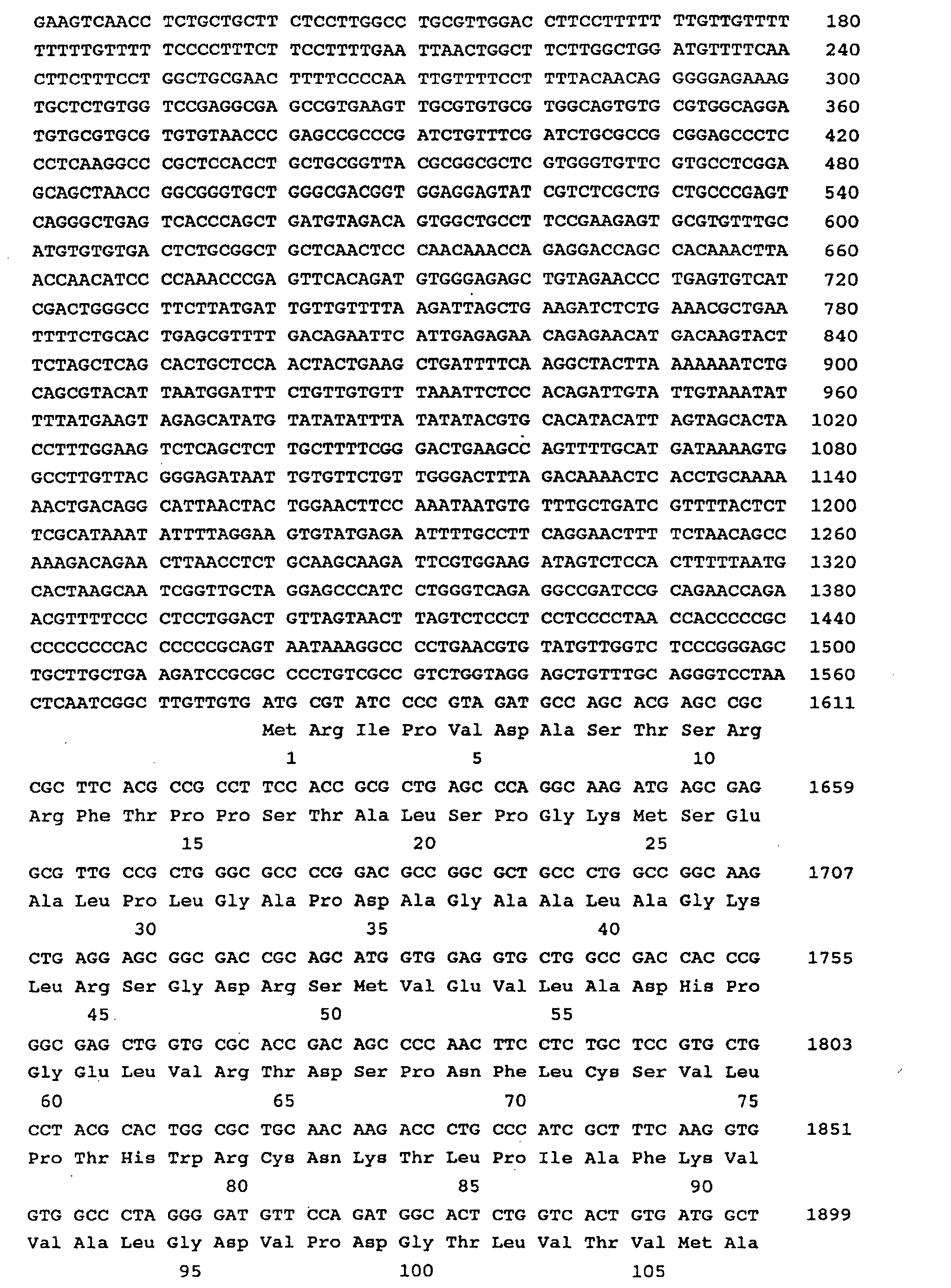
- the DNA according to the present invention whose nucleotide was determined as mentioned above, has the nucleotide sequence shown in SEQ ID No. 1.
- SEQ ID No. 1 By comparing this nucleotide sequence with the AML1 gene on chromosome 21, it is seen that the nucleotide sequence up to the 2110th base adenine is exactly the same as that of the AML1 gene and the nucleotide sequence after the 2110th nucleotide is not hitherto known, which is assumed to be a gene translocated from chromosome 8.
- this gene was named MTGB, the DNA can be called AML1-MTG8 fused DNA.
- fused site means the site between the 2110th base adenine and the 2111th base adenine.
- the deduced amino acid sequence encoded by the above-mentioned fused DNA is also shown in SEQ ID No. 1.
- fused site means the site between the 177th amino acid arginine and the 178th amino acid aspargine.
- the fused DNA according to the present invention may be prepared by the method detailed in the Example described below.
- the fused DNA according to the present invention may be easily prepared by a nucleic acid-amplifying method such as PCR method using the bone marrow cells from a t(8;21) translocation type AML patient, based on the information of the nucleotide sequence shown in SEQ ID No. 1.
- the DNA having the entire nucleotide sequence shown in SEQ ID No. 1 fragments of this DNA which contain the fused site of the nucleotide sequence and are useful for the diagnosis of t(8;21) translocation are also within the scope of the present invention. This is because that since the fused site is characteristic to t(8;21) translocation type, the DNA fragments containing the fused site are useful for the diagnosis of t(8;21) translocation type even if they do not have the full length.
- Arbitrary DNA fragments containing the fused site can be prepared by a nucleic acid-amplifying method such as PCR method using the bone marrow cells from a t(8;21) translocation type AML patient, based on the information of the nucleotide sequence shown in SEQ ID No. 1.
- a nucleic acid-amplifying method such as PCR method using the bone marrow cells from a t(8;21) translocation type AML patient, based on the information of the nucleotide sequence shown in SEQ ID No. 1.
- the polypeptide encoded by the AML1-MTG8 fused DNA according to the present invention in addition to the polypeptide having the entire amino acid sequence shown in SEQ ID No. 1, fragments thereof containing the fused site and encoded by DNA fragments useful for the diagnosis of t(8;21) translocation are also within the scope of the present invention.
- the polypeptide can be easily prepared by recombining the fused DNA according to the present invention in a vector by
- fused DNA according to the present invention was obtained by using mRNAs in bone marrow cells of a t(8;21) translocation type AML patient as a starting material, it is apparent that AML1-MTG8 fused mRNA which has the same nucleotide sequence as shown in SEQ ID NO. 1 except that thymine is substituted by uracil does exist.
- the present invention also provides such a mRNA and fragments thereof containing the fused site and useful for the diagnosis of t(8;21) translocation.
- Such a mRNA and said fragments thereof can be obtained by the method detailed in Example 1 described below.
- nucleotide sequence of the mRNA has been determined and since mRNA itself can be amplified by a nucleic acid-amplifying method such as 3SR method (Japanese Laid-open PCT Application (Kohyo) No. 2-500565) or NASBA method (Japanese Laid-open Patent Application (Kokai) No. 2-005864), optional mRNA fragments can be obtained using bone marrow cells from a t(8;21) translocation type AML patient as a starting material.
- 3SR method Japanese Laid-open PCT Application (Kohyo) No. 2-500565)
- NASBA method Japanese Laid-open Patent Application (Kokai) No. 2-005864
- the fused site in the above-described DNAs, polypeptides or mRNAs is characteristic to t(8;21) translocation type AML. Since AML1 gene and MTG8 gene exist on chromosome 21 and chromosome 8, respectively, in normal cells and cells of patients suffering from other translocation type AMLs, diagnosis of t(8;21) translocation type AML cannot be attained even if these genes are detected separately. However, since the above-mentioned fused site does not exist in normal cells and in cells of patients suffering from other translocation type AMLs, but exists only in the cells of patients suffering from t(8;21) translocation type, t(8;21) translocation type AML can be specifically diagnosed by detecting the fused site.
- the present invention first provides a probe which is the above-described fused DNA or a fragment thereof which is useful for the diagnosis of t(8;21) translocation containing the fused site and useful for the diagnosis of t(8;21) translocation, the fused DNA or the fragment thereof being labelled.
- the present invention also provides a probe which is a labelled DNA or RNA complementary to the above-described fused mRNA or a fragment thereof containing the fused site which is useful for the diagnosis of t(8;21) translocation.
- the detection of the fused DNA shown in SEQ ID No. 1 or the fused mRNA, and in turn, diagnosis of t(8;21) translocation type AML can be attained by amplifying the entire fused DNA or a fragment thereof containing the fused site, or the entire fused mRNA or a fragment thereof containing the fused site and useful for the diagnosis of t(8;21) tranlocation by a nucleic acid-amplifying method based on the information of the determined nucleotide sequence, and detecting the amplified nucleic acid fragment by staining with ethidium bromide or the like after electrophoresing the amplified nucleic acid fragment.
- Example 2 diagnosis of t(8;21) translocation type AML was attained by amplifying the sequence from the 2004th base guanine to the 2468th base cytosine by PCR method by using the sequence from the 2004th base guanine to the 2023rd base guanine as a primer 1 and using the sequence complementary to the sequence from the 2468th base cytosine to the 2451st base guanine as a primer 2 (antisense).
- the region to be amplified is not restricted to that described in Example 2 below but any region which spans the fused site may be amplified. This method has extremely high sensitivity and if one cell having the t(8;21) translocation exists in 10 8 cells, the t(8;21) translocation can be detected.
- the fused DNA according to the present invention was prepared from a mRNA in bone marrow cells of t(8;21) translocation type AML patient, the fused DNA is thought to be expressed in cells to produce a polypeptide encoded by the DNA. Therefore, by preparing an antibody, preferably a monoclonal antibody, specific to the polypeptide, or a fragment thereof encoded by a DNA fragment of the invention and containing the fused site, by a conventional method, and by specifically detecting the polypeptide using the antibody by an immunoassay, the t(8;21) translocation type AML can be diagnosed.
- an antibody preferably a monoclonal antibody, specific to the polypeptide, or a fragment thereof encoded by a DNA fragment of the invention and containing the fused site
- RNAs were isolated by AGPC method (Chomczynski et al., Anal. Biochem. 162, 156-159 (1987)). This method will now be described.
- Poly(A) + RNA was isolated from the thus isolated RNAs by using Oligotex-dT30 (NIPPON ROCHE) in accordance with the protocol of the commercial product.
- a cDNA library was prepared by the following operations:
- the nucleotide sequence of the cDNA insert recloned in pBluescript II KS + was determined using A.L.F. DNA SEQUENCER (PHARMACIA). All of the experimental procedures and reactions were in accordance with the protocol instructed by PHARMACIA.
- Example 2 Diagnosis of t(8;21) Translocation Type Myeloid Leukemia by RT-PCR Method and Detection of Minimal Residual Disease - Example
- RNAs were prepared by using a reverse transcriptase.
- the composition of the reaction solution (20 ⁇ g) is as follows: 10 mM Tris-HCl (pH 8.3), 75 mM potassium chloride, 3 mM magnesium chloride, 1 mM dithiothreitol, 1 mM dATP, 1 mM dGTP, 1 mM dCTP, 1 mM dTTP, 10 units of RNase inhibitor, 25 pmol of random hexamer, 200 units of reverse transcriptase and 1 - 5 ⁇ g of RNAs.
- the reaction mixture was left to stand at room temperature for 10 minutes to anneal the primers with the template RNAs, and the resultant was allowed to react at 37°C for 1 hour. After the reaction, the mixture was heated at 99°C for 5 minutes to inactivate the reverse transcriptase and to dissociate the generated cDNAs from the template RNAs.
- a sequence in the vicinity of the fused site of the t(8;21) transcript was amplified by using a thermostable DNA polymerase.
- the composition of the PCR solution (25 ⁇ l) is as follows: 10 mM Tris-HCl (pH 8.3), 50 mM potassium chloride, 3 mM magnesium chloride, 0.2 mM dATP, 0.2 mM dGTP, 0.2 mM dCTP, 0.2 mM TTP, 5 pmol AML1-C (5'-GAGGGAAAAGCTTCACTCTG-3'), 5 pmol MTG8-2 (5'-GCGAACTCTTTCTCCTATC-3') and 1.25 units of Taq DNA polymerase. To prevent evaporation of the reaction solution, one drop of liquid paraffin was overlaid.
- a cycle of annealing step at 62°C for 30 seconds, extension step at 72°C for 1 minute and thermal denaturing step at 95°C for 20 seconds was repeated 34 times using an automatic PCR apparatus. After completion of the 34 cycles, annealing step at 62°C for 30 seconds and extension step at 72°C for 7 minutes were carried out.
- the present invention As described above, by the present invention, specific diagnosis of t(8;21) translocation type AML was attained with high sensitivity by simple operations. Therefore, the present invention is useful for diagnosis of t(8;21) translocation type AML.
Landscapes
- Chemical & Material Sciences (AREA)
- Health & Medical Sciences (AREA)
- Life Sciences & Earth Sciences (AREA)
- Organic Chemistry (AREA)
- Proteomics, Peptides & Aminoacids (AREA)
- Zoology (AREA)
- Genetics & Genomics (AREA)
- Analytical Chemistry (AREA)
- Pathology (AREA)
- Biochemistry (AREA)
- Immunology (AREA)
- Biophysics (AREA)
- Engineering & Computer Science (AREA)
- Wood Science & Technology (AREA)
- General Health & Medical Sciences (AREA)
- Molecular Biology (AREA)
- Microbiology (AREA)
- Biotechnology (AREA)
- Physics & Mathematics (AREA)
- Oncology (AREA)
- Bioinformatics & Cheminformatics (AREA)
- General Engineering & Computer Science (AREA)
- Hospice & Palliative Care (AREA)
- Toxicology (AREA)
- Gastroenterology & Hepatology (AREA)
- Medicinal Chemistry (AREA)
- Measuring Or Testing Involving Enzymes Or Micro-Organisms (AREA)
- Peptides Or Proteins (AREA)
Abstract
Description
- The present invention relates to novel DNAs, polypeptides encoded thereby and methods for detecting the DNAs and the polypeptides. The present invention is useful for diagnosis of t(8;21) translocation type acute myeloid leukemia.
- The t(8;21) translocation type acute myeloid leukemia is an acute myeloid leukemia (hereinafter also referred to as "AML") which accompanies translocation of a gene on chromosome 8 to chromosome 21, which is one the most frequent acute myeloid leukemias ranking with t(15;17) translocation type acute myeloid leukemia. The t(8;21)(q22;q22) translocation type acute myeloid leukemia morphologically associates with FAB-M2 subtype of AML (Fourth International Workshop on Chromosomes in Leukemia, 1982, Cancer Genet. Cytogenet. 11, 284 (1984); J.D. Rowley, Sem. Hematol. 27, 122 (1990)). Leukemic cells with the t(8;21) translocation are uniquely characterized by a high frequency of Auer rods and mutation of granulocytic line (R. Berger et al., Blood 59, 171 (1982)). Cytogenetically, this translocation is often accompanied by a loss of sex chromosome which is rarely observed in acute leukemias without t(8;21) translocation.
- Diagnosis of t(8;21) translocation type AML can be attained by detecting the above-mentioned features or by analyzing the chromosomes. However, these methods are troublesome and the sensitivity of the diagnosis is not satisfactory.
- Kearney et al (Cancer Genetics and Cytogenetics, vol.57, No. 1, November 1991, pages 109-119) describes the use of a YAC clone which contains DNA sequences which hyberdise to Chromosome 21 and to the derivatives of t(8;21) (q22;q22) or AML. Shimizu et al (Genes, Chromosomes and Cancer, Vol. 3, No.3 May 1991, pages 163-167) describes identification of clones believed to the close and distal to the t(8;21) breakpoint.
- Accordingly, an object of the present invention is to provide means for diagnosing t(8;21) translocation type acute myeloid leukemia by a simple operation with high sensitivity.
- As a result of intensive study, the present inventors discovered that a transcript of a fused gene of AML1 gene (H. Miyoshi et al., Proc. Natl. Acad. Sci. U.S.A. 8, 10431 (1991)) on chromosome 21 and an unknown gene neighboring the AML1 gene exists, the unknown gene being translocated from chromosome 8. The present inventors also succeeded in determining the nucleotide sequence of the fused gene. The present inventors further discovered a method for diagnosing t(8;21) translocation type AML by specifically detecting the fused gene or the transcript thereof, thereby completing the present invention.
- That is, the present invention provides AML1-MTG8 fused DNA having the nucleotide sequence shown in SEQ ID No. 1 and DNA fragments thereof containing the fused site and useful for the diagnosis of t(8;21) translocation. It should be noted that we named the unknown gene on chromosome 8 MTG8, which gene adjoins to the AML1 gene on chromosome 21 in t(8;21) translocation.
- The present invention also provides AML1-MTG8 fused polypeptide having the amino acid sequence shown in SEQ ID No. 1 and fragments thereof containing the fused site and encoded by a DNA fragment of the present invention.
- The present invention further provides AML1-MTG8 fused mRNA having the same nucleotide sequence as shown in SEQ ID No. 1 except that thymine is replaced with uracil, and fragments thereof containing the fused site and useful for the diagnosis of t(8;21) translocation.
- The present invention still further provides probes which are said DNA fragments that are labelled, and methods for detecting the fused DNA by using the probes.
- The present invention still further provides probes which are DNAs or RNAs that are complementary to said fused mRNA or said fragments thereof, the DNAs or RNAs being labelled, as well as methods for detecting the mRNA using the probes.
- The present invention still further provides methods for detecting AML1-MTG8 fused DNA or a fragment thereof in a sample, comprising the steps of amplifying said fused DNA or a fragment thereof by a nucleic acid-amplifying method and detecting the amplified DNA fragment.
- The present invention still further provides methods for detecting AML1-MTG8 fused mRNA or said fragment thereof in a sample, comprising the steps of amplifying said fused mRNA according to the present invention or a fragment thereof by a nucleic acid-amplifying method and detecting the amplified RNA fragment.
- The present invention still further provides methods for detecting the polypeptide according to the present invention by an immunoassay employing an antibody specific to the polypeptide.
- By the present invention, a fused DNA which is specifically generated in t(8;21) translocation type AML and fragments thereof and a polypeptide encoded thereby and fragments thereof, as well as methods for detecting them were provided. By the present invention, it was first attained to diagnose t(8;21) translocation type AML specifically with high sensitivity by a simple operation.
- The nucleotide sequence of AML1-MTG8 fused DNA was determined by extracting total RNAs of bone marrow cells of a t(8;21) translocation type AML patient, preparing a cDNA library therefrom, screening the obtained cDNA library with a probe specific to AML1 gene (H. Miyoshi et al., supra), and by determining the nucleotide sequence of the DNA detected by the probe. For confirmation, a probe specific to the MTG8 moiety was prepared and the similar screening using this probe and the probe specific to AML1 gene was carried out. Further, cDNAs were prepared from the RNAs from a t(8;21) translocation type AML patient, a DNA fragment containing the fused site of the cDNA was amplified by PCR method depending on the information of the determined nucleotide sequence, and the amplified DNA fragment was detected, thereby confirming that the diagnosis of t(8;21) translocation type AML can be attained by the above-mentioned procedures. Thus, it was confirmed that the DNA according to the present invention is the AML1-MTG8 fused DNA characteristic to t(8;21) translocation type AML. The details of the above-mentioned procedures are described in Example 1 below.
- The DNA according to the present invention, whose nucleotide was determined as mentioned above, has the nucleotide sequence shown in SEQ ID No. 1. By comparing this nucleotide sequence with the AML1 gene on chromosome 21, it is seen that the nucleotide sequence up to the 2110th base adenine is exactly the same as that of the AML1 gene and the nucleotide sequence after the 2110th nucleotide is not hitherto known, which is assumed to be a gene translocated from chromosome 8. As mentioned above, since this gene was named MTGB, the DNA can be called AML1-MTG8 fused DNA. It should be noted that in the present specification, the term "fused site" means the site between the 2110th base adenine and the 2111th base adenine. The deduced amino acid sequence encoded by the above-mentioned fused DNA is also shown in SEQ ID No. 1. In the polypeptide having this amino acid sequence, the term "fused site" means the site between the 177th amino acid arginine and the 178th amino acid aspargine.
- The fused DNA according to the present invention may be prepared by the method detailed in the Example described below. Alternatively, the fused DNA according to the present invention may be easily prepared by a nucleic acid-amplifying method such as PCR method using the bone marrow cells from a t(8;21) translocation type AML patient, based on the information of the nucleotide sequence shown in SEQ ID No. 1.
- Needless to say the DNA having the entire nucleotide sequence shown in SEQ ID No. 1, fragments of this DNA which contain the fused site of the nucleotide sequence and are useful for the diagnosis of t(8;21) translocation are also within the scope of the present invention. This is because that since the fused site is characteristic to t(8;21) translocation type, the DNA fragments containing the fused site are useful for the diagnosis of t(8;21) translocation type even if they do not have the full length. Arbitrary DNA fragments containing the fused site can be prepared by a nucleic acid-amplifying method such as PCR method using the bone marrow cells from a t(8;21) translocation type AML patient, based on the information of the nucleotide sequence shown in SEQ ID No. 1. Similarly, as for the polypeptide encoded by the AML1-MTG8 fused DNA according to the present invention, in addition to the polypeptide having the entire amino acid sequence shown in SEQ ID No. 1, fragments thereof containing the fused site and encoded by DNA fragments useful for the diagnosis of t(8;21) translocation are also within the scope of the present invention. The polypeptide can be easily prepared by recombining the fused DNA according to the present invention in a vector by a conventional method and expressing the obtained recombinant vector in a host cell.
- Since the above-mentioned fused DNA according to the present invention was obtained by using mRNAs in bone marrow cells of a t(8;21) translocation type AML patient as a starting material, it is apparent that AML1-MTG8 fused mRNA which has the same nucleotide sequence as shown in SEQ ID NO. 1 except that thymine is substituted by uracil does exist. The present invention also provides such a mRNA and fragments thereof containing the fused site and useful for the diagnosis of t(8;21) translocation. Such a mRNA and said fragments thereof can be obtained by the method detailed in Example 1 described below. Alternatively, since the nucleotide sequence of the mRNA has been determined and since mRNA itself can be amplified by a nucleic acid-amplifying method such as 3SR method (Japanese Laid-open PCT Application (Kohyo) No. 2-500565) or NASBA method (Japanese Laid-open Patent Application (Kokai) No. 2-005864), optional mRNA fragments can be obtained using bone marrow cells from a t(8;21) translocation type AML patient as a starting material.
- The fused site in the above-described DNAs, polypeptides or mRNAs is characteristic to t(8;21) translocation type AML. Since AML1 gene and MTG8 gene exist on chromosome 21 and chromosome 8, respectively, in normal cells and cells of patients suffering from other translocation type AMLs, diagnosis of t(8;21) translocation type AML cannot be attained even if these genes are detected separately. However, since the above-mentioned fused site does not exist in normal cells and in cells of patients suffering from other translocation type AMLs, but exists only in the cells of patients suffering from t(8;21) translocation type, t(8;21) translocation type AML can be specifically diagnosed by detecting the fused site.
- As means for detecting the fused site, the present invention first provides a probe which is the above-described fused DNA or a fragment thereof which is useful for the diagnosis of t(8;21) translocation containing the fused site and useful for the diagnosis of t(8;21) translocation, the fused DNA or the fragment thereof being labelled. The present invention also provides a probe which is a labelled DNA or RNA complementary to the above-described fused mRNA or a fragment thereof containing the fused site which is useful for the diagnosis of t(8;21) translocation. By checking whether the sequence complementary to the probe exists or not, that is, whether the fused DNA or the fused mRNA exists or not by using the above-mentioned probe, it can be determined whether the fused site exists in the cells or not, and in turn, whether the patient suffers from t(8;21) translocation type AML or not. The method for labelling a probe is well-known in the art.
- Since the nucleotide sequence shown in SEQ ID No. 1 was determined according to the present invention, the detection of the fused DNA shown in SEQ ID No. 1 or the fused mRNA, and in turn, diagnosis of t(8;21) translocation type AML can be attained by amplifying the entire fused DNA or a fragment thereof containing the fused site, or the entire fused mRNA or a fragment thereof containing the fused site and useful for the diagnosis of t(8;21) tranlocation by a nucleic acid-amplifying method based on the information of the determined nucleotide sequence, and detecting the amplified nucleic acid fragment by staining with ethidium bromide or the like after electrophoresing the amplified nucleic acid fragment. In Example 2 described below, diagnosis of t(8;21) translocation type AML was attained by amplifying the sequence from the 2004th base guanine to the 2468th base cytosine by PCR method by using the sequence from the 2004th base guanine to the 2023rd base guanine as a primer 1 and using the sequence complementary to the sequence from the 2468th base cytosine to the 2451st base guanine as a primer 2 (antisense). Needless to say, the region to be amplified is not restricted to that described in Example 2 below but any region which spans the fused site may be amplified. This method has extremely high sensitivity and if one cell having the t(8;21) translocation exists in 108 cells, the t(8;21) translocation can be detected.
- Since the fused DNA according to the present invention was prepared from a mRNA in bone marrow cells of t(8;21) translocation type AML patient, the fused DNA is thought to be expressed in cells to produce a polypeptide encoded by the DNA. Therefore, by preparing an antibody, preferably a monoclonal antibody, specific to the polypeptide, or a fragment thereof encoded by a DNA fragment of the invention and containing the fused site, by a conventional method, and by specifically detecting the polypeptide using the antibody by an immunoassay, the t(8;21) translocation type AML can be diagnosed.
- The present invention will now be described by way of examples thereof. It should be noted, however, that the present invention is not restricted to the examples.
- From an acute myeloid leukemia cell line Kasumi-1 (H. Asou et al., Blood, 77, 2031 (1991)), RNAs were isolated by AGPC method (Chomczynski et al., Anal. Biochem. 162, 156-159 (1987)). This method will now be described.
- 1) Kasumi-1 cells are collected by centrifugation as a precipitate and 1 ml of Solution D (4M guanidine thiocyanate, 25 mM sodium citrate, 0.5% sarcosine and 0.1 M 2-mercaptoethanol) is added per 107 cells to solubilize the cells in Solution D.
- 2) The following reagents were added sequentially and
the mixture is mixed each time the each reagent is added.
2 M sodium acetate (pH 4.0) 1/10 volume
water-saturated phenol equivolume
chloroform/isoamyl alcohol (49:1) 1/5 volume - 3) The resulting mixture is vigorously shaken for 10 seconds and cooled in ice for 15 minutes
- 4) The resulting mixture is transferred to a centrifugal tube and centrifuged at 4°C, 10,000 x g for 20 minutes.
- 5) The aqueous layer is transferred to another centrifugal tube, equivolume isopropanol is added and the resulting mixture is well mixed.
- 6) The mixture is left to stand at -20°C for 1 hour.
- 7) The resultant is centrifuged at 4°C, 10,000 x g for 20 minutes.
- 8) The supernatant is discarded and Solution D is added to the precipitate of RNAs in an amount of 0.1 ml per 107 cells. To the resulting solution, equivolume of isopropanol is added and the resultant is well mixed.
- 9) The resulting mixture is left to stand at -20°C for 1 hour.
- 10) The resultant is centrifuged at 4°C, 10,000 x g for 10 minutes.
- 11) The supernatant is discarded and the precipitate of RNAs is washed with 75% ethanol, followed by drying the precipitate.
- 12) The obtained precipitate is dissolved in appropriate amount of DEPC-treated distilled water.
-
- Poly(A)+RNA was isolated from the thus isolated RNAs by using Oligotex-dT30 (NIPPON ROCHE) in accordance with the protocol of the commercial product.
- Using about 5 µg of the poly(A)+RNA purified from Kasumi-1 cells, a cDNA library was prepared by the following operations:
- 1) About 5 µg of poly(A)+RNA and 2.5 µg of oligo d(T)12-18 (PHARMACIA) are heated at 70°C for 10 minutes in DEPC-treated distilled water, and the resultant is then cooled in ice.
- 2) Fifty microliters of a reaction mixture (50 mM Tris-HCl (pH 8.3), 40 mM KCl, 10 mM DTT, 6 mM MgCl2 and 0.5 mM dNTP) is prepared, and 40 units of RNase inhibitor (commercially available from BOEHRINGER) and 500 units of M-MLV H- reverse transcriptase (BRL) are added thereto. The mixture is then incubated at 37°C for 1 hour to synthesize ss-cDNA.
- 3) Four hundred microliters of a reaction mixture (20 mM Tris-HCl (pH 6.9), 90 mM KCl, 5 mM MgCl2, 0.15 mM β-NAD, 10 mM (NH4)2SO4, 5 mM DTT and 0.25 mM dNTP) is prepared, and 30 units of E. coli DNA ligase (NEB), 40 units of E. coli DNA polymerase I and 4 units of E. coli RNaseH (BRL) are added thereto. The resulting mixture is incubated at 16°C for 2 hours and 10 units of T4 DNA polymerase (BRL) is added thereto, followed by incubating the resultant at 37°C for 15 minutes to synthesize ds-cDNAs.
- 4) Sixteen microliters of 0.5 M EDTA (pH 8.0) is added to the resulting mixture.
- 5) The resultant is extracted with 400 µl of phenol/chloroform mixture.
- 6) The resultant is extracted with 400 µl of chloroform.
- 7) 1/10 volume of 3M sodium acetate (pH 5.2) and 2.5 times volume of ethanol are added and the resultant is centrifuged to recover ds-cDNAs as a precipitate.
- 8) EcoRI/NotI adaptor (PHARMACIA) and 400 units of T4 DNA ligase (NEB) are added and the resulting mixture is allowed to react at 16°C for 16 hours to ligate the ds-cDNAs with the adaptor.
- 9) The resultant is reacted with 20 units of T4 polynucleotide kinase (BRL) at 37°C for 30 minutes to carry out phospholylation.
- 10) The resultant is incubated at 65°C for 10 minutes.
- 11) The steps 5) - 7) are repeated.
- 12) The cDNAs are fractionated by density gradient centrifugation in potassium acetate and fractions of cDNAs of not less than 2 kb are collected.
- 13) The cDNAs are digested with restriction enzyme EcoRI, and 1 µg of λ ZAP II vector (STRATAGENE) and 200 units of T4 DNA ligase (NEB) are added. The resultant is allowed to react overnight at 16°C.
- 14) The reaction mixture is subjected to packaging using GIGAPACK II PACKAGING EXTRACTS (STRATAGENE) and λ plaques in E. coli XL1-Blue as a host, thereby preparing a library.
-
- Screening of the cDNA library comprising about 1,000,000 plaques was carried out as follows:
- 1) Library is prepared using plates with a diameter of about 15 cm and the number of plaques on one plate is adjusted to 40,000 to 50,000.
- 2) On each plate in which plaques are formed, a nylon membrane HYBOND-N (AMERSHAM) is placed and left to stand for 1 minute.
- 3) The nylon membrane is gently peeled off from the plate and immersed in a denaturing solution (0.5 N NaOH, 1.5 M NaCl) for 5 minutes.
- 4) The membrane is immersed in a neutralization solution (0.5 M Tris-HCl (pH 7.5), 1.5 M NaCl) for 5 minutes.
- 5) The membrane is washed with 2 x SSC (1 x SSC: 0.15 M NaCl, 15 mM sodium citrate) and dried in the air. The nylon membrane is then irradiated with U.V. with a wavelength of 312 nm to fix DNAs on the membrane.
- 6) AML1 cDNA probe (C6E6H2, (H. Miyoshi et al., supra) or a part of CH15 clone isolated by RT/PCR method (CH15H2S, 2247 - 2701 bases) is labelled with 32P by using a multiprime labelling kit (AMERSHAM) and then boiled and rapidly cooled to denature the probe.
- 7) The labelled probe and the nylon membrane are incubated in a hybridization solution (6 x SSC, 10% dextran sulfate, 1% SDS, 1 x Denhalt's solution, 50% formamide) at 42°C overnight to carry out hybridization.
- 8) The membrane is washed with 2 x SSC, 1% SDS solution.
- 9) The membrane is washed with 0.1 x SSC, 0.1% SDS solution at 65°C for 1 hour.
- 10) The membrane is sandwiched between SARAN WRAP (trademark) and the resultant is laminated on an X-ray film, followed by conducting autoradiography.
- 11) Phage DNAs of positive clones are purified.
- 12) The phage DNAs are digested with restriction enzyme Not I and the insert regions are recloned to Not I site of pBluescript II KS+ (STRATAGENE).
-
- The nucleotide sequence of the cDNA insert recloned in pBluescript II KS+ (PHARMACIA) was determined using A.L.F. DNA SEQUENCER (PHARMACIA). All of the experimental procedures and reactions were in accordance with the protocol instructed by PHARMACIA.
- Using 1 - 5 µg of total RNAs from bone marrow cells of a leukemia patient, cDNAs were prepared by using a reverse transcriptase. The composition of the reaction solution (20 µg) is as follows: 10 mM Tris-HCl (pH 8.3), 75 mM potassium chloride, 3 mM magnesium chloride, 1 mM dithiothreitol, 1 mM dATP, 1 mM dGTP, 1 mM dCTP, 1 mM dTTP, 10 units of RNase inhibitor, 25 pmol of random hexamer, 200 units of reverse transcriptase and 1 - 5 µg of RNAs. The reaction mixture was left to stand at room temperature for 10 minutes to anneal the primers with the template RNAs, and the resultant was allowed to react at 37°C for 1 hour. After the reaction, the mixture was heated at 99°C for 5 minutes to inactivate the reverse transcriptase and to dissociate the generated cDNAs from the template RNAs.
- Using 1/10 volume (2 µl) of the reverse transcripts (cDNAs), a primer AML1-C which has a sequence of apart of AML1 gene and a primer MTG8-2 which has a sequence of a part of MTG8 gene, a sequence in the vicinity of the fused site of the t(8;21) transcript was amplified by using a thermostable DNA polymerase. The composition of the PCR solution (25 µl) is as follows: 10 mM Tris-HCl (pH 8.3), 50 mM potassium chloride, 3 mM magnesium chloride, 0.2 mM dATP, 0.2 mM dGTP, 0.2 mM dCTP, 0.2 mM TTP, 5 pmol AML1-C (5'-GAGGGAAAAGCTTCACTCTG-3'), 5 pmol MTG8-2 (5'-GCGAACTCTTTCTCCTATC-3') and 1.25 units of Taq DNA polymerase. To prevent evaporation of the reaction solution, one drop of liquid paraffin was overlaid.
After denaturing the DNAs at 95°C for 2 minutes, a cycle of annealing step at 62°C for 30 seconds, extension step at 72°C for 1 minute and thermal denaturing step at 95°C for 20 seconds was repeated 34 times using an automatic PCR apparatus. After completion of the 34 cycles, annealing step at 62°C for 30 seconds and extension step at 72°C for 7 minutes were carried out. - After the PCR, 1/5 volume of 6 x loading buffer (containing 30% glycerol, 0.25% Bromphenol Blue, 0.25% xylenecyanol was added and the mixture was well stirred. Half of the resultant was subjected to 3% Nusieve 3:1 agarose gel electrophoresis. The electrophoresis was performed in a buffer solution containing 0.5 µg/ml of ethidium bromide. After the electrophoresis, the gel was irradiated with U.V. and a DNA product stained with ethidium bromide was detected. When AML1-C and MTG8-2 are used as primers, the amplification of DNA of 457 bp indicated the t(8;21) translocation. By this method, diagnosis of t(8;21) translocation type AML was attained with high sensitivity.
- As described above, by the present invention, specific diagnosis of t(8;21) translocation type AML was attained with high sensitivity by simple operations. Therefore, the present invention is useful for diagnosis of t(8;21) translocation type AML.
-
- (i) APPLICANT:
- (A) NAME: SRL,Inc.
- (B) STREET: 4-1, Nishishinjuku 2-chome
- (C) CITY: Shinjuku-ku
- (D) STATE: Tokyo
- (E) COUNTRY: Japan
- (F) POSTAL CODE (ZIP): Tokyo 163
- (ii) TITLE OF INVENTION: Novel DNA, polypeptide encoded by the same and methods for detecting the DNA and the polypeptide.
- (iii) NUMBER OF SEQUENCES: 1
- (iv) COMPUTER READABLE FORM:
- (A) MEDIUM TYPE: Floppy disk
- (B) COMPUTER: IBM PC compatible
- (C) OPERATING SYSTEM: PC-DOS/MS-DOS
- (D) SOFTWARE: PatentIn Release #1.0, Version #1.25 (EPO)
- (v) CURRENT APPLICATION DATA: APPLICATION NUMBER: EP 93921068.8
- (vi) PRIOR APPLICATION DATA:
- (A) APPLICATION NUMBER: JP 285520/92
- (B) FILING DATE: 29-SEP-1992
-
-
- (i) SEQUENCE CHARACTERISTICS:
- (A) LENGTH: 4287 base pairs
- (B) TYPE: nucleic acid
- (C) STRANDEDNESS: both
- (D) TOPOLOGY: linear
- (vi) ORIGINAL SOURCE: bone marrow cell of t(8;21) translocation type myeloid leukemia patient
- (xi) SEQUENCE DESCRIPTION: SEQ ID NO: 1:



-
Claims (13)
- AML1-MTG8 fused DNA having the nucleotide sequence shown in SEQ ID No.1.
- A fragment of the DNA of claim 1, the fragment containing the fused site (between 2110th nucleotide and the 2111st nucleotide) of AML1-MTG8 fused DNA having the nucleotide sequence shown in SEQ ID No.1, wherein the fragment is useful for the diagnosis of t(8;21) translocation.
- AML1-MTG8 fused polypeptide having the amino acid sequence shown in SEQ ID No.1.
- A polypeptide encoded by the fragment of claim 2, the polypeptide containing the fused site (between 177th amino acid arginine and 178th amino acid asparagine) of AML1-MTG8 fused polypeptide having the amino acid sequence shown in SEQ ID No.1.
- AML1-MTG8 fused mRNA having the same nucleotide sequence as shown in SEQ ID No.1 except that thymine is replaced with uracil.
- A mRNA fragment of said AML1-MTG8 fused mRNA of claim 5, which fragment contains the fused site of said AML1-MTG8 fused mRNA and is useful for the diagnosis of t(8;21) translocation.
- A probe which is said fused DNA of claim 1 or said DNA fragment of claim 2 that is labelled.
- A method for detecting said DNA of claim 1 by using said probe of claim 7.
- A probe which is a DNA or an RNA that is complementary to said fused mRNA of claim 5 or to said mRNA fragment of claim 6, said DNA or RNA being labelled.
- A method for detecting said mRNA of claim 5 or said mRNA fragment of claim 6 by using said probe of claim 9.
- A method for detecting AML1-MTG8 fused DNA or a fragment thereof in a sample, comprising the steps of amplifying said fused DNA of claim 1 or said DNA fragment of claim 2 by a nucleic acid-amplifying method and detecting the amplified DNA fragment.
- A method for detecting AML1-MTG8 fused mRNA or a fragment thereof in a sample, comprising the steps of amplifying said fused mRNA of claim 5 or said mRNA fragment of claim 6 by a nucleic acid-amplifying method and detecting the amplified RNA fragment.
- A method for detecting said polypeptide of claim 3 or 4 by an immunoassay employing an antibody specific to said polypeptide of claim 3 or 4.
Applications Claiming Priority (4)
| Application Number | Priority Date | Filing Date | Title |
|---|---|---|---|
| JP28552092A JP3292387B2 (en) | 1992-09-29 | 1992-09-29 | Novel DNA, polypeptide it encodes and methods for their detection |
| JP28552092 | 1992-09-29 | ||
| JP285520/92 | 1992-09-29 | ||
| PCT/JP1993/001370 WO1994008005A1 (en) | 1992-09-29 | 1993-09-27 | Novel dna, polypeptide coded for thereby, and method of detecting both |
Publications (3)
| Publication Number | Publication Date |
|---|---|
| EP0625573A1 EP0625573A1 (en) | 1994-11-23 |
| EP0625573A4 EP0625573A4 (en) | 1998-02-04 |
| EP0625573B1 true EP0625573B1 (en) | 2003-12-03 |
Family
ID=17692598
Family Applications (1)
| Application Number | Title | Priority Date | Filing Date |
|---|---|---|---|
| EP93921068A Expired - Lifetime EP0625573B1 (en) | 1992-09-29 | 1993-09-27 | Novel dna, polypeptide coded for thereby, and method of detecting both |
Country Status (5)
| Country | Link |
|---|---|
| US (1) | US5580727A (en) |
| EP (1) | EP0625573B1 (en) |
| JP (1) | JP3292387B2 (en) |
| DE (1) | DE69333331T2 (en) |
| WO (1) | WO1994008005A1 (en) |
Families Citing this family (3)
| Publication number | Priority date | Publication date | Assignee | Title |
|---|---|---|---|---|
| US5547838A (en) * | 1992-10-01 | 1996-08-20 | Life Technologies, Inc. | Method for the rapid and ultra-sensitive detection of leukemic cells |
| US6153729A (en) * | 1997-06-20 | 2000-11-28 | St. Jude's Children's Research Hospital | Isolated nuclear matrix targeting peptide |
| US6849400B1 (en) * | 1997-07-23 | 2005-02-01 | Gen-Probe Incorporated | Methods for detecting and measuring spliced nucleic acids |
Family Cites Families (3)
| Publication number | Priority date | Publication date | Assignee | Title |
|---|---|---|---|---|
| JPS61227784A (en) * | 1984-11-14 | 1986-10-09 | オンコジ−ン・サイエンス・インコ−ポレ−テツド | Probe useful for detection of chromosme translocation |
| US4683202A (en) * | 1985-03-28 | 1987-07-28 | Cetus Corporation | Process for amplifying nucleic acid sequences |
| JP3075309B2 (en) * | 1991-11-28 | 2000-08-14 | 宇部興産株式会社 | Gene AML1 |
-
1992
- 1992-09-29 JP JP28552092A patent/JP3292387B2/en not_active Expired - Lifetime
-
1993
- 1993-09-27 WO PCT/JP1993/001370 patent/WO1994008005A1/en not_active Ceased
- 1993-09-27 DE DE69333331T patent/DE69333331T2/en not_active Expired - Lifetime
- 1993-09-27 EP EP93921068A patent/EP0625573B1/en not_active Expired - Lifetime
-
1994
- 1994-08-15 US US08/244,189 patent/US5580727A/en not_active Expired - Lifetime
Also Published As
| Publication number | Publication date |
|---|---|
| EP0625573A1 (en) | 1994-11-23 |
| JPH06113863A (en) | 1994-04-26 |
| DE69333331D1 (en) | 2004-01-15 |
| US5580727A (en) | 1996-12-03 |
| DE69333331T2 (en) | 2004-10-21 |
| WO1994008005A1 (en) | 1994-04-14 |
| JP3292387B2 (en) | 2002-06-17 |
| EP0625573A4 (en) | 1998-02-04 |
Similar Documents
| Publication | Publication Date | Title |
|---|---|---|
| US6291170B1 (en) | Multi-genes expression profile | |
| US6406891B1 (en) | Dual RT procedure for cDNA synthesis | |
| US5496699A (en) | Detection of allele - specific mutagens | |
| EP0679716A1 (en) | Gene signature | |
| US20020009738A1 (en) | Methods, compositions and kits for the detection and monitoring of breast cancer | |
| WO1993020235A1 (en) | Methods of detecting mammalian nucleic acids isolated from stool specimen and reagents therefor | |
| US20030170631A1 (en) | Methods, compositions and kits for the detection and monitoring of breast cancer | |
| Scurto et al. | A multiplex RT-PCR assay for the detection of chimeric transcripts encoded by the risk-stratifying translocations of pediatric acute lymphoblastic leukemia | |
| EP1105527A1 (en) | Method of identifying gene transcription patterns | |
| US5550020A (en) | Method, reagents and kit for diagnosis and targeted screening for retinoblastoma | |
| US5858663A (en) | Method for the rapid and ultra-sensitive detection of leukemic cells | |
| US6265165B1 (en) | Methods for EST-specific full length cDNA cloning | |
| Wang et al. | Expression Analysis: Suppression subtractive hybridisation: application in the discovery of novel pharmacological targets | |
| US5580727A (en) | Amli-MTg8 fusion protein resulting from T(8;21) translocation in acute myeloid leukemia | |
| EP1369477A1 (en) | METHOD OF CONSTRUCTING cDNA TAG FOR IDENTIFYING EXPRESSED GENE AND METHOD OF ANALYZING GENE EXPRESSION | |
| EP1537242A1 (en) | Method for preparation of cdna tags for identifying expressed genes and method for analysis of gene expression | |
| Colleoni et al. | Comparison of a Multiplex Reverse Transcriptase–Polymerase Chain Reaction for BCR-ABL to Fluorescence In Situ Hybridization, Southern Blotting, and Conventional Cytogenetics in the Monitoring of Patients With Ph1-Positive Leukemias | |
| Hilborne et al. | Diagnostic applications of recombinant nucleic acid technology: basic techniques | |
| US7049102B1 (en) | Multi-gene expression profile | |
| Liang | Analysis of messenger RNA by differential display | |
| JP2001518311A (en) | Linking Diseases by Hierarchical Loci | |
| AU620628B2 (en) | Dna amplification and subtraction techniques | |
| Schweinfest et al. | Subtraction hybridization cDNA libraries | |
| cDNA Synthesis | The Journal of Laboratory Technology for Bioresearch | |
| Hozier et al. | Finding candidate genes by preparative in situ hybridization |
Legal Events
| Date | Code | Title | Description |
|---|---|---|---|
| PUAI | Public reference made under article 153(3) epc to a published international application that has entered the european phase |
Free format text: ORIGINAL CODE: 0009012 |
|
| 17P | Request for examination filed |
Effective date: 19940629 |
|
| AK | Designated contracting states |
Kind code of ref document: A1 Designated state(s): CH DE FR GB IT LI NL SE |
|
| A4 | Supplementary search report drawn up and despatched |
Effective date: 19971218 |
|
| AK | Designated contracting states |
Kind code of ref document: A4 Designated state(s): CH DE FR GB IT LI NL SE |
|
| 17Q | First examination report despatched |
Effective date: 19990816 |
|
| GRAH | Despatch of communication of intention to grant a patent |
Free format text: ORIGINAL CODE: EPIDOS IGRA |
|
| GRAS | Grant fee paid |
Free format text: ORIGINAL CODE: EPIDOSNIGR3 |
|
| GRAA | (expected) grant |
Free format text: ORIGINAL CODE: 0009210 |
|
| AK | Designated contracting states |
Kind code of ref document: B1 Designated state(s): CH DE FR GB IT LI NL SE |
|
| REG | Reference to a national code |
Ref country code: GB Ref legal event code: FG4D |
|
| REG | Reference to a national code |
Ref country code: CH Ref legal event code: EP |
|
| REF | Corresponds to: |
Ref document number: 69333331 Country of ref document: DE Date of ref document: 20040115 Kind code of ref document: P |
|
| REG | Reference to a national code |
Ref country code: SE Ref legal event code: TRGR |
|
| ET | Fr: translation filed | ||
| PLBE | No opposition filed within time limit |
Free format text: ORIGINAL CODE: 0009261 |
|
| STAA | Information on the status of an ep patent application or granted ep patent |
Free format text: STATUS: NO OPPOSITION FILED WITHIN TIME LIMIT |
|
| 26N | No opposition filed |
Effective date: 20040906 |
|
| PGFP | Annual fee paid to national office [announced via postgrant information from national office to epo] |
Ref country code: NL Payment date: 20100726 Year of fee payment: 18 Ref country code: CH Payment date: 20100726 Year of fee payment: 18 |
|
| PGFP | Annual fee paid to national office [announced via postgrant information from national office to epo] |
Ref country code: SE Payment date: 20100726 Year of fee payment: 18 Ref country code: IT Payment date: 20100728 Year of fee payment: 18 Ref country code: FR Payment date: 20100806 Year of fee payment: 18 |
|
| PGFP | Annual fee paid to national office [announced via postgrant information from national office to epo] |
Ref country code: GB Payment date: 20100720 Year of fee payment: 18 |
|
| PGFP | Annual fee paid to national office [announced via postgrant information from national office to epo] |
Ref country code: DE Payment date: 20100727 Year of fee payment: 18 |
|
| REG | Reference to a national code |
Ref country code: NL Ref legal event code: V1 Effective date: 20120401 |
|
| REG | Reference to a national code |
Ref country code: CH Ref legal event code: PL |
|
| GBPC | Gb: european patent ceased through non-payment of renewal fee |
Effective date: 20110927 |
|
| PG25 | Lapsed in a contracting state [announced via postgrant information from national office to epo] |
Ref country code: IT Free format text: LAPSE BECAUSE OF NON-PAYMENT OF DUE FEES Effective date: 20110927 |
|
| REG | Reference to a national code |
Ref country code: FR Ref legal event code: ST Effective date: 20120531 |
|
| REG | Reference to a national code |
Ref country code: SE Ref legal event code: EUG |
|
| REG | Reference to a national code |
Ref country code: DE Ref legal event code: R119 Ref document number: 69333331 Country of ref document: DE Effective date: 20120403 |
|
| PG25 | Lapsed in a contracting state [announced via postgrant information from national office to epo] |
Ref country code: CH Free format text: LAPSE BECAUSE OF NON-PAYMENT OF DUE FEES Effective date: 20110930 Ref country code: NL Free format text: LAPSE BECAUSE OF NON-PAYMENT OF DUE FEES Effective date: 20120401 Ref country code: DE Free format text: LAPSE BECAUSE OF NON-PAYMENT OF DUE FEES Effective date: 20120403 Ref country code: LI Free format text: LAPSE BECAUSE OF NON-PAYMENT OF DUE FEES Effective date: 20110930 |
|
| PG25 | Lapsed in a contracting state [announced via postgrant information from national office to epo] |
Ref country code: GB Free format text: LAPSE BECAUSE OF NON-PAYMENT OF DUE FEES Effective date: 20110927 Ref country code: FR Free format text: LAPSE BECAUSE OF NON-PAYMENT OF DUE FEES Effective date: 20110930 |
|
| PG25 | Lapsed in a contracting state [announced via postgrant information from national office to epo] |
Ref country code: SE Free format text: LAPSE BECAUSE OF NON-PAYMENT OF DUE FEES Effective date: 20110928 |