EP0624683B1 - Method for dyeing polyester fibers in an alkaline dyeing bath in the presence of aminoacid and of polyamino-polycarboxylic acid - Google Patents
Method for dyeing polyester fibers in an alkaline dyeing bath in the presence of aminoacid and of polyamino-polycarboxylic acid Download PDFInfo
- Publication number
- EP0624683B1 EP0624683B1 EP93107744A EP93107744A EP0624683B1 EP 0624683 B1 EP0624683 B1 EP 0624683B1 EP 93107744 A EP93107744 A EP 93107744A EP 93107744 A EP93107744 A EP 93107744A EP 0624683 B1 EP0624683 B1 EP 0624683B1
- Authority
- EP
- European Patent Office
- Prior art keywords
- acid
- group
- dyeing
- salt
- amino acid
- Prior art date
- Legal status (The legal status is an assumption and is not a legal conclusion. Google has not performed a legal analysis and makes no representation as to the accuracy of the status listed.)
- Expired - Lifetime
Links
Classifications
-
- C—CHEMISTRY; METALLURGY
- C09—DYES; PAINTS; POLISHES; NATURAL RESINS; ADHESIVES; COMPOSITIONS NOT OTHERWISE PROVIDED FOR; APPLICATIONS OF MATERIALS NOT OTHERWISE PROVIDED FOR
- C09B—ORGANIC DYES OR CLOSELY-RELATED COMPOUNDS FOR PRODUCING DYES, e.g. PIGMENTS; MORDANTS; LAKES
- C09B67/00—Influencing the physical, e.g. the dyeing or printing properties of dyestuffs without chemical reactions, e.g. by treating with solvents grinding or grinding assistants, coating of pigments or dyes; Process features in the making of dyestuff preparations; Dyestuff preparations of a special physical nature, e.g. tablets, films
- C09B67/0033—Blends of pigments; Mixtured crystals; Solid solutions
- C09B67/0046—Mixtures of two or more azo dyes
- C09B67/0051—Mixtures of two or more azo dyes mixture of two or more monoazo dyes
-
- C—CHEMISTRY; METALLURGY
- C09—DYES; PAINTS; POLISHES; NATURAL RESINS; ADHESIVES; COMPOSITIONS NOT OTHERWISE PROVIDED FOR; APPLICATIONS OF MATERIALS NOT OTHERWISE PROVIDED FOR
- C09B—ORGANIC DYES OR CLOSELY-RELATED COMPOUNDS FOR PRODUCING DYES, e.g. PIGMENTS; MORDANTS; LAKES
- C09B67/00—Influencing the physical, e.g. the dyeing or printing properties of dyestuffs without chemical reactions, e.g. by treating with solvents grinding or grinding assistants, coating of pigments or dyes; Process features in the making of dyestuff preparations; Dyestuff preparations of a special physical nature, e.g. tablets, films
- C09B67/0071—Process features in the making of dyestuff preparations; Dehydrating agents; Dispersing agents; Dustfree compositions
- C09B67/008—Preparations of disperse dyes or solvent dyes
-
- D—TEXTILES; PAPER
- D06—TREATMENT OF TEXTILES OR THE LIKE; LAUNDERING; FLEXIBLE MATERIALS NOT OTHERWISE PROVIDED FOR
- D06P—DYEING OR PRINTING TEXTILES; DYEING LEATHER, FURS OR SOLID MACROMOLECULAR SUBSTANCES IN ANY FORM
- D06P1/00—General processes of dyeing or printing textiles, or general processes of dyeing leather, furs, or solid macromolecular substances in any form, classified according to the dyes, pigments, or auxiliary substances employed
- D06P1/44—General processes of dyeing or printing textiles, or general processes of dyeing leather, furs, or solid macromolecular substances in any form, classified according to the dyes, pigments, or auxiliary substances employed using insoluble pigments or auxiliary substances, e.g. binders
- D06P1/64—General processes of dyeing or printing textiles, or general processes of dyeing leather, furs, or solid macromolecular substances in any form, classified according to the dyes, pigments, or auxiliary substances employed using insoluble pigments or auxiliary substances, e.g. binders using compositions containing low-molecular-weight organic compounds without sulfate or sulfonate groups
- D06P1/642—Compounds containing nitrogen
- D06P1/647—Nitrogen-containing carboxylic acids or their salts
-
- D—TEXTILES; PAPER
- D06—TREATMENT OF TEXTILES OR THE LIKE; LAUNDERING; FLEXIBLE MATERIALS NOT OTHERWISE PROVIDED FOR
- D06P—DYEING OR PRINTING TEXTILES; DYEING LEATHER, FURS OR SOLID MACROMOLECULAR SUBSTANCES IN ANY FORM
- D06P3/00—Special processes of dyeing or printing textiles, or dyeing leather, furs, or solid macromolecular substances in any form, classified according to the material treated
- D06P3/34—Material containing ester groups
- D06P3/52—Polyesters
- D06P3/54—Polyesters using dispersed dyestuffs
Definitions
- the present invention relates to a method for dyeing polyester fibers by means of a disperse dye by an exhaustion method under an alkaline condition in an aqueous medium in good reproducibility while preventing the decomposition of the disperse dye, and showing good scouring effect (especially desizing effect).
- the present inventors have conducted extensive studies for a dyeing method to improve the desizing effect during the exhaustion dyeing of polyester fibers by means of a disperse dye under an alkaline condition and in the presence of a certain amino acid or a derivative thereof. As a result, they have found that by incorporating a specific polycarboxylic acid and a salt thereof to the dyeing bath, the sizing agent can be effectively removed, disperse dye can be stabilized, and dyeing can be conducted satisfactorily.
- the present invention provides a method for dyeing polyester fibers by using a disperse dye, wherein said dyeing is conducted under an alkaline condition in an aqueous medium in the presence of 1 at least one amino acid member selected from the group consisting of an amino acid, an amino acid derivative having at least one hydrogen atom of its amino group replaced with an organic group, and a salt of such an amino acid or amino acid derivative, and 2 at least one polycarboxylic acid or a salt thereof selected from the group consisting of ethylenediamine having at least two hydrogen atoms of its amino group replaced with a -RCOOH group (R means a C1 ⁇ 3 alkylene group) and a salt thereof; polyethylenepolyamine having at least two hydrogen atoms of its amino group or imino group replaced with a -RCOOH group (R means the same as defined above) and a salt thereof; and nitrilotriacetic acid; nitrilotripropionic acid, iminodiacetic acid, iminodipropionic
- the disperse dye to be used in the present invention is not particularly restricted as far as it is resistant to alkaline under alkaline dyeing condition and includes azo type disperse dyes such as monoazo type and disazo type and disperse dyes such as anthraquinone type, phthalocyanine type and copper formazan type. Particularly preferred is an azo type dye. More specifically, disperse dyes having the structures of the following formulas (I) to (VI), may be mentioned.
- each of X1 to X3 is a hydrogen atom, a lower alkyl group, a nitro group, a cyano group or a halogen atom
- Y1 is a hydrogen atom, a lower alkoxy group or a lower alkyl group
- Y is a hydrogen atom or an acyl amino group
- each of R1 and R is a hydrogen atom or a lower alkyl group which may be substituted by a cyano group, a hydroxyl group, a halogen atom, an alkylcarbonyl group, a lower alkylcarbonyloxy group, a phenyl group, a phenoxy group or a benzoyloxy group.
- each of X4 and X5 is a hydrogen atom, a halogen atom or a nitro group, and Y1, Y, R1 and R are as defined above.
- X6 is a hydrogen atom, a nitro group, a lower alkyl group or a halogen atom
- Y3 is a hydrogen atom, a lower alkyl group or a lower alkoxy group
- R1 and R are as defined above.
- X7 is a hydrogen atom, a halogen atom, a nitro group or a lower alkoxycarbonylamino group
- Y1 is as defined above.
- Z1 is a hydrogen atom or a methyl group
- x6, Y1, R1 and R are as defined above.
- the type of the amino acid used in the present invention may be a neutral amino acid such as glycine, alanine, aminobutyric acid or aminocaproic acid; an acidic amino acid such as aspartic acid or glutamic acid; and a basic amino acid such as lysine or arginine.
- glycine, alanine or glutamic acid is preferred, and glycine and glutamic acid is more preferred. Particularly preferred is glycine.
- the amino acid derivative may be a compound having at least one, preferably two, hydrogen atoms in the amino group replaced with an organic group. Further, with respect to an amino acid having two or more amino groups, it is sufficient that at least one hydrogen atom of one of the amino groups is replaced with an organic group. There is no particular restriction as to the substituent for the amino acid, so long as it does not impair the water solubility of the amino acid derivative or it does not provide adverse effects in the dyeing bath.
- amino acid derivative N,N-dimethylglycine, N-methylglycine, N,N-bishydroxyethylglycine and N-methylalanine are preferred as specific examples.
- the salt of such an amino acid or an amino acid derivative is usually an alkali metal salt, such as a lithium salt, a sodium salt or a potassium salt. particularly preferred is a sodium salt.
- an amino acid or an amino acid derivative when added in an alkaline medium, such an acid or acid derivative will be present in the form of a salt in the system.
- the amount of such an amino acid or an amino acid derivative, or a salt thereof is usually from 0.02 to 2.0 g/l, preferably from 0.05 to 1.0 g/l, in the dyeing bath from the viewpoint of the effects for preventing the decomposition of the disperse dye.
- a specific polycarboxylic acid or a salt thereof is incorporated to the dyeing bath in addition to the amino acid, the amino acid derivative or the salt thereof.
- a specific polycarboxylic acid or a salt thereof is at least one member selected from the group consisting of ethylenediamine having at least two hydrogen atoms of its amino group replaced with a -RCOOH group (R means a C1 ⁇ 3 alkylene group) and a salt thereof; polyethylenepolyamine having at least two hydrogen atoms of its amino group or imino group replaced with a -RCOOH group (R means the same as defined above) or a salt thereof; and nitrilotriacetic acid (NTA), nitrilotripropionic acid (NTP), iminodiacetic acid (IDA), iminodipropionic acid (IDP), ⁇ -hydroxyethyl-iminodiacetic acid, ⁇ -hydroxyethyl-iminodipropionic acid and salts thereof.
- NTA
- the amino group of ethylenediamine or polyethylenepolyamine can further be substituted by a hydroxyalkyl group having 1 to 3 carbon atoms, such as a hydroxyethyl group in addition to a -RCOOH group.
- R in the -RCOOH group is an alkylene group having 1 to 3 carbon atoms, such as a methylene group, a ethylene group, a propylene group or an isopropylene group, and particularly preferred is a methylene group.
- the number of the ethylene units in the polyethylenepolyamine is 2 to 4, and the number of amino groups or imino groups therein is 2 to 8 according to the number of ethylene units.
- polycarboxylic acid prepared from ethylenediamine or polyethylenepolyamine having at least two hydrogen atoms of its amino group or imino group replaced with a -RCOOH group are:
- the preferred polycarboxylic acid is ethylenediaminediacetic acid, ethylenediamine-N,N,N',N'-tetraacetic acid, nitrilotriacetic acid or iminodiacetic acid.
- the salt of the polycarboxylic acid is usually an alkaline metal salt, such as a lithium salt, a sodium salt or a potassium salt, and the sodium salt is preferred.
- the polycarboxylic acid When the polycarboxylic acid is added to the alkaline dyeing bath, a certain amount of alkaline is used to form the alkaline salt of said carboxylic acid. Therefore, it is preferable to add the alkaline salt of the polycarboxylic acid.
- the amount of such a specified polycarboxylic acid or a salt thereof is usually from 0.1 to 4 g/l, preferably from 0.5 to 2.0 g/l in the dyeing bath.
- the ratio of the amount of 1 an amino acid, an amino acid derivative or a salt thereof to the amount of 2 the specific polycarboxylic acid or the salt thereof is 1:0.1 to 1:10, preferably from 1:1 to 1:5.
- the dyeing method of the present invention may be applied to a woven fabric, a knitted fabric or a nonwoven fabric made of polyester fibers, or polyester fibers and other fibers or to yarns of such fibers.
- cellulose fibers such as cotton, hemp or rayon, and nitrogen-containing fibers such as nylon, wool or silk, may be mentioned.
- the dyeing may be conducted, as mentioned above, under an alkaline condition, preferably in a range of pH 8 to 11, more preferably pH 8 to 10, usually under a pressure which is commonly applied for dyeing polyester fibers at a temperature of from 120 to 140°C.
- an alkali metal compound such as sodium hydroxide, potassium hydroxide, sodium carbonate or sodium hydrogen carbonate may usually used.
- sodium hydroxide is used.
- the dyeing method of the present invention it is possible to conduct post treatment such as antistatic treatment or softening treatment which is commonly applied to fibers after dyeing in accordance with a usual dyeing method.
- the abovementioned amino acid member and the specific polycarboxylic acid or the salt thereof are present in the dyeing bath, whereby dyeing of polyester fibers which used to be conducted under a weakly acidic condition can be conducted under an alkaline condition with good reproducibility and desizing effect while preventing the decomposition of the disperse dye.
- a single bath scouring and dyeing method for polyester fabrics has been made possible, which used to be difficult to adopt on an industrial scale by the conventional techniques.
- a polyester oligomer precipitating in the dyeing bath from the interior of the fibers under the dyeing condition will dissolve in an alkaline dyeing bath, whereby a trouble (such as tarring or blooming) caused by the precipitated oligomer as observed in the case of dyeing under an acidic condition, can be prevented.
- a disperse dye of the formula (A), (B) or (C) was slurried by adding 40 parts of a naphthalene sulfonic acid-formalin condensation product, 40 parts of sodium lignin sulfonate and water, and thoroughly pulverized by means of a sand mill. Then, each slurry was spray-dried to obtain a disperse dye composition.
- a leveling agent Eganal LMD-J, tradename, manufactured by Hoechst AG
- an amino acid and a sodium salt of a polycarboxylic acid as shown in Table 1 in an amount as identified in Table 1 as an additive and by controlling the pH of the dyeing bath to 9.7 with NaOH
- a polyester fabric Tropical (tradename, manufactured by Toray Industries, Inc.) was dyed at a bath ratio of 1:10 at a dyeing temperature of 135°C for 30 minutes. Then, the fabric was washed and dried in a usual manner to obtain a dyed fabric.
- the dyeing bath was prepared in the same manner as above except that no amino acid and salt of polycarboxylic acid was used, and 0.2 g/l of acetic acid and 0.6 g/l of sodium acetate were used to adjust the dyeing bath to pH 5.0 which is commonly employed for dyeing polyester fibers, followed by dyeing in the same manner as above (Reference Example 1).
- the dyeing results of each dyed fabric was evaluated. The results are shown in Table 1.
- the evaluation method of each dyed fabric was as follows.
- the reflectance of the dyed fabric was measured by a spectrophotometer (MS-2020 manufactured by Macbeth Company), and the value K/S was calculated and represented by a relative value based on the value of the Reference Example 1 being 100.
- Difference in color hue The reflectance of the dyed fabric was measured by a spectrophotometer (MS-2020, manufactured by Macbeth Company), and the difference in color hue ⁇ E from the dyed fabric obtained in Reference Example 1 was obtained from CIEL*a*b*. The larger the numerical value of ⁇ E, the more different the color. As an index for color difference of the dyed fabric, ⁇ E being not higher than 1.0 is acceptable.
- Dyeing was conducted in the same manner as in Example 1 except that the disperse dye of the formula (A) (violet) used in Example 1 and non-scoured polyester taffeta grey fabric (the amount of polyacrylic acid ester type sizing agent deposited on the fabric was 2.54% by weight relative to the fabric) were employed.
- the disperse dye of the formula (A) violet
- non-scoured polyester taffeta grey fabric the amount of polyacrylic acid ester type sizing agent deposited on the fabric was 2.54% by weight relative to the fabric
- the dyed fabric was thoroughly washed with water, dried and the remaining amount of the sizing agent was measured according to Soxhlet Method (solvent: carbon tetrachloride, 95°C, 2 hours). The results are shown in Table 2.
Landscapes
- Chemical & Material Sciences (AREA)
- Chemical Kinetics & Catalysis (AREA)
- Organic Chemistry (AREA)
- Engineering & Computer Science (AREA)
- Textile Engineering (AREA)
- Dispersion Chemistry (AREA)
- Coloring (AREA)
Description
- The present invention relates to a method for dyeing polyester fibers by means of a disperse dye by an exhaustion method under an alkaline condition in an aqueous medium in good reproducibility while preventing the decomposition of the disperse dye, and showing good scouring effect (especially desizing effect).
- It is common to conduct dyeing of polyester fibers by means of a disperse dye in a weakly acidic dyeing bath (pH 5 to 7) at a temperature of from 120 to 140°C, because the disperse dye is unstable in an alkaline dyeing bath, and it is difficult under an alkaline condition to dye polyester fibers with a constant color tone with good reproducibility.
- On the other hand, when the dyeing of polyester fibers is conducted under an alkaline condition, it is known that: ①a trouble (such as tarring or blooming) caused by the precipitated oligomer as observed in the case of dyeing under an acidic condition can be prevented, since the polyester oligomer precipitating in the dyeing bath from the interior of the fibers under the dyeing condition will dissolve in an alkaline dyeing bath, ② a sizing agent such as polyacrylic acid ester type or polyvinyl alcohol type used in a spinning or weaving step can be removed.
- In such an alkaline condition dyeing, it is necessary to use a disperse dye having relatively high alkali resistance, but when the temperature of the dyeing bath is raised to 120 to 140°C, the disperse dye is decomposed and dyeing can not be conducted with good dyeing reproducibility.
- To solve the above problem, a method whereby a certain amino acid or a derivative thereof is incorporated to the dyeing bath is proposed (Japanese Unexamined Patent Publication No. 229283/1990). This method is preferable with a view to preventing the decomposition of the disperse dye used in the exhaustion method under an alkaline condition in an aqueous medium with good dyeing reproducibility, while it is not satisfactory from the viewpoint of scouring effect because of insufficient desizing effect.
- Under these circumstances, the present inventors have conducted extensive studies for a dyeing method to improve the desizing effect during the exhaustion dyeing of polyester fibers by means of a disperse dye under an alkaline condition and in the presence of a certain amino acid or a derivative thereof. As a result, they have found that by incorporating a specific polycarboxylic acid and a salt thereof to the dyeing bath, the sizing agent can be effectively removed, disperse dye can be stabilized, and dyeing can be conducted satisfactorily.
- The present invention provides a method for dyeing polyester fibers by using a disperse dye, wherein said dyeing is conducted under an alkaline condition in an aqueous medium in the presence of ① at least one amino acid member selected from the group consisting of an amino acid, an amino acid derivative having at least one hydrogen atom of its amino group replaced with an organic group, and a salt of such an amino acid or amino acid derivative, and ② at least one polycarboxylic acid or a salt thereof selected from the group consisting of ethylenediamine having at least two hydrogen atoms of its amino group replaced with a -RCOOH group (R means a C₁₋₃ alkylene group) and a salt thereof; polyethylenepolyamine having at least two hydrogen atoms of its amino group or imino group replaced with a -RCOOH group (R means the same as defined above) and a salt thereof; and nitrilotriacetic acid; nitrilotripropionic acid, iminodiacetic acid, iminodipropionic acid, β-hydroxyethyl-iminodiacetic acid, β-hydroxyethyl-iminodipropionic acid and salts thereof.
- Now, the present invention will be described in detail with reference to the preferred embodiments.
- The disperse dye to be used in the present invention is not particularly restricted as far as it is resistant to alkaline under alkaline dyeing condition and includes azo type disperse dyes such as monoazo type and disazo type and disperse dyes such as anthraquinone type, phthalocyanine type and copper formazan type. Particularly preferred is an azo type dye. More specifically, disperse dyes having the structures of the following formulas (I) to (VI), may be mentioned.

- In the above formula, wherein each of X¹ to X³ is a hydrogen atom, a lower alkyl group, a nitro group, a cyano group or a halogen atom, Y¹ is a hydrogen atom, a lower alkoxy group or a lower alkyl group, Y is a hydrogen atom or an acyl amino group, each of R¹ and R is a hydrogen atom or a lower alkyl group which may be substituted by a cyano group, a hydroxyl group, a halogen atom, an alkylcarbonyl group, a lower alkylcarbonyloxy group, a phenyl group, a phenoxy group or a benzoyloxy group.

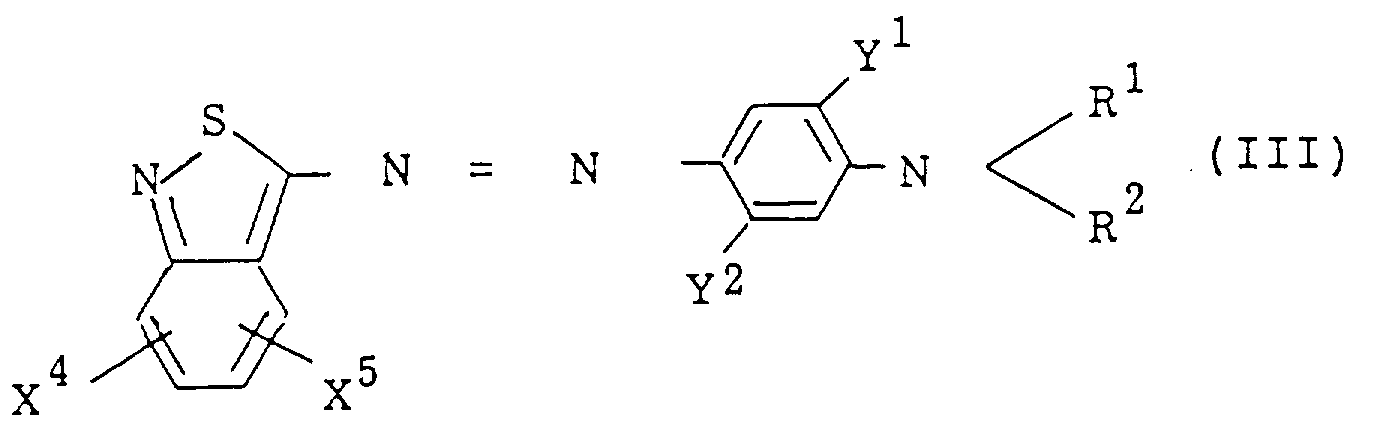
- In the formulas (II) and (III), each of X⁴ and X⁵ is a hydrogen atom, a halogen atom or a nitro group, and Y¹, Y, R¹ and R are as defined above.

- In the above formula, X⁶ is a hydrogen atom, a nitro group, a lower alkyl group or a halogen atom, Y³ is a hydrogen atom, a lower alkyl group or a lower alkoxy group, and R¹ and R are as defined above.

- In the above formula, X⁷ is a hydrogen atom, a halogen atom, a nitro group or a lower alkoxycarbonylamino group, and Y¹ is as defined above.

- In the above formula, Z¹ is a hydrogen atom or a methyl group, and x⁶, Y¹, R¹ and R are as defined above.
- The type of the amino acid used in the present invention may be a neutral amino acid such as glycine, alanine, aminobutyric acid or aminocaproic acid; an acidic amino acid such as aspartic acid or glutamic acid; and a basic amino acid such as lysine or arginine. Among them, glycine, alanine or glutamic acid is preferred, and glycine and glutamic acid is more preferred. Particularly preferred is glycine.
- The amino acid derivative may be a compound having at least one, preferably two, hydrogen atoms in the amino group replaced with an organic group. Further, with respect to an amino acid having two or more amino groups, it is sufficient that at least one hydrogen atom of one of the amino groups is replaced with an organic group. There is no particular restriction as to the substituent for the amino acid, so long as it does not impair the water solubility of the amino acid derivative or it does not provide adverse effects in the dyeing bath. Examples of such a substituent are a C₁₋₄ alkyl group such as a methyl group, an ethyl group or a propyl group; a C₁₋₄ alkoxy C₁₋₄ alkyl group such as a methoxymethyl group, a methoxyethyl group or an ethoxyethyl group; a C₁₋₄ hydroxyalkyl group such as a hydroxyethyl group or a hydroxypropyl group; a C₁₋₄ cyanoalkyl group such as a cyanomethyl group or a cyanoethyl group; an acyl group such as an acetyl group; an alkenyl group such as an allyl group; a poly lower alkyleneoxide group (the number of alkylene group n = 2 to 4); and a lower alkyl ether poly lower alkyleneoxide group (n = 2 to 4). Particularly preferred are a C₁₋₄ alkyl group, a C₁₋₄ hydroxyalkyl group and a C₁₋₄ alkoxy C₁₋₄ alkyl group. As the amino acid derivative, N,N-dimethylglycine, N-methylglycine, N,N-bishydroxyethylglycine and N-methylalanine are preferred as specific examples.
- The salt of such an amino acid or an amino acid derivative is usually an alkali metal salt, such as a lithium salt, a sodium salt or a potassium salt. particularly preferred is a sodium salt.
- In the present invention, when an amino acid or an amino acid derivative is added in an alkaline medium, such an acid or acid derivative will be present in the form of a salt in the system.
- The amount of such an amino acid or an amino acid derivative, or a salt thereof, is usually from 0.02 to 2.0 g/ℓ, preferably from 0.05 to 1.0 g/ℓ, in the dyeing bath from the viewpoint of the effects for preventing the decomposition of the disperse dye.
- In the present invention, a specific polycarboxylic acid or a salt thereof is incorporated to the dyeing bath in addition to the amino acid, the amino acid derivative or the salt thereof. Such a specific polycarboxylic acid or a salt thereof is at least one member selected from the group consisting of ethylenediamine having at least two hydrogen atoms of its amino group replaced with a -RCOOH group (R means a C₁₋₃ alkylene group) and a salt thereof; polyethylenepolyamine having at least two hydrogen atoms of its amino group or imino group replaced with a -RCOOH group (R means the same as defined above) or a salt thereof; and nitrilotriacetic acid (NTA), nitrilotripropionic acid (NTP), iminodiacetic acid (IDA), iminodipropionic acid (IDP), β-hydroxyethyl-iminodiacetic acid, β-hydroxyethyl-iminodipropionic acid and salts thereof.
- The amino group of ethylenediamine or polyethylenepolyamine can further be substituted by a hydroxyalkyl group having 1 to 3 carbon atoms, such as a hydroxyethyl group in addition to a -RCOOH group.
- R in the -RCOOH group is an alkylene group having 1 to 3 carbon atoms, such as a methylene group, a ethylene group, a propylene group or an isopropylene group, and particularly preferred is a methylene group.
- The number of the ethylene units in the polyethylenepolyamine is 2 to 4, and the number of amino groups or imino groups therein is 2 to 8 according to the number of ethylene units.
- Examples of the polycarboxylic acid prepared from ethylenediamine or polyethylenepolyamine having at least two hydrogen atoms of its amino group or imino group replaced with a -RCOOH group are:
- ethylenediamine-N,N'-diacetic acid (EDDA),
- ethylenediamine-N,N,N',N'-tetraacetic acid (EDTA),
- N-(2-hydroxyethyl)-ethylenediamine-N,N,N'-triacetic acid (HEDTA),
- diethylenetriamine-N,N,N',N'',N''-pentaacetic acid (DTPA), and
- triethylenetetramine-N,N,N',N'',N''',N'''-hexaacetic acid (TTHA).
- The preferred polycarboxylic acid is ethylenediaminediacetic acid, ethylenediamine-N,N,N',N'-tetraacetic acid, nitrilotriacetic acid or iminodiacetic acid.
- The salt of the polycarboxylic acid is usually an alkaline metal salt, such as a lithium salt, a sodium salt or a potassium salt, and the sodium salt is preferred.
- When the polycarboxylic acid is added to the alkaline dyeing bath, a certain amount of alkaline is used to form the alkaline salt of said carboxylic acid. Therefore, it is preferable to add the alkaline salt of the polycarboxylic acid.
- The amount of such a specified polycarboxylic acid or a salt thereof is usually from 0.1 to 4 g/ℓ, preferably from 0.5 to 2.0 g/ℓ in the dyeing bath.
- The ratio of the amount of ① an amino acid, an amino acid derivative or a salt thereof to the amount of ② the specific polycarboxylic acid or the salt thereof, is 1:0.1 to 1:10, preferably from 1:1 to 1:5.
- The dyeing method of the present invention may be applied to a woven fabric, a knitted fabric or a nonwoven fabric made of polyester fibers, or polyester fibers and other fibers or to yarns of such fibers. As the abovementioned other fibers, cellulose fibers such as cotton, hemp or rayon, and nitrogen-containing fibers such as nylon, wool or silk, may be mentioned.
- The dyeing may be conducted, as mentioned above, under an alkaline condition, preferably in a range of pH 8 to 11, more preferably pH 8 to 10, usually under a pressure which is commonly applied for dyeing polyester fibers at a temperature of from 120 to 140°C.
- As a pH controlling agent, an alkali metal compound such as sodium hydroxide, potassium hydroxide, sodium carbonate or sodium hydrogen carbonate may usually used. Preferably, sodium hydroxide is used.
- Further, in the dyeing method of the present invention, it is possible to conduct post treatment such as antistatic treatment or softening treatment which is commonly applied to fibers after dyeing in accordance with a usual dyeing method.
- According to the present invention, the abovementioned amino acid member and the specific polycarboxylic acid or the salt thereof are present in the dyeing bath, whereby dyeing of polyester fibers which used to be conducted under a weakly acidic condition can be conducted under an alkaline condition with good reproducibility and desizing effect while preventing the decomposition of the disperse dye. Thus, a single bath scouring and dyeing method for polyester fabrics has been made possible, which used to be difficult to adopt on an industrial scale by the conventional techniques. Further, a polyester oligomer precipitating in the dyeing bath from the interior of the fibers under the dyeing condition will dissolve in an alkaline dyeing bath, whereby a trouble (such as tarring or blooming) caused by the precipitated oligomer as observed in the case of dyeing under an acidic condition, can be prevented.
- Now, the present invention will be described in further detail with reference to Examples. However, it should be understood that the present invention is by no means restricted by such specific Examples.
- Twenty parts of a disperse dye of the formula (A), (B) or (C) was slurried by adding 40 parts of a naphthalene sulfonic acid-formalin condensation product, 40 parts of sodium lignin sulfonate and water, and thoroughly pulverized by means of a sand mill. Then, each slurry was spray-dried to obtain a disperse dye composition.


- The disperse dye compositions containing disperse dyes of the formulas (A), (B) and (C), respectively, were mixed in a weight ratio of 4:2:4 to obtain a mixture (black product) of the disperse dye compositions. By using this mixture in an amount of 4% by weight relative to the fabric to be dyed and using 0.5 g/ℓ of a leveling agent (Eganal LMD-J, tradename, manufactured by Hoechst AG) relative to the dyeing bath as a dyeing assistant, an amino acid and a sodium salt of a polycarboxylic acid as shown in Table 1 in an amount as identified in Table 1 as an additive and by controlling the pH of the dyeing bath to 9.7 with NaOH, a polyester fabric Tropical (tradename, manufactured by Toray Industries, Inc.) was dyed at a bath ratio of 1:10 at a dyeing temperature of 135°C for 30 minutes. Then, the fabric was washed and dried in a usual manner to obtain a dyed fabric.
- As a standard for evaluation of the dyed fabric, the dyeing bath was prepared in the same manner as above except that no amino acid and salt of polycarboxylic acid was used, and 0.2 g/ℓ of acetic acid and 0.6 g/ℓ of sodium acetate were used to adjust the dyeing bath to pH 5.0 which is commonly employed for dyeing polyester fibers, followed by dyeing in the same manner as above (Reference Example 1). By using the dyed fabric obtained in Reference Example 1 as the standard, the dyeing results of each dyed fabric was evaluated. The results are shown in Table 1.
- The evaluation method of each dyed fabric was as follows.
- Surface density: The reflectance of the dyed fabric was measured by a spectrophotometer (MS-2020 manufactured by Macbeth Company), and the value K/S was calculated and represented by a relative value based on the value of the Reference Example 1 being 100.
- Difference in color hue: The reflectance of the dyed fabric was measured by a spectrophotometer (MS-2020, manufactured by Macbeth Company), and the difference in color hue ΔE from the dyed fabric obtained in Reference Example 1 was obtained from CIEL*a*b*. The larger the numerical value of ΔE, the more different the color. As an index for color difference of the dyed fabric, ΔE being not higher than 1.0 is acceptable.

- Dyeing was conducted in the same manner as in Example 1 except that the disperse dye of the formula (A) (violet) used in Example 1 and non-scoured polyester taffeta grey fabric (the amount of polyacrylic acid ester type sizing agent deposited on the fabric was 2.54% by weight relative to the fabric) were employed.
- As Comparative Examples 1 and 2, dyeing was conducted in the same manner as in Example 11 except in the absence of the salt of polycarboxylic acid.
- The dyed fabric was thoroughly washed with water, dried and the remaining amount of the sizing agent was measured according to Soxhlet Method (solvent: carbon tetrachloride, 95°C, 2 hours). The results are shown in Table 2.
- It is evident from the results shown in Table 2, excellent desizing effect is observed by incorporating the salt of the specific polycarboxylic acid with the amino acid.

Claims (8)
- A method for dyeing polyester fibers by using a disperse dye, wherein said dyeing is conducted under an alkaline condition in an aqueous medium in the presence of ① at least one amino acid member selected from the group consisting of an amino acid, an amino acid derivative having at least one hydrogen atom of its amino group replaced with an organic group, and a salt of such an amino acid or amino acid derivative, and ② at least one polycarboxylic acid or a salt thereof selected from the group consisting of ethylenediamine having at least two hydrogen atoms of its amino group replaced with a -RCOOH group (R means a C₁₋₃ alkylene group) and a salt thereof; polyethylenepolyamine having at least two hydrogen atoms of its amino group or imino group replaced with a -RCOOH group (R means the same as defined above) and a salt thereof; and nitrilotriacetic acid, nitrilotripropionic acid, iminodiacetic acid, iminodipropionic acid, β-hydroxyethyl-iminodiacetic acid, β-hydroxyethyl-iminodipropionic acid and salts thereof.
- The method according to Claim 1, wherein said amino acid member is glycine, alanine or glutamic acid.
- The method according to Claim 1 or 2, wherein said polycarboxylic acid or salt thereof is at least one member selected from the group consisting of ethylenediaminediacetic acid, ethylenediamintetraacetic acid, nitrilotriacetic acid, iminodiacetic acid and sodium salts thereof.
- The method according to Claim 1, 2 or 3, wherein the pH of the dyeing bath is from 8 to 11.
- The method according to Claim 1, 2 or 3, wherein the dyeing temperature is from 120 to 140°C.
- The method according to Claim 1, 2 or 3, wherein said amino acid, amino acid derivative or salt thereof is present in an amount of from 0.02 to 2.0 g/ℓ of the dyeing bath.
- The method according to Claim 1, 2 or 3, wherein said polycarboxylic acid or salt thereof is present in an amount of from 0.1 to 4 g/ℓ of the dyeing bath.
- The method according to Claim 1, 2 or 3, wherein the ratio of the amount of said amino acid derivative or salt thereof to the amount of said polycarboxylic acid or salt thereof is 1:0.1 to 1:10.
Priority Applications (3)
| Application Number | Priority Date | Filing Date | Title |
|---|---|---|---|
| JP03301994A JP3089066B2 (en) | 1991-11-18 | 1991-11-18 | Dyeing method for polyester fiber |
| EP93107744A EP0624683B1 (en) | 1991-11-18 | 1993-05-12 | Method for dyeing polyester fibers in an alkaline dyeing bath in the presence of aminoacid and of polyamino-polycarboxylic acid |
| ES93107744T ES2087606T3 (en) | 1991-11-18 | 1993-05-12 | METHOD FOR DYING POLYESTER FIBERS IN A BATH OF ALKALINE DYE IN THE PRESENCE OF AMINO ACID AND POLYAMINO-POLYCARBOXYLIC ACID. |
Applications Claiming Priority (2)
| Application Number | Priority Date | Filing Date | Title |
|---|---|---|---|
| JP03301994A JP3089066B2 (en) | 1991-11-18 | 1991-11-18 | Dyeing method for polyester fiber |
| EP93107744A EP0624683B1 (en) | 1991-11-18 | 1993-05-12 | Method for dyeing polyester fibers in an alkaline dyeing bath in the presence of aminoacid and of polyamino-polycarboxylic acid |
Publications (2)
| Publication Number | Publication Date |
|---|---|
| EP0624683A1 EP0624683A1 (en) | 1994-11-17 |
| EP0624683B1 true EP0624683B1 (en) | 1996-03-13 |
Family
ID=26133204
Family Applications (1)
| Application Number | Title | Priority Date | Filing Date |
|---|---|---|---|
| EP93107744A Expired - Lifetime EP0624683B1 (en) | 1991-11-18 | 1993-05-12 | Method for dyeing polyester fibers in an alkaline dyeing bath in the presence of aminoacid and of polyamino-polycarboxylic acid |
Country Status (3)
| Country | Link |
|---|---|
| EP (1) | EP0624683B1 (en) |
| JP (1) | JP3089066B2 (en) |
| ES (1) | ES2087606T3 (en) |
Families Citing this family (6)
| Publication number | Priority date | Publication date | Assignee | Title |
|---|---|---|---|---|
| JP3089066B2 (en) * | 1991-11-18 | 2000-09-18 | ダイスタージャパン株式会社 | Dyeing method for polyester fiber |
| EP0824155A1 (en) * | 1996-08-15 | 1998-02-18 | Clariant Finance (BVI) Limited | Concentrated aqueous solutions of sodium salts of polycarboxylic acids, their preparation and their use |
| CA2213172A1 (en) * | 1996-08-15 | 1998-02-15 | Clariant Finance (Bvi) Limited | Aqueous, concentrated polycarboxylic acid sodium salt solutions, their production and use |
| DE19755647A1 (en) * | 1997-12-15 | 1999-06-24 | Dohmen Gmbh M | Process for dyeing textile material containing polyester fibers |
| JP2007254904A (en) * | 2006-03-22 | 2007-10-04 | Komatsu Seiren Co Ltd | Recycling polyester fiber products, decolorizing method for recycling polyester fiber products, and recycling method for polyester fiber products |
| CN103483871A (en) * | 2013-09-10 | 2014-01-01 | 江苏亚邦染料股份有限公司 | Bisazo type disperse dyes and application thereof |
Family Cites Families (4)
| Publication number | Priority date | Publication date | Assignee | Title |
|---|---|---|---|---|
| DE2816540C3 (en) * | 1977-04-19 | 1981-01-29 | Ciba-Geigy Ag, Basel (Schweiz) | Dye preparations for block dyeing |
| JPS5759999A (en) * | 1980-09-29 | 1982-04-10 | Showa Denko Kk | Bleaching agent composition |
| US5019133A (en) * | 1988-11-25 | 1991-05-28 | Mitsubishi Kasei Corporation | Method for dyeing polyester-containing fibers in an alkaline dyeing bath and dyeing assistant, an amino-acid compound |
| JP3089066B2 (en) * | 1991-11-18 | 2000-09-18 | ダイスタージャパン株式会社 | Dyeing method for polyester fiber |
-
1991
- 1991-11-18 JP JP03301994A patent/JP3089066B2/en not_active Expired - Lifetime
-
1993
- 1993-05-12 ES ES93107744T patent/ES2087606T3/en not_active Expired - Lifetime
- 1993-05-12 EP EP93107744A patent/EP0624683B1/en not_active Expired - Lifetime
Also Published As
| Publication number | Publication date |
|---|---|
| JP3089066B2 (en) | 2000-09-18 |
| ES2087606T3 (en) | 1996-07-16 |
| JPH05140877A (en) | 1993-06-08 |
| EP0624683A1 (en) | 1994-11-17 |
Similar Documents
| Publication | Publication Date | Title |
|---|---|---|
| KR970011012B1 (en) | Dyeing method and dyeing aid in alkaline dyeing bath of polyester-containing fiber | |
| US6171349B1 (en) | Reactive dye composition | |
| US5304222A (en) | Monoazo benzothiazole disperse dye mixture | |
| WO2004056925A1 (en) | Dye compositions for dyeing or printing of fibre products comprising celluloseacetate | |
| EP0624683A1 (en) | Method for dyeing polyester fibers in an alkaline dyeing bath in the presence of aminoacid and of polyamino-polycarboxylic acid | |
| US4300900A (en) | Process and dye preparations for pad-dyeing | |
| US5942011A (en) | Process for dyeing textiles containing polyester fibers and dyeing auxiliaries | |
| EP0208211A2 (en) | Water-insoluble disperse dye composition | |
| CN116925565B (en) | Reactive black dye composition and dye product | |
| CN116925566B (en) | Reactive blue-to-black dye composition and dye product | |
| US4985044A (en) | Multi-component mixtures of blue disperse azo dyes for the dyeing of synthetic fibers | |
| JPH08100133A (en) | Disperse dye mixture | |
| JPH0616962A (en) | Disperse dye mixture | |
| CN116925567B (en) | Active navy blue to black dye composition and dye product | |
| JP3115135B2 (en) | Disperse dye mixture | |
| US5494492A (en) | Disperse dye composition and method for dyeing hydrophobic fibers with it | |
| JP3115187B2 (en) | Method for dyeing or printing water-soluble dye mixtures and cellulose fiber materials | |
| AU603642B2 (en) | Use of cyclic esters of sulfurous acid in the dyeing of polyamide textile materials | |
| JPH0718093B2 (en) | Dyeing method for polyester-containing fiber and dyeing aid | |
| US5484459A (en) | Mixture of water soluble reactive dyes and their use | |
| KR100509576B1 (en) | Reactive yellow dyestuff composition | |
| JP3199904B2 (en) | Dyeing method for polyester fiber | |
| CN116925564A (en) | Reactive deep blue-to-black dye composition and dye product | |
| JPH07324172A (en) | Water-soluble dye mixture and method for dyeing or printing cellulose fiber material | |
| CN119775793A (en) | Disperse yellow to orange dye composition and dye product |
Legal Events
| Date | Code | Title | Description |
|---|---|---|---|
| PUAI | Public reference made under article 153(3) epc to a published international application that has entered the european phase |
Free format text: ORIGINAL CODE: 0009012 |
|
| AK | Designated contracting states |
Kind code of ref document: A1 Designated state(s): ES FR IT |
|
| 17P | Request for examination filed |
Effective date: 19941214 |
|
| 17Q | First examination report despatched |
Effective date: 19950516 |
|
| RAP1 | Party data changed (applicant data changed or rights of an application transferred) |
Owner name: DYSTAR JAPAN LTD. |
|
| GRAH | Despatch of communication of intention to grant a patent |
Free format text: ORIGINAL CODE: EPIDOS IGRA |
|
| GRAA | (expected) grant |
Free format text: ORIGINAL CODE: 0009210 |
|
| AK | Designated contracting states |
Kind code of ref document: B1 Designated state(s): ES FR IT |
|
| ITF | It: translation for a ep patent filed | ||
| ET | Fr: translation filed | ||
| REG | Reference to a national code |
Ref country code: ES Ref legal event code: BA2A Ref document number: 2087606 Country of ref document: ES Kind code of ref document: T3 |
|
| REG | Reference to a national code |
Ref country code: ES Ref legal event code: FG2A Ref document number: 2087606 Country of ref document: ES Kind code of ref document: T3 |
|
| PLBE | No opposition filed within time limit |
Free format text: ORIGINAL CODE: 0009261 |
|
| 26N | No opposition filed | ||
| PGFP | Annual fee paid to national office [announced via postgrant information from national office to epo] |
Ref country code: FR Payment date: 20030429 Year of fee payment: 11 |
|
| PGFP | Annual fee paid to national office [announced via postgrant information from national office to epo] |
Ref country code: ES Payment date: 20030516 Year of fee payment: 11 |
|
| PG25 | Lapsed in a contracting state [announced via postgrant information from national office to epo] |
Ref country code: ES Free format text: LAPSE BECAUSE OF NON-PAYMENT OF DUE FEES Effective date: 20040513 |
|
| PG25 | Lapsed in a contracting state [announced via postgrant information from national office to epo] |
Ref country code: FR Free format text: LAPSE BECAUSE OF NON-PAYMENT OF DUE FEES Effective date: 20050131 |
|
| REG | Reference to a national code |
Ref country code: FR Ref legal event code: ST |
|
| PG25 | Lapsed in a contracting state [announced via postgrant information from national office to epo] |
Ref country code: IT Free format text: LAPSE BECAUSE OF NON-PAYMENT OF DUE FEES Effective date: 20050512 |
|
| REG | Reference to a national code |
Ref country code: ES Ref legal event code: FD2A Effective date: 20040513 |