EP0624459A2 - Near-surface enhancement of honeycomb sandwich structures to improve durability using a hybrid core - Google Patents
Near-surface enhancement of honeycomb sandwich structures to improve durability using a hybrid core Download PDFInfo
- Publication number
- EP0624459A2 EP0624459A2 EP94810262A EP94810262A EP0624459A2 EP 0624459 A2 EP0624459 A2 EP 0624459A2 EP 94810262 A EP94810262 A EP 94810262A EP 94810262 A EP94810262 A EP 94810262A EP 0624459 A2 EP0624459 A2 EP 0624459A2
- Authority
- EP
- European Patent Office
- Prior art keywords
- panel according
- honeycomb core
- resin
- panel
- core sheet
- Prior art date
- Legal status (The legal status is an assumption and is not a legal conclusion. Google has not performed a legal analysis and makes no representation as to the accuracy of the status listed.)
- Withdrawn
Links
Images

Classifications
-
- B—PERFORMING OPERATIONS; TRANSPORTING
- B32—LAYERED PRODUCTS
- B32B—LAYERED PRODUCTS, i.e. PRODUCTS BUILT-UP OF STRATA OF FLAT OR NON-FLAT, e.g. CELLULAR OR HONEYCOMB, FORM
- B32B3/00—Layered products comprising a layer with external or internal discontinuities or unevennesses, or a layer of non-planar shape; Layered products comprising a layer having particular features of form
- B32B3/10—Layered products comprising a layer with external or internal discontinuities or unevennesses, or a layer of non-planar shape; Layered products comprising a layer having particular features of form characterised by a discontinuous layer, i.e. formed of separate pieces of material
- B32B3/12—Layered products comprising a layer with external or internal discontinuities or unevennesses, or a layer of non-planar shape; Layered products comprising a layer having particular features of form characterised by a discontinuous layer, i.e. formed of separate pieces of material characterised by a layer of regularly- arranged cells, e.g. a honeycomb structure
-
- B—PERFORMING OPERATIONS; TRANSPORTING
- B32—LAYERED PRODUCTS
- B32B—LAYERED PRODUCTS, i.e. PRODUCTS BUILT-UP OF STRATA OF FLAT OR NON-FLAT, e.g. CELLULAR OR HONEYCOMB, FORM
- B32B15/00—Layered products comprising a layer of metal
- B32B15/04—Layered products comprising a layer of metal comprising metal as the main or only constituent of a layer, which is next to another layer of the same or of a different material
- B32B15/043—Layered products comprising a layer of metal comprising metal as the main or only constituent of a layer, which is next to another layer of the same or of a different material of metal
-
- B—PERFORMING OPERATIONS; TRANSPORTING
- B32—LAYERED PRODUCTS
- B32B—LAYERED PRODUCTS, i.e. PRODUCTS BUILT-UP OF STRATA OF FLAT OR NON-FLAT, e.g. CELLULAR OR HONEYCOMB, FORM
- B32B15/00—Layered products comprising a layer of metal
- B32B15/04—Layered products comprising a layer of metal comprising metal as the main or only constituent of a layer, which is next to another layer of the same or of a different material
- B32B15/08—Layered products comprising a layer of metal comprising metal as the main or only constituent of a layer, which is next to another layer of the same or of a different material of synthetic resin
-
- B—PERFORMING OPERATIONS; TRANSPORTING
- B32—LAYERED PRODUCTS
- B32B—LAYERED PRODUCTS, i.e. PRODUCTS BUILT-UP OF STRATA OF FLAT OR NON-FLAT, e.g. CELLULAR OR HONEYCOMB, FORM
- B32B15/00—Layered products comprising a layer of metal
- B32B15/04—Layered products comprising a layer of metal comprising metal as the main or only constituent of a layer, which is next to another layer of the same or of a different material
- B32B15/12—Layered products comprising a layer of metal comprising metal as the main or only constituent of a layer, which is next to another layer of the same or of a different material of paper or cardboard
-
- B—PERFORMING OPERATIONS; TRANSPORTING
- B32—LAYERED PRODUCTS
- B32B—LAYERED PRODUCTS, i.e. PRODUCTS BUILT-UP OF STRATA OF FLAT OR NON-FLAT, e.g. CELLULAR OR HONEYCOMB, FORM
- B32B15/00—Layered products comprising a layer of metal
- B32B15/20—Layered products comprising a layer of metal comprising aluminium or copper
-
- B—PERFORMING OPERATIONS; TRANSPORTING
- B32—LAYERED PRODUCTS
- B32B—LAYERED PRODUCTS, i.e. PRODUCTS BUILT-UP OF STRATA OF FLAT OR NON-FLAT, e.g. CELLULAR OR HONEYCOMB, FORM
- B32B27/00—Layered products comprising a layer of synthetic resin
- B32B27/06—Layered products comprising a layer of synthetic resin as the main or only constituent of a layer, which is next to another layer of the same or of a different material
- B32B27/08—Layered products comprising a layer of synthetic resin as the main or only constituent of a layer, which is next to another layer of the same or of a different material of synthetic resin
-
- B—PERFORMING OPERATIONS; TRANSPORTING
- B32—LAYERED PRODUCTS
- B32B—LAYERED PRODUCTS, i.e. PRODUCTS BUILT-UP OF STRATA OF FLAT OR NON-FLAT, e.g. CELLULAR OR HONEYCOMB, FORM
- B32B27/00—Layered products comprising a layer of synthetic resin
- B32B27/06—Layered products comprising a layer of synthetic resin as the main or only constituent of a layer, which is next to another layer of the same or of a different material
- B32B27/10—Layered products comprising a layer of synthetic resin as the main or only constituent of a layer, which is next to another layer of the same or of a different material of paper or cardboard
-
- B—PERFORMING OPERATIONS; TRANSPORTING
- B32—LAYERED PRODUCTS
- B32B—LAYERED PRODUCTS, i.e. PRODUCTS BUILT-UP OF STRATA OF FLAT OR NON-FLAT, e.g. CELLULAR OR HONEYCOMB, FORM
- B32B27/00—Layered products comprising a layer of synthetic resin
- B32B27/28—Layered products comprising a layer of synthetic resin comprising synthetic resins not wholly covered by any one of the sub-groups B32B27/30 - B32B27/42
- B32B27/281—Layered products comprising a layer of synthetic resin comprising synthetic resins not wholly covered by any one of the sub-groups B32B27/30 - B32B27/42 comprising polyimides
-
- B—PERFORMING OPERATIONS; TRANSPORTING
- B32—LAYERED PRODUCTS
- B32B—LAYERED PRODUCTS, i.e. PRODUCTS BUILT-UP OF STRATA OF FLAT OR NON-FLAT, e.g. CELLULAR OR HONEYCOMB, FORM
- B32B27/00—Layered products comprising a layer of synthetic resin
- B32B27/28—Layered products comprising a layer of synthetic resin comprising synthetic resins not wholly covered by any one of the sub-groups B32B27/30 - B32B27/42
- B32B27/285—Layered products comprising a layer of synthetic resin comprising synthetic resins not wholly covered by any one of the sub-groups B32B27/30 - B32B27/42 comprising polyethers
-
- B—PERFORMING OPERATIONS; TRANSPORTING
- B32—LAYERED PRODUCTS
- B32B—LAYERED PRODUCTS, i.e. PRODUCTS BUILT-UP OF STRATA OF FLAT OR NON-FLAT, e.g. CELLULAR OR HONEYCOMB, FORM
- B32B27/00—Layered products comprising a layer of synthetic resin
- B32B27/28—Layered products comprising a layer of synthetic resin comprising synthetic resins not wholly covered by any one of the sub-groups B32B27/30 - B32B27/42
- B32B27/286—Layered products comprising a layer of synthetic resin comprising synthetic resins not wholly covered by any one of the sub-groups B32B27/30 - B32B27/42 comprising polysulphones; polysulfides
-
- B—PERFORMING OPERATIONS; TRANSPORTING
- B32—LAYERED PRODUCTS
- B32B—LAYERED PRODUCTS, i.e. PRODUCTS BUILT-UP OF STRATA OF FLAT OR NON-FLAT, e.g. CELLULAR OR HONEYCOMB, FORM
- B32B27/00—Layered products comprising a layer of synthetic resin
- B32B27/34—Layered products comprising a layer of synthetic resin comprising polyamides
-
- B—PERFORMING OPERATIONS; TRANSPORTING
- B32—LAYERED PRODUCTS
- B32B—LAYERED PRODUCTS, i.e. PRODUCTS BUILT-UP OF STRATA OF FLAT OR NON-FLAT, e.g. CELLULAR OR HONEYCOMB, FORM
- B32B27/00—Layered products comprising a layer of synthetic resin
- B32B27/36—Layered products comprising a layer of synthetic resin comprising polyesters
-
- B—PERFORMING OPERATIONS; TRANSPORTING
- B32—LAYERED PRODUCTS
- B32B—LAYERED PRODUCTS, i.e. PRODUCTS BUILT-UP OF STRATA OF FLAT OR NON-FLAT, e.g. CELLULAR OR HONEYCOMB, FORM
- B32B27/00—Layered products comprising a layer of synthetic resin
- B32B27/36—Layered products comprising a layer of synthetic resin comprising polyesters
- B32B27/365—Layered products comprising a layer of synthetic resin comprising polyesters comprising polycarbonates
-
- B—PERFORMING OPERATIONS; TRANSPORTING
- B32—LAYERED PRODUCTS
- B32B—LAYERED PRODUCTS, i.e. PRODUCTS BUILT-UP OF STRATA OF FLAT OR NON-FLAT, e.g. CELLULAR OR HONEYCOMB, FORM
- B32B27/00—Layered products comprising a layer of synthetic resin
- B32B27/38—Layered products comprising a layer of synthetic resin comprising epoxy resins
-
- B—PERFORMING OPERATIONS; TRANSPORTING
- B32—LAYERED PRODUCTS
- B32B—LAYERED PRODUCTS, i.e. PRODUCTS BUILT-UP OF STRATA OF FLAT OR NON-FLAT, e.g. CELLULAR OR HONEYCOMB, FORM
- B32B27/00—Layered products comprising a layer of synthetic resin
- B32B27/42—Layered products comprising a layer of synthetic resin comprising condensation resins of aldehydes, e.g. with phenols, ureas or melamines
-
- B—PERFORMING OPERATIONS; TRANSPORTING
- B32—LAYERED PRODUCTS
- B32B—LAYERED PRODUCTS, i.e. PRODUCTS BUILT-UP OF STRATA OF FLAT OR NON-FLAT, e.g. CELLULAR OR HONEYCOMB, FORM
- B32B29/00—Layered products comprising a layer of paper or cardboard
- B32B29/002—Layered products comprising a layer of paper or cardboard as the main or only constituent of a layer, which is next to another layer of the same or of a different material
- B32B29/005—Layered products comprising a layer of paper or cardboard as the main or only constituent of a layer, which is next to another layer of the same or of a different material next to another layer of paper or cardboard layer
-
- B—PERFORMING OPERATIONS; TRANSPORTING
- B32—LAYERED PRODUCTS
- B32B—LAYERED PRODUCTS, i.e. PRODUCTS BUILT-UP OF STRATA OF FLAT OR NON-FLAT, e.g. CELLULAR OR HONEYCOMB, FORM
- B32B7/00—Layered products characterised by the relation between layers; Layered products characterised by the relative orientation of features between layers, or by the relative values of a measurable parameter between layers, i.e. products comprising layers having different physical, chemical or physicochemical properties; Layered products characterised by the interconnection of layers
- B32B7/02—Physical, chemical or physicochemical properties
-
- B—PERFORMING OPERATIONS; TRANSPORTING
- B32—LAYERED PRODUCTS
- B32B—LAYERED PRODUCTS, i.e. PRODUCTS BUILT-UP OF STRATA OF FLAT OR NON-FLAT, e.g. CELLULAR OR HONEYCOMB, FORM
- B32B7/00—Layered products characterised by the relation between layers; Layered products characterised by the relative orientation of features between layers, or by the relative values of a measurable parameter between layers, i.e. products comprising layers having different physical, chemical or physicochemical properties; Layered products characterised by the interconnection of layers
- B32B7/04—Interconnection of layers
- B32B7/12—Interconnection of layers using interposed adhesives or interposed materials with bonding properties
-
- E—FIXED CONSTRUCTIONS
- E04—BUILDING
- E04C—STRUCTURAL ELEMENTS; BUILDING MATERIALS
- E04C2/00—Building elements of relatively thin form for the construction of parts of buildings, e.g. sheet materials, slabs, or panels
- E04C2/30—Building elements of relatively thin form for the construction of parts of buildings, e.g. sheet materials, slabs, or panels characterised by the shape or structure
- E04C2/34—Building elements of relatively thin form for the construction of parts of buildings, e.g. sheet materials, slabs, or panels characterised by the shape or structure composed of two or more spaced sheet-like parts
- E04C2/36—Building elements of relatively thin form for the construction of parts of buildings, e.g. sheet materials, slabs, or panels characterised by the shape or structure composed of two or more spaced sheet-like parts spaced apart by transversely-placed strip material, e.g. honeycomb panels
- E04C2/365—Building elements of relatively thin form for the construction of parts of buildings, e.g. sheet materials, slabs, or panels characterised by the shape or structure composed of two or more spaced sheet-like parts spaced apart by transversely-placed strip material, e.g. honeycomb panels by honeycomb structures
-
- B—PERFORMING OPERATIONS; TRANSPORTING
- B32—LAYERED PRODUCTS
- B32B—LAYERED PRODUCTS, i.e. PRODUCTS BUILT-UP OF STRATA OF FLAT OR NON-FLAT, e.g. CELLULAR OR HONEYCOMB, FORM
- B32B2309/00—Parameters for the laminating or treatment process; Apparatus details
- B32B2309/08—Dimensions, e.g. volume
- B32B2309/10—Dimensions, e.g. volume linear, e.g. length, distance, width
- B32B2309/105—Thickness
Definitions
- This invention pertains to a low weight panel with increased durability when the upper surface is subjected to localized compressive loads.
- U.S. Patent No. 4,937,125 describes one approach where a multilayer sandwich structure having a core interposed between and external and internal skin.
- the upper skin is a composite layer-polyester layer-honeycomb layer-metal sheet-glass fiber reinforced epoxy layer-composite layer.
- the core is a honeycomb.
- the internal skin is a metal sheet or a skin of the same composition as the external skin.
- two cores of either the same or different densities and/or cell sizes are combined by means of a light weight septum to form a hybrid core.
- the septum material is not of the same material as the outer skins of the sandwich panel and serves as a means to transfer load between the upper and lower portions of the structure. There is no requirement that the two honeycomb cores be aligned. That the septum prevents relative movement between the two cores is necessary, but not sufficient.
- the septum must be both sufficiently stiff and strong to redistribute localized compressive loads as well as being sufficiently light in weight to provide panels which can meet desired weight limits.
- the instant invention provides that improved panel by tailoring the core to have enhanced properties just where needed (right below the upper skin) to achieve greater resistance to concentrated transverse compressive loads with a much smaller or even no weight penalty.
- Honeycomb sandwich structures are widely used for aircraft flooring materials.
- the in-plane and bending properties needed are those derived from design requirements of the airframe manufacturers.
- the out-of-plane properties are, by contrast, determined from test data on existing materials which are believed to meet the perceived requirements. It is known that the damage that causes panels to be replaced after use in aircraft occurs almost exclusively at the top surface of the panels and is due to concentrated out-of-plane loads. This damage is believed to be due to passenger foot traffic (most likely from high heels) administering localized concentrated loads on the panels.
- the instant invention addresses the issue of floor panel durability by providing constructions which increase the resistance of aircraft fllooring to concentrated out-of-plane loads without either increasing weight or significantly influencing cost when compared to standard uniform density honeycomb core construction.
- the resistance to damage such as core fracture, resin fracture, core buckling, etc. due to localized compressive loads is increased.
- the invention pertains to a hybrid honeycomb sandwich structure with an equal or higher density layer near the top surface and a equal or lower density second layer beneath.
- the two layers are joined with an interlayer different from the outer skins and is used to distribute load from the first into the second layer so as to minimize localized stresses.
- the instant invention is to a hybrid honeycomb sandwich panel, having upper surface enhancement for improved resistance to damage from localized compressive loads, which comprises a first honeycomb core sheet having a multiplicity of cells, said cells directed transverse to said panel; a second honeycomb core sheet of equal or lower density than the first sheet beneath the first sheet and having a multiplicity of cells, said cells directed transverse to said panel; a thin adhesive interlayer bonding the lower surface of the first higher density honeycomb core sheet to the upper surface of the second lower density honeycomb core sheet; a top skin adhered to the upper surface of the first higher density honeycomb core sheet; and a lower skin adhered to the lower surface of the second lower density honeycomb core sheet.
- the present invention pertains to a honeycomb sandwich structure as seen in Fig. 1 with a first layer 3 near the top (loaded) surface 1 and a second layer 5 beneath the first.
- the first layer 3 is of equal or greater density than the second layer 5.
- the layer 3 and layer 5 of the honeycomb structure are made of either aluminum or a paper composed of thermoplastic fiber such as NOMEX® (aramid fiber, E.I. duPont de Nemours & Co., Wilmington, DE).
- the first and second layers are bonded together by an interlayer 4 composed of either a scrim cloth adhesive or an adhesively bonded layer of a thermoplastic paper such as NOMEX® described above.
- the cell size, cell wall thickness and mass density of the first honeycomb layer 3 are chosen to meet the desired mechanical requirements for indentation resistance.
- the mass density is typically between 1 lb/ft3 (16 kg/m3) to 55 lb/ft3 (880 kg/m3), preferably 6 lb/ft3(96 kg/m3) and 11.5 lb/ft3 (185 kg/m3).
- the mass density of the second honeycomb layer 5 is selected primarily to be of sufficiently low density that the total panel weight meets a specified target and is typically between 1 lb/ft3 (16 kg/m3) and 55 lb/ft3 (880 kg/m3), but preferably between 3 lb/ft3 (48 kg/m3) and 7 lb/ft3 (112 kg/m3).
- the interlayer 4 is selected for its ability to distribute load from the first layer into the second layer in order to minimize stress concentrations.
- the instant hybrid sandwich panels also contain an upper skin 1 and a lower skin 6 which are attached to the upper core 3 and the lower core 5 by way of adhesive layers 2 as seen in FIG. 1.
- the first honeycomb core sheet 3 and the second honeycomb core sheet 5 may be composed of the same or different materials.
- the first honeycomb core sheet is preferably 0.05'' to 0.10'' (1.2 mm to 2.5 mm) in thickness.
- the honeycomb core sheets are composed of aramid fiber paper.
- the honeycomb core 3 or 5 is made of an inorganic paper, a formable plastic, a thermoplastic fiber paper or a metal.
- the honeycomb core 3 or 5 is made of a thermoplastic paper, most preferably aramid fiber paper, or aluminum.
- the adhesive 2 is a thermoset resin or when the top skin 1 or the bottom skin 6 is a fiber reinforced resin which is a thermoset resin, said resin is an epoxy, phenolic, polyester or polyimide resin.
- the adhesive 2 is a thermoplastic resin or when the top skin 1 or the bottom skin 6 is a fiber reinforced resin which is a thermoplastic resin, said resin is a polycarbonate, polyetherimide, polyetherketone, polysulfone, polyester, poly(arylene sulfide), polyamide or polyphenylene oxide resin.
- the interlayer 4 is a supported adhesive, a film adhesive or an adhesively bonded thermoplastic paper.
- the upper honeycomb core 3 can be replaced by a three-dimensional thermoplastic sheet such as QUADRACORE® (Ciba Composites, Anaheim). This material is produced by imparting an "egg carton" shape to a thermoplastic sheet under heat and pressure.
- processing must be modified to maintain dimensional tolerance in the thickness direction in the final panel. This can be accomplished by the use of simple mechanical stops in the press where the panel is heat processed to cure the skins and the adhesive.
- FIG. 1 shows a perspective view of an assembled panel cross-section.
- the top skin 1 is preferably a fiber glass reinforced epoxy. Other materials such as graphite/epoxy, graphite/phenolic, fiber glass/phenolic and the like may also be used.
- the bottom skin 6 is generally composed of the same material as the top skin 1 although its thickness may be different.
- the adhesive layers 2 serve to adhere skins 1 and 6 to the cores 3 and 5 respectively.
- the adhesive layers 2 are preferably an epoxy, but other polymeric adhesives may be utilized as well.
- the interlayer 4 is a combination of a scrim cloth and adhesive or a paper and adhesive and is constructed from materials substantially lower in weight density than those used for skins 1 and 6.
- a simply-supported 12'' x 12'' (305 mm x 305 mm) panel, prepared as seen in Example 1, is loaded using a flat-faced circular cylindrical steel indenter of either 1/4'' (6.35 mm) or 1/2'' (12.7 mm) diameter placed atop a 1/8'' (3.18 mm) Shore hardness 55-65 silicone rubber which is placed between the indenter and the top surface of the panel to be tested.
- Load versus displacement is continuously monitored during the loading process. When a discrete load drop occurs, the test is ended and the maximum load reached prior to load drop is recorded as indentation strength.
- indentation strength data from the reinforced or enhanced surface are compared with either a section of the same panel which is unreinforced or with the bottom of the same panel which is also unreinforced. Therefore, all indentation strength comparisons are measured between identical cores.
- Example Core / Adhesive A HMX-1/8-11.5 over HMX-1/8-5.0/Tricot carrier adhesive B HMX-1/8-11.5 over HMX-1.8-5.0/6AC carrier adhesive C HMX-1/8-11.5 over HMX-1.8-5.0/Graphite Mat (Grade 500)adhesive
- the Tricot is a nylon weave while the 6AC is chopped nylon fiber.
- the results below indicate that scrim cloths of a continuous nature perform better than those of chopped fibers.
- Examples A, B and C show the strong influence of the interlayer 4 on indentation resistance.
- the interlayer provides a greatly enhanced resistance to concentrated loads such as that input by the 1/4'' (6.35 mm) indenter and shows no loss of indentation resistance for larger less concentrated loads such as that input by the 1/2'' (12.7 mm) indenter.
- Example C little enhancement is provided in the 1/4'' results and a large decrease in indentation resistance is measured for the 1/2'' indenter.
- Example 2 of this application approximates what happens when a localized concentrated load (such as a person wearing a high heel walks on the panel) impacts the top surface of the panel. Failure in this test occurs just beneath the upper surface of the panel.
- the failure mode alters somewhat as shear and compressive contributions to failure change.
- the indentation section is not supported from beneath (only at the edge of the panel), its failure mode is always different from stabilized core compression where there is total support beneath the panel.
- Example HMX Upper Core HMX Lower Core Thickness (in) Density (pcf) Thickness (in) Density (pcf) A 0.070 11.5 0.305 3.0 B 0.070 11.5 0.305 5.0 C 0.056 9.0 0.318 3.0 D 0.056 11.5 0.318 3.0 E 0.070 9.0 0.305 3.0 F 0.070 9.0 0.305 5.0 G 0.056 9.0 0.318 5.0 H 0.056 11.5 0.318 5.0 Indentation Strength (lb) 1/4 inch (6.35 mm) Indenter Example Upper Side Enhanced Surface Lower Side Unreinforced Surface Percent Difference A 64 39 +64 B 96 80 +20 C 57 40 +43 D 56 38 +47 E 59 37 +60 F 104 71 +47 G 82 90 -9 H 81 77 +5 1/2 inch (12.7 mm) Indenter Example Upper Side Enhanced Surface Lower Side Unreinforced Surface Percent Difference A 103 82 +26 B 157 170 -8 C 90 77 +17
- the values for the lower side essentially represent what would be expected from a "normal" panel without the hybrid honeycomb core structure.
- Example 2 Following the procedure of Example 2, additional hybrid core structures where a high density upper aluminum honeycomb core is adhered to a low density honeycomb aluminum core using a nylon tricot (Gehring Textiles, WW516) with R377 epoxy based adhesive are tested for indentation strength.
- the values for the lower side essentially represent what would be expected from a "normal" panel without the hybrid honeycomb core structure.
- the upper core is HMX having a thickness of 0.070 inches and a density of 9.0 pcf and the lower core MHX having a thickness of 0.305 inches and a density of 5.0 pcf.
- the adhesive is R377 epoxy based adhesive.
- the values for the lower side essentially represent what would be expected from a "normal" panel without the hybrid honeycomb core structure.
- Each of the different interlayers can be used to provide improved indentation strength to the instant hybrid honeycomb panel structures.
- Example 2 When in the panels described in Example 1 the upper higher density core 3 is replaced with a thermoplastic three-dimensional sheet structure QUADRACORE® excellent indentation strength is still obtained especially with the 1/4'' (6.35 mm) indenter in the test method described in Example 2.
- the panels tested have a total thickness of 0.400'' (9.800mm) with the bottom honeycomb core of NOMEX® (HMX) having a thickness of 0.305'' (7.4725 mm) and a cell size of 5/32'' (4 mm) and a density of 3.0 pcf or 5.0 pcf, and the upper QUADRACORE® having a thickness of 0.095'' (2.3275 mm).
- HMX NOMEX®
Landscapes
- Engineering & Computer Science (AREA)
- Architecture (AREA)
- Civil Engineering (AREA)
- Structural Engineering (AREA)
- Laminated Bodies (AREA)
Abstract
Description
- This invention pertains to a low weight panel with increased durability when the upper surface is subjected to localized compressive loads.
- Current sandwich structures used for aircraft flooring use only a single density honeycomb core in this construction. Heavy traffic on such flooring frequently causes failure or damage to the upper surface requiring that the flooring be replaced at great cost and inconvenience.
- In order to increase the durability of such flooring panels and to increase their resistance to concentrated transverse compressive loads, either more skin material or higher honeycomb core densities or both must be used. Both of these remedies are basically unacceptable since they each substantially increase the panel weight. This is an unacceptable solution for aircraft structures where a minimum weight is always desired.
- Many attempts to solve the problems stated above have been made. U.S. Patent No. 4,937,125 describes one approach where a multilayer sandwich structure having a core interposed between and external and internal skin. The upper skin is a composite layer-polyester layer-honeycomb layer-metal sheet-glass fiber reinforced epoxy layer-composite layer. The core is a honeycomb. The internal skin is a metal sheet or a skin of the same composition as the external skin.
- U.S. Patent Nos. 4,336,292; 5,041,323 and 5,106,668 describe multi-layered panels comprised substantially of two or several subpanels - one possibly with a higher density core than the other(s) - bonded together to form a complete panel. The latter example would work successfully, but, because of the method and materials of construction, additional materials over and above those of the instant invention are required resulting in a panel which is too costly and substantially overweight for aerospace applications.
- In the present invention, two cores of either the same or different densities and/or cell sizes are combined by means of a light weight septum to form a hybrid core. The septum material is not of the same material as the outer skins of the sandwich panel and serves as a means to transfer load between the upper and lower portions of the structure. There is no requirement that the two honeycomb cores be aligned. That the septum prevents relative movement between the two cores is necessary, but not sufficient. The septum must be both sufficiently stiff and strong to redistribute localized compressive loads as well as being sufficiently light in weight to provide panels which can meet desired weight limits.
- Accordingly, improving the upper surface properties of sandwich structures which are subject to in-use concentrated loads to make them more durable is highly desired. This will reduce life-cycle costs for airlines by decreasing the necessity for replacing damaged panels. The instant invention provides that improved panel by tailoring the core to have enhanced properties just where needed (right below the upper skin) to achieve greater resistance to concentrated transverse compressive loads with a much smaller or even no weight penalty.
- Honeycomb sandwich structures are widely used for aircraft flooring materials. In these structures, the in-plane and bending properties needed are those derived from design requirements of the airframe manufacturers. The out-of-plane properties are, by contrast, determined from test data on existing materials which are believed to meet the perceived requirements. It is known that the damage that causes panels to be replaced after use in aircraft occurs almost exclusively at the top surface of the panels and is due to concentrated out-of-plane loads. This damage is believed to be due to passenger foot traffic (most likely from high heels) administering localized concentrated loads on the panels.
- The instant invention addresses the issue of floor panel durability by providing constructions which increase the resistance of aircraft fllooring to concentrated out-of-plane loads without either increasing weight or significantly influencing cost when compared to standard uniform density honeycomb core construction. By using higher density materials near the top (loaded) surface of a sandwich structure, the resistance to damage such as core fracture, resin fracture, core buckling, etc. due to localized compressive loads is increased.
- The invention pertains to a hybrid honeycomb sandwich structure with an equal or higher density layer near the top surface and a equal or lower density second layer beneath. The two layers are joined with an interlayer different from the outer skins and is used to distribute load from the first into the second layer so as to minimize localized stresses. More particularly, the instant invention is to a hybrid honeycomb sandwich panel, having upper surface enhancement for improved resistance to damage from localized compressive loads, which comprises
a first honeycomb core sheet having a multiplicity of cells, said cells directed transverse to said panel;
a second honeycomb core sheet of equal or lower density than the first sheet beneath the first sheet and having a multiplicity of cells, said cells directed transverse to said panel;
a thin adhesive interlayer bonding the lower surface of the first higher density honeycomb core sheet to the upper surface of the second lower density honeycomb core sheet;
a top skin adhered to the upper surface of the first higher density honeycomb core sheet; and
a lower skin adhered to the lower surface of the second lower density honeycomb core sheet. - Details of the invention and of the preferred embodiments thereof will be further understood upon reference to the drawings wherein:
- Fig. 1
- is a perspective view, partially cut away, of the instant hybrid sandwich panel; and
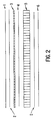
- Fig. 2
- is a vertical schematic view through the panel of Fig. 1.
- The present invention pertains to a honeycomb sandwich structure as seen in Fig. 1 with a
first layer 3 near the top (loaded) surface 1 and asecond layer 5 beneath the first. Preferably, thefirst layer 3 is of equal or greater density than thesecond layer 5. Preferably, thelayer 3 andlayer 5 of the honeycomb structure are made of either aluminum or a paper composed of thermoplastic fiber such as NOMEX® (aramid fiber, E.I. duPont de Nemours & Co., Wilmington, DE). The first and second layers are bonded together by aninterlayer 4 composed of either a scrim cloth adhesive or an adhesively bonded layer of a thermoplastic paper such as NOMEX® described above. The cell size, cell wall thickness and mass density of thefirst honeycomb layer 3 are chosen to meet the desired mechanical requirements for indentation resistance. The mass density is typically between 1 lb/ft³ (16 kg/m³) to 55 lb/ft³ (880 kg/m³), preferably 6 lb/ft³(96 kg/m³) and 11.5 lb/ft³ (185 kg/m³). The mass density of thesecond honeycomb layer 5 is selected primarily to be of sufficiently low density that the total panel weight meets a specified target and is typically between 1 lb/ft³ (16 kg/m³) and 55 lb/ft³ (880 kg/m³), but preferably between 3 lb/ft³ (48 kg/m³) and 7 lb/ft³ (112 kg/m³). Theinterlayer 4 is selected for its ability to distribute load from the first layer into the second layer in order to minimize stress concentrations. - The instant hybrid sandwich panels also contain an upper skin 1 and a
lower skin 6 which are attached to theupper core 3 and thelower core 5 by way ofadhesive layers 2 as seen in FIG. 1. - The first
honeycomb core sheet 3 and the secondhoneycomb core sheet 5 may be composed of the same or different materials. The first honeycomb core sheet is preferably 0.05'' to 0.10'' (1.2 mm to 2.5 mm) in thickness. Preferably the honeycomb core sheets are composed of aramid fiber paper. - The
honeycomb core honeycomb core - When the
adhesive 2 is a thermoset resin or when the top skin 1 or thebottom skin 6 is a fiber reinforced resin which is a thermoset resin, said resin is an epoxy, phenolic, polyester or polyimide resin. - When the
adhesive 2 is a thermoplastic resin or when the top skin 1 or thebottom skin 6 is a fiber reinforced resin which is a thermoplastic resin, said resin is a polycarbonate, polyetherimide, polyetherketone, polysulfone, polyester, poly(arylene sulfide), polyamide or polyphenylene oxide resin. - The
interlayer 4 is a supported adhesive, a film adhesive or an adhesively bonded thermoplastic paper. - It is also contemplated that the
upper honeycomb core 3 can be replaced by a three-dimensional thermoplastic sheet such as QUADRACORE® (Ciba Composites, Anaheim). This material is produced by imparting an "egg carton" shape to a thermoplastic sheet under heat and pressure. When theupper honeycomb core 3 is replaced by the three-dimensional thermoplastic sheet, processing must be modified to maintain dimensional tolerance in the thickness direction in the final panel. This can be accomplished by the use of simple mechanical stops in the press where the panel is heat processed to cure the skins and the adhesive. - The following examples are presented for the purpose of illustration only and are not to be construed to limit the nature or scope of the instant invention in any manner whatsoever.

- A panel is assembled as for single core panels with only the additional steps of placing the
interlayer 4 on thelower density core 5 followed by thehigher density core 3 on top of theinterlayer 4. FIG. 1 shows a perspective view of an assembled panel cross-section. The top skin 1 is preferably a fiber glass reinforced epoxy. Other materials such as graphite/epoxy, graphite/phenolic, fiber glass/phenolic and the like may also be used. Thebottom skin 6 is generally composed of the same material as the top skin 1 although its thickness may be different. Theadhesive layers 2 serve to adhereskins 1 and 6 to thecores adhesive layers 2 are preferably an epoxy, but other polymeric adhesives may be utilized as well. Theinterlayer 4 is a combination of a scrim cloth and adhesive or a paper and adhesive and is constructed from materials substantially lower in weight density than those used forskins 1 and 6. - A simply-supported 12'' x 12'' (305 mm x 305 mm) panel, prepared as seen in Example 1, is loaded using a flat-faced circular cylindrical steel indenter of either 1/4'' (6.35 mm) or 1/2'' (12.7 mm) diameter placed atop a 1/8'' (3.18 mm) Shore hardness 55-65 silicone rubber which is placed between the indenter and the top surface of the panel to be tested.
- Load versus displacement is continuously monitored during the loading process. When a discrete load drop occurs, the test is ended and the maximum load reached prior to load drop is recorded as indentation strength.
- In order to account for variations between core batches, in all cases, indentation strength data from the reinforced or enhanced surface are compared with either a section of the same panel which is unreinforced or with the bottom of the same panel which is also unreinforced. Therefore, all indentation strength comparisons are measured between identical cores.
- Using a hybrid core structure where a high density upper honeycomb core is adhered to a low density honeycomb core using the indicated adhesive, the indentation strength (lb) is measured on each side of the structure.
Example Core / Adhesive A HMX-1/8-11.5 over HMX-1/8-5.0/Tricot carrier adhesive B HMX-1/8-11.5 over HMX-1.8-5.0/6AC carrier adhesive C HMX-1/8-11.5 over HMX-1.8-5.0/Graphite Mat (Grade 500)adhesive - The Tricot is a nylon weave while the 6AC is chopped nylon fiber. The results below indicate that scrim cloths of a continuous nature perform better than those of chopped fibers.
Indentation Strength (lb) 1/4 inch(6.35 mm) Indenter Example Upper 11.5 Side Enhanced Surface Lower 5.0 Side Unreinforced Surface Percent Difference A 132 74 +79 B 79 66 +20 C 73 67 +9 1/2 inch (12.7 mm) Indenter Example Upper 11.5 Side Enhanced Surface Lower 5.0 Side Unreinforced Surface Percent Difference A 180 170 +6 B 152 169 -11 C 114 156 -40 - Examples A, B and C show the strong influence of the
interlayer 4 on indentation resistance. In Example A, the interlayer provides a greatly enhanced resistance to concentrated loads such as that input by the 1/4'' (6.35 mm) indenter and shows no loss of indentation resistance for larger less concentrated loads such as that input by the 1/2'' (12.7 mm) indenter. By contrast in Example C, little enhancement is provided in the 1/4'' results and a large decrease in indentation resistance is measured for the 1/2'' indenter. - These results show the increased resistance to concentrated loadings which is independent of stabilized core compression strength. In the latter standard panel test where both sides of a 1'' x 1'' (2.54 cm x 2.54 cm) sandwich panel section is subjected to pressure on both faces of the panel, failure occurs essentially midway in the core itself.
- By contrast, the localized compression loading test is described in Example 2 of this application and approximates what happens when a localized concentrated load (such as a person wearing a high heel walks on the panel) impacts the top surface of the panel. Failure in this test occurs just beneath the upper surface of the panel.
- As the load area increases (as going from a 1/4 inch indenter to a 1/2 inch indenter, the failure mode alters somewhat as shear and compressive contributions to failure change. However, because the indentation section is not supported from beneath (only at the edge of the panel), its failure mode is always different from stabilized core compression where there is total support beneath the panel.
- Following the procedure of Example 2, additional hybrid core structures where a high density upper NOMEX® (HMX) honeycomb core is adhered to a low density honeycomb NOMEX® (HMX) core using a nylon tricot (Gehring Textiles, WW516) with R377 epoxy based adhesive are tested for indentation strength.
Example HMX Upper Core HMX Lower Core Thickness (in) Density (pcf) Thickness (in) Density (pcf) A 0.070 11.5 0.305 3.0 B 0.070 11.5 0.305 5.0 C 0.056 9.0 0.318 3.0 D 0.056 11.5 0.318 3.0 E 0.070 9.0 0.305 3.0 F 0.070 9.0 0.305 5.0 G 0.056 9.0 0.318 5.0 H 0.056 11.5 0.318 5.0 Indentation Strength (lb) 1/4 inch (6.35 mm) Indenter Example Upper Side Enhanced Surface Lower Side Unreinforced Surface Percent Difference A 64 39 +64 B 96 80 +20 C 57 40 +43 D 56 38 +47 E 59 37 +60 F 104 71 +47 G 82 90 -9 H 81 77 +5 1/2 inch (12.7 mm) Indenter Example Upper Side Enhanced Surface Lower Side Unreinforced Surface Percent Difference A 103 82 +26 B 157 170 -8 C 90 77 +17 D 87 77 +13 E 100 79 +37 F 190 171 +11 G 185 179 +3 H 149 175 -15 - The values for the lower side essentially represent what would be expected from a "normal" panel without the hybrid honeycomb core structure.
- Inspection of the data in the table indicates that in nearly each instant structure the indentation strength of the hybrid honeycomb core panel is superior and in some cases significantly superior to the indentation strength values achievable with a "normal" panel.
- Following the procedure of Example 2, additional hybrid core structures where a high density upper aluminum honeycomb core is adhered to a low density honeycomb aluminum core using a nylon tricot (Gehring Textiles, WW516) with R377 epoxy based adhesive are tested for indentation strength.
Example Aluminum Upper Core Aluminum Lower Core Thickness (in) Density (pcf) Thickness (in) Density (pcf) A 0.050 6.9 0.325 3.1 B 0.050 8.5 0.325 3.1 C 0.050 8.5 0.325 4.5 D 0.050 6.9 0.325 4.5 E 0.100 8.5 0.275 4.5 F 0.100 8.5 0.275 3.1 G 0.100 6.9 0.275 3.1 H 0.100 6.9 0.275 4.5 Indentation Strength (lb) 1/4 inch (6.35 mm) Indenter Example Upper Side Enhanced Surface Lower Side Unreinforced Surface Percent Difference A 62 49 +27 B 69 49 +41 C 88 58 +52 D 69 57 +21 E 97 58 +67 F 90 41 +122 G 78 40 +95 H 92 62 +49 1/2 inch (12.7 mm) Indenter Example Upper Side Enhanced Surface Lower Side Unreinforced Surface Percent Difference A 95 83 +14 B 115 88 +30 C 141 130 +8 D 120 128 -6 E 166 125 +33 F 149 88 +69 G 123 89 +38 H 135 125 +8 - The values for the lower side essentially represent what would be expected from a "normal" panel without the hybrid honeycomb core structure.
- Inspection of the data in the table indicates that in nearly each instant structure the indentation strength of the hybrid honeycomb core panel is significantly superior to the indentation strength values achievable with a "normal" panel.
- Following the procedure of Example 2, additional hybrid core structures where a high density upper NOMEX® (HMX) honeycomb core is adhered to a low density honeycomb NOMEX® (HMX) core using a variety of interlayers are tested for indentation strength.
- The upper core is HMX having a thickness of 0.070 inches and a density of 9.0 pcf and the lower core MHX having a thickness of 0.305 inches and a density of 5.0 pcf.
- The adhesive is R377 epoxy based adhesive.
Example Interlayer A 120 E-glass (MIL-HDBK 23, widely available) B WW440 Polyester (Gehring Textiles, Inc.) C WW945 Nylon (Gehring Textiles, Inc.) 

- The values for the lower side essentially represent what would be expected from a "normal" panel without the hybrid honeycomb core structure.
- Inspection of the data in the table indicates that in nearly each instant structure the indentation strength of the hybrid honeycomb core panel is significantly superior to the indentation strength values achievable with a "normal" panel.
- Each of the different interlayers can be used to provide improved indentation strength to the instant hybrid honeycomb panel structures.
- When in the panels described in Example 1 the upper
higher density core 3 is replaced with a thermoplastic three-dimensional sheet structure QUADRACORE® excellent indentation strength is still obtained especially with the 1/4'' (6.35 mm) indenter in the test method described in Example 2. - The panels tested have a total thickness of 0.400'' (9.800mm) with the bottom honeycomb core of NOMEX® (HMX) having a thickness of 0.305'' (7.4725 mm) and a cell size of 5/32'' (4 mm) and a density of 3.0 pcf or 5.0 pcf, and the upper QUADRACORE® having a thickness of 0.095'' (2.3275 mm).
Indentation Strength (lb) 1/4'' (6.35 mm) Indenter Bottom Core With QUADRACORE® Without QUADRACORE® HMX 5/32-3.0 54-66 39 HMX 5/32-5.0144-145 82 1/2'' (12.7 mm) Indenter Bottom Core With QUADRACORE® Without QUADRACORE® HMX 5/32-3.0 86-93 88 HMX 5/32-5.0150-156 174
Claims (24)
- A hybrid honeycomb sandwich panel, having upper surface enhancement for improved resistance to damage from localized compressive loads, which comprises
a first honeycomb core sheet having a multiplicity of cells, said cells directed transverse to said panel;
a second honeycomb core sheet of equal or lower density than the first sheet beneath the first sheet and having a multiplicity of cells, said cells directed transverse to said panel;
a thin adhesive interlayer bonding the lower surface of the first honeycomb core sheet to the upper surface of the second honeycomb core sheet;
a top skin adhered to the upper surface of the first honeycomb core sheet; and
a lower skin adhered to the lower surface of the second honeycomb core sheet. - A panel according to claim 1, wherein the first honeycomb core sheet and the second honeycomb core sheet are composed of different materials.
- A panel according to claim 1 or 2, wherein the first honeycomb core sheet is 0.05'' to 0.10'' (1.2 mm to 2.5 mm) in thickness.
- A panel according to anyone of claims 1 to 3, wherein the first honeycomb core sheet is between 1 and 25 %, preferably between 5 and 10 %, of the total panel thickness.
- A panel according to claim 1 wherein the first honeycomb core sheet and the second honeycomb core sheet are composed of the same material, but with different densities.
- A panel according to claim 1 wherein the honeycomb core sheets are composed of an inorganic paper, formable plastic, thermoplastic fiber paper or metal.
- A panel according to claim 6 wherein the honeycomb core sheets are composed of aramid fiber paper.
- A panel according to claim 6 wherein the metal is aluminum.
- A panel according to claim 1 wherein the first honeycomb core is a formable plastic sheet.
- A panel according to claim 9 wherein the formable plastic sheet is a three-dimensional plastic sheet QUADRACORE®.
- A panel according to anyone of the preceeding claims, wherein the first honeycomb core sheet has a mass density of between 1 lb/ft³ and 55 lb/ft³, preferably between 6 lb/ft³ and 11.5 lb/ft³.
- A panel according to anyone of the preceeding claims, wherein the second honeycomb core sheet has a mass density of between 1 lb/ft³ and 55 lb/ft³, preferably between 3 lb/ft³ and 7 lb/ft³.
- A panel according to anyone of the preceeding claims, wherein the interlayer is a supported adhesive, a film adhesive or an adhesively bonded thermoplastic paper.
- A panel according to claim 13 wherein the adhesive is a thermoset resin, preferably an epoxy resin, a phenolic resin or a polyimide resin.
- A panel according to anyone of the preceeding claims wherein the top skin and the bottom skin are composed of the same material and are a fiber reinforced resin or a metal.
- A panel according to claim 15 wherein the fiber reinforced resin is a glass- or graphite-reinforced thermoset resin, preferably an epoxy, phenolic, polyester or polyimide resin.
- A panel according to claim 15 wherein the fiber reinforced resin is a glass- or graphite-reinforced thermoplastic resin, preferably a polycarbonate, polyetherimide, polyetherketone, polysulfone, polyester, poly(arylene sulfide), polyamide or polyphenylene oxide resin.
- A panel according to claim 15 wherein the fiber reinforced resin is fiber glass reinforced epoxy resin.
- A panel according to claim 15 wherein the metal is aluminum.
- A panel according to anyone of claims 1 to 14 wherein the top skin and the bottom skin are composed of different materials.
- A panel according to claim 20 wherein one of the skins is a metal, preferably aluminum.
- A panel according to claim 20 wherein one of the skins is a fiber reinforced resin.
- A panel according to claim 22 wherein the fiber reinforced resin is a glass- or graphite-reinforced thermoset resin, preferably an epoxy, phenolic, polyester or polyimide resin.
- A panel according to claim 22 wherein the fiber reinforced resin is a glass- or graphite-reinforced thermoplastic resin, preferably a polycarbonate, polyetherimide, polyetherketone, polysulfone, polyester, poly(arylene sulfide), polyamide or polyphenylene oxide resin.
Applications Claiming Priority (4)
| Application Number | Priority Date | Filing Date | Title |
|---|---|---|---|
| US6165093A | 1993-05-13 | 1993-05-13 | |
| US61650 | 1993-05-13 | ||
| US210393 | 1994-03-18 | ||
| US08/210,393 US5460865A (en) | 1993-05-13 | 1994-03-18 | Hybrid honeycomb sandwich panel |
Publications (2)
| Publication Number | Publication Date |
|---|---|
| EP0624459A2 true EP0624459A2 (en) | 1994-11-17 |
| EP0624459A3 EP0624459A3 (en) | 1995-04-26 |
Family
ID=26741328
Family Applications (1)
| Application Number | Title | Priority Date | Filing Date |
|---|---|---|---|
| EP94810262A Withdrawn EP0624459A3 (en) | 1993-05-13 | 1994-05-04 | Near-surface enhancement of honeycomb sandwich structures to improve durability using a hybrid core. |
Country Status (2)
| Country | Link |
|---|---|
| EP (1) | EP0624459A3 (en) |
| JP (1) | JPH0747626A (en) |
Cited By (15)
| Publication number | Priority date | Publication date | Assignee | Title |
|---|---|---|---|---|
| WO1997010098A1 (en) * | 1995-09-11 | 1997-03-20 | Ab Volvo | Honeycomb block |
| GB2316651B (en) * | 1996-08-28 | 1999-10-27 | Nicholas Mcmahon | Structure comprising honeycomb core and outer skin |
| WO2004098884A1 (en) * | 2003-05-07 | 2004-11-18 | Byung-Shik Kim | Continuous manufacturing system for composite aluminum panels |
| US7172812B2 (en) | 1998-05-06 | 2007-02-06 | Eckart-Werke Standard Bronzepūlver-Werke Carl-Eckart GmbH & Co. | Effect pigments coated with reactive orientation aids |
| US7208223B2 (en) | 2002-11-06 | 2007-04-24 | Premium Aircraft Interiors Uk Limited | Composite sheet material |
| EP2080612A1 (en) | 2008-01-19 | 2009-07-22 | The Boeing Company | Distribution of point loads in honeycomb panels |
| EP2937483A1 (en) * | 2014-04-24 | 2015-10-28 | STIA - Holzindustrie Gesellschaft m.b.H. | Building panel, in particular wall or ceiling panel |
| CN106252894A (en) * | 2016-08-03 | 2016-12-21 | 中国科学院紫金山天文台 | A kind of spontaneous heating defrosting high-precision carbon fiber aerial panel |
| CN107533837A (en) * | 2015-05-11 | 2018-01-02 | 赫克赛尔公司 | Acoustic structures with multiple degrees of freedom |
| WO2019042713A1 (en) * | 2017-08-29 | 2019-03-07 | Webasto SE | VEHICLE SANDWICH COMPONENT AND METHOD FOR PRODUCING A VEHICLE SANDWICH COMPONENT |
| AT520393A1 (en) * | 2017-06-19 | 2019-03-15 | Art Anno Gmbh | Sound absorption element |
| CN110539759A (en) * | 2019-01-29 | 2019-12-06 | 中车长春轨道客车股份有限公司 | EMU bulletproof partition |
| CN111465260A (en) * | 2020-03-19 | 2020-07-28 | 北京空间机电研究所 | A large-area radiation cooling device for spacecraft with reduced mass |
| CN118342836A (en) * | 2024-04-23 | 2024-07-16 | 南京航空航天大学 | A method for connecting the surface and core of a thermoplastic composite honeycomb sandwich structure based on ultrasonic welding |
| DE102011117179B4 (en) | 2011-10-28 | 2024-08-01 | Volkswagen Aktiengesellschaft | Aperture arrangement for a vehicle lamp and vehicle lamp with such a aperture arrangement |
Families Citing this family (9)
| Publication number | Priority date | Publication date | Assignee | Title |
|---|---|---|---|---|
| TWI412455B (en) * | 2011-07-13 | 2013-10-21 | Deposit Internat Inc | Plywood structure and manufacturing method thereof |
| US10406789B2 (en) * | 2014-06-04 | 2019-09-10 | Bright Lite Structures Llc | Multicomponent polymer resin, methods for applying the same, and composite laminate structure including the same |
| EP3037601A1 (en) * | 2014-12-22 | 2016-06-29 | Magna Steyr Fahrzeugtechnik AG & Co KG | Honeycomb structure |
| EP3277868B1 (en) | 2015-04-03 | 2021-11-24 | Bright Lite Structures LLC | Apparatus for controllably cutting fibers and related methods |
| US10392097B2 (en) * | 2017-02-16 | 2019-08-27 | The Boeing Company | Efficient sub-structures |
| JP6998828B2 (en) * | 2018-05-10 | 2022-02-04 | 日産自動車株式会社 | Composite structure |
| JP6892733B2 (en) * | 2018-08-07 | 2021-06-23 | 昭和飛行機工業株式会社 | Honeycomb panel |
| WO2020106678A1 (en) | 2018-11-19 | 2020-05-28 | Bright Lite Structures Llc | High-strength low-heat release composites cross-reference to related applications |
| KR102738690B1 (en) * | 2021-07-14 | 2024-12-09 | 한국과학기술원 | Sound insulation system with multi-scale |
Family Cites Families (3)
| Publication number | Priority date | Publication date | Assignee | Title |
|---|---|---|---|---|
| US3616139A (en) * | 1969-01-21 | 1971-10-26 | Peter Jones | Multilayered thermal insulators |
| US4465725A (en) * | 1982-07-15 | 1984-08-14 | Rohr Industries, Inc. | Noise suppression panel |
| US5106668A (en) * | 1989-06-07 | 1992-04-21 | Hexcel Corporation | Multi-layer honeycomb structure |
-
1994
- 1994-05-04 EP EP94810262A patent/EP0624459A3/en not_active Withdrawn
- 1994-05-13 JP JP6124385A patent/JPH0747626A/en active Pending
Cited By (23)
| Publication number | Priority date | Publication date | Assignee | Title |
|---|---|---|---|---|
| US6117520A (en) * | 1995-09-11 | 2000-09-12 | Ab Volvo | Honeycomb block |
| WO1997010098A1 (en) * | 1995-09-11 | 1997-03-20 | Ab Volvo | Honeycomb block |
| GB2316651B (en) * | 1996-08-28 | 1999-10-27 | Nicholas Mcmahon | Structure comprising honeycomb core and outer skin |
| US7172812B2 (en) | 1998-05-06 | 2007-02-06 | Eckart-Werke Standard Bronzepūlver-Werke Carl-Eckart GmbH & Co. | Effect pigments coated with reactive orientation aids |
| US7208223B2 (en) | 2002-11-06 | 2007-04-24 | Premium Aircraft Interiors Uk Limited | Composite sheet material |
| WO2004098884A1 (en) * | 2003-05-07 | 2004-11-18 | Byung-Shik Kim | Continuous manufacturing system for composite aluminum panels |
| RU2286258C2 (en) * | 2003-05-07 | 2006-10-27 | Биюнг-Сик КИМ | System for continuous production of composite aluminum panels |
| US7155797B2 (en) | 2003-05-07 | 2007-01-02 | Byung Shik Kim | Continuous manufacturing system for composite aluminum panels |
| EP2080612A1 (en) | 2008-01-19 | 2009-07-22 | The Boeing Company | Distribution of point loads in honeycomb panels |
| DE102011117179B4 (en) | 2011-10-28 | 2024-08-01 | Volkswagen Aktiengesellschaft | Aperture arrangement for a vehicle lamp and vehicle lamp with such a aperture arrangement |
| EP2937483A1 (en) * | 2014-04-24 | 2015-10-28 | STIA - Holzindustrie Gesellschaft m.b.H. | Building panel, in particular wall or ceiling panel |
| CN107533837A (en) * | 2015-05-11 | 2018-01-02 | 赫克赛尔公司 | Acoustic structures with multiple degrees of freedom |
| CN106252894A (en) * | 2016-08-03 | 2016-12-21 | 中国科学院紫金山天文台 | A kind of spontaneous heating defrosting high-precision carbon fiber aerial panel |
| AT520393A1 (en) * | 2017-06-19 | 2019-03-15 | Art Anno Gmbh | Sound absorption element |
| AT520393B1 (en) * | 2017-06-19 | 2019-09-15 | Art Anno Gmbh | Sound absorption element |
| CN111051049A (en) * | 2017-08-29 | 2020-04-21 | 韦巴斯托股份公司 | Vehicle sandwich element and method for producing a vehicle sandwich element |
| CN111051049B (en) * | 2017-08-29 | 2021-12-31 | 韦巴斯托股份公司 | Vehicle sandwich element and method for producing a vehicle sandwich element |
| US11685135B2 (en) | 2017-08-29 | 2023-06-27 | Webasto SE | Vehicle sandwich component and method for producing a vehicle sandwich component |
| WO2019042713A1 (en) * | 2017-08-29 | 2019-03-07 | Webasto SE | VEHICLE SANDWICH COMPONENT AND METHOD FOR PRODUCING A VEHICLE SANDWICH COMPONENT |
| CN110539759A (en) * | 2019-01-29 | 2019-12-06 | 中车长春轨道客车股份有限公司 | EMU bulletproof partition |
| EP3919851A4 (en) * | 2019-01-29 | 2022-11-02 | CRRC Changchun Railway Vehicles Co., Ltd. | BULLETPROOF PARTITION WALL OF MULTIPLE ELECTRICAL UNITS |
| CN111465260A (en) * | 2020-03-19 | 2020-07-28 | 北京空间机电研究所 | A large-area radiation cooling device for spacecraft with reduced mass |
| CN118342836A (en) * | 2024-04-23 | 2024-07-16 | 南京航空航天大学 | A method for connecting the surface and core of a thermoplastic composite honeycomb sandwich structure based on ultrasonic welding |
Also Published As
| Publication number | Publication date |
|---|---|
| JPH0747626A (en) | 1995-02-21 |
| EP0624459A3 (en) | 1995-04-26 |
Similar Documents
| Publication | Publication Date | Title |
|---|---|---|
| US5460865A (en) | Hybrid honeycomb sandwich panel | |
| EP0628406A2 (en) | Near-surface enhancement of honeycomb sandwich structures to improve durability using a foaming adhesive | |
| JPH0747626A (en) | Method for resinforcing surface and thereabouts of honeycomb core sandwich construction for improving durability using composite core | |
| CN107921725B (en) | Composite sandwich structure | |
| US5604010A (en) | Composite honeycomb sandwich structure | |
| CN1101751C (en) | Composite honeycomb sandwich structure and manufacturing method | |
| US6698484B1 (en) | Method for reducing core crush | |
| EP2253505B1 (en) | Structural member and seat structure for transportation device | |
| EP1149687A2 (en) | Method for producing body structure of fiber-reinforced composite, and body structure produced thereby | |
| US5843558A (en) | Laminated structure of fiber reinforced plastics and shock-absorbing structure | |
| US20070000091A1 (en) | Hinge apparatus | |
| JP2009539657A (en) | Laminate (laminate) consisting of metal sheet and fiber reinforced polymer layer, and skin sheet | |
| JPH01288437A (en) | Fiber-reinforced thermoplastic composite body material having interleaf | |
| EP2636514A1 (en) | Sandwich component | |
| KR100497727B1 (en) | Surface sheet and sandwich structure using the same | |
| CA2100548A1 (en) | Composite structure for floor panels | |
| US10266303B1 (en) | Light-weight structural panel construction | |
| Kim | Fatigue strength(in composite structures) | |
| JPH04267139A (en) | Carbon fiber reinforced composite material prepreg sheet | |
| JPH04125136A (en) | Fiber reinforced composite material | |
| JP2022080629A (en) | Lightweight board, manufacturing method thereof, and structural material | |
| Huang et al. | Progressive failure analysis of laminated composites with transverse shear effects | |
| Zielińska et al. | Experimental study of mechanical properties of selected polymer sandwich composites | |
| JPH0536680Y2 (en) | ||
| JPH04261840A (en) | Multilayer honeycomb structure |
Legal Events
| Date | Code | Title | Description |
|---|---|---|---|
| PUAI | Public reference made under article 153(3) epc to a published international application that has entered the european phase |
Free format text: ORIGINAL CODE: 0009012 |
|
| AK | Designated contracting states |
Kind code of ref document: A2 Designated state(s): AT BE DE FR GB IE IT LU NL |
|
| PUAL | Search report despatched |
Free format text: ORIGINAL CODE: 0009013 |
|
| AK | Designated contracting states |
Kind code of ref document: A3 Designated state(s): AT BE DE FR GB IE IT LU NL |
|
| 17P | Request for examination filed |
Effective date: 19951013 |
|
| RAP1 | Party data changed (applicant data changed or rights of an application transferred) |
Owner name: HEXCEL CORPORATION |
|
| 17Q | First examination report despatched |
Effective date: 19960820 |
|
| STAA | Information on the status of an ep patent application or granted ep patent |
Free format text: STATUS: THE APPLICATION IS DEEMED TO BE WITHDRAWN |
|
| 18D | Application deemed to be withdrawn |
Effective date: 19980620 |