EP0623127B1 - Novel neurotransmitter releasers useful for cognition enhancement - Google Patents
Novel neurotransmitter releasers useful for cognition enhancement Download PDFInfo
- Publication number
- EP0623127B1 EP0623127B1 EP93902813A EP93902813A EP0623127B1 EP 0623127 B1 EP0623127 B1 EP 0623127B1 EP 93902813 A EP93902813 A EP 93902813A EP 93902813 A EP93902813 A EP 93902813A EP 0623127 B1 EP0623127 B1 EP 0623127B1
- Authority
- EP
- European Patent Office
- Prior art keywords
- pyridinylmethyl
- dihydro
- oxo
- acenaphthylene
- compound
- Prior art date
- Legal status (The legal status is an assumption and is not a legal conclusion. Google has not performed a legal analysis and makes no representation as to the accuracy of the status listed.)
- Expired - Lifetime
Links
- 239000002858 neurotransmitter agent Substances 0.000 title abstract description 7
- 230000019771 cognition Effects 0.000 title abstract description 4
- 150000001875 compounds Chemical class 0.000 claims abstract description 57
- -1 pirimidyl Chemical group 0.000 claims abstract description 26
- 229910052801 chlorine Inorganic materials 0.000 claims abstract description 19
- 229910052731 fluorine Inorganic materials 0.000 claims abstract description 19
- 125000000339 4-pyridyl group Chemical group N1=C([H])C([H])=C([*])C([H])=C1[H] 0.000 claims abstract description 18
- 125000000217 alkyl group Chemical group 0.000 claims abstract description 17
- 229910052794 bromium Inorganic materials 0.000 claims abstract description 16
- 125000004105 2-pyridyl group Chemical group N1=C([*])C([H])=C([H])C([H])=C1[H] 0.000 claims abstract description 13
- 125000003349 3-pyridyl group Chemical group N1=C([H])C([*])=C([H])C([H])=C1[H] 0.000 claims abstract description 11
- 229910052739 hydrogen Inorganic materials 0.000 claims abstract description 11
- 125000000449 nitro group Chemical group [O-][N+](*)=O 0.000 claims abstract description 9
- 150000003839 salts Chemical class 0.000 claims abstract description 9
- WQADWIOXOXRPLN-UHFFFAOYSA-N 1,3-dithiane Chemical compound C1CSCSC1 WQADWIOXOXRPLN-UHFFFAOYSA-N 0.000 claims abstract description 6
- 125000001997 phenyl group Chemical group [H]C1=C([H])C([H])=C(*)C([H])=C1[H] 0.000 claims abstract description 6
- 125000002023 trifluoromethyl group Chemical group FC(F)(F)* 0.000 claims abstract description 6
- 125000000753 cycloalkyl group Chemical group 0.000 claims abstract description 5
- VDFVNEFVBPFDSB-UHFFFAOYSA-N 1,3-dioxane Chemical compound C1COCOC1 VDFVNEFVBPFDSB-UHFFFAOYSA-N 0.000 claims abstract description 3
- WNXJIVFYUVYPPR-UHFFFAOYSA-N 1,3-dioxolane Chemical compound C1COCO1 WNXJIVFYUVYPPR-UHFFFAOYSA-N 0.000 claims abstract description 3
- IMLSAISZLJGWPP-UHFFFAOYSA-N 1,3-dithiolane Chemical compound C1CSCS1 IMLSAISZLJGWPP-UHFFFAOYSA-N 0.000 claims abstract description 3
- COLNVLDHVKWLRT-QMMMGPOBSA-N L-phenylalanine Chemical compound OC(=O)[C@@H](N)CC1=CC=CC=C1 COLNVLDHVKWLRT-QMMMGPOBSA-N 0.000 claims abstract description 3
- KIWSYRHAAPLJFJ-DNZSEPECSA-N n-[(e,2z)-4-ethyl-2-hydroxyimino-5-nitrohex-3-enyl]pyridine-3-carboxamide Chemical compound [O-][N+](=O)C(C)C(/CC)=C/C(=N/O)/CNC(=O)C1=CC=CN=C1 KIWSYRHAAPLJFJ-DNZSEPECSA-N 0.000 claims abstract description 3
- 125000003373 pyrazinyl group Chemical group 0.000 claims abstract description 3
- 125000002496 methyl group Chemical group [H]C([H])([H])* 0.000 claims description 16
- 125000004178 (C1-C4) alkyl group Chemical group 0.000 claims description 15
- 239000003814 drug Substances 0.000 claims description 14
- MJCKABUDKLVCDI-UHFFFAOYSA-N ethyl 4-[2-oxo-1-phenyl-3-(pyridin-4-ylmethyl)indol-3-yl]butanoate;hydrochloride Chemical compound Cl.O=C1N(C=2C=CC=CC=2)C2=CC=CC=C2C1(CCCC(=O)OCC)CC1=CC=NC=C1 MJCKABUDKLVCDI-UHFFFAOYSA-N 0.000 claims description 8
- 125000003178 carboxy group Chemical group [H]OC(*)=O 0.000 claims description 6
- 208000010877 cognitive disease Diseases 0.000 claims description 6
- 230000009251 neurologic dysfunction Effects 0.000 claims description 5
- 239000003937 drug carrier Substances 0.000 claims description 4
- 208000015015 neurological dysfunction Diseases 0.000 claims description 4
- 239000008194 pharmaceutical composition Substances 0.000 claims description 4
- ZKOLTZAUPARVKB-UHFFFAOYSA-N 2-(3-hydroxypropyl)-2-(pyridin-4-ylmethyl)acenaphthylen-1-one Chemical compound O=C1C(C=23)=CC=CC3=CC=CC=2C1(CCCO)CC1=CC=NC=C1 ZKOLTZAUPARVKB-UHFFFAOYSA-N 0.000 claims description 3
- JBXIOAKUBCTDES-UHFFFAOYSA-N 2h-acenaphthylen-1-one Chemical group C1=CC(C(=O)C2)=C3C2=CC=CC3=C1 JBXIOAKUBCTDES-UHFFFAOYSA-N 0.000 claims description 3
- XYRSPZARJAGSQU-UHFFFAOYSA-N 3-(3-hydroxypropyl)-1-phenyl-3-(pyridin-4-ylmethyl)indol-2-one Chemical compound O=C1N(C=2C=CC=CC=2)C2=CC=CC=C2C1(CCCO)CC1=CC=NC=C1 XYRSPZARJAGSQU-UHFFFAOYSA-N 0.000 claims description 3
- KDQZJTJKVIJRQQ-UHFFFAOYSA-N 3-[[2-oxo-1-phenyl-3-(pyridin-4-ylmethyl)indol-3-yl]methyl]benzonitrile;hydrochloride Chemical compound Cl.O=C1N(C=2C=CC=CC=2)C2=CC=CC=C2C1(CC=1C=C(C=CC=1)C#N)CC1=CC=NC=C1 KDQZJTJKVIJRQQ-UHFFFAOYSA-N 0.000 claims description 3
- MCUQSMSCZFAJQF-UHFFFAOYSA-N 3-benzyl-1-phenyl-3-(pyridin-4-ylmethyl)indol-2-one;hydrochloride Chemical compound Cl.O=C1N(C=2C=CC=CC=2)C2=CC=CC=C2C1(CC=1C=CN=CC=1)CC1=CC=CC=C1 MCUQSMSCZFAJQF-UHFFFAOYSA-N 0.000 claims description 3
- XYXLBCBHNWQDMA-UHFFFAOYSA-N 4-[2-oxo-1-phenyl-3-(pyridin-4-ylmethyl)indol-3-yl]butanenitrile;hydrochloride Chemical compound Cl.O=C1N(C=2C=CC=CC=2)C2=CC=CC=C2C1(CCCC#N)CC1=CC=NC=C1 XYXLBCBHNWQDMA-UHFFFAOYSA-N 0.000 claims description 3
- ZTCLVEBDVCKMDL-UHFFFAOYSA-N 5-[2-oxo-1-phenyl-3-(pyridin-4-ylmethyl)indol-3-yl]pentanenitrile;hydrochloride Chemical compound Cl.O=C1N(C=2C=CC=CC=2)C2=CC=CC=C2C1(CCCCC#N)CC1=CC=NC=C1 ZTCLVEBDVCKMDL-UHFFFAOYSA-N 0.000 claims description 3
- DOMZLKKAIHQTOX-UHFFFAOYSA-N 6-[2-oxo-1-phenyl-3-(pyridin-4-ylmethyl)indol-3-yl]hexanenitrile;hydrochloride Chemical compound Cl.O=C1N(C=2C=CC=CC=2)C2=CC=CC=C2C1(CCCCCC#N)CC1=CC=NC=C1 DOMZLKKAIHQTOX-UHFFFAOYSA-N 0.000 claims description 3
- 241000124008 Mammalia Species 0.000 claims description 3
- JJDAVJBVMOXELY-UHFFFAOYSA-N ethyl 4-[2-oxo-1-(pyridin-4-ylmethyl)acenaphthylen-1-yl]butanoate Chemical compound O=C1C(C=23)=CC=CC3=CC=CC=2C1(CCCC(=O)OCC)CC1=CC=NC=C1 JJDAVJBVMOXELY-UHFFFAOYSA-N 0.000 claims description 3
- WTMGORQTEUUYGH-UHFFFAOYSA-N 1-(3-cyanopropyl)-2-oxo-1-(pyridin-4-ylmethyl)acenaphthylene-3-carbonitrile Chemical compound O=C1C(C=23)=C(C#N)C=CC3=CC=CC=2C1(CCCC#N)CC1=CC=NC=C1 WTMGORQTEUUYGH-UHFFFAOYSA-N 0.000 claims description 2
- JBPCOBSLKKZFFX-UHFFFAOYSA-N 1-[(3-cyanophenyl)methyl]-2-oxo-1-(pyridin-4-ylmethyl)acenaphthylene-3-carbonitrile Chemical compound O=C1C(C=23)=C(C#N)C=CC3=CC=CC=2C1(CC=1C=C(C=CC=1)C#N)CC1=CC=NC=C1 JBPCOBSLKKZFFX-UHFFFAOYSA-N 0.000 claims description 2
- ZGMFLCWQBRQRGZ-UHFFFAOYSA-N 3-(2-hydroxyethyl)-1-phenyl-3-(pyridin-4-ylmethyl)indol-2-one Chemical compound O=C1N(C=2C=CC=CC=2)C2=CC=CC=C2C1(CCO)CC1=CC=NC=C1 ZGMFLCWQBRQRGZ-UHFFFAOYSA-N 0.000 claims description 2
- FDPKQXSMFNIDQI-UHFFFAOYSA-N 3-(4-hydroxybutyl)-1-phenyl-3-(pyridin-4-ylmethyl)indol-2-one Chemical compound O=C1N(C=2C=CC=CC=2)C2=CC=CC=C2C1(CCCCO)CC1=CC=NC=C1 FDPKQXSMFNIDQI-UHFFFAOYSA-N 0.000 claims description 2
- BZBGSVUWIYDETB-UHFFFAOYSA-N 3-[[2-oxo-1-(pyridin-4-ylmethyl)acenaphthylen-1-yl]methyl]benzonitrile Chemical compound O=C1C(C=23)=CC=CC3=CC=CC=2C1(CC=1C=C(C=CC=1)C#N)CC1=CC=NC=C1 BZBGSVUWIYDETB-UHFFFAOYSA-N 0.000 claims description 2
- WNUYRVRPKNNADO-UHFFFAOYSA-N 3-[[4-chloro-6-methoxy-2-oxo-1-(pyridin-4-ylmethyl)acenaphthylen-1-yl]methyl]benzonitrile Chemical compound C1=C(Cl)C=C2C(OC)=CC=C3C2=C1C(=O)C3(CC=1C=C(C=CC=1)C#N)CC1=CC=NC=C1 WNUYRVRPKNNADO-UHFFFAOYSA-N 0.000 claims description 2
- BUGWOTGQHFSBRE-UHFFFAOYSA-N 3-[[5-methyl-2-oxo-1-(pyridin-4-ylmethyl)acenaphthylen-1-yl]methyl]benzonitrile Chemical compound C=12C3=CC=CC=1C(C)=CC=C2C(=O)C3(CC=1C=C(C=CC=1)C#N)CC1=CC=NC=C1 BUGWOTGQHFSBRE-UHFFFAOYSA-N 0.000 claims description 2
- IROFRVOWADEKGF-UHFFFAOYSA-N 4-[1-[(2-fluoropyridin-4-yl)methyl]-2-oxoacenaphthylen-1-yl]butanenitrile Chemical compound C1=NC(F)=CC(CC2(CCCC#N)C=3C=CC=C4C=CC=C(C=34)C2=O)=C1 IROFRVOWADEKGF-UHFFFAOYSA-N 0.000 claims description 2
- SVOVHWBSPJVXIR-UHFFFAOYSA-N 4-[2-oxo-1-(pyridin-4-ylmethyl)acenaphthylen-1-yl]butanenitrile Chemical compound O=C1C(C=23)=CC=CC3=CC=CC=2C1(CCCC#N)CC1=CC=NC=C1 SVOVHWBSPJVXIR-UHFFFAOYSA-N 0.000 claims description 2
- RYWPFSOJPXOEJJ-UHFFFAOYSA-N 4-[4-bromo-2-oxo-1-(pyridin-4-ylmethyl)acenaphthylen-1-yl]butanenitrile Chemical compound C1=2C3=CC=CC1=CC(Br)=CC=2C(=O)C3(CCCC#N)CC1=CC=NC=C1 RYWPFSOJPXOEJJ-UHFFFAOYSA-N 0.000 claims description 2
- FWZJRPUMSNJYIA-UHFFFAOYSA-N 4-[4-chloro-6-methoxy-2-oxo-1-(pyridin-4-ylmethyl)acenaphthylen-1-yl]butanenitrile Chemical compound C1=C(Cl)C=C2C(OC)=CC=C3C2=C1C(=O)C3(CCCC#N)CC1=CC=NC=C1 FWZJRPUMSNJYIA-UHFFFAOYSA-N 0.000 claims description 2
- YCRCBLGBKSGEKA-UHFFFAOYSA-N 4-[5-fluoro-2-oxo-1-(pyridin-4-ylmethyl)acenaphthylen-1-yl]butanenitrile Chemical compound C=12C3=CC=CC=1C(F)=CC=C2C(=O)C3(CCCC#N)CC1=CC=NC=C1 YCRCBLGBKSGEKA-UHFFFAOYSA-N 0.000 claims description 2
- QBUQYPTYYSMZIR-UHFFFAOYSA-N 4-[5-methyl-2-oxo-1-(pyridin-4-ylmethyl)acenaphthylen-1-yl]butanenitrile Chemical compound C=12C3=CC=CC=1C(C)=CC=C2C(=O)C3(CCCC#N)CC1=CC=NC=C1 QBUQYPTYYSMZIR-UHFFFAOYSA-N 0.000 claims description 2
- LCVAJBBTMINBFE-UHFFFAOYSA-N 4-[5-nitro-2-oxo-1-(pyridin-4-ylmethyl)acenaphthylen-1-yl]butanenitrile Chemical compound C=12C3=CC=CC=1C([N+](=O)[O-])=CC=C2C(=O)C3(CCCC#N)CC1=CC=NC=C1 LCVAJBBTMINBFE-UHFFFAOYSA-N 0.000 claims description 2
- PCTFBQYCILZOKE-UHFFFAOYSA-N 4-[6-nitro-2-oxo-1-(pyridin-4-ylmethyl)acenaphthylen-1-yl]butanenitrile Chemical compound C1=CC=C2C([N+](=O)[O-])=CC=C3C2=C1C(=O)C3(CCCC#N)CC1=CC=NC=C1 PCTFBQYCILZOKE-UHFFFAOYSA-N 0.000 claims description 2
- POYGEPXLBWBGQY-UHFFFAOYSA-N ethyl 4-[1-[(2-fluoropyridin-4-yl)methyl]-2-oxoacenaphthylen-1-yl]butanoate Chemical compound O=C1C(C=23)=CC=CC3=CC=CC=2C1(CCCC(=O)OCC)CC1=CC=NC(F)=C1 POYGEPXLBWBGQY-UHFFFAOYSA-N 0.000 claims description 2
- PFNXPPKDHUSPSZ-UHFFFAOYSA-N ethyl 4-[3-bromo-2-oxo-1-(pyridin-4-ylmethyl)acenaphthylen-1-yl]butanoate Chemical compound O=C1C(C=23)=C(Br)C=CC3=CC=CC=2C1(CCCC(=O)OCC)CC1=CC=NC=C1 PFNXPPKDHUSPSZ-UHFFFAOYSA-N 0.000 claims description 2
- MXTQAJOWDFCWMB-UHFFFAOYSA-N ethyl 4-[3-cyano-2-oxo-1-(pyridin-4-ylmethyl)acenaphthylen-1-yl]butanoate Chemical compound O=C1C(C=23)=C(C#N)C=CC3=CC=CC=2C1(CCCC(=O)OCC)CC1=CC=NC=C1 MXTQAJOWDFCWMB-UHFFFAOYSA-N 0.000 claims description 2
- CEZLSJUDUSNIRL-UHFFFAOYSA-N ethyl 4-[4-chloro-6-methoxy-2-oxo-1-(pyridin-4-ylmethyl)acenaphthylen-1-yl]butanoate Chemical compound O=C1C(C=23)=CC(Cl)=CC3=C(OC)C=CC=2C1(CCCC(=O)OCC)CC1=CC=NC=C1 CEZLSJUDUSNIRL-UHFFFAOYSA-N 0.000 claims description 2
- KNXGTWDXMAKLDU-UHFFFAOYSA-N ethyl 4-[5-fluoro-2-oxo-1-(pyridin-4-ylmethyl)acenaphthylen-1-yl]butanoate Chemical compound O=C1C(C=23)=CC=C(F)C3=CC=CC=2C1(CCCC(=O)OCC)CC1=CC=NC=C1 KNXGTWDXMAKLDU-UHFFFAOYSA-N 0.000 claims description 2
- DWSQUYCLRBEIKP-UHFFFAOYSA-N ethyl 4-[5-methyl-2-oxo-1-(pyridin-4-ylmethyl)acenaphthylen-1-yl]butanoate Chemical compound O=C1C(C=23)=CC=C(C)C3=CC=CC=2C1(CCCC(=O)OCC)CC1=CC=NC=C1 DWSQUYCLRBEIKP-UHFFFAOYSA-N 0.000 claims description 2
- ZHYYQJGEUGKNIR-UHFFFAOYSA-N ethyl 4-[5-nitro-2-oxo-1-(pyridin-4-ylmethyl)acenaphthylen-1-yl]butanoate Chemical compound O=C1C(C=23)=CC=C([N+]([O-])=O)C3=CC=CC=2C1(CCCC(=O)OCC)CC1=CC=NC=C1 ZHYYQJGEUGKNIR-UHFFFAOYSA-N 0.000 claims description 2
- GGHYZZFXCXFFSZ-UHFFFAOYSA-N ethyl 4-[6-nitro-2-oxo-1-(pyridin-4-ylmethyl)acenaphthylen-1-yl]butanoate Chemical compound O=C1C(C=23)=CC=CC3=C([N+]([O-])=O)C=CC=2C1(CCCC(=O)OCC)CC1=CC=NC=C1 GGHYZZFXCXFFSZ-UHFFFAOYSA-N 0.000 claims description 2
- 125000000714 pyrimidinyl group Chemical group 0.000 claims description 2
- GOBDNALTSPSVAG-UHFFFAOYSA-N 5-[2-oxo-1-(pyridin-4-ylmethyl)acenaphthylen-1-yl]pentanenitrile Chemical compound O=C1C(C=23)=CC=CC3=CC=CC=2C1(CCCCC#N)CC1=CC=NC=C1 GOBDNALTSPSVAG-UHFFFAOYSA-N 0.000 claims 1
- 125000004432 carbon atom Chemical group C* 0.000 claims 1
- OIPILFWXSMYKGL-UHFFFAOYSA-N acetylcholine Chemical compound CC(=O)OCC[N+](C)(C)C OIPILFWXSMYKGL-UHFFFAOYSA-N 0.000 abstract description 14
- 229960004373 acetylcholine Drugs 0.000 abstract description 14
- 238000011282 treatment Methods 0.000 abstract description 10
- 208000024827 Alzheimer disease Diseases 0.000 abstract description 7
- 201000010099 disease Diseases 0.000 abstract description 7
- 208000037265 diseases, disorders, signs and symptoms Diseases 0.000 abstract description 7
- PCKPVGOLPKLUHR-UHFFFAOYSA-N OH-Indolxyl Natural products C1=CC=C2C(O)=CNC2=C1 PCKPVGOLPKLUHR-UHFFFAOYSA-N 0.000 abstract 1
- 230000001722 neurochemical effect Effects 0.000 abstract 1
- 125000004095 oxindolyl group Chemical group N1(C(CC2=CC=CC=C12)=O)* 0.000 abstract 1
- 239000000047 product Substances 0.000 description 50
- LFQSCWFLJHTTHZ-UHFFFAOYSA-N Ethanol Chemical compound CCO LFQSCWFLJHTTHZ-UHFFFAOYSA-N 0.000 description 32
- RTZKZFJDLAIYFH-UHFFFAOYSA-N Diethyl ether Chemical compound CCOCC RTZKZFJDLAIYFH-UHFFFAOYSA-N 0.000 description 24
- HEDRZPFGACZZDS-MICDWDOJSA-N Trichloro(2H)methane Chemical compound [2H]C(Cl)(Cl)Cl HEDRZPFGACZZDS-MICDWDOJSA-N 0.000 description 24
- XLYOFNOQVPJJNP-UHFFFAOYSA-N water Substances O XLYOFNOQVPJJNP-UHFFFAOYSA-N 0.000 description 23
- 238000004949 mass spectrometry Methods 0.000 description 22
- CSNNHWWHGAXBCP-UHFFFAOYSA-L Magnesium sulfate Chemical compound [Mg+2].[O-][S+2]([O-])([O-])[O-] CSNNHWWHGAXBCP-UHFFFAOYSA-L 0.000 description 19
- 239000000203 mixture Substances 0.000 description 19
- 229910001868 water Inorganic materials 0.000 description 19
- WYURNTSHIVDZCO-UHFFFAOYSA-N Tetrahydrofuran Chemical compound C1CCOC1 WYURNTSHIVDZCO-UHFFFAOYSA-N 0.000 description 18
- YMWUJEATGCHHMB-UHFFFAOYSA-N Dichloromethane Chemical compound ClCCl YMWUJEATGCHHMB-UHFFFAOYSA-N 0.000 description 15
- 239000003921 oil Substances 0.000 description 15
- 235000019198 oils Nutrition 0.000 description 15
- VEXZGXHMUGYJMC-UHFFFAOYSA-N Hydrochloric acid Chemical compound Cl VEXZGXHMUGYJMC-UHFFFAOYSA-N 0.000 description 14
- HEMHJVSKTPXQMS-UHFFFAOYSA-M Sodium hydroxide Chemical compound [OH-].[Na+] HEMHJVSKTPXQMS-UHFFFAOYSA-M 0.000 description 12
- VYFYYTLLBUKUHU-UHFFFAOYSA-N dopamine Chemical compound NCCC1=CC=C(O)C(O)=C1 VYFYYTLLBUKUHU-UHFFFAOYSA-N 0.000 description 12
- 238000002360 preparation method Methods 0.000 description 12
- QCQCHGYLTSGIGX-GHXANHINSA-N 4-[[(3ar,5ar,5br,7ar,9s,11ar,11br,13as)-5a,5b,8,8,11a-pentamethyl-3a-[(5-methylpyridine-3-carbonyl)amino]-2-oxo-1-propan-2-yl-4,5,6,7,7a,9,10,11,11b,12,13,13a-dodecahydro-3h-cyclopenta[a]chrysen-9-yl]oxy]-2,2-dimethyl-4-oxobutanoic acid Chemical compound N([C@@]12CC[C@@]3(C)[C@]4(C)CC[C@H]5C(C)(C)[C@@H](OC(=O)CC(C)(C)C(O)=O)CC[C@]5(C)[C@H]4CC[C@@H]3C1=C(C(C2)=O)C(C)C)C(=O)C1=CN=CC(C)=C1 QCQCHGYLTSGIGX-GHXANHINSA-N 0.000 description 11
- 239000004480 active ingredient Substances 0.000 description 11
- 238000000034 method Methods 0.000 description 11
- 239000000243 solution Substances 0.000 description 11
- 239000012267 brine Substances 0.000 description 10
- 150000002148 esters Chemical class 0.000 description 10
- HPALAKNZSZLMCH-UHFFFAOYSA-M sodium;chloride;hydrate Chemical compound O.[Na+].[Cl-] HPALAKNZSZLMCH-UHFFFAOYSA-M 0.000 description 10
- OKKJLVBELUTLKV-UHFFFAOYSA-N Methanol Chemical compound OC OKKJLVBELUTLKV-UHFFFAOYSA-N 0.000 description 9
- 241000700159 Rattus Species 0.000 description 9
- 229910052943 magnesium sulfate Inorganic materials 0.000 description 9
- YLQBMQCUIZJEEH-UHFFFAOYSA-N tetrahydrofuran Natural products C=1C=COC=1 YLQBMQCUIZJEEH-UHFFFAOYSA-N 0.000 description 9
- XEKOWRVHYACXOJ-UHFFFAOYSA-N Ethyl acetate Chemical compound CCOC(C)=O XEKOWRVHYACXOJ-UHFFFAOYSA-N 0.000 description 8
- UIIMBOGNXHQVGW-UHFFFAOYSA-M Sodium bicarbonate Chemical compound [Na+].OC([O-])=O UIIMBOGNXHQVGW-UHFFFAOYSA-M 0.000 description 8
- 229940079593 drug Drugs 0.000 description 8
- 239000002253 acid Substances 0.000 description 7
- 238000001914 filtration Methods 0.000 description 7
- 239000006260 foam Substances 0.000 description 7
- 239000012458 free base Substances 0.000 description 7
- IJGRMHOSHXDMSA-UHFFFAOYSA-N Atomic nitrogen Chemical compound N#N IJGRMHOSHXDMSA-UHFFFAOYSA-N 0.000 description 6
- 238000006243 chemical reaction Methods 0.000 description 6
- 239000013078 crystal Substances 0.000 description 6
- 229960003638 dopamine Drugs 0.000 description 6
- 230000000694 effects Effects 0.000 description 6
- HQKMJHAJHXVSDF-UHFFFAOYSA-L magnesium stearate Chemical class [Mg+2].CCCCCCCCCCCCCCCCCC([O-])=O.CCCCCCCCCCCCCCCCCC([O-])=O HQKMJHAJHXVSDF-UHFFFAOYSA-L 0.000 description 6
- 239000012074 organic phase Substances 0.000 description 6
- 229910000104 sodium hydride Inorganic materials 0.000 description 6
- 239000007787 solid Substances 0.000 description 6
- QGZKDVFQNNGYKY-UHFFFAOYSA-N Ammonia Chemical compound N QGZKDVFQNNGYKY-UHFFFAOYSA-N 0.000 description 5
- 125000003118 aryl group Chemical group 0.000 description 5
- 210000004556 brain Anatomy 0.000 description 5
- 239000002775 capsule Substances 0.000 description 5
- 229960001231 choline Drugs 0.000 description 5
- 239000001257 hydrogen Substances 0.000 description 5
- 239000003826 tablet Substances 0.000 description 5
- NWWWGAKVHCSAEU-UHFFFAOYSA-N 5-bromopentanenitrile Chemical group BrCCCCC#N NWWWGAKVHCSAEU-UHFFFAOYSA-N 0.000 description 4
- FAPWRFPIFSIZLT-UHFFFAOYSA-M Sodium chloride Chemical compound [Na+].[Cl-] FAPWRFPIFSIZLT-UHFFFAOYSA-M 0.000 description 4
- 150000001408 amides Chemical class 0.000 description 4
- 150000001450 anions Chemical class 0.000 description 4
- OEYIOHPDSNJKLS-UHFFFAOYSA-N choline Chemical compound C[N+](C)(C)CCO OEYIOHPDSNJKLS-UHFFFAOYSA-N 0.000 description 4
- 230000007812 deficiency Effects 0.000 description 4
- 230000006735 deficit Effects 0.000 description 4
- XBPOBCXHALHJFP-UHFFFAOYSA-N ethyl 4-bromobutanoate Chemical compound CCOC(=O)CCCBr XBPOBCXHALHJFP-UHFFFAOYSA-N 0.000 description 4
- 235000019439 ethyl acetate Nutrition 0.000 description 4
- 239000007903 gelatin capsule Substances 0.000 description 4
- ZCSHNCUQKCANBX-UHFFFAOYSA-N lithium diisopropylamide Chemical compound [Li+].CC(C)[N-]C(C)C ZCSHNCUQKCANBX-UHFFFAOYSA-N 0.000 description 4
- 230000036651 mood Effects 0.000 description 4
- 206010028417 myasthenia gravis Diseases 0.000 description 4
- 229910052757 nitrogen Inorganic materials 0.000 description 4
- SUVIGLJNEAMWEG-UHFFFAOYSA-N propane-1-thiol Chemical compound CCCS SUVIGLJNEAMWEG-UHFFFAOYSA-N 0.000 description 4
- 239000011541 reaction mixture Substances 0.000 description 4
- QZAYGJVTTNCVMB-UHFFFAOYSA-N serotonin Chemical compound C1=C(O)C=C2C(CCN)=CNC2=C1 QZAYGJVTTNCVMB-UHFFFAOYSA-N 0.000 description 4
- 229910000030 sodium bicarbonate Inorganic materials 0.000 description 4
- 239000003981 vehicle Substances 0.000 description 4
- QTBSBXVTEAMEQO-UHFFFAOYSA-N Acetic acid Chemical compound CC(O)=O QTBSBXVTEAMEQO-UHFFFAOYSA-N 0.000 description 3
- WFDIJRYMOXRFFG-UHFFFAOYSA-N Acetic anhydride Chemical compound CC(=O)OC(C)=O WFDIJRYMOXRFFG-UHFFFAOYSA-N 0.000 description 3
- UHOVQNZJYSORNB-UHFFFAOYSA-N Benzene Chemical compound C1=CC=CC=C1 UHOVQNZJYSORNB-UHFFFAOYSA-N 0.000 description 3
- BTJNUCFKNDXXBM-UHFFFAOYSA-N C1=CC(C)=CC=C1C(=O)OC(C(O)=O)C(C(O)=O)OC(=O)C1=CC=C(C)C=C1.O=C1N(C=2C=CC=CC=2)C2=CC=CC=C2C1(CCCC(=O)OCC)CC1=CC=NC=C1 Chemical compound C1=CC(C)=CC=C1C(=O)OC(C(O)=O)C(C(O)=O)OC(=O)C1=CC=C(C)C=C1.O=C1N(C=2C=CC=CC=2)C2=CC=CC=C2C1(CCCC(=O)OCC)CC1=CC=NC=C1 BTJNUCFKNDXXBM-UHFFFAOYSA-N 0.000 description 3
- WQZGKKKJIJFFOK-GASJEMHNSA-N Glucose Natural products OC[C@H]1OC(O)[C@H](O)[C@@H](O)[C@@H]1O WQZGKKKJIJFFOK-GASJEMHNSA-N 0.000 description 3
- 206010021143 Hypoxia Diseases 0.000 description 3
- GUBGYTABKSRVRQ-QKKXKWKRSA-N Lactose Natural products OC[C@H]1O[C@@H](O[C@H]2[C@H](O)[C@@H](O)C(O)O[C@@H]2CO)[C@H](O)[C@@H](O)[C@H]1O GUBGYTABKSRVRQ-QKKXKWKRSA-N 0.000 description 3
- ZMXDDKWLCZADIW-UHFFFAOYSA-N N,N-Dimethylformamide Chemical compound CN(C)C=O ZMXDDKWLCZADIW-UHFFFAOYSA-N 0.000 description 3
- 208000012902 Nervous system disease Diseases 0.000 description 3
- 208000018737 Parkinson disease Diseases 0.000 description 3
- DNIAPMSPPWPWGF-UHFFFAOYSA-N Propylene glycol Chemical compound CC(O)CO DNIAPMSPPWPWGF-UHFFFAOYSA-N 0.000 description 3
- 206010039966 Senile dementia Diseases 0.000 description 3
- VYPSYNLAJGMNEJ-UHFFFAOYSA-N Silicium dioxide Chemical compound O=[Si]=O VYPSYNLAJGMNEJ-UHFFFAOYSA-N 0.000 description 3
- KEAYESYHFKHZAL-UHFFFAOYSA-N Sodium Chemical compound [Na] KEAYESYHFKHZAL-UHFFFAOYSA-N 0.000 description 3
- YXFVVABEGXRONW-UHFFFAOYSA-N Toluene Chemical compound CC1=CC=CC=C1 YXFVVABEGXRONW-UHFFFAOYSA-N 0.000 description 3
- 239000002585 base Substances 0.000 description 3
- 230000015572 biosynthetic process Effects 0.000 description 3
- 239000003795 chemical substances by application Substances 0.000 description 3
- 230000001713 cholinergic effect Effects 0.000 description 3
- KRKNYBCHXYNGOX-UHFFFAOYSA-N citric acid Chemical compound OC(=O)CC(O)(C(O)=O)CC(O)=O KRKNYBCHXYNGOX-UHFFFAOYSA-N 0.000 description 3
- CCGKOQOJPYTBIH-UHFFFAOYSA-N ethenone Chemical compound C=C=O CCGKOQOJPYTBIH-UHFFFAOYSA-N 0.000 description 3
- LBAQSKZHMLAFHH-UHFFFAOYSA-N ethoxyethane;hydron;chloride Chemical compound Cl.CCOCC LBAQSKZHMLAFHH-UHFFFAOYSA-N 0.000 description 3
- 229910052736 halogen Inorganic materials 0.000 description 3
- 150000002367 halogens Chemical group 0.000 description 3
- 150000002431 hydrogen Chemical group 0.000 description 3
- 239000008101 lactose Substances 0.000 description 3
- 239000007788 liquid Substances 0.000 description 3
- 235000019359 magnesium stearate Nutrition 0.000 description 3
- 239000002207 metabolite Substances 0.000 description 3
- 230000007658 neurological function Effects 0.000 description 3
- 239000012044 organic layer Substances 0.000 description 3
- 230000002285 radioactive effect Effects 0.000 description 3
- 239000012312 sodium hydride Substances 0.000 description 3
- 239000002904 solvent Substances 0.000 description 3
- 239000000126 substance Substances 0.000 description 3
- 238000003786 synthesis reaction Methods 0.000 description 3
- 125000006273 (C1-C3) alkyl group Chemical group 0.000 description 2
- ZKBAPCVRUPRLTL-UHFFFAOYSA-N 1-phenyl-3-(pyrazin-2-ylmethyl)-3h-indol-2-one Chemical group C12=CC=CC=C2N(C=2C=CC=CC=2)C(=O)C1CC1=CN=CC=N1 ZKBAPCVRUPRLTL-UHFFFAOYSA-N 0.000 description 2
- PIQUMYVOQRQGRR-UHFFFAOYSA-N 1-phenyl-3-(pyridin-4-ylmethyl)-3h-indol-2-one;hydrochloride Chemical compound Cl.C12=CC=CC=C2N(C=2C=CC=CC=2)C(=O)C1CC1=CC=NC=C1 PIQUMYVOQRQGRR-UHFFFAOYSA-N 0.000 description 2
- HMXDQCMVHFYIDF-UHFFFAOYSA-N 1-phenyl-3-(pyridin-4-ylmethylidene)indol-2-one Chemical compound O=C1N(C=2C=CC=CC=2)C2=CC=CC=C2C1=CC1=CC=NC=C1 HMXDQCMVHFYIDF-UHFFFAOYSA-N 0.000 description 2
- LIJYRZZMHWDOJF-UHFFFAOYSA-N 1-phenyl-3-(pyrimidin-4-ylmethyl)-3h-indol-2-one Chemical group C12=CC=CC=C2N(C=2C=CC=CC=2)C(=O)C1CC1=CC=NC=N1 LIJYRZZMHWDOJF-UHFFFAOYSA-N 0.000 description 2
- BLDGLPBLBNPDBR-UHFFFAOYSA-N 3-(4-chlorobutyl)-1-phenyl-3-(pyridin-4-ylmethyl)indol-2-one;hydrochloride Chemical compound Cl.O=C1N(C=2C=CC=CC=2)C2=CC=CC=C2C1(CCCCCl)CC1=CC=NC=C1 BLDGLPBLBNPDBR-UHFFFAOYSA-N 0.000 description 2
- CVKOOKPNCVYHNY-UHFFFAOYSA-N 3-(bromomethyl)benzonitrile Chemical group BrCC1=CC=CC(C#N)=C1 CVKOOKPNCVYHNY-UHFFFAOYSA-N 0.000 description 2
- JRXJVQJPMGSJHS-UHFFFAOYSA-N 3-[(4-nitrophenyl)methyl]-1-phenyl-3-(pyridin-4-ylmethyl)indol-2-one Chemical compound C1=CC([N+](=O)[O-])=CC=C1CC1(CC=2C=CN=CC=2)C2=CC=CC=C2N(C=2C=CC=CC=2)C1=O JRXJVQJPMGSJHS-UHFFFAOYSA-N 0.000 description 2
- CQPGDDAKTTWVDD-UHFFFAOYSA-N 4-bromobutanenitrile Chemical group BrCCCC#N CQPGDDAKTTWVDD-UHFFFAOYSA-N 0.000 description 2
- XJVJIBCGWGIETN-UHFFFAOYSA-N 5-[2-oxo-1-phenyl-3-(pyrazin-2-ylmethyl)indol-3-yl]pentanenitrile Chemical compound O=C1N(C=2C=CC=CC=2)C2=CC=CC=C2C1(CCCCC#N)CC1=CN=CC=N1 XJVJIBCGWGIETN-UHFFFAOYSA-N 0.000 description 2
- 208000000044 Amnesia Diseases 0.000 description 2
- 208000031091 Amnestic disease Diseases 0.000 description 2
- 208000023105 Huntington disease Diseases 0.000 description 2
- YEJCDKJIEMIWRQ-UHFFFAOYSA-N Linopirdine Chemical compound O=C1N(C=2C=CC=CC=2)C2=CC=CC=C2C1(CC=1C=CN=CC=1)CC1=CC=NC=C1 YEJCDKJIEMIWRQ-UHFFFAOYSA-N 0.000 description 2
- TWRXJAOTZQYOKJ-UHFFFAOYSA-L Magnesium chloride Chemical compound [Mg+2].[Cl-].[Cl-] TWRXJAOTZQYOKJ-UHFFFAOYSA-L 0.000 description 2
- 238000000585 Mann–Whitney U test Methods 0.000 description 2
- 208000036626 Mental retardation Diseases 0.000 description 2
- 241001465754 Metazoa Species 0.000 description 2
- 208000005314 Multi-Infarct Dementia Diseases 0.000 description 2
- MZRVEZGGRBJDDB-UHFFFAOYSA-N N-Butyllithium Chemical compound [Li]CCCC MZRVEZGGRBJDDB-UHFFFAOYSA-N 0.000 description 2
- IMNFDUFMRHMDMM-UHFFFAOYSA-N N-Heptane Chemical compound CCCCCCC IMNFDUFMRHMDMM-UHFFFAOYSA-N 0.000 description 2
- NQRYJNQNLNOLGT-UHFFFAOYSA-N Piperidine Chemical compound C1CCNCC1 NQRYJNQNLNOLGT-UHFFFAOYSA-N 0.000 description 2
- JUJWROOIHBZHMG-UHFFFAOYSA-N Pyridine Chemical compound C1=CC=NC=C1 JUJWROOIHBZHMG-UHFFFAOYSA-N 0.000 description 2
- 229920002472 Starch Chemical class 0.000 description 2
- 201000004810 Vascular dementia Diseases 0.000 description 2
- GRHZLQBPAJAHDM-SPRQWYLLSA-N [(3as,4r,6ar)-2,3,3a,4,5,6a-hexahydrofuro[2,3-b]furan-4-yl] n-[(2s,4s,5s)-5-[[2-(2,6-dimethylphenoxy)acetyl]amino]-4-hydroxy-1,6-diphenylhexan-2-yl]carbamate Chemical compound CC1=CC=CC(C)=C1OCC(=O)N[C@H]([C@@H](O)C[C@H](CC=1C=CC=CC=1)NC(=O)O[C@@H]1[C@@H]2CCO[C@@H]2OC1)CC1=CC=CC=C1 GRHZLQBPAJAHDM-SPRQWYLLSA-N 0.000 description 2
- 230000009471 action Effects 0.000 description 2
- 125000003545 alkoxy group Chemical group 0.000 description 2
- 150000001350 alkyl halides Chemical class 0.000 description 2
- 229910021529 ammonia Inorganic materials 0.000 description 2
- 230000006986 amnesia Effects 0.000 description 2
- 239000000010 aprotic solvent Substances 0.000 description 2
- UORVGPXVDQYIDP-UHFFFAOYSA-N borane Chemical compound B UORVGPXVDQYIDP-UHFFFAOYSA-N 0.000 description 2
- 125000000484 butyl group Chemical group [H]C([*])([H])C([H])([H])C([H])([H])C([H])([H])[H] 0.000 description 2
- 239000001913 cellulose Chemical class 0.000 description 2
- 235000010980 cellulose Nutrition 0.000 description 2
- 229920002678 cellulose Chemical class 0.000 description 2
- 230000008859 change Effects 0.000 description 2
- 239000003153 chemical reaction reagent Substances 0.000 description 2
- OSASVXMJTNOKOY-UHFFFAOYSA-N chlorobutanol Chemical compound CC(C)(O)C(Cl)(Cl)Cl OSASVXMJTNOKOY-UHFFFAOYSA-N 0.000 description 2
- 230000001149 cognitive effect Effects 0.000 description 2
- 239000007891 compressed tablet Substances 0.000 description 2
- 230000003291 dopaminomimetic effect Effects 0.000 description 2
- 239000002552 dosage form Substances 0.000 description 2
- 239000003623 enhancer Substances 0.000 description 2
- 239000000284 extract Substances 0.000 description 2
- 238000009472 formulation Methods 0.000 description 2
- 239000008103 glucose Substances 0.000 description 2
- 125000001475 halogen functional group Chemical group 0.000 description 2
- OPYKHUMNFAMIBL-UHFFFAOYSA-L hemicholinium-3 Chemical compound [Br-].[Br-].C1[N+](C)(C)CCOC1(O)C1=CC=C(C=2C=CC(=CC=2)C2(O)OCC[N+](C)(C)C2)C=C1 OPYKHUMNFAMIBL-UHFFFAOYSA-L 0.000 description 2
- 125000001072 heteroaryl group Chemical group 0.000 description 2
- 230000007954 hypoxia Effects 0.000 description 2
- 230000001965 increasing effect Effects 0.000 description 2
- 150000002576 ketones Chemical class 0.000 description 2
- 229960004502 levodopa Drugs 0.000 description 2
- 230000014759 maintenance of location Effects 0.000 description 2
- 230000003340 mental effect Effects 0.000 description 2
- UAEPNZWRGJTJPN-UHFFFAOYSA-N methylcyclohexane Chemical compound CC1CCCCC1 UAEPNZWRGJTJPN-UHFFFAOYSA-N 0.000 description 2
- 230000004048 modification Effects 0.000 description 2
- 238000012986 modification Methods 0.000 description 2
- VLKZOEOYAKHREP-UHFFFAOYSA-N n-Hexane Chemical class CCCCCC VLKZOEOYAKHREP-UHFFFAOYSA-N 0.000 description 2
- 230000007971 neurological deficit Effects 0.000 description 2
- 230000003957 neurotransmitter release Effects 0.000 description 2
- 150000002825 nitriles Chemical class 0.000 description 2
- LXCFILQKKLGQFO-UHFFFAOYSA-N p-hydroxybenzoic acid methyl ester Natural products COC(=O)C1=CC=C(O)C=C1 LXCFILQKKLGQFO-UHFFFAOYSA-N 0.000 description 2
- 239000003182 parenteral nutrition solution Substances 0.000 description 2
- 125000003367 polycyclic group Chemical group 0.000 description 2
- 230000008569 process Effects 0.000 description 2
- 125000001436 propyl group Chemical group [H]C([*])([H])C([H])([H])C([H])([H])[H] 0.000 description 2
- QELSKZZBTMNZEB-UHFFFAOYSA-N propylparaben Chemical compound CCCOC(=O)C1=CC=C(O)C=C1 QELSKZZBTMNZEB-UHFFFAOYSA-N 0.000 description 2
- 125000000246 pyrimidin-2-yl group Chemical group [H]C1=NC(*)=NC([H])=C1[H] 0.000 description 2
- 125000004527 pyrimidin-4-yl group Chemical group N1=CN=C(C=C1)* 0.000 description 2
- 125000004528 pyrimidin-5-yl group Chemical group N1=CN=CC(=C1)* 0.000 description 2
- 238000010992 reflux Methods 0.000 description 2
- 239000011780 sodium chloride Substances 0.000 description 2
- GEHJYWRUCIMESM-UHFFFAOYSA-L sodium sulfite Chemical compound [Na+].[Na+].[O-]S([O-])=O GEHJYWRUCIMESM-UHFFFAOYSA-L 0.000 description 2
- 239000003381 stabilizer Substances 0.000 description 2
- 239000008107 starch Chemical class 0.000 description 2
- 235000019698 starch Nutrition 0.000 description 2
- 239000007858 starting material Substances 0.000 description 2
- 239000000725 suspension Substances 0.000 description 2
- 238000013268 sustained release Methods 0.000 description 2
- 239000012730 sustained-release form Substances 0.000 description 2
- 208000024891 symptom Diseases 0.000 description 2
- 238000012360 testing method Methods 0.000 description 2
- 229940124597 therapeutic agent Drugs 0.000 description 2
- 150000003568 thioethers Chemical class 0.000 description 2
- 210000001519 tissue Anatomy 0.000 description 2
- 238000012549 training Methods 0.000 description 2
- 238000011269 treatment regimen Methods 0.000 description 2
- RXPRRQLKFXBCSJ-GIVPXCGWSA-N vincamine Chemical compound C1=CC=C2C(CCN3CCC4)=C5[C@@H]3[C@]4(CC)C[C@](O)(C(=O)OC)N5C2=C1 RXPRRQLKFXBCSJ-GIVPXCGWSA-N 0.000 description 2
- 238000005303 weighing Methods 0.000 description 2
- SFLSHLFXELFNJZ-QMMMGPOBSA-N (-)-norepinephrine Chemical compound NC[C@H](O)C1=CC=C(O)C(O)=C1 SFLSHLFXELFNJZ-QMMMGPOBSA-N 0.000 description 1
- RYHBNJHYFVUHQT-UHFFFAOYSA-N 1,4-Dioxane Chemical compound C1COCCO1 RYHBNJHYFVUHQT-UHFFFAOYSA-N 0.000 description 1
- LHPIDZXCWYJUDU-UHFFFAOYSA-N 1-(3-chloro-4-fluorophenyl)propan-1-one Chemical group CCC(=O)C1=CC=C(F)C(Cl)=C1 LHPIDZXCWYJUDU-UHFFFAOYSA-N 0.000 description 1
- FFWQLZFIMNTUCZ-UHFFFAOYSA-N 1-(bromomethyl)-2-fluorobenzene Chemical group FC1=CC=CC=C1CBr FFWQLZFIMNTUCZ-UHFFFAOYSA-N 0.000 description 1
- WGVYCXYGPNNUQA-UHFFFAOYSA-N 1-(bromomethyl)-2-methylbenzene Chemical group CC1=CC=CC=C1CBr WGVYCXYGPNNUQA-UHFFFAOYSA-N 0.000 description 1
- HXBMIQJOSHZCFX-UHFFFAOYSA-N 1-(bromomethyl)-2-nitrobenzene Chemical group [O-][N+](=O)C1=CC=CC=C1CBr HXBMIQJOSHZCFX-UHFFFAOYSA-N 0.000 description 1
- SCBZBMXPJYMXRC-UHFFFAOYSA-N 1-(bromomethyl)-3-fluorobenzene Chemical group FC1=CC=CC(CBr)=C1 SCBZBMXPJYMXRC-UHFFFAOYSA-N 0.000 description 1
- LNWXALCHPJANMJ-UHFFFAOYSA-N 1-(bromomethyl)-3-nitrobenzene Chemical group [O-][N+](=O)C1=CC=CC(CBr)=C1 LNWXALCHPJANMJ-UHFFFAOYSA-N 0.000 description 1
- NVNPLEPBDPJYRZ-UHFFFAOYSA-N 1-(bromomethyl)-4-fluorobenzene Chemical group FC1=CC=C(CBr)C=C1 NVNPLEPBDPJYRZ-UHFFFAOYSA-N 0.000 description 1
- WZRKSPFYXUXINF-UHFFFAOYSA-N 1-(bromomethyl)-4-methylbenzene Chemical group CC1=CC=C(CBr)C=C1 WZRKSPFYXUXINF-UHFFFAOYSA-N 0.000 description 1
- VGISFWWEOGVMED-UHFFFAOYSA-N 1-(chloromethyl)-3-methoxybenzene Chemical group COC1=CC=CC(CCl)=C1 VGISFWWEOGVMED-UHFFFAOYSA-N 0.000 description 1
- MOHYOXXOKFQHDC-UHFFFAOYSA-N 1-(chloromethyl)-4-methoxybenzene Chemical group COC1=CC=C(CCl)C=C1 MOHYOXXOKFQHDC-UHFFFAOYSA-N 0.000 description 1
- OGVQEEQFSPISNN-UHFFFAOYSA-N 1-(pyridin-2-ylamino)-3h-indol-2-one Chemical class O=C1CC2=CC=CC=C2N1NC1=CC=CC=N1 OGVQEEQFSPISNN-UHFFFAOYSA-N 0.000 description 1
- ZPCJPJQUVRIILS-UHFFFAOYSA-N 1-bromo-3-(bromomethyl)benzene Chemical group BrCC1=CC=CC(Br)=C1 ZPCJPJQUVRIILS-UHFFFAOYSA-N 0.000 description 1
- NIDSRGCVYOEDFW-UHFFFAOYSA-N 1-bromo-4-chlorobutane Chemical group ClCCCCBr NIDSRGCVYOEDFW-UHFFFAOYSA-N 0.000 description 1
- UDRUPOQEUPSRIG-UHFFFAOYSA-N 1-phenyl-3-(4-propylsulfanylbutyl)-3-(pyridin-4-ylmethyl)indol-2-one;hydrochloride Chemical compound Cl.O=C1N(C=2C=CC=CC=2)C2=CC=CC=C2C1(CCCCSCCC)CC1=CC=NC=C1 UDRUPOQEUPSRIG-UHFFFAOYSA-N 0.000 description 1
- PMDRWYRDPTXUPQ-UHFFFAOYSA-N 1-phenyl-3-(pyridin-4-ylmethyl)-3h-indol-2-one Chemical compound C12=CC=CC=C2N(C=2C=CC=CC=2)C(=O)C1CC1=CC=NC=C1 PMDRWYRDPTXUPQ-UHFFFAOYSA-N 0.000 description 1
- FTPFHFXBCGZZFO-UHFFFAOYSA-N 2-(3-bromopropyl)oxane Chemical compound BrCCCC1CCCCO1 FTPFHFXBCGZZFO-UHFFFAOYSA-N 0.000 description 1
- OFERIRWCHSOJJT-UHFFFAOYSA-N 2-(3-chloropropyl)-2-methyl-1,3-dioxolane Chemical group ClCCCC1(C)OCCO1 OFERIRWCHSOJJT-UHFFFAOYSA-N 0.000 description 1
- QGXNHCXKWFNKCG-UHFFFAOYSA-N 2-(bromomethyl)benzonitrile Chemical group BrCC1=CC=CC=C1C#N QGXNHCXKWFNKCG-UHFFFAOYSA-N 0.000 description 1
- GSFXYOSTLSWGAT-UHFFFAOYSA-N 2-[2-oxo-1-phenyl-3-(pyridin-4-ylmethyl)indol-3-yl]acetonitrile;hydrochloride Chemical compound Cl.O=C1N(C=2C=CC=CC=2)C2=CC=CC=C2C1(CC#N)CC1=CC=NC=C1 GSFXYOSTLSWGAT-UHFFFAOYSA-N 0.000 description 1
- RULDHHMNJXAYGW-UHFFFAOYSA-N 2-[4-(2-aminoethyl)phenoxy]-n,n-diethylacetamide Chemical group CCN(CC)C(=O)COC1=CC=C(CCN)C=C1 RULDHHMNJXAYGW-UHFFFAOYSA-N 0.000 description 1
- BJTXEUCYTYEUDP-UHFFFAOYSA-N 2-[[2-oxo-1-phenyl-3-(pyridin-4-ylmethyl)indol-3-yl]methyl]benzonitrile;hydrochloride Chemical compound Cl.O=C1N(C=2C=CC=CC=2)C2=CC=CC=C2C1(CC=1C(=CC=CC=1)C#N)CC1=CC=NC=C1 BJTXEUCYTYEUDP-UHFFFAOYSA-N 0.000 description 1
- REXUYBKPWIPONM-UHFFFAOYSA-N 2-bromoacetonitrile Chemical group BrCC#N REXUYBKPWIPONM-UHFFFAOYSA-N 0.000 description 1
- WQMAANNAZKNUDL-UHFFFAOYSA-N 2-dimethylaminoethyl chloride Chemical group CN(C)CCCl WQMAANNAZKNUDL-UHFFFAOYSA-N 0.000 description 1
- XKOSXDGWOZEORP-UHFFFAOYSA-N 3-(2-hydroxyethyl)-1-phenyl-3-(pyridin-4-ylmethyl)indol-2-one;hydrochloride Chemical compound Cl.O=C1N(C=2C=CC=CC=2)C2=CC=CC=C2C1(CCO)CC1=CC=NC=C1 XKOSXDGWOZEORP-UHFFFAOYSA-N 0.000 description 1
- LXSQFCKXLHDSEN-UHFFFAOYSA-N 3-(4-ethoxybutyl)-1-phenyl-3-(pyridin-4-ylmethyl)indol-2-one;hydrochloride Chemical compound Cl.O=C1N(C=2C=CC=CC=2)C2=CC=CC=C2C1(CCCCOCC)CC1=CC=NC=C1 LXSQFCKXLHDSEN-UHFFFAOYSA-N 0.000 description 1
- FTKLIBWDQJENJJ-UHFFFAOYSA-N 3-(4-hydroxybutyl)-1-phenyl-3-(pyridin-4-ylmethyl)indol-2-one;hydrochloride Chemical compound Cl.O=C1N(C=2C=CC=CC=2)C2=CC=CC=C2C1(CCCCO)CC1=CC=NC=C1 FTKLIBWDQJENJJ-UHFFFAOYSA-N 0.000 description 1
- WZAHPBIKCLXYOE-UHFFFAOYSA-N 3-(pyridin-4-ylmethyl)-1,3-dihydroindol-2-one Chemical compound O=C1NC2=CC=CC=C2C1CC1=CC=NC=C1 WZAHPBIKCLXYOE-UHFFFAOYSA-N 0.000 description 1
- RUVOZNQPEOGZKP-UHFFFAOYSA-N 3-[(2-fluorophenyl)methyl]-1-phenyl-3-(pyridin-4-ylmethyl)indol-2-one;hydrochloride Chemical compound Cl.FC1=CC=CC=C1CC1(CC=2C=CN=CC=2)C2=CC=CC=C2N(C=2C=CC=CC=2)C1=O RUVOZNQPEOGZKP-UHFFFAOYSA-N 0.000 description 1
- WVOMLZQJFSDPDS-UHFFFAOYSA-N 3-[(2-methylphenyl)methyl]-1-phenyl-3-(pyridin-4-ylmethyl)indol-2-one;hydrochloride Chemical compound Cl.CC1=CC=CC=C1CC1(CC=2C=CN=CC=2)C2=CC=CC=C2N(C=2C=CC=CC=2)C1=O WVOMLZQJFSDPDS-UHFFFAOYSA-N 0.000 description 1
- PZGPMSFEURVAKX-UHFFFAOYSA-N 3-[(2-nitrophenyl)methyl]-1-phenyl-3-(pyridin-4-ylmethyl)indol-2-one;hydrochloride Chemical compound Cl.[O-][N+](=O)C1=CC=CC=C1CC1(CC=2C=CN=CC=2)C2=CC=CC=C2N(C=2C=CC=CC=2)C1=O PZGPMSFEURVAKX-UHFFFAOYSA-N 0.000 description 1
- AFFHWRZVMZORTE-UHFFFAOYSA-N 3-[(3-bromophenyl)methyl]-1-phenyl-3-(pyridin-4-ylmethyl)indol-2-one;hydrochloride Chemical compound Cl.BrC1=CC=CC(CC2(CC=3C=CN=CC=3)C3=CC=CC=C3N(C2=O)C=2C=CC=CC=2)=C1 AFFHWRZVMZORTE-UHFFFAOYSA-N 0.000 description 1
- CTPQXSVNGLETIE-UHFFFAOYSA-N 3-[(3-fluorophenyl)methyl]-1-phenyl-3-(pyridin-4-ylmethyl)indol-2-one;hydrochloride Chemical compound Cl.FC1=CC=CC(CC2(CC=3C=CN=CC=3)C3=CC=CC=C3N(C2=O)C=2C=CC=CC=2)=C1 CTPQXSVNGLETIE-UHFFFAOYSA-N 0.000 description 1
- RNJQRPWRPCKGBG-UHFFFAOYSA-N 3-[(3-methoxyphenyl)methyl]-1-phenyl-3-(pyridin-4-ylmethyl)indol-2-one;hydrochloride Chemical compound Cl.COC1=CC=CC(CC2(CC=3C=CN=CC=3)C3=CC=CC=C3N(C2=O)C=2C=CC=CC=2)=C1 RNJQRPWRPCKGBG-UHFFFAOYSA-N 0.000 description 1
- YPGIPUNCYFBSEK-UHFFFAOYSA-N 3-[(3-nitrophenyl)methyl]-1-phenyl-3-(pyridin-4-ylmethyl)indol-2-one;hydrochloride Chemical compound Cl.[O-][N+](=O)C1=CC=CC(CC2(CC=3C=CN=CC=3)C3=CC=CC=C3N(C2=O)C=2C=CC=CC=2)=C1 YPGIPUNCYFBSEK-UHFFFAOYSA-N 0.000 description 1
- GKLZPJFBEJMXLM-UHFFFAOYSA-N 3-[(4-aminophenyl)methyl]-1-phenyl-3-(pyridin-4-ylmethyl)indol-2-one;dihydrobromide Chemical compound Br.Br.C1=CC(N)=CC=C1CC1(CC=2C=CN=CC=2)C2=CC=CC=C2N(C=2C=CC=CC=2)C1=O GKLZPJFBEJMXLM-UHFFFAOYSA-N 0.000 description 1
- FHGJCZOELKKYDB-UHFFFAOYSA-N 3-[(4-fluorophenyl)methyl]-1-phenyl-3-(pyridin-4-ylmethyl)indol-2-one;hydrochloride Chemical compound Cl.C1=CC(F)=CC=C1CC1(CC=2C=CN=CC=2)C2=CC=CC=C2N(C=2C=CC=CC=2)C1=O FHGJCZOELKKYDB-UHFFFAOYSA-N 0.000 description 1
- UJWSUYFBMNALDY-UHFFFAOYSA-N 3-[(4-methoxyphenyl)methyl]-1-phenyl-3-(pyridin-4-ylmethyl)indol-2-one;hydrochloride Chemical compound Cl.C1=CC(OC)=CC=C1CC1(CC=2C=CN=CC=2)C2=CC=CC=C2N(C=2C=CC=CC=2)C1=O UJWSUYFBMNALDY-UHFFFAOYSA-N 0.000 description 1
- IBMMCUWZTARBQB-UHFFFAOYSA-N 3-[(4-methylphenyl)methyl]-1-phenyl-3-(pyridin-4-ylmethyl)indol-2-one;hydrochloride Chemical compound Cl.C1=CC(C)=CC=C1CC1(CC=2C=CN=CC=2)C2=CC=CC=C2N(C=2C=CC=CC=2)C1=O IBMMCUWZTARBQB-UHFFFAOYSA-N 0.000 description 1
- UVNIMWHJSNHMBO-UHFFFAOYSA-N 3-[4-(4-fluorophenyl)-4-oxobutyl]-1-phenyl-3-(pyridin-4-ylmethyl)indol-2-one;hydrochloride Chemical compound Cl.C1=CC(F)=CC=C1C(=O)CCCC1(CC=2C=CN=CC=2)C2=CC=CC=C2N(C=2C=CC=CC=2)C1=O UVNIMWHJSNHMBO-UHFFFAOYSA-N 0.000 description 1
- AJCOCXNWKTZWCL-UHFFFAOYSA-N 3-benzyl-1-phenyl-3-(pyridin-4-ylmethyl)indol-2-one Chemical compound O=C1N(C=2C=CC=CC=2)C2=CC=CC=C2C1(CC=1C=CN=CC=1)CC1=CC=CC=C1 AJCOCXNWKTZWCL-UHFFFAOYSA-N 0.000 description 1
- RVYUKLAYLOWHMA-UHFFFAOYSA-N 3-hydroxy-1-phenyl-3-(pyridin-4-ylmethyl)indol-2-one Chemical compound O=C1N(C=2C=CC=CC=2)C2=CC=CC=C2C1(O)CC1=CC=NC=C1 RVYUKLAYLOWHMA-UHFFFAOYSA-N 0.000 description 1
- 125000001541 3-thienyl group Chemical group S1C([H])=C([*])C([H])=C1[H] 0.000 description 1
- UMLFTCYAQPPZER-UHFFFAOYSA-N 4-(bromomethyl)benzonitrile Chemical group BrCC1=CC=C(C#N)C=C1 UMLFTCYAQPPZER-UHFFFAOYSA-N 0.000 description 1
- UCEYHMZSUCQQIR-UHFFFAOYSA-N 4-[2-oxo-1-phenyl-3-(pyridin-4-ylmethyl)indol-3-yl]butyl acetate Chemical compound O=C1N(C=2C=CC=CC=2)C2=CC=CC=C2C1(CCCCOC(=O)C)CC1=CC=NC=C1 UCEYHMZSUCQQIR-UHFFFAOYSA-N 0.000 description 1
- HUUVYAHHHRPCCS-UHFFFAOYSA-N 4-[2-oxo-3-phenyl-1-(pyridin-4-ylmethyl)-3h-inden-1-yl]butanamide;hydrochloride Chemical compound Cl.O=C1C(C=2C=CC=CC=2)C2=CC=CC=C2C1(CCCC(=O)N)CC1=CC=NC=C1 HUUVYAHHHRPCCS-UHFFFAOYSA-N 0.000 description 1
- KPRVXYRXBONNDI-UHFFFAOYSA-N 4-[[2-oxo-1-phenyl-3-(pyridin-4-ylmethyl)indol-3-yl]methyl]benzonitrile;hydrochloride Chemical compound Cl.O=C1N(C=2C=CC=CC=2)C2=CC=CC=C2C1(CC=1C=CC(=CC=1)C#N)CC1=CC=NC=C1 KPRVXYRXBONNDI-UHFFFAOYSA-N 0.000 description 1
- UOABIRUEGSGTSA-UHFFFAOYSA-N 4-bromobutyl acetate Chemical group CC(=O)OCCCCBr UOABIRUEGSGTSA-UHFFFAOYSA-N 0.000 description 1
- VGTKTTZTRVJPCA-UHFFFAOYSA-N 4-chloro-4-fluoro-1-phenylbutan-1-one;prop-1-ene Chemical group CC=C.FC(Cl)CCC(=O)C1=CC=CC=C1 VGTKTTZTRVJPCA-UHFFFAOYSA-N 0.000 description 1
- VOLRSQPSJGXRNJ-UHFFFAOYSA-N 4-nitrobenzyl bromide Chemical group [O-][N+](=O)C1=CC=C(CBr)C=C1 VOLRSQPSJGXRNJ-UHFFFAOYSA-N 0.000 description 1
- YSHLYEODVIMTJI-UHFFFAOYSA-N 5-[2-oxo-1-(pyridin-4-ylmethyl)acenaphthylen-1-yl]pentanenitrile;hydrochloride Chemical compound Cl.O=C1C(C=23)=CC=CC3=CC=CC=2C1(CCCCC#N)CC1=CC=NC=C1 YSHLYEODVIMTJI-UHFFFAOYSA-N 0.000 description 1
- LJASLMIIFMIQKV-UHFFFAOYSA-N 5-[2-oxo-1-phenyl-3-(pyrimidin-4-ylmethyl)indol-3-yl]pentanenitrile Chemical compound O=C1N(C=2C=CC=CC=2)C2=CC=CC=C2C1(CCCCC#N)CC1=CC=NC=N1 LJASLMIIFMIQKV-UHFFFAOYSA-N 0.000 description 1
- 125000004070 6 membered heterocyclic group Chemical group 0.000 description 1
- PHOSWLARCIBBJZ-UHFFFAOYSA-N 6-bromohexanenitrile Chemical group BrCCCCCC#N PHOSWLARCIBBJZ-UHFFFAOYSA-N 0.000 description 1
- HKZCOJILCKAAQW-UHFFFAOYSA-N 7-[2-oxo-1-phenyl-3-(pyridin-4-ylmethyl)indol-3-yl]heptanenitrile;hydrochloride Chemical compound Cl.O=C1N(C=2C=CC=CC=2)C2=CC=CC=C2C1(CCCCCCC#N)CC1=CC=NC=C1 HKZCOJILCKAAQW-UHFFFAOYSA-N 0.000 description 1
- HVVQSKCGHAPHMV-UHFFFAOYSA-N 7-bromoheptanenitrile Chemical group BrCCCCCCC#N HVVQSKCGHAPHMV-UHFFFAOYSA-N 0.000 description 1
- YDXRPPDCHGHWMY-UHFFFAOYSA-N 9-pyridin-2-ylfluoren-9-ol Chemical compound C12=CC=CC=C2C2=CC=CC=C2C1(O)C1=CC=CC=N1 YDXRPPDCHGHWMY-UHFFFAOYSA-N 0.000 description 1
- QTBSBXVTEAMEQO-UHFFFAOYSA-M Acetate Chemical compound CC([O-])=O QTBSBXVTEAMEQO-UHFFFAOYSA-M 0.000 description 1
- WEVYAHXRMPXWCK-UHFFFAOYSA-N Acetonitrile Chemical compound CC#N WEVYAHXRMPXWCK-UHFFFAOYSA-N 0.000 description 1
- 239000000275 Adrenocorticotropic Hormone Substances 0.000 description 1
- CIWBSHSKHKDKBQ-JLAZNSOCSA-N Ascorbic acid Natural products OC[C@H](O)[C@H]1OC(=O)C(O)=C1O CIWBSHSKHKDKBQ-JLAZNSOCSA-N 0.000 description 1
- LPKSBOPBSIMGQJ-UHFFFAOYSA-N CC(OC(Cc1ccncc1)(c1ccccc1N1c2ccccc2)C1=O)=O Chemical compound CC(OC(Cc1ccncc1)(c1ccccc1N1c2ccccc2)C1=O)=O LPKSBOPBSIMGQJ-UHFFFAOYSA-N 0.000 description 1
- RXRPZFVOVAQCJV-UHFFFAOYSA-N CN(C)CCC(C(Cc1ccncc1)C(C=CC1)=C1N1c2ccccc2)C1=O Chemical compound CN(C)CCC(C(Cc1ccncc1)C(C=CC1)=C1N1c2ccccc2)C1=O RXRPZFVOVAQCJV-UHFFFAOYSA-N 0.000 description 1
- UXVMQQNJUSDDNG-UHFFFAOYSA-L Calcium chloride Chemical compound [Cl-].[Cl-].[Ca+2] UXVMQQNJUSDDNG-UHFFFAOYSA-L 0.000 description 1
- OKTJSMMVPCPJKN-UHFFFAOYSA-N Carbon Chemical compound [C] OKTJSMMVPCPJKN-UHFFFAOYSA-N 0.000 description 1
- 239000004215 Carbon black (E152) Substances 0.000 description 1
- 229940122041 Cholinesterase inhibitor Drugs 0.000 description 1
- 208000028698 Cognitive impairment Diseases 0.000 description 1
- 101800000414 Corticotropin Proteins 0.000 description 1
- 102400000739 Corticotropin Human genes 0.000 description 1
- XDTMQSROBMDMFD-UHFFFAOYSA-N Cyclohexane Chemical compound C1CCCCC1 XDTMQSROBMDMFD-UHFFFAOYSA-N 0.000 description 1
- QOSSAOTZNIDXMA-UHFFFAOYSA-N Dicylcohexylcarbodiimide Chemical compound C1CCCCC1N=C=NC1CCCCC1 QOSSAOTZNIDXMA-UHFFFAOYSA-N 0.000 description 1
- XTHFKEDIFFGKHM-UHFFFAOYSA-N Dimethoxyethane Chemical compound COCCOC XTHFKEDIFFGKHM-UHFFFAOYSA-N 0.000 description 1
- KCXVZYZYPLLWCC-UHFFFAOYSA-N EDTA Chemical compound OC(=O)CN(CC(O)=O)CCN(CC(O)=O)CC(O)=O KCXVZYZYPLLWCC-UHFFFAOYSA-N 0.000 description 1
- 108010010803 Gelatin Proteins 0.000 description 1
- 244000068988 Glycine max Species 0.000 description 1
- 235000010469 Glycine max Nutrition 0.000 description 1
- 244000041633 Grewia tenax Species 0.000 description 1
- 235000005612 Grewia tenax Nutrition 0.000 description 1
- UFHFLCQGNIYNRP-UHFFFAOYSA-N Hydrogen Chemical compound [H][H] UFHFLCQGNIYNRP-UHFFFAOYSA-N 0.000 description 1
- 239000007836 KH2PO4 Substances 0.000 description 1
- 229920005479 Lucite® Polymers 0.000 description 1
- 229920000168 Microcrystalline cellulose Polymers 0.000 description 1
- GQNQTXBTRWVXBS-UHFFFAOYSA-N N#Cc1c(CC(Cc2ccncc2)(C(CC=C2)=C2N2c3ccccc3)C2=O)cccc1 Chemical compound N#Cc1c(CC(Cc2ccncc2)(C(CC=C2)=C2N2c3ccccc3)C2=O)cccc1 GQNQTXBTRWVXBS-UHFFFAOYSA-N 0.000 description 1
- FXHOOIRPVKKKFG-UHFFFAOYSA-N N,N-Dimethylacetamide Chemical compound CN(C)C(C)=O FXHOOIRPVKKKFG-UHFFFAOYSA-N 0.000 description 1
- 150000001204 N-oxides Chemical class 0.000 description 1
- 239000007832 Na2SO4 Substances 0.000 description 1
- KBAFPSLPKGSANY-UHFFFAOYSA-N Naftidrofuryl Chemical compound C=1C=CC2=CC=CC=C2C=1CC(C(=O)OCCN(CC)CC)CC1CCCO1 KBAFPSLPKGSANY-UHFFFAOYSA-N 0.000 description 1
- 108090000189 Neuropeptides Proteins 0.000 description 1
- JCXJVPUVTGWSNB-UHFFFAOYSA-N Nitrogen dioxide Chemical compound O=[N]=O JCXJVPUVTGWSNB-UHFFFAOYSA-N 0.000 description 1
- GEWUCWKBRDZPBN-UHFFFAOYSA-N OC(C(Cc1ccncc1)c1ccccc1N1c2ccccc2)C1=O Chemical compound OC(C(Cc1ccncc1)c1ccccc1N1c2ccccc2)C1=O GEWUCWKBRDZPBN-UHFFFAOYSA-N 0.000 description 1
- 235000019502 Orange oil Nutrition 0.000 description 1
- BYPFEZZEUUWMEJ-UHFFFAOYSA-N Pentoxifylline Chemical compound O=C1N(CCCCC(=O)C)C(=O)N(C)C2=C1N(C)C=N2 BYPFEZZEUUWMEJ-UHFFFAOYSA-N 0.000 description 1
- PIJVFDBKTWXHHD-UHFFFAOYSA-N Physostigmine Natural products C12=CC(OC(=O)NC)=CC=C2N(C)C2C1(C)CCN2C PIJVFDBKTWXHHD-UHFFFAOYSA-N 0.000 description 1
- GMZVRMREEHBGGF-UHFFFAOYSA-N Piracetam Chemical compound NC(=O)CN1CCCC1=O GMZVRMREEHBGGF-UHFFFAOYSA-N 0.000 description 1
- 239000002202 Polyethylene glycol Substances 0.000 description 1
- NPYPAHLBTDXSSS-UHFFFAOYSA-N Potassium ion Chemical compound [K+] NPYPAHLBTDXSSS-UHFFFAOYSA-N 0.000 description 1
- 208000028017 Psychotic disease Diseases 0.000 description 1
- 241000700157 Rattus norvegicus Species 0.000 description 1
- PMZURENOXWZQFD-UHFFFAOYSA-L Sodium Sulfate Chemical compound [Na+].[Na+].[O-]S([O-])(=O)=O PMZURENOXWZQFD-UHFFFAOYSA-L 0.000 description 1
- DWAQJAXMDSEUJJ-UHFFFAOYSA-M Sodium bisulfite Chemical compound [Na+].OS([O-])=O DWAQJAXMDSEUJJ-UHFFFAOYSA-M 0.000 description 1
- DHXVGJBLRPWPCS-UHFFFAOYSA-N Tetrahydropyran Chemical compound C1CCOCC1 DHXVGJBLRPWPCS-UHFFFAOYSA-N 0.000 description 1
- GXBMIBRIOWHPDT-UHFFFAOYSA-N Vasopressin Natural products N1C(=O)C(CC=2C=C(O)C=CC=2)NC(=O)C(N)CSSCC(C(=O)N2C(CCC2)C(=O)NC(CCCN=C(N)N)C(=O)NCC(N)=O)NC(=O)C(CC(N)=O)NC(=O)C(CCC(N)=O)NC(=O)C1CC1=CC=CC=C1 GXBMIBRIOWHPDT-UHFFFAOYSA-N 0.000 description 1
- 108010004977 Vasopressins Proteins 0.000 description 1
- 102000002852 Vasopressins Human genes 0.000 description 1
- 238000010521 absorption reaction Methods 0.000 description 1
- 150000007513 acids Chemical class 0.000 description 1
- 230000003213 activating effect Effects 0.000 description 1
- 230000004913 activation Effects 0.000 description 1
- 239000013543 active substance Substances 0.000 description 1
- 150000001336 alkenes Chemical class 0.000 description 1
- 239000002168 alkylating agent Substances 0.000 description 1
- 229940100198 alkylating agent Drugs 0.000 description 1
- 230000000202 analgesic effect Effects 0.000 description 1
- 150000008064 anhydrides Chemical class 0.000 description 1
- 230000001773 anti-convulsant effect Effects 0.000 description 1
- 230000003064 anti-oxidating effect Effects 0.000 description 1
- 239000001961 anticonvulsive agent Substances 0.000 description 1
- 229960003965 antiepileptics Drugs 0.000 description 1
- 238000013459 approach Methods 0.000 description 1
- 239000011260 aqueous acid Substances 0.000 description 1
- KBZOIRJILGZLEJ-LGYYRGKSSA-N argipressin Chemical compound C([C@H]1C(=O)N[C@@H](CCC(N)=O)C(=O)N[C@@H](CC(N)=O)C(=O)N[C@@H](CSSC[C@@H](C(N[C@@H](CC=2C=CC(O)=CC=2)C(=O)N1)=O)N)C(=O)N1[C@@H](CCC1)C(=O)N[C@@H](CCCN=C(N)N)C(=O)NCC(N)=O)C1=CC=CC=C1 KBZOIRJILGZLEJ-LGYYRGKSSA-N 0.000 description 1
- 235000010323 ascorbic acid Nutrition 0.000 description 1
- 239000011668 ascorbic acid Substances 0.000 description 1
- 229960005070 ascorbic acid Drugs 0.000 description 1
- 238000003556 assay Methods 0.000 description 1
- 239000012298 atmosphere Substances 0.000 description 1
- QVGXLLKOCUKJST-UHFFFAOYSA-N atomic oxygen Chemical compound [O] QVGXLLKOCUKJST-UHFFFAOYSA-N 0.000 description 1
- 238000009227 behaviour therapy Methods 0.000 description 1
- 229960000686 benzalkonium chloride Drugs 0.000 description 1
- JFDZBHWFFUWGJE-UHFFFAOYSA-N benzonitrile Substances N#CC1=CC=CC=C1 JFDZBHWFFUWGJE-UHFFFAOYSA-N 0.000 description 1
- AGEZXYOZHKGVCM-UHFFFAOYSA-N benzyl bromide Chemical group BrCC1=CC=CC=C1 AGEZXYOZHKGVCM-UHFFFAOYSA-N 0.000 description 1
- CADWTSSKOVRVJC-UHFFFAOYSA-N benzyl(dimethyl)azanium;chloride Chemical compound [Cl-].C[NH+](C)CC1=CC=CC=C1 CADWTSSKOVRVJC-UHFFFAOYSA-N 0.000 description 1
- 125000000051 benzyloxy group Chemical group [H]C1=C([H])C([H])=C(C([H])=C1[H])C([H])([H])O* 0.000 description 1
- 238000010876 biochemical test Methods 0.000 description 1
- 230000033228 biological regulation Effects 0.000 description 1
- 230000005540 biological transmission Effects 0.000 description 1
- 230000037396 body weight Effects 0.000 description 1
- 229910000085 borane Inorganic materials 0.000 description 1
- UWTDFICHZKXYAC-UHFFFAOYSA-N boron;oxolane Chemical compound [B].C1CCOC1 UWTDFICHZKXYAC-UHFFFAOYSA-N 0.000 description 1
- 230000003925 brain function Effects 0.000 description 1
- 235000014121 butter Nutrition 0.000 description 1
- 239000001110 calcium chloride Substances 0.000 description 1
- 229910001628 calcium chloride Inorganic materials 0.000 description 1
- 125000002837 carbocyclic group Chemical group 0.000 description 1
- 229910052799 carbon Inorganic materials 0.000 description 1
- PFKFTWBEEFSNDU-UHFFFAOYSA-N carbonyldiimidazole Chemical compound C1=CN=CN1C(=O)N1C=CN=C1 PFKFTWBEEFSNDU-UHFFFAOYSA-N 0.000 description 1
- 239000000969 carrier Substances 0.000 description 1
- 239000003054 catalyst Substances 0.000 description 1
- PBKVEOSEPXMKDN-LZHUFOCISA-N chembl2311030 Chemical class CS(O)(=O)=O.CS(O)(=O)=O.CS(O)(=O)=O.CS(O)(=O)=O.C1=CC([C@H]2C[C@H](CN(C)[C@@H]2C2)C(=O)N[C@]3(C(=O)N4[C@H](C(N5CCC[C@H]5[C@]4(O)O3)=O)C(C)C)C(C)C)=C3C2=CNC3=C1.C1=CC([C@H]2C[C@H](CN(C)[C@@H]2C2)C(=O)N[C@]3(C(=O)N4[C@H](C(N5CCC[C@H]5[C@]4(O)O3)=O)C(C)CC)C(C)C)=C3C2=CNC3=C1.C1=CC([C@H]2C[C@H](CN(C)[C@@H]2C2)C(=O)N[C@]3(C(=O)N4[C@H](C(N5CCC[C@H]5[C@]4(O)O3)=O)CC(C)C)C(C)C)=C3C2=CNC3=C1.C([C@H]1C(=O)N2CCC[C@H]2[C@]2(O)O[C@](C(N21)=O)(NC(=O)[C@H]1CN(C)[C@H]2[C@@H](C=3C=CC=C4NC=C(C=34)C2)C1)C(C)C)C1=CC=CC=C1 PBKVEOSEPXMKDN-LZHUFOCISA-N 0.000 description 1
- 238000004296 chiral HPLC Methods 0.000 description 1
- 229960004926 chlorobutanol Drugs 0.000 description 1
- WORJEOGGNQDSOE-UHFFFAOYSA-N chloroform;methanol Chemical compound OC.ClC(Cl)Cl WORJEOGGNQDSOE-UHFFFAOYSA-N 0.000 description 1
- 239000000544 cholinesterase inhibitor Substances 0.000 description 1
- 238000004587 chromatography analysis Methods 0.000 description 1
- 238000000576 coating method Methods 0.000 description 1
- 229940075614 colloidal silicon dioxide Drugs 0.000 description 1
- 239000003086 colorant Substances 0.000 description 1
- 238000004040 coloring Methods 0.000 description 1
- 238000001816 cooling Methods 0.000 description 1
- 238000012937 correction Methods 0.000 description 1
- IDLFZVILOHSSID-OVLDLUHVSA-N corticotropin Chemical compound C([C@@H](C(=O)N[C@@H](CO)C(=O)N[C@@H](CCSC)C(=O)N[C@@H](CCC(O)=O)C(=O)N[C@@H](CC=1NC=NC=1)C(=O)N[C@@H](CC=1C=CC=CC=1)C(=O)N[C@@H](CCCNC(N)=N)C(=O)N[C@@H](CC=1C2=CC=CC=C2NC=1)C(=O)NCC(=O)N[C@@H](CCCCN)C(=O)N1[C@@H](CCC1)C(=O)N[C@@H](C(C)C)C(=O)NCC(=O)N[C@@H](CCCCN)C(=O)N[C@@H](CCCCN)C(=O)N[C@@H](CCCNC(N)=N)C(=O)N[C@@H](CCCNC(N)=N)C(=O)N1[C@@H](CCC1)C(=O)N[C@@H](C(C)C)C(=O)N[C@@H](CCCCN)C(=O)N[C@@H](C(C)C)C(=O)N[C@@H](CC=1C=CC(O)=CC=1)C(=O)N1[C@@H](CCC1)C(=O)N[C@@H](CC(N)=O)C(=O)NCC(=O)N[C@@H](C)C(=O)N[C@@H](CCC(O)=O)C(=O)N[C@@H](CC(O)=O)C(=O)N[C@@H](CCC(O)=O)C(=O)N[C@@H](CO)C(=O)N[C@@H](C)C(=O)N[C@@H](CCC(O)=O)C(=O)N[C@@H](C)C(=O)N[C@@H](CC=1C=CC=CC=1)C(=O)N1[C@@H](CCC1)C(=O)N[C@@H](CC(C)C)C(=O)N[C@@H](CCC(O)=O)C(=O)N[C@@H](CC=1C=CC=CC=1)C(O)=O)NC(=O)[C@@H](N)CO)C1=CC=C(O)C=C1 IDLFZVILOHSSID-OVLDLUHVSA-N 0.000 description 1
- 229960000258 corticotropin Drugs 0.000 description 1
- 235000012343 cottonseed oil Nutrition 0.000 description 1
- 239000002385 cottonseed oil Substances 0.000 description 1
- 230000008878 coupling Effects 0.000 description 1
- 239000007822 coupling agent Substances 0.000 description 1
- 238000010168 coupling process Methods 0.000 description 1
- 238000005859 coupling reaction Methods 0.000 description 1
- 125000004093 cyano group Chemical group *C#N 0.000 description 1
- 125000004122 cyclic group Chemical group 0.000 description 1
- 229960001270 d- tartaric acid Drugs 0.000 description 1
- 230000005786 degenerative changes Effects 0.000 description 1
- 230000003412 degenerative effect Effects 0.000 description 1
- 239000008367 deionised water Substances 0.000 description 1
- 229910021641 deionized water Inorganic materials 0.000 description 1
- 230000003111 delayed effect Effects 0.000 description 1
- 239000008121 dextrose Substances 0.000 description 1
- SBZXBUIDTXKZTM-UHFFFAOYSA-N diglyme Chemical compound COCCOCCOC SBZXBUIDTXKZTM-UHFFFAOYSA-N 0.000 description 1
- 239000003085 diluting agent Substances 0.000 description 1
- 238000010790 dilution Methods 0.000 description 1
- 239000012895 dilution Substances 0.000 description 1
- 238000006073 displacement reaction Methods 0.000 description 1
- 238000004821 distillation Methods 0.000 description 1
- RXPRRQLKFXBCSJ-UHFFFAOYSA-N dl-Vincamin Natural products C1=CC=C2C(CCN3CCC4)=C5C3C4(CC)CC(O)(C(=O)OC)N5C2=C1 RXPRRQLKFXBCSJ-UHFFFAOYSA-N 0.000 description 1
- 238000009509 drug development Methods 0.000 description 1
- 230000000857 drug effect Effects 0.000 description 1
- 230000002708 enhancing effect Effects 0.000 description 1
- 239000002532 enzyme inhibitor Substances 0.000 description 1
- 229940040520 ergoloid mesylates Drugs 0.000 description 1
- HJCHVOMTPMLUNX-UHFFFAOYSA-N ethyl 2-[2-oxo-1-phenyl-3-(pyridin-4-ylmethyl)indol-3-yl]acetate;hydrochloride Chemical compound Cl.O=C1N(C=2C=CC=CC=2)C2=CC=CC=C2C1(CC(=O)OCC)CC1=CC=NC=C1 HJCHVOMTPMLUNX-UHFFFAOYSA-N 0.000 description 1
- PQJJJMRNHATNKG-CQDYUVAPSA-N ethyl 2-bromoacetate Chemical group CCO[13C](=O)[13CH2]Br PQJJJMRNHATNKG-CQDYUVAPSA-N 0.000 description 1
- FQTIYMRSUOADDK-UHFFFAOYSA-N ethyl 3-bromopropanoate Chemical group CCOC(=O)CCBr FQTIYMRSUOADDK-UHFFFAOYSA-N 0.000 description 1
- MGSQEQKTCJIHCZ-UHFFFAOYSA-N ethyl 4-[2-oxo-1-(pyridin-4-ylmethyl)acenaphthylen-1-yl]butanoate;hydrate;hydrochloride Chemical compound O.Cl.O=C1C(C=23)=CC=CC3=CC=CC=2C1(CCCC(=O)OCC)CC1=CC=NC=C1 MGSQEQKTCJIHCZ-UHFFFAOYSA-N 0.000 description 1
- CWBZFQLHILRYMQ-UHFFFAOYSA-N ethyl 4-[2-oxo-1-phenyl-3-(pyrazin-2-ylmethyl)indol-3-yl]butanoate Chemical compound O=C1N(C=2C=CC=CC=2)C2=CC=CC=C2C1(CCCC(=O)OCC)CC1=CN=CC=N1 CWBZFQLHILRYMQ-UHFFFAOYSA-N 0.000 description 1
- NHQNWHFLQNWMPM-UHFFFAOYSA-N ethyl 4-[2-oxo-1-phenyl-3-(pyridin-4-ylmethyl)indol-3-yl]but-2-enoate;hydrochloride Chemical compound Cl.O=C1N(C=2C=CC=CC=2)C2=CC=CC=C2C1(CC=CC(=O)OCC)CC1=CC=NC=C1 NHQNWHFLQNWMPM-UHFFFAOYSA-N 0.000 description 1
- LIABGUMRBRNFMS-UHFFFAOYSA-N ethyl 4-[2-oxo-1-phenyl-3-(pyridin-4-ylmethyl)indol-3-yl]butanoate;dihydrochloride Chemical compound Cl.Cl.O=C1N(C=2C=CC=CC=2)C2=CC=CC=C2C1(CCCC(=O)OCC)CC1=CC=NC=C1 LIABGUMRBRNFMS-UHFFFAOYSA-N 0.000 description 1
- HOWAVFPZBLHBSZ-UHFFFAOYSA-N ethyl 4-[2-oxo-1-phenyl-3-(pyrimidin-4-ylmethyl)indol-3-yl]butanoate Chemical compound O=C1N(C=2C=CC=CC=2)C2=CC=CC=C2C1(CCCC(=O)OCC)CC1=CC=NC=N1 HOWAVFPZBLHBSZ-UHFFFAOYSA-N 0.000 description 1
- WIROWPOFUVQKFT-UHFFFAOYSA-N ethyl 5-[2-oxo-1-phenyl-3-(pyridin-4-ylmethyl)indol-3-yl]pentanoate;hydrochloride Chemical compound Cl.O=C1N(C=2C=CC=CC=2)C2=CC=CC=C2C1(CCCCC(=O)OCC)CC1=CC=NC=C1 WIROWPOFUVQKFT-UHFFFAOYSA-N 0.000 description 1
- AFRWBGJRWRHQOV-UHFFFAOYSA-N ethyl 5-bromopentanoate Chemical group CCOC(=O)CCCCBr AFRWBGJRWRHQOV-UHFFFAOYSA-N 0.000 description 1
- 125000004494 ethyl ester group Chemical group 0.000 description 1
- 125000001495 ethyl group Chemical group [H]C([H])([H])C([H])([H])* 0.000 description 1
- 238000002474 experimental method Methods 0.000 description 1
- 238000011049 filling Methods 0.000 description 1
- 239000000706 filtrate Substances 0.000 description 1
- 239000000796 flavoring agent Substances 0.000 description 1
- 239000012530 fluid Substances 0.000 description 1
- 235000013355 food flavoring agent Nutrition 0.000 description 1
- 230000006870 function Effects 0.000 description 1
- 239000007789 gas Substances 0.000 description 1
- 210000001035 gastrointestinal tract Anatomy 0.000 description 1
- 239000008273 gelatin Substances 0.000 description 1
- 229920000159 gelatin Polymers 0.000 description 1
- 235000019322 gelatine Nutrition 0.000 description 1
- 235000011852 gelatine desserts Nutrition 0.000 description 1
- 239000011521 glass Substances 0.000 description 1
- 239000003365 glass fiber Substances 0.000 description 1
- 150000002334 glycols Chemical class 0.000 description 1
- 150000004820 halides Chemical class 0.000 description 1
- 230000036541 health Effects 0.000 description 1
- 150000002390 heteroarenes Chemical class 0.000 description 1
- 125000000623 heterocyclic group Chemical group 0.000 description 1
- 125000000592 heterocycloalkyl group Chemical group 0.000 description 1
- QMEZUZOCLYUADC-UHFFFAOYSA-N hydrate;dihydrochloride Chemical compound O.Cl.Cl QMEZUZOCLYUADC-UHFFFAOYSA-N 0.000 description 1
- 229940042795 hydrazides for tuberculosis treatment Drugs 0.000 description 1
- 229930195733 hydrocarbon Natural products 0.000 description 1
- 150000002430 hydrocarbons Chemical class 0.000 description 1
- 125000004435 hydrogen atom Chemical group [H]* 0.000 description 1
- 125000002887 hydroxy group Chemical group [H]O* 0.000 description 1
- 150000003949 imides Chemical class 0.000 description 1
- 150000002476 indolines Chemical class 0.000 description 1
- TYQCGQRIZGCHNB-JLAZNSOCSA-N l-ascorbic acid Chemical compound OC[C@H](O)[C@H]1OC(O)=C(O)C1=O TYQCGQRIZGCHNB-JLAZNSOCSA-N 0.000 description 1
- 238000002372 labelling Methods 0.000 description 1
- 239000008297 liquid dosage form Substances 0.000 description 1
- 238000005567 liquid scintillation counting Methods 0.000 description 1
- VVNXEADCOVSAER-UHFFFAOYSA-N lithium sodium Chemical compound [Li].[Na] VVNXEADCOVSAER-UHFFFAOYSA-N 0.000 description 1
- JCIVHYBIFRUGKO-UHFFFAOYSA-N lithium;2,2,6,6-tetramethylpiperidine Chemical compound [Li].CC1(C)CCCC(C)(C)N1 JCIVHYBIFRUGKO-UHFFFAOYSA-N 0.000 description 1
- UBJFKNSINUCEAL-UHFFFAOYSA-N lithium;2-methylpropane Chemical compound [Li+].C[C-](C)C UBJFKNSINUCEAL-UHFFFAOYSA-N 0.000 description 1
- WGOPGODQLGJZGL-UHFFFAOYSA-N lithium;butane Chemical compound [Li+].CC[CH-]C WGOPGODQLGJZGL-UHFFFAOYSA-N 0.000 description 1
- 229910001629 magnesium chloride Inorganic materials 0.000 description 1
- 235000019341 magnesium sulphate Nutrition 0.000 description 1
- 239000000463 material Substances 0.000 description 1
- 230000007246 mechanism Effects 0.000 description 1
- 230000028161 membrane depolarization Effects 0.000 description 1
- 230000006883 memory enhancing effect Effects 0.000 description 1
- 230000002503 metabolic effect Effects 0.000 description 1
- 230000004060 metabolic process Effects 0.000 description 1
- NFJVPYVAZSCZJA-UHFFFAOYSA-N methyl 3-[2-oxo-1-phenyl-3-(pyridin-4-ylmethyl)indol-3-yl]propanoate;hydrochloride Chemical compound Cl.O=C1N(C=2C=CC=CC=2)C2=CC=CC=C2C1(CCC(=O)OC)CC1=CC=NC=C1 NFJVPYVAZSCZJA-UHFFFAOYSA-N 0.000 description 1
- KQEVIFKPZOGBMZ-UHFFFAOYSA-N methyl 3-bromopropanoate Chemical group COC(=O)CCBr KQEVIFKPZOGBMZ-UHFFFAOYSA-N 0.000 description 1
- 235000010270 methyl p-hydroxybenzoate Nutrition 0.000 description 1
- 239000004292 methyl p-hydroxybenzoate Substances 0.000 description 1
- GYNNXHKOJHMOHS-UHFFFAOYSA-N methyl-cycloheptane Natural products CC1CCCCCC1 GYNNXHKOJHMOHS-UHFFFAOYSA-N 0.000 description 1
- 229960002216 methylparaben Drugs 0.000 description 1
- 229940016286 microcrystalline cellulose Drugs 0.000 description 1
- 235000019813 microcrystalline cellulose Nutrition 0.000 description 1
- 239000008108 microcrystalline cellulose Substances 0.000 description 1
- 229910000402 monopotassium phosphate Inorganic materials 0.000 description 1
- 229960001132 naftidrofuryl Drugs 0.000 description 1
- 210000001640 nerve ending Anatomy 0.000 description 1
- 210000000653 nervous system Anatomy 0.000 description 1
- 230000004776 neurological deficiency Effects 0.000 description 1
- 230000000926 neurological effect Effects 0.000 description 1
- 125000004433 nitrogen atom Chemical group N* 0.000 description 1
- 239000012454 non-polar solvent Substances 0.000 description 1
- SFLSHLFXELFNJZ-UHFFFAOYSA-N norepinephrine Natural products NCC(O)C1=CC=C(O)C(O)=C1 SFLSHLFXELFNJZ-UHFFFAOYSA-N 0.000 description 1
- 229960002748 norepinephrine Drugs 0.000 description 1
- QIQXTHQIDYTFRH-UHFFFAOYSA-N octadecanoic acid Chemical class CCCCCCCCCCCCCCCCCC(O)=O QIQXTHQIDYTFRH-UHFFFAOYSA-N 0.000 description 1
- JRZJOMJEPLMPRA-UHFFFAOYSA-N olefin Natural products CCCCCCCC=C JRZJOMJEPLMPRA-UHFFFAOYSA-N 0.000 description 1
- 239000004006 olive oil Substances 0.000 description 1
- 235000008390 olive oil Nutrition 0.000 description 1
- 239000010502 orange oil Substances 0.000 description 1
- 150000005623 oxindoles Chemical class 0.000 description 1
- 239000001301 oxygen Substances 0.000 description 1
- 229910052760 oxygen Inorganic materials 0.000 description 1
- 125000001037 p-tolyl group Chemical group [H]C1=C([H])C(=C([H])C([H])=C1*)C([H])([H])[H] 0.000 description 1
- 235000019629 palatability Nutrition 0.000 description 1
- 238000007911 parenteral administration Methods 0.000 description 1
- 230000001936 parietal effect Effects 0.000 description 1
- OHIDOYVJPZRAHI-UHFFFAOYSA-N pentanenitrile Chemical compound CC[CH]CC#N OHIDOYVJPZRAHI-UHFFFAOYSA-N 0.000 description 1
- 229960001476 pentoxifylline Drugs 0.000 description 1
- 210000001428 peripheral nervous system Anatomy 0.000 description 1
- 230000002572 peristaltic effect Effects 0.000 description 1
- 230000003285 pharmacodynamic effect Effects 0.000 description 1
- 230000000144 pharmacologic effect Effects 0.000 description 1
- 239000012071 phase Substances 0.000 description 1
- 150000003904 phospholipids Chemical class 0.000 description 1
- PIJVFDBKTWXHHD-HIFRSBDPSA-N physostigmine Chemical compound C12=CC(OC(=O)NC)=CC=C2N(C)[C@@H]2[C@@]1(C)CCN2C PIJVFDBKTWXHHD-HIFRSBDPSA-N 0.000 description 1
- 229960001697 physostigmine Drugs 0.000 description 1
- 229960004526 piracetam Drugs 0.000 description 1
- 229920001223 polyethylene glycol Polymers 0.000 description 1
- 239000004926 polymethyl methacrylate Substances 0.000 description 1
- 229910052700 potassium Inorganic materials 0.000 description 1
- 239000011591 potassium Substances 0.000 description 1
- IUBQJLUDMLPAGT-UHFFFAOYSA-N potassium bis(trimethylsilyl)amide Chemical compound C[Si](C)(C)N([K])[Si](C)(C)C IUBQJLUDMLPAGT-UHFFFAOYSA-N 0.000 description 1
- CHKVPAROMQMJNQ-UHFFFAOYSA-M potassium bisulfate Chemical compound [K+].OS([O-])(=O)=O CHKVPAROMQMJNQ-UHFFFAOYSA-M 0.000 description 1
- 229910000343 potassium bisulfate Inorganic materials 0.000 description 1
- GNSKLFRGEWLPPA-UHFFFAOYSA-M potassium dihydrogen phosphate Chemical compound [K+].OP(O)([O-])=O GNSKLFRGEWLPPA-UHFFFAOYSA-M 0.000 description 1
- RPDAUEIUDPHABB-UHFFFAOYSA-N potassium ethoxide Chemical group [K+].CC[O-] RPDAUEIUDPHABB-UHFFFAOYSA-N 0.000 description 1
- NTTOTNSKUYCDAV-UHFFFAOYSA-N potassium hydride Chemical compound [KH] NTTOTNSKUYCDAV-UHFFFAOYSA-N 0.000 description 1
- 229910000105 potassium hydride Inorganic materials 0.000 description 1
- 229910052939 potassium sulfate Inorganic materials 0.000 description 1
- OTYBMLCTZGSZBG-UHFFFAOYSA-L potassium sulfate Chemical compound [K+].[K+].[O-]S([O-])(=O)=O OTYBMLCTZGSZBG-UHFFFAOYSA-L 0.000 description 1
- LPNYRYFBWFDTMA-UHFFFAOYSA-N potassium tert-butoxide Chemical compound [K+].CC(C)(C)[O-] LPNYRYFBWFDTMA-UHFFFAOYSA-N 0.000 description 1
- 239000000843 powder Substances 0.000 description 1
- 239000002243 precursor Substances 0.000 description 1
- 239000003755 preservative agent Substances 0.000 description 1
- 150000003141 primary amines Chemical group 0.000 description 1
- 108090000765 processed proteins & peptides Proteins 0.000 description 1
- 102000004196 processed proteins & peptides Human genes 0.000 description 1
- 235000010232 propyl p-hydroxybenzoate Nutrition 0.000 description 1
- 239000004405 propyl p-hydroxybenzoate Substances 0.000 description 1
- 229960003415 propylparaben Drugs 0.000 description 1
- 230000002633 protecting effect Effects 0.000 description 1
- 125000004307 pyrazin-2-yl group Chemical group [H]C1=C([H])N=C(*)C([H])=N1 0.000 description 1
- 125000002206 pyridazin-3-yl group Chemical group [H]C1=C([H])C([H])=C(*)N=N1 0.000 description 1
- 125000004940 pyridazin-4-yl group Chemical group N1=NC=C(C=C1)* 0.000 description 1
- UMJSCPRVCHMLSP-UHFFFAOYSA-N pyridine Natural products COC1=CC=CN=C1 UMJSCPRVCHMLSP-UHFFFAOYSA-N 0.000 description 1
- BGUWFUQJCDRPTL-UHFFFAOYSA-N pyridine-4-carbaldehyde Chemical compound O=CC1=CC=NC=C1 BGUWFUQJCDRPTL-UHFFFAOYSA-N 0.000 description 1
- 125000006513 pyridinyl methyl group Chemical group 0.000 description 1
- 125000004076 pyridyl group Chemical group 0.000 description 1
- 238000010791 quenching Methods 0.000 description 1
- 230000000171 quenching effect Effects 0.000 description 1
- 238000011160 research Methods 0.000 description 1
- 238000007127 saponification reaction Methods 0.000 description 1
- 229920006395 saturated elastomer Polymers 0.000 description 1
- 150000003335 secondary amines Chemical group 0.000 description 1
- 230000000862 serotonergic effect Effects 0.000 description 1
- 229940076279 serotonin Drugs 0.000 description 1
- 239000000741 silica gel Substances 0.000 description 1
- 229910002027 silica gel Inorganic materials 0.000 description 1
- 239000011734 sodium Substances 0.000 description 1
- 229910052708 sodium Inorganic materials 0.000 description 1
- ODZPKZBBUMBTMG-UHFFFAOYSA-N sodium amide Chemical compound [NH2-].[Na+] ODZPKZBBUMBTMG-UHFFFAOYSA-N 0.000 description 1
- 239000012279 sodium borohydride Substances 0.000 description 1
- 229910000033 sodium borohydride Inorganic materials 0.000 description 1
- 235000010267 sodium hydrogen sulphite Nutrition 0.000 description 1
- 229910052938 sodium sulfate Inorganic materials 0.000 description 1
- 235000010265 sodium sulphite Nutrition 0.000 description 1
- 239000007909 solid dosage form Substances 0.000 description 1
- 229910001220 stainless steel Inorganic materials 0.000 description 1
- 239000010935 stainless steel Substances 0.000 description 1
- 238000010561 standard procedure Methods 0.000 description 1
- 230000000638 stimulation Effects 0.000 description 1
- 238000003756 stirring Methods 0.000 description 1
- 230000008022 sublimation Effects 0.000 description 1
- 238000005092 sublimation method Methods 0.000 description 1
- 125000001424 substituent group Chemical group 0.000 description 1
- 238000006467 substitution reaction Methods 0.000 description 1
- 150000003457 sulfones Chemical class 0.000 description 1
- 150000003462 sulfoxides Chemical class 0.000 description 1
- 210000002504 synaptic vesicle Anatomy 0.000 description 1
- 235000020357 syrup Nutrition 0.000 description 1
- 239000006188 syrup Substances 0.000 description 1
- 125000005301 thienylmethyl group Chemical group [H]C1=C([H])C([H])=C(S1)C([H])([H])* 0.000 description 1
- 150000003573 thiols Chemical class 0.000 description 1
- 230000002227 vasoactive effect Effects 0.000 description 1
- 229960003726 vasopressin Drugs 0.000 description 1
- 229960002726 vincamine Drugs 0.000 description 1
- 238000010792 warming Methods 0.000 description 1
- 238000010626 work up procedure Methods 0.000 description 1
Classifications
-
- C—CHEMISTRY; METALLURGY
- C07—ORGANIC CHEMISTRY
- C07D—HETEROCYCLIC COMPOUNDS
- C07D401/00—Heterocyclic compounds containing two or more hetero rings, having nitrogen atoms as the only ring hetero atoms, at least one ring being a six-membered ring with only one nitrogen atom
- C07D401/02—Heterocyclic compounds containing two or more hetero rings, having nitrogen atoms as the only ring hetero atoms, at least one ring being a six-membered ring with only one nitrogen atom containing two hetero rings
- C07D401/06—Heterocyclic compounds containing two or more hetero rings, having nitrogen atoms as the only ring hetero atoms, at least one ring being a six-membered ring with only one nitrogen atom containing two hetero rings linked by a carbon chain containing only aliphatic carbon atoms
-
- A—HUMAN NECESSITIES
- A61—MEDICAL OR VETERINARY SCIENCE; HYGIENE
- A61P—SPECIFIC THERAPEUTIC ACTIVITY OF CHEMICAL COMPOUNDS OR MEDICINAL PREPARATIONS
- A61P25/00—Drugs for disorders of the nervous system
- A61P25/28—Drugs for disorders of the nervous system for treating neurodegenerative disorders of the central nervous system, e.g. nootropic agents, cognition enhancers, drugs for treating Alzheimer's disease or other forms of dementia
-
- C—CHEMISTRY; METALLURGY
- C07—ORGANIC CHEMISTRY
- C07D—HETEROCYCLIC COMPOUNDS
- C07D213/00—Heterocyclic compounds containing six-membered rings, not condensed with other rings, with one nitrogen atom as the only ring hetero atom and three or more double bonds between ring members or between ring members and non-ring members
- C07D213/02—Heterocyclic compounds containing six-membered rings, not condensed with other rings, with one nitrogen atom as the only ring hetero atom and three or more double bonds between ring members or between ring members and non-ring members having three double bonds between ring members or between ring members and non-ring members
- C07D213/04—Heterocyclic compounds containing six-membered rings, not condensed with other rings, with one nitrogen atom as the only ring hetero atom and three or more double bonds between ring members or between ring members and non-ring members having three double bonds between ring members or between ring members and non-ring members having no bond between the ring nitrogen atom and a non-ring member or having only hydrogen or carbon atoms directly attached to the ring nitrogen atom
- C07D213/24—Heterocyclic compounds containing six-membered rings, not condensed with other rings, with one nitrogen atom as the only ring hetero atom and three or more double bonds between ring members or between ring members and non-ring members having three double bonds between ring members or between ring members and non-ring members having no bond between the ring nitrogen atom and a non-ring member or having only hydrogen or carbon atoms directly attached to the ring nitrogen atom with substituted hydrocarbon radicals attached to ring carbon atoms
- C07D213/44—Radicals substituted by doubly-bound oxygen, sulfur, or nitrogen atoms, or by two such atoms singly-bound to the same carbon atom
- C07D213/46—Oxygen atoms
- C07D213/50—Ketonic radicals
-
- C—CHEMISTRY; METALLURGY
- C07—ORGANIC CHEMISTRY
- C07D—HETEROCYCLIC COMPOUNDS
- C07D213/00—Heterocyclic compounds containing six-membered rings, not condensed with other rings, with one nitrogen atom as the only ring hetero atom and three or more double bonds between ring members or between ring members and non-ring members
- C07D213/02—Heterocyclic compounds containing six-membered rings, not condensed with other rings, with one nitrogen atom as the only ring hetero atom and three or more double bonds between ring members or between ring members and non-ring members having three double bonds between ring members or between ring members and non-ring members
- C07D213/04—Heterocyclic compounds containing six-membered rings, not condensed with other rings, with one nitrogen atom as the only ring hetero atom and three or more double bonds between ring members or between ring members and non-ring members having three double bonds between ring members or between ring members and non-ring members having no bond between the ring nitrogen atom and a non-ring member or having only hydrogen or carbon atoms directly attached to the ring nitrogen atom
- C07D213/24—Heterocyclic compounds containing six-membered rings, not condensed with other rings, with one nitrogen atom as the only ring hetero atom and three or more double bonds between ring members or between ring members and non-ring members having three double bonds between ring members or between ring members and non-ring members having no bond between the ring nitrogen atom and a non-ring member or having only hydrogen or carbon atoms directly attached to the ring nitrogen atom with substituted hydrocarbon radicals attached to ring carbon atoms
- C07D213/54—Radicals substituted by carbon atoms having three bonds to hetero atoms with at the most one bond to halogen, e.g. ester or nitrile radicals
- C07D213/55—Acids; Esters
-
- C—CHEMISTRY; METALLURGY
- C07—ORGANIC CHEMISTRY
- C07D—HETEROCYCLIC COMPOUNDS
- C07D213/00—Heterocyclic compounds containing six-membered rings, not condensed with other rings, with one nitrogen atom as the only ring hetero atom and three or more double bonds between ring members or between ring members and non-ring members
- C07D213/02—Heterocyclic compounds containing six-membered rings, not condensed with other rings, with one nitrogen atom as the only ring hetero atom and three or more double bonds between ring members or between ring members and non-ring members having three double bonds between ring members or between ring members and non-ring members
- C07D213/04—Heterocyclic compounds containing six-membered rings, not condensed with other rings, with one nitrogen atom as the only ring hetero atom and three or more double bonds between ring members or between ring members and non-ring members having three double bonds between ring members or between ring members and non-ring members having no bond between the ring nitrogen atom and a non-ring member or having only hydrogen or carbon atoms directly attached to the ring nitrogen atom
- C07D213/24—Heterocyclic compounds containing six-membered rings, not condensed with other rings, with one nitrogen atom as the only ring hetero atom and three or more double bonds between ring members or between ring members and non-ring members having three double bonds between ring members or between ring members and non-ring members having no bond between the ring nitrogen atom and a non-ring member or having only hydrogen or carbon atoms directly attached to the ring nitrogen atom with substituted hydrocarbon radicals attached to ring carbon atoms
- C07D213/54—Radicals substituted by carbon atoms having three bonds to hetero atoms with at the most one bond to halogen, e.g. ester or nitrile radicals
- C07D213/57—Nitriles
-
- C—CHEMISTRY; METALLURGY
- C07—ORGANIC CHEMISTRY
- C07D—HETEROCYCLIC COMPOUNDS
- C07D403/00—Heterocyclic compounds containing two or more hetero rings, having nitrogen atoms as the only ring hetero atoms, not provided for by group C07D401/00
- C07D403/02—Heterocyclic compounds containing two or more hetero rings, having nitrogen atoms as the only ring hetero atoms, not provided for by group C07D401/00 containing two hetero rings
- C07D403/06—Heterocyclic compounds containing two or more hetero rings, having nitrogen atoms as the only ring hetero atoms, not provided for by group C07D401/00 containing two hetero rings linked by a carbon chain containing only aliphatic carbon atoms
-
- C—CHEMISTRY; METALLURGY
- C07—ORGANIC CHEMISTRY
- C07D—HETEROCYCLIC COMPOUNDS
- C07D405/00—Heterocyclic compounds containing both one or more hetero rings having oxygen atoms as the only ring hetero atoms, and one or more rings having nitrogen as the only ring hetero atom
- C07D405/02—Heterocyclic compounds containing both one or more hetero rings having oxygen atoms as the only ring hetero atoms, and one or more rings having nitrogen as the only ring hetero atom containing two hetero rings
- C07D405/06—Heterocyclic compounds containing both one or more hetero rings having oxygen atoms as the only ring hetero atoms, and one or more rings having nitrogen as the only ring hetero atom containing two hetero rings linked by a carbon chain containing only aliphatic carbon atoms
Definitions
- This invention relates to disubstituted polycyclic compounds, to pharmaceutical compositions thereof, and to the use of said compounds for preparing a medicament for treating cognitive disorders, neurological dysfunction, and/or mood disturbances such as, but not limited to degenerative nervous system diseases. Additionally, these compounds can be used as reagents in studies on the biochemical mechanism of neurotransmitter based diseases.
- vasoactive drugs like vincamine and pentoxifylline
- metabolic enhancers like ergoloid mesylates, piracetam, and naftidrofuryl
- neurotransmitter precursors like I-DOPA, choline, and 5-hydroxytryptamine
- transmitter metabolizing enzyme inhibitors such as physostigmine
- neuropeptides like adrenocorticotropic hormone and vasopressin-related peptides.
- I-DOPA treatment for Parkinson's Disease and cholinesterase inhibitor treatment for Myasthenia Gravis these treatment strategies have generally failed to enhance the residual function of the affected systems by enhancing the stimulus-induced release of neurotransmitters. Theoretically, such an enhancement would improve the signal-to noise ratio during chemical transmission of information, thereby reducing deficits in processes related to cognition, neurological function, and mood regulation.
- DuP 996 may exhibit indirect action or may have an active metabolite, and that three metabolites have been identified, a mono-N-oxide, a bis-oxide and a C- dealkylated alcohol.
- Chem. Abstracts 111(13):108875p suggest that the following structure is one of the above-named metabolites metabolite of DuP 996:
- European Patent Application 311,010 published April 12, 1989, discloses that ⁇ , ⁇ -disubstituted aromatics or heteroaromatics of the formula: or a salt thereof wherein X and Y are taken together to form a saturated or unsaturated carbocyclic or heterocyclic first ring and the shown carbon in said ring is ⁇ to at least one additional aromatic ring or heteroaromatic ring fused to the first ring; one of Het 1 or Het 2 is 2, 3, or 4-pyridyl; or 2, 4, or 5-pyrimidinyl, and the other is selected from
- Patent WO 91/01/306, Feb. 7, 1991 discloses oxindole derivatives of formula: useful for treating senile dementia, i. e. improving brain functions and activating and protecting brain metabolism.
- R 1 represents hydrogen, halogen, lower alkyl, or lower alkoxy
- R 2 represents hydrogen or lower alkyl
- This reference only discloses imides and does not suggest
- EP415-102-A discloses a series of 1,3-dihydro-1-(pyridinylamino)-2H-indol-2-ones as having analgesic, anticonvulsant, and/or memory enhancing activity and are useful in the treatment of Alzheimer's disease.
- R 1 , R 2 and R 3 are independently hydrogen, loweralkyl, aryl, arylloweralkyl or heteroarylloweralkyl selected from the group consisting of pyridinylmethyl, pyridinylethyl, thienylmethyl, thienylethyl; or R 2 and R 3 together form a cycloalkane ring of 4 to 6 carbons or a spiro-fused aryl cycloalkane or heterocycloalkyl selected from the group consisting of piperidine and tetrahydropyran; X and Y are independently hydrogen, halogen, hydroxy, loweralkyl, loweralkoxy, nitro, amino or trifluoromethyl; m and n are independently integers of 1 to 3. This reference disclosed hydrazides and does not suggest alkyl or aryl substituted amides.
- Preferred compounds of this invention are those of Formula I wherein, together or independently:
- Specifically preferred compounds of Formula I are:
- Suitable bases for forming the anion include, but are not limited to, sodamide, lithium diisopropylamide (LDA), sodium hydride, potassium tert -butoxide, sodium alkoxide, potassium alkoxide, potassium hydride, lithium 2, 2, 6, 6- tetramethylpiperidine, butyl lithium, sec -butyl lithium, tert -butyl lithium, and lithium- sodium-, or potassium hexamethyldisilazide.
- LDA lithium diisopropylamide
- the reaction can be conducted in an aprotic solvent, generally in an ether, such as but not limited to, tetrahydrofuran (THF), dioxane, glyme, diglyme, or diethyl ether.
- THF tetrahydrofuran
- dioxane glyme
- diglyme diglyme
- diethyl ether diethyl ether
- the reaction can be run in dimethylformamide or dimethylacetamide.
- the reaction can be carried out in a hydrocarbon solvent such as hexanes, heptane, cyclohexane, methylcyclohexane, benzene or toluene.
- a hydrocarbon solvent such as hexanes, heptane, cyclohexane, methylcyclohexane, benzene or toluene.
- the reactions can be conducted at a temperature from about -78° C to solvent reflux temperature.
- a 3-(4-pyridinylmethyl)- oxindole or 2-(4-pyridinylmethyl)acenaphtheone is dissolved or suspended in dry THF, cooled to 0° C, treated with 1.1 equivalents of sodium hydride, stirred for 30 to 60 minutes under an inert gaseous environment, and treated dropwise with a solution of the alkylating agent.
- the reaction is stirred in the cold for one hour, and at ambient temperature until no starting material can be detected by chromatographic methods.
- the reaction mixture is concentrated at reduced pressure, and the residue is partitioned between water and methylene chloride.
- the organic phase is washed with water and brine, dried over anhydrous magnesium sulfate, filtered, and concentrated at reduced pressure.
- the compounds of this invention may be collected as an oil, gum, or amorphous solid; or recrystallized from an appropriate solvent system; or further purified by chromatographic, sublimation, or distillation processes.
- the compounds may also exist as the "free base” or as an acid addition salt formed from pharmaceutically acceptable acids.
- compounds of Formula I may exist as racemates, diastereomeric mixtures, or their optically pure isomers.
- a nitrile can be oxidized to the corresponding amide using the procedure described by Noller, Org. Syn. Coil. Vol. II, p 586.
- the same amide can be prepared from the corresponding ester by saponification, activation of carboxyl, and reaction with ammonia or ammonia derivatives. By substituting primary or secondary amines for ammonia, other compounds of this invention may be prepared.
- the mixture was treated with ethyl 4-bromobutyrate (19.5 g, 0.1 mol) in 25 ml dry THF. The mixture was stirred in the ice for 1 h and 16 h at room temperature. The reaction mixture was concentrated in vacuo , and the residue was partitioned between 300 ml Et 2 O and 200 ml water. The organic phase was washed with water and brine, dried over anhydrous MgSO 4 , filtered, treated with 150 ml 1N HCl-Et 2 O, and concentrated in vacuo . The residue was dissolved in 100 ml anhydrous EtOH with warming and stirred at room temperature for 24 h.
- Example 2 By substituting methyl 3-bromopropionate In Example 1, the desired product was obtained in 76% yield; mp 197- 198° C.
- the desired alcohol can be prepared in 50-70% yield; mp 146-147° C.
- Example 22 The product in Example 22 was treated with 1N HCl/diethyl ether and the resulting hydrochloride salt was isolated in 100% yield; mp 236-238° C.
- Example 2 By substituting ⁇ -bromo- o -tolunitrile in Example 1, the desired product was synthesized and isolated as the hydrochloride salt in 68% yield; mp 166-167° C dec.
- Example 2 By substituting ⁇ -bromo-p-xylene in Example 1, the desired product was synthesized and isolated as the hydrochloride salt in 30% yield; mp 208-211° C.
- the olefin 4A (24.7 g) was dissolved in 250 ml MeOH and hydrogenated in a Parr Shaker over 1 g 10% Pd/c at 50 psi of hydrogen for 2 h.
- the catalyst was removed by filtration over Celite, and the filtrate was concentrated in vacuo to an orange oil of constant weight (26.11 g). Upon the addition of a few milliliters of EtOAc, crystals formed.
- the organic phase was washed with water and brine, dried over MgSO4, filtered, and concentrated to an oil.
- the oil was column chromatographed on silica gel using CHCl 3 -MeOH (10:1) as the mobile phase, and appropriate fractions were combined and concentrated to an oil.
- Example 2 By substituting 2,3-dihydro-2-oxo-1-phenyl-3-(2-pyrazinylmethyl)-1H-indole and ethyl 4-bromobutyrate in Example 1, the desired product was obtained in 80% yield as an oil.
- Neurotransmitter release assay The neurotransmitter release activities of the compounds of this invention were determined as reported by Nickolson, et al., (1990) Drug Development Research, 19, 285-300 of a modification of the procedure described by Mulder, et al., Brain Res., 1974, 70, 372.
- mice Male Wistar rats (Charies River) weighing 175-200 grams were used. The rats were housed for at least seven days before the experiment in animal facility under 12/12 hour light/dark cycle. Deionized water and standard rat chow (Purina) were available ad libitum.
- Rats were decapitated and brains were dissected immediately. Slices (0.3 mm thick) from the parietal cortex were prepared manually using a recessed Lucite guide and subsequently cut into 0.25 x 0.25 mm squares.
- radioactive choline taken up by the preparation was converted into radioactive acetylcholine (ACh) by the cholinergic nerve endings stored in synaptic vesicles, and released upon depolarization by high potassium ion (K+) containing media.
- the slices were washed three times with non-radioactive KR medium and transferred to a superfusion apparatus to measure the drug effects on ACh release.
- the superfusion apparatus consisted of 10 thermostated glass columns of 5 mm diameter that were provided with GF/F glass fiber filters to support the slices (approximately 10 mg tissue/column).
- Superfusion was carried out in KR-medium (0.3 ml/min.) containing 10 mM hemicholine- 3 (HC-3). The HC-3 prevents the reuptake of choline formed during the superfusion from phospholipids and released ACh, which would be converted into unlabeled ACh and released in preference to the pre-formed labeled ACh.
- the medium was delivered by a 25-channel peristaltic pump (Ismatec by Brinkman) and warmed to 37° C in a thermostated stainless steel coil before entering the superfusion column.
- Each column was provided with a 4-way slider valve (Beckmann instruments) which allowed rapid change of low to high K+/KR-medium, and with two 10-channel 3-way valves that were used to change from drug-free to drug-containing low and high K+/KR-medium. After 15 min. of washout of non-specifically bound radioactivity, collection of 4 min. fractions was initiated. After three 4 min. collections, the original medium was changed to a KR-medium in which the KCl concentration had been increased to 25 mM (high K+ medium) (S1).
- Depolarization- induced stimulation of release by high K+/KR-medium lasted for 4 min.
- Drug free low and high K+/KR-media were then substituted by drug- and vehicle-containing low- and high- K+/KR-medium, and superfusion was continued for three 4 min. collections with low K+/KR-medium, one 4 min. collection with high K+/KR-medium (S2), and two 4 min. collections with low K+/KR-medium.
- Drug was added to the media by 100-fold dilutions of appropriate concentrations of the drug (in 0.9% saline) with either low- or high-K+/KR-medium.
- the ratio of S2/S1 was a measure of the ability of the drug to enhance or depress stimulus-induced acetylcholine release.
- Rat Passive Avoidance Hypoxia Induced Amnesia: Unfasted male CD rats, weighing between 165-210 g were trained in a PA apparatus using the following procedure: rats were placed in the clear side of the two compartment chamber and allowed 90 seconds to enter the dark compartment. Ten seconds after entering the dark chamber, a 3 second footshock (1.0 mA) was applied to the grid floor followed by an additional 10 second delay, and another 3 second footshock was applied. Retentions were tested 4 hours later. The rats were allowed 300 seconds to enter the dark compartment; time was taken. Memory disruption was induced by exposing the rats to a gas mixture containing 6.5% oxygen supplemented with nitrogen for 30 minutes before passive avoidance training.
- a gas mixture containing 6.5% oxygen supplemented with nitrogen for 30 minutes before passive avoidance training.
- Compounds of this invention can be administered to treat said deficiencies by any means that produces contact of the active agent with the agent's site of action in the body of a mammal.
- the compounds can be administered by any conventional means available for use in conjunction with pharmaceuticals either as individual therapeutic agent or in combination of therapeutic agents. They can be administered alone, but are generally administered with a pharmaceutical carrier selected on the basis of the chosen route of administration and standard pharmaceutical practice.
- the dosage administered will vary depending on the use and known factors such as the pharmacodynamic character of the particular agent, and its mode and route of administration; the recipient's age, weight, and health; nature and extent of symptoms; kind of concurrent treatment; frequency of treatment; and the desired effect.
- the compounds of this invention can be orally administered daily at a dosage of the active ingredient of 0.001 to 100 mg/kg of body weight. Ordinarily, a dose of 0.01 to 10 mg/kg/day in divided doses one to four times a day, or in sustained release formulation was effective in obtaining the desired pharmacological effect.
- Dosage forms (compositions) suitable for administration contain from about 1 mg to about 100 mg of active ingredient per unit.
- the active ingredient will ordinarily be present in an amount of about 0.5 to 95% by weight based on the total weight of the composition.
- the active ingredient can be administered orally in solid dosage forms, such as capsules, tablets, and powders; or in liquid forms such as elixirs, syrups, and/or suspensions.
- solid dosage forms such as capsules, tablets, and powders
- liquid forms such as elixirs, syrups, and/or suspensions.
- the compounds of this invention can also be administered parenterally in sterile liquid dose formulations.
- Gelatin capsules can be used to contain the active ingredient and a suitable carrier such as but not limited to lactose, starch, magnesium stearate, steric acid, or cellulose derivatives. Similar diluents can be used to make compressed tablets. Both tablets and capsules can be manufactured as sustained release products to provide for continuous release of medication over a period of time. Compressed tablets can be sugar coated or film coated to mask any unpleasant taste, or used to protect the active ingredients from the atmosphere, or to allow selective disintegration of the tablet in the gastrointestinal tract.
- a suitable carrier such as but not limited to lactose, starch, magnesium stearate, steric acid, or cellulose derivatives. Similar diluents can be used to make compressed tablets. Both tablets and capsules can be manufactured as sustained release products to provide for continuous release of medication over a period of time. Compressed tablets can be sugar coated or film coated to mask any unpleasant taste, or used to protect the active ingredients from the atmosphere, or to allow selective disintegration of the tablet in the gastrointestinal tract.
- Liquid dosage forms for oral administration can contain coloring and flavoring agents to increase patient acceptance.
- parenteral solutions In general, water, pharmaceutically acceptable oils, saline, aqueous dextrose (glucose), and related sugar solutions and glycols, such as propylene glycol or polyethylene glycol, are suitable carriers for parenteral solutions.
- Solutions for parenteral administration preferably contain a water soluble salt of the active ingredient, suitable stabilizing agents, and if necessary, butter substances.
- Antioxidizing agents such as sodium bisulfite, sodium sulfite, or ascorbic acid, either alone or in combination, are suitable stabilizing agents.
- citric acid and its salts, and EDTA are also used.
- parenteral solutions can contain preservatives such as benzalkonium chloride, methyl- or propyl-paraben, and chlorobutanol.
- Suitable pharmaceutical carriers are described in "Remington's Pharmaceutical Sciences", A. Osol, a standard reference in this field.
- Useful pharmaceutical dosage-forms for administration of the compounds of this invention can be illustrated as follows:
- a large number of unit capsules are prepared by filling standard two-piece hard gelatin capsules each with 100 mg of powdered active ingredient, 150 mg lactose, 50 mg cellulose, and 6 mg magnesium stearate.
- a mixture of active ingredient in a digestible oil such as soybean, cottonseed oil, or olive oil is prepared and injected by means of a positive displacement was pumped into gelatin to form soft gelatin capsules containing 100 mg of the active ingredient. The capsules are washed and dried.
- a digestible oil such as soybean, cottonseed oil, or olive oil
- a large number of tablets are prepared by conventional procedures so that the dosage unit was 100 mg of active ingredient, 0.2 mg of colloidal silicon dioxide, 5 mg of magnesium stearate, 275 mg of microcrystalline cellulose, 11 mg of starch, and 98.8 mg lactose.
- Appropriate coatings may be applied to increase palatability or delayed absorption.
- the compounds of this invention may also be used as reagents or standards in the biochemical study of neurological function, dysfunction, and/or disease.
Landscapes
- Organic Chemistry (AREA)
- Chemical & Material Sciences (AREA)
- Health & Medical Sciences (AREA)
- Neurosurgery (AREA)
- Engineering & Computer Science (AREA)
- Bioinformatics & Cheminformatics (AREA)
- Biomedical Technology (AREA)
- Neurology (AREA)
- Medicinal Chemistry (AREA)
- Life Sciences & Earth Sciences (AREA)
- Chemical Kinetics & Catalysis (AREA)
- General Chemical & Material Sciences (AREA)
- Hospice & Palliative Care (AREA)
- Nuclear Medicine, Radiotherapy & Molecular Imaging (AREA)
- Pharmacology & Pharmacy (AREA)
- Psychiatry (AREA)
- Animal Behavior & Ethology (AREA)
- General Health & Medical Sciences (AREA)
- Public Health (AREA)
- Veterinary Medicine (AREA)
- Plural Heterocyclic Compounds (AREA)
- Pharmaceuticals Containing Other Organic And Inorganic Compounds (AREA)
- Pyridine Compounds (AREA)
- Acyclic And Carbocyclic Compounds In Medicinal Compositions (AREA)
Abstract
Description
- This invention relates to disubstituted polycyclic compounds, to pharmaceutical compositions thereof, and to the use of said compounds for preparing a medicament for treating cognitive disorders, neurological dysfunction, and/or mood disturbances such as, but not limited to degenerative nervous system diseases. Additionally, these compounds can be used as reagents in studies on the biochemical mechanism of neurotransmitter based diseases.
- Increasingly there is a need for effective treatments for nervous system disorders and neurological deficiencies. Many of these diseases correlate with increasing age due mainly to degenerative changes in the nervous systems. Although in early stages of some diseases, certain systems are rather specifically affected (e. g., cholinergic systems in Alzheimer's Disease and Myasthenia Gravis, the dopaminergic system in Parkinson's Disease, etc.), multiple neurotransmitter system deficiencies (acetylcholine, dopamine, norepinephrine, serotonin) are generally found at later stages of disease such as senile dementia, multi- infarct dementia, Huntington's Disease, mental retardation, etc. This explains the generally observed multiple symptomatology that includes cognitive, neurological, and effective/psychotic components (see Gottfries, Psychopharmacol., 1985, 86, 245). Deficits in the synthesis and release of acetylcholine in the brain are generally thought to be related to cognitive impairment (see Francis, et al., New England J. Med., 1985, 7, 313) whereas neurological deficits (e. g. Parkinsonian symptoms) and mood/mental changes may be related to impairment of dopaminergic and serotonergic systems, respectively. Other neurological deficits (e. g. Myasthenia Gravis) are related to cholinergic deficiencies in the peripheral nervous system.
- Treatment strategies employed previously encompass vasoactive drugs like vincamine and pentoxifylline; metabolic enhancers like ergoloid mesylates, piracetam, and naftidrofuryl; neurotransmitter precursors like I-DOPA, choline, and 5-hydroxytryptamine; transmitter metabolizing enzyme inhibitors such as physostigmine; and neuropeptides like adrenocorticotropic hormone and vasopressin-related peptides. Except for I-DOPA treatment for Parkinson's Disease and cholinesterase inhibitor treatment for Myasthenia Gravis, these treatment strategies have generally failed to enhance the residual function of the affected systems by enhancing the stimulus-induced release of neurotransmitters. Theoretically, such an enhancement would improve the signal-to noise ratio during chemical transmission of information, thereby reducing deficits in processes related to cognition, neurological function, and mood regulation.
- Cook, L., et al., Drug Development Research 19:301- 314 (1990), Nickolson, V.J., et al., Drug Development Research 19:285-300 (1990), and DeNoble, V.J., et al., Pharmacology Biochemistry & Behavior, Vol. 36, pp. 957-961 (1990), all have shown by invitro testing that the drug DuP 996, 3,3-bis(4-pyridinylmethyl)-1-phenylindolin-2-one, is useful in the treatment of cognition dysfunction.
- Saletu, B., et al., Br. J. Clin. Pharmac. (1989), 28, 1-16, suggest that DuP 996 may exhibit indirect action or may have an active metabolite, and that three metabolites have been identified, a mono-N-oxide, a bis-oxide and a C- dealkylated alcohol. Chem. Abstracts 111(13):108875p suggest that the following structure is one of the above-named metabolites metabolite of DuP 996:

- Neither reference presented chemical data to support their hypotheses.
- European Patent Application 311,010, published April 12, 1989, discloses that α,α-disubstituted aromatics or heteroaromatics of the formula:

wherein X and Y are taken together to form a saturated or unsaturated carbocyclic or heterocyclic first ring and the shown carbon in said ring is α to at least one additional aromatic ring or heteroaromatic ring fused to the first ring; one of Het1 or Het2 is 2, 3, or 4-pyridyl; or 2, 4, or 5-pyrimidinyl, and the other is selected from - (a) 2, 3, or 4-pyridyl
- (b) 2, 4, or 5-pyrimidinyl
- (c) 2-pyrazinyl
- (d) 3 or 4-pyridazinyl,
- (e) 3 or 4-pyrazolyl,
- (f) 2 or 3-tetrahydrofuranyl, and
- (g) 3-thienyl
- U.S. Patent No. 4,760,083, issued to Myers et al. on July 26, 1988, discloses that indolines of the following formula are useful for treatment of cognitive deficiencies:


- V, W, X and Y are independently halo, C,-C3 alkyl, OR1, NO2, CF3, CN or NR2R2;
- R1 and R2 independently are H or C1-C3 alkyl;
- - H and - H1 independently are 6-membered heterocyclic aromatic rings containing at least one nitrogen atom as a part of the ring optionally substituted with one substituent selected from the group C1-C3 alkyl, halo, OR1 or NR1R2, or an N-oxide or pharmaceutically suitable acid addition salt thereof. These references claim the necessity of heteroaryl groups for activity.
- Patent WO 91/01/306, Feb. 7, 1991 discloses oxindole derivatives of formula:

- EP415-102-A discloses a series of 1,3-dihydro-1-(pyridinylamino)-2H-indol-2-ones as having analgesic, anticonvulsant, and/or memory enhancing activity and are useful in the treatment of Alzheimer's disease.

- Presently, it has been found that certain polycyclic compounds having "mixed pendent group" gem substitutions enhance the stimulus-induced release of neurotransmitters, specifically acetylcholine in nervous tissue, and thus improve processes involved in leaming and memorization of an active avoidance task.
- Most particularly, according to the present invention there are provided novel compounds of the formula


- A and B are independently selected from H, R4, -OH and -OCOR4, or
- A and B together form =O, =S, =CH2, =CHR4, =C(R4), =NOH, =NOR4, 1,3-dioxane, 1,3-dioxolane, 1,3-dithiane or 1,3-dithiolane;
- R1 is 4-,3-, or 2-pyridyl, pyrimidyl; pyrazinyl, 2-, or 3-fluoro-4-pyridyl;
- R2 is alkyl of 1 to 10 carbons, cycloalkyl of 3 to 8 carbons, 2-, 3-, or 4-pyridyl, Phe or Phe-W;
- Phe is a phenyl group;
- W is F, Cl, Br, -OH, C1-4 alkyl, -O-C1-4 alkyl, -NO2, -NH2, -NHC1-4 alkyl, -N(C1-4 alkyl)2, -CN, or -S(O)m-C1-4 alkyl;
- R3 is H, F, Cl, Br, -CN, -OH, -NO2, -NH2, -CF3, -NHR4, -NR4R4', R4, - OR4, or -S(O)m-R4;
- R4 and R4' are C1-4 alkyl, CH2Phe-W or Phe-W;
- R5 is -(CH2)n-Y or -OCOR4;
- Y is H, OH, NH2, -NHR4, -NR4R4', -NHCOR4, -NHCO2R4, F, Cl, Br, OR4, -S(O)mR4, -CO2H, -CO2R4, -CN, -CONR4R4', -CONHR4, -CONH2, -COR4, -CH=CHCO2R4, OCOR4, Phe, Phe-W, -C≡CCO2R4, -CH=CHR4 or -C≡CR4;
- m is 0, 1 or 2;
- n is 1 to 7;
- 1) when Q is oxidinole and R5 is (CH2)nY, then Y is other than OH,
- 2) when Q is oxidinole, R1 is 2-pyridyl, R2 is -CH3 and R is H, then R5 is not -CH2CN or CH2CO2H,
- 3) when Q is acenaphthenone and R1 is 2-, 3-, or 4-pyridyl, then Y is not H;
- Further compounds provided by the present invention are
- 1,3-Dihydro-3-(4-hydroxybutyl)-1-phenyl-3-(4-pyridinylmethyl)-2H-indol-2-one,
- 1,3-Dihydro-3-(3-hydroxypropyl)-1-phenyl-3-(4-pyridinylmethyl)-2H-indole-2-one,
- 1,3-Dihydro-3-(2-hydroxyethyl)-1-phenyl-3-(4-pyridinylmethyl)-2H-indole-2-one,
- 2-(3-Hydroxypropyl)-2-(4-pyridinylmethyl)-1(2H)-acenaphthylenone,
- 1,2-Dihydro-2-oxo-1-(4-pyridinylmethyl)pentanenitrile,
- 1,2-Dihydro-2-oxo-1-(4-pyridinylmethyl)-1-acenaphthylenebutanoic acid ethyl ester,
- 3-[(1,2-Dihydro-2-oxo-1-(4-pyridinylmethyl)-1-acenaphthylenyl)methyl]-benzonitrile,
- 1,2-Dihydro-2-oxo-1-(4-pyridinylmethyl)-1-acenaphthylenebutanenitrile,
- 1,2-Dihydro-2-oxo-1-(2-fluoro-4-pyridinylmethyl)-1-acenaphthylene-butanoic acid ethyl ester,
- 1,2-Dihydro-2-oxo-1-(2-fluoro-4-pyridinylmethyl)-1-acenaphthylene-butanenitrile,
- 3-[(4-Chloro-1,2-dihydro-6-methoxy-2-oxo-1-(4-pyridinylmethyl)-1-acenaphthylenyl)methyl]-benzonitrile,
- 3-[(1,2-Dihydro-5-methyl-2-oxo-1-(4-pyridinylmethyl)-1-acenaphthylenyl)methyl]-benzonitrile,
- 3-Cyano-1,2-dihydro-2-oxo-1-(4-pyridinylmethyl)-1-acenaphthylene-butanenitrile,
- 3-[(3-Cyano-1,2-dihydro-2-oxo-1-(4-pyridinylmethyl)-1-acenaphthylenyl)methyl]-benzonitrile,
- 1,2-Dihydro-5-nitro-2-oxo-1-(4-pyridinylmethyl)-1-acenaphthylene-butanoic acid ethyl ester,
- 1,2-Dihydro-5-fluoro-2-oxo-1-(4-pyridinylmethyl)-1-acenaphthylene-butanoic acid ethyl ester,
- 1,2-Dihydro-5-methyl-2-oxo-1-(4-pyridinylmethyl)-1-acenaphthylene-butanoic acid ethyl ester,
- 4-Chloro-1,2-dihydro-6-methoxy-2-oxo-1-(4-pyridinylmethyl)-1-acenaphthylene-butanoic acid ethyl ester,
- 3-Bromo-1,2-dihydro-2-oxo-1-(4-pyridinylmethyl)-1-acenaphthylene-butanoic acid ethyl ester,
- 1,2-Dihydro-6-nitro-2-oxo-1-(4-pyridinylmethyl)-1-acenaphthylene-butanoic acid ethyl ester,
- 3-Cyano-1,2-dihydro-2-oxo-1-(4-pyridinylmethyl)-1-acenaphthylene-butanoic acid ethyl ester,
- 1,2-Dihydro-5-nitro-2-oxo-1-(4-pyridinylmethyl)-1-acenaphthylene-butanenitrile,
- 1,2-Dihydro-5-fluoro-2-oxo-1-(4-pyridinylmethyl)-1-acenaphthylene-butanenitrile,
- 1,2-Dihydro-5-methyl-2-oxo-1-(4-pyridinylmethyl)-1-acenaphthylene-butanenitrile,
- 4-Chloro-1,2-dihydro-6-methoxy-2-oxo-1-(4-pyridinylmethyl)-1-acenaphthylene-butanenitrile,
- 4-Bromo-1,2-dihydro-2-oxo-1-(4-pyridinylmethyl)-1-acenaphthylene-butanenitrile, and
- 1,2-Dihydro-6-nitro-2-oxo-1-(4-pyridinylmethyl)-1-acenaphthylene-butanenitrile.
- Preferred compounds of this invention are those of Formula I wherein, together or independently:
- A and B together form =O;
- R1 is (a)4-pyridyl, (b)4-pyrimidyl, or (c) 2- fluoro-4-pyridyl;
- R5 is -(CH2)n-Y;
- n is 1 to 5;
- Y is H, -OH, NH2, NHR4, NR4R4', F, Cl, Br, -CO2H, -CO2R4, -CN, -CONHR4, -CONH2, -CONR4R4', -COR4, -CH=CHCO2R4, -OCOR4, or Phe-W;
- W is F, Cl, or Br, C1-4 alkyl, -O-C1-4 alkyl, -S(O)m-C1-4 alkyl, -CN, -NO2, or -NH2;
- R4 is alkyl of 1 to 4 carbons, and m is 0, 1, 2.
- R1 is (a)4-pyridyl, (b) 4-pyrimidyl, or (c) 2-fluoro-4-pyridyl;
- R5 is -(CH2)n-Y;
- n is 1 to 4;
- Y is -CO2R4, -CN, -CONHR4, -CH=CHCO2R4, -OCOR4,
- R2 is 4-pyridyl, Phe or Phe-W,
- W is F, Cl, or Br; NO2, CN, or CH3;
- R3 is H, F, Cl, or Br; and
- R4 is alkyl of 1 to 2 carbons.
- Specifically preferred compounds of Formula I are:
- (a) 2,3-Dihydro-2-oxo-1-phenyl-3-(4-pyridinylmethyl)-1H-indole-3-butanoic acid ethyl ester Hydrochloride;
- (b) (+)-2,3-Dihydro-2-oxo-1-phenyl-3-(4-pyridinylmethyl)-1H-indole-3-butanoic acid ethyl ester Hydrochloride;
- (c) 2,3-Dihydro-2-oxo-1-phenyl-3-(4-pyridinylmethyl)-1H- indole-3-pentanenitrile Hydrochloride;
- (d) 1,3-Dihydro-3-[(3-cyanophenyl)methyl]-1-phenyl-3-(4-pyridinylmethyl)-2H-indol-2-one Hydrochloride;
- (e) 2,3-Dihydro-2-oxo-1-phenyl-3-(4-pyridinylmethyl)-1H-indole-3-butanenitrile Hydrochloride;
- (f) 2,3-Dihydro-2-oxo-1-phenyl-3-(4-pyridinylmethyl)-1H-indole-3-hexanenitrile Hydrochloride;
- (g) 1,3-Dihydro-1-phenyl-3-(phenylmethyl)-3-(4-pyridinylmethyl)-2H-indole-2-one Hydrochloride.
- It should be recognized that the above-identified groups of compounds are preferred embodiments of this invention, but that their description herein is in no way intended to limit the overall scope of this invention.
- Many of the compounds of this invention can be synthesized by the sequence shown in Schemes 1a and 1b, or by modifications thereof obvious to one skilled in the art. Generally, compound R1-CH2-Q-H is treated with a base, in an appropriate aprotic solvent and temperature, to generate an anion (R1-CH2-Q:). The resulting anion is then alkylated with an appropriate alkyl halide (R5-Hal) to give the desired compounds (R1-CH2-Q-R5).


- Suitable bases for forming the anion include, but are not limited to, sodamide, lithium diisopropylamide (LDA), sodium hydride, potassium tert-butoxide, sodium alkoxide, potassium alkoxide, potassium hydride, lithium 2, 2, 6, 6- tetramethylpiperidine, butyl lithium, sec-butyl lithium, tert-butyl lithium, and lithium- sodium-, or potassium hexamethyldisilazide. The reaction can be conducted in an aprotic solvent, generally in an ether, such as but not limited to, tetrahydrofuran (THF), dioxane, glyme, diglyme, or diethyl ether. Additionally, the reaction can be run in dimethylformamide or dimethylacetamide. However, if Q is soluble in a nonpolar solvent, the reaction can be carried out in a hydrocarbon solvent such as hexanes, heptane, cyclohexane, methylcyclohexane, benzene or toluene. Depending on the strength of the base, the reactions can be conducted at a temperature from about -78° C to solvent reflux temperature.
- Typically, a 3-(4-pyridinylmethyl)- oxindole or 2-(4-pyridinylmethyl)acenaphtheone is dissolved or suspended in dry THF, cooled to 0° C, treated with 1.1 equivalents of sodium hydride, stirred for 30 to 60 minutes under an inert gaseous environment, and treated dropwise with a solution of the alkylating agent. The reaction is stirred in the cold for one hour, and at ambient temperature until no starting material can be detected by chromatographic methods. The reaction mixture is concentrated at reduced pressure, and the residue is partitioned between water and methylene chloride. The organic phase is washed with water and brine, dried over anhydrous magnesium sulfate, filtered, and concentrated at reduced pressure. Depending on the purity, the compounds of this invention may be collected as an oil, gum, or amorphous solid; or recrystallized from an appropriate solvent system; or further purified by chromatographic, sublimation, or distillation processes. The compounds may also exist as the "free base" or as an acid addition salt formed from pharmaceutically acceptable acids. Additionally, compounds of Formula I may exist as racemates, diastereomeric mixtures, or their optically pure isomers.
- Other representative compounds of this invention can be synthesized by converting one R5 Y-group to another, as in the case of an ester (Y = CO2R4) being converted to the corresponding alcohol (Y = OH) which can be further converted to an ether (Y = OR4) or the "reverse ester (Y = O-COR4). For such a case, the ester can be saponified to give the acid (Y = CO2H) which can be reduced to the alcohol. Alternatively, the ester can be directly reduced to the alcohol. An alternative approach to the "reverse ester" compounds [Y = -OC(=O)R4], can be initiated with the ester, which can be reduced to the alcohol, which can be subsequently acylated with an acid halide or anhydride, or by coupling the alcohol to an acid using dicyclohexylcarbodiimide, carbonyl diimidazole, or some other coupling agent.
- A nitrile can be oxidized to the corresponding amide using the procedure described by Noller, Org. Syn. Coil. Vol. II, p 586. The same amide can be prepared from the corresponding ester by saponification, activation of carboxyl, and reaction with ammonia or ammonia derivatives. By substituting primary or secondary amines for ammonia, other compounds of this invention may be prepared.
- Intermediate R1-CH2-Q: can be reacted with a di- haloalkane to give the alkylhalide (Y = Hal) which can be reacted with a :OR4 to give the corresponding ether, or with a thiol to give the thioether. The thioether can be selectively oxidized to the sulfoxide (m = 1) or the sulfone (m = 2).
- The compounds of the invention and their synthesis are further illustrated by the following examples and preparations. All temperatures are in degrees Celsius.
-

- The compound was prepared as described by Bryant and Huhn, U.S. Patent 4,806,651.
-

- A solution of 1,3-dihydro-3-(4-pyridinylmethylene)-1-phenyl-2H-indole-2-one (7.46 g, 25 mmol) in 100 ml THF was treated with NaBH4 (1.0 g, 26.4 mmol) and stirred at room temperature for 24 h, and refluxed for 2 h. The mixture was cooled to room temperature and treated with 75 ml acetic acid. The mixture was concentrated in vacuo, and the residue was made alkaline with 1N NaOH and extracted with 200 ml CH2Cl2. The extract was washed with water and brine, dried over anhydrous MgSO4, filtered, and concentrated to a thick oil that crystallized on sitting at room temperature overnight. The desired product was obtained in 72% (6.14 g) yield; mp 137-140° C; IR(nujol): C=O @ 1703 cm-1 ;
NMR(DMSOd6 TMS): δ 3.61 (m, 2H, CH2-Pyr), 4.39 (t, 1H, CH-C-Pyr), [6.66 (d, 1H), 7.07 (dd, 1H), 7.22 (dd, 1H), 7.34 (m, 3H), 7.45 (m, 1H), 7.56 (m, 2H), Phe + 1,2-Phe], [7.91 (d, 2H), 8.82 (d, 2H, 4-Pyr], mass spec m/e 301(M+1). -

- A solution of 1,3-dihydro-1-phenyl-3-(4- pyridinylmethyl)-2H-indol-2-one hydrochloride (33.7 g, 0.1 mol) in 200 ml CH2Cl2 was treated with 150 ml 1N NaOH. The organic phase was washed with water and brine, dried over anhydrous MgSO4, filtered, and concentrated to an oil which solidified on cooling. The "free base" was dissolved in 150 ml dry THF, cooled in an ice bath, treated with NaH (2.88 g, 0.12 mol), and stirred under dry nitrogen for 30 min. The mixture was treated with ethyl 4-bromobutyrate (19.5 g, 0.1 mol) in 25 ml dry THF. The mixture was stirred in the ice for 1 h and 16 h at room temperature. The reaction mixture was concentrated in vacuo, and the residue was partitioned between 300 ml Et2O and 200 ml water. The organic phase was washed with water and brine, dried over anhydrous MgSO4, filtered, treated with 150 ml 1N HCl-Et2O, and concentrated in vacuo. The residue was dissolved in 100 ml anhydrous EtOH with warming and stirred at room temperature for 24 h. The resulting crystals were collected by filtration, washed with a small portion of cold EtOH and Et2O, and dried in vacuo at 80° C to give the desired product in 86% (38.6 g) yield; mp 182.5-183.0° C; IR(nujol): C=O @ 1722 and 1703 cm-1; NMR(DMSOd6 TMS: δ 1.15 (t, 3H, CH3), 1.2, 1.3 (2m, 2H, CH2CCCO), 2.1 (m, 2H, CH2CCO), 2.26 (t, 2H, CH2CO), [3.43 (d, 1H, J12), 3.64 (d, 1H, J12) CH2-Pyr], 4.02 (q, 2H, OCH2), [6.54 (m, 1H), 7.2 (m, 2H), 7.5 (m, 5H), 7.68 (m, 1H) Ar-N-Phe], [7.10 (d, 2H), 8.70 (d, 2H) 4-Pyr]; Anal calcd for C26H26N2O3 HCl, MW 450.97: C, 69.25; H, 6.04; N, 6.21. Found: C, 69.02; H, 5.98; N, 6.52. Mass spec m/e 415(M+1 - HCl).
-

- 2,3-Dihydro-2-oxo-1-phenyl-3-(4-pyridinylmethyl)-1H-indole-3-butanoic acid ethyl ester hydrochloride (19.33 g, 0.043 mol) was partitioned between 200 ml Et2O and 200 ml water containing NaHCO3 (4.0 g, 0.048 mol). The organic layer was washed with water and brine, dried over anhydrous MgSO4, filtered, and concentrated in vacuo. The residue was dissolved in EtOH (100 g) and treated with O,O-(-)-p-toluyl-L-tartaric acid monohydrate (17.33 g, 0.043 mol). The mixture was warmed at 60° C to effect solution, and the mixture was stirred at room temperature for 24 h. The resulting crystals were collected by filtration, washed with 3 X 50 ml cold EtOH and 2 X 50 ml Et2O, and dried in vacuo to give the product in 24.5% (8.6 g) overall yield which implies 48.9% of one isomer; mp 135.0-136.0° C dec.; IR(KBr): 1725 and 1711 cm-1;
NMR(CDCl3 TMS): δ 1.21 (t, 3H, CH3), 1.38 (m, 2H, CH2CCCO), 2.0-2.3 (m, 4H, CH2CH2CO), 2.35 (s, 6H, 2CH3), [3,08 (d, 1H, J12), 3.30 (d, 1H, J12.) CH2-Pyr], 4.08 (g, 2H, OCH2), 5.92 (s, 2H, 2CH- CO), [6.4 (m, 1H), 6.85 (m, 2H), 7.1 (m, 2H), 7.3(m, 2H), 7.38 (dd, 1H), Ar-N-Phe], [6.93 (d, 2H), 8.27 (d, 2H) 4-Pyr], [7.15 (d, 4H), 7.95 (d, 4H) 4-Me-Phe]; Anal calcd for C26H26N2O3C20H18O8, MW 800.87: C, 68.99; H, 5.54; N, 3.50. Found: C, 68.94; H, 5.50; N, 3.56. Mass spec m/e 415(M+1- C20H18O8), [α]25 D-61.88° (c,0.6,EtOH). -

- The salt 2,3-dihydro-2-oxo-1-phenyl-3-(4-pyridinylmethyl)-1H-indole-3-butanoic acid ethyl ester (-)- 2,3-bis-(4-methylbenzoyloxy)butanedioate (7.56 g, 0.0094 mol) was partitioned between 100 ml Et2O and 100 ml 5% NaHCO3. The organic layer was washed with water and brine, dried over MgSO4, filtered, treated with 15 ml 1N HCl-Et2O, and concentrated in vacuo to a foam: 4.34 g (100%), NMR(DMSOd6 TMS): δ 1.15 (t, 3H, CH3), 1.2, 1.3 (2m, 2H, CH2CCCO), 2.1 (m, 2H, CH2CCO), 2.26 (m, 2H, CH2CO), [3.43 (d, 1H, J12), 3.64 (d, 1 H, J12) CH2-Pyr], 4.02 (q, 2H, OCH2), [6.5 (m, 1 H), 7.2 (m, 2H), 7.5 (m, 5H), 7.67 (m, 1H) Ar-N-Phe], [7.18 (d, 2H), 8.70 (d, 2H) 4-Pyr]; Anal calcd for C26H26N2O3 HCl, MW 450.97: C, 69.25; H, 6.04; N, 6.21. Found: C, 68.94; H, 5.80; N, 6.03. Mass spec m/e 415(M+1 - HCl), [α]25 D+5.43° (c, 0.6, EtOH), analytical chiral HPLC isomer ratio: 98.2%(+): 1.8%(-).
-

- By substituting O,O-(+)-p-toluyl-D-tartaric acid monohydrate in Example 2, the desired compound was obtained in 56% (12.5 g) yield; mp 132.0-132.5° C; NMR(CDCl3 TMS): δ 1.21 (t, 3H, CH3), 1.4 (m, 2H, CH2CCCO), 2.0-2.3 (m, 4H, CH2CH2CO), 2.34 (s, 6H, 2CH3), [3.08 (d, 1H, J12), 3.30 (d, 1H, J12) CH2-Pyr], 4.08 (q, 2H, OCH2), [6.4 (m, 1H), 6.85 (m, 2H), 7.1 (m, 2H), 7.3 (m, 4H) Ar-N-Phe], [6.93 (d, 2H), 8.27 (d, 2H) 4-Pyr], [7.35 (d, 4H), 7.95 (d, 4H) 1, 4-Phe]; Anal calcd for C26H26N2O3 C20H18O8, MW 800.87: C, 68.99;H, 5.54; N, 3.50. Found: C, 69.13; H, 5.55; N, 3.61. Mass spec m/e 415(M+1),
[α]25 D+61.44° (c, 0.6, EtOH). -

- By substituting 2,3-Dihydro-2-oxo-1-phenyl-3-(4-pyridinylmethyl)-1H-indole-3-butanoic acid ethyl ester (+)- 2,3-bis(4-Methylbenzoyloxy)butanedioate in Example 3, the desired product was obtained as a foam in 94% (5.3 g); NMR (DMSOd6 TMS): α 1.15 (t, 3H, CH3), 1.2, 1.3 (2m, 2H, CH2CCCO), 2.1 (m, 2H, CH2CCO), 2.27 (t, 2H, CH2CO), [3.46 (d, 1H, J12), 3.68 (d, 1H, J12) CH2-Pyr], 4.04 (q, 2H, OCH2), [6.55 (m, 1H), 7.2 (m, 2H), 7.47 (m, 1H), 7.55 (m, 4H), 7.7 (m, 1H) Ar-N-Phe], [7.13 (d, 2H) 8.75 (d, 2H) 4-Pyr]; Anal calcd for C26H26N2O3 HCl, MW 450.97: C, 69.25; H, 6.04; N, 6.21. Found: C, 69.25; H, 5.75; N, 6.21. Mass spec m/e 415(M+1); [α]25 D-5.96° (c, 0.6, EtOH).
-

- By substituting ethyl 2-bromoacetate In Example 1, the desired product was obtained in 66% yield; mp 170-173° C.
-

- By substituting ethyl 3-bromopropionate In Example 1, the desired product was obtained in 94% yield; mp 181- 182° C.
-

- By substituting methyl 3-bromopropionate In Example 1, the desired product was obtained in 76% yield; mp 197- 198° C.
-

- By substituting ethyl 5-bromovalerate In Example 1, the desired product was obtained in 83% yield; mp 172-174° C.
-

- By substituting 2-bromoacetonitrile In Example 1, the desired product was obtained in 82% yield; mp 221° C dec.
-

- By substituting 4-brombutyronitrile In Example 1, the desired product was obtained in 41% yield; mp 185-187° C dec.
-

- By substituting 5-bromovaleronitrile In Example 1, the desired product was obtained in 93% yield; mp 164-165° C dec.
-

- By substituting 6-bromocapronitrile In Example 1, the desired product was obtained in 42% yield; mp 191-193° C dec.
-

- By substituting 4-bromobutyl acetate in Example 1, the desired product was obtained in 87% yield; mp 170-172° C dec.
-

- When the anion of 1,3-dihydro-1-phenyl-3-(4-pyridinylmethyl)-2H-indol-2-one (Preparation 2) was formed in THF with NaH, and dry air was bubbled into the reaction mixture, larger quantities of the alcohol were formed: mp 201- 202° C; IR(nujol): OH @ 3170, C=O @ 1728 cm-1; NMR(CDCl3 TMS): δ 3.34 (dd, 2H, CH2-Pyr), 4.34 (broad s, 1H, OH), [6.54 (d, 1H), 6.95 (d, 2H), 7.1 (m, 4H), Phe + 1,2-Phe], [6.87 (d, 2H), 8.30 (d, 2H), 4-Pyr]; mass spec m/e 317(M+1); Anal calcd for C20H16N2O2, MW 316.36: C, 75.93; H, 5.10; N, 8.86. Found: C, 76.12; H, 5.01; N, 8.76.
-

- A solution of the alcohol in Preparation 3(0.5 g, 1.58 mmol) in 20 ml CH2Cl2 and 5 ml dry pyridine was treated with excess acetic anhydride and stirred at room temperature for 24 hours. The red solution was poured into 200 ml cold water and extracted with 100 ml CH2Cl2. The organic phase was washed with additional water and brine, dried over MgSO4, filtered, and concentrated in vacuo to give the desired acetate as a yellow solid in 88% (0.5 g) yield; mp 193-195° C; IR(nujol): C=O @ 1732 cm-1; NMR(CDCl3 TMS): δ 2.15 (s, 3H, CH3), 3.3-3.45 (m, 2H, CH2-Pyr), [6.5 (m, 1H), 7.1 (m, 3H), 7.2 (m, 2H), 7.4 (m, 3H), Phe + 1,2-Phe], [6.88 (d, 2H), 8.39 (d, 2H), 4-Pyr]; mass spec m/e 359(M+1).
-

- A suspension of 2,3-Dihydro-2-oxo-1-phenyl-3-(4-pyridinylmethyl)-1H-indole-3-butanoic acid ethyl ester hydrochloride (10.0 g, 22.2 mmol) in 50 ml dry THF was treated with excess 1M BH3-THF and stirred at room temperature for 3 days. The excess borane was decomposed with MeOH, and the mixture was concentrated in vacuo. The residue was digested with 100 ml 1N HCl for 3 hours at 80° C, and the solution was concentrated. The residue was partitioned between 200 ml EtOAc and 100 ml 5% NaHCO3. The organic phase was washed with water and brine, dried over MgSO4, filtered, treated with 44 ml 1N HCl-Et2O, evaporated in vacuo. The residue was suspended in hot CH3CN and left standing overnight. The resulting crystals were collected by filtration, washed with Et2O, and dried to give the product in 30% (2.72 g) yield; mp 196-197° C; IR(nujol): OH @ 3356 cm-1; C=O @ 1709 cm-1; NMR(CDCl3 TMS): δ 1.13, 1.24 (2m, 2H, CH2-C-CO), 2.51 (m, 2H, CH2-CO), 2.1-3.0 (m, 2H, CH2-C-C-CO), [3.40 (d, 1H, J = 12.4 Hz), 3.54 (d, 1H, J = 12.5 Hz), CH2-Pyr], 3.48 (t, 2H, OCH2), [6.5 (m, 1H), 7.2 (m, 2H), 7.4 (m, 6H), Phe + 1,2-Phe], [6.99 (d, 2H), 8.49 (d, 2H), 4-Pyr]; mass spec m/e 373(M+1); Anal calcd for C24H24N2O2 HCl, MW 408.93: C, 70.49; H, 6.16; N, 6.85. Found: C, 70.44; H, 6.00; N, 6.67.
-

- By substituting the ester of Examples 7 or 8 in Example 16, the desired alcohol can be prepared in 50-70% yield; mp 146-147° C.
-

- By substituting the ester of Example 6 in Example 16, the desired alcohol was obtained in 55% yield; mp 193° C, dec.
-

- By substituting the product from Example 10 in the method reported by C. M. Noller, Org. Syn. Coil. Vol. II, Blatt (ed), John Wiley & Sons, New York, 1943, p 586, the desired product was obtained in 72% (3.0 g) yield; mp 232° C, dec.; IR(nujol): NH @ 3340, 3300; C=O @ 1711, 1672 cm-1; NMR(DMSOd6 TMS): δ 1.2 (m, 2H, CH2CCO), 2.0 (m, 4H, CH2-C-CH2CO), 3.4-3.6 (m, 2H, CH2-Pyr), [6.55 (m, 1H), 7.2 (m, 2H), 7.5 (m, 5H), 7.65 (m, 1H), Phe + 1,2-Phe], 6.73, 7.30 (2s, 2H, NH2), [7.11 (d, 2H), 8.79 (d, 2H), 4-Pyr]; mass spec m/e 386(M+1).
-

- By substituting 2,3-dihydro-2-oxo-1-phenyl-3-(4-pyrimidinylmethyl)-1H-indole and ethyl 4-bromobutyrate in Example 1, the desired product was obtained in 55% yield as an oil; NMR(CDCl3 TMS) δ 1.22 (t, 3H, J=7 Hz); 1.42 (m, 1H); 1.53 (m, 1H); 2.06 (m, 1H); 2.25 (m, 3H); 3.25 (d, 1H, J=14 Hz); 3.55 (d, 1H, J=14 Hz); 4.09 (q, 2H, J=7 Hz); 6.63 (d, 1H, J=8 Hz); 6.98 (m, 1H); 7.07 (m, 2H); 7.26 (m, 3H); 7.40 (m, 1H); 7.50 (m, 2H); 8.42 (d, 1H, J=5 Hz); 8.90 (s, 1H). IR(KBr): 1728, 1583, 1501, 1481, 1466, 1376, 1326, 1182, 1157, 758, 700 cm-1; mass spec m/e 416 (M + 1); high resolution mass spec m/e calcd 416.197417, m/e found 416.196591 (M + H).
-

- By substituting 2,3-Dihydro-2-oxo-1-phenyl-3-(4-pyrimidinylmethyl)-1H-indole and 5-bromopentanenitrile in Example 1, the desired product was obtained in 68% yield as an oil; NMR(CDCl3 TMS): δ 1.21 (m, 1H); 1.35 (m, 1H); 1.60 (m, 1H); 1.65 (m, 1H); 2.00 (m, 1H); 2.20 (m, 1H); 2.26 (m, 2H); 3.25 (d, 1H, J=14 Hz); 3.55 (d, 1H, J=14 Hz); 6.65 (d, 1H, J=8 Hz); 6.98 (m, 1H); 7.09 (m, 2H); 7.21 (m, 1H); 7.27 (m, 2H); 7.42 (m, 1H); 7.51 (t, 2H, J=7 Hz); 8.44 (d, 1H, J=5 Hz); 8.90 (s, 1H); IR(KBr): 1718, 1612, 1583, 1549, 1500, 1481, 1465, 1454, 1376, 1326, 1221, 758, 733, 700 cm-1; mass spec m/e 383 (M + 1). HRMS: m/e calcd 383.187187, m/e found 383.185396 (M + H).
-
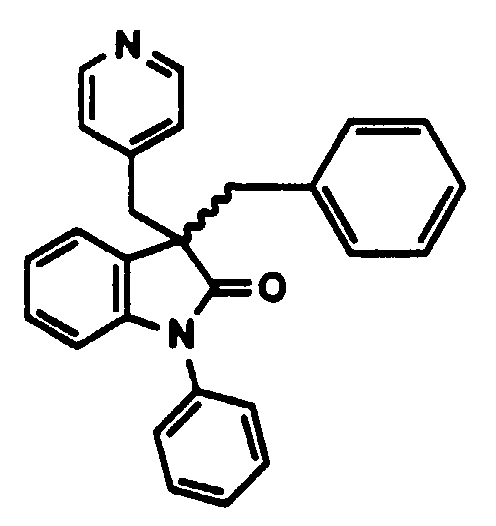
- By substituting benzyl bromide in Example 1, the desired product was synthesized and isolated as the free base in 89% yield; mp 127-128° C
-

- The product in Example 22 was treated with 1N HCl/diethyl ether and the resulting hydrochloride salt was isolated in 100% yield; mp 236-238° C.
-

- By substituting 4-nitrobenzyl bromide in Example 1, the desired product was synthesized and isolated as the free base in 76% yield; mp 168-169° C
-

- By reducing 1,3-dihydro-3-[(4-nitrophenyl)methyl]-1-phenyl-3-(4-pyridinylmethyl)-2H-indol-2-one as described in Org. Syn, Vol. 5, 346, the desired product was synthesized and isolated as the dihydrobromide salt in 70% yield; mp 200- 201° C.
-

- By substituting 3-nitrobenzyl bromide in Example 1, the desired product was synthesized and isolated as the hydrochloride salt in 78% yield as a foam; IR(nujol): C=O @ 1710 cm-1; NMR(DMSOd6 TMS): δ 3.5-3,9 (m, 4H, CH2-C-CH2), [6.25 (d, 1H), 6.71 (d, 2H), 7.1 (m, 1H), 7.19 (m, 1H), 7.44 (m, 6H), 7.60 (d, 2H), 7.90 (d, 1H), 8.0 (m, 1H), 8.72 (d, 2H), Ar]; mass spec m/e 436(M+1).
-

- By substituting 2-nitrobenzyl bromide in Example 1, the desired product was synthesized and isolated in 92% yield as a foam; IR(KBr): C=O 1710 cm-1; NMR(CDCl3 TMS): δ [3.50 (d, 1), 3.73 (d, 1), 3.69 (d, 1), 4.40 (d, 1H), CH2-C-CH2], [6,3 (m, 1H), 6.6 (m, 2H), 7.1 (m, 2H), 7.4 (m, 9H), 7.7 (d, 1H), 8.41 (d, 2H), Ar]; mass spec m/e 436(M+1).
-

- By substituting α-bromo-p-tolunitrile in Example 1, the desired product was synthesized and isolated as the hydrochloride salt in 30% yield as a foam; IR(nujol): CN @ 2226 and C=O @ 1712 cm-1; NMR(DMSOd6 TMS): δ 3.4-3.8 (m, 4H, CH2-C-CH2), [6.25 (d, 1H), 6.72 (d, 2H), 7.07 (m, 3H), 7.47 (m, 5H), 7.58 (m, 3H), 7.86 (d, 1H), 8.66 (d, 2H), Ar], mass spec m/e 416(M+1).
-

- By substituting α-bromo-m-tolunitrile in Example 1, the desired product was synthesized and isolated as the hydrochloride salt in 68% yield; mp 212-214° C
-

- By substituting α-bromo-o-tolunitrile in Example 1, the desired product was synthesized and isolated as the hydrochloride salt in 68% yield; mp 166-167° C dec.
-

- By substituting 4-methoxybenzyl chloride in Example 1, the desired product was synthesized and isolated as the hydrochloride salt in 52% yield; mp 205-208° C.
-

- By substituting 3-methoxybenzyl chloride in Example 1, the desired product was synthesized and isolated as the hydrochloride salt in 57% yield; mp 165-166° C.
-

- By substituting 3-fluorobenzyl bromide in Example 1, the desired product was synthesized and isolated as the hydrochloride salt in 78% yield; mp 210-212° C.
-

- By substituting 4-fluorobenzyl bromide in Example 1, the desired product was synthesized and isolated as the hydrochloride salt in 76% yield; mp 225-226° C.
-

- By substituting α-bromo-p-xylene in Example 1, the desired product was synthesized and isolated as the hydrochloride salt in 30% yield; mp 208-211° C.
-

- To a solution of acenaphthenone (33.64 g, 200 mmol) and 4-pyridine carboxaldehyde (23.56 g, 220 mmol) in 400 ml EtOH was added 50 ml 1N NaOH at room temperature, in 10 ml portions. The mixture was heated to reflux for 15 min. and allowed to cool to room temperature. The solution was cooled in an ice bath and neutralized with 1N HCl while stirring. On standing, the mixture presented orange crystals, which were collected by filtration, washed with cold 75% EtOH/H2O, and dried to give the desired material in 48% (24.72 g) yield (C18H11NO, MW 257.29).

- The olefin 4A (24.7 g) was dissolved in 250 ml MeOH and hydrogenated in a Parr Shaker over 1 g 10% Pd/c at 50 psi of hydrogen for 2 h. The catalyst was removed by filtration over Celite, and the filtrate was concentrated in vacuo to an orange oil of constant weight (26.11 g). Upon the addition of a few milliliters of EtOAc, crystals formed. The mixture was cooled, and the resulting crystals were collected by filtration, washed with cold EtOAc, and dried to give the desired starting material in 63% (15.69 g) yield as the free base yellow solid; mp 110-112° C; NMR(CDCl3 TMS): δ 3.04 (dd, 1H, J=9 Hz, 15 Hz), 3.57 (dd, 1H, J=5 Hz,14 Hz), 4.06 (dd, 1H, J=5 Hz, 9 Hz), 7.04 (d, 1H, J=7 Hz), 7.13 (d, 2H, J=6 Hz), 7.50 (t, 1H, J=8 Hz), 7.70 (t, 1H, J=8 Hz), 7.80 (d, 1H, J=8 Hz), 7.95 (d, 1H, J=7 Hz), 8.08 (d, 1H, J=8 Hz); 8.45 (d, 2H, J=6 Hz); mass spec m/e 260(M+1); Anal calcd C18H13NO, MW 259.29: C, 83.38; H, 5.05; N, 5.40. Found: C, 82.98; H, 4.92; N, 5.18.
-

- By reacting 2-(3-bromopropyl)tetrahydro-2H-pyran with Preparation 4B as in Example 1, the desired protected alcohol was obtained in quantitative yield as an oil.
-
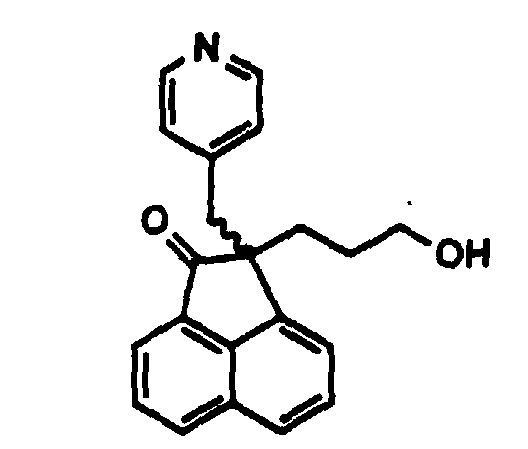
- By treating the "protected" alcohol, 2-(4-pyridinylmethyl)-2-[3-tetrahydro-2H-pyran-2-yloxy)propyl]-1(2H)-acenaphthylenone, with aqueous acid, the corresponding alcohol was obtained as the free base on work-up in 80% yield; mp 157-159° C.
-

- By substituting 5-bromovaleronitrile and Prep 4B in Example 1, the desired product was obtained in 37% yield as the hydrochloride salt; mp 218-221° C. The free base mp 103- 104° C.
-

- By substituting ethyl 4-bromobutyrate and Prep 4B in Example 1, the desired product was obtained in 52% yield; mp 189-191° C.
-

- By substituting α-bromo-m-tolunitrile and Prep 4B in Example 1, the desired product was obtained in 60% yield; mp 240-246° C.
-

- By substituting chloroethyl dimethylamine in Example 1, the desired product was obtained as a very hygroscopic foam in 55% yield; IR(nujol): C=O 1708 cm-1; NMR(DMSOd6 TMS): δ 2.51, 2.98 (2m, 2H, N-C-CH2), 2.78 (s, 6H, CH3-N-CH3), [3.46 (m, 2H), 3.67 (d, 1 H), 4.03 (t, 1 H) CH2-C-CH2], [6.54 (m, 1H), 7.23 (m, 2H), 7.75 (m, 1H), 1,2-Phe], [7.12 (d, 2H), 7.48 (m, 1H), 7.54 (m, 2H), Phe], [7.37, 8.63 (2d, 4H, 4-Pyr)]; mass spec m/e 372(M+1) - 2HCl.
-

- By substituting 1-bromo-4-chlorobutane in Example 1, the desired product was obtained in 82% yield; mp 149- 151° C.
-

- 3-(4-Chlorobutyl)-1,3-dihydro-1-phenyl-(4-pyridinylmethyl)-2H-indol-2-one hydrochloride (6.0 g, 14.04 mmol) in 75 ml dry THF was treated with NaH (0.75 g, 31.25 mmol) and stirred for 10 min. under dry nitrogen. The mixture was then treated with propanethiol (1.2 g, 15.4 mmol) and stirred at room temperature for 16 h. The mixture was concentrated in vacuo, and the residue was partitioned between 150 ml CH2Cl2 and 100 ml water. The organic layer was washed with water and brine. dried over MgSO4, filtered, treated with 20 ml 1N HCl/ether, and evaporated to dryness. The residue was triturated with 100 ml hot EtOAc, cooled to room temperature, and filtered to collect the solid. The solid was dried in vacuo to give the product in 81% (5.3 g) yield; mp 149-150° C; IR(KBr): C=O 1717 cm-1; NMR(DMSOd6 TMS): δ 0.90 (t, 3H, CH3), 1.02, 1.18 (2m, 2H, SCCCH2), 1.45 (m, 4H, CH2CSCCH2), 2.1 (SCCCCH2), 2.37 (2t, 4H, CH2SCH2), [3.42 (d, 1H), 3.59 (d, 1H), CH2-Pyr], [6.53 (m, 1H), 7.19 (m, 2H), 7.44 (d, 3H), 7.53 (m, 2H), 7.65 (m, 1H)Ar], 7.10, 8.66 (2d, 4H, 4-Pyr]; mass spec m/e 431 (M+1)-HCl.
-

- 1,3-Dihydro-1-phenyl-3-[4-(propylthio)butyl]-3-(4-pyridinylmethyl)-2N-indol-2-one hydrochloride (2.0 g, 4.28 mmol) in 50 ml MeOH and 11 ml water was treated with OXONE (monopersulfate compound, 2KHSO5/KHSO4/K2SO4) (7.9 g, 12.85 mmol) and stirred for 16 h. The reaction mixture was concentrated in vacuo, and the residue was partitioned between 100 ml 1N NaOH and 100 ml CH2Cl2. The organic phase was washed with water and brine, dried over MgSO4, filtered, and concentrated to an oil. The oil was column chromatographed on silica gel using CHCl3-MeOH (10:1) as the mobile phase, and appropriate fractions were combined and concentrated to an oil. The oil was triturated with 1N HCl/ether to give a solid which was collected by filtration, washed with ether, and dried in vacuo to give the product in 70% (1.6 g) yield; mp 197-199° C dec.; IR(nujol): C=O 1711, S02 1141 cm-1; NMR(CDCl3 TMS): δ 1.07 (t, 3H, CH3), 1.3 (m, 2H, SCCCH2), 1.8 (m, 4H, CH2CSCCH2), 2.1, 2.3 (2m, 2H, SCCCCH2), 2.9 (m, 4H, CH2SCH2), 3.3-3.6 (m, 2H, CH2-Pyr), [6.57 (d, 1H), 7.2 (d, 1H), 7.4 (m, 6H)Ar], 6.92, 8.48 (2d, 4H, 4-Pyr]; mass spec m/e 497(M+1).
-

- By substituting potassium ethoxide for sodium hydride+propanethiol in Example 42, the desired product was obtained in 73% yield; mp 95-98° C.
-
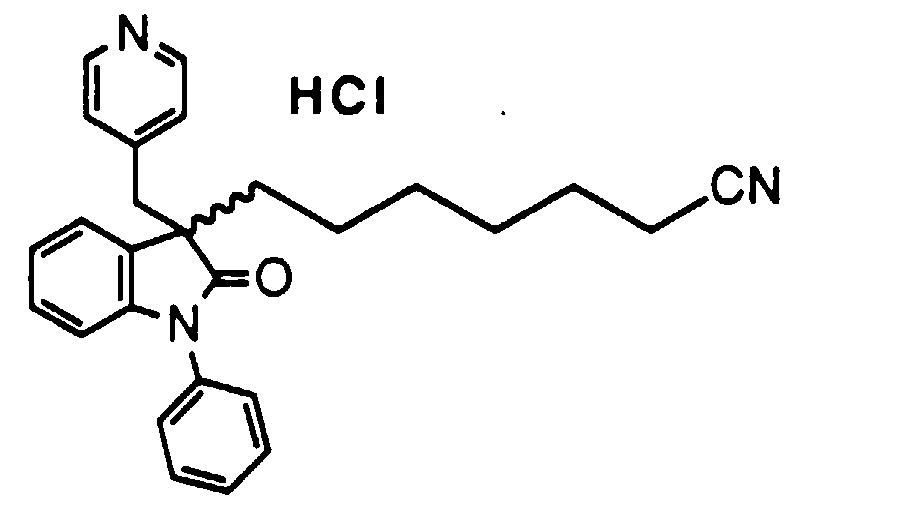
- By substituting 7-bromoheptanenitrile in Example 1, the desired product was obtained in 11% yield; mp 190-192° C.
-

- By substituting ethyl 4-bromocrotonate in Example 1, the desired product was obtained as an oil in 56% yield; IR(neat): C=O 1718 cm-1; NMR(CDCl3 TMS): δ 1.24 (t, 3H, CH3), 2.94 (m, 2H, CH2-C=C), [3.11 (d, 1H, J12), 3.32 (d, 1H, J12), CH2-Pyr], 4.14 (q, 2H, OCH2), 5,90 (d, 1H, J16, C=CH-CO), 6.7 (m, 1H, CH=C-CO), [6.5 (m, 1H), 6.79 (d, 2H), 6.9 (d, 2H), 7.15 (m, 2H), 7.4 (m, 4H), 8.29 (d, 2H), Ar]; mass spec m/e 413(M+1).
-

- By substituting 3-chloro-4-fluoropropiophenone in Example 1, the desired product was obtained in 65% yield; mp 183-185° C dec.
-

- By substituting 4-chloro-4-fluorobutyrophenone propylene ketal in Example 1, the corresponding ketal was obtained, which was converted by standard methods to the ketone in 46% yield; mp 205° C dec.
-
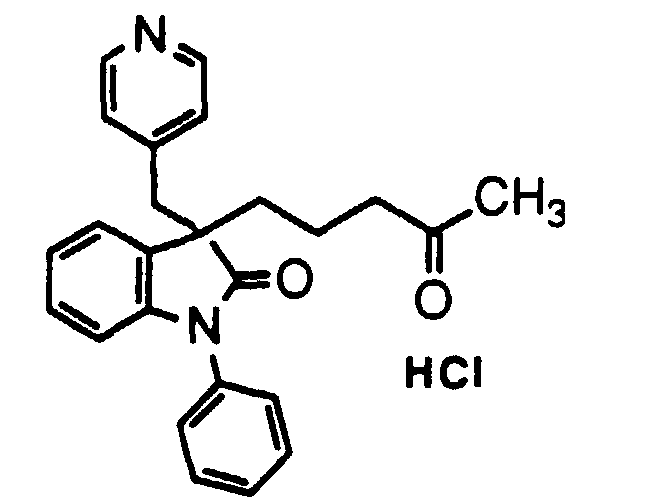
- By substituting 5-chloro-2-pentanone ethylene ketal in Example 1, the corresponding ketal was obtained, which was converted to the ketone in 44% yield; mp 192-194° C.
-

- By substituting α-bromo-o-xylene in Example 1, the desired product was obtained in 80% yield; mp 150-153° C.
-

- By substituting 2-fluorobenzyl bromide in Example 1; the desired product was obtained in 79% yield; mp 195- 198° C.
-

- By substituting 3-bromobenzyl bromide in Example 1; the desired product was obtained in 98% yield as a foam; IR(KBr): C=O @ 1711 cm-1; NMR(CDCl3 TMS): δ [3.30, 3.43 (2d, 2H), 3.58, 3.72 (2d, 2H), CH2-C-CH2)], [6.29(d, 1H), 6.67 (d, 2H), 6.81 (d, 1H), 6.92 (dd, 1H), 7.07 (d, 2H), 7.12 (d, 1H), 7.24 (d, 1H), 7.33 (m, 3H), 7.57 (d, 2H), 8.52 (d, 2H) Ar]; mass spec m/e 469(M+1).
-

- By substituting 4-bromobutyronitrile and Preparation 4 in Example 1, the desired product was obtained in 81% yield; mp 93-95° C.
-

- By substituting 2,3-dihydro-2-oxo-1-phenyl-3-(2- pyrazinylmethyl)-1H-indole and 5-bromovaleronitrile in Example 1, the desired product was obtained in 76% yield as an oil.
-
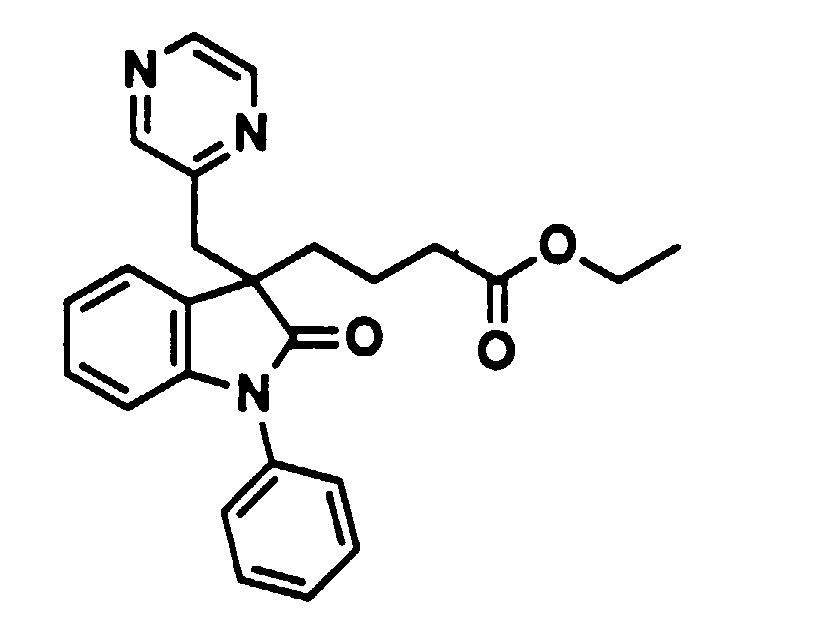
- By substituting 2,3-dihydro-2-oxo-1-phenyl-3-(2-pyrazinylmethyl)-1H-indole and ethyl 4-bromobutyrate in Example 1, the desired product was obtained in 80% yield as an oil.
- By using the methods in the examples above, the following compounds of this invention can be synthesized:
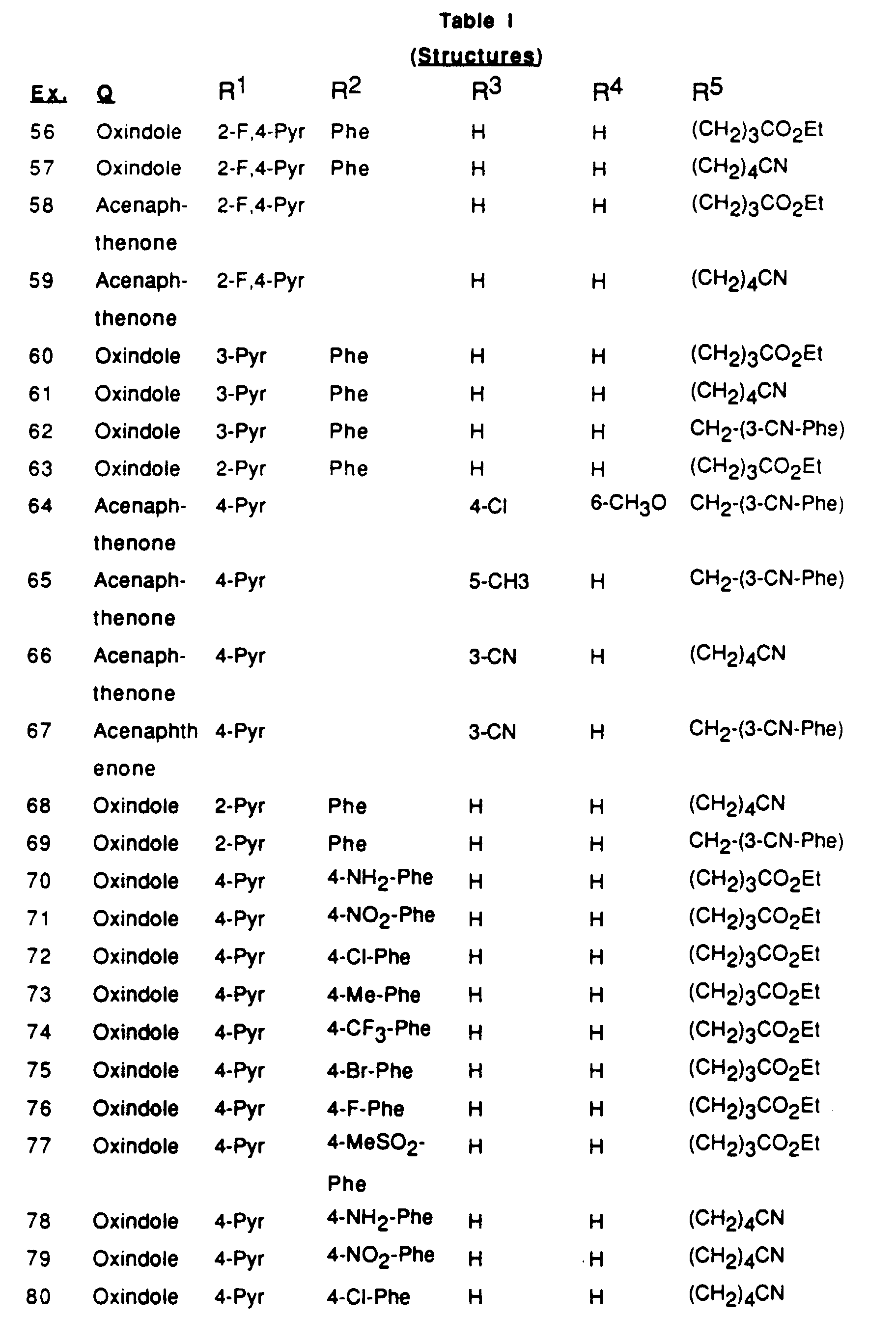


- Neurotransmitter release assay. The neurotransmitter release activities of the compounds of this invention were determined as reported by Nickolson, et al., (1990) Drug Development Research, 19, 285-300 of a modification of the procedure described by Mulder, et al., Brain Res., 1974, 70, 372.
- Male Wistar rats (Charies River) weighing 175-200 grams were used. The rats were housed for at least seven days before the experiment in animal facility under 12/12 hour light/dark cycle. Deionized water and standard rat chow (Purina) were available ad libitum.
- Rats were decapitated and brains were dissected immediately. Slices (0.3 mm thick) from the parietal cortex were prepared manually using a recessed Lucite guide and subsequently cut into 0.25 x 0.25 mm squares.
- Slices (approximately 100 mg wet weight) were incubated in 10 ml KrebsRinger medium (KR) containing NaCl (116 mM), KCl (3 mM), CaCl2 (1.3 mM), MgCl2 (1.2 mM), KH2PO4 (1.2 mM), Na2SO4 (1.2 mM), NaHCO3 (25.0 mM), and glucose (11.0 mM), to which was added 10 uCi 3H-choline (specific activity approximately 35 Ci/mM; NEN) and 10 mM unlabeled choline to give a final concentration of one micromole. The brain preparations were incubated for 30 min. at 37° C under a steady flow of 95% O2/5% CO2. Under these conditions, part of the radioactive choline taken up by the preparation was converted into radioactive acetylcholine (ACh) by the cholinergic nerve endings stored in synaptic vesicles, and released upon depolarization by high potassium ion (K+) containing media.
- After labelling of the ACh stores, the slices were washed three times with non-radioactive KR medium and transferred to a superfusion apparatus to measure the drug effects on ACh release. The superfusion apparatus consisted of 10 thermostated glass columns of 5 mm diameter that were provided with GF/F glass fiber filters to support the slices (approximately 10 mg tissue/column). Superfusion was carried out in KR-medium (0.3 ml/min.) containing 10 mM hemicholine- 3 (HC-3). The HC-3 prevents the reuptake of choline formed during the superfusion from phospholipids and released ACh, which would be converted into unlabeled ACh and released in preference to the pre-formed labeled ACh. The medium was delivered by a 25-channel peristaltic pump (Ismatec by Brinkman) and warmed to 37° C in a thermostated stainless steel coil before entering the superfusion column. Each column was provided with a 4-way slider valve (Beckmann instruments) which allowed rapid change of low to high K+/KR-medium, and with two 10-channel 3-way valves that were used to change from drug-free to drug-containing low and high K+/KR-medium. After 15 min. of washout of non-specifically bound radioactivity, collection of 4 min. fractions was initiated. After three 4 min. collections, the original medium was changed to a KR-medium in which the KCl concentration had been increased to 25 mM (high K+ medium) (S1). Depolarization- induced stimulation of release by high K+/KR-medium lasted for 4 min. Drug free low and high K+/KR-media were then substituted by drug- and vehicle-containing low- and high- K+/KR-medium, and superfusion was continued for three 4 min. collections with low K+/KR-medium, one 4 min. collection with high K+/KR-medium (S2), and two 4 min. collections with low K+/KR-medium.
- Drug was added to the media by 100-fold dilutions of appropriate concentrations of the drug (in 0.9% saline) with either low- or high-K+/KR-medium.
- All superfusion fractions were collected in liquid scintillation counting vials. After superfusion, the slices were removed from the superfusion columns and extracted with 1.0 ml of 0.1 N HCl. Liquiscint (NEN) counting fluid (12 ml) was added to superfusion fractions and extracts, and the samples were counted in a Packard Tricarb Liquid Scintillation Counter. No corrections were made for quenching.
- The ratio of S2/S1 (as compared to controls where no drug was present during S2) was a measure of the ability of the drug to enhance or depress stimulus-induced acetylcholine release.


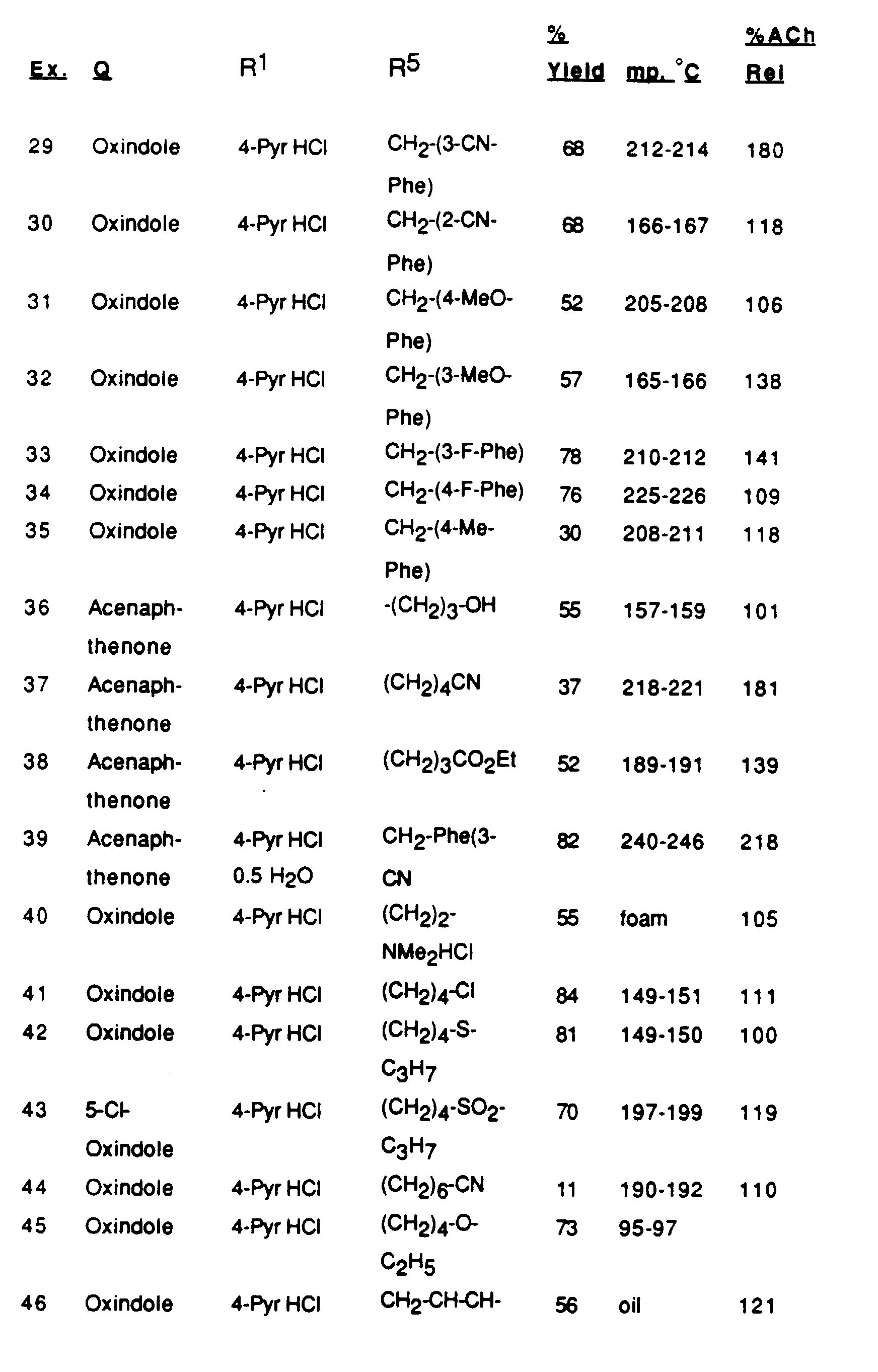

- Using a similar procedure, the compounds of this invention have been shown to enhance the release of dopamine (DA) as shown in Table III.
Table III. Acetylcholine and Dopamine (DA) Release at Dosing of 10 uM. Example %DA Rel %ACh Rel 1 347 392 5 232 257 - Rat Passive Avoidance (PA) Hypoxia Induced Amnesia: Unfasted male CD rats, weighing between 165-210 g were trained in a PA apparatus using the following procedure: rats were placed in the clear side of the two compartment chamber and allowed 90 seconds to enter the dark compartment. Ten seconds after entering the dark chamber, a 3 second footshock (1.0 mA) was applied to the grid floor followed by an additional 10 second delay, and another 3 second footshock was applied. Retentions were tested 4 hours later. The rats were allowed 300 seconds to enter the dark compartment; time was taken. Memory disruption was induced by exposing the rats to a gas mixture containing 6.5% oxygen supplemented with nitrogen for 30 minutes before passive avoidance training. Doses of the test compound were administered (0.1 ml/100 g s.c.) relative to time of PA training. Typical results are shown in Table IV for Ex 1.
Table IV. Rat Passive Avoidance-Hypoxia Induce Amnesia for Example 1. Median Retention Latencies Dose, mg/kg n (# animals tested) Median Latencies, sec No Hypoxia 60 300.0 Vehicle 59 15.0 0.1 12 79.5 0.3 12 37.5 1.0 24 89.5 3.0 36 112.0** 10.0 23 136.0** 30.0 13 201.0* *: significantly different from vehicle, p < 0.05, Mann- Whitney U Test **: significantly different from vehicle, p < 0.025, Mann- Whitney U Test - The foregoing test results suggest that the compounds of this invention have utility in the treatment of cognitive disorders and/or neurological function deficits and/or mood and mental disturbances in patients suffering from nervous system disorders like Alzheimer's disease, Parkinson's disease, senile-dementia, multi-infarct dementia, Huntington's disease, mental retardation, Myasthenia Gravis, etc. Compounds of this invention can be administered to treat said deficiencies by any means that produces contact of the active agent with the agent's site of action in the body of a mammal. The compounds can be administered by any conventional means available for use in conjunction with pharmaceuticals either as individual therapeutic agent or in combination of therapeutic agents. They can be administered alone, but are generally administered with a pharmaceutical carrier selected on the basis of the chosen route of administration and standard pharmaceutical practice.
- The dosage administered will vary depending on the use and known factors such as the pharmacodynamic character of the particular agent, and its mode and route of administration; the recipient's age, weight, and health; nature and extent of symptoms; kind of concurrent treatment; frequency of treatment; and the desired effect. For use in the treatment of said diseases or conditions, the compounds of this invention can be orally administered daily at a dosage of the active ingredient of 0.001 to 100 mg/kg of body weight. Ordinarily, a dose of 0.01 to 10 mg/kg/day in divided doses one to four times a day, or in sustained release formulation was effective in obtaining the desired pharmacological effect.
- Dosage forms (compositions) suitable for administration contain from about 1 mg to about 100 mg of active ingredient per unit. In these pharmaceutical compositions, the active ingredient will ordinarily be present in an amount of about 0.5 to 95% by weight based on the total weight of the composition.
- The active ingredient can be administered orally in solid dosage forms, such as capsules, tablets, and powders; or in liquid forms such as elixirs, syrups, and/or suspensions. The compounds of this invention can also be administered parenterally in sterile liquid dose formulations.
- Gelatin capsules can be used to contain the active ingredient and a suitable carrier such as but not limited to lactose, starch, magnesium stearate, steric acid, or cellulose derivatives. Similar diluents can be used to make compressed tablets. Both tablets and capsules can be manufactured as sustained release products to provide for continuous release of medication over a period of time. Compressed tablets can be sugar coated or film coated to mask any unpleasant taste, or used to protect the active ingredients from the atmosphere, or to allow selective disintegration of the tablet in the gastrointestinal tract.
- Liquid dosage forms for oral administration can contain coloring and flavoring agents to increase patient acceptance.
- In general, water, pharmaceutically acceptable oils, saline, aqueous dextrose (glucose), and related sugar solutions and glycols, such as propylene glycol or polyethylene glycol, are suitable carriers for parenteral solutions. Solutions for parenteral administration preferably contain a water soluble salt of the active ingredient, suitable stabilizing agents, and if necessary, butter substances. Antioxidizing agents, such as sodium bisulfite, sodium sulfite, or ascorbic acid, either alone or in combination, are suitable stabilizing agents. Also used are citric acid and its salts, and EDTA. In addition, parenteral solutions can contain preservatives such as benzalkonium chloride, methyl- or propyl-paraben, and chlorobutanol.
- Suitable pharmaceutical carriers are described in "Remington's Pharmaceutical Sciences", A. Osol, a standard reference in this field.
- Useful pharmaceutical dosage-forms for administration of the compounds of this invention can be illustrated as follows:
- A large number of unit capsules are prepared by filling standard two-piece hard gelatin capsules each with 100 mg of powdered active ingredient, 150 mg lactose, 50 mg cellulose, and 6 mg magnesium stearate.
- A mixture of active ingredient in a digestible oil such as soybean, cottonseed oil, or olive oil is prepared and injected by means of a positive displacement was pumped into gelatin to form soft gelatin capsules containing 100 mg of the active ingredient. The capsules are washed and dried.
- A large number of tablets are prepared by conventional procedures so that the dosage unit was 100 mg of active ingredient, 0.2 mg of colloidal silicon dioxide, 5 mg of magnesium stearate, 275 mg of microcrystalline cellulose, 11 mg of starch, and 98.8 mg lactose. Appropriate coatings may be applied to increase palatability or delayed absorption.
- The compounds of this invention may also be used as reagents or standards in the biochemical study of neurological function, dysfunction, and/or disease.
where, together or independently:
Claims (22)
- A compound of the formula
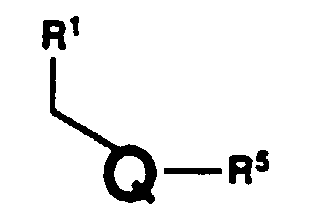
 A and B are independently selected from H, R4, -OH and -OCOR4, orA and B together form =O, =S, =CH2, =CHR4, =C(R4), =NOH, =NOR4, 1,3-dioxane, 1,3-dioxolane, 1,3-dithiane or 1,3-dithiolane;R1 is 4-,3-, or 2-pyridyl, pyrimidyl; pyrazinyl, 2-, or 3-fluoro-4-pyddyl;R2 is alkyl of 1 to 10 carbons, cycloalkyl of 3 to 8 carbons, 2-, 3-, or 4-pyridyl, Phe or Phe-W;Phe is a phenyl group;W is F, Cl, Br, -OH, C1-4 alkyl, -O-C1-4 alkyl, -NO2, -NH2, -NHC1-4 alkyl, -N(C1-4 alkyl)2, -CN, or -S(O)m-C1-4 alkyl;R3 is H, F, Cl, Br, -CN, -OH, -NO2, -NH2, -CF3, -NHR4, -NR4R4', R4, -OR4, or -S(O)m-R4;R4 and R4' are C1-4 alkyl, CH2Phe-W or Phe-W;R5 is -(CH2)n-Y or -OCOR4;Y is H, OH, NH2, -NHR4, -NR4R4', -NHCOR4, -NHCO2R4, F, Cl, Br, OR4, -S(O)mR4, -CO2H, -CO2R4, -CN, -CONR4R4', -CONHR4, -CONH2, -COR4, -CH=CHCO2R4, OCOR4, Phe, Phe-W, -C≡CCO2R4, -CH=CHR4 or -C≡CR4;m is 0, 1 or 2;n is 1 to 7;provided that,1) when Q is oxidinole and R5 is (CH2)nY, then Y is other than OH,2) when Q is oxidinole, R1 is 2-pyridyl, R2 is -CH3 and R is H, then R5 is not -CH2CN or CH2CO2H,3) when Q is acenaphthenone and R1 is 2-, 3-, or 4-pyridyl, then Y is not H;and physiologically suitable salts thereof.
 - The compound of Claim 1 wherein R1 is selected from 4-pyridyl, 4-pyrimidyl, and 2-fluoro-4-pyridyl.
- The compound of Claim 1 wherein R5 is -(CH2)n-Y.
- The compound of Claim 3 wherein n is 1 to 5 and Y is selected from H, -OH, -NH2, -NHR4, -NR4R4', F, Cl, Br, -CO2H, -CO2R4, -CN, -CONHR4, -CONH2, -CONR4R4', -COR4, -CH=CHCO2R4, -OCOR4, and -Phe-W.
- The compound of Claim 1 where W is selected from F, Cl, Br, C1-4 alkyl, -O-C1-4 alkyl, -S(O)m-C1-4 alkyl, -CN, -NO2, and -NH2.
- The compound of Claim 1 where R4 is C1-4 alkyl.
- The compound of Claim 2 where R5 is -(CH2)n-Y.
- The compound of Claim 6 where n is 1 to 4; Y is selected from -CO2R4, -CN, -CONHR4, -CH=CHCO2R4, and -OCOR4; and R4 is alkyl of 1 to 2 carbon atoms.
- The compound of Claim 1 where R2 is selected from 4-pyridyl, Phe and Phe-W.
- The compound of Claim 9 where W is selected from F, Cl, Br, -NO2, -CN, and -CH3.
- The compound of Claim 1 where R3 is selected from H, F, Cl, and Br.
- The compound of Claim 1 where R1 is selected from 4-pyridyl, 4-pyrimidyl, and 2-fluoro-4-pyridyl;R5 is -(CH2)n-Y;n is 1 to 4;Y is selected from -CO2R4, -CN, -CONHR4, -CH=CHCO2R4, and -OCOR4;R2 is selected from 4-pyridyl, Phe and Phe-W;W is selected from F, Cl, Br, NO2, CN, and CH3;R3 is selected from H, F, Cl, and Br;and R4 is alkyl of 1 to 2 carbons.
- The compound of Claim 1 which is 2,3-Dihydro- 2-oxo-1-phenyl-3-(4-pyridinylmethyl)-1H-indole-3-butanoic acid ethyl ester Hydrochloride.
- The compound of Claim 1 which is (+)-2,3- Dihydro-2-oxo-1-phenyl-3-(4-pyridinylmethyl)-1H-indole-3-butanoic acid ethyl ester Hydrochloride.
- The compound of Claim 1 which is 2,3-Dihydro- 2-oxo-1-phenyl-3-(4-pyridinylmethyl)-1H-indole-3-pentanenitrile Hydrochloride.
- The compound of Claim 1 which is 1,3-Dihydro- 3-[(3-cyanophenyl)methyl]-1-phenyl-3-(4-pyridinylmethyl)-2H-indol-2-one Hydrochloride.
- The compound of Claim 1 which is 2,3-Dihydro-2-oxo-1-phenyl-3-(4-pyridinylmethyl)-1H-indole-3-butanenitrile Hydrochloride.
- The compound of Claim 1 which is 2,3-Dihydro- 2-oxo-1-phenyl-3-(4-pyridinylmethyl)-1H-indole-3-hexanenitrile Hydrochloride.
- The compound of Claim 1 which is 1,3-Dihydro-1-phenyl-3-(phenylmethyl)-3-(4-pyridinylmethyl)-2H-indole- 2-one Hydrochloride.
- 1,3-Dihydro-3-(4-hydroxybutyl)-1-phenyl-3-(4-pyridinylmethyl)-2H-indol-2-one,1,3-Dihydro-3-(3-hydroxypropyl)-1-phenyl-3-(4-pyridinylmethyl)-2H-indole-2-one,1,3-Dihydro-3-(2-hydroxyethyl)-1-phenyl-3-(4-pyridinylmethyl)-2H-indole-2-one,2-(3-Hydroxypropyl)-2-(4-pyridinylmethyl)-1(2H)-acenaphthylenone,1,2-Dihydro-2-oxo-1-(4-pyridinylmethyl)-1-acenaphthylene-pentanenitrile,1,2-Dihydro-2-oxo-1-(4-pyridinylmethyl)-1-acenaphthylene-butanoic acid ethyl ester,3-[(1,2-Dihydro-2-oxo-1-(4-pyridinylmethyl)-1-acenaphthylenyl)methyl]-benzonitrile,1,2-Dihydro-2-oxo-1-(4-pyridinylmethyl)-1-acenaphthylene-butanenitrile,1,2-Dihydro-2-oxo-1-(2-fluoro-4-pyridinylmethyl)-1-acenaphthylene-butanoic acid ethyl ester,1,2-Dihydro-2-oxo-1-(2-fluoro-4-pyridinylmethyl)-1-acenaphthylene-butanenitrile,3-[(4-Chloro-1,2-dihydro-6-methoxy-2-oxo-1-(4-pyridinylmethyl)-1-acenaphthylenyl)methyl]-benzonitrile,3-[(1,2-Dihydro-5-methyl-2-oxo-1-(4-pyridinylmethyl)-1-acenaphthylenyl)methyl]-benzonitrile,3-Cyano-1,2-dihydro-2-oxo-1-(4-pyridinylmethyl)-1-acenaphthylene-butanenitrile,3-[(3-Cyano-1,2-dihydro-2-oxo-1-(4-pyridinylmethyl)-1-acenaphthylenyl)methyl]-benzonitrile,1,2-Dihydro-5-nitro-2-oxo-1-(4-pyridinylmethyl)-1-acenaphthylene-butanoic acid ethyl ester,1,2-Dihydro-5-fluoro-2-oxo-1-(4-pyridinylmethyl)-1-acenaphthylene-butanoic acid ethyl ester,1,2-Dihydro-5-methyl-2-oxo-1-(4-pyridinylmethyl)-1-acenaphthylene-butanoic acid ethyl ester,4-Chloro-1,2-dihydro-6-methoxy-2-oxo-1-(4-pyridinylmethyl)-1-acenaphthylene-butanoic acid ethyl ester,3-Bromo-1,2-dihydro-2-oxo-1-(4-pyridinylmethyl)-1-acenaphthylene-butanoic acid ethyl ester,1,2-Dihydro-6-nitro-2-oxo-1-(4-pyridinylmethyl)-1-acenaphthylene-butanoic acid ethyl ester,3-Cyano-1,2-dihydro-2-oxo-1-(4-pyridinylmethyl)-1-acenaphthylene-butanoic acid ethyl ester,1,2-Dihydro-5-nitro-2-oxo-1-(4-pyridinylmethyl)-1-acenaphthylene-butanenitrile,1,2-Dihydro-5-fluoro-2-oxo-1-(4-pyridinylmethyl)-1-acenaphthylene-butanenitrile,1,2-Dihydro-5-methyl-2-oxo-1-(4-pyridinylmethyl)-1-acenaphthylene-butanenitrile,4-Chloro-1,2-dihydro-6-methoxy-2-oxo-1-(4-pyridinylmethyl)-1-acenaphthylene-butanenitrile,4-Bromo-1,2-dihydro-2-oxo-1-(4-pyridinylmethyl)-1-acenaphthylene-butanenitrile, and1,2-Dihydro-6-nitro-2-oxo-1-(4-pyridinylmethyl)-1-acenaphthylene-butanenitrile.
- A pharmaceutical composition comprising a suitable pharmaceutical carrier and a therapeutically effective amount of a compound as defined in any of claims 1-20.
- Use of a compound according to any of claims 1-20 for preparing a medicament for treating cognitive or neurological dysfunction in a mammal.
Applications Claiming Priority (3)
| Application Number | Priority Date | Filing Date | Title |
|---|---|---|---|
| US82157292A | 1992-01-16 | 1992-01-16 | |
| US821572 | 1992-01-16 | ||
| PCT/US1992/011292 WO1993014085A1 (en) | 1992-01-16 | 1992-12-30 | Novel neurotransmitter releasers useful for cognition enhancement |
Publications (2)
| Publication Number | Publication Date |
|---|---|
| EP0623127A1 EP0623127A1 (en) | 1994-11-09 |
| EP0623127B1 true EP0623127B1 (en) | 1997-04-02 |
Family
ID=25233729
Family Applications (1)
| Application Number | Title | Priority Date | Filing Date |
|---|---|---|---|
| EP93902813A Expired - Lifetime EP0623127B1 (en) | 1992-01-16 | 1992-12-30 | Novel neurotransmitter releasers useful for cognition enhancement |
Country Status (12)
| Country | Link |
|---|---|
| US (1) | US5414004A (en) |
| EP (1) | EP0623127B1 (en) |
| JP (1) | JP2656157B2 (en) |
| AU (1) | AU3425493A (en) |
| CA (1) | CA2128233A1 (en) |
| DE (1) | DE69218795T2 (en) |
| ES (1) | ES2100523T3 (en) |
| IL (1) | IL104417A0 (en) |
| MX (1) | MX9300205A (en) |
| TW (1) | TW215437B (en) |
| WO (1) | WO1993014085A1 (en) |
| ZA (1) | ZA93276B (en) |
Families Citing this family (10)
| Publication number | Priority date | Publication date | Assignee | Title |
|---|---|---|---|---|
| TW219935B (en) * | 1991-12-25 | 1994-02-01 | Mitsubishi Chemicals Co Ltd | |
| US5594001A (en) * | 1993-04-08 | 1997-01-14 | The Dupont Merck Pharmaceutical Company | Polycyclic systems, and derivatives thereof, as neurotransmitter release enhancers useful in the treatment of cognitive disorders |
| BR9405954A (en) * | 1993-04-08 | 1995-12-26 | Du Pont Merck Pharma | Polycyclic compounds and derivatives of the same pharmaceutical compositions and method of treating cognitive or neurological dysfunction |
| MX9605218A (en) * | 1994-04-29 | 1997-10-31 | Pfizer | Novel acyclic and cyclic amides as neurotransmitter release enhancers. |
| US5750528A (en) * | 1995-02-01 | 1998-05-12 | The Dupont Merck Pharmaceutical Company | Blockade of neuronal m-channels as a therapeutic approach to the treatment of neurological disease |
| PT810223E (en) * | 1996-05-28 | 2001-12-28 | Pfizer | OXINDOLES SUBSTITUTED BY ADAMANTILO AS PHARMACEUTICAL AGENTS |
| JPH11236333A (en) * | 1997-12-30 | 1999-08-31 | Pfizer Prod Inc | Imidazolin-4-one derivative as anticancer agent |
| US20040175691A1 (en) * | 1998-12-03 | 2004-09-09 | Brown Barry S. | Use of the KCNQ2 and KCNQ3 genes for the discovery of agents useful in the treatment of neurological disorders |
| US6174903B1 (en) | 1998-12-28 | 2001-01-16 | Pfizer Inc. | Imidazolidin-4-one derivatives useful as anticancer agents |
| CN112358434B (en) * | 2020-11-18 | 2025-04-22 | 湖南理工学院 | A preparation method of 3-(o-cyanobenzyl)indole-2-one compounds |
Family Cites Families (4)
| Publication number | Priority date | Publication date | Assignee | Title |
|---|---|---|---|---|
| US5173489A (en) * | 1986-04-10 | 1992-12-22 | The Dupont Merck Pharmaceutical Co. | α,α-disubstituted aromatics and heteroaromatics as cognition enhancers |
| US4760083A (en) * | 1986-04-10 | 1988-07-26 | E. I. Dupont De Nemours & Company | 3,3-disubstituted indolines |
| DE69031649T2 (en) * | 1989-07-25 | 1998-02-26 | Taiho Pharmaceutical Co Ltd | OXOINDOL DERIVATIVES |
| US5006537A (en) * | 1989-08-02 | 1991-04-09 | Hoechst-Roussel Pharmaceuticals, Inc. | 1,3-dihydro-1-(pyridinylamino)-2H-indol-2-ones |
-
1992
- 1992-12-30 EP EP93902813A patent/EP0623127B1/en not_active Expired - Lifetime
- 1992-12-30 DE DE69218795T patent/DE69218795T2/en not_active Expired - Fee Related
- 1992-12-30 JP JP5512479A patent/JP2656157B2/en not_active Expired - Lifetime
- 1992-12-30 CA CA002128233A patent/CA2128233A1/en not_active Abandoned
- 1992-12-30 WO PCT/US1992/011292 patent/WO1993014085A1/en not_active Ceased
- 1992-12-30 ES ES93902813T patent/ES2100523T3/en not_active Expired - Lifetime
- 1992-12-30 AU AU34254/93A patent/AU3425493A/en not_active Abandoned
-
1993
- 1993-01-15 MX MX9300205A patent/MX9300205A/en not_active IP Right Cessation
- 1993-01-15 ZA ZA93276A patent/ZA93276B/en unknown
- 1993-01-15 TW TW082100245A patent/TW215437B/zh active
- 1993-01-17 IL IL104417A patent/IL104417A0/en unknown
- 1993-09-20 US US08/124,523 patent/US5414004A/en not_active Expired - Lifetime
Also Published As
| Publication number | Publication date |
|---|---|
| JPH07503005A (en) | 1995-03-30 |
| ES2100523T3 (en) | 1997-06-16 |
| CA2128233A1 (en) | 1993-07-22 |
| DE69218795T2 (en) | 1997-07-10 |
| AU3425493A (en) | 1993-08-03 |
| WO1993014085A1 (en) | 1993-07-22 |
| TW215437B (en) | 1993-11-01 |
| EP0623127A1 (en) | 1994-11-09 |
| JP2656157B2 (en) | 1997-09-24 |
| US5414004A (en) | 1995-05-09 |
| IL104417A0 (en) | 1993-05-13 |
| ZA93276B (en) | 1994-07-15 |
| DE69218795D1 (en) | 1997-05-07 |
| MX9300205A (en) | 1994-07-29 |
Similar Documents
| Publication | Publication Date | Title |
|---|---|---|
| EP0783500B1 (en) | Aminoheterocyclic derivatives as antithrombotic or anticoagulant agents | |
| KR100880698B1 (en) | TF-α production inhibitor | |
| JP2001505586A (en) | Triarylethanes useful as PDE IV inhibitors | |
| JPS62277381A (en) | 3,3-di-substituted indolines | |
| US5854232A (en) | Acyclic anc cyclic amides as neurotransmitter release enhancers | |
| BRPI0212726B1 (en) | lactam-containing compounds and derivatives thereof, pharmaceutical composition comprising them and their uses | |
| JP6916171B2 (en) | Human plasma kallikrein inhibitor | |
| PH26127A (en) | N-(pyridinyl)-1H-indol-1-amines and a process for their preparation | |
| EP3126345A1 (en) | Inhibitors of histone demethylases | |
| JP2003529547A (en) | 3-Pyrrolidinyloxy-3'-pyridyl ether compounds effective for controlling chemical synaptic transmission | |
| US5278162A (en) | 3,3'-disubstituted-1,3-dihydro-2H-pyrrolo[2,3-b]heterocyclic-2-one useful in the treatment of cognitive disorders of man | |
| US5414004A (en) | Neurotransmitter releasers useful for cognition enhancement | |
| US4970218A (en) | N-(pyridinyl)-1H-indol-1-amines | |
| EP0623132B1 (en) | Disubstituted polycyclic systems as cognition enhancers | |
| US5532247A (en) | Neurotransmitter releasers useful for cognition enhancement | |
| US5698559A (en) | Disubstituted polycyclic systems as cognition enhancers | |
| US5039811A (en) | Preparation of N-(pyridinyl)-1H-indol-1-amines | |
| US20250312335A1 (en) | Flt combination therapy for cancer and compositions therefor | |
| US5519132A (en) | Pyridine compounds | |
| JP3121428B2 (en) | Mixed pyridine-2,4- and -2,5-dicarboxamide | |
| US20010034357A1 (en) | Substituted pyridine compounds useful for controlling chemical synaptic transmission | |
| JPWO1999038867A1 (en) | 1-Cycloalkyl-1,8-naphthyridin-4-one derivatives having type IV phosphodiesterase inhibitory activity | |
| HK1193598A (en) | 5-cycloalkyl-or 5-heterocyclyl-nicotinamides |
Legal Events
| Date | Code | Title | Description |
|---|---|---|---|
| PUAI | Public reference made under article 153(3) epc to a published international application that has entered the european phase |
Free format text: ORIGINAL CODE: 0009012 |
|
| 17P | Request for examination filed |
Effective date: 19940707 |
|
| AK | Designated contracting states |
Kind code of ref document: A1 Designated state(s): DE ES FR GB IT |
|
| 17Q | First examination report despatched |
Effective date: 19950117 |
|
| GRAG | Despatch of communication of intention to grant |
Free format text: ORIGINAL CODE: EPIDOS AGRA |
|
| GRAH | Despatch of communication of intention to grant a patent |
Free format text: ORIGINAL CODE: EPIDOS IGRA |
|
| GRAH | Despatch of communication of intention to grant a patent |
Free format text: ORIGINAL CODE: EPIDOS IGRA |
|
| GRAA | (expected) grant |
Free format text: ORIGINAL CODE: 0009210 |
|
| AK | Designated contracting states |
Kind code of ref document: B1 Designated state(s): DE ES FR GB IT |
|
| REF | Corresponds to: |
Ref document number: 69218795 Country of ref document: DE Date of ref document: 19970507 |
|
| ITF | It: translation for a ep patent filed | ||
| ET | Fr: translation filed | ||
| REG | Reference to a national code |
Ref country code: ES Ref legal event code: FG2A Ref document number: 2100523 Country of ref document: ES Kind code of ref document: T3 |
|
| PLBE | No opposition filed within time limit |
Free format text: ORIGINAL CODE: 0009261 |
|
| STAA | Information on the status of an ep patent application or granted ep patent |
Free format text: STATUS: NO OPPOSITION FILED WITHIN TIME LIMIT |
|
| 26N | No opposition filed | ||
| REG | Reference to a national code |
Ref country code: FR Ref legal event code: CD Ref country code: FR Ref legal event code: CA |
|
| PGFP | Annual fee paid to national office [announced via postgrant information from national office to epo] |
Ref country code: FR Payment date: 20001212 Year of fee payment: 9 |
|
| PGFP | Annual fee paid to national office [announced via postgrant information from national office to epo] |
Ref country code: ES Payment date: 20001220 Year of fee payment: 9 |
|
| PGFP | Annual fee paid to national office [announced via postgrant information from national office to epo] |
Ref country code: GB Payment date: 20001227 Year of fee payment: 9 |
|
| PGFP | Annual fee paid to national office [announced via postgrant information from national office to epo] |
Ref country code: DE Payment date: 20001228 Year of fee payment: 9 |
|
| PG25 | Lapsed in a contracting state [announced via postgrant information from national office to epo] |
Ref country code: GB Free format text: LAPSE BECAUSE OF NON-PAYMENT OF DUE FEES Effective date: 20011230 |
|
| REG | Reference to a national code |
Ref country code: GB Ref legal event code: IF02 |
|
| PG25 | Lapsed in a contracting state [announced via postgrant information from national office to epo] |
Ref country code: DE Free format text: LAPSE BECAUSE OF NON-PAYMENT OF DUE FEES Effective date: 20020702 |
|
| GBPC | Gb: european patent ceased through non-payment of renewal fee |
Effective date: 20011230 |
|
| PG25 | Lapsed in a contracting state [announced via postgrant information from national office to epo] |
Ref country code: FR Free format text: LAPSE BECAUSE OF NON-PAYMENT OF DUE FEES Effective date: 20020830 |
|
| REG | Reference to a national code |
Ref country code: FR Ref legal event code: ST |
|
| PG25 | Lapsed in a contracting state [announced via postgrant information from national office to epo] |
Ref country code: ES Free format text: LAPSE BECAUSE OF NON-PAYMENT OF DUE FEES Effective date: 20021231 |
|
| REG | Reference to a national code |
Ref country code: ES Ref legal event code: FD2A Effective date: 20030113 |
|
| PG25 | Lapsed in a contracting state [announced via postgrant information from national office to epo] |
Ref country code: IT Free format text: LAPSE BECAUSE OF NON-PAYMENT OF DUE FEES;WARNING: LAPSES OF ITALIAN PATENTS WITH EFFECTIVE DATE BEFORE 2007 MAY HAVE OCCURRED AT ANY TIME BEFORE 2007. THE CORRECT EFFECTIVE DATE MAY BE DIFFERENT FROM THE ONE RECORDED. Effective date: 20051230 |