EP0622673A1 - Photographic colour couplers and photographic materials containing them - Google Patents
Photographic colour couplers and photographic materials containing them Download PDFInfo
- Publication number
- EP0622673A1 EP0622673A1 EP94201098A EP94201098A EP0622673A1 EP 0622673 A1 EP0622673 A1 EP 0622673A1 EP 94201098 A EP94201098 A EP 94201098A EP 94201098 A EP94201098 A EP 94201098A EP 0622673 A1 EP0622673 A1 EP 0622673A1
- Authority
- EP
- European Patent Office
- Prior art keywords
- substituted
- coupler
- group
- photographic
- silver halide
- Prior art date
- Legal status (The legal status is an assumption and is not a legal conclusion. Google has not performed a legal analysis and makes no representation as to the accuracy of the status listed.)
- Granted
Links
- 0 CC(C1)=CCCC1C([N+]([O-])=O)=C(NC(*C1)=CCC1C#N)N(*1CC1)C1OC([N+]([O-])=O)=CC=C1 Chemical compound CC(C1)=CCCC1C([N+]([O-])=O)=C(NC(*C1)=CCC1C#N)N(*1CC1)C1OC([N+]([O-])=O)=CC=C1 0.000 description 8
Images

Classifications
-
- G—PHYSICS
- G03—PHOTOGRAPHY; CINEMATOGRAPHY; ANALOGOUS TECHNIQUES USING WAVES OTHER THAN OPTICAL WAVES; ELECTROGRAPHY; HOLOGRAPHY
- G03C—PHOTOSENSITIVE MATERIALS FOR PHOTOGRAPHIC PURPOSES; PHOTOGRAPHIC PROCESSES, e.g. CINE, X-RAY, COLOUR, STEREO-PHOTOGRAPHIC PROCESSES; AUXILIARY PROCESSES IN PHOTOGRAPHY
- G03C7/00—Multicolour photographic processes or agents therefor; Regeneration of such processing agents; Photosensitive materials for multicolour processes
- G03C7/30—Colour processes using colour-coupling substances; Materials therefor; Preparing or processing such materials
- G03C7/305—Substances liberating photographically active agents, e.g. development-inhibiting releasing couplers
- G03C7/30511—Substances liberating photographically active agents, e.g. development-inhibiting releasing couplers characterised by the releasing group
-
- C—CHEMISTRY; METALLURGY
- C07—ORGANIC CHEMISTRY
- C07C—ACYCLIC OR CARBOCYCLIC COMPOUNDS
- C07C323/00—Thiols, sulfides, hydropolysulfides or polysulfides substituted by halogen, oxygen or nitrogen atoms, or by sulfur atoms not being part of thio groups
- C07C323/23—Thiols, sulfides, hydropolysulfides or polysulfides substituted by halogen, oxygen or nitrogen atoms, or by sulfur atoms not being part of thio groups containing thio groups and nitrogen atoms, not being part of nitro or nitroso groups, bound to the same carbon skeleton
- C07C323/24—Thiols, sulfides, hydropolysulfides or polysulfides substituted by halogen, oxygen or nitrogen atoms, or by sulfur atoms not being part of thio groups containing thio groups and nitrogen atoms, not being part of nitro or nitroso groups, bound to the same carbon skeleton having the sulfur atoms of the thio groups bound to acyclic carbon atoms of the carbon skeleton
- C07C323/27—Thiols, sulfides, hydropolysulfides or polysulfides substituted by halogen, oxygen or nitrogen atoms, or by sulfur atoms not being part of thio groups containing thio groups and nitrogen atoms, not being part of nitro or nitroso groups, bound to the same carbon skeleton having the sulfur atoms of the thio groups bound to acyclic carbon atoms of the carbon skeleton the carbon skeleton being acyclic and unsaturated
-
- C—CHEMISTRY; METALLURGY
- C07—ORGANIC CHEMISTRY
- C07C—ACYCLIC OR CARBOCYCLIC COMPOUNDS
- C07C327/00—Thiocarboxylic acids
- C07C327/58—Derivatives of thiocarboxylic acids, the doubly-bound oxygen atoms being replaced by nitrogen atoms, e.g. imino-thio ethers
-
- C—CHEMISTRY; METALLURGY
- C07—ORGANIC CHEMISTRY
- C07D—HETEROCYCLIC COMPOUNDS
- C07D209/00—Heterocyclic compounds containing five-membered rings, condensed with other rings, with one nitrogen atom as the only ring hetero atom
- C07D209/02—Heterocyclic compounds containing five-membered rings, condensed with other rings, with one nitrogen atom as the only ring hetero atom condensed with one carbocyclic ring
- C07D209/04—Indoles; Hydrogenated indoles
- C07D209/10—Indoles; Hydrogenated indoles with substituted hydrocarbon radicals attached to carbon atoms of the hetero ring
- C07D209/14—Radicals substituted by nitrogen atoms, not forming part of a nitro radical
-
- C—CHEMISTRY; METALLURGY
- C07—ORGANIC CHEMISTRY
- C07D—HETEROCYCLIC COMPOUNDS
- C07D307/00—Heterocyclic compounds containing five-membered rings having one oxygen atom as the only ring hetero atom
- C07D307/02—Heterocyclic compounds containing five-membered rings having one oxygen atom as the only ring hetero atom not condensed with other rings
- C07D307/34—Heterocyclic compounds containing five-membered rings having one oxygen atom as the only ring hetero atom not condensed with other rings having two or three double bonds between ring members or between ring members and non-ring members
- C07D307/38—Heterocyclic compounds containing five-membered rings having one oxygen atom as the only ring hetero atom not condensed with other rings having two or three double bonds between ring members or between ring members and non-ring members with substituted hydrocarbon radicals attached to ring carbon atoms
- C07D307/52—Radicals substituted by nitrogen atoms not forming part of a nitro radical
-
- C—CHEMISTRY; METALLURGY
- C07—ORGANIC CHEMISTRY
- C07D—HETEROCYCLIC COMPOUNDS
- C07D333/00—Heterocyclic compounds containing five-membered rings having one sulfur atom as the only ring hetero atom
- C07D333/02—Heterocyclic compounds containing five-membered rings having one sulfur atom as the only ring hetero atom not condensed with other rings
- C07D333/04—Heterocyclic compounds containing five-membered rings having one sulfur atom as the only ring hetero atom not condensed with other rings not substituted on the ring sulphur atom
- C07D333/06—Heterocyclic compounds containing five-membered rings having one sulfur atom as the only ring hetero atom not condensed with other rings not substituted on the ring sulphur atom with only hydrogen atoms, hydrocarbon or substituted hydrocarbon radicals, directly attached to the ring carbon atoms
- C07D333/14—Radicals substituted by singly bound hetero atoms other than halogen
- C07D333/20—Radicals substituted by singly bound hetero atoms other than halogen by nitrogen atoms
-
- G—PHYSICS
- G03—PHOTOGRAPHY; CINEMATOGRAPHY; ANALOGOUS TECHNIQUES USING WAVES OTHER THAN OPTICAL WAVES; ELECTROGRAPHY; HOLOGRAPHY
- G03C—PHOTOSENSITIVE MATERIALS FOR PHOTOGRAPHIC PURPOSES; PHOTOGRAPHIC PROCESSES, e.g. CINE, X-RAY, COLOUR, STEREO-PHOTOGRAPHIC PROCESSES; AUXILIARY PROCESSES IN PHOTOGRAPHY
- G03C7/00—Multicolour photographic processes or agents therefor; Regeneration of such processing agents; Photosensitive materials for multicolour processes
- G03C7/30—Colour processes using colour-coupling substances; Materials therefor; Preparing or processing such materials
- G03C7/32—Colour coupling substances
- G03C7/36—Couplers containing compounds with active methylene groups
Definitions
- This invention relates to photographic colour couplers and in particular to a class of couplers.
- Colour couplers are known to belong to a number of classes, for example magenta dye-forming couplers can be pyrazolones, pyrazolotriazoles and pyrazolobenzimidazoles while yellow dye-forming couplers can be acetanilides.
- the present invention provides a new class of couplers capable of forming yellow dyes having good spectral characteristics such as maximum wavelength ( ⁇ max ), little unwanted absorption of green light and low continued coupling in the bleach.
- photographic elements comprising a support, at least one photosensitive silver halide layer and in or adjacent said silver halide layer a colour coupler of one of the general formulae: wherein
- the present couplers form dyes on coupling with oxidised colour developing agent, for example yellow dyes.
- the couplers compared to presently used couplers, show less unwanted green absorption and display less continued coupling in the bleach.
- Examples of groups which R1 may represent are hydrogen, or a substituted or unsubstituted aliphatic, a substituted or unsubstituted aryl, or substituted or unsubstituted heterocyclic group.
- the aliphatic group may be cyclic or acyclic, branched or unbranched, saturated or unsaturated. Examples of such groups are straight chain or branched alkyl or alkenyl groups of 1-20 carbon atoms, preferably 1-10 carbon atoms; cycloaliphatic groups of 3-20 carbon atoms; phenyl; or substituted phenyl.
- R2 examples include hydrogen, halogen (eg F, Cl or Br), thioalkyl, thioaryl, alkyl, substituted or unsubstituted aryl, substituted or unsubstituted heterocyclic, cyano, carbonamido, alkyloxy, aryloxy, alkyloxycarbonyl, alkylsulphoxyl, arylsulphoxyl, alkylsulphonyl, arylsulphonyl, amino, nitro, or a phosphorus atom substituted with a variety of hydrocarbon groups or an acyl group.
- halogen eg F, Cl or Br
- thioalkyl e.g F, Cl or Br
- thioaryl alkyl
- substituted or unsubstituted aryl substituted or unsubstituted heterocyclic
- cyano carbonamido, alkyloxy, aryloxy, alkyloxycarbonyl, alkylsulphoxyl,
- R3 examples of groups which R3 may represent are substituted or unsubstituted aryl, substituted or unsubstituted heterocyclic, or an acyl group.
- substituents on such groups include alkyl, aryl, alkoxy, aryloxy, alkylthio, hydroxy, halogen, alkoxycarbonyl, aryloxycarbonyl, carboxy, acyl, acyloxy, amino, anilino, carbonamido, carbamoyl, alkylsulfonyl, arysulfonyl, sulfonamido, and sulfamyl groups wherein the substituents typically contain 1 to 40 carbon atoms. Such substituents can also be further substituted.
- Coupling-off groups are well known in the art. Such groups can determine the equivalency of the coupler, i.e., whether it is a 2-equivalent or a 4-equivalent coupler, or modify the reactivity of the coupler. Such groups can advantageously affect the layer in which the coupler is coated, or other layers in the photographic recording material, by performing, after release from the coupler, functions such as dye formation, development acceleration or inhibition, bleach acceleration or inhibition, electron transfer facilitation, color correction and the like.
- Examples of coupling-off groups include chloro, alkoxy, aryloxy (eg phenyloxy or 2-chloro-, 2,3,5-isopropyl-, 4-carboxy-, 4-carboxy-2-methyl-carbonamido, 4-nitro-2-carbamoyl-phenyloxy), alkylthio, arylthio (eg phenylthio, or 2,3,5-isopropyl-phenylthio), heteroyloxy (eg pyridyloxy), sulfonyloxy, acyloxy, carboxy, acyl, heterocyclyl joined via a ring carbon or hetero atom in the heterocyclic nucleus, sulfonamido, mercaptotetrazole, mercaptopropionic acid, phosphonyloxy and arylazo (eg 4-hydroxy-, 4-hexadecyloxy-3-methoxy- 4-methyl-2-hydroxy-, 4-methylsulphonyl-
- the group which splits off may provide a photographically useful compound.
- Many such groups are often known as photographically useful groups and they provide developer inhibitors, bleach accelerators, developer accelerators, antifoggants, competing couplers, etc. Many examples are listed in Research Disclosure Item 308119, December 1989 published by Kenneth Mason Publications, Emsworth, Hants, United Kingdom. Examples of such groups are shown in Table 1 below.
- the couplers of this invention can be used in any of the ways and in any of the combinations in which couplers are used in the photographic art.
- the coupler is incorporated in a silver halide emulsion and the emulsion coated on a support to form part of a photographic element.
- the coupler can be incorporated at a location adjacent to the silver halide emulsion where, during development, the coupler will be in reactive association with development products such as oxidized color developing agent.
- the term "associated" signifies that the coupler is in the silver halide emulsion layer or in an adjacent location where, during processing, the coupler is capable of reacting with silver halide development products.
- the couplers contain a ballasting group of such size and configuration to render the coupler non-diffusible in the photographic material.
- a ballasting group may form part of R1 R2 or R3.
- ballast groups include substituted or unsubstituted alkyl or aryl groups containing 8 to 40 carbon atoms.
- the photographic elements can be single color elements or multicolor elements.
- Multicolor elements contain dye image-forming units sensitive to each of the three primary regions of the spectrum.
- Each unit can be comprised of a single emulsion layer or of multiple emulsion layers sensitive to a given region of the spectrum.
- the layers of the element, including the layers of the image-forming units, can be arranged in various orders as known in the art.
- the emulsions sensitive to each of the three primary regions of the spectrum can be disposed as a single segmented layer.
- a typical multicolor photographic element comprises a support bearing a cyan dye image-forming unit comprised of at least one red-sensitive silver halide emulsion layer having associated therewith at least one cyan dye-forming coupler, a magenta dye image-forming unit comprising at least one green-sensitive silver halide emulsion layer having associated therewith at least one magenta dye-forming coupler, and a yellow dye image-forming unit comprising at least one blue-sensitive silver halide emulsion layer having associated therewith at least one yellow dye-forming coupler, at least one of the couplers in the element being a coupler of this invention.
- the element can contain additional layers, such as filter layers, interlayers, overcoat layers, subbing layers, and the like.
- the silver halide emulsions employed in the elements of this invention can be either negative-working or positive-working. Suitable emulsions and their preparation as well as methods of chemical and spectral sensitization are described in Sections I through IV. Color materials and development modifiers are described in Sections V and XXI. Vehicles are described in Section IX, and various additives such as brighteners, antifoggants, stabilizers, light absorbing and scattering materials, hardeners, coating aids, plasticizers, lubricants and matting agents are described , for example, in Sections V, VI, VIII, X, XI, XII, and XVI. Manufacturing methods are described in Sections XIV and XV, other layers and supports in Sections XIII and XVII, processing methods and agents in Sections XIX and XX, and exposure alternatives in Section XVIII.
- Preferred color developing agents are p-phenylenediamines.
- 4-amino N,N-diethylaniline hydrochloride 4-amino-3-methyl-N,N-diethylaniline hydrochloride, 4-amino-3-methyl-N-ethyl-N-(b-(methanesulfonamido) ethyl)aniline sesquisulfate hydrate, 4-amino-3-methyl-N-ethyl-N-(b-hydroxyethyl)aniline sulfate, 4-amino-3-b-(methanesulfonamido)ethyl-N,N-diethylaniline hydrochloride and 4-amino-N-ethyl-N-(2-methoxyethyl)-m-toluidine di-p-toluene sulfonic acid.
- negative working silver halide a negative image can be formed.
- positive (or reversal) image can be formed.
- the coupler described herein may be used in combination with other classes of image couplers such as 3-acylamino- and 3-anilino- 5-pyrazolones and heterocyclic couplers (e.g. pyrazoloazoles) such as those described in EP 285,274; U.S. Patent 4,540,654; EP 119,860, or with other 5-pyrazolone couplers containing different ballasts or coupling-off groups such as those described in U.S. Patent 4,301,235; U.S. Patent 4,853,319 and U.S. Patent 4,351,897.
- the coupler may also be used in association with yellow or cyan colored couplers (e.g.
- masking couplers such as those described in EP 213.490; Japanese Published Application 58-172,647; U.S. Patent 2,983,608; German Application DE 2,706,117C; U.K. Patent 1,530,272; Japanese Application A-113935; U.S. Patent 4,070,191 and German Application DE 2,643,965.
- the masking couplers may be shifted or blocked.
- Coupling-off groups are well known in the art. Such groups can determine the equivalency of the coupler, i.e., whether it is a 2-equivalent or a 4-equivalent coupler, or modify the reactivity of the coupler. Such groups can advantageously affect the layer in which the coupler is coated, or other layers in the photographic recording material, by performing, after release from the coupler, functions such as dye formation, development acceleration or inhibition, bleach acceleration or inhibition, electron transfer facilitation, color correction and the like.
- coupling-off groups include chloro, alkoxy, aryloxy, heteroyloxy, sulfonyloxy, acyloxy, acyl, heterocyclyl, sulfonamido, mercaptotetrazole, mercaptopropionic acid, phosphonyloxy anylthio, and arylazo.
- These coupling-off groups are described in the art, for example, in U.S. Pat. Nos. 2,455,169, 3,227,551, 3,432,521, 3,476,563, 3,617,291, 3,880,661, 4,052,212 and 4,134,766; and in U.K. Patents and published application Nos. 1,466,728, 1,531,927, 1,533,039, 2,006,755A and 2,017,704A, the disclosures of which are incorporated herein by reference.
- the couplers may be used in association with materials that accelerate or otherwise modify the processing steps e.g. of bleaching or fixing to improve the quality of the image.
- Bleach accelerators described in EP 193,389; EP 301,477; U.S. 4,163,669; U.S. 4,865,956; and U.S. 4,923,784 are particularly useful.
- Also contemplated is use of the coupler in association with nucleating agents, development accelerators or their precursors (UK Patent 2,097,140; U.K. Patent 2,131,188); electron transfer agents (U.S. 4,859,578; U.S.
- antifogging and anti color-mixing agents such as derivatives of hydroquinones, aminophenols, amines, gallic acid; catechol; ascorbic acid; hydrazides; sulfonamidophenols; and non color-forming couplers.
- the couplers may be used in combination with filter dye layers comprising colloidal silver sol or yellow and/or magenta filter dyes, either as oil-in-water dispersions, latex dispersions or as solid particle dispersions. Additionally, they may be used with "smearing" couplers (e.g. as described in U.S. 4,366,237; EP 96,570; U.S. 4,420,556; and U.S. 4,543,323.) Also, the couplers may be blocked or coated in protected form as described, for example, in Japanese Application 61/258,249 or U.S. 5,019,492.
- the coupler may further be used in combination with image-modifying compounds such as "Developer Inhibitor-Releasing” compounds (DIR's).
- DIR's useful in conjunction with the couplers of the invention are known in the art and examples are described in U.S. Patent Nos.
- DIR Couplers for Color Photography
- C.R. Barr J.R. Thirtle and P.W. Vittum in Photographic Science and Engineering, Vol. 13, p. 174 (1969)
- the developer inhibitor-releasing (DIR) couplers include a coupler moiety and an inhibitor coupling-off moiety (IN).
- the inhibitor-releasing couplers may be of the time-delayed type (DIAR couplers) which also include a timing moiety or chemical switch which produces a delayed release of inhibitor.
- inhibitor moieties are: oxazoles, thiazoles, diazoles, triazoles, oxadiazoles, thiadiazoles, oxathiazoles, thiatriazoles, benzotriazoles, tetrazoles, benzimidazoles, indazoles, isoindazoles, mercaptotetrazoles, selenotetrazoles, mercaptobenzothiazoles, selenobenzothiazoles, mercaptobenzoxazoles, selenobenzoxazoles, mercaptobenzimidazoles, selenobenzimidazoles, benzodiazoles, mercaptooxazoles, mercaptothiadiazoles, mercaptothiazoles, mercaptotriazoles, mercaptooxadiazoles, mercaptodiazoles, mercaptooxathiazoles, telleurotetrazoles or benz
- the present invention also provides dyes of one of the general formulae: in which
- the couplers of formulae [1] and [2] may be prepared by the scheme described in Example 1 below.
- the present invention further provides photographic colour couplers as defined above as novel compounds.
- a dye from a representative example of the couplers of the invention was prepared as in the following scheme:
- the coupler dispersion used contained 6% w/w gelatin, 9% coupler and coupler solvents in the ratio:- coupler : di-n-butyl phthalate : cyclohexanone 1.0 : 0.5 : 1.5 (w/w).
- the auxiliary solvent (cyclohexanone) was removed by washing the dispersion for 6 hours at 4°C and pH 6.0.
- the experimental photographic coatings prepared in this way were slit and chopped into 30cm by 35mm test strips. These were exposed (1.0sec) through a 0-4.0 neutral density step wedge having 0.2 ND (Neutral Density) step increments and Daylight V, WRATTEN 35 + 38A filters and 0.3 ND filters then processed through a C-41 process as described in the British Journal of Photography (1988) 196-198 using the following process times:
- step-wedge densities were measured using a spectral array automatic transmission densitometer. Measurements of sensitometric parameters were obtained from the DlogE curves.
- the second set of 35mm test strips was processed modified bleach (pH5.5) as described above with a stopbath (1% acetic acid solution) and wash step inserted between the developer and bleach steps:
- couplers of the invention (C-1 and C-12) have less unwanted absorption in the green and display less continued coupling than prior art coupler (B).
Landscapes
- Chemical & Material Sciences (AREA)
- Organic Chemistry (AREA)
- Physics & Mathematics (AREA)
- General Physics & Mathematics (AREA)
- Silver Salt Photography Or Processing Solution Therefor (AREA)
Abstract

wherein
R¹ is a group substantially without any electron-withdrawing capability,
R² is a substituent not incompatible with the function of the compound,
R³ is an alkyl, aryl or heterocyclic group any of which may be substituted, and
X is a coupling-off group.
Description
- This invention relates to photographic colour couplers and in particular to a class of couplers.
- Colour couplers are known to belong to a number of classes, for example magenta dye-forming couplers can be pyrazolones, pyrazolotriazoles and pyrazolobenzimidazoles while yellow dye-forming couplers can be acetanilides.
- There is always a need for new classes of couplers that have advantages over those already known to the art.
- The present invention provides a new class of couplers capable of forming yellow dyes having good spectral characteristics such as maximum wavelength (λmax), little unwanted absorption of green light and low continued coupling in the bleach.
- According to the present invention there are provided photographic elements comprising a support, at least one photosensitive silver halide layer and in or adjacent said silver halide layer a colour coupler of one of the general formulae:

wherein - R¹
- is a group substantially without any electron-withdrawing capability,
- R²
- is a substituent not incompatible with the function of the compound,
- R³
- is an alkyl, aryl or heterocyclic group any of which may be substituted,
and - X
- is a coupling-off group,
and
wherein
- R¹ and R² or R¹ and R³
- may together form a cyclic group containing at least one heteroatom.
- The present couplers form dyes on coupling with oxidised colour developing agent, for example yellow dyes. The couplers, compared to presently used couplers, show less unwanted green absorption and display less continued coupling in the bleach.
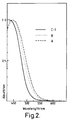
- Figures 1 and 2 of the accompanying drawings are D LogE curves as described in Example 3 below
- Examples of groups which R¹ may represent are hydrogen, or a substituted or unsubstituted aliphatic, a substituted or unsubstituted aryl, or substituted or unsubstituted heterocyclic group. The aliphatic group may be cyclic or acyclic, branched or unbranched, saturated or unsaturated. Examples of such groups are straight chain or branched alkyl or alkenyl groups of 1-20 carbon atoms, preferably 1-10 carbon atoms; cycloaliphatic groups of 3-20 carbon atoms; phenyl; or substituted phenyl.
- Examples of groups which R² may represent are hydrogen, halogen (eg F, Cl or Br), thioalkyl, thioaryl, alkyl, substituted or unsubstituted aryl, substituted or unsubstituted heterocyclic, cyano, carbonamido, alkyloxy, aryloxy, alkyloxycarbonyl, alkylsulphoxyl, arylsulphoxyl, alkylsulphonyl, arylsulphonyl, amino, nitro, or a phosphorus atom substituted with a variety of hydrocarbon groups or an acyl group.
- Examples of groups which R³ may represent are substituted or unsubstituted aryl, substituted or unsubstituted heterocyclic, or an acyl group.
- Representative substituents on such groups include alkyl, aryl, alkoxy, aryloxy, alkylthio, hydroxy, halogen, alkoxycarbonyl, aryloxycarbonyl, carboxy, acyl, acyloxy, amino, anilino, carbonamido, carbamoyl, alkylsulfonyl, arysulfonyl, sulfonamido, and sulfamyl groups wherein the substituents typically contain 1 to 40 carbon atoms. Such substituents can also be further substituted.
- Coupling-off groups are well known in the art. Such groups can determine the equivalency of the coupler, i.e., whether it is a 2-equivalent or a 4-equivalent coupler, or modify the reactivity of the coupler. Such groups can advantageously affect the layer in which the coupler is coated, or other layers in the photographic recording material, by performing, after release from the coupler, functions such as dye formation, development acceleration or inhibition, bleach acceleration or inhibition, electron transfer facilitation, color correction and the like.
- Examples of coupling-off groups include chloro, alkoxy, aryloxy (eg phenyloxy or 2-chloro-, 2,3,5-isopropyl-, 4-carboxy-, 4-carboxy-2-methyl-carbonamido, 4-nitro-2-carbamoyl-phenyloxy), alkylthio, arylthio (eg phenylthio, or 2,3,5-isopropyl-phenylthio), heteroyloxy (eg pyridyloxy), sulfonyloxy, acyloxy, carboxy, acyl, heterocyclyl joined via a ring carbon or hetero atom in the heterocyclic nucleus, sulfonamido, mercaptotetrazole, mercaptopropionic acid, phosphonyloxy and arylazo (eg 4-hydroxy-, 4-hexadecyloxy-3-methoxy- 4-methyl-2-hydroxy-, 4-methylsulphonyl- or 4-t-butylcarbonamidophenylthio). Nitro is a particularly preferred coupling-off group.
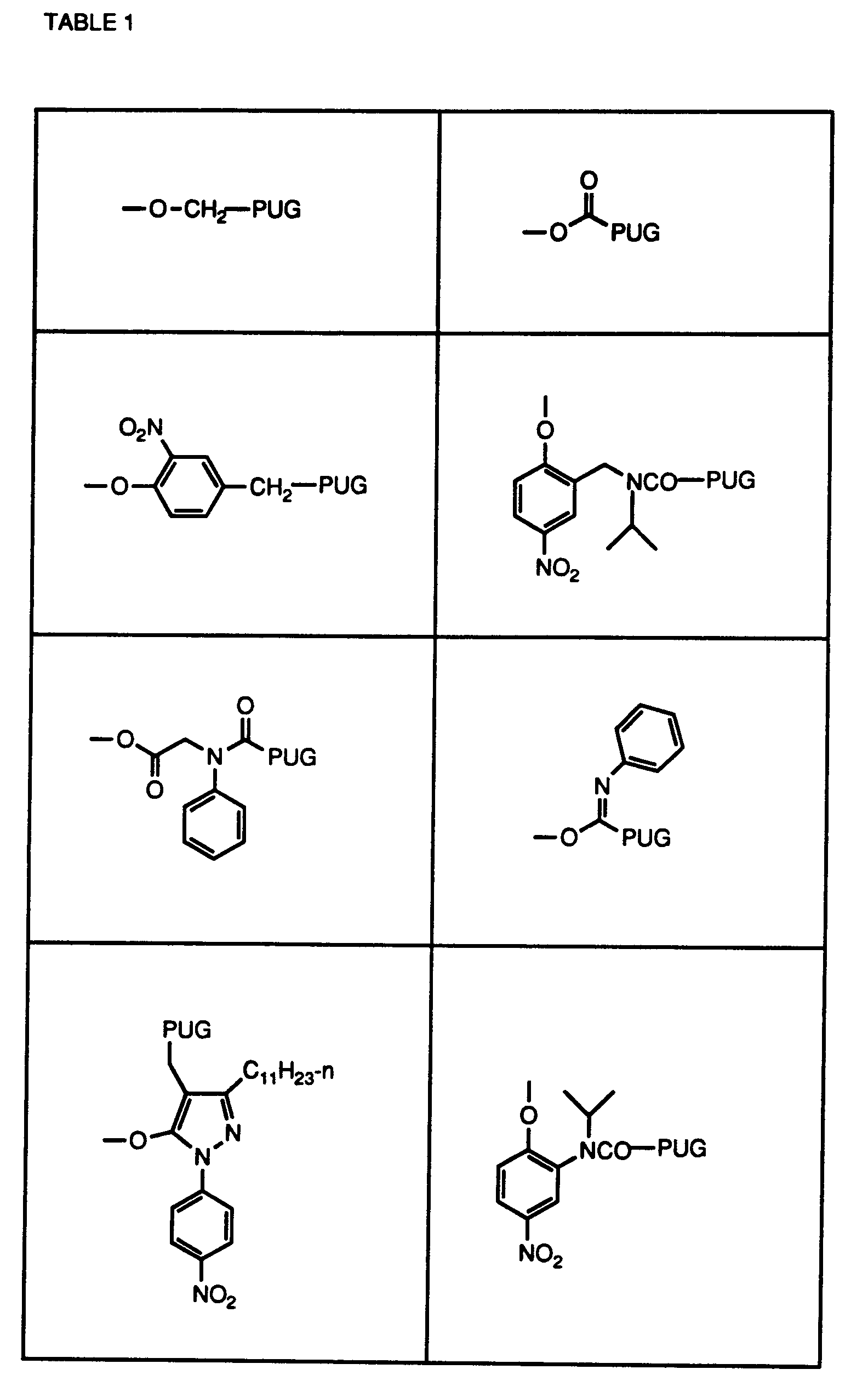
- The group which splits off may provide a photographically useful compound. Many such groups are often known as photographically useful groups and they provide developer inhibitors, bleach accelerators, developer accelerators, antifoggants, competing couplers, etc. Many examples are listed in Research Disclosure Item 308119, December 1989 published by Kenneth Mason Publications, Emsworth, Hants, United Kingdom. Examples of such groups are shown in Table 1 below.
- The couplers of this invention can be used in any of the ways and in any of the combinations in which couplers are used in the photographic art. Typically, the coupler is incorporated in a silver halide emulsion and the emulsion coated on a support to form part of a photographic element. Alternatively, the coupler can be incorporated at a location adjacent to the silver halide emulsion where, during development, the coupler will be in reactive association with development products such as oxidized color developing agent. Thus, as used herein, the term "associated" signifies that the coupler is in the silver halide emulsion layer or in an adjacent location where, during processing, the coupler is capable of reacting with silver halide development products.
- In one embodiment of the present invention the couplers contain a ballasting group of such size and configuration to render the coupler non-diffusible in the photographic material. Such a group may form part of R¹ R² or R³.
- Representative ballast groups include substituted or unsubstituted alkyl or aryl groups containing 8 to 40 carbon atoms.
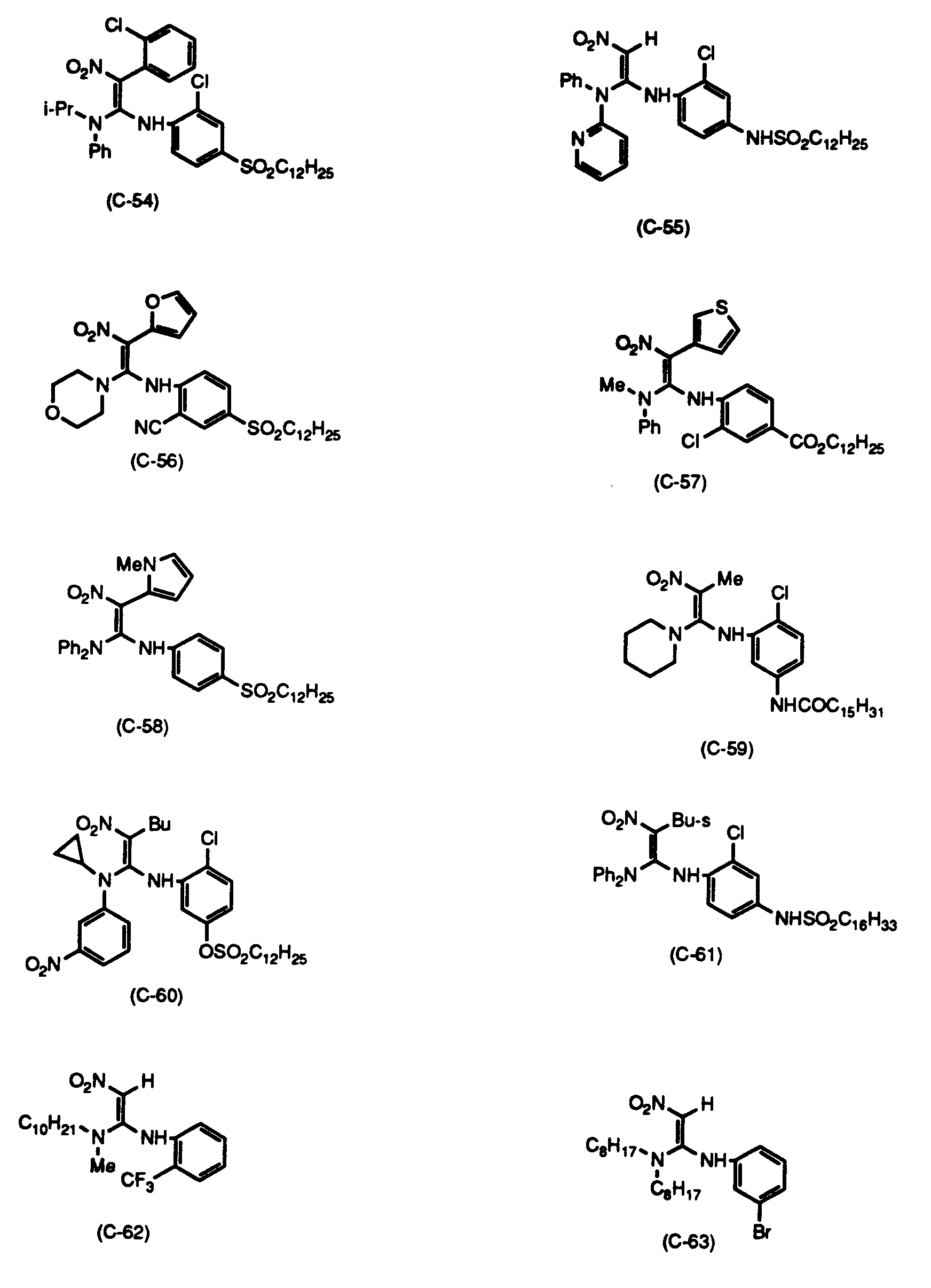
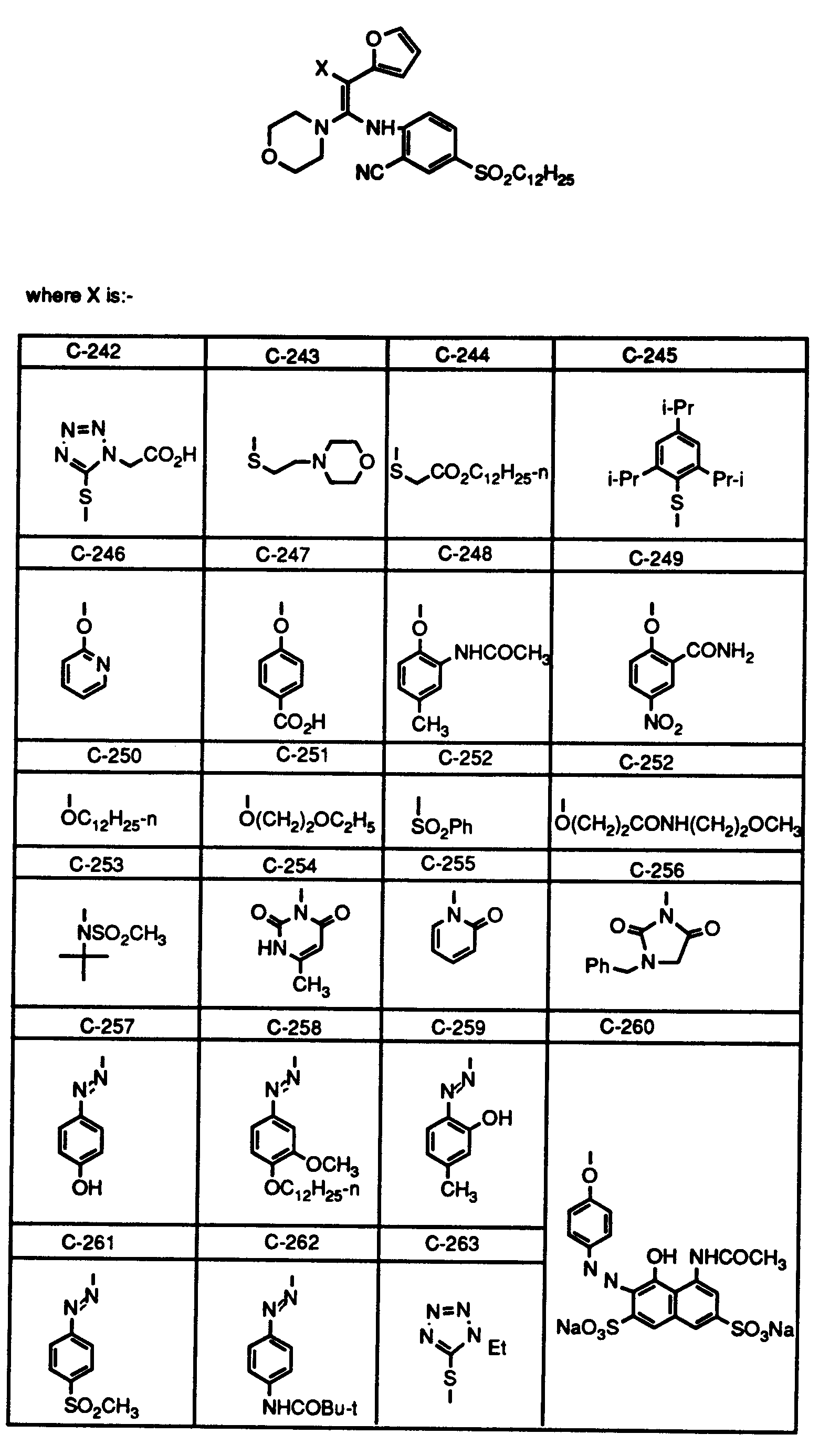
- Examples of couplers of the present invention are listed in Table below.






- The photographic elements can be single color elements or multicolor elements. Multicolor elements contain dye image-forming units sensitive to each of the three primary regions of the spectrum. Each unit can be comprised of a single emulsion layer or of multiple emulsion layers sensitive to a given region of the spectrum. The layers of the element, including the layers of the image-forming units, can be arranged in various orders as known in the art. In a alternative format, the emulsions sensitive to each of the three primary regions of the spectrum can be disposed as a single segmented layer.
- A typical multicolor photographic element comprises a support bearing a cyan dye image-forming unit comprised of at least one red-sensitive silver halide emulsion layer having associated therewith at least one cyan dye-forming coupler, a magenta dye image-forming unit comprising at least one green-sensitive silver halide emulsion layer having associated therewith at least one magenta dye-forming coupler, and a yellow dye image-forming unit comprising at least one blue-sensitive silver halide emulsion layer having associated therewith at least one yellow dye-forming coupler, at least one of the couplers in the element being a coupler of this invention. The element can contain additional layers, such as filter layers, interlayers, overcoat layers, subbing layers, and the like.
- In the following discussion of suitable materials for use in the emulsions and elements of this invention, reference will be made to Research Disclosure, December 1989, Item 308119, published by Kenneth Mason Publications, Ltd., Dudley Annex, 12a North Street, Emsworth, Hampshire P010 7DQ, ENGLAND, which will be identified hereafter by the term "Research Disclosure." The contents of the Research Disclosure, including the patents and publications referenced therein, are incorporated herein by reference, and the Sections hereafter referred to are Sections of the Research Disclosure.
- The silver halide emulsions employed in the elements of this invention can be either negative-working or positive-working. Suitable emulsions and their preparation as well as methods of chemical and spectral sensitization are described in Sections I through IV. Color materials and development modifiers are described in Sections V and XXI. Vehicles are described in Section IX, and various additives such as brighteners, antifoggants, stabilizers, light absorbing and scattering materials, hardeners, coating aids, plasticizers, lubricants and matting agents are described , for example, in Sections V, VI, VIII, X, XI, XII, and XVI. Manufacturing methods are described in Sections XIV and XV, other layers and supports in Sections XIII and XVII, processing methods and agents in Sections XIX and XX, and exposure alternatives in Section XVIII.
- Preferred color developing agents are p-phenylenediamines. Especially preferred are:
4-amino N,N-diethylaniline hydrochloride,
4-amino-3-methyl-N,N-diethylaniline hydrochloride,
4-amino-3-methyl-N-ethyl-N-(b-(methanesulfonamido) ethyl)aniline sesquisulfate hydrate,
4-amino-3-methyl-N-ethyl-N-(b-hydroxyethyl)aniline sulfate,
4-amino-3-b-(methanesulfonamido)ethyl-N,N-diethylaniline hydrochloride and
4-amino-N-ethyl-N-(2-methoxyethyl)-m-toluidine di-p-toluene sulfonic acid. - With negative working silver halide a negative image can be formed. Optionally positive (or reversal) image can be formed.
- The coupler described herein may be used in combination with other classes of image couplers such as 3-acylamino- and 3-anilino- 5-pyrazolones and heterocyclic couplers (e.g. pyrazoloazoles) such as those described in EP 285,274; U.S. Patent 4,540,654; EP 119,860, or with other 5-pyrazolone couplers containing different ballasts or coupling-off groups such as those described in U.S. Patent 4,301,235; U.S. Patent 4,853,319 and U.S. Patent 4,351,897. The coupler may also be used in association with yellow or cyan colored couplers (e.g. to adjust levels of interlayer correction) and with masking couplers such as those described in EP 213.490; Japanese Published Application 58-172,647; U.S. Patent 2,983,608; German Application DE 2,706,117C; U.K. Patent 1,530,272; Japanese Application A-113935; U.S. Patent 4,070,191 and German Application DE 2,643,965. The masking couplers may be shifted or blocked.
- Coupling-off groups are well known in the art. Such groups can determine the equivalency of the coupler, i.e., whether it is a 2-equivalent or a 4-equivalent coupler, or modify the reactivity of the coupler. Such groups can advantageously affect the layer in which the coupler is coated, or other layers in the photographic recording material, by performing, after release from the coupler, functions such as dye formation, development acceleration or inhibition, bleach acceleration or inhibition, electron transfer facilitation, color correction and the like.
- Representative classes of coupling-off groups include chloro, alkoxy, aryloxy, heteroyloxy, sulfonyloxy, acyloxy, acyl, heterocyclyl, sulfonamido, mercaptotetrazole, mercaptopropionic acid, phosphonyloxy anylthio, and arylazo. These coupling-off groups are described in the art, for example, in U.S. Pat. Nos. 2,455,169, 3,227,551, 3,432,521, 3,476,563, 3,617,291, 3,880,661, 4,052,212 and 4,134,766; and in U.K. Patents and published application Nos. 1,466,728, 1,531,927, 1,533,039, 2,006,755A and 2,017,704A, the disclosures of which are incorporated herein by reference.
- Thus, the couplers may be used in association with materials that accelerate or otherwise modify the processing steps e.g. of bleaching or fixing to improve the quality of the image. Bleach accelerators described in EP 193,389; EP 301,477; U.S. 4,163,669; U.S. 4,865,956; and U.S. 4,923,784 are particularly useful. Also contemplated is use of the coupler in association with nucleating agents, development accelerators or their precursors (UK Patent 2,097,140; U.K. Patent 2,131,188); electron transfer agents (U.S. 4,859,578; U.S. 4,912,025); antifogging and anti color-mixing agents such as derivatives of hydroquinones, aminophenols, amines, gallic acid; catechol; ascorbic acid; hydrazides; sulfonamidophenols; and non color-forming couplers.
- Thus the couplers may be used in combination with filter dye layers comprising colloidal silver sol or yellow and/or magenta filter dyes, either as oil-in-water dispersions, latex dispersions or as solid particle dispersions. Additionally, they may be used with "smearing" couplers (e.g. as described in U.S. 4,366,237; EP 96,570; U.S. 4,420,556; and U.S. 4,543,323.) Also, the couplers may be blocked or coated in protected form as described, for example, in Japanese Application 61/258,249 or U.S. 5,019,492.
- The coupler may further be used in combination with image-modifying compounds such as "Developer Inhibitor-Releasing" compounds (DIR's). DIR's useful in conjunction with the couplers of the invention are known in the art and examples are described in U.S. Patent Nos. 3,137,578; 3,148,022; 3,148,062; 3,227,554; 3,384,657; 3,379,529; 3,615,506; 3,617,291; 3,620,746; 3,701,783; 3,733,201; 4,049,455; 4,095,984; 4,126,459; 4,149,886; 4,150,228; 4,211,562; 4,248,962; 4,259,437; 4,362,878; 4,409,323; 4,477,563; 4,782,012; 4,962,018; 4,500,634; 4,579,816; 4,607,004; 4,618,571; 4,678,739; 4,746,600; 4,746,601; 4,791,049; 4,857,447; 4,865,959; 4,880,342; 4,886,736; 4,937,179; 4,946,767; 4,948,716; 4,952,485; 4,956,269; 4,959,299; 4,966,835; 4,985,336 as well as in patent publications GB 1,560,240; GB 2,007,662; GB 2,032,914; GB 2,099,167; DE 2,842,063, DE 2,937,127; DE 3,636,824; DE 3,644,416 as well as the following European Patent Publications: 272,573; 335,319; 336,411; 346, 899; 362, 870; 365,252; 365,346; 373,382; 376,212; 377,463; 378,236; 384,670; 396,486; 401,612; 401,613.
- Such compounds are also disclosed in "Developer-Inhibitor-Releasing (DIR) Couplers for Color Photography," C.R. Barr, J.R. Thirtle and P.W. Vittum in Photographic Science and Engineering, Vol. 13, p. 174 (1969), incorporated herein by reference. Generally, the developer inhibitor-releasing (DIR) couplers include a coupler moiety and an inhibitor coupling-off moiety (IN). The inhibitor-releasing couplers may be of the time-delayed type (DIAR couplers) which also include a timing moiety or chemical switch which produces a delayed release of inhibitor. Examples of typical inhibitor moieties are: oxazoles, thiazoles, diazoles, triazoles, oxadiazoles, thiadiazoles, oxathiazoles, thiatriazoles, benzotriazoles, tetrazoles, benzimidazoles, indazoles, isoindazoles, mercaptotetrazoles, selenotetrazoles, mercaptobenzothiazoles, selenobenzothiazoles, mercaptobenzoxazoles, selenobenzoxazoles, mercaptobenzimidazoles, selenobenzimidazoles, benzodiazoles, mercaptooxazoles, mercaptothiadiazoles, mercaptothiazoles, mercaptotriazoles, mercaptooxadiazoles, mercaptodiazoles, mercaptooxathiazoles, telleurotetrazoles or benzisodiazoles.
- The present invention also provides dyes of one of the general formulae:

in which - R¹, R² and R³
- are as defined above, and
- R⁴
- together with the N are the fragment of an oxidised colour developing agent.
- The couplers of formulae [1] and [2] may be prepared by the scheme described in Example 1 below.
- The following Examples are included for a better understanding of the invention.
- The present invention further provides photographic colour couplers as defined above as novel compounds.
-

- A solution of potassium hydroxide (119.83g, 2.14mol) in absolute ethanol (450ml) was added dropwise over about 3 hours to a stirred solution of carbon disulphide (82.31g, 1.08mol) and nitromethane (60.82g, 0.997mol) in absolute ethanol (150ml) at 35-40°C during which time an orange-brown solid separated. The mixture was allowed to cool and stand over the weekend. The solid was removed by filtration and recrystallised from ethanol/water. This dipotassium salt (135.01g, 0.634mol) was dissolved in water (200ml). 1-Bromododecane (312.18g, 1.25mol) in dimethyl formamide (400ml) was added to the orange-brown solution and the mixture heated to 100°C with vigorous stirring. After 3 hours the mixture was cooled and left overnight. The oily suspension was added to water (41) and extracted with diethyl ether (4 x 750ml). The dark red organic solution was dried with magnesium sulphate and evaporated in vacuo to give an oil (238.1g). This was purified by flash chromatography over silica eluting first with 60-80 petroleum ether and then with 19:1 60-80 petroleum ether/ethyl acetate to give the product (110.3g, 0.233mol, 37%) as an orange-yellow solid. All spectroscopic data is consistent with the proposed structure.
- A mixture of 3-trifluoromethylaniline (3.24g, 20.1mmol), 1,1-bis(n-dodecylthio)-2-nitroethylene (1) (9.93g, 21.0mmol) and p-toluenesulphonic acid (150mg) in toluene (150ml) was heated at reflux overnight. The solvent was removed in vacuo and the residual oil (14.07g) purified by column chromatography over silica using 5:1 60-80 petroleum ether/ethyl acetate as eluent to give the product (6.13g, 14.2mmol, 71%) as an oil. All spectroscopic data is consistent with the proposed structure.
- A mixture of 2-chloro-5-(N-(4-(2,4-di(2-(2-methylbutyl))phenoxy)butyramido))aniline (30.27g, 68.1mmol) and 1,1-bis(methylthio)-2-nitroethylene (11.30g, 68.5mmol) was heated overnight in refluxing toluene (200ml) containing p-toluenesulphonic acid (0.23g). The mixture was allowed to cool and the solid removed by filtration. This solid was recrystallised from ethanol to give the product (12.37g, 22.0mmol, 34%) as a yellowish solid. All spectroscopic data is consistent with the proposed structure.
- A dye from a representative example of the couplers of the invention was prepared as in the following scheme:

- Excess developer was added with vigorous shaking to a biphasic mixture of C (1.01g, 4.16mmol) in ethyl acetate and an excess of potassium hydroxide and potassium persulphate in water. The organic layer was separated from the aqueous layer, washed with water, dried with magnesium sulphate and evaporated in vacuo to give a dark oil. This was purified by column chromatography over silica using 2:1 60-80 petroleum ether and ethyl acetate as eluent to give the product as a dark yellow oil (1.31g) which crystallised upon standing. All spectroscopic data is consistent with the proposed structure.
- Compounds of the present invention and control compounds A and B were incorporated into a photographic silver bromoiodide emulsion and coated in the following format:-
Gel Supercoat Gelatin 1.50 gm/m2 Silver bromoiodide 0.81 gm/m2 Coupler 1.932 mmol/m2 Emulsion Layer Gelatin 2.42 gm/m2 Bis(vinylsulphonyl)-methane (hardener) 0.06 gm/m2 Support
Control compound A had the following formula:
and control compound B had the following formula:
- The coupler dispersion used contained 6% w/w gelatin, 9% coupler and coupler solvents in the ratio:- coupler : di-n-butyl phthalate : cyclohexanone 1.0 : 0.5 : 1.5 (w/w). The auxiliary solvent (cyclohexanone) was removed by washing the dispersion for 6 hours at 4°C and pH 6.0.
- The experimental photographic coatings prepared in this way were slit and chopped into 30cm by 35mm test strips. These were exposed (1.0sec) through a 0-4.0 neutral density step wedge having 0.2 ND (Neutral Density) step increments and Daylight V, WRATTEN 35 + 38A filters and 0.3 ND filters then processed through a C-41 process as described in the British Journal of Photography (1988) 196-198 using the following process times:
- Developer
- 2.5 minutes
- Bleach
- 4.0 minutes
- Wash
- 2.0 minutes
- Fix
- 4.0 minutes
- Wash
- 2.0 minutes
- For each test strip, step-wedge densities were measured using a spectral array automatic transmission densitometer. Measurements of sensitometric parameters were obtained from the DlogE curves.
- 35mm Test strips were exposed as above through a 0-0.9ND step-wedge (0.3ND steps) test object and Daylight V, WRATTEN 35 + 38A filters and the correct ND filters to give an optical density of circa 1.0. The strips were processed using the standard conditions described above and samples cut from the yellow dye image step with density closest to 1.0. Visible absorption spectra (normalised to 1.0 density) were obtained using a PYE UNICAM SP8-100 spectrophotometer. The amount of unwanted green absorption (measured at 525nm) relative to the main absorption peak is given by:

- Two sets of 35mm strips were exposed as in (i) for 1.0sec through a 0-4.0 ND step-wedge (0.2 ND increments) and Daylight V, Wratten 35 + 38A filters and 0.3ND filters. One set of strips was processed through a modified C-41 process, in which the pH of the bleach was raised to 5.5 by the addition of 0.880 ammonia, using the following processing sequence:
- Developer
- 2.5 minutes
- Modified Bleach
- 4.0 minutes
- Wash
- 2.0 minutes
- Fix
- 4.0 minutes
- Wash
- 2.0 minutes
- The second set of 35mm test strips was processed modified bleach (pH5.5) as described above with a stopbath (1% acetic acid solution) and wash step inserted between the developer and bleach steps:
- Developer
- 2.5 minutes
- Stopbath
- 1.0 minute
- Wash
- 2.0 minutes
- Modified Bleach
- 4.0 minutes
- Wash
- 2.0 minutes
- Fix
- 4.0 minutes
- Wash
- 2.0 minutes
- For the test strips processed through each of the above sequences, step-wedge densities were measured using a spectral array automatic transmission densitometer. Measurements of minimum density (Dmin) were obtained from the DlogE curves. The non-imagewise stain due to continued coupling in the bleach (Dmin) was calculated for each compound by subtracting the Dmin for the test strip processed through the stopbath process from the Dmin for the test strip processed through the process omitting the stopbath step:

- The visible absorption spectra of (C-12) and (C-1) are shown in figures 1 and 2 respectively.
- The results are shown below:
Compound Unwanted Green Absorption at 525 nm Continued coupling (ΔDmin) A 0.16 0.01 B 0.10 0.07 C-1 0.03 0.01 C-12 0.05 0.00 - It can be seen that the couplers of the invention (C-1 and C-12) have less unwanted absorption in the green and display less continued coupling than prior art coupler (B).
Claims (9)
- A photographic element comprising a support, at least one photosensitive silver halide layer and in or adjacent said silver halide layer a colour coupler of one of the general formulae:
 R¹ is a group substantially without any electron-withdrawing capability,R² is a substituent not incompatible with the function of the compound,R³ is an alkyl, aryl or heterocyclic group any of which may be substituted,
andX is a coupling-off group. - A photographic element as claimed in claim 1 in which the coupling-off group X is a nitro group.
- A photographic element as claimed in claim 1 or 2 in which R¹ is hydrogen, a substituted or unsubstituted aliphatic, a substituted or unsubstituted aryl, or a substituted or unsubstituted heterocyclic group.
- A photographic element as claimed in any of claims 1 to 3 in which R² is hydrogen, halogen, thioalkyl, thioaryl, alkyl, substituted or unsubstituted aryl, substituted or unsubstituted heterocyclic, cyano, carbonamido, alkyloxy, aryloxy, alkyloxycarbonyl, alkylsulphoxyl, arylsulphoxyl, alkylsulphonyl, arylsulphonyl, amino, nitro, or a phosphorus atom substituted with a variety of hydrocarbon groups or an acyl group.
- A photographic element as claimed in any of claims 1 to 4 in which R³ is a substituted or unsubstituted aryl, substituted or unsubstituted heterocyclic, or an acyl group.
- A photographic element as claimed in any of claims 1 to 5 in which the coupler contains a ballast group of such size and configuration that the coupler is non-diffusible in photographic layers.
- A photographic element as claimed in any of claims 1 to 6 which is a in which the material is a multicolour photographic material comprising a support bearing a yellow dye image-forming unit comprised of at least one blue-sensitive silver halide emulsion layer having associated therewith at least one yellow dye-forming coupler, at least one magenta dye image-forming unit comprising at least one green-sensitive silver halide emulsion layer having associated therewith at least one magenta dye-forming coupler at least one cyan dye image-forming unit comprising at least one red-sensitive silver halide emulsion layer having associated therewith at least one cyan dye-forming coupler.
- A dye having one of the general formulae:

R⁴ together with the N represent the fragment of an oxidised colour developing agent. - A colour coupler as defined in any of claims 1 to 6.
Applications Claiming Priority (3)
| Application Number | Priority Date | Filing Date | Title |
|---|---|---|---|
| GB9308560 | 1993-04-24 | ||
| GB939308560A GB9308560D0 (en) | 1993-04-24 | 1993-04-24 | Photographic colour couplers and photographic materials containing them |
| US08/238,135 US5460925A (en) | 1993-04-24 | 1994-05-04 | Photographic color couplers and photographic materials containing them |
Publications (2)
| Publication Number | Publication Date |
|---|---|
| EP0622673A1 true EP0622673A1 (en) | 1994-11-02 |
| EP0622673B1 EP0622673B1 (en) | 1998-02-04 |
Family
ID=26302808
Family Applications (1)
| Application Number | Title | Priority Date | Filing Date |
|---|---|---|---|
| EP94201098A Expired - Lifetime EP0622673B1 (en) | 1993-04-24 | 1994-04-21 | Photographic colour couplers and photographic materials containing them |
Country Status (3)
| Country | Link |
|---|---|
| US (1) | US5460925A (en) |
| EP (1) | EP0622673B1 (en) |
| JP (1) | JPH06347956A (en) |
Cited By (5)
| Publication number | Priority date | Publication date | Assignee | Title |
|---|---|---|---|---|
| EP0745898A1 (en) * | 1995-05-30 | 1996-12-04 | Agfa-Gevaert AG | Process for making a developed chromogenic color photographic image by using a compound which is able to react with aromatic primary amines |
| EP2168634A2 (en) | 2002-09-13 | 2010-03-31 | Kao Corporation | Hair dye composition comprising methine dye |
| WO2017100715A1 (en) | 2015-12-09 | 2017-06-15 | The Board Of Trustees Of The University Of Illinois | Benzothiophene-based selective estrogen receptor downregulator compounds |
| WO2018129387A1 (en) | 2017-01-06 | 2018-07-12 | G1 Therapeutics, Inc. | Combination therapy for the treatment of cancer |
| WO2019151451A1 (en) | 2018-01-31 | 2019-08-08 | 富士フイルム株式会社 | Staining composition, stained article, and azo dye |
Citations (3)
| Publication number | Priority date | Publication date | Assignee | Title |
|---|---|---|---|---|
| DD149718A1 (en) * | 1980-03-27 | 1981-07-22 | Joachim Epperlein | HALOGEN-SILVER FREE IMAGE RECORDING MATERIAL |
| EP0104423A1 (en) * | 1982-09-01 | 1984-04-04 | Bayer Ag | 2-Nitro-ethene diamines, process for their preparation and their use as medicines |
| WO1993007534A1 (en) * | 1991-10-03 | 1993-04-15 | Kodak Limited | Photographic colour couplers and photographic materials containing them |
Family Cites Families (10)
| Publication number | Priority date | Publication date | Assignee | Title |
|---|---|---|---|---|
| DE149718C (en) * | ||||
| US2500045A (en) * | 1948-05-29 | 1950-03-07 | Eastman Kodak Co | Dianil dye photographic filter layer |
| JPS62279339A (en) * | 1986-05-28 | 1987-12-04 | Konica Corp | Silver halide photographic sensitive material |
| JPH0833629B2 (en) * | 1986-06-11 | 1996-03-29 | コニカ株式会社 | A silver halide photographic light-sensitive material suitable for rapid processing and capable of obtaining a dye image excellent in light fastness. |
| JPH01156733A (en) * | 1987-12-15 | 1989-06-20 | Konica Corp | Silver halide color photographic sensitive material |
| JPH01156748A (en) * | 1987-12-15 | 1989-06-20 | Konica Corp | Silver halide photographic sensitive material |
| JPH02304438A (en) * | 1989-05-19 | 1990-12-18 | Konica Corp | Novel photographic coupler |
| EP0431374B1 (en) * | 1989-11-20 | 1996-02-14 | Fuji Photo Film Co., Ltd. | Color coupler for photography and silver halide photographic material comprising the same |
| JP2592353B2 (en) * | 1990-11-22 | 1997-03-19 | 富士写真フイルム株式会社 | Novel dye-forming coupler, color image forming method using the same, and silver halide color photographic light-sensitive material |
| JP2893154B2 (en) * | 1992-07-08 | 1999-05-17 | 富士写真フイルム株式会社 | Silver halide color photographic materials |
-
1994
- 1994-04-21 EP EP94201098A patent/EP0622673B1/en not_active Expired - Lifetime
- 1994-04-22 JP JP6084802A patent/JPH06347956A/en active Pending
- 1994-05-04 US US08/238,135 patent/US5460925A/en not_active Expired - Fee Related
Patent Citations (3)
| Publication number | Priority date | Publication date | Assignee | Title |
|---|---|---|---|---|
| DD149718A1 (en) * | 1980-03-27 | 1981-07-22 | Joachim Epperlein | HALOGEN-SILVER FREE IMAGE RECORDING MATERIAL |
| EP0104423A1 (en) * | 1982-09-01 | 1984-04-04 | Bayer Ag | 2-Nitro-ethene diamines, process for their preparation and their use as medicines |
| WO1993007534A1 (en) * | 1991-10-03 | 1993-04-15 | Kodak Limited | Photographic colour couplers and photographic materials containing them |
Non-Patent Citations (3)
| Title |
|---|
| P.W. MANLEY AND U. QUAST: "STRUCTURE-ACTIVITY STUDIES OF POTASSIUM CHANNEL OPENING IN PINACIDIL-TYPE CYANOGUANIDINES, NITROETHENEDIAMINES, THIOUREAS, AND UREAS", JOURNAL OF MEDICINAL CHEMISTRY, vol. 35, 1992, WASHINGTON US, pages 2327 - 2340 * |
| S. RAJAPPA: "NITROENAMINES - PREPARATION, STRUCTURE AND SYNTHETIC POTENTIAL", TETRAHEDRON, (INCL. TETRAHEDRON REPORTS), vol. 37, 1981, OXFORD GB, pages 1453 - 1480 * |
| T. KEARNEY, P.A. HARRIS, A. JACKSON AND J.A.JOULE: "SYNTHESIS OF ISATIN 3-OXIMES FROM 2-NITROACETANILIDES", SYNTHESIS, 1992, STUTTGART DE, pages 769 - 772 * |
Cited By (8)
| Publication number | Priority date | Publication date | Assignee | Title |
|---|---|---|---|---|
| EP0745898A1 (en) * | 1995-05-30 | 1996-12-04 | Agfa-Gevaert AG | Process for making a developed chromogenic color photographic image by using a compound which is able to react with aromatic primary amines |
| US5731133A (en) * | 1995-05-30 | 1998-03-24 | Ajfa-Gevaert Ag | Process for the production of a chromogenically developed color photographic image using a compound capable of reacting with primary aromatic amines |
| EP2168634A2 (en) | 2002-09-13 | 2010-03-31 | Kao Corporation | Hair dye composition comprising methine dye |
| WO2017100715A1 (en) | 2015-12-09 | 2017-06-15 | The Board Of Trustees Of The University Of Illinois | Benzothiophene-based selective estrogen receptor downregulator compounds |
| WO2017100712A1 (en) | 2015-12-09 | 2017-06-15 | The Board Of Trustees Of The University Of Illinois | Benzothiophene-based selective estrogen receptor downregulators |
| WO2018129387A1 (en) | 2017-01-06 | 2018-07-12 | G1 Therapeutics, Inc. | Combination therapy for the treatment of cancer |
| US11364222B2 (en) | 2017-01-06 | 2022-06-21 | G1 Therapeutics, Inc. | Combination therapy for treatment of cancer |
| WO2019151451A1 (en) | 2018-01-31 | 2019-08-08 | 富士フイルム株式会社 | Staining composition, stained article, and azo dye |
Also Published As
| Publication number | Publication date |
|---|---|
| EP0622673B1 (en) | 1998-02-04 |
| US5460925A (en) | 1995-10-24 |
| JPH06347956A (en) | 1994-12-22 |
Similar Documents
| Publication | Publication Date | Title |
|---|---|---|
| US5447831A (en) | Photographic element employing hue correction couplers | |
| EP0751428B1 (en) | Novel image-dye-forming couplers and photographic elements containing them | |
| EP0562074A1 (en) | Photographic colour couplers and photographic materials containing them | |
| EP0622673B1 (en) | Photographic colour couplers and photographic materials containing them | |
| EP0618496B1 (en) | Photographic elements containing particular color couplers in combination with particular stabilizers | |
| US5314792A (en) | Photographic element and process providing improved color rendition | |
| US5491052A (en) | Yellow layer for color photographic elements | |
| EP0751427B1 (en) | Image-dye-forming couplers and photographic elements containing them | |
| EP0779543A1 (en) | Photographic element containing an improved pyrazolotriazole coupler | |
| EP0681215B1 (en) | Photographic elements containing certain acylacetanilide couplers in combination with development inhibitor releasing couplers | |
| US5358829A (en) | Photographic material and process comprising a bicyclic pyrazolo coupler | |
| US6365334B1 (en) | Photographic elements containing aryloxypyrazolone couplers and sulfur containing stabilizers | |
| EP0602751B1 (en) | Photographic material and process comprising a bicyclic pyrazolo coupler | |
| US5853968A (en) | Multilayer color photographic element | |
| US5543276A (en) | Color photographic element containing new epoxy scavengers for residual magenta coupler | |
| GB2314327A (en) | Pyrazolone image dye-forming couplers | |
| EP0953872A1 (en) | Photographic element containing improved acylacetamido yellow dye-forming coupler | |
| US5620632A (en) | Dispersions of epoxy scavengers exhibiting improved raw stock keeping | |
| EP0618497B1 (en) | Photographic elements containing particular color couplers in combination with metal complex stabilizers | |
| EP0618495B1 (en) | Photographic elements containing particular color couplers in combination with hydroquinone type stabilizers | |
| US5597685A (en) | Color photographic element having improved image stability | |
| EP0602749B1 (en) | Photographic material comprising a bicyclic pyrazolo coupler | |
| GB2313834A (en) | Improved synthesis of yellow couplers | |
| US5695921A (en) | Photographic elements with magenta dye forming couplers and stabilizers | |
| US5585227A (en) | Silver halide color photographic light sensitive material |
Legal Events
| Date | Code | Title | Description |
|---|---|---|---|
| PUAI | Public reference made under article 153(3) epc to a published international application that has entered the european phase |
Free format text: ORIGINAL CODE: 0009012 |
|
| AK | Designated contracting states |
Kind code of ref document: A1 Designated state(s): GB |
|
| 17P | Request for examination filed |
Effective date: 19950428 |
|
| 17Q | First examination report despatched |
Effective date: 19950803 |
|
| GRAG | Despatch of communication of intention to grant |
Free format text: ORIGINAL CODE: EPIDOS AGRA |
|
| GRAG | Despatch of communication of intention to grant |
Free format text: ORIGINAL CODE: EPIDOS AGRA |
|
| GRAH | Despatch of communication of intention to grant a patent |
Free format text: ORIGINAL CODE: EPIDOS IGRA |
|
| GRAG | Despatch of communication of intention to grant |
Free format text: ORIGINAL CODE: EPIDOS AGRA |
|
| GRAH | Despatch of communication of intention to grant a patent |
Free format text: ORIGINAL CODE: EPIDOS IGRA |
|
| RAP1 | Party data changed (applicant data changed or rights of an application transferred) |
Owner name: KODAK LIMITED |
|
| RBV | Designated contracting states (corrected) |
Designated state(s): GB |
|
| GRAH | Despatch of communication of intention to grant a patent |
Free format text: ORIGINAL CODE: EPIDOS IGRA |
|
| REG | Reference to a national code |
Ref country code: DE Ref legal event code: 8566 |
|
| GRAA | (expected) grant |
Free format text: ORIGINAL CODE: 0009210 |
|
| AK | Designated contracting states |
Kind code of ref document: B1 Designated state(s): GB |
|
| PLBE | No opposition filed within time limit |
Free format text: ORIGINAL CODE: 0009261 |
|
| STAA | Information on the status of an ep patent application or granted ep patent |
Free format text: STATUS: NO OPPOSITION FILED WITHIN TIME LIMIT |
|
| 26N | No opposition filed | ||
| PGFP | Annual fee paid to national office [announced via postgrant information from national office to epo] |
Ref country code: GB Payment date: 19990315 Year of fee payment: 6 |
|
| PG25 | Lapsed in a contracting state [announced via postgrant information from national office to epo] |
Ref country code: GB Free format text: LAPSE BECAUSE OF NON-PAYMENT OF DUE FEES Effective date: 20000421 |
|
| GBPC | Gb: european patent ceased through non-payment of renewal fee |
Effective date: 20000421 |