EP0622396B1 - Polysilanes and method for producing the same - Google Patents
Polysilanes and method for producing the same Download PDFInfo
- Publication number
- EP0622396B1 EP0622396B1 EP94103676A EP94103676A EP0622396B1 EP 0622396 B1 EP0622396 B1 EP 0622396B1 EP 94103676 A EP94103676 A EP 94103676A EP 94103676 A EP94103676 A EP 94103676A EP 0622396 B1 EP0622396 B1 EP 0622396B1
- Authority
- EP
- European Patent Office
- Prior art keywords
- aryl
- alkyl
- alkynyl
- solution
- alkenyl
- Prior art date
- Legal status (The legal status is an assumption and is not a legal conclusion. Google has not performed a legal analysis and makes no representation as to the accuracy of the status listed.)
- Expired - Lifetime
Links
Classifications
-
- C—CHEMISTRY; METALLURGY
- C08—ORGANIC MACROMOLECULAR COMPOUNDS; THEIR PREPARATION OR CHEMICAL WORKING-UP; COMPOSITIONS BASED THEREON
- C08G—MACROMOLECULAR COMPOUNDS OBTAINED OTHERWISE THAN BY REACTIONS ONLY INVOLVING UNSATURATED CARBON-TO-CARBON BONDS
- C08G77/00—Macromolecular compounds obtained by reactions forming a linkage containing silicon with or without sulfur, nitrogen, oxygen or carbon in the main chain of the macromolecule
- C08G77/60—Macromolecular compounds obtained by reactions forming a linkage containing silicon with or without sulfur, nitrogen, oxygen or carbon in the main chain of the macromolecule in which all the silicon atoms are connected by linkages other than oxygen atoms
Definitions
- This invention relates to polysilanes which are useful as functional polymers such as nonlinear optical materials or electroconductive polymers, and to a method for synthesizing the same.
- Polysilanes are known to be useful as functional polymers such as nonlinear optical materials or electroconductive polymers ["Synthesis and Application of Organic Silicon Polymers” JMC (1989); Report of the National Chemical Laboratory for Industry, 8, 569 (1989); J. Chem. Rev. 89, 1359 (1989)].
- Synthetic methods of polysilanes of Formula [I] include:
- the methods (1) and (4) have problems in that the functional group which can be introduced is limited, and the molecular weight distribution is dispersed.
- the method (2) has problems in that the substrates are limited to a monosubstituted silanes, and the molecular weight distribution is dispersed.
- the method (3) has a problem in that the disilene equivalent used as a starting material is difficult to be synthesized.
- usable substrate is structurally limited.
- Physical properties of a polysilane are affected by the molecular weight distribution and the sequence order of substituents on the main chain. Therefore, to obtain a polysilane which has uniform electrical or optical properties, it is necessary to synthesize a polysilane which has homogeneous molecular distribution. Further, in order to achieve desired functions, it is preferable that the substituent arrangement order can be controlled.
- a primary object of the present invention is to provide a polysilane having homogeneous molecular weights and a controlled substituent pattern, and a novel and highly selective synthetic method thereof.
- a homogeneous molecular weight polysilane of Formula [I] (wherein R 1 , R 2 , R 3 , R 4 , R 5 , R 6 , R 7 , R 8 , R 9 , R 10 , R 11 and R 12 denote independently hydrogen, alkyl, aryl, alkenyl, alkynyl, silyl, and amino groups, R 1 and R 2 , R 3 and R 4 , R 5 and R 6 , R 7 and R 8 , R 10 anti R 11 can form a ring with the silicon bonded to each group, m is 0 or 1).
- R 1 , R 2 , R 3 , R 4 , R 5 , R 6 , R 7 , R 8 , R 9 , R 10 , R 11 and R 12 denote independently hydrogen, alkyl, aryl, alkenyl, alkynyl, silyl, and amino groups
- R 1 and R 2 , R 3 and R 4 , R 5 and R 6 , R 7 and R 8 , R 10 and R 11 can form a ring with the silicon bonded to each group.
- m is 0 or 1), characterized in that a small-ring polysilane of Formula [III]: (wherein R 1 , R 2 , R 3 , R 4 , R 5 , R 6 , R 7 and R 8 denote independently hydrogen, alkyl, aryl, alkenyl, alkynyl, silyl, and amino groups, R 1 and R 2 , R 3 and R 4 , R 5 and R 6 , R 7 and R 8 can form a ring with the silicon bonded to each group, m is 0 or 1) is reacted in a solvent with an organolithium reagent of Formula [IV]: R 9 -Li [IV] (where in R 9 denotes alkyl, aryl, alkenyl, alkynyl, or silyl groups), and then treated with silanes of Formula [V]: (wherein R 10 , R 11 and R 12 denote independently hydrogen, alkyl, aryl, alkenyl, alkynyl, si
- a polysilane of Formula [II] (wherein R 1 , R 2 , R 3 , R 4 , R 5 , R 6 , R 7 , R 8 , R 9 , R 13 and R 14 denote independently hydrogen, alkyl, aryl, alkenyl, alkynyl, silyl, and amino groups, R 1 and R 2 , R 3 and R 4 , R 5 and R 6 , R 7 and R 8 , R 13 and R 14 can form a ring with the silicon bonded to each group, m is 0 or 1, n is an integer).
- R 1 , R 2 , R 3 , R 4 , R 5 , R 6 , R 7 , R 8 , R 9 , R 13 and R 14 denote independently hydrogen, alkyl, aryl, alkenyl, alkynyl, silyl, and amino groups, R 1 and R 2 , R 3 and R 4 , R 5 and R 6 , R 7 and R 8 , R 13 and R 14 can form a ring with the silicon bonded to each group, m is 0 or 1, n is an integer) characterized in that a small-ring polysilane of Formula [III]: (wherein R 1 , R 2 , R 3 , R 4 , R 5 , R 6 , R 7 and R 8 denote independently hydrogen, alkyl, aryl, alkenyl, alkynyl, silyl, and amino groups, R 1 and R 2 , R 3
- the alkyl groups can be methyl, ethyl, propyl, butyl, pentyl, hexyl, cyclohexyl, isobutyl, isopropyl, or benzyl.
- the aryl groups can be phenyl, thienyl, pyridyl, naphthyl, or furyl.
- the alkenyl groups can be ethenyl, propenyl, butenyl, pentenyl, hexenyl, cyclohexenyl, or cyclopentenyl.
- the alkynyl groups can be ethynyl, propynyl, butynyl, pentynyl, or hexynyl.
- the silyl groups can be trimethylsilyl, triethylsilyl, tripropylsilyl, tributylsilyl, tripentylsilyl, trihexylsilyl, triphenylsilyl, phenyldimethylsilyl, or diphenylmethylsilyl.
- the amino groups can be dimethylamino or diethylamino.
- alkyl, aryl, alkenyl, alkynyl, and silyl groups may have substituents, and the substituents can be aryl, trifluoromethyl, nitro, cyano, alkoxy, acyl or halogen.
- the small-ring polysilane of Formula [III] used in the present invention can be easily prepared by a method in which dichlorodiorganosilanes are condensed by lithium or sodium [J. Chem. Soc,, Chem. Commun., 781 (1983); Organometallics, 3, 141 (1984); Chem. Lett., 1711 (1983); J. Organomet. Chem., 212, 155 (1981); Polym. Prepr. 31, 46 (1990); Organometallics, 2, 1771 (1983).
- the small-ring polysilane of Formula [III] includes, for example, hexapropylcyclotrisilane, hexa(2,2-dimethylpropyl)cyclotrisilane, hexa(1,1-dimethylethyl)cyclotrisilane, hexamesitylcyclotrisilane, octa(trimethylsilyl)cyclotetrasilane, octaethylcyclotetrasilane, octa(isopropyl)cyclotetrasilane, octaphenylcyclotetrasilane, 1,2,3,4-tetramethyl-1,2,3,4-tetraphenylsilane, 1,2,3,4-tetrabromo-1,2,3,4-tetraphenylcyclotetrasilane, 1,2,3,4-tetramethoxy-1,2,3,4-tetraphenylcyclotetrasilane, 1,2,3,4
- the organolithium reagents of Formula [IV] can be silyllithium compounds such as phenyldimethylsilyllithium, diphenylmethylsilyllithium, triphenylsilyllithium, trimethylsilyllithium, 4-(dimethylamino)phenyl(dimethyl) silyllithium, 4-(diethylamino)phenyl(dimethyl)silyllithium, and diethylamino(dimethyl)silyllithium, and lithium reagents such as butyllithium, phenyllithium, and methyllithium.
- silyllithium compounds such as phenyldimethylsilyllithium, diphenylmethylsilyllithium, triphenylsilyllithium, trimethylsilyllithium, 4-(dimethylamino)phenyl(dimethyl) silyllithium, 4-(diethylamino)phenyl(dimethyl)silyllithium
- silanes of Formula [V] used in the present invention those which have halogen as a leaving group are industrially available, and those which have perfluoroalkanefonyloxy, fluorosulfonyloxy, alkanesulfonyloxy, or arenesulfonyloxy as a leaving group can be easily prepared by treating the corresponding phenylsilanes with various sulfonic acids [see Examples].
- the leaving group includes acetoxy, trifluoroacetoxy and cyano.
- the alkyl groups of the silanes of Formula [V] can be, for example, methyl, ethyl, propyl, butyl, pentyl, hexyl, cyclohexyl, isobutyl, isopropyl, or benzyl.
- the aryl groups can be phenyl, thienyl, pyridyl, naphthyl, or furyl.
- the alkenyl groups can be ethenyl, propenyl, butenyl, pentenyl, hexenyl, cyclohexenyl, or cyclopentenyl.
- the alkynyl groups can be ethynyl, propynyl, butynyl, pentynyl, or hexynyl.
- the silyl groups can be trimethylsilyl, triethylsilyl, tripropylsilyl, tributylsilyl, tripentylsilyl, trihexylsilyl, triphenylsilyl, phenyldimethylsilyl, or diphenylmethylsilyl.
- the amino groups can be dimethylamino or diethylamino.
- alkyl, aryl, alkenyl, alkynyl, and silyl groups may have substituents, and the substituents can be aryl, trifluoromethyl, nitro, cyano, alkoxy, acyl or halogen.
- the leaving group can be halogen such as chlorine, bromine, fluorine, and iodine; and perfluoroalkanesulfonyloxy, alkanesulfonyloxy, fluorosulfonyloxy, and arenesulfonyloxy.
- silanes of Formula [VI] used in the present invention those which have halogen as a leaving group can be easily prepared by ring-opening halogenation of small-ring polysilanes [Organometallics, 2, 1806 (1983)]. Further, those which have perfluoroalkanesulonyloxy, fluorosulfonyloxy, alkanesulfonyloxy, or arenesufonyloxy as a leaving group can be easily prepared by treating the corresponding diphenylsilanes with various sulfonic acids [see Examples].
- the alkyl groups of the silanes of Formula [VI] can be, for example, methyl, ethyl, propyl, butyl, pentyl, hexyl, cyclohexyl, isobutyl, isopropyl, or benzyl.
- the aryl groups can be phenyl, thienyl, pyridyl, naphthyl, or furyl.
- the alkenyl groups can be ethenyl, propenyl, butenyl, pentenyl, hexenyl, cyclohexenyl, or cyclopentenyl.
- the alkynyl groups can be ethynyl, propynyl, butynyl, pentynyl, or hexynyl.
- the silyl groups can be trimethylsilyl, triethylsilyl, tripropylsilyl, tributylsilyl, tripentylsilyl, trihexylsilyl, triphenylsilyl, phenyldimethylsilyl, or diphenylmethylsilyl.
- the amino groups can be dimethylamino or diethylamino.
- alkyl, aryl, alkenyl, alkynyl, and silyl groups may have substituents, and the substituents can be aryl, trifluoromethyl, nitro, cyano, acyl, alkoxy or halogen.
- the leaving group can be halogen such as chlorine, bromine, fluorine, and iodine; and perfluoroalkanesulfonyloxy, alkanesulfonyloxy, fluorosulfonyloxy, and arenesulfonyloxy.
- the solvent can be ether solvents such as tetrahydrofuran, diethylether, dioxane and dimethoxymethane; amide solvents such as hexamethylphosphotriamide, dimethylformamide, formamide and N,N-dimethylpyrrolidone; and hydrocarbon solvents such as hexane, pentane, benzene and toluene.
- ether solvents such as tetrahydrofuran, diethylether, dioxane and dimethoxymethane
- amide solvents such as hexamethylphosphotriamide, dimethylformamide, formamide and N,N-dimethylpyrrolidone
- hydrocarbon solvents such as hexane, pentane, benzene and toluene.
- the reaction can be carried out in the range from -78°C-30°C, but it is preferable to carry out the reaction at room temperature to -78°C in view of the reaction efficiency.
- a dichloromethane solution (1 ml) of 31 mg (0.05 mmol) of 2,2,3,3,4,4,5,5-octaethyl-1,1,6,6-tetramethyl-1,6-diphenylhexasilane (1) obtained in Example 1 was treated with 15 mg (0.10 mmol) of trifluoromethanesulfonic acid at room temperature for 30 minutes to give 1,6-bis(trifluoromethanesulfonyloxy) hexasilanes. Then, dichloromethane was distilled out under vacuum, and hexane (1 ml) was added to give a hexane solution (Solution 2).
- the Solution 1 was added to the Solution 2 at -78°C and stirred for 15 minutes.
- Methanol (0.1 ml) and triethylamine (0.1 ml) were added, then saturated aqueous sodium bicarbonate solution (2 ml) was added, stirred, the hexane layer was separated, and dried with magnesium sulfate.
- the resulting crude product was purified by a silica gel column (hexane) chromatography to afford 43 mg (61% yield) of hexadecasilane (6).
- a dichloromethane solution (1 ml) of 71 mg (0.05 mmol) of hexadecasilane (6) obtained in Example 6 was treated with 15 mg (0.10 mmol) of trifluoromethanesulfonic acid at room temperature for 30 minutes to give 1,16-bis(trifluoromethanesulfonyloxy)hexadecasilane. Then, dichloromethene was distilled out under vacuum, and hexane (1 ml) was added to afford a hexane solution (Solution 2). The Solution 1 was added to the Solution 2 at -78°C, and stirred for 15 minutes.
- a dichloromethane solution (1 ml) of 27 mg (0.05 mmol) of 2,2,3,3,4,4,5,5-octaethyl-1,1,6,6,6-pentamethyl-1-phenylhexasilane (2) obtained in Example 2 was treated with 7.5 mg (0.05 mmol) of trifluoromethanesulfonic acid at room temperature for 30 minutes to give 1-(trifluoromethanesulfonyloxy)hexasilane. Then, dichloromethane was distilled out under vacuum, and hexane (1 ml) was added to give a hexane solution (Solution 2). The Solution 1 was added to the Solution 2 at -78°C and stirred for 15 minutes.
- a dichloromethane solution (1 ml) of 49 mg (0.05 mmol) of undecasilane (8) obtained in Example 8 was treated with 7.5 mg (0.05 mmol) of trifluoromethanesulfonic acid at room temperature for 30 minutes to afford 1-(trifluoromethanesulfonyloxy)undecasilane. Then, dichloromethane was distilled out under vacuum, and hexane (1 ml) was added to give a hexane solution (Solution 2). The Solution 1 was added to the Solution 2 at -78°C and stirred for 15 minutes.
- a dichloromethane solution (1 ml) of 68 mg (0.05 mmol) of hexadecasilane (9) obtained in Example 9 was treated with 7.5 mg (0.05 mmol) of trifluoromethanesulfonic acid at room temperature for 30 minutes to give 1-(trifluoromethanesulfonyloxy)hexadecasilane. Then, dichloromethane was distilled out under vacuum, and hexane (1 ml) was added to give a hexane solution (Solution 2). The Solution 1 was added to the Solution 2 at -78°C and stirred for 15 minutes.
- the present invention provides a method for synthesizing a polysilane having a homogeneous molecular weight distribution and controlled substituent arrangement order using a simple procedure, which is useful as a functional polymer for nonlinear optical materials, electroconductive polymers, and the like.
Landscapes
- Chemical & Material Sciences (AREA)
- Health & Medical Sciences (AREA)
- Chemical Kinetics & Catalysis (AREA)
- Medicinal Chemistry (AREA)
- Polymers & Plastics (AREA)
- Organic Chemistry (AREA)
- Silicon Polymers (AREA)
Description
- This invention relates to polysilanes which are useful as functional polymers such as nonlinear optical materials or electroconductive polymers, and to a method for synthesizing the same.
- Polysilanes are known to be useful as functional polymers such as nonlinear optical materials or electroconductive polymers ["Synthesis and Application of Organic Silicon Polymers" JMC (1989); Report of the National Chemical Laboratory for Industry, 8, 569 (1989); J. Chem. Rev. 89, 1359 (1989)].
- Synthetic methods of polysilanes of Formula [I] include:
- (1) polycondensation of dichlorosilanes with an alkali metal such as sodium [J. Chem. Rev. 89, 1359 (1989)],
- (2) dehydrogenative coupling of polyhydrosilanes catalyzed by a transition metal complex [Can. J. Chem., 65, 1804 (1987); J. Organomet. Chem., 27, C31 (1971)],
- (3) anion polymerization of disilabicyclooctadiene which is an equivalent of disilene [J. Am. Chem. Soc., 111, 7641 (1989)],
- (4) electrochemical polymerization of dichlorodiorganosilanes [J. Chem. Soc., Chem. Commun., 1160 (1990)], and
- (5) ring-opening polymerization of cyclotetrasilanes with a catalytic amount of butyllithium [J. Am. Chem. Soc., 113, 1046 (1991)].
- Of these methods, the methods (1) and (4) have problems in that the functional group which can be introduced is limited, and the molecular weight distribution is dispersed.
- The method (2) has problems in that the substrates are limited to a monosubstituted silanes, and the molecular weight distribution is dispersed.
- The method (3) has a problem in that the disilene equivalent used as a starting material is difficult to be synthesized.
- In the method (5), usable substrate is structurally limited.
- Physical properties of a polysilane are affected by the molecular weight distribution and the sequence order of substituents on the main chain. Therefore, to obtain a polysilane which has uniform electrical or optical properties, it is necessary to synthesize a polysilane which has homogeneous molecular distribution. Further, in order to achieve desired functions, it is preferable that the substituent arrangement order can be controlled.
- The inventors have conducted intensive studies on a polysilane which has homogeneous molecular weight and has various functional groups and an industrially applicable synthetic method. As a result, it has been found that a polysilane having a completely homogeneous molecular weight can be synthesized by reacting a small-ring polysilane with an organolithium reagent, followed by treating with organosilanes bearing a leaving group, thus accomplishing the present invention. A primary object of the present invention is to provide a polysilane having homogeneous molecular weights and a controlled substituent pattern, and a novel and highly selective synthetic method thereof.
- In accordance with the present invention, there is provided a homogeneous molecular weight polysilane of Formula [I]:

- There is also provided according to the present invention a method for producing the homogeneous molecular weight polysilane of Formula [I]:


is reacted in a solvent with an organolithium reagent of Formula [IV]:
R9-Li [IV]
(where in R9 denotes alkyl, aryl, alkenyl, alkynyl, or silyl groups),
and then treated with silanes of Formula [V]:
- There is further provided according to the present invention a polysilane of Formula [II]:

- There is further provided according to the present invention a method for producing the polysilane of Formula [II]:

characterized in that a small-ring polysilane of Formula [III]:
is reacted in a solvent with an organolithium reagent of Formula [IV]:
R9-Li [IV]
(wherein R9 denotes alkyl, aryl, alkenyl, alkynyl, silyl, or amino groups),
and then with silanes of Formula [VI]:
- In the above Formulae, the alkyl groups can be methyl, ethyl, propyl, butyl, pentyl, hexyl, cyclohexyl, isobutyl, isopropyl, or benzyl. The aryl groups can be phenyl, thienyl, pyridyl, naphthyl, or furyl. The alkenyl groups can be ethenyl, propenyl, butenyl, pentenyl, hexenyl, cyclohexenyl, or cyclopentenyl. The alkynyl groups can be ethynyl, propynyl, butynyl, pentynyl, or hexynyl. The silyl groups can be trimethylsilyl, triethylsilyl, tripropylsilyl, tributylsilyl, tripentylsilyl, trihexylsilyl, triphenylsilyl, phenyldimethylsilyl, or diphenylmethylsilyl. The amino groups can be dimethylamino or diethylamino. These alkyl, aryl, alkenyl, alkynyl, and silyl groups may have substituents, and the substituents can be aryl, trifluoromethyl, nitro, cyano, alkoxy, acyl or halogen.
- The small-ring polysilane of Formula [III] used in the present invention can be easily prepared by a method in which dichlorodiorganosilanes are condensed by lithium or sodium [J. Chem. Soc,, Chem. Commun., 781 (1983); Organometallics, 3, 141 (1984); Chem. Lett., 1711 (1983); J. Organomet. Chem., 212, 155 (1981); Polym. Prepr. 31, 46 (1990); Organometallics, 2, 1771 (1983).
- The small-ring polysilane of Formula [III] includes, for example, hexapropylcyclotrisilane, hexa(2,2-dimethylpropyl)cyclotrisilane, hexa(1,1-dimethylethyl)cyclotrisilane, hexamesitylcyclotrisilane, octa(trimethylsilyl)cyclotetrasilane, octaethylcyclotetrasilane, octa(isopropyl)cyclotetrasilane, octaphenylcyclotetrasilane, 1,2,3,4-tetramethyl-1,2,3,4-tetraphenylsilane, 1,2,3,4-tetrabromo-1,2,3,4-tetraphenylcyclotetrasilane, 1,2,3,4-tetramethoxy-1,2,3,4-tetraphenylcyclotetrasilane, 1,2,3,4-tetraphenylcyclotetrasilane, 1,2,3,4-tetravinyl-1,2,3,4-tetraphenylcyclotetrasilane, 1,2,3,4-tetraethylcyclotetrasilane, and 1,2,3,4-tetraphenylcyclotetrasilane.
- The organolithium reagents of Formula [IV] can be silyllithium compounds such as phenyldimethylsilyllithium, diphenylmethylsilyllithium, triphenylsilyllithium, trimethylsilyllithium, 4-(dimethylamino)phenyl(dimethyl) silyllithium, 4-(diethylamino)phenyl(dimethyl)silyllithium, and diethylamino(dimethyl)silyllithium, and lithium reagents such as butyllithium, phenyllithium, and methyllithium.
- Of the silanes of Formula [V] used in the present invention, those which have halogen as a leaving group are industrially available, and those which have perfluoroalkanefonyloxy, fluorosulfonyloxy, alkanesulfonyloxy, or arenesulfonyloxy as a leaving group can be easily prepared by treating the corresponding phenylsilanes with various sulfonic acids [see Examples]. In addition to the above, the leaving group includes acetoxy, trifluoroacetoxy and cyano.
- The alkyl groups of the silanes of Formula [V] can be, for example, methyl, ethyl, propyl, butyl, pentyl, hexyl, cyclohexyl, isobutyl, isopropyl, or benzyl. The aryl groups can be phenyl, thienyl, pyridyl, naphthyl, or furyl. The alkenyl groups can be ethenyl, propenyl, butenyl, pentenyl, hexenyl, cyclohexenyl, or cyclopentenyl. The alkynyl groups can be ethynyl, propynyl, butynyl, pentynyl, or hexynyl. The silyl groups can be trimethylsilyl, triethylsilyl, tripropylsilyl, tributylsilyl, tripentylsilyl, trihexylsilyl, triphenylsilyl, phenyldimethylsilyl, or diphenylmethylsilyl. The amino groups can be dimethylamino or diethylamino. These alkyl, aryl, alkenyl, alkynyl, and silyl groups may have substituents, and the substituents can be aryl, trifluoromethyl, nitro, cyano, alkoxy, acyl or halogen. The leaving group can be halogen such as chlorine, bromine, fluorine, and iodine; and perfluoroalkanesulfonyloxy, alkanesulfonyloxy, fluorosulfonyloxy, and arenesulfonyloxy.
- Of the silanes of Formula [VI] used in the present invention, those which have halogen as a leaving group can be easily prepared by ring-opening halogenation of small-ring polysilanes [Organometallics, 2, 1806 (1983)]. Further, those which have perfluoroalkanesulonyloxy, fluorosulfonyloxy, alkanesulfonyloxy, or arenesufonyloxy as a leaving group can be easily prepared by treating the corresponding diphenylsilanes with various sulfonic acids [see Examples].
- The alkyl groups of the silanes of Formula [VI] can be, for example, methyl, ethyl, propyl, butyl, pentyl, hexyl, cyclohexyl, isobutyl, isopropyl, or benzyl. The aryl groups can be phenyl, thienyl, pyridyl, naphthyl, or furyl. The alkenyl groups can be ethenyl, propenyl, butenyl, pentenyl, hexenyl, cyclohexenyl, or cyclopentenyl. The alkynyl groups can be ethynyl, propynyl, butynyl, pentynyl, or hexynyl. The silyl groups can be trimethylsilyl, triethylsilyl, tripropylsilyl, tributylsilyl, tripentylsilyl, trihexylsilyl, triphenylsilyl, phenyldimethylsilyl, or diphenylmethylsilyl. The amino groups can be dimethylamino or diethylamino. These alkyl, aryl, alkenyl, alkynyl, and silyl groups may have substituents, and the substituents can be aryl, trifluoromethyl, nitro, cyano, acyl, alkoxy or halogen. The leaving group can be halogen such as chlorine, bromine, fluorine, and iodine; and perfluoroalkanesulfonyloxy, alkanesulfonyloxy, fluorosulfonyloxy, and arenesulfonyloxy.
- In carrying out the production method of the present invention, it is preferable to use a solvent, and the solvent can be ether solvents such as tetrahydrofuran, diethylether, dioxane and dimethoxymethane; amide solvents such as hexamethylphosphotriamide, dimethylformamide, formamide and N,N-dimethylpyrrolidone; and hydrocarbon solvents such as hexane, pentane, benzene and toluene. The reaction can be carried out in the range from -78°C-30°C, but it is preferable to carry out the reaction at room temperature to -78°C in view of the reaction efficiency.
- The present invention will be described further in detail with reference to the examples.
-

- In an argon atmosphere, to a tetrahydrofuran solution (1 ml) of 52 mg (0.15 mmol) of octaethylcyclotetrasilane was added 0.56 ml (0.15 mmol) of a tetrahydrofuran solution (0.27 M) of phenyldimethylsilyllithium, and stirred at 0°C for 15 minutes. Phenyldimethylchlorosilane in an amount of 26 mg (0.15 mmol) was added, and reacted at room temperature for 3 hours. Hexane (2 ml) and saturated aqueous sodium bicarbonate solution (2 ml) were added, stirred, the hexane layer was separated, and dried with magnesium sulfate. The resulting crude product was purified by a silica gel column chromatography (hexane) to give 42 mg (46% yield) of 2,2,3,3,4,4,5,5-octaethyl-1,1,6,6-tetramethyl-1,6-diphenylhexasilane (1).
- 2,2,3,3,4,4,5,5-Octaethyl-1,1,6,6-tetramethyl- 1,6-diphenylhexasilane (1)
1H NMR (CDCl3): δ0.45 (S, 12H), 0.60-1.80 (m, 40H), 7.20-7.80 (m, 10H)
IR (KBr): 3050, 2950, 1240, 1100, 1005, 830, 804, 728, 695cm-1
UV (cyclohexane) λMAX 225 nm (ε11300) -

- In all argon atmosphere, to a tetrahydrofuran solution (1 ml) of 52 mg (0.15. mmol) of octaethylcyclotetrasilane was added 0.56 ml (0.15 mmol) of a tetrahydrofuran solution (0.27 M) of phenyldimethylsilyllithium, and stirred at 0°C for 15 minutes. Trimethylchlorosilane in an amount of 108 mg (1.0 mmol) was added, and reacted at room temperature for 3 hours. Hexane (2 ml) and saturated aqueous sodium bicarbonate solution (2 ml) were added, stirred, the hexane layer was separated, and dried with magnesium sulfate. The resulting crude product was purified by a silica gel column chromatography (hexane) to give 39 mg (47% yield) of 2,2,3,3,4,4,5,5-octaethyl-1,1,6,6,6-pentamethyl-1-phenylhexasilane (2).
- 2,2,3,3,4,4,5,5-Octaethyl-1,1,6,6,6-pentamethyl-1-phenylhexasilane (2)
1H NMR (CDCl3): δ0.16 (S, 9H), 0.47 (S, 6H), 0.55-1.25 (m, 40H), 7.25-7.63 (m, 10H)
IR (KBr): 3100, 2970, 1245, 830, 810, 735, 700cm-1
UV (cyclohexane) λMAX 237 nm (ε 15600) -

- In an argon atmosphere, to a tetrahydrofuran solution (9 ml) of 109 mg (0.15 mmol) of octaphenylcyclotetrasilane was added 0.56 ml (0.15 mmol) of a tetrahydrofuran solution (0.27 M) of phenyldimethylsilyllithium, and stirred at 0°C for 15 minutes. Trimethylchlorosilane in an amount of 108 mg (1.0 mmol) was added, and reacted at room temperature for 3 hours. Hexane (2 ml) and saturated aqueous sodium bicarbonate solution (2 ml) were added, stirred, the hexane layer was separated, and dried with magnesium sulfate. The resulting crude product was purified by a silica gel column chromatography (hexane) to give 45 mg (32% yield) of 1,1,6,6,6-pentamethyl-1,2,2,3,3,4,4,5,5-nonaphenylhexasilane (3).
- 1,1,6,6,6-Pentamethyl-1,2,2,3,3,4,4,5,5-nonaphenylhexasilane (3)
1H NMR (CDCl3): δ0.15 (S, 9H), 0.30 (S, 6H), 6.90-7.80 (m, 45H)
IR (KBr): 3060, 2950, 1425, 1140, 835, 808, 760, 695, 470cm-1
UV (cyclohexane) λMAX 245 nm (ε 14300) -

- In an argon atmosphere, to a tetrahydrofuran solution (1 ml) of 52 mg (0.15 mmol) of octaethylcyclotetrasilane was added 0.75 ml (0.15 mmol) of a tetrahydrofuran solution (0.20 M) of triphenylsilyllithium, and stirred at 0°C for 15 minutes. Trimethylchlorosilane in an amount of 108 mg (1.0 mmol) was added, and reacted at room temperature for 3 hours. Hexane (2 ml) and saturated aqueous sodium bicarbonate solution (2 ml) were added, stirred, the hexane layer was separated, and dried with magnesium sulfate. The resulting crude product was purified by a silica gel column chromatography (hexane) to give 42 mg (41% yield) of 2,2,3,3,4,4,5,5-octaethyl-1,1,1-trimethyl-6,6,6-triphenylhexasilane (4).
- 2,2,3,3,4,4,5,5-Octaethyl-1,1,1-trimethyl-6,6,6-triphenylhexasilane (4).
1H NMR (CDCl3): δ0.15 (S, 9H), 0.75-2,25 (m, 40H), 6.95-7.70 (m, 15H)
IR (KBr): 3050, 2940, 1240, 1100, 1005, 804, 750, 735, 690cm-1
UV (cyclohexane) λMAX 228 nm (ε 14700) -

- In an argon atmosphere, to a tetrahydrofuran solution (1 ml) of 52 mg (0.15 mmol) of octaethylcyclotetrasilane was added 0.58 ml (0.15 mmol) of a tetrahydrofuran solution (0.27 M) of phenyldimethylsilyllithium, and stirred at 0°C for 15 minutes. 1,2-Dichloro-1,1,2,2-tetramethyldisilane in an amount of 19 mg (0.11 mmol) was added, and reacted at room temperature for 3 hours. Hexane (2 ml) and saturated aqueous sodium bicarbonate solution (2 ml) were added, stirred, the hexane layer was separated, and dried with magnesium sulfate. The resulting crude product was purified by a silica gel column chromatography (hexane) to give 24 mg (15% yield) of 2,2,3,3,4,4,5,5,8,8,9,9,10,10,11,11-hexadecaethyl-1,1,6,6,7,7,12,12-octamethyl-1,12-diphenyldodecasilane (5) as a colorless crystal.
- 2,2,3,3,4,4,5,5,8,8,9,9,10,10,11,11-Hexadecaethyl-1,1,6,6,7,7,12,12-octamethyl-1,12-diphenyldodecasilane (5) 1H NMR (CDCl3): δ0.26 (S, 12H), 0.43 (S, 12H), 0.60-2,20 (m, 80H), 7.20-7.80 (m, 10H)
IR (KBr): 3050, 2950, 1450, 1420, 1240, 1015, 830, 800, 765, 690, 670cm-1
UV (cyclohexane) λMAX 285 nm (ε 43700) -

- In an argon atmosphere, to a tetrahydrofuran solution (1 ml) of 68 mg (0.20 mmol) of octaethylcyclotetrasilane was added 0.72 ml (0.20 mmol) of a tetrahydrofuran solution (0.26 M) of phenyldimethylsilyllithium, and stirred at 0°C for 15 minutes. The, tetrahydrofuran was distilled out under vacuum, and hexane (1 ml) was added to afford a hexane solution (Solution 1). A dichloromethane solution (1 ml) of 31 mg (0.05 mmol) of 2,2,3,3,4,4,5,5-octaethyl-1,1,6,6-tetramethyl-1,6-diphenylhexasilane (1) obtained in Example 1 was treated with 15 mg (0.10 mmol) of trifluoromethanesulfonic acid at room temperature for 30 minutes to give 1,6-bis(trifluoromethanesulfonyloxy) hexasilanes. Then, dichloromethane was distilled out under vacuum, and hexane (1 ml) was added to give a hexane solution (Solution 2). The Solution 1 was added to the Solution 2 at -78°C and stirred for 15 minutes. Methanol (0.1 ml) and triethylamine (0.1 ml) were added, then saturated aqueous sodium bicarbonate solution (2 ml) was added, stirred, the hexane layer was separated, and dried with magnesium sulfate. The resulting crude product was purified by a silica gel column (hexane) chromatography to afford 43 mg (61% yield) of hexadecasilane (6).
- 1H NMR (CDCl3) : δ0.35 (S, 12H), 0.47 (S, 12H), 0.60-1.40 (m, 120H), 7.30-7.63 (m, 10H)
IR (KBr): 3050, 2950, 1455, 1420, 1380, 1240, 1100, 1020, 830, 800, 670cm-1 -

- In an argon atmosphere, to a tetrahydrofuran solution (1 ml) of 68 mg (0.20 mmol) of octaethylcyclotetrasilane was added 0.72 ml (0.20 mmol) of a tetrahydrofuran solution (0.26 M) of phenyldimethylsilyllithium, and stirred at 0°C for 15 minutes. Then, tetrahydrofuran was distilled out under vacuum, and hexane (1 ml) was added to give a hexane solution (Solution 1). A dichloromethane solution (1 ml) of 71 mg (0.05 mmol) of hexadecasilane (6) obtained in Example 6 was treated with 15 mg (0.10 mmol) of trifluoromethanesulfonic acid at room temperature for 30 minutes to give 1,16-bis(trifluoromethanesulfonyloxy)hexadecasilane. Then, dichloromethene was distilled out under vacuum, and hexane (1 ml) was added to afford a hexane solution (Solution 2). The Solution 1 was added to the Solution 2 at -78°C, and stirred for 15 minutes. Methanol (0.1 ml) and triethylamine (0.1 ml) were added, then saturated aqueous sodium bicarbonate solution (2 ml) was added, stirred, the hexane layer was separated, and dried with magnesium sulfate. The resulting crude product was purified by a silica gel column (hexane) chromatography to give 46 mg (36% yield) of hexacosasilane (7) as a colorless crystal.
- 1H NMR (CDCl3): δ0.35 (S, 24H), 0.50 (S, 12H), 0.65-1.20 (m, 200H), 7.20-7.80 (m, 10H)
IR (KBr): 3050, 2950, 1450, 1420, 1240, 1015, 830, 800, 765, 690, 670cm-1 -

- In an argon atmosphere, to a tetrahydrofuran solution (1 ml) of 52 mg (0.15 mmol) of octaethylcyclotetrasilane was added 0.71 ml (0.10 mmol) of a tetrahydrofuran solution (0.14 M) of phenyldimethylsilyllithium, and stirred at 0°C for 15 minutes. Then, tetrahydrofuran was distilled out under vacuum, and hexane (1 ml) was added to give a hexane solution (Solution 1). A dichloromethane solution (1 ml) of 27 mg (0.05 mmol) of 2,2,3,3,4,4,5,5-octaethyl-1,1,6,6,6-pentamethyl-1-phenylhexasilane (2) obtained in Example 2 was treated with 7.5 mg (0.05 mmol) of trifluoromethanesulfonic acid at room temperature for 30 minutes to give 1-(trifluoromethanesulfonyloxy)hexasilane. Then, dichloromethane was distilled out under vacuum, and hexane (1 ml) was added to give a hexane solution (Solution 2). The Solution 1 was added to the Solution 2 at -78°C and stirred for 15 minutes. Methanol (0.1 ml) and triethylamine (0.1 ml) were added, then saturated aqueous sodium bicarbonate solution (2 ml) was added, stirred, the hexane layer was separated, and dried with magnesium sulfate. The resulting crude product was purified by a silica gel column chromatography (hexane) to afford 41 mg (86% yield) of undecasilane (8) as a colorless crystal.
- 1H NMR (CDCl3): δ0.18 (S, 9H), 0.34 (S, 6H), 0.47 (S, 6H), 0.60-1.15 (m, 80H), 7.20-7.35 (m, 3H), 7.40-7.53 (m, 2H)
IR (KBr): 3050, 2950, 1460, 1420, 1380, 1240, 1105, 1020, 830, 800, 690cm-1 -

- In an argon atmosphere, to a tetrahydrofuran solution (1 ml) of 52 mg (0.15 mmol) of octaethylcyclotetrasilane was added 0.58 ml (0.15 mmol) of a tetrahydrofuran solution (0.27 M) of phenyldimethylsilyllithium, and stirred at 0°C for 15 minutes. Then, tetrahydrofuran was distilled out under vacuum, and hexane (1 ml) was added to give a hexane solution (Solution 1). A dichloromethane solution (1 ml) of 49 mg (0.05 mmol) of undecasilane (8) obtained in Example 8 was treated with 7.5 mg (0.05 mmol) of trifluoromethanesulfonic acid at room temperature for 30 minutes to afford 1-(trifluoromethanesulfonyloxy)undecasilane. Then, dichloromethane was distilled out under vacuum, and hexane (1 ml) was added to give a hexane solution (Solution 2). The Solution 1 was added to the Solution 2 at -78°C and stirred for 15 minutes. Methanol (0.1 ml) and triethylamine (0.1 ml) were added, then saturated aqueous sodium bicarbonate solution (2 ml) was added, stirred, the hexane layer was separated, and dried with magnesium sulfate. The resulting crude product was purified by a silica gel column chromatography (hexane) to give 36 mg (41% yield) of hexadecasilane (9) as a colorless crystal.
- 1H NMR (CDCl3): δ0.18 (S, 9H), 0.34 (S, 12H), 0.47 (S, 6H), 0.60-1.50 (m, 120H), 7.22-7.35 (m, 3H), 7.40-7.55 (m, 2H)
IR (KBr) : 3050, 2950, 1450, 1420, 1240, 1015, 830, 800, 765, 690, 670cm-1 -
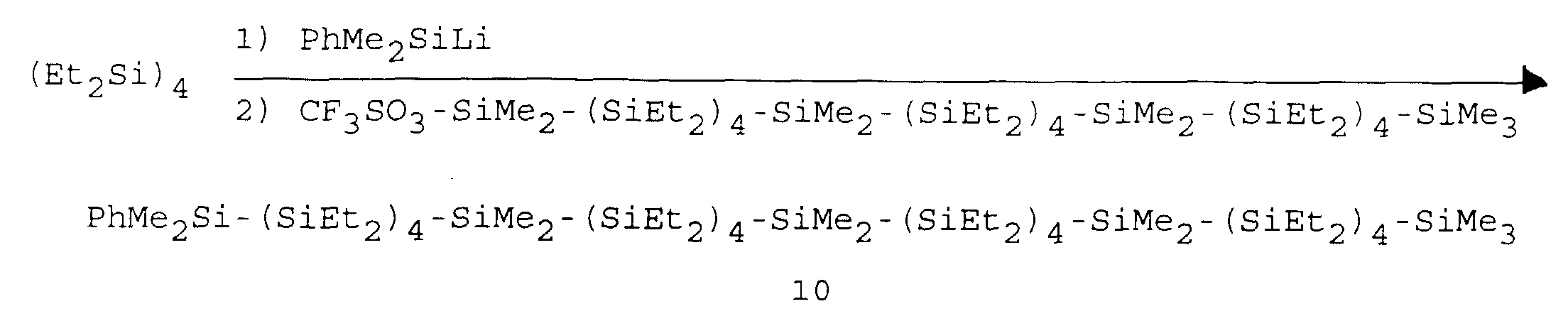
- In an argon atmosphere, to a tetrahydrofuran solution (1 ml) of 52 mg (0.15 mmol) of octaethylcyclotetrasilane was added 0.58 ml (0.15 mmol) of a tetrahydrofuran solution (0.27 M) of phenyldimethylsilyllithium, and stirred at 0°C for 15 minutes. Then, tetrahydrofuran was distilled out under vacuum, and hexane (1 ml) was added to give a hexane solution (Solution 1). A dichloromethane solution (1 ml) of 68 mg (0.05 mmol) of hexadecasilane (9) obtained in Example 9 was treated with 7.5 mg (0.05 mmol) of trifluoromethanesulfonic acid at room temperature for 30 minutes to give 1-(trifluoromethanesulfonyloxy)hexadecasilane. Then, dichloromethane was distilled out under vacuum, and hexane (1 ml) was added to give a hexane solution (Solution 2). The Solution 1 was added to the Solution 2 at -78°C and stirred for 15 minutes. Methanol (0.1 ml) and triethylamine (0.1 ml) were added, then saturated aqueous sodium bicarbonate solution (2 ml) was added, stirred, the hexane layer was separated, and dried with magnesium sulfate. The resulting crude product was purified by a silica gel column chromatography (hexane) to give 137 mg (39% yield) of eicosasilane (10) as a colorless crystal.
- 1H NMR (CDCl3): δ0.20 (S, 9H), 0.37 (S, 18H), 0.51 (S, 6H), 0.60-1.80 (m, 160H), 7.20-7.80 (m, 10H)
IR (KBr): 3050, 2950, 1450, 1420, 1240, 1015, 830, 800, 765, 690, 670cm-1
As described above, the present invention provides a method for synthesizing a polysilane having a homogeneous molecular weight distribution and controlled substituent arrangement order using a simple procedure, which is useful as a functional polymer for nonlinear optical materials, electroconductive polymers, and the like.
Claims (4)
- A homogeneous molecular weight polysilane of Formula [I]:

- A method for producing a homogeneous molecular weight polysilane of Formula [I]:


is reacted in a solvent with an organolithium reagent of Formula [IV]:
R9-Li [IV]
(wherein R9 denotes alkyl, aryl, alkenyl, alkynyl, or silyl groups),
and then with silanes of Formula [V] :
- A homogeneous molecular weight polysilane of Formula [II]:

- A method for producing a homogeneous molecular weight polysilane of Formula [II]:

characterized in that a small-ring polysilane of Formula [III]:
is reacted in a solvent with an organolithium reagent of Formula [IV]:
R9-Li [IV]
(wherein R9 denotes alkyl, aryl, alkenyl, alkynyl, silyl, or amino groups),
and then with silanes of Formula [VI]:
Applications Claiming Priority (4)
| Application Number | Priority Date | Filing Date | Title |
|---|---|---|---|
| JP52497/93 | 1993-03-12 | ||
| JP5249793 | 1993-03-12 | ||
| JP6024429A JP2932143B2 (en) | 1993-03-12 | 1994-02-22 | Method for producing polysilane |
| JP24429/94 | 1994-02-22 |
Publications (3)
| Publication Number | Publication Date |
|---|---|
| EP0622396A2 EP0622396A2 (en) | 1994-11-02 |
| EP0622396A3 EP0622396A3 (en) | 1995-09-06 |
| EP0622396B1 true EP0622396B1 (en) | 1997-12-03 |
Family
ID=26361932
Family Applications (1)
| Application Number | Title | Priority Date | Filing Date |
|---|---|---|---|
| EP94103676A Expired - Lifetime EP0622396B1 (en) | 1993-03-12 | 1994-03-10 | Polysilanes and method for producing the same |
Country Status (4)
| Country | Link |
|---|---|
| US (1) | US5663271A (en) |
| EP (1) | EP0622396B1 (en) |
| JP (1) | JP2932143B2 (en) |
| DE (1) | DE69407085T2 (en) |
Families Citing this family (5)
| Publication number | Priority date | Publication date | Assignee | Title |
|---|---|---|---|---|
| EP0836635B1 (en) * | 1995-07-03 | 2001-12-05 | Ciba SC Holding AG | Compositions of synthetic polymers and a polysilane derivative |
| FR2741626B1 (en) * | 1995-11-23 | 1998-01-09 | France Etat | PROCESS FOR THE PREPARATION OF POLYSILANES AND POLYCARBOSILANES |
| CN1954018A (en) * | 2004-05-14 | 2007-04-25 | 陶氏康宁公司 | Method of making branched polysilanes |
| JP5503371B2 (en) * | 2010-03-30 | 2014-05-28 | 大阪瓦斯株式会社 | Purification method of polysilane |
| US11706972B2 (en) * | 2015-09-08 | 2023-07-18 | Universal Display Corporation | Organic electroluminescent materials and devices |
Family Cites Families (5)
| Publication number | Priority date | Publication date | Assignee | Title |
|---|---|---|---|---|
| US3146249A (en) * | 1960-10-25 | 1964-08-25 | Dow Corning | Polymethylhydrogensilanes |
| US4783516A (en) * | 1983-03-31 | 1988-11-08 | Union Carbide Corporation | Polysilane precursors containing olefinic groups for silicon carbide |
| FR2630442B1 (en) * | 1988-04-20 | 1990-09-07 | Rhone Poulenc Chimie | ORGANOSILICY COMPOUNDS, MATERIALS AND ELECTROOPTIC DEVICES CONTAINING THEM |
| GB2224857B (en) * | 1988-11-15 | 1992-04-01 | Konishiroku Photo Ind | An electrophotographic photoreceptor |
| JPH0643655A (en) * | 1991-03-04 | 1994-02-18 | Internatl Business Mach Corp <Ibm> | Forming process of resist image and electronic device |
-
1994
- 1994-02-22 JP JP6024429A patent/JP2932143B2/en not_active Expired - Lifetime
- 1994-03-10 EP EP94103676A patent/EP0622396B1/en not_active Expired - Lifetime
- 1994-03-10 DE DE69407085T patent/DE69407085T2/en not_active Expired - Fee Related
-
1995
- 1995-11-09 US US08/552,458 patent/US5663271A/en not_active Expired - Fee Related
Also Published As
| Publication number | Publication date |
|---|---|
| JPH0710885A (en) | 1995-01-13 |
| DE69407085T2 (en) | 1998-03-26 |
| JP2932143B2 (en) | 1999-08-09 |
| US5663271A (en) | 1997-09-02 |
| EP0622396A2 (en) | 1994-11-02 |
| EP0622396A3 (en) | 1995-09-06 |
| DE69407085D1 (en) | 1998-01-15 |
Similar Documents
| Publication | Publication Date | Title |
|---|---|---|
| Chang et al. | Dehydrogenative coupling of diarylsilanes | |
| Dudziec et al. | New mono-and diethynylsiloxysilsesquioxanes–efficient procedures for their synthesis | |
| US4841083A (en) | Ladder polysilanes | |
| US5663271A (en) | Polysilanes and method for producing the same | |
| US4469881A (en) | [2-(p-t-Butylphenyl)ethyl]silanes and method of making the same | |
| Hengge et al. | Si H-containing cyclosilanes and their behaviour in the dehydrogenative polymerization reaction | |
| JP2654075B2 (en) | Method for producing cyclic silethynyl polymer | |
| US4837339A (en) | 4-Substituted-1,2,3,6-tetrahydrophthalic acid anhydride | |
| EP0537858A2 (en) | Silane compound and processes for the preparation thereof | |
| JPH0789972A (en) | Fullerene derivative and production thereof | |
| JPH10139784A (en) | Method for producing vinylsilyl group-containing silicon compound | |
| JPH07258416A (en) | Both-end-functional diphenylsiloxane oligomer compound and method for producing the same | |
| JP5052209B2 (en) | Novel epoxy compound and method for producing the same | |
| US5068381A (en) | Poly(silvinylene)s and a process for their preparation | |
| JP3385355B2 (en) | Tetrakis (dialkoxysilyl) benzene and method for producing the same | |
| US5359114A (en) | Silane compound and processes for the preparation thereof | |
| JPH082911B2 (en) | 1,3-Bis (p-hydroxybenzyl) -1,1,3,3-tetramethyldisiloxane and method for producing the same | |
| JP3338444B2 (en) | Silane-type coupling agent, method for producing the same, and method of use for forming conductive coating on glass | |
| US5049688A (en) | Allyl cyclosilalactams | |
| Beckmann et al. | The use of Pearlman's catalyst for the oxidation of Si–H bonds. Synthesis, structures and acid-catalysed condensation of novel α, ω-oligosiloxanediols HOSiMe2O (SiPh2O) nSiMe2OH (n= 1− 4) | |
| EP0488759B1 (en) | Thexyl (C1-C4)alkyl dialkoxy silanes; methods of preparation; and uses thereof | |
| JPS63253090A (en) | Silyl (meth)acrylate having trimethylsiloxy group | |
| JPH05230219A (en) | Production of alpha,omega-dihydropolysilane | |
| US5233068A (en) | Organic silicon compounds and method for making | |
| EP0864573B1 (en) | Silacyclopentadiene derivatives |
Legal Events
| Date | Code | Title | Description |
|---|---|---|---|
| PUAI | Public reference made under article 153(3) epc to a published international application that has entered the european phase |
Free format text: ORIGINAL CODE: 0009012 |
|
| AK | Designated contracting states |
Kind code of ref document: A2 Designated state(s): DE FR NL |
|
| PUAL | Search report despatched |
Free format text: ORIGINAL CODE: 0009013 |
|
| AK | Designated contracting states |
Kind code of ref document: A3 Designated state(s): DE FR NL |
|
| 17P | Request for examination filed |
Effective date: 19950908 |
|
| GRAG | Despatch of communication of intention to grant |
Free format text: ORIGINAL CODE: EPIDOS AGRA |
|
| 17Q | First examination report despatched |
Effective date: 19970124 |
|
| GRAG | Despatch of communication of intention to grant |
Free format text: ORIGINAL CODE: EPIDOS AGRA |
|
| GRAH | Despatch of communication of intention to grant a patent |
Free format text: ORIGINAL CODE: EPIDOS IGRA |
|
| GRAH | Despatch of communication of intention to grant a patent |
Free format text: ORIGINAL CODE: EPIDOS IGRA |
|
| GRAA | (expected) grant |
Free format text: ORIGINAL CODE: 0009210 |
|
| AK | Designated contracting states |
Kind code of ref document: B1 Designated state(s): DE FR NL |
|
| REF | Corresponds to: |
Ref document number: 69407085 Country of ref document: DE Date of ref document: 19980115 |
|
| ET | Fr: translation filed | ||
| PGFP | Annual fee paid to national office [announced via postgrant information from national office to epo] |
Ref country code: DE Payment date: 19980216 Year of fee payment: 5 |
|
| PGFP | Annual fee paid to national office [announced via postgrant information from national office to epo] |
Ref country code: NL Payment date: 19980217 Year of fee payment: 5 |
|
| PGFP | Annual fee paid to national office [announced via postgrant information from national office to epo] |
Ref country code: FR Payment date: 19980224 Year of fee payment: 5 |
|
| PLBE | No opposition filed within time limit |
Free format text: ORIGINAL CODE: 0009261 |
|
| STAA | Information on the status of an ep patent application or granted ep patent |
Free format text: STATUS: NO OPPOSITION FILED WITHIN TIME LIMIT |
|
| 26N | No opposition filed | ||
| PG25 | Lapsed in a contracting state [announced via postgrant information from national office to epo] |
Ref country code: NL Free format text: LAPSE BECAUSE OF NON-PAYMENT OF DUE FEES Effective date: 19991001 |
|
| PG25 | Lapsed in a contracting state [announced via postgrant information from national office to epo] |
Ref country code: FR Free format text: LAPSE BECAUSE OF NON-PAYMENT OF DUE FEES Effective date: 19991130 |
|
| NLV4 | Nl: lapsed or anulled due to non-payment of the annual fee |
Effective date: 19991001 |
|
| REG | Reference to a national code |
Ref country code: FR Ref legal event code: ST |
|
| PG25 | Lapsed in a contracting state [announced via postgrant information from national office to epo] |
Ref country code: DE Free format text: LAPSE BECAUSE OF NON-PAYMENT OF DUE FEES Effective date: 20000101 |