EP0622079B1 - Gelatinase A for the treatment of Alzheimer's disease - Google Patents
Gelatinase A for the treatment of Alzheimer's disease Download PDFInfo
- Publication number
- EP0622079B1 EP0622079B1 EP94302924A EP94302924A EP0622079B1 EP 0622079 B1 EP0622079 B1 EP 0622079B1 EP 94302924 A EP94302924 A EP 94302924A EP 94302924 A EP94302924 A EP 94302924A EP 0622079 B1 EP0622079 B1 EP 0622079B1
- Authority
- EP
- European Patent Office
- Prior art keywords
- βap
- gelatinase
- disease
- alzheimer
- progelatinase
- Prior art date
- Legal status (The legal status is an assumption and is not a legal conclusion. Google has not performed a legal analysis and makes no representation as to the accuracy of the status listed.)
- Expired - Lifetime
Links
Images


Classifications
-
- C—CHEMISTRY; METALLURGY
- C12—BIOCHEMISTRY; BEER; SPIRITS; WINE; VINEGAR; MICROBIOLOGY; ENZYMOLOGY; MUTATION OR GENETIC ENGINEERING
- C12N—MICROORGANISMS OR ENZYMES; COMPOSITIONS THEREOF; PROPAGATING, PRESERVING, OR MAINTAINING MICROORGANISMS; MUTATION OR GENETIC ENGINEERING; CULTURE MEDIA
- C12N9/00—Enzymes; Proenzymes; Compositions thereof; Processes for preparing, activating, inhibiting, separating or purifying enzymes
- C12N9/14—Hydrolases (3)
- C12N9/48—Hydrolases (3) acting on peptide bonds (3.4)
- C12N9/50—Proteinases, e.g. Endopeptidases (3.4.21-3.4.25)
- C12N9/64—Proteinases, e.g. Endopeptidases (3.4.21-3.4.25) derived from animal tissue
- C12N9/6421—Proteinases, e.g. Endopeptidases (3.4.21-3.4.25) derived from animal tissue from mammals
- C12N9/6489—Metalloendopeptidases (3.4.24)
- C12N9/6491—Matrix metalloproteases [MMP's], e.g. interstitial collagenase (3.4.24.7); Stromelysins (3.4.24.17; 3.2.1.22); Matrilysin (3.4.24.23)
-
- A—HUMAN NECESSITIES
- A61—MEDICAL OR VETERINARY SCIENCE; HYGIENE
- A61P—SPECIFIC THERAPEUTIC ACTIVITY OF CHEMICAL COMPOUNDS OR MEDICINAL PREPARATIONS
- A61P25/00—Drugs for disorders of the nervous system
- A61P25/28—Drugs for disorders of the nervous system for treating neurodegenerative disorders of the central nervous system, e.g. nootropic agents, cognition enhancers, drugs for treating Alzheimer's disease or other forms of dementia
-
- A—HUMAN NECESSITIES
- A61—MEDICAL OR VETERINARY SCIENCE; HYGIENE
- A61K—PREPARATIONS FOR MEDICAL, DENTAL OR TOILETRY PURPOSES
- A61K38/00—Medicinal preparations containing peptides
Definitions
- the present invention relates to an amyloid ⁇ -protein or A4 protein ( ⁇ AP) decomposing agent.
- ⁇ AP amyloid ⁇ -protein or A4 protein
- the ⁇ AP decomposing agent of the present invention is expected to be useful also as a medicine for preventing and curing Alzheimer's disease.
- Alzheimer's disease is a typical dementia, with which middle-aged or old-aged persons are often attacked, and this causes noticeable dysmnesia and retardation of mental capacity due to denaturation of neurons.
- Senile plaques appear on the outside of neurons in the brain of a patient suffering from Alzheimer's disease.
- Senile plaques consist essentially of ⁇ AP, in which it is seen that ⁇ AP aggregates by itself to form the cores of the plaques and denatured neuraxones surround the cores.
- ⁇ AP is derived from APP (amyloid protein precursor) which is a cell membrane protein having a molecular weight of about 100,000.
- APP is produced by an APP gene, which produces three major forms of related proteins (APP770, APP751, and APP695) due to the difference in the splicing. As one example, APP770 will be illustrated in the drawings attached hereto.
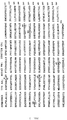
- Fig. 2 shows the outline structure of APP770, and its amino acid sequence (SEQ ID No. 1) is shown in Fig. 1.
- Fig. 2 1 indicates the signal sequence from 1 M (Met), and APP is comprised of 770 amino acids that are sequenced in order.
- 6 is a glycosylation domain where carbohydrate chains bond to the sequence at two sites, as shown by two CHO's in Fig. 2.
- the domain 8 corresponds to the transmembrane region that has penetrated the plasma membrane.
- APP When APP is cut at the site of D in Fig. 2(A) or, that is, at the arrowed site in the sequence of Fig. 2(D), it causes no disorder; but, in APP, if the part of D is closed to complete the domain 7 as one part (dark area) and the both sides of the domain 7 are cut, then APP liberates ⁇ AP (the whole domain 7).
- ⁇ AP is a mixture of peptides having the sequence comprising 1st to 39-43th amino acids.
- Fig. 3 shows the structure of ⁇ AP 1-40 .
- the present inventor has considered if the bond between 687K (Lys) and 688L (Leu) in the amino acid sequence of APP770 shown in Fig. 1 may be cut or if the bond between 16K (Lys) and 17L (Leu) in ⁇ AP shown in Fig. 3 may be cut more rapidly and more strongly before, during or after the formation of ⁇ -amyloid, then Alzheimer's disease may be prevented, retarded or cured.
- the present inventor assiduously studied and has found surprisingly that gelatinase A which decomposes gelatin has the action in question. On the basis of the finding, the inventor has completed the present invention.
- the present invention relates to a ⁇ AP-decomposing agent containing, as the active ingredient, gelatinase A, progelatinase A, a composite to which either of them has bonded or a material containing either of them.
- the present invention also relates to a medicine for preventing and curing Alzheimer's disease, which contains, as the active ingredient, gelatinase A, progelatinase A, a composite to which either of them has bonded or a material containing either of them.
- gelatinase A, etc. may cut the center part of ⁇ AP or, that is, the bond between 687K (Lys) and 688L (Leu) in the amino acid sequence of APP770 shown in Fig. 1.
- Gelatinase A and progelatinase A have heretofore been well known as enzymes to be secreted by many cancer cells, etc.
- progelatinase A has been purified as its complex with TIMP-2 (tissue inhibitor of metalloproteinases-2) from a culture of human neuroblastoma cell line T98G by an already reported method (Biochemical and Biophysical Research Communications, Vol. 185, No. 3, 1992, pp. 852-859).
- TIMP-2 tissue inhibitor of metalloproteinases-2
- the TIMP-2/progelatinase complex was hardly activated by an organo-mercurial p-aminophenylmercuric acetate (APMA) and had an activity of 10 % or less of the activity of the activated enzyme not containing TIMP-2.
- APMA organo-mercurial p-aminophenylmercuric acetate
- gelatinase A all of gelatinase A, progelatinase A, a complex to which either of them has bonded or a material containing either of them are used as the active ingredients.
- Progelatinase A not containing TIMP-2 was separated from TIMP-2-bound progelatinase by heparin affinity chromatography in accordance with the Kolkenbrock et al's method. (See Kolkenbrock, H., Orgel, D., Hecker-Kia, A., Noack, W. & Ulbrick, N.; Eur. J. Biochem., 198, 775-781 (1991).)
- progelatinase A was activated by incubating it in 20 mM of Tris-HCl (pH 7.5) containing 10 mM of Ca ++ , along with 1 mM of APMA and 0.25 ⁇ g of rat stromelysin, at 37°C for one hour.
- gelatinase A was incubated in 50 ⁇ l of Tris-HCl/Ca ++ buffer along with 20 nmol of a synthetic ⁇ AP peptide ( ⁇ AP 1-40 ), at 37°C for 6 hours, mixed with 0.5 ml of 0.05 % trifluoroacetic acid (TFA) and applied to Cosmosil (Registered Trade Mark) 5c18 reversed phase HPLC column (4.6 ⁇ 150 mm) (made by Nacalai Tesque, Kyoto, Japan).
- TFA trifluoroacetic acid
- the charged column was subjected to linear gradient elution, using an eluent of from 0 to 80 % acetonitrile in 15 ml of 0.05 % TFA at a flow rate of 0.5 ml/min.
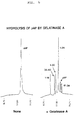
- the result is shown by the right-hand graph in Fig. 4.
- an enzyme-free ⁇ AP was incubated under the same condition and applied to the same column. (See the left-hand graph in Fig. 4.)
- ⁇ AP was desirably cut by the gelatinase A, at the cleavage sites 1, 2 and 3 shown in Fig. 3.
Landscapes
- Health & Medical Sciences (AREA)
- Engineering & Computer Science (AREA)
- Life Sciences & Earth Sciences (AREA)
- Chemical & Material Sciences (AREA)
- Bioinformatics & Cheminformatics (AREA)
- Biomedical Technology (AREA)
- Organic Chemistry (AREA)
- Wood Science & Technology (AREA)
- Zoology (AREA)
- Genetics & Genomics (AREA)
- Medicinal Chemistry (AREA)
- General Health & Medical Sciences (AREA)
- Neurosurgery (AREA)
- Biochemistry (AREA)
- Molecular Biology (AREA)
- Neurology (AREA)
- Microbiology (AREA)
- General Engineering & Computer Science (AREA)
- Biotechnology (AREA)
- Psychiatry (AREA)
- Veterinary Medicine (AREA)
- Public Health (AREA)
- Animal Behavior & Ethology (AREA)
- Pharmacology & Pharmacy (AREA)
- Nuclear Medicine, Radiotherapy & Molecular Imaging (AREA)
- General Chemical & Material Sciences (AREA)
- Chemical Kinetics & Catalysis (AREA)
- Hospice & Palliative Care (AREA)
- Medicines That Contain Protein Lipid Enzymes And Other Medicines (AREA)
- Peptides Or Proteins (AREA)
- Enzymes And Modification Thereof (AREA)
Description
- The present invention relates to an amyloid β-protein or A4 protein (βAP) decomposing agent.
- After formation of βAP, its aggregation causes the formation of senile plaques to be seen on the outside of neurocytes in the brain of a patient suffering from Alzheimer's disease (AD). Therefore, the βAP decomposing agent of the present invention is expected to be useful also as a medicine for preventing and curing Alzheimer's disease.
- In general, Alzheimer's disease is a typical dementia, with which middle-aged or old-aged persons are often attacked, and this causes noticeable dysmnesia and retardation of mental capacity due to denaturation of neurons. Senile plaques appear on the outside of neurons in the brain of a patient suffering from Alzheimer's disease. Senile plaques consist essentially of βAP, in which it is seen that βAP aggregates by itself to form the cores of the plaques and denatured neuraxones surround the cores.
- It has not been clarified as yet why βAP is produced to form senile plaques only in patients suffering from Alzheimer's disease. In fact, the formation of senile plaques is not seen in the aged with healthy mental capacity.
- It is known that βAP is derived from APP (amyloid protein precursor) which is a cell membrane protein having a molecular weight of about 100,000.
- APP is produced by an APP gene, which produces three major forms of related proteins (APP770, APP751, and APP695) due to the difference in the splicing. As one example, APP770 will be illustrated in the drawings attached hereto.
- Fig. 2 shows the outline structure of APP770, and its amino acid sequence (SEQ ID No. 1) is shown in Fig. 1.
- In Fig. 2, 1 indicates the signal sequence from 1 M (Met), and APP is comprised of 770 amino acids that are sequenced in order. 6 is a glycosylation domain where carbohydrate chains bond to the sequence at two sites, as shown by two CHO's in Fig. 2. In Fig. 2, the
domain 8 corresponds to the transmembrane region that has penetrated the plasma membrane. - When APP is cut at the site of D in Fig. 2(A) or, that is, at the arrowed site in the sequence of Fig. 2(D), it causes no disorder; but, in APP, if the part of D is closed to complete the
domain 7 as one part (dark area) and the both sides of thedomain 7 are cut, then APP liberates βAP (the whole domain 7). βAP is a mixture of peptides having the sequence comprising 1st to 39-43th amino acids. Fig. 3 shows the structure of βAP1-40. - In healthy persons, APP is cut at its center part without forming β-amyloid. However, it has heretofore been unknown at all what will act on the arrowed site in Fig. 2(D) (the site is same as the position of the
arrow ② in Fig. 3). - The present inventor has considered if the bond between 687K (Lys) and 688L (Leu) in the amino acid sequence of APP770 shown in Fig. 1 may be cut or if the bond between 16K (Lys) and 17L (Leu) in βAP shown in Fig. 3 may be cut more rapidly and more strongly before, during or after the formation of β-amyloid, then Alzheimer's disease may be prevented, retarded or cured.
- The invention will now be described in more detail by way of example with reference to the accompanying drawings, in which:
- Fig. 1 shows the amino acid sequence of APP770 by one-letter designation (SEQ ID No. 1).
- Fig. 2 shows the outline structure of APP770.
- Fig. 3 shows the sites of βAP to be cut by gelatinase A.
- Fig. 4 shows the graph of reversed phase HPLC of βAP decomposed by gelatinase A in the example.
- Considering the above-mentioned problems, the present inventor assiduously studied and has found surprisingly that gelatinase A which decomposes gelatin has the action in question. On the basis of the finding, the inventor has completed the present invention.
- The present invention relates to a βAP-decomposing agent containing, as the active ingredient, gelatinase A, progelatinase A, a composite to which either of them has bonded or a material containing either of them.
- The present invention also relates to a medicine for preventing and curing Alzheimer's disease, which contains, as the active ingredient, gelatinase A, progelatinase A, a composite to which either of them has bonded or a material containing either of them.
- According to the present invention, it has been newly found that gelatinase A, etc. may cut the center part of βAP or, that is, the bond between 687K (Lys) and 688L (Leu) in the amino acid sequence of APP770 shown in Fig. 1.
- Gelatinase A and progelatinase A have heretofore been well known as enzymes to be secreted by many cancer cells, etc.
- In the present invention, progelatinase A has been purified as its complex with TIMP-2 (tissue inhibitor of metalloproteinases-2) from a culture of human neuroblastoma cell line T98G by an already reported method (Biochemical and Biophysical Research Communications, Vol. 185, No. 3, 1992, pp. 852-859). The TIMP-2/progelatinase complex was hardly activated by an organo-mercurial p-aminophenylmercuric acetate (APMA) and had an activity of 10 % or less of the activity of the activated enzyme not containing TIMP-2. When the complex was incubated with stromelysin in the presence of APMA, the progelatinase moiety having a molecular weight of 64 k was effectively converted into a matured gelatinase A having a molecular weight of 57 k and a small amount of an activated enzyme having a molecular weight of 41 k, with the result that its gelatin-decomposing activity increased about 8 times. (From these results, it was considered that stromelysin is a natural activating agent for TIMP-2-bound progelatinase A.)
- In the present invention, all of gelatinase A, progelatinase A, a complex to which either of them has bonded or a material containing either of them are used as the active ingredients.
- Progelatinase A not containing TIMP-2 was separated from TIMP-2-bound progelatinase by heparin affinity chromatography in accordance with the Kolkenbrock et al's method. (See Kolkenbrock, H., Orgel, D., Hecker-Kia, A., Noack, W. & Ulbrick, N.; Eur. J. Biochem., 198, 775-781 (1991).)
- One µg of progelatinase A was activated by incubating it in 20 mM of Tris-HCl (pH 7.5) containing 10 mM of Ca++, along with 1 mM of APMA and 0.25 µg of rat stromelysin, at 37°C for one hour.
- The thus-activated enzyme, gelatinase A was incubated in 50 µl of Tris-HCl/Ca++ buffer along with 20 nmol of a synthetic βAP peptide (βAP1-40), at 37°C for 6 hours, mixed with 0.5 ml of 0.05 % trifluoroacetic acid (TFA) and applied to Cosmosil (Registered Trade Mark) 5c18 reversed phase HPLC column (4.6 × 150 mm) (made by Nacalai Tesque, Kyoto, Japan). The charged column was subjected to linear gradient elution, using an eluent of from 0 to 80 % acetonitrile in 15 ml of 0.05 % TFA at a flow rate of 0.5 ml/min. The result is shown by the right-hand graph in Fig. 4. As a control, an enzyme-free βAP was incubated under the same condition and applied to the same column. (See the left-hand graph in Fig. 4.)
- As is obvious from Fig. 4, βAP was desirably cut by the gelatinase A, at the
cleavage sites 


Claims (3)
- An amyloid β-protein or A4 protein (βAP) decomposing agent containing, as the active ingredient, gelatinase A, progelatinase A, a complex to which either of them has bonded or a material containing either of them.
- A medicine for preventing and curing Alzheimer's disease, which contains, as the active ingredient, gelatinase A, progelatinase A, a complex to which either of them has bonded or a material containing either of them.
- Use of an amyloid β-protein or A4 protein (βAP) decomposing agent according to claim 1, for the manufacture of a medicament for treating Alzheimer's disease.
Applications Claiming Priority (4)
| Application Number | Priority Date | Filing Date | Title |
|---|---|---|---|
| JP12220793 | 1993-04-27 | ||
| JP122207/93 | 1993-04-27 | ||
| JP51133/94 | 1994-02-25 | ||
| JP05113394A JP3466259B2 (en) | 1993-04-27 | 1994-02-25 | βAP decomposer |
Publications (3)
| Publication Number | Publication Date |
|---|---|
| EP0622079A2 EP0622079A2 (en) | 1994-11-02 |
| EP0622079A3 EP0622079A3 (en) | 1995-08-09 |
| EP0622079B1 true EP0622079B1 (en) | 1997-07-23 |
Family
ID=26391663
Family Applications (1)
| Application Number | Title | Priority Date | Filing Date |
|---|---|---|---|
| EP94302924A Expired - Lifetime EP0622079B1 (en) | 1993-04-27 | 1994-04-25 | Gelatinase A for the treatment of Alzheimer's disease |
Country Status (4)
| Country | Link |
|---|---|
| US (1) | US5843695A (en) |
| EP (1) | EP0622079B1 (en) |
| JP (1) | JP3466259B2 (en) |
| DE (1) | DE69404370T2 (en) |
Families Citing this family (1)
| Publication number | Priority date | Publication date | Assignee | Title |
|---|---|---|---|---|
| US6140309A (en) * | 1996-03-12 | 2000-10-31 | University Of South Florida | Vasoactive effects and free radical generation by β-amyloid peptides |
Family Cites Families (4)
| Publication number | Priority date | Publication date | Assignee | Title |
|---|---|---|---|---|
| US4902680A (en) * | 1984-10-29 | 1990-02-20 | Chaovanee Aroonsakul | Treating central nervous system diseases |
| US5221607A (en) * | 1989-09-18 | 1993-06-22 | Scios Nova Inc. | Assays and reagents for amyloid deposition |
| US5252463A (en) * | 1990-06-22 | 1993-10-12 | The Du Pont Merck Pharmaceutical Company | Clipsin, a chymotrypsin-like protease and method of using same |
| WO1992003542A1 (en) | 1990-08-17 | 1992-03-05 | Boston University | PROTEASES CAUSING ABNORMAL DEGRADATION OF AMYLOID β-PROTEIN PRECURSOR |
-
1994
- 1994-02-25 JP JP05113394A patent/JP3466259B2/en not_active Expired - Lifetime
- 1994-04-25 DE DE69404370T patent/DE69404370T2/en not_active Expired - Lifetime
- 1994-04-25 EP EP94302924A patent/EP0622079B1/en not_active Expired - Lifetime
-
1996
- 1996-04-30 US US08/641,774 patent/US5843695A/en not_active Expired - Lifetime
Also Published As
| Publication number | Publication date |
|---|---|
| JP3466259B2 (en) | 2003-11-10 |
| EP0622079A2 (en) | 1994-11-02 |
| DE69404370T2 (en) | 1997-11-20 |
| JPH0789870A (en) | 1995-04-04 |
| DE69404370D1 (en) | 1997-08-28 |
| US5843695A (en) | 1998-12-01 |
| EP0622079A3 (en) | 1995-08-09 |
Similar Documents
| Publication | Publication Date | Title |
|---|---|---|
| Schubert et al. | Amyloid β protein precursor is possibly a heparan sulfate proteoglycan core protein | |
| JP3025014B2 (en) | Novel protein named Component B | |
| EP0220241B1 (en) | Purified protein having angiogenic activity and methods of preparation | |
| JPH10502527A (en) | Novel growth / differentiation factors of the TGF-β family | |
| US6084069A (en) | Autotaxin: motility stimulating protein useful in cancer diagnosis and therapy | |
| CA2137377A1 (en) | Retinal pigmented epithelium derived neurotrophic factor | |
| Heinrikson et al. | A structural model to explain the partial catalytic activity of human prorenin | |
| WO1994012637A2 (en) | Novel human amyloid protein precursor homologue and kunitz-type inhibitors | |
| CA2230111A1 (en) | Antisecretory factor peptides regulating pathological permeability changes | |
| DE69029663T2 (en) | METHOD FOR ENDOPROTEOLYTIC PROCESSING OF (PRECURSOR) PROTEINS AND FOR (MICRO) BIOLOGICAL PRODUCTION | |
| US7060791B2 (en) | Meltrins | |
| Ohsawa et al. | Expression, purification, and neurotrophic activity of amyloid precursor protein-secreted forms produced by yeast | |
| CA2351558A1 (en) | Peptide fragments having cell death inhibitory activity | |
| EP0622079A2 (en) | Gelatinase A for the treatment of Alzheimer's disease | |
| WO2001034640A2 (en) | Peptide (virip) which inhibits a circulating virus in humans and the use thereof | |
| EP0240224A2 (en) | An alpha interferon analogue | |
| EP1040190B1 (en) | Serine proteinase inhibitors | |
| EP0677107A1 (en) | Clotting inhibitor made from protostomia saliva. | |
| AU3463495A (en) | Production and secretion of recombinant fibrinogen by yeast | |
| CA2004764C (en) | Ancrod proteins, their preparation and use | |
| DE60120187T2 (en) | SHORTEN BARD1 PROTEIN AND ITS DIAGNOSTIC AND THERAPEUTIC APPLICATIONS | |
| US7939635B2 (en) | Autotaxin: motility stimulating protein useful in cancer diagnosis and therapy | |
| WO2000078963A1 (en) | Serin proteinase inhibitors | |
| JP3809656B2 (en) | Gelatinase A activity inhibitor | |
| CA2067039A1 (en) | Neurotrophic peptide derivatives |
Legal Events
| Date | Code | Title | Description |
|---|---|---|---|
| PUAI | Public reference made under article 153(3) epc to a published international application that has entered the european phase |
Free format text: ORIGINAL CODE: 0009012 |
|
| AK | Designated contracting states |
Kind code of ref document: A2 Designated state(s): DE FR GB |
|
| PUAL | Search report despatched |
Free format text: ORIGINAL CODE: 0009013 |
|
| AK | Designated contracting states |
Kind code of ref document: A3 Designated state(s): DE FR GB |
|
| 17P | Request for examination filed |
Effective date: 19951125 |
|
| 17Q | First examination report despatched |
Effective date: 19960322 |
|
| GRAG | Despatch of communication of intention to grant |
Free format text: ORIGINAL CODE: EPIDOS AGRA |
|
| GRAH | Despatch of communication of intention to grant a patent |
Free format text: ORIGINAL CODE: EPIDOS IGRA |
|
| GRAH | Despatch of communication of intention to grant a patent |
Free format text: ORIGINAL CODE: EPIDOS IGRA |
|
| GRAA | (expected) grant |
Free format text: ORIGINAL CODE: 0009210 |
|
| AK | Designated contracting states |
Kind code of ref document: B1 Designated state(s): DE FR GB |
|
| REF | Corresponds to: |
Ref document number: 69404370 Country of ref document: DE Date of ref document: 19970828 |
|
| ET | Fr: translation filed | ||
| PLBE | No opposition filed within time limit |
Free format text: ORIGINAL CODE: 0009261 |
|
| STAA | Information on the status of an ep patent application or granted ep patent |
Free format text: STATUS: NO OPPOSITION FILED WITHIN TIME LIMIT |
|
| 26N | No opposition filed | ||
| REG | Reference to a national code |
Ref country code: GB Ref legal event code: IF02 |
|
| PGFP | Annual fee paid to national office [announced via postgrant information from national office to epo] |
Ref country code: GB Payment date: 20130306 Year of fee payment: 20 |
|
| PGFP | Annual fee paid to national office [announced via postgrant information from national office to epo] |
Ref country code: DE Payment date: 20130508 Year of fee payment: 20 |
|
| PGFP | Annual fee paid to national office [announced via postgrant information from national office to epo] |
Ref country code: FR Payment date: 20130625 Year of fee payment: 20 |
|
| REG | Reference to a national code |
Ref country code: DE Ref legal event code: R071 Ref document number: 69404370 Country of ref document: DE |
|
| REG | Reference to a national code |
Ref country code: DE Ref legal event code: R071 Ref document number: 69404370 Country of ref document: DE |
|
| REG | Reference to a national code |
Ref country code: GB Ref legal event code: PE20 Expiry date: 20140424 |
|
| PG25 | Lapsed in a contracting state [announced via postgrant information from national office to epo] |
Ref country code: GB Free format text: LAPSE BECAUSE OF EXPIRATION OF PROTECTION Effective date: 20140424 |
|
| PG25 | Lapsed in a contracting state [announced via postgrant information from national office to epo] |
Ref country code: DE Free format text: LAPSE BECAUSE OF EXPIRATION OF PROTECTION Effective date: 20140426 |