EP0622049B1 - Mechanism for use by endoscopic and open procedures - Google Patents
Mechanism for use by endoscopic and open procedures Download PDFInfo
- Publication number
- EP0622049B1 EP0622049B1 EP94303139A EP94303139A EP0622049B1 EP 0622049 B1 EP0622049 B1 EP 0622049B1 EP 94303139 A EP94303139 A EP 94303139A EP 94303139 A EP94303139 A EP 94303139A EP 0622049 B1 EP0622049 B1 EP 0622049B1
- Authority
- EP
- European Patent Office
- Prior art keywords
- endoscopic
- procedure
- open
- handle
- surgeon
- Prior art date
- Legal status (The legal status is an assumption and is not a legal conclusion. Google has not performed a legal analysis and makes no representation as to the accuracy of the status listed.)
- Expired - Lifetime
Links
- 238000000034 method Methods 0.000 title claims abstract description 69
- 230000007246 mechanism Effects 0.000 title description 21
- 238000002355 open surgical procedure Methods 0.000 claims description 4
- 230000000740 bleeding effect Effects 0.000 description 7
- 238000010304 firing Methods 0.000 description 5
- 230000013011 mating Effects 0.000 description 5
- 238000001356 surgical procedure Methods 0.000 description 4
- 108010080379 Fibrin Tissue Adhesive Proteins 0.000 description 2
- 239000000853 adhesive Substances 0.000 description 2
- 230000001070 adhesive effect Effects 0.000 description 2
- 238000006243 chemical reaction Methods 0.000 description 2
- 238000002674 endoscopic surgery Methods 0.000 description 2
- 208000014674 injury Diseases 0.000 description 2
- 230000008733 trauma Effects 0.000 description 2
- 206010019909 Hernia Diseases 0.000 description 1
- 208000004356 Hysteria Diseases 0.000 description 1
- 210000001015 abdomen Anatomy 0.000 description 1
- 208000012839 conversion disease Diseases 0.000 description 1
- 239000000463 material Substances 0.000 description 1
- 230000036642 wellbeing Effects 0.000 description 1
Images



Classifications
-
- A—HUMAN NECESSITIES
- A61—MEDICAL OR VETERINARY SCIENCE; HYGIENE
- A61B—DIAGNOSIS; SURGERY; IDENTIFICATION
- A61B17/00—Surgical instruments, devices or methods
- A61B17/28—Surgical forceps
- A61B17/29—Forceps for use in minimally invasive surgery
- A61B17/2909—Handles
-
- A—HUMAN NECESSITIES
- A61—MEDICAL OR VETERINARY SCIENCE; HYGIENE
- A61B—DIAGNOSIS; SURGERY; IDENTIFICATION
- A61B17/00—Surgical instruments, devices or methods
- A61B17/12—Surgical instruments, devices or methods for ligaturing or otherwise compressing tubular parts of the body, e.g. blood vessels or umbilical cord
- A61B17/128—Surgical instruments, devices or methods for ligaturing or otherwise compressing tubular parts of the body, e.g. blood vessels or umbilical cord for applying or removing clamps or clips
- A61B17/1285—Surgical instruments, devices or methods for ligaturing or otherwise compressing tubular parts of the body, e.g. blood vessels or umbilical cord for applying or removing clamps or clips for minimally invasive surgery
-
- A—HUMAN NECESSITIES
- A61—MEDICAL OR VETERINARY SCIENCE; HYGIENE
- A61B—DIAGNOSIS; SURGERY; IDENTIFICATION
- A61B17/00—Surgical instruments, devices or methods
- A61B17/068—Surgical staplers, e.g. containing multiple staples or clamps
- A61B17/0682—Surgical staplers, e.g. containing multiple staples or clamps for applying U-shaped staples or clamps, e.g. without a forming anvil
-
- A—HUMAN NECESSITIES
- A61—MEDICAL OR VETERINARY SCIENCE; HYGIENE
- A61B—DIAGNOSIS; SURGERY; IDENTIFICATION
- A61B17/00—Surgical instruments, devices or methods
- A61B17/068—Surgical staplers, e.g. containing multiple staples or clamps
- A61B17/072—Surgical staplers, e.g. containing multiple staples or clamps for applying a row of staples in a single action, e.g. the staples being applied simultaneously
- A61B17/07207—Surgical staplers, e.g. containing multiple staples or clamps for applying a row of staples in a single action, e.g. the staples being applied simultaneously the staples being applied sequentially
-
- A—HUMAN NECESSITIES
- A61—MEDICAL OR VETERINARY SCIENCE; HYGIENE
- A61B—DIAGNOSIS; SURGERY; IDENTIFICATION
- A61B17/00—Surgical instruments, devices or methods
- A61B17/12—Surgical instruments, devices or methods for ligaturing or otherwise compressing tubular parts of the body, e.g. blood vessels or umbilical cord
- A61B17/128—Surgical instruments, devices or methods for ligaturing or otherwise compressing tubular parts of the body, e.g. blood vessels or umbilical cord for applying or removing clamps or clips
-
- A—HUMAN NECESSITIES
- A61—MEDICAL OR VETERINARY SCIENCE; HYGIENE
- A61B—DIAGNOSIS; SURGERY; IDENTIFICATION
- A61B17/00—Surgical instruments, devices or methods
- A61B17/28—Surgical forceps
- A61B17/29—Forceps for use in minimally invasive surgery
-
- A—HUMAN NECESSITIES
- A61—MEDICAL OR VETERINARY SCIENCE; HYGIENE
- A61B—DIAGNOSIS; SURGERY; IDENTIFICATION
- A61B17/00—Surgical instruments, devices or methods
- A61B17/32—Surgical cutting instruments
- A61B17/320016—Endoscopic cutting instruments, e.g. arthroscopes, resectoscopes
-
- A—HUMAN NECESSITIES
- A61—MEDICAL OR VETERINARY SCIENCE; HYGIENE
- A61B—DIAGNOSIS; SURGERY; IDENTIFICATION
- A61B17/00—Surgical instruments, devices or methods
- A61B2017/0046—Surgical instruments, devices or methods with a releasable handle; with handle and operating part separable
- A61B2017/00464—Surgical instruments, devices or methods with a releasable handle; with handle and operating part separable for use with different instruments
-
- A—HUMAN NECESSITIES
- A61—MEDICAL OR VETERINARY SCIENCE; HYGIENE
- A61B—DIAGNOSIS; SURGERY; IDENTIFICATION
- A61B17/00—Surgical instruments, devices or methods
- A61B17/068—Surgical staplers, e.g. containing multiple staples or clamps
- A61B17/072—Surgical staplers, e.g. containing multiple staples or clamps for applying a row of staples in a single action, e.g. the staples being applied simultaneously
- A61B2017/07214—Stapler heads
- A61B2017/07271—Stapler heads characterised by its cartridge
Definitions
- This invention relates to surgical mechanisms. More particularly this invention relates to surgical mechanisms capable of being converted from being useful for open endoscopic procedures to being useful for procedures at a moment's notice.
- Surgical interns are indeed taught how to convert an endoscopic procedure to an open procedure.
- provisions are made to convert the procedure from an endoscopic to an open procedure.
- various trays of equipment are arrayed before the surgeon. These trays enable the surgeon to perform the endoscopic procedure.
- These trays include, among other things, trocars, instruments such as graspers, dissectors and forceps useful in endoscopic proceedings, clip appliers, staplers, needle holder, scalpels, etc. All these instruments are capable of being placed through a trocar cannula. Their use is observable on a video screen such as those typically and commonly used during endoscopic procedures.
- instruments useful for an open surgical procedure may be for instance, larger head staplers, clip appliers, graspers and forceps. There also may be retractors, scalpels, electrocautery units, open heart mechanisms or the like. Each of these groups of materials are kept on separate stands within the operating room. Then, if there is a need to convert a procedure from an endoscopic procedure to an open procedure, the endoscopic mechanisms are wheeled away from the surgeon and the open surgical procedure mechanisms are placed in front of the surgeon. Thus, a rather time consuming and expensive endeavor occurs wherein the devices are wheeled away and new devices are used. Also, the necessity arises to have multiple devices themselves within the operating room. Often, this results in a pure space filling problem.
- EP-A-0484677 discloses an endoscopic stapler in which the endoscopic portion of the instrument is detachable from the frame and handle portion of the instrument, said handle portion being reusable with replacement endoscopic portions.
- a common handle can be attached to either an endoscopic instrument or an open surgical instrument.
- a common handle may have attached to it an open surgical clip applier. Or, this may have attached to it an endoscopic clip applier. Or, there may be attached to it an endoscopic stapler. Or, there may be attached an open stapler. This capability continues across all procedures and product lines.
- the surgeon has on hand, at virtually an instance, the capability of converting the procedure from an endoscopic one to an open one, or converting one instrument to another without having to change an essential part, the handle used in the device.
- the common handle also, there can be reuse of the handle, with disposal of the cartridge held therein.
- the cartridge can be either an open procedure surgical cartridge or an endoscopic cartridge.
- the cartridge held within the handle can be compatible with a trocar or can be useful outside a trocar.
- a cartridge if useful for an endoscopic use, could be used by the surgeon for open use, but with the availability of an open procedure cartridge nearby, there is no need for such an application.
- a surgeon can have on a surgical tray cartridges for all of the instruments necessary to have either an open procedure or an endoscopic procedure.
- some of the hectic disarray involved in converting a surgical procedure is done away. That is, there is no need to wheel away the instruments useful for an endoscopic procedure, and wheel in front of the surgeon the instruments useful for an open procedure.
- the surgeon has all the instruments on one tray, as embodied in the cartridges useful with the common handle. With such an invention in place, the length of the procedure can be shortened, and the time to convert procedures is dramatically altered. Also, the surgeon will feel more confident is using a single tray to accomplish a procedure, rather than having to rely on placement of a set of devices within the operating room, but not directly in front of the surgeon.
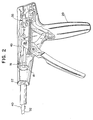
- This clip applier contains a series of clips as is better described in U.S. Patent No. 5,171,249. These clips are stored in a shaft 15 and the shaft is placed on a handle 20. This handle 20 is further described in the same patent.
- the shaft 15 of the present device is detachable from the handle 20 of this device 19.
- the firing mechanism 25 and the clip feeding mechanism 30 as contained in the shaft portion of the device are detachable from the handle portion 20 of this device by conventional attachment means.
- cam channel 32 fits into firing shaft 35.
- feed channel 40 (for loading clips) fits into feed shaft 45.
- Feed shaft 45 and firing shaft 35 are operable to cover reciprocation of feed channel 40 and cam channel 30 respectively.
- Collar 16 fits into handle 20, to hold shaft 15 in handle 20 during operation. To remove shaft 15, collar 20 is rotated so that key 18 fits through notch 22.
- FIG 3 describes an open procedure ligating shaft 50.
- This shaft corresponds in many ways to a ligating clip applier shaft disclosed in European Patent Appln. EP-A-630616 entitled “Ligating Clip Applier” (END-37), filed this day and claiming priority from USSN 54734 except that this mechanism is in cross circular section, to mate with handle 20.
- This ligating shaft 50 is capable of being inserted into the handle 20 of the instrument 19 in Figure 1.
- the clip applying 55 and feeding members 60 of shaft 50 are capable of mating with the clip applying firing shaft 35 and feeding shaft member 45, respectively, of the device in Figure 2, so that this device is entirely useful as an open surgical device.
- Mating is accomplished by known connecting means such as, for instance, by bayonet mounting the pieces one into the other. Locking is accomplished by rotating shaft 50 in handle 20, as described in connection with Figures 1 and 2.
- This handle 20 is capable of having interchanged within it staplers and ligating clip appliers. Further, this handle can have inserted into it open or endoscopic devices. Now, the surgeon can have one series of instruments useful to be interchanged with the handle 20. Then, if the surgery must go from an endoscopic surgery to an open procedure, the surgeon merely removes the endoscopic device (as in Figure 1) from a trocar, removes the shaft 15 from its handle 20, and inserts open clip applier shaft 50, for instance.
- Figure 4 describes an endoscopic stapling shaft 70 of this invention.
- the endoscopic shaft 70 has on its end a stapler cartridge 75, similar to the cartridge described in U.S. Patent US-A-5307976 (Serial No. 917,636).
- This device is capable of being placed into the handle portion 20 of Figure 1, so that the handle portion 20 containing feed shaft 45 and firing shaft 35 mates (seen in phantom in Figure 4) with the staple applying 80 mechanisms and clamping mechanisms 85, as seen in Figure 4. Again, mating is accomplished by known connection mechanisms, like a socket and ball mechanism.
- Figure 5 shows an open staple applying mechanism 90 comparable to that of the instrument of Figure 4, and further comparable to the instrument of U.S. Patent No. 4,633,861.
- This device is also capable of mating with the handle 20 of Figure 1. Furthermore, the cartridge 75 in Figure 4 is capable of being emplaced into the jaws 95 of the stapler of Figure 5. Thus, where heretofore there have been separate cartridges useful for either open or endoscopic procedures, now there are cartridges capable of being used in either procedure.
- This advancement will allow the surgeon to be able to more expeditiously convert the procedure, and even more expeditiously finish the surgical procedure.
- the capability is given to the surgeon so that the surgeon may remove a ligating endoscopic device 10 and inserting an endoscopic stapling device 70. Or, the surgeon may keep the ligating device 10 inserted through one trocar tube, and detach the handle 20 so that the handle 20 can be attached to a stapler 70 contained in another trocar. Or, the surgeon may wish to dispose of all the used shafts, and have the handle 20 autoclaved, while using a new set of shafts for another patient.
- cartridges which incorporate staples, absorbable fasteners, fibrin glue, adhesive, clips and the like, well known in the art.
- the cartridge of these devices should be useful with either an open stapling procedure or a closed endoscopic procedure.
- such cartridges have been created so that they are useful one for specific types of procedure.
- these cartridges extend across procedural lines, so that their versatility is enhanced. For instance, it is intended to include cartridges which incorporate staples, absorbable fasteners, fibrin glue, adhesive, clips or the like, all of which are well known in the art.
- Figure 6 describes an endoscopic hernia stapler 199 similar in many ways to the instrument of U.S. Patent No. 5,174,487.
- Figure 7 describes a skin stapler 201 similar to the skin stapler described in U.S. Patent No. 5,161,725.
- the cartridge 200 of the two instruments is common.
- cartridge 200 containing staples 202 may be inserted into either handle 198 on shaft 197 or handle 203 of the instruments 199, 201 respectively.
- the interchangeable cartridge 200 allows the cartridge 200 to be used with either an endoscopic or an open application.
- Mating is similar to the previous embodiments, in that push bar 210 fits into cartridge 200.
- Push bar 210 is an element of both staplers 199, 201, and mates with cartridge 200 in each instance, by known attaching mechanisms. It is this departure from the art which provides the new and useful application of this mechanism.
Landscapes
- Health & Medical Sciences (AREA)
- Surgery (AREA)
- Life Sciences & Earth Sciences (AREA)
- Medical Informatics (AREA)
- Animal Behavior & Ethology (AREA)
- Engineering & Computer Science (AREA)
- Biomedical Technology (AREA)
- Heart & Thoracic Surgery (AREA)
- Veterinary Medicine (AREA)
- Molecular Biology (AREA)
- Nuclear Medicine, Radiotherapy & Molecular Imaging (AREA)
- General Health & Medical Sciences (AREA)
- Public Health (AREA)
- Ophthalmology & Optometry (AREA)
- Reproductive Health (AREA)
- Vascular Medicine (AREA)
- Surgical Instruments (AREA)
- Endoscopes (AREA)
- Instruments For Viewing The Inside Of Hollow Bodies (AREA)
Abstract
Description
Claims (8)
- A surgical handle (20) in combination with a plurality of surgical shafts (15, 50), each of said shafts (15, 50) being mateable with said surgical handle (20), and at least a first one of said shafts (15, 50) being useful for accomplishing a step in an endoscopic procedure, characterised in that a second one of said shafts (15, 50) provides a functionality which is different from the functionality provided by said first shaft, said second shaft being useful for accomplishing one of a different step in said procedure or a step in an open surgical procedure.
- The combination of claim 1 wherein one of said shafts enables a stapling step.
- The combination of claim 1 wherein one of said shafts enables a ligating step.
- The combination of claim 1 wherein one of said shafts enables a grasping step.
- The combination of claim 1 wherein one of said shafts enables a dissecting step.
- The combination of claim 1 wherein one of said shafts enables a cutting step.
- The combination of claim 1 wherein one of said shafts is circular.
- The combination of claim 1 wherein one of said shafts enables an adhesion step.
Applications Claiming Priority (2)
| Application Number | Priority Date | Filing Date | Title |
|---|---|---|---|
| US5473293A | 1993-04-29 | 1993-04-29 | |
| US54732 | 1993-04-29 |
Publications (2)
| Publication Number | Publication Date |
|---|---|
| EP0622049A1 EP0622049A1 (en) | 1994-11-02 |
| EP0622049B1 true EP0622049B1 (en) | 1998-12-09 |
Family
ID=21993148
Family Applications (1)
| Application Number | Title | Priority Date | Filing Date |
|---|---|---|---|
| EP94303139A Expired - Lifetime EP0622049B1 (en) | 1993-04-29 | 1994-04-29 | Mechanism for use by endoscopic and open procedures |
Country Status (7)
| Country | Link |
|---|---|
| EP (1) | EP0622049B1 (en) |
| JP (1) | JPH0767882A (en) |
| AT (1) | ATE174197T1 (en) |
| AU (1) | AU6182294A (en) |
| DE (1) | DE69415071T2 (en) |
| ES (1) | ES2124370T3 (en) |
| GR (1) | GR1002376B (en) |
Families Citing this family (30)
| Publication number | Priority date | Publication date | Assignee | Title |
|---|---|---|---|---|
| DE19504002A1 (en) * | 1995-02-08 | 1996-08-14 | Arnold Dipl Ing Dr Med Pier | Surgical clip applicator |
| CA2193451C (en) * | 1995-12-21 | 2005-11-01 | Diana F. Mccue | Instrument system for knee prosthesis implantation with universal handle or slap hammer |
| US6099537A (en) * | 1996-02-26 | 2000-08-08 | Olympus Optical Co., Ltd. | Medical treatment instrument |
| EP3170459A1 (en) | 2003-03-11 | 2017-05-24 | Covidien LP | Clip applying apparatus with angled jaw |
| JP4783372B2 (en) | 2004-10-08 | 2011-09-28 | タイコ ヘルスケア グループ エルピー | Device for applying a surgical clip |
| JP5047799B2 (en) | 2004-10-08 | 2012-10-10 | タイコ ヘルスケア グループ リミテッド パートナーシップ | Endoscopic surgical clip applier |
| US9763668B2 (en) | 2004-10-08 | 2017-09-19 | Covidien Lp | Endoscopic surgical clip applier |
| US8465502B2 (en) | 2008-08-25 | 2013-06-18 | Covidien Lp | Surgical clip applier and method of assembly |
| US9358015B2 (en) | 2008-08-29 | 2016-06-07 | Covidien Lp | Endoscopic surgical clip applier with wedge plate |
| US8409223B2 (en) | 2008-08-29 | 2013-04-02 | Covidien Lp | Endoscopic surgical clip applier with clip retention |
| GB0818101D0 (en) | 2008-10-03 | 2008-11-05 | Femcare Nikomed Ltd | Applicator for surgical clips |
| US9186136B2 (en) | 2009-12-09 | 2015-11-17 | Covidien Lp | Surgical clip applier |
| US8403945B2 (en) | 2010-02-25 | 2013-03-26 | Covidien Lp | Articulating endoscopic surgical clip applier |
| US8968337B2 (en) | 2010-07-28 | 2015-03-03 | Covidien Lp | Articulating clip applier |
| US8403946B2 (en) | 2010-07-28 | 2013-03-26 | Covidien Lp | Articulating clip applier cartridge |
| US9011464B2 (en) | 2010-11-02 | 2015-04-21 | Covidien Lp | Self-centering clip and jaw |
| US9186153B2 (en) | 2011-01-31 | 2015-11-17 | Covidien Lp | Locking cam driver and jaw assembly for clip applier |
| US9775623B2 (en) | 2011-04-29 | 2017-10-03 | Covidien Lp | Surgical clip applier including clip relief feature |
| US9364239B2 (en) | 2011-12-19 | 2016-06-14 | Covidien Lp | Jaw closure mechanism for a surgical clip applier |
| US9364216B2 (en) | 2011-12-29 | 2016-06-14 | Covidien Lp | Surgical clip applier with integrated clip counter |
| US9968362B2 (en) | 2013-01-08 | 2018-05-15 | Covidien Lp | Surgical clip applier |
| US9113892B2 (en) | 2013-01-08 | 2015-08-25 | Covidien Lp | Surgical clip applier |
| US9750500B2 (en) | 2013-01-18 | 2017-09-05 | Covidien Lp | Surgical clip applier |
| US9775624B2 (en) | 2013-08-27 | 2017-10-03 | Covidien Lp | Surgical clip applier |
| US20160113655A1 (en) * | 2014-10-24 | 2016-04-28 | Covidien Lp | Reposable multiplatform endoscopic surgical clip applier |
| US10702278B2 (en) | 2014-12-02 | 2020-07-07 | Covidien Lp | Laparoscopic surgical ligation clip applier |
| US9931124B2 (en) | 2015-01-07 | 2018-04-03 | Covidien Lp | Reposable clip applier |
| US10292712B2 (en) | 2015-01-28 | 2019-05-21 | Covidien Lp | Surgical clip applier with integrated cutter |
| US10159491B2 (en) | 2015-03-10 | 2018-12-25 | Covidien Lp | Endoscopic reposable surgical clip applier |
| CN108969041B (en) * | 2018-09-28 | 2023-12-22 | 常州威克医疗器械有限公司 | Reusable endoscopic cutting anastomat gun body |
Family Cites Families (6)
| Publication number | Priority date | Publication date | Assignee | Title |
|---|---|---|---|---|
| US3740994A (en) | 1970-10-13 | 1973-06-26 | Surgical Corp | Three stage medical instrument |
| DE7330291U (en) | 1973-08-20 | 1973-12-06 | Storz K | OPERATING INSTRUMENTS, IN PARTICULAR PLIERS FOR TRIAL EXCISION, EXTERNAL BODY REMOVAL AND THE LIKE |
| GB2103936A (en) * | 1981-08-21 | 1983-03-02 | Wallace Ltd H G | Catheter guide |
| DE8914955U1 (en) * | 1989-12-18 | 1990-05-03 | Wisap Gesellschaft für wissenschaftlichen Apparatebau mbH, 8029 Sauerlach | Trocar sleeve |
| EP0484677B2 (en) * | 1990-10-05 | 2000-07-05 | United States Surgical Corporation | Apparatus for placing staples in laparoscopic or endoscopic procedures |
| US5174487A (en) * | 1991-04-04 | 1992-12-29 | Ethicon, Inc. | Endoscopic stapler and hernia repair mechanism |
-
1994
- 1994-04-26 GR GR940100210A patent/GR1002376B/en not_active IP Right Cessation
- 1994-04-28 AU AU61822/94A patent/AU6182294A/en not_active Abandoned
- 1994-04-29 ES ES94303139T patent/ES2124370T3/en not_active Expired - Lifetime
- 1994-04-29 EP EP94303139A patent/EP0622049B1/en not_active Expired - Lifetime
- 1994-04-29 DE DE69415071T patent/DE69415071T2/en not_active Expired - Fee Related
- 1994-04-29 AT AT94303139T patent/ATE174197T1/en not_active IP Right Cessation
- 1994-05-02 JP JP6115947A patent/JPH0767882A/en active Pending
Also Published As
| Publication number | Publication date |
|---|---|
| ATE174197T1 (en) | 1998-12-15 |
| ES2124370T3 (en) | 1999-02-01 |
| GR1002376B (en) | 1996-06-25 |
| AU6182294A (en) | 1994-11-03 |
| EP0622049A1 (en) | 1994-11-02 |
| DE69415071T2 (en) | 1999-06-17 |
| JPH0767882A (en) | 1995-03-14 |
| DE69415071D1 (en) | 1999-01-21 |
Similar Documents
| Publication | Publication Date | Title |
|---|---|---|
| EP0622049A1 (en) | Combined open procedure endoscopic mechanism and method of use | |
| EP0507605B1 (en) | Endoscopic stapler and hernia repair mechanism | |
| US5382255A (en) | Apparatus and method for assembly of surgical instruments | |
| US6032849A (en) | Surgical stapler | |
| US5782396A (en) | Surgical stapler | |
| US5392917A (en) | Easy open 1-2-3 instrumentation package | |
| JP6125438B2 (en) | Surgical staple cartridge | |
| EP2462880B1 (en) | Surgical apparatus including surgical buttress | |
| AU2006230749B2 (en) | Surgical stapling instruments structured for pump-assisted delivery of medical agents | |
| US20100127041A1 (en) | Surgical Stapling Instruments Structured for Delivery of Medical Agents | |
| JP2020508128A (en) | Surgical stapler with insertable distal anvil tip | |
| US20150080948A1 (en) | Ratcheting Mechanism for Surgical Stapling Device | |
| JP6461086B2 (en) | Surgical devices, systems and related methods | |
| JP2014515640A5 (en) | ||
| AU2016201101A1 (en) | Endoscopic reposable surgical clip applier | |
| AU2002363414A1 (en) | Laparoscopic spray device and method of use | |
| US20250352204A1 (en) | Stapler apparatus and methods for use | |
| US12064116B2 (en) | Circular surgical stapler with anastomosis release feature | |
| EP3607867B1 (en) | Needle reload device for use with endostitch device | |
| WO1997004713A1 (en) | Laparoscopic scope manipulator | |
| JP6858771B2 (en) | Multi-head repository for use with surgical devices | |
| US20190343522A1 (en) | Universal linear surgical stapling buttress | |
| EP3714807B1 (en) | Specimen capture stapler | |
| US12064121B2 (en) | Surgical clip packs coupleable to surgical access devices | |
| EP3881776A1 (en) | Fire assisted powered egia handle |
Legal Events
| Date | Code | Title | Description |
|---|---|---|---|
| PUAI | Public reference made under article 153(3) epc to a published international application that has entered the european phase |
Free format text: ORIGINAL CODE: 0009012 |
|
| AK | Designated contracting states |
Kind code of ref document: A1 Designated state(s): AT BE CH DE ES FR GB IE LI LU MC NL PT SE |
|
| 17P | Request for examination filed |
Effective date: 19950410 |
|
| 17Q | First examination report despatched |
Effective date: 19961028 |
|
| GRAG | Despatch of communication of intention to grant |
Free format text: ORIGINAL CODE: EPIDOS AGRA |
|
| GRAG | Despatch of communication of intention to grant |
Free format text: ORIGINAL CODE: EPIDOS AGRA |
|
| GRAH | Despatch of communication of intention to grant a patent |
Free format text: ORIGINAL CODE: EPIDOS IGRA |
|
| GRAH | Despatch of communication of intention to grant a patent |
Free format text: ORIGINAL CODE: EPIDOS IGRA |
|
| GRAA | (expected) grant |
Free format text: ORIGINAL CODE: 0009210 |
|
| AK | Designated contracting states |
Kind code of ref document: B1 Designated state(s): AT BE CH DE ES FR GB IE LI LU MC NL PT SE |
|
| PG25 | Lapsed in a contracting state [announced via postgrant information from national office to epo] |
Ref country code: NL Free format text: LAPSE BECAUSE OF FAILURE TO SUBMIT A TRANSLATION OF THE DESCRIPTION OR TO PAY THE FEE WITHIN THE PRESCRIBED TIME-LIMIT Effective date: 19981209 Ref country code: LI Free format text: LAPSE BECAUSE OF FAILURE TO SUBMIT A TRANSLATION OF THE DESCRIPTION OR TO PAY THE FEE WITHIN THE PRESCRIBED TIME-LIMIT Effective date: 19981209 Ref country code: CH Free format text: LAPSE BECAUSE OF FAILURE TO SUBMIT A TRANSLATION OF THE DESCRIPTION OR TO PAY THE FEE WITHIN THE PRESCRIBED TIME-LIMIT Effective date: 19981209 Ref country code: BE Free format text: LAPSE BECAUSE OF FAILURE TO SUBMIT A TRANSLATION OF THE DESCRIPTION OR TO PAY THE FEE WITHIN THE PRESCRIBED TIME-LIMIT Effective date: 19981209 Ref country code: AT Free format text: LAPSE BECAUSE OF FAILURE TO SUBMIT A TRANSLATION OF THE DESCRIPTION OR TO PAY THE FEE WITHIN THE PRESCRIBED TIME-LIMIT Effective date: 19981209 |
|
| REF | Corresponds to: |
Ref document number: 174197 Country of ref document: AT Date of ref document: 19981215 Kind code of ref document: T |
|
| REG | Reference to a national code |
Ref country code: CH Ref legal event code: EP |
|
| REF | Corresponds to: |
Ref document number: 69415071 Country of ref document: DE Date of ref document: 19990121 |
|
| REG | Reference to a national code |
Ref country code: IE Ref legal event code: FG4D |
|
| REG | Reference to a national code |
Ref country code: ES Ref legal event code: FG2A Ref document number: 2124370 Country of ref document: ES Kind code of ref document: T3 |
|
| ET | Fr: translation filed | ||
| PG25 | Lapsed in a contracting state [announced via postgrant information from national office to epo] |
Ref country code: SE Free format text: LAPSE BECAUSE OF FAILURE TO SUBMIT A TRANSLATION OF THE DESCRIPTION OR TO PAY THE FEE WITHIN THE PRESCRIBED TIME-LIMIT Effective date: 19990309 Ref country code: PT Free format text: LAPSE BECAUSE OF FAILURE TO SUBMIT A TRANSLATION OF THE DESCRIPTION OR TO PAY THE FEE WITHIN THE PRESCRIBED TIME-LIMIT Effective date: 19990309 |
|
| PG25 | Lapsed in a contracting state [announced via postgrant information from national office to epo] |
Ref country code: LU Free format text: LAPSE BECAUSE OF NON-PAYMENT OF DUE FEES Effective date: 19990429 Ref country code: IE Free format text: LAPSE BECAUSE OF NON-PAYMENT OF DUE FEES Effective date: 19990429 |
|
| NLV1 | Nl: lapsed or annulled due to failure to fulfill the requirements of art. 29p and 29m of the patents act | ||
| REG | Reference to a national code |
Ref country code: CH Ref legal event code: PL |
|
| PLBE | No opposition filed within time limit |
Free format text: ORIGINAL CODE: 0009261 |
|
| STAA | Information on the status of an ep patent application or granted ep patent |
Free format text: STATUS: NO OPPOSITION FILED WITHIN TIME LIMIT |
|
| PG25 | Lapsed in a contracting state [announced via postgrant information from national office to epo] |
Ref country code: MC Free format text: LAPSE BECAUSE OF NON-PAYMENT OF DUE FEES Effective date: 19991031 |
|
| 26N | No opposition filed | ||
| REG | Reference to a national code |
Ref country code: IE Ref legal event code: MM4A |
|
| REG | Reference to a national code |
Ref country code: GB Ref legal event code: IF02 |
|
| PGFP | Annual fee paid to national office [announced via postgrant information from national office to epo] |
Ref country code: ES Payment date: 20090508 Year of fee payment: 16 |
|
| PGFP | Annual fee paid to national office [announced via postgrant information from national office to epo] |
Ref country code: FR Payment date: 20090417 Year of fee payment: 16 Ref country code: DE Payment date: 20090428 Year of fee payment: 16 |
|
| PGFP | Annual fee paid to national office [announced via postgrant information from national office to epo] |
Ref country code: GB Payment date: 20090429 Year of fee payment: 16 |
|
| GBPC | Gb: european patent ceased through non-payment of renewal fee |
Effective date: 20100429 |
|
| REG | Reference to a national code |
Ref country code: FR Ref legal event code: ST Effective date: 20101230 |
|
| PG25 | Lapsed in a contracting state [announced via postgrant information from national office to epo] |
Ref country code: DE Free format text: LAPSE BECAUSE OF NON-PAYMENT OF DUE FEES Effective date: 20101103 |
|
| PG25 | Lapsed in a contracting state [announced via postgrant information from national office to epo] |
Ref country code: GB Free format text: LAPSE BECAUSE OF NON-PAYMENT OF DUE FEES Effective date: 20100429 |
|
| REG | Reference to a national code |
Ref country code: ES Ref legal event code: FD2A Effective date: 20110715 |
|
| PG25 | Lapsed in a contracting state [announced via postgrant information from national office to epo] |
Ref country code: ES Free format text: LAPSE BECAUSE OF NON-PAYMENT OF DUE FEES Effective date: 20110705 |
|
| PG25 | Lapsed in a contracting state [announced via postgrant information from national office to epo] |
Ref country code: ES Free format text: LAPSE BECAUSE OF NON-PAYMENT OF DUE FEES Effective date: 20100430 |
|
| PG25 | Lapsed in a contracting state [announced via postgrant information from national office to epo] |
Ref country code: FR Free format text: LAPSE BECAUSE OF NON-PAYMENT OF DUE FEES Effective date: 20100430 |