EP0621978B1 - Process for the preparation of conductive polymers - Google Patents
Process for the preparation of conductive polymers Download PDFInfo
- Publication number
- EP0621978B1 EP0621978B1 EP93902394A EP93902394A EP0621978B1 EP 0621978 B1 EP0621978 B1 EP 0621978B1 EP 93902394 A EP93902394 A EP 93902394A EP 93902394 A EP93902394 A EP 93902394A EP 0621978 B1 EP0621978 B1 EP 0621978B1
- Authority
- EP
- European Patent Office
- Prior art keywords
- polymerization
- anodic
- potential
- cathodic
- monomer component
- Prior art date
- Legal status (The legal status is an assumption and is not a legal conclusion. Google has not performed a legal analysis and makes no representation as to the accuracy of the status listed.)
- Expired - Lifetime
Links
- 238000000034 method Methods 0.000 title claims abstract description 37
- 229920001940 conductive polymer Polymers 0.000 title claims abstract description 11
- 230000008569 process Effects 0.000 title description 11
- 238000002360 preparation method Methods 0.000 title description 3
- 238000006116 polymerization reaction Methods 0.000 claims abstract description 57
- 239000000178 monomer Substances 0.000 claims abstract description 26
- 239000003792 electrolyte Substances 0.000 claims abstract description 14
- WEVYAHXRMPXWCK-UHFFFAOYSA-N Acetonitrile Chemical compound CC#N WEVYAHXRMPXWCK-UHFFFAOYSA-N 0.000 claims description 15
- KAESVJOAVNADME-UHFFFAOYSA-N Pyrrole Chemical compound C=1C=CNC=1 KAESVJOAVNADME-UHFFFAOYSA-N 0.000 claims description 13
- 230000001351 cycling effect Effects 0.000 claims description 11
- YTPLMLYBLZKORZ-UHFFFAOYSA-N Thiophene Chemical compound C=1C=CSC=1 YTPLMLYBLZKORZ-UHFFFAOYSA-N 0.000 claims description 10
- -1 tetrafluoroborate Chemical compound 0.000 claims description 10
- 239000002904 solvent Substances 0.000 claims description 8
- OKKJLVBELUTLKV-UHFFFAOYSA-N Methanol Chemical compound OC OKKJLVBELUTLKV-UHFFFAOYSA-N 0.000 claims description 6
- 229940075397 calomel Drugs 0.000 claims description 5
- ZOMNIUBKTOKEHS-UHFFFAOYSA-L dimercury dichloride Chemical compound Cl[Hg][Hg]Cl ZOMNIUBKTOKEHS-UHFFFAOYSA-L 0.000 claims description 5
- 229930192474 thiophene Natural products 0.000 claims description 5
- WYURNTSHIVDZCO-UHFFFAOYSA-N Tetrahydrofuran Chemical compound C1CCOC1 WYURNTSHIVDZCO-UHFFFAOYSA-N 0.000 claims description 4
- OHZAHWOAMVVGEL-UHFFFAOYSA-N 2,2'-bithiophene Chemical compound C1=CSC(C=2SC=CC=2)=C1 OHZAHWOAMVVGEL-UHFFFAOYSA-N 0.000 claims description 3
- 230000000694 effects Effects 0.000 claims description 3
- 230000003647 oxidation Effects 0.000 claims description 3
- 238000007254 oxidation reaction Methods 0.000 claims description 3
- 238000012544 monitoring process Methods 0.000 claims description 2
- 230000000379 polymerizing effect Effects 0.000 claims description 2
- RUOJZAUFBMNUDX-UHFFFAOYSA-N propylene carbonate Chemical compound CC1COC(=O)O1 RUOJZAUFBMNUDX-UHFFFAOYSA-N 0.000 claims description 2
- YLQBMQCUIZJEEH-UHFFFAOYSA-N tetrahydrofuran Natural products C=1C=COC=1 YLQBMQCUIZJEEH-UHFFFAOYSA-N 0.000 claims description 2
- UHOVQNZJYSORNB-UHFFFAOYSA-N Benzene Chemical compound C1=CC=CC=C1 UHOVQNZJYSORNB-UHFFFAOYSA-N 0.000 claims 3
- PAYRUJLWNCNPSJ-UHFFFAOYSA-N Aniline Chemical compound NC1=CC=CC=C1 PAYRUJLWNCNPSJ-UHFFFAOYSA-N 0.000 claims 2
- LYTMVABTDYMBQK-UHFFFAOYSA-N 2-benzothiophene Chemical compound C1=CC=CC2=CSC=C21 LYTMVABTDYMBQK-UHFFFAOYSA-N 0.000 claims 1
- 238000010538 cationic polymerization reaction Methods 0.000 claims 1
- 125000000168 pyrrolyl group Chemical group 0.000 claims 1
- 238000002484 cyclic voltammetry Methods 0.000 abstract description 12
- 229920000642 polymer Polymers 0.000 description 20
- BASFCYQUMIYNBI-UHFFFAOYSA-N platinum Chemical compound [Pt] BASFCYQUMIYNBI-UHFFFAOYSA-N 0.000 description 11
- 229920006254 polymer film Polymers 0.000 description 10
- 229920000123 polythiophene Polymers 0.000 description 8
- 239000002322 conducting polymer Substances 0.000 description 7
- 239000000463 material Substances 0.000 description 6
- 230000007935 neutral effect Effects 0.000 description 6
- 238000010521 absorption reaction Methods 0.000 description 5
- 238000011065 in-situ storage Methods 0.000 description 5
- 230000000977 initiatory effect Effects 0.000 description 5
- 229910052697 platinum Inorganic materials 0.000 description 5
- 229920002805 poly(2,2'-bithiophene-5,5'-diyl) polymer Polymers 0.000 description 5
- 238000004519 manufacturing process Methods 0.000 description 4
- 229920000128 polypyrrole Polymers 0.000 description 4
- 230000005855 radiation Effects 0.000 description 4
- 238000002371 ultraviolet--visible spectrum Methods 0.000 description 4
- 238000002474 experimental method Methods 0.000 description 3
- 239000011521 glass Substances 0.000 description 3
- 229920001343 polytetrafluoroethylene Polymers 0.000 description 3
- DZLFLBLQUQXARW-UHFFFAOYSA-N tetrabutylammonium Chemical compound CCCC[N+](CCCC)(CCCC)CCCC DZLFLBLQUQXARW-UHFFFAOYSA-N 0.000 description 3
- IJGRMHOSHXDMSA-UHFFFAOYSA-N Atomic nitrogen Chemical compound N#N IJGRMHOSHXDMSA-UHFFFAOYSA-N 0.000 description 2
- 230000015572 biosynthetic process Effects 0.000 description 2
- 230000008859 change Effects 0.000 description 2
- 238000006243 chemical reaction Methods 0.000 description 2
- 238000000576 coating method Methods 0.000 description 2
- AMGQUBHHOARCQH-UHFFFAOYSA-N indium;oxotin Chemical compound [In].[Sn]=O AMGQUBHHOARCQH-UHFFFAOYSA-N 0.000 description 2
- 238000007689 inspection Methods 0.000 description 2
- 230000004044 response Effects 0.000 description 2
- 230000003595 spectral effect Effects 0.000 description 2
- CSDQQAQKBAQLLE-UHFFFAOYSA-N 4-(4-chlorophenyl)-4,5,6,7-tetrahydrothieno[3,2-c]pyridine Chemical compound C1=CC(Cl)=CC=C1C1C(C=CS2)=C2CCN1 CSDQQAQKBAQLLE-UHFFFAOYSA-N 0.000 description 1
- 238000001157 Fourier transform infrared spectrum Methods 0.000 description 1
- 239000002033 PVDF binder Substances 0.000 description 1
- 229920000265 Polyparaphenylene Polymers 0.000 description 1
- 238000002835 absorbance Methods 0.000 description 1
- 230000008901 benefit Effects 0.000 description 1
- 230000005540 biological transmission Effects 0.000 description 1
- WUKWITHWXAAZEY-UHFFFAOYSA-L calcium difluoride Chemical compound [F-].[F-].[Ca+2] WUKWITHWXAAZEY-UHFFFAOYSA-L 0.000 description 1
- 229910001634 calcium fluoride Inorganic materials 0.000 description 1
- 239000003153 chemical reaction reagent Substances 0.000 description 1
- 239000000549 coloured material Substances 0.000 description 1
- 239000002274 desiccant Substances 0.000 description 1
- 230000005611 electricity Effects 0.000 description 1
- 230000008014 freezing Effects 0.000 description 1
- 238000007710 freezing Methods 0.000 description 1
- 230000006872 improvement Effects 0.000 description 1
- 230000010354 integration Effects 0.000 description 1
- 239000007788 liquid Substances 0.000 description 1
- 238000005259 measurement Methods 0.000 description 1
- 229910052751 metal Inorganic materials 0.000 description 1
- 239000002184 metal Substances 0.000 description 1
- 238000004476 mid-IR spectroscopy Methods 0.000 description 1
- 229910052757 nitrogen Inorganic materials 0.000 description 1
- 230000001590 oxidative effect Effects 0.000 description 1
- 229920003023 plastic Polymers 0.000 description 1
- 239000004033 plastic Substances 0.000 description 1
- 239000002798 polar solvent Substances 0.000 description 1
- 229920000767 polyaniline Polymers 0.000 description 1
- 229920002981 polyvinylidene fluoride Polymers 0.000 description 1
- 239000011541 reaction mixture Substances 0.000 description 1
- 238000004064 recycling Methods 0.000 description 1
- 238000009877 rendering Methods 0.000 description 1
- 238000001228 spectrum Methods 0.000 description 1
- 239000000758 substrate Substances 0.000 description 1
- 238000012546 transfer Methods 0.000 description 1
- 230000009466 transformation Effects 0.000 description 1
- 230000000007 visual effect Effects 0.000 description 1
- 238000001075 voltammogram Methods 0.000 description 1
Images






Classifications
-
- C—CHEMISTRY; METALLURGY
- C08—ORGANIC MACROMOLECULAR COMPOUNDS; THEIR PREPARATION OR CHEMICAL WORKING-UP; COMPOSITIONS BASED THEREON
- C08G—MACROMOLECULAR COMPOUNDS OBTAINED OTHERWISE THAN BY REACTIONS ONLY INVOLVING UNSATURATED CARBON-TO-CARBON BONDS
- C08G61/00—Macromolecular compounds obtained by reactions forming a carbon-to-carbon link in the main chain of the macromolecule
- C08G61/12—Macromolecular compounds containing atoms other than carbon in the main chain of the macromolecule
- C08G61/122—Macromolecular compounds containing atoms other than carbon in the main chain of the macromolecule derived from five- or six-membered heterocyclic compounds, other than imides
- C08G61/123—Macromolecular compounds containing atoms other than carbon in the main chain of the macromolecule derived from five- or six-membered heterocyclic compounds, other than imides derived from five-membered heterocyclic compounds
-
- H—ELECTRICITY
- H01—ELECTRIC ELEMENTS
- H01B—CABLES; CONDUCTORS; INSULATORS; SELECTION OF MATERIALS FOR THEIR CONDUCTIVE, INSULATING OR DIELECTRIC PROPERTIES
- H01B1/00—Conductors or conductive bodies characterised by the conductive materials; Selection of materials as conductors
- H01B1/06—Conductors or conductive bodies characterised by the conductive materials; Selection of materials as conductors mainly consisting of other non-metallic substances
- H01B1/12—Conductors or conductive bodies characterised by the conductive materials; Selection of materials as conductors mainly consisting of other non-metallic substances organic substances
- H01B1/124—Intrinsically conductive polymers
- H01B1/127—Intrinsically conductive polymers comprising five-membered aromatic rings in the main chain, e.g. polypyrroles, polythiophenes
Definitions
- the present invention is concerned with the preparation of polymers which are electronically conductive, and with polymers obtained by that process.
- organic polymeric materials may be conductive and further that certain such polymers may be reversibly and repeatedly converted between conductive and non-conductive states by the application of a potential difference across a film of the polymer.
- available conducting polymers are coloured materials, typically weakly coloured in the non-conducting state and strongly coloured in the conducting state or vice versa.
- Conducting polymers are potentially suitable for use in the form of a film applied to the windows of a building to control the flow of infra-red radiation, especially heat energy, through the windows; see US-A-5099621.
- the film is able to prevent such flow in one of its states (for example in its conducting state) but to allow the transmission of heat energy in its other state, then loss of heat through the windows can be reduced or prevented when required, by the application of the necessary potential difference across the film.
- the strongly coloured available polymers are aesthetically unsuitable for such a purpose.
- the present invention seeks to minimise or avoid the above difficulties by providing conducting polymers having improved properties and provides a modified method of production by which this can be achieved.
- the present invention provides a method of preparing a conductive polymer by electrochemically polymerizing a monomer component comprising at least one monomer in an electrochemical cell having at least an anode and a cathode, which method comprises
- the polymerization may then be carried out by repeatedly cycling to this minimum critical potential, or to a potential having a magnitude no more than 0.01V greater.
- the films may be capable of switching between conducting and non-conducting states and may be highly transparent in the visible region in at least one of these states, preferably the conducting state and more preferably in both their conducting and non-conducting states. They may also be opaque in the infra-red region, especially when in their conductive state thus rendering them particularly useful as coatings for windows capable of retaining heat within a building. Moreover, the films may have particularly stable conductive properties.
- cathodic polymerization reference to an increase in the magnitude of the cathodic potential means an increase in negative charge.
- the polymerization is anodic polymerization and the electrode potential (B) is an anodic potential capable of providing oxidation of the monomer component at the anode.
- the electrode potential is cycled repeatedly between a fixed cathodic limit and an anodic limit which initially is held at a fixed value until the current/voltage trace (the cyclic voltammogram) stabilises and then is progressively increased to a value at which polymer formation takes place.
- one of the important variables which is to be carefully selected and controlled is the temperature of the reaction mixture which is maintained at a value within the range of -10°C to minus 40°C and is more preferably maintained at about minus 15°C.
- a second important feature of the process according to the present invention is the cycling of the electrode potential between limits as specified above. That is, the electrode potential is initially cycled between a fixed cathodic limit and a fixed anodic limit until the cyclic voltammogram stabilises, whereupon a desired preconditioning of the system is judged to have been completed, and is then further cycled between the fixed cathodic limit and an anodic limit which is progressively increased, preferably in small steps, until it just exceeds the critical potential above which polymer formation occurs. That critical potential will differ among different systems but can be identified by the occurrence of a gradual and continuous increase in the level of the anodic current with each cycle.
- the critical potential may be reached at around 1.65 to 1.75V (versus a Standard Calomel Electrode).
- the potential may be necessary to cycle the potential up to a voltage as high as 1.85V.
- initiation of polymer takes place at around +1.75V.
- the critical potential may be reached at around 1 to 1.2V.
- initiation is usually achieved at around +1.2V.
- the critical potential may be reached at around 0.6-0.7V.
- initiation is usually achieved at around +0.7V.
- the small steps by which the upper anodic limit is progressively increased towards the critical potential and then above the critical potential in order to maintain polymerization may be of the order of 0.01V.
- a process in accordance with the invention is applicable to the production of a range of polymers which are known to have conducting properties and no doubt to others.
- it may be used to produce transparent conducting forms of polypyrrole, polythiophene, polybithiophene, polyphenylene, polyaniline and poly(benzo [C]-thiophene).
- the polymeric products may be of such a degree of polymerization as to have from about 40 to about 120 monomer units in each polymer chain, for example of the order of 40 such units per chain.
- the solution containing the monomer component and the electrolyte may be obtained by dissolving the monomer and electrolyte in a solvent and the polymerization reaction may be carried out in a range of possible aprotic polar solvents.
- the solvent should be so selected that it will dissolve the monomer and the electrolyte and be stable throughout the range of operating potentials to be used.
- the solvent should have a viscosity at the chosen polymerization temperature suitable for electrochemical polymerization.
- a preferred viscosity lies within the range 0.25 to 6 centipoise (2.5 to 60 Pa.s x 10 -4 ) inclusive, more preferably less than 3 centipoise (30 x 10 -4 Pa.s), especially within the range 0.4 to 1.2 centipoise (4 to 12 Pa.s) inclusive.
- Suitable solvents include acetonitrile, methanol, propylene carbonate and tetrahydrofuran.
- the electrolyte may be any electrolyte capable of presence in a solution at the low temperature employed but is preferably capable of providing a tetrafluorborate or hexafluorophosphate ion. Typical examples are tetra-n-butylammonium tetrafluoroborate or tetra-n-butylammonium hexafluorophosphate.
- the reaction conditions are those which are usual and well-known for polymerizations of this type.
- the polymers may be grown upon any suitable inert working electrode, for example a platinum electrode or an indium tin oxide-coated glass electrode.
- the working electrode should be well-polished before it is used.
- any inert counter-electrode may be used.
- a reference electrode to provide a base against which to monitor the potential at the working electrode, an aqueous reference electrode is suitable, provided that it is held at a temperature above its freezing point and used over a salt bridge.
- Polythiophene was grown in a standard, three-electrode thermostatted electrochemical cell (as illustrated schematically in Fig. 2) on a polished platinum electrode 2 containing 0.1 moles dm -3 of thiophene and 0.1 moles dm -3 of tetra-n-butylammonium tetrafluoborate in de-oxygenated acetonitrile.
- the acetonitrile was freshly distilled under dry nitrogen over calcium hydride as desiccant.
- the transfer of all reagents to the electrochemical cell was carried out under moisture and air-free conditions.
- the counter electrode 4 was platinum gauze and the reference electrode 6 was a standard calomel electrode.
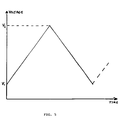
- the potential of the working electrode was cycled repeatedly between -0.5V and 1.0V for thirty minutes (as illustrated in Fig. 5) at a scan rate of (i.e. continuously changing at) 100mV/sec; the positive limit was then increased in steps of 0.1V, cycling of the potential being continued until the cyclic voltammogram was stable.
- the anodic potential limit reached 1.5V, cycling was continued for over 60 minutes until the currents observed during the potential cycles had dropped to almost zero.
- the positive limit was then again increased, in 0.01V steps, the cyclic voltammogram again being allowed to stabilise each time before the next increase in the limit.
- the increasing of the limit and the cycling of the potential were continued until polymer growth was initiated, as shown by a gradual and continuous rise in the anodic current with each cycle. This occurred, in the exemplified case of polythiophene, at about +1.75V versus SCE.
- Film growth was continued until a polymer film 8 of the desired thickness was obtained.
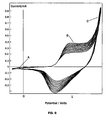
- the cyclic voltammogram response during this growth is shown in Fig. 6. As can be seen, this includes respective regions A where the polymer is in neutral insulating form, B where the polymer is in oxidised conducting form and C where polymer growth takes place in a slow and controlled manner.
- the resulting polythiophene film was highly transparent in both its conducting and its non-conducting forms.
- the cell 1 is specifically designed to allow in-situ UV-visible studies and is disposed between a light source 10 and a detector 12.
- the anode 14 on which polymer film 16 is grown consists of a conducting metal layer of indium tin oxide (ITO) on a glass slide 18. UV-visible spectra films in the oxidised form were collected at 10 minute intervals, and referenced to a blank of solvent, electrolyte and monomer.
- ITO indium tin oxide
- Fig. 9 shows the in-situ UV-visible spectra, obtained during film growth, for films prepared by both room temperature (RT) and low temperature (LT) polymerization and the much lower absorbance achieved at low temperature is clearly apparent. This difference was maintained at RT.
- the cell comprises a glass chamber generally indicated as 20 of cylindrical shape and having an axial end region of reduced diameter and defining a sleeve 22 in which is slidably mounted an electrode holder 24 of polytetrafluorethylene (PTFE) coaxial with the chamber 20.
- O-ring seals 26 are disposed between the sleeve 22 and electrode holder 24.
- the electrode holder 24 has, at an axial end remote from the sleeve 22, a disc 28 providing an axial end face of the electrode holder on which is disposed a platinum working electrode 30.
- a circular platinum wire counter electrode 32 surrounds the electrode holder 24 and a calomel reference electrode 34 is plugged into the cylindrical wall of the chamber 20.
- An axial end of the chamber 20 remote from the sleeve 22 is closed by a CaF 2 window 36 held in position by a screw cap 38 of plastics (PVDF) material cooperable with a PTFE seal 40.
- PVDF plastics
- the position of the electrode holder 24 is adjusted so that the platinum working electrode 30 lies adjacent the window 36 and an IR beam is directed at the polymer film growing on electrode 30, the reflected beam being detected by a liquid N 2 cooled Hg-Cd-Te detector.
- the conditions for growth of the polybithiophene films were the same as those of Example 1, except that the anodic potential was stabilized at 0.9V and then progressively increased in 0.01V stages to a potential of 1.2V at which growth took place.
- FTIR reflectance plots were obtained, at room temperature, for polymer films grown at room and low temperature respectively, in fully oxidised form at 1.0V relative to film in neutral form at 0.0V.
- CV Experiments corresponding to those of Example 2 showed that the respective films were of similar thickness.
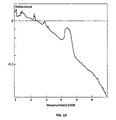
- the results of FTIR are shown in Fig. 10 (room temperature polymerization) and Fig. 11 (low temperature polymerization). As can be seen, for a film prepared by room temperature polymerization the electronic absorption (negative reflectance) does not reach a maximum within the IR range, whereas for a film prepared by low temperature polymerization the electronic absorption reaches a maximum at a wavenumber of 6200 cm -1 towards the centre of the IR region.
- the film obtained by low temperature polymerization obtained by a method embodying the invention is highly transparent to visible light but opaque to IR radiation and will thus provide a useful film for preventing escape or entry of heat through a window on which it is provided.
- the conditions for growth of the polypyrrole films were the same as that of Example 4, except that the anodic potential was stabilized at 0.4V and then progressively increased in 0.01V stages to a potential of 0.7V at which growth took place.
- the preparation process may be carried out easily and efficiently and the starting monomer components may be a cheap and widely available monomer such as pyrrole or thiophene.
- Such materials are useful as antistatic coatings, transparent electromagnetic shielding and especially "smart" windows which include a film capable of assuming conductive and non-conductive states and a device capable of switching the film from one state in which the film is opaque to IR to another in which the film is transparent to IR.
- the physical characteristics of the polymer film can be tailored according to requirements.
Landscapes
- Chemical & Material Sciences (AREA)
- Physics & Mathematics (AREA)
- Spectroscopy & Molecular Physics (AREA)
- Health & Medical Sciences (AREA)
- Chemical Kinetics & Catalysis (AREA)
- Medicinal Chemistry (AREA)
- Polymers & Plastics (AREA)
- Organic Chemistry (AREA)
- Polyoxymethylene Polymers And Polymers With Carbon-To-Carbon Bonds (AREA)
- Polymerisation Methods In General (AREA)
- Investigating Or Analyzing Materials By The Use Of Electric Means (AREA)
Abstract
Description
- The present invention is concerned with the preparation of polymers which are electronically conductive, and with polymers obtained by that process.
- It is known that certain organic polymeric materials may be conductive and further that certain such polymers may be reversibly and repeatedly converted between conductive and non-conductive states by the application of a potential difference across a film of the polymer. In general, available conducting polymers are coloured materials, typically weakly coloured in the non-conducting state and strongly coloured in the conducting state or vice versa.
- It is known to prepare conducting polymers by electrochemical polymerization. The polymerization of pyrrole by such a process is described in the Encyclopedia of Polymer Science and Engineering, Vol 13, Wiley - Interscience, New York, 1988, pages 42-55. In such a process, the monomer is dissolved in an appropriate solvent in the presence of an electrolyte in an electrolyte cell. Electrochemical polymerization is carried out at room temperature and at a constant fixed voltage to precipitate the polymer onto an anode. However, under such conditions, coloured films tend to be produced.
- In order to improve the strength, especially the elongation at break of such films, it is known to prepare a film by electrochemical polymerization of pyrrole carried out at low temperatures between 0 and -40°C. Such films are mechanically stretchable to provide a highly oriented film with improved conductivity; see Ogarawara et al, Mol. Cryst. Liq. Cryst. (1985), 118, 159-162.
- Conducting polymers are potentially suitable for use in the form of a film applied to the windows of a building to control the flow of infra-red radiation, especially heat energy, through the windows; see US-A-5099621.
- If the film is able to prevent such flow in one of its states (for example in its conducting state) but to allow the transmission of heat energy in its other state, then loss of heat through the windows can be reduced or prevented when required, by the application of the necessary potential difference across the film. However the strongly coloured available polymers are aesthetically unsuitable for such a purpose.
- There is also a potential use for conductive films in the field of infra-red photography, to generate images on substrates which are sensitive to infra-red radiation but insensitive to visual light. However films for this purpose clearly must be transparent.
- There is therefore a need for a conducting polymeric material which is transparent to light in the visible range in both its conducting and non-conducting states, even if a colour change occurs in the change between those states. More preferably, the material should be colourless in both states.
- Attempts have been made to produce improved conducting polymers suitable for the foregoing purposes, by synthesising novel monomeric materials from which to prepare the polymers. However the manufacture of the new monomers is both complicated and expensive and the polymers arising are relatively unstable and still exhibit colour in their conducting form.
- The present invention seeks to minimise or avoid the above difficulties by providing conducting polymers having improved properties and provides a modified method of production by which this can be achieved.
- Thus, the present invention provides a method of preparing a conductive polymer by electrochemically polymerizing a monomer component comprising at least one monomer in an electrochemical cell having at least an anode and a cathode, which method comprises
- introducing into the cell a solution containing the monomer component and an electrolyte,
- maintaining the solution at a temperature within a range of from -10 to -40°C inclusive, and
- repeatedly cycling an electrode potential applied to the cell between cathodic and anodic limits one of which (A) is fixed and the other of which (B) is set at a value at which anodic or cathodic polymerization takes place, thereby to effect the electrochemical polymerization,
- which method comprises the additional steps, prior
to the polymerization, of
- i) repeatedly cycling an electrode potential applied to the cell between cathodic and anodic limits one of which (A) is fixed and the other of which (B) is set at a value having a magnitude below that at which anodic or cathodic polymerization may take place,
- ii) holding each of the limits (A) and (B) at their respective fixed and set values and simultaneously monitoring a trace of current/voltage (hereinafter referred to as a cyclic voltammogram or CV) until the trace becomes stable, and thereafter
- iii) progressively increasing the value of the limit (B) until the said value reaches a critical potential having a minimum magnitude at which anodic or cathodic polymerization is initiated.
-
- The polymerization may then be carried out by repeatedly cycling to this minimum critical potential, or to a potential having a magnitude no more than 0.01V greater.
- Moreover, it is often found that after initiation of polymerization it is necessary gradually to increase the limit to which the potential is cycled in order to maintain polymerization as the polymer film builds up to the desired thickness.
- By cycling the electrode potential in this manner before initiation of polymerization and gradually increasing the value of potential (B) which is to induce polymerization up to a value at which polymerization is to be carried out it is possible simultaneously to achieve
- (a) stable electrolytic conditions under which polymerization is carried out, and
- (b) selection of a potential (B) which is the minimum required efficiently to effect polymerization thereby allowing growth of the polymer film to occur as slowly and therefore in as controlled a manner as possible.
-
- Furthermore, by continuing to cycle the electrode potential during polymerization a slow, controlled, stable polymer growth can be maintained until the desired film thickness is achieved.
- Under such specified, carefully controlled conditions we found that it is possible to provide films which are highly transparent in the visible region. The films may be capable of switching between conducting and non-conducting states and may be highly transparent in the visible region in at least one of these states, preferably the conducting state and more preferably in both their conducting and non-conducting states. They may also be opaque in the infra-red region, especially when in their conductive state thus rendering them particularly useful as coatings for windows capable of retaining heat within a building. Moreover, the films may have particularly stable conductive properties.
- For cathodic polymerization reference to an increase in the magnitude of the cathodic potential means an increase in negative charge.
- However, preferably, the polymerization is anodic polymerization and the electrode potential (B) is an anodic potential capable of providing oxidation of the monomer component at the anode.
- In such a method, the electrode potential is cycled repeatedly between a fixed cathodic limit and an anodic limit which initially is held at a fixed value until the current/voltage trace (the cyclic voltammogram) stabilises and then is progressively increased to a value at which polymer formation takes place.
- As indicated, one of the important variables which is to be carefully selected and controlled is the temperature of the reaction mixture which is maintained at a value within the range of -10°C to
minus 40°C and is more preferably maintained at aboutminus 15°C. - A second important feature of the process according to the present invention is the cycling of the electrode potential between limits as specified above. That is, the electrode potential is initially cycled between a fixed cathodic limit and a fixed anodic limit until the cyclic voltammogram stabilises, whereupon a desired preconditioning of the system is judged to have been completed, and is then further cycled between the fixed cathodic limit and an anodic limit which is progressively increased, preferably in small steps, until it just exceeds the critical potential above which polymer formation occurs. That critical potential will differ among different systems but can be identified by the occurrence of a gradual and continuous increase in the level of the anodic current with each cycle.
- It is found to be preferable to fix the cathodic potential within the range -0.3 to -0.7V inclusive, more preferably at around -0.5V.
- It is preferred to carry out the polymerization by cycling from the negative cathodic potential to a maximum anodic potential which is the minimum or no more than 0.01V greater than the minimum possible to achieve effective polymerization so as to allow slow and controlled growth of the polymer film. However, it is often found that in order to maintain growth of the polymer film it is necessary, as the thickness of the film builds up, to increase the potential limit to a value which may be up to 0.1V higher than that at which polymerization was previously initiated. The working potential should then be progressively increased in steps, for example, of the order of 0.01V until the polymerization continues.
- For example, for polythiophene the critical potential may be reached at around 1.65 to 1.75V (versus a Standard Calomel Electrode). However, in order to maintain the polymerization process it may be necessary to cycle the potential up to a voltage as high as 1.85V. Usually initiation of polymer takes place at around +1.75V.
- For polybithiophene, the critical potential may be reached at around 1 to 1.2V. In order to maintain polymerization it may be necessary to cycle up to a voltage of 1.3V, but initiation is usually achieved at around +1.2V.
- For polypyrrole, the critical potential may be reached at around 0.6-0.7V. In order to maintain polymerization it may be necessary to cycle up to a voltage as high as 0.8V, but initiation is usually achieved at around +0.7V.
- Typically, the small steps by which the upper anodic limit is progressively increased towards the critical potential and then above the critical potential in order to maintain polymerization may be of the order of 0.01V.
- A process in accordance with the invention is applicable to the production of a range of polymers which are known to have conducting properties and no doubt to others. For example, it may be used to produce transparent conducting forms of polypyrrole, polythiophene, polybithiophene, polyphenylene, polyaniline and poly(benzo [C]-thiophene). Typically, the polymeric products may be of such a degree of polymerization as to have from about 40 to about 120 monomer units in each polymer chain, for example of the order of 40 such units per chain.
- The solution containing the monomer component and the electrolyte may be obtained by dissolving the monomer and electrolyte in a solvent and the polymerization reaction may be carried out in a range of possible aprotic polar solvents. The solvent should be so selected that it will dissolve the monomer and the electrolyte and be stable throughout the range of operating potentials to be used.
- Moreover, the solvent should have a viscosity at the chosen polymerization temperature suitable for electrochemical polymerization. A preferred viscosity lies within the range 0.25 to 6 centipoise (2.5 to 60 Pa.s x 10-4) inclusive, more preferably less than 3 centipoise (30 x 10-4 Pa.s), especially within the range 0.4 to 1.2 centipoise (4 to 12 Pa.s) inclusive. Suitable solvents include acetonitrile, methanol, propylene carbonate and tetrahydrofuran.
- The electrolyte may be any electrolyte capable of presence in a solution at the low temperature employed but is preferably capable of providing a tetrafluorborate or hexafluorophosphate ion. Typical examples are tetra-n-butylammonium tetrafluoroborate or tetra-n-butylammonium hexafluorophosphate.
- Apart from the conditions already expressed above, the reaction conditions are those which are usual and well-known for polymerizations of this type. Thus the polymers may be grown upon any suitable inert working electrode, for example a platinum electrode or an indium tin oxide-coated glass electrode. The working electrode should be well-polished before it is used. Similarly, any inert counter-electrode may be used. If it is desired also to use a reference electrode, to provide a base against which to monitor the potential at the working electrode, an aqueous reference electrode is suitable, provided that it is held at a temperature above its freezing point and used over a salt bridge.
- The invention will now be further described and illustrated with reference to the accompanying drawings and by means of the following Examples, which briefly describe the application of the process to the production of various transparent conducting polymers.
- In the drawings:
- Fig. 1 represents the reaction taking place during the electrochemical polymerization of thiophene (X = S) or pyrrole (X = NH);
- Fig. 2 is a schematic representation of an electrolytic cell used in the preparative process of Example 1 below;
- Fig. 3 is a schematic representation of an electrolytic cell allowing in-situ spectral assessment in the UV-visible light range;
- Fig. 4 is a schematic representation of an electrolytic cell allowing in-situ spectral assessment by a Fourier Transformation-IR (FTIR) spectrometer;
- Fig. 5 is a schematic representation of voltage recycling (cyclic voltammetry) employed in a process embodying the invention;
- Fig. 6 is an actual voltammogram response for the growth of polythiophene in acetonitrile with tetrabutylammonium tetrafluoroborate as background electrolyte as in Example 1 below;
- Figs. 7 and 8 show growth cyclic voltammograms (CVs) for polythiophene films grown at low (-15°C) temperature (Fig. 7) and room temperature (Fig. 8);
- Fig. 9 shows a comparison of UV-Vis spectra obtained during the growth of polythiophene films grown at room temperature (RT) and at low (-15°C) temperature (LT);
- Figs. 10 and 11 are Fourier Transformation Infra Red (FTIR) spectra, taken at room temperature, of polybithiophene films in fully oxidised form relative to respective films in neutral form and grown at room temperature (Fig. 10) and low (-15°C) temperature (Fig. 11) respectively;
- Figs. 12 and 13 are FTIR spectra, taken at room temperature, of polypyrrole films in fully oxidised form relative to respective films in neutral form and grown at room (Fig. 12) and low (Fig. 13) temperatures respectively.
-
- Polythiophene was grown in a standard, three-electrode thermostatted electrochemical cell (as illustrated schematically in Fig. 2) on a
polished platinum electrode 2 containing 0.1 moles dm-3 of thiophene and 0.1 moles dm-3 of tetra-n-butylammonium tetrafluoborate in de-oxygenated acetonitrile. The acetonitrile was freshly distilled under dry nitrogen over calcium hydride as desiccant. The transfer of all reagents to the electrochemical cell was carried out under moisture and air-free conditions. Thecounter electrode 4 was platinum gauze and thereference electrode 6 was a standard calomel electrode. - When the cell temperature had been stabilised at about -15°C, the potential of the working electrode was cycled repeatedly between -0.5V and 1.0V for thirty minutes (as illustrated in Fig. 5) at a scan rate of (i.e. continuously changing at) 100mV/sec; the positive limit was then increased in steps of 0.1V, cycling of the potential being continued until the cyclic voltammogram was stable. When the anodic potential limit reached 1.5V, cycling was continued for over 60 minutes until the currents observed during the potential cycles had dropped to almost zero.
- The positive limit was then again increased, in 0.01V steps, the cyclic voltammogram again being allowed to stabilise each time before the next increase in the limit. The increasing of the limit and the cycling of the potential were continued until polymer growth was initiated, as shown by a gradual and continuous rise in the anodic current with each cycle. This occurred, in the exemplified case of polythiophene, at about +1.75V versus SCE. Film growth was continued until a
polymer film 8 of the desired thickness was obtained. The cyclic voltammogram response during this growth is shown in Fig. 6. As can be seen, this includes respective regions A where the polymer is in neutral insulating form, B where the polymer is in oxidised conducting form and C where polymer growth takes place in a slow and controlled manner. - The resulting polythiophene film was highly transparent in both its conducting and its non-conducting forms.
- In order to demonstrate more clearly the improvement in transparency achieved at low temperature as compared with that at room temperature, the above experiment was repeated both at -15°C and at room temperature in a cell, shown schematically in Fig. 3 from which the reference and counter electrodes have been omitted for clarity.
- The
cell 1 is specifically designed to allow in-situ UV-visible studies and is disposed between alight source 10 and adetector 12. Theanode 14 on whichpolymer film 16 is grown consists of a conducting metal layer of indium tin oxide (ITO) on aglass slide 18. UV-visible spectra films in the oxidised form were collected at 10 minute intervals, and referenced to a blank of solvent, electrolyte and monomer. - During the growth of the respective films, growth cyclic voltammogram plots were taken and the results are shown in Figs. 7 (low temperature polymerization) and 8 (room temperature polymerization). Integration to determine the area under these respective curves during the oxidative stage (between 0.5 and 1.5 volts) gives the charge passed (2.04 mC for Fig. 7 and 2.14 mC for Fig. 8) which is directly related to film thickness and shows that the respective films were grown to the same thickness. Thus, a comparison of respective UV-visible spectra fairly reflects differences in transparency.
- Fig. 9 shows the in-situ UV-visible spectra, obtained during film growth, for films prepared by both room temperature (RT) and low temperature (LT) polymerization and the much lower absorbance achieved at low temperature is clearly apparent. This difference was maintained at RT.
- It is of advantage to be able to provide a film which, while being transparent to visible light is opaque to infrared (IR) radiation, especially in the mid-IR range. In order to demonstrate such properties, polybithiophene was grown from bithiophene monomer both at room and low (-15°C) temperatures in a cell specifically designed to allow in-situ Fourier Transformation-IR (FTIR) studies and shown in Fig. 4 using a
Biorad FTS 40 FTIR spectrometer. - The cell comprises a glass chamber generally indicated as 20 of cylindrical shape and having an axial end region of reduced diameter and defining a
sleeve 22 in which is slidably mounted anelectrode holder 24 of polytetrafluorethylene (PTFE) coaxial with thechamber 20. O-ring seals 26 are disposed between thesleeve 22 andelectrode holder 24. Theelectrode holder 24 has, at an axial end remote from thesleeve 22, adisc 28 providing an axial end face of the electrode holder on which is disposed aplatinum working electrode 30. A circular platinumwire counter electrode 32 surrounds theelectrode holder 24 and acalomel reference electrode 34 is plugged into the cylindrical wall of thechamber 20. An axial end of thechamber 20 remote from thesleeve 22 is closed by a CaF2 window 36 held in position by ascrew cap 38 of plastics (PVDF) material cooperable with aPTFE seal 40. - For FTIR measurement the position of the
electrode holder 24 is adjusted so that theplatinum working electrode 30 lies adjacent thewindow 36 and an IR beam is directed at the polymer film growing onelectrode 30, the reflected beam being detected by a liquid N2 cooled Hg-Cd-Te detector. - The conditions for growth of the polybithiophene films were the same as those of Example 1, except that the anodic potential was stabilized at 0.9V and then progressively increased in 0.01V stages to a potential of 1.2V at which growth took place.
- FTIR reflectance plots were obtained, at room temperature, for polymer films grown at room and low temperature respectively, in fully oxidised form at 1.0V relative to film in neutral form at 0.0V. CV Experiments (results not shown) corresponding to those of Example 2 showed that the respective films were of similar thickness. The results of FTIR are shown in Fig. 10 (room temperature polymerization) and Fig. 11 (low temperature polymerization). As can be seen, for a film prepared by room temperature polymerization the electronic absorption (negative reflectance) does not reach a maximum within the IR range, whereas for a film prepared by low temperature polymerization the electronic absorption reaches a maximum at a wavenumber of 6200 cm-1 towards the centre of the IR region.
- Moreover, visible inspection of the film grown at low temperature showed this to be highly transparent in both its conducting and non-conducting forms, whereas, in its conducting form, the film prepared at room temperature was highly coloured.
- This demonstrates clearly that the film obtained by low temperature polymerization obtained by a method embodying the invention is highly transparent to visible light but opaque to IR radiation and will thus provide a useful film for preventing escape or entry of heat through a window on which it is provided.
- The method of Example 3 was repeated for the polymerization of pyrrole (see Fig. 1, X = NH) both at room temperature and low temperature (-15°C).
- The conditions for growth of the polypyrrole films were the same as that of Example 4, except that the anodic potential was stabilized at 0.4V and then progressively increased in 0.01V stages to a potential of 0.7V at which growth took place.
- Visible inspection of the film grown at low temperature showed this to be highly transparent in both its conducting and non-conducting forms, whereas, in its conducting form the film prepared at room temperature was highly coloured.
- The result of FTIR plots obtained at room temperature for films of similar thickness (as determined by CV experiments) grown at room temperature and low temperature are shown in Figs. 12 and 13 respectively.
- Again these results demonstrate how, for both films, electronic absorption increases on oxidation up to 0.7V, relative to the neutral form at -0.2V, but that for the film grown at room temperature a maximum absorption is not reached within the IR range, whereas the film grown at low temperature has a minimum absorption towards the mid IR region.
- It can be seen clearly from the Examples that processes embodying the invention can be used to prepare a polymer film which in its rest (i.e. neutral or non-electronically conducting) state is insulating and transparent to both visible and infra red. On the other hand, if a voltage is applied across the film it will conduct electricity and become opaque to infra red, while remaining highly transparent to visible light.
- The preparation process may be carried out easily and efficiently and the starting monomer components may be a cheap and widely available monomer such as pyrrole or thiophene.
- Thus, the technologically extremely important goal of successfully synthesising highly transparent electronically conducting polymers has been achieved by processes embodying the invention. Such materials are useful as antistatic coatings, transparent electromagnetic shielding and especially "smart" windows which include a film capable of assuming conductive and non-conductive states and a device capable of switching the film from one state in which the film is opaque to IR to another in which the film is transparent to IR. By selection of a particular monomer component, the physical characteristics of the polymer film can be tailored according to requirements.
Claims (16)
- A method of preparing a conductive polymer by electrochemically polymerizing a monomer component comprising at least one monomer in an electrochemical cell having at least an anode and a cathode, which method comprisesintroducing into the cell a solution containing the monomer component and an electrolyte,maintaining the solution at a temperature within a range of from -10 to -40°C inclusive, andrepeatedly cycling an electrode potential applied to the cell between cathodic and anodic limits one of which (A) is fixed and the other of which (B) is set at a value at which anodic or cathodic polymerization takes place, thereby to effect the electrochemical polymerization,which method comprises the additional steps, prior to the polymerization, ofi) repeatedly cycling an electrode potential applied to the cell between cathodic and anodic limits one of which (A) is fixed and the other of which (B) is set at a value having a magnitude below that at which anodic or cathodic polymerization may take place,ii) holding each of the limits (A) and (B) at their respective fixed and set values and simultaneously monitoring a trace of current/voltage until the trace becomes stable, and thereafteriii) progressively increasing the value of the limit (B) until the said value reaches a critical potential having a minimum magnitude at which anodic or cathodic polymerization is initiated.
- A method according to claim 1, wherein the solution has a viscosity in the range of from 0.25 to 6 centipoise (2.5 to 60 Pa.s x 10-4) inclusive.
- A method according to claim 2, wherein the viscosity of the solution is less than 3 centipoise (3 x 10⁻³ Pa.s) inclusive.
- A method according to claim 3, wherein the viscosity of the solution is in the range of from 0.4 to 1.2 centipoise (4 to 12 Pa.s x 10-4) inclusive.
- A method according to any preceding claim, wherein during the electrochemical polymerization, in order to maintain the polymerization the magnitude of the anodic or cathodic limit (B) is increased to a value no greater than 0.1 V above the minimum critical potential at which the polymerization is initiated.
- A method according to any preceding claim, wherein the polymerization is cationic polymerization and the said other electrode potential (B) is an anodic potential capable of providing oxidation of the monomer component at the anode.
- A method according to claim 6, wherein the monomer component is selected from at least one of pyrrole, thiophene, bithiophene, benzene, aniline and benz[c]-thiophene.
- A method according to claim 7, wherein the monomer component is thiophene and the critical electrode potential is about 1.75 V (versus a Standard Calomel Electrode).
- A method according to claim 7, wherein the monomer component is bithiophene and the critical electrode potential is about 1.2V.
- A method according to claim 7, wherein the monomer component is pyrrole and the critical electrode potential is about 0.7 V (versus a Standard Calomel Electrode).
- A method according to any preceding claim, wherein the solution comprises the monomer component, a solvent for the monomer component and an electrolyte.
- A method according to claim 11, wherein the solvent is selected from acetonitrile, methanol, propylene carbonate and tetrahydrofuran.
- A method according to any preceding claim, wherein the solution is maintained at a temperature within a range of from -10 to -15°C.
- A method according to any one of claims 6 to 13, wherein the electrolyte provides a tetrafluoroborate or hexafluorophosphate anion.
- A method according to any preceding claim, wherein, in step (iii), the electrode potential (B) is progressively increased towards the said minimum critical potential in steps of the order of 0.01 V.
- A method according to any preceding claim, wherein the cell contains an anode, a cathode and a reference electrode.
Applications Claiming Priority (5)
| Application Number | Priority Date | Filing Date | Title |
|---|---|---|---|
| GB929201082A GB9201082D0 (en) | 1992-01-18 | 1992-01-18 | Novel synthesis of highly transparent conducting polymers |
| GB9201082 | 1992-01-18 | ||
| GB9217469 | 1992-08-17 | ||
| GB929217469A GB9217469D0 (en) | 1992-01-18 | 1992-08-17 | Process for the preparation of conducting polymers,and polymers so obtained |
| PCT/GB1993/000094 WO1993014504A1 (en) | 1992-01-18 | 1993-01-15 | Process for the preparation of conductive polymers |
Publications (2)
| Publication Number | Publication Date |
|---|---|
| EP0621978A1 EP0621978A1 (en) | 1994-11-02 |
| EP0621978B1 true EP0621978B1 (en) | 1999-04-14 |
Family
ID=26300179
Family Applications (1)
| Application Number | Title | Priority Date | Filing Date |
|---|---|---|---|
| EP93902394A Expired - Lifetime EP0621978B1 (en) | 1992-01-18 | 1993-01-15 | Process for the preparation of conductive polymers |
Country Status (7)
| Country | Link |
|---|---|
| US (1) | US5527434A (en) |
| EP (1) | EP0621978B1 (en) |
| JP (1) | JP3215423B2 (en) |
| AT (1) | ATE179020T1 (en) |
| CA (1) | CA2126683A1 (en) |
| DE (1) | DE69324474T2 (en) |
| WO (1) | WO1993014504A1 (en) |
Families Citing this family (12)
| Publication number | Priority date | Publication date | Assignee | Title |
|---|---|---|---|---|
| DE69816601T2 (en) * | 1997-11-05 | 2004-06-03 | Koninklijke Philips Electronics N.V. | CONJUGATED POLYMERS IN AN OXIDIZED CONDITION |
| US6130339A (en) * | 1999-06-01 | 2000-10-10 | The United States Of America As Represented By The Secretary Of The Air Force | Electro-active monomers comprised of aniline-thiophene units |
| US6197921B1 (en) | 1999-06-01 | 2001-03-06 | The United States Of America As Represented By The Secretary Of The Air Force | Polymers of 1-(bithien-2-yl)-4-aminobenzene |
| US6338788B1 (en) | 1999-06-11 | 2002-01-15 | Exxonmobil Research And Engineering Company | Electrochemical oxidation of sulfur compounds in naphtha |
| US6706218B2 (en) | 2000-01-11 | 2004-03-16 | The Board Of Governors For Higher Education, State Of Rhode Island And Providence Plantations | Thermochromic polymers for rapid visual assessment of temperature |
| US6815620B2 (en) * | 2001-03-29 | 2004-11-09 | 3M Innovative Properties Company | Flexible circuit with electrostatic damage limiting feature |
| GB0119863D0 (en) | 2001-08-14 | 2001-10-10 | Cancer Res Campaign Tech | DNA-PK inhibitors |
| US7049313B2 (en) | 2002-02-25 | 2006-05-23 | Kudos Pharmaceuticals Ltd. | ATM inhibitors |
| FR2843757B1 (en) * | 2002-08-26 | 2005-04-29 | Commissariat Energie Atomique | PROCESS FOR FILLING A SURFACE WITH AN ORGANIC FILM |
| US7182849B2 (en) * | 2004-02-27 | 2007-02-27 | Taiwan Semiconducotr Manufacturing Co., Ltd. | ECP polymer additives and method for reducing overburden and defects |
| CN109651601B (en) * | 2018-12-03 | 2021-06-04 | 江西科技师范大学 | Novel hydrogen bond crosslinking stretchable conductive polymer and synthesis method thereof |
| CN112615046B (en) * | 2020-11-27 | 2023-11-21 | 辽宁科技大学 | A method for in-situ control of the interface layer of solid electrolyte in lithium batteries |
Family Cites Families (1)
| Publication number | Priority date | Publication date | Assignee | Title |
|---|---|---|---|---|
| US5120807A (en) * | 1991-01-18 | 1992-06-09 | Drexel University | Polymerization of pyrrole and its derivatives |
-
1993
- 1993-01-15 WO PCT/GB1993/000094 patent/WO1993014504A1/en not_active Ceased
- 1993-01-15 CA CA002126683A patent/CA2126683A1/en not_active Abandoned
- 1993-01-15 EP EP93902394A patent/EP0621978B1/en not_active Expired - Lifetime
- 1993-01-15 JP JP51229493A patent/JP3215423B2/en not_active Expired - Fee Related
- 1993-01-15 AT AT93902394T patent/ATE179020T1/en not_active IP Right Cessation
- 1993-01-15 DE DE69324474T patent/DE69324474T2/en not_active Expired - Fee Related
- 1993-01-15 US US08/256,583 patent/US5527434A/en not_active Expired - Fee Related
Also Published As
| Publication number | Publication date |
|---|---|
| JP3215423B2 (en) | 2001-10-09 |
| EP0621978A1 (en) | 1994-11-02 |
| US5527434A (en) | 1996-06-18 |
| CA2126683A1 (en) | 1993-07-22 |
| JPH07506127A (en) | 1995-07-06 |
| WO1993014504A1 (en) | 1993-07-22 |
| DE69324474T2 (en) | 1999-10-21 |
| DE69324474D1 (en) | 1999-05-20 |
| ATE179020T1 (en) | 1999-04-15 |
Similar Documents
| Publication | Publication Date | Title |
|---|---|---|
| US5527434A (en) | Process for the preparation of conductive polymers | |
| DE69118351T2 (en) | Arrangement of electroactive polymers | |
| İçli-Özkut et al. | Furan and benzochalcogenodiazole based multichromic polymers via a donor–acceptor approach | |
| Tsai et al. | Electrochemistry of some β‐Substituted Polythiophenes: Anodic Oxidation, Electrochromism, and Electrochemical Deactivation | |
| JPS63135453A (en) | Highly electrically conductive polymer composition and production thereof | |
| EP1348045A1 (en) | Stable conjugated polymer electrochromic devices incorporating ionic liquids | |
| Ak et al. | Synthesis and electropolymerization of 1, 2-bis (thiophen-3-ylmethoxy) benzene and its electrochromic properties and electrochromic device application | |
| US4769115A (en) | Process for preparing electrically conductive polymer | |
| Arbizzani et al. | A spectroelectrochemical study of poly (dithienothiophenes) | |
| Guzel et al. | A new way to obtain black electrochromism: Appropriately covering whole visible regions by absorption spectra of copolymers composed of EDOT and carbazole derivatives | |
| Taoudi et al. | Comparison of polycarbazole obtained by oxidation of carbazole either in solution or in thin film form | |
| US4663001A (en) | Electroconductive polymers derived from heterocycles polycyclic monomers and process for their manufacture | |
| Rasch et al. | Polythiophenes via thiophene, bithiophene and terthiophene in propylene carbonate: an electrochemical and in-situ FTIR study | |
| Azzem et al. | Electro-oxidative oligomerization of 1, 5-diaminonaphthalene in acetonitrile medium | |
| US6197921B1 (en) | Polymers of 1-(bithien-2-yl)-4-aminobenzene | |
| Inoue et al. | Change of Raman scattering intensity of a polypyrrole film during reversible doping and emitting processes of ClO4− | |
| Soganci et al. | Fabrication of multifunctional 2, 5-di (2-thienyl) pyrrole based conducting copolymer for further sensor and optoelectronic applications | |
| US4657985A (en) | Multicomponent systems based on polythiophene | |
| Zhao-yang et al. | Electrosynthesises and characterizations of copolymers based on thiophene and 3, 4-ethylenedioxythiophene in boron trifluoride diethyl etherate | |
| Peters et al. | Characterization of conducting copolymers of 2, 2′‐bithiophene and pyrrole by cyclic voltammetry and UV/visible spectroscopy | |
| Ballarin et al. | Electropolymerisation and characterisation of poly [4, 4′-bis (butylsulphanil)-2, 2′-bithiophene] | |
| JPS63215772A (en) | Production of electrically conductive polymer composition | |
| Correa et al. | The electropolymerization of several poly (3‐methylthiophene) films in the same used solution and its consequence in their properties | |
| Plieth et al. | Examination of electrically conducting films of poly (2, 5-thiophenediyl) by cyclic voltanunetry and ellipsometry: Part II | |
| Roncali et al. | Recent developments in the synthesis and functionalization of conducting poly (thiophenes) |
Legal Events
| Date | Code | Title | Description |
|---|---|---|---|
| PUAI | Public reference made under article 153(3) epc to a published international application that has entered the european phase |
Free format text: ORIGINAL CODE: 0009012 |
|
| 17P | Request for examination filed |
Effective date: 19940808 |
|
| AK | Designated contracting states |
Kind code of ref document: A1 Designated state(s): AT BE CH DE DK ES FR GB GR IE IT LI LU MC NL PT SE |
|
| 17Q | First examination report despatched |
Effective date: 19960531 |
|
| GRAG | Despatch of communication of intention to grant |
Free format text: ORIGINAL CODE: EPIDOS AGRA |
|
| GRAG | Despatch of communication of intention to grant |
Free format text: ORIGINAL CODE: EPIDOS AGRA |
|
| GRAG | Despatch of communication of intention to grant |
Free format text: ORIGINAL CODE: EPIDOS AGRA |
|
| GRAH | Despatch of communication of intention to grant a patent |
Free format text: ORIGINAL CODE: EPIDOS IGRA |
|
| GRAH | Despatch of communication of intention to grant a patent |
Free format text: ORIGINAL CODE: EPIDOS IGRA |
|
| GRAA | (expected) grant |
Free format text: ORIGINAL CODE: 0009210 |
|
| AK | Designated contracting states |
Kind code of ref document: B1 Designated state(s): AT BE CH DE DK ES FR GB GR IE IT LI LU MC NL PT SE |
|
| PG25 | Lapsed in a contracting state [announced via postgrant information from national office to epo] |
Ref country code: SE Free format text: THE PATENT HAS BEEN ANNULLED BY A DECISION OF A NATIONAL AUTHORITY Effective date: 19990414 Ref country code: NL Free format text: LAPSE BECAUSE OF FAILURE TO SUBMIT A TRANSLATION OF THE DESCRIPTION OR TO PAY THE FEE WITHIN THE PRESCRIBED TIME-LIMIT Effective date: 19990414 Ref country code: IT Free format text: LAPSE BECAUSE OF FAILURE TO SUBMIT A TRANSLATION OF THE DESCRIPTION OR TO PAY THE FEE WITHIN THE PRESCRIBED TIME-LIMIT;WARNING: LAPSES OF ITALIAN PATENTS WITH EFFECTIVE DATE BEFORE 2007 MAY HAVE OCCURRED AT ANY TIME BEFORE 2007. THE CORRECT EFFECTIVE DATE MAY BE DIFFERENT FROM THE ONE RECORDED. Effective date: 19990414 Ref country code: GR Free format text: LAPSE BECAUSE OF NON-PAYMENT OF DUE FEES Effective date: 19990414 Ref country code: ES Free format text: THE PATENT HAS BEEN ANNULLED BY A DECISION OF A NATIONAL AUTHORITY Effective date: 19990414 Ref country code: BE Free format text: LAPSE BECAUSE OF FAILURE TO SUBMIT A TRANSLATION OF THE DESCRIPTION OR TO PAY THE FEE WITHIN THE PRESCRIBED TIME-LIMIT Effective date: 19990414 Ref country code: AT Free format text: LAPSE BECAUSE OF FAILURE TO SUBMIT A TRANSLATION OF THE DESCRIPTION OR TO PAY THE FEE WITHIN THE PRESCRIBED TIME-LIMIT Effective date: 19990414 |
|
| REF | Corresponds to: |
Ref document number: 179020 Country of ref document: AT Date of ref document: 19990415 Kind code of ref document: T |
|
| REG | Reference to a national code |
Ref country code: CH Ref legal event code: EP |
|
| REG | Reference to a national code |
Ref country code: IE Ref legal event code: FG4D |
|
| REF | Corresponds to: |
Ref document number: 69324474 Country of ref document: DE Date of ref document: 19990520 |
|
| PG25 | Lapsed in a contracting state [announced via postgrant information from national office to epo] |
Ref country code: PT Free format text: LAPSE BECAUSE OF FAILURE TO SUBMIT A TRANSLATION OF THE DESCRIPTION OR TO PAY THE FEE WITHIN THE PRESCRIBED TIME-LIMIT Effective date: 19990714 Ref country code: DK Free format text: LAPSE BECAUSE OF FAILURE TO SUBMIT A TRANSLATION OF THE DESCRIPTION OR TO PAY THE FEE WITHIN THE PRESCRIBED TIME-LIMIT Effective date: 19990714 |
|
| ET | Fr: translation filed | ||
| NLV1 | Nl: lapsed or annulled due to failure to fulfill the requirements of art. 29p and 29m of the patents act | ||
| PG25 | Lapsed in a contracting state [announced via postgrant information from national office to epo] |
Ref country code: LU Free format text: LAPSE BECAUSE OF NON-PAYMENT OF DUE FEES Effective date: 20000115 |
|
| PG25 | Lapsed in a contracting state [announced via postgrant information from national office to epo] |
Ref country code: MC Free format text: THE PATENT HAS BEEN ANNULLED BY A DECISION OF A NATIONAL AUTHORITY Effective date: 20000131 |
|
| PLBE | No opposition filed within time limit |
Free format text: ORIGINAL CODE: 0009261 |
|
| STAA | Information on the status of an ep patent application or granted ep patent |
Free format text: STATUS: NO OPPOSITION FILED WITHIN TIME LIMIT |
|
| 26N | No opposition filed | ||
| PGFP | Annual fee paid to national office [announced via postgrant information from national office to epo] |
Ref country code: GB Payment date: 20010212 Year of fee payment: 9 |
|
| PGFP | Annual fee paid to national office [announced via postgrant information from national office to epo] |
Ref country code: IE Payment date: 20010215 Year of fee payment: 9 |
|
| PGFP | Annual fee paid to national office [announced via postgrant information from national office to epo] |
Ref country code: FR Payment date: 20010216 Year of fee payment: 9 |
|
| PGFP | Annual fee paid to national office [announced via postgrant information from national office to epo] |
Ref country code: CH Payment date: 20010219 Year of fee payment: 9 |
|
| PGFP | Annual fee paid to national office [announced via postgrant information from national office to epo] |
Ref country code: DE Payment date: 20010220 Year of fee payment: 9 |
|
| REG | Reference to a national code |
Ref country code: GB Ref legal event code: IF02 |
|
| PG25 | Lapsed in a contracting state [announced via postgrant information from national office to epo] |
Ref country code: IE Free format text: LAPSE BECAUSE OF NON-PAYMENT OF DUE FEES Effective date: 20020115 Ref country code: GB Free format text: LAPSE BECAUSE OF NON-PAYMENT OF DUE FEES Effective date: 20020115 |
|
| PG25 | Lapsed in a contracting state [announced via postgrant information from national office to epo] |
Ref country code: LI Free format text: LAPSE BECAUSE OF NON-PAYMENT OF DUE FEES Effective date: 20020131 Ref country code: CH Free format text: LAPSE BECAUSE OF NON-PAYMENT OF DUE FEES Effective date: 20020131 |
|
| PG25 | Lapsed in a contracting state [announced via postgrant information from national office to epo] |
Ref country code: DE Free format text: LAPSE BECAUSE OF NON-PAYMENT OF DUE FEES Effective date: 20020801 |
|
| GBPC | Gb: european patent ceased through non-payment of renewal fee |
Effective date: 20020115 |
|
| REG | Reference to a national code |
Ref country code: CH Ref legal event code: PL |
|
| PG25 | Lapsed in a contracting state [announced via postgrant information from national office to epo] |
Ref country code: FR Free format text: LAPSE BECAUSE OF NON-PAYMENT OF DUE FEES Effective date: 20020930 |
|
| REG | Reference to a national code |
Ref country code: FR Ref legal event code: ST |
|
| REG | Reference to a national code |
Ref country code: IE Ref legal event code: MM4A |