EP0621279B1 - Siloxy-aluminoxane compositions - Google Patents
Siloxy-aluminoxane compositions Download PDFInfo
- Publication number
- EP0621279B1 EP0621279B1 EP94101418A EP94101418A EP0621279B1 EP 0621279 B1 EP0621279 B1 EP 0621279B1 EP 94101418 A EP94101418 A EP 94101418A EP 94101418 A EP94101418 A EP 94101418A EP 0621279 B1 EP0621279 B1 EP 0621279B1
- Authority
- EP
- European Patent Office
- Prior art keywords
- aluminoxane
- siloxy
- alkyldisiloxane
- mao
- composition
- Prior art date
- Legal status (The legal status is an assumption and is not a legal conclusion. Google has not performed a legal analysis and makes no representation as to the accuracy of the status listed.)
- Expired - Lifetime
Links
- 239000000203 mixture Substances 0.000 title claims description 35
- 229910052782 aluminium Inorganic materials 0.000 claims description 25
- XAGFODPZIPBFFR-UHFFFAOYSA-N aluminium Chemical compound [Al] XAGFODPZIPBFFR-UHFFFAOYSA-N 0.000 claims description 22
- 239000003054 catalyst Substances 0.000 claims description 15
- 150000001336 alkenes Chemical class 0.000 claims description 11
- JRZJOMJEPLMPRA-UHFFFAOYSA-N olefin Natural products CCCCCCCC=C JRZJOMJEPLMPRA-UHFFFAOYSA-N 0.000 claims description 10
- 125000004432 carbon atom Chemical group C* 0.000 claims description 7
- 229910008051 Si-OH Inorganic materials 0.000 claims description 6
- 229910006358 Si—OH Inorganic materials 0.000 claims description 6
- 125000000217 alkyl group Chemical group 0.000 claims description 6
- CPOFMOWDMVWCLF-UHFFFAOYSA-N methyl(oxo)alumane Chemical compound C[Al]=O CPOFMOWDMVWCLF-UHFFFAOYSA-N 0.000 claims description 6
- 239000002685 polymerization catalyst Substances 0.000 claims description 6
- 239000007795 chemical reaction product Substances 0.000 claims description 5
- UQEAIHBTYFGYIE-UHFFFAOYSA-N hexamethyldisiloxane Chemical group C[Si](C)(C)O[Si](C)(C)C UQEAIHBTYFGYIE-UHFFFAOYSA-N 0.000 claims description 5
- 150000003624 transition metals Chemical class 0.000 claims description 5
- WILBTFWIBAOWLN-UHFFFAOYSA-N triethyl(triethylsilyloxy)silane Chemical group CC[Si](CC)(CC)O[Si](CC)(CC)CC WILBTFWIBAOWLN-UHFFFAOYSA-N 0.000 claims description 4
- 229910052723 transition metal Inorganic materials 0.000 claims description 2
- 125000001183 hydrocarbyl group Chemical group 0.000 claims 3
- YXFVVABEGXRONW-UHFFFAOYSA-N Toluene Chemical compound CC1=CC=CC=C1 YXFVVABEGXRONW-UHFFFAOYSA-N 0.000 description 49
- VLKZOEOYAKHREP-UHFFFAOYSA-N n-Hexane Chemical compound CCCCCC VLKZOEOYAKHREP-UHFFFAOYSA-N 0.000 description 30
- 239000000243 solution Substances 0.000 description 21
- 239000007787 solid Substances 0.000 description 19
- -1 dihydroxysiloxane Chemical class 0.000 description 17
- FFUAGWLWBBFQJT-UHFFFAOYSA-N hexamethyldisilazane Chemical compound C[Si](C)(C)N[Si](C)(C)C FFUAGWLWBBFQJT-UHFFFAOYSA-N 0.000 description 17
- 238000006116 polymerization reaction Methods 0.000 description 17
- 238000006243 chemical reaction Methods 0.000 description 16
- VGGSQFUCUMXWEO-UHFFFAOYSA-N Ethene Chemical compound C=C VGGSQFUCUMXWEO-UHFFFAOYSA-N 0.000 description 12
- 239000005977 Ethylene Substances 0.000 description 12
- 239000000047 product Substances 0.000 description 11
- 150000001875 compounds Chemical class 0.000 description 8
- 230000000694 effects Effects 0.000 description 8
- 239000000706 filtrate Substances 0.000 description 8
- XLYOFNOQVPJJNP-UHFFFAOYSA-N water Substances O XLYOFNOQVPJJNP-UHFFFAOYSA-N 0.000 description 8
- HEMHJVSKTPXQMS-UHFFFAOYSA-M Sodium hydroxide Chemical compound [OH-].[Na+] HEMHJVSKTPXQMS-UHFFFAOYSA-M 0.000 description 6
- XLYOFNOQVPJJNP-ZSJDYOACSA-N heavy water Substances [2H]O[2H] XLYOFNOQVPJJNP-ZSJDYOACSA-N 0.000 description 6
- QMBQEXOLIRBNPN-UHFFFAOYSA-L zirconocene dichloride Chemical compound [Cl-].[Cl-].[Zr+4].C=1C=C[CH-]C=1.C=1C=C[CH-]C=1 QMBQEXOLIRBNPN-UHFFFAOYSA-L 0.000 description 6
- 238000001914 filtration Methods 0.000 description 5
- 239000002904 solvent Substances 0.000 description 5
- JLTRXTDYQLMHGR-UHFFFAOYSA-N trimethylaluminium Chemical compound C[Al](C)C JLTRXTDYQLMHGR-UHFFFAOYSA-N 0.000 description 5
- IMNFDUFMRHMDMM-UHFFFAOYSA-N N-Heptane Chemical compound CCCCCCC IMNFDUFMRHMDMM-UHFFFAOYSA-N 0.000 description 4
- VYPSYNLAJGMNEJ-UHFFFAOYSA-N Silicium dioxide Chemical compound O=[Si]=O VYPSYNLAJGMNEJ-UHFFFAOYSA-N 0.000 description 4
- PNEYBMLMFCGWSK-UHFFFAOYSA-N aluminium oxide Inorganic materials [O-2].[O-2].[O-2].[Al+3].[Al+3] PNEYBMLMFCGWSK-UHFFFAOYSA-N 0.000 description 4
- 229910052809 inorganic oxide Inorganic materials 0.000 description 4
- 239000000463 material Substances 0.000 description 4
- 229920000573 polyethylene Polymers 0.000 description 4
- UHOVQNZJYSORNB-UHFFFAOYSA-N Benzene Chemical compound C1=CC=CC=C1 UHOVQNZJYSORNB-UHFFFAOYSA-N 0.000 description 3
- OKKJLVBELUTLKV-UHFFFAOYSA-N Methanol Chemical compound OC OKKJLVBELUTLKV-UHFFFAOYSA-N 0.000 description 3
- 239000004698 Polyethylene Substances 0.000 description 3
- 229910002808 Si–O–Si Inorganic materials 0.000 description 3
- KPUWHANPEXNPJT-UHFFFAOYSA-N disiloxane Chemical class [SiH3]O[SiH3] KPUWHANPEXNPJT-UHFFFAOYSA-N 0.000 description 3
- 150000004677 hydrates Chemical class 0.000 description 3
- 238000000034 method Methods 0.000 description 3
- 239000003921 oil Substances 0.000 description 3
- 239000003960 organic solvent Substances 0.000 description 3
- 229920000098 polyolefin Polymers 0.000 description 3
- 229910052710 silicon Inorganic materials 0.000 description 3
- 239000010703 silicon Substances 0.000 description 3
- 125000004469 siloxy group Chemical group [SiH3]O* 0.000 description 3
- 239000012265 solid product Substances 0.000 description 3
- 238000005292 vacuum distillation Methods 0.000 description 3
- 239000004711 α-olefin Substances 0.000 description 3
- AFFLGGQVNFXPEV-UHFFFAOYSA-N 1-decene Chemical compound CCCCCCCCC=C AFFLGGQVNFXPEV-UHFFFAOYSA-N 0.000 description 2
- CRSBERNSMYQZNG-UHFFFAOYSA-N 1-dodecene Chemical compound CCCCCCCCCCC=C CRSBERNSMYQZNG-UHFFFAOYSA-N 0.000 description 2
- GQEZCXVZFLOKMC-UHFFFAOYSA-N 1-hexadecene Chemical compound CCCCCCCCCCCCCCC=C GQEZCXVZFLOKMC-UHFFFAOYSA-N 0.000 description 2
- LIKMAJRDDDTEIG-UHFFFAOYSA-N 1-hexene Chemical compound CCCCC=C LIKMAJRDDDTEIG-UHFFFAOYSA-N 0.000 description 2
- KWKAKUADMBZCLK-UHFFFAOYSA-N 1-octene Chemical compound CCCCCCC=C KWKAKUADMBZCLK-UHFFFAOYSA-N 0.000 description 2
- HFDVRLIODXPAHB-UHFFFAOYSA-N 1-tetradecene Chemical compound CCCCCCCCCCCCC=C HFDVRLIODXPAHB-UHFFFAOYSA-N 0.000 description 2
- WSSSPWUEQFSQQG-UHFFFAOYSA-N 4-methyl-1-pentene Chemical compound CC(C)CC=C WSSSPWUEQFSQQG-UHFFFAOYSA-N 0.000 description 2
- OKTJSMMVPCPJKN-UHFFFAOYSA-N Carbon Chemical compound [C] OKTJSMMVPCPJKN-UHFFFAOYSA-N 0.000 description 2
- XDTMQSROBMDMFD-UHFFFAOYSA-N Cyclohexane Chemical compound C1CCCCC1 XDTMQSROBMDMFD-UHFFFAOYSA-N 0.000 description 2
- WMFOQBRAJBCJND-UHFFFAOYSA-M Lithium hydroxide Chemical compound [Li+].[OH-] WMFOQBRAJBCJND-UHFFFAOYSA-M 0.000 description 2
- CPLXHLVBOLITMK-UHFFFAOYSA-N Magnesium oxide Chemical compound [Mg]=O CPLXHLVBOLITMK-UHFFFAOYSA-N 0.000 description 2
- OFBQJSOFQDEBGM-UHFFFAOYSA-N Pentane Chemical compound CCCCC OFBQJSOFQDEBGM-UHFFFAOYSA-N 0.000 description 2
- GWEVSGVZZGPLCZ-UHFFFAOYSA-N Titan oxide Chemical compound O=[Ti]=O GWEVSGVZZGPLCZ-UHFFFAOYSA-N 0.000 description 2
- MCMNRKCIXSYSNV-UHFFFAOYSA-N Zirconium dioxide Chemical compound O=[Zr]=O MCMNRKCIXSYSNV-UHFFFAOYSA-N 0.000 description 2
- JLDSOYXADOWAKB-UHFFFAOYSA-N aluminium nitrate Chemical compound [Al+3].[O-][N+]([O-])=O.[O-][N+]([O-])=O.[O-][N+]([O-])=O JLDSOYXADOWAKB-UHFFFAOYSA-N 0.000 description 2
- VSCWAEJMTAWNJL-UHFFFAOYSA-K aluminium trichloride Chemical compound Cl[Al](Cl)Cl VSCWAEJMTAWNJL-UHFFFAOYSA-K 0.000 description 2
- HUCVOHYBFXVBRW-UHFFFAOYSA-M caesium hydroxide Chemical compound [OH-].[Cs+] HUCVOHYBFXVBRW-UHFFFAOYSA-M 0.000 description 2
- 229910052799 carbon Inorganic materials 0.000 description 2
- 238000001816 cooling Methods 0.000 description 2
- RWGFKTVRMDUZSP-UHFFFAOYSA-N cumene Chemical compound CC(C)C1=CC=CC=C1 RWGFKTVRMDUZSP-UHFFFAOYSA-N 0.000 description 2
- SNRUBQQJIBEYMU-UHFFFAOYSA-N dodecane Chemical compound CCCCCCCCCCCC SNRUBQQJIBEYMU-UHFFFAOYSA-N 0.000 description 2
- 239000007789 gas Substances 0.000 description 2
- DCAYPVUWAIABOU-UHFFFAOYSA-N hexadecane Chemical compound CCCCCCCCCCCCCCCC DCAYPVUWAIABOU-UHFFFAOYSA-N 0.000 description 2
- QWTDNUCVQCZILF-UHFFFAOYSA-N isopentane Chemical compound CCC(C)C QWTDNUCVQCZILF-UHFFFAOYSA-N 0.000 description 2
- AMXOYNBUYSYVKV-UHFFFAOYSA-M lithium bromide Chemical compound [Li+].[Br-] AMXOYNBUYSYVKV-UHFFFAOYSA-M 0.000 description 2
- KWGKDLIKAYFUFQ-UHFFFAOYSA-M lithium chloride Chemical compound [Li+].[Cl-] KWGKDLIKAYFUFQ-UHFFFAOYSA-M 0.000 description 2
- CCCMONHAUSKTEQ-UHFFFAOYSA-N octadec-1-ene Chemical compound CCCCCCCCCCCCCCCCC=C CCCMONHAUSKTEQ-UHFFFAOYSA-N 0.000 description 2
- RZJRJXONCZWCBN-UHFFFAOYSA-N octadecane Chemical compound CCCCCCCCCCCCCCCCCC RZJRJXONCZWCBN-UHFFFAOYSA-N 0.000 description 2
- TVMXDCGIABBOFY-UHFFFAOYSA-N octane Chemical compound CCCCCCCC TVMXDCGIABBOFY-UHFFFAOYSA-N 0.000 description 2
- 150000004819 silanols Chemical class 0.000 description 2
- 150000003377 silicon compounds Chemical class 0.000 description 2
- 239000000377 silicon dioxide Substances 0.000 description 2
- LIVNPJMFVYWSIS-UHFFFAOYSA-N silicon monoxide Inorganic materials [Si-]#[O+] LIVNPJMFVYWSIS-UHFFFAOYSA-N 0.000 description 2
- 125000003808 silyl group Chemical group [H][Si]([H])([H])[*] 0.000 description 2
- 239000002002 slurry Substances 0.000 description 2
- JHJLBTNAGRQEKS-UHFFFAOYSA-M sodium bromide Chemical compound [Na+].[Br-] JHJLBTNAGRQEKS-UHFFFAOYSA-M 0.000 description 2
- WCFQIFDACWBNJT-UHFFFAOYSA-N $l^{1}-alumanyloxy(2-methylpropyl)aluminum Chemical compound CC(C)C[Al]O[Al] WCFQIFDACWBNJT-UHFFFAOYSA-N 0.000 description 1
- 125000000008 (C1-C10) alkyl group Chemical group 0.000 description 1
- IZYHZMFAUFITLK-UHFFFAOYSA-N 1-ethenyl-2,4-difluorobenzene Chemical compound FC1=CC=C(C=C)C(F)=C1 IZYHZMFAUFITLK-UHFFFAOYSA-N 0.000 description 1
- LXSQBRFFUYMNOC-UHFFFAOYSA-N ClC.C1=CC=CC1[Zr]C1C=CC=C1 Chemical compound ClC.C1=CC=CC1[Zr]C1C=CC=C1 LXSQBRFFUYMNOC-UHFFFAOYSA-N 0.000 description 1
- 229920000089 Cyclic olefin copolymer Polymers 0.000 description 1
- VEXZGXHMUGYJMC-UHFFFAOYSA-N Hydrochloric acid Chemical compound Cl VEXZGXHMUGYJMC-UHFFFAOYSA-N 0.000 description 1
- FYYHWMGAXLPEAU-UHFFFAOYSA-N Magnesium Chemical compound [Mg] FYYHWMGAXLPEAU-UHFFFAOYSA-N 0.000 description 1
- 239000007832 Na2SO4 Substances 0.000 description 1
- CTQNGGLPUBDAKN-UHFFFAOYSA-N O-Xylene Chemical compound CC1=CC=CC=C1C CTQNGGLPUBDAKN-UHFFFAOYSA-N 0.000 description 1
- 229910018557 Si O Inorganic materials 0.000 description 1
- PMZURENOXWZQFD-UHFFFAOYSA-L Sodium Sulfate Chemical compound [Na+].[Na+].[O-]S([O-])(=O)=O PMZURENOXWZQFD-UHFFFAOYSA-L 0.000 description 1
- QCWXUUIWCKQGHC-UHFFFAOYSA-N Zirconium Chemical compound [Zr] QCWXUUIWCKQGHC-UHFFFAOYSA-N 0.000 description 1
- 230000002730 additional effect Effects 0.000 description 1
- 238000013019 agitation Methods 0.000 description 1
- 150000001335 aliphatic alkanes Chemical class 0.000 description 1
- 150000001338 aliphatic hydrocarbons Chemical class 0.000 description 1
- 239000003513 alkali Substances 0.000 description 1
- 229910001854 alkali hydroxide Inorganic materials 0.000 description 1
- 229910001860 alkaline earth metal hydroxide Inorganic materials 0.000 description 1
- 125000005234 alkyl aluminium group Chemical group 0.000 description 1
- 229910000329 aluminium sulfate Inorganic materials 0.000 description 1
- DIZPMCHEQGEION-UHFFFAOYSA-H aluminium sulfate (anhydrous) Chemical compound [Al+3].[Al+3].[O-]S([O-])(=O)=O.[O-]S([O-])(=O)=O.[O-]S([O-])(=O)=O DIZPMCHEQGEION-UHFFFAOYSA-H 0.000 description 1
- 150000004945 aromatic hydrocarbons Chemical class 0.000 description 1
- RQPZNWPYLFFXCP-UHFFFAOYSA-L barium dihydroxide Chemical compound [OH-].[OH-].[Ba+2] RQPZNWPYLFFXCP-UHFFFAOYSA-L 0.000 description 1
- 230000015572 biosynthetic process Effects 0.000 description 1
- 230000006583 body weight regulation Effects 0.000 description 1
- 229910052927 chalcanthite Inorganic materials 0.000 description 1
- 239000003153 chemical reaction reagent Substances 0.000 description 1
- 230000000052 comparative effect Effects 0.000 description 1
- 238000006482 condensation reaction Methods 0.000 description 1
- 238000007334 copolymerization reaction Methods 0.000 description 1
- 229920005565 cyclic polymer Polymers 0.000 description 1
- KSFCHHFBQJDGFF-UHFFFAOYSA-L cyclopenta-1,3-diene;dichlorotitanium Chemical compound Cl[Ti]Cl.C1C=CC=C1.C1C=CC=C1 KSFCHHFBQJDGFF-UHFFFAOYSA-L 0.000 description 1
- IDASTKMEQGPVRR-UHFFFAOYSA-N cyclopenta-1,3-diene;zirconium(2+) Chemical compound [Zr+2].C=1C=C[CH-]C=1.C=1C=C[CH-]C=1 IDASTKMEQGPVRR-UHFFFAOYSA-N 0.000 description 1
- QRUYYSPCOGSZGQ-UHFFFAOYSA-L cyclopentane;dichlorozirconium Chemical compound Cl[Zr]Cl.[CH]1[CH][CH][CH][CH]1.[CH]1[CH][CH][CH][CH]1 QRUYYSPCOGSZGQ-UHFFFAOYSA-L 0.000 description 1
- WDGICGVEWQIMTQ-UHFFFAOYSA-L cyclopentane;difluorotitanium Chemical compound F[Ti]F.[CH]1[CH][CH][CH][CH]1.[CH]1[CH][CH][CH][CH]1 WDGICGVEWQIMTQ-UHFFFAOYSA-L 0.000 description 1
- DIOQZVSQGTUSAI-NJFSPNSNSA-N decane Chemical compound CCCCCCCCC[14CH3] DIOQZVSQGTUSAI-NJFSPNSNSA-N 0.000 description 1
- 230000018044 dehydration Effects 0.000 description 1
- 238000006297 dehydration reaction Methods 0.000 description 1
- LWBWGOJHWAARSS-UHFFFAOYSA-N diethylalumanyloxy(diethyl)alumane Chemical compound CC[Al](CC)O[Al](CC)CC LWBWGOJHWAARSS-UHFFFAOYSA-N 0.000 description 1
- 239000003085 diluting agent Substances 0.000 description 1
- AFABGHUZZDYHJO-UHFFFAOYSA-N dimethyl butane Natural products CCCC(C)C AFABGHUZZDYHJO-UHFFFAOYSA-N 0.000 description 1
- 239000006185 dispersion Substances 0.000 description 1
- 229940069096 dodecene Drugs 0.000 description 1
- 229910052564 epsomite Inorganic materials 0.000 description 1
- 125000001495 ethyl group Chemical group [H]C([H])([H])C([H])([H])* 0.000 description 1
- IXCSERBJSXMMFS-UHFFFAOYSA-N hydrogen chloride Substances Cl.Cl IXCSERBJSXMMFS-UHFFFAOYSA-N 0.000 description 1
- 229910000041 hydrogen chloride Inorganic materials 0.000 description 1
- 230000007062 hydrolysis Effects 0.000 description 1
- 238000006460 hydrolysis reaction Methods 0.000 description 1
- VHJSQORPGIHACM-UHFFFAOYSA-N hydroxy(silyloxy)silane Chemical class O[SiH2]O[SiH3] VHJSQORPGIHACM-UHFFFAOYSA-N 0.000 description 1
- 239000004615 ingredient Substances 0.000 description 1
- 239000007788 liquid Substances 0.000 description 1
- 239000007791 liquid phase Substances 0.000 description 1
- 239000012263 liquid product Substances 0.000 description 1
- 238000011068 loading method Methods 0.000 description 1
- 229910052749 magnesium Inorganic materials 0.000 description 1
- 239000011777 magnesium Substances 0.000 description 1
- 239000000395 magnesium oxide Substances 0.000 description 1
- 229910052603 melanterite Inorganic materials 0.000 description 1
- 229910044991 metal oxide Inorganic materials 0.000 description 1
- 150000004706 metal oxides Chemical class 0.000 description 1
- 125000002496 methyl group Chemical group [H]C([H])([H])* 0.000 description 1
- 239000012046 mixed solvent Substances 0.000 description 1
- DIOQZVSQGTUSAI-UHFFFAOYSA-N n-butylhexane Natural products CCCCCCCCCC DIOQZVSQGTUSAI-UHFFFAOYSA-N 0.000 description 1
- 229940038384 octadecane Drugs 0.000 description 1
- 125000002524 organometallic group Chemical group 0.000 description 1
- 239000011148 porous material Substances 0.000 description 1
- 238000002360 preparation method Methods 0.000 description 1
- 238000000425 proton nuclear magnetic resonance spectrum Methods 0.000 description 1
- 238000000746 purification Methods 0.000 description 1
- 239000000376 reactant Substances 0.000 description 1
- 239000012429 reaction media Substances 0.000 description 1
- 230000035484 reaction time Effects 0.000 description 1
- 230000009257 reactivity Effects 0.000 description 1
- XUIMIQQOPSSXEZ-OUBTZVSYSA-N silicon-29 atom Chemical compound [29Si] XUIMIQQOPSSXEZ-OUBTZVSYSA-N 0.000 description 1
- 229910052938 sodium sulfate Inorganic materials 0.000 description 1
- 239000011343 solid material Substances 0.000 description 1
- 238000004611 spectroscopical analysis Methods 0.000 description 1
- 238000001228 spectrum Methods 0.000 description 1
- 238000010561 standard procedure Methods 0.000 description 1
- 239000007858 starting material Substances 0.000 description 1
- 238000003756 stirring Methods 0.000 description 1
- 239000011550 stock solution Substances 0.000 description 1
- 239000000126 substance Substances 0.000 description 1
- 239000000454 talc Substances 0.000 description 1
- 229910052623 talc Inorganic materials 0.000 description 1
- 150000003623 transition metal compounds Chemical class 0.000 description 1
- GYTROFMCUJZKNA-UHFFFAOYSA-N triethyl triethoxysilyl silicate Chemical compound CCO[Si](OCC)(OCC)O[Si](OCC)(OCC)OCC GYTROFMCUJZKNA-UHFFFAOYSA-N 0.000 description 1
- UHUUYVZLXJHWDV-UHFFFAOYSA-N trimethyl(methylsilyloxy)silane Chemical compound C[SiH2]O[Si](C)(C)C UHUUYVZLXJHWDV-UHFFFAOYSA-N 0.000 description 1
- RYFMWSXOAZQYPI-UHFFFAOYSA-K trisodium phosphate Chemical compound [Na+].[Na+].[Na+].[O-]P([O-])([O-])=O RYFMWSXOAZQYPI-UHFFFAOYSA-K 0.000 description 1
- 229910000406 trisodium phosphate Inorganic materials 0.000 description 1
- 239000008096 xylene Substances 0.000 description 1
- NWONKYPBYAMBJT-UHFFFAOYSA-L zinc sulfate Chemical compound [Zn+2].[O-]S([O-])(=O)=O NWONKYPBYAMBJT-UHFFFAOYSA-L 0.000 description 1
- 229910000368 zinc sulfate Inorganic materials 0.000 description 1
- 239000011686 zinc sulphate Substances 0.000 description 1
- 229910052726 zirconium Inorganic materials 0.000 description 1
Classifications
-
- C—CHEMISTRY; METALLURGY
- C08—ORGANIC MACROMOLECULAR COMPOUNDS; THEIR PREPARATION OR CHEMICAL WORKING-UP; COMPOSITIONS BASED THEREON
- C08G—MACROMOLECULAR COMPOUNDS OBTAINED OTHERWISE THAN BY REACTIONS ONLY INVOLVING UNSATURATED CARBON-TO-CARBON BONDS
- C08G79/00—Macromolecular compounds obtained by reactions forming a linkage containing atoms other than silicon, sulfur, nitrogen, oxygen, and carbon with or without the latter elements in the main chain of the macromolecule
-
- C—CHEMISTRY; METALLURGY
- C07—ORGANIC CHEMISTRY
- C07F—ACYCLIC, CARBOCYCLIC OR HETEROCYCLIC COMPOUNDS CONTAINING ELEMENTS OTHER THAN CARBON, HYDROGEN, HALOGEN, OXYGEN, NITROGEN, SULFUR, SELENIUM OR TELLURIUM
- C07F5/00—Compounds containing elements of Groups 3 or 13 of the Periodic Table
- C07F5/06—Aluminium compounds
- C07F5/061—Aluminium compounds with C-aluminium linkage
- C07F5/066—Aluminium compounds with C-aluminium linkage compounds with Al linked to an element other than Al, C, H or halogen (this includes Al-cyanide linkage)
- C07F5/068—Aluminium compounds with C-aluminium linkage compounds with Al linked to an element other than Al, C, H or halogen (this includes Al-cyanide linkage) preparation of alum(in)oxanes
-
- C—CHEMISTRY; METALLURGY
- C07—ORGANIC CHEMISTRY
- C07F—ACYCLIC, CARBOCYCLIC OR HETEROCYCLIC COMPOUNDS CONTAINING ELEMENTS OTHER THAN CARBON, HYDROGEN, HALOGEN, OXYGEN, NITROGEN, SULFUR, SELENIUM OR TELLURIUM
- C07F7/00—Compounds containing elements of Groups 4 or 14 of the Periodic Table
- C07F7/02—Silicon compounds
- C07F7/08—Compounds having one or more C—Si linkages
- C07F7/0834—Compounds having one or more O-Si linkage
- C07F7/0838—Compounds with one or more Si-O-Si sequences
-
- C—CHEMISTRY; METALLURGY
- C08—ORGANIC MACROMOLECULAR COMPOUNDS; THEIR PREPARATION OR CHEMICAL WORKING-UP; COMPOSITIONS BASED THEREON
- C08F—MACROMOLECULAR COMPOUNDS OBTAINED BY REACTIONS ONLY INVOLVING CARBON-TO-CARBON UNSATURATED BONDS
- C08F10/00—Homopolymers and copolymers of unsaturated aliphatic hydrocarbons having only one carbon-to-carbon double bond
-
- C—CHEMISTRY; METALLURGY
- C08—ORGANIC MACROMOLECULAR COMPOUNDS; THEIR PREPARATION OR CHEMICAL WORKING-UP; COMPOSITIONS BASED THEREON
- C08G—MACROMOLECULAR COMPOUNDS OBTAINED OTHERWISE THAN BY REACTIONS ONLY INVOLVING UNSATURATED CARBON-TO-CARBON BONDS
- C08G77/00—Macromolecular compounds obtained by reactions forming a linkage containing silicon with or without sulfur, nitrogen, oxygen or carbon in the main chain of the macromolecule
- C08G77/48—Macromolecular compounds obtained by reactions forming a linkage containing silicon with or without sulfur, nitrogen, oxygen or carbon in the main chain of the macromolecule in which at least two but not all the silicon atoms are connected by linkages other than oxygen atoms
- C08G77/58—Metal-containing linkages
Definitions
- This process relates generally to soluble aluminoxane derivatives and more particularly to siloxy-aluminoxane compositions obtained by the reaction of alkyldisiloxanes and aluminoxanes which, in the presence of metallocenes, form catalytically active compositions for olefin polymerization.
- U.S. Patent No. 3,740,384 discloses that the addition of dihydroxysiloxane to non-metallocene organozirconium catalyst systems in the absence of aluminoxanes gave improved catalyst activity in olefin polymerization.
- U.S. Patent No. 4,945,076 describes the improved activity in olefin polymerization which is obtained by the addition of dihydroxysiloxane to a catalyst system consisting of a metallocene and an aluminoxane. The resulting ethylene polymer is said to have acquired a lower melt flow rate (MFR) than those produced without the silicon compound.
- MFR melt flow rate
- alkoxy-silanes having Si-O-C bonds silicon diols having Si-OH bonds and dihydroxysiloxanes having both the Si-O-Si and Si-OH bonds.
- the reagents used in the present invention namely alkyldisiloxanes, have only the Si-O-Si bonds.
- the chemical reactivity of the alkyldisiloxanes is significantly different from those of the silanols, silyl ethers, silyl esters and hydroxy disiloxanes ( 1 . Comprehensive Organometallic Chemistry , Vol. 2, Chap. 9; Pergamon Press, 1982: 2 . Comprehensive Organic Chemistry, Vol. 3, Chap. 13 Pergamon Press N.Y.
- an olefin polymerization catalyst system which contains a group IVB transition metal compound, magnesium, aluminoxane and hydroxysiloxane as essential components whereby those ingredients are processed together.
- aluminoxanes will react with alkyldisiloxanes to form novel, soluble siloxy-aluminum compounds which, in combination with metallocenes, provide olefin polymerization catalysts having very high activity.
- siloxy-aluminoxane composition which is the reaction product of an alkyldisiloxane and an aluminoxane where the molar portions of aluminum to alkyldisiloxane are from 1:1 to 50:1.
- an olefin polymerization catalyst comprising a metallocene of a transition metal and a siloxy-aluminoxane composition which is the reaction product of an alkyldisiloxane and an aluminoxane where the molar portions of aluminum to alkyldisiloxane are from 1:1 to 50:1.
- Preferred aluminoxanes for use in making the siloxy-aluminoxane compounds are hydrocarbylaluminoxanes.
- Hydrocarbylaluminoxanes may exist in the form of linear or cyclic polymers with the simplest compounds being a tetraalkylaluminoxane such as tetramethylaluminoxane, (CH 3 ) 2 AlOAl(CH 3 ) 2 , or tetraethylaluminoxane, (C 2 H 5 ) 2 AlOAl(C 2 H 5 ) 2 .
- the compounds preferred for use in olefin polymerization catalysts usually contain 4 to 20 of the repeating units: where R is C 1 -C 10 alkyl and especially preferred are methylaluminoxanes (MAO).
- the methylaluminoxanes can contain some higher alkyl groups to improve their solubility. Such modified methylaluminoxanes are described, for example, in U.S. Patent No. 5,157,008.
- the aluminoxanes can be prepared as known in the art by the partial hydrolysis of trialkylaluminum compounds.
- the trialkylaluminoxane compounds can be hydrolyzed by adding either free water or water containing solids, which can be either hydrates or porous materials which have absorbed water. Because it is difficult to control the reaction by adding water per se, even with vigorous agitation of the mixture, the free water is preferably added in the form of a solution or a dispersion in an organic solvent.
- Suitable hydrates include salt hydrates such as, for example, CuSO 4 ⁇ 5H 2 O, Al 2 (SO 4 ) 3 ⁇ 18H 2 O, FeSO 4 ⁇ 7H 2 O, AlCl 3 ⁇ 6H 2 O, Al(NO 3 ) 3 ⁇ 9H 2 O, MgSO 4 ⁇ 7H 2 O, ZnSO 4 ⁇ 7H 2 O, Na 2 SO 4 ⁇ 10H 2 O, Na 3 PO 4 ⁇ 12H 2 O, LiBr ⁇ 2H 2 O, LiCl ⁇ 1H 2 O, LiI ⁇ 2H 2 O, LiI ⁇ 3H 2 O, KF ⁇ 2H 2 O, NaBr ⁇ 2H 2 O and the like and alkali or alkaline earth metal hydroxides such as, for example, NaOH ⁇ H 2 O, NaOH ⁇ 2H 2 O, Ba(OH) 2 ⁇ 8H 2 O, KOH ⁇ 2H 2 O, CsOH ⁇ 1H 2 O, LiOH ⁇ 1H 2 O and the like.
- salt hydrates such
- the mole ratios of free water or water in the hydrate to total alkyl aluminum compounds in the mixture can vary widely, such as for example from 2:1 to 1:4 with ratios of from 4:3 to 1:3.5 being preferred.
- methylaluminoxanes contain varying amounts, of from about 5 to 35 mole percent, of the aluminum value as unreacted trimethyl-aluminum.
- the alkyldisiloxanes for use in the invention have alkyl groups which preferably contain from 1 to 20 carbon atoms.
- the alkyldisiloxanes contain the Si-O-Si bond and are substantially free of Si-OH or Si-O-C bonds.
- the alkyl disiloxanes can contain mixed alkyl groups.
- Non-limiting examples of alkyldisiloxanes include hexamethyldisiloxane, hexaethyldisiloxane, tetramethyldisiloxane, and the like.
- the siloxy-aluminoxane compositions can be prepared by reacting the aluminoxane and alkyldisiloxane in an organic solvent medium in molar portions of aluminum to alkyldisiloxane of from 1:1 to 50:1. Mixtures of aluminoxanes and/or alkyldisiloxanes can be used in forming the compositions. Any inert organic solvent can be used as the reaction medium.
- Non-limiting examples of solvents include aliphatic hydrocarbons such as pentane, isopentane, hexane, cyclohexane, heptane, octane, decane, dodecane, hexadecane, octadecane and the like with those having carbon numbers of 5 to 10 being preferred and aromatic hydrocarbons such as benzene, toluene, xylene, cumene and the like with those having carbon numbers of 6 to 20 being preferred.
- aromatic hydrocarbons such as benzene, toluene, xylene, cumene and the like with those having carbon numbers of 6 to 20 being preferred.
- amounts of solvent to provide a total concentration of reactants of from 10 to 30 wt. percent are used.
- Preferred reaction temperatures range from about 25 to 90°C.
- the siloxy-aluminoxane compounds can be used in combination with metallocenes to provide olefin polymerization catalysts.
- metallocenes are well known in the art and non-limiting examples include the metallocenes described in published European patent application No. 0 129,368 and U.S. Patent Nos. 5,017,714 and 5,026,798, whose teachings with respect to such metallocenes are incorporated herein by reference.
- metallocenes are bis(cyclopentadienyl)zirconium dimethyl, bis(cyclopentadienyl)zirconium dichloride, bis(cyclopentadienyl)zirconium monomethyl-monochloride, bis(cyclopentadienyl)titanium dichloride, bis(cyclopentadienyl)titanium difluoride, cyclopentadienylzirconium tri(2-ethylhexanoate), biscyclopentadienyl)zirconium hydrogen chloride, bis(cyclopentadienyl)hafnium dichloride and the like.
- the catalyst components are used in proportions to provide mole ratios of transition metal atom to aluminum atom of from 0.0002:1 to 0.2:1 and preferably 0.0005:1 to 0.02:1.
- the catalyst components can be used in solution or deposited on a solid support.
- the solid support can be any particulate solid, and particularly porous supports such as talc or inorganic oxides, or resinous support material such as polyolefins.
- the support material is an inorganic oxide in finely divided form.
- Suitable inorganic oxide support materials which are desirably employed include Group IIA, IIIA, IVA or IVB metal oxides such as silica, alumina, silica-alumina and mixtures thereof.
- Other inorganic oxides that may be employed either alone or in combination with the silica, alumina or silica-alumina are magnesia, titania, zirconia, and the like.
- Other suitable support materials are finely divided polyolefins such as finely divided polyethylene.
- the catalysts are effective to produce olefin polymers and especially ethylene polymers and ethylene/ ⁇ -olefin copolymers.
- olefins that can be polymerised in the presence of the catalysts of the invention include ⁇ -olefins having 2 to 20 carbon atoms such as ethylene, propylene, 1-butene, 1-hexene, 4-methyl-1-pentene, 1-octene, 1-decene, 1-dodecene, 1-tetradecene, 1-hexadecene, and 1-octadecene.
- Polymerization of ethylene or copolymerization with ethylene and an ⁇ -olefin having 3 to 10 carbon atoms is preferable.
- Such polymerizations may be performed in either the gas or liquid phase (e.g. in a solvent, such as toluene, or in a diluent, such as heptane).
- the polymerization can be conducted at conventional temperatures (e.g., 0° to 120°C.) and pressures (e.g., ambient to 50 kg/cm 2 ) using conventional procedures as to molecular weight regulations and the like.
- H-1 NMR data showed more sharp peaks overlapping the usual MAO broad peak in the aluminum alkyl region, than was seen in the alkane product.
- the starting material in the above described reactions was solid MAO. This was obtained by removal of toluene from the MAO solution via vacuum distillation. For commercial purposes, it is desirable to avoid extra processing requirements.
- the following examples describe the formation of siloxy-MAO compositions directly from the initial toluene solution of MAO.
- TMA trimethyl-aluminum
- Ethylene polymerization was conducted in a Parr reactor (600 mL) equipped with a cooling coil, magnetic stirrer, pressure gauge and a gas inlet.
- the catalyst system, siloxy-MAO and zirconocene dichloride, are dissolved in toluene (300 mL).
- the loading was done in a dry-box after which the reactor was assembled in a well vented hood. Ethylene was passed into the reactor at 60 psi for 10 minutes while the temperature was maintained at about 90°C.
- the reactor contents were poured into a beaker where an equal volume of methanol was added to destroy the catalyst system.
- the polyethylene was collected by filtration and then dried in a vacuum oven.
- Table 1 shows that no significant additional activity was gained as the molar ratio of HMDS was increased. However, the data in this table show a notable increase (about 50%) in the activity of the siloxy-MAO derivatives as compared to the regular MAO under similar conditions.
Landscapes
- Chemical & Material Sciences (AREA)
- Organic Chemistry (AREA)
- Health & Medical Sciences (AREA)
- Chemical Kinetics & Catalysis (AREA)
- Medicinal Chemistry (AREA)
- Polymers & Plastics (AREA)
- Toxicology (AREA)
- Transition And Organic Metals Composition Catalysts For Addition Polymerization (AREA)
- Addition Polymer Or Copolymer, Post-Treatments, Or Chemical Modifications (AREA)
Description
- This process relates generally to soluble aluminoxane derivatives and more particularly to siloxy-aluminoxane compositions obtained by the reaction of alkyldisiloxanes and aluminoxanes which, in the presence of metallocenes, form catalytically active compositions for olefin polymerization.
- U.S. Patent No. 3,740,384 discloses that the addition of dihydroxysiloxane to non-metallocene organozirconium catalyst systems in the absence of aluminoxanes gave improved catalyst activity in olefin polymerization. Likewise, U.S. Patent No. 4,945,076 describes the improved activity in olefin polymerization which is obtained by the addition of dihydroxysiloxane to a catalyst system consisting of a metallocene and an aluminoxane. The resulting ethylene polymer is said to have acquired a lower melt flow rate (MFR) than those produced without the silicon compound. U.S. Patent No. 5,034,549 discloses that a preformed catalyst component is obtained by the reaction of dihydroxysiloxane or silicon diol with a zirconocene. The patent further alleges that this catalyst component, when used in conjunction with methyl-aluminoxane, formed a good catalyst system for olefin polymerization.
- All the above mentioned disclosures describe the use of alkoxy-silanes having Si-O-C bonds, silicon diols having Si-OH bonds and dihydroxysiloxanes having both the Si-O-Si and Si-OH bonds. The reagents used in the present invention, namely alkyldisiloxanes, have only the Si-O-Si bonds. The chemical reactivity of the alkyldisiloxanes is significantly different from those of the silanols, silyl ethers, silyl esters and hydroxy disiloxanes (1. Comprehensive Organometallic Chemistry, Vol. 2, Chap. 9; Pergamon Press, 1982: 2. Comprehensive Organic Chemistry, Vol. 3, Chap. 13 Pergamon Press N.Y. 1979). Those skilled in the art would appreciate the fact that silicon compounds having Si-OH bonds generally undergo dehydration and condensation reactions. These reactions are rarely observed in the case of alkyldisiloxanes. Thus, one could not anticipate any obvious similarity between the reactions of silanols, silyl ethers and silyl esters compared to alkyldisiloxanes. In fact one would not expect to isolate under similar conditions, the same product described in U.S. Patent No. 5,034,549 by substituting an alkyldisiloxane for the dihydroxysiloxane or silicon diol, as this would require the breaking of Si-O bond which is more difficult than breaking the SiO-H bond.
- In EP-A-0 418 937 an olefin polymerization catalyst system is disclosed which contains a group IVB transition metal compound, magnesium, aluminoxane and hydroxysiloxane as essential components whereby those ingredients are processed together.
- It has now been found that aluminoxanes will react with alkyldisiloxanes to form novel, soluble siloxy-aluminum compounds which, in combination with metallocenes, provide olefin polymerization catalysts having very high activity.
- In accordance with this invention there is provided a siloxy-aluminoxane composition which is the reaction product of an alkyldisiloxane and an aluminoxane where the molar portions of aluminum to alkyldisiloxane are from 1:1 to 50:1.
- Also provided is an olefin polymerization catalyst comprising a metallocene of a transition metal and a siloxy-aluminoxane composition which is the reaction product of an alkyldisiloxane and an aluminoxane where the molar portions of aluminum to alkyldisiloxane are from 1:1 to 50:1.
- Preferred aluminoxanes for use in making the siloxy-aluminoxane compounds are hydrocarbylaluminoxanes.
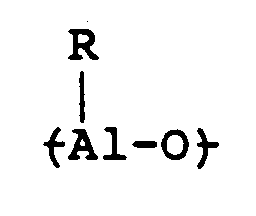
- Hydrocarbylaluminoxanes may exist in the form of linear or cyclic polymers with the simplest compounds being a tetraalkylaluminoxane such as tetramethylaluminoxane, (CH3)2AlOAl(CH3)2, or tetraethylaluminoxane, (C2H5)2AlOAl(C2H5)2. The compounds preferred for use in olefin polymerization catalysts usually contain 4 to 20 of the repeating units:where R is C1-C10 alkyl and especially preferred are methylaluminoxanes (MAO). The methylaluminoxanes can contain some higher alkyl groups to improve their solubility. Such modified methylaluminoxanes are described, for example, in U.S. Patent No. 5,157,008.
- The aluminoxanes can be prepared as known in the art by the partial hydrolysis of trialkylaluminum compounds. The trialkylaluminoxane compounds can be hydrolyzed by adding either free water or water containing solids, which can be either hydrates or porous materials which have absorbed water. Because it is difficult to control the reaction by adding water per se, even with vigorous agitation of the mixture, the free water is preferably added in the form of a solution or a dispersion in an organic solvent. Suitable hydrates include salt hydrates such as, for example, CuSO4·5H2O, Al2(SO4)3·18H2O, FeSO4·7H2O, AlCl3·6H2O, Al(NO3)3·9H2O, MgSO4·7H2O, ZnSO4·7H2O, Na2SO4·10H2O, Na3PO4·12H2O, LiBr·2H2O, LiCl·1H2O, LiI·2H2O, LiI·3H2O, KF·2H2O, NaBr·2H2O and the like and alkali or alkaline earth metal hydroxides such as, for example, NaOH·H2O, NaOH·2H2O, Ba(OH)2·8H2O, KOH·2H2O, CsOH·1H2O, LiOH·1H2O and the like. Mixtures of any of the above hydrates can be used. The mole ratios of free water or water in the hydrate to total alkyl aluminum compounds in the mixture can vary widely, such as for example from 2:1 to 1:4 with ratios of from 4:3 to 1:3.5 being preferred.
- Such processes for preparing hydrocarbylaluminoxanes are described, for example, in U.S. Patent No. 4,908,463. The methylaluminoxanes contain varying amounts, of from about 5 to 35 mole percent, of the aluminum value as unreacted trimethyl-aluminum.
- The alkyldisiloxanes for use in the invention have alkyl groups which preferably contain from 1 to 20 carbon atoms. The alkyldisiloxanes contain the Si-O-Si bond and are substantially free of Si-OH or Si-O-C bonds. The alkyl disiloxanes can contain mixed alkyl groups. Non-limiting examples of alkyldisiloxanes include hexamethyldisiloxane, hexaethyldisiloxane, tetramethyldisiloxane, and the like.
- The siloxy-aluminoxane compositions can be prepared by reacting the aluminoxane and alkyldisiloxane in an organic solvent medium in molar portions of aluminum to alkyldisiloxane of from 1:1 to 50:1. Mixtures of aluminoxanes and/or alkyldisiloxanes can be used in forming the compositions. Any inert organic solvent can be used as the reaction medium. Non-limiting examples of solvents include aliphatic hydrocarbons such as pentane, isopentane, hexane, cyclohexane, heptane, octane, decane, dodecane, hexadecane, octadecane and the like with those having carbon numbers of 5 to 10 being preferred and aromatic hydrocarbons such as benzene, toluene, xylene, cumene and the like with those having carbon numbers of 6 to 20 being preferred. Generally amounts of solvent to provide a total concentration of reactants of from 10 to 30 wt. percent are used.
- Preferred reaction temperatures range from about 25 to 90°C.
- The siloxy-aluminoxane compounds can be used in combination with metallocenes to provide olefin polymerization catalysts. Such metallocenes are well known in the art and non-limiting examples include the metallocenes described in published European patent application No. 0 129,368 and U.S. Patent Nos. 5,017,714 and 5,026,798, whose teachings with respect to such metallocenes are incorporated herein by reference. Illustrative examples of such metallocenes are bis(cyclopentadienyl)zirconium dimethyl, bis(cyclopentadienyl)zirconium dichloride, bis(cyclopentadienyl)zirconium monomethyl-monochloride, bis(cyclopentadienyl)titanium dichloride, bis(cyclopentadienyl)titanium difluoride, cyclopentadienylzirconium tri(2-ethylhexanoate), biscyclopentadienyl)zirconium hydrogen chloride, bis(cyclopentadienyl)hafnium dichloride and the like.
- The catalyst components are used in proportions to provide mole ratios of transition metal atom to aluminum atom of from 0.0002:1 to 0.2:1 and preferably 0.0005:1 to 0.02:1. The catalyst components can be used in solution or deposited on a solid support. The solid support can be any particulate solid, and particularly porous supports such as talc or inorganic oxides, or resinous support material such as polyolefins. Preferably, the support material is an inorganic oxide in finely divided form.
- Suitable inorganic oxide support materials which are desirably employed include Group IIA, IIIA, IVA or IVB metal oxides such as silica, alumina, silica-alumina and mixtures thereof. Other inorganic oxides that may be employed either alone or in combination with the silica, alumina or silica-alumina are magnesia, titania, zirconia, and the like. Other suitable support materials are finely divided polyolefins such as finely divided polyethylene.
- The catalysts are effective to produce olefin polymers and especially ethylene polymers and ethylene/α-olefin copolymers. Examples of olefins that can be polymerised in the presence of the catalysts of the invention include α-olefins having 2 to 20 carbon atoms such as ethylene, propylene, 1-butene, 1-hexene, 4-methyl-1-pentene, 1-octene, 1-decene, 1-dodecene, 1-tetradecene, 1-hexadecene, and 1-octadecene. Polymerization of ethylene or copolymerization with ethylene and an α-olefin having 3 to 10 carbon atoms is preferable. Such polymerizations may be performed in either the gas or liquid phase (e.g. in a solvent, such as toluene, or in a diluent, such as heptane). The polymerization can be conducted at conventional temperatures (e.g., 0° to 120°C.) and pressures (e.g., ambient to 50 kg/cm2) using conventional procedures as to molecular weight regulations and the like.
- The invention is further illustrated by, but is not intended to be limited to, the following examples.
- The following examples were carried out under inert atmosphere conditions, using Schlenk glassware and vacuum line, in conjunction with a N2-drybox. Solvents were distilled using standard methods. Filtration and vacuum distillation were done inside a N2-drybox and distillates were collected in a trap at -78°C. Disiloxanes were purchased from Aldrich and used without further purification. Aluminoxanes were obtained from stock solutions produced by Ethyl.
- Solid methylaluminoxanes (MAO, 38 mmol Al) was suspended in hexane (50 mL). The mixture was stirred at room temperature (30 minutes). Hexamethyldisiloxane (HMDS, 4.7 mmol) was then slowly added via syringe. After stirring for 16 hours, the mixture was filtered. The hexane solution was then concentrated to dryness by vacuum distillation. The resulting solid siloxy-MAO product contained 65% of the initial aluminum value. Silicon-29 and proton NMR showed one sharp singlet each for the siloxy group. Additionally, H-1 NMR showed the usual broad peak for methylaluminoxane in the aluminum alkyl region. The sharp signals suggest a probable end capping environment of the siloxy group in the MAO structure.
- Solid MAO (122 mmol Al) was suspended in hexane (300 mL) in a reaction flask. HMDS (60 mmol) was added via syringe. The mixture was stirred for about 30 minutes at room temperature and then heated to 70°C (oil bath) for another 12 hours. The slurry was filtered and the filtrate was concentrated to give a white solid material which contained 67% of the initial aluminum value. Si-29 and H-1 NMR data are similar to those obtained for Example 1.
- Solid MAO (60 mmol Al) was placed in hexane (100 mL). To the slurry was added HMDS (75 mmol). The mixture was magnetically stirred for about 20 hours and then filtered. The filtrate was concentrated to give white granular siloxy-MAO derivative.
- The preceding Examples 1-3 showed that the variation of HMDS concentration, reaction time and thermal conditions did not significantly alter either the product yield or the spectroscopic data of the resulting solid siloxy-MAO derivative.
- This preparation was done to investigate the effect of a mixed solvent system, toluene/hexane. A toluene solution of MAO (350 mmol Al) was placed in a reaction flask and hexane (150 g) was added. The HMDS (90 mmol) was then slowly added via syringe. The mixture was stirred for about 14 hours at room temperature. After filtration, the clear liquid which contained 90% of the original aluminum value, was concentrated to give a white solid siloxy-MAO product.
- H-1 NMR data showed more sharp peaks overlapping the usual MAO broad peak in the aluminum alkyl region, than was seen in the alkane product.
- Solid MAO (30 mmol Al) was dissolved in toluene (20 mL) and then HMDS (5 mmol) was added. The reaction was carried out as described in Example 1. The resulting solid product contained 92% of the original aluminum value. H-1 NMR contained several singlet peaks buried under the usual broad MAO peak.
- Solid MAO (75 mmol Al) was added to a toluene solvent (50 mL). To this solution was then added HMDS (30mmol) from a syringe. The mixture was stirred at room temperature for about 4 hours. The hexane (50 mL) was added and the mixture was stirred for another 2 hours and filtered. The filtrate was concentrated to dryness to give a solid product which contained 85% of the initial aluminum value.
- The H-1 NMR of the solid, hexane derived siloxy-MAO product showed only one sharp singlet peak in the aluminum alkyls region regardless of the concentration of HMDS. By contrast, similar spectra for the solid, MAO in toluene derived products showed several sharp singlet peaks in the aluminum alkyls region. Furthermore, as the molar ratio of HMDS increased the number of singlet peaks attributable to the siloxy derivatives increased. The reason for this unequivocal solvent effect is not known.
- Solid MAO (75 mmol Al) was dissolved in toluene (50 mL). To this solution was added HMDS (75 mmol). The mixture was stirred at room temperature for about 20 hours. Hexane (50 mL) was added and then the mixture was stirred for another 4 hours. After filtration and concentration, the resulting solid siloxy-MAO compound contained 88% of the original aluminum value.
- H-1 NMR of the solid compound showed several singlet peaks (Me 3SiO) buried under the broad MAO peaks.
- The starting material in the above described reactions was solid MAO. This was obtained by removal of toluene from the MAO solution via vacuum distillation. For commercial purposes, it is desirable to avoid extra processing requirements. The following examples describe the formation of siloxy-MAO compositions directly from the initial toluene solution of MAO.
- A MAO solution in toluene (271 mmol Al, 78 g of a 9.4% Al by weight solution) was placed in a reaction flask. HMDS (68 mmol) was slowly added at room temperature. The mixture was stirred for about 12 hours and then heat (oil bath, 80°C) was applied for about 2 hours. The mixture was filtered and the filtrate was found to contain 92% of the original aluminum value.
- This siloxy-MAO solution was found to be more active, compared to the original MAO solution, in an ethylene polymerization test (Table 1).
- To a solution of MAO in toluene (300 mmol Al) was added HMDS (150 mmol). The reaction was carried out as described in Example 8. The filtrate contained 93% of the original aluminum value. The resulting siloxy-MAO solution was found to be very active in ethylene polymerization (Table 1).
- A MAO solution in toluene (272 mmol Al) was placed in a reaction flask. HMDS (204 mmol) was slowly added from a syringe. The reaction was carried out as described in Example 8. The resulting filtrate contained about 82% of the original aluminum value. A significant reduction in the trimethyl-aluminum (TMA) content (from 30% TMA to 13% TMA) was observed for this product.
- The product in conjunction with zirconocene dichloride is highly active in ethylene polymerization (Table 1).
- A solution of MAO in toluene (272 mmol Al) was treated with HMDS (272 mmol). The reaction was carried out as described in Example 8. About 86% of the original aluminum value was recovered after filtration. The liquid product was found to be very active in ethylene polymerization (Table 1).
- MAO solution (194 mmol Al) was allowed to react with hexaethyldisiloxane (HEDS, 38.8 mmol). The reaction was carried out as described in Example 8. The resulting filtrate contained 79% of the original aluminum value.
- A portion of the filtrate was concentrated under vacuum to give an oily product.
- A solution of isobutylaluminoxane (IBAO, 109 mmol Al) in cyclohexane was treated with HMDS (27 mmol). The mixture was stirred at room temperature for about 2 hours and then heated (oil bath) at 100°C for another 10 hours. The clear solution was concentrated under vacuum to give a thick oily product. Ordinarily, a solid product would have resulted after similar treatment of the original IBAO solution. H-1 NMR showed broad peaks from 0.2 to 0.4 ppm which is attributable to the siloxy-aluminoxane group. All the other IBAO peaks are still present.
- Ethylene polymerization was conducted in a Parr reactor (600 mL) equipped with a cooling coil, magnetic stirrer, pressure gauge and a gas inlet. The catalyst system, siloxy-MAO and zirconocene dichloride, are dissolved in toluene (300 mL). The loading was done in a dry-box after which the reactor was assembled in a well vented hood. Ethylene was passed into the reactor at 60 psi for 10 minutes while the temperature was maintained at about 90°C.
- After cooling down to room temperature, the reactor contents were poured into a beaker where an equal volume of methanol was added to destroy the catalyst system. The polyethylene was collected by filtration and then dried in a vacuum oven.
- Solid samples obtained from Examples 1 and 5 were separately employed in conjunction with zirconocene dichloride to conduct ethylene polymerization tests as described above. Results are shown in Table 1.
- Toluene samples of the siloxy-aluminoxanes obtained respectively from Examples 8 to 11 were separately employed in the presence of zirconocene dichloride to conduct ethylene polymerization as described above. Results are shown in Table 1.
- A comparative polymerization was carried out using regular methylaluminoxane (MAO) solution in toluene (9.4 wt. % Al) in conjunction with zirconocene dichloride without the addition of disiloxane. The results are shown in Table 1.
- Table 1 shows that no significant additional activity was gained as the molar ratio of HMDS was increased. However, the data in this table show a notable increase (about 50%) in the activity of the siloxy-MAO derivatives as compared to the regular MAO under similar conditions.
Siloxy-MAO Derivatives/Ethylene Polymerization Example # (%) HMDS Aluminum (Moles x 10-3 Zirconocene Dichloride (Moles x 10-6 Al/Zr Mole Ratio Activity g(PE)/mol. Zr·atm·hr Activity Compared to Regular MAO PE (g) 14 15 16.7 12.4 1347 4.74 NA 40 15 15 16.7 12.4 1347 4.98 NA 42 16 25 10 6.8 1470 10.16 1.8 47 17 50 10 6.8 1470 9.74 1.7 45 18 75 10 6.8 1470 9.08 1.6 42 19 100 10 6.8 1470 9.08 1.6 42 Comparison Regular MAO 10 6.8 1470 5.62 1 26
Claims (11)
- A siloxy-aluminoxane composition comprising the reaction product of an alkyldisiloxane substantially free of Si-OH or Si-O-C bonds and an aluminoxane where the molar portions of aluminum to alkyldisiloxane are from 1:1 to 50:1.
- The composition of claim 1 wherein the alkyl groups in said alkyldisiloxane have from 1 to 20 carbon atoms and said aluminoxane is a hydrocarbylaluminoxane wherein the hydrocarbyl groups contain from 1 to 10 carbon atoms.
- The composition of claim 2 wherein said alkyldisiloxane is hexamethyldisiloxane and said hydrocarbylaluminoxane is methylaluminoxane.
- The composition of claim 2 wherein said alkyldisiloxane is hexaethyldisiloxane and said hydrocarbylaluminoxane is methylaluminoxane.
- The composition of claim 2 wherein said alkyldisiloxane is hexamethyldisiloxane and said hydrocarbylaluminoxane is butylaluminoxane.
- The composition of claim 2 wherein said alkyldisiloxane is hexaethyldisiloxane and said hydrocarbyl aluminoxane is butylaluminoxane.
- A siloxy-aluminoxane composition comprising the reaction product of methylaluminoxane and hexamethyldisiloxane where the molar portions of aluminum to alkyldisiloxane are 60:75 corresponding to the ratio 0.8:1.
- An olefin polymerization catalyst comprising a metallocene of a transition metal and a siloxy-aluminoxane composition which is the reaction product of an alkyldisiloxane substantially free of Si-OH or Si-O-C bonds and an aluminoxane where the molar portions of aluminum to alkyldisiloxane are from 1:1 to 50:1.
- The catalyst of claim 7 which contains mole ratios of transition metal atom in said metallocene to aluminum atom in said siloxy-aluminoxane composition of from 0.0002:1 to 0.2:1.
- The catalyst of claim 7 which contains mole ratios of transition metal atom in said metallocene to aluminum atom in said siloxy-aluminoxane composition of from 0.0005:1 to 0.02:1.
- The catalyst of claim 7 wherein the alkyl groups in said alkyldisiloxane have from 1 to 20 carbon atoms and said aluminoxane is a hydrocarbylaluminoxane wherein the hydrocarbyl groups contain from 1 to 10 carbon atoms.
Applications Claiming Priority (2)
| Application Number | Priority Date | Filing Date | Title |
|---|---|---|---|
| US11599 | 1993-02-01 | ||
| US08/011,599 US5391529A (en) | 1993-02-01 | 1993-02-01 | Siloxy-aluminoxane compositions, and catalysts which include such compositions with a metallocene |
Publications (3)
| Publication Number | Publication Date |
|---|---|
| EP0621279A2 EP0621279A2 (en) | 1994-10-26 |
| EP0621279A3 EP0621279A3 (en) | 1995-01-04 |
| EP0621279B1 true EP0621279B1 (en) | 2000-03-29 |
Family
ID=21751128
Family Applications (1)
| Application Number | Title | Priority Date | Filing Date |
|---|---|---|---|
| EP94101418A Expired - Lifetime EP0621279B1 (en) | 1993-02-01 | 1994-01-31 | Siloxy-aluminoxane compositions |
Country Status (5)
| Country | Link |
|---|---|
| US (1) | US5391529A (en) |
| EP (1) | EP0621279B1 (en) |
| JP (1) | JP3673290B2 (en) |
| CA (1) | CA2112965C (en) |
| DE (1) | DE69423670T2 (en) |
Families Citing this family (124)
| Publication number | Priority date | Publication date | Assignee | Title |
|---|---|---|---|---|
| US5565395A (en) * | 1995-05-26 | 1996-10-15 | Albemarle Corporation | Aluminoxanate compositions |
| US5614654A (en) * | 1995-05-30 | 1997-03-25 | Shin-Etsu Chemical Co., Ltd. | Aluminosiloxanes, titanosiloxanes, (poly)stannosiloxanes, and their preparation |
| US5731253A (en) * | 1995-07-27 | 1998-03-24 | Albemarle Corporation | Hydrocarbylsilloxy - aluminoxane compositions |
| DE19602543A1 (en) | 1996-01-25 | 1997-07-31 | Basf Ag | Process for the preparation of polymers of C¶2¶ to C¶1¶¶0¶ alkenes in the presence of metallocene complexes with cationically functionalized cyclopentadienyl ligands |
| DE19615953A1 (en) * | 1996-04-22 | 1997-10-23 | Basf Ag | Process for the preparation of polymers of alk-1-enes in the presence of a supported metallocene catalyst system and an antistatic |
| US5744417A (en) * | 1996-05-02 | 1998-04-28 | Lyondell Petrochemical Company | Supported catalyst |
| US6077806A (en) * | 1997-03-06 | 2000-06-20 | Equistar Chemicals, Lp | Catalyst system containing reaction product of liquid silicone and polyamine |
| DE19618007A1 (en) * | 1996-05-04 | 1997-11-06 | Basf Ag | Process for the recovery of metallocene complexes |
| DE19621969A1 (en) * | 1996-05-31 | 1997-12-04 | Basf Ag | Process for the preparation of crystalline polymers by dispersion polymerization in the presence of metallocene catalyst systems |
| DE19621838A1 (en) * | 1996-05-31 | 1997-12-04 | Basf Ag | Process for the preparation of polymers of C¶2¶ to C¶1¶¶2¶ alkenes with the addition of a reaction retardant |
| DE19622272A1 (en) * | 1996-06-03 | 1997-12-04 | Basf Ag | Copolymers of alk-1-enes and a, beta-dienes with an increased viscosity index |
| DE19622271A1 (en) * | 1996-06-03 | 1997-12-04 | Basf Ag | Chiral connections |
| US5731451A (en) * | 1996-07-12 | 1998-03-24 | Akzo Nobel Nv | Modified polyalkylauminoxane composition formed using reagent containing aluminum trialkyl siloxide |
| DE19635503A1 (en) | 1996-09-02 | 1998-03-05 | Basf Ag | Low-whitening, tough modified propylene polymers |
| US5847177A (en) * | 1996-10-10 | 1998-12-08 | Albemarle Corporation | Production of hydrocarbon-soluble hydrocarbylaluminoxanes |
| DE19653079A1 (en) * | 1996-12-19 | 1998-06-25 | Basf Ag | Process for the gas phase polymerization of C¶2¶-C¶8¶-Alk-1-enes using Ziegler-Natta or metallocene catalyst systems |
| DE19709866A1 (en) | 1997-03-11 | 1998-09-17 | Basf Ag | Supported catalyst system for the polymerization of alk-1-enes |
| DE19716239A1 (en) | 1997-04-18 | 1998-10-22 | Basf Ag | Process for the polymerization of alpha-olefins in the gas phase |
| DE19723003A1 (en) | 1997-06-02 | 1998-12-03 | Basf Ag | Polymer blend |
| DE19745047A1 (en) | 1997-10-11 | 1999-04-15 | Basf Ag | Polymer mixture, especially for production of film |
| US6322890B1 (en) | 1998-03-30 | 2001-11-27 | Wm. Marsh Rice University | Supra-molecular alkylalumoxanes |
| US6245868B1 (en) | 1998-05-29 | 2001-06-12 | Univation Technologies | Catalyst delivery method, a catalyst feeder and their use in a polymerization process |
| DE19927766A1 (en) | 1999-06-17 | 2000-12-21 | Basf Ag | Supported catalyst for olefin polymerization comprises copolymer support, metallocene complex and metallocenium ion forming compound |
| DE19957384A1 (en) | 1999-11-29 | 2001-05-31 | Targor Gmbh | Propylene polymer, useful for the production of water pipes, has a Mw of 350,000-1,000,000 g/mol, Mw/Mn of 4-10, contains polymer fractions having a viscosity number of 500-1400 ml/g and 200-400 ml/g |
| US6281306B1 (en) | 1999-12-16 | 2001-08-28 | Univation Technologies, Llc | Method of polymerization |
| DE19962129A1 (en) | 1999-12-21 | 2001-06-28 | Targor Gmbh | Solid metallocene catalyst, useful for olefin polymerization, comprises a particulate,support, an adduct of magnesium halide and a lower alkyl alcohol |
| CN1222550C (en) | 1999-12-21 | 2005-10-12 | 巴塞尔聚烯烃有限公司 | Semi-crystalline propylene polymer composition for producing biaxially stretched polypropylene films |
| MXPA02006199A (en) * | 1999-12-22 | 2003-10-15 | Exxon Chemical Patents Inc | Polypropylenebased adhesive compositions. |
| US6458738B1 (en) | 2000-09-22 | 2002-10-01 | Union Carbide Chemicals & Plastics Technology Corporation | Spray-drying compositions and methods of spray-drying |
| CN1319638C (en) | 2001-06-13 | 2007-06-06 | 能源及环境国际有限公司 | Bulk polymerization reactors and methods for polymerization |
| US20040052690A1 (en) * | 2002-09-12 | 2004-03-18 | Eaton Gerald B. | Polymerization reactant injection system |
| WO2004046214A2 (en) | 2002-10-15 | 2004-06-03 | Exxonmobil Chemical Patents Inc. | Multiple catalyst system for olefin polymerization and polymers produced therefrom |
| US7223822B2 (en) | 2002-10-15 | 2007-05-29 | Exxonmobil Chemical Patents Inc. | Multiple catalyst and reactor system for olefin polymerization and polymers produced therefrom |
| US7579407B2 (en) * | 2002-11-05 | 2009-08-25 | Dow Global Technologies Inc. | Thermoplastic elastomer compositions |
| US7459500B2 (en) * | 2002-11-05 | 2008-12-02 | Dow Global Technologies Inc. | Thermoplastic elastomer compositions |
| WO2004094487A1 (en) * | 2003-03-21 | 2004-11-04 | Dow Global Technologies, Inc. | Morphology controlled olefin polymerization process |
| US6953764B2 (en) | 2003-05-02 | 2005-10-11 | Dow Global Technologies Inc. | High activity olefin polymerization catalyst and process |
| JP2005099712A (en) * | 2003-08-28 | 2005-04-14 | Sharp Corp | Display device drive circuit and display device |
| WO2006049699A1 (en) | 2004-10-29 | 2006-05-11 | Exxonmobil Chemical Patents Inc | Catalyst compound containing divalent tridentate ligand |
| AU2005319179B2 (en) | 2004-12-21 | 2011-10-13 | Dow Global Technologies Llc | Polypropylene-based adhesive compositions |
| EP1803747A1 (en) | 2005-12-30 | 2007-07-04 | Borealis Technology Oy | Surface-modified polymerization catalysts for the preparation of low-gel polyolefin films |
| DE102006004429A1 (en) * | 2006-01-31 | 2007-08-02 | Advanced Micro Devices, Inc., Sunnyvale | Forming metallization layers for high-density integrated circuit component interconnection, also deposits dielectric material of low permitivity |
| ES2534469T3 (en) | 2006-05-17 | 2015-04-23 | Dow Global Technologies Llc | Polymerization process of polyethylene in high temperature solution |
| JP5507263B2 (en) * | 2007-03-07 | 2014-05-28 | ダウ グローバル テクノロジーズ エルエルシー | Immobilized supported transition metal complexes |
| TW200932762A (en) | 2007-10-22 | 2009-08-01 | Univation Tech Llc | Polyethylene compositions having improved properties |
| TW200936619A (en) | 2007-11-15 | 2009-09-01 | Univation Tech Llc | Polymerization catalysts, methods of making, methods of using, and polyolefin products made therefrom |
| ES2435568T3 (en) * | 2007-11-19 | 2013-12-20 | Dow Global Technologies Llc | Propylene-alpha-olefin copolymers with long chain branching |
| EP2119732A1 (en) | 2008-05-16 | 2009-11-18 | Borealis Technology Oy | Metallocene catalyst compositions with improved properties, process for its preparation and use for preparing polyolefin homo- or copolymers |
| EP2186831B1 (en) | 2008-11-10 | 2013-01-02 | Borealis AG | Process for the preparation of an unsupported, solid olefin polymerisation catalyst and use in polymerisation of olefins |
| EP2186832B1 (en) * | 2008-11-10 | 2012-09-12 | Borealis AG | Process for the preparation of an unsupported, solid metallocene catalyst system and its use in polymerization of olefins |
| MY149647A (en) | 2009-10-19 | 2013-09-30 | Sasol Tech Pty Ltd | Oligomerisation of olefinic compounds with reduced polymer formation |
| BR112012013675A2 (en) | 2009-12-07 | 2016-04-19 | Univation Tech Llc | methods for the static charge production of a catalyst and methods for using the catalyst to produce polyolefins |
| WO2011078923A1 (en) | 2009-12-23 | 2011-06-30 | Univation Technologies, Llc | Methods for producing catalyst systems |
| EP2354183B1 (en) | 2010-01-29 | 2012-08-22 | Borealis AG | Moulding composition |
| EP2354184B1 (en) | 2010-01-29 | 2012-08-22 | Borealis AG | Polyethylene moulding composition with improved stress crack/stiffness relationship and impact resistance |
| ES2545988T3 (en) | 2010-01-29 | 2015-09-17 | Borealis Ag | Improvement of homogeneity in polyethylene mixtures |
| EP2536767B1 (en) | 2010-02-18 | 2015-05-06 | Univation Technologies, LLC | Methods for operating a polymerization reactor |
| KR20130026531A (en) | 2010-02-22 | 2013-03-13 | 유니베이션 테크놀로지즈, 엘엘씨 | Catalyst systems and methods for using same to produce polyolefin products |
| ES2564189T3 (en) | 2010-05-07 | 2016-03-18 | Borealis Ag | Preparation of a solid catalyst system |
| EP2386583A1 (en) | 2010-05-07 | 2011-11-16 | Borealis AG | Process for the preparation of a solid metallocene catalyst system and its use in polymerisation of olefins |
| EP2738183A1 (en) | 2010-05-07 | 2014-06-04 | Borealis AG | Preparation of a solid catalyst system |
| KR20130113470A (en) | 2010-10-21 | 2013-10-15 | 엑손모빌 케미칼 패턴츠 인코포레이티드 | Polyethylene and process for production thereof |
| MY161763A (en) | 2010-11-30 | 2017-05-15 | Univation Tech Llc | Catalyst composition having improved flow characteristics and methods of making and using the same |
| CN103228682B (en) | 2010-11-30 | 2015-07-22 | 尤尼威蒂恩技术有限责任公司 | Process for polymerizing olefins using extracted metal carboxylates |
| RU2598023C2 (en) | 2011-05-13 | 2016-09-20 | Юнивейшн Текнолоджиз, Ллк | Spray drying-obtained catalyst compositions and polymerisation methods using same |
| WO2013028283A1 (en) | 2011-08-19 | 2013-02-28 | Univation Technologies, Llc | Catalyst systems and methods for using same to produce polyolefin products |
| ES2798272T3 (en) | 2011-11-08 | 2020-12-10 | Univation Tech Llc | Methods of preparing a catalytic system |
| ES2729280T3 (en) | 2011-11-08 | 2019-10-31 | Univation Tech Llc | Methods to produce polyolefins with catalytic systems |
| WO2014074981A1 (en) | 2012-11-12 | 2014-05-15 | Univation Technologies, Llc | Recycle gas cooler systems for gas-phase polymerization processes |
| WO2014106143A1 (en) | 2012-12-28 | 2014-07-03 | Univation Technologies, Llc | Supported catalyst with improved flowability |
| CN105189566A (en) | 2013-01-30 | 2015-12-23 | 尤尼威蒂恩技术有限责任公司 | Processes for making catalyst compositions having improved flow |
| WO2014123598A1 (en) | 2013-02-07 | 2014-08-14 | Univation Technologies, Llc | Preparation of polyolefin |
| CN105143280B (en) | 2013-03-15 | 2017-06-13 | 尤尼威蒂恩技术有限责任公司 | Catalyst Ligand |
| JP6360549B2 (en) | 2013-03-15 | 2018-07-18 | ユニベーション・テクノロジーズ・エルエルシー | Tridentate nitrogen-based ligands for olefin polymerization catalysts |
| EP3287473B1 (en) | 2013-06-05 | 2019-10-16 | Univation Technologies, LLC | Protecting phenol groups |
| JP6216887B2 (en) | 2013-08-14 | 2017-10-18 | ボレアリス・アクチェンゲゼルシャフトBorealis Ag | Propylene composition with improved impact resistance at low temperatures |
| MX2016001705A (en) | 2013-08-21 | 2016-05-18 | Borealis Ag | High flow polyolefin composition with high stiffness and toughness. |
| WO2015024887A1 (en) | 2013-08-21 | 2015-02-26 | Borealis Ag | High flow polyolefin composition with high stiffness and toughness |
| EP2853563B1 (en) | 2013-09-27 | 2016-06-15 | Borealis AG | Films suitable for BOPP processing from polymers with high XS and high Tm |
| ES2568615T3 (en) | 2013-10-11 | 2016-05-03 | Borealis Ag | Label film oriented in the machine direction |
| US10519259B2 (en) | 2013-10-24 | 2019-12-31 | Borealis Ag | Low melting PP homopolymer with high content of regioerrors and high molecular weight |
| ES2574428T3 (en) | 2013-10-24 | 2016-06-17 | Borealis Ag | Blow molded article based on bimodal random copolymer |
| EP3063185B9 (en) | 2013-10-29 | 2017-11-15 | Borealis AG | Solid single site catalysts with high polymerisation activity |
| CA2927448C (en) | 2013-11-22 | 2017-01-17 | Borealis Ag | Low emission propylene homopolymer with high melt flow |
| EP3077426B1 (en) | 2013-12-04 | 2022-10-05 | Borealis AG | Phthalate-free pp homopolymers for meltblown fibers |
| KR101873134B1 (en) | 2013-12-18 | 2018-06-29 | 보레알리스 아게 | Bopp film with improved stiffness/toughness balance |
| CN105829364B (en) | 2014-01-17 | 2017-11-10 | 博里利斯股份公司 | Method for preparing the butylene copolymer of propylene/1 |
| BR112016017227B1 (en) | 2014-02-06 | 2021-06-29 | Borealis Ag | HETEROPHASIC PROPYLENE COPOLYMER, UNORIENTED FILM, CONTAINER, AND USE OF A HETEROPHASIC PROPYLENE COPOLYMER |
| JP2017508032A (en) | 2014-02-06 | 2017-03-23 | ボレアリス エージー | Soft copolymer with high impact strength |
| EP2907841A1 (en) | 2014-02-14 | 2015-08-19 | Borealis AG | Polypropylene composite |
| RU2677897C2 (en) | 2014-04-02 | 2019-01-22 | ЮНИВЕЙШН ТЕКНОЛОДЖИЗ, ЭлЭлСи | Continuity compositions and methods of making and using same |
| EP2947118B1 (en) | 2014-05-20 | 2017-11-29 | Borealis AG | Polypropylene composition for automotive interior applications |
| WO2016028278A1 (en) | 2014-08-19 | 2016-02-25 | Univation Technologies, Llc | Fluorinated catalyst supports and catalyst systems |
| CN106714967B (en) | 2014-08-19 | 2020-07-17 | 尤尼威蒂恩技术有限责任公司 | Fluorination catalyst supports and catalyst systems |
| BR112017003170B1 (en) | 2014-08-19 | 2022-02-15 | Univation Technologies, Llc | METHOD FOR MAKING A FLUORINED ALUMINA SILICA CATALYST SUPPORT AND FLUORORATED ALUMINA SILICA CATALYST SYSTEM |
| CA2978925C (en) | 2015-03-10 | 2023-08-22 | Univation Technologies, Llc | Spray dried catalyst compositions, methods for preparation and use in olefin polymerization processes |
| CN107531601A (en) | 2015-04-20 | 2018-01-02 | 尤尼威蒂恩技术有限责任公司 | Bridging biaryl perfume base ligand and transistion metal compound prepared therefrom |
| US10195589B2 (en) | 2015-04-20 | 2019-02-05 | Univation Technologies, Llc | Bridged bi-aromatic ligands and olefin polymerization catalysts prepared therefrom |
| SG11201708626SA (en) | 2015-04-27 | 2017-11-29 | Univation Tech Llc | Supported catalyst compositions having improved flow properties and preparation thereof |
| US10351647B2 (en) | 2015-05-29 | 2019-07-16 | Exxonmobil Chemical Patents Inc. | Polymerization process using bridged metallocene compounds supported on organoaluminum treated layered silicate supports |
| US10570219B2 (en) | 2015-06-05 | 2020-02-25 | Exxonmobil Chemical Patents Inc. | Production of heterophasic polymers in gas or slurry phase |
| US10759886B2 (en) | 2015-06-05 | 2020-09-01 | Exxonmobil Chemical Patents Inc. | Single reactor production of polymers in gas or slurry phase |
| WO2016197037A1 (en) | 2015-06-05 | 2016-12-08 | Exxonmobil Chemical Patents Inc. | Catalyst system comprising supported alumoxane and unsupported alumoxane particles |
| EP3353217A4 (en) | 2015-09-24 | 2018-11-07 | ExxonMobil Chemical Patents Inc. | Polymerization process using pyridyldiamido compounds supported on organoaluminum treated layered silicate supports |
| SG11202005184XA (en) | 2017-12-18 | 2020-07-29 | Dow Global Technologies Llc | Zirconocene-titanocene catalyst system |
| BR112020010103B1 (en) | 2017-12-18 | 2024-01-02 | Dow Global Technologies Llc | HAFNOCENE-TITANOCENE CATALYST SYSTEM, METHOD FOR MAKING HAFNOCENOTITANOCENE CATALYST SYSTEM AND METHOD FOR MAKING A POLYETHYLENE COMPOSITION |
| EP3728342A1 (en) | 2017-12-21 | 2020-10-28 | Borealis AG | Process for the preparation of solid catalyst |
| JP7249349B2 (en) | 2017-12-27 | 2023-03-30 | ボレアリス エージー | Ziegler-Natta catalyst and its preparation |
| EA202091168A1 (en) | 2017-12-28 | 2020-11-24 | Бореалис Аг | CATALYST AND ITS PRODUCTION |
| CN111741988A (en) | 2018-03-19 | 2020-10-02 | 尤尼威蒂恩技术有限责任公司 | Ethylene/1-hexene copolymer |
| WO2019190897A1 (en) | 2018-03-26 | 2019-10-03 | Dow Global Technologies Llc | Spray-dried zirconocene catalyst system |
| US20230132152A1 (en) | 2020-05-29 | 2023-04-27 | Dow Global Technologies Llc | Attenuated post-metallocene catalysts |
| WO2021242795A1 (en) | 2020-05-29 | 2021-12-02 | Dow Global Technologies Llc | Attenuated post-metallocene catalysts |
| CA3180287A1 (en) | 2020-05-29 | 2021-12-02 | Rhett A. BAILLIE | Chemically converted catalysts |
| EP4157897A1 (en) | 2020-05-29 | 2023-04-05 | Dow Global Technologies LLC | Chemically converted catalysts |
| KR20230017245A (en) | 2020-05-29 | 2023-02-03 | 다우 글로벌 테크놀로지스 엘엘씨 | Attenuated post-metallocene catalyst |
| KR20230018410A (en) | 2020-05-29 | 2023-02-07 | 다우 글로벌 테크놀로지스 엘엘씨 | Damped Hybrid Catalyst |
| WO2021247244A2 (en) | 2020-06-03 | 2021-12-09 | Exxonmobil Chemical Patents Inc. | Process for production of thermoplastic vulcanizates using supported catalyst systems and compositions made therefrom |
| CN121532435A (en) * | 2023-06-06 | 2026-02-13 | 埃克森美孚技术与工程公司 | Non-coordinated alkyl aluminum free cation modified aluminum oxane and its method |
| WO2025128219A1 (en) | 2023-12-12 | 2025-06-19 | Dow Global Technologies Llc | Additive for a catalyst |
| WO2025128218A1 (en) | 2023-12-12 | 2025-06-19 | Dow Global Technologies Llc | Additive for a catalyst |
| WO2025128216A1 (en) | 2023-12-12 | 2025-06-19 | Dow Global Technologies Llc | Additive for a catalyst |
| US20260008876A1 (en) | 2023-12-12 | 2026-01-08 | Dow Global Technologies Llc | Additive for a catalyst |
| WO2025128220A1 (en) | 2023-12-12 | 2025-06-19 | Dow Global Technologies Llc | Additive for a catalyst |
Family Cites Families (14)
| Publication number | Priority date | Publication date | Assignee | Title |
|---|---|---|---|---|
| US3657159A (en) * | 1968-10-14 | 1972-04-18 | Hercules Inc | Epoxide polymerization catalysts comprising complex organoaluminate compounds of silicon tin or phosphorus |
| GB1313183A (en) * | 1970-09-03 | 1973-04-11 | Ici Ltd | Polymerisation process and catalysts |
| FR2241569B1 (en) * | 1973-08-21 | 1979-03-02 | Ethylene Plastique Sa | |
| ZA844157B (en) * | 1983-06-06 | 1986-01-29 | Exxon Research Engineering Co | Process and catalyst for polyolefin density and molecular weight control |
| WO1988008432A1 (en) * | 1987-04-20 | 1988-11-03 | Mitsui Petrochemical Industries, Ltd. | Olefin polymerization catalyst and process for polymerizing olefin |
| JP2573613B2 (en) * | 1987-08-14 | 1997-01-22 | 三菱化学株式会社 | Ethylene polymerization method |
| US4937217A (en) * | 1987-12-17 | 1990-06-26 | Exxon Chemical Patents Inc. | Method for utilizing triethylaluminum to prepare an alumoxane support for an active metallocene catalyst |
| US5017714A (en) * | 1988-03-21 | 1991-05-21 | Exxon Chemical Patents Inc. | Silicon-bridged transition metal compounds |
| US5034549A (en) * | 1989-07-28 | 1991-07-23 | Akzo N.V. | Olefin polymerization catalyst |
| US4945076A (en) * | 1989-07-28 | 1990-07-31 | Akzo America Inc. | Polymerization catalyst system |
| US5026798A (en) * | 1989-09-13 | 1991-06-25 | Exxon Chemical Patents Inc. | Process for producing crystalline poly-α-olefins with a monocyclopentadienyl transition metal catalyst system |
| US5057475A (en) * | 1989-09-13 | 1991-10-15 | Exxon Chemical Patents Inc. | Mono-Cp heteroatom containing group IVB transition metal complexes with MAO: supported catalyst for olefin polymerization |
| US5061668A (en) * | 1990-05-24 | 1991-10-29 | Shell Oil Company | Hydrogenation catalyst and hydrogenation process wherein said catalyst is used |
| US5329032A (en) * | 1992-03-18 | 1994-07-12 | Akzo Chemicals Inc. | Polymethylaluminoxane of enhanced solution stability |
-
1993
- 1993-02-01 US US08/011,599 patent/US5391529A/en not_active Expired - Lifetime
-
1994
- 1994-01-06 CA CA002112965A patent/CA2112965C/en not_active Expired - Lifetime
- 1994-01-27 JP JP02361494A patent/JP3673290B2/en not_active Expired - Lifetime
- 1994-01-31 DE DE69423670T patent/DE69423670T2/en not_active Expired - Lifetime
- 1994-01-31 EP EP94101418A patent/EP0621279B1/en not_active Expired - Lifetime
Also Published As
| Publication number | Publication date |
|---|---|
| EP0621279A2 (en) | 1994-10-26 |
| CA2112965C (en) | 2005-08-09 |
| JPH06293777A (en) | 1994-10-21 |
| EP0621279A3 (en) | 1995-01-04 |
| CA2112965A1 (en) | 1994-08-02 |
| DE69423670D1 (en) | 2000-05-04 |
| JP3673290B2 (en) | 2005-07-20 |
| US5391529A (en) | 1995-02-21 |
| DE69423670T2 (en) | 2000-07-20 |
Similar Documents
| Publication | Publication Date | Title |
|---|---|---|
| EP0621279B1 (en) | Siloxy-aluminoxane compositions | |
| US5936050A (en) | Hydrocarbylsiloxy-aluminoxane compositions | |
| EP0633264B1 (en) | Tertiary amino-aluminoxane halides | |
| US5308815A (en) | Heterogeneous methylaluminoxane catalyst system | |
| US5041583A (en) | Preparation of aluminoxanes | |
| US5041584A (en) | Modified methylaluminoxane | |
| EP0372617B2 (en) | Synthesis of methylaluminoxanes | |
| US5922631A (en) | Liquid clathrate aluminoxane compositions as co-catalysts with transition metal catalyst compounds | |
| US5086024A (en) | Catalyst system for polymerization of olefins | |
| US5371260A (en) | Amino-aluminoxane compositions | |
| US5670682A (en) | Liquid clathrate aluminoxane compositions | |
| US5527930A (en) | Aluminoxanes having increased catalytic activity | |
| KR20010021888A (en) | Polymerisation catalysts | |
| EP0744414B1 (en) | Aluminoxanate compositions | |
| CN1039587C (en) | Preparation method of aluminoxane compound | |
| WO2000017209A1 (en) | Aluminoxane synthesis employing reduced amount of trialkylaluminum compound | |
| CA2015549C (en) | Synthesis of methylaluminoxanes | |
| EP0812860A1 (en) | Processes to produce organo-aluminoxane compositions |
Legal Events
| Date | Code | Title | Description |
|---|---|---|---|
| PUAI | Public reference made under article 153(3) epc to a published international application that has entered the european phase |
Free format text: ORIGINAL CODE: 0009012 |
|
| AK | Designated contracting states |
Kind code of ref document: A2 Designated state(s): BE DE FR GB IT |
|
| PUAL | Search report despatched |
Free format text: ORIGINAL CODE: 0009013 |
|
| RAP1 | Party data changed (applicant data changed or rights of an application transferred) |
Owner name: ALBEMARLE CORPORATION |
|
| RHK1 | Main classification (correction) |
Ipc: C07F 7/18 |
|
| AK | Designated contracting states |
Kind code of ref document: A3 Designated state(s): BE DE FR GB IT |
|
| 17P | Request for examination filed |
Effective date: 19950404 |
|
| 17Q | First examination report despatched |
Effective date: 19970617 |
|
| GRAG | Despatch of communication of intention to grant |
Free format text: ORIGINAL CODE: EPIDOS AGRA |
|
| GRAG | Despatch of communication of intention to grant |
Free format text: ORIGINAL CODE: EPIDOS AGRA |
|
| GRAG | Despatch of communication of intention to grant |
Free format text: ORIGINAL CODE: EPIDOS AGRA |
|
| GRAH | Despatch of communication of intention to grant a patent |
Free format text: ORIGINAL CODE: EPIDOS IGRA |
|
| GRAH | Despatch of communication of intention to grant a patent |
Free format text: ORIGINAL CODE: EPIDOS IGRA |
|
| GRAA | (expected) grant |
Free format text: ORIGINAL CODE: 0009210 |
|
| AK | Designated contracting states |
Kind code of ref document: B1 Designated state(s): BE DE FR GB IT |
|
| REF | Corresponds to: |
Ref document number: 69423670 Country of ref document: DE Date of ref document: 20000504 |
|
| ET | Fr: translation filed | ||
| ITF | It: translation for a ep patent filed | ||
| PLBE | No opposition filed within time limit |
Free format text: ORIGINAL CODE: 0009261 |
|
| STAA | Information on the status of an ep patent application or granted ep patent |
Free format text: STATUS: NO OPPOSITION FILED WITHIN TIME LIMIT |
|
| 26N | No opposition filed | ||
| REG | Reference to a national code |
Ref country code: GB Ref legal event code: IF02 |
|
| PGFP | Annual fee paid to national office [announced via postgrant information from national office to epo] |
Ref country code: IT Payment date: 20120124 Year of fee payment: 19 |
|
| PGFP | Annual fee paid to national office [announced via postgrant information from national office to epo] |
Ref country code: GB Payment date: 20130125 Year of fee payment: 20 Ref country code: DE Payment date: 20130129 Year of fee payment: 20 Ref country code: FR Payment date: 20130211 Year of fee payment: 20 |
|
| PGFP | Annual fee paid to national office [announced via postgrant information from national office to epo] |
Ref country code: BE Payment date: 20130128 Year of fee payment: 20 |
|
| BE20 | Be: patent expired |
Owner name: *ALBEMARLE CORP. Effective date: 20140131 |
|
| REG | Reference to a national code |
Ref country code: DE Ref legal event code: R071 Ref document number: 69423670 Country of ref document: DE |
|
| REG | Reference to a national code |
Ref country code: GB Ref legal event code: PE20 Expiry date: 20140130 |
|
| PG25 | Lapsed in a contracting state [announced via postgrant information from national office to epo] |
Ref country code: DE Free format text: LAPSE BECAUSE OF EXPIRATION OF PROTECTION Effective date: 20140201 Ref country code: GB Free format text: LAPSE BECAUSE OF EXPIRATION OF PROTECTION Effective date: 20140130 |