EP0618913B1 - Imidazolyl or imidazoylalkyl substituted with a four or five membered nitrogen containing heterocyclic ring - Google Patents
Imidazolyl or imidazoylalkyl substituted with a four or five membered nitrogen containing heterocyclic ring Download PDFInfo
- Publication number
- EP0618913B1 EP0618913B1 EP93901329A EP93901329A EP0618913B1 EP 0618913 B1 EP0618913 B1 EP 0618913B1 EP 93901329 A EP93901329 A EP 93901329A EP 93901329 A EP93901329 A EP 93901329A EP 0618913 B1 EP0618913 B1 EP 0618913B1
- Authority
- EP
- European Patent Office
- Prior art keywords
- compound
- temperature
- group
- alkyl
- reaction
- Prior art date
- Legal status (The legal status is an assumption and is not a legal conclusion. Google has not performed a legal analysis and makes no representation as to the accuracy of the status listed.)
- Expired - Lifetime
Links
- 0 CC1(CCN(*)CCC1)c1c(*)[n](*)cn1 Chemical compound CC1(CCN(*)CCC1)c1c(*)[n](*)cn1 0.000 description 39
- LWCFURQTAQPROG-UHFFFAOYSA-N C(C1CNC1)c1c[nH]cn1 Chemical compound C(C1CNC1)c1c[nH]cn1 LWCFURQTAQPROG-UHFFFAOYSA-N 0.000 description 1
- GDRPZERUBPDYBB-UHFFFAOYSA-N C=C=NC(C=N)C1=C=NC1 Chemical compound C=C=NC(C=N)C1=C=NC1 GDRPZERUBPDYBB-UHFFFAOYSA-N 0.000 description 1
- LWCRXAOAKMPKQU-WAYWQWQTSA-N CC/C(/N=C)=C/NC Chemical compound CC/C(/N=C)=C/NC LWCRXAOAKMPKQU-WAYWQWQTSA-N 0.000 description 1
- WMPQYKCRUWQBCM-UHFFFAOYSA-N CN(CCC1CC(NC2)=C/C2=C\[Tl])C1=O Chemical compound CN(CCC1CC(NC2)=C/C2=C\[Tl])C1=O WMPQYKCRUWQBCM-UHFFFAOYSA-N 0.000 description 1
- XHNONHMBMHYGAV-UHFFFAOYSA-N CN(CCC1C[TlH]C2C=C(CCl)NC2)C1=O Chemical compound CN(CCC1C[TlH]C2C=C(CCl)NC2)C1=O XHNONHMBMHYGAV-UHFFFAOYSA-N 0.000 description 1
- UMJIHLPLJAOKGN-UHFFFAOYSA-N COC(C1NCCCC1(C1N)C1NC=C=C)=O Chemical compound COC(C1NCCCC1(C1N)C1NC=C=C)=O UMJIHLPLJAOKGN-UHFFFAOYSA-N 0.000 description 1
- KTEPQLOOQDLKHF-BQBZGAKWSA-N C[C@@H](CNC1)[C@H]1c1c[nH]cn1 Chemical compound C[C@@H](CNC1)[C@H]1c1c[nH]cn1 KTEPQLOOQDLKHF-BQBZGAKWSA-N 0.000 description 1
- CAGMHRADCUEORD-HTQZYQBOSA-N C[C@H](CNC1)[C@@H]1C1=CCC=N1 Chemical compound C[C@H](CNC1)[C@@H]1C1=CCC=N1 CAGMHRADCUEORD-HTQZYQBOSA-N 0.000 description 1
- KPJVKGCIIOYCKJ-HYXAFXHYSA-N N/C(/C1(CNCC1)Cl)=C\NI Chemical compound N/C(/C1(CNCC1)Cl)=C\NI KPJVKGCIIOYCKJ-HYXAFXHYSA-N 0.000 description 1
Classifications
-
- C—CHEMISTRY; METALLURGY
- C07—ORGANIC CHEMISTRY
- C07D—HETEROCYCLIC COMPOUNDS
- C07D403/00—Heterocyclic compounds containing two or more hetero rings, having nitrogen atoms as the only ring hetero atoms, not provided for by group C07D401/00
- C07D403/02—Heterocyclic compounds containing two or more hetero rings, having nitrogen atoms as the only ring hetero atoms, not provided for by group C07D401/00 containing two hetero rings
- C07D403/04—Heterocyclic compounds containing two or more hetero rings, having nitrogen atoms as the only ring hetero atoms, not provided for by group C07D401/00 containing two hetero rings directly linked by a ring-member-to-ring-member bond
-
- A—HUMAN NECESSITIES
- A61—MEDICAL OR VETERINARY SCIENCE; HYGIENE
- A61P—SPECIFIC THERAPEUTIC ACTIVITY OF CHEMICAL COMPOUNDS OR MEDICINAL PREPARATIONS
- A61P1/00—Drugs for disorders of the alimentary tract or the digestive system
- A61P1/14—Prodigestives, e.g. acids, enzymes, appetite stimulants, antidyspeptics, tonics, antiflatulents
-
- A—HUMAN NECESSITIES
- A61—MEDICAL OR VETERINARY SCIENCE; HYGIENE
- A61P—SPECIFIC THERAPEUTIC ACTIVITY OF CHEMICAL COMPOUNDS OR MEDICINAL PREPARATIONS
- A61P25/00—Drugs for disorders of the nervous system
- A61P25/04—Centrally acting analgesics, e.g. opioids
-
- A—HUMAN NECESSITIES
- A61—MEDICAL OR VETERINARY SCIENCE; HYGIENE
- A61P—SPECIFIC THERAPEUTIC ACTIVITY OF CHEMICAL COMPOUNDS OR MEDICINAL PREPARATIONS
- A61P25/00—Drugs for disorders of the nervous system
- A61P25/18—Antipsychotics, i.e. neuroleptics; Drugs for mania or schizophrenia
-
- A—HUMAN NECESSITIES
- A61—MEDICAL OR VETERINARY SCIENCE; HYGIENE
- A61P—SPECIFIC THERAPEUTIC ACTIVITY OF CHEMICAL COMPOUNDS OR MEDICINAL PREPARATIONS
- A61P25/00—Drugs for disorders of the nervous system
- A61P25/20—Hypnotics; Sedatives
-
- A—HUMAN NECESSITIES
- A61—MEDICAL OR VETERINARY SCIENCE; HYGIENE
- A61P—SPECIFIC THERAPEUTIC ACTIVITY OF CHEMICAL COMPOUNDS OR MEDICINAL PREPARATIONS
- A61P25/00—Drugs for disorders of the nervous system
- A61P25/28—Drugs for disorders of the nervous system for treating neurodegenerative disorders of the central nervous system, e.g. nootropic agents, cognition enhancers, drugs for treating Alzheimer's disease or other forms of dementia
-
- A—HUMAN NECESSITIES
- A61—MEDICAL OR VETERINARY SCIENCE; HYGIENE
- A61P—SPECIFIC THERAPEUTIC ACTIVITY OF CHEMICAL COMPOUNDS OR MEDICINAL PREPARATIONS
- A61P27/00—Drugs for disorders of the senses
- A61P27/02—Ophthalmic agents
-
- A—HUMAN NECESSITIES
- A61—MEDICAL OR VETERINARY SCIENCE; HYGIENE
- A61P—SPECIFIC THERAPEUTIC ACTIVITY OF CHEMICAL COMPOUNDS OR MEDICINAL PREPARATIONS
- A61P27/00—Drugs for disorders of the senses
- A61P27/02—Ophthalmic agents
- A61P27/14—Decongestants or antiallergics
-
- A—HUMAN NECESSITIES
- A61—MEDICAL OR VETERINARY SCIENCE; HYGIENE
- A61P—SPECIFIC THERAPEUTIC ACTIVITY OF CHEMICAL COMPOUNDS OR MEDICINAL PREPARATIONS
- A61P29/00—Non-central analgesic, antipyretic or antiinflammatory agents, e.g. antirheumatic agents; Non-steroidal antiinflammatory drugs [NSAID]
-
- A—HUMAN NECESSITIES
- A61—MEDICAL OR VETERINARY SCIENCE; HYGIENE
- A61P—SPECIFIC THERAPEUTIC ACTIVITY OF CHEMICAL COMPOUNDS OR MEDICINAL PREPARATIONS
- A61P37/00—Drugs for immunological or allergic disorders
-
- A—HUMAN NECESSITIES
- A61—MEDICAL OR VETERINARY SCIENCE; HYGIENE
- A61P—SPECIFIC THERAPEUTIC ACTIVITY OF CHEMICAL COMPOUNDS OR MEDICINAL PREPARATIONS
- A61P37/00—Drugs for immunological or allergic disorders
- A61P37/08—Antiallergic agents
-
- C—CHEMISTRY; METALLURGY
- C07—ORGANIC CHEMISTRY
- C07D—HETEROCYCLIC COMPOUNDS
- C07D403/00—Heterocyclic compounds containing two or more hetero rings, having nitrogen atoms as the only ring hetero atoms, not provided for by group C07D401/00
- C07D403/02—Heterocyclic compounds containing two or more hetero rings, having nitrogen atoms as the only ring hetero atoms, not provided for by group C07D401/00 containing two hetero rings
- C07D403/06—Heterocyclic compounds containing two or more hetero rings, having nitrogen atoms as the only ring hetero atoms, not provided for by group C07D401/00 containing two hetero rings linked by a carbon chain containing only aliphatic carbon atoms
Definitions
- H 3 receptor sites are known and are of current interest to those skilled in the art--for example, see: West, Jr. et al., "Biexponential Kinetics of (R)- ⁇ -[ 3 H]Methylhistamine Binding to the Rat Brain H 3 Histamine Receptor", Joumal of Neurochemistry, Vol. 55, No. 5, pp. 1612-1616, 1990; West, Jr.
- Arrang et al. in U.S. 4,767, 778 disclose a pharmaceutical composition containing a histamine derivative of the formula: wherein each of R 1 , R 2 , and R 4 , represents a hydrogen or a methyl, or R 1 and R 2 taken together represent a methylene, and R 3 is a hydrogen, a methyl or a carboxy, with the proviso that R 1 , R 2 , R 3 , and R 4 are not simultaneously methyl groups. It is disclosed that the derivatives behave as complete agonists of the H 3 receptors in rat brain and produce a maximal inhibition of release identical to that induced by histamine (approximately 60%).
- the histamine derivatives powerfully inhibit the release and synthesis of histamine by very selectively stimulating the H 3 receptors. Consequently, according to Arrang et al., the derivatives are likely to decrease histaminergic transmission in the digestive tract and in the nervous, cardiovascular and immune systems.
- Arrang et al. disclose that the derivatives can be used in therapy as a drug having sedative effects, as a sleep regulator, anticonvulsant, regulator of hypothalamo-hypophyseal secretion, antidepressant, and modulator of cerebral circulation.
- inhibition of the release of inflammation messengers in various allergic conditions e.g., asthma
- the inhibition of release of gastric histamine is likely to exert antisecretory and antiulcerative effects.
- modification of release of the messengers of immune responses is likely to modulate the latter responses.
- EP 0 338 939 discloses compounds of the formula:
- the compounds have the formula: wherein R is -CH 2 (CH 2 ) m -Me, -CO-(CH 2 ) m -Me or -CO-CMe 2 -R 2 ; m is 2-18; R 2 is H or Me; R 1 is -(CH 2 ) n -R 3 ; n is 0-13; R 3 is H, i-Pr or t-Bu; and the floating group is at the 2- or 4- position; with the proviso that (1) the sum of C atoms in R 1 does not exceed 13; and (2) the sum of C atoms in R and R 1 does not exceed 25.
- Derwent abstract 90-180087/24 for EP 372125A discloses compounds of the formula: wherein X is O or S; R 1 is halo, CF 3 , CN, NO 2 , OH, or 1-6C alkoxy; R 2 is H, 1-6C alkyl, aryl, 7-13C aralkyl, optionally substituted amino or 5- or 6-membered N-containing ring; and R 3 is 1-6C hydrocarbyl, 7-13C aralkyl or 1-13C acyl. It is disclosed that these compounds have alpha2-antagonist activity with no dopamine activity and that they are useful for treating depression and other related illnesses (e.g., anxiety or cognitive disorders).
- X is O or S
- R 1 is halo, CF 3 , CN, NO 2 , OH, or 1-6C alkoxy
- R 2 is H, 1-6C alkyl, aryl, 7-13C aralkyl, optionally substituted amino or 5- or 6-membered N-
- 4935417 discloses that these compounds are calcium channel antagonists useful for treating mammals having a variety of disease states, such as stroke, epilipsy, hypertension, angina, migraine, arrhythmia, thrombosis, embolism and also for treatment of spinal injuries.
- novel compounds having agonist or antagonist activity on H 3 receptors would be a welcome contribution to the art.
- This invention provides just such a contribution by providing novel compounds having H 3 agonist or antagonist activity.
- This invention provides compounds of the formula: or a pharmaceutically acceptable salt or solvate thereof, wherein:
- compositions comprising a pharmaceutically acceptable carrier and an effective amount of a Compound of Formula I.
- This invention further provides a method of treating allergy, (for example asthma), inflammation, hypertension, raised intraocular pressure (such as glaucoma)--i.e., a method of lowering intraocular pressure, sleeping disorders (e.g., hypersomnia, somnolence, narcolepsy and sleeplessness, such as insomnia), states of hyper and hypo motility and acidic secretion of the gastrointestinal tract, hypo and hyperactivity of the central nervous system (for example, agitation and depression) and other CNS disorders (such as Alzheimers, Schizophrenia, and migraine) comprising administering an effective amount of a compound of Formula I to a patient in need of such treatment.
- allergy for example asthma
- inflammation for example asthma
- hypertension such as glaucoma
- raised intraocular pressure such as glaucoma
- a method of lowering intraocular pressure lowering intraocular pressure
- sleeping disorders e.g., hypersomnia, somnolence, narcolepsy and sleeplessness, such as
- m is 0 or 1;
- R 5 is selected from the group consisting of H and C 1 to C 20 alkyl and (CH 2 ) q -R 9 wherein R 9 is phenyl; and
- R 1 to R 4 and R 6 to R 8 are each independently selected from the group consisting of: H, C 1 to C 6 alkyl, and -(CH 2 ) q -R 9 wherein R 9 is phenyl.
- R 5 is selected from the group consisting of H and methyl; and R 1 , R 2 , R 3 , R 4 , R 6 , R 7 , and R 8 are each independently selected from the group consisting of: H, methyl, ethyl, pentyl, benzyl, and 2-phenylethyl.
- Representative compounds of this invention include compounds of the formula: and wherein m and R 1 to R 8 are as defined for Formula I.
- Representative compounds of Formula II include compounds of Formulas II-1, II.2 and II-3: and wherein R 1 , R 2 , R 3 , R 5 , and R 8 are as defined for Formula I.
- R 3 , R 4 , R 6 , and R 8 are H.
- Preferred compounds of Formula II are represented by compounds of Formulas IIB and IIC: wherein R 1 and R 2 are as defined for Formula I with H being preferred, R 5 is as defined for Formula I with H and methyl being preferred and R 7 is selected from the group consisting of H, C 1 to C 6 alkyl, and -(CH 2 ) q -R 9 wherein R 9 is phenyl.
- R 7 is C 1 to C 6 alkyl, and most preferably methyl.
- Representative compounds of Formula IIA include compounds of Formulas IIA-1 and IIA-2: and wherein R 1 , R 2 , and R 5 are as defined for Formula I.
- Representative compounds of Formula III include compounds of Formulas III-1 and III-2: and wherein R 1 , R 2 , and R 5 are as defined for Formula I.
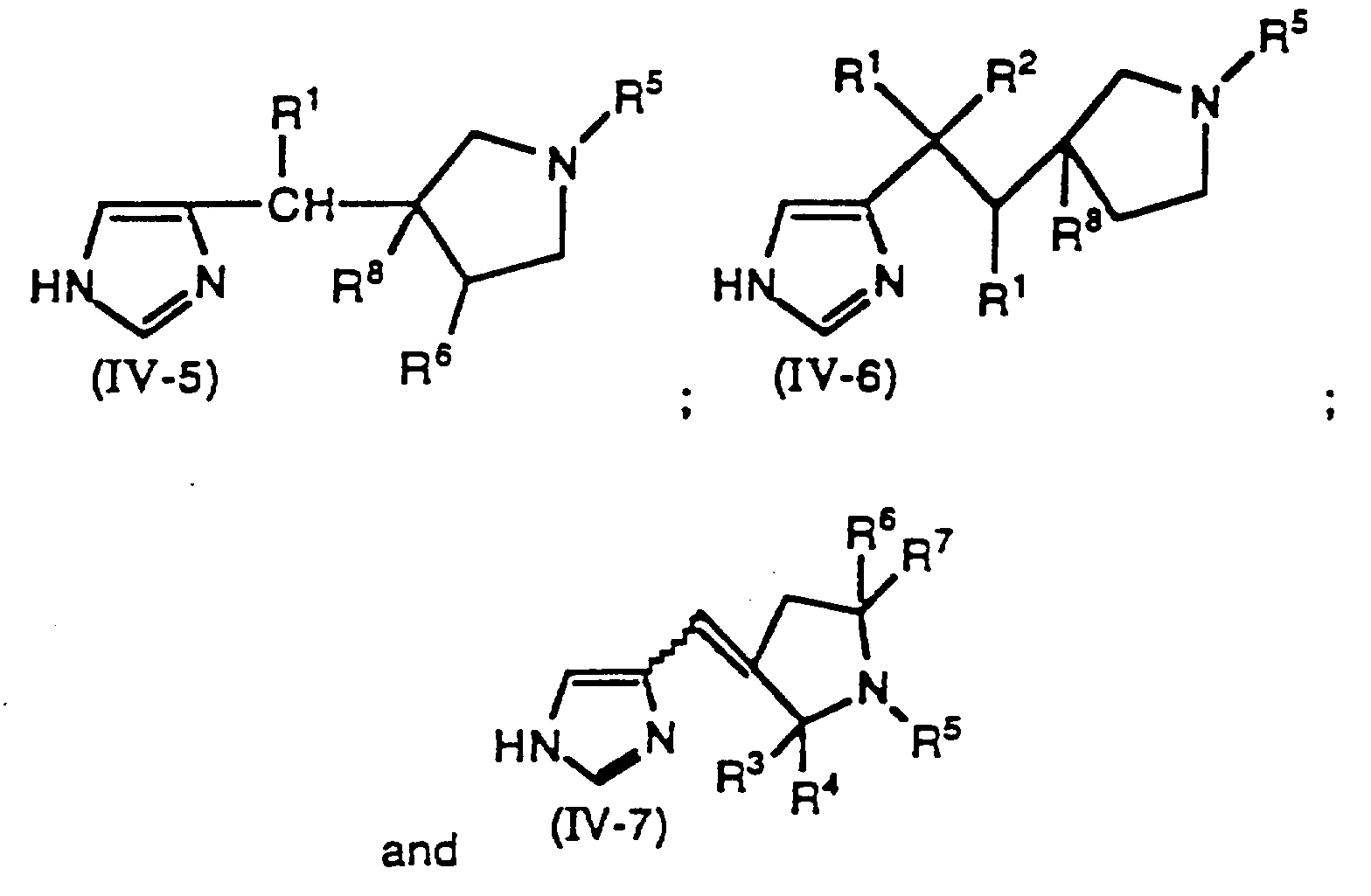
- Representative compounds of Formula IV include compounds of Formulas IV-1, IV-2, IV-3, IV-4, IV-5, IV-6 and IV-7: wherein R 1 , R 2 , R 3 , R 4 , R 5 , R 6 , R 7 , and R 8 are as defined for Formula I.
- Representative compounds of Formula IV also include compounds of Formulas IV-8, IV.9, and IV-10: wherein R 1 , R 3 , R 5 , and R 6 are as defined for formula I, especially such compounds wherein R 5 is H or methyl, with R 1 preferably being hydrogen.
- Representative compounds of Formula I include
- Certain compounds of the invention may exist in different isomeric (e.g., enantiomers and diastereoisomers) forms.
- the invention contemplates all such isomers both in pure form and in admixture, including racemic mixtures. Enol forms are also included.
- the compounds of Formula I can exist in unsolvated as well as solvated forms, including hydrated forms, e.g., hemi-hydrate.
- solvated forms including hydrated forms, e.g., hemi-hydrate.
- pharmaceutically acceptable solvents such as water, ethanol and the like are equivalent to the unsolvated forms for purposes of the invention.
- Certain compounds of the invention will be acidic in nature, e.g. those compounds which possess a carboxyl or phenolic hydroxyl group. These compounds may form pharmaceutically acceptable salts. Examples of such salts may include sodium, potassium, calcium, aluminum, gold and silver salts. Also contemplated are salts formed with pharmaceutically acceptable amines such as ammonia, alkyl amines, hydroxyalkylamines, N-methylglucamine and the like.
- Certain basic compounds of the invention also form pharmaceutically acceptable salts, e.g., acid addition salts.
- the nitrogen atoms may form salts with acids.
- suitable acids for salt formation are hydrochloric, sulfuric, phosphoric, acetic, citric, oxalic, malonic, salicylic, malic, fumaric, succinic, ascorbic, maleic, methanesulfonic and other mineral and carboxylic acids well known to those in the art.
- the salts are prepared by contacting the free base form with a sufficient amount of the desired acid to produce a salt in the conventional manner.
- the free base forms may be regenerated by treating the salt with a suitable dilute aqueous base solution such as dilute aqueous sodium hydroxide, potassium carbonate, ammonia and sodium bicarbonate.
- a suitable dilute aqueous base solution such as dilute aqueous sodium hydroxide, potassium carbonate, ammonia and sodium bicarbonate.
- the free base forms differ from their respective salt forms somewhat in certain physical properties, such as solubility in polar solvents, but the acid and base salts are otherwise equivalent to their respective free base forms for purposes of the invention.
- Processes (I) to (XI) form further aspects of the invention for producing the compounds of Formula I indicated. 1) deprotecting compound (10) by treatment with dilute aqueous acid, at a temperature of 25 to 90°C, to produce compound (11);
- Step 1 commercially available compound (1) is dissolved in a suitable alcohol, ROH wherein R is a lower alkyl such as a C 1 to C 6 alkyl (e.g., methyl, ethyl, isopropyl and the like), preferably methanol, containing a catalytic amount of concentrated hydrochloric acid or similar acid.
- ROH a lower alkyl such as a C 1 to C 6 alkyl (e.g., methyl, ethyl, isopropyl and the like), preferably methanol, containing a catalytic amount of concentrated hydrochloric acid or similar acid.
- the reaction mixture is heated at a temperature of about 50 to about 70°C to produce compound (2).
- esterification methods known in the art that may also be employed.
- Step 2 compound (2) is reacted with compound (3) in a polar organic solvent at a temperature of about 0 to about 50°C in the presence of an organic base to produce compound (4).
- Z represents the protecting group: (trityl group).
- Z can be other protecting groups, such as 2-(trimethylsilyl)ethoxymethyl, benzyloxycarbonyl, and the like; however, unless stated otherwise, Z preferably represents the trityl group in the processes described below for making the compounds of this invention.
- Suitable organic solvents include: DMF (N, N-dimethylformamide), CH 2 Cl 2 and the like. DMF is preferred.
- triethylamine is used as the base.
- Other suitable bases include N,N-diisopropylethylamine and the like.
- Step 3 the enolate of compound (4) reacts with R 8 -L in an organic solvent to produce compound (5).
- the reaction is conducted at a temperature in the range of about 0 to about 50°C.
- L is a suitable leaving group such as Cl, Br, I and the like.
- LDA lithium diisopropylamide
- Suitable organic solvents include tetrahydrofuran, 1,4-dioxane and the like.
- THF tetrahydrofuran
- Step 4 the enolate of compound (5) is reacted with compound (6) in an organic solvent in the presence of a Lewis acid to produce compound (7).
- Suitable organic solvents include tetrahydrofuran, diethyl ether, 1,4-dioxane and the like.
- tetrahydrofuran or diethyl ether is used.
- Suitable organic bases used to generate the anion of (5) include lithium diisopropylamide, LiN(Si(CH 3 ) 3 ) 2 , and NaH.
- LiN(Si(CH 3 ) 3 ) 2 is used.
- Lewis acids include BF 3 •(C 2 H 5 ) 2 O, (CH 3 ) 3 SiCl and the like, with BF 3 •(C 2 H 5 ) 2 O being preferred.
- the reaction is conducted at a temperature within the range of about -78 to about 0°C.
- Compound (7) is converted to compound (8) by reacting compound (7) with Al(R 12 ) 3 in an organic solvent at a temperature of about 50°C.
- R 12 is a suitable alkyl group such as methyl, ethyl, isopropyl, butyl, and the like.
- Methylene chloride is a preferred solvent for this reaction, but others, such as 1,2-dichloroethane, can be employed.
- Step 5 compound (8) is reduced to compound (9).
- the reaction is conducted in an organic solvent at a temperature within the range of about 20 to about 70°C using a known reducing agent.
- suitable reducing agents include DIBALH (diisobutyl aluminum hydride) and AlH 3 .
- tetrahydrofuran is used as the organic solvent, but other suitable solvents include 1,4-dioxane and the like.
- Step 6 compound (9) is reacted with (i) R 5 -X (when R 5 is -C(O)R 10 , -C(O)OR 10' , -C(O)NR 10 R 11 or alkyl) in an organic solvent optionally in the presence of a siutable base (e.g., triethylamine); or (ii) R 5A -CHO (when R 5 is alkyl, cycloalkyl, allyl, propargyl, benzyl or substituted benzyl) in the presence of NaBH 3 (CN) (sodium cyanoborohydride) or other hydrogenating conditions (e.g. H 2 /Pd/ROH) in an organic solvent; to produce compound (10).
- a siutable base e.g., triethylamine
- R 5A -CHO when R 5 is alkyl, cycloalkyl, allyl, propargyl, benzyl or substituted benzyl
- R 5A represents an R 5 group that has one less -CH 2 - group.
- CH 2 Cl 2 is used as the solvent when R 5 -X is used, and tetrahydrofuran or an alcohol is used as the solvent when R 5A -CHO is used.
- X represents a suitable leaving group such as Cl, Br, I, or -OCH 3 .
- the reaction ((i) or (ii)) can be performed at a temperature within the range of about -30 to about 80°C.
- reaction is performed at a temperature in the range of about 20 to about 110°C.
- compounds wherein R 5 is -C(O)NR 10 R 11 may be made from compounds wherein R 5 is -C(O)OR 10' by reacting such compounds with NHR 10 R 11 in an organic solvent (e.g., THF) at a temperature of about 25 to about 100°C.
- organic solvent e.g., THF
- Compound (9), or compound (10) wherein R 5 is -C(O)O(t-butyl) can be reacted with aqueous acid (e.g., HCI, HBr, and the like), at a temperature of about 25 to about 100°C, to produce compound (11) wherein R 5 is H.
- aqueous acid e.g., HCI, HBr, and the like
- Step 7 compound (10) is deprotected by treatment with dilute aqueous acid, such as HCI or HBr, at a temperature of about 25 to about 90°C to produce compound (11).
- dilute aqueous acid such as HCI or HBr
- Other protecting groups are removed by methods well known in the art.
- intermediate compounds wherein the imidazole nitrogen is protected by Z and the nitrogen of the cyclic four or five membered amine is substituted with -C(O)C(t-butyl) or unsubstituted, i.e., hydrogen is bound to the amine nitrogen, such as in compounds (10) or (9), respectively, such intermediate compounds can be reacted with aqueous acid (e.g., HCI, HBr, and the like), at a temperature of about 25 to about 100°C, to produce deprotected final products wherein R 5 is H, e.g., compound (11).
- aqueous acid e.g., HCI, HBr, and the like
- Step 1 urocanic acid (12) is heated with a catalytic amount of concentrated sulfuric acid in a solvent R 13 OH to produce a compound (13).
- R 13 is an alkyl group such as methyl, ethyl, and the like.
- the reaction is conducted at a temperature equivalent to the boiling point of the solvent (R 13 OH), for example 65°C for methanol.
- Step 2 compound (13) is reacted with trityl chloride (see compound (3) in Preparation A above) to produce compound (14), wherein Z represents the trityl group.
- Other suitable compounds which provide protecting groups (Z) which can be used instead of trityl chloride include SEM (2-(trimethylsilyl)ethoxymethyl) chloride.
- Step 3 compound (14) (from Step 2) is reacted with compound (15) to produce compound (16).
- the reaction takes place at a temperature within the range of about 20 to about 100°C in an organic solvent containing an organic base.
- organic bases include DBU (1, 8-diazabicyclo[5.4.0]undec-7-ene), and TMG (1, 1, 3, 3-tetramethylguanidine).
- Suitable solvents include acetonitrile, tetrahydrofuran, N, N-dimethylformamide and the like.
- Step 4 compound (16) (from Step 3) is hydrogenated to produce compound (17).
- the hydrogenation takes place in an organic solvent, using Raney-Nickel, at a temperature of about 20 to about 60°C.
- ethanol is used as the organic solvent. Under these conditions cyclization occurs in situ to provide the desired lactam (17).
- Step 5 the anion of compound (17) is reacted with R 14 -L to place the R 14 on the indicated nitrogen atom in compound (18).
- R 14 can be a suitable protecting group such as Si(CH 3 ) 2 C(CH 3 ) 3 or -C(O)O(t-butyl), or R 14 can be an alkyl, cycloalkyl, benzyl, substitued benzyl, allyl, or propargyl group.
- L is a leaving group, such as Cl, Br, I or -OSO 2 CF 3 .
- the reaction is conducted in an organic solvent such as THF, diethyl ether, 1,4-dioxane or DMSO in the presence of a suitable base, such as lithium diisopropylamide or NaH.
- a suitable base such as lithium diisopropylamide or NaH.
- the reaction takes place at a temperature within the range of about -78 to about 80°C.
- Step 6 the enolate of compound (18) reacts with R 6 -X and then with R 7 -X to produce compound (19).
- X represents a suitable leaving group, such as Cl, Br, I or -OSO 2 CF 3 .
- Each reaction to place each substituent group on the ring takes place in an organic solvent using an organic base.
- Tetrahydrofuran is the solvent usually used; however, other suitable solvents include 1,4-dioxane, diethyl ether and the like.
- organic bases include lithium diisopropylamide, M + N[Si(CH 3 ) 3 ] 2 , KH and the like.
- M + represents a suitable metal cation such as Na, Li, K, and the like.
- the reaction is usually conducted at a temperature of about -78 to about 80 °C.
- Step 7 compound (19) is reduced to compound (20) with a reducing agent in an organic solvent at a suitable temperature.
- a reducing agent LiAlH 4 (lithium aluminium hydride) is used with tetrahydrofuran at a temperature of about 0 to about 70°C.
- suitable reducing agents include BH 3 (borane) and the like.
- organic solvents which may be used include 1,4-dioxane and the like.
- R 14 is alkyl, cycloalkyl, benzyl, substituted benzyl, allyl, or propargyl.
- R 14 is -Si(CH 3 ) 2 C(CH 3 ) 3 or -C(O)O(t-butyl),
- Step 8 following reaction path 1, compound (20) is deprotected by following the procedure in Step 7 of Preparation A to produce compound (22).
- reaction path 2 when R 14 is -Si(CH 3 ) 2 C(CH 3 ) 3 , compound (20) is treated with tetrabutylammonium fluoride in tetrahydrofuran at a temperature of about 0 to about 50°C to produce compound (21), or compound (20), when R 14 is -C(O)O(t-butyl), is treated with dilute aqueous acid (e.g., HCI, HBr and the like).
- dilute aqueous acid e.g., HCI, HBr and the like.
- Step 9 the procedures in Steps 6 and 7 of Preparation A are followed so that compound (21) may be converted to compound (22).
- Step 1 compound (23), synthesized according to Degraw et al. J. Med. Chem., 1977 , 20 , 1671, wherein Z is the trityl group, is reacted with R 8 -L in an organic solvent, in the presence of an organic base, at a temperature of about 0 to about 50°C to produce compound (24).
- L is a suitable leaving group such as, for example, halogen (halides) selected from the group consisting of: Cl, Br, and I; -OSO 2 -C 6 H 4 -CH 3 (wherein C 6 H 4 is phenyl); -OSO 2 -CH 3 ; and the like.
- Suitable organic bases include lithium diisopropylamide, LiN[Si(CH 3 ) 3 ] 2 , and the like.
- the organic solvent is tetrahydrofuran.
- suitable solvents which may be used include 1,4-dioxane and the like.
- Step 2 the anion of compound (24) is reacted with compound (25) (wherein R is alkyl) to produce compound (26).
- the reaction is conducted at a temperature of about -78 to about 50°C in an organic solvent containing an organic base.
- Suitable organic bases include lithium diisopropylamide, LiN(Si(CH 3 ) 3 ) 2 , and the like.
- the organic solvent is tetrahydrofuran.
- suitable solvents which may be used include DMF and the like.
- Step 3 following the procedure set forth in Step 6 of Preparation B, compound (26) is substituted with substituent groups R 6 and R 7 to produce compound (27).
- compound (27) is prepared by the reaction of compound (24) with compound (26A) under similar conditions for the reaction of compound (24) with compound (25).
- Step 4 compound (27) is reduced using H 2 and Raney-Nickel.
- the reduction takes place in ethanol at a temperature of about 25 (roorn temperature) to about 80°C.
- Other reducing agents can be used such as NaBH 4 /CoCl 2 wherein the reduction takes place in ethanol at about room temperature.
- Subsequent cyclization in situ provides compound (28).
- Step 5 compound (28) is reduced to compound (29) in tetrahydrofuran using LiAlH 4 and a reaction temperature of about 0 to about 70°C.
- Another suitable reducing agent is BH 3 .
- Step 6 compound (29) is converted to compound (30) according to the procedure described in Step 6 of Preparation A.
- Step 7 compound (30) is deprotected to produce compound (31) by following the procedure described in Step 7 of Preparation A.
- Step 1 compound (32) is reacted with compound (33) to produce compound (34).
- the reaction is conducted in tetrahydrofuran at a temperature of about 25 to about 70°C.
- Other usable organic solvents besides tetrahydrofuran include DMF and the like.
- Compound (32) is prepared following the literature procedure set forth in J. L. Kelley et al., J. Med. Chem., 20 , 721(1977).
- the Wittig reagent, compound (33) is either commercially available or may be prepared from the corresponding ⁇ -halo ketone and triphenylphosphine using standard reaction conditions known in the art.
- Step 2 compound (34) is reacted with compound (35) to produce compound (36).
- the reaction is carried out according to the procedure set forth in Step 3 of Preparation B.
- Step 3 compound (36) is hydrogenated at a temperature of about 25 to about 70°C using H 2 and Raney-Nickel.
- the reaction is conducted in ethanol in similar fashion to the reaction described in Step 4 of Preparation C.
- Step 4 following the procedure in Step 6 of Preparation A, compound (37) is reacted with R 5 -X or R 5A -CHO to produce compound (38).
- Step 5 compound (38) is deprotected at a temperature of about 50 to about 100°C using aqueous acid such as 10 % aqueous hydrochloric acid to produce compound (39).
- aqueous acid such as 10 % aqueous hydrochloric acid
- Step 1 compound (40) is reacted with di-tert-butyl dicarbonate ((tBOC) 2 O) in an organic solvent in the presence of an organic base.
- the reaction is conducted at a temperature of about 0 to about 30°C.
- methylene chloride is used as the organic solvent, but other suitable organic solvents include DMF and the like.
- Triethylamine is used as the organic base.
- Other bases which can be used include 4-dimethylaminopyridine and the like.
- r represents 1 or 2.
- the desired starting reactant (40) can be obtained commercially.
- the BOC group is chosen as an activating group on nitrogen which increases the kinetic acidity of the ⁇ -proton such that a lithio salt would result (for example, Step 2).
- Other activating groups on nitrogen known in the art that can also be employed include nitroso, phosphoryl, hindered acyl, and formamidyl. (see Aldrichimica Acta, Vol. 8, No. 3, 1985).
- Step 2 the anion of compound (41) is reacted with compound (42), to produce compound (43).
- the reaction is conducted in an organic solvent containing an organic base and TMEDA (tetramethylethylenediamine).
- TMEDA tetramethylethylenediamine
- the reaction is conducted at a temperature of about -78 to about 25°C (room temperature). Tetrahydrofuran is preferably used as the solvent, other suitable solvents include diethyl ether and the like.
- the anion of (41) is prepared by metalation of (41) with sec-butyllithium in THF at -78°C.
- Compound (42) is obtained by reacting compound (32) with an organometallic reagent R 1 M, wherein M is Li or MgBr, and then with thionyl chloride (SOCl 2 ).
- Step 3 compound (43) is treated with HCI or similar acid in an inert organic solvent such as ethyl acetate or dioxane, at a temperature of about 0°C to selectively deprotect (43) thus producing compound (44).
- an inert organic solvent such as ethyl acetate or dioxane
- Step 4 compound (44) is reacted with R 5 -X or R 5A -CHO in accordance with the procedure set forth in Step 6 of Preparation A to produce compound (44A).
- Step 5 compound (44A) is then deprotected to produce compound (45) by following the procedure set forth in Step 7 of Preparation A.
- Step 1 compound (41)--see Step 1 of Preparation E--is reacted with compound (32) in accordance with the procedure set forth in Step 2 of Preparation E. r is 1 or 2.
- Step 2 compound (46) is oxidized to produce compound (47).
- the oxidation is accomplished by treating compound (46) with an oxidizing agent, such as MnO 2 or PDC (pyridinium dichromate), in an inert organic solvent, such as tetrahydrofuran or methylene chloride, at a temperature of about 20 to about 70°C.
- an oxidizing agent such as MnO 2 or PDC (pyridinium dichromate
- an inert organic solvent such as tetrahydrofuran or methylene chloride
- Step 3 compound (47) reacts, under usual Wittig reaction conditions, with compound (48) in an organic solvent at a temperature of about 25 to about 70°C to produce compound (49).
- R 1A represents an R 1 group which has one less -CH 2 - group.
- the organic solvent is tetrahydrofuran; however, other suitable solvents, such as 1,4-dioxane and the like, can be used.
- Step 4 compound (43) is produced when compound (49) is hydrogenated in tetrahydrofuran with H 2 using a Pd-C (palladium/carbon) catalyst.
- Pd-C palladium/carbon
- organic solvents which can be used include ethyl acetate, methanol and the like.
- suitable metal catalysts such as Pt, Pd-Al 2 O 3 , Ra-Ni, NiB, and Pd-CaCO 3 can also be employed as the hydrogenation catalyst.
- Step 5 conversion of compound (43) to compound (44) and then to compound (45) is accomplished by following the same process described in Steps 3, 4, and 5 of Preparation E.
- Step 1 the anion of compound (50) reacts with compound (32) in an organic solvent at a temperature of about -78 to about 25°C to produce compound (51) wherein p is 1 or 2.
- Suitable organic solvents include tetrahydrofuran and the like.
- the organic base used to generate the anion of (50) is lithium diisopropylamide or M + N[Si(CH 3 ) 3 ] 2 wherein M + is a metal cation such as Li, Na, or K. Z is trityl.
- Compound (50) is obtained from the commercially available unprotected precursor according to known methods--see, for example, Step 5 of Preparation B.
- Step 2 compound (51) is reacted with R 1 -Q, wherein Q is Li or MgBr, in tetrahydrofuran containing CuCN and a Lewis acid, such as BF 3 , (CH 3 ) 3 SiCl and the like, to produce compound (52).
- a Lewis acid such as BF 3 , (CH 3 ) 3 SiCl and the like.
- the reaction is conducted at a temperature of about -78 to about 20°C.
- Tetrahydrofuran is the preferred organic solvent; however, other suitable solvents include diethyl ether and the like.
- the reduction is conducted in tetrahydrofuran; however, other organic solvents, such as 1,4-dioxane and the like, can be used.
- Step 4 compound (53) is converted to compound (54) according to the processes described in Steps 8 and 9 of Preparation B for the conversion of compound (20) to compound (22).
- Other suitable solvents besides tetrahydrofuran can also be used, such as DMF and the like.
- Other suitable bases which can be used to generate the anion of (50) include NaN[Si(CH 3 ) 3 ] 2 , KN[Si(CH 3 ) 3 ] 2 , KH and the like.
- Compound (52) is converted to compound (54) following the procedures in Steps 3 and 4 of Preparation G.
- Compound (55) reacts with R 6 -M (wherein M is Li, ZnBr or MgBr) in tetrahydrofuran containing BF 3 •(C 2 H 5 ) 2 O and CuCN at a temperature of about -78 to about 20°C to produce compound (56).
- R 6 -M wherein M is Li, ZnBr or MgBr
- M is Li, ZnBr or MgBr
- tetrahydrofuran containing BF 3 •(C 2 H 5 ) 2 O and CuCN at a temperature of about -78 to about 20°C
- Other suitable solvents such as diethyl ether can be used.
- Compound (56) is converted to compound (57) in accordance with the reaction steps set forth in Preparation G or Preparation H.
- Compound (55) is obtained by reacting the commercially available unprotected precursor with R 14 -L according to known methods--see, for example, Step 5 of Preparation B.
- Compound (62) is produced by the reduction of compound (23) in tetrahydrofuran at a temperature of about 0 to about 70°C using diisobutylaluminum hydride as the reducing agent followed by an aqueous work up.
- reduction of compound (4) by bis(2-methoxyethoxy)aluminum hydride also can produce compound (62), see for example R. Kanazawa & T. Tokoroyama, Synthesis, 526(1976).
- Compound (59) is produced by reacting compound (62) in an organic solvent containing an organic base with R 1 -L and then with R 2 -L in accordance with the method set forth in Step 3 of Preparation A.
- the organic solvent is tetrahydrofuran and the organic base is lithium diisopropylamide.
- L is a suitable leaving group such as Cl, Br, I, -OSO 2 -CF 3 and the like.
- the sequence of the preparation of compound (59), from compound (4) or (23), can be switched, i.e., alkylation first to introduce R 1 and R 2 and then reduction.
- Q represents Li or MgBr.
- compound (58) is produced by either reacting compound (63) with (H 5 C 6 ) 3 P/CG 4 or (H 5 C 6 ) 3 PG 2 (see Fiser & Fiser, Reagents for Organic Synthesis, Vol. 1, p1247(1967)).
- compound (58) is produced by reacting compound (63) with Cl-SO 2 -C 6 H 4 -CH 3 , Cl-SO 2 -CH 3 or Cl-SO 2 -CF 3 , respectively, in methylene chloride containing triethylamine (as base) at a temperature of about -78 to about 0°C.
- Step 1 compound (65) is produced when compound (64) is reacted with (t-BOC) 2 O and triethylamine.
- the reaction is conducted in an organic solvent, such as methylene chloride or DMF, using a temperature within the range of about 0 to about 25°C (room temperature).
- Step 2 compound (66) is produced by treating compound (65) with an oxidizing agent such as pyridinium dichromate.
- the oxidation reaction is conducted in an organic solvent, such as methylene chloride, using a temperature of about 25 to about 50°C.
- Step 3 compound (67) is produced when the enolate of compound (66) is reacted with R 3 -L wherein L is a suitable leaving group, such as halogen (e.g., Cl, Br, or I), -OSO 2 CF 3 and the like.
- L is a suitable leaving group, such as halogen (e.g., Cl, Br, or I), -OSO 2 CF 3 and the like.
- the reaction takes place in an organic solvent, such as tetrahydrofuran or benzene, containing a suitable base, such as NaH, LDA, or LiN(Si(CH 3 ) 3 ) 2 .
- a suitable base such as NaH, LDA, or LiN(Si(CH 3 ) 3 ) 2 .
- tetrahydrofuran is used as the solvent and LDA is used as the base.
- the reaction is conducted at a temperature of about 0 to about 80°C.
- Step 4 compound (67) is reacted with R 4 -L using the same procedure set forth in Step 3 in order to produce compound (68).
- Step 5 compound (69) is produced When compound (68) is first reacted with R 6 -L and then reacted with R 7 -L Each reaction is conducted using the same procedure set forth in Step 3.
- Step 6 compound (71) is obtained When compound (69) is reacted with compound (70) The reaction takes place in an organic solvent, such as tetrahydrofuran, DMF or benzene, containing a suitable base, such as NaH, LDA, or LiN(Si(CH 3 ) 3 ) 2 . Preferably, tetrahydrofuran is used as the solvent and LDA is used as the base. The reaction is conducted at a temperature of about 0 to about 80°C. Compound (70) is obtained by reacting with P(C 6 H 5 ) 3 in an organic solvent, such as methylene chloride, CH 3 CN, tetrahydrofuran and the like, using a temperature of about 25 to about 50°C. In compounds (70) and (70A), Z represents trityl or SEM.
- an organic solvent such as tetrahydrofuran, DMF or benzene
- a suitable base such as NaH, LDA, or LiN(Si(CH
- Step 7 compound (72) is produced by using compound (71) and following the same procedures set forth in Steps 3, 4 and 5 of Preparation E.
- Steps 3, 4 and 5 are only if desired and R 3 , R 4 , R 5 , R 6 , and R 7 are as defined for Formula I.
- certain functional groups may be incompatable with some transformations described herein and consequently it is sometimes desirable and/or necessary to protect certain groups during the reactions.
- Certain protecting groups are employed in the above processes but, as those skilled in the art will recognize, other protecting groups may be used in their place.
- Conventional protecting groups are operable as described in Greene, T.W., and Wuts, P.G.M., "Protective Groups In Organic Synthesis,” John Wiley & Sons, New York, 1991; the disclosure of which is incorporated herein by reference thereto. After the reaction or reactions, the protecting groups may be removed by standard procedures.
- the compounds of this invention are either agonists or antagonists of the histamine H 3 receptor.
- the binding affinity of the compounds of the invention to the H 3 receptor may be demonstrated by the procedure described below:
- the source of the H 3 receptors in this experiment was guinea pig brain.
- the animals used weighed 400-600 g.
- the tissue was homogenized using a Polytron in a solution of 50 mM Tris, pH 7.5.
- the final concentration of tissue in the homogenization buffer was 10% w/v.
- the homogenates were centrifuged at 1000 x g for 10 min. in order to remove clumps of tissue and debris.
- the resulting supernatants were then centrifuged at 50,000 x g for 20 min. in order to sediment the membranes, which were next washed 3 times in homogenization buffer (50,000 x g for 20 min. each).
- the membranes were frozen and stored at -70°C until needed.
- inert, pharmaceutically acceptable carriers can be either solid or liquid.
- Solid form preparations include powders, tablets, dispersible granules, capsules, cachets and suppositories.
- the powders and tablets may be comprised of from about 5 to about 70 percent active ingredient.
- Suitable solid carriers are known in the art, e.g. magnesium carbonate, magnesium stearate, talc, sugar, lactose. Tablets, powders, cachets and capsules can be used as solid dosage forms suitable for oral administration.
- a low melting wax such as a mixture of fatty acid glycerides or cocoa butter is first melted, and the active ingredient is dispersed homogeneously therein as by stirring. The molten homogeneous mixture is then poured into convenient sized molds, allowed to cool and thereby solidify.
- Liquid form preparations include solutions, suspensions and emulsions. As an example may be mentioned water or water-propylene glycol solutions for parenteral injection.
- Liquid form preparations may also include solutions for intranasal administration.
- Aerosol preparations suitable for inhalation may include solutions and solids in powder form, which may be in combination with a pharmaceutically acceptable carrier, such as an inert compressed gas.
- a pharmaceutically acceptable carrier such as an inert compressed gas.
- solid form preparations which are intended to be converted, shortly before use, to liquid form preparations for either oral or parenteral administration.
- liquid forms include solutions, suspensions and emulsions.
- the compounds of the invention may also be deliverable transdermally.
- the transdermal compositions can take the form of creams, lotions, aerosols and/or emulsions and can be included in a transdermal patch of the matrix or reservoir type as are conventional in the art for this purpose.
- the compound is administered orally.
- the pharmaceutical preparation is in unit dosage form.
- the preparation is subdivided into unit doses containing appropriate quantities of the active component, e.g., an effective amount to achieve the desired purpose.
- the quantity of active compound in a unit dose of preparation may be varied or adjusted from about 0.1 mg to 1000 mg, more preferably from about 1 mg to 500 mg, according to the particular application.
- the actual dosage employed may be varied depending upon the requirements of the patient and the severity of the condition being treated. Determination of the proper dosage for a particular situation is within the skill of the art. Generally, treatment is initiated with smaller dosages which are less than the optimum dose of the compound. Thereafter, the dosage is increased by small increments until the optimum effect under the circumstances is reached. For convenience, the total daily dosage may be divided and administered in portions during the day if desired.
- the amount and frequency of administration of the compounds of the invention and the pharmaceutically acceptable salts thereof will be regulated according to the judgment of the attending clinician considering such factors as age, condition and size of the patient as well as severity of the symptoms being treated.
- a typical recommended dosage regimen is oral administration of from 1 mg to 2000 mg/day preferably 10 to 1000 mg/day, in one to four divided doses to achieve relief of the symptoms.
- the compounds are non-toxic when administered within this dosage range.
- the cis -lactam 5c (0.60 g, 2.0 mmol) was treated in the same manner as described for the preparation of pyrrolidine 6t .
- the crude reaction product was purified by Rash chromatography (gradient elution; CH 2 Cl 2 :. MeOH/NH 3 , 6:1 to 4:1) to give 6c as a colorless oil (0.36 g, 63%).
- the lactam 26 (1.05 g, 2.58 mmol) was treated with a solution of lithium aluminum hydride in diethyl ether (1.0 M, 13.0 mL, 13.0 mmol) as described for the preparation of the pyrrolidine 6t (see Example 1, Step E).
- the crude product was purified by flash chromatography (gradient elution: CH 2 Cl 2 : CH 3 OH/NH 3 , 8:1 to 7:1 to 6:1) to give the pyrrolidine 27 as a colorless glass (720 mg, 71%).
- Compound 49 was reduced by mixing 1.5 g of 49 , 1.5 g of Raney-Ni and 1.5 g of anhydrous Na 2 SO 4 in 50 mL of absolute ethanol and subjecting the resulting mixture to 60 psi. of H 2 for 26 hours.
- the reaction mixture was filtered through a pad of celite and the pad was washed with ethanol and CH 2 Cl 2 .
- the filtrate was concentrated to yield 0.83 g of 50 (62%).
- active compound is used to designate the compound Any compound of structural formula I can be used as active compound the pharmaceutical composition examples which follow.
- Tablets No. Ingredients mg/tablet mg/tablet 1. Active compound 100 500 2. Lactose USP 122 113 3. Corn Starch, Food Grade, as a 10% paste in Purified Water 30 40 4. Corn Starch, Food Grade 45 40 5. Magnesium Stearate 3 7 Total 300 ⁇ 700 ⁇
Landscapes
- Health & Medical Sciences (AREA)
- Chemical & Material Sciences (AREA)
- Organic Chemistry (AREA)
- Engineering & Computer Science (AREA)
- Bioinformatics & Cheminformatics (AREA)
- General Health & Medical Sciences (AREA)
- Chemical Kinetics & Catalysis (AREA)
- General Chemical & Material Sciences (AREA)
- Medicinal Chemistry (AREA)
- Nuclear Medicine, Radiotherapy & Molecular Imaging (AREA)
- Pharmacology & Pharmacy (AREA)
- Life Sciences & Earth Sciences (AREA)
- Animal Behavior & Ethology (AREA)
- Public Health (AREA)
- Veterinary Medicine (AREA)
- Neurosurgery (AREA)
- Neurology (AREA)
- Biomedical Technology (AREA)
- Immunology (AREA)
- Pain & Pain Management (AREA)
- Ophthalmology & Optometry (AREA)
- Psychiatry (AREA)
- Hospice & Palliative Care (AREA)
- Pulmonology (AREA)
- Anesthesiology (AREA)
- Rheumatology (AREA)
- Nutrition Science (AREA)
- Pharmaceuticals Containing Other Organic And Inorganic Compounds (AREA)
- Plural Heterocyclic Compounds (AREA)
- Acyclic And Carbocyclic Compounds In Medicinal Compositions (AREA)
- Agricultural Chemicals And Associated Chemicals (AREA)
Abstract
Description
- H3 receptor sites are known and are of current interest to those skilled in the art--for example, see: West, Jr. et al., "Biexponential Kinetics of (R)-α-[3H]Methylhistamine Binding to the Rat Brain H3 Histamine Receptor", Joumal of Neurochemistry, Vol. 55, No. 5, pp. 1612-1616, 1990; West, Jr. et al., "Identification of Two H3-Histamine Receptor Subtypes", Molecular Pharmacology, 38:610-613; and Korte et al., "Characterization and Tissue Distribution of H3 Histamine Receptors in Guinea Pigs by Nα-Methylhistamine", Biochemical and Biophysical Research Communications, Vol. 168, No. 3, pp. 979-986..
- Arrang et al. in U.S. 4,767, 778 (Issued August 30, 1988) disclose a pharmaceutical composition containing a histamine derivative of the formula:

- EP 0 338 939 discloses compounds of the formula:

- Derwent abstract 86-273706/42 for EP 0 197 840 discloses imidazole derivatives of the formula:


- Derwent abstract 90-184730/24 for U.S. 4,925,851 discloses 2- or 4-(2-(1H-imidazol-1-yl)ethyl) piperidine compounds useful as antitumour agents for inhibiting lymphoma, sarcoma, myeloma and leukaemia. The compounds have the formula:

- Derwent abstract 90-180087/24 for EP 372125A discloses compounds of the formula:

- Derwent abstract 88-309195/44 for U.S. 4935417 discloses compounds of the formula:
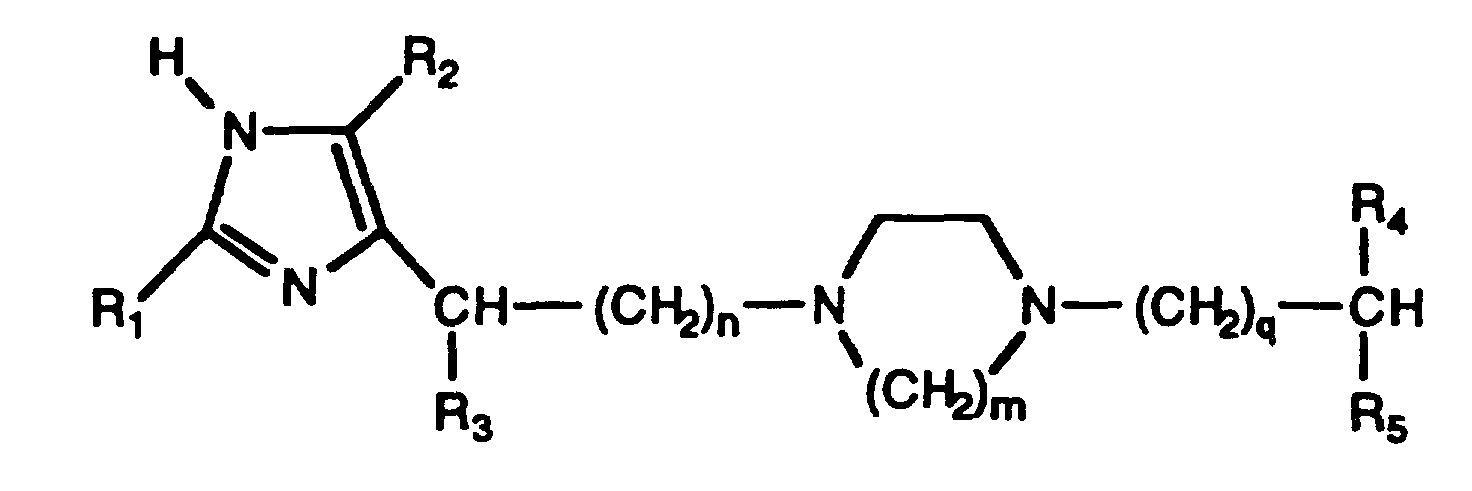
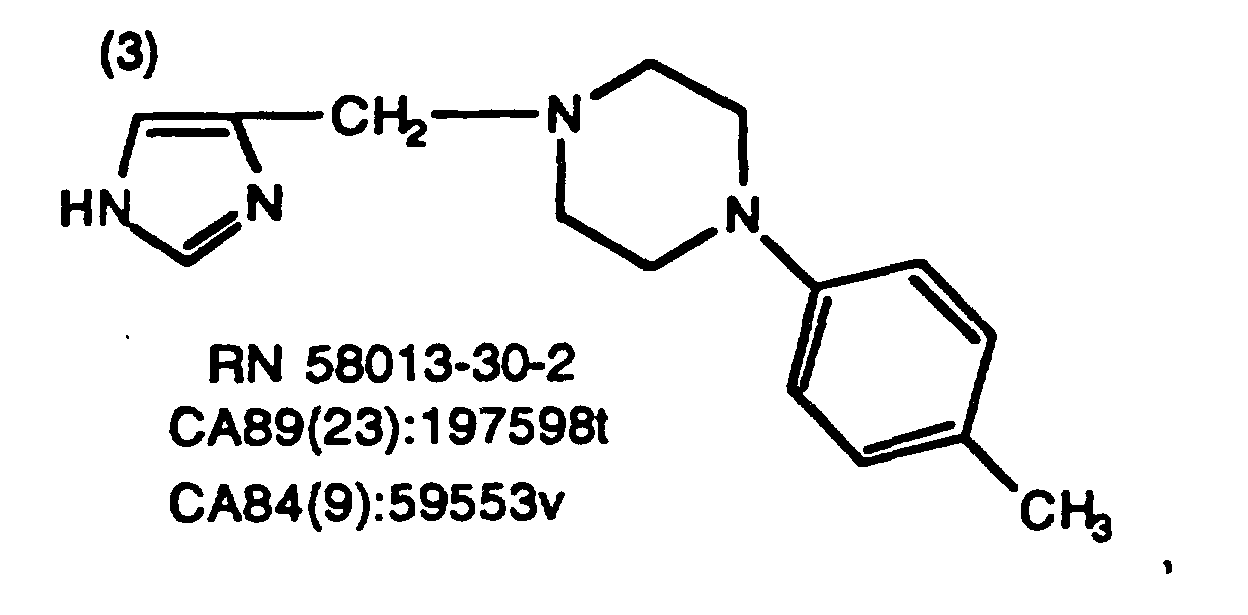
- Compounds known in the art include:


- Known compounds in the art also include compounds of the formula:


- Additionally known compounds include:



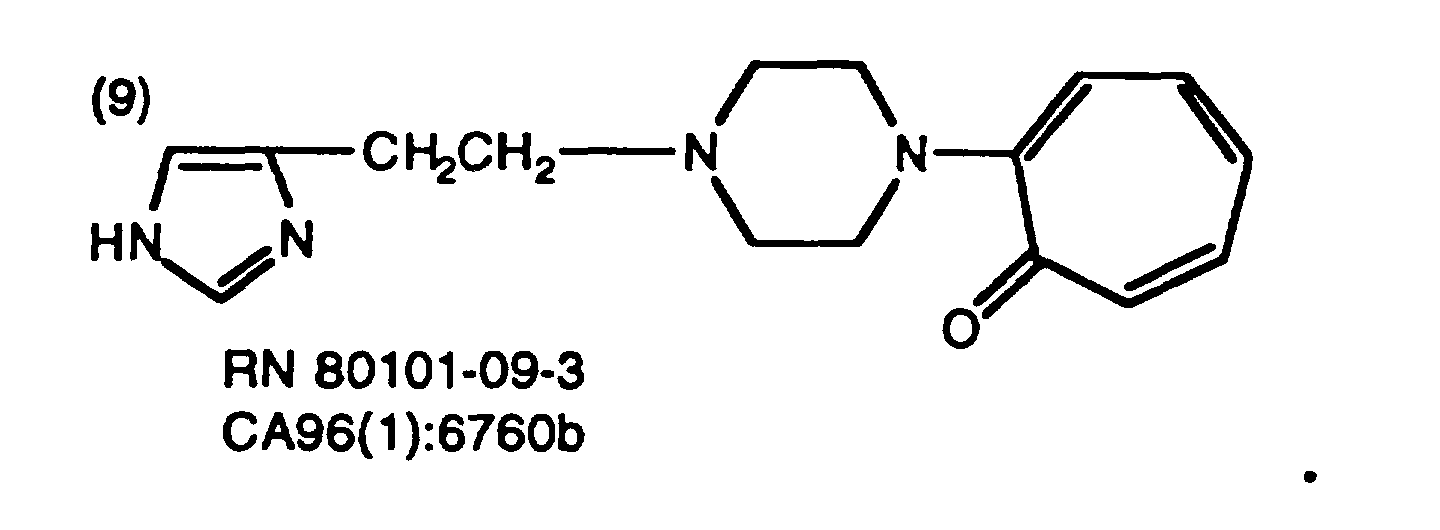
- In view of the art's interest in compounds which effect the H3 receptors, novel compounds having agonist or antagonist activity on H3 receptors would be a welcome contribution to the art. This invention provides just such a contribution by providing novel compounds having H3 agonist or antagonist activity.
- This invention provides compounds of the formula:

- (A) m is an integer selected from the group consisting of: 0, 1, and 2;
- (B) n and p are integers and are each independently selected from the group consisting of : 0, 1, 2, and 3 such that the sum of n and p is 2 or 3 such that when the sum of n and p is 2, T is a 4-membered ring and when the sum of n and p is 3, T is a 5-membered ring;
- (C) each R1, R2, R3, R4, R6, R7, and R8 is independently selected from the group consisting of:
- (1) H;
- (2) C1 to C6 alkyl;
- (3) C3 to C6 cycloalkyl; and
- (4) -(CH2)q-R9 wherein q is an integer of: 1 to 7, and R9 is selected from the group consisting of: phenyl, substituted phenyl, -OR10, -C(O)OR10, -C(O)R10, -OC(O)R10, -C(O)NR10R11, CN and -SR10 wherein R10 and R11 are as defined below, and wherein the substituents on said substituted phenyl are each independently selected from the group consisting of: -OH, -O-(C1 to C6)alkyl, halogen, C1 to C6 alkyl, -CF3, -CN, and -NO2, and wherein said substituted phenyl contains from 1 to 3 substituents; examples of -(CH2)q-R9 include benzyl, substituted benzyl and the like, wherein the substituents on the substituted benzyl are as defined above for said substituted phenyl;
- (D) R5 is selected from the group consisting of:
- (1) H;
- (2) C1 to C20 alkyl;
- (3) C3 to C6 cycloalkyl;
- (4) -C(O)OR10'; wherein R10' is the same as R10 defined below except that R10' is not H;
- (5) -C(O)R10;
- (6) -C(O)NR10R11;
- (7) allyl;
- (8) propargyl; and
- (9) -(CH2)q-R9, wherein q and R9 are as defined above with the proviso that when q is 1 then R9 is not -OH or -SH;
- (E) R10 and R11 are each independently selected from the group consisting of: H, C1 to C6 alkyl, and C3 to C6 cycloalkyl; and, for the substituent -C(O)NR10R11, R10 and R11, together with the nitrogen to which they are bound, can form a ring having 5, 6, or 7 atoms;
- (F) the dotted line (------) represents a double bond that is optionally present when m is 1, and T is a 5-membered ring, and n is not 0, and p is not 0 (i.e., the nitrogen in the ring is not bound directly to the carbon atom bearing the double bond), and when said double bond is present then R2 and R8 are absent;
- (G) when m is 2, each R1 is the same or different substituent for each m, and each R2 is the same or different substituent for each m;
- (H) when n is 2 or 3, each R3 is the same or different substituent for each n, and each R4 is the same or different substituent for each n; and
- (I) when p is 2 or 3, each R6 is the same or different substituent for each p, and each R7 is the same or different substituent for each p.
- This invention also provides pharmaceutical compositions comprising a pharmaceutically acceptable carrier and an effective amount of a Compound of Formula I.
- This invention further provides a method of treating allergy, (for example asthma), inflammation, hypertension, raised intraocular pressure (such as glaucoma)--i.e., a method of lowering intraocular pressure, sleeping disorders (e.g., hypersomnia, somnolence, narcolepsy and sleeplessness, such as insomnia), states of hyper and hypo motility and acidic secretion of the gastrointestinal tract, hypo and hyperactivity of the central nervous system (for example, agitation and depression) and other CNS disorders (such as Alzheimers, Schizophrenia, and migraine) comprising administering an effective amount of a compound of Formula I to a patient in need of such treatment.
- As used herein the following terms have the following meanings unless indicated otherwise:
- alkyl - represents a straight or branched, saturated hydrocarbon chain having from 1 to 20 carbon atoms;
- cycloalkyl - represents a saturated carbocydic ring having from 3 to 6 carbon atoms; and
- halogen (halo) - represents fluoro, chloro, bromo or iodo.
- Preferably, for compounds of Formula I, m is 0 or 1; R5 is selected from the group consisting of H and C1 to C20 alkyl and (CH2)q-R9 wherein R9 is phenyl; and R1 to R4 and R6 to R8 are each independently selected from the group consisting of: H, C1 to C6 alkyl, and -(CH2)q-R9 wherein R9 is phenyl. Most preferably, R5 is selected from the group consisting of H and methyl; and R1, R2, R3, R4, R6, R7, and R8 are each independently selected from the group consisting of: H, methyl, ethyl, pentyl, benzyl, and 2-phenylethyl.
- Representative compounds of this invention include compounds of the formula:


- Representative compounds of Formula II include compounds of Formulas II-1, II.2 and II-3:


- Preferably, for compounds of Formula II, R3, R4, R6, and R8 are H. Preferred compounds of Formula II are represented by compounds of Formulas IIB and IIC:

- Representative compounds of Formula IIA include compounds of Formulas IIA-1 and IIA-2:


- Representative compounds of Formula III include compounds of Formulas III-1 and III-2:


- Representative compounds of Formula IV include compounds of Formulas IV-1, IV-2, IV-3, IV-4, IV-5, IV-6 and IV-7:


- Representative compounds of Formula IV also include compounds of Formulas IV-8, IV.9, and IV-10:

- Representative compounds of Formula I include


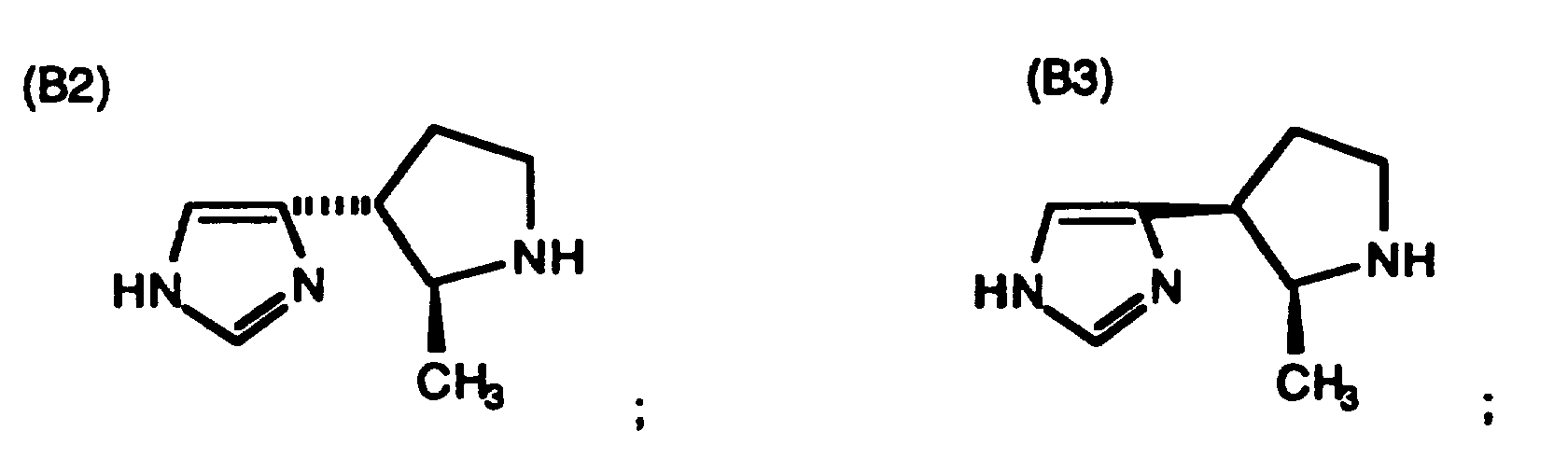


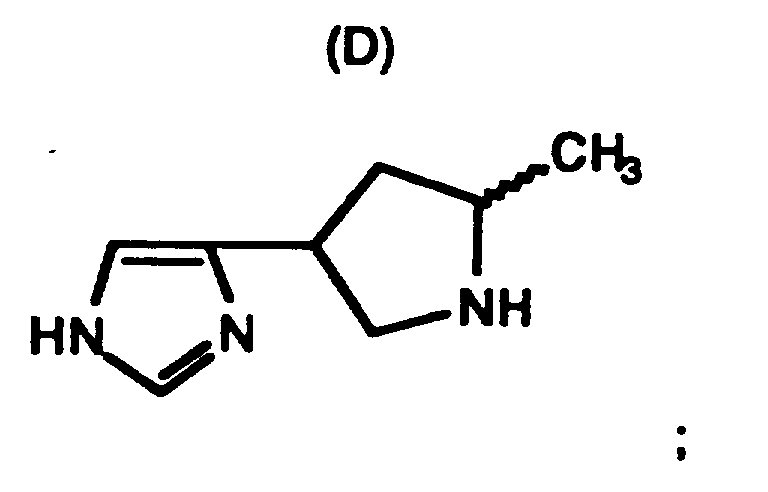


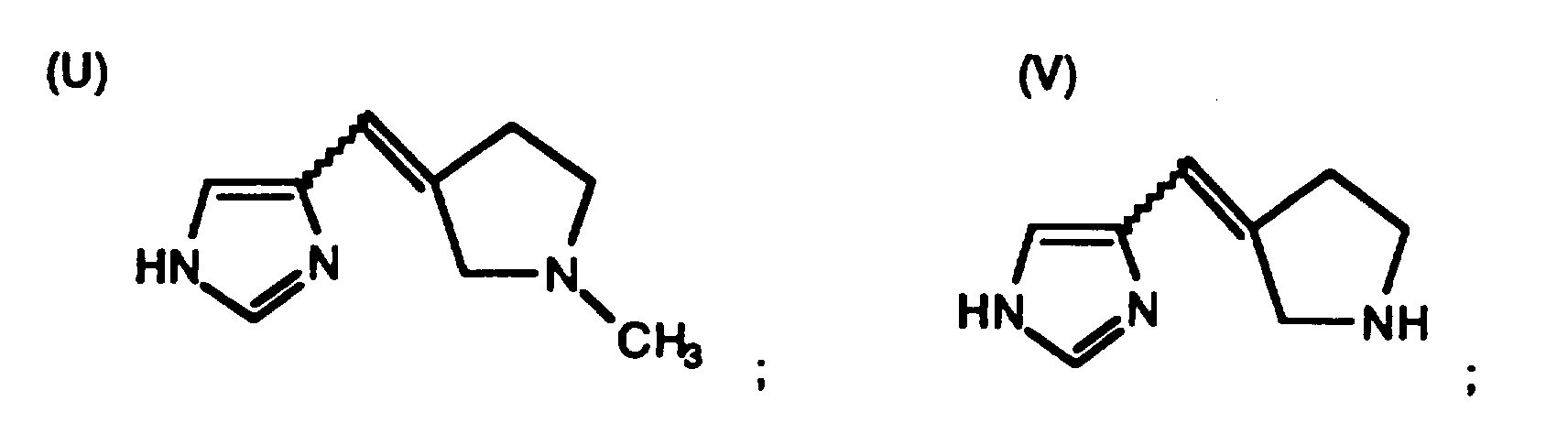


- Certain compounds of the invention may exist in different isomeric (e.g., enantiomers and diastereoisomers) forms. The invention contemplates all such isomers both in pure form and in admixture, including racemic mixtures. Enol forms are also included.
- The compounds of Formula I can exist in unsolvated as well as solvated forms, including hydrated forms, e.g., hemi-hydrate. In general, the solvated forms, with pharmaceutically acceptable solvents such as water, ethanol and the like are equivalent to the unsolvated forms for purposes of the invention.
- Certain compounds of the invention will be acidic in nature, e.g. those compounds which possess a carboxyl or phenolic hydroxyl group. These compounds may form pharmaceutically acceptable salts. Examples of such salts may include sodium, potassium, calcium, aluminum, gold and silver salts. Also contemplated are salts formed with pharmaceutically acceptable amines such as ammonia, alkyl amines, hydroxyalkylamines, N-methylglucamine and the like.
- Certain basic compounds of the invention also form pharmaceutically acceptable salts, e.g., acid addition salts. For example, the nitrogen atoms may form salts with acids. Examples of suitable acids for salt formation are hydrochloric, sulfuric, phosphoric, acetic, citric, oxalic, malonic, salicylic, malic, fumaric, succinic, ascorbic, maleic, methanesulfonic and other mineral and carboxylic acids well known to those in the art. The salts are prepared by contacting the free base form with a sufficient amount of the desired acid to produce a salt in the conventional manner. The free base forms may be regenerated by treating the salt with a suitable dilute aqueous base solution such as dilute aqueous sodium hydroxide, potassium carbonate, ammonia and sodium bicarbonate. The free base forms differ from their respective salt forms somewhat in certain physical properties, such as solubility in polar solvents, but the acid and base salts are otherwise equivalent to their respective free base forms for purposes of the invention.
- All such acid and base salts are intended to be pharmaceutically acceptable salts within the scope of the invention and all acid and base salts are considered equivalent to the free forms of the corresponding compounds for purposes of the invention.
- The following processes may be employed to produce compounds of Formula I. Unless stated otherwise, reactions are conducted at an appropriate temperature which allows the reaction to proceed at a reasonable rate to completion. Also, unless indicated otherwise, the substituent groups referred to in the following processes are as defined above for Formula I.
- The following Processes (I) to (XI) form further aspects of the invention for producing the compounds of Formula I indicated.


- 1) deprotecting compound (20) by treatment with dilute aqueous acid, at a temperature of 25 to 90°C, to produce compound (22), said reaction following reaction path 1 when R14 is alkyl, cycloalkyl, benzyl, substituted benzyl, allyl or propargyl; or
- 2)
- (a) treating compound (20), when R14 is -Si(CH3)2C(CH3)3, with tetrabutylammonium fluoride in tetrahydrofuran at a temperature of 0 to 50°C to produce compound (21); or treating compound (20), when R14 is -C(O)O(t-butyl), with dilute aqueous acid to produce compound (21);
- (b) reacting compound (21) with (i) R5-X when R5 is -C(O)R10, -C(O)OR10', -C(O)NR10R11 or alkyl in an organic solvent optionally in the presence of a suitable base; or (ii) with R5A-CHO, when R5 is alkyl, cycloalkyl, allyl, propargyl, benzyl or substituted benzyl, under hydrogenating conditions, or in the presence of NaBH3(CN), in an organic solvent; wherein R5A represents an R5 group that has one less -CH2- group and X represents a suitable leaving group; said reaction (i) or (ii) being performed at a temperature within the range of -30 to 80°C; and
- (c) deprotecting the compound produced in 2)(b) by treatment with dilute aqueous acid at a temperature of 25 to 90°C to produce compound (22);

- 1) reacting compound (29) with (i) R5-X,when R5 is -C(O)R10, -C(O)OR10', -C(O)NR10R11 or alkyl in an organic solvent optionally in the presence of a suitable base; or (ii) with R5A-CHO, when R5 is alkyl, cycloalkyl, allyl, propargyl, benzyl or substituted benzyl, under hydrogenating conditions, or in the presence of NaBH3(CN), in an organic solvent; wherein R5A represents an R5 group that has one less -CH2- group and X represents a suitable leaving group; said reaction (i) or (ii) being performed at a temperature within the range of -30 to 80°C, to produce compound (30); and
- 2) deprotecting compound (30) by treatment with dilute aqueous acid at a temperature of 25 to 90°C to produce compound (31);

- 1) reacting compound (37) with (i) R5-X ,when R5 is -(O)R10, -C(O)OR10', -C(O)NR10R11 or alkyl in an organic solvent optionally in the presence of a suitable base; or (ii) with R5A-CHO, when R5 is alkyl, cycloalkyl, allyl, propargyl, benzyl or substituted benzyl, under hydrogenating conditions, or in the presence of NaBH3(CN), in an organic solvent; wherein R5A represents an R5 group that has one less -CH2- group and X represents a suitable leaving group; said reaction (i) or (ii) being performed at a temperature within the range of -30 to 80°C, to produce compound (38); and
- 2) deprotecting compound (38) by treatment with dilute aqueous acid at a temperature of 25 to 100°C to produce compound (39);

- 1) reacting compound (44), wherein r is 1 or 2, with (i) R5-X, when R5 is -C(O)R10, -C(O)OR10', -C(O)NR10R11 or alkyl in an organic solvent optionally in the presence of a suitable base; or (ii) with R5A-CHO, when R5 is alkyl, cycloalkyl, allyl, propargyl, benzyl or substituted benzyl, under hydrogenating conditions, or in the presence of NaBH3(CN), in an organic solvent; wherein R5A represents an R5 group that has one less -CH2- group and X represents a suitable leaving group; said reaction (i) or (ii) being performed at a temperature within the range of -30 to 80°C, to produce compound (44A); and
- 2) deprotecting compound (44A) by treatment with dilute aqueous acid at a temperature of 25 to 90°C to produce compound (45);

- 1) deprotecting compound (53), wherein p is 1 or 2, by treatment with dilute aqueous acid, at a temperature of 25 to 90°C, to produce compound (54), said reaction being used when R14 is alkyl, cycloalkyl, benzyl, substituted benzyl, allyl or propargyl; or
- 2)
- (a) treating compound (53), when R14 is -Si(CH3)2C(CH3)3, with tetrabutylammonium fluoride in tetrahydrofuran at a temperature of 0 to 50°C; or treating compound (53), when R14 is -C(O)O(t-butyl), with dilute aqueous acid;
- (b) reacting the compound produced in 2)(a) with (i) R5-X ,when R5 is -C(O)R10, -C(O)OR10', -C(O)NR10R11 or alkyl in an organic solvent optionally in the presence of a sutable base; or (ii) with R5A-CHO, when R5 is alkyl, cycloalkyl, allyl, propargyl, benzyl or substituted benzyl, under hydrogenating conditions, or in the presence of NaBH3(CN), in an organic solvent; wherein R5A represents an R5 group that has one less -CH2- group and X represents a suitable leaving group; said reaction (i) or (ii) being performed at a temperature within the range of -30 to 80°C; and
- (c) deprotecting the compound produced in 2)(b) by treatment with dilute aqueous acid at a temperature of 25 to 90°C to produce compound (54);

- 1) preparing the anion of compound (56) by reacting compound (56) with a suitable base at a temperature of -20 to 20°C, and reacting said anion with compound (32)

- 2) reacting the product of 1) with R1-Q, wherein Q is Li or MgBr, in a suitable solvent containing CuCN and a Lewis acid, said reaction is conducted at a temperature of -78 to 20°C;
- 3) reacting the enolate of the product of 2) with R8-L, wherein L represents a suitable leaving group, in an organic solvent, said reaction is conducted at a temperature of 0 to 50°C;
- 4) reducing the resulting R8 substituted compound from 3) with LiAlH4 at a temperature of 25 to 65°C in an organic solvent;
- 5) deprotecting the reaction product of 4) by treatment with dilute aqueous acid, at a temperature of 25 to 90°C, to produce compound (57), said reaction being used when R14 is alkyl, cycloalkyl, benzyl, substituted benzyl, allyl or propargyl; or
- 6)
- (a) treating the reaction product of 4), when R14 is -Si(CH3)2C(CH3)3, with tetrabutylammonium fluoride in tetrahydrofuran at a temperature of 0 to 50°C; or treating the reaction product of 4), when R14 is -C(O)O(t-butyl), with dilute aqueous acid;
- (b) reacting the compound produced in 6)(a) with (i) R5-X, when R5 is -C(O)R10, -C(O)OR10', -C(O)NR10R11 or alkyl in an organic solvent optionally in the presence of a suitable base; or (ii) with R5A-CHO, when R5 is alkyl, cycloalkyl, allyl, propargyl, benzyl or substituted benzyl, under hydrogenating conditions. or in the presence of NaBH3(CN), in an organic solvent; wherein R5A represents an R5 group that has one less -CH2- group and X represents a suitable leaving group; said reaction (i) or (ii) being performed at a temperature within the range of -30 to 80°C; and
- (c) deprotecting the compound produced in 6)(b) by treatment with dilute aqueous acid at a temperature of 25 to 90°C to produce compound (57);

- 1) preparing the anion of compound (56) by reacting compound (56) with a suitable base at a temperature of -20 to 20°C, and reacting said anion with compound 42

- 2) reacting the enolate of the product of 1) with R8-L, wherein L represents a suitable leaving group, in an organic solvent, said reaction is conducted at a temperature of 0 to 50°C;
- 3) reducing the resulting R8 substituted compound from 2) with LiAlH4 at a temperature of 25 to 65°C in an organic solvent;
- 4) deprotecting the reaction product of 3) by treatment with dilute aqueous acid, at a temperature of 25 to 90°C, to produce compound (57), said reaction being used when R14 is alkyl, cycloalkyl, benzyl, substituted benzyl, allyl or propargyl; or
- 5)
- (a) treating the reaction product of 3), when R14 is -Si(CH3)2C(CH3)3, with tetrabutylammonium fluoride in tetrahydrofuran at a temperature of 0 to 50°C; or treating the reaction product of 3), when R14 is -C(O)O(t-butyl), with dilute aqueous acid;
- (b) reacting the compound produced in 5)(a) with (i) R5-X ,when R5 is -C(O)R10, -C(O)OR10', -C(O)NR10R11 or alkyl in an organic solvent optionally in the presence of a suitable base; or (ii) with R5A-CHO, when R5 is alkyl, cycloalkyl, allyl, propargyl, benzyl or substituted benzyl, under hydrogenating conditions, or in the presence of NaBH3(CN), in an organic solvent; wherein R5A represents an R5 group that has one less -CH2- group and X represents a suitable leaving group; said reaction (i) or (ii) being performed at a temperature within the range of -30 to 80°C; and
- (c) deprotecting the compound produced in 5)(b) by treatment with dilute aqueous acid at a temperature of 25 to 90°C to produce compound (57);
- (IX) using compound (58):


- 1) treating compound (71) with acid in an inert organic solvent at a temperature of 0°C to cause selective deprotection of the pyrrolidine ring;
- 2) reacting the reaction product of 1) with (i) R5-X, when R5 is -C(O)R10, -C(O)OR10', -C(O)NR10R11 or alkyl in an organic solvent optionally in the presence of a suitable base; or (ii) with R5A-CHO, when R5 is alkyl, cycloalkyl, allyl, propargyl, benzyl or substituted benzyl, under hydrogenating conditions, or in the presence of NaBH3(CN), in an organic solvent; wherein R5A represents an R5 group that has one less -CH2- group and X represents a suitable leaving group; said reaction (i) or (ii) being performed at a temperature within the range of -30 to 80°C; and
- 2) deprotecting the reaction product of 2) by treatment with dilute aqueous acid at a temperature of 25 to 90°C to produce compound (72); or
- (XI) Preparing compounds of Claim 1, wherein R5 is H, by reacting an intermediate compound of one of the above process steps (I), (II), (III), (IV), (V), (VI), (VII), (VII), (VIII), (IX), or (X), with aqueous acid, at a temperature of 25 to 100°C, said intermediate compound having the imidazole nitrogen protected by Z and having the nitrogen of the cyclic four or five membered amine substituted with -C(O)O(t-butyl) or unsubstituted.
- In greater detail, compounds of Formula I may be prepared as follows:
-

- In Step 1, commercially available compound (1) is dissolved in a suitable alcohol, ROH wherein R is a lower alkyl such as a C1 to C6 alkyl (e.g., methyl, ethyl, isopropyl and the like), preferably methanol, containing a catalytic amount of concentrated hydrochloric acid or similar acid. The reaction mixture is heated at a temperature of about 50 to about 70°C to produce compound (2). There are many other esterification methods known in the art that may also be employed.
-

- In Step 2, compound (2) is reacted with compound (3) in a polar organic solvent at a temperature of about 0 to about 50°C in the presence of an organic base to produce compound (4). In compounds (3) and (4), Z represents the protecting group:

- Those skilled in the art will appreciate that other protecting groups known in the art may be used--such as, for example, base sensitive groups wherein the protected compounds would be deprotected using basic conditions (e.g., NaOH). The processes described herein wherein the protected compound is deprotected under acidic conditions may also be carried out under basic conditions when a base sensitive protecting group is used.
-

- In Step 3, the enolate of compound (4) reacts with R8-L in an organic solvent to produce compound (5). The reaction is conducted at a temperature in the range of about 0 to about 50°C. L is a suitable leaving group such as Cl, Br, I and the like. Preferably, LDA (lithium diisopropylamide) is used as the organic base to form the enolate, but other suitable bases include sodium hydride and the like. Suitable organic solvents include tetrahydrofuran, 1,4-dioxane and the like. Preferably, THF (tetrahydrofuran) is used.
-

- In Step 4, the enolate of compound (5) is reacted with compound (6) in an organic solvent in the presence of a Lewis acid to produce compound (7). Suitable organic solvents include tetrahydrofuran, diethyl ether, 1,4-dioxane and the like. Preferably, tetrahydrofuran or diethyl ether is used. Suitable organic bases used to generate the anion of (5) include lithium diisopropylamide, LiN(Si(CH3)3)2, and NaH. Preferably, LiN(Si(CH3)3)2 is used. Representative Lewis acids include BF3•(C2H5)2O, (CH3)3SiCl and the like, with BF3•(C2H5)2O being preferred. The reaction is conducted at a temperature within the range of about -78 to about 0°C.
- Compound (7) is converted to compound (8) by reacting compound (7) with Al(R12)3 in an organic solvent at a temperature of about 50°C. R12 is a suitable alkyl group such as methyl, ethyl, isopropyl, butyl, and the like. Methylene chloride is a preferred solvent for this reaction, but others, such as 1,2-dichloroethane, can be employed.
- Compound (6) in Step 4 is prepared according to known in the art procedures-for example: Cainelli et al., Tetrahedron Letters, Vol. 28, No. 44, p. 5369 (1987); and Uyehara et al., Tetrahedron Letters, Vol. 30, No.32, p. 4275 (1989). In compound (6), R3 is as defined above.
-

- In Step 5, compound (8) is reduced to compound (9). The reaction is conducted in an organic solvent at a temperature within the range of about 20 to about 70°C using a known reducing agent. Examples of suitable reducing agents include DIBALH (diisobutyl aluminum hydride) and AlH3. Preferably tetrahydrofuran is used as the organic solvent, but other suitable solvents include 1,4-dioxane and the like.
- In Step 6, compound (9) is reacted with (i) R5-X (when R5 is -C(O)R10, -C(O)OR10', -C(O)NR10R11 or alkyl) in an organic solvent optionally in the presence of a siutable base (e.g., triethylamine); or (ii) R5A-CHO (when R5 is alkyl, cycloalkyl, allyl, propargyl, benzyl or substituted benzyl) in the presence of NaBH3(CN) (sodium cyanoborohydride) or other hydrogenating conditions (e.g. H2/Pd/ROH) in an organic solvent; to produce compound (10). R5A represents an R5 group that has one less -CH2- group. Preferably, CH2Cl2 is used as the solvent when R5-X is used, and tetrahydrofuran or an alcohol is used as the solvent when R5A-CHO is used. X represents a suitable leaving group such as Cl, Br, I, or -OCH3. The reaction ((i) or (ii)) can be performed at a temperature within the range of about -30 to about 80°C. Compound (10), when R5 is -C(O)NR10H, is prepared by reacting compound (9) with O=C=N-R10 in an organic solvent, such as CH3CN or toluene. The reaction is performed at a temperature in the range of about 20 to about 110°C. Alternatively, compounds wherein R5 is -C(O)NR10R11 may be made from compounds wherein R5 is -C(O)OR10' by reacting such compounds with NHR10R11 in an organic solvent (e.g., THF) at a temperature of about 25 to about 100°C. Compound (9), or compound (10) wherein R5 is -C(O)O(t-butyl), can be reacted with aqueous acid (e.g., HCI, HBr, and the like), at a temperature of about 25 to about 100°C, to produce compound (11) wherein R5 is H.
- In Step 7, compound (10) is deprotected by treatment with dilute aqueous acid, such as HCI or HBr, at a temperature of about 25 to about 90°C to produce compound (11). Other protecting groups are removed by methods well known in the art.
- In all the preparations that follow, intermediate compounds wherein the imidazole nitrogen is protected by Z and the nitrogen of the cyclic four or five membered amine is substituted with -C(O)C(t-butyl) or unsubstituted, i.e., hydrogen is bound to the amine nitrogen, such as in compounds (10) or (9), respectively, such intermediate compounds can be reacted with aqueous acid (e.g., HCI, HBr, and the like), at a temperature of about 25 to about 100°C, to produce deprotected final products wherein R5 is H, e.g., compound (11).
-

- In Step 1, urocanic acid (12) is heated with a catalytic amount of concentrated sulfuric acid in a solvent R13OH to produce a compound (13). R13 is an alkyl group such as methyl, ethyl, and the like. The reaction is conducted at a temperature equivalent to the boiling point of the solvent (R13OH), for example 65°C for methanol.
-

- In Step 2, compound (13) is reacted with trityl chloride (see compound (3) in Preparation A above) to produce compound (14), wherein Z represents the trityl group. Other suitable compounds which provide protecting groups (Z) which can be used instead of trityl chloride include SEM (2-(trimethylsilyl)ethoxymethyl) chloride.
-
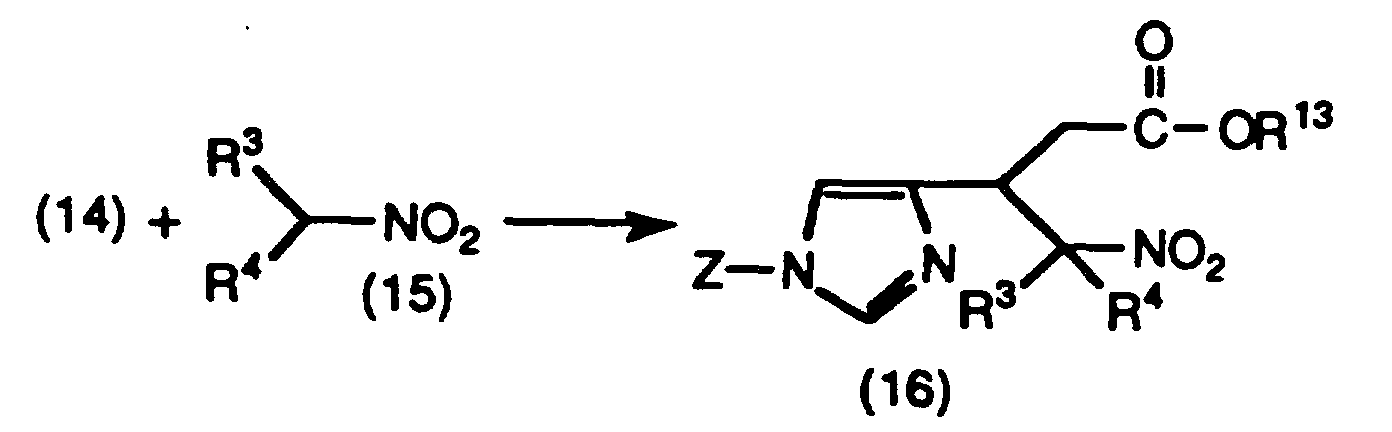
- In Step 3, compound (14) (from Step 2) is reacted with compound (15) to produce compound (16). The reaction takes place at a temperature within the range of about 20 to about 100°C in an organic solvent containing an organic base. Suitable organic bases include DBU (1, 8-diazabicyclo[5.4.0]undec-7-ene), and TMG (1, 1, 3, 3-tetramethylguanidine). Suitable solvents include acetonitrile, tetrahydrofuran, N, N-dimethylformamide and the like.
-

- In Step 4, compound (16) (from Step 3) is hydrogenated to produce compound (17). The hydrogenation takes place in an organic solvent, using Raney-Nickel, at a temperature of about 20 to about 60°C. Preferably ethanol is used as the organic solvent. Under these conditions cyclization occurs in situ to provide the desired lactam (17).
-

- In Step 5, the anion of compound (17) is reacted with R14-L to place the R14 on the indicated nitrogen atom in compound (18). R14 can be a suitable protecting group such as Si(CH3)2C(CH3)3 or -C(O)O(t-butyl), or R14 can be an alkyl, cycloalkyl, benzyl, substitued benzyl, allyl, or propargyl group. L is a leaving group, such as Cl, Br, I or -OSO2CF3. The reaction is conducted in an organic solvent such as THF, diethyl ether, 1,4-dioxane or DMSO in the presence of a suitable base, such as lithium diisopropylamide or NaH. The reaction takes place at a temperature within the range of about -78 to about 80°C.
-

- In Step 6, the enolate of compound (18) reacts with R6-X and then with R7-X to produce compound (19). X represents a suitable leaving group, such as Cl, Br, I or -OSO2CF3. Each reaction to place each substituent group on the ring takes place in an organic solvent using an organic base. Tetrahydrofuran is the solvent usually used; however, other suitable solvents include 1,4-dioxane, diethyl ether and the like. Examples of organic bases include lithium diisopropylamide, M+N[Si(CH3)3]2, KH and the like. M+ represents a suitable metal cation such as Na, Li, K, and the like. The reaction is usually conducted at a temperature of about -78 to about 80 °C.
-
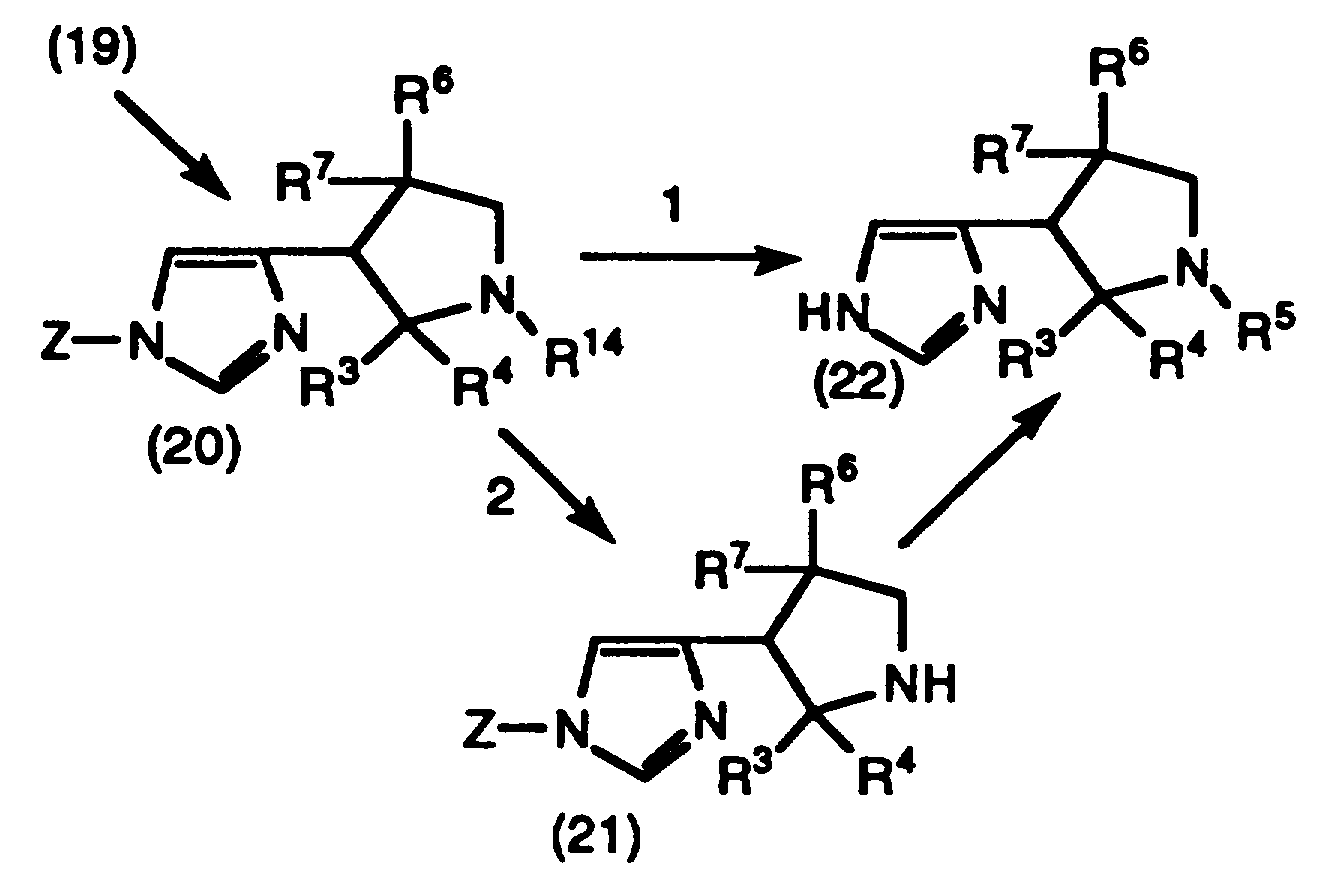
- In Step 7, compound (19) is reduced to compound (20) with a reducing agent in an organic solvent at a suitable temperature. Preferably, LiAlH4 (lithium aluminium hydride) is used with tetrahydrofuran at a temperature of about 0 to about 70°C. Other suitable reducing agents include BH3 (borane) and the like. Other organic solvents which may be used include 1,4-dioxane and the like.
- In reaction path 1 (compound (20) to (22)), R14 is alkyl, cycloalkyl, benzyl, substituted benzyl, allyl, or propargyl. In reaction path 2 (compound (20) to (21)), R14 is -Si(CH3)2C(CH3)3 or -C(O)O(t-butyl),
- In Step 8, following reaction path 1, compound (20) is deprotected by following the procedure in Step 7 of Preparation A to produce compound (22). Alternatively, following reaction path 2, when R14 is -Si(CH3)2C(CH3)3, compound (20) is treated with tetrabutylammonium fluoride in tetrahydrofuran at a temperature of about 0 to about 50°C to produce compound (21), or compound (20), when R14 is -C(O)O(t-butyl), is treated with dilute aqueous acid (e.g., HCI, HBr and the like).
- In Step 9, the procedures in Steps 6 and 7 of Preparation A are followed so that compound (21) may be converted to compound (22).
-

- In Step 1, compound (23), synthesized according to Degraw et al. J. Med. Chem., 1977, 20, 1671, wherein Z is the trityl group, is reacted with R8-L in an organic solvent, in the presence of an organic base, at a temperature of about 0 to about 50°C to produce compound (24). L is a suitable leaving group such as, for example, halogen (halides) selected from the group consisting of: Cl, Br, and I; -OSO2-C6H4-CH3 (wherein C6H4 is phenyl); -OSO2-CH3; and the like. Suitable organic bases include lithium diisopropylamide, LiN[Si(CH3)3]2, and the like. Preferably, the organic solvent is tetrahydrofuran. Other suitable solvents which may be used include 1,4-dioxane and the like.
-

- In Step 2, the anion of compound (24) is reacted with compound (25) (wherein R is alkyl) to produce compound (26). The reaction is conducted at a temperature of about -78 to about 50°C in an organic solvent containing an organic base. Suitable organic bases include lithium diisopropylamide, LiN(Si(CH3)3)2, and the like. Preferably, the organic solvent is tetrahydrofuran. Other suitable solvents which may be used include DMF and the like.
-

- In Step 3, following the procedure set forth in Step 6 of Preparation B, compound (26) is substituted with substituent groups R6 and R7 to produce compound (27). Alternatively, compound (27) is prepared by the reaction of compound (24) with compound (26A)

- In Step 4, compound (27) is reduced using H2 and Raney-Nickel. The reduction takes place in ethanol at a temperature of about 25 (roorn temperature) to about 80°C. Other reducing agents can be used such as NaBH4/CoCl2 wherein the reduction takes place in ethanol at about room temperature. Subsequent cyclization in situ provides compound (28).
-

- In Step 5, compound (28) is reduced to compound (29) in tetrahydrofuran using LiAlH4 and a reaction temperature of about 0 to about 70°C. Another suitable reducing agent is BH3.
- In Step 6, compound (29) is converted to compound (30) according to the procedure described in Step 6 of Preparation A.
- In Step 7, compound (30) is deprotected to produce compound (31) by following the procedure described in Step 7 of Preparation A.
-

- In Step 1, compound (32) is reacted with compound (33) to produce compound (34). The reaction is conducted in tetrahydrofuran at a temperature of about 25 to about 70°C. Other usable organic solvents besides tetrahydrofuran include DMF and the like. Compound (32) is prepared following the literature procedure set forth in J. L. Kelley et al., J. Med. Chem., 20, 721(1977). The Wittig reagent, compound (33), is either commercially available or may be prepared from the corresponding α-halo ketone and triphenylphosphine using standard reaction conditions known in the art.
-

- In Step 2, compound (34) is reacted with compound (35) to produce compound (36). The reaction is carried out according to the procedure set forth in Step 3 of Preparation B.
-

- In Step 3, compound (36) is hydrogenated at a temperature of about 25 to about 70°C using H2 and Raney-Nickel. The reaction is conducted in ethanol in similar fashion to the reaction described in Step 4 of Preparation C.
- In Step 4, following the procedure in Step 6 of Preparation A, compound (37) is reacted with R5-X or R5A-CHO to produce compound (38).
- In Step 5, compound (38) is deprotected at a temperature of about 50 to about 100°C using aqueous acid such as 10 % aqueous hydrochloric acid to produce compound (39).
-
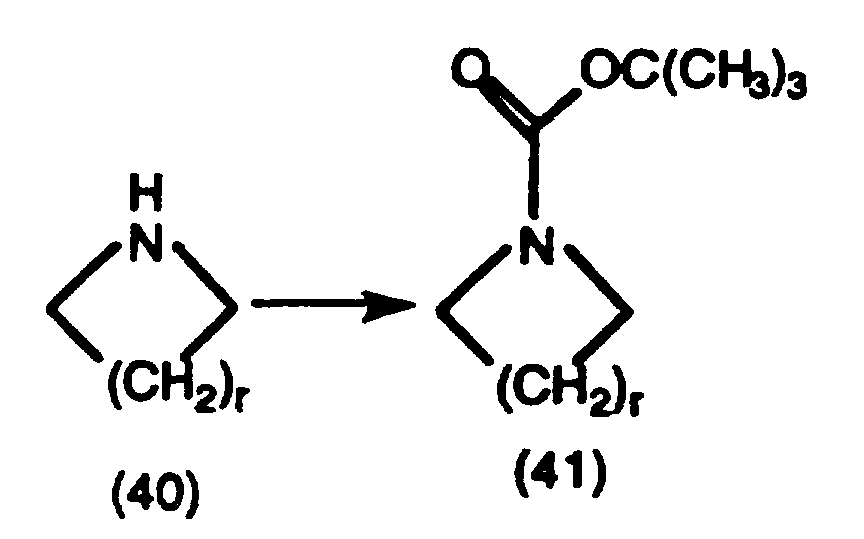
- In Step 1, compound (40) is reacted with di-tert-butyl dicarbonate ((tBOC)2O) in an organic solvent in the presence of an organic base. The reaction is conducted at a temperature of about 0 to about 30°C. Preferably, methylene chloride is used as the organic solvent, but other suitable organic solvents include DMF and the like. Triethylamine is used as the organic base. Other bases which can be used include 4-dimethylaminopyridine and the like. In compounds (40) and (41) r represents 1 or 2. The desired starting reactant (40) can be obtained commercially. In compound (41), the BOC group is chosen as an activating group on nitrogen which increases the kinetic acidity of the α-proton such that a lithio salt would result (for example, Step 2). Other activating groups on nitrogen, known in the art that can also be employed include nitroso, phosphoryl, hindered acyl, and formamidyl. (see Aldrichimica Acta, Vol. 8, No. 3, 1985).
-

- In Step 2, the anion of compound (41) is reacted with compound (42), to produce compound (43). The reaction is conducted in an organic solvent containing an organic base and TMEDA (tetramethylethylenediamine). The reaction is conducted at a temperature of about -78 to about 25°C (room temperature). Tetrahydrofuran is preferably used as the solvent, other suitable solvents include diethyl ether and the like. The anion of (41) is prepared by metalation of (41) with sec-butyllithium in THF at -78°C. Compound (42) is obtained by reacting compound (32) with an organometallic reagent R1M, wherein M is Li or MgBr, and then with thionyl chloride (SOCl2).
-

- In Step 3, compound (43) is treated with HCI or similar acid in an inert organic solvent such as ethyl acetate or dioxane, at a temperature of about 0°C to selectively deprotect (43) thus producing compound (44).
- In Step 4, compound (44) is reacted with R5-X or R5A-CHO in accordance with the procedure set forth in Step 6 of Preparation A to produce compound (44A).
- In Step 5, compound (44A) is then deprotected to produce compound (45) by following the procedure set forth in Step 7 of Preparation A.
-
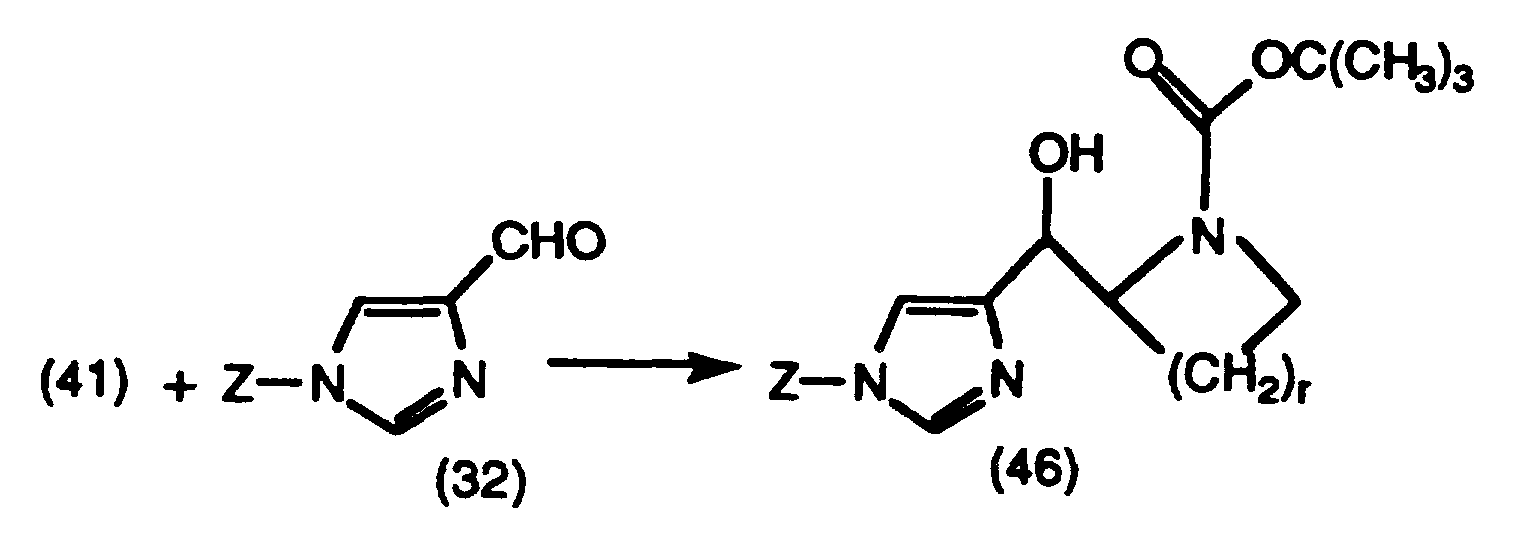
- In Step 1, compound (41)--see Step 1 of Preparation E--is reacted with compound (32) in accordance with the procedure set forth in Step 2 of Preparation E. r is 1 or 2.
-

- In Step 2, compound (46) is oxidized to produce compound (47). The oxidation is accomplished by treating compound (46) with an oxidizing agent, such as MnO2 or PDC (pyridinium dichromate), in an inert organic solvent, such as tetrahydrofuran or methylene chloride, at a temperature of about 20 to about 70°C.
- In Step 3, compound (47) reacts, under usual Wittig reaction conditions, with compound (48) in an organic solvent at a temperature of about 25 to about 70°C to produce compound (49). In compound (48), R1A represents an R1 group which has one less -CH2- group. Preferably, the organic solvent is tetrahydrofuran; however, other suitable solvents, such as 1,4-dioxane and the like, can be used.
-
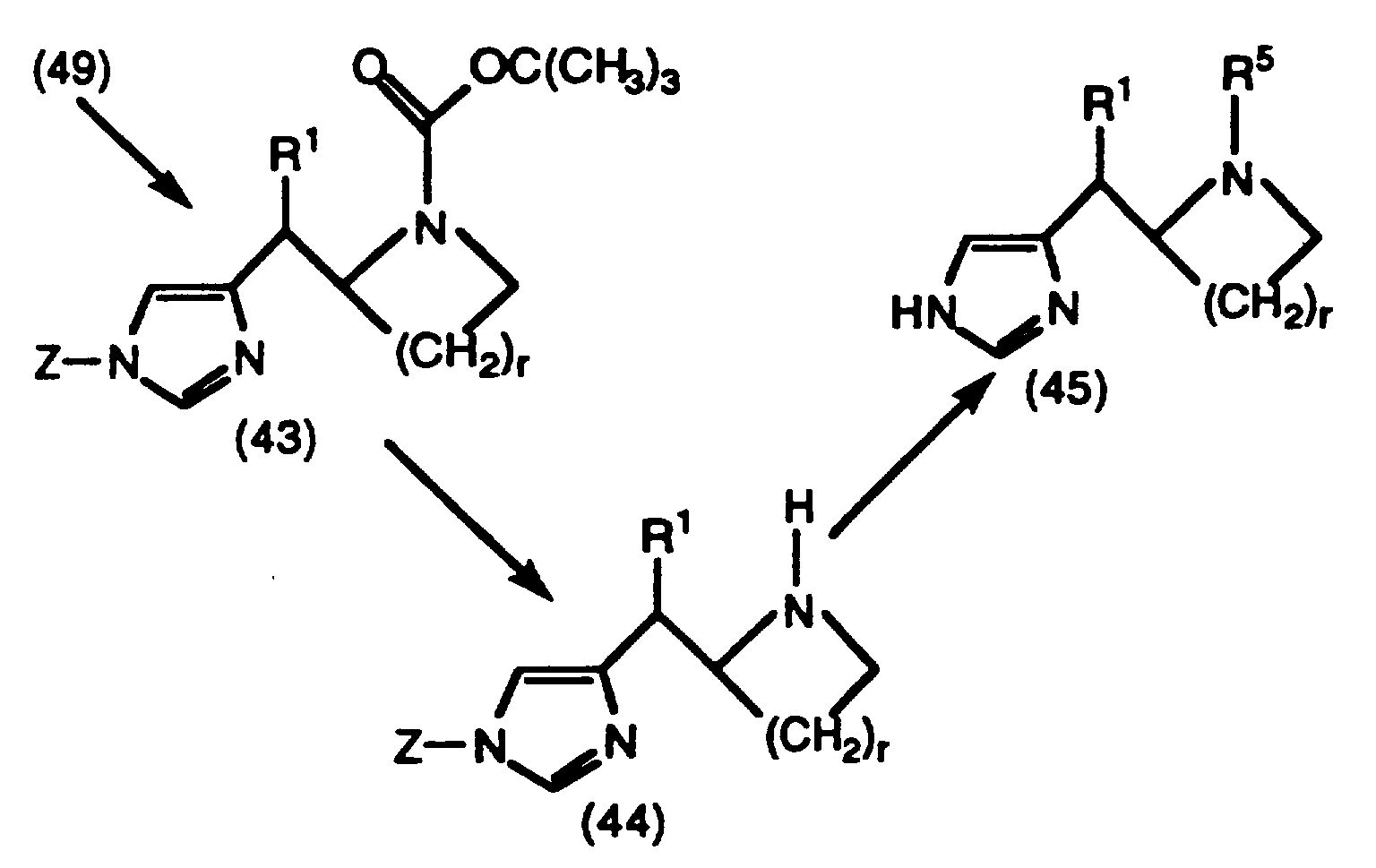
- In Step 4, compound (43) is produced when compound (49) is hydrogenated in tetrahydrofuran with H2 using a Pd-C (palladium/carbon) catalyst. Other organic solvents which can be used include ethyl acetate, methanol and the like. Other suitable metal catalysts such as Pt, Pd-Al2O3, Ra-Ni, NiB, and Pd-CaCO3 can also be employed as the hydrogenation catalyst.
- In Step 5, conversion of compound (43) to compound (44) and then to compound (45) is accomplished by following the same process described in Steps 3, 4, and 5 of Preparation E.
-
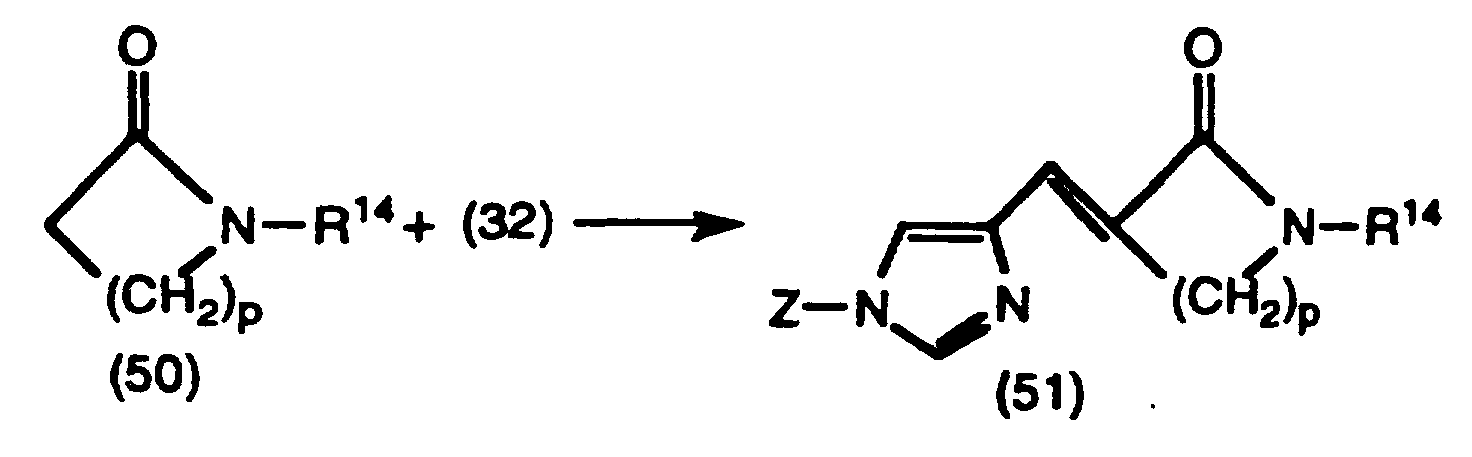
- In Step 1, the anion of compound (50) reacts with compound (32) in an organic solvent at a temperature of about -78 to about 25°C to produce compound (51) wherein p is 1 or 2. Suitable organic solvents include tetrahydrofuran and the like. Preferably, the organic base used to generate the anion of (50) is lithium diisopropylamide or M+N[Si(CH3)3]2 wherein M+ is a metal cation such as Li, Na, or K. Z is trityl. Compound (50) is obtained from the commercially available unprotected precursor

-

- In Step 2, compound (51) is reacted with R1-Q, wherein Q is Li or MgBr, in tetrahydrofuran containing CuCN and a Lewis acid, such as BF3, (CH3)3SiCl and the like, to produce compound (52). The reaction is conducted at a temperature of about -78 to about 20°C. Tetrahydrofuran is the preferred organic solvent; however, other suitable solvents include diethyl ether and the like.
- In Step (3), compound (52) is reacted with R8-L according to the procedure set forth in Step 3 of Preparation A. Then the resulting R8 substituted compound is reduced with either AlH3 or DIBALH (when p = 1); or with LiAlH4 (when p = 2) at a temperature of about 25 to about 65°C to produce compound (53). The reduction is conducted in tetrahydrofuran; however, other organic solvents, such as 1,4-dioxane and the like, can be used.
- In Step 4, compound (53) is converted to compound (54) according to the processes described in Steps 8 and 9 of Preparation B for the conversion of compound (20) to compound (22).
- The anion of compound (50), which is prepared by reacting compound (50) with lithium diisopropylamide at a temperature of about -20°C to about 20°C in THF (see Step 1 of Preparation G) reacts with compound (42)--see Step 2 of Preparation E- in tetrahydrofuran at a temperature of about -78 to about 25°C to produce compound (52)--see Step 2 Preparation G. Other suitable solvents besides tetrahydrofuran can also be used, such as DMF and the like. Other suitable bases which can be used to generate the anion of (50) include NaN[Si(CH3)3]2, KN[Si(CH3)3]2, KH and the like. Compound (52) is converted to compound (54) following the procedures in Steps 3 and 4 of Preparation G.
-

- Compound (55) reacts with R6-M (wherein M is Li, ZnBr or MgBr) in tetrahydrofuran containing BF3•(C2H5)2O and CuCN at a temperature of about -78 to about 20°C to produce compound (56). Other suitable solvents such as diethyl ether can be used. Compound (56) is converted to compound (57) in accordance with the reaction steps set forth in Preparation G or Preparation H.
- Compound (55) is obtained by reacting the commercially available unprotected precursor

- By following the steps in Preparations E, F, G or H with the exception that compound (58)
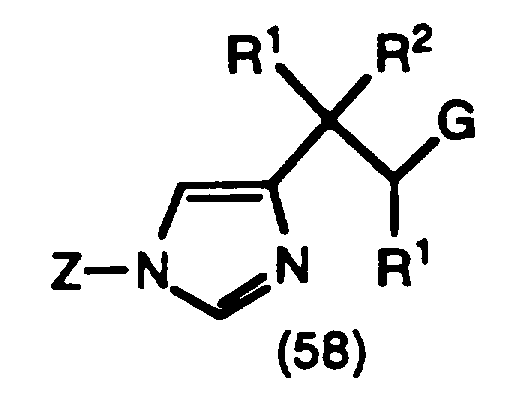

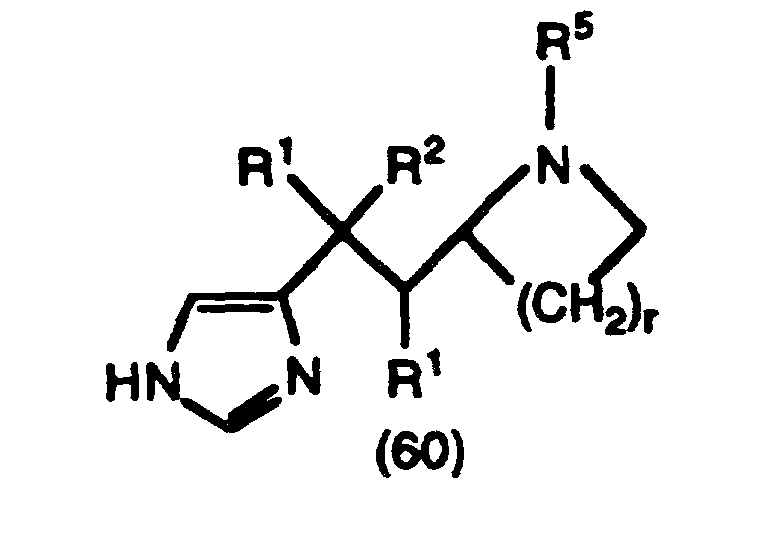

-
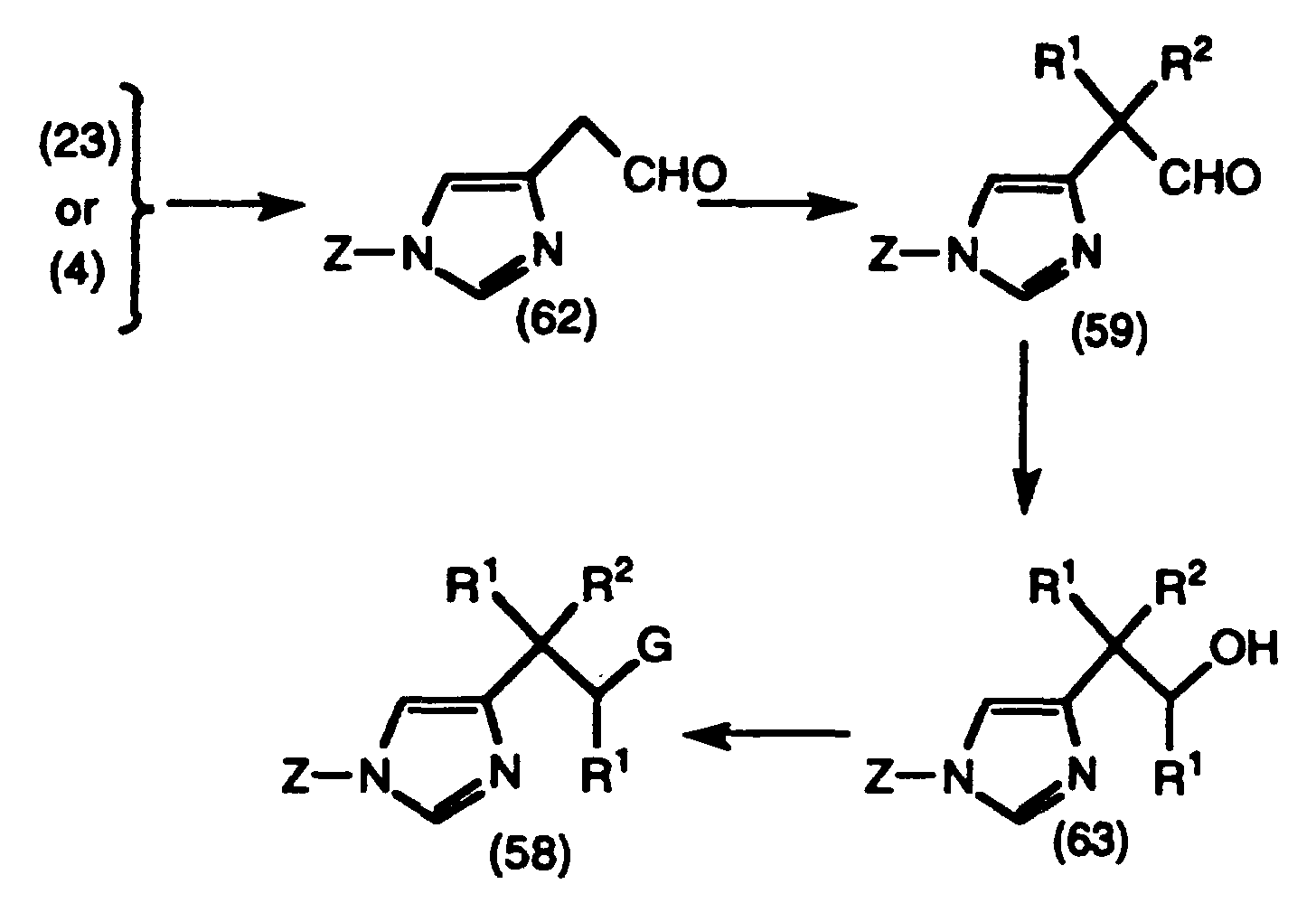
- Alternatively, the sequence of the preparation of compound (59), from compound (4) or (23), can be switched, i.e., alkylation first to introduce R1 and R2 and then reduction.

-

- In Step 1, compound (65) is produced when compound (64) is reacted with (t-BOC)2O and triethylamine. The reaction is conducted in an organic solvent, such as methylene chloride or DMF, using a temperature within the range of about 0 to about 25°C (room temperature).
- In Step 2, compound (66) is produced by treating compound (65) with an oxidizing agent such as pyridinium dichromate. The oxidation reaction is conducted in an organic solvent, such as methylene chloride, using a temperature of about 25 to about 50°C.
- In Step 3, compound (67) is produced when the enolate of compound (66) is reacted with R3-L wherein L is a suitable leaving group, such as halogen (e.g., Cl, Br, or I), -OSO2CF3 and the like. The reaction takes place in an organic solvent, such as tetrahydrofuran or benzene, containing a suitable base, such as NaH, LDA, or LiN(Si(CH3)3)2. Preferably, tetrahydrofuran is used as the solvent and LDA is used as the base. The reaction is conducted at a temperature of about 0 to about 80°C.
- In Step 4, compound (67) is reacted with R4-L using the same procedure set forth in Step 3 in order to produce compound (68).
- In Step 5, compound (69) is produced When compound (68) is first reacted with R6-L and then reacted with R7-L Each reaction is conducted using the same procedure set forth in Step 3.
- In Step 6, compound (71) is obtained When compound (69) is reacted with compound (70)


- In Step 7, compound (72) is produced by using compound (71) and following the same procedures set forth in Steps 3, 4 and 5 of Preparation E.
- In the steps of Preparation L alkylations (i.e., Steps 3, 4 and 5) are only if desired and R3, R4, R5, R6, and R7 are as defined for Formula I.
- In the above processes, certain functional groups may be incompatable with some transformations described herein and consequently it is sometimes desirable and/or necessary to protect certain groups during the reactions. Certain protecting groups are employed in the above processes but, as those skilled in the art will recognize, other protecting groups may be used in their place. Conventional protecting groups are operable as described in Greene, T.W., and Wuts, P.G.M., "Protective Groups In Organic Synthesis," John Wiley & Sons, New York, 1991; the disclosure of which is incorporated herein by reference thereto. After the reaction or reactions, the protecting groups may be removed by standard procedures.
- The compounds of this invention are either agonists or antagonists of the histamine H3 receptor. The binding affinity of the compounds of the invention to the H3 receptor may be demonstrated by the procedure described below:
- The source of the H3 receptors in this experiment was guinea pig brain. The animals used weighed 400-600 g. The tissue was homogenized using a Polytron in a solution of 50 mM Tris, pH 7.5. The final concentration of tissue in the homogenization buffer was 10% w/v. The homogenates were centrifuged at 1000 x g for 10 min. in order to remove clumps of tissue and debris. The resulting supernatants were then centrifuged at 50,000 x g for 20 min. in order to sediment the membranes, which were next washed 3 times in homogenization buffer (50,000 x g for 20 min. each). The membranes were frozen and stored at -70°C until needed.
- All compounds to be tested were dissolved in DMSO and then diluted into the binding buffer (50 mM Tris, pH 7.5) such that the final concentration was 2 µg/mL with 0.1% DMSO. Membranes were then added (400 µg of protein) to the reaction tubes. The reaction was started by the addition of 3 nM [3H]R-α-methylhistamine (8.8 Ci/mmol) or [3H]-N-methylhistamine (80 Ci/mmol) and incubated at 30° for 30 min. Bound ligand was separated from unbound ligand by filtration, and the amount of radioactive ligand bound to the membranes was quantitiated by liquid scintillation spectrometry. All incubations were performed in duplicate and the standard error was less than 10% in all instances. Compounds that inhibited greater than 70% of the specific binding of radioactive ligand to the receptor were serially diluted to determine a Ki (µM). The results are given in Table 2.
- In Table 2, the compound represented by (a*) is known in the art.


- In Table 2, the **** values for compounds (o) and (p) represent the % inhibition at a concentration of 2 µg/mL. It is expected that at higher concentrations higher activities will be obtained.
- For preparing pharmaceutical compositions from the compounds described by this invention, inert, pharmaceutically acceptable carriers can be either solid or liquid. Solid form preparations include powders, tablets, dispersible granules, capsules, cachets and suppositories. The powders and tablets may be comprised of from about 5 to about 70 percent active ingredient. Suitable solid carriers are known in the art, e.g. magnesium carbonate, magnesium stearate, talc, sugar, lactose. Tablets, powders, cachets and capsules can be used as solid dosage forms suitable for oral administration.
- For preparing suppositories, a low melting wax such as a mixture of fatty acid glycerides or cocoa butter is first melted, and the active ingredient is dispersed homogeneously therein as by stirring. The molten homogeneous mixture is then poured into convenient sized molds, allowed to cool and thereby solidify.
- Liquid form preparations include solutions, suspensions and emulsions. As an example may be mentioned water or water-propylene glycol solutions for parenteral injection.
- Liquid form preparations may also include solutions for intranasal administration.
- Aerosol preparations suitable for inhalation may include solutions and solids in powder form, which may be in combination with a pharmaceutically acceptable carrier, such as an inert compressed gas.
- Also included are solid form preparations which are intended to be converted, shortly before use, to liquid form preparations for either oral or parenteral administration. Such liquid forms include solutions, suspensions and emulsions.
- The compounds of the invention may also be deliverable transdermally. The transdermal compositions can take the form of creams, lotions, aerosols and/or emulsions and can be included in a transdermal patch of the matrix or reservoir type as are conventional in the art for this purpose.
- Preferably the compound is administered orally.
- Preferably, the pharmaceutical preparation is in unit dosage form. In such form, the preparation is subdivided into unit doses containing appropriate quantities of the active component, e.g., an effective amount to achieve the desired purpose.
- The quantity of active compound in a unit dose of preparation may be varied or adjusted from about 0.1 mg to 1000 mg, more preferably from about 1 mg to 500 mg, according to the particular application.
- The actual dosage employed may be varied depending upon the requirements of the patient and the severity of the condition being treated. Determination of the proper dosage for a particular situation is within the skill of the art. Generally, treatment is initiated with smaller dosages which are less than the optimum dose of the compound. Thereafter, the dosage is increased by small increments until the optimum effect under the circumstances is reached. For convenience, the total daily dosage may be divided and administered in portions during the day if desired.
- The amount and frequency of administration of the compounds of the invention and the pharmaceutically acceptable salts thereof will be regulated according to the judgment of the attending clinician considering such factors as age, condition and size of the patient as well as severity of the symptoms being treated. A typical recommended dosage regimen is oral administration of from 1 mg to 2000 mg/day preferably 10 to 1000 mg/day, in one to four divided doses to achieve relief of the symptoms. The compounds are non-toxic when administered within this dosage range.
- The invention disclosed herein is exemplified by the following preparative examples, which should not be construed to limit the scope of the disclosure. Alternative mechanistic pathways and analogous structures within the scope of the invention may be apparent to those skilled in the art.
-

- To a suspension of urocanic acid 1 (13-8 g, 100 mmol) in methanol (250 mL) was added concentrated sulfuric acid (10 mL) and the mixture was heated to reflux for 24 h. The mixture was cooled to 5°C and concentrated ammonium hydroxide (25 mL) was added slowly. The solvents were removed by rotary evaporation and to the residue was added water (50 mL) and ethyl acetate (750 mL). The mixture was shaken, the layers separated, and the aqueous layer was extracted with ethyl acetate (500 mL). The combined organic layers were dried over anhydrous sodium sulfate, filtered and evaporated to give 2 as a white solid (14.9 g, 98%).
-

- To a suspension of the methyl ester 2 (12.2 g, 80.0 mmol) in tetrahydrofuran (80 mL) was added triethylamine (28 mL, 200 mmol) and then (2-trimethylsilyl)ethoxymethyl chloride (30 mL, 170 mmol). The mixture was stirred at room temperature for 1 h and then to this mixture was added 5% aqueous sodium hydroxide (200 mL) and methylene chloride (1200 mL). The mixture was shaken vigorously, the layers separated, and the aqueous layer was extracted with methylene chloride (1200 mL). The combined organic layers were dried over anhydrous sodium sulfate, filtered, and evaporated to give an orange, oily residue which was purified by flash chromatography (ethyl acetate) to give 3 as a slightly yellow solid (10.8 g, 48%).
-

- To a solution of unsaturated ester 3 (10.8 g, 38 mmol) in acetonitrile (25 mL) was added nitroethane (15 mL, 209 mmol) and then 1,8-diazabicyclo[5.4.0]undec-7-ene (6 mL, 40 mmol). The mixture was stirred at room temperature for 72 h, the solvents were removed by rotary evaporation and the dark, oily residue was purified by flash chromatography (ethyl acetate) to give the nitro-ester 4 as a mixture of diastereomers (13.3 g, 97%).
-

- A mixture of the nitro-ester 4 (8.3 g, 23 mmol) and Raney nickel (8 g) in absolute ethanol (60 mL) was shaken under 60 psi 413 KPa of hydrogen at 55°C in a Parr apparatus for 6 h. The mixture was filtered and the filtrate was evaporated to give an oily residue which was purified by flash chromatography (a: 5% MeOH/NH3 in CH2Cl2, b: 7% MeOH/NH3 in THF:Hexane, 2:1) to give two compounds; the first compound to elute was the trans-diastereomer 5t (2.64 g, 39%). The second compound to elute was the cis-diastereomer 5c (1.67 g, 26%).
-

- To a solution of the trans-lactam 5t (2.60 g, 8.8 mmol) in tetrahydrofuran (175 mL) was added a solution of lithium aluminum hydride in diethyl ether (1.0 M, 44.0 mL, 44 mmol). The mixture was stirred at room temperature for 4 h and to the reaction mixture was added diethyl ether (440 mL) and saturated aqueous sodium sulfate (7 mL) dropwise. The mixture was dried over anhydrous sodium sulfate, filtered, and evaporated to give an oily residue which was purified by flash chromatography (gradient elution; CH2Cl2: MeOH/NH3, 7:1 to 5:1) to give 6t as a colorless oil (1.15 g, 46%).
-

- The cis-lactam 5c (0.60 g, 2.0 mmol) was treated in the same manner as described for the preparation of pyrrolidine 6t. The crude reaction product was purified by Rash chromatography (gradient elution; CH2Cl2:. MeOH/NH3, 6:1 to 4:1) to give 6c as a colorless oil (0.36 g, 63%).
-

- To a solution of the pyrrolidine 6t (563 mg, 2.0 mmol) in 95% ethanol (3 mL) was added concentrated hydrochloric acid (1 mL) and the mixture was heated to reflux for 16 h. The solvents were removed by rotary evaporation and to the residue was added 1 N aqueous hydrochloric acid (8 mL). This solution was extracted with ethyl acetate (3 x 4 mL) and the aqueous layer was concentrated by rotary evaporation. To the residue was added distilled water (15 mL) and the resulting solution was filtered through a glass wool plug. The filtrate was concentrated by rotrary evaporation to give (±)-7t as a cream-colored solid (395 mg, 88%).
-

- To a solution of (±)-7t (336 mg, 1.5 mmol) in dimethylformamide (5.0 mL) was added triethylamine (1.05 mL, 7.53 mmol) and then a solution of di-tert-butyl dicarbonate (t-BOC)2O (720 mg, 3.3 mmol) in dimethylformamide (1 mL). The mixture was stirred at room temperature for 2 h, the solvents were removed by vacuum distillation (1.0 mm Hg) and the resulting residue was purified by flash chromatography (gradient elution; EtOAc: hexane, 1:1 to 2:1) to give the corresponding di-t-BOC derivative (±)-7't (488 mg) as a white solid. This material was dissolved in ethyl acetate (3 mL), cooled to 5°C, and to this solution was added a saturated solution of hydrogen chloride in ethyl acetate (14 mL). The mixture was gradually warmed to room temperature (30 min) and stirred at this temperature for 16 h. The ethyl acetate was removed from the precipitated product by pipet and the precipitate was dried under high vacuum (0.1 mm Hg) to give (±)-7t as a white solid (286 mg, 85% recovery); MS (CI) 152 (M + 1).
- The racemic (±)-7't was resolved by High Performance Liquid Chromatography using a Daicel Chiralcel OJ chiral chromatography column (2.0 cm x 50.0 cm, 4 % isopropanol in hexane). Multiple injections (13 injections of about 150 mg each) provided the levorotatory enantiomer (-)-7't :

the dextrorotatory enantiomer (+)-7't:


-

- The cis-pyrrolidine 6c (394 mg, 1.4 mmol) was treated as described for the preparation (±)-7t to give (±)-7c as a cream-colored solid (288 mg, 95%). Compound (±)-7c (224 mg, 1.0 mmol) was purified as described for the purification of (±)-7t to give (±)-7c as a white solid (177 mg, 79% recovery); MS (CI) 152 (M + 1).
- Compounds 8, 9, 10t, 10c, 11t, 11c, 12t and 12c were prepared using the procedure described above for (±)-7t and 7c. The procedure is summarized below, A and B, and hence the compounds produced, are defined in Table 3.
- In a manner similar to that described in Example 1, Steps H and I, racemic (±)-7c was resolved by High Performance Liquid Chromatography using a Daicel Chiralcel OD chiral chromatography column (5.0 cm x 50.0 cm, 1% isopropanol in hexane) followed by deprotection with a saturated solution of hydrogen chloride in ethyl acetate to give the levorotatory enantiomer (-)-7c:


TABLE 3 COMPOUND A B MS(CI)(M + 1) 8 H H 138 9 -CH3 -CH3 166 10t H -CH2CH3 166 10c -CH2CH3 H 166 11t H -CH2C6H5 228 11c -CH2C6H5 H 228 12t H -CH2CH2C6H5 242 12c -CH2CH2C6H5 H 242 -

- To a cooled (0°C) solution of diisopropylamine (4 mmol, 561 µL) in dry THF (7 mL) was added n-BuLi (n-butyllithium) (2.5 mL of a 1.6 M solution in hexane) dropwise. After 10 minutes at this temperature, the solution of LDA was cooled to -30°C and a solution of 1 trityl-4-cyanomethyl imidazole 13 (4 mmol, 1.4 g, Tr = trityl)) in THF (6 mL) was added dropwise. After an additional 30 minutes at this temperature, a solution of ethyl-2-bromopropionate (4 mmol; 520 µL) in THF (5 mL) was added dropwise. The reaction was slowly warmed to RT (room temperature) (45 minutes) and quenched with 15 mL H2O. The reaction was extracted with diethyl ether (3 x 25 mL) and the combined organic fractions were washed with brine, dried with MgSO4, and filtered. Concentration on the rotovap yielded 1.65 g of an oil which was purified via column chromatography (75:25 hexane:ethyl acetate). 0.75 g (42%) of 14 was obtained as a mixture of diastereomers. MS (CI) 450 (M+1).

- To a solution of 14 (6.23 mmol; 2.8g) and CoCl2•6 H2O (6.23 mmol; 1.48 g) in absolute ethanol (150 mL) was added NaBH4 (31.2 mmol; 1.18g) portionwise over 30 minutes. After 4 hours, the black reaction mixture was concentrated to 1/3 the volume, shaken with ice-cold 3N HCl (50 mL) to dissolve the solids and rapidly basified to pH=9 with concentrated NH4OH. The crude reaction was extracted with ethyl acetate (3 x 150 mL), and the combined organic layers were washed with brine, and dried (MgSO4). Purification on a flash column (250 g SiO2; 93:7 CH2Cl2: MeOH/NH3) yielded 1.53 g (60%) of 15 as a white solid.
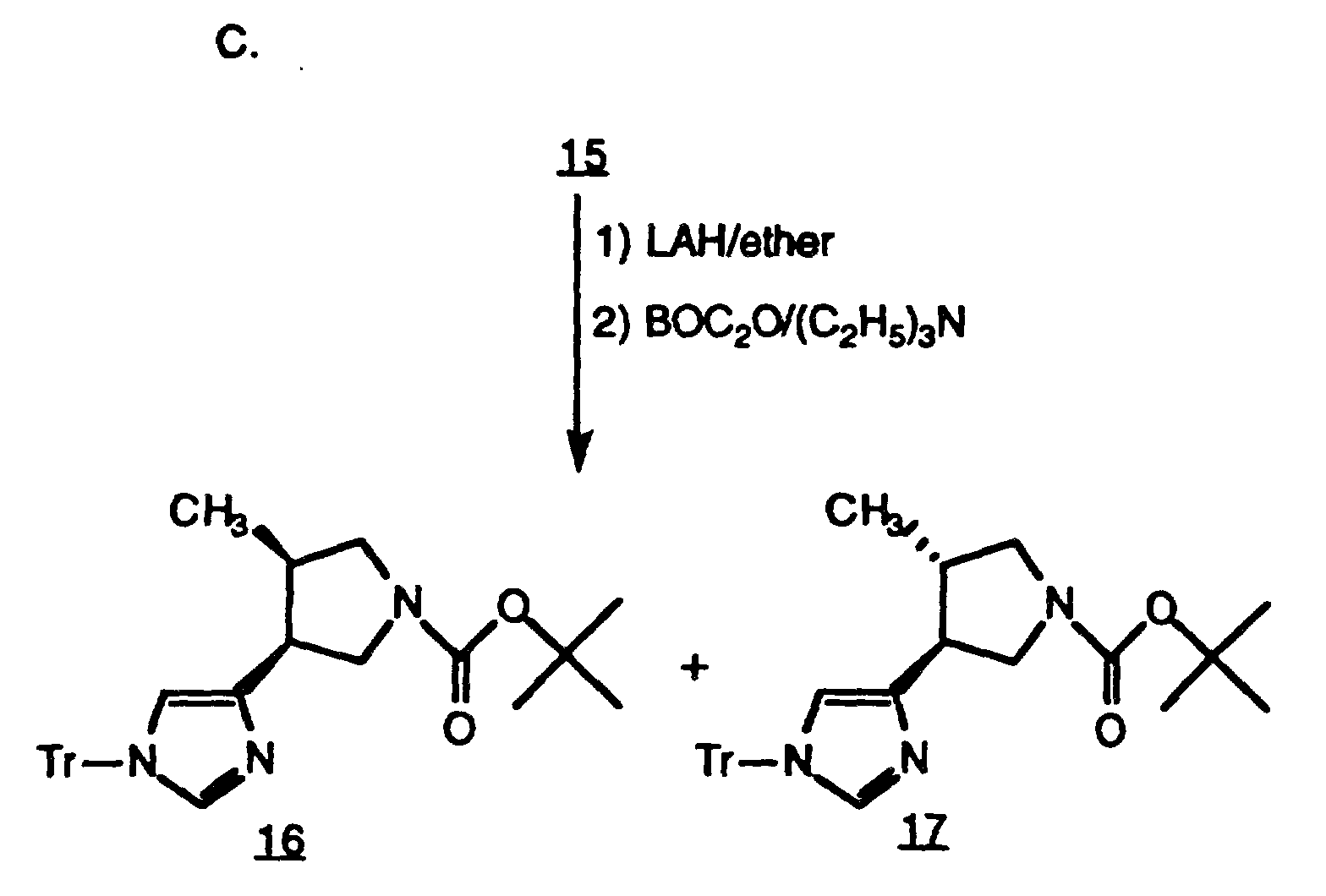
- To a solution of lactam 15 (2.46 mmol; 1 g) in THF (30 mL) was added lithium aluminum hydride in diethyl ether (1M; 12.3 mL). The reaction was heated to 50°C for 5.5h, cooled to room temperature, diluted with diethyl ether, and quenched by careful dropwise addition of saturated aqueous Na2SO4. When H2 evolution ceased, an additional 50 mL diethyl ether and solid Na2SO4 was added. The organic layer was filtered and concentrated to obtain 870 mg of a solid.
- To a solution of the solid from the previous step in THF (20 mL) was added triethylamine (4.4 mmol; 614 µL) followed by di-t-butyl dicarbonate (2.75 mmol; 600 mg). After 2.5h, brine was added and the reaction was extracted into EtOAC (100 mL). The combined organic layers were dried (Na2SO4), filtered, and concentrated. 600 mg (48%) of 16 and 660 mg (52%) of 17 were obtained after chromatography on a flash column (150 g SiO2; 65:35 EtOAc:Hexane).

- A suspension of 16 (1.2 mmol; 600 mg) in 1NHCl (30 mL) was heated to 80°C for 1 hour. Compound 16 slowly dissolved and was replaced by a new solid. The reaction was cooled, filtered, and the aqueous layer was concentrated. Compound (±)-18, 170 mg, was obtained as a clear glass (64%) MS (EI) 151 (M+).
- In a similar manner, 17 yielded (±)-19 (175 mg, 60%) MS (EI) 151 (M+).

- In a manner similar to that described in Example 1, Steps H and I, racemic (±)18 and (±)19 were resolved by High Performance Liquid Chromatography on a Chiralcel OD preparative column (2 x 50 cm) and gave after deprotection:


- By using the route described above for preparing (±)-18, the compounds listed in Table 4 were prepared:

-

- To a solution of 15 (1.4 mmol; 570 mg; see Step B of Example 2) in DMSO (10 mL) at room temperature was added NaH (1.4 mmol; 56 mg of a 60% dispersion in mineral oil). After 1.5 hours, CH3I (1.4 mmol 87 µL) was added, and the reaction was stirred overnight. The reaction was diluted with H2O and extracted into diethyl ether (3 x 25 mL). The combined organic extracts were washed with brine, dried (Na2SO4), filtered, and concentrated. The crude product was purified on a flash column (100 g SiO2; 95:5 CH2Cl2: CH3OH/NH3). Compound 22, 290 mg (49%), was obtained.

- By using the route described in Example 2, Steps C and D, compound 22 was converted to 23 (62 mg, 67%); MS (CI) 166 (M + 1).
-

- To a solution of diisopropylamine (0.775 mL 5.5 mmol) in tetrahydrofuran (15 mL) at -78°C was added a solution of n-butyllithium in hexane (2.5 M, 2.1 mL, 5.25 mmol) and the mixture was stirred at -78°C for 1 h. To this was added a solution of the nitrile 13 (1.75 g, 5.0 mmol, see Step A of Example 2) in tetrahydrofuran (10 mL) and the mixture was stirred at -78°C for 1 h. To this solution was added a solution of methyl iodide (325 µL, 5.2 mmol) in tetrahydrofuran (2.5 mL), the mixture was stirred at -78°C for 30 min and then warmed to 0°C (1 h). To the mixture was added saturated aqueous ammonium chloride (2 mL), the solvents were removed by rotary evaporation and to the residue was added methylene chloride (200 mL), water (25 mL) and saturated aqueous sodium bicarbonate (25 mL). The mixture was shaken vigorously, the layers separated and the organic layer was dried over anhydrous sodium sulfate, filtered and evaporated to give a yellow solid residue. This crude product was purified by flash chromatography (hexane:isopropanol, 4:1) to give the α-methyl-nitrile 24 as an off-white solid (1.33 g, 73%).
-

- To a solution of diisopropylamine (0.550 mL, 3.9 mmol) in tetrahydrofuran (12 mL) at -78°C was added a solution of n-butyllithium in hexane (2.5 M, 1.50 mL, 3.75 mmol) and the mixture was stirred at -78°C for 1 h. To this was added a solution of the α-methyl-nitrile 24 (1.27 g, 3.5 mmol) in tetrahydrofuran (10 mL) and the mixture was stirred at -78°C for 1 h. To this solution was added a solution of ethyl bromoacetate (420 µL, 3.79 mmol) in tetrahydrofuran (2.0 mL), the mixture was stirred at -78°C for 1 h and then warmed to 0°C (1 h). To the mixture was added saturated aqueous ammonium chloride (1.5 mL), the solvents were removed by rotary evaporation and to the residue was added methylene chloride (200 mL) and saturated aqueous sodium chloride (40 mL). The mixture was shaken vigorously, the layers separated and the organic layer was dried over anhydrous sodium sulfate, filtered and evaporated to give a yellow oily residue. This crude product was purified by flash chromatography (hexane:acetone, 3:1 to 2:1) to give the nitrile-ester 25 as a colorless glass (1.44 g, 90%).
-

- To a solution of the nitrile-ester 25 (1.39 g, 3.1 mmol) in absolute ethanol (70 mL) was added a solution of cobalt dichloride hexahydrate (736 mg, 3.1 mmol) in absolute ethanol (10 mL) and then portionwise (5 min) sodium borohydride (700 mg, 18.5 mmol). The mixture was stirred at room temperature for 2 h, the solvents were removed by rotary evaporation and to the black residue was added cold (5°C) 3 M aqueous hydrochloric acid (34 mL). The mixture was shaken until the black precipitate dissolved (5 min) and then to this mixture was added concentrated ammonium hydroxide (10 mL). This solution was extracted with ethyl acetate (2 x 250 mL) and the combined organic layers were dried over anhydrous sodium sulfate, filtered and evaporated to give an off-white solid residue which was purified by flash chromatography (gradient elution: 8% to 10% CH3OH/NH3 in CH2Cl2) to give the lactam 26 as a white solid (1.05 g, 83%).
-

- The lactam 26 (1.05 g, 2.58 mmol) was treated with a solution of lithium aluminum hydride in diethyl ether (1.0 M, 13.0 mL, 13.0 mmol) as described for the preparation of the pyrrolidine 6t (see Example 1, Step E). The crude product was purified by flash chromatography (gradient elution: CH2Cl2: CH3OH/NH3, 8:1 to 7:1 to 6:1) to give the pyrrolidine 27 as a colorless glass (720 mg, 71%).
-

- A suspension of the pyrrolidine 27 (750 mg, 1.91 mmol) in 1 N aqueous hydrochloric acid (15 mL) was heated to reflux for 1 h. The white precipitate that formed during the course of the reaction was removed by fitration and the aqueous filtrate was extracted with ethyl acetate (2 x 5 mL). The aqueous layer was concentrated by rotary evaporation to give compound 28 as an off-white solid (390 mg, 91%).
- Compound 28 (75 mg, 0.33 mmol) was purified as described for the purification of Compound (±)-7t (see Example 1, Step H) to give Compound 28 as a white solid (57 mg, 76% recovery); MS (CI) 152 (M + 1).
-

- To a solution of 1.08 mL of freshly distilled N,N-diisopropylamine in 1 mL of anhydrous THF was added 3.1 mL of 2.5 M n-butyllithium at 0°C under nitrogen. The resulting solution was stirred at 0°C for 40 minutes (resulting in the production of lithium diisopropylamide (LiN(i-Pr)2)). cooled to -23°C and then 0.672 mL of N-methyl-2-pyrrolidinone 29 was added slowly. The solution was stirred for 0.5 hours at -23°C and an additional 1 hour at -78°C. A solution of 2.69 g of 4-chloromethyl-(N-trityl)imidazole 30 in 14 mL of anhydrous THF was then added dropwise. The resulting solution was stirred for 4 hours at -78°C and slowly warmed to room temperature. After a couple of hours of stirring at room temperature, the reaction mixture was quenched by water and extracted with ethyl acetate. The combined organic extracts were washed with brine, dried over anhydrous MgSO4 and concentrated to give crude product. The crude product was purified by flash chromatography on SiO2 (1% to about 5% of ammonia saturated methanol in CH2Cl2) to give 1.77 (60% yield) of compound 31.

- To a solution of 1.54 g of 31 in 8 mL of anhydrous THF was added 11.34 mL of lithium aluminum hydride solution (1.0 M in diethyl ether) slowly. The resulting solution was stirred at room temperature for 2 hours, and 110 mL of diethyl ether was added. Saturated aqueous Na2SO4 solution was carefully added to the above mixture till hydrogen evolution ceased. The organic fraction was separated, and the aqueous solution was basified with K2CO3 and extracted with ethyl acetate many times. The combined organic solutions were washed with brine, dried over anhydrous K2CO3, and then concentrated to give a crude product. The crude product was purified by flash chromatography on SiO2 (5% CH3 OH (NH3) in CH2Cl2) to give 1.273 g (85% yield) of compound 32.

- A solution of 1.2 g of 32 in 100 mL of 0.5N aqueous hydrochloric acid was heated in a 90°C oil bath for 30 minutes. After the solution was cooled to room temperature, the mixture was extracted with diethyl ether (4 x 50 mL). The aqueous solution was concentrated under vacuum to yield crude product which was then recrystallized from 2-propanol/diethyl ether to give 0.5 g (85%) of compound 33; MS (FAB) 166 (M + 1).
-


- A solution of 0.23 g of 36 in 20 mL of 0.5 N HCl was heated to reflux for 45 minutes. After cooling to room temperature, the mixture was extracted with diethyl ether three times. The aqueous solution was then concentrated and the crude product was crystallized with CH3OH/diethyl ether to give 0.075 g (70% yield) of the product 37; MS (CI)152 (M+ 1).
-

- To a solution of 11.59 g of imidazole acetic acid hydrochloride 38 in 100 mL of anhydrous methanol was added 1 mL of concentrated HCI. The resulting mixture was refluxed for 5.5 hours, and then cooled to room temperature. After concentration of the solvent, 11.9 g (95%) of the product 39 was isolated.

- To a solution of 7.8 g of 39 in 70 mL of anhydrous DMF at 0°C was added 12.94 g of trityl chloride ((φ)3Cl) and 18.4 mL of triethyl amine. The resulting solution was stirred at room temperature for 24 hours, and the solvent was removed under vacuum. The residue was purified by flash chromatography on SiO2 (eluting solvent: CH2Cl2 and increase polarity slowly by addition of ethyl acetate) to give 16.1 g of product 40 (95% yield).

- To a solution of 8.15 mL of compound 41 in 50 mL of anhydrous THF was added 26.25 mL of 1.4M methyllithium at -78°C. The above solution was stirred for 1 hour at -78°C, and a solution of 40A (prepared by the addition of 25 mL of 1M LiN(Si(CH3)3)2 to a solution of 9.55 g of 40 in 100 mL of anhydrous THF at -78°C and stirring the solution for 2 hours at -78°C before transferring) was added by cannula over 30 minutes. Ten minutes later, 4.6 mL of BF3•(C2H5)2O was added to the above mixture, and the resulting solution was stirred at -78°C for 2 hours. The reaction mixture was slowly warmed up to room temperature (over 2 hours 45 minutes), and then saturated aqueous NaHCO3 solution was added. The organic layer was separated and the aqueous layer was extracted with EtOAc. The organic layer and EtOAc extracts were combined and the combined organic solution was washed with brine, dried over MgSO4 and then concentrated. The residue was purified by flash chromatography (silica gel was deactivated with triethylamine, eluting solvent: 1 to 10 % of CH3OH in EtOAc) to give compound 43 (6.4 g; 60% yield).

- To a solution of 6.4 g of 43 in 250 mL of anhydrous methylene chloride was added 11.3 mL of 2.OM trimethyl aluminum. The resulting mixture was stirred at room temperature for 45 minutes, heated to reflux (5 hours), cooled to 0°C, and to this mixture was added saturated aqueous NaHCO3 solution. The organic layer was separated, washed with brine, dried over Na2SO4 and concentrated. The residue was purified by flash chromatography (silica gel deactivated with triethylamine; eluting solvent EtOAc to 1 to about 2% CH3 OH in EtOAc) to give 0.91 g of 44a (trans isomer) and 0.39 g of 44b (cis isomer).

- To a solution of 0.3225 g of 44a in 8 mL of anhydrous THF was added 3.28 mL of 1M solution of diisobutylaluminum hydride in toluene dropwise at roorn temperature. After the addition was complete, the solution was refluxed for 2 hours and cooled to room temperature. Water (2 mL) was added slowly to the above solution and 20 ml of methylene chloride was added to the resulting mixture. The mixture was vigorously stirred until a white solid precipitated out. Filtration and concentration gave crude product, which was purified by preparative TLC (deactivated with triethylamine; eluting solvent 7.5% CH3OH in CH2Cl2) to give 0.187 g (60% yield) of 45.

- A solution of 0.148 g of 45 in 12 mL of 0.5N HCl was heated in an oil bath at 90°C for 0.5 hours. The solution was then cooled to room temperature. The mixture was extracted with diethyl ether three times, and the aqueous solution was concentrated to give a crude product. The crude product was recrystallized in CH3OH/diethyl ether to give 70 mg (85%) of 46; MS (CI) 138 (M + 1).
- By following the procedures set forth in Example 7, Steps E and F, compound 44b can be converted to the cis isomer of 46.
-

- A mixture of 9.78 g of 4-(N-tritylimidazoyl) carboxaldehyde and 9.55 g of Wittig reagent 47 in 30 mL of anhydrous THF was refluxed for 21 hours. An additional 4.8 g of Wittig reagent 47 and 10 mL of THF were added to the above mixture; the resulting mixture was continually refluxed for 30 hours. The solvent was concentrated. The residue was dissolved in CH2Cl2 and washed with water. The organic layer was separated and concentrated. The residue was purified by flash chromatography on SiO2(CH2Cl2/EtOAc) to give 6.14 g (81% yield) of 48.

- To a mixture of 4.5 g of ketone 48 in 18 mL of CH3CN was added 6.62 mL of nitromethane and 75 mL of THF. To the above homogenous solution was added 1.835 mL of DBU (1,8-diazabicyclo[5.4.0]undec-7-ene) and the resulting solution was stirred at room temperature ovemight (18 hours). The reaction mixture was poured into ice cold 0.1 N HCl solution and the mixture was extracted with EtOAc. The combined EtOAc extracts were washed with brine, dried over MgSO4 and concentrated to give 4.54 g (87%) of product 49.

- Compound 49 was reduced by mixing 1.5 g of 49, 1.5 g of Raney-Ni and 1.5 g of anhydrous Na2SO4 in 50 mL of absolute ethanol and subjecting the resulting mixture to 60 psi. of H2 for 26 hours. The reaction mixture was filtered through a pad of celite and the pad was washed with ethanol and CH2Cl2. The filtrate was concentrated to yield 0.83 g of 50 (62%).

- A solution of 0.83 g of 50 in 30 mL of 0.5N HCI was heated to reflux for 45 minutes. After the mixture was cooled to room temperature, it was extracted with diethyl ether. The aqueous layer was evaporated to dryness to give 0.43 g of crude product 51.

- To a mixture of 0.34 g of 51 in 5 mL of anhydrous DMF was added 1.69 mL of triethylamine; the mixture was stirred for 5 minutes and 0.77 mL of di-tert-butyldicarbonate ((tBOC)2O)was added. The reaction mixture was stirred for 18 hours at room temperature, filtered and concentrated. The residue was dissolved in water and extracted with EtOAc. The combined organic extracts were washed with brine, dried over anhydrous Na2SO4 and concentrated. The residue was purified by preparative TLC (1:1 EtOAc/hexane) to give 0.13 g (24% yield) of 52; MS (m/e) 352 (M+1).

- A solution of 0.13 g of 52 in 6 mL of EtOAc (saturated with HCI) was stirred for 45 minutes at 0°C, then the solvent was evaporated under vacuum. The residue was recrystallized in 2-propanol/diethyl ether to give 0.067 (81% yield) of 53; MS (CI) 152 (M+1).
-

- To a solution of lactam 54 (10 mmole; 4.07g) (synthesized in a manner similar to 5t) in dry THF (55mL) at -78°C was added a solution of LDA (11 mmol, 1.18g) in THF (15 mL). After 45 minutes at this temperature, the reaction was warmed to room temperature for 20 minutes and then recooled to -78°C. A solution of (tBOC)2O (11 mmol, 2.41g) in THF (15mL) was added and the reaction was slowly warmed to room temperature. The reaction was then quenched with water and extracted into diethyl ether. The combined ether extracts were washed with brine and dried (MgSO4). Concentration yielded a solid that was recrystallized from hexane: 2-propanol. Compound 55, 3.5 g (69%), was obtained as an off-white solid.

- To a solution of 55 (6.9 mmol, 3.5g) in dry THF (50 mL) at -78°C was added a solution of KN(Si(CH3)3)2 (8.63 mmol, 1.72g) in THF (20 mL) over 10 minutes. An additional 10 mL THF was used to rinse the flask and syringe. After one hour at -78°C, neat CH3I (8.63 mmol, 1.22g, filtered through basic alumina) was added, and the reaction was warmed to room temperature. After 2.5 hours, the reaction was recooled to -78°C, quenched with saturated NH4Cl (pH = 7.3) and extracted into diethyl ether. The combined ether extracts were washed with brine and dried (MgSO4). Concentration and purification via flash column chromatography (400 g SiO2; 90:10 hexane: 2-propanol) yielded 56 (2.35 g; 65%).

- To a solution of 56 (4.2 mmol, 2.19g) in dry CHCl3 (40 mL) at room temperature was added iodotrimethylsilane (10.51 mmol, 2.1g). After one hour at 40°C, the reaction was diluted with methanol and concentrated on the rotary evaporator. Purification via flash chromatography (150 g, SiO2, 80:10:10 CH2Cl2:2-propanol: methanol/ammonia) gave 600 mg (80%) of 57.

- Compound 57 (3.6 mmol, 640 mg) was combined with trityl chloride (3.9 mmol, 1.48 g) and triethylamine (3.9 mmol, 0.39 g) in dry CH2Cl2 (25 mL) at room temperature under nitrogen. After 6 hours, the reaction was quenched with water and extracted with EtOAc/CH2Cl2 (4:1) (EtOAc represents ethyl acetate). The combined organic layers were washed with saturated aqueous sodium metabisulfite and dried (MgSO4). The crude material was purified on a flash column (175g SiO2, 95:5 CH2Cl2 : methanol/ammonia) and yielded 900 mg (59%) of 58.

- To a solution of 58 (2.14 mmol, 900mg) in dry THF (30 mL) was added a solution of LAH in diethyl ether (5.34 mL of a 1M solution). The reaction was heated to reflux for 2 hours, cooled to room temperature, diluted with diethyl ether, and quenched with saturated aqueous Na2SO4. Solid Na2SO4 was added and the mixture was filtered. The filter cake was washed with 150 mL of boiling THF. Removal of the solvent on the rotary evaporator yielded 920 mg of a crude solid.
- To a solution of the crude solid (920 mg) from the previous reaction in THF (15 mL) was added (t-BOC)2O (2.7 mmol, 0.59g). After 30 minutes, the reaction was diluted with CH2Cl2, washed with water, and dried (MgSO4). Concentration yielded a crude solid which was purified on a flash column (200 g SiO2, 80:20 hexane : acetone). This material was further purified via HPLC (SiO2, 97:3 hexane : 2-propanol) to give 230 mg (21%) of 59.
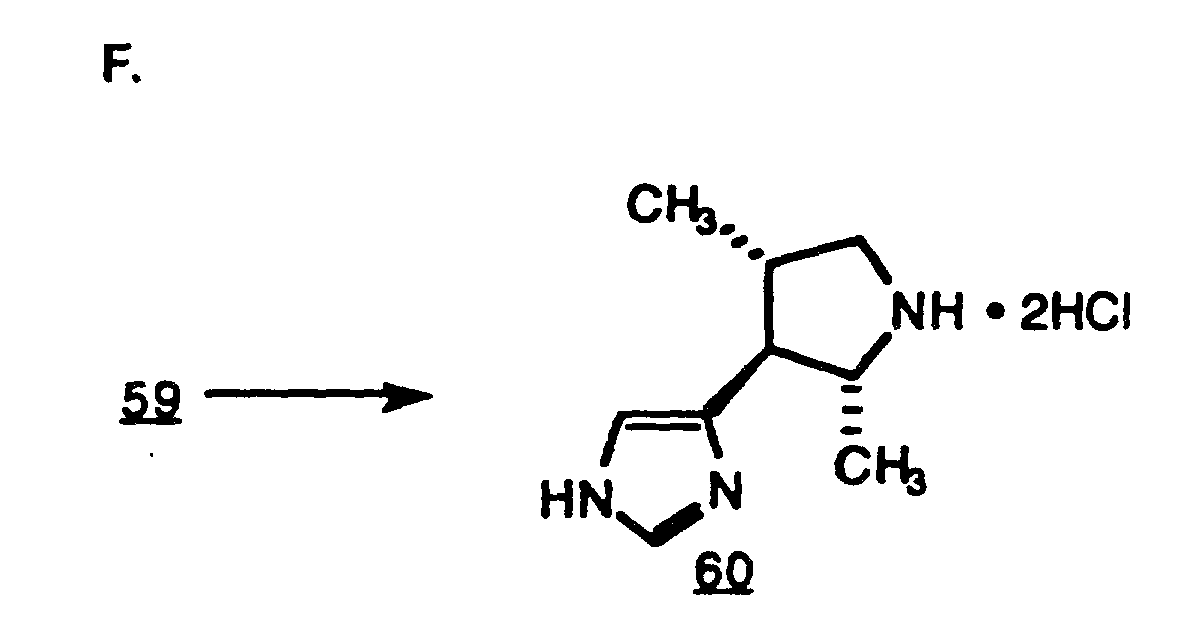
- Compound 59 (0.47 mmol, 230 mg) was combined with 15 mL 1N HCI and heated to 90°C for one hour. The reaction was cooled, filtered, and extracted with diethyl ether. The aqueous layer was concentrated in vacuo to give 60 (110 mg, 100%). MS (CI) 166 (M + 1).
- The following are examples of pharmaceutical dosage forms which contain a compound of the invention. As used therein, the term "active compound" is used to designate the compound

-
Tablets No. Ingredients mg/tablet mg/tablet 1. Active compound 100 500 2. Lactose USP 122 113 3. Corn Starch, Food Grade, as a 10% paste in Purified Water 30 40 4. Corn Starch, Food Grade 45 40 5. Magnesium Stearate 3 7 Total 

- Mix Item Nos. 1 and 2 in a suitable mixer for 10-15 minutes. Granulate the mixture with Item No. 3. Mill the damp granules through a coarse screen (e.g., 1/4", 0.63 cm) if necessary. Dry the damp granules. Screen the dried granules if necessary and mix with Item No. 4 and mix for 10-15 minutes. Add Item No. 5 and mix for 1-3 minutes. Compress the mixture to appropriate size and weigh on a suitable tablet machine.
-
Capsules No. Ingredient mg/capsule mg/capsule 1. Active compound 100 500 2. Lactose USP 106 123 3. Corn Starch, Food Grade 40 70 4. Magnesium Stearate NF 4 7 Total 

- Mix Item Nos. 1, 2 and 3 in a suitable blender for 10-15 minutes. Add Item No. 4 and mix for 1-3 minutes. Fill the mixture into suitable two-piece hard gelatin capsules on a suitable encapsulating machine.
- While the present invention has been described in conjunction with the specific embodiments set forth above, many alternatives, modifications and variations thereof will be apparent to those of ordinary skill in the art. All such altematives, modifications and variations are intended to fall within the spirit and scope of the present invention.
Claims (22)
- A compound of the formula:
 (A) m is an integer selected from the group consisting of: 0, 1, and 2;(B) n and p are integers and are each independently selected from the group consisting of: 0, 1, 2, and 3 such that the sum of n and p is 2 or 3 such that when the sum of n and p is 2, T is a 4-membered ring and when the sum of n and p is 3, T is a 5-membered ring;(C) each R1, R2, R3, R4, R6, R7, and R8 is independently selected from the group consisting of:(1) H;(2) C1 to C6 alkyl;(3) C3 to C6 cycloalkyl; and(4) -(CH2)q-R9 wherein q is an integer of: 1 to 7, and R9 is selected from the group consisting of: phenyl, substituted phenyl, -OR10, -C(O)OR10, -C(O)R10, -OC(O)R10, -C(O)NR10R11, CN and -SR10 wherein R10 and R11 are as defined below, and wherein the substituents on said substituted phenyl are each independently selected from the group consisting of: -OH, -O-(C1 to C6)alkyl, halogen, C1 to C6 alkyl, -CF3, -CN, and -NO2, and wherein said substituted phenyl contains from 1 to 3 substituents;(D) R5 is selected from the group consisting of:(1) H;(2) C1 to C20 alkyl;(3) C3 to C6 cycloalkyl;(4) -C(O)OR10'; wherein R10' is the same as R10 defined below except that R10' is not H;(5) -C(O)R10;(6) -C(O)NR10R11;(7) allyl;(8) propargyl; and(9) -(CH2)q-R9, wherein q and R9 are as defined above with the proviso that when q is 1 then R9 is not -OH or -SH;(E) R10 and R11 are each independently selected from the group consisting of: H, C1 to C6 alkyl, and C3 to C6 cycloalkyl; and, for the substituent -C(O)NR10R11, R10 and R11, together with the nitrogen to which they are bound, can form a ring having 5, 6, or 7 atoms;(F) the dotted line (----) represents a double bond that is optionally present when m is 1, and T is a 5-membered ring, and n is not 0, and p is not 0, and when said double bond is present then R2 and R8 are absent;(G) when m is 2, each R1 is the same or different substituent for each m, and each R2 is the same or different substituent for each m;(H) when n is 2 or 3, each R3 is the same or different substituent for each n, and each R4 is the same or different substituent for each n; and(I) when p is 2 or 3, each R6 is the same or different substituent for each p, and each R7 is the same or different substituent for each p.
 - The compound of Claim 1 wherein said compound is selected from the group consisting of compounds having the formula:


- The compound of Claim 1 wherein said compound is selected from the group consisting of compounds having the formula:


- The compound of Claim 1 wherein m is 0 or 1.
- The compound of Claim 4 wherein R5 is selected from the group consisting of H, C1 to C20 alkyl and (CH2)q-R9 wherein R9 is phenyl.
- The compound of Claim 5 wherein R1 to R4 and R6 to R8 are each independently selected from the group consisting of H, C1 to C6 alkyl, and -(CH2)q-R9 wherein R9 is phenyl.
- The compound of Claim 6 wherein each R1 to R4 and R6 to R8 are independently selected from the group consisting of H, methyl, ethyl, pentyl, benzyl, and 2-phenylethyl.
- The compound of Claim 7 wherein R5 is H or methyl.
- The compound of Claim 1 having the formula selected from the group consisting of:

- The compound of Claim 9 wherein R7 is C1 to C6 alkyl, R1 is H, and R2 is H.
- The compound of Claim 1 having the formula selected from the group consisting of:


- The compound of Claim 11 wherein R5 is selected from the group consisting of H and methyl.
- The compound of Claim 12 wherein R1 is H.
- The compound of Claim 1 wherein said compound is selected from the group consisting of:


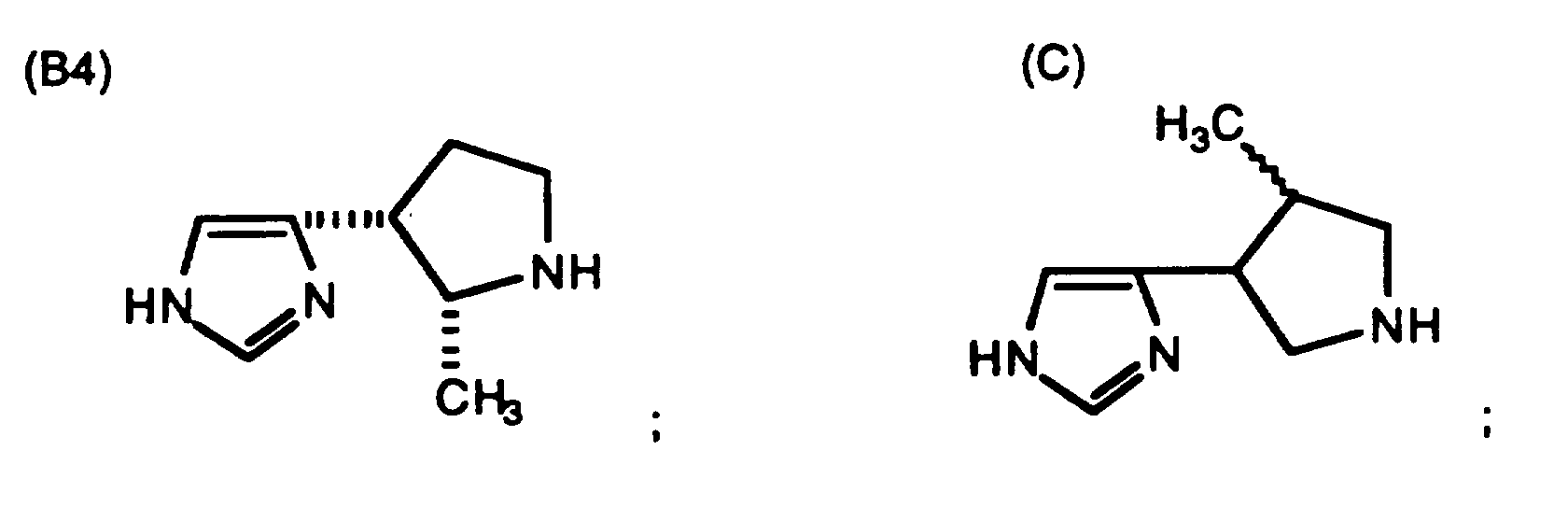
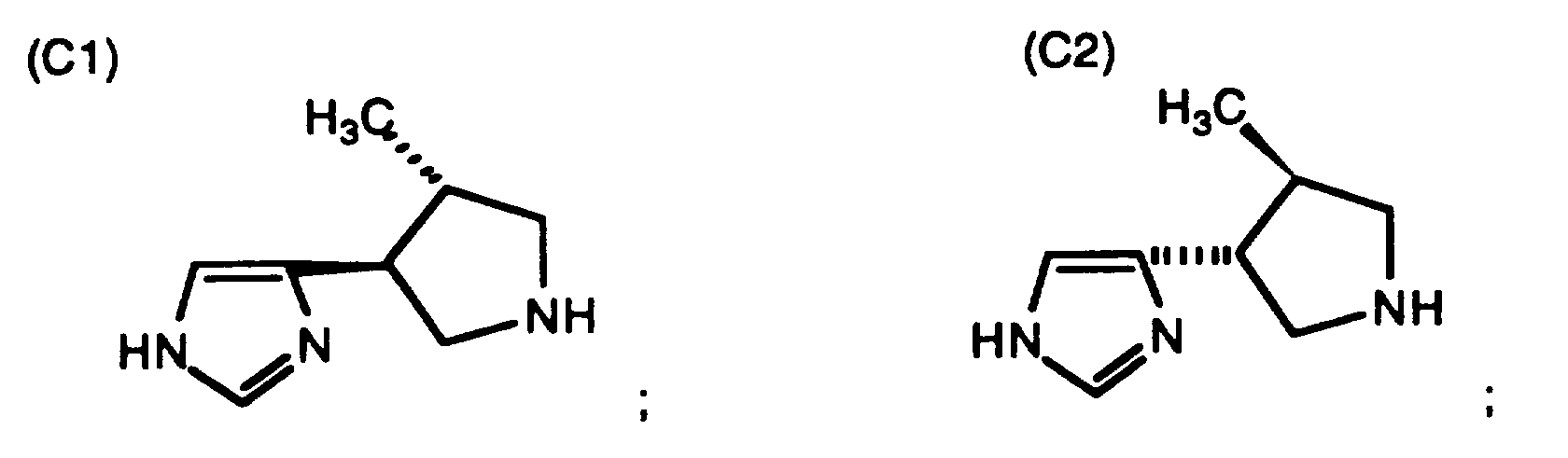


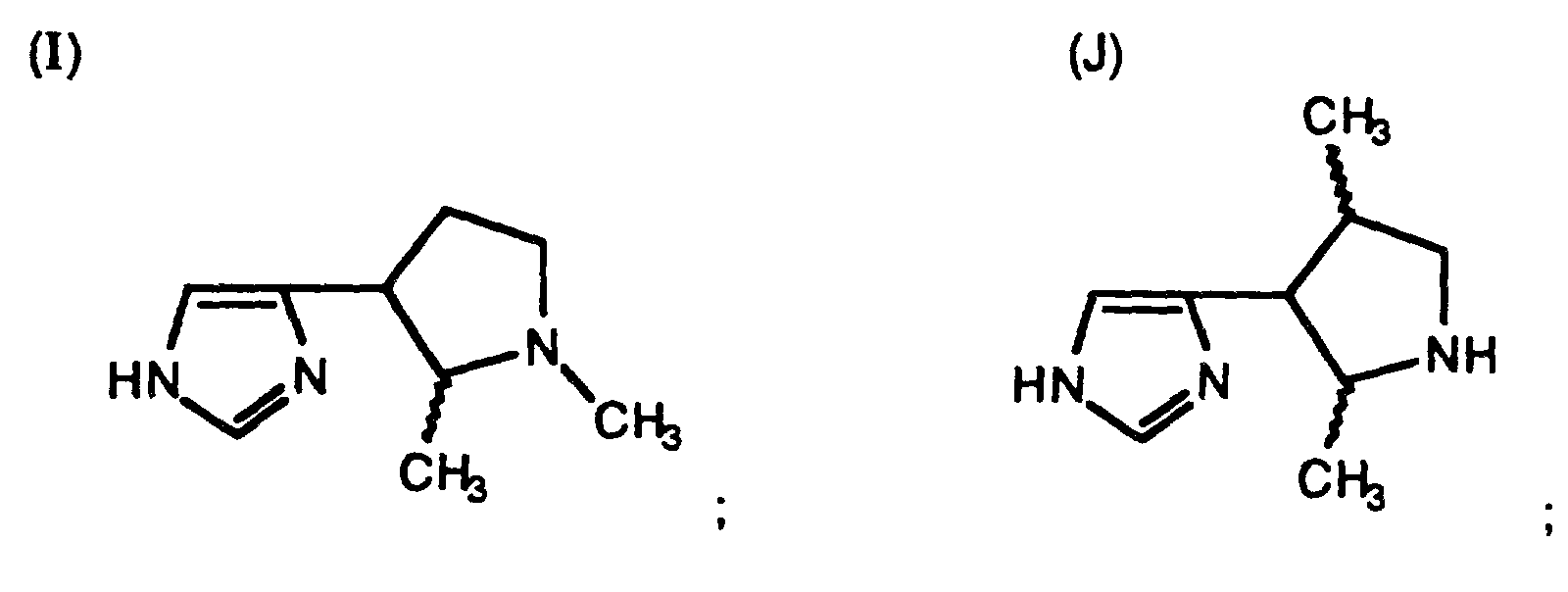


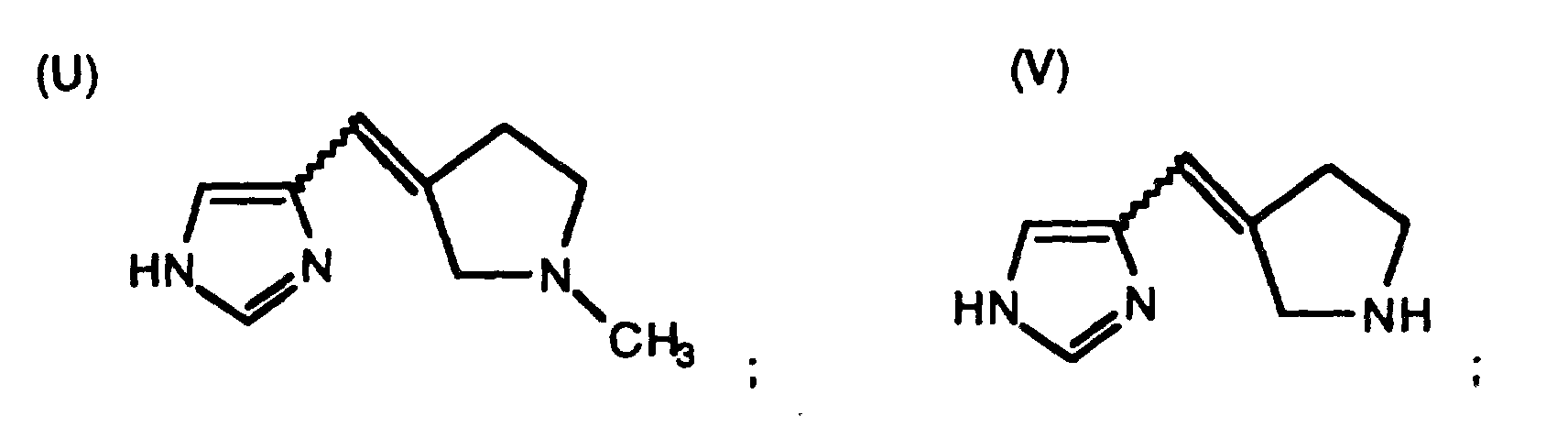


- The compound of Claim 14 having the formula:

- The compound of Claim 14 having the formula:

- The compound of Claim 14 having the formula:

- The compound of Claim 14 having the formula:

- A pharmaceutical composition, for use as an H3 receptor agonist or antagonist, comprising a pharmaceutically acceptable carrier and an effective amount of a Compound of Claim 1.
- A method of preparing a pharmaceutical composition comprising admixing a compound of Claim 1 with a pharmaceutically acceptable carrier.
- A process for preparing a compound of Claim 1 of the formula indicated , comprising a procedure selected from the following Procedures (I) to (IX):

 1) deprotecting compound (20) by treatment with dilute aqueous acid, at a temperature of 25 to 90°C, to produce compound (22), said reaction following reaction path 1 when R14 is alkyl, cycloalkyl, benzyl, substituted benzyl, allyl or propargyl; or2)(a) treating compound (20), when R14 is -Si(CH3)2C(CH3)3, with tetrabutylammonium fluoride in tetrahydrofuran at a temperature of 0 to 50°C to produce compound (21); or treating compound (20), when R14 is -C(O)O(t-butyl), with dilute aqueous acid to produce compound (21);(b) reacting compound (21) with (i) R5-X ,when R5 is -C(O)R10, -C(O)OR10', -C(O)NR10R11 or alkyl in an organic solvent optionally in the presence of a suitable base; or (ii) with R5A-CHO, when R5 is alkyl, cycloalkyl, allyl, propargyl, benzyl or substituted benzyl, under hydrogenating conditions, or in the presence of NaBH3(CN), in an organic solvent; wherein R5A represents an R5 group that has one less -CH2- group and X represents a suitable leaving group; said reaction (i) or (ii) being performed at a temperature within the range of -30 to 80°C; and(c) deprotecting the compound produced in 2)(b) by treatment with dilute aqueous acid at a temperature of 25 to 90°C to produce compound (22);
 1) reacting compound (29) with (i) R5-X ,when R5 is -C(O)R10, -C(O)OR10', -(O)NR10R11 or alkyl in an organic solvent optionally in the presence of a suitable base; or (ii) with R5A-CHO, when R5 is alkyl, cycloalkyl, allyl, propargyl, benzyl or substituted benzyl, under hydrogenating conditions, or in the presence of NaBH3(CN), in an organic solvent; wherein R5A represents an R5 group that has one less -CH2- group and X represents a suitable leaving group; said reaction (i) or (ii) being performed at a temperature within the range of -30 to 80°C, to produce compound (30); and2) deprotecting compound (30) by treatment with dilute aqueous acid at a temperature of 25 to 90°C to produce compound (31);
 1) reacting compound (37) with (i) R5-X ,when R5 is -C(O)R10, -C(O)OR10', -C(O)NR10R11 or alkyl in an organic solvent optionally in the presence of a suitable base; or (ii) with R5A-CHO, when R5 is alkyl, cycloalkyl, allyl, propargyl, benzyl or substituted benzyl, under hydrogenating conditions, or in the presence of NaBH3(CN), in an organic solvent; wherein R5A represents an R5 group that has one less -CH2- group and X represents a suitable leaving group; said reaction (i) or (ii) being performed at a temperature within the range of -30 to 80°C, to produce compound (38); and2) deprotecting compound (38) by treatment with dilute aqueous acid at a temperature of 25 to 100°C to produce compound (39);
 1) reacting compound (44), wherein r is 1 or 2, with (i) R5-X,when R5 is -C(O)R10, -C(O)OR10', -C(O)NR10R11 or alkyl in an organic solvent optionally in the presence of a suitable base; or (ii) with R5A-CHO, when R5 is alkyl, cycloalkyl, allyl, propargyl, benzyl or substituted benzyl, under hydrogenating conditions, or in the presence of NaBH3(CN), in an organic solvent; wherein R5A represents an R5 group that has one less -CH2- group and X represents a suitable leaving group; said reaction (i) or (ii) being performed at a temperature within the range of -30 to 80°C, to produce compound (44A); and2) deprotecting compound (44A) by treatment with dilute aqueous acid at a temperature of 25 to 90°C to produce compound (45);
 1) deprotecting compound (53), wherein p is 1 or 2, by treatment with dilute aqueous acid, at a temperature of 25 to 90°C, to produce compound (54), said reaction being used when R14 is alkyl, cycloalkyl, benzyl, substituted benzyl, allyl or propargyl; or2)(a) treating compound (53), when R14 is -Si(CH3)2C(CH3)3, with tetrabutylammonium fluoride in tetrahydrofuran at a temperature of 0 to 50°C; or treating compound (53), when R14 is -C(O)O(t-butyl), with dilute aqueous acid;(b) reacting the compound produced in 2)(a) with (i) R5-X ,when R5 is -C(O)R10, -C(O)OR10', -C(O)NR10R11 or alkyl in an organic solvent optionally in the presence of a sutable base; or (ii) with R5A-CHO, when R5 is alkyl, cycloalkyl, allyl, propargyl, benzyl or substituted benzyl, under hydrogenating conditions, or in the presence of NaBH3(CN), in an organic solvent; wherein R5A represents an R5 group that has one less -CH2- group and X represents a suitable leaving group; said reaction (i) or (ii) being performed at a temperature within the range of -30 to 80°C; and(c) deprotecting the compound produced in 2)(b) by treatment with dilute aqueous acid at a temperature of 25 to 90°C to produce compound (54);
 1) preparing the anion of compound (56) by reacting compound (56) with a suitable base at a temperature of -20 to 20°C, and reacting said anion with compound (32)
 2) reacting the product of 1) with R1-Q, wherein Q is Li or MgBr, in a suitable solvent containing CuCN and a Lewis acid, said reaction is conducted at a temperature of -78 to 20°C;3) reacting the enolate of the product of 2) with R8-L wherein L represents a suitable leaving group, in an organic solvent, said reaction is conducted at a temperature of 0 to 50°C;4) reducing the resulting R8 substituted compound from 3) with LiAlH4 at a temperature of 25 to 65°C in an organic solvent;5) deprotecting the reaction product of 4) by treatment with dilute aqueous acid, at a temperature of 25 to 90°C, to produce compound (57), said reaction being used when R14 is alkyl, cycloalkyl, benzyl, substituted benzyl, allyl or propargyl; or6)(a) treating the reaction product of 4), when R14 is -Si(CH3)2C(CH3)3, with tetrabutylammonium fluoride in tetrahydrofuran at a temperature of 0 to 50°C; or treating the reaction product of 4), when R14 is -C(O)O(t-butyl), with dilute aqueous acid;(b) reacting the compound produced in 6)(a) with (i) R5-X ,when R5 is -C(O)R10, -C(O)OR10', -C(O)NR10R11 or alkyl in an organic solvent optionally in the presence of a suitable base; or (ii) with R5A-CHO when R5 is alkyl, cycloalkyl, allyl, propargyl, benzyl or substituted benzyl, under hydrogenating conditions, or in the presence of NaBH3(CN), in an organic solvent; wherein R5A represents an R5 group that has one less -CH2- group and X represents a suitable leaving group; said reaction (i) or (ii) being performed at a temperature within the range of -30 to 80°C; and(c) deprotecting the compound produced in 6)(b) by treatment with dilute aqueous acid at a temperature of 25 to 90°C to produce compound (57);
 1) preparing the anion of compound (56) by reacting compound (56) with a suitable base at a temperature of -20 to 20°C, and reacting said anion with compound 42
 2) reacting the enolate of the product of 1) with R8-L, wherein L represents a suitable leaving group, in an organic solvent, said reaction is conducted at a temperature of 0 to 50°C;3) reducing the resulting R8 substituted compound from 2) with LiAlH4 at a temperature of 25 to 65°C in an organic solvent;4) deprotecting the reaction product of 3) by treatment with dilute aqueous acid, at a temperature of 25 to 90°C, to produce compound (57), said reaction being used when R14 is alkyl, cycloalkyl, benzyl, substituted benzyl, allyl or propargyl; or5)(IX) using compound (58):(a) treating the reaction product of 3), when R14 is -Si(CH3)2C(CH3)3, with tetrabutylammonium fluoride in tetrahydrofuran at a temperature of 0 to 50°C; or treating the reaction product of 3), when R14 is -C(O)O(t-butyl), with dilute aqueous acid;(b) reacting the compound produced in 5)(a) with (i) R5-X ,when R5 is -C(O)R10, -C(O)OR10', -C(O)NR10R11 or alkyl in an organic solvent optionally in the presence of a suitable base; or (ii) with R5A-CHO, when R5 is alkyl, cycloalkyl, allyl, propargyl, benzyl or substituted benzyl, under hydrogenating conditions, or in the presence of NaBH3(CN), in an organic solvent; wherein R5A represents an R5 group that has one less -CH2- group and X represents a suitable leaving group; said reaction (i) or (ii) being performed at a temperature within the range of -30 to 80°C; and(c) deprotecting the compound produced in 5)(b) by treatment with dilute aqueous acid at a temperature of 25 to 90°C to produce compound (57);


 1) treating compound (71) with acid in an inert organic solvent at a temperature of 0°C to cause selective deprotection of the pyrrolidine ring;2) reacting the reaction product of 1) with (i) R5-X, when R5 is -C(O)R10, -C(O)OR10', -C(O)NR10R11 or alkyl in an organic solvent optionally in the presence of a suitable base; or (ii) with R5A-CH, when R5 is alkyl, cycloalkyl, allyl, propargyl, benzyl or substituted benzyl, under hydrogenating conditions, or in the presence of NaBH3(CN), in an organic solvent; wherein R5A represents an R5 group that has one less -CH2- group and X represents a suitable leaving group; said reaction (i) or (ii) being performed at a temperature within the range of -30 to 80°C; and2) deprotecting the reaction product of 2) by treatment with dilute aqueous acid at a temperature of 25 to 90°C to produce compound (72); or(XI) Preparing compounds of Claim 1, wherein R5 is H, by reacting an intermediate compound of one of the above process steps (I), (II), (III), (IV), (V), (VI), (VII), (VII), (VIII), (IX), or (X), with aqueous acid, at a temperature of 25 to 100°C, said intermediate compound having the imidazole nitrogen protected by Z and having the nitrogen of the cyclic four or five membered amine substituted with -C(O)O(t-butyl) or unsubstituted.
 - Use of a compound or formula I according to any of Claims 1-18 in the manufacture of a medicament for use as an H3 receptor agonist or antagonist.
Applications Claiming Priority (3)
| Application Number | Priority Date | Filing Date | Title |
|---|---|---|---|
| US80978191A | 1991-12-18 | 1991-12-18 | |
| US809781 | 1991-12-18 | ||
| PCT/US1992/010743 WO1993012108A1 (en) | 1991-12-18 | 1992-12-17 | Imidazolyl or imidazoylalkyl substituted with a four or five membered nitrogen containing heterocyclic ring |
Publications (2)
| Publication Number | Publication Date |
|---|---|
| EP0618913A1 EP0618913A1 (en) | 1994-10-12 |
| EP0618913B1 true EP0618913B1 (en) | 1996-08-14 |
Family
ID=25202205
Family Applications (1)
| Application Number | Title | Priority Date | Filing Date |
|---|---|---|---|
| EP93901329A Expired - Lifetime EP0618913B1 (en) | 1991-12-18 | 1992-12-17 | Imidazolyl or imidazoylalkyl substituted with a four or five membered nitrogen containing heterocyclic ring |
Country Status (20)
| Country | Link |
|---|---|
| US (1) | US5463074A (en) |
| EP (1) | EP0618913B1 (en) |
| JP (1) | JPH07121939B2 (en) |
| KR (1) | KR0142802B1 (en) |
| AT (1) | ATE141269T1 (en) |
| AU (1) | AU671092B2 (en) |
| CA (1) | CA2129679C (en) |
| DE (1) | DE69212844T2 (en) |
| DK (1) | DK0618913T3 (en) |
| ES (1) | ES2090956T3 (en) |
| GR (1) | GR3021464T3 (en) |
| HK (1) | HK31397A (en) |
| IL (1) | IL104125A (en) |
| MX (1) | MX9207393A (en) |
| MY (1) | MY110108A (en) |
| NZ (1) | NZ246441A (en) |
| SG (1) | SG44510A1 (en) |
| TW (1) | TW268950B (en) |
| WO (1) | WO1993012108A1 (en) |
| ZA (1) | ZA929788B (en) |
Families Citing this family (31)
| Publication number | Priority date | Publication date | Assignee | Title |
|---|---|---|---|---|
| US5633250A (en) * | 1991-12-18 | 1997-05-27 | Schering Corporation | Imidazoylalkyl substituted with a six or seven membered heterocyclic ring containing two nitrogen atoms |
| FR2732017B1 (en) * | 1995-03-21 | 2000-09-22 | Inst Nat Sante Rech Med | NOVEL IMIDAZOLE DERIVATIVES AND / OR HISTAMINE H3 RECEPTOR AGONISTS AND / OR AGONISTS, THEIR PREPARATION AND THEIR THERAPEUTIC APPLICATIONS |
| WO1997001556A1 (en) * | 1995-06-29 | 1997-01-16 | Novo Nordisk A/S | Novel substituted azacyclic or azabicyclic compounds |
| AU717298B2 (en) * | 1996-04-03 | 2000-03-23 | Merck & Co., Inc. | Inhibitors of farnesyl-protein transferase |
| AU715603B2 (en) * | 1996-04-03 | 2000-02-03 | Merck & Co., Inc. | Inhibitors of farnesyl-protein transferase |
| US6072057A (en) * | 1996-06-06 | 2000-06-06 | Gliatech Inc. | 1H-4(5)-cyclo-substituted imidazole derivatives as histamine H3 receptor agents |
| US6407132B1 (en) | 1997-07-25 | 2002-06-18 | James Black Foundation Limited | Substituted imidazole derivatives and their use as histamine H3 receptor ligands |
| US6034251A (en) * | 1997-11-07 | 2000-03-07 | Schering Corporation | Phenyl-alkyl-imidazoles |
| US5990147A (en) * | 1997-11-07 | 1999-11-23 | Schering Corporation | H3 receptor ligands of the phenyl-alkyl-imidazoles type |
| JP2001522845A (en) * | 1997-11-07 | 2001-11-20 | シェーリング コーポレイション | Imidazoylalkyl substituted with 5, 6 or 7 membered heterocyclic rings containing one nitrogen atom |
| US6028095A (en) * | 1998-10-15 | 2000-02-22 | Warner-Lambert Company | Treatment of inflammatory bowel disease using histamine H3 -receptor agonists |
| US6133291A (en) * | 1998-10-16 | 2000-10-17 | Schering Corporation | N-(imidazolylalkyl)substituted cyclic amines as histamine-H3 agonists or antagonists |
| US6100279A (en) * | 1998-11-05 | 2000-08-08 | Schering Corporation | Imidazoylalkyl substituted with a five, six or seven membered heterocyclic ring containing one nitrogen atom |
| JP2002534511A (en) | 1999-01-18 | 2002-10-15 | ノボ ノルディスク アクティーゼルスカブ | Substituted imidazoles, their preparation and use |
| US6908926B1 (en) | 1999-04-16 | 2005-06-21 | Novo Nordisk A/S | Substituted imidazoles, their preparation and use |
| GB9924941D0 (en) * | 1999-10-22 | 1999-12-22 | Univ Manchester | Treatment of dyskinesia |
| US6437147B1 (en) | 2000-03-17 | 2002-08-20 | Novo Nordisk | Imidazole compounds |
| US6610721B2 (en) | 2000-03-17 | 2003-08-26 | Novo Nordisk A/S | Imidazo heterocyclic compounds |
| PE20020507A1 (en) * | 2000-10-17 | 2002-06-25 | Schering Corp | NON-IMIDAZOLE COMPOUNDS AS ANTAGONISTS OF THE HISTAMINE H3 RECEPTOR |
| WO2002072093A2 (en) | 2001-02-08 | 2002-09-19 | Schering Corporation | Use of dual h3/m2 antagonists with a bipiperidinic structure in the treatment of cognition deficit disorders |
| MXPA03008356A (en) | 2001-03-13 | 2003-12-11 | Schering Corp | Novel non-imidazole compounds. |
| FR2827863A1 (en) * | 2001-07-27 | 2003-01-31 | Sanofi Synthelabo | New dihydropyrrolyl alkyl imidazole derivatives having histamine receptor antagonist activity for treatment of obesity, diabetes, and central nervous system disorders |
| US7332508B2 (en) * | 2002-12-18 | 2008-02-19 | Novo Nordisk A/S | Substituted homopiperidine, piperidine or pyrrolidine derivatives |
| GB0505969D0 (en) | 2005-03-23 | 2005-04-27 | Novartis Ag | Organic compounds |
| EP1707203A1 (en) | 2005-04-01 | 2006-10-04 | Bioprojet | Treatment of parkinson's disease obstructive sleep apnea, dementia with lewy bodies, vascular dementia with non-imidazole alkylamines histamine H3- receptor ligands |
| EP1717233A1 (en) * | 2005-04-29 | 2006-11-02 | Bioprojet | Histamine H3-receptor ligands and their therapeutic application |
| EP1717235A3 (en) | 2005-04-29 | 2007-02-28 | Bioprojet | Phenoxypropylpiperidines and -pyrrolidines and their use as histamine H3-receptor ligands |
| GB0514203D0 (en) | 2005-07-11 | 2005-08-17 | Novartis Ag | Organic compounds |
| NZ569135A (en) | 2005-12-30 | 2011-08-26 | Novartis Ag | 3,5-Substituted piperidine compounds as renin inhibitors |
| WO2009000811A1 (en) | 2007-06-25 | 2008-12-31 | Novartis Ag | N5-(2-ethoxyethyl)-n3-(2-pyridinyl)-3,5-piperidinedicarboxamide derivatives for use as renin inhibitors |
| WO2013151982A1 (en) | 2012-04-03 | 2013-10-10 | Arena Pharmaceuticals, Inc. | Methods and compounds useful in treating pruritus, and methods for identifying such compounds |
Family Cites Families (24)
| Publication number | Priority date | Publication date | Assignee | Title |
|---|---|---|---|---|
| US2987522A (en) * | 1958-03-17 | 1961-06-06 | Petrolite Corp | Amidine products |
| US3491098A (en) * | 1967-05-29 | 1970-01-20 | Sterling Drug Inc | 1-((imidazolyl)-lower-alkyl)-4-substituted-piperazines |
| US3470197A (en) * | 1967-08-30 | 1969-09-30 | Miles Lab | 1-substituted derivatives of 3-ethyl-4 - (1-methylimidazolyl-(5)-methyl)-2-pyrrolidinone |
| US4011238A (en) * | 1972-07-26 | 1977-03-08 | Gruppo Lepetit S.P.A. | 2-imidazolidione derivatives |
| DE2862340D1 (en) * | 1978-02-01 | 1983-11-24 | Wellcome Found | Imidazole derivatives and salts thereof, their synthesis, and pharmaceutical formulations thereof |
| GR73560B (en) * | 1979-02-24 | 1984-03-15 | Pfizer | |
| DK151884C (en) * | 1979-03-07 | 1988-06-13 | Pfizer | METHOD OF ANALOGUE FOR THE PREPARATION OF 3- (1-IMIDAZOLYLALKYL) INCIDENTAL OR PHARMACEUTICAL ACCEPTABLE ACID ADDITION SALTS THEREOF |
| US4404387A (en) * | 1980-09-17 | 1983-09-13 | The Upjohn Company | Aminoalkyl-substituted imidazoles |
| US4404382A (en) * | 1980-09-17 | 1983-09-13 | The Upjohn Company | Piperazinyl-substituted imidazoles |
| US4431653A (en) * | 1982-03-18 | 1984-02-14 | Hoffmann-La Roche Inc. | Penicillanic acid derivatives |
| DE3313073A1 (en) * | 1983-04-12 | 1984-10-18 | Bayer Ag, 5090 Leverkusen | 1-AZOLYL-3-PYRAZOLYL-2-PROPANOL DERIVATIVES, METHOD FOR THE PRODUCTION THEREOF AND THEIR USE AS FUNGICIDES |
| US4581370A (en) * | 1983-07-12 | 1986-04-08 | Schering A.G. | Antiarrhythmic imidazoliums |
| DK704488D0 (en) * | 1988-12-19 | 1988-12-19 | Novo Industri As | NEW N-SUBSTITUTED AZAHETEROCYCLIC CARBOXYLIC ACIDS |
| FR2579596B1 (en) * | 1985-03-26 | 1987-11-20 | Inst Nat Sante Rech Med | (IMIDAZOLYL-4) PIPERIDINES, THEIR PREPARATION AND THEIR THERAPEUTIC APPLICATION |
| FR2586562B1 (en) * | 1985-09-02 | 1989-03-10 | Inst Nat Sante Rech Med | PHARMACEUTICAL COMPOSITION CONTAINING A-METHYLHISTAMINE |
| US4935417A (en) * | 1987-04-24 | 1990-06-19 | Syntex Pharmaceuticals Ltd. | Sustituted imidazolyl-alkyl-piperazine and -diazepine derivatives for treating cerebrovascular disease |
| US5091428A (en) * | 1987-04-24 | 1992-02-25 | Syntex Pharmaceuticals, Ltd. | Substituted imidazolyl-alkyl-piperazine and -diazepine derivatives |
| US5010075A (en) * | 1987-04-24 | 1991-04-23 | Syntex Pharmaceuticals Ltd. | Substituted imidazolyl-alkyl-piperazine and -diazepine derivatives |
| DE3811574A1 (en) * | 1988-03-31 | 1989-10-19 | Schering Ag | N-SUBSTITUTED IMIDAZOLES, METHODS FOR THEIR PRODUCTION AND THEIR USE IN MEDICINAL PRODUCTS |
| FR2630328B1 (en) * | 1988-04-22 | 1990-08-24 | Inst Nat Sante Rech Med | HISTAMINE DERIVATIVE, ITS PREPARATION AND ITS THERAPEUTIC APPLICATION |
| US4925851A (en) * | 1989-05-23 | 1990-05-15 | Sandoz Pharmaceuticals Corp. | 2- or 4-substituted-[2-(1H-imidazol-1-yl)ethyl]piperidines |
| US5264449A (en) * | 1989-11-13 | 1993-11-23 | Allergan, Inc. | N-substituted derivatives of 3R,4R-ethyl-[(1-methyl-1H-imidazol-5-yl)methyl]-2-pyrrolidinone |
| US5066663A (en) * | 1990-05-21 | 1991-11-19 | Warner-Lambert Company | Substituted-hetero-cyclopentanones and cyclopentenones and derivatives thereof acting at muscarinic receptors |
| SK118794A3 (en) * | 1992-04-01 | 1995-06-07 | Univ Toledo | 4(4'-piperidinyl or 3'- pyrrolidinyl) substitutes imidazoles as h3-receptor |
-
1992
- 1992-12-17 NZ NZ246441A patent/NZ246441A/en unknown
- 1992-12-17 ES ES93901329T patent/ES2090956T3/en not_active Expired - Lifetime
- 1992-12-17 WO PCT/US1992/010743 patent/WO1993012108A1/en not_active Ceased
- 1992-12-17 TW TW081110144A patent/TW268950B/zh active
- 1992-12-17 DE DE69212844T patent/DE69212844T2/en not_active Expired - Fee Related
- 1992-12-17 US US08/244,851 patent/US5463074A/en not_active Expired - Fee Related
- 1992-12-17 DK DK93901329.8T patent/DK0618913T3/en active
- 1992-12-17 ZA ZA929788A patent/ZA929788B/en unknown
- 1992-12-17 AT AT93901329T patent/ATE141269T1/en not_active IP Right Cessation
- 1992-12-17 EP EP93901329A patent/EP0618913B1/en not_active Expired - Lifetime
- 1992-12-17 CA CA002129679A patent/CA2129679C/en not_active Expired - Fee Related
- 1992-12-17 AU AU32773/93A patent/AU671092B2/en not_active Ceased
- 1992-12-17 MX MX9207393A patent/MX9207393A/en not_active IP Right Cessation
- 1992-12-17 SG SG1996001200A patent/SG44510A1/en unknown
- 1992-12-17 MY MYPI92002334A patent/MY110108A/en unknown
- 1992-12-17 IL IL10412592A patent/IL104125A/en not_active IP Right Cessation
- 1992-12-17 JP JP5511100A patent/JPH07121939B2/en not_active Expired - Fee Related
- 1992-12-27 KR KR94701079A patent/KR0142802B1/en not_active Expired - Fee Related
-
1996
- 1996-10-24 GR GR960402819T patent/GR3021464T3/en unknown
-
1997
- 1997-03-13 HK HK31397A patent/HK31397A/en not_active IP Right Cessation
Also Published As
| Publication number | Publication date |
|---|---|
| IL104125A0 (en) | 1993-05-13 |
| CA2129679A1 (en) | 1993-06-24 |
| DE69212844T2 (en) | 1997-01-09 |
| ES2090956T3 (en) | 1996-10-16 |
| HK31397A (en) | 1997-03-21 |
| KR0142802B1 (en) | 1998-07-15 |
| EP0618913A1 (en) | 1994-10-12 |
| SG44510A1 (en) | 1997-12-19 |
| JPH06511009A (en) | 1994-12-08 |
| AU3277393A (en) | 1993-07-19 |
| WO1993012108A1 (en) | 1993-06-24 |
| IL104125A (en) | 2000-08-31 |
| JPH07121939B2 (en) | 1995-12-25 |
| GR3021464T3 (en) | 1997-01-31 |
| CA2129679C (en) | 2000-05-09 |
| MY110108A (en) | 1998-01-27 |
| ZA929788B (en) | 1993-06-22 |
| AU671092B2 (en) | 1996-08-15 |
| ATE141269T1 (en) | 1996-08-15 |
| KR940703826A (en) | 1994-12-12 |
| US5463074A (en) | 1995-10-31 |
| NZ246441A (en) | 1996-02-27 |
| DK0618913T3 (en) | 1996-10-14 |
| DE69212844D1 (en) | 1996-09-19 |
| MX9207393A (en) | 1994-06-30 |
| TW268950B (en) | 1996-01-21 |
Similar Documents
| Publication | Publication Date | Title |
|---|---|---|
| US5463074A (en) | Imidazolyl or imidazoylalkyl substituted with a four or five membered nitrogen containing heterocyclic ring | |
| EP0619818B1 (en) | Imidazoylalkyl substituted with a six membered nitrogen containing heterocyclic ring | |
| AU662588B2 (en) | Imidazolyl-alkyl-piperazine and -diazepine derivatives as histamine H3 agonists/antagonists | |
| Moltzen et al. | Bioisosteres of arecoline: 1, 2, 3, 6-tetrahydro-5-pyridyl-substituted and 3-piperidyl-substituted derivatives of tetrazoles and 1, 2, 3-triazoles. Synthesis and muscarinic activity | |
| AU650182B2 (en) | Novel azaheterocyclylmethyl-chromans | |
| EP0592438B1 (en) | Indole derivatives | |
| US5397800A (en) | Certain 1-azabicyclo[2.2.1]heptanes useful as muscarinic receptor antagonists | |
| US6100279A (en) | Imidazoylalkyl substituted with a five, six or seven membered heterocyclic ring containing one nitrogen atom | |
| US5559246A (en) | Indole derivatives | |
| US5807872A (en) | Imidazoylalkyl substituted with a six membered nitrogen containing heterocyclic ring | |
| AU1296799A (en) | Imidazoylalkyl substituted with a five, six or seven membered heterocyclic ring containing one nitrogen atom | |
| EP0808316B1 (en) | Vasoconstrictive substituted 2,3-dihydro-1,4-dioxinopyridines | |
| US5633250A (en) | Imidazoylalkyl substituted with a six or seven membered heterocyclic ring containing two nitrogen atoms | |
| US5932596A (en) | Imidazoylalkyl substituted with a six membered nitrogen containing nitrogen containing heterocyclic ring | |
| JPH1081684A (en) | Substituted 3-aminoquinuclidine drug compositions |
Legal Events
| Date | Code | Title | Description |
|---|---|---|---|
| PUAI | Public reference made under article 153(3) epc to a published international application that has entered the european phase |
Free format text: ORIGINAL CODE: 0009012 |
|
| 17P | Request for examination filed |
Effective date: 19940611 |
|
| AK | Designated contracting states |
Kind code of ref document: A1 Designated state(s): AT BE CH DE DK ES FR GB GR IE IT LI LU MC NL PT SE |
|
| 17Q | First examination report despatched |
Effective date: 19950127 |
|
| GRAH | Despatch of communication of intention to grant a patent |
Free format text: ORIGINAL CODE: EPIDOS IGRA |
|
| GRAA | (expected) grant |
Free format text: ORIGINAL CODE: 0009210 |
|
| GRAH | Despatch of communication of intention to grant a patent |
Free format text: ORIGINAL CODE: EPIDOS IGRA |
|
| AK | Designated contracting states |
Kind code of ref document: B1 Designated state(s): AT BE CH DE DK ES FR GB GR IE IT LI LU MC NL PT SE |
|
| REF | Corresponds to: |
Ref document number: 141269 Country of ref document: AT Date of ref document: 19960815 Kind code of ref document: T |
|
| REG | Reference to a national code |
Ref country code: CH Ref legal event code: NV Representative=s name: HUG INTERLIZENZ AG |
|
| REG | Reference to a national code |
Ref country code: IE Ref legal event code: FG4D Free format text: 69439 |
|
| REF | Corresponds to: |
Ref document number: 69212844 Country of ref document: DE Date of ref document: 19960919 |
|
| REG | Reference to a national code |
Ref country code: DK Ref legal event code: T3 |
|
| REG | Reference to a national code |
Ref country code: ES Ref legal event code: FG2A Ref document number: 2090956 Country of ref document: ES Kind code of ref document: T3 |
|
| ITF | It: translation for a ep patent filed | ||
| REG | Reference to a national code |
Ref country code: ES Ref legal event code: FG2A Ref document number: 2090956 Country of ref document: ES Kind code of ref document: T3 |
|
| ET | Fr: translation filed |
Free format text: CORRECTIONS |
|
| REG | Reference to a national code |
Ref country code: GR Ref legal event code: FG4A Free format text: 3021464 |
|
| SC4A | Pt: translation is available |
Free format text: 960924 AVAILABILITY OF NATIONAL TRANSLATION |
|
| PLBE | No opposition filed within time limit |
Free format text: ORIGINAL CODE: 0009261 |
|
| STAA | Information on the status of an ep patent application or granted ep patent |
Free format text: STATUS: NO OPPOSITION FILED WITHIN TIME LIMIT |
|
| PG25 | Lapsed in a contracting state [announced via postgrant information from national office to epo] |
Ref country code: MC Effective date: 19970630 |
|
| 26N | No opposition filed | ||
| PGFP | Annual fee paid to national office [announced via postgrant information from national office to epo] |
Ref country code: DK Payment date: 20010919 Year of fee payment: 10 |
|
| PGFP | Annual fee paid to national office [announced via postgrant information from national office to epo] |
Ref country code: NL Payment date: 20010921 Year of fee payment: 10 |
|
| PGFP | Annual fee paid to national office [announced via postgrant information from national office to epo] |
Ref country code: PT Payment date: 20010925 Year of fee payment: 10 |
|
| PGFP | Annual fee paid to national office [announced via postgrant information from national office to epo] |
Ref country code: LU Payment date: 20011011 Year of fee payment: 10 |
|
| PGFP | Annual fee paid to national office [announced via postgrant information from national office to epo] |
Ref country code: GR Payment date: 20011017 Year of fee payment: 10 |
|
| PGFP | Annual fee paid to national office [announced via postgrant information from national office to epo] |
Ref country code: IE Payment date: 20011019 Year of fee payment: 10 |
|
| PGFP | Annual fee paid to national office [announced via postgrant information from national office to epo] |
Ref country code: AT Payment date: 20011105 Year of fee payment: 10 |
|
| PGFP | Annual fee paid to national office [announced via postgrant information from national office to epo] |
Ref country code: SE Payment date: 20011204 Year of fee payment: 10 |
|
| REG | Reference to a national code |
Ref country code: GB Ref legal event code: IF02 |
|
| PGFP | Annual fee paid to national office [announced via postgrant information from national office to epo] |
Ref country code: CH Payment date: 20020103 Year of fee payment: 10 |
|
| PGFP | Annual fee paid to national office [announced via postgrant information from national office to epo] |
Ref country code: BE Payment date: 20020117 Year of fee payment: 10 |
|
| REG | Reference to a national code |
Ref country code: CH Ref legal event code: NV Representative=s name: E. BLUM & CO. PATENTANWAELTE |
|
| PG25 | Lapsed in a contracting state [announced via postgrant information from national office to epo] |
Ref country code: LU Free format text: LAPSE BECAUSE OF NON-PAYMENT OF DUE FEES Effective date: 20021217 Ref country code: IE Free format text: LAPSE BECAUSE OF NON-PAYMENT OF DUE FEES Effective date: 20021217 Ref country code: AT Free format text: LAPSE BECAUSE OF NON-PAYMENT OF DUE FEES Effective date: 20021217 |
|
| PG25 | Lapsed in a contracting state [announced via postgrant information from national office to epo] |
Ref country code: SE Free format text: LAPSE BECAUSE OF NON-PAYMENT OF DUE FEES Effective date: 20021218 |
|
| PG25 | Lapsed in a contracting state [announced via postgrant information from national office to epo] |
Ref country code: LI Free format text: LAPSE BECAUSE OF NON-PAYMENT OF DUE FEES Effective date: 20021231 Ref country code: CH Free format text: LAPSE BECAUSE OF NON-PAYMENT OF DUE FEES Effective date: 20021231 Ref country code: BE Free format text: LAPSE BECAUSE OF NON-PAYMENT OF DUE FEES Effective date: 20021231 |
|
| PG25 | Lapsed in a contracting state [announced via postgrant information from national office to epo] |
Ref country code: DK Free format text: LAPSE BECAUSE OF NON-PAYMENT OF DUE FEES Effective date: 20030131 |
|
| BERE | Be: lapsed |
Owner name: *SCHERING CORP. Effective date: 20021231 |
|
| PG25 | Lapsed in a contracting state [announced via postgrant information from national office to epo] |
Ref country code: PT Free format text: LAPSE BECAUSE OF NON-PAYMENT OF DUE FEES Effective date: 20030630 |
|
| PG25 | Lapsed in a contracting state [announced via postgrant information from national office to epo] |
Ref country code: NL Free format text: LAPSE BECAUSE OF NON-PAYMENT OF DUE FEES Effective date: 20030701 |
|
| PG25 | Lapsed in a contracting state [announced via postgrant information from national office to epo] |
Ref country code: GR Free format text: LAPSE BECAUSE OF NON-PAYMENT OF DUE FEES Effective date: 20030707 |
|
| REG | Reference to a national code |
Ref country code: DK Ref legal event code: EBP |
|
| EUG | Se: european patent has lapsed | ||
| REG | Reference to a national code |
Ref country code: CH Ref legal event code: PL |
|
| NLV4 | Nl: lapsed or anulled due to non-payment of the annual fee |
Effective date: 20030701 |
|
| REG | Reference to a national code |
Ref country code: PT Ref legal event code: MM4A Free format text: LAPSE DUE TO NON-PAYMENT OF FEES Effective date: 20030630 |
|
| REG | Reference to a national code |
Ref country code: IE Ref legal event code: MM4A |
|
| PGFP | Annual fee paid to national office [announced via postgrant information from national office to epo] |
Ref country code: GB Payment date: 20051104 Year of fee payment: 14 |
|
| PGFP | Annual fee paid to national office [announced via postgrant information from national office to epo] |
Ref country code: FR Payment date: 20051201 Year of fee payment: 14 |
|
| PGFP | Annual fee paid to national office [announced via postgrant information from national office to epo] |
Ref country code: ES Payment date: 20051215 Year of fee payment: 14 |
|
| PGFP | Annual fee paid to national office [announced via postgrant information from national office to epo] |
Ref country code: DE Payment date: 20051230 Year of fee payment: 14 |
|
| PGFP | Annual fee paid to national office [announced via postgrant information from national office to epo] |
Ref country code: IT Payment date: 20061231 Year of fee payment: 15 |
|
| PG25 | Lapsed in a contracting state [announced via postgrant information from national office to epo] |
Ref country code: DE Free format text: LAPSE BECAUSE OF NON-PAYMENT OF DUE FEES Effective date: 20070703 |
|
| GBPC | Gb: european patent ceased through non-payment of renewal fee |
Effective date: 20061217 |
|
| REG | Reference to a national code |
Ref country code: FR Ref legal event code: ST Effective date: 20070831 |
|
| PG25 | Lapsed in a contracting state [announced via postgrant information from national office to epo] |
Ref country code: GB Free format text: LAPSE BECAUSE OF NON-PAYMENT OF DUE FEES Effective date: 20061217 |
|
| REG | Reference to a national code |
Ref country code: ES Ref legal event code: FD2A Effective date: 20061218 |
|
| PG25 | Lapsed in a contracting state [announced via postgrant information from national office to epo] |
Ref country code: FR Free format text: LAPSE BECAUSE OF NON-PAYMENT OF DUE FEES Effective date: 20070102 Ref country code: ES Free format text: LAPSE BECAUSE OF NON-PAYMENT OF DUE FEES Effective date: 20061218 |
|
| PG25 | Lapsed in a contracting state [announced via postgrant information from national office to epo] |
Ref country code: IT Free format text: LAPSE BECAUSE OF NON-PAYMENT OF DUE FEES Effective date: 20071217 |