EP0618237B1 - Polymerization process - Google Patents
Polymerization process Download PDFInfo
- Publication number
- EP0618237B1 EP0618237B1 EP94103194A EP94103194A EP0618237B1 EP 0618237 B1 EP0618237 B1 EP 0618237B1 EP 94103194 A EP94103194 A EP 94103194A EP 94103194 A EP94103194 A EP 94103194A EP 0618237 B1 EP0618237 B1 EP 0618237B1
- Authority
- EP
- European Patent Office
- Prior art keywords
- formula
- represented
- group
- complex
- nanometers
- Prior art date
- Legal status (The legal status is an assumption and is not a legal conclusion. Google has not performed a legal analysis and makes no representation as to the accuracy of the status listed.)
- Expired - Lifetime
Links
- 0 CCC1CC(C)*CC1 Chemical compound CCC1CC(C)*CC1 0.000 description 16
- OFNISBHGPNMTMS-UHFFFAOYSA-N C=C(CC(O1)=O)C1=O Chemical compound C=C(CC(O1)=O)C1=O OFNISBHGPNMTMS-UHFFFAOYSA-N 0.000 description 1
- NOLVEPIMYJFADX-UHFFFAOYSA-N CCNC(C1C)C(C)C1C1=CCC(C)(C)CC1 Chemical compound CCNC(C1C)C(C)C1C1=CCC(C)(C)CC1 NOLVEPIMYJFADX-UHFFFAOYSA-N 0.000 description 1
Images


Classifications
-
- C—CHEMISTRY; METALLURGY
- C08—ORGANIC MACROMOLECULAR COMPOUNDS; THEIR PREPARATION OR CHEMICAL WORKING-UP; COMPOSITIONS BASED THEREON
- C08F—MACROMOLECULAR COMPOUNDS OBTAINED BY REACTIONS ONLY INVOLVING CARBON-TO-CARBON UNSATURATED BONDS
- C08F2/00—Processes of polymerisation
- C08F2/46—Polymerisation initiated by wave energy or particle radiation
- C08F2/48—Polymerisation initiated by wave energy or particle radiation by ultraviolet or visible light
-
- Y—GENERAL TAGGING OF NEW TECHNOLOGICAL DEVELOPMENTS; GENERAL TAGGING OF CROSS-SECTIONAL TECHNOLOGIES SPANNING OVER SEVERAL SECTIONS OF THE IPC; TECHNICAL SUBJECTS COVERED BY FORMER USPC CROSS-REFERENCE ART COLLECTIONS [XRACs] AND DIGESTS
- Y10—TECHNICAL SUBJECTS COVERED BY FORMER USPC
- Y10S—TECHNICAL SUBJECTS COVERED BY FORMER USPC CROSS-REFERENCE ART COLLECTIONS [XRACs] AND DIGESTS
- Y10S522/00—Synthetic resins or natural rubbers -- part of the class 520 series
- Y10S522/913—Numerically specified distinct wavelength
Definitions
- the present invention is concerned with a polymerization process and especially with a polymerization process employing ultraviolet light. More particularly, the process of the present invention is concerned with polymerizing compositions that are free from photoinitiators but, nonetheless, can be polymerized employing ultraviolet light.
- the polymerizable compositions of the present invention contain a charge transfer complex from at least one unsaturated compound having an electron donor group and having an electron withdrawing group.
- the two major sources of energy for radiation polymerization currently employed are ultraviolet light and electron beam.
- electron beam is significantly more expensive in view of the high cost of equipment necessary for such processing.
- the commercial energy source most favored for radiation polymerization is ultraviolet light, which provides for photopolymerization.
- the photopolymerizable compositions contain a photosensitive monomeric and/or polymeric material along with a photoinitiator, a photosensitizer and adjuvant materials for providing particular properties.
- a photosensitive monomeric and/or polymeric material along with a photoinitiator, a photosensitizer and adjuvant materials for providing particular properties.
- the polymerization process according to the invention comprises providing a composition comprising a charge transfer complex, and subjecting said composition to ultraviolet light for a time sufficient to polymerize said complex, wherein said composition is free of any photoinitiating compound, and wherein said charge transfer complex is obtained from at least one bifunctional compound having both an electron donor group and an electron withdrawing group, and a polymerizable unsaturated moiety which is bonded to the electron donor group and another polymerizable unsaturated moiety which is bonded to the electron with drawing group or is obtained from at least one unsaturated compound having an electron donor group and a polymerizable unsaturated moiety, and at least one other unsaturated compound having an electron acceptor group and a polymerizable unsaturated moiety; wherein said charge transfer complex is capable of absorbing light having a wavelength that is longer than the longest wavelength in the spectrum of light absorbed by the individual donor and withdrawing groups used to form said complex so that ultraviolet light is absorbed by the complex rather than by individual groups or compounds forming said complex, and wherein this
- the polymerized product obtained by the present invention is more stable and can be employed in outdoor application with no or minimal discoloration. Moreover, the ability to exclude the photoinitiator not only significantly reduces the cost since the photoinitiator is one of the more expensive ingredients of photopolymerizable compositions, but also improves the relative safeness of the composition since the photoinitiator is a significant contributor to toxicity of formulations in which such is present.
- compositions of the present invention surprisingly do not require relatively short wavelengths ultraviolet light for curing, but instead are curable with the more readily available longer wavelengths such as about 310 nanometers and above. Further, the curing of the compositions of the present invention is not restricted to only a thin layer at the surface, but instead can proceed throughout the thickness employed.
- Figure 1 shows the absorbtivity of a complex of the present invention.
- Figure 2 shows the effort of adding a photoinitiater to a complex of the present invention.
- Figure 3 illustrates irradiance peak for a lamp employed in the process of the present invention.
- Figure 4 illustrates dosages for a lamp employed in the process of the present invention.
- Figure 5 illustrates the radiant spectral energy distribution for a Fusion F450 lamp with a D bulb.
- Figure 6 illustrates a focal intensity profile for a Fusion 450 lamp.
- the charge transfer complexes employed pursuant to the present invention are obtained from at least one unsaturated compound that has an electron donor group and has an electron withdrawing group.
- the at least one unsaturated compound includes a polymerizable unsaturated moiety bonded to the electron donor group and another a polymerizable unsaturated moiety bonded to the electron withdrawing group.
- the bonds are typically covalent bonds.
- Objectives of the present invention can be achieved employing one unsaturated compound that contains both the electron donor group and the electron withdrawing group.
- the charge transfer complex is obtained from at least one unsaturated compound that has an electron donor group and at least one other unsaturated compound that has an electron withdrawing group.
- the compounds employed to provide the charge transfer complex can be ethylenically unsaturated or acetylenically unsaturated.
- the double bond molar ratio of the electron donating compound to the electron withdrawing compound is about 0.5 to about 2, and more typically about 0.8 to about 1.2 and preferably about 1:1.
- the complexes employed pursuant to the present invention are stable under normal conditions.
- compositions do not spontaneously polymerize.
- the strength of both the donor and acceptor groups are not to the high level that could result in such spontaneous polymerization. Instead they polymerize under the influence of the necessary ultraviolet light.
- the complex to be used in the process of the present invention absorbs light that has a wavelength that is longer than the longest wavelength in the spectrum of light absorbed by the individual donor and withdrawing groups used to form the complex so that the ultraviolet light employed is absorbed by the complex rather than by the individual groups or components forming the complex.
- this difference in absorbtivity is sufficient so as to permit the polymerization of the complex to proceed by absorbing the light as contrasted to merely having the light absorbed by the individual groups or components thereof, resulting in conversion to heat energy but not polymerization.
- the complex absorbs light that has a wavelength that is at least about 10 nanometers longer than the longest wavelength in the spectrum of light absorbed by the individual donor and withdrawing groups or components since this facilitates tailoring the spectral output from the ultraviolet light source to assure the desired polymerization.
- the complex formed should not be one that upon initial exposure to ultraviolet light results in cleavage to a zwitterion state (that is where the positive and negative groups are equally ionized), but instead to a biradical that is capable of initiating free radical polymerization.
- the electron withdrawing and electron donating compounds employed can be represented by the following formula: wherein n is an integer preferably from 1 to 4; Z is A or D or both; wherein A is the structural fragment imparting acceptor properties to the double bond. D is the structural fragment imparting donor properties to the double bond; and R is the structural part of the backbone.
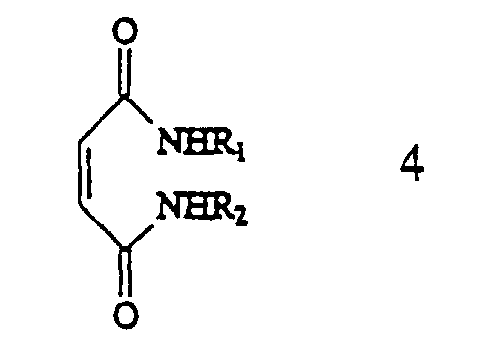
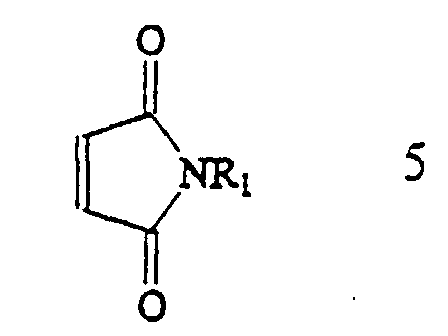
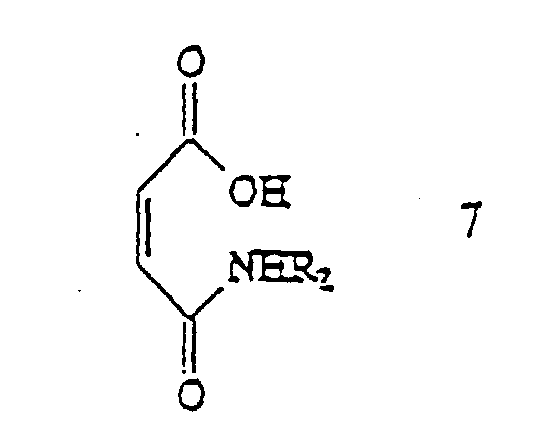
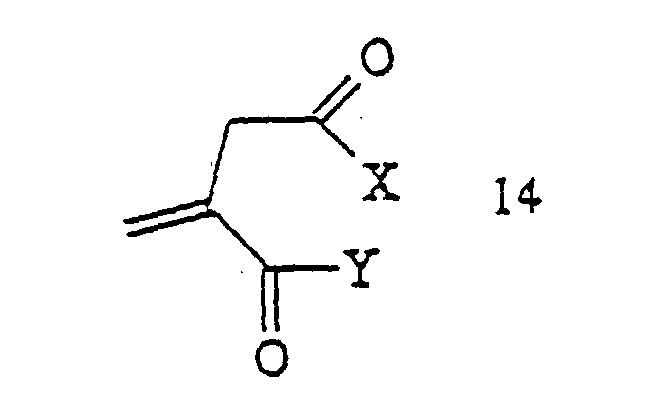
- Typical examples of the above formula I wherein Z is A are as follows: maleic diesters represented by the formula: maleic amide halfesters represented by the formula: maleic diamides represented by the formula: maleimides represented by the formula: maleic acid halfesters represented by the formula: maleic acid half amides represented by the formula: fumaric diesters represented by the formula: fumaric acid monoester halfamides represented by the formula: fumaric diamides represented by the formula: fumaric acid monoester represented by the formula: fumaric acid monoamides represented by the formula: exomethylene structures such as itaconic acid anhydride: and itaconic acid derivatives represented by the formula: wherein each X and Y independently is selected from the group consisting of: OR 1 , OR 2 , NHR 1 , NHR 2 , NR 1 , and OH and wherein each R 1 and R 2 in the above formulae is independently an aliphatic group or aromatic group.
- Typical aliphatic groups include alkyl groups having 1 to 22 carbon atoms and preferably 1-12 carbon atoms.
- Typical aromatic groups include phenyl, benzyl, biphenyl.
- Suitable compounds include the corresponding nitrile and imide derivatives of for instance maleic acid and fumaric acid.
- Some specific electron withdrawing compounds are maleic anhydride, maleimide, N-methyl maleimide, N-ethyl maleimide, N-phenyl maleimide, dimethyl maleate, dimethyl and diethyl fumarate, adamantane fumarate, and fumaric dinitrile.
- Polyfunctional, that is polyunsaturated, compounds including that with two, three and four and even more unsaturated groups can likewise be employed, and in fact, are preferred.
- polyesters examples include polyethylenically unsaturated polyesters, for example, polyesters from fumaric acid and maleic acid or anhydride thereof.
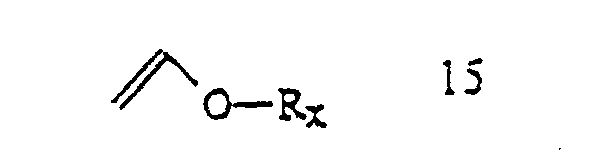
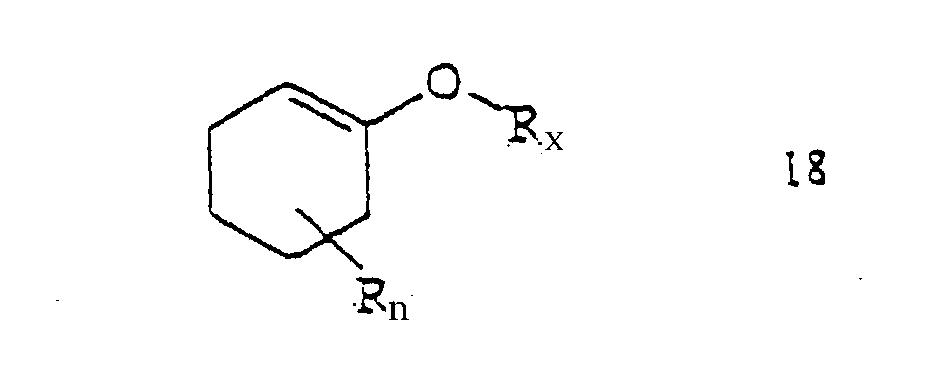
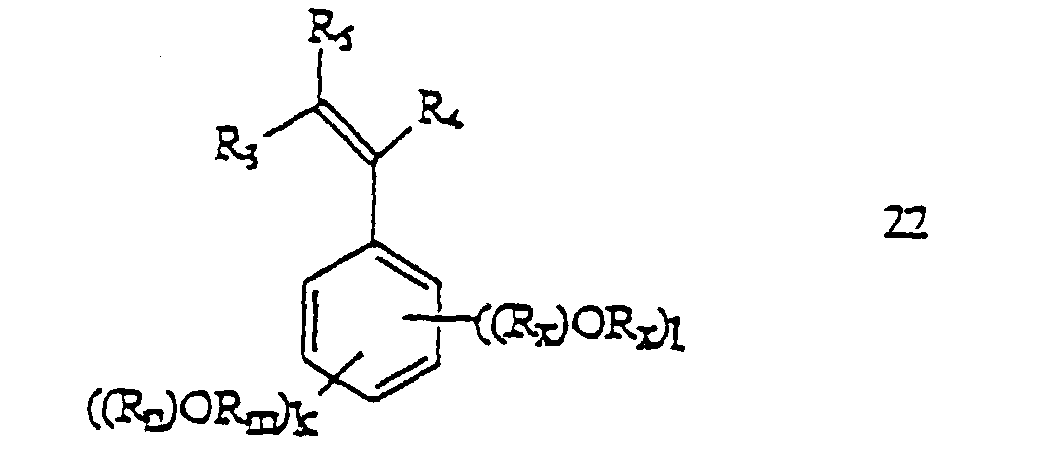
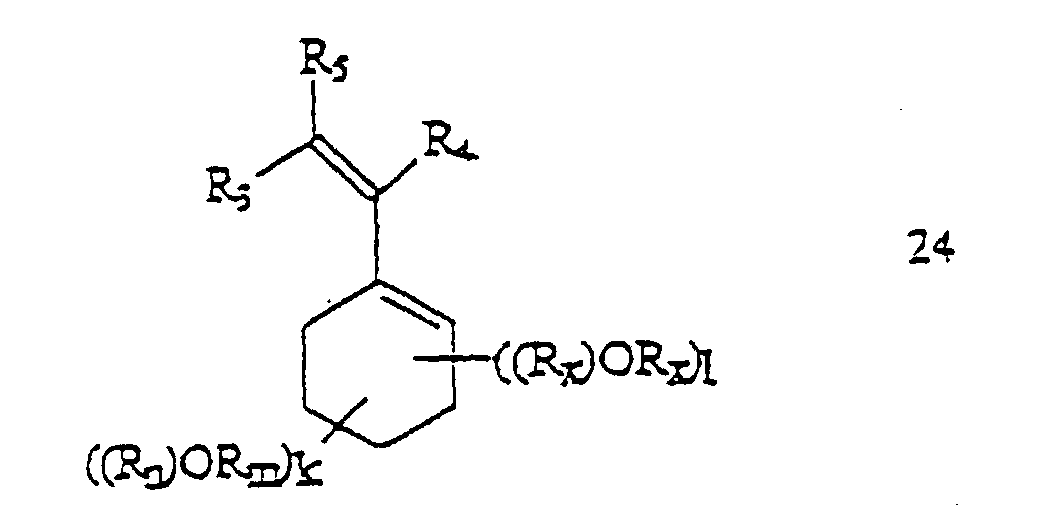
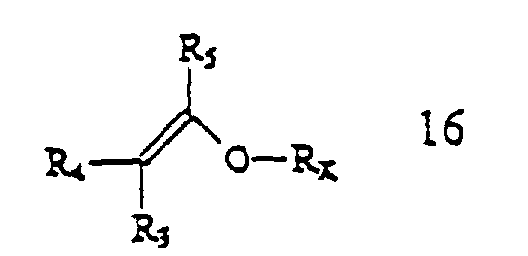
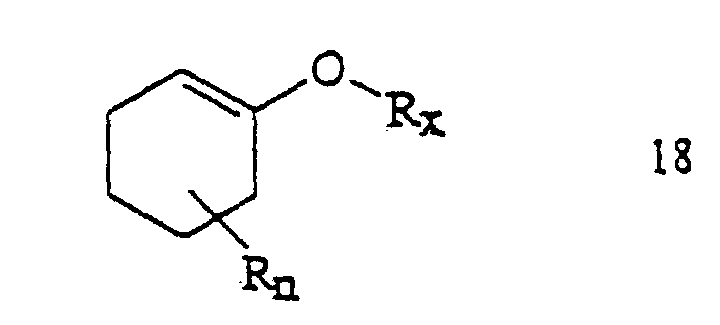
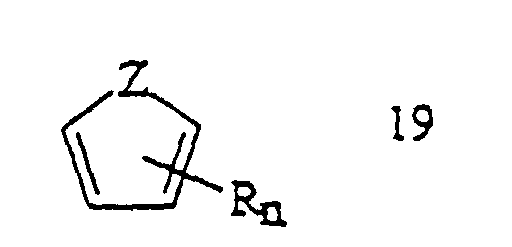
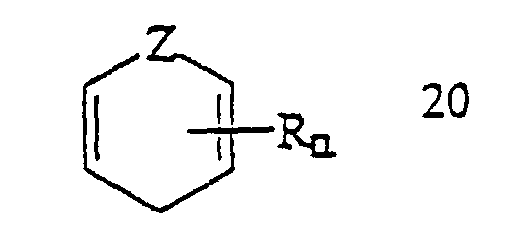
- Typical examples of the above formula 1, wherein Z is D are as follows: vinyl ethers represented by the formula: alkenyllethers represented by the formula: substituted exoalkoxy or aryloxycyclopentenes represented by the formula: substituted exoalkoxy or alryloxycyclohexenes represented by the formula: partially subtituted furanes or thiophenes represented by the formula: partially substituted pyranes or thiopyranes represented by the formula: ring substituted alkoxy or aryloxystyrenes or thioalkyl or thioarylstyrenes represented by the formula: alkoxy and/or aryloxy, alkyl and/or aryl substituted alkenylbenzenes represented by the formula; alkoxy and/or aryloxy, alkyl and or aryl substituted alkenyl-cyclopentenes represented by the formula: and alkoxy and/or aryloxy, alkyl and/or aryl substituted
- R is H and n is 2.
- polyfunctional that is, polyunsaturated compounds including those with two, three and four and even more unsaturated groups can likewise be employed, and in fact, are preferred.
- monovinyl ethers and divinyl ethers are especially preferred.
- monovinyl ethers include alkylvinyl ethers typically having a chain length of 1 to 22 carbon atoms and more typically 4-12 carbon atoms.
- Divinyl ethers include divinyl ethers of polyols having for example 2 to 6 hydroxy groups including ethylene glycol, propylene glycol, butylene glycol, 3 methyl propane triol and pentaerythritol.
- Examples of some specific electron donating materials are monobutyl 4 vinyl butoxy carbonate, monophenyl 4 vinyl butoxy carbonate, ethyl vinyl diethylene glycol, p-methoxy styrene, 3,4 dimethoxy propenyl benzene, N-vinyl carbazole, propenyl diethylene glycol, N-propenyl carbazole, monobutyl 4 propenyl butoxy carbonate, monophenyl 4-propenyl butoxy carbonate, isoengenol, and 4-propenylanisole.
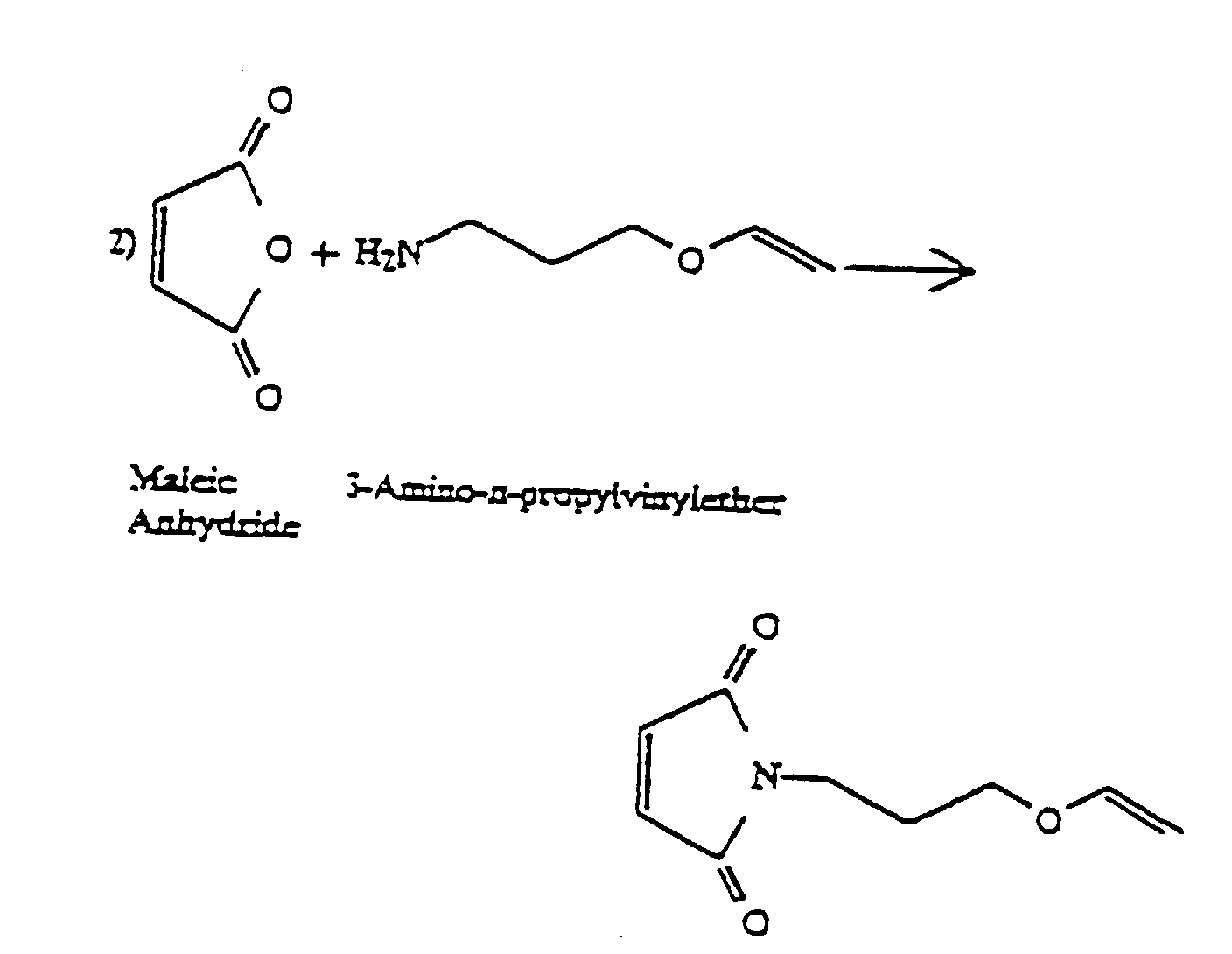
- Typical bifunctional compounds that contain both an acceptor or withdrawing group and a donor group for 2 include compounds represented by formulae 2 to 12 above except that each R 1 and R 2 in formulae 2 to 12 is independently selected from the group consisting of and wherein n is at least 2 and typically 2 to 12; R 1 is an aliphatic group, typically an alkyl group containing 1 to 2 carbon atoms; and aryl is an aromatic group such as phenyl.
- bifunctional compounds can be prepared by methods known in the art. For instance, typical compounds can be obtained from the following reactants:
- the compositions are subjected to ultraviolet light to cause polymerization thereof.
- the ultraviolet light is preferably high intensity light to provide a dosage of at least about 200 millijoules per square centimeter of surface area of the composition being polymerized to achieve reasonable curing rates.
- the ultraviolet light employed typically has substantial magnitudes at wavelengths of at least about 310 nanometers.
- Suitable lamps employed to provide the desired high intensity and availability of wavelength and spectral distribution include that available from Fusion Systems, Corp. under the trade designation F-450 model with a D bulb. See Figure 5 which illustrates a radiant spectral energy distribution for a Fusion 450 lamp with a D bulb, and Figure 6 which illustrates a focal intensity profile for a Fusion 450 lamp. At typical band speeds of about 20 to about 100 feet per minute (FPM) such gives a peak irradiance of about 1 to about 2.6 watt/cm 2 of the surface area of the composition.
- FPM feet per minute
- Figures 3 and 4 illustrate the cure rate as a function of the irradiance peak and dose values respectively, for the above disclosed lamp.
- Such lamp which is exemplary of lamps suitable for carrying out the process of the present invention emit light having a spectrum mainly between 350 and 450 nm and very low in deep UV as compared to more standard bulbs such as mercury bulbs.
- a description of lamps suitable for the present invention need not be described herein in any detail since such can be provided by those skilled in the art without undue experimentation.
- the lamp disclosed U.S. Patent 4,042,850 to Ury et al. but with a fill of 3.0 milligrams of iron iodide, 50 milligrams of mercury and 170 torr of Argon provides a spectrum rich in the 350 to 450 nanometer range.
- the combination of a minimum dosage of at least about 200 millijoules per square centimeter of surface area of composition being polymerized; a peak intensity of at least about 500 milliwatts per square centimeter of surface area of the composition along with a light spectrum that is adapted to or overlaps the absorbance of the complex should be employed in combination.
- the value for peak intensity and dosage was determined using a "UVIMAP" radiometer from Electronic Instrumentation & Technology, Inc.
- the light admitting aperture of the UVIMAP is a circle which is 3 mm in diameter. It should be noted that direct photolysis of the change transfer complex can be carried out by using a conventional arc bulb irradiation source with a standard type Hg spectral distribution, but the irradiation time needed for relatively small degrees of conversion are from an industrial point of view too long. Moreover, the degree of polymerization in such a process is not enough to provide the level of physical properties achieved by following the preferred aspects of the present invention.
- compositions of the present invention are especially suitable for coating on to various substrates such as metal, plastic foils and films, wood, and glass.
- Films of the compositions are typically about 1 ⁇ m to about 5 millimeters.
- compositions of the present invention do not include a photoinitiator, such compositions can be employed in outdoor applications without the fear of significant discoloration.
- photostabilizers can be added to the compositions to further guard against the potential of discoloration. It is further noted that the compositions of the present invention are readily polymerized in the presence of oxygen.
- compositions can include other conventionally employed additives such as surfactants, leveling agents, defoaming agents, photosensitizers, slip agents, fillers, and pigments.
- additives such as surfactants, leveling agents, defoaming agents, photosensitizers, slip agents, fillers, and pigments.
- the compositions do not require these additives and can be free of any one or all of such additives.
- compositions of the present invention can be employed in conjunction with a typical acrylate photopolymerizable system such as an adjuvant thereto such as in amounts of about 95 to about 5 percent.
- Reference to Figure 1 illustrate the absorbtivity of a complex of diethyl fumarate and dimethoxy propylene benzene of the present invention as compared to the individual monomers thereof.
- Figure 2 demonstrates that the addition of 1-2% of a photoinitiator (1,3,5 trimethyl benzoyl diphenyl phosphine oxide) to the diethyl fumarate/dimethoxy propylene benzene complex of the present invention actually resulted in worsening of the curing period.
- a photoinitiator (1,3,5 trimethyl benzoyl diphenyl phosphine oxide
- a charge transfer complex from a 1:1 ratio of double bonds of maleic anhydride and 3 ethylene glycol divinyl ether is coated onto a glass substrate to a thickness of about 10 ⁇ m.
- the coated glass is passed beneath a Fusion 450 lamp having a D bulb at a speed of about 30 feet per minute at a peak ultraviolet light intensity of about 1 watt/cm 2 and at a dosage of about 200 millejoule/cm 2 (see Figures 3 and 4).
- the coating polymerizes to a hard fully cured coating throughout the thickness of the coating.
- Example 1 is repeated except that the speed of about 60 feet per minute at a peak intensity of about 1.6 watts/cm 2 and dosage of about 425 millejoules/cm 2 (see Figures 3 and 4). The results obtained are similar to those of Example 1.
- Example 1 is repeated expect that the speed of about 100 feet per minute at a peak intensity of about 2.6 watts/cm 2 and dosage of about 600 millejoules/cm 2 are employed. (See Figures 3 and 4). The results obtained are similar to those of Example 1.
- a polyester having a molecular weight of about 1100 from about 35 parts by weight of fumaric acid, about 37 parts by weight of isophthalic acid, about 8 parts by weight of adipic acid and about 37 parts by weight of diethylene glycol is prepared.
- a charged transfer complex from a 1:1 ratio of double bonds of this polyester and diethylene divinyl ether is coated onto a glass substrate to a thickness of about 10 ⁇ m.
- the coated glass is passed beneath a Fusion 420 lamp at a speed 40 feet per minute at a peak ultraviolet light intensity of about 2.6 watts/cm 2 and a dosage of about 600 millejoule/cm 2 .
- a 1 to 1 double bond molar ratio mixture of maleic anhydride and p-methoxystyrene is cured into a hard film at a speed of about 40 feet per minute at a peak intensity of 1.6 W/cm 2 . This corresponds to a dose of 430 mJ/cm 2 .
- the irradiation was carried out by the use of the Fusion D bulb emission characteristics and F 600 lamp. Due to the strong CT complex formed, intense yellow color develops by mixing, the stability of the mixture at room temperature was only a few hours, before a gelation starts.
- a 1 to 1 double bond molar ratio mixture of maleic anhydride and triethyleneglycoldivinylether is mixed with Ebecryl 230, from Radcure Specialties, U.S., an aliphatic multifunctional urethaneacrylate, in a ratio from 1:9.
- the curing is performed by the use of a Fusion D spectrum and at a peak intensity of 2.6 W/cm 2 at 20 to 30 feet per minute. Tough films with a film thickness from 20 to 500 ⁇ m are obtained.
- Example 6 is repeated except that the ratio of the charge transfer complex to Ebecryl 230 is 9:1. The results are similar to those from Example 6.
Landscapes
- Chemical & Material Sciences (AREA)
- Health & Medical Sciences (AREA)
- Chemical Kinetics & Catalysis (AREA)
- Medicinal Chemistry (AREA)
- Polymers & Plastics (AREA)
- Organic Chemistry (AREA)
- Polymerisation Methods In General (AREA)
- Macromolecular Compounds Obtained By Forming Nitrogen-Containing Linkages In General (AREA)
- Addition Polymer Or Copolymer, Post-Treatments, Or Chemical Modifications (AREA)
- Devices For Conveying Motion By Means Of Endless Flexible Members (AREA)
- Organic Low-Molecular-Weight Compounds And Preparation Thereof (AREA)
Abstract
Description

maleic diesters represented by the formula:

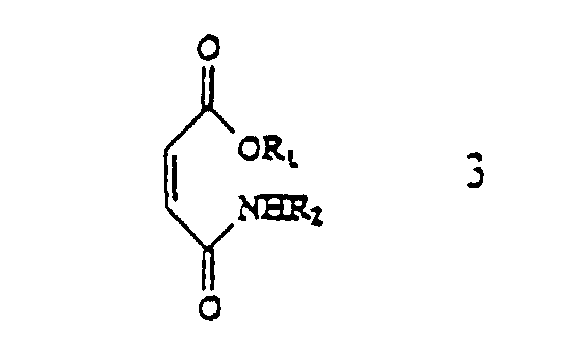
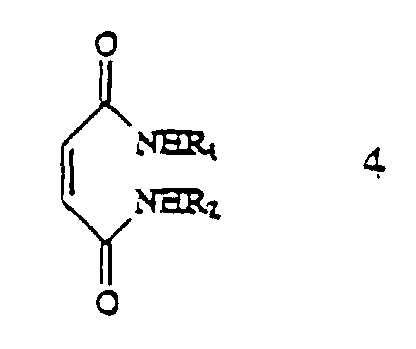

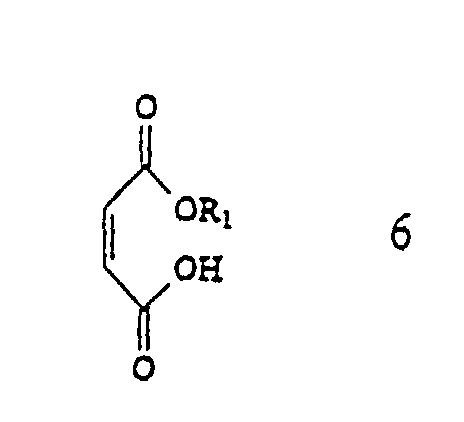

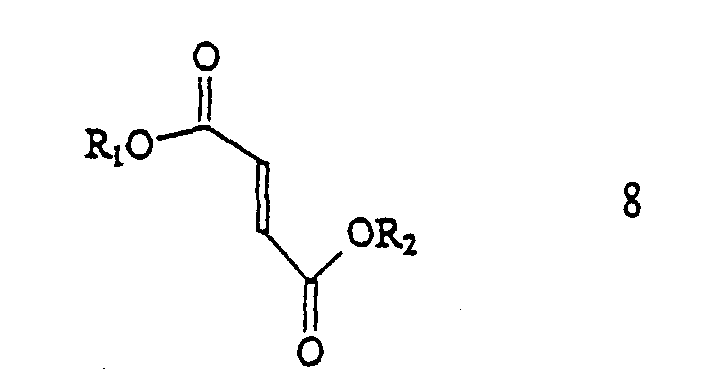


OR1, OR2, NHR1, NHR2, NR1, and OH and wherein each R1 and R2 in the above formulae is independently an aliphatic group or aromatic group.
vinyl ethers represented by the formula:








Claims (22)
- A polymerization process which comprises providing a composition comprising a charge transfer complex, and subjecting said composition to ultraviolet light for a time sufficient to polymerize said complex, wherein said composition is free of any photoinitiating compound, and wherein said charge transfer complex is obtained from at least one bifunctional compound having both an electron donor group and an electron withdrawing group, and a polymerizable unsaturated moiety which is bonded to the electron donot group and another polymerizable insaturated moiety which is bonded to the electron withdrawing group or is obtained from at least one unsaturated compound having an electron donor group and a polymerizable unsaturated moiety, and at least one other unsaturated compound having an electron acceptor group and a polymerizable unsaturated moiety; wherein said charge transfer complex is capable of absorbing light having a wavelength that is longer than the longest wavelength in the spectrum of light absorbed by the individual donor and withdrawing groups used to form said complex so that ultraviolet light is absorbed by the complex rather than by individual groups or compounds forming said complex, and wherein this difference in absorbtivity is sufficient so as to permit the polymerization of said complex to proceed by absorbing light.
- The process of claim 1, wherein the charge transfer complex is obtained from electron withdrawing and electron donating compounds represented by the formulawherein n is an integer from 1 to 4, Z is A or D or both, wherein A is a structural fragment imparting acceptor properties to the double bond, D is a structural fragment imparting donor properties to the double bond, and R is the structural part of the backbone.

- The process of claim 1, wherein said charge transfer complex is obtained fromor wherein said charge transfer complex is obtained from the bifunctional compound having both an electron donor group and an electron acceptor group and being represented by said formulae 2 to 12 except that each R1 and R2 in formulae 2 to 12 is independently selected from the group consisting of:a) at least one unsaturated compound selected from the group consisting of
maleic diesters represented by the formula:maleic amide halfesters reprented by the formula: maleic diamides represented by the formula:
 maleimides represented by the formula:
 maleic acid halfesters represented by the formula:
 maleic acid half amides represented by the formula:
 fumaric diesters represented by the formula:
 fumaric acid monoester halfamides represented by the formula:
 fumaric diamides represented by the formula:
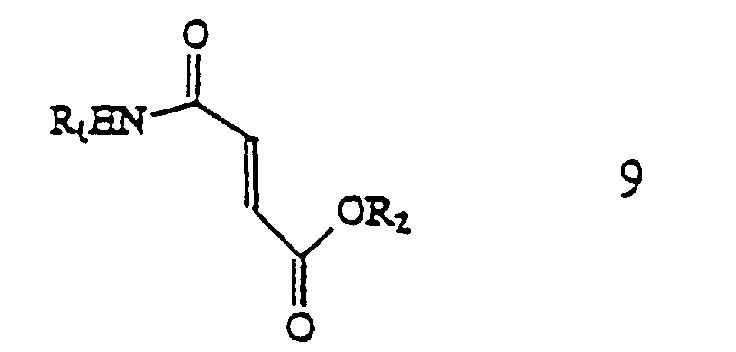 fumaric acid monoester represented by the formula:
 fumaric acid monoamides represented by the formula:
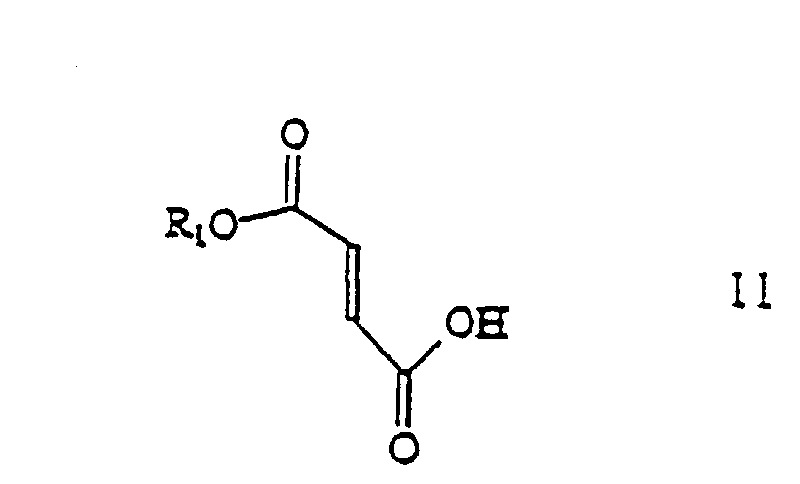 exomethylene structures represented by the formula:
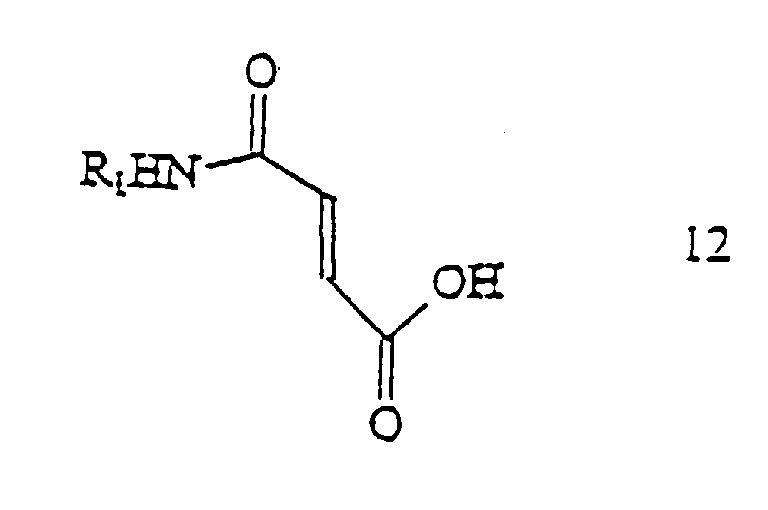 itaconic acid derivatives represented by the formula:
 nitrile derivatives of formulae 2-14; and imide derivatives of formulae 2-14; and wherein each X and Y independently is selected from the group consisting of OR1, OR2, NHR1, NHR2, NR1, and OH and wherein each R1 and R2 in the above formulae 2-14 is independently an aliphatic group or aromatic group; and
 b) at least one unsaturated compound selected from the group consisting of:
vinyl ethers represented by the formula:alkenylethers represented by the formula: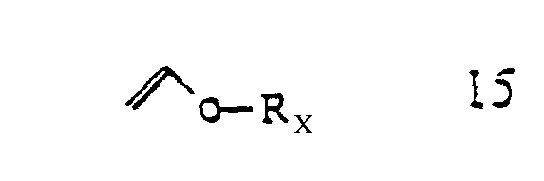 substituted cyclopentenes represented by the formula:
 substituted cyclohexenes represented by the formula:
 partially substituted furanes or thiophenes represented by the formula:
 partially substituted pyranes or thiopyranes represented by the formula:
 ring substituted styrenes represented by the formula:
 substituted alkenylbenzenes represented by the formula:
 substituted alkenyl-cyclopentenes represented by the formula:
 substituted alkenyl cyclohexenes represented by the formula:
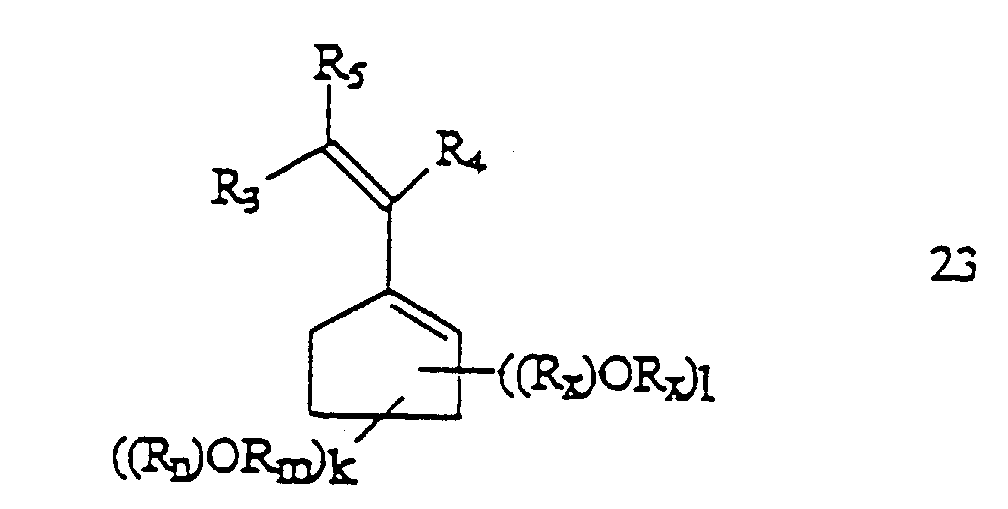 wherein each Rx and R is independently an aliphatic group or aromatic group, each R3, R4, and R5 independently is H or aliphatic; each Z is independently selected from the group of O and S, k and l are integers independently from 0 to 5 wherein 0 ≤ k + l ≤ 5;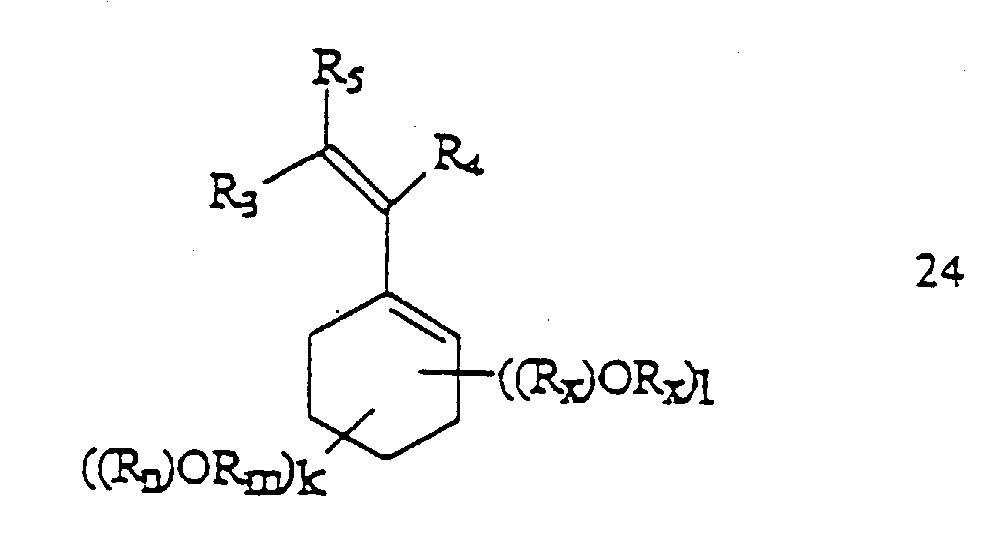
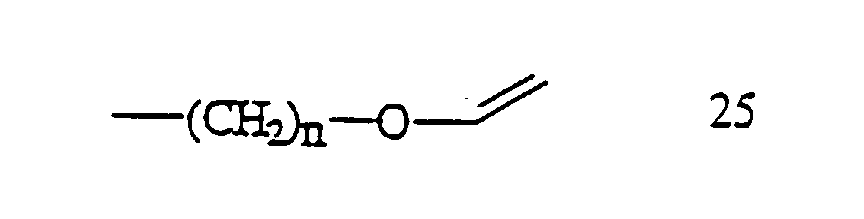
 wherein n is at least 2, R1 is an aliphatic group, and Aryl is an aromatic group.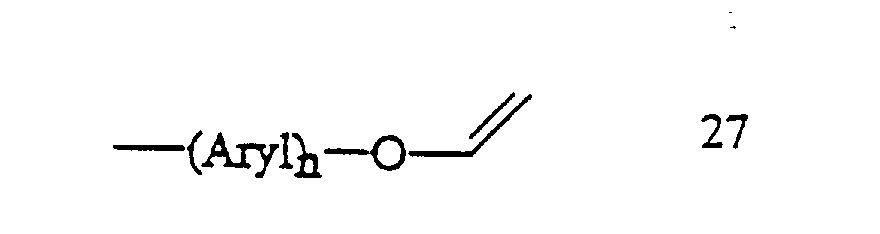
- The process of claim 3, wherein n in formula 25 is 2 to 12.
- The process of claim 1, wherein said ultraviolet light has substantial magnitude of wavelengths of at least about 310 nanometers.
- The process of claim 5, wherein said ultraviolet light contains more than half of its energy between 350 nanometers and 450 namometers.
- The process of claim 6, wherein said ultraviolet light is peaked between 350 nanometers and 450 nanometers.
- The process of claim 1, wherein the dosage of ultraviolet light is at least about 200 millijoules per square centimeter of surface area of said composition.
- The process of claim 1, wherein said charge transfer complex is obtained from the at least one unsaturated compound having an electron donor group and the at least one other unsaturated compound having an electron withdrawing group.
- The process of claim 9, wherein said complex absorbs light having a wavelength of at least about 10 nanometers greater than the highest wavelength in the spectrum of light absorbed by the compounds from which said complex was obtained.
- The process of claim 9, wherein the molar ratio of the unsaturated bonds of said compound having an electron donor group to said compound having an electron withdrawing group is 0.5 to 2.
- The process of claim 11, wherein said molar ratio is 0.8 to 1.2.
- The process of claim 11, wherein said molar ratio is 1:1.
- The process of claim 1, wherein said complex is a complex of diethyl fumarate and dimethoxy propylene benzene.
- The process of claim 1, wherein said complex is a complex of maleic anhydride and 3 ethylene glycol divinyl ether.
- The process of any one of claims 1, 5, 8 and 9, wherein the peak intensity of said ultraviolet light is at least about 500 milliwatts/cm2 of surface area of said composition.
- The process of claim 16, wherein said entire dosage of light is measured at spectral wavelengths of between 300 nanometers and 420 nanometers.
- The process of claim 1, wherein said ultraviolet light has a spectrum which is peaked between 350 nanometers and 450 nanometers and wherein more than half of the energy of said ultraviolet light is present between said wavelengths, and wherein the peak intensity of said light is at least about 500 milliwatts/cm2, and wherein the dosage is at least about 200 millijoules/cm2, the peak intensity and dosage being measured from light only at wavelengths of between 300 nanometers and 420 nanometers.
- The process of claim 1, wherein said ultraviolet light has a spectrum substantially as shown in the followingand wherein the peak intensity of said light is at least about 500 milliwatts/cm2 and the dosage is at least about 200 millijoules/cm2, the peak intensity and dosage being measured from light only at wavelengths of between 300 nanometers and 400 nanometers.

- The process of claim 15 or 17, wherein said complex absorbs light having a wavelength of at least about 10 nanometers greater than the highest wavelength in the spectrum of light absorbed by the compounds from which said complex was obtained.
- The process of claim 1, wherein a film of said composition is cured through its thickness.
- The process of claim 21, wherein said film is about 1 micrometer to about 5 millimeters thick.
Applications Claiming Priority (2)
| Application Number | Priority Date | Filing Date | Title |
|---|---|---|---|
| US08/041,423 US5446073A (en) | 1993-03-31 | 1993-03-31 | Photopolymerization process employing a charge transfer complex without a photoinitiator |
| US41423 | 1993-03-31 |
Publications (2)
| Publication Number | Publication Date |
|---|---|
| EP0618237A1 EP0618237A1 (en) | 1994-10-05 |
| EP0618237B1 true EP0618237B1 (en) | 1998-09-02 |
Family
ID=21916436
Family Applications (1)
| Application Number | Title | Priority Date | Filing Date |
|---|---|---|---|
| EP94103194A Expired - Lifetime EP0618237B1 (en) | 1993-03-31 | 1994-03-03 | Polymerization process |
Country Status (9)
| Country | Link |
|---|---|
| US (1) | US5446073A (en) |
| EP (1) | EP0618237B1 (en) |
| JP (1) | JP3353020B2 (en) |
| KR (1) | KR100293081B1 (en) |
| AT (1) | ATE170534T1 (en) |
| DE (1) | DE69412888T2 (en) |
| DK (1) | DK0618237T3 (en) |
| ES (1) | ES2125362T3 (en) |
| TW (1) | TW283151B (en) |
Cited By (2)
| Publication number | Priority date | Publication date | Assignee | Title |
|---|---|---|---|---|
| DE19928378A1 (en) * | 1999-06-21 | 2000-12-28 | Joachim Becker | Back-polymerization of photopolymers with application in e.g. dental fillings, occurs at interface opposite entry point, where coating converts incident radiation to new wavelengths initiating setting |
| EP3655247B1 (en) | 2018-03-27 | 2021-01-13 | Mercene Coatings AB | Coating and primer |
Families Citing this family (37)
| Publication number | Priority date | Publication date | Assignee | Title |
|---|---|---|---|---|
| US6025409A (en) * | 1996-02-29 | 2000-02-15 | Dsm N.V. | Radiation curable coating composition |
| BR9707893A (en) * | 1996-02-29 | 1999-07-27 | Dsm Nv | Composition of radiation curable coating |
| US6034150A (en) * | 1996-08-23 | 2000-03-07 | University Of Southern Mississippi | Polymerization processes using aliphatic maleimides |
| US20040235976A1 (en) * | 1996-08-23 | 2004-11-25 | Hoyle Charles E. | Polymerization processes using alphatic maleimides |
| US6306923B1 (en) * | 1996-09-12 | 2001-10-23 | Sartomer Company, Inc. | Ultraviolet or visible light polymerizable and/or crosslinkable maleimide-functional coating compositions |
| US6271339B1 (en) | 1996-09-12 | 2001-08-07 | Sartomer Company, Inc. | Prepolymers having maleimide functions the process for preparing them and their uses |
| DE19652544A1 (en) * | 1996-12-17 | 1998-06-18 | Wacker Chemie Gmbh | Curable organosiloxane compositions |
| DE19718634A1 (en) * | 1997-05-02 | 1998-11-05 | Wacker Chemie Gmbh | Radiation- or thermosetting organosiloxane compositions with (methyl) styrene groups |
| JP3599160B2 (en) | 1997-05-16 | 2004-12-08 | 大日本インキ化学工業株式会社 | Active energy ray-curable composition containing maleimide derivative and method for curing the active energy ray-curable composition |
| BR9809495A (en) * | 1997-05-27 | 2000-10-17 | First Chemical Corp | "aromatic maleimides and methods for their use" |
| GB2327892B (en) * | 1997-07-31 | 2001-11-14 | Perstorp Ltd | Improvements in or relating to curable coating |
| US6030703A (en) * | 1997-08-13 | 2000-02-29 | Sartomer Company, Inc. | Radiation curable compositions comprising an unsaturated polyester and a compound having two to six-propenyl ether groups |
| US6555593B1 (en) | 1998-01-30 | 2003-04-29 | Albemarle Corporation | Photopolymerization compositions including maleimides and processes for using the same |
| JP4361685B2 (en) * | 1998-03-26 | 2009-11-11 | サン ケミカル コーポレイション | Water-compatible energy curable composition containing maleimide derivatives |
| HK1041491A1 (en) * | 1998-07-31 | 2002-07-12 | Fusion Uv Systems, Inc. | Photopolymerization process and composition employing a charge transfer complex and cationic photoinitiator |
| US6835758B2 (en) * | 1998-11-14 | 2004-12-28 | Sun Chemical Corporation | Water compatible energy curable compositions containing malemide derivatives |
| WO2000020517A2 (en) * | 1999-01-19 | 2000-04-13 | Dsm N.V. | Radiation-curable compositions comprising maleimide compounds and method for producing a substrate with a cured layer |
| US6262825B1 (en) | 1999-08-24 | 2001-07-17 | Napp Systems, Inc. | Apparatus and method for the enhanced imagewise exposure of a photosensitive material |
| EP1278781A4 (en) * | 1999-10-01 | 2005-01-26 | Ballina Pty Ltd | Radiation polymerisable compositions |
| EP1332187A1 (en) * | 2000-09-05 | 2003-08-06 | John Lyndon Garnett | Radiation polymerisable compositions having accelerated cure |
| US6908586B2 (en) * | 2001-06-27 | 2005-06-21 | Fusion Uv Systems, Inc. | Free radical polymerization method having reduced premature termination, apparatus for performing the method and product formed thereby |
| US6596786B2 (en) * | 2001-08-17 | 2003-07-22 | Alcatel | Radiation-curable coating composition including oligomeric photoinitiator and/or oligomeric adhesion promoter |
| WO2003018642A1 (en) * | 2001-08-23 | 2003-03-06 | John Lyndon Garnett | Preparation of polymer composites |
| US6550905B1 (en) | 2001-11-19 | 2003-04-22 | Dotrix N.V. | Radiation curable inkjet ink relatively free of photoinitiator and method and apparatus of curing the ink |
| US20080103222A1 (en) * | 2002-04-26 | 2008-05-01 | Albemarle Corporation | New Class of Amine Coinitiators in Photoinitiated Polymerizations |
| CN1675004A (en) * | 2002-08-13 | 2005-09-28 | 阿克佐诺贝尔国际涂料股份有限公司 | Multilayer coating system comprising thiol-functional compounds |
| US20040198859A1 (en) * | 2003-04-03 | 2004-10-07 | Nguyen Chau K. | Photopolymerization systems and their use |
| US20060293404A1 (en) * | 2003-04-24 | 2006-12-28 | Santobianco John G | New class of amine coinitiators in photoinitiated polymerizations |
| US7005232B2 (en) | 2003-06-16 | 2006-02-28 | Napp Systems, Inc. | Highly reflective substrates for the digital processing of photopolymer printing plates |
| US7811480B2 (en) * | 2004-03-04 | 2010-10-12 | Transitions Optical, Inc. | Photochromic optical article |
| JP4994036B2 (en) * | 2004-07-15 | 2012-08-08 | 太陽ホールディングス株式会社 | Photocurable and thermosetting resin composition and cured product thereof |
| US7258437B2 (en) * | 2005-09-07 | 2007-08-21 | Transitions Optical, Inc. | Photochromic multifocal optical article |
| WO2008077261A1 (en) | 2006-12-22 | 2008-07-03 | Rolic Ag | Patternable liquid crystal polymer comprising thio-ether units |
| US9416289B2 (en) * | 2011-01-26 | 2016-08-16 | Konica Minolta, Inc. | Active-energy-ray-curable inkjet ink composition, active-energy-ray-curable inkjet ink, and inkjet recording method |
| JP6215211B2 (en) * | 2011-10-18 | 2017-10-18 | エンパイア テクノロジー ディベロップメント エルエルシー | Barriers and films |
| WO2019188814A1 (en) * | 2018-03-28 | 2019-10-03 | 積水化学工業株式会社 | Composition for electronic material, sealing agent for liquid crystal display element, vertically conducting material and liquid crystal display element |
| US12528949B2 (en) | 2020-01-24 | 2026-01-20 | Mercene Coatings Ab | Coating including primer |
Family Cites Families (12)
| Publication number | Priority date | Publication date | Assignee | Title |
|---|---|---|---|---|
| US2875047A (en) * | 1955-01-19 | 1959-02-24 | Oster Gerald | Photopolymerization with the formation of coherent plastic masses |
| US2880152A (en) * | 1956-11-23 | 1959-03-31 | American Viscose Corp | Photopolymerization process |
| US3137643A (en) * | 1959-12-14 | 1964-06-16 | Shell Oil Co | Process for polymerizing isoolefins |
| US3669825A (en) * | 1967-11-13 | 1972-06-13 | Scm Corp | Adhering resins to substrates,especially metal,by radiation |
| US4056391A (en) * | 1975-09-22 | 1977-11-01 | Xerox Corporation | Method for enhancing solid solution stability of electron acceptor molecules and electrophotographic compositions |
| US4112146A (en) * | 1975-12-15 | 1978-09-05 | Celanese Corporation | Polyester resin compositions which are photocurable in the presence of oxygen and an organic hydrazone polymerization initiator |
| US4749807A (en) * | 1987-02-17 | 1988-06-07 | Allied-Signal Inc. | Vinyl ether terminated ester oligomers |
| MX169697B (en) * | 1987-12-28 | 1993-07-19 | Ppg Industries Inc | IMPROVEMENTS TO RADIATION-FRAGABLE COMPOSITIONS BASED ON UNSATURATED POLYESTERS AND COMPOUNDS HAVING AT LEAST TWO GROUPS OF VINYL ETER |
| US4845265A (en) * | 1988-02-29 | 1989-07-04 | Allied-Signal Inc. | Polyfunctional vinyl ether terminated ester oligomers |
| DE69032008T2 (en) * | 1989-03-07 | 1998-09-17 | Dsm Nv | FREE RADICALLY NETWORKABLE COMPOSITIONS |
| US5004762A (en) * | 1989-11-22 | 1991-04-02 | Hoechst Celanese Corp. | Radiation curable compositions based on 4-acetoxystyrene and 4-hydroxystyrene homopolymers |
| WO1992002572A1 (en) * | 1990-07-30 | 1992-02-20 | Dsm N.V. | Associative reactive blend-containing compositions |
-
1993
- 1993-03-31 US US08/041,423 patent/US5446073A/en not_active Expired - Fee Related
-
1994
- 1994-03-03 AT AT94103194T patent/ATE170534T1/en not_active IP Right Cessation
- 1994-03-03 DE DE69412888T patent/DE69412888T2/en not_active Expired - Fee Related
- 1994-03-03 DK DK94103194T patent/DK0618237T3/en active
- 1994-03-03 ES ES94103194T patent/ES2125362T3/en not_active Expired - Lifetime
- 1994-03-03 EP EP94103194A patent/EP0618237B1/en not_active Expired - Lifetime
- 1994-03-10 JP JP04015494A patent/JP3353020B2/en not_active Ceased
- 1994-03-31 KR KR1019940006825A patent/KR100293081B1/en not_active Expired - Fee Related
- 1994-04-14 TW TW083103320A patent/TW283151B/zh active
Cited By (3)
| Publication number | Priority date | Publication date | Assignee | Title |
|---|---|---|---|---|
| DE19928378A1 (en) * | 1999-06-21 | 2000-12-28 | Joachim Becker | Back-polymerization of photopolymers with application in e.g. dental fillings, occurs at interface opposite entry point, where coating converts incident radiation to new wavelengths initiating setting |
| EP3655247B1 (en) | 2018-03-27 | 2021-01-13 | Mercene Coatings AB | Coating and primer |
| EP3655247B2 (en) † | 2018-03-27 | 2024-10-09 | Mercene Coatings AB | Coating and primer |
Also Published As
| Publication number | Publication date |
|---|---|
| DE69412888T2 (en) | 1999-04-01 |
| ATE170534T1 (en) | 1998-09-15 |
| JP3353020B2 (en) | 2002-12-03 |
| KR100293081B1 (en) | 2001-10-24 |
| EP0618237A1 (en) | 1994-10-05 |
| DE69412888D1 (en) | 1998-10-08 |
| JPH06298817A (en) | 1994-10-25 |
| KR940021586A (en) | 1994-10-19 |
| TW283151B (en) | 1996-08-11 |
| US5446073A (en) | 1995-08-29 |
| DK0618237T3 (en) | 1999-05-31 |
| ES2125362T3 (en) | 1999-03-01 |
Similar Documents
| Publication | Publication Date | Title |
|---|---|---|
| US5446073A (en) | Photopolymerization process employing a charge transfer complex without a photoinitiator | |
| US4045416A (en) | Amine acrylate addition reaction product compositions | |
| US3963771A (en) | Amine acrylate addition reaction products | |
| US3926641A (en) | Photopolymerizable compositions comprising polycarboxysubstituted benzophenone reaction products | |
| US3876518A (en) | Acrylated epoxidized soybean oil amine compositions and method of curing same | |
| US6767933B2 (en) | Radiation polymerizable compositions | |
| US4025477A (en) | Acrylated epoxidized soybean oil urethane derivatives | |
| US3979270A (en) | Method for curing acrylated epoxidized soybean oil amine compositions | |
| US4139655A (en) | Photocurable epoxy compositions containing thiopyrylium salts | |
| CA1143098A (en) | Radiation curable michael addition amine adducts of amide acrylate compounds | |
| US3878077A (en) | Radiation curable compositions of acrylated epoxidized soybean oil amine compounds useful as inks and coatings and methods of curing same | |
| JPH02248415A (en) | Radiation-curable acrylate polyester | |
| WO2003037936A1 (en) | Visible-light curable composition | |
| US3926639A (en) | Photopolymerizable compositions comprising polycarboxysubstituted benzophenone reaction products | |
| WO1985001947A1 (en) | Photocurable (meth)acrylate and cationic monomers or prepolymers | |
| US3931075A (en) | Acrylated epoxidized soybean oil amine compositions and method | |
| US3898144A (en) | Air-drying, light-curing, unsaturated polyester resins | |
| US4053316A (en) | Photopolymerization of ethylenically-unsaturated organic compounds | |
| JPS5817215B2 (en) | polymerizable composition | |
| US4157947A (en) | Coating and ink compositions and method | |
| US3982942A (en) | Photopolymerization of ethylenically-unsaturated organic compounds | |
| US4224369A (en) | Method for coating or printing using acrylated epoxidized soybean oil urethane compositions | |
| US4215167A (en) | Ink and coating compositions and method | |
| US4016059A (en) | Method for curing ink and coating compositions of acrylated epoxidized soybean oil amine compounds | |
| US4220569A (en) | Acrylated epoxidized soybean oil urethane compositions and method |
Legal Events
| Date | Code | Title | Description |
|---|---|---|---|
| PUAI | Public reference made under article 153(3) epc to a published international application that has entered the european phase |
Free format text: ORIGINAL CODE: 0009012 |
|
| AK | Designated contracting states |
Kind code of ref document: A1 Designated state(s): AT BE CH DE DK ES FR GB GR IE IT LI LU MC NL PT SE |
|
| 17P | Request for examination filed |
Effective date: 19941223 |
|
| 17Q | First examination report despatched |
Effective date: 19960507 |
|
| GRAG | Despatch of communication of intention to grant |
Free format text: ORIGINAL CODE: EPIDOS AGRA |
|
| GRAG | Despatch of communication of intention to grant |
Free format text: ORIGINAL CODE: EPIDOS AGRA |
|
| GRAG | Despatch of communication of intention to grant |
Free format text: ORIGINAL CODE: EPIDOS AGRA |
|
| GRAH | Despatch of communication of intention to grant a patent |
Free format text: ORIGINAL CODE: EPIDOS IGRA |
|
| RAP1 | Party data changed (applicant data changed or rights of an application transferred) |
Owner name: FUSION UV SYSTEMS, INC. |
|
| GRAH | Despatch of communication of intention to grant a patent |
Free format text: ORIGINAL CODE: EPIDOS IGRA |
|
| RAP1 | Party data changed (applicant data changed or rights of an application transferred) |
Owner name: FUSION UV SYSTEMS, INC. |
|
| GRAA | (expected) grant |
Free format text: ORIGINAL CODE: 0009210 |
|
| AK | Designated contracting states |
Kind code of ref document: B1 Designated state(s): AT BE CH DE DK ES FR GB GR IE IT LI LU MC NL PT SE |
|
| REF | Corresponds to: |
Ref document number: 170534 Country of ref document: AT Date of ref document: 19980915 Kind code of ref document: T |
|
| REG | Reference to a national code |
Ref country code: CH Ref legal event code: EP |
|
| REF | Corresponds to: |
Ref document number: 69412888 Country of ref document: DE Date of ref document: 19981008 |
|
| REG | Reference to a national code |
Ref country code: CH Ref legal event code: NV Representative=s name: TROESCH SCHEIDEGGER WERNER AG |
|
| REG | Reference to a national code |
Ref country code: IE Ref legal event code: FG4D |
|
| ET | Fr: translation filed | ||
| REG | Reference to a national code |
Ref country code: PT Ref legal event code: SC4A Free format text: AVAILABILITY OF NATIONAL TRANSLATION Effective date: 19981106 |
|
| REG | Reference to a national code |
Ref country code: ES Ref legal event code: FG2A Ref document number: 2125362 Country of ref document: ES Kind code of ref document: T3 |
|
| REG | Reference to a national code |
Ref country code: DK Ref legal event code: T3 |
|
| PLBE | No opposition filed within time limit |
Free format text: ORIGINAL CODE: 0009261 |
|
| STAA | Information on the status of an ep patent application or granted ep patent |
Free format text: STATUS: NO OPPOSITION FILED WITHIN TIME LIMIT |
|
| 26N | No opposition filed | ||
| REG | Reference to a national code |
Ref country code: GB Ref legal event code: IF02 |
|
| PGFP | Annual fee paid to national office [announced via postgrant information from national office to epo] |
Ref country code: GB Payment date: 20030519 Year of fee payment: 10 |
|
| PGFP | Annual fee paid to national office [announced via postgrant information from national office to epo] |
Ref country code: LU Payment date: 20030527 Year of fee payment: 10 |
|
| PGFP | Annual fee paid to national office [announced via postgrant information from national office to epo] |
Ref country code: FR Payment date: 20030528 Year of fee payment: 10 |
|
| PGFP | Annual fee paid to national office [announced via postgrant information from national office to epo] |
Ref country code: DE Payment date: 20030529 Year of fee payment: 10 |
|
| PGFP | Annual fee paid to national office [announced via postgrant information from national office to epo] |
Ref country code: SE Payment date: 20030530 Year of fee payment: 10 Ref country code: NL Payment date: 20030530 Year of fee payment: 10 Ref country code: ES Payment date: 20030530 Year of fee payment: 10 Ref country code: AT Payment date: 20030530 Year of fee payment: 10 |
|
| PGFP | Annual fee paid to national office [announced via postgrant information from national office to epo] |
Ref country code: CH Payment date: 20030531 Year of fee payment: 10 |
|
| PGFP | Annual fee paid to national office [announced via postgrant information from national office to epo] |
Ref country code: GR Payment date: 20030602 Year of fee payment: 10 Ref country code: DK Payment date: 20030602 Year of fee payment: 10 |
|
| PGFP | Annual fee paid to national office [announced via postgrant information from national office to epo] |
Ref country code: BE Payment date: 20030617 Year of fee payment: 10 |
|
| PGFP | Annual fee paid to national office [announced via postgrant information from national office to epo] |
Ref country code: PT Payment date: 20030620 Year of fee payment: 10 |
|
| PGFP | Annual fee paid to national office [announced via postgrant information from national office to epo] |
Ref country code: MC Payment date: 20030930 Year of fee payment: 10 |
|
| PG25 | Lapsed in a contracting state [announced via postgrant information from national office to epo] |
Ref country code: LU Free format text: LAPSE BECAUSE OF NON-PAYMENT OF DUE FEES Effective date: 20040303 Ref country code: IE Free format text: LAPSE BECAUSE OF NON-PAYMENT OF DUE FEES Effective date: 20040303 Ref country code: GB Free format text: LAPSE BECAUSE OF NON-PAYMENT OF DUE FEES Effective date: 20040303 Ref country code: AT Free format text: LAPSE BECAUSE OF NON-PAYMENT OF DUE FEES Effective date: 20040303 |
|
| PG25 | Lapsed in a contracting state [announced via postgrant information from national office to epo] |
Ref country code: SE Free format text: LAPSE BECAUSE OF NON-PAYMENT OF DUE FEES Effective date: 20040304 Ref country code: ES Free format text: LAPSE BECAUSE OF NON-PAYMENT OF DUE FEES Effective date: 20040304 |
|
| PG25 | Lapsed in a contracting state [announced via postgrant information from national office to epo] |
Ref country code: MC Free format text: LAPSE BECAUSE OF NON-PAYMENT OF DUE FEES Effective date: 20040331 Ref country code: LI Free format text: LAPSE BECAUSE OF NON-PAYMENT OF DUE FEES Effective date: 20040331 Ref country code: DK Free format text: LAPSE BECAUSE OF NON-PAYMENT OF DUE FEES Effective date: 20040331 Ref country code: CH Free format text: LAPSE BECAUSE OF NON-PAYMENT OF DUE FEES Effective date: 20040331 Ref country code: BE Free format text: LAPSE BECAUSE OF NON-PAYMENT OF DUE FEES Effective date: 20040331 |
|
| BERE | Be: lapsed |
Owner name: *FUSION UV SYSTEMS INC. Effective date: 20040331 |
|
| PG25 | Lapsed in a contracting state [announced via postgrant information from national office to epo] |
Ref country code: NL Free format text: LAPSE BECAUSE OF NON-PAYMENT OF DUE FEES Effective date: 20041001 Ref country code: DE Free format text: LAPSE BECAUSE OF NON-PAYMENT OF DUE FEES Effective date: 20041001 |
|
| PG25 | Lapsed in a contracting state [announced via postgrant information from national office to epo] |
Ref country code: GR Free format text: LAPSE BECAUSE OF NON-PAYMENT OF DUE FEES Effective date: 20041006 |
|
| PG25 | Lapsed in a contracting state [announced via postgrant information from national office to epo] |
Ref country code: PT Free format text: LAPSE BECAUSE OF NON-PAYMENT OF DUE FEES Effective date: 20041015 |
|
| GBPC | Gb: european patent ceased through non-payment of renewal fee | ||
| EUG | Se: european patent has lapsed | ||
| REG | Reference to a national code |
Ref country code: CH Ref legal event code: PL |
|
| PG25 | Lapsed in a contracting state [announced via postgrant information from national office to epo] |
Ref country code: FR Free format text: LAPSE BECAUSE OF NON-PAYMENT OF DUE FEES Effective date: 20041130 |
|
| REG | Reference to a national code |
Ref country code: PT Ref legal event code: MM4A Free format text: LAPSE DUE TO NON-PAYMENT OF FEES Effective date: 20040930 |
|
| NLV4 | Nl: lapsed or anulled due to non-payment of the annual fee |
Effective date: 20041001 |
|
| REG | Reference to a national code |
Ref country code: IE Ref legal event code: MM4A |
|
| REG | Reference to a national code |
Ref country code: FR Ref legal event code: ST |
|
| PG25 | Lapsed in a contracting state [announced via postgrant information from national office to epo] |
Ref country code: IT Free format text: LAPSE BECAUSE OF NON-PAYMENT OF DUE FEES;WARNING: LAPSES OF ITALIAN PATENTS WITH EFFECTIVE DATE BEFORE 2007 MAY HAVE OCCURRED AT ANY TIME BEFORE 2007. THE CORRECT EFFECTIVE DATE MAY BE DIFFERENT FROM THE ONE RECORDED. Effective date: 20050303 |
|
| REG | Reference to a national code |
Ref country code: ES Ref legal event code: FD2A Effective date: 20040304 |
|
| PGFP | Annual fee paid to national office [announced via postgrant information from national office to epo] |
Ref country code: IE Payment date: 20030331 Year of fee payment: 10 |
|
| PG25 | Lapsed in a contracting state [announced via postgrant information from national office to epo] |
Ref country code: PT Free format text: LAPSE BECAUSE OF NON-PAYMENT OF DUE FEES Effective date: 20040303 |