EP0616550B1 - Universal collisional activation ion trap mass spectrometry - Google Patents
Universal collisional activation ion trap mass spectrometry Download PDFInfo
- Publication number
- EP0616550B1 EP0616550B1 EP93900874A EP93900874A EP0616550B1 EP 0616550 B1 EP0616550 B1 EP 0616550B1 EP 93900874 A EP93900874 A EP 93900874A EP 93900874 A EP93900874 A EP 93900874A EP 0616550 B1 EP0616550 B1 EP 0616550B1
- Authority
- EP
- European Patent Office
- Prior art keywords
- ion
- ion trap
- trapping means
- noise signal
- collisional activation
- Prior art date
- Legal status (The legal status is an assumption and is not a legal conclusion. Google has not performed a legal analysis and makes no representation as to the accuracy of the status listed.)
- Expired - Lifetime
Links
- 230000004913 activation Effects 0.000 title claims abstract description 44
- 238000000534 ion trap mass spectrometry Methods 0.000 title description 4
- 150000002500 ions Chemical class 0.000 claims abstract description 119
- 238000005040 ion trap Methods 0.000 claims abstract description 51
- 238000000034 method Methods 0.000 claims abstract description 36
- 239000000126 substance Substances 0.000 claims abstract description 4
- 238000001819 mass spectrum Methods 0.000 claims description 9
- 238000004949 mass spectrometry Methods 0.000 claims description 8
- 230000000694 effects Effects 0.000 claims description 3
- 230000005520 electrodynamics Effects 0.000 claims description 2
- 238000001994 activation Methods 0.000 description 30
- 230000005284 excitation Effects 0.000 description 29
- 238000001228 spectrum Methods 0.000 description 16
- 239000007789 gas Substances 0.000 description 9
- ZPUCINDJVBIVPJ-LJISPDSOSA-N cocaine Chemical compound O([C@H]1C[C@@H]2CC[C@@H](N2C)[C@H]1C(=O)OC)C(=O)C1=CC=CC=C1 ZPUCINDJVBIVPJ-LJISPDSOSA-N 0.000 description 8
- 238000010494 dissociation reaction Methods 0.000 description 8
- 230000005593 dissociations Effects 0.000 description 8
- 238000013467 fragmentation Methods 0.000 description 8
- 238000006062 fragmentation reaction Methods 0.000 description 8
- 238000001360 collision-induced dissociation Methods 0.000 description 7
- 150000001875 compounds Chemical class 0.000 description 7
- 238000001514 detection method Methods 0.000 description 7
- JLTDJTHDQAWBAV-UHFFFAOYSA-N N,N-dimethylaniline Chemical compound CN(C)C1=CC=CC=C1 JLTDJTHDQAWBAV-UHFFFAOYSA-N 0.000 description 6
- 238000013459 approach Methods 0.000 description 6
- 239000012491 analyte Substances 0.000 description 4
- WPYMKLBDIGXBTP-UHFFFAOYSA-N benzoic acid Chemical compound OC(=O)C1=CC=CC=C1 WPYMKLBDIGXBTP-UHFFFAOYSA-N 0.000 description 4
- 229960003920 cocaine Drugs 0.000 description 4
- 239000012634 fragment Substances 0.000 description 4
- SPSSULHKWOKEEL-UHFFFAOYSA-N 2,4,6-trinitrotoluene Chemical compound CC1=C([N+]([O-])=O)C=C([N+]([O-])=O)C=C1[N+]([O-])=O SPSSULHKWOKEEL-UHFFFAOYSA-N 0.000 description 3
- 238000004252 FT/ICR mass spectrometry Methods 0.000 description 3
- OKKJLVBELUTLKV-UHFFFAOYSA-N Methanol Chemical compound OC OKKJLVBELUTLKV-UHFFFAOYSA-N 0.000 description 3
- 238000004458 analytical method Methods 0.000 description 3
- 150000001450 anions Chemical class 0.000 description 3
- 238000007796 conventional method Methods 0.000 description 3
- 239000003814 drug Substances 0.000 description 3
- 229940079593 drug Drugs 0.000 description 3
- 238000004885 tandem mass spectrometry Methods 0.000 description 3
- 239000005711 Benzoic acid Substances 0.000 description 2
- 101800003239 Neuromedin-U-8 Proteins 0.000 description 2
- 235000010233 benzoic acid Nutrition 0.000 description 2
- 230000007613 environmental effect Effects 0.000 description 2
- 238000002474 experimental method Methods 0.000 description 2
- 239000002360 explosive Substances 0.000 description 2
- 125000004435 hydrogen atom Chemical group [H]* 0.000 description 2
- 230000001939 inductive effect Effects 0.000 description 2
- 150000005839 radical cations Chemical class 0.000 description 2
- 238000012216 screening Methods 0.000 description 2
- 241000894007 species Species 0.000 description 2
- WBWUFPXBZXKQCJ-AQJXLSMYSA-N (2s)-2-[[(2s)-2-[[(2s)-1-[(2s)-2-[[(2s)-2-[[(2s)-2-[[(2s)-2-[[(2s)-2-amino-3-(4-hydroxyphenyl)propanoyl]amino]-3-phenylpropanoyl]amino]-4-methylpentanoyl]amino]-3-phenylpropanoyl]amino]-5-(diaminomethylideneamino)pentanoyl]pyrrolidine-2-carbonyl]amino]-5- Chemical compound C([C@@H](C(=O)N[C@@H](CC(C)C)C(=O)N[C@@H](CC=1C=CC=CC=1)C(=O)N[C@@H](CCCN=C(N)N)C(=O)N1[C@@H](CCC1)C(=O)N[C@@H](CCCN=C(N)N)C(=O)N[C@@H](CC(N)=O)C(N)=O)NC(=O)[C@@H](N)CC=1C=CC(O)=CC=1)C1=CC=CC=C1 WBWUFPXBZXKQCJ-AQJXLSMYSA-N 0.000 description 1
- XBDQKXXYIPTUBI-UHFFFAOYSA-M Propionate Chemical compound CCC([O-])=O XBDQKXXYIPTUBI-UHFFFAOYSA-M 0.000 description 1
- KXKVLQRXCPHEJC-UHFFFAOYSA-N acetic acid trimethyl ester Natural products COC(C)=O KXKVLQRXCPHEJC-UHFFFAOYSA-N 0.000 description 1
- 125000004429 atom Chemical group 0.000 description 1
- 230000009286 beneficial effect Effects 0.000 description 1
- 230000015572 biosynthetic process Effects 0.000 description 1
- 230000008859 change Effects 0.000 description 1
- 238000000451 chemical ionisation Methods 0.000 description 1
- 238000013375 chromatographic separation Methods 0.000 description 1
- 238000004587 chromatography analysis Methods 0.000 description 1
- 230000001419 dependent effect Effects 0.000 description 1
- 230000008021 deposition Effects 0.000 description 1
- 238000000132 electrospray ionisation Methods 0.000 description 1
- 238000010828 elution Methods 0.000 description 1
- 238000003891 environmental analysis Methods 0.000 description 1
- 238000002290 gas chromatography-mass spectrometry Methods 0.000 description 1
- 238000010438 heat treatment Methods 0.000 description 1
- 238000002347 injection Methods 0.000 description 1
- 239000007924 injection Substances 0.000 description 1
- 230000007246 mechanism Effects 0.000 description 1
- 238000012986 modification Methods 0.000 description 1
- 230000004048 modification Effects 0.000 description 1
- 238000012544 monitoring process Methods 0.000 description 1
- 230000005405 multipole Effects 0.000 description 1
- 230000000737 periodic effect Effects 0.000 description 1
- 230000000505 pernicious effect Effects 0.000 description 1
- 230000008569 process Effects 0.000 description 1
- 108090000765 processed proteins & peptides Proteins 0.000 description 1
- 108090000623 proteins and genes Proteins 0.000 description 1
- 102000004169 proteins and genes Human genes 0.000 description 1
- 239000000015 trinitrotoluene Substances 0.000 description 1
- 238000012795 verification Methods 0.000 description 1
Images





Classifications
-
- B—PERFORMING OPERATIONS; TRANSPORTING
- B01—PHYSICAL OR CHEMICAL PROCESSES OR APPARATUS IN GENERAL
- B01D—SEPARATION
- B01D59/00—Separation of different isotopes of the same chemical element
- B01D59/44—Separation by mass spectrography
-
- H—ELECTRICITY
- H01—ELECTRIC ELEMENTS
- H01J—ELECTRIC DISCHARGE TUBES OR DISCHARGE LAMPS
- H01J49/00—Particle spectrometers or separator tubes
- H01J49/004—Combinations of spectrometers, tandem spectrometers, e.g. MS/MS, MSn
- H01J49/0045—Combinations of spectrometers, tandem spectrometers, e.g. MS/MS, MSn characterised by the fragmentation or other specific reaction
- H01J49/005—Combinations of spectrometers, tandem spectrometers, e.g. MS/MS, MSn characterised by the fragmentation or other specific reaction by collision with gas, e.g. by introducing gas or by accelerating ions with an electric field
-
- H—ELECTRICITY
- H01—ELECTRIC ELEMENTS
- H01J—ELECTRIC DISCHARGE TUBES OR DISCHARGE LAMPS
- H01J49/00—Particle spectrometers or separator tubes
- H01J49/02—Details
- H01J49/04—Arrangements for introducing or extracting samples to be analysed, e.g. vacuum locks; Arrangements for external adjustment of electron- or ion-optical components
- H01J49/0468—Arrangements for introducing or extracting samples to be analysed, e.g. vacuum locks; Arrangements for external adjustment of electron- or ion-optical components with means for heating or cooling the sample
- H01J49/0481—Arrangements for introducing or extracting samples to be analysed, e.g. vacuum locks; Arrangements for external adjustment of electron- or ion-optical components with means for heating or cooling the sample with means for collisional cooling
Definitions
- the present invention relates to collisional activation ion trapping instruments and methods of using same, and more particularly to universal collisional activation ion trap mass spectrometers and methods of using same.
- CID collision-induced dissociation
- the frequencies of ion motion are mass-to-charge dependent, the use of a single excitation frequency makes collisional activation in ion trapping instruments mass-to-charge specific. Consequently, a priori knowledge of the mass-to-charge ratio for a selected ion has been required in order that the excitation frequency can be correctly adjusted. Furthermore, the frequencies of ion motion are affected by the presence of other ions of like charge (i.e., space charge) which limits the usefulness of the single frequency excitation methods commonly used in conventional ion trapping instruments.
- Single frequency excitation methods as used in ion traps employ a discrete, precisely-tuned frequency to excite a limited number of ions possessing a particular mass-to-charge ratio. Also, in many conventional ion trapping applications, the number of ions is difficult to control which necessitates frequency adjustments that are generally tedious and time-consuming. Furthermore, the extent of fragmentation, which provides structural information, is often limited because once the parent ion becomes fragmented, the first generation product ions fall out of resonance and typically do not undergo further fragmentation. Further background information can be found in the following references: J.E.
- Yates et al. have described the use of rapid frequency pre-scans over a narrow mass range (1.7 amu) to determine empirically the parent ion resonant frequency in an automated fashion. These workers have also described the use of a supplementary signal with a range in frequency of 10 kHz, equivalent to a mass/charge range of 1.7 at a q z value of 0.3. Both approaches were found to deal effectively with the space charge problem but neither deals with the problems of limited fragmentation and inability to fragment ions simultaneously over a range of mass/charge values. Further information can be found in N.
- Random-noise excitation has been used in Fourier transform ion cyclotron resonance mass spectrometry as part of the final detection/mass analysis step, but not as a means for inducing fragmentation of ions. Random noise was used to kinetically excite all ions in the ion cyclotron resonance mass spectrometer to higher orbits in order to allow their detection by the image currents they induce in receiver plates. In such an application, vacuum conditions are necessary; collisions with background or bath gases have a pernicious effect upon the detection method. Further information can be found in C.F. Ijames, et al., "Fourier Transform Mass Spectrometry Using Random-Noise Excitation", Chemical Physics Letters , 108 , 58 (1984).
- Non-selective collisional activation was used in the rapid screening technique described in S.A McLuckey, et al., "Simultaneous Monitoring for Parent Ions of Targeted Product Ions: A Method for Rapid Screening Using Mass Spectrometry/Mass Spectrometry", Analytical Chemistry , 62 , 56 (1990). The experiments reported therein were carried out with a non-trapping instrument and illustrate the usefulness of non-selective, universal collisional activation.
- a universal collisional activation ion trap for use in mass spectrometry which comprises an ion trapping means having connected thereto a random noise signal generator, the ion trapping means containing a bath gas.
- a universal collisional activation ion trap comprises a quadrupole ion trap containing a bath gas, a random noise signal generator connected to the quadrupole ion trap for generating a noise signal within the quadrupole ion trap.
- a method of operating a universal collisional activation ion trap comprises the step of:
- the invention described herein is effective for any ion trapping type of instrument in which ions execute periodic motion.
- This includes, but is not limited to, known devices such as multi-pole electrodynamic ion trap, e.g. quadrupole ion trap, and combined magnetic and electrostatic ion traps, e.g. ion cyclotron resonance spectrometer.
- multi-pole electrodynamic ion trap e.g. quadrupole ion trap
- magnetic and electrostatic ion traps e.g. ion cyclotron resonance spectrometer.
- Other and varying embodiments of the apparatus and method are possible for other types of ion trap, all of which fall within the scope of the present invention.
- Quadrupole ion trap are well known.
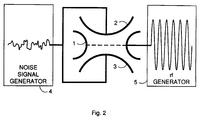
- an ion trap is generally comprised of a center ring electrode 1 and two end-cap electrodes 2 , 3 .
- a noise signal generator 4 is connected to one end-cap electrode 2 , the other end-cap electrode 3 being grounded.
- a radio-frequency (rf) generator 5 is connected to the ring electrode to supply the ion trap radio-frequency drive voltage which provides the alternating quadrupole field necessary for ion trapping.
- the noise signal generator can also be connected to both end-cap electrodes 2 , 3 , allowing the noise signal to be generated in-phase for quadrupolar excitation, or 180° out-of-phase for dipolar excitation.
- the configurations shown in Figs. 1 and 2 will result in axial modulation.
- the noise signal can be applied to the ring electrode, along with the main ion trapping voltage. In this configuration, radial modulation and excitation will be achieved.
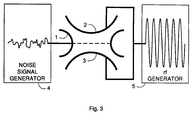
- the main trapping voltage can also be applied to the end-cap electrodes 2 , 3 while the noise signal is connected to the ring electrode 1 . In this configuration, monopolar excitation and radial modulation will be achieved.
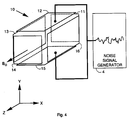
- An ion cyclotron resonance cell 10 is typically comprised of six plates 11 - 16 defining a box shape which is located within a magnetic field, B o .
- the magnetic field, B o confines ions in the x-y plane and electrostatic trapping plates confine ions in the z-direction.
- Universal collisional activation can be effected by applying noise 180° out-of-phase to either set of opposing plates which define the x-y plane.
- Kinetic excitation by noise can also be effected by application to the z-direction trapping plates.
- Ions are accumulated in the ion trap either by injection or by direct formation within the ion trapping volume. Ions of a single mass-to-charge or a wide range of mass-to-charge independent of ion number are kinetically excited by a random-noise modulation signal applied to one or more electrodes comprising the ion trap. Because such a modulation signal has a continuous, wide-band frequency spectrum, the entire mass-to-charge range of the trapped ions undergoes simultaneous, nonspecific kinetic excitation. The amplitude of the noise signal is sufficient to cause ions to experience energetic collisions with the bath, or background gas in the ion trap while remaining in the trapping field.
- the trapped ions absorb power and undergo energetic collisions with the bath gas. Collisions with the bath gas serve a mechanism for power dissipation. Some of the absorbed power goes into increasing the kinetic energy of the bath gas atoms or molecules that undergo collision and some energy goes into internal modes of the ion, if it is polyatomic.
- the ions are thereby internally heated until they undergo dissociation and produce fragments, or product ions.
- the product ions become resonant and undergo kinetic excitation and heating and may then also undergo further, or secondary dissociation. Successive generations of dissociation may continue.
- Important experimental variables that will determine the appropriate power and duration of the noise signal are the strength of the trapping field, the pressure of the bath gas, and the propensity of the analyte ion for fragmentation. The optimum values for these variables for a particular analyte can be determined by routine experimentation.
- the noise signal is terminated and a mass spectrum is acquired by one of a variety of conventional means.
- the final spectrum then may show ions that survived the collisional activation process, first generation product ions, and successive generations of product ions.
- the invention enables simultaneous kinetic excitation of stored ions having multiple, unidentified mass-to-charge ratios and a wide range of number densities (space charge).
- collisional activation can be effected in a non-selective manner without regard to ion number density and without prior knowledge of the parent ion mass-to-charge ratio.
- Parent and product ions are always "in resonance" so that more extensive fragmentation is typically observed without recourse to multiple single frequency excitation steps and the concomitant tuning.
- the invention is especially beneficial when implemented with a quadrupole ion trap in monopolar, dipolar, quadrupolar, and radial modulation modes.
- the invention is useful as a means for inducing fragmentation of a wide variety of ions, independent of mass and ion number, particularly for analytical applications of ion trap mass spectrometers. This is a rapidly growing field which has already extended to environmental and biological analyses.
- the invention facilitates rapid analysis of samples with components not previously identified. Potential applications of interest include explosives detection, drug detection, and rapid environmental analysis of organic and other polyatomic species. The following examples are intended to illustrate the wide applicability of the method.
- the random noise method provides an extremely wide bandwidth of excitation frequencies
- a high pass filter could be used to ensure that no ions above a specific mass-to-charge ratio are collisionally activated. This may be desirable in certain MS/MS experiments in which multiply charged ions are the species of interest.
- a notch filter could also be used to provide a reduced bandwidth of excitation frequencies for collisional activation. The bandwidth of this filter could be adjusted to compensate for the slight shift in the frequencies of ions at a single mass-to-charge ratio due to changes in space charge.
- the invention enables the targeted product technique described in S.A McLuckey, et al., supra, employing collisional activation to be performed with ion trapping instruments.
- Conventional methods are not applicable because the targeted product ion technique requires simultaneous, non-selective collisional activation of parent ions at multiple mass-to-charge ratios.
- Kinetic excitation of the product ions may not be desirable. This can be avoided by using an appropriate low-pass filter in conjunction with the random noise excitation.
- An alternative method is to use a notch rejection filter to exclude excitation frequencies corresponding to the target product ion.
Landscapes
- Chemical & Material Sciences (AREA)
- Analytical Chemistry (AREA)
- Chemical Kinetics & Catalysis (AREA)
- Other Investigation Or Analysis Of Materials By Electrical Means (AREA)
- Electron Tubes For Measurement (AREA)
- Carbon And Carbon Compounds (AREA)
- Transition And Organic Metals Composition Catalysts For Addition Polymerization (AREA)
- Electroluminescent Light Sources (AREA)
- Silver Salt Photography Or Processing Solution Therefor (AREA)
- Nitrogen Condensed Heterocyclic Rings (AREA)
Abstract
Description
- The United States Government has rights in this invention pursuant to contract no. DE-AC05-84OR21400 between the United States Department of Energy and Martin Marietta Energy Systems, Inc., and funded by the Office of Safeguards and Security.
- The present invention relates to collisional activation ion trapping instruments and methods of using same, and more particularly to universal collisional activation ion trap mass spectrometers and methods of using same.
- Deliberate dissociation of ions via collision-induced dissociation (CID) is a useful technique for verification of molecular entities in mass spectrometers including those based on ion trapping. Collisional activation (CA), which constitutes the first step of CID (dissociation being the second step), can be effected in ion trapping instruments by resonantly exciting ions at one or more of their characteristic frequencies of motion within the trapping field.
- Because the frequencies of ion motion are mass-to-charge dependent, the use of a single excitation frequency makes collisional activation in ion trapping instruments mass-to-charge specific. Consequently, a priori knowledge of the mass-to-charge ratio for a selected ion has been required in order that the excitation frequency can be correctly adjusted. Furthermore, the frequencies of ion motion are affected by the presence of other ions of like charge (i.e., space charge) which limits the usefulness of the single frequency excitation methods commonly used in conventional ion trapping instruments.
- Single frequency excitation methods as used in ion traps employ a discrete, precisely-tuned frequency to excite a limited number of ions possessing a particular mass-to-charge ratio. Also, in many conventional ion trapping applications, the number of ions is difficult to control which necessitates frequency adjustments that are generally tedious and time-consuming. Furthermore, the extent of fragmentation, which provides structural information, is often limited because once the parent ion becomes fragmented, the first generation product ions fall out of resonance and typically do not undergo further fragmentation. Further background information can be found in the following references: J.E. Fulford, et al., "Radio-frequency mass-selective excitation and resonant ejection of ions in a three-dimensional quadrupole ion trap", Journal of Vacuum Science and Technology, 17(4), 829 (1980); R.B. Cody, et al., "Collision-Induced Dissociation with Fourier Transform Mass Spectrometry", Analytical Chemistry, 54, 96 (1982); J.N. Louris, et al., "Instrumentation, Applications and Energy Deposition in Quadrupole Ion Trap Tandem Mass Spectrometry", Analytical Chemistry, 59, 1677 (1987); and Syka, et al. "Method of Operating Ion Trap Detector in MS/MS Mode", U.S. Patent No. 4,736,101.
- Yates et al. have described the use of rapid frequency pre-scans over a narrow mass range (1.7 amu) to determine empirically the parent ion resonant frequency in an automated fashion. These workers have also described the use of a supplementary signal with a range in frequency of 10 kHz, equivalent to a mass/charge range of 1.7 at a qz value of 0.3. Both approaches were found to deal effectively with the space charge problem but neither deals with the problems of limited fragmentation and inability to fragment ions simultaneously over a range of mass/charge values. Further information can be found in N. A Yates et al., "Resonant Excitation for GC/MS/MS in the Quadrupole Ion Trap via Frequency Assignment Pre-Scans and Broadband Excitation," Proceedings of the 39th ASMS Conference on Mass Spectrometry and Applied Topics, May 1991, Nashville, TN, p. 132.
- Random-noise excitation has been used in Fourier transform ion cyclotron resonance mass spectrometry as part of the final detection/mass analysis step, but not as a means for inducing fragmentation of ions. Random noise was used to kinetically excite all ions in the ion cyclotron resonance mass spectrometer to higher orbits in order to allow their detection by the image currents they induce in receiver plates. In such an application, vacuum conditions are necessary; collisions with background or bath gases have a pernicious effect upon the detection method. Further information can be found in C.F. Ijames, et al., "Fourier Transform Mass Spectrometry Using Random-Noise Excitation", Chemical Physics Letters, 108, 58 (1984).
- Non-selective collisional activation was used in the rapid screening technique described in S.A McLuckey, et al., "Simultaneous Monitoring for Parent Ions of Targeted Product Ions: A Method for Rapid Screening Using Mass Spectrometry/Mass Spectrometry", Analytical Chemistry, 62, 56 (1990). The experiments reported therein were carried out with a non-trapping instrument and illustrate the usefulness of non-selective, universal collisional activation.
- There is a need for apparatus and a method for collisional activation ion trapping which overcomes the problem of frequency shifts due to space charge and enables simultaneous kinetic excitation of trapped ions having a wide range of mass-to-charge ratios. There is also a need for apparatus and a method for collisional activation ion trap mass spectrometry wherein CID can be performed in a universal manner without time-consuming frequency adjustments.
- Accordingly, it is an object of the present invention to provide a new and improved apparatus and method for collisional activation ion trap mass spectrometry which overcomes the problem of frequency shifts due to space charge and enables simultaneous kinetic excitation of trapped ions having a wide range of mass-to-charge ratios.
- It is another object of the present invention to provide a new and improved apparatus and method for collisional activation ion trap mass spectrometry wherein CID can be performed in a universal manner without time-consuming frequency adjustments.
- Further and other objects of the present invention will become apparent from the description contained herein.
- In accordance with one aspect of the present invention, the foregoing and other objects are achieved by a universal collisional activation ion trap for use in mass spectrometry which comprises an ion trapping means having connected thereto a random noise signal generator, the ion trapping means containing a bath gas.
- In accordance with another aspect of the present invention, a universal collisional activation ion trap comprises a quadrupole ion trap containing a bath gas, a random noise signal generator connected to the quadrupole ion trap for generating a noise signal within the quadrupole ion trap.
- In accordance with a further aspect of the present invention, a method of operating a universal collisional activation ion trap comprises the step of:
- (a) providing an ion trapping means;
- (b) introducing into the ion trapping means a bath gas; and,
- (c) generating a random noise signal within the ion trapping means to effect collisional activation of ions trapped therein.
- In the drawing:
- Fig. 1 is a schematic representation of the subject apparatus wherein the noise signal is applied to one end-cap electrode of a quadrupole ion trap.
- Fig. 2 is a schematic representation of the subject apparatus wherein the noise signal is applied to both end-cap electrodes of a quadrupole ion trap.
- Fig. 3 is a schematic representation of the subject apparatus wherein the noise signal is applied to the ring electrode of a quadrupole ion trap.
- Fig. 4 is a schematic representation of the subject apparatus wherein the noise signal is applied to opposing plates of an ion cyclotron resonance cell.
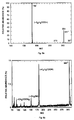
- Fig. 5a shows the mass spectrum of the isolated radical cation of N,N-dimethylaniline, with no activation applied. Fig. 5b shows the mass spectrum of the same compound resulting from the use of a conventional single frequency activation method. Fig. 5c shows the spectrum of the same compound acquired according to the present invention.
- Fig. 6a shows the mass spectrum of cocaine acquired using the conventional approach to collisional activation. Fig. 6b shows the mass spectrum of cocaine acquired according to the present invention.
- Fig. 7a shows the mass spectrum of the isolated molecular anion of 2,4,6-trinitrotoluene, with no activation applied. Fig. 7b shows the mass spectrum of the same compound acquired according to the present invention.
- Fig. 8 shows the mass spectrum of the doubly protonated peptide neuromedin U-8 acquired according to the present invention.
- For a better understanding of the present invention, together with other and further objects, advantages and capabilities thereof, reference is made to the following disclosure and appended claims in connection with the above-described drawings.
- The invention described herein is effective for any ion trapping type of instrument in which ions execute periodic motion. This includes, but is not limited to, known devices such as multi-pole electrodynamic ion trap, e.g. quadrupole ion trap, and combined magnetic and electrostatic ion traps, e.g. ion cyclotron resonance spectrometer. Other and varying embodiments of the apparatus and method are possible for other types of ion trap, all of which fall within the scope of the present invention.
- Quadrupole ion trap are well known. Referring to Fig. 1, an ion trap is generally comprised of a
center ring electrode 1 and two end-cap electrodes noise signal generator 4 is connected to one end-cap electrode 2, the other end-cap electrode 3 being grounded. A radio-frequency (rf)generator 5 is connected to the ring electrode to supply the ion trap radio-frequency drive voltage which provides the alternating quadrupole field necessary for ion trapping. Referring now to Fig. 2, the noise signal generator can also be connected to both end-cap electrodes - In another embodiment of the invention, not illustrated, the noise signal can be applied to the ring electrode, along with the main ion trapping voltage. In this configuration, radial modulation and excitation will be achieved.
- In another embodiment of the invention, shown in Fig. 3, The main trapping voltage can also be applied to the end-
cap electrodes ring electrode 1. In this configuration, monopolar excitation and radial modulation will be achieved. - A further embodiment of the invention is shown in Fig. 4. An ion
cyclotron resonance cell 10 is typically comprised of six plates 11 - 16 defining a box shape which is located within a magnetic field, Bo. The magnetic field, Bo, confines ions in the x-y plane and electrostatic trapping plates confine ions in the z-direction. Universal collisional activation can be effected by applyingnoise 180° out-of-phase to either set of opposing plates which define the x-y plane. Kinetic excitation by noise can also be effected by application to the z-direction trapping plates. - Having described the preferred embodiments of the apparatus, a preferred method for universal collisional activation of ions in an ion trapping instrument will now be set forth.
- Ions are accumulated in the ion trap either by injection or by direct formation within the ion trapping volume. Ions of a single mass-to-charge or a wide range of mass-to-charge independent of ion number are kinetically excited by a random-noise modulation signal applied to one or more electrodes comprising the ion trap. Because such a modulation signal has a continuous, wide-band frequency spectrum, the entire mass-to-charge range of the trapped ions undergoes simultaneous, nonspecific kinetic excitation. The amplitude of the noise signal is sufficient to cause ions to experience energetic collisions with the bath, or background gas in the ion trap while remaining in the trapping field.
- The trapped ions absorb power and undergo energetic collisions with the bath gas. Collisions with the bath gas serve a a mechanism for power dissipation. Some of the absorbed power goes into increasing the kinetic energy of the bath gas atoms or molecules that undergo collision and some energy goes into internal modes of the ion, if it is polyatomic. The ions are thereby internally heated until they undergo dissociation and produce fragments, or product ions. The product ions become resonant and undergo kinetic excitation and heating and may then also undergo further, or secondary dissociation. Successive generations of dissociation may continue.
- Important experimental variables that will determine the appropriate power and duration of the noise signal are the strength of the trapping field, the pressure of the bath gas, and the propensity of the analyte ion for fragmentation. The optimum values for these variables for a particular analyte can be determined by routine experimentation.
- Following the dissociation process, the noise signal is terminated and a mass spectrum is acquired by one of a variety of conventional means. The final spectrum then may show ions that survived the collisional activation process, first generation product ions, and successive generations of product ions.
- The invention enables simultaneous kinetic excitation of stored ions having multiple, unidentified mass-to-charge ratios and a wide range of number densities (space charge). Thus, collisional activation can be effected in a non-selective manner without regard to ion number density and without prior knowledge of the parent ion mass-to-charge ratio. Parent and product ions are always "in resonance" so that more extensive fragmentation is typically observed without recourse to multiple single frequency excitation steps and the concomitant tuning.
- The invention is especially beneficial when implemented with a quadrupole ion trap in monopolar, dipolar, quadrupolar, and radial modulation modes. The invention is useful as a means for inducing fragmentation of a wide variety of ions, independent of mass and ion number, particularly for analytical applications of ion trap mass spectrometers. This is a rapidly growing field which has already extended to environmental and biological analyses. The invention facilitates rapid analysis of samples with components not previously identified. Potential applications of interest include explosives detection, drug detection, and rapid environmental analysis of organic and other polyatomic species. The following examples are intended to illustrate the wide applicability of the method.
- EXAMPLE I
N,N-dimethylaniline, a compound typical of many of environmental interest, was analyzed according to the present invention. Fig. 5a shows the spectrum of the isolated radical cation of N,N-dimethylaniline. Fig. 5b shows the spectrum resulting from the conventional single frequency method for collisional activation in ion traps. Note that the parent ion shows only one product ion corresponding to the loss of a hydrogen atom. The rationale behind using collisional activation is usually to produce a spectrum that allows unambiguous identification of the compound. The loss of a hydrogen atom is not particularly informative in this regard. Fig. 5c shows the spectrum after a 20 V p-p random noise signal was applied to the ion trap for 40 milliseconds prior to spectrum acquisition. Note that a variety of product ions are formed that would allow for identification from a library search. The latter spectrum is more informative than the former due to the fact that the first generation product ion also falls into resonance with the universal method whereas it falls out of resonance with the conventional method. - EXAMPLE II
Cocaine, a well known drug, was analysed according to the present invention. Fig. 6 illustrates the behavior of a protonated molecule, cocaine, formed by chemical ionization. This compound is obviously of interest for drug detection and identification. Fig. 6a shows the spectrum acquired using the conventional approach to collisional activation (viz., single frequency excitation to match the frequency of roughly 104 ions of mass-to-charge 304). Note that the only product ion observed is that due to loss of benzoic acid. This is a structurally significant fragment but identifications are rarely based on a single product ion. Identification could be made with greater confidence if several structurally useful product ions are formed. Fig. 6b shows the spectrum acquired with the new method. This spectrum shows, in addition to benzoic acid loss, further losses of methanol and methyl acetate. Similar information would require at least three stages of mass spectrometry with the conventional method. - EXAMPLE III
Fig. 7 illustrates the use of the invention with negatively charged ions. The example shown here is that of the molecular anion of 2,4,6-trinitrotoluene (TNT), a compound of interest for the detection and identification of explosives. Fig. 7a shows the spectrum of the isolated molecular anion while 7b shows the spectrum after application of the universal collisional activation method. Note the rich fragmentation observed, unique to TNT, that allows for a highly specific identification. The conventional approach (spectrum not shown) provides many fewer product ions. - EXAMPLE IV
Fig. 8 illustrates the use of the invention for a doubly protonated peptide, neuromedin U-8 (tyr-phe-leu-phe-arg-pro-arg-asn-NH2), formed by electrospray ionization. This type of ion is typical of those formed, for example, from a protein tryptic digest. The spectrum shows a variety of structurally informative product ions. The most likely situation in which an ion of this type would be encountered in an analytical setting is from the chromatographic separation of a tryptic digest. In chromatography, of course, the analyte concentration varies as it elutes from the column. The number of ions formed from the analyte would therefore also be expected to vary, unless measure were taken to avoid it. The resonant frequency of the parent ion population would also change during the peak elution. This, however, poses no problem for the universal collisional activation approach although it would for the conventional approach. - While the random noise method provides an extremely wide bandwidth of excitation frequencies, in some cases it may be desirable to use a reduced range of excitation frequencies: this can be effected by using a suitable filter between the random noise generator and the ion trap. A high pass filter could be used to ensure that no ions above a specific mass-to-charge ratio are collisionally activated. This may be desirable in certain MS/MS experiments in which multiply charged ions are the species of interest. A notch filter could also be used to provide a reduced bandwidth of excitation frequencies for collisional activation. The bandwidth of this filter could be adjusted to compensate for the slight shift in the frequencies of ions at a single mass-to-charge ratio due to changes in space charge.
- The invention enables the targeted product technique described in S.A McLuckey, et al., supra, employing collisional activation to be performed with ion trapping instruments. Conventional methods are not applicable because the targeted product ion technique requires simultaneous, non-selective collisional activation of parent ions at multiple mass-to-charge ratios. Kinetic excitation of the product ions, however, may not be desirable. This can be avoided by using an appropriate low-pass filter in conjunction with the random noise excitation. An alternative method is to use a notch rejection filter to exclude excitation frequencies corresponding to the target product ion.
- In the quadrupole ion trap, the invention can include concurrent downward ramping of the ion trap radio-frequency drive voltage. This allows low mass ions formed via consecutive dissociation steps to be trapped. The drive voltage (or frequency) is an important variable in determining collision energetics in the ion tap. Frequently, the optimum drive voltage for dissociating a high mass parent ion is too high for trapping ions of lower mass. Random noise excitation with downward ramping of the drive voltage allows for the trapping of low mass fragments formed via consecutive dissociation steps.
- A typical mass spectrometry system in accordance with the invention may include support subsystems such as physical support, power supplies, control electronics, vacuum hardware, and ion source; and data acquisition subsystems such as ion detector, electrometer, analog-to-digital converter, computer and data output hardware.
- While there has been shown and described what are at present considered the preferred embodiments of the invention, it will be obvious to those skilled in the art that various changes and modifications can be made therein without departing from the scope of the inventions defined by the appended claims.
Claims (18)
- A universal collisional activation ion trap for use in mass spectrometry comprising an ion trapping means having connected thereto a random noise signal generator, said ion trapping means containing a bath gas.
- A universal collisional activation ion trap according to claim 1 wherein said ion trapping means comprises a quadrupole ion trap.
- A universal collisional activation ion trap according to claim 2 wherein said quadrupole ion trap comprises a ring electrode and two end-cap electrodes.
- A universal collisional activation ion trap according to claim 3 wherein said noise signal generator is connected to at least one of said two end-cap electrodes of said quadrupole ion trap.
- A universal collisional activation ion trap according to claim 3 wherein said noise signal generator is connected to said ring electrode of said quadrupole ion trap.
- A universal collisional activation ion trap according to claim 1 wherein said ion trapping means comprises an ion cyclotron resonance cell.
- A universal collisional activation ion trap according to claim 6 wherein said ion cyclotron resonance cell comprises at least two opposing electrodes, and wherein said noise signal generator is connected to at least one of said opposing electrodes.
- A universal collisional activation ion trap according to claim 1 wherein said ion trapping means uses combined magnetic and electrodynamic forces to trap ions.
- A method of operating a universal collisional activation ion trap comprising the steps of:(a) providing an ion trapping means;(b) introducing into said ion trapping means a bath gas; and,(c) generating a random noise signal within said ion trapping means to effect collisional activation of ions trapped therein.
- The method according to claim 9 further comprising the subsequent step of introducing into said ion trapping means a substance that, when acted upon by said noise signal, undergoes collisional activation to form product ions.
- A method according to claim 9 wherein said ion trapping means comprises a quadrupole ion trap.
- A method according to claim 11 wherein said quadrupole ion trap comprises a ring electrode and two end-cap electrodes.
- A method according to claim 12 wherein said noise signal generator is connected to at least one of said two end-cap electrodes of said quadrupole ion trap.
- A method according to claim 12 wherein said noise signal generator is connected to said ring electrode of a quadrupole ion trap.
- A method according to claim 9 wherein said ion trapping means comprises an ion cyclotron resonance cell.
- A method according to claim 15 wherein said ion cyclotron resonance cell comprises at least two opposing electrodes, and wherein said noise signal generator is connected to at least one of said opposing electrodes.
- The method according to claim 10 further comprising the subsequent step of acquiring a mass spectrum which contains data useful for identifying said substance.
- A mass spectrometry system comprising an ion trapping means having connected thereto a random noise signal generator, said ion trapping means containing a bath gas, support subsystems, and data acquisition subsystems.
Applications Claiming Priority (3)
| Application Number | Priority Date | Filing Date | Title |
|---|---|---|---|
| US07/805,442 US5206509A (en) | 1991-12-11 | 1991-12-11 | Universal collisional activation ion trap mass spectrometry |
| US805442 | 1991-12-11 | ||
| PCT/US1992/010486 WO1993011858A1 (en) | 1991-12-11 | 1992-12-07 | Universal collisional activation ion trap mass spectrometry |
Publications (3)
| Publication Number | Publication Date |
|---|---|
| EP0616550A1 EP0616550A1 (en) | 1994-09-28 |
| EP0616550A4 EP0616550A4 (en) | 1996-04-10 |
| EP0616550B1 true EP0616550B1 (en) | 1997-08-27 |
Family
ID=25191582
Family Applications (1)
| Application Number | Title | Priority Date | Filing Date |
|---|---|---|---|
| EP93900874A Expired - Lifetime EP0616550B1 (en) | 1991-12-11 | 1992-12-07 | Universal collisional activation ion trap mass spectrometry |
Country Status (9)
| Country | Link |
|---|---|
| US (1) | US5206509A (en) |
| EP (1) | EP0616550B1 (en) |
| JP (1) | JPH07502142A (en) |
| KR (1) | KR940703711A (en) |
| AT (1) | ATE157279T1 (en) |
| AU (1) | AU661542B2 (en) |
| CA (1) | CA2125569A1 (en) |
| DE (1) | DE69221890T2 (en) |
| WO (1) | WO1993011858A1 (en) |
Families Citing this family (15)
| Publication number | Priority date | Publication date | Assignee | Title |
|---|---|---|---|---|
| US5404011A (en) * | 1992-05-29 | 1995-04-04 | Varian Associates, Inc. | MSn using CID |
| US5291017A (en) * | 1993-01-27 | 1994-03-01 | Varian Associates, Inc. | Ion trap mass spectrometer method and apparatus for improved sensitivity |
| DE4316738C2 (en) * | 1993-05-19 | 1996-10-17 | Bruker Franzen Analytik Gmbh | Ejection of ions from ion traps using combined electrical dipole and quadrupole fields |
| US5696376A (en) * | 1996-05-20 | 1997-12-09 | The Johns Hopkins University | Method and apparatus for isolating ions in an ion trap with increased resolving power |
| US6515281B1 (en) * | 2000-06-23 | 2003-02-04 | Archimedes Technology Group, Inc. | Stochastic cyclotron ion filter (SCIF) |
| EP1319945A4 (en) * | 2000-09-20 | 2007-07-04 | Hitachi Ltd | SONY PROCESS WITH ION CASE MASS SPECTROMETER AND PROBE DEVICE |
| JP3620479B2 (en) * | 2001-07-31 | 2005-02-16 | 株式会社島津製作所 | Method of ion selection in ion storage device |
| US7102129B2 (en) * | 2004-09-14 | 2006-09-05 | Thermo Finnigan Llc | High-Q pulsed fragmentation in ion traps |
| US6949743B1 (en) | 2004-09-14 | 2005-09-27 | Thermo Finnigan Llc | High-Q pulsed fragmentation in ion traps |
| JP4843250B2 (en) * | 2005-05-13 | 2011-12-21 | 株式会社日立ハイテクノロジーズ | Method for identifying substances using mass spectrometry |
| US8334506B2 (en) | 2007-12-10 | 2012-12-18 | 1St Detect Corporation | End cap voltage control of ion traps |
| US7973277B2 (en) | 2008-05-27 | 2011-07-05 | 1St Detect Corporation | Driving a mass spectrometer ion trap or mass filter |
| US8178835B2 (en) * | 2009-05-07 | 2012-05-15 | Thermo Finnigan Llc | Prolonged ion resonance collision induced dissociation in a quadrupole ion trap |
| JP5771456B2 (en) * | 2011-06-24 | 2015-09-02 | 株式会社日立ハイテクノロジーズ | Mass spectrometry method |
| US9188565B2 (en) | 2012-05-31 | 2015-11-17 | The University Of North Carolina At Chapel Hill | High field asymmetric ion mobility spectrometry (FAIMS) methods and devices with voltage-gas composition linked scans |
Family Cites Families (6)
| Publication number | Priority date | Publication date | Assignee | Title |
|---|---|---|---|---|
| DE3688215T3 (en) * | 1985-05-24 | 2005-08-25 | Thermo Finnigan Llc, San Jose | Control method for an ion trap. |
| US4686367A (en) * | 1985-09-06 | 1987-08-11 | Finnigan Corporation | Method of operating quadrupole ion trap chemical ionization mass spectrometry |
| US4749860A (en) * | 1986-06-05 | 1988-06-07 | Finnigan Corporation | Method of isolating a single mass in a quadrupole ion trap |
| NZ220810A (en) * | 1986-07-07 | 1989-08-29 | Ppg Industries Inc | Refining glass; collapsing foam above melt by adding substances |
| US4755670A (en) * | 1986-10-01 | 1988-07-05 | Finnigan Corporation | Fourtier transform quadrupole mass spectrometer and method |
| US4945234A (en) * | 1989-05-19 | 1990-07-31 | Extrel Ftms, Inc. | Method and apparatus for producing an arbitrary excitation spectrum for Fourier transform mass spectrometry |
-
1991
- 1991-12-11 US US07/805,442 patent/US5206509A/en not_active Expired - Lifetime
-
1992
- 1992-12-07 KR KR1019940702033A patent/KR940703711A/en not_active Withdrawn
- 1992-12-07 EP EP93900874A patent/EP0616550B1/en not_active Expired - Lifetime
- 1992-12-07 CA CA002125569A patent/CA2125569A1/en active Pending
- 1992-12-07 JP JP5508025A patent/JPH07502142A/en active Pending
- 1992-12-07 AT AT93900874T patent/ATE157279T1/en active
- 1992-12-07 WO PCT/US1992/010486 patent/WO1993011858A1/en not_active Ceased
- 1992-12-07 DE DE69221890T patent/DE69221890T2/en not_active Expired - Fee Related
- 1992-12-07 AU AU32392/93A patent/AU661542B2/en not_active Ceased
Also Published As
| Publication number | Publication date |
|---|---|
| US5206509A (en) | 1993-04-27 |
| CA2125569A1 (en) | 1993-06-24 |
| EP0616550A4 (en) | 1996-04-10 |
| EP0616550A1 (en) | 1994-09-28 |
| JPH07502142A (en) | 1995-03-02 |
| AU3239293A (en) | 1993-07-19 |
| ATE157279T1 (en) | 1997-09-15 |
| WO1993011858A1 (en) | 1993-06-24 |
| KR940703711A (en) | 1994-12-12 |
| AU661542B2 (en) | 1995-07-27 |
| DE69221890T2 (en) | 1998-01-02 |
| DE69221890D1 (en) | 1997-10-02 |
Similar Documents
| Publication | Publication Date | Title |
|---|---|---|
| JP2716696B2 (en) | Method of operating a quadrupole ion trap chemical ionization mass spectrometer | |
| CN102017058B (en) | MS/MS data processing | |
| US5101105A (en) | Neutralization/chemical reionization tandem mass spectrometry method and apparatus therefor | |
| US5206509A (en) | Universal collisional activation ion trap mass spectrometry | |
| CA2312754C (en) | Method of and apparatus for selective collision-induced dissociation of ions in a quadrupole ion guide | |
| CA2317663C (en) | Method of ion fragmentation in a quadrupole ion trap | |
| US12347665B2 (en) | Rapid identification and sequence analysis of intact proteins in complex mixtures | |
| US7476853B2 (en) | Ion fragmentation by reaction with neutral particles | |
| US6800851B1 (en) | Electron-ion fragmentation reactions in multipolar radiofrequency fields | |
| WO1999030350A1 (en) | Method of analyzing ions in an apparatus including a time of flight mass spectrometer and a linear ion trap | |
| CN110494952B (en) | Optimized target analysis | |
| EP1169111A4 (en) | METHOD AND DEVICE FOR EXTERNAL ACCUMULATION AND PHOTODISSOCATION OF IONS BEFORE MASS SPECTRAL ANALYSIS | |
| EP0746873B1 (en) | Quadrupole trap ion isolation method | |
| US9911587B1 (en) | Methods and systems for quantitative mass analysis | |
| US9911588B1 (en) | Methods and systems for quantitative mass analysis | |
| US5521379A (en) | Method of selecting reaction paths in ion traps | |
| EP3373324A1 (en) | Methods and systems for quantitative mass analysis | |
| McLuckey et al. | High explosives vapor detection by atmospheric sampling glow discharge ionization/tandem mass spectrometry |
Legal Events
| Date | Code | Title | Description |
|---|---|---|---|
| PUAI | Public reference made under article 153(3) epc to a published international application that has entered the european phase |
Free format text: ORIGINAL CODE: 0009012 |
|
| 17P | Request for examination filed |
Effective date: 19940530 |
|
| AK | Designated contracting states |
Kind code of ref document: A1 Designated state(s): AT BE CH DE DK ES FR GB GR IE IT LI LU MC NL PT SE |
|
| RAP1 | Party data changed (applicant data changed or rights of an application transferred) |
Owner name: LOCKHEED MARTIN ENERGY SYSTEMS, INC. |
|
| A4 | Supplementary search report drawn up and despatched |
Effective date: 19960220 |
|
| AK | Designated contracting states |
Kind code of ref document: A4 Designated state(s): AT BE CH DE DK ES FR GB GR IE IT LI LU MC NL PT SE |
|
| GRAG | Despatch of communication of intention to grant |
Free format text: ORIGINAL CODE: EPIDOS AGRA |
|
| 17Q | First examination report despatched |
Effective date: 19960806 |
|
| GRAH | Despatch of communication of intention to grant a patent |
Free format text: ORIGINAL CODE: EPIDOS IGRA |
|
| GRAH | Despatch of communication of intention to grant a patent |
Free format text: ORIGINAL CODE: EPIDOS IGRA |
|
| GRAA | (expected) grant |
Free format text: ORIGINAL CODE: 0009210 |
|
| AK | Designated contracting states |
Kind code of ref document: B1 Designated state(s): AT BE CH DE DK ES FR GB GR IE IT LI LU MC NL PT SE |
|
| PG25 | Lapsed in a contracting state [announced via postgrant information from national office to epo] |
Ref country code: NL Free format text: LAPSE BECAUSE OF FAILURE TO SUBMIT A TRANSLATION OF THE DESCRIPTION OR TO PAY THE FEE WITHIN THE PRESCRIBED TIME-LIMIT Effective date: 19970827 Ref country code: LI Free format text: LAPSE BECAUSE OF FAILURE TO SUBMIT A TRANSLATION OF THE DESCRIPTION OR TO PAY THE FEE WITHIN THE PRESCRIBED TIME-LIMIT Effective date: 19970827 Ref country code: IT Free format text: LAPSE BECAUSE OF FAILURE TO SUBMIT A TRANSLATION OF THE DESCRIPTION OR TO PAY THE FEE WITHIN THE PRE;WARNING: LAPSES OF ITALIAN PATENTS WITH EFFECTIVE DATE BEFORE 2007 MAY HAVE OCCURRED AT ANY TIME BEFORE 2007. THE CORRECT EFFECTIVE DATE MAY BE DIFFERENT FROM THE ONE RECORDED.SCRIBED TIME-LIMIT Effective date: 19970827 Ref country code: GR Free format text: LAPSE BECAUSE OF FAILURE TO SUBMIT A TRANSLATION OF THE DESCRIPTION OR TO PAY THE FEE WITHIN THE PRESCRIBED TIME-LIMIT Effective date: 19970827 Ref country code: FR Free format text: LAPSE BECAUSE OF FAILURE TO SUBMIT A TRANSLATION OF THE DESCRIPTION OR TO PAY THE FEE WITHIN THE PRESCRIBED TIME-LIMIT Effective date: 19970827 Ref country code: ES Free format text: THE PATENT HAS BEEN ANNULLED BY A DECISION OF A NATIONAL AUTHORITY Effective date: 19970827 Ref country code: DK Free format text: LAPSE BECAUSE OF NON-PAYMENT OF DUE FEES Effective date: 19970827 Ref country code: CH Free format text: LAPSE BECAUSE OF FAILURE TO SUBMIT A TRANSLATION OF THE DESCRIPTION OR TO PAY THE FEE WITHIN THE PRESCRIBED TIME-LIMIT Effective date: 19970827 Ref country code: BE Effective date: 19970827 Ref country code: AT Effective date: 19970827 |
|
| REF | Corresponds to: |
Ref document number: 157279 Country of ref document: AT Date of ref document: 19970915 Kind code of ref document: T |
|
| REG | Reference to a national code |
Ref country code: CH Ref legal event code: EP |
|
| REF | Corresponds to: |
Ref document number: 69221890 Country of ref document: DE Date of ref document: 19971002 |
|
| PG25 | Lapsed in a contracting state [announced via postgrant information from national office to epo] |
Ref country code: SE Effective date: 19971127 Ref country code: PT Effective date: 19971127 |
|
| PG25 | Lapsed in a contracting state [announced via postgrant information from national office to epo] |
Ref country code: LU Free format text: LAPSE BECAUSE OF NON-PAYMENT OF DUE FEES Effective date: 19971207 Ref country code: IE Free format text: LAPSE BECAUSE OF NON-PAYMENT OF DUE FEES Effective date: 19971207 Ref country code: GB Free format text: LAPSE BECAUSE OF NON-PAYMENT OF DUE FEES Effective date: 19971207 |
|
| EN | Fr: translation not filed | ||
| NLV1 | Nl: lapsed or annulled due to failure to fulfill the requirements of art. 29p and 29m of the patents act | ||
| REG | Reference to a national code |
Ref country code: CH Ref legal event code: PL |
|
| PG25 | Lapsed in a contracting state [announced via postgrant information from national office to epo] |
Ref country code: MC Free format text: LAPSE BECAUSE OF NON-PAYMENT OF DUE FEES Effective date: 19980630 |
|
| PLBE | No opposition filed within time limit |
Free format text: ORIGINAL CODE: 0009261 |
|
| STAA | Information on the status of an ep patent application or granted ep patent |
Free format text: STATUS: NO OPPOSITION FILED WITHIN TIME LIMIT |
|
| GBPC | Gb: european patent ceased through non-payment of renewal fee |
Effective date: 19971207 |
|
| 26N | No opposition filed | ||
| PG25 | Lapsed in a contracting state [announced via postgrant information from national office to epo] |
Ref country code: DE Free format text: LAPSE BECAUSE OF NON-PAYMENT OF DUE FEES Effective date: 19980901 |