EP0615467B1 - 2-mercapto-benzoxazole derivatives as collectors for the selective flotation of metal ores - Google Patents
2-mercapto-benzoxazole derivatives as collectors for the selective flotation of metal ores Download PDFInfo
- Publication number
- EP0615467B1 EP0615467B1 EP92924859A EP92924859A EP0615467B1 EP 0615467 B1 EP0615467 B1 EP 0615467B1 EP 92924859 A EP92924859 A EP 92924859A EP 92924859 A EP92924859 A EP 92924859A EP 0615467 B1 EP0615467 B1 EP 0615467B1
- Authority
- EP
- European Patent Office
- Prior art keywords
- flotation
- collectors
- selective flotation
- selective
- process according
- Prior art date
- Legal status (The legal status is an assumption and is not a legal conclusion. Google has not performed a legal analysis and makes no representation as to the accuracy of the status listed.)
- Expired - Lifetime
Links
- 238000005188 flotation Methods 0.000 title claims abstract description 49
- FLFWJIBUZQARMD-UHFFFAOYSA-N 2-mercapto-1,3-benzoxazole Chemical class C1=CC=C2OC(S)=NC2=C1 FLFWJIBUZQARMD-UHFFFAOYSA-N 0.000 title claims abstract description 10
- 229910052751 metal Inorganic materials 0.000 title claims description 7
- 239000002184 metal Substances 0.000 title claims description 7
- 238000000034 method Methods 0.000 claims abstract description 19
- UCKMPCXJQFINFW-UHFFFAOYSA-N Sulphide Chemical compound [S-2] UCKMPCXJQFINFW-UHFFFAOYSA-N 0.000 claims abstract description 8
- DRDVZXDWVBGGMH-UHFFFAOYSA-N zinc;sulfide Chemical class [S-2].[Zn+2] DRDVZXDWVBGGMH-UHFFFAOYSA-N 0.000 claims abstract description 8
- 239000010949 copper Substances 0.000 claims description 38
- 239000000463 material Substances 0.000 claims description 20
- 229910052500 inorganic mineral Inorganic materials 0.000 claims description 18
- 239000011707 mineral Substances 0.000 claims description 18
- 239000000203 mixture Substances 0.000 claims description 17
- 150000004763 sulfides Chemical class 0.000 claims description 17
- 229910052802 copper Inorganic materials 0.000 claims description 13
- XCAUINMIESBTBL-UHFFFAOYSA-N lead(ii) sulfide Chemical compound [Pb]=S XCAUINMIESBTBL-UHFFFAOYSA-N 0.000 claims description 12
- RYGMFSIKBFXOCR-UHFFFAOYSA-N Copper Chemical compound [Cu] RYGMFSIKBFXOCR-UHFFFAOYSA-N 0.000 claims description 11
- 229910052709 silver Inorganic materials 0.000 claims description 11
- 239000004332 silver Substances 0.000 claims description 11
- 238000000926 separation method Methods 0.000 claims description 10
- 239000003795 chemical substances by application Substances 0.000 claims description 9
- 229910052739 hydrogen Inorganic materials 0.000 claims description 9
- 239000012141 concentrate Substances 0.000 claims description 7
- UFHFLCQGNIYNRP-UHFFFAOYSA-N Hydrogen Chemical compound [H][H] UFHFLCQGNIYNRP-UHFFFAOYSA-N 0.000 claims description 6
- 239000001257 hydrogen Substances 0.000 claims description 6
- 125000000217 alkyl group Chemical group 0.000 claims description 5
- BUGICWZUDIWQRQ-UHFFFAOYSA-N copper iron sulfane Chemical compound S.[Fe].[Cu] BUGICWZUDIWQRQ-UHFFFAOYSA-N 0.000 claims description 5
- WGPCGCOKHWGKJJ-UHFFFAOYSA-N sulfanylidenezinc Chemical compound [Zn]=S WGPCGCOKHWGKJJ-UHFFFAOYSA-N 0.000 claims description 5
- 125000004432 carbon atom Chemical group C* 0.000 claims description 4
- BWFPGXWASODCHM-UHFFFAOYSA-N copper monosulfide Chemical compound [Cu]=S BWFPGXWASODCHM-UHFFFAOYSA-N 0.000 claims description 4
- BVKZGUZCCUSVTD-UHFFFAOYSA-L Carbonate Chemical compound [O-]C([O-])=O BVKZGUZCCUSVTD-UHFFFAOYSA-L 0.000 claims description 3
- 229910003202 NH4 Inorganic materials 0.000 claims description 3
- NFMAZVUSKIJEIH-UHFFFAOYSA-N bis(sulfanylidene)iron Chemical compound S=[Fe]=S NFMAZVUSKIJEIH-UHFFFAOYSA-N 0.000 claims description 3
- 229910052947 chalcocite Inorganic materials 0.000 claims description 3
- 229910052700 potassium Inorganic materials 0.000 claims description 3
- 229910052708 sodium Inorganic materials 0.000 claims description 3
- 230000003213 activating effect Effects 0.000 claims 2
- 239000000725 suspension Substances 0.000 claims 1
- 229910052946 acanthite Inorganic materials 0.000 abstract 1
- OMZSGWSJDCOLKM-UHFFFAOYSA-N copper(II) sulfide Chemical compound [S-2].[Cu+2] OMZSGWSJDCOLKM-UHFFFAOYSA-N 0.000 abstract 1
- XUARKZBEFFVFRG-UHFFFAOYSA-N silver sulfide Chemical compound [S-2].[Ag+].[Ag+] XUARKZBEFFVFRG-UHFFFAOYSA-N 0.000 abstract 1
- 229940056910 silver sulfide Drugs 0.000 abstract 1
- 239000011133 lead Substances 0.000 description 20
- 239000000047 product Substances 0.000 description 20
- 239000011701 zinc Substances 0.000 description 20
- 150000001875 compounds Chemical class 0.000 description 10
- QTBSBXVTEAMEQO-UHFFFAOYSA-N Acetic acid Chemical compound CC(O)=O QTBSBXVTEAMEQO-UHFFFAOYSA-N 0.000 description 9
- BQCADISMDOOEFD-UHFFFAOYSA-N Silver Chemical compound [Ag] BQCADISMDOOEFD-UHFFFAOYSA-N 0.000 description 9
- HCHKCACWOHOZIP-UHFFFAOYSA-N Zinc Chemical compound [Zn] HCHKCACWOHOZIP-UHFFFAOYSA-N 0.000 description 9
- 229910052725 zinc Inorganic materials 0.000 description 9
- NIFIFKQPDTWWGU-UHFFFAOYSA-N pyrite Chemical compound [Fe+2].[S-][S-] NIFIFKQPDTWWGU-UHFFFAOYSA-N 0.000 description 8
- 229910052683 pyrite Inorganic materials 0.000 description 8
- 239000011028 pyrite Substances 0.000 description 8
- 239000002994 raw material Substances 0.000 description 8
- 238000011084 recovery Methods 0.000 description 8
- YXIWHUQXZSMYRE-UHFFFAOYSA-N 1,3-benzothiazole-2-thiol Chemical class C1=CC=C2SC(S)=NC2=C1 YXIWHUQXZSMYRE-UHFFFAOYSA-N 0.000 description 7
- 238000004458 analytical method Methods 0.000 description 7
- 229910052949 galena Inorganic materials 0.000 description 7
- XLYOFNOQVPJJNP-UHFFFAOYSA-N water Substances O XLYOFNOQVPJJNP-UHFFFAOYSA-N 0.000 description 7
- KWYUFKZDYYNOTN-UHFFFAOYSA-M Potassium hydroxide Chemical compound [OH-].[K+] KWYUFKZDYYNOTN-UHFFFAOYSA-M 0.000 description 6
- 229910052951 chalcopyrite Inorganic materials 0.000 description 6
- DVRDHUBQLOKMHZ-UHFFFAOYSA-N chalcopyrite Chemical compound [S-2].[S-2].[Fe+2].[Cu+2] DVRDHUBQLOKMHZ-UHFFFAOYSA-N 0.000 description 6
- 238000001033 granulometry Methods 0.000 description 6
- 239000002699 waste material Substances 0.000 description 5
- CSCPPACGZOOCGX-UHFFFAOYSA-N Acetone Chemical compound CC(C)=O CSCPPACGZOOCGX-UHFFFAOYSA-N 0.000 description 4
- ARUVKPQLZAKDPS-UHFFFAOYSA-L copper(II) sulfate Chemical compound [Cu+2].[O-][S+2]([O-])([O-])[O-] ARUVKPQLZAKDPS-UHFFFAOYSA-L 0.000 description 4
- YIBBMDDEXKBIAM-UHFFFAOYSA-M potassium;pentoxymethanedithioate Chemical compound [K+].CCCCCOC([S-])=S YIBBMDDEXKBIAM-UHFFFAOYSA-M 0.000 description 4
- 229910052950 sphalerite Inorganic materials 0.000 description 4
- 238000003756 stirring Methods 0.000 description 4
- XEKOWRVHYACXOJ-UHFFFAOYSA-N Ethyl acetate Chemical compound CCOC(C)=O XEKOWRVHYACXOJ-UHFFFAOYSA-N 0.000 description 3
- XEEYBQQBJWHFJM-UHFFFAOYSA-N Iron Chemical compound [Fe] XEEYBQQBJWHFJM-UHFFFAOYSA-N 0.000 description 3
- OKKJLVBELUTLKV-UHFFFAOYSA-N Methanol Chemical compound OC OKKJLVBELUTLKV-UHFFFAOYSA-N 0.000 description 3
- VYPSYNLAJGMNEJ-UHFFFAOYSA-N Silicium dioxide Chemical compound O=[Si]=O VYPSYNLAJGMNEJ-UHFFFAOYSA-N 0.000 description 3
- 230000000694 effects Effects 0.000 description 3
- 239000006260 foam Substances 0.000 description 3
- 239000004088 foaming agent Substances 0.000 description 3
- 239000002245 particle Substances 0.000 description 3
- 238000002360 preparation method Methods 0.000 description 3
- 239000002002 slurry Substances 0.000 description 3
- OMUZHQUPLSZHDL-UHFFFAOYSA-N 5-nonyl-3h-1,3-benzoxazole-2-thione Chemical compound CCCCCCCCCC1=CC=C2OC(=S)NC2=C1 OMUZHQUPLSZHDL-UHFFFAOYSA-N 0.000 description 2
- VUDLDVLERKDARG-UHFFFAOYSA-N 6-propyl-3h-1,3-benzothiazole-2-thione Chemical compound CCCC1=CC=C2NC(=S)SC2=C1 VUDLDVLERKDARG-UHFFFAOYSA-N 0.000 description 2
- QGJOPFRUJISHPQ-UHFFFAOYSA-N Carbon disulfide Chemical compound S=C=S QGJOPFRUJISHPQ-UHFFFAOYSA-N 0.000 description 2
- LFQSCWFLJHTTHZ-UHFFFAOYSA-N Ethanol Chemical compound CCO LFQSCWFLJHTTHZ-UHFFFAOYSA-N 0.000 description 2
- 239000012190 activator Substances 0.000 description 2
- 239000003153 chemical reaction reagent Substances 0.000 description 2
- 229910001919 chlorite Inorganic materials 0.000 description 2
- 229910052619 chlorite group Inorganic materials 0.000 description 2
- QBWCMBCROVPCKQ-UHFFFAOYSA-N chlorous acid Chemical compound OCl=O QBWCMBCROVPCKQ-UHFFFAOYSA-N 0.000 description 2
- 230000000052 comparative effect Effects 0.000 description 2
- 229910000366 copper(II) sulfate Inorganic materials 0.000 description 2
- 239000010459 dolomite Substances 0.000 description 2
- 229910000514 dolomite Inorganic materials 0.000 description 2
- 238000004128 high performance liquid chromatography Methods 0.000 description 2
- 230000002209 hydrophobic effect Effects 0.000 description 2
- 229910052745 lead Inorganic materials 0.000 description 2
- 238000002844 melting Methods 0.000 description 2
- 230000008018 melting Effects 0.000 description 2
- 239000003607 modifier Substances 0.000 description 2
- 239000012452 mother liquor Substances 0.000 description 2
- 230000007935 neutral effect Effects 0.000 description 2
- 239000010453 quartz Substances 0.000 description 2
- 239000012265 solid product Substances 0.000 description 2
- 239000012991 xanthate Substances 0.000 description 2
- 125000000355 1,3-benzoxazolyl group Chemical group O1C(=NC2=C1C=CC=C2)* 0.000 description 1
- LUKYIMOTPSTGQB-UHFFFAOYSA-N 2-amino-4-ethylphenol Chemical compound CCC1=CC=C(O)C(N)=C1 LUKYIMOTPSTGQB-UHFFFAOYSA-N 0.000 description 1
- 229910021532 Calcite Inorganic materials 0.000 description 1
- 235000008733 Citrus aurantifolia Nutrition 0.000 description 1
- 239000005749 Copper compound Substances 0.000 description 1
- MBMLMWLHJBBADN-UHFFFAOYSA-N Ferrous sulfide Chemical class [Fe]=S MBMLMWLHJBBADN-UHFFFAOYSA-N 0.000 description 1
- LSDPWZHWYPCBBB-UHFFFAOYSA-N Methanethiol Chemical compound SC LSDPWZHWYPCBBB-UHFFFAOYSA-N 0.000 description 1
- BPQQTUXANYXVAA-UHFFFAOYSA-N Orthosilicate Chemical compound [O-][Si]([O-])([O-])[O-] BPQQTUXANYXVAA-UHFFFAOYSA-N 0.000 description 1
- 235000011941 Tilia x europaea Nutrition 0.000 description 1
- 239000005083 Zinc sulfide Substances 0.000 description 1
- 239000012267 brine Substances 0.000 description 1
- 239000002738 chelating agent Substances 0.000 description 1
- 238000004587 chromatography analysis Methods 0.000 description 1
- 230000003750 conditioning effect Effects 0.000 description 1
- 150000001879 copper Chemical class 0.000 description 1
- 150000001880 copper compounds Chemical class 0.000 description 1
- 238000001035 drying Methods 0.000 description 1
- 239000003480 eluent Substances 0.000 description 1
- 230000003628 erosive effect Effects 0.000 description 1
- 238000001914 filtration Methods 0.000 description 1
- 239000012467 final product Substances 0.000 description 1
- 239000008396 flotation agent Substances 0.000 description 1
- PCHJSUWPFVWCPO-UHFFFAOYSA-N gold Chemical compound [Au] PCHJSUWPFVWCPO-UHFFFAOYSA-N 0.000 description 1
- 229910052737 gold Inorganic materials 0.000 description 1
- 239000010931 gold Substances 0.000 description 1
- 239000008187 granular material Substances 0.000 description 1
- 238000000227 grinding Methods 0.000 description 1
- 238000010438 heat treatment Methods 0.000 description 1
- 229910052742 iron Inorganic materials 0.000 description 1
- 239000004571 lime Substances 0.000 description 1
- 239000011159 matrix material Substances 0.000 description 1
- 239000010445 mica Substances 0.000 description 1
- 229910052618 mica group Inorganic materials 0.000 description 1
- JCBJVAJGLKENNC-UHFFFAOYSA-M potassium ethyl xanthate Chemical compound [K+].CCOC([S-])=S JCBJVAJGLKENNC-UHFFFAOYSA-M 0.000 description 1
- 229910021646 siderite Inorganic materials 0.000 description 1
- 229910002027 silica gel Inorganic materials 0.000 description 1
- 239000000741 silica gel Substances 0.000 description 1
- 150000004760 silicates Chemical class 0.000 description 1
- 229960001866 silicon dioxide Drugs 0.000 description 1
- HPALAKNZSZLMCH-UHFFFAOYSA-M sodium;chloride;hydrate Chemical compound O.[Na+].[Cl-] HPALAKNZSZLMCH-UHFFFAOYSA-M 0.000 description 1
- 239000002904 solvent Substances 0.000 description 1
- 239000000126 substance Substances 0.000 description 1
- 150000003573 thiols Chemical class 0.000 description 1
- 229910001656 zinc mineral Inorganic materials 0.000 description 1
Classifications
-
- B—PERFORMING OPERATIONS; TRANSPORTING
- B03—SEPARATION OF SOLID MATERIALS USING LIQUIDS OR USING PNEUMATIC TABLES OR JIGS; MAGNETIC OR ELECTROSTATIC SEPARATION OF SOLID MATERIALS FROM SOLID MATERIALS OR FLUIDS; SEPARATION BY HIGH-VOLTAGE ELECTRIC FIELDS
- B03D—FLOTATION; DIFFERENTIAL SEDIMENTATION
- B03D1/00—Flotation
- B03D1/001—Flotation agents
- B03D1/004—Organic compounds
- B03D1/012—Organic compounds containing sulfur
-
- B—PERFORMING OPERATIONS; TRANSPORTING
- B03—SEPARATION OF SOLID MATERIALS USING LIQUIDS OR USING PNEUMATIC TABLES OR JIGS; MAGNETIC OR ELECTROSTATIC SEPARATION OF SOLID MATERIALS FROM SOLID MATERIALS OR FLUIDS; SEPARATION BY HIGH-VOLTAGE ELECTRIC FIELDS
- B03D—FLOTATION; DIFFERENTIAL SEDIMENTATION
- B03D1/00—Flotation
- B03D1/02—Froth-flotation processes
- B03D1/06—Froth-flotation processes differential
-
- B—PERFORMING OPERATIONS; TRANSPORTING
- B03—SEPARATION OF SOLID MATERIALS USING LIQUIDS OR USING PNEUMATIC TABLES OR JIGS; MAGNETIC OR ELECTROSTATIC SEPARATION OF SOLID MATERIALS FROM SOLID MATERIALS OR FLUIDS; SEPARATION BY HIGH-VOLTAGE ELECTRIC FIELDS
- B03D—FLOTATION; DIFFERENTIAL SEDIMENTATION
- B03D2201/00—Specified effects produced by the flotation agents
- B03D2201/02—Collectors
-
- B—PERFORMING OPERATIONS; TRANSPORTING
- B03—SEPARATION OF SOLID MATERIALS USING LIQUIDS OR USING PNEUMATIC TABLES OR JIGS; MAGNETIC OR ELECTROSTATIC SEPARATION OF SOLID MATERIALS FROM SOLID MATERIALS OR FLUIDS; SEPARATION BY HIGH-VOLTAGE ELECTRIC FIELDS
- B03D—FLOTATION; DIFFERENTIAL SEDIMENTATION
- B03D2203/00—Specified materials treated by the flotation agents; Specified applications
- B03D2203/02—Ores
Definitions
- This invention concerns the use of 2-mercaptobenzoxazole derivatives as collectors for the selective flotation of metal ores, as well as the related flotation process. More particularly, this invention relates to the selective flotation of those ores which are substantially in form of sulphides, to separate materials containing copper, zinc and silver.
- flotation techniques use the selective activity of some special reagents on the various mineral components in order to separate one of said components or to provide an enrichment of the product in one of such components.
- the reagents employed for this purpose are commonly referred to as flotation “collectors”, or “collecting agents” (or “collection agents”).
- the known or used collectors of the existing art are classified in two main classes, depending upon their ionic or nonionic nature.
- the use of non-ionic oily or neutral collectors is generally restricted to the flotation of non polar minerals, whilst the ionic collectors are used for all the other ore types.
- the ionic collectors are absorbed on the ore surface through an essentially chemical bond.
- the conventional collectors suitable for the sulphide mineral flotation are mercaptan-based (i.e. thiol type) compounds and, among them, xanthates are the most widespread.
- mercaptan-based compounds i.e. thiol type
- xanthates are the most widespread.
- such agents are effective on the whole sulphide class, without showing any specific selectivity within the said class.
- composition of the ore to be treated is such that the use of modifying compounds is needed to make the collecting activity more specific.
- the ore could contain a number of different commercially valuable sulphides forming an intimate admixture with each other and with the gangue, and each one of said sulphides could be present in such amount as to justify its recovery.
- complex sulphide ores consisting of intimate associations of chalcopyrite (CuFeS2), sphalerite (ZnS) and galena (PbS) into a pyrite matrix, which associations could also contain a valuable amount of silver and, in some cases, of gold.
- modifiers often causes strong problems without giving the desired results, particularly when treating ores of a complex composition, whose surface features are not sufficiently defined.
- collectors capable of bonding given sulphides in a selective way with respect to other sulphides would be highly recommended in sole cases.
- the use of such collectors would limit the inclusion of undesired materials, thus resulting in higher recoveries of the desired metal(s), at higher concentrations.
- Such disclosure generically refers to both oxide and sulphide ores and evidences the ability of mercapto-benzothiazoles to separate lead ores, such as galena (PbS),from zinc ores, such as sphalerite (ZnS),by selectively floating the former with respect to the latter.
- lead ores such as galena (PbS)
- zinc ores such as sphalerite (ZnS)
- ZnS sphalerite
- the mercapto-benzothiazole-based collectors showed a comparable effectiveness, for instance, in selectively floating chalcopyrite (CuFeS2),and consequently they cannot be used to separate the latter from galena when raw ores comprising both materials are to be treated.
- the mercapto-benzoxazole derivatives of this invention have the ability to float sulphides of copper and silver, as well as zinc sulphides that have been previously properly activated, but they are unable to float lead and iron sulphides, nor zinc sulphides that have not been previously activated. It is evident that such ability allows to obtain single-metal concentrates by flotation also when starting from complex sulphides, without needing to use any modifier.
- the present invention specifically provides the use of 2-mercapto-benzoxazole derivatives of the formula: wherein: one of R and R1 is an alkyl group with 1-9 carbon atoms, the other being hydrogen; R2 and R3 are hydrogen; and M is H, Na, K, Li, Cs or NH4; as collectors for the selective flotation of sulphide ores, for the separation by flotation of minerals containing copper and/or silver, and/or for the separation of previously activated zinc sulphide minerals, from other sulphides.
- the collectors of this invention are advantageously employed to process materials containing chalcopyrite (CuFeS2), covellite (CuS), chalcocite (Cu2S), sphalerite (ZnS), galena (PbS), pyrite (FeS2), silicate and/or carbonate-based gangues and mixtures thereof.
- the collectors of this invention float copper sulphides but do not float iron or lead sulphides, nor the not previously activated zinc sulphides
- a separation of the various desired components from raw ores comprising complex sulphides could be obtained by recovering copper as a first step, by means of the collector of this invention, followed by a lead recovery, using the collectors of the existing art, and then by a zinc recovery, after having activated the remaining slurry with copper sulphate.
- this procedure could be satisfactorily used to process ores comprising chalcopyrite in a mixture with galena and sphalerite, together with pyrite and other gangues, when it is desired to recover all of the first three named minerals.
- the use of the mercapto-benzotiazole derivatives of the prior art as collecting agents would not afford the desired separation of chalcopyrite from galena.
- the collectors of this invention allow, because of their selectivity for silver, to recover silver in the floating material, together with the copper compounds, if any.
- the collectors of this invention can also be used in a mixture with other conventional collectors, such as xanthates, as well as with the zinc activators, if any, in order to obtain a bulk concentrate, e.g. a concentrate of copper, lead and zinc minerals.
- the process using the collectors of this invention is particularly efficient when carried out at a pH range from 4 to 12, particularly from 6 to 10, by using the collector at a rate of 10 to 200 mg per kg of the ore to be floated. In such conditions the metal recovery is close to 100%.
- the mercapto-benzoxazole compounds of this invention have an alkyl chain linked to the benzoxazole ring, at the 5- or 6-positions. Said chain provides the molecule with some hydrophobic character, which is advantageous in the flotation process. Actually, besides being an organic chelating agent, a flotation collector must also provide an adequate hydrophoby level, in order to facilitate the flotation of the ore particles which it bonds during the process.
- the product was filtered and the mother liquor was removed from the precipitated product on the filter, using 20 parts of methyl alcohol.
- the product was dried in oven under vacuum at appr. 50°C., obtaining finally 18.4 parts of dried raw material.
- the purity of the technical product is 80 %.
- a collector having the following formula: 30 parts of (85%) potassium hydroxide was added to 30 parts of water. 15.3 parts of 2-amino-5-etoxyphenol was added at room temperature. Stirring was carried out for 1 hour at 25°C, then 8.6 parts of carbon sulphide was added dropwise in 40 minutes. The mixture was heated at 45°C for 2 hours, then the reacted product was filtered, and the mother liquor was removed from the precipitated product with 50 parts of 10% brine.
- the product was dried in a vacuum oven at 50°C yielding 19.5 parts of dried product.
- Example 1 In order to carry out a comparative test between the compound of Example 1 and a conventional collector, i.e. potassium amylxanthate, the test was carried out on a raw ore which is currently treated with said known collector, in order to recover copper therefrom.
- a conventional collector i.e. potassium amylxanthate
- Raw material analysis Cu 0.65%, substantially as chalcopyrite; Pb 2%, substantially as galena; Zn 5.2%, substantially as sphalerite; Fe 35.2%, substantially as pyrite; Flotation granulometry : d 80 43 »m; Collector : potassium amylxanthate; 80 mg/kg, pH 7 Weight (%) Cu (%) Recov.'d Cu (%) Floating material 25.15 2.11 73.5 Waste 74.85 0.25 26.5 Collector : as per Example 1; 80 mg/kg, pH 7 Weight (%) Cu (%) Recov.'d Cu (%) Floating material 7.65 7.14 73.9 Waste 92.35 0.21 26.1
- the Cu contents of the flotation product obtained according to this invention is more than 3 times that obtained using the prior art product.
- the collector of this invention provides a higher Cu enrichment. Furthermore, the above data show the importance of the mineral releasability, which is associated to the ground granule size.
- a mercapto-benzoxazole with an alkyl chain of 9 carbon atoms i.e. 5-nonyl-mercapto-benzoxazole
- Raw material analysis Cu 1.07%; Zn 2.49%; Pb 0.89 %; Ag 23 ppm; pyrite; Flotation granulometry : d 80 65 »m;
- Collector 5-nonyl-mercaptobenzoxazole, 110 g/t; Weight (%) Cu cont.'s (%) Recov.Cu (%) Ag cont.'s (ppm) Recov.Ag (%) Float.mat. 19.09 4.31 76.62 54.29 44.62 Residue 80.91 0.49 36.89 19.00 66.18
- the Cu ore flotation was carried out at neutral pH, using the derivative of Example 2 as collector. From the resulting slurry the lead ore was separated by a further flotation, after having raised the pH, using a conventional collector, such as potassium amylxanthate.
- Example 2 After flotation of the Cu and Pb materials, the slurry had a pH 9.9. Then 300 g/t of CuSO4 was added, in order to activate the zinc sulphide flotation, and the mixture was allowed to react under stirring for 5 minutes; thereafter, lime wash was added to adjust the pH to 10.3. The of Example 2 was added at a rate of 80 g/t. This mixture was allowed to react for 2 minutes and, following the foaming agent addition, a 5 minutes flotation was carried out.
- the treatment allowed to recover 81.83% of the original zinc contents, besides recovering copper and lead sulphides.
- Another advantageous use of the collecting agents of this invention is for recovering zinc from the residues of the Cu and Pb separation, irrespective of how said minerals were separated.
Landscapes
- Manufacture And Refinement Of Metals (AREA)
- Pharmaceuticals Containing Other Organic And Inorganic Compounds (AREA)
- Organic Low-Molecular-Weight Compounds And Preparation Thereof (AREA)
- Acyclic And Carbocyclic Compounds In Medicinal Compositions (AREA)
- Coloring Foods And Improving Nutritive Qualities (AREA)
- Thiazole And Isothizaole Compounds (AREA)
Abstract
Description
- This invention concerns the use of 2-mercaptobenzoxazole derivatives as collectors for the selective flotation of metal ores, as well as the related flotation process. More particularly, this invention relates to the selective flotation of those ores which are substantially in form of sulphides, to separate materials containing copper, zinc and silver.
- As known in the art, flotation techniques use the selective activity of some special reagents on the various mineral components in order to separate one of said components or to provide an enrichment of the product in one of such components. The reagents employed for this purpose are commonly referred to as flotation "collectors", or "collecting agents" (or "collection agents").
- The known or used collectors of the existing art are classified in two main classes, depending upon their ionic or nonionic nature. The use of non-ionic oily or neutral collectors is generally restricted to the flotation of non polar minerals, whilst the ionic collectors are used for all the other ore types. The ionic collectors are absorbed on the ore surface through an essentially chemical bond.
- The conventional collectors suitable for the sulphide mineral flotation are mercaptan-based (i.e. thiol type) compounds and, among them, xanthates are the most widespread. However, such agents are effective on the whole sulphide class, without showing any specific selectivity within the said class.
- While in most cases this property does not involve any problem, in some specific cases the composition of the ore to be treated is such that the use of modifying compounds is needed to make the collecting activity more specific.
- Actually, the ore could contain a number of different commercially valuable sulphides forming an intimate admixture with each other and with the gangue, and each one of said sulphides could be present in such amount as to justify its recovery. For example, this occurs with complex sulphide ores consisting of intimate associations of chalcopyrite (CuFeS₂), sphalerite (ZnS) and galena (PbS) into a pyrite matrix, which associations could also contain a valuable amount of silver and, in some cases, of gold.
- The use of modifiers often causes strong problems without giving the desired results, particularly when treating ores of a complex composition, whose surface features are not sufficiently defined.
- It is clear from the foregoing that the use of collectors capable of bonding given sulphides in a selective way with respect to other sulphides would be highly recommended in sole cases. The use of such collectors would limit the inclusion of undesired materials, thus resulting in higher recoveries of the desired metal(s), at higher concentrations.
- According to this invention, it has been found that a class of mercapto-benzoxazole compounds shows superior selectivity in sulphide mineral flotation, thus affording effective separation between minerals of this category.
- Compounds generically belonging to the class of mercapto-benzoxazoles are known, and are proposed as collecting agents in US-A-1 801 318. The latter, however, does not suggest that the compounds disclosed may be active on some kinds of sulphides only, while being inactive on the others.
- Compounds having some analogy with the compounds of this invention, specifically some mercapto-benzothiazole derivatives, are disclosed in IT-A-1,181,890 (corresponding, e.g., to DE-A-3 613 277) as used in the selective flotation of lead and zinc ores. Such disclosure generically refers to both oxide and sulphide ores and evidences the ability of mercapto-benzothiazoles to separate lead ores, such as galena (PbS),from zinc ores,such as sphalerite (ZnS),by selectively floating the former with respect to the latter.To this regard it should be noted that, according to the known art, zinc can be floated only when previously activated by treatment with copper sulphate, in order to enrich the ore particle surface in copper salts.
- However, the mercapto-benzothiazole-based collectors showed a comparable effectiveness, for instance, in selectively floating chalcopyrite (CuFeS₂),and consequently they cannot be used to separate the latter from galena when raw ores comprising both materials are to be treated.
- On the contrary, the mercapto-benzoxazole derivatives of this invention have the ability to float sulphides of copper and silver, as well as zinc sulphides that have been previously properly activated, but they are unable to float lead and iron sulphides, nor zinc sulphides that have not been previously activated. It is evident that such ability allows to obtain single-metal concentrates by flotation also when starting from complex sulphides, without needing to use any modifier.
- Therefore, the present invention specifically provides the use of 2-mercapto-benzoxazole derivatives of the formula:

wherein:
one of R and R₁ is an alkyl group with 1-9 carbon atoms, the other being hydrogen; R₂ and R₃ are hydrogen; and M is H, Na, K, Li, Cs or NH₄;
as collectors for the selective flotation of sulphide ores, for the separation by flotation of minerals containing copper and/or silver, and/or for the separation of previously activated zinc sulphide minerals, from other sulphides. - The collectors of this invention are advantageously employed to process materials containing chalcopyrite (CuFeS₂), covellite (CuS), chalcocite (Cu₂S), sphalerite (ZnS), galena (PbS), pyrite (FeS₂), silicate and/or carbonate-based gangues and mixtures thereof.
- As the collectors of this invention float copper sulphides but do not float iron or lead sulphides, nor the not previously activated zinc sulphides, a separation of the various desired components from raw ores comprising complex sulphides could be obtained by recovering copper as a first step, by means of the collector of this invention, followed by a lead recovery, using the collectors of the existing art, and then by a zinc recovery, after having activated the remaining slurry with copper sulphate. For instance, this procedure could be satisfactorily used to process ores comprising chalcopyrite in a mixture with galena and sphalerite, together with pyrite and other gangues, when it is desired to recover all of the first three named minerals. In this case, the use of the mercapto-benzotiazole derivatives of the prior art as collecting agents would not afford the desired separation of chalcopyrite from galena.
- Moreover, when the ore to be processed comprises an appreciable silver amount, the collectors of this invention allow, because of their selectivity for silver, to recover silver in the floating material, together with the copper compounds, if any.
- The collectors of this invention can also be used in a mixture with other conventional collectors, such as xanthates, as well as with the zinc activators, if any, in order to obtain a bulk concentrate, e.g. a concentrate of copper, lead and zinc minerals.
- The process using the collectors of this invention is particularly efficient when carried out at a pH range from 4 to 12, particularly from 6 to 10, by using the collector at a rate of 10 to 200 mg per kg of the ore to be floated. In such conditions the metal recovery is close to 100%.
- The mercapto-benzoxazole compounds of this invention have an alkyl chain linked to the benzoxazole ring, at the 5- or 6-positions. Said chain provides the molecule with some hydrophobic character, which is advantageous in the flotation process. Actually, besides being an organic chelating agent, a flotation collector must also provide an adequate hydrophoby level, in order to facilitate the flotation of the ore particles which it bonds during the process.
- However, the balance between chelating and hydrophobic properties must be such as to avoid any ore particle erosion due to a too strong bonding of the collector on the mineral surface. It is clear that the various features that a collector must have in order to perform its selective activity are strictly depending upon the nature of the ore to be floated.
- The methods for preparing some of the collectors of this invention are described in the following examples, which are intended for the purpose of illustration only.
- Preparation of a collector having the following formula:

22 parts of (85%) potassium hydroxide was added dropwise to 90 parts of water. 12.3 parts of para-methyl-ortho-aminophenol was then added at room temperature. - Stirring was carried out for 1 hour at 25°C, then 8.36 parts of carbon sulphide was added dropwise. Stirring was carried out for 2 hours at 25°C, followed by heating at 45°C. The mixture was allowed to react for 2 hours. The development of the reaction was monitored by chromatography on a silicagel thin layer, with 8:2 by volume, normal exane/ethyl acetate mixture as eluent (the salt-free product obtained by treatment with acetic acid showed a Rf = 0.4).
- When the reaction was completed, the product was filtered and the mother liquor was removed from the precipitated product on the filter, using 20 parts of methyl alcohol. The product was dried in oven under vacuum at appr. 50°C., obtaining finally 18.4 parts of dried raw material.
- 2 g of such product was dissolved in water and its pH was adjusted to 5, using acetic acid, providing 1.6 g of:

which is insoluble in the medium. The product obtained is unitary when analyzed by TLC, and has a melting point 216.5-217°C. - Based on the above data, the purity of the technical product is 80 %.
- Preparation of a collector having the following formula:

To 300 parts of 95% ethanol 41.1 parts of 4-ethyl2-aminophenol was added, as well as 45 parts of water and 52.8 parts of potassium ethyl-xanthate. The mixture was refluxed for 3 hours and the solvent was distilled off when the reaction was completed. The solid product was treated with 50 parts of acetone, then filtered, and the solid product was treated again with 30 parts of acetone. - Finally, the material was dried in a vacuum oven at 50°C, giving 52.2 parts of the dried product. The HPLC analysis of the final product showed a 78 % titer.
- Preparation of a collector having the following formula:

30 parts of (85%) potassium hydroxide was added to 30 parts of water. 15.3 parts of 2-amino-5-etoxyphenol was added at room temperature. Stirring was carried out for 1 hour at 25°C, then 8.6 parts of carbon sulphide was added dropwise in 40 minutes. The mixture was heated at 45°C for 2 hours, then the reacted product was filtered, and the mother liquor was removed from the precipitated product with 50 parts of 10% brine. - The product was dried in a vacuum oven at 50°C yielding 19.5 parts of dried product.
- The HPLC analysis showed a 87.2% titer.
- A small amount of the product, which was dissolved in water and treated with acetic acid at pH of about 5, precipitated. After filtration and drying, the salt-free product showed 214°C as melting point.
- The properties of the compounds according to this invention in the selective flotation of ores essentially comprising sulphides are shown in the following practical examples.
- The general conditions of the flotation tests, as described in the examples, were as follows:
- Grinding: from a fractured material which was granulated to a size lower than 3 mm, a 900 g sample was picked up, placed into a laboratory rod mill together with 900 g of mains water and the mixture was ground for a time sufficient to reduce 90% of the sample to sizes able to release the useful minerals, then the sample was extracted and diluted with 2 litres of water.
- Flotation: the sample was introduced into the 2 litre cell of a Denver flotation equipment, and was stirred by the equipment rotor. While keeping the air inlet valve closed, one of the collectors under test was added and allowed to condition for 2 minutes. Thereafter, a foaming agent (frothing agent) was added. At the end of the conditioning time, during which the pH was continuously controlled, the air suction valve was opened and the rotor speed was adjusted to 1200 r.p.m., thus providing a foam carrying the mineral. The foam was removed by a hand shovel until exhaustion thereof, or, in case of persistency, till the complete removal of the mineral from the foam. Methyl-isobuthylcarbinol (MIBC) was used as foaming agent in all of the tests reported below.
- In order to carry out a comparative test between the compound of Example 1 and a conventional collector, i.e. potassium amylxanthate, the test was carried out on a raw ore which is currently treated with said known collector, in order to recover copper therefrom.
- Raw material analysis: Cu 0.65%, substantially as chalcopyrite; Pb 2%, substantially as galena; Zn 5.2%, substantially as sphalerite; Fe 35.2%, substantially as pyrite;
Flotation granulometry: d 80 43 »m;
Collector: potassium amylxanthate; 80 mg/kg, pH 7Weight (%) Cu (%) Recov.'d Cu (%) Floating material 25.15 2.11 73.5 Waste 74.85 0.25 26.5
Collector: as per Example 1; 80 mg/kg, pH 7Weight (%) Cu (%) Recov.'d Cu (%) Floating material 7.65 7.14 73.9 Waste 92.35 0.21 26.1 - From the above results it may be noted that, at the same recovery rate, the Cu contents of the flotation product obtained according to this invention is more than 3 times that obtained using the prior art product.
- A comparative test as the previous one was carried out on a raw material having the same composition, but with coarser granulometry.
Flotation granulometry: d 80 56 »m;
Collector: potassium amylxanthate; 80 mg/kg, pH 9.Weight (%) Cu (%) Recov.'d Cu (%) Floating material 15.04 3.06 66.0 Waste 84.96 0.28 34.0
Collector: as per Example 1; 80 mg/kg, pH 9Weight (%) Cu (%) Recov.'d Cu (%) Floating material 9.57 5.04 66.5 Waste 90.43 0.27 33.5 - Also in this case it may be noted that, at the same recovery rate, the collector of this invention provides a higher Cu enrichment. Furthermore, the above data show the importance of the mineral releasability, which is associated to the ground granule size.
- In order to illustrate the properties of the collectors of the prior art, i.e. mercapto-benzothiazoles, the results of two flotation tests with 6-propyl-mercapto-benzothiazole are summarized below.
Flotation granulometry: d 80 100 »m;
Collector: 6-propyl-mercaptobenzothiazole; 40 g/t
Raw material A analysis: Cu 3.2% as chalcopyrite, associated with pyrite, quartz, dolomite and chlorite;Cu contents (%) Recovered Cu (%) Floating material 17 82
Raw material B analysis: Pb 2.2%, essentially as galena; Zn 5.7%, essentially as sphalerite, associated with pyrite, quartz, siderite, mica, calcite and dolomite;Pb contents (%) Recovered Pb (%) Floating material 14 85
The above results show that the mercapto-benzothiazole derivative is equally effective in the flotation of both chalcopyrite and galena. Therefore, as previously indicated, mercapto-benzothiazoles do not possess the necessary selectivity to effectively treat a raw ore comprising both the above-mentioned sulphides. - A mercapto-benzoxazole with an alkyl chain of 9 carbon atoms, i.e. 5-nonyl-mercapto-benzoxazole, was tested as selective flotation agent according to this invention, with the following results:
Raw material analysis: Cu 1.07%; Zn 2.49%; Pb 0.89 %; Ag 23 ppm; pyrite;
Flotation granulometry: d 80 65 »m;
Collector: 5-nonyl-mercaptobenzoxazole, 110 g/t;Weight (%) Cu cont.'s (%) Recov.Cu (%) Ag cont.'s (ppm) Recov.Ag (%) Float.mat. 19.09 4.31 76.62 54.29 44.62 Residue 80.91 0.49 36.89 19.00 66.18 - As shown above, an appreciable amount of silver was recovered in the floating material, together with a considerable fraction of the copper ore.
- The selective ability of the collectors of this invention in silver ore recovery is further illustrated in the following example.
Raw material analysis: Cu 1.18%; Zn 2.30%; Pb 0.87%; Ag 21 ppm, in a pyrite gangue;
Flotation granulometry: d 80 48 »m;
Collector: compound as per Example 1; 110 g/t;Weight (%) Cu cont.'s (%) Recov.Cu (%) Ag cont.'s (ppm) Recov.Ag (%) Float.mat. 8.20 12.07 84.02 123 47.11 Residue 91.80 0.22 16.98 13 52.89 - The possibility of separating by means of a sequence flotation not only copper, but also zinc, by using the collectors of this invention, is illustrated by the following experimental results. The process steps are described further on.
Raw material analysis: Cu 0.9%, essentially as chalcopyrite; Pb 0.63%, essentially as galena; Zn 9.83% as sphalerite; gangue consisting of pyrite, chlorite and silicates.Weight (%) Cu (%) Pb (%) Zn (%) Zn recov.(%) Cu product 8.57 6.10 Pb product 10.25 Zn product 25.42 31.78 81.83 Waste 55.76 0.17 0.14 2.0 11.54 - The Cu ore flotation was carried out at neutral pH, using the derivative of Example 2 as collector. From the resulting slurry the lead ore was separated by a further flotation, after having raised the pH, using a conventional collector, such as potassium amylxanthate.
- After flotation of the Cu and Pb materials, the slurry had a pH 9.9. Then 300 g/t of CuSO₄ was added, in order to activate the zinc sulphide flotation, and the mixture was allowed to react under stirring for 5 minutes; thereafter, lime wash was added to adjust the pH to 10.3. The of Example 2 was added at a rate of 80 g/t. This mixture was allowed to react for 2 minutes and, following the foaming agent addition, a 5 minutes flotation was carried out.
- As showed by the results in the foregoing table, the treatment allowed to recover 81.83% of the original zinc contents, besides recovering copper and lead sulphides.
- Another advantageous use of the collecting agents of this invention is for recovering zinc from the residues of the Cu and Pb separation, irrespective of how said minerals were separated.
- A feed of the kind previously described gave the following Analysis: Cu 0.33%; Zn 2.5%; Pb 0.61%; Ag 22 ppm.
Activator: CuSO₄; 400 g/t;
pH 12, using CaO;
Collector: compound of Example 1; 110 g/tWeight (%) Zn cont.'s (%) Rec.'d Zn(%) Floating material 5.02 33.14 65.81 Residue 94.98 0.91 34.19
Claims (16)
- Use of 2-mercapto-benzoxazole derivatives having the formula:
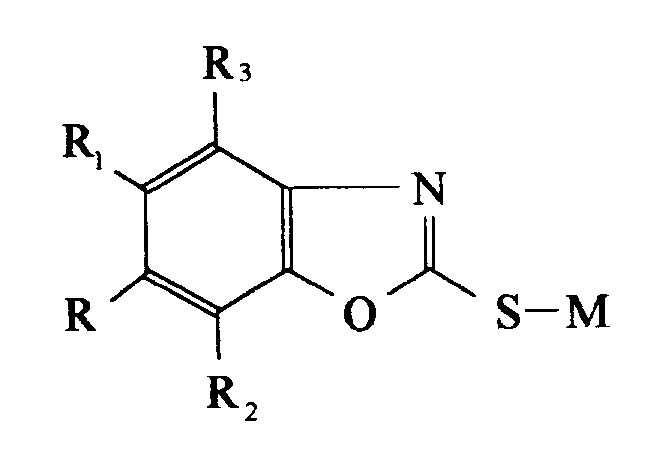
one of R and R₁ is an alkyl group with 1-9 carbon atoms, the other being hydrogen; R₂ and R₃, are hydrogen; and M is H, Na, K, Li, Cs or NH₄;
as collectors for the selective flotation of sulphide ores, for the separation by flotation of minerals containing copper and/or silver, and/or for the separation of previously activated zinc sulphide minerals, from other sulphides. - Use according to claim 1, for the selective flotation of materials containing chalcopyrite (CuFeS₂), covellite (CuS), chalcocite (Cu₂S), sphalerite (ZnS), galena (PbS), pyrite (FeS₂), silicate- and/or carbonate-based gangues or mixtures thereof.
- Use according to any one of the preceding claims for obtaining single metal concentrates by selective flotation.
- Use according to claim 1, wherein the said derivative is used in a mixture with other collectors and/or activating agents.
- Use according to claim 4 for obtaining multimetal concentrates by selective flotation.
- Use according to any one of the preceding claims, wherein said selective flotation is carried out at a pH comprised between 4 and 12.
- Use according to claim 6, wherein the pH is comprised between 6 and 10.
- Use according to any one of the preceding claims, wherein the said collector is added in an amount comprised between 10 and 200 mg per kg of the material to be processed.
- A process for the selective flotation of sulphide ores, for the separation by flotation of minerals containing copper and/or silver, and/or for the separation by flotation of previously activated zinc sulphide minerals, from other sulphides, comprising the addition of an effective amount of one or more collectors having the formula:

to a suspension of said ores. - Process according to claim 9, for the selective flotation of materials containing chalcopyrite (CuFeS₂), covellite (CuS), chalcocite (Cu₂S), sphalerite (ZnS), galena (PbS), pyrite (FeS₂), silicate- and/or carbonate-based gangues or mixtures thereof.
- Process according to any one of claims 9 and 10 for obtaining single metal concentrates by selective flotation.
- Process according to claim 9, wherein the said derivative is used in a mixture with other collectors and/or activating agents.
- Process according to claim 12 for obtaining multimetal concentrates by selective flotation.
- Process according to any one of claims 9-13, wherein said selective flotation is carried out at a pH comprised between 4 and 12.
- Process according to claim 14, wherein the pH is comprised between 6 and 10.
- Process according to any one of claims 9-15, wherein the said collector is added in an amount comprised between 10 and 200 mg per kg of the material to be processed.
Applications Claiming Priority (3)
| Application Number | Priority Date | Filing Date | Title |
|---|---|---|---|
| ITRM910897A IT1249733B (en) | 1991-11-27 | 1991-11-27 | USE OF DERIVATIVES OF 2-MERCAPTO-BENZOSSAZOLE AS COLLECTORS FOR THE SELECTIVE FLOTATION OF METAL MINERALS AND RELATED PROCEDURE. |
| ITRM910897 | 1991-11-27 | ||
| PCT/IT1992/000148 WO1993010903A1 (en) | 1991-11-27 | 1992-11-24 | 2-mercapto-benzoxazole derivatives as collectors for the selective flotation of metal ores |
Publications (2)
| Publication Number | Publication Date |
|---|---|
| EP0615467A1 EP0615467A1 (en) | 1994-09-21 |
| EP0615467B1 true EP0615467B1 (en) | 1995-08-23 |
Family
ID=11400477
Family Applications (1)
| Application Number | Title | Priority Date | Filing Date |
|---|---|---|---|
| EP92924859A Expired - Lifetime EP0615467B1 (en) | 1991-11-27 | 1992-11-24 | 2-mercapto-benzoxazole derivatives as collectors for the selective flotation of metal ores |
Country Status (12)
| Country | Link |
|---|---|
| US (1) | US5505310A (en) |
| EP (1) | EP0615467B1 (en) |
| AT (1) | ATE126730T1 (en) |
| AU (1) | AU667331B2 (en) |
| CA (1) | CA2124359C (en) |
| DE (1) | DE69204300T2 (en) |
| ES (1) | ES2079211T3 (en) |
| IT (1) | IT1249733B (en) |
| OA (1) | OA09927A (en) |
| PL (1) | PL170380B1 (en) |
| RU (1) | RU2102154C1 (en) |
| WO (1) | WO1993010903A1 (en) |
Cited By (1)
| Publication number | Priority date | Publication date | Assignee | Title |
|---|---|---|---|---|
| CN109865600A (en) * | 2018-12-24 | 2019-06-11 | 江西理工大学 | A method of lead preferentially being floated in lead-zinc sulfide ore flotation using hybrid collector |
Families Citing this family (5)
| Publication number | Priority date | Publication date | Assignee | Title |
|---|---|---|---|---|
| IT1391651B1 (en) * | 2008-08-12 | 2012-01-17 | Bornengo | USE OF DERIVATIVES OF 2-MERCAPTO-BENZOSSAZOLE FOR THE SELECTIVE SEPARATION OF METALS IN THE ELEMENTARY STATE BY MEANS OF FLOT AND RELATIVE SEPARATION PROCEDURE |
| CN105834006B (en) * | 2016-06-15 | 2018-04-10 | 江西理工大学 | A kind of beneficiation method of low-grade nickel sulfide ore |
| CN111715410B (en) * | 2020-07-01 | 2021-07-23 | 中南大学 | A combination inhibitor of zinc sulfide ore and its application |
| CN118635002B (en) * | 2023-05-29 | 2026-02-27 | 中南大学 | Application of a 2-amino-4-hydroxy-1,3,5-triazine-6-thiol collector in the flotation of metal ores |
| CN117019404B (en) * | 2023-10-10 | 2023-12-29 | 矿冶科技集团有限公司 | Ore dressing method for improving flotation separation efficiency of copper-lead sulfide ore containing chalcopyrite and galena |
Family Cites Families (5)
| Publication number | Priority date | Publication date | Assignee | Title |
|---|---|---|---|---|
| US1780000A (en) * | 1925-11-30 | 1930-10-28 | Du Pont | Concentration of ores by flotation |
| US1801318A (en) * | 1927-05-20 | 1931-04-21 | Barrett Co | Concentration of ores |
| US4511464A (en) * | 1983-07-22 | 1985-04-16 | The Dow Chemical Company | 1,3-Oxathiolane-2-thiones as sulfide mineral collectors in froth flotation |
| IT1181890B (en) * | 1985-04-30 | 1987-09-30 | Consiglio Nazionale Ricerche | COLLECTORS FOR THE SELECTIVE FLOTATION OF LEAD AND ZINC MINERALS |
| DE3601286A1 (en) * | 1986-01-17 | 1987-07-23 | Consiglio Nazionale Ricerche | COLLECTING AGENTS FOR THE SELECTIVE FLOTATION OF LEAD AND ZINC PLUGS AND METHOD FOR THE PRODUCTION THEREOF |
-
1991
- 1991-11-27 IT ITRM910897A patent/IT1249733B/en active IP Right Grant
-
1992
- 1992-11-24 AT AT92924859T patent/ATE126730T1/en not_active IP Right Cessation
- 1992-11-24 DE DE69204300T patent/DE69204300T2/en not_active Expired - Fee Related
- 1992-11-24 WO PCT/IT1992/000148 patent/WO1993010903A1/en not_active Ceased
- 1992-11-24 RU RU94027691A patent/RU2102154C1/en active
- 1992-11-24 ES ES92924859T patent/ES2079211T3/en not_active Expired - Lifetime
- 1992-11-24 PL PL92303917A patent/PL170380B1/en unknown
- 1992-11-24 CA CA002124359A patent/CA2124359C/en not_active Expired - Fee Related
- 1992-11-24 US US08/244,254 patent/US5505310A/en not_active Expired - Fee Related
- 1992-11-24 EP EP92924859A patent/EP0615467B1/en not_active Expired - Lifetime
- 1992-11-24 AU AU30940/92A patent/AU667331B2/en not_active Ceased
-
1994
- 1994-05-27 OA OA60519A patent/OA09927A/en unknown
Cited By (2)
| Publication number | Priority date | Publication date | Assignee | Title |
|---|---|---|---|---|
| CN109865600A (en) * | 2018-12-24 | 2019-06-11 | 江西理工大学 | A method of lead preferentially being floated in lead-zinc sulfide ore flotation using hybrid collector |
| CN109865600B (en) * | 2018-12-24 | 2021-04-20 | 江西理工大学 | Method for preferentially floating lead in lead-zinc sulfide ore flotation by using mixed collecting agent |
Also Published As
| Publication number | Publication date |
|---|---|
| WO1993010903A1 (en) | 1993-06-10 |
| IT1249733B (en) | 1995-03-09 |
| US5505310A (en) | 1996-04-09 |
| AU3094092A (en) | 1993-06-28 |
| ATE126730T1 (en) | 1995-09-15 |
| ES2079211T3 (en) | 1996-01-01 |
| OA09927A (en) | 1994-09-15 |
| EP0615467A1 (en) | 1994-09-21 |
| DE69204300T2 (en) | 1996-04-18 |
| AU667331B2 (en) | 1996-03-21 |
| RU2102154C1 (en) | 1998-01-20 |
| PL170380B1 (en) | 1996-12-31 |
| CA2124359A1 (en) | 1993-06-10 |
| ITRM910897A1 (en) | 1993-05-27 |
| ITRM910897A0 (en) | 1991-11-27 |
| CA2124359C (en) | 1999-11-09 |
| DE69204300D1 (en) | 1995-09-28 |
Similar Documents
| Publication | Publication Date | Title |
|---|---|---|
| US5792235A (en) | Method for recovering gold and other precious metals from carbonaceous ores | |
| FI78242B (en) | FOERFARANDE FOER FLOTATION AV MINERALER UR MALM. | |
| CN86101682A (en) | New Collectors for Selective Froth Flotation of Sulfide Minerals | |
| CN1088992A (en) | Method for recovering gold and other precious metals from carbonaceous minerals | |
| AU2004202612B8 (en) | Composition formed of mercaptans which can be used in a process for the flotation of ores | |
| EP0496012B1 (en) | Process for the selective flotation of metal ores using 2-mercaptothiazole derivatives | |
| WO2014012139A1 (en) | Monothiophosphate containing collectors and methods | |
| US4324654A (en) | Recovery of copper from copper oxide minerals | |
| US5505310A (en) | 2-mercapto-benzoxazole derivatives as collectors for the selective flotation of metal ores | |
| US4735783A (en) | Process for increasing the selectivity of mineral flotation | |
| US4724072A (en) | Collecting agents for the selective flotation of lead and zinc ores | |
| CN112934475A (en) | Beneficiation method for recovering copper, lead and zinc from copper-tungsten polymetallic ore | |
| US4269702A (en) | Ore treatment process | |
| JP2009028597A (en) | Flotation method that suppresses the floatability of pyrite | |
| US3936294A (en) | Reagent for zinc ore and method of utilizing same | |
| US4246096A (en) | Flotation process | |
| JPS5876153A (en) | Benecification of metal sulfide and collector used therein | |
| US5544760A (en) | Flotation of lead sulfides using rapeseed oil | |
| US5599442A (en) | Collector composition for flotation of activated sphalerite | |
| US4584095A (en) | Ore flotation method employing phosphorodithio compounds as frother adjuvants | |
| US4643823A (en) | Recovering metal sulfides by flotation using mercaptoalcohols | |
| CN116510912A (en) | Barite direct flotation collector and preparation method thereof | |
| GB2029274A (en) | Recovery of metal concentrates from mineral ores | |
| CN108940604B (en) | Ferro-sphalerite flotation activator and preparation method and application thereof | |
| EP0193630B1 (en) | Ore flotation with combined collectors |
Legal Events
| Date | Code | Title | Description |
|---|---|---|---|
| PUAI | Public reference made under article 153(3) epc to a published international application that has entered the european phase |
Free format text: ORIGINAL CODE: 0009012 |
|
| 17P | Request for examination filed |
Effective date: 19940525 |
|
| AK | Designated contracting states |
Kind code of ref document: A1 Designated state(s): AT BE CH DE DK ES FR GB GR IE LI LU MC NL PT SE |
|
| 17Q | First examination report despatched |
Effective date: 19941025 |
|
| GRAA | (expected) grant |
Free format text: ORIGINAL CODE: 0009210 |
|
| AK | Designated contracting states |
Kind code of ref document: B1 Designated state(s): AT BE CH DE DK ES FR GB GR IE LI LU MC NL PT SE |
|
| PG25 | Lapsed in a contracting state [announced via postgrant information from national office to epo] |
Ref country code: MC Free format text: LAPSE BECAUSE OF NON-PAYMENT OF DUE FEES Effective date: 19950823 Ref country code: GR Free format text: LAPSE BECAUSE OF FAILURE TO SUBMIT A TRANSLATION OF THE DESCRIPTION OR TO PAY THE FEE WITHIN THE PRESCRIBED TIME-LIMIT Effective date: 19950823 Ref country code: DK Effective date: 19950823 |
|
| REF | Corresponds to: |
Ref document number: 126730 Country of ref document: AT Date of ref document: 19950915 Kind code of ref document: T |
|
| REG | Reference to a national code |
Ref country code: IE Ref legal event code: FG4D Free format text: 65024 |
|
| REF | Corresponds to: |
Ref document number: 69204300 Country of ref document: DE Date of ref document: 19950928 |
|
| PG25 | Lapsed in a contracting state [announced via postgrant information from national office to epo] |
Ref country code: LU Free format text: LAPSE BECAUSE OF NON-PAYMENT OF DUE FEES Effective date: 19951130 |
|
| ET | Fr: translation filed | ||
| REG | Reference to a national code |
Ref country code: ES Ref legal event code: FG2A Ref document number: 2079211 Country of ref document: ES Kind code of ref document: T3 |
|
| SC4A | Pt: translation is available |
Free format text: 951116 AVAILABILITY OF NATIONAL TRANSLATION |
|
| PLBE | No opposition filed within time limit |
Free format text: ORIGINAL CODE: 0009261 |
|
| STAA | Information on the status of an ep patent application or granted ep patent |
Free format text: STATUS: NO OPPOSITION FILED WITHIN TIME LIMIT |
|
| 26N | No opposition filed | ||
| PGFP | Annual fee paid to national office [announced via postgrant information from national office to epo] |
Ref country code: SE Payment date: 19981123 Year of fee payment: 7 Ref country code: PT Payment date: 19981123 Year of fee payment: 7 |
|
| PGFP | Annual fee paid to national office [announced via postgrant information from national office to epo] |
Ref country code: IE Payment date: 19981124 Year of fee payment: 7 Ref country code: AT Payment date: 19981124 Year of fee payment: 7 |
|
| PGFP | Annual fee paid to national office [announced via postgrant information from national office to epo] |
Ref country code: BE Payment date: 19981125 Year of fee payment: 7 Ref country code: FR Payment date: 19981125 Year of fee payment: 7 Ref country code: ES Payment date: 19981125 Year of fee payment: 7 |
|
| PGFP | Annual fee paid to national office [announced via postgrant information from national office to epo] |
Ref country code: GB Payment date: 19981127 Year of fee payment: 7 Ref country code: DE Payment date: 19981127 Year of fee payment: 7 |
|
| PGFP | Annual fee paid to national office [announced via postgrant information from national office to epo] |
Ref country code: NL Payment date: 19981130 Year of fee payment: 7 |
|
| PGFP | Annual fee paid to national office [announced via postgrant information from national office to epo] |
Ref country code: CH Payment date: 19981203 Year of fee payment: 7 |
|
| PG25 | Lapsed in a contracting state [announced via postgrant information from national office to epo] |
Ref country code: IE Free format text: LAPSE BECAUSE OF NON-PAYMENT OF DUE FEES Effective date: 19991124 Ref country code: GB Free format text: LAPSE BECAUSE OF NON-PAYMENT OF DUE FEES Effective date: 19991124 Ref country code: AT Free format text: LAPSE BECAUSE OF NON-PAYMENT OF DUE FEES Effective date: 19991124 |
|
| PG25 | Lapsed in a contracting state [announced via postgrant information from national office to epo] |
Ref country code: SE Free format text: LAPSE BECAUSE OF NON-PAYMENT OF DUE FEES Effective date: 19991125 Ref country code: ES Free format text: LAPSE BECAUSE OF NON-PAYMENT OF DUE FEES Effective date: 19991125 |
|
| PG25 | Lapsed in a contracting state [announced via postgrant information from national office to epo] |
Ref country code: LI Free format text: LAPSE BECAUSE OF NON-PAYMENT OF DUE FEES Effective date: 19991130 Ref country code: CH Free format text: LAPSE BECAUSE OF NON-PAYMENT OF DUE FEES Effective date: 19991130 Ref country code: BE Free format text: LAPSE BECAUSE OF NON-PAYMENT OF DUE FEES Effective date: 19991130 |
|
| BERE | Be: lapsed |
Owner name: CONSIGLIO NAZIONALE DELLE RICERCHE Effective date: 19991130 |
|
| PG25 | Lapsed in a contracting state [announced via postgrant information from national office to epo] |
Ref country code: PT Free format text: LAPSE BECAUSE OF NON-PAYMENT OF DUE FEES Effective date: 20000531 |
|
| PG25 | Lapsed in a contracting state [announced via postgrant information from national office to epo] |
Ref country code: NL Free format text: LAPSE BECAUSE OF NON-PAYMENT OF DUE FEES Effective date: 20000601 |
|
| GBPC | Gb: european patent ceased through non-payment of renewal fee |
Effective date: 19991124 |
|
| REG | Reference to a national code |
Ref country code: CH Ref legal event code: PL |
|
| EUG | Se: european patent has lapsed |
Ref document number: 92924859.9 |
|
| PG25 | Lapsed in a contracting state [announced via postgrant information from national office to epo] |
Ref country code: FR Free format text: LAPSE BECAUSE OF NON-PAYMENT OF DUE FEES Effective date: 20000731 |
|
| NLV4 | Nl: lapsed or anulled due to non-payment of the annual fee |
Effective date: 20000601 |
|
| PG25 | Lapsed in a contracting state [announced via postgrant information from national office to epo] |
Ref country code: DE Free format text: LAPSE BECAUSE OF NON-PAYMENT OF DUE FEES Effective date: 20000901 |
|
| REG | Reference to a national code |
Ref country code: FR Ref legal event code: ST |
|
| REG | Reference to a national code |
Ref country code: IE Ref legal event code: MM4A |
|
| REG | Reference to a national code |
Ref country code: PT Ref legal event code: MM4A Free format text: LAPSE DUE TO NON-PAYMENT OF FEES Effective date: 20000531 |
|
| REG | Reference to a national code |
Ref country code: ES Ref legal event code: FD2A Effective date: 20001214 |