EP0613400B1 - Test device comprising a plate containing a multiplicity of wells with an associated metering device, as well as a kit which comprises these devices and use of the devices - Google Patents
Test device comprising a plate containing a multiplicity of wells with an associated metering device, as well as a kit which comprises these devices and use of the devices Download PDFInfo
- Publication number
- EP0613400B1 EP0613400B1 EP93901501A EP93901501A EP0613400B1 EP 0613400 B1 EP0613400 B1 EP 0613400B1 EP 93901501 A EP93901501 A EP 93901501A EP 93901501 A EP93901501 A EP 93901501A EP 0613400 B1 EP0613400 B1 EP 0613400B1
- Authority
- EP
- European Patent Office
- Prior art keywords
- wells
- test device
- projections
- test
- reagent
- Prior art date
- Legal status (The legal status is an assumption and is not a legal conclusion. Google has not performed a legal analysis and makes no representation as to the accuracy of the status listed.)
- Expired - Lifetime
Links
Images



Classifications
-
- B—PERFORMING OPERATIONS; TRANSPORTING
- B01—PHYSICAL OR CHEMICAL PROCESSES OR APPARATUS IN GENERAL
- B01L—CHEMICAL OR PHYSICAL LABORATORY APPARATUS FOR GENERAL USE
- B01L3/00—Containers or dishes for laboratory use, e.g. laboratory glassware; Droppers
- B01L3/50—Containers for the purpose of retaining a material to be analysed, e.g. test tubes
- B01L3/508—Rigid containers without fluid transport within
- B01L3/5085—Rigid containers without fluid transport within for multiple samples, e.g. microtitration plates
-
- B—PERFORMING OPERATIONS; TRANSPORTING
- B01—PHYSICAL OR CHEMICAL PROCESSES OR APPARATUS IN GENERAL
- B01J—CHEMICAL OR PHYSICAL PROCESSES, e.g. CATALYSIS OR COLLOID CHEMISTRY; THEIR RELEVANT APPARATUS
- B01J19/00—Chemical, physical or physico-chemical processes in general; Their relevant apparatus
- B01J19/0046—Sequential or parallel reactions, e.g. for the synthesis of polypeptides or polynucleotides; Apparatus and devices for combinatorial chemistry or for making molecular arrays
-
- G—PHYSICS
- G01—MEASURING; TESTING
- G01N—INVESTIGATING OR ANALYSING MATERIALS BY DETERMINING THEIR CHEMICAL OR PHYSICAL PROPERTIES
- G01N33/00—Investigating or analysing materials by specific methods not covered by groups G01N1/00 - G01N31/00
- G01N33/48—Biological material, e.g. blood, urine; Haemocytometers
- G01N33/50—Chemical analysis of biological material, e.g. blood, urine; Testing involving biospecific ligand binding methods; Immunological testing
- G01N33/53—Immunoassay; Biospecific binding assay; Materials therefor
- G01N33/5302—Apparatus specially adapted for immunological test procedures
- G01N33/5304—Reaction vessels, e.g. agglutination plates
-
- G—PHYSICS
- G01—MEASURING; TESTING
- G01N—INVESTIGATING OR ANALYSING MATERIALS BY DETERMINING THEIR CHEMICAL OR PHYSICAL PROPERTIES
- G01N33/00—Investigating or analysing materials by specific methods not covered by groups G01N1/00 - G01N31/00
- G01N33/48—Biological material, e.g. blood, urine; Haemocytometers
- G01N33/50—Chemical analysis of biological material, e.g. blood, urine; Testing involving biospecific ligand binding methods; Immunological testing
- G01N33/53—Immunoassay; Biospecific binding assay; Materials therefor
- G01N33/543—Immunoassay; Biospecific binding assay; Materials therefor with an insoluble carrier for immobilising immunochemicals
- G01N33/54366—Apparatus specially adapted for solid-phase testing
-
- B—PERFORMING OPERATIONS; TRANSPORTING
- B01—PHYSICAL OR CHEMICAL PROCESSES OR APPARATUS IN GENERAL
- B01J—CHEMICAL OR PHYSICAL PROCESSES, e.g. CATALYSIS OR COLLOID CHEMISTRY; THEIR RELEVANT APPARATUS
- B01J2219/00—Chemical, physical or physico-chemical processes in general; Their relevant apparatus
- B01J2219/00274—Sequential or parallel reactions; Apparatus and devices for combinatorial chemistry or for making arrays; Chemical library technology
- B01J2219/00277—Apparatus
- B01J2219/00279—Features relating to reactor vessels
- B01J2219/00306—Reactor vessels in a multiple arrangement
- B01J2219/00313—Reactor vessels in a multiple arrangement the reactor vessels being formed by arrays of wells in blocks
- B01J2219/00315—Microtiter plates
- B01J2219/00317—Microwell devices, i.e. having large numbers of wells
-
- B—PERFORMING OPERATIONS; TRANSPORTING
- B01—PHYSICAL OR CHEMICAL PROCESSES OR APPARATUS IN GENERAL
- B01J—CHEMICAL OR PHYSICAL PROCESSES, e.g. CATALYSIS OR COLLOID CHEMISTRY; THEIR RELEVANT APPARATUS
- B01J2219/00—Chemical, physical or physico-chemical processes in general; Their relevant apparatus
- B01J2219/00274—Sequential or parallel reactions; Apparatus and devices for combinatorial chemistry or for making arrays; Chemical library technology
- B01J2219/00277—Apparatus
- B01J2219/00497—Features relating to the solid phase supports
- B01J2219/00511—Walls of reactor vessels
-
- B—PERFORMING OPERATIONS; TRANSPORTING
- B01—PHYSICAL OR CHEMICAL PROCESSES OR APPARATUS IN GENERAL
- B01J—CHEMICAL OR PHYSICAL PROCESSES, e.g. CATALYSIS OR COLLOID CHEMISTRY; THEIR RELEVANT APPARATUS
- B01J2219/00—Chemical, physical or physico-chemical processes in general; Their relevant apparatus
- B01J2219/00274—Sequential or parallel reactions; Apparatus and devices for combinatorial chemistry or for making arrays; Chemical library technology
- B01J2219/00277—Apparatus
- B01J2219/0054—Means for coding or tagging the apparatus or the reagents
- B01J2219/00547—Bar codes
- B01J2219/00549—2-dimensional
-
- B—PERFORMING OPERATIONS; TRANSPORTING
- B01—PHYSICAL OR CHEMICAL PROCESSES OR APPARATUS IN GENERAL
- B01J—CHEMICAL OR PHYSICAL PROCESSES, e.g. CATALYSIS OR COLLOID CHEMISTRY; THEIR RELEVANT APPARATUS
- B01J2219/00—Chemical, physical or physico-chemical processes in general; Their relevant apparatus
- B01J2219/00274—Sequential or parallel reactions; Apparatus and devices for combinatorial chemistry or for making arrays; Chemical library technology
- B01J2219/00277—Apparatus
- B01J2219/0054—Means for coding or tagging the apparatus or the reagents
- B01J2219/00563—Magnetic means
-
- B—PERFORMING OPERATIONS; TRANSPORTING
- B01—PHYSICAL OR CHEMICAL PROCESSES OR APPARATUS IN GENERAL
- B01J—CHEMICAL OR PHYSICAL PROCESSES, e.g. CATALYSIS OR COLLOID CHEMISTRY; THEIR RELEVANT APPARATUS
- B01J2219/00—Chemical, physical or physico-chemical processes in general; Their relevant apparatus
- B01J2219/00274—Sequential or parallel reactions; Apparatus and devices for combinatorial chemistry or for making arrays; Chemical library technology
- B01J2219/00583—Features relative to the processes being carried out
- B01J2219/00585—Parallel processes
-
- B—PERFORMING OPERATIONS; TRANSPORTING
- B01—PHYSICAL OR CHEMICAL PROCESSES OR APPARATUS IN GENERAL
- B01J—CHEMICAL OR PHYSICAL PROCESSES, e.g. CATALYSIS OR COLLOID CHEMISTRY; THEIR RELEVANT APPARATUS
- B01J2219/00—Chemical, physical or physico-chemical processes in general; Their relevant apparatus
- B01J2219/00274—Sequential or parallel reactions; Apparatus and devices for combinatorial chemistry or for making arrays; Chemical library technology
- B01J2219/00583—Features relative to the processes being carried out
- B01J2219/0059—Sequential processes
-
- B—PERFORMING OPERATIONS; TRANSPORTING
- B01—PHYSICAL OR CHEMICAL PROCESSES OR APPARATUS IN GENERAL
- B01J—CHEMICAL OR PHYSICAL PROCESSES, e.g. CATALYSIS OR COLLOID CHEMISTRY; THEIR RELEVANT APPARATUS
- B01J2219/00—Chemical, physical or physico-chemical processes in general; Their relevant apparatus
- B01J2219/00274—Sequential or parallel reactions; Apparatus and devices for combinatorial chemistry or for making arrays; Chemical library technology
- B01J2219/00583—Features relative to the processes being carried out
- B01J2219/00596—Solid-phase processes
-
- B—PERFORMING OPERATIONS; TRANSPORTING
- B01—PHYSICAL OR CHEMICAL PROCESSES OR APPARATUS IN GENERAL
- B01J—CHEMICAL OR PHYSICAL PROCESSES, e.g. CATALYSIS OR COLLOID CHEMISTRY; THEIR RELEVANT APPARATUS
- B01J2219/00—Chemical, physical or physico-chemical processes in general; Their relevant apparatus
- B01J2219/00274—Sequential or parallel reactions; Apparatus and devices for combinatorial chemistry or for making arrays; Chemical library technology
- B01J2219/00718—Type of compounds synthesised
- B01J2219/0072—Organic compounds
- B01J2219/00725—Peptides
-
- C—CHEMISTRY; METALLURGY
- C40—COMBINATORIAL TECHNOLOGY
- C40B—COMBINATORIAL CHEMISTRY; LIBRARIES, e.g. CHEMICAL LIBRARIES
- C40B40/00—Libraries per se, e.g. arrays, mixtures
- C40B40/04—Libraries containing only organic compounds
- C40B40/10—Libraries containing peptides or polypeptides, or derivatives thereof
-
- C—CHEMISTRY; METALLURGY
- C40—COMBINATORIAL TECHNOLOGY
- C40B—COMBINATORIAL CHEMISTRY; LIBRARIES, e.g. CHEMICAL LIBRARIES
- C40B60/00—Apparatus specially adapted for use in combinatorial chemistry or with libraries
- C40B60/14—Apparatus specially adapted for use in combinatorial chemistry or with libraries for creating libraries
-
- C—CHEMISTRY; METALLURGY
- C40—COMBINATORIAL TECHNOLOGY
- C40B—COMBINATORIAL CHEMISTRY; LIBRARIES, e.g. CHEMICAL LIBRARIES
- C40B70/00—Tags or labels specially adapted for combinatorial chemistry or libraries, e.g. fluorescent tags or bar codes
-
- G—PHYSICS
- G01—MEASURING; TESTING
- G01N—INVESTIGATING OR ANALYSING MATERIALS BY DETERMINING THEIR CHEMICAL OR PHYSICAL PROPERTIES
- G01N35/00—Automatic analysis not limited to methods or materials provided for in any single one of groups G01N1/00 - G01N33/00; Handling materials therefor
- G01N35/10—Devices for transferring samples or any liquids to, in, or from, the analysis apparatus, e.g. suction devices, injection devices
- G01N2035/1027—General features of the devices
- G01N2035/1034—Transferring microquantities of liquid
- G01N2035/1037—Using surface tension, e.g. pins or wires
Definitions
- the present invention relates to a test device comprising a plate containing a multiplicity of wells.
- the invention also relates to a metering device suitable for the simultaneous introduction of equal volumes of reagent into different wells of the test device.
- the invention relates to a method for carrying out a (bio- and/or immuno) chemical test using the test device and/or the metering device and the invention is aimed at a kit which comprises the test device and the metering device.
- a test device comprising a plate containing a multiplicity of wells has already been known for years in the form of the so-called microtitre plate.
- the known microtitre plate is of the order of 12.5 cm ⁇ 8.0 cm in size and comprises 96 wells.
- the diameter of each well is about 0.6 cm and the depth of each well is about 1.0 cm, so that each well can contain at most a 250 ⁇ l sample.
- the wells are separated by material barriers with a width of approximately 2.0 mm.
- the known microtitre plate is used when carrying out diverse bio- and/or immunochemical tests. In tests of this type, photometric detection is frequently used. A very well-known example of such a test is the ELISA.
- the bottom of a well must be uniformly covered with a layer of the sample to be analysed in order to obtain reliable results. Furthermore, this layer must have a thickness which is at least such that detectable absorption occurs. In practice, this generally implies that samples are used which have at least a volume of 50 ⁇ l.
- an assay method for detecting the response or activation of cells including lymphocytes.
- a method for detecting immunological sensitisation in a subject which involves the introduction of a cell activating substance which causes an enzyme of the cells to become available for reaction and the measurement of the enzymatic reaction using a substrate which generates a detectable product and a kit for performing such assays are disclosed.
- Use of a sample volume of 30 ⁇ l is mentioned as a sample of preference to be used in a microtitre plate well with a diameter of 6 mm.
- a reaction vessel is claimed with a diameter of 6 mm and a height of 0,5-6 mm with a preferred height of 1-2 mm.
- the vessel is designed to optimize physiological control of the reaction allowing adequate exchange of gasses such as oxygen and CO 2 , sufficiently rapid pH equilibration, adequate diffusion of molecules and dissipation of heat.
- the reaction vessel of the cited document is concerned with the ratio of the reaction volume and the surface area of the reaction sample.
- the cited document does not disclose any problems that can be encountered when rinsing small reaction vessels in processes, such as ELISA or PEPSCAN.
- the top of the microtitre tray is formed with 864 wells which are arranged in a rectangular array that is 36 by 24.
- the system for using the multiwell microtitre tray includes a support structure which has a heat exchanger that is engageable with the microtitre tray.
- the sample can be diluted to only a limited degree since the component to be analysed must also be present in the well in a certain minimum concentration in order to obtain measurable absorption.
- the light intensity is dependent on the concentration and the absorption coefficient of the component to be analysed and also on the distance the light has to travel through the sample to be measured. In practice, this implies the use of about 12.5 ml of reagents per microtitre plate. In such cases there is an appreciable need to reduce the amount of sample to be used.
- peptides containing different amino acid sequences can be synthesised. This can be carried out, for example, with a view to determining the location of an epitope of a protein for a specific antibody. To this end, peptides containing amino acid sequences corresponding to a fragment of the protein to be studied are synthesised separately. The synthesis can be carried out in such a way that each peptide in part contains the amino acid sequence of another peptide. It is even possible to carry out the synthesis in such a way that only one amino acid does not overlap.
- peptide synthesis was carried out by adding the amino acid to be coupled to the well of the known microtitre plate in which the peptide had to be synthesised, then coupling the desired amino acid to the growing peptide chain, subsequently washing the well to remove any unreacted amino acid and repeating the procedure with the next amino acid.
- the growing peptide chains are allowed to adhere to polyethylene rods (having a diameter of 4 mm and a length of 40 mm) and the reactions required for peptide synthesis are then carried out using the ends of the support rods.
- the polyethylene rods are first immersed in a 6 percent solution of acrylic acid in water and subjected to ⁇ -radiation.
- the ends of the rods are then brought into contact with a Teflon plate containing a matrix of wells corresponding to the location of the rods (the known microtitre plate).
- the conventional methods for peptide chemistry in the solid phase can be used here, for example for coupling N ⁇ -t-butyloxycarbonyl-L-lysine methyl ester to polyethylene/polyacrylic acid via the N ⁇ -amino group of the side chain.
- N ⁇ -t-butyloxycarbonyl-L-lysine methyl ester to polyethylene/polyacrylic acid via the N ⁇ -amino group of the side chain.
- t-butyloxycarbonyl-L-alanine can be coupled, a peptide-like spacer being formed.
- the desired amino acids can be coupled successively and, following the final desired coupling reaction and after removal of the protecting t-butyloxycarbonyl group, the terminal amino acid can be acetylated using acetic anhydride in dimethylformamide/triethylamine. All coupling reactions carried out with N,N-dicyclohexylcarbodiimide can be carried out in dimethylformamide in the presence of N-hydroxybenzotriazole. Any protective groups in side chains of amino acids used in the peptide synthesis can also be removed. Before the synthesised peptides are examined further, for example by means of ELISA, the rods can be washed with a phosphate-buffered saline solution.
- peptide synthesis takes place if one or more amino acids of a known epitope are changed in order to determine which other sequences are able to function as an epitope and/or in order to determine which amino acids are essential for the epitope action.
- a method of this type is described by Geysen, H.M., Meloen, R.H. and Barteling, S.J. in Proc. Natl. Acad. Sci. USA, Vol. 82 (January 1985) pp. 178-182.
- a method for miniaturised peptide synthesis has recently been described in an article by Fodor, S.P.A. et al. (Science, (15 February 1991) pp. 767-773).
- light is used to control the simultaneous synthesis of a large number of different chemical compounds. Synthesis takes place on a solid support, such as a glass plate. The support is aminated by treatment with 0.1 % aminopropyltriethoxysilane in 95 % ethanol.
- a light-sensitive protective group is then introduced, said protective group disappearing following irradiation with light and giving a reactive site to which a building block, such as an amino acid, can be coupled.
- the pattern in which exposure to light or other forms of energy takes place determines which areas of the support are activated for chemical coupling.
- the entire surface is brought into contact with the building block to be coupled (said building block also being provided with a light-sensitive protective group).
- a coupling reaction will occur only at sites where the light in the previous step has given rise to activation.
- the substrate is then exposed through another mask, so that a subsequent building block can be incorporated in the desired site.
- the pattern of the mask and the sequence of the reagents determine the sequences of the peptides formed.
- a high degree of miniaturisation can be achieved in this way. For example, it is possible to synthesise 40,000 different peptides on 1 cm 2 .
- FR-A-2 383 442 Institute Pasteur a solution for miniaturisation problems is given.
- the solution implies carrying out miniaturisation reactions with additional means such as centrifugation and an additional receptacle for the actual reaction.
- the volume of the micro cuvet described in the cited document could be in the order of a few micro liters however the micro cuvet is merely destined for measurement of a sample that has already undergone the reaction steps required in a different much larger receptacle. It is obvious from the teaching of the French document that the micro cuvet is not suitable for carrying out a reaction.
- the present invention relates to a test device which solves the miniaturisation problems described above and is suitable for use for bio- and/or immunochemical tests such as ELISA and tests in which peptide syntheses are used, for example the PEPSCAN as described above.
- the present invention relates to a test device which comprises a plate containing a multiplicity of wells, which is characterised in that the wells have a volume within the range of 0.1-20 ⁇ l and that the diameter of the wells is 1.0-4.0 mm.
- the dimensions of the wells will be chosen depending on the price and availability of the samples and reagents to be used.
- the present invention preferably relates to a test device in which the wells have a volume within the range of 0.1-5 ⁇ l.
- a test device comprising a plate containing a multiplicity of wells, characterised in that the wells have a volume within the range of 0.1-20 ⁇ l and that the diameter of the wells is 1.0-4.0 mm, further having a ratio between the depth of the wells and the diameter thereof below 1:1, is very suitable.
- Figures 1 and 2 show the results of tests in which the rinsability of various test devices was investigated.
- the test devices had wells of equal diameter (2 mm) but of different depths.
- the rinsability was investigated on a shaking machine at speeds of, 47 and 40, respectively.
- the depth of the well in mm is plotted against the time in minutes needed to properly rinse the well.
- the invention is preferably aimed at a test device in which wells with a diameter of 1.0-2.0 mm are preferred.
- the choice of the dimensions of the wells will depend on the desired specific test for which the test device is to be used. The smaller the diameter, the smaller the required volume of the sample.
- the wells have a shape such that a vertical cross section of the wells is essentially U-shaped, the transition between legs and base of the U being gradual. Preferably there are no sharp angles in the well.
- the U shape in which the angle between base and legs is perpendicular is preferred for photometric determinations in which measurement is carried out under and through the plate.
- the test device according to the invention will preferably be a plate containing wells separated by material barriers with a width of 1.0-5.0 mm, preferably by material barriers with a width between 1.0 and 2.0 mm.
- the material barriers must be sufficiently wide to prevent reagents flowing over from one well to another.
- the material barriers must be sufficiently wide when DMF is used as solvent, as is frequently the case in peptide synthesis. This is because DMF is known to have a high creeping capacity.
- test device will in a suitable embodiment comprise a plate containing 5-20 wells per cm 2 , preferably 10-15 wells per cm 2 .
- test device will in a suitable embodiment comprise material to which peptides, proteins and other biochemical molecules, such as hormones and polysaccharides, are able to adhere.
- material will preferably be material to which peptides and proteins are able to adhere, such as polyethylene or polystyrene.
- Suitable examples of materials which can be used in a test device according to the invention are polypropylene and polycarbonate.
- test device The choice of the material for the test device will also depend on the reagents to be used in such a test device and on the detection method. In the case of photometric analysis through the bottom of the test device, for example, at least the bottom of the wells will have to be composed of transparent material. In the case of tests where DMF is used as solvent, it will not be possible to use a polystyrene test device because DMF is too aggressive.
- test device will be provided with a means for recording information, for example a bar code or a magnetic strip.
- the test device can be provided with data relating to the test it is intended to carry out, or which has been carried out, such data for example relating to reagents or samples which have been used.
- the test device can also be provided with markings which indicate the coordinations of wells in the test device.
- Figure 4 shows a top view of an example of one embodiment of the test device according to the invention.
- the present invention is also aimed at a method for carrying out (bio- and/or immuno)chemical tests, in which a test device according to the invention is used.
- a test device according to the invention can be used in the same tests as the known microtitre plate. It is now possible to carry out existing methods using much smaller amounts of sample and reagents; so-called mini-tests are now possible. It is possible to reduce the amount of sample used by a factor of one hundred. It is now possible to use 2.5 ⁇ l instead of 250 ⁇ l samples per well.
- Use of the test device according to the invention now makes mass screening of population groups much more attractive because much less blood is required from the donor and much smaller quantities of reagents are required.
- test device is particularly suitable for use in methods in which large numbers of samples have to be used.
- a mini-ELISA and mini-PEPSCAN in which a test device according to the invention is used are suitable examples of the method according to the present invention.
- the advantage of a mini-method according to the invention is that the test can be carried out with sample amounts of less than 20 ⁇ l. It is readily possible to use sample amounts of less than 5 ⁇ l in a mini-method according to the invention.
- the present invention is also aimed at a metering device suitable for simultaneously introducing equal volumes of reagent into different wells in a test device according to the invention.
- a metering device according to the invention can be used in order to carry out as efficiently as possible immuno- and/or biochemical tests, said device being provided with projections having dimensions and mutual spacings such that individual projections can simultaneously be positioned in or above wells of a test device according to the invention.
- consideration is given to optional automation of certain methods according to the invention.
- a metering device can simultaneously be provided with equal volumes of reagent if the position of the projections is such that this essentially corresponds to the position of the wells in the test device according to the invention.
- a metering device can be used which has projections which simultaneously can be positioned above or in the selected wells.
- the darker wells are the selected wells.
- the projections of the metering device are located on the metering device in such a way that they can simultaneously be positioned above or in the darker wells.
- a metering device can advantageously be used in which the projections are fixed to the support or can be fixed in a pattern which corresponds to the pattern of the wells into which reagent has to be introduced.
- Figure 8 shows an example of an embodiment of the metering device in which the projections can be fixed to a support.
- the metering device can comprise projections which are fixed or can be fixed to a support in a way equivalent to the bristles of a brush (Figs. 6, 7 and 8).
- a metering device in which the projections, like the teeth of a comb, are parallel to one another and are fixed (Fig. 9) or can be fixed (Fig. 10) at their tops to a support is also an embodiment of a metering device according to the invention which is very suitable.
- the number of projections can be less than or equal to the number of wells forming a row in the longitudinal direction of the test device.
- the number of projections can be less than or equal to the number of wells forming a row in the widthwise direction of the test device.
- the number of projections will depend on the pattern of wells of the test device into which reagent has to be introduced.
- the projections of a metering device according to the invention can be integral with the support or can be detachable.
- the projections can be fitted on the support in such a way that the projections form a pattern which corresponds to the pattern of wells which have to be filled in the test device (see Fig. 7).
- a metering device in which more than one projection can be positioned above or in a well at the same time, if it is desired to simultaneously introduce more than one reagent unit, which is present on a projection, into a well.
- Figure 11 shows a metering device in which two projections can be positioned simultaneously above or in each well.
- the amount of reagent which is present on a projection can be taken as standard and metering devices can be used which have a group of projections above or in the well, depending on the ratio in which it is desired to introduce reagents into a well.
- a group will comprise the number of projections which corresponds to the number of desired reagent units.
- the projections can be hollow, but they can also be solid or closed at the bottom. The latter two possibilities are to be preferred when working with very small amounts of sample and reagents, because it is then possible to work with drops of reagent.
- the present invention is also aimed at a method for carrying out a (bio- and/or immuno-)chemical test using a metering device according to the invention, in which method
- the invention also relates to a method of this type in which the projections of the metering device are simultaneously provided with reagent by immersing the projections in reagent.
- the present invention is also aimed at a kit which comprises at least a test device and metering device according to the invention.
- a kit which comprises at least a test device and metering device according to the invention.
- Such a kit can comprise a number of metering devices in the various embodiments described above and can also comprise replaceable projections for such metering devices.
- test devices Miniaturised synthesis of a complete tripeptide net (8000 different peptides) was carried out using test devices according to the invention.
- the test device used in this example resembled a credit card in size and was constructed so that it comprised 455 wells with a diameter of 2 mm and a maximum volume of 5 ⁇ l each.
- the test device was made of polyethylene. In order to make this solid carrier suitable for peptide synthesis the wells were treated via the method described by Geysen et al. (1984) previously mentioned.
- the carboxyl groups of the polyacrylic acid were provided with a NH 2 -group via a linking reaction of a linker t-ButylOxyCarbonyl-HexaMethyleneDiAmine (BOC-HMDA) in the presence of N,N-DicyclohexylCarbodiimide and N-HydrOxyBenzotriazole (DDC/HOBt). All these linking reactions were carried out in DiMethylFormamide (DMF).
- BOC-HMDA t-ButylOxyCarbonyl-HexaMethyleneDiAmine
- DDC/HOBt N,N-DicyclohexylCarbodiimide and N-HydrOxyBenzotriazole
- the linking time for each amino acid amounted to approximately 2 to 3 hours.
- the difference in linking time is caused by the reaction stopping when the reaction mixture has completely evaporated.
- the total structure of the peptide was as follows: Ac-A 3 -A 2 -A 1 -X-carrier, wherein Ac represents an acetyl group, A x represents a single amino acid and X represents the mixture of amino acids.
- test devices according to the invention were rinsed with phosphate buffered saline (PBS, 3x10 min) before incubation of the peptides with serum, after which the test devices according to the invention were precoated for 1 hour at 37°C with 10% horse serum/10% ovalbumine/1% Tween® 80 in PBS (SuperQ®) in order to prevent aspecific absorption of antibodies.
- the test devices according to the invention were completely submerged in the liquid.
- test devices wells with serum dilution can be carried out in two ways. If only a little serum is available the test devices can be filled using the robot arm mentioned in the previous example and when sufficient serum is available the test devices can be submerged in the serum and subsequently be wiped so that all the wells are simultaneously filled.
- test devices Incubation of the test devices took place during the night at 4°C in air saturated with water, after which the test devices were washed three times with 0.05% Tween® 80/PBS in order to remove antibodies that had not been bound.
- the test devices according to the invention that had been incubated with serum were subsequently incubated for 1 hour at 37°C with an antibody conjugated peroxidase enzyme (1/1000 solution in SuperQ®) by submerging the test devices in a solution comprising said enzyme. After this the test devices were rinsed with PBS, 3x 10 min.
- the presence of the second antibody was demonstrated with the substrate liquid ABTS (2,2'-Azine-di[3-ethyl benzthiazoline sulfonate (6)]).
- ABTS 2,2'-Azine-di[3-ethyl benzthiazoline sulfonate (6)]
Landscapes
- Health & Medical Sciences (AREA)
- Chemical & Material Sciences (AREA)
- Immunology (AREA)
- Life Sciences & Earth Sciences (AREA)
- Engineering & Computer Science (AREA)
- Hematology (AREA)
- Urology & Nephrology (AREA)
- Biomedical Technology (AREA)
- Molecular Biology (AREA)
- Chemical Kinetics & Catalysis (AREA)
- General Health & Medical Sciences (AREA)
- Analytical Chemistry (AREA)
- Medicinal Chemistry (AREA)
- Organic Chemistry (AREA)
- Microbiology (AREA)
- Physics & Mathematics (AREA)
- Cell Biology (AREA)
- Biochemistry (AREA)
- Biotechnology (AREA)
- General Physics & Mathematics (AREA)
- Pathology (AREA)
- Food Science & Technology (AREA)
- Clinical Laboratory Science (AREA)
- Automatic Analysis And Handling Materials Therefor (AREA)
- Apparatus Associated With Microorganisms And Enzymes (AREA)
- Investigating Or Analysing Biological Materials (AREA)
- Devices For Use In Laboratory Experiments (AREA)
- Investigating Or Analyzing Non-Biological Materials By The Use Of Chemical Means (AREA)
- Investigating Or Analysing Materials By The Use Of Chemical Reactions (AREA)
- Sampling And Sample Adjustment (AREA)
- Measuring Or Testing Involving Enzymes Or Micro-Organisms (AREA)
Abstract
Description
- The present invention relates to a test device comprising a plate containing a multiplicity of wells. The invention also relates to a metering device suitable for the simultaneous introduction of equal volumes of reagent into different wells of the test device. In addition, the invention relates to a method for carrying out a (bio- and/or immuno) chemical test using the test device and/or the metering device and the invention is aimed at a kit which comprises the test device and the metering device.
- A test device comprising a plate containing a multiplicity of wells has already been known for years in the form of the so-called microtitre plate. The known microtitre plate is of the order of 12.5 cm × 8.0 cm in size and comprises 96 wells. The diameter of each well is about 0.6 cm and the depth of each well is about 1.0 cm, so that each well can contain at most a 250 µl sample. The wells are separated by material barriers with a width of approximately 2.0 mm.
- The known microtitre plate is used when carrying out diverse bio- and/or immunochemical tests. In tests of this type, photometric detection is frequently used. A very well-known example of such a test is the ELISA. In the case of photometric determinations, the bottom of a well must be uniformly covered with a layer of the sample to be analysed in order to obtain reliable results. Furthermore, this layer must have a thickness which is at least such that detectable absorption occurs. In practice, this generally implies that samples are used which have at least a volume of 50 µl.
- In WO-91/06859 an assay method is described for detecting the response or activation of cells including lymphocytes. A method for detecting immunological sensitisation in a subject which involves the introduction of a cell activating substance which causes an enzyme of the cells to become available for reaction and the measurement of the enzymatic reaction using a substrate which generates a detectable product and a kit for performing such assays are disclosed. Use of a sample volume of 30 µl is mentioned as a sample of preference to be used in a microtitre plate well with a diameter of 6 mm. A reaction vessel is claimed with a diameter of 6 mm and a height of 0,5-6 mm with a preferred height of 1-2 mm. In the cited document the vessel is designed to optimize physiological control of the reaction allowing adequate exchange of gasses such as oxygen and CO2, sufficiently rapid pH equilibration, adequate diffusion of molecules and dissipation of heat. The reaction vessel of the cited document is concerned with the ratio of the reaction volume and the surface area of the reaction sample. The cited document does not disclose any problems that can be encountered when rinsing small reaction vessels in processes, such as ELISA or PEPSCAN.
- In EP-A-0 542 422 published on 19.05.93 with a priority date of 12.11.91, a document according to Article 54(3) and (4) EPC designating CH, DE, FR, GB and LI a well having a displaced volume of 20 µl is disclosed. A well having a smaller volume is not disclosed. A metering device for introducing equal volumes of reagents into different wells of a test device comprising a microtitre plate containing a multiplicity of wells is described, said device comprising 864 projections. The cited document described a multiwell microtitre tray which is useful for simultaneously processing a high volume of minute liquid samples. Such a multiwell microtitre tray is useful with robotics which function in accordance with existing standards of the industry. The top of the microtitre tray is formed with 864 wells which are arranged in a rectangular array that is 36 by 24. The system for using the multiwell microtitre tray includes a support structure which has a heat exchanger that is engageable with the microtitre tray.
- Since bio- and/or immunochemical tests frequently involve large numbers of tests on samples (such as blood and sera) which have to be obtained from test persons and/or animals, there is a need to use as little sample as possible per test.
- However, the sample can be diluted to only a limited degree since the component to be analysed must also be present in the well in a certain minimum concentration in order to obtain measurable absorption. This is because, according to Lambert-Beers' law, the light intensity is dependent on the concentration and the absorption coefficient of the component to be analysed and also on the distance the light has to travel through the sample to be measured. In practice, this implies the use of about 12.5 ml of reagents per microtitre plate. In such cases there is an appreciable need to reduce the amount of sample to be used.
- Another frequent use of the current microtitre plate is in the synthesis of peptides. In such syntheses peptides containing different amino acid sequences can be synthesised. This can be carried out, for example, with a view to determining the location of an epitope of a protein for a specific antibody. To this end, peptides containing amino acid sequences corresponding to a fragment of the protein to be studied are synthesised separately. The synthesis can be carried out in such a way that each peptide in part contains the amino acid sequence of another peptide. It is even possible to carry out the synthesis in such a way that only one amino acid does not overlap. It is also possible to produce a series of short sections, for example hexapeptides which overlap with the exception of one amino acid. A determination is then carried out to establish with which peptide antibody binding takes place. Peptides with which antibody binding takes place contain an epitope.
- In the first instance, peptide synthesis was carried out by adding the amino acid to be coupled to the well of the known microtitre plate in which the peptide had to be synthesised, then coupling the desired amino acid to the growing peptide chain, subsequently washing the well to remove any unreacted amino acid and repeating the procedure with the next amino acid.
- However, with this method problems were experienced in rinsing the wells and, therefore, a method of peptide synthesis was adopted in which small polyethylene rods are used as supports for the growing peptide chains. This method is described by Geysen, H.M., Meloen, R.H. and Barteling, S.J. beschreven in Proc. Natl. Acad. Sci. USA, Vol. 81 (July 1984) pp. 3998-4002. In this article, a method is described for the simultaneous synthesis of hundreds of peptides on a solid support with adequate purity for carrying out an ELISA. Interaction of the peptides with antibodies can be detected simply, without removing the peptides from the support. Consequently, it becomes possible to determine an immunogenic epitope with a good resolution. This method is termed the PEPSCAN.
- With this method, the growing peptide chains are allowed to adhere to polyethylene rods (having a diameter of 4 mm and a length of 40 mm) and the reactions required for peptide synthesis are then carried out using the ends of the support rods. To this end, the polyethylene rods are first immersed in a 6 percent solution of acrylic acid in water and subjected to γ-radiation. For the subsequent reactions, the ends of the rods are then brought into contact with a Teflon plate containing a matrix of wells corresponding to the location of the rods (the known microtitre plate). The conventional methods for peptide chemistry in the solid phase can be used here, for example for coupling Nα-t-butyloxycarbonyl-L-lysine methyl ester to polyethylene/polyacrylic acid via the Nα-amino group of the side chain. [(Erickson, B.W. and Merrifield, R.B. (1976) in The Proteins, Eds. Neurath, H & Hill, R.L. (Academic, New York), Vol. 2, pp. 255-527) and (Meienhofer, J. (1973) in Hormonal Proteins and Peptides, Ed. Li, C.H., (Academic, New York), Vol. 2, pp. 45-267)]. After removing the t-butyloxycarbonyl group, t-butyloxycarbonyl-L-alanine can be coupled, a peptide-like spacer being formed. The desired amino acids can be coupled successively and, following the final desired coupling reaction and after removal of the protecting t-butyloxycarbonyl group, the terminal amino acid can be acetylated using acetic anhydride in dimethylformamide/triethylamine. All coupling reactions carried out with N,N-dicyclohexylcarbodiimide can be carried out in dimethylformamide in the presence of N-hydroxybenzotriazole. Any protective groups in side chains of amino acids used in the peptide synthesis can also be removed. Before the synthesised peptides are examined further, for example by means of ELISA, the rods can be washed with a phosphate-buffered saline solution.
- Another use of peptide synthesis takes place if one or more amino acids of a known epitope are changed in order to determine which other sequences are able to function as an epitope and/or in order to determine which amino acids are essential for the epitope action. A method of this type is described by Geysen, H.M., Meloen, R.H. and Barteling, S.J. in Proc. Natl. Acad. Sci. USA, Vol. 82 (January 1985) pp. 178-182.
- As such methods frequently comprise a large number of syntheses and thus also the use of large amounts of reagents, which reagents, moreover, are frequently expensive, there is also a need, with a view to reducing costs, to use sample amounts which are as small as possible. Possibilities have therefore been sought for miniaturisation of such peptide syntheses.
- A method for miniaturised peptide synthesis has recently been described in an article by Fodor, S.P.A. et al. (Science, (15 February 1991) pp. 767-773). In this method light is used to control the simultaneous synthesis of a large number of different chemical compounds. Synthesis takes place on a solid support, such as a glass plate. The support is aminated by treatment with 0.1 % aminopropyltriethoxysilane in 95 % ethanol. Here, a light-sensitive protective group is then introduced, said protective group disappearing following irradiation with light and giving a reactive site to which a building block, such as an amino acid, can be coupled. The pattern in which exposure to light or other forms of energy takes place (for example via a mask) determines which areas of the support are activated for chemical coupling. The entire surface is brought into contact with the building block to be coupled (said building block also being provided with a light-sensitive protective group). A coupling reaction will occur only at sites where the light in the previous step has given rise to activation. The substrate is then exposed through another mask, so that a subsequent building block can be incorporated in the desired site. The pattern of the mask and the sequence of the reagents determine the sequences of the peptides formed. A high degree of miniaturisation can be achieved in this way. For example, it is possible to synthesise 40,000 different peptides on 1 cm2.
- However, this method has a number of disadvantages. The removal of the protective light-sensitive group (nitroveratryloxycarbonyl is named in the article) takes place by irradiation for 20 minutes with a mercury lamp having a power of 12 mW/cm3. This will result in a very long synthesis time in the case of the synthesis of longer peptides. Furthermore, a different mask will have to be used for each addition step and a different set of masks will have to be used for each series of peptides.
- Moreover, only one building block can be added in each addition step because the various peptides to be synthesised are not spatially separated. It is obvious that mixing of reagents would otherwise take place and, thus, undesired products would also form. This method is therefore very laborious, especially for the synthesis of peptides which differ not only in respect of length but also in respect of sequence.
- The authors of the article themselves also touch on the problem of the reliability of the synthesis. Deletions can occur as a consequence of incomplete removal of the protective group, following irradiation with light. The net coupling percentage is 85-95 %. Furthermore, when changing masks, a certain overlap between the diverse synthesis regions will take place because of light diffraction, internal reflection and scattering. Consequently, compounds will be formed in regions which are considered to be dark, as a result of which undesired insertion of a specific amino acid can take place.
- In FR-A-2 383 442 (Institut Pasteur) a solution for miniaturisation problems is given. The solution implies carrying out miniaturisation reactions with additional means such as centrifugation and an additional receptacle for the actual reaction. The volume of the micro cuvet described in the cited document could be in the order of a few micro liters however the micro cuvet is merely destined for measurement of a sample that has already undergone the reaction steps required in a different much larger receptacle. It is obvious from the teaching of the French document that the micro cuvet is not suitable for carrying out a reaction. A rather elaborate construction is shown wherein an intermediate receptacle is required along with a centrifugation step to carry out a reaction after which the reaction mixture is subsidently removed to the micro cuvet. In particular as a reaction such as a PEPSCAN involves a large number of reaction steps entailing a number of rinsing steps the method as taught in the cited document would not be acceptable for carrying out a miniaturised PEPSCAN.
- The present invention relates to a test device which solves the miniaturisation problems described above and is suitable for use for bio- and/or immunochemical tests such as ELISA and tests in which peptide syntheses are used, for example the PEPSCAN as described above.
- The present invention relates to a test device which comprises a plate containing a multiplicity of wells, which is characterised in that the wells have a volume within the range of 0.1-20 µl and that the diameter of the wells is 1.0-4.0 mm. The dimensions of the wells will be chosen depending on the price and availability of the samples and reagents to be used. In general, wells which are as small as possible will be preferred and, therefore, the present invention preferably relates to a test device in which the wells have a volume within the range of 0.1-5 µl.
- Entirely contrary to expectations, it has now been found that making the wells smaller has no adverse consequences for the efficient rinsability thereof. It has been found that the rinsing times required in order to obtain good rinsing are shortest if the ratio between the depth of the wells and the diameter thereof is less than 1:1. Therefore, a test device comprising a plate containing a multiplicity of wells, characterised in that the wells have a volume within the range of 0.1-20 µl and that the diameter of the wells is 1.0-4.0 mm, further having a ratio between the depth of the wells and the diameter thereof below 1:1, is very suitable. A test device according to the invention for which the ratio between the depth of the wells and the diameter thereof is less than 2:3 is preferred.
- Figures 1 and 2 show the results of tests in which the rinsability of various test devices was investigated. The test devices had wells of equal diameter (2 mm) but of different depths. The rinsability was investigated on a shaking machine at speeds of, 47 and 40, respectively. The depth of the well in mm is plotted against the time in minutes needed to properly rinse the well.
- The invention is preferably aimed at a test device in which wells with a diameter of 1.0-2.0 mm are preferred. The choice of the dimensions of the wells will depend on the desired specific test for which the test device is to be used. The smaller the diameter, the smaller the required volume of the sample.
- In connection with the desired good rinsability, it is also preferred that the wells have a shape such that a vertical cross section of the wells is essentially U-shaped, the transition between legs and base of the U being gradual. Preferably there are no sharp angles in the well.
- A number of suitable shapes of wells are shown in Figure 3.
- The U shape in which the angle between base and legs is perpendicular is preferred for photometric determinations in which measurement is carried out under and through the plate.
- The test device according to the invention will preferably be a plate containing wells separated by material barriers with a width of 1.0-5.0 mm, preferably by material barriers with a width between 1.0 and 2.0 mm. The material barriers must be sufficiently wide to prevent reagents flowing over from one well to another. Specifically, the material barriers must be sufficiently wide when DMF is used as solvent, as is frequently the case in peptide synthesis. This is because DMF is known to have a high creeping capacity.
- The test device according to the invention will in a suitable embodiment comprise a plate containing 5-20 wells per cm2, preferably 10-15 wells per cm2.
- Furthermore, the test device will in a suitable embodiment comprise material to which peptides, proteins and other biochemical molecules, such as hormones and polysaccharides, are able to adhere. For test devices suitable for tests with peptide synthesis, such material will preferably be material to which peptides and proteins are able to adhere, such as polyethylene or polystyrene.
- Other suitable examples of materials which can be used in a test device according to the invention are polypropylene and polycarbonate.
- The choice of the material for the test device will also depend on the reagents to be used in such a test device and on the detection method. In the case of photometric analysis through the bottom of the test device, for example, at least the bottom of the wells will have to be composed of transparent material. In the case of tests where DMF is used as solvent, it will not be possible to use a polystyrene test device because DMF is too aggressive.
- A preferred embodiment of the test device will be provided with a means for recording information, for example a bar code or a magnetic strip. The test device can be provided with data relating to the test it is intended to carry out, or which has been carried out, such data for example relating to reagents or samples which have been used. The test device can also be provided with markings which indicate the coordinations of wells in the test device.
- Figure 4 shows a top view of an example of one embodiment of the test device according to the invention.
- A cross section is shown in Figure 5.
- As already mentioned in the preamble, the present invention is also aimed at a method for carrying out (bio- and/or immuno)chemical tests, in which a test device according to the invention is used. In general, a test device according to the invention can be used in the same tests as the known microtitre plate. It is now possible to carry out existing methods using much smaller amounts of sample and reagents; so-called mini-tests are now possible. It is possible to reduce the amount of sample used by a factor of one hundred. It is now possible to use 2.5 µl instead of 250 µl samples per well. Use of the test device according to the invention now makes mass screening of population groups much more attractive because much less blood is required from the donor and much smaller quantities of reagents are required.
- Another great advantage of the miniaturisation of the methods by use of the test device according to the invention lies in the fact that the existing chemistry does not have to be modified. In this context consider the great advantage, for example, in the case of automated processes, such as the PEPSCAN. The test device is particularly suitable for use in methods in which large numbers of samples have to be used. A mini-ELISA and mini-PEPSCAN in which a test device according to the invention is used are suitable examples of the method according to the present invention. The advantage of a mini-method according to the invention is that the test can be carried out with sample amounts of less than 20 µl. It is readily possible to use sample amounts of less than 5 µl in a mini-method according to the invention.
- The present invention is also aimed at a metering device suitable for simultaneously introducing equal volumes of reagent into different wells in a test device according to the invention. A metering device according to the invention can be used in order to carry out as efficiently as possible immuno- and/or biochemical tests, said device being provided with projections having dimensions and mutual spacings such that individual projections can simultaneously be positioned in or above wells of a test device according to the invention. In this context, consideration is given to optional automation of certain methods according to the invention.
- If a predetermined equal amount of reagent has to be introduced simultaneously into a number of wells, it is possible to use a metering device according to the invention. With a metering device of this type, all wells can simultaneously be provided with equal volumes of reagent if the position of the projections is such that this essentially corresponds to the position of the wells in the test device according to the invention.
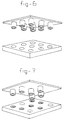
- One embodiment of the metering device and the test device is shown in Figure 6.
- If not all, but only a certain number, of wells in the test device have to be filled, a metering device can be used which has projections which simultaneously can be positioned above or in the selected wells.
- In Figure 7 the darker wells are the selected wells. The projections of the metering device are located on the metering device in such a way that they can simultaneously be positioned above or in the darker wells.
- To this end, a metering device can advantageously be used in which the projections are fixed to the support or can be fixed in a pattern which corresponds to the pattern of the wells into which reagent has to be introduced.
- Figure 8 shows an example of an embodiment of the metering device in which the projections can be fixed to a support.
- The metering device can comprise projections which are fixed or can be fixed to a support in a way equivalent to the bristles of a brush (Figs. 6, 7 and 8).
- A metering device in which the projections, like the teeth of a comb, are parallel to one another and are fixed (Fig. 9) or can be fixed (Fig. 10) at their tops to a support is also an embodiment of a metering device according to the invention which is very suitable. The number of projections can be less than or equal to the number of wells forming a row in the longitudinal direction of the test device. The number of projections can be less than or equal to the number of wells forming a row in the widthwise direction of the test device. The number of projections will depend on the pattern of wells of the test device into which reagent has to be introduced.
- The projections of a metering device according to the invention can be integral with the support or can be detachable. The projections can be fitted on the support in such a way that the projections form a pattern which corresponds to the pattern of wells which have to be filled in the test device (see Fig. 7).
- It is also possible to use a metering device in which more than one projection can be positioned above or in a well at the same time, if it is desired to simultaneously introduce more than one reagent unit, which is present on a projection, into a well.
- Figure 11 shows a metering device in which two projections can be positioned simultaneously above or in each well.
- Thus, the amount of reagent which is present on a projection can be taken as standard and metering devices can be used which have a group of projections above or in the well, depending on the ratio in which it is desired to introduce reagents into a well. A group will comprise the number of projections which corresponds to the number of desired reagent units.
- In the case of a metering device according to the invention, the projections can be hollow, but they can also be solid or closed at the bottom. The latter two possibilities are to be preferred when working with very small amounts of sample and reagents, because it is then possible to work with drops of reagent.
- The present invention is also aimed at a method for carrying out a (bio- and/or immuno-)chemical test using a metering device according to the invention, in which method
- a) the projections of the metering device are provided with reagent, in such a way that essentially equal volumes of reagent are present on or in the individual projections of the metering device, and
- b) the metering device is then positioned in or above wells of the test device according to the invention, which wells are intended to be provided with reagent, each individual projection being located in or above a well at the same time, and
- c) essentially equal volumes of reagent are introduced into the individual wells of the test device, which wells it is intended to provide with reagent.
- The invention also relates to a method of this type in which the projections of the metering device are simultaneously provided with reagent by immersing the projections in reagent.
- The present invention is also aimed at a kit which comprises at least a test device and metering device according to the invention. Such a kit can comprise a number of metering devices in the various embodiments described above and can also comprise replaceable projections for such metering devices.
- Miniaturised synthesis of a complete tripeptide net (8000 different peptides) was carried out using test devices according to the invention. The test device used in this example resembled a credit card in size and was constructed so that it comprised 455 wells with a diameter of 2 mm and a maximum volume of 5 µl each. The test device was made of polyethylene. In order to make this solid carrier suitable for peptide synthesis the wells were treated via the method described by Geysen et al. (1984) previously mentioned. The carboxyl groups of the polyacrylic acid were provided with a NH2-group via a linking reaction of a linker t-ButylOxyCarbonyl-HexaMethyleneDiAmine (BOC-HMDA) in the presence of N,N-DicyclohexylCarbodiimide and N-HydrOxyBenzotriazole (DDC/HOBt). All these linking reactions were carried out in DiMethylFormamide (DMF).
- After removing the t-butyloxycarbonyl group with TriFluor Acetic acid (TFA) a mixture of all twenty L-amino acids linked using the same method as used for linking the linker was used.
- The total volume used in the linking reaction amounted to 3 µl for each well. Pipetting the required small amounts was achieved completely automatically using a computer directed robot arm with a pipette installation (Hamilton MicroLab 2200). A special software program was written for this objective enabling two of test devices according to the invention described in this example to be filled per hour.
- The linking time for each amino acid amounted to approximately 2 to 3 hours. The difference in linking time is caused by the reaction stopping when the reaction mixture has completely evaporated.
- Subsequently after removal of the BOC-group with TFA the next amino acid was linked in the same manner after which the cycle was repeated twice more.
- After the last linkage reaction and after removal of the BOC-group the terminal NH2-group was acetylated with a mixture of acetic acid anhydride in DMF and TriEthylAmine in the
ratio 2/5/1. The groups protecting the side groups were removed in a strong acid environment. In this instance BoriumTrisTrifluor acetic acid (BTT) in TFA (30 mg/ml) was used for two hours at room temperature. - The total structure of the peptide was as follows:
Ac-A3-A2-A1-X-carrier,
wherein Ac represents an acetyl group, Ax represents a single amino acid and X represents the mixture of amino acids. - The test devices according to the invention were rinsed with phosphate buffered saline (PBS, 3x10 min) before incubation of the peptides with serum, after which the test devices according to the invention were precoated for 1 hour at 37°C with 10% horse serum/10% ovalbumine/1% Tween® 80 in PBS (SuperQ®) in order to prevent aspecific absorption of antibodies. The test devices according to the invention were completely submerged in the liquid.
- Filling the test device wells with serum dilution can be carried out in two ways. If only a little serum is available the test devices can be filled using the robot arm mentioned in the previous example and when sufficient serum is available the test devices can be submerged in the serum and subsequently be wiped so that all the wells are simultaneously filled.
- Incubation of the test devices took place during the night at 4°C in air saturated with water, after which the test devices were washed three times with 0.05% Tween® 80/PBS in order to remove antibodies that had not been bound. The test devices according to the invention that had been incubated with serum were subsequently incubated for 1 hour at 37°C with an antibody conjugated peroxidase enzyme (1/1000 solution in SuperQ®) by submerging the test devices in a solution comprising said enzyme. After this the test devices were rinsed with PBS,
3x 10 min. The presence of the second antibody was demonstrated with the substrate liquid ABTS (2,2'-Azine-di[3-ethyl benzthiazoline sulfonate (6)]). In this instance it is also possible to use the two aforementioned methods to fill the wells, either using the robot arm or submerging the devices in the substrate.
Claims (18)
- Test device comprising a plate containing a multiplicity of wells, characterised in that the wells have a volume within the range of 0.1-20 µl, and that the diameter of the wells is 1.0-4.0 mm, preferably 1.0-2.0 mm.
- Test device according to claim 1, characterised in that the wells have a volume within the range of 0.1-5 µl.
- Test device according to any of the preceding claims, characterised in that the ratio between the depth of the wells and the diameter thereof is less than 1:1, preferably less than 2:3.
- Test device according to any of the preceding claims, characterised in that a vertical cross section of the wells is essentially U-shaped, the transition between legs and base of the U being gradual.
- Test device according to any of the preceding claims, characterised in that the wells are separated by material barriers with a width between 1.0-5.0 mm and preferably between 1.0 and 2.0 mm.
- Test device according to any of the preceding claims, characterised in that the plate contains 5-20 wells per cm2, preferably 10-15 wells per cm2.
- Test device according to any of the preceding claims, characterised in that the wells of the plate are composed of material to which biochemical molecules, such as hormones and polysaccharides, and preferably peptides and proteins, are able to adhere.
- Test device according to any of the preceding claims, characterised in that the bottom of the wells is sufficiently transparent for carrying out photometric analysis.
- Method for carrying out a (bio- and/or immuno)chemical test, in particular a method comprising a rinsing step such as an ELISA or pepscan, characterised in that a test device according to any of claims 1-8 is used.
- Method according to claim 9, characterised in that the test is carried out using sample amounts of between 0.1 and 5 µl.
- Metering device suitable for simultaneously introducing equal volumes of reagent into different wells of a test device comprising a microtitre plate containing a multiplicity of well, characterised in that said device is provided with projections which have dimensions and mutual spacings such that individual projections can simultaneously be placed in or above the wells of a test device according to claims 1-8, intended to be provided with reagent, said projections optionally being detachable.
- Metering device according to claim 11, characterised in that the position of the projections is such that said position essentially corresponds to the position of the wells in the test device according to any of claims 1-8.
- A metering device according to claim 11 or 12, said projections being hollow.
- Metering device according to any of claims 11-13, characterised in that the projections are closed at the bottom.
- Method for carrying out a (bio- and/or immuno)chemical test using a metering device according to any of claims 11-14, in which methoda) the projections of the metering device are provided with reagent, in such a way that essentially equal volumes of reagent are present on or in the individual projections of the metering device, andb) the metering device is then positioned in or above the wells of the test device according to any of claims 1-8, said wells to be provided with reagent, each individual projection or each group of projections being located in or above a well at the same time, andc) essentially equal volumes of reagent are introduced into the individual wells of the test device, said wells to be provided with reagent.
- Method for carrying out a (bio- and/or immuno)chemical test according to Claim 15, in which method, in step a), the projections of the metering device are simultaneously provided with reagent by immersing the projections in reagent.
- Kit which comprises at least a test device according to any of claims 1-8 and at least a metering device according to any of claims 11-14.
Applications Claiming Priority (3)
| Application Number | Priority Date | Filing Date | Title |
|---|---|---|---|
| NL9101953 | 1991-11-21 | ||
| NL9101953A NL9101953A (en) | 1991-11-21 | 1991-11-21 | TESTING DEVICE CONTAINING A PLATE WITH A MULTIPLE OF WELLS WITH AN ASSOCIATED DOSING DEVICE, AND A KIT INCLUDING THESE DEVICES AND USE OF THE DEVICES. |
| PCT/NL1992/000213 WO1993009872A1 (en) | 1991-11-21 | 1992-11-20 | Test device comprising a plate containing a multiplicity of wells with an associated metering device, as well as a kit which comprises these devices and use of the devices |
Publications (2)
| Publication Number | Publication Date |
|---|---|
| EP0613400A1 EP0613400A1 (en) | 1994-09-07 |
| EP0613400B1 true EP0613400B1 (en) | 1997-04-16 |
Family
ID=19859949
Family Applications (1)
| Application Number | Title | Priority Date | Filing Date |
|---|---|---|---|
| EP93901501A Expired - Lifetime EP0613400B1 (en) | 1991-11-21 | 1992-11-20 | Test device comprising a plate containing a multiplicity of wells with an associated metering device, as well as a kit which comprises these devices and use of the devices |
Country Status (16)
| Country | Link |
|---|---|
| EP (1) | EP0613400B1 (en) |
| JP (1) | JPH07503399A (en) |
| AT (1) | ATE151666T1 (en) |
| AU (2) | AU3267793A (en) |
| BR (1) | BR9206802A (en) |
| CA (1) | CA2123801A1 (en) |
| DE (1) | DE69219148T2 (en) |
| DK (1) | DK0613400T3 (en) |
| ES (1) | ES2101292T3 (en) |
| FI (1) | FI109556B (en) |
| GR (1) | GR3023958T3 (en) |
| HU (1) | HU220359B (en) |
| NL (1) | NL9101953A (en) |
| NO (1) | NO312946B1 (en) |
| RU (1) | RU2108156C1 (en) |
| WO (1) | WO1993009872A1 (en) |
Families Citing this family (58)
| Publication number | Priority date | Publication date | Assignee | Title |
|---|---|---|---|---|
| JP3443119B2 (en) | 1989-08-07 | 2003-09-02 | ペプテック リミテッド | Tumor necrosis factor binding ligand |
| US20030225254A1 (en) | 1989-08-07 | 2003-12-04 | Rathjen Deborah Ann | Tumour necrosis factor binding ligands |
| EP0692096A1 (en) * | 1993-03-30 | 1996-01-17 | Terrapin Technologies, Inc. | Determination of concentration by affinity titration and competitive displacement in drug delivery |
| RU2041263C1 (en) * | 1993-08-11 | 1995-08-09 | Геннадий Моисеевич Ершов | Method and apparatus for microdosing and dispensing of aqueous solutions onto carrier |
| EP0892672A4 (en) * | 1996-04-09 | 2001-02-28 | Sarnoff Corp | Plate for reaction system |
| JP4050794B2 (en) | 1996-09-16 | 2008-02-20 | アルファヘリックス・アクチボラゲット | Cartridge and system for storing and dispensing reagents |
| US6051190A (en) * | 1997-06-17 | 2000-04-18 | Corning Incorporated | Method and apparatus for transferring and dispensing small volumes of liquid and method for making the apparatus |
| FR2764705A1 (en) * | 1997-06-17 | 1998-12-18 | Corning Costar Corp | Transference of small volume of liquid |
| EP1066112B1 (en) * | 1998-03-27 | 2002-12-11 | Aventis Pharma Deutschland GmbH | Miniaturized microtiter plate for high throughput screening |
| US6884626B1 (en) | 1998-04-27 | 2005-04-26 | Corning Incorporated | Redrawn capillary imaging reservoir |
| EP0955084B1 (en) | 1998-04-27 | 2006-07-26 | Corning Incorporated | Method of depositing an array of biological samples using a redrawn capillary reservoir |
| US6762061B1 (en) | 1998-07-03 | 2004-07-13 | Corning Incorporated | Redrawn capillary imaging reservoir |
| DE19903576C2 (en) | 1999-01-29 | 2001-02-22 | Bodenseewerk Perkin Elmer Co | Quantitative determination of analytes in a heterogeneous system |
| DE29914360U1 (en) * | 1999-08-17 | 2001-01-11 | Mwg Biotech Ag | Sampler |
| RU2246349C2 (en) * | 1999-12-23 | 2005-02-20 | Биотроув, Инк. | Testing board with many through passages for high-production screening |
| RU2158179C1 (en) * | 1999-12-30 | 2000-10-27 | Государственный научный центр Государственный научно-исследовательский институт биологического приборостроения | Microtitration plate |
| DE10002666A1 (en) * | 2000-01-21 | 2001-08-02 | Greiner Bio One Gmbh | Containers for the storage of biological material |
| EP1197755A1 (en) | 2000-10-11 | 2002-04-17 | Pepscan Systems B.V. | Identification of protein binding sites |
| AU2002303881B2 (en) * | 2001-05-30 | 2008-01-10 | Synthon Biopharmaceuticals B.V. | Plate and method for high throughput screening |
| JP2005528582A (en) | 2001-09-07 | 2005-09-22 | コーニング インコーポレイテッド | Array based on a microcolumn platform for high-throughput analysis |
| EP1452868A2 (en) | 2003-02-27 | 2004-09-01 | Pepscan Systems B.V. | Method for selecting a candidate drug compound |
| US7442542B2 (en) | 2003-03-24 | 2008-10-28 | Agency For Science, Technology And Research | Shallow multi-well plastic chip for thermal multiplexing |
| AU2005245338B2 (en) * | 2004-04-08 | 2011-11-17 | Biomatrica, Inc. | Integration of sample storage and sample management for life science |
| WO2005118644A2 (en) | 2004-05-27 | 2005-12-15 | Crucell Holland B.V. | Binding molecules capable of neutralizing rabies virus and uses thereof |
| KR101255861B1 (en) | 2004-11-11 | 2013-04-17 | 크루셀 홀란드 비.브이. | Compositions against sars-coronavirus and use thereof |
| CA2591665C (en) | 2004-12-20 | 2015-05-05 | Crucell Holland B.V. | Binding molecules capable of neutralizing west nile virus and uses thereof |
| WO2006120230A2 (en) | 2005-05-12 | 2006-11-16 | Crucell Holland B.V. | Host cell specific binding molecules capable of neutralizing viruses and uses thereof |
| GB0521117D0 (en) * | 2005-10-18 | 2005-11-23 | Amersham Biosciences Ab | Multiwell plate |
| MX2008014978A (en) | 2006-06-06 | 2008-12-09 | Crucell Holland Bv | Human binding molecules having killing activity against enterococci and staphylococcus aureus and uses thereof. |
| CN103351435B (en) | 2006-06-06 | 2015-08-19 | 克鲁塞尔荷兰公司 | There is the human binding molecules and application thereof of killing activity against staphylococci |
| DK2059532T3 (en) | 2006-09-07 | 2013-03-18 | Crucell Holland Bv | Human binding molecules capable of neutralizing influenza virus H5N1 and uses thereof |
| EP2059532B1 (en) | 2006-09-07 | 2012-12-26 | Crucell Holland B.V. | Human binding molecules capable of neutralizing influenza virus h5n1 and uses thereof |
| MX2011011331A (en) | 2009-05-11 | 2011-11-18 | Crucell Holland Bv | HUMAN UNION MOLECULES CAPABLE OF NEUTRALIZING THE H3N2 INFLUENZA VIRUS AND USES OF THE SAME. |
| WO2011124635A1 (en) | 2010-04-07 | 2011-10-13 | Humalys | Binding molecules against chikungunya virus and uses thereof |
| EP2374816B1 (en) | 2010-04-07 | 2016-09-28 | Agency For Science, Technology And Research | Binding molecules against Chikungunya virus and uses thereof |
| IN2014CN00953A (en) | 2011-07-14 | 2015-04-10 | Crucell Holland Bv | |
| JP2015501639A (en) | 2011-11-23 | 2015-01-19 | アイジェニカ バイオセラピューティクス インコーポレイテッド | Anti-CD98 antibody and method of use thereof |
| EP2822968B1 (en) | 2012-03-08 | 2018-01-10 | Janssen Vaccines & Prevention B.V. | Human binding molecules capable of binding to and neutralizing influenza b viruses and uses thereof |
| US9512201B2 (en) | 2012-09-27 | 2016-12-06 | Janssen Vaccines & Prevention B.V. | Human binding molecules capable of binding to and neutralizing hepatitis B viruses and uses thereof |
| JP2015533832A (en) | 2012-10-09 | 2015-11-26 | アイジェニカ バイオセラピューティクス インコーポレイテッド | Anti-C16orf54 antibody and method of use thereof |
| PL3097122T3 (en) | 2014-01-24 | 2020-10-19 | Ngm Biopharmaceuticals, Inc. | Antibodies binding beta klotho domain 2 and methods of use thereof |
| WO2015166036A1 (en) | 2014-05-02 | 2015-11-05 | Morphosys Ag | Peptide libraries |
| CN107207611B (en) | 2015-02-05 | 2021-11-09 | 扬森疫苗与预防公司 | Binding molecules against influenza hemagglutinin and uses thereof |
| US10174127B2 (en) | 2015-02-05 | 2019-01-08 | Janssen Vaccines & Prevention B.V. | Human neutralizing antibodies binding to influenza neuraminidase |
| KR101632425B1 (en) * | 2015-12-11 | 2016-06-21 | 이돈정 | Bio chip structure |
| EP3423484B1 (en) | 2016-03-01 | 2021-01-13 | Janssen Vaccines & Prevention B.V. | Human neutralizing antibodies binding to influenza b neuraminidase |
| KR101816535B1 (en) * | 2016-08-12 | 2018-01-11 | 엠비디주식회사 | Bio chip structure for comparative experiment |
| KR101799826B1 (en) * | 2016-09-19 | 2017-11-21 | 바이오뱅크 주식회사 | Multi-unit for conducting biochemistry and immunoassey analysis and testing-Method using thereof |
| CA3043708A1 (en) | 2016-11-17 | 2018-05-24 | Cleveland State University | Chip platforms for microarray 3d bioprinting |
| EP3652209A2 (en) | 2017-07-11 | 2020-05-20 | Compass Therapeutics LLC | Agonist antibodies that bind human cd137 and uses thereof |
| US11262349B2 (en) * | 2017-10-11 | 2022-03-01 | Cleveland State University | Multiplexed immune cell assays on a micropillar/microwell chip platform |
| US11718679B2 (en) | 2017-10-31 | 2023-08-08 | Compass Therapeutics Llc | CD137 antibodies and PD-1 antagonists and uses thereof |
| EP3713961A2 (en) | 2017-11-20 | 2020-09-30 | Compass Therapeutics LLC | Cd137 antibodies and tumor antigen-targeting antibodies and uses thereof |
| WO2020033925A2 (en) | 2018-08-09 | 2020-02-13 | Compass Therapeutics Llc | Antibodies that bind cd277 and uses thereof |
| WO2020102387A1 (en) | 2018-11-13 | 2020-05-22 | Compass Therapeutics Llc | Multispecific binding constructs against checkpoint molecules and uses thereof |
| JP7539897B2 (en) | 2019-01-16 | 2024-08-26 | コンパス セラピューティクス リミテッド ライアビリティ カンパニー | Preparations of antibodies that bind to human CD137 and uses thereof |
| US11459389B2 (en) | 2019-10-24 | 2022-10-04 | Massachusetts Institute Of Technology | Monoclonal antibodies that bind human CD161 |
| WO2023028501A1 (en) | 2021-08-23 | 2023-03-02 | Immunitas Therapeutics, Inc. | Anti-cd161 antibodies and uses thereof |
Family Cites Families (7)
| Publication number | Priority date | Publication date | Assignee | Title |
|---|---|---|---|---|
| DD107783A1 (en) * | 1973-12-03 | 1974-08-12 | ||
| FR2383442A1 (en) * | 1977-03-09 | 1978-10-06 | Pasteur Institut | MICROANALYSIS DEVICE AND METHOD |
| US4200613A (en) * | 1977-06-03 | 1980-04-29 | Ramco Laboratories Inc. | Radioimmunoassay apparatus |
| EP0018435B1 (en) * | 1979-10-16 | 1984-03-07 | Winfried Dr. med. Stöcker | Microanalytic device |
| US4735778A (en) * | 1985-08-28 | 1988-04-05 | Kureha Kagaku Kohyo Kabushiki Kaisha | Microtiter plate |
| EP0347579B1 (en) * | 1988-06-01 | 1994-03-30 | Daimler-Benz Aerospace Aktiengesellschaft | Device having a specific support structure for receiving, analysing and treating samples |
| NZ235778A (en) * | 1989-10-25 | 1992-11-25 | Russell M Jaffe | Enzyme assay and assay kit to measure cellular activation |
-
1991
- 1991-11-21 NL NL9101953A patent/NL9101953A/en not_active Application Discontinuation
-
1992
- 1992-11-20 HU HU9401550A patent/HU220359B/en not_active IP Right Cessation
- 1992-11-20 ES ES93901501T patent/ES2101292T3/en not_active Expired - Lifetime
- 1992-11-20 JP JP5509176A patent/JPH07503399A/en active Pending
- 1992-11-20 AT AT93901501T patent/ATE151666T1/en not_active IP Right Cessation
- 1992-11-20 RU RU94031826A patent/RU2108156C1/en active
- 1992-11-20 BR BR9206802A patent/BR9206802A/en not_active IP Right Cessation
- 1992-11-20 EP EP93901501A patent/EP0613400B1/en not_active Expired - Lifetime
- 1992-11-20 AU AU32677/93A patent/AU3267793A/en not_active Abandoned
- 1992-11-20 DK DK93901501.2T patent/DK0613400T3/en active
- 1992-11-20 DE DE69219148T patent/DE69219148T2/en not_active Expired - Fee Related
- 1992-11-20 CA CA002123801A patent/CA2123801A1/en not_active Abandoned
- 1992-11-20 WO PCT/NL1992/000213 patent/WO1993009872A1/en not_active Ceased
-
1994
- 1994-05-19 NO NO19941875A patent/NO312946B1/en unknown
- 1994-05-20 FI FI942360A patent/FI109556B/en not_active IP Right Cessation
-
1996
- 1996-08-28 AU AU64294/96A patent/AU717975B2/en not_active Ceased
-
1997
- 1997-06-30 GR GR970401608T patent/GR3023958T3/en unknown
Also Published As
| Publication number | Publication date |
|---|---|
| AU3267793A (en) | 1993-06-15 |
| NO312946B1 (en) | 2002-07-22 |
| NO941875L (en) | 1994-05-19 |
| HU9401550D0 (en) | 1994-08-29 |
| AU6429496A (en) | 1996-11-28 |
| ES2101292T3 (en) | 1997-07-01 |
| DE69219148D1 (en) | 1997-05-22 |
| NL9101953A (en) | 1993-06-16 |
| NO941875D0 (en) | 1994-05-19 |
| HU220359B (en) | 2001-12-28 |
| EP0613400A1 (en) | 1994-09-07 |
| JPH07503399A (en) | 1995-04-13 |
| ATE151666T1 (en) | 1997-05-15 |
| RU2108156C1 (en) | 1998-04-10 |
| AU717975B2 (en) | 2000-04-06 |
| DE69219148T2 (en) | 1997-09-18 |
| WO1993009872A1 (en) | 1993-05-27 |
| BR9206802A (en) | 1995-10-31 |
| FI109556B (en) | 2002-08-30 |
| GR3023958T3 (en) | 1997-09-30 |
| CA2123801A1 (en) | 1993-05-27 |
| FI942360L (en) | 1994-07-20 |
| FI942360A0 (en) | 1994-05-20 |
| HUT67997A (en) | 1995-05-29 |
| DK0613400T3 (en) | 1997-10-27 |
Similar Documents
| Publication | Publication Date | Title |
|---|---|---|
| AU717975B2 (en) | Test device comprising a plate containing a multiplicity of wells with an associated metering device, as well as a kit which comprises these devices and use of the devices | |
| US6103479A (en) | Miniaturized cell array methods and apparatus for cell-based screening | |
| EP0087899B1 (en) | Multi-well screening assembly for immunoassay procedures | |
| US6312901B2 (en) | Spatially addressable, cleavable reflective signal elements, assay device and method | |
| US5648213A (en) | Compositions and methods for use in detection of analytes | |
| US6737024B1 (en) | Solid supports for analytical measuring processes | |
| KR970001578B1 (en) | Large scale synthesis of immobilized polymers | |
| JP2000512009A (en) | Miniaturized cell array method and apparatus for performing cell-based screening | |
| US7964388B2 (en) | Chemical reaction device, chemical reaction system, and chemical reaction method | |
| AU5080699A (en) | Optical disc-based assay devices and methods | |
| JPH02502569A (en) | Antibody matrix device | |
| JPH03183956A (en) | Cleaning equipment and cleaning method | |
| PT1255716E (en) | Segment synthesis | |
| JP2000249706A (en) | New biological chip and analysis method | |
| US20040265923A1 (en) | Method and apparatus to determine the performance of protein arrays | |
| CA2245013C (en) | Analytical measurement method and its use | |
| US20060141539A1 (en) | Miniaturized cell array methods and apparatus for cell-based screening | |
| US6331275B1 (en) | Spatially addressable, cleavable reflective signal elements, assay device and method | |
| Beutling et al. | Large-scale analysis of protein–protein interactions using cellulose-bound peptide arrays | |
| US20010021513A1 (en) | Test device comprising a plate containing a multiplicity of wells with an associated metering device, as well as a kit which comprises these devices and use of the devices | |
| US7431685B2 (en) | Method and device for investigating substance libraries | |
| EP1263990A2 (en) | Methods of making and using microarrays of anti-ligands for the analysis of protein expression in cells | |
| US20050214827A1 (en) | Assay device and method | |
| RU2158179C1 (en) | Microtitration plate | |
| CN1356552A (en) | Bio-chemical protein chip and its preparing process |
Legal Events
| Date | Code | Title | Description |
|---|---|---|---|
| PUAI | Public reference made under article 153(3) epc to a published international application that has entered the european phase |
Free format text: ORIGINAL CODE: 0009012 |
|
| 17P | Request for examination filed |
Effective date: 19940519 |
|
| AK | Designated contracting states |
Kind code of ref document: A1 Designated state(s): AT BE CH DE DK ES FR GB GR IE IT LI LU NL SE |
|
| 17Q | First examination report despatched |
Effective date: 19950104 |
|
| RAP1 | Party data changed (applicant data changed or rights of an application transferred) |
Owner name: PEPSCAN SYSTEMS B.V. |
|
| GRAG | Despatch of communication of intention to grant |
Free format text: ORIGINAL CODE: EPIDOS AGRA |
|
| GRAH | Despatch of communication of intention to grant a patent |
Free format text: ORIGINAL CODE: EPIDOS IGRA |
|
| GRAH | Despatch of communication of intention to grant a patent |
Free format text: ORIGINAL CODE: EPIDOS IGRA |
|
| GRAA | (expected) grant |
Free format text: ORIGINAL CODE: 0009210 |
|
| AK | Designated contracting states |
Kind code of ref document: B1 Designated state(s): AT BE CH DE DK ES FR GB GR IE IT LI LU NL SE |
|
| REF | Corresponds to: |
Ref document number: 151666 Country of ref document: AT Date of ref document: 19970515 Kind code of ref document: T |
|
| ITF | It: translation for a ep patent filed | ||
| REG | Reference to a national code |
Ref country code: CH Ref legal event code: NV Representative=s name: HUG INTERLIZENZ AG Ref country code: CH Ref legal event code: EP |
|
| REF | Corresponds to: |
Ref document number: 69219148 Country of ref document: DE Date of ref document: 19970522 |
|
| ET | Fr: translation filed | ||
| REG | Reference to a national code |
Ref country code: ES Ref legal event code: FG2A Ref document number: 2101292 Country of ref document: ES Kind code of ref document: T3 |
|
| REG | Reference to a national code |
Ref country code: IE Ref legal event code: FG4D Free format text: 73341 |
|
| REG | Reference to a national code |
Ref country code: GR Ref legal event code: FG4A Free format text: 3023958 |
|
| REG | Reference to a national code |
Ref country code: DK Ref legal event code: T3 |
|
| PLBE | No opposition filed within time limit |
Free format text: ORIGINAL CODE: 0009261 |
|
| STAA | Information on the status of an ep patent application or granted ep patent |
Free format text: STATUS: NO OPPOSITION FILED WITHIN TIME LIMIT |
|
| 26N | No opposition filed | ||
| REG | Reference to a national code |
Ref country code: GB Ref legal event code: IF02 |
|
| PGFP | Annual fee paid to national office [announced via postgrant information from national office to epo] |
Ref country code: BE Payment date: 20051103 Year of fee payment: 14 |
|
| PGFP | Annual fee paid to national office [announced via postgrant information from national office to epo] |
Ref country code: DK Payment date: 20051112 Year of fee payment: 14 |
|
| PGFP | Annual fee paid to national office [announced via postgrant information from national office to epo] |
Ref country code: FR Payment date: 20051114 Year of fee payment: 14 |
|
| PGFP | Annual fee paid to national office [announced via postgrant information from national office to epo] |
Ref country code: IE Payment date: 20051115 Year of fee payment: 14 |
|
| PGFP | Annual fee paid to national office [announced via postgrant information from national office to epo] |
Ref country code: NL Payment date: 20051116 Year of fee payment: 14 Ref country code: GB Payment date: 20051116 Year of fee payment: 14 |
|
| PGFP | Annual fee paid to national office [announced via postgrant information from national office to epo] |
Ref country code: LU Payment date: 20051117 Year of fee payment: 14 |
|
| PGFP | Annual fee paid to national office [announced via postgrant information from national office to epo] |
Ref country code: GR Payment date: 20051122 Year of fee payment: 14 |
|
| PGFP | Annual fee paid to national office [announced via postgrant information from national office to epo] |
Ref country code: SE Payment date: 20051123 Year of fee payment: 14 |
|
| PGFP | Annual fee paid to national office [announced via postgrant information from national office to epo] |
Ref country code: CH Payment date: 20051125 Year of fee payment: 14 |
|
| PGFP | Annual fee paid to national office [announced via postgrant information from national office to epo] |
Ref country code: DE Payment date: 20051128 Year of fee payment: 14 |
|
| PGFP | Annual fee paid to national office [announced via postgrant information from national office to epo] |
Ref country code: AT Payment date: 20051129 Year of fee payment: 14 |
|
| PGFP | Annual fee paid to national office [announced via postgrant information from national office to epo] |
Ref country code: ES Payment date: 20051201 Year of fee payment: 14 |
|
| PG25 | Lapsed in a contracting state [announced via postgrant information from national office to epo] |
Ref country code: IE Free format text: LAPSE BECAUSE OF NON-PAYMENT OF DUE FEES Effective date: 20061120 Ref country code: AT Free format text: LAPSE BECAUSE OF NON-PAYMENT OF DUE FEES Effective date: 20061120 |
|
| PG25 | Lapsed in a contracting state [announced via postgrant information from national office to epo] |
Ref country code: SE Free format text: LAPSE BECAUSE OF NON-PAYMENT OF DUE FEES Effective date: 20061121 |
|
| PG25 | Lapsed in a contracting state [announced via postgrant information from national office to epo] |
Ref country code: LI Free format text: LAPSE BECAUSE OF NON-PAYMENT OF DUE FEES Effective date: 20061130 Ref country code: DK Free format text: LAPSE BECAUSE OF NON-PAYMENT OF DUE FEES Effective date: 20061130 Ref country code: CH Free format text: LAPSE BECAUSE OF NON-PAYMENT OF DUE FEES Effective date: 20061130 Ref country code: BE Free format text: LAPSE BECAUSE OF NON-PAYMENT OF DUE FEES Effective date: 20061130 |
|
| PGFP | Annual fee paid to national office [announced via postgrant information from national office to epo] |
Ref country code: IT Payment date: 20061130 Year of fee payment: 15 |
|
| PG25 | Lapsed in a contracting state [announced via postgrant information from national office to epo] |
Ref country code: NL Free format text: LAPSE BECAUSE OF NON-PAYMENT OF DUE FEES Effective date: 20070601 Ref country code: DE Free format text: LAPSE BECAUSE OF NON-PAYMENT OF DUE FEES Effective date: 20070601 |
|
| REG | Reference to a national code |
Ref country code: DK Ref legal event code: EBP |
|
| REG | Reference to a national code |
Ref country code: CH Ref legal event code: PL |
|
| EUG | Se: european patent has lapsed | ||
| GBPC | Gb: european patent ceased through non-payment of renewal fee |
Effective date: 20061120 |
|
| NLV4 | Nl: lapsed or anulled due to non-payment of the annual fee |
Effective date: 20070601 |
|
| REG | Reference to a national code |
Ref country code: FR Ref legal event code: ST Effective date: 20070731 |
|
| REG | Reference to a national code |
Ref country code: IE Ref legal event code: MM4A |
|
| PG25 | Lapsed in a contracting state [announced via postgrant information from national office to epo] |
Ref country code: GB Free format text: LAPSE BECAUSE OF NON-PAYMENT OF DUE FEES Effective date: 20061120 |
|
| BERE | Be: lapsed |
Owner name: *PEPSCAN SYSTEMS B.V. Effective date: 20061130 |
|
| REG | Reference to a national code |
Ref country code: ES Ref legal event code: FD2A Effective date: 20061121 |
|
| PG25 | Lapsed in a contracting state [announced via postgrant information from national office to epo] |
Ref country code: FR Free format text: LAPSE BECAUSE OF NON-PAYMENT OF DUE FEES Effective date: 20061130 Ref country code: ES Free format text: LAPSE BECAUSE OF NON-PAYMENT OF DUE FEES Effective date: 20061121 |
|
| PG25 | Lapsed in a contracting state [announced via postgrant information from national office to epo] |
Ref country code: LU Free format text: LAPSE BECAUSE OF NON-PAYMENT OF DUE FEES Effective date: 20061120 |
|
| PG25 | Lapsed in a contracting state [announced via postgrant information from national office to epo] |
Ref country code: GR Free format text: LAPSE BECAUSE OF NON-PAYMENT OF DUE FEES Effective date: 20070604 |
|
| PG25 | Lapsed in a contracting state [announced via postgrant information from national office to epo] |
Ref country code: IT Free format text: LAPSE BECAUSE OF NON-PAYMENT OF DUE FEES Effective date: 20071120 |