EP0612314B1 - 2-pyrazinylethylamine derivatives and their use as pharmaceuticals - Google Patents
2-pyrazinylethylamine derivatives and their use as pharmaceuticals Download PDFInfo
- Publication number
- EP0612314B1 EP0612314B1 EP92922179A EP92922179A EP0612314B1 EP 0612314 B1 EP0612314 B1 EP 0612314B1 EP 92922179 A EP92922179 A EP 92922179A EP 92922179 A EP92922179 A EP 92922179A EP 0612314 B1 EP0612314 B1 EP 0612314B1
- Authority
- EP
- European Patent Office
- Prior art keywords
- pharmaceutically acceptable
- compound
- alkyl
- formula
- compounds
- Prior art date
- Legal status (The legal status is an assumption and is not a legal conclusion. Google has not performed a legal analysis and makes no representation as to the accuracy of the status listed.)
- Expired - Lifetime
Links
- 0 *C(Cc1cnccn1)c1ccccc1 Chemical compound *C(Cc1cnccn1)c1ccccc1 0.000 description 1
Classifications
-
- C—CHEMISTRY; METALLURGY
- C07—ORGANIC CHEMISTRY
- C07D—HETEROCYCLIC COMPOUNDS
- C07D213/00—Heterocyclic compounds containing six-membered rings, not condensed with other rings, with one nitrogen atom as the only ring hetero atom and three or more double bonds between ring members or between ring members and non-ring members
- C07D213/02—Heterocyclic compounds containing six-membered rings, not condensed with other rings, with one nitrogen atom as the only ring hetero atom and three or more double bonds between ring members or between ring members and non-ring members having three double bonds between ring members or between ring members and non-ring members
- C07D213/04—Heterocyclic compounds containing six-membered rings, not condensed with other rings, with one nitrogen atom as the only ring hetero atom and three or more double bonds between ring members or between ring members and non-ring members having three double bonds between ring members or between ring members and non-ring members having no bond between the ring nitrogen atom and a non-ring member or having only hydrogen or carbon atoms directly attached to the ring nitrogen atom
- C07D213/24—Heterocyclic compounds containing six-membered rings, not condensed with other rings, with one nitrogen atom as the only ring hetero atom and three or more double bonds between ring members or between ring members and non-ring members having three double bonds between ring members or between ring members and non-ring members having no bond between the ring nitrogen atom and a non-ring member or having only hydrogen or carbon atoms directly attached to the ring nitrogen atom with substituted hydrocarbon radicals attached to ring carbon atoms
- C07D213/36—Radicals substituted by singly-bound nitrogen atoms
- C07D213/40—Acylated substituent nitrogen atom
-
- A—HUMAN NECESSITIES
- A61—MEDICAL OR VETERINARY SCIENCE; HYGIENE
- A61P—SPECIFIC THERAPEUTIC ACTIVITY OF CHEMICAL COMPOUNDS OR MEDICINAL PREPARATIONS
- A61P25/00—Drugs for disorders of the nervous system
-
- A—HUMAN NECESSITIES
- A61—MEDICAL OR VETERINARY SCIENCE; HYGIENE
- A61P—SPECIFIC THERAPEUTIC ACTIVITY OF CHEMICAL COMPOUNDS OR MEDICINAL PREPARATIONS
- A61P25/00—Drugs for disorders of the nervous system
- A61P25/08—Antiepileptics; Anticonvulsants
-
- A—HUMAN NECESSITIES
- A61—MEDICAL OR VETERINARY SCIENCE; HYGIENE
- A61P—SPECIFIC THERAPEUTIC ACTIVITY OF CHEMICAL COMPOUNDS OR MEDICINAL PREPARATIONS
- A61P25/00—Drugs for disorders of the nervous system
- A61P25/14—Drugs for disorders of the nervous system for treating abnormal movements, e.g. chorea, dyskinesia
- A61P25/16—Anti-Parkinson drugs
-
- A—HUMAN NECESSITIES
- A61—MEDICAL OR VETERINARY SCIENCE; HYGIENE
- A61P—SPECIFIC THERAPEUTIC ACTIVITY OF CHEMICAL COMPOUNDS OR MEDICINAL PREPARATIONS
- A61P25/00—Drugs for disorders of the nervous system
- A61P25/30—Drugs for disorders of the nervous system for treating abuse or dependence
-
- A—HUMAN NECESSITIES
- A61—MEDICAL OR VETERINARY SCIENCE; HYGIENE
- A61P—SPECIFIC THERAPEUTIC ACTIVITY OF CHEMICAL COMPOUNDS OR MEDICINAL PREPARATIONS
- A61P9/00—Drugs for disorders of the cardiovascular system
- A61P9/10—Drugs for disorders of the cardiovascular system for treating ischaemic or atherosclerotic diseases, e.g. antianginal drugs, coronary vasodilators, drugs for myocardial infarction, retinopathy, cerebrovascula insufficiency, renal arteriosclerosis
-
- C—CHEMISTRY; METALLURGY
- C07—ORGANIC CHEMISTRY
- C07D—HETEROCYCLIC COMPOUNDS
- C07D213/00—Heterocyclic compounds containing six-membered rings, not condensed with other rings, with one nitrogen atom as the only ring hetero atom and three or more double bonds between ring members or between ring members and non-ring members
- C07D213/02—Heterocyclic compounds containing six-membered rings, not condensed with other rings, with one nitrogen atom as the only ring hetero atom and three or more double bonds between ring members or between ring members and non-ring members having three double bonds between ring members or between ring members and non-ring members
- C07D213/04—Heterocyclic compounds containing six-membered rings, not condensed with other rings, with one nitrogen atom as the only ring hetero atom and three or more double bonds between ring members or between ring members and non-ring members having three double bonds between ring members or between ring members and non-ring members having no bond between the ring nitrogen atom and a non-ring member or having only hydrogen or carbon atoms directly attached to the ring nitrogen atom
- C07D213/24—Heterocyclic compounds containing six-membered rings, not condensed with other rings, with one nitrogen atom as the only ring hetero atom and three or more double bonds between ring members or between ring members and non-ring members having three double bonds between ring members or between ring members and non-ring members having no bond between the ring nitrogen atom and a non-ring member or having only hydrogen or carbon atoms directly attached to the ring nitrogen atom with substituted hydrocarbon radicals attached to ring carbon atoms
- C07D213/36—Radicals substituted by singly-bound nitrogen atoms
- C07D213/38—Radicals substituted by singly-bound nitrogen atoms having only hydrogen or hydrocarbon radicals attached to the substituent nitrogen atom
-
- C—CHEMISTRY; METALLURGY
- C07—ORGANIC CHEMISTRY
- C07D—HETEROCYCLIC COMPOUNDS
- C07D213/00—Heterocyclic compounds containing six-membered rings, not condensed with other rings, with one nitrogen atom as the only ring hetero atom and three or more double bonds between ring members or between ring members and non-ring members
- C07D213/02—Heterocyclic compounds containing six-membered rings, not condensed with other rings, with one nitrogen atom as the only ring hetero atom and three or more double bonds between ring members or between ring members and non-ring members having three double bonds between ring members or between ring members and non-ring members
- C07D213/04—Heterocyclic compounds containing six-membered rings, not condensed with other rings, with one nitrogen atom as the only ring hetero atom and three or more double bonds between ring members or between ring members and non-ring members having three double bonds between ring members or between ring members and non-ring members having no bond between the ring nitrogen atom and a non-ring member or having only hydrogen or carbon atoms directly attached to the ring nitrogen atom
- C07D213/60—Heterocyclic compounds containing six-membered rings, not condensed with other rings, with one nitrogen atom as the only ring hetero atom and three or more double bonds between ring members or between ring members and non-ring members having three double bonds between ring members or between ring members and non-ring members having no bond between the ring nitrogen atom and a non-ring member or having only hydrogen or carbon atoms directly attached to the ring nitrogen atom with hetero atoms or with carbon atoms having three bonds to hetero atoms with at the most one bond to halogen, e.g. ester or nitrile radicals, directly attached to ring carbon atoms
- C07D213/61—Halogen atoms or nitro radicals
-
- C—CHEMISTRY; METALLURGY
- C07—ORGANIC CHEMISTRY
- C07D—HETEROCYCLIC COMPOUNDS
- C07D213/00—Heterocyclic compounds containing six-membered rings, not condensed with other rings, with one nitrogen atom as the only ring hetero atom and three or more double bonds between ring members or between ring members and non-ring members
- C07D213/02—Heterocyclic compounds containing six-membered rings, not condensed with other rings, with one nitrogen atom as the only ring hetero atom and three or more double bonds between ring members or between ring members and non-ring members having three double bonds between ring members or between ring members and non-ring members
- C07D213/04—Heterocyclic compounds containing six-membered rings, not condensed with other rings, with one nitrogen atom as the only ring hetero atom and three or more double bonds between ring members or between ring members and non-ring members having three double bonds between ring members or between ring members and non-ring members having no bond between the ring nitrogen atom and a non-ring member or having only hydrogen or carbon atoms directly attached to the ring nitrogen atom
- C07D213/60—Heterocyclic compounds containing six-membered rings, not condensed with other rings, with one nitrogen atom as the only ring hetero atom and three or more double bonds between ring members or between ring members and non-ring members having three double bonds between ring members or between ring members and non-ring members having no bond between the ring nitrogen atom and a non-ring member or having only hydrogen or carbon atoms directly attached to the ring nitrogen atom with hetero atoms or with carbon atoms having three bonds to hetero atoms with at the most one bond to halogen, e.g. ester or nitrile radicals, directly attached to ring carbon atoms
- C07D213/72—Nitrogen atoms
- C07D213/73—Unsubstituted amino or imino radicals
-
- C—CHEMISTRY; METALLURGY
- C07—ORGANIC CHEMISTRY
- C07D—HETEROCYCLIC COMPOUNDS
- C07D213/00—Heterocyclic compounds containing six-membered rings, not condensed with other rings, with one nitrogen atom as the only ring hetero atom and three or more double bonds between ring members or between ring members and non-ring members
- C07D213/02—Heterocyclic compounds containing six-membered rings, not condensed with other rings, with one nitrogen atom as the only ring hetero atom and three or more double bonds between ring members or between ring members and non-ring members having three double bonds between ring members or between ring members and non-ring members
- C07D213/04—Heterocyclic compounds containing six-membered rings, not condensed with other rings, with one nitrogen atom as the only ring hetero atom and three or more double bonds between ring members or between ring members and non-ring members having three double bonds between ring members or between ring members and non-ring members having no bond between the ring nitrogen atom and a non-ring member or having only hydrogen or carbon atoms directly attached to the ring nitrogen atom
- C07D213/60—Heterocyclic compounds containing six-membered rings, not condensed with other rings, with one nitrogen atom as the only ring hetero atom and three or more double bonds between ring members or between ring members and non-ring members having three double bonds between ring members or between ring members and non-ring members having no bond between the ring nitrogen atom and a non-ring member or having only hydrogen or carbon atoms directly attached to the ring nitrogen atom with hetero atoms or with carbon atoms having three bonds to hetero atoms with at the most one bond to halogen, e.g. ester or nitrile radicals, directly attached to ring carbon atoms
- C07D213/78—Carbon atoms having three bonds to hetero atoms, with at the most one bond to halogen, e.g. ester or nitrile radicals
- C07D213/81—Amides; Imides
-
- C—CHEMISTRY; METALLURGY
- C07—ORGANIC CHEMISTRY
- C07D—HETEROCYCLIC COMPOUNDS
- C07D213/00—Heterocyclic compounds containing six-membered rings, not condensed with other rings, with one nitrogen atom as the only ring hetero atom and three or more double bonds between ring members or between ring members and non-ring members
- C07D213/02—Heterocyclic compounds containing six-membered rings, not condensed with other rings, with one nitrogen atom as the only ring hetero atom and three or more double bonds between ring members or between ring members and non-ring members having three double bonds between ring members or between ring members and non-ring members
- C07D213/89—Heterocyclic compounds containing six-membered rings, not condensed with other rings, with one nitrogen atom as the only ring hetero atom and three or more double bonds between ring members or between ring members and non-ring members having three double bonds between ring members or between ring members and non-ring members with hetero atoms directly attached to the ring nitrogen atom
-
- C—CHEMISTRY; METALLURGY
- C07—ORGANIC CHEMISTRY
- C07D—HETEROCYCLIC COMPOUNDS
- C07D233/00—Heterocyclic compounds containing 1,3-diazole or hydrogenated 1,3-diazole rings, not condensed with other rings
- C07D233/54—Heterocyclic compounds containing 1,3-diazole or hydrogenated 1,3-diazole rings, not condensed with other rings having two double bonds between ring members or between ring members and non-ring members
- C07D233/64—Heterocyclic compounds containing 1,3-diazole or hydrogenated 1,3-diazole rings, not condensed with other rings having two double bonds between ring members or between ring members and non-ring members with substituted hydrocarbon radicals attached to ring carbon atoms, e.g. histidine
-
- C—CHEMISTRY; METALLURGY
- C07—ORGANIC CHEMISTRY
- C07D—HETEROCYCLIC COMPOUNDS
- C07D237/00—Heterocyclic compounds containing 1,2-diazine or hydrogenated 1,2-diazine rings
- C07D237/02—Heterocyclic compounds containing 1,2-diazine or hydrogenated 1,2-diazine rings not condensed with other rings
- C07D237/06—Heterocyclic compounds containing 1,2-diazine or hydrogenated 1,2-diazine rings not condensed with other rings having three double bonds between ring members or between ring members and non-ring members
- C07D237/08—Heterocyclic compounds containing 1,2-diazine or hydrogenated 1,2-diazine rings not condensed with other rings having three double bonds between ring members or between ring members and non-ring members with only hydrogen atoms, hydrocarbon or substituted hydrocarbon radicals, directly attached to ring carbon atoms
-
- C—CHEMISTRY; METALLURGY
- C07—ORGANIC CHEMISTRY
- C07D—HETEROCYCLIC COMPOUNDS
- C07D239/00—Heterocyclic compounds containing 1,3-diazine or hydrogenated 1,3-diazine rings
- C07D239/02—Heterocyclic compounds containing 1,3-diazine or hydrogenated 1,3-diazine rings not condensed with other rings
- C07D239/24—Heterocyclic compounds containing 1,3-diazine or hydrogenated 1,3-diazine rings not condensed with other rings having three or more double bonds between ring members or between ring members and non-ring members
- C07D239/26—Heterocyclic compounds containing 1,3-diazine or hydrogenated 1,3-diazine rings not condensed with other rings having three or more double bonds between ring members or between ring members and non-ring members with only hydrogen atoms, hydrocarbon or substituted hydrocarbon radicals, directly attached to ring carbon atoms
-
- C—CHEMISTRY; METALLURGY
- C07—ORGANIC CHEMISTRY
- C07D—HETEROCYCLIC COMPOUNDS
- C07D241/00—Heterocyclic compounds containing 1,4-diazine or hydrogenated 1,4-diazine rings
- C07D241/02—Heterocyclic compounds containing 1,4-diazine or hydrogenated 1,4-diazine rings not condensed with other rings
- C07D241/10—Heterocyclic compounds containing 1,4-diazine or hydrogenated 1,4-diazine rings not condensed with other rings having three double bonds between ring members or between ring members and non-ring members
- C07D241/12—Heterocyclic compounds containing 1,4-diazine or hydrogenated 1,4-diazine rings not condensed with other rings having three double bonds between ring members or between ring members and non-ring members with only hydrogen atoms, hydrocarbon or substituted hydrocarbon radicals, directly attached to ring carbon atoms
-
- C—CHEMISTRY; METALLURGY
- C07—ORGANIC CHEMISTRY
- C07D—HETEROCYCLIC COMPOUNDS
- C07D241/00—Heterocyclic compounds containing 1,4-diazine or hydrogenated 1,4-diazine rings
- C07D241/02—Heterocyclic compounds containing 1,4-diazine or hydrogenated 1,4-diazine rings not condensed with other rings
- C07D241/10—Heterocyclic compounds containing 1,4-diazine or hydrogenated 1,4-diazine rings not condensed with other rings having three double bonds between ring members or between ring members and non-ring members
- C07D241/14—Heterocyclic compounds containing 1,4-diazine or hydrogenated 1,4-diazine rings not condensed with other rings having three double bonds between ring members or between ring members and non-ring members with hetero atoms or with carbon atoms having three bonds to hetero atoms with at the most one bond to halogen, e.g. ester or nitrile radicals, directly attached to ring carbon atoms
- C07D241/16—Halogen atoms; Nitro radicals
-
- C—CHEMISTRY; METALLURGY
- C07—ORGANIC CHEMISTRY
- C07D—HETEROCYCLIC COMPOUNDS
- C07D401/00—Heterocyclic compounds containing two or more hetero rings, having nitrogen atoms as the only ring hetero atoms, at least one ring being a six-membered ring with only one nitrogen atom
- C07D401/02—Heterocyclic compounds containing two or more hetero rings, having nitrogen atoms as the only ring hetero atoms, at least one ring being a six-membered ring with only one nitrogen atom containing two hetero rings
- C07D401/06—Heterocyclic compounds containing two or more hetero rings, having nitrogen atoms as the only ring hetero atoms, at least one ring being a six-membered ring with only one nitrogen atom containing two hetero rings linked by a carbon chain containing only aliphatic carbon atoms
-
- C—CHEMISTRY; METALLURGY
- C07—ORGANIC CHEMISTRY
- C07D—HETEROCYCLIC COMPOUNDS
- C07D405/00—Heterocyclic compounds containing both one or more hetero rings having oxygen atoms as the only ring hetero atoms, and one or more rings having nitrogen as the only ring hetero atom
- C07D405/02—Heterocyclic compounds containing both one or more hetero rings having oxygen atoms as the only ring hetero atoms, and one or more rings having nitrogen as the only ring hetero atom containing two hetero rings
- C07D405/06—Heterocyclic compounds containing both one or more hetero rings having oxygen atoms as the only ring hetero atoms, and one or more rings having nitrogen as the only ring hetero atom containing two hetero rings linked by a carbon chain containing only aliphatic carbon atoms
-
- C—CHEMISTRY; METALLURGY
- C07—ORGANIC CHEMISTRY
- C07D—HETEROCYCLIC COMPOUNDS
- C07D409/00—Heterocyclic compounds containing two or more hetero rings, at least one ring having sulfur atoms as the only ring hetero atoms
- C07D409/02—Heterocyclic compounds containing two or more hetero rings, at least one ring having sulfur atoms as the only ring hetero atoms containing two hetero rings
- C07D409/06—Heterocyclic compounds containing two or more hetero rings, at least one ring having sulfur atoms as the only ring hetero atoms containing two hetero rings linked by a carbon chain containing only aliphatic carbon atoms
Definitions
- This invention relates to 2-heterocyclicethylamine derivatives, processes for their preparation, pharmaceutical formulations comprising them, and to their use as pharmaceuticals, in particular in the treatment of neurological disorders
- NMDA N-methyl-(d)-aspartate
- Certain 2-heteroarylethylamines and derivatives thereof have been described as pharmaceuticals.
- European Patent Application No. 346791 describes 1,2-diarylethylamines in which the amine group is a cyclic amine as useful for controlling neuropathological processes and the neurodegenerative consequences thereof in mammals.
- US patent No. 4,769,466 describes N-(2-aminoacetyl)-derivatives of 1,2-diarylethylamines in which one of the aryl groups is pyridine and the other is phenyl as anticonvulsants.
- European patent application No. 356035 discloses ⁇ -phenyl-2-pyridineethanamine as being useful for the treatment of neurological disorders.
- N-ethlyl-l-phenyl-1-2-(2-pyrazine) ethanamine formula I and pharmaceutically acceptable acid addition salts thereof.
- Pharmaceutically acceptable acid addition salts of the compounds of formula I include salts of mineral acids, for example, hydrohalic acids (such as hydrochloric or hydrobromic); or organic acids, for example, formic, acetic or lactic acids.
- Pharmaceutically acceptable salts may be formed by reacting the free base, or a salt or derivative thereof with one or more equivalents of the appropriate acid.
- the reaction may be carried out in a solvent in which the salt is insoluble or in which the salt is soluble in mixtures of the solvents.
- Acid addition salts may be converted to the corresponding base, for example, by reacting the salt with sodium hydroxide in water at room temperature.
- Quaternary salts may be prepared from the corresponding secondary or tertiary amines by conventional methods, for example, as described in J March, Advanced Organic Chemistry, 3 rd Ed, Wiley-Interscience, 1985.
- Resolution of compounds with asymmetric centres may be accomplished by methods well known in the art, for example, by separation of their diastereoisomeric salts, chromatography on a chiral column or asymmetric syntheses. Methods of resolution are described in J March, Advanced Organic Chemistry, 3 rd Edition, Wiley Interscience, 1985.
- the compounds of formula I, and their pharmaceutically acceptable derivatives, are useful because they possess pharmacological activity in animals.
- the compounds have useful neuroprotective properties.
- the compounds are thought to possess NMDA blocking properties.
- Neurodegeneration is known to be caused or accelerated by certain excitatory amino acids found naturally in the central nervous system (CNS).
- CNS central nervous system
- Glutamate is an endogenous amino acid which has been characterised as a fast excitatory transmitter in the mammalian brain.
- Glutamate is also known as a powerful neurotoxin capable of killing CNS neurons under certain pathological conditions which accompany stroke and cardiac arrest. It has been shown that the sensitivity of central neurons to hypoxia and ischemia can be reduced by the specific antagonism of post synaptic glutamate receptors.
- Glutamate is characterised as a broad spectrum agonist having activity at four neuronal excitatory amino acid receptor sites. These receptor sites are named after the amino acids which selectively excite them: kainate (KA), N-methyl-D-aspartate (NMDA), quisqualate (QUIS) and 2-amino-4-phosphonobutyrate (APB). Glutamate is believed to be a mixed agonist capable of binding to and exciting all four receptor types.
- agents which selectively block or antagonise the action of glutamate at these receptors can prevent neurotoxic injury associated with anoxia, hypoxia or ischemia.
- compounds which bind to the NMDA receptor site and selectively block the action of glutamate are useful in the prevention and treatment of neurodegenerative diseases.
- the compounds of formula I demonstrate anticonvulsant activity by their ability to inhabit maximal electroshock (MES) induced seizures in mice, certain compounds inhibit the onset of convulsions and death induced by administration of NMDA to mice and certain compounds demonstrate antihypoxia activity by their ability to increase the survival time of mice in an oxygen depleted environment.
- MES maximal electroshock
- Antiepileptic activity may be measured by assessing a compound's ability to prevent the hind limb tonic extension component of the seizure in groups of mice induced by maximal electroshock (MES) after oral or intraperitioneal administration, according to the procedures of the Epilepsy Branch, NINCDS as published by R J Porter et al, Cleve Clin Quarterly 1984, 51, 293, and compared with the standard agents dilantin and phenobarbital.
- MES maximal electroshock
- Certain compounds of this invention may possess useful antihypoxia activity. This activity may be conveniently measured in mice. Groups of mice are tested at various times after the intraperitoneal administration of graded doses of the test compound. The animals' survival time in a temperature-controlled hypoxic environment (96% nitrogen and 4% oxygen) is recorded. A statistical comparison is made between coincident vehicle treated animals and the experimental group. The dose-response and minimum active dose (MAD) for compounds are obtained. Other models of administration can also be used.
- NMDA activity may be measured in several ways:
- Compounds may be evaluated in acute neurological impairment assays essentially according to the procedures of Coughenour et al, Pharmac Biochem Behav, 1977, 6, 351. The therapeutic index for a compound may then be calculated to provide an indication of the relative saftey of a compound. Marked side effects of compounds may be evaluated for their ability to cause significant differences in symptomatology according to the criteria set forth by Irwin, Comprehensive Obervational Assessment, Ia. A systematic, Quantitative Procedure for Assessing the Behavioral and Physiologic State of the Mouse, Psychopharmacologia. 13, 222-257, (1968).
- Certain compounds may act as neuromodulators by interfering with neurotransmitter uptake.
- Undesirable psychotomimetic effects may be associated with a compound's ability to inhabit dopamine uptake. Inhibtion of dopamine uptake may be measured according to the method of Holtz et al, Molecular Pharmacol, 10 , 746 (1974).
- a method of treatment of a neurological disorder which comprises administering to a patient in need of such treatment a therapeutically effective amount of a compound of formula I, as defined above but without proviso (3), or a pharmaceutically acceptable derivative thereof, as active ingredient in the manufacture of a medicament for use in the prevention or treatment of a neurological disorder.
- Stroke is of particular interest.
- the dosage administered will, of course, vary with the compound employed, the mode of administration and the treatment desired. However, in general, satisfactory results are obtained when the compounds are administered at a daily dosage of from about 0.1 mg to about 20mg per kg of animal body weight, preferably given in divided doses 1 to 4 times a day or in sustained release form.
- the total daily dose is in the range of from 5mg to 1,400mg, more preferably from 10mg to 100mg
- unit dosage forms suitable for oral administration comprise from 2mg to 1,400mg of the compound admixed with a solid or liquid pharmaceutical carrier or diluent.
- the compounds of formula I, and pharmaceutically acceptable derivaties thereof may be used in the form of appropriate pharmaceutical formulations.
- a pharmaceutical formulation comprising a compound of formula I, as defined above but without proviso (3), or a pharmaceutically acceptable derivative thereof, in association with a pharmaceutically acceptable adjuvant, diluent or carrier.
- Formulations in a form suitable for oral, i.e. oesophageal administration include tablets, capsules and dragees.
- Sustained release compostions include those in which the active ingredient is bound to an ion exchange resin which is optionally coated with a diffusion barrier to modify the release properties of the resin.
- formulations to contain up to 50% and more preferably up to 25% by weight of a compound of formula I, or a pharmaceutically acceptable derivative thereof.
- the compounds of formula I, and pharmaceutically acceptable derivatives thereof have the advantage that they, produce fewer side effects, than prior art compounds in the therapeutic fields mentioned above.
- the invention is illustrated by the following example.
- Example 1 The title compound of Example 1 was tested for anticonvulsant activity against MES induced convulsions and found to have an ED 50 (po) of 13.4mg/kg.
Landscapes
- Chemical & Material Sciences (AREA)
- Organic Chemistry (AREA)
- Health & Medical Sciences (AREA)
- Engineering & Computer Science (AREA)
- Bioinformatics & Cheminformatics (AREA)
- General Health & Medical Sciences (AREA)
- Neurology (AREA)
- Neurosurgery (AREA)
- Chemical Kinetics & Catalysis (AREA)
- General Chemical & Material Sciences (AREA)
- Medicinal Chemistry (AREA)
- Nuclear Medicine, Radiotherapy & Molecular Imaging (AREA)
- Biomedical Technology (AREA)
- Pharmacology & Pharmacy (AREA)
- Life Sciences & Earth Sciences (AREA)
- Animal Behavior & Ethology (AREA)
- Veterinary Medicine (AREA)
- Public Health (AREA)
- Urology & Nephrology (AREA)
- Vascular Medicine (AREA)
- Heart & Thoracic Surgery (AREA)
- Cardiology (AREA)
- Psychology (AREA)
- Addiction (AREA)
- Psychiatry (AREA)
- Pain & Pain Management (AREA)
- Pharmaceuticals Containing Other Organic And Inorganic Compounds (AREA)
- Heterocyclic Carbon Compounds Containing A Hetero Ring Having Nitrogen And Oxygen As The Only Ring Hetero Atoms (AREA)
- Pyridine Compounds (AREA)
- Plural Heterocyclic Compounds (AREA)
- Pyrrole Compounds (AREA)
- Thiazole And Isothizaole Compounds (AREA)
- Nitrogen- Or Sulfur-Containing Heterocyclic Ring Compounds With Rings Of Six Or More Members (AREA)
- Nitrogen And Oxygen Or Sulfur-Condensed Heterocyclic Ring Systems (AREA)
Abstract
Description
- This invention relates to 2-heterocyclicethylamine derivatives, processes for their preparation, pharmaceutical formulations comprising them, and to their use as pharmaceuticals, in particular in the treatment of neurological disorders
- Compounds which possess anticonvulsant or N-methyl-(d)-aspartate (NMDA) blocking properties are useful in the treatment and/or prevention of neurological disorders such as stroke, cerebral ischaemia, cerebral palsy, hypoglycaemia, epilepsy, Alzheimer's disease, Huntington's chorea, Olivo-ponto-cerebellar atrophy, perinatal asphyxia, Parkinson's disease, anoxia and neuronal damage associated with substance abuse, for example, narcotics or cocaine. Undesirable side effects are associated with some neuroprotective agents and compounds with minimal psychotomimetic effects are desirable.
- Certain 2-heteroarylethylamines and derivatives thereof have been described as pharmaceuticals. For example, European Patent Application No. 346791 describes 1,2-diarylethylamines in which the amine group is a cyclic amine as useful for controlling neuropathological processes and the neurodegenerative consequences thereof in mammals. US patent No. 4,769,466 describes N-(2-aminoacetyl)-derivatives of 1,2-diarylethylamines in which one of the aryl groups is pyridine and the other is phenyl as anticonvulsants. European patent application No. 356035 discloses α-phenyl-2-pyridineethanamine as being useful for the treatment of neurological disorders.
- Other 2-heteroarylethylamines and derivatives thereof have been described without mention of pharmaceutical utility. For example US patent No. 4,769,466 describes 1,2-diarylethylamines in which one of the aryl groups is pyridine and the other is phenyl as intermediates. German Patents Nos. 2447258 and 2415063 disclose 4-methyl, 5-ethyl and 6-methyl-α-phenyl-2-pyridineethanamine, α-(2-furanyl)- and α-(2-thienyl)-2-pyridineethanamine as intermediates to the corresponding amidines. Cliffe et al, Synthesis (12), 1138-1140(1985) describes N-(1,1-dimethylethyl)-α-phenyl-2-pyridineethanamine as an example of a highly hindered sec-alkyl-tert-alkylamine.
- Shuman et al, J Org Chem 27,1970-1972 (1962) describes N-[α-(2-pyridinylmethyl)benzyl] acetamide as an intermediate.
- According to the invention, there is provided N-ethlyl-l-phenyl-1-2-(2-pyrazine) ethanamine formula I,and pharmaceutically acceptable acid addition salts thereof.
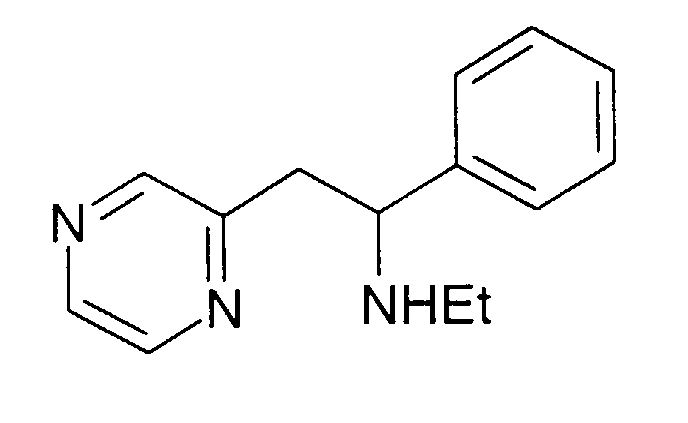
- Pharmaceutically acceptable acid addition salts of the compounds of formula I include salts of mineral acids, for example, hydrohalic acids (such as hydrochloric or hydrobromic); or organic acids, for example, formic, acetic or lactic acids.
- All optical isomers are included within the scope of the invention.
- According to a second aspect of the invention, there is provided a process for the preparation of a compound of formula I, as exemplified herein.
- Pharmaceutically acceptable salts may be formed by reacting the free base, or a salt or derivative thereof with one or more equivalents of the appropriate acid. The reaction may be carried out in a solvent in which the salt is insoluble or in which the salt is soluble in mixtures of the solvents. Acid addition salts may be converted to the corresponding base, for example, by reacting the salt with sodium hydroxide in water at room temperature.
- Quaternary salts may be prepared from the corresponding secondary or tertiary amines by conventional methods, for example, as described in J March, Advanced Organic Chemistry, 3rd Ed, Wiley-Interscience, 1985.
- Resolution of compounds with asymmetric centres may be accomplished by methods well known in the art, for example, by separation of their diastereoisomeric salts, chromatography on a chiral column or asymmetric syntheses. Methods of resolution are described in J March, Advanced Organic Chemistry, 3rd Edition, Wiley Interscience, 1985.
- The compounds of formula I, and their pharmaceutically acceptable derivatives, are useful because they possess pharmacological activity in animals. In particular, the compounds have useful neuroprotective properties. Without being limited by the following explanation, the compounds are thought to possess NMDA blocking properties. Neurodegeneration is known to be caused or accelerated by certain excitatory amino acids found naturally in the central nervous system (CNS). Glutamate is an endogenous amino acid which has been characterised as a fast excitatory transmitter in the mammalian brain. Glutamate is also known as a powerful neurotoxin capable of killing CNS neurons under certain pathological conditions which accompany stroke and cardiac arrest. It has been shown that the sensitivity of central neurons to hypoxia and ischemia can be reduced by the specific antagonism of post synaptic glutamate receptors. Glutamate is characterised as a broad spectrum agonist having activity at four neuronal excitatory amino acid receptor sites. These receptor sites are named after the amino acids which selectively excite them: kainate (KA), N-methyl-D-aspartate (NMDA), quisqualate (QUIS) and 2-amino-4-phosphonobutyrate (APB). Glutamate is believed to be a mixed agonist capable of binding to and exciting all four receptor types. Thus, agents which selectively block or antagonise the action of glutamate at these receptors can prevent neurotoxic injury associated with anoxia, hypoxia or ischemia. In particular, compounds which bind to the NMDA receptor site and selectively block the action of glutamate are useful in the prevention and treatment of neurodegenerative diseases.
- In addition, the compounds of formula I, and their pharmaceutically acceptable derivatatives, demonstrate anticonvulsant activity by their ability to inhabit maximal electroshock (MES) induced seizures in mice, certain compounds inhibit the onset of convulsions and death induced by administration of NMDA to mice and certain compounds demonstrate antihypoxia activity by their ability to increase the survival time of mice in an oxygen depleted environment.
- Antiepileptic activity may be measured by assessing a compound's ability to prevent the hind limb tonic extension component of the seizure in groups of mice induced by maximal electroshock (MES) after oral or intraperitioneal administration, according to the procedures of the Epilepsy Branch, NINCDS as published by R J Porter et al, Cleve Clin Quarterly 1984, 51, 293, and compared with the standard agents dilantin and phenobarbital.
- Certain compounds of this invention may possess useful antihypoxia activity. This activity may be conveniently measured in mice. Groups of mice are tested at various times after the intraperitoneal administration of graded doses of the test compound. The animals' survival time in a temperature-controlled hypoxic environment (96% nitrogen and 4% oxygen) is recorded. A statistical comparison is made between coincident vehicle treated animals and the experimental group. The dose-response and minimum active dose (MAD) for compounds are obtained. Other models of administration can also be used.
- NMDA activity may be measured in several ways:
- a) NMDA blocking activity is measured by assessing a compound's ability to protect mice from convulsions induced by intravenous administration of 150 mg/kg of NMDA according to the procedures of Czuczwar et al., (Neurotransmitters, Seizures and Epilepsy III, edited by G. Nistico et al., Raven Press, New York 1986, pages 235-246). Groups of mice are pretreated by 30 minutes with the test compound by the oral or intraperitoneal routes and then given NMDA. Animals were observed for convulsions as defined by loss of righting reflex and appearance of tonic/clonic seizures. Animals are kept for 60 min after NMDA dosing and mortality was recorded.
- b) NMDA receptor antagonist activity is measured in vitro by assaying a compounds ability to inhibit binding of the receptor antagonist 10,11,dihydro-5-methyl-5H-dibenzo [a,d]-cyclohepten-5,10-imine (MK801) to the receptor. The method is descibed by Foster and Wong, Br. J. Pharmacol. 91, 403-409 (1987).
- c) NMDA and glycine receptor affinity may also be tested in the [3H]L-glutamate and [3H]glycine binding assays following the method of Monaghan & Cotman, PNAS, 83, 7532, (1986) and Watson et al., Neurosci Res Comm, 2, 169, (1988).
-
- An important factor in judging the usefulness of compounds for the treatment of neurological disorders is an evaluation of their propensity to produce neurotoxic effects. Compounds may be evaluated in acute neurological impairment assays essentially according to the procedures of Coughenour et al, Pharmac Biochem Behav, 1977, 6, 351. The therapeutic index for a compound may then be calculated to provide an indication of the relative saftey of a compound. Marked side effects of compounds may be evaluated for their ability to cause significant differences in symptomatology according to the criteria set forth by Irwin, Comprehensive Obervational Assessment, Ia. A systematic, Quantitative Procedure for Assessing the Behavioral and Physiologic State of the Mouse, Psychopharmacologia. 13, 222-257, (1968).
- Certain compounds may act as neuromodulators by interfering with neurotransmitter uptake. Undesirable psychotomimetic effects may be associated with a compound's ability to inhabit dopamine uptake. Inhibtion of dopamine uptake may be measured according to the method of Holtz et al, Molecular Pharmacol, 10, 746 (1974).
- Thus, according to another aspect of the invention there is provided a method of treatment of a neurological disorder, which comprises administering to a patient in need of such treatment a therapeutically effective amount of a compound of formula I, as defined above but without proviso (3), or a pharmaceutically acceptable derivative thereof, as active ingredient in the manufacture of a medicament for use in the prevention or treatment of a neurological disorder.
- Specific neurological disorders that may be mentioned include stroke, cerebral ischaemia, cerebral palsy, hypoglycaemia, epilepsy, Alzheimer's disease, Huntington's chorea, Olivo-ponto-cerebellar atrophy, perinatal asphyxia, Parkinson's Disease, anoxia and neuronal damage associated with substance abuse, for example, narcotics or cocaine. Stroke is of particular interest.
- For the above-mentioned uses the dosage administered will, of course, vary with the compound employed, the mode of administration and the treatment desired. However, in general, satisfactory results are obtained when the compounds are administered at a daily dosage of from about 0.1 mg to about 20mg per kg of animal body weight, preferably given in divided doses 1 to 4 times a day or in sustained release form. For man, the total daily dose is in the range of from 5mg to 1,400mg, more preferably from 10mg to 100mg, and unit dosage forms suitable for oral administration comprise from 2mg to 1,400mg of the compound admixed with a solid or liquid pharmaceutical carrier or diluent.
- The compounds of formula I, and pharmaceutically acceptable derivaties thereof, may be used in the form of appropriate pharmaceutical formulations. Thus, according to a further aspect of the invention. there is provided a pharmaceutical formulation comprising a compound of formula I, as defined above but without proviso (3), or a pharmaceutically acceptable derivative thereof, in association with a pharmaceutically acceptable adjuvant, diluent or carrier.
- Examples of such adjuvants, diluents and carriers are:
- for tablets and dragees; lactose, starch, talc or stearic acid;
- for capsules; tartaric acid or lactose;
- for injectable solutions; water, alcohols, glycerin or vegetable oils;
- for suppositories: natural or hardened oils or waxes.
-
- Formulations in a form suitable for oral, i.e. oesophageal administration include tablets, capsules and dragees.
- Sustained release compostions include those in which the active ingredient is bound to an ion exchange resin which is optionally coated with a diffusion barrier to modify the release properties of the resin.
- We prefer such formulations to contain up to 50% and more preferably up to 25% by weight of a compound of formula I, or a pharmaceutically acceptable derivative thereof.
- The compounds of formula I, and pharmaceutically acceptable derivatives thereof have the advantage that they, produce fewer side effects, than prior art compounds in the therapeutic fields mentioned above.
- The invention is illustrated by the following example.
-
- a) N-(Trimethylsilyl)carboxaldimine To an ice-cooled solution of benzaldehyde (4.2g, 0.039mol) in THF (150ml) was added dropwise 40ml of a 1M solution of lithium bis(trimethylsilyl)amide in THF. The resulting mixture was stirred at 0°C for 15 minutes, then for 1 hour at room temperature to form the subtitle compound in solution.
- b) α-Phenyl-2-(2-pyrazine)ethanamine maleate To the imine solution obtained above at 0°C was added in one portion 2-methylpyrazine (3.7g, 0.039mol) followed by dropwise addition of a 1M solution of lithium bis(trimethylsilyl)amide in THF until the mixture darkened (approximately 3ml). The reaction mixture was stirred overnight at room temperature, cooled to 0°C, diluted with 100ml of ether, and treated with dropwise addition of 1N HCI until pH 1-2 was maintained. The aqueous layer was separated, made basic with 20% NaOH solution, and extracted with chloroform (3x). The chloroform extracts were washed with water, brine, dried and concentrated to give an oil (6.1 g). The oil was purified by chromatography on silica gel eluting with ammoniated CH3OH/CHCl3 [1:19], taken up in ethanol and treated with maleic acid (1.1 equivalents). The resulting white solid was collected by filtration and dried to give the title compound (2.5g). mp 155-157 C.
-
- To a Parr bottle charged with platinum oxide (120mg) was added a solution of α-phenyl-2-(2-pyrazine)ethanamine (as prepared in Intermediate 1, 4.1 g, 0.02mol) in 120ml of ethanol followed by 1.73ml (0.031 mol) of acetaldehyde under nitrogen. The mixture was subjected to hydrogenation at 2.7atm (40psi) of hydrogen for 15 minutes, filtered through celite, and the filtrate concentrated to give a dark oil (5.2g). The oil was purified by chromatography on silica gel eluting with ammoniated CH3OH/CHCL3 [1:19] gradient, dissolved in absolute ethanol (20ml), and made acidic by adding ethanol/HCl. The title compound was obtained as a white solid (1.2g), mp 2-5 - 206°C.
- The title compound of Example 1 was tested for anticonvulsant activity against MES induced convulsions and found to have an ED50 (po) of 13.4mg/kg.
Claims (5)
- The compound N-ethyl-1-phenyl-2-(2-pyrazine)ethanamine of formula I:and pharmaceutically acceptable acid addition salts thereof.

- The compound of formula I as defined in claim 1 or a pharmaceutically acceptable acid addition salt thereof, for use as a pharmaceutical.
- A pharmaceutical formulation comprising a compound of formula I, as defined in claim 1 or a pharmaceutically acceptable acid addition salt thereof, in association with a pharmaceutically acceptable adjuvant, diluent or carrier.
- The use of a compound of formula I, as defined in claim 1, or a pharmaceutically acceptable acid addition salt thereof. as active ingredient in the manufacture of a medicament for use in the prevention or treatment of a neurological disorder.
- The use according to claim 4 wherein the neurological disorder is selected from the group consisting of stroke, cerebal ischaemia, cerebral palsy, hypoglycaemia, epilepsy, Alzheimer's disease, Huntingdon's chorea, Olivo-ponto-cerebellar atrophy, perinatal asphyxia, Parkinson's disease, anoxia andneronal damage associated with substance abuse.
Applications Claiming Priority (3)
| Application Number | Priority Date | Filing Date | Title |
|---|---|---|---|
| US78559091A | 1991-10-30 | 1991-10-30 | |
| US785590 | 1991-10-30 | ||
| PCT/GB1992/001971 WO1993009095A1 (en) | 1991-10-30 | 1992-10-28 | 2-heterocyclicethylamine derivatives and their use as pharmaceuticals |
Publications (2)
| Publication Number | Publication Date |
|---|---|
| EP0612314A1 EP0612314A1 (en) | 1994-08-31 |
| EP0612314B1 true EP0612314B1 (en) | 1999-12-29 |
Family
ID=25135977
Family Applications (2)
| Application Number | Title | Priority Date | Filing Date |
|---|---|---|---|
| EP92922179A Expired - Lifetime EP0612314B1 (en) | 1991-10-30 | 1992-10-28 | 2-pyrazinylethylamine derivatives and their use as pharmaceuticals |
| EP92309888A Pending EP0540318A1 (en) | 1991-10-30 | 1992-10-28 | 2-Heterocyclicethylamine derivatives and their use as pharmaceuticals |
Family Applications After (1)
| Application Number | Title | Priority Date | Filing Date |
|---|---|---|---|
| EP92309888A Pending EP0540318A1 (en) | 1991-10-30 | 1992-10-28 | 2-Heterocyclicethylamine derivatives and their use as pharmaceuticals |
Country Status (20)
| Country | Link |
|---|---|
| US (1) | US5607935A (en) |
| EP (2) | EP0612314B1 (en) |
| JP (1) | JP3208141B2 (en) |
| AT (1) | ATE188212T1 (en) |
| AU (2) | AU667490B2 (en) |
| CA (1) | CA2122633C (en) |
| DE (1) | DE69230498T2 (en) |
| DK (1) | DK0612314T3 (en) |
| ES (1) | ES2142320T3 (en) |
| FI (1) | FI105475B (en) |
| GR (1) | GR3032993T3 (en) |
| HU (1) | HU211948A9 (en) |
| IL (1) | IL103595A (en) |
| MX (1) | MX9206296A (en) |
| NO (1) | NO300174B1 (en) |
| NZ (1) | NZ244929A (en) |
| PT (1) | PT612314E (en) |
| SG (1) | SG47949A1 (en) |
| WO (1) | WO1993009095A1 (en) |
| ZA (1) | ZA928414B (en) |
Families Citing this family (10)
| Publication number | Priority date | Publication date | Assignee | Title |
|---|---|---|---|---|
| GB9806739D0 (en) * | 1998-03-28 | 1998-05-27 | Univ Newcastle Ventures Ltd | Cyclin dependent kinase inhibitors |
| SE9901340D0 (en) * | 1999-04-15 | 1999-04-15 | Astra Pharma Prod | Novel process |
| EP1757290A1 (en) | 2005-08-16 | 2007-02-28 | Zentaris GmbH | Novel triazole derivatives as ghrelin analogue ligands of growth hormone secretagogue receptors |
| BRPI0923476A2 (en) * | 2008-12-24 | 2016-01-19 | Astrazeneca Ab | compound, methods for treating depression in a human, and major depressive disorder, and, pharmaceutical composition |
| EP2431035A1 (en) | 2010-09-16 | 2012-03-21 | Æterna Zentaris GmbH | Novel Triazole Derivatives with Improved Receptor Activity and Bioavailability Properties as Ghrelin Antagonists of Growth Hormone Secretagogue Receptors |
| EP2822931B1 (en) | 2012-03-09 | 2017-05-03 | Inception 2, Inc. | Triazolone compounds and uses thereof |
| ES2660249T3 (en) | 2012-12-20 | 2018-03-21 | Inception 2, Inc. | Triazolone type compounds and their uses |
| JP2016529311A (en) | 2013-09-06 | 2016-09-23 | インセプション 2、 インコーポレイテッド | Triazolone compounds and their use |
| SI3066091T1 (en) | 2013-11-05 | 2019-09-30 | Astrazeneca Ab | NMDA prodrug antagonist |
| US11358935B2 (en) | 2016-11-28 | 2022-06-14 | Biohaven Pharmaceutical Holding Company Ltd. | Prodrugs of lanicemine and their method of use |
Family Cites Families (8)
| Publication number | Priority date | Publication date | Assignee | Title |
|---|---|---|---|---|
| DE2447258A1 (en) * | 1974-10-03 | 1976-04-08 | Bayer Ag | Pyridyl alkyl-amidine derivs - hypoglycemics which influence flat metabolism for use in diabetes, hyperlipemia and adiposis |
| IE56001B1 (en) * | 1982-09-30 | 1991-03-13 | Boots Co Plc | 1-arylcyclobutylmethylamine compounds |
| FR2558160B1 (en) * | 1984-01-18 | 1986-05-30 | Cerm Cent Europ Rech Mauvernay | 3-ALKOXY 2- (N-PYRROLIDINO) -N-PYRIMIDINYL OR -PYRAZINYL PROPYLAMINES, THEIR PREPARATION AND THEIR THERAPEUTIC APPLICATION |
| DE3640247A1 (en) * | 1986-11-25 | 1988-05-26 | Basf Ag | FUNGICIDAL CYCLOHEXYLAMINE |
| US4769466A (en) * | 1987-02-06 | 1988-09-06 | Pennwalt Corporation | 2-aminoacetamide pyridinyl derivatives |
| EP0346791B1 (en) * | 1988-06-14 | 1994-04-06 | G.D. Searle & Co. | 1,2-diarylethylamines for treatment of neurotoxic injury |
| SG52662A1 (en) * | 1988-08-12 | 1998-09-28 | Astra Ab | Arylkalkyl-amines and -amides having anticonvulsant and neuroprotective properties |
| CA2037123A1 (en) * | 1990-02-26 | 1991-08-27 | Jouveinal S.A. | Substituted ethylamines, their process of preparation, their use as medication and their synthetic intermediates |
-
1992
- 1992-10-28 PT PT92922179T patent/PT612314E/en unknown
- 1992-10-28 DE DE69230498T patent/DE69230498T2/en not_active Expired - Fee Related
- 1992-10-28 EP EP92922179A patent/EP0612314B1/en not_active Expired - Lifetime
- 1992-10-28 ES ES92922179T patent/ES2142320T3/en not_active Expired - Lifetime
- 1992-10-28 AU AU28766/92A patent/AU667490B2/en not_active Ceased
- 1992-10-28 JP JP50801193A patent/JP3208141B2/en not_active Expired - Fee Related
- 1992-10-28 SG SG1996005611A patent/SG47949A1/en unknown
- 1992-10-28 CA CA002122633A patent/CA2122633C/en not_active Expired - Fee Related
- 1992-10-28 AT AT92922179T patent/ATE188212T1/en not_active IP Right Cessation
- 1992-10-28 WO PCT/GB1992/001971 patent/WO1993009095A1/en not_active Ceased
- 1992-10-28 DK DK92922179T patent/DK0612314T3/en active
- 1992-10-28 US US08/232,029 patent/US5607935A/en not_active Expired - Fee Related
- 1992-10-28 EP EP92309888A patent/EP0540318A1/en active Pending
- 1992-10-29 IL IL103595A patent/IL103595A/en not_active IP Right Cessation
- 1992-10-29 NZ NZ244929A patent/NZ244929A/en not_active IP Right Cessation
- 1992-10-30 MX MX9206296A patent/MX9206296A/en not_active IP Right Cessation
- 1992-10-30 ZA ZA928414A patent/ZA928414B/en unknown
-
1994
- 1994-04-28 NO NO941568A patent/NO300174B1/en unknown
- 1994-04-28 FI FI941958A patent/FI105475B/en not_active IP Right Cessation
-
1995
- 1995-06-27 HU HU95P/P00459P patent/HU211948A9/en unknown
-
1996
- 1996-03-27 AU AU50305/96A patent/AU686934B2/en not_active Ceased
-
2000
- 2000-03-17 GR GR20000400693T patent/GR3032993T3/en not_active IP Right Cessation
Also Published As
| Publication number | Publication date |
|---|---|
| IL103595A (en) | 1998-02-22 |
| EP0540318A1 (en) | 1993-05-05 |
| NO300174B1 (en) | 1997-04-21 |
| GR3032993T3 (en) | 2000-07-31 |
| IL103595A0 (en) | 1993-03-15 |
| NZ244929A (en) | 1994-08-26 |
| FI941958A0 (en) | 1994-04-28 |
| DE69230498T2 (en) | 2000-07-27 |
| US5607935A (en) | 1997-03-04 |
| JPH07500825A (en) | 1995-01-26 |
| FI105475B (en) | 2000-08-31 |
| PT612314E (en) | 2000-06-30 |
| SG47949A1 (en) | 1998-04-17 |
| DK0612314T3 (en) | 2000-05-29 |
| AU5030596A (en) | 1996-07-04 |
| NO941568D0 (en) | 1994-04-28 |
| JP3208141B2 (en) | 2001-09-10 |
| AU686934B2 (en) | 1998-02-12 |
| NO941568L (en) | 1994-06-22 |
| ES2142320T3 (en) | 2000-04-16 |
| CA2122633C (en) | 2003-12-16 |
| AU2876692A (en) | 1993-06-07 |
| ZA928414B (en) | 1993-05-03 |
| FI941958A7 (en) | 1994-04-28 |
| DE69230498D1 (en) | 2000-02-03 |
| WO1993009095A1 (en) | 1993-05-13 |
| HU211948A9 (en) | 1996-01-29 |
| ATE188212T1 (en) | 2000-01-15 |
| EP0612314A1 (en) | 1994-08-31 |
| MX9206296A (en) | 1993-08-01 |
| CA2122633A1 (en) | 1993-05-13 |
| AU667490B2 (en) | 1996-03-28 |
Similar Documents
| Publication | Publication Date | Title |
|---|---|---|
| DE60107435T2 (en) | 2-ADAMANTYLETHYLAMINES AND THEIR USE IN THE TREATMENT OF ABNORMALITIES IN THE GLUTAMAT TRANSMISSION | |
| EP1256576B1 (en) | Fused imidazolium derivatives | |
| JP3099072B2 (en) | (1S, 2S) -1- (4-hydroxyphenyl) -2- (4-hydroxy-4-phenylpiperidin-1-yl) -1-propanol methanesulfonate trihydrate | |
| CA2133461A1 (en) | 4-[4'piperidinyl or 3'-pirrolidinyl] substituted imidazoles as h3-receptor antagonists and therapeutic uses thereof | |
| EP0356035B1 (en) | Arylkalkyl-amines and -amides having anticonvulsant and neuroprotective properties | |
| FI105475B (en) | Process for Preparing Pharmaceutically Useful N-Ethyl-1-Phenyl-2- (2-pyrazine) Ethanamine and Its Acid Addition Salts | |
| DE69218795T2 (en) | CONNECTIONS THAT RELEASE NEURO TRANSMITTERS TO INCREASE LEARNABILITY | |
| EP0557305B1 (en) | (2-thienyl) alkylamine derivatives having neuroprotective properties | |
| US5714500A (en) | 2-phenyl- and 2-thienyl-(2)-piperidine derivatives having neuroprotective properties | |
| US5331007A (en) | Arylalkyl-amines and -amides having anticonvulsant and neuroprotective properties | |
| US5455259A (en) | Compounds for the treatment of neurodegenerative disorders | |
| US5430044A (en) | Arylalkyl-amines and -amides having anticonvulsant and neuroprotective properties | |
| Allan et al. | Structural analogues of ZAPA as GABAA agonists | |
| US20070082927A1 (en) | Piperidine derivative having nmda receptor antagonistic activity | |
| EP0544748A1 (en) | Spiro cycloalkylbenzene-1,1'-(1',2',3',4'-tetrahydroisoquinolines)] having neuroprotective properties. | |
| IL114388A (en) | Use of 2-amino-n-(1,2-diphenyl-1-methylethyl) acetamide and salts thereof in the manufacture of neuroprotective pharmaceutical compositions | |
| IL93286A (en) | Pharmaceutical compositions comprising arylalkyl-amines and -amides and certain such novel compounds and their preparation |
Legal Events
| Date | Code | Title | Description |
|---|---|---|---|
| PUAI | Public reference made under article 153(3) epc to a published international application that has entered the european phase |
Free format text: ORIGINAL CODE: 0009012 |
|
| 17P | Request for examination filed |
Effective date: 19940426 |
|
| AK | Designated contracting states |
Kind code of ref document: A1 Designated state(s): AT BE CH DE DK ES FR GB GR IE IT LI LU MC NL PT SE |
|
| RBV | Designated contracting states (corrected) |
Designated state(s): AT BE CH DE DK ES FR GB GR IE IT LI LU MC NL PT SE |
|
| XX | Miscellaneous (additional remarks) |
Free format text: VERBUNDEN MIT 92309888.3/0540318 (EUROPAEISCHE ANMELDENUMMER/VEROEFFENTLICHUNGSNUMMER) DURCH ENTSCHEIDUNG VOM 15.09.94. |
|
| 17Q | First examination report despatched |
Effective date: 19941028 |
|
| RAP1 | Party data changed (applicant data changed or rights of an application transferred) |
Owner name: ASTRA AKTIEBOLAG |
|
| GRAG | Despatch of communication of intention to grant |
Free format text: ORIGINAL CODE: EPIDOS AGRA |
|
| GRAG | Despatch of communication of intention to grant |
Free format text: ORIGINAL CODE: EPIDOS AGRA |
|
| GRAH | Despatch of communication of intention to grant a patent |
Free format text: ORIGINAL CODE: EPIDOS IGRA |
|
| GRAH | Despatch of communication of intention to grant a patent |
Free format text: ORIGINAL CODE: EPIDOS IGRA |
|
| GRAA | (expected) grant |
Free format text: ORIGINAL CODE: 0009210 |
|
| AK | Designated contracting states |
Kind code of ref document: B1 Designated state(s): AT BE CH DE DK ES FR GB GR IE IT LI LU MC NL PT SE |
|
| REF | Corresponds to: |
Ref document number: 188212 Country of ref document: AT Date of ref document: 20000115 Kind code of ref document: T |
|
| XX | Miscellaneous (additional remarks) |
Free format text: VERBUNDEN MIT 92309888.3/0540318 (EUROPAEISCHE ANMELDENUMMER/VEROEFFENTLICHUNGSNUMMER) DURCH ENTSCHEIDUNG VOM 15.09.94. |
|
| REG | Reference to a national code |
Ref country code: CH Ref legal event code: EP |
|
| REF | Corresponds to: |
Ref document number: 69230498 Country of ref document: DE Date of ref document: 20000203 |
|
| REG | Reference to a national code |
Ref country code: IE Ref legal event code: FG4D |
|
| ITF | It: translation for a ep patent filed | ||
| ET | Fr: translation filed | ||
| REG | Reference to a national code |
Ref country code: ES Ref legal event code: FG2A Ref document number: 2142320 Country of ref document: ES Kind code of ref document: T3 |
|
| REG | Reference to a national code |
Ref country code: DK Ref legal event code: T3 |
|
| REG | Reference to a national code |
Ref country code: PT Ref legal event code: SC4A Free format text: AVAILABILITY OF NATIONAL TRANSLATION Effective date: 20000310 |
|
| PLBE | No opposition filed within time limit |
Free format text: ORIGINAL CODE: 0009261 |
|
| STAA | Information on the status of an ep patent application or granted ep patent |
Free format text: STATUS: NO OPPOSITION FILED WITHIN TIME LIMIT |
|
| 26N | No opposition filed | ||
| REG | Reference to a national code |
Ref country code: GB Ref legal event code: IF02 |
|
| PGFP | Annual fee paid to national office [announced via postgrant information from national office to epo] |
Ref country code: GB Payment date: 20050914 Year of fee payment: 14 Ref country code: AT Payment date: 20050914 Year of fee payment: 14 |
|
| PGFP | Annual fee paid to national office [announced via postgrant information from national office to epo] |
Ref country code: NL Payment date: 20050916 Year of fee payment: 14 Ref country code: DK Payment date: 20050916 Year of fee payment: 14 |
|
| PGFP | Annual fee paid to national office [announced via postgrant information from national office to epo] |
Ref country code: PT Payment date: 20050922 Year of fee payment: 14 |
|
| PGFP | Annual fee paid to national office [announced via postgrant information from national office to epo] |
Ref country code: LU Payment date: 20050927 Year of fee payment: 14 |
|
| PGFP | Annual fee paid to national office [announced via postgrant information from national office to epo] |
Ref country code: SE Payment date: 20051004 Year of fee payment: 14 |
|
| PGFP | Annual fee paid to national office [announced via postgrant information from national office to epo] |
Ref country code: FR Payment date: 20051006 Year of fee payment: 14 |
|
| PGFP | Annual fee paid to national office [announced via postgrant information from national office to epo] |
Ref country code: MC Payment date: 20051007 Year of fee payment: 14 |
|
| PGFP | Annual fee paid to national office [announced via postgrant information from national office to epo] |
Ref country code: GR Payment date: 20051024 Year of fee payment: 14 Ref country code: ES Payment date: 20051024 Year of fee payment: 14 |
|
| PGFP | Annual fee paid to national office [announced via postgrant information from national office to epo] |
Ref country code: IE Payment date: 20051026 Year of fee payment: 14 |
|
| PGFP | Annual fee paid to national office [announced via postgrant information from national office to epo] |
Ref country code: DE Payment date: 20051031 Year of fee payment: 14 |
|
| PGFP | Annual fee paid to national office [announced via postgrant information from national office to epo] |
Ref country code: BE Payment date: 20051104 Year of fee payment: 14 |
|
| PGFP | Annual fee paid to national office [announced via postgrant information from national office to epo] |
Ref country code: CH Payment date: 20051216 Year of fee payment: 14 |
|
| PG25 | Lapsed in a contracting state [announced via postgrant information from national office to epo] |
Ref country code: AT Free format text: LAPSE BECAUSE OF NON-PAYMENT OF DUE FEES Effective date: 20061028 |
|
| PG25 | Lapsed in a contracting state [announced via postgrant information from national office to epo] |
Ref country code: SE Free format text: LAPSE BECAUSE OF NON-PAYMENT OF DUE FEES Effective date: 20061029 |
|
| PG25 | Lapsed in a contracting state [announced via postgrant information from national office to epo] |
Ref country code: IE Free format text: LAPSE BECAUSE OF NON-PAYMENT OF DUE FEES Effective date: 20061030 |
|
| PG25 | Lapsed in a contracting state [announced via postgrant information from national office to epo] |
Ref country code: MC Free format text: LAPSE BECAUSE OF NON-PAYMENT OF DUE FEES Effective date: 20061031 Ref country code: LI Free format text: LAPSE BECAUSE OF NON-PAYMENT OF DUE FEES Effective date: 20061031 Ref country code: DK Free format text: LAPSE BECAUSE OF NON-PAYMENT OF DUE FEES Effective date: 20061031 Ref country code: CH Free format text: LAPSE BECAUSE OF NON-PAYMENT OF DUE FEES Effective date: 20061031 |
|
| PGFP | Annual fee paid to national office [announced via postgrant information from national office to epo] |
Ref country code: IT Payment date: 20061031 Year of fee payment: 15 |
|
| PG25 | Lapsed in a contracting state [announced via postgrant information from national office to epo] |
Ref country code: PT Free format text: LAPSE BECAUSE OF NON-PAYMENT OF DUE FEES Effective date: 20070430 |
|
| PG25 | Lapsed in a contracting state [announced via postgrant information from national office to epo] |
Ref country code: NL Free format text: LAPSE BECAUSE OF NON-PAYMENT OF DUE FEES Effective date: 20070501 Ref country code: DE Free format text: LAPSE BECAUSE OF NON-PAYMENT OF DUE FEES Effective date: 20070501 |
|
| REG | Reference to a national code |
Ref country code: PT Ref legal event code: MM4A Free format text: LAPSE DUE TO NON-PAYMENT OF FEES Effective date: 20070430 |
|
| REG | Reference to a national code |
Ref country code: CH Ref legal event code: PL |
|
| EUG | Se: european patent has lapsed | ||
| GBPC | Gb: european patent ceased through non-payment of renewal fee |
Effective date: 20061028 |
|
| NLV4 | Nl: lapsed or anulled due to non-payment of the annual fee |
Effective date: 20070501 |
|
| REG | Reference to a national code |
Ref country code: IE Ref legal event code: MM4A |
|
| REG | Reference to a national code |
Ref country code: FR Ref legal event code: ST Effective date: 20070629 |
|
| PG25 | Lapsed in a contracting state [announced via postgrant information from national office to epo] |
Ref country code: GB Free format text: LAPSE BECAUSE OF NON-PAYMENT OF DUE FEES Effective date: 20061028 |
|
| BERE | Be: lapsed |
Owner name: *ASTRA A.B. Effective date: 20061031 |
|
| REG | Reference to a national code |
Ref country code: ES Ref legal event code: FD2A Effective date: 20061030 |
|
| PG25 | Lapsed in a contracting state [announced via postgrant information from national office to epo] |
Ref country code: FR Free format text: LAPSE BECAUSE OF NON-PAYMENT OF DUE FEES Effective date: 20061031 Ref country code: ES Free format text: LAPSE BECAUSE OF NON-PAYMENT OF DUE FEES Effective date: 20061030 |
|
| PG25 | Lapsed in a contracting state [announced via postgrant information from national office to epo] |
Ref country code: LU Free format text: LAPSE BECAUSE OF NON-PAYMENT OF DUE FEES Effective date: 20061028 |
|
| PG25 | Lapsed in a contracting state [announced via postgrant information from national office to epo] |
Ref country code: GR Free format text: LAPSE BECAUSE OF NON-PAYMENT OF DUE FEES Effective date: 20070503 |
|
| PG25 | Lapsed in a contracting state [announced via postgrant information from national office to epo] |
Ref country code: IT Free format text: LAPSE BECAUSE OF NON-PAYMENT OF DUE FEES Effective date: 20071028 Ref country code: BE Free format text: LAPSE BECAUSE OF FAILURE TO SUBMIT A TRANSLATION OF THE DESCRIPTION OR TO PAY THE FEE WITHIN THE PRESCRIBED TIME-LIMIT Effective date: 20061031 |