EP0612173B1 - Réservation de débit dans un réseau à transfert temporel asynchrone - Google Patents
Réservation de débit dans un réseau à transfert temporel asynchrone Download PDFInfo
- Publication number
- EP0612173B1 EP0612173B1 EP94400417A EP94400417A EP0612173B1 EP 0612173 B1 EP0612173 B1 EP 0612173B1 EP 94400417 A EP94400417 A EP 94400417A EP 94400417 A EP94400417 A EP 94400417A EP 0612173 B1 EP0612173 B1 EP 0612173B1
- Authority
- EP
- European Patent Office
- Prior art keywords
- bitrate
- reserved
- connection
- reservation
- new
- Prior art date
- Legal status (The legal status is an assumption and is not a legal conclusion. Google has not performed a legal analysis and makes no representation as to the accuracy of the status listed.)
- Expired - Lifetime
Links
Images


Classifications
-
- H—ELECTRICITY
- H04—ELECTRIC COMMUNICATION TECHNIQUE
- H04L—TRANSMISSION OF DIGITAL INFORMATION, e.g. TELEGRAPHIC COMMUNICATION
- H04L12/00—Data switching networks
- H04L12/54—Store-and-forward switching systems
- H04L12/56—Packet switching systems
- H04L12/5601—Transfer mode dependent, e.g. ATM
- H04L12/5602—Bandwidth control in ATM Networks, e.g. leaky bucket
-
- H—ELECTRICITY
- H04—ELECTRIC COMMUNICATION TECHNIQUE
- H04L—TRANSMISSION OF DIGITAL INFORMATION, e.g. TELEGRAPHIC COMMUNICATION
- H04L12/00—Data switching networks
- H04L12/54—Store-and-forward switching systems
- H04L12/56—Packet switching systems
- H04L12/5601—Transfer mode dependent, e.g. ATM
- H04L2012/5629—Admission control
- H04L2012/5631—Resource management and allocation
- H04L2012/5632—Bandwidth allocation
-
- H—ELECTRICITY
- H04—ELECTRIC COMMUNICATION TECHNIQUE
- H04L—TRANSMISSION OF DIGITAL INFORMATION, e.g. TELEGRAPHIC COMMUNICATION
- H04L12/00—Data switching networks
- H04L12/54—Store-and-forward switching systems
- H04L12/56—Packet switching systems
- H04L12/5601—Transfer mode dependent, e.g. ATM
- H04L2012/5629—Admission control
- H04L2012/5631—Resource management and allocation
- H04L2012/5632—Bandwidth allocation
- H04L2012/5634—In-call negotiation
-
- H—ELECTRICITY
- H04—ELECTRIC COMMUNICATION TECHNIQUE
- H04L—TRANSMISSION OF DIGITAL INFORMATION, e.g. TELEGRAPHIC COMMUNICATION
- H04L12/00—Data switching networks
- H04L12/54—Store-and-forward switching systems
- H04L12/56—Packet switching systems
- H04L12/5601—Transfer mode dependent, e.g. ATM
- H04L2012/5629—Admission control
- H04L2012/5631—Resource management and allocation
- H04L2012/5632—Bandwidth allocation
- H04L2012/5635—Backpressure, e.g. for ABR
Definitions
- the present invention relates so general telecommunications networks highlighting the so-called asynchronous time transfer mode ATM, meaning "Asynchronous Transfer Mode" in Anglosaxone terminology.
- the network will be used to satisfy quickly a very professional clientele high flow demander.
- the network is made up of brewers 10, 11 and 12 which switch each virtual path 30, 31, 32 and 33 from point to point another.
- Several user terminals share the same virtual conduit which connects two points predetermined.
- the second step will result from the addition to this patched network infrastructure, from ATM switches 20, 21 and 22 which will switch virtual channels constituting the virtual paths.
- the offer is not will limit more to a dedicated link service offering the user only a high link flow between two fixed points, but each terminal of user will benefit from a real switched service allowing it to be interconnected to any other user terminal.
- Figure 2 shows an ATM cell constituting the unit of data passing through the ATM network.
- the cell includes header and field of information.
- fields, hatched in figure 2 are occupied by VCI virtual channel identifiers ("Virtual Channel Identifier ”) and VPI Virtual Path ("Virtual Path Identifier”) which are used to the routing of the cell in the network.
- VCI virtual channel identifiers Virtual Channel Identifier
- VPI Virtual Path Virtual Path Identifier
- each user terminal transmits data to its own rhythm. So it is advantageous to optimize the bandwidth of the virtual path per reservation, prior to the transmission of data, a transmission rate by each user terminal.
- a fast debit booking based on both following features.
- the type of traffic carried in a virtual conduit for a user terminal given is constant or variable, and the flow of data transfer is permanently fixed to the connection.
- the debit reserved in the case constant traffic is "peak throughput", while for variable traffic, the reserved flow is one intermediate flow depending on the characteristics of source.
- a data source such as terminal user, initially connects by transmission an allocation request relating to a given debit.
- this source transmits a cell from request to increase or decrease flow.
- This cell is received by a management unit protocol attached to a plurality of sources and located at the entrance to the ATM network.
- This unit of management has the function, in response to reception an increase request cell or decrease in speed, to transmit, within the limit of a predetermined number of times, requests successive requests for an increase or decrease in throughput as long as previous requests have not been met.
- requests for increases debit is rejected.
- the invention aims to provide a debit reservation process for technical telecommunications networks asynchronous time, particularly intended for ATM cross-linked network resulting from the first stage of the implementation of an ATM network.
- the invention aims to permanently guarantee to user terminals, after connection and regardless of requests increase and decrease in flow rates previously accepted for these sources, a flow rate lower than connection speed even when traffic in the network is momentarily close to saturation.
- the user does not hesitate to perform debit reservation reductions for fear of not be able to benefit quickly from a higher throughput due to network overload. This behavior on the part of the user contributes to a optimization of available bandwidth.
- This method is characterized in that one of said reservation request cells relating to an increase in speed causes, in said each of the nodes, on the one hand, when a sum of the total of reserved current debit stored and the difference of said new debit to be reserved and reserved current debit is greater than said sum of the total of reserved connection debit, a memorization of said reservation cell in queue if said new debit to reserve is lower than said connection speed or a rejection of said reservation cell if said new debit to reserve is higher than said connection speed, and, on the other hand, when said sum of the total of the stored reserved current flows and of the difference of said new reserved flow and reserved current flow is less than said sum of the total of reserved connection flows, an effective increase of said reserved current flow in said new reserved speed, if necessary after said memorization in the queue and after actual increases in current reserved speeds in new reserved speeds caused by reservation request cells relating to increases in speed and previously stored in queue to said one of said reservation request cells.
- said memorization in the queue is performed only when the new flow at reserve is less than the connection speed, i.e. when the reservation request is priority over other requests for reservation of debit to reserve higher than debit of connection.
- said connection cell comprises, in in addition, a permanent debit word representative of a permanent flow reserved in each node of said connection path to said sending terminal.
- not designates both a brewer and a switch of the ATM network.
- an ATM network architecture implementing the rate reservation method according to the invention schematically comprises two groups of user terminals 1 1 to 1 P and 2 1 to 2 Q respectively connected to two units management of the Fast Reservation Protocol (FRP) 3 and 4 belonging to the ATM network.
- the two management units 3 and 4 are interconnected with one another through a plurality of network nodes (not shown).
- a terminal designated by 1 p , p being between 1 and P, attached to the unit 3, must transmit data to a terminal 2 q , q being comprised between 1 and Q, attached to the unit 4.
- the transmitting terminal 1 p transmits to the unit 3 a connection establishment request cell including, in addition, a path identifier connection defining a path through the network between the terminals 1 p and 2 q , a permanent debit word D p / per and a connection debit word D p / con .
- This connection establishment request cell is retransmitted by the unit 3 to the first node of the network connecting the terminal 1 p to the terminal 2 q .
- This first node checks whether the speed capacity available in this node, relative to the connection path, authorizes the routing of data at the connection speed D p / con . If so, the cell is transmitted to the next node which also checks whether the speed capacity available in said next node authorizes the routing of data at the connection speed, and so on until the last node connecting the terminals 1 p and 2 q .
- the capacity available in said one node is less than the connection speed D p / con , then the connection request is rejected.
- connection request is accepted.
- means are provided in the management unit 3 for reiterating each connection request, as long as this request is rejected, a number of times less than a predetermined number.
- the user terminal 1 p has a bandwidth corresponding to the connection speed D p / con for transmitting data.
- This connection speed D p / con is naturally lower than the physical speed D p / int at the interface between the terminal 1 p and the unit 3 to which it is attached.
- the mechanism for reserving a debit of connection by a terminal during a phase connection establishment is as follows.
- a first counter stores the sum of the connection rates reserved by all the terminals whose data are transferred through this node.
- the rejection or acceptance of a new connection request results from a comparison of the sum of the connection speeds reserved by other terminals and the connection speed D p / con of this new connection to be established with the useful speed available ⁇ supported by the node output multiplex channel which is used to route data at the connection rate D p / con of this new connection. If the above sum is less than or equal to the useful speed, the connection is accepted, otherwise it is rejected.
- the concepts of permanent throughput and connection throughput represented by the words D p / per and D p / con result from the following considerations.
- Professional users use telecommunications networks according to two very distinct regimes: on the one hand, a busy period regime, and on the other hand, an off-peak regime.
- the busy period regime lasts a short time, typically one to two hours per day, and requires a lot of resources, while in off-peak periods, the flow requirements are much lower.
- the connection speed D p / con is sized according to the activity during busy periods.
- the permanent flow D p / per is for example chosen as a function of an average flow during off-peak periods. As soon as a connection to be set up is requested by the user terminal 1 p , this permanent speed D p / per is permanently allocated to the terminal 1 p , without any restriction relating to the network load.
- the words permanent flow D p / per and connection flow D p / con are supplied by the user terminal 1 p which therefore decides itself on the chosen flow values, depending on the costs imposed by the network operator.
- the permanent debit is invoiced only by subscription, proportionally to the chosen value of this debit, while the connection debit is invoiced partly according to a flat-rate subscription mode and partly according to the volume of data actually transmitted.
- the transmitting terminal 1 p operates as a source with variable rate by negotiated level.
- five operating phases A to E of the terminal 1 p corresponding to five respective bit rates are provided.
- a first phase A the terminal 1 p is assumed to be at rest, not connected.
- a reserved speed D p / res allocated to the terminal is equal to the connection speed D p / con .
- the terminal 1 p has, after successive requests accepted, respectively of reserved bit rates D p / res and greater than the connection bit rate D p / con .
- the sending terminal 1 p requests the establishment of a connection with the terminal 2 q .
- the terminal transmits a connection request cell including, in addition, a permanent debit word D p / per and a connection debit word D p / con .
- This cell is received by the protocol management unit 3 which is responsible for retransmitting, through the ATM network, this connection request cell to the first node of the connection path connecting the two terminals 1 p and 2 q .
- this first node it is verified that the sum of all the connection bit rates reserved by other terminals and the connection bit rate D p / con requested by the terminal 1 p is less than the useful bit rate available in the output multiplex channel , forming part of the connection path, of said first node. If this condition is satisfied, the connection request is transmitted to the next node of the connection path, and in the same way, in this next node is checked if the node can support this rate D p / con , and so on until at the last node of the connection path. When the condition is not satisfied in at least one of the nodes of the connection path, the connection request is rejected, otherwise it is accepted. The terminal 1 p is then in a situation represented by phase B in FIG. 4.
- a first counter of this node is incremented by the value of the bit rate D p / con in the case where this bit rate can be supported by the node.
- the terminal 1 p After acceptance of the connection, the terminal 1 p has a reserved current speed equal to the connection speed D p / con . For cost reasons, it may prove advantageous for the user of the terminal 1 p to more or less durably reduce this reserved speed D p / con in the case where the terminal 1 p wishes to transmit with a speed lower than the speed of connection D p / con .
- the terminal 1 p transmits a debit reservation reduction request cell to unit 3. This cell contains a word representative of the new bit rate to be reserved D p / dem lower than the connection bit rate D p / con .
- Such a procedure for reserving a bit rate lower than the reserved current bit rate is purely indicative and always accepted by each of the nodes of the connection path.
- the reservation cell received by the unit 3 is transferred to all the nodes of the connection path connecting the two terminals 1 p and 1 q and updates second counters of these nodes by reducing their content by the difference of the value of reserved current flow, for example equal to the connection flow D p / con if this flow reduction phase follows the connection phase, and the value of the new flow to be reserved.
- the unit 3 acknowledges the acceptance of the reduction in speed reserved for the terminal 1 p which is then in the situation shown diagrammatically by phase C of FIG. 4.
- the terminal 1 p sends a rate reservation increase request cell to the protocol management unit 3.
- This cell further comprises a new rate word to reserve D p / dem higher than the current flow previously reserved D p / res .
- the protocol management unit 3 compares, in the case of this request for an increase in bit rate, the word representative of the new bit rate to be reserved D p / dem contained in the cell at the value of the connection speed D p / con transmitted during the connection establishment phase and stored in unit 3. If the new speed to reserve D p / dem is less than the connection speed D p / con (step E3a), a PAD bit, known as the Rate Increase Priority bit, of the cell shown in FIG. 2 is set to the logic state "1".
- the PAD bit is set to the logic state "0".
- This marking operation is carried out by the unit 3, then the marked cell is transmitted to the first node of the connection path connecting the two terminals 1 p and 2 q connected.
- two priority levels, priority and non-priority are distinguished according to the invention, in the case of a request for an increase in speed, according to the new speed to be reserved D p / dem compared to the speed of connection D p / con .
- the unit 3 transmits said cell for increasing the speed through all the nodes of the connection path independently of any reservation of the new speed to be reserved D p / dem in one of the nodes, and only to the first node of the connection path, respectively depending on whether said cell relates to a priority and non-priority increase request.
- each node of the network comprises memories organized in queues which operate according to a FIFO discipline (first in, first out) respectively for each of its output multiplex channels.
- FIFO discipline first in, first out
- These memories are intended to memorize priority reservation rate increase request cells, that is to say demand cells for which the new rates to reserve D p / dem are lower than the connection rates D p / con .
- step E4 On reception by a node, of a reservation request cell with a flow rate D p / dem greater than the current flow reserved D p / res by the terminal 1 p , it is checked in this node whether the FIFO queue for storing the rate increase request cells associated with the output multiplex channel of the node belonging to the connection path is empty (step E4).
- the FIFO queue is empty, which means that no priority request is pending.
- the sum of the reserved current debits for said output multiplex channel and the difference between the new bit rate to be reserved and the current bit rate reserved ( D p / dem - D p / res ) by the terminal 1 p is compared to the sum of the reserved connection rates by terminals 1 1 to 1 P for this output multiplex channel (step E6).
- step E6a When said sum of the reserved current bit rates and the difference of the new bit rates to reserve and reserved current bit rate is less than the sum of the connection bit rates (step E6a), regardless of whether or not priority is given to the request for a bit rate increase, the new debit to be reserved D p / dem is reserved and constitutes a new current debit reserved D p / res by the terminal 1 p .
- step E6b when said sum of the reserved current bit rates and the difference of the new reserved bit rates and reserved current bit rate is greater than the sum of the reserved connection bit rates (step E6b), the PAD Rate Increase Priority bit in the request cell is compared to state "1", in order to determine whether the new bit rate to be reserved D p / dem is less than the connection bit rate D p / con , that is to say if the request is priority. If this is not the case, the debit reservation request is definitively rejected (step E6c).
- the rate request reservation cell D p / dem which has been transmitted beforehand in all the nodes of the connection path in order to reduce the reservation time in all the nodes of said path, is written to the FIFO queue until resources are released in the output multiplex channel in order to allocate to the terminal 1 p , in addition to the previously reserved current speed D p / res , the difference of flow ( D p / dem - D p / res ), and thus a new reserved flow (steps E5a, E6, E6a).
- the sum of the current speeds reserved for the node multiplex channel of the connection path and the difference between the new speed to be reserved and the current speed reserved by the terminal 1 p is not compared to the useful bit rate available in said output multiplex channel, but to the sum of the reserved connection bit rates.
- the total available band allocated to a plurality of connected terminals does not correspond to the total capacity available in each multiplex channel of the connection path, but to the sum of the connection rates reserved by these terminals. This in practice guarantees an optimal quality of service to users by keeping free a part of the useful speed available in each multiplex channel of the connection path if the number of terminals connected is small. Thus, part of the useful bit rate available in each multiplex channel is left free for terminals connecting later.
- a reservation validation cell is transmitted from node to node, from the first node for which the reservation was not possible to the last node of the connection path, since each respective reservation is effective in each of these nodes (step E8).
- This reservation validation cell is received, after reservation in the last node, by the protocol management unit 4 which in response transmits a reservation acknowledgment cell to the transmitting terminal 1 p in order to confirm the reservation.
- step E4 the FIFO queue is not empty.
- step E5b the node tests whether the rate reservation request has priority by comparing the PAD bit to state "1". When the debit reservation request does not have priority, it is definitively rejected (step E5b). In the case where the PAD bit is equal to "1", then the rate reservation request cell is written to the FIFO queue (step E5a). The request will only be read from the FIFO queue and will be satisfied once all the previous requests also stored in the FIFO queue have resulted in an allocation of resources to the terminals concerned, and the request itself can be satisfied. by releasing resources from other terminals. After reservation of the flow rate D p / dem in the node, a reservation validation cell is then transmitted to the next node of the connection path (steps E7 and E8).
- the reservation procedure described above is implemented in all the nodes forming the connection path between the two terminals 1 p and 2 q .
- the protocol management unit 4 associated with the receiving terminal 2 q having received a reservation validation cell transmits a reservation acknowledgment to the sending terminal 1 p (steps E7 and E9).
- a priority reservation request that is to say a request for which the new speed to be reserved D p / dem is lower than the connection speed D p / con .
- this priority reservation request is accepted quickly.
- the protocol management unit 3 periodically produces, for each of the non-priority reservation requests which it has received from the terminals 1 1 to 1 p and which have been accepted, non-priority reservation extension request cells which are transmitted across the connection path.
- the first node of the connection path in response to an extension request cell, is examined the filling of the memory organized in a queue, relating to the output multiplex channel supporting the corresponding non-priority reservation communication, which stores priority reservation request cells. If the memory is empty, the extension request cell is transmitted to the next node on the connection path.
- the unit 3 includes a timer to set a duration estimated round trip cell crossing request for extension through the nodes of the network. In the event that an acceptance cell of extension transmitted by unit 4 is not received by unit 3 before expiry of the said duration estimated crossing, the extension cell is rejected. In response, unit 3 decreases the flow non-priority reserved current in each of nodes of the connection path that is allocated to the terminal, in the connection speed of this terminal.
- the frequency of production of extension request cells by unit 3, after a non-priority booking request is accepted in the nodes of the connection path, is equal to 200 ms.
- a timer is triggered in each node as soon as the new bit rate to be reserved D p / dem not having priority is reserved. This timer establishes a predetermined duration of time which is chosen to be equal to the round trip time of a cell through the network. This choice of the predetermined duration of time results from the fact that a non-priority debit reservation request cell is never stored in a memory organized in the queue of a node, and the reservation request relating to this cell is either refused or accepted instantly.
- the first node of the connection path must receive, if the reservation request is accepted, a reservation acknowledgment cell, at the expiration of a maximum round trip delay of a cell in the network. If a reservation acknowledgment cell is not received by each node prior to the expiration of said predetermined time period established by the timer, then the rate reservation made in this node is canceled and the reserved non-priority rate is released.
Landscapes
- Engineering & Computer Science (AREA)
- Computer Networks & Wireless Communication (AREA)
- Signal Processing (AREA)
- Data Exchanges In Wide-Area Networks (AREA)
- Use Of Switch Circuits For Exchanges And Methods Of Control Of Multiplex Exchanges (AREA)
Description
d'une part, lorsqu'une somme du total de débits courants réservés mémorisés et de la différence desdits nouveau débit à réserver et débit courant réservé est supérieure à ladite somme du total de débits de connexion réservés, une mémorisation de ladite cellule de réservation en file d'attente si ledit nouveau débit à réserver est inférieur audit débit de connexion ou un rejet de ladite cellule de réservation si ledit nouveau debit à réserver est supérieur audit débit de connexion, et,
d'autre part, lorsque ladite somme du total des débits courants réservés mémorisés et de la différence desdits nouveau débit à réserver et débit courant réservé est inférieure à ladite somme du total de débits de connexion réservés, une augmentation effective dudit débit courant réservé en ledit nouveau débit réservé, le cas échéant après ladite mémorisation en file d'attente et après augmentations effectives de débits courants réservés en de nouveaux débits réservés provoquées par des cellules de demande de réservation relatives à des augmentations de débit et mémorisées en file d'attente précédemment à ladite une desdites cellules de demande de réservation.
- la figure 1, déjà commentée, montre l'architecture d'un réseau ATM final pour expliquer les deux étapes de développement d'un tel réseau ;
- la figure 2, également déjà commentée, montre un format de cellule ATM ;
- la figure 3 est un bloc-diagramme schématique d'un réseau ATM mettant en oeuvre le procédé de réservation de débit selon l'invention ;
- la figure 4 est un diagramme temporel de l'évolution d'un débit variable par palier négocié d'un terminal rattaché au réseau ATM montré à la figure 3 ; et
- la figure 5 est un algorithme du procédé de réservation de débit selon l'invention.


Claims (6)
- Procédé de réservation de débit dans des noeuds d'un réseau de télécommunications à transfert temporel asynchrone, le long d'un chemin de connexion reliant un terminal émetteur (1p) à un terminal récepteur (2q), comprenant,lors d'une phase initiale de demande d'établissement du chemin de connexion, l'émission par ledit terminal émetteur (1p) d'une cellule de connexion incluant un identificateur dudit chemin de connexion (VPI, VCI) et un mot de réservation représentatif d'un débit de connexion à réserver (D p / con), la connexion n'étant établie et ledit débit de connexion (D p / con) n'étant réservé pour ledit terminal émetteur (1p) dans les noeuds dudit chemin de connexion que si dans chacun des noeuds, une somme du totalde débits de connexion réservés dans ledit chacun des noeuds et dudit débit de connexion (D p / con) est inférieure à un débit utile disponible dans une voie multiplex sortant dudit chacun des noeuds et appartenant audit chemin de connexion, lesdits débits de connexion réservés étant réservés à d'autres terminaux et relatifs à ladite voie multiplex, et
 lors d'une phase principale succédant à l'établissement du chemin de connexion et à la réservation dudit débit de connexion à réserver (D p / con) en un débit de connexion réservé, l'émission à travers ledit chemin de connexion par ledit terminal émetteur (1p) de cellules de demande de réservation de débit incluant chacune un mot représentatif d'un nouveau débit à réserver (D p / dem) pour modifier un débit courant réservé (D p / res) en un nouveau débit réservé,l'une desdites cellules de demande de réservation relative à une diminution de débit provoquant, dans ledit chacun des noeuds, une décrémentation dudit total de débits courants réservés de la différence desdits débit courant réservé (D p / res) et nouveau débit à réserver (D p / dem), caractérisé en ce quel'une desdites cellules de demande de réservation relative à une augmentation de débit provoque, dans ledit chacun des noeuds,d'une part, lorsqu'une somme du total de débits courants réservés mémoriséset de la différence (D p / dem - D p / res) desdits nouveau débit à réserver et débit courant réservé est supérieure à ladite somme
 du total de débits de connexion réservés, une mémorisation de ladite cellule de réservation en file d'attente si ledit nouveau débit à réserver (D p / dem) est inférieur audit débit de connexion (D p / con) ou un rejet de ladite cellule de réservation si ledit nouveau débit à réserver (D p / dem) est supérieur audit débit de connexion (D p / con), et,
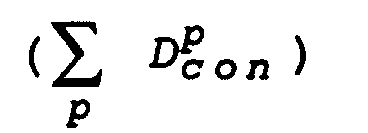 d'autre part, lorsque ladite somme du total des débits courants réservés mémoriséset de la différence (D p / dem - D p / res) desdits nouveau débit à réserver et débit courant réservé est inférieure à ladite somme du total de débits de connexion réservés, une augmentation effective dudit débit courant réservé en ledit nouveau débit réservé, le cas échéant après ladite mémorisation en file d'attente et après augmentations effectives de débits courants réservés en de nouveaux débits réservés provoquées par des cellules de demande de réservation relatives à des augmentations de débit et mémorisées en file d'attente précédemment à ladite une desdites cellules de demande de réservation.
- Procédé de réservation de débit conforme à la revendication 1, caractérisé par, lorsque ledit nouveau débit à réserver (D p / dem) est supérieure audit débit de connexion (D p / con), une transmission périodique par ledit terminal émetteur d'une cellule de demande de prolongation relative à une demande de prolongation de réservation de débit dans chacun des noeuds du chemin de connexion suite à ladite augmentation effective dudit débit courant réservé en ledit nouveau débit réservé, et
dans ledit chacun des noeuds du chemin de connexion, un rejet et une acceptation de ladite demande de prolongation de réservation respectivement si ladite file d'attente contient et ne contient pas au moins une cellule de demande de réservation, ledit rejet de la demande de prolongation provoquant une diminution dudit nouveau débit à réserver (D p / dem) en ledit débit de connexion (D p / con). - Procédé conforme à la revendication 1 ou 2, caractérisé en ce que ladite cellule de connexion comprend, en outre, un mot de débit permanent (D p / per) représentatif d'un débit permanent minimum qui est alloué dans chacun desdits noeuds dudit chemin de connexion audit terminal émetteur (1p).
- Procédé conforme à l'une quelconque des revendications 1 à 3, caractérisé en ce que lesdites cellules de demande de réservation relative à une augmentation de débit sont marquées par des informations de priorité (PAD = "0", "1") exploitées directement par ledit chacun des noeuds, respectivement différentes selon que ledit nouveau débit à réserver (D p / dem) est supérieur ou inférieur audit débit de connexion (D p / con).
- Procédé conforme à l'une quelconque des revendications 1 à 4, caractérisé par, dans ledit chacun des noeuds, simultanément à l'augmentation d'un débit courant réservé en un nouveau débit réservé qui est (D p / dem) supérieur audit débit de connexion (D p / con), un déclenchement d'un temporisateur établissant une durée de temps prédéterminée égale à une durée maximale de traversée aller-retour d'une cellule à travers lesdits noeuds du chemin de connexion, et une diminution dudit nouveau débit réservé (D p / res) en ledit débit de connexion (D p / con) à l'expiration de ladite durée prédéterminée, si une cellule d'acquittement de réservation n'est pas reçue par ledit chacun des noeuds.
- Procédé de réservation de débit conforme à l'une quelconque des revendications 1 à 5, caractérisé en ce que, lorsque ledit nouveau débit à réserver (D p / dem) est supérieur audit débit de connexion (D p / con), ladite cellule de demande de réservation relative à l'augmentation de débit est transmise dans tous les noeuds du chemin de connexion indépendamment d'une augmentation effective dudit débit courant réservé en le nouveau débit à réserver (D p / dem) dans l' un quelconque desdits noeuds, une cellule de validation de réservation étant transmise de noeud en noeud d'un premier noeud pour lequel une augmentation effective dudit débit courant réservé en ledit nouveau débit n'est pas immédiatement possible à un dernier noeud dans le chemin de connexion en réponse à des augmentations de débit effectives respectives dans ces noeuds.
Applications Claiming Priority (2)
| Application Number | Priority Date | Filing Date | Title |
|---|---|---|---|
| FR9302023A FR2701793B1 (fr) | 1993-02-18 | 1993-02-18 | Réservation de débit dans un réseau à transfert temporel asynchrone. |
| FR9302023 | 1993-02-18 |
Publications (2)
| Publication Number | Publication Date |
|---|---|
| EP0612173A1 EP0612173A1 (fr) | 1994-08-24 |
| EP0612173B1 true EP0612173B1 (fr) | 1998-07-01 |
Family
ID=9444316
Family Applications (1)
| Application Number | Title | Priority Date | Filing Date |
|---|---|---|---|
| EP94400417A Expired - Lifetime EP0612173B1 (fr) | 1993-02-18 | 1994-02-09 | Réservation de débit dans un réseau à transfert temporel asynchrone |
Country Status (4)
| Country | Link |
|---|---|
| EP (1) | EP0612173B1 (fr) |
| JP (1) | JP3407387B2 (fr) |
| DE (1) | DE69411293T2 (fr) |
| FR (1) | FR2701793B1 (fr) |
Families Citing this family (1)
| Publication number | Priority date | Publication date | Assignee | Title |
|---|---|---|---|---|
| US6377546B1 (en) * | 1998-05-12 | 2002-04-23 | International Business Machines Corporation | Rate guarantees through buffer management |
Family Cites Families (2)
| Publication number | Priority date | Publication date | Assignee | Title |
|---|---|---|---|---|
| FR2643532B1 (fr) * | 1989-02-17 | 1991-05-10 | France Etat | Procede de reservation de debits et commutateurs temporels de paquets asynchrones |
| JPH02220531A (ja) * | 1989-02-22 | 1990-09-03 | Toshiba Corp | 呼接続制御方式および流量監視方式 |
-
1993
- 1993-02-18 FR FR9302023A patent/FR2701793B1/fr not_active Expired - Fee Related
-
1994
- 1994-02-09 DE DE69411293T patent/DE69411293T2/de not_active Expired - Fee Related
- 1994-02-09 EP EP94400417A patent/EP0612173B1/fr not_active Expired - Lifetime
- 1994-02-18 JP JP04331294A patent/JP3407387B2/ja not_active Expired - Fee Related
Also Published As
| Publication number | Publication date |
|---|---|
| JPH07111511A (ja) | 1995-04-25 |
| DE69411293T2 (de) | 1999-04-22 |
| FR2701793B1 (fr) | 1995-03-31 |
| JP3407387B2 (ja) | 2003-05-19 |
| FR2701793A1 (fr) | 1994-08-26 |
| EP0612173A1 (fr) | 1994-08-24 |
| DE69411293D1 (de) | 1998-08-06 |
Similar Documents
| Publication | Publication Date | Title |
|---|---|---|
| EP0707399B1 (fr) | Procédé et dispositif pour le contrôle de congestion dans un réseau de communication de paquets | |
| EP0431438B1 (fr) | Procédé de gestion des flux dans un réseau numérique de télécommunication à intégration de services, à large bande, et réseau pour la mise en oeuvre de ce procédé | |
| EP0912018B1 (fr) | Procédé de contrôle de flux au sein d'un commutateur ATM à architecture répartie | |
| CA2215486A1 (fr) | Systeme de gestion de trafic et de controle d'encombrement pour reseaux a base de paquets | |
| WO1993007694A1 (fr) | Procede d'allocation de ressources par reservation anticipee dans un reseau satellite a integration de services | |
| EP0693841B1 (fr) | Réservation de débit dans des noeuds de commutation d'un réseau asynchrone | |
| EP0874533B1 (fr) | Procédé d'ordonnancement de paquets à pertes équitables | |
| EP0961446B1 (fr) | Contrôle de congestion dans un noeud ATM | |
| EP0899917B1 (fr) | Dispositif et procédé de commutation de cellules ATM à groupes de connections, et fonctions terminales d'entrée et de sortie correspondantes | |
| EP0612173A1 (fr) | Réservation de débit dans un réseau à transfert temporel asynchrone | |
| EP2141868B1 (fr) | Contrôle d'admission à un service | |
| EP1791306B1 (fr) | Système de commutation de paquets pour noeud de réseau de télécommunication | |
| FR2771239A1 (fr) | Procede de controle de flux d'information numerique | |
| EP0981879B1 (fr) | Procede et dispositif de controle de la conformite du debit des cellules de donnees | |
| FR2831368A1 (fr) | Procede et dispositif de commande des temps de service de cellules multidestination copiees dans le reseau de commutation d'un noeud de commutation asynchrone | |
| EP0270471B1 (fr) | Système de commutation de paquets | |
| EP0809382A1 (fr) | Procédé d'interconnexion des noeuds d'un calculateur parallèle temps réel | |
| EP1103158B1 (fr) | Procede d'allocation dynamique de debits pour un reseau de communication notamment un reseau du type a hauts debits | |
| FR2762947A1 (fr) | Procede d'allocation dynamique de debits pour un reseau de communication, notamment un reseau du type a hauts debits | |
| FR2755334A1 (fr) | Procede d'emission de donnees sur un reseau atm | |
| FR2715257A1 (fr) | Procédé de contrôle de congestion à l'interface entre des entités consommatrices de bande passante et une entité fournisseuse de bande passante, dans un réseau de télécommunication à mode de transfert asynchrone. | |
| FR2780838A1 (fr) | Procede et dispositif de communication d'information | |
| EP1425886A1 (fr) | Procede de routage de paquets a longueur variable transportes dans des cellules atm | |
| FR2780836A1 (fr) | Procede et dispositif de communication d'information | |
| EP1033013A1 (fr) | Procede de relayage de trames applicatives ip au sein d'un commutateur de reseau atm a architecture repartie |
Legal Events
| Date | Code | Title | Description |
|---|---|---|---|
| PUAI | Public reference made under article 153(3) epc to a published international application that has entered the european phase |
Free format text: ORIGINAL CODE: 0009012 |
|
| AK | Designated contracting states |
Kind code of ref document: A1 Designated state(s): BE DE ES GB IT NL |
|
| 17P | Request for examination filed |
Effective date: 19940907 |
|
| K1C3 | Correction of patent application (complete document) published |
Effective date: 19940824 |
|
| GRAG | Despatch of communication of intention to grant |
Free format text: ORIGINAL CODE: EPIDOS AGRA |
|
| 17Q | First examination report despatched |
Effective date: 19970616 |
|
| GRAG | Despatch of communication of intention to grant |
Free format text: ORIGINAL CODE: EPIDOS AGRA |
|
| GRAH | Despatch of communication of intention to grant a patent |
Free format text: ORIGINAL CODE: EPIDOS IGRA |
|
| GRAH | Despatch of communication of intention to grant a patent |
Free format text: ORIGINAL CODE: EPIDOS IGRA |
|
| GRAA | (expected) grant |
Free format text: ORIGINAL CODE: 0009210 |
|
| AK | Designated contracting states |
Kind code of ref document: B1 Designated state(s): BE DE ES GB IT NL |
|
| PG25 | Lapsed in a contracting state [announced via postgrant information from national office to epo] |
Ref country code: NL Free format text: LAPSE BECAUSE OF FAILURE TO SUBMIT A TRANSLATION OF THE DESCRIPTION OR TO PAY THE FEE WITHIN THE PRESCRIBED TIME-LIMIT Effective date: 19980701 Ref country code: ES Free format text: THE PATENT HAS BEEN ANNULLED BY A DECISION OF A NATIONAL AUTHORITY Effective date: 19980701 |
|
| ITF | It: translation for a ep patent filed | ||
| REF | Corresponds to: |
Ref document number: 69411293 Country of ref document: DE Date of ref document: 19980806 |
|
| GBT | Gb: translation of ep patent filed (gb section 77(6)(a)/1977) |
Effective date: 19981005 |
|
| NLV1 | Nl: lapsed or annulled due to failure to fulfill the requirements of art. 29p and 29m of the patents act | ||
| PG25 | Lapsed in a contracting state [announced via postgrant information from national office to epo] |
Ref country code: BE Free format text: LAPSE BECAUSE OF NON-PAYMENT OF DUE FEES Effective date: 19990228 |
|
| PLBE | No opposition filed within time limit |
Free format text: ORIGINAL CODE: 0009261 |
|
| STAA | Information on the status of an ep patent application or granted ep patent |
Free format text: STATUS: NO OPPOSITION FILED WITHIN TIME LIMIT |
|
| 26N | No opposition filed | ||
| BERE | Be: lapsed |
Owner name: FRANCE TELECOM Effective date: 19990228 |
|
| REG | Reference to a national code |
Ref country code: GB Ref legal event code: IF02 |
|
| PG25 | Lapsed in a contracting state [announced via postgrant information from national office to epo] |
Ref country code: IT Free format text: LAPSE BECAUSE OF NON-PAYMENT OF DUE FEES;WARNING: LAPSES OF ITALIAN PATENTS WITH EFFECTIVE DATE BEFORE 2007 MAY HAVE OCCURRED AT ANY TIME BEFORE 2007. THE CORRECT EFFECTIVE DATE MAY BE DIFFERENT FROM THE ONE RECORDED. Effective date: 20050209 |
|
| PGRI | Patent reinstated in contracting state [announced from national office to epo] |
Ref country code: IT Effective date: 20080301 |
|
| PGFP | Annual fee paid to national office [announced via postgrant information from national office to epo] |
Ref country code: DE Payment date: 20090227 Year of fee payment: 16 |
|
| PGFP | Annual fee paid to national office [announced via postgrant information from national office to epo] |
Ref country code: GB Payment date: 20090128 Year of fee payment: 16 |
|
| PGFP | Annual fee paid to national office [announced via postgrant information from national office to epo] |
Ref country code: IT Payment date: 20090211 Year of fee payment: 16 |
|
| GBPC | Gb: european patent ceased through non-payment of renewal fee |
Effective date: 20100209 |
|
| PG25 | Lapsed in a contracting state [announced via postgrant information from national office to epo] |
Ref country code: DE Free format text: LAPSE BECAUSE OF NON-PAYMENT OF DUE FEES Effective date: 20100901 |
|
| PG25 | Lapsed in a contracting state [announced via postgrant information from national office to epo] |
Ref country code: GB Free format text: LAPSE BECAUSE OF NON-PAYMENT OF DUE FEES Effective date: 20100209 Ref country code: IT Free format text: LAPSE BECAUSE OF NON-PAYMENT OF DUE FEES Effective date: 20100209 |