EP0611997B1 - Photopolymerizable composition - Google Patents
Photopolymerizable composition Download PDFInfo
- Publication number
- EP0611997B1 EP0611997B1 EP93914964A EP93914964A EP0611997B1 EP 0611997 B1 EP0611997 B1 EP 0611997B1 EP 93914964 A EP93914964 A EP 93914964A EP 93914964 A EP93914964 A EP 93914964A EP 0611997 B1 EP0611997 B1 EP 0611997B1
- Authority
- EP
- European Patent Office
- Prior art keywords
- group
- same
- alkyl group
- different
- compound
- Prior art date
- Legal status (The legal status is an assumption and is not a legal conclusion. Google has not performed a legal analysis and makes no representation as to the accuracy of the status listed.)
- Expired - Lifetime
Links
- 0 C=C=NC(C(C1C2*C2)O)C1O Chemical compound C=C=NC(C(C1C2*C2)O)C1O 0.000 description 2
Classifications
-
- C—CHEMISTRY; METALLURGY
- C09—DYES; PAINTS; POLISHES; NATURAL RESINS; ADHESIVES; COMPOSITIONS NOT OTHERWISE PROVIDED FOR; APPLICATIONS OF MATERIALS NOT OTHERWISE PROVIDED FOR
- C09D—COATING COMPOSITIONS, e.g. PAINTS, VARNISHES OR LACQUERS; FILLING PASTES; CHEMICAL PAINT OR INK REMOVERS; INKS; CORRECTING FLUIDS; WOODSTAINS; PASTES OR SOLIDS FOR COLOURING OR PRINTING; USE OF MATERIALS THEREFOR
- C09D4/00—Coating compositions, e.g. paints, varnishes or lacquers, based on organic non-macromolecular compounds having at least one polymerisable carbon-to-carbon unsaturated bond ; Coating compositions, based on monomers of macromolecular compounds of groups C09D183/00 - C09D183/16
- C09D4/06—Organic non-macromolecular compounds having at least one polymerisable carbon-to-carbon unsaturated bond in combination with a macromolecular compound other than an unsaturated polymer of groups C09D159/00 - C09D187/00
-
- C—CHEMISTRY; METALLURGY
- C08—ORGANIC MACROMOLECULAR COMPOUNDS; THEIR PREPARATION OR CHEMICAL WORKING-UP; COMPOSITIONS BASED THEREON
- C08F—MACROMOLECULAR COMPOUNDS OBTAINED BY REACTIONS ONLY INVOLVING CARBON-TO-CARBON UNSATURATED BONDS
- C08F2/00—Processes of polymerisation
- C08F2/46—Polymerisation initiated by wave energy or particle radiation
- C08F2/48—Polymerisation initiated by wave energy or particle radiation by ultraviolet or visible light
- C08F2/50—Polymerisation initiated by wave energy or particle radiation by ultraviolet or visible light with sensitising agents
-
- G—PHYSICS
- G03—PHOTOGRAPHY; CINEMATOGRAPHY; ANALOGOUS TECHNIQUES USING WAVES OTHER THAN OPTICAL WAVES; ELECTROGRAPHY; HOLOGRAPHY
- G03F—PHOTOMECHANICAL PRODUCTION OF TEXTURED OR PATTERNED SURFACES, e.g. FOR PRINTING, FOR PROCESSING OF SEMICONDUCTOR DEVICES; MATERIALS THEREFOR; ORIGINALS THEREFOR; APPARATUS SPECIALLY ADAPTED THEREFOR
- G03F7/00—Photomechanical, e.g. photolithographic, production of textured or patterned surfaces, e.g. printing surfaces; Materials therefor, e.g. comprising photoresists; Apparatus specially adapted therefor
- G03F7/004—Photosensitive materials
- G03F7/027—Non-macromolecular photopolymerisable compounds having carbon-to-carbon double bonds, e.g. ethylenic compounds
- G03F7/028—Non-macromolecular photopolymerisable compounds having carbon-to-carbon double bonds, e.g. ethylenic compounds with photosensitivity-increasing substances, e.g. photoinitiators
- G03F7/029—Inorganic compounds; Onium compounds; Organic compounds having hetero atoms other than oxygen, nitrogen or sulfur
-
- G—PHYSICS
- G03—PHOTOGRAPHY; CINEMATOGRAPHY; ANALOGOUS TECHNIQUES USING WAVES OTHER THAN OPTICAL WAVES; ELECTROGRAPHY; HOLOGRAPHY
- G03F—PHOTOMECHANICAL PRODUCTION OF TEXTURED OR PATTERNED SURFACES, e.g. FOR PRINTING, FOR PROCESSING OF SEMICONDUCTOR DEVICES; MATERIALS THEREFOR; ORIGINALS THEREFOR; APPARATUS SPECIALLY ADAPTED THEREFOR
- G03F7/00—Photomechanical, e.g. photolithographic, production of textured or patterned surfaces, e.g. printing surfaces; Materials therefor, e.g. comprising photoresists; Apparatus specially adapted therefor
- G03F7/004—Photosensitive materials
- G03F7/027—Non-macromolecular photopolymerisable compounds having carbon-to-carbon double bonds, e.g. ethylenic compounds
- G03F7/028—Non-macromolecular photopolymerisable compounds having carbon-to-carbon double bonds, e.g. ethylenic compounds with photosensitivity-increasing substances, e.g. photoinitiators
- G03F7/031—Organic compounds not covered by group G03F7/029
-
- C—CHEMISTRY; METALLURGY
- C08—ORGANIC MACROMOLECULAR COMPOUNDS; THEIR PREPARATION OR CHEMICAL WORKING-UP; COMPOSITIONS BASED THEREON
- C08F—MACROMOLECULAR COMPOUNDS OBTAINED BY REACTIONS ONLY INVOLVING CARBON-TO-CARBON UNSATURATED BONDS
- C08F222/00—Copolymers of compounds having one or more unsaturated aliphatic radicals, each having only one carbon-to-carbon double bond, and at least one being terminated by a carboxyl radical and containing at least one other carboxyl radical in the molecule; Salts, anhydrides, esters, amides, imides, or nitriles thereof
- C08F222/10—Esters
- C08F222/1006—Esters of polyhydric alcohols or polyhydric phenols
- C08F222/103—Esters of polyhydric alcohols or polyhydric phenols of trialcohols, e.g. trimethylolpropane tri(meth)acrylate
Definitions
- the present invention relates to photopolymerizable compositions, particularly photopolymerizable compositions having a high sensitivity to visible and near infrared light at a wavelength of 600 nm or more.
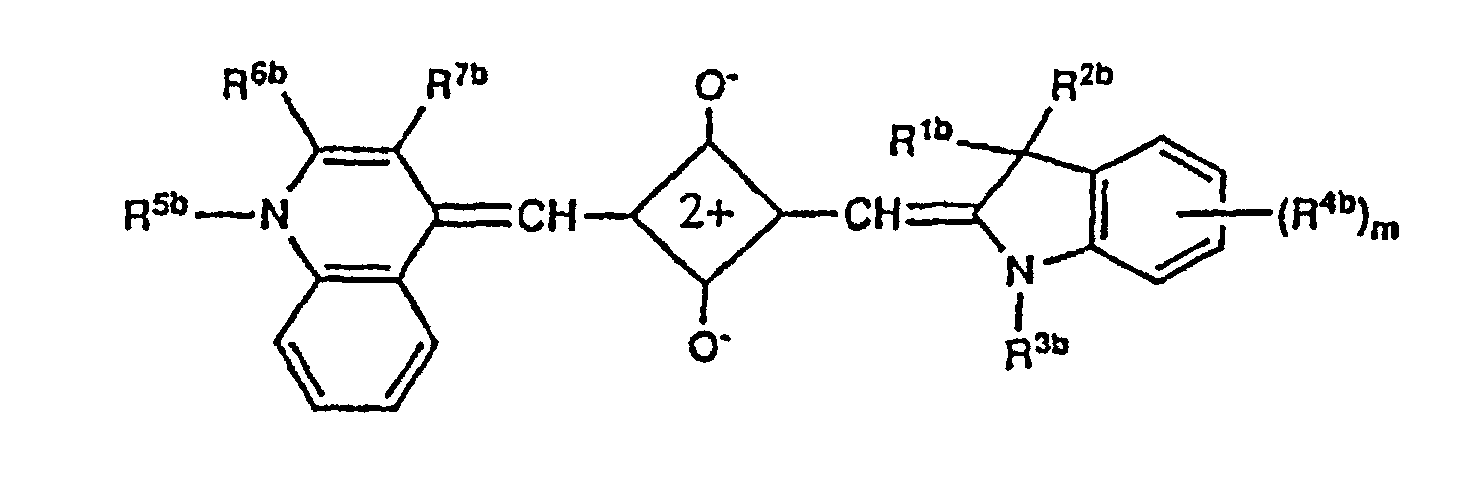
- R 1b and R 2b may be the same or different and represent an alkyl group, or R 1b and R 2b may be joined together to form a hydrocarbon ring;
- R 3b represents a hydrogen atom, an alkyl group or an aryl group;
- m represents an integer of 0 to 4;
- R 4b may be the same or different, and represents a halogen atom, an alkyl group, an aralkyl group, an aryl group or an alkoxy group or two neighboring R 4b 's may be joined together to form an aromatic ring optionally having (a) substituent(s);
- R 5b represents an alkyl group; and
- R 6b and R 7b may be the same or different, and each represent a hydrogen atom, an alkyl group or an aralkyl group, or R 6b and R 7b are joined together to form an aromatic ring or a hydrocarbon ring optionally having (a) substituent
- R 1c and R 2c may be the same or different, and each represent a hydrogen atom, an alkyl group, an aralkyl group or an aryl group
- R 3c represents a group represented by the formula: wherein R 4c and R 5c may be the same or different, and each represent hydrogen, alkyl, substituted or unsubstituted aralkyl or substituted or unsubstituted aryl
- m represents an integer of 0 to 4
- R 6c may be the same or different, and represents a halogen atom, an alkyl group, an alkoxy group, a nitro group or a hydroxy group
- n represents an integer of 0 to 5
- R 7c may be the same or different and represents a halogen atom, an alkyl group, an alkoxy group, a hydroxy group, a nitro group, a cyano group, a trifluoromethyl group or a
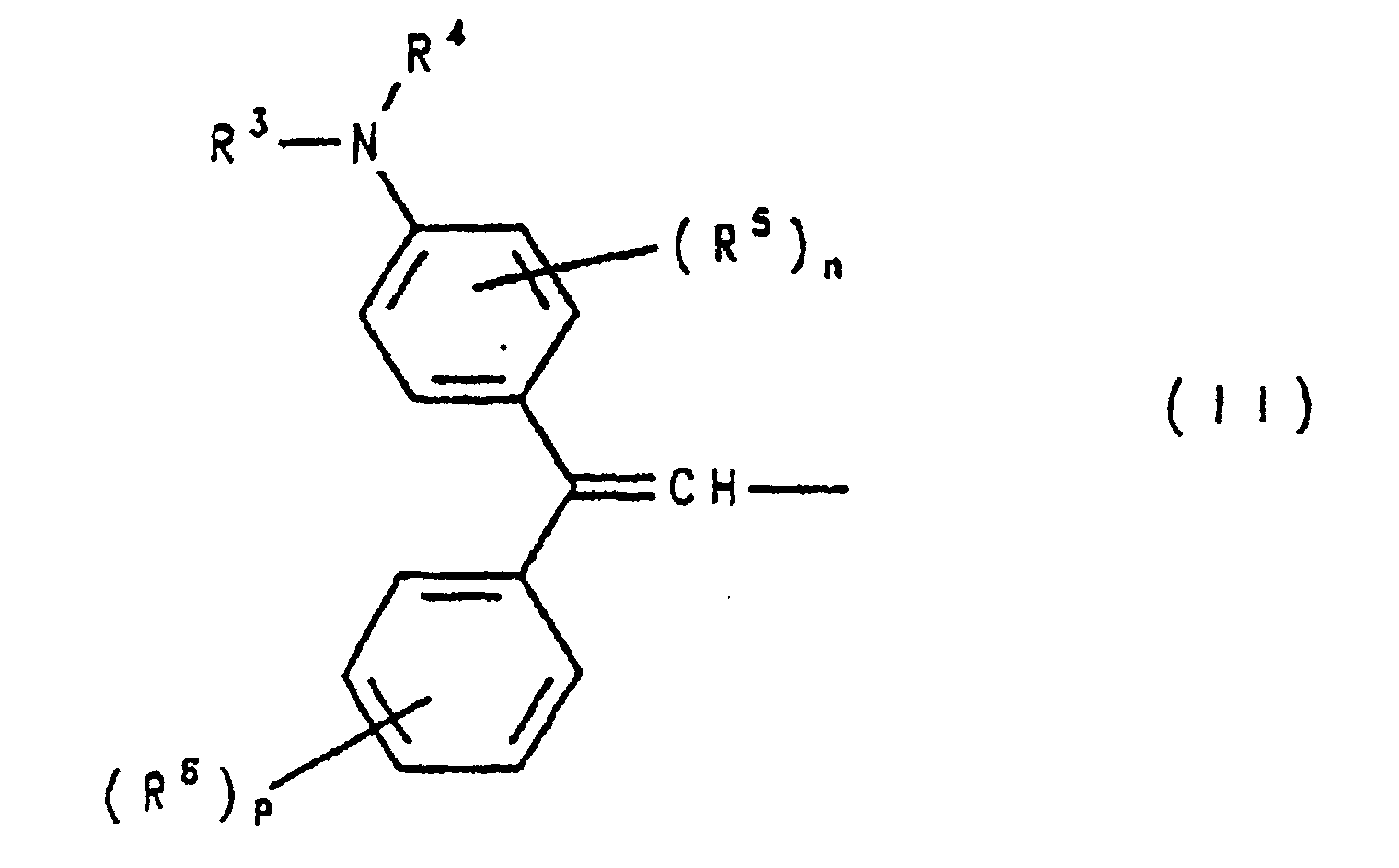
- the present invention relates to photopolymerizable compositions comprising an addition-polymerizable compound which has at least one ethylenically unsaturated double bond, a radical-producing agent and a squarylium compound represented by the formula (I): wherein R 1 is a group represented by the formula (II): wherein R 3 and R 4 may be the same or different, and each represent a hydrogen atom, an alkyl group, a substituted or unsubstituted aryl group or a substituted or unsubstituted aralkyl group; n represents an integer of 0 to 4; R 5 may be the same or different, and represents a halogen atom, an alkyl group, an alkoxy group, a nitro group or a hydroxy group; p is an integer of 0 to 5; R 6 may be the same or different, and represents a halogen atom, an alkyl group, an alkoxy group, a hydroxy group, a nitro group,
- the alkyl group is exemplified by an alkyl group having from 1 to 6 carbon atoms, e.g., methyl, ethyl, n-propyl, isopropyl, n-butyl, isobutyl, sec-butyl, tert-butyl, n-amyl, isoamyl, sec-amyl, active amyl, tert-amyl, n-hexyl, cyclohexyl, etc.
- an alkyl group having from 1 to 6 carbon atoms e.g., methyl, ethyl, n-propyl, isopropyl, n-butyl, isobutyl, sec-butyl, tert-butyl, n-amyl, isoamyl, sec-amyl, active amyl, tert-amyl, n-hexyl, cyclohexyl, etc.
- the aralkyl group includes an aralkyl group having from 7 to 10 carbon atoms, such as benzyl, phenylethyl, phenylpropyl, etc.
- the aryl group includes phenyl, naphthyl, etc.
- the halogen atom includes chlorine, bromine, fluorine, etc.
- the alkyl moiety in the alkoxy group has the same meaning as the alkyl group mentioned above.
- the hydrocarbon ring is exemplified by a hydrocarbon ring having from 3 to 7 carbon atoms, including, for example, cyclopropane, cyclobutane, cyclopentane, cyclohexane, cycloheptane, etc.
- the substituents for the aryl group, aralkyl group and hydrocarbon ring include halogen, alkyl, alkoxy, etc.
- the halogen, alkyl and alkoxy have the same meanings as defined above.
- the photopolymerizable compositions according to the present invention may be prepared by mixing an addition-polymerizable compound which has at least one ethylenically unsaturated double bond (hereunder referred to as ethylenical compound) with a radical-producing agent, a squarylium compound represented by the formula (I), and, if necessary, a binder polymer, a thermal polymerization inhibitor (e.g., hydroquinone, p-methoxyphenol, etc.), a colorant comprising an organic or inorganic dyeing pigment, a plasticizer, a sensitivity-improving agent (for example, a tert-amine, etc.).
- ethylenical compound an addition-polymerizable compound which has at least one ethylenically unsaturated double bond
- a radical-producing agent e.g., a radical-producing agent
- a binder polymer e.
- the ethylenical compound is a monomer having an ethylenically unsaturated double bond or a polymer with an ethylenically unsaturated double bond on the main or side chain so that upon irradiation of an active ray to the photopolymerizable composition, the ethylenical compound cures due to addition-polymerization by the action of the radical-producing agent and the photodecomposition product of the squarylium compound, thereby causing insolubility of the ethylenical compound.
- the monomer having an ethylenically unsaturated double bond includes, for instance, an unsaturated carboxylic acid, an ester of an unsaturated carboxylic acid and an aliphatic polyhydroxy compound, an ester of an unsaturated carboxylic acid and an aromatic polyhydroxy compound, an ester which is obtained by an esterification reaction of an unsaturated carboxylic acid with a polycarboxylic acid and a polyhydroxy compound.
- the unsaturated carboxylic acid is exemplified by acrylic acid, methacrylic acid, itaconic acid, crotonic acid, maleic acid, etc.
- the ester of an unsaturated carboxylic acid and an aliphatic polyhydroxy compound includes, for example, acrylic esters, such as ethylene glycol diacrylate, triethylene glycol diacrylate, trimethylol propane triacrylate, trimethylolethane triacrylate, pentaerythritol diacrylate, pentaerythritol triacrylate, pentaerythritol tetraacrylate, dipentaerythritol tetraacrylate, dipentaerythritol pentaacrylate, dipentaerythritol hexaacrylate, glycerol acrylate; methacrylic esters, such as triethylene glycol dimethacrylate, trimethylol propane trimethacrylate, trimethylolethane trimethacrylate, pentaerythritol dimethacrylate, pentaerythritol trimethacrylate, pentaerythritol tetramethacrylate
- the ester of an unsaturated carboxylic acid and aromatic polyhydroxy compound includes, for example, hydroquinone diacrylate, hydroquinone dimethacrylate, resorcin diacrylate, resorcin dimethacrylate, pyrogallic triacrylate, etc.
- the ester which is obtained by an esterification reaction of an unsaturated carboxylic acid with a polycarboxylic acid and a polyhydroxy compound includes, for example, an ester of acrylic acid, phthalic acid and ethylene glycol; an ester of acrylic acid, maleic acid and diethylene glycol; an ester of methacrylic acid, terephthalic acid and pentaerythritol; an ester of acrylic acid, adipic acid, butanediol and glycerin.
- the compound available for use according to the present invention which has an ethylenically unsaturated double bond include acrylamides such as ethylene bisacrylamide, allyl esters such as diallyl phthalate, including their prepolymers, vinyl group-containing compound such as divinyl phthalate, etc.
- the polymer having an ethylenically unsaturated double bond on the main chain includes, for example, polyesters obtained by a polycondensation reaction of an unsaturated dicarboxylic acid with a dihydroxy compound, a polyamide obtained by a polycondensation reaction of an unsaturated dicarboxylic acid with a diamine.
- the polymer having an ethylenically unsaturated double bond on the side chain includes, for example, condensation polymers of a dicarboxylic acid having an unsaturated double bond on the side chain, including, e.g., itaconic acid, propylidenesuccinic acid or ethylidene malonic acid with a dihydroxy or diamine compound, etc.
- polymers comprising a functional group such as hydroxy group or halomethyl group on the side chain including, e.g., polymers obtained by a polymeric reaction of a polyvinyl alcohol, poly(2-hydroxyethyl methacrylate), an epoxy resin, a phenoxy resin, polyepichlorohydrin or the like with an unsaturated carboxylic acid such as acrylic acid, methacrylic acid, crotonic acid, etc. are available for use.
- the radical-producing agent includes s-triazine compounds having at least one trihalomethyl substituent [2,4,6-tris(trichloromethyl)-s-triazine, 2-(4-methoxyphenyl)-4,6-bis(trichloromethyl)-s-triazine, 2-(4-methoxy-1-naphthalenyl)-4,6-bis(trichloromethyl)-s-triazine, etc.], organic peroxides [3,3',4,4'-tetrakis(t-butyldioxycarbonyl)benzophenone, etc.], N-phenylglycines [N-phenylglycine, p-chloro-N-phenylglycine, m-methyl-N-phenylglycine, etc.], aromatic sulfonyl halide compounds [benzenesulfonyl chloride, p-toluenesulfonyl chloride, etc.], imi
- the amount of the radical-producing agent to be used is 1 to 50 parts, preferably 2 to 25 parts, based on 100 parts of the ethylenical compound.
- the squarylium compound includes the compounds represented by the above formula (I), specifically those listed in Table 1.
- Compounds 1, a, and 2 correspond to the compounds produced in Reference Examples 1, a, and 2, respectively.
- the binder polymer includes, for example, polymethacrylic esters or their partial hydrolyzates, polyacrylic esters or their partial hydrolyzates, polystyrene, polyvinyl acetate or its partial hydrolyzates, polyvinyl butyrate, polychloroprene, polyvinyl chloride, chlorinated polyethylene, chlorinated polypropylene, polyvinylpyrrolidone, polyethylene oxide, polymethacrylic acid or methacrylic copolymers with a carboxyl group on the side chain, polyacrylic acid or acrylic copolymers with a carboxyl group on the side chain, polyurethane, polyamide, polycarbonate, acetyl cellulose, polyvinyl carbazole, and other copolymers of acrylic ester, methacrylic ester, maleic acid (anhydride), acrylonitrile, styrene, vinyl acetate, vinyl chloride, vinylidene chloride, butadiene, isoprene
- the amount of the binder polymer to be used is 10 to 1000 parts, preferably 50 to 200 parts, based on 100 parts of the ethylenical compound.
- the squarylium compounds represented by the above formula (I) are described in Japanese Published Unexamined Patent Application No. 149263/91, Japanese Patent Application No. 106399/92 and Japanese Patent Application No. 106400/92 and Japanese Patent Application No. 96173/93, and may be obtained by, for example, the following production process: wherein R 1 and R 2 have the same meanings as defined above, X represents chlorine, bromine, iodine or a group: wherein R 0 represents chlorine or OR 16 where R 16 represents an alkyl of 1 to 4 carbon atoms.
- the alkyl having 1 to 4 carbon atoms includes methyl, ethyl, propyl, butyl, etc.
- Compound (IX) may be obtained by reacting R 1 H or R 1 H 2 + ⁇ X - with an equimolar amount of Compound (VIII), and, if necessary, an equimolar amount of a basic compound or metallic sodium in a solvent at 10 to 35°C for from 5 minutes to 5 hours.
- the basic compound includes triethylamine, quinoline, pyridine, etc.
- the solvent includes chloroform, dichloromethane, 1,2-dichloroethane, diethyl ether, diisopropyl ether, tetrahydrofuran, toluene, benzene, dimethylformamide, dimethyl sulfoxide, methanol, ethanol, n-propanol, isopropanol, n-butanol, etc.
- Compound (IX) may be isolated by evaporating the solvent from the reaction mixture or by filtering the reaction mixture.
- Compound (X) may be produced by heating Compound (IX) in 50 to 90% by weight of an aqueous acetic acid at 90 to 110°C for 1 to 24 hours. Compound (X) may be isolated in the same manner as mentioned above.
- Compound (I) may be obtained by reacting Compound (X) with an equimolar amount of Compound R 2 H or R 2 H 2 + ⁇ X - , and, if necessary, an equimolar to two moles of a basic compound in a solvent at 90 to 110°C for 1 to 40 hours.
- the basic compound may be chosen in the same manner as mentioned above.
- the solvent available for use includes an alcoholic solvent having 4 to 6 carbon atoms or a mixed solvent of a 50% or more alcoholic solvent, and one of benzene and toluene.
- Compound (I) may be isolated in the same way as mentioned above, and Compound (I) may be further purified by recrystallization, compelled sedimentation, column chromatography, etc.
- the photopolymerizable compositions according to the present invention may be applied to various uses including, for example, printing plates as described in Japanese Published Unexamined Patent Application No. 48665/90, microcapsules as described in Japanese Published Unexamined Patent Application No. 306247/90, and holograms as described in Japanese Published Unexamined Patent Application No. 27436/93.
- the photopolymerizable composition is coated on a base, and the resulting coating layer is provided with a protecting layer thereon to produce a photosensitive sample.
- the photosensitive sample is subjected to irradiation of light, unexposed portions of the photosensitive sample are removed with a developer to provide a printing plate.
- the base includes sheet materials of paper, paper laminated with plastics (polyethylene, polypropylene, etc.), metals such as copper, aluminum, etc., cellulose acetate, polyethylene, polypropylene, etc.
- Aluminum sheet is most preferred. If aluminum sheet is used as the base, then preferably its surface is treated by graining and anodic oxidation processing.
- the protecting layer includes a polymer with excellent oxygen barrier properties, for example, polyvinyl alcohol, cellulose acetate, etc. in order to prevent the polymerization prohibition effect of oxygen in the air.
- a polymer with excellent oxygen barrier properties for example, polyvinyl alcohol, cellulose acetate, etc. in order to prevent the polymerization prohibition effect of oxygen in the air.
- the irradiation source includes mercury lamp, chemical lamp, carbon arc lamp, xenon lamp, metal halide lamp, various visible, ultraviolet and near infrared lasers, fluorescent lamp, tungsten light, sunlight, etc.
- the developer includes inorganic alkali chemicals such as sodium silicate, potassium silicate, sodium hydroxide, potassium hydroxide, tribasic sodium phosphate, dibasic sodium phosphate, tribasic ammonium phosphate, dibasic ammonium phosphate, sodium metasilicate, sodium bicarbonate, sodium carbonate, aqueous ammonia, etc., and aqueous solutions of an organic alkali chemical such as monoethanolamine, diethanolamine, etc.
- An aqueous solution of polyvinyl alcohol (Kuraray Poval 706) was coated on the dried sheet to a dried film thickness of 1.0 ⁇ m, to provide an overcoat layer.
- a step tablet with an optical density step of 0.15 was piled on the resulting photosensitive sample.
- An irradiation was made for two minutes with a light having a wavelength of around 630 nm (66 ⁇ J/cm 2 .S) which passed through a heat ray absorption filter HA-30 (manufactured by Hoya), a colored glass filter R-61 and an interference filter KL-63 (both manufactured by Toshiba Glass Co., Ltd.) from a 3 kW ultrahigh pressure mercury lamp.
- the developing was made with PS plate developer DN3C (manufactured by Fuji Photo Film Co., Ltd.), and the sample was inked with PS plate developing ink PI-2 (manufactured by Fuji Photo Film Co., Ltd.) for the determination of the energy level necessary for the curing on the basis of the number of the cured steps.
- the sensitivity was determined to be 0.56 mJ/cm 2 .
- Example 2 a light having a wavelength of 610 nm or more (2.37 mJ/cm 2 .S) which passed through a heat ray absorption filter HA-30 and a colored glass filter R-61 was used instead of a light having a wavelength of around 630 nm (66 ⁇ J/cm 2 .S) which has passed through a heat ray absorption filter HA-30, a colored glass filter R-61 and an interference filter KL-63.
- the sensitivity was determined to be 5.9 mJ/cm 2 .
- Example 2 a light having a wavelength of around 780 nm (162 ⁇ J/cm 2 .S) which passed through an interference filter KL-78 (manufactured by Toshiba Glass Co., Ltd.) was used instead of a light having a wavelength of around 630 nm (66 ⁇ J/cm 2 .S) which has passed through a heat ray absorption filter HA-30, a colored glass filter R-61 and an interference filter KL-63.
- the sensitivity was determined to be 1.2 mJ/cm 2 .
- An aqueous solution of polyvinyl alcohol (Kuraray Poval 706) was coated on the dried sheet to a dried film thickness of 1.0 ⁇ m, to obtain an overcoat layer.
- a step tablet with an optical density step of 0.15 was piled on the resulting photosensitive sample.
- An irradiation was made for two minutes with a light having a wavelength of around 780 nm (162 ⁇ J/cm 2 .S) which passed through an interference filter KL-78 from a 3 kW ultrahigh pressure mercury lamp.
- the developing was made with PS plate developer DN3C, and the sample was inked with PS plate developing ink PI-2 for the determination of the energy level necessary for the curing on the basis of the number of the cured steps.
- the sensitivity was determined to be 5.6 mJ/cm 2 .
- a photosensitive sample was prepared in the same manner as in Example 4 except that a compound represented by the formula: which is described in Japanese Published Unexamined Patent Application No. 306247/90 was used instead of Compound a.
- the photosensitive sample did not cure.
- a photosensitive sample was prepared in the same manner as in Example 4 except that a compound represented by the formula: which is described in Japanese Published Unexamined Patent Application No. 306247/90 was used instead of Compound a.
- the photosensitive sample did not cure.
- the photopolymerizable compositions according to the present invention are suitable for use as materials for PS plates for laser direct process, dry film resists, digital proofs, holograms, photosensitive microcapsules, etc.
Landscapes
- Chemical & Material Sciences (AREA)
- Physics & Mathematics (AREA)
- Organic Chemistry (AREA)
- General Physics & Mathematics (AREA)
- Spectroscopy & Molecular Physics (AREA)
- Polymers & Plastics (AREA)
- Materials Engineering (AREA)
- Health & Medical Sciences (AREA)
- Medicinal Chemistry (AREA)
- Chemical Kinetics & Catalysis (AREA)
- Life Sciences & Earth Sciences (AREA)
- Engineering & Computer Science (AREA)
- Inorganic Chemistry (AREA)
- Wood Science & Technology (AREA)
- Indole Compounds (AREA)
- Polymerisation Methods In General (AREA)
- Materials For Photolithography (AREA)
- Holo Graphy (AREA)
- Organic Low-Molecular-Weight Compounds And Preparation Thereof (AREA)
Abstract
Description
- The present invention relates to photopolymerizable compositions, particularly photopolymerizable compositions having a high sensitivity to visible and near infrared light at a wavelength of 600 nm or more.
- There has been known a photopolymerizable composition comprising an addition-polymerizable compound having at least one ethylenically unsaturated double bond; a squarylium compound represented by the formula:wherein Ra and Rb each are a substituted or unsubstituted aminophenyl group or a group Y=CH- where Y is a nitrogen-containing heterocyclic group; and an s-triazine compound having at least one halogenated methyl group [Japanese Published Unexamined Patent Application No. 306247/90 (EP379200A)].
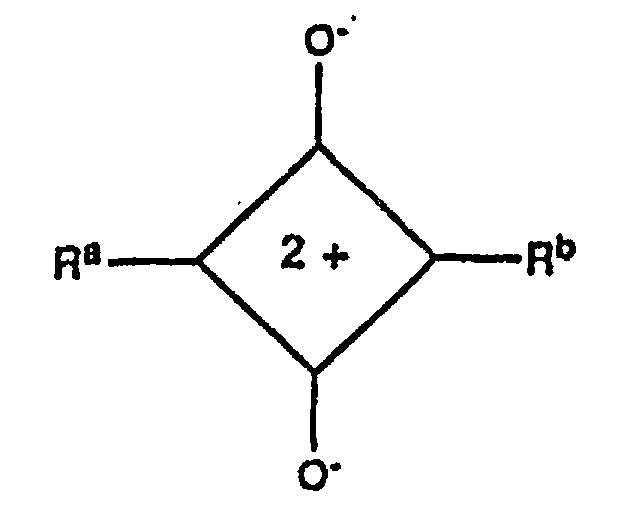
- Further, a squarylium compound represented by the formula:wherein, R1a and R2a may be the same or different, and each represent a hydrogen atom, an alkyl group, a substituted or unsubstituted aryl group or a substituted or unsubstituted aralkyl group; n represents an integer of 0 to 4; R3a may be the same or different, and represents a halogen atom, an alkyl group, an alkoxy group, a nitro group or a hydroxy group; p represents an integer of 0 to 5; R4a may be the same or different, and represents a halogen atom, an alkyl group, an alkoxy group, a hydroxy group, a nitro group, a cyano group, a trifluoromethyl group or a
 R5a and R6a may be the same or different, and each represent an alkyl group; R7a represents an alkyl group, a substituted or unsubstituted aryl group or a substituted or unsubstituted aralkyl group; q represents an integer of 0 to 4; R8a may be the same or different, and represents a halogen atom, an alkyl group, an alkoxy group, a substituted or unsubstituted aryl or a substituted or unsubstituted aralkyl group or two neighboring R8a's may be joined together to form an aromatic ring optionally having (a) substituent(s); and R9a and R10a have the same meanings as R1a has been disclosed (Japanese Published Unexamined Patent Application No. 149263/91). There have been filed applications for squarylium compounds represented by the formula:
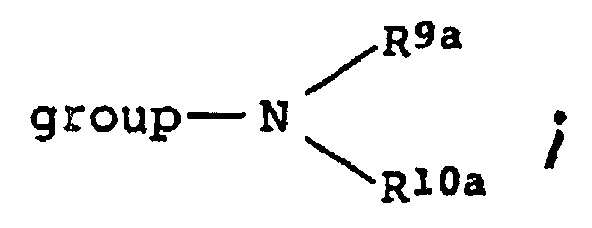 where R1b and R2b may be the same or different and represent an alkyl group, or R1b and R2b may be joined together to form a hydrocarbon ring; R3b represents a hydrogen atom, an alkyl group or an aryl group; m represents an integer of 0 to 4; R4b may be the same or different, and represents a halogen atom, an alkyl group, an aralkyl group, an aryl group or an alkoxy group or two neighboring R4b's may be joined together to form an aromatic ring optionally having (a) substituent(s); R5b represents an alkyl group; and R6b and R7b may be the same or different, and each represent a hydrogen atom, an alkyl group or an aralkyl group, or R6b and R7b are joined together to form an aromatic ring or a hydrocarbon ring optionally having (a) substituent(s) (Japanese Patent Application No. 106399/92); for squarylium compounds represented by the formula:
 wherein R1c and R2c may be the same or different, and each represent a hydrogen atom, an alkyl group, an aralkyl group or an aryl group; R3c represents a group represented by the formula:
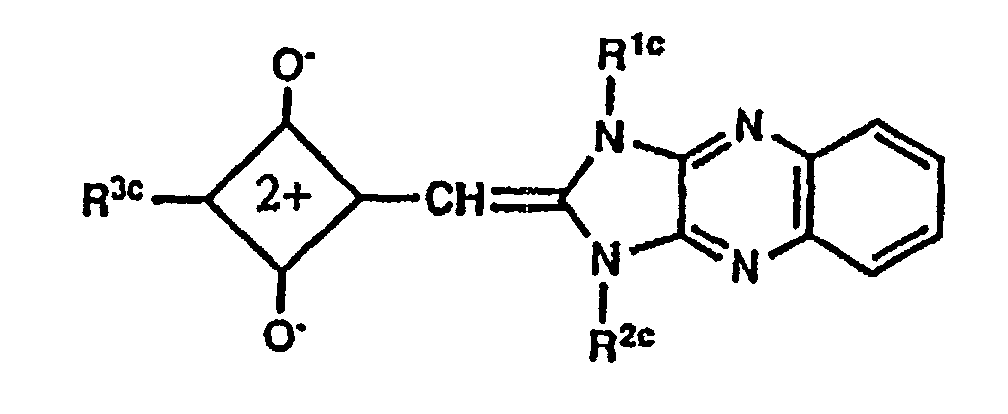 wherein R4c and R5c may be the same or different, and each represent hydrogen, alkyl, substituted or unsubstituted aralkyl or substituted or unsubstituted aryl; m represents an integer of 0 to 4; R6c may be the same or different, and represents a halogen atom, an alkyl group, an alkoxy group, a nitro group or a hydroxy group; n represents an integer of 0 to 5; R7c may be the same or different and represents a halogen atom, an alkyl group, an alkoxy group, a hydroxy group, a nitro group, a cyano group, a trifluoromethyl group or a group: -NQ1Q2 where Q1 and Q2 may be the same or different, and each are defined in the same manner as R4c;
or a group represented by the formula:wherein R8c and R9c each represent a hydrogen atom, an alkyl group, an aralkyl group or an aryl group, or R8c and R9c are joined together, to form an aromatic ring, a heterocycylic ring or a hydrocarbon ring optionally having (a) substituent(s); p represents an integer of 0 to 3; R10c may be the same or different and represents an alkyl group, an aralkyl group or an aryl group or two of the neighboring R10c's are joined together to form an aromatic ring, a heterocyclic ring or a hydrocarbon ring optionally having (a) substituent(s);
or a group represented by the formula:wherein R11c represents an alkyl group (Japanese Patent Application No. 106400/92);
and squarylium compound represented by the formula:(Japanese Patent Application No. 96173/93)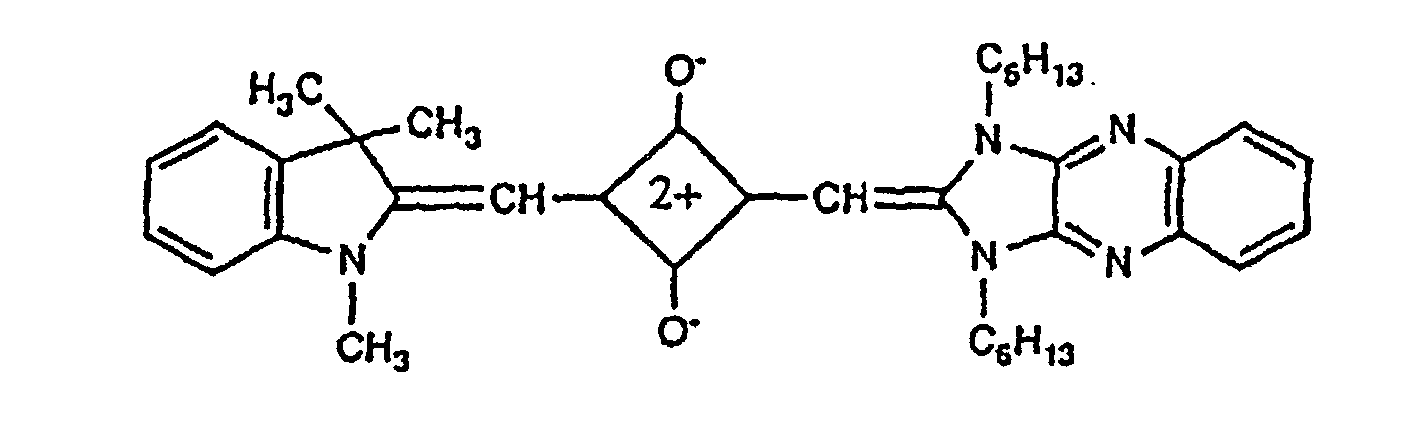
- The present invention relates to photopolymerizable compositions comprising an addition-polymerizable compound which has at least one ethylenically unsaturated double bond, a radical-producing agent and a squarylium compound represented by the formula (I):wherein R1 is a group represented by the formula (II):
 wherein R3 and R4 may be the same or different, and each represent a hydrogen atom, an alkyl group, a substituted or unsubstituted aryl group or a substituted or unsubstituted aralkyl group; n represents an integer of 0 to 4; R5 may be the same or different, and represents a halogen atom, an alkyl group, an alkoxy group, a nitro group or a hydroxy group; p is an integer of 0 to 5; R6 may be the same or different, and represents a halogen atom, an alkyl group, an alkoxy group, a hydroxy group, a nitro group, a cyano group, a trifluoromethyl group, or a group represented by the formula (III):
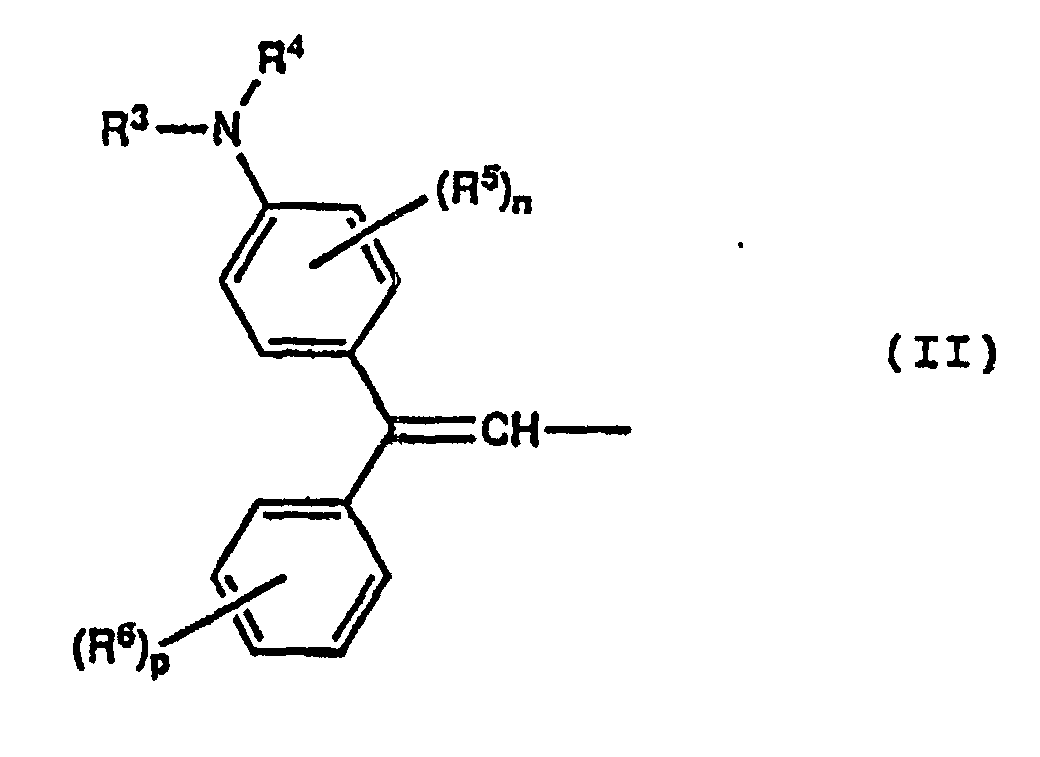 wherein R7 and R8 may be the same or different, and are defined in the same manner as R3,
or a group represented by the formula (VI):wherein R12 and R13 may be the same or different, and each represent an alkyl group, or R12 and R13 are joined together to form a hydrocarbon ring optionally having (a) substituent(s); R14 represents a hydrogen atom, an alkyl group, an aralkyl group or an aryl groups r is an integer of 0 to 4; R15 may be the same or different, and represents a halogen atom, an alkyl group, an aralkyl group, an aryl group or an alkoxy group or two of neighboring R15's are joined together to form an aromatic ring optionally having (a) substituent(s) selected from a halogen atom, an alkyl group or an alkoxy group and R2 is a group represented by the formula (V): wherein R10 and R11 may be the same or different, and each represents a hydrogen atom, an alkyl group, an aralkyl group or an aryl group.
- In the definitions given above, the alkyl group is exemplified by an alkyl group having from 1 to 6 carbon atoms, e.g., methyl, ethyl, n-propyl, isopropyl, n-butyl, isobutyl, sec-butyl, tert-butyl, n-amyl, isoamyl, sec-amyl, active amyl, tert-amyl, n-hexyl, cyclohexyl, etc.
- The aralkyl group includes an aralkyl group having from 7 to 10 carbon atoms, such as benzyl, phenylethyl, phenylpropyl, etc.
- The aryl group includes phenyl, naphthyl, etc.
- The halogen atom includes chlorine, bromine, fluorine, etc.
- The alkyl moiety in the alkoxy group has the same meaning as the alkyl group mentioned above.
- The hydrocarbon ring is exemplified by a hydrocarbon ring having from 3 to 7 carbon atoms, including, for example, cyclopropane, cyclobutane, cyclopentane, cyclohexane, cycloheptane, etc.
- The substituents for the aryl group, aralkyl group and hydrocarbon ring include halogen, alkyl, alkoxy, etc. Here, the halogen, alkyl and alkoxy have the same meanings as defined above.
- The photopolymerizable compositions according to the present invention may be prepared by mixing an addition-polymerizable compound which has at least one ethylenically unsaturated double bond (hereunder referred to as ethylenical compound) with a radical-producing agent, a squarylium compound represented by the formula (I), and, if necessary, a binder polymer, a thermal polymerization inhibitor (e.g., hydroquinone, p-methoxyphenol, etc.), a colorant comprising an organic or inorganic dyeing pigment, a plasticizer, a sensitivity-improving agent (for example, a tert-amine, etc.).
- The ethylenical compound is a monomer having an ethylenically unsaturated double bond or a polymer with an ethylenically unsaturated double bond on the main or side chain so that upon irradiation of an active ray to the photopolymerizable composition, the ethylenical compound cures due to addition-polymerization by the action of the radical-producing agent and the photodecomposition product of the squarylium compound, thereby causing insolubility of the ethylenical compound.
- The monomer having an ethylenically unsaturated double bond includes, for instance, an unsaturated carboxylic acid, an ester of an unsaturated carboxylic acid and an aliphatic polyhydroxy compound, an ester of an unsaturated carboxylic acid and an aromatic polyhydroxy compound, an ester which is obtained by an esterification reaction of an unsaturated carboxylic acid with a polycarboxylic acid and a polyhydroxy compound.
- The unsaturated carboxylic acid is exemplified by acrylic acid, methacrylic acid, itaconic acid, crotonic acid, maleic acid, etc.
- The ester of an unsaturated carboxylic acid and an aliphatic polyhydroxy compound includes, for example, acrylic esters, such as ethylene glycol diacrylate, triethylene glycol diacrylate, trimethylol propane triacrylate, trimethylolethane triacrylate, pentaerythritol diacrylate, pentaerythritol triacrylate, pentaerythritol tetraacrylate, dipentaerythritol tetraacrylate, dipentaerythritol pentaacrylate, dipentaerythritol hexaacrylate, glycerol acrylate; methacrylic esters, such as triethylene glycol dimethacrylate, trimethylol propane trimethacrylate, trimethylolethane trimethacrylate, pentaerythritol dimethacrylate, pentaerythritol trimethacrylate, pentaerythritol tetramethacrylate, dipentaerythritol dimethacrylate, dipentaerythritol trimethacrylate, dipentaerythritol tetramethacrylate; as well as itaconic esters, crotonic esters and maleic esters of aliphatic polyhydroxy compounds, etc.
- The ester of an unsaturated carboxylic acid and aromatic polyhydroxy compound includes, for example, hydroquinone diacrylate, hydroquinone dimethacrylate, resorcin diacrylate, resorcin dimethacrylate, pyrogallic triacrylate, etc.
- The ester which is obtained by an esterification reaction of an unsaturated carboxylic acid with a polycarboxylic acid and a polyhydroxy compound includes, for example, an ester of acrylic acid, phthalic acid and ethylene glycol; an ester of acrylic acid, maleic acid and diethylene glycol; an ester of methacrylic acid, terephthalic acid and pentaerythritol; an ester of acrylic acid, adipic acid, butanediol and glycerin.
- The compound available for use according to the present invention which has an ethylenically unsaturated double bond include acrylamides such as ethylene bisacrylamide, allyl esters such as diallyl phthalate, including their prepolymers, vinyl group-containing compound such as divinyl phthalate, etc.
- The polymer having an ethylenically unsaturated double bond on the main chain includes, for example, polyesters obtained by a polycondensation reaction of an unsaturated dicarboxylic acid with a dihydroxy compound, a polyamide obtained by a polycondensation reaction of an unsaturated dicarboxylic acid with a diamine.
- The polymer having an ethylenically unsaturated double bond on the side chain includes, for example, condensation polymers of a dicarboxylic acid having an unsaturated double bond on the side chain, including, e.g., itaconic acid, propylidenesuccinic acid or ethylidene malonic acid with a dihydroxy or diamine compound, etc. Also, polymers comprising a functional group such as hydroxy group or halomethyl group on the side chain, including, e.g., polymers obtained by a polymeric reaction of a polyvinyl alcohol, poly(2-hydroxyethyl methacrylate), an epoxy resin, a phenoxy resin, polyepichlorohydrin or the like with an unsaturated carboxylic acid such as acrylic acid, methacrylic acid, crotonic acid, etc. are available for use.
- The radical-producing agent includes s-triazine compounds having at least one trihalomethyl substituent [2,4,6-tris(trichloromethyl)-s-triazine, 2-(4-methoxyphenyl)-4,6-bis(trichloromethyl)-s-triazine, 2-(4-methoxy-1-naphthalenyl)-4,6-bis(trichloromethyl)-s-triazine, etc.], organic peroxides [3,3',4,4'-tetrakis(t-butyldioxycarbonyl)benzophenone, etc.], N-phenylglycines [N-phenylglycine, p-chloro-N-phenylglycine, m-methyl-N-phenylglycine, etc.], aromatic sulfonyl halide compounds [benzenesulfonyl chloride, p-toluenesulfonyl chloride, etc.], imidazole dimers [2,2'-bis(o-chlorophenyl-4, 4', 5, 5'-tetraphenyl-biimidazole, etc.], metal arene complexes [PF- 6 salt of (η6-benzene)(η5-cyclopentadienyl) iron (II), etc.], titanocene [fluoroaryltitanocene, etc.], diaryl iodonium salts, triaryl sulfonium salts, branched polyethylene imines, etc.
- The amount of the radical-producing agent to be used is 1 to 50 parts, preferably 2 to 25 parts, based on 100 parts of the ethylenical compound. The squarylium compound includes the compounds represented by the above formula (I), specifically those listed in Table 1.

- Compounds 1, a, and 2 correspond to the compounds produced in Reference Examples 1, a, and 2, respectively.
- Further, the binder polymer includes, for example, polymethacrylic esters or their partial hydrolyzates, polyacrylic esters or their partial hydrolyzates, polystyrene, polyvinyl acetate or its partial hydrolyzates, polyvinyl butyrate, polychloroprene, polyvinyl chloride, chlorinated polyethylene, chlorinated polypropylene, polyvinylpyrrolidone, polyethylene oxide, polymethacrylic acid or methacrylic copolymers with a carboxyl group on the side chain, polyacrylic acid or acrylic copolymers with a carboxyl group on the side chain, polyurethane, polyamide, polycarbonate, acetyl cellulose, polyvinyl carbazole, and other copolymers of acrylic ester, methacrylic ester, maleic acid (anhydride), acrylonitrile, styrene, vinyl acetate, vinyl chloride, vinylidene chloride, butadiene, isoprene, chloroprene, etc.
- The amount of the binder polymer to be used is 10 to 1000 parts, preferably 50 to 200 parts, based on 100 parts of the ethylenical compound.
- The squarylium compounds represented by the above formula (I) are described in Japanese Published Unexamined Patent Application No. 149263/91, Japanese Patent Application No. 106399/92 and Japanese Patent Application No. 106400/92 and Japanese Patent Application No. 96173/93, and may be obtained by, for example, the following production process:wherein R1 and R2 have the same meanings as defined above, X represents chlorine, bromine, iodine or a group:
 wherein R0 represents chlorine or OR16 where R16 represents an alkyl of 1 to 4 carbon atoms.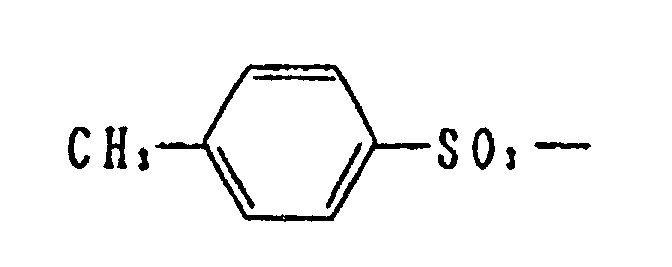
- The alkyl having 1 to 4 carbon atoms includes methyl, ethyl, propyl, butyl, etc.
- Compound (IX) may be obtained by reacting R1H or R1H2 +·X- with an equimolar amount of Compound (VIII), and, if necessary, an equimolar amount of a basic compound or metallic sodium in a solvent at 10 to 35°C for from 5 minutes to 5 hours.
- The basic compound includes triethylamine, quinoline, pyridine, etc. The solvent includes chloroform, dichloromethane, 1,2-dichloroethane, diethyl ether, diisopropyl ether, tetrahydrofuran, toluene, benzene, dimethylformamide, dimethyl sulfoxide, methanol, ethanol, n-propanol, isopropanol, n-butanol, etc.
- Compound (IX) may be isolated by evaporating the solvent from the reaction mixture or by filtering the reaction mixture.
- Compound (X) may be produced by heating Compound (IX) in 50 to 90% by weight of an aqueous acetic acid at 90 to 110°C for 1 to 24 hours. Compound (X) may be isolated in the same manner as mentioned above.
- Compound (I) may be obtained by reacting Compound (X) with an equimolar amount of Compound R2H or R2H2 +·X-, and, if necessary, an equimolar to two moles of a basic compound in a solvent at 90 to 110°C for 1 to 40 hours. The basic compound may be chosen in the same manner as mentioned above. The solvent available for use includes an alcoholic solvent having 4 to 6 carbon atoms or a mixed solvent of a 50% or more alcoholic solvent, and one of benzene and toluene.
- Compound (I) may be isolated in the same way as mentioned above, and Compound (I) may be further purified by recrystallization, compelled sedimentation, column chromatography, etc.
- The photopolymerizable compositions according to the present invention may be applied to various uses including, for example, printing plates as described in Japanese Published Unexamined Patent Application No. 48665/90, microcapsules as described in Japanese Published Unexamined Patent Application No. 306247/90, and holograms as described in Japanese Published Unexamined Patent Application No. 27436/93.
- Hereunder an explanation will be provided with regard to the application to printing plates.
- The photopolymerizable composition is coated on a base, and the resulting coating layer is provided with a protecting layer thereon to produce a photosensitive sample. The photosensitive sample is subjected to irradiation of light, unexposed portions of the photosensitive sample are removed with a developer to provide a printing plate.
- The base includes sheet materials of paper, paper laminated with plastics (polyethylene, polypropylene, etc.), metals such as copper, aluminum, etc., cellulose acetate, polyethylene, polypropylene, etc. Aluminum sheet is most preferred. If aluminum sheet is used as the base, then preferably its surface is treated by graining and anodic oxidation processing.
- The protecting layer includes a polymer with excellent oxygen barrier properties, for example, polyvinyl alcohol, cellulose acetate, etc. in order to prevent the polymerization prohibition effect of oxygen in the air.
- The irradiation source includes mercury lamp, chemical lamp, carbon arc lamp, xenon lamp, metal halide lamp, various visible, ultraviolet and near infrared lasers, fluorescent lamp, tungsten light, sunlight, etc. The developer includes inorganic alkali chemicals such as sodium silicate, potassium silicate, sodium hydroxide, potassium hydroxide, tribasic sodium phosphate, dibasic sodium phosphate, tribasic ammonium phosphate, dibasic ammonium phosphate, sodium metasilicate, sodium bicarbonate, sodium carbonate, aqueous ammonia, etc., and aqueous solutions of an organic alkali chemical such as monoethanolamine, diethanolamine, etc.
- Examples, comparison examples and reference examples are given below.
- In this example, 100 parts of pentaerythritol triacrylate, 100 parts of polymethacrylate polymer (average molecular weight: 150,000), 8 parts of 2,4,6-tris(trichloromethyl)-s-triazine and 1.2 parts of Compound 1 were dissolved in 900 ml of ethylcellosolve to obtain a solution of a photosensitive resin. The solution of a photosensitive resin was coated on an aluminum sheet which had undergone graining and anodic oxidation treatment, to a dry film thickness of 2 µm with a spin coater. Then, the sheet was dried at 80°C for 2 minutes. An aqueous solution of polyvinyl alcohol (Kuraray Poval 706) was coated on the dried sheet to a dried film thickness of 1.0 µm, to provide an overcoat layer. A step tablet with an optical density step of 0.15 was piled on the resulting photosensitive sample. An irradiation was made for two minutes with a light having a wavelength of around 630 nm (66 µJ/cm2.S) which passed through a heat ray absorption filter HA-30 (manufactured by Hoya), a colored glass filter R-61 and an interference filter KL-63 (both manufactured by Toshiba Glass Co., Ltd.) from a 3 kW ultrahigh pressure mercury lamp.
- The developing was made with PS plate developer DN3C (manufactured by Fuji Photo Film Co., Ltd.), and the sample was inked with PS plate developing ink PI-2 (manufactured by Fuji Photo Film Co., Ltd.) for the determination of the energy level necessary for the curing on the basis of the number of the cured steps. The sensitivity was determined to be 0.56 mJ/cm2.
- In the same manner as in Example 1, a light having a wavelength of 610 nm or more (2.37 mJ/cm2.S) which passed through a heat ray absorption filter HA-30 and a colored glass filter R-61 was used instead of a light having a wavelength of around 630 nm (66 µJ/cm2.S) which has passed through a heat ray absorption filter HA-30, a colored glass filter R-61 and an interference filter KL-63. The sensitivity was determined to be 5.9 mJ/cm2.
- In the same manner as in Example 1, a light having a wavelength of around 780 nm (162 µJ/cm2.S) which passed through an interference filter KL-78 (manufactured by Toshiba Glass Co., Ltd.) was used instead of a light having a wavelength of around 630 nm (66 µJ/cm2.S) which has passed through a heat ray absorption filter HA-30, a colored glass filter R-61 and an interference filter KL-63. The sensitivity was determined to be 1.2 mJ/cm2.
- In this example, 100 parts of pentaerythritol triacrylate, 100 parts of polymethacrylate polymer (average molecular weight: 150,000), 8 parts of 2,4,6-tris(trichloromethyl)-s-triazine and 1.2 parts of Compound a were dissolved in 900 ml of ethylcellosolve to obtain a solution of a photosensitive resin. The solution of the photosensitive resin was coated on an aluminum sheet which had undergone graining and anodic oxidation treatment, to a dry film thickness of 2 µm with a spin coater. Then, the sheet was dried at 80°C for 2 minutes. An aqueous solution of polyvinyl alcohol (Kuraray Poval 706) was coated on the dried sheet to a dried film thickness of 1.0 µm, to obtain an overcoat layer. A step tablet with an optical density step of 0.15 was piled on the resulting photosensitive sample. An irradiation was made for two minutes with a light having a wavelength of around 780 nm (162 µJ/cm2.S) which passed through an interference filter KL-78 from a 3 kW ultrahigh pressure mercury lamp. The developing was made with PS plate developer DN3C, and the sample was inked with PS plate developing ink PI-2 for the determination of the energy level necessary for the curing on the basis of the number of the cured steps. The sensitivity was determined to be 5.6 mJ/cm2.
- A photosensitive sample was prepared in the same manner as in Example 4 except that a compound represented by the formula:which is described in Japanese Published Unexamined Patent Application No. 306247/90 was used instead of Compound a. The photosensitive sample did not cure.

- A photosensitive sample was prepared in the same manner as in Example 4 except that a compound represented by the formula:which is described in Japanese Published Unexamined Patent Application No. 306247/90 was used instead of Compound a. The photosensitive sample did not cure.

- To 0.3g of 3,4-dichloro-3-cyclobutene-1,2-dione was added 15 ml of dichloromethane. Then, 0.54g of 1,1-bis(p-dimethylaminophenyl)ethylene was added thereto and the mixture was stirred at room temperature for one hour. The dichloromethane was evaporated from the reaction mixture with a rotary evaporator. To the residue were added 7.6 ml of acetic acid and 10 ml of water. The mixture was heated on an oil bath at 100°C. After heating for 1 hour, the acetic acid and water were evaporated with an rotary evaporator. To the residue were added 20 ml of n-butanol, 20 ml of benzene, 1.05g of 1,3-di-n-hexyl-2-methylimidazo[4,5-b]quinoxalinium tosylate and 0.27g of quinoline. The mixture was heated for 2 hours and concentrated with a rotary evaporator. The concentrate was purified by column chromatography to obtain 0.45g of Compound 1.
M. p.: 147°C (dec.)Elemental analysis: C H N Calculated (%) 75.83 7.52 12.06 Found (%) 76.13 7.54 12.26 - A mixture of 1.98g of 3,4-diisopropoxy-3-cyclobutene-1,2-dione, 2.99g of N-ethyllepidinium iodide and 20 ml of isopropanol was stirred at room temperature. Then, 0.23g of sodium was added thereto and further stirred for 4 hours. Thereafter, the insoluble matters were filtered off, and the filtrate was concentrated. The residue was purified by column chromatography. To the purified product were added 30 ml of acetic acid and 10 ml of water. The mixture was heated at 90 - 100°C for 1.5 hours. After the reaction, the reaction solution was concentrated to dryness. Thereafter, the dried product was heated under reflux for 4 hours together with 13 ml of n-butanol, 0.92g of 1,3-di-n-butyl-2-ethylimidazo[4,5-b]quinoxalinium chloride and 0.27g of quinoline. The solvent and the produced water were evaporated with a rotary evaporator. The resulting residue was purified by column chromatography to obtain 0.31g of Compound a.
M. p.: 237 - 238°C (dec.)Elemental analysis: C H N Calculated (%) 74.84 6.47 12.83 Found (%) 75.13 6.52 12.94 - To 1.5g of 3,4-dichloro-3-cyclobutene-1,2-dione was added 20 ml of dichloromethane. Then, 1.7g of 1,3,3-trimethyl-2-methyleneindoline was added dropwise to the mixture with cooling with ice water. After 2 hours, the precipitate was filtered off and dried. To the dried product were added 35 ml of acetic acid and 50 ml of water, followed by heating on an oil bath at 100°C for 1 hour, then the acetic acid and water were evaporated with a rotary evaporator. Then, 100 ml of n-butanol, 5.25g of 1,3-di-n-hexyl-2-methylimidazo[4,5-b]quinoxalimium tosylate and 1.01g of triethylamine were added to the residue, followed by heating under reflux for 3 hours. Then, the reaction mixture was concentrated, and the residue was purified by column chromatography to obtain 3.57g of Compound 2.
M. p.: 173.5 - 174.9°C (dec.)Elemental analysis: C H N Calculated (%) 75.59 7.51 11.60 Found (%) 73.99 7.47 11.17 - The photopolymerizable compositions according to the present invention are suitable for use as materials for PS plates for laser direct process, dry film resists, digital proofs, holograms, photosensitive microcapsules, etc.
Claims (1)
- A photopolymerizable composition comprising an addition-polymerizable compound which has at least one ethylenically unsaturated double bond, a radical-producing agent and a squarylium compound represented by the formula (I):wherein R1 is a group represented by the formula (II):
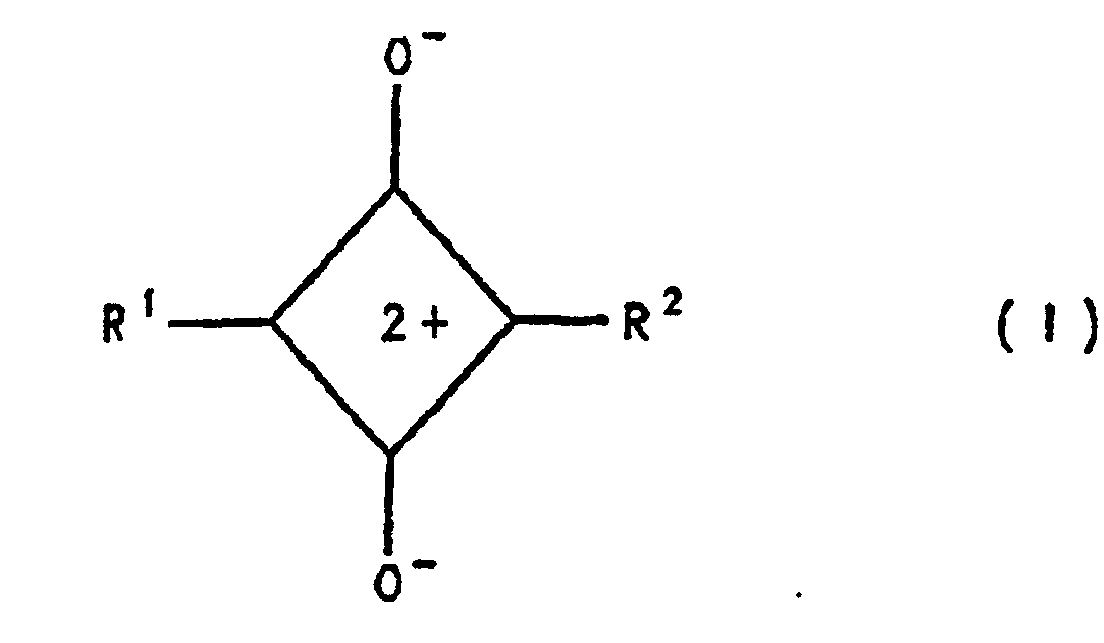 wherein R3 and R4 may be the same or different, and each represents a hydrogen atom, an alkyl group, a substituted or unsubstituted aryl or a substituted or unsubstituted aralkyl group; n represents an integer of 0 to 4; R5 may be the same or different and represents a halogen atom, an alkyl group, an alkoxy group, a nitro group or a hydroxy group; p is an integer of 0 to 5; R6 may be the same or different and represents a halogen atom, an alkyl group, an alkoxy group, a hydroxy group, a nitro group, a cyano group, a trifluoromethyl group or a group represented by the formula (III):
 wherein R7 and R8 may be the same or different, and each are defined in the same manner as R3;
or a group represented by the formula (VI):wherein R12 and R13 may be the same or different, and each represents an alkyl group, or R12 and R13, together with the carbon atom to which they are bonded, form a hydrocarbon ring, said hydrocarbon ring being unsubstituted or substituted with at least one of a halogen atom, an alkyl group or an alkoxy group; R14 represents a hydrogen atom, an alkyl group, an aralkyl group or an aryl group; r is an integer of 0 to 4; R15 may be the same or different and represents a halogen atom, an alkyl group, an aralkyl group, an aryl group or an alkoxy group, or two adjacent R15's may form an aromatic ring being unsubstituted or substituted with at least one of a halogen atom, an alkyl group or an alkoxy group;
and
R2 is a group represented by the formula (V):wherein R10 and R11 may be the same or different, and each represents a hydrogen atom, an alkyl group, an aralkyl group or an aryl group.
Priority Applications (1)
| Application Number | Priority Date | Filing Date | Title |
|---|---|---|---|
| EP01106388A EP1113335B1 (en) | 1992-07-13 | 1993-07-07 | Photopolymerizable compositions |
Applications Claiming Priority (4)
| Application Number | Priority Date | Filing Date | Title |
|---|---|---|---|
| JP18522492 | 1992-07-13 | ||
| JP185224/92 | 1992-07-13 | ||
| JP18522492 | 1992-07-13 | ||
| PCT/JP1993/000932 WO1994001806A1 (en) | 1992-07-13 | 1993-07-07 | Photopolymerizable composition |
Related Child Applications (1)
| Application Number | Title | Priority Date | Filing Date |
|---|---|---|---|
| EP01106388A Division EP1113335B1 (en) | 1992-07-13 | 1993-07-07 | Photopolymerizable compositions |
Publications (3)
| Publication Number | Publication Date |
|---|---|
| EP0611997A1 EP0611997A1 (en) | 1994-08-24 |
| EP0611997A4 EP0611997A4 (en) | 1995-06-07 |
| EP0611997B1 true EP0611997B1 (en) | 2003-02-12 |
Family
ID=16167053
Family Applications (2)
| Application Number | Title | Priority Date | Filing Date |
|---|---|---|---|
| EP01106388A Expired - Lifetime EP1113335B1 (en) | 1992-07-13 | 1993-07-07 | Photopolymerizable compositions |
| EP93914964A Expired - Lifetime EP0611997B1 (en) | 1992-07-13 | 1993-07-07 | Photopolymerizable composition |
Family Applications Before (1)
| Application Number | Title | Priority Date | Filing Date |
|---|---|---|---|
| EP01106388A Expired - Lifetime EP1113335B1 (en) | 1992-07-13 | 1993-07-07 | Photopolymerizable compositions |
Country Status (5)
| Country | Link |
|---|---|
| EP (2) | EP1113335B1 (en) |
| JP (1) | JP3202989B2 (en) |
| CA (1) | CA2118604C (en) |
| DE (2) | DE69333328T2 (en) |
| WO (1) | WO1994001806A1 (en) |
Families Citing this family (9)
| Publication number | Priority date | Publication date | Assignee | Title |
|---|---|---|---|---|
| DE69331772T2 (en) * | 1992-04-24 | 2002-11-07 | Kyowa Hakko Kogyo Co., Ltd. | Squarylium compounds and optical information recording media using them |
| US6893797B2 (en) | 2001-11-09 | 2005-05-17 | Kodak Polychrome Graphics Llc | High speed negative-working thermal printing plates |
| US7056639B2 (en) | 2001-08-21 | 2006-06-06 | Eastman Kodak Company | Imageable composition containing an infrared absorber with counter anion derived from a non-volatile acid |
| KR20040097204A (en) * | 2002-04-08 | 2004-11-17 | 교와 핫꼬 케미카루 가부시키가이샤 | Photopolymerizable composition |
| EP1614541A3 (en) | 2004-07-08 | 2006-06-07 | Agfa-Gevaert | Method of making a lithographic printing plate. |
| WO2006041155A1 (en) * | 2004-10-14 | 2006-04-20 | Kyowa Hakko Chemical Co., Ltd. | Squarylium compound, photo-electric converting material comprising the same, photo-electric converting element, and photoelectrochemical cell |
| JP5646426B2 (en) * | 2011-09-30 | 2014-12-24 | 富士フイルム株式会社 | Colored photosensitive composition, color filter, method for producing the same, and liquid crystal display device |
| JP6126851B2 (en) * | 2013-01-28 | 2017-05-10 | カーリットホールディングス株式会社 | UV curable resin composition |
| JP6151033B2 (en) * | 2013-01-28 | 2017-06-21 | カーリットホールディングス株式会社 | UV curable resin composition |
Citations (4)
| Publication number | Priority date | Publication date | Assignee | Title |
|---|---|---|---|---|
| EP0379200A2 (en) * | 1989-01-19 | 1990-07-25 | Mitsubishi Kasei Corporation | Photopolymerizable composition |
| EP0408014A1 (en) * | 1989-07-12 | 1991-01-16 | Kyowa Hakko Kogyo Co., Ltd. | Squarylium compounds and optical information recording medium using the same |
| JPH03126581A (en) * | 1989-10-12 | 1991-05-29 | Canon Inc | optical recording medium |
| EP0568993A2 (en) * | 1992-05-06 | 1993-11-10 | Kyowa Hakko Kogyo Co., Ltd. | Chemical amplification resist composition |
Family Cites Families (7)
| Publication number | Priority date | Publication date | Assignee | Title |
|---|---|---|---|---|
| EP0269397A3 (en) * | 1986-11-21 | 1988-12-07 | EASTMAN KODAK COMPANY (a New Jersey corporation) | Dye sensitized photographic imaging system |
| JPH02306247A (en) * | 1989-01-19 | 1990-12-19 | Mitsubishi Kasei Corp | Photopolymerizable composition |
| CA2033821A1 (en) * | 1990-01-12 | 1991-07-13 | Evan D. Laganis | Photopolymerizable compositions sensitive to longer wavelength visible actinic radiation |
| JP2897369B2 (en) * | 1990-08-09 | 1999-05-31 | 三菱化学株式会社 | Photopolymerizable composition |
| JP2897375B2 (en) * | 1990-08-27 | 1999-05-31 | 三菱化学株式会社 | Photopolymerizable composition |
| JP2871181B2 (en) * | 1991-07-09 | 1999-03-17 | ブラザー工業株式会社 | Photocurable composition |
| US5236808A (en) * | 1992-04-13 | 1993-08-17 | E. I. Du Pont De Nemours And Company | Visible photosensitizers for photopolymerizable compositions |
-
1993
- 1993-07-07 EP EP01106388A patent/EP1113335B1/en not_active Expired - Lifetime
- 1993-07-07 JP JP50317394A patent/JP3202989B2/en not_active Expired - Fee Related
- 1993-07-07 DE DE69333328T patent/DE69333328T2/en not_active Expired - Fee Related
- 1993-07-07 CA CA002118604A patent/CA2118604C/en not_active Expired - Fee Related
- 1993-07-07 EP EP93914964A patent/EP0611997B1/en not_active Expired - Lifetime
- 1993-07-07 DE DE69332687T patent/DE69332687T2/en not_active Expired - Fee Related
- 1993-07-07 WO PCT/JP1993/000932 patent/WO1994001806A1/en not_active Ceased
Patent Citations (4)
| Publication number | Priority date | Publication date | Assignee | Title |
|---|---|---|---|---|
| EP0379200A2 (en) * | 1989-01-19 | 1990-07-25 | Mitsubishi Kasei Corporation | Photopolymerizable composition |
| EP0408014A1 (en) * | 1989-07-12 | 1991-01-16 | Kyowa Hakko Kogyo Co., Ltd. | Squarylium compounds and optical information recording medium using the same |
| JPH03126581A (en) * | 1989-10-12 | 1991-05-29 | Canon Inc | optical recording medium |
| EP0568993A2 (en) * | 1992-05-06 | 1993-11-10 | Kyowa Hakko Kogyo Co., Ltd. | Chemical amplification resist composition |
Also Published As
| Publication number | Publication date |
|---|---|
| EP1113335A1 (en) | 2001-07-04 |
| DE69332687T2 (en) | 2004-01-15 |
| EP0611997A4 (en) | 1995-06-07 |
| JP3202989B2 (en) | 2001-08-27 |
| WO1994001806A1 (en) | 1994-01-20 |
| EP0611997A1 (en) | 1994-08-24 |
| CA2118604C (en) | 2004-07-06 |
| EP1113335B1 (en) | 2003-11-26 |
| DE69333328T2 (en) | 2004-09-30 |
| CA2118604A1 (en) | 1994-01-20 |
| DE69333328D1 (en) | 2004-01-08 |
| DE69332687D1 (en) | 2003-03-20 |
Similar Documents
| Publication | Publication Date | Title |
|---|---|---|
| JP2988756B2 (en) | Photopolymerization initiator and photopolymerizable composition containing the same | |
| EP0568993B1 (en) | Chemical amplification resist composition | |
| JPH01304453A (en) | Photopolymerizable composition | |
| JPS63258903A (en) | Photopolymerizable composition | |
| CN1251103A (en) | Photoactivatable nitrogen-contg. based on alpha-amino alkenes | |
| US5756258A (en) | Photopolymerizable composition containing an addition polymerizable compound, a radical-producing agent and a squarylium compound | |
| EP1113335B1 (en) | Photopolymerizable compositions | |
| KR20040097204A (en) | Photopolymerizable composition | |
| JPWO1994001806A1 (en) | Photopolymerizable composition | |
| JP4286570B2 (en) | Photoradical polymerization initiator and photosensitive resin composition | |
| EP0196561A1 (en) | Photosensitive lithographic printing plate | |
| US6007965A (en) | Photopolymerizable compositions including squarylium compounds | |
| JP3404046B2 (en) | Photopolymerizable composition containing squarylium compound | |
| JP4463649B2 (en) | Photoradical polymerization initiator, photosensitive resin composition, and article | |
| JPH05210240A (en) | Photopolymerizable composition | |
| JP2004176034A (en) | Photosensitive compound and photosensitive resin composition | |
| JP3674336B2 (en) | Visible light polymerizable composition | |
| JP3324266B2 (en) | Photopolymerizable composition and photosensitive material | |
| JP4574971B2 (en) | Photoradical polymerization initiator, photosensitive resin composition and article using the same | |
| JP2004176035A (en) | Radical generator and photosensitive resin composition | |
| JPWO2007049579A1 (en) | SQUARYLIUM COMPOUND AND PHOTOpolymerizable composition for short wavelength light source using the same | |
| JP4463648B2 (en) | Photoradical generator, photosensitive resin composition, and article | |
| JPH1017604A (en) | Visible light photosensitive resin composition and use thereof | |
| JPH0980751A (en) | Photopolymerizable composition | |
| JPS60263142A (en) | Photopolymerizable composition |
Legal Events
| Date | Code | Title | Description |
|---|---|---|---|
| PUAI | Public reference made under article 153(3) epc to a published international application that has entered the european phase |
Free format text: ORIGINAL CODE: 0009012 |
|
| 17P | Request for examination filed |
Effective date: 19940323 |
|
| AK | Designated contracting states |
Kind code of ref document: A1 Designated state(s): CH DE FR GB LI |
|
| A4 | Supplementary search report drawn up and despatched | ||
| AK | Designated contracting states |
Kind code of ref document: A4 Designated state(s): CH DE FR GB LI |
|
| 17Q | First examination report despatched |
Effective date: 19980908 |
|
| GRAG | Despatch of communication of intention to grant |
Free format text: ORIGINAL CODE: EPIDOS AGRA |
|
| GRAG | Despatch of communication of intention to grant |
Free format text: ORIGINAL CODE: EPIDOS AGRA |
|
| GRAH | Despatch of communication of intention to grant a patent |
Free format text: ORIGINAL CODE: EPIDOS IGRA |
|
| RIN1 | Information on inventor provided before grant (corrected) |
Inventor name: KAWATO, HITOSHI Inventor name: ITO, YUKIYOSHI Inventor name: SHIMIZU, IKUO Inventor name: OBARA, MITSUHARU Inventor name: KOSEKI, KENICHI Inventor name: YAMAOKA, TSUGUO |
|
| GRAH | Despatch of communication of intention to grant a patent |
Free format text: ORIGINAL CODE: EPIDOS IGRA |
|
| GRAA | (expected) grant |
Free format text: ORIGINAL CODE: 0009210 |
|
| AK | Designated contracting states |
Designated state(s): CH DE FR GB LI |
|
| REG | Reference to a national code |
Ref country code: GB Ref legal event code: FG4D |
|
| REG | Reference to a national code |
Ref country code: CH Ref legal event code: EP |
|
| REF | Corresponds to: |
Ref document number: 69332687 Country of ref document: DE Date of ref document: 20030320 Kind code of ref document: P |
|
| REG | Reference to a national code |
Ref country code: CH Ref legal event code: NV Representative=s name: BOVARD AG PATENTANWAELTE |
|
| ET | Fr: translation filed | ||
| PLBE | No opposition filed within time limit |
Free format text: ORIGINAL CODE: 0009261 |
|
| STAA | Information on the status of an ep patent application or granted ep patent |
Free format text: STATUS: NO OPPOSITION FILED WITHIN TIME LIMIT |
|
| 26N | No opposition filed |
Effective date: 20031113 |
|
| PGFP | Annual fee paid to national office [announced via postgrant information from national office to epo] |
Ref country code: GB Payment date: 20070710 Year of fee payment: 15 |
|
| PGFP | Annual fee paid to national office [announced via postgrant information from national office to epo] |
Ref country code: FR Payment date: 20070613 Year of fee payment: 15 |
|
| PGFP | Annual fee paid to national office [announced via postgrant information from national office to epo] |
Ref country code: DE Payment date: 20080711 Year of fee payment: 16 Ref country code: CH Payment date: 20080912 Year of fee payment: 16 |
|
| GBPC | Gb: european patent ceased through non-payment of renewal fee |
Effective date: 20080707 |
|
| REG | Reference to a national code |
Ref country code: FR Ref legal event code: ST Effective date: 20090331 |
|
| PG25 | Lapsed in a contracting state [announced via postgrant information from national office to epo] |
Ref country code: GB Free format text: LAPSE BECAUSE OF NON-PAYMENT OF DUE FEES Effective date: 20080707 |
|
| PG25 | Lapsed in a contracting state [announced via postgrant information from national office to epo] |
Ref country code: FR Free format text: LAPSE BECAUSE OF NON-PAYMENT OF DUE FEES Effective date: 20080731 |
|
| REG | Reference to a national code |
Ref country code: CH Ref legal event code: PL |
|
| PG25 | Lapsed in a contracting state [announced via postgrant information from national office to epo] |
Ref country code: LI Free format text: LAPSE BECAUSE OF NON-PAYMENT OF DUE FEES Effective date: 20090731 Ref country code: CH Free format text: LAPSE BECAUSE OF NON-PAYMENT OF DUE FEES Effective date: 20090731 |
|
| PG25 | Lapsed in a contracting state [announced via postgrant information from national office to epo] |
Ref country code: DE Free format text: LAPSE BECAUSE OF NON-PAYMENT OF DUE FEES Effective date: 20100202 |