EP0610645B1 - Method of distributing channel capacity in a cellular system - Google Patents
Method of distributing channel capacity in a cellular system Download PDFInfo
- Publication number
- EP0610645B1 EP0610645B1 EP93850030A EP93850030A EP0610645B1 EP 0610645 B1 EP0610645 B1 EP 0610645B1 EP 93850030 A EP93850030 A EP 93850030A EP 93850030 A EP93850030 A EP 93850030A EP 0610645 B1 EP0610645 B1 EP 0610645B1
- Authority
- EP
- European Patent Office
- Prior art keywords
- channel
- cell
- channels
- marginal
- list
- Prior art date
- Legal status (The legal status is an assumption and is not a legal conclusion. Google has not performed a legal analysis and makes no representation as to the accuracy of the status listed.)
- Expired - Lifetime
Links
Images



Classifications
-
- H—ELECTRICITY
- H04—ELECTRIC COMMUNICATION TECHNIQUE
- H04W—WIRELESS COMMUNICATION NETWORKS
- H04W16/00—Network planning, e.g. coverage or traffic planning tools; Network deployment, e.g. resource partitioning or cells structures
- H04W16/02—Resource partitioning among network components, e.g. reuse partitioning
- H04W16/06—Hybrid resource partitioning, e.g. channel borrowing
Definitions
- the present invention relates to a method in a mobile radio system using a technical means, preferably a computer, for determining, for a given channel plan, the distribution of marginal traffic capacity of given base stations corresponding to cells, within the coverage area of which a number of mobile radio stations exist, said radio stations being movable from the coverage area of cell to the coverage area of another cell, the mobile radio system being provided with a number of channels.
- a technical means preferably a computer
- the term cell refers to the solid angle irradiated by a specific antenna system and providing coverage according to given coverage limit values.
- a base station can sustain a plurality of cells having various antenna diagrams, bearings and effective transmitted power.
- the invention is used in radio cell systems in which a control unit for channel allocation is provided in each cell. According to the invention a method of indicating, in dependence of the traffic need and a primary given channel plan, at which cells in an existing mobile radio system it is possible to change the capacity by adding more channels per cell at the same time as the number of channels per cell is reduced in other cells.
- the mobile radio systems in various countries are growing rapidly, especially in large urban areas, and new methods are developed to achieve traffic handling with an efficient utilization of radio frequency aspects.
- computer programs are beginning to be used to perform channel allocation. These programs utilize information about which cells that can not share a channel with, or have a neighbouring channel with, any other cell, said information being described by a so-called exclusion matrix.
- the solutions obtained so far represent stationary solutions in which the channels once and for all are fixed for fixed base stations or cells.
- the method proposed by the invention is useful if an exlusion matrix for every cell in the radio system is available and a channel plan of the cells in the system.
- the channel plan satisfies a stationary partial need of capacity in the system.
- the method results in the possibility of redistributing the capacity in the various cells of the mobile radio system.
- the document WO90/10341 relates to a method for resource allocation in a radio system comprising base stations with respective coverage areas and mobile units.
- the interaction between the stations in the system is defined with the aid of measured and/or calculated field strengts from all base stations on relevant traffic routes in the geographic area of the radio system, preferably in the form of an exclusion matrix.
- An allocating matrix is formed by compressing the exclusion matrix by means of an allocating algorithm.
- the algorithm utilizes figures of merit which are on the one hand calculated by mathematical/logical means to form possible combinations of stations and utilizes on the other hand a random technique for selecting one of these combinations.
- the algorithm is iterated a number of times and different allocations are obtained thanks to the random technique. The best one of the allocations from any point of view is selected.
- the present invention provides a method of determining the distribution of marginal traffic capacity for given cells in a radio cell system comprising a number of base stations with cells and associated coverage areas, and radio stations within the coverage areas of the cells.
- the characterizing feature of the invention is that compatibilty calculations are performed by means of a technical means for each element or a selective selection of elements of an exclusion matrix with respect to all or a selective selection of channels in a given channel allocation in such a manner that a list can be generated by means of said technical means for alternative channels for each cell within the base stations.
- a distribution of maximal traffic capacity for the cell in terms of the number of realizable channels per cell is calculated by means of said technical means by selecting cells with alternative, not mutually excluding possible channels in accordance with a given order of priority, by examining alternative possible channels according to the list in a further order of priority, and by adding one of the possible channels to the cell, resulting in a new channel plan and exclusion matrix, which creates the basis of a new list. This procedure is iterated until no alternative channel for the cell can be found in the list and hence no further channel for the cell can be added, or the remaining cells are uninteresting in view of their low priority according to a given order of priority. Similarly, channels may be subtracted in low priority cells and thus, their capacity is decreased.
- the orders of priority are naturally dependent of the current traffic situation in the system.
- the allocation of the required number of channels per cell can be made dependent of the traffic need in every moment, which is assumed to be known and recorded and continuously updated in a memory unit provided centrally, and the above control unit in each cell in question obtains information continuously about the momentary valid channel plan in order to enable connection of the for the moment best, in view of the traffic demand, possible channels.
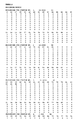
- Table 1 shows an example of a channel allocation.
- Table 2 shows an exclusion matrix having as many elements as the number of cells.
- Table 3 shows marginal capacity with respect to the channel plan of table 1 and the exclusion matrix of table 2.
- Table 5 shows the channel plan developed with new channels according to table 1.
- Table 6 shows the maximal capacity of the radio system in form of number of channels per cell in given orders of priority for cells and channels.
- table 1 a channel allocation in the form of a list having lines of element numbers and, at the left, associated channels having the designations 1, 21, 2, 22, etc.
- the reason for the designations 1, 21, 2, 22, etc. is that the channel allocation relates to a mobile radio system having so-called inter-leaved channels. Obviously succeeding channels are neighbouring channels, for instance 21 and 2. For each channel it is possible to read out what elements are to be assigned to this channel, for instance the elements 27, 53, 55, etc. are to be assigned to channel 1. What cells these element numbers relate to can be read from the exclusion matrix, see table 2.
- the number of elements in the cell equals the number of channels allocated to the cell and thus, is an expression of the capacity that may be handled by the cell.
- a prerequisite of enabling allocation of allocating the same channel to different elements is that the exclusion matrix does not contain cochannel exclusions between these elements.
- Cochannels exclusion and neighbouring channel exclusion are represented by two element number series included in each element. These two number series indicate the elements that are excluded to have a channel being cochannel and neighbouring channel or cochannel, respectively, to the element under study.
- channel 9 it can not be enlarged with further channels. If instead channel 28 is allocated to the cell also channel 29 can be added. For this reason the number of alternatives is not a direct expression of the geographical distribution of overall free capacity of the channel allocation. However, the list expresses the degree of free marginal capacity, i.e. the capacity of absorbing at least one further channel in an arbitrary cell.
- the above method is used to redistribute the channels of the system. This is done by transferring information about the traffic need of the various parts of the radio system from the various radio stations to centrally provided means, e.g. a computer calculating a new order of priority with respect to the present traffic need. Idle channels, if any, thereafter are added in accordance with the above description to the cells requiring further capacity. If it is not possible to add a cell quite simply a redistribution between the cells can be achieved by taking a channel from a cell and transferring it to another cell. This means that the radio system continuously is optimized in response to the traffic need.
Landscapes
- Engineering & Computer Science (AREA)
- Computer Networks & Wireless Communication (AREA)
- Signal Processing (AREA)
- Mobile Radio Communication Systems (AREA)
Description
- The present invention relates to a method in a mobile radio system using a technical means, preferably a computer, for determining, for a given channel plan, the distribution of marginal traffic capacity of given base stations corresponding to cells, within the coverage area of which a number of mobile radio stations exist, said radio stations being movable from the coverage area of cell to the coverage area of another cell, the mobile radio system being provided with a number of channels.
- The term cell refers to the solid angle irradiated by a specific antenna system and providing coverage according to given coverage limit values. Thus, a base station can sustain a plurality of cells having various antenna diagrams, bearings and effective transmitted power. The invention is used in radio cell systems in which a control unit for channel allocation is provided in each cell. According to the invention a method of indicating, in dependence of the traffic need and a primary given channel plan, at which cells in an existing mobile radio system it is possible to change the capacity by adding more channels per cell at the same time as the number of channels per cell is reduced in other cells.
- The mobile radio systems in various countries are growing rapidly, especially in large urban areas, and new methods are developed to achieve traffic handling with an efficient utilization of radio frequency aspects. In many places of the world computer programs are beginning to be used to perform channel allocation. These programs utilize information about which cells that can not share a channel with, or have a neighbouring channel with, any other cell, said information being described by a so-called exclusion matrix. The solutions obtained so far represent stationary solutions in which the channels once and for all are fixed for fixed base stations or cells. However, there is a need to redistribute the channels for different cells in dependence of the traffic need in the course of the day. The method proposed by the invention is useful if an exlusion matrix for every cell in the radio system is available and a channel plan of the cells in the system. The channel plan satisfies a stationary partial need of capacity in the system. The method results in the possibility of redistributing the capacity in the various cells of the mobile radio system.
- The following documents deal with similar methods.
- The document WO90/10341 relates to a method for resource allocation in a radio system comprising base stations with respective coverage areas and mobile units. The interaction between the stations in the system is defined with the aid of measured and/or calculated field strengts from all base stations on relevant traffic routes in the geographic area of the radio system, preferably in the form of an exclusion matrix. An allocating matrix is formed by compressing the exclusion matrix by means of an allocating algorithm. The algorithm utilizes figures of merit which are on the one hand calculated by mathematical/logical means to form possible combinations of stations and utilizes on the other hand a random technique for selecting one of these combinations. The algorithm is iterated a number of times and different allocations are obtained thanks to the random technique. The best one of the allocations from any point of view is selected.
- The article "A Resource Allocation Technique for FDMA Systems" in ALTA FREQUENZA describes a resource allocation problem which can be viewed as a model for the problem of finding a compatible frequency plan for the required voice channels in FDMA mobile radio telephone systems. A general and efficient algorithm solving the problem approximately is described in detail. It relies on the determination of a priori bounds on the frequency demand combined with an iterative nondeterministic assignment strategy. The possibility of extending these ideas to TDMA systems is discussed briefly.
- Thus, the present invention provides a method of determining the distribution of marginal traffic capacity for given cells in a radio cell system comprising a number of base stations with cells and associated coverage areas, and radio stations within the coverage areas of the cells. The characterizing feature of the invention is that compatibilty calculations are performed by means of a technical means for each element or a selective selection of elements of an exclusion matrix with respect to all or a selective selection of channels in a given channel allocation in such a manner that a list can be generated by means of said technical means for alternative channels for each cell within the base stations. Thereafter, a distribution of maximal traffic capacity for the cell in terms of the number of realizable channels per cell is calculated by means of said technical means by selecting cells with alternative, not mutually excluding possible channels in accordance with a given order of priority, by examining alternative possible channels according to the list in a further order of priority, and by adding one of the possible channels to the cell, resulting in a new channel plan and exclusion matrix, which creates the basis of a new list. This procedure is iterated until no alternative channel for the cell can be found in the list and hence no further channel for the cell can be added, or the remaining cells are uninteresting in view of their low priority according to a given order of priority. Similarly, channels may be subtracted in low priority cells and thus, their capacity is decreased. The orders of priority are naturally dependent of the current traffic situation in the system. In means provided centrally, for instance a computer, the allocation of the required number of channels per cell can be made dependent of the traffic need in every moment, which is assumed to be known and recorded and continuously updated in a memory unit provided centrally, and the above control unit in each cell in question obtains information continuously about the momentary valid channel plan in order to enable connection of the for the moment best, in view of the traffic demand, possible channels.
- Table 1 shows an example of a channel allocation.
- Table 2 shows an exclusion matrix having as many elements as the number of cells.
- Table 3 shows marginal capacity with respect to the channel plan of table 1 and the exclusion matrix of table 2.
- Table 4 shows marginal capacity in a channel plan developed with new channels per cell according to table 1, see also table 5, and an exclusion matrix according to table 2 with additional inserted elements representing further channels for existing cells Am,m=1,2......etc.
- Table 5 shows the channel plan developed with new channels according to table 1.
- Table 6 shows the maximal capacity of the radio system in form of number of channels per cell in given orders of priority for cells and channels.
- The following description is based on a realization with a specific example having a degree of complexity comparable with that of NMT 900 in the Stockholm area. In table 1 is shown a channel allocation in the form of a list having lines of element numbers and, at the left, associated channels having the
designations designations instance elements channel 1. What cells these element numbers relate to can be read from the exclusion matrix, see table 2. The number of elements in the cell equals the number of channels allocated to the cell and thus, is an expression of the capacity that may be handled by the cell. In the exclusion matrix of table 2, however, it happens to be only one channel per cell. A prerequisite of enabling allocation of allocating the same channel to different elements is that the exclusion matrix does not contain cochannel exclusions between these elements. Cochannels exclusion and neighbouring channel exclusion are represented by two element number series included in each element. These two number series indicate the elements that are excluded to have a channel being cochannel and neighbouring channel or cochannel, respectively, to the element under study. Thus, if we consider the elements to whichchannel 21 is allocated and the corresponding elements of the exclusion matrix it may be seen that these elements do not have any mutual cochannel exclusions or neighbouring channel exclusions, and neither any neighbouring channel exclusions with respect to the elements allocated thechannels - 1. Select
element number 1 of the exclusion matrix. Canchannel number 1 be allocated to this element? The question is answered by calculating from the exclusion matrix all cochannel exclusions and neighbouring channel exclusions generated by elements having thenumbers numbers exclusions number 1 is not found as cochannel exclusion or as neighbouring channel exclusion, and if theelements element 1 of the exclusion matrix, and if theelements element 1 of the exclusion matrix,channel 1 can be allocated toelement 1. The fact thatelement 1 can be onchannel 1 is entered in a list comprising element numbers, cell numbers and possible channel candidates compatible with the channel. We call this list marginal list, see table 3. - 2. Select again
element number 1 of the exclusion matrix. Canchannel 21 be allocated to this element? To obtain an answer to this question the above procedure is repeated. The calculations will be more comprehensive this time, sincechannel 21 as opposed tochannel 1 has two neighbouring channels, and channel exclusions for every element thereof must be retrieved from the exclusion matrix. Furthermore, the neighbouring channel exclusions ofelement number 1 have to be checked against the elements of thechannels case channel 21 can be allocated to element 21 (see table 1) this is entered in the channel list. - 3. The above procedure is repeated until it has been
verified if
channels last channel 29 can be allocated toelement 1 and if it is possible to allocate the respective channel an entry is made in the marginal list. - 4. The above procedure with the steps 1-3 is repeated until every element of the matrix has been examined and thereby also every cell.
-
- The current marginal list generated by the channel allocation of table 1 and exclusion matrix of table 2 is shown in table 3. It will happen that channel alternatives of a given element is presented being mutually exclusive, see e,g. possible channels for
cell A 13, wherechannel 9 excludes bothchannel 28 andchannel 29. - Therefore, if
cell A 13 haschannel 9 it can not be enlarged with further channels. If instead channel 28 is allocated to the cell also channel 29 can be added. For this reason the number of alternatives is not a direct expression of the geographical distribution of overall free capacity of the channel allocation. However, the list expresses the degree of free marginal capacity, i.e. the capacity of absorbing at least one further channel in an arbitrary cell. Through the following procedure it is possible to derive a distribution of the cells having the largest possible traffic handled by the system: - 1. Begin with
element 1 of the marginal list of table 3, if the corresponding cell has the highest priority with respect to capacity need, and note that one further channel can be accommodated incell 1, meaning that the cell can have bothchannels cell A 1. The new elements of the exclusion matrix should be provided with cochannel exclusions with respect to the old element and, if necessary, which we assume here, neighbouring channel exclusions. If the new element relating tocell A 1 gets theserial number 2 it will be necessary to renumber all succeeding elements of the exclusion matrix and new versions of the lists in tables 1 to 3 have to be generated. In case no channel alternative exists of a selected cell the next cell in the order of priority is selected. - 2. A new marginal list analogous with the list of table 3 is generated for the new channel plan and the new exclusion matrix. The procedure of generating the marginal list is described above.
- 3. The procedure according to 1 and 2 is repeated, now with a new cell from the new marginal list, said cell being selected with a high priority from a traffic point of view, which allows extension with one further channel.
- 4. The
procedure 1 to 3 is repeated until there are no additional channels left at one's disposal or until there are only such cells left that do not require an extension of the capacity. - 5. When the above procedure is finished the result is a marginal list reflecting the maximal capacity of the cell system for the special order of priority of cells and channels selected when extending the capacity of the cells in the series of marginal lists. Obviously, it is only desired to extend the capacity of the cells that have the heaviest load from a traffic point of view. Table 4 shows an example of a marginal list being result of the above procedure when it is completed until no further capacity remains. As may be seen, the alternatives represented are all mutually exclusive and cannot increase the capacity of the cell further. The resulting channel plan is shown in table 5 and the maximal capacity per cell is shown in table 6.
-
- In an already established mobile radio system the above method is used to redistribute the channels of the system. This is done by transferring information about the traffic need of the various parts of the radio system from the various radio stations to centrally provided means, e.g. a computer calculating a new order of priority with respect to the present traffic need. Idle channels, if any, thereafter are added in accordance with the above description to the cells requiring further capacity. If it is not possible to add a cell quite simply a redistribution between the cells can be achieved by taking a channel from a cell and transferring it to another cell. This means that the radio system continuously is optimized in response to the traffic need.
- The present invention has a plurality of advantages as is appreciated by a skilled person. The invention is only limited by the claims below.
Claims (5)
- Method in a mobile radio system using a technical means, preferably a computer, for determining, for a given channel plan, the distribution of marginal traffic capacity of given base stations corresponding to cells, within the coverage area of which a number of mobile radio stations exist, said radio stations being movable from the coverage area of cell to the coverage area of another cell, the mobile radio system being provided with a number of channels, characterized in that compatibility calculations are performed by said technical means for each element or for a selection of elements of an exclusion matrix with respect to all or a selection of the channels in a given channel allocation in such a manner that a marginal list is generated by said technical means for alternative channels for each cell within the base stations, whereby a distribution of maximal traffic capacity for the cell in terms of the number of realizable channels per cell is calculated by means of said technical means by selecting cells with alternative, not mutually excluding possible channels in accordance with a given order of priority, by examining alternative possible channels according to said marginal list in a further order of priority, and by adding one of possible channels to the cell, resulting in a new channel plan and exclusion matrix, which creates the basis of a new marginal list, which marginal list is used for distribution of traffic capacity with respect to the traffic need varying in time in each cell.
- Method according to claim 1, characterized in that the cells are prioritized in dependence of the prevailing traffic need in time periods having variable duration.
- Method according to any one of the preceding claims, characterized in that the traffic capacity of the mobile radio system is optimized by examining alternative possible channels according to the marginal lists for a given initial channel allocation, or alternatively the prevailing channel allocation, and selecting a cell having alternative non-excluding channels according to an order of priority, adding a channel to the cell, as well as subtracting the corresponding channel, if necessary, from another cell where it is not needed at the moment, generating a new channel plan and exclusion matrix, which create the basis of a new marginal list, iterating this procedure until no alternative channel can be found in the marginal list and hence no further channel can be added or redistributed in the system, or the remaining cells are uninteresting with respect to their low priority according to the order of priority.
- Method according to any one of the preceding claims, characterized in that a control of the mobile radio system is achieved by means of centrally provided technical means, e.g. a computer.
- Method according to any one of the preceding claims, characterized in that centrally provided technical means continously receive information about the traffic need from the base stations from which new orders of priority are calculated.
Priority Applications (4)
| Application Number | Priority Date | Filing Date | Title |
|---|---|---|---|
| SE9102810A SE9102810L (en) | 1991-09-27 | 1991-09-27 | METHOD OF DISTRIBUTING CAPACITY IN A RADIO CELL SYSTEM |
| JP4283763A JPH06120871A (en) | 1991-09-27 | 1992-09-28 | Method of capacity distribution in wireless cell system |
| EP93850030A EP0610645B1 (en) | 1991-09-27 | 1993-02-12 | Method of distributing channel capacity in a cellular system |
| DE1993624565 DE69324565T2 (en) | 1993-02-12 | 1993-02-12 | Method of distributing channel capacity in a cellular system |
Applications Claiming Priority (2)
| Application Number | Priority Date | Filing Date | Title |
|---|---|---|---|
| SE9102810A SE9102810L (en) | 1991-09-27 | 1991-09-27 | METHOD OF DISTRIBUTING CAPACITY IN A RADIO CELL SYSTEM |
| EP93850030A EP0610645B1 (en) | 1991-09-27 | 1993-02-12 | Method of distributing channel capacity in a cellular system |
Publications (2)
| Publication Number | Publication Date |
|---|---|
| EP0610645A1 EP0610645A1 (en) | 1994-08-17 |
| EP0610645B1 true EP0610645B1 (en) | 1999-04-21 |
Family
ID=26134929
Family Applications (1)
| Application Number | Title | Priority Date | Filing Date |
|---|---|---|---|
| EP93850030A Expired - Lifetime EP0610645B1 (en) | 1991-09-27 | 1993-02-12 | Method of distributing channel capacity in a cellular system |
Country Status (3)
| Country | Link |
|---|---|
| EP (1) | EP0610645B1 (en) |
| JP (1) | JPH06120871A (en) |
| SE (1) | SE9102810L (en) |
Families Citing this family (3)
| Publication number | Priority date | Publication date | Assignee | Title |
|---|---|---|---|---|
| USRE35792E (en) * | 1981-09-07 | 1998-05-12 | Papst Licensing, Gmbh | Disk storage drive |
| GB2318483B (en) * | 1996-10-18 | 2001-05-09 | Motorola Ltd | Dynamic control of cellular radio communication system resources |
| US6052593A (en) * | 1997-05-08 | 2000-04-18 | Telefonaktiebolaget L M Ericsson | Method for frequency mode validation for, frequency assignment for, and evaluating the network effect of a frequency plan revision within a dual mode cellular telephone system |
Family Cites Families (1)
| Publication number | Priority date | Publication date | Assignee | Title |
|---|---|---|---|---|
| SE465146B (en) * | 1989-03-03 | 1991-07-29 | Televerket | METHOD FOR DISTRIBUTING A GIVEN NUMBER OF RADIO CHANNELS IN A RADIO SYSTEM |
-
1991
- 1991-09-27 SE SE9102810A patent/SE9102810L/en not_active Application Discontinuation
-
1992
- 1992-09-28 JP JP4283763A patent/JPH06120871A/en active Pending
-
1993
- 1993-02-12 EP EP93850030A patent/EP0610645B1/en not_active Expired - Lifetime
Also Published As
| Publication number | Publication date |
|---|---|
| EP0610645A1 (en) | 1994-08-17 |
| SE9102810D0 (en) | 1991-09-27 |
| SE9102810L (en) | 1993-03-28 |
| JPH06120871A (en) | 1994-04-28 |
Similar Documents
| Publication | Publication Date | Title |
|---|---|---|
| US5507007A (en) | Method of distributing capacity in a radio cell system | |
| US5590398A (en) | Virtual mobile location area | |
| Elnoubi et al. | A new frequency channel assignment algorithm in high capacity mobile communication systems | |
| EP0461176B1 (en) | Method for resource allocation in a radio system | |
| US6157627A (en) | Channel allocation for mixed multislot services | |
| EP0767548A3 (en) | Code division multiple access system providing load and interference based demand assignment service to users | |
| GB2418324A (en) | Carrier allocation | |
| CN101345572B (en) | Time slot distribution management method for carrier channel in MF-TDMA satellite system | |
| US6269245B1 (en) | Cellular communication system employing dynamic preferential channel allocation | |
| Khanbary et al. | A GA-based effective fault-tolerant model for channel allocation in mobile computing | |
| US6385188B1 (en) | Method for sharing channels between base station sectors and frequency assignments in code division multiple access system | |
| CN1087131C (en) | Allocating channels in mobile radio system | |
| CN100521829C (en) | Method for distributing multiple services in multiple access system | |
| EP0610645A1 (en) | Method of distributing channel capacity in a cellular system | |
| Brown et al. | A grouping genetic algorithm for the microcell sectorization problem | |
| Lucatti et al. | Bounds and Performance Networks of Reuse Partitioning in Cellular | |
| CN114641036A (en) | Load balancing method and device, base station and computer readable storage medium | |
| Park et al. | Computationally efficient dynamic code assignment schemes with call admission control (DCA-CAC) for OVSF-CDMA systems | |
| CN101772032B (en) | Multi-cell cooperating method and system | |
| EP1163606B1 (en) | Optimiser | |
| Ghosh et al. | Dynamic channel assignment problem in mobile networks using particle swarm optimization | |
| Wu et al. | Optimized hybrid resource allocation in wireless cellular networks with and without channel reassignment | |
| KR20050001685A (en) | Dynamic resource management method using multiple ant colony system in wireless communication microcell system and recording medium storing the program including the same | |
| Cong et al. | Performance analysis of dynamic channel assignment algorithms in cellular mobile systems with hand‐off | |
| CN104113845A (en) | Resource negotiation method, system and equipment |
Legal Events
| Date | Code | Title | Description |
|---|---|---|---|
| PUAI | Public reference made under article 153(3) epc to a published international application that has entered the european phase |
Free format text: ORIGINAL CODE: 0009012 |
|
| 17P | Request for examination filed |
Effective date: 19930304 |
|
| AK | Designated contracting states |
Kind code of ref document: A1 Designated state(s): DE ES FR GB NL |
|
| 17Q | First examination report despatched |
Effective date: 19960529 |
|
| RAP1 | Party data changed (applicant data changed or rights of an application transferred) |
Owner name: TELIA AB |
|
| GRAG | Despatch of communication of intention to grant |
Free format text: ORIGINAL CODE: EPIDOS AGRA |
|
| GRAG | Despatch of communication of intention to grant |
Free format text: ORIGINAL CODE: EPIDOS AGRA |
|
| GRAH | Despatch of communication of intention to grant a patent |
Free format text: ORIGINAL CODE: EPIDOS IGRA |
|
| GRAH | Despatch of communication of intention to grant a patent |
Free format text: ORIGINAL CODE: EPIDOS IGRA |
|
| GRAA | (expected) grant |
Free format text: ORIGINAL CODE: 0009210 |
|
| AK | Designated contracting states |
Kind code of ref document: B1 Designated state(s): DE ES FR GB NL |
|
| PG25 | Lapsed in a contracting state [announced via postgrant information from national office to epo] |
Ref country code: ES Free format text: THE PATENT HAS BEEN ANNULLED BY A DECISION OF A NATIONAL AUTHORITY Effective date: 19990421 |
|
| REF | Corresponds to: |
Ref document number: 69324565 Country of ref document: DE Date of ref document: 19990527 |
|
| ET | Fr: translation filed | ||
| PGFP | Annual fee paid to national office [announced via postgrant information from national office to epo] |
Ref country code: NL Payment date: 20000225 Year of fee payment: 8 |
|
| PLBE | No opposition filed within time limit |
Free format text: ORIGINAL CODE: 0009261 |
|
| STAA | Information on the status of an ep patent application or granted ep patent |
Free format text: STATUS: NO OPPOSITION FILED WITHIN TIME LIMIT |
|
| 26N | No opposition filed | ||
| PG25 | Lapsed in a contracting state [announced via postgrant information from national office to epo] |
Ref country code: NL Free format text: LAPSE BECAUSE OF NON-PAYMENT OF DUE FEES Effective date: 20010901 |
|
| NLV4 | Nl: lapsed or anulled due to non-payment of the annual fee |
Effective date: 20010901 |
|
| REG | Reference to a national code |
Ref country code: GB Ref legal event code: IF02 |
|
| PGFP | Annual fee paid to national office [announced via postgrant information from national office to epo] |
Ref country code: DE Payment date: 20020422 Year of fee payment: 10 |
|
| PG25 | Lapsed in a contracting state [announced via postgrant information from national office to epo] |
Ref country code: DE Free format text: LAPSE BECAUSE OF NON-PAYMENT OF DUE FEES Effective date: 20030902 |
|
| PGFP | Annual fee paid to national office [announced via postgrant information from national office to epo] |
Ref country code: FR Payment date: 20040127 Year of fee payment: 12 |
|
| PGFP | Annual fee paid to national office [announced via postgrant information from national office to epo] |
Ref country code: GB Payment date: 20040130 Year of fee payment: 12 |
|
| PG25 | Lapsed in a contracting state [announced via postgrant information from national office to epo] |
Ref country code: GB Free format text: LAPSE BECAUSE OF NON-PAYMENT OF DUE FEES Effective date: 20050212 |
|
| GBPC | Gb: european patent ceased through non-payment of renewal fee |
Effective date: 20050216 |
|
| PG25 | Lapsed in a contracting state [announced via postgrant information from national office to epo] |
Ref country code: FR Free format text: LAPSE BECAUSE OF NON-PAYMENT OF DUE FEES Effective date: 20051031 |
|
| REG | Reference to a national code |
Ref country code: FR Ref legal event code: ST Effective date: 20051031 |