EP0608513B1 - Surface-treated metal sheet which excels in workability, electrical conduktivity and corrosion resistance, and method of producing the same - Google Patents
Surface-treated metal sheet which excels in workability, electrical conduktivity and corrosion resistance, and method of producing the same Download PDFInfo
- Publication number
- EP0608513B1 EP0608513B1 EP93119308A EP93119308A EP0608513B1 EP 0608513 B1 EP0608513 B1 EP 0608513B1 EP 93119308 A EP93119308 A EP 93119308A EP 93119308 A EP93119308 A EP 93119308A EP 0608513 B1 EP0608513 B1 EP 0608513B1
- Authority
- EP
- European Patent Office
- Prior art keywords
- metal sheet
- organic lubricant
- layer
- lubricant particles
- treated metal
- Prior art date
- Legal status (The legal status is an assumption and is not a legal conclusion. Google has not performed a legal analysis and makes no representation as to the accuracy of the status listed.)
- Expired - Lifetime
Links
- 229910052751 metal Inorganic materials 0.000 title claims abstract description 79
- 239000002184 metal Substances 0.000 title claims abstract description 79
- 238000005260 corrosion Methods 0.000 title claims abstract description 20
- 230000007797 corrosion Effects 0.000 title claims abstract description 20
- 238000000034 method Methods 0.000 title claims description 13
- 239000002245 particle Substances 0.000 claims abstract description 50
- 239000000314 lubricant Substances 0.000 claims abstract description 44
- ZCDOYSPFYFSLEW-UHFFFAOYSA-N chromate(2-) Chemical compound [O-][Cr]([O-])(=O)=O ZCDOYSPFYFSLEW-UHFFFAOYSA-N 0.000 claims abstract description 32
- 230000008021 deposition Effects 0.000 claims abstract description 23
- 239000000839 emulsion Substances 0.000 claims abstract description 8
- 239000006185 dispersion Substances 0.000 claims abstract description 7
- 239000007788 liquid Substances 0.000 claims abstract description 6
- 239000001993 wax Substances 0.000 claims description 22
- VYPSYNLAJGMNEJ-UHFFFAOYSA-N Silicium dioxide Chemical compound O=[Si]=O VYPSYNLAJGMNEJ-UHFFFAOYSA-N 0.000 claims description 17
- 229920000098 polyolefin Polymers 0.000 claims description 10
- 150000004820 halides Chemical class 0.000 claims description 4
- 239000000463 material Substances 0.000 claims description 3
- 239000012188 paraffin wax Substances 0.000 claims description 3
- OFOBLEOULBTSOW-UHFFFAOYSA-N Propanedioic acid Natural products OC(=O)CC(O)=O OFOBLEOULBTSOW-UHFFFAOYSA-N 0.000 claims description 2
- VZCYOOQTPOCHFL-UPHRSURJSA-N maleic acid Chemical compound OC(=O)\C=C/C(O)=O VZCYOOQTPOCHFL-UPHRSURJSA-N 0.000 claims description 2
- 239000011976 maleic acid Substances 0.000 claims description 2
- VZCYOOQTPOCHFL-UHFFFAOYSA-N trans-butenedioic acid Natural products OC(=O)C=CC(O)=O VZCYOOQTPOCHFL-UHFFFAOYSA-N 0.000 claims description 2
- 229940098895 maleic acid Drugs 0.000 claims 1
- 239000010410 layer Substances 0.000 description 33
- 229910000831 Steel Inorganic materials 0.000 description 18
- 239000010959 steel Substances 0.000 description 18
- 239000011347 resin Substances 0.000 description 13
- 229920005989 resin Polymers 0.000 description 13
- 239000010408 film Substances 0.000 description 10
- 239000000377 silicon dioxide Substances 0.000 description 8
- 238000000576 coating method Methods 0.000 description 7
- 229910000838 Al alloy Inorganic materials 0.000 description 6
- 239000011248 coating agent Substances 0.000 description 6
- 238000004519 manufacturing process Methods 0.000 description 6
- 238000004381 surface treatment Methods 0.000 description 6
- 230000000694 effects Effects 0.000 description 5
- PXHVJJICTQNCMI-UHFFFAOYSA-N Nickel Chemical compound [Ni] PXHVJJICTQNCMI-UHFFFAOYSA-N 0.000 description 4
- 229910052782 aluminium Inorganic materials 0.000 description 4
- 229910052681 coesite Inorganic materials 0.000 description 4
- 229910052906 cristobalite Inorganic materials 0.000 description 4
- 238000005238 degreasing Methods 0.000 description 4
- 239000010687 lubricating oil Substances 0.000 description 4
- 229910052682 stishovite Inorganic materials 0.000 description 4
- 229910052905 tridymite Inorganic materials 0.000 description 4
- XAGFODPZIPBFFR-UHFFFAOYSA-N aluminium Chemical compound [Al] XAGFODPZIPBFFR-UHFFFAOYSA-N 0.000 description 3
- 238000009826 distribution Methods 0.000 description 3
- 230000001050 lubricating effect Effects 0.000 description 3
- 238000007747 plating Methods 0.000 description 3
- UOCLXMDMGBRAIB-UHFFFAOYSA-N 1,1,1-trichloroethane Chemical compound CC(Cl)(Cl)Cl UOCLXMDMGBRAIB-UHFFFAOYSA-N 0.000 description 2
- 238000002441 X-ray diffraction Methods 0.000 description 2
- HCHKCACWOHOZIP-UHFFFAOYSA-N Zinc Chemical compound [Zn] HCHKCACWOHOZIP-UHFFFAOYSA-N 0.000 description 2
- 239000011247 coating layer Substances 0.000 description 2
- 238000002845 discoloration Methods 0.000 description 2
- 238000011156 evaluation Methods 0.000 description 2
- 238000004299 exfoliation Methods 0.000 description 2
- JEIPFZHSYJVQDO-UHFFFAOYSA-N iron(III) oxide Inorganic materials O=[Fe]O[Fe]=O JEIPFZHSYJVQDO-UHFFFAOYSA-N 0.000 description 2
- 229910052759 nickel Inorganic materials 0.000 description 2
- 239000003973 paint Substances 0.000 description 2
- 239000002904 solvent Substances 0.000 description 2
- 238000011282 treatment Methods 0.000 description 2
- 229910052725 zinc Inorganic materials 0.000 description 2
- 239000011701 zinc Substances 0.000 description 2
- 241001163841 Albugo ipomoeae-panduratae Species 0.000 description 1
- 229910001335 Galvanized steel Inorganic materials 0.000 description 1
- 229920003171 Poly (ethylene oxide) Polymers 0.000 description 1
- 239000004698 Polyethylene Substances 0.000 description 1
- NIXOWILDQLNWCW-UHFFFAOYSA-N acrylic acid group Chemical group C(C=C)(=O)O NIXOWILDQLNWCW-UHFFFAOYSA-N 0.000 description 1
- 230000002411 adverse Effects 0.000 description 1
- 239000003513 alkali Substances 0.000 description 1
- FJMNNXLGOUYVHO-UHFFFAOYSA-N aluminum zinc Chemical compound [Al].[Zn] FJMNNXLGOUYVHO-UHFFFAOYSA-N 0.000 description 1
- 239000002585 base Substances 0.000 description 1
- 239000010953 base metal Substances 0.000 description 1
- 230000015572 biosynthetic process Effects 0.000 description 1
- 235000013869 carnauba wax Nutrition 0.000 description 1
- 239000004203 carnauba wax Substances 0.000 description 1
- 238000006757 chemical reactions by type Methods 0.000 description 1
- 239000010960 cold rolled steel Substances 0.000 description 1
- 238000005536 corrosion prevention Methods 0.000 description 1
- 230000018044 dehydration Effects 0.000 description 1
- 238000006297 dehydration reaction Methods 0.000 description 1
- 238000004925 denaturation Methods 0.000 description 1
- 239000003599 detergent Substances 0.000 description 1
- 230000002542 deteriorative effect Effects 0.000 description 1
- 238000001035 drying Methods 0.000 description 1
- 230000005674 electromagnetic induction Effects 0.000 description 1
- 239000010419 fine particle Substances 0.000 description 1
- 125000000524 functional group Chemical group 0.000 description 1
- 239000008397 galvanized steel Substances 0.000 description 1
- 239000008187 granular material Substances 0.000 description 1
- 230000001771 impaired effect Effects 0.000 description 1
- 239000011229 interlayer Substances 0.000 description 1
- 238000005461 lubrication Methods 0.000 description 1
- 238000005259 measurement Methods 0.000 description 1
- 150000002739 metals Chemical class 0.000 description 1
- 239000000203 mixture Substances 0.000 description 1
- QELJHCBNGDEXLD-UHFFFAOYSA-N nickel zinc Chemical compound [Ni].[Zn] QELJHCBNGDEXLD-UHFFFAOYSA-N 0.000 description 1
- 239000003921 oil Substances 0.000 description 1
- 239000005416 organic matter Substances 0.000 description 1
- 230000003647 oxidation Effects 0.000 description 1
- 238000007254 oxidation reaction Methods 0.000 description 1
- -1 polyethylene Polymers 0.000 description 1
- 229920000573 polyethylene Polymers 0.000 description 1
- 238000006116 polymerization reaction Methods 0.000 description 1
- 238000003825 pressing Methods 0.000 description 1
- 150000003839 salts Chemical class 0.000 description 1
- 239000007921 spray Substances 0.000 description 1
- 238000005507 spraying Methods 0.000 description 1
- 239000000126 substance Substances 0.000 description 1
- 239000010409 thin film Substances 0.000 description 1
Images

Classifications
-
- C—CHEMISTRY; METALLURGY
- C23—COATING METALLIC MATERIAL; COATING MATERIAL WITH METALLIC MATERIAL; CHEMICAL SURFACE TREATMENT; DIFFUSION TREATMENT OF METALLIC MATERIAL; COATING BY VACUUM EVAPORATION, BY SPUTTERING, BY ION IMPLANTATION OR BY CHEMICAL VAPOUR DEPOSITION, IN GENERAL; INHIBITING CORROSION OF METALLIC MATERIAL OR INCRUSTATION IN GENERAL
- C23C—COATING METALLIC MATERIAL; COATING MATERIAL WITH METALLIC MATERIAL; SURFACE TREATMENT OF METALLIC MATERIAL BY DIFFUSION INTO THE SURFACE, BY CHEMICAL CONVERSION OR SUBSTITUTION; COATING BY VACUUM EVAPORATION, BY SPUTTERING, BY ION IMPLANTATION OR BY CHEMICAL VAPOUR DEPOSITION, IN GENERAL
- C23C22/00—Chemical surface treatment of metallic material by reaction of the surface with a reactive liquid, leaving reaction products of surface material in the coating, e.g. conversion coatings, passivation of metals
- C23C22/82—After-treatment
- C23C22/83—Chemical after-treatment
-
- C—CHEMISTRY; METALLURGY
- C23—COATING METALLIC MATERIAL; COATING MATERIAL WITH METALLIC MATERIAL; CHEMICAL SURFACE TREATMENT; DIFFUSION TREATMENT OF METALLIC MATERIAL; COATING BY VACUUM EVAPORATION, BY SPUTTERING, BY ION IMPLANTATION OR BY CHEMICAL VAPOUR DEPOSITION, IN GENERAL; INHIBITING CORROSION OF METALLIC MATERIAL OR INCRUSTATION IN GENERAL
- C23C—COATING METALLIC MATERIAL; COATING MATERIAL WITH METALLIC MATERIAL; SURFACE TREATMENT OF METALLIC MATERIAL BY DIFFUSION INTO THE SURFACE, BY CHEMICAL CONVERSION OR SUBSTITUTION; COATING BY VACUUM EVAPORATION, BY SPUTTERING, BY ION IMPLANTATION OR BY CHEMICAL VAPOUR DEPOSITION, IN GENERAL
- C23C28/00—Coating for obtaining at least two superposed coatings either by methods not provided for in a single one of groups C23C2/00 - C23C26/00 or by combinations of methods provided for in subclasses C23C and C25C or C25D
-
- Y—GENERAL TAGGING OF NEW TECHNOLOGICAL DEVELOPMENTS; GENERAL TAGGING OF CROSS-SECTIONAL TECHNOLOGIES SPANNING OVER SEVERAL SECTIONS OF THE IPC; TECHNICAL SUBJECTS COVERED BY FORMER USPC CROSS-REFERENCE ART COLLECTIONS [XRACs] AND DIGESTS
- Y10—TECHNICAL SUBJECTS COVERED BY FORMER USPC
- Y10T—TECHNICAL SUBJECTS COVERED BY FORMER US CLASSIFICATION
- Y10T428/00—Stock material or miscellaneous articles
- Y10T428/25—Web or sheet containing structurally defined element or component and including a second component containing structurally defined particles
-
- Y—GENERAL TAGGING OF NEW TECHNOLOGICAL DEVELOPMENTS; GENERAL TAGGING OF CROSS-SECTIONAL TECHNOLOGIES SPANNING OVER SEVERAL SECTIONS OF THE IPC; TECHNICAL SUBJECTS COVERED BY FORMER USPC CROSS-REFERENCE ART COLLECTIONS [XRACs] AND DIGESTS
- Y10—TECHNICAL SUBJECTS COVERED BY FORMER USPC
- Y10T—TECHNICAL SUBJECTS COVERED BY FORMER US CLASSIFICATION
- Y10T428/00—Stock material or miscellaneous articles
- Y10T428/25—Web or sheet containing structurally defined element or component and including a second component containing structurally defined particles
- Y10T428/254—Polymeric or resinous material
Definitions
- the present invention relates to a surface-treated metal sheet which excels in press-workability, electrical conductivity and corrosion resistance and which is used mainly as a component of household electric appliances, office automation equipment, automobiles and so forth.
- the invention also is concerned with a method of producing such a metal sheet.
- Production of household electric appliances, office automation equipment, automobiles and so forth employ press-forming work on various kinds of metal sheets such as non-plated steel sheets, galvanized or galvanealed steel sheets, aluminum (Al) or Al-alloy sheet, for example.
- metal sheets such as non-plated steel sheets, galvanized or galvanealed steel sheets, aluminum (Al) or Al-alloy sheet, for example.
- Degreasing treatment is necessary after press-forming, in order to remove the lubricating oil.
- the degreasing treatment usually employs a solvent such as 1,1,1-trichloroethane or an alkali detergent.
- a solvent such as 1,1,1-trichloroethane or an alkali detergent.
- the use of such solvent not only degrades the working environment but also requires a suitable anti-pollution countermeasure which raises the production cost and itself degrades the working environment.
- the resin which generally has a very high volumetric specific resistivity of 10 15 ⁇ cm or so produces an inter-layer resistance of 10 10 ⁇ or greater on the metal sheet surface even when it is applied as a very thin film of 1 ⁇ m or so.
- Such high electrical resistance seriously impairs the electrical conductivity and grounding characteristics of the product.
- Japanese Patent Laid-Open No. 63-83172 proposed a technique in which conductive particles are dispersed in the resin layer so as to improve electrical conductivity.
- the electrical conductivity does not recover enough electrical conductivity and grounding characteristics.
- metal sheets for a computer chassis are required to have a high shielding effect against electromagnetic waves, in order to prevent leakage of high-frequency electromagnetic waves to the exterior, as well as generation of noise due to electromagnetic induction.
- the metal sheet used for such a purpose must have a surface electrical resistivity of 1 ⁇ or less.
- Japanese Patent Laid-Open No. 63-114635 discloses a conductive surface-treated steel sheet having a discontinuous film formed by a resin dispersed on a chromate film.
- This steel sheet is disadvantageous in that coating with fine particles cannot easily be conducted with the use of a resin emulsion in electrostatic dispersion coating and in that the particle size of the resin tends to increase after coating due to polymerization of the resin material such as an acrylic emulsion used in the coating process.
- the increase in the size of the resin particles serving as lubricant undesirably reduces the chance of electrical contact between the metal sheet coated with the lubricant particles and another metal which has to be kept in electrical contact with the coated sheet, thus impairing coating characteristics.
- Increase of the lubricant particle size also enhances the tendency of the particles to come off during handling, thus deteriorating workability.
- a surface-treated metal sheet according to the preamble of claim 1 is known from US-A-5,061,575.
- an object of the present invention is to provide a surface-treated metal sheet which has excellent surface conductivity and grounding characteristics and which can easily be press-worked without application of lubricant, thereby overcoming the problems of the known art.
- the present inventors have discovered that the provision of a resin layer is not essential for the improvement of workability; high workability can be obtained when predetermined amounts of lubricating particles are fixed on the surface of the metal sheet.
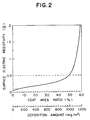
- the coated area ratio of the lubricating layer must be less than about 50 %.
- a surface-treated metal sheet which excels in workability, electrical surface conductivity and corrosion resistance, comprising: a metal sheet which has been plated as required; a chromate layer as a first layer formed on at least one side of the metal sheet, in an amount of about 5 to 200 mg/m 2 calculated on the basis of Cr, and a second layer formed on the first layer from organic lubricant particles, with a deposition amount of from about 5 to 1000 mg/m 2 , such that the proportion of the area coated by the organic lubricant particles to the entire area of the metal sheet surface is less than about 50 %.
- the invention also provides a method of producing a surface-treated metal sheet as specified above.
- the organic lubricant particles preferably contain particles of one, two or more kinds selected from the group consisting of paraffin wax, polyolefin wax, denatured polyolefin wax, polyolefin halide wax and a fluororesin.
- a metal sheet or plated metal sheet in accordance with the present invention broadly includes a variety of metal sheets such as steel sheets, galvanized or galvanealed steel sheets, steel sheets plated with Al or Al alloy, aluminum or aluminum alloy sheets, intended to be press-worked into panels or other structural components of various products such as household electric appliances, office automation equipment, automobiles.
- the chromate layer which is formed as a primary layer on the surface of the metal sheet or plated metal sheet of the present invention is intended to provide resistance to corrosion under comparatively gentle corrosive conditions such as indoor use or use free of exposure to rain.
- the chromate layer may be selected from various types, including any reaction-type chromate layer, electrolytic chromate layer or application chromate layer, and can be freely selected according to the type of production equipment or production line employed in the factory for forming the underlying metal or for providing surface treatment.
- a Cr deposition amount less than about 5 mg/m 2 is insufficient to attain the required resistance to corrosion, while deposition of Cr in excess of about 200 mg/m 2 uneconomically causes saturation of corrosion prevention effect. Such a large amount of Cr deposition tends to cause exfoliation of the coating layer due to breakage of the chromate layer when the coating is applied subsequently to the press work.
- the amount of deposition of Cr therefore is limited to range between about 5 and 200 mg/m 2 on a basis of the metal Cr.
- a chromate layer 2 (Fig. 1) is formed as the first layer on metal sheet 1. Then a second layer composed of organic lubricant particles 3 is formed on the chromate layer 2.
- organic lubricant particles is used in this specification to mean precipated or granular material of organic matter which exhibits an appreciable lubrication effect when the metal sheet of the invention is subjected to work such as press work.
- the organic lubricant particle layer is preferably formed from one, two or more kinds of lubricants selected from the group consisting of paraffin wax, polyolefin wax, denatured polyolefin wax, polyolefin halide wax and fluororesin.
- the application of the organic lubricant particles 3 onto the chromate layer 2 may be effected by means of a roll coater, spin coater or dip coater.
- Deposition of the organic lubricant particles below about 5 mg/m 2 does not provide significant lubricating effect, whereas deposition of organic lubricant particles in excess of about 1000 mg/m 2 reduces electrical conductivity and impairs the grounding characteristics and electromagnetic shielding effect of the sheet to unacceptable levels.
- the amount of deposition of the organic lubricant particles therefore, is determined to range from about 5 mg/m 2 to 1000 g/m 2 .
- the preferable amount of deposition of the organic lubricant particles ranges from about 10 to less than 100 mg/m 2 .
- the coated area ratio mentioned above can be measured by microscopic examination method for determining non-metallic inclusions in steel, as specified by JIS (Japanese Industrial Standards) G 0555.
- a mean particle size of the organic lubricant particles exceeding 20 ⁇ m increases the tendency for the particles to come off the metal sheet during handling prior to press work, and also reduces the metal-to-metal contact between the surface-treated metal sheet of the invention and any other metal member, thus impairing grounding characteristics.
- the mean particle size of the organic lubricant particles is restricted to a value up to 20 ⁇ m.
- Affinity or adhesion between the metal and any paint coating layer provided on the layer of the organic lubricant particles is enhanced when the surface of the organic lubricant particle layer is denatured with maleic acid or oxidized. This advantageous effect owes to formation of chemical bonding between the metal atoms and end functional groups formed as a result of the maleic-acid-denaturation or oxidation.
- the chromate layer contains silica. This is because the silica contained in the chromate layer reduces the ratio of area coated by the organic lubricant particles while preserving corrosion resistance.
- the corrosion resistance of the sheet mainly depends on the presence of chromate because the ratio of the area coated by the organic lubricant particles is less than 50 %.
- the chromate may contain silica by an amount ranging from about 0.1 to 6.0 in terms of the weight ratio SiO 2 /Cr.
- the weight ratio SiO 2 /Cr is below about 0.1, the corrosion resistance is not high, whereas the weight ratio SiO 2 /Cr exceeding about 6.0 causes reduction of electrical conductivity.
- the weight ratio SiO 2 /Cr is determined to range from about 0.1 to 6.0.
- surface treatment is effected on at least one side of the metal sheet.
- Surface treatment effected on only one side of the metal sheet suffices in, for example, simple press working in which only the metal sheet surface facing the punch is restrained so that sliding movement takes place only between the die and the surface of the metal sheet facing the die.
- both these surfaces may be subjected to the surface treatment of the present invention.
- the surface-treated metal sheet in accordance with the present invention is produced by forming, at least on one side of the metal sheet or plated metal sheet, a chromate layer in a deposition amount of 5 to 200 mg/m 2 as calculated on the basis of Cr, and applying, on the surface of the chromate layer, a dispersion liquid or emulsion having an organic lubricant particle concentration of 0.1 to 40 wt% so as to form a wet film of 0.2 to 10 ⁇ m thick as the second layer, such that the ratio of the area coated by the organic lubricant particles to the total metal sheet surface area is less than 50 %.
- the concentration of the organic lubricant particles in the dispersion or emulsion is below 0.1 wt%, the desired amount deposited cannot be obtained unless the wet film thickness, i.e., the thickness of the film formed by application of the dispersion liquid or emulsion containing organic lubricant particles as measured immediately after the application, is increased to an excessively large value.
- the wet film thickness i.e., the thickness of the film formed by application of the dispersion liquid or emulsion containing organic lubricant particles as measured immediately after the application.
- an organic lubricant particle concentration exceeding about 40 wt% enhances the viscosity of the liquid so as to cause a variation or uneven thickness distribution of the wet film.
- any wet film thickness below about 0.2 ⁇ m undesirably allows the applicator roll to contact the metal sheet directly, tending to cause exfoliation of the chromate layer to impair corrosion resistance. Conversely, control of the wet film thickness to develop a uniform thickness distribution is difficult to conduct when the wet film thickness exceeds about 10 ⁇ m.
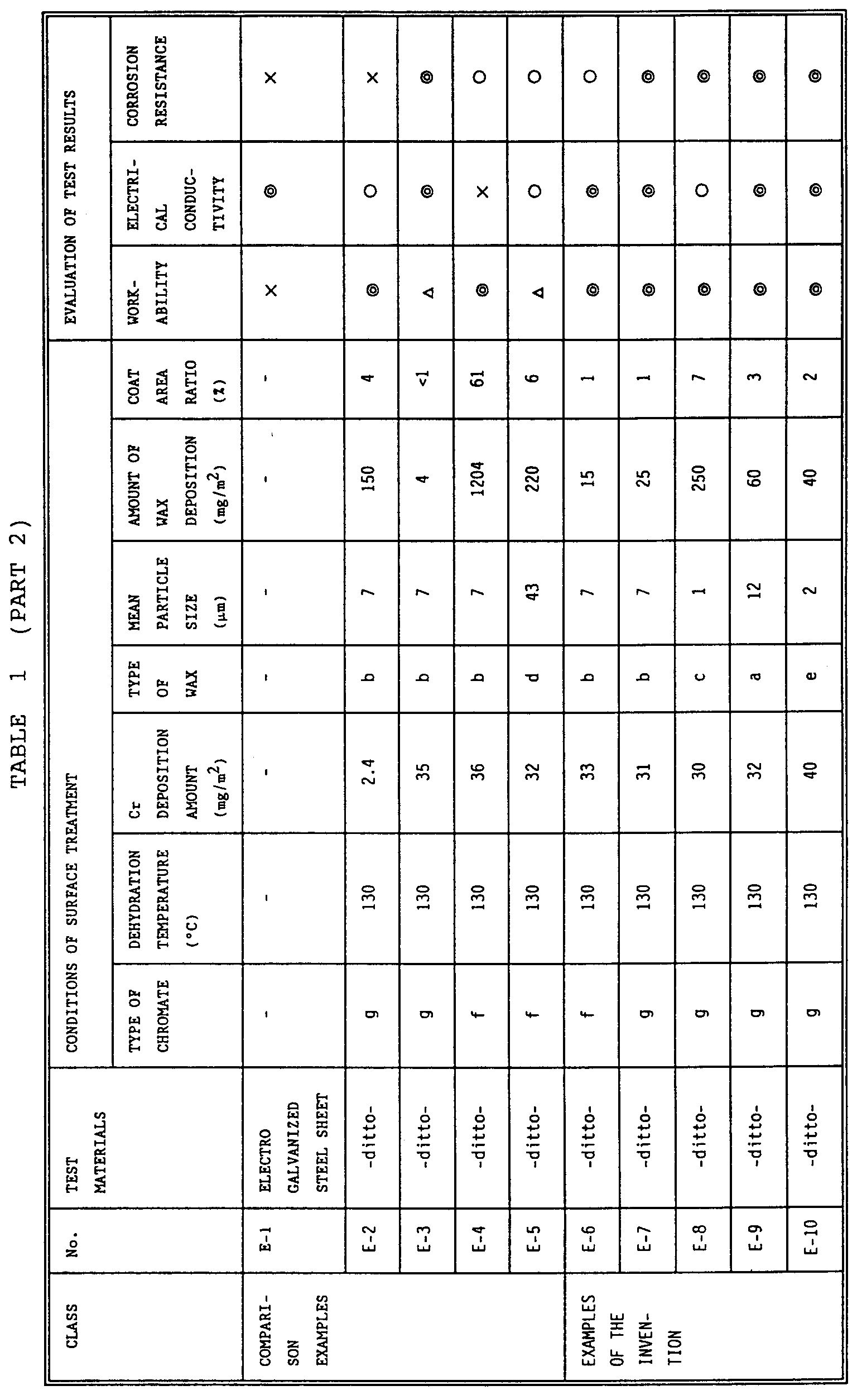
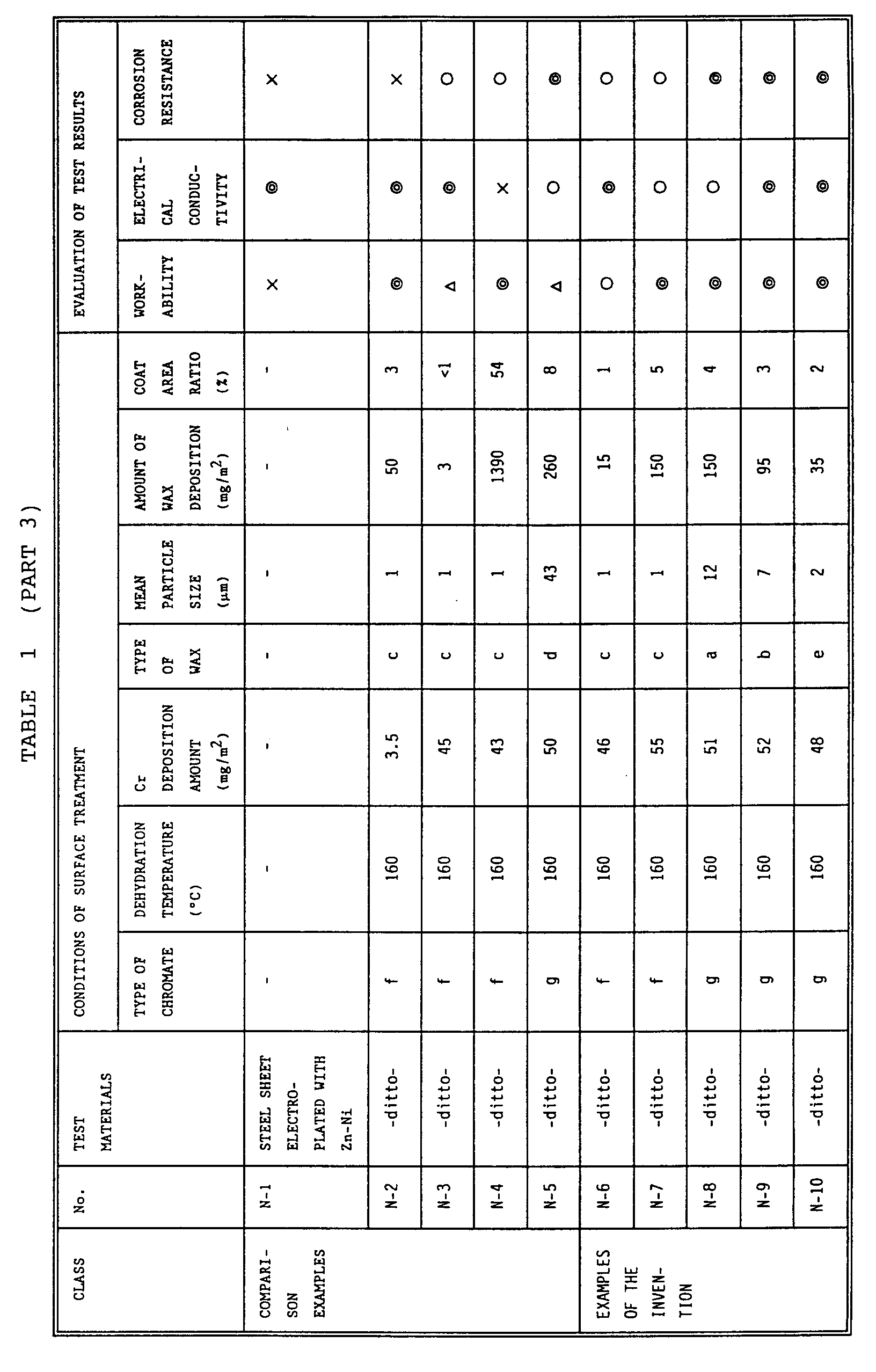
- Each of the metal sheets mentioned above was vapor-degreased with 1,1,1-trichloroethane, and a chromate layer was formed through application of the chromate with a spin coater, followed by dehydration and baking. Then a solution was formed by dissolving a wax selected from those shown in Table 1, and was applied to the metal sheet by means of a spin coater, followed by drying at 120 °C, whereby each test piece was obtained.
- the amount of deposition of the chromate was determined by measuring the amount of elemental Cr through fluorescent X-ray analysis.
- the amount of deposition of the wax also was determined by measuring the C element through fluorescent X-ray analysis.
- the coated area ratio i.e., the proportion of the area coated by the wax to the metal sheet surface area, was determined as a mean of the values obtained on arbitrary 20 fields of SEM observation (magnification 1000).
- Electrical conductivity was determined by measuring the surface resistivity by using a surface resistance meter LORESTA MCP-tester (commercial name) produced by Mitsubishi Petrochemical Engineering Co., and was evaluated on the basis of the mean value over 10 (ten) measurements, applying the following criteria.
- Corrosion resistance was evaluated on the following criteria, after keeping each test piece in a thermo/humidistat oven maintaining an atmosphere of 50 °C and RH not less than 98 %.
- waxes and two types of chromates shown below were used in the Examples. It is to be understood, however, that these waxes and chromates are only illustrative and other waxes and chromates may be used in the present invention.
- Table 1 shows the conditions of surface treatments, together with the results of the evaluation. From this Table 1, it will be seen that all the examples of the surface-treated metal sheet of the present invention excelled in workability, electrical conductivity and corrosion resistance. Comparison Examples C-1, E-1, N-1 and G-1 showed inferior workability and corrosion resistance, due to lack of the surface treatment. Comparison Examples C-2, E-2, N-2 and G-2 also were inferior in corrosion resistance, due to too small amount of deposition of chromate, while Comparison Examples C-3, E-3, N-3, G-3, A-1 and A-2 exhibited only a low level of workability due to shortage of the wax. Conversely, Comparison Examples, which have excessively large wax contents, exhibited inferior electrical conductivity.
- the present invention it is possible remarkably to improve the workability of non-plated or plated steel sheets, aluminum sheets or like metal sheets, without impairing electrical conductivity (surface resistivity).
- the metal sheet in accordance with the present invention therefore can be subjected to press-forming work without greasing and degreasing, while ensuring high electrical conductivity.
- the surface-treated metal sheet of the present invention therefore, can be used for products requiring excellent grounding characteristic; this could never be met by conventional lubricant-clad metal sheets.
- This invention further simplifies the process in pressing operations and contributes to significant improvements in the working environments.
Landscapes
- Chemical & Material Sciences (AREA)
- Chemical Kinetics & Catalysis (AREA)
- Engineering & Computer Science (AREA)
- Materials Engineering (AREA)
- Mechanical Engineering (AREA)
- Metallurgy (AREA)
- Organic Chemistry (AREA)
- General Chemical & Material Sciences (AREA)
- Laminated Bodies (AREA)
- Application Of Or Painting With Fluid Materials (AREA)
- Chemical Treatment Of Metals (AREA)
Abstract
Description
- o ○ :
- Limiting draw ratio (LDR) 2.30 or greater
- ○ :
- LDR not less than 2.24 but below 2.30
- ▵ :
- LDR not less than 2.12 but below 2.24
- X :
- LDR below 2.12
- o ○ :
- Limiting drawing ratio (LDR) not less than 2.12
- ○ :
- LDR not less than 1.96 but below 2.12
- ▵ :
- LDR not less than 1.90 but below 1.96
- X :
- LDR less than 1.90
- o ○:
- below 0.1 Ω
- ○:
- not less than 0.1 Ω but below 0.5 Ω
- ▵:
- not less than 0.5 Ω but below 2 Ω
- X:
- not less than 2 Ω
- o ○:
- Generation of 5 % white rust does not start before 48 hours in salt spray test specified by JIS 2371
- ○:
- No discoloration or spot rust
- X:
- Discoloration or spot rust occurred



Claims (8)
- A surface-treated metal sheet which excels in workability, low surface resistivity and corrosion resistance, comprising a metal sheet; a chromate layer formed on at least one side of said metal sheet, with a deposition amount of 5 to 200 mg/m2 calculated on the basis of Cr; and an organic lubricant layer formed on said chromate layer and composed of organic lubricant having a deposition amount of from 5 to 1,000 mg/m2
characterised in that
the proportion of the area coated by said organic lubricant particles to the entire area of the metal sheet surface is below 50%. - A surface-treated metal sheet according to Claim 1, wherein said organic lubricant particles include particles of one, two or more kinds of materials selected from the group consisting of paraffin wax, polyolefin wax, denatured polyolefin wax, polyolefin halide wax and fluororesins.
- A surface-treated metal sheet according to Claim 1 to 2, wherein the amount of deposition of said organic lubricant particles ranges from 10 to less than 100 mg/m2.
- A surface-treated metal sheet according to one of Claims 1 to 3, wherein the mean particle size of the organic lubricant particles is at most 20 µm.
- A surface-treated metal sheet according to any one of Claims 1 to 4, wherein the surfaces of said organic lubricant particles have been maleic-acid denatured or oxidized.
- A surface-treated metal sheet according to any one of the preceding claims, wherein said chromate layer contains silica (SiO2) by an amount which ranges from 0.1 to 6.0 weight ratio of SiO2/Cr.
- A method of producing a surface-treated metal sheet which excels in workability, low surface resistivity and corrosion resistance, comprising the steps of: preparing a metal sheet which has been plated as required; forming, on at least one side of said metal sheet, a chromate layer as a first layer, with a deposition amount of 5 to 200 mg/m2 as calculated on the basis of Cr; and forming a second layer on said first layer by applying a dispersion liquid or emulsion containing organic lubricant particles at a concentration of from 0.1 to 40 wt% so as to provide a wet film thickness of 0.2 to 10 µm, such that the proportion of the area coated by said organic lubricant particles to the entire area of the metal sheet surface is less than 50 %.
- A method of producing a surface-treated metal sheet according to claim 7, wherein the application of said dispersion liquid or emulsion containing organic lubricant particles is conducted by using a roll coater, a spin coater or a dip coater.
Applications Claiming Priority (2)
| Application Number | Priority Date | Filing Date | Title |
|---|---|---|---|
| JP320146/92 | 1992-11-30 | ||
| JP32014692 | 1992-11-30 |
Publications (2)
| Publication Number | Publication Date |
|---|---|
| EP0608513A1 EP0608513A1 (en) | 1994-08-03 |
| EP0608513B1 true EP0608513B1 (en) | 1998-08-26 |
Family
ID=18118225
Family Applications (1)
| Application Number | Title | Priority Date | Filing Date |
|---|---|---|---|
| EP93119308A Expired - Lifetime EP0608513B1 (en) | 1992-11-30 | 1993-11-30 | Surface-treated metal sheet which excels in workability, electrical conduktivity and corrosion resistance, and method of producing the same |
Country Status (7)
| Country | Link |
|---|---|
| US (1) | US5389436A (en) |
| EP (1) | EP0608513B1 (en) |
| KR (1) | KR100264622B1 (en) |
| AT (1) | ATE170130T1 (en) |
| CA (1) | CA2110124C (en) |
| DE (1) | DE69320615T2 (en) |
| TW (1) | TW302398B (en) |
Families Citing this family (3)
| Publication number | Priority date | Publication date | Assignee | Title |
|---|---|---|---|---|
| CA2113968C (en) * | 1993-07-29 | 2000-05-30 | Junichi Mano | Chromated metal sheet having high corrosion resistance with improved lubricity and electric conductivity |
| US6933027B2 (en) * | 2001-02-26 | 2005-08-23 | Takehara Can Co., Ltd | Composite and vessels including the composite |
| CN119307310B (en) * | 2024-10-18 | 2025-08-22 | 浙江工业大学 | A conductive nanofluid lubricant and its preparation method and application |
Family Cites Families (13)
| Publication number | Priority date | Publication date | Assignee | Title |
|---|---|---|---|---|
| US3591350A (en) * | 1968-06-17 | 1971-07-06 | M & T Chemicals Inc | Novel plating process |
| US3706124A (en) * | 1970-03-07 | 1972-12-19 | Bayer Ag | Process for the pre-treating of metal sheets which are provided with a coating following a forming operation |
| FR2220600B2 (en) * | 1973-03-09 | 1976-09-10 | Mecano Bundy Gmbh | |
| JPS57104141A (en) * | 1980-12-22 | 1982-06-29 | Dainippon Printing Co Ltd | Photomask and photomask substrate |
| DE3112658C1 (en) * | 1981-03-31 | 1987-03-26 | Basf Farben + Fasern Ag, 2000 Hamburg | Metal registration papers and processes for their manufacture |
| US4487815A (en) * | 1983-03-07 | 1984-12-11 | Diamond Shamrock Chemicals Company | Temperature resistant coating composite |
| US4555445A (en) * | 1984-03-30 | 1985-11-26 | Frey Gary T | Corrosion resistant lubricant coating composite |
| US4614691A (en) * | 1984-10-01 | 1986-09-30 | Toyo Kohan Co., Ltd. | Method for production of metal sheet covered with polyester resin film |
| EP0344717B1 (en) * | 1988-05-31 | 1994-01-05 | Kawasaki Steel Corporation | Lubricating resin coated steel strips having improved formability and corrosion resistance |
| JP2741599B2 (en) * | 1988-07-29 | 1998-04-22 | 日本鋼管株式会社 | Multi-layer coated steel sheet |
| JPH064311B2 (en) * | 1989-02-27 | 1994-01-19 | 川崎製鉄株式会社 | Organic coated steel sheet with excellent corrosion resistance |
| JPH0688370B2 (en) * | 1989-03-31 | 1994-11-09 | 川崎製鉄株式会社 | Organic coated steel sheet with excellent corrosion resistance after processing |
| JPH07120564B2 (en) * | 1989-10-02 | 1995-12-20 | 日本電解株式会社 | Conductive material with resistive layer and printed circuit board with resistive layer |
-
1993
- 1993-11-26 CA CA002110124A patent/CA2110124C/en not_active Expired - Fee Related
- 1993-11-26 KR KR1019930025454A patent/KR100264622B1/en not_active Expired - Fee Related
- 1993-11-26 TW TW082109991A patent/TW302398B/zh active
- 1993-11-30 DE DE69320615T patent/DE69320615T2/en not_active Expired - Fee Related
- 1993-11-30 US US08/160,051 patent/US5389436A/en not_active Expired - Fee Related
- 1993-11-30 EP EP93119308A patent/EP0608513B1/en not_active Expired - Lifetime
- 1993-11-30 AT AT93119308T patent/ATE170130T1/en not_active IP Right Cessation
Also Published As
| Publication number | Publication date |
|---|---|
| CA2110124C (en) | 2000-04-25 |
| KR100264622B1 (en) | 2000-09-01 |
| ATE170130T1 (en) | 1998-09-15 |
| US5389436A (en) | 1995-02-14 |
| KR940011661A (en) | 1994-06-21 |
| TW302398B (en) | 1997-04-11 |
| CA2110124A1 (en) | 1994-05-31 |
| DE69320615D1 (en) | 1998-10-01 |
| EP0608513A1 (en) | 1994-08-03 |
| DE69320615T2 (en) | 1999-01-14 |
Similar Documents
| Publication | Publication Date | Title |
|---|---|---|
| EP0344717B1 (en) | Lubricating resin coated steel strips having improved formability and corrosion resistance | |
| JPH0488196A (en) | Galvanized steel sheet excellent in press workability and chemical conversion treating property | |
| US5389436A (en) | Surface-treated metal sheet which excels in workability, electrical conductivity and corrosion resistance, and method of producing the same | |
| US5700561A (en) | Chromated metal sheet having high corrosion resistance with improved lubricity and electric conductivity | |
| JPH0339485A (en) | Lubricating resin treated steel sheet excellent in powdering resistance at the time of forming | |
| JP2000000519A (en) | Surface treated steel sheet with excellent white rust resistance | |
| JPH0243040A (en) | Lubricating resin treated steel plate excellent in corrosion resistance | |
| JP3188571B2 (en) | Surface-treated metal plate excellent in processability, conductivity and corrosion resistance and method for producing the same | |
| JPH0586916B2 (en) | ||
| JP3282482B2 (en) | Alloyed hot-dip galvanized steel sheet with excellent lubricity and chemical conversion properties | |
| JP2910637B2 (en) | Lubricated steel sheet with excellent conductivity | |
| JPH05237449A (en) | Lubricating resin treated steel sheet with excellent press formability and corrosion resistance | |
| JP2002012982A (en) | Phosphate composite coated steel sheet with excellent corrosion resistance, lubricity and paint adhesion | |
| JP2002080975A (en) | Surface treated steel sheet for motor case | |
| JP2910621B2 (en) | Surface treated steel sheet with excellent lubricity and conductivity | |
| JPH11269659A (en) | Surface treated steel sheet with excellent chromium elution resistance and corrosion resistance | |
| JP3704766B2 (en) | Galvanized steel sheet with excellent press formability | |
| JP3122616B2 (en) | Lubricious resin-coated metal sheet with excellent deep drawing workability and coating film adhesion | |
| JPH09137285A (en) | Lubricating steel sheet excellent in oil face adhesive property and chemical convertibility | |
| JP3129635B2 (en) | Aluminum alloy plate with excellent press workability and spot weldability | |
| JP3123418B2 (en) | Lubricious resin-coated metal sheet with excellent workability and coating adhesion | |
| JP3276501B2 (en) | Chromate treated metal plate with high corrosion resistance and excellent lubricity and conductivity | |
| JP3193454B2 (en) | High corrosion resistant lubricated steel sheet | |
| JP2857989B2 (en) | Surface treated metal sheet excellent in weldability and deep drawability and method for producing the same | |
| JP3271240B2 (en) | Surface treated steel sheet with excellent corrosion and alkali resistance |
Legal Events
| Date | Code | Title | Description |
|---|---|---|---|
| PUAI | Public reference made under article 153(3) epc to a published international application that has entered the european phase |
Free format text: ORIGINAL CODE: 0009012 |
|
| AK | Designated contracting states |
Kind code of ref document: A1 Designated state(s): AT BE DE FR GB IT SE |
|
| 17P | Request for examination filed |
Effective date: 19941228 |
|
| 17Q | First examination report despatched |
Effective date: 19970418 |
|
| GRAG | Despatch of communication of intention to grant |
Free format text: ORIGINAL CODE: EPIDOS AGRA |
|
| GRAG | Despatch of communication of intention to grant |
Free format text: ORIGINAL CODE: EPIDOS AGRA |
|
| GRAH | Despatch of communication of intention to grant a patent |
Free format text: ORIGINAL CODE: EPIDOS IGRA |
|
| RAP1 | Party data changed (applicant data changed or rights of an application transferred) |
Owner name: KAWASAKI STEEL CORPORATION |
|
| GRAH | Despatch of communication of intention to grant a patent |
Free format text: ORIGINAL CODE: EPIDOS IGRA |
|
| GRAA | (expected) grant |
Free format text: ORIGINAL CODE: 0009210 |
|
| AK | Designated contracting states |
Kind code of ref document: B1 Designated state(s): AT BE DE FR GB IT SE |
|
| REF | Corresponds to: |
Ref document number: 170130 Country of ref document: AT Date of ref document: 19980915 Kind code of ref document: T |
|
| REF | Corresponds to: |
Ref document number: 69320615 Country of ref document: DE Date of ref document: 19981001 |
|
| ET | Fr: translation filed | ||
| PLBE | No opposition filed within time limit |
Free format text: ORIGINAL CODE: 0009261 |
|
| STAA | Information on the status of an ep patent application or granted ep patent |
Free format text: STATUS: NO OPPOSITION FILED WITHIN TIME LIMIT |
|
| 26N | No opposition filed | ||
| REG | Reference to a national code |
Ref country code: GB Ref legal event code: IF02 |
|
| PGFP | Annual fee paid to national office [announced via postgrant information from national office to epo] |
Ref country code: SE Payment date: 20051107 Year of fee payment: 13 |
|
| PGFP | Annual fee paid to national office [announced via postgrant information from national office to epo] |
Ref country code: FR Payment date: 20051108 Year of fee payment: 13 |
|
| PGFP | Annual fee paid to national office [announced via postgrant information from national office to epo] |
Ref country code: AT Payment date: 20051111 Year of fee payment: 13 |
|
| PGFP | Annual fee paid to national office [announced via postgrant information from national office to epo] |
Ref country code: DE Payment date: 20051124 Year of fee payment: 13 |
|
| PGFP | Annual fee paid to national office [announced via postgrant information from national office to epo] |
Ref country code: GB Payment date: 20051130 Year of fee payment: 13 |
|
| PGFP | Annual fee paid to national office [announced via postgrant information from national office to epo] |
Ref country code: BE Payment date: 20060117 Year of fee payment: 13 |
|
| PG25 | Lapsed in a contracting state [announced via postgrant information from national office to epo] |
Ref country code: BE Free format text: LAPSE BECAUSE OF NON-PAYMENT OF DUE FEES Effective date: 20061130 Ref country code: AT Free format text: LAPSE BECAUSE OF NON-PAYMENT OF DUE FEES Effective date: 20061130 |
|
| PGFP | Annual fee paid to national office [announced via postgrant information from national office to epo] |
Ref country code: IT Payment date: 20061130 Year of fee payment: 14 |
|
| PG25 | Lapsed in a contracting state [announced via postgrant information from national office to epo] |
Ref country code: SE Free format text: LAPSE BECAUSE OF NON-PAYMENT OF DUE FEES Effective date: 20061201 |
|
| PG25 | Lapsed in a contracting state [announced via postgrant information from national office to epo] |
Ref country code: DE Free format text: LAPSE BECAUSE OF NON-PAYMENT OF DUE FEES Effective date: 20070601 |
|
| GBPC | Gb: european patent ceased through non-payment of renewal fee |
Effective date: 20061130 |
|
| REG | Reference to a national code |
Ref country code: FR Ref legal event code: ST Effective date: 20070731 |
|
| EUG | Se: european patent has lapsed | ||
| PG25 | Lapsed in a contracting state [announced via postgrant information from national office to epo] |
Ref country code: GB Free format text: LAPSE BECAUSE OF NON-PAYMENT OF DUE FEES Effective date: 20061130 |
|
| BERE | Be: lapsed |
Owner name: *KAWASAKI STEEL CORP. Effective date: 20061130 |
|
| PG25 | Lapsed in a contracting state [announced via postgrant information from national office to epo] |
Ref country code: FR Free format text: LAPSE BECAUSE OF NON-PAYMENT OF DUE FEES Effective date: 20061130 |
|
| PG25 | Lapsed in a contracting state [announced via postgrant information from national office to epo] |
Ref country code: IT Free format text: LAPSE BECAUSE OF NON-PAYMENT OF DUE FEES Effective date: 20071130 |