EP0601191B1 - Novel tetracyclic compound - Google Patents

Novel tetracyclic compound Download PDF

Info

Publication number
EP0601191B1
EP0601191B1 EP93909411A EP93909411A EP0601191B1 EP 0601191 B1 EP0601191 B1 EP 0601191B1 EP 93909411 A EP93909411 A EP 93909411A EP 93909411 A EP93909411 A EP 93909411A EP 0601191 B1 EP0601191 B1 EP 0601191B1
Authority
EP
European Patent Office
Prior art keywords
compound
added
mmol
solvent
water
Prior art date
Legal status (The legal status is an assumption and is not a legal conclusion. Google has not performed a legal analysis and makes no representation as to the accuracy of the status listed.)
Expired - Lifetime
Application number
EP93909411A
Other languages
German (de)
French (fr)
Other versions
EP0601191A4 (en
EP0601191A1 (en
Inventor
Fumio Suzuki
Yoshisuke Nakasato
Hiroshi Tsumuki
Kenji Ohmori
Hiroshi Nakajima
Tadafumi Tamura
Soichiro Sato
Current Assignee (The listed assignees may be inaccurate. Google has not performed a legal analysis and makes no representation or warranty as to the accuracy of the list.)
KH Neochem Co Ltd
Original Assignee
Kyowa Hakko Kogyo Co Ltd
Priority date (The priority date is an assumption and is not a legal conclusion. Google has not performed a legal analysis and makes no representation as to the accuracy of the date listed.)
Filing date
Publication date
Application filed by Kyowa Hakko Kogyo Co Ltd filed Critical Kyowa Hakko Kogyo Co Ltd
Publication of EP0601191A1 publication Critical patent/EP0601191A1/en
Publication of EP0601191A4 publication Critical patent/EP0601191A4/en
Application granted granted Critical
Publication of EP0601191B1 publication Critical patent/EP0601191B1/en
Anticipated expiration legal-status Critical
Expired - Lifetime legal-status Critical Current

Links

Images

Classifications

    • C—CHEMISTRY; METALLURGY
    • C07—ORGANIC CHEMISTRY
    • C07D—HETEROCYCLIC COMPOUNDS
    • C07D221/00—Heterocyclic compounds containing six-membered rings having one nitrogen atom as the only ring hetero atom, not provided for by groups C07D211/00 - C07D219/00
    • C07D221/02—Heterocyclic compounds containing six-membered rings having one nitrogen atom as the only ring hetero atom, not provided for by groups C07D211/00 - C07D219/00 condensed with carbocyclic rings or ring systems
    • C07D221/04—Ortho- or peri-condensed ring systems
    • C07D221/18—Ring systems of four or more rings

Definitions

  • the present invention relates to novel tetracyclic compounds which are useful as immunosuppresive agents.
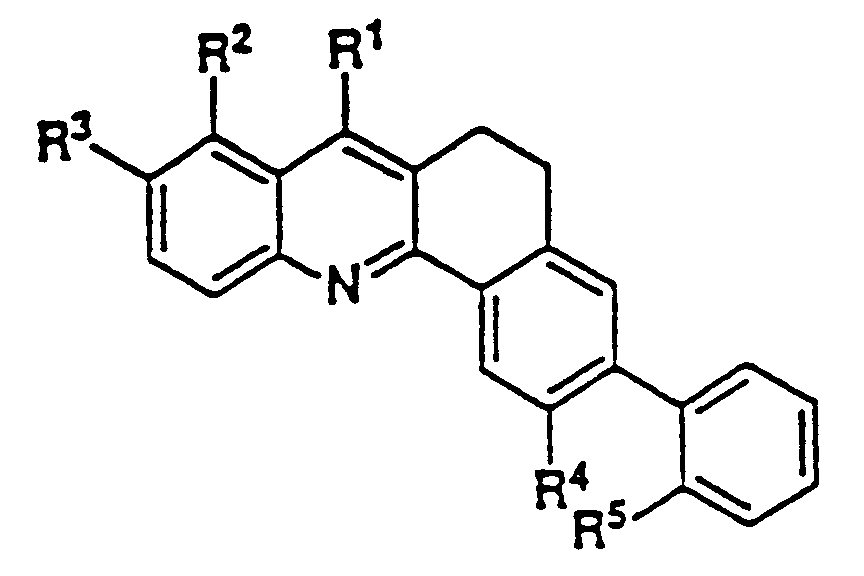
  • a compound represented by the formula (where R 1 represents CO 2 H, etc.; R 2 and R 3 independently represent H, F, etc.; and R 4 and R 5 independently represent H, etc.) is disclosed in JP-A-233661/90 (US-A-4,918,077) as being effective as a cancer chemotherapeutic agent, and in WO 92/00739, it is mentioned as being useful as an immunosuppresive agent.
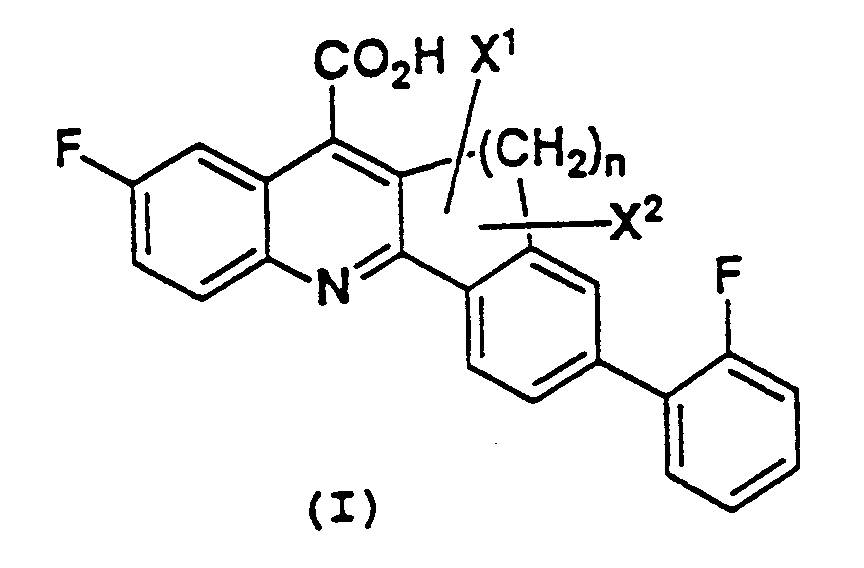
  • novel tetracyclic compounds represented by formula (I) (wherein X 1 and X 2 independently represent hydrogen or lower alkyl; and n represents an integer of 1 to 4) and pharmaceutically acceptable salts thereof.
  • the lower alkyl includes straight-chain or branched alkyl group having 1 to 6 carbon atoms, for example, methyl, ethyl, propyl, isopropyl, butyl, isobutyl, sec-butyl, tert-butyl, pentyl, neopentyl, hexyl, etc.
  • the pharmaceutically acceptable salts of Compound (I) include metal salts, ammonium salts, organic amine addition salts and amino acid addition salts.
  • the pharmaceutically acceptable metal salts of Compound (I) include alkali metal salts such as sodium salts and potassium salts, alkaline earth metal salts such as magnesium salts and calcium salts, aluminum salts and zinc salts; as the pharmaceutically acceptable ammonium salts include salts of ammonium and tetramethylammonium; as the pharmaceutically acceptable organic amine addition salts include addition salts with morpholine and piperidine; and as the pharmaceutically acceptable amino acid addition salt include addition salts with lysine, glycine and phenylalanine.
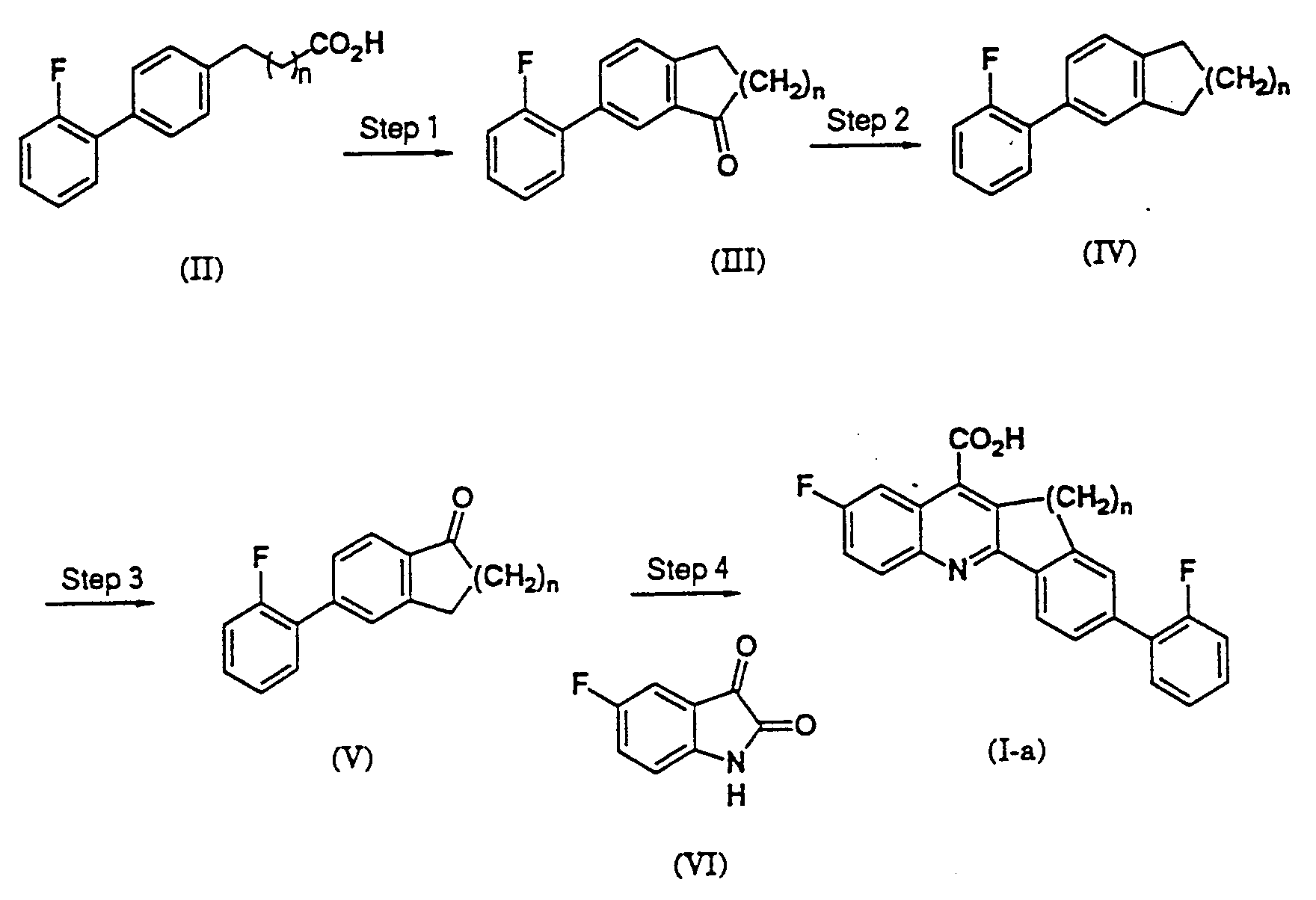
  • Compound (III) can be obtained by treating Compound (II) with a dehydrating agent in the absence of a solvent usually at 50 to 120°C for 1 to 6 hours.
  • the dehydrating agent includes polyphosphoric acid, methanesulfonic acid and sulfuric acid.
  • Compound (IV) can be obtained by reacting Compound (III) with 2 to 3 equivalents of triethylsilane in trifluoroacetic acid usually at room temperature to 70°C for 5 minutes to 6 hours.
  • Compound (V) can be obtained by reacting Compound (IV) with 1 to 4 equivalents of chromic acid in a mixed solvent of acetic acid/propionic acid usually at 0°C to room temperature for 1 to 6 hours.
  • Compound (I-a) can be obtained by reacting Compound (V) with an equivalent amount of Compound (VI) (product of Aldrich Co.) in a mixed solvent of ethanol/water under the alkaline condition where potassium hydroxide, sodium hydroxide, etc. are used usually at room temperature to 100°C for 3 to 120 hours.
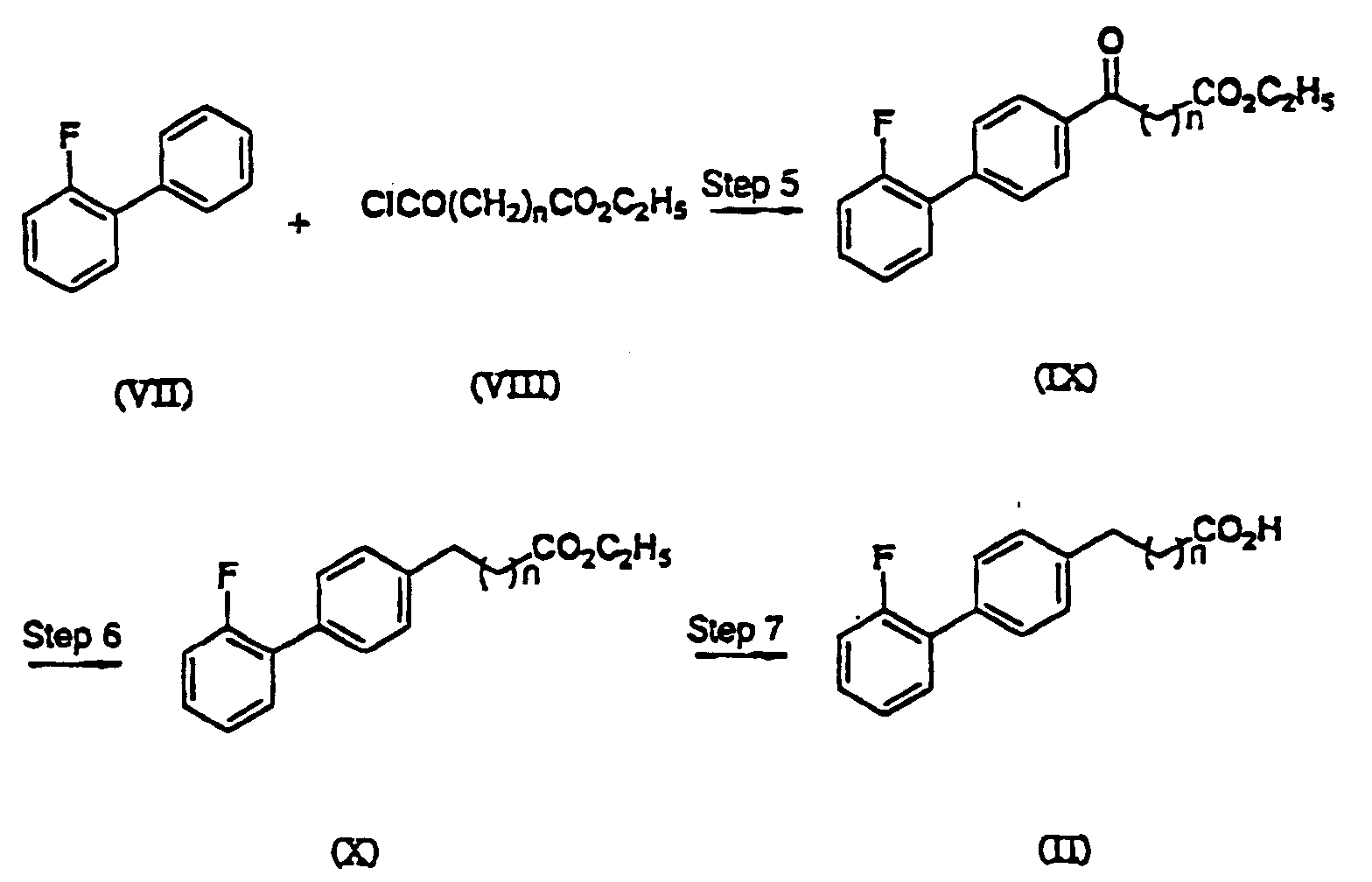
  • Compound (IX) can be obtained by reacting Compound (VII) (product of Aldrich Co.) with an equivalent amount of Compound (VIII) in an inert solvent such as dichloromethane and dichloroethane in the presence of 2 equivalents of a Lewis acid such as aluminum trichloride usually at 0°C to room temperature for 1 to 12 hours.
  • a Lewis acid such as aluminum trichloride usually at 0°C to room temperature for 1 to 12 hours.
  • Compound (X) can be obtained from Compound (IX) by the same method as in Step 2 above.
  • Compound (II) can be obtained by reacting Compound (X) in a mixed solvent of dioxane/water under the alkaline condition where potassium hydroxide, sodium hydroxide, etc. are used usually at room temperature to 100°C for 1 to 12 hours.
  • Compound (II-a), wherein n in the starting Compound (II) is 2 or 3, can be obtained by the following reaction steps. (In the above formulae, m represents 2 or 3.)
  • Compound (XII) can be obtained from Compound (VII) (product of Aldrich Co.) and an equivalent amount of Compound (XI) (product of Aldrich Co.) by approximately the same method as in Step 5 above.
  • Compound (II-a) can be obtained from Compound (XII) by approximately the same method as in Step 2 above.
  • Compound (V) can be obtained by the following reaction step.
  • n has the same meaning as defined above, Bu represents butyl, and Z represents bromine, iodine or trifluorosulfonyloxy.
  • Compound (V) can be obtained by reacting Compound (XIII) with 1 to 2 equivalents of Compound (XIV) in a solvent such as dimethylformamide, tetrahydrofuran and dioxane in the presence of a catalytic amount of a palladium complex usually at 60 to 120°C for 1 to 12 hours. If necessary, a salt such as lithium chloride or an oxidizing agent such as silver oxide may be added thereto.
  • Compound (XIII) may be synthesized by the known method [J. Org. Chem. 27 , 70 (1962)] or a similar method. Also, compound (XIV) may be synthesized by the known method [Angew. Chem., Int. Ed. Engl., 25 , 508 (1986)] or a similar method.
  • a compound wherein X 1 and/or X 2 in Compound (I) are lower alkyl may be obtained by the following Processes 2 to 4.
  • n has the same meaning as defined above, and X 1a represents the lower alkyl in the definition of X 1 .
  • Compound (XV) can be obtained by reacting Compound (III) with an equivalent amount of an alkylphosphonium salt in a solvent such as tetrahydrofuran, dioxane, dimethylformamide and dimethylsulfoxide in the presence of a base usually at 0 to 120°C for 5 minutes to 12 hours, and then carrying out catalytic hydrogenation with a catalyst such as palladium/carbon and platinum dioxide, in a solvent such as methanol, ethanol and acetic acid usually at 0 to 100°C for 5 minutes to 12 hours.
  • a solvent such as tetrahydrofuran, dioxane, dimethylformamide and dimethylsulfoxide
  • a base usually at 0 to 120°C for 5 minutes to 12 hours
  • a catalyst such as palladium/carbon and platinum dioxide
  • n-butyl lithium, potassium tert-butoxide, sodium hydride, sodium hydroxide, potassium carbonate, triethylamine are exemplified.
  • Compound (XV) can be obtained by reacting Compound (III) with 1 to 5 equivalents of a Grignard reagent in a solvent such as ether, tetrahydrofuran and dioxane at -30 to 100°C for 5 minutes to 12 hours, and then reacting the product with 1 to 2 equivalents of triethylsilane in trifluoroacetic acid usually at room temperature to 70°C for 5 minutes to 6 hours.
  • a solvent such as ether, tetrahydrofuran and dioxane
  • Compound (XVI) can be obtained from Compound (XV) by the same method as in Step 3 above.
  • Compound (I-b) can be obtained from Compound (XVI) and Compound (VI) by the same method as in Step 4 above.
  • Compound (XVII) can be obtained by reacting Compound (II) with 2 to 10 equivalents of a Grignard reagent in a solvent such as ether, tetrahydrofuran and dioxane usually at -30 to 100°C for 5 minutes to 12 hours.
  • a solvent such as ether, tetrahydrofuran and dioxane usually at -30 to 100°C for 5 minutes to 12 hours.
  • Compound (XVIII) can be obtained by treating Compound (XVII) in an inert solvent such as dichloromethane and dichloroethane in the presence of an equivalent amount of a Lewis acid such as aluminum trichloride usually at 0°C to room temperature for 1 to 12 hours.
  • an inert solvent such as dichloromethane and dichloroethane
  • a Lewis acid such as aluminum trichloride usually at 0°C to room temperature for 1 to 12 hours.
  • Compound (XIX) can be obtained from Compound (XVIII) by the same method as in Step 3 above.
  • Compound (I-c) can be obtained from Compound (XIX) and Compound (VI) by the same method as in Step 4 above.
  • Compound (XX) can be obtained by reacting Compound (III-a), Compound (III) wherein n is 2 or 3, with an alkyl halide such as methyl iodide and ethyl iodide in a solvent such as tetrahydrofuran, dioxane, dimethylformamide and dimethylsulfoxide in the presence of a base usually at 0 to 120°C for 5 minutes to 12 hours.
  • an alkyl halide such as methyl iodide and ethyl iodide
  • a solvent such as tetrahydrofuran, dioxane, dimethylformamide and dimethylsulfoxide
  • sodium hydride, potassium tert-butoxide, sodium hydroxide, potassium carbonate are exemplified.
  • a quaternary ammonium halide such as tetrabutylammonium bromide or a phase-transfer catalyst such as 18-crown-6 or another crown ether may be added thereto.
  • Compound (XX) can be obtained by reacting Compound (III-a) with a secondary amine such as pyrrolidine and piperazine in a solvent such as benzene and toluene in the presence of p-toluenesulfonic acid usually under reflux for 1 to 12 hours, and then reacting the product with an alkyl halide such as methyl iodide and ethyl iodide in a solvent such as dioxane and dimethylformamide usually at room temperature to 100°C for 5 minutes to 12 hours.
  • a secondary amine such as pyrrolidine and piperazine
  • a solvent such as benzene and toluene
  • p-toluenesulfonic acid usually under reflux for 1 to 12 hours
  • an alkyl halide such as methyl iodide and ethyl iodide
  • dioxane and dimethylformamide usually at room temperature to 100°C for 5 minutes to 12 hours
  • Compound (XXI) can be obtained from Compound (XX) by the same method as in Step 2 above.
  • Compound (XXII) can be obtained from Compound (XXI) by the same method as in Step 3 above.
  • Compound (I-d) can be obtained from Compound (XXII) and Compound (VI) by the same method as in Step 4 above.
  • the intermediates and the desired compounds in the processes described above may be isolated and purified by purification methods conventionally used in organic synthetic chemistry, for example, filtration, extraction, washing, drying, concentration, recrystallization, and various kinds of chromatography.
  • the intermediates may also be subjected to the subsequent reaction without purification.
  • Compound (I) and pharmaceutically acceptable salt thereof may be in the form of adducts with water or various solvents, which are also included in the scope of the present invention.
  • the plaque forming cell assay was carried out by the following manner with reference to the method of Jerne et al. [Science, 140 , 405 (1963)] and the method of Yamamoto et al. [Drugs Experimental Clinical Research, VIII(1), 5 (1982)].
  • mice Male Balb/c strain mice (7-week-old) (Charles River Co.) were sensitized with 1 x 10 8 sheep erythrocytes (product of Biotest Research Institute) administered via the caudal vein, and the spleens were extirpated after 6 or 7 days after the sensitization.
  • the extirpated spleens were immersed in Hanks' solution (Nissui Seiyaku) to make a cell suspension, which was then filtered, followed by centrifugal separation at 1200 rpm for 5 minutes.
  • the supernatant was discarded and the precipitate was treated with Tris ⁇ NH 4 Cl solution to remove the erythrocytes, and then washed three times with Hanks' solution.
  • the cells were suspended in an RPMI-1640 medium (Nissui Seiyaku) containing 10% bovine fetal serum (Gibco Co.), 50 ⁇ g/ml of streptomycin (Meiji Seika), 50 ⁇ U/ml of penicillin (Meiji Seika) and 2-mercaptoethanol (5 x 10 -5 M).
  • each well of a micro culture plate (NUNK Co., Ltd., 24 wells) were put 2 ml of the mixture of the cell suspension containing 1 x 10 7 of spleen cells 5 x 10 6 sheep erythrocytes and a test compound solution (10 -5 , 10 -6 , 10 -7 M) obtained by diluting the test compound dissolved in dimethylsulfoxide (10 -2 M) with the above mentioned RPMI-1640, and the cells were cultured at 37°C for 5 days.
  • a test compound solution (10 -5 , 10 -6 , 10 -7 M
  • the cells were subjected to centrifugal separation at 2000 rpm for 5 minutes, and the resulting supernatant was removed.
  • the precipitate was suspended in 1 ml of Hanks' solution, again subjected to centrifugal separation, suspended in 1 ml of Hanks' solution, and then, 50 ⁇ l of the suspension and 50 ⁇ l of sheep erythrocytes were added to 400 ⁇ l of 0.25% agarose/Hanks' solution heated to 50°C in advance, and the mixture was scattered on a glass slide, placed on a plaque assay plate, and together with guinea pig complement (Cedarlene Institute) diluted 40-fold with a phosphate buffer solution, incubated at 37°C for 1 to 2 hours. The number of the appearing direct plaque cells (direct PFC count) in suspension was counted.
  • inhibition rate(%) PFC count in control - PFC count in the presence of test compound PFC count in control x 100
  • PFC count in control means PFC count in the absence of the test compound (dimethylsulfoxide alone).
  • the experiment was carried out by using groups of 7-weeks-old female Lewis rats (Charles River Co.), each group consisting of 8 rats. Following the method of Newbould B.B. [Brit. J. Pharmacol., 21 , 127 (1963)], Mycobacterium butyricum (killed and dried) (Difco Co.) suspended in liquid paraffin (0.6 mg/0.1 ml) was subcutaneously injected, as an adjuvant, into right hind paw of rats, hind paws volumes of which were measured in advance.
  • the hind paws volumes were measured using a plethysmograph (Unicom Co., Ltd., TK-101), and the swelling rates were determined by comparing each of the right and left hind paws volumes before the injection with that after the injection.
  • test compound (Compound 3) was suspended in a 5% arabic gum solution and orally administered once a day on days 0 to 4, days 7 to 11 and days 14 to 17 provided the day of injection of the adjuvant was counted as day 0.
  • Compound (I) and its pharmaceutically acceptable salts can be used as they are or in various preparation forms for the desired purpose of administration.
  • the pharmaceutical composition of the present invention can be prepared by uniformly mixing an effective amount of Compound (I) or its pharmaceutically acceptable salts as an active ingredient with a pharmaceutically acceptable carrier.
  • the carrier may be in any of a wide variety of forms, depending on the most preferable form of preparation for administration.
  • the pharmaceutical compositions are preferably in a unit dosage form suitable for oral administration or injection.
  • any useful, pharmaceutically acceptable carrier can be used.
  • a liquid preparation for oral administration such as suspension and a syrup can be prepared using water; a sugar such as sucrose, sorbitol and fructose; a glycol such as polyethylene glycol and propylene glycol; an oil such as sesame oil, olive oil and soybean oil; an antiseptic such as alkyl p-hydroxybenzoate; and a flavor such as strawberry flavor and peppermint flavor.
  • Powders, pills, capsules and tablets may be prepared using an excipient such as lactose, glucose, sucrose and mannitol; a disintegrator such as starch and sodium alginate; a lubricant such as magnesium stearate and talc; a binder such as polyvinyl alcohol, hydroxypropyl cellulose and gelatin; a surfactant such as fatty acid esters; and a plasticizer such as glycerin. Tablets and capsules are the most useful oral unit dose forms, since their administration is easy. In the preparation of tablets or capsules, a solid pharmaceutical carrier is used.
  • a solution for injection may be prepared using a carrier such as distilled water, a saline solution, a glucose solution and a mixture of a saline solution and a glucose solution.
  • a carrier such as distilled water, a saline solution, a glucose solution and a mixture of a saline solution and a glucose solution.
  • Compound (I) or its pharmaceutically acceptable salts may be administered either orally or parenterally by injection.
  • the effective dose and the administration schedule of Compound (I) or its pharmaceutically acceptable salts vary depending on the mode of administration, age, weight and conditions of a patient, etc. However, it is generally preferred to administer Compound (I) or its pharmaceutically acceptable salts in a dose of 1 to 50 mg/kg per day in 3 to 4 parts.
  • Fig. 1 shows the swelling rates of the rats with right hind paw treated with an adjuvant.
  • - ⁇ - represents the swelling rates of the control group
  • - ⁇ - represents the swelling rates of a comparison compound-administered group (dose: 3 mg/kg)
  • - ⁇ - represents the swelling rates of a comparison compound-administered group (dose: 10 mg/kg)
  • - ⁇ - represents the swelling rates of a test compound-administered group (dose: 1 mg/kg)
  • - ⁇ - represents the swelling rates of a test compound-administered group (dose: 3 mg/kg).
  • Fig. 2 shows the swelling rates of the rats with the left hind paw untreated with an adjuvant.
  • - ⁇ - represents the swelling rates of the control group
  • - ⁇ - represents the swelling rates of a comparison compound-administered group (dose: 3 mg/kg)
  • - ⁇ - represents the swelling rates of a comparison compound-administered group (dose: 10 mg/kg)
  • - ⁇ - represents the swelling rates of a test compound-administered group (dose: 1 mg/kg)
  • - ⁇ - represents the swelling rates of a test compound-administered group (dose: 3 mg/kg).
  • reaction solution was filtered through celite®, washed with ethyl acetate and water, and then extracted. The organic layer was washed with saline and dried over anhydrous magnesium sulfate. The solvent was distilled off under reduced pressure and the residue was then separated and purified by silica gel column chromatography [elution solvent: hexane-ethyl acetate (9:1)] to obtain 0.84 g (40%) of the desired compound.
  • the organic layer was washed with saline and dried over anhydrous magnesium sulfate.
  • the solvent was distilled off under reduced pressure, the residue was dissolved in 30 ml of ethanol, 150 mg of palladium/carbon was added thereto, and the mixture was stirred under a hydrogen atmosphere at room temperature for 4 hours. The mixture was then filtered through celite® and the solvent was distilled off. The residue was separated and purified by silica gel column chromatography [elution solvent: hexane] to obtain 1.80 g (60%) of the desired compound.
  • the organic layer was washed with saline and dried over anhydrous magnesium sulfate.
  • the solvent was distilled off under reduced pressure, the residue was dissolved in 80 ml of ethanol, 168 mg of platinum dioxide was added thereto, and the mixture was stirred under a hydrogen atmosphere at room temperature for 4 hours.
  • the mixture was then filtered through celite® and the solvent was distilled off.
  • the residue was separated and purified by silica gel column chromatography [elution solvent: hexane] to obtain 3.26 g (77%) of the desired compound.
  • the solvent was distilled off under reduced pressure, and then the residue was separated and purified by silica gel column chromatography [elution solvent: hexane-ethyl acetate (25:1)].
  • silica gel column chromatography [elution solvent: hexane-ethyl acetate (25:1)].
  • To 2.0 g of the obtained compound were added 2.85 ml (17.8 mmol) of triethylsilane and 10 ml of trifluoroacetic acid, and the mixture was stirred at 60°C for 1 hour.
  • the solvent was distilled off under reduced pressure, chloroform was added thereto for extraction and the organic layer was washed with water and dried over anhydrous magnesium sulfate.
  • the solvent was distilled off under reduced pressure, and the residue was then separated and purified by silica gel column chromatography [elution solvent: hexane] to obtain the desired compound, which was used in the next reaction with no further purification.
  • the solvent was distilled off under reduced pressure, and chloroform was added to the residue for extraction.
  • the organic layer was washed with water and then dried over anhydrous magnesium sulfate.
  • the solvent was distilled off under reduced pressure and then the residue was separated and purified by silica gel column chromatography [elution solvent: hexane-ethyl acetate (30:1)] to obtain 1.66 g (63% yield) of the desired compound.
  • Capsules each having the following composition were prepared in a conventional manner.
  • Prescription Compound 1 10 mg Lactose 100 mg Magnesium stearate 2.5 mg
  • novel tetracyclic compounds which are useful as immunosuppressive agents.

Landscapes

  • Chemical & Material Sciences (AREA)
  • Organic Chemistry (AREA)
  • Pharmaceuticals Containing Other Organic And Inorganic Compounds (AREA)
  • Heterocyclic Carbon Compounds Containing A Hetero Ring Having Oxygen Or Sulfur (AREA)
  • Nitrogen And Oxygen Or Sulfur-Condensed Heterocyclic Ring Systems (AREA)
  • Other In-Based Heterocyclic Compounds (AREA)
  • Nitrogen Condensed Heterocyclic Rings (AREA)

Abstract

A novel tetracyclic compound useful as an immuno-suppressant, represented by general formula (I), or a pharmacologically acceptable salt thereof wherein X<1> and X<2> may be the same or different from each other and each represents hydrogen or lower alkyl, and n represents an integer of 1 to 4. <CHEM>

Description

The present invention relates to novel tetracyclic compounds which are useful as immunosuppresive agents.
A compound represented by the formula
Figure 00010001
(where R1 represents CO2H, etc.; R2 and R3 independently represent H, F, etc.; and R4 and R5 independently represent H, etc.) is disclosed in JP-A-233661/90 (US-A-4,918,077) as being effective as a cancer chemotherapeutic agent, and in WO 92/00739, it is mentioned as being useful as an immunosuppresive agent.
The compound sodium 2-(2'-fluoro-1,1'-biphenyl-4-yl)-6-fluoro-3-methyl-4-quinoline carboxylate (DuP785) is disclosed in JP-A-313428/89 (US-A-5,084,462) as being useful as an immunosuppresive agent.
The compounds 5H-indeno[1,2-b]quinoline-6-carboxylic acid; 6,7-dihydro-5H-benzo[6,7]cyclohepta[1,2-b]quinoline-8-carboxylic acid and 5,6,7,8-tetrahydrobenzo[7,8]-cycloocta[1,2-b]quinoline-9-carboxylic acid have been reported, but their pharmacological effects are unknown ((Liebigs Ann. Chem., 610, 57 (1957)].
According to the present invention, there are provided novel tetracyclic compounds represented by formula (I)
Figure 00020001
(wherein X1 and X2 independently represent hydrogen or lower alkyl; and n represents an integer of 1 to 4) and pharmaceutically acceptable salts thereof.
In the definition of the respective groups in formula (I), the lower alkyl includes straight-chain or branched alkyl group having 1 to 6 carbon atoms, for example, methyl, ethyl, propyl, isopropyl, butyl, isobutyl, sec-butyl, tert-butyl, pentyl, neopentyl, hexyl, etc.
The pharmaceutically acceptable salts of Compound (I) include metal salts, ammonium salts, organic amine addition salts and amino acid addition salts.
As the pharmaceutically acceptable metal salts of Compound (I) include alkali metal salts such as sodium salts and potassium salts, alkaline earth metal salts such as magnesium salts and calcium salts, aluminum salts and zinc salts; as the pharmaceutically acceptable ammonium salts include salts of ammonium and tetramethylammonium; as the pharmaceutically acceptable organic amine addition salts include addition salts with morpholine and piperidine; and as the pharmaceutically acceptable amino acid addition salt include addition salts with lysine, glycine and phenylalanine.
The processes for producing the compounds of the present invention are described below.
Process 1
Compound (I-a), Compound (I) wherein X1 and X2 are both hydrogen, can be obtained by the following reaction steps.
Figure 00030001
(In the above formulae, n has the same meaning as defined above.)
STEP 1:
Compound (III) can be obtained by treating Compound (II) with a dehydrating agent in the absence of a solvent usually at 50 to 120°C for 1 to 6 hours.
The dehydrating agent includes polyphosphoric acid, methanesulfonic acid and sulfuric acid.
STEP 2:
Compound (IV) can be obtained by reacting Compound (III) with 2 to 3 equivalents of triethylsilane in trifluoroacetic acid usually at room temperature to 70°C for 5 minutes to 6 hours.
STEP 3:
Compound (V) can be obtained by reacting Compound (IV) with 1 to 4 equivalents of chromic acid in a mixed solvent of acetic acid/propionic acid usually at 0°C to room temperature for 1 to 6 hours.
STEP 4:
Compound (I-a) can be obtained by reacting Compound (V) with an equivalent amount of Compound (VI) (product of Aldrich Co.) in a mixed solvent of ethanol/water under the alkaline condition where potassium hydroxide, sodium hydroxide, etc. are used usually at room temperature to 100°C for 3 to 120 hours.
Compound (II) can be obtained by the following reaction steps.
Figure 00040001
(In the above formulae, n has the same meaning as defined above.)
STEP 5:
Compound (IX) can be obtained by reacting Compound (VII) (product of Aldrich Co.) with an equivalent amount of Compound (VIII) in an inert solvent such as dichloromethane and dichloroethane in the presence of 2 equivalents of a Lewis acid such as aluminum trichloride usually at 0°C to room temperature for 1 to 12 hours.
STEP 6:
Compound (X) can be obtained from Compound (IX) by the same method as in Step 2 above.
STEP 7:
Compound (II) can be obtained by reacting Compound (X) in a mixed solvent of dioxane/water under the alkaline condition where potassium hydroxide, sodium hydroxide, etc. are used usually at room temperature to 100°C for 1 to 12 hours.
As an alternative method, Compound (II-a), wherein n in the starting Compound (II) is 2 or 3, can be obtained by the following reaction steps.
Figure 00050001
(In the above formulae, m represents 2 or 3.)
STEP 8:
Compound (XII) can be obtained from Compound (VII) (product of Aldrich Co.) and an equivalent amount of Compound (XI) (product of Aldrich Co.) by approximately the same method as in Step 5 above.
STEP 9:
Compound (II-a) can be obtained from Compound (XII) by approximately the same method as in Step 2 above.
Compound (V) can be obtained by the following reaction step.
Figure 00060001
(In the above formulae, n has the same meaning as defined above, Bu represents butyl, and Z represents bromine, iodine or trifluorosulfonyloxy.)
STEP 10:
Compound (V) can be obtained by reacting Compound (XIII) with 1 to 2 equivalents of Compound (XIV) in a solvent such as dimethylformamide, tetrahydrofuran and dioxane in the presence of a catalytic amount of a palladium complex usually at 60 to 120°C for 1 to 12 hours. If necessary, a salt such as lithium chloride or an oxidizing agent such as silver oxide may be added thereto.
Compound (XIII) may be synthesized by the known method [J. Org. Chem. 27, 70 (1962)] or a similar method. Also, compound (XIV) may be synthesized by the known method [Angew. Chem., Int. Ed. Engl., 25, 508 (1986)] or a similar method.
A compound wherein X1 and/or X2 in Compound (I) are lower alkyl may be obtained by the following Processes 2 to 4.
Process 2
Figure 00070001
(In the above formulae, n has the same meaning as defined above, and X1a represents the lower alkyl in the definition of X1.)
STEP 11:
Compound (XV) can be obtained by reacting Compound (III) with an equivalent amount of an alkylphosphonium salt in a solvent such as tetrahydrofuran, dioxane, dimethylformamide and dimethylsulfoxide in the presence of a base usually at 0 to 120°C for 5 minutes to 12 hours, and then carrying out catalytic hydrogenation with a catalyst such as palladium/carbon and platinum dioxide, in a solvent such as methanol, ethanol and acetic acid usually at 0 to 100°C for 5 minutes to 12 hours.
As the base, n-butyl lithium, potassium tert-butoxide, sodium hydride, sodium hydroxide, potassium carbonate, triethylamine are exemplified.
As an alternative method of Step 11, Compound (XV) can be obtained by reacting Compound (III) with 1 to 5 equivalents of a Grignard reagent in a solvent such as ether, tetrahydrofuran and dioxane at -30 to 100°C for 5 minutes to 12 hours, and then reacting the product with 1 to 2 equivalents of triethylsilane in trifluoroacetic acid usually at room temperature to 70°C for 5 minutes to 6 hours.
STEP 12:
Compound (XVI) can be obtained from Compound (XV) by the same method as in Step 3 above.
STEP 13:
Compound (I-b) can be obtained from Compound (XVI) and Compound (VI) by the same method as in Step 4 above.
Process 3
Figure 00090001
(In the above formulae, X1a and n have the same meanings as defined above and X2a represents the lower alkyl in the definition of X2.)
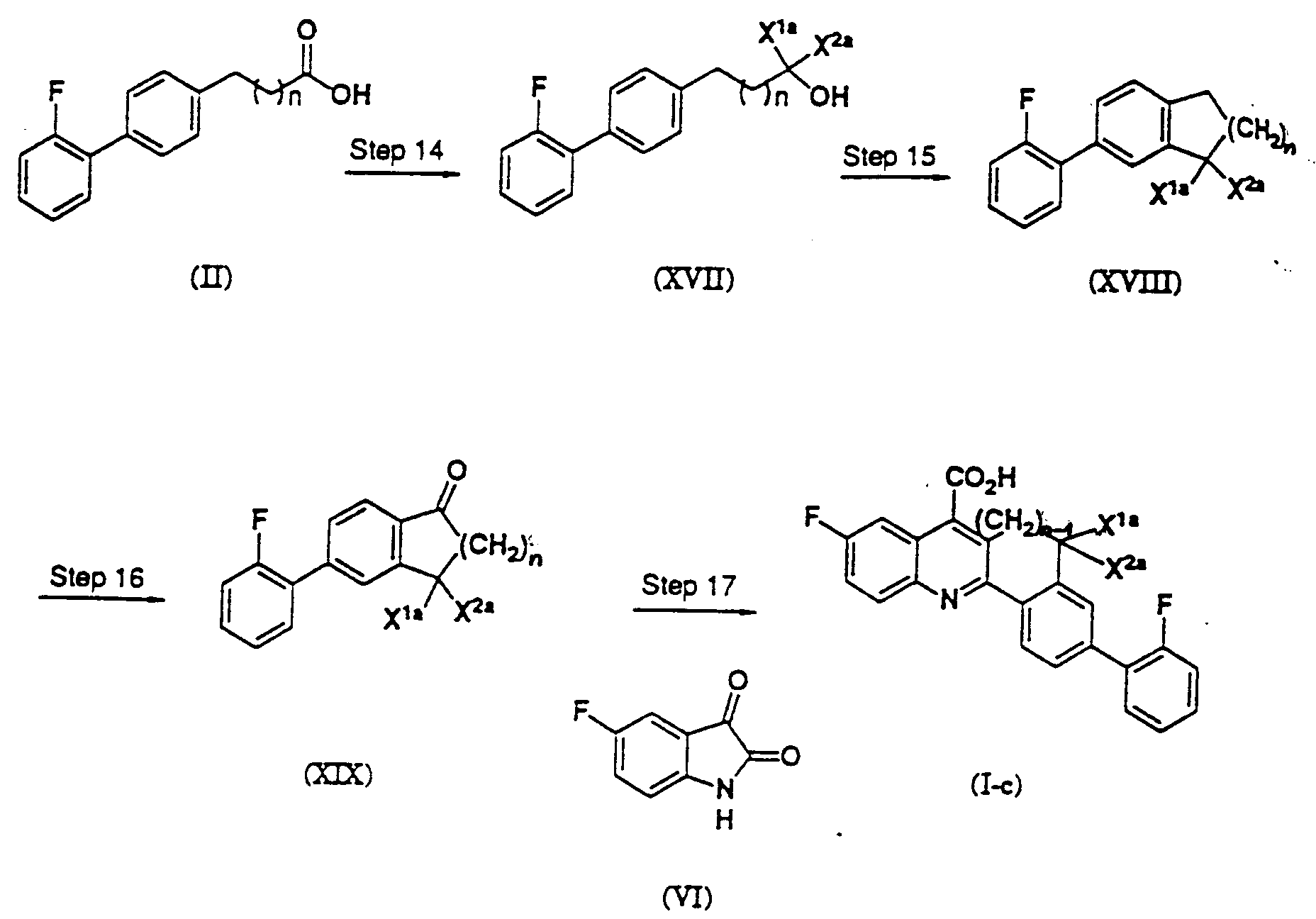
STEP 14:
Compound (XVII) can be obtained by reacting Compound (II) with 2 to 10 equivalents of a Grignard reagent in a solvent such as ether, tetrahydrofuran and dioxane usually at -30 to 100°C for 5 minutes to 12 hours.
STEP 15:
Compound (XVIII) can be obtained by treating Compound (XVII) in an inert solvent such as dichloromethane and dichloroethane in the presence of an equivalent amount of a Lewis acid such as aluminum trichloride usually at 0°C to room temperature for 1 to 12 hours.
STEP 16:
Compound (XIX) can be obtained from Compound (XVIII) by the same method as in Step 3 above.
STEP 17:
Compound (I-c) can be obtained from Compound (XIX) and Compound (VI) by the same method as in Step 4 above.
Process 4
Figure 00100001
(In the above formulae, X1a, X2 and m have the same meanings as defined above.)
STEP 18:
Compound (XX) can be obtained by reacting Compound (III-a), Compound (III) wherein n is 2 or 3, with an alkyl halide such as methyl iodide and ethyl iodide in a solvent such as tetrahydrofuran, dioxane, dimethylformamide and dimethylsulfoxide in the presence of a base usually at 0 to 120°C for 5 minutes to 12 hours.
As the base, sodium hydride, potassium tert-butoxide, sodium hydroxide, potassium carbonate are exemplified. If necessary, a quaternary ammonium halide such as tetrabutylammonium bromide or a phase-transfer catalyst such as 18-crown-6 or another crown ether may be added thereto.
As an alternative method of Step 18, Compound (XX) can be obtained by reacting Compound (III-a) with a secondary amine such as pyrrolidine and piperazine in a solvent such as benzene and toluene in the presence of p-toluenesulfonic acid usually under reflux for 1 to 12 hours, and then reacting the product with an alkyl halide such as methyl iodide and ethyl iodide in a solvent such as dioxane and dimethylformamide usually at room temperature to 100°C for 5 minutes to 12 hours.
STEP 19:
Compound (XXI) can be obtained from Compound (XX) by the same method as in Step 2 above.
STEP 20:
Compound (XXII) can be obtained from Compound (XXI) by the same method as in Step 3 above.
STEP 21:
Compound (I-d) can be obtained from Compound (XXII) and Compound (VI) by the same method as in Step 4 above.
The intermediates and the desired compounds in the processes described above may be isolated and purified by purification methods conventionally used in organic synthetic chemistry, for example, filtration, extraction, washing, drying, concentration, recrystallization, and various kinds of chromatography. The intermediates may also be subjected to the subsequent reaction without purification.
In the case where a salt of Compound (I) is desired and it is produced in the form of the desired salt, it may be subjected to purification as such. In the case where Compound (I) is produced in the free form and its salt is desired, it may be dissolved or suspended in an appropriate solvent, and then an acid or a base may be added thereto to the solution or suspension to form its salt.
Compound (I) and pharmaceutically acceptable salt thereof may be in the form of adducts with water or various solvents, which are also included in the scope of the present invention.
Specific examples of Compound (I) obtained by the respective processes are shown in Table 1.
Figure 00120001
The pharmacological activities of Compound (I) are illustrated with the following test examples.
Test Example 1: Plaque Forming Cell Assay
The plaque forming cell assay was carried out by the following manner with reference to the method of Jerne et al. [Science, 140, 405 (1963)] and the method of Yamamoto et al. [Drugs Experimental Clinical Research, VIII(1), 5 (1982)].
Male Balb/c strain mice (7-week-old) (Charles River Co.) were sensitized with 1 x 10⁸ sheep erythrocytes (product of Biotest Research Institute) administered via the caudal vein, and the spleens were extirpated after 6 or 7 days after the sensitization. The extirpated spleens were immersed in Hanks' solution (Nissui Seiyaku) to make a cell suspension, which was then filtered, followed by centrifugal separation at 1200 rpm for 5 minutes. After centrifugal separation, the supernatant was discarded and the precipitate was treated with Tris·NH4Cl solution to remove the erythrocytes, and then washed three times with Hanks' solution. After discarding the supernatant, the cells were suspended in an RPMI-1640 medium (Nissui Seiyaku) containing 10% bovine fetal serum (Gibco Co.), 50 µg/ml of streptomycin (Meiji Seika), 50 µU/ml of penicillin (Meiji Seika) and 2-mercaptoethanol (5 x 10⁻⁵M). In each well of a micro culture plate (NUNK Co., Ltd., 24 wells) were put 2 ml of the mixture of the cell suspension containing 1 x 10⁷ of spleen cells 5 x 10⁶ sheep erythrocytes and a test compound solution (10-5, 10-6, 10-7 M) obtained by diluting the test compound dissolved in dimethylsulfoxide (10-2 M) with the above mentioned RPMI-1640, and the cells were cultured at 37°C for 5 days.
After the completion of the culturing, the cells were subjected to centrifugal separation at 2000 rpm for 5 minutes, and the resulting supernatant was removed. The precipitate was suspended in 1 ml of Hanks' solution, again subjected to centrifugal separation, suspended in 1 ml of Hanks' solution, and then, 50 µl of the suspension and 50 µl of sheep erythrocytes were added to 400 µl of 0.25% agarose/Hanks' solution heated to 50°C in advance, and the mixture was scattered on a glass slide, placed on a plaque assay plate, and together with guinea pig complement (Cedarlene Institute) diluted 40-fold with a phosphate buffer solution, incubated at 37°C for 1 to 2 hours. The number of the appearing direct plaque cells (direct PFC count) in suspension was counted.
The inhibition rate of the antibody production of the test compound was determined by the following equation. inhibition rate(%) = PFC count in control - PFC count in the presence of test compoundPFC count in control x 100
The compound used for comparison was 5,6-dihydro-9-fluoro-3-phenylbenzic]acridine-7-carboxylic acid [JP-A-233661/90], hereinafter referred to as Compound (A) represented by formula (A).
Figure 00140001
PFC count in control means PFC count in the absence of the test compound (dimethylsulfoxide alone).
The results are shown in Table 2.
Compound No. Concentration (M) Inhibition rate (%)
2 10-5 99.4
10-6 94.4
10-7 57.1
3 10-5 83.5
10-6 80.3
10-7 55.4
5 10-5 98.7
10-6 64.6
7 10-5 98.1
10-6 75.3
8 10-5 98.7
10-6 80.2
A 10-5 78.6
10-6 45.9
Test Example 2: Prophylactic effect against adjuvant arthritis
The experiment was carried out by using groups of 7-weeks-old female Lewis rats (Charles River Co.), each group consisting of 8 rats. Following the method of Newbould B.B. [Brit. J. Pharmacol., 21, 127 (1963)], Mycobacterium butyricum (killed and dried) (Difco Co.) suspended in liquid paraffin (0.6 mg/0.1 ml) was subcutaneously injected, as an adjuvant, into right hind paw of rats, hind paws volumes of which were measured in advance. After the injection, the hind paws volumes were measured using a plethysmograph (Unicom Co., Ltd., TK-101), and the swelling rates were determined by comparing each of the right and left hind paws volumes before the injection with that after the injection.
The test compound (Compound 3) was suspended in a 5% arabic gum solution and orally administered once a day on days 0 to 4, days 7 to 11 and days 14 to 17 provided the day of injection of the adjuvant was counted as day 0.
To the control group was orally administered only a 5% arabic gum solution.
The compound used for comparison was sodium 2-(2'-fluoro-1,1'-biphenyl-4-yl)-6-fluoro-3-methyl-4-quinolinecarboxylate [Japanese Published Unexamined Patent Application No. 313428/89], hereinafter referred to as Compound (B) represented by formula (B).
Figure 00160001
The results are shown in Figs. 1 and 2.
Depending on the pharmaceutical effects, Compound (I) and its pharmaceutically acceptable salts can be used as they are or in various preparation forms for the desired purpose of administration. The pharmaceutical composition of the present invention can be prepared by uniformly mixing an effective amount of Compound (I) or its pharmaceutically acceptable salts as an active ingredient with a pharmaceutically acceptable carrier. The carrier may be in any of a wide variety of forms, depending on the most preferable form of preparation for administration. The pharmaceutical compositions are preferably in a unit dosage form suitable for oral administration or injection.
In the preparation of pharmaceutical compositions for oral administration, any useful, pharmaceutically acceptable carrier can be used. For example, a liquid preparation for oral administration such as suspension and a syrup can be prepared using water; a sugar such as sucrose, sorbitol and fructose; a glycol such as polyethylene glycol and propylene glycol; an oil such as sesame oil, olive oil and soybean oil; an antiseptic such as alkyl p-hydroxybenzoate; and a flavor such as strawberry flavor and peppermint flavor. Powders, pills, capsules and tablets may be prepared using an excipient such as lactose, glucose, sucrose and mannitol; a disintegrator such as starch and sodium alginate; a lubricant such as magnesium stearate and talc; a binder such as polyvinyl alcohol, hydroxypropyl cellulose and gelatin; a surfactant such as fatty acid esters; and a plasticizer such as glycerin. Tablets and capsules are the most useful oral unit dose forms, since their administration is easy. In the preparation of tablets or capsules, a solid pharmaceutical carrier is used.
A solution for injection may be prepared using a carrier such as distilled water, a saline solution, a glucose solution and a mixture of a saline solution and a glucose solution.
Compound (I) or its pharmaceutically acceptable salts may be administered either orally or parenterally by injection. The effective dose and the administration schedule of Compound (I) or its pharmaceutically acceptable salts vary depending on the mode of administration, age, weight and conditions of a patient, etc. However, it is generally preferred to administer Compound (I) or its pharmaceutically acceptable salts in a dose of 1 to 50 mg/kg per day in 3 to 4 parts.
Brief Description of the Drawings
Fig. 1 shows the swelling rates of the rats with right hind paw treated with an adjuvant.
In the figure, -○- represents the swelling rates of the control group, -▵- represents the swelling rates of a comparison compound-administered group (dose: 3 mg/kg), -□- represents the swelling rates of a comparison compound-administered group (dose: 10 mg/kg), -▴- represents the swelling rates of a test compound-administered group (dose: 1 mg/kg), and -▪- represents the swelling rates of a test compound-administered group (dose: 3 mg/kg).
Fig. 2 shows the swelling rates of the rats with the left hind paw untreated with an adjuvant.
In the figure, -○- represents the swelling rates of the control group, -▵- represents the swelling rates of a comparison compound-administered group (dose: 3 mg/kg), -□- represents the swelling rates of a comparison compound-administered group (dose: 10 mg/kg), -▴- represents the swelling rates of a test compound-administered group (dose: 1 mg/kg), and -▪- represents the swelling rates of a test compound-administered group (dose: 3 mg/kg).
Certain embodiments of the present invention are illustrated in the following Examples, Reference Examples and Preparation Examples.
Example 1 8-Fluoro-3-(2-fluorophenyl)-5H-indeno[1,2-b]quinoline-6-carboxylic acid (Compound 1)
In 1 ml of water containing 650 mg (10 mmol) of potassium hydroxide was dissolved 330 mg (2 mmol) of 5-fluoroisatin, and 450 mg (2 mmol) of Compound c obtained in Reference Example 3 and dissolved in 5 ml of dioxane-ethanol (2:3) was added thereto. After heating to reflux for 3 hours, the solvent was distilled off and ether was added thereto, followed by extraction with water. Hydrochloric acid was added to the aqueous layer, and the precipitated crystals were filtered off. The obtained crystals were washed with water, dried and recrystallized from dimethylformamide-water to obtain 313 mg (42% yield) of the desired compound.
  • Melting point: >300°C
    Elemental analysis (%): C23H13F2NO2·0.5H2O
    Calcd.: C 72.25, H 3.69, N 3.66
    Found : C 72.35, H 3.39, N 4.07
  • IR (KBr)cm-1: 1705, 1620, 1505, 1240
  • NMR (DMSO-d6), δ (ppm): 8.35-8.21(m, 3H), 7.91(s, 1H), 7.78-7.61(m, 3H), 7.53-7.33(m, 3H), 4.40(s, 2H)
  • MS (m/e): 373 (M+), 328 [(M-COOH)+]
  • Example 2 5,6-Dihydro-9-fluoro-3-(2-fluorophenyl)benz[c]acridine-7-carboxylic acid (Compound 2)
    In 24 ml of ethanol were dissolved 2.66 g (16 mmol) of Compound h obtained in Reference Example 8 and 3.81 g (16 mmol) of 5-fluoroisatin, and 12 ml of water containing 4.22 g (80 mmol) of potassium hydroxide was added thereto. After heating to reflux for 60 hours, the solvent was distilled off, and ether was added thereto, followed by extraction with water. Hydrochloric acid was added to the aqueous layer, the precipitated crystals were filtered off and then washed with ether. The obtained crystals were recrystallized from dimethylformamide-water to obtain 2.6 g (43% yield) of the desired compound.
  • Melting point: >300°C
    Elemental analysis (%): C24H15F2NO2·0.2H2O
    Calcd.: C 73.73, H 3.97, N 3.58
    Found : C 73.65, H 3.73, N 3.67
  • IR (KBr)cm-1: 3400, 1718, 1615, 1502, 1420
  • NMR (DMSO-d6), δ (ppm): 8.52(1H, d, J=8Hz), 8.23-8.17(1H, m), 7.95-7.32(8H, m), 3.21-3.07(4H, m)
  • MS (m/e): 387 (M+)
  • Example 3 6,7-Dihydro-10-fluoro-3-(2-fluorophenyl)-5H-benzo[6,7]cyclohepta[1,2-b]quinoline-8-carboxylic acid (Compound 3)
    In 4 ml of ethanol were dissolved 0.62 g (2.4 mmol) of Compound m obtained in Reference Example 13 and 0.41 g (2.4 mmol) of 5-fluoroisatin, and 2 ml of water containing 0.67 g (12 mmol) of potassium hydroxide was added thereto. After heating to reflux for 50 hours, the solvent was distilled off, and ether was added thereto, followed by extraction with water. Hydrochloric acid was added to the aqueous layer, the precipitated crystals were filtered off and then washed with ether. The obtained crystals were recrystallized from dimethylformamide-water to obtain 445 mg (46% yield) of the desired compound.
  • Melting point: >300°C
    Elemental analysis (%): C25H17F2NO2·0.4H2O
    Calcd.: C 73.49, H 4.39, N 3.43
    Found : C 73.55, H 4.04, N 3.34
  • IR (KBr)cm-1: 2940, 2860, 1730, 1625, 1500, 1480, 1240
  • NMR (DMSO-d6), δ (ppm): 8.24-8.19(1H, m), 7.87(1H, d, J=8Hz), 7.79-7.32(8H, m), 2.89-2.61(4H, m), 2.26-2.21(2H, m)
  • MS (m/e): 401 (M+), 356
  • Example 4 11-Fluoro-3-(2-fluorophenyl)-5,6,7,8-tetrahydrobenzo[7,8]cycloocta[1,2-b]quinoline-9-carboxylic acid (Compound 4)
    In 7 ml of ethanol were dissolved 0.67 g (2.5 mmol) of Compound n obtained in Reference Example 14 and 0.41 g (2.5 mmol) of 5-fluoroisatin, and 7 ml of 6 N potassium hydroxide was added thereto. After heating to reflux for 24 hours, the solvent was distilled off, and ether was added thereto, followed by extraction with water. Hydrochloric acid was added to the aqueous layer, and the precipitated crystals were filtered off. The obtained residue was separated and purified by silica gel column chromatography [elution solvent: chloroform-methanol-acetic acid (100:1:0.1)], and then recrystallized from ethanol to obtain 0.60 g (58% yield) of the desired compound.
  • Melting point: >300°C
    Elemental analysis (%): C26H19F2NO2·0.5H2O
    Calcd.: C 73.58, H 4.75, N 3.30
    Found : C 73.27, H 4.54, N 3.38
  • IR (KBr)cm-1: 2928, 1702, 1625, 1501, 1486
  • NMR (DMSO-d6), δ (ppm): 8.23-8.17(1H, m), 7.79-7.32(9H, m), 3.08-2.85(2H, m), 2.34-1.65(6H, m)
  • MS (m/e): 415 (M+)
  • Example 5 5,6-Dihydro-9-fluoro-3-(2-fluorophenyl)-5-methylbenz[c]acridine-7-carboxylic acid (Compound 5)
    In 15 ml of ethanol were dissolved 1.26 g (5.0 mmol) of Compound p obtained in Reference Example 16 and 0.82 g (5.0 mmol) of 5-fluoroisatin, and 4 ml of water containing 1.39 g (25 mmol) of potassium hydroxide was added thereto. After heating to reflux for 45 hours, the solvent was distilled off, and ether was added thereto, followed by extraction with water. Hydrochloric acid was added to the aqueous layer, the precipitated crystals were filtered off and then washed with ether. The obtained crystals were recrystallized from ethanol to obtain 0.85 g (43% yield) of the desired compound.
  • Melting point: 274.1-277.4°C
    Elemental analysis (%): C25H17F2NO2·0.4H2O
    Calcd.: C 73.49, H 4.39, N 3.43
    Found : C 73.34, H 4.11, N 3.72
  • IR (KBr)cm-1: 2364, 1626, 1502, 1408, 1366, 1247
  • NMR (DMSO-d6), δ (ppm): 8.54(1H, d, J=8Hz), 8.23-8.17(1H, m), 7.76-7.32(8H, m), 3.49-3.23(2H, m), 3.06-2.97(1H, m), 1.22(3H, d, J=7Hz)
  • MS (m/e): 401 (M+), 386
  • Example 6 5,6-Dihydro-5-ethyl-9-fluoro-3-(2-fluorophenyl)benz[c]acridine-7-carboxylic acid (Compound 6)
    In 4 ml of ethanol were dissolved 0.62 g (2.4 mmol) of Compound r obtained in Reference Example 18 and 0.41 g (2.4 mmol) of 5-fluoroisatin, and 2 ml of water containing 0.67 g (12 mmol) of potassium hydroxide was added thereto. After heating to reflux for 50 hours, the solvent was distilled off, and ether was added thereto, followed by extraction with water. Hydrochloric acid was added to the aqueous layer, the precipitated crystals were filtered off and then washed with ether. The obtained crystals were recrystallized from dimethylformamide-water to obtain 445 mg (46% yield) of the desired compound.
  • Melting point: 236.5-237.0°C
    Elemental analysis (%): C26H19F2NO2·0.6H2O
    Calcd.: C 73.26, H 4.78, N 3.29
    Found : C 73.39, H 4.62, N 3.28
  • IR (KBr)cm-1: 2960, 1720, 1620, 1566, 1483
  • NMR (DMSO-d6), δ (ppm): 8.52(1H, d, J=8Hz), 8.17-8.12(1H, m), 7.70-7.32(8H, m), 3.19-2.95(3H, m), 1.44-1.31(2H, m), 0.88(3H, t, J=7Hz)
  • MS (m/e): 415 (M+), 386
  • Example 7 5,6-Dihydro-5,5-dimethyl-9-fluoro-3-(2-fluorophenyl)benz[c]acridine-7-carboxylic acid (Compound 7)
    In 15 ml of ethanol were dissolved 2.25 g (8.39 mmol) of Compound u obtained in Reference Example 21 and 2.25 g (8.39 mmol) of 5-fluoroisatin, and 5 ml of water containing 2.14 g (41.9 mmol) of potassium hydroxide was added thereto. After heating to reflux for 20 hours, the solvent was distilled off, and ether was added thereto, followed by extraction with water. Hydrochloric acid was added to the aqueous layer, the precipitated crystals were filtered off and then washed with ether. The obtained crystals were recrystallized from ethanol to obtain 0.78 g (22% yield) of the desired compound.
  • Melting point: 269.2-272.4°C
    Elemental analysis (%): C26H19F2NO2·0.3H2O
    Calcd.: C 74.02, H 4.69, N 3.33
    Found : C 74.20, H 4.40, N 3.59
  • IR (KBr)cm-1: 1599, 1503, 1408, 1246
  • NMR (DMSO-d6), δ (ppm): 8.58(1H, d, J=8Hz), 8.22-8.16(1H, m), 7.75-7.32(8H, m), 3.06(2H, s), 1.32(6H, s)
  • MS (m/e): 415 (M+), 400
  • Example 8 5,6-Dihydro-9-fluoro-3-(2-fluorophenyl)-6-methylbenz[c]acridine-7-carboxylic acid (Compound 8)
    In 10 ml of ethanol were dissolved 1.50 g (5.90 mmol) of Compound x obtained in Reference Example 24 and 0.97 g (5.90 mmol) of 5-fluoroisatin, and 3 ml of water containing 1.65 g (29.5 mmol) of potassium hydroxide was added thereto. After heating to reflux for 60 hours, the solvent was distilled off, and ether was added thereto, followed by extraction with water. Hydrochloric acid was added to the aqueous layer and the precipitated crystals were filtered off. The obtained residue was separated and purified by silica gel column chromatography [elution solvent: chloroform-methanol-acetic acid (100:1:0.1)], and then recrystallized from ethanol to obtain 0.32 g (14% yield) of the desired compound.
  • Melting point: 257.4-260.3°C
    Elemental analysts (%): C25H17F2NO2·0.2H2O
    Calcd.: C 74.14, H 4.33, N 3.46
    Found : C 74.18, H 4.62, N 3.29
  • IR (KBr)cm-1: 2360, 1703, 1560, 1506, 1485, 1239
  • NMR (CDCl3), δ (ppm): 8.58(1H, d, J=8Hz), 8.24-8.18(1H, m), 7.64-7.15(8H, m), 3.58(1H, brs), 3.31-3.23(1H, m), 2.84-2.78(1H, m), 1.20(3H, d, J=7Hz)
  • MS (m/e): 401 (M+), 386
  • Example 9 6,7-Dihydro-10-fluoro-3-(2-fluorophenyl)-5-methyl-5H-benzo[6,7]cyclohepta[1,2-b]quinoline-8-carboxylic acid (Compound 9)
    In 3 ml of water containing 1.0 g (15.3 mmol) of potassium hydroxide was dissolved 0.51 g (3.06 mmol) of 5-fluoroisatin, and 0.82 g (3.06 mmol) of Compound z obtained in Reference Example 26 and dissolved in 6 ml of ethanol-dioxane (5:1) was added thereto. After heating to reflux for 5 days, the solvent was distilled off, water-ether was added to the residue thereof for extraction, and the aqueous layer was washed with ether. The aqueous layer was filtered through celite. Acetic acid was added to the filtrate, and the precipitated crystals were filtered off. The obtained crystals were dried and then recrystallized from dimethylformamide-water to obtain 0.42 g (32% yield) of the desired compound.
  • Melting point: >300°C
    Elemental analysis (%): C26H19F2NO2·0.2H2O
    Calcd.: C 74.52, H 4.67, N 3.34
    Found : C 74.59, H 4.57, N 3.25
  • IR (KBr)cm-1: 1712, 1628, 1502, 1243, 1216
  • NMR (DMSO-d6), δ (ppm): 8.24-8.18(1H, m), 7.85-7.33(9H, m), 2.89-2.81(1H, m), 2.70-2.64(1H, m), 2.49-2.26(2H, m), 1.89-1.92(1H, m), 1.32(3H, d, J=7Hz)
  • MS (m/e): 415 (M+)
  • Example 10 6,7-Dihydro-10-fluoro-3-(2-fluorophenyl)-6-methyl-5H-benzo[6,7]cyclohepta[1,2-b]quinoline-8-carboxylic acid (Compound 10)
    In the same manner as in Example 9 except for using 0.45 g (2.69 mmol) of 5-fluoroisatin, 0.9 g (13.5 mmol) of potassium hydroxide and 0.72 g of Compound cc obtained in Reference Example 29, 0.38 g (34% yield) of the desired compound was obtained.
  • Melting point: >300°C
    Elemental analysis (%): C26H19F2NO2·0.2H2O
    Calcd.: C 74.52, H 4.67, N 3.34
    Found : C 74.53, H 4.57, N 3.35
  • IR (KBr)cm-1: 1703, 1610, 1494, 1236
  • NMR (DMSO-d6), δ (ppm): 8.24-8.19(1H, m), 7.88(1H, d, J=8Hz), 7.79-7.33(8H, m), 2.82-2.49(4H, m), 2.35-2.28(1H, m), 1.06(3H, d, J=7Hz)
  • MS (m/e): 415 (M+)
  • Example 11 6,7-Dihydro-6,6-dimethyl-10-fluoro-3-(2-fluorophenyl)-5H-benzo[6,7]cyclohepta[1,2-b]quinoline-8-carboxylic acid (Compound 11)
    In the same manner as in Example 9 except for using 0.46 g (2.76 mmol) of 5-fluoroisatin, 0.91 g (13.8 mmol) of potassium hydroxide and 0.78 g of Compound ff obtained in Reference Example 32, 0.56 g (47% yield) of the desired compound was obtained.
  • Melting point: >300°C
    Elemental analysis (%): C27H21F2NO2·0.2H2O
    Calcd.: C 74.88, H 4.98, N 3.23
    Found : C 74.90, H 4.94, N 3.38
  • IR (KBr)cm-1: 1684, 1648, 1508
  • NMR (DMSO-d6), δ (ppm): 8.25-8.19(1H, m), 7.88(1H, d, J=8Hz), 7.80-7.33(8H, m), 2.50(2H, s), 2.37(2H, s), 1.09(6H, s)
  • MS (m/e): 429 (M+)
  • Reference Example 1 6-(2-Fluorophenyl)-1-indanone (Compound a)
    To 10.7 g (80 mmol) of aluminum trichloride suspended in 100 ml of dichloroethane was added 5.46 g (42.7 mmol) of ethylmalonyl chloride. To the mixture was added 7.0 g (40 mmol) of 2-fluorobiphenyl, and the mixture was stirred at room temperature for 4 hours. The reaction solution was poured into hydrochloric acid containing ice, and extracted with chloroform. The organic layer was washed with hydrochloric acid and then dried over anhydrous magnesium sulfate. The solvent was distilled off under reduced pressure, and the residue was separated and purified by silica gel column chromatography [elution solvent: hexane-ethyl acetate (30:1)], to obtain a mixture (70% yield) of ethyl 4-(2-fluorophenyl) benzoylacetate and ethyl 2-(2-fluorophenyl)benzoylacetate.
    To 7.9 g of the above mentioned mixture dissolved in 30 ml of trifluoroacetic acid was added 10.6 ml (66 mmol) of triethylsilane, and the mixture was stirred at 70°C for 2 hours. After the solvent was distilled off, chloroform and water were added to the residue for extraction. The organic layer was washed with an aqueous solution of sodium bicarbonate, and then dried over anhydrous magnesium sulfate. The solvent was distilled off under reduced pressure, and the residue was separated and purified by silica gel column chromatography [elution solvent: hexane-ethyl acetate (30:1)], to obtain 6.1g (81% yield) of a mixture of ethyl 3-(4-(2-fluorophenyl)phenyl)propionate and ethyl 3-(2-(2-fluorophenyl)phenyl)propionate.
    To 5.9 g of the above mentioned mixture dissolved in 20 ml of dioxane was added 20 ml of an aqueous solution of 4 N sodium hydroxide, and the mixture was heated to reflux for 2 hours. The solvent was distilled off under reduced pressure, and 50 ml of water was added thereto. The mixture was washed with ether, 20 ml of 6 N hydrochloric acid was added to the aqueous layer for acidification, followed by extraction with ethyl acetate. The organic layer was washed with saturated saline and then dried over anhydrous magnesium sulfate. The solvent was distilled off under reduced pressure to obtain 5.2 g (97% yield) of a mixture of 4-(2-fluorophenyl)benzylacetic acid and 2-(2-fluorophenyl)benzylacetic acid.
    To 5.1 g of the above mentioned mixture was added 50 ml of polyphosphoric acid, and the mixture was stirred at 80°C for 2 hours. The reaction product was poured into ice water and extracted with chloroform. The organic layer was washed with water and dried over anhydrous magnesium sulfate. The solvent was distilled off under reduced pressure, and the residue was separated and purified by silica gel column chromatography [elution solvent: hexane-ethyl acetate (30:1)], to obtain 2.9 g (54% yield) of the desired compound.
  • NMR (CDCl3), δ (ppm): 7.93(1H, s), 7.81(1H, d, J=8Hz), 7.53-7.13(5H, m), 3.20(2H, t, J=6Hz), 2.75(2H, t, J=6Hz)
  • MS (m/e): 226 (M+)
  • Reference Example 2 5-(2-Fluorophenyl)indan (Compound b)
    In 20 ml of trifluoroacetic acid was dissolved 1.6 g (7.1 mmol) of Compound a obtained in Reference Example 1 and 2.61 ml (16.3 mmol) of triethylsilane was added thereto. The mixture was stirred at 80°C for 3 hours. The solvent was distilled off, and then chloroform and water were added to the residue for extraction. The organic layer was washed with an aqueous solution of sodium bicarbonate and then dried over anhydrous magnesium sulfate. The solvent was distilled off under reduced pressure and the residue was separated and purified by silica gel column chromatography [elution solvent: hexane] to obtain 1.38 g (92% yield) of the desired compound.
  • NMR (CDCl3), δ (ppm): 7.44-7.10(7H, m), 2.99-2.92(4H, m), 2.16-2.05(2H, q, J=7Hz)
  • MS (m/e): 212 (M+)
  • Reference Example 3 5-(2-Fluorophenyl)-1-indanone (Compound c)
    In 1 ml of propionic acid and 4 ml of acetic acid was dissolved 1.35 g of Compound b obtained in Reference Example 2, and 1.91 g (19.1 mmol) of chromic acid dissolved in 7.2 ml of acetic acid-water (7:1) was added thereto at 0°C. The mixture was stirred at room temperature for 2 hours. An aqueous solution of sodium sulfite and ethyl acetate were added to the reaction solution for extraction. The organic layer was washed with saline and then dried over anhydrous magnesium sulfate. The solvent was distilled off under reduced pressure and the residue was separated and purified by silica gel column chromatography [elution solvent: 4% ethyl acetate-hexane] to obtain 1.0 g (70% yield) of the desired compound.
  • NMR (CDCl3), δ (ppm): 7.83(1H, d, J=8Hz), 7.66(1H, s), 7.56-7.18(5H, m), 3.21(2H, t, J=6Hz), 2.75(2H, t, J=6Hz)
  • MS (m/e): 226 (M+)
  • Reference Example 4 3-[4-(2-Fluorophenyl)benzoyl]propanoic acid (Compound d)
    To 6.2 g (46.5 mmol) of aluminum trichloride suspended in 50 ml of dichloroethane were added 3.02 g (30.2 mmol) of succinic anhydride and 4.0 g (23.2 mmol) of 2-fluorobiphenyl were added thereto and the mixture was stirred at room temperature for 4 hours. The reaction solution was poured into hydrochloric acid containing ice, and extracted with chloroform. The organic layer was washed with water and then dried over anhydrous magnesium sulfate. The solvent was distilled off under reduced pressure and the residue was then recrystallized from chloroform to obtain 5.6 g (89% yield) of the desired compound.
  • NMR (CDCl3), δ (ppm): 8.15(2H, d, J=7Hz), 7.73-7.00(6H, m), 3.35(2H, t, J=7Hz), 2.85(2H, t, J=7Hz)
  • MS (m/e): 272 (M+), 255, 228
  • Reference Example 5 4-[4-(2-Fluorophenyl)phenyl]butanoic acid (Compound e)
    In 25 ml of trifluoroacetic acid was dissolved 5.21 g (19.1 mmol) of Compound d obtained in Reference Example 4, and 7.5 ml (46.5 mmol) of triethylsilane was added thereto. The mixture was stirred at 70°C for 6 hours. The solvent was distilled off, and then chloroform and water were added to the residue for extraction. The organic layer was washed with water and then dried over anhydrous magnesium sulfate. The solvent was distilled off under reduced pressure and the residue was separated and purified by silica gel column chromatography [elution solvent: ethyl acetate-hexane (4:1)] to obtain 4.72 g (97% yield) of the desired compound.
  • NMR (CDCl3), δ (ppm): 7.65-6.93(8H, m), 2.80(2H, t, J=6Hz), 2.31(2H, t, J=6Hz), 2.21-1.81(2H, m)
  • MS (m/e): 258 (M+)
  • Reference Example 6 3,4-Dihydro-7-(2-fluorophenyl)-1-(2H)-naphthalenone (Compound f)
    To 4.72 g (18.4 mmol) of Compound e obtained in Reference Example 5 was added 50 ml of polyphosphoric acid, and the mixture was stirred at 70°C for 4 hours. The reaction product was poured into ice water and extracted with chloroform. The organic layer was washed with water and dried over anhydrous magnesium sulfate. The solvent was distilled off under reduced pressure to obtain 4.11 g (94% yield) of the desired compound.
  • NMR (CDCl3), δ (ppm): 8.15(1H, s), 7.71-6.90(6H, m), 2.93(2H, t, J=5Hz), 2.60(2H, t, J=5Hz), 2.30-1.92(2H, m)
  • MS (m/e): 240 (M+)
  • Reference Example 7 6-(2-Fluorophenyl)-1,2,3,4-tetrahydronaphthalene (Compound g)
    In 40 ml of trifluoroacetic acid was dissolved 9.45 g (39.6 mmol) of Compound f obtained in Reference Example 6, and 15.3 ml (95.2 mmol) of triethylsilane was added thereto. The mixture was stirred at 70°C for 1 hour. The solvent was distilled off, and then chloroform and water were added to the residue for extraction. The organic layer was washed with water and then dried over anhydrous magnesium sulfate. The solvent was distilled off under reduced pressure to obtain the desired compound, which was used in the next reaction with no further purification.
  • NMR (CDCl3), δ (ppm): 7.48-6.87(7H, m), 2.90-2.60(4H, m), 1.90-1.55(4H, m)
  • MS (m/e): 226 (M+)
  • Reference Example 8 3,4-Dihydro-6-(2-fluorophenyl)-1(2H)-naphthalenone (Compound h)
    In 6 ml of propionic acid and 23 ml of acetic acid was dissolved 4.5 g of Compound g obtained in Reference Example 7, and 5.93 g (59.3 mmol) of chromic acid dissolved in 24 ml of acetic acid-water (7:1) was added thereto at 0°C. The mixture was stirred at room temperature for 12 hours. An aqueous solution of sodium sulfate and ethyl acetate were added to the reaction solution for extraction. The organic layer was washed with saline and then dried over anhydrous magnesium sulfate. The solvent was distilled off under reduced pressure and the residue was separated and purified by silica gel column chromatography [elution solvent: hexane-ethyl acetate (9:1)] to obtain 2.75 g (58% yield from Compound f) of the desired compound.
  • NMR (CDCl3), δ (ppm): 8.10(1H, d, J=8Hz), 7.60-6.95(6H, m), 3.01(2H, t, J=6Hz), 2.69(2H, t, J=6Hz), 2.31-2.00(2H, m)
  • MS (m/e): 240 (M+)
  • Reference Example 9 4-[4-(2-Fluorophenyl)benzoyl]butanoic acid (Compound i)
    To 6.03 g (45.2 mmol) of aluminum trichloride suspended in 50 ml of dichloroethane were added 2.58 g (22.6 mmol) of anhydrous glutaric acid and 3.0 g (17.4 mmol) of 2-fluorobiphenyl, and the mixture was stirred at room temperature for 3 hours. The reaction solution was poured into hydrochloric acid containing ice, and extracted with chloroform. The organic layer was washed with water and then dried over anhydrous magnesium sulfate. The solvent was distilled off under reduced pressure and the residue was then recrystallized from ethyl acetate to obtain 1.53 g (31% yield) of the desired compound.
  • NMR (DMSO-d6), δ (ppm): 8.05(2H, d, J=8Hz), 7.76.-7.21(6H, m), 3.10(2H, t, J=6Hz), 2.33(2H, t, J=6Hz), 2.10-1.75(2H, m)
  • MS (m/e): 286 (M+)
  • Reference Example 10 5-[4-(2-Fluorophenyl)phenyl]pentanoic acid (Compound j)
    In 20 ml of trifluoroacetic acid was dissolved 3.8 g (13.3 mmol) of Compound i obtained in Reference Example 9, and 5.22 ml (32.5 mmol) of triethylsilane was added thereto. The mixture was stirred at 70°C for 3 hours. The solvent was distilled off, and then chloroform and water were added to the residue for extraction. The organic layer was washed with water and then dried over anhydrous magnesium sulfate. The solvent was distilled off under reduced pressure and the residue was then recrystallized from methylene chloride-hexane to obtain 2.7 g (75% yield) of the desired compound.
  • NMR (CDCl3), δ (ppm): 7.56-6.99(8H, m), 2.83-2.57(2H, m), 2.52-2.23(2H, m), 1.93-1.50(4H, m)
  • MS (m/e): 272 (M+), 254
  • Reference Example 11 8-(2-Fluorophenyl)-1-benzosuberone (Compound k)
    To 2.70 g (9.9 mmol) of Compound j obtained in Reference Example 10 was added 50 ml of polyphosphoric acid, and the mixture was stirred at 110°C for 4 hours. The reaction product was poured into ice water and extracted with chloroform. The organic layer was washed with water and dried over anhydrous magnesium sulfate. The solvent was distilled off under reduced pressure to obtain 2.41 g (96% yield) of the desired compound.
  • NMR (CDCl3), δ (ppm): 7.91(1H, s), 7.65(1H, d, J=8Hz), 7.51-7.10(5H, m), 2.98(2H, t, J=7Hz), 2.78(2H, t, J=7Hz), 1.99-1.81(4H, m)
  • MS (m/e): 254 (M+)
  • Reference Example 12 7-(2-Fluorophenyl)-1H-2,3,4,5-tetrahydrobenzocycloheptene (Compound ℓ)
    In 20 ml of trifluoroacetic acid was dissolved 2.36 g (9.2 mmol) of Compound k obtained in Reference Example 11, and 3.4 ml (21 mmol) of triethylsilane was added thereto. The mixture was stirred at 70°C for 3 hours. The solvent was distilled off, and then chloroform and water were added to the residue for extraction. The organic layer was washed with water and then dried over anhydrous magnesium sulfate. The solvent was distilled off under reduced pressure to obtain the subject compound, which was used in the next reaction without further purification.
  • NMR (CDCl3), δ (ppm): 7.66-6.80(7H, m), 3.19-2.48(4H, m), 2.15-1.24(6H, m)
  • MS (m/e): 240 (M+)
  • Reference Example 13 7-(2-Fluorophenyl)-1-benzosuberone (Compound m)
    In a mixture of 3 ml of propionic acid and 12 ml of acetic acid was dissolved 2.0 g of Compound ℓ obtained in Reference Example 12, and 2.5 g (24.9 mmol) of chromic acid dissolved in 12 ml of acetic acid-water (7:1) was added thereto at 0°C, and the mixture was stirred at room temperature for 8 hours. An aqueous solution of sodium sulfite and ethyl acetate were added to the reaction solution for extraction. The organic layer was washed with saline and then dried over anhydrous magnesium sulfate. The solvent was distilled off under reduced pressure and the residue was separated and purified by silica gel column chromatography [elution solvent: hexane-ethyl acetate (9:1)] to obtain 0.43 g (20% yield from Compound k) of the desired compound.
  • NMR (CDCl3), δ (ppm): 7.79(1H, d, J=8Hz), 7.57-7.00(6H, m), 2.97(2H, t, J=7Hz), 2.75(2H, t, J=7Hz), 2.04-1.65(4H, m)
  • MS (m/e): 254 (M+)
  • Reference Example 14 8-(2-Fluorophenyl)-1-benzocyclooctanone (Compound n)
    In 10 ml of dimethylformamide were dissolved 2.0 g (7.9 mmol) of 8-bromo-1-benzocyclooctanone, 0.27 g (0.23 mmol) of tetrakis(triphenylphosphine) palladium and 2.0 g (8.6 mmol) of silver oxide, 4.6 g (11.9 mmol) of o-fluorophenyltributyl tin was added thereto, and the mixture was stirred under an argon atmosphere at 120°C for 2 hours. After cooling, an aqueous solution of ammonium fluoride was added to the reaction solution, and then stirred at room temperature for 12 hours. The reaction solution was filtered through celite®, washed with ethyl acetate and water, and then extracted. The organic layer was washed with saline and dried over anhydrous magnesium sulfate. The solvent was distilled off under reduced pressure and the residue was then separated and purified by silica gel column chromatography [elution solvent: hexane-ethyl acetate (9:1)] to obtain 0.84 g (40%) of the desired compound.
  • NMR (CDCl3), δ (ppm): 7.79(1H, d, J=8Hz), 7.49-7.12(6H, m), 3.13(2H, t, J=5Hz), 2.98(2H, t, J=5Hz), 1.94-1.80(4H, m), 1.62-1.51(2H, m)
  • MS (m/e): 268 (M+)
  • Reference Example 15 7-(2-Fluorophenyl)-1-methyl-1,2,3,4-tetrahydronaphthalene (Compound o)
    To 12 ml of dimethylsulfoxide was added 1.0 g (25.0 mmol) of 60% sodium hydroxide, and the mixture was stirred at 60°C for 1 hour. After allowing the solution to room temperature, 9.08 g (25.4 mmol) of methyltriphenylphosphonium bromide and 12 ml of tetrahydrofuran were added thereto. The mixture was stirred at room temperature for 20 minutes, 3.00 g (12.5 mmol) of Compound f obtained in Reference Example 6 dissolved in 15 ml of tetrahydrofuran was further added thereto, and the mixture was stirred at room temperature for 3 hours. Ether and water were added to the reaction solution for extraction. The organic layer was washed with saline and dried over anhydrous magnesium sulfate. The solvent was distilled off under reduced pressure, the residue was dissolved in 30 ml of ethanol, 150 mg of palladium/carbon was added thereto, and the mixture was stirred under a hydrogen atmosphere at room temperature for 4 hours. The mixture was then filtered through celite® and the solvent was distilled off. The residue was separated and purified by silica gel column chromatography [elution solvent: hexane] to obtain 1.80 g (60%) of the desired compound.
  • NMR (CDCl3), δ (ppm): 7.45-7.09(7H, m), 3.00-2.78(3H, m), 1.98-1.53(4H, m), 1.33(3H, d, J=7Hz)
  • MS (m/e): 240 (M+), 225
  • Reference Example 16 3,4-Dihydro-6-(2-fluorophenyl)-4-methyl-1(2H)-naphthalenone (Compound p)
    In a mixture of 3 ml of propionic acid and 10 ml of acetic acid was dissolved 1.85 g (7.7 mmol) of Compound o obtained in Reference Example 15, and 2.5 g (25 mmol) of chromic acid dissolved in 12 ml of acetic acid-water (7:1) was added thereto at 0°C. The mixture was stirred at room temperature for 4 hours. An aqueous solution of sodium sulfite and ethyl acetate were added to the reaction solution for extraction. The organic layer was washed with saline and then dried over anhydrous magnesium sulfate. The solvent was distilled off under reduced pressure and then the residue was separated and purified by silica gel column chromatography [elution solvent: hexane-ethyl acetate (10:1)] to obtain 0.88 g (45% yield) of the desired compound.
  • NMR (CDCl3), δ (ppm): 8.10(1H, d, J=8Hz), 7.51-7.13(6H, m), 3.19-1.88(5H, m), 1.43(3H, d, J=7Hz)
  • MS (m/e): 254 (M+), 226
  • Reference Example 17 1-Ethyl-7-(2-fluorophenyl)-1,2,3,4-tetrahydronaphthalene (Compound q)
    To 45 ml of dimethylsulfoxide was added 1.33 g (33.3 mmol) of 60% sodium hydroxide, and the mixture was stirred at 60°C for 1 hour. After allowing the solution to room temperature, 12.5 g (33.8 mmol) of ethyltriphenylphosphonium bromide and 45 ml of tetrahydrofuran were added thereto, the mixture was stirred at room temperature for 20 minutes, 4.00 g (16.6 mmol) of Compound f obtained in Reference Example 6 dissolved in 15 ml of tetrahydrofuran was further added thereto, and the mixture was stirred at room temperature for 5 hours. Ether and water were added to the reaction solution for extraction. The organic layer was washed with saline and dried over anhydrous magnesium sulfate. The solvent was distilled off under reduced pressure, the residue was dissolved in 80 ml of ethanol, 168 mg of platinum dioxide was added thereto, and the mixture was stirred under a hydrogen atmosphere at room temperature for 4 hours. The mixture was then filtered through celite® and the solvent was distilled off. The residue was separated and purified by silica gel column chromatography [elution solvent: hexane] to obtain 3.26 g (77%) of the desired compound.
  • NMR (CDCl3), δ (ppm): 7.45-7.08(7H, m), 2.80-2.72(3H, m), 1.91-1.53(6H, m), 0.99(3H, t, J=7Hz)
  • MS (m/e): 254 (M+)
  • Reference Example 18 3,4-Dihydro-4-ethyl-6-(2-fluorophenyl)-1(2H)-naphthalenone (Compound r)
    In a mixture of 4 ml of propionic acid and 15 ml of acetic acid was dissolved 3.26 g (12.8 mmol) of Compound q obtained in Reference Example 17, 4.09 g (40.9 mmol) of chromic acid dissolved in 24 ml of acetic acid-water (7:1) was added thereto at 0°C, and the mixture was stirred at room temperature for 4 hours. An aqueous solution of sodium sulfite and ethyl acetate were added to the reaction solution for extraction. The organic layer was washed with saline and then dried over anhydrous magnesium sulfate. The solvent was distilled off under reduced pressure and then the residue was separated and purified by silica gel column chromatography [elution solvent: hexane-ethyl acetate (30:1)] to obtain 1.39 g (41% yield) of the desired compound.
  • NMR (CDCl3), δ (ppm): 8.10(1H, d, J=8Hz), 7.50-7.13(6H, m), 2.94-1.70(7H, m), 1.05(3H, t, J=7Hz)
  • MS (m/e): 268 (M+)
  • Reference Example 19 5-[4-(2-Fluorophenyl)phenyl]-2-methyl-2-pentanol (Compound s)
    In 50 ml of tetrahydrofuran was dissolved 5.00 g (19.4 mmol) of Compound e obtained in Reference Example 5, 40 ml (120 mmol) of an ether solution with 3 M concentration of methyl magnesium bromide was added thereto at 0°C, and then the mixture was heated to reflux for 1 hour. An aqueous solution of ammonium chloride and ether were added to the reaction solution for extraction. The organic layer was washed with saline and dried over anhydrous magnesium sulfate. The solvent was distilled off under reduced pressure, and then the residue was separated and purified by silica gel column chromatography [elution solvent: hexane-ethyl acetate (8:1)] to obtain 3.67 g (70% yield) of the desired compound.
  • NMR (CDCl3), δ (ppm): 7.49-7.09(8H, m), 2.66(2H, t, J=7Hz), 1.78-1.51(4H, m), 1.21(6H, s)
  • MS (m/e): 258 (M+), 199
  • Reference Example 20 7-(2-Fluorophenyl)-1,1-dimethyl-1,2,3,4-tetrahydronaphthalene (Compound t)
    In 40 ml of dichloroethane was dissolved 3.67 g (13.5 mmol) of Compound s obtained in Reference Example 19, 2.0 g (15.0 mmol) of aluminum trichloride was added thereto, and the mixture was stirred at room temperature for 30 minutes. The reaction solution was poured into ice water, and chloroform was added thereto for extraction. The organic layer was washed with saline and then dried over anhydrous magnesium sulfate. The solvent was distilled off under reduced pressure and then the residue was separated and purified by silica gel column chromatography [elution solvent: hexane] to obtain 3.00 g (88% yield) of the desired compound.
  • NMR (CDCl3), δ (ppm): 7.77-7.33(7H, m), 3.05(2H, t, J=6Hz), 2.10-1.92(4H, m), 1.58(6H, s)
  • MS (m/e): 254 (M+), 239
  • Reference Example 21 3,4-Dihydro-4,4-dimethyl-6-(2-fluorophenyl)-1(2H)-naphthalenone (Compound u)
    In 3.5 ml of propionic acid and 17 ml of acetic acid was dissolved 2.80 g (11.1 mmol) of Compound t obtained in Reference Example 20, 3.54 g (35.4 mmol) of chromic acid dissolved in 14 ml of acetic acid-water (7:1) was added thereto at 0°C, and the mixture was stirred at room temperature for 4 hours. An aqueous solution of sodium sulfite and ethyl acetate were added to the reaction solution for extraction. The organic layer was washed with saline and then dried over anhydrous magnesium sulfate. The solvent was distilled off under reduced pressure and then the residue was separated and purified by silica gel column chromatography [elution solvent: hexane-ethyl acetate (10:1)] to obtain 2.25 g (76% yield) of the desired compound.
  • NMR (CDCl3), δ (ppm): 8.09(1H, d, J=8Hz), 7.61-7.14(6H, m), 2.76(t, J=6Hz), 2.06(2H, t, J=6Hz), 1.44(6H, s)
  • MS (m/e): 268 (M+), 253, 225
  • Reference Example 22 3,4-Dihydro-7-(2-fluorophenyl)-2-methyl-1(2H)-naphthalenone (Compound v)
    In 20 ml of toluene was dissolved 2.00 g (8.32 mmol) of Compound f obtained in Reference Example 6, 1.45 g (18.3 mmol) of potassium hydroxide, 0.22 g (0.83 mmol) of 18-crown-6 and 6.8 ml (110 mmol) of methyl iodide were added thereto, and the mixture was stirred at room temperature for 4 hours. Ammonium chloride and ethyl acetate were added to the reaction solution for extraction. The organic layer was washed with saline and then dried over anhydrous magnesium sulfate. The solvent was distilled off under reduced pressure and then the residue was separated and purified by silica gel column chromatography [elution solvent: hexane-ethyl acetate (50:1)] to obtain 0.89 g (42% yield) of the desired compound.
  • NMR (CDCl3), δ (ppm): 8.20(1H, s), 7.69-7.11(6H, m), 3.09-1.84(5H, m), 1.30(3H, d, J=7Hz)
  • MS (m/e): 254 (M+), 212
  • Reference Example 23
    7-(2-Fluorophenyl)-2-methyl-1,2,3,4-tetrahydronaphthalene (Compound w)
    In 15 ml of trifluoroacetic acid was dissolved 2.16 g (8.49 mmol) of Compound v obtained in Reference Example 22, 3.26 ml (20.4 mmol) of triethylsilane was added thereto, and the mixture was stirred at 70°C for 30 minutes. The solvent was distilled off, and then chloroform and water were added to the residue for extraction. The organic layer was washed with water and then dried over anhydrous magnesium sulfate. The solvent was distilled off under reduced pressure to obtain the desired compound, which was used in the next reaction with no further purification.
  • NMR (CDCl3), δ (ppm): 7.46-7.09(7H, m), 2.92-1.38(7H, m), 1.08(3H, d, J=7Hz)
  • MS (m/e): 240 (M+), 198
  • Reference Example 24 3,4-Dihydro-6-(2-fluorophenyl)-3-methyl-1(2H)-naphthalenone (Compound x)
    In a mixture of 2.7 ml of propionic acid and 10 ml of acetic acid was dissolved 2.3 g of Compound w obtained in Reference Example 23, 2.71 g (2.71 mmol) of chromic acid dissolved in 10 ml of acetic acid-water (7:1) was added thereto at 0°C, and the mixture was stirred at room temperature for 3 hours. An aqueous solution of sodium sulfite and ethyl acetate were added to the reaction solution for extraction. The organic layer was washed with saline and then dried over anhydrous magnesium sulfate. The solvent was distilled off under reduced pressure and then the residue was separated and purified by silica gel column chromatography [elution solvent: hexane-ethyl acetate (10:1)] to obtain 2.15 g (70% yield) of the desired compound.
  • NMR (CDCl3), δ (ppm): 8.09(1H, d, J=8Hz), 7.50-7.13(6H, m), 3.05-2.32(5H, m), 1.17(3H, d, J=7Hz)
  • MS (m/e): 254 (M+), 212
  • Reference Example 25 8-(2-Fluorophenyl)-1-methyl-1H-2,3,4,5-tetrahydrobenzocycloheptene (Compound y)
    In 20 ml of tetrahydrofuran was dissolved 2.50 g (9.84 mmol) of Compound k obtained in Reference Example 11, 6.7 ml (19.68 mmol) of an ether solution with 3 M concentration of methyl magnesium bromide was added thereto, and then the mixture was heated to reflux for 10 hours. The reaction solution was allowed to room temperature, a saturated aqueous solution of ammonium chloride was added thereto to stop the reaction, and ether was added thereto for extraction. The organic layer was washed with water and with saturated saline and then dried over anhydrous magnesium sulfate. The solvent was distilled off under reduced pressure, and then the residue was separated and purified by silica gel column chromatography [elution solvent: hexane-ethyl acetate (25:1)]. To 2.0 g of the obtained compound were added 2.85 ml (17.8 mmol) of triethylsilane and 10 ml of trifluoroacetic acid, and the mixture was stirred at 60°C for 1 hour. The solvent was distilled off under reduced pressure, chloroform was added thereto for extraction and the organic layer was washed with water and dried over anhydrous magnesium sulfate. The solvent was distilled off under reduced pressure, and the residue was then separated and purified by silica gel column chromatography [elution solvent: hexane] to obtain the desired compound, which was used in the next reaction with no further purification.
  • NMR (CDCl3), δ (ppm): 7.47-7.08(7H, m), 3.09(1H, q, J=7Hz), 2.96-2.78(2H, m), 1.98-1.69(4H, m), 1.54-1.30(2H, m), 1.37(3H, d, J=7Hz)
  • MS (m/e): 254 (M+)
  • Reference Example 26 7-(2-Fluorophenyl)-5-methyl-1-benzosuberone (Compound z)
    In a mixture of 1 ml of propionic acid and 10 ml of acetic acid was dissolved 1.60 g (6.29 mmol) of Compound y obtained in Reference Example 25, and 1.90 g (18.9 mmol) of chromic acid dissolved in 8 ml of acetic acid-water (7:1) was added thereto at 0°C. The mixture was stirred at room temperature for 6 hours, and an aqueous solution of sodium sulfite was added thereto to stop the reaction. The solvent was distilled off under reduced pressure, and then ethyl acetate and water were added to the residue for extraction. The organic layer was washed with water and with saturated saline, and then dried over anhydrous magnesium sulfate. The solvent was distilled off under reduced pressure and then the residue was separated and purified by silica gel column chromatography [elution solvent: hexane-ethyl acetate (25:1)] to obtain 0.35 g (21% yield) of the desired compound.
  • NMR (CDCl3), δ (ppm): 7.64 (1H, d, J=8Hz), 7.49-7.13(6H, m), 3.21-3.13(1H, m), 2.82-2.58(2H, m), 2.08-1.83(2H, m), 1.78-1.55(2H, m), 1.42(3H, d, J=7Hz)
  • MS (m/e): 268 (M+)
  • Reference Example 27 8-(2-Fluorophenyl)-2-methyl-1-benzosuberone (Compound aa)
    In 70 ml of toluene was dissolved 2.50 g (9.84 mmol) of Compound k obtained in Reference Example 11, 1.32 ml (14.8 mmol) of pyrrolidine and 50 mg of tosylic acid were added thereto, and the mixture was heated to reflux for 6 hours under azeotropic dehydration. The solvent was distilled off, the residue was allowed to room temperature, 100 ml of dioxane and 1.04 ml (16.7 mmol) of methyl iodide were added thereto, and the mixture was heated to reflux for 6 hours. The reaction solution was allowed to stand to room temperature, 2 ml of water, and then 1 ml of acetic acid, were added thereto, and the mixture was stirred for 30 minutes. The solvent was distilled off under reduced pressure, and chloroform was added to the residue for extraction. The organic layer was washed with water and then dried over anhydrous magnesium sulfate. The solvent was distilled off under reduced pressure and then the residue was separated and purified by silica gel column chromatography [elution solvent: hexane-ethyl acetate (30:1)] to obtain 1.66 g (63% yield) of the desired compound.
  • NMR (CDCl3), δ (ppm): 7.85(1H, s) 7.48-7.10(6H, m), 3.06-2.93(3H, m), 2.12-1.61(4H, m), 1.24(3H, d, J=7Hz)
  • MS (m/e): 268 (M+)
  • Reference Example 28 8-(2-Fluorophenyl)-2-methyl-1H-2,3,4,5-tetrahydrobenzocycloheptene (Compound bb)
    In 25 ml of trifluoroacetic acid was dissolved 2.98 g (11.1 mmol) of Compound aa obtained in Reference Example 27, 4.28 ml (26.6 mmol) of triethylsilane was added thereto, and the mixture was stirred at 70°C for 2 hours. The solvent was distilled off, chloroform and water were added to the residue for extraction, and the organic layer was washed with water and then dried over anhydrous magnesium sulfate. The solvent was distilled off under reduced pressure and the residue was separated and purified by silica gel column chromatography [elution solvent: hexane] to obtain the desired compound, which was used in the next reaction without further purification.
  • NMR (CDCl3), δ (ppm): 7.43-7.10(7H, m), 2.81-2.71(4H, m), 1.99-1.44(5H, m), 0.97(3H, d, J=8Hz)
  • MS (m/e): 254 (M+)
  • Reference Example 29 7-(2-Fluorophenyl)-4-methyl-1-benzosuberone (Compound cc)
    In 15 ml of acetic acid was dissolved 2.76 g (10.9 mmol) of Compound bb obtained in Reference Example 28, and 3.27 g (32.7 mmol) of chromic acid dissolved in 8 ml of acetic acid-water (7:1) was added thereto at 0°C. The mixture was stirred at room temperature for 6 hours, and an aqueous solution of sodium sulfite was added thereto to stop the reaction. The solvent was distilled off under reduced pressure, and then ethyl acetate and water were added to the residue for extraction. The organic layer was washed with water and with saturated saline, and then dried over anhydrous magnesium sulfate. The solvent was distilled off under reduced pressure and then the residue was separated and purified by silica gel column chromatography [elution solvent: hexane-ethyl acetate (25:1)] to obtain 0.60 g (21% yield) of the desired compound.
  • NMR (CDCl3), δ (ppm): 7.80(1H, d, J=8Hz), 7.51-7.13(6H, m), 3.07-2.99(1H, m), 2.85-2.61(3H, m), 2.21-2.11 (1H, m), 2.02-1.90(1H, m), 1.47-1.35(1H, m), 1.04(3H, d, J=7Hz)
  • MS (m/e): 268 (M+)
  • Reference Example 30 2,2-Dimethyl-8-(2-fluorophenyl)-1-benzosuberone (Compound dd)
    In 30 ml of tetrahydrofuran was dissolved 2.50 g (9.84 mmol) of Compound k obtained in Reference Example 11, 2.67 g (24.6 mmol) of potassium tert-butoxide was added thereto, and the mixture was stirred for 30 minutes. To the mixture was added 1.53 ml (24.6 mmol) of methyl iodide at 0°C, stirred at room temperature for 8 hours, and water was added thereto to stop the reaction. Ethyl acetate was added thereto for extraction, and the organic layer was washed with water and with saturated saline and then dried over anhydrous magnesium sulfate. The solvent was distilled off under reduced pressure, and then the residue was separated and purified by silica gel column chromatography [elution solvent: hexane-ethyl acetate (50:1)] to obtain 1.80 g (65% yield) of the desired compound.
  • NMR (CDCl3), δ (ppm): 7.57-7.13 (7H, m), 2.81(2H, t, J=7Hz), 1.98-1.91(2H, m), 1.74-1.69(2H, m), 1.20(6H, s)
  • MS (m/e): 282 (M+)
  • Reference Example 31 2,2-Dimethyl-8-(2-fluorophenyl)-1H-2,3,4,5-tetrahydrobenzocycloheptene (Compound ee)
    In 25 ml of trifluoroacetic acid was dissolved 2.22 g (7.87 mmol) of Compound dd obtained in Reference Example 30, 3.03 ml (18.9 mmol) of triethylsilane was added thereto, and the mixture was stirred at 70°C for 2 hours. The solvent was distilled off, chloroform and water were added to the residue for extraction, and the organic layer was washed with water and then dried over anhydrous magnesium sulfate. The solvent was distilled off under reduced pressure and the residue was separated and purified by silica gel column chromatography [elution solvent: hexane] to obtain the desired compound, which was used in the next reaction with no further purification.
  • NMR (CDCl3), δ (ppm): 7.45-7.08(7H, m), 2.81-2.70(4H, m), 1.69-1.47(4H, m), 0.86(6H, s)
  • MS (m/e): 268 (M+)
  • Reference Example 32 4,4-Dimethyl-7-(2-fluorophenyl)-1-benzosuberone (Compound ff)
    In 15 ml of acetic acid was dissolved 2.10 g (7.84 mmol) of Compound ee obtained in Reference Example 31, and 2.35 g (23.5 mmol) of chromic acid dissolved in 8 ml of acetic acid-water (7:1) was added thereto at 0°C. The mixture was stirred at room temperature for 6 hours, and an aqueous solution of sodium sulfite was added thereto to stop the reaction. The solvent was distilled off under reduced pressure, and then ethyl acetate and water were added to the residue for extraction. The organic layer was washed with water and with saturated saline, and then dried over anhydrous magnesium sulfate. The solvent was distilled off under reduced pressure and then the residue was separated and purified by silica gel column chromatography [elution solvent: hexane-ethyl acetate (25:1)] to obtain 0.79 g (36% yield) of the desired compound.
  • NMR (CDCl3), δ (ppm): 7.81(1H, d, J=8Hz), 7.52-7.13(6H, m), 2.71-2.63(4H, m), 1.55-1.51(2H, m), 1.05(6H, s)
  • MS (m/e): 282 (M+)
  • Preparation Example 1: Tablets
    Tablets each having the following composition were prepared in a conventional manner.
    Prescription Compound 1 10 mg
    Lactose 30 mg
    Potato starch 15 mg
    Polyvinyl alcohol 1.5 mg
    Magnesium stearate 0.5 mg
    Preparation Example 2: Capsules
    Capsules each having the following composition were prepared in a conventional manner.
    Prescription Compound 1 10 mg
    Lactose 100 mg
    Magnesium stearate 2.5 mg
    A mixture of the above ingredients was loaded into gelatin capsules.
    Preparation Example 3: Injections
    Injections having the following composition were prepared in a conventional manner.
    Prescription Compound 1 10 mg
    Sodium chloride
    20 mg
    To the ingredients was added distilled water for injection to make the total volume 5 ml (per ampule).
    Industrial Applicability
    According to the present invention, there can be provided novel tetracyclic compounds which are useful as immunosuppressive agents.

    Claims (3)

    1. A novel tetracyclic compound represented by formula
      Figure 00480001
      (wherein each of X1 and X2 independently represents hydrogen or a straight-chain or branched alkyl having 1 to 6 carbon atoms and n represents an integer of 1 to 4), or a pharmaceutically acceptable salt thereof.
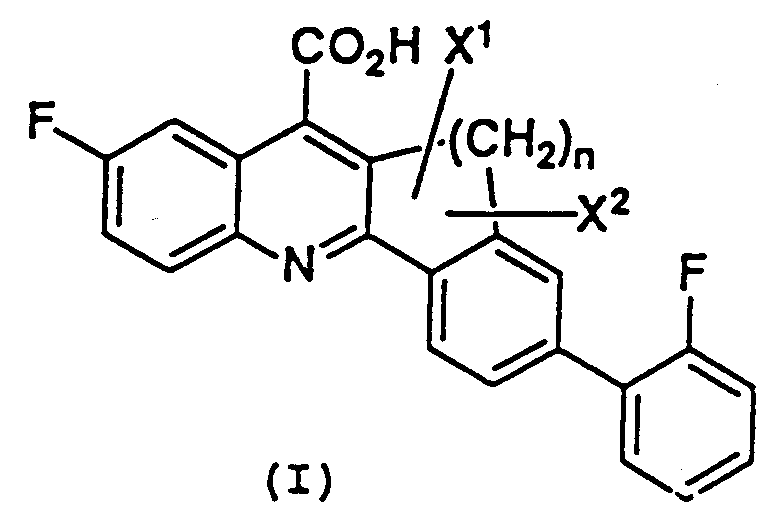
    2. A pharmaceutical composition comprising a compound as defined in claim 1 and a pharmaceutically acceptable carrier.
    3. Use of a compound as defined in claim 1 for the preparation of a pharmaceutical composition for use as an immunosuppressive.
    EP93909411A 1992-04-24 1993-04-23 Novel tetracyclic compound Expired - Lifetime EP0601191B1 (en)

    Applications Claiming Priority (5)

    Application Number Priority Date Filing Date Title
    JP106482/92 1992-04-24
    JP10648292 1992-04-24
    JP34271092 1992-12-22
    JP342710/92 1992-12-22
    PCT/JP1993/000527 WO1993022286A1 (en) 1992-04-24 1993-04-23 Novel tetracyclic compound

    Publications (3)

    Publication Number Publication Date
    EP0601191A1 EP0601191A1 (en) 1994-06-15
    EP0601191A4 EP0601191A4 (en) 1994-08-17
    EP0601191B1 true EP0601191B1 (en) 1998-07-22

    Family

    ID=26446598

    Family Applications (1)

    Application Number Title Priority Date Filing Date
    EP93909411A Expired - Lifetime EP0601191B1 (en) 1992-04-24 1993-04-23 Novel tetracyclic compound

    Country Status (9)

    Country Link
    US (1) US5371225A (en)
    EP (1) EP0601191B1 (en)
    JP (1) JP2928385B2 (en)
    AT (1) ATE168679T1 (en)
    CA (1) CA2111955C (en)
    DE (1) DE69319859T2 (en)
    DK (1) DK0601191T3 (en)
    ES (1) ES2120498T3 (en)
    WO (1) WO1993022286A1 (en)

    Families Citing this family (9)

    * Cited by examiner, † Cited by third party
    Publication number Priority date Publication date Assignee Title
    US5428040A (en) * 1993-08-31 1995-06-27 The Du Pont Merck Pharmaceutical Company Carbocyclic fused-ring quinolinecarboxylic acids useful as immunosuppressive agents
    WO1995009153A1 (en) * 1993-09-28 1995-04-06 Kyowa Hakko Kogyo Co., Ltd. Novel tetracyclic compound
    WO2000021916A1 (en) * 1998-10-15 2000-04-20 Takeda Chemical Industries, Ltd. Process for the preparation of amine derivatives
    US6841561B1 (en) 1999-10-01 2005-01-11 Institute Of Molecular And Cell Biology Dihydroorotate dehydrogenase inhibitors for the treatment of viral-mediated diseases
    EP1237546A2 (en) * 1999-10-01 2002-09-11 Institute of Molecular and Cell Biology Dihydroorotate dehydrogenase inhibitors for the treatment of viral-mediated diseases
    DE10047118A1 (en) * 2000-09-22 2002-04-11 Bayer Ag Process for the preparation of ketocarboxylic acid derivatives
    WO2006115509A2 (en) 2004-06-24 2006-11-02 Novartis Vaccines And Diagnostics Inc. Small molecule immunopotentiators and assays for their detection
    KR20160079123A (en) 2013-11-22 2016-07-05 젠자임 코포레이션 Novel methods for treating neurodegenerative diseases
    CN114031606B (en) * 2020-12-07 2023-01-24 广东聚华印刷显示技术有限公司 Indenoquinoline compound and preparation method and application thereof

    Family Cites Families (3)

    * Cited by examiner, † Cited by third party
    Publication number Priority date Publication date Assignee Title
    US5084462A (en) * 1988-04-26 1992-01-28 The Du Pont Merck Pharmaceutical Company 4-quinoline carboxylic acid derivatives useful as immunosuppressive agents
    US4918077A (en) * 1989-01-25 1990-04-17 E. I. Du Pont De Nemours & Co., Inc. 3-phenyl-5,6-dihydrobenz(c)acridine-7-carboxylic acids and related compounds as cancer chemotherapeutic agents
    US5135934A (en) * 1990-07-06 1992-08-04 Du Pont Merck Pharmaceutical Company 3-phenyl-5,6-dihydrobenz(c) acridine-7-carboxylic acids and related compounds as immunosuppressive agents

    Also Published As

    Publication number Publication date
    CA2111955A1 (en) 1993-11-11
    DE69319859T2 (en) 1998-12-17
    ES2120498T3 (en) 1998-11-01
    ATE168679T1 (en) 1998-08-15
    EP0601191A4 (en) 1994-08-17
    DE69319859D1 (en) 1998-08-27
    JP2928385B2 (en) 1999-08-03
    CA2111955C (en) 2002-03-05
    EP0601191A1 (en) 1994-06-15
    US5371225A (en) 1994-12-06
    WO1993022286A1 (en) 1993-11-11
    DK0601191T3 (en) 1999-04-26

    Similar Documents

    Publication Publication Date Title
    KR102905557B1 (en) THRβ receptor agonist compounds and methods for preparing and using the same
    US6387929B1 (en) 4-heteroaryl-tetrahydroquinolines and their use as inhibitors of the cholesterin-ester transfer protein
    US5646283A (en) Tetracyclic compound
    US5190951A (en) Quinoline derivatives
    KR100408177B1 (en) Method for Making 4-Carboxyamino-2-Substituted-1,2,3,4-Tetrahydroquinoline
    JPH1067746A (en) Cycloalkanolpyridine
    CA2040747A1 (en) Pyridine derivatives
    EP0270818A1 (en) Benzo(5,6)cycloheptapyridines, compositions and method of use
    SK92597A3 (en) Heterocyclic condensed pyridines, method for producing the same, pharmaceutical compositions containing same and their use
    US3470182A (en) 4-amino-substituted quinazolines
    US5371225A (en) Tetracyclic compounds
    US5281600A (en) Cyclic anthranilic acid derivatives
    NZ250580A (en) 3-(hetero)aryloxymorphinan derivatives and their use in the manufacture of medicaments
    IE61901B1 (en) &#34;Substituted 1h-imidazoles&#34;
    KR20000070756A (en) 2-Amino Substituted Pyridines for Use in The Treatment of Arteriosclerosis and Hyperlipoproteinaemia
    JPWO1993022286A1 (en) New tetracyclic compounds
    US5240934A (en) Quinoline derivatives
    JPH083163A (en) Condensed pyridine derivative
    CA2283404A1 (en) Cycloalka¬b|pyridine-3-carbonylguanidine derivatives, process for producing the same, and drugs containing the same
    US4473576A (en) Analgesic 9,9-dimethylbenzomorphanes
    US3215697A (en) Novel 4-oxo-1, 2, 3, 4-tetrahydroquinazolines
    NZ245327A (en) Quinolylmethoxyphenyl-acetamides, preparation and pharmaceutical compositions thereof
    EP1758866A1 (en) Processes for preparing 6-alkyl-5-arylsulfonyl- dihydrophenanthridines
    SK155395A3 (en) Naphtyridine derivatives, preparation method thereof and pharmaceutical compositions containing them
    JPH02200685A (en) New indole derivative

    Legal Events

    Date Code Title Description
    PUAI Public reference made under article 153(3) epc to a published international application that has entered the european phase

    Free format text: ORIGINAL CODE: 0009012

    17P Request for examination filed

    Effective date: 19940120

    AK Designated contracting states

    Kind code of ref document: A1

    Designated state(s): AT BE CH DE DK ES FR GB GR IE IT LI LU MC NL PT SE

    A4 Supplementary search report drawn up and despatched
    AK Designated contracting states

    Kind code of ref document: A4

    Designated state(s): AT BE CH DE DK ES FR GB GR IE IT LI LU MC NL PT SE

    17Q First examination report despatched

    Effective date: 19970418

    GRAG Despatch of communication of intention to grant

    Free format text: ORIGINAL CODE: EPIDOS AGRA

    GRAG Despatch of communication of intention to grant

    Free format text: ORIGINAL CODE: EPIDOS AGRA

    GRAG Despatch of communication of intention to grant

    Free format text: ORIGINAL CODE: EPIDOS AGRA

    GRAH Despatch of communication of intention to grant a patent

    Free format text: ORIGINAL CODE: EPIDOS IGRA

    GRAH Despatch of communication of intention to grant a patent

    Free format text: ORIGINAL CODE: EPIDOS IGRA

    GRAA (expected) grant

    Free format text: ORIGINAL CODE: 0009210

    AK Designated contracting states

    Kind code of ref document: B1

    Designated state(s): AT BE CH DE DK ES FR GB GR IE IT LI LU MC NL PT SE

    REF Corresponds to:

    Ref document number: 168679

    Country of ref document: AT

    Date of ref document: 19980815

    Kind code of ref document: T

    REG Reference to a national code

    Ref country code: CH

    Ref legal event code: EP

    REF Corresponds to:

    Ref document number: 69319859

    Country of ref document: DE

    Date of ref document: 19980827

    REG Reference to a national code

    Ref country code: CH

    Ref legal event code: NV

    Representative=s name: BOVARD AG PATENTANWAELTE

    ET Fr: translation filed
    REG Reference to a national code

    Ref country code: PT

    Ref legal event code: SC4A

    Free format text: AVAILABILITY OF NATIONAL TRANSLATION

    Effective date: 19980730

    REG Reference to a national code

    Ref country code: ES

    Ref legal event code: FG2A

    Ref document number: 2120498

    Country of ref document: ES

    Kind code of ref document: T3

    REG Reference to a national code

    Ref country code: IE

    Ref legal event code: FG4D

    REG Reference to a national code

    Ref country code: DK

    Ref legal event code: T3

    PLBE No opposition filed within time limit

    Free format text: ORIGINAL CODE: 0009261

    STAA Information on the status of an ep patent application or granted ep patent

    Free format text: STATUS: NO OPPOSITION FILED WITHIN TIME LIMIT

    26N No opposition filed
    REG Reference to a national code

    Ref country code: GB

    Ref legal event code: IF02

    PGFP Annual fee paid to national office [announced via postgrant information from national office to epo]

    Ref country code: MC

    Payment date: 20040326

    Year of fee payment: 12

    PGFP Annual fee paid to national office [announced via postgrant information from national office to epo]

    Ref country code: SE

    Payment date: 20040406

    Year of fee payment: 12

    Ref country code: NL

    Payment date: 20040406

    Year of fee payment: 12

    PGFP Annual fee paid to national office [announced via postgrant information from national office to epo]

    Ref country code: FR

    Payment date: 20040408

    Year of fee payment: 12

    PGFP Annual fee paid to national office [announced via postgrant information from national office to epo]

    Ref country code: IE

    Payment date: 20040415

    Year of fee payment: 12

    Ref country code: AT

    Payment date: 20040415

    Year of fee payment: 12

    PGFP Annual fee paid to national office [announced via postgrant information from national office to epo]

    Ref country code: ES

    Payment date: 20040416

    Year of fee payment: 12

    PGFP Annual fee paid to national office [announced via postgrant information from national office to epo]

    Ref country code: DK

    Payment date: 20040419

    Year of fee payment: 12

    PGFP Annual fee paid to national office [announced via postgrant information from national office to epo]

    Ref country code: PT

    Payment date: 20040420

    Year of fee payment: 12

    PGFP Annual fee paid to national office [announced via postgrant information from national office to epo]

    Ref country code: GB

    Payment date: 20040421

    Year of fee payment: 12

    PGFP Annual fee paid to national office [announced via postgrant information from national office to epo]

    Ref country code: LU

    Payment date: 20040427

    Year of fee payment: 12

    PGFP Annual fee paid to national office [announced via postgrant information from national office to epo]

    Ref country code: CH

    Payment date: 20040428

    Year of fee payment: 12

    PGFP Annual fee paid to national office [announced via postgrant information from national office to epo]

    Ref country code: GR

    Payment date: 20040430

    Year of fee payment: 12

    PGFP Annual fee paid to national office [announced via postgrant information from national office to epo]

    Ref country code: DE

    Payment date: 20040506

    Year of fee payment: 12

    PGFP Annual fee paid to national office [announced via postgrant information from national office to epo]

    Ref country code: BE

    Payment date: 20040617

    Year of fee payment: 12

    PG25 Lapsed in a contracting state [announced via postgrant information from national office to epo]

    Ref country code: LU

    Free format text: LAPSE BECAUSE OF NON-PAYMENT OF DUE FEES

    Effective date: 20050423

    Ref country code: IT

    Free format text: LAPSE BECAUSE OF NON-PAYMENT OF DUE FEES

    Effective date: 20050423

    Ref country code: AT

    Free format text: LAPSE BECAUSE OF NON-PAYMENT OF DUE FEES

    Effective date: 20050423

    PG25 Lapsed in a contracting state [announced via postgrant information from national office to epo]

    Ref country code: SE

    Free format text: LAPSE BECAUSE OF NON-PAYMENT OF DUE FEES

    Effective date: 20050424

    PG25 Lapsed in a contracting state [announced via postgrant information from national office to epo]

    Ref country code: IE

    Free format text: LAPSE BECAUSE OF NON-PAYMENT OF DUE FEES

    Effective date: 20050425

    Ref country code: ES

    Free format text: LAPSE BECAUSE OF NON-PAYMENT OF DUE FEES

    Effective date: 20050425

    PG25 Lapsed in a contracting state [announced via postgrant information from national office to epo]

    Ref country code: MC

    Free format text: LAPSE BECAUSE OF NON-PAYMENT OF DUE FEES

    Effective date: 20050430

    Ref country code: LI

    Free format text: LAPSE BECAUSE OF NON-PAYMENT OF DUE FEES

    Effective date: 20050430

    Ref country code: CH

    Free format text: LAPSE BECAUSE OF NON-PAYMENT OF DUE FEES

    Effective date: 20050430

    Ref country code: BE

    Free format text: LAPSE BECAUSE OF NON-PAYMENT OF DUE FEES

    Effective date: 20050430

    PG25 Lapsed in a contracting state [announced via postgrant information from national office to epo]

    Ref country code: DK

    Free format text: LAPSE BECAUSE OF NON-PAYMENT OF DUE FEES

    Effective date: 20050502

    PG25 Lapsed in a contracting state [announced via postgrant information from national office to epo]

    Ref country code: PT

    Free format text: LAPSE BECAUSE OF NON-PAYMENT OF DUE FEES

    Effective date: 20051024

    BERE Be: lapsed

    Owner name: *KYOWA HAKKO KOGYO K.K.

    Effective date: 20050430

    PG25 Lapsed in a contracting state [announced via postgrant information from national office to epo]

    Ref country code: NL

    Free format text: LAPSE BECAUSE OF NON-PAYMENT OF DUE FEES

    Effective date: 20051101

    Ref country code: DE

    Free format text: LAPSE BECAUSE OF NON-PAYMENT OF DUE FEES

    Effective date: 20051101

    PG25 Lapsed in a contracting state [announced via postgrant information from national office to epo]

    Ref country code: GR

    Free format text: LAPSE BECAUSE OF NON-PAYMENT OF DUE FEES

    Effective date: 20051103

    REG Reference to a national code

    Ref country code: DK

    Ref legal event code: EBP

    EUG Se: european patent has lapsed
    REG Reference to a national code

    Ref country code: CH

    Ref legal event code: PL

    GBPC Gb: european patent ceased through non-payment of renewal fee

    Effective date: 20050423

    PG25 Lapsed in a contracting state [announced via postgrant information from national office to epo]

    Ref country code: FR

    Free format text: LAPSE BECAUSE OF NON-PAYMENT OF DUE FEES

    Effective date: 20051230

    NLV4 Nl: lapsed or anulled due to non-payment of the annual fee

    Effective date: 20051101

    REG Reference to a national code

    Ref country code: FR

    Ref legal event code: ST

    Effective date: 20051230

    REG Reference to a national code

    Ref country code: ES

    Ref legal event code: FD2A

    Effective date: 20050425

    BERE Be: lapsed

    Owner name: *KYOWA HAKKO KOGYO K.K.

    Effective date: 20050430