EP0601108B1 - Multideterminant peptide antigens that stimulate helper t lymphocyte response to hiv in a range of human subjects - Google Patents
Multideterminant peptide antigens that stimulate helper t lymphocyte response to hiv in a range of human subjects Download PDFInfo
- Publication number
- EP0601108B1 EP0601108B1 EP92919588A EP92919588A EP0601108B1 EP 0601108 B1 EP0601108 B1 EP 0601108B1 EP 92919588 A EP92919588 A EP 92919588A EP 92919588 A EP92919588 A EP 92919588A EP 0601108 B1 EP0601108 B1 EP 0601108B1
- Authority
- EP
- European Patent Office
- Prior art keywords
- peptide
- peptides
- hiv
- vaccine
- amino acid
- Prior art date
- Legal status (The legal status is an assumption and is not a legal conclusion. Google has not performed a legal analysis and makes no representation as to the accuracy of the status listed.)
- Expired - Lifetime
Links
Images


Classifications
-
- C—CHEMISTRY; METALLURGY
- C07—ORGANIC CHEMISTRY
- C07K—PEPTIDES
- C07K14/00—Peptides having more than 20 amino acids; Gastrins; Somatostatins; Melanotropins; Derivatives thereof
- C07K14/005—Peptides having more than 20 amino acids; Gastrins; Somatostatins; Melanotropins; Derivatives thereof from viruses
-
- A—HUMAN NECESSITIES
- A61—MEDICAL OR VETERINARY SCIENCE; HYGIENE
- A61P—SPECIFIC THERAPEUTIC ACTIVITY OF CHEMICAL COMPOUNDS OR MEDICINAL PREPARATIONS
- A61P31/00—Antiinfectives, i.e. antibiotics, antiseptics, chemotherapeutics
- A61P31/12—Antivirals
-
- A—HUMAN NECESSITIES
- A61—MEDICAL OR VETERINARY SCIENCE; HYGIENE
- A61K—PREPARATIONS FOR MEDICAL, DENTAL OR TOILETRY PURPOSES
- A61K39/00—Medicinal preparations containing antigens or antibodies
-
- C—CHEMISTRY; METALLURGY
- C07—ORGANIC CHEMISTRY
- C07K—PEPTIDES
- C07K2319/00—Fusion polypeptide
- C07K2319/40—Fusion polypeptide containing a tag for immunodetection, or an epitope for immunisation
-
- C—CHEMISTRY; METALLURGY
- C12—BIOCHEMISTRY; BEER; SPIRITS; WINE; VINEGAR; MICROBIOLOGY; ENZYMOLOGY; MUTATION OR GENETIC ENGINEERING
- C12N—MICROORGANISMS OR ENZYMES; COMPOSITIONS THEREOF; PROPAGATING, PRESERVING, OR MAINTAINING MICROORGANISMS; MUTATION OR GENETIC ENGINEERING; CULTURE MEDIA
- C12N2740/00—Reverse transcribing RNA viruses
- C12N2740/00011—Details
- C12N2740/10011—Retroviridae
- C12N2740/16011—Human Immunodeficiency Virus, HIV
- C12N2740/16111—Human Immunodeficiency Virus, HIV concerning HIV env
- C12N2740/16122—New viral proteins or individual genes, new structural or functional aspects of known viral proteins or genes
Definitions
- the invention is directed to a method for the selection of peptides useful for production of vaccine(s) against HIV infection or as components of a therapeutic mixture or as components of a diagnostic kit for HIV seroconversion.
- the instant application also describes a series of peptides selected by the method.
- Whole virus vaccines against HIV live attenuated or killed offer the potential to stimulate immunity to the broadest array of antigenic determinants of the virus.
- they also may contain structures developed by the virus to evade the immune system, such as suppressive epitopes or masking carbohydrates, or structures which elicit deleterious effects such as enhancing antibodies that increase viral infectivity (Takeda, A. et al. Science 242:580-583. (1988); Robinson, W.E.Jr. et al ., Proc. Nati. Acad. Sci. USA 86:4710-4714 (1989); Robinson, W.E.,Jr. et al.; Proc . Natl. Acad. Sci.
- T cells recognize antigens in association with molecules encoded by the major histocompatibility complex (MHC) of the host, and the MHC molecules of any given individual will bind and present only a subset of potential antigenic determinants that could be recognized by the species as a whole (Benacerraf, B., J. Immunol . 120:1809-1812 (1978); Schwartz, R.H., Annu . Rev . Immunol . 3:237-261 (1985); Berzofsky, J.A., in "The Antigens". pp. 1 - 146, M. Sela, editor, c.
- MHC major histocompatibility complex
- mice Simuet al., Cell 54:561-575 (1988); Schrier, R.D. et al., J . Immunol . 142:1166-1176 (1989); Callahan, K.M. et al, J . Immunol . 144:3341-3346 (1990); Martin, R. et al., J . Immunol . 145:540-548 (1990); Martin, R. et al., J . Exp . Med . 173:19-24 (1991); Jaraquemada, D. et al., J . Immunol . 145:2880-2885 (1990)).
- a vaccine should contain multiple such determinants. Only limited data exist to indicate how many such determinants would have to be included. Although some concern has been raised that the number might be impractical to achieve, some data exist to suggest that as few as four such determinants could elicit responses in 85-90% of outbred humans (Clerici, M. et al., Nature 339:383-385 (1989)). A few antigenic peptides have been identified that appear to be promiscuous in their recognition in association with many DR molecules (Sinigaglia, F.et at., Nature 336:778-780 (1988); Panina-Bordignon, P. et al., Eur .
- multideterminant peptides might provide a means to circumvent this problem of MHC restriction in the design of synthetic vaccines.
- the present applicants have, therefore, tested this hypothesis by constructing six synthetic peptides of 20-33 residues each that correspond to the six multideterminant regions of HIV envelope protein localized in the mouse (Hale, P.M. et al., Internat . Immunol . 1:409-415 (1989)), and tested these peptides for their ability to stimulate T-cell responses in mice immunized with recombinant gp160 and in peripheral blood lymphocytes of humans infected with HIV.
- peptides Although not all of the peptides were as widely recognized as expected, several such peptides were identified that were broadly recognized by both murine and human T cells of multiple H-2 and HLA types. These peptides can also immunize mice for T-cell responses to the intact HIV envelope protein, and so are useful as valuable components of a synthetic vaccine, and responses to them are useful diagnostic or prognostic markers.
- EP-0273716 discloses certain peptides whcih are said to induce cellular immunity to HIV and HIV proteins.
- WO-A-9000901 teaches methods for identifying HIV T cell epitopes.
- WO-A-9104045 discloses a peptide having a sequence that corresponds to a conserved domain of an HIV protein, for use in the prophylaxis and therapy of AIDS.
- EP-A-0370458 discloses a relatively-long polypeptide coded for by a recombinant HIV antigen.
- WO89/02277 describes synthetic peptides for use as vaccines in the prophylaxis and therapy of AIDS.
- EP-A-00317804 concerns synthetic peptides which replicate various sequences of an envelope protein of HIV.
- EP-A-0279688 relates to the use of HIV envelope proteins or fragments thereof for the treatment of immunoinflammatory disorders.
- EP-A-0328403 describes synthetic peptides related to an HIV envelope protein for the detection of HIV antibodies. Klerici et al . Nature 339-383, 1988 describes a method of identifying HIV-seropositive individuals.
- the cluster peptides described in Table 1 above may be utilized for the diagnosis of HIV-1 positive seroconversion in patients.
- the detection of HIV-1 gp160 specific T cell responses to these peptides can be accomplished by standard techniques of T-ell proliferation and production of IL-2 or other lymphokines as described above in Example 1, items 4 and 5, applied to humans as described in Clerici et al., Nature, Vol. 339, pp. 383-385 (1989).
- the diagnostic test can be of a cytotoxicity format as described for the peptide env-K 1 in Berzofsky, et al., WO-A-8907112 This format has the advantage of detecting infected individuals that are not yet producing antibodies to HIV.
- Small peptides circulating in the blood are subject to degradation by proteolytic action and clearing by the kidneys. Yet, a number of naturally occurring peptides are found in the circulation, for example the enkephalins. These small peptides are often found to be modified by amidation of the carboxy-terminus (Kitamura, K. et al., Biochem . Biophys . Res . Comm . 169:1164-1171 (1990); Dickson, C.J. and Yamada, T., J. Biol. Chem. 266:334-338 (1991)). Thus, it may prove advantageous to produce chemically modified variants of the cluster peptides for use in therapeutic applications.
- the peptides of the instant invention could also be coupled to, or co-synthesized with, peptides that bind to or induce production of neutralizing antibodies to HIV or cytotoxic T-cells specific for HIV.
- the peptides of the instant invention serve as HIV I-specific carriers in such constructs, which advantageously induces a memory in T-cells which would cause a memory helper T-cell response on exposure to HIV, in contrast to the use of HIV-unrelated carriers which would not produce such a memory response on exposure to the virus.
- Useful HIV-I specific carriers are, for example; as described in Good, M.F. et al., Science, Vol. 235, pp. 1059-1062 (1987); U.S. Patent No. 4,886,782 to Good et al.; and Palker, T. J. et al., J. of Immunology, Vol. 142, pp. 3612-3619 (1989).
- a pharmaceutical composition including a vaccine in accordance with the present invention comprises an effective antigenic or therapeutic amount of at least one of the cluster peptides and a pharaceutically acceptable carrier such as physiological saline, non-toxic, sterile buffer and the like.
- a pharaceutically acceptable carrier such as physiological saline, non-toxic, sterile buffer and the like.
- additives such as preservatives, sterilants, adjuvants and the like, well known to one of ordinary skill in the art, could also be included in the pharmaceutical composition to maintain or increase the efficacy of the preparation.
- peptides of the instant invention can also be administered as a vaccine in a fashion similar to that for the administration to primates of a synthetic peptide vaccine against hepatitus B as described by Itoh (Itoh, Y. et al., Proc. Natl. Acad. Sci. USA 83:9174-9178 (1986)).
- An alternative method for the preparation of vaccines involves the use of Protein A coated microbeads that bind immune complexes of an antibody and the immunizing antigen on their outer surface described for eample in Platt, et al., U.S. patent number 4,493,825.
- the cluster peptides of the invention could be coupled to, or conjugated with, peptides that bind to or induce.
Landscapes
- Health & Medical Sciences (AREA)
- Chemical & Material Sciences (AREA)
- Life Sciences & Earth Sciences (AREA)
- Organic Chemistry (AREA)
- General Health & Medical Sciences (AREA)
- Virology (AREA)
- Medicinal Chemistry (AREA)
- Biophysics (AREA)
- General Chemical & Material Sciences (AREA)
- Biochemistry (AREA)
- Molecular Biology (AREA)
- Proteomics, Peptides & Aminoacids (AREA)
- Gastroenterology & Hepatology (AREA)
- Communicable Diseases (AREA)
- Oncology (AREA)
- Chemical Kinetics & Catalysis (AREA)
- Genetics & Genomics (AREA)
- Nuclear Medicine, Radiotherapy & Molecular Imaging (AREA)
- Pharmacology & Pharmacy (AREA)
- Animal Behavior & Ethology (AREA)
- Public Health (AREA)
- Veterinary Medicine (AREA)
- Peptides Or Proteins (AREA)
- Medicines Containing Antibodies Or Antigens For Use As Internal Diagnostic Agents (AREA)
- Micro-Organisms Or Cultivation Processes Thereof (AREA)
Abstract
Description
- The invention is directed to a method for the selection of peptides useful for production of vaccine(s) against HIV infection or as components of a therapeutic mixture or as components of a diagnostic kit for HIV seroconversion. The instant application also describes a series of peptides selected by the method.
- Whole virus vaccines against HIV, live attenuated or killed offer the potential to stimulate immunity to the broadest array of antigenic determinants of the virus. However, they also may contain structures developed by the virus to evade the immune system, such as suppressive epitopes or masking carbohydrates, or structures which elicit deleterious effects such as enhancing antibodies that increase viral infectivity (Takeda, A. et al. Science 242:580-583. (1988); Robinson, W.E.Jr. et al., Proc. Nati. Acad. Sci. USA 86:4710-4714 (1989); Robinson, W.E.,Jr. et al.; Proc. Natl. Acad. Sci. USA 87:3185-3189 (1990); Halstead, S.B. Science 239:476-481 (1988)) or antibodies or T cells that may contribute to immunodeficiency in the case of HIV (Weinhold, K.J. et al., J. Immununol 142:3091-3097 (1989); Siliciano, R-F.et al., Cell 54:561-575 (1988); Mittler, R.S. and M. K. Hoffmann, Science 245:1380-1382 (1989); Golding, H. et al., J. Clin. Invest. 83:1430-1435 (1989)). In addition, for a retrovirus such as HIV, concerns about the safety of live attenuated or even killed whole viral vaccines may make them unacceptable to many potential recipients. Purified subunit vaccines have less safety risk, but still may suffer from the other problems of whole virus vaccines. Indeed, because the virus has evolved to evade the immune system, evolution may have favored the development of viral proteins that are hardly optimal as vaccines. Thus, in contrast to enzymes which have been honed by evolution to be the best structures for catalyzing their reactions, viral proteins may leave the scientist with considerable opportunities to improve on nature for the development of better vaccines (Berzofsky, J.A., J. Clin. Invest. 82:1811-1817 (1988)).
- To rationally design highly engineered synthetic or recombinant antiviral vaccines, one needs considerable knowledge about the workings of the immune system, and in particular, about the immune response to structures expressed by the virus. The present inventors have initiated such an approach by attempting to identify antigenic determinants recognized by cytotoxic T lymphocytes (CTL) (Takahashi, H.et al., Proc. Natl. Acad. Sci. USA 85:3105-3109 (1988); Takahashi, H. et al, Science 246:118-121 (1989); Takahashi, H. et al., J. Exp. Med. 170:2023-2035 (1989); Takahashi, H. et al., J. Exp. Med. 171:571-576 (1990); Hosmalin, A. et al, Proc. Natl. Acad. Sci. USA 87:2344-2348 (1990)) and by helper T cells that would be required for either a CTL or an antibody response (Cease, K.B. et al., Proc. Natl. Acad. Sci. USA 84:4249-4253 (1987); Berzofsky, J.A. et al. Nature 334:706-708 (1988); Clerici, M. et al., Nature 339:383-385 (1989); Hale, P.M. et al., Internat. Immunol. 1:409-415 (1989)). However, a potential problem with the use of any single antigenic determinant is that T cells recognize antigens in association with molecules encoded by the major histocompatibility complex (MHC) of the host, and the MHC molecules of any given individual will bind and present only a subset of potential antigenic determinants that could be recognized by the species as a whole (Benacerraf, B., J. Immunol. 120:1809-1812 (1978); Schwartz, R.H., Annu. Rev. Immunol. 3:237-261 (1985); Berzofsky, J.A., in "The Antigens". pp. 1 - 146, M. Sela, editor, c. 1987 by Academic Press, New York). This is true of humans as well as mice (Siliciano, R-F. et al, Cell 54:561-575 (1988); Schrier, R.D. et al., J. Immunol. 142:1166-1176 (1989); Callahan, K.M. et al, J. Immunol. 144:3341-3346 (1990); Martin, R. et al., J. Immunol. 145:540-548 (1990); Martin, R. et al., J. Exp. Med. 173:19-24 (1991); Jaraquemada, D. et al., J. Immunol. 145:2880-2885 (1990)).
- Therefore, in order to be useful in a broad outbred population such as humans, a vaccine should contain multiple such determinants. Only limited data exist to indicate how many such determinants would have to be included. Although some concern has been raised that the number might be impractical to achieve, some data exist to suggest that as few as four such determinants could elicit responses in 85-90% of outbred humans (Clerici, M. et al., Nature 339:383-385 (1989)). A few antigenic peptides have been identified that appear to be promiscuous in their recognition in association with many DR molecules (Sinigaglia, F.et at., Nature 336:778-780 (1988); Panina-Bordignon, P. et al., Eur. J. Immunol. 19:2237-2242 (1989)), perhaps because DR molecules share a conserved alpha chain, and in the mouse some determinants have been reported to be presented by three different I-A molecules that do not share alpha chains (Brett, S.J. et al., J. Immunol. 143:771-779 (1989)), or even by class II MHC molecules of different isotypes, such as I-A and I-E (Guillet, J.-G. et al., Science 235:865-870 (1987))). However, it is not clear how common such promiscuous epitopes are.
- In the course of locating the major T-cell stimulatory sites of the HIV envelope, we observed that there were regions in the sequence that contained multiple overlapping determinants seen by mice of different MHC haplotypes (Hale, P.M. et al., Internat. Immunol. 1:409-415 (1989)). Although the precise determinants seen by T cells of each strain of mouse differed, each multideterminant region contained determinants that could stimulate T cells of mice of three or four of the four MHC types tested. We, therefore, reasoned that peptides encompassing such multideterminant regions might be able to stimulate T cells of many or most haplotypes of mice, and hopefully also T cells of humans of many HLA types. Thus, such multideterminant peptides might provide a means to circumvent this problem of MHC restriction in the design of synthetic vaccines. The present applicants have, therefore, tested this hypothesis by constructing six synthetic peptides of 20-33 residues each that correspond to the six multideterminant regions of HIV envelope protein localized in the mouse (Hale, P.M. et al., Internat. Immunol. 1:409-415 (1989)), and tested these peptides for their ability to stimulate T-cell responses in mice immunized with recombinant gp160 and in peripheral blood lymphocytes of humans infected with HIV. Although not all of the peptides were as widely recognized as expected, several such peptides were identified that were broadly recognized by both murine and human T cells of multiple H-2 and HLA types. These peptides can also immunize mice for T-cell responses to the intact HIV envelope protein, and so are useful as valuable components of a synthetic vaccine, and responses to them are useful diagnostic or prognostic markers.
- EP-0273716 discloses certain peptides whcih are said to induce cellular immunity to HIV and HIV proteins. WO-A-9000901 teaches methods for identifying HIV T cell epitopes. WO-A-9104045 discloses a peptide having a sequence that corresponds to a conserved domain of an HIV protein, for use in the prophylaxis and therapy of AIDS. EP-A-0370458 discloses a relatively-long polypeptide coded for by a recombinant HIV antigen.
- WO89/02277 describes synthetic peptides for use as vaccines in the prophylaxis and therapy of AIDS. EP-A-00317804 concerns synthetic peptides which replicate various sequences of an envelope protein of HIV. EP-A-0279688 relates to the use of HIV envelope proteins or fragments thereof for the treatment of immunoinflammatory disorders. EP-A-0328403 describes synthetic peptides related to an HIV envelope protein for the detection of HIV antibodies. Klerici et al. Nature 339-383, 1988 describes a method of identifying HIV-seropositive individuals.
- It is one object of the present invention to demonstrate a process for the selection of synthetic peptides that are useful candidates for vaccines against HIV. Furthermore, a set of particular peptides are described that have demonstrated efficacy in the process above. Finally, the invention may find application in diagnostic and therapeutic settings.
- Figure 1 shows the proliferative response of T cells from gp160-immune mice to the six cluster peptides.
- Figure 2 shows the proliferation response to recombinant gp160 of T-cells isolated from the lymph nodes of mice immunized with cluster peptides.
-
- The invention is described by means of several examples below. The examples are presented for purposes of illustration and are not to be construed as limiting the scope of the instant invention.
-
- 1. Synthesis of peptides. The six cluster peptides
are synthesized on an Applied Biosystems 430A
automated peptide synthesizer using t-boc chemistry
(Stewart, J.M. and J.D. Young. "Solid Phase Peptide
Synthesis", Pierce Chemical Company, Rockford,
Illinois (1984)). The peptides are cleaved from the
resin with HF and are initially purified by molecular
exclusion chromatography (P4 biogel, BioRad). Reverse
phase HPLC is employed to determine degree of purity
and in cases requiring further purification. The HPLC
separations are carried out on Waters µbondapack
reverse phase C18 analytical and preparative columns.
The sequences of the peptides synthesized for the
experiment are shown in Table 1 below:
Sequences of Cluster Peptides PCLUS1 (109-128) EQMHEDIISLWDQSLKPCVK (SEQ ID 1) PCLUS2 (324-356) FVTIGKIGNMRQAHCNISRAKWNNTLKQIDSKL (SEQ ID 2) PCLUS3 (428-451) KQIINMWQEVGKAMYAPPISGQIR (SEQ ID 3) PCLUS4 (483-506) RDNWRSELYKYKVVKIEPLGVAPT (SEQ ID 4) PCLUS5 (787-820) RIVELLGRRGWEALKYWWNLLQYWSQELKNSAVS (SEQ ID 5) PCLUS6 (828-860) AVAEGTDRVIEVVQGAYRAIRHIPRRIRQGLER (SEQ ID 6) 
- 2. Mice. BlO.BR/Sgsn and BlO.D2/nSn strains are obtained from The Jackson Laboratory (Bar Harbor, ME, USA). BlO.S(9R) and BlOA(5R) strains are bred in our colony from breeders obtained from J. Stimpfling and Jackson Laboratories, respectively.
- 3. gpl6O preparation. Recombinant gpl60 is prepared from cells infected with recombinant baculovirus expressing the gene for gp160 of the HTLV-IIIB isolate of HIV-1 as described (Javaherian, K. et al., Proc. Natl. Acad. Sci. USA 86:6768-6772 (1989)).
- 4. T-cell proliferation assay (Corradin, G., J.
Immunol. 119:1048 (1977)). Mice are immunized
subcutaneously in the tail with 20-30 µg recombinant
gp160 emulsified 1:1 in complete Freund's adjuvant
The mice are sacrificed 8-11 days following
immunization and their draining inguinal and
periaortic lymph nodes are harvested and teased into
single cell suspensions in complete T-cell medium
(Matis, L.A. et al., J. Immunol. 130:1527-1535
(1983)). Aliquots consisting of 4x10⁵ cells are
introduced into wells of 96-well flat-bottom culture
plates containing various concentrations of the
cluster peptides (2, 0.66, 0.22 µM final concentration
in triplicate). After four days of incubation at 37°
in 5% C02, tritiated thymidine (1 mCi) is added to all
the wells. 24 hr later the cells are harvested on an
automated harvesting device (Skatron) and thymidine
incorporated into DNA determined by scintillation
counting. The stimulation index is the ratio of cpm
incorporated in the presence of antigen to cpm
incorporated by cells cultured with medium alone.
Each cluster peptide of Table 1 was synthesized
and purified as decribed above and tested for the
ability to stimulate T-cell proliferative responses of
mice of the four MHC types noted that had been
immunized with recombinant gpl6O. BlO congenic mice
are used that differed only in their MHC type, but are
otherwise genetically identical. The four mouse MHC
types studied are chosen because they represent four
independent MHC haplotypes that each express both an
I-A and an I-E molecule, and differ from each other in
both of these molecules. Thus the four strains
together express eight different murine class II MHC
molecules. It should be noted that the murine I-E
molecules, like human DR molecules to which they are
homologous, all share a conserved alpha chain, but
differ in their beta chain, which accounts for all the
polymorphism. Responses to most antigens differ among
the several I-E and DR alleles, indicating the
important role of the beta chain, despite the shared
alpha chain.Each peptide was studied in four independent
experiments (or three for
cluster peptide 3, which was synthesized last), and the results pooled by determining the geometric mean of the stimulation indices for a given peptide concentration in all four experiments. The results are presented in Figure 1, which shows the stimulation index as a function of peptide concentration in the culture, for 4 congenic strains of mice representing 4 distinct MHC haplotypes. Each value is the geometric mean stimulation index of 4 (or 3 in the case of cluster peptide 3) independent experiments. Although the results of the several experiments were qualitatively similar, the absolute values of the stimulation indices varied sufficiently as to make error bars difficult to read on these plots. Instead, values for which the mean stimulation index of all experiments is statistically significantly different from background (1.0) as measured by a Student's t test (p < 0.05) are indicated with an asterisk. Results were considered positive only if this statistic was significant and the mean stimulation index of all experiments was > 2.Cluster peptides Cluster peptide 6 stimulated most strongly in BlO.BR and BlO.A(5R) mice, and gave weaker but significantly positive and reproducible responses in BlO.S(9R) and BlO.D2.Cluster peptide 4 stimulated most strongly in Bl0.S(9R), but was significantly and reproducibly positive in the other strains as well.Cluster peptide 3 stimulated very strongly in BlO.S(9R), and gave weak but statistically significant responses in the other three strains. The responses were more strongly positive in some experiments for these other strains, but some variability in magnitude of response reduced the geometric mean, although they remained statistically significant. These three peptides thus fulfill the predictions of the hypothesis (Hale, P.M. et al., Internat. Immunol. 1:409-415 (1989)) that by making an extended peptide encompassing overlapping antigenic determinants recognized by mice of multiple haplotypes, the resulting construct would be broadly recognized by all or most haplotypes.The remaining three peptides elicited responses in fewer strains of mice than expected.Cluster peptide 2 was strongly positive in only two strains, B10.D2 and B1O.BR, despite the fact that all four strains had recognized at least one site encompassed within this multideterminant region in our earlier study (Hale, P.M. et al., Internat. Immunol. 1:409-415 (1989)). Similarly,cluster peptide 1 was recognized by one strain, B1O.BR, strongly, and by another strain, B10.S(9R) only marginally, despite the fact that all four strains had recognized components of this multideterminant region. The most disappointing peptide wascluster peptide 5, which failed to elicit a significant response in three strains, and gave only a marginal response in the fourth strain BlO.BR. These results suggest that the larger peptide is not simply the sum of its parts, but may fail to stimulate in strains that a smaller subcomponent would stimulate, perhaps because parts of the larger structure hinder interaction with MHC or T cell receptor, or because they cause the peptide to fold back on itself (Brett, S.J. et al., J. Exp. Med. 168:357-373 (1988); Gammon, G. et al., Immunol. Rev. 98:53-73 (1987); Vacchio, M.S. et al., J. Immunol. 143:2814-2819 (1989); Berzofsky, J.A. et al., Immunol. Rev. 106:5-31 (1988)) or because of different processing requirements. - 5. IL-2 production by human PBL. For the assay of
antigen-induced IL-2 production by human peripheral
blood T cells, PBL from HIV-seropositive asymptomatic
blood donors are separated on lymphocyte separation
medium (LSM, Organon Teknika Corp, Durham, NC), washed
twice, counted, and resuspended at 3 x 10⁶/ml in RPMI
1640 (Gibco, Grand Island, NY) containing 50 U/ml
penicillin and 2 mM glutamine. In triplicate wells in
a 96-well flat bottom plate (Costar, Cambridge, MA),
0. 1 ml of PBL is added per well and cultured without
stimulation or stimulated with: a) influenza A/Bangkok
RX73 (final dilution 1: 1000); b) PHA (Gibco) (antigen
dilution 1:100); or c) cluster peptides at a final
concentration of 2.5 µM. Pooled AB+ plasma is added
to each well (final dilution 1:20). The anti-IL-2
receptor antibody anti-Tac (obtained from Dr. T. A.
Waldmann, NCI) is added to each well at the initiation
of culture (
final concentration 5 µM) in order to block IL-2 consumption. The supernatants of the cell cultures are harvested 7 d later and frozen at -20°C. The supernatant IL-2 activity is assessed as the ability to stimulate the proliferation of the IL-2-dependent CTLL cell line as previously described (Clerici, M. et al., J. Clin. Invest. 84:1892-1899 (1989)). Although prior publications demonstrate that many peptides that elicit responses in murine T cells also do so with human T cells (Berzofsky, J.A. et al., Nature 334:706-708 (1988); Clerici, M. et al, Nature 339:383-385 (1989); lamb, J.R. et al., Nature 300:66-69 (1982); Hurwitz, J.L. et al., J. Immunol. 133:3371-3377 (1984); Good, M.F. et al., Science 235:1059-1062 (1987); Good, M.F., Proc. Natl. Acad. Sci. USA 85:1199-1203 (1988)); Dontfraid, F. et al., Mol. Biol. Med. 5:185-196 (1988)), there were no data on human T cells to some of the components of the cluster peptides. Therefore, the experiments leading to the present invention were designed to test the hypothesis that peptides that elicit responses in mice of multiple MHC types were likely to elicit responses in humans of multiple HLA types as well. It was known from earlier work that peptide envT2 (residues 112-124) contained withincluster peptide 1, peptide envTl (residues 428-443) contained withincluster peptide 3, and peptide TH4.1 (residues 834-848, also known as HP53) contained withincluster peptide 6 all stimulated responses in 50-67% of HIV-infected human subjects who could still respond to positive-control recall antigens such as influenza A virus (flu) or tetanus toxoid (Clerici, M. et al., Nature 339:383-385 (1989)). However, we had no prior experience with peptides from these other multideterminant regions in humans. Because the proliferative and IL-2 productive responses to soluble protein antigens is lost early in HIV infection, frequently when patients are still asymptomatic and have normal CD4+ cell numbers (Clerici, M. et al., Nature 339:383-385 (1989); Clerici, M.et al., J. Clin. Invest. 84:1892-1899 (1989); Lane, H.C. et al., New Engl. J. Med. 313:79-84 (1985)), responses to flu and tetanus toxoid were used as positive controls in these experiments to exclude donors unresponsive to all such recall protein antigens.All six cluster peptides were tested for the ability to stimulate IL-2 production by peripheral blood T cells from a series of HIV-seropositive but asymptomatic volunteers, as well as HIV-seronegative controls. All 15 seronegative controls responded to the control recall antigen influenza virus (flu), but only 42 of the 59 HIV-seropositive donors responded to flu. Because of our previous experience that seropositive donors who fail to respond to control recall protein antigens such as flu or tetanus toxoid also fail to respond to HIV peptides (Clerici, M. et al., Nature 339:383-385 (1989)), the 17 donors who failed to respond to flu were excluded from further study. Because some of the peptides had not been purified at the time some of the donors were available, these peptides were tested on cells from a subset of the donors. Results for the six cluster peptides in the 42 HIV-seropositive flu-positive donors and 15 control HIV-seronegative donors are given in Table 3, and summarized in Table 4.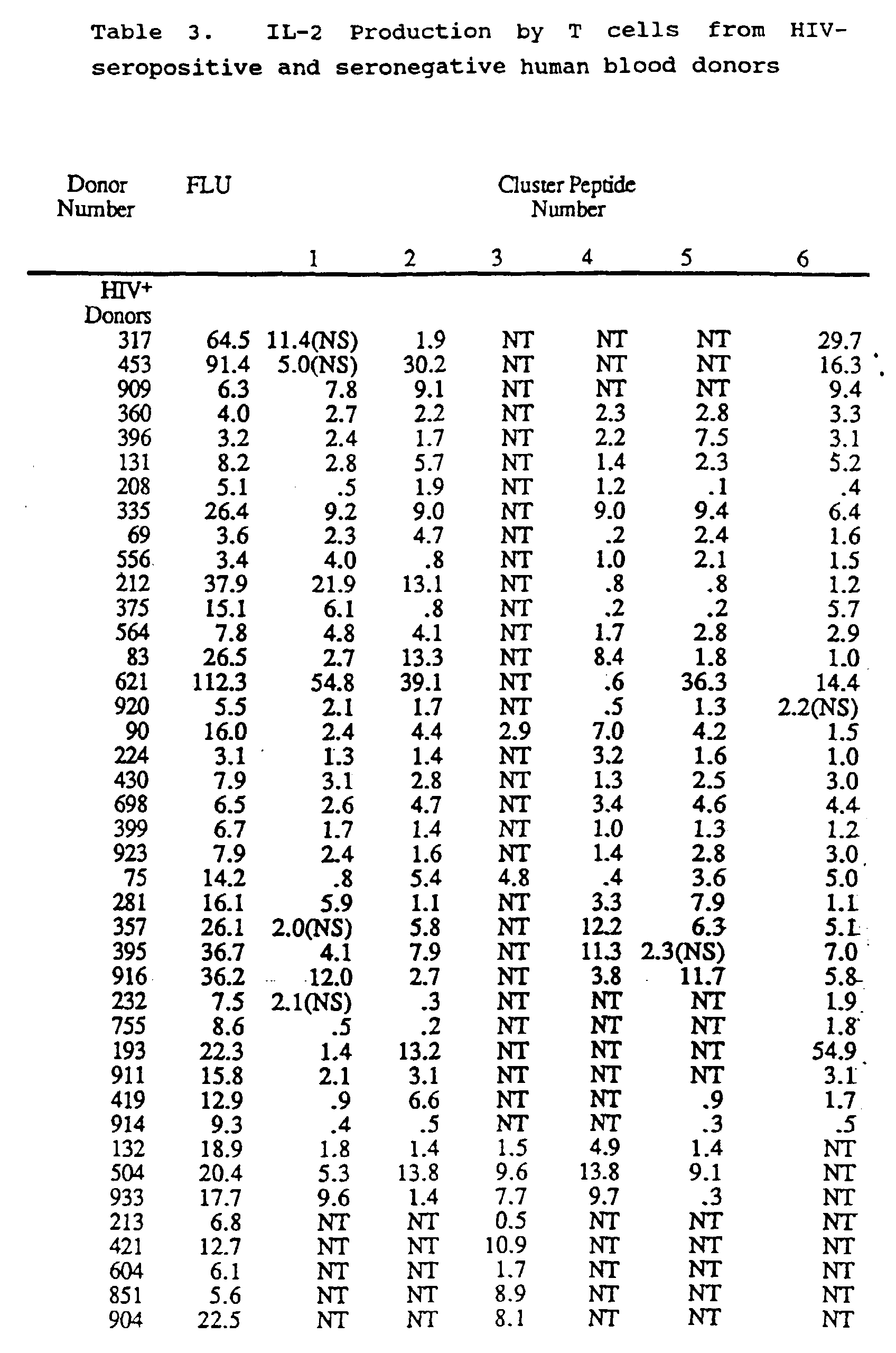 Values shown are stimulation indices for proliferation of an IL-2-dependent CTLL cell line in the presence of a 1:2 dilution of culture supernatant from triplicate cultures of PBL from the indicated donor with a 2.5 µM concentration of the indicated peptide, as described above. All of the seropositive donors and controls studied were responsive to the positive control recall protein antigen flu. For a value to be considered positive, it had to simultaneously meet two criteria: The replicates had to be statistically significantly different from the control replicates for that donor by Student's t test (p < 0.05), and the stimulation index had to be greater than twice the medium control. Six cases marked NS were stimulation indices > 2.0 which were not counted as positives because the replicates were not statistically significant. In several cases with SI < 2.0, the replicates were significantly different from background, but these were not considered positive because of the low stimulation index. The requirement for both criteria is thus more conservative than using either alone.
Summary of Human T-cell IL-2
Responses to Cluster PeptidesCluster Peptide Cluster Peptide 1 Cluster Peptide 2Cluster Peptide 3Cluster Peptide 4Cluster Peptide 5Cluster Peptide 6HIV+FLU+ 23/36 21/36 8/11 14/27 17/29 19/33 Donors 64% 58% 73% 52% 59% 58% HIV- FLU+ 1/15 2/15 0/10 1/11 0/14 1/12 Controls 7% 13% 0% 9% 0% 8% See legend to table 3 for criteria for positivity. HLA Typing of HIV-seropositive donors Donor HLA-A HLA-B HLA-C DQ DR 90 24, 29 7,44 2,3 208 9 (23), 32 7, 17 3 1,2 2,3 281 23, 33 17 3 2 1, 3 375 2, 24 35, 61 2, 4 1 3 131 1, 3 7, 62 3 1, 3 2, 4 909 30, 33 17 3 1 1, 2 232 9, 31 14, 18 3 2, 3 3, 5 755 2, 28 35, 15 2, 3 1, 3 2, 4 75 30 7, 18 2 360 2, 31 51 2 317 28 12 3 1, 2 2, 4 395 1, 3 7, 8 - Cluster peptides Cluster peptides cluster peptide 4, but even this stimulated 52% of the donors. In contrast, none or only one of the control seronegative donors responded to any of the peptides exceptcluster peptide 2, which stimulated 2 of the 15 control donors (13 %). Thus, none of the peptides was nonspecifically mitogenic. The human donors were unrelated Air Force personnel, originally from different parts of the United States, and of diverse HLA types. Because of limited availability of blood, only 13 of the HIV+ donors could be HLA-typed, and only 8 could be typed for DR and DQ, which require more blood (Table 5). In this limited sample, no correlation between response to any peptide and any HLA type could be detected. We conclude that all of these cluster peptides fulfill the hypothesis that peptides which are broadly recognized by murine T cells are likely to be broadly recognized by human T cells as well. Indeed, some of the peptides, such ascluster peptides - 6. Immunization with peptides to induce T cells
responding to intact gp160 in vitro.
If the peptides identified by the two screening
techniques above are to be useful components of a
vaccine, it is important that they not only be
recognized by T-cells immune to the HIV envelope
protein gpl60, but also that they be immunogenic to
elicit T cells in vivo that can respond to gpl60. Of
course, the immunizations cannot be performed yet in
the clinically relevant species, (uninfected) humans,
but it is desirable to be sure that for the strains of
mice shown above to have T cells responsive to these
peptides, the mice can be immunized in vivo with the
peptides and elicit T cells that respond to intact
gpl6O in vitro. Each peptide is tested by immunizing
mice of the strain responding best to that peptide
based on the data in Fig. 1. Mice of the four strains
shown are immunized subcutaneously in the tail with
8-10 nmoles of the indicated cluster peptide in a 1:1
emulsion with CFA, final volume per mouse 50 µl except
for
cluster peptide 2 which was in 75 µl. Twelve days later, the draining lymph nodes are harvested from 2 mice of each group (strain and peptide combination) and assayed as described above. Results are shown as stimulation indices, the ratio of experimental cpm over cpm from stimulation with medium alone, which ranged from 3000-7000 cpm for the different groups.B10.BR mice immunized withcluster peptide 1,cluster peptide 5, orcluster peptide 6 all produced T cells that could be stimulated by recombinant gp160 in vitro (Fig. 2, panel A). As a control for possible mitogenicity of the recombinant gp160, T cells from B10.BR mice immunized with only complete Freunds adjuvant did not respond significantly to the gp160 in vitro (Fig. 2, panel A). Therefore, the in vitro response was a result of immunization with the peptides. Similarly, T cells from BlO.S(9R) mice immunized with eithercluster peptide 3 orcluster peptide 4 responded to recombinant gp160 in vitro, whereas similar mice immunized with adjuvant alone made a weak (mitogenic) response at only the highest concentration (Fig. 2, panel B). Likewise, BIO.A(5R) mice immunized withcluster peptide 6 and B10.D2 mice immunized withcluster peptide 2 produced T cells responsive to gp160 in vitro (Fig. 2, panels C and D). All of these responses show high dose inhibition typical of T-cell proliferative responses, but in this case the decreased response at 30 µg/ml also may be due to some toxicity of the recombinant gp160 preparation, which was solubilized in 8M urea and sodium dodecyl sulfate. Although the gp160 was dialyzed before use, it is possible that residual detergent that is hard to remove was toxic at the highest dose. Nevertheless, the clear response at 10 µg/ml in all cases indicates that all six cluster peptides elicit in vivo T cells that can react with gp160. -
- The cluster peptides described in Table 1 above may be utilized for the diagnosis of HIV-1 positive seroconversion in patients. The detection of HIV-1 gp160 specific T cell responses to these peptides can be accomplished by standard techniques of T-ell proliferation and production of IL-2 or other lymphokines as described above in Example 1,
items - Alternatively, the diagnostic test can be of a cytotoxicity format as described for the peptide env-K1 in Berzofsky, et al., WO-A-8907112 This format has the advantage of detecting infected individuals that are not yet producing antibodies to HIV.
- Small peptides circulating in the blood are subject to degradation by proteolytic action and clearing by the kidneys. Yet, a number of naturally occurring peptides are found in the circulation, for example the enkephalins. These small peptides are often found to be modified by amidation of the carboxy-terminus (Kitamura, K. et al., Biochem. Biophys. Res. Comm. 169:1164-1171 (1990); Dickson, C.J. and Yamada, T., J. Biol. Chem. 266:334-338 (1991)). Thus, it may prove advantageous to produce chemically modified variants of the cluster peptides for use in therapeutic applications. The enzymatic carboxy-terminal amidation of a synthetic peptide has been described (Suzuki, K. et al., EMBO J. 9:4259-4265 (1990); Katopodis, G.A. et al., Biochemistry 30:6189-6194 (1991)). Also, the addition of residues useful for the cross-linking of the peptides to carrier proteins for immunizations or to solid supports for immunoassay or antibody purification applications may prove advantageous. Many means for chemical modification of peptides are well known in the art.
- The peptides of the instant invention could also be coupled to, or co-synthesized with, peptides that bind to or induce production of neutralizing antibodies to HIV or cytotoxic T-cells specific for HIV. The peptides of the instant invention serve as HIV I-specific carriers in such constructs, which advantageously induces a memory in T-cells which would cause a memory helper T-cell response on exposure to HIV, in contrast to the use of HIV-unrelated carriers which would not produce such a memory response on exposure to the virus. Useful HIV-I specific carriers are, for example; as described in Good, M.F. et al., Science, Vol. 235, pp. 1059-1062 (1987); U.S. Patent No. 4,886,782 to Good et al.; and Palker, T. J. et al., J. of Immunology, Vol. 142, pp. 3612-3619 (1989).
- The aim of the research of a large number of biomedical researchers is the production of a vaccine which would produce protection to humans from infection by HIV-1 or therapeutic benefit in AIDS treatment. The instant invention provides a means for identifying peptides that may prove useful as such vaccines as well as specifying six particular peptides as candidates based on the production of a T-cell response to the protein target from which the peptides are derived in mice immunized with the peptide. A pharmaceutical composition including a vaccine in accordance with the present invention comprises an effective antigenic or therapeutic amount of at least one of the cluster peptides and a pharaceutically acceptable carrier such as physiological saline, non-toxic, sterile buffer and the like. Of course, additives such as preservatives, sterilants, adjuvants and the like, well known to one of ordinary skill in the art, could also be included in the pharmaceutical composition to maintain or increase the efficacy of the preparation.
- It is proposed that peptides of the instant invention can also be administered as a vaccine in a fashion similar to that for the administration to primates of a synthetic peptide vaccine against hepatitus B as described by Itoh (Itoh, Y. et al., Proc. Natl. Acad. Sci. USA 83:9174-9178 (1986)). An alternative method for the preparation of vaccines involves the use of Protein A coated microbeads that bind immune complexes of an antibody and the immunizing antigen on their outer surface described for eample in Platt, et al., U.S. patent number 4,493,825. In addition, the cluster peptides of the invention could be coupled to, or conjugated with, peptides that bind to or induce.
Claims (17)
- A process for the identification of peptides useful for subunit vaccines against HIV that comprises:(i) production of vaccine candidate peptides, the amino acid sequences of which represent fragments or mimetopes of a larger target protein, by chemical synthesis or the use of recombinant DNA technology:(ii) immunization of congenic nice, differing in MHC haplotype, with the complete protein target of the peptide vaccine;(iii) production of lymph node suspensions from the immunized mice and testing of the proliferative response of the T-cells therefrom to challenge with the candidate vaccine peptide;(iv) isolation of peripheral blood lymphocytes (PBL) from a population of HIV seropositive human donors, of such size as to be useful for statistical evaluation;(v) testing of said PBL for interleukin-2 production in response to a control memory antigen, and testing for interleukin-2 production by the PBL in response to challenge with the candidate vaccine peptide;(vi) selection of those peptides that produce a significant response in both of steps (iii) and (v) for use in immunization of mice;(vii) testing of the proliferative response of T-cells isolated from the immunized mice of step (v) to challenge with the whole target protein; and(viii) designation of peptides producing statistically significant positive responses in step (vii) as candidate vaccines.
- A peptide consisting of the amino acid sequence EQMHEDIISLWDQSLKPCVK.
- A peptide comprising the amino acid sequence FVTIGKIGNMRQAHCNISRAKWNNTLKQIDSKL
- A peptide consisting of the amino acid sequence KQIINMWQEVGKAMYAPPISGQIR.
- A peptide comprising the amino acid sequence RDNWRSELYKYKVVKIEPLGVAPT.
- A peptide comprising the amino acid sequence RIVELLGRRGWEALKYWWNLLQYWSQELKNSAVS.
- A peptide comprising the amino acid sequence AVAEGTDRVIEVVQGAYRAIRHIPRRIRQGLER.
- A peptide vaccine against HIV comprising at least one peptide selected from
PCLUS1 (109-128) EQMHEDIISLWDQSLKPCVK (SEQ ID 1) PCLUS2 (324-356) FVTIGKIGNMRQAHCNISRAKWNNTLKQIDSKL (SEQ ID 2) PCLUS3 (428-451) KQIIKMWQEVGKAMYAPPISGQIR (SEQ ID 3) PCLUS4 (483-506) RDNWRSELYKYKVVKIEPLGVAPT (SEQ ID 4) PCLUS5 (787-820) RIVELLGRRGWEALKYWWNLQYWSQELKNSAVS (SEQ ID 5) PCLUS6 (828-860) AVAEGTDRVIEVVQGAYRAIRHIPRRIRQGLER (SEQ ID 6) - The peptide according to claim 8, which has been covalently modified by derivatization with a small moiety to achieve better pharmacologic characteristics than obtainable by the underivatized peptide, or other minor modifications which do not undesirably alter the activity of said peptide.
- A vaccine according to claim 8 which includes a pharmaceutically acceptable carrier.
- A vaccine against HIV according to claim 10 comprising a mixture of at least two of the said peptides and a pharmaceutically acceptable carrier.
- A kit for the diagnosis or prognosis of HIV which comprises at least one of the peptides defined in claim 8.
- A method for the diagnosis or prognosis of HIV comprising the use of at least one of the peptides defined in claim 8 in an assay.
- A method according to claim 13, wherein said assay measures T-cell proliferation, or production of IL-2 or other lymphokines.
- The use of a vaccine according to claim 8 in the manufacture of a medicament for treating an HIV infection in an HIV seropositive patient.
- A construct which comprises at least one of the peptides recited in claims 2-7 and 10 coupled by chemical coupling or co-synthesized with a second peptide containing a T- or B-cell epitope.
- The use of a vaccine according to claim 8 in the manufacture of a medicament for protection from an HIV infection.
Applications Claiming Priority (3)
| Application Number | Priority Date | Filing Date | Title |
|---|---|---|---|
| US75199891A | 1991-08-29 | 1991-08-29 | |
| US751998 | 1991-08-29 | ||
| PCT/US1992/007422 WO1993004697A1 (en) | 1991-08-29 | 1992-08-31 | Multideterminant peptide antigens that stimulate helper t lymphocyte response to hiv in a range of human subjects |
Publications (3)
| Publication Number | Publication Date |
|---|---|
| EP0601108A1 EP0601108A1 (en) | 1994-06-15 |
| EP0601108A4 EP0601108A4 (en) | 1997-03-19 |
| EP0601108B1 true EP0601108B1 (en) | 1999-10-06 |
Family
ID=25024412
Family Applications (1)
| Application Number | Title | Priority Date | Filing Date |
|---|---|---|---|
| EP92919588A Expired - Lifetime EP0601108B1 (en) | 1991-08-29 | 1992-08-31 | Multideterminant peptide antigens that stimulate helper t lymphocyte response to hiv in a range of human subjects |
Country Status (9)
| Country | Link |
|---|---|
| EP (1) | EP0601108B1 (en) |
| JP (1) | JPH07501516A (en) |
| AT (1) | ATE185275T1 (en) |
| AU (1) | AU665023B2 (en) |
| CA (1) | CA2114849C (en) |
| DE (1) | DE69230106T2 (en) |
| DK (1) | DK0601108T3 (en) |
| ES (1) | ES2257733T3 (en) |
| WO (1) | WO1993004697A1 (en) |
Families Citing this family (8)
| Publication number | Priority date | Publication date | Assignee | Title |
|---|---|---|---|---|
| US6294322B1 (en) | 1988-01-26 | 2001-09-25 | The United States Of America As Represented By The Department Of Health And Human Services | Multideterminant peptides that elicit helper T-lymphocyte cytotoxic T-lymphocyte and neutralizing antibody responses against HIV-1 |
| US6210873B1 (en) | 1987-08-28 | 2001-04-03 | Board Of Regents, The University Of Texas System | Methods and compositions for the priming of specific cytotoxic T-lymphocyte response |
| US5128319A (en) | 1987-08-28 | 1992-07-07 | Board Of Regents, The University Of Texas System | Prophylaxis and therapy of acquired immunodeficiency syndrome |
| WO1995003067A1 (en) * | 1993-07-21 | 1995-02-02 | Khavinson Vladimir Khatskelevi | Pharmaceutical with immunomodulating activity |
| US5603933A (en) * | 1993-08-31 | 1997-02-18 | Board Of Regents, The University Of Texas | CD4 peptides for binding to viral envelope proteins |
| US5972339A (en) * | 1997-11-13 | 1999-10-26 | The General Hospital Corporation | Method of eliciting anti-HIV-1 helper T cell responses |
| IL150961A0 (en) | 2000-02-04 | 2003-02-12 | Univ Duke | Human immunodeficiency virus vaccine |
| CN110349627B (en) * | 2019-06-27 | 2021-08-27 | 杭州纽安津生物科技有限公司 | Design method of polypeptide vaccine sequence and its automatic design product |
Family Cites Families (11)
| Publication number | Priority date | Publication date | Assignee | Title |
|---|---|---|---|---|
| WO1988005051A1 (en) * | 1986-12-30 | 1988-07-14 | United States Of America, Represented By The Unite | Synthetic peptides which induce cellular immunity of the aids virus and aids viral proteins |
| US5030449A (en) * | 1988-07-21 | 1991-07-09 | The United States Of America As Represented By The Secretary Of The Department Of Health And Human Services | Synthetic vaccine against AIDS virus |
| ES2102347T3 (en) * | 1987-02-20 | 1997-08-01 | Genentech Inc | METHODS AND COMPOSITIONS FOR THE USE OF ENV POLYPEPTIDES AND ANTI-ENV ANTIBODIES OF HIV. |
| WO1989002277A2 (en) * | 1987-08-28 | 1989-03-23 | Board Of Regents, The University Of Texas System | Prophylaxis and therapy of acquired immunodeficiency syndrome |
| US5128319A (en) * | 1987-08-28 | 1992-07-07 | Board Of Regents, The University Of Texas System | Prophylaxis and therapy of acquired immunodeficiency syndrome |
| ATE128716T1 (en) * | 1987-11-24 | 1995-10-15 | Abbott Lab | HIV PEPTIDES AND METHODS FOR DETECTING HIV. |
| CA1341285C (en) * | 1988-02-12 | 2001-08-14 | Chang Yi Wang | Synthetic peptides for the detection of antibodies to hiv gp120 envelope protein for diagnosis of aids and pre-aids conditions and as vaccines |
| US4943628A (en) * | 1988-06-13 | 1990-07-24 | Ortho Pharmaceutical Corporation | HIV peptide-inducted T cell stimulation |
| CA2003383A1 (en) * | 1988-11-23 | 1990-05-23 | Sushil G. Devare | Synthetic dna derived recombinant hiv antigens |
| CA2078545A1 (en) * | 1990-04-03 | 1991-10-04 | Timothy J. Gregory | Hiv envelope polypeptides |
| AU650911B2 (en) * | 1990-09-27 | 1994-07-07 | Syntello Vaccine Development Kb | Peptides for use in vaccination and induction of neutralizing antibodies against human immunodeficiency virus |
-
1992
- 1992-08-31 CA CA002114849A patent/CA2114849C/en not_active Expired - Lifetime
- 1992-08-31 EP EP92919588A patent/EP0601108B1/en not_active Expired - Lifetime
- 1992-08-31 DE DE69230106T patent/DE69230106T2/en not_active Expired - Lifetime
- 1992-08-31 ES ES92919588T patent/ES2257733T3/en not_active Expired - Lifetime
- 1992-08-31 JP JP5505385A patent/JPH07501516A/en active Pending
- 1992-08-31 WO PCT/US1992/007422 patent/WO1993004697A1/en not_active Ceased
- 1992-08-31 AT AT92919588T patent/ATE185275T1/en active
- 1992-08-31 DK DK92919588T patent/DK0601108T3/en active
- 1992-08-31 AU AU25693/92A patent/AU665023B2/en not_active Ceased
Also Published As
| Publication number | Publication date |
|---|---|
| JPH07501516A (en) | 1995-02-16 |
| CA2114849C (en) | 2007-04-24 |
| ES2257733T3 (en) | 2006-08-01 |
| AU2569392A (en) | 1993-04-05 |
| DE69230106T2 (en) | 2000-03-30 |
| AU665023B2 (en) | 1995-12-14 |
| CA2114849A1 (en) | 1993-03-18 |
| EP0601108A1 (en) | 1994-06-15 |
| WO1993004697A1 (en) | 1993-03-18 |
| DE69230106D1 (en) | 1999-11-11 |
| DK0601108T3 (en) | 2000-04-17 |
| EP0601108A4 (en) | 1997-03-19 |
| ATE185275T1 (en) | 1999-10-15 |
Similar Documents
| Publication | Publication Date | Title |
|---|---|---|
| US5939074A (en) | Multideterminant peptide antigens | |
| Henderson et al. | Direct identification of class II histocompatibility DR proteins in preparations of human T-cell lymphotropic virus type III | |
| US6265539B1 (en) | Prophylaxis and therapy of acquired immunodeficiency syndrome | |
| Berzofsky et al. | Construction of peptides encompassing multideterminant clusters of human immunodeficiency virus envelope to induce in vitro T cell responses in mice and humans of multiple MHC types. | |
| EP0273716B1 (en) | Synthetic peptides which induce cellular immunity to the aids virus and aids viral proteins | |
| CA2162880C (en) | Composite synthetic peptide construct eliciting neutralizing antibodies and cytotoxic t lymphocytes against hiv | |
| US20100121029A1 (en) | Anti-hiv immunogenic formulation and process for preparation thereof | |
| WO1990000901A1 (en) | Synthetic vaccine against aids virus | |
| EP0400076B1 (en) | A synthetic antigen evoking anti-hiv response | |
| EP0554389B1 (en) | Molecular clones of hiv-1 and uses thereof | |
| WO1989002277A2 (en) | Prophylaxis and therapy of acquired immunodeficiency syndrome | |
| Valentine et al. | A randomized, placebo-controlled study of the immunogenicity of human immunodeficiency virus (HIV) rgp160 vaccine in HIV-infected subjects with⩾ 400/mm3 CD4 T lymphocytes (AIDS Clinical Trials Group Protocol 137) | |
| Bahraoui et al. | Immunogenicity of the human immunodeficiency virus (HIV) recombinant nef gene product. Mapping of T-cell and B-cell epitopes in immunized chimpanzees | |
| AU665023B2 (en) | Multideterminant peptide antigens that stimulate helper T lymphocyte response to HIV in a range of human subjects | |
| US6210873B1 (en) | Methods and compositions for the priming of specific cytotoxic T-lymphocyte response | |
| Berzofsky | Mechanisms of T cell recognition with application to vaccine design | |
| WO1995025124A1 (en) | Methods to diagnose and treat hiv-1 infection | |
| Lee et al. | A single point mutation in HIV-1 V3 loop alters the immunogenic properties of rgp120 | |
| EP1476182B1 (en) | Process for preparation of immunogenic formulations of variable peptidic epitopes | |
| US5882853A (en) | Method of evaluating HTLV-I-specific T cell responses | |
| US6290963B1 (en) | Anti-HIV compositions containing native and recombinant peptides | |
| Kelker et al. | Immunogenic and antigenic properties of an HIV-1 gp120-derived multiple chain peptide. | |
| Eriksson et al. | Systematic identification of T-cell activating epitopes on the human immunodeficiency virus type 1 envelope glycoprotein gp120 in primates immunized with synthetic peptides | |
| AU694204C (en) | Methods to diagnose and treat HIV-1 infection | |
| Ahlers | Developing synthetic peptide vaccines for HIV-1: the design and characterization of multideterminant T helper-CTL/neutralizing antibody vaccine constructs and the use of cytokines for steering immune responses toward desired functional types |
Legal Events
| Date | Code | Title | Description |
|---|---|---|---|
| PUAI | Public reference made under article 153(3) epc to a published international application that has entered the european phase |
Free format text: ORIGINAL CODE: 0009012 |
|
| 17P | Request for examination filed |
Effective date: 19940315 |
|
| AK | Designated contracting states |
Kind code of ref document: A1 Designated state(s): AT BE CH DE DK ES FR GB GR IE IT LI LU MC NL SE |
|
| A4 | Supplementary search report drawn up and despatched |
Effective date: 19970131 |
|
| AK | Designated contracting states |
Kind code of ref document: A4 Designated state(s): AT BE CH DE DK ES FR GB GR IE IT LI LU MC NL SE |
|
| 17Q | First examination report despatched |
Effective date: 19970822 |
|
| GRAG | Despatch of communication of intention to grant |
Free format text: ORIGINAL CODE: EPIDOS AGRA |
|
| GRAG | Despatch of communication of intention to grant |
Free format text: ORIGINAL CODE: EPIDOS AGRA |
|
| GRAH | Despatch of communication of intention to grant a patent |
Free format text: ORIGINAL CODE: EPIDOS IGRA |
|
| RAP1 | Party data changed (applicant data changed or rights of an application transferred) |
Owner name: THE GOVERNMENT OF THE UNITED STATES OF AMERICA, AS |
|
| GRAH | Despatch of communication of intention to grant a patent |
Free format text: ORIGINAL CODE: EPIDOS IGRA |
|
| GRAA | (expected) grant |
Free format text: ORIGINAL CODE: 0009210 |
|
| AK | Designated contracting states |
Kind code of ref document: B1 Designated state(s): AT BE CH DE DK ES FR GB GR IE IT LI LU MC NL SE |
|
| PG25 | Lapsed in a contracting state [announced via postgrant information from national office to epo] |
Ref country code: GR Free format text: LAPSE BECAUSE OF NON-PAYMENT OF DUE FEES Effective date: 19991006 |
|
| REF | Corresponds to: |
Ref document number: 185275 Country of ref document: AT Date of ref document: 19991015 Kind code of ref document: T |
|
| REG | Reference to a national code |
Ref country code: CH Ref legal event code: NV Representative=s name: KELLER & PARTNER PATENTANWAELTE AG Ref country code: CH Ref legal event code: EP |
|
| REF | Corresponds to: |
Ref document number: 69230106 Country of ref document: DE Date of ref document: 19991111 |
|
| ITF | It: translation for a ep patent filed | ||
| REG | Reference to a national code |
Ref country code: IE Ref legal event code: FG4D |
|
| ET | Fr: translation filed | ||
| REG | Reference to a national code |
Ref country code: DK Ref legal event code: T3 |
|
| PLBE | No opposition filed within time limit |
Free format text: ORIGINAL CODE: 0009261 |
|
| PG25 | Lapsed in a contracting state [announced via postgrant information from national office to epo] |
Ref country code: MC Free format text: THE PATENT HAS BEEN ANNULLED BY A DECISION OF A NATIONAL AUTHORITY Effective date: 20000831 |
|
| PG25 | Lapsed in a contracting state [announced via postgrant information from national office to epo] |
Ref country code: ES Free format text: LAPSE BECAUSE OF NON-PAYMENT OF DUE FEES Effective date: 20000901 |
|
| 26N | No opposition filed | ||
| REG | Reference to a national code |
Ref country code: GB Ref legal event code: IF02 |
|
| REG | Reference to a national code |
Ref country code: ES Ref legal event code: FG2A Ref document number: 2257733 Country of ref document: ES Kind code of ref document: T3 |
|
| REG | Reference to a national code |
Ref country code: ES Ref legal event code: FD2A Effective date: 20000901 |
|
| PGFP | Annual fee paid to national office [announced via postgrant information from national office to epo] |
Ref country code: CH Payment date: 20110825 Year of fee payment: 20 Ref country code: DK Payment date: 20110826 Year of fee payment: 20 Ref country code: LU Payment date: 20110901 Year of fee payment: 20 Ref country code: IE Payment date: 20110825 Year of fee payment: 20 |
|
| PGFP | Annual fee paid to national office [announced via postgrant information from national office to epo] |
Ref country code: FR Payment date: 20110830 Year of fee payment: 20 Ref country code: ES Payment date: 20110826 Year of fee payment: 20 Ref country code: DE Payment date: 20110830 Year of fee payment: 20 Ref country code: AT Payment date: 20110803 Year of fee payment: 20 Ref country code: GB Payment date: 20110825 Year of fee payment: 20 Ref country code: SE Payment date: 20110829 Year of fee payment: 20 |
|
| PGFP | Annual fee paid to national office [announced via postgrant information from national office to epo] |
Ref country code: IT Payment date: 20110824 Year of fee payment: 20 Ref country code: BE Payment date: 20110825 Year of fee payment: 20 Ref country code: NL Payment date: 20110901 Year of fee payment: 20 |
|
| BE20 | Be: patent expired |
Owner name: THE *GOVERNMENT OF THE UNITED STATES OF AMERICA AS Effective date: 20120831 |
|
| REG | Reference to a national code |
Ref country code: DE Ref legal event code: R071 Ref document number: 69230106 Country of ref document: DE |
|
| REG | Reference to a national code |
Ref country code: DE Ref legal event code: R071 Ref document number: 69230106 Country of ref document: DE |
|
| REG | Reference to a national code |
Ref country code: DK Ref legal event code: EUP |
|
| REG | Reference to a national code |
Ref country code: NL Ref legal event code: V4 Effective date: 20120831 |
|
| REG | Reference to a national code |
Ref country code: CH Ref legal event code: PL |
|
| REG | Reference to a national code |
Ref country code: GB Ref legal event code: PE20 Expiry date: 20120830 |
|
| REG | Reference to a national code |
Ref country code: AT Ref legal event code: MK07 Ref document number: 185275 Country of ref document: AT Kind code of ref document: T Effective date: 20120831 |
|
| REG | Reference to a national code |
Ref country code: SE Ref legal event code: EUG |
|
| PG25 | Lapsed in a contracting state [announced via postgrant information from national office to epo] |
Ref country code: DE Free format text: LAPSE BECAUSE OF EXPIRATION OF PROTECTION Effective date: 20120901 Ref country code: GB Free format text: LAPSE BECAUSE OF EXPIRATION OF PROTECTION Effective date: 20120830 |
|
| REG | Reference to a national code |
Ref country code: IE Ref legal event code: MM4A |
|
| REG | Reference to a national code |
Ref country code: ES Ref legal event code: FD2A Effective date: 20130722 |
|
| PG25 | Lapsed in a contracting state [announced via postgrant information from national office to epo] |
Ref country code: IE Free format text: LAPSE BECAUSE OF EXPIRATION OF PROTECTION Effective date: 20120831 |