EP0597915B1 - A process for making morphine-6-glucuronide or substituted morphine-6-glucuronide - Google Patents
A process for making morphine-6-glucuronide or substituted morphine-6-glucuronide Download PDFInfo
- Publication number
- EP0597915B1 EP0597915B1 EP92916104A EP92916104A EP0597915B1 EP 0597915 B1 EP0597915 B1 EP 0597915B1 EP 92916104 A EP92916104 A EP 92916104A EP 92916104 A EP92916104 A EP 92916104A EP 0597915 B1 EP0597915 B1 EP 0597915B1
- Authority
- EP
- European Patent Office
- Prior art keywords
- methyl
- glucuronate
- isobutyryl
- triisobutyryl
- morphine
- Prior art date
- Legal status (The legal status is an assumption and is not a legal conclusion. Google has not performed a legal analysis and makes no representation as to the accuracy of the status listed.)
- Expired - Lifetime
Links
Classifications
-
- C—CHEMISTRY; METALLURGY
- C07—ORGANIC CHEMISTRY
- C07H—SUGARS; DERIVATIVES THEREOF; NUCLEOSIDES; NUCLEOTIDES; NUCLEIC ACIDS
- C07H13/00—Compounds containing saccharide radicals esterified by carbonic acid or derivatives thereof, or by organic acids, e.g. phosphonic acids
- C07H13/02—Compounds containing saccharide radicals esterified by carbonic acid or derivatives thereof, or by organic acids, e.g. phosphonic acids by carboxylic acids
- C07H13/04—Compounds containing saccharide radicals esterified by carbonic acid or derivatives thereof, or by organic acids, e.g. phosphonic acids by carboxylic acids having the esterifying carboxyl radicals attached to acyclic carbon atoms
-
- C—CHEMISTRY; METALLURGY
- C07—ORGANIC CHEMISTRY
- C07D—HETEROCYCLIC COMPOUNDS
- C07D489/00—Heterocyclic compounds containing 4aH-8, 9 c- Iminoethano-phenanthro [4, 5-b, c, d] furan ring systems, e.g. derivatives of [4, 5-epoxy]-morphinan of the formula:
- C07D489/02—Heterocyclic compounds containing 4aH-8, 9 c- Iminoethano-phenanthro [4, 5-b, c, d] furan ring systems, e.g. derivatives of [4, 5-epoxy]-morphinan of the formula: with oxygen atoms attached in positions 3 and 6, e.g. morphine, morphinone
-
- C—CHEMISTRY; METALLURGY
- C07—ORGANIC CHEMISTRY
- C07H—SUGARS; DERIVATIVES THEREOF; NUCLEOSIDES; NUCLEOTIDES; NUCLEIC ACIDS
- C07H17/00—Compounds containing heterocyclic radicals directly attached to hetero atoms of saccharide radicals
Definitions
- This invention relates to a process for making morphine-6-glucuronide or substituted morphine-6-glucuronide.
- Morphine-6- ⁇ -D-glucuronide is a metabolite of morphine in the human body and is a more powerful analgesic than morphine itself (R. Osborne et al ., The Lancet, 1988, 828 and literature cited therein). It has previously been synthesised by H. Yoshimura et al ., (Chem. Pharm. Bull ., 1968, 16 , 2114) and others e.g. (P-A Carrupt. et al ., J. Med.
- Morphine-6-glucuronide is now required in substantial quantities for extensive biological and clinical evaluations.
- the trace amounts of heavy metals from the Koenigs-Knorr method of production can be very difficult to remove in the final product.
- Another problem associated with the Koenigs-Knorr reaction is that glycoside formation involves an unstable sugar derivative and a heterogenous reaction system which leads to variable yields of the conjugate and difficulties in purification when the synthesis of morphine-6-glucuronide is carried out on a larger scale.
- the present invention has been made from a consideration of these problems.
- R 1 , R 2 and R 3 may be of any of the following:-
- R 1 , R 2 and R 3 of the morphine-6-glucuronide or substituted morphine-6-glucuronide are present in one of the following combinations:- R 1 R 2 R 3 H ⁇ -D-glucuronyl methyl ⁇ -D-glucuronyl ⁇ -D-glucuronyl methyl acetyl methyl ⁇ -D-(2,3,4-triisobutyryl)glucuronate methyl benzoyl methyl ⁇ -D-(2,3,4-triisobutyryl)glucuronate methyl H methyl ⁇ -D-(2,3,4-triisobutyryl)glucuronate methyl t butyldimethylsilyl methyl ⁇ -D-(2,3,4-triisobutyryl)glucuronate methyl isobutyryl methyl ⁇ -D-(2,3,4-triisobutyryl)glucuronate methyl methyl ⁇ -D-(2,3,4-triacetyl) methyl
- the morphine or substituted morphine may comprise the following formula:-
- R 1 , R 2 and R 3 may be any of the following combinations:- R 1 R 2 R 3 H H methyl acyl H alkyl silyl H alkyl alkyl H alkyl aralkyl H alkyl
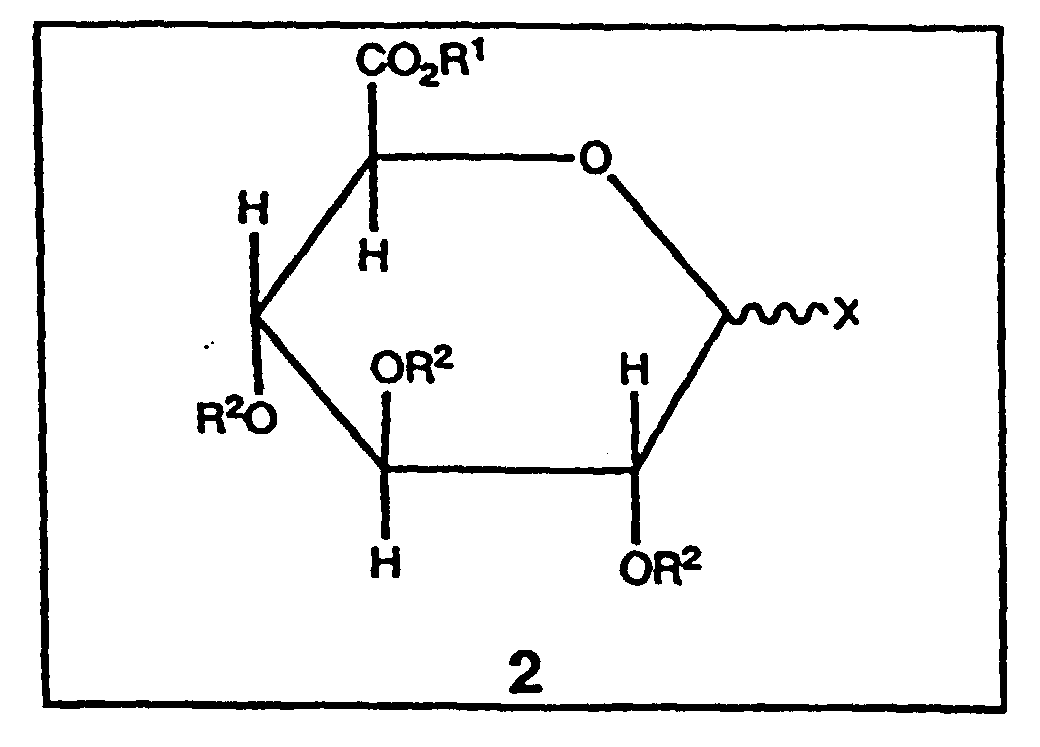
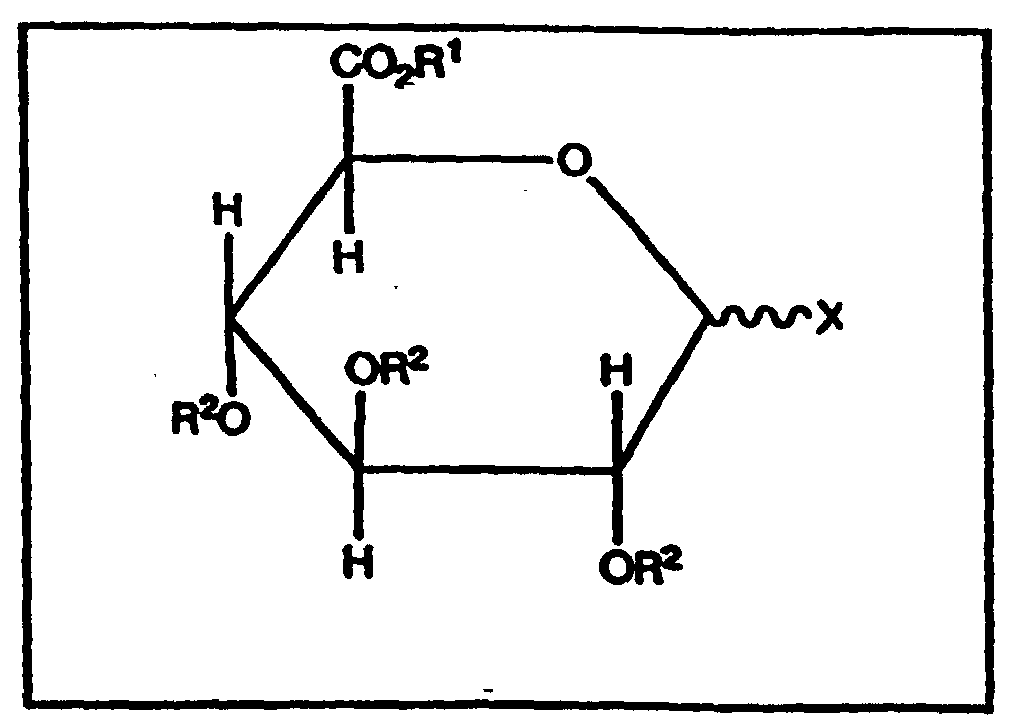
- glucuronate esters and substituted glucuronate esters preferably comprise the following formulae:
- R 1 , R 2 and X comprise any of the following:- R 1 R 2 X methyl acetyl Br akyl acyl O- acyl akyl acyl OH alkyl acyl O-C(NH)-CCl 3 methyl acetyl ⁇ -Cl methyl acetyl ⁇ -Cl methyl isobutyryl ⁇ -isobutyryl methyl isobutyryl ⁇ -isobutyryl methyl isobutyryl OH( ⁇ / ⁇ ) methyl isobutyryl ⁇ -OH methyl isobutyryl ⁇ -trichloroacetyl imidoyl methyl isobutyryl Br( ⁇ / ⁇ ) methyl pivalyl ⁇ -pivalyl methyl benzoyl benzoyl ( ⁇ / ⁇ )
- the phenolic group of the morphine-6-glucuronide or substituted morphine-6-glucuronide esters is protected.
- the protected esters may then be isolated. This is followed by alkaline or enzymatic hydrolysis or removal of silyl protecting groups using fluoride for example.
- the process of the present invention avoids the use of barium hydroxide and other heavy metals in the synthesis.
- This invention uses D-glucurono-6,3-lactone which is converted to esters of tetra-O-acyl- ⁇ -D-glucopyranuronates 2 (where the acyl group could include acetyl, propionyl, butyryl, isobutyryl, pivalyl, and other esters of organic acids as well as inorganic esters).
- the product could then be condensed directly in the presence of a catalyst such as trimethylsilyl triflate or a Lewis acid, with morphine or a derivative whereby the phenolic OH group is protected, e.g.
- protecting groups can be removed by hydrolysis or other selective cleavage.
- An alternative method of synthesis involves the selective cleavage at position 1 of the ester tetra-O-acyl- ⁇ -D-glucopyranuronate (X of formula 2 is O-acyl) to give the corresponding hemiacetal (X is OH) followed by formation of the imidate (X is OC(NH)CCl 3 using for example trichloroacetonitrile in the presence of potassium carbonate or other group I metal carbonates rather than the sodium hydride previously used for such transformations of sugar esters.
- X is O-acyl
- the present invention has been used to produce a large number of new compounds.
- These compounds include morphine-6-glucuronide derivatives of the following formula:
- R 1 , R 2 and R 3 may be any of the following combinations :- R 1 R 2 R 3 acetyl methyl ⁇ -D-(2,3,4-triisobutyryl)glucuronate methyl benzoyl methyl ⁇ -D-(2,3,4-triisobutyryl)glucuronate methyl H methyl ⁇ -D-(2,3,4-triisobutyryl)glucuronate methyl t butyldimethylsilyl methyl ⁇ -D-(2,3,4-triisobutyryl)glucuronate methyl isobutyryl methyl ⁇ -D-(2,3,4-triisobutyryl)glucuronate methyl methyl ⁇ -D-(2,3,4-triacetyl)glucuronate acetyl methyl methyl ⁇ -D-(2,3,4-triisobutyryl)glucuronate H methyl methyl ⁇ -D-(2,3,4-triacetyl)glucuronate H
- R 1 , R 2 and X may be any of the following combinations:- R 1 R 2 X methyl isobutyryl ⁇ -isobutyryl methyl isobutyryl ⁇ -isobutyryl methyl isobutyryl OH ( ⁇ / ⁇ ) methyl isobutyryl ⁇ -OH methyl isobutyryl ⁇ -trichloroacetyl imidoyl methyl isobutyryl Br( ⁇ / ⁇ )
Landscapes
- Chemical & Material Sciences (AREA)
- Organic Chemistry (AREA)
- Engineering & Computer Science (AREA)
- Health & Medical Sciences (AREA)
- Biochemistry (AREA)
- Biotechnology (AREA)
- General Health & Medical Sciences (AREA)
- Genetics & Genomics (AREA)
- Molecular Biology (AREA)
- Life Sciences & Earth Sciences (AREA)
- Pharmaceuticals Containing Other Organic And Inorganic Compounds (AREA)
- Saccharide Compounds (AREA)
- Catalysts (AREA)
- Low-Molecular Organic Synthesis Reactions Using Catalysts (AREA)
Abstract
Description

the method comprising the steps of conjugating a glucuronate ester and/or a substituted glucuronate ester with morphine or substituted morphine using acid catalysis to yield the morphine glucuronate derivative, followed by replacement of R1 (of formula 1) by hydrogen and, where appropriate, ester hydrolysis of the glucuronate at R2 (of formula 1) the glucuronate ester and/or substituted glucuronate ester comprising one of the following formulae (formula 2):-

| R1 | R2 | R3 |
| H | β-D-glucuronyl | methyl |
| β-D-glucuronyl | β-D-glucuronyl | methyl |
| acetyl | methyl β-D-(2,3,4-triisobutyryl)glucuronate | methyl |
| benzoyl | methyl β-D-(2,3,4-triisobutyryl)glucuronate | methyl |
| H | methyl β-D-(2,3,4-triisobutyryl)glucuronate | methyl |
| tbutyldimethylsilyl | methyl β-D-(2,3,4-triisobutyryl)glucuronate | methyl |
| isobutyryl | methyl β-D-(2,3,4-triisobutyryl)glucuronate | methyl |
| methyl β-D-(2,3,4-triacetyl)glucuronate | acetyl | methyl |
| methyl β-D-(2,3,4-triisobutyryl)glucuronate | H | methyl |
| methyl β-D-(2,3,4-triacetyl)glucuronate | methyl β-D-(2,3,4,triacetyl)glucuronate | methyl |
| methyl β-D-(2,3,4-triisobutyryl)glucuronate | methyl β-D-(2,3,4-triisobutyryl)glucuronate | methyl |
| propionyl | H | methyl |
| isobutyryl | H | methyl |
| pivalyl | H | methyl |
| tbutyldimethylsilyl | H | methyl |
| methyl | glucuronic acid | methyl |
| H | glucuronic acid | methyl, → O |
| H | glucuronic acid | (CH2)nX X= NRR4, OR, halogen |

| R1 | R2 | R3 |
| H | H | methyl |
| acyl | H | alkyl |
| silyl | H | alkyl |
| alkyl | H | alkyl |
| aralkyl | H | alkyl |
| R1 | R2 | X |
| methyl | acetyl | Br |
| akyl | acyl | O- acyl |
| akyl | acyl | OH |
| alkyl | acyl | O-C(NH)-CCl3 |
| methyl | acetyl | α-Cl |
| methyl | acetyl | β-Cl |
| methyl | isobutyryl | β-isobutyryl |
| methyl | isobutyryl | α-isobutyryl |
| methyl | isobutyryl | OH(α/β) |
| methyl | isobutyryl | α-OH |
| methyl | isobutyryl | α-trichloroacetyl imidoyl |
| methyl | isobutyryl | Br(α/β) |
| methyl | pivalyl | β-pivalyl |
| methyl | benzoyl | benzoyl (α/β) |

| R1 | R2 | R3 |
| acetyl | methyl β-D-(2,3,4-triisobutyryl)glucuronate | methyl |
| benzoyl | methyl β-D-(2,3,4-triisobutyryl)glucuronate | methyl |
| H | methyl β-D-(2,3,4-triisobutyryl)glucuronate | methyl |
| tbutyldimethylsilyl | methyl β-D-(2,3,4-triisobutyryl)glucuronate | methyl |
| isobutyryl | methyl β-D-(2,3,4-triisobutyryl)glucuronate | methyl |
| methyl β-D-(2,3,4-triacetyl)glucuronate | acetyl | methyl |
| methyl β-D-(2,3,4-triisobutyryl)glucuronate | H | methyl |
| methyl β-D-(2,3,4-triacetyl)glucuronate | methyl β-D-(2,3,4-triacetyl)glucuronate | methyl |
| methyl β-D-(2,3,4-triisobutyryl)glucuronate | methyl β-D-(2,3,4-triisobutyryl)glucuronate | methyl |
| propionyl | H | methyl |
| isobutyryl | H | methyl |
| pivalyl | H | methyl |
| H | glucuronic acid | methyl, → O |
| H | glucuronic acid | (CH2)nX X= NRR4, OR, halogen |

| R1 | R2 | X |
| methyl | isobutyryl | β-isobutyryl |
| methyl | isobutyryl | α-isobutyryl |
| methyl | isobutyryl | OH (α/β) |
| methyl | isobutyryl | α-OH |
| methyl | isobutyryl | α-trichloroacetyl imidoyl |
| methyl | isobutyryl | Br(α/β) |
δ(CDCl3: 8.76 (1H,bs,HN); 6.63 (1H,d,J=3.5Hz,1-H); 5.63 (1H,t,J=9.7Hz,4-H); 5.27 (1H,t,J=9.7Hz,3-H);5.15 (1H,dd,J=3.5,9.7Hz,2-H);4.49 (1H,d,J=9.7Hz,5-H);3.75 (3H,s,CO2Me); 2.05 (6H,s,Ac); 2.03 (3H,s,Ac)
| C,H,N analysis: Found | C, 60.6; | H, 6.9; | N, 1.3 |
| C55 H75 NO21 requires | C, 60.8; | H, 6.9; | N, 1.3. |
Claims (8)
- A process for making morphine-6-glucuronide or substituted morphine-6-glucuronide of the following formula 1:-positions 7, 8 can be olefin as shown or dihydro-, dihydroxy-, hydroxyhalo-, epoxy-, dihalo-, hydrohalo-, hydrohydroxy-, or CXY (X,Y = halogen or hydrogen) adducts,

whereinthe method comprising the steps of conjugating a glucuronate ester and/or a substituted glucuronate ester with morphine or substituted morphine using acid catalysis to yield the morphine glucuronate derivative, followed by replacement of R1 of formula 1, the glucuronate ester and/or substituted glucuronate ester comprising the following formula 2:-R1 = alkyl, aryl, acyl, silyl, phosphate, sulphate, hydrogen or glycoside.R2 = glucuronide esters or glucuronic acid, andR3 = alkyl, aryl, hydrogen, alkoxy, aryloxy, halogen or (CH2)nX where X=NRR4, where n is an integer and R and R4 are alkyl, aryl or acyl,wherein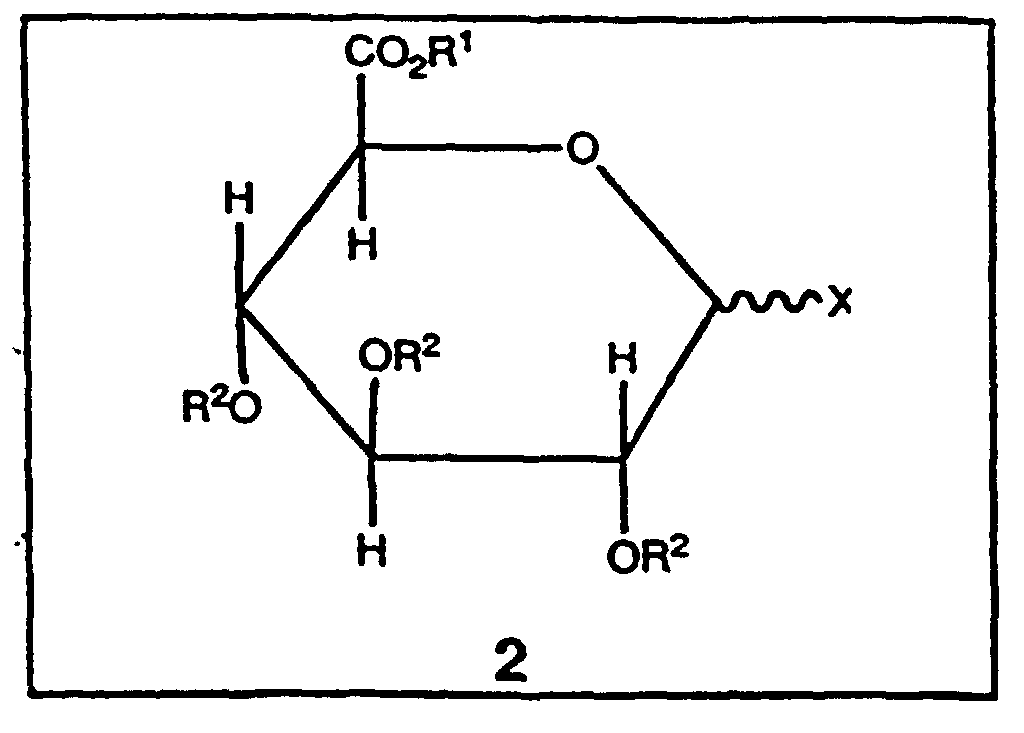 R1 = alkyl or aryl,R2 = acyl, andX = O-acyl, OC(NH)CCl3, OC(NH) C(halogen) 2R, hydroxyl, inorganic ester, e.g. phosphate or sulphate derivatives or halogen.
 - A process as claimed in claim 1, characterised in that R1, R2 and R3 (of formula 1) are one of the following combinations:-
R1 R2 R3 H β-D-glucuronyl methyl β-D-glucuronyl β-D-glucuronyl methyl acetyl methyl β-D-(2,3,4-triisobutyryl)glucuronate methyl benzoyl methyl β-D-(2,3,4-triisobutyryl)glucuronate methyl H methyl β-D-(2,3,4-triisobutyryl)glucuronate methyl tbutyldimethylsilyl methyl β-D-(2,3,4-triisobutyryl)glucuronate methyl isobutyryl methyl β-D-(2,3,4-triisobutyryl)glucuronate methyl methyl β-D-(2,3,4-triacetyl)glucuronate methyl β-D-(2,3,4,triacetyl)glucuronate methyl methyl β-D-(2,3,4-triisobutyryl)glucuronate methyl β-D-(2,3,4-triisobutyryl)glucuronate methyl methyl glucuronic acid methyl H glucuronic acid methyl, → O H glucuronic acid (CH2)nX where X= NRR4, OR, or halogen - A process as claimed in claim 1 or claim 2, wherein the said morphine or substituted morphine comprises the following formula:positions 7,8 can be olefin as shown or dihydro-, dihydroxy-, hydroxyhalo-, epoxy-, dihalo-, hydrohalo-, hydrohydroxy-, or CXY (X,Y = halogen or hydrogen) adducts,

wherein R1, R2 and R3 are one of the following combinations:-R1 R2 R3 H H methyl acyl H alkyl silyl H alkyl alkyl H alkyl aralkyl H alkyl - A process as claimed in any preceding claim, characterised in that the glucuronate ester and substituted glucuronate ester comprises one of the following formulae:-Wherein R1, R2 and X comprise any of the following:-
R1 R2 X akyl acyl O-acyl akyl acyl OH alkyl acyl O-C(NH)-CCl3 methyl acetyl α-Cl methyl acetyl β-Cl methyl isobutyryl β-O-isobutyryl methyl isobutyryl α-O-isobutyryl methyl isobutyryl OH(α/β) methyl isobutyryl α-OH methyl isobutyryl O-C(NH)-CCl3 methyl isobutyryl Br(α/β) methyl pivalyl β-O-pivaloyl methyl benzoyl (α/β)-O-benzoyl - A process as claimed in any preceding claim, characterised in that the phenolic hydroxide group of the morphine -6-glucuronide esters or substituted morphine-6-glucuronide esters is protected.
- A process as claimed in any of claims 1 to 4, characterised in that the process includes selective cleavage at position 1 of the glucuronate or substituted glucuronate to give the corresponding hemiacetal.
- A compound selected from the following formula:-positions 7, 8 can be olefin as shown or dihydro-, dihydroxy-, hydroxyhalo-, epoxy-, dihalo-, hydrohalo-, hydrohydroxy-, or CXY (X,Y = halogen or hydrogen) adducts,

wherein R1, R2 and R3 may be any of the following combinations:-R1 R2 R3 acetyl methyl β-D-(2,3,4-triisobutyryl)glucuronate methyl benzoyl methyl β-D-(2,3,4-triisobutyryl)glucuronate methyl H methyl β-D-(2,3,4-triisobutyryl)glucuronate methyl tbutyldimethylsilyl methyl β-D-(2,3,4-triisobutyryl)glucuronate methyl isobutyryl methyl β-D-(2,3,4-triisobutyryl)glucuronate methyl methyl β-D-(2,3,4-triacetyl)glucuronate acetyl methyl methyl β-D-(2,3,4-triisobutyryl)glucuronate H methyl methyl β-D-(2,3,4-triacetyl)glucuronate methyl β-D-(2,3,4-triacetyl)glucuronate methyl methyl β-D-(2,3,4-triisobutyryl)glucuronate methyl β-D-(2,3,4-triisobutyryl)glucuronate methyl isobutyryl H methyl pivalyl H methyl H glucuronic acid methyl, → O H glucuronic acid (CH2)nX where X= NRR4, OR, or halogen - A compound selected from the following formula:wherein R1, R2 and X may be any of the following combinations:-

R1 R2 X methyl isobutyryl β-O-isobutyryl methyl isobutyryl α-O-isobutyryl methyl isobutyryl OH (α/β) methyl isobutyryl α-OH methyl isobutyryl α-O-C(NH)CCl3 methyl isobutyryl Br(α/β)
Applications Claiming Priority (3)
| Application Number | Priority Date | Filing Date | Title |
|---|---|---|---|
| GB919116909A GB9116909D0 (en) | 1991-08-06 | 1991-08-06 | Morphine derivatives |
| GB9116909 | 1991-08-06 | ||
| PCT/GB1992/001449 WO1993003051A1 (en) | 1991-08-06 | 1992-08-04 | A process for making morphine-6-glucuronide or substituted morphine-6-glucuronide |
Publications (2)
| Publication Number | Publication Date |
|---|---|
| EP0597915A1 EP0597915A1 (en) | 1994-05-25 |
| EP0597915B1 true EP0597915B1 (en) | 1998-11-11 |
Family
ID=10699556
Family Applications (1)
| Application Number | Title | Priority Date | Filing Date |
|---|---|---|---|
| EP92916104A Expired - Lifetime EP0597915B1 (en) | 1991-08-06 | 1992-08-04 | A process for making morphine-6-glucuronide or substituted morphine-6-glucuronide |
Country Status (15)
| Country | Link |
|---|---|
| US (2) | US5621087A (en) |
| EP (1) | EP0597915B1 (en) |
| JP (1) | JP3642576B2 (en) |
| AT (1) | ATE173269T1 (en) |
| AU (1) | AU672365B2 (en) |
| CA (2) | CA2412554C (en) |
| DE (1) | DE69227588T2 (en) |
| DK (1) | DK0597915T3 (en) |
| ES (1) | ES2130175T3 (en) |
| FI (1) | FI940534L (en) |
| GB (1) | GB9116909D0 (en) |
| GR (1) | GR3029369T3 (en) |
| HU (1) | HUT68169A (en) |
| NO (1) | NO940349L (en) |
| WO (1) | WO1993003051A1 (en) |
Cited By (1)
| Publication number | Priority date | Publication date | Assignee | Title |
|---|---|---|---|---|
| WO2008043962A1 (en) | 2006-10-12 | 2008-04-17 | Neorphys | Novel morphine derivatives |
Families Citing this family (32)
| Publication number | Priority date | Publication date | Assignee | Title |
|---|---|---|---|---|
| GB9116909D0 (en) * | 1991-08-06 | 1991-09-18 | Salford Ultrafine Chem & Res | Morphine derivatives |
| GB9325065D0 (en) * | 1993-12-07 | 1994-02-02 | Salford Ultrafine Chem & Res | An enzymatic process for making morphine-6-glucuronide or substituted morphine-6-glucuronide |
| US5977326A (en) * | 1991-08-06 | 1999-11-02 | Salford Ultrafine Chemicals And Research Limited | Process for making morphine-6-glucuronide or substituted morphine-6-glucuronide |
| EP0632041A1 (en) * | 1993-07-01 | 1995-01-04 | Katholieke Universiteit Nijmegen | New morphine derivatives having improved analgesic and narcotic properties |
| EP0663401B1 (en) | 1993-07-23 | 2000-06-07 | Toray Industries, Inc. | Morphinan derivative and medicinal use |
| GB2282758A (en) * | 1993-08-23 | 1995-04-19 | Euro Celtique Sa | Oral morphine-6-glucuronide compositions |
| DE4403709A1 (en) * | 1994-02-07 | 1995-08-10 | Lohmann Therapie Syst Lts | Pharmaceutical composition for systemic transdermal administration with the active ingredient morphine-6-glucuronide |
| GB9423542D0 (en) * | 1994-11-22 | 1995-01-11 | Marples Brian A | Pharmaceutical compounds |
| WO1996028451A1 (en) * | 1995-03-14 | 1996-09-19 | Euroceltique S.A. | Morphine-3-esters |
| DE19508664C2 (en) * | 1995-03-14 | 2001-08-23 | Christian Mignat | Use of morphine-3-esters, morphine-3-esters as such and process for their preparation |
| AT403162B (en) * | 1995-10-11 | 1997-11-25 | Nycomed Austria Gmbh | NEW MORPHINE-6-GLUCURONIDE CRYSTAL SHAPE |
| DE19541921A1 (en) * | 1995-11-10 | 1997-05-15 | Nycomed Arzneimittel Gmbh | New crystalline form of morphone-6-glucuronide, useful as analgesic |
| WO1997021416A2 (en) * | 1995-11-29 | 1997-06-19 | Rolabo Sl | Glycoconjugates of opiated substances |
| DE19602963A1 (en) * | 1995-12-20 | 1997-07-31 | Nycomed Arzneimittel Gmbh | New morphine derivatives |
| DE69815336T2 (en) * | 1997-04-14 | 2004-05-06 | Ufc Ltd. | MORPHINE DERIVATIVES |
| GB9711118D0 (en) * | 1997-05-29 | 1997-07-23 | Rolabo Sl | Compound |
| HUP0100841A3 (en) * | 1998-02-02 | 2003-03-28 | Cenes Ltd Cambridge | Glycosidation of 4,5-epoxymorphinan-6-ols |
| US6737518B1 (en) * | 1998-05-13 | 2004-05-18 | Cenes Limited | Process for preparation of 4,5-epoxymorphinan-6-oxyglucuronides |
| ATE225363T1 (en) * | 1998-06-06 | 2002-10-15 | Cenes Ltd | SYNTHESIS OF MORPHINE-6-GLUCURONIDE |
| SE9901257D0 (en) * | 1999-04-09 | 1999-04-09 | Hel Ab | Treatment of pain after joint surgery |
| GB9914382D0 (en) * | 1999-06-21 | 1999-08-18 | Ufc Limited | New process for the manufacture of morphine-6-glucuronide and its analogues and also to a manufacture of new intermediaries |
| US6339107B1 (en) | 2000-08-02 | 2002-01-15 | Syntex (U.S.A.) Llc | Methods for treatment of Emphysema using 13-cis retinoic acid |
| IL158882A0 (en) * | 2001-06-05 | 2004-05-12 | Control Delivery Sys Inc | Sustained-release analgesic compounds |
| MXPA05003068A (en) | 2002-09-20 | 2005-06-08 | Univ Kingston | Detection of biological molecules by differential partitioning of enzyme substrates and products. |
| PT1864987E (en) | 2004-02-06 | 2010-03-09 | Euro Celtique Sa | Methods for making 3-o protected morphinones and 3-o-protected morphinone dienol carboxylates |
| FR2939437B1 (en) | 2008-12-10 | 2010-12-17 | Sanofi Aventis | MORPHINE-6-GLUCURONIDE DERIVATIVES, THEIR PREPARATION AND THEIR THERAPEUTIC USE |
| FR2939436B1 (en) * | 2008-12-10 | 2010-12-17 | Sanofi Aventis | SYNTHESIS OF MORPHINE-6-GLUCURONIDE OR ONE OF ITS DERIVATIVES |
| FR2939796B1 (en) | 2008-12-11 | 2010-12-17 | Sanofi Aventis | BICYCLIC DERIVATIVES OF MORPHINE-6-GLUCURONIDE, THEIR PREPARATION AND THEIR THERAPEUTIC USE |
| CA2802724C (en) | 2010-06-18 | 2016-09-06 | Pathogen Detection Systems, Inc. | Method and system for detecting biological molecules in samples |
| CN103421063B (en) * | 2012-05-23 | 2016-04-06 | 宜昌人福药业有限责任公司 | A kind of method of synthesizing morphine-6-β-D-Glucose aldehydic acid glycosides |
| CN106008621B (en) * | 2014-03-26 | 2019-02-19 | 宜昌人福药业有限责任公司 | A kind of synthetic method of morphine-6-β-D-glucuronide and intermediate compound thereof |
| AU2023246772A1 (en) | 2022-03-29 | 2024-01-18 | Illumina Inc. | Chromenoquinoline dyes and uses in sequencing |
Citations (1)
| Publication number | Priority date | Publication date | Assignee | Title |
|---|---|---|---|---|
| WO1993005057A1 (en) * | 1991-09-04 | 1993-03-18 | Irepa (Institut Regional De Promotion De La Recherche Appliquee) | Method for synthesizing glucuronides of 4,5-epoxy morphinanes |
Family Cites Families (4)
| Publication number | Priority date | Publication date | Assignee | Title |
|---|---|---|---|---|
| ES2058243T3 (en) * | 1988-01-12 | 1994-11-01 | Baker Norton Pharma | DERIVATIVES OF THE GLUCURONIC ACID FROM OPIACEAN ANTAGONISTS. |
| US4774230A (en) * | 1988-03-26 | 1988-09-27 | Ivax Laboratories, Inc. | Glucuronic acid derivatives of opioid antagonists |
| GB9325065D0 (en) * | 1993-12-07 | 1994-02-02 | Salford Ultrafine Chem & Res | An enzymatic process for making morphine-6-glucuronide or substituted morphine-6-glucuronide |
| GB9116909D0 (en) * | 1991-08-06 | 1991-09-18 | Salford Ultrafine Chem & Res | Morphine derivatives |
-
1991
- 1991-08-06 GB GB919116909A patent/GB9116909D0/en active Pending
-
1992
- 1992-08-04 CA CA002412554A patent/CA2412554C/en not_active Expired - Fee Related
- 1992-08-04 AT AT92916104T patent/ATE173269T1/en not_active IP Right Cessation
- 1992-08-04 ES ES92916104T patent/ES2130175T3/en not_active Expired - Lifetime
- 1992-08-04 FI FI940534A patent/FI940534L/en not_active Application Discontinuation
- 1992-08-04 DE DE69227588T patent/DE69227588T2/en not_active Expired - Fee Related
- 1992-08-04 CA CA002114838A patent/CA2114838C/en not_active Expired - Fee Related
- 1992-08-04 AU AU23894/92A patent/AU672365B2/en not_active Ceased
- 1992-08-04 DK DK92916104T patent/DK0597915T3/en active
- 1992-08-04 JP JP50342393A patent/JP3642576B2/en not_active Expired - Fee Related
- 1992-08-04 EP EP92916104A patent/EP0597915B1/en not_active Expired - Lifetime
- 1992-08-04 WO PCT/GB1992/001449 patent/WO1993003051A1/en not_active Ceased
- 1992-08-06 HU HU9400330A patent/HUT68169A/en unknown
-
1994
- 1994-02-02 NO NO940349A patent/NO940349L/en unknown
- 1994-02-04 US US08/192,281 patent/US5621087A/en not_active Expired - Lifetime
-
1996
- 1996-07-31 US US08/688,727 patent/US6046313A/en not_active Expired - Lifetime
-
1999
- 1999-02-10 GR GR990400456T patent/GR3029369T3/en unknown
Patent Citations (1)
| Publication number | Priority date | Publication date | Assignee | Title |
|---|---|---|---|---|
| WO1993005057A1 (en) * | 1991-09-04 | 1993-03-18 | Irepa (Institut Regional De Promotion De La Recherche Appliquee) | Method for synthesizing glucuronides of 4,5-epoxy morphinanes |
Cited By (2)
| Publication number | Priority date | Publication date | Assignee | Title |
|---|---|---|---|---|
| WO2008043962A1 (en) | 2006-10-12 | 2008-04-17 | Neorphys | Novel morphine derivatives |
| US8158764B2 (en) | 2006-10-12 | 2012-04-17 | Neorphys | Morphine derivatives |
Also Published As
| Publication number | Publication date |
|---|---|
| JPH07501317A (en) | 1995-02-09 |
| EP0597915A1 (en) | 1994-05-25 |
| US5621087A (en) | 1997-04-15 |
| FI940534A0 (en) | 1994-02-04 |
| CA2412554C (en) | 2006-10-31 |
| DE69227588D1 (en) | 1998-12-17 |
| HU9400330D0 (en) | 1994-05-30 |
| WO1993003051A1 (en) | 1993-02-18 |
| GB9116909D0 (en) | 1991-09-18 |
| CA2114838A1 (en) | 1993-02-18 |
| GR3029369T3 (en) | 1999-05-28 |
| US6046313A (en) | 2000-04-04 |
| NO940349D0 (en) | 1994-02-02 |
| NO940349L (en) | 1994-03-16 |
| HUT68169A (en) | 1995-05-29 |
| AU2389492A (en) | 1993-03-02 |
| CA2114838C (en) | 2003-10-14 |
| DE69227588T2 (en) | 2000-01-27 |
| DK0597915T3 (en) | 1999-07-26 |
| ATE173269T1 (en) | 1998-11-15 |
| CA2412554A1 (en) | 1993-02-18 |
| FI940534A7 (en) | 1994-04-05 |
| AU672365B2 (en) | 1996-10-03 |
| JP3642576B2 (en) | 2005-04-27 |
| FI940534L (en) | 1994-04-05 |
| ES2130175T3 (en) | 1999-07-01 |
Similar Documents
| Publication | Publication Date | Title |
|---|---|---|
| AU672365B2 (en) | A process for making morphine-6-glucuronide or substituted morphine-6-glucuronide | |
| US5977326A (en) | Process for making morphine-6-glucuronide or substituted morphine-6-glucuronide | |
| EP0141057A1 (en) | Novel 4'-demethyl-4-epipodophyllotoxin derivatives, a process for their preparation and their use as medicaments | |
| EP0193903B1 (en) | Production of cytosine nucleosides | |
| EP3819302B1 (en) | Fucosylated chondroitin sulfate oligosaccharide, preparation method therefor, composition thereof and use thereof | |
| US5036055A (en) | Acylated derivatives of etoposide | |
| Brown et al. | A Simple Synthesis of Morphine-3, 6-di-β-d-glucuronide | |
| US5066645A (en) | Epipodophyllotoxin altroside derivatives | |
| KR920000646B1 (en) | Fluoro-substituted epipodophyllo-toxin glucosides | |
| HU209724B (en) | Process for preparing glucosidase inhibitors and pharmaceutical comp. contg. them | |
| KR0153478B1 (en) | Method for preparing esculin derivative, use thereof and weak composition | |
| Popsavin et al. | Direct Preparation of 1, 2: 3, 5-Di-O-cyclohexylidene-α-D-xylofuranose from Corncobs and Its Conversion to 1-O-Acetyl-2, 3, 5-tri-O-benzoyl-D-ribofuranose | |
| JPH0592987A (en) | 4'-demethylepipodophyllotoxin glycosides | |
| Vogel et al. | α-1-Tributyltin-O-2, 3-bisacetyl-4, 6-ethylidene-glucose as a convenient glycosidation reagent: an efficient synthesis of etoposide | |
| US6384201B1 (en) | Synthetic method for the preparation of the antineoplastic agent etoposide | |
| EP1053244B1 (en) | Glycosidation of 4,5-epoxymorphinan-6-ols | |
| EP0499904A1 (en) | Solvent-free synthesis of ethereally substituted blocked monosaccharides and the selective hydrolysis thereof | |
| Popsavin et al. | Conversion of D-xylose to protected D-lyxose derivatives and to D-lyxose, via the corresponding 1, 2-anhydride | |
| US4284763A (en) | Sugar acetals, their preparation and use | |
| Morikawa et al. | Novel Partial Protections of 1, 6–Anhtdro–β-Lactose | |
| EP1200441B1 (en) | Process for making morphine-6-glucuronide and its analogues using haloglucuronate ester intermediates | |
| CA2375812A1 (en) | Derivatives of 4'-demycarosyl-8a-aza-8a-homotylosin | |
| US20040053854A1 (en) | Process for preparation of 4,5-Epoxymorphinan-6-oxyglucuronides | |
| HU215156B (en) | Process for producing 4'-dezoxy-10,11,12,13-tetrahydro-demicosin and pharmaceutical compositions containing it | |
| EP0986569A1 (en) | Process for preparing etoposide |
Legal Events
| Date | Code | Title | Description |
|---|---|---|---|
| PUAI | Public reference made under article 153(3) epc to a published international application that has entered the european phase |
Free format text: ORIGINAL CODE: 0009012 |
|
| 17P | Request for examination filed |
Effective date: 19940301 |
|
| AK | Designated contracting states |
Kind code of ref document: A1 Designated state(s): AT BE CH DE DK ES FR GB GR IE IT LI LU MC NL SE |
|
| 17Q | First examination report despatched |
Effective date: 19960126 |
|
| GRAG | Despatch of communication of intention to grant |
Free format text: ORIGINAL CODE: EPIDOS AGRA |
|
| GRAG | Despatch of communication of intention to grant |
Free format text: ORIGINAL CODE: EPIDOS AGRA |
|
| GRAH | Despatch of communication of intention to grant a patent |
Free format text: ORIGINAL CODE: EPIDOS IGRA |
|
| GRAH | Despatch of communication of intention to grant a patent |
Free format text: ORIGINAL CODE: EPIDOS IGRA |
|
| GRAA | (expected) grant |
Free format text: ORIGINAL CODE: 0009210 |
|
| AK | Designated contracting states |
Kind code of ref document: B1 Designated state(s): AT BE CH DE DK ES FR GB GR IE IT LI LU MC NL SE |
|
| REF | Corresponds to: |
Ref document number: 173269 Country of ref document: AT Date of ref document: 19981115 Kind code of ref document: T |
|
| REG | Reference to a national code |
Ref country code: CH Ref legal event code: EP |
|
| REF | Corresponds to: |
Ref document number: 69227588 Country of ref document: DE Date of ref document: 19981217 |
|
| BECA | Be: change of holder's address |
Free format text: 981111 *UFC LTD:SYNERGY HOUSE GUILDHALL CLOSE MANCHESTER SCIENCE PARK, MANCHESTER M15 6SY |
|
| BECN | Be: change of holder's name |
Effective date: 19981111 |
|
| REG | Reference to a national code |
Ref country code: IE Ref legal event code: FG4D |
|
| ITF | It: translation for a ep patent filed | ||
| REG | Reference to a national code |
Ref country code: CH Ref legal event code: PFA Free format text: SALFORD ULTRAFINE CHEMICALS AND RESEARCH LIMITED TRANSFER- UFC LIMITED Ref country code: CH Ref legal event code: NV Representative=s name: LUCHS & PARTNER PATENTANWAELTE |
|
| REG | Reference to a national code |
Ref country code: GB Ref legal event code: 732E |
|
| ET | Fr: translation filed | ||
| REG | Reference to a national code |
Ref country code: ES Ref legal event code: FG2A Ref document number: 2130175 Country of ref document: ES Kind code of ref document: T3 |
|
| REG | Reference to a national code |
Ref country code: DK Ref legal event code: T3 |
|
| REG | Reference to a national code |
Ref country code: FR Ref legal event code: CD Ref country code: FR Ref legal event code: CA |
|
| NLT1 | Nl: modifications of names registered in virtue of documents presented to the patent office pursuant to art. 16 a, paragraph 1 |
Owner name: UFC LIMITED |
|
| REG | Reference to a national code |
Ref country code: ES Ref legal event code: PC2A |
|
| PLBE | No opposition filed within time limit |
Free format text: ORIGINAL CODE: 0009261 |
|
| STAA | Information on the status of an ep patent application or granted ep patent |
Free format text: STATUS: NO OPPOSITION FILED WITHIN TIME LIMIT |
|
| 26N | No opposition filed | ||
| REG | Reference to a national code |
Ref country code: GB Ref legal event code: IF02 |
|
| REG | Reference to a national code |
Ref country code: CH Ref legal event code: PUE Owner name: CENES LIMITED Free format text: UFC LIMITED#SYNERGY HOUSE GUILDHALL CLOSE MANCHESTER SCIENCE PARK#MANCHESTER M15 6SY (GB) -TRANSFER TO- CENES LIMITED#COMPASS HOUSE, VISION PARK CHIVERS WAY, HISTON#CAMBRIDGE CB24 9ZR (GB) |
|
| NLS | Nl: assignments of ep-patents |
Owner name: CENES LIMITED Effective date: 20070508 |
|
| REG | Reference to a national code |
Ref country code: ES Ref legal event code: PC2A |
|
| REG | Reference to a national code |
Ref country code: FR Ref legal event code: TP |
|
| PGFP | Annual fee paid to national office [announced via postgrant information from national office to epo] |
Ref country code: NL Payment date: 20080803 Year of fee payment: 17 Ref country code: LU Payment date: 20080826 Year of fee payment: 17 Ref country code: ES Payment date: 20080922 Year of fee payment: 17 Ref country code: DK Payment date: 20080815 Year of fee payment: 17 Ref country code: DE Payment date: 20080814 Year of fee payment: 17 Ref country code: CH Payment date: 20080912 Year of fee payment: 17 |
|
| PGFP | Annual fee paid to national office [announced via postgrant information from national office to epo] |
Ref country code: MC Payment date: 20080731 Year of fee payment: 17 Ref country code: IT Payment date: 20080827 Year of fee payment: 17 Ref country code: IE Payment date: 20080818 Year of fee payment: 17 Ref country code: FR Payment date: 20080818 Year of fee payment: 17 Ref country code: AT Payment date: 20080814 Year of fee payment: 17 |
|
| PGFP | Annual fee paid to national office [announced via postgrant information from national office to epo] |
Ref country code: GB Payment date: 20080813 Year of fee payment: 17 |
|
| PGFP | Annual fee paid to national office [announced via postgrant information from national office to epo] |
Ref country code: SE Payment date: 20080807 Year of fee payment: 17 |
|
| PGFP | Annual fee paid to national office [announced via postgrant information from national office to epo] |
Ref country code: GR Payment date: 20080716 Year of fee payment: 17 |
|
| PGFP | Annual fee paid to national office [announced via postgrant information from national office to epo] |
Ref country code: BE Payment date: 20090119 Year of fee payment: 17 |
|
| BERE | Be: lapsed |
Owner name: *CENES LTD Effective date: 20090831 |
|
| PG25 | Lapsed in a contracting state [announced via postgrant information from national office to epo] |
Ref country code: MC Free format text: LAPSE BECAUSE OF NON-PAYMENT OF DUE FEES Effective date: 20090831 |
|
| REG | Reference to a national code |
Ref country code: NL Ref legal event code: V1 Effective date: 20100301 Ref country code: CH Ref legal event code: PL |
|
| REG | Reference to a national code |
Ref country code: DK Ref legal event code: EBP |
|
| GBPC | Gb: european patent ceased through non-payment of renewal fee |
Effective date: 20090804 |
|
| PG25 | Lapsed in a contracting state [announced via postgrant information from national office to epo] |
Ref country code: LI Free format text: LAPSE BECAUSE OF NON-PAYMENT OF DUE FEES Effective date: 20090831 Ref country code: CH Free format text: LAPSE BECAUSE OF NON-PAYMENT OF DUE FEES Effective date: 20090831 |
|
| REG | Reference to a national code |
Ref country code: FR Ref legal event code: ST Effective date: 20100430 |
|
| REG | Reference to a national code |
Ref country code: IE Ref legal event code: MM4A |
|
| PG25 | Lapsed in a contracting state [announced via postgrant information from national office to epo] |
Ref country code: BE Free format text: LAPSE BECAUSE OF NON-PAYMENT OF DUE FEES Effective date: 20090831 Ref country code: AT Free format text: LAPSE BECAUSE OF NON-PAYMENT OF DUE FEES Effective date: 20090804 |
|
| PG25 | Lapsed in a contracting state [announced via postgrant information from national office to epo] |
Ref country code: NL Free format text: LAPSE BECAUSE OF NON-PAYMENT OF DUE FEES Effective date: 20100301 Ref country code: IE Free format text: LAPSE BECAUSE OF NON-PAYMENT OF DUE FEES Effective date: 20090804 Ref country code: FR Free format text: LAPSE BECAUSE OF NON-PAYMENT OF DUE FEES Effective date: 20090831 Ref country code: DK Free format text: LAPSE BECAUSE OF NON-PAYMENT OF DUE FEES Effective date: 20090831 Ref country code: DE Free format text: LAPSE BECAUSE OF NON-PAYMENT OF DUE FEES Effective date: 20100302 |
|
| REG | Reference to a national code |
Ref country code: ES Ref legal event code: FD2A Effective date: 20090805 |
|
| PG25 | Lapsed in a contracting state [announced via postgrant information from national office to epo] |
Ref country code: GR Free format text: LAPSE BECAUSE OF NON-PAYMENT OF DUE FEES Effective date: 20100303 |
|
| PG25 | Lapsed in a contracting state [announced via postgrant information from national office to epo] |
Ref country code: GB Free format text: LAPSE BECAUSE OF NON-PAYMENT OF DUE FEES Effective date: 20090804 |
|
| PG25 | Lapsed in a contracting state [announced via postgrant information from national office to epo] |
Ref country code: IT Free format text: LAPSE BECAUSE OF NON-PAYMENT OF DUE FEES Effective date: 20090804 |
|
| PG25 | Lapsed in a contracting state [announced via postgrant information from national office to epo] |
Ref country code: LU Free format text: LAPSE BECAUSE OF NON-PAYMENT OF DUE FEES Effective date: 20090804 |
|
| PG25 | Lapsed in a contracting state [announced via postgrant information from national office to epo] |
Ref country code: SE Free format text: LAPSE BECAUSE OF NON-PAYMENT OF DUE FEES Effective date: 20090805 |
|
| PG25 | Lapsed in a contracting state [announced via postgrant information from national office to epo] |
Ref country code: ES Free format text: LAPSE BECAUSE OF NON-PAYMENT OF DUE FEES Effective date: 20090805 |