EP0595959B1 - A method for forming and consolidating a fiber reinforced resin structure - Google Patents
A method for forming and consolidating a fiber reinforced resin structure Download PDFInfo
- Publication number
- EP0595959B1 EP0595959B1 EP92916155A EP92916155A EP0595959B1 EP 0595959 B1 EP0595959 B1 EP 0595959B1 EP 92916155 A EP92916155 A EP 92916155A EP 92916155 A EP92916155 A EP 92916155A EP 0595959 B1 EP0595959 B1 EP 0595959B1
- Authority
- EP
- European Patent Office
- Prior art keywords
- metal alloy
- mandrel
- cores
- prepreg material
- thermal expansion
- Prior art date
- Legal status (The legal status is an assumption and is not a legal conclusion. Google has not performed a legal analysis and makes no representation as to the accuracy of the status listed.)
- Expired - Lifetime
Links
Images
Classifications
-
- B—PERFORMING OPERATIONS; TRANSPORTING
- B29—WORKING OF PLASTICS; WORKING OF SUBSTANCES IN A PLASTIC STATE IN GENERAL
- B29D—PRODUCING PARTICULAR ARTICLES FROM PLASTICS OR FROM SUBSTANCES IN A PLASTIC STATE
- B29D23/00—Producing tubular articles
-
- B—PERFORMING OPERATIONS; TRANSPORTING
- B29—WORKING OF PLASTICS; WORKING OF SUBSTANCES IN A PLASTIC STATE IN GENERAL
- B29C—SHAPING OR JOINING OF PLASTICS; SHAPING OF MATERIAL IN A PLASTIC STATE, NOT OTHERWISE PROVIDED FOR; AFTER-TREATMENT OF THE SHAPED PRODUCTS, e.g. REPAIRING
- B29C70/00—Shaping composites, i.e. plastics material comprising reinforcements, fillers or preformed parts, e.g. inserts
- B29C70/04—Shaping composites, i.e. plastics material comprising reinforcements, fillers or preformed parts, e.g. inserts comprising reinforcements only, e.g. self-reinforcing plastics
- B29C70/28—Shaping operations therefor
- B29C70/30—Shaping by lay-up, i.e. applying fibres, tape or broadsheet on a mould, former or core; Shaping by spray-up, i.e. spraying of fibres on a mould, former or core
- B29C70/34—Shaping by lay-up, i.e. applying fibres, tape or broadsheet on a mould, former or core; Shaping by spray-up, i.e. spraying of fibres on a mould, former or core and shaping or impregnating by compression, i.e. combined with compressing after the lay-up operation
-
- B—PERFORMING OPERATIONS; TRANSPORTING
- B29—WORKING OF PLASTICS; WORKING OF SUBSTANCES IN A PLASTIC STATE IN GENERAL
- B29K—INDEXING SCHEME ASSOCIATED WITH SUBCLASSES B29B, B29C OR B29D, RELATING TO MOULDING MATERIALS OR TO MATERIALS FOR MOULDS, REINFORCEMENTS, FILLERS OR PREFORMED PARTS, e.g. INSERTS
- B29K2105/00—Condition, form or state of moulded material or of the material to be shaped
- B29K2105/24—Condition, form or state of moulded material or of the material to be shaped crosslinked or vulcanised
-
- B—PERFORMING OPERATIONS; TRANSPORTING
- B29—WORKING OF PLASTICS; WORKING OF SUBSTANCES IN A PLASTIC STATE IN GENERAL
- B29K—INDEXING SCHEME ASSOCIATED WITH SUBCLASSES B29B, B29C OR B29D, RELATING TO MOULDING MATERIALS OR TO MATERIALS FOR MOULDS, REINFORCEMENTS, FILLERS OR PREFORMED PARTS, e.g. INSERTS
- B29K2105/00—Condition, form or state of moulded material or of the material to be shaped
- B29K2105/24—Condition, form or state of moulded material or of the material to be shaped crosslinked or vulcanised
- B29K2105/243—Partially cured
-
- B—PERFORMING OPERATIONS; TRANSPORTING
- B29—WORKING OF PLASTICS; WORKING OF SUBSTANCES IN A PLASTIC STATE IN GENERAL
- B29L—INDEXING SCHEME ASSOCIATED WITH SUBCLASS B29C, RELATING TO PARTICULAR ARTICLES
- B29L2031/00—Other particular articles
- B29L2031/60—Multitubular or multicompartmented articles, e.g. honeycomb
- B29L2031/601—Multi-tubular articles, i.e. composed of a plurality of tubes
Definitions
- This invention relates to a method for forming and consolidating fiber reinforced composite structures with hollow sections or passages through the structure.
- these low melt alloys can be melted out to form very complex and dimensionally accurate passageways or hollow shapes without harming the physical properties of the plastic material (DE-A-2 251 435).
- these low melting alloys are not useful as cores for polymer prepregs that cure at high temperatures in the range of from a minimum of about 315°C (600°F) to a maximum of about 370°C (700°F) and finally post-cure at temperatures from 370°C (700°F) to about 400 ° C (750°F).
- fiber reinforced resin structures are formed into many complex shapes, in some cases these shapes include passageways which make consolidation of these structures during their cure cycle difficult.
- the structures are usually formed by wrapping a prepreg around one or more cores which are then attached to a steel mandrel and placed in an autoclave for curing under predetermined temperatures and pressures. What makes consolidation during the cure cycle so difficult is the formation of gaps between wrapped cores due to looseness required for assembly and the fact that the steel mandrel expands as the temperature increases which increases the gaps between the wrapped cores.
- volatiles are lost front the prepreg material as the temperature increases, thus decreasing the thickness of the prepreg material. All three of these factors contribute to a poorly consolidated product.
- the amount of core expansion must be somewhat greater than the mandrel expansion to compensate for the gap increases caused by expansion of the mandrel and loss of volatiles from the prepreg material and to compensate for any looseness between the wrapped cores after assembly.
- the amount of thermal expansion required by the core material to ensure consolidation of the prepreg is dependent on these factors and the maximum cure temperature of the composite structure.
- the metal alloy forms covered with prepreg material are placed on a mandrel in a side-by-side relationship.
- the mandrel and the metal alloy having different coefficients of thermal expansion, the coefficient of thermal expansion (CTE) of the metal alloy core being greater than the coefficient of thermal expansion of the mandrel.
- the core is a zinc/aluminum alloy having CTE about three (3) times the CTE of the mandrel.
- the metal alloy core has a melting temperature above the minimum cure temperature of the prepreg material. Free movement between the metal alloy cores covered with composite prepreg material and the mandrel is restricted. The unitary structure is heated to the predetermined cure temperature to fully cure and consolidate the composite prepreg material.
- the metal alloy cores are not geometrically locked into the structure after autoclave curing, they may be removed by pulling/pushing them out. In the event that the metal alloy cores are locked into the structure by curves in the passages and by varying cross sections, the cores can be melted out leaving the finished hollow structure.
- Suitable prepreg materials are polyimide resins based on 2,2-bis(3',4'-dicarboxyphenyl) hexafluoropropane/p-phenylenediamine/m-phenylenediamine mixtures (e.g. Avimid® N), pyromellitic diethyl ester diacid/1,4-bis(4-aminophenoxy)-2-phenylbenzene mixtures (e.g. Avimid® K), 3,3',4,4'-benzophenonetetracarboxylic dimethyl ester diacid/4,4'-methylenedianiline/ nadic methyl ester acid mixtures (e.g.
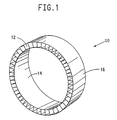
- Fig. 1 is a perspective view of a composite structure formed according to the method of this invention.
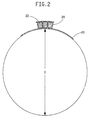
- Fig. 2 is a cross sectioned end elevation of the assembly for preparation of the structure of Fig. 1.
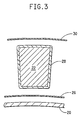
- Fig. 3 is an enlarged expanded view of one segment of the assembly shown in Fig. 2.
- Fig. 1 the embodiment chosen for purposes of illustration as shown in Fig. 1 is a composite full round duct 10 with a plurality of passages 12 distributed between inner and outer surfaces 14, 16, respectively, of the duct.
- the preparation of this duct involves an assembly of parts on a mandrel to form the structure followed by curing and post-curing the formed structure.
- the layup of the structure includes a mandrel 20 fabricated from a length of carbon steel pipe of a predetermined diameter D on which are fixed metal alloy cores 22.
- Each core 22 is wrapped with a prepreg material 24.
- the wrapped forms are configured to conform to the curvature of the mandrel.
- a more detailed description of the layup is shown in Fig.
- a layer 26 of a fiber reinforced resin prepreg is wrapped around mandrel 20 to form the inner surface 14 of the duct 10.
- the metal alloy core 22 is wrapped with a fiber reinforced resin prepreg material 28. After the wrapped coress are fixed to the mandrel an outside face sheet 30 is wrapped around all the forms on the mandrel to form the outside surface 16 of the duct 10.
- the metal alloy core is preferably zinc/aluminum alloy #3 or #5 made by Eastern Alloys, Inc. having a CTE of about 36 ⁇ m/m/°C (20 micro in./in./°F).
- the mandrel is of carbon steel with a CTE of about 12.6 ⁇ m/m/°C 7 micro in./in./°F.
- the layers 26 and 30 and the wrapping materials 28 preferably are Avimid® N prepreg by Du Pont reinforced with S2 glass fiber by Owens Corning.
- the assembly Upon completion of the structural layup, the assembly is enclosed in a bag with vacuum lines attached and placed in autoclave for curing.
- the autoclave cure cycle lasts for about 20 hours and the maximum temperature is below the melt temperature of the metal alloy cores.
- the mandrel layup assembly is debagged following the autoclave cure cycle and placed in an oven for post cure.
- the post cure cycle slowly raises the Tg of the Avimid® N based composites to the desired level.
- the part is heated above the metal alloy's melt temperature with the result that the cores will melt out in the oven.
- the cores can be removed using induction heating techniques.
Landscapes
- Engineering & Computer Science (AREA)
- Mechanical Engineering (AREA)
- Chemical & Material Sciences (AREA)
- Composite Materials (AREA)
- Moulding By Coating Moulds (AREA)
- Moulds For Moulding Plastics Or The Like (AREA)
- Reinforced Plastic Materials (AREA)
Abstract
Description
- This invention relates to a method for forming and consolidating fiber reinforced composite structures with hollow sections or passages through the structure.
- Formation of high quality, complex, and dimensionally accurate hollow sections in resin based composite parts reinforced with such fibers as glass, quartz and carbon fibers has been limited by core material performance. In some cases plaster cores are too brittle for normal handling procedures. This can be a particular problem when thin core cross-sections are involved. Rubber has temperature limitations and cannot provide a dimensionally accurate hollow section. Metal cores such as steel or aluminum cannot be removed from complex shaped hollow sections under conditions mild enough to prevent excessive degradation of the resin based composite. Bi/Sn or Sn/Pb (commonly referred to as low melt alloys are known for creating relatively low melting point cores that in turn can be used to injection mold hollow plastic components. Additionally, these low melt alloys can be melted out to form very complex and dimensionally accurate passageways or hollow shapes without harming the physical properties of the plastic material (DE-A-2 251 435). However, these low melting alloys are not useful as cores for polymer prepregs that cure at high temperatures in the range of from a minimum of about 315°C (600°F) to a maximum of about 370°C (700°F) and finally post-cure at temperatures from 370°C (700°F) to about 400°C (750°F).
- In addition, fiber reinforced resin structures are formed into many complex shapes, in some cases these shapes include passageways which make consolidation of these structures during their cure cycle difficult. The structures are usually formed by wrapping a prepreg around one or more cores which are then attached to a steel mandrel and placed in an autoclave for curing under predetermined temperatures and pressures. What makes consolidation during the cure cycle so difficult is the formation of gaps between wrapped cores due to looseness required for assembly and the fact that the steel mandrel expands as the temperature increases which increases the gaps between the wrapped cores. In addition, volatiles are lost front the prepreg material as the temperature increases, thus decreasing the thickness of the prepreg material. All three of these factors contribute to a poorly consolidated product.
- In order to fully consolidate the prepreg of a composite structure having passages within the structure during the cure cycle the amount of core expansion must be somewhat greater than the mandrel expansion to compensate for the gap increases caused by expansion of the mandrel and loss of volatiles from the prepreg material and to compensate for any looseness between the wrapped cores after assembly. The amount of thermal expansion required by the core material to ensure consolidation of the prepreg is dependent on these factors and the maximum cure temperature of the composite structure. One way this is accomplished is to provide a plurality of metal alloy forms defining the configuration of the passages then cover the metal alloy forms with a heat curable composite prepreg material having a predetermined cure temperature. The metal alloy forms covered with prepreg material are placed on a mandrel in a side-by-side relationship. The mandrel and the metal alloy having different coefficients of thermal expansion, the coefficient of thermal expansion (CTE) of the metal alloy core being greater than the coefficient of thermal expansion of the mandrel. In a preferred embodiment the core is a zinc/aluminum alloy having CTE about three (3) times the CTE of the mandrel. The metal alloy core has a melting temperature above the minimum cure temperature of the prepreg material. Free movement between the metal alloy cores covered with composite prepreg material and the mandrel is restricted. The unitary structure is heated to the predetermined cure temperature to fully cure and consolidate the composite prepreg material. If the metal alloy cores are not geometrically locked into the structure after autoclave curing, they may be removed by pulling/pushing them out. In the event that the metal alloy cores are locked into the structure by curves in the passages and by varying cross sections, the cores can be melted out leaving the finished hollow structure.
- Suitable prepreg materials are polyimide resins based on 2,2-bis(3',4'-dicarboxyphenyl) hexafluoropropane/p-phenylenediamine/m-phenylenediamine mixtures (e.g. Avimid® N), pyromellitic diethyl ester diacid/1,4-bis(4-aminophenoxy)-2-phenylbenzene mixtures (e.g. Avimid® K), 3,3',4,4'-benzophenonetetracarboxylic dimethyl ester diacid/4,4'-methylenedianiline/ nadic methyl ester acid mixtures (e.g. PMR-15), and the dimethyl ester diacid derivatives of 2,2-bis(3',4'-dicarboxyphenyl)hexafluoropropane dianhydride mixed with p-phenylenediamine and nadic methyl ester acid (e.g. AF-R-700A and B, PMR-II-30 and PMR-II-50), reinforced with fibers such as carbon, glass, quartz and aramid fibers.
- Fig. 1 is a perspective view of a composite structure formed according to the method of this invention.
- Fig. 2 is a cross sectioned end elevation of the assembly for preparation of the structure of Fig. 1.
- Fig. 3 is an enlarged expanded view of one segment of the assembly shown in Fig. 2.
- Referring now to the drawings, the embodiment chosen for purposes of illustration as shown in Fig. 1 is a composite full
round duct 10 with a plurality ofpassages 12 distributed between inner andouter surfaces mandrel 20 fabricated from a length of carbon steel pipe of a predetermined diameter D on which are fixedmetal alloy cores 22. Eachcore 22 is wrapped with aprepreg material 24. The wrapped forms are configured to conform to the curvature of the mandrel. A more detailed description of the layup is shown in Fig. 3 wherein alayer 26 of a fiber reinforced resin prepreg is wrapped aroundmandrel 20 to form theinner surface 14 of theduct 10. Themetal alloy core 22 is wrapped with a fiber reinforcedresin prepreg material 28. After the wrapped coress are fixed to the mandrel anoutside face sheet 30 is wrapped around all the forms on the mandrel to form theoutside surface 16 of theduct 10. - In a particularly preferred embodiment, the metal alloy core is preferably zinc/aluminum alloy #3 or #5 made by Eastern Alloys, Inc. having a CTE of about 36 µm/m/°C (20 micro in./in./°F).
- The mandrel is of carbon steel with a CTE of about 12.6 µm/m/°C 7 micro in./in./°F.
- The
layers materials 28 preferably are Avimid® N prepreg by Du Pont reinforced with S2 glass fiber by Owens Corning. - Upon completion of the structural layup, the assembly is enclosed in a bag with vacuum lines attached and placed in autoclave for curing. The autoclave cure cycle lasts for about 20 hours and the maximum temperature is below the melt temperature of the metal alloy cores.
- The mandrel layup assembly is debagged following the autoclave cure cycle and placed in an oven for post cure. The post cure cycle slowly raises the Tg of the Avimid® N based composites to the desired level. Finally the part is heated above the metal alloy's melt temperature with the result that the cores will melt out in the oven. Alternatively, if the final post cure temperature is below the core's melt temperature, the cores can be removed using induction heating techniques.
Claims (5)
- A method for forming and consolidating a composite structure (10) having hollow sections or passages (12) therein comprising:providing a plurality of metal alloy cores (22) defining the configuration of said hollow sections or passages (12);covering said metal alloy cores (22) with a heat curable composite prepreg material (24) having a predetermined cure temperature;placing said metal alloy cores (22) covered with prepreg material on a mandrel (20) in a side-by-side relationship, said mandrel (20) and said metal alloy cores (22) having different coefficients of thermal expansion, the coefficient of thermal expansion of said metal alloy core (22) being greater than the coefficient of thermal expansion of said mandrel (20), restricting free relative movement between the metal alloy cores (22) covered with composite prepreg material (24) and the mandrel to form a unitary structure (10);heating said unitary structure (10) to said predetermined cure temperature to consolidate and cure said composite prepreg material (24).
- The method of claim 1 including the additional steps of heating said metal alloy core (22) to a temperature to melt said alloy and draining the melted metal alloy from the unitary structure (10).
- The method of claim 1 wherein said metal alloy cores (22) are a zinc/aluminum alloy.
- The method of claim 1 wherein said coefficient of thermal expansion of said cores (22) is about three times greater than the coefficient of expansion of said mandrel (24).
- The method of claim 1 wherein said composite prepreg material (24) is 2,2-bis (3',4'-dicarboxyphenyl)hexafluoropropane/p-phenylenediamine/m-phenylenediamine mixtures reinforced with glass fibers.
Applications Claiming Priority (3)
| Application Number | Priority Date | Filing Date | Title |
|---|---|---|---|
| US735841 | 1991-07-25 | ||
| US07/735,841 US5125993A (en) | 1991-07-25 | 1991-07-25 | Method for forming and consolidating a fiber reinforced resin structure |
| PCT/US1992/006060 WO1993001925A1 (en) | 1991-07-25 | 1992-07-24 | A method for forming and consolidating a fiber reinforced resin structure |
Publications (2)
| Publication Number | Publication Date |
|---|---|
| EP0595959A1 EP0595959A1 (en) | 1994-05-11 |
| EP0595959B1 true EP0595959B1 (en) | 1997-03-05 |
Family
ID=24957411
Family Applications (1)
| Application Number | Title | Priority Date | Filing Date |
|---|---|---|---|
| EP92916155A Expired - Lifetime EP0595959B1 (en) | 1991-07-25 | 1992-07-24 | A method for forming and consolidating a fiber reinforced resin structure |
Country Status (10)
| Country | Link |
|---|---|
| US (1) | US5125993A (en) |
| EP (1) | EP0595959B1 (en) |
| JP (1) | JPH06509292A (en) |
| KR (1) | KR100214396B1 (en) |
| AU (1) | AU2393692A (en) |
| BR (1) | BR9206288A (en) |
| CA (1) | CA2113622A1 (en) |
| DE (1) | DE69217953T2 (en) |
| ES (1) | ES2098521T3 (en) |
| WO (1) | WO1993001925A1 (en) |
Cited By (3)
| Publication number | Priority date | Publication date | Assignee | Title |
|---|---|---|---|---|
| DE202013004692U1 (en) | 2013-05-22 | 2013-06-14 | Weinor Gmbh & Co. Kg | Awning with clamping system |
| DE102014017949A1 (en) | 2014-12-05 | 2016-06-09 | Weinor Gmbh & Co. Kg | Awning with a return system |
| EP3048213A1 (en) | 2015-01-23 | 2016-07-27 | Weinor GmbH & Co. KG | Awning with tissue counter-movement system |
Families Citing this family (13)
| Publication number | Priority date | Publication date | Assignee | Title |
|---|---|---|---|---|
| US5429693A (en) * | 1994-05-09 | 1995-07-04 | The United States Of America As Represented By The Secretary Of The Air Force | Method of making a prestressed composite materials |
| US5716677A (en) * | 1996-03-21 | 1998-02-10 | Ohio Aerospace Institute | Protective coatings for polyimide composites |
| US5795524A (en) * | 1996-03-29 | 1998-08-18 | Basso, Jr.; Robert J. | Process for producing composite tubular parts |
| FR2760399B1 (en) * | 1997-03-06 | 1999-05-07 | Hispano Suiza Sa | PROCESS FOR THE MANUFACTURE OF HOLLOW PARTS OF COMPOSITE MATERIAL |
| CA2253037C (en) * | 1997-11-12 | 2004-11-02 | Sakura Rubber Co., Ltd. | Method of manufacturing structure by using biodegradable mold |
| ES2268848T3 (en) | 1998-01-16 | 2007-03-16 | Maverick Corporation | HIGH TEMPERATURE POLYAMIDS WITH LOW TOXICITY. |
| DE10210517B3 (en) * | 2002-03-09 | 2004-01-29 | Airbus Deutschland Gmbh | Process for the production of a component in fiber composite construction |
| EP1473131A3 (en) * | 2003-04-30 | 2007-01-03 | Airbus Deutschland GmbH | Method for making textile preforms from textile half-products |
| US7166251B2 (en) * | 2004-12-01 | 2007-01-23 | The Boeing Company | Segmented flexible barrel lay-up mandrel |
| JP5738033B2 (en) * | 2011-03-28 | 2015-06-17 | 三菱重工業株式会社 | Method for forming composite material structure |
| JP5777789B1 (en) * | 2014-10-30 | 2015-09-09 | 三菱重工業株式会社 | Artificial defect material and manufacturing method of FRP structure |
| US20160214283A1 (en) * | 2015-01-26 | 2016-07-28 | General Electric Company | Composite tool and method for forming composite components |
| CN109605780B (en) * | 2018-11-20 | 2021-02-19 | 航天时代飞鸿技术有限公司 | Method for integrally forming composite material structure of unmanned aerial vehicle |
Family Cites Families (10)
| Publication number | Priority date | Publication date | Assignee | Title |
|---|---|---|---|---|
| US2755216A (en) * | 1952-08-16 | 1956-07-17 | Douglas Aircraft Co Inc | Process for forming a multi-ducted shell |
| FR1111380A (en) * | 1954-11-02 | 1956-02-27 | Renault | Plastic panels |
| US3165569A (en) * | 1960-04-18 | 1965-01-12 | Air Logisties Corp | Method and apparatus for thermal expansion molding |
| CH530249A (en) * | 1971-10-22 | 1972-11-15 | Liechti Fritz Dipl Ing Dr | Process for the production of molded parts from plastics with complicated recesses and cavities |
| US4187271A (en) * | 1977-04-18 | 1980-02-05 | Owens-Corning Fiberglas Corporation | Method of making same |
| US4155970A (en) * | 1977-11-04 | 1979-05-22 | Mcdonnell Douglas Corporation | Method for making a hollow composite using a destructible core |
| US4167430A (en) * | 1978-04-28 | 1979-09-11 | General Dynamics Corporation | Method for fabricating a composite bonded structure |
| JPS54156080A (en) * | 1978-05-31 | 1979-12-08 | Nitto Electric Ind Co Ltd | Manufacture of pipe connection member in tubular module |
| US4474636A (en) * | 1981-11-06 | 1984-10-02 | Qo Chemicals, Inc. | Fabrication of composite articles |
| EP0244120A3 (en) * | 1986-04-16 | 1989-07-12 | Courtaulds Plc | Composite element |
-
1991
- 1991-07-25 US US07/735,841 patent/US5125993A/en not_active Expired - Fee Related
-
1992
- 1992-07-24 DE DE69217953T patent/DE69217953T2/en not_active Expired - Fee Related
- 1992-07-24 CA CA002113622A patent/CA2113622A1/en not_active Abandoned
- 1992-07-24 ES ES92916155T patent/ES2098521T3/en not_active Expired - Lifetime
- 1992-07-24 EP EP92916155A patent/EP0595959B1/en not_active Expired - Lifetime
- 1992-07-24 JP JP5503026A patent/JPH06509292A/en active Pending
- 1992-07-24 AU AU23936/92A patent/AU2393692A/en not_active Abandoned
- 1992-07-24 WO PCT/US1992/006060 patent/WO1993001925A1/en not_active Ceased
- 1992-07-24 KR KR1019940700212A patent/KR100214396B1/en not_active Expired - Fee Related
- 1992-07-24 BR BR9206288A patent/BR9206288A/en not_active Application Discontinuation
Cited By (4)
| Publication number | Priority date | Publication date | Assignee | Title |
|---|---|---|---|---|
| DE202013004692U1 (en) | 2013-05-22 | 2013-06-14 | Weinor Gmbh & Co. Kg | Awning with clamping system |
| DE102014017949A1 (en) | 2014-12-05 | 2016-06-09 | Weinor Gmbh & Co. Kg | Awning with a return system |
| EP3048213A1 (en) | 2015-01-23 | 2016-07-27 | Weinor GmbH & Co. KG | Awning with tissue counter-movement system |
| DE102015000671A1 (en) | 2015-01-23 | 2016-07-28 | Weinor Gmbh & Co. Kg | Awning with fabric return system |
Also Published As
| Publication number | Publication date |
|---|---|
| AU2393692A (en) | 1993-02-23 |
| DE69217953D1 (en) | 1997-04-10 |
| ES2098521T3 (en) | 1997-05-01 |
| DE69217953T2 (en) | 1997-07-10 |
| BR9206288A (en) | 1994-08-02 |
| US5125993A (en) | 1992-06-30 |
| JPH06509292A (en) | 1994-10-20 |
| EP0595959A1 (en) | 1994-05-11 |
| CA2113622A1 (en) | 1993-02-04 |
| WO1993001925A1 (en) | 1993-02-04 |
| KR100214396B1 (en) | 1999-09-01 |
Similar Documents
| Publication | Publication Date | Title |
|---|---|---|
| US5125993A (en) | Method for forming and consolidating a fiber reinforced resin structure | |
| US5176864A (en) | Lost wax process utilizing a high temperature wax-based material | |
| US4271116A (en) | Composite structure | |
| US5707723A (en) | Multilayer radome structure and its fabrication | |
| US5262118A (en) | Method for producing a hollow FRP article | |
| US4591400A (en) | Method of forming a fiber reinforced composite article of a complex configuration | |
| EP0793573B1 (en) | Low resin content unidirectional fiber tape | |
| CN110591356B (en) | Wave-transparent composite material half cover and preparation method thereof | |
| US8075719B2 (en) | Manufacture of complex composite parts | |
| CA2225640A1 (en) | Method of molding composite insulator and metal molding apparatus used for this molding method | |
| US20100196729A1 (en) | Autoclave Cure Cycle Design Process and Curing Method | |
| US6126557A (en) | Golf club shafts and methods of manufacturing the same | |
| GB2348163A (en) | A fibre-reinforced composite | |
| WO1992008594A1 (en) | A method and an apparatus for the manufacture of moulded components on thermally expandable cores | |
| JPH03272832A (en) | Manufacture of hollow body of fiber reinforced thermoplastic resin | |
| CA1271010A (en) | Method for moulding fibre reinforced laminates | |
| JP3115023B2 (en) | Manufacturing method of fiber reinforced resin molded product | |
| JPH0569492A (en) | Manufacture of hollow rod body | |
| JPH085139B2 (en) | FRP hollow product manufacturing method | |
| JP2022022602A (en) | Molding method of frp and core | |
| JP3384936B2 (en) | Golf club shaft manufacturing method | |
| JP3014402B2 (en) | Fiber reinforced plastic pipe and method for producing the same | |
| JPH0319721B2 (en) | ||
| JPH0367638A (en) | Preparation of frp pipe | |
| JPH0352203B2 (en) |
Legal Events
| Date | Code | Title | Description |
|---|---|---|---|
| PUAI | Public reference made under article 153(3) epc to a published international application that has entered the european phase |
Free format text: ORIGINAL CODE: 0009012 |
|
| 17P | Request for examination filed |
Effective date: 19940113 |
|
| AK | Designated contracting states |
Kind code of ref document: A1 Designated state(s): DE ES FR GB IT NL |
|
| 17Q | First examination report despatched |
Effective date: 19950630 |
|
| GRAG | Despatch of communication of intention to grant |
Free format text: ORIGINAL CODE: EPIDOS AGRA |
|
| GRAH | Despatch of communication of intention to grant a patent |
Free format text: ORIGINAL CODE: EPIDOS IGRA |
|
| GRAH | Despatch of communication of intention to grant a patent |
Free format text: ORIGINAL CODE: EPIDOS IGRA |
|
| GRAA | (expected) grant |
Free format text: ORIGINAL CODE: 0009210 |
|
| AK | Designated contracting states |
Kind code of ref document: B1 Designated state(s): DE ES FR GB IT NL |
|
| REF | Corresponds to: |
Ref document number: 69217953 Country of ref document: DE Date of ref document: 19970410 |
|
| REG | Reference to a national code |
Ref country code: ES Ref legal event code: FG2A Ref document number: 2098521 Country of ref document: ES Kind code of ref document: T3 |
|
| ET | Fr: translation filed | ||
| ITF | It: translation for a ep patent filed | ||
| PLBE | No opposition filed within time limit |
Free format text: ORIGINAL CODE: 0009261 |
|
| STAA | Information on the status of an ep patent application or granted ep patent |
Free format text: STATUS: NO OPPOSITION FILED WITHIN TIME LIMIT |
|
| 26N | No opposition filed | ||
| PGFP | Annual fee paid to national office [announced via postgrant information from national office to epo] |
Ref country code: GB Payment date: 20000614 Year of fee payment: 9 |
|
| PGFP | Annual fee paid to national office [announced via postgrant information from national office to epo] |
Ref country code: NL Payment date: 20000620 Year of fee payment: 9 |
|
| PGFP | Annual fee paid to national office [announced via postgrant information from national office to epo] |
Ref country code: FR Payment date: 20000707 Year of fee payment: 9 |
|
| PGFP | Annual fee paid to national office [announced via postgrant information from national office to epo] |
Ref country code: ES Payment date: 20000713 Year of fee payment: 9 |
|
| PGFP | Annual fee paid to national office [announced via postgrant information from national office to epo] |
Ref country code: DE Payment date: 20000727 Year of fee payment: 9 |
|
| PG25 | Lapsed in a contracting state [announced via postgrant information from national office to epo] |
Ref country code: GB Free format text: LAPSE BECAUSE OF NON-PAYMENT OF DUE FEES Effective date: 20010724 |
|
| PG25 | Lapsed in a contracting state [announced via postgrant information from national office to epo] |
Ref country code: ES Free format text: LAPSE BECAUSE OF NON-PAYMENT OF DUE FEES Effective date: 20010725 |
|
| PG25 | Lapsed in a contracting state [announced via postgrant information from national office to epo] |
Ref country code: NL Free format text: LAPSE BECAUSE OF NON-PAYMENT OF DUE FEES Effective date: 20020201 |
|
| GBPC | Gb: european patent ceased through non-payment of renewal fee |
Effective date: 20010724 |
|
| PG25 | Lapsed in a contracting state [announced via postgrant information from national office to epo] |
Ref country code: FR Free format text: LAPSE BECAUSE OF NON-PAYMENT OF DUE FEES Effective date: 20020329 |
|
| NLV4 | Nl: lapsed or anulled due to non-payment of the annual fee |
Effective date: 20020201 |
|
| PG25 | Lapsed in a contracting state [announced via postgrant information from national office to epo] |
Ref country code: DE Free format text: LAPSE BECAUSE OF NON-PAYMENT OF DUE FEES Effective date: 20020501 |
|
| REG | Reference to a national code |
Ref country code: FR Ref legal event code: ST |
|
| REG | Reference to a national code |
Ref country code: ES Ref legal event code: FD2A Effective date: 20020810 |
|
| PG25 | Lapsed in a contracting state [announced via postgrant information from national office to epo] |
Ref country code: IT Free format text: LAPSE BECAUSE OF NON-PAYMENT OF DUE FEES Effective date: 20050724 |