EP0595924B1 - Platelet activating factor antagonists - Google Patents
Platelet activating factor antagonists Download PDFInfo
- Publication number
- EP0595924B1 EP0595924B1 EP92915895A EP92915895A EP0595924B1 EP 0595924 B1 EP0595924 B1 EP 0595924B1 EP 92915895 A EP92915895 A EP 92915895A EP 92915895 A EP92915895 A EP 92915895A EP 0595924 B1 EP0595924 B1 EP 0595924B1
- Authority
- EP
- European Patent Office
- Prior art keywords
- pyrrolo
- pyridin
- thiazole
- formula
- compound
- Prior art date
- Legal status (The legal status is an assumption and is not a legal conclusion. Google has not performed a legal analysis and makes no representation as to the accuracy of the status listed.)
- Expired - Lifetime
Links
- HVAUUPRFYPCOCA-AREMUKBSSA-N 2-O-acetyl-1-O-hexadecyl-sn-glycero-3-phosphocholine Chemical compound CCCCCCCCCCCCCCCCOC[C@@H](OC(C)=O)COP([O-])(=O)OCC[N+](C)(C)C HVAUUPRFYPCOCA-AREMUKBSSA-N 0.000 title description 23
- 108010003541 Platelet Activating Factor Proteins 0.000 title description 22
- 239000005557 antagonist Substances 0.000 title description 4
- 150000001875 compounds Chemical class 0.000 claims description 208
- 238000000034 method Methods 0.000 claims description 105
- -1 4-pyrimidyl Chemical group 0.000 claims description 73
- 125000004432 carbon atom Chemical group C* 0.000 claims description 64
- RTZKZFJDLAIYFH-UHFFFAOYSA-N Diethyl ether Chemical compound CCOCC RTZKZFJDLAIYFH-UHFFFAOYSA-N 0.000 claims description 60
- 125000000217 alkyl group Chemical group 0.000 claims description 46
- 125000001997 phenyl group Chemical group [H]C1=C([H])C([H])=C(*)C([H])=C1[H] 0.000 claims description 24
- 125000003545 alkoxy group Chemical group 0.000 claims description 21
- KWYUFKZDYYNOTN-UHFFFAOYSA-M Potassium hydroxide Chemical compound [OH-].[K+] KWYUFKZDYYNOTN-UHFFFAOYSA-M 0.000 claims description 20
- 239000001257 hydrogen Substances 0.000 claims description 20
- 229910052739 hydrogen Inorganic materials 0.000 claims description 20
- 229910052736 halogen Inorganic materials 0.000 claims description 18
- NFHFRUOZVGFOOS-UHFFFAOYSA-N palladium;triphenylphosphane Chemical compound [Pd].C1=CC=CC=C1P(C=1C=CC=CC=1)C1=CC=CC=C1.C1=CC=CC=C1P(C=1C=CC=CC=1)C1=CC=CC=C1.C1=CC=CC=C1P(C=1C=CC=CC=1)C1=CC=CC=C1.C1=CC=CC=C1P(C=1C=CC=CC=1)C1=CC=CC=C1 NFHFRUOZVGFOOS-UHFFFAOYSA-N 0.000 claims description 18
- 229910052757 nitrogen Inorganic materials 0.000 claims description 17
- XTHFKEDIFFGKHM-UHFFFAOYSA-N Dimethoxyethane Chemical compound COCCOC XTHFKEDIFFGKHM-UHFFFAOYSA-N 0.000 claims description 16
- 150000003839 salts Chemical class 0.000 claims description 16
- 229910000104 sodium hydride Inorganic materials 0.000 claims description 14
- 150000002367 halogens Chemical group 0.000 claims description 13
- OAKJQQAXSVQMHS-UHFFFAOYSA-N Hydrazine Chemical compound NN OAKJQQAXSVQMHS-UHFFFAOYSA-N 0.000 claims description 12
- NGNBDVOYPDDBFK-UHFFFAOYSA-N 2-[2,4-di(pentan-2-yl)phenoxy]acetyl chloride Chemical compound CCCC(C)C1=CC=C(OCC(Cl)=O)C(C(C)CCC)=C1 NGNBDVOYPDDBFK-UHFFFAOYSA-N 0.000 claims description 9
- UFHFLCQGNIYNRP-UHFFFAOYSA-N Hydrogen Chemical compound [H][H] UFHFLCQGNIYNRP-UHFFFAOYSA-N 0.000 claims description 9
- JUJWROOIHBZHMG-UHFFFAOYSA-N Pyridine Chemical class C1=CC=NC=C1 JUJWROOIHBZHMG-UHFFFAOYSA-N 0.000 claims description 9
- 229920006395 saturated elastomer Polymers 0.000 claims description 9
- 150000001350 alkyl halides Chemical class 0.000 claims description 8
- 125000004435 hydrogen atom Chemical group [H]* 0.000 claims description 8
- CTSLXHKWHWQRSH-UHFFFAOYSA-N oxalyl chloride Chemical compound ClC(=O)C(Cl)=O CTSLXHKWHWQRSH-UHFFFAOYSA-N 0.000 claims description 8
- VHYFNPMBLIVWCW-UHFFFAOYSA-N 4-Dimethylaminopyridine Chemical compound CN(C)C1=CC=NC=C1 VHYFNPMBLIVWCW-UHFFFAOYSA-N 0.000 claims description 6
- AVXURJPOCDRRFD-UHFFFAOYSA-N Hydroxylamine Chemical compound ON AVXURJPOCDRRFD-UHFFFAOYSA-N 0.000 claims description 6
- KEAYESYHFKHZAL-UHFFFAOYSA-N Sodium Chemical compound [Na] KEAYESYHFKHZAL-UHFFFAOYSA-N 0.000 claims description 6
- 125000005843 halogen group Chemical group 0.000 claims description 6
- 125000004433 nitrogen atom Chemical group N* 0.000 claims description 6
- JIAARYAFYJHUJI-UHFFFAOYSA-L zinc dichloride Chemical compound [Cl-].[Cl-].[Zn+2] JIAARYAFYJHUJI-UHFFFAOYSA-L 0.000 claims description 6
- 125000003349 3-pyridyl group Chemical group N1=C([H])C([*])=C([H])C([H])=C1[H] 0.000 claims description 5
- 125000003917 carbamoyl group Chemical group [H]N([H])C(*)=O 0.000 claims description 5
- 239000012312 sodium hydride Substances 0.000 claims description 5
- 150000003462 sulfoxides Chemical class 0.000 claims description 5
- QJGQUHMNIGDVPM-UHFFFAOYSA-N nitrogen group Chemical group [N] QJGQUHMNIGDVPM-UHFFFAOYSA-N 0.000 claims description 4
- CIHOLLKRGTVIJN-UHFFFAOYSA-N tert‐butyl hydroperoxide Chemical compound CC(C)(C)OO CIHOLLKRGTVIJN-UHFFFAOYSA-N 0.000 claims description 4
- VXUYXOFXAQZZMF-UHFFFAOYSA-N titanium(IV) isopropoxide Chemical compound CC(C)O[Ti](OC(C)C)(OC(C)C)OC(C)C VXUYXOFXAQZZMF-UHFFFAOYSA-N 0.000 claims description 4
- NQXDAKVRYHXNPE-UHFFFAOYSA-N (2,4-dinitrophenyl) 4-methylbenzenesulfonate Chemical compound C1=CC(C)=CC=C1S(=O)(=O)OC1=CC=C([N+]([O-])=O)C=C1[N+]([O-])=O NQXDAKVRYHXNPE-UHFFFAOYSA-N 0.000 claims description 3
- NXLNNXIXOYSCMB-UHFFFAOYSA-N (4-nitrophenyl) carbonochloridate Chemical compound [O-][N+](=O)C1=CC=C(OC(Cl)=O)C=C1 NXLNNXIXOYSCMB-UHFFFAOYSA-N 0.000 claims description 3
- NHQDETIJWKXCTC-UHFFFAOYSA-N 3-chloroperbenzoic acid Chemical compound OOC(=O)C1=CC=CC(Cl)=C1 NHQDETIJWKXCTC-UHFFFAOYSA-N 0.000 claims description 3
- 125000003236 benzoyl group Chemical group [H]C1=C([H])C([H])=C(C([H])=C1[H])C(*)=O 0.000 claims description 3
- 238000004519 manufacturing process Methods 0.000 claims description 3
- 150000002923 oximes Chemical class 0.000 claims description 3
- 229910052760 oxygen Inorganic materials 0.000 claims description 3
- 125000004076 pyridyl group Chemical group 0.000 claims description 3
- 125000000714 pyrimidinyl group Chemical group 0.000 claims description 3
- 229910052717 sulfur Inorganic materials 0.000 claims description 3
- 125000000335 thiazolyl group Chemical group 0.000 claims description 3
- 239000011592 zinc chloride Substances 0.000 claims description 3
- 235000005074 zinc chloride Nutrition 0.000 claims description 3
- LQWFBRZPLSZJNN-UHFFFAOYSA-N 1h-indole;magnesium Chemical compound [Mg].C1=CC=C2NC=CC2=C1 LQWFBRZPLSZJNN-UHFFFAOYSA-N 0.000 claims description 2
- 125000002941 2-furyl group Chemical group O1C([*])=C([H])C([H])=C1[H] 0.000 claims description 2
- 125000004105 2-pyridyl group Chemical group N1=C([*])C([H])=C([H])C([H])=C1[H] 0.000 claims description 2
- 125000000175 2-thienyl group Chemical group S1C([*])=C([H])C([H])=C1[H] 0.000 claims description 2
- 125000003682 3-furyl group Chemical group O1C([H])=C([*])C([H])=C1[H] 0.000 claims description 2
- 125000001541 3-thienyl group Chemical group S1C([H])=C([*])C([H])=C1[H] 0.000 claims description 2
- 125000001255 4-fluorophenyl group Chemical group [H]C1=C([H])C(*)=C([H])C([H])=C1F 0.000 claims description 2
- 125000000339 4-pyridyl group Chemical group N1=C([H])C([H])=C([*])C([H])=C1[H] 0.000 claims description 2
- KDDQRKBRJSGMQE-UHFFFAOYSA-N 4-thiazolyl Chemical compound [C]1=CSC=N1 KDDQRKBRJSGMQE-UHFFFAOYSA-N 0.000 claims description 2
- CWDWFSXUQODZGW-UHFFFAOYSA-N 5-thiazolyl Chemical group [C]1=CN=CS1 CWDWFSXUQODZGW-UHFFFAOYSA-N 0.000 claims description 2
- CKDWPUIZGOQOOM-UHFFFAOYSA-N Carbamyl chloride Chemical compound NC(Cl)=O CKDWPUIZGOQOOM-UHFFFAOYSA-N 0.000 claims description 2
- 150000003855 acyl compounds Chemical class 0.000 claims description 2
- 150000001412 amines Chemical class 0.000 claims description 2
- 150000001543 aryl boronic acids Chemical class 0.000 claims description 2
- 150000001502 aryl halides Chemical class 0.000 claims description 2
- YSAVZVORKRDODB-PHDIDXHHSA-N diethyl (2r,3r)-2,3-dihydroxybutanedioate Chemical compound CCOC(=O)[C@H](O)[C@@H](O)C(=O)OCC YSAVZVORKRDODB-PHDIDXHHSA-N 0.000 claims description 2
- 239000012948 isocyanate Substances 0.000 claims description 2
- 150000002513 isocyanates Chemical class 0.000 claims description 2
- 125000000951 phenoxy group Chemical group [H]C1=C([H])C([H])=C(O*)C([H])=C1[H] 0.000 claims description 2
- QAHVHSLSRLSVGS-UHFFFAOYSA-N sulfamoyl chloride Chemical compound NS(Cl)(=O)=O QAHVHSLSRLSVGS-UHFFFAOYSA-N 0.000 claims description 2
- 150000003457 sulfones Chemical class 0.000 claims description 2
- YBBRCQOCSYXUOC-UHFFFAOYSA-N sulfuryl dichloride Chemical compound ClS(Cl)(=O)=O YBBRCQOCSYXUOC-UHFFFAOYSA-N 0.000 claims description 2
- 150000002431 hydrogen Chemical group 0.000 claims 6
- 150000004820 halides Chemical group 0.000 claims 5
- 125000002541 furyl group Chemical group 0.000 claims 2
- 125000001544 thienyl group Chemical group 0.000 claims 2
- LLAPDLPYIYKTGQ-UHFFFAOYSA-N 1-aminoethyl Chemical group C[CH]N LLAPDLPYIYKTGQ-UHFFFAOYSA-N 0.000 claims 1
- 229910003844 NSO2 Inorganic materials 0.000 claims 1
- 229910005948 SO2Cl Inorganic materials 0.000 claims 1
- 230000003213 activating effect Effects 0.000 claims 1
- 150000001734 carboxylic acid salts Chemical class 0.000 claims 1
- 239000003054 catalyst Substances 0.000 claims 1
- 125000000547 substituted alkyl group Chemical group 0.000 claims 1
- 208000037265 diseases, disorders, signs and symptoms Diseases 0.000 abstract description 7
- 208000035475 disorder Diseases 0.000 abstract description 7
- 230000003111 delayed effect Effects 0.000 abstract description 5
- 208000038016 acute inflammation Diseases 0.000 abstract description 4
- 230000006022 acute inflammation Effects 0.000 abstract description 4
- 208000006673 asthma Diseases 0.000 abstract description 4
- 230000035939 shock Effects 0.000 abstract description 4
- 208000013616 Respiratory Distress Syndrome Diseases 0.000 abstract description 3
- 208000025865 Ulcer Diseases 0.000 abstract description 3
- 230000000172 allergic effect Effects 0.000 abstract description 3
- 208000010668 atopic eczema Diseases 0.000 abstract description 3
- 230000024245 cell differentiation Effects 0.000 abstract description 3
- 230000007969 cellular immunity Effects 0.000 abstract description 3
- 230000001605 fetal effect Effects 0.000 abstract description 3
- 125000001041 indolyl group Chemical group 0.000 abstract description 3
- 210000004072 lung Anatomy 0.000 abstract description 3
- 230000035800 maturation Effects 0.000 abstract description 3
- 210000000056 organ Anatomy 0.000 abstract description 3
- 208000017520 skin disease Diseases 0.000 abstract description 3
- 230000036269 ulceration Effects 0.000 abstract description 3
- 206010001052 Acute respiratory distress syndrome Diseases 0.000 abstract description 2
- 230000032696 parturition Effects 0.000 abstract description 2
- 230000003389 potentiating effect Effects 0.000 abstract description 2
- 208000009144 Pure autonomic failure Diseases 0.000 abstract 2
- ZMGUSORTSCSHFO-UHFFFAOYSA-N (1-pyridin-3-yl-3h-pyrrolo[1,2-c][1,3]oxazol-7-ylidene)methanone Chemical compound C=12C(=C=O)C=CN2COC=1C1=CC=CN=C1 ZMGUSORTSCSHFO-UHFFFAOYSA-N 0.000 abstract 1
- XVQDCBJVFGDAPS-UHFFFAOYSA-N (1-pyridin-3-yl-3h-pyrrolo[1,2-c][1,3]thiazol-7-ylidene)methanone Chemical compound C=12C(=C=O)C=CN2CSC=1C1=CC=CN=C1 XVQDCBJVFGDAPS-UHFFFAOYSA-N 0.000 abstract 1
- 125000000168 pyrrolyl group Chemical group 0.000 abstract 1
- IAZDPXIOMUYVGZ-WFGJKAKNSA-N Dimethyl sulfoxide Chemical compound [2H]C([2H])([2H])S(=O)C([2H])([2H])[2H] IAZDPXIOMUYVGZ-WFGJKAKNSA-N 0.000 description 136
- 238000002360 preparation method Methods 0.000 description 128
- 238000005160 1H NMR spectroscopy Methods 0.000 description 105
- QGZKDVFQNNGYKY-UHFFFAOYSA-N Ammonia Chemical compound N QGZKDVFQNNGYKY-UHFFFAOYSA-N 0.000 description 92
- XEKOWRVHYACXOJ-UHFFFAOYSA-N Ethyl acetate Chemical compound CCOC(C)=O XEKOWRVHYACXOJ-UHFFFAOYSA-N 0.000 description 81
- 229910000069 nitrogen hydride Inorganic materials 0.000 description 79
- OKKJLVBELUTLKV-UHFFFAOYSA-N Methanol Chemical compound OC OKKJLVBELUTLKV-UHFFFAOYSA-N 0.000 description 57
- HEDRZPFGACZZDS-MICDWDOJSA-N Trichloro(2H)methane Chemical compound [2H]C(Cl)(Cl)Cl HEDRZPFGACZZDS-MICDWDOJSA-N 0.000 description 56
- 239000011541 reaction mixture Substances 0.000 description 50
- 239000000243 solution Substances 0.000 description 43
- WYURNTSHIVDZCO-UHFFFAOYSA-N Tetrahydrofuran Chemical compound C1CCOC1 WYURNTSHIVDZCO-UHFFFAOYSA-N 0.000 description 40
- YMWUJEATGCHHMB-UHFFFAOYSA-N Dichloromethane Chemical compound ClCCl YMWUJEATGCHHMB-UHFFFAOYSA-N 0.000 description 38
- SIKJAQJRHWYJAI-UHFFFAOYSA-N Indole Chemical compound C1=CC=C2NC=CC2=C1 SIKJAQJRHWYJAI-UHFFFAOYSA-N 0.000 description 37
- VLKZOEOYAKHREP-UHFFFAOYSA-N n-Hexane Chemical compound CCCCCC VLKZOEOYAKHREP-UHFFFAOYSA-N 0.000 description 31
- CSNNHWWHGAXBCP-UHFFFAOYSA-L Magnesium sulfate Chemical compound [Mg+2].[O-][S+2]([O-])([O-])[O-] CSNNHWWHGAXBCP-UHFFFAOYSA-L 0.000 description 30
- 238000006243 chemical reaction Methods 0.000 description 29
- DEYKZUJGURSBKE-UHFFFAOYSA-N 1h-indol-3-yl-(3-pyridin-3-yl-1,3-dihydropyrrolo[1,2-c][1,3]thiazol-7-yl)methanone Chemical compound C=1NC2=CC=CC=C2C=1C(=O)C(=C1CS2)C=CN1C2C1=CC=CN=C1 DEYKZUJGURSBKE-UHFFFAOYSA-N 0.000 description 27
- VYPSYNLAJGMNEJ-UHFFFAOYSA-N Silicium dioxide Chemical compound O=[Si]=O VYPSYNLAJGMNEJ-UHFFFAOYSA-N 0.000 description 26
- 239000000203 mixture Substances 0.000 description 26
- PZOUSPYUWWUPPK-UHFFFAOYSA-N indole Natural products CC1=CC=CC2=C1C=CN2 PZOUSPYUWWUPPK-UHFFFAOYSA-N 0.000 description 25
- RKJUIXBNRJVNHR-UHFFFAOYSA-N indolenine Natural products C1=CC=C2CC=NC2=C1 RKJUIXBNRJVNHR-UHFFFAOYSA-N 0.000 description 25
- 239000000741 silica gel Substances 0.000 description 25
- 229910002027 silica gel Inorganic materials 0.000 description 25
- HEDRZPFGACZZDS-UHFFFAOYSA-N Chloroform Chemical compound ClC(Cl)Cl HEDRZPFGACZZDS-UHFFFAOYSA-N 0.000 description 24
- 238000004992 fast atom bombardment mass spectroscopy Methods 0.000 description 24
- LFQSCWFLJHTTHZ-UHFFFAOYSA-N Ethanol Chemical compound CCO LFQSCWFLJHTTHZ-UHFFFAOYSA-N 0.000 description 23
- HEMHJVSKTPXQMS-UHFFFAOYSA-M Sodium hydroxide Chemical compound [OH-].[Na+] HEMHJVSKTPXQMS-UHFFFAOYSA-M 0.000 description 21
- 238000003818 flash chromatography Methods 0.000 description 21
- YLQBMQCUIZJEEH-UHFFFAOYSA-N tetrahydrofuran Natural products C=1C=COC=1 YLQBMQCUIZJEEH-UHFFFAOYSA-N 0.000 description 20
- 239000000725 suspension Substances 0.000 description 19
- ZMXDDKWLCZADIW-UHFFFAOYSA-N N,N-Dimethylformamide Chemical compound CN(C)C=O ZMXDDKWLCZADIW-UHFFFAOYSA-N 0.000 description 18
- YXFVVABEGXRONW-UHFFFAOYSA-N Toluene Chemical compound CC1=CC=CC=C1 YXFVVABEGXRONW-UHFFFAOYSA-N 0.000 description 18
- 229910001868 water Inorganic materials 0.000 description 18
- XLYOFNOQVPJJNP-UHFFFAOYSA-N water Substances O XLYOFNOQVPJJNP-UHFFFAOYSA-N 0.000 description 17
- HZAXFHJVJLSVMW-UHFFFAOYSA-N 2-Aminoethan-1-ol Chemical group NCCO HZAXFHJVJLSVMW-UHFFFAOYSA-N 0.000 description 16
- OKKJLVBELUTLKV-MZCSYVLQSA-N Deuterated methanol Chemical compound [2H]OC([2H])([2H])[2H] OKKJLVBELUTLKV-MZCSYVLQSA-N 0.000 description 16
- BAPJBEWLBFYGME-UHFFFAOYSA-N Methyl acrylate Chemical compound COC(=O)C=C BAPJBEWLBFYGME-UHFFFAOYSA-N 0.000 description 16
- 229910052943 magnesium sulfate Inorganic materials 0.000 description 15
- 239000007787 solid Substances 0.000 description 14
- YIIMEMSDCNDGTB-UHFFFAOYSA-N Dimethylcarbamoyl chloride Chemical compound CN(C)C(Cl)=O YIIMEMSDCNDGTB-UHFFFAOYSA-N 0.000 description 13
- SFVYOTPVGBKQCX-UHFFFAOYSA-N (6-phenylmethoxy-1h-indol-3-yl)-(3-pyridin-3-yl-1,3-dihydropyrrolo[1,2-c][1,3]thiazol-7-yl)methanone Chemical compound C=1NC2=CC(OCC=3C=CC=CC=3)=CC=C2C=1C(=O)C(=C1CS2)C=CN1C2C1=CC=CN=C1 SFVYOTPVGBKQCX-UHFFFAOYSA-N 0.000 description 12
- ZMANZCXQSJIPKH-UHFFFAOYSA-N Triethylamine Chemical compound CCN(CC)CC ZMANZCXQSJIPKH-UHFFFAOYSA-N 0.000 description 12
- 239000012267 brine Substances 0.000 description 12
- 239000000843 powder Substances 0.000 description 12
- HPALAKNZSZLMCH-UHFFFAOYSA-M sodium;chloride;hydrate Chemical compound O.[Na+].[Cl-] HPALAKNZSZLMCH-UHFFFAOYSA-M 0.000 description 12
- 0 CC(*)(*[C@](C(*)=CC=CN)[n]1cc2)c1c2C(c1c(*)[n](*(*)=O)c2c1cccc2)=O Chemical compound CC(*)(*[C@](C(*)=CC=CN)[n]1cc2)c1c2C(c1c(*)[n](*(*)=O)c2c1cccc2)=O 0.000 description 11
- 239000003814 drug Substances 0.000 description 11
- IJGRMHOSHXDMSA-UHFFFAOYSA-N nitrogen Substances N#N IJGRMHOSHXDMSA-UHFFFAOYSA-N 0.000 description 11
- 238000010992 reflux Methods 0.000 description 11
- QQKLVMOIVVXRGA-UHFFFAOYSA-N [6-(4-fluorophenyl)-1h-indol-3-yl]-(3-pyridin-3-yl-1,3-dihydropyrrolo[1,2-c][1,3]thiazol-7-yl)methanone Chemical compound C1=CC(F)=CC=C1C1=CC=C(C(=CN2)C(=O)C3=C4CSC(N4C=C3)C=3C=NC=CC=3)C2=C1 QQKLVMOIVVXRGA-UHFFFAOYSA-N 0.000 description 10
- 239000012043 crude product Substances 0.000 description 10
- 239000012074 organic phase Substances 0.000 description 10
- WFDIJRYMOXRFFG-UHFFFAOYSA-N Acetic anhydride Chemical compound CC(=O)OC(C)=O WFDIJRYMOXRFFG-UHFFFAOYSA-N 0.000 description 9
- CSCPPACGZOOCGX-UHFFFAOYSA-N Acetone Chemical compound CC(C)=O CSCPPACGZOOCGX-UHFFFAOYSA-N 0.000 description 9
- WEVYAHXRMPXWCK-UHFFFAOYSA-N Acetonitrile Chemical compound CC#N WEVYAHXRMPXWCK-UHFFFAOYSA-N 0.000 description 9
- PEDCQBHIVMGVHV-UHFFFAOYSA-N Glycerine Chemical compound OCC(O)CO PEDCQBHIVMGVHV-UHFFFAOYSA-N 0.000 description 9
- OFBQJSOFQDEBGM-UHFFFAOYSA-N Pentane Chemical compound CCCCC OFBQJSOFQDEBGM-UHFFFAOYSA-N 0.000 description 9
- 229940079593 drug Drugs 0.000 description 9
- 235000019441 ethanol Nutrition 0.000 description 9
- 239000012044 organic layer Substances 0.000 description 9
- UIIMBOGNXHQVGW-UHFFFAOYSA-M Sodium bicarbonate Chemical compound [Na+].OC([O-])=O UIIMBOGNXHQVGW-UHFFFAOYSA-M 0.000 description 8
- 230000000694 effects Effects 0.000 description 8
- VEXZGXHMUGYJMC-UHFFFAOYSA-N Hydrochloric acid Chemical compound Cl VEXZGXHMUGYJMC-UHFFFAOYSA-N 0.000 description 7
- KFZMGEQAYNKOFK-UHFFFAOYSA-N Isopropanol Chemical compound CC(C)O KFZMGEQAYNKOFK-UHFFFAOYSA-N 0.000 description 7
- 239000000872 buffer Substances 0.000 description 7
- 239000002502 liposome Substances 0.000 description 7
- HAMGRBXTJNITHG-UHFFFAOYSA-N methyl isocyanate Chemical compound CN=C=O HAMGRBXTJNITHG-UHFFFAOYSA-N 0.000 description 7
- 239000008194 pharmaceutical composition Substances 0.000 description 7
- 238000000746 purification Methods 0.000 description 7
- XGVRPEQTMRKHMA-UHFFFAOYSA-N 2-[[6-(4-fluorophenyl)-3-(3-pyridin-3-yl-1,3-dihydropyrrolo[1,2-c][1,3]thiazole-7-carbonyl)indole-1-carbonyl]amino]ethanesulfonic acid Chemical compound C12=CC=C(C=3C=CC(F)=CC=3)C=C2N(C(=O)NCCS(=O)(=O)O)C=C1C(=O)C(=C1CS2)C=CN1C2C1=CC=CN=C1 XGVRPEQTMRKHMA-UHFFFAOYSA-N 0.000 description 6
- UHOVQNZJYSORNB-UHFFFAOYSA-N Benzene Chemical compound C1=CC=CC=C1 UHOVQNZJYSORNB-UHFFFAOYSA-N 0.000 description 6
- DNIAPMSPPWPWGF-UHFFFAOYSA-N Propylene glycol Chemical compound CC(O)CO DNIAPMSPPWPWGF-UHFFFAOYSA-N 0.000 description 6
- CDBYLPFSWZWCQE-UHFFFAOYSA-L Sodium Carbonate Chemical compound [Na+].[Na+].[O-]C([O-])=O CDBYLPFSWZWCQE-UHFFFAOYSA-L 0.000 description 6
- XSQUKJJJFZCRTK-UHFFFAOYSA-N Urea Chemical compound NC(N)=O XSQUKJJJFZCRTK-UHFFFAOYSA-N 0.000 description 6
- BDAGIHXWWSANSR-UHFFFAOYSA-N methanoic acid Natural products OC=O BDAGIHXWWSANSR-UHFFFAOYSA-N 0.000 description 6
- QGSFFCHJZNUZRY-UHFFFAOYSA-N tert-butyl 3-(3-pyridin-3-yl-1,3-dihydropyrrolo[1,2-c][1,3]thiazole-7-carbonyl)indole-1-carboxylate Chemical compound C12=CC=CC=C2N(C(=O)OC(C)(C)C)C=C1C(=O)C(=C1CS2)C=CN1C2C1=CC=CN=C1 QGSFFCHJZNUZRY-UHFFFAOYSA-N 0.000 description 6
- HHHCCMXHEBDJBC-UHFFFAOYSA-N (1,1-dimethyl-3-pyridin-3-yl-3h-pyrrolo[1,2-c][1,3]thiazol-7-yl)-(1h-indol-3-yl)methanone Chemical compound N12C=CC(C(=O)C=3C4=CC=CC=C4NC=3)=C2C(C)(C)SC1C1=CC=CN=C1 HHHCCMXHEBDJBC-UHFFFAOYSA-N 0.000 description 5
- QNMKGLGAFJKXPZ-UHFFFAOYSA-N (1,1-dimethyl-3-pyridin-3-yl-3h-pyrrolo[1,2-c][1,3]thiazol-7-yl)-[6-(4-methoxyphenyl)-1h-indol-3-yl]methanone Chemical compound C1=CC(OC)=CC=C1C1=CC=C(C(=CN2)C(=O)C3=C4C(C)(C)SC(N4C=C3)C=3C=NC=CC=3)C2=C1 QNMKGLGAFJKXPZ-UHFFFAOYSA-N 0.000 description 5
- PGFIHORVILKHIA-UHFFFAOYSA-N 2-bromopyrimidine Chemical compound BrC1=NC=CC=N1 PGFIHORVILKHIA-UHFFFAOYSA-N 0.000 description 5
- 239000012359 Methanesulfonyl chloride Substances 0.000 description 5
- 239000007832 Na2SO4 Substances 0.000 description 5
- PMZURENOXWZQFD-UHFFFAOYSA-L Sodium Sulfate Chemical compound [Na+].[Na+].[O-]S([O-])(=O)=O PMZURENOXWZQFD-UHFFFAOYSA-L 0.000 description 5
- OIKXOZGBRJFYGL-UHFFFAOYSA-N [1-(2-aminoethyl)-6-(4-fluorophenyl)indol-3-yl]-(3-pyridin-3-yl-1,3-dihydropyrrolo[1,2-c][1,3]thiazol-7-yl)methanone Chemical compound C12=CC=C(C=3C=CC(F)=CC=3)C=C2N(CCN)C=C1C(=O)C(=C1CS2)C=CN1C2C1=CC=CN=C1 OIKXOZGBRJFYGL-UHFFFAOYSA-N 0.000 description 5
- 238000010521 absorption reaction Methods 0.000 description 5
- 238000004587 chromatography analysis Methods 0.000 description 5
- 230000001404 mediated effect Effects 0.000 description 5
- 239000000546 pharmaceutical excipient Substances 0.000 description 5
- 229920001223 polyethylene glycol Polymers 0.000 description 5
- 239000000047 product Substances 0.000 description 5
- 229910052938 sodium sulfate Inorganic materials 0.000 description 5
- 239000002904 solvent Substances 0.000 description 5
- MTCFGRXMJLQNBG-REOHCLBHSA-N (2S)-2-Amino-3-hydroxypropansäure Chemical compound OC[C@H](N)C(O)=O MTCFGRXMJLQNBG-REOHCLBHSA-N 0.000 description 4
- SRNHLWDKUQZOCH-UHFFFAOYSA-N (6-bromo-1h-indol-3-yl)-(3-pyridin-3-yl-1,3-dihydropyrrolo[1,2-c][1,3]thiazol-7-yl)methanone Chemical compound C=1NC2=CC(Br)=CC=C2C=1C(=O)C(=C1CS2)C=CN1C2C1=CC=CN=C1 SRNHLWDKUQZOCH-UHFFFAOYSA-N 0.000 description 4
- ARBBBRLNAOLRLN-UHFFFAOYSA-N (6-phenyl-1h-indol-3-yl)-(3-pyridin-3-yl-1,3-dihydropyrrolo[1,2-c][1,3]thiazol-7-yl)methanone Chemical compound C=1NC2=CC(C=3C=CC=CC=3)=CC=C2C=1C(=O)C(=C1CS2)C=CN1C2C1=CC=CN=C1 ARBBBRLNAOLRLN-UHFFFAOYSA-N 0.000 description 4
- KWVDKELXWYHTKJ-UHFFFAOYSA-N 2-[6-(4-fluorophenyl)-3-(3-pyridin-3-yl-1,3-dihydropyrrolo[1,2-c][1,3]thiazole-7-carbonyl)indol-1-yl]acetonitrile Chemical compound C1=CC(F)=CC=C1C1=CC=C(C(=CN2CC#N)C(=O)C3=C4CSC(N4C=C3)C=3C=NC=CC=3)C2=C1 KWVDKELXWYHTKJ-UHFFFAOYSA-N 0.000 description 4
- NEKJJSVYRIAWEI-UHFFFAOYSA-N 3-[6-(4-fluorophenyl)-3-(3-pyridin-3-yl-1,3-dihydropyrrolo[1,2-c][1,3]thiazole-7-carbonyl)indol-1-yl]propanoic acid Chemical compound C12=CC=C(C=3C=CC(F)=CC=3)C=C2N(CCC(=O)O)C=C1C(=O)C(=C1CS2)C=CN1C2C1=CC=CN=C1 NEKJJSVYRIAWEI-UHFFFAOYSA-N 0.000 description 4
- YYROPELSRYBVMQ-UHFFFAOYSA-N 4-toluenesulfonyl chloride Chemical compound CC1=CC=C(S(Cl)(=O)=O)C=C1 YYROPELSRYBVMQ-UHFFFAOYSA-N 0.000 description 4
- GUBGYTABKSRVRQ-QKKXKWKRSA-N Lactose Natural products OC[C@H]1O[C@@H](O[C@H]2[C@H](O)[C@@H](O)C(O)O[C@@H]2CO)[C@H](O)[C@@H](O)[C@H]1O GUBGYTABKSRVRQ-QKKXKWKRSA-N 0.000 description 4
- 150000001204 N-oxides Chemical class 0.000 description 4
- MSJKJRQWFYHPIY-UHFFFAOYSA-N [6-(4-fluorophenyl)-1-(2-hydroxyethyl)indol-3-yl]-(3-pyridin-3-yl-1,3-dihydropyrrolo[1,2-c][1,3]thiazol-7-yl)methanone Chemical compound C12=CC=C(C=3C=CC(F)=CC=3)C=C2N(CCO)C=C1C(=O)C(=C1CS2)C=CN1C2C1=CC=CN=C1 MSJKJRQWFYHPIY-UHFFFAOYSA-N 0.000 description 4
- FKCNYIVUZOJCFT-UHFFFAOYSA-N [6-(4-methoxyphenyl)-1h-indol-3-yl]-(3-pyridin-3-yl-1,3-dihydropyrrolo[1,2-c][1,3]thiazol-7-yl)methanone Chemical compound C1=CC(OC)=CC=C1C1=CC=C(C(=CN2)C(=O)C3=C4CSC(N4C=C3)C=3C=NC=CC=3)C2=C1 FKCNYIVUZOJCFT-UHFFFAOYSA-N 0.000 description 4
- 239000008346 aqueous phase Substances 0.000 description 4
- 230000027455 binding Effects 0.000 description 4
- 125000002915 carbonyl group Chemical group [*:2]C([*:1])=O 0.000 description 4
- 239000003795 chemical substances by application Substances 0.000 description 4
- 239000003937 drug carrier Substances 0.000 description 4
- 239000006260 foam Substances 0.000 description 4
- 230000002401 inhibitory effect Effects 0.000 description 4
- 239000012528 membrane Substances 0.000 description 4
- QARBMVPHQWIHKH-UHFFFAOYSA-N methanesulfonyl chloride Chemical compound CS(Cl)(=O)=O QARBMVPHQWIHKH-UHFFFAOYSA-N 0.000 description 4
- BRNTXQROMZUQEB-UHFFFAOYSA-N methyl 3-[6-(4-fluorophenyl)-3-(3-pyridin-3-yl-1,3-dihydropyrrolo[1,2-c][1,3]thiazole-7-carbonyl)indol-1-yl]propanoate Chemical compound C12=CC=C(C=3C=CC(F)=CC=3)C=C2N(CCC(=O)OC)C=C1C(=O)C(=C1CS2)C=CN1C2C1=CC=CN=C1 BRNTXQROMZUQEB-UHFFFAOYSA-N 0.000 description 4
- 239000003921 oil Substances 0.000 description 4
- 239000004533 oil dispersion Substances 0.000 description 4
- 235000019198 oils Nutrition 0.000 description 4
- 238000001953 recrystallisation Methods 0.000 description 4
- 229910000030 sodium bicarbonate Inorganic materials 0.000 description 4
- 238000003756 stirring Methods 0.000 description 4
- MCHDZPRKFWQWJY-UHFFFAOYSA-N tert-butyl n-[2-[6-(4-fluorophenyl)-3-(3-pyridin-3-yl-1,3-dihydropyrrolo[1,2-c][1,3]thiazole-7-carbonyl)indol-1-yl]ethyl]carbamate Chemical compound C12=CC=C(C=3C=CC(F)=CC=3)C=C2N(CCNC(=O)OC(C)(C)C)C=C1C(=O)C(=C1CS2)C=CN1C2C1=CC=CN=C1 MCHDZPRKFWQWJY-UHFFFAOYSA-N 0.000 description 4
- NCNRAYSWBXEHQM-UHFFFAOYSA-N (1-methyl-6-phenylmethoxyindol-3-yl)-(3-pyridin-3-yl-1,3-dihydropyrrolo[1,2-c][1,3]thiazol-7-yl)methanone Chemical compound C12=CC=C(OCC=3C=CC=CC=3)C=C2N(C)C=C1C(=O)C(=C1CS2)C=CN1C2C1=CC=CN=C1 NCNRAYSWBXEHQM-UHFFFAOYSA-N 0.000 description 3
- HKNOPZALTSIMPO-UHFFFAOYSA-N (3-pyridin-3-yl-1,3-dihydropyrrolo[1,2-c][1,3]thiazol-7-yl)-(6-pyridin-3-yl-1h-indol-3-yl)methanone Chemical compound C=1NC2=CC(C=3C=NC=CC=3)=CC=C2C=1C(=O)C(=C1CS2)C=CN1C2C1=CC=CN=C1 HKNOPZALTSIMPO-UHFFFAOYSA-N 0.000 description 3
- GUCFXQCRAUGQJV-UHFFFAOYSA-N (3-pyridin-3-yl-1,3-dihydropyrrolo[1,2-c][1,3]thiazol-7-yl)-(6-pyrimidin-2-yl-1h-indol-3-yl)methanone Chemical compound C=1NC2=CC(C=3N=CC=CN=3)=CC=C2C=1C(=O)C(=C1CS2)C=CN1C2C1=CC=CN=C1 GUCFXQCRAUGQJV-UHFFFAOYSA-N 0.000 description 3
- VOAAEKKFGLPLLU-UHFFFAOYSA-N (4-methoxyphenyl)boronic acid Chemical compound COC1=CC=C(B(O)O)C=C1 VOAAEKKFGLPLLU-UHFFFAOYSA-N 0.000 description 3
- MQJCHVNYZOBXKC-UHFFFAOYSA-N (5-phenylmethoxy-1h-indol-3-yl)-(3-pyridin-3-yl-1,3-dihydropyrrolo[1,2-c][1,3]thiazol-7-yl)methanone Chemical compound C=1NC2=CC=C(OCC=3C=CC=CC=3)C=C2C=1C(=O)C(=C1CS2)C=CN1C2C1=CC=CN=C1 MQJCHVNYZOBXKC-UHFFFAOYSA-N 0.000 description 3
- APPHIIUBJZYHHW-UHFFFAOYSA-N (6-chloro-1h-indol-3-yl)-(3-pyridin-3-yl-1,3-dihydropyrrolo[1,2-c][1,3]thiazol-7-yl)methanone Chemical compound C=1NC2=CC(Cl)=CC=C2C=1C(=O)C(=C1CS2)C=CN1C2C1=CC=CN=C1 APPHIIUBJZYHHW-UHFFFAOYSA-N 0.000 description 3
- PQROBSMDUDGELJ-UHFFFAOYSA-N (7-phenylmethoxy-1h-indol-3-yl)-(3-pyridin-3-yl-1,3-dihydropyrrolo[1,2-c][1,3]thiazol-7-yl)methanone Chemical compound C=1NC2=C(OCC=3C=CC=CC=3)C=CC=C2C=1C(=O)C(=C1CS2)C=CN1C2C1=CC=CN=C1 PQROBSMDUDGELJ-UHFFFAOYSA-N 0.000 description 3
- WGUXINZHLOEMSK-UHFFFAOYSA-N 1,1-dimethyl-3-pyridin-3-yl-3h-pyrrolo[1,2-c][1,3]thiazole-7-carboxylic acid Chemical compound N12C=CC(C(O)=O)=C2C(C)(C)SC1C1=CC=CN=C1 WGUXINZHLOEMSK-UHFFFAOYSA-N 0.000 description 3
- ZVMHOIWRCCZGPZ-UHFFFAOYSA-N 1h-indol-6-ylboronic acid Chemical compound OB(O)C1=CC=C2C=CNC2=C1 ZVMHOIWRCCZGPZ-UHFFFAOYSA-N 0.000 description 3
- ZXCIEWBDUAPBJF-MUUNZHRXSA-N 2-O-acetyl-1-O-octadecyl-sn-glycero-3-phosphocholine Chemical compound CCCCCCCCCCCCCCCCCCOC[C@@H](OC(C)=O)COP([O-])(=O)OCC[N+](C)(C)C ZXCIEWBDUAPBJF-MUUNZHRXSA-N 0.000 description 3
- IIGYLBODVXXAMH-UHFFFAOYSA-N 2-[6-(4-fluorophenyl)-3-(3-pyridin-3-yl-1,3-dihydropyrrolo[1,2-c][1,3]thiazole-7-carbonyl)indol-1-yl]acetamide Chemical compound C12=CC=C(C=3C=CC(F)=CC=3)C=C2N(CC(=O)N)C=C1C(=O)C(=C1CS2)C=CN1C2C1=CC=CN=C1 IIGYLBODVXXAMH-UHFFFAOYSA-N 0.000 description 3
- WSRASIMVTFUGLY-UHFFFAOYSA-N 2-[6-(4-fluorophenyl)-3-(3-pyridin-3-yl-1,3-dihydropyrrolo[1,2-c][1,3]thiazole-7-carbonyl)indol-1-yl]acetic acid Chemical compound C12=CC=C(C=3C=CC(F)=CC=3)C=C2N(CC(=O)O)C=C1C(=O)C(=C1CS2)C=CN1C2C1=CC=CN=C1 WSRASIMVTFUGLY-UHFFFAOYSA-N 0.000 description 3
- JLGXMLCTWSUHFO-UHFFFAOYSA-N 2-[6-(4-fluorophenyl)-3-(3-pyridin-3-yl-1,3-dihydropyrrolo[1,2-c][1,3]thiazole-7-carbonyl)indol-1-yl]ethanesulfonamide Chemical compound C12=CC=C(C=3C=CC(F)=CC=3)C=C2N(CCS(=O)(=O)N)C=C1C(=O)C(=C1CS2)C=CN1C2C1=CC=CN=C1 JLGXMLCTWSUHFO-UHFFFAOYSA-N 0.000 description 3
- GIBBDNXZLICCSL-UHFFFAOYSA-N 3-formyl-5,5-dimethyl-2-pyridin-3-yl-1,3-thiazolidine-4-carboxylic acid Chemical compound O=CN1C(C(O)=O)C(C)(C)SC1C1=CC=CN=C1 GIBBDNXZLICCSL-UHFFFAOYSA-N 0.000 description 3
- OSWFIVFLDKOXQC-UHFFFAOYSA-N 4-(3-methoxyphenyl)aniline Chemical compound COC1=CC=CC(C=2C=CC(N)=CC=2)=C1 OSWFIVFLDKOXQC-UHFFFAOYSA-N 0.000 description 3
- WFIBNIODPWJRHK-UHFFFAOYSA-N 5,5-dimethyl-2-pyridin-3-yl-1,3-thiazolidin-3-ium-4-carboxylate Chemical compound N1C(C(O)=O)C(C)(C)SC1C1=CC=CN=C1 WFIBNIODPWJRHK-UHFFFAOYSA-N 0.000 description 3
- GYCPLYCTMDTEPU-UHFFFAOYSA-N 5-bromopyrimidine Chemical compound BrC1=CN=CN=C1 GYCPLYCTMDTEPU-UHFFFAOYSA-N 0.000 description 3
- RUYZRLREVCHREA-UHFFFAOYSA-N 6-(4-fluorophenyl)-1h-indole Chemical compound C1=CC(F)=CC=C1C1=CC=C(C=CN2)C2=C1 RUYZRLREVCHREA-UHFFFAOYSA-N 0.000 description 3
- AOZHIRVTXWVRCY-UHFFFAOYSA-N 6-(4-methoxyphenyl)-1h-indole Chemical compound C1=CC(OC)=CC=C1C1=CC=C(C=CN2)C2=C1 AOZHIRVTXWVRCY-UHFFFAOYSA-N 0.000 description 3
- MAWGHOPSCKCTPA-UHFFFAOYSA-N 6-bromo-1h-indole Chemical compound BrC1=CC=C2C=CNC2=C1 MAWGHOPSCKCTPA-UHFFFAOYSA-N 0.000 description 3
- KVVBMAQSZVYTCW-UHFFFAOYSA-N 6-phenyl-1h-indole Chemical compound C1=C2NC=CC2=CC=C1C1=CC=CC=C1 KVVBMAQSZVYTCW-UHFFFAOYSA-N 0.000 description 3
- UDJBHBSRFYRXSP-UHFFFAOYSA-N 6-phenylmethoxy-3-(3-pyridin-3-yl-1,3-dihydropyrrolo[1,2-c][1,3]thiazole-7-carbonyl)indole-1-carboxamide Chemical compound C12=CC=C(OCC=3C=CC=CC=3)C=C2N(C(=O)N)C=C1C(=O)C(=C1CS2)C=CN1C2C1=CC=CN=C1 UDJBHBSRFYRXSP-UHFFFAOYSA-N 0.000 description 3
- QTBSBXVTEAMEQO-UHFFFAOYSA-N Acetic acid Chemical compound CC(O)=O QTBSBXVTEAMEQO-UHFFFAOYSA-N 0.000 description 3
- IAZDPXIOMUYVGZ-UHFFFAOYSA-N Dimethylsulphoxide Chemical compound CS(C)=O IAZDPXIOMUYVGZ-UHFFFAOYSA-N 0.000 description 3
- WSFSSNUMVMOOMR-UHFFFAOYSA-N Formaldehyde Chemical compound O=C WSFSSNUMVMOOMR-UHFFFAOYSA-N 0.000 description 3
- WMFOQBRAJBCJND-UHFFFAOYSA-M Lithium hydroxide Chemical compound [Li+].[OH-] WMFOQBRAJBCJND-UHFFFAOYSA-M 0.000 description 3
- CZMRCDWAGMRECN-UGDNZRGBSA-N Sucrose Chemical compound O[C@H]1[C@H](O)[C@@H](CO)O[C@@]1(CO)O[C@@H]1[C@H](O)[C@@H](O)[C@H](O)[C@@H](CO)O1 CZMRCDWAGMRECN-UGDNZRGBSA-N 0.000 description 3
- 229930006000 Sucrose Natural products 0.000 description 3
- BBCRAQAHSOLODP-UHFFFAOYSA-N [1-(2-aminoethyl)-6-(4-fluorophenyl)indol-3-yl]-(3-pyridin-3-yl-1,3-dihydropyrrolo[1,2-c][1,3]thiazol-7-yl)methanone;hydrochloride Chemical compound Cl.C12=CC=C(C=3C=CC(F)=CC=3)C=C2N(CCN)C=C1C(=O)C(=C1CS2)C=CN1C2C1=CC=CN=C1 BBCRAQAHSOLODP-UHFFFAOYSA-N 0.000 description 3
- QYTNRGMNQJFRLV-UHFFFAOYSA-N [1-(benzenesulfonyl)-6-(4-fluorophenyl)indol-3-yl]-(3-pyridin-3-yl-1,3-dihydropyrrolo[1,2-c][1,3]thiazol-7-yl)methanone Chemical compound C1=CC(F)=CC=C1C1=CC=C(C(=CN2S(=O)(=O)C=3C=CC=CC=3)C(=O)C3=C4CSC(N4C=C3)C=3C=NC=CC=3)C2=C1 QYTNRGMNQJFRLV-UHFFFAOYSA-N 0.000 description 3
- CMGMCGAXMRTFGJ-UHFFFAOYSA-N [6-(4-fluorophenyl)-1-(2h-tetrazol-5-ylmethyl)indol-3-yl]-(3-pyridin-3-yl-1,3-dihydropyrrolo[1,2-c][1,3]thiazol-7-yl)methanone Chemical compound C1=CC(F)=CC=C1C1=CC=C(C(=CN2CC3=NNN=N3)C(=O)C3=C4CSC(N4C=C3)C=3C=NC=CC=3)C2=C1 CMGMCGAXMRTFGJ-UHFFFAOYSA-N 0.000 description 3
- 239000002253 acid Substances 0.000 description 3
- 125000003342 alkenyl group Chemical group 0.000 description 3
- 150000001413 amino acids Chemical class 0.000 description 3
- 125000004429 atom Chemical group 0.000 description 3
- 125000001797 benzyl group Chemical group [H]C1=C([H])C([H])=C(C([H])=C1[H])C([H])([H])* 0.000 description 3
- 239000002775 capsule Substances 0.000 description 3
- 239000004202 carbamide Substances 0.000 description 3
- 238000000576 coating method Methods 0.000 description 3
- 239000006185 dispersion Substances 0.000 description 3
- 239000003995 emulsifying agent Substances 0.000 description 3
- 238000001914 filtration Methods 0.000 description 3
- 235000019253 formic acid Nutrition 0.000 description 3
- 239000007924 injection Substances 0.000 description 3
- 238000002347 injection Methods 0.000 description 3
- INQOMBQAUSQDDS-UHFFFAOYSA-N iodomethane Chemical compound IC INQOMBQAUSQDDS-UHFFFAOYSA-N 0.000 description 3
- 239000010410 layer Substances 0.000 description 3
- 150000002632 lipids Chemical class 0.000 description 3
- 239000000463 material Substances 0.000 description 3
- SSYSDLRYZDTCHM-UHFFFAOYSA-N methyl 1,1-dimethyl-3-pyridin-3-yl-3h-pyrrolo[1,2-c][1,3]thiazole-7-carboxylate Chemical compound S1C(C)(C)C2=C(C(=O)OC)C=CN2C1C1=CC=CN=C1 SSYSDLRYZDTCHM-UHFFFAOYSA-N 0.000 description 3
- WMNULCMOLQDEFP-UHFFFAOYSA-N n-[2-[6-(4-fluorophenyl)-3-(3-pyridin-3-yl-1,3-dihydropyrrolo[1,2-c][1,3]thiazole-7-carbonyl)indol-1-yl]ethyl]methanesulfonamide Chemical compound C12=CC=C(C=3C=CC(F)=CC=3)C=C2N(CCNS(=O)(=O)C)C=C1C(=O)C(=C1CS2)C=CN1C2C1=CC=CN=C1 WMNULCMOLQDEFP-UHFFFAOYSA-N 0.000 description 3
- PJDHFVVRKWHTPI-UHFFFAOYSA-N n-methyl-6-phenyl-3-(3-pyridin-3-yl-1,3-dihydropyrrolo[1,2-c][1,3]thiazole-7-carbonyl)indole-1-carboxamide Chemical compound C12=CC=C(C=3C=CC=CC=3)C=C2N(C(=O)NC)C=C1C(=O)C(=C1CS2)C=CN1C2C1=CC=CN=C1 PJDHFVVRKWHTPI-UHFFFAOYSA-N 0.000 description 3
- YQIJMFSTLLYYRR-UHFFFAOYSA-N n-methyl-6-phenylmethoxy-3-(3-pyridin-3-yl-1,3-dihydropyrrolo[1,2-c][1,3]thiazole-7-carbonyl)indole-1-carboxamide Chemical compound C12=CC=C(OCC=3C=CC=CC=3)C=C2N(C(=O)NC)C=C1C(=O)C(=C1CS2)C=CN1C2C1=CC=CN=C1 YQIJMFSTLLYYRR-UHFFFAOYSA-N 0.000 description 3
- 231100000252 nontoxic Toxicity 0.000 description 3
- 230000003000 nontoxic effect Effects 0.000 description 3
- 125000002071 phenylalkoxy group Chemical group 0.000 description 3
- 150000003904 phospholipids Chemical class 0.000 description 3
- 239000006187 pill Substances 0.000 description 3
- 239000002244 precipitate Substances 0.000 description 3
- 239000003755 preservative agent Substances 0.000 description 3
- QJZUKDFHGGYHMC-UHFFFAOYSA-N pyridine-3-carbaldehyde Chemical compound O=CC1=CC=CN=C1 QJZUKDFHGGYHMC-UHFFFAOYSA-N 0.000 description 3
- 239000002002 slurry Substances 0.000 description 3
- 229910000029 sodium carbonate Inorganic materials 0.000 description 3
- 239000007909 solid dosage form Substances 0.000 description 3
- 239000005720 sucrose Substances 0.000 description 3
- 239000003826 tablet Substances 0.000 description 3
- DYHSDKLCOJIUFX-UHFFFAOYSA-N tert-butoxycarbonyl anhydride Chemical compound CC(C)(C)OC(=O)OC(=O)OC(C)(C)C DYHSDKLCOJIUFX-UHFFFAOYSA-N 0.000 description 3
- MDLWBFDCHOGELO-UHFFFAOYSA-N tert-butyl 6-(4-methoxyphenyl)indole-1-carboxylate Chemical compound C1=CC(OC)=CC=C1C1=CC=C(C=CN2C(=O)OC(C)(C)C)C2=C1 MDLWBFDCHOGELO-UHFFFAOYSA-N 0.000 description 3
- 238000012360 testing method Methods 0.000 description 3
- 239000000080 wetting agent Substances 0.000 description 3
- PUPZLCDOIYMWBV-UHFFFAOYSA-N (+/-)-1,3-Butanediol Chemical compound CC(O)CCO PUPZLCDOIYMWBV-UHFFFAOYSA-N 0.000 description 2
- HVGNJINNRAIEGJ-UHFFFAOYSA-N (1,1-dimethyl-3-pyridin-3-yl-3h-pyrrolo[1,2-c][1,3]thiazol-7-yl)-[6-(4-fluorophenyl)-1h-indol-3-yl]methanone Chemical compound N12C=CC(C(=O)C=3C4=CC=C(C=C4NC=3)C=3C=CC(F)=CC=3)=C2C(C)(C)SC1C1=CC=CN=C1 HVGNJINNRAIEGJ-UHFFFAOYSA-N 0.000 description 2
- JNYAEWCLZODPBN-JGWLITMVSA-N (2r,3r,4s)-2-[(1r)-1,2-dihydroxyethyl]oxolane-3,4-diol Chemical compound OC[C@@H](O)[C@H]1OC[C@H](O)[C@H]1O JNYAEWCLZODPBN-JGWLITMVSA-N 0.000 description 2
- PNXQMYKYPMZCJR-UHFFFAOYSA-N (3-pyridin-3-yl-1,3-dihydropyrrolo[1,2-c][1,3]thiazol-7-yl)-(6-pyridin-4-yl-1h-indol-3-yl)methanone Chemical compound C=1NC2=CC(C=3C=CN=CC=3)=CC=C2C=1C(=O)C(=C1CS2)C=CN1C2C1=CC=CN=C1 PNXQMYKYPMZCJR-UHFFFAOYSA-N 0.000 description 2
- ISLOQBDKDLDIEZ-UHFFFAOYSA-N (4-nitrophenyl) 6-phenylmethoxy-3-(3-pyridin-3-yl-1,3-dihydropyrrolo[1,2-c][1,3]thiazole-7-carbonyl)indole-1-carboxylate Chemical compound C1=CC([N+](=O)[O-])=CC=C1OC(=O)N1C2=CC(OCC=3C=CC=CC=3)=CC=C2C(C(=O)C2=C3CSC(N3C=C2)C=2C=NC=CC=2)=C1 ISLOQBDKDLDIEZ-UHFFFAOYSA-N 0.000 description 2
- AITNMTXHTIIIBB-UHFFFAOYSA-N 1-bromo-4-fluorobenzene Chemical compound FC1=CC=C(Br)C=C1 AITNMTXHTIIIBB-UHFFFAOYSA-N 0.000 description 2
- VBICKXHEKHSIBG-UHFFFAOYSA-N 1-monostearoylglycerol Chemical compound CCCCCCCCCCCCCCCCCC(=O)OCC(O)CO VBICKXHEKHSIBG-UHFFFAOYSA-N 0.000 description 2
- LLVLNXAOWOGKOZ-UHFFFAOYSA-N 1h-indol-3-yl-(3-pyridin-3-yl-1,3-dihydropyrrolo[1,2-c][1,3]oxazol-7-yl)methanone Chemical compound C=1NC2=CC=CC=C2C=1C(=O)C(=C1CO2)C=CN1C2C1=CC=CN=C1 LLVLNXAOWOGKOZ-UHFFFAOYSA-N 0.000 description 2
- HIXDQWDOVZUNNA-UHFFFAOYSA-N 2-(3,4-dimethoxyphenyl)-5-hydroxy-7-methoxychromen-4-one Chemical compound C=1C(OC)=CC(O)=C(C(C=2)=O)C=1OC=2C1=CC=C(OC)C(OC)=C1 HIXDQWDOVZUNNA-UHFFFAOYSA-N 0.000 description 2
- QYQLNIMXEAWVMK-UHFFFAOYSA-N 2-[[6-(4-fluorophenyl)-3-(3-pyridin-3-yl-1,3-dihydropyrrolo[1,2-c][1,3]thiazole-7-carbonyl)indole-1-carbonyl]amino]acetic acid Chemical compound C12=CC=C(C=3C=CC(F)=CC=3)C=C2N(C(=O)NCC(=O)O)C=C1C(=O)C(=C1CS2)C=CN1C2C1=CC=CN=C1 QYQLNIMXEAWVMK-UHFFFAOYSA-N 0.000 description 2
- WLKWOEPGAUHOKS-UHFFFAOYSA-N 3-(1,1-dimethyl-3-pyridin-3-yl-3h-pyrrolo[1,2-c][1,3]thiazole-7-carbonyl)-6-(4-methoxyphenyl)-n-methylindole-1-carboxamide Chemical compound C12=CC=C(C=3C=CC(OC)=CC=3)C=C2N(C(=O)NC)C=C1C(=O)C(=C1C(C)(C)S2)C=CN1C2C1=CC=CN=C1 WLKWOEPGAUHOKS-UHFFFAOYSA-N 0.000 description 2
- RZUMSHFSPJRQIU-UHFFFAOYSA-N 3-pyridin-3-yl-1,3-dihydropyrrolo[1,2-c][1,3]thiazole-7-carboxylic acid Chemical compound S1CC2=C(C(=O)O)C=CN2C1C1=CC=CN=C1 RZUMSHFSPJRQIU-UHFFFAOYSA-N 0.000 description 2
- FAYZFXYNZAPSSY-UHFFFAOYSA-N 6-(4-fluorophenyl)-3-(3-pyridin-3-yl-1,3-dihydropyrrolo[1,2-c][1,3]thiazole-7-carbonyl)indole-1-carbohydrazide Chemical compound C12=CC=C(C=3C=CC(F)=CC=3)C=C2N(C(=O)NN)C=C1C(=O)C(=C1CS2)C=CN1C2C1=CC=CN=C1 FAYZFXYNZAPSSY-UHFFFAOYSA-N 0.000 description 2
- SXCBKQVIUOYLFM-UHFFFAOYSA-N 6-(4-fluorophenyl)-3-(3-pyridin-3-yl-1,3-dihydropyrrolo[1,2-c][1,3]thiazole-7-carbonyl)indole-1-carboxamide Chemical compound C12=CC=C(C=3C=CC(F)=CC=3)C=C2N(C(=O)N)C=C1C(=O)C(=C1CS2)C=CN1C2C1=CC=CN=C1 SXCBKQVIUOYLFM-UHFFFAOYSA-N 0.000 description 2
- YFKKECFBVAKIJU-UHFFFAOYSA-N 6-(4-fluorophenyl)-n-(2-hydroxyethyl)-3-(3-pyridin-3-yl-1,3-dihydropyrrolo[1,2-c][1,3]thiazole-7-carbonyl)indole-1-carboxamide Chemical compound C12=CC=C(C=3C=CC(F)=CC=3)C=C2N(C(=O)NCCO)C=C1C(=O)C(=C1CS2)C=CN1C2C1=CC=CN=C1 YFKKECFBVAKIJU-UHFFFAOYSA-N 0.000 description 2
- DDCSAZQQPZGOSR-UHFFFAOYSA-N 6-(4-fluorophenyl)-n-[2-(1h-imidazol-5-yl)ethyl]-3-(3-pyridin-3-yl-1,3-dihydropyrrolo[1,2-c][1,3]thiazole-7-carbonyl)indole-1-carboxamide Chemical compound C1=CC(F)=CC=C1C1=CC=C(C(=CN2C(=O)NCCC=3N=CNC=3)C(=O)C3=C4CSC(N4C=C3)C=3C=NC=CC=3)C2=C1 DDCSAZQQPZGOSR-UHFFFAOYSA-N 0.000 description 2
- HWJFDGDXWNQBFR-UHFFFAOYSA-N 6-(4-fluorophenyl)-n-methyl-3-(3-pyridin-3-yl-1,3-dihydropyrrolo[1,2-c][1,3]thiazole-7-carbonyl)indole-1-carboxamide Chemical compound C12=CC=C(C=3C=CC(F)=CC=3)C=C2N(C(=O)NC)C=C1C(=O)C(=C1CS2)C=CN1C2C1=CC=CN=C1 HWJFDGDXWNQBFR-UHFFFAOYSA-N 0.000 description 2
- QHPGEGRGIDDQFP-UHFFFAOYSA-N 6-(4-methoxyphenyl)-n-methyl-3-(3-pyridin-3-yl-1,3-dihydropyrrolo[1,2-c][1,3]thiazole-7-carbonyl)indole-1-carboxamide Chemical compound C12=CC=C(C=3C=CC(OC)=CC=3)C=C2N(C(=O)NC)C=C1C(=O)C(=C1CS2)C=CN1C2C1=CC=CN=C1 QHPGEGRGIDDQFP-UHFFFAOYSA-N 0.000 description 2
- FUNQPHBGDXAVGZ-UHFFFAOYSA-N 6-pyridin-3-yl-1h-indole Chemical compound C1=C2NC=CC2=CC=C1C1=CC=CN=C1 FUNQPHBGDXAVGZ-UHFFFAOYSA-N 0.000 description 2
- 229920001817 Agar Polymers 0.000 description 2
- GUBGYTABKSRVRQ-XLOQQCSPSA-N Alpha-Lactose Chemical compound O[C@@H]1[C@@H](O)[C@@H](O)[C@@H](CO)O[C@H]1O[C@@H]1[C@@H](CO)O[C@H](O)[C@H](O)[C@H]1O GUBGYTABKSRVRQ-XLOQQCSPSA-N 0.000 description 2
- NLXLAEXVIDQMFP-UHFFFAOYSA-N Ammonia chloride Chemical compound [NH4+].[Cl-] NLXLAEXVIDQMFP-UHFFFAOYSA-N 0.000 description 2
- VTYYLEPIZMXCLO-UHFFFAOYSA-L Calcium carbonate Chemical compound [Ca+2].[O-]C([O-])=O VTYYLEPIZMXCLO-UHFFFAOYSA-L 0.000 description 2
- QUSNBJAOOMFDIB-UHFFFAOYSA-N Ethylamine Chemical compound CCN QUSNBJAOOMFDIB-UHFFFAOYSA-N 0.000 description 2
- 108010010803 Gelatin Proteins 0.000 description 2
- 241000206672 Gelidium Species 0.000 description 2
- DHMQDGOQFOQNFH-UHFFFAOYSA-N Glycine Chemical compound NCC(O)=O DHMQDGOQFOQNFH-UHFFFAOYSA-N 0.000 description 2
- NTYJJOPFIAHURM-UHFFFAOYSA-N Histamine Chemical group NCCC1=CN=CN1 NTYJJOPFIAHURM-UHFFFAOYSA-N 0.000 description 2
- WTDHULULXKLSOZ-UHFFFAOYSA-N Hydroxylamine hydrochloride Chemical compound Cl.ON WTDHULULXKLSOZ-UHFFFAOYSA-N 0.000 description 2
- TWRXJAOTZQYOKJ-UHFFFAOYSA-L Magnesium chloride Chemical compound [Mg+2].[Cl-].[Cl-] TWRXJAOTZQYOKJ-UHFFFAOYSA-L 0.000 description 2
- 241000124008 Mammalia Species 0.000 description 2
- LRHPLDYGYMQRHN-UHFFFAOYSA-N N-Butanol Chemical compound CCCCO LRHPLDYGYMQRHN-UHFFFAOYSA-N 0.000 description 2
- 229910004279 O3SF Inorganic materials 0.000 description 2
- 241000283973 Oryctolagus cuniculus Species 0.000 description 2
- 229910019142 PO4 Inorganic materials 0.000 description 2
- ISWSIDIOOBJBQZ-UHFFFAOYSA-N Phenol Chemical compound OC1=CC=CC=C1 ISWSIDIOOBJBQZ-UHFFFAOYSA-N 0.000 description 2
- 239000002202 Polyethylene glycol Substances 0.000 description 2
- FAPWRFPIFSIZLT-UHFFFAOYSA-M Sodium chloride Chemical compound [Na+].[Cl-] FAPWRFPIFSIZLT-UHFFFAOYSA-M 0.000 description 2
- 229920002472 Starch Polymers 0.000 description 2
- NINIDFKCEFEMDL-UHFFFAOYSA-N Sulfur Chemical compound [S] NINIDFKCEFEMDL-UHFFFAOYSA-N 0.000 description 2
- OKJPEAGHQZHRQV-UHFFFAOYSA-N Triiodomethane Natural products IC(I)I OKJPEAGHQZHRQV-UHFFFAOYSA-N 0.000 description 2
- GRBYRCSMUUBCBX-UHFFFAOYSA-N [1-(morpholine-4-carbonyl)indol-3-yl]-(3-pyridin-3-yl-1,3-dihydropyrrolo[1,2-c][1,3]thiazol-7-yl)methanone Chemical compound C1=C(C(=O)C2=C3CSC(N3C=C2)C=2C=NC=CC=2)C2=CC=CC=C2N1C(=O)N1CCOCC1 GRBYRCSMUUBCBX-UHFFFAOYSA-N 0.000 description 2
- LWWFSWHPATUDPP-UHFFFAOYSA-N [1-ethylsulfonyl-6-(4-fluorophenyl)indol-3-yl]-(3-pyridin-3-yl-1,3-dihydropyrrolo[1,2-c][1,3]thiazol-7-yl)methanone Chemical compound C12=CC=C(C=3C=CC(F)=CC=3)C=C2N(S(=O)(=O)CC)C=C1C(=O)C(=C1CS2)C=CN1C2C1=CC=CN=C1 LWWFSWHPATUDPP-UHFFFAOYSA-N 0.000 description 2
- LKOKYKFHBGMZSV-UHFFFAOYSA-N [6-(4-fluorophenyl)-1-methylsulfonylindol-3-yl]-(3-pyridin-3-yl-1,3-dihydropyrrolo[1,2-c][1,3]thiazol-7-yl)methanone Chemical compound C12=CC=C(C=3C=CC(F)=CC=3)C=C2N(S(=O)(=O)C)C=C1C(=O)C(=C1CS2)C=CN1C2C1=CC=CN=C1 LKOKYKFHBGMZSV-UHFFFAOYSA-N 0.000 description 2
- 230000009471 action Effects 0.000 description 2
- 239000004480 active ingredient Substances 0.000 description 2
- 239000002671 adjuvant Substances 0.000 description 2
- 235000010419 agar Nutrition 0.000 description 2
- 235000010443 alginic acid Nutrition 0.000 description 2
- 229920000615 alginic acid Polymers 0.000 description 2
- 125000004390 alkyl sulfonyl group Chemical group 0.000 description 2
- 239000007864 aqueous solution Substances 0.000 description 2
- 238000003556 assay Methods 0.000 description 2
- 239000000440 bentonite Substances 0.000 description 2
- 235000012216 bentonite Nutrition 0.000 description 2
- 229910000278 bentonite Inorganic materials 0.000 description 2
- SVPXDRXYRYOSEX-UHFFFAOYSA-N bentoquatam Chemical compound O.O=[Si]=O.O=[Al]O[Al]=O SVPXDRXYRYOSEX-UHFFFAOYSA-N 0.000 description 2
- SESFRYSPDFLNCH-UHFFFAOYSA-N benzyl benzoate Chemical compound C=1C=CC=CC=1C(=O)OCC1=CC=CC=C1 SESFRYSPDFLNCH-UHFFFAOYSA-N 0.000 description 2
- 125000002618 bicyclic heterocycle group Chemical group 0.000 description 2
- 239000012148 binding buffer Substances 0.000 description 2
- 229920002988 biodegradable polymer Polymers 0.000 description 2
- 239000004621 biodegradable polymer Substances 0.000 description 2
- 239000000969 carrier Substances 0.000 description 2
- 238000005119 centrifugation Methods 0.000 description 2
- 239000003153 chemical reaction reagent Substances 0.000 description 2
- OSASVXMJTNOKOY-UHFFFAOYSA-N chlorobutanol Chemical compound CC(C)(O)C(Cl)(Cl)Cl OSASVXMJTNOKOY-UHFFFAOYSA-N 0.000 description 2
- 239000013058 crude material Substances 0.000 description 2
- ZPWVASYFFYYZEW-UHFFFAOYSA-L dipotassium hydrogen phosphate Chemical compound [K+].[K+].OP([O-])([O-])=O ZPWVASYFFYYZEW-UHFFFAOYSA-L 0.000 description 2
- 229910000396 dipotassium phosphate Inorganic materials 0.000 description 2
- 239000002552 dosage form Substances 0.000 description 2
- 239000000839 emulsion Substances 0.000 description 2
- VDARGALHBDRWLQ-UHFFFAOYSA-N ethyl 2-[6-(4-fluorophenyl)-3-(3-pyridin-3-yl-1,3-dihydropyrrolo[1,2-c][1,3]thiazole-7-carbonyl)indol-1-yl]acetate Chemical compound C12=CC=C(C=3C=CC(F)=CC=3)C=C2N(CC(=O)OCC)C=C1C(=O)C(=C1CS2)C=CN1C2C1=CC=CN=C1 VDARGALHBDRWLQ-UHFFFAOYSA-N 0.000 description 2
- DUGADEXNQAYIGS-UHFFFAOYSA-N ethyl 3-[6-(4-fluorophenyl)-3-(3-pyridin-3-yl-1,3-dihydropyrrolo[1,2-c][1,3]thiazole-7-carbonyl)indol-1-yl]propanoate Chemical compound C12=CC=C(C=3C=CC(F)=CC=3)C=C2N(CCC(=O)OCC)C=C1C(=O)C(=C1CS2)C=CN1C2C1=CC=CN=C1 DUGADEXNQAYIGS-UHFFFAOYSA-N 0.000 description 2
- 239000000284 extract Substances 0.000 description 2
- 239000000945 filler Substances 0.000 description 2
- 239000000706 filtrate Substances 0.000 description 2
- 125000002485 formyl group Chemical group [H]C(*)=O 0.000 description 2
- 230000002496 gastric effect Effects 0.000 description 2
- 239000008273 gelatin Substances 0.000 description 2
- 229920000159 gelatin Polymers 0.000 description 2
- 235000019322 gelatine Nutrition 0.000 description 2
- 235000011852 gelatine desserts Nutrition 0.000 description 2
- 239000008187 granular material Substances 0.000 description 2
- 125000000623 heterocyclic group Chemical group 0.000 description 2
- 238000011534 incubation Methods 0.000 description 2
- 150000002475 indoles Chemical class 0.000 description 2
- 239000003701 inert diluent Substances 0.000 description 2
- 230000005764 inhibitory process Effects 0.000 description 2
- 239000007972 injectable composition Substances 0.000 description 2
- 239000008101 lactose Substances 0.000 description 2
- 239000000787 lecithin Substances 0.000 description 2
- 235000010445 lecithin Nutrition 0.000 description 2
- 239000007788 liquid Substances 0.000 description 2
- 239000008297 liquid dosage form Substances 0.000 description 2
- HQKMJHAJHXVSDF-UHFFFAOYSA-L magnesium stearate Chemical compound [Mg+2].CCCCCCCCCCCCCCCCCC([O-])=O.CCCCCCCCCCCCCCCCCC([O-])=O HQKMJHAJHXVSDF-UHFFFAOYSA-L 0.000 description 2
- 235000019341 magnesium sulphate Nutrition 0.000 description 2
- NXPHGHWWQRMDIA-UHFFFAOYSA-M magnesium;carbanide;bromide Chemical compound [CH3-].[Mg+2].[Br-] NXPHGHWWQRMDIA-UHFFFAOYSA-M 0.000 description 2
- 150000004702 methyl esters Chemical class 0.000 description 2
- 125000002496 methyl group Chemical group [H]C([H])([H])* 0.000 description 2
- IBUHNFIPVAKADK-UHFFFAOYSA-N methyl n-[6-phenylmethoxy-3-(3-pyridin-3-yl-1,3-dihydropyrrolo[1,2-c][1,3]thiazole-7-carbonyl)indole-1-carbonyl]carbamate Chemical compound C12=CC=C(OCC=3C=CC=CC=3)C=C2N(C(=O)NC(=O)OC)C=C1C(=O)C(=C1CS2)C=CN1C2C1=CC=CN=C1 IBUHNFIPVAKADK-UHFFFAOYSA-N 0.000 description 2
- 150000007522 mineralic acids Chemical class 0.000 description 2
- 239000002674 ointment Substances 0.000 description 2
- 239000004006 olive oil Substances 0.000 description 2
- 150000007524 organic acids Chemical class 0.000 description 2
- 239000012071 phase Substances 0.000 description 2
- ZYWHWXJGASXZJA-UHFFFAOYSA-N phenyl 6-phenylmethoxy-3-(3-pyridin-3-yl-1,3-dihydropyrrolo[1,2-c][1,3]thiazole-7-carbonyl)indole-1-carboxylate Chemical compound C1=C(C(=O)C2=C3CSC(N3C=C2)C=2C=NC=CC=2)C2=CC=C(OCC=3C=CC=CC=3)C=C2N1C(=O)OC1=CC=CC=C1 ZYWHWXJGASXZJA-UHFFFAOYSA-N 0.000 description 2
- NBIIXXVUZAFLBC-UHFFFAOYSA-K phosphate Chemical compound [O-]P([O-])([O-])=O NBIIXXVUZAFLBC-UHFFFAOYSA-K 0.000 description 2
- 239000010452 phosphate Substances 0.000 description 2
- 229920000642 polymer Polymers 0.000 description 2
- BWHMMNNQKKPAPP-UHFFFAOYSA-L potassium carbonate Chemical compound [K+].[K+].[O-]C([O-])=O BWHMMNNQKKPAPP-UHFFFAOYSA-L 0.000 description 2
- UMJSCPRVCHMLSP-UHFFFAOYSA-N pyridine Natural products COC1=CC=CN=C1 UMJSCPRVCHMLSP-UHFFFAOYSA-N 0.000 description 2
- 150000003254 radicals Chemical class 0.000 description 2
- 229960001153 serine Drugs 0.000 description 2
- 235000010339 sodium tetraborate Nutrition 0.000 description 2
- 239000008247 solid mixture Substances 0.000 description 2
- 235000019698 starch Nutrition 0.000 description 2
- 239000000126 substance Substances 0.000 description 2
- 125000001424 substituent group Chemical group 0.000 description 2
- 239000006228 supernatant Substances 0.000 description 2
- 239000000829 suppository Substances 0.000 description 2
- 239000000375 suspending agent Substances 0.000 description 2
- XOAAWQZATWQOTB-UHFFFAOYSA-N taurine Chemical compound NCCS(O)(=O)=O XOAAWQZATWQOTB-UHFFFAOYSA-N 0.000 description 2
- 125000004213 tert-butoxy group Chemical group [H]C([H])([H])C(O*)(C([H])([H])[H])C([H])([H])[H] 0.000 description 2
- OUOWFTDOMYJYKB-UHFFFAOYSA-N tert-butyl 6-bromoindole-1-carboxylate Chemical compound C1=C(Br)C=C2N(C(=O)OC(C)(C)C)C=CC2=C1 OUOWFTDOMYJYKB-UHFFFAOYSA-N 0.000 description 2
- VZCYOOQTPOCHFL-UHFFFAOYSA-N trans-butenedioic acid Natural products OC(=O)C=CC(O)=O VZCYOOQTPOCHFL-UHFFFAOYSA-N 0.000 description 2
- 239000003981 vehicle Substances 0.000 description 2
- 238000005406 washing Methods 0.000 description 2
- 239000001993 wax Substances 0.000 description 2
- GHYOCDFICYLMRF-UTIIJYGPSA-N (2S,3R)-N-[(2S)-3-(cyclopenten-1-yl)-1-[(2R)-2-methyloxiran-2-yl]-1-oxopropan-2-yl]-3-hydroxy-3-(4-methoxyphenyl)-2-[[(2S)-2-[(2-morpholin-4-ylacetyl)amino]propanoyl]amino]propanamide Chemical compound C1(=CCCC1)C[C@@H](C(=O)[C@@]1(OC1)C)NC([C@H]([C@@H](C1=CC=C(C=C1)OC)O)NC([C@H](C)NC(CN1CCOCC1)=O)=O)=O GHYOCDFICYLMRF-UTIIJYGPSA-N 0.000 description 1
- NWZSZGALRFJKBT-KNIFDHDWSA-N (2s)-2,6-diaminohexanoic acid;(2s)-2-hydroxybutanedioic acid Chemical compound OC(=O)[C@@H](O)CC(O)=O.NCCCC[C@H](N)C(O)=O NWZSZGALRFJKBT-KNIFDHDWSA-N 0.000 description 1
- QUNNPPBWYJZPIW-UHFFFAOYSA-N (3-pyridin-3-yl-1,3-dihydropyrrolo[1,2-c][1,3]thiazol-7-yl)-[6-(3,4,5-trimethoxyphenyl)-1h-indol-3-yl]methanone Chemical compound COC1=C(OC)C(OC)=CC(C=2C=C3NC=C(C3=CC=2)C(=O)C2=C3CSC(N3C=C2)C=2C=NC=CC=2)=C1 QUNNPPBWYJZPIW-UHFFFAOYSA-N 0.000 description 1
- 229940058015 1,3-butylene glycol Drugs 0.000 description 1
- OGYGFUAIIOPWQD-UHFFFAOYSA-N 1,3-thiazolidine Chemical compound C1CSCN1 OGYGFUAIIOPWQD-UHFFFAOYSA-N 0.000 description 1
- RYHBNJHYFVUHQT-UHFFFAOYSA-N 1,4-Dioxane Chemical compound C1COCCO1 RYHBNJHYFVUHQT-UHFFFAOYSA-N 0.000 description 1
- WORJRXHJTUTINR-UHFFFAOYSA-N 1,4-dioxane;hydron;chloride Chemical compound Cl.C1COCCO1 WORJRXHJTUTINR-UHFFFAOYSA-N 0.000 description 1
- AGRIQBHIKABLPJ-UHFFFAOYSA-N 1-Pyrrolidinecarboxaldehyde Chemical compound O=CN1CCCC1 AGRIQBHIKABLPJ-UHFFFAOYSA-N 0.000 description 1
- 125000004973 1-butenyl group Chemical group C(=CCC)* 0.000 description 1
- LDMOEFOXLIZJOW-UHFFFAOYSA-N 1-dodecanesulfonic acid Chemical class CCCCCCCCCCCCS(O)(=O)=O LDMOEFOXLIZJOW-UHFFFAOYSA-N 0.000 description 1
- IIZPXYDJLKNOIY-JXPKJXOSSA-N 1-palmitoyl-2-arachidonoyl-sn-glycero-3-phosphocholine Chemical compound CCCCCCCCCCCCCCCC(=O)OC[C@H](COP([O-])(=O)OCC[N+](C)(C)C)OC(=O)CCC\C=C/C\C=C/C\C=C/C\C=C/CCCCC IIZPXYDJLKNOIY-JXPKJXOSSA-N 0.000 description 1
- 125000006017 1-propenyl group Chemical group 0.000 description 1
- XEZNGIUYQVAUSS-UHFFFAOYSA-N 18-crown-6 Chemical compound C1COCCOCCOCCOCCOCCO1 XEZNGIUYQVAUSS-UHFFFAOYSA-N 0.000 description 1
- VTZMWEXSEKXCFC-UHFFFAOYSA-N 1h-indol-2-yl-(2-pyridin-2-yl-2h-pyrrolo[2,3-d][1,3]thiazol-5-yl)methanone Chemical class C=1C2=CC=CC=C2NC=1C(=O)C(C=C1S2)=NC1=NC2C1=CC=CC=N1 VTZMWEXSEKXCFC-UHFFFAOYSA-N 0.000 description 1
- YQTCQNIPQMJNTI-UHFFFAOYSA-N 2,2-dimethylpropan-1-one Chemical group CC(C)(C)[C]=O YQTCQNIPQMJNTI-UHFFFAOYSA-N 0.000 description 1
- KMZHZAAOEWVPSE-UHFFFAOYSA-N 2,3-dihydroxypropyl acetate Chemical compound CC(=O)OCC(O)CO KMZHZAAOEWVPSE-UHFFFAOYSA-N 0.000 description 1
- PWKSKIMOESPYIA-UHFFFAOYSA-N 2-acetamido-3-sulfanylpropanoic acid Chemical compound CC(=O)NC(CS)C(O)=O PWKSKIMOESPYIA-UHFFFAOYSA-N 0.000 description 1
- HRMLMRIORGNUSV-UHFFFAOYSA-N 2-amino-2-(1-benzothiophen-3-yl)acetic acid Chemical compound C1=CC=C2C(C(C(O)=O)N)=CSC2=C1 HRMLMRIORGNUSV-UHFFFAOYSA-N 0.000 description 1
- RXNZFHIEDZEUQM-UHFFFAOYSA-N 2-bromo-1,3-thiazole Chemical compound BrC1=NC=CS1 RXNZFHIEDZEUQM-UHFFFAOYSA-N 0.000 description 1
- QPIOVNJLOVNTMW-UHFFFAOYSA-N 2-bromo-n,n-dimethylacetamide Chemical compound CN(C)C(=O)CBr QPIOVNJLOVNTMW-UHFFFAOYSA-N 0.000 description 1
- LBVZINOLAFTARU-UHFFFAOYSA-N 2-bromo-n-methylacetamide Chemical compound CNC(=O)CBr LBVZINOLAFTARU-UHFFFAOYSA-N 0.000 description 1
- JBKINHFZTVLNEM-UHFFFAOYSA-N 2-bromoethoxy-tert-butyl-dimethylsilane Chemical compound CC(C)(C)[Si](C)(C)OCCBr JBKINHFZTVLNEM-UHFFFAOYSA-N 0.000 description 1
- TUCRZHGAIRVWTI-UHFFFAOYSA-N 2-bromothiophene Chemical group BrC1=CC=CS1 TUCRZHGAIRVWTI-UHFFFAOYSA-N 0.000 description 1
- XBPPLECAZBTMMK-UHFFFAOYSA-N 2-chloro-n,n-dimethylacetamide Chemical group CN(C)C(=O)CCl XBPPLECAZBTMMK-UHFFFAOYSA-N 0.000 description 1
- OYUNTGBISCIYPW-UHFFFAOYSA-N 2-chloroprop-2-enenitrile Chemical compound ClC(=C)C#N OYUNTGBISCIYPW-UHFFFAOYSA-N 0.000 description 1
- VODKOOOHHCAWFR-UHFFFAOYSA-N 2-iodoacetonitrile Chemical group ICC#N VODKOOOHHCAWFR-UHFFFAOYSA-N 0.000 description 1
- 125000003903 2-propenyl group Chemical group [H]C([*])([H])C([H])=C([H])[H] 0.000 description 1
- NYPYPOZNGOXYSU-UHFFFAOYSA-N 3-bromopyridine Chemical compound BrC1=CC=CN=C1 NYPYPOZNGOXYSU-UHFFFAOYSA-N 0.000 description 1
- QJPJQTDYNZXKQF-UHFFFAOYSA-N 4-bromoanisole Chemical compound COC1=CC=C(Br)C=C1 QJPJQTDYNZXKQF-UHFFFAOYSA-N 0.000 description 1
- STYQHICBPYRHQK-UHFFFAOYSA-N 4-bromobenzenesulfonamide Chemical compound NS(=O)(=O)C1=CC=C(Br)C=C1 STYQHICBPYRHQK-UHFFFAOYSA-N 0.000 description 1
- 125000002672 4-bromobenzoyl group Chemical group BrC1=CC=C(C(=O)*)C=C1 0.000 description 1
- LBUNNMJLXWQQBY-UHFFFAOYSA-N 4-fluorophenylboronic acid Chemical group OB(O)C1=CC=C(F)C=C1 LBUNNMJLXWQQBY-UHFFFAOYSA-N 0.000 description 1
- FJKROLUGYXJWQN-UHFFFAOYSA-N 4-hydroxybenzoic acid Chemical compound OC(=O)C1=CC=C(O)C=C1 FJKROLUGYXJWQN-UHFFFAOYSA-N 0.000 description 1
- XAOOZMATJDXDQJ-UHFFFAOYSA-N 5-bromo-1,2,3-trimethoxybenzene Chemical compound COC1=CC(Br)=CC(OC)=C1OC XAOOZMATJDXDQJ-UHFFFAOYSA-N 0.000 description 1
- LQLQRFGHAALLLE-UHFFFAOYSA-N 5-bromouracil Chemical compound BrC1=CNC(=O)NC1=O LQLQRFGHAALLLE-UHFFFAOYSA-N 0.000 description 1
- ODHCTXKNWHHXJC-VKHMYHEASA-N 5-oxo-L-proline Chemical compound OC(=O)[C@@H]1CCC(=O)N1 ODHCTXKNWHHXJC-VKHMYHEASA-N 0.000 description 1
- JCQLPDZCNSVBMS-UHFFFAOYSA-N 5-phenylmethoxy-1h-indole Chemical compound C=1C=C2NC=CC2=CC=1OCC1=CC=CC=C1 JCQLPDZCNSVBMS-UHFFFAOYSA-N 0.000 description 1
- YTYIMDRWPTUAHP-UHFFFAOYSA-N 6-Chloroindole Chemical compound ClC1=CC=C2C=CNC2=C1 YTYIMDRWPTUAHP-UHFFFAOYSA-N 0.000 description 1
- FKGJWRFNBGGBSY-UHFFFAOYSA-N 6-bromo-1-[(2-methylpropan-2-yl)oxy]indole Chemical compound C1=C(Br)C=C2N(OC(C)(C)C)C=CC2=C1 FKGJWRFNBGGBSY-UHFFFAOYSA-N 0.000 description 1
- FPMICYBCFBLGOZ-UHFFFAOYSA-N 6-phenylmethoxy-1h-indole Chemical compound C=1C=C2C=CNC2=CC=1OCC1=CC=CC=C1 FPMICYBCFBLGOZ-UHFFFAOYSA-N 0.000 description 1
- DIGZMTAFOACVBW-UHFFFAOYSA-N 7-phenylmethoxy-1h-indole Chemical compound C=1C=CC=2C=CNC=2C=1OCC1=CC=CC=C1 DIGZMTAFOACVBW-UHFFFAOYSA-N 0.000 description 1
- HBAQYPYDRFILMT-UHFFFAOYSA-N 8-[3-(1-cyclopropylpyrazol-4-yl)-1H-pyrazolo[4,3-d]pyrimidin-5-yl]-3-methyl-3,8-diazabicyclo[3.2.1]octan-2-one Chemical class C1(CC1)N1N=CC(=C1)C1=NNC2=C1N=C(N=C2)N1C2C(N(CC1CC2)C)=O HBAQYPYDRFILMT-UHFFFAOYSA-N 0.000 description 1
- UJTTUOLQLCQZEA-UHFFFAOYSA-N 9h-fluoren-9-ylmethyl n-(4-hydroxybutyl)carbamate Chemical compound C1=CC=C2C(COC(=O)NCCCCO)C3=CC=CC=C3C2=C1 UJTTUOLQLCQZEA-UHFFFAOYSA-N 0.000 description 1
- QTBSBXVTEAMEQO-UHFFFAOYSA-M Acetate Chemical compound CC([O-])=O QTBSBXVTEAMEQO-UHFFFAOYSA-M 0.000 description 1
- 239000005995 Aluminium silicate Substances 0.000 description 1
- 206010002198 Anaphylactic reaction Diseases 0.000 description 1
- 235000003276 Apios tuberosa Nutrition 0.000 description 1
- 244000105624 Arachis hypogaea Species 0.000 description 1
- 235000010777 Arachis hypogaea Nutrition 0.000 description 1
- 235000010744 Arachis villosulicarpa Nutrition 0.000 description 1
- 241000416162 Astragalus gummifer Species 0.000 description 1
- BTBUEUYNUDRHOZ-UHFFFAOYSA-N Borate Chemical compound [O-]B([O-])[O-] BTBUEUYNUDRHOZ-UHFFFAOYSA-N 0.000 description 1
- 108091003079 Bovine Serum Albumin Proteins 0.000 description 1
- UFAFZMXMNCDUTG-UHFFFAOYSA-M Br[Mg]c1cc2ccccc2[nH]1 Chemical compound Br[Mg]c1cc2ccccc2[nH]1 UFAFZMXMNCDUTG-UHFFFAOYSA-M 0.000 description 1
- OKTJSMMVPCPJKN-UHFFFAOYSA-N Carbon Chemical group [C] OKTJSMMVPCPJKN-UHFFFAOYSA-N 0.000 description 1
- 229920002134 Carboxymethyl cellulose Polymers 0.000 description 1
- KRKNYBCHXYNGOX-UHFFFAOYSA-K Citrate Chemical compound [O-]C(=O)CC(O)(CC([O-])=O)C([O-])=O KRKNYBCHXYNGOX-UHFFFAOYSA-K 0.000 description 1
- FBPFZTCFMRRESA-FSIIMWSLSA-N D-Glucitol Natural products OC[C@H](O)[C@H](O)[C@@H](O)[C@H](O)CO FBPFZTCFMRRESA-FSIIMWSLSA-N 0.000 description 1
- FBPFZTCFMRRESA-KVTDHHQDSA-N D-Mannitol Chemical compound OC[C@@H](O)[C@@H](O)[C@H](O)[C@H](O)CO FBPFZTCFMRRESA-KVTDHHQDSA-N 0.000 description 1
- FBPFZTCFMRRESA-JGWLITMVSA-N D-glucitol Chemical compound OC[C@H](O)[C@@H](O)[C@H](O)[C@H](O)CO FBPFZTCFMRRESA-JGWLITMVSA-N 0.000 description 1
- 235000019739 Dicalciumphosphate Nutrition 0.000 description 1
- KCXVZYZYPLLWCC-UHFFFAOYSA-N EDTA Chemical compound OC(=O)CN(CC(O)=O)CCN(CC(O)=O)CC(O)=O KCXVZYZYPLLWCC-UHFFFAOYSA-N 0.000 description 1
- LVGKNOAMLMIIKO-UHFFFAOYSA-N Elaidinsaeure-aethylester Natural products CCCCCCCCC=CCCCCCCCC(=O)OCC LVGKNOAMLMIIKO-UHFFFAOYSA-N 0.000 description 1
- JIGUQPWFLRLWPJ-UHFFFAOYSA-N Ethyl acrylate Chemical group CCOC(=O)C=C JIGUQPWFLRLWPJ-UHFFFAOYSA-N 0.000 description 1
- 239000004606 Fillers/Extenders Substances 0.000 description 1
- WQZGKKKJIJFFOK-GASJEMHNSA-N Glucose Natural products OC[C@H]1OC(O)[C@H](O)[C@@H](O)[C@@H]1O WQZGKKKJIJFFOK-GASJEMHNSA-N 0.000 description 1
- 239000004471 Glycine Substances 0.000 description 1
- AEMRFAOFKBGASW-UHFFFAOYSA-N Glycolic acid Polymers OCC(O)=O AEMRFAOFKBGASW-UHFFFAOYSA-N 0.000 description 1
- 239000004705 High-molecular-weight polyethylene Substances 0.000 description 1
- CPELXLSAUQHCOX-UHFFFAOYSA-N Hydrogen bromide Chemical compound Br CPELXLSAUQHCOX-UHFFFAOYSA-N 0.000 description 1
- 208000001953 Hypotension Diseases 0.000 description 1
- 206010061218 Inflammation Diseases 0.000 description 1
- ROHFNLRQFUQHCH-YFKPBYRVSA-N L-leucine Chemical compound CC(C)C[C@H](N)C(O)=O ROHFNLRQFUQHCH-YFKPBYRVSA-N 0.000 description 1
- VVNCNSJFMMFHPL-GSVOUGTGSA-N L-penicillamine Chemical compound CC(C)(S)[C@H](N)C(O)=O VVNCNSJFMMFHPL-GSVOUGTGSA-N 0.000 description 1
- FEWJPZIEWOKRBE-JCYAYHJZSA-L L-tartrate(2-) Chemical compound [O-]C(=O)[C@H](O)[C@@H](O)C([O-])=O FEWJPZIEWOKRBE-JCYAYHJZSA-L 0.000 description 1
- JVTAAEKCZFNVCJ-UHFFFAOYSA-M Lactate Chemical compound CC(O)C([O-])=O JVTAAEKCZFNVCJ-UHFFFAOYSA-M 0.000 description 1
- 240000007472 Leucaena leucocephala Species 0.000 description 1
- 235000010643 Leucaena leucocephala Nutrition 0.000 description 1
- ROHFNLRQFUQHCH-UHFFFAOYSA-N Leucine Natural products CC(C)CC(N)C(O)=O ROHFNLRQFUQHCH-UHFFFAOYSA-N 0.000 description 1
- 240000003183 Manihot esculenta Species 0.000 description 1
- 235000016735 Manihot esculenta subsp esculenta Nutrition 0.000 description 1
- 229930195725 Mannitol Natural products 0.000 description 1
- 108010052285 Membrane Proteins Proteins 0.000 description 1
- 102000018697 Membrane Proteins Human genes 0.000 description 1
- 241001465754 Metazoa Species 0.000 description 1
- AFVFQIVMOAPDHO-UHFFFAOYSA-N Methanesulfonic acid Chemical compound CS(O)(=O)=O AFVFQIVMOAPDHO-UHFFFAOYSA-N 0.000 description 1
- 229920000168 Microcrystalline cellulose Polymers 0.000 description 1
- 238000005481 NMR spectroscopy Methods 0.000 description 1
- 229910002651 NO3 Inorganic materials 0.000 description 1
- NHNBFGGVMKEFGY-UHFFFAOYSA-N Nitrate Chemical compound [O-][N+]([O-])=O NHNBFGGVMKEFGY-UHFFFAOYSA-N 0.000 description 1
- 240000007817 Olea europaea Species 0.000 description 1
- MUBZPKHOEPUJKR-UHFFFAOYSA-N Oxalic acid Chemical compound OC(=O)C(O)=O MUBZPKHOEPUJKR-UHFFFAOYSA-N 0.000 description 1
- 108700023400 Platelet-activating factor receptors Proteins 0.000 description 1
- 229920003171 Poly (ethylene oxide) Polymers 0.000 description 1
- 229920002732 Polyanhydride Polymers 0.000 description 1
- 229920000954 Polyglycolide Polymers 0.000 description 1
- 229920001710 Polyorthoester Polymers 0.000 description 1
- 201000004681 Psoriasis Diseases 0.000 description 1
- 206010063837 Reperfusion injury Diseases 0.000 description 1
- 208000017442 Retinal disease Diseases 0.000 description 1
- 235000004443 Ricinus communis Nutrition 0.000 description 1
- DBMJMQXJHONAFJ-UHFFFAOYSA-M Sodium laurylsulphate Chemical compound [Na+].CCCCCCCCCCCCOS([O-])(=O)=O DBMJMQXJHONAFJ-UHFFFAOYSA-M 0.000 description 1
- 235000002595 Solanum tuberosum Nutrition 0.000 description 1
- 244000061456 Solanum tuberosum Species 0.000 description 1
- SSZBUIDZHHWXNJ-UHFFFAOYSA-N Stearinsaeure-hexadecylester Natural products CCCCCCCCCCCCCCCCCC(=O)OCCCCCCCCCCCCCCCC SSZBUIDZHHWXNJ-UHFFFAOYSA-N 0.000 description 1
- QAOWNCQODCNURD-UHFFFAOYSA-L Sulfate Chemical compound [O-]S([O-])(=O)=O QAOWNCQODCNURD-UHFFFAOYSA-L 0.000 description 1
- 229940100389 Sulfonylurea Drugs 0.000 description 1
- FZWLAAWBMGSTSO-UHFFFAOYSA-N Thiazole Chemical compound C1=CSC=N1 FZWLAAWBMGSTSO-UHFFFAOYSA-N 0.000 description 1
- 208000007536 Thrombosis Diseases 0.000 description 1
- ATJFFYVFTNAWJD-UHFFFAOYSA-N Tin Chemical class [Sn] ATJFFYVFTNAWJD-UHFFFAOYSA-N 0.000 description 1
- 229920001615 Tragacanth Polymers 0.000 description 1
- 239000007983 Tris buffer Substances 0.000 description 1
- 240000008042 Zea mays Species 0.000 description 1
- 235000005824 Zea mays ssp. parviglumis Nutrition 0.000 description 1
- 235000002017 Zea mays subsp mays Nutrition 0.000 description 1
- 239000001089 [(2R)-oxolan-2-yl]methanol Substances 0.000 description 1
- OJBRUPAOTDAVFC-UHFFFAOYSA-M [Cl-].[Zn+]c1cc2ccccc2[nH]1 Chemical compound [Cl-].[Zn+]c1cc2ccccc2[nH]1 OJBRUPAOTDAVFC-UHFFFAOYSA-M 0.000 description 1
- DXGTUUQHTDOFFQ-UHFFFAOYSA-N [N].C1=CC=C2NC=CC2=C1 Chemical group [N].C1=CC=C2NC=CC2=C1 DXGTUUQHTDOFFQ-UHFFFAOYSA-N 0.000 description 1
- 239000002250 absorbent Substances 0.000 description 1
- 230000002745 absorbent Effects 0.000 description 1
- 239000003655 absorption accelerator Substances 0.000 description 1
- 229940022663 acetate Drugs 0.000 description 1
- 125000002777 acetyl group Chemical group [H]C([H])([H])C(*)=O 0.000 description 1
- ODHCTXKNWHHXJC-UHFFFAOYSA-N acide pyroglutamique Natural products OC(=O)C1CCC(=O)N1 ODHCTXKNWHHXJC-UHFFFAOYSA-N 0.000 description 1
- 230000002378 acidificating effect Effects 0.000 description 1
- 210000005091 airway smooth muscle Anatomy 0.000 description 1
- 239000000783 alginic acid Substances 0.000 description 1
- 229960001126 alginic acid Drugs 0.000 description 1
- 150000004781 alginic acids Chemical class 0.000 description 1
- XAGFODPZIPBFFR-UHFFFAOYSA-N aluminium Chemical compound [Al] XAGFODPZIPBFFR-UHFFFAOYSA-N 0.000 description 1
- 229910052782 aluminium Inorganic materials 0.000 description 1
- 235000012211 aluminium silicate Nutrition 0.000 description 1
- 125000003368 amide group Chemical group 0.000 description 1
- 229940024606 amino acid Drugs 0.000 description 1
- 229910021529 ammonia Inorganic materials 0.000 description 1
- 230000036783 anaphylactic response Effects 0.000 description 1
- 208000003455 anaphylaxis Diseases 0.000 description 1
- IMNFDUFMRHMDMM-UHFFFAOYSA-N anhydrous n-heptane Natural products CCCCCCC IMNFDUFMRHMDMM-UHFFFAOYSA-N 0.000 description 1
- 210000004102 animal cell Anatomy 0.000 description 1
- 239000003242 anti bacterial agent Substances 0.000 description 1
- 230000000844 anti-bacterial effect Effects 0.000 description 1
- 239000003429 antifungal agent Substances 0.000 description 1
- 229940121375 antifungal agent Drugs 0.000 description 1
- 239000006286 aqueous extract Substances 0.000 description 1
- 239000012736 aqueous medium Substances 0.000 description 1
- QVGXLLKOCUKJST-UHFFFAOYSA-N atomic oxygen Chemical compound [O] QVGXLLKOCUKJST-UHFFFAOYSA-N 0.000 description 1
- 125000004069 aziridinyl group Chemical group 0.000 description 1
- 238000010945 base-catalyzed hydrolysis reactiony Methods 0.000 description 1
- CSKNSYBAZOQPLR-UHFFFAOYSA-N benzenesulfonyl chloride Chemical compound ClS(=O)(=O)C1=CC=CC=C1 CSKNSYBAZOQPLR-UHFFFAOYSA-N 0.000 description 1
- WPYMKLBDIGXBTP-UHFFFAOYSA-N benzoic acid Chemical compound OC(=O)C1=CC=CC=C1 WPYMKLBDIGXBTP-UHFFFAOYSA-N 0.000 description 1
- 229960002903 benzyl benzoate Drugs 0.000 description 1
- 125000000051 benzyloxy group Chemical group [H]C1=C([H])C([H])=C(C([H])=C1[H])C([H])([H])O* 0.000 description 1
- 125000001584 benzyloxycarbonyl group Chemical group C(=O)(OCC1=CC=CC=C1)* 0.000 description 1
- WQZGKKKJIJFFOK-VFUOTHLCSA-N beta-D-glucose Chemical compound OC[C@H]1O[C@@H](O)[C@H](O)[C@@H](O)[C@@H]1O WQZGKKKJIJFFOK-VFUOTHLCSA-N 0.000 description 1
- 239000011230 binding agent Substances 0.000 description 1
- 230000015572 biosynthetic process Effects 0.000 description 1
- 239000008280 blood Substances 0.000 description 1
- 210000004369 blood Anatomy 0.000 description 1
- 230000036760 body temperature Effects 0.000 description 1
- 230000037396 body weight Effects 0.000 description 1
- 229910021538 borax Inorganic materials 0.000 description 1
- 229940098773 bovine serum albumin Drugs 0.000 description 1
- NHYXMAKLBXBVEO-UHFFFAOYSA-N bromomethyl acetate Chemical compound CC(=O)OCBr NHYXMAKLBXBVEO-UHFFFAOYSA-N 0.000 description 1
- 239000006172 buffering agent Substances 0.000 description 1
- 235000019437 butane-1,3-diol Nutrition 0.000 description 1
- 125000004063 butyryl group Chemical group O=C([*])C([H])([H])C([H])([H])C([H])([H])[H] 0.000 description 1
- 229910000019 calcium carbonate Inorganic materials 0.000 description 1
- 235000010216 calcium carbonate Nutrition 0.000 description 1
- FATUQANACHZLRT-KMRXSBRUSA-L calcium glucoheptonate Chemical compound [Ca+2].OC[C@@H](O)[C@@H](O)[C@H](O)[C@@H](O)C(O)C([O-])=O.OC[C@@H](O)[C@@H](O)[C@H](O)[C@@H](O)C(O)C([O-])=O FATUQANACHZLRT-KMRXSBRUSA-L 0.000 description 1
- 239000001506 calcium phosphate Substances 0.000 description 1
- CJZGTCYPCWQAJB-UHFFFAOYSA-L calcium stearate Chemical compound [Ca+2].CCCCCCCCCCCCCCCCCC([O-])=O.CCCCCCCCCCCCCCCCCC([O-])=O CJZGTCYPCWQAJB-UHFFFAOYSA-L 0.000 description 1
- 239000008116 calcium stearate Substances 0.000 description 1
- 235000013539 calcium stearate Nutrition 0.000 description 1
- 229910052799 carbon Inorganic materials 0.000 description 1
- 239000011203 carbon fibre reinforced carbon Substances 0.000 description 1
- 150000001728 carbonyl compounds Chemical class 0.000 description 1
- 239000001768 carboxy methyl cellulose Substances 0.000 description 1
- 235000010948 carboxy methyl cellulose Nutrition 0.000 description 1
- 239000008112 carboxymethyl-cellulose Substances 0.000 description 1
- 239000004359 castor oil Substances 0.000 description 1
- 230000003197 catalytic effect Effects 0.000 description 1
- 210000004027 cell Anatomy 0.000 description 1
- QCCDYNYSHILRDG-UHFFFAOYSA-K cerium(3+);trifluoride Chemical compound [F-].[F-].[F-].[Ce+3] QCCDYNYSHILRDG-UHFFFAOYSA-K 0.000 description 1
- 229960000541 cetyl alcohol Drugs 0.000 description 1
- 150000001805 chlorine compounds Chemical class 0.000 description 1
- FZFAMSAMCHXGEF-UHFFFAOYSA-N chloro formate Chemical compound ClOC=O FZFAMSAMCHXGEF-UHFFFAOYSA-N 0.000 description 1
- 229960004926 chlorobutanol Drugs 0.000 description 1
- 239000012501 chromatography medium Substances 0.000 description 1
- 208000019425 cirrhosis of liver Diseases 0.000 description 1
- 239000004927 clay Substances 0.000 description 1
- 239000011248 coating agent Substances 0.000 description 1
- 229940110456 cocoa butter Drugs 0.000 description 1
- 235000019868 cocoa butter Nutrition 0.000 description 1
- 229940125797 compound 12 Drugs 0.000 description 1
- 230000008602 contraction Effects 0.000 description 1
- 235000005822 corn Nutrition 0.000 description 1
- 208000021921 corneal disease Diseases 0.000 description 1
- 235000012343 cottonseed oil Nutrition 0.000 description 1
- 239000013078 crystal Substances 0.000 description 1
- 125000004093 cyano group Chemical group *C#N 0.000 description 1
- 238000010511 deprotection reaction Methods 0.000 description 1
- 238000011161 development Methods 0.000 description 1
- 230000018109 developmental process Effects 0.000 description 1
- JGFBRKRYDCGYKD-UHFFFAOYSA-N dibutyl(oxo)tin Chemical compound CCCC[Sn](=O)CCCC JGFBRKRYDCGYKD-UHFFFAOYSA-N 0.000 description 1
- NEFBYIFKOOEVPA-UHFFFAOYSA-K dicalcium phosphate Chemical compound [Ca+2].[Ca+2].[O-]P([O-])([O-])=O NEFBYIFKOOEVPA-UHFFFAOYSA-K 0.000 description 1
- 229940038472 dicalcium phosphate Drugs 0.000 description 1
- 229910000390 dicalcium phosphate Inorganic materials 0.000 description 1
- 235000014113 dietary fatty acids Nutrition 0.000 description 1
- UGMCXQCYOVCMTB-UHFFFAOYSA-K dihydroxy(stearato)aluminium Chemical compound CCCCCCCCCCCCCCCCCC(=O)O[Al](O)O UGMCXQCYOVCMTB-UHFFFAOYSA-K 0.000 description 1
- 239000003085 diluting agent Substances 0.000 description 1
- CDMADVZSLOHIFP-UHFFFAOYSA-N disodium;3,7-dioxido-2,4,6,8,9-pentaoxa-1,3,5,7-tetraborabicyclo[3.3.1]nonane;decahydrate Chemical compound O.O.O.O.O.O.O.O.O.O.[Na+].[Na+].O1B([O-])OB2OB([O-])OB1O2 CDMADVZSLOHIFP-UHFFFAOYSA-N 0.000 description 1
- 239000002270 dispersing agent Substances 0.000 description 1
- 238000004090 dissolution Methods 0.000 description 1
- POULHZVOKOAJMA-UHFFFAOYSA-M dodecanoate Chemical compound CCCCCCCCCCCC([O-])=O POULHZVOKOAJMA-UHFFFAOYSA-M 0.000 description 1
- 231100000673 dose–response relationship Toxicity 0.000 description 1
- 239000008298 dragée Substances 0.000 description 1
- 239000006196 drop Substances 0.000 description 1
- 230000001804 emulsifying effect Effects 0.000 description 1
- 239000002702 enteric coating Substances 0.000 description 1
- 238000009505 enteric coating Methods 0.000 description 1
- FRYHCSODNHYDPU-UHFFFAOYSA-N ethanesulfonyl chloride Chemical compound CCS(Cl)(=O)=O FRYHCSODNHYDPU-UHFFFAOYSA-N 0.000 description 1
- JOXWSDNHLSQKCC-UHFFFAOYSA-N ethenesulfonamide Chemical compound NS(=O)(=O)C=C JOXWSDNHLSQKCC-UHFFFAOYSA-N 0.000 description 1
- BEFDCLMNVWHSGT-UHFFFAOYSA-N ethenylcyclopentane Chemical compound C=CC1CCCC1 BEFDCLMNVWHSGT-UHFFFAOYSA-N 0.000 description 1
- 229940093499 ethyl acetate Drugs 0.000 description 1
- 239000002024 ethyl acetate extract Substances 0.000 description 1
- VEUUMBGHMNQHGO-UHFFFAOYSA-N ethyl chloroacetate Chemical compound CCOC(=O)CCl VEUUMBGHMNQHGO-UHFFFAOYSA-N 0.000 description 1
- 125000001495 ethyl group Chemical group [H]C([H])([H])C([H])([H])* 0.000 description 1
- LVGKNOAMLMIIKO-QXMHVHEDSA-N ethyl oleate Chemical compound CCCCCCCC\C=C/CCCCCCCC(=O)OCC LVGKNOAMLMIIKO-QXMHVHEDSA-N 0.000 description 1
- 229940093471 ethyl oleate Drugs 0.000 description 1
- 125000006125 ethylsulfonyl group Chemical group 0.000 description 1
- 238000011156 evaluation Methods 0.000 description 1
- 238000002474 experimental method Methods 0.000 description 1
- 239000003885 eye ointment Substances 0.000 description 1
- 239000000194 fatty acid Substances 0.000 description 1
- 229930195729 fatty acid Natural products 0.000 description 1
- 239000000796 flavoring agent Substances 0.000 description 1
- 238000009472 formulation Methods 0.000 description 1
- 230000022244 formylation Effects 0.000 description 1
- 238000006170 formylation reaction Methods 0.000 description 1
- 239000012458 free base Substances 0.000 description 1
- VZCYOOQTPOCHFL-OWOJBTEDSA-L fumarate(2-) Chemical compound [O-]C(=O)\C=C\C([O-])=O VZCYOOQTPOCHFL-OWOJBTEDSA-L 0.000 description 1
- 210000001035 gastrointestinal tract Anatomy 0.000 description 1
- 239000007903 gelatin capsule Substances 0.000 description 1
- 239000008103 glucose Substances 0.000 description 1
- 235000001727 glucose Nutrition 0.000 description 1
- YQEMORVAKMFKLG-UHFFFAOYSA-N glycerine monostearate Natural products CCCCCCCCCCCCCCCCCC(=O)OC(CO)CO YQEMORVAKMFKLG-UHFFFAOYSA-N 0.000 description 1
- SVUQHVRAGMNPLW-UHFFFAOYSA-N glycerol monostearate Natural products CCCCCCCCCCCCCCCCC(=O)OCC(O)CO SVUQHVRAGMNPLW-UHFFFAOYSA-N 0.000 description 1
- 125000001188 haloalkyl group Chemical group 0.000 description 1
- 125000005842 heteroatom Chemical group 0.000 description 1
- BXWNKGSJHAJOGX-UHFFFAOYSA-N hexadecan-1-ol Chemical compound CCCCCCCCCCCCCCCCO BXWNKGSJHAJOGX-UHFFFAOYSA-N 0.000 description 1
- IPCSVZSSVZVIGE-UHFFFAOYSA-M hexadecanoate Chemical compound CCCCCCCCCCCCCCCC([O-])=O IPCSVZSSVZVIGE-UHFFFAOYSA-M 0.000 description 1
- 229960001340 histamine Drugs 0.000 description 1
- 239000003906 humectant Substances 0.000 description 1
- IKDUDTNKRLTJSI-UHFFFAOYSA-N hydrazine monohydrate Substances O.NN IKDUDTNKRLTJSI-UHFFFAOYSA-N 0.000 description 1
- QAOWNCQODCNURD-UHFFFAOYSA-M hydrogensulfate Chemical compound OS([O-])(=O)=O QAOWNCQODCNURD-UHFFFAOYSA-M 0.000 description 1
- 230000007062 hydrolysis Effects 0.000 description 1
- 238000006460 hydrolysis reaction Methods 0.000 description 1
- 230000036543 hypotension Effects 0.000 description 1
- 238000000338 in vitro Methods 0.000 description 1
- 238000011065 in-situ storage Methods 0.000 description 1
- 230000004054 inflammatory process Effects 0.000 description 1
- 238000001802 infusion Methods 0.000 description 1
- 238000007918 intramuscular administration Methods 0.000 description 1
- 238000010255 intramuscular injection Methods 0.000 description 1
- 239000007927 intramuscular injection Substances 0.000 description 1
- 238000007912 intraperitoneal administration Methods 0.000 description 1
- 238000001990 intravenous administration Methods 0.000 description 1
- 208000028867 ischemia Diseases 0.000 description 1
- 125000002510 isobutoxy group Chemical group [H]C([H])([H])C([H])(C([H])([H])[H])C([H])([H])O* 0.000 description 1
- 125000000959 isobutyl group Chemical group [H]C([H])([H])C([H])(C([H])([H])[H])C([H])([H])* 0.000 description 1
- 238000002955 isolation Methods 0.000 description 1
- 125000003253 isopropoxy group Chemical group [H]C([H])([H])C([H])(O*)C([H])([H])[H] 0.000 description 1
- 125000001449 isopropyl group Chemical group [H]C([H])([H])C([H])(*)C([H])([H])[H] 0.000 description 1
- 239000007951 isotonicity adjuster Substances 0.000 description 1
- NLYAJNPCOHFWQQ-UHFFFAOYSA-N kaolin Chemical compound O.O.O=[Al]O[Si](=O)O[Si](=O)O[Al]=O NLYAJNPCOHFWQQ-UHFFFAOYSA-N 0.000 description 1
- 150000002576 ketones Chemical class 0.000 description 1
- 150000003951 lactams Chemical class 0.000 description 1
- 229940070765 laurate Drugs 0.000 description 1
- 229940067606 lecithin Drugs 0.000 description 1
- 239000004973 liquid crystal related substance Substances 0.000 description 1
- 239000006194 liquid suspension Substances 0.000 description 1
- UBJFKNSINUCEAL-UHFFFAOYSA-N lithium;2-methylpropane Chemical compound [Li+].C[C-](C)C UBJFKNSINUCEAL-UHFFFAOYSA-N 0.000 description 1
- 239000000314 lubricant Substances 0.000 description 1
- 230000005980 lung dysfunction Effects 0.000 description 1
- JMZFEHDNIAQMNB-UHFFFAOYSA-N m-aminophenylboronic acid Chemical compound NC1=CC=CC(B(O)O)=C1 JMZFEHDNIAQMNB-UHFFFAOYSA-N 0.000 description 1
- 229910001629 magnesium chloride Inorganic materials 0.000 description 1
- 235000019359 magnesium stearate Nutrition 0.000 description 1
- QUZNVZUTDKEPBJ-UHFFFAOYSA-M magnesium;3h-pyridin-3-ide;bromide Chemical compound [Mg+2].[Br-].C1=C[C-]=CN=C1 QUZNVZUTDKEPBJ-UHFFFAOYSA-M 0.000 description 1
- FRIJBUGBVQZNTB-UHFFFAOYSA-M magnesium;ethane;bromide Chemical class [Mg+2].[Br-].[CH2-]C FRIJBUGBVQZNTB-UHFFFAOYSA-M 0.000 description 1
- 238000012423 maintenance Methods 0.000 description 1
- VZCYOOQTPOCHFL-UPHRSURJSA-N maleic acid Chemical compound OC(=O)\C=C/C(O)=O VZCYOOQTPOCHFL-UPHRSURJSA-N 0.000 description 1
- 239000000594 mannitol Substances 0.000 description 1
- 235000010355 mannitol Nutrition 0.000 description 1
- 239000002609 medium Substances 0.000 description 1
- QARBMVPHQWIHKH-KHWXYDKHSA-N methanesulfonyl chloride Chemical group C[35S](Cl)(=O)=O QARBMVPHQWIHKH-KHWXYDKHSA-N 0.000 description 1
- GRWIABMEEKERFV-UHFFFAOYSA-N methanol;oxolane Chemical compound OC.C1CCOC1 GRWIABMEEKERFV-UHFFFAOYSA-N 0.000 description 1
- XMJHPCRAQCTCFT-UHFFFAOYSA-N methyl chloroformate Chemical group COC(Cl)=O XMJHPCRAQCTCFT-UHFFFAOYSA-N 0.000 description 1
- 125000004170 methylsulfonyl group Chemical group [H]C([H])([H])S(*)(=O)=O 0.000 description 1
- 239000004530 micro-emulsion Substances 0.000 description 1
- 244000005700 microbiome Species 0.000 description 1
- 229940016286 microcrystalline cellulose Drugs 0.000 description 1
- 235000019813 microcrystalline cellulose Nutrition 0.000 description 1
- 239000008108 microcrystalline cellulose Substances 0.000 description 1
- 238000002156 mixing Methods 0.000 description 1
- CQDGTJPVBWZJAZ-UHFFFAOYSA-N monoethyl carbonate Chemical compound CCOC(O)=O CQDGTJPVBWZJAZ-UHFFFAOYSA-N 0.000 description 1
- 125000004573 morpholin-4-yl group Chemical group N1(CCOCC1)* 0.000 description 1
- 125000002757 morpholinyl group Chemical group 0.000 description 1
- HVOYZOQVDYHUPF-UHFFFAOYSA-N n,n',n'-trimethylethane-1,2-diamine Chemical compound CNCCN(C)C HVOYZOQVDYHUPF-UHFFFAOYSA-N 0.000 description 1
- RSAFAYLZKCYUQW-UHFFFAOYSA-N n,n-di(propan-2-yl)carbamoyl chloride Chemical compound CC(C)N(C(C)C)C(Cl)=O RSAFAYLZKCYUQW-UHFFFAOYSA-N 0.000 description 1
- JFCHSQDLLFJHOA-UHFFFAOYSA-N n,n-dimethylsulfamoyl chloride Chemical compound CN(C)S(Cl)(=O)=O JFCHSQDLLFJHOA-UHFFFAOYSA-N 0.000 description 1
- 125000004108 n-butyl group Chemical group [H]C([H])([H])C([H])([H])C([H])([H])C([H])([H])* 0.000 description 1
- CPGWSLFYXMRNDV-UHFFFAOYSA-N n-methyl-n-phenylcarbamoyl chloride Chemical compound ClC(=O)N(C)C1=CC=CC=C1 CPGWSLFYXMRNDV-UHFFFAOYSA-N 0.000 description 1
- 125000004123 n-propyl group Chemical group [H]C([H])([H])C([H])([H])C([H])([H])* 0.000 description 1
- 125000005487 naphthalate group Chemical group 0.000 description 1
- 239000007922 nasal spray Substances 0.000 description 1
- 229940097496 nasal spray Drugs 0.000 description 1
- 125000002560 nitrile group Chemical group 0.000 description 1
- 150000002825 nitriles Chemical class 0.000 description 1
- 125000000449 nitro group Chemical group [O-][N+](*)=O 0.000 description 1
- 231100000344 non-irritating Toxicity 0.000 description 1
- 239000012457 nonaqueous media Substances 0.000 description 1
- 230000009871 nonspecific binding Effects 0.000 description 1
- QIQXTHQIDYTFRH-UHFFFAOYSA-N octadecanoic acid Chemical compound CCCCCCCCCCCCCCCCCC(O)=O QIQXTHQIDYTFRH-UHFFFAOYSA-N 0.000 description 1
- 229940049964 oleate Drugs 0.000 description 1
- ZQPPMHVWECSIRJ-KTKRTIGZSA-M oleate Chemical compound CCCCCCCC\C=C/CCCCCCCC([O-])=O ZQPPMHVWECSIRJ-KTKRTIGZSA-M 0.000 description 1
- 235000008390 olive oil Nutrition 0.000 description 1
- 239000000668 oral spray Substances 0.000 description 1
- 229940041678 oral spray Drugs 0.000 description 1
- 150000002895 organic esters Chemical class 0.000 description 1
- 229940039748 oxalate Drugs 0.000 description 1
- 150000002917 oxazolidines Chemical class 0.000 description 1
- CFHIDWOYWUOIHU-UHFFFAOYSA-N oxomethyl Chemical compound O=[CH] CFHIDWOYWUOIHU-UHFFFAOYSA-N 0.000 description 1
- 239000001301 oxygen Substances 0.000 description 1
- 125000004430 oxygen atom Chemical group O* 0.000 description 1
- 230000020477 pH reduction Effects 0.000 description 1
- VEDDBHYQWFOITD-UHFFFAOYSA-N para-bromobenzyl alcohol Chemical group OCC1=CC=C(Br)C=C1 VEDDBHYQWFOITD-UHFFFAOYSA-N 0.000 description 1
- 239000012188 paraffin wax Substances 0.000 description 1
- 239000002245 particle Substances 0.000 description 1
- VVNCNSJFMMFHPL-UHFFFAOYSA-N penicillamine Chemical compound CC(C)(S)C(N)C(O)=O VVNCNSJFMMFHPL-UHFFFAOYSA-N 0.000 description 1
- PNJWIWWMYCMZRO-UHFFFAOYSA-N pent‐4‐en‐2‐one Natural products CC(=O)CC=C PNJWIWWMYCMZRO-UHFFFAOYSA-N 0.000 description 1
- 239000002304 perfume Substances 0.000 description 1
- 230000000144 pharmacologic effect Effects 0.000 description 1
- AHWALFGBDFAJAI-UHFFFAOYSA-N phenyl carbonochloridate Chemical group ClC(=O)OC1=CC=CC=C1 AHWALFGBDFAJAI-UHFFFAOYSA-N 0.000 description 1
- WVDDGKGOMKODPV-ZQBYOMGUSA-N phenyl(114C)methanol Chemical compound O[14CH2]C1=CC=CC=C1 WVDDGKGOMKODPV-ZQBYOMGUSA-N 0.000 description 1
- UYWQUFXKFGHYNT-UHFFFAOYSA-N phenylmethyl ester of formic acid Natural products O=COCC1=CC=CC=C1 UYWQUFXKFGHYNT-UHFFFAOYSA-N 0.000 description 1
- 150000008105 phosphatidylcholines Chemical class 0.000 description 1
- 229950004354 phosphorylcholine Drugs 0.000 description 1
- PYJNAPOPMIJKJZ-UHFFFAOYSA-N phosphorylcholine chloride Chemical compound [Cl-].C[N+](C)(C)CCOP(O)(O)=O PYJNAPOPMIJKJZ-UHFFFAOYSA-N 0.000 description 1
- 125000004193 piperazinyl group Chemical group 0.000 description 1
- 125000003386 piperidinyl group Chemical group 0.000 description 1
- 102000030769 platelet activating factor receptor Human genes 0.000 description 1
- 229920005862 polyol Polymers 0.000 description 1
- 150000003077 polyols Chemical class 0.000 description 1
- 235000013855 polyvinylpyrrolidone Nutrition 0.000 description 1
- 239000001267 polyvinylpyrrolidone Substances 0.000 description 1
- 229920000036 polyvinylpyrrolidone Polymers 0.000 description 1
- 229910000027 potassium carbonate Inorganic materials 0.000 description 1
- NTTOTNSKUYCDAV-UHFFFAOYSA-N potassium hydride Chemical compound [KH] NTTOTNSKUYCDAV-UHFFFAOYSA-N 0.000 description 1
- 229910000105 potassium hydride Inorganic materials 0.000 description 1
- 230000035935 pregnancy Effects 0.000 description 1
- 230000002335 preservative effect Effects 0.000 description 1
- 230000002265 prevention Effects 0.000 description 1
- 230000002035 prolonged effect Effects 0.000 description 1
- 239000003380 propellant Substances 0.000 description 1
- 125000001501 propionyl group Chemical group O=C([*])C([H])([H])C([H])([H])[H] 0.000 description 1
- 229960004063 propylene glycol Drugs 0.000 description 1
- 125000006239 protecting group Chemical group 0.000 description 1
- KFUSANSHCADHNJ-UHFFFAOYSA-N pyridine-3-carbohydrazide Chemical compound NNC(=O)C1=CC=CN=C1 KFUSANSHCADHNJ-UHFFFAOYSA-N 0.000 description 1
- 125000000719 pyrrolidinyl group Chemical group 0.000 description 1
- 150000003856 quaternary ammonium compounds Chemical class 0.000 description 1
- 238000001525 receptor binding assay Methods 0.000 description 1
- 102000005962 receptors Human genes 0.000 description 1
- 108020003175 receptors Proteins 0.000 description 1
- 238000011084 recovery Methods 0.000 description 1
- 210000000664 rectum Anatomy 0.000 description 1
- 238000006476 reductive cyclization reaction Methods 0.000 description 1
- 230000002207 retinal effect Effects 0.000 description 1
- 229930195734 saturated hydrocarbon Natural products 0.000 description 1
- 125000005920 sec-butoxy group Chemical group 0.000 description 1
- 125000002914 sec-butyl group Chemical group [H]C([H])([H])C([H])([H])C([H])(*)C([H])([H])[H] 0.000 description 1
- DUIOPKIIICUYRZ-UHFFFAOYSA-N semicarbazide Chemical compound NNC(N)=O DUIOPKIIICUYRZ-UHFFFAOYSA-N 0.000 description 1
- 238000000926 separation method Methods 0.000 description 1
- 239000008159 sesame oil Substances 0.000 description 1
- 235000011803 sesame oil Nutrition 0.000 description 1
- 150000004760 silicates Chemical class 0.000 description 1
- RMAQACBXLXPBSY-UHFFFAOYSA-N silicic acid Chemical compound O[Si](O)(O)O RMAQACBXLXPBSY-UHFFFAOYSA-N 0.000 description 1
- 235000012239 silicon dioxide Nutrition 0.000 description 1
- 239000011734 sodium Substances 0.000 description 1
- 239000011780 sodium chloride Substances 0.000 description 1
- 239000001509 sodium citrate Substances 0.000 description 1
- NLJMYIDDQXHKNR-UHFFFAOYSA-K sodium citrate Chemical compound O.O.[Na+].[Na+].[Na+].[O-]C(=O)CC(O)(CC([O-])=O)C([O-])=O NLJMYIDDQXHKNR-UHFFFAOYSA-K 0.000 description 1
- BEOOHQFXGBMRKU-UHFFFAOYSA-N sodium cyanoborohydride Chemical compound [Na+].[B-]C#N BEOOHQFXGBMRKU-UHFFFAOYSA-N 0.000 description 1
- 235000019333 sodium laurylsulphate Nutrition 0.000 description 1
- 239000004328 sodium tetraborate Substances 0.000 description 1
- 238000000527 sonication Methods 0.000 description 1
- 239000004334 sorbic acid Substances 0.000 description 1
- 235000010199 sorbic acid Nutrition 0.000 description 1
- 229940075582 sorbic acid Drugs 0.000 description 1
- 239000000600 sorbitol Substances 0.000 description 1
- 230000009870 specific binding Effects 0.000 description 1
- 208000010110 spontaneous platelet aggregation Diseases 0.000 description 1
- 239000007921 spray Substances 0.000 description 1
- 230000006641 stabilisation Effects 0.000 description 1
- 238000011105 stabilization Methods 0.000 description 1
- 239000003381 stabilizer Substances 0.000 description 1
- 239000008107 starch Substances 0.000 description 1
- 239000008223 sterile water Substances 0.000 description 1
- 239000003206 sterilizing agent Substances 0.000 description 1
- 238000007920 subcutaneous administration Methods 0.000 description 1
- 238000010254 subcutaneous injection Methods 0.000 description 1
- 239000007929 subcutaneous injection Substances 0.000 description 1
- KDYFGRWQOYBRFD-UHFFFAOYSA-L succinate(2-) Chemical compound [O-]C(=O)CCC([O-])=O KDYFGRWQOYBRFD-UHFFFAOYSA-L 0.000 description 1
- 235000000346 sugar Nutrition 0.000 description 1
- 150000008163 sugars Chemical class 0.000 description 1
- 229940124530 sulfonamide Drugs 0.000 description 1
- 150000003456 sulfonamides Chemical class 0.000 description 1
- YROXIXLRRCOBKF-UHFFFAOYSA-N sulfonylurea Chemical class OC(=N)N=S(=O)=O YROXIXLRRCOBKF-UHFFFAOYSA-N 0.000 description 1
- 239000011593 sulfur Substances 0.000 description 1
- 239000004094 surface-active agent Substances 0.000 description 1
- 239000003765 sweetening agent Substances 0.000 description 1
- 238000003786 synthesis reaction Methods 0.000 description 1
- 239000006188 syrup Substances 0.000 description 1
- 235000020357 syrup Nutrition 0.000 description 1
- 239000000454 talc Substances 0.000 description 1
- 229910052623 talc Inorganic materials 0.000 description 1
- 235000012222 talc Nutrition 0.000 description 1
- 229940095064 tartrate Drugs 0.000 description 1
- 229960003080 taurine Drugs 0.000 description 1
- VBYPJHLRWKGNAI-UHFFFAOYSA-N tert-butyl aziridine-1-carboxylate Chemical group CC(C)(C)OC(=O)N1CC1 VBYPJHLRWKGNAI-UHFFFAOYSA-N 0.000 description 1
- 125000000999 tert-butyl group Chemical group [H]C([H])([H])C(*)(C([H])([H])[H])C([H])([H])[H] 0.000 description 1
- BSYVTEYKTMYBMK-UHFFFAOYSA-N tetrahydrofurfuryl alcohol Chemical compound OCC1CCCO1 BSYVTEYKTMYBMK-UHFFFAOYSA-N 0.000 description 1
- 238000010257 thawing Methods 0.000 description 1
- 230000001225 therapeutic effect Effects 0.000 description 1
- 230000004797 therapeutic response Effects 0.000 description 1
- 125000004568 thiomorpholinyl group Chemical group 0.000 description 1
- 239000003848 thrombocyte activating factor antagonist Substances 0.000 description 1
- 210000001519 tissue Anatomy 0.000 description 1
- JOXIMZWYDAKGHI-UHFFFAOYSA-N toluene-4-sulfonic acid Chemical compound CC1=CC=C(S(O)(=O)=O)C=C1 JOXIMZWYDAKGHI-UHFFFAOYSA-N 0.000 description 1
- 238000011200 topical administration Methods 0.000 description 1
- 235000010487 tragacanth Nutrition 0.000 description 1
- 239000000196 tragacanth Substances 0.000 description 1
- 229940116362 tragacanth Drugs 0.000 description 1
- 230000009466 transformation Effects 0.000 description 1
- LGQXXHMEBUOXRP-UHFFFAOYSA-N tributyl borate Chemical compound CCCCOB(OCCCC)OCCCC LGQXXHMEBUOXRP-UHFFFAOYSA-N 0.000 description 1
- SEDZOYHHAIAQIW-UHFFFAOYSA-N trimethylsilyl azide Chemical compound C[Si](C)(C)N=[N+]=[N-] SEDZOYHHAIAQIW-UHFFFAOYSA-N 0.000 description 1
- CCRMAATUKBYMPA-UHFFFAOYSA-N trimethyltin Chemical compound C[Sn](C)C.C[Sn](C)C CCRMAATUKBYMPA-UHFFFAOYSA-N 0.000 description 1
- LENZDBCJOHFCAS-UHFFFAOYSA-N tris Chemical compound OCC(N)(CO)CO LENZDBCJOHFCAS-UHFFFAOYSA-N 0.000 description 1
- 229940070710 valerate Drugs 0.000 description 1
- NQPDZGIKBAWPEJ-UHFFFAOYSA-N valeric acid Chemical compound CCCCC(O)=O NQPDZGIKBAWPEJ-UHFFFAOYSA-N 0.000 description 1
- 230000008728 vascular permeability Effects 0.000 description 1
- 235000015112 vegetable and seed oil Nutrition 0.000 description 1
- 239000008158 vegetable oil Substances 0.000 description 1
- 125000000391 vinyl group Chemical group [H]C([*])=C([H])[H] 0.000 description 1
Classifications
-
- C—CHEMISTRY; METALLURGY
- C07—ORGANIC CHEMISTRY
- C07D—HETEROCYCLIC COMPOUNDS
- C07D487/00—Heterocyclic compounds containing nitrogen atoms as the only ring hetero atoms in the condensed system, not provided for by groups C07D451/00 - C07D477/00
- C07D487/02—Heterocyclic compounds containing nitrogen atoms as the only ring hetero atoms in the condensed system, not provided for by groups C07D451/00 - C07D477/00 in which the condensed system contains two hetero rings
- C07D487/04—Ortho-condensed systems
-
- A—HUMAN NECESSITIES
- A61—MEDICAL OR VETERINARY SCIENCE; HYGIENE
- A61K—PREPARATIONS FOR MEDICAL, DENTAL OR TOILETRY PURPOSES
- A61K49/00—Preparations for testing in vivo
- A61K49/06—Nuclear magnetic resonance [NMR] contrast preparations; Magnetic resonance imaging [MRI] contrast preparations
-
- A—HUMAN NECESSITIES
- A61—MEDICAL OR VETERINARY SCIENCE; HYGIENE
- A61P—SPECIFIC THERAPEUTIC ACTIVITY OF CHEMICAL COMPOUNDS OR MEDICINAL PREPARATIONS
- A61P1/00—Drugs for disorders of the alimentary tract or the digestive system
- A61P1/04—Drugs for disorders of the alimentary tract or the digestive system for ulcers, gastritis or reflux esophagitis, e.g. antacids, inhibitors of acid secretion, mucosal protectants
-
- A—HUMAN NECESSITIES
- A61—MEDICAL OR VETERINARY SCIENCE; HYGIENE
- A61P—SPECIFIC THERAPEUTIC ACTIVITY OF CHEMICAL COMPOUNDS OR MEDICINAL PREPARATIONS
- A61P11/00—Drugs for disorders of the respiratory system
- A61P11/06—Antiasthmatics
-
- A—HUMAN NECESSITIES
- A61—MEDICAL OR VETERINARY SCIENCE; HYGIENE
- A61P—SPECIFIC THERAPEUTIC ACTIVITY OF CHEMICAL COMPOUNDS OR MEDICINAL PREPARATIONS
- A61P17/00—Drugs for dermatological disorders
- A61P17/06—Antipsoriatics
-
- A—HUMAN NECESSITIES
- A61—MEDICAL OR VETERINARY SCIENCE; HYGIENE
- A61P—SPECIFIC THERAPEUTIC ACTIVITY OF CHEMICAL COMPOUNDS OR MEDICINAL PREPARATIONS
- A61P29/00—Non-central analgesic, antipyretic or antiinflammatory agents, e.g. antirheumatic agents; Non-steroidal antiinflammatory drugs [NSAID]
-
- A—HUMAN NECESSITIES
- A61—MEDICAL OR VETERINARY SCIENCE; HYGIENE
- A61P—SPECIFIC THERAPEUTIC ACTIVITY OF CHEMICAL COMPOUNDS OR MEDICINAL PREPARATIONS
- A61P37/00—Drugs for immunological or allergic disorders
- A61P37/02—Immunomodulators
- A61P37/06—Immunosuppressants, e.g. drugs for graft rejection
-
- A—HUMAN NECESSITIES
- A61—MEDICAL OR VETERINARY SCIENCE; HYGIENE
- A61P—SPECIFIC THERAPEUTIC ACTIVITY OF CHEMICAL COMPOUNDS OR MEDICINAL PREPARATIONS
- A61P37/00—Drugs for immunological or allergic disorders
- A61P37/08—Antiallergic agents
-
- A—HUMAN NECESSITIES
- A61—MEDICAL OR VETERINARY SCIENCE; HYGIENE
- A61P—SPECIFIC THERAPEUTIC ACTIVITY OF CHEMICAL COMPOUNDS OR MEDICINAL PREPARATIONS
- A61P43/00—Drugs for specific purposes, not provided for in groups A61P1/00-A61P41/00
-
- A—HUMAN NECESSITIES
- A61—MEDICAL OR VETERINARY SCIENCE; HYGIENE
- A61P—SPECIFIC THERAPEUTIC ACTIVITY OF CHEMICAL COMPOUNDS OR MEDICINAL PREPARATIONS
- A61P7/00—Drugs for disorders of the blood or the extracellular fluid
- A61P7/02—Antithrombotic agents; Anticoagulants; Platelet aggregation inhibitors
-
- A—HUMAN NECESSITIES
- A61—MEDICAL OR VETERINARY SCIENCE; HYGIENE
- A61P—SPECIFIC THERAPEUTIC ACTIVITY OF CHEMICAL COMPOUNDS OR MEDICINAL PREPARATIONS
- A61P7/00—Drugs for disorders of the blood or the extracellular fluid
- A61P7/06—Antianaemics
-
- A—HUMAN NECESSITIES
- A61—MEDICAL OR VETERINARY SCIENCE; HYGIENE
- A61P—SPECIFIC THERAPEUTIC ACTIVITY OF CHEMICAL COMPOUNDS OR MEDICINAL PREPARATIONS
- A61P9/00—Drugs for disorders of the cardiovascular system
- A61P9/02—Non-specific cardiovascular stimulants, e.g. drugs for syncope, antihypotensives
-
- C—CHEMISTRY; METALLURGY
- C07—ORGANIC CHEMISTRY
- C07D—HETEROCYCLIC COMPOUNDS
- C07D213/00—Heterocyclic compounds containing six-membered rings, not condensed with other rings, with one nitrogen atom as the only ring hetero atom and three or more double bonds between ring members or between ring members and non-ring members
- C07D213/02—Heterocyclic compounds containing six-membered rings, not condensed with other rings, with one nitrogen atom as the only ring hetero atom and three or more double bonds between ring members or between ring members and non-ring members having three double bonds between ring members or between ring members and non-ring members
- C07D213/04—Heterocyclic compounds containing six-membered rings, not condensed with other rings, with one nitrogen atom as the only ring hetero atom and three or more double bonds between ring members or between ring members and non-ring members having three double bonds between ring members or between ring members and non-ring members having no bond between the ring nitrogen atom and a non-ring member or having only hydrogen or carbon atoms directly attached to the ring nitrogen atom
- C07D213/60—Heterocyclic compounds containing six-membered rings, not condensed with other rings, with one nitrogen atom as the only ring hetero atom and three or more double bonds between ring members or between ring members and non-ring members having three double bonds between ring members or between ring members and non-ring members having no bond between the ring nitrogen atom and a non-ring member or having only hydrogen or carbon atoms directly attached to the ring nitrogen atom with hetero atoms or with carbon atoms having three bonds to hetero atoms with at the most one bond to halogen, e.g. ester or nitrile radicals, directly attached to ring carbon atoms
- C07D213/62—Oxygen or sulfur atoms
- C07D213/69—Two or more oxygen atoms
-
- C—CHEMISTRY; METALLURGY
- C07—ORGANIC CHEMISTRY
- C07D—HETEROCYCLIC COMPOUNDS
- C07D513/00—Heterocyclic compounds containing in the condensed system at least one hetero ring having nitrogen and sulfur atoms as the only ring hetero atoms, not provided for in groups C07D463/00, C07D477/00 or C07D499/00 - C07D507/00
- C07D513/02—Heterocyclic compounds containing in the condensed system at least one hetero ring having nitrogen and sulfur atoms as the only ring hetero atoms, not provided for in groups C07D463/00, C07D477/00 or C07D499/00 - C07D507/00 in which the condensed system contains two hetero rings
- C07D513/04—Ortho-condensed systems
Definitions
- This invention relates to compounds having pharmacological activity, to compositions containing these compounds, and to uses for manufacturing a medicament for treatment employing the compounds and compositions. More particularly, this invention concerns certain indolecarbonyl pyridylpyrrolothiazole compounds and their salts which have platelet activating factor (PAF) antagonist activity, to pharmaceutical compositions containing these compounds, and to their use for manufacturing a medicament for treating PAF-mediated disorders.
- PAF platelet activating factor
- Platelet activating factor is a phospholipid released from human and other animal cells and is an acetylglyceryl ether of phosphorylcholine as represented by the following formula: where n is 15 or 17.
- PAF is physiologically active and causes contraction of the airway smooth muscle, increased vascular permeability, platelet aggregation, hypotension, and the like. It is now recognized as a powerful mediator of inflammation and may play a physiological or pathobiological role in a variety of clinical conditions, such as asthma and pulmonary dysfunction, acute inflammation, transplanted organ rejection, shock, thrombosis, anaphylaxis, gastrointestinal ulceration, allergic skin diseases, retinal and corneal diseases, chemically induced liver cirrhosis, and ovimplantation in pregnancy.
- the present invention provides, in its principal aspect, compounds having PAF antagonist activity of the formula: or a pharmaceutically acceptable salt thereof.
- R 1 is one or more groups independently selected from the group consisting of (A) hydrogen; (B) halogen; (C) alkyl of from one to six carbon atoms; (D) alkoxy of from one to six carbon atoms; (E) alkoyl of from one to seven carbon atoms; (F) phenyl, optionally substituted by (1) alkyl of from one to six carbon atoms, (2) alkoxy of from one to six carbon atoms, or (3) halogen; (G) NR 7 R 8 where R 7 and R 8 are independently selected from (1) hydrogen, and (2) alkyl of from one to six carbon atoms, or (3) taken together with the nitrogen atom to which they are attached form a saturated 5- or 6-membered nitrogen-containing ring; (H) -COOR 9 where R 9 is independently selected from (1) hydrogen, and (2) alkyl of from one to six carbon atoms, (I) -CONR 7 R 8 where R 7 and R 8 are as defined above; (J) -
- the substituent group R 2 is selected from the group consisting of (A) hydrogen, (B) alkyl of from one to six carbon atoms; (C) -(CH 2 ) p COOR 9 , where p is 0 or an integer of from 1 to 4 and R 9 is as defined above, (D) -(CH 2 ) q NR 7 R 8 , where q is an integer of from 2 and 4 and R 7 and R 8 are as defined above, (E) -(CH 2 ) p COR 9 where R 9 is as defined above; (F) -(CH 2 ) q OH where q is as defined above; (G) -(CH 2 ) p SO 2 R 9 where p and R 9 are as defined above, (H) -(CH 2 ) p SO 2 NR 7 R 8 where p, R 7 and R 8 are as defined above, (I) -(CH 2 ) p CONR 10 R 11 , where p is as defined above and R 10 and R 11 are independently
- R 3 , R 4 , and R 5 are independently selected from hydrogen or alkyl of from one to six carbon atoms.
- X represents an atom or group of atoms selected from the group consisting of S, SO, SO 2 , O, and CH 2 .
- Y represents an atom or group selected from the group consisting of (A) N, (B) N + -R 12 where R 12 is an alkyl group of from one to six carbon atoms, (C) N + ⁇ O - , (D) N + -OR 12 where R 12 is as defined above, (E) N + -NR 7 R 8 where R 7 and R 8 are as defined above, (F) N + -NHCONR 7 R 8 R 7 and R 8 are as defined above, (G) N + -NHCOR 9 where R 9 is as defined above, (H) N + -CR 7 R 8 OCOR 12 where R 7 , R 8 and R 12 are as defined above, (I) N + -OCR 7 R 8 OCOR 12 where R 7 , R 8 and R 12 are as defined above, (J) N + -CR 7 R 8 OCONR 7 R 8 where R 7 and R 8 are as defined above, and (K) N + -O-CR 7 R 8 OCONR 7 R 8 where R 7 and
- A represents O, N + OR 10 , N + OCOR 10 , or N + NR 7 R 8 , where where R 7 , R 8 and R 10 are as defined above.
- the present invention provides pharmaceutical compositions useful for the treatment of PAF-mediated disorders comprising a therapeutically effective amount of a compound of formula I above in combination with a pharmaceutically acceptable carrier.
- the present invention provides a method of inhibiting PAF activity by administering to a host mammal in need of such treatment an effective amount of a PAF-inhibiting compound having structure I above.
- a method of treating PAF-mediated disorders including asthma, shock, respiratory distress syndrome, acute inflammation, delayed cellular immunity, parturition, fetal lung maturation, and cellular differentiation by administering to a host mammal in need of such treatment a therapeutically effective amount of a compound of structure I above.
- R 1 is phenyl, optionally substituted by (a) alkyl of from one to six carbon atoms, (b) alkoxy of from one to six carbon atoms, or (c) halogen;
- R 2 is as defined above;
- R 3 , R 4 , and R 5 are hydrogen;
- X is -S-;
- Y is selected from the groups consisting of (a) -N-, (b) >N-O, (c) >N-CR 7 R 8 OCOR 12 , or (d) >N-OCR 7 R 8 OCOR 12 ;
- Preferred compounds of Formula I are those in which X is -S-, -SO-, or -SO 2 -; R 2 is hydrogen, carbamoyl, alkyl of from one to six carbon atoms, -COOR 8 , or -SO 2 R 8 ; R 3 is hydrogen or alkyl of from one to six carbon atoms; and R 1 is hydrogen, phenyl, or phenylalkoxy or a pharmaceutically acceptable salt thereof.
- compounds of the present invention are represented by Formula I wherein R 1 is phenyl or 4-fluorophenyl; R 2 is CONH 2 , CONHCH 3 , or CON(CH 3 ) 2 ; and R 3 , R 4 , X , Y , and A are as defined immediately above.
- alkenyl refers to straight or branched chain groups of 2 to 6 carbon atoms containing a carbon-carbon double bond.
- Representative examples of alkenyl groups include ethenyl, 1-propenyl, 2-propenyl and 1-butenyl.
- alkoxy refers to an alkyl group, as defined herein, which is bonded to the parent molecular moiety through an oxygen atom.
- Representative examples of alkoxy groups include methoxy, ethoxy and tert -butoxy.
- alkoyl refers to formyl and radicals of the structure -C(O)-alkyl in which the alkyl portion is a straight or branched alkyl group of from one to six carbon atoms.
- Representative examples of alkoyl groups include formyl, acetyl, propionyl, butyryl, isobutyryl and pivaloyl.
- alkyl refers to straight or branched chain radicals derived from saturated hydrocarbons by the removal of one hydrogen atom.
- Representative examples of alkyl groups include methyl, ethyl, n -propyl, iso -propyl, n -butyl, sec -butyl, iso -butyl and tert -butyl.
- alkylsulfonyl is used herein to mean -SO 2 (alkyl) where the alkyl group is as defined above.
- Representative examples of alkylsulfonyl groups include methylsulfonyl, ethylsulfonyl and isopropylsulfonyl.
- benzyl refers specifically to a phenyl substituted methyl in which the phenyl group may be substituted with 1, 2, or 3 substituents independently selected from halo, nitro, cyano, alkyl of from one to six carbon atoms, alkoxy, and halo-substituted alkyl.
- carbalkoxy refers to a structure of formula -C(O)OR wherein R is a straight or branched alkyl radical of from one to six carbon atoms, benzyl, or substituted benzyl.
- Representative examples of carbalkoxy groups include carbomethoxy, carboethoxy, carbo( iso -propoxy), carbobutoxy, carbo( sec -butoxy), carbo( iso -butoxy), carbo( tert -butoxy) and benzyloxycarbonyl.
- nitrogen heterocycle refers to any 5- or 6-membered saturated ring containing from one to three heteroatoms independently selected from the group consisting of one, two, or three nitrogens, one oxygen and one nitrogen, and one sulfur and one nitrogen; wherein the nitrogen and sulfur heteroatoms may be optionally oxidized, wherein the nitrogen heteroatom may be optionally quaternized, and wherein one or more carbon or nitrogen atoms may be substituted with alkyl of from one to six carbon atoms.
- Representative nitrogen heterocycles include, but are not limited to, pyrrolidinyl, piperidinyl, morpholinyl, piperazinyl and thiomorpholinyl.
- carbamoyl refers to a structure of formula -CONR'R'' wherein R' and R'' are independently selected from hydrogen, a straight or branched alkyl radical of from one to six carbon atoms, or taken together may form a nitrogen heterocycle, as previously defined.
- Representative examples of carbamoyl groups include -C(O)NH 2 , N , N -dimethylcarbamoyl, N - tert -butylcarbamoyl, N -methyl- N -ethylcarbamoyl, (morpholin-4-yl)carbonyl, (piperidin-1-yl)carbonyl and (4-methylpiperazin-1-yl)carbonyl.
- phenylalkoxy is used herein to mean a phenyl group appended to an alkoxy radical as previously defined.
- Representative examples of phenylalkoxy groups include phenylmethoxy ( i . e . benzyloxy), 1-phenylethoxy, 2-phenylethoxy and 2-phenylpropoxy.
- phenylalkoyl is used herein to mean a phenyl group appended through an alkyl or alkenyl group of from one to six carbon atoms or a valence bond to a formyl radical of the structure -C(O)- in which the phenyl group may optionally be substutited with alkyl of from one to six carbon atoms, halogen, or alkoxy as previously defined.
- Representative examples of phenylalkoyl groups include benzoyl, phenylacetyl, cinnamoyl and phenylpropionyl.
- PAF-related disorders and “PAF-mediated disorders” are used herein to mean disorders related to PAF or mediated by PAF, including asthma, shock, respiratory distress syndromes, acute inflammation, gastric ulceration, transplant organ rejection, psoriasis, allergic skin disease, ischemia and reperfusion injury, delayed cellular immunity, parturtition, fetal lung maturation, and cellular differentiation.
- salts refers to the relatively non-toxic, inorganic and organic acid addition salts of compounds of the present invention. These salts can be prepared in situ during the final isolation and purification of the compounds or by separately reacting the purified compound in its free base form with a suitable organic or inorganic acid and isolating the salt thus formed.
- Representative salts include the hydrobromide, hydrochloride, sulfate, bisulfate, phosphate, nitrate, acetate, oxalate, valerate, oleate, palmitate, stearate, laurate, borate, benzoate, lactate, phosphate, tosylate, citrate, maleate, fumarate, succinate, tartrate, naphthylate, mesylate, glucoheptonate, lactiobionate, laurylsulphonate salts, and the like.
- S. M. Berge, et al. "Pharmaceutical Salts," J. Pharm. Sci. , 66 : 1-19 (1977) which is incorporated herein by reference.)
- enantiomeric forms of compounds of the present invention can be separated from mixtures thereof by techniques well known in the art.
- a mixture of diastereomeric salts may be formed by reacting the compounds of the present invention with a optically pure form of an acid, followed by purification of the mixture of diastereomers by recrystallization or chromatography and subsequent recovery of the resolved compound from the salt by basification.
- the enantiomers of the compounds of the present invention can be separated from one another by chromatographic techniques employing separation on a chiral chromatographic medium.
- the present invention also provides pharmaceutical compositions which comprise one or more of the compounds of formula I above formulated together with one or more non-toxic pharmaceutically acceptable carriers.
- the pharmaceutical compositions may be specially formulated for oral administration in solid or liquid form, for parenteral injection, or for rectal administration.
- compositions of this invention can be administered to humans and other animals orally, rectally, parenterally, intracistemally, intravaginally, intraperitoneally, topically (as by powders, ointments, or drops), bucally, or as an oral or nasal spray.
- parenteral administration refers to modes of administration which include intravenous, intramuscular, intraperitoneal, intrasternal, subcutaneous and intraarticular injection and infusion.
- compositions of this invention for parenteral injection comprise pharmaceutically acceptable sterile aqueous or nonaqueous solutions, dispersions, suspensions, or emulsions as well as sterile powders for reconstitution into sterile injectable solutions or dispersions just prior to use.
- suitable aqueous and nonaqueous carriers, diluents, solvents, or vehicles include water, ethanol, polyols (such as glycerol, propylene glycol, polyethylene glycol, and the like), and suitable mixtures thereof, vegetable oils (such as olive oil), and injectable organic esters such as ethyl oleate.
- Proper fluidity can be maintained, for example, by the use of coating materials such as lecithin, by the maintenance of the required particle size in the case of dispersions, and by the use of surfactants.
- compositions may also contain adjuvants such as preservative, wetting agents, emulsifying agents, and dispersing agents. Prevention of the action of microorganisms may be ensured by the inclusion of various antibacterial and antifungal agents, for example, paraben, chlorobutanol, phenol sorbic acid, and the like. It may also be desirable to include isotonic agents such as sugars, sodium chloride, and the like. Prolonged absorption of the injectable pharmaceutical form may be brought about by the inclusion of agents which delay absorption such as aluminum monostearate and gelatin.
- the absorption of the drug in order to prolong the effect of the drug, it is desirable to slow the absorption of the drug from subcutaneous or intramuscular injection. This may be accomplished by the use of a liquid suspension of crystalline or amorphous material with poor water solubility. The rate of absorption of the drug then depends upon its rate of dissolution which, in turn, may depend upon crystal size and crystalline form. Alternatively, delayed absorption of a parenterally administered drug form is accomplished by dissolving or suspending the drug in an oil vehicle.
- Injectable depot forms are made by forming microencapsule matrices of the drug in biodegradable polymers such as polylactide-polyglycolide. Depending upon the ratio of drug to polymer and the nature of the particular polymer employed, the rate of drug release can be controlled. Examples of other biodegradable polymers include poly(orthoesters) and poly(anhydrides). Depot injectable formulations are also prepared by entrapping the drug in liposomes or microemulsions which are compatible with body tissues.
- the injectable formulations can be sterilized, for example, by filtration through a bacterial-retaining filter or by incorporating sterilizing agents in the form of sterile solid compositions which can be dissolved or dispersed in sterile water or other sterile injectable medium just prior to use.
- Solid dosage forms for oral administration include capsules, tablets, pills, powders, and granules.
- the active compound is mixed with at least one inert, pharmaceutically acceptable excipient or carrier such as sodium citrate or dicalcium phosphate and/or (a) fillers or extenders such as starches, lactose, sucrose, glucose, mannitol, and silicic acid, (b) binders such as, for example, carboxymethylcellulose, alginates, gelatin, polyvinylpyrrolidone, sucrose, and acacia, (c) humectants such as glycerol, (d) disintegrating agents such as agar-agar, calcium carbonate, potato or tapioca starch, alginic acid, certain silicates, and sodium carbonate, (e) solution reading agents such as paraffin, (f) absorption accelerators such as quaternary ammonium compounds, (g) wetting agents such as, for example, cetyl alcohol and glycerol,
- compositions of a similar type may also be employed as fillers in soft and hard-filled gelatin capsules using such excipients as lactose or milk sugar as well as high molecular weight polyethylene glycols and the like.
- the solid dosage forms of tablets, dragees, capsules, pills, and granules can be prepared with coatings and shells such as enteric coatings and other coatings well known in the pharmaceutical formulating art. They may optionally contain opacifying agents and can also be of a composition that they release the active ingredient(s) only, or preferentially, in a certain part of the intestinal tract, optionally, in a delayed manner. Examples of embedding compositions which can be used include polymeric substances and waxes.
- the active compounds can also be in micro-encapsulated form, if appropriate, with one or more of the above-mentioned excipients.
- Liquid dosage forms for oral administration include pharmaceutically acceptable emulsions, solutions, suspensions, syrups, and elixirs.
- the liquid dosage forms may contain inert diluents commonly used in the art such as, for example, water or other solvents, solubilizing agents and emulsifiers such as ethyl alcohol, isopropyl alcohol, ethyl carbonate, ethyl acetate, benzyl alcohol, benzyl benzoate, propylene glycol, 1,3-butylene glycol, dimethyl formamide, oils (in particular, cottonseed, groundnut, corn, germ, olive, castor, and sesame oils), glycerol, tetrahydrofurfuryl alcohol, polyethylene glycols and fatty acid esters of sorbitan, and mixtures thereof.
- inert diluents commonly used in the art such as, for example, water or other solvents, solubilizing agents and emulsifiers
- the oral compositions can also include adjuvants such as wetting agents, emulsifying and suspending agents, sweetening, flavoring, and perfuming agents.
- adjuvants such as wetting agents, emulsifying and suspending agents, sweetening, flavoring, and perfuming agents.
- Suspensions in addition to the active compounds, may contain suspending agents as, for example, ethoxylated isostearyl alcohols, polyoxyethylene sorbitol and sorbitan esters, microcrystalline cellulose, aluminum metahydroxide, bentonite, agar-agar and tragacanth, and mixtures thereof.
- suspending agents as, for example, ethoxylated isostearyl alcohols, polyoxyethylene sorbitol and sorbitan esters, microcrystalline cellulose, aluminum metahydroxide, bentonite, agar-agar and tragacanth, and mixtures thereof.
- compositions for rectal or vaginal administration are preferably suppositories which can be prepared by mixing the compounds of this invention with suitable non-irritating excipients or carriers such as cocoa butter, polyethylene glycol, or a suppository wax which are solid at room temperature but liquid at body temperature and therefore melt in the rectum or vaginal cavity and release the active compound.
- suitable non-irritating excipients or carriers such as cocoa butter, polyethylene glycol, or a suppository wax which are solid at room temperature but liquid at body temperature and therefore melt in the rectum or vaginal cavity and release the active compound.
- Liposomes are generally derived from phospholipids or other lipid substances. Liposomes are formed by mono- or multi-lamellar hydrated liquid crystals that are dispersed in an aqueous medium. Any non-toxic, physiologically acceptable and metabolizable lipid capable of forming liposomes can be used.
- the present compositions in liposome form can contain, in addition to a compound of the present invention, stabilizers, preservatives, excipients, and the like.
- the preferred lipids are the phospholipids and the phosphatidyl cholines (lecithins), both natural and synthetic.
- Dosage forms for topical administration of a compound of this invention include powders, sprays, ointments, and inhalants.
- the active compound is mixed under sterile conditions with a pharmaceutically acceptable carrier and any needed preservatives, buffers, or propellants which may be required.
- Opthalmic formulations, eye ointments, powders and solutions are also contemplated as being within the scope of this invention.
- Actual dosage levels of active ingredients in the pharmaceutical compositions of this invention may be varied so as to obtain an amount of the active compound(s) that is effective to achieve the desired therapeutic response for a particular patient, compositions, and mode of administration.
- the selected dosage level will depend upon the activity of the particular compound, the route of administration, the severity of the condition being treated, and the condition and prior medical history of the patient being treated. However, it is within the skill of the art to start doses of the compound at levels lower than required to achieve the desired therapeutic effect and to gradually increase the dosage until the desired effect is achieved.
- dosage levels of about 0.001 to about 100 mg, more preferably of about 0.01 to about 20 mg, and most preferably about 0.1 to about 10 mg of active compound per kilogram of body weight per day are administered orally to a mammalian patient.
- the effective daily dose may be divided into multiple doses for purposes of administration, e.g. two to four separate doses per day.
- the compounds of Formula I may be prepared using the reactions and techniques described in this section. The reactions are performed in a solvent appropriate to the reagents and materials employed and suitable for the transformation being effected. It is understood by those skilled in the art of organic synthesis that the functionality present on the heterocycle and other portions of the molecule must be consistent with the chemical transformation proposed. This will frequently necessitate judgement as to the order of synthetic steps, protecting groups required, and deprotection conditions.
- L-Cysteine, L-Serine, L-Penicillamine, or a related amino acid ( 1 ) is condensed with nicotinaldehyde to produce the thiazolidine or oxazolidine acids 2 .
- the secondary nitrogen atom is then formylated by the action of formic acid/acetic anhydride to yield the N -formyl heterocycles 3 .
- the nitrogen atom of L-pyroglutamic acid may be protected with an appropriate group, preferably tert -butyloxycarbonyl (BOC) with di- tert -butyl dicarbonate followed by methyl ester formation which gives lactam 5 .
- BOC tert -butyloxycarbonyl
- 3-pyridylmagnesium bromide cleaves the heterocyclic ring ad gives ketone 6 .
- the nitrogen atom is deprotected under acidic conditions and reductive cyclization is achieved upon treatment with sodium cyanoborohydride. Hydrolysis of the methyl ester followed by formylation with formic acid/acetic anhydride gives the N -formyl pyrrolidine 8 .
- N -formyl heterocycles 3 and 8 may be heated independently with 2-chloroacrylonitrile in the presence of triethylamine and p -toluenesulfonyl chloride to afford the corresponding fused bicyclic heterocycle 9 .
- Base catalyzed hydrolysis of the nitrile group followed by acidification affords acid 10 .
- the indole group is introduced by treatment of the anhydrous acid chlorides (prepared from 10 by treatment with sodium hydride followed by oxalyl chloride) with indole Grignard 11 derived from the reaction of the appropriate substituted indole and ethylmagnesium bromide.
- the appropriately substituted indole group is also introduced by treatment of magnesium indole salt with zinc chloride in ether followed by reaction with the anhydrous acid chloride of 10 .
- the indole nitrogen atom of the bicyclic heterocycle 12 may be functionalized with an amide group by reaction with the corresponding acid chloride, preferably using potassium hydroxide in 1,2-dimethoxyethane, giving N-acyl indoles 13 .
- compound 12 may be treated independently with the appropriate carbamoyl chloride under similar conditions to give urea 14 .
- Treatment of a potassium hydroxide solution of 12 in 1,2-dimethoxyethane with the appropriate sulfonyl chloride gives the corresponding sulfonamide 15 .
- 12 in a potassium hydroxide solution with the appropriate sulfamoyl chloride gives the sulfonylurea 16 .
- 3-acyl indole heterocycle 12 are treated with the appropriate isocyanate to give the urea substituted indole 17 .
- 3-acyl indole heterocycle 12 is treated with the appropriate alkyl dicarbonate in the presence of 4-dimethylaminopyridine to give the corresponding N -carboalkoxy indole 18 .
- 3-acyl indole heterocycle 12 is treated with sodium hydride followed by the addition of the appropriate alkyl halide to give the corresponding N-alkyl indole 19 .
- 3-acyl indole heterocycle 12 is treated with 4-nitrophenylchloroformate to give the activated acylindole derivative 20 that is subsequently reacted with an appropriately substituted amine to afford urea 14 .
- 3-acyl indole heterocycle 12 is treated with sodium hydride and then reacted with an ⁇ , ⁇ unsaturated carbonyl compound to give 21 , with an ⁇ , ⁇ unsaturated sulfonyl compound to give 22 , with an ⁇ , ⁇ unsaturated nitrile to give 23 , or with an acyl aziridine to afford 24 .
- R 13 in 21 is used herein to indicate R 9 , OR 9 , or NR 10 R 11 and R 13 in 22 is used to indicate R 9 or NR 7 R 8 .
- the 3-acyl indole heterocycle 25 is treated with tert -butyl hydroperoxide, titanium tetraisopropoxide, and (R,R)-diethyl tartrate, or with m -chloroperoxybenzoic acid to give the corresponding sulfoxide 26 or sulfone 27 .
- the 3-acyl indole heterocycle 25 is treated with 2,4-dinitrophenyl 4-toluenesulfonate to the pyridinium salt 28 .
- the salt is treated with hydroxylamine to give N -oxide 30 or alternatively with hydrazine to give 29 .
- the 3-acyl indole heterocycle 25 is treated with an alkyl halide to give pyridinium salt 31.
- R 14 is used herein to indicate R 12 or CR 7 R 8 OCOR 12 .
- the 3-acyl indole N -oxide heterocycle 30 is treated with an alkyl halide to give pyridinium salt 32 .
- the bromo indole heterocycle 33 (prepare as described in reaction Scheme 4) is treated with hexamethyltin in the presence of tetrakis(triphenylphosphine)palladium to give 34.
- This tin reagent is then treated with an aryl halide also in the presence of tetrakis(triphenylphosphine)palladium to afford the aryl indole 35 .
- Alternatively 33 may be converted to 35 directly using the appropriate arylboronic acid in the presence of tetrakis(triphenylphosphine)palladium Ar is used herein to indicate substituted or unsubstituted phenyl, thiazolyl, pyridyl, pyrimidyl.
- the indole heterocycle 25 is treated with hydroxylamine to give oxime 36 .
- This oxime can be alkylated with an appropriate alkyl halide to give 37 , or acylated with an activated acyl compound to give 38 .
- Citrated whole rabbit blood was obtained from Pel-Freez (Rogers, AR). Rabbit platelets were prepared by centrifugation and washing. The platelets were lysed by freeze-thawing and sonication; platelet membranes were prepared by centrifugation and washing. Final membrane preparations were stored frozen in 10 mM T ris/5 mM M gCl 2 /2 mM E DTA (TME buffer, pH 7.0) with 0.25 M sucrose added for membrane stabilization.
- TME buffer pH 7.0
- the standard PAF receptor binding assay contained 10 ⁇ g platelet membrane protein, 0.6 nM [3H]C 18 -PAF (from Amersham or New England Nuclear; specific activity 120-180 Ci/mmol), with and without test compound, in "binding buffer” consisting of TME with 0.25% bovine serum albumin added (Sigma, RIA grade). The final volume of the assay was 100 ⁇ l. The assay was conducted in Millititre-GVTM (Millipore Corp.) filtration plates; incubation time was for 60 minutes at room temperature (22-23°C.).
- Specific binding was operationally defined as the arithmetic difference between “total binding” of 0.6 nM [3H]C 18 -PAF (in the absence of added PAF) and “nonspecific binding” (in the presence of 1 ⁇ M PAF). After the prescribed incubation, platelet membranes were filtered under vacuum and washed with 1 millilitre of "binding buffer”. The filters were dried and removed. The bound radioactivity was quantitated with a Berthold TLC-Linear Analyzer model LB2842.
- Table 1 The values of K i for representative compounds of the present invention appear in Table 1.
- Example K i (nM) Example K i (nM)
- Example K i (nM) Example K i (nM)
- Example K i (nM) 1 53. 28 75 55 940. 82 0.3 2 2,000 29 7.5 56 110 83 10.7 3 180. 30 135 57 38 84 6.9 4 64. 31 10 58 49 85 129. 5 90. 32 150 59 27 86 4,000 6 120. 33 2,800 60 210 87 71 7 17. 34 14 61 1,100 88 680 8 170. 35 44 62 7.4 89 280 9 110. 36 1,100 63 580 90 480 10 95 37 10 64 15.3 91 20 11 225. 38 1.000 65 89 92 19 12 23.
- the title compound was prepared by the procedure described in Example 1 except 5-phenylmethoxyindole was used instead of indole.
- the crude product was purified by flash chromatography (15 p.s.i.) on 250 g silica gel eluting with 3:2 THF/hexane to afford the title compound. m.p. 178-179°C.
- the title compound was prepared by the procedure described in Example 1 using 6-phenylmethoxyindole instead of indole.
- the crude product was purified by flash chromatography (15 p.s.i.) on 250 g silica gel eluting with 3:2 THF/hexane and then recrystallized from THF, a minimum of methanol, and excess ether to afford the title compound. m.p. 229-231°C.
- the title compound was prepared by the procedure described in Example 1 using 7-phenylmethoxyindole instead of indole.
- the crude product was purified by flash chromatography (15 p.s.i.) on 250 g silica gel eluting with 1:1 THF/hexane and then recrystallized from ethyl acetate/ether to afford the title compound. m.p. 184-188°C.
- the title compound was prepared by the procedure described in Example 2 using the compound resulting from Example 3, 3-(pyridin-3-yl)-7-(5-phenylmethoxyindol-3-yl)carbonyl-1 H ,3 H -pyrrolo[1,2-c]thiazole, instead of 3-(pyridin-3-yl)-7-(indol-3-yl)carbonyl-1 H ,3 H -pyrrolo[1,2-c]thiazole.
- the product was recrystallized from ethyl acetate/pentane to give the title compound. m.p. 87-91°C.
- the title compound was prepared by the procedure described in Example 2 using the compound resulting from Example 4, 3-(pyridin-3-yl)-7-(6-phenylmethoxyindol-3-yl)carbonyl-1 H ,3 H -pyrrolo[1,2-c]thiazole, instead of 3-(pyridin-3-yl)-7-(indol-3-yl)carbonyl-1 H ,3 H -pyrrolo[1,2-c]thiazole.
- the product was recystallized from toluene/ether/excess pentane to give the title compound. m.p. 85-91°C.
- the title compound was prepared by the procedure described in Example 2 using the compound resulting from Example 5, 3-(pyridin-3-yl)-7-(7-phenylmethoxyindol-3-yl)carbonyl-1 H ,3 H -pyrrolo[1,2-c]thiazole, instead of 3-(pyridin-3-yl)-7-(indol-3-yl)carbonyl-1 H ,3 H -pyrrolo[1,2-c]thiazole.
- the product was recrystallized from methylene chloride/THF/hexane to give the title compound. m.p. 210-211°C.
- Example 2 The compound resulting from Example 1 was reacted with di- t -butyl-dicarbonate in acetonitrile in the presence of 4-dimethylaminopyridine to give, after recrystallization from ether/pentane at -20 °C, the title compound. m.p. 150-151°C.
- the title compound was prepared by the procedure described in Example 2 using the compound resulting from Example 1, 3-(pyridin-3-yl)-7-(indol-3-yl)carbonyl-1 H ,3 H -pyrrolo[1,2-c]thiazole, and (morpholin-4-yl)chloroformate to give, after recrystallization from ethyl acetate/ether, the title compound. m.p. 161-163°C.
- the title compound was prepared by the procedure described in Example 2 using the compound resulting from Example 10, 3-(pyridin-3-yl)-7-(6-phenylindol-3-yl)carbonyl-1 H ,3 H -pyrrolo[1,2-c]thiazole, instead of 3-(pyridin-3-yl)-7-(indol-3-yl)carbonyl-1 H ,3 H -pyrrolo[1,2-]thiazole.
- the crude product was purified by flash chromatography (15 p.s.i.) on 250 g silica gel eluting with ethyl acetate to give the title compound as an amorphous solid. m.p. 115-125°C.
- Example 13 The title compound was prepared by the procedure described in Example 13 using the compound resulting from Example 1, 3-(Pyridin-3-yl)-7-(indol-3-yl)carbonyl-1 H ,3 H -pyrrolo[1,2-c]thiazole, instead of 3-(pyridin-3-yl)-7-(1- tert -butyloxycarbonylindol-3-yl)carbonyl-1 H ,3 H -pyrrolo[1,2-c]thiazole. m.p. 158°C (decomp).
- the desired compound was prepared according to the method of Example 1, except substituting 3-(3-pyridin-3-yl)-1 H ,3 H -pyrrolo[1,2-c]oxazole-7-carboxylic acid, prepared from 3-pyridinecarboxaldehyde and L-serine as described in United States Patent 4,529,728, for 3-(3-pyridin-3-yl)-1 H ,3 H -pyrrolo[1,2-c]thiazole-7-carboxylic acid.
- the title compound was prepared by the procedure described in Example 2 using the compound resulting from Example 4, 3-(pyridin-3-yl)-7-(6-phenylmethoxyindol-3-yl)carbonyl-1 H ,3 H -pyrrolo[1,2-c]thiazole, instead of 3-(pyridin-3-yl)-7-(indol-3-yl)carbonyl-1 H ,3 H -pyrrolo[1,2-c]thiazole and using diisopropylcarbamoylchloride instead of dimethylcarbamoylchloride.
- Step 3 methyl 1,1-dimethyl-3-(pyrid-3-yl)-1 H ,3 H -pyrrolo[1,2-c]thiazole-7-carboxylate.
- the reaction mixture was cooled to ambient temperature and partitioned between cold 1N aqueous NaOH and ethyl acetate.
- the organic phase was washed with cold 1N aqueous NaOH and brine, dried over MgSO 4 , filtered, and concentrated in vacuo .
- the crude product was dissolved in 5% aqueous HCl and the solution was extracted twice with ether.
- the aqueous phase was neutralized with solid Na 2 CO 3 and extracted twice with ethyl acetate.
- the combined ethyl acetate extracts were washed with brine, dried over MgSO 4 , and concentrated in vacu o.
- Step 4 1,1-dimethyl-3-(pyrid-3-yl)-1 H ,3 H -pyrrolo[1,2-c]thiazole-7-carboxylic acid.
- Step 5 1,1-Dimethyl-3-(pyridin-3-yl)-7-(indol-3-ylcarbonyl)-1 H ,3 H -pyrrolo[1,2-c]thiazole.
- the desired compound was prepared according to the method of Example 1, except substituting 1,1-dimethyl-3-(pyrid-3-yl)-1 H ,3 H -pyrrolo[1,2-c]thiazole-7-carboxylic acid (1.0g, 3.6 mmol) for 3-(pyridln-3-yl)-1 H ,3 H -pyrrolo[1,2-c]thiazole-7-carboxylic acid to give 1,1-Dimethyl-3-(pyridin-3-yl)-7-(indol-3-ylcarbonyl)-1 H ,3 H -pyrrolo[1,2-c]thiazole (183mg, 14%). m.p. 254-257°C.
- the desired compound was prepared according to the method of Example 2, except substituting 3-(pyridin-3-yl)-7-(6-phenylmethoxyindol-3-yl)carbonyl-1 H ,3 H -pyrrolo[1,2-c]thiazole, prepared as in Example 4 for 3-(pyridin-3-yl)-7-(indol-3-yl)carbonyl-1 H ,3 H -pyrrolo[1,2-c]thiazole and substituting methyl chloroformate for N , N -dimethylcarbamoyl chloride. m.p. 152-153°C.
- the title compound was prepared by the procedure described in Example 2 using the compound resulting from Example 17, 1,1-dimethyl-3-(pyridin-3-yl)-7-(indol-3-ylcarbonyl)-1 H ,3 H -pyrrolo[1,2-c]thiazole, instead of 3-(Pyridin-3-yl)-7-(indol-3-yl)carbonyl-1 H ,3 H -pyrrolo[1,2-c]thiazole.
- the title compound was prepared by the procedure described in Example 2 using the compound resulting from Example 4, 3-(pyridin-3-yl)-7-(6-phenylmethoxyindol-3-yl)carbonyl-1 H ,3 H -pyrrolo[1,2-c]thiazole, instead of 3-(pyridin-3-yl)-7-(indol-3-yl)carbonyl-1 H ,3 H -pyrrolo[1,2-c]thiazole and using N -methyl- N -phenylcarbamoylchloride instead of N , N -dimethylcarbamoylchloride.
- the title compound was prepared by the procedure described in Example 2 using the compound resulting from Example 4, 3-(pyridin-3-yl)-7-(6-phenylmethoxyindol-3-yl)carbonyl-1 H ,3 H -pyrrolo[1,2-c]thiazole, instead of 3-(pyridin-3-yl)-7-(indol-3-yl)carbonyl-1 H ,3 H -pyrrolo[1,2-c]thiazole and using methyl iodide instead of N , N -dimethylcarbamoylchloride. m.p. 172-173°C.
- the title compound was prepared by the procedure described in Example 2 using the compound resulting from Example 4, 3-(pyridin-3-yl)-7-(6-phenylmethoxyindol-3-yl)carbonyl-1 H ,3 H -pyrrolo[1,2-c]thiazole, instead of 3-(pyridin-3-yl)-7-(indol-3-yl)carbonyl-1 H ,3 H -pyrrolo[1,2-c]thiazole and using methylisocyanate instead of N , N -dimethylcarbonylchloride. m.p. 212-214°C.
- the title compound was prepared by the procedure described in Example 13 using the compound resulting from Example 12, 3-(pyridin-3-yl)-7-(1- N , N -dimethylcarbamoyl-6-phenylindol-3-yl)carbonyl-1 H ,3 H -pyrrolo[1,2-c]thiazole, instead of 3-(pyridin-3-yl)-7-(1- tert -butyloxycarbonylindol-3-yl)carbonyl-1 H ,3 H -pyrrolo[1,2-c]thiazole.
- Step 1 Preparation of 6-(4-methoxyphenyl)-1- tert -butoxycarbonylindole.
- Step 3 Preparation of 1,1-Dimethyl-3-(pyridin-3-yl)-7-[6-(4-methoxyphenyl)indol-3-ylcarbonyl]-1 H ,3 H -pyrrolo[1,2-c]thiazole.
- the title compound was prepared by the procedure described in Example 2 using the compound resulting from Example 25, 1,1-dimethyl-3-(pyridin-3-yl)-7-[6-(4-methoxyphenyl)indol-3-ylcarbonyl]-1 H ,3 H -pyrrolo[1,2-c]thiazole, instead of 3-(pyridin-3-yl)-7-(indol-3-yl)carbonyl-1 H ,3 H -pyrrolo[1,2-c]thiazole. m.p.271-273°C.
- the desired compound was prepared according to the method of Example 2, except substituting 3-(pyridin-3-yl)-7-(6-phenylmethoxyindol-3-yl)carbonyl-1 H ,3 H -pyrrolo[1,2-c]thiazole, prepared as in Example 4 for 3-(pyridin-3-yl)-7-(indol-3-yl)carbonyl-1 H ,3 H -pyrrolo[1,2-c]thiazole and substituting phenyl chloroformate for N , N -dimethylcarbamoyl chloride.
- the desired compound was prepared according to the method of Example 25, step 1, except substituting 4-fluorophenylboronic acid for 4-methoxyphenylboronic acid, and 6-bromoindole for 1- tert -butoxy-6-bromoindole.
- the title compound was prepared by the procedure described in Example 2 using the compound resulting from Example 28, 3-(pyridin-3-yl)-7-[6-(4-fluorophenyl)indol-3-ylcarbonyl]-1 H ,3 H -pyrrolo[1,2-c]thiazole, instead of 3-(pyridin-3-yl)-7-(indol-3-yl)carbonyl-1 H ,3 H -pyrrolo[1,2-c]thiazole. m.p. 212-214°C.
- the title compound was prepared by the procedure described in Example 2 using the compound resulting from Example 10, 3-(pyridin-3-yl)-7-(6-phenylindol-3-yl)carbonyl-1 H ,3 H -pyrrolo[1,2-c]thiazole, instead of 3-(pyridin-3-yl)-7-(indol-3-yl)carbonyl-1 H ,3 H -pyrrolo[1,2-c]thiazole and using methylisocyanate instead of N , N -dimethylcarbamoyl chloride. m.p. 238-240°C.
- the title compound was prepared by the procedure described in Example 2 using the compound resulting from Example 28, 3-(pyridin-3-yl)-7-[6-(4-fluorophenyl)indol-3-ylcarbonyl]-1 H ,3 H -pyrrolo[1,2-c]thiazole, instead of 3-(pyridin-3-yl)-7-(indol-3-yl)carbonyl-1 H ,3 H -pyrrolo[1,2-c]thiazole and using methylisocyanate instead of N , N -dimethylcarbamoyl chloride. m.p. 227-228°C.
- the title compound was prepared by the procedure described in Example 2 using the compound resulting from Example 25, 1,1-dimethyl-3-(pyridin-3-yl)-7-[6-(4-methoxyphenyl)indol-3-ylcarbonyl]-1 H ,3 H -pyrrolo[1,2-c]thiazole, instead of 3-(pyridin-3-yl)-7-(indol-3-yl)carbonyl-1 H ,3 H -pyrrolo[1,2-c]thiazole and using methylisocyanate instead of N , N -dimethylcarbamoyl chloride.
- Step 1 Preparation of 3-[1-(2,4-dinitrophenyl)pyridin-3-yl]-7-(1- N , N -dimethylcarbamoyl-6-phenylindol-3-yl)carbonyl-1 H ,3 H -pyrrolo[1,2-c]thiazole.
- Step 2 Preparation of 3-(1-Oxide-pyridin-3-yl)-7-(1- N , N -dimethylcarbamoyl-6-phenylindol-3-ylcarbonyl)-1 H ,3 H -pyrrolo[1,2-c]thiazole.
- Example 34 The title compound is prepared by the procedure described in Example 34 using the compound resulting from Example 30, 3-(pyridin-3-yl)-7-(1- N -methylcarbamoyl-6-phenylindol-3-ylcarbonyl)-1 H ,3 H -pyrrolo[1,2-c]thiazole instead of 3-(pyridin-3-yl)-7-(1- N , N -dimethylcarbamoyl-6-phenylindol-3-yl)carbonyl-1 H ,3 H -pyrrolo[1,2-c]thiazole.
- Step 1 Preparation of 3-(Pyridin-3-yl)-7-[1-(4-nitrophenoxycarbonyl)-6-phenylmethoxyindol-3-ylcarbonyl]-1 H ,3 H -pyrrolo[1,2-c]thiazole.
- Step 2 Preparation of Preparation of 3-(Pyridin-3-yl)-7-(1-carbamoyl-6-phenylmethoxyindol-3-ylcarbonyl)-1 H ,3 H -pyrrolo[1,2-c]thiazole.
- the title compound is prepared by the procedure described in Example 34 using the compound resulting from Example 29, 3-(pyridin-3-yl)-7-[1- N , N -dimethylcarbamoyl-6-(4-fluorophenyl)indol-3-ylcarbonyl]-1 H ,3 H -pyrrolo[1,2-c]thiazole instead of 3-(pyridin-3-yl)-7-(1- N , N -dimethylcarbamoyl-6-phenylindol-3-yl)carbonyl-1 H ,3 H -pyrrolo[1,2-c]thiazole.
- the title compound was prepared by the procedure described in Example 2 using the compound resulting from Example 38, 3-(pyridin-3-yl)-7-[6-(4-methoxyphenyl)indol-3-yl]carbonyl-1 H ,3 H -pyrrolo[1,2-c]thiazole, instead of 3-(pyridin-3-yl)-7-(indol-3-yl)carbonyl-1 H ,3 H -pyrrolo[1,2-c]thiazole. m.p. 204-205°C.
- the reaction mixture was stirred for 1 hour at -78°C and 2 hours at 0°C.
- the reaction was quenched by addition of 1N aqueous HCl (15 ml) and stirring for 30 min at 0°C.
- the reaction mixture was partitioned between H 2 O and ether.
- the aqueous phase was extracted 3 times with ether.
- the combined ethereal extracts were washed 3 times with cold 1H aqueous NaOH, and then discarded.
- the basic aqueous extracts were acidified with 1N aqueous HCl and extracted 3 times with ether.
- the combined organic layers were dried over Na 2 SO 4 , filtered, and concentrated in vacuo to give 6-indolylboronic acid (0.86 g) which was used without further purification.
- the desired compound was prepared according to the method of Example 25, step 1, except substituting 6-indolylboronic acid, prepared as in step 1 for 4-methoxyphenylboronic acid, and 3-bromopyridine for 1- tert -butoxycarbonyl-6-bromoindole.
- Step 3 Preparation of 3-(Pyridin-3-yl)-7-(6-pyrid-3-ylindol-3-ylcarbonyl)-1 H ,3 H -pyrrolo[1,2-c]thiazole.
- methylmagnesium bromide solution (3.0M in ether, 2.3 ml, 6.9 mmol) was added to a suspension of 6-(3-pyridinyl)indole, prepared in step 2, in ether (35 ml).
- the yellow suspension was stirred for 30 min at ambient temperature, after which zinc chloride solution (1.0M in ether, 6.9 mmol) was added quickly and the suspension was stirred for a further 20 min.
- the title compound was prepared by the procedure described in Example 2 using the compound resulting from Example 41, 3-(pyridin-3-yl)-7-(6-pyrid-4-ylindol-3-ylcarbonyl)-1 H ,3 H -pyrrolo[1,2-c]thiazole, instead of 3-(pyridin-3-yl)-7-(indol-3-yl)carbonyl-1 H ,3 H -pyrrolo[1,2-c]thiazole.
- the title compound was prepared by the procedure described in Example 2 using the compound resulting from Example 38, 3-(pyridin-3-yl)-7-[6-(4-methoxyphenyl)indol-3-yl]carbonyl-1 H ,3 H -pyrrolo[1,2-c]thiazole, instead of 3-(pyridin-3-yl)-7-(indol-3-yl)carbonyl-1 H ,3 H -pyrrolo[1,2-c]thiazole and using methylisocyanate instead of N , N -dimethylcarbamoyl chloride. m.p. 251°C.
- the title compound was prepared by the procedure described in Example 34 using the compound resulting from Example 2, 3-(pyridin-3-yl)-7-(1- N , N -dimethylcarbamoylindol-3-yl)carbonyl-1 H ,3 H -pyrrolo[1,2-c]thiazole instead of 3-(pyridin-3-yl)-7-(1- N , N -dimethylcarbamoyl-6-phenylindol-3-yl)carbonyl-1 H ,3 H -pyrrolo[1,2-c]thiazole.
- the title compound was prepared by the procedure described in Example 34 using the compound resulting from Example 40, 3-(pyridin-3-yl)-7-[1- N , N -dimethylcarbamoyl-6-(4-methoxyphenyl)indol-3-ylcarbonyl]-1 H ,3 H -pyrrolo[1,2-c]thiazole instead of 3-(pyridin-3-yl)-7-(1- N , N -dimethylcarbamoyl-6-phenylindol-3-yl)carbonyl-1 H ,3 H -pyrrolo[1,2-c]thiazole.
- the title compound was prepared by the method of Example 2, using 3-(pyridin-3-yl)-7-[6-(3,4,5-trimethoxyphenyl)indol-3-ylcarbonyl]-1 H ,3 H -pyrrolo[1,2-c]thiazole, prepared according to the methods of Example 28, except using 3,4,5-trimethoxybromobenzene instead of 4-fluorobromobenzene, instead of 3-(pyridin-3-yl)-7-(indol-3-yl)carbonyl-1 H ,3 H -pyrrolo[1,2-c]thiazole. m.p. 194-196°C.
- Step 1 Preparation of 3-(pyridin-3-yl)-7-[1-(2-carboethoxyethyl)-6-(4-fluorophenyl)indol-3-ylcarbonyl]-1 H ,3 H -pyrrolo[1,2-c]thiazole.
- the desired compound was prepared according to the method of Example 46, except substituting ethyl acrylate for methyl acrylate.
- Step 2 Preparation of 3-(Pyridin-3-yl)-7-[1-(2-carboxyethyl)-6-(4-fluorophenyl)indol-3-ylcarbonyl]-1 H ,3 H -pyrrolo[1,2-c]thiazole.
- the desired compound was prepared according to the method of Example 29, except substituting methanesulfonyl chloride for N , N -dimethylcarbamoyl chloride.
- the title compound was prepared by the procedure described in Example 52 using the compound resulting from Example 34, 3-(1-oxide-pyridin-3-yl)-7-(1- N , N -dimethylcarbamoyl-6-phenylindol-3-ylcarbonyl)-1 H ,3 H -pyrrolo[1,2-c]thiazole instead of 3-(pyridin-3-yl)-7-(1- N , N -dimethylcarbamoyl-6-phenylindol-3-ylcarbonyl)-1 H ,3 H -pyrrolo[1,2-c]thiazole. m.p. 122-130°C.
- Step 1 N - tert -butoxycarbonylazide.
- the desired compound was prepared according to the method of Example 9, except substituting aziridine for 3-(Pyridin-3-yl)-7-(indol-3-yl)carbonyl-1 H ,3 H -pyrrolo[1,2-c]thiazole
- Step 2 3-(Pyridin-3-yl)-7-[1-(2- tert -butoxycarbonylaminoethyl)-6-(4-fluorophenyl)indol-3-ylcarbonyl]-1 H ,3 H -pyrrolo[1,2-c]thiazole.
- Example 34 The title compound was prepared by the procedure described in Example 34 using the compound resulting from Example 21, 3-(pyridin-3-yl)-7-(1-methyl-6-phenylmethoxyindol-3-ylcarbonyl)-1 H ,3 H -pyrrolo[1,2-c]thiazole instead of 3-(pyridin-3-yl)-7-(1- N , N -dimethylcarbamoyl-6-phenylindol-3-yl)carbonyl-1 H ,3 H -pyrrolo[1,2-c]thiazole. m.p. 98-100°C.
- the title compound was prepared by the procedure described in Example 34 using the compound resulting from Example 55, 3-(pyridin-3-yl)-7-[1- N , N -dimethylsulfamyl-6-(4-fluorophenyl)indol-3-ylcarbonyl]-1 H ,3 H -pyrrolo[1,2-c]thiazole instead of 3-(pyridin-3-yl)-7-(1- N , N -dimethylcarbamoyl-6-phenylindol-3-yl)carbonyl-1 H ,3 H -pyrrolo[1,2-c]thiazole. m.p. 118°C.
- the desired compound was prepared according to the method of Example 37 except substituting 3-(pyridin-3-yl)-7-[6-(4-fluorophenyl)indol-3-ylcarbonyl]-1 H ,3 H -pyrrolo[1,2-c]thiazole, prepared as in Example 28, for 3-(Pyridin-3-yl)-7-(6-phenylmethoxyindol-3-yl)carbonyl-1 H ,3 H -pyrrolo[1,2-c]thiazole, and substituting ethanolamine for ammonia.
- the title compound was prepared by the procedure described in Example 2 using the compound resulting from Example 63, 3-(pyridin-3-yl)-7-(6-bromoindol-3-ylcarbonyl)-1 H ,3 H -pyrrolo[1,2-c]thiazole, instead of 3-(pyridin-3-yl)-7-(indol-3-yl)carbonyl-1 H ,3 H -pyrrolo[1,2-c]thiazole and using methylisocyanate instead of N , N -dimethylcarbamoyl chloride. m.p. 199-201°C.
- the title compound was prepared by the procedure described in Example 2 using the compound resulting from Example 47, 3-(pyridin-3-yl)-7-(6-chloroindol-3-ylcarbonyl)-1 H ,3 H -pyrrolo[1,2-c]thiazole, instead of 3-(pyridin-3-yl)-7-(indol-3-yl)carbonyl-1 H ,3 H -pyrrolo[1,2-c]thiazole and using methylisocyanate instead of N , N -dimethylcarbamoyl chloride. m.p. 214-215°C.
- Example 65 The title compound was prepared by the procedure described in Example 34 using the compound resulting from Example 65, 3-(pyridin-3-yl)-7-(1- N , N -dimethylcarbamoyl-6-chloroindol-3-ylcarbonyl)-1 H ,3 H -pyrrolo[1,2-c]thiazole instead of 3-(pyridin-3-yl)-7-(1- N , N -dimethylcarbamoyl-6-phenylindol-3-yl)carbonyl-1 H ,3 H -pyrrolo[1,2-c]thiazole. m.p. 192-193°C.
- the desired compound was prepared according to the method of Example 34, except substituting 3-(Pyridin-3-yl)-7-[1- N , N -dimethylcarbamoyl-6-(4-fluorophenyl)indol-3-ylcarbonyl]-1 H ,3 H -pyrrolo[1,2-c]thiazole, prepared as in Example 29, for 3-(pyridin-3-yl)-7-(1- N , N -dimethylcarbamoyl-6-phenylindol-3-yl)carbonyl-1 H ,3 H -pyrrolo[1,2-c]thiazole, and aqueous hydrazine for aqueous hydroxylamine. m.p.
- the title compound was prepared by the procedure described in Example 52 using the compound resulting from Example 59, 3-(pyridin-3-yl)-7-[1-(2-aminoethyl)-6-(4-fluorophenyl)indol-3-ylcarbonyl]-1 H ,3 H -pyrrolo[1,2-c]thiazole instead of 3-(pyridin-3-yl)-7-(1- N , N -dimethylcarbamoyl-6-phenylindol-3-ylcarbonyl)-1 H ,3 H -pyrrolo[1,2-c]thiazole.
- Step 1 Preparation of 3-(Pyridin-3-yl)-7-[1-(2-dimethyl- tert -butylsilyloxyethyl)-6-(4-fluorophenyl)indol-3-ylcarbonyl]-1 H ,3 H -pyrrolo[1,2-c]thiazole.
- the desired compound was prepared according to the method of Example 46, except subsituting 2-bromoethoxydimethyl- tert -butylsilane for methyl acrylate.
- the title compound was prepared by the procedure described in Example 34 using the compound resulting from Example 61, 3-(pyridin-3-yl)-7-[1-phenylsulfonyl-6-(4-fluorophenyl)indol-3-ylcarbonyl]-1 H ,3 H -pyrrolo[1,2-c]thiazole instead of 3-(pyridin-3-yl)-7-(1- N , N -dimethylcarbamoyl-6-phenylindol-3-yl)carbonyl-1 H ,3 H -pyrrolo[1,2-c]thiazole. m.p. 135-137°C.
- Step 1 Preparation of 3-(pyridin-3-yl)-7-(1- N , N -dimethylcarbamoyl-6-trimethylstannylindol-3-ylcarbonyl)-1 H ,3 H -pyrrolo[1,2-c]thiazole.
- reaction mixture was warmed to reflux and stirred for 2.5 hours.
- the reaction mixture was cooled to ambient temperature and partitioned between ethyl acetate and pH 7 K 2 HPO 4 - /NaOH buffer.
- the organic phase was washed with buffer and brine, dried over Na 2 SO 4 , filtered, and concentrated in vacuo to a small volume.
- the suspension was filtered, and the filtrate concentrated in vacuo and azeotroped with ethanol and CH 2 Cl 2 to give an orange solid.
- Step 2 Preparation of 3-(Pyridin-3-yl)-7-(6-pyrimid-2-ylindol-3-ylcarbonyl)-1 H ,3 H -pyrrolo[1,2-c]thiazole.
- reaction mixture was cooled to ambient temperature and partitioned between ethyl acetate and pH 7 K 2 HPO 4 - /NaOH buffer.
- the organic phase was washed once with buffer, and the combined aqueous layers were extracted once with ethyl acetate.
- the combined organic layers were washed with brine, dried over Na 2 SO 4 , filtered, and concentrated in vacuo .
- the title compound was prepared by the procedure described in Example 34 using the compound resulting from Example 53, 3-(pyridin-3-yl)-7-[1-(2- N , N -dimethylcarbamoylmethyl)-6-(4-fluorophenyl)indol-3-ylcarbonyl]-1 H ,3 H -pyrrolo[1,2-c]thiazole instead of 3-(pyridin-3-yl)-7-(1- N , N -dimethylcarbamoyl-6-phenylindol-3-yl)carbonyl-1 H ,3 H -pyrrolo[1,2-c]thiazole. m.p. 180.7°C.
- Example 28 The title compound was prepared by the procedure described in Example 37 using 3-(pyridin-3-yl)-7-[6-(4-fluorophenyl)indol-3-ylcarbonyl]-1 H ,3 H -pyrrolo[1,2-c]thiazole, prepared as in Example 28, instead of 3-(Pyridin-3-yl)-7-(6-phenylmethoxyindol-3-yl)carbonyl-1 H ,3 H -pyrrolo[1,2-c]thiazole.
- the title compound was prepared by the procedure described in Example 34 using the compound resulting from Example 50, 3-(pyridin-3-yl)-7-[1-(2-sulfamylethyl)-6-(4-fluorophenyl)indol-3-ylcarbonyl]-1 H ,3 H -pyrrolo[1,2-c]thiazole instead of 3-(pyridin-3-yl)-7-(1- N , N -dimethylcarbamoyl-6-phenylindol-3-yl)carbonyl-1 H ,3 H -pyrrolo[1,2-c]thiazole. m.p. 171-176°C.
- the title compound was prepared by the procedure described in Example 33 using the compound resulting from Example 29, 3-(pyridin-3-yl)-7-[1- N , N -dimethylcarbamoyl-6-(4-fluorophenyl)indol-3-ylcarbonyl]-1 H ,3 H -pyrrolo[1,2-c]thiazole instead of 3-(pyridin-3-yl)-7-(1- N , N -dimethylcarbamoyl-6-phenylindol-3-ylcarbonyl)-1 H ,3 H -pyrrolo[1,2-c]thiazole. m.p. 168°C.
- Example 34 The title compound was prepared by the procedure described in Example 34 using the compound resulting from Example 59, 3-(Pyridin-3-yl)-7-[1-(2-aminoethyl)-6-(4-fluorophenyl)indol-3-ylcarbonyl]-1 H ,3 H -pyrrolo[1,2-c]thiazole instead of 3-(pyridin-3-yl)-7-(1- N , N -dimethylcarbamoyl-6-phenylindol-3-yl)carbonyl-1 H ,3 H -pyrrolo[1,2-c]thiazole. m.p. 178-190°C.
- Step 1 Preparation of 3-(pyridin-3-yl)-7-[1-carboethoxymethyl-6-(4-fluorophenyl)indol-3-ylcarbonyl]-1 H ,3 H -pyrrolo[1,2-c]thiazole.
- the desired compound was prepared according to the method of Example 46, except subsitiuting ethyl chloroacetate for methyl acrylate.
- the desired compound was prepared according to the method of Example 49, step 2 except subsitiuting 3-(pyridin-3-yl)-7-[1-carboethoxymethyl-6-(4-fluorophenyl)indol-3-ylcarbonyl]-1 H ,3 H -pyrrolo[1,2-c]thiazole, prepared in step 1, for 3-(Pyridin-3-yl)-7-[1-(2-carbomethoxyethyl)-6-(4-fluorophenyl)indol-3-ylcarbonyl]-1 H ,3 H -pyrrolo[1,2-c]thiazole. m.p. 240-249°C.
- the desired compound was prepared according to the method of Example 13, except substituting 3-(1-oxide-pyridin-3-yl)-7-[1- N , N -dimethylcarbamoyl-6-(4-fluorophenyl)indole-3-ylcarbonyl]-1 H ,3 H -pyrrolo[1,2-c]thiazole, prepared as in Example 39, for 3-(pyridin-3-yl)-7-(1- tert -butyloxycarbonylindol-3-yl)carbonyl-1 H ,3 H -pyrrolo[1,2-c]thiazole. m.p. 187-206°C.
Landscapes
- Health & Medical Sciences (AREA)
- Chemical & Material Sciences (AREA)
- Organic Chemistry (AREA)
- Life Sciences & Earth Sciences (AREA)
- Veterinary Medicine (AREA)
- Public Health (AREA)
- General Health & Medical Sciences (AREA)
- Animal Behavior & Ethology (AREA)
- Nuclear Medicine, Radiotherapy & Molecular Imaging (AREA)
- Engineering & Computer Science (AREA)
- Bioinformatics & Cheminformatics (AREA)
- Medicinal Chemistry (AREA)
- General Chemical & Material Sciences (AREA)
- Chemical Kinetics & Catalysis (AREA)
- Pharmacology & Pharmacy (AREA)
- Immunology (AREA)
- Pulmonology (AREA)
- Radiology & Medical Imaging (AREA)
- Hematology (AREA)
- Diabetes (AREA)
- Epidemiology (AREA)
- Cardiology (AREA)
- Heart & Thoracic Surgery (AREA)
- Pain & Pain Management (AREA)
- Dermatology (AREA)
- Rheumatology (AREA)
- Transplantation (AREA)
- Pharmaceuticals Containing Other Organic And Inorganic Compounds (AREA)
- Medicines That Contain Protein Lipid Enzymes And Other Medicines (AREA)
- Plural Heterocyclic Compounds (AREA)
- Nitrogen And Oxygen Or Sulfur-Condensed Heterocyclic Ring Systems (AREA)
- Nitrogen Condensed Heterocyclic Rings (AREA)
Abstract
Description
- This invention relates to compounds having pharmacological activity, to compositions containing these compounds, and to uses for manufacturing a medicament for treatment employing the compounds and compositions. More particularly, this invention concerns certain indolecarbonyl pyridylpyrrolothiazole compounds and their salts which have platelet activating factor (PAF) antagonist activity, to pharmaceutical compositions containing these compounds, and to their use for manufacturing a medicament for treating PAF-mediated disorders.
- Platelet activating factor (PAF) is a phospholipid released from human and other animal cells and is an acetylglyceryl ether of phosphorylcholine as represented by the following formula:where n is 15 or 17.
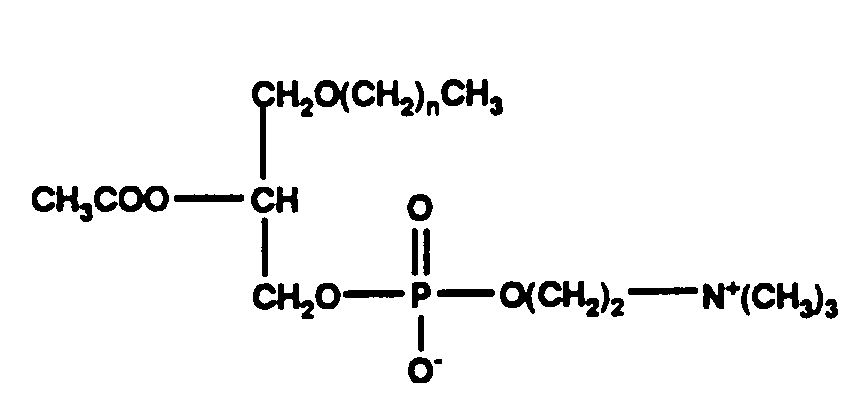
- PAF is physiologically active and causes contraction of the airway smooth muscle, increased vascular permeability, platelet aggregation, hypotension, and the like. It is now recognized as a powerful mediator of inflammation and may play a physiological or pathobiological role in a variety of clinical conditions, such as asthma and pulmonary dysfunction, acute inflammation, transplanted organ rejection, shock, thrombosis, anaphylaxis, gastrointestinal ulceration, allergic skin diseases, retinal and corneal diseases, chemically induced liver cirrhosis, and ovimplantation in pregnancy.
- Several PAF antagonists have been reported (e.g., United States Patent US-A-4,948,795, European Patent Application EP-A-279681, and U.S.-A-4,786,645) but none have received wide acceptance. Therefore, there is a continuing need for the development of potent, orally active antagonists of PAF.
- The present invention provides, in its principal aspect, compounds having PAF antagonist activity of the formula:or a pharmaceutically acceptable salt thereof.

- In the formula given above, R1 is one or more groups independently selected from the group consisting of (A) hydrogen; (B) halogen; (C) alkyl of from one to six carbon atoms; (D) alkoxy of from one to six carbon atoms; (E) alkoyl of from one to seven carbon atoms; (F) phenyl, optionally substituted by (1) alkyl of from one to six carbon atoms, (2) alkoxy of from one to six carbon atoms, or (3) halogen; (G) NR7R8 where R7 and R8 are independently selected from (1) hydrogen, and (2) alkyl of from one to six carbon atoms, or (3) taken together with the nitrogen atom to which they are attached form a saturated 5- or 6-membered nitrogen-containing ring; (H) -COOR9 where R9 is independently selected from (1) hydrogen, and (2) alkyl of from one to six carbon atoms, (I) -CONR7R8 where R7 and R8 are as defined above; (J) -SO2NR7R8 where R7 and R8 are as defined above; (K) 2- or 3-furyl, (L) 2- or 3-thienyl, (M) 2-, 4-, or 5-thiazolyl, (N) 2-, 3-, or 4-pyridyl, (O) 2-, or 4-pyrimidyl, (P) benzoyl, wherein the phenyl moiety is optionally substituted by (1) halogen, (2) alkyl of from one to six carbon atoms, or (3) alkoxy of from one to six carbon atoms; (Q) phenoxy optionally substituted by (1) halogen, (2) alkyl of from one to six carbon atoms, or (3) alkoxy of from one to six carbon atoms; (R) phenylalkyloxy in which the alkyl portion contains from one to six carbon atoms and the phenyl is optionally substituted with (1) halogen, (2) alkyl of from one to six carbon atoms, or (3) alkoxy of from one to six carbon atoms, and (S) phenylalkoyl in which the alkoyl portion contains from one to seven carbon atoms and the phenyl moiety is optionally substituted by; (1) halogen, (2) alkyl of from one to six carbon atoms, or (3) alkoxy of from one to six carbon atoms.
- The substituent group R2 is selected from the group consisting of (A) hydrogen, (B) alkyl of from one to six carbon atoms; (C) -(CH2)pCOOR9, where p is 0 or an integer of from 1 to 4 and R9 is as defined above, (D) -(CH2)qNR7R8, where q is an integer of from 2 and 4 and R7 and R8 are as defined above, (E) -(CH2)pCOR9 where R9 is as defined above; (F) -(CH2)qOH where q is as defined above; (G) -(CH2)pSO2R9 where p and R9 are as defined above, (H) -(CH2)pSO2NR7R8 where p, R7 and R8 are as defined above, (I) -(CH2)pCONR10R11, where p is as defined above and R10 and R11 are independently selected from (1) hydrogen, (2) alkyl of from one to six carbon atoms, (3) -(CH2)rCOOR9, where r is an integer of from 1 to 4 and R9 is as defined above, (4) -(CH2)rNR7R8 where r, R7 and R8 are as defined above, (5) -(CH2)rOH, (6) -(CH2)rSO2R9 where r and R9 are as defined above, (7) -(CH2)rSO2NR7R8 where r, R7 and R8 are as defined above, (8) -(CH2)pCN where p is as defined above; (9) -(CH2)p-1H-tetrazol-5-yl where p is as defined above; (10) -CONHNH2, and (11) -(CH2)r-phenyl, where r is as defined above and the phenyl moiety is optionally substituted by halogen, alkyl of from one to six carbon atoms, or alkoxy of from one to six carbon atoms.
- The groups R3 , R4 , and R5 are independently selected from hydrogen or alkyl of from one to six carbon atoms.
- X represents an atom or group of atoms selected from the group consisting of S, SO, SO2, O, and CH2.
- Y represents an atom or group selected from the group consisting of (A) N, (B) N+-R12 where R12 is an alkyl group of from one to six carbon atoms, (C) N+→O-, (D) N+-OR12 where R12 is as defined above, (E) N+-NR7R8 where R7 and R8 are as defined above, (F) N+-NHCONR7R8 R7 and R8 are as defined above, (G) N+-NHCOR9 where R9 is as defined above, (H) N+-CR7R8OCOR12 where R7, R8 and R12 are as defined above, (I) N+-OCR7R8OCOR12 where R7, R8 and R12 are as defined above, (J) N+-CR7R8OCONR7R8 where R7 and R8 are as defined above, and (K) N+-O-CR7R8OCONR7R8 where R7 and R8 are as defined above.
- A represents O, N+OR10, N+OCOR10, or N+NR7R8, where where R7, R8 and R10 are as defined above.
- The pharmaceutically acceptable salts and individual stereoisomers of compounds of structural formula I above, as well as mixtures thereof, are also contemplated as falling within the scope of the present invention.
- In another aspect, the present invention provides pharmaceutical compositions useful for the treatment of PAF-mediated disorders comprising a therapeutically effective amount of a compound of formula I above in combination with a pharmaceutically acceptable carrier.
- In another aspect, the present invention provides a method of inhibiting PAF activity by administering to a host mammal in need of such treatment an effective amount of a PAF-inhibiting compound having structure I above.
- In yet another aspect of the present invention, there is provided a method of treating PAF-mediated disorders including asthma, shock, respiratory distress syndrome, acute inflammation, delayed cellular immunity, parturition, fetal lung maturation, and cellular differentiation by administering to a host mammal in need of such treatment a therapeutically effective amount of a compound of structure I above.
- In a preferred embodiment, compounds of the present invention are represented by formula I wherein:
- R1 is phenyl, optionally substituted by (a) alkyl of from one to six carbon atoms, (b) alkoxy of from one to six carbon atoms, or (c) halogen; R2 is as defined above; R3 , R4 , and R5 are hydrogen; X is -S-; Y is selected from the groups consisting of (a) -N-, (b) >N-O, (c) >N-CR7R8OCOR12, or (d) >N-OCR7R8OCOR12; A is selected from the groups consisting of (a) =O, or (b) =NOH. Preferred compounds of Formula I are those in which X is -S-, -SO-, or -SO2-; R2 is hydrogen, carbamoyl, alkyl of from one to six carbon atoms, -COOR8, or -SO2R8; R3 is hydrogen or alkyl of from one to six carbon atoms; and R1 is hydrogen, phenyl, or phenylalkoxy or a pharmaceutically acceptable salt thereof.
- In a particularly preferred embodiment, compounds of the present invention are represented by Formula I wherein R1 is phenyl or 4-fluorophenyl; R2 is CONH2, CONHCH3, or CON(CH3)2; and R3 , R4 , X, Y, and A are as defined immediately above.
- Examples of compounds contemplated as falling within the scope of the present invention include, but are not necessarily limited to:
- 3-(pyridin-3-yl)-7-(indol-3-yl)carbonyl-1H,3H-pyrrolo[1,2-c]thiazole;
- 3-(pyridin-3-yl)-7-(1-N,N-dimethylcarbamoylindol-3-yl)carbonyl-1H,3H-pyrrolo[1,2-c]thiazole;
- 3-(pyridin-3-yl)-7-(5-phenylmethoxyindol-3-yl)carbonyl-1H,3H-pyrrolo[1,2-c]thiazole;
- 3-(pyridin-3-yl)-7-(6-phenylmethoxyindol-3-yl)carbonyl-1H,3H-pyrrolo[1,2-c]thiazole;
- 3-(pyridin-3-yl)-7-(7-phenylmethoxyindol-3-yl)carbonyl-1H,3H-pyrrolo[1,2-c]thiazole;
- 3-(pyridin-3-yl)-7-(1-N,N-dimethylcarbamoyl-5-phenylmethoxyindol-3-yl)carbonyl-1H,3H-pyrrolo[1,2-c]thiazole;
- 3-(pyridin-3-yl)-7-(1-N,N-dimethylcarbamoyl-6-phenylmethoxyindol-3-yl)carbonyl-1H,3H-pyrrolo[1,2-c]thiazole;
- 3-(pyridin-3-yl)-7-(1-N,N-dimethylcarbamoyl-7-phenylmethoxyindol-3-yl)carbonyl-1H,3H-pyrrolo[1,2-c]thiazole;
- 3-(pyridin-3-yl)-7-(1-tert-butyloxycarbonylindol-3-yl)carbonyl-1H,3H-pyrrolo[1,2-c]thiazole;
- 3-(pyridin-3-yl)-7-(6-phenylindol-3-yl)carbonyl-1H,3H-pyrrolo[1,2-c]thiazole;
- 3-(pyridin-3-yl)-7-[1-(morpholin-4-ylcarbonyl)indol-3-yl]carbonyl-1H,3H-pyrrolo[1,2-c]thiazole;
- 3-(pyridin-3-yl)-7-(1-N,N-dimethylcarbamoyl-6-phenylindol-3-yl)carbonyl-1H,3H-pyrrolo[1,2-c]thiazole;
- 2-oxide-3-(pyridin-3-yl)-7-(1-tert-butyoxycarbonylindol-3-ylcarbonyl)-1H,3H-pyrrolo[1,2-c]thiazole;
- 2-oxide-3-(pyridin-3-yl)-7-(indol-3-ylcarbonyl)-1H,3H-pyrrolo[1,2-c]thiazole;
- 3-(pyridin-3-yl)-7-(indol-3-ylcarbonyl)-1H,3H-pyrrolo[1,2-c]oxazole;
- 3-(pyridin-3-yl)-7-(1-N,N-diisopropylcarbamoyl-6-phenylmethoxyindol-3-ylcarbonyl)-1H,3H-pyrrolo[1,2-c]thiazole;
- 1,1-dimethyl-3-(pyridin-3-yl)-7-(indol-3-ylcarbonyl)-1H,3H-pyrrolo[1,2-c]thiazole;
- 3-(pyridin-3-yl)-7-(1-carbomethoxycarbamoyl-6-phenylmethoxyindol-3-ylcarbonyl)-1H,3H-pyrrolo[1,2-c]thiazole;
- 1,1-dimethyl-3-(pyridin-3-yl)-7-(1-N,N-dimethylcarbamoyl-indol-3-ylcarbonyl)-1H,3H-pyrrolo[1,2-c]thiazole;
- 3-(pyridin-3-yl)-7-(1-N-methyl-N-phenylcarbamoyl-6-phenylmethoxyindol-3-ylcarbonyl)-1H,3H-pyrrolo[1,2-c]thiazole;
- 3-(pyridin-3-yl)-7-(1-methyl-6-phenylmethoxyindol-3-ylcarbonyl)-1H,3H-pyrrolo[1,2-c]thiazole;
- 3-(pyridin-3-yl)-7-(1-N-methylcarbamoyl-6-phenylmethoxyindol-3-ylcarbonyl)-1H,3H-pyrrolo[1,2-c]thiazole;
- 2-oxide-3-(pyridin-3-yl)-7-(1-N,N-dimethylcarbamoyl-6-phenylindol-3-ylcarbonyl)-1H,3H-pyrrolo[1,2-c]thiazole;
- 1,1-dimethyl-3-(pyridin-3-yl)-7-(1-N,N-dimethylcarbamoyl-6-phenylindol-3-ylcarbonyl)-1H,3H-pyrrolo[1,2-c]thiazole;
- 1,1-dimethyl-3-(pyridin-3-yl)-7-[6-(4-methoxyphenyl)indol-3-ylcarbonyl]-1H,3H-pyrrolo[1,2-c]thiazole;
- 1,1-dimethyl-3-(pyridin-3-yl)-7-[1-N,N-dimethylcarbamoyl-6-(4-methoxyphenyl)indol-3-ylcarbonyl]-1H,3H-pyrrolo[1,2-c]thiazole;
- 3-(pyridin-3-yl)-7-(1-carbophenoxy-6-phenylmethoxyindol-3-ylcarbonyl)-1H,3H-pyrrolo[1,2-c]thiazole;
- 3-(pyridin-3-yl)-7-[6-(4-fluorophenyl)indol-3-ylcarbonyl]-1H,3H-pyrrolo[1,2-c]thiazole;
- 3-(pyridin-3-yl)-7-[1-N,N-dimethylcarbamoyl-6-(4-fluorophenyl)indol-3-ylcarbonyl]-1H,3H-pyrrolo[1,2-c]thiazole;
- 3-(pyridin-3-yl)-7-(1-N-methylcarbamoyl-6-phenylindol-3-ylcarbonyl)-1H,3H-pyrrolo[1,2-c]thiazole;
- 3-(pyridin-3-yl)-7-[1-N-methylcarbamoyl-6-(4-fluorophenyl)indol-3-ylcarbonyl]-1H,3H-pyrrolo[1,2-c]thiazole;
- 1,1-dimethyl-3-(pyridin-3-yl)-7-[1-N-methylcarbamoyl-6-(4-methoxyphenyl)indol-3-ylcarbonyl]-1H,3H-pyrrolo[1,2-c]thiazole;
- 3-(1-methylpyridin-3-yl)-7-(1-N,N-dimethylcarbamoyl-6-phenylindol-3-ylcarbonyl)-1H,3H-pyrrolo[1,2-c]thiazole;
- 3-(1-oxide-pyridin-3-yl)-7-(1-N,N-dimethylcarbamoyl-6-phenylindol-3-ylcarbonyl)-1H,3H-pyrrolo[1,2-c]thiazole;
- 3-(1-oxide-pyridin-3-yl)-7-(1-N-methylcarbamoyl-6-phenylindol-3-ylcarbonyl)-1H,3H-pyrrolo[1,2-c]thiazole;
- 1,1-dimethyl-3-(pyridin-3-yl)-7-[6-(4-fluorophenyl)indol-3-ylcarbonyl]-1H,3H-pyrrolo[1,2-c]thiazole;
- 3-(pyridin-3-yl)-7-(1-N-methylcarbamoyl-6-phenylmethoxyindol-3-ylcarbonyl)-1H,3H-pyrrolo[1,2-c]thiazole;
- 3-(pyridin-3-yl)-7-[6-(4-methoxyphenyl)indol-3-yl]carbonyl-1H,3H-pyrrolo[1,2-c]thiazole;
- 3-(1-oxide-pyridin-3-yl)-7-[1-N,N-dimethylcarbamoyl-6-(4-fluorophenyl)indol-3-ylcarbonyl]-1H,3H-pyrrolo[1,2-c]thiazole;
- 3-(pyridin-3-yl)-7-[1-N,N-dimethylcarbamoyl-6-(4-methoxyphenyl)indol-3-ylcarbonyl]-1H,3H-pyrrolo[1,2-c]thiazole;
- 3-(pyridin-3-yl)-7-(6-pyrid-3-ylindol-3-ylcarbonyl)-1H,3H-pyrrolo[1,2-c]thiazole;
- 3-(pyridin-3-yl)-7-(1-N,N-dimethylcarbamoyl-6-pyrid-4-ylindol-3-ylcarbonyl)-1H,3H-pyrrolo[1,2-c]thiazole;
- 3-(pyridin-3-yl)-7-[1-N-methylcarbamoyl-6-(4-methoxyphenyl)indol-3-ylcarbonyl]-1H,3H-pyrrolo[1,2-c]thiazole;
- 3-(1-oxide-pyridin-3-yl)-7-(1-N,N-dimethylcarbamoylindol-3-ylcarbonyl)-1H,3H-pyrrolo[1,2-c]thiazole;
- 3-(1-oxide-pyridin-3-yl)-7-[1-N,N-dimethylcarbamoyl-6-(4-methoxyphenyl)indol-3-ylcarbonyl]-1H,3H-pyrrolo[1,2-c]thiazole;
- 3-(pyridin-3-yl)-7-[1-(2-carbomethoxyethyl)-6-(4-fluorophenyl)indol-3-ylcarbonyl]-1H,3H-pyrrolo[1,2-c]thiazole;
- 3-(pyridin-3-yl)-7-(6-chloroindol-3-ylcarbonyl)-1H,3H-pyrrolo[1,2-c]thiazole;
- 3-(pyridin-3-yl)-7-[1-N,N-dimethylcarbamoyl-6-(3,4,5-trimethoxyphenyl)indol-3-ylcarbonyl]-1H,3H-pyrrolo[1,2-c]thiazole;
- 3-(pyridin-3-yl)-7-[1-(2-carboxyethyl)-6-(4-fluorophenyl)indol-3-ylcarbonyl]-1H,3H-pyrrolo[1,2-c]thiazole;
- 3-(pyridin-3-yl)-7-[1-(2-sulfamylethyl)-6-(4-fluorophenyl)indol-3-ylcarbonyl]-1H,3H-pyrrolo[1,2-c]thiazole;
- 3-(pyridin-3-yl)-7-[1-methanesulfonyl-6-(4-fluorophenyl)indol-3-ylcarbonyl]-1H,3H-pyrrolo[1,2-c]thiazole;
- 3-(pyridin-3-yl)-7-(1-N,N-dimethylcarbamoyl-6-phenylindol-3-ylcarbonyl)-1H,3H-pyrrolo[1,2-c]thiazole Hydrochloride;
- 3-(pyridin-3-yl)-7-[1-(2-N,N-dimethylcarbamoylmethyl)-6-(4-fluorophenyl)indol-3-ylcarbonyl]-1H,3H-pyrrolo[1,2-c]thiazole;
- 3-(1-oxide-pyridin-3-yl)-7-(1-N,N-dimethylcarbamoyl-6-phenylindol-3-ylcarbonyl)-1H,3H-pyrrolo[1,2-c]thiazole hydrochloride;
- 3-(pyridin-3-yl)-7-[1-N,N-dimethylsulfamyl-6-(4-fluorophenyl)indol-3-ylcarbonyl]-1H,3H-pyrrolo[1,2-c]thiazole;
- 3-(pyridin-3-yl)-7-[1-N,N-dimethylcarbamoyl-6-(3-aminophenyl)indol-3-ylcarbonyl]-1H,3H-pyrrolo[1,2-c]thiazole;
- 3-(pyridin-3-yl)-7-[1-(2-tert-butoxycarbonylaminoethyl)-6-(4-fluorophenyl)indol-3-ylcarbonyl]-1H,3H-pyrrolo[1,2-c]thiazole;
- 3-(1-oxide-pyridin-3-yl)-7-(1-methyl-6-phenylmethoxyindol-3-ylcarbonyl)-1H,3H-pyrrolo[1,2-c]thiazole;
- 3-(pyridin-3-yl)-7-[1-(2-aminoethyl)-6-(4-fluorophenyl)indol-3-ylcarbonyl]-1H,3H-pyrrolo[1,2-c]thiazole;
- 3-(1-oxide-pyridin-3-yl)-7-[1-N,N-dimethylsulfamyl-6-(4-fluorophenyl)indol-3-ylcarbonyl]-1H,3H-pyrrolo[1,2-c]thiazole;
- 3-(pyridin-3-yl)-7-[1-phenylsulfonyl-6-(4-fluorophenyl)indol-3-ylcarbonyl]-1H,3H-pyrrolo[1,2-c]thiazole;
- 3-(pyridin-3-yl)-7-[1-N-(2-hydroxyethyl)carbamoyl-6-(4-fluorophenyl)indol-3-ylcarbonyl]-1H,3H-pyrrolo[1,2-c]thiazole;
- 3-(pyridin-3-yl)-7-(6-bromoindol-3-ylcarbonyl)-1H,3H-pyrrolo[1,2-c]thiazole;
- 3-(pyridin-3-yl)-7-(1-N,N-dimethylcarbamoyl-6-bromoindol-3-ylcarbonyl)-1H,3H-pyrrolo[1,2-c]thiazole;
- 3-(pyridin-3-yl)-7-(1-N,N-dimethylcarbamoyl-6-chloroindol-3-ylcarbonyl)-1H,3H-pyrrolo[1,2-c]thiazole;
- 3-(1-oxide-Pyridin-3-yl)-7-(1-N,N-dimethylcarbamoyl-6-chloroindol-3-ylcarbonyl)-1H,3H-pyrrolo[1,2-c]thiazole;
- 3-(1-amino-pyridin-3-yl)-7-[1-N,N-dimethylcarbamoyl-6-(4-fluorophenyl)-indol-3-ylcarbonyl]-1H,3H-pyrrolo[1,2-c]thiazole;
- 3-(pyridin-3-yl)-7-[1-(2-methanesulfonylaminoethyl)-6-(4-fluorophenyl)indol-3-ylcarbonyl]-1H,3H-pyrrolo[1,2-c]thiazole;
- 3-(pyridin-3-yl)-7-[1-hydrazinocarbonyl-6-(4-fluorophenyl)indol-3-ylcarbonyl]-1H,3H-pyrrolo[1,2-c]thiazole;
- 3-(pyridin-3-yl)-7-[1-(2-aminoethyl)-6-(4-fluorophenyl)indol-3-ylcarbonyl]-1H,3H-pyrrolo[1,2-c]thiazole Hydrochloride;
- 3-(pyridin-3-yl)-7-[1-ethanesulfonyl-6-(4-fluorophenyl)indol-3-ylcarbonyl]-1H,3H-pyrrolo[1,2-c]thiazole;
- 3-(pyridin-3-yl)-7-[1-(2-hydroxyethyl)-6-(4-fluorophenyl)indol-3-ylcarbonyl]-1H,3H-pyrrolo[1,2-c]thiazole;
- 3-(1-oxide-pyridin-3-yl)-7-[1-phenylsulfonyl-6-(4-fluorophenyl)indol-3-ylcarbonyl]-1H,3H-pyrrolo[1,2-c]thiazole;
- 3-(pyridin-3-yl)-7-(1-N,N-dimethylcarbamoyl-6-pyrimid-2-ylindol-3-ylcarbonyl)-1H,3H-pyrrolo[1,2-c]thiazole;
- 3-(1-oxide-pyridin-3-yl)-7-[1-(2-N,N-dimethylcarbamoylmethyl)-6-(4-fluorophenyl)indol-3-ylcarbonyl]-1H,3H-pyrrolo[1,2-c]thiazole;
- 3-(pyridin-3-yl)-7-[1-carbamoyl-6-(4-fluorophenyl)indol-3-ylcarbonyl]-1H,3H-pyrrolo[1,2-c]thiazole;
- 3-(1-carbamoylamino-pyridin-3-yl)-7-[1-N,N-dimethylcarbamoyl-6-(4-fluorophenyl)indol-3-ylcarbonyl]-1H,3H-pyrrolo[1,2-c]thiazole;
- 3-(1-pyrid-3-oylamino-pyridin-3-yl)-7-[1-N,N-dimethylcarbamoyl-6-(4-fluorophenyl)indol-3-ylcarbonyl]-1H,3H-pyrrolo[1,2-c]thiazole;
- 3-(1-oxide-pyridin-3-yl)-7-[1-(2-aminosulfonylethyl)-6-(4-fluorophenyl)indol-3-ylcarbonyl]-1H,3H-pyrrolo[1,2-c]thiazole;
- 3-(pyridin-3-yl)-7-[1-N,N-dimethylcarbamoyl-6-(3-aminosulfonylphenyl)indol-3-ylcarbonyl]-1H,3H-pyrrolo[1,2-c]thiazole;
- 3-(pyridin-3-yl)-7-[1-(2-N-methylcarbamoylmethyl)-6-(4-fluorophenyl)indol-3-ylcarbonyl]-1H,3H-pyrrolo[1,2-c]thiazole;
- 3-(pyridin-3-yl)-7-[1-N,N-dimethylcarbamoyl-6-(4-fluorophenyl)indol-3-ylcarbonyloxime]-1H,3H-pyrrolo[1,2-c]thiazole;
- 3-(pyridin-3-yl)-7-[6-(4-fluorophenyl)indol-3-ylcarbonyloxime]-1H,3H-pyrrolo[1,2-c]thiazole;
- 3-(pyridin-3-yl)-7-[1-(N-methyl-N-(dimethylaminoethyl))carbamoyl-6-(4-fluorophenyl)indol-3-ylcarbonyl]-1H,3H-pyrrolo[1,2-c]thiazole;
- 3-(pyridin-3-yl)-7-[1-N-carboxymethylcarbamoyl-6-(4-fluorophenyl)indol-3-ylcarbonyl]-1H,3H-pyrrolo[1,2-c]thiazole;
- 3-(1-methyl-pyridin-3-yl)-7-[1-N,N-dimethylcarbamoyl-6-(4-fluorophenyl)indol-3-ylcarbonyl]-1H,3H-pyrrolo[1,2-c]thiazole;
- 3-(pyridin-3-yl)-7-(1-N,N-dimethylcarbamoyl-6-thiazol-2-ylindol-3-ylcarbonyl)-1H,3H-pyrrolo[1,2-c]thiazole;
- 3-(pyridin-3-yl)-7-[1-N-sulfoethylcarbamoyl-6-(4-fluorophenyl)indol-3-ylcarbonyl]-1H,3H-pyrrolo[1,2-c]thiazole;
- 3-(pyridin-3-yl)-7-[1-N,N-dimethylcarbamoyl-6-(2-aminopyrimid-5-yl)indol-3-yl)carbonyl]-1H,3H-pyrrolo[1,2-c]thiazole;
- 3-(1-oxide-pyridin-3-yl)-7-[1-(2-aminoethyl)-6-(4-fluorophenyl)indol-3-ylcarbonyl]-1H,3H-pyrrolo[1,2-c]thiazole;
- 3-(1-oxide-pyridin-3-yl)-7-[1-N,N-dimethylcarbamoyl-6-(4-hydrazinylcarbonylphenyl)indol-3-ylcarbonyl]-1H,3H-pyrrolo[1,2-c]thiazole;
- 3-(1-acetoxymethylpyridin-3-yl)-7-[1-N,N-dimethylcarbamoyl-6-(4-fluorophenyl)indol-3-ylcarbonyl]-1H,3H-pyrrolo[1,2-c]thiazole;
- 3-(pyridin-3-yl)-7-[1-N-methyl-N-hydroxymethylcarbamoyl-6-(4-fluorophenyl)indol-3-ylcarbonyl]-1H,3H-pyrrolo[1,2-c]thiazole;
- 3-(pyridin-3-yl)-7-[1-cyanomethyl-6-(4-fluorophenyl)indol-3-ylcarbonyl]-1H,3H-pyrrolo[1,2-c]thiazole;
- 3-(pyridin-3-yl)-7-[1-carbamoylmethyl-6-(4-fluorophenyl)indol-3-ylcarbonyl]-1H,3H-pyrrolo[1,2-c]thiazole;
- 3-(pyridin-3-yl)-7-[1-carboxymethyl-6-(4-fluorophenyl)indol-3-ylcarbonyl]-1H,3H-pyrrolo[1,2-c]thiazole;
- 3-(pyridin-3-yl)-7-[1-(1H-tetrazol-5-ylmethyl)-6-(4-fluorophenyl)indol-3-ylcarbonyl]-1H,3H-pyrrolo[1,2-c]thiazole;
- 3-(pyridin-3-yl)-7-[1-N,N-dimethylcarbamoyl-6-(2,4(1H,3H)-pyrimidinedion-5-yl)indol-3-yl)carbonyl]-1H,3H-pyrrolo[1,2-c]thiazole;
- 3-(pyridin-3-yl)-7-[1-N-sulfoethylcarbamoyl-6-(4-fluorophenyl)indol-3-ylcarbonyl]-1H,3H-pyrrolo[1,2-c]thiazole;
- 3-(pyridin-3-yl)-7-[1-N-sulfoethylcarbamoyl-6-(4-fluorophenyl)indol-3-ylcarbonyl]-1H,3H-pyrrolo[1,2-c]thiazole;
- 3-(pyridin-3-yl)-7-(1-N,N-dimethylcarbamoyl-6-thiophen-2-ylindol-3-ylcarbonyl)-1H,3H-pyrrolo[1,2-c]thiazole;
- 3-(pyridin-3-yl)-7-(1-N,N-dimethylcarbamoyl-6-(4-hydroxymethyl)phenylindol-3-ylcarbonyl)-1H,3H-pyrrolo[1,2-c]thiazole;
- 2-oxide-3-(1-oxide-pyridin-3-yl)-7-[1-N,N-dimethylcarbamoyl-6-(4-fluorophenyl)indole-3-ylcarbonyl]-1H,3H-pyrrolo[1,2-c]thiazole;
- 3-(pyridin-3-yl)-7-[1-N,N-dimethylcarbamoyl-6-(4-fluorophenyl)indol-3-ylcarbonylhydrazone]-1H,3H-pyrrolo[1,2-c]thiazole;
- 3-(pyridin-3-yl)-7-[1-N-(2-(4-imidazolyl)ethyl)carbamoyl-6-(4-fluorophenyl)indol-3-ylcarbonyl]-1H,3H-pyrrolo[1,2-c]thiazole; and
- 3-(pyridin-3-yl)-7-[1-N,N-dimethylcarbamoyl-6-(4-fluorophenyl)indol-3-ylcarbonylsemicarbazide]-1H,3H-pyrrolo[1,2-c]thiazole; or a pharmaceutically acceptable salt of each thereof.
-
- As used throughout this specification and the appended claims, the following terms have the meanings ascribed to them:
- The term "alkenyl" as used herein refers to straight or branched chain groups of 2 to 6 carbon atoms containing a carbon-carbon double bond. Representative examples of alkenyl groups include ethenyl, 1-propenyl, 2-propenyl and 1-butenyl.
- The term "alkoxy" as used herein refers to an alkyl group, as defined herein, which is bonded to the parent molecular moiety through an oxygen atom. Representative examples of alkoxy groups include methoxy, ethoxy and tert-butoxy.
- The term "alkoyl" as used herein refers to formyl and radicals of the structure -C(O)-alkyl in which the alkyl portion is a straight or branched alkyl group of from one to six carbon atoms. Representative examples of alkoyl groups include formyl, acetyl, propionyl, butyryl, isobutyryl and pivaloyl.
- The term "alkyl" as used herein refers to straight or branched chain radicals derived from saturated hydrocarbons by the removal of one hydrogen atom. Representative examples of alkyl groups include methyl, ethyl, n-propyl, iso-propyl, n-butyl, sec-butyl, iso-butyl and tert-butyl.
- The term "alkylsulfonyl" is used herein to mean -SO2(alkyl) where the alkyl group is as defined above. Representative examples of alkylsulfonyl groups include methylsulfonyl, ethylsulfonyl and isopropylsulfonyl.
- The term "benzyl" as used herein refers specifically to a phenyl substituted methyl in which the phenyl group may be substituted with 1, 2, or 3 substituents independently selected from halo, nitro, cyano, alkyl of from one to six carbon atoms, alkoxy, and halo-substituted alkyl.
- The term "carboalkoxy" as used herein refers to a structure of formula -C(O)OR wherein R is a straight or branched alkyl radical of from one to six carbon atoms, benzyl, or substituted benzyl. Representative examples of carbalkoxy groups include carbomethoxy, carboethoxy, carbo(iso-propoxy), carbobutoxy, carbo(sec-butoxy), carbo(iso-butoxy), carbo(tert-butoxy) and benzyloxycarbonyl.
- The term "nitrogen heterocycle" as used herein refers to any 5- or 6-membered saturated ring containing from one to three heteroatoms independently selected from the group consisting of one, two, or three nitrogens, one oxygen and one nitrogen, and one sulfur and one nitrogen; wherein the nitrogen and sulfur heteroatoms may be optionally oxidized, wherein the nitrogen heteroatom may be optionally quaternized, and wherein one or more carbon or nitrogen atoms may be substituted with alkyl of from one to six carbon atoms. Representative nitrogen heterocycles include, but are not limited to, pyrrolidinyl, piperidinyl, morpholinyl, piperazinyl and thiomorpholinyl.
- The term "carbamoyl" refers to a structure of formula -CONR'R'' wherein R' and R'' are independently selected from hydrogen, a straight or branched alkyl radical of from one to six carbon atoms, or taken together may form a nitrogen heterocycle, as previously defined. Representative examples of carbamoyl groups, include -C(O)NH2, N,N-dimethylcarbamoyl, N-tert-butylcarbamoyl, N-methyl-N-ethylcarbamoyl, (morpholin-4-yl)carbonyl, (piperidin-1-yl)carbonyl and (4-methylpiperazin-1-yl)carbonyl.
- The term "phenylalkoxy" is used herein to mean a phenyl group appended to an alkoxy radical as previously defined. Representative examples of phenylalkoxy groups include phenylmethoxy (i.e. benzyloxy), 1-phenylethoxy, 2-phenylethoxy and 2-phenylpropoxy.
- The term "phenylalkoyl" is used herein to mean a phenyl group appended through an alkyl or alkenyl group of from one to six carbon atoms or a valence bond to a formyl radical of the structure -C(O)- in which the phenyl group may optionally be substutited with alkyl of from one to six carbon atoms, halogen, or alkoxy as previously defined. Representative examples of phenylalkoyl groups include benzoyl, phenylacetyl, cinnamoyl and phenylpropionyl.
- The terms "PAF-related disorders" and "PAF-mediated disorders" are used herein to mean disorders related to PAF or mediated by PAF, including asthma, shock, respiratory distress syndromes, acute inflammation, gastric ulceration, transplant organ rejection, psoriasis, allergic skin disease, ischemia and reperfusion injury, delayed cellular immunity, parturtition, fetal lung maturation, and cellular differentiation.
- The term "pharmaceutically acceptable salts" refers to the relatively non-toxic, inorganic and organic acid addition salts of compounds of the present invention. These salts can be prepared in situ during the final isolation and purification of the compounds or by separately reacting the purified compound in its free base form with a suitable organic or inorganic acid and isolating the salt thus formed. Representative salts include the hydrobromide, hydrochloride, sulfate, bisulfate, phosphate, nitrate, acetate, oxalate, valerate, oleate, palmitate, stearate, laurate, borate, benzoate, lactate, phosphate, tosylate, citrate, maleate, fumarate, succinate, tartrate, naphthylate, mesylate, glucoheptonate, lactiobionate, laurylsulphonate salts, and the like. (See, for example S. M. Berge, et al., "Pharmaceutical Salts," J. Pharm. Sci., 66: 1-19 (1977) which is incorporated herein by reference.)
- Individual enantiomeric forms of compounds of the present invention can be separated from mixtures thereof by techniques well known in the art. For example, a mixture of diastereomeric salts may be formed by reacting the compounds of the present invention with a optically pure form of an acid, followed by purification of the mixture of diastereomers by recrystallization or chromatography and subsequent recovery of the resolved compound from the salt by basification. Alternatively, the enantiomers of the compounds of the present invention can be separated from one another by chromatographic techniques employing separation on a chiral chromatographic medium.
- The present invention also provides pharmaceutical compositions which comprise one or more of the compounds of formula I above formulated together with one or more non-toxic pharmaceutically acceptable carriers. The pharmaceutical compositions may be specially formulated for oral administration in solid or liquid form, for parenteral injection, or for rectal administration.
- The pharmaceutical compositions of this invention can be administered to humans and other animals orally, rectally, parenterally, intracistemally, intravaginally, intraperitoneally, topically (as by powders, ointments, or drops), bucally, or as an oral or nasal spray. The term "parenteral" administration as used herein refers to modes of administration which include intravenous, intramuscular, intraperitoneal, intrasternal, subcutaneous and intraarticular injection and infusion.
- Pharmaceutical compositions of this invention for parenteral injection comprise pharmaceutically acceptable sterile aqueous or nonaqueous solutions, dispersions, suspensions, or emulsions as well as sterile powders for reconstitution into sterile injectable solutions or dispersions just prior to use. Examples of suitable aqueous and nonaqueous carriers, diluents, solvents, or vehicles include water, ethanol, polyols (such as glycerol, propylene glycol, polyethylene glycol, and the like), and suitable mixtures thereof, vegetable oils (such as olive oil), and injectable organic esters such as ethyl oleate. Proper fluidity can be maintained, for example, by the use of coating materials such as lecithin, by the maintenance of the required particle size in the case of dispersions, and by the use of surfactants.
- These compositions may also contain adjuvants such as preservative, wetting agents, emulsifying agents, and dispersing agents. Prevention of the action of microorganisms may be ensured by the inclusion of various antibacterial and antifungal agents, for example, paraben, chlorobutanol, phenol sorbic acid, and the like. It may also be desirable to include isotonic agents such as sugars, sodium chloride, and the like. Prolonged absorption of the injectable pharmaceutical form may be brought about by the inclusion of agents which delay absorption such as aluminum monostearate and gelatin.
- In some cases, in order to prolong the effect of the drug, it is desirable to slow the absorption of the drug from subcutaneous or intramuscular injection. This may be accomplished by the use of a liquid suspension of crystalline or amorphous material with poor water solubility. The rate of absorption of the drug then depends upon its rate of dissolution which, in turn, may depend upon crystal size and crystalline form. Alternatively, delayed absorption of a parenterally administered drug form is accomplished by dissolving or suspending the drug in an oil vehicle.
- Injectable depot forms are made by forming microencapsule matrices of the drug in biodegradable polymers such as polylactide-polyglycolide. Depending upon the ratio of drug to polymer and the nature of the particular polymer employed, the rate of drug release can be controlled. Examples of other biodegradable polymers include poly(orthoesters) and poly(anhydrides). Depot injectable formulations are also prepared by entrapping the drug in liposomes or microemulsions which are compatible with body tissues.
- The injectable formulations can be sterilized, for example, by filtration through a bacterial-retaining filter or by incorporating sterilizing agents in the form of sterile solid compositions which can be dissolved or dispersed in sterile water or other sterile injectable medium just prior to use.
- Solid dosage forms for oral administration include capsules, tablets, pills, powders, and granules. In such solid dosage forms, the active compound is mixed with at least one inert, pharmaceutically acceptable excipient or carrier such as sodium citrate or dicalcium phosphate and/or (a) fillers or extenders such as starches, lactose, sucrose, glucose, mannitol, and silicic acid, (b) binders such as, for example, carboxymethylcellulose, alginates, gelatin, polyvinylpyrrolidone, sucrose, and acacia, (c) humectants such as glycerol, (d) disintegrating agents such as agar-agar, calcium carbonate, potato or tapioca starch, alginic acid, certain silicates, and sodium carbonate, (e) solution reading agents such as paraffin, (f) absorption accelerators such as quaternary ammonium compounds, (g) wetting agents such as, for example, cetyl alcohol and glycerol monostearate, (h) absorbents such as kaolin and bentonite clay, and (i) lubricants such as talc, calcium stearate, magnesium stearate, solid polyethylene glycols, sodium lauryl sulfate, and mixtures thereof. In the case of capsules, tablets and pills, the dosage form may also comprise buffering agents.
- Solid compositions of a similar type may also be employed as fillers in soft and hard-filled gelatin capsules using such excipients as lactose or milk sugar as well as high molecular weight polyethylene glycols and the like.
- The solid dosage forms of tablets, dragees, capsules, pills, and granules can be prepared with coatings and shells such as enteric coatings and other coatings well known in the pharmaceutical formulating art. They may optionally contain opacifying agents and can also be of a composition that they release the active ingredient(s) only, or preferentially, in a certain part of the intestinal tract, optionally, in a delayed manner. Examples of embedding compositions which can be used include polymeric substances and waxes.
- The active compounds can also be in micro-encapsulated form, if appropriate, with one or more of the above-mentioned excipients.
- Liquid dosage forms for oral administration include pharmaceutically acceptable emulsions, solutions, suspensions, syrups, and elixirs. In addition to the active compounds, the liquid dosage forms may contain inert diluents commonly used in the art such as, for example, water or other solvents, solubilizing agents and emulsifiers such as ethyl alcohol, isopropyl alcohol, ethyl carbonate, ethyl acetate, benzyl alcohol, benzyl benzoate, propylene glycol, 1,3-butylene glycol, dimethyl formamide, oils (in particular, cottonseed, groundnut, corn, germ, olive, castor, and sesame oils), glycerol, tetrahydrofurfuryl alcohol, polyethylene glycols and fatty acid esters of sorbitan, and mixtures thereof.
- Besides inert diluents, the oral compositions can also include adjuvants such as wetting agents, emulsifying and suspending agents, sweetening, flavoring, and perfuming agents.
- Suspensions, in addition to the active compounds, may contain suspending agents as, for example, ethoxylated isostearyl alcohols, polyoxyethylene sorbitol and sorbitan esters, microcrystalline cellulose, aluminum metahydroxide, bentonite, agar-agar and tragacanth, and mixtures thereof.
- Compositions for rectal or vaginal administration are preferably suppositories which can be prepared by mixing the compounds of this invention with suitable non-irritating excipients or carriers such as cocoa butter, polyethylene glycol, or a suppository wax which are solid at room temperature but liquid at body temperature and therefore melt in the rectum or vaginal cavity and release the active compound.
- Compounds of the present invention can also be administered in the form of liposomes. As is known in the art, liposomes are generally derived from phospholipids or other lipid substances. Liposomes are formed by mono- or multi-lamellar hydrated liquid crystals that are dispersed in an aqueous medium. Any non-toxic, physiologically acceptable and metabolizable lipid capable of forming liposomes can be used. The present compositions in liposome form can contain, in addition to a compound of the present invention, stabilizers, preservatives, excipients, and the like. The preferred lipids are the phospholipids and the phosphatidyl cholines (lecithins), both natural and synthetic.
- Methods to form liposomes are known in the art. See, for example, Prescott, Ed., Methods in Cell Biology, Volume XIV, Academic Press, New York, N.Y. (1976), p. 33 et seq.
- Dosage forms for topical administration of a compound of this invention include powders, sprays, ointments, and inhalants. The active compound is mixed under sterile conditions with a pharmaceutically acceptable carrier and any needed preservatives, buffers, or propellants which may be required. Opthalmic formulations, eye ointments, powders and solutions are also contemplated as being within the scope of this invention.
- Actual dosage levels of active ingredients in the pharmaceutical compositions of this invention may be varied so as to obtain an amount of the active compound(s) that is effective to achieve the desired therapeutic response for a particular patient, compositions, and mode of administration. The selected dosage level will depend upon the activity of the particular compound, the route of administration, the severity of the condition being treated, and the condition and prior medical history of the patient being treated. However, it is within the skill of the art to start doses of the compound at levels lower than required to achieve the desired therapeutic effect and to gradually increase the dosage until the desired effect is achieved.
- Generally dosage levels of about 0.001 to about 100 mg, more preferably of about 0.01 to about 20 mg, and most preferably about 0.1 to about 10 mg of active compound per kilogram of body weight per day are administered orally to a mammalian patient. If desired, the effective daily dose may be divided into multiple doses for purposes of administration, e.g. two to four separate doses per day.
- In general, the compounds of the present invention are synthesized by reaction Schemes 1 through 15 as illustrated below. It should be understood that X, A, R1, R2, R3, R5, R6, R7, R8, R9, R10, R11, and R12 as used herein correspond to the groups identified by Formula I.
- The compounds of Formula I may be prepared using the reactions and techniques described in this section. The reactions are performed in a solvent appropriate to the reagents and materials employed and suitable for the transformation being effected. It is understood by those skilled in the art of organic synthesis that the functionality present on the heterocycle and other portions of the molecule must be consistent with the chemical transformation proposed. This will frequently necessitate judgement as to the order of synthetic steps, protecting groups required, and deprotection conditions.

- According to the foregoing reaction Scheme 1, L-Cysteine, L-Serine, L-Penicillamine, or a related amino acid (1) is condensed with nicotinaldehyde to produce the thiazolidine or oxazolidine acids 2. The secondary nitrogen atom is then formylated by the action of formic acid/acetic anhydride to yield the N-formyl heterocycles 3.

- According to the foregoing reaction Scheme 2, the nitrogen atom of L-pyroglutamic acid may be protected with an appropriate group, preferably tert-butyloxycarbonyl (BOC) with di-tert-butyl dicarbonate followed by methyl ester formation which gives lactam 5. Addition of 3-pyridylmagnesium bromide cleaves the heterocyclic ring ad gives ketone 6. The nitrogen atom is deprotected under acidic conditions and reductive cyclization is achieved upon treatment with sodium cyanoborohydride. Hydrolysis of the methyl ester followed by formylation with formic acid/acetic anhydride gives the N-formyl pyrrolidine 8.

- According to the foregoing reaction Scheme 3, N-formyl heterocycles 3 and 8 may be heated independently with 2-chloroacrylonitrile in the presence of triethylamine and p-toluenesulfonyl chloride to afford the corresponding fused bicyclic heterocycle 9. Base catalyzed hydrolysis of the nitrile group followed by acidification affords acid 10. The indole group is introduced by treatment of the anhydrous acid chlorides (prepared from 10 by treatment with sodium hydride followed by oxalyl chloride) with indole Grignard 11 derived from the reaction of the appropriate substituted indole and ethylmagnesium bromide.
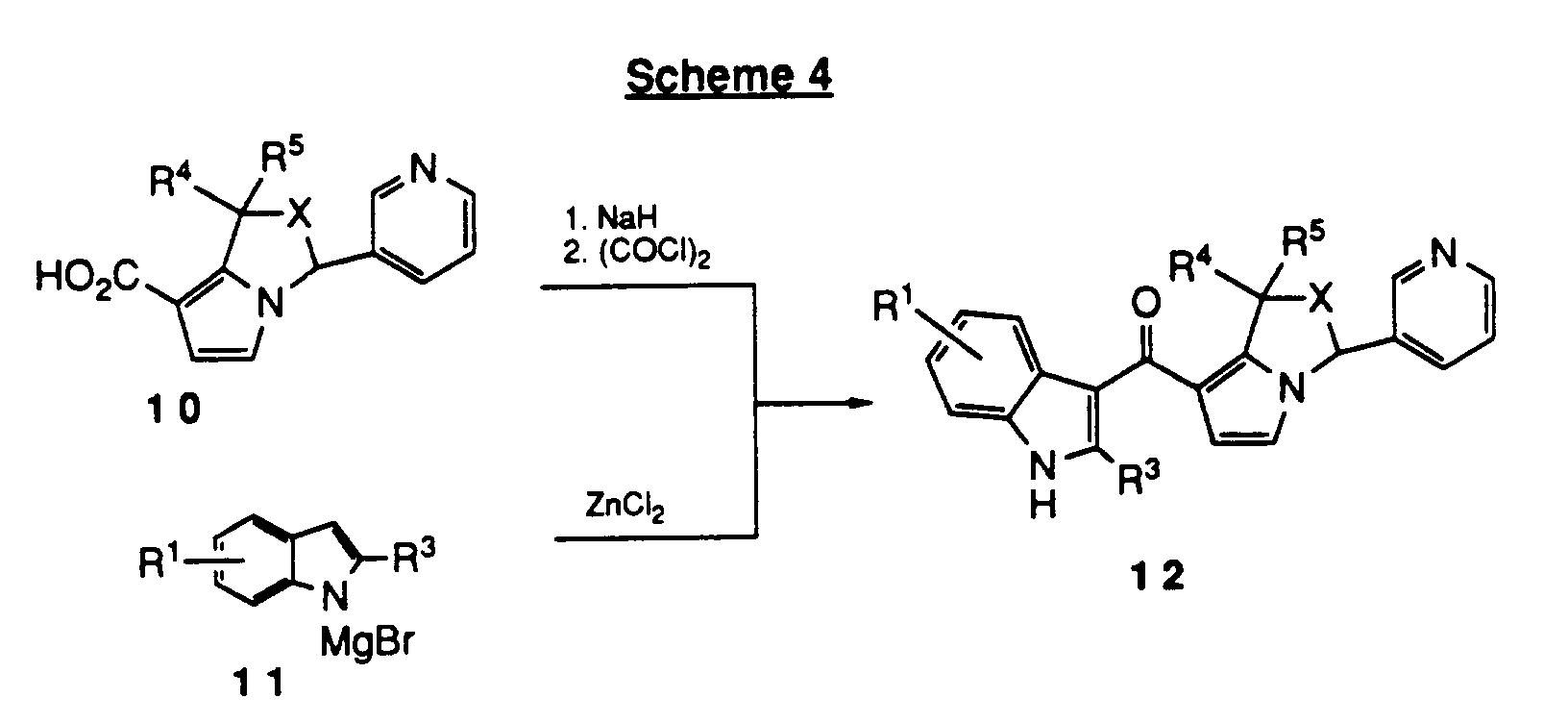
- According to the foregoing reaction Scheme 4, the appropriately substituted indole group is also introduced by treatment of magnesium indole salt with zinc chloride in ether followed by reaction with the anhydrous acid chloride of 10.
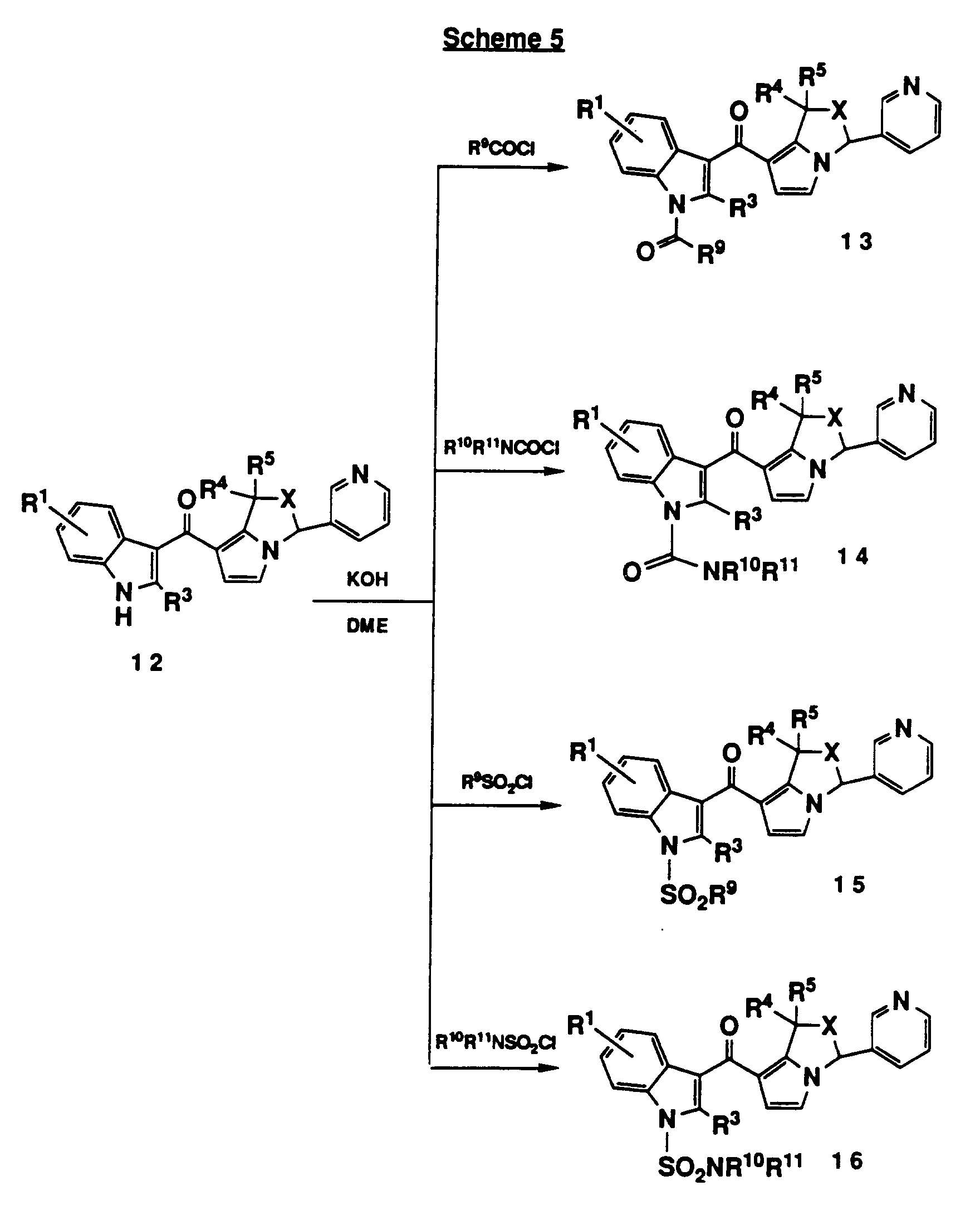
- According to the foregoing reaction Scheme 5, the indole nitrogen atom of the bicyclic heterocycle 12 may be functionalized with an amide group by reaction with the corresponding acid chloride, preferably using potassium hydroxide in 1,2-dimethoxyethane, giving N-acyl indoles 13. Alternatively, compound 12 may be treated independently with the appropriate carbamoyl chloride under similar conditions to give urea 14. Treatment of a potassium hydroxide solution of 12 in 1,2-dimethoxyethane with the appropriate sulfonyl chloride gives the corresponding sulfonamide 15. Finally, 12 in a potassium hydroxide solution with the appropriate sulfamoyl chloride gives the sulfonylurea 16.

- According to the foregoing reaction Scheme 6, 3-acyl indole heterocycle 12 are treated with the appropriate isocyanate to give the urea substituted indole 17.

- According to the foregoing reaction Scheme 7, 3-acyl indole heterocycle 12 is treated with the appropriate alkyl dicarbonate in the presence of 4-dimethylaminopyridine to give the corresponding N-carboalkoxy indole 18.

- According to the foregoing reaction Scheme 8, 3-acyl indole heterocycle 12 is treated with sodium hydride followed by the addition of the appropriate alkyl halide to give the corresponding N-alkyl indole 19.
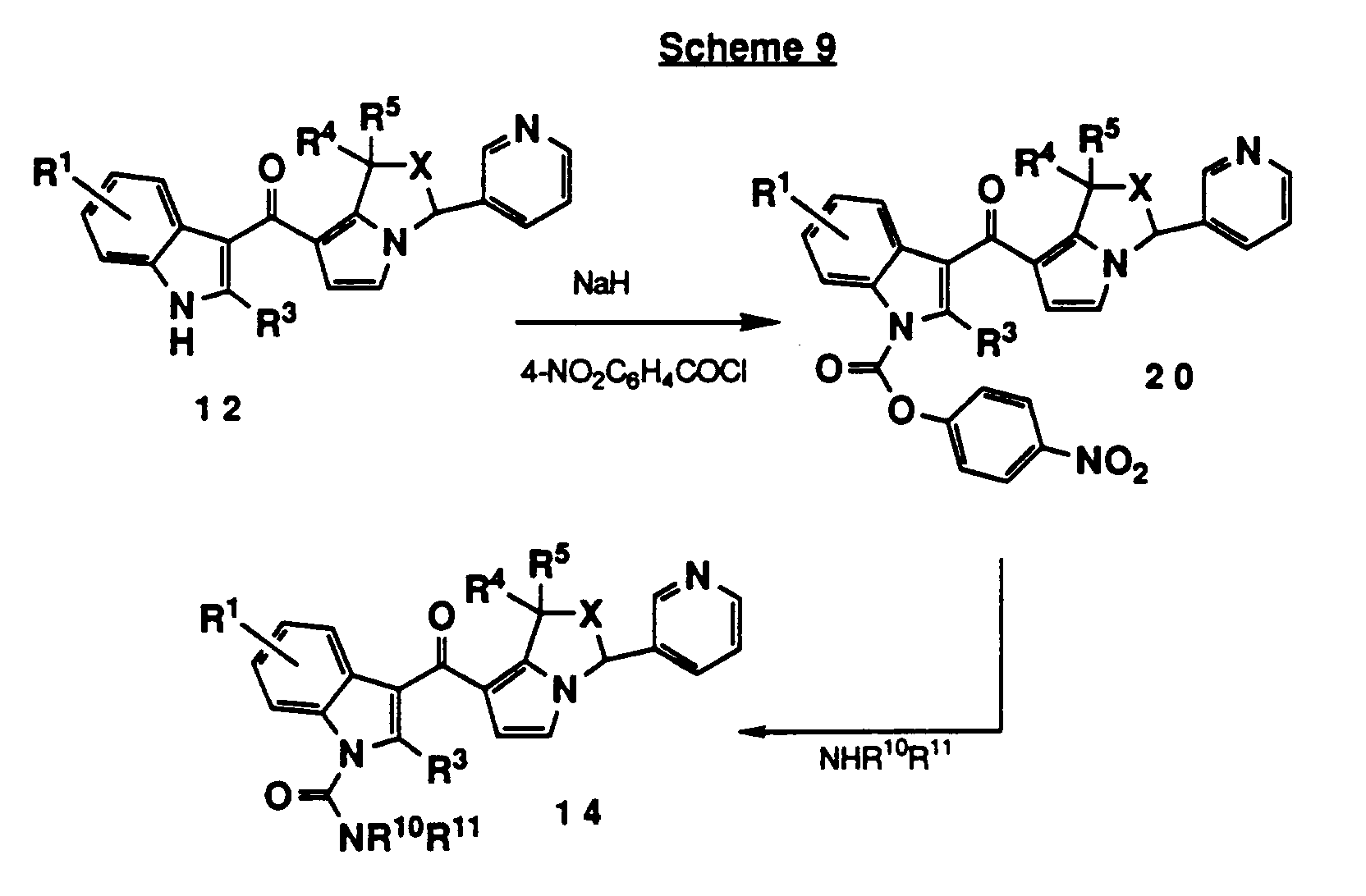
- According to the foregoing reaction Scheme 9, 3-acyl indole heterocycle 12 is treated with 4-nitrophenylchloroformate to give the activated acylindole derivative 20 that is subsequently reacted with an appropriately substituted amine to afford urea 14.
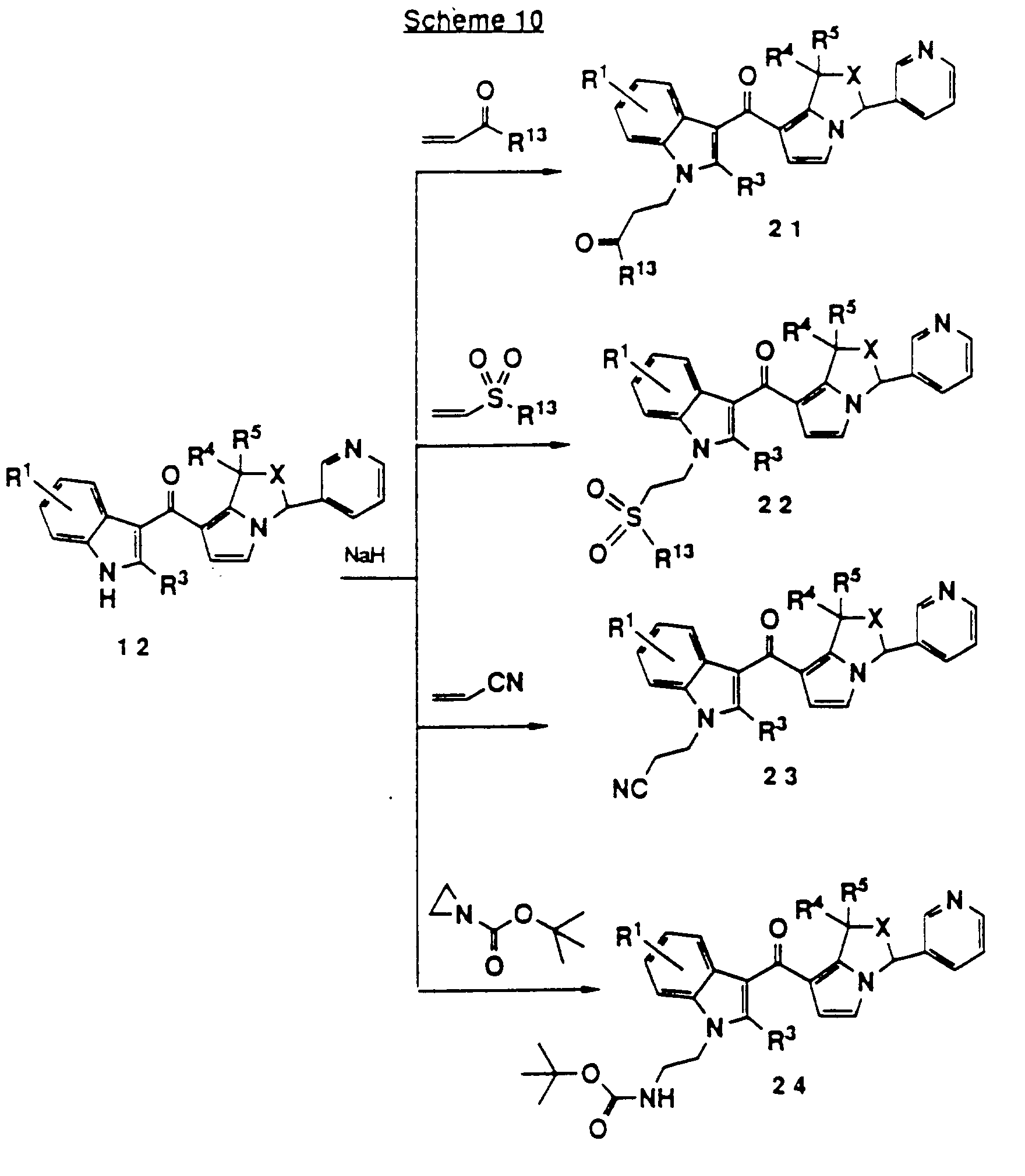
- According to the foregoing reaction Scheme 10, 3-acyl indole heterocycle 12 is treated with sodium hydride and then reacted with an α,β unsaturated carbonyl compound to give 21, with an α,β unsaturated sulfonyl compound to give 22, with an α,β unsaturated nitrile to give 23, or with an acyl aziridine to afford 24. R13 in 21 is used herein to indicate R9, OR9, or NR10R11 and R13 in 22 is used to indicate R9 or NR7R8.
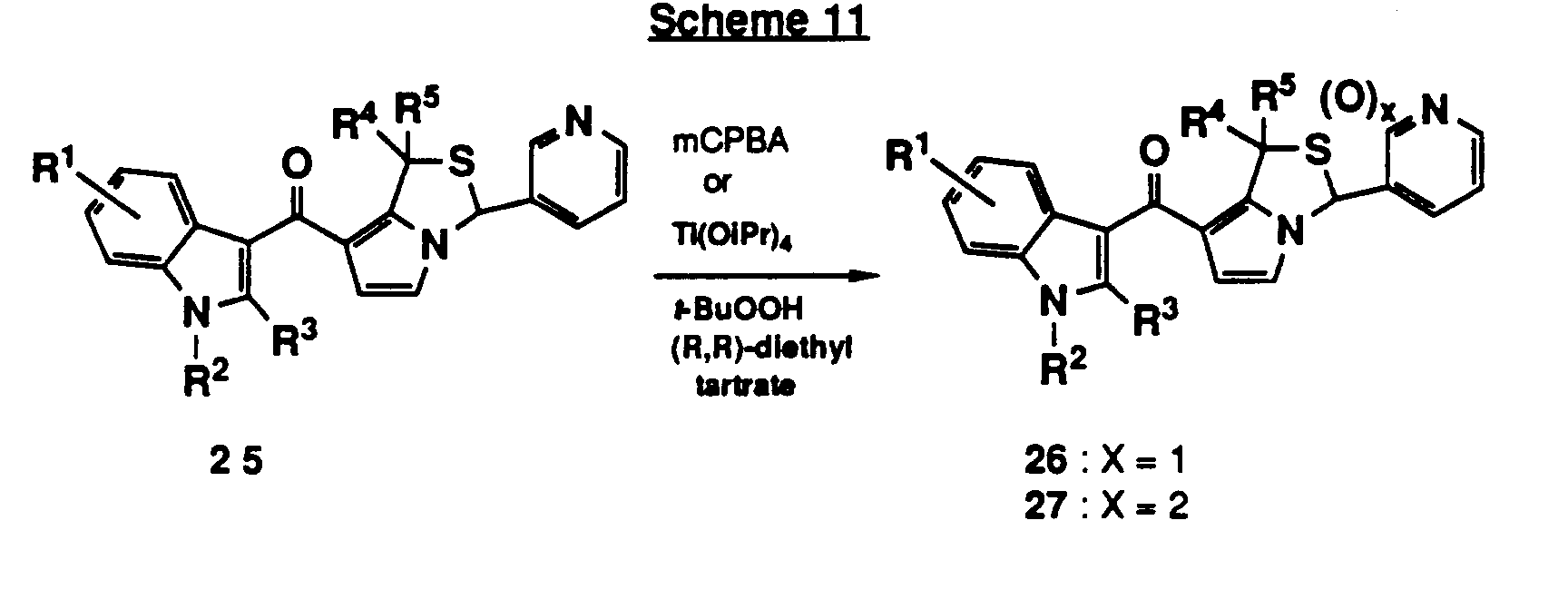
- According to the foregoing reaction Scheme 11, the 3-acyl indole heterocycle 25 is treated with tert-butyl hydroperoxide, titanium tetraisopropoxide, and (R,R)-diethyl tartrate, or with m-chloroperoxybenzoic acid to give the corresponding sulfoxide 26 or sulfone 27.

- According to the foregoing reaction Scheme 12, the 3-acyl indole heterocycle 25 is treated with 2,4-dinitrophenyl 4-toluenesulfonate to the pyridinium salt 28. The salt is treated with hydroxylamine to give N-oxide 30 or alternatively with hydrazine to give 29.

- According to the foregoing reaction Scheme 13, the 3-acyl indole heterocycle 25 is treated with an alkyl halide to give pyridinium salt 31. R14 is used herein to indicate R12 or CR7R8OCOR12.
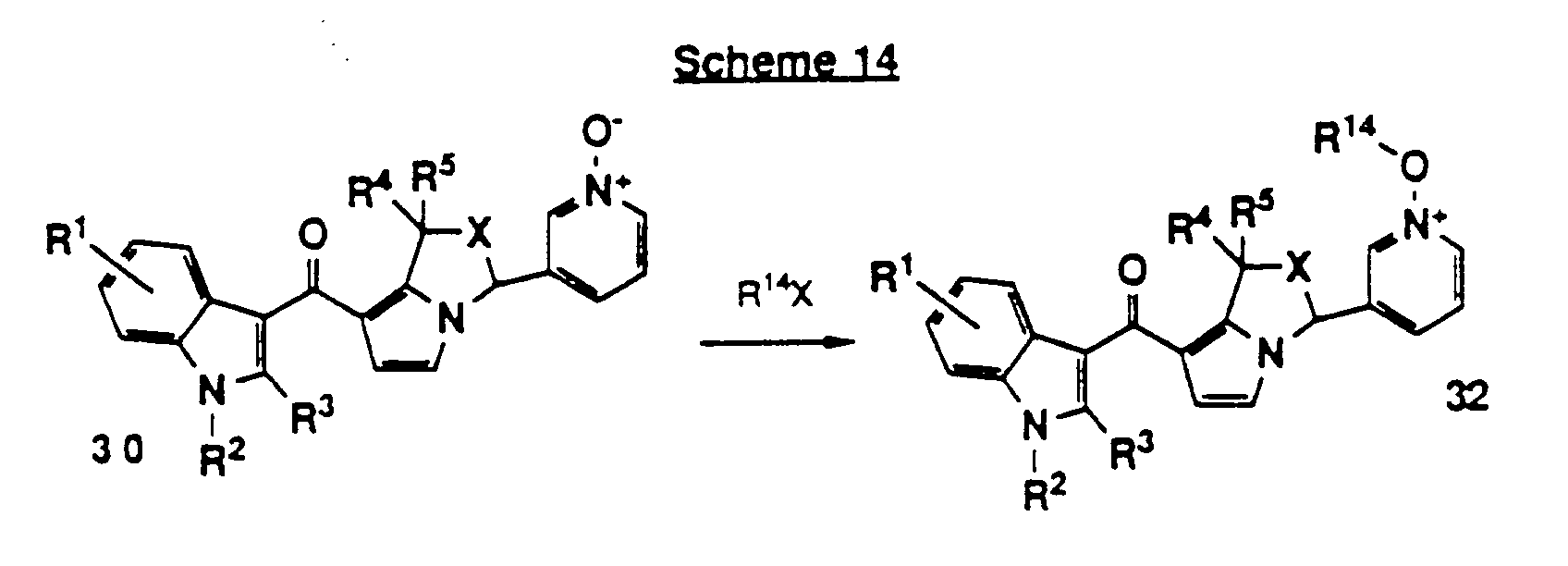
- According to the foregoing reaction Scheme 14, the 3-acyl indole N-oxide heterocycle 30 is treated with an alkyl halide to give pyridinium salt 32.

- According to the foregoing reaction Scheme 15, the bromo indole heterocycle 33 (prepare as described in reaction Scheme 4) is treated with hexamethyltin in the presence of tetrakis(triphenylphosphine)palladium to give 34. This tin reagent is then treated with an aryl halide also in the presence of tetrakis(triphenylphosphine)palladium to afford the aryl indole 35. Alternatively 33 may be converted to 35 directly using the appropriate arylboronic acid in the presence of tetrakis(triphenylphosphine)palladium Ar is used herein to indicate substituted or unsubstituted phenyl, thiazolyl, pyridyl, pyrimidyl.

- According to the foregoing reaction Scheme 16, the indole heterocycle 25 is treated with hydroxylamine to give oxime 36. This oxime can be alkylated with an appropriate alkyl halide to give 37, or acylated with an activated acyl compound to give 38.
- The ability of representative compounds of the present invention to inhibit PAF activity was determined in an in vitro test using the following method.
- Citrated whole rabbit blood was obtained from Pel-Freez (Rogers, AR). Rabbit platelets were prepared by centrifugation and washing. The platelets were lysed by freeze-thawing and sonication; platelet membranes were prepared by centrifugation and washing. Final membrane preparations were stored frozen in 10 mM Tris/5 mM MgCl2/2 mM EDTA (TME buffer, pH 7.0) with 0.25 M sucrose added for membrane stabilization.
- The standard PAF receptor binding assay contained 10 µg platelet membrane protein, 0.6 nM [3H]C18-PAF (from Amersham or New England Nuclear; specific activity 120-180 Ci/mmol), with and without test compound, in "binding buffer" consisting of TME with 0.25% bovine serum albumin added (Sigma, RIA grade). The final volume of the assay was 100 µl. The assay was conducted in Millititre-GV™ (Millipore Corp.) filtration plates; incubation time was for 60 minutes at room temperature (22-23°C.). "Specific binding" was operationally defined as the arithmetic difference between "total binding" of 0.6 nM [3H]C18-PAF (in the absence of added PAF) and "nonspecific binding" (in the presence of 1 µM PAF). After the prescribed incubation, platelet membranes were filtered under vacuum and washed with 1 millilitre of "binding buffer". The filters were dried and removed. The bound radioactivity was quantitated with a Berthold TLC-Linear Analyzer model LB2842.
- Dose-response curves of inhibition of specific [3H]C18-PAF binding by test compounds were conducted in triplicate, with at least four doses covering the active range. Experiments were repeated at least once. IC50 values (concentration producing 50% inhibition) were determined by point-to-point evaluation. Ki values of inhibitory binding constants were calculated according to the method of Cheng and Prusoff [Biochem. Pharmacol. 22 (1973) 3099-3108] whereby
PAF Receptor Binding Activity Example Ki (nM) Example Ki (nM) Example K i (nM) Example K i (nM) 1 53. 28 75 55 940. 82 0.3 2 2,000 29 7.5 56 110 83 10.7 3 180. 30 135 57 38 84 6.9 4 64. 31 10 58 49 85 129. 5 90. 32 150 59 27 86 4,000 6 120. 33 2,800 60 210 87 71 7 17. 34 14 61 1,100 88 680 8 170. 35 44 62 7.4 89 280 9 110. 36 1,100 63 580 90 480 10 95 37 10 64 15.3 91 20 11 225. 38 1.000 65 89 92 19 12 23. 39 3.3 66 38 93 0.8 13 2,200. 40 26 67 2,000 94 40 14 2,400. 41 2,000 68 9.6 95 10 15 5,600. 42 10.5 69 25 96 18 16 85. 43 26 70 2.6 97 19 17 1,200. 44 40 71 244 98 240 18 35. 45 4.1 72 5 99 19 19 100. 46 10 73 211 100 >300 20 180. 47 590 74 84 101 0.95 21 15. 48 8 75 7.5 102 16 22 9. 49 160 76 6.1 103 85 23 95. 50 3.3 77 100 104 2.2 24 51. 51 120 78 123 105 4.3 25 272 52 16 79 18. 106 8.0 26 55 53 0.7 80 45. 27 200 54 17 81 1.12 - The foregoing may be better understood from the following Examples.
- To a solution of 3-(pyridin-3-yl)-1H,3H-pyrrolo[1,2-c]thiazole-7-carboxylic acid, prepared as described in United States Patent 4,529,728, (1.00 g) in anhydrous tetrahydrofuran (THF) (50 mℓ) under dry nitrogen was added sodium hydride, 60% oil dispersion (0.18 g, 1.1 equivalents) and stirred 1.0 hour at ambient temperature. To the resulting suspension was added a catalytic amount of dimethylformamide (DMF) followed by the dropwise addition of oxalyl chloride (0.43 mℓ, 1.2 equivalents). After the reaction mixture had stirred 2.0 hours at ambient temperature, the solvent was evaporated in vacuo at 45°C. The residue was suspended in a mixture of methylene chloride and benzene (3:1 v/v, 30 mℓ).
- In a separate flask, a 3.0 M solution of methyl magnesium bromide in ether (2.0 mL, 1.5 equivalents) was added dropwise to a solution of indole (0.72 g, 1.5 equivalents) in benzene (30 mL) at room temperature and stirred 0.75 hour. The resulting green indolylmagnesium bromide solution was cannulated into the suspension of acid chloride described above. The reaction mixture was stirred at room temperature for 18 hours and then quenched with water (equal volume) and extracted with ether (2 x equal volume). The combined organic phases were dried over magnesium sulfate and concentrated in vacuo at 45°C to afford crude product which was purified by flash chromatography (15 p.s.i.) on 250 g silica gel eluting with 1:1 THF/hexane. The resulting yellow solid was triturated with methylene chloride, filtered, and dried at 50° in vacuo to afford the title compound as a white powder (112 mg, 8 %). m.p. 237-238°C. 1H NMR (DMSO-d6, 300 MHz) δ 4.45 (d, J = 15Hz, 1H), 4.63 (dd, J = 15, 2Hz, 1H), 6.69 (d, J = 3Hz, 1H), 6.77 (d, J = 1.5Hz, 1H), 6.88 (d, J = 3Hz, 1H), 7.20 (dquintet, J = 7.5Hz, 1H), 7.43 (dd, J = 7.5, 5.3Hz, 1H), 7.48 (d, J = 8Hz, 1H), 7.65 (dt, J = 2, 8.4Hz, 1H), 8.21 (d, J = 3Hz, 1H), 8.24-8.28 (m, 1H), 8.53-8.58 (m, 2H), 11.86 (s, 1H). MS (DCI/NH3) m/e 346 (M+H)+.
- 3-(Pyridin-3-yl)-7-(indol-3-yl)carbonyl-1H,3H-pyrrolo[1,2-c]thiazole prepared as described in Example 1, (0.11 g) was dissolved in dimethoxyethane (DME) (20 mℓ) and powdered potassium hydroxide (0.09 g, 5 equivalents) was added in one portion. After stirring at ambient temperature for 0.5 hour, N,N-dimethylcarbamoyl chloride (0.038 g, 1.1 equivalents) was added dropwise and the reaction was stirred for 1 hour. The reaction mixture was poured into water (50 mℓ) and extracted with ether (2 x 50 mℓ). The combined extracts were dried over magnesium sulfate and concentrated in vacuo at 50°C to afford crude product as an amber oil. The crude product was dissolved in the minimal amount of toluene (2 mℓ) and ether was added until cloudy (20 mℓ). After standing for 18 hours at -20°C, the supernatant was decanted from a yellow precipitate. The desired product was then precipitated from the supernatant with the addition of excess pentane (50 mℓ). The white floculent precipitate was dried in vacuo at 50°C to afford the title compound as a white powder (28 mg, 21%). m.p. 241-243°C. 1H NMR (DMSO-d6, 300 MHz) δ 3.05 (s, 6H), 4.48 (d, J = 15Hz, 1H), 4.66 (dd, J = 15, 2Hz, 1H), 6.73 (d, J = 3Hz, 1H), 6.79 (d, J = 1Hz, 1H), 6.89 (d, J = 3Hz, 1H), 7.28-7.47 (m, 3H), 7.60-7.70 (m, 2H), 8.23-8.28 (m, 1H), 8.32 (s, 1H), 8.55-8.59 (m, 2H). MS (DCI/NH3) m/e 417 (M+H)+. IR (KBr) 1600, 1687, 2930, 3440 cm-1.
- The title compound was prepared by the procedure described in Example 1 except 5-phenylmethoxyindole was used instead of indole. The crude product was purified by flash chromatography (15 p.s.i.) on 250 g silica gel eluting with 3:2 THF/hexane to afford the title compound. m.p. 178-179°C. 1H NMR (DMSO-d6, 300 MHz) δ 4.45 (d, 1H, J = 15Hz), 4.62 (dd, 1H, J = 15, 2Hz), 5.13 (s, 2H), 6.68 (d, 1H, J = 3Hz), 6.76 (d, 1H, J = 1Hz), 6.87 (d, 1H, J = 3Hz), 6.94 (dd, 1H, J = 9, 3Hz), 7.29-7.53 (m, 7H), 7.65 (dt, 1H, J = 2.4, 8.4Hz), 7.91 (d, 1H, J = 2.5Hz), 8.18 (d, 1H, J = 3Hz), 8.53-8.58 (m, 2H), 11.77 (d, 1H, J = 2.5Hz). Anal calcd for C27H21N3O2S: C, 71.82; H, 4.69; N, 9.31. Found: C, 71.41; H, 4.78; N, 9.19. MS (DCI/NH3) m/e 452 (M+H)+. IR (KBr) 1422, 1585, 3400 cm-1.
- The title compound was prepared by the procedure described in Example 1 using 6-phenylmethoxyindole instead of indole. The crude product was purified by flash chromatography (15 p.s.i.) on 250 g silica gel eluting with 3:2 THF/hexane and then recrystallized from THF, a minimum of methanol, and excess ether to afford the title compound. m.p. 229-231°C. 1H NMR (DMSO-d6, 300 MHz) δ 4.45 (d, J = 15Hz, 1H), 4.62 (dd, J = 15, 2Hz, 1H), 5.15 (s, 2H), 6.67 (d, J = 3Hz, 1H), 6.75 (d, J = 2Hz, 1H), 6.85 (d, J = 3Hz, 1H), 6.91 (dd, J = 9, 2.5Hz, 1H), 7.04 (d, J = 2.5Hz, 1H), 7.30-7.52 (m, 6H), 7.65 (dt, J = 8, 2Hz, 1H), 8.09 (s, 1H), 8.13 (d, J = 9Hz, 1H), 8.53-8.58 (m, 2H), 11.68 (m, 1H). Anal calcd for C27H21N3O2S: C, 71.82; H, 4.69; N, 9.31. Found: C, 71.72; H, 4.78; N, 9.16. MS (DCI/NH3) m/e 452 (M+H)+. IR (KBr) 1520, 1570, 1620, 3200, 3420 cm-1.
- The title compound was prepared by the procedure described in Example 1 using 7-phenylmethoxyindole instead of indole. The crude product was purified by flash chromatography (15 p.s.i.) on 250 g silica gel eluting with 1:1 THF/hexane and then recrystallized from ethyl acetate/ether to afford the title compound. m.p. 184-188°C. 1H NMR (DMSO-d6, 300 MHz) δ 4.45 (d, J = 15Hz, 1H), 4.62 (dd, J = 15, 2Hz, 1H), 5.30 (s, 2H), 6.68 (d, J = 3Hz, 1H), 6.76 (d, J = 1Hz, 1H), 6.85 (d, J = 3Hz, 1H), 6.89 (d, J = 8Hz, 1H), 7.08 (t, J = 8Hz, 1H), 7.31-7.46 (m, 4H), 7.56-7.67 (m, 3H), 7.83 (d, J = 8Hz, 1H), 8.03 (d, J = 3Hz, 1H), 8.53-8.58 (m, 2H), 12.06 (d, J = 3Hz). Anal calcd for C27N21N3O2S: C, 71.82; H, 4.69; N, 9.31. Found: C, 71.33; H, 4.70; N, 9.16. MS (DCI/NH3) m/e 452 (M+H)+.
- The title compound was prepared by the procedure described in Example 2 using the compound resulting from Example 3, 3-(pyridin-3-yl)-7-(5-phenylmethoxyindol-3-yl)carbonyl-1H,3H-pyrrolo[1,2-c]thiazole, instead of 3-(pyridin-3-yl)-7-(indol-3-yl)carbonyl-1H,3H-pyrrolo[1,2-c]thiazole. The product was recrystallized from ethyl acetate/pentane to give the title compound. m.p. 87-91°C. 1H NMR (DMSO-d6, 300 MHz) δ 3.04 (s, 6H), 4.48 (d, J = 15Hz, 1H), 4.65 (dd, J = 2, 15Hz, 1H), 5.16 (s, 2H), 6.72 (d, J = 3Hz, 1H), 6.79 (d, J = 1Hz, 1H), 6.89 (d, J = 3Hz, 1H), 7.06 (dd, J = 15, 3Hz, 1H), 7.30-7.56 (m, 7H), 7.66 (dt, H = 8, 2Hz, 1H), 7.88 (d, J = 3Hz, 1H), 8.28 (s, 1H), 8.55-8.59 (m, 2H). Anal calcd for C30H26N4O3S: C, 68.95; H, 5.01; N, 10.72. Found: C, 68.44; H, 5.17; N, 10.43. MS (DCI/NH3) m/e 523 (M+H)+.
- The title compound was prepared by the procedure described in Example 2 using the compound resulting from Example 4, 3-(pyridin-3-yl)-7-(6-phenylmethoxyindol-3-yl)carbonyl-1H,3H-pyrrolo[1,2-c]thiazole, instead of 3-(pyridin-3-yl)-7-(indol-3-yl)carbonyl-1H,3H-pyrrolo[1,2-c]thiazole. The product was recystallized from toluene/ether/excess pentane to give the title compound. m.p. 85-91°C. 1H NMR (DMSO-d6, 300 MHz) δ 3.01 (s, 6H), 4.47 (d, J = 15Hz, 1H), 4.55 (dd, J = 15, 2Hz, 1H), 5.17 (s, 2H), 6.71 (d, J = 3Hz, 1H), 6.78 (d, J = 1Hz, 1H), 6.88 (d, J = 3Hz, 1H), 7.30-7.52 (m, 6H), 7.66 (dt, J = 8, 2Hz, 1H), 8.12 (d, J = 15Hz, 1H), 8.19 (s, 1H), 8.54-8.58 (m, 2H). Anal calcd for C30H26N4O3S: C, 68.95; H, 5.01; N, 10.72. Found: C, 68.66; H, 5.04; N, 10.55. MS (DCI/NH3) m/e 523 (M+H)+.
- The title compound was prepared by the procedure described in Example 2 using the compound resulting from Example 5, 3-(pyridin-3-yl)-7-(7-phenylmethoxyindol-3-yl)carbonyl-1H,3H-pyrrolo[1,2-c]thiazole, instead of 3-(pyridin-3-yl)-7-(indol-3-yl)carbonyl-1H,3H-pyrrolo[1,2-c]thiazole. The product was recrystallized from methylene chloride/THF/hexane to give the title compound. m.p. 210-211°C. 1H NMR (DMSO-d6, 300 MHz) δ 2.70 (d, J = 21Hz, 6H), 4.45 (d, J = 15Hz, 1H), 4.54 (dd, J = 15, 2Hz, 1H), 5.21 (s, 2H), 6.70 (d, J = 3Hz, 1H), 6.78 (d, J = 1Hz, 1H), 6.88 (s, 1H), 7.05 (d, J = 8Hz, 1H), 7.23 (t, J = 8Hz, 1H), 7.33-7.53 (m, 6H), 7.66 (dt, J = 8, 2Hz, 1H), 7.89 (d, J = 8Hz, 1H), 8.28 (s, 1H), 8.52-8.58 (m, 2H). MS (DCI/NH3) m/e 523 (M+N)+.
- The compound resulting from Example 1 was reacted with di-t-butyl-dicarbonate in acetonitrile in the presence of 4-dimethylaminopyridine to give, after recrystallization from ether/pentane at -20 °C, the title compound. m.p. 150-151°C. 1H NMR (DMSO-d6, 300 MHz) δ 1.66 (s, 9H), 4.48 (d, J = 15Hz, 1H), 4.65 (dd, J = 15, 2Hz, 1H), 6.75 (d, J = 3Hz, 1H), 6.83 (d, J = 3Hz, 1H), 7.34-7.48 (m, 3H), 7.69 (dt, J = 9, 2Hz, 1H), 8.12 (d, J = 9Hz, 1H), 8.26 (s, 1H), 8.56-8.60 (m, 2H). Anal calcd for C25H23N3O3S: C, 67.40; H, 5.20; N, 9.43. Found: C, 67.26; H, 5.53; N, 9.10. MS (DCI/NH3) m/e 446 (M+H)+. IR(KBr) 1540, 1605, 1735, 2980 cm-1.
- The title compound was prepared by the procedure described in Example 1 using 6-phenylindole instead of indole. The product was recrystallized from THF/methanol/ether and then triturated in methylene chloride to afford the title compound. m.p. 258°C. 1H NMR (DMSO-d6, 300 MHz) δ 4.48 (d, J = 15Hz, 1H), 4.65 (dd, J = 15, 2Hz, 1H), 6.71 (d, J = 3Hz, 1H), 6.78 (s, 1H), 6.90 (d, J = 3Hz, 1H), 7.32-7.53 (m, 5H), 7.64-7.73 (m, 4H), 8.27 (d, J = 3Hz, 1H), 8.33 (d, J = 9Hz, 1H), 8.54-8.59 (m, 2H), 11.96 (d, J = 3Hz, 1H). Anal calcd for C26H19N3OS: C, 74.09; H, 4.54; N, 9.97. Found: C, 73.93; H, 4.57; N, 9.92. MS (DCI/NH3) m/e 422 (M+H)+. IR(KBr) 1505, 1522, 1550, 1580, 3180, 3420 cm-1.
- The title compound was prepared by the procedure described in Example 2 using the compound resulting from Example 1, 3-(pyridin-3-yl)-7-(indol-3-yl)carbonyl-1H,3H-pyrrolo[1,2-c]thiazole, and (morpholin-4-yl)chloroformate to give, after recrystallization from ethyl acetate/ether, the title compound. m.p. 161-163°C. 1H NMR (DMSO-d6, 300 MHz) δ 3.53-3.58 (m, 4H), 3.66-3.72 (m, 4H), 4.48 (d, J = 15Hz, 1H), 4.65 (d, J = 15Hz, 1H), 6.75 (d, J = 2Hz, 1H), 6.80 (s, 1H), 6.90 (d, J = 3Hz, 1H), 7.28-7.47 (m, 3H), 7.68 (d, J = 8Hz, 2H), 8.22-8.30 (m, 2H), 8.55-8.59 (m, 2H). MS (DCI/NH3) m/e 459 (M+H)+. IR(CDCl3) 1540, 1605, 1690, 2850, 2920, 2970 cm-1.
- The title compound was prepared by the procedure described in Example 2 using the compound resulting from Example 10, 3-(pyridin-3-yl)-7-(6-phenylindol-3-yl)carbonyl-1H,3H-pyrrolo[1,2-c]thiazole, instead of 3-(pyridin-3-yl)-7-(indol-3-yl)carbonyl-1H,3H-pyrrolo[1,2-]thiazole. The crude product was purified by flash chromatography (15 p.s.i.) on 250 g silica gel eluting with ethyl acetate to give the title compound as an amorphous solid. m.p. 115-125°C. 1H NMR (DMSO-d6, 300 MHz) δ 3.09 (s, 6H), 4.50 (d, J = 15Hz, 1H), 4.68 (dd, J = 15, 2Hz, 1H), 6.74 (d, J = 3Hz, 1H), 6.80 (d, J = 1Hz, 1H), 6.92 (d, J = 3Hz, 1H), 7.34-7.53 (m, 4H), 7.84 (d, J = 1Hz, 1H), 8.33 (d, J = 9Hz, 1H), 8.38 (s, 1H), 8.57-8.60 (m, 2H). MS (DCI/NH3) m/e 493 (M+H)+. IR(CDCl3) 1540, 1610, 1690, 2930 cm-1.
- To a solution of 3-(pyridin-3-yl)-7-(1-tert-butyloxycarbonylindol-3-yl)carbonyl-1H,3H-pyrrolo[1,2-c]thiazole (270mg, 0.61 mmol) prepared as described in example 9, in CHCl3 (50 mL) at -20°C was added a solution of 3-chloroperbenzoic acid in CHCl3 (50 mL). The reaction mixture was stirred for three hours at -20°C and then was partitioned between CHCl3 and saturated aqueous NaHCO3. The organic phase was washed with brine, dried over MgSO4, filtered, and concentrated. Purification by flash chromatography on silica gel (ethyl acetate) afforded the desired sulfoxide (150 mg). m.p. 155-157°C. 1H NMR (DMSO-d6, 300 MHz) δ 1.67 (s, 9H), 4.27 (d, 1H, J=17 Hz), 4.68 (d, 1H, J=17 Hz), 6.72 (s, 1H), 6.97 (d, 1H, J=3 Hz), 7.12 (d, 1H, J=3 Hz), 7.36-7.50 (m, 4H), 8.11-8.16 (m, 1H), 8.20-8.24 (m, 1H), 8.31 (s, 1H), 8.45 (m, 1H), 8.61 (dd, 1H, J=2,4 Hz). MS (DCI/NH3) m/e 462 (M+H)+, 479 (M+NH4)+, 414. IR (CDCl3) 2980, 1740, 1620, 1545. Anal calcd for C25H23N3O4S: C, 65.06; H, 5.02; N, 9.10. Found: C, 63.92; H, 5.16; N, 8.72.
- The title compound was prepared by the procedure described in Example 13 using the compound resulting from Example 1, 3-(Pyridin-3-yl)-7-(indol-3-yl)carbonyl-1H,3H-pyrrolo[1,2-c]thiazole, instead of 3-(pyridin-3-yl)-7-(1-tert-butyloxycarbonylindol-3-yl)carbonyl-1H,3H-pyrrolo[1,2-c]thiazole. m.p. 158°C (decomp). 1H NMR (DMSO-d6, 300 MHz) δ 4.25 (d, 1H, J=18 Hz), 4.67 (d, 1H, J=18 Hz), 6.68 (s, 1H), 7.00 (d, 1H, J=3 Hz), 7.06 (d, 1H, J=3 Hz), 7.16-7.27 (m, 2H), 7.39-7.52 (m, 3H), 8.25-8.29 (m, 2H), 8.42 (d, 1H, J=2 Hz), 8.59-8.62 (m, 1H), 11.92 (s, 1H). MS (DCI/NH3) m/e 362 (M+H)+, 379 (M+NH4)+, 346, 315. IR (KBr) 3420, 2920, 1592, 1422. Anal calcd for C20H15N3O2S: C, 66.47; H, 4.18; N, 11.63. Found: C, 63.69; H, 4.64; N, 10.39.
- The desired compound was prepared according to the method of Example 1, except substituting 3-(3-pyridin-3-yl)-1H,3H-pyrrolo[1,2-c]oxazole-7-carboxylic acid, prepared from 3-pyridinecarboxaldehyde and L-serine as described in United States Patent 4,529,728, for 3-(3-pyridin-3-yl)-1H,3H-pyrrolo[1,2-c]thiazole-7-carboxylic acid. 1H NMR (DMSO-d6) δ 5.28 (dd, 1H, J = 1.5, 13.0Hz), 5.44 (dd, 1H, J = 2.0, 13.0Hz), 6.80 (d, 1H, J = 3.0Hz), 6.84 (s, 1H), 6.90 (d, 1H, J = 3.0Hz), 7.19 (pd, 2H, J = 1.5, 7.0Hz), 7.47 (d, 1H, J = 7.0Hz), 7.49 (m, 1H), 7.825 (m, 2H), 8.68 (dd, 1H, J = 2.0, 5.0Hz), 8.71 (d, 1H, J = 2.0Hz). MS (DCI/NH3) m/e 330 (M+1)+.
- The title compound was prepared by the procedure described in Example 2 using the compound resulting from Example 4, 3-(pyridin-3-yl)-7-(6-phenylmethoxyindol-3-yl)carbonyl-1H,3H-pyrrolo[1,2-c]thiazole, instead of 3-(pyridin-3-yl)-7-(indol-3-yl)carbonyl-1H,3H-pyrrolo[1,2-c]thiazole and using diisopropylcarbamoylchloride instead of dimethylcarbamoylchloride. 1H NMR (CDCl3, 300 MHz) δ 1.30 (d, 12H, J=7 Hz), 3.63 (m, 2H), 4.47 (d, 1H, J=15 Hz), 4.65 (d, 1H, J=15 Hz), 5.18 (s, 2H), 6.72 (d, 1H, J=3 Hz), 6.78 (s, 1H), 6.88 (d, 1H, J=3 Hz), 6.97 (s, 1H), 7.04 (d, 1H, J=10 Hz), 7.29-7.50 (m, 6H), 7.62-7.69 (m, 1H), 8.15 (d, 1H, J=9 Hz), 8.19 (s, 1H), 8.53-8.58 (m, 2H). MS (DCI/NH3) m/e 579 (M+H)+, 457. IR (CDCl3) 2970, 1685, 1616. Anal calcd for C34H34N4O3S: C, 70.56; H, 5.92; N, 9.68. Found: C, 69.08; H, 5.84; N, 9.39.
- To a suspension of DL-penicillamine (50g, 335 mmol) in 1:1 aqueous ethanol (500 mℓ) was added 3-pyridinecarboxaldehyde (36g, 335 mmol). The resulting clear-yellow solution was stirred for 17 hours at ambient temperature during which time a white precipitate formed. The white solid was filtered off and rinsed with 3:1 H2O, ethanol and ether to give 2-(3-pyridinyl)-5,5-dimethyl-4-thiazolidinecarboxylic acid (51g, 64%).
- Formic acid (17g, 378 mmol) and acetic anhydride (13g, 126 mmol) were combined at 0°C. A slurry of 2-(3-pyridinyl)-5,5-dimethyl-4-thiazolidinecarboxylic acid (10g, 42 mmol), prepared as in step 1, in THF (250 mℓ) was added over five minutes. The resulting clear-yellow solution was warmed slowly to ambient temperature and stirred for 17 hours, during which time it became a white suspension. The THF was removed in vacuo, and the resulting slurry was filtered to yield a white solid. The solid was rinsed with ether to give 2-(3-pyridinyl)-3-formyl-5,5-dimethyl-4-thiazolidinecarboxylic acid (10g) which was used without further purification.
- To a solution of p-toluenesulfonyl chloride (18g, 95 mmol) and methyl 2,3-dichloropropionate (15g, 95 mmol) in refluxing CH2Cl2 (125 mℓ) was added a mixture of 2-(3-pyridinyl)-3-formyl-5,5-dimethyl-4-thiazolidinecarboxylic acid (5.1 g, 19 mmol) and triethylamine (2.3g, 22 mmol) in CH2Cl2 (125 mℓ). After one hour at reflux triethylamine (4.6g, 44 mmol) was added and the reaction mixture was refluxed for a further 17 hours. The reaction mixture was cooled to ambient temperature and partitioned between cold 1N aqueous NaOH and ethyl acetate. The organic phase was washed with cold 1N aqueous NaOH and brine, dried over MgSO4, filtered, and concentrated in vacuo. The crude product was dissolved in 5% aqueous HCl and the solution was extracted twice with ether. The aqueous phase was neutralized with solid Na2CO3 and extracted twice with ethyl acetate. The combined ethyl acetate extracts were washed with brine, dried over MgSO4, and concentrated in vacuo. Chromatography on silica gel (150g, 1:1 ethyl acetate, hexanes), afforded methyl 1,1-dimethyl-3-(pyrid-3-yl)-1H,3H-pyrrolo[1,2-c]thiazole-7-carboxylate (1.1g, 20%) as an off-white powder.
- A mixture of methyl 1,1-dimethyl-3-(pyrid-3-yl)-1H,3H-pyrrolo[1,2-c]thiazole-7-carboxylate (1.1g, 3.8 mmol), 1N aqueous NaOH (19 mmol), and methanol (40 mℓ) was refluxed for 17 hours. The reaction mixture was cooled to ambient temperature and taken to pH 4 with concentrated HCl. The thick solution was extracted twice with 9:1 CHCl3, isopropanol. The combined organic layers were washed with brine, dried over MgSO4, filtered, and concentrated in vacuo to give a yellow powder. The powder was triturated with ether to afford 1,1-dimethyl-3-(pyrid-3-yl)-1H,3H-pyrrolo[1,2-c]thiazole-7-carboxylic acid as a pale-yellow powder.
- The desired compound was prepared according to the method of Example 1, except substituting 1,1-dimethyl-3-(pyrid-3-yl)-1H,3H-pyrrolo[1,2-c]thiazole-7-carboxylic acid (1.0g, 3.6 mmol) for 3-(pyridln-3-yl)-1H,3H-pyrrolo[1,2-c]thiazole-7-carboxylic acid to give 1,1-Dimethyl-3-(pyridin-3-yl)-7-(indol-3-ylcarbonyl)-1H,3H-pyrrolo[1,2-c]thiazole
(183mg, 14%). m.p. 254-257°C. 1H NMR (CDCl3, 300 MHz) δ 2.05 (s, 3H), 2.07 (s, 3H), 6.19 (d, J=3Hz, 1H), 6.50 (s, 1H), 6.70 (d, J=3 Hz, 1H), 7.29 (m, 2H), 7.35 (m, 1H), 7.43 (m, 1H), 7.70 (dt, J=9.0, 1.5 Hz, 1H), 7.82 (d, J=3 Hz, 1H), 8.53 (bs, 1H), 8.64 (dd, J=6.0, 1.5 Hz, 2H). MS (DCI/NH3) m/e 374 (M+1)+, 253, 141, 124. - The desired compound was prepared according to the method of Example 2, except substituting 3-(pyridin-3-yl)-7-(6-phenylmethoxyindol-3-yl)carbonyl-1H,3H-pyrrolo[1,2-c]thiazole, prepared as in Example 4 for 3-(pyridin-3-yl)-7-(indol-3-yl)carbonyl-1H,3H-pyrrolo[1,2-c]thiazole and substituting methyl chloroformate for N,N-dimethylcarbamoyl chloride. m.p. 152-153°C. 1H NMR (DMSO-d6, 300 MHz) δ 4.03 (s, 3H), 4.47 (d, 1H, J=15 Hz), 4.63 (dd, 1H, J=2, 15 Hz), 5.20 (s, 2H), 6.73 (d, 1H, J=3 Hz), 6.80 (d, 1H, J=2 Hz), 6.81 (d, 1H, J=3 Hz), 7.12 (dd, 1H, J=3, 9 Hz), 7.30-7.52 (m, 6H), 7.67 (dt, 1H, J=8, 2 Hz), 7.79 (d, 1H, J=3 Hz), 8.08 (d, 1H, J=9 Hz), 8.16 (s, 1H), 8.55-8.59 (m, 2H). MS (DCI/NH3) m/e 510 (M+H)+. Anal calcd for C29H23N3O4S: C, 68.35; H, 4.55; N, 8.25. Found: C, 67.84; H, 4.63; N, 8.04.
- The title compound was prepared by the procedure described in Example 2 using the compound resulting from Example 17, 1,1-dimethyl-3-(pyridin-3-yl)-7-(indol-3-ylcarbonyl)-1H,3H-pyrrolo[1,2-c]thiazole, instead of 3-(Pyridin-3-yl)-7-(indol-3-yl)carbonyl-1H,3H-pyrrolo[1,2-c]thiazole. 1H NMR (CDCl3, 300 MHz) δ 2.05 (s, 3H), 2.06 (s, 3H), 3.13 (s, 6H), 6.20 (d, 1H, J=3Hz), 6.51 (s, 1H), 6.72 (d, 1H, J=3Hz), 7.36 (m, 3H), 7.58 (m, 1H), 7.69 (dt, 1H, J=7.5, 1.5Hz), 7.91 (s, 1H), 8.34 (m, 1H), 8.64 (b, 2H). MS (DCI/NH3) 445(M+H)+, 322, 124.
- The title compound was prepared by the procedure described in Example 2 using the compound resulting from Example 4, 3-(pyridin-3-yl)-7-(6-phenylmethoxyindol-3-yl)carbonyl-1H,3H-pyrrolo[1,2-c]thiazole, instead of 3-(pyridin-3-yl)-7-(indol-3-yl)carbonyl-1H,3H-pyrrolo[1,2-c]thiazole and using N-methyl-N-phenylcarbamoylchloride instead of N,N-dimethylcarbamoylchloride. 1H NMR (DMSO-d6, 300 MHz) δ 3.49 (s, 3H), 4.34 (d, 1H, J=15Hz), 4.52 (dd, 1H, J=15, 2Hz), 5.18 (s, 2H), 5.72 (d, 1H J=3Hz), 6.55 (d, 1H, J=3Hz), 6.72 (d, 1H, J=2Hz), 7.00 (dd, 1H, J=9, 3Hz), 7.18-7.55 (m, 12H), 7.60-7.66 (m, 2H), 7.98 (d, 1H, J=8Hz), 8.52 (d, 1H, J=2Hz), 8.58 (dd, 1H, J=2, 8Hz). MS (DCI/NH3) m/e 585 (M+H)+, 463, 452, 372. IR (KBr) 1690, 1610, 1592, 1540, 1485. Anal calcd for C35H28N4O3S: C, 71.90; H, 4.83; N, 9.58. Found: C, 71.43; H, 4.95; N, 9.45.
- The title compound was prepared by the procedure described in Example 2 using the compound resulting from Example 4, 3-(pyridin-3-yl)-7-(6-phenylmethoxyindol-3-yl)carbonyl-1H,3H-pyrrolo[1,2-c]thiazole, instead of 3-(pyridin-3-yl)-7-(indol-3-yl)carbonyl-1H,3H-pyrrolo[1,2-c]thiazole and using methyl iodide instead of N,N-dimethylcarbamoylchloride. m.p. 172-173°C. 1H NMR (DMSO-d6, 300 MHz) δ 3.84 (s, 3H), 4.45 (d, 1H,J=5Hz),4.62 (dd, 1H, J=15, 2Hz),5.18 (s, 2H),6.69 (d, 1H, J=3Hz),6.76 (d, 1H, J=1Hz),6.90 (d, 1H, J=3Hz),6.95 (dd, 1H, J=9, 2Hz),7.20 (d, 1H, J=2Hz),7.32-7.53 (m, 6H),7.65 (dt, 1H, J=8, 2Hz),8.15 (d, 1H, 9Hz),8.17 (s, 1H),8.53-8.58 (m, 2H). MS (DCI/NH3) m/e 466 (M+H)+, 436, 374, 345. IR (CDCl3) 1595, 1570, 1525, 1245, 1080. Anal calcd for C28H23N3O2S: C, 72.24; H, 4.98; N, 9.03. Found: C, 72.34; H, 5.06; N, 8.88.
- The title compound was prepared by the procedure described in Example 2 using the compound resulting from Example 4, 3-(pyridin-3-yl)-7-(6-phenylmethoxyindol-3-yl)carbonyl-1H,3H-pyrrolo[1,2-c]thiazole, instead of 3-(pyridin-3-yl)-7-(indol-3-yl)carbonyl-1H,3H-pyrrolo[1,2-c]thiazole and using methylisocyanate instead of N,N-dimethylcarbonylchloride. m.p. 212-214°C. 1H NMR (DMSO-d6) δ 3.84 (s, 3H), 4.45 (d, 1H, J=5Hz), 4.62 (dd, 1H, J=15, 2Hz), 5.18 (s, 2H), 6.69 (d, 1H, J=3Hz), 6.76 (d, 1H, J=1Hz), 6.90 (d, 1H, J=3Hz), 6.95 (dd, 1H, J=9, 2Hz), 7.20 (d, 1H, J=2Hz), 7.327.53 (m, 6H), 7.65 (dt, 1H, J=8, 2Hz), 8.15 (d, 1H, 9Hz), 8.17 (s, 1H), 8.53-8.58 (m, 2H). MS (DCI/NH3) m/e 509 (M+H)+, 452. Anal calcd for C29H24N4O3S: C, 68.49; H, 4.76; N, 11.02. Found: C, 68.43; H, 4.31; N, 11.47.
- The title compound was prepared by the procedure described in Example 13 using the compound resulting from Example 12, 3-(pyridin-3-yl)-7-(1-N,N-dimethylcarbamoyl-6-phenylindol-3-yl)carbonyl-1H,3H-pyrrolo[1,2-c]thiazole, instead of 3-(pyridin-3-yl)-7-(1-tert-butyloxycarbonylindol-3-yl)carbonyl-1H,3H-pyrrolo[1,2-c]thiazole. 1H NMR (DMSO-d6, 300 MHz) δ 3.09 (s, 0.12H), 3.11 (s, 0.88H), 4.29 (d, 0.12H, J=17Hz), 4.30 (d, 0.88H, J=17Hz), 4.72 (d, 0.88H, J=17Hz), 4.82 (d, 0.12H, J=17Hz), 6.72 (s, 0.88H), 6.77 (d, 0.12H, J=3Hz), 6.81 (s, 0.12), 6.96 (d, 0.12, J=3Hz), 7.05 (d, 0.88H, J=3Hz), 7.35-7.44 (m, 1H), 7.45-7.53 (m, 4H), 7.65 (dd, 1H, J=9, 2Hz), 7.72 (dd, 2H, J=9, 1Hz), 7.86 (m, 1H), 8.34 (d, 1H, J=9Hz), 8.43 (m, 2H), 8.62 (dd, 0.88H, 4, 2Hz), 8.69 (dd, 0.12H, 4Hz, 2Hz). MS (DCI/NH3) m/e 526 (M+NH4)+, 509 (M+H)+, 461, 403, 388. Anal calcd for C29H24N4O3S: C, 68.49; H, 4.76; N, 11.02. Found: C, 70.44; H, 5.33; N, 12.05.
- The title compound was prepared by the procedure described in Example 19 using, 6-phenylindole instead of indole. 1H NMR (CDCl3, 300 MHz) δ 2.04 (s, 3H), 2.07 (s, 3H), 6.22 (d, 1H, J=3Hz), 6.53 (s, 1H), 6.75 (d, 1H, J=3Hz), 7.36 (m, 1H), 7.47 (m, 2H), 7.60 (dd, 1H, J=7.5, 1.5Hz), 7.67 (m, 2H), 7.81 (m, 2H), 7.92 (s, 1H), 8.37 (d, 1H, J=9Hz), 8.67 (b, 2H). MS (DCI/NH3) m/e 521(M+H)+, 398.
- To a solution of 1-tert-butoxycarbonyl-6-bromoindole (5.0g, 17 mmol) in toluene (200 mℓ) was added tetrakis(triphenylphosphine)palladium(0) (0.94g, 0.84 mmol), 2N aqueous Na2CO3 (100 mL), and a solution of 4-methoxyboronic acid in ethanol (50 mℓ). The 2-phase mixture was heated at 110-125°C for two hours. The reaction mixture was cooled to ambient temperature and the layers were separated. The aqueous phase was extracted twice with ether. The combined organic layers were washed twice with brine, dried over MgSO4, filtered, and concentrated in vacuo to give a brown oil. Chromatography on silica gel (250g, 5% ether, hexanes) afforded 6-(4-methoxyphenyl)-1-tert-butoxycarbonylindole (3.2g, 58%).
- To a suspension of 6-(4-methoxyphenyl)-1-tert-butoxycarbonylindole (3.9g, 12 mmol) in methanol (50 mℓ) was added 1N methanolic NaOH (60 mℓ) and CH2Cl2 (20 mL). The reaction was stirred for one hour at ambient temperature and 1.5 hours at reflux. The reaction mixture was cooled to ambient temperature and H2O (50 mℓ) was added to dissolve all solids. The two-phase mixture was poured into CHCl3 and the layers were separated. The organic phase was washed with brine, dired over MgSO4, filtered, and concentrated in vacuo. Flash chromatography on silica gel (100g, 25% ethyl acetate, hexanes) afforded 6-(4-methoxyphenyl)indole as white flakes (2.2g, 81%).
- The title compound was prepared by the procedure described in Example 17 using 6-(4-methoxyphenyl)indole instead of indole. m.p. 236-239°C. 1H NMR (CDCl3, 300 MHz) δ 2.06 (s, 3H), 2.08 (s, 3H), 4.06 (s, 3H), 6.19 (d, J=3 Hz, 1H), 6.49 (s, 1H), 6.70 (d, J=3 Hz, 1H), 6.99 (d, J=9 Hz, 2H), 7.36 (dd, J=7.5, 6.0 Hz, 1H), 7.51 (dd, J=7.5, 1.5 Hz, 1H), 7.58 (m, 3H), 7.71 (dt, J=9.0, 1.5 Hz, 1H), 7.81 (d, J=3 Hz, 1H), 8.40 (d, J=9 Hz, 1H), 8.62 (b, 3H). MS (DCI/NH3) m/e 480 (M+1)+.
- The title compound was prepared by the procedure described in Example 2 using the compound resulting from Example 25, 1,1-dimethyl-3-(pyridin-3-yl)-7-[6-(4-methoxyphenyl)indol-3-ylcarbonyl]-1H,3H-pyrrolo[1,2-c]thiazole, instead of 3-(pyridin-3-yl)-7-(indol-3-yl)carbonyl-1H,3H-pyrrolo[1,2-c]thiazole.
m.p.271-273°C. 1H NMR (CDCl3, 300 MHz) δ 2.06 (s, 3H), 2.07 (s, 3H), 3.15 (s, 3H), 3.86 (s, 3H), 6.20 (d, J=3 Hz, 1H), 6.51 (s, 1H), 6.73 (d, J=3 Hz, 1H), 6.99 (dd, J=9.0, 6.0 Hz, 2H), 7.37 (m, 1H), 7.55 (dd, J=9.0, 1.5 Hz, 1H), 7.59 (d, J=9 Hz, 2H), 7.70 (dt, J=9.0, 1.5 Hz, 1H), 7.73 (d, J=1.5 Hz, 1H), 7.89 (s, 1H), 8.34 (d, J=9 Hz, 1H), 8.64 (b, 2H). MS (DCI/NH3) m/e 551 (M+1)+, 428. Anal cacld for C32H30N4O3S: C, 69.80; H, 5.49; N, 10.17. Found: C, 69.57; H, 5.59; N, 9.89. - The desired compound was prepared according to the method of Example 2, except substituting 3-(pyridin-3-yl)-7-(6-phenylmethoxyindol-3-yl)carbonyl-1H,3H-pyrrolo[1,2-c]thiazole, prepared as in Example 4 for 3-(pyridin-3-yl)-7-(indol-3-yl)carbonyl-1H,3H-pyrrolo[1,2-c]thiazole and substituting phenyl chloroformate for N,N-dimethylcarbamoyl chloride. 1H NMR (DMSO-d6, 300 MHz) δ 4.45 (d, 1H, J=15Hz), 4.62 (dd, 1H, J=15Hz, 2Hz), 5.16 (s, 2H), 6.69 (d, 1H, J=3Hz), 6.76 (s, 1H), 6.85 (d, 1H, J=3Hz), 7.12 (dd, 1H, J=9Hz, 3Hz), 7.26-7.52 (m, 11H), 7.60-7.68 (m, 1H), 7.77 (d, 1H, J=3Hz), 8.08 (d, 1H, J=9Hz), 8.30 (s, 1H), 8.51-8.54 (m, 2H). MS (DCI/NH3) m/e 572 (M+H)+.
- The desired compound was prepared according to the method of Example 25, step 1, except substituting 4-fluorophenylboronic acid for 4-methoxyphenylboronic acid, and 6-bromoindole for 1-tert-butoxy-6-bromoindole.
- 3-(Pyridin-3-yl)-7-[6-(4-fluorophenyl)indol-3-ylcarbonyl]-1H,3H-pyrrolo[1,2-c]thiazole was prepared according to the method of Example 1, except substituting 6-(4-fluorophenyl)indole for indole. m.p. 248-252°C. 1H NMR (DMSO-d6, 300 MHz) δ 4.47 (d, 1H, J=15Hz), 4.64 (dd, 1H, J=15Hz, 2Hz), 6.71 (d, 1H, J=3Hz), 6.78 (s, 1H), 6.90 (d, 1H, J=3Hz), 7.30 (t, 2H, J=9Hz), 7.41-7.50 (m, 2H), 7.63-7.78 (m, 4H), 8.27 (d, 1H, J=3Hz), 8.31 (d, 1H, J=8Hz), 8.55-8.60 (m, 2H), 11.96 (d, 1H, J=3Hz). MS (DCI/NH3) m/e 440 (M+H)+, 406, 315, 212. IR (KBr) 3420, 1590, 1510, 1425, 1230, 860. Anal calcd for C26H18N3OSF: C, 71.05; H, 4.13; N, 9.56. Found: C, 70.06; H, 4.19; N, 9.31.
- The title compound was prepared by the procedure described in Example 2 using the compound resulting from Example 28, 3-(pyridin-3-yl)-7-[6-(4-fluorophenyl)indol-3-ylcarbonyl]-1H,3H-pyrrolo[1,2-c]thiazole, instead of 3-(pyridin-3-yl)-7-(indol-3-yl)carbonyl-1H,3H-pyrrolo[1,2-c]thiazole. m.p. 212-214°C. 1H NMR (DMSO-d6, 300 MHz) δ 3.08 (s, 6H), 4.50 (d, 1H, J=15Hz), 4.67 (dd, 1H, J=15, 2Hz), 6.73 (d, 1H, J=3Hz), 6.80 (d, 1H, J=1Hz), 6.92 (d, 1H, J=3Hz), 7.32 (t, 2H, J=9Hz), 7.44 (dd, 1H, J=5, 8Hz), 7.61 (dd, 1H, J=9, 1Hz), 7.68 (dt, 1H, J=8, 1Hz), 7.72-7.84 (m, 3H), 8.32 (d, 1H, J=9Hz), 8.37 (s, 1H), 8.55-8.60 (m, 2H). MS (DCI/NH3) m/e 511 (M+H)+, 465, 387. IR (KBr) 1690, 1605, 1540, 1515, 1480. Anal calcd for C29H23FN4O2S: C, 68.22; H, 4.54; N, 10.97. Found: C, 67.46; H, 4.58; N, 10.67.
- The title compound was prepared by the procedure described in Example 2 using the compound resulting from Example 10, 3-(pyridin-3-yl)-7-(6-phenylindol-3-yl)carbonyl-1H,3H-pyrrolo[1,2-c]thiazole, instead of 3-(pyridin-3-yl)-7-(indol-3-yl)carbonyl-1H,3H-pyrrolo[1,2-c]thiazole and using methylisocyanate instead of N,N-dimethylcarbamoyl chloride. m.p. 238-240°C. 1H NMR (DMSO-d6, 300 MHz) δ 2.89 (d, 3H, J=4Hz), 4.51 (d, 1H, J=Hz), 4.68 (dd, 1H, J=15, 2Hz), 6.77 (d, 1H, J=3Hz), 6.81 (d, 1H, J=1Hz), 7.06 (d, 1H, 3Hz), 7.35-7.53 (m, 4H), 7.63 (dd, 1H, J=9, 1Hz), 7.66 (m, 3H), 8.32 (d, 1H, J=9Hz), 8.53-8.63 (m, 5H). MS (DCI/NH3) m/e 479 (M+H)+, 422, 298. IR (KBr) 1710, 1600, 1530, 1470. Anal calcd for C28H22N4O2S: C, 70.27; H, 4.63; N, 11.71. Found: C, 69.63; H, 4.87; N, 11.20.
- The title compound was prepared by the procedure described in Example 2 using the compound resulting from Example 28, 3-(pyridin-3-yl)-7-[6-(4-fluorophenyl)indol-3-ylcarbonyl]-1H,3H-pyrrolo[1,2-c]thiazole, instead of 3-(pyridin-3-yl)-7-(indol-3-yl)carbonyl-1H,3H-pyrrolo[1,2-c]thiazole and using methylisocyanate instead of N,N-dimethylcarbamoyl chloride. m.p. 227-228°C. 1H NMR (DMSO-d6, 300 MHz) δ 2.89 (d, 3H, J=4Hz), 4.51 (d, 1H, J=15Hz), 4.67 (dd, 1H, J=15, 2Hz), 6.78 (d, 1H, J=3Hz), 6.81 (d, 1H, J=1Hz), 7.05 (d, 1H, J=3Hz), 7.32 (t, 2H, J=9Hz), 7.45 (dd, 1H, J=8, 5Hz), 7.61 (dd, 1H, J=9, 1Hz), 7.65-7.77 (m, J=3H), 8.31 (d, 1H, J=8Hz),
8.50-8.63 (m, 5H). MS (DCI/NH3) m/e 497 (M+H)+, 440. IR (KBr) 1712, 1600, 1535, 1510, 1430. Anal calcd for C28H21N4O2SF: C, 67.73; H, 4.26; N, 11.28. Found: C, 67.05; H, 4.31; N, 10.94. - The title compound was prepared by the procedure described in Example 2 using the compound resulting from Example 25, 1,1-dimethyl-3-(pyridin-3-yl)-7-[6-(4-methoxyphenyl)indol-3-ylcarbonyl]-1H,3H-pyrrolo[1,2-c]thiazole, instead of 3-(pyridin-3-yl)-7-(indol-3-yl)carbonyl-1H,3H-pyrrolo[1,2-c]thiazole and using methylisocyanate instead of N,N-dimethylcarbamoyl chloride. 1H NMR (CDCl3, 300 MHz) δ 2.03 (s, 6H), 3.12 (s, 3H), 3.14 (s, 3H), 3.86 (s, 3H), 6.16 (b, 1H), 6.19 (d, 1H, J=3Hz), 6.51 (s, 1H), 6.70 (d, 1H, J=3Hz), 6.96 (d, 2H, J=9Hz), 7.49 (m, 1H), 7.50-7.60 (c, 3H), 7.73 (d, 1H, J=9Hz), 7.96 (s, 1H), 8.06 (s, 1H), 8.24 (d, 1H, J=9Hz), 8.58-8.70 (b, 2H). MS (DCI/NH3) 537(M+H)+, 480.
- To a solution of 3-(pyridin-3-yl)-7-(1-N,N-dimethylcarbamoyl-6-phenylindol-3-ylcarbonyl)-1H,3H-pyrrolo[1,2-c]thiazole (100mg, 0.20 mmol), prepared as in Example 11, in acetone (15 mL) was added iodomethane (19 µℓ, 0.30 mmol) via syringe. The reaction mixture was stirred at reflux for 18 hours. The reaction mixture was cooled to ambient temperature and iodomethane (7 µℓ) was added and the reaction mixture was warmed back to reflux and stirred for 18 hours. The reaction mixture was concentrated in vacuo and the residue taken up in methanol. Crude material was precipitated by addition of ether. Pure 3-(1-Methylpyridin-3-yl)-7-(1-N,N-dimethylcarbamoyl-6-phenylindol-3-ylcarbonyl)-1H,3H-pyrrolo[1,2-c]thiazole (38 mg),.was obtained by recrystallization from methanol, ether. m.p. 171-174C. 1H NMR (D3COD, 300 MHz) δ 3.17 (s, 6H), 4.44 (s, 3H), 4.57 (d, 1H, J=15Hz), 4.76 (dd, 1H, J=15, 2Hz), 6.76 (d, 1H, J=3Hz), 6.87 (d, 1H, J=2Hz), 6.98 (d, 1H, J=3Hz), 7.35 (t, 1H, J=8Hz), 7.47 (t, 2H, J=8Hz), 7.62 (dd, 1H, J=9, 2Hz), 7.65-7.72 (m, 2H), 7.81-7.82 (m, 1H), 8.10 (dd, 1H, J=6, 8Hz), 8.25 ( s, 1H), 8.32 (d, 1H, J=9Hz), 8.45 (d, 1H, J=9Hz), 8.91 (d, 1H, J=6Hz), 8.97 (s, 1H). MS (FAB) m/e 507 (M+1)+. IR (KBr) 1690, 1610, 1535, 1475. Anal calcd for C30H27IN4O2S: C, 56.79; H, 4.29; N, 8.83. Found: C, 54.50; H, 4.12; N, 8.45.
- A mixture of 3-(pyridin-3-yl)-7-(1-N,N-dimethylcarbamoyl-6-phenylindol-3-yl)carbonyl-1H,3H-pyrrolo[1,2-c]thiazole (500 mg, 1.01 mmol), prepared as described in Example 12, and 2,4-dinitrophenyl-p-toluenesulfonate (515 mg, 1.5 mmol), prepared according to the method described in J. Amer. Chem. Soc., 74, 5859 (1952), in acetonitrile (10 mℓ) was heated at 100-110°C for 23 hours. The heterogeneous reaction mixture was cooled to ambient temperature, ether (30 mℓ) was added, and the slurry was stirred for 10 min. The solid was filtered off and recrystallized from methanol to afford 3-[1-(2,4-dinitrophenyl)pyridin-3-yl]-7-(1-N,N-dimethylcarbamoyl-6-phenylindol-3-yl)carbonyl-1H,3H-pyrrolo[1,2-c]thiazole (608 mg) as a tan solid.
- To a suspension of 3-[1-(2,4-dinitrophenyl)pyridin-3-yl]-7-(1-N,N-dimethylcarbamoyl-6-phenylindol-3-yl)carbonyl-1H,3H-pyrrolo[1,2-c]thiazole (250 mg, 0.30 mmol), prepared as in step 1, in methanol (6 ml) was added aqueous hydroxylamine (1N, 0.60 mmol) and the reaction mixture was heated at 90°C for three hours. The reaction mixture was concentrated in vacuo and triturated with ether to give a reddish powder. Pure 3-(1-Oxide-pyridin-3-yl)-7-(1-N,N-dimethylcarbamoyl-6-phenylindol-3-ylcarbonyl)-1H,3H-pyrrolo[1,2-c]thiazole was obtained by flash chromatography on silica gel (24:1 CH2Cl2, 5% aqueous methanol). 1H NMR (CD3OD, 300 MHz) δ 3.18 (s, 6H), 4.52 (d, 1H, J = 15.0Hz), 4.68 (dd, 1H, J = 1.5, 15.0Hz), 6.69 (d, 1H, J = 1.0Hz), 6.72 (d, 1H, J = 3.0Hz), 6.95 (d, 1H, J = 3.0Hz), 7.34 (m, 1H), 7.43-7.50(c, 3H), 7.55 (dd, 1H, J = 7.0, 8.5Hz), 7.61 (dd, 1H, J = 1.5, 9.0Hz), 7.69 (d, 2H, J = 8.0Hz), 7.82 (d, 1H, J = 1.0Hz), 8.25 (s, 1H), 8.28 (br s, 1H), 8.30 (d, 1H, J = 8.0Hz), 8.31 (m, 1H). MS ((DCI/NH3) 509 (M+1), 493.
- The title compound is prepared by the procedure described in Example 34 using the compound resulting from Example 30, 3-(pyridin-3-yl)-7-(1-N-methylcarbamoyl-6-phenylindol-3-ylcarbonyl)-1H,3H-pyrrolo[1,2-c]thiazole instead of 3-(pyridin-3-yl)-7-(1-N,N-dimethylcarbamoyl-6-phenylindol-3-yl)carbonyl-1H,3H-pyrrolo[1,2-c]thiazole. 1H NMR (CD3OD, 300 MHz) δ 3.00 (s, 3H), 4.52 (d, 1H, J = 15.0Hz), 4.66 (dd, 1H, J = 1.5, 15.0Hz), 6.69 (d, 1H, 1 = 1.0Hz), 6.73 (d, 1H, J = 3.0Hz), 7.03 (d, 1H, J = 3.0Hz), 7.34 (m, 1H), 7.45-7.48 (c, 3H), 7.55 (dd, 1H, J = 7.0, 9.0Hz), 7.61 (dd, 1H, J = 1.5, 9.0Hz), 7.70 (d, 2H, J = 8.0Hz), 8.23 (d, 1H, J = 1.5Hz), 8.29 (d, 1H, J = 8.0Hz), 8.30 (dd, 1H, J = 1.5, 7.0Hz), 8.49 (s, 1H), 8.50 (s, 1H). MS (FAB) 495 (M+1)+ 479.
- The title compound was prepared by the procedure described in Example 17 using 6-(4-fluorophenyl)indole, prepared as in Example 28, instead of indole. 1H NMR (CDCl3, 300 MHz) δ 2.05 (s, 6H), 6.18 (d, 1H, J=3Hz), 6.51 (s, 1H), 6.69 (d, 1H, J=3Hz), 7.13 (t, 2H, J=14.9Hz), 7.43 (m, 1H), 7.49 (dd, 1H, J=9, 1.5Hz), 7.58 (m, 3H), 7.78 (m, 1H), 7.80 (d, 1H, J=3Hz), 8.42 (d, 1H, J=9Hz), 8.61 (d, 1H, J=1.5Hz), 8.65 (m, 1H), 8.98 (bs, 1H). MS (DCI/NH3) 468 (M+H)+.
- To a solution of 3-(pyridin-3-yl)-7-(6-phenylmethoxyindol-3-yl)carbonyl-1H,3H-pyrrolo[1,2-c]thiazole (200 mg, 0.443 mmol), prepared as in Example 4, in DMF (12 mℓ) was added NaH (60% oil dispersion, 19 mg, 0.465 mmol) and the reaction mixture was stirred for 7 min at ambient temperature. 4-nitrophenyl chloroformate (94 mg, 0.45 mmol) was added and the amber solution was stirred for two hours at ambient temperature. The reaction mixture was partitioned between H2O and ethyl acetate. The organic phase was dried over MgSO4, filtered, and concentrated. The title compound (98 mg) was purified by flash chromagraphy on silica gel (60 g, 1:1 ethyl acetate, hexanes).
- Several drops of anhydrous ammonia were condensed into a solution of 3-(Pyridin-3-yl)-7-[1-(4-nitrophenoxycarbonyl)-6-phenylmethoxyindol-3-ylcarbonyl]-1H,3H-pyrrolo[1,2-c]thiazole (50 mg) in 1:1 THF methanol (4 mℓ) at -78°C. The reaction mixture was stirred for 1 hour at -78°C. The reaction mixture was warmed to ambient temperature and concentrated in vacuo. The crude material was purified by flash chromatography on silica gel (50 g, ethyl acetate) to yield 32 mg of 3-(Pyridin-3-yl)-7-(1-carbamoyl-6-phenylmethoxyindol-3-ylcarbonyl)-1H,3H-pyrrolo[1,2-c]thiazole. 1H NMR (DMSO-d6, 300 MHz) δ 4.48 (d, 1H, J=15Hz), 4.55 (dd 1H, J=15, 2Hz), 5.15 (s, 2H), 6.74 (d, 1H, J=3Hz), 6.79 (d, 1H, J=1Hz), 7.01 (d, 1H, J=3Hz), 7.04 (dd, 1H, J=3, 9Hz) 7.30-7.52 (m, 6H), 7.68 (dt, 1H, J=8, 2Hz), 7.89 (s, 2H), 7.98 (d, 1H, J=3Hz), 8.11 (d, 1H, J=9Hz), 8.41 (s, 1H), 8.55-8.59 (m, 2H). MS (DCI/NH3) m/e 495 (M+H)+, 452. IR (KBr) 1710, 1600, 1540, 1480. Anal calcd for C28H22N4O3S: C, 68.00; H, 4.48; N, 11.33. Found: C, 67.14; H, 4.68; N, 10.87.
- The desired compound was prepared using the procedure of example 28, except using 4-methoxybromobenzene instead of 4-fluorobromobenzene. m.p. 246-248°C. 1H NMR (DMSO-d6, 300 MHz) δ 3.81 (s, 3H), 4.47 (d, 1H, J=15Hz), 4.64 (dd, 1H, J=15Hz, 2Hz), 6.70 (d, 1H, J=3Hz), 6.77 (s, 1H), 6.90 (d, 1H, J=3Hz), 7.04 (d, 2H, J=2Hz), 7.41-7.48 (m, 2H), 7.61-769 (m, 4H), 8.23 (d, 1H, J=2Hz), 8.29 (d, 1H, J=9Hz), 8.53-8.59 (m, 2H), 11.90 (s, 1H). MS (DCI/NH3) m/e 452 (M+H)+. IR (KBr) 1605, 1575, 1510. Anal calcd for C27H21N3O2S: C, 71.82; H, 4.69; N, 9.31. Found: C, 70.97; H, 4.74; N, 9.06.
- The title compound is prepared by the procedure described in Example 34 using the compound resulting from Example 29, 3-(pyridin-3-yl)-7-[1-N,N-dimethylcarbamoyl-6-(4-fluorophenyl)indol-3-ylcarbonyl]-1H,3H-pyrrolo[1,2-c]thiazole instead of 3-(pyridin-3-yl)-7-(1-N,N-dimethylcarbamoyl-6-phenylindol-3-yl)carbonyl-1H,3H-pyrrolo[1,2-c]thiazole. 1H NMR (CD3OD, 300 MHz) δ 3.15 (s, 6H), 4.48 (d, 1H, J=15 Hz), 4.65 (1H, J=15, 2Hz), 6.68 (d, 1H, J=1Hz), 6.73 (d, 1H, J=3Hz), 6.95 (1H, J=4Hz), 7.2 (t, 2H, J=9Hz), 7.45 (m, 1H), 7.5-7.6 (cm, 2H), 7.65-7.75 (m, 2H), 7.8 (d, 1H, J=1Hz), 8.23-8.33 (m, 4H). MS (FAB) m/e 527. IR (CDCl3) 1690, 1600, 1540, 1510, 1480, 1440, 1390, 1225, 1180.
- The title compound was prepared by the procedure described in Example 2 using the compound resulting from Example 38, 3-(pyridin-3-yl)-7-[6-(4-methoxyphenyl)indol-3-yl]carbonyl-1H,3H-pyrrolo[1,2-c]thiazole, instead of 3-(pyridin-3-yl)-7-(indol-3-yl)carbonyl-1H,3H-pyrrolo[1,2-c]thiazole. m.p. 204-205°C. 1H NMR (DMSO-d6, 300 MHz) δ 3.08 (s, 6H), 3.81 (s, 3H), 4.49 (d, 1H, J=15Hz), 4.68 (dd, 1H, J=15, 2Hz), 6.73 (d, 1H, J=3Hz), 6.80 (s, 1H), 6.91 (d, 1H, J=3Hz), 7.05 (d, 2H, J=9Hz), 7.45 (dd, 1H, J=5, 8Hz), 7.58 (dd, 1H, J=1, 8Hz), 7.63-7.70 (m, 3H), 7.78 (s, 1H), 8.29 (d, 1H, J=9Hz), 8.33 (s, 1H), 8.55-8.59 (m, 2H). MS (DCI/NH3) m/e 523 (M+H)+. IR (KBr) 1690, 1605, 1540, 1520, 1480. Anal calcd for C20H26N4O3S: C, 68.95; H, 5.01; N, 10.72. Found: C, 67.22; H, 5.05; N, 9.93.
- To a suspension of potassium hydride (35% oil dispersion, 0.84 g, 7.33 mmol) in THF (10 mℓ) at 0°C was added a solution of 6-bromoindole (1.43 g, 7.29 mmol) in THF (6 mℓ). The reaction mixture was stirred for 15 min at 0°C, then cooled to -78°C and t-butyllithium solution (1.7M in pentane, 14.6 mmol) was added quickly dropwise. After stirring for 20 min. at -78°C, a solution of tri-n-butyl borate (3.94 mℓ, 14.6 mmol) in THF (4 mℓ) was added quickly. The reaction mixture was stirred for 1 hour at -78°C and 2 hours at 0°C. The reaction was quenched by addition of 1N aqueous HCl (15 mℓ) and stirring for 30 min at 0°C. The reaction mixture was partitioned between H2O and ether. The aqueous phase was extracted 3 times with ether. The combined ethereal extracts were washed 3 times with cold 1H aqueous NaOH, and then discarded. The basic aqueous extracts were acidified with 1N aqueous HCl and extracted 3 times with ether. The combined organic layers were dried over Na2SO4, filtered, and concentrated in vacuo to give 6-indolylboronic acid (0.86 g) which was used without further purification.
- The desired compound was prepared according to the method of Example 25, step 1, except substituting 6-indolylboronic acid, prepared as in step 1 for 4-methoxyphenylboronic acid, and 3-bromopyridine for 1-tert-butoxycarbonyl-6-bromoindole.
- To a suspension of 3-(pyridin-3-yl)-1H,3H-pyrrolo[1,2-c]thiazole-7-carboxylic acid (0.84 g, 3.43 mmol), prepared as described in United States Patent 4,529,728, in dry CHCl3 under N2 was added NaH (60% oil dispersion, 151 mg, 3.77 mmol) in a single portion. The suspension was stirred for 30 min at ambient temperature, then 2 drops of DMF were added, followed by oxalyl chloride (0.34 mℓ, 3.77 mmol). The suspension was stirred for 30 min at ambient temperature.
- In a separate flask, methylmagnesium bromide solution (3.0M in ether, 2.3 mℓ, 6.9 mmol) was added to a suspension of 6-(3-pyridinyl)indole, prepared in step 2, in ether (35 mℓ). The yellow suspension was stirred for 30 min at ambient temperature, after which zinc chloride solution (1.0M in ether, 6.9 mmol) was added quickly and the suspension was stirred for a further 20 min.
- The solution of acid chloride in CHCl3 was cannulated into the indolylzinc chloride suspension and the reaction mixture was stirred for 18 hours at ambient temperature. The reaction was quenched with saturated aqueous NH4Cl and extracted with THF, ethyl acetate, and again with THF. The combined organic layers were dried over MgSO4, filtered, and concentrated in vacuo. Flash chromatography on silica gel (200 g, 7% methanol, CHCl3) afforded 3-(Pyridin-3-yl)-7-(6-pyrid-3-ylindol-3-ylcarbonyl)-1H,3H-pyrrolo[1,2-c]thiazole (116 mg). m.p. 270-271°C. 1H NMR (DMSO-d6, 300 MHz) δ 4.48 (d, 1H, J=15Hz), 4.65 (dd, 1H, J=2, 15Hz), 6.71 (d, 1H, J=3Hz), 6.78 (d, 1H, J=1Hz), 6.91 (d, 1H, J=3Hz), 7.45 (dd, 1H, J=8, 5Hz), 7.50 (dd, 1H, J=5, 8Hz), 7.55 (dd, 1H, J=9, 2Hz), 7.66 (dt, 1H, J=9, 2Hz), 7.79 (d, 1H, J=2Hz), 8.30 (s, 1H), 8.37 (d, 1H, J=9Hz), 8.53-8.59 (d, 1H, J=9Hz), 8.53-8.59 (m, 3H), 8.94 (d, 1H, J=2Hz). MS (DCI/NH3) m/e 423 (M+H)+, 223, 195. IR (KBr) 3180, 1585, 1575, 1540. Anal calcd for C25H18N4OS: C, 71.07; H, 4.29; N, 13.26. Found: C, 70.14; H, 4.28; N, 12.93.
- The title compound was prepared by the procedure described in Example 2 using the compound resulting from Example 41, 3-(pyridin-3-yl)-7-(6-pyrid-4-ylindol-3-ylcarbonyl)-1H,3H-pyrrolo[1,2-c]thiazole, instead of 3-(pyridin-3-yl)-7-(indol-3-yl)carbonyl-1H,3H-pyrrolo[1,2-c]thiazole. 1H NMR (DMSO-d6, 300 MHz) δ 3.09 (s, 6H), 4.50 (d, 1H, J=15Hz), 4.68 (dd, 1H, J=2, 15Hz), 6.74 (d, 1H, J=3Hz), 6.80 (d, 1H, J=1Hz), 6.92 (d, 1H, J=3Hz), 7.45 (dd, 1H, J=5, 8Hz), 7.51 (dd, 1H, J=5, 8Hz), 7.65-7.71 (m, 2H), 7.90 (d, 1H, J=1Hz), 8.14 (dt, 1H, J=2, 8Hz), 8.36 (d, 1H, J=8Hz), 8.40 (s, 1H), 8.56-8.61 (m, 3H), 8.95 (d, 1H, J=2Hz). MS (DCI/NH3) m/e 494 (M+H)+, 387, 337. IR (KBr) 2920, 1690, 1602, 1530, 1480. Anal calcd for C28H23N5O2S: C, 68.14; H, 4.70; N, 14.19. Found: C, 67.27; H, 4.75; N, 14.06.
- The title compound was prepared by the procedure described in Example 2 using the compound resulting from Example 38, 3-(pyridin-3-yl)-7-[6-(4-methoxyphenyl)indol-3-yl]carbonyl-1H,3H-pyrrolo[1,2-c]thiazole, instead of 3-(pyridin-3-yl)-7-(indol-3-yl)carbonyl-1H,3H-pyrrolo[1,2-c]thiazole and using methylisocyanate instead of N,N-dimethylcarbamoyl chloride. m.p. 251°C. 1H NMR (DMSO-d6, 300 MHz) δ 2.89 (d, 3H, J=5Hz), 3.81 (s, 3H), 4.51 (d, 1H, J=15Hz), 4.68 (dd, 1H, J=2, 15Hz), 6.78 (d, 1H, J=3Hz), 6.81 (d, 1H, J=1Hz), 7.03-7.08 (m, 3H), 7.45 (dd, 1H, J=5, 8Hz), 7.59 (dd, 1H, J=1, 9Hz), 7.61-7.71 (m, 3H), 8.28 (d, 1H, J=9Hz), 8.48-8.52 (m, 2H),
8.56-8.62 (m, 3H). MS (DCI/NH3) m/e 509 (M+H)+, 452. IR (KBr) 1705, 1605, 1530, 1515, 1475. Anal calcd for C29H24N4O3S: C, 68.49; H, 4.76; N, 11.02. Found: C, 67.56; H, 4.96; N, 10.58. - The title compound was prepared by the procedure described in Example 34 using the compound resulting from Example 2, 3-(pyridin-3-yl)-7-(1-N,N-dimethylcarbamoylindol-3-yl)carbonyl-1H,3H-pyrrolo[1,2-c]thiazole instead of 3-(pyridin-3-yl)-7-(1-N,N-dimethylcarbamoyl-6-phenylindol-3-yl)carbonyl-1H,3H-pyrrolo[1,2-c]thiazole. 1H NMR (DMSO-d6, 300 MHz) δ 3.05 (s, 6H), 4.46 ( d, 1H, J=15Hz), 4.65 (dd, 1H, J=2, 15Hz), 6.70 (d, 1H, J=2Hz), 6.86 (d, 1H, J=3Hz), 6.91 (d, 1H, J=3Hz), 7.13 (d, 1H, J=8Hz), 7.28-7.47 (m, 3H) 7.62 (d, 1H, J=8Hz), 8.18-8.28 (m, 3H), 8.33 (s, 1H). IR (KBr) 2920, 1690, 1600, 1535, 1480.
- The title compound was prepared by the procedure described in Example 34 using the compound resulting from Example 40, 3-(pyridin-3-yl)-7-[1-N,N-dimethylcarbamoyl-6-(4-methoxyphenyl)indol-3-ylcarbonyl]-1H,3H-pyrrolo[1,2-c]thiazole instead of 3-(pyridin-3-yl)-7-(1-N,N-dimethylcarbamoyl-6-phenylindol-3-yl)carbonyl-1H,3H-pyrrolo[1,2-c]thiazole. 1H NMR (DMSO-d6, 300 MHz) δ 3.09 (s, 6H), 3.81 (s, 3H), 4.47 (d, 1H, J=15Hz), 4.67 (dd, 1H, J=2, 15Hz), 6.71 (d, 1H, J=1Hz), 6.87 (d, 1H, J=3Hz), 6.94 (d, 1H, J=3Hz), 7.05 (d, 2H, J=9Hz), 7.15 (d, 1H, J=8Hz), 7.40-7.46 (m, 1H), 7.59 (dd, 1H, J=2, 9Hz), 7.63-7.70 (m, 2H), 7.78 (d, 1H, J=1Hz), 8.19-8.22 (m, 2H), 8.29 (d, 1H, J=9Hz), 8.34 (s, 1H). MS (DCI/NH3) m/e 523 (M+H)+, 539.
- Sodium hydride (95%, 37.4 mg, 1.48 mmol) was added to a solution of 3-(pyridin-3-yl)-7-[6-(4-fluorophenyl)indol-3-ylcarbonyl]-1H,3H-pyrrolo[1,2-c]thiazole (0.50 g, 1.14 mmol), prepared according to the method of Example 28, in DMF (30 mL). The reaction mixture was stirred for 30 min. at ambient temperature, and then methyl acrylate (0.40 mℓ, 4.56 mmol) was added. The reaction mixure was poured into brine and extracted three times with ethyl acetate. The combined organic layers were dried over MgSO4, filtered, and concentrated in vacuo. 3-(Pyridin-3-yl)-7-[1-(2-carbomethoxyethyl)-6-(4-fluorophenyl)indol-3-ylcarbonyl]-1H,3H-pyrrolo[1,2-c]thiazole (190 mg, 32%) was obtained by flash chromatography on silica gel (5g, 40%, then 60%, then 80% ethyl acetate, hexanes). 1H NMR (CDCl3, 300 MHz) δ 2.93 (t, 2H, J=6, 8Hz), 3.68 (s, 3H), 4.53 (dd, 3H, J=6, 11Hz), 4.7 (dd, 1H, J=2, 15Hz), 6.38 (d, 1H, J=3Hz), 6.43 (s, 1H), 6.78 (d, 1H, J=3Hz), 7.15 (t, 2H, J=9, 10Hz), 7.35 (dd, 1H, J=5, 8Hz), 7.5 (dd, 2H, J=3, 10Hz), 7.6-7.1 (m, 3H), 7.95 (s, 1H), 8.45 (dd, 1H, J=1, 9Hz), 8.6-8.68 (m, 2H). MS (DCI/NH3) m/e 526 (M+H)+.
- The desired compound was prepared by the procedure of Example 28, using 6-chloroindole instead 6-phenylindole. m.p. 263-265°C. 1H NMR (DMSO-d6, 300 MHz) δ 4.45 (d, 1H, J=15Hz), 4.62 (dd, 1H, J=2, 15Hz), 6.70 (d, 1H, J=3Hz), 6.77 (s, 1H), 6.89 (d, 1H, J=3Hz), 7.20 (dd, 1H, J=2, 9Hz), 7.43 (dd, 1H, J=5, 7Hz), 7.52 (d, 1H, J=2Hz), 7.65 (dt, 1H, J=1, 8Hz), 8.25 (d, 1H, J=9Hz), 8.28 (d, 1H, J=2Hz), 8.53-8.58 (m, 2H), 11.98 (s, 1H). MS (DCI/NH3) m/e 380 (M+H)+, 350. Anal calcd for C20H14ClN3OS: C, 63.24; H, 3.71; N, 11.06. Found: C, 61.98; H, 2.89; N, 10.73.
- The title compound was prepared by the method of Example 2, using 3-(pyridin-3-yl)-7-[6-(3,4,5-trimethoxyphenyl)indol-3-ylcarbonyl]-1H,3H-pyrrolo[1,2-c]thiazole, prepared according to the methods of Example 28, except using 3,4,5-trimethoxybromobenzene instead of 4-fluorobromobenzene, instead of 3-(pyridin-3-yl)-7-(indol-3-yl)carbonyl-1H,3H-pyrrolo[1,2-c]thiazole. m.p. 194-196°C. 1H NMR (DMSO-d6, 300 MHz) δ 3.09 (s, 6H), 3.71 (s, 3H), 3.89 (s, 6H), 4.50 (d, 1H, J=15Hz), 4.68 (dd, 1H, J=2, 15Hz), 6.74 (d, 1H, J=3Hz), 6.80 (s, 1H), 6.91-6.95 (m, 3H), 7.45 (dd, 1H, J=5, 8Hz), 7.62 (dd, 1H, J=1, 9Hz), 7.68 (dt, 1H, J=1, 9Hz), 7.82 (s, 1H), 8.30 (d, 1H, J=8Hz), 8.36 (s, 1H), 8.55-8.60 (m, 2H). MS (DCI/NH3) m/e 583 (M+H)+, 461, 387. IR (KBr) 2940, 1690, 1605, 1580, 1535. Anal calcd for C32H30N4O5S: C, 65.96; H, 5.19; N, 6.92. Found: C, 64.28; H, 4.06; N, 9.26.
- The desired compound was prepared according to the method of Example 46, except substituting ethyl acrylate for methyl acrylate.
- A mixture of 3-(pyridin-3-yl)-7-[1-(2-carboethoxyethyl)-6-(4-fluorophenyl)indol-3-ylcarbonyl]-1H,3H-pyrrolo[1,2-c]thiazole (90 mg, 0.17 mmol), and lithium hydroxide (11 mg), were stirred in 33% aqueous THF (15 mℓ) for 45 min. The reaction mixture was diluted with H2O and taken to pH 4 with 1M aqueous HCl. The reaction mixture was extracted three times with ethyl acetate. The combined organic layers were dried over MgSO4, filtered, and concentrated in vacuo. 3-(Pyridin-3-yl)-7-[1-(2-carboxyethyl)-6-(4-fluorophenyl)indol-3-ylcarbonyl]-1H,3H-pyrrolo[1,2-c]thiazole (63 mg), was crystallized from ethyl acetate, hexanes. 1H NMR (CDCl3, 300MHz) δ 2.95 (t, 2H, J=6, 7Hz), 4.5-4.65 (m, 4H), 6.14 (d, 1H, J=3Hz), 6.45 (s, 1H), 6.73 (d, 1H, J=3Hz), 7.15 (t, 2H, J=9, 11Hz), 7.38-7.43 (m, 1H), 7.52 (d, 2H, J=8Hz), 7.6-7.7 (m, 3H), 8.05 (s, 1H), 8.46 (d, 1H, J=9Hz), 8.57 (bs, 2H). MS (DCI/NH3) m/e 512 (M+H)+. Anal calcd for C29H22N3O3SF: C, 68.09; H, 4.33; N, 8.21. Found: C, 67.78; H, 3.90; N, 8.06.
- The title compound was prepared by the procedure described in Example 46 using vinylsulfonamide instead of methyl acrylate. 1H NMR (DMSO-d6, 300 MHz) δ 3.6 (t, 2H, J=7, 9Hz), 4.48 (d, 1H, J=15Hz), 4.65 (d, 1H, J=15Hz), 4.77 (t, 2H, J=6, 8Hz), 6.73 (d, 1H, J=3Hz), 6.78 (s, 1H), 6.95 (d, 1H, J=3Hz), 7.13 (s, 2H), 7.33 (t, 2H, J=9, 10Hz), 7.45 (dd, 1H, J=5, 9Hz), 7.54 (d, 1H, J=9Hz), 7.67 (d, 1H, J=8Hz),
7.8-7.88 (m, 3H), 8.32 (d, 1H, J=9Hz), 8.39 (s, 1H), 8.55-8.6 (m, 2H). MS (DCI/NH3) m/e 547 (M+H)+. Anal calcd for C28H23N4O3S2F: C, 61.52; H, 4.24; N, 10.25. Found: C, 60.82; H, 3.95; N, 9.95. - The desired compound was prepared according to the method of Example 29, except substituting methanesulfonyl chloride for N,N-dimethylcarbamoyl chloride. 1H NMR (DMSO -d6) δ 3.76 (s,3H), 4.48 (d, 1H, J =15Hz), 4.66 (dd, 1H, J =15, 1.5Hz), 6.78 (d, 1H, J =3Hz), 6.82 (bs, 1H), 6.9 (d, 1H, J =3Hz), 7.35 (t, 2H, J =9Hz), 7.45 (dd, 1H, J =4.5, 6Hz), 7.65-7.74 (cm, 2H), 7.82 (dd, 2H, J =6, 3Hz), 8.08 (bs, 1H), 8.2 (s, 1H), 8.3 (d, 1H, J =9Hz), 8.55-9.0 (cm, 2H). MS (DCI/NH3) m/e 517 (M+H)+ 440. Anal calcd for C27H20FN3O3S2·0.75H2O: C, 51.06; H, 4.08; N, 7.91. Found: C, 51.14; H, 3.69; N, 7.62.
- A solution of 3-(pyridin-3-yl)-7-(1-N,N-dimethylcarbamoyl-6-phenylindol-3-yl)carbonyl-1H,3H-pyrrolo[1,2-c]thiazole, prepared as in Example 12, was treated at ambient temperature with excess 4N HCl in dioxane. After stirring for two hours, 3-(Pyridin-3-yl)-7-(1-N,N-dimethylcarbamoyl-6-phenylindol-3-ylcarbonyl)-1H,3H-pyrrolo[1,2-c]thiazole Hydrochloride was isolated by filtration. 1H NMR (CD3OD, 300 MHz) δ 3.17 (s, 6H), 4.55 (d, 1H, J = 15.0Hz), 4.72 (dd, 1H, J = 15.0, 1.0Hz), 6.72 (d, 1H, J = 3.0Hz), 6.89 (d, 1H, J = 1.0Hz), 6.98 (d, 1H, J = 3.0Hz), 7.36 (t, 1H, J = 7.5Hz), 7.46 (t, 2H, J = 7.5Hz), 7.61 (dd, 1H, J = 9.0, 1.0Hz), 7.69 (d, 2H, J = 8.0Hz), 7.81 (bs, 1H), 8.09 (dd, 1H, J = 9.0, 6.0Hz), 8.24 (s, 1H), 8.31 (d, 1H, J = 9.0Hz), 8.49 (dt, 1H, J = 8.5, 1.0Hz), 8.84 (bs, 1H), 8.85 (m, 1H). IR (KBr) 3450, 1695, 1540, 1390. Anal calcd for C29H25ClN4O2S: C, 65.84; H, 4.76; N, 10.59. Found: C, 65.96; H, 4.91; N, 10.48.
- The desired compound was prepared according to the method of Example 46, except substituting N,N-dimethylchloroacetamide for methyl acrylate. 1H NMR (DMSO-d6, 300 MHz) δ 2.88 (s, 3H), 3.15 (s, 3H), 4.48 (d, 1H, J=15 Hz), 4.65 (dd, 1H, J=15, 2 Hz), 5,37 (s, 2H), 6.72 (d, 1H, J=3 Hz), 6.78 (bs, 1H), 6.85 (d, 1H, J=3 Hz), 7.31 (t, 2H, J=12 Hz), 7.44 (cm, 2H), 7.52 (dd, 2H, J=12, 2Hz), 7.66 (cm, 1H), 7.78 (cm, 3H), 8.25 (s, 1H), 8.32 (d, 1H, J=12 Hz), 8.57 (cm, 2H). MS (DCI/NH3) m/e 525 (M+H)+, 542 (M+ NH4)+. IR (KBr) 1600(s), 1660(s). Anal calcd for C30H25N4O2SF: C, 68.69; H, 4.80; N, 10.68. Found: C, 68.20; H, 4.63; N, 10.68.
- The title compound was prepared by the procedure described in Example 52 using the compound resulting from Example 34, 3-(1-oxide-pyridin-3-yl)-7-(1-N,N-dimethylcarbamoyl-6-phenylindol-3-ylcarbonyl)-1H,3H-pyrrolo[1,2-c]thiazole instead of 3-(pyridin-3-yl)-7-(1-N,N-dimethylcarbamoyl-6-phenylindol-3-ylcarbonyl)-1H,3H-pyrrolo[1,2-c]thiazole. m.p. 122-130°C. 1H NMR (CD3OD, 300 MHz) δ 3.16 (s, 6H), 4.53 (d, 1H, J = 15.0Hz), 4.69 (d, 1H, J = 15.0Hz), 6.73 (s, 1H, J = 3.0Hz), 6.74 (bs, 1H), 6.97 (d, 1H, J = 3.0Hz), 7.33 (t, 1H, J = 7.5Hz), 7.45 (t, 2H, J = 7.5Hz), 7.62 (dd, 1H, J = 9.0, 1.0Hz), 7.68 (d, 2H, J = 7.5Hz), 7.81 (m, 2H), 8.23 (s, 1H), 8.31 (d, 1H, J = 9.0Hz), 8.58 (bs, 1H), 8.60 (m, 1H). IR (KBr) 3410, 1695, 1535, 1395.
- The title compound was prepared by the procedure described in Example 51, using N,N-dimethylaminosulfonylchloride instead of methanesulfonylchloride. m.p. 100°C. 1H NMR (DMSO-d6, 300 MHz) δ 3.35 (s, 6H), 4.48 (d, 1H, J=15Hz), 4.67 (d, 1H, J=15Hz), 6.75-6.77 (m, 1H), 6.82 (d, 2H, J=3Hz), 7.35 (t, 2H, J=9Hz), 7.42-7.46 (dd, 1H, J=4.5,J =3Hz), 7.65-7.73 (cm, 2H), 7.75 (dd, 2H, J=6, 3Hz), 8.08 (m, 1H), 8.22 (s, 1H), 8.3 (d, 1H, J=9Hz), 8.58 (m, 2H). MS (FAB) m/e 546 (M+1), 563. Anal calcd for C28H23FN4O3S2·0.75H20: C, 60.04; H, 4.41; N, 10.00. Found: C, 60.84; H, 4.75; N, 9.66.
- To a solution of 3-(pyridin-3-yl)-7-(6-bromoindol-3-ylcarbonyl)-1H,3H-pyrrolo[1,2-c]thiazole (370 mg, 0.75 mmol), prepared as in Example 64, in DME (15 mℓ), was added a solution of 3-aminophenylboronic acid (182 mg, 1.2 mmol). The reaction mixture was warmed to reflux, diluted with DME (15 mℓ, and stirred at reflux for 17 hours. The reaction mixture was cooled to ambient termperature and partitioned between saturated aqueous NaHCO3 and ethyl acetate. The aqueous phase was extracted twice with ethyl acetate, then once with 3% methanol, methylene chloride. The combined organic layers were dried over MgSO4, filtered, and concentrated in vacuo. Purification by chromatography on silica gel (3% methanol, methylene chloride) gave 3-(pyridin-3-yl)-7-(1-N,N-dimethylcarbamoyl-6-(3-aminophenyl)indol-3-ylcarbonyl)-1H,3H-pyrrolo[1,2-c]thiazole as a pale-yellow foam. m.p. 86-88°C. 1H NMR (DMSO-d6, 300 MHz) δ 8.57 (m, 2H), 8.28 (d, 1H, J= 8.1Hz), 7.77 (m, 1H), 7.68 (m, 1H), 7.60 (m, 6H), 7.56 (m, 1H), 6.91 (d, 1H, J= 3.0Hz), 6.79 (bds, 1H), 6.73 (d, 1H, J= 3.3Hz), 5.19 (bds, 2H), 4.67 (dd, 1H, J= 2.2, 14.7Hz), 4.49 (d, 1H, J= 14.7Hz), 3.08 (s, 6H). MS (DCI/NH3) m/e 508 (M+H)+ (75), 182 (100). Anal calcd for C29H25N5O2S: C, 68.62; H, 4.96; N, 13.80. Found: C, 67.20; H, 4.88; N, 11.08.
- The desired compound was prepared according to the method of Example 9, except substituting aziridine for 3-(Pyridin-3-yl)-7-(indol-3-yl)carbonyl-1H,3H-pyrrolo[1,2-c]thiazole
- The desired compound was prepared according to the method of Example 46, except substituting N-tert-butoxycarbonylaziridine, prepared in step 1 for methyl acrylate. 1H NMR (CDCl3, 300 MHz) δ 1.5-1.7 (bs, 2H), 3.25 (t, 2H, J=6, 8Hz), 4.3 (t, 2H, J=6, 7Hz), 4.56 (d, 1H, J=15Hz), 4.70 (dd, 1H, J=15, 3Hz), 6.35 (d, 1H, J=3Hz), 6.42 (s, 1H), 6.78 (d, 1H, J=3Hz), 7.15 (t, 2H, J=9, 12Hz), 7.35 (dd, 1h, J=5, 9Hz), 7.5 (m, 2H), 7.62 (dd, 3H, J=7, 9Hz), 7.93 (s, 1H), 8.45 (d, 1H, J=9Hz), 8.6 (d, 1H, J=3Hz) 8.65 (dd, 1H, J=3, 5Hz). MS (DCI/NH3) m/e 483 (M+H)+. Anal calcd for C28H23N4OSF: C, 69.69; H, 4.80; N, 11.61. Found: C, 69.41; H, 4.55; N, 11.46.
- The title compound was prepared by the procedure described in Example 34 using the compound resulting from Example 21, 3-(pyridin-3-yl)-7-(1-methyl-6-phenylmethoxyindol-3-ylcarbonyl)-1H,3H-pyrrolo[1,2-c]thiazole instead of 3-(pyridin-3-yl)-7-(1-N,N-dimethylcarbamoyl-6-phenylindol-3-yl)carbonyl-1H,3H-pyrrolo[1,2-c]thiazole. m.p. 98-100°C. 1H NMR (DMSO-d6, 300 MHz) δ 8.22 (m, 1H), 8.18 (bds, 1H), 8.16 (m, 1H), 8.13 (s, 1H), 7.51 (m, 2H), 7.41 (m, 3H), 7.36 (m, 1H), 7.20 (d, 1H, J= 2Hz), 7.12 (bdd, 1H, J= 7.2Hz), 6.94 (dd, 1H, J= 2.8, 6.9Hz), 6.92 (d, 1H, J= 3.0Hz), 6.92 (d, 1H, J= 3.0Hz), 6.67 (bds, 1H), 5.18 (s, 2H), 4.62 (bdd, 1H, J= 15.1Hz), 4.43 (d, 1H, J= 15.1Hz), 3.85 (s, 3H). MS (DCI/NH3) m/e 499(M+NH4)+ (30), 482 (M+H)+ (50), 466 (100).
- A solution of 3-(pyridin-3-yl)-7-[1-(2-tert-butoxycarbonylaminoethyl)-6-(4-fluorophenyl)indol-3-ylcarbonyl]-1H,3H-pyrrolo[1,2-c]thiazole (104 mg), prepared as in Example 57, in CH2Cl2 at 0°C was treated with 4N HCl/dioxane (1 mℓ). The reaction mixture was stirred for 15 min at 0°C and then concentrated in vacuo. The resulting solid was azeotroped three times with CH2Cl2 to give 3-(Pyridin-3-yl)-7-[1-(2-aminoethyl)-6-(4-fluorophenyl)indol-3-ylcarbonyl]-1H,3H-pyrrolo[1,2-c]thiazole hydrochloride (115 mg). 1H NMR (D3COD, 300 MHz) δ 3.48-3.60 (m, 3H), 3.64-3.75 (m, 4H), 4.53 (d, 1H, J=15Hz) 4.68-4.77 (m, 3H), 6.76 (d, 1H, J=3Hz), 6.9 (d, 1H, J=1.5Hz), 7.55 (dd, 1H, J=1.5, 9Hz), 7.75 (dd, 2H, J=6, 8Hz), 7.83 (s, 1H), 8.13 (dd, 1H, J=6, 8Hz), 8.30 (s, 1H), 8.35 (d, 1H, J=9Hz), 8.49 (d, 1H, J=9Hz), 8.87 (d, 2H, J=7Hz). MS (DCI/NH3) m/e 483 (M+H)+.
- The title compound was prepared by the procedure described in Example 34 using the compound resulting from Example 55, 3-(pyridin-3-yl)-7-[1-N,N-dimethylsulfamyl-6-(4-fluorophenyl)indol-3-ylcarbonyl]-1H,3H-pyrrolo[1,2-c]thiazole instead of 3-(pyridin-3-yl)-7-(1-N,N-dimethylcarbamoyl-6-phenylindol-3-yl)carbonyl-1H,3H-pyrrolo[1,2-c]thiazole. m.p. 118°C. 1H NMR (CDCl3, 300 MHz) δ 2.95 (s,6H), 4.57 (d, 1H, J =15Hz), 4.67 (dd, 1H, J=12, 3Hz), 6.34 (s, 1H), 6.48 (d, 1H, J=3Hz), 6.82 (d, 1H, J=3Hz), 7.13-7.2 (m, 3H), 7.26 (s, 1H), 7.32 (t, 1H, J=6Hz), 7.58-7.64 (cm, 3H), 8.11 (d, 2H, J=4.5Hz), 8.19 (d, 1H, J=6Hz), 8.37 (d, 1H, J=9Hz). MS (DCI/NH3) m/e 562 (M+H)+, 547.
- The title compound was prepared by the procedure described in Example 51, using phenylsulfonylchloride instead of methane sulfonyl chloride. m.p. 115-116°C. 1H NMR (CDCl3, 300 MHz) δ 4.55 (d, 1H, J=12Hz), 4.67 (dd, 1H, J=12, 1.5Hz), 6.42 (d, 1H, J=3Hz), 6.46 (s, 1H), 6.8 (m, 1H), 7.13-7.2 (cm, 1H), 7.25 (s, 1H), 7.38 (dd, 1H, J=4.5, 0.75Hz), 8.14 (s, 1H), 8.2 (m, 1H), 8.28 (d, 1H, J=9Hz), 8.62 (s, 1H), 8.66 (d, 1H, J=3Hz). MS (FAB) m/e 508 (M+H)+, 307. Anal calcd for C32H22FN3O3S2·0.25H2O: C, 65.79; H, 3.88; N, 7.19. Found: C, 65.68; H, 3.93; N, 6.81.
- The desired compound was prepared according to the method of Example 37 except substituting 3-(pyridin-3-yl)-7-[6-(4-fluorophenyl)indol-3-ylcarbonyl]-1H,3H-pyrrolo[1,2-c]thiazole, prepared as in Example 28, for 3-(Pyridin-3-yl)-7-(6-phenylmethoxyindol-3-yl)carbonyl-1H,3H-pyrrolo[1,2-c]thiazole, and substituting ethanolamine for ammonia. 1H NMR (DMSO-d6, 300 MHz) δ 3.32-3.42 (m, 2H), 3.60 (q, 2H, J=6Hz), 4.51 (d, 1H, J=15Hz), 4.68 (dd, 1H, J=2, 15Hz), 4.88 (t, 1H, J=6Hz), 6.79 (d, 1H, J=3Hz), 6.81 (d, 1H, J=1Hz), 7.09 (d, 1H, J=3Hz), 7.32 (t, 2H, J=9Hz), 7.45 (dd, 1H, J=5, 8Hz), 7.61 (dd, 1H, J=1, 8Hz), 7.69 (dt, 1H, J=1, 8Hz), 7.71-7.76 (m, 2H), 8.32 (d, 1H, J=8Hz), 8.51 (d, 1H, J=1Hz), 8.56-8.61 (m, 3H), 8.47 (t, 1H, J=6Hz). MS (FAB) m/e 527 (M+H)+, 440. IR (KBr) 1701, 1601, 1530, 1510, 1475. Anal calcd for C29H23FN4O3S: C, 66.15; H, 4.40; N, 10.64. Found: C, 64.93; H, 4.14; N, 10.00.
- The title compound was prepared by the procedure described in Example 1, using 6-bromoindole instead of indole. m.p. 265°C. 1H NMR (DMSO-d6, 300 MHz) δ 4.45 (d, 1H, J=15Hz), 4.52 (dd, 1H, J=1, 15Hz), 6.70 (d, 1H, J=3Hz), 6.77 (s, 1H), 6.89 (d, 1H, J=3Hz), 7.31 (dd, 1H, J=1, 9Hz), 7.43 (dd, 1H, J=5, 8Hz), 7.61-7.69 (m, 2H), 8.20 (d, 1H, J=9Hz), 8.27 (d, 1H, J=3Hz), 8.53-8.59 (m, 2H), 11.98 (s, 1H). MS (DCI/NH3) m/e 443 (M+NH4)+, 441 (M+NH4)+, 426 (M+H)+, 424 (M+H)+, 394. IR (KBr) 1582, 1560, 1530, 1510, 1480. Anal calcd for C20H14BrN3OS: C, 56.61; H, 3.33; N, 9.90. Found: C, 55.82; H, 3.25; N, 9.54.
- The title compound was prepared by the procedure described in Example 2 using the compound resulting from Example 63, 3-(pyridin-3-yl)-7-(6-bromoindol-3-ylcarbonyl)-1H,3H-pyrrolo[1,2-c]thiazole, instead of 3-(pyridin-3-yl)-7-(indol-3-yl)carbonyl-1H,3H-pyrrolo[1,2-c]thiazole and using methylisocyanate instead of N,N-dimethylcarbamoyl chloride. m.p. 199-201°C. 1H NMR (DMSO-d6, 300 MHz) δ 3.05 (s, 6H), 4.48 (d, 1H, J=15Hz), 4.55 (dd, 1H, J=2, 15Hz), 6.73 (d, 1H, J=3Hz), 6.79 (d, 1H, J=1Hz), 6.90 (d, 1H, J=3Hz), 7.40-7.50 (m, 2H), 7.68 (dt, 1H, J=2, 8Hz), 7.82 (d, 1H, J=1Hz), 8.19 (d, 1H, J=9Hz), 8.37 (s, 1H), 8.55-8.59 (m, 2H). MS (DCI/NH3) m/e 497 (M+H)+, 495 (M+H)+. IR (KBr) 3100, 2920, 1680, 1590, 1530. Anal calcd for C23H19BrN4O2S: C, 55.76; H, 3.87; N, 11.31. Found: C, 55.63; H, 3.59; N, 11.06.
- The title compound was prepared by the procedure described in Example 2 using the compound resulting from Example 47, 3-(pyridin-3-yl)-7-(6-chloroindol-3-ylcarbonyl)-1H,3H-pyrrolo[1,2-c]thiazole, instead of 3-(pyridin-3-yl)-7-(indol-3-yl)carbonyl-1H,3H-pyrrolo[1,2-c]thiazole and using methylisocyanate instead of N,N-dimethylcarbamoyl chloride. m.p. 214-215°C. 1H NMR (DMSO-d6, 300 MHz) δ 3.05 (s, 6H), 4.48 (d, 1H, J=15Hz), 4.56 (dd, 1H, J=2, 15Hz), 6.73 (d, 1H, J=3Hz), 6.79 (d, 1H, J=1Hz), 6.90 (d, 1H, J=3Hz), 7.36 (dd, 1H, J=2, 8Hz), 7.43 (dd, 1H, J=5, 8Hz), 7.65-7.70 (m, 2H), 8.24 (d, 1H, J=9Hz), 8.38 (s, 1H), 8.55-8.59 (m, 2H). MS (DCI/NH3) m/e 451 (M+H)+, 329, 141, 124. Anal calcd for C23H19ClN4O2S: C, 61.26; H, 4.25; N, 12.42. Found: C, 60.99; H, 4.16; N, 12.13.
- The title compound was prepared by the procedure described in Example 34 using the compound resulting from Example 65, 3-(pyridin-3-yl)-7-(1-N,N-dimethylcarbamoyl-6-chloroindol-3-ylcarbonyl)-1H,3H-pyrrolo[1,2-c]thiazole instead of 3-(pyridin-3-yl)-7-(1-N,N-dimethylcarbamoyl-6-phenylindol-3-yl)carbonyl-1H,3H-pyrrolo[1,2-c]thiazole.
m.p. 192-193°C. 1H NMR (DMSO-d6, 300 MHz) δ 3.06 (s, 6H), 4.45 (d, 1H, J=2, 15Hz), 4.55 (dd, 1H, J=2, 15Hz), 6.70 (d, 1H, J=1Hz), 6.87 (d, 1H, J=3Hz), 6.92 (d, 1H, J=3Hz), 7.14 (d, 1H, J=8Hz), 7.36 (dd, 1H, J=2, 9Hz), 7.39-7.45 (m, 1H), 7.69 (d, 1H, J=2Hz), 8.18-8.27 (m, 3H), 8.40 (s, 1H). MS (DCI/NH3) m/e 484 (M=NH4)+, 467 (M+H)+, 451. Anal calcd for C23H19ClN4O3S: C, 59.16; H, 4.10; N, 12.00. Found: C, 57.61; H, 3.96; N, 11.53. - The desired compound was prepared according to the method of Example 34, except substituting 3-(Pyridin-3-yl)-7-[1-N,N-dimethylcarbamoyl-6-(4-fluorophenyl)indol-3-ylcarbonyl]-1H,3H-pyrrolo[1,2-c]thiazole, prepared as in Example 29, for 3-(pyridin-3-yl)-7-(1-N,N-dimethylcarbamoyl-6-phenylindol-3-yl)carbonyl-1H,3H-pyrrolo[1,2-c]thiazole, and aqueous hydrazine for aqueous hydroxylamine. m.p. 253-258°C. 1H NMR (CD3OD, 300 MHz) δ 2.36(s, 3H), 3.17(s, 6H), 4.55(d, 1H, J= 15.0Hz), 4.71 (d, 1H, J= 15.0, 1.0Hz), 6.78 (d, 1H, J= 3.0Hz), 6.82 (d, 1H, J= 1.0Hz), 6.98 (d, 1H, J= 3.0Hz), 7.20 (t, 2H, J= 7.5Hz), 7.22 (d, 2H, J= 8.5Hz), 7.58 (dd, 1H, J= 9.0, 1.0Hz), 7.69 (d, 2H, J= 8.5Hz), 7.71 (m, 2H), 7.79 (bs, 1H), 7.99 (dd, 1H, J=7.5, 6.0Hz), 8.17 (d, 1H, J= 8.5Hz), 8.25 (s, 1H), 8.31 (d, 1H, J= 9.0Hz), 8.66 (bs, 1H), 8.71 (bd, 1H, J= 6.0Hz). MS (FAB) m/e 526 (M+1)+. IR (KBr) 3410, 1695, 1610, 1210. Anal calcd for C29H25FN5O2S: C, 61.18; H, 4.71; N, 9.91. Found: C, 61.19; H, 4.72; N, 9.95.
- To a solution of 3-(pyridin-3-yl)-7-[1-(2-aminoethyl)-6-(4-fluorophenyl)indol-3-ylcarbonyl]-1H,3H-pyrrolo[1,2-c]thiazole (0.20 g, 0.062 mmol), prepared according to the method of Example 59, and triethylamine (13 µℓ, 0.093 mmol) in THF (15 mℓ) was added methanesulfonyl chloride (6 µL, 0.074 mmol). The reaction mixture was stirred for two hours at ambient temperature. The reaction mixture was quenched with saturated aqueous NH4Cl and extracted with ethyl acetate. The organic phase was washed with brine, dried over MgSO4, filtered, and concentrated in vacuo. 3-(Pyridin-3-yl)-7-[1-(2-methanesulfonylaminoethyl)-6-(4-fluorophenyl)indol-3-ylcarbonyl]-1H,3H-pyrrolo[1,2-c]thiazole (66 mg) was obtained by flash chromatography on silica gel (98:2 CHCl3, methanol). 1H NMR (CDCl3, 300 MHz) δ 2.83 (s, 3H), 3.6 (d, 2H, J=6Hz), 4.42-4.52 (m, 3H), 4.65 (d, 1H, J=15Hz), 5.57 (bs, 1H), 6.38 (bs, 1H), 6.46 (bs, 1H), 6.8 (d, 1H, J=3Hz), 7.15 (t, 2H, J=9Hz, 11Hz), 7.47 (d, 2H, J=7Hz), 7.52 7.65 (m, 3H), 7.8 (d, 1H, J=9Hz), 7.95 (s, 1H), 8.38 (d, 1H, 9Hz), 8.55 (bs, 2H). MS (DCI/NH3) m/e 561 (M+H)+. Anal calcd for C29H25FN4O3S2: C, 62.13; H, 4.49; N, 9.99. Found: C, 61.37; H, 4.57; N, 9.58.
- The title compound was prepared by the procedure described in Example 62 using hydrazine instead of ethanolamine. 1H NMR (DMSO-d6, 300 MHz) δ 4.50 (d, 1H, J=15Hz), 4.60 (bs, 2H), 4.68 (dd, 1H, J=2, 15Hz), 6.78 (d, 1H, J=3Hz), 6.81 (d, 1H, J=1Hz), 7.09 (s, 1H), 7.33 (t, 2H, J=9Hz), 7.45 (dd, 1H, J=5, 8Hz), 7.61 (dd, 1H, J=1, 9Hz), 7.65-7.76 (m, 3H), 8.31 (d, 1H, J=9Hz), 8.47-8.51- (m, 2H), 8.56 8.60 (m, 2H), 9.90 (bs, 1H). MS (DCI/NH3) m/e 498 (M+H)+, 440. Anal calcd for C27H20FN5O2S: C, 65.18; H, 4.05; N, 14.08. Found: C, 64.18; H, 4.03; N, 13.79.
- The title compound was prepared by the procedure described in Example 52 using the compound resulting from Example 59, 3-(pyridin-3-yl)-7-[1-(2-aminoethyl)-6-(4-fluorophenyl)indol-3-ylcarbonyl]-1H,3H-pyrrolo[1,2-c]thiazole instead of 3-(pyridin-3-yl)-7-(1-N,N-dimethylcarbamoyl-6-phenylindol-3-ylcarbonyl)-1H,3H-pyrrolo[1,2-c]thiazole. 1H NMR (CDCl3, 300 MHz) δ 1.35 (s, 9H), 3.57 (q, 2H, J=15Hz), 4.35-4.45 (m, 2H), 4.57 (d, 1H, J=15Hz), 4.63 (m, 1H), 4.7 (dd, 1H, J=3Hz), 7.15 (t, 2H, J=9Hz, 11Hz), 7.35 (dd, 1H, J=6, 11Hz), 7.5 (m, 2H), 7.6-7.7 (m, 3H), 7.83 (s, 1H), 8.45 (d, 1H, J=9Hz), 8.60 (d, 1H, J=2Hz), 8.65 (d, 1H, J=5Hz). MS (DCI/NH3) m/e 583 (M+H)+.
- The title compound was prepared by the procedure described in Example 51, using ethanesulfonylchloride instead of methanesulfonylchloride. m.p. 132°C. 1H NMR (CDCl3, 300 MHz) δ 1.25 (cm, 2H), 3.4-3.52 (m, 3H), 4.57 (d, 1H, J=13.5Hz), 4.7 (dd, 1H, J=1.5, 13.5Hz), 6.42 (d, 1H, J=3Hz), 6.52 (bs, 1H), 6.8 (m, 1H), 7.16 (t, 2H, J=6Hz), 7.55-7.68 (cm, 5H), 7.8 (d, 1H, J=4.5Hz), 8.05-8.12 (m, 2H), 8.4 (d, 1H, J=7.5), 8.68 (bs, 1H). MS (DCI/NH3) m/e 532 (M+H)+, 440, 534. Anal calcd for C28H22N3FO3S2·1H2O: C, 61.19; H, 4.40; N, 7.65. Found: C, 61.37; H, 4.40; N, 6.47.
- The desired compound was prepared according to the method of Example 46, except subsituting 2-bromoethoxydimethyl-tert-butylsilane for methyl acrylate.
- To a solution of 3-(Pyridin-3-yl)-7-[1-(2-dimethyl-tert-butylsilyloxyethyl)-6-(4-fluorophenyl)indol-3-ylcarbonyl]-1H,3H-pyrrolo[1,2-c]thiazole (365 mg, 0.61 mmol) and 18-crown-6 (168 mg, 0.64 mmol) in acetonitrile (8 mℓ) was added cerium fluoride (695 mg, 4.6 mmol). The reaction mixture was stirred 17 hours at ambient temperature. The reaction mixture was quenched with H2O and concentrated in vacuo. The residue was taken up in CH2Cl2 and filtered. The filtrate was concentrated in vacuo. 3-(Pyridin-3-yl)-7-[1-(2-hydroxyethyl)-6-(4-fluorophenyl)indol-3-ylcarbonyl]-1H,3H-pyrrolo[1,2-c]thiazole was obtained by flash chromatography on silica gel. m.p. 170-171°C. 1H NMR (DMSO-d6, 300 MHz) δ 3.73 (dd, 2H, J=6, 6Hz), 4.37 (t, 2H, J=1.5, 13.5Hz), 4.41 (d, !H, J=13.5Hz), 4.57 (dd, 1H, J=1.5, 13.5Hz), 4.89 (t, 1H, J=6Hz), 6.65 (d, 1H, J=3Hz), 6.70 (bs, 1H), 6.82 (d, 1H, J=3Hz), 7.20 (t, 2H, J=9Hz), 7.29-7.35 (c, 1H), 7.63-7.70 (c, 2H), 7.85 (bs, 1H), 8.15 (s, 1H), 8.19 (d, 1H, J=6Hz), 8.31-8.35 (c, 2H). MS (DCI/NH3) m/e 484 (M+H)+. IR (KBr) 3440, 1590, 1510, 1480, 1380, 1230, 1230, 1180, 1160, 1080, 1070, 870, 820, 710. Anal calcd for C28H23FN3O2S: C, 68.27; H, 4.91; N, 8.53. Found: C, 68.57; H, 4.71; N, 8.42.
- The title compound was prepared by the procedure described in Example 34 using the compound resulting from Example 61, 3-(pyridin-3-yl)-7-[1-phenylsulfonyl-6-(4-fluorophenyl)indol-3-ylcarbonyl]-1H,3H-pyrrolo[1,2-c]thiazole instead of 3-(pyridin-3-yl)-7-(1-N,N-dimethylcarbamoyl-6-phenylindol-3-yl)carbonyl-1H,3H-pyrrolo[1,2-c]thiazole. m.p. 135-137°C. 1H NMR (CDCl3, 300 MHz) δ 4.55 (d, 1H, J=13.5Hz), 4.62-4.69 (dd, 1H, J=13.5, 3Hz), 6.38 (s, 1H), 6.53 (d, 1H, J=3Hz), 6.85 (d, 1H, J=3Hz), 7.18 (t, 2H, J=7.5Hz), 7.25-7.32 (m, 1H), 7.43 (t, 1H, J=3Hz), 7.47-7.64 (cm, 6H), 7.95 (m, 1H), 7.97 (s, 1H), 8.15 (d, 1H, J=1.5Hz), 8.22 (s, 1H), 8.26 (s, 1H), 8.28-8.34 (m, 2H). MS (FAB) m/e 596 (M+1)+.
- 3-(pyridin-3-yl)-7-(1-N,N-dimethylcarbamoyl-6-bromoindol-3-ylcarbonyl)-1H,3H-pyrrolo[1,2-c]thiazole (2.00 g, 4.04 mmol), prepared according to the method of Example 64, and hexamethylditin (1.65 g, 5.04 mmol) were combined under N2 in a dry flask. Toluene (81 mℓ) was added via syringe and tetrakis(triphenylphosphine)palladium(0) (0.34 g, 0.29 mmol) was added under a stream of N2. The reaction mixture was warmed to reflux and stirred for 2.5 hours. The reaction mixture was cooled to ambient temperature and partitioned between ethyl acetate and pH 7 K2HPO4 -/NaOH buffer. The organic phase was washed with buffer and brine, dried over Na2SO4, filtered, and concentrated in vacuo to a small volume. The suspension was filtered, and the filtrate concentrated in vacuo and azeotroped with ethanol and CH2Cl2 to give an orange solid. Pure 3-(pyridin-3-yl)-7-(1-N,N-dimethylcarbamoyl-6-trimethylstannylindol-3-ylcarbonyl)-1H,3H-pyrrolo[1,2-c]thiazole (1.88 g, 80%), was obtained as a pale-yellow foam by flash chromatography on silica gel (3:1 then 5:1 ethyl acetate, hexanes).
- 3-(pyridin-3-yl)-7-(1-N,N-dimethylcarbamoyl-6-trimethylstannylindol-3-ylcarbonyl)-1H,3H-pyrrolo[1,2-c]thiazole (0.23 g, 0.40 mmol), prepared in step 1, and 5-bromopyrimidine (76 mg, 0.48 mmol) were combined under N2 in a dry flask. Toluene (4 mℓ) was added via syringe and tetrakis(triphenylphosphine)palladium(0) (30 mg, 0.026 mmol) was added under a stream of N2. The reaction mixture was warmed to reflux and heated for 23 hours. The reaction mixture was cooled to ambient temperature and partitioned between ethyl acetate and pH 7 K2HPO4 -/NaOH buffer. The organic phase was washed once with buffer, and the combined aqueous layers were extracted once with ethyl acetate. The combined organic layers were washed with brine, dried over Na2SO4, filtered, and concentrated in vacuo. Flash chromatography on silica gel (100:1, then 65:1, then 40:1 then 20:1 CHCl3, methanol) afforded pure 3-(Pyridin-3-yl)-7-(6-pyrimid-2-ylindol-3-ylcarbonyl)-1H,3H-pyrrolo[1,2-c]thiazole (0.14 g,.70%). m.p. 125-128°C. 1H NMR (CDCl3, 300 MHz) δ 3.18 (s, 6H), 4.60 (d, 1H, J=15.1 Hz), 4.72 (dd, 1H, J=1.8, 15.1 Hz), 6.40 (d, 1H, J=2.9 Hz), 6.49 (s, 1H), 6.79 (d, 1H, J=2.9 Hz), 7.44 (dd, 1H, J=5.0, 7.9 Hz), 7.57 (dd, 1H, J=1.5, 8.5 Hz), 7.74 (d, 1H, J=8.1 Hz), 7.87 (s, 1H), 8.04 (s, 1H), 8.48 (d, 1H, J=8.1 Hz), 8.62-8.70 (c, 2H), 9.03 (s, 2H), 9.22 (s, 1H). MS (DCI/NH3) m/e 495 (M+1)+. IR (KBr) 866 (s), 1181 (s), 1226 (m), 1386 (s), 1416 (s), 1484 (m), 1539 (s), 1612 (m), 1695 (s), 3437 (br). Anal calcd for C27H22N6O2S·0.75H2O: C, 63.82; H, 4.67; N, 16.54. Found: C, 53.45; H, 4.31; N, 16.19.
- The title compound was prepared by the procedure described in Example 34 using the compound resulting from Example 53, 3-(pyridin-3-yl)-7-[1-(2-N,N-dimethylcarbamoylmethyl)-6-(4-fluorophenyl)indol-3-ylcarbonyl]-1H,3H-pyrrolo[1,2-c]thiazole instead of 3-(pyridin-3-yl)-7-(1-N,N-dimethylcarbamoyl-6-phenylindol-3-yl)carbonyl-1H,3H-pyrrolo[1,2-c]thiazole. m.p. 180.7°C. 1H NMR (DMSO-d6, 300 MHz) δ 4.55 (d, 1H, J=13.5Hz), 4.62-4.69 (dd, 1H, J=13.5, 3Hz), 6.38 (s, 1H), 6.53 (d, 1H, J=3Hz), 6.85 (d, 1H, J=3Hz), 7.18 (t, 2H, J=7.5Hz), 7.25-7.32 (m, 1H), 7.43 (t, 1H, J=3Hz), 7.47-7.64 (cm, 6H), 7.95 (m, 1H), 7.97 (s, 1H), 8.15 (d, 1H, J=1.5Hz), 8.22 (s, 1H), 8.26 (s, 1H), 8.28-8.34 (m, 2H). MS (FAB) m/e 541 (M+1)+. IR (KBr) 1600(s), 1660(s). Anal calcd for C30H25FN4O3S: C, 62.98; H, 5.02; N, 9.79. Found: C, 62.65; H, 3.97; N, 9.47.
- The title compound was prepared by the procedure described in Example 37 using 3-(pyridin-3-yl)-7-[6-(4-fluorophenyl)indol-3-ylcarbonyl]-1H,3H-pyrrolo[1,2-c]thiazole, prepared as in Example 28, instead of 3-(Pyridin-3-yl)-7-(6-phenylmethoxyindol-3-yl)carbonyl-1H,3H-pyrrolo[1,2-c]thiazole. 1H NMR (DMSO-d6, 300 MHz) δ 4.50 (d, 1H, J=15Hz), 4.68 (dd, 1H, J=2, 15Hz), 6.78 (d, 1H, J=3Hz), 6.81 (s, 1H), 7.05 (d, 1H, J=3Hz), 7.32 (t, 2H, J=9Hz), 7.45 (dd, 1H, J=5, 8Hz), 7.61 (dd, 1H, J=1, 9Hz), 7.66-7.77 (m, 3H), 8.00 (bs, 2H), 8.30 (d, 1H, J=9Hz), 8.53-8.60 (m, 4H). MS (DCI/NH3) m/e 483 (M+H)+, 440. Anal calcd for C27H19FN4O2S: C, 67.21; H, 3.97; N, 11.61. Found: C, 66.92; H, 3.88; N, 11.44.
- The title compound was prepared by the procedure described in Example 67 using semicarbazide instead of hydrazine. m.p. 156-163. 1H NMR (CD3OD, 300 MHz) δ 3.14 (s, 6H), 4.52 (d, 1H, J= 15.0Hz), 4.69 (dd, 1H, J= 15.0, 1.0Hz), 6.76 (d, 1H, J= 3.0Hz), 6.79 (d, 1H, J= 1.0Hz), 6.93 (d, 1H, J= 3.0Hz), 7.19 (t, 2H, J= 9.0Hz), 7.58 (dd, 1H, J= 1.0Hz), 7.70 (dd, 2H, J =9.0, 6.0Hz), 7.80 (d, 1H, J= 1.0Hz), 7.81 (m, 1H), 7.98 (d, 1H, J= 8.5Hz), 8.26 (s, 1H), 8.30 (d, 1H, J= 9.0Hz), 8.57 (d, 1H, J= 1.0Hz), 8.58 (m, 1H). IR (KBr) 3410, 1695, 1610, 1480, 1380. MS (FAB) m/e 569 (M+1)+ 552. Anal calcd for C30H25FN6O3S: C, 63.37; H, 4.43; N, 14.78. Found: C, 60.91; H, 4.99; N, 13.65.
- The title compound was prepared by the procedure described in Example 62 using 3-pyridinehydrazide instead of hydrazine. m.p. 140-149°C. 1H NMR (CD3OD, 300 MHz) δ 3.15 (s, 6H), 4.56 (d, 1H, J= 15.0Hz), 4.73 (dd, 1H, J= 15.0, 3.0Hz), 6.78 (d, 1H, J= 3.0Hz), 6.82 (d, 1H, J= 1.0Hz), 6.96 (d, 1H, J= 3.0Hz), 7.19 (t, 2H, J= 9.0Hz), 7.50 (dd, 1H, J= 8.5, 4.5Hz), 7.57 (dd, 1H, J= 9.0, 1.0Hz), 7.70 (dd, 1H, J= 8.5, 4.5Hz), 7.79 (d, 1H, J= 1.0Hz), 7.96 (dd, 1H, J= 8.5, 4.5Hz), 8.12 (d, 1H, J= 8.5Hz), 8.25 (s, 1H), 8.30 (d, 1H, J= 9.0Hz), 8.93 (dt, 1H, J= 8.5, 1.0Hz), 8.62 (dd, 1H, J= 4.5, 1.0Hz), 8.78 (bd, 1H, J= 6.5Hz), 8.80 (bs, 1H), 9.20 (bs, 1H). MS (FAB) m/e 631 (M+1)+. IR (KBr) 3410, 1695, 1600, 1540, 1480, 1390.
- The title compound was prepared by the procedure described in Example 34 using the compound resulting from Example 50, 3-(pyridin-3-yl)-7-[1-(2-sulfamylethyl)-6-(4-fluorophenyl)indol-3-ylcarbonyl]-1H,3H-pyrrolo[1,2-c]thiazole instead of 3-(pyridin-3-yl)-7-(1-N,N-dimethylcarbamoyl-6-phenylindol-3-yl)carbonyl-1H,3H-pyrrolo[1,2-c]thiazole. m.p. 171-176°C. 1H (NMR D3COD, 300 MHz) δ 3.65 (t, 2H, J=7, 81Hz), 4.5 (d, 1H, J=15Hz), 4.65 (dd, 1H, J=2, 15Hz), 4.8 (m, 2H), 6.67 (d, 1H, J=2Hz), 6.73 (d, 1H, J=3Hz), 6.97 (d, 1H, J=3Hz), 7.2 (t, 2H, J=9, 12Hz), 7.45 (d, 1H, J=9Hz), 7.52-7.6 (m, 2H), 7.7-7.78 (m, 3H), 8.24 (s, 1H), 8.25-8.34 (m, 3H). MS (FAB) m/e 563 (M+H)+. Anal calcd for C28H23N4O4S2F: C, 59.77; H, 4.12; N, 9.96. Found: C, 58.83; H, 4.37; N, 9.57.
- The title compound was prepared by the procedure described in Example 74, using 4-bromophenylsulfonamide instead of 2-bromopyrimidine. m.p. 155-160°C. 1H NMR (DMSO-d6, 300 MHz) δ 3.09 (s, 6H), 4.50 (d, 1H, J=15.1 Hz), 4.68 (d, 1H, J=15.1 Hz), 6.74 (d, 1H, J=3.3 Hz), 6.81 (s, 1H), 6.94 (d, 1H, J=2.9 Hz), 7.42 (s, 2H), 7.44 (dd, 1H, J=5.0, 7.9 Hz), 7.66-7.73 (c, 2H), 7.93 (s, 5H), 8.36 (d, 1H, J=8.1 Hz), 8.41 (s, 1H), 8.57 (br s, 2H). MS (DCI/NH3) m/e 572(M+H)+. IR 865 (s), 1163 (s), 1182 (s), 1226 (m), 1341 (m), 1388 (s), 1433 (m), 1483 (m), 1537 (s), 1595 (m), 1609 (m), 1693 (s), 3427 (br). Anal calcd for C29H25N5O4S2·0.6H2O: C, 67.09; H, 4.25; N, 11.25. Found C, 67.17; H, 4.15; N, 11.06.
- The title compound was prepared by the procedure described in Example 53, using N-methyl bromoacetamide instead of N,N-dimethyl bromoacetamide. m.p. 166-168°C. 1H NMR (DMSO-d6, 300 MHz) δ 2.62 (d, 3H, J=5 Hz), 4.48 (d, 1H, J=15 Hz), 4.65 (dd, 1H, J=15, 2Hz), 5.02 (s, 2H), 6.72 (d, 1H, J=3 Hz), 6.78 (bs, 1H), 6.89 (d, 1H, J=3 Hz), 7.31 (t, 2H, J=12 Hz), 7.44 (dd, 2H, J=12, 8 Hz), 7.66 (cm, 1H), 7.77 (cm, 3H), 8.15 (bd, 1H, J=5 Hz), 8.33 (d, 2H, J=12 Hz), 8.57 (cm, 2H). MS (DCI/NH3) m/e 511 (M+H)+, 528 (M+NH4)+. IR (KBr) 1600(s), 1660(s). Anal calcd for C29H23FN4O2S: C, 66.46; H, 4.71; N, 10.69. Found: C, 66.74; H, 4.38; N, 10.22.
- To a solution of 3-(pyridin-3-yl)-7-[1-N,N-dimethylcarbamoyl-6-(4-fluorophenyl)indol-3-ylcarbonyl]-1H,3H-pyrrolo[1,2-c]thiazole (0.33 g, 0.64 mmol), prepared as in Example 29, in 1:1 pyridine, ethanol (8 mℓ) was added hydroxylamine hydrochloride (0.36 g, 5.2 mmol). The reaction mixture was heated for 30 min at 110°C. The reaction mixture was cooled to ambient temperature and partitioned between ether and H2O. The organic phase was washed with pH 7 buffer and brine, dried over Na2SO4, filtered, and concentrated in vacuo. Flash chromatography on silica gel (3:1 hexanes, ethyl acetate, then ethyl acetate) afforded 3-(Pyridin-3-yl)-7-[1-N,N-dimethylcarbamoyl-6-(4-fluorophenyl)indol-3-ylcarbonyloxime]-1H,3H-pyrrolo[1,2-c]thiazole. m.p. 132°C. 1H NMR (D3COD, 300 MHz) δ 3.1 (s, 3H), 3.13 (s, 3H), 3.93-4.0 (c, 2H),6.35 (d, 0.5H, J=3Hz), 6.45 (d, 0.5H, J=3Hz), 6.51 (d, 0.5H, J=1.5Hz), 6.52 (s, 0.5H), 6.54 (s, 0.5H), 6.55 (d, 0.5H, J=4.5Hz), 7.11-7.19 (m, 2H), 7.38-7.45 (m, 2H), 7.53 (s, 1H), 7.61-7.7 (m, 2H), 7.8-7.84 (c, 2H), 7.95 (s, 0.5H),7.97 (s, 0.5H), 8.43-8.53 (m, 2H). MS (FAB) m/e 526 (M+1)+.
- The title compound was prepared by the procedure described in Example 82, using 3-(pyridin-3-yl)-7-[6-(4-fluorophenyl)indol-3-ylcarbonyl]-1H,3H-pyrrolo[1,2-c]thiazole instead of 3-(pyridin-3-yl)-7-[1-N,N-dimethylcarbamoyl-6-(4-fluorophenyl)indol-3-ylcarbonyl]-1H,3H-pyrrolo[1,2-c]thiazole. m.p. 106-108°C. 1H NMR (CDCl3, 300 MHz) δ 3.94-4.21 (c, 2H), 6.36 (d,.5H, J=3Hz), 6.46 (d, 0.5H,J=3Hz), 6.54 (s, 0.5H), 6.55 (s, 0.5H), 6.56-6.6 (c, 1H), 7.12-7.2 (m, 2H), 7.4-7.46 (m, 2H), 7.54 (s, 1H), 7.62-7.7 (m, 4H), 7.8-7.82 (br s, 1H), 7.95 (s, 0.5H),7.98 (s, 0.5H), 8.42-8.54 (m, 2H). MS (DCI/NH3) m/e 454 (M+H)+.
- The title compound was prepared by the procedure described in Example 62 using N,N,N'-trimethylethylenediamine instead of ethanolamine. m.p. 149-152°C. 1H NMR (DMSO-d6, 300 MHz) δ 2.08 (s, 6H), 2.50 (m, 2H), 3.02 (s, 3H), 3.58 (t, 2H, J=6Hz), 4.49 (d, 1H, J=15Hz), 4.68 (dd, 1H, J=1, 15Hz), 6.73 (d, 1H, J=3Hz), 6.80 (s, 1H), 6.91 (d, 1H, J=3Hz), 7.32 (t, 2H, J=9Hz), 7.44 (dd, 1H, J=5, 8Hz), 7.49-7.79 (m, 4H), 7.88 (s, 1H), 8.32 (d, 1H, J=8Hz), 8.37 (s, 1H), 8.56-8.60 (m, 2H). MS (DCI/NH3) m/e 568 (M+H)+, 440. IR (CDCl3) 1685, 1600, 1540, 1510. Anal calcd for C32H30FN5O2S: C, 67.71; H, 5.33; N, 12.34. Found: C, 66.96; H, 5.10; N, 12.06.
- The title compound was prepared by the procedure described in Example 62 using glycine instead of ethanolamine. m.p. 255°C. 1H NMR (DMSO-d6, 300 MHz) δ 4.01 (d, 2H, J=6Hz), 4.52 (d, 1H, J=15Hz), 4.69 (dd, 1H, J=15, 2Hz), 6.79 (d, 1H, J=3Hz), 6.81 (d, 1H, J=1Hz), 7.06 (d, 1H, J=3Hz), 7.32 (t, 2H, J=9Hz), 7.45 (dd, 1H, J=5Hz, 8Hz), 7.63 (dd, 1H, J=1, 8Hz), 7.69 (dt, 1H, J=2, 9Hz), 7.72-7.78 (m, 2H), 8.32 (d, 1H, J=8Hz), 8.51 (d, 1H, J=1Hz), 8.5-8.61 (m, 3H), 9.12 (t, 1H, J=6Hz). MS (DCI/NH3) m/e 541 (M+H)+, 440. IR (KBr) 1708, 1600, 1532, 1510, 1475. Anal calcd for C29H21FN4O4S: C, 64.44; H, 3.92; N, 10.36. Found: C, 63.53; H, 3.82; N, 10.08.
- The title compound was prepared by the procedure described in Example 33 using the compound resulting from Example 29, 3-(pyridin-3-yl)-7-[1-N,N-dimethylcarbamoyl-6-(4-fluorophenyl)indol-3-ylcarbonyl]-1H,3H-pyrrolo[1,2-c]thiazole instead of 3-(pyridin-3-yl)-7-(1-N,N-dimethylcarbamoyl-6-phenylindol-3-ylcarbonyl)-1H,3H-pyrrolo[1,2-c]thiazole. m.p. 168°C. 1H NMR (DMSO-d6, 300 MHz) δ 3.08 (s, 6H), 4.37 (s, 3H), 4.54 (d, 1H, J=15Hz), 4.78 (dd, 1H, J=2, 15Hz), 6.83 (d, 1H, J=3Hz), 6.95 (d, 1H, J=1Hz), 6.99 (d, 1H, J=3Hz), 7.32 (t, 2H, J=6Hz), 7.61 (dd, 1H, J=2, 9Hz), 7.73-7.82 (m, 3H), 8.16 (dd, 1H, J=7, 9Hz), 8.32 (d, 1H, J=9Hz), 8.38 (s, 1H), 8.49 (d, 1H, J=8Hz), 8.98 (d, 1H, J=6Hz), 9.03 (s, 1H). MS (FAB) m/e 525 (M+H)+, 307, 289. Anal calcd for C30H26FIN4O2S: C, 55.22; H, 4.02; N, 8.59. Found: C, 53.97; H, 3.88; N, 8.39.
- The title compound was prepared by the procedure described in Example 74, using 2-bromothiazole instead of 2-bromopyrimidine. m.p. 123-126°C. 1H NMR (CDCl3, 300 MHz) δ 3.17 (s, 6H), 4.58 (d, 1H, J=15.4 Hz), 4.71 (dd, 1H, J=2.2, 15.1 Hz), 6.38 (d, 1H, J=3.0 Hz), 6.47 (s, 1H), 6.80 (d, 1H, J=2.9 Hz), 7.36 (d, 1H, J=2.9 Hz), 7.42 (dd, 1H, J=5.0, 7.9 Hz), 7.72 (d, 1H, J=7.7 Hz), 7.88 (d, 1H, J=3.3 Hz), 7.92 (dd, 1H, J=1.6, 8.3 Hz), 8.07 (s, 1H), 8.25 (s, 1H), 8.42 (d, 1H, J=8.1 Hz), 8.63 (br s, 1H), 8.65 (br s, 1H). MS (DCI/NH3) m/e 500 (M+H)+. IR (KBr) 857 (s), 1181 (s), 1223 (m), 1388 (s), 1435 (s), 1482 (s), 1538 (s), 1612 (s), 1696 (s), 3439 (br). Anal calcd for C26H21N5O2S2·0.4H2O: C, 61.61; H, 4.34; N, 13.82. Found: C, 61.59; H, 3.95; N, 13.41.
- The title compound was prepared by the procedure described in Example 62 using taurine instead of ethanolamine. m.p. 238°C (dec). 1H NMR (DMSO-d6, 300 MHz) δ 2.79(t,2H,J=6Hz), 4.51(d,1H,J=15Hz), 4.70 (d,1H,J=15Hz), 6.80 (d,1H,J=3Hz), 6.85 (s,1H),7.05(d,1H,J=3Hz), 7.32(t,2H,J=2Hz), 7.57-7.65(c,2H), 7.73-7.81 (c,2H),7.84-7.90 (c,2H), 8.31 (d,1H,J=9Hz), 8.49 (s,1H), 8.53 (s,1H), 8.67 (bs,2H), 8.75 (bs,1H). IR (KBr cm-1) 3440, 1710, 1610, 1540, 1510, 1475, 1425,1220, 1040, 875, 820. MS (FAB) m/e 613(M+Na)+, 591(M+H)+, 207, 185, 115.
- The title compound was prepared by the procedure described in Example 74, using 2-amino-5-bromopyrmidine instead of 2-bromopyrimidine. m.p. 145-148°C. 1H NMR (DMSO-d6, 300 MHz) δ 3.07 (s, 6H), 4.49 (d, 1H, J=15.2 Hz), 4.66 (dd, 1H, J=1.6, 15.2 Hz), 6.73 (d, 1H, J=2.9 Hz), 6.77 (s, 2H), 6.80 (s, 1H), 6.91 (d, 1H, J=3.3 Hz), 7.44 (dd, 1H, J=4.9, 7.8 Hz), 7.56 (dd, 1H, J=1.6, 8.6 Hz), 7.68 (d, 1H, J=8.2 Hz), 7.76 (s, 1H), 8.29 (d, 1H, J=8.2 Hz), 8.33 (s, 1H), 8.58 (s, 2H), 8.62 (s, 2H). MS (DCI/NH3) m/e 510 (M+H)+. IR (KBr) 863 (m), 1183 (m), 1225 (m), 1384 (m), 1437 (m), 1464 (s), 1539 (s), 1612 (s), 1693 (s), 3409 (br), 3438 (br). Anal calcd for C27H23N7O2S·H2O: C, 51.47; H, 4.78; N, 18.58. Found: C, 51.87; H, 4.74; N, 18.12.
- The title compound was prepared by the procedure described in Example 34 using the compound resulting from Example 59, 3-(Pyridin-3-yl)-7-[1-(2-aminoethyl)-6-(4-fluorophenyl)indol-3-ylcarbonyl]-1H,3H-pyrrolo[1,2-c]thiazole instead of 3-(pyridin-3-yl)-7-(1-N,N-dimethylcarbamoyl-6-phenylindol-3-yl)carbonyl-1H,3H-pyrrolo[1,2-c]thiazole. m.p. 178-190°C. 1H NMR (CDCl3, 300 MHz) δ 3.87 (t, 2H, J=9Hz), 4.44 (t, 2H, J=9Hz), 4.59 (d, 1H, J=15Hz), 4.69 (dd, 1H, J=15, 1Hz) 6.37 (bs, 1H), 6.48 (d, 1H, J=3Hz), 6.87 (d, 1H, J=3Hz), 7.15 (t, 2H, J=12Hz), 7.37 (cm, 2H), 7.47 (bs, 1H) 7.53 (bd, 1H, J=12Hz), 7.62 (cm, 2H), 7.92 (s, 1H), 8.32 (cm, 2H), 8.48 (d, 1H, J=12Hz). MS (FAB) m/e 499 (M+1)+. IR (KBr) 1515 (s), 1600 (s), 3430 (br). Anal calcd for C28H23FN4O2S: C, 67.45; H, 4.65; N, 11.24. Found: C, 55.69; H, 4.63; N, 8.40.
- The title compound was prepared by the procedure described in Example 74, using 4-bromobenzoyl hydrazide instead of 2-bromopyrimidine. m.p. 151-154°C. 1H NMR (DMSO-d6, 300 MHz) δ 3.09 (s, 6H), 4.50 (d, 1H, J=14.7 Hz), 4.52 (s, 2H), 4.68 (d, 1H, J=14.3 Hz), 6.74 (d, 1H, J=2.9 Hz), 6.80 (s, 1H), 6.92 (d, 1H, J=2.9 Hz), 7.44 (dd, 1H, J=4.8, 7.7 Hz), 7.68 (d, 2H, J=8.1 Hz), 7.82 (d, 1H, J=8.5 Hz), 7.83 (s, 1H), 7.92 (d, 2H, J=9.6 Hz), 7.95 (d, 1H, J=8.5 Hz), 8.34 (d, 1H, J=8.5 Hz), 8.39 (s, 1H), 8.57 (br s, 2H), 9.85 (br s, 1H). MS (DCI/NH3) m/e 551 (M+H)+. IR (KBr) 864 (s), 1182 (m), 1226 (m), 1387 (s), 1433 (m), 1480 (s), 1538 (s), 1609 (s), 1692 (s), 3431 (br). Anal calcd for C30H26N6O3S·0.85H2O: C, 63.66; H, 4.94; N, 14.85. Found: C, 63.99; H, 4.86; N, 14.47.
- To a solution of 3-(Pyridin-3-yl)-7-[1-N,N-dimethylcarbamoyl-6-(4-fluorophenyl)indol-3-ylcarbonyl]-1H,3H-pyrrolo[1,2-c]thiazole (206 mg, 0.41 mmol), prepared as in Example 29, in acetone (8 mℓ) was added bromomethyl acetate (60 µℓ, 0.62 mmol). The reaction mixture was warmed to reflux and stirred for four hours. The reaction mixture was cooled to ambient temperature and concentrated to a foam. The foam was dissolved in methanol, and 3-(1-Acetoxymethylpyridin-3-yl)-7-[1-N,N-dimethylcarbamoyl-6-(4-fluorophenyl)indol-3-ylcarbonyl]-1H,3H-pyrrolo[1,2-c]thiazole was precipitated by addition of ether. m.p. 218-223°C. 1H NMR (DMSO-d6, 300 MHz) δ 2.18 (s, 3H), 3.09 (s, 6H), 4.55 (d, 1H, J= 15.0Hz), 4.75 (dd, 1H, J= 15.0, 1.0Hz), 6.41 (s, 2H), 6.86 (d, 1H, J= 3.0Hz), 7.00 (d, 1H, J= 3.0Hz), 7.01 (s, 1H), 7.32 (t, 2H, J= 8.5Hz), 7.62 (dd, 1H, J= 8.5, 1.0Hz), 7.77 (m, 2H), 7.81 (bs, 1H), 8.26 (dd, 1H, J= 8.5, 1.0Hz), 8.31 (d, 1H, J= 8.5Hz), 8.39 (s, 1H), 8.61 (bd, 1H, J= 8.5Hz), 9.20 (d, 1H, J= 6.0Hz), 9.22 (bs, 1H). MS (FAB) m/e 583, 511. IR (KBr) 3450(br), 1685, 1480, 1220.
- To a solution of 3-(pyridin-3-yl)-7-[1-(2-N-methylcarbamoylmethyl)-6-(4-fluorophenyl)indol-3-ylcarbonyl]-1H,3H-pyrrolo[1,2-c]thiazole (100 mg, 0.20 mmol), prepared as in Example 81, in THF (5 mℓ) was added a solution of K2CO3 (13 mg, 0.098 mmol) in H2O (5 mℓ). Formaldehyde (37% aqueous solution, 10 mℓ, 123 mmol) was added and the reaction mixture was stirred overnight at ambient temperature. The THF was removed in vacuo and the residue was extracted three times with ethyl acetate. The combined organic layers were washed with saturated aqueous NaHCO3 and concentrated in vacuo. Purification by flash chromatography on silica gel (2% methanol, ethyl acetate) afforded 3-(Pyridin-3-yl)-7-[1-N-methyl-N-hydroxymethylcarbamoyl-6-(4-fluorophenyl)indol-3-ylcarbonyl]-1H,3H-pyrrolo[1,2-c]thiazole (32 mg). m.p. 172-182°C (decomp). 1H NMR (DMSO-d6, 300 MHz) δ 2.89 (s, 2.25H), 3.15 (s, 0.75H), 4.48 (d, 1H, J=15Hz), 4.62 (dd, 1H, J=15, 1Hz), 4.71 (d, 0.5H, J=10Hz), 4.92 (d, 1.5H, J=10Hz), 5.39 (s, 0.5H), 5.47 (s, 1.5H), 5.9 (t, 0.25, J=10Hz), 6.21 (t, 0.75H, J=10Hz), 6.71 (d, 1H, J=3Hz), 6.78 (s, 1H), 6.87 (d, 0.25H, J=3Hz), 6.88 (d, 0.75, J=3Hz), 7.312 (t, 2H, J=12Hz), 7.44 (cm, 1H), 7.51 (d, 1H, J=12Hz), 7.65 (d, 1H, J=12Hz), 7.75 (cm, 3H), 8.27 (s, 1H), 8.32 (d, 1H, J=12Hz), 8.57 (d, 2H, J=9Hz). MS (FAB) m/e 541 (M+1)+. Anal calcd for C30H25N4O3SF: C, 63.48; H, 4.97; N, 9.87. Found: C, 63.77; H, 5.87; N, 7.45.
- The desired compound was prepared according to the method of Example 46, except substituting iodoacetonitrile for methyl acrylate. m.p. 219-223. 1H NMR (DMSO-d6, 300 MHz) δ 4.5 (d, 1H, J=1.5Hz), 4.65 (dd, 1H, J=1.5, 0.3Hz), 5.7 (s, 2H), 6.75 (d, 1H, J=0.3Hz), 6.8 (d, 1H, J=0.2Hz), 6.93 (d, 1H, J=0.3Hz), 7.35 (t, 2H, J=0.9, 1.2Hz), 7.4 (dd, 1H, 0.6, 0.9Hz), 7.63 (dd, 1H, J=0.9, 0.3Hz), 7.68 (dd, 1H, J=0.9, 0.3Hz), 7.83 (dd, 2H, J=0.3, 0.9Hz), 8.2 (s, 1H), 8.35 (d, 1H, J=0.9Hz), 8.48 (s, 1H), 8.55-8.60 (m, 2H). MS (DCI/NH3) m/e 479 (M+H)+. IR (KBr) 2200.
- To a solution of 3-(pyridin-3-yl)-7-[1-cyanomethyl-6-(4-fluorophenyl)indol-3-ylcarbonyl]-1H,3H-pyrrolo[1,2-c]thiazole (290 mg, 0.607 mmol), prepared as in Example 94, in 2:1 isopropanol, methanol (60 mℓ), was added a solution of borax (sodium tetraborate decahydrate, 0.693 g, 1.82 mmol) in H2O (20 mℓ). The reaction mixture was heated for four hours at 80°C. The reaction mixture was cooled to ambient temperature and concentrated in vacuo. The residue was taken up in CHCl3 and filtered through a pad of celite. The organic phase was washed with brine, dried over MgSO4, filtered, and concentrated in vacuo. The crude product was purified by flash chromatography on silica gel to give 3-(Pyridin-3-yl)-7-[1-carbamoylmethyl-6-(4-fluorophenyl)indol-3-ylcarbonyl]-1H,3H-pyrrolo[1,2-c]thiazole (20 mg). m.p. 215-225°C. 1H NMR (DMSO-d6, 300 MHz) δ 4.49 (d, 1H, J=15Hz), 4.65 (d, 1H, J=15Hz), 5.03 (s, 2H), 6.73 (d, 1H, J=3Hz), 6.79 (s, 1H), 6.9 (d, 1H, J=3Hz), 7.28-7.39 (m, 3H), 7.40-7.48 (m, 1H), 7.53 (d, 1H, J=9Hz), 7.6-7.8 (m, 5H), 8.33 (m, 1H), 8.58 (m, 1H). MS (DCI/NH3) m/e 497 (M+H)+. Anal calcd for C28H21FN4O2S: C, 67.73; H, 4.26; N, 11.28. Found: C, 65.63: H, 4.37; N, 10.31.
- The desired compound was prepared according to the method of Example 46, except subsitiuting ethyl chloroacetate for methyl acrylate.
- The desired compound was prepared according to the method of Example 49, step 2 except subsitiuting 3-(pyridin-3-yl)-7-[1-carboethoxymethyl-6-(4-fluorophenyl)indol-3-ylcarbonyl]-1H,3H-pyrrolo[1,2-c]thiazole, prepared in step 1, for 3-(Pyridin-3-yl)-7-[1-(2-carbomethoxyethyl)-6-(4-fluorophenyl)indol-3-ylcarbonyl]-1H,3H-pyrrolo[1,2-c]thiazole. m.p. 240-249°C. 1H NMR (DMSO-d6, 300 MHz) δ 4.45 (d, 1H, J=1.5Hz), 4.65 (dd, 1H, J=1.5, 0.3Hz), 4.84 (s, 2H), 6.7 (d, 1H, J=0.3Hz), 6.78 (s, 1H), 6.87 (d, 1H, J=0.3Hz), 7.3 (t, 2H, J=0.9, 1.5Hz), 7.4-7.5 (m, 2H), 7.6-7.8 (m, 4H), 8.25-8.33 (m, 2H), 8.5-8.6 (m, 2H). MS (DCI/NH3) m/e 498 (M+H)+.
- A mixture of 3-(pyridin-3-yl)-7-[1-cyanomethyl-6-(4-fluorophenyl)indol-3-ylcarbonyl]-1H,3H-pyrrolo[1,2-c]thiazole (77 mg, 0.161 mmol), prepared as in Example 94, dibutyltin oxide (40 mg, 0.161 mmol), and trimethylsilylazide (47.3 µℓ, 0.322 mmol) in toluene (15 mℓ) was heated at reflux for three hours. The reaction mixture was cooled to ambient temperature and concentrated in vacuo. The crude product was azeotroped with CH2Cl2 and purified by flash chromatography on silica gel (9:1 CHCl3, methanol) to give 3-(Pyridin-3-yl)-7-[1-(1H-tetrazol-5-ylmethyl)-6-(4-fluorophenyl)indol-3-ylcarbonyl]-1H,3H-pyrrolo[1,2-c]thiazole (53 mg). m.p. 110-118°C. 1H NMR (D3COD, 300 MHz) δ 4.5 (d, 1H, J=15Hz), 4.63 (dd, 1H, 15, 3Hz), 5.75 (s, 2H), 6.57 (d, 1H, J=3Hz), 6.67 (bs, 1H), 6.98 (d, 1H, J=3Hz), 7.15 (t, 2H, J=9Hz), 7.45-7.51 (m, 2H), 7.67-7.77 (m, 3H), 7.79 (s, 1H), 8.25 (s, 1H), 8.31 (d, 1H, 9Hz), 8.55 (bs, 2H). MS (FAB) m/e 522 (M+H)+.
- The title compound was prepared by the procedure described in Example 74, using 5-bromouracil instead of 2-bromopyrimidine. 1H NMR (DMSO-d6, 300 MHz) δ 3.06 (s, 6H), 4.48 (d, 1H, J=15.1 Hz), 4.66 (d, 1H, J=15.4 Hz), 6.72 (d, 1H, J=3.3 Hz), 6.79 (s, 1H), 6.90 (d, 1H, J=2.9 Hz), 7.40-7.47 (c, 2H), 7.65-7.70 (c, 2H), 7.83 (s, 1H), 8.20 (d, 1H, J=8.1 Hz), 8.32 (s, 1H), 8.55-8.59 (c, 2H), 11.17 (br s, 0.67H), 11.24 (br s, 0.33H), 11.27 (s, 0.67H), 11.52 (br s, 0.33H). MS (DCI/NH3) m/e 527 (M+H)+.
- The title compound was prepared by the procedure described in Example 62 using ethylamine instead of ethanolamine. m.p. 210-213°C. 1H NMR (DMSO-d6, 300 MHz) δ 1.21 (t, 3H, J=7Hz), 3.35-3.42 (m, 2H), 4.51 (d, 1H, J=15Hz), 4.68 (dd, 1H, J=2, 15Hz), 6.78 (d, 1H, J=3Hz), 6.81 (s, 1H), 7.05 (d, 1H, J=3Hz), 7.32 (t, 2H, J=9Hz), 7.45 (dd, 1H, J=5, 8Hz), 7.61 (dd, 1H, J=1, 9Hz), 7.65 (m, 3H), 8.31 (d, 1H, J=8Hz), 8.50-861 (m, 4H), 8.68 (t, 1H, J=6Hz). MS (DCI/NH3) m/e 511 (M+H)+, 441, 417. IR (KBr) 1710, 1600, 1532, 1512, 1475. Anal calcd for C29H23FN4O2S: C, 68.22; H, 4.54; N, 10.97. Found: C, 67.96; H, 4.42; N, 10.73.
- The title compound was prepared by the procedure described in Example 62 using leucine instead of ethanolamine. m.p. 214-215°C. 1H NMR (DMSO-d6, 300 MHz) δ 0.91 (bs, 6H), 1.24 (bs, 3H), 1.72 (bs, 3H), 4.25 (bs, 1H), 4.51 (bd, 1H, J=15Hz), 4.67 (bd, 1H, J=15Hz), 6.80 (bs, 2H), 7.09 (bs, 1H), 7.33 (t, 2H, J=9Hz), 7.40-7.48 (c, 1H), 7.61 (bd, 1H, J=9Hz), 7.67-7.81 (c, 3H), 8.32 (d, 1H, J=7.5Hz), 8.51-8.62(c, 4H). MS (DCI/NH3) m/e 597 (M+H)+, 440, 228, 200. IR (KBr) 3420, 2950, 2940, 1710, 1600, 1535, 1515, 1480, 1430, 1380, 1220, 1160, 1140, 820, 710.
- The desired compound was prepared according to the method of Example 74, except substituting 2-bromothiophene for 5-bromopyrimidine. m.p. 115-118°C. 1H NMR (DMSO-d6, 300 MHz) δ 3.08 (s, 6H), 4.50 (d, 1H, J=15.1 Hz), 4.66 (dd, 1H, J=1.8, 15.1 Hz), 6.72 (d, 1H, J=2.9 Hz), 6.80 (d, 1H, J=1.5 Hz), 6.91 (d, 1H, J=3.3 Hz), 7.16 (dd, 1H, J=3.8, 5.0 Hz), 7.44 (dd, 1H, J=5.0, 7.9 Hz), 7.55 (d, 1H, J=5.5 Hz), 7.56 (d, 1H, J=3.7 Hz), 7.64 (dd, 1H, J=1.5, 8.4 Hz), 7.68 (dt, 1H, J=1.9, 8.1 Hz), 7.85 (dd, 1H, J=0.7, 1.5 Hz), 8.26 (d, 1H, J=8.4 Hz), 8.35 (s, 1H), 8.54-8.60 (c, 2H). MS (DCI/NH3) m/e 499 (M+H)+. IR (KBr) 707 (m), 862 (m), 1180 (s), 1224 (m), 1387 (s), 1435 (m), 1483 (s), 1539 (s), 1611 (m), 1694 (s), 3439 (br). Anal calcd for C27H22N4O2S2·0.1C5H12: C, 65.30; H, 4.62; N, 11.08. Found: C, 65.23; H, 4.73; N, 10.72.
- The desired compound was prepared according to the method of Example 74, except substituting 4-bromobenzyl alcohol for 5-bromopyrimidine. m.p. 134-137°C. 1H NMR (DMSO-d6, 300 MHz) δ 3.08 (s, 6H), 4.50 (d, 1H, J=15.1 Hz), 4.56 (d, 2H, J=5.5 Hz), 4.67 (dd, 1H, J=2.0, 15.2 Hz), 5.20 (t, 1H, J=5.7 Hz), 6.74 (d, 1H, J=3.3 Hz), 6.80 (d, 1H, J=1.8 Hz), 6.92 (d, 1H, J=3.3 Hz), 7.41-7.47 (m, 1H), 7.42 (d, 2H, J=8.5 Hz), 7.62 (dd, 1H, J=1.8, 8.4 Hz), 7.66-7.71 (m, 1H), 7.68 (d, 2H, J=8.1 Hz), 7.83 (s, 1H), 8.30 (d, 1H, J=8.5 Hz), 8.35 (s, 1H), 8.56-8.59 (c, 2H). MS (FAB) m/e 523 (M+1)+. IR (KBr) 866(s), 1182(s), 1225 (m), 1388(s), 1433 (m), 1482 (s), 1538 (s), 1610 (m), 1694 (s), 3436 (br). Anal calcd for C30H26N4O3S·0.75H2O: C, 67.21; H, 5.17; N, 10.45. Found: C, 67.44; H, 4.83; N, 10.46.
- The desired compound was prepared according to the method of Example 13, except substituting 3-(1-oxide-pyridin-3-yl)-7-[1-N,N-dimethylcarbamoyl-6-(4-fluorophenyl)indole-3-ylcarbonyl]-1H,3H-pyrrolo[1,2-c]thiazole, prepared as in Example 39, for 3-(pyridin-3-yl)-7-(1-tert-butyloxycarbonylindol-3-yl)carbonyl-1H,3H-pyrrolo[1,2-c]thiazole. m.p. 187-206°C. 1H NMR (DMSO-d6, 300 MHz) δ 3.10 (s, 6H), 4.29 (d, 1H, J=17.0Hz), 4.75 (d, 1H, J=17.0Hz), 6.61 (s, 1H), 6.92 (bd, 1H, J=8.0Hz), 7.04 (d, 1H, J=3.0Hz), 7.18 (d, 1H, J=3.0Hz), 7.31 (t, 2H, J=8.5Hz), 7.45 (dd, 1H, J=7.0, 8.0Hz), 7.52 (dd, 1H, J=1.5, 8.5Hz), 7.78 (m, 2H), 7.82(d, 1H, J=1.5Hz), 8.09 (s, 1H), 8.24 (d, 1H, J=6.0Hz), 8.31(d, 1H, J=8.0Hz), 8.43 (s, 1H). MS (FAB) m/e 543 (M+1)+. IR (KBr) 1695, 1480.
- To a solution of 3-(pyridin-3-yl)-7-[1-N,N-dimethylcarbamoyl-6-(4-fluorophenyl)indol-3-ylcarbonyl]-1H,3H-pyrrolo[1,2-c]thiazole (0.30 g, 0.59 mmol), prepared as in Example 29, in n-butanol was added hydrazine hydrate (55% solution in H2O, 0.20 mL, 2.9 mmol) and acetic acid (0.20 mℓ). The reaction mixture was heated at 80-90°C for 72 hours. The reaction mixture was cooled to ambient temperature and concentrated in vauco. 3-(Pyridin-3-yl)-7-[1-N,N-dimethylcarbamoyl-6-(4-fluorophenyl)indol-3-ylcarbonylhydrazone]-1H,3H-pyrrolo[1,2-c]thiazole was obtained by flash chromatography on silica gel. m.p. 150-151°C. 1H NMR (D3COD, 300 MHz) δ 3.1 (s, 6H), 3.95-4.1 (dd, 2H, J=1.5, 12Hz),6.5 (d, 1H, J=3Hz), 6.63 (br s, 1H), 6.66 (d, 1H, J=3Hz), 7.13-7.2 (c, 2H), 7.35 (s, 1H), 7.42 (dd, 1H, J=1.5, 6Hz), 7.45-7.5 (c, 1H), 7.64-7.59 (c, 2H), 7.75-7.78 (c, 1H), 7.79-7.8 (c, 1H), 8.08 (d, 1H, J=7.5Hz), 8.5 (br s, 1H), 8.54 (d, 1H, J=3Hz). MS (FAB) m/e 525 (M+1)+.
- The desired compound was prepared according to the method of Example 62, except substituting histamine for ethanolamine. m.p. 156-158°C. 1H NMR (D3COD, 300 MHz) δ 2.97 (t, 2H, J=7.5Hz), 3.68 (t, 2H, J=7.5Hz), 4.50 (d, 1H, J=15Hz), 4.65 (dd, 1H, J=3, 15Hz), 6.60 (d, 1H, J=3Hz), 6.79 (d, 1H, J=1.5Hz), 6.92 (bs, 1H), 6.96 (d, 1H, J=3Hz), 7.19 (t, 2H, J=9Hz), 7.45-7.51 (c, 1H), 7.55 (dd, 1H, J=1.5, 9Hz), 7.59 (d, 1H, J=1Hz), 7.63-7.70 (c, 2H), 7.75 (dt, 1H, J=1.5, 7.5Hz), 8.26 (d, 1H, J=7.5Hz), 8.34 (s, 1H), 8.37 (d, 1H, J=1Hz), 8.52 (d, 1H, J=1.5Hz), 8.55 (dd, 1H, J=1.5, 4.5Hz). MS (FAB) m/e 577 (M+H)+, 460, 440, 154, 136. IR (KBr) 3410, 1710, 1600, 1530, 1510, 1475, 1430, 1220, 875, 820. Anal calcd for C32H27FN6O3S: C, 64.63; H, 4.58; N, 14.13. Found: C, 64.88; H, 4.28; N, 14.16.
- To a suspension of 3-(pyridin-3-yl)-7-[1-N,N-dimethylcarbamoyl-6-(4-fluorophenyl)indol-3-ylcarbonyl]-1H,3H-pyrrolo[1,2-c]thiazole (0.62 g, 1.21 mmol), prepared as in Example 29, in 1:1 ethanol, pyridine (12 mℓ) was added semicarbazide hydrochloride (1.08 g, 9.72 mmol) and the reaction mixture was heated for 24 hours at 105°C. The reaction mixture was cooled to ambient temperature and concentrated in vacuo. The residue was taken up in CH2Cl2 and the solution was washed with saturated aqueous NaHCO3, dried over Na2SO4, filtered, and concentrated. Flash chromatography on silica gel (20% methanol/acetone) provided 3-(pyridin-3-yl)-7-[1-N,N-dimethylcarbamoyl-6-(4-fluorophenyl)indol-3-ylcarbonylsemicarbazide]-1H,3H-pyrrolo[1,2-c]thiazole (30 mg). m.p. 160-161°C. 1H NMR (D3COD, 300 MHz) δ 3.3 (s, 6H), 4.03-4.35 (2H), 6.45-6.67 (3H), 7.07-7.2 (3H), 7.35-7.5 (4H), 7.6-7.75 (4H), 8.4-8.53 (2H). MS (FAB) m/e 567 (M+1)+.
Claims (8)
- A process for preparing a compound of the formula:or a pharmaceutically acceptable salt thereof wherein
 said process alternatively comprising the steps ofR1 is one or more groups independently selected from the group consisting ofhydrogen,halogen,alkyl of from one to six carbon atoms,alkoxy of from one to six carbon atoms,alkoyl of from one to seven carbon atoms,phenyl, optionally substituted byalkyl of from one to six carbon atoms,alkoxy of from one to six carbon atoms, orhalogen,NR7R8 where R7 and R8 are independently selected from,hydrogen,alkyl of from one to six carbon atoms,or taken together with the nitrogen atom to which they are attached form a saturated 5- or 6-membered nitrogen-containing ring,-COOR9 where R9 is independently selected from,hydrogen, and alkyl of from one to six carbon atoms,-CONR7R8 where R7and R8 are as defined above, and-SO2NR7R8 where R7 and R8 are as defined above,2- or 3-furyl,2- or 3-thienyl,2-, 4-, or 5-thiazolyl,2-, 3-, or 4-pyridyl,2-, or 4-pyrimidyl,benzoyl, wherein the phenyl moiety is optionally substituted byhalogen,alkyl of from one to six carbon atoms, oralkoxy of from one to six carbon atoms,phenoxy optionally substituted byhalogen,alkyl of from one to six carbon atoms, oralkoxy of from one to six carbon atoms,phenylalkyloxy in which the alkyl portion contains from one to six carbon atoms and the phenyl is optionally substituted withhalogen,alkyl of from one to six carbon atoms, oralkoxy of from one to six carbon atoms, orphenylalkoyl in which the alkoyl portion contains from one to seven carbon atoms and the phenyl moiety is optionally substituted by;halogen,alkyl of from one to six carbon atoms, oralkoxy of from one to six carbon atoms;R2 is selected from the group consisting ofhydrogen,alkyl of from one to six carbon atoms;-(CH2)pCOOR9, where p is 0 or an integer of from 1 to 4 and R9 is as defined above,-(CH2)qNR7R8, where q is an integer of from 2 and 4 and R7 and R8 are as defined above,-(CH2)pCOR9 where R9 is as defined above,-(CH2)qOH,-(CH2)pSO2R9 where p and R9 are as defined above,-(CH2)pSO2NR7R8 where p, R7 and R8 are as defined above,-(CH2)pCONR10R11, where p is as defined above and R10 and R11 are independently selected fromhydrogen,alkyl of from one to six carbon atoms,-(CH2)rCOOR9, where r is an integer of from 1 to 4 and R9 is as defined above,-(CH2)rNR7R8 where r, R7 and R8 are as defined above,-(CH2)rOH,-(CH2)rSO2R9 where r and R9 are as defined above, and-(CH2)rSO2NR7R8 where r, R7 and R8 are as defined above,-(CH2)pCN where p is as defined above;-(CH2)p-1H-tetrazol-5-yl where p is as defined above;-CONHNH2, or;-(CH2)r-phenyl, where r is as defined above and the phenyl moiety is optionally substituted byhalogen,alkyl of from one to six carbon atoms, oralkoxy of from one to six carbon atoms;R3 , R4 , and R5 are independently selected from hydrogen or alkyl of from one to six carbon atoms;X is selected from the group consisting of S, SO, SO2, O, and CH2;Y is selected from the groups consisting ofN,N+-R12 where R12 is an alkyl group of from one to six carbon atoms,N+→O-,N+-OR12 where R12 is as defined above,N+-NR7R8 where R7 and R8 are as defined above,N+-NHCONR7R8 where R7 and R8 are as defined above,N+-NHCOR9 where R9 is as defined above,N+-CR7R8OCOR12 where R7, R8 and R12 are as defined above,N+-OCR7R8OCOR12 where R7, R8 and R12 are as defined above,N+-CR7R8OCONR7R8 where R7and R8 are as defined above,N+-O-CR7R8OCONR7R8 where R7and R8 are as defined above; andA is selected from the group consisting ofwhere where R7, R8 and R10 are as defined above,O,NOR10,NOCOR10,NNR7R8,(1) contacting a carboxylic acid compound of the formulawith the base sodium hydride followed by an acid chloride oxalyl chloride to produce the corresponding anhydrous acid chloride of the above carboxylic acid compound and contacting said anhydrous acid chloride with a magnesium indole salt of the formula
 wherein said salt has been optionally first treated with zinc chloride in ether, to produce a compound of the formula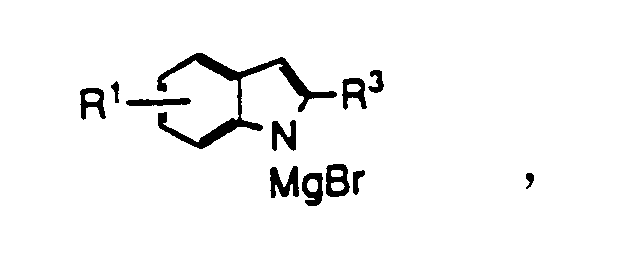
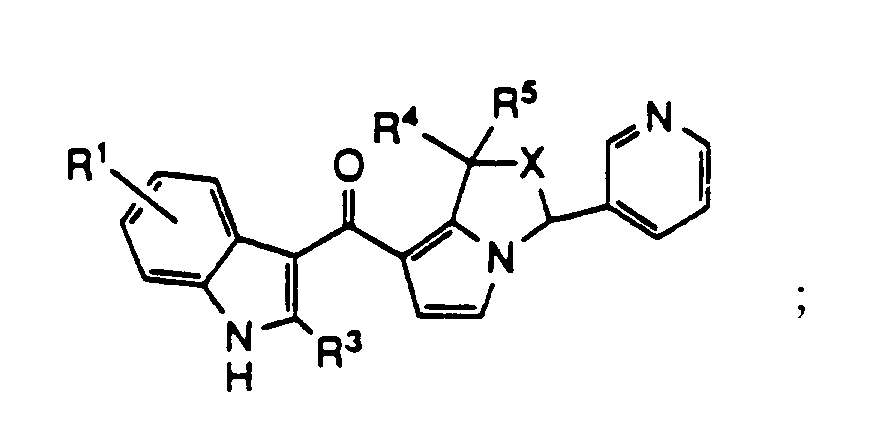 (2) contacting a compound of formula I wherein R2 is hydrogen with either(a) an acid chloride of the formula R9COCl wherein R9 is as defined above, preferably in a solution of potassium hydroxide in 1,2-dimethoxyethane to produce a compound of formula I wherein R2 is -COR9,(b) a carbamoyl chloride of the formula R10R11NCOCl wherein R10 and R11 are as defined above, preferably in a solution of potassium hydroxide in 1,2-dimethoxyethane, to produce a compound of formula I wherein R2 is -CONR10R11,(c) a sulfonyl chloride of the formula R9SO2Cl wherein R9 is as defined above, in a solution of potassium hydroxide in 1,2-dimethoxyethane, to produce a compound of formula I wherein R2 is -SO2R9,(d) a sulfamoyl chloride of the formula R10R11NSO2Cl wherein R10 and R11 are as defined above, in a solution of potassium hydroxide in 1,2-dimethoxyethane, to produce a compound of formula I wherein R2 is -SO2NR10R11,(e) an isocyanate of the formula R10NCO, wherein R10 is as defined above, in the presence of a base NaH, to produce a compound of formula I wherein R2 is -CONHR10,(f) an alkyl dicarbonate of the formula (R9CO)2O, in the presence of a catalyst 4-dimethylaminopyridine, to produce a compound of formula I wherein R2 is -COOR9,(g) the base NaH followed by adding an appropriate alkyl halide of the formula R2X' wherein X' is a halide such as Br to produce a compound of formula I wherein R2 is alkyl of from one to six carbon atoms or one of the R2 groups as defined above which are substituted alkyl groups,(h) the base NaH followed by adding an acid chloride 4-nitrophenylchloroformate to produce an activated acylindole derivative which is subsequently contacted with a substituted amine of the formula NHR10R11 wherein R10 and R11 are as defined above to produce a compound of formula I wherein R2 is -CONR10R11,(i) the base NaH followed by adding an α,β unsaturated carbonyl compound CH2=CHCOR9, CH2=CHCOOR9 or CH2=CHCONR10R11 wherein R9, R10 and R11 are as defined above to produce a compound of formula I wherein R2 is respectively -(CH2)2COR9, -(CH2)2COOR9 or -(CH2)2CONR10R11,(j) the base NaH followed by adding an α,β unsaturated sulfonyl compound CH2=CHSO2R9 or CH2=CHSO2NR7R8 wherein R7, R8 and R9 are as defined above to produce a compound of formula I wherein R2 is respectively - (CH2)2SO2R9 or -(CH2)2SO2NR7R8,(k) the base NaH followed by adding an α,β unsaturated nitrile CH2=CHCN to produce a compound of formula I wherein R2 is -(CH2)2CN, or(l) the base NaH followed by adding an acyl aziridine N-tert-butoxycarbonylaziridine to produce a carboxylic acid salt of a compound of formula I wherein R2 is 1-aminoethyl;(3) contacting a compound of formula I wherein X is S with tert-butyl hydroperoxide, titanium tetraisopropoxide and (R,R)-diethyl tartrate, or with m-chloroperoxybenzoic acid to produce the corresponding sulfoxide or sulfone of the following formulawherein x is 1 or 2;
 (4) contacting a compound of formula I wherein Y is N with(a) 2,4-dinitrophenyl-4-toluenesulfonate to form the pyridinium salt of the formulaand contacting said pyridinium salt with either
 (i) hydroxylamine to produce a compound of formula I wherein Y is N+→O- or(ii) hydrazine to produce a compound of formula I wherein Y is N+-NH2, or(b) an alkyl halide R14X' wherein R14 is R12 or CR7R8OCOR12 and R7, R8 and R12 are as defined above and X' is a halide to produce a compound of the formula I wherein Y is respectively N+-R12 or N+-CR7R8OCOR12;(5) contacting a compound of formula I wherein Y is N+-O- with an alkylhalide R14X' wherein R14 is R12 or CR7R8OCOR12 and R7, R8 and R12 are as defined above and X' is a halide to produce a compound of formula I wherein Y is respectively N+-OR12 or N+-OCR7R8OCOR12;(6) contacting a compound of formula I wherein R1 is a halide Br with either(a) hexamethyltin in the presence of tetrakis(triphenylphosphine)palladium and subsequently contacting the resulting product with an appropriate aryl halide in the presence of tetrakis(triphenylphosphine)palladium to produce a compound of formula I wherein R1 is substituted or unsubstituted phenyl, furyl, thienyl, thiazolyl, pyridyl or pyrimidyl as defined above, or(b) an appropriate arylboronic acid in the presence of tetrakis(triphenylphosphine)palladium to produce a compound of formula I wherein R1 is substituted or unsubstituted phenyl, furyl, thienyl, thiazolyl, pyridyl or pyrimidyl as defined above; or(7) contacting a compound of formula I wherein A is O with hydroxylamine to produce an oxime compound of formula I wherein A is NOH and optionally contacting said oxime with either(a) an alkyl halide R10X' wherein R10 is defined as above and X' is a halide to produce a compound of formula I wherein A is NOR10, or(b) an activated acyl compound R10COX'' wherein R10 is as defined above and X'' is an activating group to produce a compound of formula I wherein A is NOCOR10.
 - A process according to Claim 1 whereinR1 is phenyl, optionally substituted byalkyl of from one to six carbon atoms,alkoxy of from one to six carbon atoms, orhalogen,R2 is selected from the group consisting ofhydrogen,alkyl of from one to six carbon atoms;-(CH2)pCOOR9, where p and R9 are as defined therein,-(CH2)qNR7R8, where q, R7 and R8 are as defined therein,-(CH2)pCOR9 where p and R9 is as defined therein,-(CH2)qOH where q is as defined therein,-(CH2)pSO2R7 where p and R7are as defined therein,-(CH2)pSO2NR7R8 where p, R7 and R8 are as defined therein,-(CH2)pCONR10R11, where p, R10 and R11 are as defined therein,-(CH2)rCN,-(CH2)r-1H-tetrazol-5-yl where r is as defined therein,-CONHNH2, or;-(CH2)r-phenyl, where r is as defined therein and the phenyl moiety is optionally substituted byhalogen,alkyl of from one to six carbon atoms, oralkoxy of from one to six carbon atoms;R3, R4, and R5 are hydrogen;X is S;Y is selected from the group consisting ofN,N+→O-,N+-CR7R8OCOR12 where R7, R8 and R12 are as defined therein,
andN+-OCR7R8R12where R7, R8 and R12 are as defined therein,
andA is selected from the groups consisting ofO, orNOH. - A process according to Claim 2 wherein R1 is phenyl or 4-fluorophenyl and R2 is selected from the group consisting of CONH2, CONHCH3, and CON(CH3)2.
Applications Claiming Priority (3)
| Application Number | Priority Date | Filing Date | Title |
|---|---|---|---|
| US73168191A | 1991-07-17 | 1991-07-17 | |
| US731681 | 1991-07-17 | ||
| PCT/US1992/005890 WO1993001813A1 (en) | 1991-07-17 | 1992-07-14 | Platelet activating factor antagonists |
Publications (3)
| Publication Number | Publication Date |
|---|---|
| EP0595924A1 EP0595924A1 (en) | 1994-05-11 |
| EP0595924A4 EP0595924A4 (en) | 1994-08-24 |
| EP0595924B1 true EP0595924B1 (en) | 1999-04-14 |
Family
ID=24940541
Family Applications (1)
| Application Number | Title | Priority Date | Filing Date |
|---|---|---|---|
| EP92915895A Expired - Lifetime EP0595924B1 (en) | 1991-07-17 | 1992-07-14 | Platelet activating factor antagonists |
Country Status (15)
| Country | Link |
|---|---|
| US (1) | US5459152A (en) |
| EP (1) | EP0595924B1 (en) |
| JP (1) | JP3135917B2 (en) |
| KR (1) | KR100251603B1 (en) |
| AT (1) | ATE178796T1 (en) |
| AU (1) | AU651243B2 (en) |
| CA (1) | CA2112562A1 (en) |
| DE (1) | DE69228932T2 (en) |
| DK (1) | DK0595924T3 (en) |
| ES (1) | ES2131530T3 (en) |
| GR (1) | GR3030208T3 (en) |
| IE (1) | IE922293A1 (en) |
| IL (1) | IL102494A0 (en) |
| PT (1) | PT100698B (en) |
| WO (1) | WO1993001813A1 (en) |
Families Citing this family (9)
| Publication number | Priority date | Publication date | Assignee | Title |
|---|---|---|---|---|
| US5486525A (en) * | 1993-12-16 | 1996-01-23 | Abbott Laboratories | Platelet activating factor antagonists: imidazopyridine indoles |
| US5567711A (en) * | 1995-04-19 | 1996-10-22 | Abbott Laboratories | Indole-3-carbonyl and indole-3-sulfonyl derivatives as platelet activating factor antagonists |
| US6630496B1 (en) | 1996-08-26 | 2003-10-07 | Genetics Institute Llc | Inhibitors of phospholipase enzymes |
| US6916841B2 (en) * | 1998-02-25 | 2005-07-12 | Genetics Institute, Llc | Inhibitors of phospholipase enzymes |
| US6828344B1 (en) | 1998-02-25 | 2004-12-07 | Genetics Institute, Llc | Inhibitors of phospholipase enzymes |
| US6500853B1 (en) | 1998-02-28 | 2002-12-31 | Genetics Institute, Llc | Inhibitors of phospholipase enzymes |
| US6534535B1 (en) | 1999-08-12 | 2003-03-18 | Millennium Pharmaceuticals, Inc. | Inhibitors of factor Xa |
| DE10004157A1 (en) * | 2000-02-01 | 2001-08-02 | Merckle Gmbh Chem Pharm Fabrik | New pyridyl- or pyrimidinyl-substituted bicyclic pyrrole derivatives, are cyclokine release inhibitors useful for treating immune system-related disorders, e.g. cancer, multiple sclerosis or arthritis |
| US20130178453A1 (en) * | 2010-02-09 | 2013-07-11 | Ironwood Pharmaceuticals, Inc. | Cannabinoid Agonists |
Family Cites Families (4)
| Publication number | Priority date | Publication date | Assignee | Title |
|---|---|---|---|---|
| FR2541280B1 (en) * | 1983-01-13 | 1985-06-21 | Rhone Poulenc Sante | NEW DERIVATIVES OF 1H, 3H-PYRROLO (1,2C) THIAZOLECARBOXAMIDE-7, THEIR PREPARATION AND THE MEDICINAL PRODUCTS CONTAINING THEM |
| FR2617484B1 (en) * | 1987-07-02 | 1989-10-20 | Rhone Poulenc Sante | PROCESS FOR THE PREPARATION OF ACID (PYRIDYL-3) -3 1H-3H-PYRROLO (1,2-C) THIAZOLECARBOXYLIQUE-7 DEXTROGYRE |
| FR2626004B1 (en) * | 1988-01-20 | 1991-08-02 | Rhone Poulenc Sante | PROCESS FOR THE PREPARATION OF (PYRIDYL-3) -3 1H, 3H-PYRROLO (1,2-C) THIAZOLECARBONITRILE-7 |
| JP3061631B2 (en) * | 1989-10-11 | 2000-07-10 | 山之内製薬株式会社 | Novel heterocyclic compound and method for producing the same |
-
1992
- 1992-07-14 IL IL102494A patent/IL102494A0/en unknown
- 1992-07-14 US US08/162,034 patent/US5459152A/en not_active Expired - Fee Related
- 1992-07-14 DK DK92915895T patent/DK0595924T3/en active
- 1992-07-14 IE IE229392A patent/IE922293A1/en unknown
- 1992-07-14 DE DE69228932T patent/DE69228932T2/en not_active Expired - Fee Related
- 1992-07-14 KR KR1019940700139A patent/KR100251603B1/en not_active Expired - Fee Related
- 1992-07-14 CA CA002112562A patent/CA2112562A1/en not_active Abandoned
- 1992-07-14 WO PCT/US1992/005890 patent/WO1993001813A1/en not_active Ceased
- 1992-07-14 EP EP92915895A patent/EP0595924B1/en not_active Expired - Lifetime
- 1992-07-14 ES ES92915895T patent/ES2131530T3/en not_active Expired - Lifetime
- 1992-07-14 AU AU23391/92A patent/AU651243B2/en not_active Ceased
- 1992-07-14 AT AT92915895T patent/ATE178796T1/en not_active IP Right Cessation
- 1992-07-14 JP JP05502913A patent/JP3135917B2/en not_active Expired - Fee Related
- 1992-07-16 PT PT100698A patent/PT100698B/en not_active IP Right Cessation
-
1999
- 1999-05-13 GR GR990401293T patent/GR3030208T3/en unknown
Also Published As
| Publication number | Publication date |
|---|---|
| JP3135917B2 (en) | 2001-02-19 |
| DE69228932D1 (en) | 1999-05-20 |
| GR3030208T3 (en) | 1999-08-31 |
| KR100251603B1 (en) | 2000-05-01 |
| PT100698B (en) | 1999-07-30 |
| PT100698A (en) | 1993-10-29 |
| EP0595924A1 (en) | 1994-05-11 |
| IL102494A0 (en) | 1993-01-14 |
| AU651243B2 (en) | 1994-07-14 |
| IE922293A1 (en) | 1993-01-27 |
| CA2112562A1 (en) | 1993-02-04 |
| AU2339192A (en) | 1993-02-23 |
| US5459152A (en) | 1995-10-17 |
| ES2131530T3 (en) | 1999-08-01 |
| DE69228932T2 (en) | 1999-11-11 |
| DK0595924T3 (en) | 1999-11-01 |
| EP0595924A4 (en) | 1994-08-24 |
| ATE178796T1 (en) | 1999-04-15 |
| WO1993001813A1 (en) | 1993-02-04 |
| JPH06510027A (en) | 1994-11-10 |
Similar Documents
| Publication | Publication Date | Title |
|---|---|---|
| US12297209B2 (en) | Benzodiazepine derivatives as RSV inhibitors | |
| JP5140577B2 (en) | Hydroxysteroid dehydrogenase inhibitor | |
| JP2001518895A (en) | Somatostatin agonist | |
| US8822453B2 (en) | Nitrogen-containing compounds and pharmaceutical compositions thereof for the treatment of atrial fibrillation | |
| US20190127358A1 (en) | Bridged bicyclic compounds as farnesoid x receptor modulators | |
| WO1992012154A1 (en) | Imidazotriazine derivatives | |
| AU2004285452A1 (en) | Triazolo-pyridazine compounds and derivatives thereof useful in the treatment of neuropathic pain | |
| CZ20023934A3 (en) | Beta-carboline derivatives intended for use as phosphodiesterase inhibitors | |
| EP0925299A1 (en) | Pyrazolopyridine compound and pharmaceutical use thereof | |
| US5120749A (en) | Platelet activating antagonists | |
| US5459152A (en) | Platelet activating factor antagonists | |
| CN113754635A (en) | Fused ring compound and preparation method and application thereof | |
| MXPA03002447A (en) | Substituted imidazoles as dual histamine h1. |
Legal Events
| Date | Code | Title | Description |
|---|---|---|---|
| PUAI | Public reference made under article 153(3) epc to a published international application that has entered the european phase |
Free format text: ORIGINAL CODE: 0009012 |
|
| 17P | Request for examination filed |
Effective date: 19940107 |
|
| AK | Designated contracting states |
Kind code of ref document: A1 Designated state(s): AT BE CH DE DK ES FR GB GR IT LI LU MC NL SE |
|
| A4 | Supplementary search report drawn up and despatched |
Effective date: 19940705 |
|
| AK | Designated contracting states |
Kind code of ref document: A4 Designated state(s): AT BE CH DE DK ES FR GB GR IT LI LU MC NL SE |
|
| GRAG | Despatch of communication of intention to grant |
Free format text: ORIGINAL CODE: EPIDOS AGRA |
|
| 17Q | First examination report despatched |
Effective date: 19971103 |
|
| GRAG | Despatch of communication of intention to grant |
Free format text: ORIGINAL CODE: EPIDOS AGRA |
|
| GRAG | Despatch of communication of intention to grant |
Free format text: ORIGINAL CODE: EPIDOS AGRA |
|
| GRAH | Despatch of communication of intention to grant a patent |
Free format text: ORIGINAL CODE: EPIDOS IGRA |
|
| GRAH | Despatch of communication of intention to grant a patent |
Free format text: ORIGINAL CODE: EPIDOS IGRA |
|
| GRAA | (expected) grant |
Free format text: ORIGINAL CODE: 0009210 |
|
| AK | Designated contracting states |
Kind code of ref document: B1 Designated state(s): AT BE CH DE DK ES FR GB GR IT LI LU MC NL SE |
|
| REF | Corresponds to: |
Ref document number: 178796 Country of ref document: AT Date of ref document: 19990415 Kind code of ref document: T |
|
| REG | Reference to a national code |
Ref country code: CH Ref legal event code: EP |
|
| REF | Corresponds to: |
Ref document number: 69228932 Country of ref document: DE Date of ref document: 19990520 |
|
| ET | Fr: translation filed | ||
| PGFP | Annual fee paid to national office [announced via postgrant information from national office to epo] |
Ref country code: MC Payment date: 19990729 Year of fee payment: 8 |
|
| REG | Reference to a national code |
Ref country code: CH Ref legal event code: NV Representative=s name: A. BRAUN, BRAUN, HERITIER, ESCHMANN AG PATENTANWAE |
|
| REG | Reference to a national code |
Ref country code: ES Ref legal event code: FG2A Ref document number: 2131530 Country of ref document: ES Kind code of ref document: T3 |
|
| REG | Reference to a national code |
Ref country code: DK Ref legal event code: T3 |
|
| PLBE | No opposition filed within time limit |
Free format text: ORIGINAL CODE: 0009261 |
|
| STAA | Information on the status of an ep patent application or granted ep patent |
Free format text: STATUS: NO OPPOSITION FILED WITHIN TIME LIMIT |
|
| 26N | No opposition filed | ||
| PG25 | Lapsed in a contracting state [announced via postgrant information from national office to epo] |
Ref country code: MC Free format text: THE PATENT HAS BEEN ANNULLED BY A DECISION OF A NATIONAL AUTHORITY Effective date: 20000731 |
|
| PGFP | Annual fee paid to national office [announced via postgrant information from national office to epo] |
Ref country code: GB Payment date: 20010614 Year of fee payment: 10 |
|
| PGFP | Annual fee paid to national office [announced via postgrant information from national office to epo] |
Ref country code: DK Payment date: 20010615 Year of fee payment: 10 Ref country code: AT Payment date: 20010615 Year of fee payment: 10 |
|
| PGFP | Annual fee paid to national office [announced via postgrant information from national office to epo] |
Ref country code: NL Payment date: 20010618 Year of fee payment: 10 |
|
| PGFP | Annual fee paid to national office [announced via postgrant information from national office to epo] |
Ref country code: LU Payment date: 20010627 Year of fee payment: 10 |
|
| PGFP | Annual fee paid to national office [announced via postgrant information from national office to epo] |
Ref country code: FR Payment date: 20010702 Year of fee payment: 10 |
|
| PGFP | Annual fee paid to national office [announced via postgrant information from national office to epo] |
Ref country code: SE Payment date: 20010703 Year of fee payment: 10 |
|
| PGFP | Annual fee paid to national office [announced via postgrant information from national office to epo] |
Ref country code: ES Payment date: 20010716 Year of fee payment: 10 |
|
| PGFP | Annual fee paid to national office [announced via postgrant information from national office to epo] |
Ref country code: GR Payment date: 20010725 Year of fee payment: 10 |
|
| PGFP | Annual fee paid to national office [announced via postgrant information from national office to epo] |
Ref country code: DE Payment date: 20010731 Year of fee payment: 10 |
|
| PGFP | Annual fee paid to national office [announced via postgrant information from national office to epo] |
Ref country code: BE Payment date: 20010814 Year of fee payment: 10 |
|
| PGFP | Annual fee paid to national office [announced via postgrant information from national office to epo] |
Ref country code: CH Payment date: 20010927 Year of fee payment: 10 |
|
| REG | Reference to a national code |
Ref country code: GB Ref legal event code: IF02 |
|
| PG25 | Lapsed in a contracting state [announced via postgrant information from national office to epo] |
Ref country code: LU Free format text: LAPSE BECAUSE OF NON-PAYMENT OF DUE FEES Effective date: 20020714 Ref country code: GB Free format text: LAPSE BECAUSE OF NON-PAYMENT OF DUE FEES Effective date: 20020714 Ref country code: AT Free format text: LAPSE BECAUSE OF NON-PAYMENT OF DUE FEES Effective date: 20020714 |
|
| PG25 | Lapsed in a contracting state [announced via postgrant information from national office to epo] |
Ref country code: SE Free format text: LAPSE BECAUSE OF NON-PAYMENT OF DUE FEES Effective date: 20020715 Ref country code: ES Free format text: LAPSE BECAUSE OF NON-PAYMENT OF DUE FEES Effective date: 20020715 |
|
| PG25 | Lapsed in a contracting state [announced via postgrant information from national office to epo] |
Ref country code: LI Free format text: LAPSE BECAUSE OF NON-PAYMENT OF DUE FEES Effective date: 20020731 Ref country code: DK Free format text: LAPSE BECAUSE OF NON-PAYMENT OF DUE FEES Effective date: 20020731 Ref country code: CH Free format text: LAPSE BECAUSE OF NON-PAYMENT OF DUE FEES Effective date: 20020731 Ref country code: BE Free format text: LAPSE BECAUSE OF NON-PAYMENT OF DUE FEES Effective date: 20020731 |
|
| BERE | Be: lapsed |
Owner name: *ABBOTT LABORATORIES Effective date: 20020731 |
|
| PG25 | Lapsed in a contracting state [announced via postgrant information from national office to epo] |
Ref country code: NL Free format text: LAPSE BECAUSE OF NON-PAYMENT OF DUE FEES Effective date: 20030201 Ref country code: DE Free format text: LAPSE BECAUSE OF NON-PAYMENT OF DUE FEES Effective date: 20030201 |
|
| PG25 | Lapsed in a contracting state [announced via postgrant information from national office to epo] |
Ref country code: GR Free format text: LAPSE BECAUSE OF NON-PAYMENT OF DUE FEES Effective date: 20030206 |
|
| EUG | Se: european patent has lapsed | ||
| GBPC | Gb: european patent ceased through non-payment of renewal fee |
Effective date: 20020714 |
|
| REG | Reference to a national code |
Ref country code: DK Ref legal event code: EBP |
|
| REG | Reference to a national code |
Ref country code: CH Ref legal event code: PL |
|
| PG25 | Lapsed in a contracting state [announced via postgrant information from national office to epo] |
Ref country code: FR Free format text: LAPSE BECAUSE OF NON-PAYMENT OF DUE FEES Effective date: 20030331 |
|
| NLV4 | Nl: lapsed or anulled due to non-payment of the annual fee |
Effective date: 20030201 |
|
| REG | Reference to a national code |
Ref country code: FR Ref legal event code: ST |
|
| REG | Reference to a national code |
Ref country code: ES Ref legal event code: FD2A Effective date: 20030811 |
|
| PG25 | Lapsed in a contracting state [announced via postgrant information from national office to epo] |
Ref country code: IT Free format text: LAPSE BECAUSE OF NON-PAYMENT OF DUE FEES;WARNING: LAPSES OF ITALIAN PATENTS WITH EFFECTIVE DATE BEFORE 2007 MAY HAVE OCCURRED AT ANY TIME BEFORE 2007. THE CORRECT EFFECTIVE DATE MAY BE DIFFERENT FROM THE ONE RECORDED. Effective date: 20050714 |