EP0595275B1 - Photographic light-sensitive elements - Google Patents
Photographic light-sensitive elements Download PDFInfo
- Publication number
- EP0595275B1 EP0595275B1 EP93117362A EP93117362A EP0595275B1 EP 0595275 B1 EP0595275 B1 EP 0595275B1 EP 93117362 A EP93117362 A EP 93117362A EP 93117362 A EP93117362 A EP 93117362A EP 0595275 B1 EP0595275 B1 EP 0595275B1
- Authority
- EP
- European Patent Office
- Prior art keywords
- gelatin
- layer
- particles
- photographic element
- matte
- Prior art date
- Legal status (The legal status is an assumption and is not a legal conclusion. Google has not performed a legal analysis and makes no representation as to the accuracy of the status listed.)
- Expired - Lifetime
Links
- 229920000159 gelatin Polymers 0.000 claims description 125
- 108010010803 Gelatin Proteins 0.000 claims description 124
- 239000008273 gelatin Substances 0.000 claims description 124
- 235000019322 gelatine Nutrition 0.000 claims description 124
- 235000011852 gelatine desserts Nutrition 0.000 claims description 124
- 239000002245 particle Substances 0.000 claims description 90
- 229920000642 polymer Polymers 0.000 claims description 47
- VYPSYNLAJGMNEJ-UHFFFAOYSA-N Silicium dioxide Chemical compound O=[Si]=O VYPSYNLAJGMNEJ-UHFFFAOYSA-N 0.000 claims description 22
- 239000008119 colloidal silica Substances 0.000 claims description 14
- 239000011236 particulate material Substances 0.000 claims description 13
- 239000011230 binding agent Substances 0.000 claims description 4
- 239000000463 material Substances 0.000 claims description 4
- AFOSIXZFDONLBT-UHFFFAOYSA-N divinyl sulfone Chemical group C=CS(=O)(=O)C=C AFOSIXZFDONLBT-UHFFFAOYSA-N 0.000 claims description 3
- LUYAMNYBNTVQJG-UHFFFAOYSA-N 1-chloro-2-(2-chloroethylsulfonyl)ethane Chemical group ClCCS(=O)(=O)CCCl LUYAMNYBNTVQJG-UHFFFAOYSA-N 0.000 claims description 2
- 125000003172 aldehyde group Chemical group 0.000 claims description 2
- 125000003277 amino group Chemical group 0.000 claims description 2
- 125000005843 halogen group Chemical group 0.000 claims description 2
- 125000001570 methylene group Chemical group [H]C([H])([*:1])[*:2] 0.000 claims description 2
- 125000002843 carboxylic acid group Chemical group 0.000 claims 1
- 125000003700 epoxy group Chemical group 0.000 claims 1
- IQPQWNKOIGAROB-UHFFFAOYSA-N isocyanate group Chemical group [N-]=C=O IQPQWNKOIGAROB-UHFFFAOYSA-N 0.000 claims 1
- 239000010410 layer Substances 0.000 description 103
- 239000000839 emulsion Substances 0.000 description 27
- 150000001875 compounds Chemical class 0.000 description 26
- 239000011324 bead Substances 0.000 description 25
- 239000000178 monomer Substances 0.000 description 21
- 238000000034 method Methods 0.000 description 17
- 238000000576 coating method Methods 0.000 description 13
- 239000006185 dispersion Substances 0.000 description 13
- 239000006224 matting agent Substances 0.000 description 13
- 239000000203 mixture Substances 0.000 description 13
- 239000004094 surface-active agent Substances 0.000 description 13
- -1 silver halide Chemical class 0.000 description 12
- 239000011248 coating agent Substances 0.000 description 11
- XLYOFNOQVPJJNP-UHFFFAOYSA-N water Substances O XLYOFNOQVPJJNP-UHFFFAOYSA-N 0.000 description 11
- 229920001577 copolymer Polymers 0.000 description 10
- XMBWDFGMSWQBCA-UHFFFAOYSA-N hydrogen iodide Chemical compound I XMBWDFGMSWQBCA-UHFFFAOYSA-N 0.000 description 10
- ZUNKMNLKJXRCDM-UHFFFAOYSA-N silver bromoiodide Chemical compound [Ag].IBr ZUNKMNLKJXRCDM-UHFFFAOYSA-N 0.000 description 10
- 229910052709 silver Inorganic materials 0.000 description 9
- 239000004332 silver Substances 0.000 description 9
- 238000004132 cross linking Methods 0.000 description 8
- 238000012545 processing Methods 0.000 description 7
- 239000003431 cross linking reagent Substances 0.000 description 6
- 238000011160 research Methods 0.000 description 6
- 238000012360 testing method Methods 0.000 description 6
- IWTYTFSSTWXZFU-UHFFFAOYSA-N 3-chloroprop-1-enylbenzene Chemical compound ClCC=CC1=CC=CC=C1 IWTYTFSSTWXZFU-UHFFFAOYSA-N 0.000 description 5
- 238000005299 abrasion Methods 0.000 description 5
- 239000003795 chemical substances by application Substances 0.000 description 5
- 239000012153 distilled water Substances 0.000 description 5
- HJWLCRVIBGQPNF-UHFFFAOYSA-N prop-2-enylbenzene Chemical compound C=CCC1=CC=CC=C1 HJWLCRVIBGQPNF-UHFFFAOYSA-N 0.000 description 5
- 239000000725 suspension Substances 0.000 description 5
- BAPJBEWLBFYGME-UHFFFAOYSA-N Methyl acrylate Chemical compound COC(=O)C=C BAPJBEWLBFYGME-UHFFFAOYSA-N 0.000 description 4
- 210000000988 bone and bone Anatomy 0.000 description 4
- 238000001035 drying Methods 0.000 description 4
- 239000000975 dye Substances 0.000 description 4
- 229920000578 graft copolymer Polymers 0.000 description 4
- 230000006872 improvement Effects 0.000 description 4
- 239000004816 latex Substances 0.000 description 4
- 229920000126 latex Polymers 0.000 description 4
- 239000004848 polyfunctional curative Substances 0.000 description 4
- 230000008569 process Effects 0.000 description 4
- 238000001228 spectrum Methods 0.000 description 4
- XOLBLPGZBRYERU-UHFFFAOYSA-N tin dioxide Chemical compound O=[Sn]=O XOLBLPGZBRYERU-UHFFFAOYSA-N 0.000 description 4
- NIXOWILDQLNWCW-UHFFFAOYSA-N 2-Propenoic acid Natural products OC(=O)C=C NIXOWILDQLNWCW-UHFFFAOYSA-N 0.000 description 3
- PPBRXRYQALVLMV-UHFFFAOYSA-N Styrene Chemical compound C=CC1=CC=CC=C1 PPBRXRYQALVLMV-UHFFFAOYSA-N 0.000 description 3
- 239000002253 acid Substances 0.000 description 3
- 239000002216 antistatic agent Substances 0.000 description 3
- 238000011161 development Methods 0.000 description 3
- 238000007720 emulsion polymerization reaction Methods 0.000 description 3
- SUPCQIBBMFXVTL-UHFFFAOYSA-N ethyl 2-methylprop-2-enoate Chemical compound CCOC(=O)C(C)=C SUPCQIBBMFXVTL-UHFFFAOYSA-N 0.000 description 3
- 239000011229 interlayer Substances 0.000 description 3
- 238000002360 preparation method Methods 0.000 description 3
- 239000011241 protective layer Substances 0.000 description 3
- 238000010557 suspension polymerization reaction Methods 0.000 description 3
- MYRTYDVEIRVNKP-UHFFFAOYSA-N 1,2-Divinylbenzene Chemical compound C=CC1=CC=CC=C1C=C MYRTYDVEIRVNKP-UHFFFAOYSA-N 0.000 description 2
- QLAJNZSPVITUCQ-UHFFFAOYSA-N 1,3,2-dioxathietane 2,2-dioxide Chemical compound O=S1(=O)OCO1 QLAJNZSPVITUCQ-UHFFFAOYSA-N 0.000 description 2
- SMZOUWXMTYCWNB-UHFFFAOYSA-N 2-(2-methoxy-5-methylphenyl)ethanamine Chemical compound COC1=CC=C(C)C=C1CCN SMZOUWXMTYCWNB-UHFFFAOYSA-N 0.000 description 2
- HGINCPLSRVDWNT-UHFFFAOYSA-N Acrolein Chemical compound C=CC=O HGINCPLSRVDWNT-UHFFFAOYSA-N 0.000 description 2
- IJGRMHOSHXDMSA-UHFFFAOYSA-N Atomic nitrogen Chemical compound N#N IJGRMHOSHXDMSA-UHFFFAOYSA-N 0.000 description 2
- SOGAXMICEFXMKE-UHFFFAOYSA-N Butylmethacrylate Chemical compound CCCCOC(=O)C(C)=C SOGAXMICEFXMKE-UHFFFAOYSA-N 0.000 description 2
- WSFSSNUMVMOOMR-UHFFFAOYSA-N Formaldehyde Chemical compound O=C WSFSSNUMVMOOMR-UHFFFAOYSA-N 0.000 description 2
- VVQNEPGJFQJSBK-UHFFFAOYSA-N Methyl methacrylate Chemical compound COC(=O)C(C)=C VVQNEPGJFQJSBK-UHFFFAOYSA-N 0.000 description 2
- QAOWNCQODCNURD-UHFFFAOYSA-N Sulfuric acid Chemical compound OS(O)(=O)=O QAOWNCQODCNURD-UHFFFAOYSA-N 0.000 description 2
- GWEVSGVZZGPLCZ-UHFFFAOYSA-N Titan oxide Chemical compound O=[Ti]=O GWEVSGVZZGPLCZ-UHFFFAOYSA-N 0.000 description 2
- 238000004458 analytical method Methods 0.000 description 2
- 230000004888 barrier function Effects 0.000 description 2
- CQEYYJKEWSMYFG-UHFFFAOYSA-N butyl acrylate Chemical compound CCCCOC(=O)C=C CQEYYJKEWSMYFG-UHFFFAOYSA-N 0.000 description 2
- JNGZXGGOCLZBFB-IVCQMTBJSA-N compound E Chemical compound N([C@@H](C)C(=O)N[C@@H]1C(N(C)C2=CC=CC=C2C(C=2C=CC=CC=2)=N1)=O)C(=O)CC1=CC(F)=CC(F)=C1 JNGZXGGOCLZBFB-IVCQMTBJSA-N 0.000 description 2
- GNTDGMZSJNCJKK-UHFFFAOYSA-N divanadium pentaoxide Chemical compound O=[V](=O)O[V](=O)=O GNTDGMZSJNCJKK-UHFFFAOYSA-N 0.000 description 2
- 238000010410 dusting Methods 0.000 description 2
- 238000001704 evaporation Methods 0.000 description 2
- 230000008020 evaporation Effects 0.000 description 2
- 238000007756 gravure coating Methods 0.000 description 2
- 230000002401 inhibitory effect Effects 0.000 description 2
- 239000007788 liquid Substances 0.000 description 2
- 230000014759 maintenance of location Effects 0.000 description 2
- 229910044991 metal oxide Inorganic materials 0.000 description 2
- 150000004706 metal oxides Chemical class 0.000 description 2
- 229910052757 nitrogen Inorganic materials 0.000 description 2
- 239000003960 organic solvent Substances 0.000 description 2
- 150000002924 oxiranes Chemical class 0.000 description 2
- LVTJOONKWUXEFR-FZRMHRINSA-N protoneodioscin Natural products O(C[C@@H](CC[C@]1(O)[C@H](C)[C@@H]2[C@]3(C)[C@H]([C@H]4[C@@H]([C@]5(C)C(=CC4)C[C@@H](O[C@@H]4[C@H](O[C@H]6[C@@H](O)[C@@H](O)[C@@H](O)[C@H](C)O6)[C@@H](O)[C@H](O[C@H]6[C@@H](O)[C@@H](O)[C@@H](O)[C@H](C)O6)[C@H](CO)O4)CC5)CC3)C[C@@H]2O1)C)[C@H]1[C@H](O)[C@H](O)[C@H](O)[C@@H](CO)O1 LVTJOONKWUXEFR-FZRMHRINSA-N 0.000 description 2
- 230000005855 radiation Effects 0.000 description 2
- 238000006748 scratching Methods 0.000 description 2
- 230000002393 scratching effect Effects 0.000 description 2
- 230000001235 sensitizing effect Effects 0.000 description 2
- 239000007787 solid Substances 0.000 description 2
- 125000000391 vinyl group Chemical group [H]C([*])=C([H])[H] 0.000 description 2
- 229920002554 vinyl polymer Polymers 0.000 description 2
- DDKMFQGAZVMXQV-UHFFFAOYSA-N (3-chloro-2-hydroxypropyl) 2-methylprop-2-enoate Chemical compound CC(=C)C(=O)OCC(O)CCl DDKMFQGAZVMXQV-UHFFFAOYSA-N 0.000 description 1
- LUMLZKVIXLWTCI-NSCUHMNNSA-N (e)-2,3-dichloro-4-oxobut-2-enoic acid Chemical compound OC(=O)C(\Cl)=C(/Cl)C=O LUMLZKVIXLWTCI-NSCUHMNNSA-N 0.000 description 1
- ZVEMLYIXBCTVOF-UHFFFAOYSA-N 1-(2-isocyanatopropan-2-yl)-3-prop-1-en-2-ylbenzene Chemical compound CC(=C)C1=CC=CC(C(C)(C)N=C=O)=C1 ZVEMLYIXBCTVOF-UHFFFAOYSA-N 0.000 description 1
- KKLSEIIDJBCSRK-UHFFFAOYSA-N 1-(chloromethyl)-2-ethenylbenzene Chemical compound ClCC1=CC=CC=C1C=C KKLSEIIDJBCSRK-UHFFFAOYSA-N 0.000 description 1
- QEDJMOONZLUIMC-UHFFFAOYSA-N 1-tert-butyl-4-ethenylbenzene Chemical compound CC(C)(C)C1=CC=C(C=C)C=C1 QEDJMOONZLUIMC-UHFFFAOYSA-N 0.000 description 1
- YKUDHBLDJYZZQS-UHFFFAOYSA-N 2,6-dichloro-1h-1,3,5-triazin-4-one Chemical compound OC1=NC(Cl)=NC(Cl)=N1 YKUDHBLDJYZZQS-UHFFFAOYSA-N 0.000 description 1
- OZAIFHULBGXAKX-UHFFFAOYSA-N 2-(2-cyanopropan-2-yldiazenyl)-2-methylpropanenitrile Chemical compound N#CC(C)(C)N=NC(C)(C)C#N OZAIFHULBGXAKX-UHFFFAOYSA-N 0.000 description 1
- IBDVWXAVKPRHCU-UHFFFAOYSA-N 2-(2-methylprop-2-enoyloxy)ethyl 3-oxobutanoate Chemical compound CC(=O)CC(=O)OCCOC(=O)C(C)=C IBDVWXAVKPRHCU-UHFFFAOYSA-N 0.000 description 1
- JAHNSTQSQJOJLO-UHFFFAOYSA-N 2-(3-fluorophenyl)-1h-imidazole Chemical compound FC1=CC=CC(C=2NC=CN=2)=C1 JAHNSTQSQJOJLO-UHFFFAOYSA-N 0.000 description 1
- OEPOKWHJYJXUGD-UHFFFAOYSA-N 2-(3-phenylmethoxyphenyl)-1,3-thiazole-4-carbaldehyde Chemical compound O=CC1=CSC(C=2C=C(OCC=3C=CC=CC=3)C=CC=2)=N1 OEPOKWHJYJXUGD-UHFFFAOYSA-N 0.000 description 1
- 229920000536 2-Acrylamido-2-methylpropane sulfonic acid Polymers 0.000 description 1
- QLIBJPGWWSHWBF-UHFFFAOYSA-N 2-aminoethyl methacrylate Chemical compound CC(=C)C(=O)OCCN QLIBJPGWWSHWBF-UHFFFAOYSA-N 0.000 description 1
- GPOGMJLHWQHEGF-UHFFFAOYSA-N 2-chloroethyl 2-methylprop-2-enoate Chemical compound CC(=C)C(=O)OCCCl GPOGMJLHWQHEGF-UHFFFAOYSA-N 0.000 description 1
- WHBAYNMEIXUTJV-UHFFFAOYSA-N 2-chloroethyl prop-2-enoate Chemical compound ClCCOC(=O)C=C WHBAYNMEIXUTJV-UHFFFAOYSA-N 0.000 description 1
- DHEJIZSVHGOKMJ-UHFFFAOYSA-N 2-ethenylbenzaldehyde Chemical compound C=CC1=CC=CC=C1C=O DHEJIZSVHGOKMJ-UHFFFAOYSA-N 0.000 description 1
- WDQMWEYDKDCEHT-UHFFFAOYSA-N 2-ethylhexyl 2-methylprop-2-enoate Chemical compound CCCCC(CC)COC(=O)C(C)=C WDQMWEYDKDCEHT-UHFFFAOYSA-N 0.000 description 1
- OMIGHNLMNHATMP-UHFFFAOYSA-N 2-hydroxyethyl prop-2-enoate Chemical compound OCCOC(=O)C=C OMIGHNLMNHATMP-UHFFFAOYSA-N 0.000 description 1
- DPNXHTDWGGVXID-UHFFFAOYSA-N 2-isocyanatoethyl prop-2-enoate Chemical compound C=CC(=O)OCCN=C=O DPNXHTDWGGVXID-UHFFFAOYSA-N 0.000 description 1
- UHBZMSVSQFNVRN-UHFFFAOYSA-N 2-methyl-2-(prop-2-enoylamino)propane-1-sulfonic acid;styrene Chemical compound C=CC1=CC=CC=C1.OS(=O)(=O)CC(C)(C)NC(=O)C=C UHBZMSVSQFNVRN-UHFFFAOYSA-N 0.000 description 1
- SWUMLOXBPGDJOR-UHFFFAOYSA-N 2-methylidenebutanedioic acid;prop-2-enenitrile Chemical compound C=CC#N.OC(=O)CC(=C)C(O)=O SWUMLOXBPGDJOR-UHFFFAOYSA-N 0.000 description 1
- GDFSPVCGPYQJDG-UHFFFAOYSA-N 3-ethenylsulfonylprop-1-enylbenzene Chemical compound C=CS(=O)(=O)CC=CC1=CC=CC=C1 GDFSPVCGPYQJDG-UHFFFAOYSA-N 0.000 description 1
- NLHHRLWOUZZQLW-UHFFFAOYSA-N Acrylonitrile Chemical compound C=CC#N NLHHRLWOUZZQLW-UHFFFAOYSA-N 0.000 description 1
- LSNNMFCWUKXFEE-UHFFFAOYSA-M Bisulfite Chemical group OS([O-])=O LSNNMFCWUKXFEE-UHFFFAOYSA-M 0.000 description 1
- 241000283690 Bos taurus Species 0.000 description 1
- 229920002284 Cellulose triacetate Polymers 0.000 description 1
- 235000008733 Citrus aurantifolia Nutrition 0.000 description 1
- 229940126062 Compound A Drugs 0.000 description 1
- XZMCDFZZKTWFGF-UHFFFAOYSA-N Cyanamide Chemical compound NC#N XZMCDFZZKTWFGF-UHFFFAOYSA-N 0.000 description 1
- 229920002085 Dialdehyde starch Polymers 0.000 description 1
- NLDMNSXOCDLTTB-UHFFFAOYSA-N Heterophylliin A Natural products O1C2COC(=O)C3=CC(O)=C(O)C(O)=C3C3=C(O)C(O)=C(O)C=C3C(=O)OC2C(OC(=O)C=2C=C(O)C(O)=C(O)C=2)C(O)C1OC(=O)C1=CC(O)=C(O)C(O)=C1 NLDMNSXOCDLTTB-UHFFFAOYSA-N 0.000 description 1
- WOBHKFSMXKNTIM-UHFFFAOYSA-N Hydroxyethyl methacrylate Chemical compound CC(=C)C(=O)OCCO WOBHKFSMXKNTIM-UHFFFAOYSA-N 0.000 description 1
- CERQOIWHTDAKMF-UHFFFAOYSA-M Methacrylate Chemical compound CC(=C)C([O-])=O CERQOIWHTDAKMF-UHFFFAOYSA-M 0.000 description 1
- CERQOIWHTDAKMF-UHFFFAOYSA-N Methacrylic acid Chemical compound CC(=C)C(O)=O CERQOIWHTDAKMF-UHFFFAOYSA-N 0.000 description 1
- KWYHDKDOAIKMQN-UHFFFAOYSA-N N,N,N',N'-tetramethylethylenediamine Chemical compound CN(C)CCN(C)C KWYHDKDOAIKMQN-UHFFFAOYSA-N 0.000 description 1
- OFOBLEOULBTSOW-UHFFFAOYSA-N Propanedioic acid Natural products OC(=O)CC(O)=O OFOBLEOULBTSOW-UHFFFAOYSA-N 0.000 description 1
- BQCADISMDOOEFD-UHFFFAOYSA-N Silver Chemical compound [Ag] BQCADISMDOOEFD-UHFFFAOYSA-N 0.000 description 1
- PCSMJKASWLYICJ-UHFFFAOYSA-N Succinic aldehyde Chemical compound O=CCCC=O PCSMJKASWLYICJ-UHFFFAOYSA-N 0.000 description 1
- 235000011941 Tilia x europaea Nutrition 0.000 description 1
- 229920004890 Triton X-100 Polymers 0.000 description 1
- NNLVGZFZQQXQNW-ADJNRHBOSA-N [(2r,3r,4s,5r,6s)-4,5-diacetyloxy-3-[(2s,3r,4s,5r,6r)-3,4,5-triacetyloxy-6-(acetyloxymethyl)oxan-2-yl]oxy-6-[(2r,3r,4s,5r,6s)-4,5,6-triacetyloxy-2-(acetyloxymethyl)oxan-3-yl]oxyoxan-2-yl]methyl acetate Chemical compound O([C@@H]1O[C@@H]([C@H]([C@H](OC(C)=O)[C@H]1OC(C)=O)O[C@H]1[C@@H]([C@@H](OC(C)=O)[C@H](OC(C)=O)[C@@H](COC(C)=O)O1)OC(C)=O)COC(=O)C)[C@@H]1[C@@H](COC(C)=O)O[C@@H](OC(C)=O)[C@H](OC(C)=O)[C@H]1OC(C)=O NNLVGZFZQQXQNW-ADJNRHBOSA-N 0.000 description 1
- 230000002378 acidificating effect Effects 0.000 description 1
- 239000000654 additive Substances 0.000 description 1
- 150000001299 aldehydes Chemical class 0.000 description 1
- 239000003513 alkali Substances 0.000 description 1
- 229910052783 alkali metal Inorganic materials 0.000 description 1
- 150000001336 alkenes Chemical class 0.000 description 1
- 150000003973 alkyl amines Chemical class 0.000 description 1
- 150000001412 amines Chemical class 0.000 description 1
- 125000000129 anionic group Chemical group 0.000 description 1
- 229910052787 antimony Inorganic materials 0.000 description 1
- WATWJIUSRGPENY-UHFFFAOYSA-N antimony atom Chemical compound [Sb] WATWJIUSRGPENY-UHFFFAOYSA-N 0.000 description 1
- 150000001541 aziridines Chemical class 0.000 description 1
- 239000002585 base Substances 0.000 description 1
- 230000008901 benefit Effects 0.000 description 1
- 230000005540 biological transmission Effects 0.000 description 1
- 238000009835 boiling Methods 0.000 description 1
- 238000012662 bulk polymerization Methods 0.000 description 1
- 150000001718 carbodiimides Chemical class 0.000 description 1
- 125000003178 carboxy group Chemical group [H]OC(*)=O 0.000 description 1
- 150000001732 carboxylic acid derivatives Chemical group 0.000 description 1
- 150000001735 carboxylic acids Chemical class 0.000 description 1
- 125000002091 cationic group Chemical group 0.000 description 1
- 230000008859 change Effects 0.000 description 1
- 235000013351 cheese Nutrition 0.000 description 1
- 238000006243 chemical reaction Methods 0.000 description 1
- 230000015271 coagulation Effects 0.000 description 1
- 238000005345 coagulation Methods 0.000 description 1
- 238000004581 coalescence Methods 0.000 description 1
- 238000007766 curtain coating Methods 0.000 description 1
- 238000004090 dissolution Methods 0.000 description 1
- 238000009826 distribution Methods 0.000 description 1
- 238000007606 doctor blade method Methods 0.000 description 1
- 150000002148 esters Chemical class 0.000 description 1
- XJELOQYISYPGDX-UHFFFAOYSA-N ethenyl 2-chloroacetate Chemical compound ClCC(=O)OC=C XJELOQYISYPGDX-UHFFFAOYSA-N 0.000 description 1
- STVZJERGLQHEKB-UHFFFAOYSA-N ethylene glycol dimethacrylate Chemical compound CC(=C)C(=O)OCCOC(=O)C(C)=C STVZJERGLQHEKB-UHFFFAOYSA-N 0.000 description 1
- 238000011156 evaluation Methods 0.000 description 1
- 239000004744 fabric Substances 0.000 description 1
- 125000000524 functional group Chemical group 0.000 description 1
- 239000000499 gel Substances 0.000 description 1
- FVIZARNDLVOMSU-UHFFFAOYSA-N ginsenoside K Natural products C1CC(C2(CCC3C(C)(C)C(O)CCC3(C)C2CC2O)C)(C)C2C1C(C)(CCC=C(C)C)OC1OC(CO)C(O)C(O)C1O FVIZARNDLVOMSU-UHFFFAOYSA-N 0.000 description 1
- VOZRXNHHFUQHIL-UHFFFAOYSA-N glycidyl methacrylate Chemical compound CC(=C)C(=O)OCC1CO1 VOZRXNHHFUQHIL-UHFFFAOYSA-N 0.000 description 1
- 238000000227 grinding Methods 0.000 description 1
- 238000009499 grossing Methods 0.000 description 1
- 229910052736 halogen Inorganic materials 0.000 description 1
- 150000002367 halogens Chemical class 0.000 description 1
- 238000010438 heat treatment Methods 0.000 description 1
- 229920001519 homopolymer Polymers 0.000 description 1
- 230000009545 invasion Effects 0.000 description 1
- 239000012948 isocyanate Substances 0.000 description 1
- 150000002513 isocyanates Chemical class 0.000 description 1
- 238000002955 isolation Methods 0.000 description 1
- 239000004571 lime Substances 0.000 description 1
- 239000000314 lubricant Substances 0.000 description 1
- VZCYOOQTPOCHFL-UPHRSURJSA-N maleic acid Chemical compound OC(=O)\C=C/C(O)=O VZCYOOQTPOCHFL-UPHRSURJSA-N 0.000 description 1
- 239000011976 maleic acid Substances 0.000 description 1
- FPYJFEHAWHCUMM-UHFFFAOYSA-N maleic anhydride Chemical compound O=C1OC(=O)C=C1 FPYJFEHAWHCUMM-UHFFFAOYSA-N 0.000 description 1
- 238000004519 manufacturing process Methods 0.000 description 1
- FQPSGWSUVKBHSU-UHFFFAOYSA-N methacrylamide Chemical compound CC(=C)C(N)=O FQPSGWSUVKBHSU-UHFFFAOYSA-N 0.000 description 1
- 125000005397 methacrylic acid ester group Chemical group 0.000 description 1
- 125000005395 methacrylic acid group Chemical group 0.000 description 1
- 125000002496 methyl group Chemical group [H]C([H])([H])* 0.000 description 1
- LVHBHZANLOWSRM-UHFFFAOYSA-N methylenebutanedioic acid Natural products OC(=O)CC(=C)C(O)=O LVHBHZANLOWSRM-UHFFFAOYSA-N 0.000 description 1
- 238000003801 milling Methods 0.000 description 1
- 238000002156 mixing Methods 0.000 description 1
- ZAKLKBFCSHJIRI-UHFFFAOYSA-N mucochloric acid Natural products OC1OC(=O)C(Cl)=C1Cl ZAKLKBFCSHJIRI-UHFFFAOYSA-N 0.000 description 1
- OMNKZBIFPJNNIO-UHFFFAOYSA-N n-(2-methyl-4-oxopentan-2-yl)prop-2-enamide Chemical compound CC(=O)CC(C)(C)NC(=O)C=C OMNKZBIFPJNNIO-UHFFFAOYSA-N 0.000 description 1
- XHIRWEVPYCTARV-UHFFFAOYSA-N n-(3-aminopropyl)-2-methylprop-2-enamide;hydrochloride Chemical compound Cl.CC(=C)C(=O)NCCCN XHIRWEVPYCTARV-UHFFFAOYSA-N 0.000 description 1
- 125000004108 n-butyl group Chemical group [H]C([H])([H])C([H])([H])C([H])([H])C([H])([H])* 0.000 description 1
- 230000003287 optical effect Effects 0.000 description 1
- RPQRDASANLAFCM-UHFFFAOYSA-N oxiran-2-ylmethyl prop-2-enoate Chemical compound C=CC(=O)OCC1CO1 RPQRDASANLAFCM-UHFFFAOYSA-N 0.000 description 1
- 229920000233 poly(alkylene oxides) Polymers 0.000 description 1
- 238000006116 polymerization reaction Methods 0.000 description 1
- UGZVCHWAXABBHR-UHFFFAOYSA-O pyridin-1-ium-1-carboxamide Chemical compound NC(=O)[N+]1=CC=CC=C1 UGZVCHWAXABBHR-UHFFFAOYSA-O 0.000 description 1
- 150000003242 quaternary ammonium salts Chemical class 0.000 description 1
- 239000001397 quillaja saponaria molina bark Substances 0.000 description 1
- 230000009467 reduction Effects 0.000 description 1
- 238000009877 rendering Methods 0.000 description 1
- 238000007761 roller coating Methods 0.000 description 1
- 229930182490 saponin Natural products 0.000 description 1
- 150000007949 saponins Chemical class 0.000 description 1
- 239000000377 silicon dioxide Substances 0.000 description 1
- APSBXTVYXVQYAB-UHFFFAOYSA-M sodium docusate Chemical compound [Na+].CCCCC(CC)COC(=O)CC(S([O-])(=O)=O)C(=O)OCC(CC)CCCC APSBXTVYXVQYAB-UHFFFAOYSA-M 0.000 description 1
- 239000002904 solvent Substances 0.000 description 1
- 239000003381 stabilizer Substances 0.000 description 1
- 238000003756 stirring Methods 0.000 description 1
- 150000003440 styrenes Chemical class 0.000 description 1
- 150000003871 sulfonates Chemical class 0.000 description 1
- 239000002562 thickening agent Substances 0.000 description 1
- VZCYOOQTPOCHFL-UHFFFAOYSA-N trans-butenedioic acid Natural products OC(=O)C=CC(O)=O VZCYOOQTPOCHFL-UHFFFAOYSA-N 0.000 description 1
- 238000012546 transfer Methods 0.000 description 1
- 239000012801 ultraviolet ray absorbent Substances 0.000 description 1
Classifications
-
- G—PHYSICS
- G03—PHOTOGRAPHY; CINEMATOGRAPHY; ANALOGOUS TECHNIQUES USING WAVES OTHER THAN OPTICAL WAVES; ELECTROGRAPHY; HOLOGRAPHY
- G03C—PHOTOSENSITIVE MATERIALS FOR PHOTOGRAPHIC PURPOSES; PHOTOGRAPHIC PROCESSES, e.g. CINE, X-RAY, COLOUR, STEREO-PHOTOGRAPHIC PROCESSES; AUXILIARY PROCESSES IN PHOTOGRAPHY
- G03C1/00—Photosensitive materials
- G03C1/76—Photosensitive materials characterised by the base or auxiliary layers
- G03C1/95—Photosensitive materials characterised by the base or auxiliary layers rendered opaque or writable, e.g. with inert particulate additives
-
- Y—GENERAL TAGGING OF NEW TECHNOLOGICAL DEVELOPMENTS; GENERAL TAGGING OF CROSS-SECTIONAL TECHNOLOGIES SPANNING OVER SEVERAL SECTIONS OF THE IPC; TECHNICAL SUBJECTS COVERED BY FORMER USPC CROSS-REFERENCE ART COLLECTIONS [XRACs] AND DIGESTS
- Y10—TECHNICAL SUBJECTS COVERED BY FORMER USPC
- Y10S—TECHNICAL SUBJECTS COVERED BY FORMER USPC CROSS-REFERENCE ART COLLECTIONS [XRACs] AND DIGESTS
- Y10S430/00—Radiation imagery chemistry: process, composition, or product thereof
- Y10S430/151—Matting or other surface reflectivity altering material
-
- Y—GENERAL TAGGING OF NEW TECHNOLOGICAL DEVELOPMENTS; GENERAL TAGGING OF CROSS-SECTIONAL TECHNOLOGIES SPANNING OVER SEVERAL SECTIONS OF THE IPC; TECHNICAL SUBJECTS COVERED BY FORMER USPC CROSS-REFERENCE ART COLLECTIONS [XRACs] AND DIGESTS
- Y10—TECHNICAL SUBJECTS COVERED BY FORMER USPC
- Y10S—TECHNICAL SUBJECTS COVERED BY FORMER USPC CROSS-REFERENCE ART COLLECTIONS [XRACs] AND DIGESTS
- Y10S430/00—Radiation imagery chemistry: process, composition, or product thereof
- Y10S430/162—Protective or antiabrasion layer
Definitions
- This invention relates to silver halide photographic light-sensitive elements and more particularly to a method of forming images wherein the silver halide photographic light-sensitive element contains a matting agent in its outermost layer.
- Finely divided materials with a mean particle size of from 1 to 10 micrometers are commonly used as matting agents to provide a rough surface to photographic elements.
- Modern day photographic film processing apparatus cause a problem in that contact with the film surface in these devices cause matte particles to separate from the film resulting in disadvantages to the image on the film as well as complication due to the presence of the matte particles in the processing solutions.
- U.S. Patents 4,856,219; 4,920,004 and 5,057,407 provide matte particles and techniques to increase the adhesion of the particles to the photographic element during processing of the element. However, in addition, improvement in adhesion is still desirable. Printer dusting is also an objectionable problem associated with inadequate matte adhesion.
- the invention contemplates a photographic element having at least one light-sensitive layer on a support, a light-sensitive element containing a layer containing a first particulate material on a second particulate material, the first particulate being polymer matte particles covalently bonded to the gelatin in the layer and the second particulate material being colloidal silica.
- the matte particles or beads in accordance with this invention can be included in any layer of the photographic element but preferably are included in the topmost surface of the light-sensitive silver halide photographic element, in a separate layer over the top surface of the photographic element or in a layer in close proximity to the topmost layer so that the matte particles protrude above the surface of the top-most or outermost layer.
- the polymeric matte particles have a mean diameter ranging from 0.5 to 10, preferably from 0.5 to 5 micrometers and most preferably from 1 to 3.5 micrometers.
- the fine colloidal silica employed as the second particulate material has a particle diameter less than 50 nanometers and preferably from 10 to 25 nanometers.
- Photographic elements in accordance with this invention demonstrate improved processing characteristics in modern rapid development apparatus with respect to matte adhesion, printer dusting, lack of haze and improved back side abrasion.
- Polymer particles useful in the present invention include any polymer that is capable of covalently bonding with gelatin, either directly or with the aid of a cross-linking agent.
- Monomers the polymers or copolymers of which covalently bond with gelatin directly, include monomers with an active halogen atom such as vinylchloroacetate, vinyl halogenated aromatics (e.g., chloromethylstyrene), chloroalkyl acrylic or methacrylic esters (e.g., chloroethylmethacrylate, 3-chloro-2-hydroxypropylmethacrylate, or chloroethylacrylate), isocyanates (e.g., isocyanatoethyl acrylate, isocyanoatoethyl methacrylate, or ⁇ , ⁇ -dimethylmetaisopropenylbenzyl isocyanate), epoxides (e.g., glycidyl acrylate or glycidyl methacrylate), and compounds containing aldehyde groups (e.g., vinyl benzaldehyde and acrolein), and monomers containing chloroe
- Monomers, the polymers and copolymers of which are capable of covalently bonding with gelatin through the use of a cross-lining agent include carboxylic acids (e.g., acrylic acid, methacrylic acid, itaconic acid, and maleic acid or anhydride), amine-containing monomers (e.g., 2-aminoethyl methacrylate and N-(3-aminopropyl) methacrylamide hydrochloride), and active methylene group-containing monomers (e.g., 2-acetoacetoxyethyl methacrylate and diacetone acrylamide).
- Monomers having functional groups capable of forming a covalent bond by reacting with an organic hardener or a binder such as gelatin as disclosed in U.S. Patent 5,057,407 can also be used.
- Polymers useful in the invention preferably comprise at least 0.1 mole percent or more preferably at least 1 mole percent of monomers, the polymers or copolymers of which are capable of covalently bonding with gelatin, either directly or with the aid of a cross-linking agent.
- the polymer useful in the present invention is represented by the formula: --A x (--B--) 100-x wherein A represents recurring units derived from one or more of the monomers described above that are capable of covalently bonding with gelatin, and B represents recurring units derived from one or more other ethylenically unsaturated monomers.
- Monomers represented by B include essentially any monomer capable of copolymerizing with the above-described monomers without rendering them incapable of covalently bonding with gelatin.
- monomers include ethylenically unsaturated monomers such as styrene and styrene derivatives (e.g., vinyltoluene, vinylbenzene, divinylbenzene, 4-t-butylstyrene, and 2-chloromethylstyrene) and acrylic and methacrylic acid esters (e.g., methyl methacrylate, methyl acrylate, ethyl methacrylate, n-butyl acrylate, 2-ethylhexyl methacrylate, 2-hydroxyethyl methacrylate, 2-hydroxyethyl acrylate, ethylene dimethacrylate, methacrylamide, and acrylonitrile).
- x represents from 0.1 to 100 mole percent and preferably from 1 to 20 mole percent.
- Polymer particles useful in the present invention can be of essentially any shape.
- Useful particles will generally have a mean diameter in the range of 0.5 to 10 ⁇ m.
- Mean diameter is defined as the mean of the volume distribution.
- the gelatin to be covalently bound to the polymer particles can be any of the types of gelatin known in the photographic art. These include, for example, alkali-treated gelatin (cattle bone or hide gelatin), acid-treated gelatin (pigskin or bone gelatin), and gelatin derivatives such as partially phthalated gelatin, acetylated gelatin, and the like.
- the gelatin may be hardened, as is known in the art.
- the gelatin covalently bound to the polymer particles may be cross-linked through the use of a conventional cross-linking agent, which also serves to harden the gelatin-containing layers of the element.
- the polymer particles can be prepared by techniques well-known in the art, such as by polymerization followed by grinding or milling to obtain the desired particle size, or more preferably by emulsion or suspension polymerization procedures whereby the desired particle size can be produced directly as stable dispersions.
- Emulsion polymerization techniques can be employed to produce particle sizes ranging from 0.01 to 5 ⁇ m (preferably 0.1 to 2.5 ⁇ m) as stable aqueous dispersions that can be coated directly without isolation.
- Larger size particles, i.e., over 3 ⁇ m are preferably prepared by suspension polymerization, often in an organic solvent system from which the particles are isolated and resuspended in water for most economic coating procedures, or most preferably by "limited coalescence" procedures, taught by U.S. Patent No.
- polymer particles having gelatin covalently bonded thereto are utilized as a matting agent in photographic element.
- the gelatin that is covalently bonded to the particles is covalently bonded (i.e., cross-linked) with the gelatin in a layer of the photographic element.
- the polymer core provides the particles with the necessary size, hardness, and inertness to effectively function as matting agents while the gelatin shell allows the particles to be cross-linked with gelatin layers in the element so that they are not washed off during processing.
- the polymer particles may be covalently bonded with gelatin simply by contacting the particles with gelatin under conditions as described below. If the polymer is of the type that utilizes a cross-linking agent to bond with gelatin, the polymer particles are preferably first contacted with the cross-linking agent and then with gelatin, so as that the gelatin preferentially reacts with the polymer particles, instead of gelatin-gelatin cross-linking.
- Carbamoyl pyridinium cross-linking agents are advantageously utilized in the practice of the invention because they tend to first bond to a carboxyl group on a polymer particle and then with an amino group on the gelatin molecule.
- the contacting of the polymer particles and gelatin is preferably performed in an aqueous dispersion of the particles.
- concentration of polymer particles in the aqueous dispersion is preferably less than 25% and more preferably less than 15% by weight.
- concentration of gelatin in the aqueous dispersion is preferably less than 25% and more preferably less than 15% by weight.
- the pH of the aqueous dispersion and the concentration of the particles and gelatin should be adjusted to prevent bridging of gelatin molecules between polymer particles.
- the pH of the gelatin is preferably maintained above the isoelectric pH of the gelatin (e.g., above 5.8 and preferably between 8 and 10 for lime-processed bone gelatin). Under such conditions, both the particles and the gelatin should have the same charge, preferably negative, in order to minimize coagulation.
- Polymer particles useful in the invention can be located any place in the photographic element where there is gelatin with which the gelatin covalently bound to the particle can cross-link, and where it is desirable to have a matting agent.
- the particles can be incorporated in an overcoat layer, that is, the outermost layer of the photographic element, or they can be incorporated in an underlying layer such as, an emulsion layer, or an interlayer, as long as the particle sizes and layer thicknesses are such that the matting agent performs its function of imparting roughness to the surface of the element.
- Elements containing matting agents are described in further detail in U.S. Patent No. 4,172,731 and Research Disclosure 17643 , December 1978.
- the polymer particles are utilized as a matting agent on the outermost surface of a photographic element.
- a photographic element is prepared by coating a gelatin-containing layer onto a support, at least partially drying the layer, applying polymer particles to the surface of the layer, and covalently bonding the polymer particles to the gelatin in the layer.
- the photographic element includes a support having thereon a gelatin-containing layer, which may be, for example, a silver halide emulsion layer.
- a gelatin-containing layer which may be, for example, a silver halide emulsion layer.
- Polymer particle having gelatin covalently bonded thereof are positioned on top of layer.
- the gelatin is cross-linked with the gelatin in layer.
- a photographic element such as the one described is prepared by coating the gelatin-containing layer onto a support, at least partially drying the layer, applying gel-grafted polymer particles to the surface of the layer, and hardening the gelatin in the layer so as to cause cross-linking between the gelatin in the layer and the gelatin covalently bonded to the polymer particles.
- the gelatin-containing layer and other layers in the element may be coated by any of the known coating methods, such as curtain coating, roller coating, bead coating, doctor blade coating, gravure coating, reverse gravure coating, and the like.
- the layer is generally dried by simple evaporation, which may be accelerated by known techniques such as convection heating.
- Known coating and drying methods are described in more detail in the above-referenced Research Disclosure 17643 .
- the polymer particles can be applied by a variety of methods, such as with an air jet or simply dropped onto the surface of the gelatin-containing layer.
- the gelatin-containing layer may have been dried sufficiently to prevent invasion of the emulsion layer by the particles during subsequent drying, but left still somewhat tacky so as to prevent the particles from being dislocated before the gelatin covalently bonded to them cross-links with the gelatin in the layer.
- a preferred method of applying the polymer particles to the gelatin-containing layer is to coat a dispersion of the particles in a liquid medium such as an organic solvent or water, which may optionally contain a small amount of gelatin (e.g., on the order of the same weight concentration as the polymer particles, preferably less than 25%, based on total weight of the dispersion), onto the gelatin-containing layer.
- a coating dispersion would generally have a weight ratio of polymer particles to liquid of between 1:99 and 5:95.
- the cross-linking of the gelatin in the gelatin-containing layer and the gelatin that is covalently bound to the polymer particles may be carried out with any of the compounds known to cross-link, or harden, gelatin. These include, for example, free dialdehydes such as succinaldehyde, blocked dialdehydes, sulfonate esters, active esters, epoxides, aziridines, blocked active olefins, carbodiimides, carbamoylpyridiniums, vinyl sulfones, polymeric hardeners such as dialdehyde starches or poly(acroleinmethacrylic acid), and many others.
- the cross-linking is generally carried out by simply applying solutions of these hardeners to the photographic element.
- the cross-linking compound can be applied to either the particles or the gelatin-containing layer before the particles are contacted with the layer if such contacting is done while there is still enough residual cross-linking compound present to cross-link the gelatin in the layer to the gelatin on the particles when they are brought into contact.
- the cross-linking compound can be applied after the particles are brought into contact with the gelatin-containing layer. Further disclosure of cross-linking hardeners is given in the above-referenced Research Disclosure 17643.
- Photographic elements according to the invention generally comprise at least one light-sensitive layer, such as a silver halide emulsion layer.
- This layer may be sensitized to a particular spectrum of radiation with, for example, a sensitizing dye, as is known in the art. Additional light-sensitive layers may be sensitized to other portions of the spectrum.
- the light-sensitive layers may contain or have associated therewith dye-forming compounds or couplers. For example, a red-sensitive emulsion would generally have a cyan coupler associated therewith, a green-sensitive emulsion would be associated with a magenta coupler, and a blue-sensitive emulsion would be associated with a yellow coupler.
- the second particulate material present in the photographic element in accordance with this invention is colloidal silica.
- Colloidal silica particles are small, discrete and uniformly dispersed in water alkaline media which reacts with the silica surface to produce a negative charge on the particles that repel each other to make up a stable water dispersion.
- a suitable dispersion is one sold under the trade designation Ludox by DuPont Co. Because the matte particles are covalently bonded to the gelatin of the layer, the further improvement in adhesion by combining such particles with colloidal silica particles as a second particulate material in the layer is quite unexpected.
- the matting agent is generally incorporated into the outermost layer of a light sensitive material, however, as indicated above, the matting agent can be incorporated into any layer of the light sensitive element.
- outermost layer is meant either the emulsion side surface protecting layer or a backing layer or both. However, it is particularly preferable to allow to incorporate the matting agent in the surface protecting layer.
- Another advantage of this invention is that equipment such as, dissolution tanks and the like used in the process of production are washed with ease because the matting agent does not adhere firmly to the wall surfaces.
- the matting agent is employed in an amount to achieve a coverage of from 2 to 500 mg per square meter.
- the matte particle content should range from 0.3 to 25 weight percent of the gelatin content of the layer and preferably from 0.6 to 18.5 weight percent.
- the colloidal silica preferably should be employed in an amount up to 50 weight percent based on the gelatin content of the layer and preferably in an amount of from 5 to 40% by weight.
- gelatin any kinds of gelatin, for example, alkali-processed gelatin, acid-processed gelatin, enzyme-processed gelatin, gelatin derivatives and denatured gelatins are usable.
- the outermost layer of this invention may optionally contain a hardening agent, a smoothing agent, a surface active agent, an antistatic agent, a thickener, polymers, an ultraviolet ray absorbent, a high boiling point solvent, silver halides, a formalin capturing agent, a polymer latex and various other additives.
- Examples of a hardening agent employable in this invention includes aldehyde series compounds, active halogen-containing compounds such as 2-hydroxy-4,6-dichloro-1,3,5-triazine, vinyl sulfone series compounds, N-methylol series compounds, halogencarboxyaldehyde compounds such as mucochloric acid, and so on.
- any kind of surface active agents for example, natural surface active agents such as saponin, nonionic surface active agents such as polyalkyleneoxide, cationic surface active agents such as higher alkylamines, quaternary ammonium salts and so on; anionic surface active agents containing acidic groups such as carboxylic acid, sulfonic acid and so forth, may be employed.
- natural surface active agents such as saponin
- nonionic surface active agents such as polyalkyleneoxide
- cationic surface active agents such as higher alkylamines, quaternary ammonium salts and so on
- anionic surface active agents containing acidic groups such as carboxylic acid, sulfonic acid and so forth
- the outermost layer may contain surface active agents as described above, alkali metal salts of styrene-maleic acid series copolymers and acrylonitrile-acrylic acid series copolymers, and antistatic agents as described in U.S. Pat. Nos. 3,206,312; 3,428,451; metal oxides, such as V 2 O 5 , SnO 2 , antimony doped SnO 2 , ZnO 2 , TiO 2 and the like. Suitable metal oxides are set forth in U.S. Patents 4,203,769; 4,264,707; 4,275,103; 4,394,441; 4,495,276; 4,999,276 and so forth.
- Photographic elements in which the particles of the invention can be utilized generally comprise at least one light-sensitive layer, such as a silver halide emulsion layer.
- This layer may be sensitized to a particular spectrum of radiation with, for example, a sensitizing dye, as is known in the art.
- Additional light-sensitive layers may be sensitized to other portions of the spectrum.
- the light-sensitive layers may contain or have associated therewith dye-forming compounds or couplers. For example, a red-sensitive emulsion would generally have a cyan coupler associated therewith, a green-sensitive emulsion would be associated with a magenta coupler, and a blue-sensitive emulsion would be associated with a yellow coupler.
- photographic elements of the invention can be present in photographic elements of the invention, as is well known in the art. Detailed description of photographic elements and their various layers and addenda can be found in the above-identified Research Disclosure 17643 and in James, The Theory of the Photographic Process, 4th, 1977.
- Photographic elements suitable for use in combination with the overcoat layer containing matte particles in accordance with this invention are disclosed in Research Disclosure 22534, January 1983. Further, the light sensitive elements disclosed in U.S. Patent 4,980,267 are particularly applicable to protection by the overcoat layers in accordance with this invention.
- Suitable polymeric latex particles have a diameter of from 0.01 to 0.05 ⁇ m, preferably from 0.02 to 0.1 ⁇ m and are employed in an amount of from 10 to 75 weight percent, preferably from 25 to 50 percent by weight based on the weight of the gelatin present in the layer.
- Suitable monomers for use in the preparation of latex homopolymers or copolymers include, for example, methyl acrylate, methyl methacrylate, 2-acrylamido-2-methyl propane sulfonic acid styrene, butyl methacrylate, 2-methacryloyloxyethyl-1-sulfonic acid-sodium salt, vinylidene chloride, itaconic acid acrylonitrile, acrylic acid, n-butyl acrylate, and 2-[N,N,N-trimethyl ammonium] ethyl methacrylate methosulfate.
- suitable copolymers include polymethyl acrylate-co-2-acrylamido-2-methylpropane sulfonic acid (96:4), styrene-co-butylmethacrylate-co-2 methacryloyloxy-ethyl-1-sulfonic acid-sodium salt, methyl acrylate-co-vinylidene chloride-co-itaconic acid, acrylonitrile-co-vinylidene chloride-co-acrylic acid, n-butyl acrylate-co-methylmethacrylate, and acrylonitrile-co-vinylidene chloride-co-2[N,N,N,-bimethyl ammonium] ethyl methacrylate methosulfate.
- the polymer for the matte particles one that has a refractive index that closely matches that of the binder for the layer containing the particles.
- a polymer or copolymer having a refractive index as close to 1.54, as possible will result in improved light transmission of the layer and thus improved characteristics for the photographic element.
- the flask is then removed from the constant temperature bath and the contents of the flask are filtered through a cheese cloth bag. Analysis of the suspension of gelatin-grafted-polymer beads yields a solids content of 13.74% by weight and a pH of 7.48.
- a series of color photographic elements are prepared as follows:
- a cellulose triacetate film support having an antihalation layer on one side and an antistatic layer on the other is coated on the antihalation layer with the following layers in sequence (coverages are in grams per meter squared):
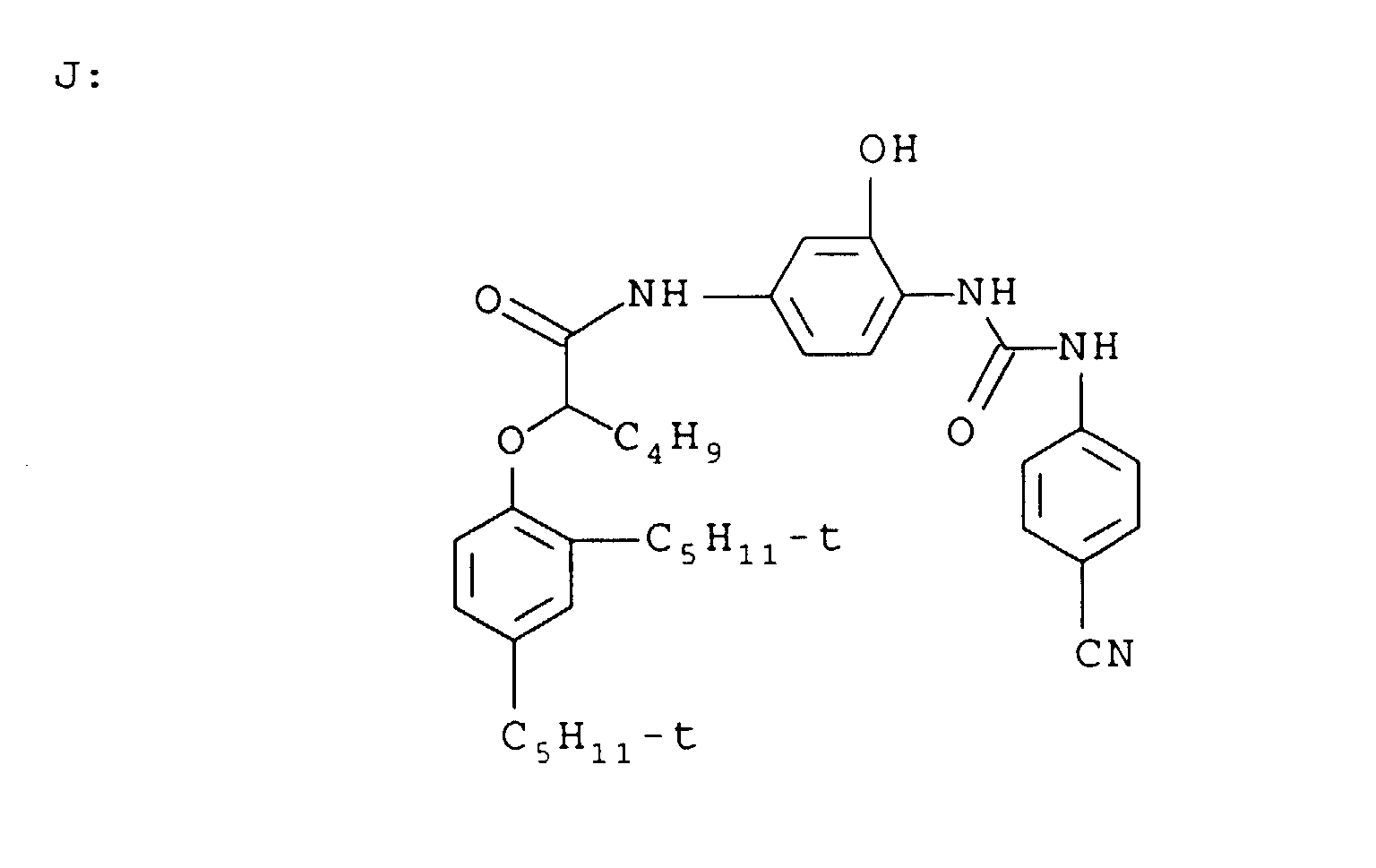
- This layer comprises a blend of red-sensitized, cubic, silver bromoiodide emulsion (1.5 mol percent iodide) (0.31 ⁇ m grain size) (1.16 g/m 2 ) and red-sensitized, tabular grain, silver bromoiodide emulsion (3 mol percent iodide) (0.75 ⁇ m diameter by 0.14 ⁇ m thick) (1.31), Compound J (0.965), Compound E (0.011), Compound L (0.65) and gelatin (2.96).
- This layer comprises a red-sensitized, tabular grain silver bromoiodide emulsion (6 mol percent iodide) having a diameter of 1.40 ⁇ m and a thickness of 0.12 ⁇ m (0.807), Compound J (0.102), Compound K (0.065), Compound L (0.102) and gelatin (1.506).
- This layer comprises Compound F (0.054), an antifoggant and gelatin (1.291).
- This layer comprises a blend of green-sensitized tabular grain silver bromoiodide emulsion (3 mol percent iodide) (grain diameter 0.55 ⁇ m and thickness 0.08 ⁇ m) (0.473) and tabular grain silver bromoiodide emulsion (3 mol percent iodide) (grain diameter 0.52 and thickness 0.09 ⁇ m (0.495), Compound g (0.161), Compound I (0.108) and gelatin (2.916).
- This layer comprises a blend of green-sensitized tabular grain silver bromoiodide emulsion (3 mol percent iodide) (grain diameter 1.05 ⁇ m and thickness 0.12 ⁇ m) (0.536) and tabular grain silver bromoiodide emulsion (3 mol percent iodide) (grain diameter 0.75 ⁇ m and thickness 0.14 ⁇ m), Compound G (0.258), Compound H (0.054) and gelatin (1.119).
- This layer comprises Carey-Lea Silver (0.43), Compound F (0.054), an antifoggant and gelatin (0.861).
- This layer comprises a blend of blue-sensitized tabular grain silver bromoiodide emulsions (3 mol percent iodide) (grain diameter 0.57 ⁇ m and thickness 0.12 ⁇ m) (0.274) and blue-sensitive silver bromoiodide emulsion (0.3 mol percent iodide) (grain diameter 0.52 ⁇ m and thickness 0.09 ⁇ m) (0.118), Compound C (1.022), Compound D (0.168) and gelatin (1.732)
- This layer comprises a blue-sensitized tabular grain silver bromoiodide emulsion (3 mol percent iodide) (grain diameter 1.10 ⁇ m and thickness 0.12 ⁇ m) (0.43), Compound C (0.161), Compound D (0.054), Compound E (0.003) and gelatin (0.791).
- This layer comprises silver halide Lippmann emulsion (0.215), Compound A (0.108), Compound B (0.106) and gelatin (0.538).
- This layer comprises matte particles of Example 1 (0.038) and gelatin (0.888)
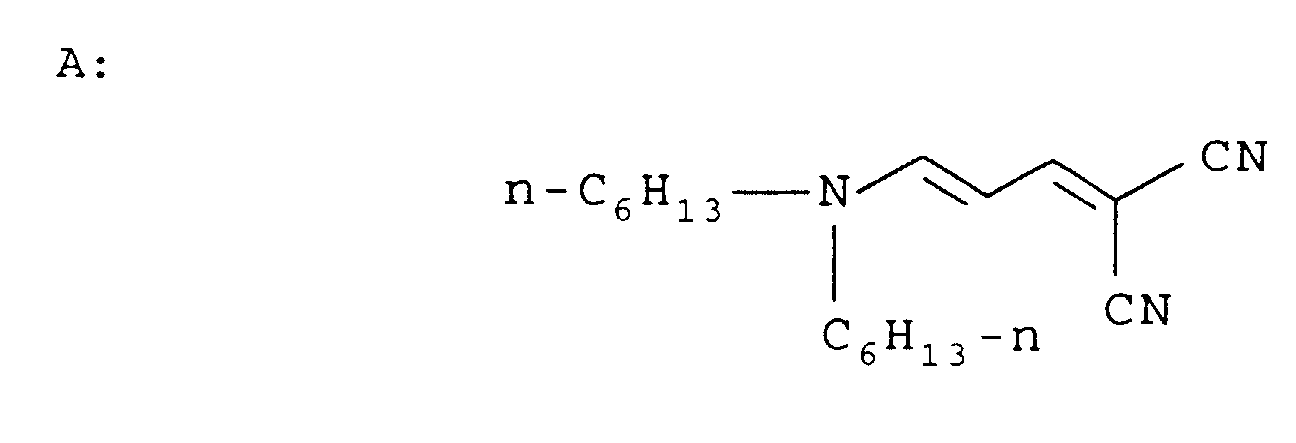
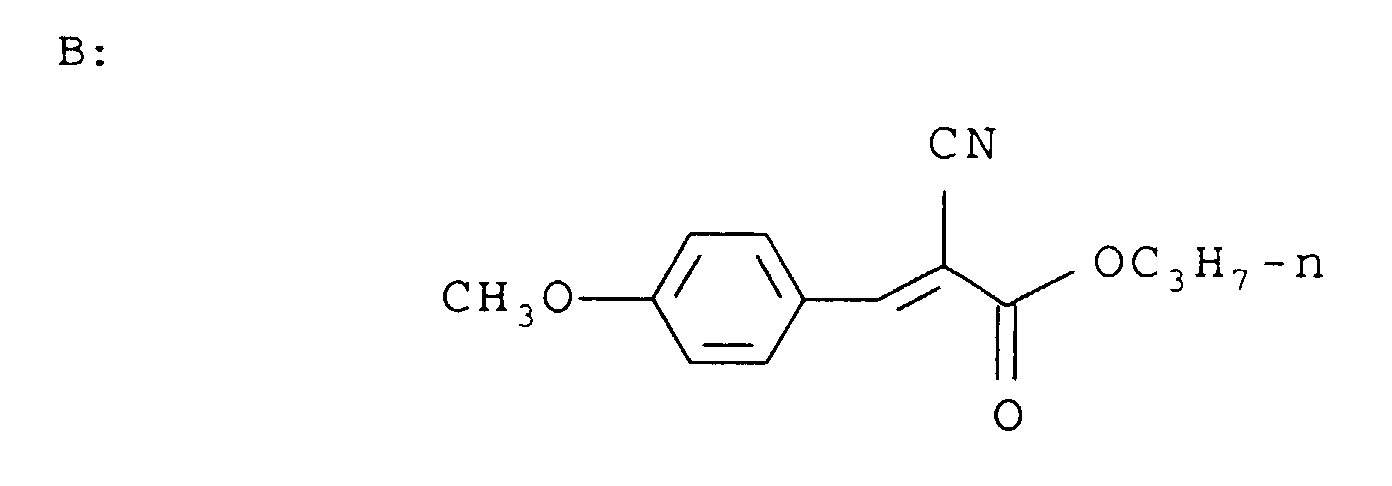
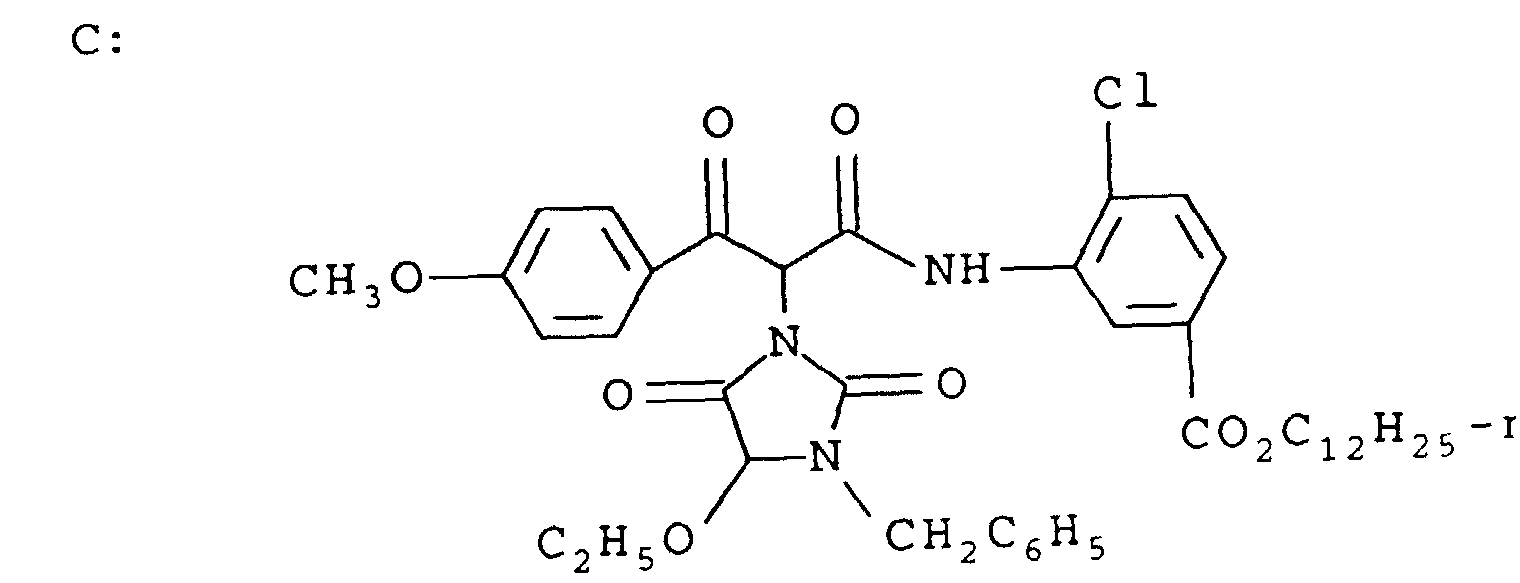
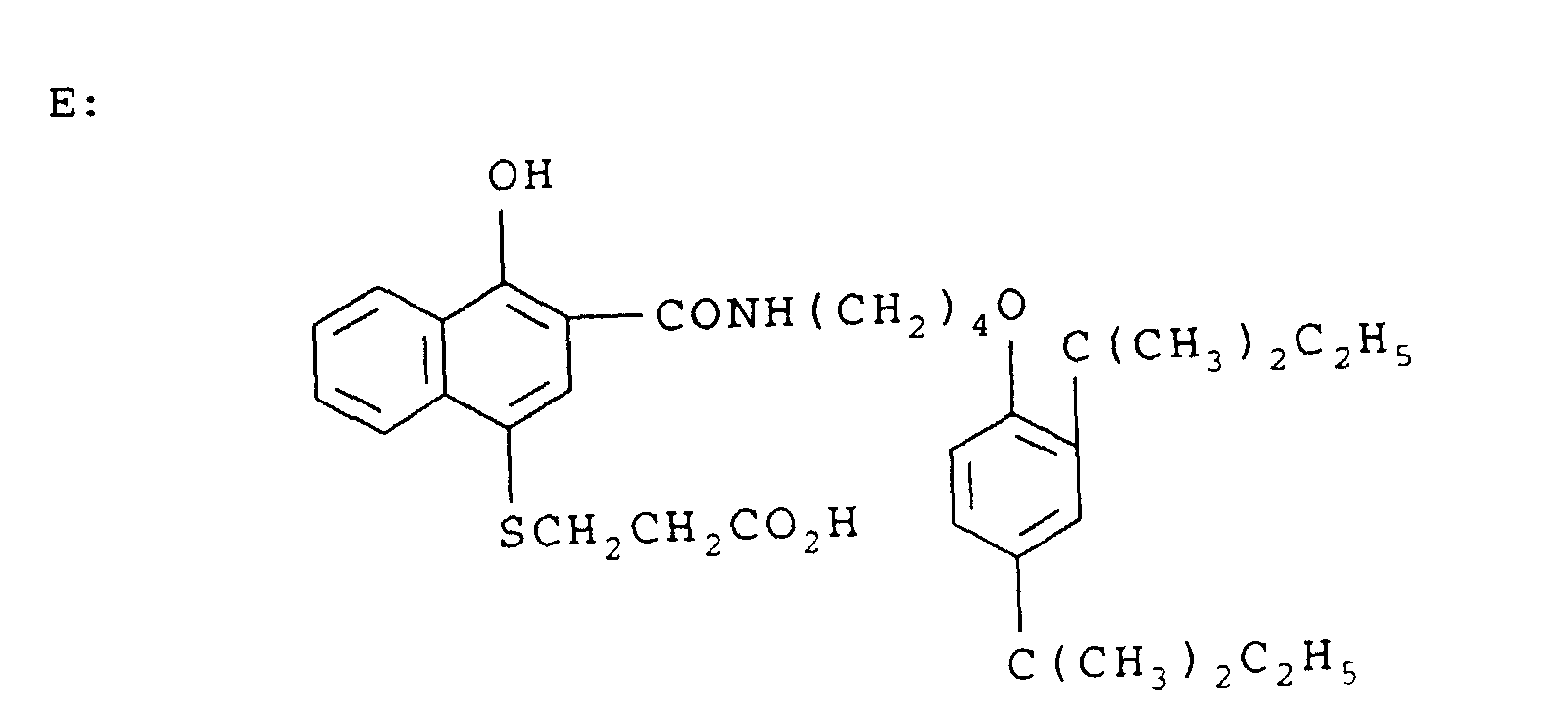
- the structures of the above-designated Compounds A through L are as follows:
- Equal footage of film from each of the experimental coatings is perforated for use in a 35mm camera and exposed. These exposed films are then processed in a standard photofinishing processor with fresh stabilizer solution, which is the final solution in the process, to insure that the matte beads from previously processed films will not be deposited on the test film surface.
- the processed films are then printed in a standard photofinishing high speed printer which has roller contact with the top-most protective layer of the film which contains the matte beads.
- the roller is removed and analyzed for the number of matte beads that transfer to the roller, i.e., dusted from the film surface due to poor adhesion.
- each of the processed films is evaluated for matte adhesion by examining the surface of each film sample with an optical microscope and counting the number of craters, or pits, on the surface which result from the removal of matte beads during the processing, notching and printing operations. A constant surface area is used for each film sample in this procedure.
- the films prepared in the above examples are evaluated for matte adhesion. A very significant improvement in matte bead retention is observed in those samples having colloidal silica present as an addendum where the matte beads are covalently bonded to gelatin.
- the films are also evaluated for resistance to abrasion and scratching by the Taber Abrader test.
- This abrasion test is conducted on the processed emulsion using two wheels with a load of 185 grams for 100 cycles.
- the change in observed haze i.e., the difference in haze of the test film observed before and after the abrader test indicates the degree of abrasion to the film sample.
- the degree of abrasion and scratching observed in the samples containing colloidal silica is much less than the layers containing gel grafted particles alone.
Landscapes
- Chemical & Material Sciences (AREA)
- Engineering & Computer Science (AREA)
- Materials Engineering (AREA)
- Physics & Mathematics (AREA)
- General Physics & Mathematics (AREA)
- Silver Salt Photography Or Processing Solution Therefor (AREA)
- Laminated Bodies (AREA)
Description
The structures of the above-designated Compounds A through L are as follows:





In a mixing vessel combine 1179 grams of Type IV gelatin, as a swollen gelatin which contains 65% water, 1000 grams distilled water, 285.3 grams of a matte dispersion, which consists of 6.75% matte beads of example 2, 7.5% Type IV gelatin, and the balance being distilled water, and 222 grams of a lubricant/gelatin dispersion which contains 9.0% Type IV gelatin. This mixture is heated at 46°C with gentle stirring until the gelatin has dissolved completely, approximately 30 minutes, and a uniform solution is achieved.This solution is held at 46°C and the following addenda are added in the following order:
| Sulfuric acid | 66.14 cm3/kg (30 cc/pound) gelatin |
| Alkanol XC | 29.98 cm3/kg (13.6 cc/pound) of gelatin |
| Surfactant 10G | 32.85 cm3/kg (14.9 cc/pound) of gelatin |
| Flourad FC135 | 4.41 cm3/kg (2.0 cc/pound) gelatin |
Claims (9)
- A photographic element comprising at least one light-sensitive layer on a support said element containing in at least one layer, a first particulate matte material and a second particulate material, said first particulate material being polymeric particles covalently bonded to gelatin and the second particulate material being colloidal silica having a particle size less than 50 nm, said first particulate matte material having a mean particle size of from 0.5 to 10 micrometers.
- The photographic element of Claim 1 wherein the polymeric particulate material has a mean particle size of from 1 to 3.5 micrometers.
- The photographic element of Claim 1 wherein the polymeric particles are included in the top-most layer.
- The photographic element of Claim 1 wherein the polymeric particles are included in an overcoat layer.
- The photographic element of Claim 1 wherein the layer containing the first particulate material and the second particulate material includes a gelatin binder.
- The photographic element of claim 5 wherein the first particulate is present in an amount of from 0.3 to 25 weight percent based on the weight of the gelatin.
- The photographic element of Claim 5 wherein the colloidal silica is present in an amount up to 50 percent by weight, based on the weight of the gelatin.
- The photographic element of claim 1 wherein the layer containing the first and second particulate materials comprises gelatin and the first polymeric particles are individually covered with gelatin that is covalently bonded thereto which is also covalently bonded to the gelatin of the layer.
- A photographic element according to Claim 1 wherein the polymer in said particles comprises an active halogen atom, an isocyanate group, an epoxide group, and aldehyde group, a chloroethylsulfone group, vinyl sulfone group, an amine group, a carboxylic acid group, or an active methylene group.
Applications Claiming Priority (2)
| Application Number | Priority Date | Filing Date | Title |
|---|---|---|---|
| US07/968,714 US5300411A (en) | 1992-10-30 | 1992-10-30 | Photographic light-sensitive elements |
| US968714 | 1992-10-30 |
Publications (2)
| Publication Number | Publication Date |
|---|---|
| EP0595275A1 EP0595275A1 (en) | 1994-05-04 |
| EP0595275B1 true EP0595275B1 (en) | 1998-12-09 |
Family
ID=25514657
Family Applications (1)
| Application Number | Title | Priority Date | Filing Date |
|---|---|---|---|
| EP93117362A Expired - Lifetime EP0595275B1 (en) | 1992-10-30 | 1993-10-26 | Photographic light-sensitive elements |
Country Status (4)
| Country | Link |
|---|---|
| US (1) | US5300411A (en) |
| EP (1) | EP0595275B1 (en) |
| JP (1) | JPH06202264A (en) |
| DE (1) | DE69322483T2 (en) |
Families Citing this family (6)
| Publication number | Priority date | Publication date | Assignee | Title |
|---|---|---|---|---|
| IT1254445B (en) * | 1992-02-13 | 1995-09-25 | Minnesota Mining & Mfg | INFRARED SENSITIVE PHOTOGRAPHIC ELEMENTS |
| US5698385A (en) * | 1994-02-21 | 1997-12-16 | Soken Chemical & Engineering Co., Ltd. | Silver halide photosensitive material |
| US5411844A (en) * | 1994-03-31 | 1995-05-02 | Eastman Kodak Company | Photographic element and coating composition therefor |
| US5750328A (en) * | 1995-04-13 | 1998-05-12 | Eastman Kodak Company | Thermally processable imaging element comprising polymeric matte particles |
| US5834174A (en) * | 1995-10-24 | 1998-11-10 | Eastman Kodak Company | Photographic elements containing highly crosslinked matting agent |
| EP0790526B1 (en) | 1996-02-19 | 2002-07-24 | Agfa-Gevaert | Radiographic image forming film-screen system |
Family Cites Families (23)
| Publication number | Priority date | Publication date | Assignee | Title |
|---|---|---|---|---|
| US3428451A (en) * | 1960-09-19 | 1969-02-18 | Eastman Kodak Co | Supports for radiation-sensitive elements and improved elements comprising such supports |
| US3206312A (en) * | 1962-06-12 | 1965-09-14 | Eastman Kodak Co | Photographic film having antistatic agent therein |
| US3591379A (en) * | 1968-04-09 | 1971-07-06 | Eastman Kodak Co | Photographic overcoat compositions and photographic elements |
| AT282373B (en) * | 1968-04-10 | 1970-06-25 | Semperit Ag | Pneumatic motor vehicle tires |
| FR2318442A1 (en) * | 1975-07-15 | 1977-02-11 | Kodak Pathe | NEW PRODUCT, IN PARTICULAR, PHOTOGRAPHIC, ANTISTATIC COATING AND PROCESS FOR ITS PREPARATION |
| JPS5459926A (en) * | 1977-10-21 | 1979-05-15 | Konishiroku Photo Ind Co Ltd | Photographic material having antistatic layer |
| JPS53100226A (en) * | 1977-02-14 | 1978-09-01 | Fuji Photo Film Co Ltd | Photosensitive material with film physical property improved |
| US4161407A (en) * | 1977-10-06 | 1979-07-17 | Eastman Kodak Company | Crosslinkable polymers having vinylsulfonyl groups or styrylsulfonyl groups and their use as hardeners for gelatin |
| US4172731A (en) * | 1978-04-03 | 1979-10-30 | Eastman Kodak Company | Photographic element containing a light absorbing matting agent |
| AU511943B2 (en) * | 1978-07-12 | 1980-09-11 | Matsushita Electric Industrial Co., Ltd. | Electrographic recording |
| JPS56143430A (en) * | 1980-04-11 | 1981-11-09 | Fuji Photo Film Co Ltd | Photographic sensitive material with improved antistatic property |
| JPS57118242A (en) * | 1981-01-14 | 1982-07-23 | Fuji Photo Film Co Ltd | Photographic sensitive material |
| JPH0830862B2 (en) * | 1987-05-21 | 1996-03-27 | 富士写真フイルム株式会社 | Silver halide photographic material |
| US4855219A (en) * | 1987-09-18 | 1989-08-08 | Eastman Kodak Company | Photographic element having polymer particles covalently bonded to gelatin |
| EP0307855B1 (en) * | 1987-09-18 | 1993-07-14 | EASTMAN KODAK COMPANY (a New Jersey corporation) | Gelatin-grafted polymer particles |
| JPH07119961B2 (en) * | 1987-12-28 | 1995-12-20 | 富士写真フイルム株式会社 | Silver halide photographic light-sensitive material |
| DE68927687T2 (en) * | 1988-05-24 | 1997-06-12 | Fuji Photo Film Co Ltd | Silver halide photographic material |
| US4999276A (en) * | 1988-06-29 | 1991-03-12 | Fuji Photo Film Co., Ltd. | Silver halide photographic materials |
| US4980267A (en) * | 1988-08-30 | 1990-12-25 | Eastman Kodak Company | Photographic element and process comprising a development inhibitor releasing coupler and a yellow dye-forming coupler |
| US4885219A (en) * | 1988-11-21 | 1989-12-05 | American Telephone And Telegraph Company | Rotatable storage compartment for batteries and the like |
| IT1227930B (en) * | 1988-11-25 | 1991-05-14 | Minnesota Mining & Mfg | SILVER HALOGEN PHOTOGRAPHIC MATERIALS SENSITIVE TO LIGHT. |
| US4856219A (en) * | 1988-12-16 | 1989-08-15 | Severance Marcus W | Fishing float |
| DE3914567A1 (en) * | 1989-05-03 | 1990-11-08 | Agfa Gevaert Ag | PHOTOGRAPHIC RECORDING MATERIAL |
-
1992
- 1992-10-30 US US07/968,714 patent/US5300411A/en not_active Expired - Fee Related
-
1993
- 1993-10-25 JP JP5266160A patent/JPH06202264A/en active Pending
- 1993-10-26 DE DE69322483T patent/DE69322483T2/en not_active Expired - Fee Related
- 1993-10-26 EP EP93117362A patent/EP0595275B1/en not_active Expired - Lifetime
Also Published As
| Publication number | Publication date |
|---|---|
| EP0595275A1 (en) | 1994-05-04 |
| US5300411A (en) | 1994-04-05 |
| JPH06202264A (en) | 1994-07-22 |
| DE69322483T2 (en) | 1999-04-29 |
| DE69322483D1 (en) | 1999-01-21 |
Similar Documents
| Publication | Publication Date | Title |
|---|---|---|
| EP0307856B1 (en) | Photographic element having polymer particles covalently bonded to gelatin | |
| EP0307855B1 (en) | Gelatin-grafted polymer particles | |
| US5288598A (en) | Photographic light-sensitive elements | |
| US5279934A (en) | Photographic light-sensitive elements | |
| US4448850A (en) | Vinyl acetate polymers and latex compositions containing same | |
| US5300411A (en) | Photographic light-sensitive elements | |
| JPH10104793A (en) | Image forming element | |
| JPH1097028A (en) | Image forming element | |
| JP2000338626A (en) | Scratch resistant and water resistant overcoat for photographic element | |
| US4544723A (en) | Vinyl acetate polymers and latex compositions containing same | |
| US6174661B1 (en) | Silver halide photographic elements | |
| EP0640871B1 (en) | Pressure sensitivity relief for photographic products | |
| US5723273A (en) | Protective overcoat for antistatic layer | |
| EP0829758B1 (en) | Method of forming a photographic paper having a backing layer comprising colloidal inorganic oxide particles, antistatic agent and film forming acrylic binder | |
| US6048678A (en) | Protective overcoat coating compositions | |
| US6407160B2 (en) | Non-aqueous composite wax particle dispersion | |
| JPH10171066A (en) | Image forming element | |
| EP1050780B1 (en) | Photographic element with a layer improving the adhesion to the support | |
| EP0962816B1 (en) | Improved topcoat for motion picture film | |
| EP0831366A1 (en) | Synthesis of matte beads containing a carboxylic acid monomer and their use in photographic elements | |
| JP2003186149A (en) | Photographic element having improved surface protective layer containing composite wax particles | |
| JPH06258762A (en) | Silver halide photographic sensitive material | |
| JPH04124652A (en) | Antistatic silver halide film photosensitive material |
Legal Events
| Date | Code | Title | Description |
|---|---|---|---|
| PUAI | Public reference made under article 153(3) epc to a published international application that has entered the european phase |
Free format text: ORIGINAL CODE: 0009012 |
|
| AK | Designated contracting states |
Kind code of ref document: A1 Designated state(s): BE CH DE FR GB IT LI NL |
|
| 17P | Request for examination filed |
Effective date: 19940609 |
|
| 17Q | First examination report despatched |
Effective date: 19970909 |
|
| GRAG | Despatch of communication of intention to grant |
Free format text: ORIGINAL CODE: EPIDOS AGRA |
|
| GRAG | Despatch of communication of intention to grant |
Free format text: ORIGINAL CODE: EPIDOS AGRA |
|
| GRAG | Despatch of communication of intention to grant |
Free format text: ORIGINAL CODE: EPIDOS AGRA |
|
| GRAH | Despatch of communication of intention to grant a patent |
Free format text: ORIGINAL CODE: EPIDOS IGRA |
|
| RBV | Designated contracting states (corrected) |
Designated state(s): DE FR GB |
|
| GRAH | Despatch of communication of intention to grant a patent |
Free format text: ORIGINAL CODE: EPIDOS IGRA |
|
| GRAA | (expected) grant |
Free format text: ORIGINAL CODE: 0009210 |
|
| AK | Designated contracting states |
Kind code of ref document: B1 Designated state(s): DE FR GB |
|
| REF | Corresponds to: |
Ref document number: 69322483 Country of ref document: DE Date of ref document: 19990121 |
|
| ET | Fr: translation filed | ||
| PGFP | Annual fee paid to national office [announced via postgrant information from national office to epo] |
Ref country code: GB Payment date: 19990913 Year of fee payment: 7 |
|
| PGFP | Annual fee paid to national office [announced via postgrant information from national office to epo] |
Ref country code: FR Payment date: 19991013 Year of fee payment: 7 |
|
| PLBE | No opposition filed within time limit |
Free format text: ORIGINAL CODE: 0009261 |
|
| STAA | Information on the status of an ep patent application or granted ep patent |
Free format text: STATUS: NO OPPOSITION FILED WITHIN TIME LIMIT |
|
| PGFP | Annual fee paid to national office [announced via postgrant information from national office to epo] |
Ref country code: DE Payment date: 19991027 Year of fee payment: 7 |
|
| 26N | No opposition filed | ||
| PG25 | Lapsed in a contracting state [announced via postgrant information from national office to epo] |
Ref country code: GB Free format text: LAPSE BECAUSE OF NON-PAYMENT OF DUE FEES Effective date: 20001026 |
|
| GBPC | Gb: european patent ceased through non-payment of renewal fee |
Effective date: 20001026 |
|
| PG25 | Lapsed in a contracting state [announced via postgrant information from national office to epo] |
Ref country code: FR Free format text: LAPSE BECAUSE OF NON-PAYMENT OF DUE FEES Effective date: 20010629 |
|
| PG25 | Lapsed in a contracting state [announced via postgrant information from national office to epo] |
Ref country code: DE Free format text: LAPSE BECAUSE OF NON-PAYMENT OF DUE FEES Effective date: 20010703 |
|
| REG | Reference to a national code |
Ref country code: FR Ref legal event code: ST |