EP0595088B1 - Photographic silver halide elements comprising infrared sensitizing dyes - Google Patents
Photographic silver halide elements comprising infrared sensitizing dyes Download PDFInfo
- Publication number
- EP0595088B1 EP0595088B1 EP93116230A EP93116230A EP0595088B1 EP 0595088 B1 EP0595088 B1 EP 0595088B1 EP 93116230 A EP93116230 A EP 93116230A EP 93116230 A EP93116230 A EP 93116230A EP 0595088 B1 EP0595088 B1 EP 0595088B1
- Authority
- EP
- European Patent Office
- Prior art keywords
- dye
- silver halide
- complete
- dyes
- halide emulsion
- Prior art date
- Legal status (The legal status is an assumption and is not a legal conclusion. Google has not performed a legal analysis and makes no representation as to the accuracy of the status listed.)
- Expired - Lifetime
Links
- -1 silver halide Chemical class 0.000 title claims description 69
- 229910052709 silver Inorganic materials 0.000 title claims description 50
- 239000004332 silver Substances 0.000 title claims description 49
- 239000000975 dye Substances 0.000 title description 105
- 230000001235 sensitizing effect Effects 0.000 title description 23
- 239000000839 emulsion Substances 0.000 claims description 35
- 230000005855 radiation Effects 0.000 claims description 18
- 125000000217 alkyl group Chemical group 0.000 claims description 14
- 238000001228 spectrum Methods 0.000 claims description 11
- 230000035945 sensitivity Effects 0.000 claims description 10
- 125000003118 aryl group Chemical group 0.000 claims description 8
- BQCADISMDOOEFD-UHFFFAOYSA-N Silver Chemical compound [Ag] BQCADISMDOOEFD-UHFFFAOYSA-N 0.000 claims description 6
- RAXXELZNTBOGNW-UHFFFAOYSA-N imidazole Natural products C1=CNC=N1 RAXXELZNTBOGNW-UHFFFAOYSA-N 0.000 claims description 6
- 150000002916 oxazoles Chemical class 0.000 claims description 5
- 150000003557 thiazoles Chemical class 0.000 claims description 5
- 125000004008 6 membered carbocyclic group Chemical group 0.000 claims description 4
- KAESVJOAVNADME-UHFFFAOYSA-N Pyrrole Chemical compound C=1C=CNC=1 KAESVJOAVNADME-UHFFFAOYSA-N 0.000 claims description 4
- 150000001450 anions Chemical class 0.000 claims description 4
- 125000001054 5 membered carbocyclic group Chemical group 0.000 claims description 3
- 150000003839 salts Chemical class 0.000 claims description 3
- WTKZEGDFNFYCGP-UHFFFAOYSA-N Pyrazole Chemical compound C=1C=NNC=1 WTKZEGDFNFYCGP-UHFFFAOYSA-N 0.000 claims description 2
- 150000003852 triazoles Chemical class 0.000 claims description 2
- 125000002837 carbocyclic group Chemical group 0.000 claims 1
- OKKJLVBELUTLKV-UHFFFAOYSA-N Methanol Chemical compound OC OKKJLVBELUTLKV-UHFFFAOYSA-N 0.000 description 48
- 239000010410 layer Substances 0.000 description 41
- 125000004432 carbon atom Chemical group C* 0.000 description 22
- 238000000034 method Methods 0.000 description 15
- 229910052799 carbon Inorganic materials 0.000 description 13
- 125000001434 methanylylidene group Chemical group [H]C#[*] 0.000 description 9
- 206010070834 Sensitisation Diseases 0.000 description 8
- 239000011248 coating agent Substances 0.000 description 8
- 238000000576 coating method Methods 0.000 description 8
- 150000001875 compounds Chemical class 0.000 description 8
- 230000008313 sensitization Effects 0.000 description 8
- 238000009792 diffusion process Methods 0.000 description 7
- 238000007429 general method Methods 0.000 description 7
- 229910052736 halogen Inorganic materials 0.000 description 7
- 239000000203 mixture Substances 0.000 description 7
- 230000008569 process Effects 0.000 description 7
- 125000004429 atom Chemical group 0.000 description 6
- 125000001495 ethyl group Chemical group [H]C([H])([H])C([H])([H])* 0.000 description 6
- 125000002496 methyl group Chemical group [H]C([H])([H])* 0.000 description 6
- 230000003595 spectral effect Effects 0.000 description 6
- 125000001424 substituent group Chemical group 0.000 description 6
- 238000012546 transfer Methods 0.000 description 6
- 108010010803 Gelatin Proteins 0.000 description 5
- 239000003795 chemical substances by application Substances 0.000 description 5
- 229920000159 gelatin Polymers 0.000 description 5
- 239000008273 gelatin Substances 0.000 description 5
- 235000019322 gelatine Nutrition 0.000 description 5
- 235000011852 gelatine desserts Nutrition 0.000 description 5
- 150000002367 halogens Chemical class 0.000 description 5
- 239000000463 material Substances 0.000 description 5
- 239000003381 stabilizer Substances 0.000 description 5
- 238000006243 chemical reaction Methods 0.000 description 4
- 239000004848 polyfunctional curative Substances 0.000 description 4
- 239000002904 solvent Substances 0.000 description 4
- 239000000126 substance Substances 0.000 description 4
- BCMCBBGGLRIHSE-UHFFFAOYSA-N 1,3-benzoxazole Chemical compound C1=CC=C2OC=NC2=C1 BCMCBBGGLRIHSE-UHFFFAOYSA-N 0.000 description 3
- XEKOWRVHYACXOJ-UHFFFAOYSA-N Ethyl acetate Chemical compound CCOC(C)=O XEKOWRVHYACXOJ-UHFFFAOYSA-N 0.000 description 3
- ZMANZCXQSJIPKH-UHFFFAOYSA-N Triethylamine Chemical compound CCN(CC)CC ZMANZCXQSJIPKH-UHFFFAOYSA-N 0.000 description 3
- 125000003277 amino group Chemical group 0.000 description 3
- 230000015572 biosynthetic process Effects 0.000 description 3
- 125000000484 butyl group Chemical group [H]C([*])([H])C([H])([H])C([H])([H])C([H])([H])[H] 0.000 description 3
- 125000001309 chloro group Chemical group Cl* 0.000 description 3
- 239000008199 coating composition Substances 0.000 description 3
- 238000011161 development Methods 0.000 description 3
- 230000000694 effects Effects 0.000 description 3
- 125000001153 fluoro group Chemical group F* 0.000 description 3
- 125000002887 hydroxy group Chemical group [H]O* 0.000 description 3
- 238000003384 imaging method Methods 0.000 description 3
- 239000003112 inhibitor Substances 0.000 description 3
- 229910052757 nitrogen Inorganic materials 0.000 description 3
- 125000004433 nitrogen atom Chemical group N* 0.000 description 3
- 125000002347 octyl group Chemical group [H]C([*])([H])C([H])([H])C([H])([H])C([H])([H])C([H])([H])C([H])([H])C([H])([H])C([H])([H])[H] 0.000 description 3
- 238000000926 separation method Methods 0.000 description 3
- 239000007787 solid Substances 0.000 description 3
- XLYOFNOQVPJJNP-UHFFFAOYSA-N water Substances O XLYOFNOQVPJJNP-UHFFFAOYSA-N 0.000 description 3
- QMHIMXFNBOYPND-UHFFFAOYSA-N 4-methylthiazole Chemical compound CC1=CSC=N1 QMHIMXFNBOYPND-UHFFFAOYSA-N 0.000 description 2
- VWMQXAYLHOSRKA-UHFFFAOYSA-N 5-chloro-1,3-benzoxazole Chemical compound ClC1=CC=C2OC=NC2=C1 VWMQXAYLHOSRKA-UHFFFAOYSA-N 0.000 description 2
- ZLLOWHFKKIOINR-UHFFFAOYSA-N 5-phenyl-1,3-thiazole Chemical compound S1C=NC=C1C1=CC=CC=C1 ZLLOWHFKKIOINR-UHFFFAOYSA-N 0.000 description 2
- CSCPPACGZOOCGX-UHFFFAOYSA-N Acetone Chemical compound CC(C)=O CSCPPACGZOOCGX-UHFFFAOYSA-N 0.000 description 2
- LFQSCWFLJHTTHZ-UHFFFAOYSA-N Ethanol Chemical compound CCO LFQSCWFLJHTTHZ-UHFFFAOYSA-N 0.000 description 2
- JGFZNNIVVJXRND-UHFFFAOYSA-N N,N-Diisopropylethylamine (DIPEA) Chemical compound CCN(C(C)C)C(C)C JGFZNNIVVJXRND-UHFFFAOYSA-N 0.000 description 2
- ISWSIDIOOBJBQZ-UHFFFAOYSA-N Phenol Chemical compound OC1=CC=CC=C1 ISWSIDIOOBJBQZ-UHFFFAOYSA-N 0.000 description 2
- JUJWROOIHBZHMG-UHFFFAOYSA-N Pyridine Chemical compound C1=CC=NC=C1 JUJWROOIHBZHMG-UHFFFAOYSA-N 0.000 description 2
- 229910021607 Silver chloride Inorganic materials 0.000 description 2
- 238000010521 absorption reaction Methods 0.000 description 2
- 238000000862 absorption spectrum Methods 0.000 description 2
- 150000001299 aldehydes Chemical class 0.000 description 2
- 125000003545 alkoxy group Chemical group 0.000 description 2
- 125000006615 aromatic heterocyclic group Chemical group 0.000 description 2
- IOJUPLGTWVMSFF-UHFFFAOYSA-N benzothiazole Chemical compound C1=CC=C2SC=NC2=C1 IOJUPLGTWVMSFF-UHFFFAOYSA-N 0.000 description 2
- 238000004061 bleaching Methods 0.000 description 2
- 239000007844 bleaching agent Substances 0.000 description 2
- 150000001718 carbodiimides Chemical class 0.000 description 2
- 150000007942 carboxylates Chemical class 0.000 description 2
- 125000002603 chloroethyl group Chemical group [H]C([*])([H])C([H])([H])Cl 0.000 description 2
- 239000000084 colloidal system Substances 0.000 description 2
- 230000003750 conditioning effect Effects 0.000 description 2
- 230000008878 coupling Effects 0.000 description 2
- 238000010168 coupling process Methods 0.000 description 2
- 238000005859 coupling reaction Methods 0.000 description 2
- 238000005516 engineering process Methods 0.000 description 2
- 125000004494 ethyl ester group Chemical group 0.000 description 2
- 239000012634 fragment Substances 0.000 description 2
- 125000005843 halogen group Chemical group 0.000 description 2
- 125000000623 heterocyclic group Chemical group 0.000 description 2
- 238000010348 incorporation Methods 0.000 description 2
- 230000007246 mechanism Effects 0.000 description 2
- 150000004702 methyl esters Chemical class 0.000 description 2
- 238000013508 migration Methods 0.000 description 2
- 230000005012 migration Effects 0.000 description 2
- 230000003287 optical effect Effects 0.000 description 2
- 230000003647 oxidation Effects 0.000 description 2
- 238000007254 oxidation reaction Methods 0.000 description 2
- 238000002360 preparation method Methods 0.000 description 2
- 238000012545 processing Methods 0.000 description 2
- 125000001436 propyl group Chemical group [H]C([*])([H])C([H])([H])C([H])([H])[H] 0.000 description 2
- 238000011160 research Methods 0.000 description 2
- HKZLPVFGJNLROG-UHFFFAOYSA-M silver monochloride Chemical compound [Cl-].[Ag+] HKZLPVFGJNLROG-UHFFFAOYSA-M 0.000 description 2
- 125000004079 stearyl group Chemical group [H]C([*])([H])C([H])([H])C([H])([H])C([H])([H])C([H])([H])C([H])([H])C([H])([H])C([H])([H])C([H])([H])C([H])([H])C([H])([H])C([H])([H])C([H])([H])C([H])([H])C([H])([H])C([H])([H])C([H])([H])C([H])([H])[H] 0.000 description 2
- 239000000758 substrate Substances 0.000 description 2
- 125000000020 sulfo group Chemical group O=S(=O)([*])O[H] 0.000 description 2
- 125000005420 sulfonamido group Chemical group S(=O)(=O)(N*)* 0.000 description 2
- 239000004094 surface-active agent Substances 0.000 description 2
- 238000003786 synthesis reaction Methods 0.000 description 2
- BREUOIWLJRZAFF-UHFFFAOYSA-N 1,3-benzothiazol-5-ol Chemical compound OC1=CC=C2SC=NC2=C1 BREUOIWLJRZAFF-UHFFFAOYSA-N 0.000 description 1
- ORIIXCOYEOIFSN-UHFFFAOYSA-N 1,3-benzothiazol-6-ol Chemical compound OC1=CC=C2N=CSC2=C1 ORIIXCOYEOIFSN-UHFFFAOYSA-N 0.000 description 1
- UPPYOQWUJKAFSG-UHFFFAOYSA-N 1,3-benzoxazol-5-ol Chemical compound OC1=CC=C2OC=NC2=C1 UPPYOQWUJKAFSG-UHFFFAOYSA-N 0.000 description 1
- SAHAKBXWZLDNAA-UHFFFAOYSA-N 1,3-benzoxazol-6-ol Chemical compound OC1=CC=C2N=COC2=C1 SAHAKBXWZLDNAA-UHFFFAOYSA-N 0.000 description 1
- KJCVRFUGPWSIIH-UHFFFAOYSA-N 1-naphthol Chemical compound C1=CC=C2C(O)=CC=CC2=C1 KJCVRFUGPWSIIH-UHFFFAOYSA-N 0.000 description 1
- ALUQMCBDQKDRAK-UHFFFAOYSA-N 2,3,3a,4-tetrahydro-1,3-benzothiazole Chemical compound C1C=CC=C2SCNC21 ALUQMCBDQKDRAK-UHFFFAOYSA-N 0.000 description 1
- XNWFRZJHXBZDAG-UHFFFAOYSA-N 2-METHOXYETHANOL Chemical compound COCCO XNWFRZJHXBZDAG-UHFFFAOYSA-N 0.000 description 1
- QCDWFXQBSFUVSP-UHFFFAOYSA-N 2-phenoxyethanol Chemical compound OCCOC1=CC=CC=C1 QCDWFXQBSFUVSP-UHFFFAOYSA-N 0.000 description 1
- LDRRXHAINPPJJA-UHFFFAOYSA-N 3-hydroxy-4-methylidene-2-pyrazol-1-ylcyclohexene-1-carbaldehyde Chemical compound OC1C(=C)CCC(C=O)=C1N1N=CC=C1 LDRRXHAINPPJJA-UHFFFAOYSA-N 0.000 description 1
- YVORRVFKHZLJGZ-UHFFFAOYSA-N 4,5-Dimethyloxazole Chemical compound CC=1N=COC=1C YVORRVFKHZLJGZ-UHFFFAOYSA-N 0.000 description 1
- UWSONZCNXUSTKW-UHFFFAOYSA-N 4,5-Dimethylthiazole Chemical compound CC=1N=CSC=1C UWSONZCNXUSTKW-UHFFFAOYSA-N 0.000 description 1
- ODKHOKLXMBWVOQ-UHFFFAOYSA-N 4,5-diphenyl-1,3-oxazole Chemical compound O1C=NC(C=2C=CC=CC=2)=C1C1=CC=CC=C1 ODKHOKLXMBWVOQ-UHFFFAOYSA-N 0.000 description 1
- BGTVICKPWACXLR-UHFFFAOYSA-N 4,5-diphenyl-1,3-thiazole Chemical compound S1C=NC(C=2C=CC=CC=2)=C1C1=CC=CC=C1 BGTVICKPWACXLR-UHFFFAOYSA-N 0.000 description 1
- NDUHYERSZLRFNL-UHFFFAOYSA-N 4,6-dimethyl-1,3-benzoxazole Chemical compound CC1=CC(C)=C2N=COC2=C1 NDUHYERSZLRFNL-UHFFFAOYSA-N 0.000 description 1
- IFEPGHPDQJOYGG-UHFFFAOYSA-N 4-chloro-1,3-benzothiazole Chemical compound ClC1=CC=CC2=C1N=CS2 IFEPGHPDQJOYGG-UHFFFAOYSA-N 0.000 description 1
- WQJKBLBBLUDZEW-UHFFFAOYSA-N 4-ethoxy-1,3-benzothiazole Chemical compound CCOC1=CC=CC2=C1N=CS2 WQJKBLBBLUDZEW-UHFFFAOYSA-N 0.000 description 1
- GQPBBURQQRLAKF-UHFFFAOYSA-N 4-ethyl-1,3-oxazole Chemical compound CCC1=COC=N1 GQPBBURQQRLAKF-UHFFFAOYSA-N 0.000 description 1
- XQPAPBLJJLIQGV-UHFFFAOYSA-N 4-methoxy-1,3-benzothiazole Chemical compound COC1=CC=CC2=C1N=CS2 XQPAPBLJJLIQGV-UHFFFAOYSA-N 0.000 description 1
- PIUXNZAIHQAHBY-UHFFFAOYSA-N 4-methyl-1,3-benzothiazole Chemical compound CC1=CC=CC2=C1N=CS2 PIUXNZAIHQAHBY-UHFFFAOYSA-N 0.000 description 1
- PUMREIFKTMLCAF-UHFFFAOYSA-N 4-methyl-1,3-oxazole Chemical compound CC1=COC=N1 PUMREIFKTMLCAF-UHFFFAOYSA-N 0.000 description 1
- NTFMLYSGIKHECT-UHFFFAOYSA-N 4-phenyl-1,3-oxazole Chemical compound O1C=NC(C=2C=CC=CC=2)=C1 NTFMLYSGIKHECT-UHFFFAOYSA-N 0.000 description 1
- KXCQDIWJQBSUJF-UHFFFAOYSA-N 4-phenyl-1,3-thiazole Chemical compound S1C=NC(C=2C=CC=CC=2)=C1 KXCQDIWJQBSUJF-UHFFFAOYSA-N 0.000 description 1
- YXGBCQGWEUFUID-UHFFFAOYSA-N 4-thiophen-2-yl-1,3-thiazole Chemical compound C1=CSC(C=2N=CSC=2)=C1 YXGBCQGWEUFUID-UHFFFAOYSA-N 0.000 description 1
- HYXKRZZFKJHDRT-UHFFFAOYSA-N 5,6-dimethoxy-1,3-benzothiazole Chemical compound C1=C(OC)C(OC)=CC2=C1SC=N2 HYXKRZZFKJHDRT-UHFFFAOYSA-N 0.000 description 1
- RWNMLYACWNIEIG-UHFFFAOYSA-N 5,6-dimethyl-1,3-benzoxazole Chemical compound C1=C(C)C(C)=CC2=C1OC=N2 RWNMLYACWNIEIG-UHFFFAOYSA-N 0.000 description 1
- KFDDRUWQFQJGNL-UHFFFAOYSA-N 5-bromo-1,3-benzothiazole Chemical compound BrC1=CC=C2SC=NC2=C1 KFDDRUWQFQJGNL-UHFFFAOYSA-N 0.000 description 1
- YTSFYTDPSSFCLU-UHFFFAOYSA-N 5-chloro-1,3-benzothiazole Chemical compound ClC1=CC=C2SC=NC2=C1 YTSFYTDPSSFCLU-UHFFFAOYSA-N 0.000 description 1
- GWKNDCJHRNOQAR-UHFFFAOYSA-N 5-ethoxy-1,3-benzothiazole Chemical compound CCOC1=CC=C2SC=NC2=C1 GWKNDCJHRNOQAR-UHFFFAOYSA-N 0.000 description 1
- MHWNEQOZIDVGJS-UHFFFAOYSA-N 5-ethoxy-1,3-benzoxazole Chemical compound CCOC1=CC=C2OC=NC2=C1 MHWNEQOZIDVGJS-UHFFFAOYSA-N 0.000 description 1
- HGKWFAVDDRDNHM-UHFFFAOYSA-N 5-ethoxybenzo[f][1,3]benzothiazole Chemical compound C1=C2C(OCC)=CC=CC2=CC2=C1N=CS2 HGKWFAVDDRDNHM-UHFFFAOYSA-N 0.000 description 1
- GLKZKYSZPVHLDK-UHFFFAOYSA-N 5-iodo-1,3-benzothiazole Chemical compound IC1=CC=C2SC=NC2=C1 GLKZKYSZPVHLDK-UHFFFAOYSA-N 0.000 description 1
- PNJKZDLZKILFNF-UHFFFAOYSA-N 5-methoxy-1,3-benzothiazole Chemical compound COC1=CC=C2SC=NC2=C1 PNJKZDLZKILFNF-UHFFFAOYSA-N 0.000 description 1
- IQQKXTVYGHYXFX-UHFFFAOYSA-N 5-methoxy-1,3-benzoxazole Chemical compound COC1=CC=C2OC=NC2=C1 IQQKXTVYGHYXFX-UHFFFAOYSA-N 0.000 description 1
- TTWTXOMTJQBYPG-UHFFFAOYSA-N 5-methoxybenzo[f][1,3]benzothiazole Chemical compound C1=C2C(OC)=CC=CC2=CC2=C1N=CS2 TTWTXOMTJQBYPG-UHFFFAOYSA-N 0.000 description 1
- SEBIXVUYSFOUEL-UHFFFAOYSA-N 5-methyl-1,3-benzothiazole Chemical compound CC1=CC=C2SC=NC2=C1 SEBIXVUYSFOUEL-UHFFFAOYSA-N 0.000 description 1
- UBIAVBGIRDRQLD-UHFFFAOYSA-N 5-methyl-1,3-benzoxazole Chemical compound CC1=CC=C2OC=NC2=C1 UBIAVBGIRDRQLD-UHFFFAOYSA-N 0.000 description 1
- ZYMHCFYHVYGFMS-UHFFFAOYSA-N 5-methyl-1,3-oxazole Chemical compound CC1=CN=CO1 ZYMHCFYHVYGFMS-UHFFFAOYSA-N 0.000 description 1
- RLYUNPNLXMSXAX-UHFFFAOYSA-N 5-methylthiazole Chemical compound CC1=CN=CS1 RLYUNPNLXMSXAX-UHFFFAOYSA-N 0.000 description 1
- AAKPXIJKSNGOCO-UHFFFAOYSA-N 5-phenyl-1,3-benzothiazole Chemical compound C=1C=C2SC=NC2=CC=1C1=CC=CC=C1 AAKPXIJKSNGOCO-UHFFFAOYSA-N 0.000 description 1
- NIFNXGHHDAXUGO-UHFFFAOYSA-N 5-phenyl-1,3-benzoxazole Chemical compound C=1C=C2OC=NC2=CC=1C1=CC=CC=C1 NIFNXGHHDAXUGO-UHFFFAOYSA-N 0.000 description 1
- YPYPBEGIASEWKA-UHFFFAOYSA-N 5-phenyl-1,3-oxazole Chemical compound O1C=NC=C1C1=CC=CC=C1 YPYPBEGIASEWKA-UHFFFAOYSA-N 0.000 description 1
- YJOUISWKEOXIMC-UHFFFAOYSA-N 6-bromo-1,3-benzothiazole Chemical compound BrC1=CC=C2N=CSC2=C1 YJOUISWKEOXIMC-UHFFFAOYSA-N 0.000 description 1
- AIBQGOMAISTKSR-UHFFFAOYSA-N 6-chloro-1,3-benzothiazole Chemical compound ClC1=CC=C2N=CSC2=C1 AIBQGOMAISTKSR-UHFFFAOYSA-N 0.000 description 1
- NICZKYFUJVAZLV-UHFFFAOYSA-N 6-iodo-1,3-benzothiazole Chemical compound IC1=CC=C2N=CSC2=C1 NICZKYFUJVAZLV-UHFFFAOYSA-N 0.000 description 1
- AHOIGFLSEXUWNV-UHFFFAOYSA-N 6-methoxy-1,3-benzothiazole Chemical compound COC1=CC=C2N=CSC2=C1 AHOIGFLSEXUWNV-UHFFFAOYSA-N 0.000 description 1
- FKYKJYSYSGEDCG-UHFFFAOYSA-N 6-methoxy-1,3-benzoxazole Chemical compound COC1=CC=C2N=COC2=C1 FKYKJYSYSGEDCG-UHFFFAOYSA-N 0.000 description 1
- IVKILQAPNDCUNJ-UHFFFAOYSA-N 6-methyl-1,3-benzothiazole Chemical compound CC1=CC=C2N=CSC2=C1 IVKILQAPNDCUNJ-UHFFFAOYSA-N 0.000 description 1
- SZWNDAUMBWLYOQ-UHFFFAOYSA-N 6-methylbenzoxazole Chemical compound CC1=CC=C2N=COC2=C1 SZWNDAUMBWLYOQ-UHFFFAOYSA-N 0.000 description 1
- ZLQIQTPPVHFSPY-UHFFFAOYSA-N 6-phenyl-1,3-benzothiazole Chemical compound C1=C2SC=NC2=CC=C1C1=CC=CC=C1 ZLQIQTPPVHFSPY-UHFFFAOYSA-N 0.000 description 1
- RXEDQOMFMWCKFW-UHFFFAOYSA-N 7-chloro-1,3-benzothiazole Chemical compound ClC1=CC=CC2=C1SC=N2 RXEDQOMFMWCKFW-UHFFFAOYSA-N 0.000 description 1
- REAGHRQKVIAPSF-UHFFFAOYSA-N 7-methoxybenzo[f][1,3]benzothiazole Chemical compound C1=C2N=CSC2=CC2=CC(OC)=CC=C21 REAGHRQKVIAPSF-UHFFFAOYSA-N 0.000 description 1
- DPBXDXMSUBTWCB-UHFFFAOYSA-N 8-methoxybenzo[f][1,3]benzothiazole Chemical compound C1=C2C(OC)=CC=CC2=CC2=C1SC=N2 DPBXDXMSUBTWCB-UHFFFAOYSA-N 0.000 description 1
- CPELXLSAUQHCOX-UHFFFAOYSA-M Bromide Chemical compound [Br-] CPELXLSAUQHCOX-UHFFFAOYSA-M 0.000 description 1
- QMZVYIQGAGGTHU-UHFFFAOYSA-N CC/N=N/[N-2][N+]#CN=C Chemical compound CC/N=N/[N-2][N+]#CN=C QMZVYIQGAGGTHU-UHFFFAOYSA-N 0.000 description 1
- XZNRWZPUOGZUAJ-UHFFFAOYSA-M CC[S+]1C(C=CC2=CC=CC=C22)=C2N=C1C.[I-] Chemical compound CC[S+]1C(C=CC2=CC=CC=C22)=C2N=C1C.[I-] XZNRWZPUOGZUAJ-UHFFFAOYSA-M 0.000 description 1
- GAWIXWVDTYZWAW-UHFFFAOYSA-N C[CH]O Chemical group C[CH]O GAWIXWVDTYZWAW-UHFFFAOYSA-N 0.000 description 1
- VEXZGXHMUGYJMC-UHFFFAOYSA-M Chloride anion Chemical compound [Cl-] VEXZGXHMUGYJMC-UHFFFAOYSA-M 0.000 description 1
- 229940126062 Compound A Drugs 0.000 description 1
- 229940090898 Desensitizer Drugs 0.000 description 1
- NLDMNSXOCDLTTB-UHFFFAOYSA-N Heterophylliin A Natural products O1C2COC(=O)C3=CC(O)=C(O)C(O)=C3C3=C(O)C(O)=C(O)C=C3C(=O)OC2C(OC(=O)C=2C=C(O)C(O)=C(O)C=2)C(O)C1OC(=O)C1=CC(O)=C(O)C(O)=C1 NLDMNSXOCDLTTB-UHFFFAOYSA-N 0.000 description 1
- BZXHADZHHVBZMN-UHFFFAOYSA-N OC=C1CCCC(C=O)=C1n1cccn1 Chemical compound OC=C1CCCC(C=O)=C1n1cccn1 BZXHADZHHVBZMN-UHFFFAOYSA-N 0.000 description 1
- MUBZPKHOEPUJKR-UHFFFAOYSA-N Oxalic acid Chemical compound OC(=O)C(O)=O MUBZPKHOEPUJKR-UHFFFAOYSA-N 0.000 description 1
- FZWLAAWBMGSTSO-UHFFFAOYSA-N Thiazole Chemical compound C1=CSC=N1 FZWLAAWBMGSTSO-UHFFFAOYSA-N 0.000 description 1
- SJOOOZPMQAWAOP-UHFFFAOYSA-N [Ag].BrCl Chemical compound [Ag].BrCl SJOOOZPMQAWAOP-UHFFFAOYSA-N 0.000 description 1
- XCFIVNQHHFZRNR-UHFFFAOYSA-N [Ag].Cl[IH]Br Chemical compound [Ag].Cl[IH]Br XCFIVNQHHFZRNR-UHFFFAOYSA-N 0.000 description 1
- 230000009471 action Effects 0.000 description 1
- 125000005041 acyloxyalkyl group Chemical group 0.000 description 1
- 125000003368 amide group Chemical group 0.000 description 1
- 239000002216 antistatic agent Substances 0.000 description 1
- 150000001541 aziridines Chemical class 0.000 description 1
- 230000004888 barrier function Effects 0.000 description 1
- 230000008901 benefit Effects 0.000 description 1
- KXNQKOAQSGJCQU-UHFFFAOYSA-N benzo[e][1,3]benzothiazole Chemical compound C1=CC=C2C(N=CS3)=C3C=CC2=C1 KXNQKOAQSGJCQU-UHFFFAOYSA-N 0.000 description 1
- WMUIZUWOEIQJEH-UHFFFAOYSA-N benzo[e][1,3]benzoxazole Chemical class C1=CC=C2C(N=CO3)=C3C=CC2=C1 WMUIZUWOEIQJEH-UHFFFAOYSA-N 0.000 description 1
- IIUUNAJWKSTFPF-UHFFFAOYSA-N benzo[g][1,3]benzothiazole Chemical compound C1=CC=CC2=C(SC=N3)C3=CC=C21 IIUUNAJWKSTFPF-UHFFFAOYSA-N 0.000 description 1
- 125000001797 benzyl group Chemical group [H]C1=C([H])C([H])=C(C([H])=C1[H])C([H])([H])* 0.000 description 1
- 230000005540 biological transmission Effects 0.000 description 1
- 238000009835 boiling Methods 0.000 description 1
- 125000004181 carboxyalkyl group Chemical group 0.000 description 1
- 230000003197 catalytic effect Effects 0.000 description 1
- 239000003153 chemical reaction reagent Substances 0.000 description 1
- 239000003638 chemical reducing agent Substances 0.000 description 1
- 239000003086 colorant Substances 0.000 description 1
- 238000010276 construction Methods 0.000 description 1
- 125000004122 cyclic group Chemical group 0.000 description 1
- 125000000113 cyclohexyl group Chemical group [H]C1([H])C([H])([H])C([H])([H])C([H])(*)C([H])([H])C1([H])[H] 0.000 description 1
- 150000004891 diazines Chemical class 0.000 description 1
- 239000006185 dispersion Substances 0.000 description 1
- AFOSIXZFDONLBT-UHFFFAOYSA-N divinyl sulfone Chemical class C=CS(=O)(=O)C=C AFOSIXZFDONLBT-UHFFFAOYSA-N 0.000 description 1
- CCIVGXIOQKPBKL-UHFFFAOYSA-M ethanesulfonate Chemical compound CCS([O-])(=O)=O CCIVGXIOQKPBKL-UHFFFAOYSA-M 0.000 description 1
- 235000019441 ethanol Nutrition 0.000 description 1
- 229940093499 ethyl acetate Drugs 0.000 description 1
- 235000019439 ethyl acetate Nutrition 0.000 description 1
- 238000001914 filtration Methods 0.000 description 1
- 125000005842 heteroatom Chemical group 0.000 description 1
- XMBWDFGMSWQBCA-UHFFFAOYSA-N hydrogen iodide Chemical compound I XMBWDFGMSWQBCA-UHFFFAOYSA-N 0.000 description 1
- 125000002768 hydroxyalkyl group Chemical group 0.000 description 1
- PTFYQSWHBLOXRZ-UHFFFAOYSA-N imidazo[4,5-e]indazole Chemical compound C1=CC2=NC=NC2=C2C=NN=C21 PTFYQSWHBLOXRZ-UHFFFAOYSA-N 0.000 description 1
- 239000011229 interlayer Substances 0.000 description 1
- 125000001449 isopropyl group Chemical group [H]C([H])([H])C([H])(*)C([H])([H])[H] 0.000 description 1
- 239000012633 leachable Substances 0.000 description 1
- 230000001617 migratory effect Effects 0.000 description 1
- 125000004573 morpholin-4-yl group Chemical group N1(CCOCC1)* 0.000 description 1
- SFDJOSRHYKHMOK-UHFFFAOYSA-N nitramide Chemical group N[N+]([O-])=O SFDJOSRHYKHMOK-UHFFFAOYSA-N 0.000 description 1
- 125000003854 p-chlorophenyl group Chemical group [H]C1=C([H])C(*)=C([H])C([H])=C1Cl 0.000 description 1
- VLTRZXGMWDSKGL-UHFFFAOYSA-M perchlorate Inorganic materials [O-]Cl(=O)(=O)=O VLTRZXGMWDSKGL-UHFFFAOYSA-M 0.000 description 1
- VLTRZXGMWDSKGL-UHFFFAOYSA-N perchloric acid Chemical compound OCl(=O)(=O)=O VLTRZXGMWDSKGL-UHFFFAOYSA-N 0.000 description 1
- 125000001997 phenyl group Chemical group [H]C1=C([H])C([H])=C(*)C([H])=C1[H] 0.000 description 1
- 125000004193 piperazinyl group Chemical group 0.000 description 1
- 150000003142 primary aromatic amines Chemical class 0.000 description 1
- 239000011241 protective layer Substances 0.000 description 1
- LVTJOONKWUXEFR-FZRMHRINSA-N protoneodioscin Natural products O(C[C@@H](CC[C@]1(O)[C@H](C)[C@@H]2[C@]3(C)[C@H]([C@H]4[C@@H]([C@]5(C)C(=CC4)C[C@@H](O[C@@H]4[C@H](O[C@H]6[C@@H](O)[C@@H](O)[C@@H](O)[C@H](C)O6)[C@@H](O)[C@H](O[C@H]6[C@@H](O)[C@@H](O)[C@@H](O)[C@H](C)O6)[C@H](CO)O4)CC5)CC3)C[C@@H]2O1)C)[C@H]1[C@H](O)[C@H](O)[C@H](O)[C@@H](CO)O1 LVTJOONKWUXEFR-FZRMHRINSA-N 0.000 description 1
- JEXVQSWXXUJEMA-UHFFFAOYSA-N pyrazol-3-one Chemical compound O=C1C=CN=N1 JEXVQSWXXUJEMA-UHFFFAOYSA-N 0.000 description 1
- MCSKRVKAXABJLX-UHFFFAOYSA-N pyrazolo[3,4-d]triazole Chemical compound N1=NN=C2N=NC=C21 MCSKRVKAXABJLX-UHFFFAOYSA-N 0.000 description 1
- UMJSCPRVCHMLSP-UHFFFAOYSA-N pyridine Natural products COC1=CC=CN=C1 UMJSCPRVCHMLSP-UHFFFAOYSA-N 0.000 description 1
- 238000010992 reflux Methods 0.000 description 1
- ADZWSOLPGZMUMY-UHFFFAOYSA-M silver bromide Chemical compound [Ag]Br ADZWSOLPGZMUMY-UHFFFAOYSA-M 0.000 description 1
- ZUNKMNLKJXRCDM-UHFFFAOYSA-N silver bromoiodide Chemical compound [Ag].IBr ZUNKMNLKJXRCDM-UHFFFAOYSA-N 0.000 description 1
- 239000011877 solvent mixture Substances 0.000 description 1
- 238000003756 stirring Methods 0.000 description 1
- 125000000547 substituted alkyl group Chemical group 0.000 description 1
- 238000006467 substitution reaction Methods 0.000 description 1
- 125000004964 sulfoalkyl group Chemical group 0.000 description 1
- 150000003457 sulfones Chemical class 0.000 description 1
- JOXIMZWYDAKGHI-UHFFFAOYSA-N toluene-4-sulfonic acid Chemical compound CC1=CC=C(S(O)(=O)=O)C=C1 JOXIMZWYDAKGHI-UHFFFAOYSA-N 0.000 description 1
- 238000003325 tomography Methods 0.000 description 1
- 150000003918 triazines Chemical class 0.000 description 1
- 238000001429 visible spectrum Methods 0.000 description 1
- QYSXJUFSXHHAJI-YRZJJWOYSA-N vitamin D3 Chemical compound C1(/[C@@H]2CC[C@@H]([C@]2(CCC1)C)[C@H](C)CCCC(C)C)=C\C=C1\C[C@@H](O)CCC1=C QYSXJUFSXHHAJI-YRZJJWOYSA-N 0.000 description 1
Classifications
-
- G—PHYSICS
- G03—PHOTOGRAPHY; CINEMATOGRAPHY; ANALOGOUS TECHNIQUES USING WAVES OTHER THAN OPTICAL WAVES; ELECTROGRAPHY; HOLOGRAPHY
- G03C—PHOTOSENSITIVE MATERIALS FOR PHOTOGRAPHIC PURPOSES; PHOTOGRAPHIC PROCESSES, e.g. CINE, X-RAY, COLOUR, STEREO-PHOTOGRAPHIC PROCESSES; AUXILIARY PROCESSES IN PHOTOGRAPHY
- G03C1/00—Photosensitive materials
- G03C1/005—Silver halide emulsions; Preparation thereof; Physical treatment thereof; Incorporation of additives therein
- G03C1/06—Silver halide emulsions; Preparation thereof; Physical treatment thereof; Incorporation of additives therein with non-macromolecular additives
- G03C1/08—Sensitivity-increasing substances
- G03C1/10—Organic substances
- G03C1/12—Methine and polymethine dyes
- G03C1/26—Polymethine chain forming part of a heterocyclic ring
-
- C—CHEMISTRY; METALLURGY
- C09—DYES; PAINTS; POLISHES; NATURAL RESINS; ADHESIVES; COMPOSITIONS NOT OTHERWISE PROVIDED FOR; APPLICATIONS OF MATERIALS NOT OTHERWISE PROVIDED FOR
- C09B—ORGANIC DYES OR CLOSELY-RELATED COMPOUNDS FOR PRODUCING DYES, e.g. PIGMENTS; MORDANTS; LAKES
- C09B23/00—Methine or polymethine dyes, e.g. cyanine dyes
- C09B23/0066—Methine or polymethine dyes, e.g. cyanine dyes the polymethine chain being part of a carbocyclic ring,(e.g. benzene, naphtalene, cyclohexene, cyclobutenene-quadratic acid)
-
- G—PHYSICS
- G03—PHOTOGRAPHY; CINEMATOGRAPHY; ANALOGOUS TECHNIQUES USING WAVES OTHER THAN OPTICAL WAVES; ELECTROGRAPHY; HOLOGRAPHY
- G03C—PHOTOSENSITIVE MATERIALS FOR PHOTOGRAPHIC PURPOSES; PHOTOGRAPHIC PROCESSES, e.g. CINE, X-RAY, COLOUR, STEREO-PHOTOGRAPHIC PROCESSES; AUXILIARY PROCESSES IN PHOTOGRAPHY
- G03C1/00—Photosensitive materials
- G03C1/005—Silver halide emulsions; Preparation thereof; Physical treatment thereof; Incorporation of additives therein
- G03C1/06—Silver halide emulsions; Preparation thereof; Physical treatment thereof; Incorporation of additives therein with non-macromolecular additives
- G03C1/08—Sensitivity-increasing substances
- G03C1/10—Organic substances
- G03C1/12—Methine and polymethine dyes
- G03C1/127—Methine and polymethine dyes the polymethine chain forming part of a carbocyclic ring
-
- Y—GENERAL TAGGING OF NEW TECHNOLOGICAL DEVELOPMENTS; GENERAL TAGGING OF CROSS-SECTIONAL TECHNOLOGIES SPANNING OVER SEVERAL SECTIONS OF THE IPC; TECHNICAL SUBJECTS COVERED BY FORMER USPC CROSS-REFERENCE ART COLLECTIONS [XRACs] AND DIGESTS
- Y10—TECHNICAL SUBJECTS COVERED BY FORMER USPC
- Y10S—TECHNICAL SUBJECTS COVERED BY FORMER USPC CROSS-REFERENCE ART COLLECTIONS [XRACs] AND DIGESTS
- Y10S430/00—Radiation imagery chemistry: process, composition, or product thereof
- Y10S430/145—Infrared
Definitions
- This invention relates to photographic silver halide elements and, more particularly, to photographic silver halide elements spectrally sensitised to infrared radiation with tricarbocyanine dyes.
- silver halide photographic elements can be spectrally sensitized to infrared radiation. See Mees and James, The Theory of Photographic Processes , 3rd edition, The MacMillan Company, 1966, pages 198 and 199. Silver halides are intrinsically sensitive only to light in the blue region of the spectrum. Therefore, when silver halides are to be exposed to other wavelengths of radiation, such as green light, red light or infrared radiation, a spectral sensitizing dye is required to render silver halide sensitive to such radiation. As known in the art, silver halides having adsorbed on the grains spectral sensitizing dyes can be made sensitive to radiation of a wavelength other than the intrinsic blue sensitivity.
- This false address elements comprise at least three silver halide emulsions layers on a substrate, each associated with different photographic color image forming materials and sensitized to three different portions of the spectrum with at least two layers sensitized to different regions of the infrared region of the spectrum.
- Said methine chain is represented by the formula: wherein the carbon atom marked with the asterisk is the meso carbon atom.
- Tricarbocyanine infrared sensitizing dyes having a 4-quinoline nucleus are described in US Pat. No. 4,536,473.
- Benzoxazole tricarbocyanine infrared sensitizing dyes having a halogen atom attached to the meso carbon atom are described in US Pat. No. 4,959,294.
- Tricarbocyanine infrared sensitizing dyes containing an amino group attached to the meso carbon atom are described in US Pat. Nos. 3,482,978 and 3,671,648.
- Tricarbocyanine infrared desensitizing dyes containing cyclic amino group (such as pyrrolidino, piperidino and morpholino) attached through the nitrogen atom to the meso carbon atom of the methine linkage of the dye are described in US Pat. Nos. 3,506,655 and 3,552,974.
- Tricarbocyanine infrared sensitizing dyes having a piperazinyl group attached through the nitrogen atom to the meso carbon atom of the methine linkage of the dye are described in US Pat. Nos. 3,623,881 and 3,758,461.
- infrared sensitizing dyes described in the prior art are of limited utility for use in silver halide photographic elements intended for exposure to infrared radiation.
- Some dyes, especially those having an amino group attached to the meso carbon atom of tricarbocyanine dyes exhibit a large hyprochromic shift of the absorption maximum and a sensitization wavelength not deep enough in the infrared region.
- Some dyes exhibit a broad absorbance spectrum which gives to the silver halide photographic element unwanted sensitivity in regions of the spectrum other than that of the emission of laser diodes, resulting in poor colour separation between layers of elements having multiple infrared sensitive layers (such as those described in US Pat. No. 4,619,892).
- a silver halide photographic element comprising a support and at least one silver halide emulsion layer spectrally sensitised to infrared radiation with a tricarbocyanine dye having the formula: wherein,
- the dyes of the present invention exhibit good stability and deep and narrow sensitization of silver halides to infrared radiation.
- Z 1 and Z 2 each independently represents the atoms necessary to complete a substituted or unsubstituted thiazole nucleus or oxazole nucleus.
- These nuclei may be substituted by any of a number of groups known to be substituents for such nuclei. These includes sulfo, halogen (e.g. chloro, fluoro), alkyl of 1 to 12 carbon atoms (preferably of 1 to 4 carbon atoms, e.g.
- methyl, ethyl, butyl which may themselves be substituted with known elements such as hydroxy, halogen or sulfo), alkoxy of 1 to 12 carbon atoms (preferably of 1 to 4 carbon atoms, e.g. methoxy, ethoxy, butoxy), carboxy, carboxylate of from 1 to 4 carbon atom (e.g. methyl ester, ethyl ester), sulfonamido or carbonamido.
- useful nuclei for Z 1 and Z 2 include a thiazole nucleus, e.g.
- thiazole 4-methylthiazole, 4-phenylthiazole, 5-methylthiazole, 5-phenyl-thiazole, 4,5-dimethyl-thiazole, 4,5-diphenylthiazole, 4-(2-thienyl)-thiazole, benzothiazole, 4-chlorobenzothiazole, 5-chlorobenzothiazole, 6-chloro-benzothiazole, 7-chlorobenzothiazole, 4-methyl-benzothiazole, 5-methyl-benzothiazole, 6-methylbenzothiazole, 5-bromobenzothiazole, 6-bromo-benzothiazole, 5-phenylbenzothiazole, 6-phenylbenzothiazole, 4-methoxy-benzothiazole, 5-methoxybenzothiazole, 6-methoxybenzothiazole, 5-iodo-benzothiazole, 6-iodobenzothiazole, 4-ethoxybenzothiazole, 5-ethoxybenzothi
- benzoxazole 5-chlorobenzoxazole, 5-methylbenzoxazole, 5-phenylbenzoxazole, 6-methylbenzoxazole, 5,6-dimethylbenzoxazole, 4,6-dimethylbenzoxazole, 5-methoxybenzoxazole, 5-ethoxybenzoxazole, 5-chlorobenzoxazole, 6-methoxybenzoxazole, 5-hydroxybenzoxazole, 6-hydroxybenzoxazole, etc., a naphthoxazole nucleus, e.g. ⁇ -naphth-oxazole, ⁇ -naphthoxazole.
- Z 3 represents the atoms necessary to complete a substituted or unsubstituted 5-membered N-containing aromatic ring.
- Said heterocyclic aromatic ring includes two conjugated double bonds in the ring.
- the aromatic character of said heterocyclic rings is well known in the chemical literature, as described for example in S.H. Pine, Organic Chemistry , Fifth Edition, MacGraw-Hill Book Company, 1987, page 703. This ring may be substituted as known in the art.
- substituents include alkyl such as alkyl from 1 to 4 carbon atoms (e.g.
- methyl, ethyl, butyl which may themselves be substituted with known elements such as hydroxy, halogen (e.g., hydroxyethyl, chloroethyl), carboxylate of from 1 to 4 carbon atom (e.g. methyl ester, ethyl ester), amido, sulfonamido and halogen (e.g., chloro, fluoro).
- halogen e.g., hydroxyethyl, chloroethyl
- carboxylate of from 1 to 4 carbon atom e.g. methyl ester, ethyl ester
- amido sulfonamido
- halogen e.g., chloro, fluoro
- 5-membered N-containing aromatic ring include pyrazole, triazole, imidazole and pyrrole.
- Q represents the atoms necessary to complete a substituted or unsubstituted 5- or 6- membered carbocyclic ring, preferably a 6-membered carbocyclic ring.
- substituents include substituted or unsubstituted alkyl of 1 to 12 carbon atoms (e.g., methyl, ethyl, propyl, chloroethyl, benzyl), substituted or unsubstituted aryl (e.g., phenyl, p-chlorophenyl), halogen (e.g., chloro, fluoro), hydroxy and alkoxy (e.g., methoxy, ethoxy).
- R 1 and R 2 each independently represents a substituted or unsubstituted alkyl of 1 to 20 carbon atoms (preferably of from 1 to 6 carbon atoms).
- alkyl include methyl, ethyl, propyl, isopropyl, butyl and octyl, and substituted alkyl groups (preferably a substituted lower alkyl of from 1 to 6 carbon atoms), such as a hydroxyalkyl group, e.g., ⁇ -hydroxyethyl, ⁇ -hydroxypropyl, ⁇ -hydroxybutyl, a carboxyalkyl group, e.g., ⁇ -carboxyethyl, ⁇ -carboxypropyl, a sulfoalkyl group, e.g., ⁇ -sulfoethyl, ⁇ -sulfopropyl, ⁇ -sulfobutyl, ⁇ -sulfobutyl, a sulfatoal
- the anion represented by X - is , for example, a halogen ion (e.g., chloride, bromide, iodide), p-toluene sulfonate (PTS - ), ethylsulfonate and perchlorate.
- a halogen ion e.g., chloride, bromide, iodide
- PTS - p-toluene sulfonate
- ethylsulfonate ethylsulfonate
- perchlorate perchlorate
- alkyl group includes not only such alkyl moieties as methyl, ethyl, octyl, stearyl, but also such moieties bearing substituents groups such as halogen, cyano, hydroxyl, nitro, amine and carboxylate.
- alkyl moiety or “alkyl” includes only methyl, ethyl, octyl, stearyl and cyclohexyl.
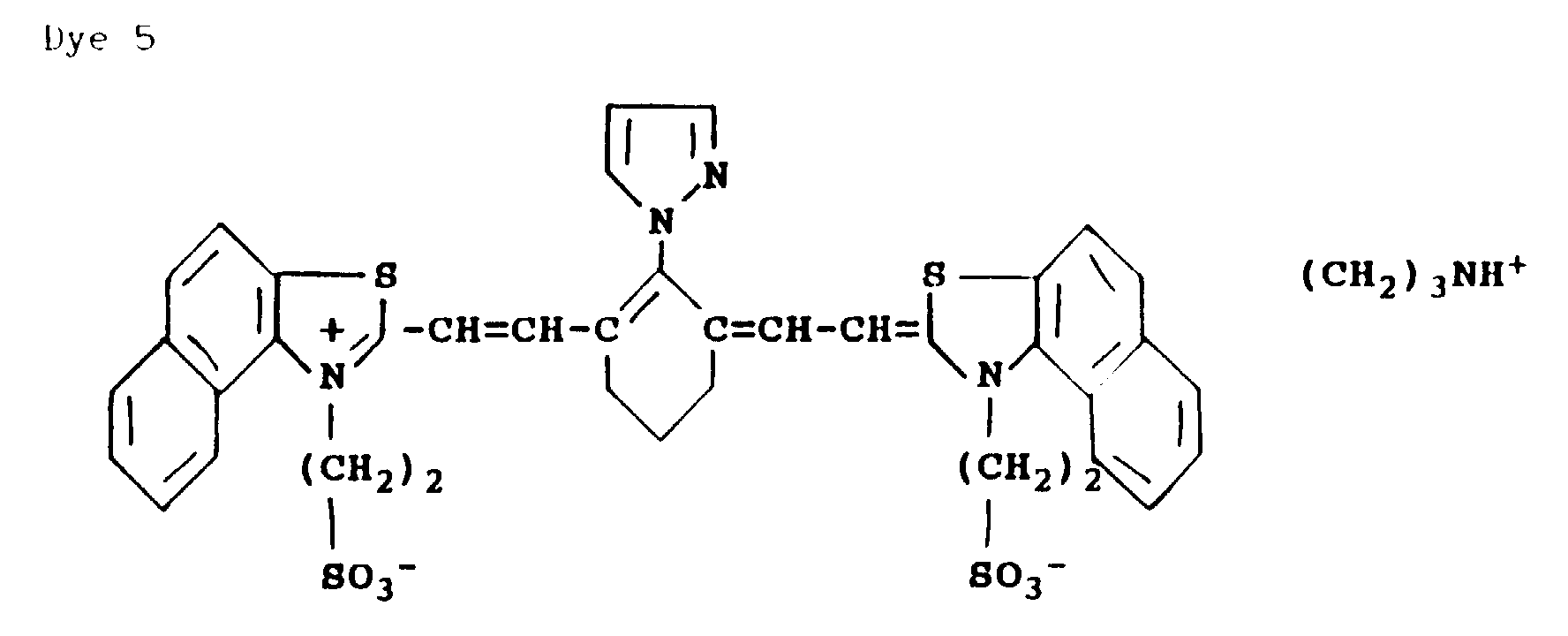
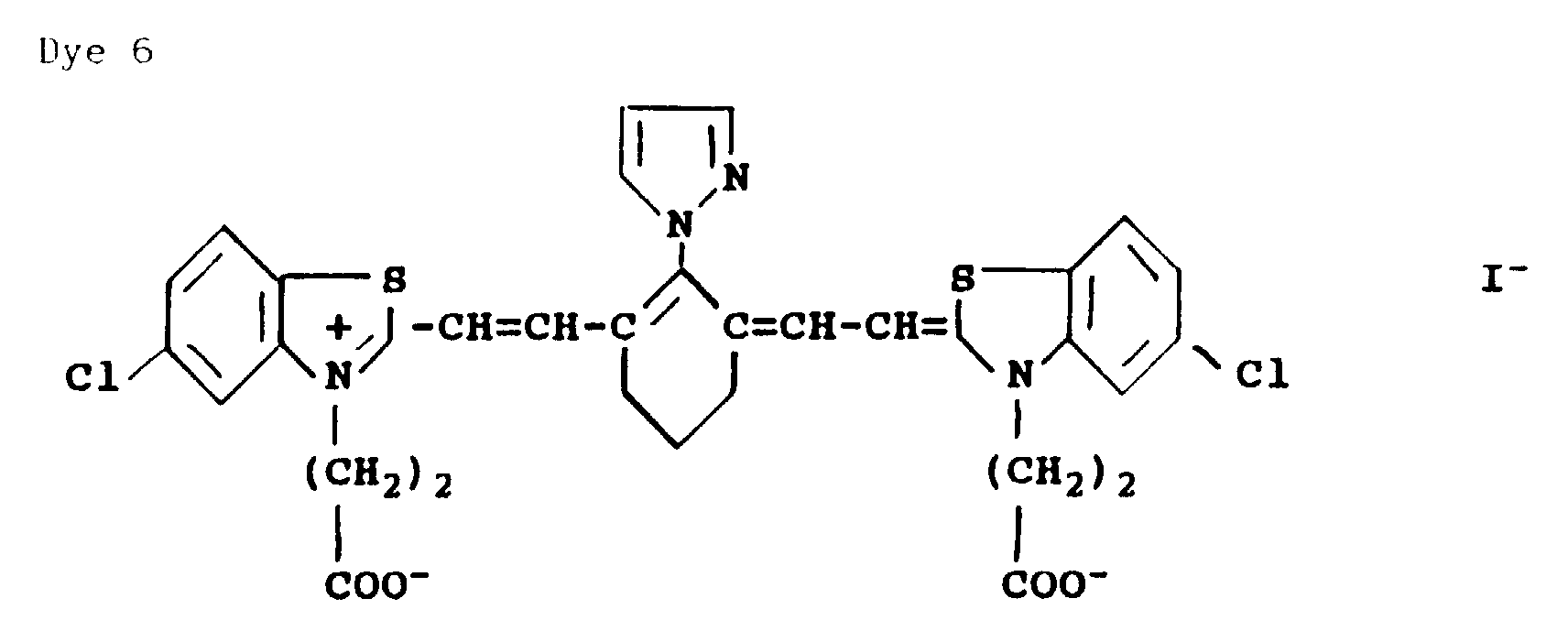
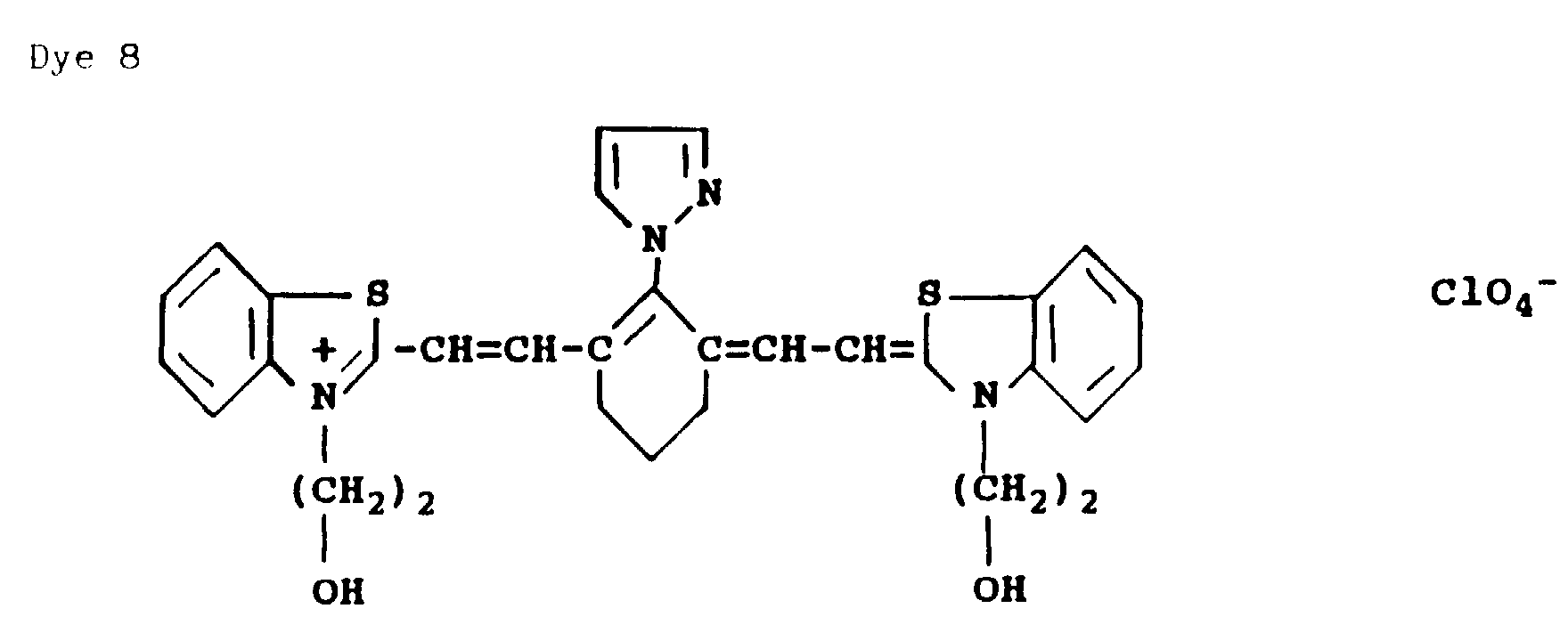
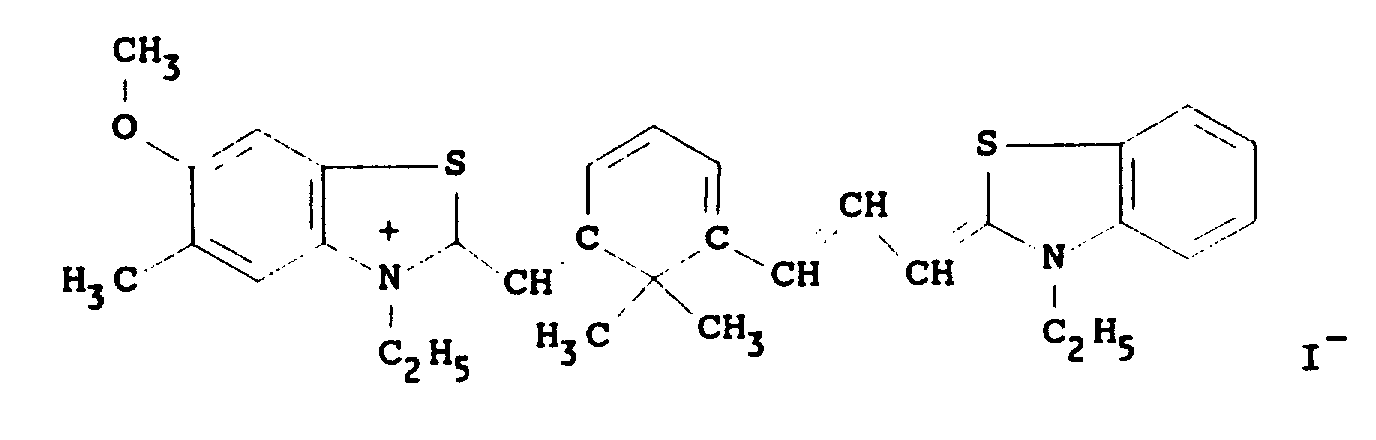
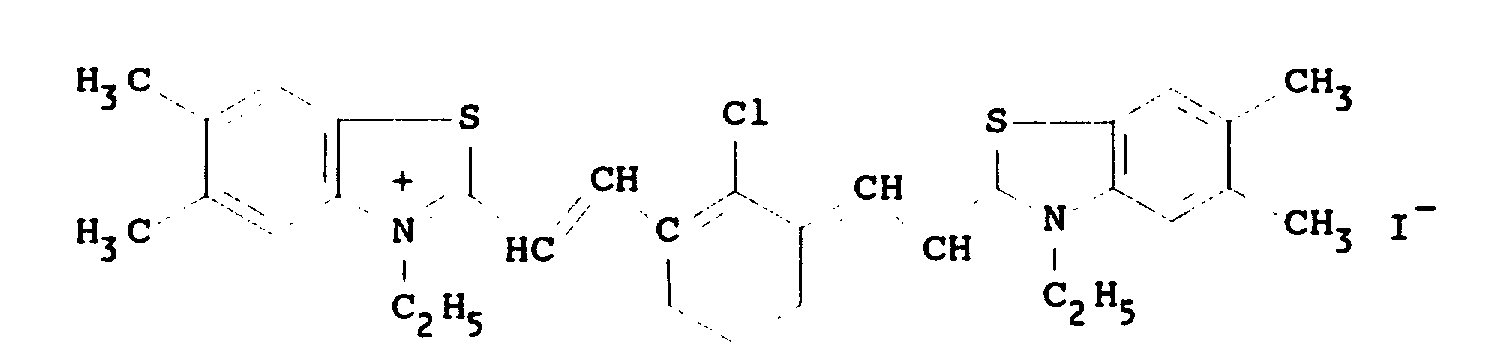
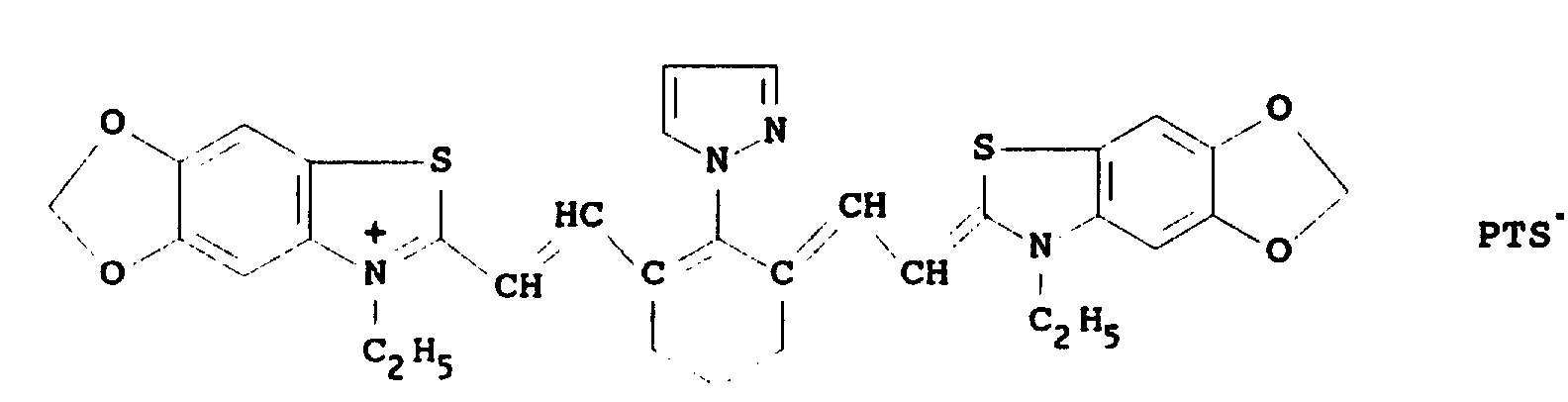
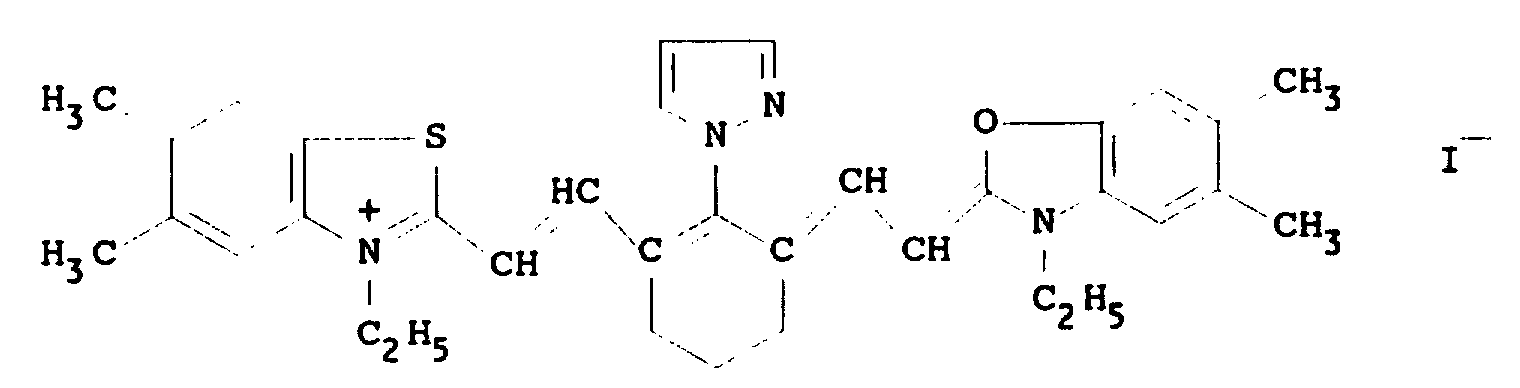
- infrared sensitizing dyes include the following. However, the scope of this invention is not limited to these compounds.
- the tricarbocyanine dyes for use in the present invention can be prepared according to well-known procedures in the art, such those described in James, The Theory of Photographic Processes , MacMillan, 4th Edition, 1977, in US Pat. Nos. 2,734,900, 3,148,187, 2,895,955 and 3,423,207, in CA 56 114571 and J.Org.Chem., Vol 42, 1977, page 885. Synthetic techniques are also described by Y.L.Slominskii et al, UKR. Khim. Zh., 40, pages 625-629, 1974 and Zh.Org.Khim., 15, page 400, 1979. Preparation processes of such dyes are illustrated in the examples herein below. Variations in the structures of the final dyes may be made by the appropriate selection of reagents and the use of these varied methods.
- the tricarbocyanine dyes used in the present invention spectrally sensitize silver halide emulsions to radiation in the infrared from 700 nm upwards, especially from 750 to 850 nm, to provide photographic elements which are particularly suitable with a number of commercially available laser diodes.
- the sensitizing dyes used in this invention exhibit a relatively narrow absorbance spectrum which helps image separation between layers of an element having multiple infrared-sensitive silver halide layers.
- a further important advantage of the dyes used in the present invention is that they exhibit an increased stability of their solutions during keeping.
- the dyes of the present invention find particular utility when used for spectrally sensitizing to infrared radiation a silver halide emulsion layer in photographic elements that include at least one other infrared-sensitive silver halide layer.
- Preferred examples of said photographic elements are those comprising at least three silver halide emulsion layers on a substrate, each associated with different photographic colour image forming materials such as color couplers capable of forming dyes of different colors upon reaction with an oxidised color photographic developer, diffusing dyes, bleachable dyes or oxidizable leuco dyes, the three emulsion layers being sensitized to three different portions of the visible spectrum with at least one layer, preferably at least two layers, sensitized to radiation within the infrared region of the spectrum.
- the infrared sensitizing dyes of the present invention are incorporated in the silver halide photographic emulsion in a content of 5x10 -7 mol to 5x10 -3 mol, preferably 1x10 -6 mol to 1x10 -3 mol, more preferably 2x10 -6 mol to 5x10 -4 mol, per mol of silver within the particular layer which is being sensitized by that dye.
- the infrared sensitizing dyes to be used in the present invention can be directly dispersed in the emulsion. Alternatively, they may be first dissolved in a suitable solvent such as methyl alcohol, ethyl alcohol, methyl cellosolve, acetone, water, pyridine, or a mixture thereof to add them to the emulsion as a solution.
- a suitable solvent such as methyl alcohol, ethyl alcohol, methyl cellosolve, acetone, water, pyridine, or a mixture thereof.
- Processes for adding the infrared sensitizing dyes to the photographic emulsion are described, for example, in US Pat. Nos. 3,469,987, 3,676,147, 3,822,135, 4,199,360, and in US Pat. Nos. 2,912,343, 3,342,605, 2,996,287 and 3,429,835.
- the aforesaid infrared sensitizing dyes may be uniformly dispersed in the silver halide emulsion before coating on a suitable support.
- this dispersing procedure may be conducted in any suitable step of preparing the silver halide emulsion.
- Infrared sensitive silver halide color photographic elements for use in the present invention are preferably those described in US Pat. No. 4,619,892. More preferably, the infrared sensitive silver halide color photographic elements for use in the present invention are those having all of the silver halide emulsion layers sensitized to different infrared regions of the electromagnetic spectrum. The order of these layers respect to the support, the difference in emulsion sensitivity among the layers and the sensitivity, contrast and D-max of each layer are preferably those described in said US Pat. No. 4,619,892.
- any of the various types of photographic silver halide emulsions may be used in the practice of the present invention.
- Silver chloride, silver bromide, silver iodobromide, silver chlorobromide, silver chloroiodobromide, and mixtures thereof may be used, for example, dispersed in a hydrophilic colloid or carrier. Any configuration of grains, cubic, orthorombic, hexagonal, epitaxial, or tabular (high aspect ratio) grains may be used.
- the colloid may be partially hardened or fully hardened by any of the variously known photographic hardeners.
- Such hardeners are free aldehydes, aldehyde releasing compounds, triazines and diazines, aziridines, vinylsulfones, carbodiimides, and the like may be used, sulfones and carbodiimides as described, for example, in US Pat. Nos. 3,232,764, 2,870,013, 3,819,608, 3,325,287, 3,992,366, 3,271,175 and 3,490,911.
- the silver halide photographic elements can be used to form dye images therein through the selective formation of dyes.
- the photographic elements described above for forming silver images can be used to form dye images by employing developers containing dye image formers, such as color couplers, as described, for example, in US Pat. Nos. 3,111,864, 3,002,836, 2,271,238, 2,236,598, 2,950,970, 2,592,243, 2,343,703, 2,376,380, 2,369,489, 2,899,306, 3,152,896, 2,115,394, 2,252,718, 2,108,602, and 3,547,650.
- dye image formers such as color couplers
- the developer contains a color developing agent (e.g., a primary aromatic amine which in its oxidized form is capable of reacting with the coupler to form the image dye).
- a color developing agent e.g., a primary aromatic amine which in its oxidized form is capable of reacting with the coupler to form the image dye.
- instant self-developing diffusion transfer film can be used as well as photothermographic color film or paper using silver halide in catalytic proximity to reducable silver sources and leuco dyes.
- the dye-forming couplers can be incorporated in the photographic elements, as illustrated by Schneider et al., Die Chemie , Vol. 57, 1944, p. 113, and in US Pat. Nos. 2,304,940, 2,269,158, 2,322,027, 2,376,679, 2,801,171, 2,748,141, 2,772,163, 2,835,579, 2,533,514, 2,353,754, 3,409,435 and Chen, Research Disclosure, Vol. 159, July 1977, Item 15930.
- the dye-forming couplers can be incorporated in different amounts to achieve differing photographic effects.
- GB Pat. No. 923,045 and US Pat. No. 3,843,369 teach limiting the concentration of coupler in relation to the silver coverage to less than normally employed amounts in faster and intermediate speed emulsion layers.
- the dye-forming couplers are commonly chosen to form subtractive primary (i.e., yellow, magenta and cyan) image dyes and are nondiffusible, colorless couplers, such as two and four equivalent couplers of the open chain ketomethylene, pyrazolone, pyrazolotriazole, pyrazolobenzimidazole, phenol and naphthol type hydrophobically ballasted for incorporation in high-boiling organic (coupler) solvents.
- Such couplers are illustrated in US Pat. Nos.
- the dye-forming couplers upon coupling can release photo-graphically useful fragments, such as development inhibitors or accelerators, bleach accelerators, developing agents, silver halide sol-vents, toners, hardeners, fogging agents, antifoggants, competing couplers, chemical or spectral sensitizers and desensitizers.
- Development inhibitor-releasing (DIR) couplers are illustrated in US Pat. Nos. 3,148,062, 3,227,554, 3,733,201, 3,617,291, 3,703,375, 3,615,506, 3,265,506, 3,620,745, 3,632,345, 3,869,291, 3,642,485, 3,770,436, 3,808,945, and in GB Pat. Nos.
- Dye-forming couplers and nondye-forming compounds which upon coupling release a variety of photographically useful groups are described in US Pat. No. 4,248,962.
- DIR compounds which do not form dye upon reaction with oxidized color developing agents can be employed, as illustrated in US Pat. Nos. 3,928,041, 3,958,993, 3,961,959, 4,049,455, 4,052,213 and in German OLS Nos. 2,529,350, 2,448,063 and 2,610,546.
- DIR compounds which oxidatively cleave can be employed, as illustrated in US Pat. Nos. 3,379,529, 3,043,690, 3,364,022, 3,297,445 and 3,287,129.
- Silver halide emulsions which are relatively light insensitive, such as Lippmann emulsions, having been used as interlayers or overcoat layers to prevent or control the migration of development inhibitor fragments as described in US Pat. No. 3,892,572 can be employed.
- the photographic elements can incorporate colored dye-forming couplers, such as those employed to form integral masks for negative color images, as illustrated in US Pat. Nos. 2,449,966, 2,521,908, 3,034,892, 3,476,563, 3,519,429, 2,543,691, 3,028,238, 3,061,432, and/or competing couplers, as illustrated in US Pat. Nos. 3,876,428, 3,580,722, 2,998,314, 2,808,329, 2,742,832 and 2,689,793.
- colored dye-forming couplers such as those employed to form integral masks for negative color images, as illustrated in US Pat. Nos. 2,449,966, 2,521,908, 3,034,892, 3,476,563, 3,519,429, 2,543,691, 3,028,238, 3,061,432, and/or competing couplers, as illustrated in US Pat. Nos. 3,876,428, 3,580,722, 2,998,314, 2,808,329, 2,742,832 and 2,689,793.
- the color provided in the image produced by exposure of each of the differently sensitized silver halide emulsion layers does not have to be produced by color coupler reaction with oxidized color developers.
- a number of other color image forming mechanisms well known in the art can also be used.
- the commercially available color image forming mechanisms are the diffusion transfer of dyes, dye-bleaching, and leuco dye oxidation. Each of these procedures is used in commercial products, is well understood by the ordinary skilled photographic artisan, and is used with silver halide emulsions. Multicolor elements using these different technologies are also commercially available.
- the photographic elements can include image dye stabilizers.
- image dye stabilizers are illustrated in US Pat. Nos. 3,432,300, 3,698,909, 3,574,627, 3,573,050, 3,764,337, and 4,042,394 and in GB Pat. No. 1,326,889.
- Filter dyes can be included in the photographic elements. Said dyes must be selected on the basis of their radiation filtering characteristics to insure that they filter the appropriate wavelengths. Filter dyes and their methods of incorporation into the photographic elements are well documented in the literature such as US Pat. Nos. 4,440,852, 3,671,648, 3,423,207, and 2,895,955, GB Pat. No. 485,624, and Research Disclosure, Vol. 176, December 1978, Item 17643. Filter dyes can be used in the practice of the present invention to provide room-light handleability to the elements.
- Dyes which will not allow transmission of radiation having wavelengths shorter than the shortest wavelength to which one of the emulsion layers has been sensitized can be used in a layer above one or more (preferably all) of the emulsion layers.
- the cut-off filter dye preferably does not transmit light more than approximately 50 nm less than the shortest wavelength to which any of the emulsion layers have been sensitized.
- Filter dyes should also be provided with non-fugitive (i.e., non-migratory) characteristics and should be decolorizable (by bleaching in developer or heat, for example) or leachable (e.g., removed by solvent action of any baths).
- photographic addenda such as coating aids, antistatic agents, acutance dyes, antihalation dyes and layers, antifoggants, latent image stabilizers, supersentizers, antikinking agents and high intensity reciprocity failure reducers may also be present.
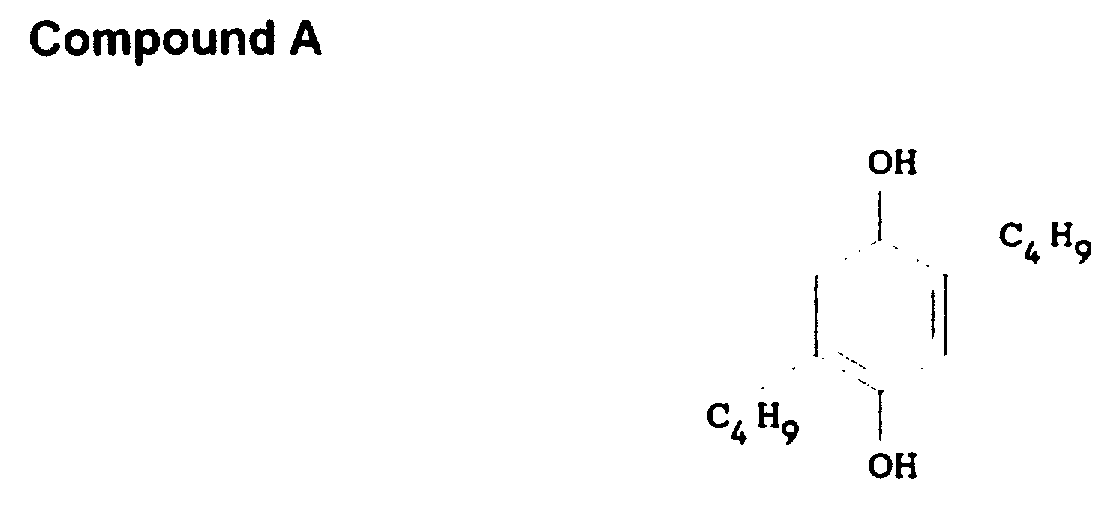
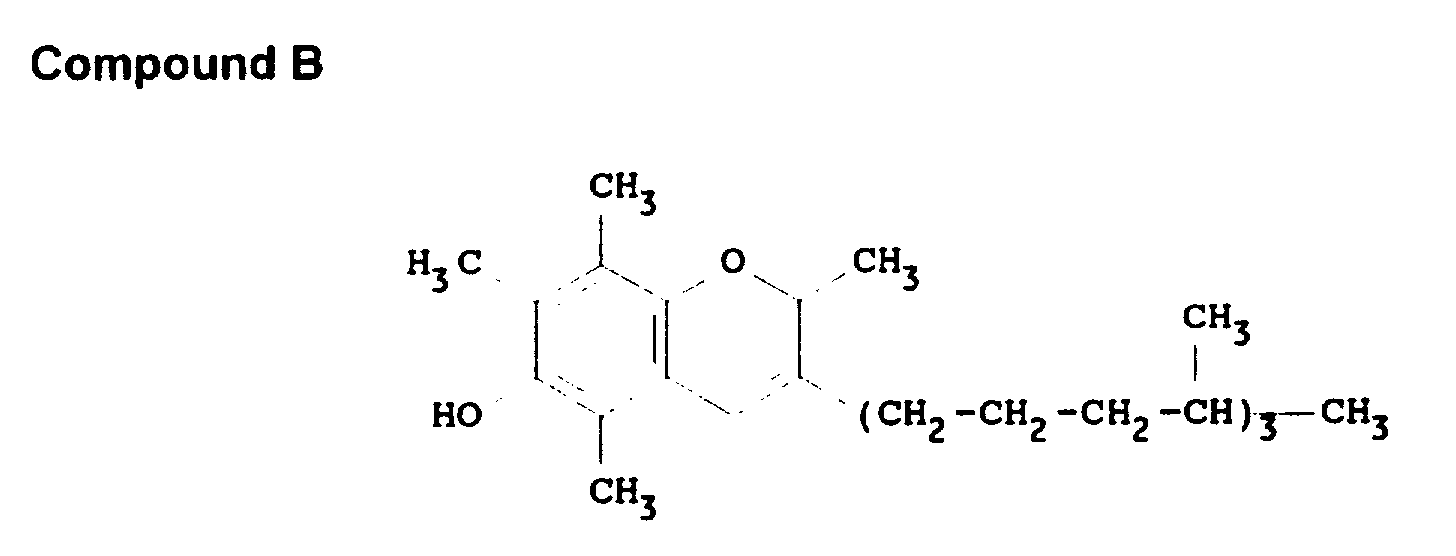
- composition was then maintained at 38°C for 40 minutes. After this time, 1.75 ml of a 0.1% w/w solution in methanol of compound C and a surfactant were added.
- the composition was coated onto a conventional photographic paper base at a coverage of 0.28 g/m 2 .
- the photosensitive layer was overcoated with a protective layer comprising gelatin, a surfactant and a vinylsulfonyl hardener.
- each coating was exposed to an 835 nm laser light at different exposition levels, developed in a Kodak RA-4 processing line and sensitivity was measured by conventional densitometric methods.
- each coating was given 8 seconds exposure on a wedge spectrographic instrument covering a wavelength range from 550 to 950 nm.
- the instrument contained a step tablet ranging in density from 0 to 3 density unit in 0.15 density step and a WrattenTM W29 red filter. From developed images, spectrophotometric curves were generated and the half-band width (HBW) was measured.
- HBW is the width in nanometers of the spectrophotometric curve at one half the difference between maximum density and dye fog. The narrower the HBW, the lower is the unwanted sensitivity in regions of the spectrum other than the emission wavelength of the laser diode and the better color separation between layers of an element having multiple infrared-sensitive layers. Sensitivity (Speed, expressed in logE), wavelength of maximum sensitization (Lambda max, in nanometers) and spectral width (HBW, in nanometers) are reported in the following Table 1: Coating Dye Speed ⁇ max HBW 1 E (Comp.) 2.59 818 135 2 D (Comp.) 1.68 801 48 3 2 (Inv.) 2.64 815 50
- the dye of the present invention results in a higher efficiency of sensitization than the comparison dye (Dye D), and a narrower spectral width than the comparion dye (Dye E).
- the present dyes When compared to other dyes, the present dyes have a substantially better keeping stability in solution.
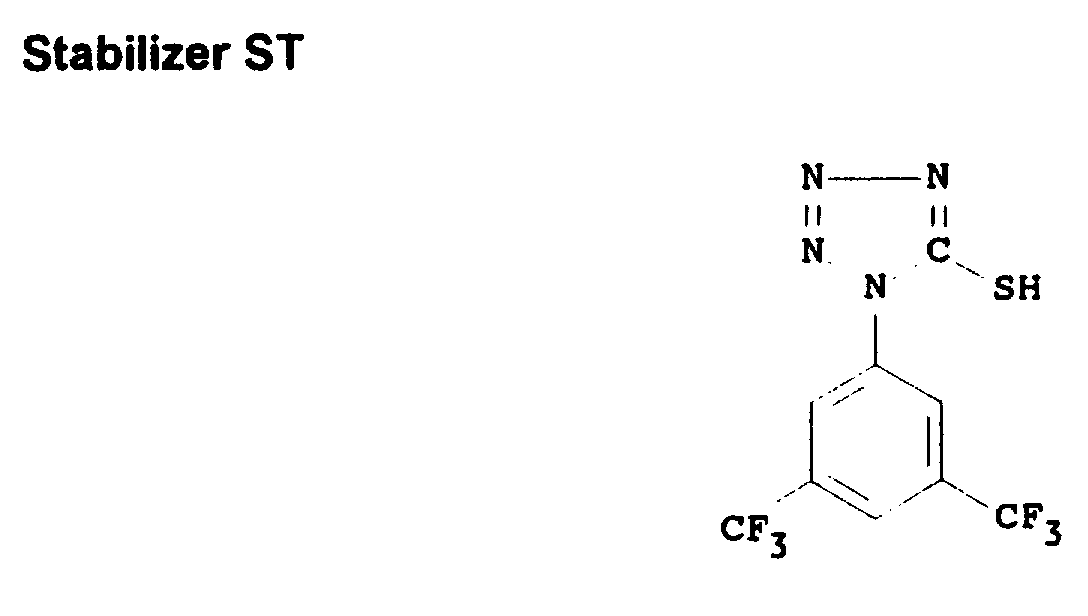
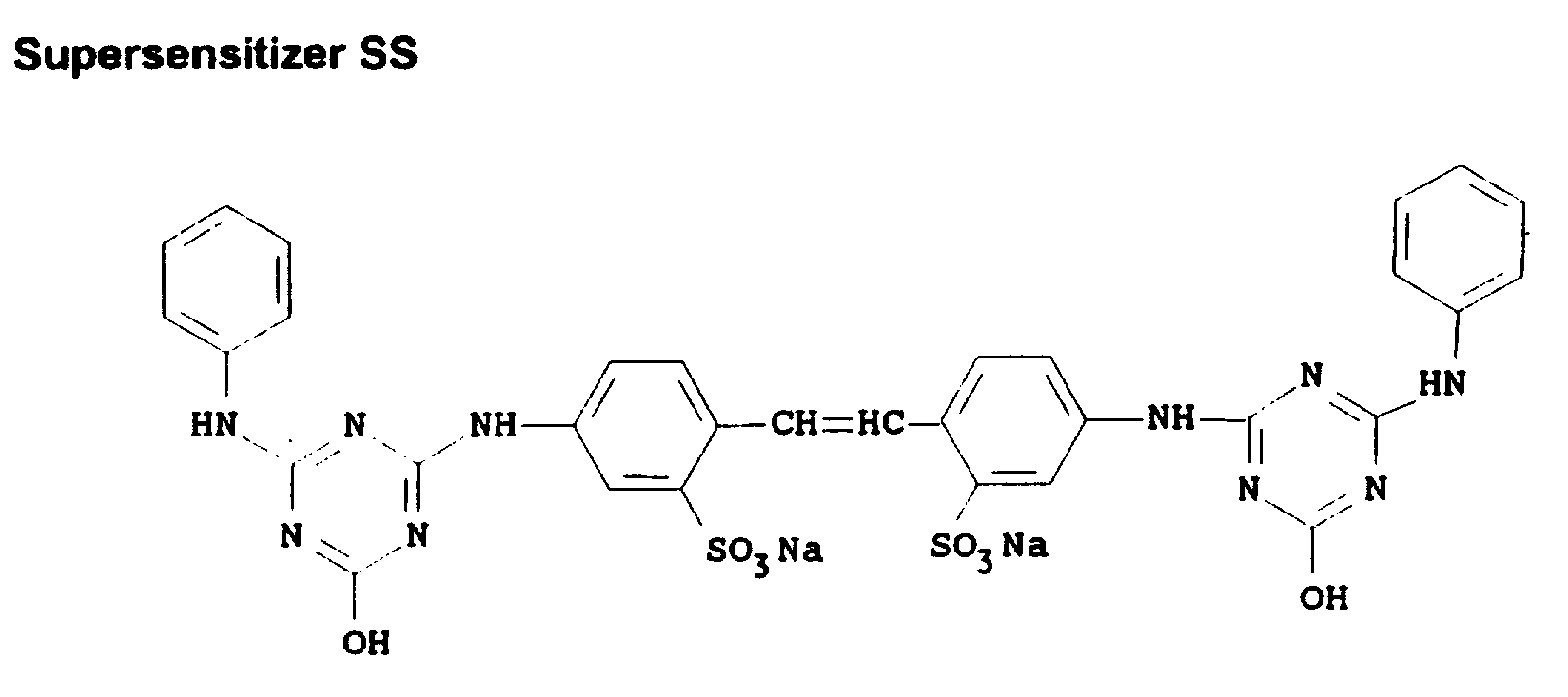
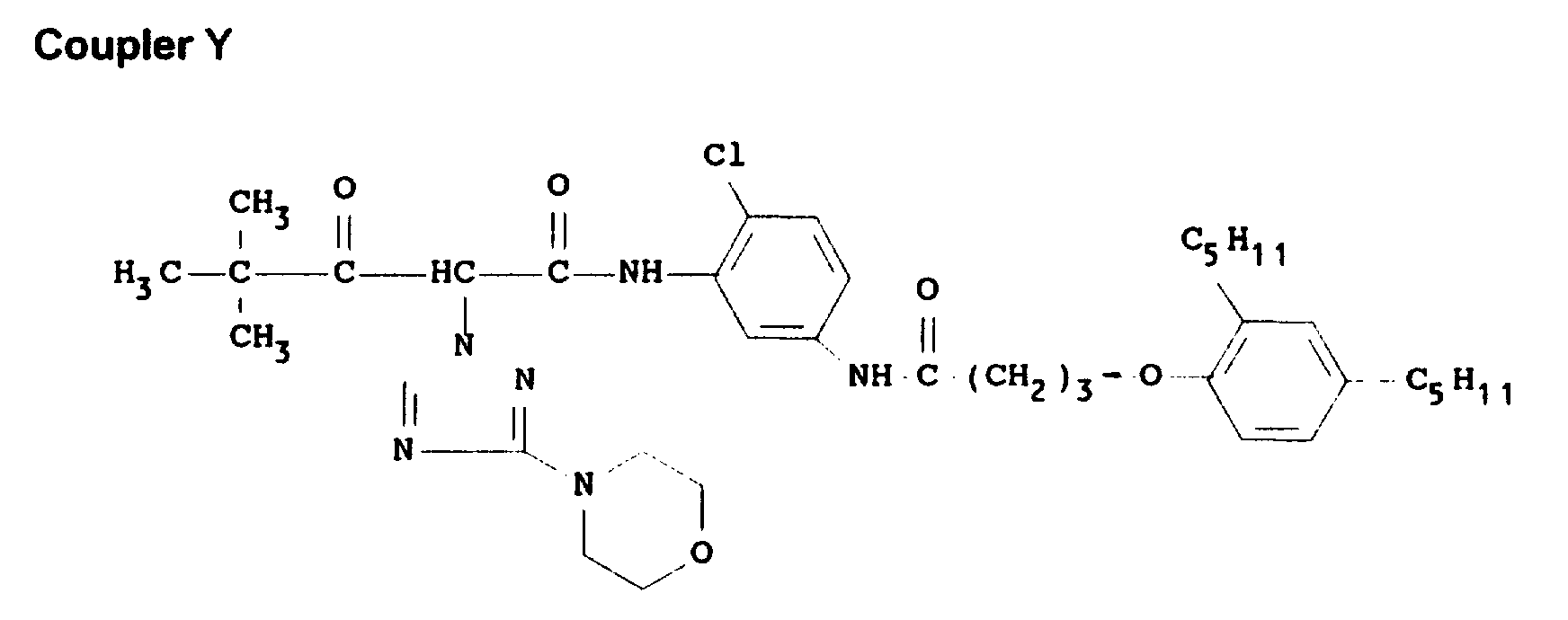
- Sensitizing dyes for laser exposure at 780 nm were evaluated using the same conditions as in Example 3, with the following variations: Sensitizing Dye 0.061 mmole/mole Ag Stabilizer ST 0.91 mmole/mole Ag Supersensitizer SS 1.144 mg/mole Ag Coupler Y 2.05% by weight of the final coating composition Gelatin 4.56% by weight of the final coating composition Ag 1.16% by weight of the final coating composition
- the coating speed was adjusted to obtain a silver coating weight of 0.34 g/m 2 .
- the dye of the invention provide higher sensitivity in the infrared region of the spectrum compared with the prior art dye.
Landscapes
- Chemical & Material Sciences (AREA)
- Physics & Mathematics (AREA)
- Spectroscopy & Molecular Physics (AREA)
- Chemical Kinetics & Catalysis (AREA)
- Engineering & Computer Science (AREA)
- Materials Engineering (AREA)
- General Physics & Mathematics (AREA)
- Organic Chemistry (AREA)
- Silver Salt Photography Or Processing Solution Therefor (AREA)
- Heterocyclic Carbon Compounds Containing A Hetero Ring Having Nitrogen And Oxygen As The Only Ring Hetero Atoms (AREA)
Description







| Coating | Dye | Speed | λmax | HBW |
| 1 | E (Comp.) | 2.59 | 818 | 135 |
| 2 | D (Comp.) | 1.68 | 801 | 48 |
| 3 | 2 (Inv.) | 2.64 | 815 | 50 |

| Dye | Stability (hours) |
| E (comp.) | 36 |
| D (comp.) | 24 |
| F (comp.) | 24 |
| 2 (inv.) | 72 |
| 3 (inv.) | 72 |
| Sensitizing Dye | 0.061 mmole/mole Ag |
| Stabilizer ST | 0.91 mmole/mole Ag |
| Supersensitizer SS | 1.144 mg/mole Ag |
| Coupler Y | 2.05% by weight of the final coating composition |
| Gelatin | 4.56% by weight of the final coating composition |
| Ag | 1.16% by weight of the final coating composition |
| Dye | Speed | λmax |
| G (comp.) | 2.25 | 760 |
| 7 (inv.) | 2.40 | 769 |
Claims (6)
- A silver halide photographic element comprising a support and at least one silver halide emulsion layer, characterised in that said silver halide emulsion layer is spectrally sensitized to infrared radiation with a tricarbocyanine dye having the formula:wherein,
 Z1 and Z2 each independently represents the atoms necessary to complete a substituted or unsubstituted thiazole nucleus or an oxazole nucleus,Z3 represents the atoms necessary to complete a 5-membered N-containing substituted or unsubstituted aromatic ring,Q represents the atoms necessary to complete a 5- or 6- membered substituted or unsubstituted carbocyclic ring,R1 and R2 each independently represents a substituted or unsubstituted alkyl group,X- represents an anion, andn represents an integer of 1 to 2, provided that n is 1 when the dye forms an intramolecular salt.
 - The photographic element of claim 1, further comprising at least one additional silver halide emulsion layer sensitised to infrared radiation and having a maximum sensitivity which is different from the first silver halide emulsion layer.
- The photographic element of claim 1, comprising a support, and on one side of said support at least three silver halide emulsion layers, each of said silver halide emulsion layers being associated with a different colour photographic coupler, each emulsion layer being sensitized to different region of the electromagnetic spectrum and at least two emulsion layers being sensitized to radiation within the infrared region of the electromagnetic spectrum, at least one silver halide emulsion layer being spectrally sensitized with said tricarbocyanine dye.
- The photographic element of claim 1, wherein Z3 represents the atoms necessary to complete a 5-membered N-containing aromatic ring selected in the group consisting of pyrazole, triazole, imidazole and pyrrole.
- The photographic element of claim 1, wherein the tricarbocyanine dye is present in an amount of from 5x10⁻⁷ mol to 5x10⁻³ mol per mol of silver.
- A dye represented by the following formula:wherein,
 Z1 and Z2 each independently represents the atoms necessary to complete a thiazole nucleus or an oxazole nucleus,Z3 represents the atoms necessary to complete a 5-membered N-containing aromatic ring,Q represents the atoms necessary to complete a 5- or 6- membered carbocyclic ring,R1 and R2 each independently represents an alkyl group,X- represents an anion, andn represents an integer of 1 to 2, provided that n is 1 when the dye forms an intramolecular salt.
Applications Claiming Priority (2)
| Application Number | Priority Date | Filing Date | Title |
|---|---|---|---|
| ITMI922499 | 1992-10-30 | ||
| ITMI922499A IT1256604B (en) | 1992-10-30 | 1992-10-30 | SILVER HALIDE PHOTOGRAPHIC ELEMENTS CONTAINING INFRARED SENSITIZING DYES |
Publications (2)
| Publication Number | Publication Date |
|---|---|
| EP0595088A1 EP0595088A1 (en) | 1994-05-04 |
| EP0595088B1 true EP0595088B1 (en) | 1999-01-07 |
Family
ID=11364204
Family Applications (1)
| Application Number | Title | Priority Date | Filing Date |
|---|---|---|---|
| EP93116230A Expired - Lifetime EP0595088B1 (en) | 1992-10-30 | 1993-10-07 | Photographic silver halide elements comprising infrared sensitizing dyes |
Country Status (5)
| Country | Link |
|---|---|
| US (1) | US5441858A (en) |
| EP (1) | EP0595088B1 (en) |
| JP (1) | JP3631261B2 (en) |
| DE (1) | DE69322927T2 (en) |
| IT (1) | IT1256604B (en) |
Families Citing this family (4)
| Publication number | Priority date | Publication date | Assignee | Title |
|---|---|---|---|---|
| US6351663B1 (en) | 1999-09-10 | 2002-02-26 | Akorn, Inc. | Methods for diagnosing and treating conditions associated with abnormal vasculature using fluorescent dye angiography and dye-enhanced photocoagulation |
| US6944493B2 (en) * | 1999-09-10 | 2005-09-13 | Akora, Inc. | Indocyanine green (ICG) compositions and related methods of use |
| US6443976B1 (en) | 1999-11-30 | 2002-09-03 | Akorn, Inc. | Methods for treating conditions and illnesses associated with abnormal vasculature |
| JP6502248B2 (en) * | 2012-05-10 | 2019-04-17 | メルク パテント ゲゼルシャフト ミット ベシュレンクテル ハフツングMerck Patent Gesellschaft mit beschraenkter Haftung | Formulation comprising an ionic organic compound for use in an electron transport layer |
Family Cites Families (17)
| Publication number | Priority date | Publication date | Assignee | Title |
|---|---|---|---|---|
| GB1148493A (en) * | 1965-01-07 | 1969-04-10 | Kodak Ltd | Methine dyestuffs and methods of synthesis therefor |
| US3552974A (en) * | 1966-01-03 | 1971-01-05 | Eastman Kodak Co | Photographic silver halide emulsions containing styryl sensitizing dyes |
| US3482978A (en) * | 1966-08-25 | 1969-12-09 | Eastman Kodak Co | Carbocyanine filter dyes and sensitizers for silver halide emulsions |
| US3623881A (en) * | 1970-03-25 | 1971-11-30 | Eastman Kodak Co | Silver halide emulsions sensitized with tricarbocyanine dyes containing a 1-piperazinyl group |
| US3753721A (en) * | 1970-08-13 | 1973-08-21 | Eastman Kodak Co | Photographic materials |
| US3758461A (en) * | 1971-07-09 | 1973-09-11 | Eastman Kodak Co | Dyes and photographic materials |
| GB1420958A (en) * | 1972-06-30 | 1976-01-14 | Ici Ltd | Photo-polymerisable composition |
| US4011083A (en) * | 1974-12-10 | 1977-03-08 | Eastman Kodak Company | Surface sensitive silver halide emulsion containing a silver complexing azaindene to reduce desensitization of optical sensitizing dye incorporated therein |
| JPS6080841A (en) * | 1983-10-11 | 1985-05-08 | Fuji Photo Film Co Ltd | Photosensitive silver halide material |
| US4619892A (en) * | 1985-03-08 | 1986-10-28 | Minnesota Mining And Manufacturing Company | Color photographic element containing three silver halide layers sensitive to infrared |
| US4914165A (en) * | 1988-02-03 | 1990-04-03 | Minnesota Mining And Manufacturing Company | Radiation crosslinkable compositions |
| US4959294A (en) * | 1988-04-14 | 1990-09-25 | Minnesota Mining And Manufacturing Company | Infra-red sensitising dyes for silver halide |
| CA1337923C (en) * | 1988-07-07 | 1996-01-16 | Richard Lee Parton | Infrared filter dye for photographic element |
| US5061618A (en) * | 1989-09-26 | 1991-10-29 | Eastman Kodak Company | Infrared-sensitive photographic element |
| JPH03171136A (en) * | 1989-11-30 | 1991-07-24 | Fuji Photo Film Co Ltd | Silver halide photographic sensitive material |
| JP2515162B2 (en) * | 1990-02-23 | 1996-07-10 | 富士写真フイルム株式会社 | Methine compound |
| EP0465730B1 (en) * | 1990-07-10 | 1996-06-05 | Agfa-Gevaert N.V. | Photographic infrared sensitized material containing a speed enhancing agent |
-
1992
- 1992-10-30 IT ITMI922499A patent/IT1256604B/en active IP Right Grant
-
1993
- 1993-10-07 EP EP93116230A patent/EP0595088B1/en not_active Expired - Lifetime
- 1993-10-07 DE DE69322927T patent/DE69322927T2/en not_active Expired - Fee Related
- 1993-10-29 JP JP27166093A patent/JP3631261B2/en not_active Expired - Fee Related
-
1994
- 1994-09-06 US US08/302,224 patent/US5441858A/en not_active Expired - Fee Related
Also Published As
| Publication number | Publication date |
|---|---|
| ITMI922499A0 (en) | 1992-10-30 |
| JP3631261B2 (en) | 2005-03-23 |
| JPH06202263A (en) | 1994-07-22 |
| EP0595088A1 (en) | 1994-05-04 |
| DE69322927D1 (en) | 1999-02-18 |
| IT1256604B (en) | 1995-12-12 |
| ITMI922499A1 (en) | 1994-04-30 |
| US5441858A (en) | 1995-08-15 |
| DE69322927T2 (en) | 1999-07-29 |
Similar Documents
| Publication | Publication Date | Title |
|---|---|---|
| US4596767A (en) | Silver halide photographic light-sensitive material | |
| US4046572A (en) | Silver halide photographic light sensitive material | |
| US3988155A (en) | Silver halide photographic emulsion | |
| JP3075538B2 (en) | Infrared sensitive photographic element | |
| EP0271260B1 (en) | Supersensitization of silver halide emulsions | |
| US4873184A (en) | Supersensitization of silver halide photothermographic emulsions | |
| JP3042699B2 (en) | Infrared light-sensitive photographic element containing at least two light-sensitive layers | |
| EP0447647B1 (en) | Infrared sensitive silver halide photographic elements | |
| JPS5852576B2 (en) | silver halide photographic emulsion | |
| US4040841A (en) | Silver halide photographic emulsion | |
| US5441858A (en) | Photographic silver halide elements comprising infrared sensitizing dyes | |
| US4179296A (en) | Silver halide photographic emulsion | |
| US3967967A (en) | Spectrally sensitized silver halide photographic emulsion | |
| US4105454A (en) | Silver halide photographic emulsion spectrally sensitized with merocyanine dyes | |
| EP0369410B1 (en) | Silver halide photographic emulsion | |
| US5543278A (en) | Infrared sensitive silver halide photographic elements | |
| US3985563A (en) | Silver halide photographic emulsion | |
| US4493889A (en) | Silver halide photographic light-sensitive materials | |
| JPS623250A (en) | Silver halide photographic sensitive material | |
| JP2584620B2 (en) | Color photographic light-sensitive material | |
| EP0666496A1 (en) | Photographic silver halide elements comprising infrared sensitizing dyes | |
| EP0644458B1 (en) | Infrared sensitive silver halide phototographic elements | |
| US3977883A (en) | Spectrally sensitized silver halide photographic emulsion | |
| JPH03135553A (en) | Heat developable photosensitive material improved in sharpness | |
| JPS6334538A (en) | Silver halide photographic sensitive material containing merocyanine dyestuff |
Legal Events
| Date | Code | Title | Description |
|---|---|---|---|
| PUAI | Public reference made under article 153(3) epc to a published international application that has entered the european phase |
Free format text: ORIGINAL CODE: 0009012 |
|
| AK | Designated contracting states |
Kind code of ref document: A1 Designated state(s): BE DE FR GB IT NL |
|
| 17P | Request for examination filed |
Effective date: 19941104 |
|
| GRAG | Despatch of communication of intention to grant |
Free format text: ORIGINAL CODE: EPIDOS AGRA |
|
| 17Q | First examination report despatched |
Effective date: 19971212 |
|
| GRAG | Despatch of communication of intention to grant |
Free format text: ORIGINAL CODE: EPIDOS AGRA |
|
| GRAH | Despatch of communication of intention to grant a patent |
Free format text: ORIGINAL CODE: EPIDOS IGRA |
|
| GRAH | Despatch of communication of intention to grant a patent |
Free format text: ORIGINAL CODE: EPIDOS IGRA |
|
| RAP1 | Party data changed (applicant data changed or rights of an application transferred) |
Owner name: IMATION CORP. |
|
| GRAA | (expected) grant |
Free format text: ORIGINAL CODE: 0009210 |
|
| AK | Designated contracting states |
Kind code of ref document: B1 Designated state(s): BE DE FR GB IT NL |
|
| PG25 | Lapsed in a contracting state [announced via postgrant information from national office to epo] |
Ref country code: NL Free format text: LAPSE BECAUSE OF FAILURE TO SUBMIT A TRANSLATION OF THE DESCRIPTION OR TO PAY THE FEE WITHIN THE PRESCRIBED TIME-LIMIT Effective date: 19990107 Ref country code: BE Free format text: LAPSE BECAUSE OF FAILURE TO SUBMIT A TRANSLATION OF THE DESCRIPTION OR TO PAY THE FEE WITHIN THE PRESCRIBED TIME-LIMIT Effective date: 19990107 |
|
| REF | Corresponds to: |
Ref document number: 69322927 Country of ref document: DE Date of ref document: 19990218 |
|
| ET | Fr: translation filed | ||
| ITF | It: translation for a ep patent filed | ||
| NLV1 | Nl: lapsed or annulled due to failure to fulfill the requirements of art. 29p and 29m of the patents act | ||
| PLBE | No opposition filed within time limit |
Free format text: ORIGINAL CODE: 0009261 |
|
| STAA | Information on the status of an ep patent application or granted ep patent |
Free format text: STATUS: NO OPPOSITION FILED WITHIN TIME LIMIT |
|
| 26N | No opposition filed | ||
| PG25 | Lapsed in a contracting state [announced via postgrant information from national office to epo] |
Ref country code: FR Free format text: LAPSE BECAUSE OF NON-PAYMENT OF DUE FEES Effective date: 20000630 |
|
| REG | Reference to a national code |
Ref country code: GB Ref legal event code: 732E |
|
| PG25 | Lapsed in a contracting state [announced via postgrant information from national office to epo] |
Ref country code: DE Free format text: LAPSE BECAUSE OF NON-PAYMENT OF DUE FEES Effective date: 20000801 |
|
| REG | Reference to a national code |
Ref country code: FR Ref legal event code: ST |
|
| REG | Reference to a national code |
Ref country code: GB Ref legal event code: IF02 |
|
| REG | Reference to a national code |
Ref country code: GB Ref legal event code: 732E |
|
| PG25 | Lapsed in a contracting state [announced via postgrant information from national office to epo] |
Ref country code: IT Free format text: LAPSE BECAUSE OF NON-PAYMENT OF DUE FEES;WARNING: LAPSES OF ITALIAN PATENTS WITH EFFECTIVE DATE BEFORE 2007 MAY HAVE OCCURRED AT ANY TIME BEFORE 2007. THE CORRECT EFFECTIVE DATE MAY BE DIFFERENT FROM THE ONE RECORDED. Effective date: 20051007 |
|
| PGFP | Annual fee paid to national office [announced via postgrant information from national office to epo] |
Ref country code: GB Payment date: 20060915 Year of fee payment: 14 |
|
| GBPC | Gb: european patent ceased through non-payment of renewal fee |
Effective date: 20071007 |
|
| PG25 | Lapsed in a contracting state [announced via postgrant information from national office to epo] |
Ref country code: GB Free format text: LAPSE BECAUSE OF NON-PAYMENT OF DUE FEES Effective date: 20071007 |