EP0594806B1 - Composition and method for scavenging oxygen - Google Patents
Composition and method for scavenging oxygen Download PDFInfo
- Publication number
- EP0594806B1 EP0594806B1 EP93908621A EP93908621A EP0594806B1 EP 0594806 B1 EP0594806 B1 EP 0594806B1 EP 93908621 A EP93908621 A EP 93908621A EP 93908621 A EP93908621 A EP 93908621A EP 0594806 B1 EP0594806 B1 EP 0594806B1
- Authority
- EP
- European Patent Office
- Prior art keywords
- dihydrocarbylhydroxylamine
- hydrocarbylhydroxylamine
- boiler
- water
- corrosion
- Prior art date
- Legal status (The legal status is an assumption and is not a legal conclusion. Google has not performed a legal analysis and makes no representation as to the accuracy of the status listed.)
- Expired - Lifetime
Links
Images
Classifications
-
- C—CHEMISTRY; METALLURGY
- C02—TREATMENT OF WATER, WASTE WATER, SEWAGE, OR SLUDGE
- C02F—TREATMENT OF WATER, WASTE WATER, SEWAGE, OR SLUDGE
- C02F5/00—Softening water; Preventing scale; Adding scale preventatives or scale removers to water, e.g. adding sequestering agents
-
- C—CHEMISTRY; METALLURGY
- C02—TREATMENT OF WATER, WASTE WATER, SEWAGE, OR SLUDGE
- C02F—TREATMENT OF WATER, WASTE WATER, SEWAGE, OR SLUDGE
- C02F1/00—Treatment of water, waste water, or sewage
- C02F1/68—Treatment of water, waste water, or sewage by addition of specified substances, e.g. trace elements, for ameliorating potable water
- C02F1/683—Treatment of water, waste water, or sewage by addition of specified substances, e.g. trace elements, for ameliorating potable water by addition of complex-forming compounds
-
- C—CHEMISTRY; METALLURGY
- C02—TREATMENT OF WATER, WASTE WATER, SEWAGE, OR SLUDGE
- C02F—TREATMENT OF WATER, WASTE WATER, SEWAGE, OR SLUDGE
- C02F1/00—Treatment of water, waste water, or sewage
- C02F1/20—Treatment of water, waste water, or sewage by degassing, i.e. liberation of dissolved gases
-
- C—CHEMISTRY; METALLURGY
- C23—COATING METALLIC MATERIAL; COATING MATERIAL WITH METALLIC MATERIAL; CHEMICAL SURFACE TREATMENT; DIFFUSION TREATMENT OF METALLIC MATERIAL; COATING BY VACUUM EVAPORATION, BY SPUTTERING, BY ION IMPLANTATION OR BY CHEMICAL VAPOUR DEPOSITION, IN GENERAL; INHIBITING CORROSION OF METALLIC MATERIAL OR INCRUSTATION IN GENERAL
- C23F—NON-MECHANICAL REMOVAL OF METALLIC MATERIAL FROM SURFACE; INHIBITING CORROSION OF METALLIC MATERIAL OR INCRUSTATION IN GENERAL; MULTI-STEP PROCESSES FOR SURFACE TREATMENT OF METALLIC MATERIAL INVOLVING AT LEAST ONE PROCESS PROVIDED FOR IN CLASS C23 AND AT LEAST ONE PROCESS COVERED BY SUBCLASS C21D OR C22F OR CLASS C25
- C23F11/00—Inhibiting corrosion of metallic material by applying inhibitors to the surface in danger of corrosion or adding them to the corrosive agent
- C23F11/08—Inhibiting corrosion of metallic material by applying inhibitors to the surface in danger of corrosion or adding them to the corrosive agent in other liquids
- C23F11/10—Inhibiting corrosion of metallic material by applying inhibitors to the surface in danger of corrosion or adding them to the corrosive agent in other liquids using organic inhibitors
- C23F11/14—Nitrogen-containing compounds
- C23F11/147—Nitrogen-containing compounds containing a nitrogen-to-oxygen bond
-
- C—CHEMISTRY; METALLURGY
- C02—TREATMENT OF WATER, WASTE WATER, SEWAGE, OR SLUDGE
- C02F—TREATMENT OF WATER, WASTE WATER, SEWAGE, OR SLUDGE
- C02F2303/00—Specific treatment goals
- C02F2303/08—Corrosion inhibition
Definitions
- the present invention relates to a method of inhibiting corrosion in boiler water systems and more particularly to compositions and methods for scavenging oxygen in both low temperature and high temperature areas in boiler-steam condensate systems.
- boiler-steam condensate systems In steam generating systems, boiler water systems, steam lines, steam condensate lines, and the like, hereinafter referred to as boiler-steam condensate systems, one objective of a water treatment program is the removal of dissolved oxygen from the feedwater.
- the removal may be partially accomplished by using either vacuum or thermal deaeration techniques or both.
- complete oxygen removal cannot be effected by these techniques, further removal through the use of chemical oxygen scavenging agents has been a customary practice.
- Sodium sulfite and hydrazine have commonly been used for scavenging oxygen in boilers, hot water plants, etc.
- the use of sodium sulfite introduces solids into the boiler water and hydrazine is a suspect carcinogen.
- these chemicals are not volatile and therefore are not effective in scavenging oxygen in steam and steam condensate lines.
- Hydroxylamines and certain derivatives thereof are not only effective oxygen scavengers, but are also volatile, and have been used to control corrosion of iron and steel surfaces in boiler apparatus caused by dissolved oxygen.
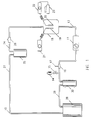
- Figure 1 is a schematic diagram of an apparatus which is useful for evaluating oxygen scavenging activity in a boiler-steam condensate system.
- compositions comprising the combination of N,N-dihydrocarbylhydroxylamine and N-hydrocarbylhydroxylamine.
- a method for inhibiting corrosion in boiler-steam condensate systems which comprises adding to the system at least one water-soluble N,N-dihydrocarbylhydroxylamine and at least one water-soluble N-hydrocarbylhydroxylamine in amounts effective to inhibit corrosion.
- the present invention is directed to the control and inhibition of corrosion caused by the presence of dissolved oxygen in boiler-steam condensate systems. It has now been found that the combination of N,N-dihydrocarbylhydroxylamine and N-hydrocarbylhydroxylamine provide surprisingly enhanced oxygen scavenging effects.
- hydrocarbyl refers to C 1 and C 12 alkyl, hetero or homocycloalkyl or aromatic compounds such as benzyl, phenyl, or tolyl, preferably C 1 to C 4 alkyl compounds.
- N,N-dihydrocarbylhydroxylamine and N-hydrocarbylhydroxylamine have unexpectedly different chemical and physical characteristics.
- N,N-dihydrocarbylhydroxylamines such as N,N-diethylhydroxylamine react with oxygen rather slowly at low temperatures, but possess good stability at high temperatures.
- N-hydrocarbylhydroxylamines such as N-isopropylhydroxylamine are fast reacting at low temperatures, but have relatively low thermal stability.
- N,N-dihydrocarbylhydroxylamines suitable for use in this invention include, but are not limited to, N,N-dimethylhydroxylamine, N,N-diethylhydroxylamine, N-methyl N-ethylhydroxylamine, N,N-dipropylhydroxylamine, N,N,-dibutylhydroxylamine, N-ethyl, N-tolylhydroxylamine, N-N-dibenzylhydroxylamine and the like, and the water soluble salts thereof, and mixtures thereof.
- a preferred N,N-dihydrocarbylhydroxylamine for use in this invention is N,N-diethylhydroxylamine.
- N-hydrocarbylhydroxylamines suitable for use in this invention include, but are not limited to, N-methylhydroxylamine, N-ethylhydroxylamine, N-propylhydroxylamine, N-butylhydroxylamine, N-isopropylhydroxylamine, N-cyclohexylhydroxylamine, N-tert-butylhydroxylamine, N-benzylhydroxylamine, and the like, and mixtures thereof.
- a preferred N-hydrocarbylhydroxylamine for use in this invention is N-isopropylhydroxylamine.
- the dosage amounts of the corrosion inhibiting compositions of the present invention is not per se critical to the invention and can be readily determined by one of ordinary skill in the art by conventional methods. In general, approximately 3 parts per million of hydroxylamine or an equivalent amount of a derivative is needed to remove each part per million of oxygen. Accordingly, an effective dosage amount is relative to the amount of dissolved oxygen in the system to be treated. Normal dosages are in the range of from 0.001 ppm to 500 ppm (as hydroxylamine), preferably from 0.01 to 50 ppm and most preferably from 0.02 to 25 ppm.
- the ratios of N,N-dihydrocarbylhydroxylamine to N-hydrocarbylhydroxylamine can vary widely depending on the nature of the system being treated and the relative concentration of dissolved oxygen in the high temperature and low temperature areas of the boiler-steam condensate system. In general the ratio is from 1:50 to 50:1, preferably 1:10 to 10:1 and most preferably 1:1 N,N-dihydrocarbylhydroxylamine:N-hydrocarbylhydroxylamine on a weight basis.
- the corrosion inhibiting compositions of this invention may be used in combination with other boiler treatment agents including other corrosion inhibitors or oxygen scavengers such as neutralizing amines, hydrazine, sodium sulfite, as well as other known dispersants, chelants, scale inhibitors, and the like, and mixtures thereof.
- other corrosion inhibitors or oxygen scavengers such as neutralizing amines, hydrazine, sodium sulfite, as well as other known dispersants, chelants, scale inhibitors, and the like, and mixtures thereof.
- a particularly preferred embodiment comprises the combination of a neutralizing amine with the N,N-dihydrocarbylhydroxylamines and N-hydrocarbylhydroxylamines.
- the ratio of neutralizing amine to N,N-dihydrocarbylhydroxylamines is generally in the range of from 1:10 to 100:1 on a weight basis.
- the oxygen scavenging activity of the water-soluble N,N-dihydrocarbylhydroxylamines and N-hydrocarbylhydroxylamines of this invention were evaluated under simulated boiler feedwater conditions.
- the apparatus used for this evaluation is depicted schematically in Figure 1.
- the apparatus (10) comprises a peristaltic pump (11) which is used for circulating water throughout the system, pump inlet tubing (12) and pump outlet tubing (13).
- a polyethylene fill-bottle (14) is connected with the inlet tubing and is used to feed system water into the apparatus.
- a valve (15), which may be selectively opened and closed, is provided between the fill-bottle and the inlet tubing and is used to control flow therebetween.
- a temperature measurement chamber (16) is positioned within the pump inlet tubing and contains a thermometer (17) used for monitoring the water temperature.
- the system water is drawn through the inlet tubing, into the pump, and then is pumped via the pump outlet tubing into a glass sampling chamber (18).
- the sampling chamber contains a pH probe (19) and a dissolved oxygen probe (20).
- the pH probe is operably connected to a pH meter (21) used for displaying and monitoring the system water pH; and the dissolved oxygen probe is operably connected to a dissolved oxygen meter (22) used for displaying and monitoring the system water dissolved oxygen level, as well as to a recorder (23) used for continuously recording the dissolved oxygen level in the system water.
- Tubing (24) is provided for directing system water from the glass sampling chamber to the one liter stainless steel preheat reactor (25), known in the laboratory as a "Parr vessel.”
- a glass chemical inlet chamber (26) is positioned within the tubing and may be fitted with a rubber septum (not shown) through which a chemical solution of oxygen scavenger may be injected.
- the preheat reactor contains a heating element (not shown) which may be activated to preheat the system water. Water forced out of the preheat reactor by operation of the pump is directed through tubing (27) to a two liter stainless steel heating reactor (28) where the system water is heated to its highest temperature.
- a heating element and a thermostat are provided for maintaining the water temperature in the heating reactor relatively constant.
- the water from the heating reactor passes through tubing (29) into a water cooled heat exchanger (30) which cools the system water to a range of about 13°C to 16°C (55°F to 60°F).
- System water from the heat exchanger is then recirculated into the pump inlet tubing.
- the recirculated water passing through the pump and into the sampling chamber may be kept at a relatively constant temperature conducive to accurate probe operation.
- the full capacity of the apparatus is about 4.5 liters while the pumping rate of the pump is about 0.30 to 0.35 liters per minute.
- the system was filled to its capacity with water to the substantial exclusion of air, and the water was heated using the preheat reactor and heating reactor until the steady state was achieved at which the temperature of system water leaving the heating reactor, as controlled by the thermostat therein, was 90°C (194°F), and the temperature of the system water leaving the heat exchanger as measured by thermometer was from about 13°C to 16°C (55°F to 60°F).
- gas was allowed to exit from the system through the fill-bottle and the chemical inlet chamber; and the dissolved oxygen level in the circulating water was allowed to equilibrate. Recirculation continued in each run until the oxygen level in the system water remained constant for at least 30 minutes.
- Thermal stability of hydrocarbylhydroxylamine compounds was investigated under boiler temperatures using the Parr pressure vessel. Approximately 1000 ml of a 1000 ppm solution of the compound in distilled water was placed into a 2-liter Parr vessel. The pH of the solution was adjusted to 9 using sodium hydroxide. The vessel was blanketed with nitrogen and was then heated at 200 psig (198°C; 388°F) for two hours, terminated, cooled and sampled. The concentration of the additive before and after autoclaving was analyzed by using gas chromatography. Experimental results are shown below.
- N-hydrocarbylhydroxylamines tested are less stable than N,N-diethylhydroxylamine which is a N,N-dihydrocarbylhydroxylamine at high temperatures.
- Volatile neutralizing amines such as morpholine, diethylaminoethanol and cyclohexylamine, have been used as steam line treatments. However, the use of neutralizing amines can control carbon dioxide only. They are unable to provide protection against oxygen corrosion.
- hydroxylamine compounds are not only effective oxygen scavengers, but also volatile, thus capable of protecting the entire boiler circuit (i.e. water and steam).
- vapor-liquid distribution ratio The volatility of a boiler water treatment in a steam generating system is termed vapor-liquid distribution ratio.
- the vapor-liquid distribution ratio of the hydroxylamine compounds are illustrated in Table 3.
- the experimental procedure for determining the vapor-liquid distribution ratio is described in Materials performance, Vol. 16, No. 5, pages 21-23 (1977).
- a mixture of N,N-diethylhydroxylamine and N-isopropylhydroxylamine (1:1 ratio by weight) was fed to the deaerator storage sections of the 600 psig and 1500 psig boiler systems at a pulp and paper mill.
- the treatment was added at a rate of 12 ppm active. It reduced oxygen levels in the feedwater to 1.5-3 ppb from 3-6 ppb with a conventional oxygen scavenger program.
- the mixture of N,N-diethylhydroxylamine and N-isopropylhydroxylamine reduced iron and copper levels in the feedwater, steam and condensate lines.
Landscapes
- Chemical & Material Sciences (AREA)
- Engineering & Computer Science (AREA)
- Organic Chemistry (AREA)
- Life Sciences & Earth Sciences (AREA)
- Hydrology & Water Resources (AREA)
- Environmental & Geological Engineering (AREA)
- Water Supply & Treatment (AREA)
- Medicinal Chemistry (AREA)
- Health & Medical Sciences (AREA)
- Materials Engineering (AREA)
- Mechanical Engineering (AREA)
- Metallurgy (AREA)
- Preventing Corrosion Or Incrustation Of Metals (AREA)
- Food Preservation Except Freezing, Refrigeration, And Drying (AREA)
- Organic Low-Molecular-Weight Compounds And Preparation Thereof (AREA)
- Anti-Oxidant Or Stabilizer Compositions (AREA)
- Fertilizers (AREA)
Abstract
Description
| Time, Minutes | |||||||
| Hydroxylamine | 0 | 5 | 10 | 15 | 20 | 25 | 30 |
| N-Methyl | 3.3 | 1.8 | 1.0 | 0.7 | 0.5 | 0.4 | 0.3 |
| N-C2H5 | 4.1 | 2.5 | 1.6 | 1.1 | 0.8 | 0.6 | 0.4 |
| N-C3H7 | 5.0 | 3.0 | 2.0 | 1.3 | 1.0 | 0.7 | 0.5 |
| N-(i-C3H7) | 4.8 | 2.2 | 1.1 | 0.7 | 0.5 | 0.4 | 0.3 |
| N-(t-C4H9) | 4.8 | 3.4 | 2.5 | 2.0 | 1.6 | 1.3 | 1.0 |
| N-Cyclohexyl | 4.0 | 3.2 | 2.3 | 1.6 | 1.1 | 0.7 | 0.5 |
| N,N-di-CH3 | 3.7 | 3.3 | 2.9 | 2.6 | 2.4 | 2.2 | 2.0 |
| N,N-di-C2H5 | 5.1 | 4.3 | 3.6 | 3.1 | 2.7 | 2.5 | 2.4 |
| N,N-di-benzyl | 4.7 | 2.9 | 2.5 | 2.2 | 2.0 | 1.9 | 1.8 |
| Concentration (ppm) Before and After Autoclaving at 200 psig (198°C; 388°F) | |||
| ADDITIVE | Before | After | Decomposition, % |
| N,N-Diethylhydroxylamine | 1000 | 1000 | 0 |
| N-Ethylhydroxylamine | 1000 | 0 | 100 |
| N-Propylhydroxylamine | 1000 | 0 | 100 |
| N-Isopropylhydroxylamine | 1000 | 630 | 37 |
| Additive | Vapor-Liquid Distribution Ratio |
| Standard Neutralizing Amines: | |
| Morpholine | 0.48 |
| Diethylaminoethanol | 1.45 |
| Cyclohexylamine | 2.60 |
| Standard Boiler Oxygen Scavengers: | |
| Sodium Sulfite | 0.00 |
| Hydrazine | 0.08 |
| Hydroxylamine Compounds: | |
| N-Methylhydroxylamine | 3.30 |
| N,N-Diethylhydroxylamine | 1.26 |
| N-Isopropylhydroxylamine | 1.20 |
| N-tert-Butylhydroxylamine | 1.30 |
| N-Cyclohexylhydroxylamine | 1.30 |
Claims (11)
- A method of inhibiting corrosion in boiler-steam condensate systems having low temperature areas and high temperature areas comprising adding to the system water-soluble N,N-dihydrocarbylhydroxylamine and N-hydrocarbylhydroxylamine in amounts effective to inhibit corrosion and wherein the weight ratio of N,N-dihydrocarbylhydroxylamine to N-hydrocarbylhydroxylamine is from 50:1 to 1:50.
- A method according to claim 1 wherein the N,N-dihydrocarbylhydroxylamine is N,N-diethylhydroxylamine.
- A method according to claim 1 wherein the N-hydrocarbylhydroxylamine is N-isopropylhydroxylamine.
- A method according to claim 1 wherein the hydroxylamines are added in combination with one or more neutralizing amines.
- A method according to claim 5 wherein the neutralizing amines are selected from the group consisting of cyclohexylamine, morpholine, diethylaminoethanol, dimethylpropanolamine and 2-amino-2-methyl-1-propanol.
- A corrosion inhibiting composition for boiler steam condensation systems comprising a water-soluble N,N-dihydrocarbylhydroxylamine and N-hydrocarbylhydroxylamine in a weight ratio within a range from about 10:1 to about 1:10.
- A corrosion inhibiting composition according to claim 6 wherein the water soluble, N,N-dihydrocarbylhydroxylamine and N-hydrocarbylhydroxylamine are in the ratio of approximately 1:1 by weight.
- A corrosion inhibiting composition according to claims 6 and 8, wherein the N,N-dihydrocarbylhydroxylamine is N,N-diethylhydroxylamine.
- A corrosion inhibiting composition according to claims 6 to 8 wherein the N-hydrocarbylhydroxylamine is N-isopropylhydroxylamine.
- A corrosion inhibiting composition for boiler-steam condensate systems comprising water-soluble N,N-dihydrocarbylhydroxylamine, N-hydrocarbylhydroxylamine and a neutralizing amine; the weight ratio of the N,N-dihydrocarbylhydroxylamine component to the N-hydrocarbylhydroxylamine component being between about 50:1 to about 1:50, and the weight ration of the N,N-dihydrocarbylhydroxylamine component to the neutralizing amine component being between about 10:1 to about 1:100.
- A corrosion inhibiting composition according to Claim 10 wherein the neutralizing amine is selected from the group consisting of cyclohexylamine, morpholine, diethylaminoethanol, dimethylpropanolamine and 2-amino-2-methyl-1-propanol.
Applications Claiming Priority (3)
| Application Number | Priority Date | Filing Date | Title |
|---|---|---|---|
| US07/868,434 US5176849A (en) | 1992-04-15 | 1992-04-15 | Composition and method for scavenging oxygen |
| PCT/US1993/002879 WO1993021361A1 (en) | 1992-04-15 | 1993-03-26 | Composition and method for scavenging oxygen |
| US868434 | 1997-06-03 |
Publications (3)
| Publication Number | Publication Date |
|---|---|
| EP0594806A1 EP0594806A1 (en) | 1994-05-04 |
| EP0594806A4 EP0594806A4 (en) | 1995-08-09 |
| EP0594806B1 true EP0594806B1 (en) | 1998-11-04 |
Family
ID=25351677
Family Applications (1)
| Application Number | Title | Priority Date | Filing Date |
|---|---|---|---|
| EP93908621A Expired - Lifetime EP0594806B1 (en) | 1992-04-15 | 1993-03-26 | Composition and method for scavenging oxygen |
Country Status (18)
| Country | Link |
|---|---|
| US (1) | US5176849A (en) |
| EP (1) | EP0594806B1 (en) |
| JP (1) | JPH0623394A (en) |
| KR (1) | KR100275101B1 (en) |
| CN (1) | CN1042446C (en) |
| AT (1) | ATE173035T1 (en) |
| AU (1) | AU655100B2 (en) |
| CA (1) | CA2092499C (en) |
| CZ (1) | CZ285673B6 (en) |
| DE (1) | DE69321918T2 (en) |
| ES (1) | ES2123643T3 (en) |
| FI (1) | FI935621L (en) |
| MY (1) | MY110358A (en) |
| PL (1) | PL173745B1 (en) |
| SG (1) | SG43104A1 (en) |
| TR (1) | TR27916A (en) |
| WO (1) | WO1993021361A1 (en) |
| ZA (1) | ZA931581B (en) |
Cited By (1)
| Publication number | Priority date | Publication date | Assignee | Title |
|---|---|---|---|---|
| DE102013013121A1 (en) * | 2013-08-07 | 2015-02-12 | Bk Giulini Gmbh | oxygen binder |
Families Citing this family (25)
| Publication number | Priority date | Publication date | Assignee | Title |
|---|---|---|---|---|
| GB2272431B (en) * | 1992-08-17 | 1997-04-09 | Grace W R & Co | Inhibition of corrosion in aqueous systems |
| MX9702676A (en) * | 1994-10-13 | 1998-02-28 | Catachem Inc | Method for minimizing solvent degradation and corrosion in amine solvent treating systems. |
| US5698250A (en) | 1996-04-03 | 1997-12-16 | Tenneco Packaging Inc. | Modifield atmosphere package for cut of raw meat |
| US5928560A (en) | 1996-08-08 | 1999-07-27 | Tenneco Packaging Inc. | Oxygen scavenger accelerator |
| US6395195B1 (en) | 1996-08-08 | 2002-05-28 | Pactiv Corporation | Oxygen scavenger accelerator |
| US6926846B1 (en) | 1996-08-08 | 2005-08-09 | Pactiv Corporation | Methods of using an oxygen scavenger |
| US6054153A (en) | 1998-04-03 | 2000-04-25 | Tenneco Packaging Inc. | Modified atmosphere package with accelerated reduction of oxygen level in meat compartment |
| US6231905B1 (en) | 1998-10-08 | 2001-05-15 | Delduca Gary R. | System and method of making a modified atmosphere package comprising an activated oxygen scavenger for packaging meat |
| US6321509B1 (en) | 1999-06-11 | 2001-11-27 | Pactiv Corporation | Method and apparatus for inserting an oxygen scavenger into a modified atmosphere package |
| US6723255B2 (en) * | 2000-03-07 | 2004-04-20 | Atofina Chemicals, Inc. | Compositions for shortstopping free radical emulsion polymerizations and stabilizing latices made therefrom |
| US20030054074A1 (en) * | 2001-07-25 | 2003-03-20 | Delduca Gary R. | Modified atomsphere packages and methods for making the same |
| US20030054073A1 (en) * | 2001-07-25 | 2003-03-20 | Delduca Gary R. | Modified atmosphere packages and methods for making the same |
| US6669853B2 (en) | 2001-08-09 | 2003-12-30 | Ashland Inc. | Composition for removing dissolved oxygen from a fluid |
| US20060042663A1 (en) * | 2004-08-25 | 2006-03-02 | Baker Hughes Incorporated | Method for removing iron deposits from within closed loop systems |
| US8036409B2 (en) | 2006-08-29 | 2011-10-11 | Onkyo Corporation | Speaker cabinet and speaker using the same |
| US9115431B2 (en) | 2010-01-22 | 2015-08-25 | Midcontinental Chemical | Methods and compositions for reducing stress corrosion cracking |
| US20110180759A1 (en) * | 2010-01-22 | 2011-07-28 | Midcontinental Chemical Company, Inc. | Methods and compositions for reducing stress corrosion cracking |
| CZ302467B6 (en) * | 2010-02-10 | 2011-06-01 | Vysoká škola chemicko-technologická v Praze | Composition for alkalization and anti-corrosive protection of power generating equipment |
| DE102012203003A1 (en) * | 2012-02-28 | 2013-08-29 | Schülke & Mayr GmbH | Liquid preparation for the reduction of free oxygen and the preservation of water |
| EP3169744A1 (en) * | 2014-07-18 | 2017-05-24 | Cabot Microelectronics Corporation | Stabilization of tris(2-hydroxyethyl( methylammonium hydroxide against decomposition with dialkyhydroxylamine |
| CN104591369A (en) * | 2014-12-23 | 2015-05-06 | 南京林业大学 | Composite chemical agent for promoting hydrogen peroxide to produce hydroxyl free radicals and application thereof |
| JP6686591B2 (en) * | 2016-03-22 | 2020-04-22 | 三浦工業株式会社 | Drain collection system |
| EP3861150B1 (en) * | 2018-10-04 | 2025-04-02 | Huntsman Petrochemical LLC | Method of controlling corrosion in an aqueous heat transfer system by the partial decomposition of the morpholine generating agent in the aqueous heat transfer system to form morpholine insitu |
| CN113966271A (en) | 2019-01-26 | 2022-01-21 | 李蓁蓁 | Agent capable of reacting with or removing oxygen molecules |
| EP4077598A1 (en) | 2019-12-20 | 2022-10-26 | BL Technologies, Inc. | Method for minimizing fouling, corrosion, and solvent degradation in low-temperature refinery and natural gas processes |
Family Cites Families (8)
| Publication number | Priority date | Publication date | Assignee | Title |
|---|---|---|---|---|
| US4067690A (en) * | 1976-05-04 | 1978-01-10 | Chemed Corporation | Boiler water treatment |
| US4350606A (en) * | 1980-10-03 | 1982-09-21 | Dearborn Chemical Company | Composition and method for inhibiting corrosion |
| GB2156330B (en) * | 1984-03-06 | 1988-04-07 | Dearborn Chemicals Ltd | Prevention of corrosion in recirculating water systems |
| US4657740A (en) * | 1984-11-21 | 1987-04-14 | Betz Laboratories, Inc. | Method of scavenging oxygen from aqueous mediums |
| US4847001A (en) * | 1987-07-01 | 1989-07-11 | W. R. Grace & Co.-Conn. | Control of corrosion in aqueous systems |
| EP0321219B1 (en) * | 1987-12-14 | 1994-02-23 | W.R. Grace & Co.-Conn. | Hydrogenation of nitroalkanes to hydroxylamines |
| US5094814A (en) * | 1990-06-15 | 1992-03-10 | Nalco Chemical Company | All-volatile multi-functional oxygen and carbon dioxide corrosion control treatment for steam systems |
| US5091108A (en) * | 1991-02-21 | 1992-02-25 | Nalco Chemical Company | Method of retarding corrosion of metal surfaces in contact with boiler water systems which corrosion is caused by dissolved oxygen |
-
1992
- 1992-04-15 US US07/868,434 patent/US5176849A/en not_active Expired - Lifetime
-
1993
- 1993-03-02 AU AU33879/93A patent/AU655100B2/en not_active Ceased
- 1993-03-05 ZA ZA931581A patent/ZA931581B/en unknown
- 1993-03-25 CA CA002092499A patent/CA2092499C/en not_active Expired - Lifetime
- 1993-03-26 EP EP93908621A patent/EP0594806B1/en not_active Expired - Lifetime
- 1993-03-26 SG SG1996003688A patent/SG43104A1/en unknown
- 1993-03-26 WO PCT/US1993/002879 patent/WO1993021361A1/en not_active Ceased
- 1993-03-26 DE DE69321918T patent/DE69321918T2/en not_active Expired - Lifetime
- 1993-03-26 PL PL93301822A patent/PL173745B1/en unknown
- 1993-03-26 ES ES93908621T patent/ES2123643T3/en not_active Expired - Lifetime
- 1993-03-26 CZ CZ932736A patent/CZ285673B6/en not_active IP Right Cessation
- 1993-03-26 AT AT93908621T patent/ATE173035T1/en not_active IP Right Cessation
- 1993-03-26 FI FI935621A patent/FI935621L/en unknown
- 1993-04-06 TR TR00284/93A patent/TR27916A/en unknown
- 1993-04-09 JP JP5105897A patent/JPH0623394A/en active Pending
- 1993-04-13 MY MYPI93000675A patent/MY110358A/en unknown
- 1993-04-13 KR KR1019930006303A patent/KR100275101B1/en not_active Expired - Fee Related
- 1993-04-14 CN CN93104218A patent/CN1042446C/en not_active Expired - Lifetime
Cited By (1)
| Publication number | Priority date | Publication date | Assignee | Title |
|---|---|---|---|---|
| DE102013013121A1 (en) * | 2013-08-07 | 2015-02-12 | Bk Giulini Gmbh | oxygen binder |
Also Published As
| Publication number | Publication date |
|---|---|
| CZ285673B6 (en) | 1999-10-13 |
| TR27916A (en) | 1995-10-12 |
| JPH0623394A (en) | 1994-02-01 |
| DE69321918D1 (en) | 1998-12-10 |
| SG43104A1 (en) | 1997-10-17 |
| EP0594806A1 (en) | 1994-05-04 |
| CN1077731A (en) | 1993-10-27 |
| US5176849A (en) | 1993-01-05 |
| KR100275101B1 (en) | 2000-12-15 |
| PL173745B1 (en) | 1998-04-30 |
| WO1993021361A1 (en) | 1993-10-28 |
| ES2123643T3 (en) | 1999-01-16 |
| DE69321918T2 (en) | 1999-07-29 |
| ATE173035T1 (en) | 1998-11-15 |
| MY110358A (en) | 1998-04-30 |
| KR930021555A (en) | 1993-11-22 |
| CN1042446C (en) | 1999-03-10 |
| CA2092499A1 (en) | 1993-10-16 |
| AU3387993A (en) | 1993-10-21 |
| FI935621A0 (en) | 1993-12-14 |
| EP0594806A4 (en) | 1995-08-09 |
| CA2092499C (en) | 1999-04-06 |
| AU655100B2 (en) | 1994-12-01 |
| CZ273693A3 (en) | 1994-11-16 |
| ZA931581B (en) | 1993-11-11 |
| FI935621A7 (en) | 1993-12-14 |
| FI935621L (en) | 1993-12-14 |
Similar Documents
| Publication | Publication Date | Title |
|---|---|---|
| US5176849A (en) | Composition and method for scavenging oxygen | |
| US4350606A (en) | Composition and method for inhibiting corrosion | |
| US4289645A (en) | Hydroquinone and mu-amine compositions | |
| CA2082234A1 (en) | Method of scavenging oxygen from boiler waters with substituted quinolines | |
| EP0297916B1 (en) | Control of corrosion in aqueous systems | |
| US4487708A (en) | Hydroquinone oxygen scavenger for use in aqueous mediums | |
| US4728497A (en) | Use of aminophenol compounds as oxygen scavengers in an aqueous medium | |
| CA2053814A1 (en) | Method of retarding corrosion of metal surfaces in contact with boiler water systems which corrosion is caused by dissolved oxygen | |
| EP0283243B1 (en) | Control of corrosion in aqueous systems | |
| EP0505633B1 (en) | Hydroxyalkylhydroxylamine oxygen scavengers for use in aqueous media | |
| EP0216586B2 (en) | Stabilized sodium erythorbate and its use as a corrosion inhibitor | |
| US4569783A (en) | Hydroquinone catalyzed oxygen scavenger and methods of use thereof | |
| US6540923B2 (en) | Oxygen scavenger | |
| US4541932A (en) | Hydroquinone catalyzed oxygen scavenger and methods of use thereof | |
| EP4158081B1 (en) | Method for providing corrosion protection to a pressurized water-steam system | |
| EP0787225A1 (en) | Method for minimizing solvent degradation and corrosion in amine solvent treating systems | |
| US4657740A (en) | Method of scavenging oxygen from aqueous mediums | |
| US4693866A (en) | Method of scavenging oxygen from aqueous mediums | |
| US4971718A (en) | Alkanolamine gas treating composition and process | |
| JP2001140086A (en) | Corrosion inhibitor for boiler water circulation system and method for controlling corrosion of boiler water circulation system | |
| US4764354A (en) | Alkanolamine gas treating process for a feedstream containing hydrogen sulfide | |
| US3600125A (en) | Method of utilizing piperidine as a condensate corrosion inhibitor | |
| CA2202468C (en) | Method for minimizing solvent degradation and corrosion in amine solvent treating systems | |
| EP0607738A2 (en) | Aqueous solutions of acrylic polymers | |
| Sendelbach | Boiler-water treatment: why, what and how |
Legal Events
| Date | Code | Title | Description |
|---|---|---|---|
| PUAI | Public reference made under article 153(3) epc to a published international application that has entered the european phase |
Free format text: ORIGINAL CODE: 0009012 |
|
| AK | Designated contracting states |
Kind code of ref document: A1 Designated state(s): AT BE CH DE DK ES FR GB GR IT LI LU MC NL PT SE |
|
| 17P | Request for examination filed |
Effective date: 19940407 |
|
| A4 | Supplementary search report drawn up and despatched | ||
| AK | Designated contracting states |
Kind code of ref document: A4 Designated state(s): AT BE CH DE DK ES FR GB GR IT LI LU MC NL PT SE |
|
| 17Q | First examination report despatched |
Effective date: 19961001 |
|
| RAP1 | Party data changed (applicant data changed or rights of an application transferred) |
Owner name: BETZDEARBORN, INC. |
|
| GRAG | Despatch of communication of intention to grant |
Free format text: ORIGINAL CODE: EPIDOS AGRA |
|
| GRAG | Despatch of communication of intention to grant |
Free format text: ORIGINAL CODE: EPIDOS AGRA |
|
| GRAH | Despatch of communication of intention to grant a patent |
Free format text: ORIGINAL CODE: EPIDOS IGRA |
|
| GRAH | Despatch of communication of intention to grant a patent |
Free format text: ORIGINAL CODE: EPIDOS IGRA |
|
| GRAA | (expected) grant |
Free format text: ORIGINAL CODE: 0009210 |
|
| AK | Designated contracting states |
Kind code of ref document: B1 Designated state(s): AT BE CH DE DK ES FR GB GR IT LI LU MC NL PT SE |
|
| PG25 | Lapsed in a contracting state [announced via postgrant information from national office to epo] |
Ref country code: LI Free format text: LAPSE BECAUSE OF FAILURE TO SUBMIT A TRANSLATION OF THE DESCRIPTION OR TO PAY THE FEE WITHIN THE PRESCRIBED TIME-LIMIT Effective date: 19981104 Ref country code: GR Free format text: LAPSE BECAUSE OF NON-PAYMENT OF DUE FEES Effective date: 19981104 Ref country code: CH Free format text: LAPSE BECAUSE OF FAILURE TO SUBMIT A TRANSLATION OF THE DESCRIPTION OR TO PAY THE FEE WITHIN THE PRESCRIBED TIME-LIMIT Effective date: 19981104 Ref country code: AT Free format text: LAPSE BECAUSE OF FAILURE TO SUBMIT A TRANSLATION OF THE DESCRIPTION OR TO PAY THE FEE WITHIN THE PRESCRIBED TIME-LIMIT Effective date: 19981104 |
|
| REF | Corresponds to: |
Ref document number: 173035 Country of ref document: AT Date of ref document: 19981115 Kind code of ref document: T |
|
| REG | Reference to a national code |
Ref country code: CH Ref legal event code: EP |
|
| REF | Corresponds to: |
Ref document number: 69321918 Country of ref document: DE Date of ref document: 19981210 |
|
| NLR4 | Nl: receipt of corrected translation in the netherlands language at the initiative of the proprietor of the patent | ||
| ET | Fr: translation filed | ||
| REG | Reference to a national code |
Ref country code: ES Ref legal event code: FG2A Ref document number: 2123643 Country of ref document: ES Kind code of ref document: T3 |
|
| PG25 | Lapsed in a contracting state [announced via postgrant information from national office to epo] |
Ref country code: PT Free format text: LAPSE BECAUSE OF FAILURE TO SUBMIT A TRANSLATION OF THE DESCRIPTION OR TO PAY THE FEE WITHIN THE PRESCRIBED TIME-LIMIT Effective date: 19990204 Ref country code: DK Free format text: LAPSE BECAUSE OF FAILURE TO SUBMIT A TRANSLATION OF THE DESCRIPTION OR TO PAY THE FEE WITHIN THE PRESCRIBED TIME-LIMIT Effective date: 19990204 |
|
| REG | Reference to a national code |
Ref country code: CH Ref legal event code: PL |
|
| PLBE | No opposition filed within time limit |
Free format text: ORIGINAL CODE: 0009261 |
|
| STAA | Information on the status of an ep patent application or granted ep patent |
Free format text: STATUS: NO OPPOSITION FILED WITHIN TIME LIMIT |
|
| PG25 | Lapsed in a contracting state [announced via postgrant information from national office to epo] |
Ref country code: MC Free format text: LAPSE BECAUSE OF NON-PAYMENT OF DUE FEES Effective date: 19990930 |
|
| 26N | No opposition filed | ||
| REG | Reference to a national code |
Ref country code: GB Ref legal event code: IF02 |
|
| PGFP | Annual fee paid to national office [announced via postgrant information from national office to epo] |
Ref country code: LU Payment date: 20030321 Year of fee payment: 11 |
|
| PGFP | Annual fee paid to national office [announced via postgrant information from national office to epo] |
Ref country code: BE Payment date: 20030401 Year of fee payment: 11 |
|
| PGFP | Annual fee paid to national office [announced via postgrant information from national office to epo] |
Ref country code: ES Payment date: 20030408 Year of fee payment: 11 |
|
| PG25 | Lapsed in a contracting state [announced via postgrant information from national office to epo] |
Ref country code: LU Free format text: LAPSE BECAUSE OF NON-PAYMENT OF DUE FEES Effective date: 20040326 |
|
| PG25 | Lapsed in a contracting state [announced via postgrant information from national office to epo] |
Ref country code: ES Free format text: LAPSE BECAUSE OF NON-PAYMENT OF DUE FEES Effective date: 20040327 |
|
| PG25 | Lapsed in a contracting state [announced via postgrant information from national office to epo] |
Ref country code: BE Free format text: LAPSE BECAUSE OF NON-PAYMENT OF DUE FEES Effective date: 20040331 |
|
| BERE | Be: lapsed |
Owner name: *BETZDEARBORN INC. Effective date: 20040331 |
|
| REG | Reference to a national code |
Ref country code: ES Ref legal event code: FD2A Effective date: 20040327 |
|
| PGFP | Annual fee paid to national office [announced via postgrant information from national office to epo] |
Ref country code: FR Payment date: 20120406 Year of fee payment: 20 |
|
| PGFP | Annual fee paid to national office [announced via postgrant information from national office to epo] |
Ref country code: GB Payment date: 20120326 Year of fee payment: 20 Ref country code: IT Payment date: 20120327 Year of fee payment: 20 Ref country code: SE Payment date: 20120328 Year of fee payment: 20 |
|
| PGFP | Annual fee paid to national office [announced via postgrant information from national office to epo] |
Ref country code: NL Payment date: 20120329 Year of fee payment: 20 Ref country code: DE Payment date: 20120328 Year of fee payment: 20 |
|
| REG | Reference to a national code |
Ref country code: DE Ref legal event code: R071 Ref document number: 69321918 Country of ref document: DE |
|
| REG | Reference to a national code |
Ref country code: NL Ref legal event code: V4 Effective date: 20130326 |
|
| REG | Reference to a national code |
Ref country code: GB Ref legal event code: PE20 Expiry date: 20130325 |
|
| PG25 | Lapsed in a contracting state [announced via postgrant information from national office to epo] |
Ref country code: GB Free format text: LAPSE BECAUSE OF EXPIRATION OF PROTECTION Effective date: 20130325 Ref country code: DE Free format text: LAPSE BECAUSE OF EXPIRATION OF PROTECTION Effective date: 20130327 |
|
| REG | Reference to a national code |
Ref country code: SE Ref legal event code: EUG |