EP0594000B1 - Substituted (pyridinylamino)-benzisoxazoles and benzoisothiazole a process for their preparation and their use as medicaments - Google Patents
Substituted (pyridinylamino)-benzisoxazoles and benzoisothiazole a process for their preparation and their use as medicaments Download PDFInfo
- Publication number
- EP0594000B1 EP0594000B1 EP93116316A EP93116316A EP0594000B1 EP 0594000 B1 EP0594000 B1 EP 0594000B1 EP 93116316 A EP93116316 A EP 93116316A EP 93116316 A EP93116316 A EP 93116316A EP 0594000 B1 EP0594000 B1 EP 0594000B1
- Authority
- EP
- European Patent Office
- Prior art keywords
- compound
- formula
- alkyl
- hydrogen
- amino
- Prior art date
- Legal status (The legal status is an assumption and is not a legal conclusion. Google has not performed a legal analysis and makes no representation as to the accuracy of the status listed.)
- Expired - Lifetime
Links
Classifications
-
- C—CHEMISTRY; METALLURGY
- C07—ORGANIC CHEMISTRY
- C07D—HETEROCYCLIC COMPOUNDS
- C07D413/00—Heterocyclic compounds containing two or more hetero rings, at least one ring having nitrogen and oxygen atoms as the only ring hetero atoms
- C07D413/02—Heterocyclic compounds containing two or more hetero rings, at least one ring having nitrogen and oxygen atoms as the only ring hetero atoms containing two hetero rings
- C07D413/12—Heterocyclic compounds containing two or more hetero rings, at least one ring having nitrogen and oxygen atoms as the only ring hetero atoms containing two hetero rings linked by a chain containing hetero atoms as chain links
-
- A—HUMAN NECESSITIES
- A61—MEDICAL OR VETERINARY SCIENCE; HYGIENE
- A61P—SPECIFIC THERAPEUTIC ACTIVITY OF CHEMICAL COMPOUNDS OR MEDICINAL PREPARATIONS
- A61P1/00—Drugs for disorders of the alimentary tract or the digestive system
- A61P1/08—Drugs for disorders of the alimentary tract or the digestive system for nausea, cinetosis or vertigo; Antiemetics
-
- A—HUMAN NECESSITIES
- A61—MEDICAL OR VETERINARY SCIENCE; HYGIENE
- A61P—SPECIFIC THERAPEUTIC ACTIVITY OF CHEMICAL COMPOUNDS OR MEDICINAL PREPARATIONS
- A61P25/00—Drugs for disorders of the nervous system
- A61P25/18—Antipsychotics, i.e. neuroleptics; Drugs for mania or schizophrenia
-
- A—HUMAN NECESSITIES
- A61—MEDICAL OR VETERINARY SCIENCE; HYGIENE
- A61P—SPECIFIC THERAPEUTIC ACTIVITY OF CHEMICAL COMPOUNDS OR MEDICINAL PREPARATIONS
- A61P25/00—Drugs for disorders of the nervous system
- A61P25/20—Hypnotics; Sedatives
-
- A—HUMAN NECESSITIES
- A61—MEDICAL OR VETERINARY SCIENCE; HYGIENE
- A61P—SPECIFIC THERAPEUTIC ACTIVITY OF CHEMICAL COMPOUNDS OR MEDICINAL PREPARATIONS
- A61P25/00—Drugs for disorders of the nervous system
- A61P25/24—Antidepressants
-
- A—HUMAN NECESSITIES
- A61—MEDICAL OR VETERINARY SCIENCE; HYGIENE
- A61P—SPECIFIC THERAPEUTIC ACTIVITY OF CHEMICAL COMPOUNDS OR MEDICINAL PREPARATIONS
- A61P25/00—Drugs for disorders of the nervous system
- A61P25/26—Psychostimulants, e.g. nicotine, cocaine
-
- A—HUMAN NECESSITIES
- A61—MEDICAL OR VETERINARY SCIENCE; HYGIENE
- A61P—SPECIFIC THERAPEUTIC ACTIVITY OF CHEMICAL COMPOUNDS OR MEDICINAL PREPARATIONS
- A61P25/00—Drugs for disorders of the nervous system
- A61P25/28—Drugs for disorders of the nervous system for treating neurodegenerative disorders of the central nervous system, e.g. nootropic agents, cognition enhancers, drugs for treating Alzheimer's disease or other forms of dementia
-
- C—CHEMISTRY; METALLURGY
- C07—ORGANIC CHEMISTRY
- C07D—HETEROCYCLIC COMPOUNDS
- C07D401/00—Heterocyclic compounds containing two or more hetero rings, having nitrogen atoms as the only ring hetero atoms, at least one ring being a six-membered ring with only one nitrogen atom
- C07D401/02—Heterocyclic compounds containing two or more hetero rings, having nitrogen atoms as the only ring hetero atoms, at least one ring being a six-membered ring with only one nitrogen atom containing two hetero rings
- C07D401/12—Heterocyclic compounds containing two or more hetero rings, having nitrogen atoms as the only ring hetero atoms, at least one ring being a six-membered ring with only one nitrogen atom containing two hetero rings linked by a chain containing hetero atoms as chain links
-
- C—CHEMISTRY; METALLURGY
- C07—ORGANIC CHEMISTRY
- C07D—HETEROCYCLIC COMPOUNDS
- C07D409/00—Heterocyclic compounds containing two or more hetero rings, at least one ring having sulfur atoms as the only ring hetero atoms
- C07D409/02—Heterocyclic compounds containing two or more hetero rings, at least one ring having sulfur atoms as the only ring hetero atoms containing two hetero rings
- C07D409/12—Heterocyclic compounds containing two or more hetero rings, at least one ring having sulfur atoms as the only ring hetero atoms containing two hetero rings linked by a chain containing hetero atoms as chain links
-
- C—CHEMISTRY; METALLURGY
- C07—ORGANIC CHEMISTRY
- C07D—HETEROCYCLIC COMPOUNDS
- C07D413/00—Heterocyclic compounds containing two or more hetero rings, at least one ring having nitrogen and oxygen atoms as the only ring hetero atoms
- C07D413/02—Heterocyclic compounds containing two or more hetero rings, at least one ring having nitrogen and oxygen atoms as the only ring hetero atoms containing two hetero rings
- C07D413/10—Heterocyclic compounds containing two or more hetero rings, at least one ring having nitrogen and oxygen atoms as the only ring hetero atoms containing two hetero rings linked by a carbon chain containing aromatic rings
-
- C—CHEMISTRY; METALLURGY
- C07—ORGANIC CHEMISTRY
- C07D—HETEROCYCLIC COMPOUNDS
- C07D417/00—Heterocyclic compounds containing two or more hetero rings, at least one ring having nitrogen and sulfur atoms as the only ring hetero atoms, not provided for by group C07D415/00
- C07D417/02—Heterocyclic compounds containing two or more hetero rings, at least one ring having nitrogen and sulfur atoms as the only ring hetero atoms, not provided for by group C07D415/00 containing two hetero rings
- C07D417/12—Heterocyclic compounds containing two or more hetero rings, at least one ring having nitrogen and sulfur atoms as the only ring hetero atoms, not provided for by group C07D415/00 containing two hetero rings linked by a chain containing hetero atoms as chain links
Definitions
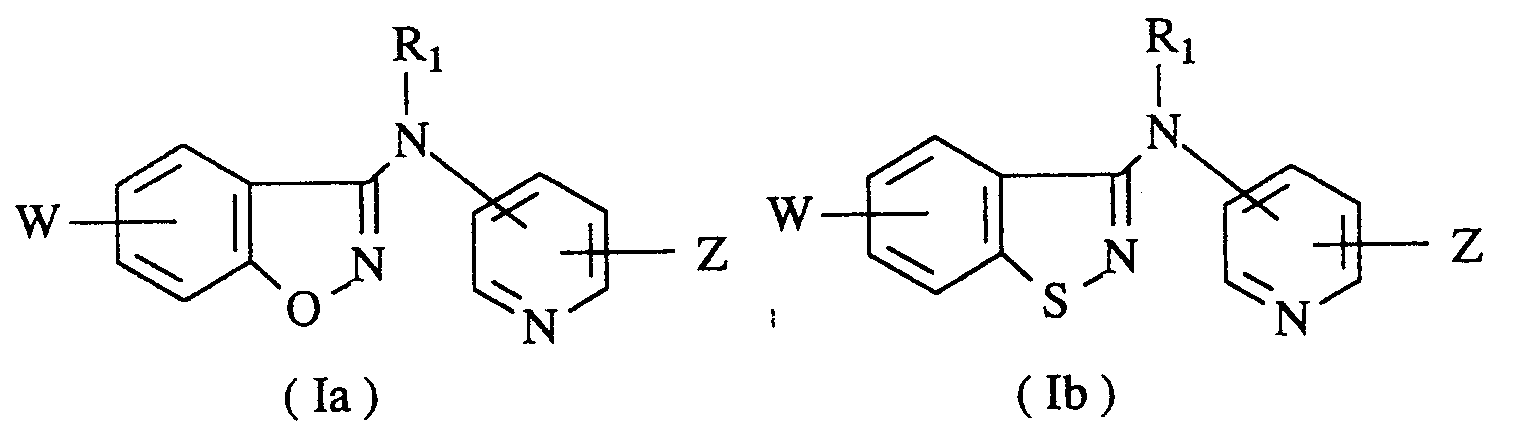
- the present invention relates to compounds of the formula, where
- loweralkyl or (C 1 -C 6 )alkyl shall mean a straight or branched alkyl group having from 1 to 6 carbon atoms.
- Examples of said loweralkyl or (C 1 -C 6 )alkyl include methyl, ethyl, n-propyl, iso-propyl, n-butyl, iso-butyl, sec-butyl, t-butyl and straight-and branched-chain pentyl and hexyl.
- halogen shall mean fluorine, chlorine, bromine or iodine.
- aryl or phenyl shall mean a phenyl group substituted with 0, 1 or 2 substituents each of which being independently loweralkyl, loweralkoxy, loweralkylcarbonyl, halogen or trifluoromethyl.
- cycloalkyl or cyclo(C 3 -C 8 )alkyl shall mean a cycloalkyl group of 3 to 8 carbon atoms.
- the compounds of this invention are prepared by utilizing one or more of the synthetic steps described below.
- the starting 3-amino-1 ,2-benzisoxazoles of Formula II can be prepared by utilizing various methods known to the art. Thus, for instance, one can prepare compounds I by the procedure outlined below, described in Shutske and Kapples, J. Heterocyclic Chem., 26 , 1293 (1989).
- 3-Amino-1,2-benzisothiazole of Formula IIIa is known to the art.
- This compound can be synthesized by various methods known to the art. See, for instance, Böshagen U.S. Patent 3,692,795; Fleig et al, U.S. Patent 4,140,692; and British Patent 1,249,459.
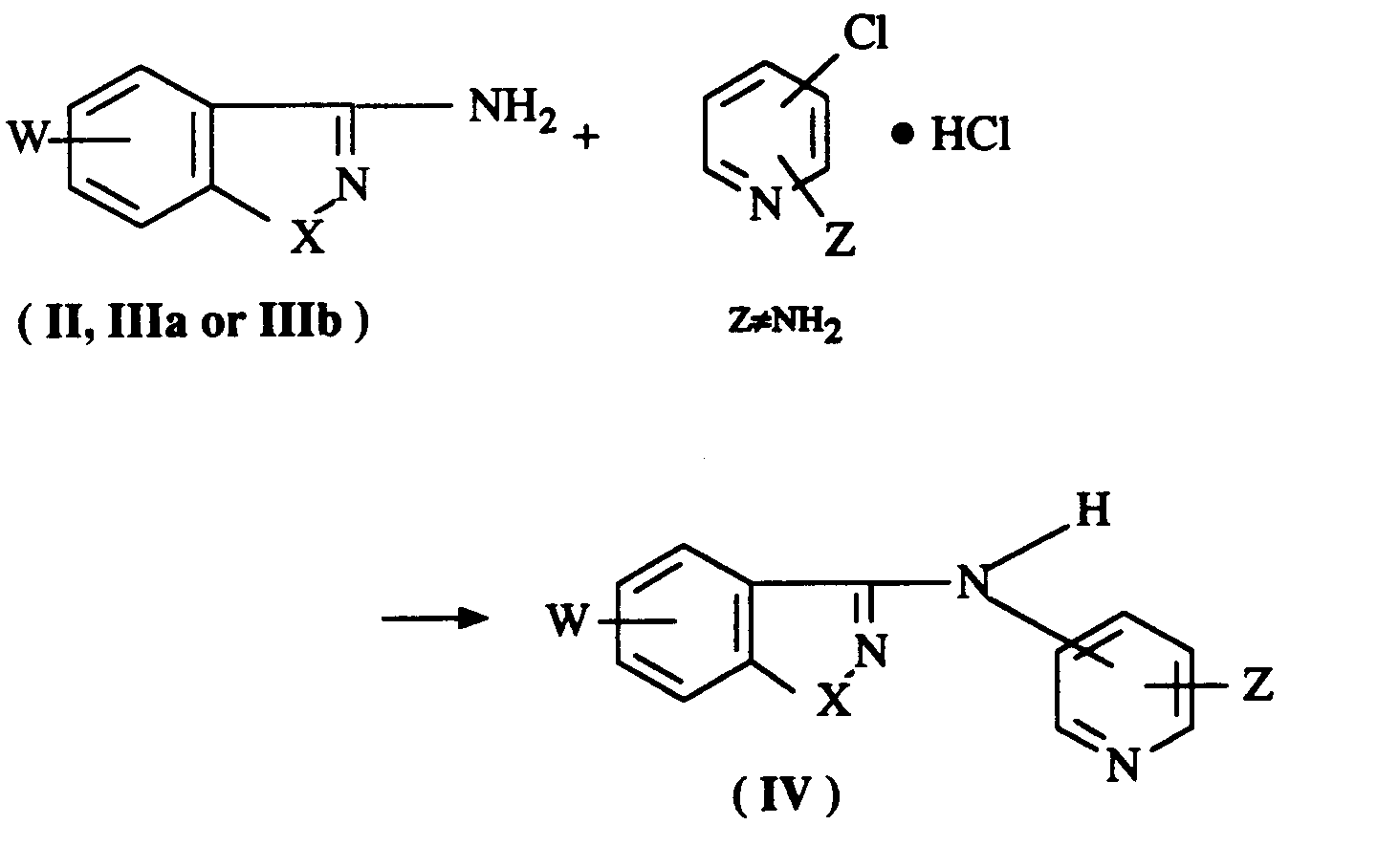
- a compound of Formula II, IIIa or IIIb which is prepared with the aid of one of the synthetic routes described above is allowed to react with a chloropyridine hydrochloride to afford a compound of Formula IV.
- Said reaction is typically conducted in an ethereal solvent such as bis(2-methoxyethyl)ether, diethyl ether, dimethoxyethane, dioxane or tetrahydrofuran or polar aprotic solvent such as dimethylformamide, dimethylacetamide, N-methyl-2-pyrrolidone, hexamethylphosphoramide or dimethylsulfoxide or protic solvent such as ethanol or isopropanol at a temperature of between about 20°C and 150°C.
- an ethereal solvent such as bis(2-methoxyethyl)ether, diethyl ether, dimethoxyethane, dioxane or tetrahydrofuran or polar aprotic solvent such as dimethylformamide, dimethylacetamide, N-methyl-2-pyrrolidone, hexamethylphosphoramide or dimethylsulfoxide or protic solvent such as ethanol or isopropanol at a temperature of between
- Compound IV is allowed to react with a loweralkyl chloroformate of the formula Cl-CO-OR 8 where R 8 is loweralkyl to afford a compound of Formula V.
- Said reaction is conducted typically in a suitable solvent such as dichloromethane in the presence of a suitable base such as sodium bicarbonate or triethylamine at a temperature of about 20-60°C.
- Compound IV is allowed to react with a halide compound of the formula R 9 -Hal, where R 9 is loweralkyl, loweralkenyl, loweralkynyl or arylloweralkyl,at a temperature of about -10°C-80°C, preferably between 0°C-25°C to afford a compound of Formula XV.
- Said reaction is conducted typically in a suitable solvent such as dimethylformamide, dimethylsulfoxide, ethereal solvents or aromatic hydrocarbon in the presence of a suitable base such as sodium or potassium hydride or potassium-t-butoxide.
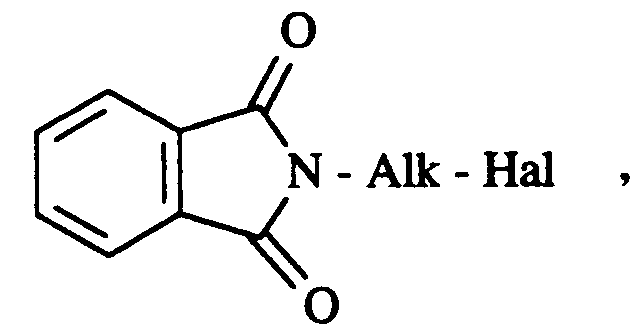
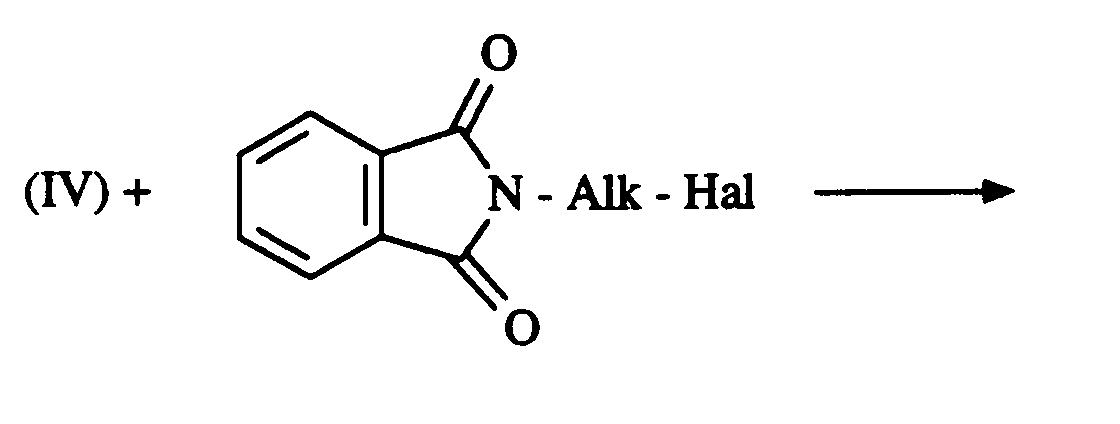
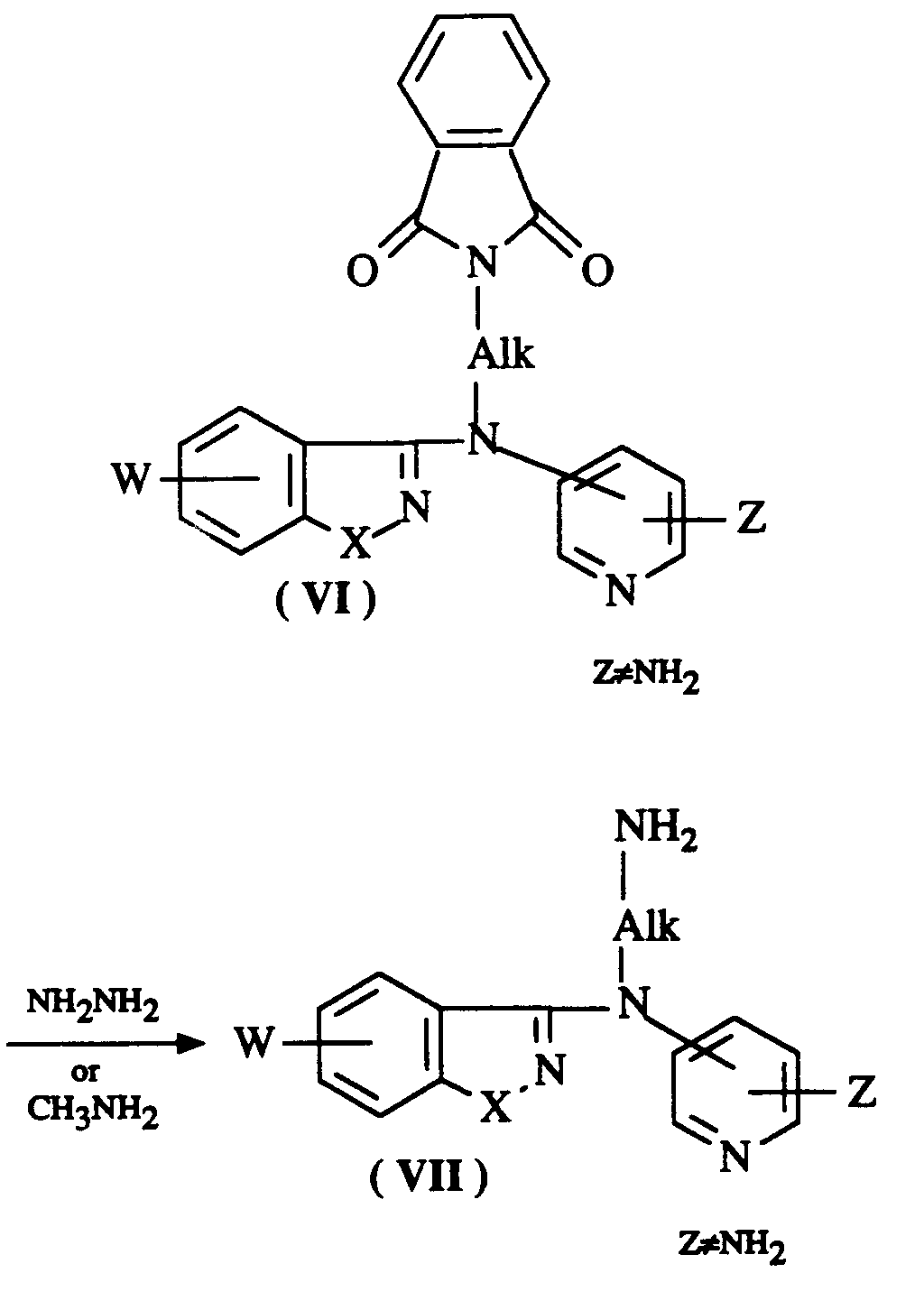
- Compound IV is allowed to react with a compound of the formula where "Alk” is a loweralkylene group and Hal is Cl or Br in a routine manner known to the art to afford a compound of Formula VI. Thereafter, compound VI is treated with hydrazine or methylamine in a routine manner known to the art to afford a compound of Formula VII.
- Compound IV is allowed to react with a dihaloloweralkane of the formula Hal-Alk-Hal in a routine manner known to the art to afford a compound of Formula VIII and thereafter the latter is allowed to react with a compound of the formula R'NH 2 , where R' is hydrogen or loweralkyl in a routine manner known to the art to afford a compound of the Formula IX.
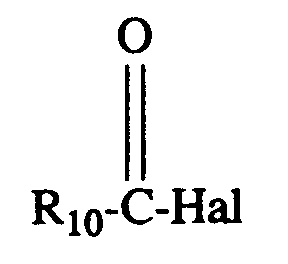
- Compound IV is allowed to react with an acid halide of the formula where R 10 is loweralkyl, in a routine manner known to the art to afford a compound of Formula X.
- R 10 is hydrogen or loweralkyl
- an acid anhydride of the formula, R 10 -CO-O-CO-R 10 may be used in a routine manner known to the art to accomplish the same purpose.
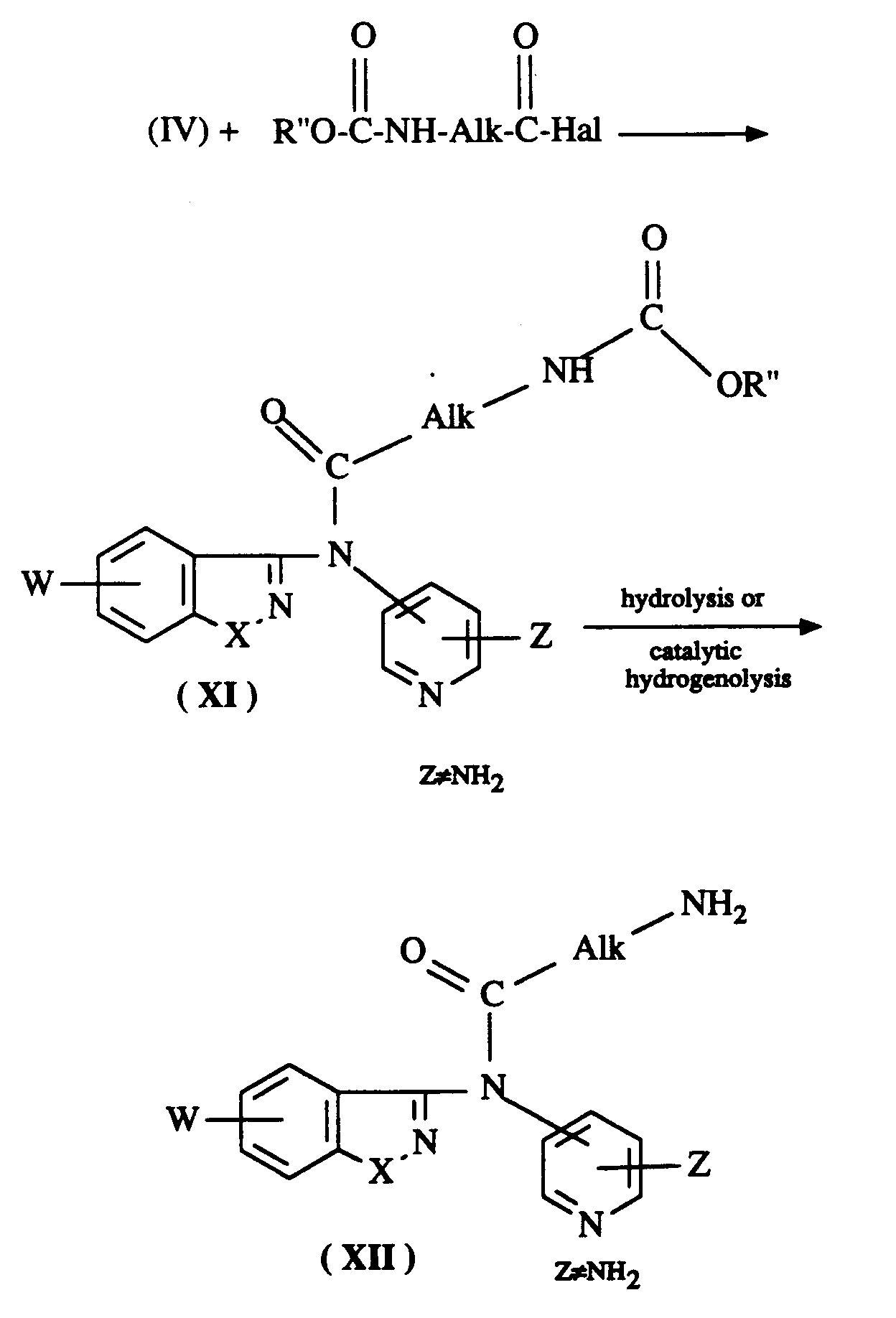
- Compound IV is allowed to react with a compound of formula where R'' is t-butyl or benzyl in a routine manner known to the art to afford a compound of Formula XI and thereafter the latter is hydrolyzed or subjected to catalytic hydrogenolysis in a routine manner known to the art to afford a compound of the Formula XII.
- compound IV is allowed to react with a carboxylic acid of Formula XIII in the presence of dicyclohexylcarbodiimide to afford compound XI which is converted to compound XII as described supra.
- the compounds of Formula I of the present invention are useful as antidepressants.
- MAO monoamine oxidase
- Clorgyline is a selective inhibitor of the type A enzyme
- deprenyl and pargyline are selective inhibitors of the type B enzyme
- tranylcypromine and iproniazid are nonselective inhibitors (2). It is recognized that MAO inhibitors have antidepressant properties.
- the described method involves the extraction of the radiolabeled deaminated metabolites of [ 3 H]-5HT or [ 14 C]- ⁇ -phenethylamine. This procedure allows MAO-A and MAO-B activities to be measured either simultaneously or individually (3).
- the antidepressant activities were further evaluated in this invention on the basis of prevention of Tetrabenazine-induced ptosis in mice.
- the test method and results are described below.
- Tetrabenazine induces behavioral depression with concomitant ptosis in mice similar to reserpine.
- Antidepressant compounds both monoamineoxidase inhibitors and tricyclics, are known to prevent or antagonize these effects and the degree of antagonism correlates with clinical efficacy.
- the prevention of TBZ-induced ptosis in mice is used as a preliminary screen for possible antidepressant activity.
- the method used in this invention is as follows:
- mice Male mice weighing 20 to 30 grams are used in test groups of five subjects. All compounds are dissolved or suspended with a suitable surfactant in distrilled water and administered in volumes of 10 ml/kg of body weight. TBZ solution is made from the methanesulfonate salt and the concentration of 60 mg/kg of base by intraperitoneal (i.p.) injection.
- the pretreatment time is measured from the time of dosing to observation. Therefore, when a 30-minute pretreat is utilized, drug and TBZ are given simultaneously.
- a control group received solvent ad TBZ at intervals identical to drug group.
- the drug is administered i.p. and a group size of five is utilized. Eight animals/group are used for a dose rage.
- the vehicle control group score is used as a determinant of the validity of each test. If the control score is less than 17, the results are discarded and the test repeated. The calculation of percent inhibition of ptosis is: (Control Score - Drug Score) Control Score x 100%
- ED 50 estimation For ED 50 estimation, four or five doses are administered in order to bracket the estimated value and only vehicle control scores of 27 to 32 are accepted to assure the accuracy of the ED 50 estimation.
- Linear regression analysis is used to estimate ED 50 values and 95% confidence intervals.
- Effective quantities of the compounds of the invention may be administered to a patient by any of the various methods, for example, orally as in capsule or tablets, parenterally in the form of sterile solutions or suspensions, and in some cases intravenously in the form of sterile solutions.
- the free base final products while effective themselves, may be formulated and administered in the form of their pharmaceutically acceptable acid addition salts for purposes of stability, convenience of crystallization, increased solubility and the like.
- Acids useful for preparing the pharmaceutically acceptable acid addition salts of the invention include inorganic acids such as hydrochloric, hydrobromic, sulfuric, nitric, phosphoric and perchloric acids, as well as organic acids such as tartaric, citric, acetic, succinic, maleic, fumaric and oxalic acids.
- inorganic acids such as hydrochloric, hydrobromic, sulfuric, nitric, phosphoric and perchloric acids
- organic acids such as tartaric, citric, acetic, succinic, maleic, fumaric and oxalic acids.
- the active compounds of the present invention may be orally administered, for example, with an inert diluent or with an edible carrier, or they may be enclosed in gelatin capsules, or they may be compressed into tablets.
- the active compounds of the invention may be incorporated with excipients and used in the form of tablets, troches, capsules, elixirs, suspensions, syrups, wafers, chewing gum and the like. These preparations should contain at least 0.5% of active compounds, but may be varied depending upon the particular form and may conveniently be between 4% to about 70% of the weight of the unit. The amount of active compound in such compositions is such that a suitable dosage will be obtained.
- Preferred compositions and preparations according to the present invention are prepared so that an oral dosage unit form contains between 1.0 - 300 milligrams of active compound.
- the tablets, pills, capsules, troches and the like may also contain the following ingredients: a binder such as micro-crystalline cellulose, gum tragacanth or gelatin; an excipient such as starch or lactose, a disintegrating agent such as alginic acid, Primogel, cornstarch and the like; a lubricant such as magnesium stearate or Sterotex; a glidant such as colloidal silicon dioxide; and a sweeting agent such as sucrose or saccharin may be added or a flavoring agent such as peppermint, methyl salicylate, or orange flavoring.
- a binder such as micro-crystalline cellulose, gum tragacanth or gelatin
- an excipient such as starch or lactose, a disintegrating agent such as alginic acid, Primogel, cornstarch and the like
- a lubricant such as magnesium stearate or Sterotex
- a glidant such as colloidal silicon dioxide
- a sweeting agent such
- dosage unit forms may contain other various materials which modify the physical form of the dosage unit, for example, as coatings.
- tablets or pills may be coated with sugar, shellac, or other enteric coating agents.
- a syrup may contain, in addition to the active compounds, sucrose as a sweetening agent and certain preservatives, dyes, coloring and flavors. Materials used in preparing these various compositions should be pharmaceutically pure and non-toxic in the amounts used.
- the active compounds of the invention may be incorporated into a solution or suspension. These preparations should contain at least 0.1% of active compound, but may be varied between 0.5 and about 30% of the weight thereof. The amount of active compound in such compositions is such that a suitable dosage will be obtained. Preferred compositions and preparations according to the present inventions are prepared so that a parenteral dosage unit contains between 0.5 to 100 milligrams of active compound.
- the solutions or suspensions may also include the following components: a sterile diluent such as water for injection, saline solution, fixed oils, polyethylene glycols, glycerine, propylene glycol or other synthetic solvents; antibacterial agents such as benzyl alcohol or methyl parabens; antioxidants such as ascorbic acid or sodium bisulfite; chelating agents such as ethylenediaminetetraacetic acid; buffers such as acetates, citrates or phosphates and agents for the adjustment of tonicity such as sodium chloride or dextrose.
- a sterile diluent such as water for injection, saline solution, fixed oils, polyethylene glycols, glycerine, propylene glycol or other synthetic solvents
- antibacterial agents such as benzyl alcohol or methyl parabens
- antioxidants such as ascorbic acid or sodium bisulfite
- chelating agents such as ethylenediaminetetraacetic acid
- Examples of the compounds of this invention include:
- the reaction mixture was cooled and distributed between diethyl ether and water, and the resultant mixture was filtered to recover 6-chloro-3-[1-propyl-N-4(1H)pyridinyl]-1,2-benzisoxazole, which is the major product of the reaction.
- the organic phase was separated and the aqueous phase was extracted with ethyl acetate.
- the organics were combined, washed with water, dried (MgSO 4 ), concentrated, and flash chromatographed (silica gel) with ethyl acetate to yield 354 mg of clean product as an oil.
Landscapes
- Organic Chemistry (AREA)
- Chemical & Material Sciences (AREA)
- Health & Medical Sciences (AREA)
- Engineering & Computer Science (AREA)
- Bioinformatics & Cheminformatics (AREA)
- Life Sciences & Earth Sciences (AREA)
- Veterinary Medicine (AREA)
- Chemical Kinetics & Catalysis (AREA)
- General Chemical & Material Sciences (AREA)
- Medicinal Chemistry (AREA)
- Nuclear Medicine, Radiotherapy & Molecular Imaging (AREA)
- Pharmacology & Pharmacy (AREA)
- Neurosurgery (AREA)
- Animal Behavior & Ethology (AREA)
- General Health & Medical Sciences (AREA)
- Public Health (AREA)
- Neurology (AREA)
- Biomedical Technology (AREA)
- Psychiatry (AREA)
- Hospice & Palliative Care (AREA)
- Otolaryngology (AREA)
- Anesthesiology (AREA)
- Pain & Pain Management (AREA)
- Pharmaceuticals Containing Other Organic And Inorganic Compounds (AREA)
- Plural Heterocyclic Compounds (AREA)
- Heterocyclic Carbon Compounds Containing A Hetero Ring Having Nitrogen And Oxygen As The Only Ring Hetero Atoms (AREA)
- Thiazole And Isothizaole Compounds (AREA)
Abstract
Description
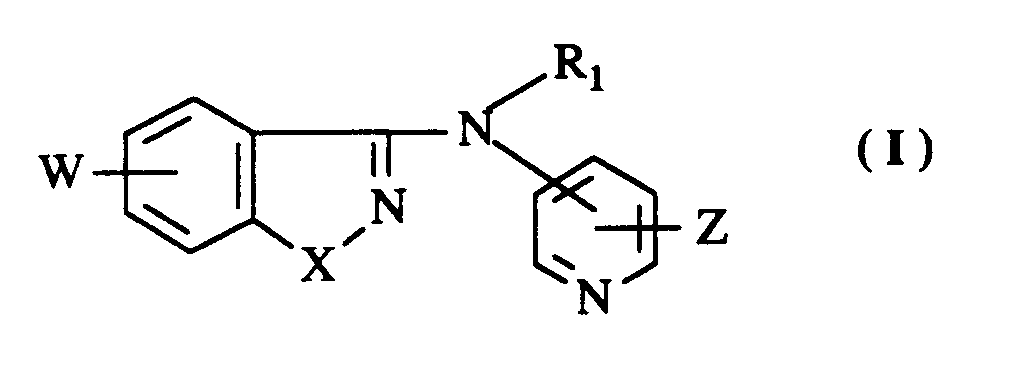
- R1
- is hydrogen, loweralkyl, loweralkenyl, loweralkynyl, arylloweralkyl,
cycloalkylloweralkyl, loweralkoxyloweralkyl, hydroxyloweralkyl,
aminoloweralkyl, mono- or di-loweralkylaminoloweralkyl, formyl,
loweralkylcarbonyl, aminoloweralkylcarbonyl, loweralkoxycarbonyl, mono- or
di-aryl-substituted loweralkyl, arylcarbonylloweralkyl, aryloxyloweralkyl,
or

W is hydrogen, halogen, hydroxy, loweralkoxy, arylloweralkoxy, nitro,
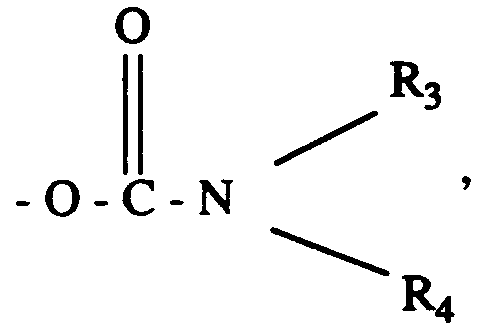
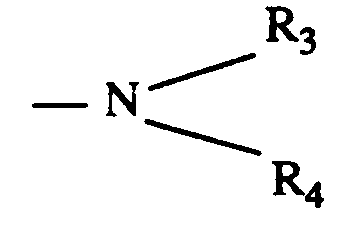

Z is hydrogen, halogen, loweralkyl, nitro or amino;
which are useful as antidepressants.










Although various methods for measuring MAO activity are available, the described method involves the extraction of the radiolabeled deaminated metabolites of [3H]-5HT or [14C]-β-phenethylamine. This procedure allows MAO-A and MAO-B activities to be measured either simultaneously or individually (3).
- 10 µl
- 0.5 M PO4 buffer, pH 7.4
- 50 µl
- H2O or appropriate drug concentration
- 400 µl
- Tissue suspension
| Compound | Inhibitory Concentration - IC50(µM) | |
| MAO-A | MAO-B | |
| 3-[(4-pyridinyl)amino]-1, 2-benzisoxazole | 0.64 | 3.9 |
| 6-chloro-3-[(4-pyridinyl)amino]-1,2-benzisoxazole maleate | 2.8 | 51 |
| (Reference Compounds) | ||
| Deprenyl | 0.14 | 0.016 |
| Tranylcypromine | 0.19 | 0.12 |
| Compound | ED50 (mg/kg) |
| 3-[(4-pyridinyl)amino]-1,2-benzisoxazole | 13.5 (i.p.) |
| (Prior Art Compound) Desipramine | 2.3 (p.o.) |
| ANALYSIS: | |||
| Calculated for C12H9N3O: | 68.24%C | 4.29%H | 19.89%N |
| Found: | 68.14%C | 4.12%H | 20.06%N |
| ANALYSIS: | |||
| Calculated for C15H15N3O·C4H4O4: | 61.78%C | 5.18%H | 11.38%N |
| Found: | 61.68%C | 5.07%H | 11.36%N |
| ANALYSIS: | |||
| Calculated for C7H5C1N2O: | 49.87%C | 2.99%H | 16.62%N |
| Found: | 49.70%C | 2.93%H | 16.66%N |
| ANALYSIS: | |||
| Calculated for C16H12C1N3O5: | 53.13%C | 3.34%H | 11.62%N |
| Found: | 53.02%C | 3.14%H | 11.44%N |
| ANALYSIS: | |||
| Calculated for C15H14N3OC1·C4H4O4: | 56.51%C | 4.49%H | 10.41%N |
| Found: | 56.60%C | 4.42%H | 10.57%N |
Claims (10)
- A compound of the formula Iwhere

- R1
- is hydrogen, (C1-C6)alkyl, (up to C6)alkenyl, (up to C6)alkynyl,
phenyl(C1-C6)alkyl, cyclo(C3 C8)alkyl(C1-C6)alkyl,
(C1-C6)alkoxy(C1-C6)alkyl, hydroxy(C1-C6)alkyl, amino(C1-C6)alkyl, monoor
di-(C1-C6)afkylamino(C1-C6)alkyl, formyl, (C1-C6)alkylcarbonyl,
amino(C1-C6)alkylcarbonyl, (C1-C6)alkoxycarbonyl, mono- or
di-phenyl-substituted (C1-C6)alkyl phenylcarbonyl(C1-C6)alkyl,
phenyloxyl(C1-C6)alkyl, or

W is hydrogen, halogen, hydroxy, (C1-C6)alkoxy, phenyl(C1-C6)alkoxy, nitro, trifluoromethyl orwhere R3 is hydrogen, (C1-C6)alkyl or phenyl(C1-C6)alkyl; and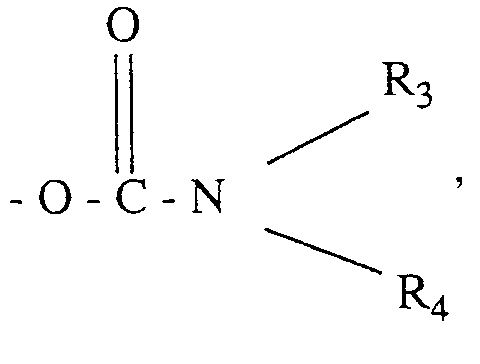
R4 is (C1-C6)alkyl or phenyl(C1-C6)alkyl; or alternatively the groupas a whole is R5 being hydrogen, (C1-C6)alkyl, phenyl or phenyl(C1-C6)alkyl; and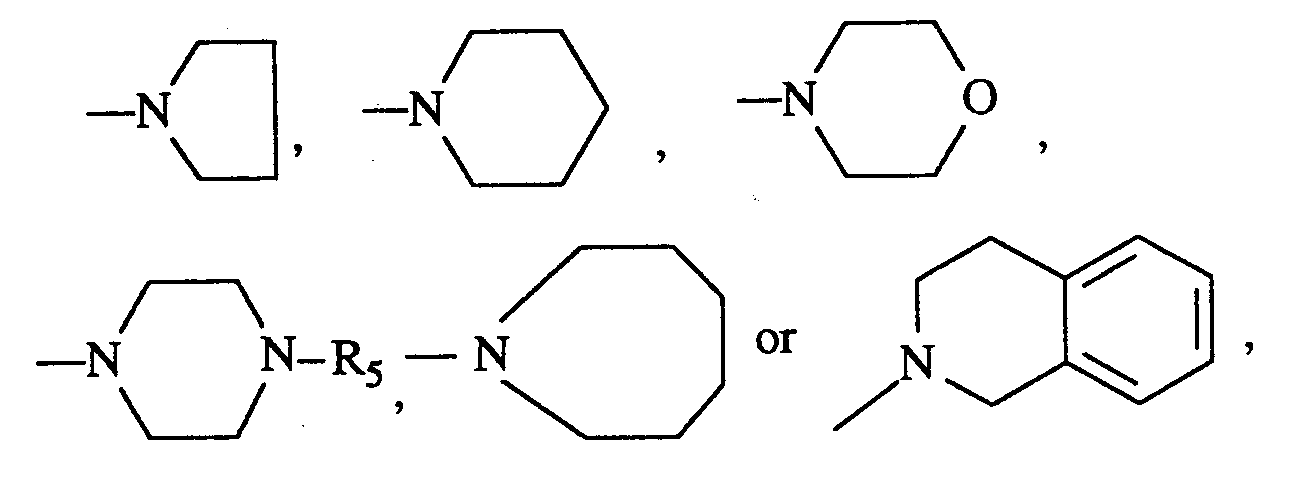
Z is hydrogen, halogen, (C1-C6)alkyl, nitro or amino; where phenyl is in each occurence optionally substituted with 1 or 2 substituents each of which being independently (C1-C6)alkyl, (C1-C6)alkoxy, (C1-C6)alkylcarbonyl, halogen or trifluormethyl;
or a pharmaceutically acceptable acid addition salt thereof. - A compound as defined in claim 1, wherein X is -O-.
- A compound as defined in claim 2, wherein R1 is hydrogen or (C1-C6)alkyl, W is hydrogen or halogen, and Z is hydrogen.
- The compound as defined in claim 1, which is
3-[(4-pyridinyl)amino]-1,2-benzisoxazole. - The compound as defined in claim 1, which is
3-[(1-propyl)(4-pyridinyl)amino]-1,2-benzisoxazole. - The compound as defined in claim 1, which is
6-chloro-3-[(4-pyridinyl)amino]-1,2-benzisoxazole. - The compound as defined in claim 1, which is
6-chloro-3-[(4-pyridinyl)(propyl)amino]-1,2-benzisoxazole. - A pharmaceutical composition which comprises a compound as defined in claim 1, in an amount effective for alleviating depression and a suitable carrier therefor.
- Use of a compound as defined in claim 1, for the preparation of a medicament having antidepressant activity.
- A process for the preparation of a compound of the formula I, as defined in claim 1, which comprisesa) reacting a compound of the formula II'wherein W and X are as defined, with a compound of the formula
 wherein Z is as defined, but is not -NH2, to form a compound of the formula I wherein W and X are as defined, R1 is hydrogen, and Z is as defined, but is not -NH2,
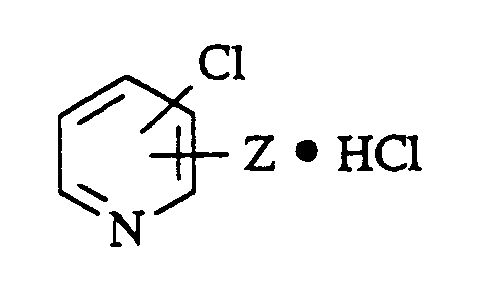 b) optionally reacting a compound of the formula I, wherein R1 is hydrogen and Z is as defined, but is not -NH2, with a compound of the formula Cl-CO-OR8, where R8 is (C1-C6)alkyl, to form a compound of the formula I, wherein R1 is (C1-C6)alkoxycarbonyl and Z is as defined, but is not -NH2,c) optionally reacting a compound of the formula I, wherein R1 is hydrogen and Z is as defined, but is not -NH2, with a halide of the formula R9Hal, where R9 is (C1-C6)alkyl, (up to C6)alkenyl, (up to C6)alkynyl or phenyl(C1-C6)alkyl, to form a compound of the formula I, wherein R1 has the meaning of R9 above, and Z is as defined, but is not -NH2,d) optionally reacting a compound of the formula I, wherein R1 is hydrogen and Z is as defined, but is not -NH2, with a compound of the formulawhere Alk is a (up to C6)alkylene group and Hal is Cl or Br, to form a compound of the formula VI
 and reacting the compound obtained with hydrazine or methylamine to form a compound of the formula I, wherein R1 is amino(C1-C6)alkyl and Z is as defined but is not -NH2,
 e) optionally reacting a compound of the formula I, wherein R1 is hydrogen, and Z is as defined, but is not -NH2, with a dihalo(C1-C6)alkane of the formula Hal-Alk-Hal to form a compound of the formula VIIIand reacting the compound obtained with a compound of the formula R'NH2, where R' is hydrogen or (C1-C6)alkyl, to form a compound of the formula I, wherein R1 is amino(C1-C6)alkyl or (C1-C6)alkylamino(C1-C6)alkyl, and Z is as defined but is not -NH2,
 f) optionally reacting a compound of the formula I, wherein R1 is hydrogen and Z is as defined, but is not -NH2, with a compound of the formula R10-CO-Hal, where R10 is (C1-C6)alkyl, or with a compound of the formula R10'-CO-O-CO-R10' where R10 is hydrogen or (C1-C6)alkyl, to form a compound of the formula I, wherein R1 is (C1-C6)alkylcarbonyl or formyl and Z is as defined but is not -NH2,g) optionally reacting a compound of the formula I, wherein R1 is hydrogen and Z is as defined but is not -NH2, with a compound of the formulawhere R'' is t-butyl or benzyl and Alk means (C1-C6)alkylene or with a compound of the formula
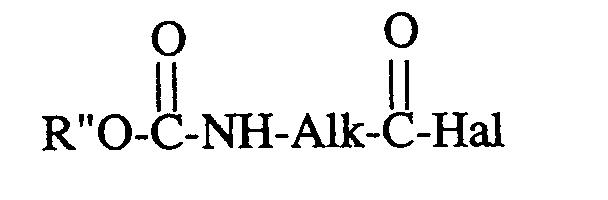 where R'' and Alk are as defined above, in the presence of dicyclohexylcarbodiimide to form a compound of the formula XI
 and hydrolyzing the compound obtained or subjecting it to catalytic hydrogenolysis to form a compound of the formula I, where R1 is amino(C1-C6)alkyl and Z is as defined but is not -NH2,
 h) optionally reducing a compound of the formula I, wherein R1 is formyl or (C1-C6)alkylcarbonyl and Z is as defined but not -NH2, to form a compound of the formula I, wherein R1 is (C1-C6)alkyl and Z is as defined, but is not -NH2, andi) optionally reducing a compound of the formula I, wherein Z is -NO2 with a suitable reducing agent or catalytically with hydrogen to form a compound of the formula I, wherein Z is -NH2.
Applications Claiming Priority (2)
| Application Number | Priority Date | Filing Date | Title |
|---|---|---|---|
| US07/964,546 US5328920A (en) | 1991-04-17 | 1992-10-21 | Substituted (pyridinylamino)-indoles |
| US964546 | 1997-11-05 |
Publications (2)
| Publication Number | Publication Date |
|---|---|
| EP0594000A1 EP0594000A1 (en) | 1994-04-27 |
| EP0594000B1 true EP0594000B1 (en) | 1998-07-22 |
Family
ID=25508677
Family Applications (1)
| Application Number | Title | Priority Date | Filing Date |
|---|---|---|---|
| EP93116316A Expired - Lifetime EP0594000B1 (en) | 1992-10-21 | 1993-10-08 | Substituted (pyridinylamino)-benzisoxazoles and benzoisothiazole a process for their preparation and their use as medicaments |
Country Status (18)
| Country | Link |
|---|---|
| US (1) | US5328920A (en) |
| EP (1) | EP0594000B1 (en) |
| KR (1) | KR100297651B1 (en) |
| AT (1) | ATE168689T1 (en) |
| AU (1) | AU665637B2 (en) |
| CA (1) | CA2108800A1 (en) |
| DE (1) | DE69319830T2 (en) |
| DK (1) | DK0594000T3 (en) |
| ES (1) | ES2120463T3 (en) |
| FI (1) | FI934611A7 (en) |
| GR (1) | GR3027574T3 (en) |
| HU (1) | HUT68875A (en) |
| IL (1) | IL107330A (en) |
| NO (1) | NO300806B1 (en) |
| NZ (1) | NZ248991A (en) |
| PL (1) | PL173540B1 (en) |
| RU (1) | RU2083575C1 (en) |
| ZA (1) | ZA937823B (en) |
Families Citing this family (15)
| Publication number | Priority date | Publication date | Assignee | Title |
|---|---|---|---|---|
| JP3057763B2 (en) * | 1995-06-06 | 2000-07-04 | ヘキスト・マリオン・ルセル・インコーポレイテツド | Benzoisoxazole and indazole derivatives as antipsychotics |
| US5668154A (en) * | 1995-06-06 | 1997-09-16 | Hoechst Marion Roussel Inc. | Pyridiniminyl-1,2-benzisoxazoles and -benzisothiazoles |
| GB2308362A (en) * | 1995-12-19 | 1997-06-25 | Lilly Industries Ltd | Pharmaceutical indole derivatives |
| EP0950056B1 (en) * | 1996-12-27 | 2002-09-18 | Aventis Pharmaceuticals Inc. | N-(pyridinylamino)isoindolines and related compounds |
| US5886191A (en) * | 1997-08-18 | 1999-03-23 | Dupont Pharmaceuticals Company | Amidinoindoles, amidinoazoles, and analogs thereof |
| US7125903B1 (en) | 1999-09-14 | 2006-10-24 | Aventis Pharmaceuticals Inc. | Thienoisoxazolyl-and thienylpyrrazolyl-phenoxy substituted propyl derivatives useful as D4 antagonists |
| US7253165B2 (en) * | 1999-09-14 | 2007-08-07 | Aventis Pharmaceuticals Inc. | Benzisoxazolyl-, pyridoisoxazolyl-and benzthienyl-phenoxy derivatives useful as D4 antagonists |
| US7091199B1 (en) | 1999-09-14 | 2006-08-15 | Aventis Pharmaceuticals Inc. | Thienoisoxazole phenoxy unsubstituted ethyl and propyl derivatives useful as d4 antagonists |
| US20020161002A1 (en) * | 2001-01-02 | 2002-10-31 | Mel Epstein | Use of catecholamine reuptake inhibitors to enhance memory |
| GB0217920D0 (en) * | 2002-04-23 | 2002-09-11 | Aventis Pharm Prod Inc | Interleukin-4 Gene Expression inhibitors |
| DE60328675D1 (en) * | 2002-04-23 | 2009-09-17 | Aventis Pharma Inc | 3- (SUBSTITUTED AMINO) -1H-INDOLE-2-CARBOXYLIC ACID AND 3- (SUBSTITUTED AMINO) -BENZOETH-ETHIOPHONE-2-CARBOXYLIC ACIDES AS INHIBITORS OF INTERLEUKIN-4 GENE EXPRESSION |
| BRPI0514077A (en) * | 2004-08-02 | 2008-05-27 | Hoffmann La Roche | benzyloxy derivatives as maob inhibitors |
| DE102005038947A1 (en) * | 2005-05-18 | 2006-11-30 | Grünenthal GmbH | Substituted benzo [d] isoxazol-3-yl-amine compounds and their use in medicaments |
| EP2069359B1 (en) * | 2006-08-21 | 2014-11-12 | Genentech, Inc. | Aza-benzothiophenyl compounds and methods of use |
| WO2008024725A1 (en) * | 2006-08-21 | 2008-02-28 | Genentech, Inc. | Aza-benzofuranyl compounds and methods of use |
Family Cites Families (10)
| Publication number | Priority date | Publication date | Assignee | Title |
|---|---|---|---|---|
| DE3166987D1 (en) * | 1980-09-18 | 1984-12-06 | Asahi Chemical Ind | 3-aminoindazole derivatives and process for preparation thereof |
| US4590196A (en) * | 1984-08-23 | 1986-05-20 | Bristol-Myers Company | Analgesic 1,2-benzisothiazol-3-ylpiperazine derivatives |
| IE58370B1 (en) * | 1985-04-10 | 1993-09-08 | Lundbeck & Co As H | Indole derivatives |
| US4717658A (en) * | 1985-12-03 | 1988-01-05 | Miles Inc. | Gram negative bacteria screening method with horseshoe crab amebocyte lysate (LAL) |
| EP0287982B1 (en) * | 1987-04-24 | 1994-12-07 | Hoechst-Roussel Pharmaceuticals Incorporated | N-(Pyridinyl)-1H-indol-1-amines, a process for their preparation and their use as medicaments |
| US4954502A (en) * | 1988-06-10 | 1990-09-04 | Bristol-Myers Squibb Company | 1-indolyalkyl-4-(substituted-pyridinyl)piperazines |
| ES2076253T3 (en) * | 1989-05-19 | 1995-11-01 | Hoechst Roussel Pharma | N- (ARYLOXYALKYL) -HETEROARILPIPERIDINES AND -HETEROARILPIPERAZINAS, A PROCEDURE FOR ITS PREPARATION AND USE AS MEDICINES. |
| US4954503A (en) * | 1989-09-11 | 1990-09-04 | Hoechst-Roussel Pharmaceuticals, Inc. | 3-(1-substituted-4-piperazinyl)-1H-indazoles |
| CA2030051C (en) * | 1989-11-17 | 2001-08-07 | Haruhiko Kikuchi | Indole derivatives |
| US5177088A (en) * | 1991-04-17 | 1993-01-05 | Hoechst-Roussel Pharmaceuticals Incorporated | Substituted 3-(pyridinylamino)-indoles |
-
1992
- 1992-10-21 US US07/964,546 patent/US5328920A/en not_active Expired - Lifetime
-
1993
- 1993-10-08 AT AT93116316T patent/ATE168689T1/en not_active IP Right Cessation
- 1993-10-08 EP EP93116316A patent/EP0594000B1/en not_active Expired - Lifetime
- 1993-10-08 DK DK93116316T patent/DK0594000T3/en active
- 1993-10-08 ES ES93116316T patent/ES2120463T3/en not_active Expired - Lifetime
- 1993-10-08 DE DE69319830T patent/DE69319830T2/en not_active Expired - Fee Related
- 1993-10-19 NZ NZ248991A patent/NZ248991A/en unknown
- 1993-10-19 FI FI934611A patent/FI934611A7/en not_active Application Discontinuation
- 1993-10-20 IL IL107330A patent/IL107330A/en not_active IP Right Cessation
- 1993-10-20 NO NO933772A patent/NO300806B1/en not_active IP Right Cessation
- 1993-10-20 CA CA002108800A patent/CA2108800A1/en not_active Abandoned
- 1993-10-20 AU AU49125/93A patent/AU665637B2/en not_active Ceased
- 1993-10-20 RU RU9393047920A patent/RU2083575C1/en active
- 1993-10-21 PL PL93300804A patent/PL173540B1/en unknown
- 1993-10-21 KR KR1019930021922A patent/KR100297651B1/en not_active Expired - Fee Related
- 1993-10-21 ZA ZA937823A patent/ZA937823B/en unknown
- 1993-10-21 HU HU9302979A patent/HUT68875A/en unknown
-
1998
- 1998-08-04 GR GR980401759T patent/GR3027574T3/en unknown
Also Published As
| Publication number | Publication date |
|---|---|
| IL107330A (en) | 1998-04-05 |
| NO933772D0 (en) | 1993-10-20 |
| KR940009182A (en) | 1994-05-20 |
| PL173540B1 (en) | 1998-03-31 |
| RU2083575C1 (en) | 1997-07-10 |
| KR100297651B1 (en) | 2001-10-24 |
| PL300804A1 (en) | 1994-05-16 |
| FI934611L (en) | 1994-04-22 |
| HUT68875A (en) | 1995-08-28 |
| ES2120463T3 (en) | 1998-11-01 |
| HU9302979D0 (en) | 1994-01-28 |
| DK0594000T3 (en) | 1999-04-26 |
| GR3027574T3 (en) | 1998-11-30 |
| FI934611A7 (en) | 1994-04-22 |
| CA2108800A1 (en) | 1994-04-22 |
| ZA937823B (en) | 1994-05-19 |
| EP0594000A1 (en) | 1994-04-27 |
| AU4912593A (en) | 1994-05-05 |
| ATE168689T1 (en) | 1998-08-15 |
| NO933772L (en) | 1994-04-22 |
| NO300806B1 (en) | 1997-07-28 |
| US5328920A (en) | 1994-07-12 |
| NZ248991A (en) | 1996-02-27 |
| IL107330A0 (en) | 1994-01-25 |
| DE69319830D1 (en) | 1998-08-27 |
| DE69319830T2 (en) | 1999-01-14 |
| AU665637B2 (en) | 1996-01-11 |
| FI934611A0 (en) | 1993-10-19 |
Similar Documents
| Publication | Publication Date | Title |
|---|---|---|
| KR100340372B1 (en) | Substituted 3- (aminoalkylamino) -1,2-benzisoxazole, a process for preparing the same, and a pharmaceutical composition comprising the same | |
| EP0669920B1 (en) | Substituted 3-(aminoalkylamino)-1,2-benzisoxazoles and related compounds | |
| EP1910370B1 (en) | A pyridin quinolin substituted pyrrolo [1,2-b] pyrazole monohydrate as tgf-beta inhibitor | |
| KR101544290B1 (en) | Kat ii inhibitors | |
| EP0594000A1 (en) | Substituted (pyridinylamino)-benzisoxazoles and benzoisothiazole a process for their preparation and their use as medicaments | |
| HK18194A (en) | Substituted benzamide derivatives, processes for the preparation thereof, and pharmaceutical compositions containing the same | |
| SK59798A3 (en) | Benzoxazine antimicrobial agents | |
| JPS62155278A (en) | Heterocyclic compound, its production and use | |
| AU643135B2 (en) | 1-(pyrido(3,4.b)-1,4-oxazinyl-4-YL)-1H-indoles, intermediates and a process for their preparation, and their use as medicaments | |
| EP0594001B1 (en) | Pyrazolo 4,3-c pyridines, a process for their preparation and their use as serotonin reuptake inhibitors | |
| WO1996039405A1 (en) | Pyridiniminyl-1,2-benzisoxazoles and- benzisothiazoles as antipsychotic agents | |
| AU708843B2 (en) | Pyridiniminyl-1,2-benzisoxazoles and -benzisothiazoles as antipsychotic agents | |
| CZ284437B6 (en) | SUBSTITUTED (PYRIDINYLAMINO)-BENZISOXAZOLES AND BENZO[b]THIOPHENES, PROCESS OF THEIR PREPARATION, PHARMACEUTICAL COMPOSITION CONTAINING THEREOF AND USE OF THESE COMPOUNDS | |
| EP0277625A2 (en) | Tetrahydropyrido[3',4':4,5]pyrrolo[2,3-c]quinolines, intermediates and a process for the preparation thereof and their use as hypotensive agents | |
| JPH09151186A (en) | Fused triazole compound | |
| CZ367499A3 (en) | Compounds | |
| KR20090096749A (en) | Triabenzo [A] naphtho [2, 1, BCC] azulene derivative, preparation method thereof, and pharmaceutical composition containing same |
Legal Events
| Date | Code | Title | Description |
|---|---|---|---|
| PUAI | Public reference made under article 153(3) epc to a published international application that has entered the european phase |
Free format text: ORIGINAL CODE: 0009012 |
|
| AK | Designated contracting states |
Kind code of ref document: A1 Designated state(s): AT BE CH DE DK ES FR GB GR IE IT LI LU NL PT SE |
|
| 17P | Request for examination filed |
Effective date: 19940620 |
|
| RAP1 | Party data changed (applicant data changed or rights of an application transferred) |
Owner name: HOECHST MARION ROUSSEL, INC. |
|
| 17Q | First examination report despatched |
Effective date: 19970319 |
|
| GRAG | Despatch of communication of intention to grant |
Free format text: ORIGINAL CODE: EPIDOS AGRA |
|
| GRAG | Despatch of communication of intention to grant |
Free format text: ORIGINAL CODE: EPIDOS AGRA |
|
| GRAH | Despatch of communication of intention to grant a patent |
Free format text: ORIGINAL CODE: EPIDOS IGRA |
|
| GRAH | Despatch of communication of intention to grant a patent |
Free format text: ORIGINAL CODE: EPIDOS IGRA |
|
| GRAA | (expected) grant |
Free format text: ORIGINAL CODE: 0009210 |
|
| AK | Designated contracting states |
Kind code of ref document: B1 Designated state(s): AT BE CH DE DK ES FR GB GR IE IT LI LU NL PT SE |
|
| REF | Corresponds to: |
Ref document number: 168689 Country of ref document: AT Date of ref document: 19980815 Kind code of ref document: T |
|
| REG | Reference to a national code |
Ref country code: CH Ref legal event code: EP |
|
| REF | Corresponds to: |
Ref document number: 69319830 Country of ref document: DE Date of ref document: 19980827 |
|
| ET | Fr: translation filed | ||
| REG | Reference to a national code |
Ref country code: ES Ref legal event code: FG2A Ref document number: 2120463 Country of ref document: ES Kind code of ref document: T3 |
|
| REG | Reference to a national code |
Ref country code: IE Ref legal event code: FG4D |
|
| REG | Reference to a national code |
Ref country code: PT Ref legal event code: SC4A Free format text: AVAILABILITY OF NATIONAL TRANSLATION Effective date: 19980909 |
|
| REG | Reference to a national code |
Ref country code: DK Ref legal event code: T3 |
|
| PLBE | No opposition filed within time limit |
Free format text: ORIGINAL CODE: 0009261 |
|
| STAA | Information on the status of an ep patent application or granted ep patent |
Free format text: STATUS: NO OPPOSITION FILED WITHIN TIME LIMIT |
|
| 26N | No opposition filed | ||
| REG | Reference to a national code |
Ref country code: GB Ref legal event code: IF02 |
|
| NLT1 | Nl: modifications of names registered in virtue of documents presented to the patent office pursuant to art. 16 a, paragraph 1 |
Owner name: AVENTIS PHARMACEUTICALS, INC. |
|
| REG | Reference to a national code |
Ref country code: PT Ref legal event code: PD4A Free format text: AVENTIS PHARMACEUTICALS INC. US Effective date: 20050125 |
|
| PGFP | Annual fee paid to national office [announced via postgrant information from national office to epo] |
Ref country code: CH Payment date: 20070927 Year of fee payment: 15 |
|
| PGFP | Annual fee paid to national office [announced via postgrant information from national office to epo] |
Ref country code: NL Payment date: 20071003 Year of fee payment: 15 Ref country code: LU Payment date: 20071012 Year of fee payment: 15 Ref country code: ES Payment date: 20071120 Year of fee payment: 15 Ref country code: DK Payment date: 20071015 Year of fee payment: 15 Ref country code: DE Payment date: 20071004 Year of fee payment: 15 |
|
| PGFP | Annual fee paid to national office [announced via postgrant information from national office to epo] |
Ref country code: IT Payment date: 20071026 Year of fee payment: 15 Ref country code: AT Payment date: 20071011 Year of fee payment: 15 |
|
| PGFP | Annual fee paid to national office [announced via postgrant information from national office to epo] |
Ref country code: BE Payment date: 20071220 Year of fee payment: 15 Ref country code: SE Payment date: 20071004 Year of fee payment: 15 |
|
| PGFP | Annual fee paid to national office [announced via postgrant information from national office to epo] |
Ref country code: GB Payment date: 20071003 Year of fee payment: 15 Ref country code: FR Payment date: 20071009 Year of fee payment: 15 |
|
| PGFP | Annual fee paid to national office [announced via postgrant information from national office to epo] |
Ref country code: PT Payment date: 20071004 Year of fee payment: 15 Ref country code: GR Payment date: 20070913 Year of fee payment: 15 |
|
| REG | Reference to a national code |
Ref country code: PT Ref legal event code: MM4A Free format text: LAPSE DUE TO NON-PAYMENT OF FEES Effective date: 20090408 |
|
| BERE | Be: lapsed |
Owner name: *AVENTIS PHARMACEUTICALS INC. Effective date: 20081031 |
|
| REG | Reference to a national code |
Ref country code: CH Ref legal event code: PL |
|
| REG | Reference to a national code |
Ref country code: DK Ref legal event code: EBP |
|
| EUG | Se: european patent has lapsed | ||
| GBPC | Gb: european patent ceased through non-payment of renewal fee |
Effective date: 20081008 |
|
| NLV4 | Nl: lapsed or anulled due to non-payment of the annual fee |
Effective date: 20090501 |
|
| REG | Reference to a national code |
Ref country code: IE Ref legal event code: MM4A |
|
| REG | Reference to a national code |
Ref country code: FR Ref legal event code: ST Effective date: 20090630 |
|
| PG25 | Lapsed in a contracting state [announced via postgrant information from national office to epo] |
Ref country code: NL Free format text: LAPSE BECAUSE OF NON-PAYMENT OF DUE FEES Effective date: 20090501 |
|
| PG25 | Lapsed in a contracting state [announced via postgrant information from national office to epo] |
Ref country code: PT Free format text: LAPSE BECAUSE OF NON-PAYMENT OF DUE FEES Effective date: 20090408 Ref country code: IT Free format text: LAPSE BECAUSE OF NON-PAYMENT OF DUE FEES Effective date: 20081008 Ref country code: DE Free format text: LAPSE BECAUSE OF NON-PAYMENT OF DUE FEES Effective date: 20090501 Ref country code: AT Free format text: LAPSE BECAUSE OF NON-PAYMENT OF DUE FEES Effective date: 20081008 |
|
| PGFP | Annual fee paid to national office [announced via postgrant information from national office to epo] |
Ref country code: IE Payment date: 20071011 Year of fee payment: 15 |
|
| PG25 | Lapsed in a contracting state [announced via postgrant information from national office to epo] |
Ref country code: BE Free format text: LAPSE BECAUSE OF NON-PAYMENT OF DUE FEES Effective date: 20081031 |
|
| PG25 | Lapsed in a contracting state [announced via postgrant information from national office to epo] |
Ref country code: LI Free format text: LAPSE BECAUSE OF NON-PAYMENT OF DUE FEES Effective date: 20081031 Ref country code: IE Free format text: LAPSE BECAUSE OF NON-PAYMENT OF DUE FEES Effective date: 20081008 Ref country code: FR Free format text: LAPSE BECAUSE OF NON-PAYMENT OF DUE FEES Effective date: 20081031 Ref country code: DK Free format text: LAPSE BECAUSE OF NON-PAYMENT OF DUE FEES Effective date: 20081031 Ref country code: CH Free format text: LAPSE BECAUSE OF NON-PAYMENT OF DUE FEES Effective date: 20081031 |
|
| PG25 | Lapsed in a contracting state [announced via postgrant information from national office to epo] |
Ref country code: GR Free format text: LAPSE BECAUSE OF NON-PAYMENT OF DUE FEES Effective date: 20090505 Ref country code: GB Free format text: LAPSE BECAUSE OF NON-PAYMENT OF DUE FEES Effective date: 20081008 |
|
| REG | Reference to a national code |
Ref country code: ES Ref legal event code: FD2A Effective date: 20081009 |
|
| PG25 | Lapsed in a contracting state [announced via postgrant information from national office to epo] |
Ref country code: ES Free format text: LAPSE BECAUSE OF NON-PAYMENT OF DUE FEES Effective date: 20081009 |
|
| PG25 | Lapsed in a contracting state [announced via postgrant information from national office to epo] |
Ref country code: LU Free format text: LAPSE BECAUSE OF NON-PAYMENT OF DUE FEES Effective date: 20081008 |
|
| PG25 | Lapsed in a contracting state [announced via postgrant information from national office to epo] |
Ref country code: SE Free format text: LAPSE BECAUSE OF NON-PAYMENT OF DUE FEES Effective date: 20081009 |