EP0593668B1 - Method of making toothed belt constructions - Google Patents
Method of making toothed belt constructions Download PDFInfo
- Publication number
- EP0593668B1 EP0593668B1 EP92916233A EP92916233A EP0593668B1 EP 0593668 B1 EP0593668 B1 EP 0593668B1 EP 92916233 A EP92916233 A EP 92916233A EP 92916233 A EP92916233 A EP 92916233A EP 0593668 B1 EP0593668 B1 EP 0593668B1
- Authority
- EP
- European Patent Office
- Prior art keywords
- fabric material
- mold
- toothed belt
- sleeve
- teeth
- Prior art date
- Legal status (The legal status is an assumption and is not a legal conclusion. Google has not performed a legal analysis and makes no representation as to the accuracy of the status listed.)
- Expired - Lifetime
Links
- 238000004519 manufacturing process Methods 0.000 title claims abstract description 11
- 238000010276 construction Methods 0.000 title abstract description 53
- 239000000463 material Substances 0.000 claims abstract description 91
- 239000004744 fabric Substances 0.000 claims abstract description 60
- 238000000034 method Methods 0.000 claims abstract description 34
- 230000002093 peripheral effect Effects 0.000 claims description 9
- 239000004677 Nylon Substances 0.000 claims description 2
- 229920001778 nylon Polymers 0.000 claims description 2
- 230000003014 reinforcing effect Effects 0.000 description 2
- 239000007769 metal material Substances 0.000 description 1
Images

Classifications
-
- B—PERFORMING OPERATIONS; TRANSPORTING
- B29—WORKING OF PLASTICS; WORKING OF SUBSTANCES IN A PLASTIC STATE IN GENERAL
- B29D—PRODUCING PARTICULAR ARTICLES FROM PLASTICS OR FROM SUBSTANCES IN A PLASTIC STATE
- B29D29/00—Producing belts or bands
- B29D29/08—Toothed driving belts
-
- F—MECHANICAL ENGINEERING; LIGHTING; HEATING; WEAPONS; BLASTING
- F16—ENGINEERING ELEMENTS AND UNITS; GENERAL MEASURES FOR PRODUCING AND MAINTAINING EFFECTIVE FUNCTIONING OF MACHINES OR INSTALLATIONS; THERMAL INSULATION IN GENERAL
- F16G—BELTS, CABLES, OR ROPES, PREDOMINANTLY USED FOR DRIVING PURPOSES; CHAINS; FITTINGS PREDOMINANTLY USED THEREFOR
- F16G1/00—Driving-belts
- F16G1/28—Driving-belts with a contact surface of special shape, e.g. toothed
-
- Y—GENERAL TAGGING OF NEW TECHNOLOGICAL DEVELOPMENTS; GENERAL TAGGING OF CROSS-SECTIONAL TECHNOLOGIES SPANNING OVER SEVERAL SECTIONS OF THE IPC; TECHNICAL SUBJECTS COVERED BY FORMER USPC CROSS-REFERENCE ART COLLECTIONS [XRACs] AND DIGESTS
- Y10—TECHNICAL SUBJECTS COVERED BY FORMER USPC
- Y10S—TECHNICAL SUBJECTS COVERED BY FORMER USPC CROSS-REFERENCE ART COLLECTIONS [XRACs] AND DIGESTS
- Y10S425/00—Plastic article or earthenware shaping or treating: apparatus
- Y10S425/818—Belt
Definitions
- This invention relates to a new method of making a plurality of toothed belt constructions.
- This invention provides a new method of making a plurality of toothed belt means respectively having different diameters and still being formed from sleeves of the same fabric material and having the same diameters in the nonstretched conditions thereof so that the fabric material will be carried in certain positions relative to the respective teeth thereof.
- toothed belt constructions being made by the methods set forth in the aforementioned two U.S. patents, Nos. 4,443,396 and 3,419,449, have the sleeves of fabric material thereof lining the exterior peripheral surface means of the teeth of the resulting toothed belt constructions thereof, it was found according to the teachings of this invention that the sleeve of fabric material could be disposed anywhere from the root of each tooth to the outer periphery or tip of the tooth and will still provide an improved belt life over belts produced without such fabric material.
- this invention provides a method of making a plurality of toothed belt means, some of which have larger inside diameters than the inside diameters of the others, the method comprising the steps of disposing tubular sleeves of stretchable fabric material respectively onto a plurality of toothed mold members having different diameters, forcing mold material against the outside surfaces of the sleeves to tend to stretch the fabric material into the grooves of the toothed mold members as the mold material enters the grooves of the mold members so that the resulting toothed belt means will have the fabric material thereof carried in certain positions relative to the respective teeth thereof, and forming the sleeves from the same fabric material and with the same diameters in the nonstretched conditions thereof, and forming the sleeves to each have a circumferential length in the fully stretched condition thereof that is at least twice the circumferential length in the nonstretched condition thereof so that the same is disposed substantially across the roots of the teeth of the toothed belt means when the mold member being utilized at that time has a diameter that substantially corresponds to the diameter of the sleeve in
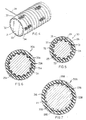
- a new endless toothed belt construction according to the method of this invention is generally indicated by the reference numeral 20 and comprises an outer peripheral surface means 21, an inner peripheral surface means 22 defined by a plurality of radially inwardly directed teeth 23, a reinforcing cord means 24, and a teeth reinforcing fabric means 25 lining the teeth 23, whereby it can be seen that the toothed belt construction 20 of this invention has a configuration that is well known in the art, such as set forth in the aforementioned U.S. patent to Breher, No. 4,443,396, the U.S. patent to Valerio et al, No. 3,419,449 and the WO91/02178.
- FIG. 2 Another endless toothed belt construction according to the method of this invention is generally indicated by the reference numeral 20A in FIG. 2 and parts thereof similar to the belt construction 20 previously described are indicated by like reference numerals followed by the reference letter "A".
- the belt construction 20A is substantially identical to the belt construction 20 previously described except that the diameter of the belt construction 20A is larger than the diameter of the belt construction 20, as will be apparent hereinafter, and has the fabric material 25A thereof embedded in the teeth 23A intermediate the roots 26 thereof and the tips 27 thereof as illustrated in FIG. 2.
- FIG. 3 Another endless toothed belt construction according to the method of this invention is generally indicated by the reference numeral 20B in FIG. 3 and parts thereof similar to the belt constructions 20 and 20A previously described are indicated by like reference numerals followed by the reference letter "B".
- the belt construction 20B is substantially the same as the belt constructions 20 and 20A previously described except that the diameter of the belt construction 20B is larger than the diameters of the belt constructions 20 and 20A, as will be apparent hereinafter, and the fabric material 25B thereof is located at the roots 26B of the teeth 23B as illustrated in FIG. 3.
- the fabric material for forming the belt constructions of this invention can be disposed in a seamless sleeve form, be the same fabric material, and have the same diameters in the nonstretched conditions thereof so as to respectively form a plurality or set of toothed belt constructions having different diameters, with each belt construction having the sleeve of fabric material thereof disposed somewhere relative to the teeth thereof to reinforce such teeth.
- the fabric material comprises a knitted seamless nylon stocking that has a circumferential length in the nonstretched condition thereof of approximately 15.24 cm (6.0 inches) and has a circumferential length of approximately 35.56 cm (14.0 inches) when fully stretched so that no residual stretch characteristic remains therein.
- a sleeve of fabric material has been utilized to form a toothed belt construction wherein the pitch length thereof is approximately 19.0683 cm (7.5072 inches), the thickness thereof is approximately 0.114 cm (0.045 of an inch) and the number of teeth is ninety-two, whereby the outside diameter of the toothed belt construction is approximately 5.715 cm (2 1/4 inches).
- the belt constructions 20, 20A and 20B of this invention can be respectively formed by the apparatus 30, 30A and 30B illustrated respectively in FIGS. 5, 6 and 7, wherein it can be seen that the apparatus 30, 30A and 30B are substantially identical except that the apparatus 30A is larger in diameter than the apparatus 30 and the apparatus 30B is larger in diameter than the apparatus 30A, whereby only the details of the structure and method of making the belt construction 20 with the apparatus 30 of FIG. 5 will now be described with the understanding that such description equally applies to the method of using the apparatus 30A and 30B for forming the belt constructions 20A and 20B.
- the apparatus 30 includes a substantially cylindrical toothed mold member 31 having an outer peripheral surface means 32 provided with a plurality of longitudinally disposed and equally spaced apart grooves 33 which will form the teeth 23 of the belt construction 20 according to the method of this invention, the mold member 31 being formed of any suitable material, such as the metallic material illustrated in the drawings.
- a stretchable sleeve 34 of seamless knitted fabric material is axially disposed on the mold member 31 by causing relative movement between the mold member 31. and the sleeve 34 so that the sleeve 34 is actually in a stretched condition on the mold member 31 but has sufficient residual stretch characteristic therein so that the sleeve 34 will stretch fully into the grooves 33 of the mold member 31 to line the same in the manner illustrated in FIG.
- a suitable tensile cord means 24 is wrapped in a helical manner on the outer peripheral surface 37 of the sleeve 34 in the manner illustrated in FIG. 4 so that the mold material 35 will exude through the spacings between the coils of the cord means 24 to form the teeth 23 in the manner previously set forth.
- the material 35 can be solidified in the apparatus 30 in a manner well known in the art, the mold material 35 comprising any suitable polymeric material normally utilized to form toothed belt constructions.
- the resulting toothed belt construction 20 is removed from the apparatus 30 in a manner well known in the art and comprises a relatively wide belt sleeve means, whereby individual narrower toothed belts can be cut from the belt sleeve also in a manner well known in the art and as illustrated in FIG. 1.
- a relatively wide belt sleeve means whereby individual narrower toothed belts can be cut from the belt sleeve also in a manner well known in the art and as illustrated in FIG. 1.
- the mold material 35A when the mold material 35A is disposed in the apparatus 30A, the mold material 35A will exude against the fabric material 25A and carry the same along therewith into the grooves 33A of the mold member 31A and will exude through the fabric material 25A once the remaining stretch characteristic thereof has been used up so that the material 35A exudes beyond the material 25A in each groove 33A as illustrated in FIG. 6 and FIG. 2.
- the mold member 31B of the apparatus 30B of FIG. 7 has a greater diameter than the diameter of the mold member 31A of FIG. 6, and since the same sleeve 34 of fabric material is being utilized to initially be disposed thereon as in the apparatus 30 and 30A, it may be found that the entire stretch characteristic of the sleeve 34 is used up in merely placing the sleeve 34 onto the mold member 31B so that when the mold material 35B is subsequently disposed into the apparatus 30B, the mold material 35B will exude through the material 25B without carrying the same into the grooves 33B so that the fabric material 25B will merely be disposed at the roots 26B of the resulting teeth 23B as illustrated in FIGS. 3 and 7.
- this invention provides a new method of making a plurality of toothed belt constructions.
Landscapes
- Engineering & Computer Science (AREA)
- Mechanical Engineering (AREA)
- General Engineering & Computer Science (AREA)
- Measurement Of Velocity Or Position Using Acoustic Or Ultrasonic Waves (AREA)
- Noise Elimination (AREA)
Abstract
Description
- This invention relates to a new method of making a plurality of toothed belt constructions.
- It is known to provide a method of making a plurality of toothed belt means, some of which have larger inside diameters than the inside diameters of the others, the method comprising the steps of disposing tubular sleeves of stretchable fabric material respectively onto a plurality of toothed mold members having different diameters, and forcing mold material against the outside surfaces of the sleeves to tend to stretch the fabric material into the grooves of the toothed mold members as the mold material enters the grooves of the mold members so that the resulting toothed belt means will have the fabric material thereof carried in certain positions relative to the respective teeth thereof. For example, see the U.S. patent to Breher, No. 4,443,396, the U.S. patent to Valerio et al, No. 3,419,449 and the WO 91/02178.
- It is also known to have fabric material disposed in each tooth of a toothed belt construction between the root and tip thereof. For example, see the U.S. patent to Skura et al, No. 4,392,842.
- This invention provides a new method of making a plurality of toothed belt means respectively having different diameters and still being formed from sleeves of the same fabric material and having the same diameters in the nonstretched conditions thereof so that the fabric material will be carried in certain positions relative to the respective teeth thereof.
- In particular, it is well known to dispose a tubular sleeve of stretchable fabric material onto a toothed mold member and then forcing mold material against the outside surface of the sleeve to tend to stretch the fabric material into the grooves of the toothed mold member as the mold material enters the grooves of the mold member so that the resulting toothed belt means will have the fabric material thereof carried in a certain position relative to the respective teeth thereof. For example, see the aforementioned U.S. patent to Breher, No. 4,443,396, and the aforementioned U.S. patent to Valerio et al, No. 3,419,449, whereby these two U.S. patents are being incorporated into this disclosure by this reference thereto.
- While the toothed belt constructions being made by the methods set forth in the aforementioned two U.S. patents, Nos. 4,443,396 and 3,419,449, have the sleeves of fabric material thereof lining the exterior peripheral surface means of the teeth of the resulting toothed belt constructions thereof, it was found according to the teachings of this invention that the sleeve of fabric material could be disposed anywhere from the root of each tooth to the outer periphery or tip of the tooth and will still provide an improved belt life over belts produced without such fabric material.
- Therefore, it was further found according to the teachings of this invention that the same sized sleeve of the same fabric material can be utilized to produce belt constructions having various diameters so that the resulting method will be less costly than using sleeves of fabric material which must be formed so that each only makes a tooth face as in the prior mentioned U.S. patent Nos. 4,443,396 and 3,419,449.
- For example, this invention provides a method of making a plurality of toothed belt means, some of which have larger inside diameters than the inside diameters of the others, the method comprising the steps of disposing tubular sleeves of stretchable fabric material respectively onto a plurality of toothed mold members having different diameters, forcing mold material against the outside surfaces of the sleeves to tend to stretch the fabric material into the grooves of the toothed mold members as the mold material enters the grooves of the mold members so that the resulting toothed belt means will have the fabric material thereof carried in certain positions relative to the respective teeth thereof, and forming the sleeves from the same fabric material and with the same diameters in the nonstretched conditions thereof, and forming the sleeves to each have a circumferential length in the fully stretched condition thereof that is at least twice the circumferential length in the nonstretched condition thereof so that the same is disposed substantially across the roots of the teeth of the toothed belt means when the mold member being utilized at that time has a diameter that substantially corresponds to the diameter of the sleeve in the fully stretched condition thereof, and so that the same substantially lines the outer peripheral surface of the teeth of the toothed belt means when the mold member being utilized at that time has a diameter that substantially corresponds to the diameter of the sleeve in the nonstretched condition thereof.
- Accordingly, it is an object of this invention to provide a new method of making a plurality of toothed belt means, the method of this invention having one or more of the novel features of this invention as set forth above or hereinafter shown or described.
- The features of the invention, and its technical advantages, can be seen from the following description of the preferred embodiments, together with the claims and the accompanying drawings, in which:
- FIG. 1 is a fragmentary perspective view partially in cross section illustrating the toothed belt construction according to the method of this invention formed by the apparatus of FIG. 5;
- FIG. 2 is a view similar to FIG. 1 and illustrates another toothed belt construction according to the method of this invention that is formed by the apparatus of FIG. 6;
- FIG. 3 is a view similar to FIG. 1 and illustrates another toothed belt construction according to the method of this invention that is formed by the method illustrated in FIG. 7;
- FIG. 4 is a perspective view illustrating one of the steps in the method of this invention for forming one of the toothed belt constructions of this invention;
- FIG. 5 is a cross-sectional view illustrating the apparatus utilized to make the toothed belt construction according to the method of this invention that is illustrated in FIG. 1;
- FIG. 6 is a view similar to FIG. 5 and illustrates the apparatus for forming the toothed belt construction according to the method of this invention that is illustrated in FIG. 2 and that has a larger diameter than the diameter of the toothed belt construction of FIG. 1; and
- FIG. 7 is a view similar to FIG. 5 and illustrates the apparatus for forming the toothed belt construction according to the method of this invention that is illustrated in FIG. 3 and that has a larger diameter than the diameters of the toothed belt constructions of FIGS. 2 and 3.
- While the various features of this invention are hereinafter illustrated and described as being particularly adapted to provide belt constructions that have load carrying cord means, it is to be understood that the various features of this invention can be utilized singly or in various combinations thereof to provide toothed belt constructions having other types of load carrying means as desired.
- Therefore, this invention is not to be limited to only the embodiment illustrated in the drawings, because the drawings are merely utilized to illustrate one of the wide variety of uses of this invention.
- Referring now to FIG. 1, a new endless toothed belt construction according to the method of this invention is generally indicated by the
reference numeral 20 and comprises an outer peripheral surface means 21, an inner peripheral surface means 22 defined by a plurality of radially inwardly directedteeth 23, a reinforcing cord means 24, and a teeth reinforcing fabric means 25 lining theteeth 23, whereby it can be seen that thetoothed belt construction 20 of this invention has a configuration that is well known in the art, such as set forth in the aforementioned U.S. patent to Breher, No. 4,443,396, the U.S. patent to Valerio et al, No. 3,419,449 and the WO91/02178. - Another endless toothed belt construction according to the method of this invention is generally indicated by the
reference numeral 20A in FIG. 2 and parts thereof similar to thebelt construction 20 previously described are indicated by like reference numerals followed by the reference letter "A". - As illustrated in FIG. 2, the
belt construction 20A is substantially identical to thebelt construction 20 previously described except that the diameter of thebelt construction 20A is larger than the diameter of thebelt construction 20, as will be apparent hereinafter, and has thefabric material 25A thereof embedded in theteeth 23A intermediate theroots 26 thereof and thetips 27 thereof as illustrated in FIG. 2. - Another endless toothed belt construction according to the method of this invention is generally indicated by the reference numeral 20B in FIG. 3 and parts thereof similar to the
belt constructions - As illustrated in FIG. 3, the belt construction 20B is substantially the same as the
belt constructions belt constructions roots 26B of theteeth 23B as illustrated in FIG. 3. - Therefore, it can be seen that it is a feature of this invention to provide a method of making a plurality of toothed belt constructions wherein the fabric material for the teeth thereof is located at the outer tips thereof so as to line the teeth thereof, is disposed at the roots of the teeth, or is embedded in the teeth anywhere between the roots thereof and the tips thereof, as it has been found according to the teachings of this invention that merely providing the fabric material so as to be in any position relative to the teeth thereof improves the belt life over a similar belt construction which does not utilize any fabric material in connection with the teeth thereof.
- It has been further found according to the teachings of this invention that the fabric material for forming the belt constructions of this invention can be disposed in a seamless sleeve form, be the same fabric material, and have the same diameters in the nonstretched conditions thereof so as to respectively form a plurality or set of toothed belt constructions having different diameters, with each belt construction having the sleeve of fabric material thereof disposed somewhere relative to the teeth thereof to reinforce such teeth.
- In one working embodiment of this invention, the fabric material comprises a knitted seamless nylon stocking that has a circumferential length in the nonstretched condition thereof of approximately 15.24 cm (6.0 inches) and has a circumferential length of approximately 35.56 cm (14.0 inches) when fully stretched so that no residual stretch characteristic remains therein. Such a sleeve of fabric material has been utilized to form a toothed belt construction wherein the pitch length thereof is approximately 19.0683 cm (7.5072 inches), the thickness thereof is approximately 0.114 cm (0.045 of an inch) and the number of teeth is ninety-two, whereby the outside diameter of the toothed belt construction is approximately 5.715 cm (2 1/4 inches).
- It is to be understood that while certain dimensions, etc., have been set forth above for one working embodiment of this invention, such dimensions, etc., are not to be a limitation on this invention as other dimensions, etc., can be utilized, as desired.
- The
belt constructions apparatus apparatus apparatus 30A is larger in diameter than theapparatus 30 and the apparatus 30B is larger in diameter than theapparatus 30A, whereby only the details of the structure and method of making thebelt construction 20 with theapparatus 30 of FIG. 5 will now be described with the understanding that such description equally applies to the method of using theapparatus 30A and 30B for forming thebelt constructions 20A and 20B. - As illustrated in FIGS. 4 and 5, the
apparatus 30 includes a substantially cylindricaltoothed mold member 31 having an outer peripheral surface means 32 provided with a plurality of longitudinally disposed and equally spaced apartgrooves 33 which will form theteeth 23 of thebelt construction 20 according to the method of this invention, themold member 31 being formed of any suitable material, such as the metallic material illustrated in the drawings. - A
stretchable sleeve 34 of seamless knitted fabric material is axially disposed on themold member 31 by causing relative movement between themold member 31. and thesleeve 34 so that thesleeve 34 is actually in a stretched condition on themold member 31 but has sufficient residual stretch characteristic therein so that thesleeve 34 will stretch fully into thegrooves 33 of themold member 31 to line the same in the manner illustrated in FIG. 5 whenmold material 35 is injected into theapparatus 30 between themold member 31 and an outer surroundingcylindrical casing 36 so as to engage against theoutside surface 37 of thesleeve 34 and force thesleeve 34 into thegrooves 33 of themold member 31 to line thegrooves 33 and, thus, line the resultingteeth 23 of thetoothed belt construction 20 being formed in theapparatus 30 in the manner fully set forth in the aforementioned U.S. patent to Breher, No. 4,443,396. - However, before the
mold member 31 is disposed in the outer surroundingcasing 36 of theapparatus 30, a suitable tensile cord means 24 is wrapped in a helical manner on the outerperipheral surface 37 of thesleeve 34 in the manner illustrated in FIG. 4 so that themold material 35 will exude through the spacings between the coils of the cord means 24 to form theteeth 23 in the manner previously set forth. - Once the
mold material 35 has been exuded into theapparatus 30 in the manner illustrated in FIG. 5 to complete the configuration of the endlesstoothed belt construction 20, thematerial 35 can be solidified in theapparatus 30 in a manner well known in the art, themold material 35 comprising any suitable polymeric material normally utilized to form toothed belt constructions. - The resulting
toothed belt construction 20 is removed from theapparatus 30 in a manner well known in the art and comprises a relatively wide belt sleeve means, whereby individual narrower toothed belts can be cut from the belt sleeve also in a manner well known in the art and as illustrated in FIG. 1. For example, see the aforementioned U.S. patent to Valerio, No. 3,419,449. - Thus, it can be seen that when forming the
belt construction 20A with theapparatus 30A of FIG. 6, thesame belt sleeve 34 is being utilized with themold member 31A, whereby thesleeve 34 must be in a greater stretched condition when initially disposed onto themold member 31A than when disposed on themold member 31 previously described so that the resulting residual stretch characteristic of thesleeve 34 is less than the residual stretch characteristic of thesleeve 34 when on themold member 31. Thus, when themold material 35A is disposed in theapparatus 30A, themold material 35A will exude against thefabric material 25A and carry the same along therewith into thegrooves 33A of themold member 31A and will exude through thefabric material 25A once the remaining stretch characteristic thereof has been used up so that thematerial 35A exudes beyond thematerial 25A in eachgroove 33A as illustrated in FIG. 6 and FIG. 2. - Likewise, since the
mold member 31B of the apparatus 30B of FIG. 7 has a greater diameter than the diameter of themold member 31A of FIG. 6, and since thesame sleeve 34 of fabric material is being utilized to initially be disposed thereon as in theapparatus sleeve 34 is used up in merely placing thesleeve 34 onto themold member 31B so that when the mold material 35B is subsequently disposed into the apparatus 30B, the mold material 35B will exude through the material 25B without carrying the same into the grooves 33B so that the fabric material 25B will merely be disposed at theroots 26B of the resultingteeth 23B as illustrated in FIGS. 3 and 7. - Therefore, it can be seen that it is a unique feature of this invention to utilize the same sleeve of fabric material for forming belt constructions that have different diameters as such sleeve of fabric material improves the belt life of the resulting toothed belt construction regardless of where the fabric material ends up in the teeth thereof as the fabric material may be disposed at the outer tips of the teeth so as to line the teeth, may be disposed at the roots thereof, or may be disposed in the teeth anywhere between the tips and the roots thereof and still perform a belt life increasing function as previously set forth.
- Therefore, it can be seen that this invention provides a new method of making a plurality of toothed belt constructions.
- While the forms and methods of this invention now preferred have been illustrated and described as required, it is to be understood that other forms and method steps can be utilized and still fall within the scope of the appended claims, wherein each claim sets forth what is believed to be known in each claim prior to this invention, and sets forth what is believed to be new in each claim according to this invention, whereby it is believed that each claim sets forth a novel, useful and unobvious invention.
Claims (13)
- Method of making a plurality of toothed belt means, some of which have larger inside diameters than the inside diameters of the others, the method comprising the steps of disposing tubular sleeves (34) of stretchable fabric material (25-25B) respectively onto a plurality of toothed mold members (31-31B) having different diameters, and forcing mold material (35-35B) against the outside surfaces (37) of said sleeves (34) to tend to stretch said fabric material (25-25B) into the grooves (33-33B) of said toothed mold members (31-31B) as said mold material enters the grooves of said mold members so that said resulting toothed belt means (20-20B) will have said fabric material (25-25B) thereof carried in certain positions relative to the respective teeth (23-23B) thereof, characterized by the steps of forming said sleeves (34) from the same fabric material and with the same diameters in the nonstretched conditions thereof, and forming said sleeves to each have a circumferential length in the fully stretched condition thereof that is at least twice the circumferential length in the nonstretched condition thereof so that the same is disposed substantially across the roots (26B) of the teeth (23B) of said toothed belt means (20B) when said mold member (31B) being utilized at that time has a diameter that substantially corresponds to the diameter of said sleeve (34) in the fully stretched condition thereof, and so that the same substantially lines the outer peripheral surface of the teeth (23) of said toothed belt means (20) when said mold member (31) being utilized at that time has a diameter that substantially corresponds to the diameter of said sleeve (34) in the nonstretched condition thereof.
- Method as set forth in claim 1 and including the step of forming each sleeve (34) to be seamless.
- Method as set forth in claim 1 wherein the step of disposing said sleeves (34) of fabric material (25-25B) respectively onto said plurality of mold members (31-31B) comprises the step of causing axial movement between said sleeves (34) and said mold members (31-31B).
- Method as set forth in claim 3 wherein the step of disposing said sleeves (34) onto said plurality of mold members (31-31B) comprises the step of circumferentially stretching said sleeves as said sleeves and said mold members are being axially moved.
- Method as set forth in claim 4 wherein each sleeve (34) on its respective mold member (31-31B) has a residual stretch characteristic after being stretched onto its respective mold member and before the step of forcing mold material (35,35A) against said outside surface (37) thereof.
- Method as set forth in claim 5 wherein one of said toothed belt means (20) has the sleeve (34) of fabric material (25) thereof substantially lining the outer peripheral surfaces of the teeth (23) thereof after the mold material (35) has completely entered the grooves (33) of said respective mold member (31).
- Method as set forth in claim 5 wherein one of said toothed belt means (20A) has the sleeve (34) of fabric material (25A) thereof disposed in the teeth (23A) thereof after the mold material (35A) has completely entered the grooves (33A) of said respective mold members (31A) by exuding through said fabric material.
- Method as set forth in claim 4 wherein one of said sleeves (34) on its respective mold member (31B) has substantially no residual stretch characteristic after being stretched onto its respective mold member and before the step of forcing mold material (35B) against said outside surface (37) thereof whereby said sleeve (34) of fabric material (25B) is disposed substantially across the roots (26B) of the teeth (23B) of the resulting toothed belt means (20B) after the mold material (35B) has completely entered the grooves (33B) of said respective mold member (31B) by exuding through said fabric material (25B).
- Method as set forth in claim 1 wherein said stretchable fabric material (25-25B) comprises a stretchable knit fabric material.
- Method as set forth in claim 9 wherein said stretchable knit fabric material (25-25B) comprises a nylon stocking.
- Method as set forth in claim 10 wherein one of said resulting toothed belt means has an outside diameter of approximately 2-1/4 inches.
- Method as set forth in claim 1 wherein said toothed belt means comprises a toothed belt sleeve.
- Method as set forth in claim 1 wherein one of said toothed belt means (20) has the sleeve (34) of fabric material (25) thereof substantially lining the outer peripheral surfaces of the teeth (23) thereof after the mold material (35) has completely entered the grooves (33) of said respective mold member (31), another of said toothed belt means (20A) having the sleeve (34) of fabric material (25A) thereof disposed in the teeth (23A) thereof after the mold material (35A) has completely entered the grooves (33A) of said respective mold member (31A) by exuding said fabric material, and still another of said toothed belt means (20B) having the sleeve (34) of fabric material (25B) thereof disposed substantially across the roots (26B) of the teeth (23B) thereof after the mold material (35B) has completely entered the grooves (33B) of said respective mold member (31B) by exuding through said fabric material (25B).
Applications Claiming Priority (3)
| Application Number | Priority Date | Filing Date | Title |
|---|---|---|---|
| US73253391A | 1991-07-18 | 1991-07-18 | |
| US732533 | 1991-07-18 | ||
| PCT/US1992/005801 WO1993002299A1 (en) | 1991-07-18 | 1992-07-01 | Method of making toothed belt constructions and such belt constructions |
Publications (3)
| Publication Number | Publication Date |
|---|---|
| EP0593668A1 EP0593668A1 (en) | 1994-04-27 |
| EP0593668A4 EP0593668A4 (en) | 1994-06-08 |
| EP0593668B1 true EP0593668B1 (en) | 1996-12-11 |
Family
ID=24943898
Family Applications (1)
| Application Number | Title | Priority Date | Filing Date |
|---|---|---|---|
| EP92916233A Expired - Lifetime EP0593668B1 (en) | 1991-07-18 | 1992-07-01 | Method of making toothed belt constructions |
Country Status (8)
| Country | Link |
|---|---|
| US (1) | US5427728A (en) |
| EP (1) | EP0593668B1 (en) |
| JP (1) | JPH06509856A (en) |
| AU (1) | AU661503B2 (en) |
| CA (1) | CA2110279C (en) |
| DE (1) | DE69215875T2 (en) |
| ES (1) | ES2096093T3 (en) |
| WO (1) | WO1993002299A1 (en) |
Families Citing this family (14)
| Publication number | Priority date | Publication date | Assignee | Title |
|---|---|---|---|---|
| US5645504A (en) * | 1995-09-29 | 1997-07-08 | The Gates Corporation | Power transmission belt with teeth reinforced with a fabric material |
| EP0971142A1 (en) * | 1998-06-17 | 2000-01-12 | The Gates Corporation | Flexible shaft coupling element, flexible couplings incorporating same and method for forming same |
| ES2278641T3 (en) | 1999-11-12 | 2007-08-16 | The Gates Corporation | POWER DRIVE BELT WITH TUBULAR TUBULAR CASE. |
| CN1230636C (en) * | 1999-11-12 | 2005-12-07 | 盖茨公司 | Power transmission belts using open mesh textile materials |
| US6601890B1 (en) * | 2000-11-28 | 2003-08-05 | Safe Shop Tools, Inc. | Cylinder lifting sling and method for making the same |
| US6752908B2 (en) | 2001-06-01 | 2004-06-22 | Stowe Woodward, Llc | Shoe press belt with system for detecting operational parameters |
| US7033397B2 (en) * | 2003-02-03 | 2006-04-25 | Zimmer Technology, Inc. | Mobile bearing unicondylar tibial knee prosthesis |
| DE102004030722A1 (en) * | 2004-06-25 | 2006-01-19 | Contitech Antriebssysteme Gmbh | Flat belts for elevator systems provided with reinforcements |
| US7749120B2 (en) * | 2006-11-03 | 2010-07-06 | Dayco Products, Llc | Power transmission belt |
| US8796163B2 (en) * | 2008-08-29 | 2014-08-05 | Ryo Okada | Multi layer fabrics for structural applications having woven and unidirectional portions and methods of fabricating same |
| US9243682B2 (en) | 2012-09-25 | 2016-01-26 | Highland Industries, Inc. | Double knit twill fabric for power transmission belts and belts constructed thereof |
| CN108778665A (en) * | 2016-03-07 | 2018-11-09 | 沃尔特·弗兰德有限公司 | Method for producing drive belt and drive belt |
| US10514083B2 (en) * | 2016-08-16 | 2019-12-24 | Contitech Antriebssysteme Gmbh | Cross-linked elastomeric low friction faced synchronous power transmission belt |
| EP3820686B1 (en) * | 2018-07-10 | 2022-09-21 | Walther Flender GmbH | Method for producing driving belts |
Family Cites Families (11)
| Publication number | Priority date | Publication date | Assignee | Title |
|---|---|---|---|---|
| US3078206A (en) * | 1959-02-25 | 1963-02-19 | Us Rubber Co | Method of forming belt teeth in reinforced positive drive belts |
| US3419449A (en) * | 1965-08-02 | 1968-12-31 | Uniroyal Inc | Method of making transmission belts |
| IT1131268B (en) * | 1980-06-05 | 1986-06-18 | Pirelli | TOOTHED BELT |
| DE3031330C2 (en) * | 1980-08-20 | 1983-11-10 | Breco Kunststoffverarbeitungs-Gesellschaft mbH & Co KG, 4952 Porta Westfalica | Molding tool for producing a toothed belt-shaped, reinforced hose piece made of plastic |
| US4392842A (en) * | 1980-10-10 | 1983-07-12 | Uniroyal, Inc. | Toothed positive drive power transmission belt with a fabric reinforcement suspended within the belt teeth |
| US4414047A (en) * | 1981-06-11 | 1983-11-08 | Dayco Corporation | Method of making an endless power transmission belt |
| GB2102849A (en) * | 1981-07-06 | 1983-02-09 | Milliken Ind Ltd | Improvements in driving belts |
| US4486375A (en) * | 1983-02-23 | 1984-12-04 | Mitsuboshi Belting Ltd. | Method of manufacturing toothed belts |
| DE3880710T2 (en) * | 1987-02-27 | 1993-12-02 | Nitta Kk | Manufacturing process for endless belts. |
| EP0345367A1 (en) * | 1988-06-08 | 1989-12-13 | OLBO Textilwerke GmbH | Process for making toothed belts or the like, and toothed belts obtained thereby |
| CA2062775C (en) * | 1989-08-02 | 2000-04-18 | Danny L. Thomas | Methods for making toothed belt construction |
-
1992
- 1992-07-01 WO PCT/US1992/005801 patent/WO1993002299A1/en not_active Ceased
- 1992-07-01 DE DE69215875T patent/DE69215875T2/en not_active Expired - Fee Related
- 1992-07-01 ES ES92916233T patent/ES2096093T3/en not_active Expired - Lifetime
- 1992-07-01 CA CA002110279A patent/CA2110279C/en not_active Expired - Fee Related
- 1992-07-01 AU AU23718/92A patent/AU661503B2/en not_active Ceased
- 1992-07-01 JP JP5502871A patent/JPH06509856A/en active Pending
- 1992-07-01 EP EP92916233A patent/EP0593668B1/en not_active Expired - Lifetime
-
1993
- 1993-09-17 US US08/123,619 patent/US5427728A/en not_active Expired - Lifetime
Also Published As
| Publication number | Publication date |
|---|---|
| ES2096093T3 (en) | 1997-03-01 |
| DE69215875D1 (en) | 1997-01-23 |
| CA2110279A1 (en) | 1993-02-04 |
| AU2371892A (en) | 1993-02-23 |
| JPH06509856A (en) | 1994-11-02 |
| AU661503B2 (en) | 1995-07-27 |
| EP0593668A4 (en) | 1994-06-08 |
| WO1993002299A1 (en) | 1993-02-04 |
| EP0593668A1 (en) | 1994-04-27 |
| US5427728A (en) | 1995-06-27 |
| CA2110279C (en) | 2003-10-07 |
| DE69215875T2 (en) | 1997-07-03 |
Similar Documents
| Publication | Publication Date | Title |
|---|---|---|
| AU661503B2 (en) | Method of making toothed belt constructions and such belt constructions | |
| CA2117578C (en) | Toothed belt construction formed mainly of thermoplastic material and method of making the same | |
| KR880010926A (en) | Sleeve type air spring and its manufacturing method | |
| KR890014288A (en) | Pneumatic Tire | |
| EP2465475A3 (en) | Helical stent having improved flexibility and expandability | |
| JPS61274923A (en) | Reinforcing material of polymer form, reinforced structure and manufacture thereof | |
| DE202017101198U1 (en) | Casting tool for producing belts for the transmission of kinetic energy | |
| KR100502763B1 (en) | Transverse reinforced cvt belt | |
| DE68918782T2 (en) | A method of manufacturing a power transmission belt and a vulcanizing flexible sheath used in this method. | |
| EP2441996B1 (en) | Bellows and flexible line element with same | |
| CA1262064A (en) | Reinforced belt assembly and method of manufacture | |
| DE112019001775T5 (en) | Timing belt | |
| US5292474A (en) | Method of making a preformed fabric liner which lines a toothed belt construction | |
| DE112017001668T5 (en) | Ribbed belt manufacturing process | |
| DE2547296B2 (en) | METHOD AND DEVICE FOR ASSEMBLING AND PRESSING A TIMING BELT | |
| DE10327461B4 (en) | Sprocket of a chain transmission | |
| DE112019000546T5 (en) | Method of manufacturing a power transmission belt | |
| JP2001173755A (en) | Reinforcing fiber base for resin gear and resin gear | |
| CA2062775C (en) | Methods for making toothed belt construction | |
| JP4214105B2 (en) | Toothed belt and manufacturing method thereof | |
| JPH03155736A (en) | Fishing rod and its preparation | |
| EP3529510B1 (en) | Thread package supporting device, elastic joint disc, and method for producing an elastic joint disc | |
| US4489030A (en) | Method of making a top toothed endless power transmission belt construction | |
| US11198173B2 (en) | Rotating member and forming method thereof | |
| DE1253907B (en) | Process for making endless toothed drive belts |
Legal Events
| Date | Code | Title | Description |
|---|---|---|---|
| PUAI | Public reference made under article 153(3) epc to a published international application that has entered the european phase |
Free format text: ORIGINAL CODE: 0009012 |
|
| 17P | Request for examination filed |
Effective date: 19931221 |
|
| AK | Designated contracting states |
Kind code of ref document: A1 Designated state(s): AT BE CH DE DK ES FR GB GR IT LI LU MC NL SE |
|
| A4 | Supplementary search report drawn up and despatched |
Effective date: 19940422 |
|
| AK | Designated contracting states |
Kind code of ref document: A4 Designated state(s): AT BE CH DE DK ES FR GB GR IT LI LU MC NL SE |
|
| RBV | Designated contracting states (corrected) |
Designated state(s): BE DE ES FR GB IT SE |
|
| 17Q | First examination report despatched |
Effective date: 19950510 |
|
| GRAG | Despatch of communication of intention to grant |
Free format text: ORIGINAL CODE: EPIDOS AGRA |
|
| GRAH | Despatch of communication of intention to grant a patent |
Free format text: ORIGINAL CODE: EPIDOS IGRA |
|
| GRAH | Despatch of communication of intention to grant a patent |
Free format text: ORIGINAL CODE: EPIDOS IGRA |
|
| GRAA | (expected) grant |
Free format text: ORIGINAL CODE: 0009210 |
|
| AK | Designated contracting states |
Kind code of ref document: B1 Designated state(s): BE DE ES FR GB IT SE |
|
| ET | Fr: translation filed | ||
| REF | Corresponds to: |
Ref document number: 69215875 Country of ref document: DE Date of ref document: 19970123 |
|
| ITF | It: translation for a ep patent filed | ||
| REG | Reference to a national code |
Ref country code: ES Ref legal event code: FG2A Ref document number: 2096093 Country of ref document: ES Kind code of ref document: T3 |
|
| PLBE | No opposition filed within time limit |
Free format text: ORIGINAL CODE: 0009261 |
|
| STAA | Information on the status of an ep patent application or granted ep patent |
Free format text: STATUS: NO OPPOSITION FILED WITHIN TIME LIMIT |
|
| 26N | No opposition filed | ||
| REG | Reference to a national code |
Ref country code: GB Ref legal event code: IF02 |
|
| PGFP | Annual fee paid to national office [announced via postgrant information from national office to epo] |
Ref country code: FR Payment date: 20050614 Year of fee payment: 14 |
|
| PGFP | Annual fee paid to national office [announced via postgrant information from national office to epo] |
Ref country code: GB Payment date: 20050615 Year of fee payment: 14 |
|
| PGFP | Annual fee paid to national office [announced via postgrant information from national office to epo] |
Ref country code: DE Payment date: 20050617 Year of fee payment: 14 |
|
| PGFP | Annual fee paid to national office [announced via postgrant information from national office to epo] |
Ref country code: SE Payment date: 20050622 Year of fee payment: 14 |
|
| PGFP | Annual fee paid to national office [announced via postgrant information from national office to epo] |
Ref country code: BE Payment date: 20050628 Year of fee payment: 14 |
|
| PGFP | Annual fee paid to national office [announced via postgrant information from national office to epo] |
Ref country code: ES Payment date: 20050705 Year of fee payment: 14 |
|
| PG25 | Lapsed in a contracting state [announced via postgrant information from national office to epo] |
Ref country code: GB Free format text: LAPSE BECAUSE OF NON-PAYMENT OF DUE FEES Effective date: 20060701 |
|
| PG25 | Lapsed in a contracting state [announced via postgrant information from national office to epo] |
Ref country code: SE Free format text: LAPSE BECAUSE OF NON-PAYMENT OF DUE FEES Effective date: 20060702 |
|
| PG25 | Lapsed in a contracting state [announced via postgrant information from national office to epo] |
Ref country code: BE Free format text: LAPSE BECAUSE OF NON-PAYMENT OF DUE FEES Effective date: 20060731 |
|
| PGFP | Annual fee paid to national office [announced via postgrant information from national office to epo] |
Ref country code: IT Payment date: 20060731 Year of fee payment: 15 |
|
| PG25 | Lapsed in a contracting state [announced via postgrant information from national office to epo] |
Ref country code: DE Free format text: LAPSE BECAUSE OF NON-PAYMENT OF DUE FEES Effective date: 20070201 |
|
| EUG | Se: european patent has lapsed | ||
| GBPC | Gb: european patent ceased through non-payment of renewal fee |
Effective date: 20060701 |
|
| REG | Reference to a national code |
Ref country code: FR Ref legal event code: ST Effective date: 20070330 |
|
| REG | Reference to a national code |
Ref country code: ES Ref legal event code: FD2A Effective date: 20060703 |
|
| BERE | Be: lapsed |
Owner name: *DAYCO PRODUCTS INC. Effective date: 20060731 |
|
| PG25 | Lapsed in a contracting state [announced via postgrant information from national office to epo] |
Ref country code: ES Free format text: LAPSE BECAUSE OF NON-PAYMENT OF DUE FEES Effective date: 20060703 |
|
| PG25 | Lapsed in a contracting state [announced via postgrant information from national office to epo] |
Ref country code: FR Free format text: LAPSE BECAUSE OF NON-PAYMENT OF DUE FEES Effective date: 20060731 |
|
| PG25 | Lapsed in a contracting state [announced via postgrant information from national office to epo] |
Ref country code: IT Free format text: LAPSE BECAUSE OF NON-PAYMENT OF DUE FEES Effective date: 20070701 |