EP0593592B1 - Thermotropic liquid crystal segmented block copolymer - Google Patents
Thermotropic liquid crystal segmented block copolymer Download PDFInfo
- Publication number
- EP0593592B1 EP0593592B1 EP92914623A EP92914623A EP0593592B1 EP 0593592 B1 EP0593592 B1 EP 0593592B1 EP 92914623 A EP92914623 A EP 92914623A EP 92914623 A EP92914623 A EP 92914623A EP 0593592 B1 EP0593592 B1 EP 0593592B1
- Authority
- EP
- European Patent Office
- Prior art keywords
- pbt
- lcp
- rod
- block copolymer
- flexible
- Prior art date
- Legal status (The legal status is an assumption and is not a legal conclusion. Google has not performed a legal analysis and makes no representation as to the accuracy of the status listed.)
- Expired - Lifetime
Links
- 229920001400 block copolymer Polymers 0.000 title claims description 29
- 239000004974 Thermotropic liquid crystal Substances 0.000 title description 3
- 229920001707 polybutylene terephthalate Polymers 0.000 claims description 121
- 239000000203 mixture Substances 0.000 claims description 64
- 229920000642 polymer Polymers 0.000 claims description 41
- 239000011159 matrix material Substances 0.000 claims description 31
- -1 poly(butylene terephthalate) Polymers 0.000 claims description 29
- 239000007788 liquid Substances 0.000 claims description 13
- 125000006850 spacer group Chemical group 0.000 claims description 11
- 229920000728 polyester Polymers 0.000 claims description 10
- HBGGXOJOCNVPFY-UHFFFAOYSA-N diisononyl phthalate Chemical compound CC(C)CCCCCCOC(=O)C1=CC=CC=C1C(=O)OCCCCCCC(C)C HBGGXOJOCNVPFY-UHFFFAOYSA-N 0.000 claims description 5
- 239000004952 Polyamide Substances 0.000 claims description 4
- 229920002647 polyamide Polymers 0.000 claims description 4
- 229920001281 polyalkylene Polymers 0.000 claims description 3
- 229920006149 polyester-amide block copolymer Polymers 0.000 claims description 3
- 125000004432 carbon atom Chemical group C* 0.000 claims description 2
- KKEYFWRCBNTPAC-UHFFFAOYSA-N Terephthalic acid Chemical group OC(=O)C1=CC=C(C(O)=O)C=C1 KKEYFWRCBNTPAC-UHFFFAOYSA-N 0.000 claims 2
- 239000000835 fiber Substances 0.000 description 26
- 229920000106 Liquid crystal polymer Polymers 0.000 description 18
- 239000004977 Liquid-crystal polymers (LCPs) Substances 0.000 description 15
- OKKJLVBELUTLKV-UHFFFAOYSA-N Methanol Chemical compound OC OKKJLVBELUTLKV-UHFFFAOYSA-N 0.000 description 12
- 229920000139 polyethylene terephthalate Polymers 0.000 description 12
- 239000005020 polyethylene terephthalate Substances 0.000 description 12
- 229920001577 copolymer Polymers 0.000 description 9
- 238000002844 melting Methods 0.000 description 9
- 230000008018 melting Effects 0.000 description 9
- FJKROLUGYXJWQN-UHFFFAOYSA-N 4-hydroxybenzoic acid Chemical compound OC(=O)C1=CC=C(O)C=C1 FJKROLUGYXJWQN-UHFFFAOYSA-N 0.000 description 8
- 230000007704 transition Effects 0.000 description 8
- 230000015572 biosynthetic process Effects 0.000 description 7
- DTQVDTLACAAQTR-UHFFFAOYSA-N Trifluoroacetic acid Chemical compound OC(=O)C(F)(F)F DTQVDTLACAAQTR-UHFFFAOYSA-N 0.000 description 6
- 238000001125 extrusion Methods 0.000 description 6
- 239000000243 solution Substances 0.000 description 6
- 238000006243 chemical reaction Methods 0.000 description 5
- 239000002131 composite material Substances 0.000 description 5
- 239000006185 dispersion Substances 0.000 description 5
- 239000000463 material Substances 0.000 description 5
- 238000002156 mixing Methods 0.000 description 5
- 229940090248 4-hydroxybenzoic acid Drugs 0.000 description 4
- 206010061592 cardiac fibrillation Diseases 0.000 description 4
- 238000001816 cooling Methods 0.000 description 4
- 230000002600 fibrillogenic effect Effects 0.000 description 4
- 239000000155 melt Substances 0.000 description 4
- 229920001778 nylon Polymers 0.000 description 4
- 238000001907 polarising light microscopy Methods 0.000 description 4
- LXEJRKJRKIFVNY-UHFFFAOYSA-N terephthaloyl chloride Chemical compound ClC(=O)C1=CC=C(C(Cl)=O)C=C1 LXEJRKJRKIFVNY-UHFFFAOYSA-N 0.000 description 4
- 238000005809 transesterification reaction Methods 0.000 description 4
- 229920001634 Copolyester Polymers 0.000 description 3
- 239000004677 Nylon Substances 0.000 description 3
- 150000001263 acyl chlorides Chemical class 0.000 description 3
- MRLFFZIIRRKXBJ-UHFFFAOYSA-N bis(4-hydroxybutyl) benzene-1,4-dicarboxylate Chemical compound OCCCCOC(=O)C1=CC=C(C(=O)OCCCCO)C=C1 MRLFFZIIRRKXBJ-UHFFFAOYSA-N 0.000 description 3
- 230000015556 catabolic process Effects 0.000 description 3
- 239000013078 crystal Substances 0.000 description 3
- 238000006731 degradation reaction Methods 0.000 description 3
- 238000010438 heat treatment Methods 0.000 description 3
- 125000002887 hydroxy group Chemical group [H]O* 0.000 description 3
- 238000000034 method Methods 0.000 description 3
- 230000000877 morphologic effect Effects 0.000 description 3
- 239000002245 particle Substances 0.000 description 3
- 239000004417 polycarbonate Substances 0.000 description 3
- 239000002244 precipitate Substances 0.000 description 3
- 238000002360 preparation method Methods 0.000 description 3
- 238000001878 scanning electron micrograph Methods 0.000 description 3
- 238000000926 separation method Methods 0.000 description 3
- 239000012798 spherical particle Substances 0.000 description 3
- 238000001757 thermogravimetry curve Methods 0.000 description 3
- WSQZNZLOZXSBHA-UHFFFAOYSA-N 3,8-dioxabicyclo[8.2.2]tetradeca-1(12),10,13-triene-2,9-dione Chemical compound O=C1OCCCCOC(=O)C2=CC=C1C=C2 WSQZNZLOZXSBHA-UHFFFAOYSA-N 0.000 description 2
- XKRFYHLGVUSROY-UHFFFAOYSA-N Argon Chemical compound [Ar] XKRFYHLGVUSROY-UHFFFAOYSA-N 0.000 description 2
- IJGRMHOSHXDMSA-UHFFFAOYSA-N Atomic nitrogen Chemical compound N#N IJGRMHOSHXDMSA-UHFFFAOYSA-N 0.000 description 2
- 229920002302 Nylon 6,6 Polymers 0.000 description 2
- UIIMBOGNXHQVGW-UHFFFAOYSA-M Sodium bicarbonate Chemical compound [Na+].OC([O-])=O UIIMBOGNXHQVGW-UHFFFAOYSA-M 0.000 description 2
- 239000000654 additive Substances 0.000 description 2
- 230000000996 additive effect Effects 0.000 description 2
- 230000002776 aggregation Effects 0.000 description 2
- 238000004220 aggregation Methods 0.000 description 2
- 238000000137 annealing Methods 0.000 description 2
- 239000012300 argon atmosphere Substances 0.000 description 2
- 230000002051 biphasic effect Effects 0.000 description 2
- 230000008859 change Effects 0.000 description 2
- 238000004581 coalescence Methods 0.000 description 2
- 229920005570 flexible polymer Polymers 0.000 description 2
- 239000004973 liquid crystal related substance Substances 0.000 description 2
- 238000003760 magnetic stirring Methods 0.000 description 2
- 239000000178 monomer Substances 0.000 description 2
- 125000001997 phenyl group Chemical group [H]C1=C([H])C([H])=C(*)C([H])=C1[H] 0.000 description 2
- 229920000515 polycarbonate Polymers 0.000 description 2
- 230000002787 reinforcement Effects 0.000 description 2
- 239000007787 solid Substances 0.000 description 2
- 239000000126 substance Substances 0.000 description 2
- KKEYFWRCBNTPAC-UHFFFAOYSA-L terephthalate(2-) Chemical compound [O-]C(=O)C1=CC=C(C([O-])=O)C=C1 KKEYFWRCBNTPAC-UHFFFAOYSA-L 0.000 description 2
- XLYOFNOQVPJJNP-UHFFFAOYSA-N water Substances O XLYOFNOQVPJJNP-UHFFFAOYSA-N 0.000 description 2
- 125000001140 1,4-phenylene group Chemical group [H]C1=C([H])C([*:2])=C([H])C([H])=C1[*:1] 0.000 description 1
- CGYGETOMCSJHJU-UHFFFAOYSA-N 2-chloronaphthalene Chemical compound C1=CC=CC2=CC(Cl)=CC=C21 CGYGETOMCSJHJU-UHFFFAOYSA-N 0.000 description 1
- LLLVZDVNHNWSDS-UHFFFAOYSA-N 4-methylidene-3,5-dioxabicyclo[5.2.2]undeca-1(9),7,10-triene-2,6-dione Chemical compound C1(C2=CC=C(C(=O)OC(=C)O1)C=C2)=O LLLVZDVNHNWSDS-UHFFFAOYSA-N 0.000 description 1
- VEXZGXHMUGYJMC-UHFFFAOYSA-N Hydrochloric acid Chemical compound Cl VEXZGXHMUGYJMC-UHFFFAOYSA-N 0.000 description 1
- 229920001410 Microfiber Polymers 0.000 description 1
- 239000004988 Nematic liquid crystal Substances 0.000 description 1
- 229920002292 Nylon 6 Polymers 0.000 description 1
- QLACRIKFZRFWRU-UHFFFAOYSA-N [4-oxo-4-(4-oxobutan-2-yloxy)butan-2-yl] 3-hydroxybutanoate Chemical compound CC(O)CC(=O)OC(C)CC(=O)OC(C)CC=O QLACRIKFZRFWRU-UHFFFAOYSA-N 0.000 description 1
- 125000000217 alkyl group Chemical group 0.000 description 1
- 125000002947 alkylene group Chemical group 0.000 description 1
- XAGFODPZIPBFFR-UHFFFAOYSA-N aluminium Chemical compound [Al] XAGFODPZIPBFFR-UHFFFAOYSA-N 0.000 description 1
- 229910052782 aluminium Inorganic materials 0.000 description 1
- 229910052786 argon Inorganic materials 0.000 description 1
- 150000007942 carboxylates Chemical group 0.000 description 1
- 238000012512 characterization method Methods 0.000 description 1
- 125000001309 chloro group Chemical group Cl* 0.000 description 1
- 238000002425 crystallisation Methods 0.000 description 1
- 230000008025 crystallization Effects 0.000 description 1
- 238000000113 differential scanning calorimetry Methods 0.000 description 1
- 238000001938 differential scanning calorimetry curve Methods 0.000 description 1
- 238000001035 drying Methods 0.000 description 1
- 230000000694 effects Effects 0.000 description 1
- 230000009477 glass transition Effects 0.000 description 1
- PCHJSUWPFVWCPO-UHFFFAOYSA-N gold Chemical compound [Au] PCHJSUWPFVWCPO-UHFFFAOYSA-N 0.000 description 1
- 239000010931 gold Substances 0.000 description 1
- 229910052737 gold Inorganic materials 0.000 description 1
- 229920000578 graft copolymer Polymers 0.000 description 1
- 229910000041 hydrogen chloride Inorganic materials 0.000 description 1
- IXCSERBJSXMMFS-UHFFFAOYSA-N hydrogen chloride Substances Cl.Cl IXCSERBJSXMMFS-UHFFFAOYSA-N 0.000 description 1
- 238000011065 in-situ storage Methods 0.000 description 1
- 230000003993 interaction Effects 0.000 description 1
- 230000001788 irregular Effects 0.000 description 1
- 238000011068 loading method Methods 0.000 description 1
- 125000002496 methyl group Chemical group [H]C([H])([H])* 0.000 description 1
- 125000001570 methylene group Chemical group [H]C([H])([*:1])[*:2] 0.000 description 1
- 239000003658 microfiber Substances 0.000 description 1
- 210000001724 microfibril Anatomy 0.000 description 1
- 238000000386 microscopy Methods 0.000 description 1
- 229910052757 nitrogen Inorganic materials 0.000 description 1
- 230000003287 optical effect Effects 0.000 description 1
- 238000000399 optical microscopy Methods 0.000 description 1
- 238000005191 phase separation Methods 0.000 description 1
- 125000000843 phenylene group Chemical group C1(=C(C=CC=C1)*)* 0.000 description 1
- 229920003190 poly( p-benzamide) Polymers 0.000 description 1
- 229920003366 poly(p-phenylene terephthalamide) Polymers 0.000 description 1
- 229920000570 polyether Polymers 0.000 description 1
- 229920002959 polymer blend Polymers 0.000 description 1
- 238000006116 polymerization reaction Methods 0.000 description 1
- 239000000843 powder Substances 0.000 description 1
- 230000008569 process Effects 0.000 description 1
- 230000009467 reduction Effects 0.000 description 1
- 230000000717 retained effect Effects 0.000 description 1
- 229910000030 sodium bicarbonate Inorganic materials 0.000 description 1
- 238000007711 solidification Methods 0.000 description 1
- 230000008023 solidification Effects 0.000 description 1
- 238000006467 substitution reaction Methods 0.000 description 1
- 238000004781 supercooling Methods 0.000 description 1
- 238000003786 synthesis reaction Methods 0.000 description 1
- 125000000383 tetramethylene group Chemical group [H]C([H])([*:1])C([H])([H])C([H])([H])C([H])([H])[*:2] 0.000 description 1
- 229920002725 thermoplastic elastomer Polymers 0.000 description 1
- 238000007039 two-step reaction Methods 0.000 description 1
- 238000003828 vacuum filtration Methods 0.000 description 1
Classifications
-
- C—CHEMISTRY; METALLURGY
- C09—DYES; PAINTS; POLISHES; NATURAL RESINS; ADHESIVES; COMPOSITIONS NOT OTHERWISE PROVIDED FOR; APPLICATIONS OF MATERIALS NOT OTHERWISE PROVIDED FOR
- C09K—MATERIALS FOR MISCELLANEOUS APPLICATIONS, NOT PROVIDED FOR ELSEWHERE
- C09K19/00—Liquid crystal materials
- C09K19/04—Liquid crystal materials characterised by the chemical structure of the liquid crystal components, e.g. by a specific unit
- C09K19/38—Polymers
- C09K19/3804—Polymers with mesogenic groups in the main chain
- C09K19/3809—Polyesters; Polyester derivatives, e.g. polyamides
-
- C—CHEMISTRY; METALLURGY
- C08—ORGANIC MACROMOLECULAR COMPOUNDS; THEIR PREPARATION OR CHEMICAL WORKING-UP; COMPOSITIONS BASED THEREON
- C08G—MACROMOLECULAR COMPOUNDS OBTAINED OTHERWISE THAN BY REACTIONS ONLY INVOLVING UNSATURATED CARBON-TO-CARBON BONDS
- C08G63/00—Macromolecular compounds obtained by reactions forming a carboxylic ester link in the main chain of the macromolecule
- C08G63/02—Polyesters derived from hydroxycarboxylic acids or from polycarboxylic acids and polyhydroxy compounds
- C08G63/12—Polyesters derived from hydroxycarboxylic acids or from polycarboxylic acids and polyhydroxy compounds derived from polycarboxylic acids and polyhydroxy compounds
- C08G63/16—Dicarboxylic acids and dihydroxy compounds
- C08G63/18—Dicarboxylic acids and dihydroxy compounds the acids or hydroxy compounds containing carbocyclic rings
- C08G63/181—Acids containing aromatic rings
-
- C—CHEMISTRY; METALLURGY
- C08—ORGANIC MACROMOLECULAR COMPOUNDS; THEIR PREPARATION OR CHEMICAL WORKING-UP; COMPOSITIONS BASED THEREON
- C08G—MACROMOLECULAR COMPOUNDS OBTAINED OTHERWISE THAN BY REACTIONS ONLY INVOLVING UNSATURATED CARBON-TO-CARBON BONDS
- C08G63/00—Macromolecular compounds obtained by reactions forming a carboxylic ester link in the main chain of the macromolecule
- C08G63/02—Polyesters derived from hydroxycarboxylic acids or from polycarboxylic acids and polyhydroxy compounds
- C08G63/60—Polyesters derived from hydroxycarboxylic acids or from polycarboxylic acids and polyhydroxy compounds derived from the reaction of a mixture of hydroxy carboxylic acids, polycarboxylic acids and polyhydroxy compounds
-
- C—CHEMISTRY; METALLURGY
- C08—ORGANIC MACROMOLECULAR COMPOUNDS; THEIR PREPARATION OR CHEMICAL WORKING-UP; COMPOSITIONS BASED THEREON
- C08G—MACROMOLECULAR COMPOUNDS OBTAINED OTHERWISE THAN BY REACTIONS ONLY INVOLVING UNSATURATED CARBON-TO-CARBON BONDS
- C08G81/00—Macromolecular compounds obtained by interreacting polymers in the absence of monomers, e.g. block polymers
-
- C—CHEMISTRY; METALLURGY
- C08—ORGANIC MACROMOLECULAR COMPOUNDS; THEIR PREPARATION OR CHEMICAL WORKING-UP; COMPOSITIONS BASED THEREON
- C08L—COMPOSITIONS OF MACROMOLECULAR COMPOUNDS
- C08L67/00—Compositions of polyesters obtained by reactions forming a carboxylic ester link in the main chain; Compositions of derivatives of such polymers
- C08L67/02—Polyesters derived from dicarboxylic acids and dihydroxy compounds
Definitions
- LCPs main chain thermotropic liquid crystal polymers
- LC phase When processed in the mesophase state, LCPs generally provide many advantages over random coil polymers because most LCPs have an intrinsically low melt viscosity in the nematic melt and a tendency toward easy orientation in the flow direction. Furthermore, it is well known that oriented LCPs relax very slowly and therefore the orientation developed in a processed melt may be retained after solidification. Under controlled processing conditions droplets of the LC phase can be induced to form elongated or even fibrillar domains in which the molecular chains are highly aligned yielding self-reinforcement.
- Blends of a thermotropic liquid crystalline polymer (TLCP) with a flexible coil-like polymer may achieve the characteristics of TLCP, but at a lower cost.
- the TLCP which is initially dispersed as spheres or droplets in the matrix can be elongated in adequate flow-fields to give reinforcement.
- Recent work in the literature has described blends of a TLCP with coil-like polymers including poly(ethylene terephthalate), poly(butylene terephthalate), polycarbonate, polyamide and polyethers as matrix materials.
- Exemplary art considered to be generally relevant to the instant invention, to be described hereinafter, are: Shin et al., Polymer. Eng. and Sci., Vol. 30, No.
- TLCP orientation of the TLCP and the degree of interfacial adherence between TLCP and matrix are both important factors for the strength of such a blend composite material.
- a major difficulty in such TLCP blend systems derives from the techniques of dispersing the rigid-rod molecules in the matrix of flexible coil molecules. If the interfacial interaction force between the TLCP and matrix is strong enough, the dispersion can proceed until the interfacial energy is balanced with the aggregation energy of rigid molecules.
- the most promising way to get good dispersion would be to prepare block or graft copolymers which contain both rigid and flexible moieties.
- the flexible blocks which are attached to the rigid blocks can increase the entropy of mixing to result in uniform dispersion and good adhesion of the rigid blocks in a flexible polymer matrix, (when the aggregation energy of rigid blocks is correspondingly low).
- block/matrix blends such as poly(p-phenylene terephthalamide)/nylon and poly(p-benzamide)/nylon block copolymers blended into a nylon matrix showed improved properties over the normal blends with equivalent rod-like polymer loading.
- block copolymers of rigid and flexible polymers are considered by the present inventors to have great potential in self-reinforced composites.
- dilute solutions must be employed in order to obtain good dispersion because the rod-like molecules aggregate above a certain critical concentration.
- a TLCP in-situ composite LCP systems would have the advantages of melt processability and well dispersed mixing.
- the present invention relates to a novel liquid crystal block, as contrasted to random, copolymer comprising segmented mesogenic and segmented flexible coil blocks.
- the segmented flexible coil blocks are preferably substantially similar to the flexible coil polymer of the matrix if the novel block copolymer claimed herein is intended to be blended with a flexible coil polymer matrix. It is most preferred, but not necessary, that the segmented flexible coil blocks and the flexible coil polymer of the matrix be substantially identical when the novel block copolymer of the present invention is used for blending with a flexible coil polymer matrix.
- the present invention in a more narrow but preferred embodiment, relates to a novel segmented block copolymer af a liquid polymer containing a triad aromatic ester mesogen unit with flexible polyalkylene spacer adn a polyester, such as PBT as the flexible coil.
- the liquid crystalline segmented block copolymer which can be added to a selected flexible coil polymer matrix can be envisioned to have the general formula: -[[Rod] x -[Coil] y ] p - where "Rod” indicates the mesogenic block with x, normally from 2 to 50, indicating the number of mesogen repeats, "Coil” indicating the block comprising the flexible coil polymer, with y, normally from 2 to 50, indicating the number of repeat units of the flexible coil polymer, and p representing the repeat units of "Rod” and "Coil” blocks.
- the mole % rod in the total polymer can range from about 4% to about 80%.
- the repeat unit p can range from about 1 to very large numbers such as 50-500 for high molecular weight segmented block copolymers.
- the rod length which is responsible for liquid crystalline properties for the instant block copolymer, and the % block in the matrix/block copolymer combination, if desired, need to be appropriately balanced within the general ranges given above so that there is liquid crystalline properties imparted to the additive so that appropriate phase separation, with creation of domains of rod and coil, is created with a concomitant reinforcement of the entire blend.
- the flexible coil polymer matrix for blend applications can be selected from known polyester and polyamide polymers such as poly(ethylene terephthalate), poly(butylene terephthalate) nylon-6,6, nylon 6, amorphous nylons, and polyester thermoplastic elastomers based on PBT and polytetramethylene oxide units.
- polyester and polyamide polymers such as poly(ethylene terephthalate), poly(butylene terephthalate) nylon-6,6, nylon 6, amorphous nylons, and polyester thermoplastic elastomers based on PBT and polytetramethylene oxide units.
- the type of mesogenic unit for the rod portion of the LC copolymer can be appropriately selected from known mesogenic units (main chain thermotropic liquid crystal polymers) including those of the general structure: [-A-Y-X-Z-] x as set forth in U.S. Patent No. 4,952,334, for example.
- another mesogenic unit which can be employed has the structure -Ar-C(O)-NH-Ar-NH-C(O)-Ar-.
- the commercial rod polymers based on oxybenzoate units, 4,4'-biphenylene terephthalate units, and oxynaphthalene carboxylate units can be especially preferred.
- the flexible coil block in the block copolymer segment described above should be substantially similar to the matrix material, when a blend utility is desired for the instant block copolymer, by being either substantially the same in regard to the repeat units of the matrix or by having some of the same repeat units. Thus, if a PET matrix is chosen a PET block segment in the copolymer would be selected.
- thermotropic LCP block triad with flexible spacer block and polyester block
- structure (I) is not a true rigid-rod, it readily assumes an extended chain structure and forms nematic mesophases and consequently high modulus/strength structures.
- the high strength chain extended block polymer molecules would be very finely dispersed in a PBT matrix in blend applications and would be expected to have potential as a high performance molecular composite material.
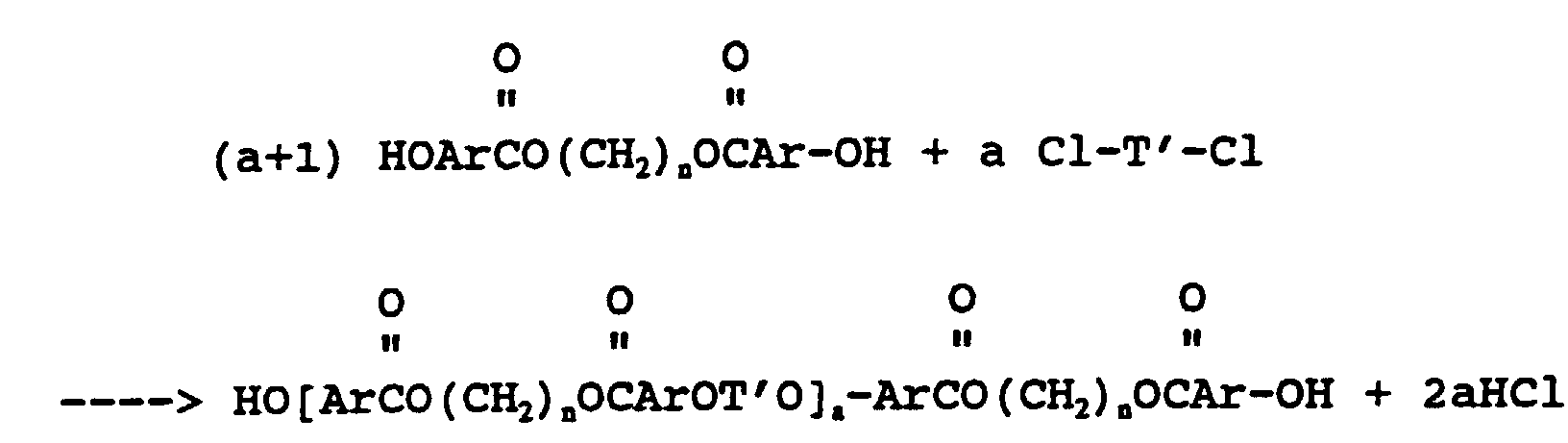
- the LCP segmented block copolymer (triad mesogenic unit with flexible spacer and polyester segment) can be advantageously prepared in a two step-reaction sequence.
- low oligomers of the triad oligomer can be prepared by the following reaction:
- Ar is paraphenylene
- a can be 2-50
- b can be 2-50
- n is the length of the spacer, e.g., 2-10, 2 or 4 most preferably
- T' is (para)-OCArCO-.
- low oligomers of the polyester e.g., preferably either ethylene terephthalate or butylene terephthalate
- the polyester e.g., preferably either ethylene terephthalate or butylene terephthalate
- the end-groups of the triad oligomer and the polyester oligomers can be selected as either acyl chloride or hydroxyl, respectively (or the converse), depending on the chosen preselected stoichiometry.
- the oligomers can be allowed to react with each other to produce the desired block copolymer according to the following sequence:
- the same block copolymer may be prepared from acyl chloride end-groups on the triad oligomer and hydroxyl end-groups on the polyester oligomer in the two step sequence shown below:
- both the length of the blocks and the composition of the copolymer may be controlled.
- the sizes of the oligomers can be controlled by the stoichiometric ratios of the triad monomer to terephthaloyl chloride and bis(hydroxyalkyl)terephthalate to terephthaloyl chloride.
- Polarized optical microscopy (POM) results have shown that these block copolymers form nematic liquid crystal phases above T m , as shown by Schlieren textures.
- the following Example and related Experimentals section sets forth one preferred material of this type and a process to make it.
- This Example illustrates preparation of a triad-4 poly(butylene terephthalate) (PBT) copolymer (B) with an average block size of five triad-4 terephthalate and eight butylene terephthalate units in the corresponding blocks.
- PBT poly(butylene terephthalate)
- B butylene terephthalate copolymer
- BHBT Bis-(hydroxybutyl)terephthalate
- terephthaloyl chloride 3.271 gm, 1.6111 x 10 -2 mol
- Triad-4 monomer 5.322 gm, 1.6111 x 10 -2 mol
- terephthaloyl chloride 2.617 gm, 1.2889 x 10 -2 mol
- the polymer was then dried in a vacuum oven at 100°C for twenty-four hours.
- the yield was 90%, and the inherent viscosity was 0.50 g -1. dL, measured as a 0.50 g . dL -1 trifluoroacetic acid polymer solution at 30°C.
- the LCP copolymer used was a block polymer made in Example 1, above (hereinafter termed "LCP-b-PBT (5/8)"), which consisted of blocks of a triad aromatic ester mesogenic unit containing an alkylene spacer (C 4 alkylene) of the type described by Lenz et al. in Polym. J., Vol. 14, p. 9 (1982).
- LCP-b-PBT a block polymer made in Example 1, above
- C 4 alkylene alkylene spacer
- the tetramethylene [(CH 2 ) 4 ] groups between the rigid mesogen blocks and the PBT block may increase the compatibility and dispersity of the LCP/PBT blend.
- the LCP-b-PBT (5/8) with an inherent viscosity of 0.51 (0.2 g/dL in trifluoroacetic acid) had a melting temperature (T m ) of 210°C and an isotropic transition Ti at 275°C.
- the PBT (Mn : 10,500, Mw/Mn : 3.1) had a melting temperature of 225°C.
- blends of LCP-b-PBT with PBT in various compositions were prepared by solution blending.
- Dilute (less than 5 wt%) solutions of PBT and LCP-b-PBT in trifluoroacetic acid at room temperature were mixed together in appropriate portions and were co-precipitated in methanol, then were washed with 5% NaHCO 3 solution, water and methanol followed by drying at 130°C under vacuum overnight.
- the concentration of LCP-b-PBT was varied over the range of 5-50 wt%.
- the vacuum dried blend and pure component polymer precipitates were combined in a hot-press at 210°C and 2500 kg/cm 2 for a brief period of time. These irregular films were immediately removed from the press and were quenched in cold water.
- the residence time in the capillary extruder was 2 to 3 minutes.
- the extrudate was elongated by a take-up machine below the die.
- the draw ratio (DR) was determined by measuring the reduction in fiber diameter by either laser diffraction or optical microscopy. It is to be understood that the term “draw ratio” as used herein is to be construed as relating to "drawn as spun”, also termed “jet draw” or "jet stretch”.
- Tensile properties were measured at 10 or 20 mm/min cross-head speed on an Instron Mechanical Tester at ambient conditions in the laboratory. Each tensile property was averaged over six tests.
- Morphology was characterized using a JEOL [JSM-35C] scanning electron microscope with an accelerating voltage of 25 kv.
- Fracture surfaces were prepared by snapping the materials after cooling in liquid nitrogen. To observe the deformation of dispersed LCP-b-PBT particles in the blend, the strands stretched by the tensile tester were also examined. These samples were mounted on aluminum stubs and sputtered with gold using an SPI Sputter Coater for enhanced conductivity. A Perkin-Elmer model DSC-7 was used for thermal characterization. A heating rate of 20°C/min was utilized, and the samples were scanned from 40°C to 300°C.
- LCP-b-PBT in the melt showed the nematic behavior characterized by a thread-like texture.
- thermograms of the LCP-b-PBT and the pure PBT were taken.
- the parameters determined from the thermograms are given in Table 1, above.
- the crystal to nematic transition for the LCP-b-PBT and isotropic melt for the PBT were 210°C and 225°C, respectively.
- the cooling cycle thermogram showed a considerable supercooling of the mesophase to solid crystal transition.
- LCP-b-PBT polymer The nematic nature of the LCP-b-PBT polymer was identified by a thread-like Schlieren texture observed by cross-polarized optical microscopy, as mentioned earlier.
- the heat of isotropization of LCP-b-PBT in the blend was observed to decrease with increasing PBT content and eventually disappeared. Furthermore, there was a depression in the melting point of PBT with increasing blend composition.
- T m melting transition
- the pure LCP-b-PBT fiber fracture surfaces were also imaged by SEM.
- the fiber was extruded through a die of a capillary rheometer.
- extruded strand of pure LCP-b-PBT with draw ratios over 1 could not be obtained because of the fibers brittle behavior.
- IV 0.51
- Fibers of LCP-b-PBT/PBT blend and pure PBT were spun at 245°C and 255°C with various draw ratios via the extrusion procedure described previously.
- the values of the ⁇ versus the LCP-b-PBT content were also compared.
- the tensile strength of the 245°C extruded materials increased from 59 MPa for the PBT fiber with a draw ratio of 40 to 104 MPa for the 20% LCP-b-PBT fiber with the same draw ratio.
- ⁇ was improved from 60 MPa for PBT to 120 MPa for 20% LCP-b-PBT fiber with the same draw ratio of 40.
- the values were about twice that for pure PBT.
- the following Table shows the LCP-b-PBT composition dependence of tensile strength (MPa) of the blend fibers spun at 245°C for a draw ratio of 1, 10, 20, and 40: LCP-b-PBT Content (%) --- Tensile Str. (MPa) at Draw Ratio of -- 1 10 20 40 0 51 51 57 59 5 54 59 62 63 10 55 64 70 81 20 58 69 90 104
- LCP-b-PBT Content (%) -- Modulus (GPa) at Draw Ratio of -- 1 10 20 40 0 1.94 2.08 2.15 2.28 5 2.50 2.85 3.14 3.30 10 2.80 4.20 8.01 8.34 20 3.21 6.99 12.01 13.01
- Fibers made from blends of LCP-b-PBT and PBT generally have shown that tensile strength and initial modulus increase with processing temperature.
- the LCP-b-PBT was not totally miscible with the matrix, but the adhesion between the two materials was excellent.
- the initial moduli for 20% LCP-b-PBT fibers extruded at 245°C and 255°C were 13.0 GPa and 14.2 GPa amounting to an increase of 6 to 7 times that for pure PBT.
- the mechanical properties of the fibers spun through a capillary die increased with draw ratio, processing temperature and LCP-b-PBT content.
Landscapes
- Chemical & Material Sciences (AREA)
- Organic Chemistry (AREA)
- Chemical Kinetics & Catalysis (AREA)
- Polymers & Plastics (AREA)
- Medicinal Chemistry (AREA)
- Health & Medical Sciences (AREA)
- Materials Engineering (AREA)
- Engineering & Computer Science (AREA)
- Crystallography & Structural Chemistry (AREA)
- Polyesters Or Polycarbonates (AREA)
- Compositions Of Macromolecular Compounds (AREA)
- Liquid Crystal Substances (AREA)
- Other Resins Obtained By Reactions Not Involving Carbon-To-Carbon Unsaturated Bonds (AREA)
Description






| Properties of LCP-b-PBT and Poly(butylene terephthalate) | ||||
| Tm (°C) | Ti(°C) | IV (dl/g) | Mw | |
| LCP-b-PBT | 210 | 275 | 0.51 | |
| PBT | 225 | --- | --- | 33,000 |
| Tensile properties of LCP-b-PBT/PBT extrudates | |||||
| LCP-b-PBT content (%) | draw ratio | ultimate strength (MPa) | initial modulus (GPa) | ||
| extrusion temp. | extrusion temp. | ||||
| 245°C | 255°C | 245°C | 255°C | ||
| 0 | 1 | 51 | 53 | 1.94 | 1.92 |
| 10 | 51 | 54 | 2.08 | 2.01 | |
| 20 | 57 | 59 | 2.15 | 2.15 | |
| 40 | 59 | 60 | 2.28 | 2.25 | |
| 5 | 1 | 54 | 54 | 2.50 | 2.61 |
| 10 | 59 | 61 | 2.85 | 3.02 | |
| 20 | 62 | 64 | 3.14 | 3.18 | |
| 40 | 63 | 66 | 3.30 | 3.48 | |
| 10 | 1 | 55 | 58 | 2.80 | 2.95 |
| 10 | 64 | 68 | 4.20 | 4.95 | |
| 20 | 70 | 76 | 8.01 | 8.50 | |
| 40 | 81 | 89 | 8.34 | 9.52 | |
| 20 | 1 | 58 | 60 | 3.21 | 3.34 |
| 10 | 69 | 75 | 6.99 | 7.48 | |
| 20 | 90 | 114 | 12.01 | 13.81 | |
| 40 | 104 | 120 | 13.01 | 14.23 |
| LCP-b-PBT Content (%) | --- Tensile Str. (MPa) at Draw Ratio of -- | |||
| 1 | 10 | 20 | 40 | |
| 0 | 51 | 51 | 57 | 59 |
| 5 | 54 | 59 | 62 | 63 |
| 10 | 55 | 64 | 70 | 81 |
| 20 | 58 | 69 | 90 | 104 |
| LCP-b-PBT Content (%) | --- Tensile Str. (MPa) at Draw Ratio of -- | |||
| 1 | 10 | 20 | 40 | |
| 0 | 53 | 54 | 59 | 60 |
| 5 | 54 | 61 | 64 | 66 |
| 10 | 58 | 68 | 76 | 89 |
| 20 | 60 | 75 | 114 | 120 |
| LCP-b-PBT Content (%) | -- Modulus (GPa) at Draw Ratio of -- | |||
| 1 | 10 | 20 | 40 | |
| 0 | 1.94 | 2.08 | 2.15 | 2.28 |
| 5 | 2.50 | 2.85 | 3.14 | 3.30 |
| 10 | 2.80 | 4.20 | 8.01 | 8.34 |
| 20 | 3.21 | 6.99 | 12.01 | 13.01 |
| LCP-b-PBT Content (%) | -- Modulus (GPa) at Draw Ratio of -- | |||
| 1 | 10 | 20 | 40 | |
| 0 | 1.92 | 2.01 | 2.15 | 2.25 |
| 5 | 2.61 | 3.02 | 3.18 | 3.48 |
| 10 | 2.95 | 4.95 | 8.50 | 9.52 |
| 20 | 3.34 | 7.48 | 13.81 | 14.23 |
| Extrudate | -- Tensile Str. (MPa) at Draw Ratio of -- | |||
| 1 | 10 | 20 | 40 | |
| 245°C | 58 | 69 | 90 | 104 |
| 255°C | 60 | 75 | 114 | 120 |
| Extrudate | -- Modulus (GPa) at Draw Ratio of -- | |||
| 1 | 10 | 20 | 40 | |
| 245°C | 3.21 | 6.99 | 12.01 | 13.01 |
| 255°C | 3.34 | 7.48 | 13.81 | 14.23 |
Claims (9)
- A main chain thermotropic liquid crystalline segmented block copolymer which has the following general formula:
- A segmented block copolymer as claimed in Claim 1 wherein the flexible coil polymer matrix and the flexible coil block is polyester.
- A segmented block copolymer as claimed in Claim 2 wherein the polyester is poly(butylene terephthalate).
- A segmented block copolymer as claimed in Claim 1 wherein the rod block comprises oxybenzoate and terephtalate units.
- A segmented block copolymer as claimed in Claim 2 wherein the rod block comprises oxybenzoate and terephthalate units.
- A segmented block copolymer as claimed in Claim 3 wherein the rod block comprises oxybenzoate and terephthalate units.
- A segmented block copolymer as claimed in Claim 1 wherein the rod block comprises a triad aromatic ester mesogenic unit containing a flexible polyalkylene spacer in the main chain thereof.
- A segmented block copolymer as claimed in Claim 7 wherein the polyalkylene spacer is from about 2 to about 10 carbon atoms in length.
- A main chain thermotropic liquid crystalline segmented block copolymer according to any one of claims 1-8, which is especially adapted to be blended with a flexible coil polymer matrix, which comprises rod and flexible coil polymer blocks, the rod blocks containing a flexible spacer and the flexible coil blocks being selected from the group consisting of polyester and polyamide, the flexible coil blocks being selected to be substantially similar to the composition of the flexible coil polymer matrix.
Applications Claiming Priority (3)
| Application Number | Priority Date | Filing Date | Title |
|---|---|---|---|
| US72660191A | 1991-07-08 | 1991-07-08 | |
| US726601 | 1991-07-08 | ||
| PCT/US1992/005671 WO1993001227A1 (en) | 1991-07-08 | 1992-07-07 | Thermotropic liquid crystal segmented block copolymer |
Publications (3)
| Publication Number | Publication Date |
|---|---|
| EP0593592A1 EP0593592A1 (en) | 1994-04-27 |
| EP0593592A4 EP0593592A4 (en) | 1994-06-15 |
| EP0593592B1 true EP0593592B1 (en) | 1998-03-25 |
Family
ID=24919267
Family Applications (1)
| Application Number | Title | Priority Date | Filing Date |
|---|---|---|---|
| EP92914623A Expired - Lifetime EP0593592B1 (en) | 1991-07-08 | 1992-07-07 | Thermotropic liquid crystal segmented block copolymer |
Country Status (5)
| Country | Link |
|---|---|
| EP (1) | EP0593592B1 (en) |
| JP (1) | JPH06508880A (en) |
| CA (1) | CA2113113A1 (en) |
| DE (1) | DE69224906T2 (en) |
| WO (1) | WO1993001227A1 (en) |
Families Citing this family (119)
| Publication number | Priority date | Publication date | Assignee | Title |
|---|---|---|---|---|
| US5194569A (en) * | 1991-10-18 | 1993-03-16 | Akzo Nv | Synthesis of block liquid crystal copolymer |
| US5258486A (en) * | 1992-07-31 | 1993-11-02 | Akzo Nv | Synthesis of block liquid crystal copolymer |
| DE19704506A1 (en) * | 1997-02-06 | 1998-08-13 | Basf Ag | Chiral nematic polyester |
| CN102766210B (en) | 1999-08-24 | 2015-07-08 | E.R.施贵宝&圣斯有限责任公司 | Human CTLA-4 antibodies and uses thereof |
| US7560534B2 (en) | 2000-05-08 | 2009-07-14 | Celldex Research Corporation | Molecular conjugates comprising human monoclonal antibodies to dendritic cells |
| EP2314316A1 (en) | 2002-04-05 | 2011-04-27 | Amgen, Inc | Human anti-OPGL neutralizing antibodies as selective OPGL pathway inhibitors |
| CN104178491B (en) | 2002-09-06 | 2018-07-03 | 安姆根有限公司 | Therapeutic human anti-IL-1R1 monoclonal antibody |
| KR20110017020A (en) | 2002-10-17 | 2011-02-18 | 젠맵 에이/에스 | Human monoclonal antibodies against CD20 |
| EP1533617A1 (en) | 2003-11-19 | 2005-05-25 | RMF Dictagene S.A. | Angiogenesis inhibiting molecules, their selection, production and their use in the treatment and diagnosis of cancer |
| US7642341B2 (en) | 2003-12-18 | 2010-01-05 | Merck Serono S.A. | Angiogenesis inhibiting molecules, their selection, production and their use in the treatment of cancer |
| EP2857418B1 (en) | 2004-02-06 | 2017-07-26 | University of Massachusetts | Antibodies against Clostridium difficile toxins and uses thereof |
| PT1737891E (en) | 2004-04-13 | 2013-04-16 | Hoffmann La Roche | Anti-p-selectin antibodies |
| ME00226B (en) | 2004-07-15 | 2011-02-10 | Medarex Llc | Human anti-ngf neutralizing antibodies as selective ngf pathway inhibitors |
| CA2574881C (en) | 2004-08-04 | 2013-01-08 | Amgen Inc. | Antibodies to dkk-1 |
| EP3312196B1 (en) | 2005-03-23 | 2019-07-17 | Genmab A/S | Antibodies against cd38 for treatment of multiple myeloma |
| DK1915398T3 (en) | 2005-07-18 | 2016-07-04 | Amgen Inc | Humane anti-B7RP1 neutraliserende antistoffer |
| AU2007302448C1 (en) | 2006-09-26 | 2019-02-14 | Genmab A/S | Combination treatment of CD38-expressing tumors |
| JP2010504955A (en) | 2006-09-28 | 2010-02-18 | メルク セローノ ソシエテ アノニム | Bonding molecule adhesion molecule C (JAM-C) binding compound and method of use thereof |
| US8551484B2 (en) | 2007-02-21 | 2013-10-08 | University Of Massachusetts | Human antibodies against hepatitis C virus (HCV) and uses thereof |
| CN104497143B (en) | 2007-03-29 | 2020-08-25 | 健玛保 | Bispecific antibodies and methods of making the same |
| WO2008145140A2 (en) | 2007-05-31 | 2008-12-04 | Genmab A/S | Transgenic animals producing monovalent human antibodies and antibodies obtainable from these animals |
| JP6071165B2 (en) | 2007-05-31 | 2017-02-01 | ゲンマブ エー/エス | Stable IgG4 antibody |
| RS56743B1 (en) | 2007-08-21 | 2018-03-30 | Amgen Inc | Human c-fms antigen binding proteins |
| KR101811965B1 (en) | 2007-11-07 | 2017-12-22 | 셀덱스 쎄라퓨틱스, 인크. | Antibodies that bind human dendritic and epithelial cell 205(dec-205) |
| US8715941B2 (en) | 2007-11-16 | 2014-05-06 | Arca Biopharma, Inc. | Antibodies to LRP6 |
| MX2010008083A (en) | 2008-01-25 | 2010-12-20 | Univ Aarhus | Selective exosite inhibition of papp-a activity against igfbp-4. |
| AU2009262199B2 (en) | 2008-06-27 | 2012-08-09 | Amgen Inc. | Ang-2 inhibition to treat multiple sclerosis |
| CA2745439C (en) | 2008-12-03 | 2019-10-15 | Genmab A/S | Antibody variants having modifications in the constant region |
| UA109633C2 (en) | 2008-12-09 | 2015-09-25 | HUMAN ANTIBODY AGAINST TISSUE FACTOR | |
| JO3382B1 (en) | 2008-12-23 | 2019-03-13 | Amgen Inc | Human cgrp receptor binding antibodies |
| WO2010112034A2 (en) | 2009-04-02 | 2010-10-07 | Aarhus Universitet | Compositions and methods for treatment and diagnosis of synucleinopathies |
| JO3244B1 (en) | 2009-10-26 | 2018-03-08 | Amgen Inc | Proteins bind to human IL-23 antigens |
| US8968740B2 (en) | 2009-11-13 | 2015-03-03 | Dana-Farber Cancer Institute, Inc. | Compositions, kits, and methods for the diagnosis, prognosis, monitoring, treatment and modulation of post-transplant lymphoproliferative disorders and hypoxia associated angiogenesis disorders using galectin-1 |
| UA109888C2 (en) | 2009-12-07 | 2015-10-26 | ANTIBODY OR ANTIBODILITY ANTIBODY OR ITS BINDING TO THE β-CLOTE, FGF RECEPTORS AND THEIR COMPLEXES | |
| WO2011110642A2 (en) | 2010-03-10 | 2011-09-15 | Genmab A/S | Monoclonal antibodies against c-met |
| NZ602892A (en) | 2010-04-13 | 2014-08-29 | Celldex Therapeutics Inc | Antibodies that bind human cd27 and uses thereof |
| JP2013523184A (en) | 2010-04-15 | 2013-06-17 | アムジエン・インコーポレーテツド | Human FGF receptor and β-KLOTHO binding protein |
| JP6040148B2 (en) | 2010-04-20 | 2016-12-07 | ゲンマブ エー/エス | Heterodimeric antibody Fc-containing protein and production method thereof |
| NZ604007A (en) | 2010-05-27 | 2015-03-27 | Genmab As | Monoclonal antibodies against her2 epitope |
| CA3051311A1 (en) | 2010-05-27 | 2011-12-01 | Genmab A/S | Monoclonal antibodies against her2 |
| EP2580243B1 (en) | 2010-06-09 | 2019-10-16 | Genmab A/S | Antibodies against human cd38 |
| SMT201700547T1 (en) | 2010-06-15 | 2018-01-11 | Genmab As | Human antibody drug conjugates against tissue factor |
| TWI636993B (en) | 2010-10-27 | 2018-10-01 | 安美基公司 | Dkk1 antibodies and methods of use |
| WO2012118693A1 (en) | 2011-02-28 | 2012-09-07 | Northshore University Healthsystem | Methods of diagnosing clostridium difficile infection |
| EP2681242B1 (en) | 2011-03-01 | 2018-01-24 | Amgen Inc. | Sclerostin and dkk-1 bispecific binding agents |
| US9499610B2 (en) | 2011-04-08 | 2016-11-22 | H. Lundbeck A/S | Antibodies specific to pyroglutamated Aβ |
| EP4520771A3 (en) | 2011-04-20 | 2025-07-16 | Genmab A/S | Bispecifc antibodies against her2 |
| AU2012245116A1 (en) | 2011-04-20 | 2013-11-07 | Genmab A/S | Bispecific antibodies against HER2 and CD3 |
| WO2012143523A1 (en) | 2011-04-20 | 2012-10-26 | Genmab A/S | Bispecifc antibodies against her2 |
| AU2012271329A1 (en) | 2011-06-17 | 2013-12-19 | Amgen Inc. | Method of treating or ameliorating metabolic disorders using Clec-2 |
| UA117901C2 (en) | 2011-07-06 | 2018-10-25 | Ґенмаб Б.В. | METHOD FOR STRENGTHENING THE EFFECTORAL FUNCTION OF THE ORIGINAL POLYEPEPTIDE, ITS OPTIONS AND THEIR APPLICATIONS |
| JP6454547B2 (en) | 2011-07-06 | 2019-01-16 | ゲンマブ エー/エス | Regulation of complement-dependent cytotoxicity by modification of the C-terminus of antibody heavy chain |
| DK2771364T3 (en) | 2011-10-27 | 2019-08-19 | Genmab As | PREPARATION OF HETERODIMERED PROTEINS |
| CA2858572C (en) | 2011-12-08 | 2023-01-17 | Amgen Inc. | Human lcat antigen binding proteins and their use in therapy |
| DK3431492T3 (en) | 2012-04-27 | 2021-03-08 | Amgen Inc | HUMANE CD30 LIGANDANTIGEN BINDING PROTEINS |
| US11180572B2 (en) | 2012-07-06 | 2021-11-23 | Genmab B.V. | Dimeric protein with triple mutations |
| EP3632462A1 (en) | 2012-07-06 | 2020-04-08 | Genmab B.V. | Dimeric protein with triple mutations |
| AU2013372331A1 (en) | 2013-01-10 | 2015-07-23 | Genmab B.V. | Human IgG1 Fc region variants and uses thereof |
| WO2014144553A1 (en) | 2013-03-15 | 2014-09-18 | Amgen Inc. | Secreted frizzle-related protein 5 (sfrp5) binding proteins and methods of treatment |
| TWI636064B (en) | 2013-03-15 | 2018-09-21 | 安美基公司 | Human PAC1 antibody |
| TW201605896A (en) | 2013-08-30 | 2016-02-16 | 安美基股份有限公司 | GITR antigen binding proteins |
| JP6913018B2 (en) | 2014-07-08 | 2021-08-04 | ニューヨーク・ユニバーシティ | Tau imaging ligands, and their use in the diagnosis and treatment of tau disorders |
| EP3169706B1 (en) | 2014-07-11 | 2019-12-04 | Genmab A/S | Antibodies binding axl |
| MX2017003247A (en) | 2014-09-15 | 2017-11-30 | Amgen Inc | Bi-specific anti-cgrp receptor/pac1 receptor antigen binding proteins and uses thereof. |
| SG10201902924RA (en) | 2014-10-03 | 2019-05-30 | Massachusetts Inst Technology | Antibodies that bind ebola glycoprotein and uses thereof |
| ES3013108T3 (en) | 2014-11-05 | 2025-04-11 | Annexon Inc | Humanized anti-complement factor c1q antibodies and uses thereof |
| CN107278206B (en) | 2014-12-19 | 2021-04-02 | 雷根尼桑斯公司 | Antibodies that bind to human C6 and uses thereof |
| TWI728953B (en) | 2015-04-24 | 2021-06-01 | 美商安美基公司 | Methods for treating or preventing migraine headache |
| CA2991805A1 (en) | 2015-07-10 | 2017-01-19 | Genmab A/S | Axl-specific antibody-drug conjugates for cancer treatment |
| JO3711B1 (en) | 2015-07-13 | 2021-01-31 | H Lundbeck As | Antibodies specific for hyperphosphorylated tau and methods of use thereof |
| GB201512215D0 (en) | 2015-07-13 | 2015-08-19 | Lundbeck & Co As H | Agents,uses and methods |
| GB201512203D0 (en) | 2015-07-13 | 2015-08-19 | Lundbeck & Co As H | Agents,uses and methods |
| CN108137679B (en) | 2015-08-13 | 2022-07-19 | 纽约大学 | For Tau, of{p}Antibody-based molecules selective for the Ser404 epitope and their use in the diagnosis and treatment of Tau disease |
| CA2998174A1 (en) | 2015-09-15 | 2017-03-23 | Amgen Inc. | Tetravalent bispecific and tetraspecific antigen binding proteins and uses thereof |
| CR20180378A (en) | 2015-12-23 | 2018-12-06 | Amgen Inc | METHOD TO TREAT OR IMPROVE METABOLIC DISORDERS WITH UNION PROTEINS FOR THE GASTRIC INHIBITOR PEPTIDE RECEPTOR (GIPR) IN COMBINATION WITH GLP-1 AGOSNISTES |
| JP7038064B2 (en) | 2016-04-18 | 2022-03-17 | セルデックス セラピューティクス インコーポレイテッド | Agonist antibody that binds to human CD40 and its use |
| KR102551971B1 (en) | 2016-07-12 | 2023-07-07 | 하. 룬드벡 아크티에셀스카브 | Antibodies specific for hyperphosphorylated tau and methods for their use |
| CA3040189A1 (en) | 2016-10-13 | 2018-04-19 | Massachusetts Institute Of Technology | Antibodies that bind zika virus envelope protein and uses thereof |
| CA3043528A1 (en) | 2016-11-14 | 2018-05-17 | Amgen Inc. | Bispecific or biparatopic antigen binding proteins and uses thereof |
| MA46836A (en) | 2016-11-15 | 2019-09-25 | H Lundbeck As | AGENTS, USES AND METHODS FOR THE TREATMENT OF SYNUCLEINOPATHY |
| EP3555127B1 (en) | 2016-12-16 | 2024-12-18 | H. Lundbeck A/S | Agents, uses and methods |
| US10364286B2 (en) | 2016-12-22 | 2019-07-30 | H. Lundbeck A/S | Monoclonal anti-alpha-synuclein antibodies for preventing tau aggregation |
| CN118047864A (en) | 2016-12-23 | 2024-05-17 | 百时美施贵宝公司 | Design of Therapeutic Immunoglobulin G4 for Improved Bioanalytical and Bioprocessing Properties |
| CN110267985B (en) | 2017-01-04 | 2023-05-23 | H.隆德贝克有限公司 | Antibodies specific for hyperphosphorylated tau protein for the treatment of ophthalmic diseases |
| KR102781241B1 (en) | 2017-01-17 | 2025-03-14 | 암젠 인크 | Method of treating or ameliorating metabolic disorders using glp-1 receptor agonists conjugated to antagonists for gastric inhibitory peptide receptor(gipr) |
| JOP20190248A1 (en) | 2017-04-21 | 2019-10-20 | Amgen Inc | Trem2 antigen binding proteins and uses thereof |
| JOP20190259A1 (en) | 2017-05-31 | 2019-10-31 | Amgen Inc | Anti-jagged1 antigen binding proteins |
| MX2019013919A (en) | 2017-06-20 | 2020-01-21 | Amgen Inc | Method of treating or ameliorating metabolic disorders using binding proteins for gastric inhibitory peptide receptor (gipr) in combination with glp-1 agonists. |
| JP7250706B2 (en) | 2017-06-21 | 2023-04-03 | アムジエン・インコーポレーテツド | Methods of treating or ameliorating metabolic disorders using antagonist binding proteins to the gastric inhibitory peptide receptor (GIPR)/GLP-1 receptor agonist fusion proteins |
| US10894833B2 (en) | 2017-07-20 | 2021-01-19 | H. Lundbeck A/S | Agents, uses and methods for treatment |
| FI3661562T3 (en) | 2017-08-04 | 2024-12-09 | Amgen Inc | Method of conjugation of cys-mabs |
| CA3099547A1 (en) | 2018-05-07 | 2019-11-14 | Reshma Abdulla RANGWALA | Methods of treating cancer with a combination of an anti-pd-1 antibody and an anti-tissue factor antibody-drug conjugate |
| WO2019217457A1 (en) | 2018-05-07 | 2019-11-14 | Genmab A/S | Methods of treating cancer with a combination of an anti-pd-1 antibody and an anti-tissue factor antibody-drug conjugate |
| TWI844571B (en) | 2018-10-30 | 2024-06-11 | 丹麥商珍美寶股份有限公司 | Methods of treating cancer with a combination of an anti-vegf antibody and an anti-tissue factor antibody-drug conjugate |
| SG11202112926YA (en) | 2019-05-30 | 2021-12-30 | Amgen Inc | Engineering the hinge region to drive antibody dimerization |
| US20220363770A1 (en) | 2019-06-28 | 2022-11-17 | Amgen Inc. | Anti-cgrp receptor/anti-pac1 receptor bispecific antigen binding proteins |
| CN115175680A (en) | 2019-10-18 | 2022-10-11 | 加利福尼亚大学董事会 | PLXDC activators and their use for treating vascular disorders |
| WO2021091815A1 (en) | 2019-11-04 | 2021-05-14 | Seagen Inc. | Anti-cd30 antibody-drug conjugates and their use for the treatment of hiv infection |
| JP2023500888A (en) | 2019-11-07 | 2023-01-11 | ジェンマブ エー/エス | Methods of treating cancer using a combination of an anti-PD-1 antibody and an anti-tissue factor antibody-drug conjugate |
| TW202131954A (en) | 2019-11-07 | 2021-09-01 | 丹麥商珍美寶股份有限公司 | Methods of treating cancer with a combination of a platinum-based agent and an anti-tissue factor antibody-drug conjugate |
| WO2021092355A1 (en) | 2019-11-08 | 2021-05-14 | Amgen Inc. | Engineering charge pair mutations for pairing of hetero-igg molecules |
| CA3160438A1 (en) | 2019-11-19 | 2021-05-27 | Amgen Inc. | Novel multispecific antibody format |
| EP4077378A1 (en) | 2019-12-20 | 2022-10-26 | NovaRock Biotherapeutics, Ltd. | Anti-interleukin-23 p19 antibodies and methods of use thereof |
| EP4171652A1 (en) | 2020-06-29 | 2023-05-03 | Genmab A/S | Anti-tissue factor antibody-drug conjugates and their use in the treatment of cancer |
| JP2023538897A (en) | 2020-08-20 | 2023-09-12 | アムジエン・インコーポレーテツド | Antigen binding proteins with non-canonical disulfides in the Fab region |
| EP4208259A2 (en) | 2020-09-04 | 2023-07-12 | NovaRock Biotherapeutics, Ltd. | Nectin-4 antibodies and uses thereof |
| US20230374162A1 (en) | 2020-10-07 | 2023-11-23 | Amgen Inc. | Rational selection of building blocks for the assembly of multispecific antibodies |
| US20240002545A1 (en) | 2020-11-10 | 2024-01-04 | Amgen Inc. | Novel linkers of multispecific antigen binding domains |
| US20240024320A1 (en) | 2020-11-17 | 2024-01-25 | Seagen Inc. | Methods of treating cancer with a combination of tucatinib and an anti-pd-1/anti-pd-l1 antibody |
| CA3216559A1 (en) | 2021-04-20 | 2022-10-27 | Amgen Inc. | Balanced charge distribution in electrostatic steering of chain pairing in multi-specific and monovalent igg molecule assembly |
| AU2022377628A1 (en) | 2021-10-29 | 2024-04-11 | Seagen Inc. | Methods of treating cancer with a combination of an anti-pd-1 antibody and an anti-cd30 antibody-drug conjugate |
| WO2023213960A1 (en) | 2022-05-06 | 2023-11-09 | Genmab A/S | Methods of treating cancer with anti-tissue factor antibody-drug conjugates |
| CN119836306A (en) | 2022-07-15 | 2025-04-15 | 费恩治疗有限公司 | Antibody drug conjugates that bind CDCP1 and uses thereof |
| AU2023393437A1 (en) | 2022-12-16 | 2025-06-19 | Pheon Therapeutics Ltd | Antibodies to cub domain-containing protein 1 (cdcp1) and uses thereof |
| WO2025050009A2 (en) | 2023-09-01 | 2025-03-06 | Children's Hospital Medical Center | Identification of targets for immunotherapy in melanoma using splicing-derived neoantigens |
| WO2025149667A1 (en) | 2024-01-12 | 2025-07-17 | Pheon Therapeutics Ltd | Antibody drug conjugates and uses thereof |
| WO2025262641A1 (en) | 2024-06-19 | 2025-12-26 | Pheon Therapeutics Ltd | Antibody drug conjugates that bind cdcp1 and uses thereof |
| WO2026020031A2 (en) | 2024-07-18 | 2026-01-22 | Novarock Biotherapeutics, Ltd. | Cdh17 antibodies and uses thereof |
| WO2026078443A1 (en) | 2024-10-11 | 2026-04-16 | Pheon Therapeutics Ltd. | Antibody drug conjugates that bind cdcp1 and uses thereof |
Family Cites Families (2)
| Publication number | Priority date | Publication date | Assignee | Title |
|---|---|---|---|---|
| JPS5465747A (en) * | 1977-11-04 | 1979-05-26 | Motoo Takayanagi | High molecular composite body |
| JP2505411B2 (en) * | 1986-03-24 | 1996-06-12 | ポリプラスチックス 株式会社 | Resin composition exhibiting anisotropy when melted |
-
1992
- 1992-07-07 JP JP5502376A patent/JPH06508880A/en active Pending
- 1992-07-07 DE DE69224906T patent/DE69224906T2/en not_active Expired - Fee Related
- 1992-07-07 CA CA 2113113 patent/CA2113113A1/en not_active Abandoned
- 1992-07-07 WO PCT/US1992/005671 patent/WO1993001227A1/en not_active Ceased
- 1992-07-07 EP EP92914623A patent/EP0593592B1/en not_active Expired - Lifetime
Non-Patent Citations (1)
| Title |
|---|
| "Faraday Discussions of the Chemical Society", vol. 79, "Polymer Liquid Crystals", London, The Royal Society of Chemistry, 1985, pp 21-32 * |
Also Published As
| Publication number | Publication date |
|---|---|
| JPH06508880A (en) | 1994-10-06 |
| EP0593592A1 (en) | 1994-04-27 |
| DE69224906D1 (en) | 1998-04-30 |
| DE69224906T2 (en) | 1998-10-29 |
| EP0593592A4 (en) | 1994-06-15 |
| WO1993001227A1 (en) | 1993-01-21 |
| CA2113113A1 (en) | 1993-01-21 |
Similar Documents
| Publication | Publication Date | Title |
|---|---|---|
| WO1993001227A1 (en) | Thermotropic liquid crystal segmented block copolymer | |
| Dobb et al. | Properties and applications of liquid-crystalline main-chain polymers | |
| Dutta et al. | Polymer blends containing liquid crystals: a review | |
| Shin et al. | Speculation on interfacial adhesion and mechanical properties of blends of PET and thermotropic polyester with flexible spacer groups | |
| US4451611A (en) | Process for forming blend of polyalkylene terephthalate and wholly aromatic polyester which exhibits an anisotropic melt phase | |
| EP0169947B1 (en) | Melt blend of non-thermotropic and thermotropic wholly aromatic polyesters | |
| Miller et al. | Fibres from polypropylene and liquid-crystal polymer blends using compatibilizing agents: 1. Assessment of functional and non-functional polypropylene—acrylic acid compatibilizers | |
| CA1188847A (en) | Aromatic, melt-processible (co)polyesters | |
| Kyotani et al. | Mechanical and structural properties of extruded strands of blends containing a liquid-crystalline polyester with poly (ethylene terephthalate) | |
| WO1993013172A1 (en) | Blend of polyethylene terephthalate matrix and thermotropic liquid crystal block copolymer | |
| Golovoy et al. | Characterization of thermotropic liquid crystalline polyester/polysulfone blends | |
| EP0102719A1 (en) | Wholly aromatic polyesters comprising 6-oxy-2-naphthoyl moiety and 4-oxy-4'-carboxy biphenyl moiety | |
| Ajji et al. | Rheology and morphology of some thermoplastic blends with a liquid crystalline copolyester | |
| Kim et al. | Effect of composition and molecular structure on the LC phase of PHB‐PEN‐PET ternary blend | |
| Chang et al. | Blends of thermotropic liquid crystalline polyesters and poly (butylene terephthalate): Thermal, mechanical, and morphological properties | |
| Tjong et al. | Properties of in situ composites based on semiflexible thermotropic liquid crystalline copolyesteramide and polyamide 66 blends | |
| Choi et al. | Reinforcing properties of poly (trimethyleneterephthalate) by a thermotropic liquid crystal polymer | |
| WO1993001238A1 (en) | Blend of flexible coil polymer and thermotropic liquid crystal segmented block copolymer | |
| Joslin et al. | Thermotropic liquid-crystalline polymers with flexible moieties blended with poly (ethylene terephthalate) | |
| Kim et al. | Rheological and physical properties of in situ composite based on liquid crystalline polymer and poly (ethylene 2, 6‐naphthalate) blends | |
| Kim et al. | Studies on the ternary blends of liquid crystalline polymer and polyesters | |
| Chang et al. | The effect of composition on thermal, mechanical, and morphological properties of thermotropic liquid crystalline polyester with alkyl side‐group and polycarbonate blends | |
| Haderlein et al. | Synthesis and properties of liquid crystalline aromatic copolyesters with lactide moieties | |
| Pan et al. | A comparative study of in‐situ composite fibers reinforced with different rigid liquid crystalline polymers | |
| Hong et al. | Effect of poly (esterimide) s as compatibilizers on the physical properties of poly (etherimide)/thermotropic liquid crystalline polymer in-situ composites |
Legal Events
| Date | Code | Title | Description |
|---|---|---|---|
| PUAI | Public reference made under article 153(3) epc to a published international application that has entered the european phase |
Free format text: ORIGINAL CODE: 0009012 |
|
| 17P | Request for examination filed |
Effective date: 19940107 |
|
| AK | Designated contracting states |
Kind code of ref document: A1 Designated state(s): CH DE ES FR GB IT LI NL |
|
| A4 | Supplementary search report drawn up and despatched |
Effective date: 19940428 |
|
| AK | Designated contracting states |
Kind code of ref document: A4 Designated state(s): CH DE ES FR GB IT LI NL |
|
| 17Q | First examination report despatched |
Effective date: 19951010 |
|
| GRAG | Despatch of communication of intention to grant |
Free format text: ORIGINAL CODE: EPIDOS AGRA |
|
| GRAG | Despatch of communication of intention to grant |
Free format text: ORIGINAL CODE: EPIDOS AGRA |
|
| GRAH | Despatch of communication of intention to grant a patent |
Free format text: ORIGINAL CODE: EPIDOS IGRA |
|
| GRAH | Despatch of communication of intention to grant a patent |
Free format text: ORIGINAL CODE: EPIDOS IGRA |
|
| GRAA | (expected) grant |
Free format text: ORIGINAL CODE: 0009210 |
|
| AK | Designated contracting states |
Kind code of ref document: B1 Designated state(s): CH DE ES FR GB IT LI NL |
|
| PG25 | Lapsed in a contracting state [announced via postgrant information from national office to epo] |
Ref country code: NL Free format text: LAPSE BECAUSE OF FAILURE TO SUBMIT A TRANSLATION OF THE DESCRIPTION OR TO PAY THE FEE WITHIN THE PRESCRIBED TIME-LIMIT Effective date: 19980325 Ref country code: LI Free format text: LAPSE BECAUSE OF FAILURE TO SUBMIT A TRANSLATION OF THE DESCRIPTION OR TO PAY THE FEE WITHIN THE PRESCRIBED TIME-LIMIT Effective date: 19980325 Ref country code: IT Free format text: LAPSE BECAUSE OF FAILURE TO SUBMIT A TRANSLATION OF THE DESCRIPTION OR TO PAY THE FEE WITHIN THE PRESCRIBED TIME-LIMIT;WARNING: LAPSES OF ITALIAN PATENTS WITH EFFECTIVE DATE BEFORE 2007 MAY HAVE OCCURRED AT ANY TIME BEFORE 2007. THE CORRECT EFFECTIVE DATE MAY BE DIFFERENT FROM THE ONE RECORDED. Effective date: 19980325 Ref country code: ES Free format text: THE PATENT HAS BEEN ANNULLED BY A DECISION OF A NATIONAL AUTHORITY Effective date: 19980325 Ref country code: CH Free format text: LAPSE BECAUSE OF FAILURE TO SUBMIT A TRANSLATION OF THE DESCRIPTION OR TO PAY THE FEE WITHIN THE PRESCRIBED TIME-LIMIT Effective date: 19980325 |
|
| REG | Reference to a national code |
Ref country code: CH Ref legal event code: EP |
|
| REF | Corresponds to: |
Ref document number: 69224906 Country of ref document: DE Date of ref document: 19980430 |
|
| ET | Fr: translation filed | ||
| PGFP | Annual fee paid to national office [announced via postgrant information from national office to epo] |
Ref country code: FR Payment date: 19980528 Year of fee payment: 7 |
|
| PGFP | Annual fee paid to national office [announced via postgrant information from national office to epo] |
Ref country code: GB Payment date: 19980601 Year of fee payment: 7 |
|
| PGFP | Annual fee paid to national office [announced via postgrant information from national office to epo] |
Ref country code: DE Payment date: 19980612 Year of fee payment: 7 |
|
| NLV1 | Nl: lapsed or annulled due to failure to fulfill the requirements of art. 29p and 29m of the patents act | ||
| REG | Reference to a national code |
Ref country code: CH Ref legal event code: PL |
|
| PLBE | No opposition filed within time limit |
Free format text: ORIGINAL CODE: 0009261 |
|
| STAA | Information on the status of an ep patent application or granted ep patent |
Free format text: STATUS: NO OPPOSITION FILED WITHIN TIME LIMIT |
|
| 26N | No opposition filed | ||
| PG25 | Lapsed in a contracting state [announced via postgrant information from national office to epo] |
Ref country code: GB Free format text: LAPSE BECAUSE OF NON-PAYMENT OF DUE FEES Effective date: 19990707 |
|
| PG25 | Lapsed in a contracting state [announced via postgrant information from national office to epo] |
Ref country code: FR Free format text: THE PATENT HAS BEEN ANNULLED BY A DECISION OF A NATIONAL AUTHORITY Effective date: 19990731 |
|
| GBPC | Gb: european patent ceased through non-payment of renewal fee |
Effective date: 19990707 |
|
| PG25 | Lapsed in a contracting state [announced via postgrant information from national office to epo] |
Ref country code: DE Free format text: LAPSE BECAUSE OF NON-PAYMENT OF DUE FEES Effective date: 20000503 |
|
| REG | Reference to a national code |
Ref country code: FR Ref legal event code: ST |