EP0591528B1 - PYRAZOLO[1,5-a]PYRIMIDINE DERIVATIVE AND ANTI-INFLAMMATORY CONTAINING THE SAME - Google Patents
PYRAZOLO[1,5-a]PYRIMIDINE DERIVATIVE AND ANTI-INFLAMMATORY CONTAINING THE SAME Download PDFInfo
- Publication number
- EP0591528B1 EP0591528B1 EP91913666A EP91913666A EP0591528B1 EP 0591528 B1 EP0591528 B1 EP 0591528B1 EP 91913666 A EP91913666 A EP 91913666A EP 91913666 A EP91913666 A EP 91913666A EP 0591528 B1 EP0591528 B1 EP 0591528B1
- Authority
- EP
- European Patent Office
- Prior art keywords
- group
- formula
- compound
- alkyl group
- hydrogen atom
- Prior art date
- Legal status (The legal status is an assumption and is not a legal conclusion. Google has not performed a legal analysis and makes no representation as to the accuracy of the status listed.)
- Expired - Lifetime
Links
- 0 *c1cc(I)nc2ccn[n]12 Chemical compound *c1cc(I)nc2ccn[n]12 0.000 description 4
Classifications
-
- C—CHEMISTRY; METALLURGY
- C07—ORGANIC CHEMISTRY
- C07D—HETEROCYCLIC COMPOUNDS
- C07D487/00—Heterocyclic compounds containing nitrogen atoms as the only ring hetero atoms in the condensed system, not provided for by groups C07D451/00 - C07D477/00
- C07D487/02—Heterocyclic compounds containing nitrogen atoms as the only ring hetero atoms in the condensed system, not provided for by groups C07D451/00 - C07D477/00 in which the condensed system contains two hetero rings
- C07D487/04—Ortho-condensed systems
-
- A—HUMAN NECESSITIES
- A61—MEDICAL OR VETERINARY SCIENCE; HYGIENE
- A61P—SPECIFIC THERAPEUTIC ACTIVITY OF CHEMICAL COMPOUNDS OR MEDICINAL PREPARATIONS
- A61P29/00—Non-central analgesic, antipyretic or antiinflammatory agents, e.g. antirheumatic agents; Non-steroidal antiinflammatory drugs [NSAID]
Definitions
- the present invention relates to novel pyrazolo-[1,5-a]pyrimidine derivatives which are useful as medicaments, and an anti-inflammatory agent containing the same as an active ingredient.
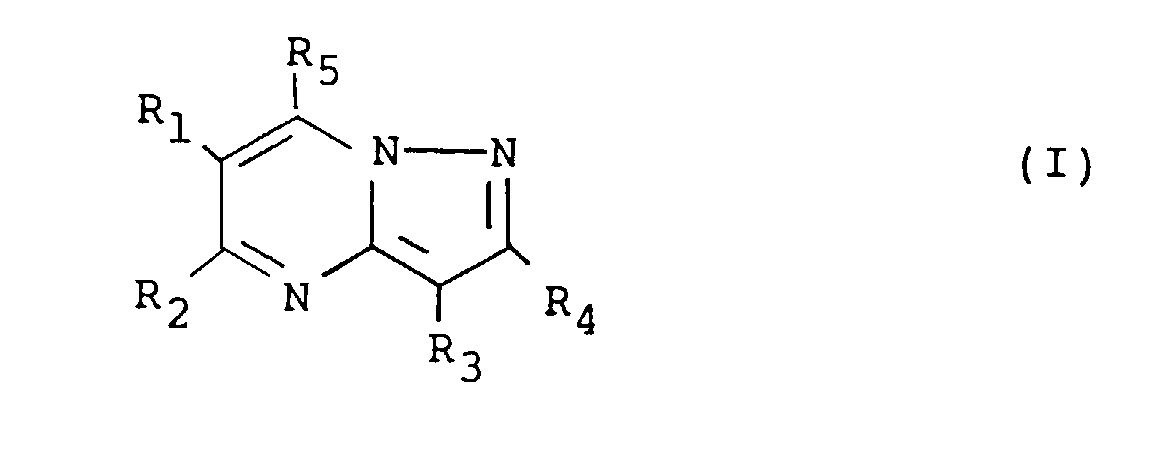
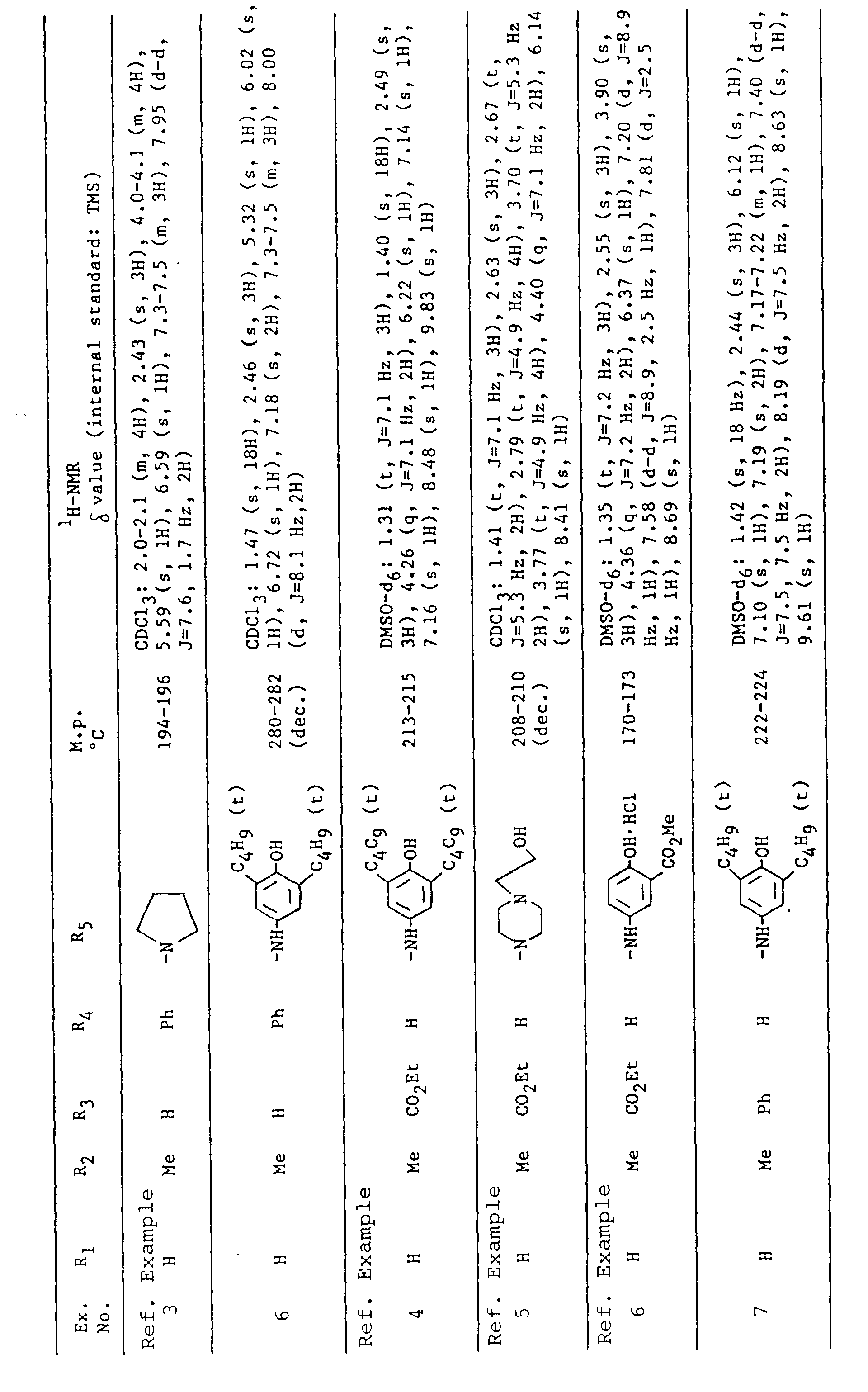
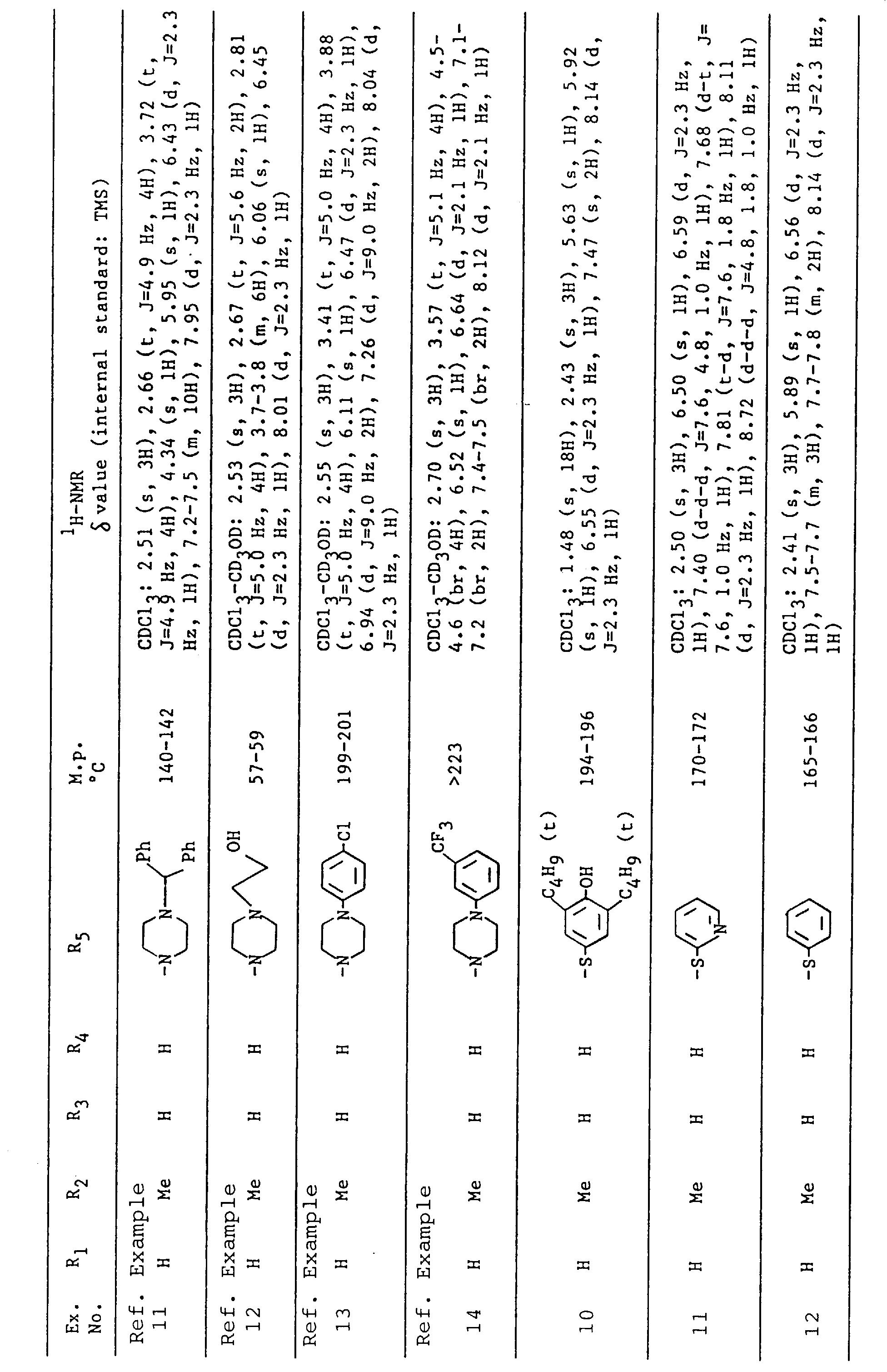
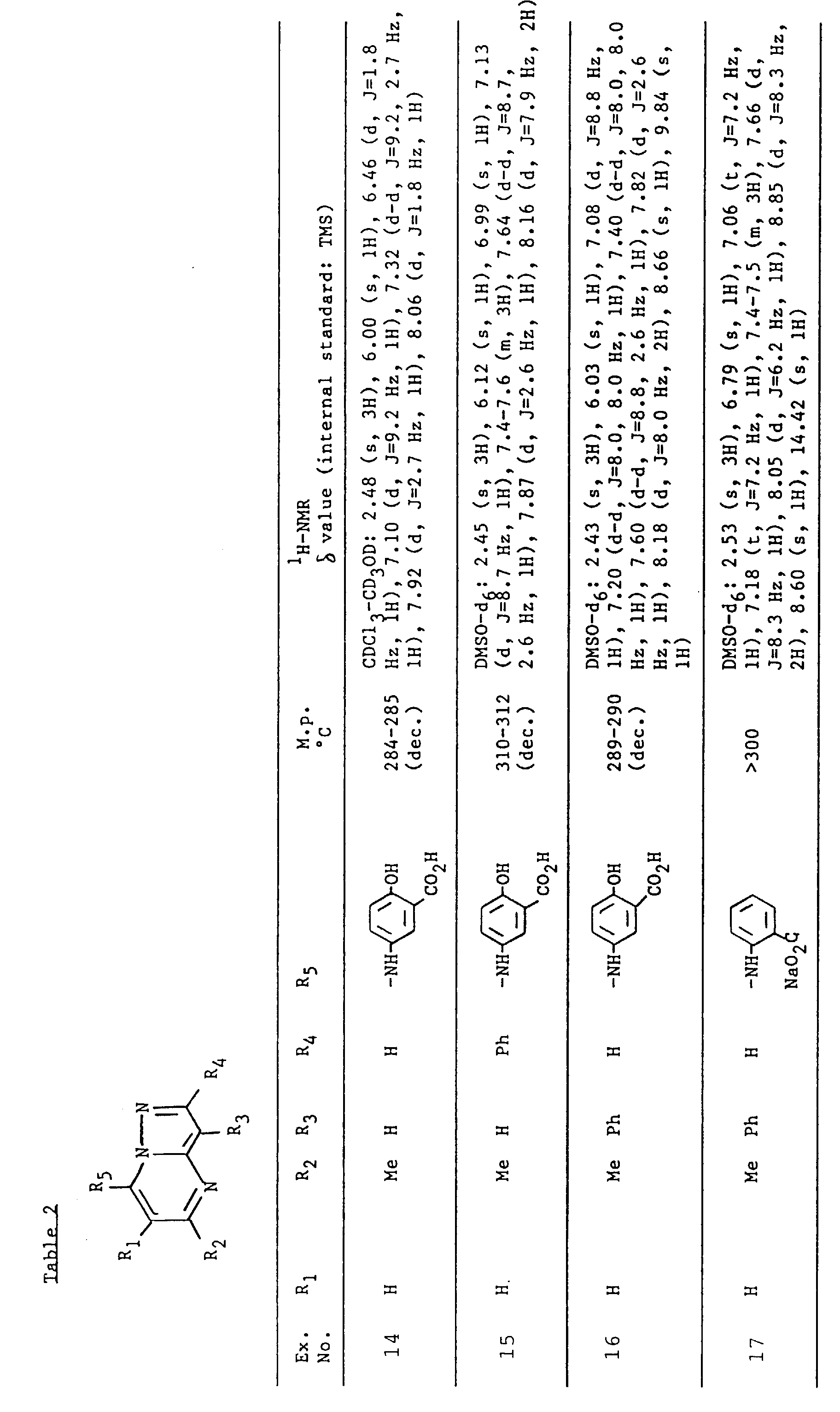
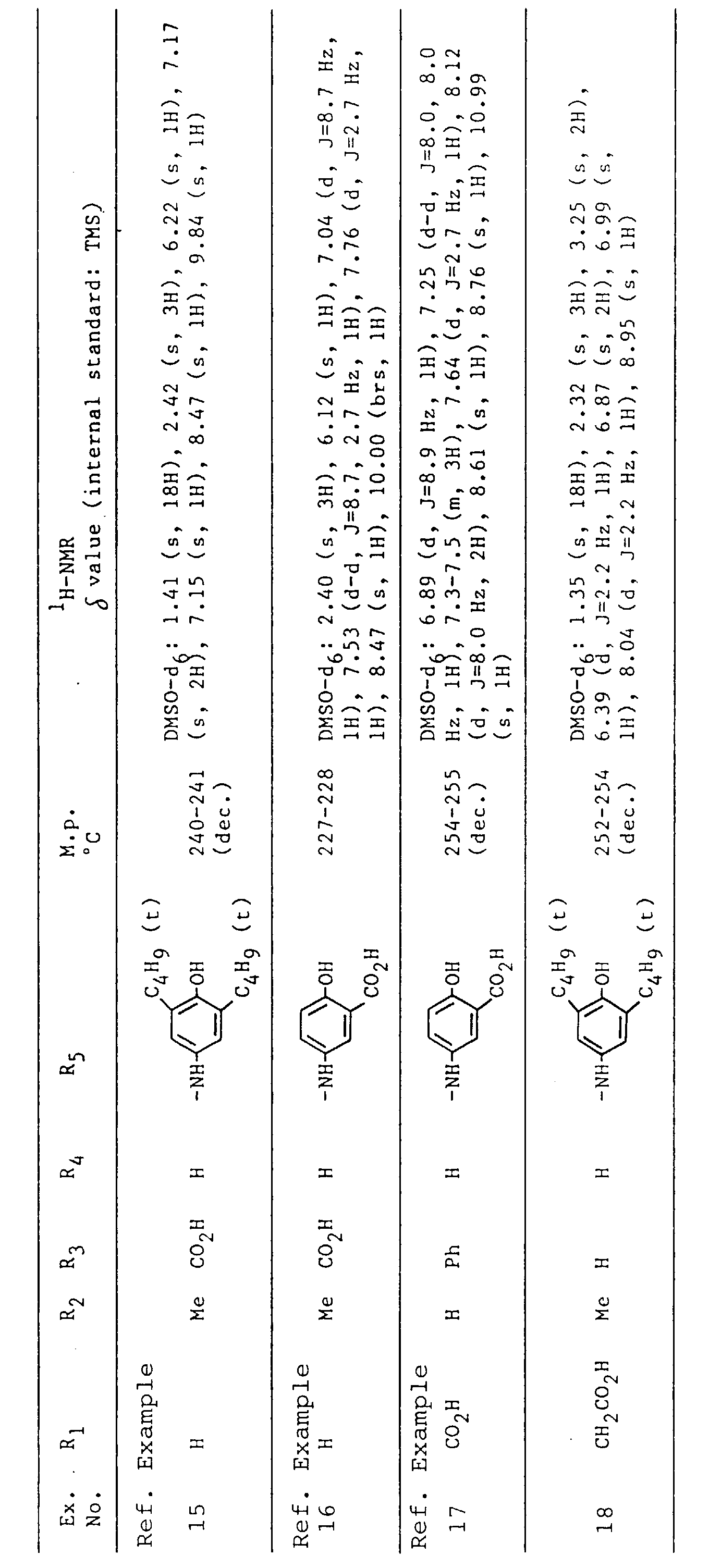
- the present invention relates to a pyrazolo[1,5-a]pyrimidine derivative of the formula: wherein R 1 , R 2 , R 3 , and R 4 are the same or different and are each hydrogen atom, phenyl group, a C 1 -C 6 alkyl group which may optionally be substituted by a group selected from hydroxyl group, carboxyl group and a C 2 -C 7 alkoxycarbonyl group, or a C 3 -C 8 cycloalkyl group, or R 1 and R 2 may combine each other to form a C 1 -C 6 alkylene group;
- R 5 is a group of the formula: -SR 6 or a group of the formula: -NR 7 R 8 in which R 6 is pyridyl group or a phenyl group which may optionally be substituted by 1 to 3 groups selected from hydroxyl group and a C 1 -C 6 alkyl group; and R 7 and R 8 are hydrogen atom, a phenyl
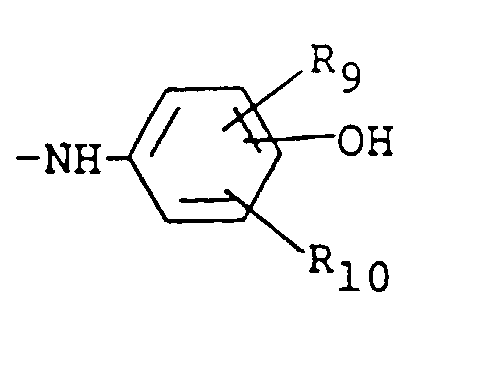
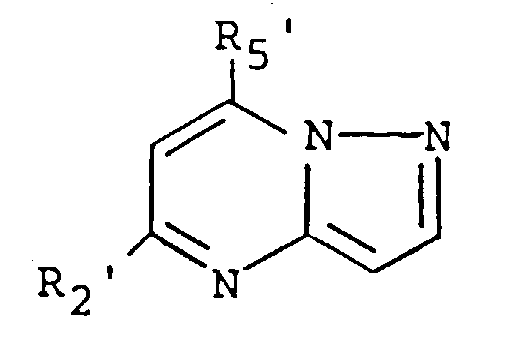
- the present invention relates to an anti-inflammatory agent which contains as an active ingredient at least a compound of the pyrazolo[1,5-a]pyrimidine derivatives represented by the formula: wherein R 2 ' is a C 1 -C 6 alkyl group or a C 3 -C 8 cycloalkyl group, R 5 ' is a group of the formula: in which R 9 and R 10 are each a C 1 -C 6 alkyl group, and salts thereof.
- arachidonic acid which is one of the components comprising phospholipid existing on the cell membrane, may be released from the cell membrane by various stimulus, e.g. phlogogenic stimulus, antigen-antibody reaction (i.e. immuno-stimulation), etc., and then firstly metabolized by lipoxygenase or cyclooxygenase, etc., to be converted into various products.
- various stimulus e.g. phlogogenic stimulus, antigen-antibody reaction (i.e. immuno-stimulation), etc.
- lipoxygenase or cyclooxygenase, etc. may be converted into various products.
- prostaglandin E 2 PGE 2
- prostaglandin I 2 PGE 2
- prostaglandin I 2 PGE 2
- PGE 2 hydroxyperoxyeicosatetraenoic acids
- HETE hydroxyeicosatetraenoic acids
- US-A-3925385 family member of JP-A-48064097 discloses pyrazolo[1,5-a]pyrimidines which are inhibitors of phosphodiesterase but no antiinflammatory activity is mentioned.
- JP-A-40002679 (and Derwent Abstract) and JP-A-40002680 (and Derwent Abstract) disclose 7-aminopyrazolo[2,3-a] -pyrimidine derivatives, which have antipyretic activity or antiinflammatory activity is mentioned.
- JP-A-40 002 680 no antiinflammatory activity is mentioned.
- JP-A-60100581 discloses other pyrazolo-[1,5-a]pyrimidines which are useful as horticultural fungicides but no antiinflammatory activity is disclosed.
- CAS 67:108663r discloses certain pyrazolo[1,5-a]pyrimidines having antiflogistic properties.
- CAS 67:11500x discloses 7-aminopyrazolo[2,3-a]pyrimidine derivatives but an antiinflammatory activity is not disclosed.
- EP-A-0141317 and CAS 87:201460v disclose some 7-aminopyrazolo[1,5-a]pyrimidine derivatives whereby no antiinflammatory activity is mentioned, while EP-A-0141317 mentions that the compounds exhibit fungicidal activity.
- J. Med. Chem. 25 (3) (1982) 235-242 discloses certain 7-aminopyrazolo[1,5-a]pyrimidine derivatives which have phosphodiesterase inihibitory activity but no antiinflammatory activity is mentioned.
- CAS 67:90832h discloses also some 7-substituted pyrazolo[1,5-a]pyrimidine derivatives but no antiinflammatory activity is mentioned.
- the present inventors have found that the pyrazolo[1,5-a]pyrimidine derivatives having the above formula (I) and their salts show various pharmacological actions, that particularly the compounds having the above formula (I') show excellent enzyme inhibitory activities and potent anti-inflammatory activities based thereon, and have achieved the present invention.
- An object of the present invention is to provide novel pyrazolo[1,5-a]pyrimidine derivatives of the above formula (I) which are useful as a medicament.
- Another object of the present invention is to provide an anti-inflammatory agent containing as an active ingredient the compound of the above formula (I').
- novel pyrazolo[1,5-a]pyrimidine derivatives of the present invention have the above formula (I), and show various pharmacological activities, for example, ischemic-reperfusion disorder improving activity, anti-inflammatory activity, antirheumatic activity, activity for treatment of asthma, antiallergic activity, antipyretic and analgesic activity, etc., and hence, they are useful as a medicament such as drug for improving of ischemic-reperfusion disorder, anti-inflammatory agent, antirheumatic agent, drug for asthma, antiallergic agent, antipyretic analgesic, and the like, in animals, especially mammals.
- the compound of the formula (I') is useful as anti-inflammatory agent based on excellent anti-inflammatory activity thereof.
- the "lower alkyl group” includes, for example, straight chain or branched chain alkyl groups having 1 to 6 carbon atoms such as methyl, ethyl, propyl, isopropyl, butyl, isobutyl, t-butyl, pentyl, hexyl, and the like.
- lower alkoxycarbonyl group includes, for example, straight chain or branched chain alkoxycarbonyl groups having 2 to 7 carbon atoms such as methoxycarbonyl, ethoxycarbonyl, propoxycarbonyl, isopropoxycarbonyl, butoxycarbonyl, t-butoxycarbonyl, pentyloxycarbonyl, hexyloxycarbonyl, and the like.
- lower alkyl group which may optionally be substituted by a group selected from hydroxyl group, carboxyl group and a lower alkoxycarbonyl group
- lower alkyl group includes, for example, in addition to the above mentioned lower alkyl groups, hydroxymethyl, 2-hydroxyethyl, 3-hydroxypropyl, 2-hydroxypropyl, 2-hydroxyisopropyl, carboxymethyl, 2-carboxyethyl, 3-carboxypropyl, 4-carboxybutyl, methoxycarbonylmethyl, ethoxycarbonylmethyl, propoxycarbonylmethyl, butoxycarbonylmethyl, 2-methoxycarbonylethyl, 2-ethoxycarbonylethyl, and the like.
- cycloalkyl group includes, for example, cycloalkyl groups having 3 to 8 carbon atoms such as cyclopropyl, cyclobutyl, cyclopentyl, cyclohexyl, cycloheptyl, cyclooctyl, and the like.
- the "lower alkylene group” includes, for example, methylene, ethylene, trimethylene, tetramethylene, pentamethylene, hexamethylene, and the like.
- phenyl group which may optionally be substituted by 1 to 3 groups selected from hydroxyl group, a lower alkyl group, a lower alkoxycarbonyl group and carboxyl group includes, for example, in addition to phenyl, 2-hydroxyphenyl, 3-hydroxyphenyl, 4-hydroxyphenyl, 2,3-dihydroxyphenyl, 2,4-dihydroxyphenyl, 3,4-dihydroxyphenyl, 2-methylphenyl, 1,3-dimethylphenyl, 3,4,5-trimethylphenyl, 3-ethylphenyl, 2,3-diethylphenyl, 2,4,6-triethylphenyl, 4-propylphenyl, 2,4-dipropylphenyl, 1,2,3-tripropylphenyl, 4-t-butylphenyl, 2,4-di-t-butylphenyl, 2,4,6-tri-t-butylphenyl, 3,5-di-t-butyl-4-hydroxypheny
- phenyl group optionally being substituted by a halogen atom or a trihalomethyl group includes, for example, in addition to phenyl, 2-fluorophenyl, 3-fluorophenyl, 4-fluorophenyl, 2-chlorophenyl, 3-chlorophenyl, 4-chlorophenyl, 2-bromophenyl, 3-bromophenyl, 4-bromophenyl, 2-iodophenyl, 3-iodophenyl, 4-iodophenyl, 2-fluoro-3-chlorophenyl, 2-trifluoromethylphenyl, 3-trichloromethylphenyl, 4-tribromomethylphenyl, 2-triiodomethylphenyl, 3-difluoromonochloromethylphenyl, 4-monochlorodibromomethylphenyl, 2-dichloromonoiodomethylphenyl, and the like.
- the "diphenyl-lower alkyl group” includes, for example, diphenylmethyl, 2,2-diphenylethyl, 2,3-diphenylpropyl, and the like.
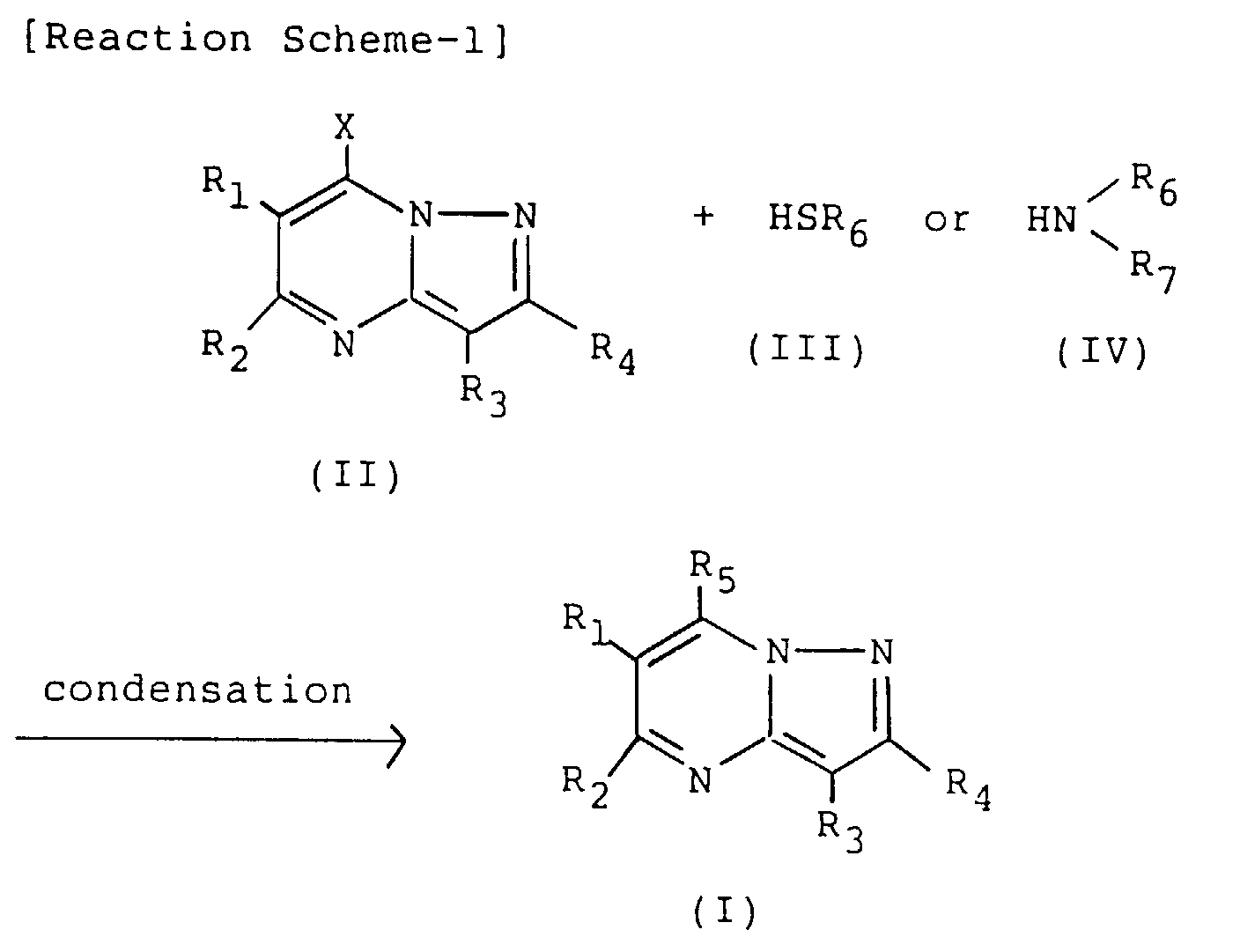
- the pyrazolo[1,5-a]pyrimidine derivatives of the present invention can be prepared by the following reaction schemes. wherein X is a halogen atom, and R 1 , R 2 , R 3 , R 4 , R 5 , R 6 , R 7 and R 8 are the same as defined above.
- the compounds (I) of the present invention can be prepared by the condensation reaction of a pyrazolo[1,5-a]pyrimidine halide derivative (II) and a thiol compound (III) or an amine compound (IV).
- the above reaction is usually carried out in a suitable solvent in the presence or absence of an acid acceptor.
- the acid acceptor includes, for example, inorganic bases such as hydroxides, hydrogen carbonates and carbonates of alkali metals (e.g. NaOH, KOH, NaHCO 3 , K 2 CO 3 , etc.), or tertiary amines such as triethylamine, dimethylaniline, diethylaniline, N-methylmorpholine, pyridine, 4-dimethylaminopyridine, and the like.
- the solvent includes, for example, inert organic solvents such as lower alcohols (e.g. methanol, ethanol, etc.) and ethers (e.g.
- tetrahydrofuran THF
- dioxane dioxane
- an inorganic base it is preferable to use as a solvent a mixture of an inert organic solvent and water.
- aromatic hydrocarbons e.g. benzene, toluene, xylene, etc. may also be used as a solvent.
- the ratio of the pyrazolo[1,5-a]pyridimidine halide derivative (II) and the thiol compound (III) or the amine compound (IV) is not specified, but the latter is used in an equimolar or excess amount to one mole of the former.
- the above acid acceptor is preferably used in an amount of equimolar or excess amount to one mole of the pyrazolo[1,5-a]pyrimidine halide derivative.
- the reaction is carried out either under cooling, at room temperature or under heating, but it is usually carried out at a temperature of 0°C to a refluxing temperature of the solvent used therein, for 0.5 to 15 hours.
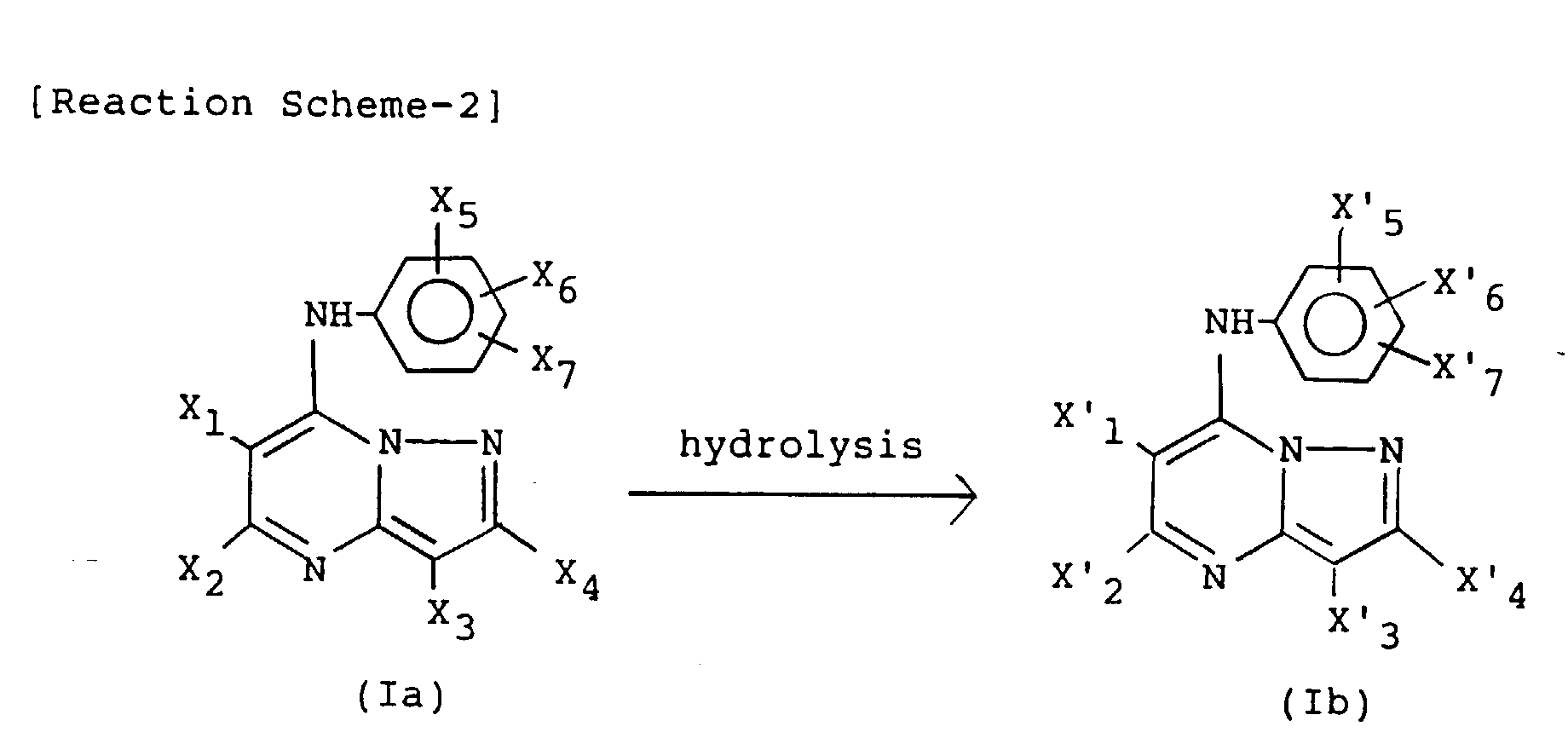
- X 1 - X 7 and X' 1 - X' 7 are each the corresponding group in the above formula (I), that is, X 1 and X' 1 , X 2 and X' 2 , X 3 and X' 3 , X 4 and X' 4 correspond to R 1 , R 2 , R 3 and R 4 , respectively, and X 5 and X' 5 , X 6 and X' 6 , X 7 and X' 7 are hydrogen atom, hydroxyl group, a lower alkyl group, a lower alkoxycarbonyl group or carboxy group, provided that at least one of X 1 , X 2 , X 3 , X 4 , X 5 , X 6 and X 7 is a lower alkoxycarbonyl group or a lower alkoxycarbonyl-lower alkyl group, and a group in X' 1 , X' 2 , X' 3 , X' 4 , X'
- one of the compounds of the present invention (Ib) can be prepared by hydrolysis of the compound (Ia) which is one of the compounds (I) prepared in Reaction Scheme-1 and has a lower alkoxycarbonyl group and/or a lower alkoxycarbonyl-lower alkyl group as a substituent.
- the above reaction is carried out in a mixed solvent of water and an inert solvent such as lower alcohols (e.g. methanol, ethanol, etc.), ethers (e.g. THF, dioxane, etc.) in the presence or absence of an alkali metal hydroxide (e.g.
- reaction is preferably carried out in the presence of Na 2 S 2 O 4 .
- the reaction may proceed either under cooling, at room temperature or under heating, but it is usually carried out at a temperature of 0°C to a refluxing temperature of the solvent used.
- Y 1 - Y 7 and Y' 1 - Y' 7 are each the corresponding group in the formula (I), that is, Y 1 and Y' 1 , Y 2 and Y' 2 , and Y' 3 , and Y 4 and Y' 4 are R 1 , R 2 , R 3 and R 4 , respectively, Y 5 and Y' 5 , Y 6 and Y' 6 , Y 7 and Y' 7 are hydrogen atom, hydroxyl group, a lower alkyl group, a lower alkoxycarbonyl group or carboxy group, provided that at least one of Y 1 , Y 2 , Y 3 , Y 4 , Y 5 , Y 6 , Y 7 is carboxyl group, a lower alkoxycarbonyl group or a carboxy-lower alkyl group, and a group in Y' 1 , Y' 2 , Y' 3 , Y' 4 , Y' 5 , Y
- one of the compounds of the present invention (Id) can be prepared by the reduction of the compound (Ic), which is one of the compounds (I) prepared in Reaction Scheme-1 and has a carboxyl group, a lower alkylcarbonyl group and/or a carboxy-lower alkyl group.
- the above reduction reaction is carried out in an inert organic solvent such as diethyl ether, THF, dioxane, etc., by using a suitable reducing agent such as lithium aluminum hydride, aluminum hydride, diborane, etc. in an amount of 1 to 10 moles to one mole of the compound (Ic).
- the reaction is carried out at a temperature of about 0 to 50°C, preferably at a temperature of about 0°C to room temperature.
- the compound (II) used as a starting compound includes both a known compound and a novel compound, and these compounds may be prepared, for example, by a method disclosed in the following Reaction Scheme-4.
- Y is a lower alkyl group
- R 1 , R 2 , R 3 , R 4 and X are the same as defined above.
- the condensation reaction between the compound (V) and the compound (VI) in Reaction Scheme-4 is carried out in a solvent such as acetic acid, ethanol, etc., at a temperature of room temperature to a boiling point of the solvent.
- a solvent such as acetic acid, ethanol, etc.
- the compound (V) is used in an amount of almost equimolar to the compound (VI), and the reaction is carried out for 2 to 5 hours to give the compound (VII).
- the compound (II), the starting compound of the present invention is prepared by halogenating the compound (VII).
- the halogenation reaction is carried out by treating with a halogenating agent such as phosphorus oxychloride, phosphorus oxybromide, etc. in the presence of an acid acceptor such as N,N-dimethylaniline, N,N-diethylaniline, triethylamine, etc.
- a halogenating agent such as phosphorus oxychloride, phosphorus oxybromide, etc.
- an acid acceptor such as N,N-dimethylaniline, N,N-diethylaniline, triethylamine, etc.
- the above halogenating agent may also be used as a solvent, and hence, the reaction does not need any solvent but can be carried out in another inert solvent such as benzene, toluene, xylene, etc.
- the acid acceptor is used in an amount of about 1 to 10 moles to 1 mole of the compound (VII).
- the reaction is carried out at a temperature of room temperature to 100°C, for 0.5 to two hours.
- the compounds obtained in above Reaction Schemes 1 to 4 can be purified and isolated from the reaction system by a conventional separation method.
- the conventional method for isolating and purification is, for example, extraction with a solvent, distillation, recrystallization, column chromatography, preparative thin layer chromatography, and the like.
- the compounds of the present invention thus obtained may be isolated, if necessary, in the form of a free base, or in the form of an acid addition salt with a pharmaceutically acceptable acid such as inorganic acids (e.g. hydrochloric acid, hydrobromic acid, sulfuric acid, nitric acid, etc.) or organic acids (e.g.
- oxalic acid fumaric acid, maleic acid, tartaric acid, citric acid, etc.
- a metal salt e.g. sodium, potassium, calcium, etc.
- the anti-inflammatory agent of the present invention is used in the form of a pharmaceutical preparation containing an effective amount of at least-one of the above compounds (I') and salts thereof.
- the pharmaceutical preparation form and the administration route of the present anti-inflammatory agent may be any conventional ones, but it is advantageous to administer the present anti-inflammatory agent locally in the form of an external preparation such as creams, ointments, lotions, aerosols, etc.
- These pharmaceutical preparations may be prepared by a conventional method with a conventional nontoxic pharmaceutical excipinent.
- the base for preparation of creams, ointments, etc. is, for example, white soft paraffine, paraffine, glycerin, bees wax, cellulose derivatives (e.g.
- liquid preparations e.g., methyl cellulose, etc.
- glyceryl monostearate cetostearyl alcohol, octyldodecanol, medium-chain fatty acid triglyceride, polyethyleneglycol, silicone, bentonite, and the like.
- cetostearyl alcohol cetostearyl alcohol
- octyldodecanol cetostearyl alcohol
- medium-chain fatty acid triglyceride e.g., polyethyleneglycol, silicone, bentonite, and the like.
- the solvent for dissolving an active ingredient includes, for example, water, ethyl alcohol, isopropyl alcohol, propyleneglycol, 1,3-butyleneglycol, polyethyleneglycol, crotamiton, and the like
- the surfactant includes, for example, sorbitan fatty acid esters, polyoxyethylenesorbitan fatty acid esters, polyoxyethylene fatty acid esters, polyoxyethylene ethers of hydrogenated castor oil, lecithin, self-emulsifiable-type glyceryl monostearate, and the like.
- the preparation of the present invention may be prepared in the form of a suspension, and the suspending agent includes, for example, cellulose derivatives (e.g. carboxymethyl cellulose sodium salt, methyl cellulose, etc.), and natural gums (e.g. tragacanth, gum arabic, etc.), and the like.
- cellulose derivatives e.g. carboxymethyl cellulose sodium salt, methyl cellulose, etc.
- natural gums e.g. tragacanth, gum arabic, etc.
- the present preparations thus prepared may contain a conventional preservative (e.g. p-hydroxybenzoic acid ester, benzalkonium chloride, sorbitan acid salt, etc.), or other various additives, if necessary.
- a conventional preservative e.g. p-hydroxybenzoic acid ester, benzalkonium chloride, sorbitan acid salt, etc.
- other various additives if necessary.
- the clinical dosage of the present anti-inflammatory agent varies depending on ages, weights, sensibility of the patients, and severities of the diseases, but it is usually in the range of about 0.001 to 10 g, preferably about 0.02 to 5 g per day for an adult. The dosage may, of course, be out of this range depending on the conditions of the patients.
- a suspension of 5-methyl-7-chloropyrazolo[1,5-a]-pyrimidine (3.5 g) and 3,5-di-t-butyl-4-hydroxyaniline hydrochloride (6.0 g) and diethylaniline (6.0 g) in toluene (150 ml) is heated at 120°C for 30 minutes, and cooled.
- the reaction mixture is poured into water, and extracted with dichloromethane.
- the organic layer is dried over anhydrous magnesium sulfate and concentrated.
- the precipitated crystal is collected by filtration, and washed with water, ethanol and ethyl ether, and dried to give 7-(2-carboxyphenyl)amino-5-methylpyrazolo[1,5-a]pyrimidine (970 mg) as colorless crystal.
- the filtrate is diluted with ethyl acetate, and washed with a saturated aqueous Na 2 S 2 O 4 solution and a saturated sodium chloride solution, and dried over anhydrous magnesium sulfate.
- the obtained crystal is washed with ethyl ether to give 7-(3,5-di-t-butyl-4-hydroxyphenyl)amino-3-hydroxymethyl-5-methylpyrazolo[1,5-a]pyrimidine (2.3 g) as colorless crystal.
- Ethyl 2-oxocyclopentanecarboxylate (31 g) and 3-aminopyrazole (17.4 g) are dissolved in acetic acid (300 ml), and the mixture is heated at 100°C for 3 hours. After allowed to stand for cooling, the resulting crystal is collected by filtration, and washed successively with water and diethyl ether, and further recrystallized from dichloromethane-diethyl ether to give a crystal (22.3 g) having a melting point of more than 280°C.
- a test compound was added to a microsome solution, and the mixture was incubated at 24°C for two minutes, and then, thereto was added a substrate, 14 C-arachidonic acid. The mixture was further incubated for two minutes, and the reaction was quenched with a mixture of ether/methanol/0.2 M citric acid (30:4:1), and extracted to collect a product produced by cyclooxygenase. The extract was spotted on a thin layer plate and the plate was developed. The fractions containing the arachidonic acid, prostaglandin E 2 (PGE 2 ) and the other parts were collected by scratching, respectively. Each part was measured with a scintillation counter, by which the cyclooxygenase activity therein was estimated.
- PGE 2 prostaglandin E 2
- the IC 50 value of the compound prepared in Example 2 was 3 x 10 -7 M, which was 27.8 times as high as that of indomethacin which was used as a reference compound. That means that the present compound has extremely excellent inhibitory activity.
- each test compound (the present compounds and indomethacin as a reference compound) was tested by the same experiment in the same concentration (fixed), and the cyclooxygenase activity was measured, which was compared with that of the control group (PGE 2 producing rate) and expressed as inhibitory rate (%).
- Example 2 Using the compound of Example 2 (2 g), liquid paraffin (5 g), bees wax (5 g), crotamiton (5 g), self-emulsifiable-type glyceryl monostearate (3 g) and white soft paraffin (80 g) (totally, 100 g) as components, the compound of Example 2 is suspended in the above components with warming to give a uniform suspension, which is further rapidly cooled to give an anti-inflammatory agent of the present invention in the form of ointment.
- liquid paraffin 5 g
- bees wax g
- crotamiton 5 g
- self-emulsifiable-type glyceryl monostearate 3 g
- white soft paraffin 80 g
- Example 2 Using the compound of Example 2 (2 g), glyceryl monostearate (20 g), self-emulsifiable-type glyceryl monostearate (3 g), crotamiton (5 g) and medium-chain fatty acid triglyceride (70 g) (totally, 100 g) as components, the compound of Example 2 is suspended in the above components with warming to give a uniform suspension, which is further rapidly cooled to give an anti-inflammatory agent of the present invention in the form of ointment.
- Example 2 The compound of Example 2 (2 g) is suspended with warming in a mixture of glyceryl monostearate (20 g), cetostearyl alcohol (2 g), octyldodecanol (10 g), crotamiton (10 g), polyoxyethylene sorbitan monooleate (3.3 g), sorbitan monooleate (1.2 g) and butyl paraben (0.01 g) to give a uniform suspension. Separately, conc.
- glycerin (5 g) and methyl paraben (0.02 g) are dissolved in purified water (totally, 100 g) with warming, and this solution is added with stirring to the above suspension, and subjected to emulsification with rapid-stirring, and cooled to give an anti-inflammatory agent of the present invention in the form of cream.
Landscapes
- Chemical & Material Sciences (AREA)
- Organic Chemistry (AREA)
- Health & Medical Sciences (AREA)
- Chemical Kinetics & Catalysis (AREA)
- Life Sciences & Earth Sciences (AREA)
- General Chemical & Material Sciences (AREA)
- Medicinal Chemistry (AREA)
- Nuclear Medicine, Radiotherapy & Molecular Imaging (AREA)
- Pain & Pain Management (AREA)
- Pharmacology & Pharmacy (AREA)
- Rheumatology (AREA)
- Animal Behavior & Ethology (AREA)
- General Health & Medical Sciences (AREA)
- Public Health (AREA)
- Veterinary Medicine (AREA)
- Pharmaceuticals Containing Other Organic And Inorganic Compounds (AREA)
- Nitrogen Condensed Heterocyclic Rings (AREA)
Abstract
Description







| Test compound | Inhibitory rate (%) |
| Compound of Ex. 2 | 65.0 |
| Compound of Ex. 38 | 48.2 |
| Compound of Ex. 44 | 55.9 |
| Compound of Ex. 46 | 50.5 |
| Indomethacin (reference compound) | 12.4 |
Claims (11)
- A pyrazolo[1,5-a]pyrimidine derivative of the general formula:wherein R1, R2, R3, and R4 are the same or different and are each hydrogen atom, phenyl group, a C1-C6 alkyl group which may optionally be substituted by a group selected from hydroxyl group, carboxyl group and a C2-C7 alkoxycarbonyl group, or a C3-C8 cycloalkyl group, or R1 and R2 may combine each other to form a C1-C6 alkylene group; R5 is a group of the formula: -SR6 or a group of the formula: -NR7R8 in which R6 is pyridyl group or a phenyl group which may optionally be substituted by 1 to 3 groups selected from hydroxyl group and a C1-C6 alkyl group; and R7 and R8 are hydrogen atom, a phenyl group which is substituted by 1 to 3 groups selected from hydroxyl group, a C1-C6 alkyl group, a C2-C7 alkoxycarbonyl group and carboxyl group, provided that R7 and R8 are not simultaneously hydrogen atom, or a salt thereof.

- The compound according to claim 1, wherein R1, R2, R3, and R4 are the same or different and are each hydrogen atom, phenyl group, a C1-C6 alkyl group or a C3-C8 cycloalkyl group; R1 is a group of the formula: -SR6 or a group of the formula: -NR7R8 in which R6 is a phenyl group which may optionally be substituted by 1 to 3 groups selected from hydroxyl group and a C1-C6 alkyl group; and R7 and R8 are hydrogen atom, a phenyl group which is substituted by 1 to 3 groups selected from hydroxyl group, a C1-C6 alkyl group and carboxyl group, provided that both of R7 and R8 are not simultaneously hydrogen atom.
- The compound according to claim 2, which is 5-methyl-7-(3,5-di-t-butyl-4-hydroxyphenyl)amino-pyrazolo[1,5-a]pyrimidine.
- An anti-inflammatory agent, which comprises as an active ingredient at least a compound of the pyrazolo[1,5-a]pyrimidine derivatives represented by the formula:wherein R2, is a C1-C6 alkyl group or a C3-C8 cycloalkyl group, R5, is a group of the formula:
 in which R9 and R10 are each a C1-C6 alkyl group, and salts thereof.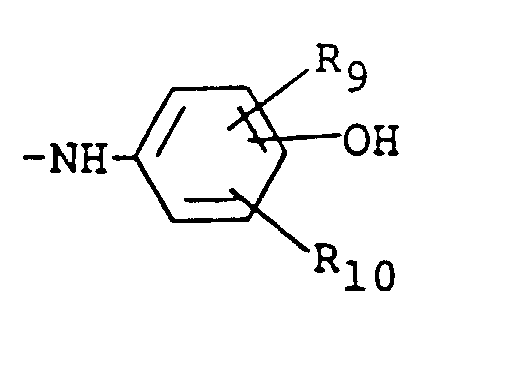
- The anti-inflammatory agent according to claim 4, whrein an active ingredient is 5-methyl-7-(3,5-di-t-butyl-4-hydroxyphenyl)amino-pyrazolo[1,5-a]pyrimidine.
- Use of a compound as defined in claim 4 for preparing an anti-inflammatory agent.
- A process for preparing a pyrazolo[1,5-a]-pyrimidine derivative of the formula:wherein R1, R2, R3 and R4 are the same or different and are each hydrogen atom, phenyl group, a C1-C6 alkyl group which may optionally be substituted by a group selected from hydroxyl group, carboxyl group, and a C2-C7 alkoxycarbonyl group, or a C3-C8 cycloalkyl group, or R1 and R2 may combine each other to form a C1-C6 alkylene group; R5 is a group of the formula: -SR6 or a group of the formula: -NR7R8 in which R6 is a pyridyl group or a phenyl group which may optionally be substituted by 1 to 3 groups selected from hydroxyl group and a C1-C6 alkyl group, and R7 and R8 are hydrogen atom, a phenyl group which is substituted by 1 to 3 groups selected from hydroxyl group, a C1-C6 alkyl group, a C2-C7 alkoxy-carbonyl group and carboxyl group, provided that R7 and R8 are not simultaneously hydrogen atom, or a salt thereof, which comprises subjecting a pyrazolo[1,5-a]pyrimidine halide derivative of the formula:
 wherein X is a halogen atom, and R1, R2, R3 and R4 are as defined above, to a condensation reaction with a thiol compound (III) or amine compound (IV) of the following formulae:
 wherein R6, R7 and R8 are as defined above.
- The process according to claim 7 for preparing the compound of the formula (Ib):wherein X'1, X'2, X'3 and X'4 correspond to R1, R2, R3 and R4 respectively, and X'5, X'6 and X'7 are hydrogen atom, hydroxyl group, a C1-C6 alkyl group, or carboxyl group, provided that at least one of X'1, X'2, X'3, X'4, X'5, X'6 and X'7 are a carboxyl group or a carboxy-C1-C6 alkyl group, which comprises further subjecting a compound of the formula
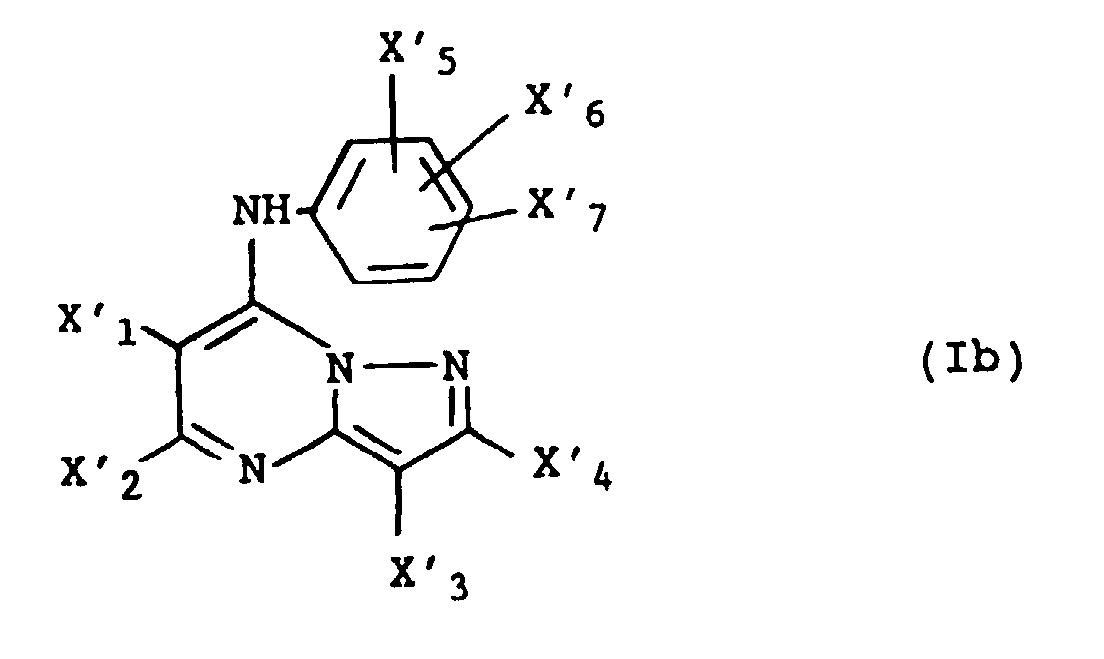 wherein X1, X2, X3 and X4 correspond to R1, R2, R3 and R4 respectively, and X5, X6 and X7 are hydrogen atom, hydroxyl group, a C1-C6 alkyl group, a C2-C7 alkoxycarbonyl group or carboxyl group, provided that at least one of X1, X2, X3, X4, X5, X6 and X7 are a C2-C7 alkoxycarbonyl group or a C2-C7 alkoxycarbonyl-C1-C6 alkyl group, which is obtained by the process as claimed in claim 7, to hydrolysis.
- The process according to claim 7 for preparing the compound of the formula (Id):wherein Y'1, Y'2, Y'3 and Y'4 correspond to R1, R2, R3 and R4 respectively, and Y'5, Y'6 and Y'7 are hydrogen atom, hydroxyl group, or a C1-C6 alkyl group, provided that at least one of Y'1, Y'2, Y'3, Y'4, Y'5, Y'6 and Y'7 are a hydroxyl group or a hydroxy-C1-C6 alkyl group, which comprises further subjecting a compound of the formula (Ic) :
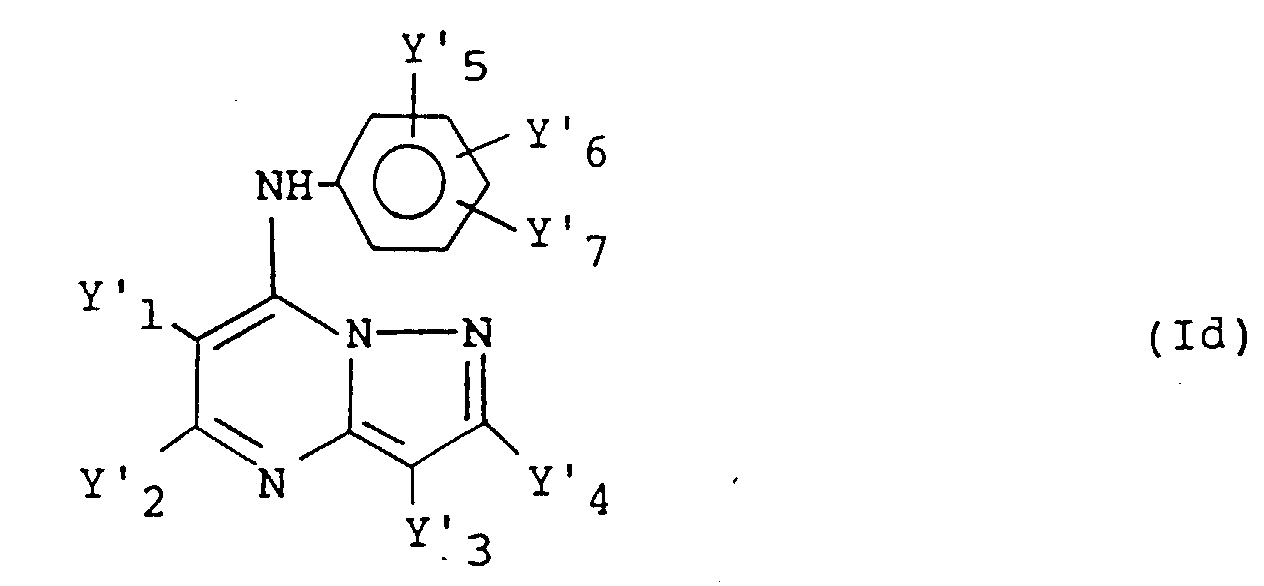 wherein Y1, Y2, Y3 and Y4 correspond to R1, R2, R3 and R4 respectively, and Y5, Y6 and Y7 are hydrogen atom, hydroxyl group, a C1-C6 alkyl group, a C2-C7 alkoxycarbonyl group or carboxyl group, provided that at least one of Y1, Y2, Y3, Y4, Y5, Y6, and Y7 are carboxyl group, a C2-C7 alkoxycarbonyl group or a carboxy-C1-C6 alkyl group, which is obtained by the process as claimed in claim 7, to reduction.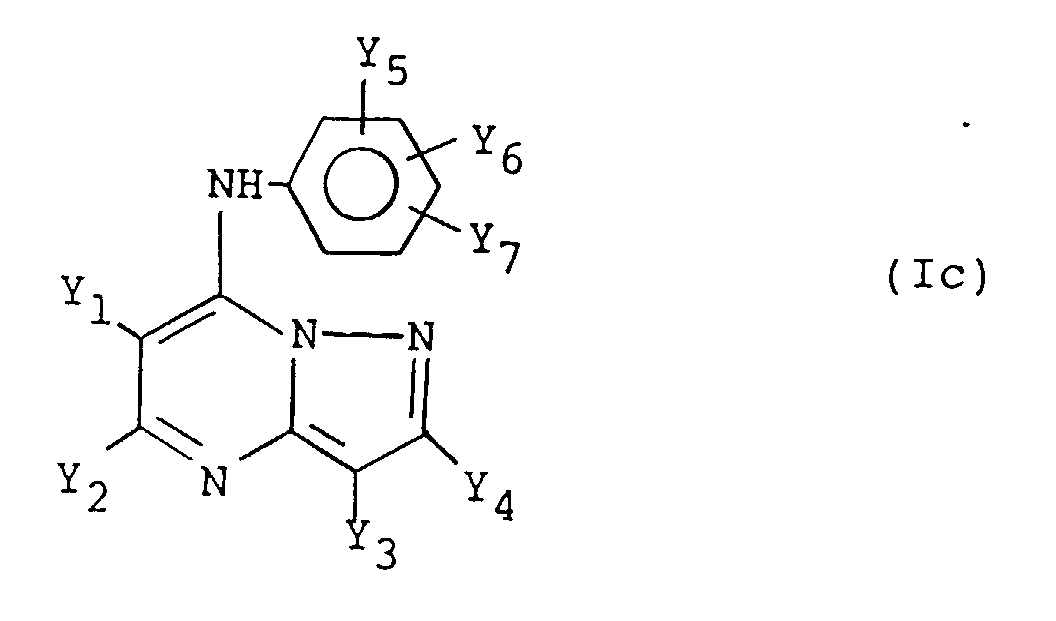
- Process according to claim 7 wherein the compound prepared is 5-methyl-7-(3,5-di-t-butyl-4-hydroxyphenyl)aminopyrazolo[1,5-a]pyrimidine.
- Process for preparing an antiinflammatory agent which comprises mixing at least one pyrazolo[1,5-a]pyrimidine derivative represented by the formulawherein R2, is a C1-C6 alkyl group or a C3-C8 cycloalkyl group, R5, is a group of the formula:
 in which R9 and R10 are each a C1-C6 alkyl group and salts thereof with a pharmaceutically acceptable usual carrier.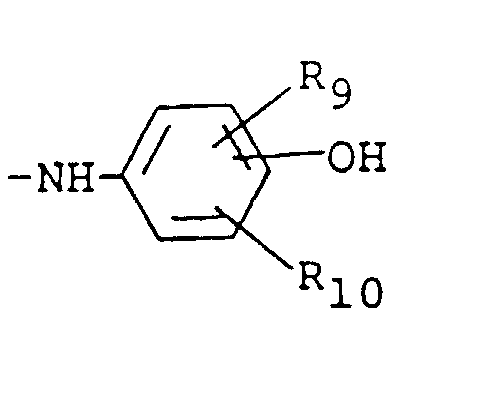
Applications Claiming Priority (3)
| Application Number | Priority Date | Filing Date | Title |
|---|---|---|---|
| JP90707/91 | 1991-04-22 | ||
| JP9070791 | 1991-04-22 | ||
| PCT/JP1991/001043 WO1992018504A1 (en) | 1991-04-22 | 1991-08-06 | PYRAZOLO[1,5-a]PYRIMIDINE DERIVATIVE AND ANTI-INFLAMMATORY CONTAINING THE SAME |
Publications (3)
| Publication Number | Publication Date |
|---|---|
| EP0591528A1 EP0591528A1 (en) | 1994-04-13 |
| EP0591528A4 EP0591528A4 (en) | 1995-02-15 |
| EP0591528B1 true EP0591528B1 (en) | 1998-12-23 |
Family
ID=14006001
Family Applications (1)
| Application Number | Title | Priority Date | Filing Date |
|---|---|---|---|
| EP91913666A Expired - Lifetime EP0591528B1 (en) | 1991-04-22 | 1991-08-06 | PYRAZOLO[1,5-a]PYRIMIDINE DERIVATIVE AND ANTI-INFLAMMATORY CONTAINING THE SAME |
Country Status (12)
| Country | Link |
|---|---|
| US (1) | US5688949A (en) |
| EP (1) | EP0591528B1 (en) |
| JP (1) | JPH0570353A (en) |
| KR (1) | KR100191774B1 (en) |
| AT (1) | ATE174917T1 (en) |
| AU (1) | AU651986B2 (en) |
| CA (1) | CA2107479C (en) |
| DE (1) | DE69130683T2 (en) |
| DK (1) | DK0591528T3 (en) |
| ES (1) | ES2126573T3 (en) |
| TW (1) | TW221434B (en) |
| WO (1) | WO1992018504A1 (en) |
Cited By (2)
| Publication number | Priority date | Publication date | Assignee | Title |
|---|---|---|---|---|
| US7074797B2 (en) | 1996-02-07 | 2006-07-11 | Neurocrine Biosciences, Inc. | Pyrazolopyrimidines as CRF receptor antagonists |
| US7678793B2 (en) | 1996-07-24 | 2010-03-16 | Bristol-Myers Squibb Pharma Company | Azolo triazines and pyrimidines |
Families Citing this family (55)
| Publication number | Priority date | Publication date | Assignee | Title |
|---|---|---|---|---|
| EP0628559B1 (en) * | 1993-06-10 | 2002-04-03 | Beiersdorf-Lilly GmbH | Pyrimidine compounds and their use as pharmaceuticals |
| KR100315837B1 (en) * | 1994-06-21 | 2002-02-28 | 고리 히데아끼 | PYRAZOLO[1,5-a]PYRAMIDINE DERIVATIVE |
| RU2147584C1 (en) * | 1995-10-27 | 2000-04-20 | Американ Цианамид Компани | Method of synthesis of dihaloidazolopyrimidines and method of synthesis of dihydroxyazolopyrimidines |
| WO1997046560A1 (en) * | 1996-06-06 | 1997-12-11 | Otsuka Pharmaceutical Factory, Inc. | Amide derivatives |
| US6191131B1 (en) | 1997-07-23 | 2001-02-20 | Dupont Pharmaceuticals Company | Azolo triazines and pyrimidines |
| US6313124B1 (en) | 1997-07-23 | 2001-11-06 | Dupont Pharmaceuticals Company | Tetrazine bicyclic compounds |
| HU229024B1 (en) * | 1996-07-24 | 2013-07-29 | Bristol Myers Squibb Pharma Co | Azolo-pyridimidines, pharmaceutical compositions containing the same and use thereof |
| US6124289A (en) * | 1996-07-24 | 2000-09-26 | Dupont Pharmaceuticals Co. | Azolo triazines and pyrimidines |
| CZ299451B6 (en) * | 1996-07-24 | 2008-07-30 | Bristol-Myers Squibb Pharma Company | [1,5-a]-Pyrazolo-1,3,5- triazines, their use and pharmaceutical composition pharmaceutical composition based thereon |
| US6060478A (en) * | 1996-07-24 | 2000-05-09 | Dupont Pharmaceuticals | Azolo triazines and pyrimidines |
| HUP9603001A3 (en) * | 1996-10-30 | 1999-07-28 | Richter Gedeon Vegyeszet | Heterocycle compounds comprising nitrogen, process for producing them and pharmaceutical compositions containing the same |
| AU4331500A (en) | 1999-04-06 | 2000-10-23 | Du Pont Pharmaceuticals Company | Pyrazolotriazines as crf antagonists |
| AU4203500A (en) | 1999-04-06 | 2000-10-23 | Du Pont Pharmaceuticals Company | Pyrazolopyrimidines as crf antagonists |
| US20020061897A1 (en) * | 2000-03-30 | 2002-05-23 | Elliott Richard L. | Neuropeptide Y antagonists |
| US6630476B2 (en) | 2000-07-07 | 2003-10-07 | Bristol-Myers Squibb Pharma Company | Pyrrolo [3,4-d] pyrimidines as corticotropin releasing factor (CRF) antagonists |
| WO2002076987A1 (en) * | 2001-03-27 | 2002-10-03 | Neurogen Corporation | (oxo-pyrazolo[1,5a]pyrimidin-2-yl)alkyl-carboxamides |
| AU2002322720B2 (en) | 2001-07-25 | 2008-11-13 | Raptor Pharmaceutical Inc. | Compositions and methods for modulating blood-brain barrier transport |
| EP1511751B1 (en) * | 2002-06-04 | 2008-03-19 | Neogenesis Pharmaceuticals, Inc. | Pyrazolo[1,5-a]pyrimidine compounds as antiviral agents |
| MXPA05002570A (en) * | 2002-09-04 | 2005-09-08 | Schering Corp | Pyrazolopyrimidines as cyclin dependent kinase inhibitors. |
| CA2497544C (en) * | 2002-09-04 | 2010-11-02 | Schering Corporation | Pyrazolo[1,5-a]pyrimidines compounds as cyclin dependent kinase inhibitors |
| US8580782B2 (en) | 2002-09-04 | 2013-11-12 | Merck Sharp & Dohme Corp. | Substituted pyrazolo[1,5-a]pyrimidines as cyclin dependent kinase inhibitors |
| AR041137A1 (en) | 2002-09-04 | 2005-05-04 | Pharmacopeia Drug Discovery | PIRAZOLOPIRIMIDINAS AS CYCLINE DEPENDENT KINASE INHIBITORS |
| US7196078B2 (en) * | 2002-09-04 | 2007-03-27 | Schering Corpoartion | Trisubstituted and tetrasubstituted pyrazolopyrimidines as cyclin dependent kinase inhibitors |
| US7161003B1 (en) * | 2002-09-04 | 2007-01-09 | Schering Corporation | Pyrazolopyrimidines as cyclin dependent kinase inhibitors |
| US7205308B2 (en) | 2002-09-04 | 2007-04-17 | Schering Corporation | Trisubstituted 7-aminopyrazolopyrimidines as cyclin dependent kinase inhibitors |
| CN1310918C (en) | 2002-09-04 | 2007-04-18 | 先灵公司 | Novel pyrazolopyrimidines as cyclin dependent kinase inhibitors |
| US7119200B2 (en) | 2002-09-04 | 2006-10-10 | Schering Corporation | Pyrazolopyrimidines as cyclin dependent kinase inhibitors |
| US8673924B2 (en) | 2002-09-04 | 2014-03-18 | Merck Sharp & Dohme Corp. | Substituted pyrazolo[1,5-a]pyrimidines as cyclin dependent kinase inhibitors |
| US7084271B2 (en) * | 2002-09-04 | 2006-08-01 | Schering Corporation | Pyrazolopyrimidines as cyclin dependent kinase inhibitors |
| KR20050115252A (en) | 2003-02-28 | 2005-12-07 | 데이진 화-마 가부시키가이샤 | Pyrazolo[1,5-a]pyrimidine derivatives |
| US20070179161A1 (en) * | 2003-03-31 | 2007-08-02 | Vernalis (Cambridge) Limited. | Pyrazolopyrimidine compounds and their use in medicine |
| US6949895B2 (en) * | 2003-09-03 | 2005-09-27 | Axcelis Technologies, Inc. | Unipolar electrostatic quadrupole lens and switching methods for charged beam transport |
| AR049769A1 (en) * | 2004-01-22 | 2006-09-06 | Novartis Ag | DERIVATIVES OF PIRAZOLO (1,5-A) PIRIMIDIN 7-IL-AMINA TO BE USED IN THE TREATMENT OF DEPENDENT DISEASES OF PROTEIN KINASE |
| CN102379684B (en) | 2005-04-28 | 2014-11-19 | 普罗透斯数字保健公司 | Pharma-informatics system |
| US7700773B2 (en) | 2005-09-09 | 2010-04-20 | Schering Corporation | 4-cyano, 4-amino, and 4-aminomethyl derivatives of pyrazolo[1,5-a]pyridines, pyrazolo[1,5-c]pyrimidines and 2H-indazole compounds and 5-cyano, 5-amino, and 5-aminomethyl derivatives of imidazo[1,2-a]pyridines, and imidazo[1,5-a]pyrazines as cyclin dependent kinase inhibitors |
| CA2624882C (en) | 2005-10-06 | 2014-05-20 | Schering Corporation | Pyrazolopyrimidines as protein kinase inhibitors |
| US7642266B2 (en) * | 2005-10-06 | 2010-01-05 | Schering Corporation | Substituted pyrazolo[1,5-a]pyrimidines as protein kinase inhibitors |
| GB0526419D0 (en) * | 2005-12-23 | 2006-02-08 | Cyclacel Ltd | Formulation |
| KR20090071598A (en) | 2006-09-18 | 2009-07-01 | 랩터 파마슈티컬 인코포레이티드 | Treatment of liver disease by administration of receptor binding protein (RAP) -conjugates |
| EP2117526B1 (en) | 2006-11-29 | 2013-04-03 | Abbott Laboratories | Inhibitors of diacylglycerol o-acyltransferase type 1 enzyme |
| PE20131210A1 (en) * | 2007-12-19 | 2013-10-31 | Genentech Inc | 5-ANILINOIMIDAZOPYRIDINE DERIVATIVES AS MEK INHIBITORS |
| EP2398500B1 (en) | 2009-02-20 | 2019-03-13 | 2-BBB Medicines B.V. | Glutathione-based drug delivery system |
| ES2942923T3 (en) | 2009-05-06 | 2023-06-07 | Laboratory Skin Care Inc | Dermal delivery compositions comprising complexes of active agent-calcium phosphate particles and methods of use thereof |
| GB0908394D0 (en) | 2009-05-15 | 2009-06-24 | Univ Leuven Kath | Novel viral replication inhibitors |
| KR101483834B1 (en) * | 2009-12-23 | 2015-01-16 | 카트호리이케 유니버시타이트 로이펜 | Novel antiviral compounds |
| US8927562B2 (en) * | 2010-09-28 | 2015-01-06 | Merck Sharp & Dohme Corp. | Fused tricyclic inhibitors of mammalian target of rapamycin |
| US20120077778A1 (en) | 2010-09-29 | 2012-03-29 | Andrea Bourdelais | Ladder-Frame Polyether Conjugates |
| BR112013011737A2 (en) | 2010-11-15 | 2016-08-09 | Univ Leuven Kath | compound, use of a compound pharmaceutical composition, and method of treating or preventing an HIV infection |
| US8633198B1 (en) | 2011-09-20 | 2014-01-21 | Nant Holdings Ip, Llc | Small molecule inhibitors of influenza A RNA-dependent RNA polymerase |
| WO2015088516A1 (en) * | 2013-12-11 | 2015-06-18 | Nant Holdings Ip, Llc | Small molecule inhibitors of influenza a rna-dependent rna polymerase |
| AU2015208205B2 (en) * | 2014-01-22 | 2019-12-05 | Curovir Ab | Pyrazolo[1,5-a]pyrimidines as antiviral compounds |
| GB201410817D0 (en) * | 2014-06-17 | 2014-07-30 | Ucb Biopharma Sprl And Katholieke Universiteit Leuven K U Leuven R & D | Therapeutic agents |
| WO2019055750A1 (en) * | 2017-09-15 | 2019-03-21 | Aduro Biotech, Inc. | Pyrazolopyrimidinone compounds and uses thereof |
| DE102018201598A1 (en) | 2018-02-02 | 2019-08-08 | Beiersdorf Ag | Stable wound ointment |
| PY2193067A (en) | 2020-10-23 | 2022-06-20 | Ildong Pharmaceutical Co Ltd | CFTR MODULATING COMPOUNDS, COMPOSITIONS AND USES |
Family Cites Families (9)
| Publication number | Priority date | Publication date | Assignee | Title |
|---|---|---|---|---|
| US3925385A (en) * | 1972-04-20 | 1975-12-09 | Icn Pharmaceuticals | 6-Carbethoxy-3,7-disubstitutedpyrazolo{8 1,5a{9 pyrimidines |
| BE792533A (en) * | 1971-12-09 | 1973-06-08 | Int Chem & Nuclear Corp | NEW PYRAZOLO (1.5A) PYRIMIDINES AND THEIR PREPARATION PROCESS |
| US4026893A (en) * | 1975-11-07 | 1977-05-31 | Squibb & Sons Inc | Pyrazolo{8 1,5-a{9 pyrido{8 3,2-e{9 pyrimidine-7-carboxylic acid derivatives |
| DE3338292A1 (en) * | 1983-10-21 | 1985-05-02 | Basf Ag, 6700 Ludwigshafen | 7-AMINO-AZOLO (1,5-A) -PYRIMIDINE AND FUNGICIDES CONTAINING THEM |
| JPS60100381A (en) * | 1983-11-04 | 1985-06-04 | Yuasa Battery Co Ltd | Closed lead storage battery |
| JPS60100581A (en) * | 1983-11-07 | 1985-06-04 | S D S Baiotetsuku:Kk | Pyrazolo(1,5-a)pyrimidine derivative, agricultural and horticultural fungicide containing the same, and its preparation |
| JPS6157587A (en) * | 1984-08-29 | 1986-03-24 | Shionogi & Co Ltd | Condensed heterocyclic derivative and antiulcerative |
| JP2585462B2 (en) * | 1989-10-25 | 1997-02-26 | 株式会社大塚製薬工場 | Pyrazolo [1,5-a] pyrimidine derivatives |
| CA2100514C (en) * | 1992-07-29 | 2005-03-29 | Johannes A. M. Hamersma | 17-spiromethylene steroids |
-
1991
- 1991-08-06 WO PCT/JP1991/001043 patent/WO1992018504A1/en not_active Ceased
- 1991-08-06 US US08/133,086 patent/US5688949A/en not_active Expired - Fee Related
- 1991-08-06 KR KR1019930703210A patent/KR100191774B1/en not_active Expired - Fee Related
- 1991-08-06 AU AU82958/91A patent/AU651986B2/en not_active Ceased
- 1991-08-06 CA CA002107479A patent/CA2107479C/en not_active Expired - Fee Related
- 1991-08-06 AT AT91913666T patent/ATE174917T1/en not_active IP Right Cessation
- 1991-08-06 EP EP91913666A patent/EP0591528B1/en not_active Expired - Lifetime
- 1991-08-06 DK DK91913666T patent/DK0591528T3/en active
- 1991-08-06 ES ES91913666T patent/ES2126573T3/en not_active Expired - Lifetime
- 1991-08-06 DE DE69130683T patent/DE69130683T2/en not_active Expired - Fee Related
- 1991-08-16 TW TW080106516A patent/TW221434B/zh active
-
1992
- 1992-03-13 JP JP4055370A patent/JPH0570353A/en active Pending
Cited By (2)
| Publication number | Priority date | Publication date | Assignee | Title |
|---|---|---|---|---|
| US7074797B2 (en) | 1996-02-07 | 2006-07-11 | Neurocrine Biosciences, Inc. | Pyrazolopyrimidines as CRF receptor antagonists |
| US7678793B2 (en) | 1996-07-24 | 2010-03-16 | Bristol-Myers Squibb Pharma Company | Azolo triazines and pyrimidines |
Also Published As
| Publication number | Publication date |
|---|---|
| CA2107479C (en) | 1997-12-16 |
| ES2126573T3 (en) | 1999-04-01 |
| JPH0570353A (en) | 1993-03-23 |
| AU8295891A (en) | 1992-11-17 |
| DE69130683T2 (en) | 1999-05-06 |
| DE69130683D1 (en) | 1999-02-04 |
| AU651986B2 (en) | 1994-08-11 |
| CA2107479A1 (en) | 1992-10-23 |
| EP0591528A4 (en) | 1995-02-15 |
| US5688949A (en) | 1997-11-18 |
| DK0591528T3 (en) | 1999-08-23 |
| EP0591528A1 (en) | 1994-04-13 |
| KR100191774B1 (en) | 1999-06-15 |
| TW221434B (en) | 1994-03-01 |
| ATE174917T1 (en) | 1999-01-15 |
| WO1992018504A1 (en) | 1992-10-29 |
Similar Documents
| Publication | Publication Date | Title |
|---|---|---|
| US5688949A (en) | Pyrazolo 1,5-A!pyrimidine derivatives and anti-inflammatory agent containing the same | |
| US6794391B2 (en) | Derivatives of pyrimido[6.1-a]isoquinolin-4-one | |
| US5508300A (en) | Dihydro pyrazolopyrroles, compositions and use | |
| DE69827786T2 (en) | CONDENSED PYRIDAZINE DERIVATIVES, THEIR PREPARATION AND USE | |
| KR900007780B1 (en) | Method for preparing condensed pyrrolidone derivatives | |
| CA2012628C (en) | New fluoro-4 benzoic derivatives, process for their preparation and pharmaceutical compositions containing them | |
| EP0562439B1 (en) | Triazolopyridazines as antioasthmatics | |
| EP0934319B1 (en) | 1H-PYRIDO[3,4-b]INDOLE-4-CARBOXAMIDE DERIVATIVES, PREPARATION AND APPLICATION THEREOF IN THERAPEUTICS | |
| EP0104522B1 (en) | New pyrazolo(3,4-b)pyridine derivatives and process for producing them | |
| JPS61155358A (en) | Diallylbutyric acid derivative and production thereof | |
| JPH09301958A (en) | New pyrimidine compound and antirotavirus agent | |
| US5565463A (en) | 9-subtituted-8-unsubstituted-9-deazaguanines | |
| HU215394B (en) | 3-phenyl-izoquinolin-(2h)-one derivatives, process for producing them and pharmaceutical compositions containing them | |
| BG61729B1 (en) | 9-substituted-2- (2-morpholinoxyphenyl) purin-6-one | |
| JP2585462B2 (en) | Pyrazolo [1,5-a] pyrimidine derivatives | |
| HU204052B (en) | Process for producing imidazopyridazines and pharmaceutical comprising such compounds | |
| RU2048469C1 (en) | Method of synthesis of azetidine derivative or its pharmaceutical acceptable salt | |
| US3652569A (en) | Ergonine ergoptine and the 1-methyl and 9 10-dihydro derivatives thereof | |
| CN103189367A (en) | Chromene derivatives | |
| EP0562440B1 (en) | Imidazopyridazines as antiasthmatics | |
| RU2156252C2 (en) | Triazolopyridazines, method of their synthesis, pharmaceutical compositions based on thereof and method of treatment | |
| JP3140155B2 (en) | N, N'-disubstituted amide derivatives | |
| EP0231138B1 (en) | 1-Acylaminomethyl-imidazo[1,2-a] quinoline derivatives, their preparation and therapeutical use | |
| EP0090275A2 (en) | Isoxazole (5,4-b) pyridines | |
| JP3512236B2 (en) | Pyrazolopyridine oxoalkylene acid derivatives and their production |
Legal Events
| Date | Code | Title | Description |
|---|---|---|---|
| PUAI | Public reference made under article 153(3) epc to a published international application that has entered the european phase |
Free format text: ORIGINAL CODE: 0009012 |
|
| 17P | Request for examination filed |
Effective date: 19931012 |
|
| AK | Designated contracting states |
Kind code of ref document: A1 Designated state(s): AT CH DE DK ES FR GB IT LI NL SE |
|
| A4 | Supplementary search report drawn up and despatched | ||
| AK | Designated contracting states |
Kind code of ref document: A4 Designated state(s): AT CH DE DK ES FR GB IT LI NL SE |
|
| 17Q | First examination report despatched |
Effective date: 19960906 |
|
| GRAG | Despatch of communication of intention to grant |
Free format text: ORIGINAL CODE: EPIDOS AGRA |
|
| GRAG | Despatch of communication of intention to grant |
Free format text: ORIGINAL CODE: EPIDOS AGRA |
|
| GRAH | Despatch of communication of intention to grant a patent |
Free format text: ORIGINAL CODE: EPIDOS IGRA |
|
| GRAH | Despatch of communication of intention to grant a patent |
Free format text: ORIGINAL CODE: EPIDOS IGRA |
|
| GRAA | (expected) grant |
Free format text: ORIGINAL CODE: 0009210 |
|
| AK | Designated contracting states |
Kind code of ref document: B1 Designated state(s): AT CH DE DK ES FR GB IT LI NL SE |
|
| REF | Corresponds to: |
Ref document number: 174917 Country of ref document: AT Date of ref document: 19990115 Kind code of ref document: T |
|
| REG | Reference to a national code |
Ref country code: CH Ref legal event code: NV Representative=s name: A. BRAUN, BRAUN, HERITIER, ESCHMANN AG PATENTANWAE Ref country code: CH Ref legal event code: EP |
|
| REF | Corresponds to: |
Ref document number: 69130683 Country of ref document: DE Date of ref document: 19990204 |
|
| REG | Reference to a national code |
Ref country code: ES Ref legal event code: FG2A Ref document number: 2126573 Country of ref document: ES Kind code of ref document: T3 |
|
| ET | Fr: translation filed | ||
| REG | Reference to a national code |
Ref country code: DK Ref legal event code: T3 |
|
| PLBE | No opposition filed within time limit |
Free format text: ORIGINAL CODE: 0009261 |
|
| STAA | Information on the status of an ep patent application or granted ep patent |
Free format text: STATUS: NO OPPOSITION FILED WITHIN TIME LIMIT |
|
| 26N | No opposition filed | ||
| PGFP | Annual fee paid to national office [announced via postgrant information from national office to epo] |
Ref country code: SE Payment date: 20000713 Year of fee payment: 10 |
|
| PGFP | Annual fee paid to national office [announced via postgrant information from national office to epo] |
Ref country code: CH Payment date: 20000725 Year of fee payment: 10 |
|
| PGFP | Annual fee paid to national office [announced via postgrant information from national office to epo] |
Ref country code: GB Payment date: 20000727 Year of fee payment: 10 |
|
| PGFP | Annual fee paid to national office [announced via postgrant information from national office to epo] |
Ref country code: ES Payment date: 20000816 Year of fee payment: 10 |
|
| PGFP | Annual fee paid to national office [announced via postgrant information from national office to epo] |
Ref country code: DK Payment date: 20000818 Year of fee payment: 10 |
|
| PGFP | Annual fee paid to national office [announced via postgrant information from national office to epo] |
Ref country code: AT Payment date: 20000825 Year of fee payment: 10 |
|
| PGFP | Annual fee paid to national office [announced via postgrant information from national office to epo] |
Ref country code: NL Payment date: 20000831 Year of fee payment: 10 Ref country code: FR Payment date: 20000831 Year of fee payment: 10 |
|
| PGFP | Annual fee paid to national office [announced via postgrant information from national office to epo] |
Ref country code: DE Payment date: 20001016 Year of fee payment: 10 |
|
| PG25 | Lapsed in a contracting state [announced via postgrant information from national office to epo] |
Ref country code: GB Free format text: LAPSE BECAUSE OF NON-PAYMENT OF DUE FEES Effective date: 20010806 Ref country code: DK Free format text: LAPSE BECAUSE OF NON-PAYMENT OF DUE FEES Effective date: 20010806 Ref country code: AT Free format text: LAPSE BECAUSE OF NON-PAYMENT OF DUE FEES Effective date: 20010806 |
|
| PG25 | Lapsed in a contracting state [announced via postgrant information from national office to epo] |
Ref country code: SE Free format text: LAPSE BECAUSE OF NON-PAYMENT OF DUE FEES Effective date: 20010807 Ref country code: ES Free format text: LAPSE BECAUSE OF NON-PAYMENT OF DUE FEES Effective date: 20010807 |
|
| PG25 | Lapsed in a contracting state [announced via postgrant information from national office to epo] |
Ref country code: LI Free format text: LAPSE BECAUSE OF NON-PAYMENT OF DUE FEES Effective date: 20010831 Ref country code: CH Free format text: LAPSE BECAUSE OF NON-PAYMENT OF DUE FEES Effective date: 20010831 |
|
| PG25 | Lapsed in a contracting state [announced via postgrant information from national office to epo] |
Ref country code: NL Free format text: LAPSE BECAUSE OF NON-PAYMENT OF DUE FEES Effective date: 20020301 |
|
| GBPC | Gb: european patent ceased through non-payment of renewal fee |
Effective date: 20010806 |
|
| EUG | Se: european patent has lapsed |
Ref document number: 91913666.3 |
|
| REG | Reference to a national code |
Ref country code: CH Ref legal event code: PL |
|
| REG | Reference to a national code |
Ref country code: DK Ref legal event code: EBP |
|
| PG25 | Lapsed in a contracting state [announced via postgrant information from national office to epo] |
Ref country code: FR Free format text: LAPSE BECAUSE OF NON-PAYMENT OF DUE FEES Effective date: 20020430 |
|
| NLV4 | Nl: lapsed or anulled due to non-payment of the annual fee |
Effective date: 20020301 |
|
| PG25 | Lapsed in a contracting state [announced via postgrant information from national office to epo] |
Ref country code: DE Free format text: LAPSE BECAUSE OF NON-PAYMENT OF DUE FEES Effective date: 20020501 |
|
| REG | Reference to a national code |
Ref country code: FR Ref legal event code: ST |
|
| REG | Reference to a national code |
Ref country code: ES Ref legal event code: FD2A Effective date: 20020911 |
|
| PG25 | Lapsed in a contracting state [announced via postgrant information from national office to epo] |
Ref country code: IT Free format text: LAPSE BECAUSE OF NON-PAYMENT OF DUE FEES;WARNING: LAPSES OF ITALIAN PATENTS WITH EFFECTIVE DATE BEFORE 2007 MAY HAVE OCCURRED AT ANY TIME BEFORE 2007. THE CORRECT EFFECTIVE DATE MAY BE DIFFERENT FROM THE ONE RECORDED. Effective date: 20050806 |