EP0590000B1 - Method and apparatus for producing a laminate - Google Patents
Method and apparatus for producing a laminate Download PDFInfo
- Publication number
- EP0590000B1 EP0590000B1 EP92912822A EP92912822A EP0590000B1 EP 0590000 B1 EP0590000 B1 EP 0590000B1 EP 92912822 A EP92912822 A EP 92912822A EP 92912822 A EP92912822 A EP 92912822A EP 0590000 B1 EP0590000 B1 EP 0590000B1
- Authority
- EP
- European Patent Office
- Prior art keywords
- paper web
- waterglass
- paper
- drying
- corrugated
- Prior art date
- Legal status (The legal status is an assumption and is not a legal conclusion. Google has not performed a legal analysis and makes no representation as to the accuracy of the status listed.)
- Expired - Lifetime
Links
- 238000000034 method Methods 0.000 title claims abstract description 22
- NTHWMYGWWRZVTN-UHFFFAOYSA-N sodium silicate Chemical compound [Na+].[Na+].[O-][Si]([O-])=O NTHWMYGWWRZVTN-UHFFFAOYSA-N 0.000 claims abstract description 35
- 235000019353 potassium silicate Nutrition 0.000 claims abstract description 34
- 238000001035 drying Methods 0.000 claims abstract description 22
- 238000004519 manufacturing process Methods 0.000 claims abstract description 14
- 239000007787 solid Substances 0.000 claims abstract description 9
- 239000000463 material Substances 0.000 claims abstract description 7
- 239000001913 cellulose Substances 0.000 claims abstract description 5
- 229920002678 cellulose Polymers 0.000 claims abstract description 5
- 239000011152 fibreglass Substances 0.000 claims abstract description 3
- 239000007858 starting material Substances 0.000 claims abstract 3
- 238000009738 saturating Methods 0.000 claims 2
- 230000005855 radiation Effects 0.000 claims 1
- 229920006395 saturated elastomer Polymers 0.000 abstract description 6
- 210000003850 cellular structure Anatomy 0.000 abstract 1
- 239000000853 adhesive Substances 0.000 description 5
- 230000001070 adhesive effect Effects 0.000 description 5
- 239000000126 substance Substances 0.000 description 3
- 239000000499 gel Substances 0.000 description 2
- 239000002002 slurry Substances 0.000 description 2
- 239000004593 Epoxy Substances 0.000 description 1
- BPQQTUXANYXVAA-UHFFFAOYSA-N Orthosilicate Chemical compound [O-][Si]([O-])([O-])[O-] BPQQTUXANYXVAA-UHFFFAOYSA-N 0.000 description 1
- VYPSYNLAJGMNEJ-UHFFFAOYSA-N Silicium dioxide Chemical compound O=[Si]=O VYPSYNLAJGMNEJ-UHFFFAOYSA-N 0.000 description 1
- 239000004115 Sodium Silicate Substances 0.000 description 1
- HEHRHMRHPUNLIR-UHFFFAOYSA-N aluminum;hydroxy-[hydroxy(oxo)silyl]oxy-oxosilane;lithium Chemical compound [Li].[Al].O[Si](=O)O[Si](O)=O.O[Si](=O)O[Si](O)=O HEHRHMRHPUNLIR-UHFFFAOYSA-N 0.000 description 1
- 230000000903 blocking effect Effects 0.000 description 1
- 239000007767 bonding agent Substances 0.000 description 1
- 239000000428 dust Substances 0.000 description 1
- 239000003365 glass fiber Substances 0.000 description 1
- 238000005470 impregnation Methods 0.000 description 1
- 238000010030 laminating Methods 0.000 description 1
- 229910052670 petalite Inorganic materials 0.000 description 1
- 239000004033 plastic Substances 0.000 description 1
- 239000000741 silica gel Substances 0.000 description 1
- 229910002027 silica gel Inorganic materials 0.000 description 1
- 229940032158 sodium silicate Drugs 0.000 description 1
- 229910052911 sodium silicate Inorganic materials 0.000 description 1
- 235000019794 sodium silicate Nutrition 0.000 description 1
- 239000000454 talc Substances 0.000 description 1
- 229910052623 talc Inorganic materials 0.000 description 1
Images
Classifications
-
- B—PERFORMING OPERATIONS; TRANSPORTING
- B32—LAYERED PRODUCTS
- B32B—LAYERED PRODUCTS, i.e. PRODUCTS BUILT-UP OF STRATA OF FLAT OR NON-FLAT, e.g. CELLULAR OR HONEYCOMB, FORM
- B32B38/00—Ancillary operations in connection with laminating processes
- B32B38/08—Impregnating
-
- B—PERFORMING OPERATIONS; TRANSPORTING
- B31—MAKING ARTICLES OF PAPER, CARDBOARD OR MATERIAL WORKED IN A MANNER ANALOGOUS TO PAPER; WORKING PAPER, CARDBOARD OR MATERIAL WORKED IN A MANNER ANALOGOUS TO PAPER
- B31F—MECHANICAL WORKING OR DEFORMATION OF PAPER, CARDBOARD OR MATERIAL WORKED IN A MANNER ANALOGOUS TO PAPER
- B31F1/00—Mechanical deformation without removing material, e.g. in combination with laminating
- B31F1/20—Corrugating; Corrugating combined with laminating to other layers
- B31F1/24—Making webs in which the channel of each corrugation is transverse to the web feed
- B31F1/26—Making webs in which the channel of each corrugation is transverse to the web feed by interengaging toothed cylinders cylinder constructions
- B31F1/28—Making webs in which the channel of each corrugation is transverse to the web feed by interengaging toothed cylinders cylinder constructions combined with uniting the corrugated webs to flat webs ; Making double-faced corrugated cardboard
- B31F1/2804—Methods
- B31F1/2809—Methods characterised by the chemical composition of the glue
-
- B—PERFORMING OPERATIONS; TRANSPORTING
- B32—LAYERED PRODUCTS
- B32B—LAYERED PRODUCTS, i.e. PRODUCTS BUILT-UP OF STRATA OF FLAT OR NON-FLAT, e.g. CELLULAR OR HONEYCOMB, FORM
- B32B29/00—Layered products comprising a layer of paper or cardboard
- B32B29/002—Layered products comprising a layer of paper or cardboard as the main or only constituent of a layer, which is next to another layer of the same or of a different material
- B32B29/005—Layered products comprising a layer of paper or cardboard as the main or only constituent of a layer, which is next to another layer of the same or of a different material next to another layer of paper or cardboard layer
-
- B—PERFORMING OPERATIONS; TRANSPORTING
- B32—LAYERED PRODUCTS
- B32B—LAYERED PRODUCTS, i.e. PRODUCTS BUILT-UP OF STRATA OF FLAT OR NON-FLAT, e.g. CELLULAR OR HONEYCOMB, FORM
- B32B29/00—Layered products comprising a layer of paper or cardboard
- B32B29/08—Corrugated paper or cardboard
-
- B—PERFORMING OPERATIONS; TRANSPORTING
- B32—LAYERED PRODUCTS
- B32B—LAYERED PRODUCTS, i.e. PRODUCTS BUILT-UP OF STRATA OF FLAT OR NON-FLAT, e.g. CELLULAR OR HONEYCOMB, FORM
- B32B3/00—Layered products comprising a layer with external or internal discontinuities or unevennesses, or a layer of non-planar shape; Layered products comprising a layer having particular features of form
- B32B3/26—Layered products comprising a layer with external or internal discontinuities or unevennesses, or a layer of non-planar shape; Layered products comprising a layer having particular features of form characterised by a particular shape of the outline of the cross-section of a continuous layer; characterised by a layer with cavities or internal voids ; characterised by an apertured layer
- B32B3/28—Layered products comprising a layer with external or internal discontinuities or unevennesses, or a layer of non-planar shape; Layered products comprising a layer having particular features of form characterised by a particular shape of the outline of the cross-section of a continuous layer; characterised by a layer with cavities or internal voids ; characterised by an apertured layer characterised by a layer comprising a deformed thin sheet, i.e. the layer having its entire thickness deformed out of the plane, e.g. corrugated, crumpled
-
- B—PERFORMING OPERATIONS; TRANSPORTING
- B32—LAYERED PRODUCTS
- B32B—LAYERED PRODUCTS, i.e. PRODUCTS BUILT-UP OF STRATA OF FLAT OR NON-FLAT, e.g. CELLULAR OR HONEYCOMB, FORM
- B32B2310/00—Treatment by energy or chemical effects
- B32B2310/04—Treatment by energy or chemical effects using liquids, gas or steam
- B32B2310/0445—Treatment by energy or chemical effects using liquids, gas or steam using gas or flames
- B32B2310/0454—Hot air
-
- B—PERFORMING OPERATIONS; TRANSPORTING
- B32—LAYERED PRODUCTS
- B32B—LAYERED PRODUCTS, i.e. PRODUCTS BUILT-UP OF STRATA OF FLAT OR NON-FLAT, e.g. CELLULAR OR HONEYCOMB, FORM
- B32B2310/00—Treatment by energy or chemical effects
- B32B2310/08—Treatment by energy or chemical effects by wave energy or particle radiation
- B32B2310/0806—Treatment by energy or chemical effects by wave energy or particle radiation using electromagnetic radiation
- B32B2310/0825—Treatment by energy or chemical effects by wave energy or particle radiation using electromagnetic radiation using IR radiation
-
- Y—GENERAL TAGGING OF NEW TECHNOLOGICAL DEVELOPMENTS; GENERAL TAGGING OF CROSS-SECTIONAL TECHNOLOGIES SPANNING OVER SEVERAL SECTIONS OF THE IPC; TECHNICAL SUBJECTS COVERED BY FORMER USPC CROSS-REFERENCE ART COLLECTIONS [XRACs] AND DIGESTS
- Y10—TECHNICAL SUBJECTS COVERED BY FORMER USPC
- Y10T—TECHNICAL SUBJECTS COVERED BY FORMER US CLASSIFICATION
- Y10T156/00—Adhesive bonding and miscellaneous chemical manufacture
- Y10T156/10—Methods of surface bonding and/or assembly therefor
- Y10T156/1002—Methods of surface bonding and/or assembly therefor with permanent bending or reshaping or surface deformation of self sustaining lamina
- Y10T156/1007—Running or continuous length work
- Y10T156/1016—Transverse corrugating
-
- Y—GENERAL TAGGING OF NEW TECHNOLOGICAL DEVELOPMENTS; GENERAL TAGGING OF CROSS-SECTIONAL TECHNOLOGIES SPANNING OVER SEVERAL SECTIONS OF THE IPC; TECHNICAL SUBJECTS COVERED BY FORMER USPC CROSS-REFERENCE ART COLLECTIONS [XRACs] AND DIGESTS
- Y10—TECHNICAL SUBJECTS COVERED BY FORMER USPC
- Y10T—TECHNICAL SUBJECTS COVERED BY FORMER US CLASSIFICATION
- Y10T156/00—Adhesive bonding and miscellaneous chemical manufacture
- Y10T156/10—Methods of surface bonding and/or assembly therefor
- Y10T156/1002—Methods of surface bonding and/or assembly therefor with permanent bending or reshaping or surface deformation of self sustaining lamina
- Y10T156/1007—Running or continuous length work
- Y10T156/1016—Transverse corrugating
- Y10T156/1021—Treating material of corrugated lamina or dry adhesive thereon to render tacky
-
- Y—GENERAL TAGGING OF NEW TECHNOLOGICAL DEVELOPMENTS; GENERAL TAGGING OF CROSS-SECTIONAL TECHNOLOGIES SPANNING OVER SEVERAL SECTIONS OF THE IPC; TECHNICAL SUBJECTS COVERED BY FORMER USPC CROSS-REFERENCE ART COLLECTIONS [XRACs] AND DIGESTS
- Y10—TECHNICAL SUBJECTS COVERED BY FORMER USPC
- Y10T—TECHNICAL SUBJECTS COVERED BY FORMER US CLASSIFICATION
- Y10T156/00—Adhesive bonding and miscellaneous chemical manufacture
- Y10T156/10—Methods of surface bonding and/or assembly therefor
- Y10T156/1002—Methods of surface bonding and/or assembly therefor with permanent bending or reshaping or surface deformation of self sustaining lamina
- Y10T156/1025—Methods of surface bonding and/or assembly therefor with permanent bending or reshaping or surface deformation of self sustaining lamina to form undulated to corrugated sheet and securing to base with parts of shaped areas out of contact
Definitions
- the present invention relates to a method of manufacturing a laminated structure comprised of alternate smooth and corrugated board which forms a corrugated laminate for the subsequent manufacture of contact bodies, hereinafter referred to as contactors, for use in the manufacture of heat-exchangers and moisture -exchangers and corresponding devices.
- Contactors for instance contactors which are intended for the exchange of moisture or heat, or both, are typically comprised of thin layers of formable material, such as paper webs of glass fibers, cellulose or the like, which can be formed into a laminate structure, by combining smooth and corrugated paper-web board or sheets and mutually bonding the sheets so as to form a structure that exhibits a plurality of open, through-passing passageways or cells.
- formable material such as paper webs of glass fibers, cellulose or the like
- the corrugated and smooth paper webs are normally joined together with the aid of an organic adhesive, which is also applied to the laminate when coiling the laminate to form a rotor-shaped contactor, or when binding smooth laminate sheets to a cube-shaped contactor.
- the contactor is then impregnated with a waterglass solution, so as to form a gel which is then subsequently treated converted into to a solid substance on the contactor, thereby imparting moisture-transferring and heat-transferring properties to the contactor.
- the contactor is normally impregnated with waterglass, by immersing the cube-shaped or rotor-like contactor in a waterglass solution.
- US-Patent Specification 3,419,937 teaches a method of manufacturing filters by impregnating a cellulose paper with a slurry that contains petalite and a small amount of talc mixed in an epoxy solution. The paper is brought to a desired form and then heat-treated.
- This method which relates to the manufacture of porous filter material, cannot be applied in the manufacture of an exchange contactor of the kind to which the present invention relates, since the introduction of those substances included in the slurry used with the known method would impair the properties of the contactor.
- the main object of the present invention is to provide a method and an arrangement which will eliminate the drawbacks of the known manufacturing processes.
- Another object is to provide a method and an arrangement for manufacturing contactors, with which the extent to which the material shrinks or contracts during the gelling process is reduced.
- a further object of the invention is to provide a method and an arrangement for manufacturing contactors in which the impregnating substances, such as waterglass, are distributed evenly throughout the contactor, in a controlled manner, during the manufacturing process.
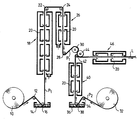
- the illustrated plant includes a roll 10 consisting of a paper-web of formable, or shapeable material, such as fiber glass, cellulose or like material.
- the web is taken from the roll 10 in the direction of the arrow shown, and is passed over a guide roller 12 and down into a vessel 14 which contains concentrated waterglass solution.
- the web P 1 is guided down beneath the surface of the waterglass solution in the vessel 14 with the aid of a guide roller 16, which is immersed in the solution. As the web P 1 passes through the vessel 14, the web becomes saturated with concentrated waterglass solution.
- the waterglass solution which may consist of a sodium-silicate solution which is later converted to silicate gel for impregnating the paper, may be brushed or otherwise applied to the paper web in quantities such as to saturate said web.
- the paper web P 1 After having been saturated with the concentrated waterglass solution, the paper web P 1 is moved upwards, as seen in the drawing, to a drying station 18, which includes a plurality of drying sections 20, in the illustrated case four drying sections which may either operate with hot-air units or infrared units.
- the paper web P 1 is then advanced, via guide rollers 22 and 24, to a further drying station 26 which includes drying sections 20 of the aforedescribed kind and in which the paper web P 1 is further dried.
- the waterglass When the web leaves the drying station 26, the waterglass will have a dry solids content of about 45-65%, preferably 45-55%.
- the paper web P 1 is then passed, via a guide roller 28, to a corrugating roller 30 on which the web P 1 is corrugated so as to form a large number of shallow corrugations in the paper web.
- a second paper web P 2 is taken from a paper roll 32 and passed, via a guide roller 34, into a vessel 36 which contains concentrated waterglass solution and into which the paper web P 2 is immersed, via a roller 38.
- the paper web P 2 is therewith saturated with concentrated waterglass solution and is passed from the vessel 36 to a drying station 40 which includes a plurality of drying sections 20 of the same kind as those earlier described with reference to drying of the paper web P 1 .
- the paper web P 2 is dried in the drying station 40, preferably from that side of the web which will later face away from the paper web P 1 when the two webs P 1 , P 2 are brought together to form a laminate.
- the drying process affects the whole of the paper web, that side which faces towards the web P 1 in the laminating process will have a higher moisture content than the outwardly facing side of said web.
- the paper web P 2 is combined with the corrugated paper web P 1 , via a guide roller 42, and the combined paper webs forming the laminate L are pressed together between the guide roller 42 and the roller 44, thereby bonding the webs together with the waterglass functioning as a bonding agent.
- the resultant laminate L is passed through a further drying station 46, which includes a plurality of drying sections 20 of the aforedescribed kind.
- the laminate is dried in the drying station 46 to a dry solids content of about 60-95% with regards to waterglass.
- the paper in the laminate L is impregnated initially with large quantities of waterglass sufficient to impart the desired properties to the contactor subsequently manufactured from the laminate. Because the paper web P 1 , which is subsequently corrugated, is saturated with waterglass and then dried to a dry solids content of about 45-65%, preferably 45-55%, and is thus in a wet, plastic state, it is possible to use smaller corrugation heights and therewith obtain a uniform, homogenous corrugated surface structure without risk of blocking the subsequent passageways. Since waterglass is the only adhesive used to bond the layers together, there is no need to burn-off the rotor and the laminate will therewith be impregnated over the whole of its surface, including the bonding locations. When practicing the inventive method, the silica gel formed in the aforesaid after-treatment is less fluffy and thus produces less dust when the contactor is used.
Landscapes
- Engineering & Computer Science (AREA)
- Mechanical Engineering (AREA)
- Laminated Bodies (AREA)
- Paper (AREA)
Abstract
Description
Claims (5)
- A method of producing a laminate structure comprised of alternating smooth and corrugated sheets and forming a corrugated structure for the manufacture of so-called exchange contactors for the exchange of heat and moisture among others, characterized by saturating a starting material, consisting of a first paper web of formable material made of fiber glass or cellulose, with a concentrated waterglass solution; drying the paper web to a dry solids content of 45-65% with respect to the waterglass; corrugating said paper web; saturating a second paper web with concentrated waterglass solution and drying said web; combining the second paper web with the first paper web so as to form a laminate structure; and drying the laminate structure to a dry solids content of about 60-95% with regard to the waterglass.
- A method according to Claim 1, characterized by drying the second paper web from one side thereof; and by combining the second paper web with the first paper web such that the wetter side of the second paper web is brought into contact with the corrugated, first paper web.
- A method according to Claim 1 or 2, characterized by passing the paper webs through a waterglass solution in order to saturate said webs with said solution.
- A method according to any one of Claims 1-3, characterized by drying the paper webs with the aid of hot air or infrared heat radiation.
- A method according to any one of Claims 1-4, characterized by drying the first paper web to a dry solids content of 45-55% with regard to the waterglass.
Applications Claiming Priority (3)
| Application Number | Priority Date | Filing Date | Title |
|---|---|---|---|
| SE9101938 | 1991-06-20 | ||
| SE9101938A SE469976B (en) | 1991-06-20 | 1991-06-20 | Process for preparing a laminate |
| PCT/SE1992/000446 WO1993000220A1 (en) | 1991-06-20 | 1992-06-18 | Method and apparatus for producing a laminate |
Publications (2)
| Publication Number | Publication Date |
|---|---|
| EP0590000A1 EP0590000A1 (en) | 1994-04-06 |
| EP0590000B1 true EP0590000B1 (en) | 1998-06-03 |
Family
ID=20383131
Family Applications (1)
| Application Number | Title | Priority Date | Filing Date |
|---|---|---|---|
| EP92912822A Expired - Lifetime EP0590000B1 (en) | 1991-06-20 | 1992-06-18 | Method and apparatus for producing a laminate |
Country Status (7)
| Country | Link |
|---|---|
| US (1) | US5423934A (en) |
| EP (1) | EP0590000B1 (en) |
| JP (1) | JPH06508314A (en) |
| AU (1) | AU2175192A (en) |
| DE (1) | DE69225798T2 (en) |
| SE (1) | SE469976B (en) |
| WO (1) | WO1993000220A1 (en) |
Families Citing this family (7)
| Publication number | Priority date | Publication date | Assignee | Title |
|---|---|---|---|---|
| SE9802287L (en) * | 1998-06-26 | 1999-12-27 | Munters Ab Carl | Process for producing bacteriostatic cell body |
| SE513238E (en) * | 1998-12-01 | 2009-06-16 | Proflute Ab | Process for producing dehumidifiers and use of aqueous glass solution for impregnating paper in the process |
| SE514957C2 (en) * | 1999-09-28 | 2001-05-21 | Munters Ab Carl | Process for making a laminate of alternately flat and corrugated sheets |
| SE515614E (en) | 2000-03-01 | 2009-06-16 | Proflute Ab | Process for making dehumidifying elements and using a suspension for impregnating paper in the process |
| US20030056884A1 (en) * | 2001-09-26 | 2003-03-27 | Belding William A. | Heat and moisture exchange media |
| US9574782B2 (en) | 2012-01-20 | 2017-02-21 | Innovent Air Handling Equipment, LLC | Dehumidification system |
| MX2020007544A (en) | 2018-01-15 | 2020-11-11 | C Ip S A | New additive to improve adhesive compositions. |
Family Cites Families (5)
| Publication number | Priority date | Publication date | Assignee | Title |
|---|---|---|---|---|
| US3112184A (en) * | 1958-09-08 | 1963-11-26 | Corning Glass Works | Method of making ceramic articles |
| US3307617A (en) * | 1962-01-30 | 1967-03-07 | Munters Carl Georg | Method in the manufacture of an exchanger packing and exchanger packing manufactured according to said method |
| US3419937A (en) * | 1965-08-13 | 1969-01-07 | Corning Glass Works | Filter and method and apparatus for its production |
| US3826703A (en) * | 1968-12-04 | 1974-07-30 | W Russell | Methods of producing fibrous silicate products |
| JPS61252497A (en) * | 1985-04-22 | 1986-11-10 | Seibu Giken:Kk | Manufacture of element for dehumidification and total heat exchange |
-
1991
- 1991-06-20 SE SE9101938A patent/SE469976B/en not_active IP Right Cessation
-
1992
- 1992-06-18 DE DE69225798T patent/DE69225798T2/en not_active Expired - Lifetime
- 1992-06-18 WO PCT/SE1992/000446 patent/WO1993000220A1/en not_active Ceased
- 1992-06-18 JP JP5501183A patent/JPH06508314A/en not_active Withdrawn
- 1992-06-18 AU AU21751/92A patent/AU2175192A/en not_active Abandoned
- 1992-06-18 EP EP92912822A patent/EP0590000B1/en not_active Expired - Lifetime
- 1992-06-18 US US08/167,901 patent/US5423934A/en not_active Expired - Lifetime
Also Published As
| Publication number | Publication date |
|---|---|
| SE9101938L (en) | 1992-12-21 |
| DE69225798D1 (en) | 1998-07-09 |
| AU2175192A (en) | 1993-01-25 |
| EP0590000A1 (en) | 1994-04-06 |
| US5423934A (en) | 1995-06-13 |
| JPH06508314A (en) | 1994-09-22 |
| SE9101938D0 (en) | 1991-06-20 |
| DE69225798T2 (en) | 1998-11-19 |
| WO1993000220A1 (en) | 1993-01-07 |
| SE469976B (en) | 1993-10-18 |
Similar Documents
| Publication | Publication Date | Title |
|---|---|---|
| JP3222728B2 (en) | Element for moisture exchanger, moisture exchanger medium and method for producing the same | |
| US5505769A (en) | Titanium silicate aerogel element and humidity exchanger using matrix of aerogel element | |
| CN1018347B (en) | Chemical fibre sheet, and its producing method and qpparatus | |
| US5423934A (en) | Method for producing a laminate | |
| US3677868A (en) | Laminated board structure and method of making same | |
| RU2680443C2 (en) | Mineral fiber batting for manufacture of thermally insulation composite | |
| US4510199A (en) | Release sheets for laminates with wax and alginate salt release layer | |
| EP1006238B1 (en) | Method of producing a dehumidifying element | |
| US4948448A (en) | Method of manufacturing moisture resistant corrugated fiberboard | |
| EP1130161B1 (en) | Method for the production of a dehumidifying element | |
| JP2001269911A (en) | Method of manufacturing waste paper board | |
| US1864812A (en) | Method of gluing wet veneers to backings and drying them | |
| KR102509614B1 (en) | Method and apparatus of manufacturing nonwoven fabric panel | |
| EP1218172B1 (en) | Method for producing a laminate | |
| JPS63227857A (en) | Production of bonded web like product, bonded web like product and production of composite body | |
| RU2021414C1 (en) | Process for manufacturing multi-layer paper-based material | |
| JPH11268186A (en) | Manufacture of decorative plate | |
| US1303753A (en) | Composite board. | |
| JPS6114945B2 (en) | ||
| KR102251359B1 (en) | Semi-nonflammable corrugated cardboard board attached semi-nonflammable kenaf fiber plate and its manufacturing method | |
| JPH10109383A (en) | Manufacture of decorative board | |
| JPS60250945A (en) | Manufacture of paper core | |
| JPS5843398A (en) | Manufacture of heat exchange element | |
| JP2000079607A (en) | Integrated wood | |
| JP2002282706A (en) | Metal honeycomb carrier, method for manufacturing metal honeycomb carrier, and method for manufacturing metal honeycomb basic structure |
Legal Events
| Date | Code | Title | Description |
|---|---|---|---|
| PUAI | Public reference made under article 153(3) epc to a published international application that has entered the european phase |
Free format text: ORIGINAL CODE: 0009012 |
|
| 17P | Request for examination filed |
Effective date: 19940107 |
|
| AK | Designated contracting states |
Kind code of ref document: A1 Designated state(s): BE DE DK ES FR GB IT NL SE |
|
| 17Q | First examination report despatched |
Effective date: 19961119 |
|
| GRAG | Despatch of communication of intention to grant |
Free format text: ORIGINAL CODE: EPIDOS AGRA |
|
| GRAG | Despatch of communication of intention to grant |
Free format text: ORIGINAL CODE: EPIDOS AGRA |
|
| GRAH | Despatch of communication of intention to grant a patent |
Free format text: ORIGINAL CODE: EPIDOS IGRA |
|
| GRAH | Despatch of communication of intention to grant a patent |
Free format text: ORIGINAL CODE: EPIDOS IGRA |
|
| GRAA | (expected) grant |
Free format text: ORIGINAL CODE: 0009210 |
|
| AK | Designated contracting states |
Kind code of ref document: B1 Designated state(s): BE DE DK ES FR GB IT NL SE |
|
| PG25 | Lapsed in a contracting state [announced via postgrant information from national office to epo] |
Ref country code: NL Free format text: LAPSE BECAUSE OF FAILURE TO SUBMIT A TRANSLATION OF THE DESCRIPTION OR TO PAY THE FEE WITHIN THE PRESCRIBED TIME-LIMIT Effective date: 19980603 Ref country code: IT Free format text: LAPSE BECAUSE OF FAILURE TO SUBMIT A TRANSLATION OF THE DESCRIPTION OR TO PAY THE FEE WITHIN THE PRE;WARNING: LAPSES OF ITALIAN PATENTS WITH EFFECTIVE DATE BEFORE 2007 MAY HAVE OCCURRED AT ANY TIME BEFORE 2007. THE CORRECT EFFECTIVE DATE MAY BE DIFFERENT FROM THE ONE RECORDED.SCRIBED TIME-LIMIT Effective date: 19980603 Ref country code: ES Free format text: THE PATENT HAS BEEN ANNULLED BY A DECISION OF A NATIONAL AUTHORITY Effective date: 19980603 |
|
| REF | Corresponds to: |
Ref document number: 69225798 Country of ref document: DE Date of ref document: 19980709 |
|
| PG25 | Lapsed in a contracting state [announced via postgrant information from national office to epo] |
Ref country code: SE Free format text: LAPSE BECAUSE OF FAILURE TO SUBMIT A TRANSLATION OF THE DESCRIPTION OR TO PAY THE FEE WITHIN THE PRESCRIBED TIME-LIMIT Effective date: 19980903 Ref country code: DK Free format text: LAPSE BECAUSE OF FAILURE TO SUBMIT A TRANSLATION OF THE DESCRIPTION OR TO PAY THE FEE WITHIN THE PRESCRIBED TIME-LIMIT Effective date: 19980903 |
|
| ET | Fr: translation filed | ||
| NLV1 | Nl: lapsed or annulled due to failure to fulfill the requirements of art. 29p and 29m of the patents act | ||
| PLBE | No opposition filed within time limit |
Free format text: ORIGINAL CODE: 0009261 |
|
| STAA | Information on the status of an ep patent application or granted ep patent |
Free format text: STATUS: NO OPPOSITION FILED WITHIN TIME LIMIT |
|
| 26N | No opposition filed | ||
| REG | Reference to a national code |
Ref country code: GB Ref legal event code: IF02 |
|
| PGFP | Annual fee paid to national office [announced via postgrant information from national office to epo] |
Ref country code: BE Payment date: 20100616 Year of fee payment: 19 |
|
| PGFP | Annual fee paid to national office [announced via postgrant information from national office to epo] |
Ref country code: GB Payment date: 20100621 Year of fee payment: 19 Ref country code: FR Payment date: 20100721 Year of fee payment: 19 |
|
| PGFP | Annual fee paid to national office [announced via postgrant information from national office to epo] |
Ref country code: DE Payment date: 20110621 Year of fee payment: 20 |
|
| BERE | Be: lapsed |
Owner name: CARL *MUNTERS A.B. Effective date: 20110630 |
|
| GBPC | Gb: european patent ceased through non-payment of renewal fee |
Effective date: 20110618 |
|
| REG | Reference to a national code |
Ref country code: FR Ref legal event code: ST Effective date: 20120229 |
|
| PG25 | Lapsed in a contracting state [announced via postgrant information from national office to epo] |
Ref country code: BE Free format text: LAPSE BECAUSE OF NON-PAYMENT OF DUE FEES Effective date: 20110630 |
|
| PG25 | Lapsed in a contracting state [announced via postgrant information from national office to epo] |
Ref country code: FR Free format text: LAPSE BECAUSE OF NON-PAYMENT OF DUE FEES Effective date: 20110630 |
|
| REG | Reference to a national code |
Ref country code: DE Ref legal event code: R071 Ref document number: 69225798 Country of ref document: DE |
|
| REG | Reference to a national code |
Ref country code: DE Ref legal event code: R071 Ref document number: 69225798 Country of ref document: DE |
|
| PG25 | Lapsed in a contracting state [announced via postgrant information from national office to epo] |
Ref country code: GB Free format text: LAPSE BECAUSE OF NON-PAYMENT OF DUE FEES Effective date: 20110618 |
|
| PG25 | Lapsed in a contracting state [announced via postgrant information from national office to epo] |
Ref country code: DE Free format text: LAPSE BECAUSE OF EXPIRATION OF PROTECTION Effective date: 20120619 |