EP0589004B1 - Process for the determination of peptides corresponding to immunologically important epitopes of hcv - Google Patents
Process for the determination of peptides corresponding to immunologically important epitopes of hcv Download PDFInfo
- Publication number
- EP0589004B1 EP0589004B1 EP93906490A EP93906490A EP0589004B1 EP 0589004 B1 EP0589004 B1 EP 0589004B1 EP 93906490 A EP93906490 A EP 93906490A EP 93906490 A EP93906490 A EP 93906490A EP 0589004 B1 EP0589004 B1 EP 0589004B1
- Authority
- EP
- European Patent Office
- Prior art keywords
- peptide
- peptides
- hcv
- biotinylated
- fmoc
- Prior art date
- Legal status (The legal status is an assumption and is not a legal conclusion. Google has not performed a legal analysis and makes no representation as to the accuracy of the status listed.)
- Expired - Lifetime
Links
- 108090000765 processed proteins & peptides Proteins 0.000 title claims abstract description 367
- 102000004196 processed proteins & peptides Human genes 0.000 title claims abstract description 165
- 238000000034 method Methods 0.000 title claims abstract description 55
- 230000008569 process Effects 0.000 title claims description 14
- YBJHBAHKTGYVGT-ZKWXMUAHSA-N (+)-Biotin Chemical group N1C(=O)N[C@@H]2[C@H](CCCCC(=O)O)SC[C@@H]21 YBJHBAHKTGYVGT-ZKWXMUAHSA-N 0.000 claims description 48
- 229960002685 biotin Drugs 0.000 claims description 48
- 239000011616 biotin Substances 0.000 claims description 48
- 239000007790 solid phase Substances 0.000 claims description 40
- RTZKZFJDLAIYFH-UHFFFAOYSA-N Diethyl ether Chemical compound CCOCC RTZKZFJDLAIYFH-UHFFFAOYSA-N 0.000 claims description 39
- 108010090804 Streptavidin Proteins 0.000 claims description 35
- 150000001413 amino acids Chemical class 0.000 claims description 31
- NQRYJNQNLNOLGT-UHFFFAOYSA-N Piperidine Chemical compound C1CCNCC1 NQRYJNQNLNOLGT-UHFFFAOYSA-N 0.000 claims description 30
- 238000010511 deprotection reaction Methods 0.000 claims description 29
- 239000011347 resin Substances 0.000 claims description 28
- 229920005989 resin Polymers 0.000 claims description 28
- 235000020958 biotin Nutrition 0.000 claims description 24
- 238000003776 cleavage reaction Methods 0.000 claims description 24
- 230000007017 scission Effects 0.000 claims description 24
- DTQVDTLACAAQTR-UHFFFAOYSA-N Trifluoroacetic acid Chemical compound OC(=O)C(F)(F)F DTQVDTLACAAQTR-UHFFFAOYSA-N 0.000 claims description 22
- 150000001875 compounds Chemical class 0.000 claims description 21
- 125000003088 (fluoren-9-ylmethoxy)carbonyl group Chemical group 0.000 claims description 19
- -1 9-fluorenylmethoxycarbonyl Chemical group 0.000 claims description 19
- 125000003275 alpha amino acid group Chemical group 0.000 claims description 19
- 108090001008 Avidin Proteins 0.000 claims description 18
- 101710159910 Movement protein Proteins 0.000 claims description 18
- 101710144117 Non-structural protein 4 Proteins 0.000 claims description 18
- 230000015572 biosynthetic process Effects 0.000 claims description 18
- 238000000605 extraction Methods 0.000 claims description 18
- 238000003786 synthesis reaction Methods 0.000 claims description 18
- 238000005859 coupling reaction Methods 0.000 claims description 16
- 239000000523 sample Substances 0.000 claims description 16
- 125000003178 carboxy group Chemical group [H]OC(*)=O 0.000 claims description 15
- 238000010324 immunological assay Methods 0.000 claims description 15
- 125000002924 primary amino group Chemical group [H]N([H])* 0.000 claims description 14
- 238000000746 purification Methods 0.000 claims description 14
- 125000003277 amino group Chemical group 0.000 claims description 13
- 230000008878 coupling Effects 0.000 claims description 13
- 238000010168 coupling process Methods 0.000 claims description 13
- 229960004132 diethyl ether Drugs 0.000 claims description 13
- RDOXTESZEPMUJZ-UHFFFAOYSA-N anisole Chemical compound COC1=CC=CC=C1 RDOXTESZEPMUJZ-UHFFFAOYSA-N 0.000 claims description 12
- 239000000427 antigen Substances 0.000 claims description 12
- 108091007433 antigens Proteins 0.000 claims description 12
- 102000036639 antigens Human genes 0.000 claims description 12
- 239000007787 solid Substances 0.000 claims description 11
- 239000002253 acid Substances 0.000 claims description 10
- 239000012472 biological sample Substances 0.000 claims description 10
- 238000010647 peptide synthesis reaction Methods 0.000 claims description 10
- 229910052799 carbon Inorganic materials 0.000 claims description 9
- 230000001900 immune effect Effects 0.000 claims description 9
- 238000004519 manufacturing process Methods 0.000 claims description 9
- 210000004899 c-terminal region Anatomy 0.000 claims description 8
- 239000012528 membrane Substances 0.000 claims description 8
- 230000003993 interaction Effects 0.000 claims description 7
- DHBXNPKRAUYBTH-UHFFFAOYSA-N 1,1-ethanedithiol Chemical compound CC(S)S DHBXNPKRAUYBTH-UHFFFAOYSA-N 0.000 claims description 6
- 238000004128 high performance liquid chromatography Methods 0.000 claims description 6
- 208000015181 infectious disease Diseases 0.000 claims description 6
- UZKWTJUDCOPSNM-UHFFFAOYSA-N methoxybenzene Substances CCCCOC=C UZKWTJUDCOPSNM-UHFFFAOYSA-N 0.000 claims description 6
- 239000002904 solvent Substances 0.000 claims description 6
- HNKJADCVZUBCPG-UHFFFAOYSA-N thioanisole Chemical compound CSC1=CC=CC=C1 HNKJADCVZUBCPG-UHFFFAOYSA-N 0.000 claims description 6
- 150000001721 carbon Chemical group 0.000 claims description 5
- 239000012634 fragment Substances 0.000 claims description 5
- 230000035945 sensitivity Effects 0.000 claims description 5
- OKTJSMMVPCPJKN-UHFFFAOYSA-N Carbon Chemical compound [C] OKTJSMMVPCPJKN-UHFFFAOYSA-N 0.000 claims description 4
- 239000004677 Nylon Substances 0.000 claims description 4
- 125000004429 atom Chemical group 0.000 claims description 4
- 229920001778 nylon Polymers 0.000 claims description 4
- 238000002360 preparation method Methods 0.000 claims description 4
- 125000003396 thiol group Chemical group [H]S* 0.000 claims description 4
- 238000012217 deletion Methods 0.000 claims description 3
- 230000037430 deletion Effects 0.000 claims description 3
- 150000002148 esters Chemical class 0.000 claims description 3
- 238000002649 immunization Methods 0.000 claims description 3
- 238000003780 insertion Methods 0.000 claims description 3
- 230000037431 insertion Effects 0.000 claims description 3
- 125000006850 spacer group Chemical group 0.000 claims description 3
- 238000006467 substitution reaction Methods 0.000 claims description 3
- 150000003573 thiols Chemical class 0.000 claims description 3
- LFQSCWFLJHTTHZ-UHFFFAOYSA-N Ethanol Chemical compound CCO LFQSCWFLJHTTHZ-UHFFFAOYSA-N 0.000 claims description 2
- 238000007385 chemical modification Methods 0.000 claims description 2
- 125000004122 cyclic group Chemical group 0.000 claims description 2
- 125000002887 hydroxy group Chemical group [H]O* 0.000 claims description 2
- 238000001514 detection method Methods 0.000 abstract description 25
- 238000009007 Diagnostic Kit Methods 0.000 abstract 1
- 101800001690 Transmembrane protein gp41 Proteins 0.000 abstract 1
- 241000711549 Hepacivirus C Species 0.000 description 73
- 238000009739 binding Methods 0.000 description 48
- 241000713772 Human immunodeficiency virus 1 Species 0.000 description 31
- 235000018102 proteins Nutrition 0.000 description 28
- 102000004169 proteins and genes Human genes 0.000 description 28
- 108090000623 proteins and genes Proteins 0.000 description 28
- 235000001014 amino acid Nutrition 0.000 description 27
- 229940024606 amino acid Drugs 0.000 description 25
- 238000002965 ELISA Methods 0.000 description 20
- 239000000047 product Substances 0.000 description 19
- 239000011248 coating agent Substances 0.000 description 14
- 238000000576 coating method Methods 0.000 description 14
- 239000000243 solution Substances 0.000 description 13
- XEKOWRVHYACXOJ-UHFFFAOYSA-N Ethyl acetate Chemical compound CCOC(C)=O XEKOWRVHYACXOJ-UHFFFAOYSA-N 0.000 description 12
- SJRJJKPEHAURKC-UHFFFAOYSA-N N-Methylmorpholine Chemical compound CN1CCOCC1 SJRJJKPEHAURKC-UHFFFAOYSA-N 0.000 description 12
- 239000004793 Polystyrene Substances 0.000 description 12
- CDBYLPFSWZWCQE-UHFFFAOYSA-L Sodium Carbonate Chemical compound [Na+].[Na+].[O-]C([O-])=O CDBYLPFSWZWCQE-UHFFFAOYSA-L 0.000 description 12
- 239000000203 mixture Substances 0.000 description 12
- 229920002223 polystyrene Polymers 0.000 description 12
- 238000006243 chemical reaction Methods 0.000 description 11
- ZMXDDKWLCZADIW-UHFFFAOYSA-N N,N-Dimethylformamide Chemical compound CN(C)C=O ZMXDDKWLCZADIW-UHFFFAOYSA-N 0.000 description 10
- 230000003287 optical effect Effects 0.000 description 10
- 208000031886 HIV Infections Diseases 0.000 description 9
- 238000013459 approach Methods 0.000 description 9
- 230000004913 activation Effects 0.000 description 8
- 238000010790 dilution Methods 0.000 description 8
- 239000012895 dilution Substances 0.000 description 8
- 238000012360 testing method Methods 0.000 description 8
- 238000005406 washing Methods 0.000 description 8
- 102000004190 Enzymes Human genes 0.000 description 7
- 108090000790 Enzymes Proteins 0.000 description 7
- 241000713340 Human immunodeficiency virus 2 Species 0.000 description 7
- 239000003153 chemical reaction reagent Substances 0.000 description 7
- 238000002474 experimental method Methods 0.000 description 7
- KPYXMALABCDPGN-HYOZMBHHSA-N (4s)-5-[[(2s)-6-amino-1-[[(2s,3s)-1-[[(2s)-1-[[(2s)-1-[[(2s)-1-[[(2s)-1-[[(2r)-1-[[2-[[2-[[(1s)-3-amino-1-carboxy-3-oxopropyl]amino]-2-oxoethyl]amino]-2-oxoethyl]amino]-1-oxo-3-sulfanylpropan-2-yl]amino]-4-methyl-1-oxopentan-2-yl]amino]-1-oxopropan-2-yl]a Chemical compound NC(=O)C[C@@H](C(O)=O)NC(=O)CNC(=O)CNC(=O)[C@H](CS)NC(=O)[C@H](CC(C)C)NC(=O)[C@H](C)NC(=O)[C@H](C(C)C)NC(=O)[C@H](CC(C)C)NC(=O)[C@H]([C@@H](C)CC)NC(=O)[C@H](CCCCN)NC(=O)[C@H](CCC(O)=O)NC(=O)[C@@H](NC(=O)[C@H](CC(O)=O)NC(=O)CNC(=O)[C@@H](N)CCCCN)CC1=CC=C(O)C=C1 KPYXMALABCDPGN-HYOZMBHHSA-N 0.000 description 6
- CSCPPACGZOOCGX-UHFFFAOYSA-N Acetone Chemical compound CC(C)=O CSCPPACGZOOCGX-UHFFFAOYSA-N 0.000 description 6
- 101800001386 Peptide II Proteins 0.000 description 6
- 125000004057 biotinyl group Chemical class [H]N1C(=O)N([H])[C@]2([H])[C@@]([H])(SC([H])([H])[C@]12[H])C([H])([H])C([H])([H])C([H])([H])C([H])([H])C(*)=O 0.000 description 6
- 239000004033 plastic Substances 0.000 description 6
- 229920003023 plastic Polymers 0.000 description 6
- 239000002244 precipitate Substances 0.000 description 6
- 238000004366 reverse phase liquid chromatography Methods 0.000 description 6
- 210000002966 serum Anatomy 0.000 description 6
- 229910000029 sodium carbonate Inorganic materials 0.000 description 6
- XLYOFNOQVPJJNP-UHFFFAOYSA-N water Substances O XLYOFNOQVPJJNP-UHFFFAOYSA-N 0.000 description 6
- 239000012317 TBTU Substances 0.000 description 5
- CLZISMQKJZCZDN-UHFFFAOYSA-N [benzotriazol-1-yloxy(dimethylamino)methylidene]-dimethylazanium Chemical compound C1=CC=C2N(OC(N(C)C)=[N+](C)C)N=NC2=C1 CLZISMQKJZCZDN-UHFFFAOYSA-N 0.000 description 5
- 230000006287 biotinylation Effects 0.000 description 5
- 238000007413 biotinylation Methods 0.000 description 5
- 238000011156 evaluation Methods 0.000 description 5
- 125000003630 glycyl group Chemical group [H]N([H])C([H])([H])C(*)=O 0.000 description 5
- 235000017550 sodium carbonate Nutrition 0.000 description 5
- 239000000126 substance Substances 0.000 description 5
- 108010001336 Horseradish Peroxidase Proteins 0.000 description 4
- 108010076039 Polyproteins Proteins 0.000 description 4
- 238000003556 assay Methods 0.000 description 4
- 230000008901 benefit Effects 0.000 description 4
- 239000003795 chemical substances by application Substances 0.000 description 4
- 229940093499 ethyl acetate Drugs 0.000 description 4
- 235000019439 ethyl acetate Nutrition 0.000 description 4
- 230000002163 immunogen Effects 0.000 description 4
- 238000001179 sorption measurement Methods 0.000 description 4
- 239000000758 substrate Substances 0.000 description 4
- 230000003612 virological effect Effects 0.000 description 4
- YMXHPSHLTSZXKH-RVBZMBCESA-N (2,5-dioxopyrrolidin-1-yl) 5-[(3as,4s,6ar)-2-oxo-1,3,3a,4,6,6a-hexahydrothieno[3,4-d]imidazol-4-yl]pentanoate Chemical compound C([C@H]1[C@H]2NC(=O)N[C@H]2CS1)CCCC(=O)ON1C(=O)CCC1=O YMXHPSHLTSZXKH-RVBZMBCESA-N 0.000 description 3
- WFDIJRYMOXRFFG-UHFFFAOYSA-N Acetic anhydride Chemical compound CC(=O)OC(C)=O WFDIJRYMOXRFFG-UHFFFAOYSA-N 0.000 description 3
- WEVYAHXRMPXWCK-UHFFFAOYSA-N Acetonitrile Chemical compound CC#N WEVYAHXRMPXWCK-UHFFFAOYSA-N 0.000 description 3
- 241000725303 Human immunodeficiency virus Species 0.000 description 3
- 101710128560 Initiator protein NS1 Proteins 0.000 description 3
- 101710144127 Non-structural protein 1 Proteins 0.000 description 3
- HEMHJVSKTPXQMS-UHFFFAOYSA-M Sodium hydroxide Chemical compound [OH-].[Na+] HEMHJVSKTPXQMS-UHFFFAOYSA-M 0.000 description 3
- 239000005018 casein Substances 0.000 description 3
- BECPQYXYKAMYBN-UHFFFAOYSA-N casein, tech. Chemical compound NCCCCC(C(O)=O)N=C(O)C(CC(O)=O)N=C(O)C(CCC(O)=N)N=C(O)C(CC(C)C)N=C(O)C(CCC(O)=O)N=C(O)C(CC(O)=O)N=C(O)C(CCC(O)=O)N=C(O)C(C(C)O)N=C(O)C(CCC(O)=N)N=C(O)C(CCC(O)=N)N=C(O)C(CCC(O)=N)N=C(O)C(CCC(O)=O)N=C(O)C(CCC(O)=O)N=C(O)C(COP(O)(O)=O)N=C(O)C(CCC(O)=N)N=C(O)C(N)CC1=CC=CC=C1 BECPQYXYKAMYBN-UHFFFAOYSA-N 0.000 description 3
- 235000021240 caseins Nutrition 0.000 description 3
- 238000004587 chromatography analysis Methods 0.000 description 3
- 238000010586 diagram Methods 0.000 description 3
- YWEUIGNSBFLMFL-UHFFFAOYSA-N diphosphonate Chemical compound O=P(=O)OP(=O)=O YWEUIGNSBFLMFL-UHFFFAOYSA-N 0.000 description 3
- 238000003018 immunoassay Methods 0.000 description 3
- 238000011534 incubation Methods 0.000 description 3
- 239000012071 phase Substances 0.000 description 3
- DLYUQMMRRRQYAE-UHFFFAOYSA-N phosphorus pentoxide Inorganic materials O1P(O2)(=O)OP3(=O)OP1(=O)OP2(=O)O3 DLYUQMMRRRQYAE-UHFFFAOYSA-N 0.000 description 3
- 239000000843 powder Substances 0.000 description 3
- UVGHPGOONBRLCX-NJSLBKSFSA-N (2,5-dioxopyrrolidin-1-yl) 6-[5-[(3as,4s,6ar)-2-oxo-1,3,3a,4,6,6a-hexahydrothieno[3,4-d]imidazol-4-yl]pentanoylamino]hexanoate Chemical compound C([C@H]1[C@H]2NC(=O)N[C@H]2CS1)CCCC(=O)NCCCCCC(=O)ON1C(=O)CCC1=O UVGHPGOONBRLCX-NJSLBKSFSA-N 0.000 description 2
- YFHGOMGFTFTQSS-MNXVOIDGSA-N (2s)-2-[5-[(3as,4s,6ar)-2-oxo-1,3,3a,4,6,6a-hexahydrothieno[3,4-d]imidazol-4-yl]pentanoylamino]-6-aminohexanoic acid Chemical compound N1C(=O)N[C@@H]2[C@H](CCCCC(=O)N[C@@H](CCCCN)C(O)=O)SC[C@@H]21 YFHGOMGFTFTQSS-MNXVOIDGSA-N 0.000 description 2
- ASOKPJOREAFHNY-UHFFFAOYSA-N 1-Hydroxybenzotriazole Chemical compound C1=CC=C2N(O)N=NC2=C1 ASOKPJOREAFHNY-UHFFFAOYSA-N 0.000 description 2
- YRKFMPDOFHQWPI-UHFFFAOYSA-N 6-azaniumyl-2-(9h-fluoren-9-ylmethoxycarbonylamino)hexanoate Chemical compound C1=CC=C2C(COC(=O)NC(CCCCN)C(O)=O)C3=CC=CC=C3C2=C1 YRKFMPDOFHQWPI-UHFFFAOYSA-N 0.000 description 2
- 239000004475 Arginine Substances 0.000 description 2
- IJGRMHOSHXDMSA-UHFFFAOYSA-N Atomic nitrogen Chemical compound N#N IJGRMHOSHXDMSA-UHFFFAOYSA-N 0.000 description 2
- 108091003079 Bovine Serum Albumin Proteins 0.000 description 2
- BVKZGUZCCUSVTD-UHFFFAOYSA-L Carbonate Chemical compound [O-]C([O-])=O BVKZGUZCCUSVTD-UHFFFAOYSA-L 0.000 description 2
- 102000014914 Carrier Proteins Human genes 0.000 description 2
- IAZDPXIOMUYVGZ-UHFFFAOYSA-N Dimethylsulphoxide Chemical compound CS(C)=O IAZDPXIOMUYVGZ-UHFFFAOYSA-N 0.000 description 2
- 108060003951 Immunoglobulin Proteins 0.000 description 2
- XUJNEKJLAYXESH-REOHCLBHSA-N L-Cysteine Chemical compound SC[C@H](N)C(O)=O XUJNEKJLAYXESH-REOHCLBHSA-N 0.000 description 2
- AHLPHDHHMVZTML-BYPYZUCNSA-N L-Ornithine Chemical class NCCC[C@H](N)C(O)=O AHLPHDHHMVZTML-BYPYZUCNSA-N 0.000 description 2
- BAQMYDQNMFBZNA-UHFFFAOYSA-N N-biotinyl-L-lysine Natural products N1C(=O)NC2C(CCCCC(=O)NCCCCC(N)C(O)=O)SCC21 BAQMYDQNMFBZNA-UHFFFAOYSA-N 0.000 description 2
- QAOWNCQODCNURD-UHFFFAOYSA-N Sulfuric acid Chemical compound OS(O)(=O)=O QAOWNCQODCNURD-UHFFFAOYSA-N 0.000 description 2
- 108010067390 Viral Proteins Proteins 0.000 description 2
- 230000003213 activating effect Effects 0.000 description 2
- 230000002411 adverse Effects 0.000 description 2
- 150000001408 amides Chemical group 0.000 description 2
- ODKSFYDXXFIFQN-UHFFFAOYSA-N arginine Natural products OC(=O)C(N)CCCNC(N)=N ODKSFYDXXFIFQN-UHFFFAOYSA-N 0.000 description 2
- BAQMYDQNMFBZNA-MNXVOIDGSA-N biocytin Chemical compound N1C(=O)N[C@@H]2[C@H](CCCCC(=O)NCCCC[C@H](N)C(O)=O)SC[C@@H]21 BAQMYDQNMFBZNA-MNXVOIDGSA-N 0.000 description 2
- 210000001124 body fluid Anatomy 0.000 description 2
- 239000010839 body fluid Substances 0.000 description 2
- 229940098773 bovine serum albumin Drugs 0.000 description 2
- 230000008859 change Effects 0.000 description 2
- 235000018417 cysteine Nutrition 0.000 description 2
- XUJNEKJLAYXESH-UHFFFAOYSA-N cysteine Natural products SCC(N)C(O)=O XUJNEKJLAYXESH-UHFFFAOYSA-N 0.000 description 2
- 230000000694 effects Effects 0.000 description 2
- 208000006454 hepatitis Diseases 0.000 description 2
- 231100000283 hepatitis Toxicity 0.000 description 2
- 102000018358 immunoglobulin Human genes 0.000 description 2
- 238000000338 in vitro Methods 0.000 description 2
- 238000011065 in-situ storage Methods 0.000 description 2
- 238000013507 mapping Methods 0.000 description 2
- 239000000463 material Substances 0.000 description 2
- 230000003278 mimic effect Effects 0.000 description 2
- 229960003104 ornithine Drugs 0.000 description 2
- LCPDWSOZIOUXRV-UHFFFAOYSA-N phenoxyacetic acid Chemical compound OC(=O)COC1=CC=CC=C1 LCPDWSOZIOUXRV-UHFFFAOYSA-N 0.000 description 2
- 125000006239 protecting group Chemical group 0.000 description 2
- 239000007858 starting material Substances 0.000 description 2
- 238000003756 stirring Methods 0.000 description 2
- 239000011550 stock solution Substances 0.000 description 2
- 125000005931 tert-butyloxycarbonyl group Chemical group [H]C([H])([H])C(OC(*)=O)(C([H])([H])[H])C([H])([H])[H] 0.000 description 2
- 102000035160 transmembrane proteins Human genes 0.000 description 2
- 108091005703 transmembrane proteins Proteins 0.000 description 2
- 125000002221 trityl group Chemical group [H]C1=C([H])C([H])=C([H])C([H])=C1C([*])(C1=C(C(=C(C(=C1[H])[H])[H])[H])[H])C1=C([H])C([H])=C([H])C([H])=C1[H] 0.000 description 2
- 229960005486 vaccine Drugs 0.000 description 2
- VCQURUZYYSOUHP-UHFFFAOYSA-N (2,3,4,5,6-pentafluorophenyl) 2,2,2-trifluoroacetate Chemical compound FC1=C(F)C(F)=C(OC(=O)C(F)(F)F)C(F)=C1F VCQURUZYYSOUHP-UHFFFAOYSA-N 0.000 description 1
- 108091032973 (ribonucleotides)n+m Proteins 0.000 description 1
- NHBKXEKEPDILRR-UHFFFAOYSA-N 2,3-bis(butanoylsulfanyl)propyl butanoate Chemical compound CCCC(=O)OCC(SC(=O)CCC)CSC(=O)CCC NHBKXEKEPDILRR-UHFFFAOYSA-N 0.000 description 1
- PRIQPGUUEABMCC-UHFFFAOYSA-N 2-[4-[1-amino-1-(2,4-dimethoxyphenyl)-2-(9h-fluoren-9-ylmethoxy)-2-oxoethyl]phenoxy]acetic acid Chemical compound COC1=CC(OC)=CC=C1C(N)(C=1C=CC(OCC(O)=O)=CC=1)C(=O)OCC1C2=CC=CC=C2C2=CC=CC=C21 PRIQPGUUEABMCC-UHFFFAOYSA-N 0.000 description 1
- UAIUNKRWKOVEES-UHFFFAOYSA-N 3,3',5,5'-tetramethylbenzidine Chemical compound CC1=C(N)C(C)=CC(C=2C=C(C)C(N)=C(C)C=2)=C1 UAIUNKRWKOVEES-UHFFFAOYSA-N 0.000 description 1
- AYXZIZMZXAORLO-UFLZEWODSA-N 5-[(3as,4s,6ar)-2-oxo-1,3,3a,4,6,6a-hexahydrothieno[3,4-d]imidazol-4-yl]pentanoic acid;1-hydroxypyrrolidine-2,5-dione Chemical compound ON1C(=O)CCC1=O.N1C(=O)N[C@@H]2[C@H](CCCCC(=O)O)SC[C@@H]21 AYXZIZMZXAORLO-UFLZEWODSA-N 0.000 description 1
- LQVMZVKOVPITOO-UHFFFAOYSA-N 9h-fluoren-1-ylmethyl carbonochloridate Chemical compound C1C2=CC=CC=C2C2=C1C(COC(=O)Cl)=CC=C2 LQVMZVKOVPITOO-UHFFFAOYSA-N 0.000 description 1
- 102000002260 Alkaline Phosphatase Human genes 0.000 description 1
- 108020004774 Alkaline Phosphatase Proteins 0.000 description 1
- DCXYFEDJOCDNAF-UHFFFAOYSA-N Asparagine Natural products OC(=O)C(N)CC(N)=O DCXYFEDJOCDNAF-UHFFFAOYSA-N 0.000 description 1
- 108010077805 Bacterial Proteins Proteins 0.000 description 1
- 102100026189 Beta-galactosidase Human genes 0.000 description 1
- BTBUEUYNUDRHOZ-UHFFFAOYSA-N Borate Chemical compound [O-]B([O-])[O-] BTBUEUYNUDRHOZ-UHFFFAOYSA-N 0.000 description 1
- 241000283707 Capra Species 0.000 description 1
- 108010078791 Carrier Proteins Proteins 0.000 description 1
- 102100027723 Endogenous retrovirus group K member 6 Rec protein Human genes 0.000 description 1
- 101710091045 Envelope protein Proteins 0.000 description 1
- 102400000921 Gastrin Human genes 0.000 description 1
- 108010052343 Gastrins Proteins 0.000 description 1
- 108700039791 Hepatitis C virus nucleocapsid Proteins 0.000 description 1
- 241000598436 Human T-cell lymphotropic virus Species 0.000 description 1
- 206010020460 Human T-cell lymphotropic virus type I infection Diseases 0.000 description 1
- 241000714260 Human T-lymphotropic virus 1 Species 0.000 description 1
- DCXYFEDJOCDNAF-REOHCLBHSA-N L-asparagine Chemical compound OC(=O)[C@@H](N)CC(N)=O DCXYFEDJOCDNAF-REOHCLBHSA-N 0.000 description 1
- ZDXPYRJPNDTMRX-VKHMYHEASA-N L-glutamine Chemical compound OC(=O)[C@@H](N)CCC(N)=O ZDXPYRJPNDTMRX-VKHMYHEASA-N 0.000 description 1
- KDXKERNSBIXSRK-UHFFFAOYSA-N Lysine Natural products NCCCCC(N)C(O)=O KDXKERNSBIXSRK-UHFFFAOYSA-N 0.000 description 1
- 241001465754 Metazoa Species 0.000 description 1
- 108010051679 Methylmalonyl-CoA carboxytransferase Proteins 0.000 description 1
- 241000699670 Mus sp. Species 0.000 description 1
- 239000000020 Nitrocellulose Substances 0.000 description 1
- 108090001074 Nucleocapsid Proteins Proteins 0.000 description 1
- 108700026244 Open Reading Frames Proteins 0.000 description 1
- 101800005164 Peptide V Proteins 0.000 description 1
- 229920003171 Poly (ethylene oxide) Polymers 0.000 description 1
- 239000004698 Polyethylene Substances 0.000 description 1
- 101710188315 Protein X Proteins 0.000 description 1
- 102000007056 Recombinant Fusion Proteins Human genes 0.000 description 1
- 108010008281 Recombinant Fusion Proteins Proteins 0.000 description 1
- 101710172711 Structural protein Proteins 0.000 description 1
- 108091023045 Untranslated Region Proteins 0.000 description 1
- 241000700605 Viruses Species 0.000 description 1
- 238000011481 absorbance measurement Methods 0.000 description 1
- 125000002777 acetyl group Chemical group [H]C([H])([H])C(*)=O 0.000 description 1
- 230000009471 action Effects 0.000 description 1
- 125000000539 amino acid group Chemical group 0.000 description 1
- 238000004873 anchoring Methods 0.000 description 1
- 239000008346 aqueous phase Substances 0.000 description 1
- 229960001230 asparagine Drugs 0.000 description 1
- 235000009582 asparagine Nutrition 0.000 description 1
- 239000011324 bead Substances 0.000 description 1
- 108010005774 beta-Galactosidase Proteins 0.000 description 1
- 108091008324 binding proteins Proteins 0.000 description 1
- 125000004744 butyloxycarbonyl group Chemical group 0.000 description 1
- 210000000234 capsid Anatomy 0.000 description 1
- 238000005119 centrifugation Methods 0.000 description 1
- AOXOCDRNSPFDPE-UKEONUMOSA-N chembl413654 Chemical compound C([C@H](C(=O)NCC(=O)N[C@H](CC=1C2=CC=CC=C2NC=1)C(=O)N[C@H](CCSC)C(=O)N[C@H](CC(O)=O)C(=O)N[C@H](CC=1C=CC=CC=1)C(N)=O)NC(=O)[C@@H](C)NC(=O)[C@@H](CCC(O)=O)NC(=O)[C@@H](CCC(O)=O)NC(=O)[C@@H](CCC(O)=O)NC(=O)[C@H](CCC(O)=O)NC(=O)[C@H](CCC(O)=O)NC(=O)[C@H](CC(C)C)NC(=O)[C@H](CC=1C2=CC=CC=C2NC=1)NC(=O)[C@H]1N(CCC1)C(=O)CNC(=O)[C@@H](N)CCC(O)=O)C1=CC=C(O)C=C1 AOXOCDRNSPFDPE-UKEONUMOSA-N 0.000 description 1
- 150000005829 chemical entities Chemical class 0.000 description 1
- 125000003636 chemical group Chemical group 0.000 description 1
- 230000000295 complement effect Effects 0.000 description 1
- 239000002131 composite material Substances 0.000 description 1
- 239000007822 coupling agent Substances 0.000 description 1
- 238000000326 densiometry Methods 0.000 description 1
- 238000011161 development Methods 0.000 description 1
- 230000018109 developmental process Effects 0.000 description 1
- 238000003745 diagnosis Methods 0.000 description 1
- 238000004090 dissolution Methods 0.000 description 1
- 239000003797 essential amino acid Substances 0.000 description 1
- 235000020776 essential amino acid Nutrition 0.000 description 1
- 125000000524 functional group Chemical group 0.000 description 1
- 239000003588 gastrin derivative Substances 0.000 description 1
- 238000010353 genetic engineering Methods 0.000 description 1
- ZDXPYRJPNDTMRX-UHFFFAOYSA-N glutamine Natural products OC(=O)C(N)CCC(N)=O ZDXPYRJPNDTMRX-UHFFFAOYSA-N 0.000 description 1
- ZRALSGWEFCBTJO-UHFFFAOYSA-N guanidine group Chemical group NC(=N)N ZRALSGWEFCBTJO-UHFFFAOYSA-N 0.000 description 1
- HNDVDQJCIGZPNO-UHFFFAOYSA-N histidine Natural products OC(=O)C(N)CC1=CN=CN1 HNDVDQJCIGZPNO-UHFFFAOYSA-N 0.000 description 1
- 125000002883 imidazolyl group Chemical group 0.000 description 1
- 230000003053 immunization Effects 0.000 description 1
- 229940072221 immunoglobulins Drugs 0.000 description 1
- 238000010348 incorporation Methods 0.000 description 1
- 239000012678 infectious agent Substances 0.000 description 1
- 238000007689 inspection Methods 0.000 description 1
- 239000013067 intermediate product Substances 0.000 description 1
- 230000008863 intramolecular interaction Effects 0.000 description 1
- 238000011005 laboratory method Methods 0.000 description 1
- 150000002668 lysine derivatives Chemical class 0.000 description 1
- 230000014759 maintenance of location Effects 0.000 description 1
- 230000004048 modification Effects 0.000 description 1
- 238000012986 modification Methods 0.000 description 1
- 108091005601 modified peptides Proteins 0.000 description 1
- 238000010369 molecular cloning Methods 0.000 description 1
- 150000002762 monocarboxylic acid derivatives Chemical class 0.000 description 1
- 229920005615 natural polymer Polymers 0.000 description 1
- 229920001220 nitrocellulos Polymers 0.000 description 1
- 229910052757 nitrogen Inorganic materials 0.000 description 1
- 239000002773 nucleotide Substances 0.000 description 1
- 125000003729 nucleotide group Chemical group 0.000 description 1
- 230000020477 pH reduction Effects 0.000 description 1
- 239000002245 particle Substances 0.000 description 1
- 229920000573 polyethylene Polymers 0.000 description 1
- 229920001184 polypeptide Polymers 0.000 description 1
- 238000001556 precipitation Methods 0.000 description 1
- 239000002243 precursor Substances 0.000 description 1
- 239000002516 radical scavenger Substances 0.000 description 1
- 238000007363 ring formation reaction Methods 0.000 description 1
- 238000003118 sandwich ELISA Methods 0.000 description 1
- 238000003345 scintillation counting Methods 0.000 description 1
- 238000010532 solid phase synthesis reaction Methods 0.000 description 1
- 230000000087 stabilizing effect Effects 0.000 description 1
- 238000010561 standard procedure Methods 0.000 description 1
- 230000004936 stimulating effect Effects 0.000 description 1
- 230000002194 synthesizing effect Effects 0.000 description 1
- 229920001059 synthetic polymer Polymers 0.000 description 1
- 125000000999 tert-butyl group Chemical group [H]C([H])([H])C(*)(C([H])([H])[H])C([H])([H])[H] 0.000 description 1
- CWERGRDVMFNCDR-UHFFFAOYSA-N thioglycolic acid Chemical compound OC(=O)CS CWERGRDVMFNCDR-UHFFFAOYSA-N 0.000 description 1
- 238000005809 transesterification reaction Methods 0.000 description 1
- 239000012224 working solution Substances 0.000 description 1
Images


Classifications
-
- C—CHEMISTRY; METALLURGY
- C07—ORGANIC CHEMISTRY
- C07K—PEPTIDES
- C07K1/00—General methods for the preparation of peptides, i.e. processes for the organic chemical preparation of peptides or proteins of any length
- C07K1/13—Labelling of peptides
-
- C—CHEMISTRY; METALLURGY
- C07—ORGANIC CHEMISTRY
- C07K—PEPTIDES
- C07K14/00—Peptides having more than 20 amino acids; Gastrins; Somatostatins; Melanotropins; Derivatives thereof
- C07K14/005—Peptides having more than 20 amino acids; Gastrins; Somatostatins; Melanotropins; Derivatives thereof from viruses
- C07K14/08—RNA viruses
- C07K14/18—Togaviridae; Flaviviridae
-
- A—HUMAN NECESSITIES
- A61—MEDICAL OR VETERINARY SCIENCE; HYGIENE
- A61P—SPECIFIC THERAPEUTIC ACTIVITY OF CHEMICAL COMPOUNDS OR MEDICINAL PREPARATIONS
- A61P31/00—Antiinfectives, i.e. antibiotics, antiseptics, chemotherapeutics
- A61P31/12—Antivirals
-
- A—HUMAN NECESSITIES
- A61—MEDICAL OR VETERINARY SCIENCE; HYGIENE
- A61P—SPECIFIC THERAPEUTIC ACTIVITY OF CHEMICAL COMPOUNDS OR MEDICINAL PREPARATIONS
- A61P31/00—Antiinfectives, i.e. antibiotics, antiseptics, chemotherapeutics
- A61P31/12—Antivirals
- A61P31/14—Antivirals for RNA viruses
-
- A—HUMAN NECESSITIES
- A61—MEDICAL OR VETERINARY SCIENCE; HYGIENE
- A61P—SPECIFIC THERAPEUTIC ACTIVITY OF CHEMICAL COMPOUNDS OR MEDICINAL PREPARATIONS
- A61P31/00—Antiinfectives, i.e. antibiotics, antiseptics, chemotherapeutics
- A61P31/12—Antivirals
- A61P31/14—Antivirals for RNA viruses
- A61P31/18—Antivirals for RNA viruses for HIV
-
- A—HUMAN NECESSITIES
- A61—MEDICAL OR VETERINARY SCIENCE; HYGIENE
- A61P—SPECIFIC THERAPEUTIC ACTIVITY OF CHEMICAL COMPOUNDS OR MEDICINAL PREPARATIONS
- A61P37/00—Drugs for immunological or allergic disorders
- A61P37/02—Immunomodulators
- A61P37/04—Immunostimulants
-
- C—CHEMISTRY; METALLURGY
- C07—ORGANIC CHEMISTRY
- C07K—PEPTIDES
- C07K14/00—Peptides having more than 20 amino acids; Gastrins; Somatostatins; Melanotropins; Derivatives thereof
- C07K14/005—Peptides having more than 20 amino acids; Gastrins; Somatostatins; Melanotropins; Derivatives thereof from viruses
-
- G—PHYSICS
- G01—MEASURING; TESTING
- G01N—INVESTIGATING OR ANALYSING MATERIALS BY DETERMINING THEIR CHEMICAL OR PHYSICAL PROPERTIES
- G01N33/00—Investigating or analysing materials by specific methods not covered by groups G01N1/00 - G01N31/00
- G01N33/48—Biological material, e.g. blood, urine; Haemocytometers
- G01N33/50—Chemical analysis of biological material, e.g. blood, urine; Testing involving biospecific ligand binding methods; Immunological testing
- G01N33/53—Immunoassay; Biospecific binding assay; Materials therefor
- G01N33/531—Production of immunochemical test materials
-
- G—PHYSICS
- G01—MEASURING; TESTING
- G01N—INVESTIGATING OR ANALYSING MATERIALS BY DETERMINING THEIR CHEMICAL OR PHYSICAL PROPERTIES
- G01N33/00—Investigating or analysing materials by specific methods not covered by groups G01N1/00 - G01N31/00
- G01N33/48—Biological material, e.g. blood, urine; Haemocytometers
- G01N33/50—Chemical analysis of biological material, e.g. blood, urine; Testing involving biospecific ligand binding methods; Immunological testing
- G01N33/53—Immunoassay; Biospecific binding assay; Materials therefor
- G01N33/569—Immunoassay; Biospecific binding assay; Materials therefor for microorganisms, e.g. protozoa, bacteria, viruses
- G01N33/56983—Viruses
-
- G—PHYSICS
- G01—MEASURING; TESTING
- G01N—INVESTIGATING OR ANALYSING MATERIALS BY DETERMINING THEIR CHEMICAL OR PHYSICAL PROPERTIES
- G01N33/00—Investigating or analysing materials by specific methods not covered by groups G01N1/00 - G01N31/00
- G01N33/48—Biological material, e.g. blood, urine; Haemocytometers
- G01N33/50—Chemical analysis of biological material, e.g. blood, urine; Testing involving biospecific ligand binding methods; Immunological testing
- G01N33/53—Immunoassay; Biospecific binding assay; Materials therefor
- G01N33/569—Immunoassay; Biospecific binding assay; Materials therefor for microorganisms, e.g. protozoa, bacteria, viruses
- G01N33/56983—Viruses
- G01N33/56988—HIV or HTLV
-
- G—PHYSICS
- G01—MEASURING; TESTING
- G01N—INVESTIGATING OR ANALYSING MATERIALS BY DETERMINING THEIR CHEMICAL OR PHYSICAL PROPERTIES
- G01N33/00—Investigating or analysing materials by specific methods not covered by groups G01N1/00 - G01N31/00
- G01N33/48—Biological material, e.g. blood, urine; Haemocytometers
- G01N33/50—Chemical analysis of biological material, e.g. blood, urine; Testing involving biospecific ligand binding methods; Immunological testing
- G01N33/68—Chemical analysis of biological material, e.g. blood, urine; Testing involving biospecific ligand binding methods; Immunological testing involving proteins, peptides or amino acids
- G01N33/6878—Chemical analysis of biological material, e.g. blood, urine; Testing involving biospecific ligand binding methods; Immunological testing involving proteins, peptides or amino acids in epitope analysis
-
- C—CHEMISTRY; METALLURGY
- C07—ORGANIC CHEMISTRY
- C07K—PEPTIDES
- C07K2319/00—Fusion polypeptide
-
- C—CHEMISTRY; METALLURGY
- C12—BIOCHEMISTRY; BEER; SPIRITS; WINE; VINEGAR; MICROBIOLOGY; ENZYMOLOGY; MUTATION OR GENETIC ENGINEERING
- C12N—MICROORGANISMS OR ENZYMES; COMPOSITIONS THEREOF; PROPAGATING, PRESERVING, OR MAINTAINING MICROORGANISMS; MUTATION OR GENETIC ENGINEERING; CULTURE MEDIA
- C12N2740/00—Reverse transcribing RNA viruses
- C12N2740/00011—Details
- C12N2740/10011—Retroviridae
- C12N2740/14011—Deltaretrovirus, e.g. bovine leukeamia virus
- C12N2740/14022—New viral proteins or individual genes, new structural or functional aspects of known viral proteins or genes
-
- C—CHEMISTRY; METALLURGY
- C12—BIOCHEMISTRY; BEER; SPIRITS; WINE; VINEGAR; MICROBIOLOGY; ENZYMOLOGY; MUTATION OR GENETIC ENGINEERING
- C12N—MICROORGANISMS OR ENZYMES; COMPOSITIONS THEREOF; PROPAGATING, PRESERVING, OR MAINTAINING MICROORGANISMS; MUTATION OR GENETIC ENGINEERING; CULTURE MEDIA
- C12N2740/00—Reverse transcribing RNA viruses
- C12N2740/00011—Details
- C12N2740/10011—Retroviridae
- C12N2740/16011—Human Immunodeficiency Virus, HIV
- C12N2740/16111—Human Immunodeficiency Virus, HIV concerning HIV env
- C12N2740/16122—New viral proteins or individual genes, new structural or functional aspects of known viral proteins or genes
-
- C—CHEMISTRY; METALLURGY
- C12—BIOCHEMISTRY; BEER; SPIRITS; WINE; VINEGAR; MICROBIOLOGY; ENZYMOLOGY; MUTATION OR GENETIC ENGINEERING
- C12N—MICROORGANISMS OR ENZYMES; COMPOSITIONS THEREOF; PROPAGATING, PRESERVING, OR MAINTAINING MICROORGANISMS; MUTATION OR GENETIC ENGINEERING; CULTURE MEDIA
- C12N2770/00—MICROORGANISMS OR ENZYMES; COMPOSITIONS THEREOF; PROPAGATING, PRESERVING, OR MAINTAINING MICROORGANISMS; MUTATION OR GENETIC ENGINEERING; CULTURE MEDIA ssRNA viruses positive-sense
- C12N2770/00011—Details
- C12N2770/24011—Flaviviridae
- C12N2770/24211—Hepacivirus, e.g. hepatitis C virus, hepatitis G virus
- C12N2770/24222—New viral proteins or individual genes, new structural or functional aspects of known viral proteins or genes
-
- G—PHYSICS
- G01—MEASURING; TESTING
- G01N—INVESTIGATING OR ANALYSING MATERIALS BY DETERMINING THEIR CHEMICAL OR PHYSICAL PROPERTIES
- G01N2333/00—Assays involving biological materials from specific organisms or of a specific nature
- G01N2333/005—Assays involving biological materials from specific organisms or of a specific nature from viruses
- G01N2333/08—RNA viruses
- G01N2333/18—Togaviridae; Flaviviridae
Definitions
- the technical problem underlying the present invention is to provide peptides corresponding to immunologically important epitopes, as well as the use of said peptides in diagnostic or immunogenic compositions.
- the peptide may not possess the correct overall charge or amino acid composition which would enable the peptide to bind to the solid phase.
- the same amino acid residues which are required for binding to the solid phase may also be required for antibody recognition and therefore not available for antibody binding.
- the peptide may become fixed in an unfavorable conformation upon binding to the solid phase which renders it unrecognizable to antibody molecules. In many cases, it is neither possible nor necessary to distinguish between these possibilities. Binding to the solid phase can be increased and made less sensitive to the specific chemical properties of a peptide by first coupling the peptide to a large carrier molecule.
- the carrier molecule is a protein.
- unprotected peptides can also be biotinylated using commercially available reagents such as N-hydroxysuccinimidobiotin or biotinamidocaproate N-hydroxysuccinimide ester.
- Biotinylated peptides are capable of being bound by the proteins streptavidin and avidin, two proteins which exhibit extraordinarily high affinity binding to biotin.
- biotin to an unprotected peptide or an unprotected peptide to a carrier.
- This may be accomplished by synthesizing the peptide with an additional trifunctional amino acid added to one of the ends which is capable of participating in the coupling reaction.
- This approach will only be successful, however, as long as this amino acid is not a critical residue in the immunogenic sequence of interest and as long as the coupling agent chosen is sufficiently selective. No single technique is applicable to all unprotected peptides regardless of their amino acid composition.
- HCV hepatitis C virus
- the genome consists of one large, uninterrupted, open reading frame encoding a polyprotein of approximately 3000 amino acids.
- This polyprotein has been shown to be cleaved cotranslationally into individual viral structural and non-structural (NS) regions.
- the structural protein region is further divided into capsid (Core) and envelope(E1 and E2) proteins.
- the NS regions are divided into NS-1 to NS-5 regions.
- the NS4 region has mainly been studied in EP-A-0 318 216, EP-A-0 442 394, US-5,106,726, EP-A-0 489 986, EP-A-0 484 787, and EP-A-0 445 801. Unfortunately only 70% -of HCV-infected individuals produce antibodies to NS4, neither the synthetic nor recombinant proteins containing sequences from this region are adequate for identifying all infected serum samples.
- the nucleocapsid or Core region has been studied in patent applications EP-A-0 442 394, US-5,106,726, EP-A-0 489 986, EP-A-0 445 801, EP-A-0 451 891 and EP-A-0 479 376.
- an epitope Deciding whether or not an epitope is diagnostically useful is always straightforward and depends to an extent on the specific configuration of the test into which it is incorporated. It should be ideally an immunodominant epitope which is recognized by a large percentage of true positive sera or should be able to complement other antigens in the test to increase the detection rate. Epitopes which are not frequently recognized may or may not be diagnostically useful depending on the contribution they make towards increasing the detection rate of antibodies in true positive sera and the extent to which incorporation of these epitopes has an adverse effect on the sensitivity of the test due to dilution of other stronger epitopes.
- Peptides can thus be used to identify regions of proteins which are specifically recognized by antibodies produced as a result of infection or immunization.
- two strategies which can be followed.
- One of these strategies has been described by Geysen, H.M., Meloen, R.H., and Barteling, S.J.; Proc. Natl. Acad. Sci. USA (1984) 81:3998-4002.
- This approach involves the synthesis of a large series of short, overlapping peptides on polyethylene rods derivatized with a noncleavable linker such that the entire length of the protein or protein fragment of interest is represented.
- the rods are incubated with antisera and antibody binding is detected using an anti-immunoglobulin: enzyme conjugate.
- a positive reaction immediately identifies the location and sequence of epitopes present in the protein sequence.
- This technique has the advantage that all peptides are uniformly linked to the solid support through their carboxy-terminus. While this method allows for very accurate mapping of linear epitopes, the length of the peptides which can be reliably synthesized on the rods is limited. This may sometimes present problems if the length of the epitope exceeds the length of the peptides synthesized.
- a second approach to epitope mapping involves the synthesis of larger peptides, generally between fifteen and thirty amino acids in length, along the sequence of the protein to be analyzed. Consecutive peptides may be contiguous but are preferably overlapping. Following cleavage, the evaluation of antibody binding to the individual peptides is assessed and the approximate positions of the epitopes can be identified.
- An example of this approach is given in Neurath, A.R., Strick, N., and Lee, E.S.Y.; J. Gen. Virol. (1990) 71:85-95. This approach has the advantage that longer peptides can be synthesized which presumably more closely resemble the homologous sequence in the native protein and which offer better targets for antibody binding.
- each peptide is chemically unique and that the conditions under which each peptide can be optimally coated onto a solid phase for immunological evaluation may vary widely in terms of such factors as pH, ionic strength, and buffer composition.
- the quantity of peptide which can be adsorbed onto the solid phase is also an uncontrolled factor which is unique for each peptide.
- the aim of the present invention is to provide compositions containing peptides determined to correspond to immunologically important epitopes on proteins for diagnostic purposes.
- Another aim of the present invention is also to provide compositions containing peptides determined to correspond to immunologically important epitopes on proteins for vaccine purposes.
- peptides representing immunologically important regions of viral proteins have been identified and prepared by a solid phase peptide synthesis. These peptides have been identified to be very useful for (i) the detection of antibodies to HCV. In some preferred arrangements, these peptides were also found or are at least expected, to be useful in stimulating the production of antibodies to HCV in healthy animals such as BALB/C mice, and in a vaccine composition to prevent HCV infection.
- these peptides are biotinylated.
- the present invention relates more particularly to a peptide having an amino acid sequence selected from the group consisting of : wherein A, when present, represents (an) amino acid(s), and wherein Z, when present, represents (an) amino acid(s) : or said peptides having on their N-terminal side an amino group, or a chemical modification of the amino terminus of the peptide chain ; and/or on their C-terminal side, and OH-group, a NH 2 -group or a linkage involving either of these two groups ; or, variants of any of the above given peptides, with said variants presenting insertions, deletions and conservative as well as non-conservative amino acid substitutions with respect to any of the above given amino acid sequences, provided that said variant peptides are capable of providing for immunological competition with at least one strain of HCV type 3; or, fragments on any of the above given peptides, with said fragments maintaining substantially all of the immunological sensitivity of said peptide sequences from
- the present invention also relates to a peptide as defined above having an amino acid sequence selected from the group consisting of :
- the peptides of interest are intended to mimic immunologically proteins or domains of proteins encoded by HCV. Since sequence variability has been observed for HCV, it may be desirable to vary one or more amino acids so as to better mimic the epitopes of different strains. It should be understood that the peptides described need not be identical to any particular HCV sequence as long as the subject compounds are capable of providing for immunological competition with at least one strain of HCV. The peptides may therefore be subject to insertions, deletions and conservative as well as non-conservative amino acid substitutions where such changes might provide for certain advantages in their use. The peptides will preferably be as short as possible while still maintaining all of the sensitivity of the larger sequence. In certain cases, it may be desirable to join two or more peptides together into a single structure. The formation of such a composite may involve covalent or non-covalent linkages.
- biotinylated peptides of HCV into which cysteine, thioglycollic acid, or other thiol-containing compounds have been incorporated into the peptide chain for the purpose of providing mercapto-groups which can be used for cyclization of the peptides.
- HCV type-3 isolate sequences which correspond to immunologically important regions as determined for HCV type-1 and type-2 may also be comprised in the composition according to the invention.
- the present invention also relates to a hybrid peptide comprising in its amino acid sequence a covalent or non-covalently linked combination of at least two of the peptide sequences as defined above, possibly separated by spacer residues, preferably Gly and/or Ser residues.
- the present invention also relates to a peptide as defined above with said peptide being biotinylated, preferentially during peptide synthesis, with said peptide being biotinylated N-terminally, C-terminally or internally.
- the present invention also relates to a peptide which is coupled to streptavidin or avidin, with said streptavidin or avidin itself being possibly coupled to a solid phase.
- the present invention also relates to a peptide as defined above, wherein said peptide is coupled via its biotin group to streptavidin present on a Nylon membrane.
- the present invention also relates to a peptide as defined above, with said peptide being anchored to a solid support via covalent or non-covalent interactions.
- the present invention also relates to a method for detecting antibodies to HCV present in a biological sample, comprising :
- the present invention also relates to a method for determining the HCV type present in a sample comprising :
- the present invention also relates to a method as defined above, wherein in step (i) said biological sample is also contacted with at least one HCV type 2 NS4 peptide chosen from : wherein A and Z have the same meaning as described above.
- the present invention also relates to a method as defined above, wherein said biological sample is also contacted with at least one HCV type 1 NS4 peptide chosen from : wherein A and Z have the same meaning as described above.
- the present invention also relates to an immunological assay for detecting HCV antibodies employing (a) peptide(s) as defined above.
- the present invention also relates to an immunological assay for detecting HCV antibodies employing a peptide as defined above, with said peptide being capable of competing with an antigen or a peptide as defined above being attached to a solid phase.
- the present invention also relates to an immunological assay for detecting HCV antibodies as defined above, with said peptides being attached to a membrane in the form of parallel lines.
- the present invention also relates to an immunological assay for simultaneously detecting the presence or absence of antibodies to different HCV genotypes in a sample employing a peptide as defined above.
- the present invention relates to an immunological assay as defined above, further employing an NS4 type 2 peptide as defined above.
- the present invention relates to an immunological assay as defined above, further employing an HCV NS4 type 1 peptide as defined above.
- the synthesis of the peptides may be achieved in solution or on a solid support.
- Synthesis protocols generally employ t-butyloxycarbonyl- or 9-fluorenylmethoxycarbonyl-protected activated amino acids.
- the procedures for carrying out the synthesis, the amino acid activation techniques, the types of side-chain production, and the cleavage procedures used are amply described in, for example, Stewart and Young, Solide Phase Peptide Synthesis, 2nd Edition, Pierce Chemical Company, 1984; and Atherton and Sheppard, Solid Phase Peptide Synthesis, IRL Press, 1989.
- biotinylated peptides for the determination of antibodies is not limited with respect to peptide length and avoids the difficulties inherent in coating peptides directly onto the solid phase for immunological evaluation.
- biotinylated peptides in the process of the invention, makes the anchorage of peptides to a solid support such that it leaves their essential amino acids free to be recognized by antibodies.
- the expression anchoring peptide to a solid support means the attachment of the peptide to a support via covalent bonds or non-covalent interactions such that the peptide becomes immobilized.
- the solid support can be nitrocellulose, polystyrene, Nylon or any other natural or synthetic polymer.
- biotinylated peptides in the process of the invention enables said biotinylated peptides to be free to assume a wide range of conformations, among which at least one is appropriate for the binding of antibodies to said biotinylated peptides.
- Biotinylated peptide can be selected to be used in the process of the invention. However, some of them are able to be anchored on solid support and to react with antibodies specifically recognizing the epitope within this peptide even without being biotinylated and without being involved in a complex of avidin or streptavidin. In this case, the use of biotinylated peptides results in an apparent increase of the antigenicity of peptides with respect to the antigenicity observed when the peptides are not biotinylated.
- the expression "apparent” is meant to indicate an observed change obtained under similar test conditions without regard to the absolute cause of the observed change.
- antigenicity is meant the property of a peptide to be bound by an antibody.
- increase of antigenicity is meant that a positive signal is obtained for a dilution which is at least two times the dilution of the non-biotinylated peptides. Said positive signal is of the same magnitue as the one obtained for non-biotinylated peptides.
- obtaining a positive signal can be obtained for a smaller amount of biotinylated peptide, compared to the amount of non-biotinylated peptide.
- a preferred method for carrying out the in vitro determination of antibodies is by means of an enzyme-linked immunosorbant assay (ELISA).
- ELISA enzyme-linked immunosorbant assay
- This assay employs a solid phase which is generally a polystyrene microtiter plate or bead.
- the solid phase may, however, be any material which is capable of binding a protein, either chemically via a covalent linkage or by passive adsorption.
- nylon-based membranes are also considered to be particularly advantageous.
- the solid phase is coated with streptavidin or avidin and after a suitable period, excess unbound protein is removed by washing. Any unoccupied binding sites on the solid phase are then blocked with an irrelevant protein such as bovine serum albumin or casein.
- a solution containing the mixture or selection of biotinylated peptides is subsequently brought into contact with the streptavidin- or avidin-coated surface and allowed to bind. Unbound peptide is removed by washing. Alternatively, biotinylated peptides are allowed to form complexes with either avidin or streptavidin. The resulting complexes are used to coat the solid phase. After a suitable incubation period, unbound complex is removed by washing. An appropriate dilution of an antiserum or other body fluid is brought into contact with the solid phase to which the peptide is bound. The incubation is carried out for a time necessary to allow the binding reaction to occur. Subsequently, unbound components are removed by washing the solid phase.
- the detection of immune complexes is achieved by using heterologous antibodies which specifically bind to the antibodies present in the test serum and which have been conjugated with an enzyme, preferably but not limited to either horseradish peroxidase, alkaline phosphatase, or ⁇ -galactosidase, which is capable of converting a colorless or nearly colorless substrate or co-substrate into a highly colored product or a product capable of forming a colored complex with a chromogen which can be detected visually or measured spectrophotometrically.
- an enzyme preferably but not limited to either horseradish peroxidase, alkaline phosphatase, or ⁇ -galactosidase, which is capable of converting a colorless or nearly colorless substrate or co-substrate into a highly colored product or a product capable of forming a colored complex with a chromogen which can be detected visually or measured spectrophotometrically.
- detection systems known in the art may however be employed and include those in which the amount of product formed is measured electrochemically or luminometrically.
- the detection system may also employ radioactively labeled antibodies, in which case the amount of immune complex is quantified by scintillation counting or counting.
- any type of immunological test for the detection of antibodies may be used, as long as the test makes use of the complex between either streptavidin or avidin and (a) biotinylated peptide(s) synthesized as described.
- the immunological assays may be restricted to single biotinylated peptides.
- a mixture of biotinylated peptides is used which includes more than one epitope derived from the infectious agent(s) to which the presence of specific antibodies is to be measured.
- LSA line immunoassay
- This method of antibody detection consists essentially of the following steps:
- the present invention relates to a process for obtaining biotinylated peptides as defined above in which N- ⁇ -Fmoc-X (N-y-biotin) or a N- ⁇ -Fmoc-X (N-y-biotin) derivative is used as intermediary product, wherein X represents : wherein Fmoc represents 9-fluorenylmethoxycarbonyl, where n is at least 1 but less than 10 and is preferably between 3 and 6, one amino group being attached to the Ca atom while the other being attached to carbon Cy, which is the most distal carbon in the side chain ; and with y representing the position of said most distal carbon atom with respect to the carbon atom carrying the COOH group (C ⁇ atom) or their esters obtained with an alcohol and more particularly the pentafluorophenyl ester.
- This biotin derivative will be called intermediary product, and the above-defined intermediary products are new compounds determined according to the process of the invention.
- the present invention relates to a process as defined above, wherein N- ⁇ -Fmoc-x (N-y-biotin) is N- ⁇ -Fmoc-Lys (N- ⁇ -biotin) or N- ⁇ -Fmoc-ornithinyl (N- ⁇ -biotin), wherein Fmoc represents 9-fluorenylmethoxycarbonyl.
- the present invention relates to a process for preparing a carboxy terminal biotinylated peptide as defined above, comprising the following steps :
- the present invention relates to a process for preparing a N-terminal biotinylated peptide as defined above, comprising the following steps :
- Biotin can be conveniently coupled to the free amino terminus of an otherwise fully protected peptide chain using also conventional activation procedures. Since biotin possesses one carboxyl group and no amino groups, biotin essentially functions as a chain terminator.
- Preferred activating agents for in situ activation include but are not limited to benzotriazol-1-yl-oxy-tripyrrolidinophosphonium hexafluorophosphate (PyBOP), O-benzotriazol-l-yl-N,N,N',N'-tetramethyluronium hexafluorophosphate (HBTU), and O-(1H-benzotriazol-1-yl)-N,N,N',N'-tetramethyluronium tetrafluoroborate (TBTU).
- the activation procedures employing these and related compounds are known to those versed in the art of solid phase peptide synthesis and the coupling of biotin does not entail a significant departure from standard coupling protocols.
- Biotin in a pre-activated form may also be used. Either N-hydroxysuccinimidobiotin or biotinamidocaproate N-hydroxysuccinimide ester are coveniently employed and both are commercially available. This method of coupling has been described by Lobl, T.J., Deibel, M.R., and Yem, A.W., Anal. Biochem. (1988) 170(2):502-511. Following addition of the N-terminal biotin, the peptide is cleaved from the resin in the present of scavengers, the choice of which will depend on the usual considerations of peptide amino acid composition and the nature of the protecting groups used.
- the present invention relates to a process for preparing an internally biotinylated peptide as defined above, comprising the following steps :
- the present invention relates to (a) peptide (s) as defined above for use in an immunisation process against HCV infection.
- the present invention also relates to a process for the preparation of a peptide as defined above, wherein the synthesis of said peptides is achieved in solution or on a solid support.
- a convenient reagent for C-terminal or internal biotinylation is N- ⁇ -biotinyl-lysine.
- this reagent may be used to introduce a biotin anywhere in the peptide chain, including at the amino terminus, by the standard procedures used in solid phase peptide synthesis.
- N- ⁇ -Fmoc-Lys N- ⁇ -biotin
- N- ⁇ -Fmoc-Lys N- ⁇ -tBoc
- N- ⁇ -tBoc N- ⁇ -tBoc
- the N- ⁇ -tBoc protection is removed using trifluoroacetic acid and a scavenger such as water.
- a slight molar excess of the N- ⁇ -Fmoc-lysine so obtained is then reacted with carboxy-activated biotin.
- the resulting product can be readily purified by selective extractions and standard chromatographic techniques.
- N- ⁇ -Fmoc-Lys can be produced from commercially available N- ⁇ -biotinyl lysine (biocytin) by reaction with fluorenylmethylsuccinimidyl carbonate. Numerous examples of these reactions which can be used as guidelines are given in Atherton and Sheppard, Solid Phase Peptide Synthesis, IRL Press, 1989.
- the strategy shown in Figure 1 may also be applied to synthesize N- ⁇ -Fmoc-ornithine (N- ⁇ -biotin) from commercially available N- ⁇ -Fmoc-ornithine (N- ⁇ -tBoc).
- N- ⁇ -biotin commercially available N- ⁇ -Fmoc-ornithine
- N- ⁇ -tBoc commercially available N- ⁇ -Fmoc-ornithine
- the ornithine derivative differs from the lysine derivative only in the length of the side chain which, for the ornithine derivative, is shorter by one carbon atom.
- the N- ⁇ -Fmoc-Lys can be conveniently incorporated into the peptide chain using the same reagents for in situ activation described for free biotin.
- N- ⁇ -Fmoc-Lys (N- ⁇ -biotin)-O-pentafluorophenyl ester can be conveniently synthesized from N- ⁇ -Fmoc-Lys (N- ⁇ -biotin) and pentafluorophenyl trifluoroacetate using the base-catalyzed transesterification reaction described by Green, M. and Berman, J., Tetrahedron Lett. (1990) 31:5851-5852, for the preparation of O-pentafluorophenyl esters of amino acids.
- This active ester can be used directly to incorporate N- ⁇ -Fmoc-Lys (N- ⁇ -biotin) into the peptide chain.
- the class of above-defined intermediary products can be prepared according to a method which comprises the following steps:
- biotinylated peptides used in the process of the invention are to be provided with linker arms
- these chemical entities may be conveniently attached to either the N- or C-terminus of a peptide sequence during solid phase synthesis using standard coupling protocols, as long as the amino groups of these compounds are provided with appropriate temporary amino group protection.
- Figure 1 represents the strategies for the synthesis of N- ⁇ -Fmoc-lysine (N- ⁇ -Biotin).
- Method A corresponds to the synthesis of (N- ⁇ -Fmoc-Lys(N- ⁇ -biotin) from N- ⁇ -Fmoc-Lys(N- ⁇ -tBoc) and Method B corresponds to the synthesis of (N- ⁇ -Fmoc-Lys)N- ⁇ -biotin) from N- ⁇ -biotinyl lysine.
- Figure 2 represents the diagram obtained in reverse phase chromatography of the precursors involved in the preparation of the intermediary products defined above, and of the intermediary compounds.
- the first diagram corresponds to method A (see Figure 1) and the second diagram corresponds to method B (see Figure 1).
- Figure 3a represents the antibody binding to HCV peptide II (in an ELISA).
- the optical density (at 450 nm) is plotted against the coating concentration expressed in ⁇ g/ml.
- the curve with crosses corresponds to non-biotinylated HCV peptide II and the curve with dots corresponds to biotinylated HCV peptide II.
- Figure 3b represents the antibody binding to HCV peptide XI (in an ELISA).
- the optical density (at 450 nm) is plotted against the coating concentration expressed in ⁇ g/ml.
- the curve with crosses corresponds to non-biotinylated HCV peptide XI and the curve with dots corresponds to biotinylated HCV peptide XI.
- Figure 3c represents the antibody binding to HCV peptide XVI (in an ELISA).
- the optical density (at 450 nm) is plotted against the coating concentration expressed in ⁇ g/ml.
- the curve with crosses corresponds to non-biotinylated HCV peptide XVI and the curve with dots corresponds to biotinylated HCV peptide XVI.
- Figure 4 corresponds to the detection of biotinylated peptides coated directly (in an ELISA).
- the first curve corresponds to biotinylated HCV peptide II
- the second curve to biotinylated HCV peptide XI
- the third curve to biotinylated HCV peptide XVI.
- the optical density (at 450 nm) is plotted against the coating concentration expressed in ⁇ g/ml.
- Figure 5 represents the structures of N- and C-terminally biotinylated HIV-1 peptides (hereabove designated by 1a.1) originating from the transmembrane (TM) protein of HIV-1.
- Figure 6 represents an evaluation of type-specific HCV NS4 peptides by Line immunoassay (LIA).
- LIA Line immunoassay
- Table 1 represents the antibody recognition of unbiotinylated HIV-1 and HIV-2 peptides (designated by TM-HIV-1 and TM-HIV-2) and biotinylated HIV-1 and HIV-2 peptides (hereabove referred to as 1a.1 and 2a, and also designated by TM-HIV-1 Bio and TM-HIV-2 Bio) in an ELISA.
- Table 2 represents the comparison of antibody recognition of unbiotinylated and biotinylated peptides from the V3 sequence of isolate HIV-1 mn (also referred as 1b.4) in an ELISA.
- Table 3 represents the comparison of antibody recognition of the biotinylated V3-mn peptide (referred to as 1b.4) bound to streptavidin and avidin, in an ELISA.
- Table 4 represents the comparison of antibody recognition of biotinylated and unbiotinylated HCV peptides, in an ELISA.
- Table 4A corresponds to the antibody binding to HCV peptide XI.
- Table 4B corresponds to the antibody binding to HCV peptide XVI.
- Table 4C corresponds to the antibody binding to HCV peptide II.
- Table 4D corresponds to the antibody binding to HCV peptide III.
- Table 4E corresponds to the antibody binding to HCV peptide V.
- Table 4F corresponds to the antibody binding to HCV peptide IX.
- Table 4G corresponds to the antibody binding to HCV peptide XVIII.
- Table 5 represents a comparison of antibody binding to biotinylated and non-biotinylated peptides, at different peptide coating concentrations, in an ELISA.
- Table 6 represents the comparison of N- and C-terminally biotinylated TM-HIV-1 peptide (referred to as 1a.1), in an ELISA.
- Table 7 represents a comparison of antibody recognition of unbiotinylated and carboxy-biotinylated HCV peptide I.
- the guanidine-group of arginine was protected with the 2,2,5,7,8-pentamethylchroman-6-sulfonyl moiety.
- the imidazole group of histidine was protected with either t-Boc or trityl and the sulfhydryl group of cysteine was protected with a trityl group.
- Couplings were carried out using preformed O-pentafluorophenyl esters except in the case of arginine where TBTU was used as the activating agent in the presence of 1.5 equivalents of the base N-methylmorpholine. Occasionally, glutamine and asparagine were also coupled using TBTU activation.
- N- ⁇ -Fmoc-L-lysine (1.5 grams) was treated with 20 milliliters of 95% trifluoroacetic acid, 5% H 2 O for 2 hours at room temperature. Most of the acid was then evaporated under a stream of nitrogen. Ten milliliters of water was added and the solution was extracted 3 times with diethylether. The aqueous phase was then evaporated to dryness in vacuo over phosphorus pentoxide. The resulting powder(N- ⁇ -Fmoc-L-lysine) was analyzed by reverse phase chromatography and revealed a homogeneous product which was, as expected, more hydrophilic than the starting material.
- N- ⁇ -Fmoc-lysine (190 mg, 0.49 mmol) was dissolved in 8 milliliters of 0.1 M borate buffer, pH 8.7.
- N-hydroxysuccinimidobiotin (162 mg, 0.47 mmol) was dissolved in 4 milliliters of dimethylformamide and added to the solution of N- ⁇ -Fmoc-lysine.
- the pH was monitored and titrated as necessary, with NaOH. After 2 hours, the solution was acidified with HCl to pH 2.0, at which time a white precipitate was obtained.
- N- ⁇ -biotinyl lysine (biocytin, Sigma, 249 mg, 0.67 mmol) was dissolved in 8 milliliters of 1 M Na2CO3 and cooled on ice. Fluorenylmethylsuccinimidyl carbonate (222 mg, 0.66 mmol) was dissolved in 2 milliliters of acetone and was added to the biotinyl lysine solution over a period of 30 minutes with vigorous stirring. Stirring was continued for 5 hours at room temperature. The pH was maintained between 8 and 9 by addition of 1 M Na 2 CO 3 as necessary. The acetone was then evaporated off under vacuum, and 1.0 M HCl was added until the pH of the solution was approximately 2.
- EXAMPLE 3 METHODS FOR THE DETERMINATION OF PEPTIDES CORRESPONDING TO IMMUNOLOGICALLY IMPORTANT EPITOPES IN AN ENZYME-LINKED IMMUNOSORBENT ASSAY (ELISA) USING SPECIFIC ANTIBODIES
- peptides were to be coated directly, stock solutions of the peptides were diluted in sodium carbonate buffer, pH 9.6 and used to coat polystyrene microtiter plates at a peptide concentration of 2 to 5 micrograms per milliliter for 1 hour at 37°C.
- EXAMPLE 4 USE OF BIOTINYLATED HIV PEPTIDES FOR THE DETECTION OF HIV-SPECIFIC ANTIBODIES
- biotinylated peptides were loaded onto microtiter plates which had been coated with streptavidin. Antibody binding to these peptides was compared to antibody binding to the unbiotinylated peptides which were coated directly onto microtiter plates. The results are shown in Table 1. It is evident that the biotinylated peptides from the HIV-1 or HIV-2 transmembrane proteins bound to streptavidin are recognized very well by antisera from HIV-1 or HIV-2 infected persons respectively. This is in contrast to the unbiotinylated versions of these peptides coated directly onto the polystyrene plates.
- Some peptides particularly ones which are 15 amino acids in length or longer, bind sufficiently to the solid phase to allow the detection of specific antibodies which recognize (an) epitope(s) present in the peptide sequence.
- both the biotinylated and unbiotinylated versions of the partial V3 loop sequence of isolate HIV-1 mn were synthesized.
- the sequence and method of synthesis of both peptides were identical except at the amino terminus.
- the unbiotinylated peptide was simply acetylated whereas in the biotinylated version, two glycine residues were added as a linker arm to separate the peptide from the biotinyl moiety.
- the unbiotinylated peptide was coated directly onto the wells of a polystyrene microtiter plate while the biotinylated peptide was bound to wells which had previously been coated with streptavidin.
- Table 2 demonstrate that antibody binding to the biotinylated peptide is superior to antibody binding to peptide coated directly onto the plastic.
- EXAMPLE 5 USE OF BIOTINYLATED PEPTIDES - AVIDIN COMPLEXES FOR ANTIBODY DETECTION
- EXAMPLE 6 USE OF BIOTINYLATED HCV PEPTIDES FOR DETECTION OF HCV SPECIFIC ANTIBODIES
- the unbiotinylated peptides were adsorbed onto the wells of polystyrene microtiter plates at a concentration of 3 micrograms per milliliter.
- biotinylated peptides were bound at a concentration of 1 microgram per milliliter to streptavidin-coated microtiter plates. Sera known to contain antibodies to these peptides were used for the evaluation and were tested at a 20-fold dilution. The results of these comparisons are shown in Table 4, a to g.
- HCV peptides II, XI, and XVI Three peptides (HCV peptides II, XI, and XVI) were coated in concentrations ranging from 10 nanograms per milliliter to 3 micrograms per milliliter in a volume of 200 microliters per microtiter plate well.
- HCV peptides II, XI, and XVI Three peptides (HCV peptides II, XI, and XVI) were coated in concentrations ranging from 10 nanograms per milliliter to 3 micrograms per milliliter in a volume of 200 microliters per microtiter plate well.
- the biotinylated versions of these peptides were used to coat wells to which streptavidin had previously been adsorbed.
- Sera known to contain antibodies to these peptides were used at a dilution of 1 to 100 to evaluate the magnitude of antibody binding.
- biotinylated peptide is recognized very well even at the lowest concentration tested (10 nanograms per milliliter, 2 nanograms per well). In many cases, optical density values close to the maximum attainable are observed at a peptide concentration cf only 30 nanograms per milliliter (6 nanograms per well). In contrast, however, the unbiotinylated peptides adsorbed directly onto the plastic are poorly bound by antibody, if at all.
- EXAMPLE 8 INFLUENCE OF BIOTINYLATION OF PEPTIDES ON COATING EFFICIENCY OF THE PEPTIDES ON A SOLID PHASE
- one of the peptides shows very significant binding to the solid phase, particularly at higher coating concentrations.
- EXAMPLE 9 USE OF C-TERMINALLY BIOTINYLATED HIV PEPTIDES FOR SPECIFIC ANTIBODY RECOGNITION
- N- ⁇ -Fmoc-Lys (N- ⁇ -biotin) prepared by method A as described was coupled directly to resin functionalized with the acid labile linker 4-( ⁇ -Fmoc-amino-2',4'-dimethoxybenzyl) phenoxyacetic acid after removal of the linker-bound Fmoc group with 20 percent piperidine.
- N- ⁇ -Fmoc-Lys N- ⁇ -biotin
- Carboxyl group activation was achieved using one equivalent of HBTU, one equivalent of l-hydroxybenzotriazole and 1.5 equivalents of N-methylmorpholine.
- N-methyl morpholine was dispensed as a 0.6 M solution in dimethylformamide containing 40 percent dimethylsulfoxide which was necessary to achieve complete dissolution of the N- ⁇ -Fmoc-Lys (N- ⁇ -biotin).
- EXAMPLE 10 COMPARISON OF ANTIBODY RECOGNITION OF HCV PEPTIDE I, COATED DIRECTLY (UNBIOTINYLATED) OR BOUND TO STREPTAVIDIN-COATED PLATED (CARBOXY-TERMINAL BIOTINYLATION)
- a spacer consisting of two glycine residues was added at the carboxy-terminus to physically separate the HCV portion of the peptide proper from the Lys(N- ⁇ -Bio).
- Synthesis was performed on resin functionalized with 4-( ⁇ -Fmoc-amino-2',4'-dimethoxybenzyl) phenoxyacetic acid linker in order to generate carboxy-terminal amides upon cleavage.
- Coupling of the N- ⁇ -Fmoc-Lys(N- ⁇ -biotin) to the linker was performed using a 3-fold molar excess of the intermediate product relative to the linker.
- N- ⁇ -Fmoc-Lys(N- ⁇ -biotin) was achieved using one equivalent of TBTU, one equivalent of 1-hydroxybenzotriazole, and 1.5 equivalents of N-methylmorpholine.
- the coupling of all other amino acids was performed according to conventional protocols. Following cleavage of the peptides in trifluoroacetic acid in the presence of the appropriate scavengers, the peptides were precipitated and extracted with diethylether.
- Unbiotinylated HCV peptide I was coated directly onto the wells of a polystyrene ELISA plate at a concentration of 3 micrograms per milliliter in sodium carbonate buffer, pH 9.6. Biotinylated HCV peptide I was bound to streptavidin-coated wells using a stock solution containing the peptide at a concentration of 1 microgram per milliliter. The resulting plates were then incubated in parallel with a panel of sera from HCV-seropositive donors. The results of this comparison are shown in Table 7. The biotinylated peptide clearly gives superior results relative to the unbiotinylated version of the same sequence.
- EXAMPLE 11 USE OF TYPE-SPECIFIC HCV NS4 PEPTIDES FOR THE DETECTION OF ANTIBODIES BY LIA
- HCV antibody-positive sera HCV peptide I (coated directly) HCV peptide I carboxy-biotinylated (bound to streptavidin-coated wells) 8316 2.394 2.541 8318 2.385 2.404 8320 2.760 2.762 8326 0.525 1.775 8329 2.633 2.672 8333 2.143 2.545 8334 2.271 2.549 8336 1.558 2.016 8344 1.878 2.010 8248 2.042 2.493 8244 0.077 1.399 8243 2.211 2.541 8242 1.367 2.389 8364 2.705 2.705 8374 1.070 2.151 8378 2.161 2.531 8330 1.985 2.651 8387 1.427 2.628 HCV antibody-negative sera F88 0.000 0.026 F89 0.017 0.001 F76 0.000 0.022 F136 0.006 0.002 F8 0.000 0.000 Antibody recognition of individual E2/NS1 peptides (percent of all sera giving a positive reaction
Landscapes
- Health & Medical Sciences (AREA)
- Life Sciences & Earth Sciences (AREA)
- Chemical & Material Sciences (AREA)
- Immunology (AREA)
- Engineering & Computer Science (AREA)
- Molecular Biology (AREA)
- Virology (AREA)
- Medicinal Chemistry (AREA)
- General Health & Medical Sciences (AREA)
- Hematology (AREA)
- Biomedical Technology (AREA)
- Urology & Nephrology (AREA)
- Organic Chemistry (AREA)
- Biochemistry (AREA)
- Analytical Chemistry (AREA)
- General Physics & Mathematics (AREA)
- Food Science & Technology (AREA)
- Microbiology (AREA)
- Cell Biology (AREA)
- Biotechnology (AREA)
- Pathology (AREA)
- Physics & Mathematics (AREA)
- Proteomics, Peptides & Aminoacids (AREA)
- Tropical Medicine & Parasitology (AREA)
- Genetics & Genomics (AREA)
- Biophysics (AREA)
- Pharmacology & Pharmacy (AREA)
- Nuclear Medicine, Radiotherapy & Molecular Imaging (AREA)
- General Chemical & Material Sciences (AREA)
- Animal Behavior & Ethology (AREA)
- Public Health (AREA)
- Veterinary Medicine (AREA)
- Chemical Kinetics & Catalysis (AREA)
- Oncology (AREA)
- Communicable Diseases (AREA)
- AIDS & HIV (AREA)
- Gastroenterology & Hepatology (AREA)
- Bioinformatics & Cheminformatics (AREA)
- Peptides Or Proteins (AREA)
- Medicines Containing Antibodies Or Antigens For Use As Internal Diagnostic Agents (AREA)
Abstract
Description
- The technical problem underlying the present invention is to provide peptides corresponding to immunologically important epitopes, as well as the use of said peptides in diagnostic or immunogenic compositions.
- Recent developments in genetic engineering as well as the chemistry of solid phase peptide synthesis have led to the increasingly wider use of synthetic peptides in biochemistry and immunology. Protein sequences which become available as a result of molecular cloning techniques can be synthesized chemically in large quantities for structural, functional, and immunological studies. Peptides corresponding to immunologically important epitopes found on viral and bacterial proteins have also proven to be highly specific reagents which can be used for antibody detection and the diagnosis of infection.
- Despite the many advantages synthetic peptides offer, there are a number of disadvantages associated with their use. Because of their relatively short size (generally less than 50 amino acids in length), their structure may fluctuate between many different conformations in the absence of the stabilizing influence of intramolecular interactions present in the full-length protein. Furthermore, the small size of these peptides means that their chemical properties and solubilities will frequently be quite different from those of the full-length protein and that the contribution of individual amino acids in the peptide sequence toward determining the overall chemical properties of the peptide will be proportionally greater.
- Many immunological assays require that the antigen used for antibody detection be immobilized on a solid support. Most enzyme-linked immunosorbent assays (ELISA) make use of polystyrene as the solid phase. Many proteins can be stably adsorbed to the solid phase and present sequences which are accessible for subsequent interactions with antibodies. Because of their small size, direct adsorption of peptides to the solid phase frequently gives rise to unsatisfactory results for any of a number of reasons.
- Firstly, the peptide may not possess the correct overall charge or amino acid composition which would enable the peptide to bind to the solid phase. Secondly, the same amino acid residues which are required for binding to the solid phase may also be required for antibody recognition and therefore not available for antibody binding. Thirdly, the peptide may become fixed in an unfavorable conformation upon binding to the solid phase which renders it unrecognizable to antibody molecules. In many cases, it is neither possible nor necessary to distinguish between these possibilities. Binding to the solid phase can be increased and made less sensitive to the specific chemical properties of a peptide by first coupling the peptide to a large carrier molecule. Typically, the carrier molecule is a protein.
- While the amount of peptide bound to the solid phase, albeit indirectly, can in some cases be increased by this method, this approach suffers from the fact that the linkage between the peptide and the carrier protein frequently involves the side chains of internal trifunctional amino acids whose integrity may be indispensable for recognition by antibodies. The binding avidity of antisera for the internally modified peptide is frequently very much reduced relative to the unmodified peptide or the native protein.
- The production of antisera to synthetic peptides also requires in most cases that the peptide be coupled to a carrier. Again, the coupling reaction between an internal trifunctional amino acid of the peptide and the carrier is likely to alter the immunogenic properties of the peptide.
- There exist many methods for performing coupling reactions and most of the procedures in current use are discussed in detail in Van Regenmortel, M.H.V., Briand, J.P., Muller, S., and Plaue, S.; Laboratory Techniques in Biochemistry and Molecular Biology, vol. 19, Synthetic Polypeptides as Antigens, Elsevier Press, Amsterdam, New York, Oxford, 1988. In addition to these procedures, unprotected peptides can also be biotinylated using commercially available reagents such as N-hydroxysuccinimidobiotin or biotinamidocaproate N-hydroxysuccinimide ester. Many of these reagents are discussed in Billingsley, M.L., Pennypacker, K.R., Hoover, C.G., and Kincaid, R.L., Biotechniques (1987)5(1):22-31. Biotinylated peptides are capable of being bound by the proteins streptavidin and avidin, two proteins which exhibit extraordinarily high affinity binding to biotin.
- In certain instances, it is possible to selectively couple biotin to an unprotected peptide or an unprotected peptide to a carrier. This may be accomplished by synthesizing the peptide with an additional trifunctional amino acid added to one of the ends which is capable of participating in the coupling reaction. This approach will only be successful, however, as long as this amino acid is not a critical residue in the immunogenic sequence of interest and as long as the coupling agent chosen is sufficiently selective. No single technique is applicable to all unprotected peptides regardless of their amino acid composition.
- The etiological agent responsible for non-A, non-B hepatitis has been identified and termed hepatitis C virus (HCV). Patent application EP-A-0 318 216 discloses sequences corresponding to approximately 80% of the viral genome. The availability of these sequences rapidly led to the elucidation of the remainder of the coding sequences, particularly those located in the 5' end of the genome (Okamoto; J. Exp. Med. 60, 167-177, 1990). The HCV genome is a linear, positive-stranded RNA molecule with a length of approximately 9400 nucleotides. With the exception of rather short untranslated regions at the termini, the genome consists of one large, uninterrupted, open reading frame encoding a polyprotein of approximately 3000 amino acids. This polyprotein has been shown to be cleaved cotranslationally into individual viral structural and non-structural (NS) regions. The structural protein region is further divided into capsid (Core) and envelope(E1 and E2) proteins. The NS regions are divided into NS-1 to NS-5 regions.
- A number of independent patent applications have employed a variety of strategies to determine the locations of diagnostically important amino acid sequences and many of these studies have led to the identification of similar regions of the HCV polyprotein.
- The NS4 region has mainly been studied in EP-A-0 318 216, EP-A-0 442 394, US-5,106,726, EP-A-0 489 986, EP-A-0 484 787, and EP-A-0 445 801. Unfortunately only 70% -of HCV-infected individuals produce antibodies to NS4, neither the synthetic nor recombinant proteins containing sequences from this region are adequate for identifying all infected serum samples. The nucleocapsid or Core region has been studied in patent applications EP-A-0 442 394, US-5,106,726, EP-A-0 489 986, EP-A-0 445 801, EP-A-0 451 891 and EP-A-0 479 376. It was found that these peptides often used as mixtures, were more frequently recognized by antibodies (85-90%) in sera from chronically infected individuals than were the peptides derived from NS4. The NS5 region was studied in patent applications EP-A-0 489 986 and EP-A-0 468 527. Depending on the serum panel used, more than 60% of NANB hepatitis can be shown to contain antibodies directed against these peptides. The NS3 region was also studied in patent application EP-A-0 468 527. All available evidence suggests that the most dominant epitope of NS3 are discontinuous in nature and cannot be adequately represented by synthetic peptides. The El region which is potentially interesting as a region from the outer surface of the virus particles (possible immunogenic epitopes) was studied in both patent applications EP-A-0 468 527 and EP-A-0 507 615. The E2/NS1 region was studied for the same reason as E1. Comparisons of this region from different HCV variants elucidated that this protein contains variable regions which are reminiscent of the HIV V3 loop region of gp120 envelope protein. Four peptides were found in EP-A-0 468 527 which were shown to contain relatively infrequently recognized epitopes. Finally, the NS2 region of HCV was analyzed in EP-A-0 486 527. However, the diagnostic value of this region is not clear yet. Virtually all patent applications concerning diagnostically useful synthetic peptides for antibody detection describe preferred combinations of peptides. Most of these include peptides from the HCV core protein and NS4. In some cases, peptides from NS5 (EP-A-0 489 968 and EP-A-0 468 527), and El and E2/NS1 are included (EP-A-0 507 615 and EP-A-0 468 527).
- Deciding whether or not an epitope is diagnostically useful is always straightforward and depends to an extent on the specific configuration of the test into which it is incorporated. It should be ideally an immunodominant epitope which is recognized by a large percentage of true positive sera or should be able to complement other antigens in the test to increase the detection rate. Epitopes which are not frequently recognized may or may not be diagnostically useful depending on the contribution they make towards increasing the detection rate of antibodies in true positive sera and the extent to which incorporation of these epitopes has an adverse effect on the sensitivity of the test due to dilution of other stronger epitopes.
- Peptides can thus be used to identify regions of proteins which are specifically recognized by antibodies produced as a result of infection or immunization. In general, there are two strategies which can be followed. One of these strategies has been described by Geysen, H.M., Meloen, R.H., and Barteling, S.J.; Proc. Natl. Acad. Sci. USA (1984) 81:3998-4002. This approach involves the synthesis of a large series of short, overlapping peptides on polyethylene rods derivatized with a noncleavable linker such that the entire length of the protein or protein fragment of interest is represented.
- The rods are incubated with antisera and antibody binding is detected using an anti-immunoglobulin: enzyme conjugate. A positive reaction immediately identifies the location and sequence of epitopes present in the protein sequence. This technique has the advantage that all peptides are uniformly linked to the solid support through their carboxy-terminus. While this method allows for very accurate mapping of linear epitopes, the length of the peptides which can be reliably synthesized on the rods is limited. This may sometimes present problems if the length of the epitope exceeds the length of the peptides synthesized.
- A second approach to epitope mapping involves the synthesis of larger peptides, generally between fifteen and thirty amino acids in length, along the sequence of the protein to be analyzed. Consecutive peptides may be contiguous but are preferably overlapping. Following cleavage, the evaluation of antibody binding to the individual peptides is assessed and the approximate positions of the epitopes can be identified. An example of this approach is given in Neurath, A.R., Strick, N., and Lee, E.S.Y.; J. Gen. Virol. (1990) 71:85-95. This approach has the advantage that longer peptides can be synthesized which presumably more closely resemble the homologous sequence in the native protein and which offer better targets for antibody binding. The disadvantage of this approach is that each peptide is chemically unique and that the conditions under which each peptide can be optimally coated onto a solid phase for immunological evaluation may vary widely in terms of such factors as pH, ionic strength, and buffer composition. The quantity of peptide which can be adsorbed onto the solid phase is also an uncontrolled factor which is unique for each peptide.
- Von Grünigen et al., (Biol. Chem. Hoppe-Seyler, 1991, 372:163-172) disclose two N-terminal biotinyl-gastrin derivatives which are captured by avidin or streptavidin adsorbed on polystyrene. Upon immobilization, these biotinyl-gastrin fully retain their antibody binding capacity which allows to develop a sandwich ELISA with a sensitivity of one order of magnitude better than the standard ELISA with polystyrene-adsorbed gastrin.
- Pollet et al., (Clinical Chemistry, 1991, 37:6, abstract No. 0547) describes the use of
synthetic HCV 20 mer peptides for detection of HCV antibodies. A combination of peptides from the NS5, NS4 and core regions were required to maximize the number of reactive sera. - The aim of the present invention is to provide compositions containing peptides determined to correspond to immunologically important epitopes on proteins for diagnostic purposes.
- Another aim of the present invention is also to provide compositions containing peptides determined to correspond to immunologically important epitopes on proteins for vaccine purposes.
- According to the present invention, a series of peptides representing immunologically important regions of viral proteins have been identified and prepared by a solid phase peptide synthesis. These peptides have been identified to be very useful for (i) the detection of antibodies to HCV. In some preferred arrangements, these peptides were also found or are at least expected, to be useful in stimulating the production of antibodies to HCV in healthy animals such as BALB/C mice, and in a vaccine composition to prevent HCV infection.
- According to a preferred embodiment of the invention, these peptides are biotinylated.
- The present invention relates more particularly to a peptide having an amino acid sequence selected from the group consisting of :

 wherein A, when present, represents (an) amino acid(s), and wherein Z, when present, represents (an) amino acid(s) :
or said peptides having on their N-terminal side an amino group, or a chemical modification of the amino terminus of the peptide chain ; and/or on their C-terminal side, and OH-group, a NH2-group or a linkage involving either of these two groups ;
or,
variants of any of the above given peptides, with said variants presenting insertions, deletions and conservative as well as non-conservative amino acid substitutions with respect to any of the above given amino acid sequences, provided that said variant peptides are capable of providing for immunological competition with at least one strain ofHCV type 3;
or,
fragments on any of the above given peptides, with said fragments maintaining substantially all of the immunological sensitivity of said peptide sequences from which they are derived ;
or,
cyclic versions of any of the above given peptides obtainable by incorporating into the peptide chain of the above given amino acid sequences a thiol-containing compound for the purpose of providing mercapto groups to be used in a subsequent cyclisation step. - The present invention also relates to a peptide as defined above having an amino acid sequence selected from the group consisting of :



- The peptides of interest are intended to mimic immunologically proteins or domains of proteins encoded by HCV. Since sequence variability has been observed for HCV, it may be desirable to vary one or more amino acids so as to better mimic the epitopes of different strains. it should be understood that the peptides described need not be identical to any particular HCV sequence as long as the subject compounds are capable of providing for immunological competition with at least one strain of HCV. The peptides may therefore be subject to insertions, deletions and conservative as well as non-conservative amino acid substitutions where such changes might provide for certain advantages in their use. The peptides will preferably be as short as possible while still maintaining all of the sensitivity of the larger sequence. In certain cases, it may be desirable to join two or more peptides together into a single structure. The formation of such a composite may involve covalent or non-covalent linkages.
- Of particular interest are biotinylated peptides of HCV into which cysteine, thioglycollic acid, or other thiol-containing compounds have been incorporated into the peptide chain for the purpose of providing mercapto-groups which can be used for cyclization of the peptides.
- It is to be understood that also other peptides corresponding to HCV type-3 isolate sequences which correspond to immunologically important regions as determined for HCV type-1 and type-2 may also be comprised in the composition according to the invention.
- The present invention also relates to a hybrid peptide comprising in its amino acid sequence a covalent or non-covalently linked combination of at least two of the peptide sequences as defined above, possibly separated by spacer residues, preferably Gly and/or Ser residues.
- The present invention also relates to a peptide as defined above with said peptide being biotinylated, preferentially during peptide synthesis, with said peptide being biotinylated N-terminally, C-terminally or internally.
- The present invention also relates to a peptide which is coupled to streptavidin or avidin, with said streptavidin or avidin itself being possibly coupled to a solid phase.
- The present invention also relates to a peptide as defined above, wherein said peptide is coupled via its biotin group to streptavidin present on a Nylon membrane.
- The present invention also relates to a peptide as defined above, with said peptide being anchored to a solid support via covalent or non-covalent interactions.
- The present invention also relates to a method for detecting antibodies to HCV present in a biological sample, comprising :
- (i) contacting the biological sample to be analysed for the presence of HCV with a peptide(s) as defined above,
- (ii) detecting the immune complex formed between said antibodies and said peptide(s).
-
- The present invention also relates to a method for determining the HCV type present in a sample comprising :
- (i) contacting the biological sample to be analysed for the presence of HCV with a peptide(s) as defined above,
- (ii) detecting the immune complex formed between said antibodies and said peptide(s).
-
- The present invention also relates to a method as defined above, wherein in step (i) said biological sample is also contacted with at least one
HCV type 2 NS4 peptide chosen from :
 wherein A and Z have the same meaning as described above.
- The present invention also relates to a method as defined above, wherein said biological sample is also contacted with at least one
HCV type 1 NS4 peptide chosen from :
 wherein A and Z have the same meaning as described above.
- The present invention also relates to an immunological assay for detecting HCV antibodies employing (a) peptide(s) as defined above.
- The present invention also relates to an immunological assay for detecting HCV antibodies employing a peptide as defined above, with said peptide being capable of competing with an antigen or a peptide as defined above being attached to a solid phase.
- The present invention also relates to an immunological assay for detecting HCV antibodies as defined above, with said peptides being attached to a membrane in the form of parallel lines.
- The present invention also relates to an immunological assay for simultaneously detecting the presence or absence of antibodies to different HCV genotypes in a sample employing a peptide as defined above.
- The present invention relates to an immunological assay as defined above, further employing an
NS4 type 2 peptide as defined above. - The present invention relates to an immunological assay as defined above, further employing an
HCV NS4 type 1 peptide as defined above. - The synthesis of the peptides may be achieved in solution or on a solid support. Synthesis protocols generally employ t-butyloxycarbonyl- or 9-fluorenylmethoxycarbonyl-protected activated amino acids. The procedures for carrying out the synthesis, the amino acid activation techniques, the types of side-chain production, and the cleavage procedures used are amply described in, for example, Stewart and Young, Solide Phase Peptide Synthesis, 2nd Edition, Pierce Chemical Company, 1984; and Atherton and Sheppard, Solid Phase Peptide Synthesis, IRL Press, 1989.
- The use of biotinylated peptides for the determination of antibodies is not limited with respect to peptide length and avoids the difficulties inherent in coating peptides directly onto the solid phase for immunological evaluation.
- The use of biotinylated peptides, in the process of the invention, makes the anchorage of peptides to a solid support such that it leaves their essential amino acids free to be recognized by antibodies.
- The expression anchoring peptide to a solid support means the attachment of the peptide to a support via covalent bonds or non-covalent interactions such that the peptide becomes immobilized.
- The solid support can be nitrocellulose, polystyrene, Nylon or any other natural or synthetic polymer.
- The use of biotinylated peptides in the process of the invention enables said biotinylated peptides to be free to assume a wide range of conformations, among which at least one is appropriate for the binding of antibodies to said biotinylated peptides.
- Biotinylated peptide can be selected to be used in the process of the invention. However, some of them are able to be anchored on solid support and to react with antibodies specifically recognizing the epitope within this peptide even without being biotinylated and without being involved in a complex of avidin or streptavidin. In this case, the use of biotinylated peptides results in an apparent increase of the antigenicity of peptides with respect to the antigenicity observed when the peptides are not biotinylated. The expression "apparent" is meant to indicate an observed change obtained under similar test conditions without regard to the absolute cause of the observed change.
- By "antigenicity" is meant the property of a peptide to be bound by an antibody.
- By "increase of antigenicity" is meant that a positive signal is obtained for a dilution which is at least two times the dilution of the non-biotinylated peptides. Said positive signal is of the same magnitue as the one obtained for non-biotinylated peptides.
- In other words, obtaining a positive signal can be obtained for a smaller amount of biotinylated peptide, compared to the amount of non-biotinylated peptide.
- A preferred method for carrying out the in vitro determination of antibodies is by means of an enzyme-linked immunosorbant assay (ELISA). This assay employs a solid phase which is generally a polystyrene microtiter plate or bead. The solid phase may, however, be any material which is capable of binding a protein, either chemically via a covalent linkage or by passive adsorption. In this regard, nylon-based membranes are also considered to be particularly advantageous. The solid phase is coated with streptavidin or avidin and after a suitable period, excess unbound protein is removed by washing. Any unoccupied binding sites on the solid phase are then blocked with an irrelevant protein such as bovine serum albumin or casein.
- A solution containing the mixture or selection of biotinylated peptides is subsequently brought into contact with the streptavidin- or avidin-coated surface and allowed to bind. Unbound peptide is removed by washing. Alternatively, biotinylated peptides are allowed to form complexes with either avidin or streptavidin. The resulting complexes are used to coat the solid phase. After a suitable incubation period, unbound complex is removed by washing. An appropriate dilution of an antiserum or other body fluid is brought into contact with the solid phase to which the peptide is bound. The incubation is carried out for a time necessary to allow the binding reaction to occur. Subsequently, unbound components are removed by washing the solid phase. The detection of immune complexes is achieved by using heterologous antibodies which specifically bind to the antibodies present in the test serum and which have been conjugated with an enzyme, preferably but not limited to either horseradish peroxidase, alkaline phosphatase, or β-galactosidase, which is capable of converting a colorless or nearly colorless substrate or co-substrate into a highly colored product or a product capable of forming a colored complex with a chromogen which can be detected visually or measured spectrophotometrically.
- Other detection systems known in the art may however be employed and include those in which the amount of product formed is measured electrochemically or luminometrically. The detection system may also employ radioactively labeled antibodies, in which case the amount of immune complex is quantified by scintillation counting or counting. In principle, any type of immunological test for the detection of antibodies may be used, as long as the test makes use of the complex between either streptavidin or avidin and (a) biotinylated peptide(s) synthesized as described.
- Also included are competition assays in which streptavidin- or avidin- biotinylated peptide complexes in solution are permitted to compete with the solid phase-bound antigen for antibody binding or assays in which free peptide in solution is permitted to compete with solid phase-bound streptavidin or avidin: biotinylated peptide complexes. By way of example, the many types of immunological assays for the detection and quantitation of antibodies and antigen are discussed in detail (Tijssen, P., Practice and Theory of Enzyme Immunoassays, Elsevier Press, Amsterdam, Oxford, New York, 1985).
- The immunological assays may be restricted to single biotinylated peptides. Preferably, however, a mixture of biotinylated peptides is used which includes more than one epitope derived from the infectious agent(s) to which the presence of specific antibodies is to be measured.
- Another preferred method for carrying out the in vitro determination of antibody detection is the line immunoassay (LIA).
- This method of antibody detection consists essentially of the following steps:
- the antigens, in the form of biotinylated peptide: streptavidin or avidin complexes, to be tested or used are applied as parallel lines onto a membrane which is capable of binding, covalently or non-covalently, the antigen to be tested,
- unoccupied binding sites on the membrane are blocked with an irrelevant protein such as casein or bovine serum albumin,
- the membrane is cut into strips in a direction perpendicular to the direction in which the antigen (biotinylated peptide) lines are applied,
- an appropriate dilution of an antiserum or other body fluid (containing antibodies to be detected) is brought into contact with a strip to which the antigens are bound and allowed to incubate for a period of time sufficient to permit the binding reaction to occur,
- unbound components are removed by washing the strip,
- the detection of immune complexes is achieved by incubating the strip with heterologous antibodies which specifically bind to the antibodies in the test serum and which have been conjugated to an enzyme such as horseradish peroxidase,
- the incubation is carried out for a period sufficient to allow binding to occur,
- the presence of bound conjugate is detected by addition of the required substrate or co-substrates which are converted to a colored product by the action of the enzyme,
- the reactions are detected visually or may be quantified by densitometry.
- The present invention relates to a process for obtaining biotinylated peptides as defined above in which N-α-Fmoc-X (N-y-biotin) or a N-α-Fmoc-X (N-y-biotin) derivative is used as intermediary product, wherein X represents :wherein Fmoc represents 9-fluorenylmethoxycarbonyl,

where n is at least 1 but less than 10 and is preferably between 3 and 6, one amino group being attached to the Ca atom while the other being attached to carbon Cy, which is the most distal carbon in the side chain ;
and with y representing the position of said most distal carbon atom with respect to the carbon atom carrying the COOH group (Cα atom)
or their esters obtained with an alcohol and more particularly the pentafluorophenyl ester. - This biotin derivative will be called intermediary product, and the above-defined intermediary products are new compounds determined according to the process of the invention.
- The present invention relates to a process as defined above, wherein N-α-Fmoc-x (N-y-biotin) is N-α-Fmoc-Lys (N-ε-biotin) or N-α-Fmoc-ornithinyl (N-ε-biotin),
wherein Fmoc represents 9-fluorenylmethoxycarbonyl. - The present invention relates to a process for preparing a carboxy terminal biotinylated peptide as defined above, comprising the following steps :
- coupling of a carboxy-activated from of the
intermediary product as defined above to a cleavable linker
attached to the resin, for instance to obtain the following
compound :
wherein Fmoc represents 9-fluorenylmethoxycarbonyl,
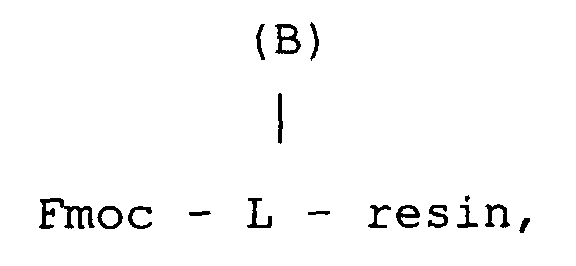
wherein L represents X as defined above, and wherein B represents biotin, - deprotection of the α amino group of the intermediary
compound, for instance by means of piperidine to obtain :
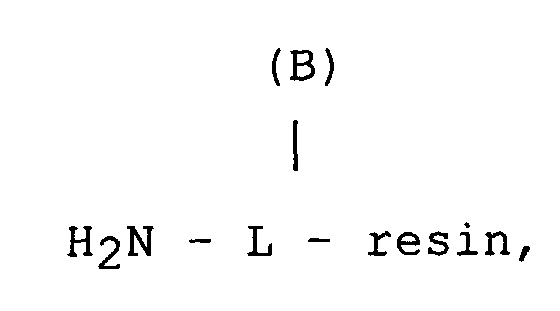
- successive addition of the subsequent amino acids
AA1......AAn duly protected into :
to obtain :

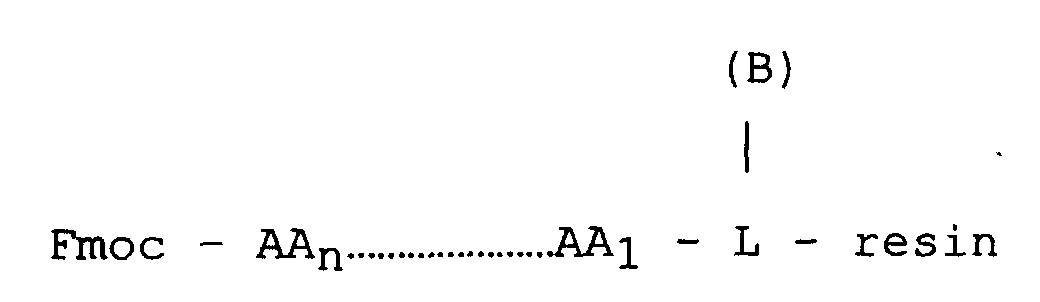
- deprotection of the NH2-terminal for instance by means of piperidine,
- deprotection of the compound obtained, cleavage from the resin, extraction and purification of the peptide obtained, biotinylated at its carboxy terminal end, the steps of side chain deprotection and cleavage being liable to be performed simultaneously or separately, and particularly deprotection of the NH2-terminal, for instance by means of piperidine,
- cleavage from the resin for instance with trifluoroacetic acid, in the presence of scavengers such as ethanedithiol, or thioanisole, or anisole,
- extraction of the peptide with a solvent such as diethylether to remove most of the acid and scavengers,
- purification, such as with HPLC to obtain :
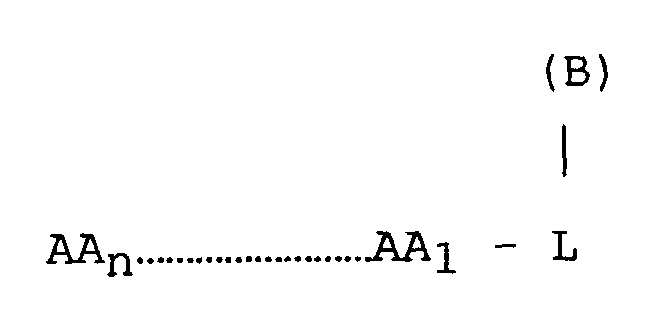
- The present invention relates to a process for preparing a N-terminal biotinylated peptide as defined above, comprising the following steps :
- addition of the subsequent amino acids duly protected
onto the resin to give :
Fmoc - AA1.....AAn - resin, wherein Fmoc represents 9-fluorenylmethoxycarbonyl, - deprotection of the NH2-terminal for instance by means of piperidine,
- addition of the intermediary product :
wherein L represents X as defined in claim 18 and B represents biotin,

through its COOH onto the NH2-terminal to obtain :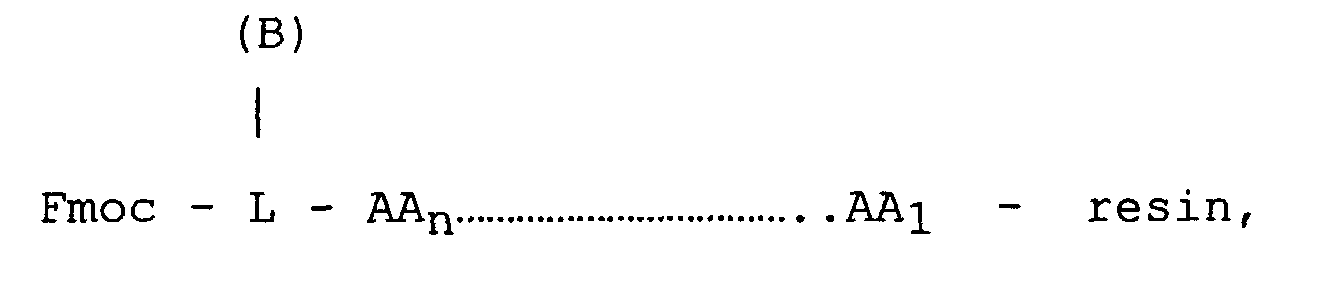
- deprotection of the NH2-terminal group of the compound obtained, cleavage from the resin, extraction and purification of the peptide obtained, biotinylated at its amino terminal, the steps of side chain deprotection and cleavage being liable to be performed simultaneously or separately, and particularly deprotection of the NH2-terminal group of the intermediary group, for instance by means of piperidine,
- cleavage from the resin for instance with an acid such as trifluoroacetic acid, in the presence of scavengers such as ethanedithiol, or thioanisole, or anisole,
- extraction of the peptide with a solvent such as diethylether to remove most of the acid and scavengers,
- purification, such as with HPLC to obtain :

- Biotin can be conveniently coupled to the free amino terminus of an otherwise fully protected peptide chain using also conventional activation procedures. Since biotin possesses one carboxyl group and no amino groups, biotin essentially functions as a chain terminator. Preferred activating agents for in situ activation include but are not limited to benzotriazol-1-yl-oxy-tripyrrolidinophosphonium hexafluorophosphate (PyBOP), O-benzotriazol-l-yl-N,N,N',N'-tetramethyluronium hexafluorophosphate (HBTU), and O-(1H-benzotriazol-1-yl)-N,N,N',N'-tetramethyluronium tetrafluoroborate (TBTU). The activation procedures employing these and related compounds are known to those versed in the art of solid phase peptide synthesis and the coupling of biotin does not entail a significant departure from standard coupling protocols.
- Biotin in a pre-activated form may also be used. Either N-hydroxysuccinimidobiotin or biotinamidocaproate N-hydroxysuccinimide ester are coveniently employed and both are commercially available. This method of coupling has been described by Lobl, T.J., Deibel, M.R., and Yem, A.W., Anal. Biochem. (1988) 170(2):502-511. Following addition of the N-terminal biotin, the peptide is cleaved from the resin in the present of scavengers, the choice of which will depend on the usual considerations of peptide amino acid composition and the nature of the protecting groups used.
- The present invention relates to a process for preparing an internally biotinylated peptide as defined above, comprising the following steps :
- addition of successive amino acids duly protected onto
the resin to give :
Fmoc - AA1......AAn - resin, wherein Fmoc represents 9-fluorenylmethoxycarbonyl, - deprotection of the NH2-terminal,
- addition of the intermediary product :
wherein L represents X as defined above, and B represents biotin,

through its COOH onto the NH2-terminal to obtain :
- deprotection of the α amino group of the intermediary
group, for instance by means of piperidine to obtain :
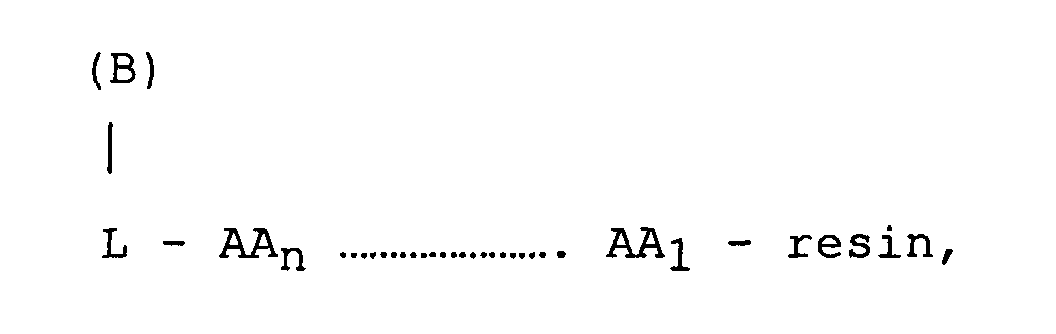
- addition of the subsequent amino acids duly protected
onto the resin to give :

- deprotection of the NH2-terminal group of the compound obtained, cleavage from the resin, extraction and purification of the peptide obtained, biotinylated at its amino-terminal, the steps of side chain deprotection and cleavage being liable to be performed simultaneously or separately, and particularly, deprotection of the NH2-terminal group of the peptide, for instance by means of piperidine,
- cleavage from the resin for instance with trifluoroacetic acid, in the presence of scavengers such as ethanedithiol, or thioanisole, or anisole,
- extraction of the peptide with a solvent such as diethylether to remove most of the acid and scavengers,
- purification, such as with HPLC to obtain :

- The present invention relates to (a) peptide (s) as defined above for use in an immunisation process against HCV infection.
- The present invention also relates to a process for the preparation of a peptide as defined above, wherein the synthesis of said peptides is achieved in solution or on a solid support.
- Under certain circumstances, it may prove particularly advantageous to be able to biotinylate a peptide internally or at its carboxy-terminus. Such instances arise, for example, when the amino acid sequence of a peptide corresponds to the amino-terminal sequence of a protein. Attachment of a biotin to the amino-terminus of such a peptide results in a structure which is significantly different from that found in the native protein and may, as a consequence, adversely affect the binding properties of biochemical properties of the peptide. It is also possible that even for peptides corresponding to internal protein sequences, their recognition by binding proteins or immunoglobulins may depend on which end of the peptide and the manner in which it is presented for binding. The importance of peptide orientation has been described by Dyrberg, T. and Oldstone, M.B.A., J. Exp. Med. (1986) 164:1344-1349.
- In order to be able to incorporate a biotinyl moiety into a peptide in a position and sequence independent manner, efforts were made to synthesize a suitable reagent which can be coupled using conventional procedures. A convenient reagent for C-terminal or internal biotinylation is N-ε-biotinyl-lysine. Provided the α-amino group of this compound is suitably protected (Fmoc and tBoc), this reagent may be used to introduce a biotin anywhere in the peptide chain, including at the amino terminus, by the standard procedures used in solid phase peptide synthesis. The synthesis of the t-Boc-protected derivative has been described (Bodansky, M., and Fagan, DT., J. Am. Chem. Soc. (1977) 99:235-239) and was used to synthesize short peptides for use in studying the enzyme activities of certain transcarboxylases.
- Unlike the t-Boc derivative, the synthesis of N-α-Fmoc-Lys (N-ε-biotin) has not been described and given the growing interest in Fmoc-based synthesis strategies, this compound is considered particularly advantageous.
- There are a number of possible routes which can be taken to arrive at the desired Fmoc-protected compound. These are shown in Figure 1. In the first approach, commercially available N-α-Fmoc-Lys (N-ε-tBoc) can be used as the starting material. The N-ε-tBoc protection is removed using trifluoroacetic acid and a scavenger such as water. A slight molar excess of the N-α-Fmoc-lysine so obtained is then reacted with carboxy-activated biotin. The resulting product can be readily purified by selective extractions and standard chromatographic techniques. In an alternative approach, N-α-Fmoc-Lys (N-ε-biotin) can be produced from commercially available N-ε-biotinyl lysine (biocytin) by reaction with fluorenylmethylsuccinimidyl carbonate. Numerous examples of these reactions which can be used as guidelines are given in Atherton and Sheppard, Solid Phase Peptide Synthesis, IRL Press, 1989.
- The strategy shown in Figure 1 (method A) may also be applied to synthesize N-α-Fmoc-ornithine (N-δ-biotin) from commercially available N-α-Fmoc-ornithine (N-δ-tBoc). The ornithine derivative differs from the lysine derivative only in the length of the side chain which, for the ornithine derivative, is shorter by one carbon atom. The N-α-Fmoc-Lys can be conveniently incorporated into the peptide chain using the same reagents for in situ activation described for free biotin.
- Alternatively, N-α-Fmoc-Lys (N-ε-biotin)-O-pentafluorophenyl ester can be conveniently synthesized from N-α-Fmoc-Lys (N-ε-biotin) and pentafluorophenyl trifluoroacetate using the base-catalyzed transesterification reaction described by Green, M. and Berman, J., Tetrahedron Lett. (1990) 31:5851-5852, for the preparation of O-pentafluorophenyl esters of amino acids. This active ester can be used directly to incorporate N-α-Fmoc-Lys (N-ε-biotin) into the peptide chain. The class of above-defined intermediary products can be prepared according to a method which comprises the following steps:
- reaction of a diamino-, monocarboxylic acid previously described with fluorenylmethysuccinimidylcarbonate or fluorenylmethyl chloroformate under conditions of carefully controlled pH to give the singly protected N-α-Fmoc derivative,
- or alternatively, use of commercially available N-α-Fmoc-protected diamino-monocarboxylic acids when the side chain amino group is provided with a protecting group which is different from the Fmoc group used to protect the α-amino group, the side chain amino group protection being liable to be selectively removed under conditions which leave the N-α-Fmoc group intact,
- purification of the mono-protected N-α-Fmoc-diamino-monocarboxylic acid derivative by selective extractions and chromatography,
- reaction of the derivative obtained with a carboxy-activated derivative of biotin, such as N-hydroxysuccinimide biotin, to obtain the (N-α-Fmoc)-(N-y-biotin) derivative which is the desired intermediary. product,
- purification of the intermediary product by selective extractions, precipitations, or chromatography.
- When the biotinylated peptides used in the process of the invention are to be provided with linker arms, these chemical entities may be conveniently attached to either the N- or C-terminus of a peptide sequence during solid phase synthesis using standard coupling protocols, as long as the amino groups of these compounds are provided with appropriate temporary amino group protection.
- All these specific biotinylated peptides are new.
- All the samples and sera mentioned in the figures and tables are randomly chosen samples and sera, containing antibodies produced as a result of naturally occurring infection by a viral agent.
- Figure 1 represents the strategies for the synthesis of N-α-Fmoc-lysine (N-ε-Biotin).
- More particularly:
- Method A corresponds to the synthesis of (N-α-Fmoc-Lys(N-ε-biotin) from N-ε-Fmoc-Lys(N-ε-tBoc) and Method B corresponds to the synthesis of (N-α-Fmoc-Lys)N-ε-biotin) from N-ε-biotinyl lysine.
- Figure 2 represents the diagram obtained in reverse phase chromatography of the precursors involved in the preparation of the intermediary products defined above, and of the intermediary compounds.
- The reverse phase chromatography has been carried out in the following conditions:
- gradient specifications:
- buffer A: 0.1% TFA in H2O,
- buffer B: 0.1% TFA in acetonitrile,
- column: C2/C18 reverse phase (Pharmacia, Pep-S),
- detection wavelength: 255 nanometers;
- gradient:
- 0% B from 0 to 1 minute,
- 0% B to 100% B from 1 minute to 60 minutes,
- 0% B from 60 minutes to 70 minutes.
- The first diagram corresponds to method A (see Figure 1) and the second diagram corresponds to method B (see Figure 1).
- Figure 3a represents the antibody binding to HCV peptide II (in an ELISA).
- The upper left curve corresponds to sample 8320.
- The upper right curve corresponds to sample 8242.
- The lower left curve corresponds to sample 8243.
- The lower right curve corresponds to sample 8318.
-
- In each of these samples, the optical density (at 450 nm) is plotted against the coating concentration expressed in µg/ml.
- The curve with crosses corresponds to non-biotinylated HCV peptide II and the curve with dots corresponds to biotinylated HCV peptide II.
- Figure 3b represents the antibody binding to HCV peptide XI (in an ELISA).
- The upper left curve corresponds to sample 8320.
- The upper right curve corresponds to sample 8326.
- The lower left curve corresponds to sample 8242.
- The lower right curve corresponds to sample 8243.
-
- In each of these samples, the optical density (at 450 nm) is plotted against the coating concentration expressed in µg/ml.
- The curve with crosses corresponds to non-biotinylated HCV peptide XI and the curve with dots corresponds to biotinylated HCV peptide XI.
- Figure 3c represents the antibody binding to HCV peptide XVI (in an ELISA).
- The upper left curve corresponds to sample 8326.
- The upper right curve corresponds to sample 8242.
- The lower left curve corresponds to sample 8243.
- The lower right curve corresponds to sample 8318.
-
- In each of these samples, the optical density (at 450 nm) is plotted against the coating concentration expressed in µg/ml.
- The curve with crosses corresponds to non-biotinylated HCV peptide XVI and the curve with dots corresponds to biotinylated HCV peptide XVI.
- Figure 4 corresponds to the detection of biotinylated peptides coated directly (in an ELISA).
- The first curve corresponds to biotinylated HCV peptide II, the second curve to biotinylated HCV peptide XI and the third curve to biotinylated HCV peptide XVI.
- In each of these samples, the optical density (at 450 nm) is plotted against the coating concentration expressed in µg/ml.
- Figure 5 represents the structures of N- and C-terminally biotinylated HIV-1 peptides (hereabove designated by 1a.1) originating from the transmembrane (TM) protein of HIV-1.
- Figure 6 represents an evaluation of type-specific HCV NS4 peptides by Line immunoassay (LIA).
- Table 1 represents the antibody recognition of unbiotinylated HIV-1 and HIV-2 peptides (designated by TM-HIV-1 and TM-HIV-2) and biotinylated HIV-1 and HIV-2 peptides (hereabove referred to as 1a.1 and 2a, and also designated by TM-HIV-1 Bio and TM-HIV-2 Bio) in an ELISA.
- Table 2 represents the comparison of antibody recognition of unbiotinylated and biotinylated peptides from the V3 sequence of isolate HIV-1 mn (also referred as 1b.4) in an ELISA.
- Table 3 represents the comparison of antibody recognition of the biotinylated V3-mn peptide (referred to as 1b.4) bound to streptavidin and avidin, in an ELISA.
- Table 4 represents the comparison of antibody recognition of biotinylated and unbiotinylated HCV peptides, in an ELISA.
- More particularly:
- Table 4A corresponds to the antibody binding to HCV peptide XI.
- Table 4B corresponds to the antibody binding to HCV peptide XVI.
- Table 4C corresponds to the antibody binding to HCV peptide II.
- Table 4D corresponds to the antibody binding to HCV peptide III.
- Table 4E corresponds to the antibody binding to HCV peptide V.
- Table 4F corresponds to the antibody binding to HCV peptide IX.
- Table 4G corresponds to the antibody binding to HCV peptide XVIII.
- Table 5 represents a comparison of antibody binding to biotinylated and non-biotinylated peptides, at different peptide coating concentrations, in an ELISA.
- Table 6 represents the comparison of N- and C-terminally biotinylated TM-HIV-1 peptide (referred to as 1a.1), in an ELISA.
- Table 7 represents a comparison of antibody recognition of unbiotinylated and carboxy-biotinylated HCV peptide I.
- All amino acid sequences are given in the conventional and universally accepted three-letter code and where indicated in the one-letter code. The peptide sequences are given left to right which, by convention, is the direction from the amino terminus to the carboxy-terminus.
- A number of unconventional codes are also used to represent chemical groups or modifications and are defined as follows:
Group Code Ac acetyl Bio D-biotinyl Fmoc 9-fluorenylmethoxycarbonyl tBoc tertiary butyloxycarbonyl - All of the peptides described were synthesized on TentaGel S-RAM (Rapp Polymere, Tübingen, Germany), a polystyrene-polyoxyethylene graft copolymerfunctionalized with the acid-labile linker4-(α-Fmoc-amino-2',4 '-dimethoxybenzyl) phenoxyaceticacid (Rink, Tetrahedron Lett. (1987) 28:3787) in order to generate peptide carboxy-terminal amides upon cleavage. t-Butyl-based side chain protection and Fmoc-α-amino-protection was used. The guanidine-group of arginine was protected with the 2,2,5,7,8-pentamethylchroman-6-sulfonyl moiety. The imidazole group of histidine was protected with either t-Boc or trityl and the sulfhydryl group of cysteine was protected with a trityl group. Couplings were carried out using preformed O-pentafluorophenyl esters except in the case of arginine where TBTU was used as the activating agent in the presence of 1.5 equivalents of the base N-methylmorpholine. Occasionally, glutamine and asparagine were also coupled using TBTU activation. In these cases, the trityl-protected derivatives of these amino acids were employed. Biotin was coupled using either TBTU or HBTU. All syntheses were carried out on a Milligen 9050 PepSynthesizer (Novato, California) using continuous flow procedures. Following cleavage with trifluoroacetic acid in the presence of scavengers and extraction with diethylether, all peptides were analyzed by C18-reverse phase chromatography.
- Commercially available N-α-Fmoc-L-lysine (N-ε-tBoc)(1.5 grams) was treated with 20 milliliters of 95% trifluoroacetic acid, 5% H2O for 2 hours at room temperature. Most of the acid was then evaporated under a stream of nitrogen. Ten milliliters of water was added and the solution was extracted 3 times with diethylether. The aqueous phase was then evaporated to dryness in vacuo over phosphorus pentoxide. The resulting powder(N-α-Fmoc-L-lysine) was analyzed by reverse phase chromatography and revealed a homogeneous product which was, as expected, more hydrophilic than the starting material.
- N-α-Fmoc-lysine (190 mg, 0.49 mmol) was dissolved in 8 milliliters of 0.1 M borate buffer, pH 8.7. N-hydroxysuccinimidobiotin (162 mg, 0.47 mmol) was dissolved in 4 milliliters of dimethylformamide and added to the solution of N-α-Fmoc-lysine. The pH was monitored and titrated as necessary, with NaOH. After 2 hours, the solution was acidified with HCl to pH 2.0, at which time a white precipitate was obtained.
- Following extraction with ethylacetate and centrifugation, the white precipitate was found at the H2O: ethylacetate interface. Both phases were removed and the precipitate extracted twice with 10 mM HCl, once with ethylacetate, followed by two extractions with diethylether. The precipitate was dissolved in DMF and precipitated by addition of diethylether. The crystalline powder was then dried in vacuo over phosphorus pentoxide. The resulting product was analyzed by reverse phase chromatography and revealed a major peak which, as expected, eluted later than N-α-Fmoc-Lys. A very small peak of N-α-Fmoc-Lys was also observed. (Figure 2a).
- Commercially available N-ε-biotinyl lysine (biocytin, Sigma, 249 mg, 0.67 mmol) was dissolved in 8 milliliters of 1 M Na2CO3 and cooled on ice. Fluorenylmethylsuccinimidyl carbonate (222 mg, 0.66 mmol) was dissolved in 2 milliliters of acetone and was added to the biotinyl lysine solution over a period of 30 minutes with vigorous stirring. Stirring was continued for 5 hours at room temperature. The pH was maintained between 8 and 9 by addition of 1 M Na2CO3 as necessary. The acetone was then evaporated off under vacuum, and 1.0 M HCl was added until the pH of the solution was approximately 2. Upon acidification of the solution, a white precipitate appeared which was washed twice with 10 mM HCl, twice with ethyl acetate, and twice with diethylether. The precipitate was dissolved in DMF and precipitated by addition of diethylether. The crystalline powder was then thoroughly dried in vacuo over phosphorus pentoxide. The resulting product was analyzed by reverse phase chromatography and revealed a major peak which eluted with the same retention time (30.5 minutes) as the product obtained using method 1 (Figure 2b).
- Where peptides were to be coated directly, stock solutions of the peptides were diluted in sodium carbonate buffer, pH 9.6 and used to coat polystyrene microtiter plates at a peptide concentration of 2 to 5 micrograms per milliliter for 1 hour at 37°C.
- In cases where biotinylated peptides were to be evaluated, plates were first coated with streptavidin in sodium carbonate buffer, pH 9.6 at a concentration of 3 micrograms per milliliter for 1 hour at 37°C. The plates were then washed to remove excess, unbound protein. A working solution of the biotinylated peptide at 1 microgram per milliliter in sodium carbonate buffer was then added to the wells of the microtiter plate and incubated for 1 hours at 37°C.
- Once the plates had been coated with antigen, any remaining free binding sites on the plastic were blocked with casein. After washing, a dilution of the appropriate antisera, usually 1:100, was added to the wells of the plates and incubated for 1 hour at 37°C.
- After washing to remove unbound material, specific antibody binding was detected by incubating the plates with goat anti-human immunoglobulin antibodies conjugated to the enzyme horseradish peroxidase. Following removal of unbound conjugate by washing, a solution containing H2O2 and 3,3',5,5'-tetramethylbenzidine was added.
- Reactions were stopped after a suitable interval by addition of sulfuric acid. Positive reactions gave rise to a yellow color which was quantified using a conventional microtiter plate reader. Absorbance measurements were made at a wavelength of 450 nanometers and all data are expressed as an optical density value at this wavelength.
- Experiments were performed to evaluate antibody recognition of short, 10 amino acid-long, N-acetylated peptides corresponding to other contained within the transmembrane proteins of HIV-1 and HIV-2. Direct coating of these peptides in the wells of microtiter plates gave very poor results when antibody binding was evaluated in an ELISA. Since it was suspected that the peptides did not bind well to the polystyrene solid phase, the peptides were resynthesized in the same way except that biotin was attached to the amino terminus of the peptides, separated from the decamer peptide sequence by three glycine residues whose function it was to serve as a linker arm. The peptides used for the comparison were as follows:
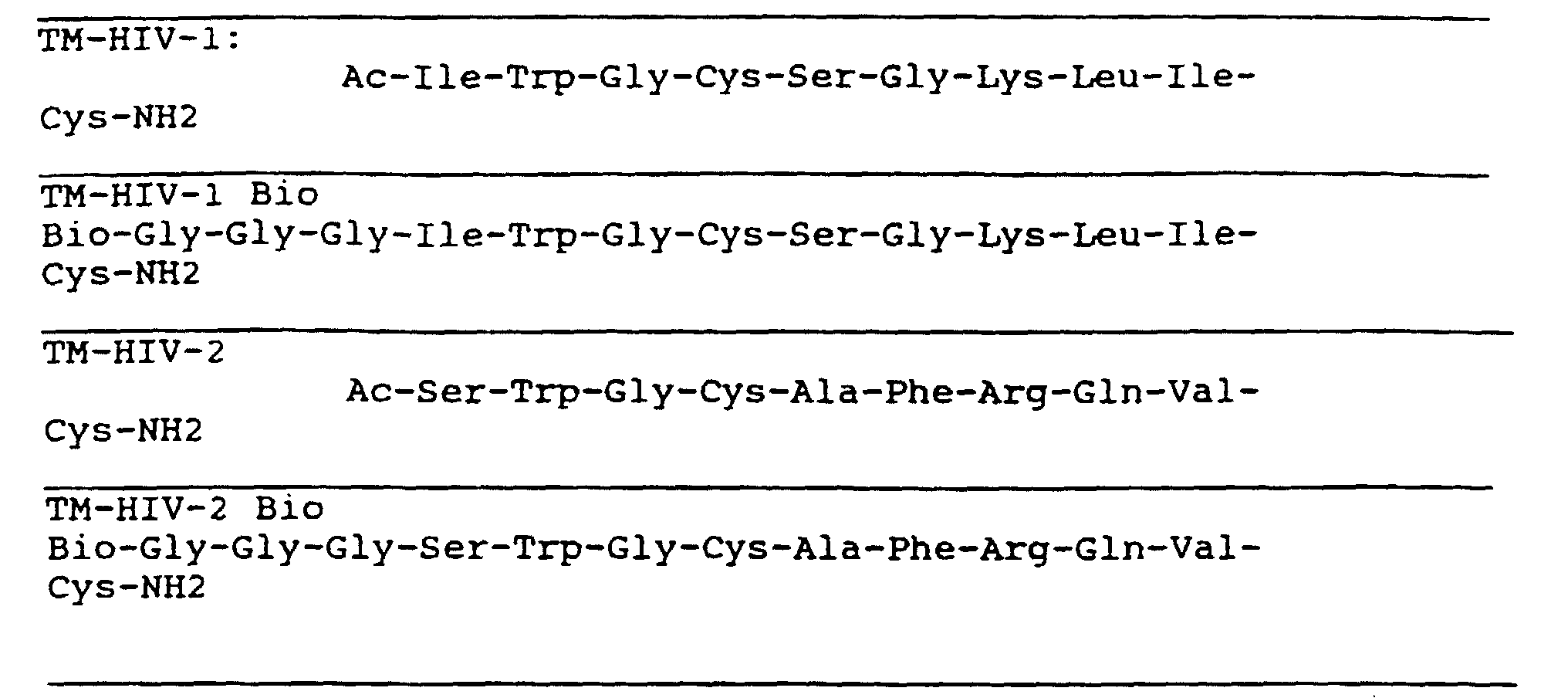
- The biotinylated peptides were loaded onto microtiter plates which had been coated with streptavidin. Antibody binding to these peptides was compared to antibody binding to the unbiotinylated peptides which were coated directly onto microtiter plates. The results are shown in Table 1. It is evident that the biotinylated peptides from the HIV-1 or HIV-2 transmembrane proteins bound to streptavidin are recognized very well by antisera from HIV-1 or HIV-2 infected persons respectively. This is in contrast to the unbiotinylated versions of these peptides coated directly onto the polystyrene plates. Addition control experiments showed that the increase in antibody binding was the result of the specific interaction between the biotinylated peptide and streptavidin, since there was no difference in antibody recognition of the biotinylated or unbiotinylated peptides when both were coated directly onto the microtiter plate.
- Some peptides, particularly ones which are 15 amino acids in length or longer, bind sufficiently to the solid phase to allow the detection of specific antibodies which recognize (an) epitope(s) present in the peptide sequence.
- To ascertain whether biotinylation would also improve antibody recognition of longer peptides, both the biotinylated and unbiotinylated versions of the partial V3 loop sequence of isolate HIV-1 mn were synthesized. The sequence and method of synthesis of both peptides were identical except at the amino terminus. The unbiotinylated peptide was simply acetylated whereas in the biotinylated version, two glycine residues were added as a linker arm to separate the peptide from the biotinyl moiety.
- The sequences of the two peptides used are as follows:
- unbiotinylated V3 mn peptide

- biotinylated V3 mn peptide (peptide 1b.4)

- The unbiotinylated peptide was coated directly onto the wells of a polystyrene microtiter plate while the biotinylated peptide was bound to wells which had previously been coated with streptavidin. The results shown in Table 2 demonstrate that antibody binding to the biotinylated peptide is superior to antibody binding to peptide coated directly onto the plastic.
- Having demonstrated that antibody recognition of this peptide is improved when the peptide is biotinylated and bound to streptavidin, an additional experiment was performed to determine whether streptavidin could be substituted by avidin. The results shown in Table 3 indicate that this is the case and that biotinylated peptides bound to avidin are recognized very efficiently by specific antibodies.
- In order to determine whether the enhanced antibody recognition of biotinylated peptides was a general phenomenon, a number of additional twenty amino acid-long peptides were synthesized which correspond to sequences derived from the hepatitis C virus (HCV) polyprotein. The amino acid sequences evaluated were as follows:





- In each case, two versions of the peptide were synthesized. In the unbiotinylated version, the peptide was acetylated at the amino terminus. The biotinylated versions were all N-terminally biotinylated. A linker arm consisting of two glycine residues separated the biotinyl moiety from the amino acids comprising the HCV sequence.
- The unbiotinylated peptides were adsorbed onto the wells of polystyrene microtiter plates at a concentration of 3 micrograms per milliliter.
- The biotinylated peptides were bound at a concentration of 1 microgram per milliliter to streptavidin-coated microtiter plates. Sera known to contain antibodies to these peptides were used for the evaluation and were tested at a 20-fold dilution. The results of these comparisons are shown in Table 4, a to g.
- These results clearly indicate that antibody recognition of biotinylated peptides bound to streptavidin is enhanced relative to that of peptides coated directly onto the wells of the microtiter plate.
- To investigate further the enhanced antibody recognition of biotinylated HCV peptides bound to streptavidin or avidin as compared to direct adsorption on plastic, the influence of peptide coating concentration was investigated. Three peptides (HCV peptides II, XI, and XVI) were coated in concentrations ranging from 10 nanograms per milliliter to 3 micrograms per milliliter in a volume of 200 microliters per microtiter plate well. For direct coating, the unbiotinylated versions of these peptides were used. The biotinylated versions of these peptides were used to coat wells to which streptavidin had previously been adsorbed. Sera known to contain antibodies to these peptides were used at a dilution of 1 to 100 to evaluate the magnitude of antibody binding.
- The numerical results of this experiment are shown in Table 5 and are depicted graphically in Figure 3, a-c.
- It is evident that with few exceptions, the biotinylated peptide is recognized very well even at the lowest concentration tested (10 nanograms per milliliter, 2 nanograms per well). In many cases, optical density values close to the maximum attainable are observed at a peptide concentration cf only 30 nanograms per milliliter (6 nanograms per well). In contrast, however, the unbiotinylated peptides adsorbed directly onto the plastic are poorly bound by antibody, if at all.
- To determine if the absence of a signal was due to lack of peptide adsorption when the peptides were coated directly, an additional experiment was performed. In this case, the biotinylated versions of the peptides were coated directly onto the plastic at the same concentrations used in the previous experiment for the unbiotinylated versions. To ascertain whether biotin-labeled peptide was bound, the microtiter plates were incubated with a streptavidin: horseradish peroxidase conjugate. Since each peptide contains a single biotinyl group, the resulting optical densities are a measure of the amount of peptide bound, although the absolute amount of bound peptide is not known. The results presented graphically in Figure 4 demonstrate that plastic-bound peptide can be detected. As expected, the curves are different for each peptide which is a reflection of their chemical uniqueness. Two of the peptides, HCV peptides XI and XVI, appear to bind only weakly to the wells of the polystyrene microtiter plate and this poor binding is reflected in the low optical density values obtained in the ELISA. Since the binding of the biotinylated peptides to streptavidin-coated wells results in very good antibody recognition, it is obvious that poor binding of the peptide to the solid phase is not a limitation when use is made of interaction between biotin and streptavidin.
- On the other hand, one of the peptides, HCV peptide II, shows very significant binding to the solid phase, particularly at higher coating concentrations. However, at no coating concentration did the signal obtained when the peptide was coated directly ever equal the signal obtained when the biotinylated peptide was bound to streptavidin. Since even at the lowest concentration tested, the streptavidin-bound biotinylated versions of this peptide clearly gives a positive signal with the antisera tested, the results would seem to indicate either that the direct coating of this peptide is extraordinarily inefficient or that other factors are important besides the simple binding of peptide to the solid phase.
- Although difficult to quantify, one of the factors almost certainly involves the manner in which the peptide is bound and available for antibody binding. In the case of peptides coated directly onto the solid phase, it is virtually inevitable that some proportion of the peptide molecules will interact with the solid phase through amino acid side chains which are also essential for antibody recognition. These peptide molecules will therefore be unable to participate in the binding reaction with antibodies. This problem is not encountered with the biotinylated peptides which are all bound to the solid phase through the interaction between biotin and the solid phase-bound streptavidin.
- In order to determine whether the peptides biotinylated at their carboxy-terminus also give use to enhanced antibody recognition, a carboxy-biotinylated version of the TM-HIV-1 peptide was synthesized. N-α-Fmoc-Lys (N-ε-biotin) prepared by method A as described was coupled directly to resin functionalized with the acid labile linker 4-(α-Fmoc-amino-2',4'-dimethoxybenzyl) phenoxyacetic acid after removal of the linker-bound Fmoc group with 20 percent piperidine. The coupling was performed using a 3-fold molar excess of N-α-Fmoc-Lys (N-ε-biotin) relative to resin functional groups. Carboxyl group activation was achieved using one equivalent of HBTU, one equivalent of l-hydroxybenzotriazole and 1.5 equivalents of N-methylmorpholine. N-methyl morpholine was dispensed as a 0.6 M solution in dimethylformamide containing 40 percent dimethylsulfoxide which was necessary to achieve complete dissolution of the N-α-Fmoc-Lys (N-ε-biotin). Inspection of the Fmoc deprotection peak following coupling of the N-α-Fmoc-Lys (N-ε-biotin) indicated that coupling had proceeded smoothly and efficiently. Two glycine residues were coupled to separate the biotinyl lysine from the TM-HIV-1 amino acid sequence. Following synthesis of the peptide, the amino terminus was acetylated with acetic anhydride. The resulting structure of the carboxy-biotinylated peptide differs significantly from the peptide biotinylated at the amino terminus. A comparison of these structures is shown in Figure 5.
- In order to evaluate antibody recognition of these two peptides, the peptides were bound individually to streptavidin-coated microtiter plates and tested using a panel of antisera from HIV-1 seropositive donors. The results of this comparison is shown in Table 6. Clearly, antibody recognition of the C-terminally biotinylated peptide compares very favorably with that of the N-terminally biotinylated peptide. These results also confirm the utility of the reagent N-α-Fmoc-Lys (14-ε-biotin) for carboxy-terminal biotinylation.
- A similar experiment was performed using a peptide which binds relatively well to polystyrene ELISA plates in order to determine whether the carboxy-biotinylated form of the peptide would result in superior antibody recognition relative to the unbiotinylated form of the peptide. The peptide chosen was HCV peptide I, which was synthesized in the following versions:


- A spacer consisting of two glycine residues was added at the carboxy-terminus to physically separate the HCV portion of the peptide proper from the Lys(N-ε-Bio). Synthesis was performed on resin functionalized with 4-(α-Fmoc-amino-2',4'-dimethoxybenzyl) phenoxyacetic acid linker in order to generate carboxy-terminal amides upon cleavage. Coupling of the N-α-Fmoc-Lys(N-ε-biotin) to the linker was performed using a 3-fold molar excess of the intermediate product relative to the linker. Activation of the N-α-Fmoc-Lys(N-ε-biotin) was achieved using one equivalent of TBTU, one equivalent of 1-hydroxybenzotriazole, and 1.5 equivalents of N-methylmorpholine. The coupling of all other amino acids was performed according to conventional protocols. Following cleavage of the peptides in trifluoroacetic acid in the presence of the appropriate scavengers, the peptides were precipitated and extracted with diethylether.
- Unbiotinylated HCV peptide I was coated directly onto the wells of a polystyrene ELISA plate at a concentration of 3 micrograms per milliliter in sodium carbonate buffer, pH 9.6. Biotinylated HCV peptide I was bound to streptavidin-coated wells using a stock solution containing the peptide at a concentration of 1 microgram per milliliter. The resulting plates were then incubated in parallel with a panel of sera from HCV-seropositive donors. The results of this comparison are shown in Table 7. The biotinylated peptide clearly gives superior results relative to the unbiotinylated version of the same sequence. Two of the sera (8326 and 8244) recognize the biotinylated version of this peptide far better than the unbiotinylated version. The specificity of the antibody reaction is also reflected by the low optical density values obtained for 5 serum samples from uninfected donors (F88, F89, F76, F136,and F6).
- Equivalent peptides containing
HCV type 2 andtype 3 NS4 sequences which correspond.to thetype 1 peptides found to contain epitopes in NS4 were synthesized. The sequences of these peptides are shown below For comparison:LIA strips were prepared using these nine peptides which were subsequently incubated with different sera. The results are shown in figure 6. Two of the sera which were previously negative on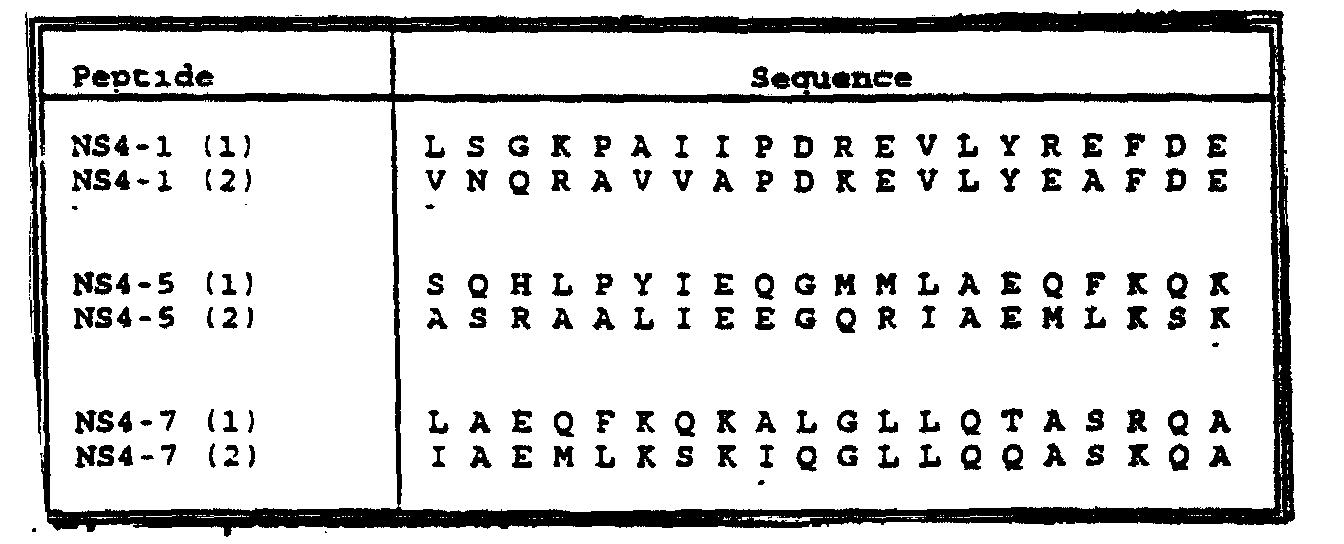
type 1 NS4 peptides gave a positive reaction to thetype 3 andtype 2 peptides. This indicates that it is possible to increase the NS4 detection rate using these peptides.

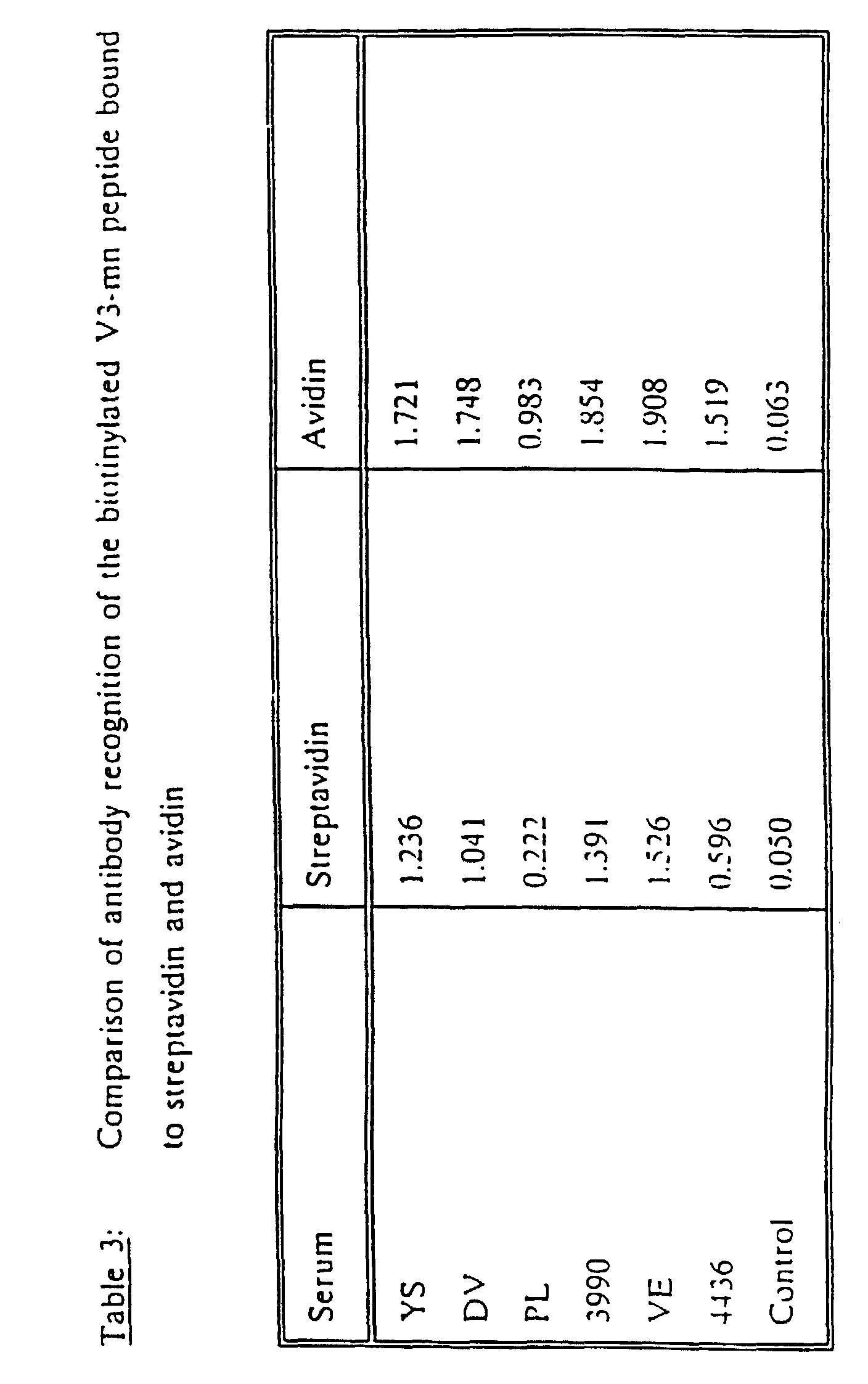


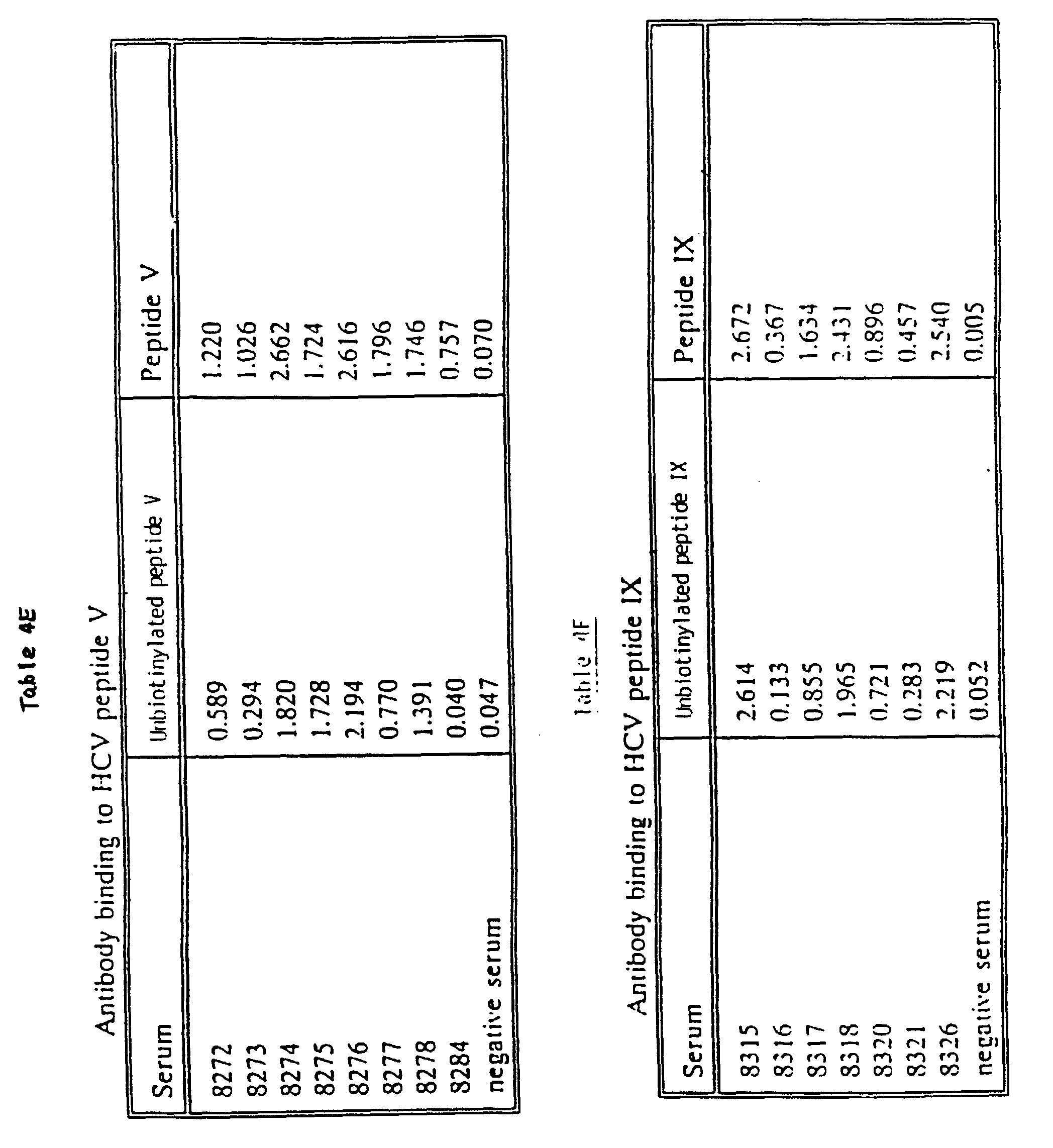

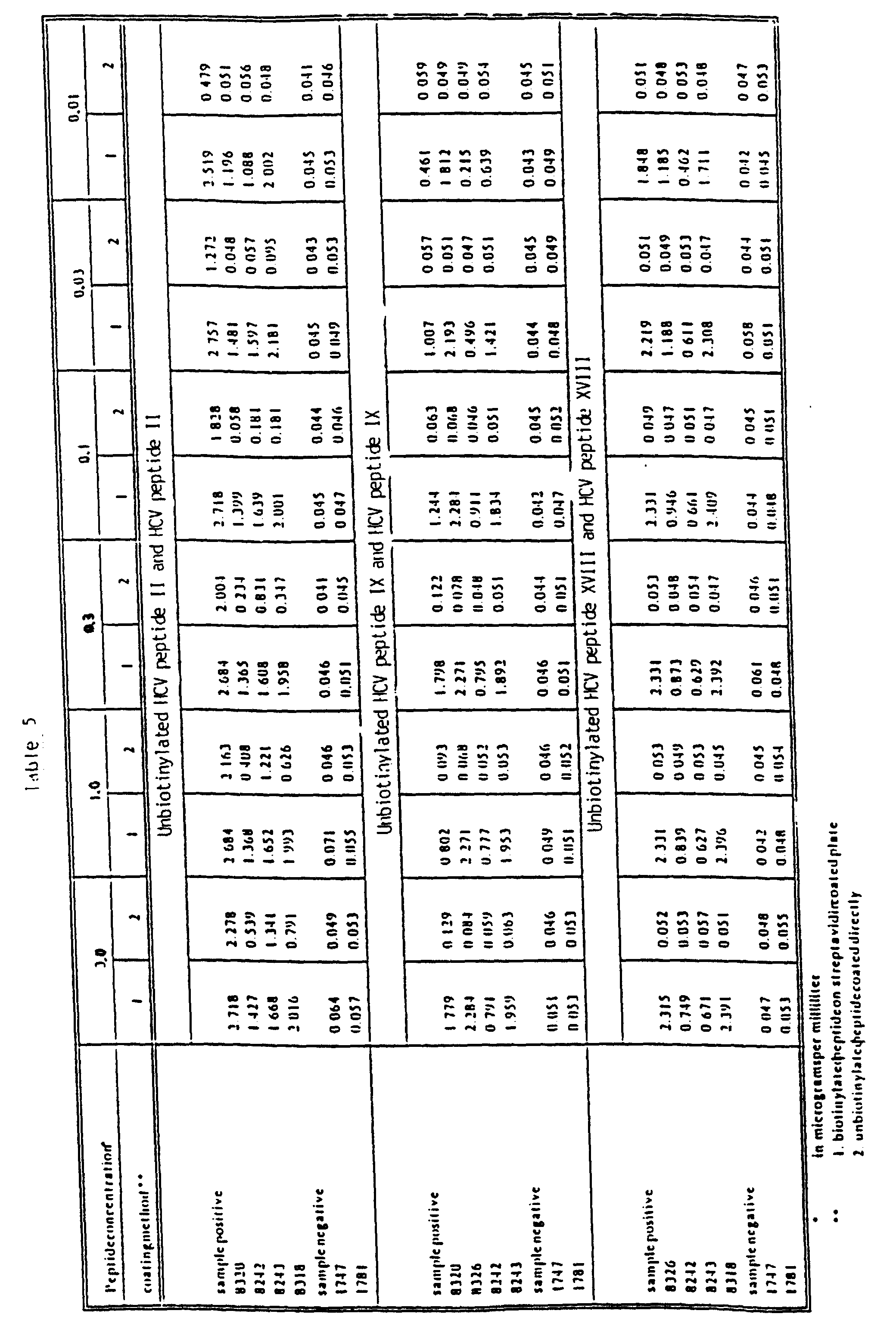

HCV antibody-positive sera HCV peptide I (coated directly) HCV peptide I carboxy-biotinylated (bound to streptavidin-coated wells) 8316 2.394 2.541 8318 2.385 2.404 8320 2.760 2.762 8326 0.525 1.775 8329 2.633 2.672 8333 2.143 2.545 8334 2.271 2.549 8336 1.558 2.016 8344 1.878 2.010 8248 2.042 2.493 8244 0.077 1.399 8243 2.211 2.541 8242 1.367 2.389 8364 2.705 2.705 8374 1.070 2.151 8378 2.161 2.531 8330 1.985 2.651 8387 1.427 2.628 HCV antibody-negative sera F88 0.000 0.026 F89 0.017 0.001 F76 0.000 0.022 F136 0.006 0.002 F8 0.000 0.000 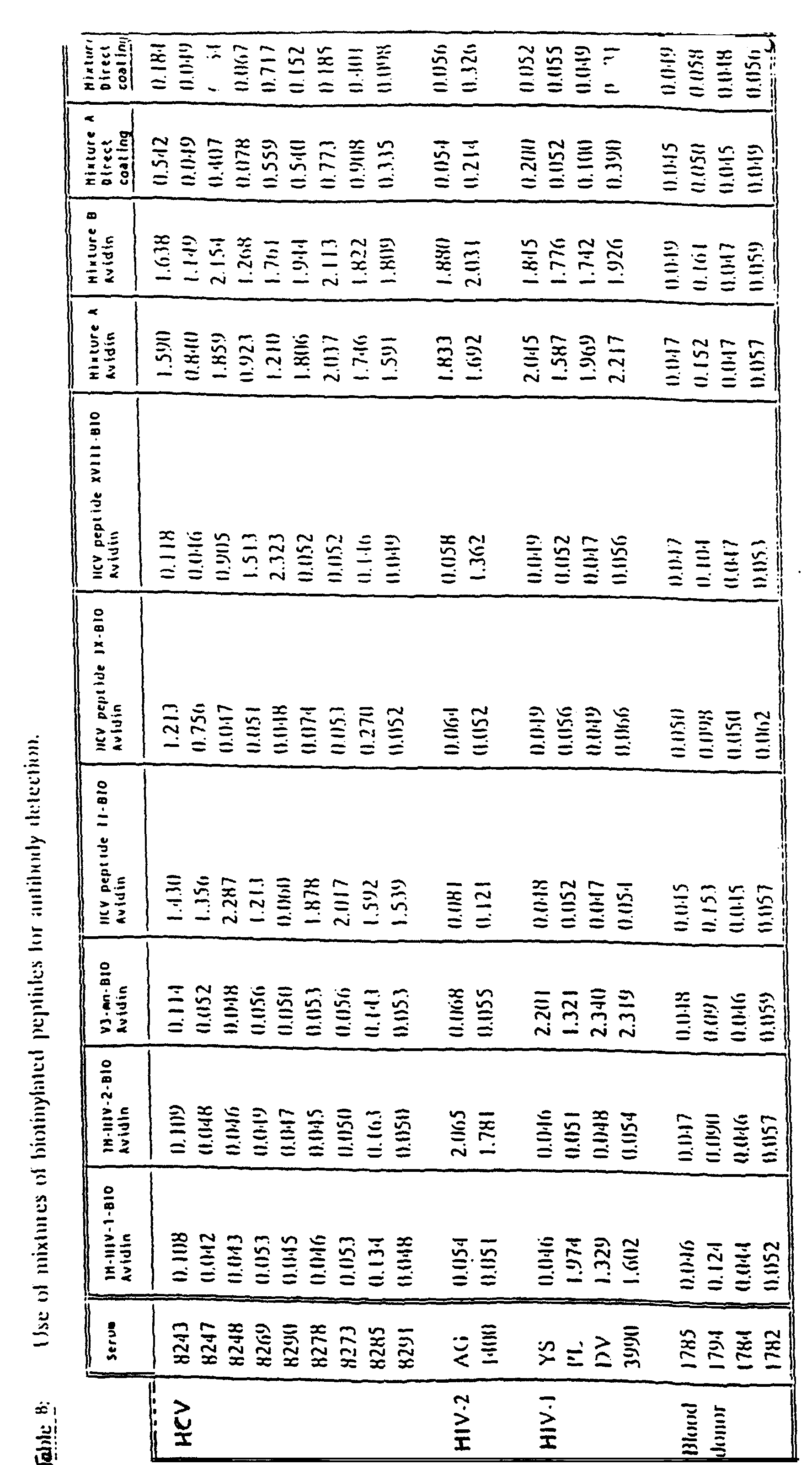
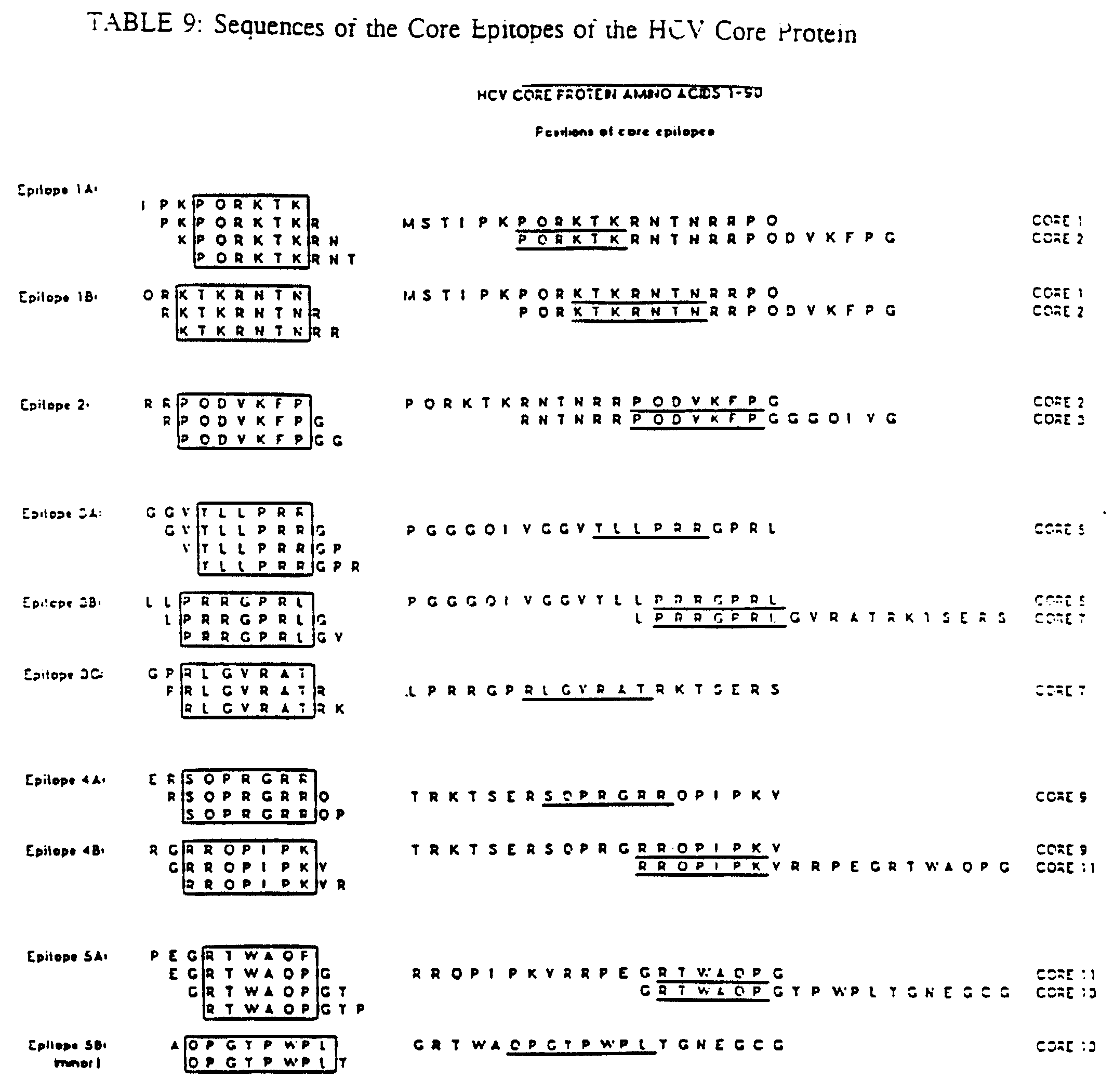
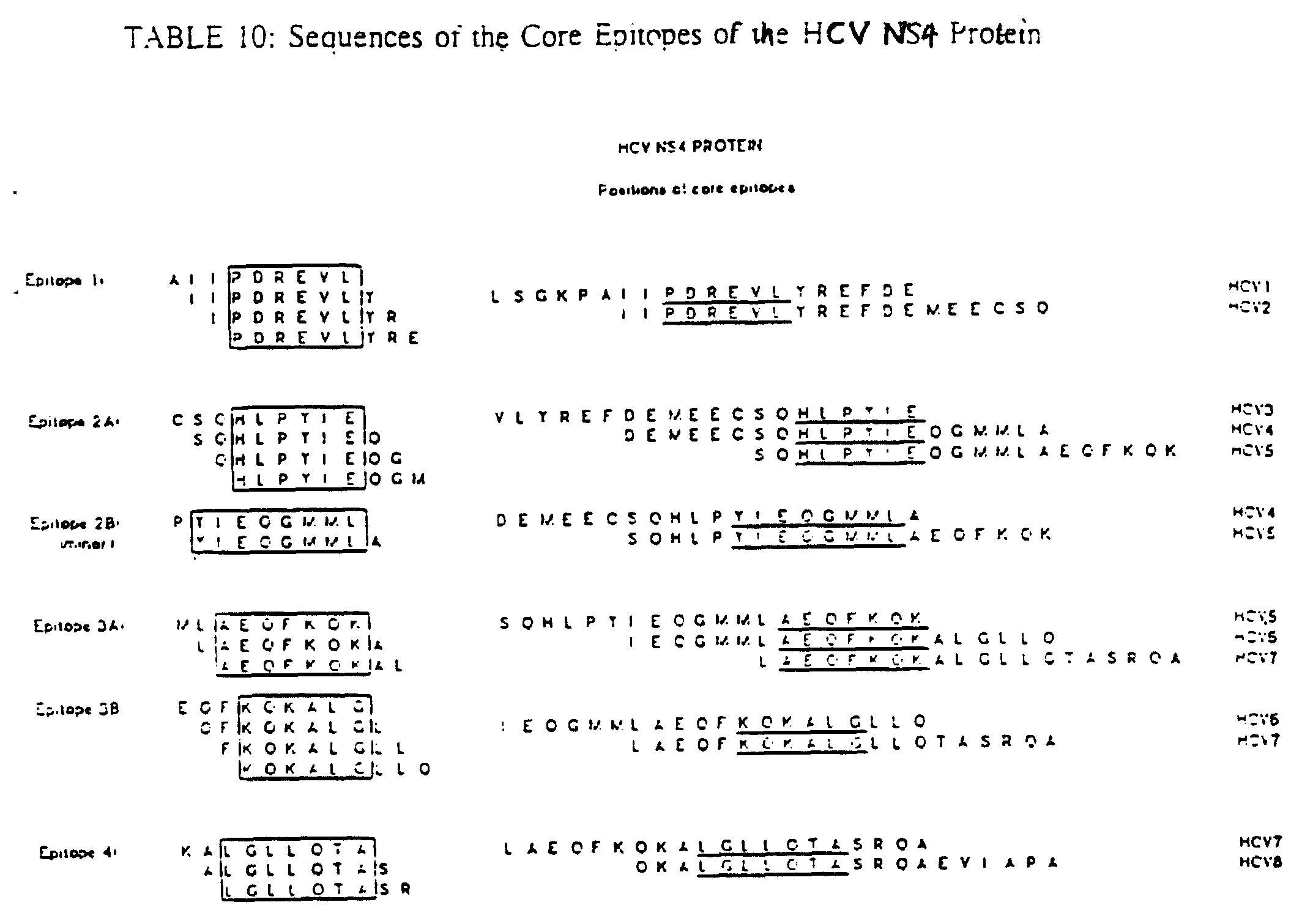
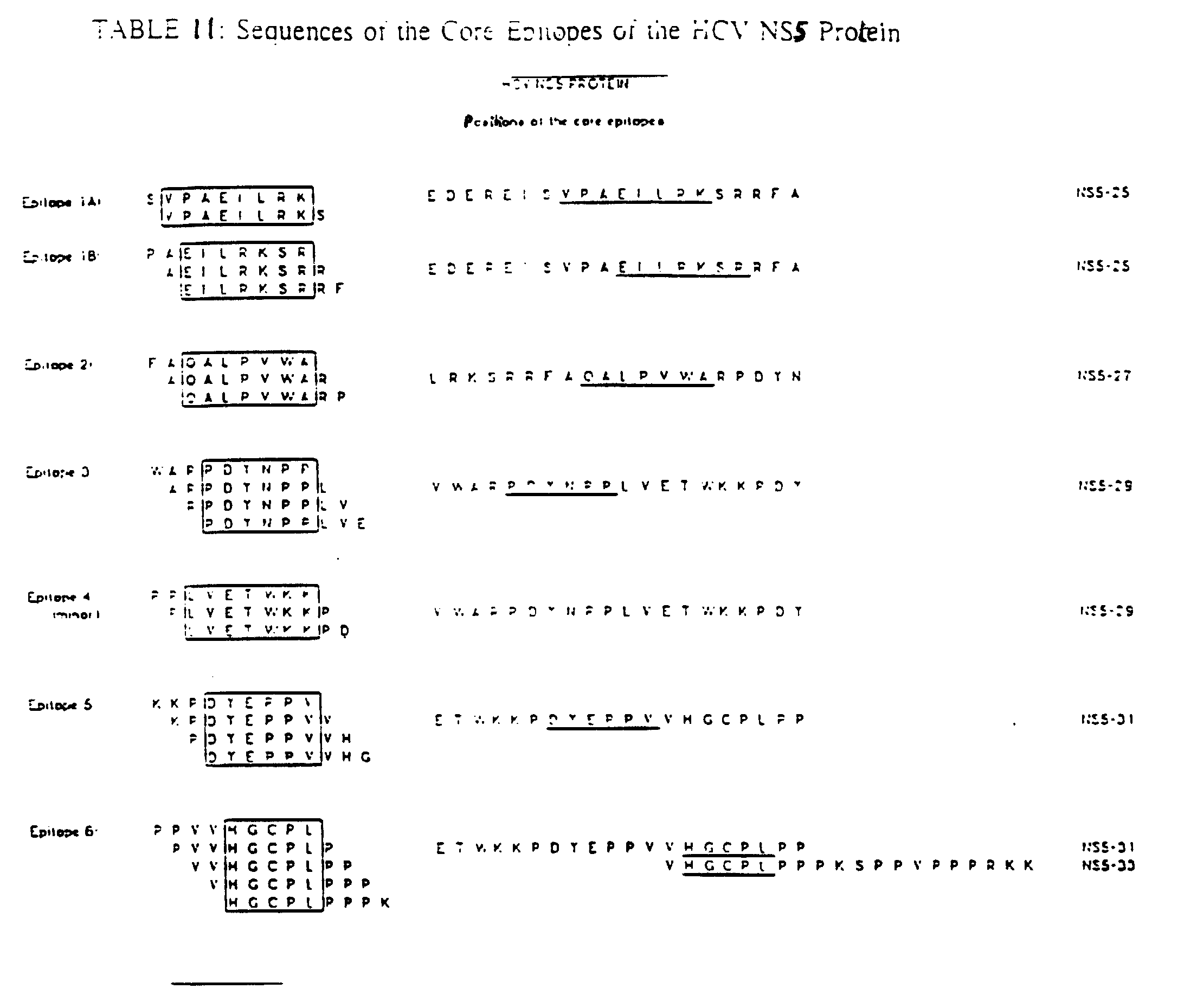

Antibody recognition of individual E2/NS1 peptides (percent of all sera giving a positive reaction.) CL14-A 7(51) 13.7% B 36(51) 70.6% KATO-A 2(51) 3.92% B 26(51) 50.98% HCJ4-A 32(51) 62.74% B 41(51) 80.39% FRENCH-A 30(51) 58.8% B 42(51) 82.35% YEK-A 7(51) 13.72% B 49(51) 96.07% TAMI-A 12(51) 23.52% B 36(51) 70.58% 18CHl-A 5(51) 9.8% B 30(51) 58.82% CHIR-A 32(51) 62.7% B 40(51) 78.43% Overall Recognition of V3-Loop Peptides CON SC MN SF2 BH RF MAL ELI 70 Total SUM 287 261 275 258 108 146 140 24 6 COUNT 326 326 326 326 326 326 326 326 326 gp120 positive % Reactive 88 80 84 79 33 45 43 7 2 Total SUM 287 261 275 258 108 146 140 24 6 COUNT 307 307 307 307 307 307 307 307 307 HIV-V3 positive % Reactive 93 85 90 84 35 48 46 8 2 Recognition of Peptides Acccording to Geographical Region EUROPEAN % AFRICAN % BRAZILIAN % Consensus 98 Consensus 89 Consensus 82 HIV-1 (SC) 98 HIV-1 (MN) 85 HIV-1 (MN) 78 HIV-1 (SF2) 98 HIV-1 (SF2) 79 HIV-1 (SC) 75 HIV-1 (MN) 97 HIV-1 (SC) 73 HIV-1(SF2) 72 HIV-1 (RF) 75 HIV-1 (MAL) 60 HIV-1 (RF) 38 HIV-1 (MAL) 68 HIV-1 (RF) 34 HIV-1 (MAL) 30 HIV-1 (IIIB) 61 HIV-1 (IIIB) 27 HIV-1 (IIIB) 26 HIV-1 (ELI) 8 HIV-1 (ELI) 13 HIV-1 (ELI) 5 ANT 70 2 ANT 70 2 ANT 70 2 Recognition of European. African and Brazilian HIV-I antibody-positive sera to HIV-I V3 loop peptides V3-con and V3-368 European sera V3-con V3-368 V3con + V3-368 number tested 36 36 36 number positive 33 4 33 number negative 0 12 0 number borderline 3 20 3 percent positive 92 11 92 percent negative 0 33 0 percent borderline 8 56 8 African sera V3-con V3-368 V3con + V3-368 number tested 45 45 45 number positive 40 5 40 number negative 4 31 2 number borderline 1 9 3 percent positive 89 11 89 percent negative 9 69 4 percent borderline 2 20 7 Brazilian sera V3-con V3-368 V3con + V3-368 number tested 36 36 36 number positive 30 16 35 number negative 1 5 1 number borderline 5 15 0 percent positive 83.3 44.4 97.2 percent negative 2.8 13.9 2.8 percent borderline 13.9 41.7 0 Recognition of HIV-2 positive sera to peptides from the V3 loop region of HIV-2 V3-GB12 V3-239 number tested 21 21 number positive 21 19 number negative 0 0 number borderline 0 2 percent positive 100 90.5 percent negative 0 0 percent borderline 0 9.5 
ANTIBODY RECOGNITION OF HTLV PEPTIDES Serum number Optical density 1 0.303 2 3.001 3 0.644 4 1.262 6 3.001 7 2.623 9 2.607 (HTLV-I) 10 3.001 11 0.058 (negative) 13 3.001 14 3.001 15 0.850 16 0.278 19 1.048 20 3.001 21 0.805 22 0.812 23 3.001 24 0.405 25 1.521
Claims (24)
- Peptide having an amino acid sequence selected from the group consisting of:

 wherein A, when present, represents (an) amino acid(s), and wherein Z, when present, represents (an) amino acid(s) :
or said peptides having on their N-terminal side an amino group, or a chemical modification of the amino terminus of the peptide chain ; and/or on their C-terminal side, an OH-group, an NH2-group or a linkage involving either of these two groups ;
or,
variants of any of the above given peptides, with said variants presenting insertions, deletions and conservative as well as non-conservative amino acid substitutions with respect to any of the above given amino acid sequences, provided that said variant peptides are capable of providing for immunological competition with at least one strain of HCV type 3 ;
or,
fragments of any of the above given peptides, with said fragments maintaining substantially all of the immunological sensitivity of said peptide sequences from which they are derived ;
or,
cyclic versions of any of the above given peptides obtainable by incorporating into the peptide chain of the above given amino acid sequences a thiol-containing compound for the purpose of providing mercapto groups to be used in a subsequent cyclisation step, provided that the peptides are different from : and from the nine mers of the following sequences :
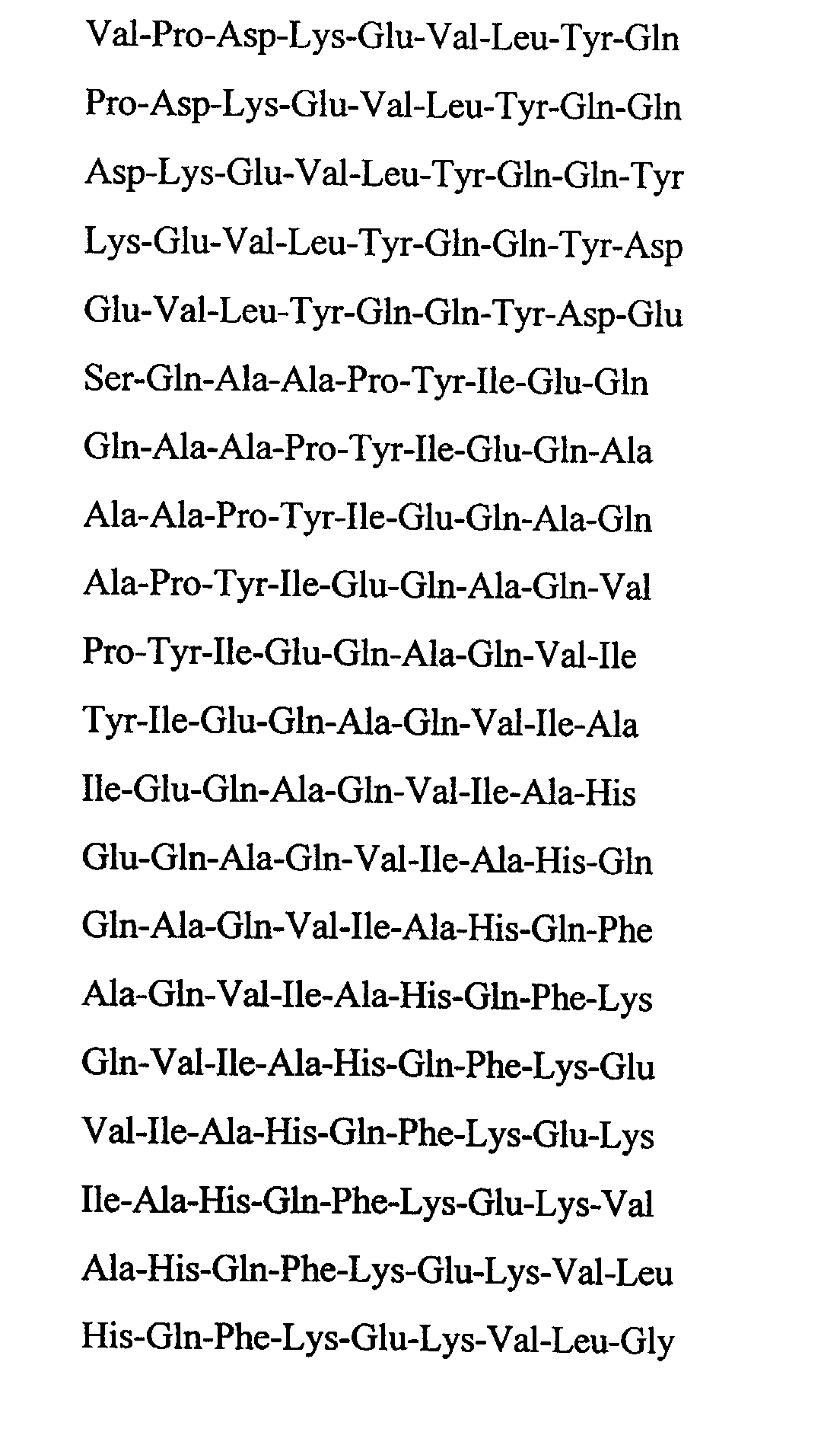

- A peptide according to claim 1 having an amino acid sequence selected from the group consisting of:



- A hybrid peptide comprising in its amino acid sequence a covalent or non-covalently linked combination of at least two of the peptide sequences according to any of claims 1 to 2, possibly separated by spacer residues, preferably Gly and/or Ser residues.
- Peptide according to any of claims 1 to 3, with said peptide being N-terminally, C-terminally or internally biotinylated, preferentially during peptide synthesis.
- Peptide according to claim 4 which is coupled to streptavidin or avidin, with said streptavidin or avidin itself being possibly coupled to a solid phase.
- Peptide according to claim 4, wherein said peptide is coupled via its biotin group to streptavidin present on a nylon membrane.
- Peptide according to any of claims 1 to 4, with said peptide being anchored to a solid support via covalent or non-covalent interactions.
- Method for detecting antibodies to HCV present in a biological sample, comprising :(i) contacting the biological sample to be analysed for the presence of HCV with a peptide(s) according to any of claims 1 to 7,(ii) detecting the immune complex formed between said antibodies and said peptide(s).
- A method for determining the HCV type present in a sample comprising :(i) contacting the biological sample to be analysed for the presence of HCV with (a) peptide(s) according to any of claims 1 to 7,(ii) detecting the immune complex formed between said antibodies and said peptide(s).
- A method according to claim 9, wherein in step (i) said biological sample is also contacted with at least one HCV type 2 NS4 peptide chosen from :

 wherein A and Z have the same meaning as described in claim 1.
- A method according to any of claims 9 to 10, wherein in step (i) said biological sample is also contacted with at least one HCV type 1 NS4 peptide chosen from :

 wherein A and Z have the same meaning as described in claim 1.
- An immunological assay for detecting HCV antibodies employing (a) peptide(s) according to any of claims 4 to 7.
- An immunological assay for detecting HCV antibodies employing a peptide according to claims 1 to 3, with said peptide being capable of competing with an antigen or a peptide according to any of claims 4 to 7 being attached to a solid phase.
- An immunological assay for detecting HCV antibodies according to claims 12 to 13, with said peptides being attached to a membrane in the form of parallel lines.
- An immunological assay for simultaneously detecting the presence or absence of antibodies to different HCV genotypes in a sample employing a peptide according to any of claims 4 to 7.
- An immunological assay according to claim 15, further employing an NS4 type 2 peptide as defined in claim 10.
- An immunological assay according to any of claims 15 or 16, further employing an HCV NS4 type 1 peptide as defined in claim 11.
- Process for obtaining biotinylated peptides according to claim 4 in which N-α-Fmoc-X (N-y-biotin) or a N-α-Fmoc-X (N-y-biotin) derivative is used as intermediary product, wherein X represents :wherein Fmoc represents 9-fluorenylmethoxycarbonyl,

where n is at least 1 but less than 10 and is preferably between 3 and 6, one amino group being attached to the Ca atom while the other being attached to carbon Cy, which is the most distal carbon in the side chain ;
and with y representing the position of said most distal carbon atom with respect to the carbon atom carrying the COOH group (Cα atom)
or their esters obtained with an alcohol and more particularly the pentafluorophenyl ester. - Process according to claim 18, wherein N-α-Fmoc-x (N-y-biotin) is N-α-Fmoc-Lys (N-ε-biotin) or N-α-Fmoc-ornithinyl (N-ε-biotin),
wherein Fmoc represents 9-fluorenylmethoxycarbonyl, - Process for preparing a carboxy terminal biotinylated peptide according to claim 4, comprising the following steps :coupling of a carboxy-activated from of the intermediary product according to claim 18 or 19 to a cleavable linker attached to the resin, for instance to obtain the following compound :wherein Fmoc represents 9-fluorenylmethoxycarbonyl,
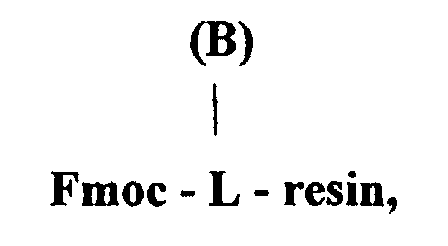
wherein L represents X as defined in claim 18, and wherein B represents biotin,deprotection of the α amino group of the intermediary compound, for instance by means of piperidine to obtain : successive addition of the subsequent amino acids AA1......AAn duly protected on to :to obtain :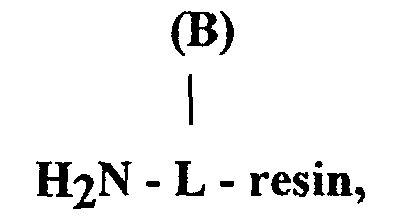
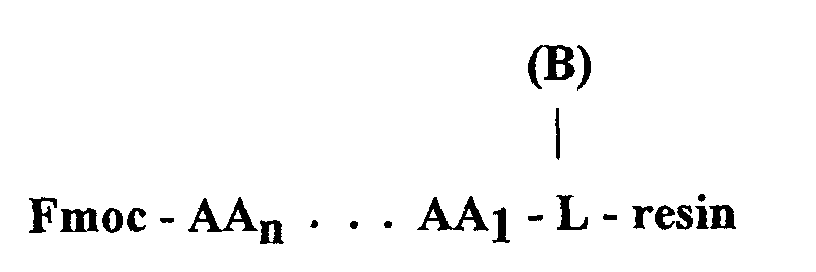 deprotection of the NH2-terminal for instance by means of piperidine,deprotection of the compound obtained, cleavage from the resin, extraction and purification of the peptide obtained, biotinylated at its carboxy terminal end, the steps of side chain deprotection and cleavage being liable to be performed simultaneously or separately, and particularly deprotection of the NH2-terminal, for instance by means of piperidine,cleavage from the resin for instance with trifluoroacetic acid, in the presence of scavengers such as ethanedithiol, or thioanisole, or anisole,extraction of the peptide with a solvent such as diethylether to remove most of the acid and scavengers,purification, such as with HPLC to obtain :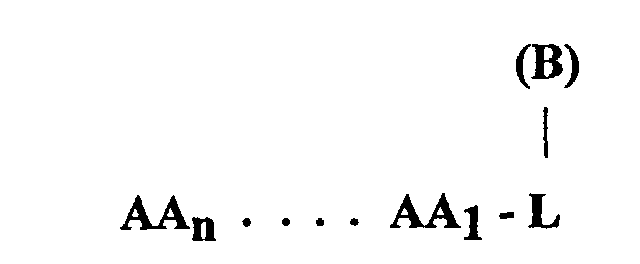
- Process for preparing an N-terminal biotinylated peptide according to claim 4, comprising the following steps:addition of the subsequent amino acids duly protected onto the resin to give : Fmoc - AA1......AAn - resin, wherein Fmoc represents 9-fluorenylmethoxycarbonyl,deprotection of the NH2-terminal for instance by means of piperidine,addition of the intermediary product :wherein L represents X as defined in claim 18 and B represents biotin,

through its COOH onto the NH2-terminal to obtain : deprotection of the NH2-terminal group of the compound obtained, cleavage from the resin, extraction and purification of the peptide obtained, biotinylated at its amino terminal, the steps of side chain deprotection and cleavage being liable to be performed simultaneously or separately, and particularly deprotection of the NH2-terminal group of the intermediary group, for instance by means of piperidine,cleavage from the resin for instance with an acid such as trifluoroacetic acid, in the presence of scavengers such as ethanedithiol, or thioanisole, or anisole,extraction of the peptide with a solvent such as diethylether to remove most of the acid and scavengers,purification, such as with HPLC to obtain :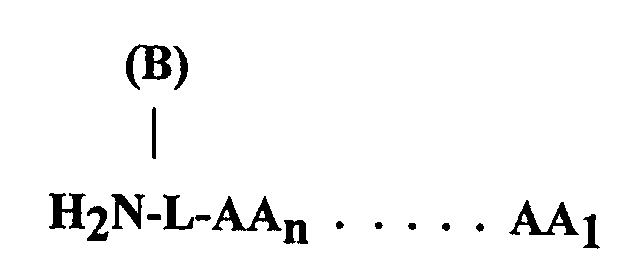
- Process for preparing an internally biotinylated peptide according to claim 4, comprising the following steps :addition of successive amino acids duly protected onto the resin to give : Fmoc - AA1......AAn - resin, wherein Fmoc represents 9-fluorenylmethoxycarbonyl,deprotection of the NH2-terminal,addition of the intermediary product :wherein L represents X as defined in claim 18, and B represents biotin,
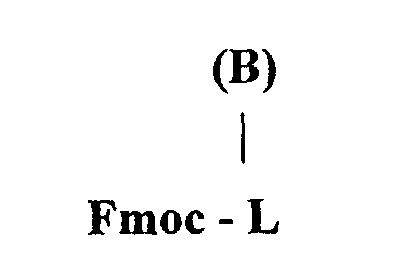
through its COOH onto the NH2-terminal to obtain :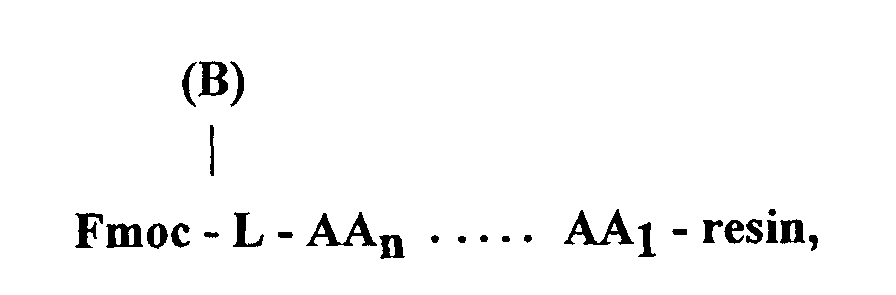 deprotection of the α amino group of the intermediary group, for instance by means of piperidine to obtain :
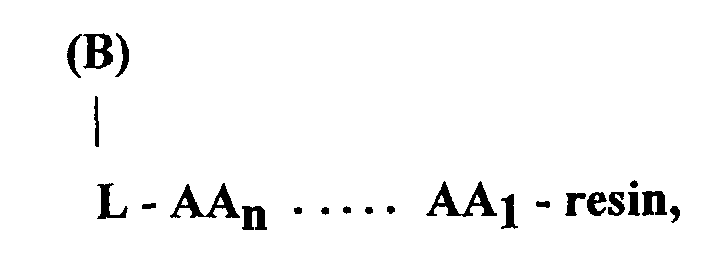 addition of the subsequent amino acids duly protected onto the resin to give :
 deprotection of the NH2-terminal group of the compound obtained, cleavage from the resin, extraction and purification of the peptide obtained, biotinylated at its amino-terminal, the steps of side chain deprotection and cleavage being liable to be performed simultaneously or separately, and particularly, deprotection of the NH2-terminal group of the peptide, for instance by means of piperidine,cleavage from the resin for instance with trifluoroacetic acid, in the presence of scavengers such as ethanedithiol, or thioanisole, or anisole,extraction of the peptide with a solvent such as diethylether to remove most of the acid and scavengers,purification, such as with HPLC to obtain :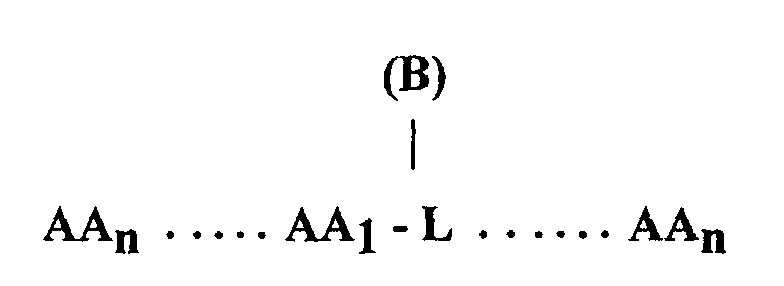
- Peptide(s) according to any of claims 1 to 7 for use in an immunisation process against HCV infection.
- Process for the preparation of a peptide according to any one of claims 1 to 4, wherein the synthesis of said peptides is achieved in solution or on a solid support.
Applications Claiming Priority (3)
| Application Number | Priority Date | Filing Date | Title |
|---|---|---|---|
| EP92400598 | 1992-03-06 | ||
| EP92400598 | 1992-03-06 | ||
| PCT/EP1993/000517 WO1993018054A2 (en) | 1992-03-06 | 1993-03-08 | Process for the determination of peptides corresponding to immunologically important epitopes and their use in a process for determination of antibodies or biotinylated peptides corresponding to immunologically important epitopes, a process for preparing them and compositions containing them |
Related Child Applications (2)
| Application Number | Title | Priority Date | Filing Date |
|---|---|---|---|
| EP98202777A Division EP0891982B1 (en) | 1992-03-06 | 1993-03-08 | HIV peptides |
| EP98202777.3 Division-Into | 1998-08-19 |
Publications (3)
| Publication Number | Publication Date |
|---|---|
| EP0589004A1 EP0589004A1 (en) | 1994-03-30 |
| EP0589004B1 true EP0589004B1 (en) | 1999-05-06 |
| EP0589004B2 EP0589004B2 (en) | 2004-05-06 |
Family
ID=8211622
Family Applications (2)
| Application Number | Title | Priority Date | Filing Date |
|---|---|---|---|
| EP98202777A Expired - Lifetime EP0891982B1 (en) | 1992-03-06 | 1993-03-08 | HIV peptides |
| EP93906490A Expired - Lifetime EP0589004B2 (en) | 1992-03-06 | 1993-03-08 | Process for the determination of peptides corresponding to immunologically important epitopes of hcv |
Family Applications Before (1)
| Application Number | Title | Priority Date | Filing Date |
|---|---|---|---|
| EP98202777A Expired - Lifetime EP0891982B1 (en) | 1992-03-06 | 1993-03-08 | HIV peptides |
Country Status (16)
| Country | Link |
|---|---|
| US (3) | US5891640A (en) |
| EP (2) | EP0891982B1 (en) |
| JP (2) | JP3443809B2 (en) |
| KR (3) | KR100257941B1 (en) |
| AT (2) | ATE179716T1 (en) |
| AU (1) | AU671623B2 (en) |
| BR (1) | BR9305435A (en) |
| CA (1) | CA2102301C (en) |
| DE (2) | DE69334148T2 (en) |
| DK (2) | DK0891982T3 (en) |
| ES (2) | ES2287969T3 (en) |
| GR (1) | GR3030595T3 (en) |
| NZ (2) | NZ299048A (en) |
| PT (1) | PT891982E (en) |
| SG (1) | SG77551A1 (en) |
| WO (1) | WO1993018054A2 (en) |
Families Citing this family (57)
| Publication number | Priority date | Publication date | Assignee | Title |
|---|---|---|---|---|
| US5223409A (en) * | 1988-09-02 | 1993-06-29 | Protein Engineering Corp. | Directed evolution of novel binding proteins |
| US7413537B2 (en) * | 1989-09-01 | 2008-08-19 | Dyax Corp. | Directed evolution of disulfide-bonded micro-proteins |
| WO1992006191A1 (en) * | 1990-09-28 | 1992-04-16 | Protein Engineering Corporation | Proteinaceous anti-dental plaque agents |
| ATE144993T1 (en) * | 1990-12-14 | 1996-11-15 | Innogenetics Nv | SYNTHETIC ANTIGENS FOR DETECTING ANTIBODIES AGAINST HEPATITIS C VIRUS |
| DE69233769D1 (en) * | 1991-03-01 | 2009-09-24 | Dyax Corp | Chimeric protein with microprotein having two or more disulfide bonds and embodiments thereof |
| US5773211A (en) * | 1991-07-10 | 1998-06-30 | Abbott Laboratories | Differentiation of HTLV-I and HTLV-II using synthetic peptides |
| US6709828B1 (en) | 1992-03-06 | 2004-03-23 | N.V. Innogenetics S.A. | Process for the determination of peptides corresponding to immunologically important epitopes and their use in a process for determination of antibodies or biotinylated peptides corresponding to immunologically important epitopes, a process for preparing them and compositions containing them |
| US6667387B1 (en) | 1996-09-30 | 2003-12-23 | N.V. Innogenetics S.A. | HCV core peptides |
| DE69331266T2 (en) * | 1992-05-29 | 2002-08-08 | Howard Florey Institute Of Experimental Physiology And Medicine, Parkville | OLIGONUCLEOTID-POLYAMIDE CONJUGATE |
| DE69433160T2 (en) | 1993-05-12 | 2004-07-08 | Chiron Corp. (N.D.Ges.D. Staates Delaware), Emeryville | Preserved motif of the hepatitis C virus E2 / NS1 region |
| IT1270941B (en) * | 1993-05-12 | 1997-05-26 | Sorin Biomedica Spa | HCV PEPTIDES AND THEIR USES. |
| EP0729973A4 (en) * | 1993-10-29 | 1998-12-30 | Srl Inc | Antigen peptide compound and immunoassay method |
| PT992580E (en) | 1993-11-04 | 2005-07-29 | Innogenetics Nv | EPITOPES FOR IMMUNODOMINANT HUMAN T-CELLS OF HEPATITIS C VIRUS |
| AU1443695A (en) * | 1993-12-20 | 1995-07-10 | Abbott Laboratories | Differentiation of htlv-i and htlv-ii using synthetic peptides |
| US5709995A (en) | 1994-03-17 | 1998-01-20 | The Scripps Research Institute | Hepatitis C virus-derived peptides capable of inducing cytotoxic T lymphocyte responses |
| GB9410044D0 (en) * | 1994-05-19 | 1994-07-06 | Int Murex Tech Corp | Assay |
| US6184205B1 (en) * | 1994-07-22 | 2001-02-06 | University Of North Carolina At Chapel Hill | GRB2 SH3 binding peptides and methods of isolating and using same |
| US6303574B1 (en) | 1994-07-22 | 2001-10-16 | The University Of North Carolina At Chapel Hill | Scr SH3 binding peptides and methods of isolating and using same |
| US5804371A (en) * | 1994-07-25 | 1998-09-08 | Boehringer Mannheim Gmbh | Hapten-labelled peptides |
| FI970300A0 (en) * | 1994-07-25 | 1997-01-24 | Boehringer Mannheim Gmbh | Metal chelated peptides |
| WO1996004385A2 (en) | 1994-07-29 | 1996-02-15 | Innogenetics N.V. | Purified hepatitis c virus envelope proteins for diagnostic and therapeutic use |
| JP3665371B2 (en) * | 1994-08-31 | 2005-06-29 | 株式会社先端生命科学研究所 | Epitope chimera antigen peptide for hepatitis C virus infection or group determination, production method thereof, and infection or group determination method using the same |
| AU780017B2 (en) * | 1994-10-20 | 2005-02-24 | Institut Pasteur | Nucleotide sequences of HIV-1 type (or subtype) O retrovirus antigens |
| FR2731225B1 (en) * | 1995-03-03 | 2003-10-31 | Pasteur Institut | PEPTIDES OF TRANSMEMBRANE ENVELOPE GLYCOPROTEIN AND CAPSID PROTEIN OF HUMAN RETROVIRUS TYPE HIV-1 AND PEPTIDES WITH AN IMMUNOLOGICAL PARENT |
| ES2293643T5 (en) * | 1994-10-20 | 2012-02-02 | Institut Pasteur | NUCLEOTYDIC SEQUENCES OF HIV-1 GROUP RETROVIRICAL ANTIGENS (OR SUBGROUP) O. |
| DE19504302A1 (en) * | 1995-02-09 | 1996-08-14 | Boehringer Mannheim Gmbh | Method for serological typing using type-specific antigens |
| DE19505262C2 (en) * | 1995-02-16 | 1998-06-18 | Behring Diagnostics Gmbh | Retrovirus from the HIV group and its use |
| WO1996027012A1 (en) * | 1995-03-02 | 1996-09-06 | Akzo Nobel N.V. | Specific hiv-1 group o antigens |
| US6309820B1 (en) | 1995-04-07 | 2001-10-30 | University Of North Carolina At Chapel Hill | Polypeptides having a functional domain of interest and methods of identifying and using same |
| WO1996031625A1 (en) * | 1995-04-07 | 1996-10-10 | Cytogen Corporation | Polypeptides having a functional domain of interest and methods of identifying and using same |
| EP0829488A4 (en) * | 1995-04-28 | 1999-04-07 | Srl Inc | ANTIGENIC PEPTIDE COMPOUND AND IMMUNOLOGICAL ASSAY METHOD |
| US6110465A (en) * | 1995-06-07 | 2000-08-29 | The United States Of America As Represented By The Department Of Health And Human Services | Nucleotide and deduced amino acid sequences of hypervariable region 1 of the envelope 2 gene of isolates of hepatitis C virus and the use of reagents derived from these hypervariable sequences in diagnostic methods and vaccines |
| JPH0967395A (en) * | 1995-08-31 | 1997-03-11 | S R L:Kk | Antigen peptide compound and immunoassay method |
| DE19534988A1 (en) * | 1995-09-21 | 1997-03-27 | Forssmann Wolf Georg | Process for the production and use of synthetic, biotinylated peptides |
| JP2002171972A (en) * | 1996-10-14 | 2002-06-18 | Chemo Sero Therapeut Res Inst | Hepatitis virus epitope |
| US6270777B1 (en) * | 1996-12-20 | 2001-08-07 | University Technologies International Inc. | Conserved metalloprotease epitopes |
| FR2765688B1 (en) | 1997-07-04 | 1999-09-10 | Pasteur Institut | REAGENT FOR DETECTION AND MONITORING OF INFECTIONS CAUSED BY THE EPSTEIN-BARR VIRUS AND ITS APPLICATIONS |
| AU752131C (en) | 1997-11-06 | 2003-12-04 | Innogenetics N.V. | Multi-mer peptides derived from hepatitis C virus envelope proteins for diagnostic use and vaccination purposes |
| EP0947525A1 (en) * | 1998-03-27 | 1999-10-06 | Innogenetics N.V. | Epitopes in viral envelope proteins and specific antibodies directed against these epitopes: use for detection of HCV viral antigen in host tissue |
| JP2002525382A (en) | 1998-09-25 | 2002-08-13 | ザ チルドレンズ メディカル センター コーポレイション | Short peptide that selectively regulates protein kinase activity |
| SE9903031D0 (en) * | 1999-08-27 | 1999-08-27 | Eurodiagnostica Ab | Peptide mixture and vaccine against a chronic viral infection |
| IT1310160B1 (en) * | 1999-09-03 | 2002-02-11 | Invicta S P A | BACKPACK WITH BACKREST PROVIDED WITH ELASTIC LAMINA |
| JP2003064096A (en) * | 2001-08-29 | 2003-03-05 | Mitsubishi Kagaku Bio-Clinical Laboratories Inc | Hepatitis c virus-specific cytotoxic t cell recognition epitope |
| CA2462651A1 (en) * | 2001-10-05 | 2003-04-17 | Novozymes A/S | Kit for predicting binding of a specific antibody to a potential immunogen and method of screening |
| CN100479859C (en) * | 2002-03-20 | 2009-04-22 | 厦门大学 | Method for filtering out matters possible to restrain and/or activate target biological activity in aiming at phenomena of spatial allosterism of the target |
| AU2004230606B2 (en) * | 2003-04-11 | 2009-03-19 | The Government Of The United States Of America As Represented By The Secretary Of The Department Of Health And Human Services, Centers For Disease Control And Prevention | Multiple antigenic peptide assay for detection of HIV or SIV type retroviruses |
| US7604804B2 (en) | 2004-02-09 | 2009-10-20 | University Of Maryland Biotechnology Institute | Enhancing anti-HIV efficiency through multivalent inhibitors targeting oligomeric gp120 |
| CA2624153A1 (en) * | 2005-09-29 | 2007-04-12 | The Scripps Research Institute | Viral peptides and their use to inhibit viral infections against viruses of the flaviridae family |
| US8865398B2 (en) | 2006-09-01 | 2014-10-21 | Abbott Laboratories | Combination hepatitis C virus antigen and antibody detection method |
| JPWO2009044650A1 (en) * | 2007-10-05 | 2011-02-03 | 株式会社カネカ | Labeled peptide having binding activity to immunoglobulin and / or immunoglobulin complex, and method for detecting or measuring immunoglobulin using said peptide |
| WO2010027973A1 (en) * | 2008-09-02 | 2010-03-11 | Antigen Express, Inc. | Human papillomavirus / li-key hybrids and methods of use |
| FR2984328B1 (en) | 2011-12-20 | 2016-12-30 | Bio-Rad Innovations | METHOD FOR DETECTING HEPATITIS C VIRUS INFECTION |
| HUE034308T2 (en) | 2013-03-21 | 2018-02-28 | Sanofi Aventis Deutschland | Synthesis of hydantoin containing peptide products |
| CN105102427B (en) | 2013-03-21 | 2018-09-07 | 赛诺菲-安万特德国有限公司 | Synthesis of Peptide Products Containing Cyclic Imides |
| US9850278B2 (en) | 2013-04-25 | 2017-12-26 | Carmel-Haifa University Economic Corp. | Synthetic anti-inflammatory peptides and use thereof |
| US10161938B2 (en) | 2013-12-27 | 2018-12-25 | Roche Sequencing Solutions, Inc. | Systematic discovery, maturation and extension of peptide binders to proteins |
| AU2016251501A1 (en) | 2015-04-20 | 2017-10-19 | F. Hoffmann-La Roche Ag | Specific peptide binders to proteins identified via systemic discovery, maturation and extension process |
Family Cites Families (20)
| Publication number | Priority date | Publication date | Assignee | Title |
|---|---|---|---|---|
| WO1984003506A1 (en) * | 1983-03-08 | 1984-09-13 | Commw Serum Lab Commission | Antigenically active amino acid sequences |
| US5075211A (en) * | 1986-03-26 | 1991-12-24 | Genetic Systems Corporation | Synthetic antigen for the detection of AIDS-related disease |
| US4833071A (en) * | 1987-01-09 | 1989-05-23 | United Biomedical, Inc. | Peptide composition as anitgen for detection of antibodies to HTLV-I, as a vaccine for ATL and methods therefor |
| EP0278940A3 (en) * | 1987-01-30 | 1988-12-07 | Smithkline Biologicals S.A. | Hepatitis b virus surface antigens and hybrid antigens containing them |
| AU629528B2 (en) * | 1988-01-27 | 1992-10-08 | Biochem Pharma Inc. | Synthetic peptides and mixtures thereof for detecting hiv antibodies |
| EP0345375B1 (en) * | 1988-06-09 | 1995-03-22 | N.V. Innogenetics S.A. | HIV-3 retrovirus and its use |
| DE3901857A1 (en) * | 1989-01-23 | 1990-07-26 | Boehringer Mannheim Gmbh | METHOD FOR DETERMINING HIV 2 ANTIBODY |
| SU1612264A1 (en) * | 1989-03-01 | 1990-12-07 | Институт биоорганической химии им.М.М.Шемякина | Method of solid-phase immuno-ferment determination of antibodies to virus of manъs immunodefficiency and synthetic peptide labeled with biotin for effecting same |
| HU225068B1 (en) * | 1989-03-17 | 2006-05-29 | Chiron Corp | Process for producing diagnostics and vaccine of nanbh |
| US5120662A (en) * | 1989-05-09 | 1992-06-09 | Abbott Laboratories | Multilayer solid phase immunoassay support and method of use |
| EP0438332B1 (en) * | 1990-01-16 | 1998-04-08 | Orgenics Ltd. | Peptides issued from the glycoprotein envelope of HIV virus, their uses for the detection of an infection due to these viruses and for the vaccination against AIDS |
| KR940000755B1 (en) * | 1990-02-16 | 1994-01-29 | 유나이티드 바이오메디칼 인코오포레이티드 | Synthetic peptides that are particularly suitable for detecting antibodies to HCV, diagnosing HCV infections and their prevention as vaccines |
| EP0445801A3 (en) * | 1990-03-08 | 1992-07-01 | Kuraray Co., Ltd. | Peptide and its use |
| EP0448095A1 (en) * | 1990-03-21 | 1991-09-25 | Wolf, Hans Joachim, Prof. Dr. | Subregion of the retroviral ENV protein, DNA sequences encoding it and compositions for the diagnosis, prevention or therapy of retrovirus infections |
| CA2047792C (en) * | 1990-07-26 | 2002-07-02 | Chang Y. Wang | Synthetic peptides specific for the detection of antibodies to hcv, diagnosis of hcv infection and prevention thereof as vaccines |
| ES2161682T3 (en) * | 1990-11-03 | 2001-12-16 | Dade Behring Marburg Gmbh | SPECIFIC PEPTIDES TO HCV, SUITABLE AGENTS FOR THEM AND ITS USE. |
| ATE144993T1 (en) * | 1990-12-14 | 1996-11-15 | Innogenetics Nv | SYNTHETIC ANTIGENS FOR DETECTING ANTIBODIES AGAINST HEPATITIS C VIRUS |
| US5574132A (en) * | 1991-04-05 | 1996-11-12 | Biochem Immunosystems Inc. | Peptides and mixtures thereof for detecting antibodies to hepatitis C virus (HCV) |
| AU648912B2 (en) * | 1991-06-13 | 1994-05-05 | Dade International Inc. | Immunoassay for non-A non-B hepatitis |
| JP3277045B2 (en) | 1992-10-06 | 2002-04-22 | デイド・ベーリング・マルブルク・ゲゼルシヤフト・ミツト・ベシユレンクテル・ハフツング | HIV-group retroviruses and uses thereof |
-
1993
- 1993-03-08 KR KR1019930703359A patent/KR100257941B1/en not_active Expired - Fee Related
- 1993-03-08 PT PT98202777T patent/PT891982E/en unknown
- 1993-03-08 JP JP51533493A patent/JP3443809B2/en not_active Expired - Lifetime
- 1993-03-08 NZ NZ299048A patent/NZ299048A/en not_active IP Right Cessation
- 1993-03-08 US US08/146,028 patent/US5891640A/en not_active Expired - Lifetime
- 1993-03-08 DE DE69334148T patent/DE69334148T2/en not_active Expired - Lifetime
- 1993-03-08 DK DK98202777T patent/DK0891982T3/en active
- 1993-03-08 AT AT93906490T patent/ATE179716T1/en not_active IP Right Cessation
- 1993-03-08 ES ES98202777T patent/ES2287969T3/en not_active Expired - Lifetime
- 1993-03-08 CA CA002102301A patent/CA2102301C/en not_active Expired - Lifetime
- 1993-03-08 BR BR9305435A patent/BR9305435A/en not_active IP Right Cessation
- 1993-03-08 SG SG9605107A patent/SG77551A1/en unknown
- 1993-03-08 EP EP98202777A patent/EP0891982B1/en not_active Expired - Lifetime
- 1993-03-08 DK DK93906490T patent/DK0589004T4/en active
- 1993-03-08 DE DE69324751T patent/DE69324751T3/en not_active Expired - Lifetime
- 1993-03-08 NZ NZ249838A patent/NZ249838A/en active IP Right Revival
- 1993-03-08 KR KR10-1999-7012596A patent/KR20030096423A/en not_active Withdrawn
- 1993-03-08 US US08/723,425 patent/US6165730A/en not_active Expired - Lifetime
- 1993-03-08 EP EP93906490A patent/EP0589004B2/en not_active Expired - Lifetime
- 1993-03-08 AT AT98202777T patent/ATE364621T1/en active
- 1993-03-08 ES ES93906490T patent/ES2133392T5/en not_active Expired - Lifetime
- 1993-03-08 AU AU37463/93A patent/AU671623B2/en not_active Expired
- 1993-03-08 WO PCT/EP1993/000517 patent/WO1993018054A2/en not_active Ceased
-
1998
- 1998-02-28 KR KR1019980701532A patent/KR100259223B1/en not_active Expired - Lifetime
- 1998-07-09 US US09/112,206 patent/US6210903B1/en not_active Expired - Lifetime
-
1999
- 1999-06-23 GR GR990401678T patent/GR3030595T3/en unknown
-
2003
- 2003-04-11 JP JP2003107716A patent/JP2004002379A/en active Pending
Also Published As
Similar Documents
| Publication | Publication Date | Title |
|---|---|---|
| EP0589004B2 (en) | Process for the determination of peptides corresponding to immunologically important epitopes of hcv | |
| AU652013B2 (en) | Synthetic antigens for the detection of antibodies to hepatitis C virus | |
| US6667387B1 (en) | HCV core peptides | |
| US6709828B1 (en) | Process for the determination of peptides corresponding to immunologically important epitopes and their use in a process for determination of antibodies or biotinylated peptides corresponding to immunologically important epitopes, a process for preparing them and compositions containing them | |
| US20020106640A1 (en) | Synthetic antigens for the detection of antibodies to hepatitis C virus | |
| CA2056381C (en) | Cysteine thiol-protected peptides for use in immunoassays | |
| AU623949B2 (en) | Synthetic peptide derivatives of gp41 glycoprotein of HIV | |
| JPH05320192A (en) | Peptides showing immunochemical reactivity with antibodies against non-A non-B hepatitis viruses | |
| CA2004287A1 (en) | Peptides | |
| JPH04221398A (en) | Antibody to non-a, non-b hepatitis virus and immunochemically reactive peptide |
Legal Events
| Date | Code | Title | Description |
|---|---|---|---|
| PUAI | Public reference made under article 153(3) epc to a published international application that has entered the european phase |
Free format text: ORIGINAL CODE: 0009012 |
|
| 17P | Request for examination filed |
Effective date: 19931018 |
|
| AK | Designated contracting states |
Kind code of ref document: A1 Designated state(s): AT BE CH DE DK ES FR GB GR IE IT LI LU MC NL PT SE |
|
| 17Q | First examination report despatched |
Effective date: 19960116 |
|
| GRAG | Despatch of communication of intention to grant |
Free format text: ORIGINAL CODE: EPIDOS AGRA |
|
| GRAG | Despatch of communication of intention to grant |
Free format text: ORIGINAL CODE: EPIDOS AGRA |
|
| GRAG | Despatch of communication of intention to grant |
Free format text: ORIGINAL CODE: EPIDOS AGRA |
|
| GRAH | Despatch of communication of intention to grant a patent |
Free format text: ORIGINAL CODE: EPIDOS IGRA |
|
| GRAH | Despatch of communication of intention to grant a patent |
Free format text: ORIGINAL CODE: EPIDOS IGRA |
|
| GRAA | (expected) grant |
Free format text: ORIGINAL CODE: 0009210 |
|
| AK | Designated contracting states |
Kind code of ref document: B1 Designated state(s): AT BE CH DE DK ES FR GB GR IE IT LI LU MC NL PT SE |
|
| REF | Corresponds to: |
Ref document number: 179716 Country of ref document: AT Date of ref document: 19990515 Kind code of ref document: T |
|
| REG | Reference to a national code |
Ref country code: CH Ref legal event code: EP |
|
| REF | Corresponds to: |
Ref document number: 69324751 Country of ref document: DE Date of ref document: 19990610 |
|
| REG | Reference to a national code |
Ref country code: IE Ref legal event code: FG4D |
|
| REG | Reference to a national code |
Ref country code: CH Ref legal event code: NV Representative=s name: BUECHEL & PARTNER AG PATENTBUERO |
|
| ET | Fr: translation filed | ||
| REG | Reference to a national code |
Ref country code: ES Ref legal event code: FG2A Ref document number: 2133392 Country of ref document: ES Kind code of ref document: T3 |
|
| REG | Reference to a national code |
Ref country code: DK Ref legal event code: T3 |
|
| REG | Reference to a national code |
Ref country code: PT Ref legal event code: SC4A Free format text: AVAILABILITY OF NATIONAL TRANSLATION Effective date: 19990803 |
|
| PLBE | No opposition filed within time limit |
Free format text: ORIGINAL CODE: 0009261 |
|
| PLBQ | Unpublished change to opponent data |
Free format text: ORIGINAL CODE: EPIDOS OPPO |
|
| PLAA | Information modified related to event that no opposition was filed |
Free format text: ORIGINAL CODE: 0009299DELT |
|
| PLBI | Opposition filed |
Free format text: ORIGINAL CODE: 0009260 |
|
| 26N | No opposition filed | ||
| 26 | Opposition filed |
Opponent name: CHIRON CORPORATION Effective date: 20000204 Opponent name: ROCHE DIAGNOSTICS GMBH Effective date: 20000204 |
|
| D26N | No opposition filed (deleted) | ||
| PLAV | Examination of admissibility of opposition |
Free format text: ORIGINAL CODE: EPIDOS OPEX |
|
| PLBF | Reply of patent proprietor to notice(s) of opposition |
Free format text: ORIGINAL CODE: EPIDOS OBSO |
|
| NLR1 | Nl: opposition has been filed with the epo |
Opponent name: CHIRON CORPORATION Opponent name: ROCHE DIAGNOSTICS GMBH |
|
| PLBF | Reply of patent proprietor to notice(s) of opposition |
Free format text: ORIGINAL CODE: EPIDOS OBSO |
|
| PLBF | Reply of patent proprietor to notice(s) of opposition |
Free format text: ORIGINAL CODE: EPIDOS OBSO |
|
| DX | Miscellaneous (deleted) | ||
| REG | Reference to a national code |
Ref country code: GB Ref legal event code: IF02 |
|
| PLBP | Opposition withdrawn |
Free format text: ORIGINAL CODE: 0009264 |
|
| PLAW | Interlocutory decision in opposition |
Free format text: ORIGINAL CODE: EPIDOS IDOP |
|
| PUAH | Patent maintained in amended form |
Free format text: ORIGINAL CODE: 0009272 |
|
| STAA | Information on the status of an ep patent application or granted ep patent |
Free format text: STATUS: PATENT MAINTAINED AS AMENDED |
|
| 27A | Patent maintained in amended form |
Effective date: 20040506 |
|
| AK | Designated contracting states |
Kind code of ref document: B2 Designated state(s): AT BE CH DE DK ES FR GB GR IE IT LI LU MC NL PT SE |
|
| REG | Reference to a national code |
Ref country code: CH Ref legal event code: AEN Free format text: AUFRECHTERHALTUNG DES PATENTES IN GEAENDERTER FORM |
|
| NLR2 | Nl: decision of opposition |
Effective date: 20040506 |
|
| REG | Reference to a national code |
Ref country code: DK Ref legal event code: T4 |
|
| REG | Reference to a national code |
Ref country code: SE Ref legal event code: RPEO |
|
| NLR3 | Nl: receipt of modified translations in the netherlands language after an opposition procedure | ||
| REG | Reference to a national code |
Ref country code: GR Ref legal event code: EP Ref document number: 20040402682 Country of ref document: GR |
|
| REG | Reference to a national code |
Ref country code: ES Ref legal event code: DC2A Date of ref document: 20040721 Kind code of ref document: T5 |
|
| ET3 | Fr: translation filed ** decision concerning opposition | ||
| PGFP | Annual fee paid to national office [announced via postgrant information from national office to epo] |
Ref country code: PT Payment date: 20060223 Year of fee payment: 14 |
|
| PGFP | Annual fee paid to national office [announced via postgrant information from national office to epo] |
Ref country code: NL Payment date: 20060314 Year of fee payment: 14 Ref country code: LU Payment date: 20060314 Year of fee payment: 14 |
|
| PGFP | Annual fee paid to national office [announced via postgrant information from national office to epo] |
Ref country code: DK Payment date: 20060315 Year of fee payment: 14 Ref country code: AT Payment date: 20060315 Year of fee payment: 14 |
|
| PGFP | Annual fee paid to national office [announced via postgrant information from national office to epo] |
Ref country code: GR Payment date: 20060323 Year of fee payment: 14 |
|
| PGFP | Annual fee paid to national office [announced via postgrant information from national office to epo] |
Ref country code: IE Payment date: 20060330 Year of fee payment: 14 |
|
| PGFP | Annual fee paid to national office [announced via postgrant information from national office to epo] |
Ref country code: MC Payment date: 20061222 Year of fee payment: 15 |
|
| PG25 | Lapsed in a contracting state [announced via postgrant information from national office to epo] |
Ref country code: SE Free format text: LAPSE BECAUSE OF NON-PAYMENT OF DUE FEES Effective date: 20070309 |
|
| PG25 | Lapsed in a contracting state [announced via postgrant information from national office to epo] |
Ref country code: PT Free format text: LAPSE BECAUSE OF NON-PAYMENT OF DUE FEES Effective date: 20070910 |
|
| REG | Reference to a national code |
Ref country code: PT Ref legal event code: MM4A Free format text: LAPSE DUE TO NON-PAYMENT OF FEES Effective date: 20070910 |
|
| REG | Reference to a national code |
Ref country code: DK Ref legal event code: EBP |
|
| EUG | Se: european patent has lapsed | ||
| PG25 | Lapsed in a contracting state [announced via postgrant information from national office to epo] |
Ref country code: AT Free format text: LAPSE BECAUSE OF NON-PAYMENT OF DUE FEES Effective date: 20070308 |
|
| NLV4 | Nl: lapsed or anulled due to non-payment of the annual fee |
Effective date: 20071001 |
|
| REG | Reference to a national code |
Ref country code: IE Ref legal event code: MM4A |
|
| PG25 | Lapsed in a contracting state [announced via postgrant information from national office to epo] |
Ref country code: NL Free format text: LAPSE BECAUSE OF NON-PAYMENT OF DUE FEES Effective date: 20071001 Ref country code: IE Free format text: LAPSE BECAUSE OF NON-PAYMENT OF DUE FEES Effective date: 20070308 |
|
| PGFP | Annual fee paid to national office [announced via postgrant information from national office to epo] |
Ref country code: SE Payment date: 20060314 Year of fee payment: 14 |
|
| PG25 | Lapsed in a contracting state [announced via postgrant information from national office to epo] |
Ref country code: DK Free format text: LAPSE BECAUSE OF NON-PAYMENT OF DUE FEES Effective date: 20070402 |
|
| PG25 | Lapsed in a contracting state [announced via postgrant information from national office to epo] |
Ref country code: MC Free format text: LAPSE BECAUSE OF NON-PAYMENT OF DUE FEES Effective date: 20080331 Ref country code: GR Free format text: LAPSE BECAUSE OF NON-PAYMENT OF DUE FEES Effective date: 20071003 |
|
| PG25 | Lapsed in a contracting state [announced via postgrant information from national office to epo] |
Ref country code: LU Free format text: LAPSE BECAUSE OF NON-PAYMENT OF DUE FEES Effective date: 20070308 |
|
| PGFP | Annual fee paid to national office [announced via postgrant information from national office to epo] |
Ref country code: CH Payment date: 20120326 Year of fee payment: 20 Ref country code: FR Payment date: 20120403 Year of fee payment: 20 |
|
| PGFP | Annual fee paid to national office [announced via postgrant information from national office to epo] |
Ref country code: DE Payment date: 20120323 Year of fee payment: 20 |
|
| PGFP | Annual fee paid to national office [announced via postgrant information from national office to epo] |
Ref country code: BE Payment date: 20120329 Year of fee payment: 20 Ref country code: GB Payment date: 20120322 Year of fee payment: 20 |
|
| PGFP | Annual fee paid to national office [announced via postgrant information from national office to epo] |
Ref country code: IT Payment date: 20120329 Year of fee payment: 20 |
|
| REG | Reference to a national code |
Ref country code: DE Ref legal event code: R071 Ref document number: 69324751 Country of ref document: DE |
|
| REG | Reference to a national code |
Ref country code: DE Ref legal event code: R071 Ref document number: 69324751 Country of ref document: DE |
|
| REG | Reference to a national code |
Ref country code: CH Ref legal event code: PL |
|
| REG | Reference to a national code |
Ref country code: GB Ref legal event code: PE20 Expiry date: 20130307 |
|
| BE20 | Be: patent expired |
Owner name: S.A. *INNOGENETICS N.V. Effective date: 20130308 |
|
| PG25 | Lapsed in a contracting state [announced via postgrant information from national office to epo] |
Ref country code: GB Free format text: LAPSE BECAUSE OF EXPIRATION OF PROTECTION Effective date: 20130307 Ref country code: DE Free format text: LAPSE BECAUSE OF EXPIRATION OF PROTECTION Effective date: 20130309 |
|
| PGFP | Annual fee paid to national office [announced via postgrant information from national office to epo] |
Ref country code: ES Payment date: 20120327 Year of fee payment: 20 |
|
| REG | Reference to a national code |
Ref country code: ES Ref legal event code: FD2A Effective date: 20130710 |
|
| PG25 | Lapsed in a contracting state [announced via postgrant information from national office to epo] |
Ref country code: ES Free format text: LAPSE BECAUSE OF EXPIRATION OF PROTECTION Effective date: 20130309 |