EP0588060B1 - Method for preparing aromatic secondary amino compound - Google Patents
Method for preparing aromatic secondary amino compound Download PDFInfo
- Publication number
- EP0588060B1 EP0588060B1 EP93112886A EP93112886A EP0588060B1 EP 0588060 B1 EP0588060 B1 EP 0588060B1 EP 93112886 A EP93112886 A EP 93112886A EP 93112886 A EP93112886 A EP 93112886A EP 0588060 B1 EP0588060 B1 EP 0588060B1
- Authority
- EP
- European Patent Office
- Prior art keywords
- group
- reaction
- secondary amino
- aromatic secondary
- preparing
- Prior art date
- Legal status (The legal status is an assumption and is not a legal conclusion. Google has not performed a legal analysis and makes no representation as to the accuracy of the status listed.)
- Expired - Lifetime
Links
Classifications
-
- C—CHEMISTRY; METALLURGY
- C07—ORGANIC CHEMISTRY
- C07C—ACYCLIC OR CARBOCYCLIC COMPOUNDS
- C07C209/00—Preparation of compounds containing amino groups bound to a carbon skeleton
- C07C209/04—Preparation of compounds containing amino groups bound to a carbon skeleton by substitution of functional groups by amino groups
-
- C—CHEMISTRY; METALLURGY
- C07—ORGANIC CHEMISTRY
- C07C—ACYCLIC OR CARBOCYCLIC COMPOUNDS
- C07C209/00—Preparation of compounds containing amino groups bound to a carbon skeleton
-
- C—CHEMISTRY; METALLURGY
- C07—ORGANIC CHEMISTRY
- C07C—ACYCLIC OR CARBOCYCLIC COMPOUNDS
- C07C209/00—Preparation of compounds containing amino groups bound to a carbon skeleton
- C07C209/24—Preparation of compounds containing amino groups bound to a carbon skeleton by reductive alkylation of ammonia, amines or compounds having groups reducible to amino groups, with carbonyl compounds
- C07C209/28—Preparation of compounds containing amino groups bound to a carbon skeleton by reductive alkylation of ammonia, amines or compounds having groups reducible to amino groups, with carbonyl compounds by reduction with other reducing agents
-
- C—CHEMISTRY; METALLURGY
- C07—ORGANIC CHEMISTRY
- C07C—ACYCLIC OR CARBOCYCLIC COMPOUNDS
- C07C209/00—Preparation of compounds containing amino groups bound to a carbon skeleton
- C07C209/44—Preparation of compounds containing amino groups bound to a carbon skeleton by reduction of carboxylic acids or esters thereof in presence of ammonia or amines, or by reduction of nitriles, carboxylic acid amides, imines or imino-ethers
- C07C209/52—Preparation of compounds containing amino groups bound to a carbon skeleton by reduction of carboxylic acids or esters thereof in presence of ammonia or amines, or by reduction of nitriles, carboxylic acid amides, imines or imino-ethers by reduction of imines or imino-ethers
-
- C—CHEMISTRY; METALLURGY
- C07—ORGANIC CHEMISTRY
- C07C—ACYCLIC OR CARBOCYCLIC COMPOUNDS
- C07C209/00—Preparation of compounds containing amino groups bound to a carbon skeleton
- C07C209/68—Preparation of compounds containing amino groups bound to a carbon skeleton from amines, by reactions not involving amino groups, e.g. reduction of unsaturated amines, aromatisation, or substitution of the carbon skeleton
-
- C—CHEMISTRY; METALLURGY
- C07—ORGANIC CHEMISTRY
- C07C—ACYCLIC OR CARBOCYCLIC COMPOUNDS
- C07C211/00—Compounds containing amino groups bound to a carbon skeleton
- C07C211/43—Compounds containing amino groups bound to a carbon skeleton having amino groups bound to carbon atoms of six-membered aromatic rings of the carbon skeleton
- C07C211/44—Compounds containing amino groups bound to a carbon skeleton having amino groups bound to carbon atoms of six-membered aromatic rings of the carbon skeleton having amino groups bound to only one six-membered aromatic ring
Definitions
- the present invention relates to an improved method for preparing an aromatic secondary amino compound.
- the aromatic secondary amino compound obtained by the method of the present invention is an extremely important industrial product such as a raw material for modifier of rubber and dyes.
- An object of the present invention is to provide an industrially improved method for preparing an aromatic secondary amino compound from an N-cyclohexylidene amino compound or cyclohexanone (inclusive of a nucleus-substituted compound), and according to this method, the above-mentioned problems can be solved.
- the aromatic secondary amino compound can be obtained under extremely moderate conditions in a high yield by (1) using a sulfur-free polar solvent and optionally a cocatalyst at the time of the dehydrogenation reaction of an N-cyclohexylideneamino compound in the presence of a dehydrogenation catalyst and a hydrogen acceptor, or (2) reacting cyclohexanone or a nucleus-substituted cyclohexanone with an amine in a sulfur-free polar solvent in the presence of a dehydrogenation catalyst by the use of a nitro compound corresponding to the amine as a hydrogen acceptor.
- the present invention has been attained.
- the first aspect of the present invention is directed to a method for preparing an aromatic secondary amino compound represented by the formula (2) (wherein each R is a hydrogen atom, alkyl group, alkoxy group, amino group, hydroxyl group or fluorine; n is an integer of from 0 to 5; and R' is an alkyl group, phenyl group, benzyl group, naphthyl group, furyl group, furfuryl group or cyclohexyl group, and R' may be substituted by an alkyl group, alkoxy group, phenyl group, phenoxy group, cyclohexyl group, substituted amino group, carboxyl group, hydroxyl group or fluorine) which comprises the step of subjecting, to a dehydrogenation reaction, an N-cyclohexylideneamino compound represented by the formula (1) (wherein R, R' and n are defined above) in the presence of a dehydrogenation catalyst and a hydrogen acceptor, said method being characterized in that
- the N-cyclohexylideneamino compound which is used as a starting material can be easily synthesized from an amine (or its derivative having an amino group with a substituent) and cyclohexanone or its derivative in accordance with a known process.
- alkyl group represented by R in the formula (1) examples include methyl, ethyl, propyl, isopropyl, butyl, isobutyl, tert-butyl, pentyl, phenylmethyl, aminomethyl, hydroxymethyl and fluoromethyl, and above all, methyl and ethyl are preferable.
- alkoxy group examples include methoxy, ethoxy, butoxy, pentyloxy, hexyloxy, heptyloxy, octyloxy, nonyloxy, decyloxy, dodecyloxy, hexadecyloxy, aminomethoxy and fluoromethoxy, and above all, methyloxy, ethyloxy are preferable.
- amino group examples include amino, methylamino, ethylamino, propylamino, isopropylamino, butylamino, isobutylamino, tert-butylamino, pentylamino, dimethylamino, diethylamino, cyclohexylamino and acetylamino.
- alkyl group represented by R' in the formula (1) examples include methyl, ethyl, propyl, isopropyl, butyl, isobutyl, tert-butyl, aminomethyl, aminoethyl, aminopropyl, 2-aminopropyl, 3-aminopropyl, aminobutyl and hydoxyethyl.
- phenyl group examples include phenyl, o-methylphenyl, m-methylphenyl, p-methylphenyl, p-ethylphenyl, p-propylphenyl, p-isopropylphenyl, p-butylphenyl, p-tert-butylphenyl, p-pentylphenyl, p-hexylphenyl, p-heptylphenyl, p-octylphenyl, p-nonylphenyl, p-decylphenyl, p-dodecylphenyl, p-hexadecylphenyl, 3,4-dimethylphenyl, 2,3-dimethylphenyl, 2,6-dimethylphenyl, 2,4,6-trimethylphenyl, p-methoxyphenyl, p-ethoxyphenyl, p-butoxyphenyl
- benzyl group examples include benzyl, o-methylbenzyl, m-methylbenzyl, p-methylbenzyl, p-ethylbenzyl, p-propylbenzyl, p-isopropylbenzyl, p-butylbenzyl, p-tert-butylbenzyl, p-pentylbenzyl, p-hexylbenzyl, p-heptylbenzyl, p-octylbenzyl, p-nonylbenzyl, p-decylbenzyl, p-dodecylbenzyl, p-hexadecylbenzyl, p-acetylbenzyl, 3,4-dimethylbenzyl, 2,3-dimethylbenzyl, 2,6-dimethylbenzyl, 2,4,6-trimethylbenzyl, p-methoxybenzyl, p-ethoxybenz
- cyclohexyl group examples include cyclohexyl, o-methylcyclohexyl, m-methylcyclohexyl, p-methylcyclohexyl, p-ethylcyclohexyl, p-propylcyclohexyl, p-isopropylcyclohexyl, p-butylcyclohexyl, p-tert-butylcyclohexyl, p-pentylcyclohexyl, p-hexylcyclohexyl, p-heptylcyclohexyl, p-octylcyclohexyl, p-nonylcyclohexyl, p-decylcyclohexyl, p-dodecylcyclohexyl, p-hexadecylcyclohexyl, p-acetylcyclohexyl
- the dehydrogenation catalyst there can be used any known dehydrogenation catalyst.
- the dehydrogenation catalyst include Raney nickel, reduced nickel and nickel supporting catalysts obtained by supporting nickel on various carriers such as diatomaceous earth, alumina, pumice, silica gel and acidic terra abla; cobalt catalysts such as Raney cobalt, reduced cobalt, cobalt and cobalt-carrier catalysts; copper catalysts such as Raney copper, reduced copper and copper-carrier catalysts; palladium catalysts such as palladium black, palladium oxide, colloidal palladium, palladium-carbon, palladium-barium sulfate and palladium-barium carbonate; platinum catalysts such as platinum black, colloidal platinum, platinum sponge, platinum oxide, platinum sulfide, platinum-carbon and platinum-carrier catalysts; rhodium catalysts such as colloidal rhodium, rhodium-carbon and rhodium oxide; a platinum group catalyst such as a
- the amount of the dehydrogenation catalyst is usually in the range of from 0.001 to 1.0 gram atom, preferably from 0.002 to 0.2 gram atom in terms of a metallic atom per gram molecule of the N-cyclohexylideneamino compound.
- any of various reducing materials is used as a hydrogen acceptor.
- the hydrogen acceptor include olefin compounds such as 1-octene, allylbenzene and crotonic acid; nitro compounds such as 2,6-dimethylnitrobenzene, p-amylnitrobenzene, p-hexylnitrobenzene, p-octylnitrobenzene, p-sec-octylnitrobenzene, p-tert-octylnitrobenzene, p-nonylnitrobenzene, p-decylnitrobenzene, p-ethoxynitrobenzene, o-ethoxynitrobenzene, 2,6-dimethyl-4-aminonitrobenzene, nitrobenzene, p-dinitrobenzene, m-dinitrobenzene, 4-nitrodiphenyl, p-phenoxynitrobenzene, p-cyclohexyl
- nitrobenzene in the above-mentioned nitro compounds as the hydrogen acceptor, because nitrobenzene can be utilized as the material of N-cyclohexylideneaniline.
- the amount of the hydrogen acceptor to be used depends upon its kind, but it is 5 equivalents of the hydrogen acceptor to the N-cyclohexylideneamino compound. Particularly in the case of the olefin or the nitro compound, the amount of the hydrogen acceptor is an equivalent or 50% excess of the N-cyclohexylideneamino compound. When the hydrogen acceptor is short, the by-product of N-cyclohexylamine tends to increase. As the hydrogen acceptor, the olefin or the nitro compound is preferable from the viewpoint of the volume efficiency of a reactor.
- sulfur-free polar solvent examples include N,N-dimethylformamide, N,N-dimethylacetamide, tetramethylurea, methyl isobutyl ketone, tetrahydrofuran, dioxane, 1,3-dimethylimidazolizinone, glymes such as ethylene glycol dimethyl ether and diethylene glycol dimethyl ether, methyl salicylate, phenol and phenols, for example, alkylphenols such as methylphenol and 2,4,6-trimethylphenol as well as alkoxyphenols such as 3-methoxyphenol and 4-methoxyphenol. If necessary, they may be used in combination of two or more thereof. Dimethyl sulfoxide and sulfolane are similarly within the category of the polar solvents, but they are not used because they contain sulfur which is poisonous to the dehydrogenation catalyst.
- the amount of the sulfur-free polar solvent to be used is preferably 0.05-3.0 times by weight, more preferably 0.15-1.5 times by weight as much as that of the N-cyclohexylideneamino compound.
- the solvent and the catalyst are previously placed in the reactor and mixed, and the N-cyclohexylideneamino compound and the hydrogen acceptor are then simultaneously dropped into the reactor to carry out the above-mentioned reaction.
- the N-cyclohexylideneamino compound and the hydrogen acceptor may be first mixed and then dropped thereinto.
- an alkaline metal compound and/or an alkaline earth metal compound can be added as a cocatalyst to the reaction system. This is also one embodiment of the first aspect of the present invention.
- alkaline metal compound and/or the alkaline earth metal compound which can be added as the cocatalyst are hydroxides, carbonates and bicarbonates of alkaline metals and alkaline earth metals.
- Typical examples of these compounds include lithium hydroxide, sodium hydroxide, potassium hydroxide, calcium hydroxide, magnesium hydroxide, sodium carbonate, potassium carbonate and sodium hydrogen carbonate. Above all, sodium hydroxide and potassium hydroxide are preferable.
- These cocatalysts may be used singly or in combination of two or more thereof. The cocatalyst does not have to be added to the reaction system separately from the above-mentioned dehydrogenation catalyst.
- a salt or a hydroxide of an alkaline metal and/or an alkaline earth metal may be additionally supported as the alkaline metal component and/or the alkaline earth metal component on the noble metal supporting catalyst, and the thus formed catalyst may be used.
- the amount of the cocatalyst is preferably in the range of from 2 to 30% by weight, more preferably from 5 to 20% by weight, in terms of the alkaline metal and/or the alkaline earth metal, based on the weight of the catalyst metal. If the amount of the cocatalyst is in excess of this range, a reaction rate tends to deteriorate, and conversely if it is less than the range, a yield is low.
- reaction is carried out under the removal of water, and thus a technique is suitable in which water is removed from the reaction mixture while azeotropic distillation is done by the use of a solvent such as benzene, toluene or xylene.
- the temperature at the reaction is usually in the range of from 120 to 250°C, preferably from 140 to 200°C.
- the mixture obtained by the above-mentioned method is treated in an ordinary manner such as distillation, crystallization or extraction.
- the solution in which the reaction has already been brought to an end is filtered to separate the catalyst therefrom.
- the thus recovered catalyst can be reused.
- the resultant filtrate is concentrated to recover the solvent.
- the produced aromatic secondary amino compound in the reactor can be directly used without any treatment, but if necessary, it may be purified by distillation, and crystallization.
- the second aspect of the present invention is directed to a method for preparing an aromatic secondary amino compound represented by the formula (2) (wherein each R is a hydrogen atom, alkyl group, alkoxy group, amino group, hydroxyl group or fluorine; R' is an alkyl group, phenyl group, benzyl group, naphthyl group, furyl group, furfuryl group or cyclohexyl group, and R' may be substituted by an alkyl group, alkoxy group, phenyl group, phenoxy group, cyclohexyl group, substituted amino group, carboxyl group, hydroxyl group or fluorine; and n is an integer of from 0 to 5) which comprises the step of reacting cyclohexanone or a nucleus-substituted cyclohexanone represented by the formula (3) (wherein R is defined above), an amine represented by the formula (4) R'- NH 2 (4) (wherein R' is defined above), and a
- the second aspect of the present invention is directed to a method for preparing an aromatic secondary amino compound which is characterized by comprising the step of reacting cyclohexanone or a nucleus-substituted cyclohexanone, an amine and a nitro compound as a hydrogen acceptor corresponding to the amine in a sulfur-free polar solvent in the presence of a dehydrogenation catalyst.
- Examples of the alkyl group represented by R' in the formulae (4) and (5) include methyl, ethyl, propyl, isopropyl, butyl, isobutyl, tert-butyl, aminomethyl, aminoethyl, aminopropyl, 2-aminopropyl, 3-aminopropyl, aminobutyl and hydoxyethyl.
- phenyl group examples include phenyl, o-methylphenyl, m-methylphenyl, p-methylphenyl, p-ethylphenyl, p-propylphenyl, p-isopropylphenyl, p-butylphenyl, p-tert-butylphenyl, p-pentylphenyl, p-hexylphenyl, p-heptylphenyl, p-octylphenyl, p-nonylphenyl, p-decylphenyl, p-dodecylphenyl, p-hexadecylphenyl, 3,4-dimethylphenyl, 2,3-dimethylphenyl, 2,6-dimethylphenyl, 2,4,6-trimethylphenyl, p-methoxyphenyl, p-ethoxyphenyl, p-butoxyphenyl
- benzyl group examples include benzyl, o-methylbenzyl, m-methylbenzyl, p-methylbenzyl, p-ethylbenzyl, p-propylbenzyl, p-isopropylbenzyl, p-butylbenzyl, p-tert-butylbenzyl, p-pentylbenzyl, p-hexylbenzyl, p-heptylbenzyl, p-octylbenzyl, p-nonylbenzyl, p-decylbenzyl, p-dodecylbenzyl, p-hexadecylbenzyl, p-acetylbenzyl, 3,4-dimethylbenzyl, 2,3-dimethylbenzyl, 2,6-dimethylbenzyl, 2,4,6-trimethylbenzyl, p-methoxybenzyl, p-ethoxybenz
- cyclohexyl group examples include cyclohexyl, o-methylcyclohexyl, m-methylcyclohexyl, p-methylcyclohexyl, p-ethylcyclohexyl, p-propylcyclohexyl, p-isopropylcyclohexyl, p-butylcyclohexyl, p-tert-butylcyclohexyl, p-pentylcyclohexyl, p-hexylcyclohexyl, p-heptylcyclohexyl, p-octylcyclohexyl, p-nonylcyclohexyl, p-decylcyclohexyl, p-dodecylcyclohexyl, p-hexadecylcyclohexyl, p-acetylcyclohexyl
- a molar ratio of the cyclohexanone or the nucleus-substituted cyclohexanone represented by the formula (3):the amine represented by the formula (4):the nitro compound represented by the formula (5) is usually 3:1:2, and this ratio can be suitably altered on the basis of the given values.
- the nitro compound behaves as the hydrogen acceptor to produce the amine in the reaction system, and this amine causes a condensation reaction with the cyclohexanone or the nucleus-substituted cyclohexanone which is another starting material, to produce a Schiff base. Afterward, the Schiff base is subjected to dehydrogenation, thereby producing an aromatic secondary amino compound. In the dehydrogenation of the Schiff base, hydrogen is generated, and 2/3 mol of the nitro compound per mol of the Schiff base can be converted into the amine by the thus generated hydrogen.
- a molar ratio of the cyclohexanone or the nucleus-substituted cyclohexanone:the amine compound:the nitro compound is 3:1:2, and more preferably, a molar ratio of the sum of the nitro compound and the amine compound to the cyclohexanone or the nucleus-substituted cyclohexanone is in the range of from 0.9 to 1.2.
- the dehydrogenation catalyst which can be used in the method of the present invention, there can be used any known dehydrogenation catalyst.
- the dehydrogenation catalyst include Raney nickel, reduced nickel and nickel supporting catalysts obtained by supporting nickel on various carriers such as diatomaceous earth, alumina, pumice, silica gel and acidic terra abla; cobalt catalysts such as Raney cobalt, reduced cobalt, cobalt and cobalt-carrier catalysts; copper catalysts such as Raney copper, reduced copper and copper-carrier catalysts; palladium catalysts such as palladium black, palladium oxide, colloidal palladium, palladium-carbon, palladium-barium sulfate and palladium-barium carbonate; platinum catalysts such as platinum black, colloidal platinum, platinum sponge, platinum oxide, platinum sulfide, and platinum-carrier catalysts such as platinum-carbon; rhodium catalysts such as colloidal rhodium, rhodium-carbon and rh
- the amount of the dehydrogenation catalyst to be used is usually in the range of from 0.001 to 1.0 gram atom, preferably from 0.002 to 0.2 gram atom in terms of a metallic atom per gram molecule of the amine.
- the method of the present invention is characterized by using a sulfur-free polar solvent.
- the sulfur-free polar solvent include N,N-dimethylformamide, N,N-dimethylacetamide, tetramethylurea, methyl isobutyl ketone, tetrahydrofuran, dioxane, 1,3-dimethylimidazolizinone, glymes such as ethylene glycol dimethyl ether and diethylene glycol dimethyl ether, methyl salicylate, phenol and phenols, for example, alkylphenols such as methylphenol and 2,4,6-trimethylphenol as well as alkoxyphenols such as 3-methoxyphenol and 4-methoxyphenol. If necessary, they may be used in combination of two or more thereof. Dimethyl sulfoxide and sulfolane are similarly within the category of the polar solvents, but they are not used because they contain sulfur which is poisonous to the dehydrogenation catalyst.
- the amount of the sulfur-free polar solvent to be used is preferably 0.1-6.0 times by weight, more preferably 0.3-3.0 times by weight as much as that of the cyclohexanone or the nucleus-substituted cyclohexanone.
- an alkaline metal compound and/or an alkaline earth metal compound as a cocatalyst.
- the use of the cocatalyst leads to the effect that the life of the dehydrogenation catalyst can be prolonged.
- alkaline metal compound and/or the alkaline earth metal compound which can be added as the cocatalyst are hydroxides, carbonates and bicarbonates of alkaline metals and alkaline earth metals.
- Typical examples of these compounds include lithium hydroxide, sodium hydroxide, potassium hydroxide, calcium hydroxide, magnesium hydroxide, sodium carbonate, potassium carbonate and sodium hydrogen carbonate. Above all, sodium hydroxide and potassium hydroxide are preferable.
- These cocatalysts may be used singly or in combination of two or more thereof. The cocatalyst does not have to be added to the reaction system separately from the above-mentioned dehydrogenation catalyst.
- a salt or a hydroxide of an alkaline metal and/or an alkaline earth metal may be additionally supported as the alkaline metal component and/or the alkaline earth metal component on the noble metal supporting catalyst, and the thus formed catalyst may be used.
- the amount of the cocatalyst to be used is preferably in the range of from 2 to 30% by weight, more preferably from 5 to 20% by weight, in terms of the alkaline metal and/or the alkaline earth metal, based on the weight of the catalyst metal.
- the preferable pKa of the organic acid is in the range of from 4.0 to 5.0. If the pKa of the organic acid is less than this range, the Schiff base is unstable, and if it is more than the above-mentioned range, the dehydrogenation reaction is impaired.
- the organic acid include acetic acid, propionic acid, butyric acid, isobutyric acid, valerianic acid, isovalerianic acid, hexanic acid, cyclohexanecarboxylic acid, octanoic acid, crotonic acid, vinylacetic acid, benzoic acid, anisic acid, cinnamic acid, phenylacetic acid and 2-naphthoic acid.
- the amount of the organic acid to be used is preferably in the range of from 50 to 2000% by weight, more preferably from 70 to 800% by weight based on the weight of the catalyst metal.
- the used catalyst can be recovered and then reused.
- the alkaline metal compound and/or the alkaline earth metal compound as the cocatalyst and the organic acid having a pKa of 3.5 to 6.0 are added to the reaction system, the amount of the catalyst to be added in each operation can be decreased as much as possible, and a reaction rate and a yield can be maintained.
- reaction is carried out under the removal of water, and thus a technique is suitable in which water is removed from the reaction mixture while azeotropic distillation is done by the use of a solvent such as benzene, toluene or xylene.
- the temperature at the reaction is usually in the range of from 120 to 250°C, preferably from 140 to 200°C.
- the mixture obtained by the above-mentioned reaction is treated in an ordinary manner such as distillation, crystallization or extraction.
- the solution in which the reaction has already been brought to an end is filtered to separate the catalyst therefrom.
- the thus recovered catalyst can be reused.
- the resultant filtrate was concentrated to recover the solvent.
- the produced aromatic secondary amino compound in the reactor can be directly used without any treatment, but if necessary, it may be purified by distillation, and crystallization.
- the desired aromatic secondary amino compound can be obtained under extremely moderate conditions and in a high yield.
- Example A1 Reactions were carried out by the same procedure as in Example A1 except that diethylene glycol dimethyl ether in Example A1 was replaced with various polar solvents shown in Table 1.
- Example A1 Reaction was carried out by the same procedure as in Example A1 except that in place of nitrobenzene in Example A1, 23.87 g (0.202 mol) of ⁇ -methylstyrene were used as a hydrogen acceptor. As a result, the conversion of an imine was 100%, and the yield of diphenylamine was 85.9%.
- Example B1 Reaction was carried out by the same procedure as in Example B1 except that in place of p-nitrotoluene in Example B1, 23.87 g (0.202 mol) of ⁇ -methylstyrene were used as a hydrogen acceptor. As a result, the conversion of an imine was 89.1%, and the yield of 4,4'-dimethyldiphenylamine was 82.1%.
- the reactor was heated up to 160°C with stirring, and after the removal of water present in the catalyst, the solution in the dropping device was dropped over 4 hours, while a temperature of 158-162°C was maintained. After completion of the dropping, the solution was stirred for 0.5 hour, while this temperature range was kept up. Water produced during this step was removed from the reaction system by adding benzene to the reactor to cause azeotropy, condensing water by the reflux condenser, and then separating it by the separator. The amount of the removed water was 4.8 g.
- the reaction solution in the reactor was cooled to room temperature, and the 5% Pd/C was then removed from the reaction solution by filtration. The resultant filtrate was analyzed by the use of gas chromatography. The conversion of an imine was 100%, and the yield of diphenylamine was 98.5%.
- Example C1 Reactions were carried out by the same procedure as in Example C1 except that diethylene glycol dimethyl ether in Example C1 was replaced with various polar solvents shown in Table 4.
- Example C1 Reaction was carried out by the same procedure as in Example C1 except that in place of diethylene glycol dimethyl ether in Example C1, p-tert-butyltoluene was used as a solvent. As a result, the conversion of an imine was 35.0%, and the selectivity of diphenylamine was 90.2%.
- the reactor was heated up to 140°C with stirring, and after the removal of water present in the catalyst, the solution in the dropping device was dropped over 4 hours, while a temperature of 138-142°C was maintained. After completion of the dropping, the solution was stirred for 1 hour, while this temperature range was kept up. Water produced during this step was removed from the reaction system by adding benzene to the reactor to cause azeotropy, condensing water by the reflux condenser, and then separating it by the separator. The amount of the removed water was 4.0 g. Next, the reaction solution was cooled to room temperature, and the 5% Pd/C was then removed from the reaction solution by filtration. The resultant filtrate was analyzed by the use of gas chromatography. The conversion of an imine was 98.6%, and the yield of 4,4'-dimethyldiphenylamine was 93.5%.
- Example D1 Reactions were carried out by the same procedure as in Example D1 except that the combination of N-cyclohexylidene amino compound and a hydrogen acceptor in Example D1 was changed to combinations shown in Table 6.
- Example E1 Reactions were carried out by the same procedure as in Example E1 except that diethylene glycol dimethyl ether in Example E1 was replaced with various polar solvents shown in Table 7.
- Example E1 Reactions were carried out by the same procedure as in Example E1 except that in place of 0.24 g of 1N-NaOH in Example E1, an alkaline metal compound and/or an alkaline earth metal compound shown in Table 8 was used as a co-catalyst.
- Example F1 Reactions were carried out by the same procedure as in Example F1 except that in place of 0.3 g of 1N-NaOH in Example F1, an alkaline metal compound and/or an alkaline earth metal compound shown in Table 10 was used as a co-catalyst.
- Example F1 Reactions were carried out by the same procedure as in Example F1 except that the combination of N-(4-methylcyclohexylidene)-4-methylaniline and p-nitrotoluene in Example F1 was changed to combinations of N-cyclohexylidene amino compounds and hydrogen acceptors shown in Table 11.
- Example F9 Reaction was carried out by the same procedure as in Example F9 except that N,N-dimethylformamide in Example F9 was not used. As a result, the conversion of an imine was 55.2%, and the yield of 4,2'-dimethyldiphenylamine was 42.3%.
- Example F9 Reaction was carried out by the same procedure as in Example F9 except that 1N-NaOH and N,N-dimethylformamide in Example F9 were not used. As a result, the conversion of an imine was 17.0%, and the yield of 4,2'-dimethyldiphenylamine was 12.5%.
- Example F11 Reaction was carried out by the same procedure as in Example F11 except that N,N-dimethylformamide in Example F11 was not used. As a result, the conversion of an imine was 48.2%, and the yield of 2,4'-dimethyldiphenylamine was 35.8%.
- Example F11 Reaction was carried out by the same procedure as in Example F11 except that 1N-NaOH and N,N-dimethylformamide in Example F11 were not used. As a result, the conversion of an imine was 11.3%, and the yield of 2,4'-dimethyldiphenylamine was 3.5%.
- Example I1 Reactions were carried out by the same procedure as in Example I1 except that diethylene glycol dimethyl ether in Example I1 was replaced with various polar solvents shown in Table 15.
- the reactor was heated up o 160°C with stirring, and after the removal of water present in the catalyst, the solution in the dropping device was dropped over 4 hours, while a temperature of 158-162°C was maintained. After completion of the dropping, the solution was stirred for 0.5 hour, while this temperature range was kept up. Water produced during this step was removed from the reaction system by adding benzene to the reactor to cause azeotropy, condensing water by the reflux condenser, and then separating it by the separator. The amount of the removed water was 12.6 g. Next, the reaction solution was cooled to room temperature, and the 5% Pd/C was then removed from the reaction solution by filtration. The resultant filtrate was analyzed by the use of gas chromatography. The conversion of cyclohexanone was 100%, and the yield of diphenylamine was 99.2%.
- Example K1 Reactions were carried out by the same procedure as in Example K1 except that diethylene glycol dimethyl ether in Example K1 was replaced with various polar solvents shown in Table 18.
- the reactor was heated up to 140°C with stirring, and after the removal of water present in the catalyst, the solution in the dropping device was dropped over 6 hours, while a temperature of 134-142°C was maintained. After completion of the dropping, the solution was stirred for 1 hour, while this temperature range was kept up. Water produced during this step was removed from the reaction system by adding benzene to the reactor to cause azeotropy, condensing water by the reflux condenser, and then separating it by the separator. The amount of the removed water was 12.5 g. Next, the reaction solution was cooled to room temperature, and the 5% Pd/C was then removed from the reaction solution by filtration. The resultant filtrate was analyzed by the use of gas chromatography. The conversion of 4-methylcyclohexanone was 99.6%, and the yield of ditolylamine was 97.7%.
- Example L1 Reactions were carried out by the same procedure as in Example L1 except that p-toluidine, 4-methylcyclohexanone and p-nitrotoluene in Example L1 were replaced with various materials shown in Table 20.
- the reactor was heated up to 140°C with stirring, and reaction was then carried out for 3 hours by maintaining the reactor at 138-142°C.
- Water present in the catalyst and water produced during this reaction were removed from the reaction system by adding benzene to the reactor to cause azeotropy, condensing water by the reflux condenser, and then separating it by the separator. The amount of the removed water was 15.22 g.
- the reaction solution was cooled to room temperature, and the 5% Pd/C was then removed from the reaction solution by filtration. The resultant filtrate was analyzed by the use of gas chromatography. The conversion of 4-methylcyclohexanone was 99.8%, and the yield of ditolylamine was 94.2%.
- the reactor was heated to 160°C with stirring, and after the removal of water present in the catalyst, the solution in the dropping device was dropped over 4 hours, while a temperature of 158-162°C was maintained. After completion of the dropping, the solution was stirred for 0.5 hour, while this temperature range was kept up. Water produced during this step was removed from the reaction system by adding benzene to the reactor to cause azeotropy, condensing water by the reflux condenser, and then separating it by the separator. The amount of the removed water was 21.0 g. Next, the reaction solution was cooled to room temperature, and the 5% Pd/C was then removed from the reaction solution by filtration. The resultant filtrate was analyzed by the use of gas chromatography. The conversion of cyclohexanone was 100%, and the yield of diphenylamine was 99.9%.
- the reactor was heated up to 160°C with stirring, and after the removal of water present in the catalyst, the solution in the dropping device was dropped over 4 hours, while a temperature of 158-162°C was maintained. After completion of the dropping, the solution was stirred for 0.5 hour, while this temperature range was kept up. Water produced during this step was removed from the reaction system by adding benzene to the reactor to cause azeotropy, condensing water by the reflux condenser, and then separating it by the separator. The amount of the removed water was 21.0 g. Next, the reaction solution was cooled to room temperature, and the 5% Pd/C was then removed from the reaction solution by filtration. The resultant filtrate was analyzed by the use of gas chromatography. The conversion of cyclohexanone was 100%, and the yield of diphenylamine was 99.2%.
- the reactor was heated up to 140°C with stirring, and after the removal of water present in the catalyst, the solution in the dropping device was dropped over 6 hours, while a temperature of 134-142°C was maintained. After completion of the dropping, the solution was stirred for 1 hour, while this temperature range was kept up. Water produced during this step was removed from the reaction system by adding benzene to the reactor to cause azeotropy, condensing water by the reflux condenser, and then separating it by the separator. The amount of the removed water was 12.6 g. Next, the reaction solution was cooled to room temperature, and the 5% Pd/C was then removed from the reaction solution by filtration. The resultant filtrate was analyzed by the use of gas chromatography. The conversion of 4-methylcyclohexanone was 99.8%, and the yield of ditolylamine was 98.8%.
- the reactor was heated up to 140°C with stirring, and after the removal of water present in the catalyst, the solution in the dropping device was dropped over 6 hours, while a temperature of 134-142°C was maintained. After completion of the dropping, the solution was stirred for 1 hour, while this temperature range was kept up. Water produced during this step was removed from the reaction system by adding benzene to the reactor to cause azeotropy, condensing water by the reflux condenser, and then separating it by the separator. The amount of the removed water was 12.5 g. Next, the reaction solution was cooled to room temperature, and the 5% Pd/C was then removed from the reaction solution by filtration. The resultant filtrate was analyzed by the use of gas chromatography. The conversion of 4-methylcyclohexanone was 99.6%, and the yield of ditolylamine was 98.7%.
Landscapes
- Chemical & Material Sciences (AREA)
- Organic Chemistry (AREA)
- Chemical Kinetics & Catalysis (AREA)
- Organic Low-Molecular-Weight Compounds And Preparation Thereof (AREA)
- Low-Molecular Organic Synthesis Reactions Using Catalysts (AREA)
Description
- The present invention relates to an improved method for preparing an aromatic secondary amino compound.
- The aromatic secondary amino compound obtained by the method of the present invention is an extremely important industrial product such as a raw material for modifier of rubber and dyes.
- As methods for preparing an aromatic secondary amino compound, there are known a method in which the reaction of toluidine is carried out in a liquid phase at 300 to 400°C in the presence of a suitable self-condensation type reaction catalyst (BF3, FeCl2, a salt of an ammonium halogenide, or a mineral acid), and a method in which cresol is reacted with toluidine at 330 to 340°C under pressure in the presence of triphenyl phosphite.
- Other methods for preparing the aromatic secondary amino compound are also known which comprise the dehydrogenation reaction of an N-cyclohexylideneamino compound. For example, there are a method for obtaining N-isopropyl-N1-phenyl-p-phenylenediamine at a temperature of 350°C or less in the presence of a dehydrogenation catalyst (British Patent No. 989257); a method in which reaction is carried out in a gaseous phase, while oxygen or an oxygen-containing gas is fed at 300 to 450°C in the presence of an oxidizing catalyst such as silica or alumina (Japanese Patent Application Laid-open No. 49924/1974); a method for obtaining 4-methyldiphenylamine by reaction at 300 to 500°C in the presence of a dehydrogenation catalyst selected from the group consisting of nickel, platinum, palladium and copper-chromium alloy (Japanese Patent Application Laid-open No. 49925/1974); and a method for preparing an amino compound by the use of a specific nickel/chromium catalyst (Japanese Patent Publication No. 4623/1982).
- Still other methods are already known in which a nitro compound is used as a hydrogen acceptor in the presence of a dehydrogenation catalyst to produce an amine in the system, and a nucleus-substituted cyclohexanone is simultaneously reacted with the amine to prepare an aromatic secondary amino compound. For example, there are a method for obtaining p-ethoxydiphenylamine by reacting p-nitrophenetole with a large excess of cyclohexanone in the presence of a palladium catalyst (British Patent No. 975097); a method for obtaining 2,6-dimethyldiphenylamine by reacting 1/3 mol of 2,6-dimethylaniline, 2/3 mol of 2,6-dimethylnitrobenzene, and cyclohexanone in the presence of a palladium catalyst, the amount of cyclohexanone being 10% in excess of the total of 2,6-dimethylaniline and 2,6-dimethylnitrobenzene (British Patent No. 989257); and a method for preparing a diphenylamine derivative by reacting 2-(alkyl or alkoxy)-4-alkoxynitrobenzene, 2-(alkyl or alkoxy)-4-alkoxyaniline and cyclohexanone in the presence of a palladium catalyst (Japanese Patent Application Laid-open No. 117214/1993).
- However, these conventional methods have drawbacks of (1) reaction conditions being severe, (2) a reaction rate being low, and (3) a yield being low. For these reasons, they are not industrially satisfactory manufacturing methods.
- An object of the present invention is to provide an industrially improved method for preparing an aromatic secondary amino compound from an N-cyclohexylidene amino compound or cyclohexanone (inclusive of a nucleus-substituted compound), and according to this method, the above-mentioned problems can be solved.
- As a result of various investigations, it has been found that the aromatic secondary amino compound can be obtained under extremely moderate conditions in a high yield by (1) using a sulfur-free polar solvent and optionally a cocatalyst at the time of the dehydrogenation reaction of an N-cyclohexylideneamino compound in the presence of a dehydrogenation catalyst and a hydrogen acceptor, or (2) reacting cyclohexanone or a nucleus-substituted cyclohexanone with an amine in a sulfur-free polar solvent in the presence of a dehydrogenation catalyst by the use of a nitro compound corresponding to the amine as a hydrogen acceptor. In consequence, the present invention has been attained.
- The first aspect of the present invention is directed to a method for preparing an aromatic secondary amino compound represented by the formula (2)

which comprises the step of subjecting, to a dehydrogenation reaction, an N-cyclohexylideneamino compound represented by the formula (1)
in the presence of a dehydrogenation catalyst and a hydrogen acceptor, said method being characterized in that a sulfur-free polar solvent is used at the time of the dehydrogenation reaction. - The N-cyclohexylideneamino compound which is used as a starting material can be easily synthesized from an amine (or its derivative having an amino group with a substituent) and cyclohexanone or its derivative in accordance with a known process.
- Examples of the alkyl group represented by R in the formula (1) include methyl, ethyl, propyl, isopropyl, butyl, isobutyl, tert-butyl, pentyl, phenylmethyl, aminomethyl, hydroxymethyl and fluoromethyl, and above all, methyl and ethyl are preferable.
- Examples of the alkoxy group include methoxy, ethoxy, butoxy, pentyloxy, hexyloxy, heptyloxy, octyloxy, nonyloxy, decyloxy, dodecyloxy, hexadecyloxy, aminomethoxy and fluoromethoxy, and above all, methyloxy, ethyloxy are preferable.
- Examples of the amino group include amino, methylamino, ethylamino, propylamino, isopropylamino, butylamino, isobutylamino, tert-butylamino, pentylamino, dimethylamino, diethylamino, cyclohexylamino and acetylamino.
- Examples of the alkyl group represented by R' in the formula (1) include methyl, ethyl, propyl, isopropyl, butyl, isobutyl, tert-butyl, aminomethyl, aminoethyl, aminopropyl, 2-aminopropyl, 3-aminopropyl, aminobutyl and hydoxyethyl.
- Examples of the phenyl group include phenyl, o-methylphenyl, m-methylphenyl, p-methylphenyl, p-ethylphenyl, p-propylphenyl, p-isopropylphenyl, p-butylphenyl, p-tert-butylphenyl, p-pentylphenyl, p-hexylphenyl, p-heptylphenyl, p-octylphenyl, p-nonylphenyl, p-decylphenyl, p-dodecylphenyl, p-hexadecylphenyl, 3,4-dimethylphenyl, 2,3-dimethylphenyl, 2,6-dimethylphenyl, 2,4,6-trimethylphenyl, p-methoxyphenyl, p-ethoxyphenyl, p-butoxyphenyl, p-pentyloxyphenyl, p-hexyloxyphenyl, p-heptyloxyphenyl, p-octyloxyphenyl, p-nonyloxyphenyl, p-phenyloxyphenyl, p-trioxyphenyl, p-acetylphenyl, p-benzoylphenyl, p-aminophenyl, p-methylaminophenyl, p-ethylaminophenyl, p-butylaminophenyl, p-tert-butylaminophenyl, p-octylaminophenyl, p-dodecylaminophenyl, p-cyclohexylphenyl, p-methylcyclohexylphenyl, p-ethylcyclohexylphenyl, p-propylcyclohexylphenyl, p-hydroxyphenyl, p-carboxyphenyl and p-fluorophenyl, and phenyl and p-methylphenyl are preferable.
- Examples of the benzyl group include benzyl, o-methylbenzyl, m-methylbenzyl, p-methylbenzyl, p-ethylbenzyl, p-propylbenzyl, p-isopropylbenzyl, p-butylbenzyl, p-tert-butylbenzyl, p-pentylbenzyl, p-hexylbenzyl, p-heptylbenzyl, p-octylbenzyl, p-nonylbenzyl, p-decylbenzyl, p-dodecylbenzyl, p-hexadecylbenzyl, p-acetylbenzyl, 3,4-dimethylbenzyl, 2,3-dimethylbenzyl, 2,6-dimethylbenzyl, 2,4,6-trimethylbenzyl, p-methoxybenzyl, p-ethoxybenzyl, p-butoxybenzyl, p-pentyloxybenzyl, p-hexyloxybenzyl, p-heptyloxybenzyl, p-octyloxybenzyl, p-nonyloxybenzyl, p-phenyloxybenzyl, p-tolyloxybenzyl, p-benzoylbenzyl, p-methylaminobenzyl, p-ethylaminobenzyl, p-butylaminobenzyl, p-tert-butylaminobenzyl, p-octylaminobenzyl, p-dodecylaminobenzyl, p-cyclohexylbenzyl, p-methylcyclohexylbenzyl, p-ethylcyclohexylbenzyl, p-propylcyclohexylbenzyl, p-hydroxybenzyl, p-carboxybenzyl and p-fluorobenzyl.
- Examples of the cyclohexyl group include cyclohexyl, o-methylcyclohexyl, m-methylcyclohexyl, p-methylcyclohexyl, p-ethylcyclohexyl, p-propylcyclohexyl, p-isopropylcyclohexyl, p-butylcyclohexyl, p-tert-butylcyclohexyl, p-pentylcyclohexyl, p-hexylcyclohexyl, p-heptylcyclohexyl, p-octylcyclohexyl, p-nonylcyclohexyl, p-decylcyclohexyl, p-dodecylcyclohexyl, p-hexadecylcyclohexyl, p-acetylcyclohexyl, 3,4-dimethylcyclohexyl, 2,3-dimethylcyclohexyl, 2,6-dimethylcyclohexyl, 2,4,6-trimethylcyclohexyl, p-methoxycyclohexyl, p-ethoxycyclohexyl, p-butoxycyclohexyl, p-pentyloxycyclohexyl, p-hexyloxycyclohexyl, p-heptyloxycyclohexyl, p-octyloxycyclohexyl and p-nonyloxycyclohexyl.
- The preferred compounds of formula (1) are as follows:
- 1. N-(cyclohexylidene)methylamine
- 2. N-(4-methylcyclohexylidene)methylamine
- 3. N-(4-methyloxycyclohexylidene)methylamine
- 4. N-(cyclohexylidene)aniline
- 5. N-(2-methylcyclohexylidene)aniline
- 6. N-(3-methylcyclohexylidene)aniline
- 7. N-(4-methylcyclohexylidene)aniline
- 8. N-(4-ethylcyclohexylidene)aniline
- 9. N-(2,6-dimethylcyclohexylidene)aniline
- 10. N-(4-methyloxycyclohexylidene)aniline
- 11. N-(4-fluorocyclohexylidene)aniline
- 12. N-(4-hydroxycyclohexylidene)aniline
- 13. N-(cyclohexylidene)-2-methylaniline
- 14. N-(2-methylcyclohexylidene)-2-methylaniline
- 15. N-(3-methylcyclohexylidene)-2-methylaniline
- 16. N-(4-methylcyclohexylidene)-2-methylaniline
- 17. N-(4-ethylcyclohexylidene)-2-methylaniline
- 18. N-(2,6-dimethylcyclohexylidene)-2-methylaniline
- 19. N-(4-methyloxycyclohexylidene)-2-methylaniline
- 20. N-(4-fluorocyclohexylidene)-2-methylaniline
- 21. N-(4-hydroxycyclohexylidene)-2-methylaniline
- 22. N-(cyclohexylidene)-3-methylaniline
- 23. N-(2-methylcyclohexylidene)-3-methylaniline
- 24. N-(3-methylcyclohexylidene)-3-methylaniline
- 25. N-(4-methylcyclohexylidene)-3-methylaniline
- 26. N-(4-ethylcyclohexylidene)-3-methylaniline
- 27. N-(2,6-dimethylcyclohexylidene)-3-methylaniline
- 28. N-(4-methyloxycyclohexylidene)-3-methylaniline
- 29. N-(4-fluorocyclohexylidene)-3-methylaniline
- 30. N-(4-hydroxycyclohexylidene)-3-methylaniline
- 31. N-(cyclohexylidene)-4-methylaniline
- 32. N-(2-methylcyclohexylidene)-4-methylaniline
- 33. N-(3-methylcyclohexylidene)-4-methylaniline
- 34. N-(4-methylcyclohexylidene)-4-methylaniline
- 35. N-(4-ethylcyclohexylidene)-4-methylaniline
- 36. N-(2,6-dimethylcyclohexylidene)-4-methylaniline
- 37. N-(4-methyloxycyclohexylidene)-4-methylaniline
- 38. N-(4-fluorocyclohexylidene)-4-methylaniline
- 39. N-(4-hydroxycyclohexylidene)-2-methylaniline
- 40. N-(cyclohexylidene)-2,4-dimethylaniline
- 41. N-(2-methylcyclohexylidene)-2,4-dimethylaniline
- 42. N-(3-methylcyclohexylidene)-2,4-dimethylaniline
- 43. N-(4-methylcyclohexylidene)-2,4-dimethylaniline
- 44. N-(4-ethylcyclohexylidene)-2,4-dimethylaniline
- 45. N-(2,6-dimethylcyclohexylidene)-2,4-(dimethylaniline)
- 46. N-(4-methyloxycyclohexylidene)-2,4-(dimethylaniline)
- 47. N-(4-fluorocyclohexylidene)-2,4-dimethylaniline
- 48. N-(4-hdyroxycyclohexylidene)-2,4-dimethylaniline
- 49. N-(cyclohexylidene)-4-methoxyaniline
- 50. N-(2-methylcyclohexylidene)-4-methoxyaniline
- 51. N-(3-methylcyclohexylidene)-4-methoxyaniline
- 52. N-(4-methylcyclohexylidene)-4-methoxyaniline
- 53. N-(4-ethylcyclohexylidene)-4-methoxyaniline
- 54. N-(2,6-dimethylcyclohexylidene)-4-methoxyaniline
- 55. N-(4-methyloxycyclohexylidene)-4-methoxyaniline
- 56. N-(4-fluorocyclohexylidene)-4-methoxyaniline
- 57. N-(4-hydroxycyclohexylidene)-4-methoxyaniline
- 58. N-(cyclohexylidene)-4-hydroxyaniline
- 59. N-(2-methylcyclohexylidene)-4-hydroxyaniline
- 60. N-(3-methylcyclohexylidene)-4-hydroxyaniline
- 61. N-(4-methylcyclohexylidene)-4-hydroxyaniline
- 62. N-(4-ethylcyclohexylidene)-4-hydroxyaniline
- 63. N-(2,6-dimethylcyclohexylidene)-4-hydroyaniline
- 64. N-(4-methyloxycyclohexylidene)-4-hydroxyaniline
- 65. N-(4-fluorocyclohexylidene)-4-hydroxyaniline
- 66. N-(4-hydroxycyclohexylidene)-4-hydroxyaniline
- 67. N-(cyclohexylidene)benzylamine
- 68. N-(2-methylcyclohexylidene)benzylamine
- 69. N-(3-methylcyclohexylidene)benzylamine
- 70. N-(4-methylcyclohexylidene)benzylamine
- 71. N-(4-ethylcyclohexylidene)benzylamine
- 72. N-(2,6-dimethylcyclohexylidene)benzylamine
- 73. N-(4-methyloxycyclohexylidene)benzylamine
- 74. N-(4-fluorocyclohexyliene)benzylamine
- 75. N-(4-hydroxycyclohexylidene)benzylamine
- 76. N-(cyclohexylidene)cyclohexyl
- 77. N-(2-methylcyclohexylidene)cyclohexyl
- 78. N-(3-methylcyclohexylidene)cyclohexyl
- 79. N-(4-methylcyclohexylidene)cyclohexyl
- 80. N-(4-ethylcyclohexylidene)cyclohexyl
- 81. N-(2,6-dimethylcyclohexylidene)cyclohexyl
- 82. N-(4-methyloxycyclohexylidene)cyclohexyl
- 83. N-(4-fluorocyclohexylidene)cyclohexyl
- 84. N-(4-hydroxycyclohexylidene)cyclohexyl
- 85. N-(cyclohexylidene)-4-fluoroaniline
- 86. N-(2-methylcyclohexylidene)-4-fluoroaniline
- 87. N-(3-methylcyclohexylidene)-4-fluoroaniline
- 88. N-(4-methylcyclohexylidene)-4-fluoroaniline
- 89. N-(4-ethylcyclohexylidene)-4-fluroaniline
- 90. N-(2,6-dimethylcyclohexylidene)-4-fluroaniline
- 91. N-(4-methyloxycyclohexylidene)-4-fluoroaniline
- 92. N-(4-fluorocyclohexylidene)-4-fluoroaniline
- 93. N-(4-hydroxycyclohexylidene)-4-fluoroaniline
- 94. N-(2-methylcyclohexylidene)methylamine
- 95. N-(3-methylcyclohexylidene)methylamine
- 96. N-(4-ethylcyclohexylidene)methylamine
- 97. N-(2,6-dimethylcylohexylidene)methylamine
- 98. N-(4-methyloxycyclohexylidene)methylamine
- 99. N-(4-fluorocyclohexylidene)methylamine
- 100. N-(4-hydroxycyclohexylidene)methylamine
- 101. N-(cyclohexylidene)-4-phenoxyaniline
- 102. N-(2-methylcyclohexylidene)-4-phenoxyaniline
- 103. N-(3-methylcyclohexylidene)-4-phenoxyaniline
- 104. N-(4-methylcyclohexlidene)-4-phenoxyaniline
- 105. N-(4-ethylcyclohexylidene)-4-phenoxyaniline
- 106. N-(2,6-dimethylcyclohexylidene)-4-phenoxyaniline
- 107. N-(4-methyloxycyclohexylidene)-4-phenoxyaniline
- 108. N-(4-fluorocyclohexylidene)-4-phenoxyaniline
- 109. N-(4-hydroxycyclohexylidene)-4-phenoxyaniline
- 110. N-(cyclohexylidene)-4-fluoroaniline
- 111. N-(2-methylcyclohexylidene)-4-fluoroaniline
- 112. N-(3-methylcyclohexylidene)-4-fluroaniline
- 113. N-(4-methylcyclohexylidene)-4-fluroaniline
- 114. N-(4-ethylcyclohexylidene)-4-fluoroaniline
- 115. N-(2,6-dimethylcyclohexylidene)-4-fluoroaniline
- 116. N-(4-methyloxycyclohexylidene)-4-fluoroaniline
- 117. N-(4-fluorocyclohexylidene)-4-fluoroaniline
- 118. N-(4-hydroxycyclohexylidene)-4-fluoroaniline
- As the dehydrogenation catalyst, there can be used any known dehydrogenation catalyst. Typical examples of the dehydrogenation catalyst include Raney nickel, reduced nickel and nickel supporting catalysts obtained by supporting nickel on various carriers such as diatomaceous earth, alumina, pumice, silica gel and acidic terra abla; cobalt catalysts such as Raney cobalt, reduced cobalt, cobalt and cobalt-carrier catalysts; copper catalysts such as Raney copper, reduced copper and copper-carrier catalysts; palladium catalysts such as palladium black, palladium oxide, colloidal palladium, palladium-carbon, palladium-barium sulfate and palladium-barium carbonate; platinum catalysts such as platinum black, colloidal platinum, platinum sponge, platinum oxide, platinum sulfide, platinum-carbon and platinum-carrier catalysts; rhodium catalysts such as colloidal rhodium, rhodium-carbon and rhodium oxide; a platinum group catalyst such as a ruthenium catalyst; rhenium catalysts such as dirhenium heptaoxide and rhenium-carbon; a copper chromium oxide catalyst; a molybdeum oxide catalyst; a vanadium oxide catalyst; and a tungsten oxide catalyst. Among these catalysts, the palladium catalyst is preferable. In particular, the palladium-carrier catalyst is preferable. Above all, the palladium-carbon and palladium-alumina are most preferable.
- The amount of the dehydrogenation catalyst is usually in the range of from 0.001 to 1.0 gram atom, preferably from 0.002 to 0.2 gram atom in terms of a metallic atom per gram molecule of the N-cyclohexylideneamino compound.
- In the first aspect of the present invention, any of various reducing materials is used as a hydrogen acceptor. Examples of the hydrogen acceptor include olefin compounds such as 1-octene, allylbenzene and crotonic acid; nitro compounds such as 2,6-dimethylnitrobenzene, p-amylnitrobenzene, p-hexylnitrobenzene, p-octylnitrobenzene, p-sec-octylnitrobenzene, p-tert-octylnitrobenzene, p-nonylnitrobenzene, p-decylnitrobenzene, p-ethoxynitrobenzene, o-ethoxynitrobenzene, 2,6-dimethyl-4-aminonitrobenzene, nitrobenzene, p-dinitrobenzene, m-dinitrobenzene, 4-nitrodiphenyl, p-phenoxynitrobenzene, p-cyclohexylnitrobenzene, p-benzylnitrobenzene, nitromethane, 2-nitropropane, 1-nitronaphthalene, 2-, 3- and 4-nitrotoluenes, 4-nitroanisole, p-propylnitrobenzene, m-ethylnitrobenzene, 4-nitrobenzonitrile, p-nitroacetoanilide, 4-nitrobenzoic acid and nitrocyclohexane; phenols, for example, alkylphenols such as phenol, methylphenol, ethylphenol, isopropylphenol, butylphenol, 2,4-dimethylphenol, 2,4,6-trimethylphenol and 2,6-di-tert-butyl-4-methylphenol as well as alkoxyphenols such as 3-methoxyphenol and 4-methoxyphenol.
- However, in the case that the phenol is selected, it must be used in large quantities and there is the tendency that the amounts of by-products increase. It is particularly preferable to use nitrobenzene in the above-mentioned nitro compounds as the hydrogen acceptor, because nitrobenzene can be utilized as the material of N-cyclohexylideneaniline.
- The amount of the hydrogen acceptor to be used depends upon its kind, but it is 5 equivalents of the hydrogen acceptor to the N-cyclohexylideneamino compound. Particularly in the case of the olefin or the nitro compound, the amount of the hydrogen acceptor is an equivalent or 50% excess of the N-cyclohexylideneamino compound. When the hydrogen acceptor is short, the by-product of N-cyclohexylamine tends to increase. As the hydrogen acceptor, the olefin or the nitro compound is preferable from the viewpoint of the volume efficiency of a reactor.
- Examples of the sulfur-free polar solvent to be used include N,N-dimethylformamide, N,N-dimethylacetamide, tetramethylurea, methyl isobutyl ketone, tetrahydrofuran, dioxane, 1,3-dimethylimidazolizinone, glymes such as ethylene glycol dimethyl ether and diethylene glycol dimethyl ether, methyl salicylate, phenol and phenols, for example, alkylphenols such as methylphenol and 2,4,6-trimethylphenol as well as alkoxyphenols such as 3-methoxyphenol and 4-methoxyphenol. If necessary, they may be used in combination of two or more thereof. Dimethyl sulfoxide and sulfolane are similarly within the category of the polar solvents, but they are not used because they contain sulfur which is poisonous to the dehydrogenation catalyst.
- The amount of the sulfur-free polar solvent to be used is preferably 0.05-3.0 times by weight, more preferably 0.15-1.5 times by weight as much as that of the N-cyclohexylideneamino compound.
- In placing the starting materials in a reactor, it is a preferable manner that the solvent and the catalyst are previously placed in the reactor and mixed, and the N-cyclohexylideneamino compound and the hydrogen acceptor are then simultaneously dropped into the reactor to carry out the above-mentioned reaction. Needless to say, alternatively, the N-cyclohexylideneamino compound and the hydrogen acceptor may be first mixed and then dropped thereinto.
- In the above-mentioned dehydrogenation reaction of the N-cyclohexylideneamino compound in the presence of the dehydrogenation catalyst and the hydrogen acceptor, an alkaline metal compound and/or an alkaline earth metal compound can be added as a cocatalyst to the reaction system. This is also one embodiment of the first aspect of the present invention.
- Usable examples of the alkaline metal compound and/or the alkaline earth metal compound which can be added as the cocatalyst are hydroxides, carbonates and bicarbonates of alkaline metals and alkaline earth metals. Typical examples of these compounds include lithium hydroxide, sodium hydroxide, potassium hydroxide, calcium hydroxide, magnesium hydroxide, sodium carbonate, potassium carbonate and sodium hydrogen carbonate. Above all, sodium hydroxide and potassium hydroxide are preferable. These cocatalysts may be used singly or in combination of two or more thereof. The cocatalyst does not have to be added to the reaction system separately from the above-mentioned dehydrogenation catalyst. For example, after a noble metal supporting catalyst has been prepared, a salt or a hydroxide of an alkaline metal and/or an alkaline earth metal may be additionally supported as the alkaline metal component and/or the alkaline earth metal component on the noble metal supporting catalyst, and the thus formed catalyst may be used.
- The amount of the cocatalyst is preferably in the range of from 2 to 30% by weight, more preferably from 5 to 20% by weight, in terms of the alkaline metal and/or the alkaline earth metal, based on the weight of the catalyst metal. If the amount of the cocatalyst is in excess of this range, a reaction rate tends to deteriorate, and conversely if it is less than the range, a yield is low.
- It is advantageous that the reaction is carried out under the removal of water, and thus a technique is suitable in which water is removed from the reaction mixture while azeotropic distillation is done by the use of a solvent such as benzene, toluene or xylene.
- The temperature at the reaction is usually in the range of from 120 to 250°C, preferably from 140 to 200°C.
- The mixture obtained by the above-mentioned method is treated in an ordinary manner such as distillation, crystallization or extraction. For example, the solution in which the reaction has already been brought to an end is filtered to separate the catalyst therefrom. The thus recovered catalyst can be reused. The resultant filtrate is concentrated to recover the solvent. The produced aromatic secondary amino compound in the reactor can be directly used without any treatment, but if necessary, it may be purified by distillation, and crystallization.
- The second aspect of the present invention is directed to a method for preparing an aromatic secondary amino compound represented by the formula (2)

which comprises the step of reacting cyclohexanone or a nucleus-substituted cyclohexanone represented by the formula (3)
an amine represented by the formula (4)
R'- NH2 (4)
(wherein R' is defined above), and a nitro compound corresponding to the amine and represented by the formula (5)
R'- NO2 (5)
(wherein R' is defined above)
as a hydrogen acceptor in a sulfur-free polar solvent in the presence of a dehydrogenation catalyst. - That is, the second aspect of the present invention is directed to a method for preparing an aromatic secondary amino compound which is characterized by comprising the step of reacting cyclohexanone or a nucleus-substituted cyclohexanone, an amine and a nitro compound as a hydrogen acceptor corresponding to the amine in a sulfur-free polar solvent in the presence of a dehydrogenation catalyst.
- Examples of the alkyl group represented by R' in the formulae (4) and (5) include methyl, ethyl, propyl, isopropyl, butyl, isobutyl, tert-butyl, aminomethyl, aminoethyl, aminopropyl, 2-aminopropyl, 3-aminopropyl, aminobutyl and hydoxyethyl.
- Examples of the phenyl group include phenyl, o-methylphenyl, m-methylphenyl, p-methylphenyl, p-ethylphenyl, p-propylphenyl, p-isopropylphenyl, p-butylphenyl, p-tert-butylphenyl, p-pentylphenyl, p-hexylphenyl, p-heptylphenyl, p-octylphenyl, p-nonylphenyl, p-decylphenyl, p-dodecylphenyl, p-hexadecylphenyl, 3,4-dimethylphenyl, 2,3-dimethylphenyl, 2,6-dimethylphenyl, 2,4,6-trimethylphenyl, p-methoxyphenyl, p-ethoxyphenyl, p-butoxyphenyl, p-pentyloxyphenyl, p-hexyloxyphenyl, p-heptyloxyphenyl, p-octyloxyphenyl, p-nonyloxyphenyl, p-phenyloxyphenyl, p-trioxyphenyl, p-acetylphenyl, p-benzoylphenyl, p-aminophenyl, p-methylaminophenyl, p-ethylaminophenyl, p-butylaminophenyl, p-tert-butylaminophenyl, p-octylaminophenyl, p-dodecylaminophenyl, p-cyclohexylphenyl, p-methylcyclohexylphenyl, p-ethylcyclohexylphenyl, p-propylcyclohexylphenyl, p-hydroxyphenyl, p-carboxyphenyl and p-fluorophenyl, and phenyl and p-methylphenyl are preferable.
- Examples of the benzyl group include benzyl, o-methylbenzyl, m-methylbenzyl, p-methylbenzyl, p-ethylbenzyl, p-propylbenzyl, p-isopropylbenzyl, p-butylbenzyl, p-tert-butylbenzyl, p-pentylbenzyl, p-hexylbenzyl, p-heptylbenzyl, p-octylbenzyl, p-nonylbenzyl, p-decylbenzyl, p-dodecylbenzyl, p-hexadecylbenzyl, p-acetylbenzyl, 3,4-dimethylbenzyl, 2,3-dimethylbenzyl, 2,6-dimethylbenzyl, 2,4,6-trimethylbenzyl, p-methoxybenzyl, p-ethoxybenzyl, p-butoxybenzyl, p-pentyloxybenzyl, p-hexyloxybenzyl, p-heptyloxybenzyl, p-octyloxybenzyl, p-nonyloxybenzyl, p-phenyloxybenzyl, p-tolyloxybenzyl, p-benzoylbenzyl, p-methylaminobenzyl, p-ethylaminobenzyl, p-butylaminobenzyl, p-tert-butylaminobenzyl, p-octylaminobenzyl, p-dodecylaminobenzyl, p-cyclohexylbenzyl, p-methylcyclohexylbenzyl, p-ethylcyclohexylbenzyl, p-propylcyclohexylbenzyl, p-hydroxybenzyl, p-carboxybenzyl and p-fluorobenzyl.
- Examples of the cyclohexyl group include cyclohexyl, o-methylcyclohexyl, m-methylcyclohexyl, p-methylcyclohexyl, p-ethylcyclohexyl, p-propylcyclohexyl, p-isopropylcyclohexyl, p-butylcyclohexyl, p-tert-butylcyclohexyl, p-pentylcyclohexyl, p-hexylcyclohexyl, p-heptylcyclohexyl, p-octylcyclohexyl, p-nonylcyclohexyl, p-decylcyclohexyl, p-dodecylcyclohexyl, p-hexadecylcyclohexyl, p-acetylcyclohexyl, 3,4-dimethylcyclohexyl, 2,3-dimethyl cyclohexyl, 2,6-dimethylcyclohexyl, 2,4,6-trimethylcyclohexyl, p-methoxycyclohexyl, p-ethoxycyclohexyl, p-butoxycyclohexyl, p-pentyloxycyclohexyl, p-hexyloxycyclohexyl, p-heptyloxycyclohexyl, p-octyloxycyclohexyl and p-nonyloxycyclohexyl.
- The preferred compounds of formula (3) are as follows:
- 1. cyclohexanone
- 2. 2-methylcyclohexanone
- 3. 3-methylcyclohexanone
- 4. 4-methylcyclohexanone
- 5. 4-ethylcyclohexanone
- 6. 4-octylcyclohexanone
- 7. 2,6-dimethylcyclohexanone
- 8. 2,4-dimethylcyclohexanone
- 9. 4-phenylcyclohexanone
- 10. 4-phenylmethylcyclohexanone
- 11. 4-phenyloxycyclohexanone
- 12. 4-methyloxycyclohexanone
- 13. 4-nonyloxycyclohexanone
- 14. 4-methylaminocyclohexanone
- 15. 4-dimethylaminocyclohexanone
- 16. 4-acetylaminocyclohexanone
- 17. 4-fluorocyclohexanone
- 18. 4-hydroxycyclohexanone
- The preferred compounds of formula (4) are as follows:
- 1. methylamine
- 2. ethylamine
- 3. aniline
- 4. 2-methylaniline
- 5. 3-methylaniline
- 6. 4-methylaniline
- 7. 4-ethylaniline
- 8. 4-nonylaniline
- 9. 2,6-dimethylaniline
- 10. 2,4-dimethylaniline
- 11. 2,4,6-trimethylaniline
- 12. 4-methoxyaniline
- 13. 2-methyl-4-methoxyaniline
- 14. 4-acetylaniline
- 15. 4-aminoacetoanilide
- 16. 4-methylaminoaniline
- 17. 4-cyclohexylaniline
- 18. 4-hydroxyaniline
- 19. 4-carboxyaniline
- 20. benzylamine
- 21. 4-methylbenzylamine
- 22. 4-octylbenzylamine
- 23. 2,4-dimethylbenzylamine
- 24. 4-methoxybenzylamine
- 25. cyclohexylamine
- 26. 4-methylcyclohexylamine
- 27. 4-methyloxycycloamine
- 28. 2-naphthylamine
- 29. furfurylamine
- 30. 4-fluoroaniline
- 31. 4-aminodiphenylether
- The preferred compounds of formula (5) are as follows:
- 1. nitromethane
- 2. nitroethane
- 3. nitrobenzene
- 4. 2-nitrotoluene
- 5. 3-nitrotoluene
- 6. 4-nitrotoluene
- 7. 4-ethylnitrobenzene
- 8. 4-nonylnitrobenzene
- 9. 2,6-dimethylnitrobenzene
- 10. 2,4-dimethylnitrobenzene
- 11. 2,4,6-trimethylnitrobezene
- 12. 4-methyoxynitrobenzene
- 13. 2-methyl-4-methoxynitrobenzene
- 14. 4-acetylnitrobezene
- 15. 4-nitroacetoanilide
- 16. 4-methylaminonitrobenzene
- 17. 4-cyclohexylnitrobenzene
- 18. 4-hydroxynitrobenzene
- 19. 4-carboxynitrobenzene
- 20. nitrobenzyl
- 21. 4-methylnitrobenzyl
- 22. 4-octylnitrobenzyl
- 23. 2,4-dimethylnitrobenzyl
- 24. 4-methoxynitrobenzyl
- 25. nitrocyclohexanone
- 26. 4-methylnitrocyclohexanone
- 27. 4-methoxynitrocyclohexanone
- 28. 2-nitronaphthalene
- 29. nitrofurfuryl
- 30. 4-fluoronitrobenzene
- 31. 4-nitrodiphenylether
- In the present invention, a molar ratio of the cyclohexanone or the nucleus-substituted cyclohexanone represented by the formula (3):the amine represented by the formula (4):the nitro compound represented by the formula (5) is usually 3:1:2, and this ratio can be suitably altered on the basis of the given values. The nitro compound behaves as the hydrogen acceptor to produce the amine in the reaction system, and this amine causes a condensation reaction with the cyclohexanone or the nucleus-substituted cyclohexanone which is another starting material, to produce a Schiff base. Afterward, the Schiff base is subjected to dehydrogenation, thereby producing an aromatic secondary amino compound. In the dehydrogenation of the Schiff base, hydrogen is generated, and 2/3 mol of the nitro compound per mol of the Schiff base can be converted into the amine by the thus generated hydrogen.
- Therefore, in order to completely effectively utilize the hydrogen generated in the system, it is necessary to react the cyclohexanone or the nucleus-substituted cyclohexanone and the nitro compound in a molar ratio of 3:2. In this case, however, the excessive amount of the cyclohexanone or the nucleus-substituted cyclohexanone further reacts with the aromatic secondary amino compound produced in the system, so that an aromatic tertiary amino compound tends to be produced as a by-product. Conversely, if the amount of the nitro compound is excessive, a reaction rate tends to deteriorate inconveniently. For the purpose of avoiding these drawbacks, it is preferable that a molar ratio of the cyclohexanone or the nucleus-substituted cyclohexanone:the amine compound:the nitro compound is 3:1:2, and more preferably, a molar ratio of the sum of the nitro compound and the amine compound to the cyclohexanone or the nucleus-substituted cyclohexanone is in the range of from 0.9 to 1.2.
- As the dehydrogenation catalyst which can be used in the method of the present invention, there can be used any known dehydrogenation catalyst. Typical examples of the dehydrogenation catalyst include Raney nickel, reduced nickel and nickel supporting catalysts obtained by supporting nickel on various carriers such as diatomaceous earth, alumina, pumice, silica gel and acidic terra abla; cobalt catalysts such as Raney cobalt, reduced cobalt, cobalt and cobalt-carrier catalysts; copper catalysts such as Raney copper, reduced copper and copper-carrier catalysts; palladium catalysts such as palladium black, palladium oxide, colloidal palladium, palladium-carbon, palladium-barium sulfate and palladium-barium carbonate; platinum catalysts such as platinum black, colloidal platinum, platinum sponge, platinum oxide, platinum sulfide, and platinum-carrier catalysts such as platinum-carbon; rhodium catalysts such as colloidal rhodium, rhodium-carbon and rhodium oxide; a platinum group catalyst such as a ruthenium catalyst; rhenium catalysts such as dirhenium heptaoxide and rhenium-carbon; a copper chromium oxide catalyst; a molybdenum oxide catalyst; a vanadium oxide catalyst; and a tungsten oxide catalyst. Among these catalysts, the palladium catalyst is preferable. In particular, the palladium-carrier catalyst is preferable. Above all, the palladium-carbon and palladium-alumina are most preferable.
- The amount of the dehydrogenation catalyst to be used is usually in the range of from 0.001 to 1.0 gram atom, preferably from 0.002 to 0.2 gram atom in terms of a metallic atom per gram molecule of the amine.
- The method of the present invention is characterized by using a sulfur-free polar solvent. Examples of the sulfur-free polar solvent include N,N-dimethylformamide, N,N-dimethylacetamide, tetramethylurea, methyl isobutyl ketone, tetrahydrofuran, dioxane, 1,3-dimethylimidazolizinone, glymes such as ethylene glycol dimethyl ether and diethylene glycol dimethyl ether, methyl salicylate, phenol and phenols, for example, alkylphenols such as methylphenol and 2,4,6-trimethylphenol as well as alkoxyphenols such as 3-methoxyphenol and 4-methoxyphenol. If necessary, they may be used in combination of two or more thereof. Dimethyl sulfoxide and sulfolane are similarly within the category of the polar solvents, but they are not used because they contain sulfur which is poisonous to the dehydrogenation catalyst.
- The amount of the sulfur-free polar solvent to be used is preferably 0.1-6.0 times by weight, more preferably 0.3-3.0 times by weight as much as that of the cyclohexanone or the nucleus-substituted cyclohexanone.
- It is also within the category of the present invention to use an alkaline metal compound and/or an alkaline earth metal compound as a cocatalyst. The use of the cocatalyst leads to the effect that the life of the dehydrogenation catalyst can be prolonged.
- Usable examples of the alkaline metal compound and/or the alkaline earth metal compound which can be added as the cocatalyst are hydroxides, carbonates and bicarbonates of alkaline metals and alkaline earth metals. Typical examples of these compounds include lithium hydroxide, sodium hydroxide, potassium hydroxide, calcium hydroxide, magnesium hydroxide, sodium carbonate, potassium carbonate and sodium hydrogen carbonate. Above all, sodium hydroxide and potassium hydroxide are preferable. These cocatalysts may be used singly or in combination of two or more thereof. The cocatalyst does not have to be added to the reaction system separately from the above-mentioned dehydrogenation catalyst. For example, after a noble metal supporting catalyst has been prepared, a salt or a hydroxide of an alkaline metal and/or an alkaline earth metal may be additionally supported as the alkaline metal component and/or the alkaline earth metal component on the noble metal supporting catalyst, and the thus formed catalyst may be used.
- The amount of the cocatalyst to be used is preferably in the range of from 2 to 30% by weight, more preferably from 5 to 20% by weight, in terms of the alkaline metal and/or the alkaline earth metal, based on the weight of the catalyst metal.
- It is also a preferable embodiment of the present invention to add, to the reaction using the above-mentioned cocatalyst, an organic acid in which a logarithm (pKa) of a reciprocal of an acid dissociation constant is in the range of from 3.5 to 6.0.
- The preferable pKa of the organic acid is in the range of from 4.0 to 5.0. If the pKa of the organic acid is less than this range, the Schiff base is unstable, and if it is more than the above-mentioned range, the dehydrogenation reaction is impaired. Examples of the organic acid include acetic acid, propionic acid, butyric acid, isobutyric acid, valerianic acid, isovalerianic acid, hexanic acid, cyclohexanecarboxylic acid, octanoic acid, crotonic acid, vinylacetic acid, benzoic acid, anisic acid, cinnamic acid, phenylacetic acid and 2-naphthoic acid. The amount of the organic acid to be used is preferably in the range of from 50 to 2000% by weight, more preferably from 70 to 800% by weight based on the weight of the catalyst metal.
- In the case that the nitro compound is used as the hydrogen acceptor in the presence of the catalyst of a noble metal in the group VIII and the sulfur-free solvent to produce the amine and the cyclohexanone or the nucleus-substituted cyclohexanone is simultaneously reacted with the amine to prepare the aromatic secondary amino compound, the used catalyst can be recovered and then reused. In this case, if the alkaline metal compound and/or the alkaline earth metal compound as the cocatalyst and the organic acid having a pKa of 3.5 to 6.0 are added to the reaction system, the amount of the catalyst to be added in each operation can be decreased as much as possible, and a reaction rate and a yield can be maintained.
- It is advantageous that the reaction is carried out under the removal of water, and thus a technique is suitable in which water is removed from the reaction mixture while azeotropic distillation is done by the use of a solvent such as benzene, toluene or xylene.
- The temperature at the reaction is usually in the range of from 120 to 250°C, preferably from 140 to 200°C.
- In the above-mentioned reaction, when the raw materials are placed in a reactor, it is a preferable manner that the (co)catalyst, the solvent and the amine are previously put in the reactor, stirred and then heated, and the (nucleus-substituted) cyclohexanone and the nitro compound are then simultaneously dropped into the reactor to carry out the above-mentioned reaction. Needless to say, the (nucleus-substituted) cyclohexanone and the nitro compound are first mixed and then dropped thereinto.
- The mixture obtained by the above-mentioned reaction is treated in an ordinary manner such as distillation, crystallization or extraction. For example, the solution in which the reaction has already been brought to an end is filtered to separate the catalyst therefrom. The thus recovered catalyst can be reused. The resultant filtrate was concentrated to recover the solvent. The produced aromatic secondary amino compound in the reactor can be directly used without any treatment, but if necessary, it may be purified by distillation, and crystallization.
- According to the present invention, the desired aromatic secondary amino compound can be obtained under extremely moderate conditions and in a high yield.
- Now, a method of the present invention will be described in detail in reference to examples.
- In a 100 ml round bottom flask equipped with a reflux condenser with a separator, a thermometer and a stirrer were placed 1.6 g of 5% Pd/C containing 50% of water made by N.E. Chemcat Co., Ltd., 10 g of diethylene glycol dimethyl ether, 17.33 g (0.1 mol) of N-cyclohexylidene aniline and 8.29 g (0.067 mol) of nitrobenzene. Afterward, the reactor was heated up to 160°C with stirring, and reaction was then carried out for 4 hours by maintaining the reactor at 158-162°C. During this reaction, water present in the catalyst and water produced by the reaction were removed from the reaction system by adding benzene to the reactor to cause azeotropy, condensing water by the reflux condenser, and then separating it by the separator. The amount of the removed water was 1.8 g. Next, the reaction solution was cooled to room temperature, and the 5% Pd/C was then removed from the reaction solution by filtration. The resultant filtrate was analyzed by the use of gas chromatography. The conversion of an imine was 100%, and the yield of diphenylamine was 87.6%.
- Reactions were carried out by the same procedure as in Example A1 except that diethylene glycol dimethyl ether in Example A1 was replaced with various polar solvents shown in Table 1.
- The results are set forth in Table 1.
Table 1 Example Solvent Conversion of Imine (mol%) Yield of Diphenylamine (mol%) A2 N,N-dimethylacetamide 100.0 89.5 A3 N,N'-dimethylimidazolidinone 100.0 88.2 A4 p-cresol 99.3 84.1 A5 N,N-dimethylformamide 100.0 87.7 A6 Tetramethylurea 99.5 87.0 A7 N-methylpyrrolidone 98.9 83.8 A8 Methyl salicylate 99.8 86.5 - Reaction was carried out by the same procedure as in Example A1 except that in place of nitrobenzene in Example A1, 23.87 g (0.202 mol) of α-methylstyrene were used as a hydrogen acceptor. As a result, the conversion of an imine was 100%, and the yield of diphenylamine was 85.9%.
- Reaction was carried out by the same procedure as in Example A1 except that diethylene glycol dimethyl ether was not used. As a result, the conversion of an imine was 96.1%, and the yield of diphenylamine was 72.3%.
- Reaction was carried out by the same procedure as in Example A1 except that in place of diethylene glycol dimethyl ether in Example A1, p-tert-butyltoluene was used as a solvent. As a result, the conversion of an imine was 94.0%, and the yield of diphenylamine was 72.6%.
- In a 100 ml round bottom flask equipped with a reflux condenser with a separator, a thermometer and a stirrer were placed 2.57 g of 5% Pd/C containing 50% of water made by N.E. Chemcat Co., Ltd., 22.23 g of N,N-dimethylformamide, 20.51 g (0.1 mol) of N-(4-methylcyclohexylidene)-4-methylaniline and 9.24 g (0.067 mol) of p-nitrotoluene. Afterward, the reactor was heated up to 140°C with stirring, and reaction was then carried out for 4 hours by maintaining the reactor at 138-142°C. During this reaction, water present in the catalyst and water produced by the reaction were removed from the reaction system by adding benzene to the reactor to cause azeotropy, condensing water by the reflux condenser, and then separating it by the separator. The amount of the removed water was 2.9 g. Next, the reaction solution was cooled to room temperature, and the 5% Pd/C was then removed from the reaction solution by filtration. The resultant filtrate was analyzed by the use of gas chromatography. The conversion of an imine was 100%, and the yield of 4,4'-dimethyldiphenylamine was 85.3%.
- Reactions were carried out by the same procedure as in Example B1 except that N,N-dimethylformamide in Example B1 was replaced with various polar solvents shown in Table 2 and reaction temperature was set to 160°C.
- The results are set forth in Table 2.
Table 2 Example Solvent Conversion of Imine (mol%) Yield of Ditolylamine (mol%) B2 N,N'-dimethylimidazolidinone 99.4 94.9 B3 p-cresol 99.6 91.4 B4 Phenol 99.5 88.3 B5 Diethylene glycol dimethyl ether 99.5 91.1 B6 p-methoxyphenol 99.8 93.4 - Reactions were carried out by the same procedure as in Example B1 except that in place of the combination of N-(4-methylcyclohexylidene)-4-methylaniline and p-nitrotoluene in Example B1, combinations of various N-cyclohexylidene amino compounds and hydrogen acceptors shown in Table 3 were used.
- The results are set forth in Table 3.
Table 3 Example N-Cyclohexylideneamino Compound Hydrogen Acceptor Conversion (mol%) Yield (mol%) B7 N-(4-methylcyclohexylidene)-2-methylaniline o-nitrotoluene 96.2 90.8 B8 N-(3-ethylcyclohexylidene)-4-methylaniline p-nitrotoluene 99.1 94.2 B9 N-(2-methylcyclohexylidene)-4-methylaniline p-nitrotoluene 100.0 96.1 B10 N-cyclohexylidene-3-ethylaniline m-nitrotoluene 98.9 92.1 B11 N-(4-methylcyclohexylidene)-4-methoxyaniline 4-nitroanisole 99.2 93.1 B12 N-(4-methylcyclohexylidene)-4-phenoxyaniline 4-nitrodiphenyl ether 99.3 93.2 B13 N-(4-methoxycyclohexylidene)-4-fluoroaniline 4-fluoronitrobenzene 92.3 89.1 B14 N-(4-methylcyclohexylidene)-4-hydroxyaniline 4-nitrophenol 95.6 91.1 - Reaction was carried out by the same procedure as in Example B1 except that in place of p-nitrotoluene in Example B1, 23.87 g (0.202 mol) of α-methylstyrene were used as a hydrogen acceptor. As a result, the conversion of an imine was 89.1%, and the yield of 4,4'-dimethyldiphenylamine was 82.1%.
- Reaction was carried out by the same procedure as in Example B1 except that N,N-dimethylformamide was not used. As a result, the conversion of an imine was 51.9%, and the yield of 4,4'-dimethyldiphenylamine was 37.4%.
- Reaction was carried out by the same procedure as in Example B1 except that in place of N,N-dimethylformamide in Example B1, p-tert-butyltoluene was used as a solvent. As a result, the conversion of an imine was 49.1%, and the yield of 4,4'-dimethyldiphenylamine was 35.3%.
- Reaction was carried out by the same procedure as in Example B7 except that N,N-dimethylformamide was not used. As a result, the conversion of an imine was 31.3%, and the yield of 4,2'-dimethyldiphenylamine was 15.5%.
- Reaction was carried out by the same procedure as in Example B9 except that N,N-dimethylformamide was not used. As a result, the conversion of an imine was 12.1%, and the yield of 2,4'-dimethyldiphenylamine was 4.3%.
- In a 200 ml round bottom flask equipped with a reflux condenser with a separator, a thermometer, a dropping device and a stirrer were placed 3.72 g of 5% Pd/C containing 50% of water made by N.E. Chemcat Co., Ltd. and 20 g of diethylene glycol dimethyl ether, and in the dropping device was prepared a mixed solution of 34.66 g (0.2 mol) of N-cyclohexylidene aniline and 16.58 g (0.13 mol) of nitrobenzene. Afterward, the reactor was heated up to 160°C with stirring, and after the removal of water present in the catalyst, the solution in the dropping device was dropped over 4 hours, while a temperature of 158-162°C was maintained. After completion of the dropping, the solution was stirred for 0.5 hour, while this temperature range was kept up. Water produced during this step was removed from the reaction system by adding benzene to the reactor to cause azeotropy, condensing water by the reflux condenser, and then separating it by the separator. The amount of the removed water was 4.8 g. Next, the reaction solution in the reactor was cooled to room temperature, and the 5% Pd/C was then removed from the reaction solution by filtration. The resultant filtrate was analyzed by the use of gas chromatography. The conversion of an imine was 100%, and the yield of diphenylamine was 98.5%.
- Reactions were carried out by the same procedure as in Example C1 except that diethylene glycol dimethyl ether in Example C1 was replaced with various polar solvents shown in Table 4.
- The results are set forth in Table 4.
- Reaction was carried out by the same procedure as in Example C1 except that in place of diethylene glycol dimethyl ether in Example C1, p-tert-butyltoluene was used as a solvent. As a result, the conversion of an imine was 35.0%, and the selectivity of diphenylamine was 90.2%.
Table 4 Example Solvent Conversion of Imine (mol%) Yield of Diphenylamine (mol%) C2 Diethylene glycol diethyl ether 100.0 98.4 C3 N,N'-dimethylimidazolidinone 100.0 98.5 C4 N,N-dimethylformamide 100.0 98.7 C5 N,N-dimethylacetamide 100.0 99.0 C6 Tetramethylurea 99.0 97.0 C7 N-methylpyrrolidone 91.0 89.3 C8 Methyl salicylate 97.0 95.0 C9 p-cresol 98.0 96.5 - In a 100 ml round bottom flask equipped with a reflux condenser with a separator, a thermometer and a stirrer were placed 2.57 g of 5% Pd/C containing 50% of water made by N.E. Chemcat Co., Ltd. and 22.23 g of N,N-dimethylformamide, and in the dropping device was prepared and stored a mixed solution of 20.51 g (0.1 mol) of N-(4-methylcyclohexylidene)-4-methylaniline and 9.24 g (0.067 mol) of p-nitrotoluene. Afterward, the reactor was heated up to 140°C with stirring, and after the removal of water present in the catalyst, the solution in the dropping device was dropped over 4 hours, while a temperature of 138-142°C was maintained. After completion of the dropping, the solution was stirred for 1 hour, while this temperature range was kept up. Water produced during this step was removed from the reaction system by adding benzene to the reactor to cause azeotropy, condensing water by the reflux condenser, and then separating it by the separator. The amount of the removed water was 4.0 g. Next, the reaction solution was cooled to room temperature, and the 5% Pd/C was then removed from the reaction solution by filtration. The resultant filtrate was analyzed by the use of gas chromatography. The conversion of an imine was 98.6%, and the yield of 4,4'-dimethyldiphenylamine was 93.5%.
- Reactions were carried out by the same procedure as in Example D1 except that N,N-dimethylformamide in Example D1 was replaced with various polar solvents shown in Table 5 and reaction temperature was set to 160°C.
- The results are set forth in Table 5.
Table 5 Example Solvent Conversion of Imine (mol%) Yield of Ditolylamine (mol%) D2 N,N'-dimethylimidazolidinone 98.2 96.3 D3 p-cresol 99.1 94.1 D4 Phenol 99.0 93.4 D5 Diethylene glycol dimethyl ether 98.3 95.2 D6 p-methoxyphenol 99.2 95.3 - Reactions were carried out by the same procedure as in Example D1 except that the combination of N-cyclohexylidene amino compound and a hydrogen acceptor in Example D1 was changed to combinations shown in Table 6.
- The results are set forth in Table 6.
Table 6 Example N-Cyclohexylideneamino Compound Hydrogen Acceptor Conversion (mol%) Yield (mol%) D7 N-(4-methylcyclohexylidene)-2-methylaniline o-nitrotoluene 96.1 94.4 D8 N-(3-ethylcyclohexylidene)-4-methylaniline p-nitrotoluene 98.1 96.5 D9 N-(2-methylcyclohexylidene)-4-methylaniline p-nitrotoluene 99.7 98.5 D10 N-cyclohexylidene-3-ethylaniline m-nitrotoluene 98.8 95.9 D11 N-(4-methylcyclohexylidene)-4-methoxyaniline 4-nitroanisole 98.1 94.9 D12 N-(4-methylcyclohexylidene)-4-phenoxyaniline 4-nitrodiphenyl ether 98.2 95.3 D13 N-(4-methoxycyclohexylidene)-4-fluoroaniline 4-fluoronitrobenzene 90.6 89.1 D14 N-(4-methylcyclohexylidene)-4-hydroxyaniline 4-nitrophenol 96.0 93.7 - In a 100 ml round bottom flask equipped with a reflux condenser with a separator, a thermometer and a stirrer were placed 1.86 g of 5% Pd/C containing 50% of water made by N.E. Chemcat Co., Ltd., 0.24 g of 1N-NaOH, 10 g of diethylene glycol dimethyl ether, 17.33 g (0.1 mol) of N-cyclohexylidene aniline and 8.29 g (0.067 mol) of nitrobenzene. Afterward, the reactor was heated up to 160°C with stirring, and reaction was then carried out for 2 hours by maintaining the reactor at 158-162°C. During this reaction, water present in the catalyst and water produced by the reaction were removed from the reaction system by adding benzene to the reactor to cause azeotropy, condensing water by the reflux condenser, and then separating it by the separator. The amount of the removed water was 2.6 g. Next, the reaction solution was cooled to room temperature, and the 5% Pd/C was then removed from the reaction solution by filtration. The resultant filtrate was analyzed by the use of gas chromatography. The conversion of an imine was 100%, and the yield of diphenylamine was 93.0%.
- Reactions were carried out by the same procedure as in Example E1 except that diethylene glycol dimethyl ether in Example E1 was replaced with various polar solvents shown in Table 7.
- The results are set forth in Table 7.
Table 7 Example Solvent Cocatalyst Conversion of Imine (mol%) Yield of Diphenylamine (mol%) E2 N,N-dimethylacetamide NaOH 100.0 94.2 E3 N,N'-dimethylimidazolidinone NaOH 100.0 93.5 E4 p-cresol NaOH 98.8 90.4 E5 N,N-dimethylformamide NaOH 100.0 92.8 E6 Tetramethylurea NaOH 99.2 90.6 E7 N-methylpyrrolidone NaOH 98.4 89.7 E8 Methyl salicylate NaOH 99.6 92.2 Comp. Ex. E1 - NaOH 97.5 84.8 Comp. Ex. E2 - - 92.5 68.1 Comp. Ex. E3 p-tert-butyltoluene NaOH 91.1 67.4 - Reactions were carried out by the same procedure as in Example E1 except that in place of 0.24 g of 1N-NaOH in Example E1, an alkaline metal compound and/or an alkaline earth metal compound shown in Table 8 was used as a co-catalyst.
- The results are set forth together with those of Example E1 in Table 8.
Table 8 Example Cocatalyst Conversion of Imine (mol%) Yield of Diphenylamine (mol%) Kind Amount* (wt%/Pd) E1 NaOH Na: 11.9 100.0 93.0 E9 Ca(OH)2 Ca: 20 100.0 92.3 E10 NaOH + Mg(OH)2 Na: 5 100.0 93.0 Mg: 12 * The amount of the cocatalyst in terms of an alkaline metal and/or an alkaline earth metal. - In a 100 ml round bottom flask equipped with a reflux condenser with a separator, a thermometer and a stirrer were placed 2.57 g of 5% Pd/C containing 50% of water made by N.E. Chemcat Co., Ltd., 0.30 g of 1N-NaOH, 22.23 g of N,N-dimethylformamide, 20.51 g (0.1 mol) of N-(4-methylcyclohexylidene)-4-methylaniline and 9.24 g (0.067 mol) of p-nitrotoluene. Afterward, the reactor was heated up to 140°C with stirring, and reaction was then carried out for 2 hours by maintaining the reactor at 138-142°C. During this reaction, water present in the catalyst and water produced by the reaction were removed from the reaction system by adding benzene to the reactor to cause azeotropy, condensing water by the reflux condenser, and then separating it by the separator. The amount of the removed water was 3.6 g. Next, the reaction solution was cooled to room temperature, and the 5% Pd/C was then removed from the reaction solution by filtration. The resultant filtrate was analyzed by the use of gas chromatography. The conversion of an imine was 99.7%, and the yield of 4,4'-dimethyldiphenylamine was 90.9%.
- Reaction was carried out by the same procedure as in Example F1 except that N,N-dimethylformamide was not used. As a result, the conversion of an imine was 46.6%, and the yield of 4,4'-dimethyldiphenylamine was 36.0%.
- Reaction was carried out by the same procedure as in Example F1 except that 1N-NaOH and N,N-dimethylformamide were not used. As a result, the conversion of an imine was 45.3%, and the yield of 4,4'-dimethyldiphenylamine was 31.5%.
- Reactions were carried out by the same procedure as in Example F1 except that N,N-dimethylformamide in Example F1 was replaced with various polar solvents shown in Table 9 and reaction temperature was set to 160°C.
- The results are set forth in Table 9.
Table 9 Example Solvent Conversion of Imine (mol%) Yield of Ditolylamine (mol%) F2 N,N'-dimethylimidazolidinone 98.5 95.2 F3 p-cresol 100.0 94.6 F4 Phenol 99.3 90.6 F5 Diethylene glycol dimethyl ether 98.7 93.1 F6 p-methoxyphenol 98.8 94.1 - Reactions were carried out by the same procedure as in Example F1 except that in place of 0.3 g of 1N-NaOH in Example F1, an alkaline metal compound and/or an alkaline earth metal compound shown in Table 10 was used as a co-catalyst.
- The results are set forth together with those of Example F1 in Table 10.
Table 10 Example Cocatalyst Conversion of Imine (mol%) Yield of Diphenylamine (mol%) Kind Amount* (wt%/Pd) F1 NaOH Na: 10.7 99.7 90.9 F7 Ca(OH)2 Ca: 20 99.7 89.8 F8 NaOH + Mg(OH)2 Na: 5 100.0 90.6 Mg: 12 * The amount of the cocatalyst in terms of an alkaline metal and/or an alkaline earth metal. - Reactions were carried out by the same procedure as in Example F1 except that the combination of N-(4-methylcyclohexylidene)-4-methylaniline and p-nitrotoluene in Example F1 was changed to combinations of N-cyclohexylidene amino compounds and hydrogen acceptors shown in Table 11.
- The results are set forth in Table 11.
Table 11 Example N-Cyclohexylideneamino Compound Hydrogen Acceptor Conversion (mol%) Yield (mol%) F9 N-(4-methylcyclohexylidene)-2-methylaniline o-nitrotoluene 97.9 94.0 F10 N-(3-ethylcyclohexylidene)-4-methylaniline p-nitrotoluene 98.3 95.2 F11 N-(2-methylcyclohexylidene)-4-methylaniline p-nitrotoluene 99.8 97.1 F12 N-cyclohexylidene-3-ethylaniline m-nitrotoluene 99.1 94.7 F13 N-(4-methylcyclohexylidene)-4-methoxyaniline 4-nitroanisole 98.5 93.5 F14 N-(4-methylcyclohexylidene)-4-phenoxyaniline 4-nitrodiphenyl ether 98.5 93.6 F15 N-(4-methoxycyclohexylidene)-4-fluoroaniline 4-fluoronitrobenzene 90.8 88.3 F16 N-(4-methylcyclohexylidene)-4-hydroxyaniline 4-nitrophenol 96.2 92.8 - Reaction was carried out by the same procedure as in Example F9 except that N,N-dimethylformamide in Example F9 was not used. As a result, the conversion of an imine was 55.2%, and the yield of 4,2'-dimethyldiphenylamine was 42.3%.
- Reaction was carried out by the same procedure as in Example F9 except that 1N-NaOH and N,N-dimethylformamide in Example F9 were not used. As a result, the conversion of an imine was 17.0%, and the yield of 4,2'-dimethyldiphenylamine was 12.5%.
- Reaction was carried out by the same procedure as in Example F11 except that N,N-dimethylformamide in Example F11 was not used. As a result, the conversion of an imine was 48.2%, and the yield of 2,4'-dimethyldiphenylamine was 35.8%.
- Reaction was carried out by the same procedure as in Example F11 except that 1N-NaOH and N,N-dimethylformamide in Example F11 were not used. As a result, the conversion of an imine was 11.3%, and the yield of 2,4'-dimethyldiphenylamine was 3.5%.
- In a 200 ml round bottom flask equipped with a reflux condenser with a separator, a thermometer and a stirrer were placed 5.59 g of 5% Pd/C containing 50% of water made by N.E. Chemcat Co., Ltd., 25.68 g of diethylene glycol dimethyl ether, 13.97 g (0.15 mol) of aniline, 29.44 g (0.3 mol) of cyclohexanone and 24.87 g (0.2 mol) of nitrobenzene. Afterward, the reactor was heated up to 160°C with stirring, and reaction was then carried out for 3 hours by maintaining the reactor at 158-162°C. Water present in the catalyst and water produced during this reaction was removed from the reaction system by adding benzene to the reactor to cause azeotropy, condensing water by the reflux condenser, and then separating it by the separator. The amount of the removed water was 12.4 g. Next, the reaction solution was cooled to room temperature, and the 5% Pd/C was then removed from the reaction solution by filtration. The resultant filtrate was analyzed by the use of gas chromatography. The conversion of cyclohexanone was 100%, and the yield of diphenylamine was 86.8%.
- Reactions were carried out by the same procedure as in Example I1 except that diethylene glycol dimethyl ether in Example I1 was replaced with various polar solvents shown in Table 15.
- The results are set forth in Table 15.
Table 15 Example Solvent Conversion of Imine (mol%) Yield of Diphenylamine (mol%) I2 N,N-dimethylacetamide 100.0 90.2 I3 N,N'-dimethylimidazolidinone 98.9 86.2 I4 p-cresol 100.0 91.7 I5 N,N-dimethylformamide 100.0 91.4 I6 Tetramethylurea 98.2 87.4 I7 N-methylpyrrolidone 97.4 85.8 - Reaction was carried out by the same procedure as in Example I1 except that diethylene glycol dimethyl ether was not used. As a result, the conversion of cyclohexanone was 96.6%, and the yield of diphenylamine was 76.3%.
- Reaction was carried out by the same procedure as in Example I1 except that in place of diethylene glycol dimethyl ether, p-tert-butyltoluene was used as a solvent. As a result, the conversion of cyclohexanone was 91.1%, and the yield of diphenylamine was 67.3%.
- Reaction was carried out by the same procedure as in Example I1 except that 32.39 g (0.39 mol) of cyclohexanone, 9.31 g (0.1 mol) of aniline and 24.62 g (0.2 mol) nitrobenzene were used. As a result, the yield of diphenylamine was 89.5%, and 1.8% of triphenylamine and 2.9% of N-cyclohexylaniline were produced.
- In a 200 ml round bottom flask equipped with a reflux condenser with a separator, a thermometer and a stirrer were placed 7.72 g of 5% Pd/C containing 50% of water made by N.E. Chemcat Co., Ltd., 60.00 g of N,N-dimethylformamide, 16.07 g (0.15 mol) of p-toluidine, 33.65 g (0.3 mol) of 4-methylcyclohexanone and 27.43 g (0.2 mol) of p-nitrotoluene. Afterward, the reactor was heated up to 140°C with stirring, and reaction was then carried out for 3 hours by maintaining the reactor at 134-142°C. Water present in the catalyst and water produced during this reaction were removed from the reaction system by adding benzene to the reactor to cause azeotropy, condensing water by the reflux condenser, and then separating it by the separator. The amount of the removed water was 12.34 g. Next, the reaction solution was cooled to room temperature, and the 5% Pd/C was then removed from the reaction solution by filtration. The resultant filtrate was analyzed by the use of gas chromatography. The conversion of 4-methylcyclohexanone was 98.6%, and the yield of ditolylamine was 91.6%.
- Reactions were carried out by the same procedure as in Example J1 except that N,N-dimethylformamide in Example J1 was replaced with various polar solvents shown in Table 16 and reaction temperature was set to 160°C.
- The results are set forth in Table 16.
Table 16 Example Solvent Conversion (mol%) Yield of Ditolylamine (mol%) J2 N,N-dimethylacetamide 99.8 90.2 J3 N,N'-dimethylimidazolidinone 98.9 89.2 J4 p-cresol 100.0 94.3 J5 Diethylene glycol dimethyl ether 98.0 89.4 J6 Tetramethylurea 98.7 87.9 J7 N-methylpyrrolidone 97.4 88.8 - Reaction was carried out by the same procedure as in Example J1 except that N,N-dimethylformamide was not used. As a result, the conversion of 4-methylcyclohexanone was 51.6%, and the yield of ditolylamine was 7.9%.
- Reaction was carried out by the same procedure as in Example J1 except that in place of N,N-dimethylformamide in Example J1, xylene was used as a solvent. As a result, the conversion of p-methylcyclohexanone was 53.7%, and the yield of ditolylamine was 9.0%.
- Reaction was carried out by the same procedure as in Example J1 except that the combination of p-toluidine, 4-methylcyclohexanone and p-nitrotoluene was replaced with materials shown in Table 17.
- The results are set forth in Table 17.

- In a 200 ml round bottom flask equipped with a reflux condenser with a separator, a thermometer, a dropping device and a stirrer were placed 5.59 g of 5% Pd/C containing 50% of water made by N.E. Chemcat Co., Ltd., 25.68 g of diethylene glycol dimethyl ether and 13.97 g (0.15 mol) of aniline, and in the dropping device was prepared and stored a mixed solution of 29.44 g (0.3 mol) of cyclohexanone and 24.87 g (0.2 mol) of nitrobenzene. Afterward, the reactor was heated up o 160°C with stirring, and after the removal of water present in the catalyst, the solution in the dropping device was dropped over 4 hours, while a temperature of 158-162°C was maintained. After completion of the dropping, the solution was stirred for 0.5 hour, while this temperature range was kept up. Water produced during this step was removed from the reaction system by adding benzene to the reactor to cause azeotropy, condensing water by the reflux condenser, and then separating it by the separator. The amount of the removed water was 12.6 g. Next, the reaction solution was cooled to room temperature, and the 5% Pd/C was then removed from the reaction solution by filtration. The resultant filtrate was analyzed by the use of gas chromatography. The conversion of cyclohexanone was 100%, and the yield of diphenylamine was 99.2%.
- Reactions were carried out by the same procedure as in Example K1 except that diethylene glycol dimethyl ether in Example K1 was replaced with various polar solvents shown in Table 18.
- The results are set forth in Table 18.
Table 18 Example Solvent Conversion (mol%) Yield of Diphenylamine (mol%) K2 N,N-dimethylacetamide 100.0 98.8 K3 N,N'-dimethylimidazolidinone 100.0 98.5 K4 p-cresol 98.9 97.1 K5 N,N-dimethylformamide 100.0 99.1 K6 Tetramethylurea 99.5 98.0 K7 N-methylpyrrolidone 96.8 94.9 K8 Methyl salicylate 98.7 96.8 - Reaction was carried out by the same procedure as in Example K1 except that in place of diethylene glycol dimethyl ether in Example K1, p-tert-butyltoluene was used as a solvent. As a result, the conversion of cyclohexanone was 77.5%, and the yield of diphenylamine was 48.5%.
- In a 200 ml round bottom flask equipped with a reflux condenser with a separator, a thermometer, a dropping device and a stirrer were placed 7.72 g of 5% Pd/C containing 50% of water made by N.E. Chemcat Co., Ltd., 60.00 g of N,N-dimethylformamide and 16.07 g (0.15 mol) of p-toluidine, and in the dropping device was prepared and stored a mixed solution of 33.65 g (0.3 mol) of 4-methylcyclohexanone and 27.43 g (0.2 mol) of p-nitrotoluene. Afterward, the reactor was heated up to 140°C with stirring, and after the removal of water present in the catalyst, the solution in the dropping device was dropped over 6 hours, while a temperature of 134-142°C was maintained. After completion of the dropping, the solution was stirred for 1 hour, while this temperature range was kept up. Water produced during this step was removed from the reaction system by adding benzene to the reactor to cause azeotropy, condensing water by the reflux condenser, and then separating it by the separator. The amount of the removed water was 12.5 g. Next, the reaction solution was cooled to room temperature, and the 5% Pd/C was then removed from the reaction solution by filtration. The resultant filtrate was analyzed by the use of gas chromatography. The conversion of 4-methylcyclohexanone was 99.6%, and the yield of ditolylamine was 97.7%.
- Reactions were carried out by the same procedure as in Example L1 except that N,N-dimethylformamide in Example L1 was replaced with various polar solvents shown in Table 19 and reaction temperature was set to 160°C.
- The results are set forth in Table 19.
Table 19 Example Solvent Conversion (mol%) Yield of Ditolylamine (mol%) L2 N,N-dimethylacetamide 99.7 97.1 L3 N,N'-dimethylimidazolidinone 99.1 96.5 L4 p-cresol 99.9 98.1 L5 Diethylene glycol dimethyl ether 98.0 96.1 L6 Tetramethylurea 99.2 97.1 L7 N-methylpyrrolidone 98.7 96.9 - Reactions were carried out by the same procedure as in Example L1 except that p-toluidine, 4-methylcyclohexanone and p-nitrotoluene in Example L1 were replaced with various materials shown in Table 20.
- The results are set forth in Table 20.

- In a 200 ml round bottom flask equipped with a reflux condenser with a separator, a thermometer and a stirrer were placed 7.72 g of 5% Pd/C containing 50% of water made by N.E. Chemcat Co., Ltd., 0.91 g of 1N-NaOH (Na content = 10.8 wt%/Pd), 60.00 of N,N-dimethylformamide, 16.07 g (0.15 mol) of p-toluidine, 33.65 g (0.3 mol) of 4-methylcyclohexanone and 27.43 g (0.2 mol) of p-nitrotoluene. Afterward, the reactor was heated up to 140°C with stirring, and reaction was then carried out for 3 hours by maintaining the reactor at 138-142°C. Water present in the catalyst and water produced during this reaction were removed from the reaction system by adding benzene to the reactor to cause azeotropy, condensing water by the reflux condenser, and then separating it by the separator. The amount of the removed water was 15.22 g. Next, the reaction solution was cooled to room temperature, and the 5% Pd/C was then removed from the reaction solution by filtration. The resultant filtrate was analyzed by the use of gas chromatography. The conversion of 4-methylcyclohexanone was 99.8%, and the yield of ditolylamine was 94.2%.
- In a 300 ml round bottom flask equipped with a reflux condenser with a separator, a thermometer, a dropping device and a stirrer were placed 4.66 g of 5% Pd/C containing 50% of water made by N.E. Chemcat Co., Ltd., 1.21 g of 1N-NaOH, 0.33 g of butyric acid, 42.80 g of diethylene glycol dimethyl ether and 23.28 g (0.25 mol) of aniline, and in the dropping device was prepared and stored a mixed solution of 49.07 g (0.5 mol) of cyclohexanone and 41.45 g (0.33 mol) of nitrobenzene. The reactor was heated to 160°C with stirring, and after the removal of water present in the catalyst, the solution in the dropping device was dropped over 4 hours, while a temperature of 158-162°C was maintained. After completion of the dropping, the solution was stirred for 0.5 hour, while this temperature range was kept up. Water produced during this step was removed from the reaction system by adding benzene to the reactor to cause azeotropy, condensing water by the reflux condenser, and then separating it by the separator. The amount of the removed water was 21.0 g. Next, the reaction solution was cooled to room temperature, and the 5% Pd/C was then removed from the reaction solution by filtration. The resultant filtrate was analyzed by the use of gas chromatography. The conversion of cyclohexanone was 100%, and the yield of diphenylamine was 99.9%.
- In succession, the previously recovered catalyst was used, and 5% Pd/C containing 50% of water, NaOH and butyric acid were added as shown in Table 21 and reaction was then similarly carried out. As a result, the average amount of the added new 5% Pd/C catalyst necessary to maintain a reaction rate and a selectivity was about 3% of its initial amount.
Table 21 Number of Recycling Amount of Added New Catalyst 5% Pd/C (g) 1N-NaOH (g) Butyric Acid (g) Conversion (mol%) Selectivity (mol%) 1 - - 0.33 100.0 99.8 2 - - 0.33 100.0 99.7 3 - - 0.33 100.0 99.7 4 - - 0.33 100.0 99.1 5 0.70 0.18 0.33 100.0 99.7 6 - - 0.33 99.7 98.6 7 0.47 0.12 0.33 100.0 99.5 8 - - 0.33 100.0 99.0 9 - - 0.33 98.7 97.3 10 0.23 0.06 0.33 100.0 99.3 - In a 300 ml round bottom flask equipped with a reflux condenser with a separator, a thermometer, a dropping device and a stirrer were placed 4.66 g of 5% Pd/C containing 50% of water made by N.E. Chemcat Co., Ltd., 42.80 g of diethylene glycol dimethyl ether and 23.28 g (0.25 mol) of aniline, and in the dropping device was prepared and stored a mixed solution of 49.07 g (0.5 mol) of cyclohexanone and 41.45 g (0.33 mol) of nitrobenzene. Afterward, the reactor was heated up to 160°C with stirring, and after the removal of water present in the catalyst, the solution in the dropping device was dropped over 4 hours, while a temperature of 158-162°C was maintained. After completion of the dropping, the solution was stirred for 0.5 hour, while this temperature range was kept up. Water produced during this step was removed from the reaction system by adding benzene to the reactor to cause azeotropy, condensing water by the reflux condenser, and then separating it by the separator. The amount of the removed water was 21.0 g. Next, the reaction solution was cooled to room temperature, and the 5% Pd/C was then removed from the reaction solution by filtration. The resultant filtrate was analyzed by the use of gas chromatography. The conversion of cyclohexanone was 100%, and the yield of diphenylamine was 99.2%.
- In succession, the previously recovered catalyst was used, and 5% Pd/C was added as shown in Table 22 and the reaction was then similarly carried out. As a result, the average amount of the added new 5% Pd/C catalyst necessary to maintain a reaction rate and a selectivity was about 15% of its initial amount.
Table 22 Number of Recycling Amount of Added New 5% Pd/C Catalyst (g) Conversion (mol%) Selectivity (mol%) 1 0.47 98.7 96.7 2 0.47 94.5 92.4 3 0.93 95.7 93.3 4 0.93 96.0 93.7 5 0.93 96.2 94.0 6 0.47 93.6 90.8 7 0.70 95.3 92.6 8 0.70 94.1 91.7 9 0.70 93.4 91.2 10 0.70 92.7 90.4 - In a 200 ml round bottom flask equipped with a reflux condenser with a separator, a thermometer, a dropping device and a stirrer were placed 7.72 g of 5% Pd/C containing 50% of water made by N.E. Chemcat Co., Ltd., 0.91 g of 1N-NaOH, 0.55 g of butyric acid, 60.00 g of N,N-dimethylformamide and 16.07 g (0.15 mol) of toluidine, and in the dropping device was prepared and stored a mixed solution of 33.65 g (0.3 mol) of 4-methylcyclohexanone and 27.43 g (0.2 mol) of p-nitrotoluene. Afterward, the reactor was heated up to 140°C with stirring, and after the removal of water present in the catalyst, the solution in the dropping device was dropped over 6 hours, while a temperature of 134-142°C was maintained. After completion of the dropping, the solution was stirred for 1 hour, while this temperature range was kept up. Water produced during this step was removed from the reaction system by adding benzene to the reactor to cause azeotropy, condensing water by the reflux condenser, and then separating it by the separator. The amount of the removed water was 12.6 g. Next, the reaction solution was cooled to room temperature, and the 5% Pd/C was then removed from the reaction solution by filtration. The resultant filtrate was analyzed by the use of gas chromatography. The conversion of 4-methylcyclohexanone was 99.8%, and the yield of ditolylamine was 98.8%.
- In succession, the previously recovered catalyst was used, and 5% Pd/C containing 50% of water, NaOH and butyric acid were added as shown in Table 23 and the reaction was then similarly carried out. As a result, the average amount of the added new catalyst necessary to maintain a reaction rate and a selectivity was about 6.0% of its initial amount.
Table 23 Number of Recycling Amount of Added New Catalyst 5% Pd/C (g) 1N-NaOH (g) Butyric Acid (g) Conversion (mol%) Selectivity (mol%) 1 0.39 0.08 0.55 100.0 99.2 2 0.19 0.08 0.55 100.0 99.1 3 0.19 0.08 0.55 100.0 99.0 4 0.19 0.08 0.55 100.0 99.1 5 0.19 0.08 0.55 100.0 98.9 - In a 200 ml round bottom flask equipped with a reflux condenser with a separator, a thermometer, a dropping device and a stirrer were placed 7.72 g of 5% Pd/C containing 50% of water made by N.E. Chemcat Co., Ltd., 60.00 g of N,N-dimethylformamide and 16.07 g (0.15 mol) of toluidine, and in the dropping device was prepared and stored a mixed solution of 33.65 g (0.3 mol) of 4-methylcyclohexanone and 27.43 g (0.2 mol) of p-nitrotoluene. Afterward, the reactor was heated up to 140°C with stirring, and after the removal of water present in the catalyst, the solution in the dropping device was dropped over 6 hours, while a temperature of 134-142°C was maintained. After completion of the dropping, the solution was stirred for 1 hour, while this temperature range was kept up. Water produced during this step was removed from the reaction system by adding benzene to the reactor to cause azeotropy, condensing water by the reflux condenser, and then separating it by the separator. The amount of the removed water was 12.5 g. Next, the reaction solution was cooled to room temperature, and the 5% Pd/C was then removed from the reaction solution by filtration. The resultant filtrate was analyzed by the use of gas chromatography. The conversion of 4-methylcyclohexanone was 99.6%, and the yield of ditolylamine was 98.7%.
- In succession, the previously recovered catalyst was used, and the new catalyst was added as much as an average amount of about 8.3% based on the initial amount as shown in Table 24 and the reaction was then similarly carried out. The results obtained were shown in the same table.
Table 24 Number of Recycling Amount of Added New 5% Pd/C Catalyst (g) Conversion (mol%) Selectivity (mol%) 1 0.39 98.5 96.7 2 0.19 95.6 92.8 3 0.39 95.8 92.7 4 0.39 93.9 89.9 5 0.59 95.1 90.5
Claims (12)
- A method for preparing an aromatic secondary amino compound represented by the formula (2)


in the presence of a dehydrogenation catalyst and a hydrogen acceptor, said method being characterized in that a sulfur-free polar solvent is used at the time of the dehydrogenation reaction. - The method for preparing an aromatic secondary amino compound according to Claim 1 wherein said dehydrogenation reaction is carried out by simultaneously dropping the N-cyclohexylideneamino compound and the hydrogen acceptor into the sulfur-free polar solvent in which the dehydrogenation catalyst is dispersed.
- The method for preparing an aromatic secondary amino compound according to Claim 1 wherein said dehydrogenation reaction is carried out by adding an alkaline metal compound and/or an alkaline earth metal compound as a cocatalyst.
- The method for preparing an aromatic secondary amino compound according to Claim 3 wherein said dehydrogenation reaction is carried out by simultaneously dropping the N-cyclohexylideneamino compound and the hydrogen acceptor into a mixture obtained by adding the cocatalyst and the dehydrogenation catalyst to the sulfur-free polar solvent.
- A method for preparing an aromatic secondary amino compound represented by the formula (2)

which comprises the step of reacting cyclohexanone or a nucleus-substituted cyclohexanone represented by the formula (3)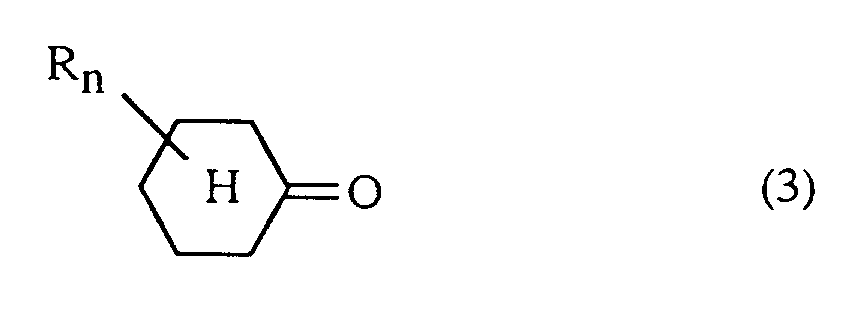
an amine represented by the formula (4)
R'- NH2 (4)
(wherein R' is defined above), and a nitro compound as a hydrogen acceptor corresponding to the amine and represented by the formula (5)
R'- NO2 (5)
(wherein R' is defined above)
in a sulfur-free polar solvent in the presence of a dehydrogenation catalyst. - The method for preparing an aromatic secondary amino compound according to Claim 5 wherein said reaction is carried out by dropping cyclohexanone or the nucleus-substituted cyclohexanone and the nitro compound into the sulfur-free polar solvent in which the dehydrogenation catalyst is dispersed.
- The method for preparing an aromatic secondary amino compound according to Claim 5 wherein said reaction is carried out by adding an alkaline metal compound and/or an alkaline earth metal compound as a cocatalyst.
- The method for preparing an aromatic secondary amino compound according to Claim 7 wherein said reaction is carried out by dropping cyclohexanone or the nucleus-substituted cyclohexanone and the nitro compound into a mixture obtained by adding the cocatalyst and the dehydrogenation catalyst to the sulfur-free polar solvent.
- The method for preparing an aromatic secondary amino compound according to Claim 7 wherein an organic acid having a logarithm (pKa) of a reciprocal of an acid dissociation constant in the range of from 3.5 to 6.0 is further added.
- The method for preparing an aromatic secondary amino compound according to Claim 8 wherein an organic acid having a logarithm (pKa) of a reciprocal of an acid dissociation constant in the range of from 3.5 to 6.0 is further added to the sulfur-free polar solvent.
- The method for preparing an aromatic secondary amino compound according to claim 5 wherein R is a hydrogen atom and R' is an aminophenyl group.
- The method for preparing an aromatic secondary amino compound according to claim 11, wherein the aromatic secondary amino compound is aminodiphenylamine.
Priority Applications (1)
| Application Number | Priority Date | Filing Date | Title |
|---|---|---|---|
| EP96114159A EP0753505A3 (en) | 1992-08-11 | 1993-08-11 | Process for the preparation of an aromatic secondary amino compound |
Applications Claiming Priority (28)
| Application Number | Priority Date | Filing Date | Title |
|---|---|---|---|
| JP21407892 | 1992-08-11 | ||
| JP214078/92 | 1992-08-11 | ||
| JP26150592 | 1992-09-30 | ||
| JP261505/92 | 1992-09-30 | ||
| JP26589892 | 1992-10-05 | ||
| JP265898/92 | 1992-10-05 | ||
| JP26589792 | 1992-10-05 | ||
| JP265897/92 | 1992-10-05 | ||
| JP282940/92 | 1992-10-21 | ||
| JP28294092 | 1992-10-21 | ||
| JP290133/92 | 1992-10-28 | ||
| JP29013392 | 1992-10-28 | ||
| JP29131192 | 1992-10-29 | ||
| JP291311/92 | 1992-10-29 | ||
| JP29709692 | 1992-11-06 | ||
| JP297096/92 | 1992-11-06 | ||
| JP119975/93 | 1993-05-21 | ||
| JP11997593 | 1993-05-21 | ||
| JP12142393 | 1993-05-24 | ||
| JP121423/93 | 1993-05-24 | ||
| JP12406293 | 1993-05-26 | ||
| JP124062/93 | 1993-05-26 | ||
| JP126826/93 | 1993-05-28 | ||
| JP12682793 | 1993-05-28 | ||
| JP126827/93 | 1993-05-28 | ||
| JP12682693 | 1993-05-28 | ||
| JP133273/93 | 1993-06-03 | ||
| JP13327393 | 1993-06-03 |
Related Child Applications (1)
| Application Number | Title | Priority Date | Filing Date |
|---|---|---|---|
| EP96114159.5 Division-Into | 1996-09-04 |
Publications (3)
| Publication Number | Publication Date |
|---|---|
| EP0588060A2 EP0588060A2 (en) | 1994-03-23 |
| EP0588060A3 EP0588060A3 (en) | 1994-04-13 |
| EP0588060B1 true EP0588060B1 (en) | 1997-04-02 |
Family
ID=27584890
Family Applications (2)
| Application Number | Title | Priority Date | Filing Date |
|---|---|---|---|
| EP93112886A Expired - Lifetime EP0588060B1 (en) | 1992-08-11 | 1993-08-11 | Method for preparing aromatic secondary amino compound |
| EP96114159A Withdrawn EP0753505A3 (en) | 1992-08-11 | 1993-08-11 | Process for the preparation of an aromatic secondary amino compound |
Family Applications After (1)
| Application Number | Title | Priority Date | Filing Date |
|---|---|---|---|
| EP96114159A Withdrawn EP0753505A3 (en) | 1992-08-11 | 1993-08-11 | Process for the preparation of an aromatic secondary amino compound |
Country Status (5)
| Country | Link |
|---|---|
| US (1) | US5382690A (en) |
| EP (2) | EP0588060B1 (en) |
| KR (2) | KR970001221B1 (en) |
| CN (1) | CN1040207C (en) |
| DE (1) | DE69309373T2 (en) |
Families Citing this family (4)
| Publication number | Priority date | Publication date | Assignee | Title |
|---|---|---|---|---|
| US6268387B1 (en) | 1997-12-23 | 2001-07-31 | Warner-Lambert Company | Thiourea and benzamide compounds, compositions and methods of treating or preventing inflammatory diseases and atherosclerosis |
| CN104355954B (en) * | 2014-11-06 | 2017-01-25 | 上海晶纯生化科技股份有限公司 | Process method for preparing tetrahydronaphthylamine compounds |
| CN113861065B (en) * | 2021-10-18 | 2023-09-26 | 苏州大学张家港工业技术研究院 | Method for preparing asymmetric imine or asymmetric secondary amine compound by photocatalysis |
| CN116589361A (en) * | 2022-08-22 | 2023-08-15 | 圣奥化学科技有限公司 | Preparation method of diaryl p-phenylenediamine compound |
Family Cites Families (12)
| Publication number | Priority date | Publication date | Assignee | Title |
|---|---|---|---|---|
| US3219702A (en) * | 1961-02-02 | 1965-11-23 | Monsanto Co | Manufacture of aromatic amines by aromatization |
| US3219703A (en) * | 1961-02-02 | 1965-11-23 | Monsanto Co | Manufacture of diarylamines from nitroaromatics |
| IT961239B (en) * | 1972-06-24 | 1973-12-10 | Snam Progetti | PROCESS FOR THE PRODUCTION OF DIPHENYLAMINE AND ITS DERIVATIVES |
| US4046810A (en) * | 1972-06-24 | 1977-09-06 | Snam Progetti S.P.A. | Process for the preparation of diphenylamine and derivatives thereof |
| IT961240B (en) * | 1972-06-24 | 1973-12-10 | Snam Progetti | PROCEDURE FOR THE PRODUCTION OF DIPHENYLAMINE AND ITS DERIVATIVES |
| DE2520893C2 (en) * | 1975-05-10 | 1982-03-11 | Bayer Ag, 5090 Leverkusen | Process for the production of diphenylamine |
| JPS6014546B2 (en) * | 1980-06-10 | 1985-04-13 | 日本電信電話株式会社 | Fault monitoring method for cable relay communication system |
| US4431841A (en) * | 1982-09-16 | 1984-02-14 | Uniroyal, Inc. | Process for making diarylamines |
| CA1244836A (en) * | 1984-03-14 | 1988-11-15 | Teruyuki Nagata | Process for producing diphenylamines or n,n'-diphenyl- phenylenediamines |
| US5196592A (en) * | 1991-01-10 | 1993-03-23 | Bayer Aktiengesellschaft | Process for the preparation of diphenylamines |
| DE4132945A1 (en) * | 1991-10-04 | 1993-04-08 | Bayer Ag | PROCESS FOR THE PREPARATION OF DIPHENYLAMINES |
| JPH05117214A (en) * | 1991-10-24 | 1993-05-14 | Takashi Akamatsu | Production of diphenylamine derivative |
-
1993
- 1993-08-02 US US08/100,149 patent/US5382690A/en not_active Expired - Lifetime
- 1993-08-11 EP EP93112886A patent/EP0588060B1/en not_active Expired - Lifetime
- 1993-08-11 EP EP96114159A patent/EP0753505A3/en not_active Withdrawn
- 1993-08-11 DE DE69309373T patent/DE69309373T2/en not_active Expired - Lifetime
- 1993-08-11 KR KR1019930015557A patent/KR970001221B1/en not_active Expired - Lifetime
- 1993-08-11 CN CN93117780A patent/CN1040207C/en not_active Expired - Lifetime
-
1996
- 1996-09-10 KR KR96039098A patent/KR970001219B1/en not_active Expired - Lifetime
Also Published As
| Publication number | Publication date |
|---|---|
| EP0588060A2 (en) | 1994-03-23 |
| KR970001221B1 (en) | 1997-02-04 |
| DE69309373T2 (en) | 1997-11-06 |
| CN1040207C (en) | 1998-10-14 |
| KR970001219B1 (en) | 1997-02-04 |
| DE69309373D1 (en) | 1997-05-07 |
| KR940003919A (en) | 1994-03-14 |
| EP0753505A2 (en) | 1997-01-15 |
| CN1091121A (en) | 1994-08-24 |
| EP0753505A3 (en) | 1997-03-26 |
| US5382690A (en) | 1995-01-17 |
| EP0588060A3 (en) | 1994-04-13 |
Similar Documents
| Publication | Publication Date | Title |
|---|---|---|
| JP2001072648A (en) | Production of 4-nitrodiphenylamine and 4- nitrosodiphenylamine from carbanilide | |
| US4952731A (en) | Process for producing diphenylamines or N,N'-diphenyl-phenylenediamines | |
| HK1049327A1 (en) | Process for producing aminodiphenylamines | |
| CN110734380B (en) | Preparation method of diaryl p-phenylenediamine anti-aging agent | |
| US5382690A (en) | Method for preparing aromatic secondary amino compound | |
| US4431841A (en) | Process for making diarylamines | |
| US5618980A (en) | Method for preparing aromatic secondary amino compound | |
| JP3251728B2 (en) | Method for producing aromatic secondary amino compound | |
| JP3714539B2 (en) | Method for producing aromatic secondary amino compound | |
| JP3213502B2 (en) | Method for producing triphenylamines | |
| JP3137828B2 (en) | Method for producing aminodiphenylamine | |
| JPH034053B2 (en) | ||
| JP3177351B2 (en) | Method for producing tris (diarylamino) benzenes | |
| JP3234655B2 (en) | Process for producing diphenylamine or its nuclear substituted product | |
| CN1054368C (en) | Process for the preparation of diphenylamine or nucleus-substituted derivative thereof | |
| KR920001167B1 (en) | Process for the preparation of carbamic ester | |
| JP3135436B2 (en) | Method for producing diphenylamine or its nuclear-substituted product | |
| JPH0528216B2 (en) | ||
| JP3177350B2 (en) | Method for producing dinonyldiphenylamine | |
| JPH07242606A (en) | Process for producing 3-nitro-4'-aminodiphenyl ethers and derivatives thereof | |
| CN1636966A (en) | Process for preparing diamines and polyamines of the diphenylmethane series | |
| JPH0665662B2 (en) | Method for producing triphenylamine or nuclear substitution product thereof | |
| JPS60202846A (en) | Production of n,n'-diphenyl-phenylenediamine or its nucleus-substituted derivative | |
| JPH0770003A (en) | Method for producing diphenylamines | |
| JPH08151352A (en) | Production of diarylamines |
Legal Events
| Date | Code | Title | Description |
|---|---|---|---|
| PUAI | Public reference made under article 153(3) epc to a published international application that has entered the european phase |
Free format text: ORIGINAL CODE: 0009012 |
|
| PUAL | Search report despatched |
Free format text: ORIGINAL CODE: 0009013 |
|
| 17P | Request for examination filed |
Effective date: 19930811 |
|
| AK | Designated contracting states |
Kind code of ref document: A2 Designated state(s): DE FR GB IT |
|
| AK | Designated contracting states |
Kind code of ref document: A3 Designated state(s): DE FR GB IT |
|
| 17Q | First examination report despatched |
Effective date: 19950823 |
|
| GRAG | Despatch of communication of intention to grant |
Free format text: ORIGINAL CODE: EPIDOS AGRA |
|
| GRAH | Despatch of communication of intention to grant a patent |
Free format text: ORIGINAL CODE: EPIDOS IGRA |
|
| GRAH | Despatch of communication of intention to grant a patent |
Free format text: ORIGINAL CODE: EPIDOS IGRA |
|
| GRAA | (expected) grant |
Free format text: ORIGINAL CODE: 0009210 |
|
| AK | Designated contracting states |
Kind code of ref document: B1 Designated state(s): DE FR GB IT |
|
| XX | Miscellaneous (additional remarks) |
Free format text: TEILANMELDUNG 96114159.5 EINGEREICHT AM 04/09/96. |
|
| REF | Corresponds to: |
Ref document number: 69309373 Country of ref document: DE Date of ref document: 19970507 |
|
| ET | Fr: translation filed | ||
| PLBE | No opposition filed within time limit |
Free format text: ORIGINAL CODE: 0009261 |
|
| 26N | No opposition filed | ||
| REG | Reference to a national code |
Ref country code: GB Ref legal event code: 732E |
|
| REG | Reference to a national code |
Ref country code: FR Ref legal event code: TP |
|
| REG | Reference to a national code |
Ref country code: GB Ref legal event code: IF02 |
|
| PGFP | Annual fee paid to national office [announced via postgrant information from national office to epo] |
Ref country code: GB Payment date: 20120808 Year of fee payment: 20 |
|
| PGFP | Annual fee paid to national office [announced via postgrant information from national office to epo] |
Ref country code: IT Payment date: 20120809 Year of fee payment: 20 Ref country code: FR Payment date: 20120823 Year of fee payment: 20 Ref country code: DE Payment date: 20120808 Year of fee payment: 20 |
|
| REG | Reference to a national code |
Ref country code: DE Ref legal event code: R071 Ref document number: 69309373 Country of ref document: DE |
|
| REG | Reference to a national code |
Ref country code: GB Ref legal event code: PE20 Expiry date: 20130810 |
|
| PG25 | Lapsed in a contracting state [announced via postgrant information from national office to epo] |
Ref country code: DE Free format text: LAPSE BECAUSE OF EXPIRATION OF PROTECTION Effective date: 20130813 |
|
| PG25 | Lapsed in a contracting state [announced via postgrant information from national office to epo] |
Ref country code: GB Free format text: LAPSE BECAUSE OF EXPIRATION OF PROTECTION Effective date: 20130810 |