EP0586378B1 - Novel platinum(ii) complex and processes for preparing the same - Google Patents

Novel platinum(ii) complex and processes for preparing the same Download PDF

Info

Publication number
EP0586378B1
EP0586378B1 EP92902293A EP92902293A EP0586378B1 EP 0586378 B1 EP0586378 B1 EP 0586378B1 EP 92902293 A EP92902293 A EP 92902293A EP 92902293 A EP92902293 A EP 92902293A EP 0586378 B1 EP0586378 B1 EP 0586378B1
Authority
EP
European Patent Office
Prior art keywords
bis
platinum
dioxolane
aminomethyl
formula
Prior art date
Legal status (The legal status is an assumption and is not a legal conclusion. Google has not performed a legal analysis and makes no representation as to the accuracy of the status listed.)
Expired - Lifetime
Application number
EP92902293A
Other languages
German (de)
French (fr)
Other versions
EP0586378A1 (en
Inventor
Dae-Kee Jukong APT 505-501 897 Maetan-dong KIM
Ganghyeok 11-302 Namsu-dong Changan-ku KIM
Jongsik 600 Jungja-dong GAM
Yong Baik Cho
Hun Taek Kim
Joo Ho Tai
Key Hyup Kim
Current Assignee (The listed assignees may be inaccurate. Google has not performed a legal analysis and makes no representation or warranty as to the accuracy of the list.)
SK Discovery Co Ltd
Original Assignee
Sunkyung Industries Ltd
Priority date (The priority date is an assumption and is not a legal conclusion. Google has not performed a legal analysis and makes no representation as to the accuracy of the date listed.)
Filing date
Publication date
Priority claimed from KR1019910019969A external-priority patent/KR940010296B1/en
Priority claimed from KR1019910024631A external-priority patent/KR940010297B1/en
Priority claimed from KR1019910024632A external-priority patent/KR940010298B1/en
Application filed by Sunkyung Industries Ltd filed Critical Sunkyung Industries Ltd
Publication of EP0586378A1 publication Critical patent/EP0586378A1/en
Application granted granted Critical
Publication of EP0586378B1 publication Critical patent/EP0586378B1/en
Anticipated expiration legal-status Critical
Expired - Lifetime legal-status Critical Current

Links

Classifications

    • CCHEMISTRY; METALLURGY
    • C07ORGANIC CHEMISTRY
    • C07FACYCLIC, CARBOCYCLIC OR HETEROCYCLIC COMPOUNDS CONTAINING ELEMENTS OTHER THAN CARBON, HYDROGEN, HALOGEN, OXYGEN, NITROGEN, SULFUR, SELENIUM OR TELLURIUM
    • C07F15/00Compounds containing elements of Groups 8, 9, 10 or 18 of the Periodic Table
    • C07F15/0006Compounds containing elements of Groups 8, 9, 10 or 18 of the Periodic Table compounds of the platinum group
    • C07F15/0086Platinum compounds
    • C07F15/0093Platinum compounds without a metal-carbon linkage

Definitions

  • the present invention relates to novel platinum(II) complexes which show a potent anti-tumor activity with low toxicity and good solubility in water, processes for preparing the same, and an anti-tumor agent comprising said platinum(II) complex as an active ingredient.
  • the present invention also relates to novel intermediates useful for the preparation of said platinum(II) complexes.
  • Platinum coordination complexes cytotoxic agents first identified by Rosenberg and his coworkers in 1965, are fully documented in the literature(B. Rosenberg et al ., Nature, 222 , 385(1969)).
  • One of the best known platinum coordination complexes is cis -dichlorodiammineplatinum(II), also known as cis -DDP or cisplatin.
  • Cisplatin has proven to be effective on a variety of human cancers such as testicular, ovarian, bladder, and head and neck cancer; however, its serious dose-limiting toxicities include severe nephrotoxicity, myelosuppression, nausea and vomiting, and neurotoxicity, especially ototoxicity and peripheral neuropathy.
  • cisplatin is not very soluble in water and dissolves in water very slowly, which makes its intravenous administration difficult. Therefore, numerous cisplatin derivatives have been synthesized in a search for improved anti-cancer agents with reduced toxicity and improved water-solubility. However, no platinum coordination complex which meets these criteria has been developed.
  • a primary objective of the present invention is to provide novel platinum(II) complexes which have potent anti-tumor activities with low toxicity and good water-solubility, which are useful for the treatment of human cancers, represented by the formula of: wherein:
  • the platinum complexes of the present invention comprise all of the above stereoisomers of the formulas(1a1) and (1a2) and mixtures thereof.
  • the platinum complexes of the present invention comprise all of the above stereoisomers of the formulas(1a1) and (1a2) and mixtures thereof.
  • the two isomers For the purpose of the present invention, however, there will be made no distinction between the two isomers.
  • a mixture of said stereoisomers of formulas(1a1) and (1a2) is not readily separable; and it is believed that the two stereoisomers have an equivalent level of anti-tumor activity.
  • Another objective of the present invention is to provide processes for preparing said platinum(II) complexes of formula(1).
  • a further objective of the present invention is to provide novel intermediates useful for said processes and processes for preparing other upstream intermediates.
  • a still further objective of the present invention is to provide an anti-cancer agent comprising said platinum(II) complex as an active ingredient.
  • R 1 and R 2 jointly form a cycloalkane such as a cyclopentane or cyclohexane group; those wherein R 1 and R 2 are both methyl or ethyl group; those wherein either R 1 or R 2 is an ethyl group and the other is a methyl group, or one of R 1 and R 2 is an ethyl or isopropyl group and the other is a hydrogen atom; and, those wherein two Xs jointly form the group of formula(a) wherein R 3 is a hydrogen atom, or the group of formula(b) wherein both R 4 and R 5 is hydrogen.
  • a cycloalkane such as a cyclopentane or cyclohexane group
  • R 1 and R 2 are both methyl or ethyl group
  • Most of the compounds represented by formula(1) are soluble in water. Particularly, the compounds having the R 1 group which is different from the R 2 group show a better water-solubility; and the shorter the alkyl chain length of R 1 or R 2 group is, the higher their water-solubility is.
  • Representative compounds of the present invention include:
  • More preferred compounds include:
  • platinum(II) complexes of formula(1) may be prepared by employing various methods; and among them, more preferred ones are described below.
  • Methods A and B may be employed for preparing the compounds of formula(1) wherein two Xs jointly form the group of formula(a), i.e., the compounds represented by the formula of: wherein R 1 , R 2 , R 3 and the absolute configurations are the same as defined previously. wherein R 1 , R 2 , R 3 and the absolute configurations are the same as defined previsouly, and Hal is a halogen atom.
  • the reaction may be advantageously carried out in an aqueous medium or a mixed medium of an aqueous solvent and an alcoholic solvent such as methanol and ethanol in a dark environment at a temperature between 0°C and 100°C, preferably between 50°C and 70°C, for about 1 hour to 3 days.
  • an alcoholic solvent such as methanol and ethanol
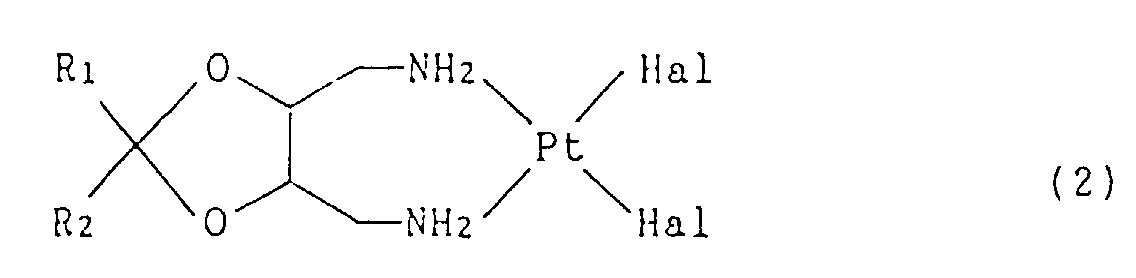
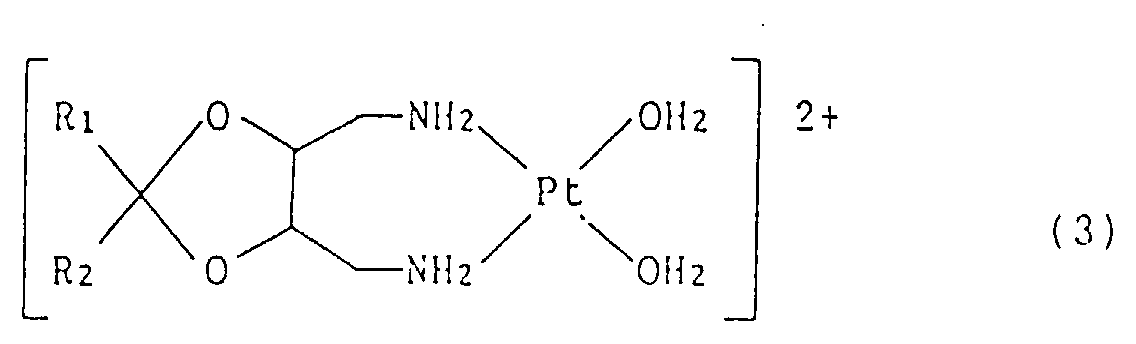
  • Step 1 of Method B a dihalogenodiamine platinum(II) complex of formula(2) is reacted with an aqueous silver nitrate solution, preferably in the molar ratio of about 1:2, to obtain an aqueous solution of a diaquacomplex represented by formula(3), which is then converted to an aqueous solution of a compound represented by formula(4) through an anion-exchange resin.
  • the reaction of the compound(2) with silver nitrate may be advantageously carried out in an aqueous medium in a dark environment at a temperature between 0°C and 80°C for about 20 minutes to 3 days.
  • the anion-exchange resin used for converting the compound(3) to the compound(4) is generally an OH- type resin such as Amberlite IRA-400, Dowex I or Daiaion SA-10A.
  • the reaction may be advantageously carried out in an aqueous medium in a dark environment at a temperature between 0°C and 100°C, preferably 50°C and 70°C, for about 1 hour to 3 days.
  • Methods C and D may be employed for preparing the compounds of formula(1) wherein two Xs jointly from the group of formula(b), i.e., the compounds represented by the formula of: wherein R 1 , R 2 , R 4 , R 5 and the absolute configurations are the same as defined previously. wherein R 1 , R 2 , R 4 , R 5 , the absolute configurations and Hal are the same as defined previously.
  • a dihalogenodiamine platinum(II) complex of formula(2) is reacted with a silver salt of formula(5), preferably in the molar ratio of from 1:0.5 to 1:5, to obtain the desired compound of formula(1b).
  • the reaction is advantageously, carried out in an aqueous medium in a dark environment at a temperature between 0°C and 100°C, preferably between 50°C and 70°C, for about 1 hour to 3 days.
  • R 1 , R 2 , R 4 , R 5 , the absolute configurations and Hal are the same as defined previously
  • M is a monovalent cation such as Na, K and the like.
  • Step 1 of Method D a dihalogenodiamine platinum(II) complex is reacted with a silver ion, for example, with 2 moles of silver nitrate per 1 mole of compound(2) or with 1 mole of silver sulfate per 1 mole of compound(2), to obtain an aqueous solution of a diaquacomplex represented by formula(3).
  • the reaction is advantageously carried out in an aqueous medium at a temperature between 0°C and 80°C for about 1 hour to 3 days.
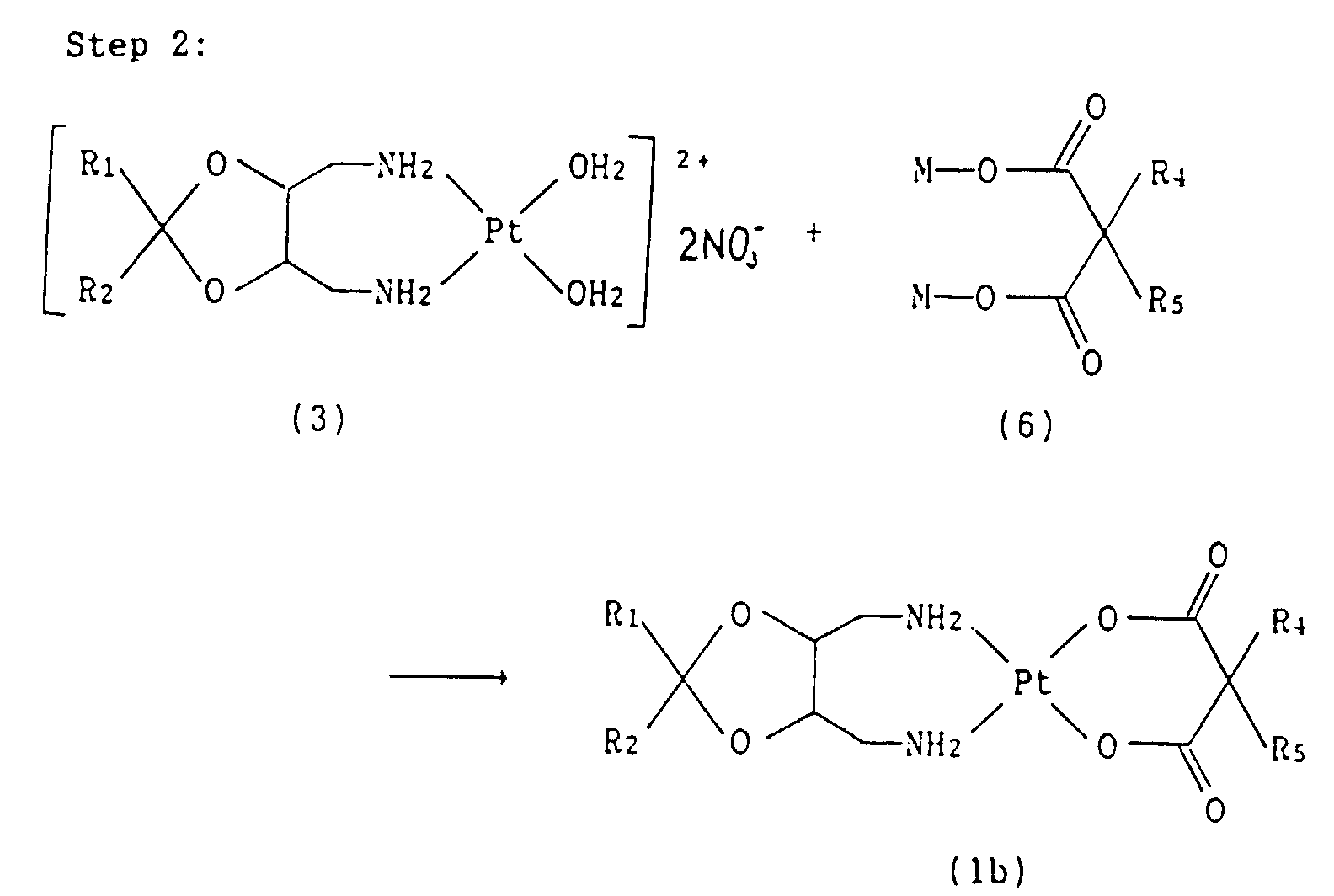
  • Step 2 the aqueous solution of a diaquacomplex(3) obtained above is reacted with a compound of formula(6) to obtain the desired compound of formula(1b).
  • the reaction is advantageously carried out in an aqueous medium at a temperature between 0°C and 100°C for about 1 hour to 3 days.
  • the dihalogenodiamine platinum(II) complexes of formula (2) employed as starting meterials in Methods A to D may be prepared as follows: wherein R 1 , R 2 , the absolute configurations, Hal and M are the same as defined previously.
  • the selection of said aldehyde, acetal, ketone or ketal is made according to the substituents R 1 and R 2 .
  • formaldehyde may be chosen when both R 1 and R 2 are hydrogens; acetaldehyde diethyl acetal when either R 1 and R 2 is a methyl group and the other is a hydrogen atom; propionaldehyde diethyl acetal when either R 1 or R 2 is a ethyl group and the other is a hydrogen atom; isobutylaldehyde when one of R 1 and R 2 is a isopropyl group and the other is a hydrogen atom; cyclopentanone when R 1 and R 2 jointly form cyclopentane together with the carbon atom attached thereto; or cyclohexanone when R 1 and R 2 jointly form cyclohexane together with the carbon atom attached thereto.
  • the compound of formula(8) thus obtained is reacted with an azide ion in N,N-dimethylformamide at a temperature between 20°C and 120°C for about 1 to 24 hours to obtain a 4,5-bis(azidomethyl)-1,3-dioxolane of formula(9).
  • said 4,5-bis(azidomethyl)-1,3-dioxolane of formula(9) is subjected to a reduction process to yield a 4,5-bis (aminomethyl)-1,3-dioxolane of formula(10) by using a conventional method such as reduction with hydrogen in the presence of palladium-charcoal or platinum(IV) oxide in an alcoholic medium under a pressure between 15 psi and 70 psi at a temperature between 0°C and 50°C for about 30 minutes to 1 day.
  • the compound of formula(10) is reacted with an equimolar amount of tetrahalogenoplatinate(II) salt represented by the formula of M 2 Pt(Hal) 4 wherein M and Hal have the same meanings as defined previously, generally in an aqueous medium at a temperature between 0°C and 100°C, preferably between 50°C and 70°C at an atmospheric pressure but preferably under a stream of an inert gas such as nitrogen or argon gas, to obtain the dihalogenodiamine platinum(II) complex of formula(2).
  • M and Hal have the same meanings as defined previously
  • the compound of formula(8) may be prepared by using an alternative method, which comprises the following steps: wherein R 1 , R 2 , and the absolute configurations, are the same as defined previously, and R is a methyl or ethyl group.
  • tartaric acid of formula(11) is reacted with methanol or ethanol in the presence of an acid catalyst to obtain a tartaric acid diester of formula(12).
  • the compound of formula(12) is reacted with an appropriate aldehyde, acetal, ketone or ketal, preferably in the presence of an acid catalyst such as methanesulfonic acid, concentrated sulfuric acid and the like, or phosphorus pentoxide(Tsuzuki, et al ., Bull, Chem. Sco. Japan 15 , 55(1940)), to obtain a 1,3-dioxolane-4,5-dicarboxylic acid diester of formula(13).
  • an acid catalyst such as methanesulfonic acid, concentrated sulfuric acid and the like, or phosphorus pentoxide(Tsuzuki, et al ., Bull, Chem. Sco. Japan 15 , 55(1940)
  • aldehyde, acetal, ketone or ketal can be chosen according to the substituents R 1 and R 2 , as previously illustrated.
  • the compound of formula(13) is then reduced with lithium aluminum hydride(LAH) to obtain a 4,5-bis(hydroxymethyl)-1,3-dioxolane of formula(14).
  • the compound of formula(14) is reacted with methanesulfonyl chloride in pyridine to obtain the 1,3-dioxolane-4,5-bis(methanesulfonate) of formula(8).
  • the compounds of formula (8), (9), (10) and (2) having the (4 R , 5 R ) absolute configurations at the respective chiral centers in said 4,5-bis(aminomethyl)-1,3-dioxolane are obtainable from the starting compound of formula(7) or (11) existing as D-form, i.e., D-threitol 1,4-bis(methanesulfonate) or D-tartaric acid.
  • the compound of formula(7) or (11) existing as L-form i.e., L-threitol 1,4-bis(methanesulfonate) or L-tartaric acid yields the compounds of formula(8), (9), (10) and (2) having the (4 S , 5 S ) configurations.
  • the platinum(II) complexes of the present invention have improved pharmacological characteristics such as excellent anti-tumor activities, low nephrotoxicity and good solubility in water and the like; and, therefore, are useful as an anti-cancer agent.
  • the compounds of the present invention can be formulated by any of the known appropriate methods with a pharmaceutically acceptable carrier and, if necessary, an adjuvant.
  • a pharmaceutically acceptable carrier for instance, the compounds of the present invention can be formulated into a solid preparation such as tablets, pills, granules, powder, capsules and the like, or a liquid preparation such as solution, suspension, emulsion and the like.
  • the preparation is made in an injection formula, an intravenous drip infusion and the like.
  • the compound is preferably dissolved in distilled water or an aqueous solution of a salt such as sodium chloride.
  • a suitable fluid therapy such as a physiological saline, a glucose-sodium chloride solution and the like.
  • the effective dosage of the compounds of the present invention may vary with the physical condition of the patients and the location and status of the tumors. In general, it has been shown advantageous to administer the active compounds in an amount of about 50 to 1000mg per 1m 2 body surface area in order to achieve the desired result.
  • the structure of the compounds(II) of the present invention was confirmed by various analytical methods such as infrared(IR) spectrometry, 1 H NMR spectrometry, 13 C NMR spectrometry, elemental analysis, fast atom bombardment mass spectrometry(FAB-MS) and the like.
  • IR infrared
  • 1 H NMR spectrometry 1 H NMR spectrometry
  • 13 C NMR spectrometry elemental analysis
  • FAB-MS fast atom bombardment mass spectrometry
  • Example 1A Synthesis of (glycolato- O , O' )[(4 R ,5 R )-4,5-bis(aminomethyl)-1,3-dioxolane]platinum(II) by method A
  • Example 1B Synthesis of (glycolato- O , O' )[(4 R ,5 R )-4,5-bis(aminomethyl)-1,3-dioxolane]platinum(II) by Method B
  • Example 2A Synthesis of (glycolato- O , O' )[(4 R ,5 R )-4,5-bis(aminomethyl)-2,2-dimethyl-1,3-dioxolane]platinum(II) by Method A
  • Example 2B Synthesis of (glycolato- O , O' )[(4 R ,5 R )-4,5-bis(aminomethyl)-2,2-dimethyl-1,3-dioxolane]platinum(II) by Method B
  • Example 3A Synthesis of (glycolato- O , O' )[(4 R ,5 R )-4,5-bis(aminomethyl)-1,3-dioxolane-2-spiro-1'-cyclopentane]platinum (II) by Method A
  • Example 3B Synthesis of (glycolato- O , O' )[(4 R ,5 R )-4,5-bis(aminomethyl)-1,3-dioxolane-2-spiro-1'-cyclopentane]platinum (II) by Method B
  • Example 4A Synthesis of (glycolato- O , O' ) ⁇ cyclohexanespiro-2'-[(4' R ,5' R )-4',5'-bis(aminomethyl)-1',3'-dioxolane] ⁇ -platinum(II) by Method A
  • Example 4B Synthesis of (glycolato- O , O' ) ⁇ cyclohexanespiro-2'-[(4' R ,5' R )-4',5'-bis(aminomethyl)-1',3'-dioxolane] ⁇ -platinum(II) by Method B
  • Example 5A Synthesis of (glycolato- O , O' )[(4 R ,5 R )-4,5-bis(aminomethyl)-2-methyl-1,3-dioxolane]platinum(II) by Method A
  • Example 5B Synthesis of (glycolato- O , O ')[(4 R ,5 R )-4,5-bis(aminomethyl)-2-methyl-1,3-dioxolane]platinum(II) by Method B
  • Example 6A Synthesis of (glycolato- O , O ')[(4 R ,5 R )-4,5-bis(aminomethyl)-2-ethyl-1,3-dioxolane]platinum(II) by Method A
  • Example 6B Synthesis of (glycolato- O , O ')[(4 R ,5 R )-4,5-bis(aminomethyl)-2-ethyl-1,3-dioxolane]platinum(II) by Method B
  • Example 7A Synthesis of (glycolato- O , O' )[(4 R ,5 R )-4,5-bis(aminomethyl)-2-isopropyl-1,3-dioxolane]platinum(II) by Method A
  • Example 7B Synthesis of (glycolato- O , O' )[(4 R ,5 R )-4,5-bis(aminomethyl)-2-isopropyl-1,3-dioxolane]platinum(II) by Method B
  • Example 8 Synthesis of (glycolato- O , O ')[(4 R ,5 R )-4,5-bis(aminomethyl)-2,2-diethyl-1,3-dioxolane]platinum(II) by Method A
  • Example 13A Synthesis of (L-lactato- O , O' )[(4 R ,5 R )-4,5-bis(aminomethyl)-1,3-dioxolane]platinum(II) by Method A
  • Example 13B Synthesis of (L-lactato- O , O' )[(4 R ,5 R )-4,5-bis(aminomethyl)-1,3-dioxolane]platinum(II) by Method B
  • Example 14A Synthesis of (L-lactato- O , O' )[(4 R ,5 R )-4,5-bis(aminomethyl)-2,2-dimethyl-1,3-dioxolane]platinum(II) by Method A
  • Example 14B Synthesis of (L-lactato- O , O ')[(4 R ,5 R )-4,5-bis(aminomethyl)-2,2-dimethyl-1,3-dioxolane]platinum(II) by Method B
  • Example 15A Synthesis of (L-lactato- O , O' )[(4 R ,5 R )-4,5-bis(aminomethyl)-1,3-dioxolane-2-spiro-1'-cyclopentane]-platinum(II) by Method A
  • Example 15B Synthesis of (L-lactato- O , O' )[(4 R ,5 R )-4,5-bis(aminomethyl)-1,3-dioxolane-2-spiro-1'-cyclopentane]-platinum(II) by Method B
  • Example 16A Synthesis of (L-lactato- O , O ') ⁇ cyclohexanespiro-2'-[(4' R ,5' R )-4',5'-bis(aminomethyl)-1',3'-dioxolane] ⁇ -platinum(II) by Method A
  • Example 16B Synthesis of (L-lactato- O , O' ) ⁇ cyclohexanespiro-2'-[(4' R ,5' R )-4',5'-bis(aminomethyl)-1',3'-dioxolane] ⁇ platinum(II) by Method B
  • Exampled 17A Synthesis of (L-lactato- O , O ')[(4 R ,5 R )-4,5-bis(aminomethyl)-2-methyl-1,3-dioxolane]platinum(II) by Method A
  • Exampled 17B Synthesis of (L-lactato- O , O ')[(4 R ,5 R )-4,5-bis(aminomethyl)-2-methyl-1,3-dioxolane]platinum(II) by Method B
  • Example 18A Synthesis of (L-lactato- O , O' )[(4 R ,5 R )-4,5-bis(aminomethyl)-2-ethyl-1,3-dioxolane]platinum(II) by method A
  • Example 18B Synthesis of (L-lactato- O , O ')[(4 R ,5 R )-4,5-bis(aminomethyl )-2-ethyl-1,3-dioxolane]platinum(II) by Method B
  • Example 19A Synthesis of (L-lactato- O , O' )[(4 R ,5 R )-4,5-bis(aminomethyl)-2-isopropyl-1,3-dioxolane]platinum(II) by Method A
  • Example 19B Synthesis of (L-lactato- O , O' )[(4 R ,5 R )-4,5-bis(aminomethyl)-2-isopropyl-1,3-dioxolane]platinum(II) by Method B
  • a suspension of cis -diiodo[(4 R ,5 R )-4,5-bis(aminomethyl)-1,3-dioxolane]platinum(II)(2.00 g, 3.4 mmol) and 1,1-cyclobutanedicarboxylic acid disilver salt(1.23 g, 3.4 mmol) in water(400 ml) was stirred at 60°C for 16 hours in the dark.
  • the resulting silver iodide was filtered through a pad of celite and the filtrate was again filtered using a millipore filter(0.22 ⁇ m).
  • Example 22 Synthesis of cis -cyclobutane-1,1-dicarboxylato-[(4 R ,5 R )-4,5-bis(aminomethyl)-2-methyl-1,3-dioxolane]-platinum(II) by Method C
  • a suspension of cis -diiodo[(4 R ,5 R )-4,5-bis(aminomethyl)-2-methyl-1,3-dioxolane]platinum(II)(1.00 g, 1.7 mmol) and 1,1-cyclobutanedicarboxylic acid disilver salt(0.60 g, 1.7 mmol) in water(170 ml) was stirred at 60°C for 16 hours in the dark.
  • the resulting silver iodide was filtered through a pad of celite and the filtrate was again filtered using a millipore filter(0.22 ⁇ m).
  • Example 25 Synthesis of cis -cyclobutane-1,1-dicarboxylato-[(4 S ,5 S )-4,5-bis(aminomethyl)-2-ethyl-1,3-dioxolane] platinum(II) by Method C
  • Example 28 Synthesis of cis -cyclobutane-1,1-dicarboxylato-[(4 R ,5 R )-4,5-bis(aminomethyl)-2-isopropyl-1,3-dioxolane]platinum(II) by Method C
  • Example 42 Synthesis of cis -dimethylmalonato[(4 R ,5 R )-4,5-bis-(aminomethyl)-1,3-dioxolane-2-spiro-1'-cyclopentane]-platinum(II) by method C
  • Example 46 Synthesis of cis -cyclobutane-1,1-dicarboxylato-[(4 S ,5 S )-4,5-bis(aminomethyl)-1,3-diaxalane-2-spiro-1' -cyclohexane]platinum(II) by Method D
  • D-threitol 1,4-bis(methanesulfonate) was reacted with formaldehyde and concentrated sulfuric acid as described in J. Med. Chem., 7 , 14 (1964) to yield 2,3- O -methylene-D-threitol 1,4-bis(methanesulfonate) in 61% yield.
  • D-threitol 1,4-bis(methanesulfonate) was reacted with acetaldehyde diethyl acetal and methanesulfonic acid as described in J. Med. Chem., 7 , 14 (1964) to yield 2,3-O-ethylidene-D-threitol 1,4-bis-(methanesulfonate) in 95% yield.
  • 2,3- O -propionylidene-D-threitol 1,4-bis-(methansulfonate) may be prepared by the following method.
  • 2,3- O -isobutylidene-D-threitol 1,4-bis-(methanesulfonate) may be prepared by the following method.
  • 2,3- O -cyclopentylidene-D-threitol 1,4-bis(methanesulfonate) may prepared by the following method.
  • 2,3- O -cyclohexylidene-D-threitol 1,4-bis-(methanesulfonate) may be prepared by the following method.
  • Murine leukemia L1210 cells(1 x 10 5 ) were treated with various concentrations of the compounds prepared in the above examples in RPMI 1640 medium supplemented with 10% fetal calf serum, and cultured in a 5% CO 2 humidified incubator at 37°C for 48 hours. Their viability, estimated by staining with 0.17% Trypan blue, was compared with that of control cells cultured in the identical medium without the compounds.
  • the assays were carried out using at least six different concentrations, and the IC50 values (the concentrations in ⁇ g/ml required for 50% inhibition of growth) were calculated from their logarithmic dose-response curves. The results are shown in Table 1.
  • Example 1 0.36
  • Example 2 0.15
  • Example 3 0.10
  • Example 4 0.08
  • Example 5 0.35
  • Example 6 0.22
  • Example 7 0.06
  • Example 8 0.06
  • Example 9 0.08
  • Example 10 0.13
  • Example 11 0.10
  • Example 12 0.10
  • Example 13 0.55
  • Example 14 0.46
  • Example 15 0.33
  • Example 16 0.34
  • Example 17 0.44
  • Example 18 0.32
  • Example 19 0.29
  • Example 20 1.28
  • Example 21 2.08
  • Example 22 0.90
  • Example 23 1.75
  • Example 24 0.55
  • Example 25 1.02
  • Example 26 0.65
  • Example 27 2.36
  • Example 28 1.14
  • Example 29 2.12
  • Example 30 0.55
  • Example 31 1.75
  • Example 32 1.05
  • Example 33 0.50 Example 34 0.60
  • Example 35 0.44
  • Example 36 0.76
  • Example 37 0.42
  • Example 38 0.43
  • Example 39 0.31
  • Example 40 0.52
  • Example 11 0.44
  • Example 42 0.54
  • Example 43 0.72
  • the compounds of the present invention have a potent ability to inhibit the growth of cancer cells at a low concentration.
  • Murine leukemia L1210 cells were maintained in the peritoneal cavities of 6-week-old male DBA/2 mice by weekly transfer in accordance with the procedure described in cancer chemotherary Reports, Part 3, 3 (2), 7 (1972). Specifically, 1 x 10 6 leukemia cells were inoculated into the abdominal cavities of 6-week-old male BDF 1 mice weighing 21 ⁇ 3g on day 0. Each treatment group consisted of seven mice. The test compounds were dissolved or suspended in 0.5% carboxymethyl cellulose(CMC) solution (in water) and were administered intraperitoneally on days 1, 5, and 9 relative to the tumor inoculation.
  • CMC carboxymethyl cellulose
  • mice of 6-week-old male BDF 1 weighing 21 ⁇ 3g were used as the control group, which were injected with 0.5% CMC solution only in the same manner as above.
  • T/C % Mean survival time of compound-treated group Mean survival time of control group x 100
  • the compounds of the present invention have an excellent life prolongation effect for mice inoculated with murine leukemia L1210 cells.
  • a standard plot of UV absorbance(220 nm) vs. concentration was made; and employed to determine water-sobubility.
  • the standard solution was made in water or 10% ethanol in water (in case of a compound with poor solubility).
  • Example 1 >30 Example 2 17.5 Example 3 5.8 Example 4 2.9 Example 5 >50 Example 6 >50 Example 7 >30 Example 8 >30 Example 9 11.6 Example 10 >30 Example 11 4.6 Example 12 2.1 Example 13 >100 Example 14 >100 Example 15 4.9 Example 16 3.8 Example 17 >100 Example 18 >100 Example 19 >100 Example 20 3.1 Example 21 3.1 Example 22 24.9 Example 23 22.1 Example 24 12.0 Example 25 11.8 Example 26 2.0 Example 27 1.9 Example 28 2.1 Example 29 2.0 Example 30 1.9 Example 31 1.9 Example 32 0.9 Example 33 21.9 Example 34 > 50 Example 35 > 30 Example 36 27.1 Example 37 2.0 Example 38 4.1 Example 39 5.3 Example 40 11.3 Example 41 > 30 Example 42 6.7 Example 43 7.9 Example 44 7.8 Example 45 2.7 Example 46 0.9 Cisplatin 1.2 Carboplatin 10.0
  • the compounds of the present invention were dissolved or suspended in 0.5% CMC solution(in water) and were administered intraperitoneally one time to 8-week-old male ICR mice weighing 30 ⁇ 3g. Each treatment and control groups consisted of six mice.
  • the administration amount of the test compound was 1.5 times the optimum dose obtained in Table 2, or more.
  • the body weight ratio shown in Table 5 is a ratio of the body weight measured on days 1, 4 and 8 from the administration of the compound to the body weight measured on the administration day.
  • mice employed BUN(mg/1000ml) creatinine(mg/100ml) 1st day 4th day 8th day 1st day 4th day 8th day Control 0.5% CMC 6 26.0 29.7 27.8 ⁇ 1.3 ⁇ 2.2 ⁇ 2.1
  • Example 1 37.5 6 28.07 94.42 27.44 ⁇ 0.98 ⁇ 45.22 ⁇ 2.79
  • Example 2 18.8 6 25.87 22.13 31.13 ⁇ 1.45 ⁇ 2.22 ⁇ 2.73
  • Example 3 18.8 6 26.45 20.04 40.86 ⁇ 0.08 ⁇ 0.55 ⁇ 3.88
  • Example 4 37.5 6 24.23 22.13 25.54 ⁇ 0.64 ⁇ 1.44 ⁇ 1.23
  • Example 5 37.5 6 25.33 73.66 28.70 ⁇ 1.63 ⁇ 25.47 ⁇ 0.97
  • Example 6 18.8 6 22.41 22.67 30.41 ⁇ 1.00 ⁇ 1.18 ⁇ 0.92
  • Example 7 18.8 6 23.69 22.04
  • Each treatment group consisted of 6 mice.
  • the test compounds were administered intraperitoneally.
  • the compounds of the present invention have a higher median lethal dose(LD 50 ) value than cisplatin; and it is relatively harmless in the dosges of several grams or more.

Landscapes

  • Chemical & Material Sciences (AREA)
  • Organic Chemistry (AREA)
  • Pharmaceuticals Containing Other Organic And Inorganic Compounds (AREA)
  • Heterocyclic Compounds That Contain Two Or More Ring Oxygen Atoms (AREA)
  • Acyclic And Carbocyclic Compounds In Medicinal Compositions (AREA)
  • Catalysts (AREA)

Abstract

Disclosed herein are novel platinum(II) complexes having a potent anti-tumor activity which are represented by the formula (1), <IMAGE> (1) <IMAGE> (a) <IMAGE> (b) wherein R1 and R2, which may be the same or different, are a hydrogen atom or a C1-4 alkyl group, respectively, or jointly form a cycloalkane group together with the carbon atom attached thereto; two Xs jointly form a group represented by formula (a) or (b) wherein, R3 is a hydrogen atom or a methyl group; R4 and R5, which may be the same or different, are a hydrogen atom or a C1-4 alkyl group, respectively, or jointly form a cyclobutane together with the carbon thereto; and the absolute configurations at the respective chiral centers in the 4,5-bis(aminomethyl)-1,3-dioxolane moiety are (4R,5R) or (4S,5S); processes for the preparing the same; and their use for treating animal or human cancer. Further, disclosed herein are novel intermediates useful for the preparation of the platinum(II) complexes and processes for preparing said intermediates.

Description

Field of the Invention
The present invention relates to novel platinum(II) complexes which show a potent anti-tumor activity with low toxicity and good solubility in water, processes for preparing the same, and an anti-tumor agent comprising said platinum(II) complex as an active ingredient. The present invention also relates to novel intermediates useful for the preparation of said platinum(II) complexes.
Description of the Prior Art
Platinum coordination complexes, cytotoxic agents first identified by Rosenberg and his coworkers in 1965, are fully documented in the literature(B. Rosenberg et al., Nature, 222, 385(1969)). One of the best known platinum coordination complexes is cis-dichlorodiammineplatinum(II), also known as cis-DDP or cisplatin. Cisplatin has proven to be effective on a variety of human cancers such as testicular, ovarian, bladder, and head and neck cancer; however, its serious dose-limiting toxicities include severe nephrotoxicity, myelosuppression, nausea and vomiting, and neurotoxicity, especially ototoxicity and peripheral neuropathy. Further, cisplatin is not very soluble in water and dissolves in water very slowly, which makes its intravenous administration difficult. Therefore, numerous cisplatin derivatives have been synthesized in a search for improved anti-cancer agents with reduced toxicity and improved water-solubility. However, no platinum coordination complex which meets these criteria has been developed.
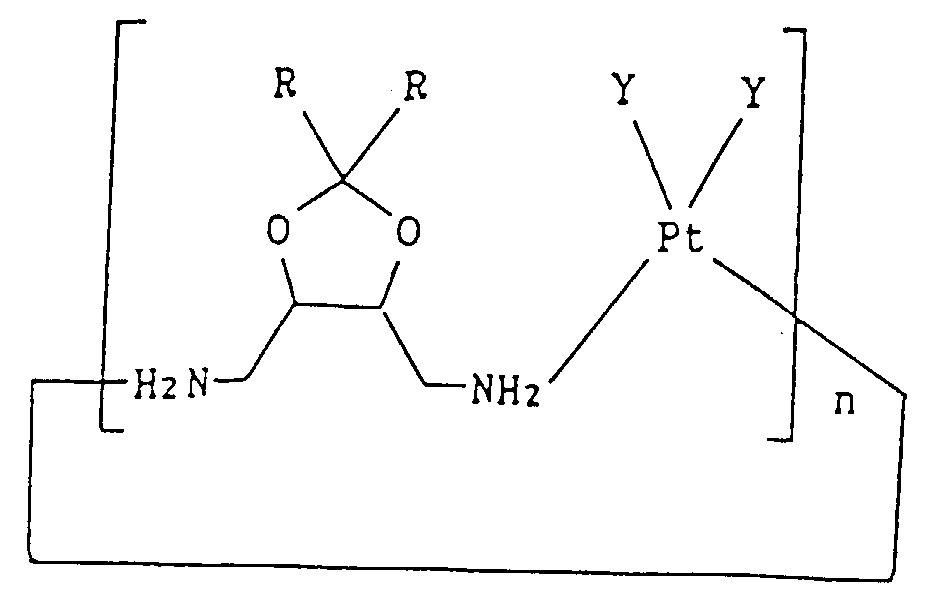
For instance, USP No. 4,783,452 issued to A. H. Haines et al. discloses cisplatin-derived compounds, having the formula of:
Figure 00020001
wherein both Y groups are either chloride or bromide; the two R groups are both methyl or one of them is hydrogen and the other is phenyl; and n is 1. Such compounds are stated to have potent anti-tumor activity, although they still have severe nephrotoxicity and poor water solubility problems.
In the Journal of Med. Chem. 1989, 32(4), 742-745 it is referred to novel analogues of cisplatin derived from diaminodide-oxytetritols; further platinum coordination complexes which exhibit potent antitumor activity are disclosed in the documents EP-A-0 041 644, US-A-4 657 927, US-A-4 939 256, EP-A-0 281 412, EP-A-0 284 197 and US-A-4 870 062.
Summmary of the Invention
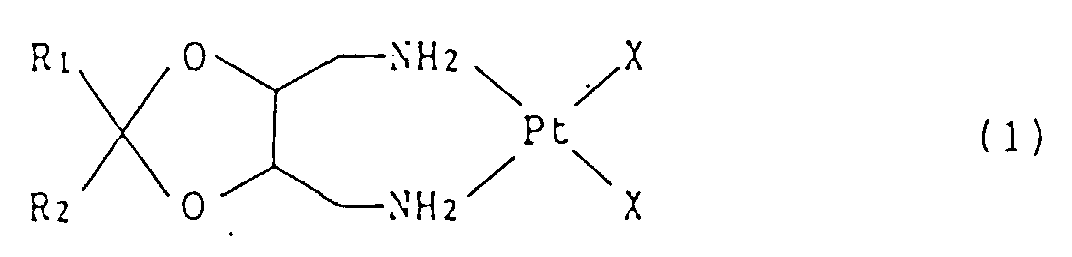
A primary objective of the present invention is to provide novel platinum(II) complexes which have potent anti-tumor activities with low toxicity and good water-solubility, which are useful for the treatment of human cancers, represented by the formula of:
Figure 00020002
wherein:
R1 and R2,
which may be the same or different, are a hydrogen atom or a C1-4 alkyl group, respectively, or jointly form a cycloalkane group together with a carbon atom attached thereto;
two Xs
jointly form a group represented by the formula(a) or (b) as follows:
Figure 00040001
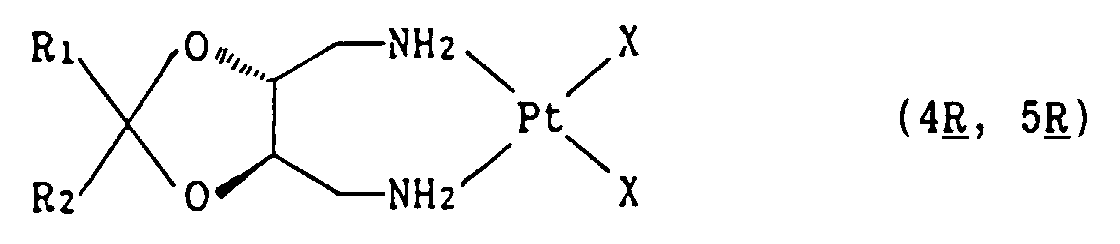
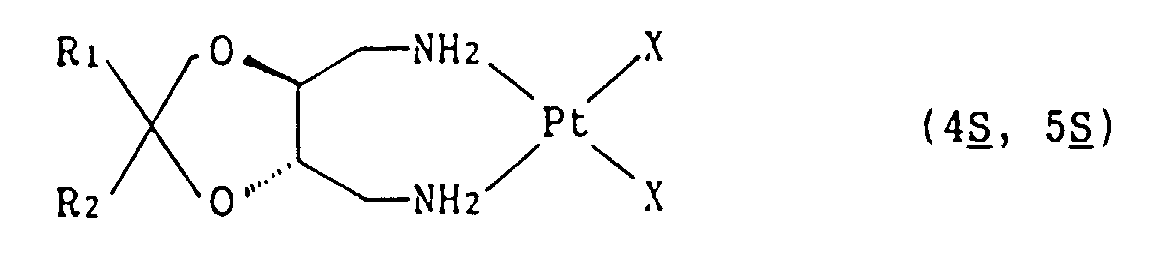
wherein R3 is a hydrogen atom or a methyl group; R4 and R5, which may be the same or different, are a hydrogen atom or a C1-4 alkyl group, respectively, or jointly form a cyclobutane together with a carbon attached thereto; and, the absolute configurations at the respective chiral centers in the 4,5-bis(aminomethyl)-1,3-dioxolane moiety are (4R, 5R) or (4S, 5S) represented by:
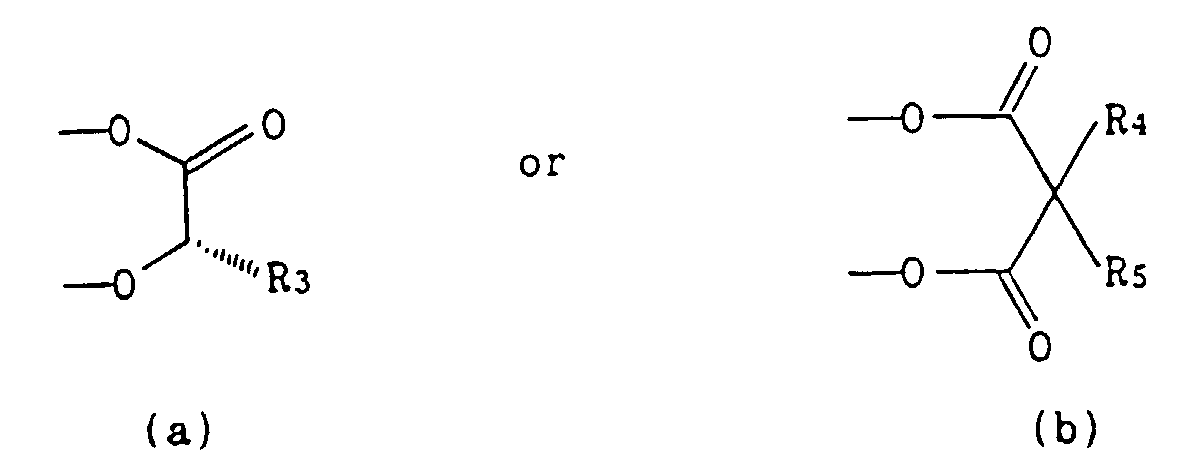
Figure 00040002
Figure 00040003
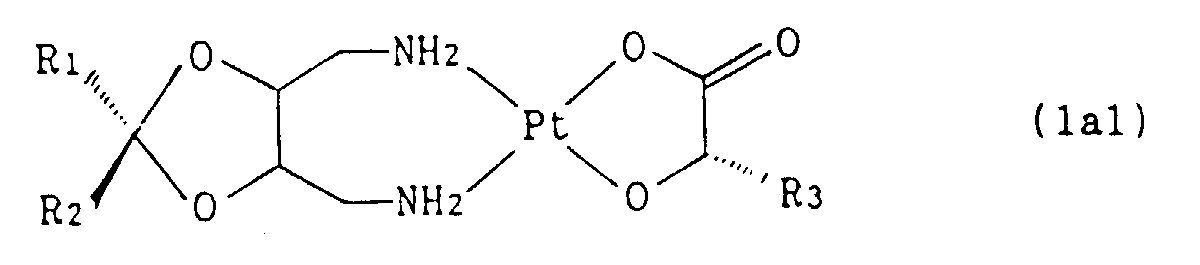
Further, among the compounds of the formula(1), those with the two Xs which jointly form a group of the formula(a) in which R1 and R2 are different exist as one of the following stereoisomers represented by:
Figure 00040004
Figure 00050001
The platinum complexes of the present invention comprise all of the above stereoisomers of the formulas(1a1) and (1a2) and mixtures thereof. For the purpose of the present invention, however, there will be made no distinction between the two isomers. For a mixture of said stereoisomers of formulas(1a1) and (1a2) is not readily separable; and it is believed that the two stereoisomers have an equivalent level of anti-tumor activity.
Another objective of the present invention is to provide processes for preparing said platinum(II) complexes of formula(1).
A further objective of the present invention is to provide novel intermediates useful for said processes and processes for preparing other upstream intermediates.
A still further objective of the present invention is to provide an anti-cancer agent comprising said platinum(II) complex as an active ingredient.
Detailed Description of the Invention
The platinum(II) complexes of the formula(1) wherein the absolute configurations at the respective chiral centers in 4,5-bis (aminomethyl)-1,3-dixolane moiety are (4R, 5R), show more potent anti-tumor activity than the compounds having the (4S, 5S) moiety. Even among the (4R, 5R)-compounds, possessed with still further effective anti-tumor activity are those wherein R1 and R2 jointly form a cycloalkane such as a cyclopentane or cyclohexane group; those wherein R1 and R2 are both methyl or ethyl group; those wherein either R1 or R2 is an ethyl group and the other is a methyl group, or one of R1 and R2 is an ethyl or isopropyl group and the other is a hydrogen atom; and, those wherein two Xs jointly form the group of formula(a) wherein R3 is a hydrogen atom, or the group of formula(b) wherein both R4 and R5 is hydrogen.
Most of the compounds represented by formula(1) are soluble in water. Particularly, the compounds having the R1 group which is different from the R2 group show a better water-solubility; and the shorter the alkyl chain length of R1 or R2 group is, the higher their water-solubility is.
It is further important to note that, the compounds of formula(1) show very low nephrotoxicity.
Representative compounds of the present invention include:
  • (glycolato-O,O')[(4R,5R)-4,5-bis(aminomethyl)-1,3-dioxolane]platinum(II);
  • (glycolato-O,O')[(4R,5R)-4,5-bis(aminomethyl)-2,2-dimethyl-1,3-dioxolane]platinum(II);
  • (glycolato-O,O')[(4R,5R)-4,5-bis(aminomethyl)-1,3-dioxolane-2-spiro-1'-cyclopentane]platinum(II);
  • (glycolato-O,O'){cyclohexanespiro-2'-[(4'R,5'R)-4',5'-bis-(aminomethyl)-1'3'-dioxolane]}platinum(II);
  • (glycolato-O,O')[(4R,5R)-4,5-bis(aminomethyl)-2-methyl-1,3-dioxolane]platinum(II);
  • (glycolato-O,O')[(4R,5R)-4,5-bis(aminomethyl)-2-ethyl-1,3-dioxolane]platinum(II);
  • (glycolato-O,O')[(4R,5R)-4,5-bis(aminomethyl)-2-isopropyl-1,3-dioxolane]platinum(II);
  • (glycolato-O,O')[(4R,5R)-4,5-bis(aminomethyl)-2,2-diethyl-1,3-dioxolane]platinum(II);
  • (glycolato-O,O')[(4R,5R)-4,5-bis(aminomethyl)-2-ethyl-2-methyl-1,3-dioxolane]platinum(II);
  • (glycolato-O,O')[(4R,5R)-4,5-bis(aminomethyl)-2-propyl-1,3-dioxolane]platinum(II);
  • (glycolato-O,O')[(4R,5R)-4,5-bis(aminomethyl)-2-isobutyl-1,3-dioxolane]platinum(II);
  • (glycolato-O,O')[(4R,5R)-4,5-bis(aminomethyl)-2-tert-butyl-1,3-dioxolane]platinum(II);
  • cis-cyclobutane-1,1-dicarboxylato[(4R,5R)-4,5-his(aminomethyl)-2-methyl-1,3-dioxolane]platinum(II);
  • cis-cyclobutane-1,1-dicarboxylato[(4R,5R)-4,5-bis(aminomethyl)-1,3-dioxolane]platinum(II);
  • cis-cyclobutane-1,1-dicarboxylato[(4R,5R)-4,5-bis(aminomethyl)-2-ethyl-1,3-dioxolane]platinum(II);
  • cis-cyclobutane-1,1-dicarboxylato[(4R,5R)-4,5-bis(aminomethyl)-2,2-dimethyl-1,3-dioxolane]platinum(II);
  • cis-cyclobutane-1,1-dicarboxylato[(4R,5R)-4,5-bis(aminomethyl)-2-isopropyl-1,3-dioxolane]platinum(II);
  • cis-cyclobutane-1,1-dicarboxylato[(4R,5R)-4,5-bis(aminomethyl)-1,3-dioxolane-2-spiro-1'-cyclopentane]platinum(II); and
  • cis-cyclobutane-1,1-dicarboxylato[(4R,5R)-4,5-bis(aminomethyl)-1,3-dioxolane-2-spiro-1'-cyclohexane]platinum(II).
  • More preferred compounds include:
  • (glycolato-O,O')[(4R,5R)-4,5-bis(aminomethyl)-1,3-dioxolane-2-spiro-1'-cyclopentane]platinum(II);
  • (glycolato-O,O'){cyclohexanespiro-2'-[(4'R,5'R)-4',5'-bis-(aminomethyl)-1'3'-dioxolane})platinum(II);
  • (glycolato-O,O')[(4R,5R)-4,5-bis(aminomethyl)-2-methyl-1,3-dioxolane]platinum(II);
  • (glycolato-O,O')[(4R,5R)-4,5-bis(aminomethyl)-2-isopropyl-1,3-dioxolane]platinum(II);
  • (glycolato-O,O')[(4R,5R)-4,5-bis(aminomethyl)-2,2-diethyl-1,3-dioxolane]platinum(II);
  • (glycolato-O,O')[(4R,5R)-4,5-bis(aminomethyl)-2-ethyl-2-methyl-1,3-dioxolane]platinum(II);
  • (glycolato-O,O')[(4R,5R)-4,5-bis(aminomethyl)-2-propyl-1,3-dioxolane]platinum(II);
  • cis-cyclobutane-1,1-dicarboxylato[(4R,5R)-4,5-bis(aminomethyl)-2-ethyl-1,3-dioxolane]platinum(II)
  • cis-malonato[(4R,5R)-4,5-bis(aminomethyl)-2,2-diethyl-1,3-dioxolane]platinum(II)
  • cis-malonato[(4R,5R)-4,5-bis(amimomethyl)-2-isopropyl-1,3-dioxolane]platinum(II)
  • cis-malonato[(4R,5R)-4,5-bis(aminomethyl)-1,3-dioxolane-2-spiro-1'-cyclopentane]platinum(II)
  • The platinum(II) complexes of formula(1) may be prepared by employing various methods; and among them, more preferred ones are described below.
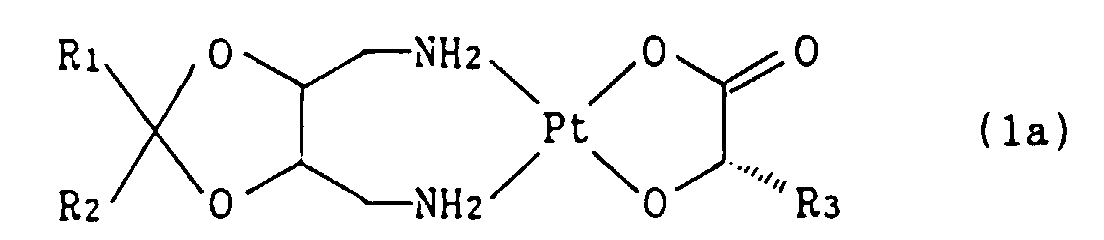
    The following Methods A and B may be employed for preparing the compounds of formula(1) wherein two Xs jointly form the group of formula(a), i.e., the compounds represented by the formula of:
    Figure 00080001
    wherein R1, R2, R3 and the absolute configurations are the same as defined previously.
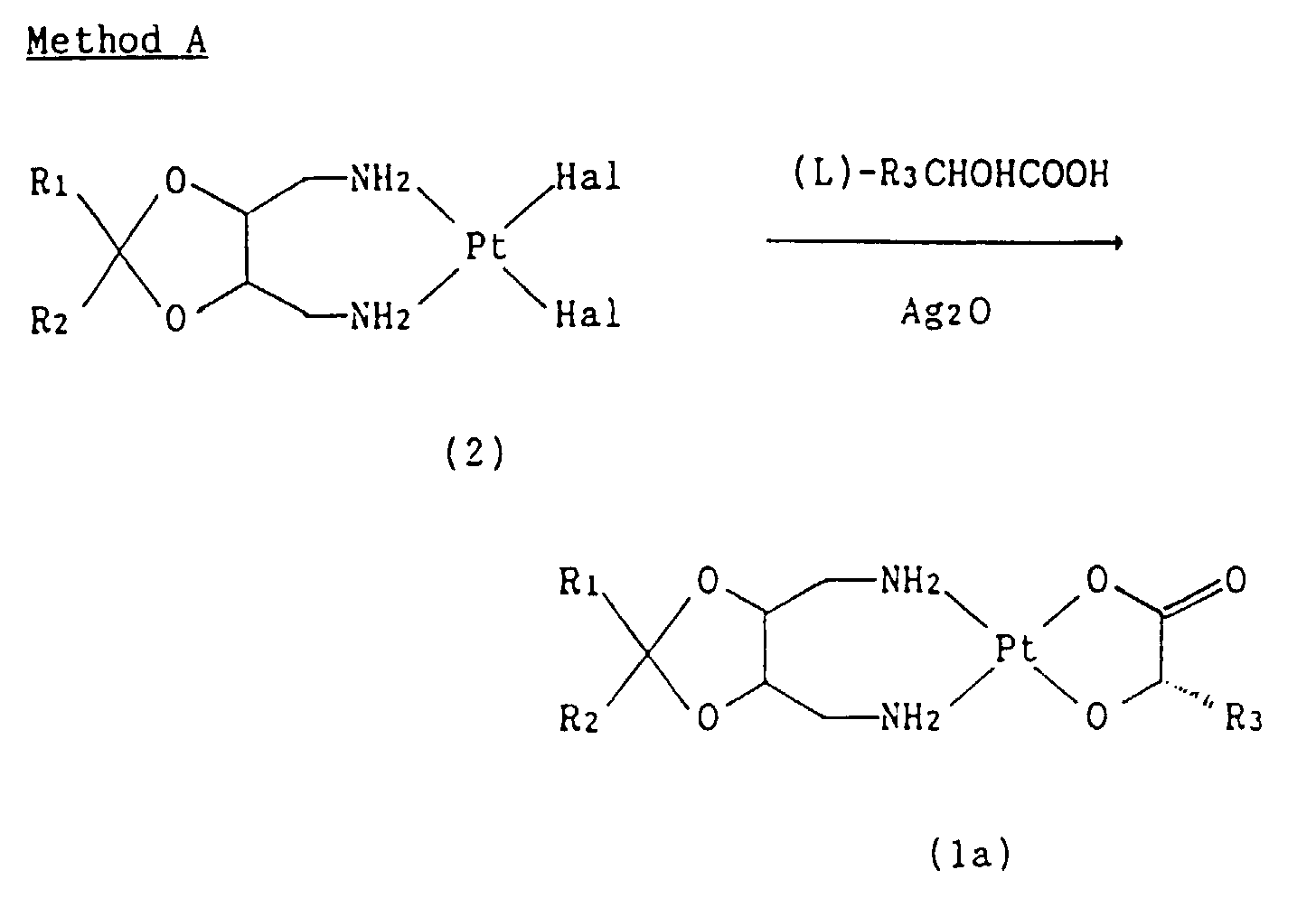
    Figure 00080002
    wherein R1, R2, R3 and the absolute configurations are the same as defined previsouly, and Hal is a halogen atom.
    In Method A, a dihalogenodiamine platinum(II) complex of formula(2) is reacted with a compound represented by the formula of (L)-R3CHOHCOOH wherein R3 is H or CH3, i.e., glycolic acid (R3=H) or L-lactic acid(R3=CH3), and silver(I) oxide, in the equivalent ratio of from 1:0.5:0.5 to 1:5:5, to obtain the desired compound of formula(1a). The reaction may be advantageously carried out in an aqueous medium or a mixed medium of an aqueous solvent and an alcoholic solvent such as methanol and ethanol in a dark environment at a temperature between 0°C and 100°C, preferably between 50°C and 70°C, for about 1 hour to 3 days.
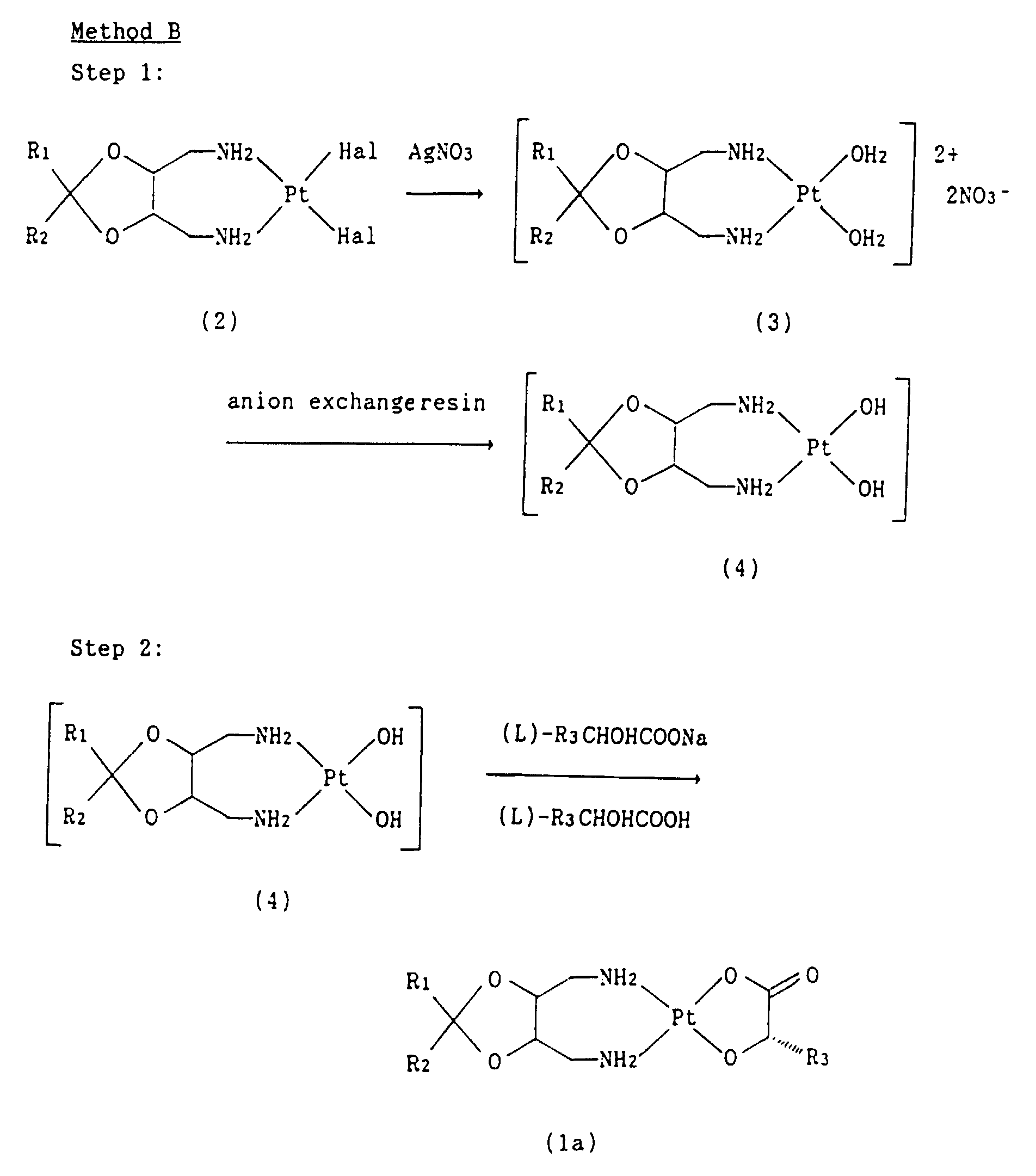
    Figure 00090001
    wherein R1, R2, R3, the absolute configurations and Hal are the same as defined previously.
    In Step 1 of Method B, a dihalogenodiamine platinum(II) complex of formula(2) is reacted with an aqueous silver nitrate solution, preferably in the molar ratio of about 1:2, to obtain an aqueous solution of a diaquacomplex represented by formula(3), which is then converted to an aqueous solution of a compound represented by formula(4) through an anion-exchange resin. The reaction of the compound(2) with silver nitrate may be advantageously carried out in an aqueous medium in a dark environment at a temperature between 0°C and 80°C for about 20 minutes to 3 days. The anion-exchange resin used for converting the compound(3) to the compound(4) is generally an OH- type resin such as Amberlite IRA-400, Dowex I or Daiaion SA-10A.
    Thereafter, in Step 2, the aqueous solution of the compound(4) obtained above is reacted with an acid and its salt represented by the formula of (L)-R3CHOHCOOH and (L)-R3 CHOHCOONa wherein R3 is H or CH3, i.e., glycolic acid and sodium glycolate (R3=H) or L-lactic acid and sodium L-lacate(R3=CH3), preferably in the molar ratio of 1:1:1 to 1:5:5, to obtain the desired compound of formula(1a). The reaction may be advantageously carried out in an aqueous medium in a dark environment at a temperature between 0°C and 100°C, preferably 50°C and 70°C, for about 1 hour to 3 days.
    The following Methods C and D may be employed for preparing the compounds of formula(1) wherein two Xs jointly from the group of formula(b), i.e., the compounds represented by the formula of:
    Figure 00100001
    wherein R1, R2, R4, R5 and the absolute configurations are the same as defined previously.
    Figure 00110001
    wherein R1, R2, R4, R5, the absolute configurations and Hal are the same as defined previously.
    In Method C, a dihalogenodiamine platinum(II) complex of formula(2) is reacted with a silver salt of formula(5), preferably in the molar ratio of from 1:0.5 to 1:5, to obtain the desired compound of formula(1b). The reaction is advantageously, carried out in an aqueous medium in a dark environment at a temperature between 0°C and 100°C, preferably between 50°C and 70°C, for about 1 hour to 3 days.
    Figure 00110002
    Figure 00120001
    wherein R1, R2, R4, R5, the absolute configurations and Hal are the same as defined previously, and M is a monovalent cation such as Na, K and the like.
    In Step 1 of Method D, a dihalogenodiamine platinum(II) complex is reacted with a silver ion, for example, with 2 moles of silver nitrate per 1 mole of compound(2) or with 1 mole of silver sulfate per 1 mole of compound(2), to obtain an aqueous solution of a diaquacomplex represented by formula(3). The reaction is advantageously carried out in an aqueous medium at a temperature between 0°C and 80°C for about 1 hour to 3 days.
    Thereafter, in Step 2, the aqueous solution of a diaquacomplex(3) obtained above is reacted with a compound of formula(6) to obtain the desired compound of formula(1b). The reaction is advantageously carried out in an aqueous medium at a temperature between 0°C and 100°C for about 1 hour to 3 days.
    In the above described Methods A to D, in order to obtain a compound of formula(1) having the (4R, 5R) absolute configurations at the chiral centers in the 4,5-bis(aminomethyl)-1,3-dioxolane, the dihalogenodiamine platinum(II) complex of formula(2) having the corresponding (4R, 5R) configurations should be employed as a starting material. Similarly, in order to obtain a compound of formula(1) having the (4S, 5S) absolute configurations at the chiral centers, a dihalogenodiamine platinum(II) complex of formula (2) with the corresponding absolute configurations should be employed as a starting material.
    The dihalogenodiamine platinum(II) complexes of formula (2) employed as starting meterials in Methods A to D may be prepared as follows:
    Figure 00130001
    wherein R1, R2, the absolute configurations, Hal and M are the same as defined previously.
    As illustrated above, first, a readily prepared compound of formula(7) in accordance with the method described in J. Med. Chem., 7, 14(1964), i.e., threitol 1,4-bis(methanesulfonate), is reacted with an appropriate aldehyde, acetal, ketone or ketal, preferably in the presence of an acid catalyst such as methanesulfonic acid, concentrated sulfuric acid and the like, to obtain a 1,3-dioxolane-4,5-bis(methanesulfonate) of formula(8). The selection of said aldehyde, acetal, ketone or ketal is made according to the substituents R1 and R2. For examples, formaldehyde may be chosen when both R1 and R2 are hydrogens; acetaldehyde diethyl acetal when either R1 and R2 is a methyl group and the other is a hydrogen atom; propionaldehyde diethyl acetal when either R1 or R2 is a ethyl group and the other is a hydrogen atom; isobutylaldehyde when one of R1 and R2 is a isopropyl group and the other is a hydrogen atom; cyclopentanone when R1 and R2 jointly form cyclopentane together with the carbon atom attached thereto; or cyclohexanone when R1 and R2 jointly form cyclohexane together with the carbon atom attached thereto.
    The compound of formula(8) thus obtained is reacted with an azide ion in N,N-dimethylformamide at a temperature between 20°C and 120°C for about 1 to 24 hours to obtain a 4,5-bis(azidomethyl)-1,3-dioxolane of formula(9).
    Thereafter, said 4,5-bis(azidomethyl)-1,3-dioxolane of formula(9) is subjected to a reduction process to yield a 4,5-bis (aminomethyl)-1,3-dioxolane of formula(10) by using a conventional method such as reduction with hydrogen in the presence of palladium-charcoal or platinum(IV) oxide in an alcoholic medium under a pressure between 15 psi and 70 psi at a temperature between 0°C and 50°C for about 30 minutes to 1 day.
    Finally, the compound of formula(10) is reacted with an equimolar amount of tetrahalogenoplatinate(II) salt represented by the formula of M2Pt(Hal)4 wherein M and Hal have the same meanings as defined previously, generally in an aqueous medium at a temperature between 0°C and 100°C, preferably between 50°C and 70°C at an atmospheric pressure but preferably under a stream of an inert gas such as nitrogen or argon gas, to obtain the dihalogenodiamine platinum(II) complex of formula(2).
    The compound of formula(8) may be prepared by using an alternative method, which comprises the following steps:
    Figure 00150001
    wherein R1, R2, and the absolute configurations, are the same as defined previously, and R is a methyl or ethyl group.
    In accordance with the above method, tartaric acid of formula(11) is reacted with methanol or ethanol in the presence of an acid catalyst to obtain a tartaric acid diester of formula(12). The compound of formula(12) is reacted with an appropriate aldehyde, acetal, ketone or ketal, preferably in the presence of an acid catalyst such as methanesulfonic acid, concentrated sulfuric acid and the like, or phosphorus pentoxide(Tsuzuki, et al., Bull, Chem. Sco. Japan 15, 55(1940)), to obtain a 1,3-dioxolane-4,5-dicarboxylic acid diester of formula(13). Said appropriate aldehyde, acetal, ketone or ketal can be chosen according to the substituents R1 and R2, as previously illustrated. The compound of formula(13) is then reduced with lithium aluminum hydride(LAH) to obtain a 4,5-bis(hydroxymethyl)-1,3-dioxolane of formula(14). The compound of formula(14) is reacted with methanesulfonyl chloride in pyridine to obtain the 1,3-dioxolane-4,5-bis(methanesulfonate) of formula(8).
    The compounds of formula (8), (9), (10) and (2) having the (4R, 5R) absolute configurations at the respective chiral centers in said 4,5-bis(aminomethyl)-1,3-dioxolane are obtainable from the starting compound of formula(7) or (11) existing as D-form, i.e., D-threitol 1,4-bis(methanesulfonate) or D-tartaric acid. Whereas the compound of formula(7) or (11) existing as L-form, i.e., L-threitol 1,4-bis(methanesulfonate) or L-tartaric acid yields the compounds of formula(8), (9), (10) and (2) having the (4S, 5S) configurations.
    The platinum(II) complexes of the present invention have improved pharmacological characteristics such as excellent anti-tumor activities, low nephrotoxicity and good solubility in water and the like; and, therefore, are useful as an anti-cancer agent.
    The compounds of the present invention can be formulated by any of the known appropriate methods with a pharmaceutically acceptable carrier and, if necessary, an adjuvant. For oral administration, for instance, the compounds of the present invention can be formulated into a solid preparation such as tablets, pills, granules, powder, capsules and the like, or a liquid preparation such as solution, suspension, emulsion and the like. When the preparation is used for parenteral administration, the preparation is made in an injection formula, an intravenous drip infusion and the like. For the preparation of an injection formula, the compound is preferably dissolved in distilled water or an aqueous solution of a salt such as sodium chloride. For the preparation of an intravenous drip infusion, the compound may be dissolved in a suitable fluid therapy such as a physiological saline, a glucose-sodium chloride solution and the like.
    The effective dosage of the compounds of the present invention may vary with the physical condition of the patients and the location and status of the tumors. In general, it has been shown advantageous to administer the active compounds in an amount of about 50 to 1000mg per 1m2 body surface area in order to achieve the desired result.
    The present invention is further illustrated in the following Examples, which should not be taken to limit the scope of the invention.
    The structure of the compounds(II) of the present invention was confirmed by various analytical methods such as infrared(IR) spectrometry, 1H NMR spectrometry, 13C NMR spectrometry, elemental analysis, fast atom bombardment mass spectrometry(FAB-MS) and the like.
    Example 1A: Synthesis of (glycolato- O , O' )[(4 R ,5 R )-4,5-bis(aminomethyl)-1,3-dioxolane]platinum(II) by method A
    A mixture of cis-diiodo[(4R,5R)-4,5-bis(aminomethyl)-1,3-dioxolane]platinum (II)(0.50 g, 0.86 mmol), glycolic acid(0.13 g, 1.71 mmol), and silver(I) oxide(0.40 g, 1.72 mmol) in water(30 mℓ) was stirred at 60°C overnight in the dark. The reaction mixture was cooled to a room temperature, filtered through a pad of celite, and the filtered residue was washed with a small volume of water. The filtrate and the washing were combined and concentrated under a reduced pressure to 5 mℓ, and purified by using preparative HPLC on Delta pak C18-100Å reverse-phase bonded silica cartridge with water as the mobile phase. The eluate was concentrated under a reduced pressure to a small volume and freeze-dried to give 0.198 g of (glycolato-O,O')[(4R,5R)-4,5-bis(aminomethyl)-1,3-dioxolane] platinum(II) as a white solid.
    Yield: 57%
    IR(KBr): 3445, 3222, 3069 cm-1 (NH), 1645 cm-1 (C=0)
    1H NMR(D2O/DSS):
    δ 2.87(m, 2 H, 2 CHNH2), 3.38(m, 2 H, 2 CHNH2), 4.10(s, 2 H, CH2), 4.59(m, 2 H, 2 CH), 5.05 (s, 2 H, OCH2O)
    DSS(δ 0.015 ppm in D2O) was used as the internal standard
    13C NMR(D2O/DSS):
    δ 48.52, 48.82, 69.30, 79.49, 79.53, 95.42, 195.49
    DSS(δ = -1.600 ppm in D2O) was used as the internal standard
    FAB-MS:
    (M+H)+ = 401(194Pt, 33%), 402(195Pt, 34%) and 403(196Pt, 25%)
    Example 1B: Synthesis of (glycolato- O , O' )[(4 R ,5 R )-4,5-bis(aminomethyl)-1,3-dioxolane]platinum(II) by Method B
    To a stirred suspension of cis-diiodo[(4R,5R)-4,5-bis (aminomethyl)-1,3-dioxolane]platinum(II)(0.50 g, 0.86 mmol) in water(15 mℓ) was added a solution of silver nitrate(0.29 g, 1.72 mmol) in water(15 mℓ). The mixture was heated at 60°C for 2 hours in the dark, cooled to a room temperature, filtered through a pad of celite, and the filtered residue was washed with a small volume of water. The filtrate and the washing were combined and concentrated under a reduced pressure to 10 mℓ and passed through a column of anion exchange resin Amberlite IRA-400(OH- type, 20 mℓ ) with water as the eluent. To 30 mℓ of alkaline eluate were added glycolic acid(0.07 g, 0.92 mmol) and 1 M aqueous solution of sodium glycolate(3.44 mℓ). The mixture was stirred at 60°C overnight in the dark, cooled to a room temperature, and concentrated under a reduced pressure to 5 mℓ. The concentrate was purified in the same manner as described in Example 1A to give 0.194 g of (glycolato-O,O')[(4R,5R)-4,5-bis(aminomethyl)-1,3-dioxolane]platinum(II).
    Yield: 56%
    Example 2A: Synthesis of (glycolato- O , O' )[(4 R ,5 R )-4,5-bis(aminomethyl)-2,2-dimethyl-1,3-dioxolane]platinum(II) by Method A
    0.50 g(0.82 mmol) of cis-diiodo[(4R,5R)-4,5-bis(aminomethyl)-2,2-dimethyl-1,3-dioxolane]platinum(II) was reacted with glycolic acid(0.13 g, 1.71 mmol) and silver(I) oxide(0.38 g, 1.64 mmol) in water(30 mℓ) in the same manner as described in Example 1A to give 0.149 g of (glycolato-O,O')[(4R,5R)-4,5-bis-(aminomethyl)-2,2-dimethyl-1,3-dioxolane]platinuttl(II) as a white solid after purification by using preparative HPLC on Delta pak C18-100Å reverse-phase bonded silica cartridge with a mixture of water-methanol(9:1, v/v) as the mobile phase.
    Yield: 42%
    IR(KBr): 3430, 3142, 3085 cm-1 (NH), 1657 cm-1 (C=0)
    1H NMR(D2O/DSS):
    δ 1.47(s, 6 H, 2 CH3), 2.86(m, 2 H, 2 CHNH2), 3.32(m, 2 H, 2 CHNH2), 4.10(s, 2 H, CH2), 4.71(m, 2 H, 2 CH)
    DSS(δ= 0.015 ppm in D2O) was used as the internal standard
    13C NMR(D2O/DSS):
    δ 26.56, 49.36, 49.65, 69.27, 79.18, 111.35, 195.51
    DSS(δ = -1.600 ppm in D2O) was used as the internal standard
    FAB-MS:
    (M+H)+ = 429(194Pt, 33%), 430(195Pt, 34%) and 431(196Pt, 25%)
    Example 2B: Synthesis of (glycolato- O , O' )[(4 R ,5 R )-4,5-bis(aminomethyl)-2,2-dimethyl-1,3-dioxolane]platinum(II) by Method B
    0.50 g(0.82 mmol) of cis-diiodo[(4R,5R)-4,5-bis(aminomethyl)-2,2-dimethyl-1,3-dioxolane]platinum(II) was reacted with silver nitrate(0.28 g, 1.65 mmol), followed by passing the reaction mixture through a column of anion exchange resin Amberlite IRA-400, and then reacted with glycolic acid(0.06 g, 0.79 mmol) and sodium glycolate (3.3 mℓ of 1 M aqueous solution) in the same manner as described in Example 1B to give 0.161 g of (glycolato-O,O')[(4R,5R)-4,5-bis(aminomethyl)-2,2-dimethyl-1,3-dioxolane]platinum(II) as a white solid after purification in the same manner as described in Example 2A.
    Yield: 46%
    Example 3A: Synthesis of (glycolato- O , O' )[(4 R ,5 R )-4,5-bis(aminomethyl)-1,3-dioxolane-2-spiro-1'-cyclopentane]platinum (II) by Method A
    0.50 g(0.79 mmol) of cis-diiodo[(4R,5R)-4,5-bis(aminomethyl)-1,3-dioxolane-2-spiro-1'-cyclopentane]platinum(II) was reacted with glycolic acid(0.12 g, 1.58 mmol) and silver(I) oxide (0.37 g, 1.60 mmol) in a mixture of water(55 mℓ) and methanol(5 mℓ) in the same manner as described in Example 1A to give 0.243 g of (glycolato-O,O')[(4R,5R)-4,5-bis(aminomethyl)-1,3-dioxolane-2-spiro-1'-cyclopentane]platinum(II) as a white solid after purification by using preparative HPLC on Delta pak C18-100Å reverse-phase bonded silica cartridge with a mixture of water-methanol(6:4, v/v) as the mobile phase.
    Yield: 68%
    IR(KBr): 3409, 3211, 3143 cm-1(NH), 1635 cm-1 (C=O)
    1H NMR(D2O/DSS):
    δ 1.60-2.00(m, 8 H, cyclopentyl), 2.86 (m, 2 H, 2 CHNH2), 3.33(m, 2 H, 2 CHNH2), 4.10(s, 2 H, CH2), 4.66(m, 2 H, 2 CH)
    DSS(δ 0.015 ppm in D2O) was used as the internal standard
    13C NMR(D2O/DSS):
    δ 23.88, 37.11, 49.22, 49.50, 69.29, 79.05, 121.09, 195.51
    DSS(δ = -1.600 ppm in D2O) was used as the internal standard
    FAB-MS:
    (M+H)+ = 455(194Pt, 33%), 456(195Pt, 34%) and 457(196Pt, 25%)
    Example 3B: Synthesis of (glycolato- O , O' )[(4 R ,5 R )-4,5-bis(aminomethyl)-1,3-dioxolane-2-spiro-1'-cyclopentane]platinum (II) by Method B
    0.50 g(0.79 mmol)of cis-diiodo[(4R,5R)-4,5-bis(aminomethyl)-1,3-dioxolane-2-spiro-1'-cyclopentane]platinum(II) was reacted with silver nitrate(0.27 g, 1.59 mmol), followed by passing the reaction mixture through a column of anion exchange resin Amberlite IRA-400, and then reacted with glycolic acid (0.06 g, 0.79 mmol) and sodium glycolate(3.2 mℓ of 1 M aqueous solution) in the same manner as described in Example 1B to give 0.178 g of (glycolato-O,O')[(4R,5R)-4,5-bis(aminomethyl)-1,3-dioxolane-2-spiro-1'-cyclopentane]platinum(II) as a white solid after purification in the same manner as described in Example 3A.
    Yield: 50%
    Example 4A: Synthesis of (glycolato- O , O' ){cyclohexanespiro-2'-[(4' R ,5' R )-4',5'-bis(aminomethyl)-1',3'-dioxolane]}-platinum(II) by Method A
    0.50 g(0.77 mmol) of cis-diiodo{cyclohexanespiro-2'-[(4'R,5'R)-4',5'-bis(aminomethyl)-1',3'-dioxolane]}platinum(II) was reacted with glycolic acid(0.12 g, 1.58 mmol) and silver(I) oxide(0.36 g, 1.55 mmol) in a mixture of water(110 mℓ) and methanol (10 mℓ) in the same manner as described in Example 1A to give 0.174 g of (glycolato-O,O'){cyclohexanespiro-2'-[(4'R,5'R)-4',5'-bis(aminomethyl)-1',3'-dioxolane]}platinum(II) as a white solid after purification by using preparative HPLC on Delta pak C18-100Å reverse-phase bonded silica cartridge with a mixture of water-methanol(6:4, v/v) as the mobile phase.
    Yield: 48%
    IR(KBr): 3417, 3218, 3143 cm-1 (NH), 1634 cm-1 (C=O)
    1H NMR(DMSO-d 6/TMS):
    δ 1.34(br s, 2 H, cyclohexyl), 1.54 (br s, 8 H, cyclohexyl), 2.55(m, 2 H, 2 CHNH2 ), 3.14(m, 2 H, 2 CHNH2), 3.78 (s, 2 H, CH2), 4.40(m, 2 H, 2 CH), 4.93 (br s, 1H, NH), 5.15(br s, 2 H, 2 NH), 5.24(br s, 1 H, NH)
    13C NMR(DMSO-d 6):
    δ 23.79, 24.83, 35.96, 36.00, 48.92, 48.96, 69.70, 78.17, 78.21, 109.43, 191.91
    FAB-MS:
    (M+H)+ = 469(194Pt, 33%), 470(195Pt, 34%) and 471(196Pt, 25%)
    Example 4B: Synthesis of (glycolato- O , O' ){cyclohexanespiro-2'-[(4' R ,5' R )-4',5'-bis(aminomethyl)-1',3'-dioxolane]}-platinum(II) by Method B
    0.50 g(0.77 mmol) of cis-diiodo{cyclohexanespiro-2'-[(4'R,5'R)-4',5'-bis(aminomethyl)-1',3'-dioxolane]}platinum(II) was reacted with silver nitrate(0.26 g, 1.53 mmol), followed by passing the reaction mixture through a column of anion exchange resin Amberlite IRA-400, and then reacted with glycolic acid (0.06 g, 0.79 mmol) and sodium gylcolate(3.1 mℓ of 1 M aqueous solution) in the same manner as described in Example 1B to give 0.084 g of (glycolato-O,O'){cyclohexanespiro-2'-[(4'R,5'R)-4',5'-bis(aminomethyl)-1',3'-dioxolane]}platinum(II) as a white solid after purficiation in the same manner as described in Example 4A.
    Yield: 23%
    Example 5A: Synthesis of (glycolato- O , O' )[(4 R ,5 R )-4,5-bis(aminomethyl)-2-methyl-1,3-dioxolane]platinum(II) by Method A
    0.50 g(0.84 mmol) of cis-diiodo[(4R,5R)-4,5-bis(aminomethyl)-2-methyl-1,3-dioxolane]platinum(II) was reacted with glycolic acid(0.13 g, 0.17 mmol) and silver(I) oxide(0.39 g, 1.68 mmol) in water(30 mℓ ) in the same manner as described in Example 1A to give 0.225 g of (glycolato-O,O')[(4R,5R)-4,5-bis (aminomethyl)-2-methyl-1,3-dioxolane]platinum(II) as a white solid after purification by using preparative HPLC on Delta pak C18-100Å reverse-phase bonded silica cartridge with a mixture of watermethanol(95:5, v/v) as the mobile phase.
    Yield: 64%
    IR(KBr): 3451, 3213, 3139 cm-1 (NH), 1634 cm-1 (C=O)
    1H NMR(D2O/DSS):
    δ 1.40(d, J = 4.8 Hz, 3 H, CH3), 2.87 (m, 2 H, 2 CHNH2), 3.28(m, 1 H, CHNH2), 3.39(m, 1 H, CHNH2), 4.10(s, 2 H, CH2) 4.64(m, 1 H, CH), 4.71(m, 1 H, CH, overlapped with HOD), 5.28(q, J = 4.8 Hz, 1 H, CH)
    DSS(δ = 0.015 ppm in D2O) was used as the internal standard
    13C NMR(D2O/DSS):
    δ 19.51, 48.57, 48.73, 48.86, 49.05, 69.29, 78.82, 80.77, 102.70, 195.46
    DSS(δ = -1.600 ppm in D2O) was used as the internal standard
    FAB-MS:
    (M+H)+ = 415(194Pt, 33%), 416(195Pt, 34%) and 417(196Pt, 25%)
    Example 5B: Synthesis of (glycolato- O , O ')[(4 R ,5 R )-4,5-bis(aminomethyl)-2-methyl-1,3-dioxolane]platinum(II) by Method B
    0.50 g(0.84 mmol) of cis-diiodo[(4R,5R)-4,5-bis(aminomethyl)-2-methyl-1,3-dioxolane]platinum(II) was reacted with silver nitrate(0.28 g, 1.65 mmol), followed by passing the reaction mixture through a column of anion exchange resin Amberlite IRA-400, and then reacted with glycolic acid(0.06 g, 0.79 mmol) and sodium glycolate(3.4 mℓ of 1 M aqueous solution) in the same manner as described in Example 1B to give 0.273 g of (glycolato-O,O')[(4R,5R)-4,5-bis(aminomethyl)-2-methyl-1,3-dioxolane]platinum(II) as a white solid after purification in the same manner as described in Exmaple 5A.
    Yield: 78%
    Example 6A: Synthesis of (glycolato- O , O ')[(4 R ,5 R )-4,5-bis(aminomethyl)-2-ethyl-1,3-dioxolane]platinum(II) by Method A
    0.50 g(0.82 mmol) of cis-diiodo[(4R,5R)-4,5-bis(aminomethyl)-2-ethyl-1,3-dioxolane]platinum(II) was reacted with glycolic acid(0.13 g, 1.71 mmol) and silver(I) oxide(0.38 g, 1.64 mmol) in water(30 mℓ) in the same manner as described in Example 1A to give 0.234 g of (glycolate-O,O')[(4R,5R)-4,5-bis-(aminomethyl)-2-ethyl-1,3-dioxolane]platinum(II) as a white solid after purfication by using preparative HPLC on Delta pak C18-100Å reverse-phase bonded silica cartridge with a mixture of watermethanol(9:1, v/v) as the mobile phase.
    Yield: 66%
    IR(KBr): 3431, 3132 cm-1 (NH), 1650 cm-1 (C=O)
    1H NMR(D2O/DSS):
    δ 0.93(t, J = 7.5 Hz, 3 H, CH3), 1.72 (dq, J = 4.5 Hz, J = 7.5 Hz, 2 H, CH2CH3), 2.88(m, 2 H, 2 CHNH2), 3.29(m, 1 H, CHNH2), 3.39(m, 1 H, CHNH2), 4.10(s, 2 H, CH2), 4.61(m, 1 H, CH), 4.68(m, 1 H, CH, overlapped with HOD), 5.15(t, J = 4.5 Hz, 1 H, CH)
    DSS(δ = 0.015 ppm in D2O) was used as the internal standard
    13C NMR(D2O/DSS):
    δ 7.89, 26.90, 48.65, 48.70, 48.94, 49.00, 69.28, 78.85, 80.57, 106.43, 195.48
    DSS(δ = -1.600 ppm in D2O) was used as the internal standard
    FAB-MS:
    (M+H)+ = 429(194Pt, 33%), 430(195Pt, 34%) and 431(196Pt, 25%)
    Example 6B: Synthesis of (glycolato- O , O ')[(4 R ,5 R )-4,5-bis(aminomethyl)-2-ethyl-1,3-dioxolane]platinum(II) by Method B
    0.50 g(0.82 mmol) of cis-diiodo[(4R,5R)-4,5-bis(aminomethyl)-2-ethyl-1,3-dioxolane]platinum(II) was reacted with silver nitrate(0.28 g, 1.65 mmol), followed by passing the reaction mixture through a column of anion exchange resin Amberlite IRA-400, and then reacted with glycolic acid(0.06 g, 0.79 mmol) and sodium glycolate(3.3 mℓ of 1 M aqueous solution) in the same manner as described in Example 1B to give 0.189g of (glycolato-O,O')[(4R,5R)-4,5-bis(aminomethyl)-2-ethyl-1,3-dioxolane]platinum(II) as a white solid after purification in the same manner as described in Example 6A.
    Yield: 54%
    Example 7A: Synthesis of (glycolato- O, O' )[(4 R ,5 R )-4,5-bis(aminomethyl)-2-isopropyl-1,3-dioxolane]platinum(II) by Method A
    0.50 g(0.80 mmol) of cis-diiodo[(4R,5R)-4,5-bis(aminomethyl)-2-isopropyl-1,3-dioxolane]platinuttl(II) was reacted with gylcolic acid(0.12 g, 1.58 mmol) and silver(I) oxide(0.37 g, 1.60 mmol) in a mixture of water(55 mℓ) and methanol(5 mℓ) in the same manner as described in Example 1A to give 0.267 g of (glycolato-O,O')[(4R,5R)-4,5-bis(aminomethyl)-2-isopropyl-1,3-dioxolane]platinum(II) as a white solid after purification by using preparative HPLC on Delta pak C18-100Å reverse-phase bonded silica cartridge with a mixture of water-methanol(7:3, v/v) as the mobile phase.
    Yield: 75%
    IR(KBr): 3425, 3218, 3143 cm-1 (NH), 1634 cm-1 (C=O)
    1H NMR(D2O/DSS):
    δ 0.94(d, J = 6.9 Hz, 6 H, 2 CH3), 1.89 (m, 1 H, CH(CH3)2), 2.86(m, 2 H, 2 CHNH2), 3.30(m, 1 H, CHNH2), 3.39(m, 1 H, CHNH2), 4.10(s, 2 H, CH2), 4.58(m, 1 H, CH), 4.64 (m, 1 H, CH, overlapped with HOD), 4.98(d, J = 4.2 Hz, 1 H, CH)
    DSS(δ = 0.015 ppm in D2O) was used as the internal standard
    13C NMR(D2O/DSS):
    δ 16.69, 16.79, 32.02, 48.66, 48.72, 48.96, 49.02, 69.28, 78.97, 80.48, 109.26, 195.50
    DSS(δ = -1.600 ppm in D2O) was used as the internal standard
    FAB-MS:
    (M+H)+ = 443(194Pt, 33%), 444(195Pt, 34%) and 445(196Pt, 25%)
    Example 7B: Synthesis of (glycolato- O , O' )[(4 R ,5 R )-4,5-bis(aminomethyl)-2-isopropyl-1,3-dioxolane]platinum(II) by Method B
    0.50 g(0.80 mmol) of cis-diiodo[(4R,5R)-4,5-bis(aminomethyl)-2-isopropyl-1,3-dioxolane]platinum(II) was reacted with silver nitrate(0.27 g, 1.59 mmol), followed by passing the reaction mixture through a column of anion exchange resin Amberlite IRA-400, and then reacted with glycolic acid(0.06 g, 0.79 mmol) and sodium glycolate(3.2 mℓ of 1 M aqueous solution) in the same manner as described in Example 1B to give 0.102 g of (glycolato-O,O')-[(4R,5R)-4,5-bis(aminomethyl)-2-isopropyl-1,3-dioxolane]platinum(II) as a white solid after purification in the same manner as described in Example 7A.
    Yield: 29%
    Example 8: Synthesis of (glycolato- O , O ')[(4 R ,5 R )-4,5-bis(aminomethyl)-2,2-diethyl-1,3-dioxolane]platinum(II) by Method A
    1.42 g(2.23 mmol) of cis-diiodo[(4R,5R)-4,5-bis(aminomethyl)-2,2-diethyl-1,3-dioxolane]platinum(II) was reacted with glycolic acid(0.34 g, 4.46 mmol) and silver(I) oxide(1.03 g, 4.46 mmol) in a mixture of water(100 mℓ) and methanol(10 mℓ) in the same manner as described in Example 1A to give 0.616 g of (glycolato-O,O' )[(4R,5R)-4,5-bis(aminomethyl)-2,2-diethyl-1,3-dioxolane]platinum(II) as a white solid after purification by using preparative HPLC on Delta pak C18-100Å reverse-phase bonded silica cartridgl with a mixture of water-methanol(6:4, v/v) as the mobile phase.
    Yield: 60%
    IR(KBr): 3422, 3208 cm-1 (NH), 1640 cm-1 (C=O)
    1H NMR(D2O/DSS):
    δ 0.91(t, J = 7.2 Hz, 6 H, 2 CH3), 1.73 (q, J = 7.2 Hz, 4 H, 2 CH2), 2.80-2.96 (m, 2 H, 2 CHNH2), 3.29-3.42(m, 2 H, 2 CHNH2), 4.10(s, 2 H, CH2), 4.71(m, 2 H, 2 CH, overlapped with HOD)
    DSS(δ = 0.015 ppm in D2O) was used as the internal standard
    FAB-MS:
    (M+H)+ = 457(194Pt, 33%), 458(195Pt, 34%) and 459(196Pt, 25%)
    Example 9: Synthesis of (glycolato- O , O ')[(4 R ,5 R )-4,5-bis(aminomethyl)-2-ethyl-2-methyl-1,3-dioxolane]platinum(II) by Method A
    1.22 g(1.96 mmol) of cis-diiodo[(4R,5R)-4,5-bis(aminomethyl)-2-ethyl-2-methyl-1,3-dioxolane]platinum(II) was reacted with glycolic acid(0.30 g, 3.92 mmol) and silver(I) oxide(0.91 g, 3.92 mmol) in a mixture of water(90 mℓ ) and methanol(10 mℓ ) in the same manner as described in Example 1A to give 0.607 g of (glycolato-O,O')[(4R,5R)-4,5-bis(aminomethyl)-2-ethyl-2-methyl-1,3-dioxolane]platinum(II) as a white solid after purification by using preparative HPLC on Delta pak C18-100Å reverse-phase bonded silica cartridge with a mixture of water-methanol(6:4, v/v) as the mobile phase.
    Yield: 70%
    IR(KBr): 3425, 3142 cm-1 (NH), 1645 cm-1 (C=O)
    1H NMR(D2O/DSS):
    δ 0.92(t, J = 6.6 Hz, 3 H, CH3), 1.43(s, 3 H, CH3), 1.75(q, J = 6.6Hz, 2 H, CH2), 2.78-2.98(m, 2 H, 2 CHNH2), 3.28-3.42(m, 2 H, 2 CHNH2), 4.10(s, 2 H, CH2), 4.72 (m, 2 H, 2 CH, overlapped with HOD)
    DSS(δ= 0.015 ppm in D2O) was used as the internal standard
    13C NMR(D2O/DSS):
    δ 8.25, 24.66, 32.69, 49.42, 49.52, 69.27, 79.04, 79.64, 113.44, 195.44
    DSS(δ = -1.600 ppm in D2O) was used as the internal standard
    FAB-MS:
    (M+H)+ = 443(194Pt, 33%), 444(195Pt, 34%) and 445(196Pt, 25%)
    Example 10: Synthesis of (glycolato- O , O' )[(4 R ,5 R )-4,5-bis(aminomethyl)-2-propyl-1,3-dioxolane]platinum(II) by Method A
    1.00 g(1.91 mmol) of cis-diiodo[(4R,5R)-4,5-bis(aminomethyl)-2-propyl-1,3-dioxolane]platinum(II) was reacted with glycolic acid(0.29 g, 3.82 mmol) and silver(I) oxide(0.89 g, 3.82 mmol) in a mixture of water(90 mℓ) and methanol (10 mℓ) in the same manner as described in Example 1A to give 0.470 g of (glycolato-O,O')[(4R,5R)-4,5-bis(aminomethyl)-2-propyl-1,3-dioxolane]platinum(II) as a white solid after purification by using preparative HPLC on Delta pak C18-100Å reverse-phase bonded silica cartridge with a mixture of water-methanol(5:5, v/v) as the mobile phase.
    Yield: 56%
    IR(KBr): 3422, 3210, 3131 cm-1 (NH), 1630 cm-1 (C=O)
    1H NMR(D2O/DSS):
    δ 0.94(t, J = 7.2 Hz, 3 H, CH3), 1.41(m, 2 H, CH2), 1.68(m, 2 H, CH2), 2.81-2.97 (m, 2 H, 2 CHNH2), 3.23-3.34(m, 1 H, CHNH2), 3.34-3.45(m, 1 H, CHNH2), 4.10(s, 2 H, CH2), 4.62(m, 2 H, 2 CH, overlapped with HOD), 5.19(t, J = 4.2 Hz, 1 H, OH)
    DSS(δ = 0.015 ppm in D2O) was used as the internal standard
    FAB-MS:
    (M+H)+ = 443(194Pt, 33%), 444(195Pt, 34%) and 445(196Pt, 25%)
    Example 11: Synthesis of (glycolato- O , O' )[(4 R ,5 R )-4,5-bis(aminomethyl)-2-isobutyl-1,3-dioxolane]platinum(II) by Method A
    1.00 g(1.86 mmol) of cis-diiodo[(4R,5R)-4,5-bis(aminomethyl)-2-isobutyl-1,3-dioxolane]platinum(II) was reacted with glycolic acid(0.28 g, 3.72 mmol) and silver(I) oxide(0.86 g, 3.72 mmol) in a mixture of water (90 mℓ ) and methanol(10 mℓ ) in the same manner as described in Example 1A to give 0.257 g of (glycolato-O,O')[(4R,5R)-4,5-bis(aminomethyl)-2-isobutyl-1,3-dioxolane]platinum(II) as a white solid after purification by using preparative HPLC on Delta pak C18-100Å reverse-phase bonded silica cartridge with a mixture of water-methanol(5:5, v/v) as the mobile phase.
    Yield: 30%
    IR(KBr): 3430, 3140, 3082 cm-1 (NH), 1653 cm-1 (C=0)
    FAB-MS:
    (M+H)+ = 457(194Pt, 33%), 458(195Pt, 34%) and 459(196Pt, 25%)
    Example 12: Synthesis of (glycolato- O , O' )[(4 R ,5 R )-4,5-bis(aminomethyl)-2- tert -butyl-1,3-dioxolane]platinum(II) by Method A
    0.97 g(1.80 mmol) of cis-diiodo[(4R,5R)-4,5-bis(aminomethyl)-2-tert-butyl-1,3-dioxolane]platinum(II) was reacted with glycolic acid(0.27 g, 3.60 mmol) and silver(I) oxide(0.83 g, 3.60 mmol) in a mixture of water (90 mℓ) and methanol(10 mℓ) in the same manner as described in Example 1A to give 0.402 g of (glycolato-O,O')[(4R,5R)-4,5-bis(aminomethyl)-2-tert-butyl-1,3-dioxolane]platinum(II) as a white solid after purification by using preparative HPLC on Delta pak C18-100Å reverse-phase bonded silica cartridge with a mixture of water-methanol(5:5, v/v) as the mobile phase.
    Yield: 49%
    IR(KBr): 3486, 3190, 3063 cm-1 (NH), 1645 cm-1 (C=O)
    FAB-MS:
    (M+H)+ = 457(194Pt, 33%), 458(195Pt, 34%) and 459(196Pt, 25%)
    Example 13A: Synthesis of (L-lactato- O , O' )[(4 R ,5 R )-4,5-bis(aminomethyl)-1,3-dioxolane]platinum(II) by Method A
    0.50 g(0.86 mmol) of cis-diiodo[(4R,5R)-4,5-bis(aminomethyl)-1,3-dioxolane]platinum(II) was reacted with L-lactic acid (0.18 g of 85% solution in water, 1.72 mmol) and silver(I) oxide (0.40 g, 1.72 mmol) in water(30 mℓ) in the same manner as described in Example 1A to give 0.206 g of(L-lactato-O,O' )[(4R,5R)-4,5-bis (aminomethyl)-1,3-dioxolane]platinum(II) as a white solid after purification by using preparative HPLC on Delta pak C18-100Å reverse-phase bonded silica cartridge with a mixture of water-methanol(93:7, v/v) as the mobile phase.
    Yield: 58%
    IR(KBr): 3426, 3209, 3132 cm-1 (NH), 1628 cm-1 (C=O)
    1H NMR(D2O/DSS):
    δ 1.30(d, J = 6.9 Hz, 3 H, CH3), 2.89 (m, 2 H, 2 CHNH2), 3.40(m, 2 H, 2 CHNH2), 4.17(q, J = 6.9 Hz, 1 H, CHCH3), 4.60(m, 2 H, 2 CH), 5.05(s, 2 H, OCH2O)
    DSS(δ= 0.015 ppm in D2O) was used as the internal standard
    13C NMR(D2O/DSS):
    δ 22.62, 48.47, 48.82, 75.19, 79.53, 79.58, 95.43, 196.47
    DSS(δ = -1.600 ppm in D2O) was used as the internal standard
    FAB-MS:
    (M+H)+ = 415(194Pt, 33%), 416(195Pt, 34%) and 417(196Pt, 25%)
    Example 13B: Synthesis of (L-lactato- O , O' )[(4 R ,5 R )-4,5-bis(aminomethyl)-1,3-dioxolane]platinum(II) by Method B
    0.50 g(0.86 mmol) of cis-diiodo[(4R,5R)-4,5-bis(aminomethyl)-1,3-dioxolane]platinum(II) was reacted with silver nitrate (0.29 g, 1.72 mmol), followed by passing the reaction mixture through a column of anion exchange resin Amberlite IRA-400, and then reacted with L-lactic acid(0.14 g of 85% solution in water, 1.29 mmol) and sodium lactate(3.44 mℓ of 1M aqueous solution) in the same manner as described in Example 1B to give 0.085 g of (L-lactato-O,O')[(4R,5R)-4,5-bis-(aminomethyl)-1,3-dioxolane]platinum (II) as a white solid after purification in the same manner as described in Example 13A.
    Yield: 24%
    Example 14A: Synthesis of (L-lactato- O , O' )[(4 R ,5 R )-4,5-bis(aminomethyl)-2,2-dimethyl-1,3-dioxolane]platinum(II) by Method A
    0.50 g(0.82 mmol) of cis-diiodo[(4R,5R)-4,5-bis(aminomethyl)-2,2-dimethyl-1,3-dioxoalne]platinum(II) was reacted with L-lactic acid(0.17 g of 85% solution in water, 1.64 mmol) and silver(I) oxide(0.38 g, 1.64 mmol) in water(30 mℓ) in the same manner as described in Example 1A to give 0.265 g of (L-lactato-O,O')[(4R,5R)-4,5-bis(aminomethyl)-2,2-dimethyl-1,3-dioxolane] platinum(II) as a white solid after purification by using preparative HPLC on Delta pak C18-100Å reverse-phase bonded silica cartridge with a mixture of water-methanol(7:3, v/v) as the mobile phase.
    Yield: 73%
    IR(KBr): 3419, 3216, 3131 cm-1 (NH), 1634 cm-1 (C=O)
    1H NMR(DMSO-d 6/TMS):
    δ 1.14(d, J = 6.9 Hz, 3 H, CH3), 1.37(s, 6 H, 2 CH3), 2.66(m, 1 H, CHNH2), 2.80(m, 1 H, CHNH2), 3.18(m, 2 H, 2 CHNH2), 3.68(q, J= 6.9 Hz, 1 H, CHCH3), 4.66(m, 2 H, 2 CH), 6.16(br s, 1 H, NH), 6.22(br s, 1 H, NH), 6.48(br s, 2 H, 2 NH)
    13C NMR(DMSO-d 6):
    δ 21.33, 26.39, 48.01, 48.29, 66.91, 77.49, 77.94, 108.74, 180.70
    FAB-MS:
    (M+H)+ = 443(194Pt, 33%), 444(195Pt, 34%) and 445(196Pt, 25%)
    Example 14B: Synthesis of (L-lactato- O , O ')[(4 R ,5 R )-4,5-bis(aminomethyl)-2,2-dimethyl-1,3-dioxolane]platinum(II) by Method B
    0.50 g(0.82 mmol) of cis-diiodo[(4R,5R)-4,5-bis(aminomethyl)-2,2-dimethyl-1,3-dioxolane]platinum(II) was reacted with silver nitrate(0.28 g, 1.65 mmol), followed by passing the reaction mixture through a column of anion exchange resin Amberlite IRA-400, and then reacted with L-lactic acid(0.13 g of 85% solution in water, 1.23 mmol) and sodium lactate(3.3 mℓ of 1 M aqueous solution) in the same manner as described in Example 1B to give 0.203 g of (L-lactato-O,O')[(4R,5R)-4,5-bis(aminomethyl)-2,2-dimethyl-1,3-dioxolane]platinum(lI) as a white solid after purification in the same manner as described in Example 14A.
    Yield: 56%
    Example 15A: Synthesis of (L-lactato- O , O' )[(4 R ,5 R )-4,5-bis(aminomethyl)-1,3-dioxolane-2-spiro-1'-cyclopentane]-platinum(II) by Method A
    0.50 g(0.79 mmol) of cis-diiodo[(4R,5R)-4,5-bis(aminomethyl)-1,3-dixolane-2-spiro-1'-cyclopentane]platinum(II) was reacted with L-lactic acid(0.25 g of 85% solution in water, 2.36 mmol) and silver(I) oxide(0.55 g, 2.36 mmol) in a mixture of water(55 mℓ) and methanol(5 mℓ ) in the same manner as described in Example 1A to give 0.175 g of (L-lactato-O,O')[(4R,5R)-4,5-bis-(aminomethyl)-1,3-dioxolane-2-spiro-1'-cyclopentane]platinum(II) as a white solid after purification by using preparative HPLC on Delta pak C18-100Å reverse-phase bonded silica cartridge with a mixture of water-methanol(6:4, v/v) as the mobile phase.
    Yield: 47%
    IR(KBr): 3413, 3207, 3143 cm-1 (NH), 1642 cm-1 (C=0)
    FAB-MS:
    (M+H)+ = 469(194Pt, 33%), 470(195Pt, 34%) and 471(196Pt, 25%)
    Example 15B: Synthesis of (L-lactato- O , O' )[(4 R ,5 R )-4,5-bis(aminomethyl)-1,3-dioxolane-2-spiro-1'-cyclopentane]-platinum(II) by Method B
    0.50 g(0.79 mmol) of cis-diiodo[(4R,5R)-4,5-bis(aminomethyl)-1,3-dioxolane-2-spiro-1'-cyclopentane]platinum(II) was reacted with silver nitrate(0.26 g, 1.54 mmol), followed by passing the reaction mixture through a column of anion exchange resin Amberlite IRA-400, and then reacted with L-lactic acid(0.08 g of 85% solution in water) and sodium lactate(3.1 mℓ of 1 M aqueous solution) in the same manner as described in Example 1B to give 0.259 g of (L-lactato-O,O')[(4R,5R)-,1,5-bis(aminomethyl)-1,3-dioxolane-2-spiro-1'-cyclopentane]platinum(II) as a white solid after purification in the same manner as described in Example 15A.
    Yield: 70%
    Example 16A: Synthesis of (L-lactato- O , O '){cyclohexanespiro-2'-[(4' R ,5' R )-4',5'-bis(aminomethyl)-1',3'-dioxolane]}-platinum(II) by Method A
    0.50 g(0.77 mmol) of cis-diiodo{cyclohexanespiro-2'-[(4'R,5'R)-4',5'-bis(aminomethyl)-1',3'-dioxolane]}platinum(II) was reacted with L-lactic acid (0.16 g of 85% solution in water, 1.54 mmol) and silver (I) oxide(0.36 g, 1.55 mmol) in a mixture of water (110 mℓ) and methanol (10 mℓ) in the same manner as described in Example 1A to give 0.223 g of (L-lactato-O,O')[cyclohexanespiro-2'-[(4'R,5'R)-4',5'-bis(aminomethyl)-1',3'-dioxolane]]platinum(II) as a white solid after purification by using preparative HPLC on Delta pak C18-100Å reverse-phase bonded silica cartridge with a mixture of water-methanol(5:5, v/v) as the mobile phase.
    Yield: 60%
    IR(KBr): 3425, 3219, 3137 cm-1 (NH), 1630 cm-1 (C=O)
    FAB-MS:
    (M+H)+ = 483(194Pt, 33%), 484(195Pt, 34%) and 485(196Pt, 25%)
    Example 16B: Synthesis of (L-lactato- O , O' ){cyclohexanespiro-2'-[(4' R ,5' R )-4',5'-bis(aminomethyl)-1',3'-dioxolane]} platinum(II) by Method B
    0.50 g(0.77 mmol) of cis-diiodo[cyclohexanespiro-2'-{(4'R,5'R)-4',5'-bis(aminomethyl)-1',3'-dioxolane]}platinum(II) was reacted with silver nitrate(0.26 g, 1.53 mmol), followed by passing the reaction mixture through a colum of anion exchange resin Amberlite IRA-400, and then reacted with L-lactic acid(0.12 g of 85% solution in water, 1.15 mmol) and sodium lactate(3.1 mℓ)of 1 M aqueous solution) in the same manner as described in Example 1B to give 0.176 g of (L-lactato-O,O'){cyclohexanespiro-2'-[(4'R, 5'R)-4',5'-bis(aminomethyl)-1',3'-dioxolane]}platinum(II) as a white solid after purification in the same manner as described in Example 16A.
    Yield: 47%
    Exampled 17A: Synthesis of (L-lactato- O , O ')[(4 R ,5 R )-4,5-bis(aminomethyl)-2-methyl-1,3-dioxolane]platinum(II) by Method A
    0.50 g(0.84 mmol) of cis-diiodo[(4R,5R)-4,5-bis(aminomethyl)-2-methyl-1,3-dioxolane]platinum(II) was reaeted with L-lactic acid(0.018 g of 85% solution in water, 1.68 mmol) and silver(I) oxide(0.39 g, 1.68 mmol) in water(30 mℓ) in the same manner as described in Example 1A to give 0.207 g of (L-lactato-O,O')[(4R,5R)-4,5-bis(aminomethyl)-2-methyl-1,3-dioxolane]platinum (II) as a white solid after purification by using preparative HPLC on Delta pak C18-100Å reverse-phase bonded silica cartridge with a mixture of water-methanol(9:1, v/v) as the mobile phase. Yield: 57%
    IR(KBr): 3426, 3214, 3143 cm-1 (NH), 1623 cm-1 (C=O)
    1H NMR(D2O/DSS):
    δ 1.30(d, J = 6.9 Hz, 3 H, CH3), 1.40(d, J = 4.8 Hz, 3 H, CH3), 2.88(m, 2 H, 2 CHNH2), 3.30(m, 1 H, CHNH2), 3.41(m, 1 H, CHNH2), 4.17(q, J = 6.9 Hz, 1 H, CHCH3), 4.63(m, 1 H, CH), 4.70(m, 1 H, CH, overlapped with HOD), 5.28(q, J = 4.8 Hz, 1 H, CH)
    DSS(δ = 0.015 ppm in D2O) was used as the internal standard
    FAB-MS:
    (M+H)+ = 429(194Pt, 33%), 430(195Pt, 34%) and 431(196Pt, 25%)
    Exampled 17B: Synthesis of (L-lactato- O , O ')[(4 R ,5 R )-4,5-bis(aminomethyl)-2-methyl-1,3-dioxolane]platinum(II) by Method B
    0.50 g(0.84 mmol) of cis-diiodo[(4R,5R)-4,5-bis(aminomethyl)-2-methyl-1,3-dioxolane]platinum(II) was reacted with silver nitrate(0.28 g, 1.65 mmol), followed by passing the reaction mixture through a column of anion exchange resin Amberlite IRA-100, and then reacted with L-lactic acid(0.09 g of 85% solution in water, 0.84 mmol) and sodium lactate(3.4 mℓ of 1 M aqueous solution) in the same manner as described in Example 1B to give 0.275 g of (L-lactato-O,O')[(4R,5R)-4,5-bis(aminomethyl)-2-methyl-1,3 -dioxolane] platinum(II) as a white solid after purification in the same manner as described in Example 17A.
    Yield: 76%
    Example 18A: Synthesis of (L-lactato- O , O' )[(4 R ,5 R )-4,5-bis(aminomethyl)-2-ethyl-1,3-dioxolane]platinum(II) by method A
    0.50 g(0.82 mmol) of cis-diiodo[(4R,5R)-4,5-bis(aminomethyl)-2-ethyl-1,3-dioxolane]platinum(II) was reacted with L-lactic acid(0.26 g of 85% solution in water, 2.46 mmol) and silver (I) oxide(0.57 g, 2.46 mmol) in water(30 mℓ) in the same manner as described in Example 1A to give 0.267 g of (L-lactato-O,O')[(4R,5R)-4,5-bis(aminomethyl)-2-ethyl-1,3-dioxolane]platinum(II) as a white solid after purification by using preparative HPLC on Delta pak C18-100Å reverse-phase bonded silica cartridge with a mixture of water-methanol(8:2, v/v) as the mobile phase.
    Yield: 73%
    IR(KBr): 3405, 3209, 3138 cm-1 (NH), 1636 cm-1 (C=0)
    1H NMR(D2O/DSS):
    δ 0.94(t, J = 7.5 Hz, 3 H, CH2CH3), 1.30(d, J = 6.9 Hz, 3 H, CH3), 1.73(dq, J = 4.5 Hz, J = 7.5 Hz, 2 H, CH2CH3), 2.88(m, 2 H, 2 CHNH2), 3.31(m, 1 H, CHNH2), 3.41(m, 1 H, CHNH2), 4.17(q, J = 6.9 Hz, 1 H, CHCH3), 4,62(m, 1 H, CH), 4.70(m, 1 H, CH, overlapped with HOD), 5.15(t, J = 4.5 Hz, 1 H, CH).
    DSS(δ = 0.015 ppm in D2O) was used as the internal standard
    FAB-MS:
    (M+H)+ = 443(194Pt, 33%), 444(195Pt, 34%) and 445(196Pt, 25%)
    Example 18B: Synthesis of (L-lactato- O , O ')[(4 R ,5 R )-4,5-bis(aminomethyl )-2-ethyl-1,3-dioxolane]platinum(II) by Method B
    0.50 g(0.82 mmol) of cis-diiodo[(4R,5R)-4,5-bis(aminomethyl)-2-ethyl-1,3-dioxolane]platinum(II) was reacted with silver nitrate(0.27 g, 1.61 mmol), followed by passing the reaction mixture through a column of anion exchange resin Amberlite IRA-100, and then reacted with L-lactic acid(0.09 g of 85% solution in water, 0.82 mmol) and sodium lactate(3.3 mℓ of 1 M aqueous solution) in the same manner as described in Example 1B to give 0.279 g of (L-lactato-O,O')[(4R,5R)-4,5-bis(aminomethyl)-2-ethyl-1,3-dioxolane] platinum(II) as a white solid after purification in the same manner as described in Example 18A.
    Yield: 77%
    Example 19A: Synthesis of (L-lactato- O , O' )[(4 R ,5 R )-4,5-bis(aminomethyl)-2-isopropyl-1,3-dioxolane]platinum(II) by Method A
    0.50 g(0.80 mmol) of cis-diiodo[(4R,5R)-4,5-bis(aminomethyl)-2-isopropyl-1,3-dioxolane]platinum(II) was reacted with L-lactic acid(0.26 g of 85% solution in water, 2.41 mmol) and silver(I) oxide(0.56 g, 2.41 mmol) in a mixture of water(55 mℓ) and methanol(5 mℓ) in the same manner as described in Example 1A to give 0.227 g of (L-Lactato-O,O')[(4R,5R)-4,5-bis(aminomethyl)-2-isopropyl-1,3-dioxolane]platinum(II) as a white soilid after purification by using preparative HPLC on Delta pak C18-100Å reverse-phase bonded silica cartridge with a mixture of water-methanol(7:3, v/v) as the mobile phase.
    Yield: 62%
    IR(KBr): 3425, 3212, 3136 cm-1 (NH), 1634 cm-1 (C=O)
    FAB-Ms:
    (M+H)+ = 457(194Pt, 33%), 458(195Pt, 34%) and 459(196Pt, 25%)
    Example 19B: Synthesis of (L-lactato- O , O' )[(4 R ,5 R )-4,5-bis(aminomethyl)-2-isopropyl-1,3-dioxolane]platinum(II) by Method B
    0.50 g(0.80 mmol) of cis-diiodo[(4R,5R)-4,5-bis(aminomethyl)-2-isopropyl-1,3-dioxolane]platinum(II) was reacted with silver nitrate(0.27 g, 1.59 mmol) followed by passing the reaction mixture through a column of anion exchange resin Amberlite IRA-400, and then reacted with L-lactic acid(0.09 of 85% solution in water, 0.82 mmol) and sodium lactate(3,2 mℓ of 1 M aqueous solution) in the same manner as described in Example 1B to give 0.310 g of (L-lactato-O,O')[(4R,5R)-4,5-bis(aminomethyl-2-isopropyl-1,3-dioxolane]platinum(II) as a white solid after purification in the same manner as described in Example 19A.
    Yield : 85%
    Example 20: Synthesis of cis -cyclobutane-1,1-dicarboxylato [(4 R ,5 R )-4,5-bis(aminomethyl)-1,3-dioxolane]platinum (II) by Method C
    A suspension of cis-diiodo[(4R,5R)-4,5-bis(aminomethyl)-1,3-dioxolane]platinum(II)(2.00 g, 3.4 mmol) and 1,1-cyclobutanedicarboxylic acid disilver salt(1.23 g, 3.4 mmol) in water(400 mℓ) was stirred at 60°C for 16 hours in the dark. The resulting silver iodide was filtered through a pad of celite and the filtrate was again filtered using a millipore filter(0.22 µm). The filtrate was concentrated under a reduced pressure to 10 mℓ and the resulting white crystals were filtered to give 0.764 g of cis-cyclobutane-1,1-dicarboxylato[(4R,5R)-4,5-bis(aminomethyl)-1,3-dioxolane]platinum(II).
    Yield: 46%
    IR(KBr) : 3432, 3239, 3191, 3126 cm-1 (NH), 1634, 1590 cm-1 (C=O)
    13C NMR(DMSO-d 6):
    δ 14.85, 30.32, 47.75, 55.43, 78.37, 93.87, 177.30
    Elemental analysis:
    Calcd. for C11H18N2O6Pt C 28.15, H 3.87, N 5.97 (%)
    Found C 28.20, H 3.88, N 5.86 (%)
    FAB-MS:
    (M+H)+ = 469(194Pt, 33%), 470(195Pt, 34%) and 471 (196Pt, 25%)
    Example 21: Synthesis of cis -cyclobutane-1,1-dicarboxylato-[(4 S ,5 S )-4,5-bis(aminomethyl)-1,3-dioxolane]platinum (II) by Method C
    2.00 g of cis-diiodo[(4S,5S)-4,5-bis(aminomethyl)-1,3-dioxolane]platinum(II) was reacted with 1,1-cyclobutanedicarboxylic acid disilver salt in the same manner as descrbied in Example 20 to give 0.78 g of cis-cyclobutane-1,1-dicarboxylato[(4S,5S)-4,5-bis(aminomethyl)-1,3-dioxolane]platinum(II).
    Yield: 48%
    Elemental analysis:
    Calcd. for C11H18N2O6Pt C 28.15, H 3.87, N 5.97 (%)
    Found C 28.10, H 3.83, N 5.80 (%)
    FAB-MS:
    (M+H)+ = 469(194Pt, 33%), 470(195Pt, 34%) and 471 (196Pt, 25%)
    Example 22: Synthesis of cis -cyclobutane-1,1-dicarboxylato-[(4 R ,5 R )-4,5-bis(aminomethyl)-2-methyl-1,3-dioxolane]-platinum(II) by Method C
    A suspension of cis-diiodo[(4R,5R)-4,5-bis(aminomethyl)-2-methyl-1,3-dioxolane]platinum(II)(1.00 g, 1.7 mmol) and 1,1-cyclobutanedicarboxylic acid disilver salt(0.60 g, 1.7 mmol) in water(170 mℓ) was stirred at 60°C for 16 hours in the dark. The resulting silver iodide was filtered through a pad of celite and the filtrate was again filtered using a millipore filter(0.22 µm). The filtrate was concentrated under a reduced pressure to 30 mℓ and the concentrate was purified by using preparative HPLC on Delta Pak C18-100Å reverse-phase bonded silica cartridge with a mixture of water-methanol(8:2, v/v) as the mobile phase to give 0.446 g of cis-cyclobutane-1,1-dicarboxylato[(4R,5R)-4,5-bis(aminomethyl)-2-methyl-1,3-dioxolane]platinum(II) as a white solid.
    Yield: 55%
    IR(KBr): 3447, 3218, 3132 cm-1(NH), 1634 cm-1 (C=O)
    13C NMR(DMSO-d 6):
    δ 14.82, 19.49, 30.21, 30.39, 47.87, 47.98, 55.42, 77.61, 79.73, 100.44, 177.29
    Elemental analysis:
    Calcd. for C12H20N2O6Pt C 29.82, H 4.17, N 5.80 (%)
    Found C 29.69, H 4.29, N 5.57 (%)
    FAB-MS:
    (M+H)+ = 483(194Pt, 33%), 484(195Pt, 34%) and 485(196Pt, 25%)
    Example 23: Synthesis of cis -cyclobutane-1,1-dicarboxylato-[(4 S ,5 S )-4,5-bis(aminomethyl)-2-methyl-1,3-dioxolane] platinum(II) by Method C
    1.00 g of cis-diiodo[(4S,5S)-4,5-bis(aminomethyl)-2-methyl-1,3-dioxolanep]platinum(II) was reacted with 1,1-cyclobutanedicarboxylic acid disilver salt in the same manner as described in Example 22 to give 0.435 g of cis-cyclobutane-1,1-dicarboxylato[(4S,5S)-4,5-bis(aminomethyl)-2-methyl-1,3-dioxolane] platinum(II).
    Yield: 54%
    Elemental analysis:
    Calcd. for C12N20N2O6Pt C 29.82, H 4.17, N 5.80 (%)
    Found C 29.68, H 4.25, N 5.70 (%)
    FAB-MS:
    (M+H)+ = 483(194Pt, 33%), 484(195Pt, 34%) and 485(196Pt, 25%)
    Example 24: Synthesis of cis -cyclobutane-1,1-dicarboxylato-[(4 R ,5 R )-4,5-bis(aminomethyl)-2-ethyl-1,3-dioxolane] platinum(II) by Method C
    1.50 g of cis-diiodo[(4R,5R)-4,5-bis(aminomethyl)-2-ethyl-1,3-dioxolane]platinum(II) was reacted with 1,1-cyclobutanedicarboxylic acid disilver salt in the same manner as described in Exmample 20 to give 0.693 g of cis-cyclobutane-1,1-dicarboxylato-[(4R,5R)-4,5-bis(aminomethyl)-2-ethyl-1,3-dioxolane]platinum(II) as colorless crystals.
    Yield: 57%
    IR(KBr): 3446, 3189, 3072 cm-1 (NH), 1609 cm-1 (C=0)
    13C NMR(DMSO-d6):
    δ 7.63, 14.79, 26.33, 30.27, 47.90, 47.98, 55.40, 77.70, 79.52, 104.08, 177.24
    Elemental analysis:
    Calcd. for C13H22N2O6Pt C 31.39, H 4.46, N 5.63 (%)
    Found C 31.60, H 4.23, N 5.85 (%)
    FAB-MS:
    (M+H)+ = 497(194Pt, 33%), 498(195Pt, 34%) and 499(196Pt, 25%)
    Example 25: Synthesis of cis -cyclobutane-1,1-dicarboxylato-[(4 S ,5 S )-4,5-bis(aminomethyl)-2-ethyl-1,3-dioxolane] platinum(II) by Method C
    1.50 g of cis-diiodo[(4S,5S)-4,5-bis(aminomethyl)-2-ethyl-1,3-dioxolane]platinum(II) was reacted with 1,1-cyclobutanedicarboxylic acid disilver salt in the same manner as described in Example 20 to give 0.680 g of cis-cyclobutane-1,1-dicarboxylato-[(4S,5S)-4,5-bis(aminomethyl)-2-ethyl-1,3-dioxolane]platinum(II). Yield: 56%
    Elemental analysis:
    Calcd. for C13H22N2O6Pt C 31.39, H 4,46, N 5.63 (%)
    Found C 31.52, H 4.15, N 5.79 (%)
    FAB-MS:
    (M+H)+ = 497(194Pt, 33%), 498(195Pt, 34%) and 499(196Pt, 25%)
    Example 26: Synthesis of cis -cyclobutane-1,1-dicarboxylato-[(4 R ,5 R )-4,5-bis(aminomethyl)-2,2-dimethyl-1,3-dioxolane]platinum(II) by Method C
    1.30 g of cis-diiodo[(4R,5R)-4,5-bis(aminomethyl)-2,2-dimethyl-1,3-dioxolane]platinum(II) was reacted with 1,1-cyclobutane-dicarboxylic acid disilver salt in the same manner as described in Example 20 to give 0.586 g of cis-cyclobutane-1,1-dicarboxylato[(4R,5R)-4,5-bis(aminomethyl)-2,2-dimethyl-1,3-dioxolane]platinum(II) as white crystals.
    Yield: 55%
    IR(KBr): 3424, 3239, 3084 cm-1 (NH), 1616, 1587 cm-1 (C=O)
    13C NMR(DMSO-d 6):
    δ 14.86, 26.41, 30.29, 48.47, 55.44, 78.18, 108.32, 177.28
    Elemental analysis:
    Calcd. for C13N22N2O6Pt C 31.39, H 4.46, K 5.63 (%)
    Found C 31.18, H 4.50, N 5.55 (%)
    FAB-MS:
    (M+H)+ = 497(194Pt, 33%), 498(195Pt, 34%) and 499(196Pt, 25%)
    Example 27: Synthesis of cis -cyclobutane-1,1-dicarboxylato-[(4 S ,5 S )-4,5-bis(aminomethyl)-2,2-dimethyl-1,3-dioxolane]platinum(II) by Method C
    1.30 g of cis-diiodo[(4S,5S)-4,5-bis(aminomethyl)-2,2-dimethyl-1,3-dioxolane]platinum(II) was reacted with 1,1-cyclobutanedicarboxylic acid disilver salt in the same manner as described in Example 20 to give 0.573 g of cis-cyclobutane-1,1-dicarboxylato-[(4S,5S)-4,5-bis(aminomethyl)-2,2-dimethyl-1,3-dioxolane]platinum (II).
    Yield: 54%
    Elemental analysis:
    Calcd. for C13N22N2O6Pt C 31.39, H 4.46, N 5.63 (%)
    Found C 31.31, H 4.32, N 5.50 (%)
    FAB-MS:
    (M+H)+ = 497(194Pt, 33%), 498(195Pt, 34%) and 499(196Pt, 25%)
    Example 28: Synthesis of cis -cyclobutane-1,1-dicarboxylato-[(4 R ,5 R )-4,5-bis(aminomethyl)-2-isopropyl-1,3-dioxolane]platinum(II) by Method C
    1.50 g of cis-diiodo[(4R,5R)-4,5-bis(aminomethyl)-2-isopropyl-1,3-dioxolane]platinum(II) was reacted with 1,1-cyclobutanedicarboxylic acid disilver salt in the same manner as described in Example 20 to give 0.63 g of cis-cyclobutane-1,1-dicarboxylato[(4R,5R)-4,5-bis(aminomethyl)-2-isopropyl-1,3-dioxolane]platinum(II) as white crystals.
    Yield: 51%
    IR (KBr): 3433, 3189, 3070 cm-1 (NH), 1608, 1593 cm-1 (C=O)
    13C NMR(DMSO-d 6):
    δ 14.80, 16.39, 16.44, 30.17, 30.37, 31.32, 47.83, 48.03, 55.41, 77.92, 79.48, 106.83, 177.24
    Elemental analysis:
    Calcd. for C14H24N2O6Pt C 32.88, H 4.73, N 5.48 (%)
    Found C 33,12, H 4.39, N 5.35 (%)
    FAB-MS:
    (M+H)+ = 511(194Pt, 33%), 512(195Pt, 34%) and 513(196Pt, 25%)
    Example 29: Synthesis of cis -cyclobutane-1,1-dicarboxylato-[(4 S ,5 S )-4,5-bis(aminomethyl)-2-isopropyl-1,3-dioxolane]platinum(II) by Method C
    1.50 g of cis-diiodo[(4S,5S)-4,5-bis(aminomethyl)-2-isopropyl-1,3-dioxolane]platinum(II) was reacted with 1,1-cyclobutane-dicarboxylic acid disilver salt in the same manner as described in Example 20 to give 0.57 g of cis-cyclobutane-1,1-dicarboxylato[(4R,5R)-4,5-bis(aminomethyl)-2-isopropyl-1,3-dioxolane]platinum(II).
    Yield: 46%
    Elemental analysis:
    Calcd. for C14H24N2O6Pt C 32.88, H 4.73, N 5.48 (%)
    Found C 33.10, H 4.50, N 5.40 (%)
    FAB-MS:
    (M+H)+ = 511(194Pt, 33%), 512(195Pt, 34%) and 513(196Pt, 25%)
    Example 30: Synthesis of cis -cyclobutane-1,1-dicarboxylato-[(4 R ,5 R )-4,5-bis(aminomethyl)-1,3-dioxolane-2-spiro-1'-cyclopentane]platinum(II) by Method C
    1.50 g of cis-diiodo[(4R,5R)-4,5-bis(aminomethyl)-1,3-dioxolane-2-spiro-1'-cyclopentane]platinum(II) was reacted with 1,1-cyclobutanedicarboxylic acid disilver salt in the same manner as described in Example 20 to give 0.561 g of cis-cyclobutane-1,1-dicarboxylato[(4R,5R)-4,5-bis(aminomethyl)-1,3-dioxolane-2-spiro-1'-cyclopentane]platinum(II) as a white powder.
    Yield: 45%
    IR(KBr): 3445, 3190, 3085 cm-1 (NH), 1615 cm-1 (C=O)
    13C NMR(DMSO-d 6):
    δ 15.26, 23.30, 30.72, 36.58, 48.61, 55.84, 78.34, 118.69, 178,13
    Elemental analysis:
    Calcd. for C15H24N2O6Pt C 34.42, H 1.62, N 5.35 (%)
    Found C 34.78, H 4.84, N 5.08 (%)
    FAB-MS:
    (M+H)+ = 523(194Pt, 33%), 524(195Pt, 34%) and 525(196Pt, 25%)
    Example 31: Synthesis of cis -cyclobutane-1,1-dicarboxylato-[(4 S ,5 S )-4,5-bis(aminomethyl)-1,3-dioxolane-2-spiro-1'-cyclopentane]platinum(II) by Method C
    1.50 g of cis-diiodo[(4S,5S)-4,5-bis(aminomethyl)-1,3-dioxolane-2-spiro-1'-cyclopentane]platinum(II) was reacted with 1,1-cyclobutanedicarboxylic acid disilver salt in the same manner as described in Example 20 to give 0.665 g of cis-cyclobutane-1,1-dicarboxylato[(4S,5S)-4,5-bis(aminomethyl)-1,3-dioxolane-2-spiro-1'-cyclopentane]platinum(II).
    Yield: 54%
    Elemental analysis:
    Calcd. for C15H24N2O6Pt C 34.42, H 4.62, N 5.35 (%)
    Found C 34.78, H 4.56, N 5.20 (%)
    FAB-MS:
    (M+H)+ = 523(194Pt, 33%), 524(195Pt, 34%) and 525(196Pt, 25%)
    Example 32: Synthesis of cis -cyclobutane-1,1-dicarboxylato-[(4 R ,5 R )-4,5-bis(aminomethyl)-1,3-dioxolane-2-spiro-1'-cyclohexane]platinum(II) by Method C
    1.50 g of cis-diiodo[(4R,5R)-4,5-bis(aminomethyl)-1,3-dioxolane-2-spiro-1'-cyclohexane]platinum(II) was reacted with 1,1-cyclobutanedicarboxylic acid disilver salt in the same manner as described in Example 20 to give 0.510 g of cis-cyclobutane-1,1-dicarboxylato[(4R,5R)-4,5-bis(aminomethyl)-1,3-dioxolane-2-spiro-1'-cyclohexane]platinum(II) as a white powder.
    Yield: 41%
    IR(KBr): 3445, 3190, 3069 cm-1 (NH), 1607 cm-1 (C=O)
    13C NMR(DMSO-d 6):
    δ 14.82, 23.32, 24:41, 30.26, 35.55, 48.60, 55.42, 77.84, 108.72, 117.24
    Elemental analysis:
    Calcd. for C16H26N2O6Pt C 35.76, H 4.88, N 5.21 (%)
    Found C 35.71, H 4,53, N 5.05 (%)
    FAB-MS:
    (M+H)+ = 537(194Pt, 33%), 538(195Pt, 34%) and 539(196Pt, 25%)
    Example 33: Synthesis of cis -malonato[(4 R ,5 R )-4,5-bis(aminomethyl)-1,3-dioxolane]platinum(II) by Method C
    A suspension of cis-diiodo[(4R,5R)-4,5-bis(aminomethyl)-1,3-dioxolane]platinum(II)(1.00 g, 1.72 mmol) and malonic acid disilver salt(0.55 g, 1.72 mmol) in water(150 mℓ) was stirred at 60°C for 16 hours in the dark. The resulting silver iodide was filtered through a pad of celite and the filtrate was again filtered using a millipore filter(0.22 µm). The filtrate was concentrated under a reduced pressure to 10 mℓ and the resulting white crystals were filtered to give 0.498 g of cis-malonato[(4R,5R)-4,5-bis-(aminomethyl)-1,3-dioxolane]platinum(II). The mother liquor was purified by using preparative HPLC on Delta pak C18-100Å reverse-phase bonded silica cartridge with a mixture of water-methanol(9:1, v/v) as the mobile phase to give 0.104 g of an additional product.
    Yield: 81%
    IR(KBr): 3481, 3243, 3172, 3048 cm-1 (NH), 1652, 1606 cm-1 (C=0)
    1H NMR(DMSO-d 6/TMS):
    δ 2.62(m, 2 H, 2 CHNH2), 3.04(m, 2 H, 2 CHNH2), 3.26(s, 2 H, CH2), 4.41(m, 2 H, 2 CH), 4.94(s, 2 H, OCH2O), 5.38(br s, 2 H, 2 NH), 5.47(br s, 2 H, 2 NH)
    13C NMR(DMSO-d 6): δ 47.54, 50.22, 78.30, 93.86, 174.01
    FAB-MS:
    (M+H)+ = 429(194Pt, 33%), 430(195Pt, 34%) and 431 (196Pt, 25%)
    Example 34: Synthesis of cis -malonato[(4 R ,5 R )-4,5-bis(aminomethyl)-2-methyl-1,3-dioxolane]platinum(II) by Method C
    cis-Diiodo[(4R,5R)-4,5-bis(aminomethyl)-2-methyl-1,3-dioxolane]platinum(II)(1.00 g, 1.68 mmol) was reacted with malonic acid disilver salt(0.53 g, 1.68 mmol) in water(150 mℓ) in the same manner as described in Example 33 to give 0.239 g of cis-malonato-[(4R,5R)-4,5-bis(aminomethyl)-2-methyl-1,3-dioxolane]platinum (II). The mother liquor was purified by using preparative HPLC on Delta pak C18-100Å reverse-phase bonded silica cartridge with a mixture of water-methanol(9;1, v/v) as the mobile phase to give 0.361 g of an additional product.
    Yield: 81%
    IR(KBr): 3454, 3383, 3214, 3065 cm-1 (NH), 1643-1555 cm-1 (C=O)
    1H NMR(DMSO-d 6/TMS):
    δ 1.27(d, J = 4.8 Hz, 3 H, CH3), 2.60(m, 2 H, 2 CHNH2), 2.94(m, 1 H, CHNH2), 3.05(m, 1 H, CHNH2), 3.26(s, 2 H, CH2), 4.36(m, 1 H, CH), 4.61(m, 1 H, CH), 5.16(q, J = 4.8 Hz, 1 H, CH), 5.31 (br s, 1 H, NH), 5.48(br s, 3 H, 3 NH)
    13C NMR(DMSO-d 6):
    δ 19.54, 47.75, 47.81, 50.21, 77.50, 79.72, 100.44, 174.03
    FAB-MS:
    (M+H)+ = 443(194Pt, 33%), 444(195Pt, 34%) and 445 (196Pt, 25%)
    Example 35: Synthesis of cis -malonato[(4 R ,5 R )-4,5-bis(aminomethyl)-2-ethyl-1,3-dioxolane]platinum(II) by Method C
    cis-Diiodo[(4R,5R)-4,5-bis(aminomethyl)-2-ethyl-1,3-dioxoalne]platinum(II)(1.00 g, 1.64 mmol) was reacted with malonic acid disilver salt(0.52 g, 1.64 mmol) in water(150 mℓ) in the same manner as described in Example 33 to give 0.242 g of cis-malonato-[(4R,5R)-4,5-bis(aminomethyl)-2-ethyl-1,3-dioxolane]platinum(II). The mother liquor was purified by using preparative HPLC on Delta pak C18-100Å reverse-phase bonded silica cartridge with a mixture of water-methanol(7:3, v/v) as the mobile phase to give 0.430 g of an additional product.
    Yield: 89%
    IR(KBr): 3447, 3214, 3120 cm-1 (NH), 1628 cm-1 (C=O)
    1H NMR(DMSO-d 6 /TMS):
    δ 0.87(t, J = 7.5 Hz, 3 H, CH3), 1.58 (dq, J = 4.5 Hz, J = 7.5 Hz, 2 H, CH 2CH3), 2.59(m, 2 H, 2 CHNH2), 2.97(m, 1 H, CHNH2), 3.08(m, 1 H, CHNH2), 3.26(s, 2 H, CH2), 4.33(m, 1 H, CH), 4.57(m, 1 H, CH), 5.00 (t, J = 4.5 Hz, 1 H, CH), 5.29(br s, 1 H, NH), 5.46(br s, 3 H, 3 NH)
    13C NMR(DMSO-d 6):
    δ 7.65, 26.35, 47.74, 47.84, 50.21, 77.65, 79.50, 104.12, 174.04
    FAB-MS:
    (M+H)+ = 457(194Pt, 33%), 458(195Pt, 34%) and 459 (196Pt, 25%)
    Example 36: Synthesis of cis -malonato[(4 R ,5 R )-4,5-bis(aminomethyl)-2,2-dimethyl-1,3-dioxolane]platinum(II) by Method C
    cis-Diiodo[(4R,5R)-4,5-bis(aminomethyl)-2,2-dimethyl-1,3-dioxolane]platinum(II)(0.70 g, 1.15 mmol) was reacted with malonic acid disilver salt(0.37 g, 1.15 mmol) in water(100 mℓ) in the same manner as described in Example 33 to give 0.259 g of cis-malonato-[(4R,5R)-4,5-bis(aminomethyl)-2,2-dimethyl-1,3-dioxolane]platinum (II). The mother liquor was purified by using preparative HPLC on Delta pak C18-100Å reverse-phase bonded silica cartridge with a mixture of water-methanol(7:3, v/v) as the mobile phase to give 0.206 g of an additional product.
    Yield: 89%
    IR(KBr): 3445, 3207, 3107 cm-1 (NH), 1627 cm-1 (C=O)
    1H NMR(DHSO-d 6/TMS):
    δ 1.34(s, 6 H, 2 CH3), 2.56(m, 2 H, 2 CHNH2 ), 3.02(m, 2 H, 2 CHNH2), 3.26 (s, 2 H, CH2), 4.45(m, 2 H, 2 CH), 5.45 (br s, 2 H, 2 NH), 5.56(br s, 2 H, 2 NH)
    FAB-MS:
    (M+H)+ = 457(194Pt, 33%), 458(195Pt, 34%) and 459 (196Pt, 25%)
    Example 37: Synthesis of cis -malonato[(4 R ,5 R )-4,5-bis(aminomethyl)-2,2-diethyl-1,3-dioxolane]platinum(II) by Method C
    cis-Diiodo[(4R,5R)-4,5-bis(aminomethyl)-2,2-diethyl-1,3-dioxolane]platinum(II)(1.00 g, 1.57 mmol) was reacted with malonic acid disilver salt(0.50 g, 1.57 mmol) in water(200 mℓ) in the same manner as described in Example 33 to give 0.533 g of cis-malonato-[(4R,5R)-4,5-bis(aminomethyl)-2,2-diethyl-1,3-dioxolane]platinum (II) as white crystals.
    Yield: 70%
    IR(KBr): 3440, 3200, 3053 cm-1(NH), 1611 cm-1(C=O)
    1H NMR(DMSO-d 6/TMS):
    δ 0.84(t, J = 7.2 Hz, 6 H, 2 CH3), 1.59(q, J = 7.2 Hz, 4 H, 2 CH2), 2.55(m, 2 H, 2 CHNH2), 3.05(m, 2 H, 2 CHNH2), 3.25(s, 2 H, CH2), 4.43(m, 2 H, 2 CH), 5.38(br s, 2 H, 2 NH), 5.50(br s, 2 H, 2 NH)
    13C NMR(DMSO-d 6):
    δ 7.77, 29.65, 48.33, 50.24, 78.63, 112.06, 174.01
    FAB-MS:
    (M+H)+ = 485(194Pt, 33%), 486(195Pt, 34%) and 487 (196Pt, 25%)
    Example 38: Synthesis of cis -malonato[(4 R ,5 R )-4,5-bis(aminomethyl)-2-isopropyl-1,3-dioxolane]platinum(II) by Method C
    cis-Diiodo[(4R,5R)-4,5-bis(aminomethyl)-2-isopropyl-1,3-dioxolane]platinum(II)(1.00 g, 1.61 mmol) was reacted with malonic acid disilver salt(0.51 g, 1.61 mmol) in water(150 mℓ) in the same manner as described in Example 33 to give 0.324 g of cis-malonato-[(4R,5R)-4,5-bis(aminomethyl)-2-isopropyl-1,3-dioxolane]platinum (II). The mother liquor was purified by using preparative HPLC on Delta pak C18-100Å reverse-phase bonded silica cartridge with a mixture of water-methanol(6:4, v/v) as the mobile phase to give 0.350 g of an additional product.
    Yield: 89%
    IR(KBr): 3431, 3205, 3049 cm-1 (NH), 1612 cm-1 (C=O)
    1H NMR(DMSO-d 6/TMS):
    δ 0.87(d, J = 6.6 Hz, 6 H, 2 CH3), 1.75 (m, 1 H, CH(CH3)2), 2.59(m, 2 H, 2 CHNH2), 2.98(m, 1 H, CHNH2), 3.09(m, 1 H, CHNH2), 3.26(s, 2 H, CH2), 4.31(m, 1 H, CH), 4.55(m, 1 H, CH), 4.80(d, J = 4.5 Hz, 1 H, CH), 5.31(br s, 1 H, NH), 5.48(br s, 3 H, 3 NH)
    FAB-MS:
    (M+H)+ = 471(194Pt, 33%), 472(195Pt, 34%) and 473 (196Pt, 25%)
    Example 39: Synthesis of cis -malonato[(4 R ,5 R )-4,5-bis(aminomethyl)-1,3-dioxolane-2-spiro-1'-cyclopentane]platinum (II) by Method C
    cis-Diiodo[(4R,5R)-4,5-bis(aminomethyl)-1,3-dioxolane-2-spiro-1'-cyclopentane]platinum(II)(1.00 g 1.57 mmol) was reacted with malonic acid disilver salt(0.50 g, 1.57 mmol) in water(250 mℓ) in the same manner as described in Example 33 to give 0.265 g of cis-malonato[(4R,5R)-4,5-bis(aminomethyl)-1,3-dioxolane-2-spiro-1'-cyclopentane]platinum(II). The mother liquor was purified by using prepavative HPLC on Delta pak C18-100Å reverse-phase bonded silica cartridge with a mixture of water-methanol(6:4, v/v) as the mobile phase to give 0.159 g of an additional product.
    Yield: 56%
    IR(KBr): 3433, 3200, 3053 cm-1 (NH), 1613 cm-1 (C=O)
    1H NMR(DMSO-d 6/TMS):
    δ 1.45-1.90(m, 8 H, cyclopentyl), 2.55 (m, 2 H, 2 CHNH2), 3.03(m, 2 H, 2 CHNH2), 3.26(s, 2 H, CH2), 4.41(m, 2 H, 2 CH), 5.38(br s, 2 H, 2 NH), 5.50(br s, 2 H, 2 NH)
    FAB-MS:
    (M+H)+ = 483(194Pt, 33%), 484(195Pt, 34%) and 485 (196Pt, 25%)
    Example 40: Synthesis of cis -dimethylmalonato[(4 R ,5 R )-4,5-bis-(aminomethyl)-2-ethyl-1,3-dioxolane]platinum(II) by Method C
    cis-Diiodo[(4R,5R)-4,5-bis(aminomethyl)-2-ethyl-1,3-dioxolane]platinum(II)(1.00 g, 1.64 mmol) was reacted with dimethylmalonic acid disilver salt(0.57 g, 1.64 mmol) in water (150 mℓ) in the same manner as described in Example 33 to give 0.401 g of cis-dimethylmalonato[(4R,5R)-4,5-bis(aminomethyl)-2-ethyl-1,3-dioxolane]platinum(II). The mother liquor was purified by using preparative HPLC on Delta pak C18-100Å reverse-phase bonded silica cartridge with a mixture of water-methanol(6:4, v/v) as the mobile phase to give 0,261 g of an additional product.
    Yield: 83%
    IR(KBr): 3454, 3211, 3126 cm-1 (NH), 1650-1597 cm-1 (C=O)
    FAB-MS:
    (M+H)+ = 485(194Pt, 33%), 486(195Pt, 34%) and 487(196Pt, 25%)
    Example 41: Synthesis of cis -dimethylmalonato[(4 R ,5 R )-4,5-bis-(aminomethyl)-2-isopropyl-1,3-dioxolane]platinum(II) by Method C
    cis-Diiodo[(4R,5R)-4,5-bis(aminomethyl)-2-isopropyl-1,3-dioxolane]platinum(II)(0.95 g, 1.53 mmol) was reacted with dimethylmalonic acid disilver salt(0.53 g, 1.53 mmol) in water (150 mℓ) in the same manner as described in Example 33 to give 0.113 g of cis-dimethylmalonato[(4R,5R)-4,5-bis(aminomethyl)-2-isopropyl-1,3-dioxolane]platinum(II). The mother liquor was purified by using preparative HPLC on Delta pak C18-100Å reverse-phase bonded silica cartridge with a mixture of water-methanol(5:5, v/v) as the mobile phase to give 0.457 g of an additional product. Yield: 75%
    IR(KBr): 3449, 3216, 3130 cm-1 (NH), 1630 cm-1 (C=O)
    FAB-MS:
    (M+H)+ = 499(194Pt, 33%), 500(195Pt, 34%) and 501(196Pt, 25%)
    Example 42: Synthesis of cis -dimethylmalonato[(4 R ,5 R )-4,5-bis-(aminomethyl)-1,3-dioxolane-2-spiro-1'-cyclopentane]-platinum(II) by method C
    cis-Diiodo[(4R,5R)-4,5-bis(aminomethyl)-1,3-dioxolane-2-spiro-1'-cyclopentane]platinum(II)(1.00 g, 1.57 mmol) was reacted with dimethylmalonic acid disilver salt(0.54 g, 1.57 mmol) in water (150 mℓ) in the same manner as described in Example 33 to give 0.009 g of cis-dimethylmalonato[(4R,5R)-4,5-bis(aminomethyl)-1,3-dioxolane-2-spiro-1'-cyclopentane]platinum(II). The mother liquor was purified by using preparative HPLC on Delta pak C18-100Å reverse-phase bonded silica cartridge with a mixture of water-methanol(5:5, v/v) as the mobile phase to give 0.503 g of an additional product.
    Yield: 64%
    IR(KBr): 3454, 3218, 3131 cm-1 (NH), 1668-1652 cm-1 (C=O)
    FAB-MS:
    (M+H)+ = 511(194Pt, 33%), 512(195Pt, 34%) and 513(196Pt, 25%)
    Example 43: Synthesis of cis -ethylmalonato[(4 R ,5 R )-4,5-bis(aminomethyl)-2-ethyl-1,3-dioxolane]platinum(II) by Method C
    cis-diiodo[(4R,5R)-4,5-bis(aminomethyl)-2-ethyl-1,3-dioxolane]platinum(II)(1.00 g, 1.64 mmol) was reacted with ethylmalonic acid disilver salt(0.57 g, 1.64 mmol) in water(150 mℓ) in the same manner as described in Example 33 to give 0.605 g of cis-ethylmalonato[(4R,5R)-4,5-bis(aminomethyl)-2-ethyl-1,3-dioxolane]-platinum(II). The mother liquor was purified by using preparative HPLC on Delta pak C18-100Å reverse-phase bonded silica cartridge with a mixture of water-methanol(6:4, v/v) as the mobile phase to give 0.154 g of an additional product.
    Yield: 95%
    IR(KBr): 3446, 3205, 3122 cm-1 (NH), 1648, 1635 cm-1 (C=O)
    FAB-MS:
    (M+H)+ = 485(194Pt, 33%), 486(195Pt, 34%) and 487(196Pt, 25%)
    Example 44: Synthesis of cis -ethylmalonato[(4 R ,5 R )-4,5-bis(aminomethyl)-2-isopropyl-1,3-dioxolane]platinum(II) by Method C
    cis-diiodo[(4R,5R)-4,5-bis(aminomethyl)-2-isopropyl-1,3-dioxolane]platinum(II)(0.95 g, 1.53 mmol) was reacted with ethylmalonic acid disilver salt(0.53 g, 1.53 mmol) in water(150 mℓ) in the same manner as described in Example 33 to give 0.278 g of cis-ethylmalonato[(4R,5R)-4,5-bis(aminomethyl)-2-isopropyl-1,3-dioxolane]platinum(II). The mother liquor was purified by using preparative HPLC on Delta pak C18-100Å reverse-phase bonded silica cartridge with water-methanol(5:5, v/v) as the mobile phase to give 0.169 g of an additional product.
    Yield: 59%
    IR(KBr): 3448, 3202, 3126 cm-1 (NH), 1617 cm-1 (C=0)
    FAB-MS:
    (M+H)+ = 499(194Pt, 33%), 500(195Pt, 34%) and 501(196Pt, 25%)
    Example 45: Synthesis of cis -ethylmalonato[(4 R ,5 R )-4,5-bis(aminomethyl)-1,3-dioxolane-2-spiro-1'-cyclopentane]platinum (II) by Method C
    cis-Diiodo[(4R,5R)-4,5-bis(aminomethyl)-1,3-dioxolane-2-spiro-1'-cyclopentane)platinum(II)(1.00 g, 1.57 mmol) was reacted with ethylmalonic acid disilver salt(0.54 g, 1.57 mmol) in water (150 mℓ) in the same manner as described in Example 33 to give 0.657 g of cis-ethylmalonato[(4R,5R)-4,5-bis(aminomethyl)-1,3-dioxolane-2-spiro-1'-cyclopentane]platinum(II). The mother liquor was purified by using preparative HPLC on Delta pak C18-100Å reverse-phase bonded silica cartridge with a mixture of water-methanol(5:5, v/v) as the mobile phase to give 0.036 g of an additional product.
    Yield: 86%
    IR(KBr): 3448, 3197, 3092 cm-1 (NH), 1622 cm-1 (C=O)
    FAB-MS:
    (M+H)+ = 511(194Pt, 33%), 512(195Pt, 34%) and 513(196Pt, 25%)
    Example 46: Synthesis of cis -cyclobutane-1,1-dicarboxylato-[(4 S ,5 S )-4,5-bis(aminomethyl)-1,3-diaxalane-2-spiro-1' -cyclohexane]platinum(II) by Method D
    To a stirred suspension of cis-diiodo[(4S,5S)-4,5-bis (aminomethyl)-1,3-dioxolane-2-spiro-1'-cyclohexane]platinum(II) (2.00 g, 3.1 mmol) in water(100 mℓ) was added a solution of silver nitrate(1.05 g, 6.2 mmol) in water(15 mℓ). The mixture was heated at 60°C for 3 hours in the dark, cooled to a room temperature and filtered through a pad of celite. The filtrate was again filtered using a millipore filter(0.22 µm). To this filtrate was added a solution of 1,1-cyclobutanedicarboxylic acid(0.45 g, 3.1 mmol) dissolved in 1N sodium hydroxide solution(6.2 mℓ). The mixture was heated at 60°C for 16 hours, concentrated under a reduced pressure to 10 mℓ and the resulting white powder was filtered to give 0.858 g of cis-cyclobutane-1,1-dicarboxylato[(4S,5S)-4,5-bis(aminomethyl)-1,3-dioxolane-2-spiro-1'-cyclohexane]platinum(II).
    Yield: 52%
    Elemental analysis:
    Calcd. for C16H26N2O6Pt C 35.76, H 4.88, N 5.21 (%)
    Found C 35.62, H 4.56, N 5.13 (%)
    FAB-MS:
    (M+H)+ = 537(194Pt, 33%), 538(195Pt, 34%) and 539(196Pt, 25%)
    The dihalogenodiamine platinum(II) complexes used as starting materials in the above Examples were synthesized in accordance with the following Preparative Examples, which are presented here for illustration purpose and not to limit the scope of the present invention.
    Preparative Example 1: (1) Synthesis of 2,3-O-methylene-D-threitol 1,4-bis(methanesulfonate)
    D-threitol 1,4-bis(methanesulfonate) was reacted with formaldehyde and concentrated sulfuric acid as described in J. Med. Chem., 7, 14 (1964) to yield 2,3-O-methylene-D-threitol 1,4-bis(methanesulfonate) in 61% yield.
    (2) Synthesis of (4R,5R)-4,5-bis(azidomethyl)-1,3-dioxolane
    A mixture of 2,3-O-methylene-D-threitol 1,4-bis-(methanesulfonate)(3.19 g, 11.0 mmol) and sodium azide(2.86 g, 44.0 mmol) in anhydrous N,N-dimethylformamide(15 mℓ) was heated at 100°C for 16 hours under a nitrogen atmosphere. The reaction mixture was cooled to a room temperature, diluted with water(20 mℓ ) and extracted with ether(100 mℓ). The ethereal solution was washed with brine(20 mℓ), dried over anhydrous magnesium sulfate and evaporated to dryness under a reduced pressure. The crude product was purified by using flash column chromatography over silica gel with a mixture of ether-hexane(1:4, v/v) as the eluent to give 1.93 g of (4R,5R)-4,5-bis(azidomethyl)-1,3-dioxolane as a light yellow oil.
    Yield: 95%
    [α]D 20 = +125.20° (acetone)
    IR(neat): 2103 cm-1 (N3)
    1H NMR(CDCl3):
    δ 3.30-3.62(m, 4 H, 2 CH2), 3.91-4.09(m, 2 H, 2 CH), 5.08(s, 2 H, OCH2O)
    13C NMR(CDCl3):
    δ 51.64, 77.14, 95.37
    (3) Synthesis of (4R,5R)-4,5-bis(aminomethyl)-1,3-dioxolane
    A solution of (4R,5R)-4,5-bis(azidomethyl)-1,3-dioxolane (1.93 g, 10.5 mmol) in ethanol(20 mℓ) was hydrogenated in the presence of 10% palladium on activated carbon(0.2 g) at 50 psi at 40°C for 2 hours. The reaction mixture was filtered through a pad of celite and evaporated to dryness under a reduced pressure to give 1.35 g of (4R,5R)-4,5-bis(aminomethyl)-1,3-dioxolane as a colorless oil.
    Yield: 97%
    IR(neat): 3370, 3307 cm-1 (NH2)
    1H NMR(CDCl3):
    δ 1.40(s, 4 H, 2 NH2), 2.81-2.98(m, 4 H, 2 CH2), 3.63-3.82(m, 2 H, 2 CH), 5.01(s, 2 H, OCH2O)
    13C NMR(CDCl3):
    δ 43.81, 80.34, 94.34
    (4) Synthesis of cis-diiodo[(4R,5R)-4,5-bis(aminomethyl)-1,3-dioxolane]platinum(II)
    To a stirred solution of potassium iodide(10.17 g, 61.2 mmol) in water(20 mℓ) was added a filtered solution of potassium tetrachloroplatinate(II)(4.24 g, 10.2 mmol) in water (150 mℓ) that was stirred at a room temperature for 40 minutes in the dark under a nitrogen atmosphere to obtain a black solution of potassium tetraiodoplatinate(II). 110 mℓ of water was placed in a flask and stirred at 60°C under a nitrogen atmosphere, and into this, the above obtained black solution of potassium tetraiodoplatinate(II) and a solution of (4R,5R)-4,5-bis(aminomethyl)-1,3-dioxolane(1.35 g, 10.2 mmol) in water(170 mℓ) were simultaneously added dropwise over 2 hours at a constant rate. After 1 hour, the yellow precipitate was collected by filtration, washed sequentially with water, ethanol and ether, and dried thoroughly in vacuo to give 4.95 g of cis-diiodo[(4R,5R)-4,5-bis(aminomethyl)-1,3-dioxolane] platinum(II).
    Yield: 83%
    Preparative Example 2: (1) Synthesis of 2,3-O-methylene-L-threitol 1,4-bis(methanesulfonate)
    L-threitol 1,4-bis(methanesulfonate) was reacted with formaldehyde and concentrated sulfuric acid as described in J. Med. Chem., 7, 14 (1964) to yield 2,3-O-methylene-L-threitol 1,4-bis-(methanesulfonate) in 63% yield.
    (2) Synthesis of (4S,5S)-4,5-bis(azidomethyl)-1,3-dioxolane
    3.89 g of 2,3-O-methylene-L-threitol 1,4-bis(methanesulfonate) was reacted with sodium azide in the same manner as described in Preparative Example 1 to give 2.38 g of (4S,5S)-4,5-bis(azidomethyl)-1,3-dioxolane.
    Yield : 96%
    [α]D 20 = -122.01° (acetone)
    (3) Synthesis of (4S,5S)-4,5-bis(aminomethyl)-1,3-dioxolane
    1.10 g of (4S,5S)-4,5-bis(azidomethyl)-1,3-dioxolane was reduced in the same manner as described in Preparative Example 1 to give 0.78 g of (4S,5S)-4,5-bis(aminomethyl)-1,3-dioxolane. Yield: 99%
    (4) Synthesis of cis-diiodo[(4S,5S)-4,5-bis(aminomethyl)-1,3-dioxolane]platinum(II)
    0.78 g of (4S,5S)-4,5-bis(aminomethyl)-1,3-dioxolane was reacted with an aqueous solution of potassium tetraiodoplatinate (II) in the same manner as described in Preparative Example 1 to give 2.92 g of cis-diiodo[(4S,5S)-4,5-bis(aminomethyl)-1,3-dioxolane]platinum(II).
    Yield: 85%
    Preparative Example 3: (1) Synthesis of 2,3-O-ethylidene-D-threitol 1,4-bis(methanesulfonate)
    D-threitol 1,4-bis(methanesulfonate) was reacted with acetaldehyde diethyl acetal and methanesulfonic acid as described in J. Med. Chem., 7, 14 (1964) to yield 2,3-O-ethylidene-D-threitol 1,4-bis-(methanesulfonate) in 95% yield.
    (2) Synthesis of (4R,5R)-4,5-bis(azidomethyl)-2-methyl-1,3-dioxolane
    4.28 g of 2,3-O-ethylidene-D-threitol 1,4-bis(methanesulfonate) was reacted with sodium azide in the same manner as described in Preparative Example 1 to give 2.59 g of (4R,5R)-4,5-bis(azidomethyl)-2-methyl-1,3-dioxolane as a light yellow oil.
    Yield: 93%
    [α]D 20 = +143.80° (acetone)
    IR(neat): 2101 cm-1 (N3)
    1H NMR(CDCl3):
    δ 1.42(d, J = 4.8 Hz, 3 H, CH3), 3.24-3.63 (m, 4 H, 2 CH2), 3.93-4.13(m, 2 H, 2 CH), 5.24 (q, J = 4.8 Hz, 1 H, CH)
    13C NMR(CDCl3):
    δ 19.84, 51.76, 76.80, 77.96, 101.97
    (3) Synthesis of (4R,5R)-4,5-bis(aminomethyl)-2-methyl-1,3-dioxolane
    2.52 g of (4R,5R)-4,5-bis(aziodmethyl)-2-methyl-1,3-dioxolane was reduced in the same manner as described in Preparative Example 1 to give 1.80 g of (4R,5R)-4,5-bis(aminomethyl)-2-methyl-1,3-dioxolane as a semi-solid oil.
    Yield: 97%
    IR(neat): 3375, 3304 cm-1 (NH2)
    1H NMR(CDCl3):
    δ 1.37(d, J = 4.8 Hz, 3 H, CH3), 1.41(s, 4 H, 2 NH2), 2.65-3.04(m, 4 H, 2 CH2), 3.65-3.87 (m, 2 H, 2 CH), 5.16(q, J = 4.8 Hz, 1 H, CH)
    13C NMR(CDCl3):
    δ 19.75, 43.76, 44.05, 80.16, 81.09, 100.35
    (4) Synthesis of cis-diiodo[(4R,5R)-4,5-bis(aminomethyl)-2-methyl-1,3-dioxolane]platinum(II)
    1.70 g of (4R,5R)-4,5-bis(aminomethyl)-2-methyl-1,3-dioxolane was reacted with an aqueous solution of potassium tetraiodoplatinate(II) in the same manner as described in Preparative Example 1 to give 5.76 g of cis-diiodo[(4R,5R)-4,5-bis(aminomethyl)-2-methyl-1,3-dioxolane]platinum(II) as a yellow solid.
    Yield: 83%
    Preparative Example 4: (1) Synthesis of 2,3-O-ethylidene-L-threitol 1,4-bis(methanesulfonate)
    L-threitol 1,4-bis(methanesulfonate) was reacted with acetaldehyde diethyl acetal and methanesulfonic acid as described in J. Med. Chem., 7, 14 (1964) to yield 2,3,-O-ethylidene-L-threitol 1,4-bis-(methanesulfonate) in 96% yield.
    (2) Synthesis of (4S,5S)-4,5-bis(azidomethyl)-2-methyl-1,3-dioxolane
    4.99 g of 2,3-O-ethylidene-L-threitol 1,4-bis(methanesulfonate) was reacted with sodium azide in the same manner as described in Preparative Example 1 to give 3.18 g of (4S,5S)-4,5-bis(azidomethyl)-2-methyl-1,3-dioxolane.
    Yield: 98%
    [α]D 20 = -140.70° (acetone)
    (3) Synthesis of (4S,5S)-4,5-bis(aminomethyl)-2-methyl-1,3-dioxolane
    2.38 g of (4S,5S)-4,5-bis(aziodomethyl)-2-methyl-1,3-dioxolane was reduced in the same manner as described in Preparative Example 1 to give 1.75 g of (4S,5S)-4,5-bis(aminomethyl)-2-methyl-1,3-dioxolane.
    Yield: 99%
    (4) Synthesis of cis-diiodo[(4S,5S)-4,5-bis(aminomethyl)-2-methyl-1,3-dioxolane]platinum(II)
    1.70 g of (4S,5S)-4,5-bis(aminomethyl)-2-methyl-1,3-dioxolane was reacted with an aqueous solution of potassium tetraiodoplatinate(II) in the same manner as described in Preparative Example 1 to give 5.80 g of cis-diiodo[(4S,5S)-4,5-bis(aminomethyl)-2-methyl-1,3-dioxolane]platinum(II).
    Yield: 84%
    Preparative Example 5: (1) Synthesis of 2,3-O-propionylidene-D-threitol 1,4-bis(methanesulfonate)
    A mixture of D-threitol 1,4-bis(methanesulfonate)(1.80 g, 6.5 mmol), propionaldehyde(0.41 g, 7.1 mmol, 0.51 mℓ), anhydrous copper(II) sulfate(1.55 g, 9.7 mmol) and methanesulfonic acid(2 drops) in anhydrous toluene(30 mℓ) was strirred at a room temperature for 16 hours under a nitrogen atmosphere. Anhydrous potassium carbonate(0.3 g) was added to the reaction mixture and stirred for an additional 20 minutes. The reaction mixture was filtered, evaporated to dryness and oily residue was crystallized from a mixture of absolute ethanol and acetone to give 1.60 g of 2,3-O-propionylidene-D-threitol 1,4-bis(methanesulfonate) as colorless crystals.
    Yield: 78%
    m.p.: 65.0-65.5°C
    IR(Nujol): 1357, 1179 cm-1 (O-SO2)
    1H NMR(CDCl3):
    δ 0.96(t, J = 7.4 Hz, 3 H, CH3), 1.71(dq, J = 4.6 Hz, J = 7.4 Hz, 2 H, CH2), 3.09(s, 6 H, 2 SO2CH3), 4.09-4.29(m, 2 H, 2 CH), 4.33(m, 4 H, 2 CH2), 5,07(t, J = 4.6 Hz, 1 H, CH)
    13C NMR(CDCl3):
    δ 7.59, 26.89, 37.77, 67.78, 68.00, 75.18, 75.73, 106.38
    Alternatively, 2,3-O-propionylidene-D-threitol 1,4-bis-(methansulfonate) may be prepared by the following method.
    A mixture of D-tartaric acid(50.00 g, 0.333 mol) and concentrated sulfuric aicd(5 mℓ) in absolute ethanol(500 mℓ) was heated at reflux for 15 hours. The reaction mixture was cooled to a room temperature and to it, aqueous 28X ammonium hydroxide solution(24 mℓ) was added, and the mixture was stirred for an additional 30 minutes. The white precipitate was filtered off and the filtrate was evaporated to dryness to give 56.09 g of diethyl D-tartrate as an oil.
    Yield: 82%
    1H NMR(CDCl3):
    δ 1.33(t, J = 7.2 Hz, 6 H, 2CH3), 3.28 (br s, 2 H, 2 OH), 4.32(q, J = 7.2 Hz, 4 H, 2 CH2), 4.54(s, 2 H, 2 CH)
    13C NMR(CDCl3):
    δ 14.07, 62.36, 71.95, 171.47
    A mixture of diethyl D-tartrate(4.00 g, 19.4 mmol), propionaldehyde(5.63 g, 96.9 mmol, 6.99 mℓ), anhydrous copper(II) sulfate(6.19 g, 38.8 mmol) and methanesulfonic acid(3 drops) in anhydrous toluene(60 mℓ) was stirred at a room temperature for 16 hours under a nitrogen atmosphere. Anhydrous potassium carbonate(0.30g) was added to the reaction mixture and stirred for an additional 20 minutes. The reaction mixture was filtered, evaporated to dryness and the oily residue was purified by using flash column chromatography over silica gel with a mixture of ether-hexane(1:4, v/v) as the eluent to give 3.80 g of diethyl 2,3-O-propionylidene-D-tartrate as an oil.
    Yield: 80%
    IR(neat): 1757, 1740 cm-1 (C=O)
    1H NMR(CDCl3):
    δ 1.01(t, J = 7.5 Hz, 3 H, CH3), 1.32(t, J = 7.2 Hz, 6 H, 2 CH3), 1.81(dq, J = 4.5 Hz, J = 7.5 Hz, 2 H, CH2), 4.27(q, J = 7.2 Hz, 2 H, CH2), 4.28(q, J = 7.2Hz, 2 H, CH2), 4.66(d, J = 4.2 Hz, 1 H, CH), 4.75(d, J = 4.2 Hz, 1 H, CH), 5.23(t, J = 4.5Hz, 1 H, CH)
    13C NMR(CDCl3):
    δ 7.59, 14.04, 14.07, 26.64, 61.77, 61.79, 77.13, 77.25, 108.39, 169.09, 169.78
    A suspension of lithium aluminum hydride(1.03 g, 27.2 mmol) in ether(25 mℓ) was refluxed for 30 minutes with vigorous stirring. A solution of diethyl 2,3-O-propionylidene-D-tartrate(5.28 g, 21.4 mmol) in ether(10 mℓ) was added dropwise without heating over 30 minutes, the heat of reaction causing a gentle refluxing. After additional heating for 5 hours, ethyl acetate(1.1 mℓ) was carefully added, and the reaction mixture was cooled to 0-5°C. After successive cautious additions of water (0.9 mℓ), 4N NaOH(0.9 mℓ ) and water(2.8 mℓ), the inorganic precipitate which had formed was removed by filtration, and extracted thoroughly with warm ethyl acetate(2 x 40 mℓ). The combined organic solution were dried over anhydrous MgSO4, evaporated to dryness and purified by using flash column chromatography over silica gel with a mixture of ethyl acetate and hexane (2:1, v/v) as the eluent to give 2.28g of 2,3-O-propionylidene-D-threitol as an oil.
    Yield: 66%
    IR(neat): 3385 cm-1 (OH)
    1H NMR(CDCl3):
    δ 0.98(t, J = 7.5 Hz, 3 H, CH3), 1.70(dq, J = 4.5 Hz, J = 7.5 Hz, 2 H, CH2), 3.34(br s, 2 H, 2 OH), 3.62-3.88(m, 4 H, 2 CH2), 3.88-4.05(m, 2 H, 2 CH), 5.05(t, J = 4.5 Hz, 1 H, CH)
    13C NMR(CDCl3):
    δ 7.75, 27.13, 62.36, 62.46, 78.29, 79.04, 105.63
    To a stirred solution of 2,3-O-propionylidene-D-threitol (2.18 g, 13.4 mmol) in pyridine(10 mℓ) was added methanesulfonyl chloride(3.80 g, 33.2 mmol, 2.57 mℓ) dropwise at 0°C and the mixture was stirred for 16 hours at a room temperature. The reaction mixture was poured into ice-water(20 mℓ) with vigorous stirring. The resulting precipitate was filtered, washed well with water and dried in vacuo. The crude product was crystallized from absolute ethanol to give 2.81g of 2,3-O-propionylidene-D-threitol 1,4-bis(methanesulfonate).
    Yield: 66%
    m.p.: 65.0-65.5°C
    IR(nujol): 1357, 1179 cm-1(O-SO2)
    (2) Synthesis of (4R,5R)-4,5-bis(azidomethyl)-2-ethyl-1,3-dioxolane
    1.43 g of 2,3-O-propionylidene-D-threitol 1,4-bis(methanesulfonate) was reacted with sodium azide in the same manner as described in Preparative Example 1 to give 0.88 g of (4R,5R)-4,5-bis(azidomethyl)-2-ethyl-1,3-dioxolane as a light yellow oil.
    Yield: 92%
    [α]D 20 = +127.88° (acetone)
    IR(neat): 2102 cm-1 (N3 )
    1H NMR(CDCl3):
    δ 0.98(t, J = 7.5 Hz, 3 H, CH3), 1.72(dq, J = 4.5Hz, J = 7.5 Hz, 2 H, CH2), 3.34-3.54 (m, 4 H, 2 CH2), 3.97-4.07(m, 2 H, 2 CH), 5.07 (t, J = 4.5 Hz, 1 H, CH)
    13C NMR(CDCl3):
    δ 7.64, 27.09, 51.88, 51.94, 77.94, 105.86
    (3) Synthesis of (4R,5R)-4,5-bis(aminomethyl)-2-ethyl-1,3-dioxolane
    0.85 g of (4R,5R)-4,5-bis(azidomethyl)-2-ethyl-1,3-dioxolane was reduced in the same manner as described in Preparative Example 1 to give 0.61 g of (4R,5R)-4,5-bis(aminomethyl)-2-ethyl-1,3-dioxolane as a semi-solid oil.
    Yield: 95%
    IR(neat): 3367 cm-1 (NH2)
    1H NMR(CDCl3):
    δ 0.97(t, J = 7.5 Hz, 3 H, CH3), 1.36(s, 4 H, 2 NH2, 1.68(dq, J = 4.5 Hz, J = 7.5 Hz, 2 H, CH2), 2.75-3.00(m, 4 H, 2 CH2), 3.70-3.80(m, 2 H, 2 CH), 5.00(t, J = 4.5 Hz, 1 H, CH)
    13C NMR(CDCl3):
    δ 7.83, 27.19, 44.05, 44.33, 80.34, 81.11, 104.59
    (4) Synthesis of cis-diiodo[(4R,5R)-4,5-bis(aminomethyl)-2-ethyl-1,3-dioxolane]platinum(II)
    0.59g of (4R,5R)-4,5-bis(aminomethyl)-2-ethyl-1,3-dioxolane was reacted with an aqueous solution of potassium tetraiodoplatinate(II) in the same manner as described in Preparative Example 1 to give 1.93 g of cis-diiodo[(4R,5R)-4,5-bis (aminomethyl)-2-ethyl-1,3-dioxolane]platinum(II) as a yellow solid. Yield: 86%
    Preparative Example 6: (1) Synthesis of 2,3-O-propionylidene-L-threitol 1,4-bis(methanesulfonate)
    A mixture of L-threitol 1,4-bis(methanesulfonate)(4.00 g, 14.4 mmol), propionaldehyde diethyl acetal(19.00 g, 144.0 mmol, 23.3 mℓ) and methanesulfonic acid(2 drops) was heated at 70°C for 16 hours under a nitrogen atmosphere. The reaction mixture was cooled to 0°C with an ice bath and diluted with ether(100 mℓ). After standing for 1 hour at 0°C, the ethereal solution was decanted and the residue was washed with a small volume of ether and then triturated with a small volume of absolute ethanol to give 3.80 g of 2,3-O-propionylidene-L-threitol 1,4-bis(methanesulfonate) as colorless crystals.
    Yield: 83%
    (2) Synthesis of (4S,5S)-4,5-bis(azidomethyl)-2-ethyl-1,3-dioxolane
    1.39 g of 2,3-O-propionylidene-L-threitol 1,4-bis (methanesulfonate) was reacted with sodium azide in the same manner as described in Preparative Example 1 to give 0.83 g of (4S,5S)-4,5-bis(azidomethyl)-2-ethyl-1,3-dioxolane.
    Yield: 90%
    [α]D 20 = -127.54° (acetone)
    (3) Synthesis of (4S,5S)-4,5-bis(aminomethyl)-2-ethyl-1,3-dioxolane
    0.73 g of (4S,5S)-4,5-bis(azidomethyl-2-ethyl-1,3-dioxolane was reduced in the same manner as described in Preparative Example 1 to give 0.51 g of (4S,5S)-4,5-bis(aminomethyl)-2-ethyl-1,3-dioxolane.
    Yield: 93%
    (4) Synthesis of cis-diiodo[(4S,5S)-4,5-bis(aminomethyl)-2-ethyl-1,3-dioxolane]platinum(II)
    0.51 g of (4S,5S)-4,5-bis(aminomethyl)-2-ethyl-1,3-dioxolane was reacted with an aqueous solution of potassium tetraiodoplatinate(II) in the same manner as described in Preparative Example 1 to give 1.63 of cis-diiodo[(4S,5S)-4,5-bis-(aminomethyl)-2-ethyl-1,3-dioxolane]platinum(II).
    Yield: 84%
    Preparative Example 7: (1) Synthesis of 2,3-O-isopropylidene-D-threitol 1,4-bis(methanesulfonate)
    5.04 g of 2,3-O-isopropylidene-D-threitol 1,4-bis(methanesulfonate) was produced in the same procedure as described in J. Med. Chem., 7, 14 (1964).
    (2) Synthesis of (4R,5R)-4,5-bis(azidomethyl)-2,2-dimethyl-1,3-dioxolane
    5.04 g of 2,3-O-isopropylidene-D-threitol 1,4-bis(methanesulfonate) was reacted with sodium azide in the same manner as described in Preparative Example 1 to give 3.22 g of (4R,5R)-4,5-bis(azidomethyl)-2,2-dimethyl-1,3-dioxolane as a light yellow oil.
    Yield: 96%
    IR(neat): 2110 cm-1 (N3)
    (3) Synthesis of (4R,5R)-4,5-bis(aminomethyl)-2,2-dimethyl-1,3-dioxolane
    3.22 g of (4R,5R)-4,5-bis(azidomethyl)-2,2-dimethyl-1,3-dioxolane was reduced in the same manner as described in Preparative Example 1 to give 2.40 g of (4R,5R)-4,5-bis(aminomethyl)-2,2-dimethyl-1,3-dioxolane as an oil.
    Yield: 99%
    IR(neat): 3370, 3306 cm-1 (NH2)
    (4) Synthesis of cis-diiodo[(4R,5R)-4,5-bis(aminomethyl)-2,2-dimethyl-1,3-dioxolane]platinum(II)
    2.40 g of (4R,5R)-4,5-bis(aminomethyl)-2,2-dimethyl-1,3-dioxolane was reacted with an aqueous solution of potassium tetraiodoplatinate(II) in the same manner as described in Preparative Example 1 to give 8.05 g of cis-diiodo[(4R,5R)-4,5-bis(aminomethyl)-2,2-dimethyl-1,3-dioxolane]platinum(II) as a yellow solid.
    Yield: 88%
    Preparative Example 8: (1) Synthesis of 2,3-O-isopropylidene-L-threitol 1,4-bis(methanesulfonate)
    3.30 g of 2,3-O-isopropylidene-L-threitol 1,4-bis(methanesulfonate) was produced by the same procedure as described in J. Med. Chem., 7, 14 (1964).
    (2) Synthesis of (4S,5S)-4,5-bis(azidomethyl)-2,2-dimethyl-1,3-dioxolane.
    3.30 g of 2,3-O-isopropylidene-L-threitol 1,4-bis-(methanesulfonate) was reacted with sodium azide in the same manner as described in Preparative Example 1 to give 2.18 g of (4S,5S)-4,5-bis(azidomethyl)-2,2-dimethyl-1,3-dioxolane.
    Yield: 99%
    (3) Synthesis of (4S,5S)-4,5-bis(aminomethyl)-2,2-dimethyl-1,3-dioxolane
    2.11 g of (4S,5S)-4,5-bis(azidomethyl)-2,2-dimethyl-1,3-dioxolane was reduced in the same manner as described in Preparative Example 1 to give 1.53 g of (4S,5S)-4,5-bis(aminomethyl)-2,2-dimethyl-1,3-dioxolane.
    Yield: 96%
    (4) Synthesis of cis-diiodo[(4S,5S)-4,5-bis(aminomethyl)-2,2-dimethyl-1,3-dioxolane]platinum(II)
    1.50 g of (4S,5S)-4,5-bis(aminomethyl)-2,2-dimethyl-1,3-dioxolane was reacted with an aqueous solution of potassium tetraiodoplatinate(II) in the same manner as described in Preparative Example 1 to give 4.83 g of cis-diiodo[(4S,5S)-4,5-bis(aminomethyl)-2,2-dimethyl-1,3-dioxolane]platinum(II).
    Yield: 85%
    Preparative Example 9: (1) Synthesis of 2,3-O-isobutylidene-D-threitol 1,4-bis(methanesulfonate)
    A mixture of D-threitol 1,4-bis(methanesulfonate)(4.00 g, 14.4 mmol), isobutyraldehyde(1.14 g, 15.8 mmol), anhydrous copper (II) sulfate(3.44 g, 21.6 mmol) and methanesulfonic acid(2 drops) in anhydrous toluene(40 mℓ) was stirred at a room temperature for 16 hours under a nitrogen atmosphere. The reaction mixture truned to a solid mass and to it, ethyl acetate(50 mℓ) and anhydrous potassium carbonate(0.3 g) were added. The reaction mixture was stirred for an additonal 20 minutes, filtered, evaporated to dryness under a reduced pressure, and purified by using flash column chromatography over silica gel with a mixture of ethyl acetatehexane(1:1, v/v) as the eluent to give 4.70 g of 2,3-O-isobutylidene-D-threitol 1,4-bis(methanesulfonate) which was crystallized from absolute ethanol.
    Yield: 98%
    m.p.: 70.0-70.5°C
    IR(KBr): 1360, 1332, 1182 cm-1 (O-SO2)
    1H NMR(CDCl3):
    δ 0.95(d, J = 6.8 Hz, 6 H, 2 CH3), 1.82(m, 1 H, CH), 3.08(s, 6 H, 2 SO2CH3), 4.05-4.25 (m, 2 H, 2 CH), 4.25-4.45(m, 4 H, 2 CH2), 4.86 (d, J = 4.6 Hz, 1 H, CH)
    13C NMR(CDCl3):
    δ 16.50, 31.87, 37.75, 67.83, 67.91, 75.28, 75.66, 109.15
    Alternatively, 2,3-O-isobutylidene-D-threitol 1,4-bis-(methanesulfonate) may be prepared by the following method.
    A mixture of diethyl D-tartrate(15.00 g, 72.7 mmol), isobutyraldehyde(26.23 g, 363.7 mmol, 33.04 mℓ), anhydrous copper (II) sulfate(23.22 g, 145.5 mmol) and methanesulfonic acid(10 drops) in anhydrous toluene(250 mℓ) was stirred at a room temperature for 16 hours under a nitrogen atmosphere. Anhydrous potassium carbonate(1.00 g) was added to the reaction mixture and stirred for an additional 20 minutes. The reaction mixture was filtered, evaporated to dryness and the oily residue was purified by using flash column chromatography over silica gel with a mixture of ether-hexane(1:4, v/v) as the eluent to give 15.95g of diethyl 2,3-O-isobutylidene-D-tartrate as an oil.
    Yield: 84%
    IR(neat): 1757 cm-1 (C=O)
    1H NMR(CDCl3):
    δ 1.00(d, J = 6.9 Hz, 3 H, CH3), 1.01(d, J = 6.9 Hz, 3 H, CH3), 1.32(t, J = 7.2 Hz, 6 H, 2 CH3), 1.96(m, 1 H, CH(CH3)2), 4.27 (q, J = 7.2 Hz, 2 H, CH2), 4.28(q, J = 7.2 Hz, 2 H, CH2), 4.65(d, J = 4.2 Hz, 1 H, CH), 4.73(d, J = 4.2 Hz, 1 H, CH), 5.01(d, J = 4.8 Hz, 1H, CH)
    13C NMR(CDCl3):
    δ 13.99, 14.02, 16.50, 31.61, 61.66, 77.09, 77.21, 111.12, 169.02, 169.80
    15.00g(57.6 mmol) of diethyl 2,3-O-isobutylidene-D-tartrate was reduced in the same manner as described in Step 1 of Preparative Example 5 to give 6.89g of 2,3-O-isobutylidene-D-threitol as an oil.
    Yield: 68%
    IR(neat): 3382 cm-1 (OH)
    1H NMR(CDCl3):
    δ 0.95(d, J = 6.9 Hz, 6 H, 2 CH3), 1.83(m, 1 H, CH(CH3)2), 2.54(br s, 2 H, 2 OH), 3.68-3.86(m, 4 H, 2 CH2), 3.87-4.00(m, 2 H, 2 CH), 4.84(d, J = 4.5 Hz, 1 H, CH)
    13C NMR(CDCl3):
    δ 16.62, 16.67, 32.12, 62.27, 62.33, 78.11, 78.89, 108.24
    6.70g(38.0 mmol) of 2,3-O-isobutylidene-D-threitol was reacted with methanesulfonyl chloride in the same manner as described in Step 1 of Preparative Example 5 to give 11.13g of 2,3-O-isobutylidene-D-threitol 1,4-bis(methanesulfonate).
    Yield: 88%
    m.p.: 70.0-70.5°C
    IR(KBr): 1360, 1332, 1182 cm-1 (O-SO2)
    (2) Synthesis of (4R,5R)-4,5-bis(azidomethyl)-2-isopropyl-1,3-dioxolane
    4.40 g of 2,3-O-isobutylidene-D-threitol 1,4-bis(methanesulfonate) was reacted with sodium azide in the same manner as described in Preparative Example 1 to give 2.92 g of (4R,5R)-4,5-bis(azidomethyl)-2-isopropyl-1,3-dioxolane as a light yellow oil.
    Yield: 97%
    [α]D 20 = +110.85° (acetone)
    IR(neat): 2103 cm-1 (N3)
    1H NMR(CDCl3):
    δ 0.97(d, J = 6.8 Hz, 6 H, 2 CH3), 1.65-2.05 (m, 1 H, CH), 3.20-3.60(m, 4 H, 2 CH2), 3.85-4.15(m, 2 H, 2 CH), 4.85(d, J = 4.6 Hz, 1 H, CH)
    13C NMR(CDCl3):
    δ 16.51, 16.56, 32.00, 51.81, 51.91, 77.10, 77.90, 108.69
    (3) Synthesis of (4R,5R)-4,5-bis(aminomethyl)-2-isopropyl-1,3-dioxolane
    2.87 g of (4R,5R)-4,5-bis(azidomethyl)-2-isopropyl-1,3-dioxolane was reduced in the same manner as described in Preparative Example 1 to give 2.13 g of (4R,5R)-4,5-bis(aminomethyl)-2-isopropyl-1,3-dioxolane as an oil.
    Yield: 96%
    IR(neat): 3369, 3301 cm-1 (NH2)
    1H NMR(CDCl3):
    δ 0.96(d, J = 6.9 Hz, 6 H, 2 CH3), 1.33(s, 4 H, 2 NH2), 1.75-1.90(m, 1 H, CH), 2.75-2.98 (m, 4 H, 2 CH2), 3.67-3.77(m, 2 H, 2 CH), 4.79 (d, J = 4.5 Hz, 1 H, CH)
    13C NMR(CDCl3):
    δ 16.65, 16.76, 32.06, 44.01, 44.25, 80.29, 80.91, 107.40
    (4) Synthesis of cis-diiodo[(4R,5R)-4,5-bis(aminomethyl)-2-isopropyl-1,3-dioxolane]platinum(II)
    0.70 g of (4R,5R)-4,5-bis(aminomethyl)-2-isopropyl-1,3-dioxolane was reacted with an aqueous solution of potassium tetraiodoplatinate(II) in the same manner as described in Preparative Example 1 to give 2.21 g of cis-diiodo[(4R,5R)-4,5-bis(aminomethyl)-2-isopropyl-1,3-dioxolane]platinum(II) as a yellow solid.
    Yield: 88%
    Preparative Example 10: (1) Synthesis of 2,3-O-isobutylidene-L-threitol 1,4-bis(methanesulfonate)
    4.00 of L-threitol 1,4-bis(methanesulfonate) was reacted with isobutyraldehyde in the same manner as described in Preparative Example 9 to give 4.58 g of 2,3-O-isobutylidene-L-threitol 1,4-bis (methanesulfonate).
    Yield: 96%
    (2) Synthesis of (4S,5S)-4,5-bis(azidomethyl)-2-isopropyl-1,3-dioxolane
    4.40 g of 2,3-O-isobutylidene-L-threitol 1,4-bis(methanesulfonate) was reacted with sodium azide in the same manner as described in Preparative Example 1 to give 2.90 g of (4S,5S)-4,5-bis(azidomethyl)-2-isopropyl-1,3-dioxolane.
    Yield: 97%
    [α]D 20 = -110.91° (acetone)
    (3) Synthesis of (4S,5S)-4,5-bis(aminomethyl)-2-isopropyl-1,3-dioxolane
    2.50 g of (4S,5S)-4,5-bis(azidomethyl)-2-isopropyl-1,3-dioxolane was reduced in the same manner as described in Preparative Example 1 to give 1.85 g of (4S,5S)-4,5-bis(aminomethyl)-2-isopropyl-1,3-dioxolane.
    Yield: 96%
    (4) Synthesis of cis-diiodo[(4S,5S)-4,5-bis(aminomethyl)-2-isopropyl-1,3-dioxolane]platinum(II)
    1.80 g of (4S,5S)-4,5-bis(aminomethyl)-2-isopropyl-1,3-doixolane was reacted with an aqueous solution of potassium tetraiodoplatinate(II) in the same manner as described in Preparative Example 1 to give 5.10 g of cis-diiodo[(4S,5S)-4,5-bis-(aminomethyl)-2-isopropyl-1,3-dioxolane]platinum(II).
    Yield: 79%
    Preparative Example 11: (1) Synthesis of 2,3-O-cyclopentylidene-D-threitol 1,4-bis(methanesulfonate)
    A mixture of D-threitol 1,4-bis(methanesulfonate)(10.00 g, 35.9 mmol), cyclopentanone(6.05 g, 71.8 mmol, 6.4 mℓ) and methanesulfonic acid(5 drops) in benzene(100 mℓ) was refluxed under a Dean-Stark continuous water separator for 16 hours. The reaction mixture was cooled to a room temperature and to this clear solution, anhydrous potassium carbonate(0.50 g) was added. The reaction mixture was stirred for an additional 20 minutes, filtered, evaporated under a reduced pressure, and the residue was crystallized from absolute ethanol to give 11.02 g of 2,3-O-cyclopentylidene-D-threitol 1,4-bis(methanesulfonate) as white crystals.
    Yield: 89%
    m.p.: 89.5-90.5°C
    IR(Nujol): 1357, 1179 cm-1 (O-SO2)
    1H NNR(CDCl3):
    δ 1.50-2.00(m, 8 H, 4 CH2), 3.08(s, 6 H, 2 SO2CH3), 4.10-4.25(m, 2 H, 2 CH), 4.25-4.50 (m, 4 H, 2 CH2)
    13C NMR(CDCl3):
    δ 23.35, 37.15, 37.66, 68.03, 75.10, 120.80
    Alternatively, 2,3-O-cyclopentylidene-D-threitol 1,4-bis(methanesulfonate) may prepared by the following method.
    A mixture of diethyl D-tartrate(3.90 g, 18.9 mmol), cyclopentanone(6.53 g, 77.6 mmol, 6.86 mℓ) and methanesulfonic acid(3 drops) in benzene(60 mℓ) was refluxed under a Dean-Stark continuous water separator for 16 hours. The reaction mixture was cooled to a room temperature and to this clear solution, anhydrous potassium carbonate(0.30 g) was added. The reaction mixture was stirred for an additional 20 minutes, filtered, evaporated to dryness, and the residue was purified by using flash column chromatography over silica gel with a mixture of ether-hexane(1:4, v/v) as the eluent to give 2.36 g of diethyl 2,3-O-cyclopentylidene-D-tartrate as an oil.
    Yield: 46%
    IR(neat): 1757 cm-1 (C=O)
    1H NMR(CDCl3):
    δ 1.32(t, J = 7.2 Hz, 6 H, 2 CH3), 1.71(m, 4 H, cyclopentyl), 1.80-2.10(m, 4 H, cyclopentyl), 4.27(q, J = 7.2 Hz, 4 H, 2 CH2), 4.72(s, 2 H, 2 CH)
    13C NMR(CDCl3):
    δ 14.04, 23.38, 36.55, 61.73, 76.99, 123.26, 169.53
    6.12 g(22.5 mmol) of diethyl 2,3-O-cyclopentylidene-D-tartrate was reduced by the same manner as described in Step 1 of Preparative Example 5 to give 2.57 of 2,3-O-cyclopentylidene-D-threitol as white crystals.
    Yield: 61%
    m.p.: 53.0-53.5°C
    IR(KBr): 3283 cm-1 (OH)
    1H NMR(CDCl3):
    δ 1.51-2.01(m, 8 H, cyclopentyl), 2.56(br s, 2 H, 2 OH), 3.61-3.87(m, 4 H, 2 CH2), 3.93 (br s, 2 H, 2 CH)
    13C NMR(CDCl3):
    δ 23.42, 37.36, 62.42, 78.52, 119.34
    2.50g (13.3mmol) of 2,3-O-cyclopentylidene-D-threitol was reacted with methanesulfonyl chloride in the same manner as described in Step 1 of Preparative Example 5 to give 3.72g of 2,3-O-cyclopentylidene-D-threitol 1,4-bis(methanesulfonate).
    Yield: 81%
    m.p.: 89.5-90.5°C
    IR(Nujol): 1357, 1179 cm-1 (O-SO2)
    (2) Synthesis of (4R,5R)-4,5-bis(azidomethyl)-1,3-dioxolane-2-spiro-1'-cyclopentane
    5.00 g of 2,3-O-cyclopentylidene-D-threitol 1,4-bis-(methanesulfonate) was reacted with sodium azide in the same manner as described in Preparative Example 1 to give 3.29 g of (4R,5R)-4,5-bis(azidomethyl)-1,3-dioxolane-2-spiro-1'-cyclopentane as a light yellow oil.
    Yield: 95%
    [α]D 20 = +125.39° (acetone)
    IR(neat): 2101 cm-1 (N3)
    1H NMR(CDCl3):
    δ 1.50-2.05(m, 8 H, 4 CH2), 3.25-3.60(m, 4 H, 2 CH2), 3.89-4.09(m, 2 H, 2 CH),
    13C NMR(CDCl3):
    δ 23.25, 37.07, 51.73, 76.83, 120.15
    (3) Synthesis of (4R,5R)-4,5-bis(aminomethyl)-1,3-dioxolane-2-spiro-1'-cyclopentane
    3.20 g of (4R,5R)-4,5-bis(azidomethyl)-1,3-dioxolane-2-spiro-1'-cyclopentane was reduced in the same manner as descrbied in Preparative Example 1 to give 2.40 g of (4R,5R)-4,5-bis(aminomethyl)-1,3-dioxolane-2-spiro-1'-cyclopentane as an oil. Yield: 96%
    IR(neat): 3370, 3302 cm-1 (NH2)
    1H NMR(CDCl3):
    δ 1.36(s, 4 H, 2 NH2), 1.50-1.90(m, 8 H, 4 CH2), 2.77-2.95(m, 4 H, 2 CH2), 3.68-3.78 (m, 2 H, 2 CH),
    13C NMR(CDCl3):
    δ 23.23, 37.30, 44.13, 80.02, 118.45
    (4) Synthesis of cis-diiodo[(4R,5R)-4,5-bis(aminomethyl)-1,3-dioxolane-2-spiro-1'-cyclopentane]platinum(II)
    1.26 g of (4R,5R)-4,5-bis(aminomethyl)-1,3-dioxolane-2-spiro-1'-cyclopentane was reacted with an aqueous solution of potassium tetraiodoplatinate(II) in the same manner as described in Preparative Example 1 to give 3.87 g of cis-diiodo[(4R,5R)-4,5-bis(aminomethyl)-1,3-dioxolane-2-spiro-1'-cyclopentane]platinum(II) as a yellow solid.
    Yield: 90%
    Preparative Example 12: (1) Synthesis of 2,3-O-cyclopentylidene-L-threitol 1,4-bis(methanesulfonate)
    5.00 g of L-threitol 1,4-bis(methanesulfonate) was reacted with cyclopentanone in the same procedure as described in Preparative Example 11 to give 5.93 g of 2,3-O-cyclopentylidene-L-threitol 1,4-bis(methanesulfonate).
    Yield: 96%
    m.p.: 90-91°C
    (2) Synthesis of (4S,5S)-4,5-bis(azidomethyl)-1,3-dioxolane-2-spiro-1'-cyclopentane
    5.73 of 2,3-O-cyclopentylidene-L-threitol 1,4-bis-(methanesulfo) was reacted with sodium azide in the same manner as described in Preparative Example 1 to give 3.85 g of (4S,5S)-4,5-bis(azidomethyl)-1,3-dioxolane-2-spiro-1'-cyclopentane.
    Yield: 97%
    [α]D 20 = -122.90° (acetone)
    (3) Synthesis of (4S,5S)-4,5-bis(aminomethyl)-1,3-dioxolane-2-spiro-1'-cyclopentane
    2.86 g of (4S,5S)-4,5-bis(azidomethyl)-1,3-dioxolane-2-spiro-1'-cyclopentane was reduced in the same manner as described in Preparative Example 1 to give 2.12 g of (4S,5S)-4,5-bis(aminomethyl)-1,3-dioxolane-2-spiro-1'-cyclopentane.
    Yield: 95%
    (4) Synthesis of cis-diiodo[(4S,5S)-4,5-bis(aminomethyl)-1,3-dioxolane-2-spiro-1'-cyclopentane]platinum(II )
    2.00 g of (4S,5S)-4,5-bis(aminomethyl)-1,3-dioxolane-2-spiro-1'-cyclopentane was reacted with an aqueous solution of potassium tetraiodoplatinate(II) in the same manner as described in Preparative Example 1 to give 6.00 g of cis-diiodo[(4S,5S)-4,5-bis(aminomethyl)-1,3-dioxolane-2-spiro-1'-cyclopentane]-platinum(II).
    Yield : 88%
    Preparative Example 13: (1) Synthesis of 2,3-O-cyclohexylidene-D-threitol 1,4-bis(methanesulfonate)
    4.00 g(14.4 mmol) of D-threitol 1,4-bis(methanesulfonate) was reacted with cyclohexanone(2.82 g, 28.7 mmol, 2.98 mℓ) in the same manner as described in Preparative Example 11 to give 4.73 g of 2,3-O-cyclohexylidene-D-threitol 1,4-bis(methanesulfonate) as white crystals.
    Yield: 92%
    m.p. 95.5∼96.5°C
    Alternatively, 2,3-O-cyclohexylidene-D-threitol 1,4-bis-(methanesulfonate) may be prepared by the following method.
    A mixture of diethyl D-tartrate(3.90 g, 18.9 mmol), cyclohexanone(7.62 g, 77.6 mmol, 8.04 mℓ) and methanesulfonic acid(3 drops) in toluene(60 mℓ) was refluxed under a Dean-Stark continuous water separator for 16 hours. The reaction mixture was cooled to a room temperautre and to this clear solution, anhydrous potassium carbonate(0.30 g) was added. The reaction mixture was stirred for an additional 20 minutes, filtered, evaporated to dryness, and the residue was purified by using flash column chromatography over silica gel with a mixture of ether-hexane(1:4, v/v) as the eluent to give 4.74 g of diethyl 2,3-O-cyclohexylidene-D-tartrate as an oil.
    Yield: 88%
    IR(neat): 1757, 1735 cm-1 (C=O)
    1H NMR(CDCl3):
    δ 1.31(t, J = 7.2 Hz, 6 H, 2 CH3), 1.37-1.47 (m, 2 H, cyclohexyl), 1.57-1.80(m, 8 H, cyclohexyl), 4.27(q, J = 7.2 Hz, 4 H, 2 CH2), 4.77(s, 2 H, 2 CH)
    13C NMR(CDCl3):
    δ 13.98, 23.65, 24.78, 35.77, 61.63, 76.83, 114.40, 169.78
    6.58 g(23.0 mmol) of diethyl 2,3-O-cyclohexylidene-D-tartrate was reduced in the same manner as described in Step 1 of Preparative Example 5 to give 2.98 g of 2,3-O-cyclohexylidene-D-threitol as colorless crystals.
    Yield: 64%
    m.p.: 49.5-51.5°C
    IR(KBr): 3383 cm-1 (OH)
    1H NMR(CDCl3):
    δ 1.34-1.49(m, 2 H, cyclohexyl), 1.63(br s, 8 H, cyclohexyl), 2.35(br s, 2 H, 2 OH), 3.64-3.86(m, 4 H, 2 CH2), 3.99(br s, 2 H, 2 CH)
    2.70 g(13.3 mmol) of 2,3-O-cyclohexylidene-D-threitol was reacted with methanesulfonyl chloride in the same manner as described in Step 1 of Preparative Example 5 to give 4.29 g of 2,3-O-cyclohexylidene-D-threitol 1,4-bis(methanesulfonate).
    Yield: 90%
    m.p.: 95.5-96.5°C
    (2) Synthesis of (4R,5R)-4,5-bis(azidomethyl)-1,3-dioxolane-2-spiro-1'-cyclohexane
    4.73 g of 2,3-O-cyclohexylidene-D-threitol 1,4-bis-(methanesulfonate) was reacted with sodim azide in the same manner as described in Preparative Example 1 to give 3.16 g of (4R,5R)-4,5-bis(azidomethyl)-1,3-dioxolane-2-spiro-1'-cyclohexane as a light yellow oil.
    Yield: 95%
    [α]D 20 = +120.36° (acetone)
    IR(neat): 2100 cm-1 (N3)
    1H NMR(CDCl3):
    δ 1.20-1.85(m, 10 H, 5 CH2), 3.21-3.62(m, 4 H, 2 CH2), 3.95-4.15(m, 2 H, 2 CH),
    13C NMR(CDCl3):
    δ 23.77, 24.93, 36.45, 51.70, 76.60, 110.99
    (3) Synthesis of (4R,5R)-4,5-bis(aminomethyl)-1,3-dioxolane-2-spiro-1'-cyclohexane
    3.10 g of (4R,5R)-4,5-bis(azidomethyl)-1,3-dioxolane-2-spiro-1'-cyclohexane was reduced in the same manner as described in Preparative Example 1 to give 2.44 g of (4R,5R)-4,5-bis(aminomethyl)-1,3-dioxolane-2-spiro-1'-cyclohexane as an oil.
    Yield: 99%
    IR(neat): 3370, 3297 cm-1 (NH2)
    1H NMR(CDCl3):
    δ 1.37(s, 4 H, 2 NH2), 1.40-1.80(m, 10 H, 5 CH2), 2.78-2.93(m, 4 H, 2 CH2), 3.70-3.80 (m, 2 H, 2 CH)
    13C NMR(CDCl3):
    δ 23.71, 25.00, 36.74, 44.20, 79.55, 109.06
    (4) Synthesis of cis-diiodo[(4R,5R)-4,5-bis(aminomethyl)-1,3-dioxolane-2-spiro-1'-cyclohexane]platinum(II)
    0.70 g of (4R,5R)-4,5-bis(aminomethyl)-1,3-dioxolane-2-spiro-1'-cyclohexane was reacted with an aqueous solution of potassium tetraiodoplatinate(II) in the same manner as described in Example 1 to give 2.00 g of cis-diiodo[(4R,5R)-4,5-bis(aminomethyl)-1,3-dioxolane-2-spiro-1'-cyclohexane]platinum(II) as a yellow solid.
    Yield: 88%
    Preparative Example 14: (1) Synthesis of 2,3-O-cyclohexylidene-L-threitol 1,4-bis(methanesulfonate)
    5.00 g(18.0 mmol) of L-threitol 1,4-bis(methanesulfonate) was reacted with cyclohexanone(3.53 g, 35.9 mmol, 3.72 mℓ) in the same manner as described in Preparative Example 11 to give 6.14 g of 2,3-O-cyclohexylidene-L-threitol 1,4-bis(methanesulfonate) as white crystals.
    Yield: 95%
    (2) Synthesis of (4S,5S)-4,5-bis(azidomethyl)-1,3-dioxolane-2-spiro-1'-cyclohexane
    5.94 g of 2,3-O-cyclohexylidene-L-threitol 1,4-bis-(methanesulfonate) was reacted with sodium azide in the same manner as described in Preparative Example 1 to give 4.11 g of (4S,5S)-4,5-bis(aziodomethyl)-1,3-dioxolane-2-spiro-1'-cyclohexane.
    Yield: 98%
    [α ]D 20 = -122.51° (acetone)
    (3) Synthesis of (4S,5S)-4,5-bis(aminomethyl)-1,3-dioxolane-2-spiro-1'-cyclohexane
    3.03 g of (4S,5S)-4,5-bis(azidomethyl)-1,3-dioxolane-2-spiro-1'-cyclohexane was reduced in the same manner as described in Preparative Example 1 to give 2.35 g of (4S,5S)-4,5-bis(aminomethyl)-1,3-dioxolane-2-spiro-1'-cyclohexane.
    Yield: 98%
    (4) Synthesis of cis-diiodo[(4S,5S)-4,5-bis(aminomethyl)-1,3-dioxolane-2-spiro-1'-cyclohexane]platinum(II)
    2.30 g of (4S,5S)-4,5-bis(aminomethyl)-1,3-dioxolane-2-spiro-1'-cyclohexane was reacted with an aqueous solution of potassium tetraiodoplatinate(II) in the same manner as described in Preparative Example 1 to give 6.42 g of cis-diiodo[(4S,5S)-4,5-bis(aminomethyl)-1,3-dioxolane-2-spiro-1'-cyclohexane]platinum(II).
    Yield: 86%
    Preparative Example 15: (1) Synthesis of 2,3-O-diethylmethylene-D-threitol 1,4-bis(methanesulfonate)
    A mixture of D-threitol 1,4-bis(methanesulfonate)(4.17 g, 15.0 mmol), 3-pentanone(2.58 g, 30.0 mmol, 3.17 mℓ ) and methanesulfonic acid(3 drops) in benzene(50 mℓ) was refluxed under a Dean-Stark continuous water separator for 16 hours. The reaction mixture was cooled to a room temperature and to this clear solution, anhydrous potassium carbonate(0.20 g) was added. The reaction mixture was stirred for an additional 20 minutes, filtered, evaporated under a reduced pressure, and the residue was crystallized from absolute ethanol to give 4.32 g of 2,3-O-diethylmethylene-D-threitol 1,4-bis(methanesulfonate) as white crystals.
    Yield: 83%
    m.p.: 53.5°C
    IR(KBr): 1351, 1170 cm-1(O-SO2)
    1H NNR(CDCl3):
    δ 0.92(t, J = 7.3 Hz, 6 H, 2 CH3), 1.68 (q, J = 7.3 Hz, 4 H, 2 CH2), 3.08(s, 6 H, 2 SO2CH3), 4.08-4.22(m, 2 H, 2 CH), 4.22-4.44(m, 4 H, 2 CH2)
    13C NMR(CDCl3):
    δ 7.85, 30.17, 37.67, 67.85, 75.53, 114.85
    (2) Synthesis of (4R,5R)-4,5-bis(azidomethyl)-2,2-diethyl-1,3-dioxolane
    4.26 g(12.3 mmol) of 2,3-O-diethylmethylene-D-threitol 1,4-bis(methanesulfonate) was reacted with sodium azide in the same manner as described in Example 1 to give 2.65 g of (4R,5R)-4,5-bis(azidomethyl)-2,2-diethyl-1,3-dioxolane as a light yellow oil.
    Yield: 90%
    [α]D 20 = +105.89° (acetone)
    IR(neat): 2104 cm-1 (N3)
    1H NMR(CDCl3):
    δ 0.93(t, J = 7.3 Hz, 6 H, 2 CH3), 1.70(q, J = 7.3 Hz, 4 H, 2 CH2), 3.27-3.63(m, 4 H, 2 CH2), 3.89-4.10(m, 2 H, 2 CH)
    13C NMR(CDCl3) :
    δ 7.91, 30.21, 51.75, 77.13, 114.16
    (3) Synthesis of (4R,5R)-4,5-bis(aminomethyl)-2,2-diethyl-1,3-dioxolane
    2.62 g (10.9 mmol) of (4R,5R)-4,5-bis(azidomethyl)-2,2-diethyl-1,3-dioxolane was reduced in the same manner as described in Preparative Example 1 to give 2.05 g of (4R,5R)-4,5-bis(aminomethyl)-2,2-diethyl-1,3-dioxolane as a colorless oil.
    Yield: 100%
    IR(neat): 3374, 3299 cm-1 (NH2)
    1H NMR(CDCl3):
    δ 0.91(t, J = 7.3 Hz, 6 H, 2 CH3), 1.39(s, 4 H, 2 NH2), 1.65(q, J = 7.3 Hz, 4 H, 2 CH2), 2.68-3.04(m, 4 H, 2 CH2), 3.60-3.87(m, 2 H, 2 CH)
    13C NMR(CDCl3):
    δ 8.01, 30.56, 44.24, 80.50, 112.41
    (4) Synthesis of cis-diiodo[(4R,5R)-4,5-bis(aminomethyl)-2,2-diethyl-1,3-dioxolane]platinum(II)
    2.05 g(10.9 mmol) of (4R,5R)-4,5-bis(aminomethyl)-2,2-diethyl-1,3-dioxolane was reacted with an aqueous solution of potassium tetraiodoplatinate(II) in the same manner as described in Example 1 to give 6.35 g of cis-diiodo[(4R,5R)-4,5-bis(aminomethyl)-2,2-diethyl-1,3-dioxolane]platinum(II) as a yellow solid. Yield: 91%
    Preparative Example 16: (1) Synthesis of 2,3-O-(1-methylpropylidene)-D-threitol 1,4-bis-(methanesulfonate)
    A mixture of D-threitol 1,4-bis(methanesulfonate)(3.50 g, 12.6 mmol), 2-butanone(70 mℓ), anhydrous copper(II) sulfate(3.01 g, 18.9 mmol) and concentrated sulfuric acid(0.1 mℓ) was stirred at room temperature for 16 hours under a nitrogen atmosphere. The reaction mixture was filtered and the filtrate was neutralized with 28% of ammonium hydroxide solution. The filtered solution was evaporated to dryness and crystallized from absolute ethanol to give 3.69 g of 2,3-O-(1-methylpropylidene)-D-threitol 1,4-bis (methanesulfonate) as white crystals.
    Yield: 98%
    m.p.: 71.5-72.5°C
    IR(KBr): 1352, 1332, 1182 cm-1 (O-SO2)
    1H NMR(CDCl3):
    δ 0.94(t, J = 7.3 Hz, 3 H, CH3), 1.38(s, 3 H, CH3), 1.70(q, J = 7.3 Hz, 2 H, CH2), 3.08(s, 6 H, 2 SO2CH3), 4.02-4.27(m, 2 H, 2 CH), 4.31-4.45(m, 4 H, 2 CH2)
    13C NMR(CDCl3):
    δ 8.01, 24.59, 32.69, 37.70, 67.74, 67.97, 75.02, 75.60, 112.90
    (2) Synthesis of (4R,5R)-4,5-bis(azidomethyl)-2-ethyl-2-methyl-1,3-dioxolane
    3.50 g(11.7 mmol) of 2,3-O-(1-methylpropylidene)-D-threitol 1,4-bis(methanesulfonate) was reacted with sodium azide in the same manner as described in Preparative Example 1 to give 2.35 g of (4R,5R)-4,5-bis(azidomethyl)-2-ethyl-2-methyl-1,3-dioxolane as a light yellow oil.
    Yield: 88%
    [α]D 20 = +128.24° (acetone)
    IR(neat): 2105 cm-1 (N3)
    1H NMR(CDCl3):
    δ 0.96(t, J = 7.3 Hz, 3 H, CH3), 1.41(s, 3 H, CH3), 1.73(q, J = 7.3 Hz, 2 H, CH2), 3.23-3.65(m, 4 H, 2 CH2), 3.88-4.18(m, 2 H, 2 CH)
    13C NMR(CDCl3):
    δ 8.04, 24.53, 32.82, 51.61, 51.70, 76.65, 77.32, 112.28
    (3) Synthesis of (4R,5R)-4,5-bis(aminomethyl)-2-ethyl-2-methyl-1,3-dioxolane
    2.70 g(11.9 mmol) of (4R,5R)-4,5-bis(azidomethyl)-2-ethyl-2-methyl-1,3-dioxolane was reduced in the same manner as described in Preparative Example 1 to give 2.08 g of (4R,5R)-4,5-bis(aminomethyl)-2-ethyl-2-methyl-1,3-dioxolane as an oil.
    Yield: 100%
    IR(neat): 3373, 3319 cm-1 (NH2)
    1H NMR(CDCl3):
    δ 0.94(t, J = 7.4 Hz, 3 H, CH3), 1.35(br s, 7 H, CH3 and 2 NH2), 1.68(q, J = 7.4 Hz, 2 H, CH2), 2.71-3.03(m, 4 H, 2 CH2), 3.63-3.93(m, 2 H, 2 CH)
    13C NMR(CDCl3):
    δ 8.10, 25.01, 33.01, 43.99, 44.24, 79.84, 80.55, 110.49
    (4) Synthesis of cis-diiodo[(4R,5R)-4,5-bis(aminomethyl)-2-ethyl-2-methyl-1,3-dioxolane]platinum(II)
    2.08 g(11.9 mmol) of (4R,5R)-4,5-bis(aminomethyl)-2-ethyl-2-methyl-1,3-dioxolane was reacted with an aqueous solution of potassium tetraiodoplatinate(II) in the same manner as described in Preparative Example 1 to give 7.12 g of cis-diiodo[(4R,5R)-4,5-bis(aminomethyl)-2-ethyl-2-methyl-1,3-dioxolane]platinum(II) as a yellow solid.
    Yield: 96%
    Preparative Example 17: (1) Synthesis of 2,3-O-butylidene-D-threitol 1,4-bis(methanesulfonate)
    A mixture of D-threitol 1,4-bis(methanesulfonate)(3.50 g, 12.6 mmol), n-butyraldehyde(1.00 g, 13.8 mmol, 1.25 mℓ), anhydrous copper(II) sulfate(3.01 g, 18.9 mmol) and methanesulfonic acid (3 drops) in anhydrous toluene(35 mℓ) was stirred at a room temperature for 16 hours under a nitrogen atmosphere. The reaction mixture was added with anhydrous potassium carbonate(0.30 g) and stirred for an additonal 20 minutes. The reaction mixture was filtered, evaporated to dryness and crystallized from absolute ethanol to give 4.10 g of 2,3-0-butylidene-D-threitol 1,4-bis (methanesulfonate) as white crystals.
    Yield: 98%
    m.p.: 59.0-59.5°C
    IR(KBr): 1360, 1332, 1782 cm-1 (O-SO2)
    1H NMR(CDCl3):
    δ 0.95(t, J = 7.4 Hz, 3 H, CH3), 1.45(m, 2 H, CH2), 1.66(m, 2 H, CH2), 3.08(s, 6 H, 2 SO2CH3), 4.10-4.27(m, 2 H, 2 CH), 4.27-4.50(m, 4 H, 2 CH2), 5.10(t, J = 4.6 Hz, 1 H, CH)
    13C NMR(CDCl3):
    δ 13.88, 17.02, 35.83, 37.74, 67.80, 68.06, 75.06, 75.69, 105.49
    (2) Synthesis of (4R,5R)-4,5-bis(azidomethyl)-2-propyl-1,3-dioxolane
    4.01 g (12.1 mmol) of 2,3-O-butylidene-D-threitol 1,4-bis-(methanesulfonate) was reacted with sodium azide in the same manner as described in Preparative Example 1 to give 2.45 g of (4R,5R)-4,5-bis(azidomethyl)-2-propyl-1,3-dioxolane as a light yellow oil.
    Yield: 90%
    [α]D 20 = +119.96° (acetone)
    IR(neat): 2104 cm-1 (N3)
    1H NMR(CDCl3):
    δ 0.96(t, J = 7.4 Hz, 3 H, CH3), 1.46(m, 2 H, CH2), 1.67(m, 2H, CH2), 3.30-3.60(m, 4 H, 2 CH2), 4.01(br s, 2 H, 2 CH), 5.10 (t, J = 4.5 Hz, 1 H, CH)
    13C NMR(CDCl3):
    δ 13.92, 17.11, 36.09, 51.87, 51.96, 76.89, 77.90, 105.02
    (3) Synthesis of (4R,5R)-4,5-bis(aminomethyl)-2-propyl-1,3-dioxolane
    2.37 g(10.5 mmol) of (4R,5R)-4,5-bis(azidomethyl)-2-propyl-1,3-dioxolane was reduced in the same manner as described in Preparative Example 1 to give 1.81 g of (4R,5R)-4,5-bis(aminomethyl)-2-propyl-1,3-dioxolane as an oil.
    Yield: 99%
    IR(neat): 3368, 3297 cm-1 (NH2)
    1H NMR(CDCl3):
    δ 0.95(t, J = 7.2 Hz, 3 H, CH3), 1.45(m, 2 H, CH2), 1.63(m, 2 H, CH2), 1.68(s, 4 H, 2 NH2), 2.70-3.05(m, 4 H, 2 CH2), 3.75(br s, 2 H, 2 CH), 5.03(t, J = 4.2 Hz, 1 H, CH)
    13C NMR(CDCl3):
    δ 14.01, 17.23, 36.27, 43.94, 44.24, 80.15, 81.01, 103.71
    (4) Synthesis of cis-diiodo[(4R,5R)-4,5-bis(aminomethyl)-2-propyl-1,3-dioxolane]platinum(II)
    1.81 g(10.4 mmol) of (4R,5R)-4,5-bis(aminomethyl)-2-propyl-1,3-dioxolane was reacted with an aqueous solution of potassium tetraiodoplatinate(II) in the same manner as described in Preparative Example 1 to give 4.73 g of cis-diiodo[(4R,5R)-4,5-bis(aminomethyl)-2-propyl-1,3-dioxolane]platinum(II) as a yellow solid.
    Yield: 87%
    Preparative Example 18: (1) Synthesis of 2,3-O-isopentylidene-D-threitol 1,4-bis(methanesulfonate)
    3.50 g(12.6 mmol) of D-threitol 1,4-bis(methanesulfonate) was reacted with isovaleraldehyde(1.19 g, 13.8 mmol, 1.48 mℓ) in the same manner as described in Preparative Example 17 to give 4.18 g of 2,3-O-isopentylidene-D-threitol 1,4-bis(methanesulfonate) as white crystals.
    Yield: 96%
    m.p.: 85.5-86°C
    IR(KBr): 1356, 1333, 1181 cm-1 (O-SO2)
    1H NMR(CDCl3) :
    δ 0.95(d, J = 6.6 Hz, 6 H, 2 CH3), 1.58(dd, J = 4.9 Hz, J = 6.8 Hz, 2 H, CH2), 1.79 (m, 1 H, CH), 3.09(s, 6 H, 2 SO2CH3), 4.18 (br s, 2 H, 2 CH), 4.27-4.50 (m, 4 H, 2 CH2), 5.13(t, J = 4.9 Hz, 1 H, CH)
    13C NMR(CDCl3):
    δ 22.82, 22.88, 24.38, 37.80, 42.67, 67.75, 68.05, 74.98, 75.73, 104.91
    (2) Synthesis of (4R,5R)-4,5-bis(azidomethyl)-2-isobutyl-1,3-dioxolane
    4.08 g of 2,3-0-isopentylidene-D-threitol 1,4-bis-(methanesulfonate) was reacted with sodium azide in the same manner as described in Preparative Example 1 to give 2.78 g of (4R,5R)-4,5-bis(azidomethyl)-2-isobutyl-1,3-dioxolane as a light yellow oil.
    Yield: 98%
    [α]D 20 = +118.44° (acetone)
    IR(neat): 2103 cm-1(N3)
    1H NMR(CDCl3):
    δ 0.96(d, J = 6.6 Hz, 6 H, 2 CH3), 1.59(dd, J = 5.1 Hz, J = 6.6 Hz, 2 H, CH2), 1.83(m, 1 H, CH), 3.30-3.60(m, 4 H, 2 CH2), 4.01 (br s, 2 H, 2 CH), 5.13(t, J = 5.1 Hz, 1 H, CH)
    13C NMR(CDCl3):
    δ 22.81, 22.89, 24.44, 42.89, 51.88, 51.96, 76.77, 77.85, 104.38
    (3) Synthesis of (4R,5R)-4,5-bis(aminomethyl)-2-isobutyl-1,3-dioxolane
    2.71 g(11.3 mmol) of (4R,5R)-4,5-bis(azidomethyl)-2-isobutyl-1,3-dioxolane was reduced in the same manner as described in Preparative Example 1 to give 2.12 g of (4R,5R)-4,5-bis(aminomethyl)-2-isobutyl-1,3-dioxolane as an oil.
    Yield: 100%
    IR(neat): 3370, 3295 cm-1 (NH2)
    1H NMR(CDCl3):
    δ 0.95(d, J = 6.6 Hz, 6 H, 2 CH3), 1.55(dd, J = 4.9 Hz, J = 6.8 Hz, 2 H, CH2), 1.81(m, 1 H, CH), 2.03(s, 4 H, 2 NH2), 2.73-2.93 (m, 4 H, 2 NH2), 3.73(br s, 2 H, 2 CH), 5.06(t, J = 4.9. Hz, 1 H, CH)
    13C NMR(CDCl3):
    δ 22.98, 24.46, 43.06, 43.78, 44.13, 79.88, 80.89, 103.07
    (4) Synthesis of cis-diiodo[(4R,5R)-4,5-bis(aminomethyl)-2-isobutyl-1,3-dioxolane]platinum(II)
    2.11 g(11.2 mmol) of (4R,5R)-4,5-bis(aminomethyl)-2-isobutyl-1,3-dioxolane was reacted with an aqueous solution of potassium tetraiodoplatinate(II) in the same manner as described in Preparative Example 1 to give 5.36 g of cis-diiodo[(4R,5R)-4,5-bis(aminomethyl)-2-isobutyl-1,3-dioxolane]platinum(II) as a yellow solid.
    Yield : 89%
    Preparative Example 19: (1) Synthesis of 2,3-O-neopentylidene-D-threitol 1,4-bis(methanesulfonate)
    3.50 g(12.6 mmol) of D-threitol 1,4-bis(methanesulfonate) was reacted with trimethylacetaldehyde(1.19 g, 13.8 mmol, 1.50 mℓ) in the same manner as described in Preparative Example 17 to give 2.08g of 2,3-O-neopentylidene-D-threitol 1,4-bis(methanesulfonate) as white crystals.
    Yield: 48%
    m.p.: 100.0°C
    IR(KBr): 1358, 1331, 1181 cm-1 (O-SO2)
    1H NMR(CDCl3):
    δ 0.92(s, 9 H, 3 CH3), 3.07(s, 3 H, SO2CH3), 3.08(s, 3 H, SO2CH3), 4.10-4.24(m, 2 H, 2 CH), 4.24-4.50(m, 4 H, 2 CH2), 4.74(s, 1 H, CH)
    13C NMR(CDCl3):
    δ 24.06, 34.19, 37.74, 37.79, 67.81, 67.91, 75.49, 75.67, 110.98
    (2) Synthesis of (4R,5R)-4,5-bis(azidomethyl)-2-tert-butyl-1,3-dioxolane
    1.98 g(5.7 mmol) of 2,3-O-neopentylidene-D-threitol 1,4-bis(methanesulfonate) was reacted with sodium azide in the same manner as described in Preparative Example 1 to give 1.36 g of (4R,5R)-4,5-bis(azidomethyl)-2-tert-butyl-1,3-dioxolane as a light yellow oil.
    Yield: 99%
    [α]D 20 = +104.69° (acetone)
    IR(neat): 2103 cm-1 (N3)
    1H NMR(CDCl3):
    δ 0.94(s, 9 H, 3 CH3), 3.32-3.49(m, 4 H, 2 CH2), 3.92-4.04(m, 2 H, 2 CH), 4.74(s, 1 H, CH)
    13C NMR(CDCl3):
    δ 24.05, 34.16, 51.73, 51.88, 77.31, 77.91, 110.53
    (3) Synthesis of (4R,5R)-4,5-bis(aminomethyl)-2-tert-butyl-1,3-dioxolane
    1.29 g(5.4 mmol) of (4R,5R)-4,5-bis(azidomethyl)-2-tert-butyl-1,3-dioxolane was reduced in the same manner as described in Preparative Example 1 to give 1.00 of (4R,5R)-4,5-bis(aminomethyl)-2-tert-butyl-1,3-dioxolane as an oil.
    Yield: 99%
    IR(neat): 3366, 3295 cm-1 (NH2)
    1H NMR(CDCl3):
    δ 0.92(s, 9 H, 3 CH3), 1.49(s, 4 H, 2 NH2), 2.70-3.00(m, 4 H, 2 CH2), 3.66-3.80(m, 2 H, 2 CH), 4.66(s, 1 H, CH)
    13C NMR(CDCl3):
    δ 24.31, 34.33, 44.03, 44.18, 80.43, 80.96, 109.50
    (4) Synthesis of cis-diiodo[(4R,5R)-4,5-bis(aminomethyl)-2-tert-butyl-1,3-dioxolane]platinum(II)
    0.99 g(5.3 mmol) of (4R,5R)-4,5-bis(aminomethyl)-2-tert-butyl-1,3-dioxolane was reacted with an aqueous solution of potassium tetraiodoplatinate(II) in the same manner as described in Preparative Example 1 to give 2.55 g of cis-diiodo[(4R,5R)-4,5-bis(aminomethyl)-2-tert-butyl-1,3-dioxolane]platinum(II) as a yellow solid.
    Yield: 90%
    The compounds prepared in accordance with the process described in the above working examples were assayed on their anti-tumor activity in vitro and in vivo; and solubility in water and toxicity were also determined, as demonstrated below.
    1. Growth inhibition test on cultured murine leukemia L1210 cells
    Murine leukemia L1210 cells(1 x 10⁵) were treated with various concentrations of the compounds prepared in the above examples in RPMI 1640 medium supplemented with 10% fetal calf serum, and cultured in a 5% CO2 humidified incubator at 37°C for 48 hours. Their viability, estimated by staining with 0.17% Trypan blue, was compared with that of control cells cultured in the identical medium without the compounds. The assays were carried out using at least six different concentrations, and the IC50 values (the concentrations in µg/mℓ required for 50% inhibition of growth) were calculated from their logarithmic dose-response curves. The results are shown in Table 1.
    Compound IC50 (µg/mℓ )
    Example 1 0.36
    Example 2 0.15
    Example 3 0.10
    Example 4 0.08
    Example 5 0.35
    Example 6 0.22
    Example 7 0.06
    Example 8 0.06
    Example 9 0.08
    Example 10 0.13
    Example 11 0.10
    Example 12 0.10
    Example 13 0.55
    Example 14 0.46
    Example 15 0.33
    Example 16 0.34
    Example 17 0.44
    Example 18 0.32
    Example 19 0.29
    Example 20 1.28
    Example 21 2.08
    Example 22 0.90
    Example 23 1.75
    Example 24 0.55
    Example 25 1.02
    Example 26 0.65
    Example 27 2.36
    Example 28 1.14
    Example 29 2.12
    Example 30 0.55
    Example 31 1.75
    Example 32 1.05
    Example 33 0.50
    Example 34 0.60
    Example 35 0.44
    Example 36 0.76
    Example 37 0.42
    Example 38 0.43
    Example 39 0.31
    Example 40 0.52
    Example 11 0.44
    Example 42 0.54
    Example 43 0.72
    Example 44 0.47
    Example 45 1.40
    Example 46 2.23
    cisplatin 0.06
    carboplatin 1.98
    As shown in Table 1, the compounds of the present invention have a potent ability to inhibit the growth of cancer cells at a low concentration.
    2. Antitumor activity test on murine leukemia L1210 in vivo
    Murine leukemia L1210 cells were maintained in the peritoneal cavities of 6-week-old male DBA/2 mice by weekly transfer in accordance with the procedure described in cancer chemotherary Reports, Part 3, 3(2), 7 (1972). Specifically, 1 x 10⁶ leukemia cells were inoculated into the abdominal cavities of 6-week-old male BDF1 mice weighing 21±3g on day 0. Each treatment group consisted of seven mice. The test compounds were dissolved or suspended in 0.5% carboxymethyl cellulose(CMC) solution (in water) and were administered intraperitoneally on days 1, 5, and 9 relative to the tumor inoculation.
    Thrity mice of 6-week-old male BDF1 weighing 21± 3g were used as the control group, which were injected with 0.5% CMC solution only in the same manner as above.
    Anti-tumor activities of the compounds were evaluated in terms of the T/C % values calculated from the mean survival time(T) of the compound-treated group over that(C) of the control group. T/C(%) = Mean survival time of compound-treated groupMean survival time of control group x 100
    Figure 00870001
    Figure 00880001
    As shown in Table 2, the compounds of the present invention have an excellent life prolongation effect for mice inoculated with murine leukemia L1210 cells.
    3. Test for water solubility
    A standard plot of UV absorbance(220 nm) vs. concentration was made; and employed to determine water-sobubility. The standard solution was made in water or 10% ethanol in water (in case of a compound with poor solubility).
    For the solubility study, saturated solutions in water were prepared by vortex mixing the compounds in water for 60 sec., then ultrasonification for 60 sec., vortex mixing for 180 sec., ultrasonification for 60 sec., and finally vortex mixing for 5min. The mixture was then passed through a 0.45 micron disposable membrane filter before dilution and UV measurement. The water-solubility data measured with the compounds prepared in the working examples are shown in Table 3 hereof.
    Compound Solubility in water (mg/mℓ, 20°C)
    Example 1 >30
    Example 2 17.5
    Example 3 5.8
    Example 4 2.9
    Example 5 >50
    Example 6 >50
    Example 7 >30
    Example 8 >30
    Example 9 11.6
    Example 10 >30
    Example 11 4.6
    Example 12 2.1
    Example 13 >100
    Example 14 >100
    Example 15 4.9
    Example 16 3.8
    Example 17 >100
    Example 18 >100
    Example 19 >100
    Example 20 3.1
    Example 21 3.1
    Example 22 24.9
    Example 23 22.1
    Example 24 12.0
    Example 25 11.8
    Example 26 2.0
    Example 27 1.9
    Example 28 2.1
    Example 29 2.0
    Example 30 1.9
    Example 31 1.9
    Example 32 0.9
    Example 33 21.9
    Example 34 > 50
    Example 35 > 30
    Example 36 27.1
    Example 37 2.0
    Example 38 4.1
    Example 39 5.3
    Example 40 11.3
    Example 41 > 30
    Example 42 6.7
    Example 43 7.9
    Example 44 7.8
    Example 45 2.7
    Example 46 0.9
    Cisplatin 1.2
    Carboplatin 10.0
    As shown in Table 3, a large number of the compounds of the present invention have a good solubility in water.
    4. Test for nephrotoxicity
    The compounds of the present invention were dissolved or suspended in 0.5% CMC solution(in water) and were administered intraperitoneally one time to 8-week-old male ICR mice weighing 30±3g. Each treatment and control groups consisted of six mice.
    The administration amount of the test compound was 1.5 times the optimum dose obtained in Table 2, or more. On days 1,4 and 8 after administration, their blood was collected under ether anesthesia for measurement of blood urea nitrogen concentration (BUN value) and creatinine concentration. The results are shown in Table 4.
    A pair of kidneys were taken and, after immediate weighing, were stored in a 10% neutral buffered formalin solution. The results are shown in Table 5. The body weight ratio shown in Table 5 is a ratio of the body weight measured on days 1, 4 and 8 from the administration of the compound to the body weight measured on the administration day.
    Compound Dose (mg/kg) No. of mice employed BUN(mg/1000ml) creatinine(mg/100mℓ)
    1st day 4th day 8th day 1st day 4th day 8th day
    Control 0.5% CMC 6 26.0 29.7 27.8
    ± 1.3 ± 2.2 ± 2.1
    Example 1 37.5 6 28.07 94.42 27.44
    ± 0.98 ± 45.22 ± 2.79
    Example 2 18.8 6 25.87 22.13 31.13
    ± 1.45 ± 2.22 ± 2.73
    Example 3 18.8 6 26.45 20.04 40.86
    ± 0.08 ± 0.55 ± 3.88
    Example 4 37.5 6 24.23 22.13 25.54
    ± 0.64 ± 1.44 ± 1.23
    Example 5 37.5 6 25.33 73.66 28.70
    ± 1.63 ± 25.47 ± 0.97
    Example 6 18.8 6 22.41 22.67 30.41
    ± 1.00 ± 1.18 ± 0.92
    Example 7 18.8 6 23.69 22.04 31.73
    ± 1.28 ± 1.21 ± 1.51
    Example 8 18.8 6 27.1 22.4 28.4
    ± 1.2 ± 4.2 ± 1.5
    Example 9 18.8 6 26.2 21.8 30.1
    ± 1.4 ± 5.2 ± 1.7
    Example 15 18.8 6 19.4 22.1 27.1
    ± 1.1 ± 1.1 ± 1.9
    Example 19 18.8 6 38.6 27.9 50.7
    ± 1.6 ± 5.2 ± 17.3
    Example 20 150 6 25.4 64.3 30.1 0.30 0.53 0.28
    ± 3.4 ± 15.7 ± 3.1 ± 0.04 ± 0.09 ± 0.05
    Example 22 150 6 26.0 36.0 26.7 0.28 0.25 0.23
    ±1.3 ±3.9 ±2.8 ±0.02 ±0.02 ±0.03
    Example 23 150 6 24.8 32.1 42.0 0.26 0.30 0.28
    ±0.9 ±3.1 ±2.3 ±0.02 ±0.01 ±0.02
    Example 24 150 6 26.7 20.9 36,1 0.25 0.22 0.30
    ±1.6 ±2.3 ±2.5 ±0.01 ±0.02 ±0.00
    Example 26 150 6 26.7 23.7 30.0 0.24 0.22 0.27
    ±2.2 ±6.0 ±1.6 ±0.05 ±0.04 ±0.02
    Example 27 150 6 28.9 27.2 35.3 0.23 0.28 0.29
    ±1.8 ±2.3 ±0.5 ±0.02 ±0.02 ±0.02
    Example 30 150 6 33.0 21.4 30.7 0.32 0.20 0.31
    ±2.1 ±3.2 ±3.1 ±0.04 ±0.03 ±0.02
    Example 31 150 6 43.1 all all 0.35 all all
    ± 5.8 dead dead ± 1.3 dead dead
    Example 37 75.0 6 27.5 26.4 28.4
    ±2.2 ±3.2 ±1.7
    Example 38 75.0 6 22.6 27.0 28.3
    ±1.6 ±2.2 ± 1.5
    Example 39 75.0 6 26.5 29.1 23.7
    ±1.2 ±4.2 ± 1.5
    Cisplatin 6 6 42.8 343.0 38.3 0.32 2.86 0.35
    ±5.5 ±82.9 ±0.8 ±0.04 ±0.44 ±0,05
    Compound Dose (mg/kg) 1st day 4th day 8th day
    BWR Kidney wt BHR Kidney wt BHR Kidney wt
    Control - 1.00 528±24.5 1.01 563±26.0 1.08 530±25.6
    Example 20 150 0.95 470±62.0 0.79 465±19.5 0.93 552±39.0
    Example 22 150 0.98 497±17.2 0.82 425±12.5 0.97 465±31.8
    Example 23 150 0.98 492±22.7 0.96 535±16.3 0.99 527±13.8
    Exmaple 24 150 0.96 487±19.0 0.97 538±23.6 1.02 532±30.7
    Example 26 150 0.97 532±29.8 0.85 457±41.0 1.03 516±24.4
    Example 27 150 0.96 497±22.8 0.98 547±20.6 1.00 530±35.0
    Example 30 150 0.99 485±20.8 0.90 487±39.0 1.04 542±22.5
    Example 31 150 0.94 485±15.0 all dead all dead all dead all dead
    Cisplatin 6 0.94 471±22.1 0.82 420±6.3 0.88 475±42.9
    As shown in Tables 4 and 5, the BUN and the creatinine values obtained for the compounds tested were lower than the value obtained for cisplatin; and close to the values obtained with the control group administered with 0.5% CMC solution (in water); and kidney weight was slightly reduced. These results indicate that the present compounds have very low nephrotoxicity.
    Acute toxicity test
    7-week-old ICR mice(male: 34±2g; female: 31±2g) were fed with solid food and water under the condition of 23±1°C temperature and 65±5% humidity before the test.
    Each treatment group consisted of 6 mice. The test compounds were administered intraperitoneally.
    For 7 days after the administration, the appearance and the fate of the tested amimals were recorded. The dead animals were subjected to autopsy and their visible pathological changes were observed. Their viscerals were stored in 10% formalin solution. The results are as shown in Table 6.
    Compound Sex Dose (mg/kg) Number of dead mice Lethality LD50
    1st day 2nd day 3rd day 4th day 5th day 6th day for 7 days
    Example 1 male 25.0 0/6 0/6
    32.5 0/6 0/6
    42.3 0/6 1/6 1/6 16.7 61.7
    55.0 0/6 2/6 2/6 33.3
    71.4 0/6 3/6 1/3 4/6 66.7
    female 25.0 0/6 0/6
    32.5 0/6 0/6
    42.3 0/6 1/6 1/6 16.7 68.0
    55.0 0/6 2/6 2/6 33.3
    71.4 0/6 2/6 1/4 3/6 50.0
    Example 2 male 25.0 0/6 0/6
    32.5 0/6 1/6 1/5 1/4 3/6 50.0
    42.3 0/6 3/6 2/3 5/6 83.3 34.0
    55.0 0/6 4/6 1/2 1/1 6/6 100.0
    71.4 0/6 4/6 2/2 6/6 100.0
    female 25.0 0/6 0/6
    32.5 0/6 2/6 1/4 3/6 50.0
    42.3 0/6 3/6 1/3 4/6 66.7 35.4
    55.0 0/6 4/6 1/2 1/1 6/6 100.0
    71.4 0/6 4/6 2/2 6/6 100.0
    Example 3 male 25.0 0/6 0/6
    32.5 0/6 1/6 0/6
    42.3 0/6 1/6 2/6 33.3 43.5
    55.0 0/6 4/6 1/2 1/1 6/6 100.0
    71.4 0/6 4/6 2/2 6/6 100.0
    female 25.0 0/6 0/6
    32.5 0/6 0/6
    42.3 0/6 1/6 1/5 2/6 33.3 46.4
    55.0 0/6 4/6 1/2 5/6 83.2
    71.4 0/6 4/6 2/2 6/6 100.0
    Example 4 male 25.0 0/6 0/6
    32.5 0/6 0/6
    42.3 0/6 0/6 60.2
    55.0 0/6 2/6 1/4 3/6 50.0
    71.4 0/6 3/6 1/3 4/6 66.7
    female 25.0 0/6 0/6
    32.5 0/6 0/6
    42.3 0/6 0/6 63.3
    55.0 0/6 1/6 1/5 2/6 33.3
    71.4 0/6 2/6 1/4 1/3 4/6 66.7
    Example 5 male 25.0 0/6 0/6
    32.5 0/6 0/6
    42.3 0/6 0/6 63.3
    55.0 0/6 1/6 1/6 16.7
    71.4 0/6 3/6 1/3 4/6 66.7
    female 25.0 0/6 0/6
    32.5 0/6 0/6
    42.3 0/6 0/6 70.4
    55.0 0/6 1/6 1/6 16.7
    71.4 0/6 2/6 1/4 3/6 50.0
    Example 6 male 25.0 0/6 0/6
    32.5 0/6 1/6 0/6 16.7
    42.3 0/6 1/6 2/5 1/3 4/6 66.7 38.5
    55.0 0/6 4/6 1/2 1/1 6/6 100.0
    71.4 0/6 4/6 2/2 6/6 100.0
    female 25.0 0/6 0/6
    32.5 0/6 1/6 1/6 16.7
    42.3 0/6 1/6 1/5 1/4 3/6 50.0 42.3
    55.0 0/6 4/6 1/2 5/6 83.3
    71.4 0/6 4/6 2/2 6/6 100.0
    Example 7 male 25.0 0/6 0/6
    32.5 0/6 0/6
    42.3 0/6 1/6 1/5 2/6 33.3 60.0
    55.0 0/6 1/6 1/5 2/6 33.3
    71.4 0/6 2/6 2/4 4/6 66.7
    female 25.0 0/6 0/6
    32.5 0/6 0/6
    42.3 0/6 1/6 1/6 16.7 61.7
    55.0 0/6 1/6 1/5 2/6 33.3
    71.4 0/6 3/6 1/3 4/6 66.7
    Example 8 male 41.3 0/6 0/6 0.0
    54.9 0/6 2/6 2/4 4/6 66.7
    71.4 0/6 1/6 4/5 5/6 83.3 54.2
    91.8 0/6 2/6 4/4 6/6 100.0
    female 41.3 0/6 0/6 0.0
    54.9 0/6 1/6 2/5 3/6 50.0
    71.4 0/6 2/6 3/4 5/6 83.7 57.2
    91.8 0/6 1/6 3/5 2/2 6/6 100.0
    Example 9 male 41.3 0/6 2/6 1/4 0/6 0.0
    54.9 0/6 2/6 2/4 4/6 66.7
    71.4 0/6 1/6 2/5 2/3 5/6 83.3 43.7
    91.8 0/6 1/6 4/5 1/1 6/6 100.0
    female 41.3 0/6 2/6 2/6 0.0
    54.9 0/6 1/6 3/5 4/6 50.0
    71.4 0/6 1/6 3/5 1/2 5/6 83.7 48.3
    91.8 0/6 2/6 4/4 6/6 100.0
    Example 15 male 41.3 0/6 0/6 0.0
    54.9 0/6 2/6 2/4 4/6 66.7
    71.4 0/6 4/6 1/2 5/6 83.3 54.2
    91.8 0/6 2/6 3/4 1/1 6/6 100.0
    female 41.3 0/6 0/6 0.0
    54.9 0/6 1/6 1/5 1/4 3/6 50.0
    71.4 0/6 1/6 3/5 1/2 5/6 83.7 57.2
    91.8 0/6 1/6 2/5 2/3 1/1 6/6 100.0
    Example 18 male 41.3 0/6 1/6 1/5 2/4 4/6 66.7
    54.9 0/6 1/6 1/5 1/4 1/3 4/6 66.7
    71.4 0/6 2/6 2/4 1/2 5/6 83.3 36.3
    91.8 0/6 3/6 1/3 1/2 1/1 6/6 100.0
    female 41.3 0/6 1/6 2/5 3/6 55.0
    54.9 0/6 1/6 2/5 1/3 4/6 66.7
    71.4 0/6 1/6 3/5 1/2 5/6 83.3 43.7
    91.8 1/6 1/6 2/5 2/3 1/1 6/6 100.0
    Example 19 male 41.3 0/6 1/6 2/5 3/6 50.0
    54.9 0/6 1/6 2/5 1/3 4/6 66.7
    71.4 0/6 1/6 2/5 2/3 5/6 83.7 43.7
    91.8 0/6 1/6 4/5 1/1 6/6 100.0
    female 41.3 0/6 1/6 1/5 2/6 33.3
    54.9 0/6 1/6 2/5 1/3 4/6 66.7
    71.4 0/6 1/6 3/5 1/2 5/6 83.3 48.3
    91.8 0/6 1/6 2/5 2/3 1/1 6/6 100.0
    Example 20 male 94 0/6 0/6
    123 1/6 1/5 2/6 33.3
    160 0/6 2/6 1/4 2/3 5/6 83.3 141.6
    208 0/6 6/6 6/6 100.0
    270 0/6 4/6 2/2 6/6 100.0
    female 94 0/6 0/6
    123 0/6 2/6 2/6 33.3
    160 0/6 2/6 2/4 4/6 66.7 144.2
    208 0/6 1/6 5/5 6/6 100.0
    270 0/6 4/6 2/2 6/6 100.0
    Example 22 male 94 0/6 0/6
    123 0/6 0/6
    160 1/6 1/5 1/4 1/3 4/6 66.7 168.6
    208 0/6 4/6 1/2 5/6 83.3
    270 0/6 2/6 4/4 6/6 100.0
    female 94 0/6 0/6
    123 0/6 1/6 1/6 16.7
    160 0/6 2/6 1/4 3/6 50.0 159.7
    208 0/6 1/6 4/5 5/6 83.3
    270 0/6 4/6 2/2 6/6 100.0
    Example 24 male 160 0/6 0/6
    208 0/6 1/6 1/6 16.7
    270 0/6 1/6 2/5 1/3 1/2 5/6 83.3 246.7
    352 1/6 2/5 2/3 1/1 6/6 100.0
    457 0/6 2/6 4/6 6/6 100.0
    female 160 0/6 0/6
    208 0/6 0/6
    270 0/6 1/6 1/5 1/4 3/6 50.0 289.4
    352 0/6 3/6 2/3 5/6 83.3
    457 0/6 4/6 2/2 6/6 100.0
    Example 26 male 160 0/6 0/6
    208 0/6 1/6 1/6 16.7
    270 0/6 2/6 2/6 33.3 280.6
    352 0/6 1/6 3/5 4/6 66.7
    457 0/6 2/6 4/4 6/6 100.0
    female 160 0/6 0/6
    208 0/6 0/6
    270 0/6 1/6 1/6 16.7 304.8
    352 0/6 2/6 2/4 4/6 66.7
    457 0/6 4/6 2/2 6/6 100.0
    Example 30 male 94 0/6 0/6
    123 1/6 0/6
    160 0/6 1/6 1/6 16.7 176.4
    208 1/6 1/6 3/5 5/6 83.3
    270 0/6 2/6 4/4 6/6 100.0
    female 94 0/6 0/6
    123 0/6 0/6
    160 0/6 1/6 1/6 16.7 180.2
    208 0/6 2/6 2/4 4/6 66.7
    270 0/6 4/6 2/2 6/6 100.0
    Example 37 male 71.4 0/6 1/6 1/6 16.7
    91.8 0/6 2/6 2/4 4/6 66.7 84.5
    100.0 0/6 4/6 1/2 5/6 83.3
    130.0 0/6 2/6 3/4 1/1 6/6 100.0
    female 100.0 0/6 0/6 0.0
    130.0 0/6 1/6 1/5 1/4 3/6 50.0 93.6
    169.0 0/6 1/6 3/5 1/2 5/6 83.3
    219.0 0/6 1/6 2/5 2/3 1/1 6/6 100.0
    Example 38 male 100.0 1/6 2/6 1/4 4/6 66.7
    130.0 0/6 1/6 2/5 1/3 1/2 5/6 83.7
    169.0 0/6 2/6 3/4 1/1 6/6 100.0 86.4
    219.0 0/6 1/6 1/5 4/4 6/6 100.0
    female 100.0 0/6 1/6 2/5 3/6 50.0
    130.0 0/6 1/6 2/5 1/3 1/2 5/6 83.7
    169.0 0/6 1/6 1/5 2/2 6/6 100.0 98.1
    219.0 0/6 1/6 2/5 2/3 1/1 6/6 100.0
    Example 39 male 71.4 0/6 0/6 0.0
    91.8 0/6 2/6 1/6 3/6 50.0
    100.0 0/6 4/6 1/6 5/6 83.3 93.6
    130.0 0/6 2/6 3/6 1/6 6/6 100.0
    female 71.4 0/6 0/6 0.0
    91.8 0/6 1/6 1/6 2/6 50.0 94.7
    100.0 0/6 1/6 3/6 1/6 5/6 83.3
    130.0 0/6 1/6 2/6 2/6 1/6 6/6 100.0
    Cisplatin male 4.7 0/6 0/6
    6.0 0/6 0/6
    7.8 0/6 1/6 2/5 1/3 4/6 66.7 7.7
    10.1 0/6 4/6 2/3 6/6 100.0
    13.0 0/6 1/6 5/5 6/6 100.0
    female 4.7 0/6 0/6
    6.0 0/6 0/6
    7.8 0/6 1/6 1/5 1/4 1/3 4/6 66.7 7.7
    10.1 0/6 3/6 2/3 1/1 6/6 100.0
    13.0 0/6 1/6 4/5 1/1 6/6 100.0
    As shown in Table 6, the compounds of the present invention have a higher median lethal dose(LD50) value than cisplatin; and it is relatively harmless in the dosges of several grams or more.

    Claims (20)

    1. A platinum(II) complex compound represented by the formula (1) of:
      Figure 01040001
      wherein:
      R1 and R2,
      which may be the same or different, are a hydrogen atom or a C1-4 alkyl group, respectively, or jointly form a cycloalkane group together with the carbon atom attached thereto;
      two Xs
      jointly form a group represented by the formula of:
      Figure 01040002
      wherein R3 is a hydrogen atom or a methyl group; R4 and R5, which may be the same or different, are a hydrogen atom or a C1-4 alkyl group, respectively, or jointly form a cyclobutane together with the carbon atom attached thereto; and
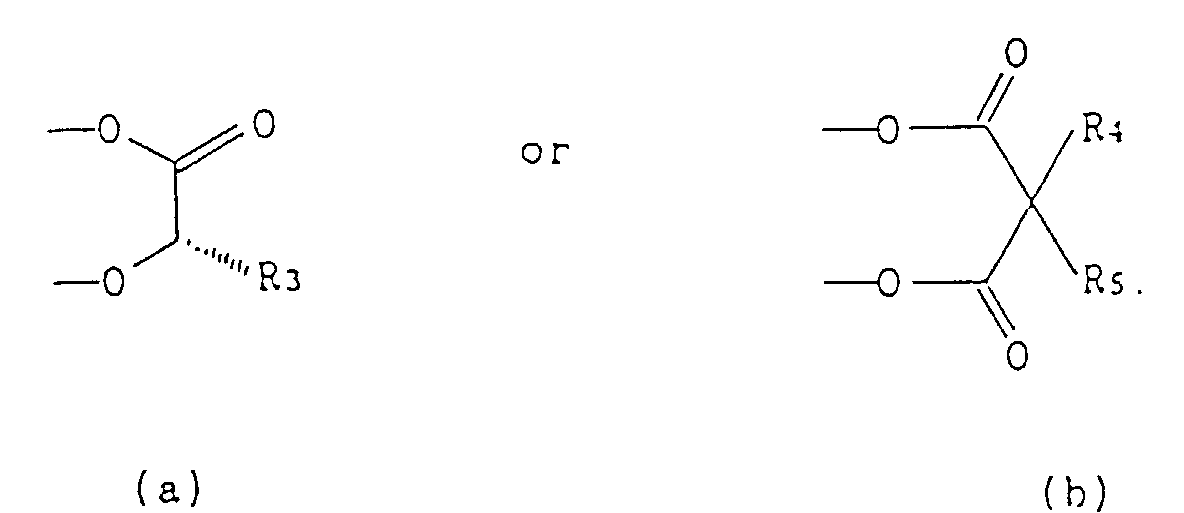
      the absolute configurations at the respective chiral centers in the 4,5-bis(aminomethyl)-1,3-dioxolane moiety are (4R, 5R) or (4S, 5S).
    2. The compound of claim 1, wherein the absolute configurations at the respective chiral centers are (4R,5R).
    3. The compound of claim 1, wherein said R1 and R2 jointly form a cyclopentane or cyclohexane group together with the carbon atom attached thereto; both are a methyl group or an ethyl group; or one of said R1 and R2 is an ethyl or isopropyl group and the other is a hydrogen atom.
    4. The compound of claim 1, wherein R3 is a hydrogen atom when said two Xs jointly form the group of formula(a), or wherein both R4 and R5 are hydrogens when said two Xs form the group of formula(b).
    5. A platinum(II) complex compound having the molecular structure of (glycolato-O,O')[(4R,5R)-4,5-bis(aminomethyl)-1,3-dioxolane-2-spiro-1'-cyclopentane]platinum(II).
    6. A platinum(II) complex compound having the molecular structure of (glycolato-O,O'){cyclohexanespiro-2'-[(4'R,5'R)-4',5'-bis(aminomethyl)-1',3'-dioxolane]}platinum(II).
    7. A platinum(II) complex compound having the molecular structure of (glycolato-O,O')[(4R,5R)-4,5-bis(aminomethyl)-2-ethyl-1,3-dioxolane]platinum(II).
    8. A platinum (II) complex compound having the molecular structure of (glycolato-O,O')[(4R,5R)-4,5-bis(aminomethyl)-2-isopropyl-1,3-dioxolane]platinum (II).
    9. A platinum(II) complex compound having the molecular structure of (glycolato-O,O')[(4R,5R)-4,5-bis(aminomethyl)-2,2-diethyl-1,3-dioxolane]platinum (II).
    10. A platinum(II) complex compound having the molecular structure of (glycolato-O,O')[(4R,5R)-4,5-bis(aminomethyl)-2-ethyl-2-methyl-1,3-dioxolane]platinum (II).
    11. A platinum (II) complex compound having the molecular structure of (glycolato-O,O')[(4R,5R)-4,5-bis(aminomethyl)-2-propyl-1,3-dioxolane]platinum (II).
    12. A platinum(II) complex compound having the molecular structure of cis-cyclobutane-1,1-dicarboxylato[(4R,5R)-4,5-bis-(aminomethyl)-2-ethyl-1,3-dioxolane]platinum (II)
    13. A platinum(II) complex compound having the molecular structure of cis-malonato[(4R,5R)-4,5-bis(aminomethyl)-2,2-diethyl-1,3-dioxolane]platinum(II)
    14. A platinum(II) complex compound having the molecular structure of cis-malonato[(4R,5R)-4,5-bis(aminonethyl)-2-isopropyl-1,3-dioxolane]platinum(II)
    15. A platinum(II) complex compound having the molecular structure of cis-malonato[(4R,5R)-4,5-bis(aminomethyl)-1,3-dioxolane-2-spiro-1'-cyclopentane]platinum (II)
    16. A process for preparing a platinum(II) complex compound of the formula(1a), which comprises:
      reacting a dihalogenodiamine platinum(II) complex of the formula (2) with an acid having the formula of (L)-R3 CHOHCOOH and silver(I) oxide,
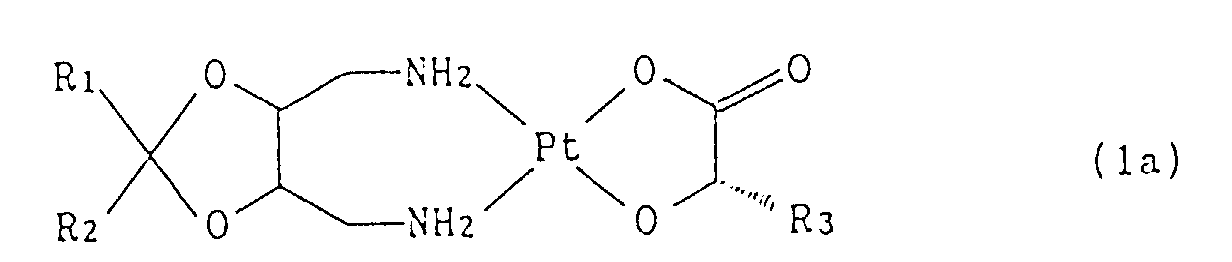
      Figure 01060001
      Figure 01060002
      wherein R1, R2, R3 and the absolute configurations are the same as defined in claim 1 and Hal is a halogen atom.
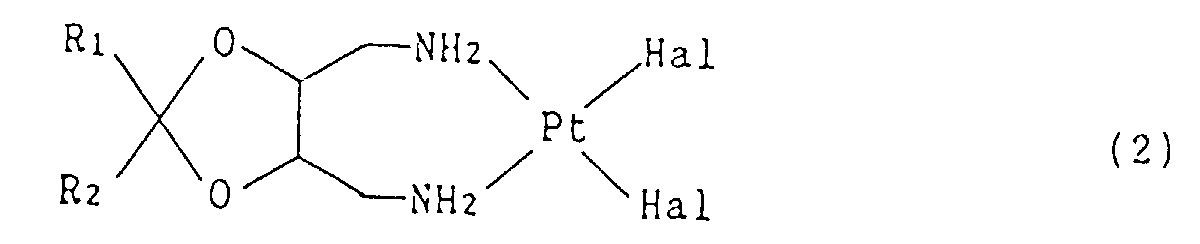
    17. The process of claim 16, wherein said compound of the formula(2) is reacted with said acid and said silver(I) oxide in the equivalent ratio of from 1:0.5:0.5 to 1:5:5, in an aqueous medium or a mixed medium of an aqueous solvent and an alcoholic solvent in a dark environment at a temperature between 0 and 100°C for about 1 hour to 3 days.
    18. A process for preparing a platinum(II) complex compound of the formula(la), which comprises:
      reacting a dihalogenodiamine platinum(II) complex of the formula(2) with an aqueous solution of silver nitrate to obtain an aqueous solution of a diaquacomplex of the formula(3);
      converting said aqueous solution of said diaquacomples of the formula(3) to an aqueous solution of a compound of the formula(4) by passing said diaquacomplex solution through an anion-exchange resin; and
      reacting said aqueous solution of said compound of the formula(4) with an acid and its salt having the formula of (L)-R3CHOHCOOH and (L)-R3CHOHCOONa,
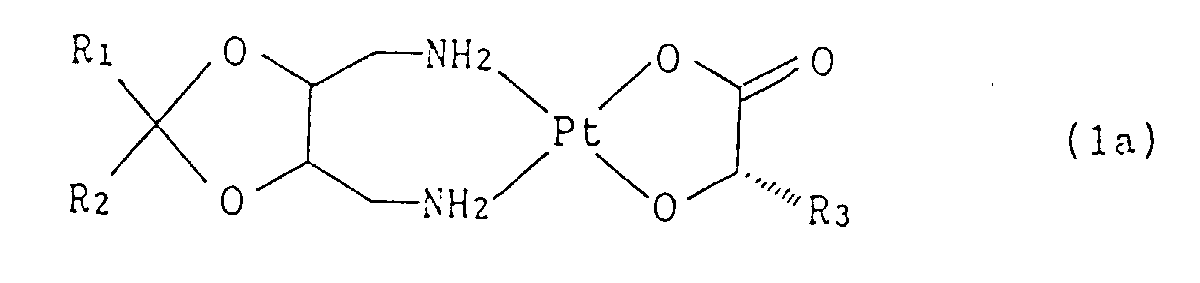
      Figure 01070001
      Figure 01070002
      Figure 01070003
      Figure 01080001
      wherein R1, R2, R3 and the absolute configurations are the same as defined claim 1 and Hal is a halogen atom.
    19. A process for preparing a platinum(II) complex compound of the formula(1b), which comprises:
      reacting a dihalogenodiamine platinum(II) complex of the formula (2) with a compound of the formula (5),
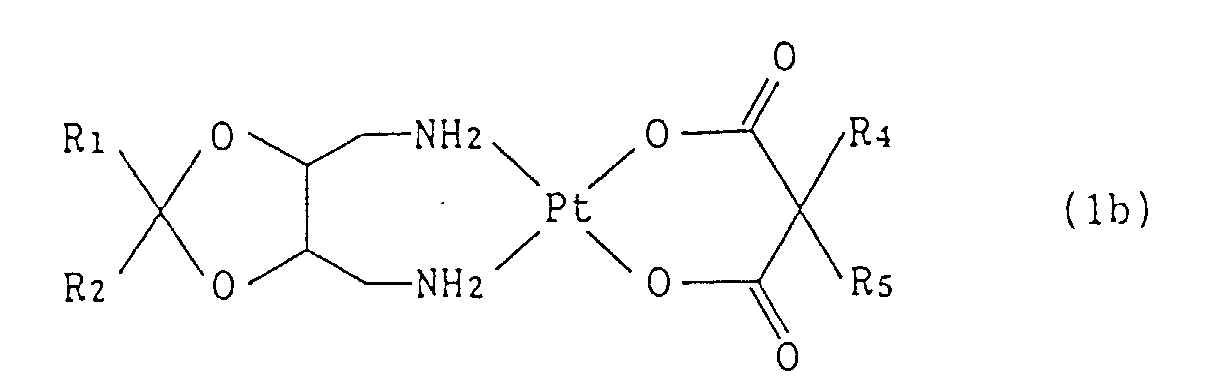
      Figure 01080002
      Figure 01080003
      Figure 01080004
      wherein R1, R2, R4, R5 and the absolute configurations are the same as defined in claim 1 and Hal is a halogen atom.
    20. A process for preparing a platinum(II) complex compound of the formula(1b), which comprises:
      reacting a dihalogenodiamine platinum(II) complex of the formula(2) with a silver ion to obtain a diaquacomplex of the formula(3); and
      reacting said diaquacomplex of the formula (3) with a compound of the formula(6),
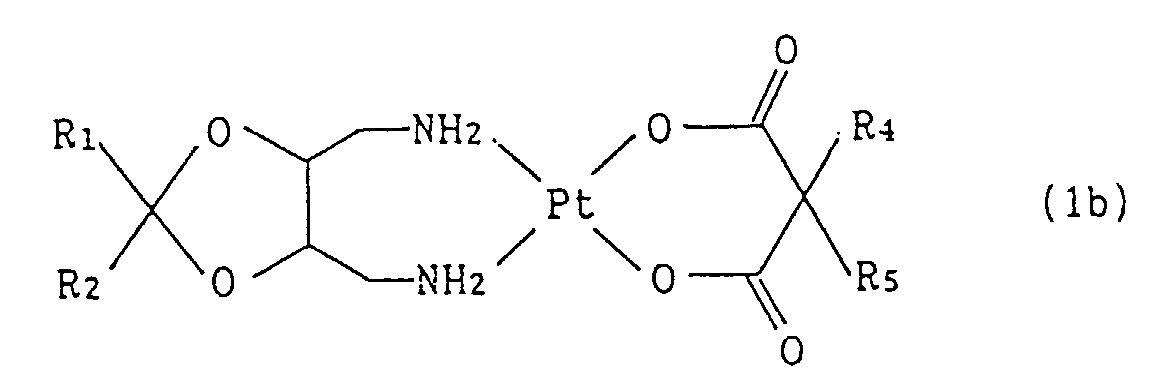
      Figure 01090001
      Figure 01090002
      Figure 01090003
      Figure 01090004
      Wherein R1, R2, R4, R5 and the absolute configurations are the same as defined in claim 1 and M is a monovalent cation.
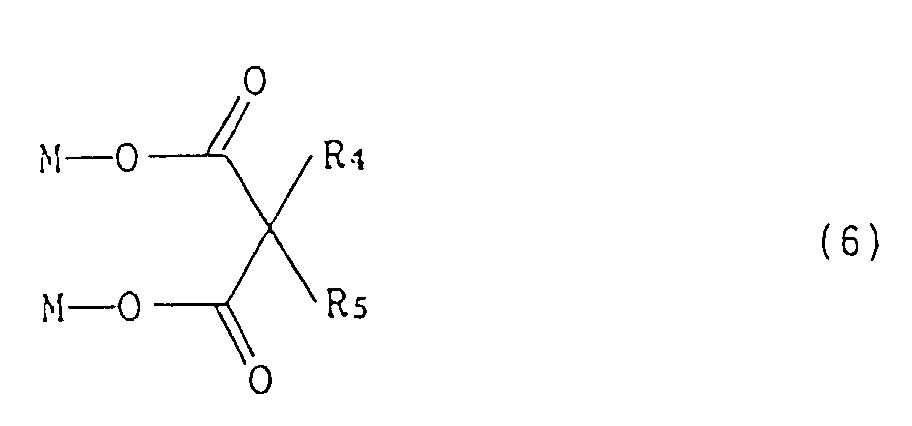
    EP92902293A 1991-03-23 1991-12-30 Novel platinum(ii) complex and processes for preparing the same Expired - Lifetime EP0586378B1 (en)

    Applications Claiming Priority (12)

    Application Number Priority Date Filing Date Title
    KR910004627 1991-03-23
    KR1991462 1991-03-23
    KR1991720 1991-05-03
    KR910007207 1991-05-03
    KR910013205 1991-07-31
    KR1991132 1991-07-31
    KR1991199 1991-11-11
    KR1019910019969A KR940010296B1 (en) 1991-05-03 1991-11-11 New pt(ñœ)complexes and process for the preparation thereof
    KR1019910024631A KR940010297B1 (en) 1991-03-23 1991-12-27 Novel Platinum (II) Complexes and Preparation Methods
    KR1019910024632A KR940010298B1 (en) 1991-07-31 1991-12-27 New pt(ñœ) complexes and process for the preparation thereof
    KR1991246 1991-12-27
    PCT/KR1991/000036 WO1992016539A1 (en) 1991-03-23 1991-12-30 Novel platinum(ii) complex and processes for preparing the same

    Publications (2)

    Publication Number Publication Date
    EP0586378A1 EP0586378A1 (en) 1994-03-16
    EP0586378B1 true EP0586378B1 (en) 1998-09-23

    Family

    ID=27555050

    Family Applications (1)

    Application Number Title Priority Date Filing Date
    EP92902293A Expired - Lifetime EP0586378B1 (en) 1991-03-23 1991-12-30 Novel platinum(ii) complex and processes for preparing the same

    Country Status (21)

    Country Link
    US (1) US5395947A (en)
    EP (1) EP0586378B1 (en)
    JP (1) JP2801965B2 (en)
    CN (2) CN1038590C (en)
    AT (1) ATE171455T1 (en)
    AU (2) AU654990B2 (en)
    BR (1) BR9107299A (en)
    CA (1) CA2106679C (en)
    CZ (1) CZ285904B6 (en)
    DE (1) DE69130261T2 (en)
    ES (1) ES2124251T3 (en)
    FI (1) FI934150A7 (en)
    HU (3) HUT72890A (en)
    IE (1) IE920687A1 (en)
    IL (1) IL101167A (en)
    NO (1) NO304652B1 (en)
    NZ (1) NZ241824A (en)
    PH (1) PH30926A (en)
    PT (1) PT100272B (en)
    RU (1) RU2067099C1 (en)
    WO (1) WO1992016539A1 (en)

    Families Citing this family (7)

    * Cited by examiner, † Cited by third party
    Publication number Priority date Publication date Assignee Title
    US5380897A (en) * 1993-05-25 1995-01-10 Hoeschele; James D. Tri(platinum) complexes
    CN1068002C (en) * 1997-04-30 2001-07-04 中国科学院大连化学物理研究所 Mesoplatinum anticarcinogen and its synthesis
    CA2385528C (en) 1999-10-01 2013-12-10 Immunogen, Inc. Compositions and methods for treating cancer using immunoconjugates and chemotherapeutic agents
    CN100497359C (en) * 2006-01-06 2009-06-10 昆明贵研药业有限公司 Novel synthesis process of anti-cancer Sunpla
    RU2457838C1 (en) * 2011-04-13 2012-08-10 Федеральное Государственное Бюджетное Учреждение Науки Институт Химии И Химической Технологии Сибирского Отделения Российской Академии Наук (Иххт Со Ран) Method of obtaining trans-1,2-diaminocyclohexane tetrachloroplatinum (iv)
    CN103242509B (en) * 2013-04-18 2015-06-10 艾达索高新材料无锡有限公司 Degradable cyclic acetal and cyclic ketal diamine epoxy resin curing agent and application thereof
    CN106132408B (en) * 2015-04-10 2018-02-13 新纳特产品公司 A kind of preparation method of bicycloplatin

    Citations (6)

    * Cited by examiner, † Cited by third party
    Publication number Priority date Publication date Assignee Title
    EP0041644A2 (en) * 1980-05-27 1981-12-16 Bristol-Myers Company Salts of 2-hydroxymalonato diammine platinum (II) compounds, process for preparing said compounds and pharmaceutical compositions containing said compounds
    US4657927A (en) * 1978-05-04 1987-04-14 Research Corporation Malonato platinum compounds
    EP0281412A2 (en) * 1987-03-06 1988-09-07 Tanabe Seiyaku Co., Ltd. Novel organic platinum complex pharmaceutical compositions containing same and a process for the preparation thereof
    EP0284197A1 (en) * 1987-02-20 1988-09-28 Tanabe Seiyaku Co., Ltd. Novel organic platinum complex and process for the preparation thereof
    US4870062A (en) * 1987-04-23 1989-09-26 Sanwa Kagaku Kenkyusho Co., Ltd. Organo-platinum complex and use thereof as anti-tumor agent
    US4939256A (en) * 1988-02-04 1990-07-03 Kanebo Ltd. Novel platinum complex, antineoplastic agent containing the same, and intermediate therefor

    Family Cites Families (6)

    * Cited by examiner, † Cited by third party
    Publication number Priority date Publication date Assignee Title
    DE3432320A1 (en) * 1984-09-03 1986-03-13 Behringwerke Ag, 3550 Marburg CIS-PLATINUM COMPLEXES WITH A PENTAERYTHRITE DERIVATIVE AS A LIGAND, METHOD FOR THE PRODUCTION THEREOF AND PHARMACEUTICAL AGENT CONTAINING THESE COMPOUNDS
    US4665210A (en) * 1984-12-17 1987-05-12 American Cyanamid Company Platinum complexes of aliphatic tricarboxylic acids
    GB8525689D0 (en) * 1985-10-18 1985-11-20 Johnson Mathey Plc Platinum coordination compounds
    US4808730A (en) * 1987-06-23 1989-02-28 American Cyanamid Company Synthesis of cisplatin analogs
    US4870070A (en) * 1987-08-10 1989-09-26 American Cyanamid Company Water soluble platinum complexes of novel malonate derivatives
    US5243057A (en) 1989-03-07 1993-09-07 Aerojet-General Corporation Energetic azidomethyl-substituted 1,3-dioxolanes

    Patent Citations (6)

    * Cited by examiner, † Cited by third party
    Publication number Priority date Publication date Assignee Title
    US4657927A (en) * 1978-05-04 1987-04-14 Research Corporation Malonato platinum compounds
    EP0041644A2 (en) * 1980-05-27 1981-12-16 Bristol-Myers Company Salts of 2-hydroxymalonato diammine platinum (II) compounds, process for preparing said compounds and pharmaceutical compositions containing said compounds
    EP0284197A1 (en) * 1987-02-20 1988-09-28 Tanabe Seiyaku Co., Ltd. Novel organic platinum complex and process for the preparation thereof
    EP0281412A2 (en) * 1987-03-06 1988-09-07 Tanabe Seiyaku Co., Ltd. Novel organic platinum complex pharmaceutical compositions containing same and a process for the preparation thereof
    US4870062A (en) * 1987-04-23 1989-09-26 Sanwa Kagaku Kenkyusho Co., Ltd. Organo-platinum complex and use thereof as anti-tumor agent
    US4939256A (en) * 1988-02-04 1990-07-03 Kanebo Ltd. Novel platinum complex, antineoplastic agent containing the same, and intermediate therefor

    Also Published As

    Publication number Publication date
    CA2106679C (en) 1996-01-09
    AU654990B2 (en) 1994-12-01
    ATE171455T1 (en) 1998-10-15
    JPH06510520A (en) 1994-11-24
    FI934150A7 (en) 1993-10-08
    PT100272B (en) 1999-09-30
    HUT72890A (en) 1996-06-28
    PH30926A (en) 1997-12-23
    NO304652B1 (en) 1999-01-25
    NO933370L (en) 1993-09-22
    WO1992016539A1 (en) 1992-10-01
    JP2801965B2 (en) 1998-09-21
    ES2124251T3 (en) 1999-02-01
    CN1063753C (en) 2001-03-28
    CN1038590C (en) 1998-06-03
    CN1065274A (en) 1992-10-14
    CS87392A3 (en) 1992-10-14
    DE69130261T2 (en) 1999-05-20
    IL101167A0 (en) 1992-11-15
    DE69130261D1 (en) 1998-10-29
    NO933370D0 (en) 1993-09-22
    HU220869B1 (en) 2002-06-29
    CZ285904B6 (en) 1999-11-17
    HU9502323D0 (en) 1995-09-28
    HU9302461D0 (en) 1993-11-29
    AU9124791A (en) 1992-10-21
    BR9107299A (en) 1994-06-14
    US5395947A (en) 1995-03-07
    PT100272A (en) 1993-08-31
    FI934150A0 (en) 1993-09-22
    IL101167A (en) 1996-08-04
    NZ241824A (en) 1993-04-28
    IE920687A1 (en) 1992-09-23
    AU7443994A (en) 1994-12-08
    EP0586378A1 (en) 1994-03-16
    RU2067099C1 (en) 1996-09-27
    CA2106679A1 (en) 1992-09-24
    CN1204650A (en) 1999-01-13
    HUT65220A (en) 1994-05-02

    Similar Documents

    Publication Publication Date Title
    Kim et al. Synthesis and antitumor activity of a series of [2-substituted-4, 5-bis (aminomethyl)-1, 3-dioxolane] platinum (II) complexes
    US4256652A (en) Platinum complex
    AU595827B2 (en) Novel platinum complexes
    CA1268599A (en) Cis-platinum complexes with a pentaerythritol derivative as the ligand, a process for their preparation and a pharmaceutical agent containing these compounds
    EP0166366B1 (en) Novel platinum complexes
    US5091521A (en) Cis-platinum complexes, a process for the preparation thereof, and pharmaceuticals containing these compounds
    EP0273315B1 (en) Ammine-n-heterocyclic-platinum complexes and antitumor agents
    CA1292749C (en) Platinum complexes
    US5395947A (en) Platinum(II) complex and processes for preparing the same
    EP0222522B1 (en) Platinum coordination compounds
    US4994591A (en) Platinum complexes derived from b-silyamines
    EP0176005A1 (en) Novel platinum complexes
    US4968826A (en) Platinum complexes and antitumor agents containing them as an active ingredient
    EP0518645B1 (en) Platinum (II) complex and antitumor agent
    US5616613A (en) Platinum(II) complex and malignant tumor treatment agent
    KR940010297B1 (en) Novel Platinum (II) Complexes and Preparation Methods
    KR940010296B1 (en) New pt(ñœ)complexes and process for the preparation thereof
    EP0214862B1 (en) Anti-tumour platinum complexes, their preparation and their use
    KR940010298B1 (en) New pt(ñœ) complexes and process for the preparation thereof
    US5101054A (en) Novel fluorine-containing platinum complex
    JPH0523276B2 (en)
    JPWO1995028408A1 (en) Novel platinum (II) complexes and malignant tumor treatment agents

    Legal Events

    Date Code Title Description
    PUAI Public reference made under article 153(3) epc to a published international application that has entered the european phase

    Free format text: ORIGINAL CODE: 0009012

    17P Request for examination filed

    Effective date: 19930916

    AK Designated contracting states

    Kind code of ref document: A1

    Designated state(s): AT BE CH DE DK ES FR GB GR IT LI LU MC NL SE

    17Q First examination report despatched

    Effective date: 19961106

    GRAG Despatch of communication of intention to grant

    Free format text: ORIGINAL CODE: EPIDOS AGRA

    GRAG Despatch of communication of intention to grant

    Free format text: ORIGINAL CODE: EPIDOS AGRA

    GRAH Despatch of communication of intention to grant a patent

    Free format text: ORIGINAL CODE: EPIDOS IGRA

    GRAH Despatch of communication of intention to grant a patent

    Free format text: ORIGINAL CODE: EPIDOS IGRA

    GRAA (expected) grant

    Free format text: ORIGINAL CODE: 0009210

    AK Designated contracting states

    Kind code of ref document: B1

    Designated state(s): AT BE CH DE DK ES FR GB GR IT LI LU MC NL SE

    PG25 Lapsed in a contracting state [announced via postgrant information from national office to epo]

    Ref country code: NL

    Free format text: LAPSE BECAUSE OF FAILURE TO SUBMIT A TRANSLATION OF THE DESCRIPTION OR TO PAY THE FEE WITHIN THE PRESCRIBED TIME-LIMIT

    Effective date: 19980923

    Ref country code: LI

    Free format text: LAPSE BECAUSE OF FAILURE TO SUBMIT A TRANSLATION OF THE DESCRIPTION OR TO PAY THE FEE WITHIN THE PRESCRIBED TIME-LIMIT

    Effective date: 19980923

    Ref country code: GR

    Free format text: LAPSE BECAUSE OF NON-PAYMENT OF DUE FEES

    Effective date: 19980923

    Ref country code: CH

    Free format text: LAPSE BECAUSE OF FAILURE TO SUBMIT A TRANSLATION OF THE DESCRIPTION OR TO PAY THE FEE WITHIN THE PRESCRIBED TIME-LIMIT

    Effective date: 19980923

    Ref country code: BE

    Free format text: LAPSE BECAUSE OF FAILURE TO SUBMIT A TRANSLATION OF THE DESCRIPTION OR TO PAY THE FEE WITHIN THE PRESCRIBED TIME-LIMIT

    Effective date: 19980923

    Ref country code: AT

    Free format text: LAPSE BECAUSE OF FAILURE TO SUBMIT A TRANSLATION OF THE DESCRIPTION OR TO PAY THE FEE WITHIN THE PRESCRIBED TIME-LIMIT

    Effective date: 19980923

    REF Corresponds to:

    Ref document number: 171455

    Country of ref document: AT

    Date of ref document: 19981015

    Kind code of ref document: T

    REG Reference to a national code

    Ref country code: CH

    Ref legal event code: EP

    REF Corresponds to:

    Ref document number: 69130261

    Country of ref document: DE

    Date of ref document: 19981029

    PG25 Lapsed in a contracting state [announced via postgrant information from national office to epo]

    Ref country code: SE

    Free format text: LAPSE BECAUSE OF FAILURE TO SUBMIT A TRANSLATION OF THE DESCRIPTION OR TO PAY THE FEE WITHIN THE PRESCRIBED TIME-LIMIT

    Effective date: 19981223

    Ref country code: DK

    Free format text: LAPSE BECAUSE OF FAILURE TO SUBMIT A TRANSLATION OF THE DESCRIPTION OR TO PAY THE FEE WITHIN THE PRESCRIBED TIME-LIMIT

    Effective date: 19981223

    ET Fr: translation filed
    PG25 Lapsed in a contracting state [announced via postgrant information from national office to epo]

    Ref country code: LU

    Free format text: LAPSE BECAUSE OF NON-PAYMENT OF DUE FEES

    Effective date: 19981230

    REG Reference to a national code

    Ref country code: ES

    Ref legal event code: FG2A

    Ref document number: 2124251

    Country of ref document: ES

    Kind code of ref document: T3

    NLV1 Nl: lapsed or annulled due to failure to fulfill the requirements of art. 29p and 29m of the patents act
    REG Reference to a national code

    Ref country code: CH

    Ref legal event code: PL

    PG25 Lapsed in a contracting state [announced via postgrant information from national office to epo]

    Ref country code: MC

    Free format text: LAPSE BECAUSE OF NON-PAYMENT OF DUE FEES

    Effective date: 19990630

    PLBE No opposition filed within time limit

    Free format text: ORIGINAL CODE: 0009261

    STAA Information on the status of an ep patent application or granted ep patent

    Free format text: STATUS: NO OPPOSITION FILED WITHIN TIME LIMIT

    26N No opposition filed
    REG Reference to a national code

    Ref country code: GB

    Ref legal event code: IF02

    PGFP Annual fee paid to national office [announced via postgrant information from national office to epo]

    Ref country code: FR

    Payment date: 20031210

    Year of fee payment: 13

    PGFP Annual fee paid to national office [announced via postgrant information from national office to epo]

    Ref country code: GB

    Payment date: 20031224

    Year of fee payment: 13

    PGFP Annual fee paid to national office [announced via postgrant information from national office to epo]

    Ref country code: ES

    Payment date: 20031230

    Year of fee payment: 13

    PGFP Annual fee paid to national office [announced via postgrant information from national office to epo]

    Ref country code: DE

    Payment date: 20040108

    Year of fee payment: 13

    PG25 Lapsed in a contracting state [announced via postgrant information from national office to epo]

    Ref country code: GB

    Free format text: LAPSE BECAUSE OF NON-PAYMENT OF DUE FEES

    Effective date: 20041230

    PG25 Lapsed in a contracting state [announced via postgrant information from national office to epo]

    Ref country code: ES

    Free format text: LAPSE BECAUSE OF NON-PAYMENT OF DUE FEES

    Effective date: 20041231

    PG25 Lapsed in a contracting state [announced via postgrant information from national office to epo]

    Ref country code: DE

    Free format text: LAPSE BECAUSE OF NON-PAYMENT OF DUE FEES

    Effective date: 20050701

    GBPC Gb: european patent ceased through non-payment of renewal fee

    Effective date: 20041230

    PG25 Lapsed in a contracting state [announced via postgrant information from national office to epo]

    Ref country code: FR

    Free format text: LAPSE BECAUSE OF NON-PAYMENT OF DUE FEES

    Effective date: 20050831

    REG Reference to a national code

    Ref country code: FR

    Ref legal event code: ST

    PG25 Lapsed in a contracting state [announced via postgrant information from national office to epo]

    Ref country code: IT

    Free format text: LAPSE BECAUSE OF NON-PAYMENT OF DUE FEES

    Effective date: 20051230

    REG Reference to a national code

    Ref country code: ES

    Ref legal event code: FD2A

    Effective date: 20041231