EP0585440B1 - 2-amino-1,2,3,4-tetrahydronaphthalene derivatives active on the cardiovascular system, processes for their preparation and pharmaceutical compositions containing them - Google Patents
2-amino-1,2,3,4-tetrahydronaphthalene derivatives active on the cardiovascular system, processes for their preparation and pharmaceutical compositions containing them Download PDFInfo
- Publication number
- EP0585440B1 EP0585440B1 EP93906515A EP93906515A EP0585440B1 EP 0585440 B1 EP0585440 B1 EP 0585440B1 EP 93906515 A EP93906515 A EP 93906515A EP 93906515 A EP93906515 A EP 93906515A EP 0585440 B1 EP0585440 B1 EP 0585440B1
- Authority
- EP
- European Patent Office
- Prior art keywords
- formula
- compound
- acid
- compounds
- hydrogen atom
- Prior art date
- Legal status (The legal status is an assumption and is not a legal conclusion. Google has not performed a legal analysis and makes no representation as to the accuracy of the status listed.)
- Expired - Lifetime
Links
- 0 Cc1cc(CC(CC2)N(C=I)C(*=C)=O)c2c(*)c1C Chemical compound Cc1cc(CC(CC2)N(C=I)C(*=C)=O)c2c(*)c1C 0.000 description 2
- GHDIHPNJQVDFBL-UHFFFAOYSA-N COC1CCCCC1 Chemical compound COC1CCCCC1 GHDIHPNJQVDFBL-UHFFFAOYSA-N 0.000 description 1
Classifications
-
- C—CHEMISTRY; METALLURGY
- C07—ORGANIC CHEMISTRY
- C07C—ACYCLIC OR CARBOCYCLIC COMPOUNDS
- C07C219/00—Compounds containing amino and esterified hydroxy groups bound to the same carbon skeleton
- C07C219/26—Compounds containing amino and esterified hydroxy groups bound to the same carbon skeleton having esterified hydroxy groups bound to carbon atoms of at least one six-membered aromatic ring and amino groups bound to acyclic carbon atoms or to carbon atoms of rings other than six-membered aromatic rings of the same carbon skeleton
-
- A—HUMAN NECESSITIES
- A61—MEDICAL OR VETERINARY SCIENCE; HYGIENE
- A61P—SPECIFIC THERAPEUTIC ACTIVITY OF CHEMICAL COMPOUNDS OR MEDICINAL PREPARATIONS
- A61P13/00—Drugs for disorders of the urinary system
- A61P13/02—Drugs for disorders of the urinary system of urine or of the urinary tract, e.g. urine acidifiers
-
- A—HUMAN NECESSITIES
- A61—MEDICAL OR VETERINARY SCIENCE; HYGIENE
- A61P—SPECIFIC THERAPEUTIC ACTIVITY OF CHEMICAL COMPOUNDS OR MEDICINAL PREPARATIONS
- A61P15/00—Drugs for genital or sexual disorders; Contraceptives
-
- A—HUMAN NECESSITIES
- A61—MEDICAL OR VETERINARY SCIENCE; HYGIENE
- A61P—SPECIFIC THERAPEUTIC ACTIVITY OF CHEMICAL COMPOUNDS OR MEDICINAL PREPARATIONS
- A61P43/00—Drugs for specific purposes, not provided for in groups A61P1/00-A61P41/00
-
- A—HUMAN NECESSITIES
- A61—MEDICAL OR VETERINARY SCIENCE; HYGIENE
- A61P—SPECIFIC THERAPEUTIC ACTIVITY OF CHEMICAL COMPOUNDS OR MEDICINAL PREPARATIONS
- A61P9/00—Drugs for disorders of the cardiovascular system
-
- A—HUMAN NECESSITIES
- A61—MEDICAL OR VETERINARY SCIENCE; HYGIENE
- A61P—SPECIFIC THERAPEUTIC ACTIVITY OF CHEMICAL COMPOUNDS OR MEDICINAL PREPARATIONS
- A61P9/00—Drugs for disorders of the cardiovascular system
- A61P9/10—Drugs for disorders of the cardiovascular system for treating ischaemic or atherosclerotic diseases, e.g. antianginal drugs, coronary vasodilators, drugs for myocardial infarction, retinopathy, cerebrovascula insufficiency, renal arteriosclerosis
-
- A—HUMAN NECESSITIES
- A61—MEDICAL OR VETERINARY SCIENCE; HYGIENE
- A61P—SPECIFIC THERAPEUTIC ACTIVITY OF CHEMICAL COMPOUNDS OR MEDICINAL PREPARATIONS
- A61P9/00—Drugs for disorders of the cardiovascular system
- A61P9/12—Antihypertensives
-
- C—CHEMISTRY; METALLURGY
- C07—ORGANIC CHEMISTRY
- C07C—ACYCLIC OR CARBOCYCLIC COMPOUNDS
- C07C217/00—Compounds containing amino and etherified hydroxy groups bound to the same carbon skeleton
- C07C217/02—Compounds containing amino and etherified hydroxy groups bound to the same carbon skeleton having etherified hydroxy groups and amino groups bound to acyclic carbon atoms of the same carbon skeleton
- C07C217/04—Compounds containing amino and etherified hydroxy groups bound to the same carbon skeleton having etherified hydroxy groups and amino groups bound to acyclic carbon atoms of the same carbon skeleton the carbon skeleton being acyclic and saturated
- C07C217/06—Compounds containing amino and etherified hydroxy groups bound to the same carbon skeleton having etherified hydroxy groups and amino groups bound to acyclic carbon atoms of the same carbon skeleton the carbon skeleton being acyclic and saturated having only one etherified hydroxy group and one amino group bound to the carbon skeleton, which is not further substituted
- C07C217/14—Compounds containing amino and etherified hydroxy groups bound to the same carbon skeleton having etherified hydroxy groups and amino groups bound to acyclic carbon atoms of the same carbon skeleton the carbon skeleton being acyclic and saturated having only one etherified hydroxy group and one amino group bound to the carbon skeleton, which is not further substituted the oxygen atom of the etherified hydroxy group being further bound to a carbon atom of a six-membered aromatic ring
- C07C217/18—Compounds containing amino and etherified hydroxy groups bound to the same carbon skeleton having etherified hydroxy groups and amino groups bound to acyclic carbon atoms of the same carbon skeleton the carbon skeleton being acyclic and saturated having only one etherified hydroxy group and one amino group bound to the carbon skeleton, which is not further substituted the oxygen atom of the etherified hydroxy group being further bound to a carbon atom of a six-membered aromatic ring the six-membered aromatic ring or condensed ring system containing that ring being further substituted
- C07C217/20—Compounds containing amino and etherified hydroxy groups bound to the same carbon skeleton having etherified hydroxy groups and amino groups bound to acyclic carbon atoms of the same carbon skeleton the carbon skeleton being acyclic and saturated having only one etherified hydroxy group and one amino group bound to the carbon skeleton, which is not further substituted the oxygen atom of the etherified hydroxy group being further bound to a carbon atom of a six-membered aromatic ring the six-membered aromatic ring or condensed ring system containing that ring being further substituted by halogen atoms, by trihalomethyl, nitro or nitroso groups, or by singly-bound oxygen atoms
-
- C—CHEMISTRY; METALLURGY
- C07—ORGANIC CHEMISTRY
- C07C—ACYCLIC OR CARBOCYCLIC COMPOUNDS
- C07C271/00—Derivatives of carbamic acids, i.e. compounds containing any of the groups, the nitrogen atom not being part of nitro or nitroso groups
- C07C271/06—Esters of carbamic acids
- C07C271/08—Esters of carbamic acids having oxygen atoms of carbamate groups bound to acyclic carbon atoms
- C07C271/10—Esters of carbamic acids having oxygen atoms of carbamate groups bound to acyclic carbon atoms with the nitrogen atoms of the carbamate groups bound to hydrogen atoms or to acyclic carbon atoms
- C07C271/20—Esters of carbamic acids having oxygen atoms of carbamate groups bound to acyclic carbon atoms with the nitrogen atoms of the carbamate groups bound to hydrogen atoms or to acyclic carbon atoms to carbon atoms of hydrocarbon radicals substituted by nitrogen atoms not being part of nitro or nitroso groups
-
- C—CHEMISTRY; METALLURGY
- C07—ORGANIC CHEMISTRY
- C07C—ACYCLIC OR CARBOCYCLIC COMPOUNDS
- C07C271/00—Derivatives of carbamic acids, i.e. compounds containing any of the groups, the nitrogen atom not being part of nitro or nitroso groups
- C07C271/06—Esters of carbamic acids
- C07C271/40—Esters of carbamic acids having oxygen atoms of carbamate groups bound to carbon atoms of six-membered aromatic rings
- C07C271/42—Esters of carbamic acids having oxygen atoms of carbamate groups bound to carbon atoms of six-membered aromatic rings with the nitrogen atoms of the carbamate groups bound to hydrogen atoms or to acyclic carbon atoms
- C07C271/44—Esters of carbamic acids having oxygen atoms of carbamate groups bound to carbon atoms of six-membered aromatic rings with the nitrogen atoms of the carbamate groups bound to hydrogen atoms or to acyclic carbon atoms to hydrogen atoms or to carbon atoms of unsubstituted hydrocarbon radicals
-
- C—CHEMISTRY; METALLURGY
- C07—ORGANIC CHEMISTRY
- C07C—ACYCLIC OR CARBOCYCLIC COMPOUNDS
- C07C2602/00—Systems containing two condensed rings
- C07C2602/02—Systems containing two condensed rings the rings having only two atoms in common
- C07C2602/04—One of the condensed rings being a six-membered aromatic ring
- C07C2602/10—One of the condensed rings being a six-membered aromatic ring the other ring being six-membered, e.g. tetraline
Definitions
- the present invention relates to compounds active on the cardiovascular system and, in particular, it relates to derivatives of 2-amino-1,2,3,4-tetrahydronaphthalene and to their use in therapeutic field.
- European patent application No. 0 072 061 (Fisons) describes, among the others, dopamine and amino-1,2,3,4-tetraidronaphthalene derivatives having a mono or di-substituted amino portion of formula wherein X is a -(CH2) n - chain, optionally substituted by hydroxy; n is an integer between 1 and 7; R1 and R2, the same or different, are hydrogen, alkyl or phenyl; D2 is hydrogen, alkyl, phenyl; alkyl substituted by phenyl substituted, in turn, by halogen, alkyl, amino, alkoxy or nitro; or D2 may be the phenylethyl moiety of a dopamine or a hydroxy-1,2,3,4-tetrahydronaphthyl moiety.
- European patent application No. 0 142 283 (Fisons) describes a class of compounds which are analogs of dopexamine and in which the amino group of the dopamine moiety is still secondary.
- object of the present invention are the compounds of formula wherein
- the compounds of formula I have, at least, an asymmetric center and they exist in the form of stereoisomers.
- the compounds of formula I are agonists of dopaminergic receptors, are active also by oral route and have a long duration of action and they are useful in therapy in the cardiovascular field, in particular for the treatment of arterial hypertension, congestive heart failure, renal failure, for the treatment of peripheral arteriopathies and in cerebrovascular insufficiencies.
- alkyl or alkoxy group in the meanings of R3, R4, R5 and R6 are methyl, ethyl, n.propyl, i.propyl, n.butyl, i.butyl, sec.butyl, ter.butyl, methoxy, ethoxy, n.propoxy and i.propoxy.
- Halogen atoms are fluorine, chlorine, bromine and iodine.
- acyl group derived from an aliphatic carboxylic acid means an acyl radical derived from a linear or branched aliphatic carboxylic acid having from 1 to 6 carbon atoms, optionally substituted by phenyl, halogen or alkoxy groups; specific examples are the acyl groups derived from the following acids: formic, acetic, propionic, butyric, isobutyric, valeric and pivalic; acyl groups from aromatic or heteroaromatic carboxylic acids derive from benzoic or pyridinecarboxylic (2-, 3- or 4-pyridinecarboxylic), pyrrolecarboxylic, isoxazolecarboxylic and quinolinecarboxylic acid, optionally substituted by alkyl, alkoxy, halogen or nitro groups.
- Specific examples comprise benzoyl, 2-pyridinecarbonyl, 3-pyridinecarbonyl, 4-pyridinecarbonyl, 2-chlorobenzoyl, 4-chlorobenzoyl, 2-methylbenzoyl, 3-methylbenzoyl, 4-methylbenzoyl, 2,4-dimethylbenzoyl, 4-nitrobenzoyl, 4-isobutyrylbenzoyl, 4-methoxybenzoyl, 2-methoxybenzoyl, 3-methoxybenzoyl.
- Preferred substituents for carbamic and carbonic acids are alkyl and phenyl.
- Preferred compounds of formula I are the compounds in which R1 is OY', Y, Y' and R2 are hydrogen atoms, n is an integer selected from 5, 6 and 7.
- Still more preferred compounds of formula I are the compounds in which R1 is OY', Y, Y' and R2 are hydrogen atoms, n is 6, m is 1, R4 and R5, the same or different, are hydrogen atoms, methyl or methoxy groups, chlorine.
- preferred pro-drugs are the compounds in which one or both Y and Y', the same or different, are an acyl group derived from acetic, propionic, butyric, isobutyric acid, from optionally substituted benzoic or pyridinecarboxylic acid, from carbamic or carbonic acid.
- salts of the compounds of formula I are salts with organic or inorganic acids such as, for example, hydrochloric, hydrobromic, hydriodic, nitric, sulfuric, phosphoric, acetic, aspartic, methansulfonic and 3,7-di-ter.butylnaphthalen-1,5-disulfonic acid (dibudinic acid).
- organic or inorganic acids such as, for example, hydrochloric, hydrobromic, hydriodic, nitric, sulfuric, phosphoric, acetic, aspartic, methansulfonic and 3,7-di-ter.butylnaphthalen-1,5-disulfonic acid (dibudinic acid).
- the preparation of the compounds of formula I can be carried out according to the synthetic method described hereinafter.
- the method comprises the reaction between a compound of formula wherein
- the reduction of the compounds of formula IV can be carried out by using electrophylic reducing agents, in particular diborane optionally complexed with dimethylsulphide, tetrahydrofuran, aliphatic amines such as triethylamine or aromatic amines such as N,N-diethylaniline or pyridine.
- electrophylic reducing agents in particular diborane optionally complexed with dimethylsulphide, tetrahydrofuran, aliphatic amines such as triethylamine or aromatic amines such as N,N-diethylaniline or pyridine.
- the reduction can be carried out with nucleophylic reducing agents such as metal hydride, for example aluminum lithium hydride.
- nucleophylic reducing agents such as metal hydride, for example aluminum lithium hydride.
- the reduction reaction is carried out in a suitable solvent such as, for example, tetrahydrofuran, diethylether or 1,2-dimethoxyethane.
- a suitable solvent such as, for example, tetrahydrofuran, diethylether or 1,2-dimethoxyethane.
- the deprotection, when needed, of the hydroxy groups is carried out according to conventional techniques such as hydrolysis or hydrogenolysis.
- the compounds of formula II are known or they can be easily prepared according to known methods (British Patent No. 1,509,454 - The Wellcome Foundation Ltd.).
- the compounds of formula III are known or they can be easily prepared according to conventional methods such as the condensation between an aminoacid of formula wherein R3 and n have the meanings reported for formula I; and an acyl halide of formula wherein R4 and R5 have the meanings reported for formula I and X is a chlorine or bromine atom.
- the synthetic method for the preparation of the compounds of formula I can be carried out by a different sequence of steps.
- the compounds of formula II can be reacted, first, with an aminoacid of formula V or a reactive derivative thereof, in order to obtain the intermediate of formula where in m , n , R3, R7, R8 and R9 have the meanings reported for formula I and II; which is then acylated with an acyl halide of formula VI, so obtaining the intermediates of formula IV.
- the subsequent reduction as above reported affords the compounds of formula I, object of the present invention.
- the compounds of formula I in optically active form can be obtained by optical separation or by stereospecific or stereoselective synthesis by using an optically active starting compound of formula II.
- the preparation of the pro-drugs of formula I can be carried out by esterification of one or both the catechol hydroxy groups according to conventional methods.
- This protecting group can be easily removed after the esterification, for example by hydrogenolysis.
- the compounds of formula I are agonists of D1 and D2 dopaminergic receptors at least 2-10 times more potent than dopamine as shown in the in vitro binding tests (example 11).
- the compounds of formula I showed to be inactive on the central nervous system and this lack of effect is a further favourable property not shared by other compounds having a catecholamine structure.
- the compounds of formula I can be administered by infusion as well as by enteral route so differing from dopamine and from dopexamine.
- the therapeutic doses will be generally between 10 mg and 1 g a day and between 5 and 300 mg by oral route for each administration.
- compositions containing a therapeutically effective amount of the compounds of formula I or of pharmaceutically acceptable salts thereof in a mixture with a suitable carrier are a further object of the present invention.
- compositions object of the invention may be liquid, suitable for enteral or parenteral administration or, preferably, solid such as tablets, capsules, granulates, suitable for oral administration.
- compositions can be carried out according to traditional techniques.
- a pro-drug can be useful for improving formulation properties or the compatibility with other active ingredients.
- the reaction mixture was kept under stirring and under hydrogen pressure (2.7 atm) at 35°C for 7 hours.
- the catalyst was filtered off and the solvent was evaporated under reduced pressure. The residue was dissolved in absolute ethanol (300 ml) and a solution of hydrochloric acid in ethyl ether (15% w/v) was added up to clearly acid pH.
- the precipitate was filtered and dried at 40°C under vacuum.
- the title compound was obtained as a white solid (57.6 g).
- Propionyl chloride (14.3 ml; 165 mmoles) was added to a solution of (S)-5,6-dimethoxy-1,2,3,4-tetrahydro-2-naphthylamine (31 g; 150 mmoles) and triethylamine (23 ml; 165 mmoles) in dimethylformamide (310 ml) at room temperature and under nitrogen.
- reaction mixture was kept under stirring for 1 hour, then it was poured into water (1.5 l) and the solid was filtered and washed with water.
- the reaction mixture was heated under reflux for 1.5 hours.
- reaction mixture was heated under reflux for 1 hour, then the solvent (about 500 ml) was distilled off at atmospheric pressure and evaporated to dryness under vacuum.
- the reaction mixture was kept under stirring and under hydrogen pressure (2.7 atm) at 35°C for 8 hours.
- the catalyst was filtered off and the solvent was evaporated under reduced pressure. The residue was dissolved in absolute ethanol (100 ml) and a solution of hydrochloric acid in ethyl ether (15% w/v) was added up to clearly acid pH.
- DBU 1,8-Diazabicyclo[5.4.0]undec-7-ene
- reaction mixture was kept under stirring for 30 minutes, acidified with 1N hydrochloric acid up to pH 1 and the solvent was evaporated to dryness under reduced pressure.
- reaction mixture was heated under reflux for 1 hour, concentrated by distilling the solvent (about 750 ml) at atmospheric pressure and then under reduced pressure up to dryness.
- Acetyl chloride (0.4 g; 5.1 mmoles) was added under stirring at room temperature to a solution of Compound 1 (0.9 g; 1.6 mmoles), prepared as described in example 6, in trifluoroacetic acid (7 ml).
- the resultant product was dissolved in water (3 ml); a solution of sodium dibudinate (0.5 g; 1.1 mmoles) in water (4 ml) and, then, methylene chloride (5 ml) were added and the phases were separated. The aqueous phase was extracted again with methylene chloride (3 ml).
- reaction mixture was washed twice with an aqueous saturated solution of sodium chloride.
- the reaction mixture was kept under stirring under hydrogen pressure (2.7 atm) at room temperature for 6 hours.
- the catalyst was filtered off and the solvent was evaporated under reduced pressure.
- the tissues were homogenized in 50 mM Tris/HCl buffer, pH 7.4 (1:100 weight/volume).
- the homogenate was centrifuged and the pellet was resuspended, centrifuged again and resuspended in 50 mM Tris/HCl buffer pH 7.4 containing 120 mM NaCl, 5mM KCl, 2mM CaCl2 and 1mM MgCl2.
- dopamine and dopexamine were used as reference substances.
- the standard incubation conditions (volume 1000 ⁇ l) for the assay in which [3H]-SCH23390 was used were as follows: 50 mM Tris/HCl buffer (pH 7.4), 0.2 nM [3H]-SCH23390, a membrane preparation of 130-140 ⁇ g proteins/ml.
- the mixture was incubated with different concentrations of the tested compounds at 37°C for 15 minutes, filtered under vacuum through Whatman GF/C filters and then washed 4 times with 5 ml of ice-cold 50 mM Tris/HCl buffer (pH 7.4).
- [3H]-domperidone (0.3 nM) was incubated in a volume of 1000 ⁇ l containing buffer and a membrane preparation as above described. In addition bovine serum albumine (BSA) (0.01%) was added.
- BSA bovine serum albumine
- the mixture was incubated at 37°C for 30 minutes for each concentration of the tested compounds.
- Compound 1 showed high affinity for both receptor sub-types being about 10 times more potent than dopamine and dopexamine on D1 receptors and about 100 times more potent on D2 receptors.
- the standard incubation conditions (volume 1 ml) for the assay in which [3H]-SCH23390 was used were as follows: 50 mM Tris/HCl buffer (pH 7.4), 0.2 nM [3H]-SCH23390, a membrane preparation (3 mg/ml corresponding to 130-150 ⁇ g proteins/ml), incubation temperature 37°C and incubation time 15 minutes.
- the standard incubation conditions (volume 2 ml) for the assay in which [3H]-spiperone was used were as follows: 50 mM Tris/HCl buffer (pH 7.4), 0.2 nM [3H]-spiperone, a membrane preparation (3 mg/ml corresponding to 130-150 ⁇ g proteins/ml), incubation temperature 37°C and incubation time 15 minutes.
- DA2-agonist activity was evaluated as follows.
- Transversal sections (2-3 mm) of rabbit ear artery were suspended in isolated organ baths containing Krebs-Henseleit solution added with corticosterone (30 ⁇ M), desipramine (0.1 ⁇ M) and EDTA (10 ⁇ M).
- the preparation subjected to a traction of 1 g and to an electric stimulation with field pulses every 5 minutes (10 Hz, 1 msec., 30-60 V, 500 msec. duration) were left stabilize for about 2 hours.
- a dose-response curve for the compounds of the invention and for dopamine and dopexamine as reference compounds was determined and the inhibitory effect on the contraction induced by electric stimulation was evaluated.
- SBP stolic blood pressure
- HR heart rate
- the compounds were administered orally by gavage, in a volume of 10 ml/kg, at doses between 10 and 160 mg/kg.
- the compounds were suspended in carboxymethylcellulose (CMC) 0.5% in water and additioned with Tween 80 (0.3 ml/10 ml of CMC).
- ED 30mmHg (mg/kg p.o.) that is the dose causing a decrease of 30 mmHg from the basal value of SBP (about 15% decrease) are the following:
Landscapes
- Chemical & Material Sciences (AREA)
- Organic Chemistry (AREA)
- Health & Medical Sciences (AREA)
- Engineering & Computer Science (AREA)
- Bioinformatics & Cheminformatics (AREA)
- Life Sciences & Earth Sciences (AREA)
- Public Health (AREA)
- General Chemical & Material Sciences (AREA)
- Medicinal Chemistry (AREA)
- Nuclear Medicine, Radiotherapy & Molecular Imaging (AREA)
- Chemical Kinetics & Catalysis (AREA)
- Pharmacology & Pharmacy (AREA)
- Veterinary Medicine (AREA)
- Animal Behavior & Ethology (AREA)
- General Health & Medical Sciences (AREA)
- Heart & Thoracic Surgery (AREA)
- Cardiology (AREA)
- Urology & Nephrology (AREA)
- Vascular Medicine (AREA)
- Endocrinology (AREA)
- Reproductive Health (AREA)
- Acyclic And Carbocyclic Compounds In Medicinal Compositions (AREA)
- Organic Low-Molecular-Weight Compounds And Preparation Thereof (AREA)
- Pyridine Compounds (AREA)
Abstract
Description
- The present invention relates to compounds active on the cardiovascular system and, in particular, it relates to derivatives of 2-amino-1,2,3,4-tetrahydronaphthalene and to their use in therapeutic field.
- Various hydroxylated 2-amino-1,2,3,4-tetrahydronaphthalene derivatives are known to be agonists of dopaminergic receptors and several studies about the structure-activity relationship have been carried out to determine the structure characteristics able to ensure the best dopaminergic activity and to avoid, at the same time, the undesired effects of dopamine.
- An interesting review of these studies is collected in the paper published by H.E. Katerinopoulos and D.I. Schuster on Drugs of the Future, vol. 12(3), pages 223-253, (1987).
- In spite of the various studies, however, the topology of dopaminergic receptors has not been yet explained and a series of receptor models has been proposed in the last ten years.
- In the field of the compounds strictly related to dopamine and/or 2-amino-1,2,3,4-tetrahydronaphthalene, some authors have found that the presence of a C₃-C₄ alkyl group on the amino function is one of the requirements for dopaminergic activity while the structural requirements of the second substituent on the amino group have not yet been found.
- Nevertheless, there are several examples in literature showing that the structural features of the two substituents on the amino group can be extremely variable, in practice, and that small changes of the molecule can affect both quantitatively and qualitatively the pharmacologic activity in a relevant manner.
- Among the most significant examples the following are cited. European patent application No. 0 072 061 (Fisons) describes, among the others, dopamine and amino-1,2,3,4-tetraidronaphthalene derivatives having a mono or di-substituted amino portion of formula

X is a -(CH₂)n- chain, optionally substituted by hydroxy; n is an integer between 1 and 7; R₁ and R₂, the same or different, are hydrogen, alkyl or phenyl; D₂ is hydrogen, alkyl, phenyl; alkyl substituted by phenyl substituted, in turn, by halogen, alkyl, amino, alkoxy or nitro; or D₂ may be the phenylethyl moiety of a dopamine or a hydroxy-1,2,3,4-tetrahydronaphthyl moiety. - Among the compounds described in European patent application No. 0 072 061, the compound of formula

- It is significant that dopexamine, not withstanding it was selected among the several compounds described and exemplified in European patent application No. 0 072 061, is an agonist of dopaminergic receptors less active than dopamine and, like dopamine, it is not absorbed when administered by oral route [A. Fitton and P. Benfield, Drugs, 39(2), 308-330, (1990)].
- European patent application No. 0 142 283 (Fisons) describes a class of compounds which are analogs of dopexamine and in which the amino group of the dopamine moiety is still secondary.
- In literature, there are several examples of compounds, with a catecholamine structure having the aim of keeping the favourable properties of dopexamine, also when administered by oral route, or of increasing the selectivity towards both dopaminergic receptors.
- As far as we know, however, none of these compounds has shown all the required characteristics.
- For the specific treatment of hypertension and of congestive heart failure still exists in the medical class the need of drugs which are dopaminergic agonists more potent than dopamine but are not selective towards a specific receptor subtype (D₁ or D₂), which do not interact with other receptor systems, especially α,β and 5-HT₂ receptors, and, contemporaneously, which do not have either the adversed effects or the therapeutic unfavourable aspects of dopamine, such as the lack of absorption by oral route and the short action (Goodman and Gilman's - VII Ed., pages 161-163).
- In this connection, it is worth noting European patent application No. 0 321 968 (SIMES Società Italiana Medicinali e Sintetici S.p.A. now Zambon Group S.p.A.) which describes compounds of formula

- R and R₁,
- the same or different, are hydrogen atoms or acyl groups derived from optionally substituted aliphatic, aromatic or heteroaromatic carboxylic acids, from optionally substituted carbamic or carbonic acids, or from a phosphoric acid;
- n and p
- are an integer between 0 and 1;
- m
- is an integer selected from 1, 2, 3 and 4 so that n+p=1 and m+n is 2, 3 or 4; R₂ and R₃, the same or different, are a hydrogen or halogen atom, an alkyl or an alkoxy group.
- These compounds are agonists of D₁ and D₂ dopaminergic receptors, show contemporaneously an α₁-antagonist effect, do not interact with other receptor systems, but to be active by oral administration, they must be transformed into suitable pro-drugs.
- We have now found agonists of dopaminergic receptors more potent than dopamine, which have substantially no interaction with other receptor systems and, above all, which are absorbed by oral route and have a long duration of action.
- Therefore, object of the present invention are the compounds of formula
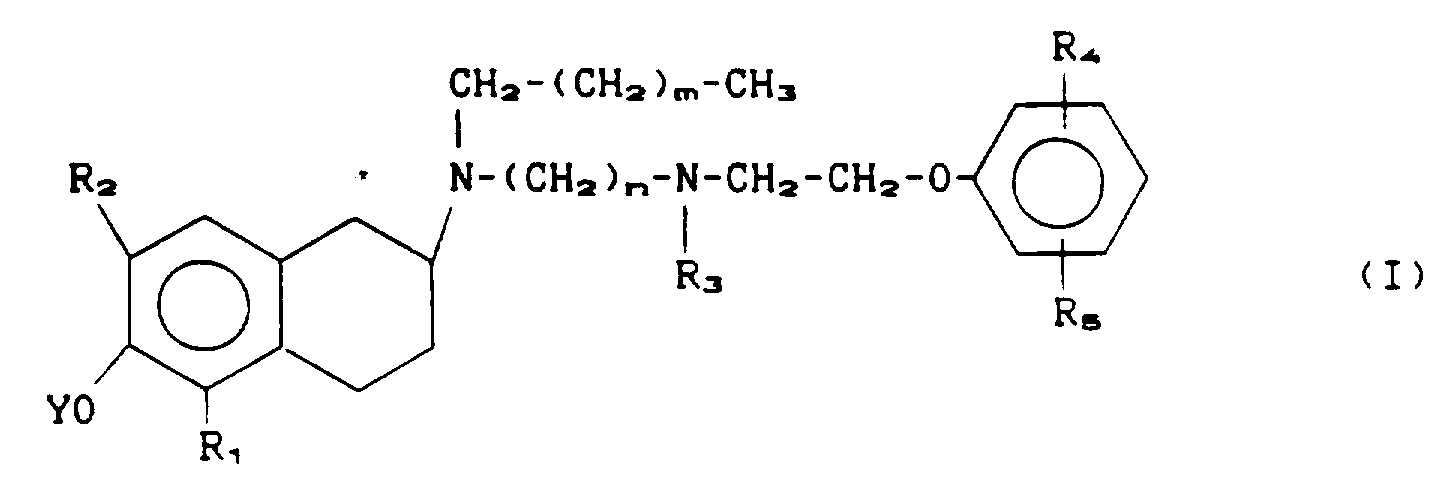
- R₁ and R₂,
- different from each other, are a hydrogen atom or an OY' group;
- Y and Y',
- the same or different, are a hydrogen atom or an acyl group derived from an optionally substituted aliphatic, aromatic or heteroaromatic carboxylic acid, from an optionally substituted carbamic or carbonic acid or from a phosphoric acid of formula

- R₆
- is a hydrogen atom, a C₁-C₆ alkyl optionally substituted by one or more groups selected from hydroxy, alkoxy, acyloxy, amino, carboxy and alkoxycarbonyl; or a phenyl;
- m
- is an integer selected between 1 and 2;
- n
- is an integer from 3 to 7;
- R₃
- is a hydrogen atom or a C₁-C₄ alkyl;
- R₄ and R₅,
- the same or different, are a hydrogen or a halogen atom, a C₁-C₃ alkyl or alkoxy group;
- The compounds of formula I have, at least, an asymmetric center and they exist in the form of stereoisomers.
- The compounds of formula I in the form of stereoisomeric mixtures as well as of single stereoisomers are object of the present invention.
- The compounds of formula I are agonists of dopaminergic receptors, are active also by oral route and have a long duration of action and they are useful in therapy in the cardiovascular field, in particular for the treatment of arterial hypertension, congestive heart failure, renal failure, for the treatment of peripheral arteriopathies and in cerebrovascular insufficiencies.
- Specific examples of alkyl or alkoxy group in the meanings of R₃, R₄, R₅ and R₆ are methyl, ethyl, n.propyl, i.propyl, n.butyl, i.butyl, sec.butyl, ter.butyl, methoxy, ethoxy, n.propoxy and i.propoxy.
- Halogen atoms are fluorine, chlorine, bromine and iodine.
- The term acyl group derived from an aliphatic carboxylic acid means an acyl radical derived from a linear or branched aliphatic carboxylic acid having from 1 to 6 carbon atoms, optionally substituted by phenyl, halogen or alkoxy groups; specific examples are the acyl groups derived from the following acids: formic, acetic, propionic, butyric, isobutyric, valeric and pivalic; acyl groups from aromatic or heteroaromatic carboxylic acids derive from benzoic or pyridinecarboxylic (2-, 3- or 4-pyridinecarboxylic), pyrrolecarboxylic, isoxazolecarboxylic and quinolinecarboxylic acid, optionally substituted by alkyl, alkoxy, halogen or nitro groups.
- Specific examples comprise benzoyl, 2-pyridinecarbonyl, 3-pyridinecarbonyl, 4-pyridinecarbonyl, 2-chlorobenzoyl, 4-chlorobenzoyl, 2-methylbenzoyl, 3-methylbenzoyl, 4-methylbenzoyl, 2,4-dimethylbenzoyl, 4-nitrobenzoyl, 4-isobutyrylbenzoyl, 4-methoxybenzoyl, 2-methoxybenzoyl, 3-methoxybenzoyl.
- Preferred substituents for carbamic and carbonic acids are alkyl and phenyl.
- Preferred compounds of formula I are the compounds in which R₁ is OY', Y, Y' and R₂ are hydrogen atoms, n is an integer selected from 5, 6 and 7.
- Still more preferred compounds of formula I are the compounds in which R₁ is OY', Y, Y' and R₂ are hydrogen atoms, n is 6, m is 1, R₄ and R₅, the same or different, are hydrogen atoms, methyl or methoxy groups, chlorine.
- According to the common knowledge in the field of catechol derivatives, the compounds of formula I, wherein at least one among Y and Y' is different from hydrogen, are pro-drugs of the corresponding catechol compound of formula I (Y=Y'=H).
- Among the compounds of formula I, preferred pro-drugs are the compounds in which one or both Y and Y', the same or different, are an acyl group derived from acetic, propionic, butyric, isobutyric acid, from optionally substituted benzoic or pyridinecarboxylic acid, from carbamic or carbonic acid.
- Pharmaceutically acceptable salts of the compounds of formula I are salts with organic or inorganic acids such as, for example, hydrochloric, hydrobromic, hydriodic, nitric, sulfuric, phosphoric, acetic, aspartic, methansulfonic and 3,7-di-ter.butylnaphthalen-1,5-disulfonic acid (dibudinic acid).
- The preparation of the compounds of formula I can be carried out according to the synthetic method described hereinafter. The method comprises the reaction between a compound of formula

- R₇
- is a hydrogen atom or a protecting group selected, for example, from methyl, benzyl, benzoyl and 4-methoxybenzoyl;
- R₈ and R₉,
- different from each other, are a hydrogen atom or an -OR₇ group;
- m
- has the meanings reported for formula I;
- The reduction of the compounds of formula IV can be carried out by using electrophylic reducing agents, in particular diborane optionally complexed with dimethylsulphide, tetrahydrofuran, aliphatic amines such as triethylamine or aromatic amines such as N,N-diethylaniline or pyridine.
- Alternatively, the reduction can be carried out with nucleophylic reducing agents such as metal hydride, for example aluminum lithium hydride.
- The reduction reaction is carried out in a suitable solvent such as, for example, tetrahydrofuran, diethylether or 1,2-dimethoxyethane. The deprotection, when needed, of the hydroxy groups is carried out according to conventional techniques such as hydrolysis or hydrogenolysis.
- The compounds of formula II are known or they can be easily prepared according to known methods (British Patent No. 1,509,454 - The Wellcome Foundation Ltd.).
- Also the compounds of formula III are known or they can be easily prepared according to conventional methods such as the condensation between an aminoacid of formula


- Alternatively, the synthetic method for the preparation of the compounds of formula I can be carried out by a different sequence of steps.
- Therefore, the compounds of formula II can be reacted, first, with an aminoacid of formula V or a reactive derivative thereof, in order to obtain the intermediate of formula

which is then acylated with an acyl halide of formula VI, so obtaining the intermediates of formula IV. The subsequent reduction as above reported affords the compounds of formula I, object of the present invention. - The compounds of formula I in optically active form can be obtained by optical separation or by stereospecific or stereoselective synthesis by using an optically active starting compound of formula II.
- The preparation of the pro-drugs of formula I can be carried out by esterification of one or both the catechol hydroxy groups according to conventional methods.
- Before carrying out the esterification reaction it may be useful to protect the secondary (N-R₃ when R₃=H) amino group, for example as benzyloxycarbonyl derivative.
- This protecting group can be easily removed after the esterification, for example by hydrogenolysis.
- The preparation of the salts of the compounds of formula I is carried out according to conventional methods.
- The compounds of formula I are agonists of D₁ and D₂ dopaminergic receptors at least 2-10 times more potent than dopamine as shown in the in vitro binding tests (example 11).
- In addition, they are also more potent than dopexamine as well as than the compounds described in the above cited European patent application No. 0 321 968.
- The tests carried out to evaluate the interaction with other receptor systems have shown that the compounds of formula I do not significantly interact and therefore they are endowed with high specificity.
- The compounds of formula I showed to be inactive on the central nervous system and this lack of effect is a further favourable property not shared by other compounds having a catecholamine structure.
- It is clear how these characteristics of receptor selectivity and specificity together with the absence of activity on the central nervous system make the compounds of formula I particularly suitable for the treatment of cardiovascular disorders and, mainly, in the antihypertensive therapy, in the therapy of congestive heart failure, of renal failure, in the treatment of peripheral arteriopathies and cerebrovascular insufficiencies.
- In addition to the already underlined higher pharmacological activity, the feature that more than others distinguishes the compounds of formula I, object of the invention, is their ability to be absorbed by oral route and their long duration of action (example 12).
- As a consequence, for the practical use in therapy, the compounds of formula I can be administered by infusion as well as by enteral route so differing from dopamine and from dopexamine.
- The therapeutic doses will be generally between 10 mg and 1 g a day and between 5 and 300 mg by oral route for each administration.
- The pharmaceutical compositions containing a therapeutically effective amount of the compounds of formula I or of pharmaceutically acceptable salts thereof in a mixture with a suitable carrier are a further object of the present invention.
- The pharmaceutical compositions object of the invention may be liquid, suitable for enteral or parenteral administration or, preferably, solid such as tablets, capsules, granulates, suitable for oral administration.
- The preparation of the pharmaceutical compositions can be carried out according to traditional techniques.
- Some times, in order to meet specific therapeutic or pharmaceutical requirements, in the preparation of the pharmaceutical compositions object of the present invention, it may be more convenient the use of a pro-drug of formula I.
- For example, the use of a pro-drug can be useful for improving formulation properties or the compatibility with other active ingredients.
- The choice of a compound of formula I in the form of catechol (Y=Y'=H) or of a corresponding pro-drug falls within the technical knowledge of the man skilled in the art.
- In order to better illustrate the present invention, the following examples are now given.
- 10% Palladium on charcoal (50% water) (0.5 g) was added to a solution of (S)-5,6-dimethoxy-1,2,3,4-tetrahydro-2-naphthylamine (50.0 g; 241 mmoles) and propionaldehyde (14.8 g; 255 mmoles) in ethanol 95° (300 ml).
- The reaction mixture was kept under stirring and under hydrogen pressure (2.7 atm) at 35°C for 7 hours.
- The catalyst was filtered off and the solvent was evaporated under reduced pressure. The residue was dissolved in absolute ethanol (300 ml) and a solution of hydrochloric acid in ethyl ether (15% w/v) was added up to clearly acid pH.
- The precipitate was filtered and dried at 40°C under vacuum.
- The title compound was obtained as a white solid (57.6 g).
- m.p. 257-262°C.
- ¹H-NMR (300 MHz, DMSO-d₆): δ (ppm): 0.96 (t, 3H); 1.65-1.80 (m, 3H); 2.29 (m, 1H); 2.60 (m, 1H); 2.80-3.00 (m, 4H); 3.13 (dd, 1H); 3.34 (m, 1H); 3.68 (s, 3H); 3.77 (s, 3H); 6.83 (d, 1H); 6.89 (d, 1H).
Mass (chemical ionization, isobutane, positive ions): 250 [M⁺1] - By working in a similar way but using butyraldehyde instead of propionaldehyde, and hydrobromic acid instead of hydrochloric acid the following compound was prepared:
(S)-N-butyl-5,6-dimethoxy-1,2,3,4-tetrahydro-2-naphthylamine hydrobromide
m.p. 226-228°C - ¹H-NMR (200 MHz, CDCl₃) (free base): δ (ppm): 0.90 (t, 3H); 1.26-1.62 (m, 5H); 2.05 (m, 1H); 2.60 (m, 2H); 2.69 (m, 2H); 2.81-3.05 (m, 3H); 3.77 (s, 3H); 3.81 (s, 3H); 6.70 (d, 1H); 6.78 (d, 1H).
Mass (chemical ionization, isobutane, positive ions): 264 [M⁺1] - Propionyl chloride (14.3 ml; 165 mmoles) was added to a solution of (S)-5,6-dimethoxy-1,2,3,4-tetrahydro-2-naphthylamine (31 g; 150 mmoles) and triethylamine (23 ml; 165 mmoles) in dimethylformamide (310 ml) at room temperature and under nitrogen.
- The reaction mixture was kept under stirring for 1 hour, then it was poured into water (1.5 l) and the solid was filtered and washed with water.
- After drying at 50°C under vacuum, (S)-N-propionyl-5,6-dimethoxy-1,2,3,4-tetrahydro-2-naphthylamine (32.8 g) was obtained.
m.p. 149-151°C - ¹H-NMR (300 MHz, CDCl₃): δ (ppm): 1.14 (t, 3H); 1.70-1.80 (m, 1H); 2.02 (m, 1H); 2.18 (q, 2H); 2.57 (dd, 1H); 2.75-3.00 (m, 2H); 3.04 (dd, 1H); 3.80 (s, 3H); 3.84 (s, 3H); 4.25 (m, 1H); 5.47 (bd, 1H); 6.74 (d, 1H); 6.78 (d, 1H).
- Mass (chemical ionization, isobutane, positive ions): 264 [M⁺1], 190 Borane-dimethylsulphide complex (82 ml; 854.4 mmoles) was added dropwise to a solution of (S)-N-propionyl-5,6-dimethoxy-1,2,3,4-tetrahydro-2-naphthylamine (22.5 g; 85.4 mmoles), prepared as above described, in anhydrous tetrahydrofuran (900 ml) at room temperature and under nitrogen.
- The reaction mixture was heated under reflux for 1.5 hours.
- After cooling to 15°C, a solution of 36% hydrochloric acid (9.5 ml) in methanol (247 ml) was cautiously added dropwise.
- The reaction mixture was heated under reflux for 1 hour, then the solvent (about 500 ml) was distilled off at atmospheric pressure and evaporated to dryness under vacuum.
- The resultant crude was dissolved with absolute ethanol and the solution was heated under reflux obtaining, after cooling and filtration, the title compound (23 g) having the same physico-chemical and spectroscopic characteristics reported in method A.
- By working in a similar way, the following compound was prepared:
- (S)-N-butyl-5,6-dimethoxy-1,2,3,4-tetrahydro-2-naphthylamine hydrobromide having the same physico-chemical and spectroscopic characteristics reported in method A.
- A solution of (S)-N-propyl-5,6-dimethoxy-1,2,3,4-tetrahydro-2-naphthylamine hydrochloride (22 g; 76.9 mmoles), prepared as described in example 1, in 48% hydrobromic acid (220 ml) was heated under reflux (about 130°C) for 3 hours.
- The solvent was evaporated to dryness under vacuum; the residue was dissolved with toluene and the solvent was evaporated to dryness.
- The resultant crude was suspended in ethyl acetate and, after filtration, the title compound (23 g) was obtained.
m.p. 219-222°C - ¹H-NMR (300 MHz, DMSO-d₆): δ (ppm): 0.93 (t, 3H); 1.68 (m, 3H); 2.25 (m, 1H); 2.40-2.55 (m, 1H); 2.70-3.10 (m, 5H); 3.31 (m, 1H); 6.40 (d, 1H); 6.61 (d, 1H).
Mass (chemical ionization, isobutane, positive ions): 222 [N⁺1] - By working in a similar way, the following compound was prepared:
(S)-N-butyl-5,6-dihydroxy-1,2,3,4-tetrahydro-2-naphthylamine hydrobromide
m.p. 240-242°C - ¹H-NMR (200 MHz, DMSO-d₆): δ (ppm): 0.90 (t, 3H); 1.35 (m, 2H); 1.62 (m, 3H); 2.13-3.11 (m, 7H); 3.38 (m, 1H); 6.39 (d, 1H); 6.60 (d, 1H).
Mass (chemical ionization, isobutane, positive ions): 236 [N⁺1] - 10% Palladium on charcoal (50% water) (0.5 g) and triethylamine (2.1 g; 21 mmoles) were added to a solution of (R)-6,7-dihydroxy-1,2,3,4-tetrahydro-2-naphthylamine (5.0 g; 19 mmoles) and propionaldehyde (1.1 g; 19 mmoles) in ethanol 95° (150 ml).
- The reaction mixture was kept under stirring and under hydrogen pressure (2.7 atm) at 35°C for 8 hours.
- The catalyst was filtered off and the solvent was evaporated under reduced pressure. The residue was dissolved in absolute ethanol (100 ml) and a solution of hydrochloric acid in ethyl ether (15% w/v) was added up to clearly acid pH.
- The solvent was evaporated and the crude was purified by chromatographic column on silica gel (230-400 mesh), eluent methylene chloride:methanol:acetic acid:=90:10:1.
- The title compound (3.8 g) was obtained as a white solid.
m.p. 201-203°C - ¹H-NMR (200 MHz, DMSO-d₆): δ (ppm): 0.93 (t, 3H); 1.56-1.78 (m, 3H); 2.19 (m, 1H); 2.53-3.02 (m, 6H); 3.30 (m, 1H); 6.46 (s, 2H).
- Mass (chemical ionization, isobutane, positive ions): 222 [M⁺1]
- By working in a similar way but using butyraldehyde instead of propionaldehyde, the following compound was prepared:
(R)-N-butyl-6,7-dihydroxy-1,2,3,4-tetrahydro-2-naphthylamine hydrochloride
m.p. 126-128°C - ¹H-NMR (200 MHz, DMSO-d₆): δ (ppm): 0.89 (t, 3H); 1.34 (m, 2H); 1.54-1.80 (m, 3H); 2.19 (m, 1H); 2.67-2.78 (m, 3H); 2.85-3.10 (m, 3H); 3.42 (m, 1H); 6.45 (s, 2H).
Mass (chemical ionization, isobutane, positive ions): 236 [M⁺1] - A solution of (2-methoxyphenoxy)acetyl chloride (24 g; 0.12 moles) in methylene chloride (26 ml) and a solution of sodium hydroxide (4.8 g; 0.12 moles) in water (26 ml) were contemporaneously added dropwise, under vigorous stirring, to a solution of 6-aminohexanoic acid (13.1 g; 0.1 moles) and sodium hydroxide (4 g; 0.1 moles) in water (36 ml).
- After 1 hour, the phases were separated and the aqueous phase was washed with methylene chloride, acidified with hydrochloric acid and extracted with methylene chloride. The resultant organic phase was dried on anhydrous sodium sulphate and the solvent was evaporated. The resultant crude was purified by chromatographic column on silica gel (230-400 mesh), eluent methylene chloride:methanol=9:1, obtaining the title compound (20 g).
m.p. 69-70°C (ethyl acetate) - ¹H-NMR (300 MHz, CDCl₃): δ (ppm): 1.37 (m, 2H); 1.50-1.70 (m, 4H); 2.33 (t, 2H); 3.33 (m, 2H); 3.88 (s, 3H); 4.55 (s, 2H); 6.90-7.05 (m, 4H); 7.10 (bt, 1H).
Mass (chemical ionization, isobutane, positive ions): 296 [M⁺1] - By working in a similar way, the following compounds were prepared:
6-[(2-chlorophenoxy)acetylamino]hexanoic acid
m.p. 87-88°C - ¹H-NMR (200 MHz, DMSO-d₆): δ (ppm): 1.12-1.33 (m, 2H); 1.35-1.56 (m, 4H); 2.18 (t, 2H); 3.12 (m, 2H); 4.58 (s, 2H); 6.98 (m, 2H); 7.31 (dd, 1H); 7.43 (dd, 1H); 7.93 (bt, 1H); 11.98 (bs, 1H).
Mass (chemical ionization, isobutane, positive ions): 300 [M⁺1]
6-[[(2-chloro-4-methyl)phenoxylacetylamino]hexanoic acid
m.p. 92-95°C - ¹H-NMR (200 MHz, DMSO-d₆): δ (ppm): 1.12-1.31 (m, 2H); 1.32-1.56 (m, 4H); 2.16 (t, 2H); 2.21 (s, 3H); 3.10 (m, 2H); 4.51 (s, 2H); 6.89 (d, 1H); 7.18 (dd, 1H); 7.26 (dd, 1H); 7.89 (bt, 1H); 12.02 (bs, 1H).
Mass (chemical ionization, isobutane, positive ions): 314 [M⁺1]
6-[[(2-methoxy-4-methyl)phenoxy]acetylamino]hexanoic acid
oil - ¹H-NMR (200 MHz, CDCl₃): δ (ppm): 1.24-1.42 (m, 2H); 1.45-1.70 (m, 4H); 2.29 (s, 3H); 2.31 (t, 2H); 3.31 (m, 2H); 3.84 (s, 3H); 4.49 (s, 2H); 6.65-6.80 (m, 3H); 7.08 (bt, 1H).
Mass (chemical ionization, isobutane, positive ions): 310 [M⁺1]
3-[(2-methoxyphenoxy)acetylamino]propionic acid
m.p. 95-97°C - ¹H-NMR (300 MHz, DMSO-d₆): δ (ppm): 2.42 (t, 2H); 3.34 (m, 2H); 3.77 and 3.79 (2s, 3H); 4.42 and 4.62 (2s, 2H); 6.80-7.03 (m, 4H); 7.96 (bt, 1H); 12.42 (bs, 1H).
Mass (chemical ionization, isobutane, positive ions): 254 [M⁺1]
3-[(2-chlorophenoxy)acetylamino]propionic acid
m.p. 143-144°C - ¹H-NMR (200 MHz, DMSO-d₆): δ (ppm): 2.43 (t, 2H); 3.36 (m, 2H); 4.57 (s, 2H); 6.99 (m, 2H); 7.27 (m, 1H); 7.42 (dd, 1H); 7.98 (bt, 1H); 12.30 (bs, 1H).
Mass (chemical ionization, isobutane, positive ions): 258 [M⁺1]
3-[[(2-methoxy-4-methyl)phenoxylacetylamino]propionic acid
oil - ¹H-NMR (200 MHz, CDCl₃): δ (ppm): 2.28 (s, 3H); 2.72 (t, 2H); 3.69 (m, 2H); 3.82 (s, 3H); 4.50 (s, 2H); 6.63-6.78 (m, 3H); 7.56 (bt, 1H).
Mass (chemical ionization, isobutane, positive ions): 268 [M⁺1] - 1,8-Diazabicyclo[5.4.0]undec-7-ene (DBU) (12.8 g; 84 mmoles) and ethyl 6-bromohexanoate (12.3 g; 55 mmoles) were added under stirring to a solution prepared by bubbling gaseous methylamine into toluene (150 ml) at -10°C for 20 minutes. The temperature was left arise up to 20°C. The reaction mixture was kept under stirring for 1 hour.
- The excess of methylamine was removed by bubbling nitrogen under reduced pressure up to neutral pH.
- A solution of (2-methoxyphenoxy)acetyl chloride (5.4 g; 27 mmoles) in toluene (10 ml) was added to the reaction mixture under stirring.
- After 1 hour an aqueous saturated solution of sodium chloride was added and the phases were separated.
- The organic phase was dried on anhydrous sodium sulphate and the solvent was evaporated under reduced pressure.
- The resultant crude was purified by chromatographic column on silica gel (230-400 mesh), eluent petroleum ether (b.p. 40-70°C):ethyl acetate=1 :1.
- Ethyl 6-[N-methyl-N-[(2-methoxyphenoxy)acetyl]amino]hexanoate (2.6 g) was obtained.
- ¹H-NMR (200 MHz, CDCl₃): δ (ppm): 1.23 (t, 3H); 1.30-1.74 (m, 4H); 1.84 (m, 1H); 2.18-2.34 (m, 3H); 2.90 and 3.04 (2s, 3H); 3.30-3.45 (m, 2H); 3.85 (s, 3H); 4.10 (q, 2H); 4.71 (s, 2H); 6.79-6.99 (m, 4H).
Mass (chemical ionization, isobutane, positive ions): 338 [M⁺1] - A solution of potassium hydroxide (1.1 g; 19.4 mmoles) in water (5 ml) was added to a solution of ethyl 6-[N-methyl-N-[(2-methoxyphenoxy)acetyl]amino]hexanoate (2.5 g; 7.4 mmoles) in methanol (5 ml) under stirring and at room temperature.
- The reaction mixture was kept under stirring for 30 minutes, acidified with 1N hydrochloric acid up to pH 1 and the solvent was evaporated to dryness under reduced pressure.
- The residue was treated with a mixture of methylene chloride and water. The organic phase was dried on anhydrous sodium sulphate and the solvent was evaporated under reduced pressure.
- The resultant crude was purified by chromatographic column on silica gel (230-400 mesh), eluent methylene chloride:methanol:acetic acid=95:5:1.
- The title compound (1.8 g) was obtained as an oil.
- 'H-NMR (200 MHz, CDCl₃): δ (ppm): 1.30 (m, 2H); 1.42-1.69 (m, 4H); 2.28 (m, 2H); 2.91 and 3.04 (2s, 3H); 3.30-3.41 (m, 2H); 3.84 (s, 3H); 4.72 (s, 2H); 6.80-6.98 (m, 4H).
Mass (chemical ionization, ammonia, positive ions): 310 [M⁺1] - By working in a similar way, the following compounds were prepared:
6-[N-methyl-N-[[(2-chloro-4-methyl)phenoxy]acetyl]amino]hexanoic acid - ¹H-NMR (200 MHz, CDCl₃): δ (ppm): 1.14-1.71 (m, 6H); 2.07 (s, 3H); 2.30 (m, 2H); 2.91 and 3.06 (2s, 3H); 3.37 (m, 2H); 4.71 (s, 2H); 6.86 (dd, 1H); 6.96 (dd, 1H); 7.17 (dd, 1H).
Mass (chemical ionization, isobutane, positive ions): 328 [M⁺1]
3-[N-methyl-N-[(2-methoxyphenoxy)acetyl]amino]propionic acid
m.p. 71-73°C - ¹H-NMR (200 MHz, DMSO-d₆): δ (ppm): 2.41 and 2.60 (2t, 2H); 2.79 and 3.00 (2s, 3H); 3.50 (m, 2H); 3.75 (s, 3H); 4.72 and 4.81 (2s, 2H); 6.76-6.99 (m, 4H).
Mass (chemical ionization, isobutane, positive ions): 268 [M⁺1]
3-[N-methyl-N-[[(2-chloro-4-methyl)phenoxy]acetyl]aminolpropionic acid
m.p. 143-145°C - ¹H-NMR (200 MHz, CDCl₃): δ (ppm): 2.24 (s, 3H); 2.62 and 2.69 (2t, 2H); 2.93 and 3.14 (2s, 3H); 3.62 and 3.76 (2t, 2H); 4.71 and 4.80 (2s, 2H); 6.85 (t, 1H); 6.96 (dd, 1H); 7.16 (dd, 1H).
Mass (chemical ionization, isobutane, positive ions): 286 [M⁺1] -
- a) Thionyl chloride (68.2 g; 573 mmoles) was added to a solution of 6-[(2-methoxyphenoxy)acetylamino]hexanoic acid (63.5 g; 215 mmoles), prepared as described in example 4, in methylene chloride (420 ml).
After 2 hours at room temperature, the reaction mixture was evaporated to dryness under reduced pressure.
An yellow oil residue was obtained and used in the next step without any further purification. - b) Sodium borate (66.6 g; 331 mmoles) was added under nitrogen to a solution of (S)-N-propyl-5,6-dimethoxy-1,2,3,4-tetrahydro-2-naphthylamine hydrobromide (50.0 g; 165 mmoles), prepared as described in example 2, in water (1000 ml).
The mixture was heated at 70°C up to complete dissolution, then cooled to room temperature and methylene chloride (100 ml), potassium carbonate (178.3 g; 1.290 moles) and, under vigorous stirring, a solution of the yellow oil residue (prepared as described in the above point a) in methylene chloride (400 ml) were added to the mixture. - After 1 hour at room temperature, toluene (500 ml) was added.
- After acidification with concentrated hydrochloric acid, the phases were separated. The aqueous phase was extracted again with methylene chloride (500 ml).
- The collected organic phases were dried on anhydrous sodium sulphate, filtered and the solvent was evaporated to dryness.
- The resultant residue was dissolved in tetrahydrofuran (334 ml) under nitrogen and borane-dimethylsulphide complex (172.0 g; 2.143 moles) was slowly added under stirring.
- The temperature spontaneously arose up to 35°C and the reaction mixture was kept at this temperature for 30 minutes, then heated under reflux for 1.5 hours.
- After cooling to 5°C, a solution of 37% hydrochloric acid (85.2 g; 0.864 mmoles) in methanol (643 ml) was added in 1 hour.
- The reaction mixture was heated under reflux for 1 hour, concentrated by distilling the solvent (about 750 ml) at atmospheric pressure and then under reduced pressure up to dryness.
- The residue was dissolved in methanol (830 ml); the solvent was distilled off under reduced pressure, absolute ethanol (830 ml) was added and the solvent was distilled again. Further absolute ethanol (830 ml) and, then, a solution of hydrochloric acid in ethyl ether (10 ml; 15% w/v) were added.
- After evaporation of the solvent, the residue was dissolved in absolute ethanol (660 ml); ethyl acetate (1170 ml) was added and the mixture was cooled at 0-5°C for 24 hours.
- The crystallized product was filtered and dried at 30°C under vacuum obtaining Compound 1 as a white solid.
m.p. 193-194°C
[α]D=-32.5° (1% in methanol) - ¹H-NMR (300 MHz, DMSO-d₆): δ (ppm): 0.92 (t, 3H); 1.34 (bs, 4H); 1.70 (m, 7H); 2.28 (m, 1H); 2.40-2.60 (m, 1H); 2.80-3.20 (m, 9H); 3.30 (t, 2H); 3.50 (m, 1H); 3.76 (s, 3H); 4.25 (t, 2H); 6.41 (d, 1H); 6.62 (d, 1H); 6.85-7.05 (m, 4H).
Mass (chemical ionization, isobutane, positive ions): 472 [M⁺1] - By working in a similar way the following compounds were prepared:
(R)-N-propyl-N-[6-[2-(2-methoxyphenoxy)ethylamino]hexyl]-6,7--dihydroxy-1,2,3,4-tetrahydro-2-naphthylamine dihydrochloride (Compound 2) - ¹H-NMR (200 MHz, D₂O): δ (ppm): 0.78 (t, 3H); 1.19-2.06 (m, 12H); 2.45-3.13 (m, 10H); 3.30 (m, 2H); 3.38-3.53 (m, 1H); 3.67 (s, 1H); 4.12 (m, 2H); 6.46 (s, 2H); 6.77-6.92 (m, 4H).
Mass (chemical ionization, isobutane, positive ions): 471 [M⁺1]
(S)-N-butyl-N-[6-[2-(2-methoxyphenoxy)ethylamino]hexyl]-5,6--dihydroxy-1,2,3,4-tetrahydro-2-naphthylamine dihydrochloride (Compound 3) - ¹H-NMR (200 MHz, D₂O): δ (ppm): 0.75 (t, 3H); 1.11-1.67 (m, 12H); 2.16-2.46 (m, 2H); 2.36-3.15 (m, 10H); 3.29-3.34 (m, 2H); 3.41-3.57 (m, 1H); 3.69 (s, 3H); 4.11-4.16 (m, 2H); 6.48 (d, 1H); 6.61 (d, 1H); 6.81-6.93 (m, 4H).
Mass (chemical ionization, isobutane, positive ions): 485 [M⁺1]
(S)-N-butyl-N-[6-[2-(2-chlorophenoxy)ethylamino]hexyl]-5,6--dihydroxy-1,2,3,4-tetrahydro-2-naphthylamine dihydrochloride (Compound 4) - ¹H-NMR (200 MHz, D₂O): δ (ppm): 0.74 (t, 3H); 1.11-1.77 (m, 13H); 2.05-2.17 (m, 1H); 2.35-3.57 (m, 13H); 4.17-4.22 (m, 2H); 6.47 (d, 1H); 6.60 (d, 1H); 6.80-7.26 (m, 4H).
Mass (chemical ionization, isobutane, positive ions): 489 [M⁺1]
(S)-N-propyl-N-[6-[2-[(2-chloro-4-methyl)phenoxy]ethylamino]-hexyl]-5,6-dihydroxy-1,2,3,4-tetrahydro-2-naphthylamine dihydrochloride (Compound 5) - ¹H-NMR (200 MHz, D₂O): δ (ppm): 0.79 (t, 3H); 1.24-1.75 (m, 11H); 2.04 (s, 3H); 2.03-2.15 (m, 1H); 3.33 (m, 2H); 2.34-3.53 (m, 11H); 4.15 (m, 2H); 6.46 (d, 1H); 6.59 (d, 1H); 6.81 (d, 1H); 6.94 (dd, 1H); 7.04 (d, 1H).
Mass (chemical ionization, isobutane, positive ions): 489 [M⁺1]
(R)-N-propyl-N-[6-[2-[(2-chloro-4-methyl)phenoxy]ethylamino]hexyll-6,7-dihydroxy-1,2,3,4-tetrahydro-2-naphthylamine dihydrochloride (Compound 6) - ¹H-NMR (200 MHz, D₂O): δ (ppm): 0.79 (t, 3H); 1.20-1.69 (m, 10H); 1.47-2.06 (m, 2H); 2.09 (s, 3H); 2.53-3.08 (m, 10H); 3.26-3.31 (m, 2H); 3.40-3.55 (m, 1H); 3.66 (s, 3H); 4.06-4.11 (m, 2H); 6.48 (s, 2H); 6.60-6.77 (m, 3H).
Mass (chemical ionization, isobutane, positive ions): 485 [M⁺1]
(S)-N-propyl-N-[3-[2-[(2-methoxyphenoxy)ethylamino]propyl]-5,6-dihydroxy-1,2,3,4-tetrahydro-2-naphthylamine dihydrochloride (Compound 7) - ¹H-NMR (200 MHz, D₂O): δ (ppm): 0.8 (t, 3H); 1.50-2.18 (m, 6H); 2.36-3.23 (m, 10H); 3.35-3.40 (m, 2H); 3.47-3.60 (m, 1H); 3.67 (s, 3H); 4.14-4.19 (m, 2H); 6.48 (d, 1H); 6.61 (d, 1H); 6.83-6.91 (m, 4H).
Mass (chemical ionization, isobutane, positive ions): 429 [M⁺1]
(R)-N-propyl-N-[3-[2-[(2-chlorophenoxy)ethylamino]propyl]-6,7-dihydroxy-1,2,3,4-tetrahydro-2-naphthylamine dihydrochloride (Compound 8) - ¹H-NMR (200 MHz, D₂O): δ (ppm): 0.79 (t, 3H); 1.48-2.14 (m, 6H); 2.46-3.20 (m, 10H); 3.37-3.57 (m, 3H); 4.19-4.24 (m, 2H); 6.44 (s, 1H); 6.46 (s, 1H); 6.80-7.25 (m, 4H).
Mass (chemical ionization, isobutane, positive ions): 433 [M⁺1]
(S)-N-butyl-N-[3-[2-[(2-methoxy-4-methyl)phenoxy]ethylamino]propyl]-5,6-dihydroxy-1,2,3,4-tetrahydro-2-naphthylamine dihydrochloride (Compound 9) - ¹H-NMR (200 MHz, D₂O): δ (ppm): 0.75 (t, 3H); 1.11-1.30 (m, 2H); 1.46-1.62 (m, 2H); 2.08 (s, 3H); 1.60-2.15 (m, 2H); 1.97-2.15 (m, 2H); 2.34-3.22 (m, 10H); 3.31-3.36 (m, 2H); 3.44-3.57 (m, 1H); 3.64 (s, 3H); 4.12 (m, 2H); 6.46 (d, 1H); 6.61 (d, 1H); 6.60-6.78 (m, 3H).
Mass (chemical ionization, isobutane, positive ions): 457 [M⁺1]
(S)-N-[2-(5,6-dihydroxy-1,2,3,4-tetrahydro)naphthyl]-N-propyl--N'-methyl-N'-[2-(2-methoxyphenoxy)ethyl]-1,6-hexanediamine dihydrochloride (Compound 10) - ¹H-NMR (200 MHz, D₂O): δ (ppm): 0.78 (t, 3H); 1.16-2.07 (m, 12H); 2.76 (s, 3H); 2.26-3.54 (m, 13H); 3.63 (s, 3H); 4.15 (m, 2H); 6.41 (d, 1H); 6.57 (d, 1H); 6.74-6.86 (m, 4H).
Mass (chemical ionization, isobutane, positive ions): 485 [M+1]
(R)-N-butyl-N-[2-(6,7-dihydroxy-1,2,3,4-tetrahydro)naphthyl]-N'-methyl-N'-[2-(2-methoxyphenoxy)ethyl]-1,6-hexanediamine dihydrochloride (Compound 11) - ¹H-NMR (200 MHz, D₂O): δ (ppm): 0.74 (t, 3H); 1.14-1.71 (m, 12H); 1.48-2.04 (m, 2H); 2.77 (s, 3H); 2.54-3.53 (m, 13H); 3.67 (s, 3H); 4.20 (m, 2H); 6.49 (s, 2H); 6.76-6.93 (m, 4H).
Mass (chemical ionization, isobutane, positive ions): 499 [M+1]
(S)-N-[2-(5,6-dihydroxy-1,2,3,4-tetrahydro)naphthyl]-N-propyl--N'-methyl-N'-[2-[(2-chloro-4-methyl]phenoxy]ethyl]-1,6-hexane diamine dihydrochloride (Compound 12) - ¹H-NMR (200 MHz, D₂O): δ (ppm): 0.79 (t, 3H); 1.22-1.30 (m, 4H); 1.47-1.71 (m, 7H); 2.02 (s, 3H); 2.02-2.13 (m, 1H); 2.80 (s, 3H); 2.32-3.18 (m, 10H); 3.35-3.50 (m, 3H); 4.20 (m, 2H); 6.44 (d, 1H); 6.58 (d, 1H); 6.77-6.99 (m, 3H).
Mass (chemical ionization, isobutane, positive ions): 503 [M+1]
(S)-N-propyl-N-[2-(5,6-dihydroxy-1,2,3,4-tetrahydro)naphthyl]-N'-methyl-N'-[2-(2-methoxyphenoxy)ethyl]-1,3-propanediamine dihydrochloride (Compound 13) - ¹H-NMR (200 MHz, D₂O): δ (ppm): 0.78 (t, 3H); 1.46-2.15 (m, 6H); 2.82 (s, 3H); 2.27-3.51 (m, 13H); 3.61 (s, 3H); 4.22 (m, 2H); 6.42 (d, 1H); 6.60 (d, 1H); 6.74-6.91 (m, 4H).
Mass (chemical ionization, isobutane, positive ions): 443 [M+1]
(R)-N-butyl-N-[2-(6,7-dihydroxy-1,2,3,4-tetrahydro)naphthyl]-N'-methyl-N'-[2-[(2-chloro-4-methyl)phenoxy]ethyl]-1,3-propane diamine dihydrochloride (Compound 14) - ¹H-NMR (200 MHz, D₂O): δ (ppm): 0.74 (t, 3H); 1.09-1.28 (m, 2H); 1.44-1.60 (m, 2H); 2.01 (s, 3H); 1.45-2.20 (m, 2H); 1.91-2.20 (m, 2H); 2.88 (s, 3H); 2.40-3.48 (m, 11H); 3.54 (m, 2H); 4.25 (m, 2H); 6.41 (s, 1H); 6.44 (s, 1H); 6.80-6.97 (m, 3H).
Mass (chemical ionization, isobutane, positive ions): 475 [M+1] -
- a) A solution of 4-methoxybenzoylchloride (11.8 g; 69.5 mmoles) in trifluoroacetic acid (24 ml) was added under nitrogen at 20°C to a solution of (S)-N-propyl-5,6-dihydroxy-1,2,3,4-tetrahydro-2-naphthylamine hydrobromide (7 g; 23.2 mmoles), prepared as described in example 2, in trifluoroacetic acid (80 ml).
The reaction mixture was kept under stirring at room temperature for 2 hours, then the solvent was evaporated to dryness. The residue was dissolved in ethyl acetate (20 ml) and a solution of hydrochloric acid in diethyl ether was added up to clearly acid pH.
The resultant solid was filtered obtaining (S)-N-propyl-5,6-di-(4-methoxybenzoyloxy)-1,2,3,4-tetrahydro-2-naphthylamine hydrochloride (12.5 g).
m.p. 114-117°C
[α]D=-42.64° (1% in methanol)
¹H-NMR (300 MHz, DMSO-d₆): δ (ppm): 0.95 (t, 3H); 1.60-1.80 (m, 3H); 2.55 (m, 1H); 2.60 (m, 1H); 2.75-3.05 (m, 4H); 3.31 (dd, 1H); 3.47 (m, 1H); 3.76 (s, 3H); 3.78 (s, 3H); 6.94 (d, 2H); 7.00 (d, 2H); 7.21 (d, 1H); 7.25 (d, 1H); 7.84 (d, 2H); 7.92 (d, 2H).
Mass (chemical ionization, isobutane, positive ions): 490 [M⁺1], 89. - b) Ethylchlorocarbonate (2.9 ml; 27.4 mmoles) was added dropwise at -12°C under nitrogen to a solution of 6-[(2-methoxyphenoxy)acetylamino]hexanoic acid (8 g; 27.4 mmoles), prepared as described in example 4, and triethylamine (2.8 ml; 27.4 mmoles) in anhydrous dimethylformamide (240 ml).
The reaction mixture was kept under stirring for 30 minutes, keeping the temperature between -10°C and -12°C, then a solution of (S)-N-propyl-5,6-di-(4-methoxybenzoyloxy)-1,2,3,4-tetrahydro--2-naphthylamine hydrochloride (12 g; 22.8 mmoles), prepared as described in the above point a., and triethylamine (2.3 ml; 22.8 mmoles) in anhydrous dimethylformamide (200 ml) was added.
The reaction mixture was kept under stirring overnight at room temperature.
After evaporation to dryness, the residue was dissolved in methylene chloride (100 ml) and washed with water (3 x 50 ml).
The organic phase was dried on anhydrous sodium sulphate and the solvent was evaporated under reduced pressure obtaining (S)-N--propyl-N-[6-[[(2-methoxyphenoxy)acetyl]amino]hexanoyl]-5,6--di-(4-methoxybenzoyloxy)-1,2,3,4-tetrahydro-2-naphthylamine as an oil crude (19 g) which was directly used in the next step.
¹H-NMR (300 MHz, DMSO-d₆): δ (ppm): 0.86 (dt, 3H); 1.15-1.35 (m, 2H); 1.35-1.65 (m, 6H); 1.75-2.05 (m, 2H); 2.20-2.40 (m, 2H); 2.70-3.25 (m, 8H); 3.77 (d, 3H); 3.78 (s, 3H); 3.80 (s, 3H); 4.04 (m, 1H); 4.43 (d, 2H); 6.96 (d, 2H); 7.00 (d, 2H); 6.80-7.30 (m, 6H); 7.86 (d, 2H); 7.94 (d, 2H).
Mass (chemical ionization, isobutane, positive ions): 767 [M⁺1], 337, 296. - c) A solution of crude (S)-N-propyl-N-[6-[[(2-methoxyphenoxy)acetyl]amino]hexanoyl]-5,6-di-(4-methoxybenzoyloxy)-1,2,3,4-tetrahydro-2-naphthylamine (18.5 g; 24.15 mmoles), prepared as described in above point b., and butylamine (7.16 ml; 72.5 mmoles) in absolute ethanol (510 ml) was heated under reflux and under nitrogen for 17 hours.
After evaporation to dryness, the resultant crude was purified by chromatographic column on silica gel (230-400 mesh), eluent methylene chloride, then, methylene chloride:methanol=95:5, obtaining (S)-N-propyl-N-[6-[[(2-methoxyphenoxy)acetyl]amino]hexanoyl]-5,6-dihydroxy-1,2,3,4-tetrahydro-2-naphthylamine (6.3 g) which was directly used in the next step.
To a solution of this compound (6 g; 12.1 mmoles) in anhydrous tetrahydrofuran (240 ml) borane-dimethylsulphide complex (16 ml; 168.5 mmoles) was added dropwise at room temperature under nitrogen.
The reaction mixture was heated under reflux for 1.5 hours.
After cooling at 15°C, a solution of 36% hydrochloric acid (3.25 ml) in methanol (45 ml) was cautiously added dropwise.
The reaction mixture was heated under reflux for 1 hour, then the solvent (about 120-150 ml) was distilled off at atmospheric pressure and then to dryness under vacuum. The crude was treated twice with methanol by evaporating to dryness each time.
The resultant crude was washed with dioxane and then crystallized from absolute ethanol obtaining Compound 1 (4.5 g) having the same physico-chemical and spectroscopic characteristics reported in method A. - Acetyl chloride (0.4 g; 5.1 mmoles) was added under stirring at room temperature to a solution of Compound 1 (0.9 g; 1.6 mmoles), prepared as described in example 6, in trifluoroacetic acid (7 ml).
- After 15 hours under these conditions, the solvent was evaporated under reduced pressure and the resultant residue was purified by chromatographic column on silica gel (230-400 mesh), eluent methylene chloride:methanol=88:1 2.
- The resultant product was dissolved in water (3 ml); a solution of sodium dibudinate (0.5 g; 1.1 mmoles) in water (4 ml) and, then, methylene chloride (5 ml) were added and the phases were separated. The aqueous phase was extracted again with methylene chloride (3 ml).
- The collected organic phases were dried on anhydrous sodium sulphate and the solvent was evaporated under reduced pressure.
- Compound 15 was obtained (0.8 g) as a white solid.
m.p. 165-167°C (dec.) - H-NMR (200 MHz, D₂O): δ (ppm): -0.60 (bs, 2H); 0.36-0.61 (bs, 3H); 0.89 (t, 3H); 1.16 (s, 18H); 1.60 (bs, 3H); 2.24 (s, 6H); 2.08-3.40 (m, 17H); 3.75 (s, 3H); 4.26 (bs, 2H); 6.77-7.10 (m, 6H); 8.05 (s, 2H); 8.67 (s, 2H).
Mass (chemical ionization, isobutane, positive ions): 555 [M⁺1] - Potassium carbonate (3.4 g; 24.6 mmoles), water (20 ml) and benzylchloroformate (1.3 g; 7.7 mmoles) were added under nitrogen to a solution of Compound 1 (4.0 g; 7.3 mmoles), prepared as described in example 6, in methylene chloride (200 ml) and dimethylformamide (20 ml).
- After 1 hour, the reaction mixture was washed twice with an aqueous saturated solution of sodium chloride.
- The organic phase was dried on anhydrous sodium sulphate and the solvent was evaporated under reduced pressure.
- The residue was purified by column chromatography on silica gel (230-400 mesh), eluent methylene chloride:methanol:toluene:formic acid=90:10:15:0.5, obtaining the title compound (3.6 g) as a white solid.
- ¹H-NMR (200 MHz, CDCl₃): δ (ppm): 0.99 (t, 3H); 1.20-1.96 (m, 12H); 2.12-2.20 (m, 1H); 2.75-3.35 (m, 8H); 3.38 (m, 2H); 3.65 (m, 2H); 3.81 (s, 3H); 4.03-4.20 (m, 2H); 5.11 (s, 2H); 6.21 (d, 1H); 6.77 (d, 1H); 6.73-7.38 (m, 9H).
Mass (chemical ionization, ammonia, positive ions): 605 [M⁺1] - A solution of (S)-N-propyl-N-[2-(5,6-dihydroxy-1,2,3,4-tetrahydro)-naphthyl)-N'-benzyloxycarbonyl-N'-[2-(2-methoxyphenoxy)ethyl]-1,6-hexanediamine (3.6 g; 6 mmoles), prepared as described in example 8, in ethylisocyanate (20 ml) was heated at 60°C under stirring and under nitrogen for 24 hours.
- The excess of ethylisocyanate was evaporated under reduced pressure and the residue was dissolved in ethyl acetate. The resultant solution was washed with water.
- The organic phase was dried on anhydrous sodium sulphate and the solvent was evaporated under reduced pressure.
- The residue was purified by column chromatography on silica gel (230-400 mesh), eluent methylene chloride:methanol:toluene=90:5:5, obtaining the title compound (2.2 g).
- ¹H-NMR (200 MHz, CDCl₃): δ (ppm): 0.88 (t, 3H); 1.18 (t, 3H); 1.19 (t, 3H); 1.10-1.80 (m, 12H); 1.96-2.18 (m, 1H); 2.40-3.10 (m, 8H); 3.10-3.41 (m, 6H); 3.65 (m, 2H); 3.81 (s, 3H); 4.03-4.21 (m, 2H); 5.02-5.17 (m, 2H); 5.11 (s, 2H); 6.72-7.36 (m, 11H).
- 37% Hydrochloric acid (0.6 ml) and 10% palladium on charcoal (0.2 g) were added to a solution of (S)-N-propyl-N-[2-[5,6-di-(ethylcarbamoyloxy)-1,2,3,4-tetrahydro]naphthyl]-N'-benzyloxycarbonyl-N'-[2-(2-methoxyphenoxy)ethyl]-1,6-hexanediamine (2.0 g; 2.7 mmoles), prepared as described in example 9, in absolute ethanol (80 ml).
- The reaction mixture was kept under stirring under hydrogen pressure (2.7 atm) at room temperature for 6 hours.
- The catalyst was filtered off and the solvent was evaporated under reduced pressure.
- The residue was purified by column chromatography on silica gel (230-400 mesh), eluent methylene chloride:methanol:toluene:ammonia= 80:10:10:0.5, obtaining Compound 16 (0.6 g).
- ¹H-NMR (200 MHz, D₂O): δ (ppm): 0.79 (t, 3H); 0.96 (t, 3H); 0.97 (t, 3H); 1.23-1.63 (m, 10H); 1.58-2.13 (m, 2H); 2.37-3.15 (m, 14H); 3.30 (m, 2H); 3.48-3.65 (m, 1H); 3.68 (s, 3H); 4.12 (m, 2H); 6.77-6.97 (m, 6H).
Mass (chemical ionization, isobutane, negative ions): 611 [M-1] - Brains of male, Sprague-Dawley rats (200-250 g) were removed and membranes from striatal tissues were prepared according to the method described by Billard et al. in Life Sciences, 35, 1885, (1984).
- The tissues were homogenized in 50 mM Tris/HCl buffer, pH 7.4 (1:100 weight/volume).
- The homogenate was centrifuged and the pellet was resuspended, centrifuged again and resuspended in 50 mM Tris/HCl buffer pH 7.4 containing 120 mM NaCl, 5mM KCl, 2mM CaCl₂ and 1mM MgCl₂.
- The affinity for D₁ receptor and for D₂ receptor was evaluated by using [³H]-SCH23390 [R(+)-8-chloro-2,3,4,5-tetrahydro-3-methyl-5-phenyl-1H-3-benzazepine 7-ol hydrochloride] and [³H]-domperidone (The Merck Index - XI Ed., No. 3412, page 537) as labelled ligands respectively.
- As reference substances, dopamine and dopexamine were used.
- The standard incubation conditions (volume 1000 µl) for the assay in which [³H]-SCH23390 was used were as follows: 50 mM Tris/HCl buffer (pH 7.4), 0.2 nM [³H]-SCH23390, a membrane preparation of 130-140 µg proteins/ml.
- The mixture was incubated with different concentrations of the tested compounds at 37°C for 15 minutes, filtered under vacuum through Whatman GF/C filters and then washed 4 times with 5 ml of ice-cold 50 mM Tris/HCl buffer (pH 7.4).
- For D₂-receptor binding studies [³H]-domperidone (0.3 nM) was incubated in a volume of 1000 µl containing buffer and a membrane preparation as above described. In addition bovine serum albumine (BSA) (0.01%) was added.
- The mixture was incubated at 37°C for 30 minutes for each concentration of the tested compounds.
- The obtained values, expressed as Ki(nM), for compound 1, dopamine and dopexamine are reported in the following table.

- Compound 1 showed high affinity for both receptor sub-types being about 10 times more potent than dopamine and dopexamine on D₁ receptors and about 100 times more potent on D₂ receptors.
- The receptor binding tests to evaluate the affinity for D₁ and D₂ receptors were repeated according to the method reported in above point A but using [³H]-spiperone (Merck Index - XI Ed., No. 8707, page 1380) as labelled ligand for D₂ receptor.
- The standard incubation conditions (volume 1 ml) for the assay in which [³H]-SCH23390 was used were as follows: 50 mM Tris/HCl buffer (pH 7.4), 0.2 nM [³H]-SCH23390, a membrane preparation (3 mg/ml corresponding to 130-150 µg proteins/ml), incubation temperature 37°C and incubation time 15 minutes.
- The standard incubation conditions (volume 2 ml) for the assay in which [³H]-spiperone was used were as follows: 50 mM Tris/HCl buffer (pH 7.4), 0.2 nM [³H]-spiperone, a membrane preparation (3 mg/ml corresponding to 130-150 µg proteins/ml), incubation temperature 37°C and incubation time 15 minutes.
- The obtained values, expressed as Ki(µM), for compounds 1-14, dopamine and dopexamine are reported in table 2.
- DA₂-agonist activity was evaluated as follows.
- Transversal sections (2-3 mm) of rabbit ear artery were suspended in isolated organ baths containing Krebs-Henseleit solution added with corticosterone (30 µM), desipramine (0.1 µM) and EDTA (10 µM).
- The preparation, subjected to a traction of 1 g and to an electric stimulation with field pulses every 5 minutes (10 Hz, 1 msec., 30-60 V, 500 msec. duration) were left stabilize for about 2 hours.
- A dose-response curve for the compounds of the invention and for dopamine and dopexamine as reference compounds was determined and the inhibitory effect on the contraction induced by electric stimulation was evaluated.
- Each preparation was submitted to three increasing concentrations allowing the recovery of the basal conditions before the subsequent administration.
- The obtained values, expressed as pD₂(-log EC₅₀), for compounds 1-14, dopamine and dopexamine are reported in table 2.
Table 2 Affinity [Ki(µm)] for D₁ and D₂ receptors (receptor binding) on rat striatal membranes and DA₂-agonist activity (pD₂) on rabbit ear artery for compounds 1-14, dopamine and dopexamine. Compound Binding D₁ rat striatum Ki(µm) Binding D₂ rat striatum Ki(µm) DA₂ rabbit ear artery pD₂ Dopamine 2.2 1.3 7.40 1 0.09 0.0005 8.97 2 0.315 0.0084 8.36 3 0.56 0.086 7.53 4 0.7 0.08 6.29 5 0.12 0.005 8.16 6 0.51 0.031 7.96 7 1.1 0.0011 8.67 8 2.65 0.016 7.35 9 22.0 0.19 5.98 10 0.41 0.0055 8.47 11 11.7 0.63 5.87 12 0.18 0.0083 6.34 13 3.6 0.0098 8.39 14 2.8 0.26 5.22 Dopexamine 3.2 1.7 6.35 - Male SHR rats, 3-4 months old, fasted 16 hours before the experiment were used. Systolic blood pressure (SBP) and heart rate (HR) were recorded by tail cuff method in conscious animals by means of a BP Recorder (W+W Basile, Italy). Before every pressure determination animals were maintained at 37°C for 10 minutes.
- SBP and HR values were recorded before and at various times up to seven hours after treatment with the tested compounds.
- The compounds were administered orally by gavage, in a volume of 10 ml/kg, at doses between 10 and 160 mg/kg. For the administration, the compounds were suspended in carboxymethylcellulose (CMC) 0.5% in water and additioned with Tween 80 (0.3 ml/10 ml of CMC).
- The obtained results, expressed as ED30mmHg (mg/kg p.o.) that is the dose causing a decrease of 30 mmHg from the basal value of SBP (about 15% decrease) are the following:
- Compound 1: ED30mmHg=22.9 mg/kg p.o.
- The results, moreover, show that the effect of the compound 1 was long lasting (about 4 hours).
- Similar results were obtained with other compounds of formula I.


and their reduction, carried out before or after the optional deprotection of the hydroxy groups, in order to obtain the compounds of formula I.
Claims (8)
- A compound of formula
 R₁ and R₂, different from each other, are a hydrogen atom or an OY' group;Y and Y', the same or different, are a hydrogen atom or an acyl group derived from an optionally substituted aliphatic, aromatic or heteroaromatic carboxylic acid, from an optionally substituted carbamic or carbonic acid or from a phosphoric acid of formulawherein
 R₆ is a hydrogen atom, a C₁-C₆ alkyl optionally substituted by one or more groups selected from hydroxy, alkoxy, acyloxy, amino, carboxy and alkoxycarbonyl; or a phenyl;m is an integer selected between 1 and 2;n is an integer from 3 to 7;R₃ is a hydrogen atom or a C₁-C₄ alkyl;R₄ and R₅, the same or different, are a hydrogen or a halogen atom, a C₁-C₃ alkyl or alkoxy group;and pharmaceutically acceptable salts thereof.
 - A compound according to claim 1 in which R₁ is OY', Y, Y' and R₂ are hydrogen atoms, n is an integer selected from 5, 6 and 7.
- A compound according to claim 1 in which R, is OY', Y, Y' and R₂ are hydrogen atoms, n is 6, m is 1, R₄ and R₅, the same or different, are hydrogen atoms, methyl or methoxy groups, or chlorine.
- A compound according to claim 1 in which one or both Y and Y', the same or different, are an acyl group derived from acetic, propionic, butyric, isobutyric acid, from optionally substituted benzoic or pyridinecarboxylic acid, from carbamic or carbonic acid.
- A compound according to claim 1 in an optically active form.
- A process for the preparation of a compound according to claim 1 comprising the reduction of a compound of formula
 R₇ is a hydrogen atom or a protecting group selected from methyl, benzyl, benzoyl and 4-methoxybenzoyl;R₈ and R₉, different from each other, are a hydrogen atom or an -OR₇ group.
 - A pharmaceutical composition containing a therapeutically effective amount of a compound according to claim 1 in admixture with a suitable carrier.
- A pharmaceutical composition according to claim 6 for the treatment of cardiovascular diseases.
Applications Claiming Priority (3)
| Application Number | Priority Date | Filing Date | Title |
|---|---|---|---|
| ITMI920608 | 1992-03-17 | ||
| ITMI920608A IT1254521B (en) | 1992-03-17 | 1992-03-17 | 2-AMINO-TETRALINE DERIVATIVES ACTIVE IN THE CARDIOVASCULAR SYSTEM |
| PCT/EP1993/000577 WO1993019036A1 (en) | 1992-03-17 | 1993-03-13 | 2-amino-1,2,3,4-tetrahydronaphthalene derivatives active on the cardiovascular system, processes for their preparation and pharmaceutical compositions containing them |
Publications (2)
| Publication Number | Publication Date |
|---|---|
| EP0585440A1 EP0585440A1 (en) | 1994-03-09 |
| EP0585440B1 true EP0585440B1 (en) | 1996-05-08 |
Family
ID=11362451
Family Applications (1)
| Application Number | Title | Priority Date | Filing Date |
|---|---|---|---|
| EP93906515A Expired - Lifetime EP0585440B1 (en) | 1992-03-17 | 1993-03-13 | 2-amino-1,2,3,4-tetrahydronaphthalene derivatives active on the cardiovascular system, processes for their preparation and pharmaceutical compositions containing them |
Country Status (20)
| Country | Link |
|---|---|
| US (2) | US5407956A (en) |
| EP (1) | EP0585440B1 (en) |
| JP (1) | JP3231775B2 (en) |
| KR (1) | KR100283945B1 (en) |
| AT (1) | ATE137737T1 (en) |
| CA (1) | CA2102490C (en) |
| DE (1) | DE69302544T2 (en) |
| DK (1) | DK0585440T3 (en) |
| ES (1) | ES2087729T3 (en) |
| FI (1) | FI935066A7 (en) |
| GR (1) | GR3020419T3 (en) |
| HU (2) | HUT68936A (en) |
| IT (1) | IT1254521B (en) |
| MD (1) | MD1449G2 (en) |
| NO (1) | NO180230C (en) |
| NZ (1) | NZ249845A (en) |
| OA (1) | OA09843A (en) |
| PL (2) | PL172056B1 (en) |
| RU (1) | RU2120435C1 (en) |
| WO (1) | WO1993019036A1 (en) |
Families Citing this family (11)
| Publication number | Priority date | Publication date | Assignee | Title |
|---|---|---|---|---|
| IT1271411B (en) * | 1993-09-14 | 1997-05-28 | Zambon Spa | 2-AMINO-1,2,3,4-TETRAIDRO-NAFTALENE DERIVATIVES ACTIVE IN THE CARDIOVASCULAR SYSTEM |
| IT1274673B (en) * | 1994-04-14 | 1997-07-24 | Zambon Spa | PHOSPHONIC ACID DERIVATIVES HELPFUL IN THE TREATMENT OF CARIOIOVASCULAR DISEASES |
| IT1270260B (en) * | 1994-06-21 | 1997-04-29 | Zambon Spa | PHOSPHONIC ACID DERIVATIVES FOR METALLOPEPTIDASE INHIBITIVE ACTIVITIES |
| IT1271008B (en) * | 1994-09-13 | 1997-05-26 | Zambon Spa | 2-AMINO-1,2,3,4-TETRAIDRO-NAFTALENE DERIVATIVES ACTIVE IN THE CARDIOVASCULAR SYSTEM |
| IT1271007B (en) * | 1994-09-13 | 1997-05-26 | Zambon Spa | DERIVATIVES OF 2-AMINO-1,2,3,4-TETRAIDRONAFTALENE ACTIVE IN THE CARDIOVASCULAR SYSTEM |
| IT1271009B (en) * | 1994-09-13 | 1997-05-26 | Zambon Spa | BENZOPYRANE AND BENZOTHIOPYRANE DERIVATIVES ACTIVE IN THE CARDIOVASCULAR SYSTEM |
| IT1273455B (en) * | 1995-01-27 | 1997-07-08 | Zambon Spa | THIOLIC DERIVATIVES WITH METALLOPEPTIDASE INHIBITIVE ACTIVITY |
| IT1276710B1 (en) * | 1995-06-14 | 1997-11-03 | Zambon Spa | DERIVATIVES OF PHOSPHINIC ACID WITH METALLOPEPTIDASE INHIBITIVE ACTIVITY |
| GB9625455D0 (en) * | 1996-12-07 | 1997-01-22 | Glaxo Group Ltd | Process for resolving mixtures of carbocyclic steroisomers |
| IT1289980B1 (en) * | 1997-02-26 | 1998-10-19 | Zambon Spa | HYDROXYMETHYL DERIVATIVES OF 2-AMINO-1,2,3,4-TETRAIDRONAPHTHALENE ACTIVE IN THE CARDIOVASCULAR FIELD |
| KR101774598B1 (en) | 2008-12-09 | 2017-09-04 | 인터퀴임, 에스.에이. | Process for the preparation of (6s)-(-)-5,6,7,8-tetrahydro-6-[propyl-(2-thienyl)ethyl]amino-1-naphthol (rotigotine) |
Family Cites Families (3)
| Publication number | Priority date | Publication date | Assignee | Title |
|---|---|---|---|---|
| EP0072061B1 (en) * | 1981-08-05 | 1985-05-15 | FISONS plc | Amine derivatives, processes for their production and pharmaceutical compositions containing them |
| EP0142283B1 (en) * | 1983-10-25 | 1991-01-30 | FISONS plc | Phenylethylamines, process for their preparation and compositions containing them |
| IT1224405B (en) * | 1987-12-23 | 1990-10-04 | Simes | ACTIVE COMPOUNDS ON THE CARDIOVASCULAR SYSTEM |
-
1992
- 1992-03-17 IT ITMI920608A patent/IT1254521B/en active
-
1993
- 1993-03-13 AT AT93906515T patent/ATE137737T1/en not_active IP Right Cessation
- 1993-03-13 RU RU93058292A patent/RU2120435C1/en not_active IP Right Cessation
- 1993-03-13 HU HU9303266A patent/HUT68936A/en unknown
- 1993-03-13 PL PL93315380A patent/PL172056B1/en unknown
- 1993-03-13 MD MD96-0271A patent/MD1449G2/en unknown
- 1993-03-13 KR KR1019930703509A patent/KR100283945B1/en not_active Expired - Fee Related
- 1993-03-13 DK DK93906515.7T patent/DK0585440T3/en active
- 1993-03-13 WO PCT/EP1993/000577 patent/WO1993019036A1/en not_active Ceased
- 1993-03-13 ES ES93906515T patent/ES2087729T3/en not_active Expired - Lifetime
- 1993-03-13 DE DE69302544T patent/DE69302544T2/en not_active Expired - Fee Related
- 1993-03-13 FI FI935066A patent/FI935066A7/en unknown
- 1993-03-13 EP EP93906515A patent/EP0585440B1/en not_active Expired - Lifetime
- 1993-03-13 CA CA002102490A patent/CA2102490C/en not_active Expired - Fee Related
- 1993-03-13 JP JP51622793A patent/JP3231775B2/en not_active Expired - Fee Related
- 1993-03-13 PL PL93301342A patent/PL171844B1/en unknown
- 1993-03-13 NZ NZ249845A patent/NZ249845A/en unknown
- 1993-03-17 US US08/032,845 patent/US5407956A/en not_active Expired - Fee Related
- 1993-11-11 OA OA60433A patent/OA09843A/en unknown
- 1993-11-17 NO NO934160A patent/NO180230C/en unknown
-
1994
- 1994-07-28 US US08/281,698 patent/US5451608A/en not_active Expired - Fee Related
-
1995
- 1995-06-28 HU HU95P/P00509P patent/HU211517A9/en unknown
-
1996
- 1996-07-02 GR GR960401792T patent/GR3020419T3/en unknown
Also Published As
Similar Documents
| Publication | Publication Date | Title |
|---|---|---|
| US6080768A (en) | Derivatives of 2-amino-1,2,3,4-tetrahydronaphthalene active on the cardiovascular system | |
| US6127414A (en) | NPY antagonists | |
| PL167994B1 (en) | The method of producing new arylalkylamines PL PL PL PL PL PL | |
| US5451608A (en) | 2-amino-1,2,3,4-tetrahydronaphthalene derivatives active on the cardiovasular system, processes for their preparation and pharmaceutical compositions containing them | |
| EP0321968B1 (en) | Compounds active on the cardiovascular system | |
| AU600376B2 (en) | N-aminobutyl-n-phenylarylamide derivatives, their preparation and their application in therapy | |
| US5607930A (en) | 1,4-disubstituted piperazines useful in the therapy of the asthma and of the inflammation of the respiratory tract | |
| US5674909A (en) | Derivatives of 2-amino-1,2,3,4-tetrahydronaphthalene active on the cardiovascular system | |
| US6063964A (en) | 5-hydroxymethyl-2-aminotetralins as cardiovascular agents | |
| EP0321967B1 (en) | Compounds active on the cardiovascular system | |
| EP0781268B1 (en) | Derivatives of 2-amino-1,2,3,4-tetrahydronaphthalene active on the cardiovascular system | |
| US6232348B1 (en) | Hydroxymethyl derivatives of 2-amino-1,2,3,4-tetrahydronaphthalene as cardiovascular agent | |
| US20040248963A1 (en) | Prodrugs of excitatory amino acids |
Legal Events
| Date | Code | Title | Description |
|---|---|---|---|
| PUAI | Public reference made under article 153(3) epc to a published international application that has entered the european phase |
Free format text: ORIGINAL CODE: 0009012 |
|
| 17P | Request for examination filed |
Effective date: 19931106 |
|
| AK | Designated contracting states |
Kind code of ref document: A1 Designated state(s): AT BE CH DE DK ES FR GB GR IE IT LI LU NL PT SE |
|
| 17Q | First examination report despatched |
Effective date: 19950602 |
|
| GRAA | (expected) grant |
Free format text: ORIGINAL CODE: 0009210 |
|
| AK | Designated contracting states |
Kind code of ref document: B1 Designated state(s): AT BE CH DE DK ES FR GB GR IE IT LI LU NL PT SE |
|
| REF | Corresponds to: |
Ref document number: 137737 Country of ref document: AT Date of ref document: 19960515 Kind code of ref document: T |
|
| REG | Reference to a national code |
Ref country code: IE Ref legal event code: FG4D Free format text: 68271 |
|
| REG | Reference to a national code |
Ref country code: DK Ref legal event code: T3 |
|
| REG | Reference to a national code |
Ref country code: ES Ref legal event code: BA2A Ref document number: 2087729 Country of ref document: ES Kind code of ref document: T3 |
|
| REF | Corresponds to: |
Ref document number: 69302544 Country of ref document: DE Date of ref document: 19960613 |
|
| ITF | It: translation for a ep patent filed | ||
| ET | Fr: translation filed | ||
| REG | Reference to a national code |
Ref country code: CH Ref legal event code: NV Representative=s name: E. BLUM & CO. PATENTANWAELTE |
|
| REG | Reference to a national code |
Ref country code: ES Ref legal event code: FG2A Ref document number: 2087729 Country of ref document: ES Kind code of ref document: T3 |
|
| GRAH | Despatch of communication of intention to grant a patent |
Free format text: ORIGINAL CODE: EPIDOS IGRA |
|
| SC4A | Pt: translation is available |
Free format text: 960530 AVAILABILITY OF NATIONAL TRANSLATION |
|
| REG | Reference to a national code |
Ref country code: GR Ref legal event code: FG4A Free format text: 3020419 |
|
| PLBE | No opposition filed within time limit |
Free format text: ORIGINAL CODE: 0009261 |
|
| STAA | Information on the status of an ep patent application or granted ep patent |
Free format text: STATUS: NO OPPOSITION FILED WITHIN TIME LIMIT |
|
| 26N | No opposition filed | ||
| PGFP | Annual fee paid to national office [announced via postgrant information from national office to epo] |
Ref country code: GR Payment date: 20000209 Year of fee payment: 8 |
|
| PGFP | Annual fee paid to national office [announced via postgrant information from national office to epo] |
Ref country code: PT Payment date: 20000210 Year of fee payment: 8 |
|
| PGFP | Annual fee paid to national office [announced via postgrant information from national office to epo] |
Ref country code: BE Payment date: 20000215 Year of fee payment: 8 |
|
| PGFP | Annual fee paid to national office [announced via postgrant information from national office to epo] |
Ref country code: LU Payment date: 20000218 Year of fee payment: 8 |
|
| PGFP | Annual fee paid to national office [announced via postgrant information from national office to epo] |
Ref country code: SE Payment date: 20000317 Year of fee payment: 8 Ref country code: DK Payment date: 20000317 Year of fee payment: 8 |
|
| PGFP | Annual fee paid to national office [announced via postgrant information from national office to epo] |
Ref country code: AT Payment date: 20000328 Year of fee payment: 8 |
|
| PGFP | Annual fee paid to national office [announced via postgrant information from national office to epo] |
Ref country code: NL Payment date: 20000331 Year of fee payment: 8 |
|
| PG25 | Lapsed in a contracting state [announced via postgrant information from national office to epo] |
Ref country code: LU Free format text: LAPSE BECAUSE OF NON-PAYMENT OF DUE FEES Effective date: 20010313 Ref country code: DK Free format text: LAPSE BECAUSE OF NON-PAYMENT OF DUE FEES Effective date: 20010313 Ref country code: AT Free format text: LAPSE BECAUSE OF NON-PAYMENT OF DUE FEES Effective date: 20010313 |
|
| PG25 | Lapsed in a contracting state [announced via postgrant information from national office to epo] |
Ref country code: SE Free format text: LAPSE BECAUSE OF NON-PAYMENT OF DUE FEES Effective date: 20010314 |
|
| PG25 | Lapsed in a contracting state [announced via postgrant information from national office to epo] |
Ref country code: GR Free format text: LAPSE BECAUSE OF NON-PAYMENT OF DUE FEES Effective date: 20010331 Ref country code: BE Free format text: LAPSE BECAUSE OF NON-PAYMENT OF DUE FEES Effective date: 20010331 |
|
| BERE | Be: lapsed |
Owner name: ZAMBON GROUP S.P.A. Effective date: 20010331 |
|
| PG25 | Lapsed in a contracting state [announced via postgrant information from national office to epo] |
Ref country code: PT Free format text: LAPSE BECAUSE OF NON-PAYMENT OF DUE FEES Effective date: 20010930 |
|
| PG25 | Lapsed in a contracting state [announced via postgrant information from national office to epo] |
Ref country code: NL Free format text: LAPSE BECAUSE OF NON-PAYMENT OF DUE FEES Effective date: 20011001 |
|
| EUG | Se: european patent has lapsed |
Ref document number: 93906515.7 |
|
| REG | Reference to a national code |
Ref country code: DK Ref legal event code: EBP |
|
| NLV4 | Nl: lapsed or anulled due to non-payment of the annual fee |
Effective date: 20011001 |
|
| REG | Reference to a national code |
Ref country code: GB Ref legal event code: IF02 |
|
| REG | Reference to a national code |
Ref country code: PT Ref legal event code: MM4A Free format text: LAPSE DUE TO NON-PAYMENT OF FEES Effective date: 20010930 |
|
| PGFP | Annual fee paid to national office [announced via postgrant information from national office to epo] |
Ref country code: FR Payment date: 20040331 Year of fee payment: 12 |
|
| PGFP | Annual fee paid to national office [announced via postgrant information from national office to epo] |
Ref country code: GB Payment date: 20050309 Year of fee payment: 13 |
|
| PGFP | Annual fee paid to national office [announced via postgrant information from national office to epo] |
Ref country code: DE Payment date: 20050310 Year of fee payment: 13 |
|
| PGFP | Annual fee paid to national office [announced via postgrant information from national office to epo] |
Ref country code: IE Payment date: 20050311 Year of fee payment: 13 |
|
| PGFP | Annual fee paid to national office [announced via postgrant information from national office to epo] |
Ref country code: CH Payment date: 20050316 Year of fee payment: 13 |
|
| PGFP | Annual fee paid to national office [announced via postgrant information from national office to epo] |
Ref country code: ES Payment date: 20050425 Year of fee payment: 13 |
|
| PG25 | Lapsed in a contracting state [announced via postgrant information from national office to epo] |
Ref country code: FR Free format text: LAPSE BECAUSE OF NON-PAYMENT OF DUE FEES Effective date: 20051130 |
|
| REG | Reference to a national code |
Ref country code: FR Ref legal event code: ST Effective date: 20051130 |
|
| PG25 | Lapsed in a contracting state [announced via postgrant information from national office to epo] |
Ref country code: IE Free format text: LAPSE BECAUSE OF NON-PAYMENT OF DUE FEES Effective date: 20060313 Ref country code: GB Free format text: LAPSE BECAUSE OF NON-PAYMENT OF DUE FEES Effective date: 20060313 |
|
| PG25 | Lapsed in a contracting state [announced via postgrant information from national office to epo] |
Ref country code: ES Free format text: LAPSE BECAUSE OF NON-PAYMENT OF DUE FEES Effective date: 20060314 |
|
| PG25 | Lapsed in a contracting state [announced via postgrant information from national office to epo] |
Ref country code: LI Free format text: LAPSE BECAUSE OF NON-PAYMENT OF DUE FEES Effective date: 20060331 Ref country code: CH Free format text: LAPSE BECAUSE OF NON-PAYMENT OF DUE FEES Effective date: 20060331 |
|
| PGFP | Annual fee paid to national office [announced via postgrant information from national office to epo] |
Ref country code: IT Payment date: 20060331 Year of fee payment: 14 |
|
| PG25 | Lapsed in a contracting state [announced via postgrant information from national office to epo] |
Ref country code: DE Free format text: LAPSE BECAUSE OF NON-PAYMENT OF DUE FEES Effective date: 20061003 |
|
| REG | Reference to a national code |
Ref country code: CH Ref legal event code: PL |
|
| GBPC | Gb: european patent ceased through non-payment of renewal fee |
Effective date: 20060313 |
|
| REG | Reference to a national code |
Ref country code: IE Ref legal event code: MM4A |
|
| REG | Reference to a national code |
Ref country code: ES Ref legal event code: FD2A Effective date: 20060314 |
|
| PG25 | Lapsed in a contracting state [announced via postgrant information from national office to epo] |
Ref country code: IT Free format text: LAPSE BECAUSE OF NON-PAYMENT OF DUE FEES Effective date: 20070313 |