EP0582624B1 - Cationic polysaccharides - Google Patents
Cationic polysaccharides Download PDFInfo
- Publication number
- EP0582624B1 EP0582624B1 EP92909539A EP92909539A EP0582624B1 EP 0582624 B1 EP0582624 B1 EP 0582624B1 EP 92909539 A EP92909539 A EP 92909539A EP 92909539 A EP92909539 A EP 92909539A EP 0582624 B1 EP0582624 B1 EP 0582624B1
- Authority
- EP
- European Patent Office
- Prior art keywords
- cellulose
- product
- water
- fibrous
- aqueous solution
- Prior art date
- Legal status (The legal status is an assumption and is not a legal conclusion. Google has not performed a legal analysis and makes no representation as to the accuracy of the status listed.)
- Expired - Lifetime
Links
- 0 CC(CCN)*=I Chemical compound CC(CCN)*=I 0.000 description 2
Classifications
-
- C—CHEMISTRY; METALLURGY
- C08—ORGANIC MACROMOLECULAR COMPOUNDS; THEIR PREPARATION OR CHEMICAL WORKING-UP; COMPOSITIONS BASED THEREON
- C08B—POLYSACCHARIDES; DERIVATIVES THEREOF
- C08B11/00—Preparation of cellulose ethers
- C08B11/02—Alkyl or cycloalkyl ethers
- C08B11/04—Alkyl or cycloalkyl ethers with substituted hydrocarbon radicals
- C08B11/14—Alkyl or cycloalkyl ethers with substituted hydrocarbon radicals with nitrogen-containing groups
- C08B11/145—Alkyl or cycloalkyl ethers with substituted hydrocarbon radicals with nitrogen-containing groups with basic nitrogen, e.g. aminoalkyl ethers
-
- A—HUMAN NECESSITIES
- A61—MEDICAL OR VETERINARY SCIENCE; HYGIENE
- A61L—METHODS OR APPARATUS FOR STERILISING MATERIALS OR OBJECTS IN GENERAL; DISINFECTION, STERILISATION OR DEODORISATION OF AIR; CHEMICAL ASPECTS OF BANDAGES, DRESSINGS, ABSORBENT PADS OR SURGICAL ARTICLES; MATERIALS FOR BANDAGES, DRESSINGS, ABSORBENT PADS OR SURGICAL ARTICLES
- A61L15/00—Chemical aspects of, or use of materials for, bandages, dressings or absorbent pads
- A61L15/16—Bandages, dressings or absorbent pads for physiological fluids such as urine or blood, e.g. sanitary towels, tampons
- A61L15/22—Bandages, dressings or absorbent pads for physiological fluids such as urine or blood, e.g. sanitary towels, tampons containing macromolecular materials
- A61L15/28—Polysaccharides or their derivatives
-
- A—HUMAN NECESSITIES
- A61—MEDICAL OR VETERINARY SCIENCE; HYGIENE
- A61L—METHODS OR APPARATUS FOR STERILISING MATERIALS OR OBJECTS IN GENERAL; DISINFECTION, STERILISATION OR DEODORISATION OF AIR; CHEMICAL ASPECTS OF BANDAGES, DRESSINGS, ABSORBENT PADS OR SURGICAL ARTICLES; MATERIALS FOR BANDAGES, DRESSINGS, ABSORBENT PADS OR SURGICAL ARTICLES
- A61L15/00—Chemical aspects of, or use of materials for, bandages, dressings or absorbent pads
- A61L15/16—Bandages, dressings or absorbent pads for physiological fluids such as urine or blood, e.g. sanitary towels, tampons
- A61L15/42—Use of materials characterised by their function or physical properties
- A61L15/60—Liquid-swellable gel-forming materials, e.g. super-absorbents
Definitions
- the present invention relates to cationic fibrous polysaccharides which are functionalized with quaternary ammonium groups and have superabsorption characteristics.
- superabsorbents are hydrophilic polymers, of different chemical nature, which are capable of absorbing and retaining the aqueous fluids, even under a moderate pressure, in amounts equivalent to many times the weight thereof, without substantially dissolving in the fluid that they absorb.
- Superabsorbent materials have been and are used for different industrial applications; the use thereof has been suggested in agriculture as seeding coadjuvants, in building industry, in the production of alkali batteries and of filters.
- superabsorbents are mainly used in the field of hygienic-sanitary products, as highly absorbent materials used in disposable sanitary napkins and diapers for children or incontinent adults, in combination with cellulose fibres.
- the superabsorption characteristics are due to the presence in the basic structure of ionizable functional groups, which are usually of anionic type (carboxylates) and generally highly salified, which undergo dissociation and solvation upon contacting water.
- ionizable functional groups which are usually of anionic type (carboxylates) and generally highly salified, which undergo dissociation and solvation upon contacting water.
- the polymer is partially cross-linked with suitable agents in order to make substantially insoluble the gel, thus avoiding the dissolution of the polymer.
- Such a functional characteristic develops to the highest degree in the case of deionized water, whereas it remarkably decreases in the presence of electrolytes, as a function of the ionic concentration of the fluid solution.
- Superabsorbent materials can be of different types: for example, polyacrylonitrile (PAN)-grafted celluloses are described in US 3661815; superabsorbents with a base consisting of cross-linked derivatized starch both in the cationic and the anionic forms are described in GB 1576475.
- PAN polyacrylonitrile
- US pat. 3823133 discloses quaternized celluloses having adsorption characteristics for some protein materials, such as enzymes, which celluloses have a substitution degree, calculated as the average number of substituted hydroxyl groups per cellulose anhydroglucose units, ranging from 0.05 to 0.4.
- US 4,624,743 discloses cationic cellulose products having a maximum nitrogen content of 0.058%, which corresponds to a ds of about 0.07.
- US 4,432,833 discloses cationic polysaccharides having a degree of substitution of 0.023.
- JP 75035408 discloses celluloses fibres impregnated with quaternary compounds as debonding agents.
- polysaccharides which are functionalized with quaternary ammonium groups having high substitution degrees, ranging from 0.5 to 1.1, have marked superabsorption characteristics also towards saline aqueous solutions.
- the polysaccharides of the invention can be prepared according to a process which comprises reacting fibrous polysaccharides with an excess of quaternary ammonium compounds containing at least a group capable of reacting with the polysaccharide hydroxyl groups, in the presence of bases and preferably in aqueous solvents.
- protic or aprotic polar solvents can be used, such as alcohols, N,N-dimethylformamide and the like, optionally in admixtures thereof.
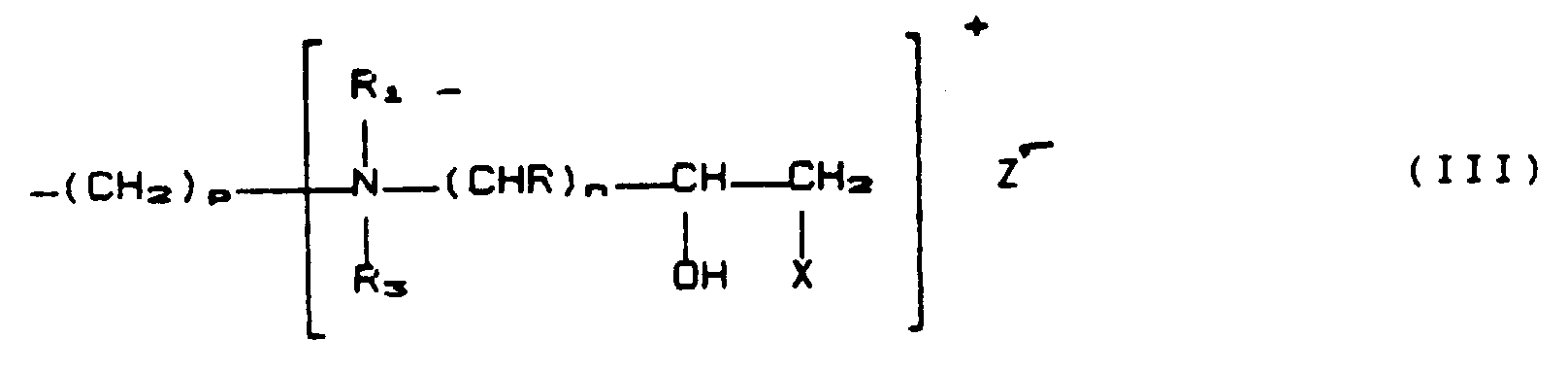
- Quaternary ammonium compounds containing at least one group capable of reacting with hydroxyl groups can be represented by the following general formulae I or II: wherein n is an integer from 1 to 16; X is a halogen; Z - is an anion, such as a halide or hydroxyl group, and R, R 1 , R 2 and R 3 , which can be the same or different, are hydrogen or alkyl, hydroxyalkyl, alkenyl, aryl groups; and R 2 can also be a residue of formula III or IV in which p is an integer from 2 to 10, whereas n, R, R 1 , R 3 , X and Z - have the meanings precised above.
- Some compounds are also commercially available, such as 2,3-hepoxypropyl-N,N,N-trimethylammonium chloride (manufactured by Degussa A.G. in form of a 70% aqueous solution under the commercial name QUAB 151, or by Fluka under the code 50045, in form of the pure solid compound); 3-chloro-2-hydroxypropyl-N,N,N-trimethylammonium chloride, 3-chloro-2-hydroxypropyl-N,N,N-dimethylethanolammonium chloride, 1,3-bis-(3-chloro-2-hydroxypropyl-N,N-dimethylammonium)-N-propane dichloride, all of them being manufactured by Degussa A.G. as 65% aqueous solutions, under the commercial names QUAB 188, QUAB 218 and QUAB 388, respectively.
- quaternized polysaccharides The quaternary ammonium group functionalized polysaccharides according to the invention will be hereinafter named "quaternized polysaccharides”.
- the polysaccharide is preferably fibrous cellulose, particularly the so-called "fluff” deriving from mechanically fiberized wood pulp.
- the quaternized cellulose of the present invention have the following general formula: wherein the R 4 groups, which can be the same or different, are hydrogen or one or more residues containing quaternary groups deriving from the reactives of the above formulae I or II, with the proviso that the ratio of the number of the R 4 groups different from hydrogen to the n 1 value is comprised from 0.5 to 1.1; Z - is an anion of the above described type which acts as counter-ion to the positive charge of the quaternary nitrogen and m is equal to the number of the R 4 groups which are different from hydrogen, whereas n 1 is ⁇ 1000.
- the reaction can be carried out either in a single step or in more steps, with intermediate separation and purification of the product; in each step, the reaction is carried out by contacting the polysaccharide with the base, usually in an aqueous solution which is selected from alkali or alkaline-earth hydroxides or alkoxides such as sodium methoxide, ethoxide, propoxide, isopropoxide, n-butoxide, t-butoxide; then the quaternary compound I or II, as defined above, is added in one or more additions.
- an aqueous solution which is selected from alkali or alkaline-earth hydroxides or alkoxides such as sodium methoxide, ethoxide, propoxide, isopropoxide, n-butoxide, t-butoxide.
- the reaction conditions are as follows:
- the NaOH excess is neutralized washing with a 4% NaCl aqueous solution to neutrality and subsequently the reaction mixture is treated with a strong excess of a 4% HCl aqueous solution.
- the product is dehydrated with acetone and subsequently recovered by filtration and/or centrifugation.
- the quaternized polysaccharides of the invention can also be prepared by subsequent exhaustive N-alkylation of the products from the reaction of the starting polysaccharides with the compounds of formula I or II, wherein at least one of R 1 , R 2 or R 3 is a hydrogen atom.
- the polysaccharide can first be treated, in one or more steps and under the above described reaction conditions, with the above mentioned compounds I or II wherein at least one of R 1 , R 2 o R 3 is a hydrogen atom, and the resulting products can subsequently be reacted with alkylating agents of formula R 5 Z (wherein R 5 is an alkyl, hydroxyalkyl o alkenyl residue, whereas Z is a halogen atom) until quaternization of all of the ammonium groups or at least of part of them.
- Different fibrous cellulose substrates were tested deriving from different chemical and mechanical treatments, such as wood pulp fibres purified by sulfate treatment, beet cellulose, bisulfite cellulose, cellulose fibres of wood pulp obtained by thermomechanical or mechanical treatments, cotton linters.
- the obtained products having satisfactory superabsorption characteristics have relatively high degrees of substitution (D.S.), ranging from 0.5 to 1.1, more frequently from 0.5 to 0.8.
- the cellulose quaternized derivatives described below can be used as superabsorbents in the place of the conventional anionic superabsorbents.
- the cationic cellulose derivatives of the present invention show a number of advantages compared to the commercially available superabsorbent products, particularly:
- Said test is used to evaluate the free absorption capability of the superabsorbent material when it is contacted with a fluid.
- a 325 mesh polyester non-vowen tissue bag is filled with 0.5 g of the test product, then it is soaked in a 250 ml beaker containing 170 ml of a saline solution (1% NaCl aqueous solution). After 30 min. the bag is extracted and left to drip for 15 min. to remove the excess fluid.
- a saline solution 1% NaCl aqueous solution
- Said determination is used to evaluate the retention capability of the gel of the superabsorbent products subjected to centrifugation.
- the superabsorbent material under test is placed into a bag of the above described type, then it is completely soaked with the above described saline solution. After that, the bag is centrifuged at 60 g for 10 min.
- the retention capability (R.) of the gel is expressed as the weight of the fluid retained by the superabsorbent material under test, compared to the starting weight of said material.
- the D.S. is calculated as the ratio of the substituent mmoles entered into the polysaccharide to the monosaccharide mmoles in which said substituent entered, and it is evaluated by potentiometric retrotitration.
- 0.5 g of the quaternized product are digested in a 300 ml centrifuge test tube for one hour under stirring in about 100 ml of 0.1N NaOH, after that the product is filtered and/or centrifuged and washed to neutral mother liquors, the supernatant being discarded.
- the product is taken up into 100 ml of a 1M KCl solution, pH is adjusted to 2.5 with subsequent additions of 0.1N HCl known amounts and the mixture is left under stirring to reach the equilibrium, which is generally attained within a time of 1-2 hours. After centrifugation, a supernatant aliquot is withdrawn and quantitatively titrated with 0.1N NaOH.
- M subst (V 1 -V 2 )xN ab xV t /V 1 xEW subst /MW subst mmoles
- V 1 volume (in ml) of the withdrawn supernatant aliquot.
- V 2 volume (in ml) of the titrating base.
- N ab acid and base normalities, which are the same (0.1 meq/ml).
- V t supernatant liquid total volume (in ml).
- EW subst substituent equivalent weight.
- MW subst substituent molecular weight.
- D.S. M subst /M sacc
- the product is filtered with a gooch, washed to neutrality with water and dried with acetone, to obtain a product similar to the starting one, but that gels upon contact with a saline solution.
- a product has D.S. 0.39 and a saline solution retention of 17.0 g/g.
- Table 1 the product is compared with two commercially available superabsorbent products: Drytech 2080, which is a polyacrylate manufactured by Dow Rheinmünster GmbH, and Aqualon 2C, which is a fibrous carboxymethyl cellulose manufactured by Hercules Inc. Table 1. Measurement of the saline solution retention R. of samples of the product of example 1 and two commercial superabsorbents. PRODUCT R. g/g Drytech 2080 35.0 Cellulose of the present invention 37.2 Aqualon 2C 16.0
- the test is repeated under the same conditions as in example 1, but changing the concentration of the NaOH aqueous solution which is added at the second step from 23% to 10% by weight, and the number of reactive additions at the second step, from 3 to 4.
- test is repeated under the same conditions as in example 4, but changing the concentration of the NaOH aqueous solution which is added at the second step from 10% to 30% by weight.
- the jelly mass is washed to neutrality with a 4% NaCl aqueous solution and the product is stirred in about 2.5 1 of a 4% HCl aqueous solution for 10 hours.
- 10 g of fiberized cellulose are mixed with 6.7 g of NaOH and 28.5 ml of water in a salt-ice bath for 30 min. After that, 46.7 g of Fluka 50045 with 10 ml of water are added thereto, in a reactive to anhydroglucose units 5:1 molar ratio, and the whole is heated to 80-85°C, for 30 min, with stirring now and then. Three more additions are effected at 30 min. intervals. The product is washed to neutrality with a 4% NaCl aqueous solution; then it is stirred in about 2.5 1 of a 4% HCl aqueous solution.
- Table 3 summarizes the values of degree of substitution (D.S.), absorption capability (A.C.) and retention capability (R.), respectively, of the products of the examples.
- Table 3 PRODUCT D.S. A.C. (g/g) R. (g/g) 1 0.55 47.5 37.2 2 0.64 44.0 26.7 3 0.64 42.9 23.3 4 0.23 20.9 7.9 5 0.54 27.6 16.5 6 0.76 21.2 15.5 7 1.10 29.7 24.2 8 0.52 24.7 15.7 9 0.60 33.9 25.2 10 0.03 17.7 2.9 11 0.63 23.8 12.9 12 0.81 39.2 30.2 13 0.50 35.2 27.4 14 0.60 30.0 21.5 15 0.13 - - 16 0.47 26.2 13.7
Landscapes
- Health & Medical Sciences (AREA)
- Chemical & Material Sciences (AREA)
- Engineering & Computer Science (AREA)
- Life Sciences & Earth Sciences (AREA)
- Materials Engineering (AREA)
- Hematology (AREA)
- Veterinary Medicine (AREA)
- Public Health (AREA)
- General Health & Medical Sciences (AREA)
- Animal Behavior & Ethology (AREA)
- Epidemiology (AREA)
- Biochemistry (AREA)
- Organic Chemistry (AREA)
- Polymers & Plastics (AREA)
- Medicinal Chemistry (AREA)
- Chemical Kinetics & Catalysis (AREA)
- Dispersion Chemistry (AREA)
- Polysaccharides And Polysaccharide Derivatives (AREA)
- Materials For Medical Uses (AREA)
- Treatments For Attaching Organic Compounds To Fibrous Goods (AREA)
- Detergent Compositions (AREA)
Abstract
Description
- The present invention relates to cationic fibrous polysaccharides which are functionalized with quaternary ammonium groups and have superabsorption characteristics.
- The substances currently named superabsorbents are hydrophilic polymers, of different chemical nature, which are capable of absorbing and retaining the aqueous fluids, even under a moderate pressure, in amounts equivalent to many times the weight thereof, without substantially dissolving in the fluid that they absorb.
- Superabsorbent materials have been and are used for different industrial applications; the use thereof has been suggested in agriculture as seeding coadjuvants, in building industry, in the production of alkali batteries and of filters.
- However, superabsorbents are mainly used in the field of hygienic-sanitary products, as highly absorbent materials used in disposable sanitary napkins and diapers for children or incontinent adults, in combination with cellulose fibres.
- The superabsorption characteristics are due to the presence in the basic structure of ionizable functional groups, which are usually of anionic type (carboxylates) and generally highly salified, which undergo dissociation and solvation upon contacting water.
- In the dissociated state, a series of functional groups form alongside the polymer chain, which groups have the same electric charge and mutually repel. This involves a broadening of the polymer tangle and, as a consequence, a further absorption of water molecules can be attained.
- Generally, the polymer is partially cross-linked with suitable agents in order to make substantially insoluble the gel, thus avoiding the dissolution of the polymer.
- In conclusion, water absorption only involves a substantial swelling of the polymer.
- Such a functional characteristic develops to the highest degree in the case of deionized water, whereas it remarkably decreases in the presence of electrolytes, as a function of the ionic concentration of the fluid solution.
- Superabsorbent materials can be of different types: for example, polyacrylonitrile (PAN)-grafted celluloses are described in US 3661815; superabsorbents with a base consisting of cross-linked derivatized starch both in the cationic and the anionic forms are described in GB 1576475.
- Preparation of quaternized celluloses is known in the art, for example from US pat. 3472840 assigned to Union Carbide Corporation, which discloses cellulose derivatives, particularly cellulose ethers containing quaternary ammonium groups which are used in the many fields in which cellulose ethers cannot be employed.
- However, said materials are water-soluble and do not show the above described superabsorbption characteristics.
- US pat. 3823133 discloses quaternized celluloses having adsorption characteristics for some protein materials, such as enzymes, which celluloses have a substitution degree, calculated as the average number of substituted hydroxyl groups per cellulose anhydroglucose units, ranging from 0.05 to 0.4.
- US 4,624,743 discloses cationic cellulose products having a maximum nitrogen content of 0.058%, which corresponds to a ds of about 0.07. US 4,432,833 discloses cationic polysaccharides having a degree of substitution of 0.023. JP 75035408 discloses celluloses fibres impregnated with quaternary compounds as debonding agents.
- Now, it has been found that polysaccharides which are functionalized with quaternary ammonium groups having high substitution degrees, ranging from 0.5 to 1.1, have marked superabsorption characteristics also towards saline aqueous solutions.
- The polysaccharides of the invention can be prepared according to a process which comprises reacting fibrous polysaccharides with an excess of quaternary ammonium compounds containing at least a group capable of reacting with the polysaccharide hydroxyl groups, in the presence of bases and preferably in aqueous solvents.
- Also other protic or aprotic polar solvents can be used, such as alcohols, N,N-dimethylformamide and the like, optionally in admixtures thereof.
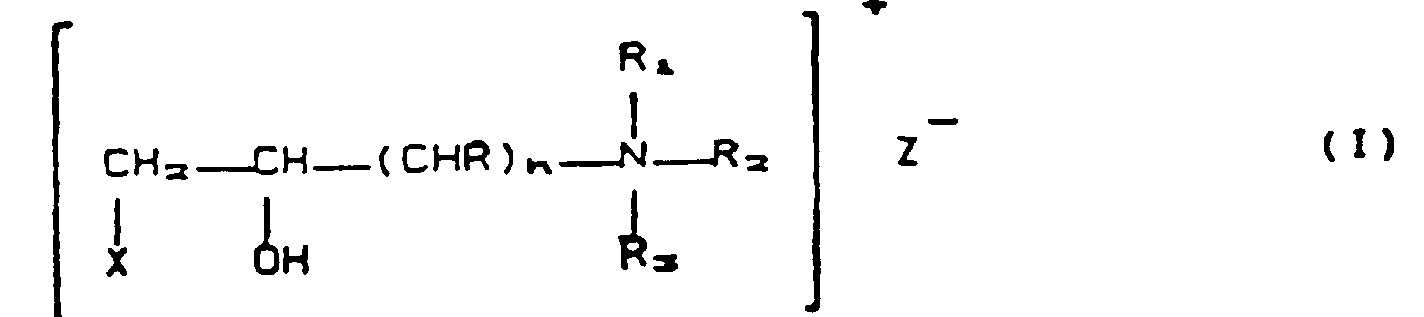
- Quaternary ammonium compounds containing at least one group capable of reacting with hydroxyl groups can be represented by the following general formulae I or II:



- The compounds of formula I and II are known, or they can be prepared according to conventional procedures.
- Some compounds are also commercially available, such as 2,3-hepoxypropyl-N,N,N-trimethylammonium chloride (manufactured by Degussa A.G. in form of a 70% aqueous solution under the commercial name QUAB 151, or by Fluka under the code 50045, in form of the pure solid compound); 3-chloro-2-hydroxypropyl-N,N,N-trimethylammonium chloride, 3-chloro-2-hydroxypropyl-N,N,N-dimethylethanolammonium chloride, 1,3-bis-(3-chloro-2-hydroxypropyl-N,N-dimethylammonium)-N-propane dichloride, all of them being manufactured by Degussa A.G. as 65% aqueous solutions, under the commercial names QUAB 188, QUAB 218 and QUAB 388, respectively.
- Particularly preferred is 2,3-epoxypropyl-N,N,N-trimethylammonium chloride.
- The quaternary ammonium group functionalized polysaccharides according to the invention will be hereinafter named "quaternized polysaccharides".
- The polysaccharide is preferably fibrous cellulose, particularly the so-called "fluff" deriving from mechanically fiberized wood pulp.
- The quaternized cellulose of the present invention have the following general formula:

- According to the process of the invention, the reaction can be carried out either in a single step or in more steps, with intermediate separation and purification of the product; in each step, the reaction is carried out by contacting the polysaccharide with the base, usually in an aqueous solution which is selected from alkali or alkaline-earth hydroxides or alkoxides such as sodium methoxide, ethoxide, propoxide, isopropoxide, n-butoxide, t-butoxide; then the quaternary compound I or II, as defined above, is added in one or more additions.
- The reaction conditions are as follows:
- a) the reactive containing the quaternary ammonium groups is used in a strong excess, in molar ratios to the polisaccharide substrate, expressed as monosaccharide units, ranging from 5:1 to 40:1 as a whole, preferably from 20:1 to 40:1; if the reaction is carried out in more steps, the preferred molar ratio ranging from 10:1 to 20:1 for each step;
- b) the base, which is preferably aqueous NaOH, is used in each step in a molar ratio from 1:3 to 3:1 to the monosaccharide unit hydroxyls and in molar ratios from 5:100 to 300:100 to the reactive, preferably from 100:100 to 300:100 when the reactives of general formula I are used, and from 10:100 to 50:100 when the reactives of general formula II are used;
- c) the reaction temperatures for each step range from 40 to 120°C, preferably from 70 to 100°C, with reaction times ranging from 1 to 5 hours, preferably from 2 to 4 hours.
- At the end of each reaction step, the NaOH excess is neutralized washing with a 4% NaCl aqueous solution to neutrality and subsequently the reaction mixture is treated with a strong excess of a 4% HCl aqueous solution. The product is dehydrated with acetone and subsequently recovered by filtration and/or centrifugation.
- Alternatively, the quaternized polysaccharides of the invention can also be prepared by subsequent exhaustive N-alkylation of the products from the reaction of the starting polysaccharides with the compounds of formula I or II, wherein at least one of R1, R2 or R3 is a hydrogen atom.
- In other words, the polysaccharide can first be treated, in one or more steps and under the above described reaction conditions, with the above mentioned compounds I or II wherein at least one of R1, R2 o R3 is a hydrogen atom, and the resulting products can subsequently be reacted with alkylating agents of formula R5Z (wherein R5 is an alkyl, hydroxyalkyl o alkenyl residue, whereas Z is a halogen atom) until quaternization of all of the ammonium groups or at least of part of them.
- In order to evaluate the absorption characteristics of the compounds of the invention compared with control compounds, the following parameters were measured, according to the procedures reported hereinbelow:
saline solution (1% NaCl aqueous solution) free absorption (A.C.) and retention (R.) capabilities and degree of substitution (D.S.). - Different fibrous cellulose substrates were tested deriving from different chemical and mechanical treatments, such as wood pulp fibres purified by sulfate treatment, beet cellulose, bisulfite cellulose, cellulose fibres of wood pulp obtained by thermomechanical or mechanical treatments, cotton linters.
- The best results were obtained, according to the methods described below, using sulfate cellulose fibres of the type which is generally used for the preparation of absorbent pads of disposable products, such as sanitary napkins and towels, and diapers.
- The obtained products having satisfactory superabsorption characteristics have relatively high degrees of substitution (D.S.), ranging from 0.5 to 1.1, more frequently from 0.5 to 0.8.
- It has surprisingly been found that, notwithstanding the high D.S. values, the products of the invention have superabsorption properties even if they are not cross-linked.
- Such a characteristic makes them different from similar cellulose or synthetic products which require cross-linking to show the superabsorption characteristics.
- The cellulose quaternized derivatives described below can be used as superabsorbents in the place of the conventional anionic superabsorbents.
- Particularly, they can advantageously be used in the above mentioned disposable articles.
- Moreover, the cationic cellulose derivatives of the present invention show a number of advantages compared to the commercially available superabsorbent products, particularly:
- a) they show a much higher saline solution retention capability than the commercially available fibrous superabsorbents, such as fibrous carboxyme-thylcelluloses;
- b) they show a saline solution retention capability equivalent to that of the commercially available powder or granular superabsorbents, such as polyacrylates; moreover they are in fibrous form, which is advantageous when they are used as absorbent materials for disposable hygienic articles, such as diapers or sanitary napkins, particularly when they are in admixture with the conventional cellulose fibres used to prepare the absorbent pads for said products;
- c) they show both in the salified and in the unsalified forms the superabsorption characteristics towards saline solutions, unlike the common anionic superabsorbents which have absorption characteristics depending on the degree of neutralization and completely lose all the superabsorption characteristics in the unsalified form.
- In the following examples, which further illustrate the invention, the absorption characteristics of the described products were determined as follows:
- Said test is used to evaluate the free absorption capability of the superabsorbent material when it is contacted with a fluid.
- A 325 mesh polyester non-vowen tissue bag is filled with 0.5 g of the test product, then it is soaked in a 250 ml beaker containing 170 ml of a saline solution (1% NaCl aqueous solution). After 30 min. the bag is extracted and left to drip for 15 min. to remove the excess fluid.
- The amount in grams of the liquid retained by the superabsorbent material under test, compared to the starting weight (0.5 g) of said material, expresses the free absorption capability in g/g (A.C.)
- Said determination is used to evaluate the retention capability of the gel of the superabsorbent products subjected to centrifugation.
- The superabsorbent material under test is placed into a bag of the above described type, then it is completely soaked with the above described saline solution. After that, the bag is centrifuged at 60 g for 10 min.
- The retention capability (R.) of the gel is expressed as the weight of the fluid retained by the superabsorbent material under test, compared to the starting weight of said material.
- The D.S. is calculated as the ratio of the substituent mmoles entered into the polysaccharide to the monosaccharide mmoles in which said substituent entered, and it is evaluated by potentiometric retrotitration.
- 0.5 g of the quaternized product are digested in a 300 ml centrifuge test tube for one hour under stirring in about 100 ml of 0.1N NaOH, after that the product is filtered and/or centrifuged and washed to neutral mother liquors, the supernatant being discarded.
- Then the product is taken up into 100 ml of a 1M KCl solution, pH is adjusted to 2.5 with subsequent additions of 0.1N HCl known amounts and the mixture is left under stirring to reach the equilibrium, which is generally attained within a time of 1-2 hours. After centrifugation, a supernatant aliquot is withdrawn and quantitatively titrated with 0.1N NaOH.
- The substituent mmoles (Msubst) entered into the polysaccharide are calculated as follows:
Msubst=(V1-V2)xNabxVt/V1xEWsubst/MWsubst mmoles wherein:
V1 = volume (in ml) of the withdrawn supernatant aliquot.
V2 = volume (in ml) of the titrating base.
Nab = acid and base normalities, which are the same (0.1 meq/ml).
Vt = supernatant liquid total volume (in ml).
EWsubst = substituent equivalent weight.
MWsubst = substituent molecular weight. - The polysaccharide amount (Wp) (in mg) in 0.5 g of the sample, is calculated as follows:
Wp = Ws - (MWsubst x Msubst) mg, wherein:
Ws = sample weight (in mg). - The monosaccharide mmoles (Msacc) in 0.5 g of the sample are calculated as follows:
Msacc = Wp/MWsacc mmoles, wherein:
MWsacc = molecular weight of the monosaccharide unit.
The D.S. is calculated as follows:
D.S. = Msubst/Msacc - 10 g of sulfate chemical cellulose are mixed with 6.7 g of NaOH and 28.5 ml of water in salt-ice bath for 30 min. After that, 46.74 g of Fluka 50045 (solid 2,3-epoxypropyl-N,N,N- trimethylammonium chloride) added with 20 ml of water are added thereto, in a reactive to anhydroglucose units 5:1 molar ratio, and the whole is heated to 80-85°C, for 30 min, with stirring now and then. The addition of the reactive and water is repeated 3 times in the same way as above. At the end of the first reaction step, the jelly mass is washed to neutrality with a 4% NaCl aqueous solution; then the product is stirred for 10 hours in about 2.5 1 of a 4% HCl aqueous solution.
- At the end of this time, the product is filtered with a gooch, washed to neutrality with water and dried with acetone, to obtain a product similar to the starting one, but that gels upon contact with a saline solution. Such a product has D.S. 0.39 and a saline solution retention of 17.0 g/g.
- The product is subjected to a second reaction step following the same procedure as in the first step, but with 3 additions of reactive and water, instead of 4 additions; at the end of the reaction a fibrous product (I) is recovered having D.S. = 0.55, A.C. = 47.5 g/g and R. = 37.2 g/g.
- In Table 1 the product is compared with two commercially available superabsorbent products: Drytech 2080, which is a polyacrylate manufactured by Dow Rheinmünster GmbH, and Aqualon 2C, which is a fibrous carboxymethyl cellulose manufactured by Hercules Inc.
Table 1. Measurement of the saline solution retention R. of samples of the product of example 1 and two commercial superabsorbents. PRODUCT R. g/g Drytech 2080 35.0 Cellulose of the present invention 37.2 Aqualon 2C 16.0 - 10 g of sulfate chemical cellulose are mixed with 6.7 g of NaOH and 30 ml of water in salt-ice bath for 30 min. 327.18 g of Fluka 50045 are added in a single portion, in a reactive to anhydroglucose units 35:1 total molar ratio, and the whole is heated to 80-85°C, for 30 min, with stirring now and then. The mixture is left to react for 3 hours, sometimes stirring, and at the end of the single step the jelly mass is washed to neutrality with a 4% NaCl aqueous solution; then the product is stirred for 10 hours in about 2.5 1 of a 4% HCl aqueous solution.
- At the end of this time, the product is filtered, washed to neutrality with water and dried with acetone, to obtain a fibrous product (2) in the salified form, having D.S. = 0.64, A.C. = 44.0 g/g and R. = 26.7 g/g.
- An aliquot of said product (0.25 g) in a 325 mesh polyester non-woven tissue bag is placed in one litre of a 0.1N NaOH aqueous solution for 10 hours, under mechanical stirring, then it is washed with water to neutrality and dried with acetone, to obtain a product (3) in the unsalified form, having A.C. = 42.9 g/g and R. = 23.2 g/g.
- The characteristics of the two products are reported in Table 2.
Table 2. Comparison of the salified and unsalified forms of a quaternized cellulose according to the invention; evaluation of the absorption and retention capabilities. PRODUCT A.C. (g/g) R. (g/g) 2 (salified form) 44.0 26.7 3 (unsalified form) 42.9 23.2 - 30 g of sulfate chemical cellulose are placed into a 1 litre autoclave (fitted with a thermostatizing jacket) and added with 20.1 g of NaOH dissolved in 300 ml of distilled water. The suspension is mechanically stirred for 30 min. at 0°C. Subsequently temperature is increased to 85°C and QUAB 151 (2,3-epoxypropyl-N,N,N-trimethylammonium chloride in 70% aqueous solution) is added in 4 portions at 30 min. intervals, each portion containing 177 ml of the reactive, corresponding to a reactive to anhydroglucose units 4:1 molar ratio for each single addition. 30 Minutes after the last addition, the mixture is washed to neutrality with a 4% NaCl aqueous solution; then the product is stirred for 1 hour in about 2.5 1 of a 4% HCl aqueous solution, then it is washed to neutrality with water and dried with acetone, to obtain a fibrous product (4) that gels upon contact with a saline solution. Such a product has D.S. = 0.23; A.C. = 20.9 g/g and R. = 7.9 g/g.
- 20 g of zinc chloride are placed into a flask fitted with a condenser, then 68 ml of 88% formic acid are added. After dissolution, 3 g of sulfate chemical cellulose are added and the reaction medium is kept at room temperature for 24 hours, with magnetic stirring. At the end of this time the mixture is washed with methanol to neutrality and dried with methanol. The resulting cellulose is added with 2.0 g of NaOH dissolved in 8.5 ml of water in a salt-ice bath for 30 min. The reaction mixture is added with 14.0 g of Fluka 50045 added to 6 ml of water, in a reactive to anhydroglucose units 5:1 molar ratio. The whole is heated to 80-85°C, stirring sometimes. 3 More reactive additions are repeated in the same way and amounts, at 30 min. intervals. At the end of the reaction, the product is recovered as in example 1, to obtain a fibrous product (5) having D.S. = 0.54; A.C. = 27.6 g/g and R. = 16.5 g/g.
- The test is repeated under the same conditions as in example 1, but changing the concentration of the NaOH aqueous solution which is added at the second step from 23% to 10% by weight, and the number of reactive additions at the second step, from 3 to 4. The fibrous product recovered (6) has D.S. = 0.76; A.C. = 21.2 g/g and R. = 15.5 g/g.
- The test is repeated under the same conditions as in example 4, but changing the concentration of the NaOH aqueous solution which is added at the second step from 10% to 30% by weight. A fibrous product is recovered (7) which gels, having D.S. = 1.10; A.C. = 29.7 g/g and R. = 24.2 g/g.
- 10 g of cellulose from cotton linters are mixed with 6.7 g of NaOH and 28.5 ml of water in a salt-ice bath for 30 min. After that, 46.74 g of Fluka 50045 with 20 ml of water are added, in a reactive to anhydroglucose units 5:1 molar ratio; the whole is heated to 80-85°C stirring sometimes, for 30 minutes.
- The addition of reactive and water is repeated 3 more times, in the same way and amounts.
- At the end of the single reaction step, the jelly mass is washed to neutrality with a 4% NaCl aqueous solution and the product is stirred in about 2.5 1 of a 4% HCl aqueous solution for 10 hours. After that the product is filtered with a gooch, washed to neutrality and dried with acetone, to obtain a fibrous product (8) which gels in a saline solution, having D.S. = 0.52; A.C. = 24.7 g/g and R. = 15.7 g/g.
- The test is repeated under the same conditions as in example 1, but using 10 g of bisulfite chemical cellulose and repeating the reactive addition 4 times in each of the two reaction steps, to obtain a fibrous product (9) which gels, having D.S. - 0.60; A.C. = 33.9 g/g and R. = 25.2 g/g.
- 10 g of fiberized cellulose are mixed with 6.7 g of NaOH and 28.5 ml of water in a salt-ice bath for 30 min. After that, QUAB 218 (3-chloro-2-hydroxypropyl-N,N,N-dimethylammonium chloride in a 65% aqueous solution) is added, in a reactive to anhydroglucose units 1:1 molar ratio, and the whole is heated to 80-85°C, for 30 min, with stirring now and then. Three more additions are effected at 30 min. intervals. The obtained product is washed to neutrality with a 4% NaCl aqueous solution; then it is stirred in about 2.5 1 of a 4% HCl aqueous solution for one hour.
- At the end of this time, the product is washed to neutrality with water and dried with acetone, to obtain product (10) having D.S. 0.03; A.C. = 17.7 g/g and R. = 2.9 g/g.
- 10 g of fiberized cellulose are mixed with 6.7 g of NaOH and 28.5 ml of water in a salt-ice bath for 30 min. After that, 46.7 g of Fluka 50045 with 10 ml of water are added thereto, in a reactive to anhydroglucose units 5:1 molar ratio, and the whole is heated to 80-85°C, for 30 min, with stirring now and then. Three more additions are effected at 30 min. intervals. The product is washed to neutrality with a 4% NaCl aqueous solution; then it is stirred in about 2.5 1 of a 4% HCl aqueous solution.
- At the end of this time, the product is washed to neutrality with water and dried with acetone, and it is subsequently subjected to a second reaction step, in the same way as the first one, to obtain product (11) having D.S. = 0.63; A.C. = 23.8 g/g and R. = 12.9 g/g.
- The test is repeated under the same conditions as in example 10, but adding 15 ml of water for each reactive addition, to obtain product (12) having the following characteristics: D.S. = 0.81; A.C. = 39.2 g/g and R. = 30.2 g/g.
- The test is repeated under the same conditions as in example 10, but adding 20 ml of water for each reactive addition, to obtain product (13) having the following characteristics: D.S. = 0.50; A.C. = 35.2 g/g and R. = 27.4 g/g.
- 10 g of fiberized cellulose are mixed in a 600 ml beaker with 6.7 g of NaOH and 28.5 ml of water in salt-ice bath for 30 min. After that, 73 ml of QUAB 151 are added in a reactive to anhydroglucose units 5:1 molar ratio, and the whole is heated to 80-85°C, for 30 min, with stirring now and then. Three more additions are repeated at 30 min. intervals. The obtained product is washed to neutrality with a 4% NaCl aqueous solution; then the product is stirred for 1 hour in about 2.5 1 of a 4% HCl aqueous solution.
- At the end of this time, the product is washed to neutrality with water and dried with acetone, to obtain a product having D.S. = 0.46, A.C. = 30.14 g/g and R. = 12.4 g/g.
- Such a product is treated and recovered again as described above, to obtain product (14) having the following characteristics: D.S. = 0.60; A.C. = 30.0 g/g and R. = 21.5 g/g.
- 10 g of fiberized cellulose are mixed with 6.7 g of NaOH and 28.5 ml of water in salt-ice bath for 30 min. After that, 9.3 ml of QUAD 188 (3-chloro-2-hydroxypropyl-N,N,N-trimethylammonium chloride in a 65% aqueous solution) are added and the whole is heated to 80-85°C, for 30 min, with stirring now and then. Two more additions are effected at 15 min. intervals, and the product is left to react for 30 min. after the last addition. The obtained product is washed to neutrality with a 4% NaCl aqueous solution; then it is stirred in about 2.5 1 of a 4% HCl aqueous solution for one hour. At the end of this time, the product is washed to neutrality with water and dried with acetone, to obtain product (15) having D.S. = 0.13.
- 4 g of beet cellulose are placed into a beaker and added with 2.68 g of NaOH dissolved in 11.4 ml of water. The suspension is kept in a salt-ice bath, stirring now and then. At the end of this time, 18.7 g of Fluka 50045 added with 8 ml of water are added thereto, and the beaker is heated to 80-85°C in an oil-bath. This addition is repeated 3 more times, at 30 min. intervals, then product is washed to neutrality with a 4% NaCl aqueous solution. After that the product is stirred with about 1 1 of a 4% HCl aqueous solution for one hour, then it is washed to neutrality with water and dried with acetone. A fibrous product (16) is recovered, having D.S .= 0.47; A.C. = 26.2 g/g and R. = 13.7 g/g.
- The following Table 3 summarizes the values of degree of substitution (D.S.), absorption capability (A.C.) and retention capability (R.), respectively, of the products of the examples.
Table 3 PRODUCT D.S. A.C. (g/g) R. (g/g) 1 0.55 47.5 37.2 2 0.64 44.0 26.7 3 0.64 42.9 23.3 4 0.23 20.9 7.9 5 0.54 27.6 16.5 6 0.76 21.2 15.5 7 1.10 29.7 24.2 8 0.52 24.7 15.7 9 0.60 33.9 25.2 10 0.03 17.7 2.9 11 0.63 23.8 12.9 12 0.81 39.2 30.2 13 0.50 35.2 27.4 14 0.60 30.0 21.5 15 0.13 - - 16 0.47 26.2 13.7
Claims (7)
- A process for the preparation of superabsorbent fibrous cationic polysaccharides which comprises reacting the polysaccharide in the fibrous form with a quaternary ammonium compound having the general formulas:


- A process according to claim 1 characterized in that the fibrous polysaccharide is cellulose.
- A process according to claim 2 characterized in that said cellulose is sulfate cellulose, bisulfite cellulose, cellulose from wood pulp obtained by a thermomechanic or mechanic process, cotton linters, beet cellulose.
- A process according to claim 1 characterized in that the compounds of formula I or II are selected from 2,3-epoxypropyl-N,N,N-trimethylammonium chloride, 3-chloro-2-hydroxypropyl-N,N,N-trimethylammonium chloride, 3-chloro-2-hydroxypropyl-N,N,N-dimethylethanolammonium chloride, 1,3-bis-(3-chloro-2-hydroxypropyl-N,N-dimethylammonium)-N-propane dichloride.
Applications Claiming Priority (3)
| Application Number | Priority Date | Filing Date | Title |
|---|---|---|---|
| ITMI911217A IT1249309B (en) | 1991-05-03 | 1991-05-03 | CATIONIC TYPE POLYSACCHARIDES |
| ITMI911217 | 1991-05-03 | ||
| PCT/EP1992/000942 WO1992019652A1 (en) | 1991-05-03 | 1992-04-30 | Cationic polysaccharides |
Publications (2)
| Publication Number | Publication Date |
|---|---|
| EP0582624A1 EP0582624A1 (en) | 1994-02-16 |
| EP0582624B1 true EP0582624B1 (en) | 1997-07-02 |
Family
ID=11359837
Family Applications (1)
| Application Number | Title | Priority Date | Filing Date |
|---|---|---|---|
| EP92909539A Expired - Lifetime EP0582624B1 (en) | 1991-05-03 | 1992-04-30 | Cationic polysaccharides |
Country Status (18)
| Country | Link |
|---|---|
| EP (1) | EP0582624B1 (en) |
| JP (1) | JP3323198B2 (en) |
| KR (1) | KR100215215B1 (en) |
| AT (1) | ATE154939T1 (en) |
| AU (1) | AU659149B2 (en) |
| BR (1) | BR9205968A (en) |
| CA (1) | CA2102314C (en) |
| CZ (1) | CZ281413B6 (en) |
| DE (1) | DE69220664T2 (en) |
| DK (1) | DK0582624T3 (en) |
| ES (1) | ES2103370T3 (en) |
| FI (1) | FI104425B (en) |
| GR (1) | GR3024914T3 (en) |
| IT (1) | IT1249309B (en) |
| NO (1) | NO305991B1 (en) |
| RU (1) | RU2127279C1 (en) |
| SK (1) | SK279778B6 (en) |
| WO (1) | WO1992019652A1 (en) |
Cited By (1)
| Publication number | Priority date | Publication date | Assignee | Title |
|---|---|---|---|---|
| DE10200717A1 (en) * | 2002-01-10 | 2003-07-31 | Knoell Hans Forschung Ev | Use of polysaccharide derivatives as anti-infective substances |
Families Citing this family (18)
| Publication number | Priority date | Publication date | Assignee | Title |
|---|---|---|---|---|
| IT1267495B1 (en) * | 1994-11-10 | 1997-02-05 | P & G Spa | ABSORBENT MATERIAL, FOR EXAMPLE OF SUPER ABSORBENT TYPE, AND RELATIVE USE. |
| US5780616A (en) * | 1994-11-10 | 1998-07-14 | The Procter & Gamble Company | Cationic polymer |
| IT1267498B1 (en) * | 1994-11-10 | 1997-02-05 | P & G Spa | CATIONIC CELLULOSE DERIVATIVE, ITS USE FOR THE REDUCTION OF CHOLESTEROL LEVELS AND ITS PHARMACEUTICAL COMPOSITION. |
| IT1267496B1 (en) * | 1994-11-10 | 1997-02-05 | P & G Spa | CATIONIC POLYMER, FOR EXAMPLE OF SUPER ABSORBENT TYPE, RELATIVE PROCEDURE AND USE. |
| IT1267184B1 (en) * | 1994-12-06 | 1997-01-28 | P & G Spa | ABSORBENT MATERIAL, FOR EXAMPLE OF THE SUPER ABSORBENT TYPE, AND RELATIVE USE. |
| ATE176785T1 (en) | 1995-02-21 | 1999-03-15 | Cellcat Gmbh | CELLULOSE PARTICLES, METHOD FOR THE PRODUCTION THEREOF AND THEIR USE |
| DE19520804C3 (en) * | 1995-02-21 | 2000-08-24 | Cellcat Gmbh | Cellulose particles which have cationic groups inside, process for their preparation and their use |
| FR2759376B1 (en) * | 1997-02-12 | 1999-04-16 | Ard Sa | PROCESS FOR OBTAINING CATIONIC CELLULOSE MICROFIBRILLES OR THEIR SOLUBLE DERIVATIVES AS WELL AS CELLULOSES OBTAINED BY THIS PROCESS |
| DE19717030A1 (en) * | 1997-04-23 | 1998-10-29 | Degussa | Substituted, powdered natural polymers, a process for their preparation and their use |
| DE19719899A1 (en) | 1997-05-12 | 1998-11-19 | Clariant Gmbh | Largely water-insoluble cationized solids as well as their production and use |
| DK0994732T3 (en) * | 1997-06-24 | 2001-12-17 | Sca Hygiene Prod Ab | Absorbent structure comprising a highly absorbent polymer and an absorbent article comprising the absorbent structure |
| GB0202723D0 (en) * | 2002-02-06 | 2002-03-27 | Huntsman Int Llc | Anti-microbial fabric treatment |
| US20050133180A1 (en) * | 2003-12-19 | 2005-06-23 | Hugh West | Densification agent and oil treated cellulose fibers |
| CA2615780C (en) * | 2005-07-26 | 2020-03-10 | Knauf Insulation Gmbh | Binders and materials made therewith |
| ES2422282T3 (en) * | 2008-05-19 | 2013-09-10 | Procter & Gamble | Absorbent core |
| EP2123310B1 (en) | 2008-05-19 | 2012-12-12 | The Procter & Gamble Company | Absorbent product comprising a cationic modified starch |
| EP2153808A1 (en) | 2008-08-08 | 2010-02-17 | The Procter and Gamble Company | Absorbent product comprising a cationic modified guar gum |
| EP2394669A1 (en) | 2010-06-11 | 2011-12-14 | The Procter & Gamble Company | Absorbent product comprising a cationic polysaccharide in a hydrophilic carrier matrix |
Citations (2)
| Publication number | Priority date | Publication date | Assignee | Title |
|---|---|---|---|---|
| EP0212145A1 (en) * | 1985-08-14 | 1987-03-04 | Etablissement TEXCONTOR | Quaternary ammonium salts of natural polysaccharides possessing hypocholesterolemic activity |
| EP0310787A2 (en) * | 1987-10-03 | 1989-04-12 | Degussa Aktiengesellschaft | Process for preparating cellulose ethers containing tertiary or quaternary nitrogen |
Family Cites Families (8)
| Publication number | Priority date | Publication date | Assignee | Title |
|---|---|---|---|---|
| JPS53145892A (en) * | 1977-05-26 | 1978-12-19 | Toyo Pulp Co Ltd | Method of improving cellulose pulp for paperrmaking |
| US4432833A (en) * | 1980-05-19 | 1984-02-21 | Kimberly-Clark Corporation | Pulp containing hydrophilic debonder and process for its application |
| US4624743A (en) * | 1983-06-24 | 1986-11-25 | Weyerhaeuser Company | Cationic cellulose product and method for its preparation |
| DE3329385A1 (en) * | 1983-08-13 | 1985-02-28 | Seitz-Filter-Werke Theo & Geo Seitz GmbH und Co, 6550 Bad Kreuznach | ASBEST FREE FILTER LAYER |
| SU1370116A1 (en) * | 1986-08-04 | 1988-01-30 | Каунасский Политехнический Институт Им.Антанаса Снечкуса | Method of obtaining cellulose anionite |
| JPS6392788A (en) * | 1986-10-06 | 1988-04-23 | 東レ株式会社 | Treatment of cellulosic fiber |
| JPS63303182A (en) * | 1987-05-30 | 1988-12-09 | 旭化成株式会社 | Production of improved regenerated cellulose fiber |
| JPS6468578A (en) * | 1987-09-02 | 1989-03-14 | Daiwa Spinning Co Ltd | Fiber having excellent washing fastness and deodorizing function |
-
1991
- 1991-05-03 IT ITMI911217A patent/IT1249309B/en active IP Right Grant
-
1992
- 1992-04-30 DE DE69220664T patent/DE69220664T2/en not_active Expired - Fee Related
- 1992-04-30 CA CA002102314A patent/CA2102314C/en not_active Expired - Fee Related
- 1992-04-30 RU RU93058443A patent/RU2127279C1/en not_active IP Right Cessation
- 1992-04-30 AU AU16725/92A patent/AU659149B2/en not_active Ceased
- 1992-04-30 KR KR1019930703314A patent/KR100215215B1/en not_active Expired - Fee Related
- 1992-04-30 SK SK1218-93A patent/SK279778B6/en not_active IP Right Cessation
- 1992-04-30 CZ CS932324A patent/CZ281413B6/en not_active IP Right Cessation
- 1992-04-30 ES ES92909539T patent/ES2103370T3/en not_active Expired - Lifetime
- 1992-04-30 AT AT92909539T patent/ATE154939T1/en not_active IP Right Cessation
- 1992-04-30 EP EP92909539A patent/EP0582624B1/en not_active Expired - Lifetime
- 1992-04-30 JP JP50852792A patent/JP3323198B2/en not_active Expired - Fee Related
- 1992-04-30 DK DK92909539.6T patent/DK0582624T3/en active
- 1992-04-30 BR BR9205968A patent/BR9205968A/en not_active IP Right Cessation
- 1992-04-30 WO PCT/EP1992/000942 patent/WO1992019652A1/en not_active Ceased
-
1993
- 1993-11-02 NO NO933956A patent/NO305991B1/en unknown
- 1993-11-02 FI FI934842A patent/FI104425B/en active
-
1997
- 1997-10-01 GR GR970402561T patent/GR3024914T3/en unknown
Patent Citations (2)
| Publication number | Priority date | Publication date | Assignee | Title |
|---|---|---|---|---|
| EP0212145A1 (en) * | 1985-08-14 | 1987-03-04 | Etablissement TEXCONTOR | Quaternary ammonium salts of natural polysaccharides possessing hypocholesterolemic activity |
| EP0310787A2 (en) * | 1987-10-03 | 1989-04-12 | Degussa Aktiengesellschaft | Process for preparating cellulose ethers containing tertiary or quaternary nitrogen |
Cited By (1)
| Publication number | Priority date | Publication date | Assignee | Title |
|---|---|---|---|---|
| DE10200717A1 (en) * | 2002-01-10 | 2003-07-31 | Knoell Hans Forschung Ev | Use of polysaccharide derivatives as anti-infective substances |
Also Published As
| Publication number | Publication date |
|---|---|
| NO933956L (en) | 1993-12-15 |
| FI104425B (en) | 2000-01-31 |
| KR100215215B1 (en) | 1999-08-16 |
| AU659149B2 (en) | 1995-05-11 |
| CZ232493A3 (en) | 1994-03-16 |
| DE69220664T2 (en) | 1997-10-16 |
| FI934842A0 (en) | 1993-11-02 |
| ITMI911217A1 (en) | 1992-11-03 |
| DK0582624T3 (en) | 1998-02-16 |
| EP0582624A1 (en) | 1994-02-16 |
| ATE154939T1 (en) | 1997-07-15 |
| SK121893A3 (en) | 1994-07-06 |
| NO305991B1 (en) | 1999-08-30 |
| JPH06506965A (en) | 1994-08-04 |
| NO933956D0 (en) | 1993-11-02 |
| CA2102314A1 (en) | 1992-11-04 |
| BR9205968A (en) | 1994-09-27 |
| WO1992019652A1 (en) | 1992-11-12 |
| JP3323198B2 (en) | 2002-09-09 |
| AU1672592A (en) | 1992-12-21 |
| RU2127279C1 (en) | 1999-03-10 |
| ES2103370T3 (en) | 1997-09-16 |
| DE69220664D1 (en) | 1997-08-07 |
| FI934842L (en) | 1993-12-29 |
| CA2102314C (en) | 2003-07-22 |
| GR3024914T3 (en) | 1998-01-30 |
| IT1249309B (en) | 1995-02-22 |
| CZ281413B6 (en) | 1996-09-11 |
| SK279778B6 (en) | 1999-03-12 |
| ITMI911217A0 (en) | 1991-05-03 |
Similar Documents
| Publication | Publication Date | Title |
|---|---|---|
| US5731259A (en) | Cationic polysaccharides | |
| AU1672592A (en) | Cationic polysaccharides | |
| US5780616A (en) | Cationic polymer | |
| US6627750B2 (en) | Highly carboxylated cellulose fibers and process of making the same | |
| EP0799247B1 (en) | Chitosan salts and process for the preparation thereof | |
| JP3274550B2 (en) | Manufacturing method of water absorbing material | |
| CA2130427C (en) | Modified polysaccharides having improved absorbent properties and process for the preparation thereof | |
| EP0946598B1 (en) | Superabsorbent material and method for producing said material | |
| CA1079271A (en) | Process for the manufacture of absorbent, modified starch ethers and their use | |
| CA2207081C (en) | Absorbent material | |
| US5770711A (en) | Polysaccharides substituted with polycarboxylated moieties | |
| EP0023561B1 (en) | Polycarboxyalkyl-cellulose having high fluid absorbing and retaining properties, and process for preparing same | |
| US20140088252A1 (en) | Method for making specific products from polysaccharide molecule | |
| CA2205026C (en) | Cationic polymer | |
| HU216321B (en) | In water swellable cationic polymer, process for producing thereof and their use | |
| JPS5946249B2 (en) | Method for producing insoluble etherified cellulose graft copolymer | |
| EP2196224A1 (en) | Absorbent material | |
| EP0791002A1 (en) | Anionic polymer | |
| HU215150B (en) | Process for preparation of fibrous cationic polysaccharides and disposable absorbent articles | |
| JPH0469161B2 (en) | ||
| MXPA97003448A (en) | Polimero anion | |
| MXPA97003447A (en) | Polimero cation | |
| MXPA97006906A (en) | Polysaccharides replaced with polycarboxilate parts | |
| JPS621732B2 (en) |
Legal Events
| Date | Code | Title | Description |
|---|---|---|---|
| PUAI | Public reference made under article 153(3) epc to a published international application that has entered the european phase |
Free format text: ORIGINAL CODE: 0009012 |
|
| 17P | Request for examination filed |
Effective date: 19931118 |
|
| AK | Designated contracting states |
Kind code of ref document: A1 Designated state(s): AT BE CH DE DK ES FR GB GR IT LI LU MC NL SE |
|
| 17Q | First examination report despatched |
Effective date: 19950802 |
|
| GRAG | Despatch of communication of intention to grant |
Free format text: ORIGINAL CODE: EPIDOS AGRA |
|
| GRAH | Despatch of communication of intention to grant a patent |
Free format text: ORIGINAL CODE: EPIDOS IGRA |
|
| RAP1 | Party data changed (applicant data changed or rights of an application transferred) |
Owner name: ANGELINI RICERCHE S.P.A. SOCIETA' CONSORTILE |
|
| GRAH | Despatch of communication of intention to grant a patent |
Free format text: ORIGINAL CODE: EPIDOS IGRA |
|
| GRAA | (expected) grant |
Free format text: ORIGINAL CODE: 0009210 |
|
| AK | Designated contracting states |
Kind code of ref document: B1 Designated state(s): AT BE CH DE DK ES FR GB GR IT LI LU MC NL SE |
|
| REF | Corresponds to: |
Ref document number: 154939 Country of ref document: AT Date of ref document: 19970715 Kind code of ref document: T |
|
| REG | Reference to a national code |
Ref country code: CH Ref legal event code: NV Representative=s name: HUG INTERLIZENZ AG Ref country code: CH Ref legal event code: EP |
|
| REF | Corresponds to: |
Ref document number: 69220664 Country of ref document: DE Date of ref document: 19970807 |
|
| REG | Reference to a national code |
Ref country code: ES Ref legal event code: FG2A Ref document number: 2103370 Country of ref document: ES Kind code of ref document: T3 |
|
| ITF | It: translation for a ep patent filed | ||
| ET | Fr: translation filed | ||
| REG | Reference to a national code |
Ref country code: GR Ref legal event code: FG4A Free format text: 3024914 |
|
| REG | Reference to a national code |
Ref country code: DK Ref legal event code: T3 |
|
| PLBE | No opposition filed within time limit |
Free format text: ORIGINAL CODE: 0009261 |
|
| 26N | No opposition filed | ||
| REG | Reference to a national code |
Ref country code: GB Ref legal event code: IF02 |
|
| PGFP | Annual fee paid to national office [announced via postgrant information from national office to epo] |
Ref country code: MC Payment date: 20080331 Year of fee payment: 17 |
|
| PGFP | Annual fee paid to national office [announced via postgrant information from national office to epo] |
Ref country code: LU Payment date: 20080416 Year of fee payment: 17 Ref country code: ES Payment date: 20080402 Year of fee payment: 17 Ref country code: DK Payment date: 20080425 Year of fee payment: 17 Ref country code: DE Payment date: 20080612 Year of fee payment: 17 Ref country code: CH Payment date: 20080430 Year of fee payment: 17 |
|
| PGFP | Annual fee paid to national office [announced via postgrant information from national office to epo] |
Ref country code: AT Payment date: 20080425 Year of fee payment: 17 |
|
| PGFP | Annual fee paid to national office [announced via postgrant information from national office to epo] |
Ref country code: BE Payment date: 20080428 Year of fee payment: 17 Ref country code: IT Payment date: 20080424 Year of fee payment: 17 |
|
| PGFP | Annual fee paid to national office [announced via postgrant information from national office to epo] |
Ref country code: SE Payment date: 20080414 Year of fee payment: 17 Ref country code: NL Payment date: 20080331 Year of fee payment: 17 |
|
| PGFP | Annual fee paid to national office [announced via postgrant information from national office to epo] |
Ref country code: GB Payment date: 20080430 Year of fee payment: 17 |
|
| PGFP | Annual fee paid to national office [announced via postgrant information from national office to epo] |
Ref country code: GR Payment date: 20080430 Year of fee payment: 17 |
|
| BERE | Be: lapsed |
Owner name: *ANGELINI RICERCHE S.P.A. SOCIETA' CONSORTILE Effective date: 20090430 |
|
| REG | Reference to a national code |
Ref country code: CH Ref legal event code: PL |
|
| REG | Reference to a national code |
Ref country code: DK Ref legal event code: EBP |
|
| GBPC | Gb: european patent ceased through non-payment of renewal fee |
Effective date: 20090430 |
|
| NLV4 | Nl: lapsed or anulled due to non-payment of the annual fee |
Effective date: 20091101 |
|
| REG | Reference to a national code |
Ref country code: FR Ref legal event code: ST Effective date: 20091231 |
|
| PG25 | Lapsed in a contracting state [announced via postgrant information from national office to epo] |
Ref country code: LI Free format text: LAPSE BECAUSE OF NON-PAYMENT OF DUE FEES Effective date: 20090430 Ref country code: DE Free format text: LAPSE BECAUSE OF NON-PAYMENT OF DUE FEES Effective date: 20091103 Ref country code: CH Free format text: LAPSE BECAUSE OF NON-PAYMENT OF DUE FEES Effective date: 20090430 Ref country code: AT Free format text: LAPSE BECAUSE OF NON-PAYMENT OF DUE FEES Effective date: 20090430 |
|
| PG25 | Lapsed in a contracting state [announced via postgrant information from national office to epo] |
Ref country code: NL Free format text: LAPSE BECAUSE OF NON-PAYMENT OF DUE FEES Effective date: 20091101 |
|
| PG25 | Lapsed in a contracting state [announced via postgrant information from national office to epo] |
Ref country code: MC Free format text: LAPSE BECAUSE OF NON-PAYMENT OF DUE FEES Effective date: 20090430 Ref country code: GB Free format text: LAPSE BECAUSE OF NON-PAYMENT OF DUE FEES Effective date: 20090430 Ref country code: FR Free format text: LAPSE BECAUSE OF NON-PAYMENT OF DUE FEES Effective date: 20091222 Ref country code: DK Free format text: LAPSE BECAUSE OF NON-PAYMENT OF DUE FEES Effective date: 20090430 |
|
| PGFP | Annual fee paid to national office [announced via postgrant information from national office to epo] |
Ref country code: FR Payment date: 20080424 Year of fee payment: 17 |
|
| PG25 | Lapsed in a contracting state [announced via postgrant information from national office to epo] |
Ref country code: BE Free format text: LAPSE BECAUSE OF NON-PAYMENT OF DUE FEES Effective date: 20090430 |
|
| REG | Reference to a national code |
Ref country code: ES Ref legal event code: FD2A Effective date: 20090504 |
|
| PG25 | Lapsed in a contracting state [announced via postgrant information from national office to epo] |
Ref country code: GR Free format text: LAPSE BECAUSE OF NON-PAYMENT OF DUE FEES Effective date: 20091104 |
|
| PG25 | Lapsed in a contracting state [announced via postgrant information from national office to epo] |
Ref country code: ES Free format text: LAPSE BECAUSE OF NON-PAYMENT OF DUE FEES Effective date: 20090504 |
|
| PG25 | Lapsed in a contracting state [announced via postgrant information from national office to epo] |
Ref country code: IT Free format text: LAPSE BECAUSE OF NON-PAYMENT OF DUE FEES Effective date: 20090430 |
|
| PG25 | Lapsed in a contracting state [announced via postgrant information from national office to epo] |
Ref country code: LU Free format text: LAPSE BECAUSE OF NON-PAYMENT OF DUE FEES Effective date: 20090430 |
|
| PG25 | Lapsed in a contracting state [announced via postgrant information from national office to epo] |
Ref country code: SE Free format text: LAPSE BECAUSE OF NON-PAYMENT OF DUE FEES Effective date: 20090501 |