EP0581538A1 - 4-Substituted 1,2,4-triazole derivatives - Google Patents
4-Substituted 1,2,4-triazole derivatives Download PDFInfo
- Publication number
- EP0581538A1 EP0581538A1 EP93305829A EP93305829A EP0581538A1 EP 0581538 A1 EP0581538 A1 EP 0581538A1 EP 93305829 A EP93305829 A EP 93305829A EP 93305829 A EP93305829 A EP 93305829A EP 0581538 A1 EP0581538 A1 EP 0581538A1
- Authority
- EP
- European Patent Office
- Prior art keywords
- formula
- compound
- triazol
- indol
- methyl
- Prior art date
- Legal status (The legal status is an assumption and is not a legal conclusion. Google has not performed a legal analysis and makes no representation as to the accuracy of the status listed.)
- Granted
Links
- LDKIYTFDNJHIGI-UHFFFAOYSA-N NNc(cc1)ccc1-[n]1cnnc1 Chemical compound NNc(cc1)ccc1-[n]1cnnc1 LDKIYTFDNJHIGI-UHFFFAOYSA-N 0.000 description 2
- 0 *c(c1c2)c[n]c1ccc2-[n]1cnnc1 Chemical compound *c(c1c2)c[n]c1ccc2-[n]1cnnc1 0.000 description 1
- IGNXHSPBUUSUHB-UHFFFAOYSA-N CN(C)CCc1c[nH]c(cc2)c1cc2-[n]1cnnc1 Chemical compound CN(C)CCc1c[nH]c(cc2)c1cc2-[n]1cnnc1 IGNXHSPBUUSUHB-UHFFFAOYSA-N 0.000 description 1
- XTYQZASWPRUWMG-XLDIYJRPSA-N C[C@](c1ccccc1)(N(CC1)CC1c(c1cc(-[n]2cnnc2)ccc11)c[n]1N)O Chemical compound C[C@](c1ccccc1)(N(CC1)CC1c(c1cc(-[n]2cnnc2)ccc11)c[n]1N)O XTYQZASWPRUWMG-XLDIYJRPSA-N 0.000 description 1
Classifications
-
- C—CHEMISTRY; METALLURGY
- C07—ORGANIC CHEMISTRY
- C07D—HETEROCYCLIC COMPOUNDS
- C07D231/00—Heterocyclic compounds containing 1,2-diazole or hydrogenated 1,2-diazole rings
- C07D231/02—Heterocyclic compounds containing 1,2-diazole or hydrogenated 1,2-diazole rings not condensed with other rings
- C07D231/10—Heterocyclic compounds containing 1,2-diazole or hydrogenated 1,2-diazole rings not condensed with other rings having two or three double bonds between ring members or between ring members and non-ring members
- C07D231/12—Heterocyclic compounds containing 1,2-diazole or hydrogenated 1,2-diazole rings not condensed with other rings having two or three double bonds between ring members or between ring members and non-ring members with only hydrogen atoms, hydrocarbon or substituted hydrocarbon radicals, directly attached to ring carbon atoms
-
- A—HUMAN NECESSITIES
- A61—MEDICAL OR VETERINARY SCIENCE; HYGIENE
- A61P—SPECIFIC THERAPEUTIC ACTIVITY OF CHEMICAL COMPOUNDS OR MEDICINAL PREPARATIONS
- A61P43/00—Drugs for specific purposes, not provided for in groups A61P1/00-A61P41/00
-
- C—CHEMISTRY; METALLURGY
- C07—ORGANIC CHEMISTRY
- C07D—HETEROCYCLIC COMPOUNDS
- C07D233/00—Heterocyclic compounds containing 1,3-diazole or hydrogenated 1,3-diazole rings, not condensed with other rings
- C07D233/54—Heterocyclic compounds containing 1,3-diazole or hydrogenated 1,3-diazole rings, not condensed with other rings having two double bonds between ring members or between ring members and non-ring members
- C07D233/56—Heterocyclic compounds containing 1,3-diazole or hydrogenated 1,3-diazole rings, not condensed with other rings having two double bonds between ring members or between ring members and non-ring members with only hydrogen atoms or radicals containing only hydrogen and carbon atoms, attached to ring carbon atoms
-
- C—CHEMISTRY; METALLURGY
- C07—ORGANIC CHEMISTRY
- C07D—HETEROCYCLIC COMPOUNDS
- C07D249/00—Heterocyclic compounds containing five-membered rings having three nitrogen atoms as the only ring hetero atoms
- C07D249/02—Heterocyclic compounds containing five-membered rings having three nitrogen atoms as the only ring hetero atoms not condensed with other rings
- C07D249/08—1,2,4-Triazoles; Hydrogenated 1,2,4-triazoles
Definitions
- the present invention relates to a discrete class of 4-substituted 1,2,4-triazole derivatives which act on 5-hydroxytryptamine (5-HT) receptors, being Selective agonists of so-called “5-HT 1 -like" receptors. They are therefore useful in the treatment of clinical conditions for which a selective agonist of these receptors is indicated.
- 5-HT 5-hydroxytryptamine
- 5-HT 1 -like receptor agonists which exhibit selective vasoconstrictor activity have recently been described as being of use in the treatment of migraine (see, for example, A. Doenicke et al., The Lancet, 1988, Vol. 1, 1309-11).
- the compounds of the present invention, being selective 5-HT 1 -like receptor agonists, are accordingly of particular use in the treatment of migraine and associated conditions, e.g. cluster headache, chronic paroxysmal hemicrania, headache associated with vascular disorders, tension headache and paediatric migraine.
- EP-A-0313397 and WO-A-91/18897 describe separate classes of tryptamine derivatives substituted by various five-membered heteroaliphatic rings, which are stated to be specific to a particular type of "5-HT 1 -like" receptor and thus to be effective therapeutic agents for the treatment of clinical conditions, particularly migraine, requiring this activity.
- EP-A-0313397 nor WO-A-91/18897 discloses or suggests the particular 4-substituted 1,2,4-triazole derivatives provided by the present invention.
- EP-A-0497512 published on 5th August 1992, describes a class of substituted imidazole, triazole and tet- razole derivatives which are stated to be selective agonists of 5-HT 1 -like receptors and hence to be of particular use in the treatment of migraine and associated conditions.
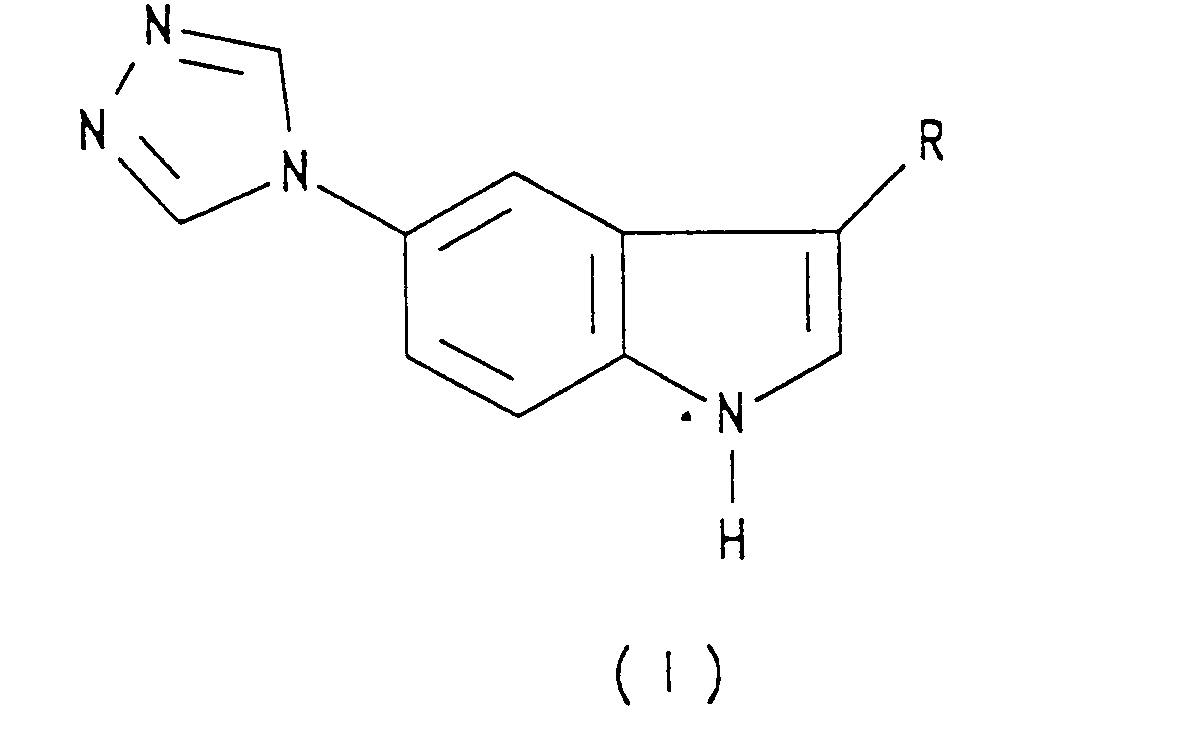
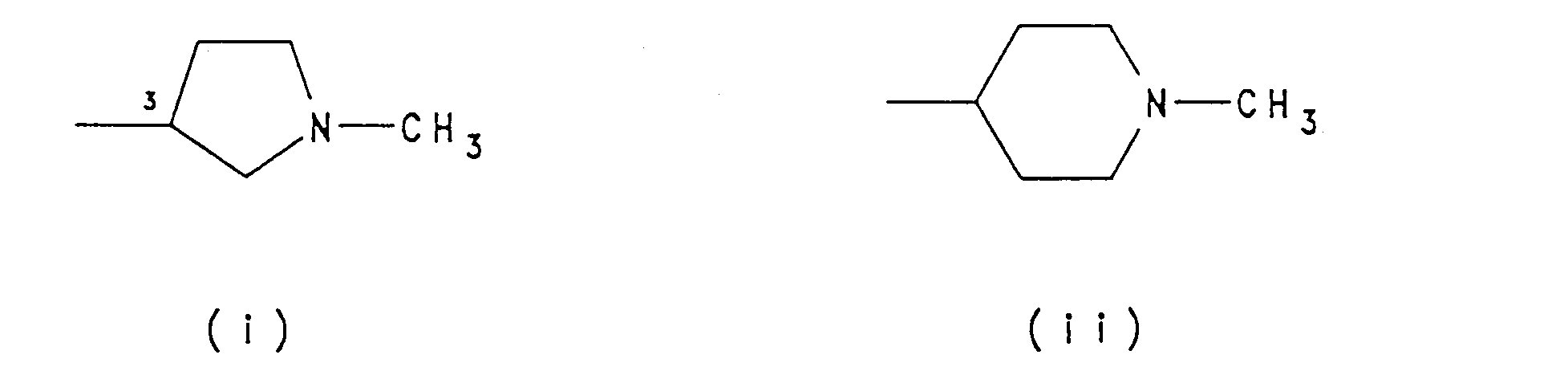
- the present invention provides a compound of formula I: wherein R represents a 2-(dimethylamino)ethyl group, or a group of formula (i) or (ii): or a salt or prodrug thereof.
- the compounds of formula I above have interesting biological activity, being potent and highly selective agonists of 5-HT 1 -like receptors with good bioavailability. These compounds, and salts and prodrugs thereof, are generically encompassed within the scope of EP-A-0497512. However, EP-A-0497512 nowhere specifically discloses a 1,2,4-triazol-4-yl derivative, or a salt or prodrug thereof.
- mixtures of this compound containing at least 75% of the enantiomer wherein the carbon atom in the 3-position of the pyrrolidine ring is in either the (R) or the (S) configuration and 25% or less of the opposite enantiomer are provided by the present invention, as also are mixtures containing at least 85% of one enantiomer and 15% or less of the opposite enantiomer.
- the mixture is enriched to the extent that it contains at least 95%, preferably at least 99%, of one enantiomer and no more than 5%, preferably no more than 1%, of the opposite enantiomer.
- the salts of the compounds of formula I will be pharmaceutically acceptable salts.
- Other salts may, however, be useful in the preparation of the compounds according to the invention or of their pharmaceutically acceptable salts.
- Suitable pharmaceutically acceptable salts of the compounds of this invention include acid addition salts which may, for example, be formed by mixing a solution of the compound according to the invention with a solution of a pharmaceutically acceptable acid such as hydrochloric acid, sulphuric acid, fumaric acid, maleic acid, succinic acid, acetic acid, benzoic acid, oxalic acid, citric acid, tartaric acid, carbonic acid or phosphoric acid.
- a pharmaceutically acceptable acid such as hydrochloric acid, sulphuric acid, fumaric acid, maleic acid, succinic acid, acetic acid, benzoic acid, oxalic acid, citric acid, tartaric acid, carbonic acid or phosphoric acid.
- the present invention includes within its scope prodrugs of the compounds of formula I above.
- prodrugs will be functional derivatives of the compounds of formula I which are readily convertible in vivo into the required compound of formula I.
- Conventional procedures for the selection and preparation of suitable prodrug derivatives are described, for example, in "Design of Prodrugs", ed. H. Bundgaard, Elsevier, 1985.
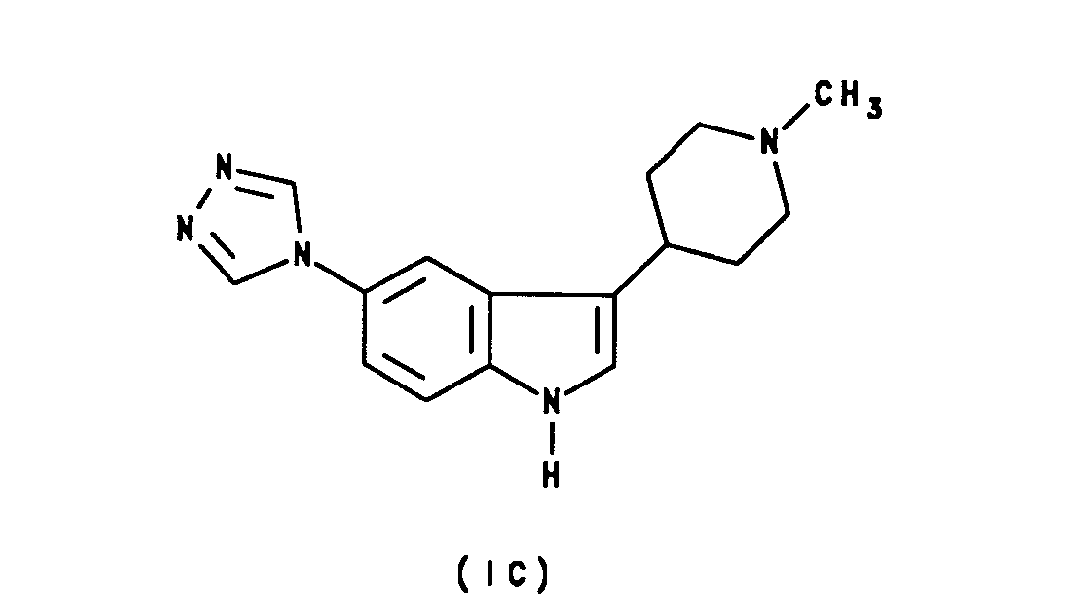
- Specific compounds within the scope of the present invention include: ( ⁇ )-N-methyl-3-[5-(1,2,4-triazol-4-yl)-1 H-indol-3-yl]pyrrolidine; 3(R)-N-methyl-3-[5-(1,2,4-triazol-4-yl)-1H-indol-3-yl]pyrrolidine of formula IA: 3(S)-N-methyl-3-[5-(1,2,4-triazol-4-yl)-1H-indol-3-yl]pyrrolidine of formula IB: N-methyl-4-[5-(1,2,4-triazol-4-yl)-1H-indol-3-yl]piperidine of formula IC: N,N-d!methy!-2-[5-(1,2,4-tr!azo!-4-y!-1 H-indol-3-yl]ethylamine of formula ID: and salts and prodrugs thereof.
- compositions comprising one or more compounds of formula I above or a pharmaceutically acceptable salt thereof or a prodrug thereof in association with a pharmaceutically acceptable carrier.
- these compositions are in unit dosage forms such as tablets, pills, capsules, powders, granules, sterile parenteral solutions or suspensions, metered aerosol or liquid sprays, drops, ampoules, auto-injector devices or suppositories; for oral, parenteral, intranasal, sublingual or rectal administration, or for administration by inhalation or insufflation.
- a pharmaceutical carrier e.g.
- a solid preformulation composition containing a homogeneous mixture of a compound of the present invention, or a pharmaceutically acceptable salt thereof.
- preformulation compositions as homogeneous, it is meant that the active ingredient is dispersed evenly throughout the composition so that the composition may be readily subdivided into equally effective unit dosage forms such as tablets, pills and capsules.
- This solid preformulation composition is then subdivided into unit dosage forms of the type described above containing from 0.1 to about 500 mg of the active ingredient of the present invention.
- the tablets or pills of the novel composition can be coated or otherwise compounded to provide a dosage form affording the advantage of prolonged action.
- the tablet or pill can comprise an inner dosage and an outer dosage component, the latter being in the form of an envelope over the former.
- the two components can be separated by an enteric layer which serves to resist disintegration in the stomach and permits the inner component to pass intact into the duodenum or to be delayed in release.
- enteric layers or coatings such materials including a number of polymeric acids and mixtures of polymeric acids with such materials as shellac, cetyl alcohol and cellulose acetate.
- liquid forms in which the novel compositions of the present invention may be incorporated for administration orally or by injection include aqueous solutions, suitably flavoured syrups, aqueous or oil suspensions, and flavoured emulsions with edible oils such as cottonseed oil, sesame oil, coconut oil or peanut oil, as well as elixirs and similar pharmaceutical vehicles.
- Suitable dispersing or suspending agents for aqueous suspensions include synthetic and natural gums such as tragacanth, acacia, alginate, dextran, sodium carboxymethylcellulose, methylcellulose, polyvinylpyrrolidone or gelatin.
- a suitable dosage level is about 0.01 to 250 mg/kg per day, preferably about 0.05 to 100 mg/kg per day, and especially about 0.05 to 5 mg/kg per day.
- the compounds may be administered on a regimen of 1 to 4 times per day.
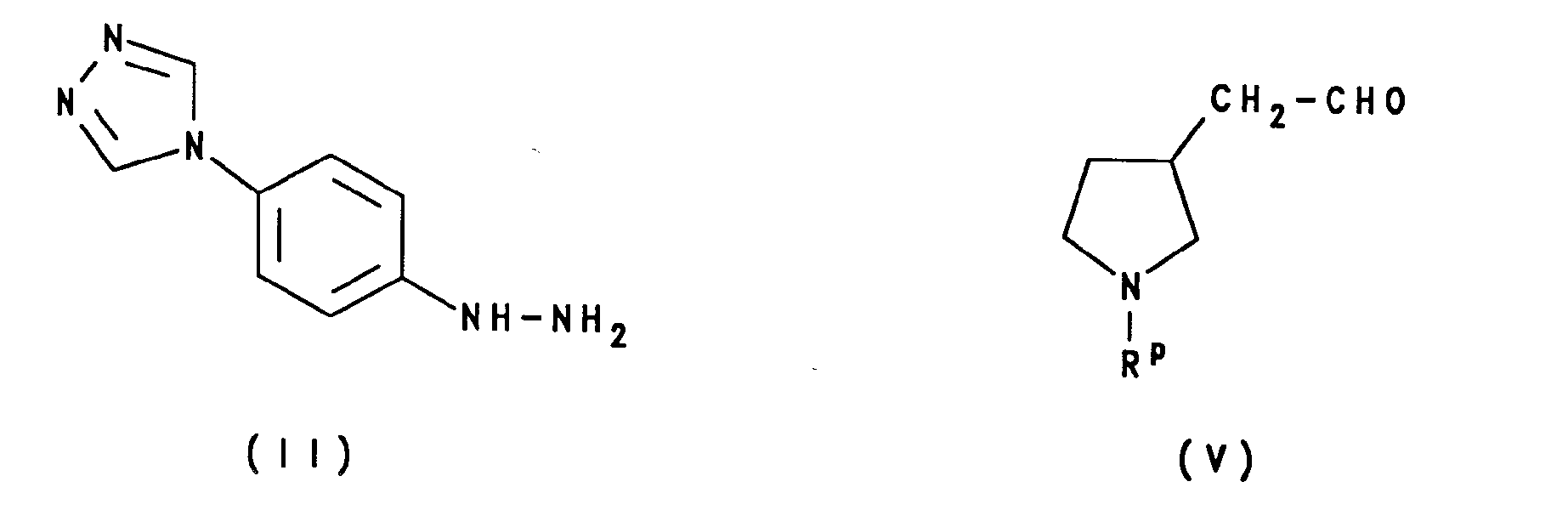
- the compounds of formula I above may be prepared by a process which comprises reacting the compound of formula II: with a compound of formula III: wherein R is as defined above; or a carbonyl-protected form thereof.
- reaction of compounds II and III may be carried out in a single step (Fischer indole synthesis) or by an initial non-cyclising step at a lower temperature to give a compound of formula IV: wherein R is as defined above; followed by cyclisation using a suitable reagent, such as a polyphosphate ester, to give a compound of formula I.
- a suitable reagent such as a polyphosphate ester
- reaction between compounds II and V may be carried out in a single step (Fischer indole synthesis) or by an initial non-cyclising step at a lower temperature to give a compound of formula VIII: wherein R P is as defined above; followed by cyclisation using a suitable reagent, such as a polyphosphate ester, to give a compound of formula VI.
- a suitable reagent such as a polyphosphate ester
- amino-protecting groups for the substituent R P include carboxylic acid groups such as chloroacetyl, trifluoroacetyl, formyl, benzoyl, phthaloyl, phenylacetyl or pyridinecarbonyl; acid groups derived from carbonic acid such as ethoxycarbonyl, benzyloxycarbonyl, t-butoxycarbonyl, biphenylisopropoxy- carbonyl, p-methylbenzyloxycarbonyl, p-nitrobenzyloxycarbonyl, p-bromobenzyloxycarbonyl, p-phenylazobenzyloxycarbonyl, p-(p'-methoxyphenylazo)benzyloxycarbonyl or t-amyloxycarbonyl; acid groups derived from sulphonic acid, e.g. p-toluenesulphonic acid; and other groups such as benzyl, p-methoxybenzyl,
- the removal of the protecting group present in the resultant compound may be effected by an appropriate procedure depending upon the nature of the protecting group.
- Typical procedures include hydrogenation in the presence of a palladium catalyst (e.g. palladium carbon or palladium black) for benzyloxycarbonyl, p-nitrobenzyloxycarbonyl, p-bromobenzyloxycarbonyl, p-phenylazobenzyloxycarbonyl, p-(p'-methoxyphenylazo)benzyloxycarbonyl and trityl groups; treatment with hydrogen bromide in glacial acetic acid or trifluoroacetic acid for benzyloxycarbonyl, p-bromobenzyloxycarbonyl, p-phenylazobenzyloxycarbonyl and t-butoxycarbonyl groups; treatment with acetic acid and/or a mineral acid such as hydrochloric acid or sulphuric acid for trityl, t-butoxycarbon
- a particular amino-protecting group R P is benzyl.
- benzyl is employed as the amino-protecting group R P
- a favoured method for its removal is hydrogenation.
- This may be conventional catalytic hydrogenation or, more particularly, the technique known as transfer hydrogenation.
- the latter procedure employs a hydrogenation catalyst such as palladium on carbon, ideally 10% palladium on carbon, in the presence of a hydrogen donor such as ammonium formate, sodium hypophosphite, triethylammonium formate or potassium formate, preferably ammonium formate.
- a hydrogen donor such as ammonium formate, sodium hypophosphite, triethylammonium formate or potassium formate, preferably ammonium formate.
- ammonium formate is employed as the hydrogen donor, the reaction is conveniently carried out in a solvent such as methanol or aqueous methanol, advantageously at a temperature in the region of 35-45°C.
- the individual enantiomers of the compound of formula I above wherein R represents the group of formula (i) may be prepared by resolution of racemic N-methyl-3-[5-(1,2,4-triazol-4-yl)-1H-indol-3-yl]pyrrolidine, prepared as described above, or a protected derivative thereof which may subsequently be deprotected by methods known per se at an appropriate subsequent stage.
- Known methods of resolution may suitably be employed, for example comprising the formation and separation of diastereoisomers.
- Suitable resolving agents include chiral acids which form acid addition salts with amino groups within the molecule.
- Suitable resolving acids are camphor derivatives, such as camphor-10-suiphonic acid, ⁇ -brom0-camph0-7r-sulphonic acid, hydroxymethylene camphor and camphoric acid; menthol derivatives such as menthoxyacetic acid; naturally occurring optically active forms of tartaric acid and malic acid; and diacetyltartaric acid.
- camphor derivatives such as camphor-10-suiphonic acid, ⁇ -brom0-camph0-7r-sulphonic acid, hydroxymethylene camphor and camphoric acid
- menthol derivatives such as menthoxyacetic acid
- naturally occurring optically active forms of tartaric acid and malic acid and diacetyltartaric acid.
- a chiral amino acid derivative may be employed in the resolution process, to form an amide bond, for example with the nitrogen atom at the 1-position of the indole nucleus, which subsequently may be cleaved under mild conditions.
- a suitable amino acid which may be employed is L-phenylalanine, optionally having its amino group protected.
- the diastereoisomers are separated by conventional methods, such as chromatography or crystallisation.
- Suitable solvents for chromatography include ethyl acetate and petroleum ethers.
- Suitable solvents for crystallisation include non-polar solvents such as ether, methylene dichloride, petroleum ethers and methanol.
- the appropriate diastereoisomer is converted to the enantiomer wherein the carbon atom at the 3-position of the pyrrolidine ring is in the requisite configuration, either (R) or (S) as required. If necessary, the diastereoisomer obtained wherein the carbon atom at the 3-position of the pyrrolidine ring is in the opposite configuration may be re-racemised for further resolution.
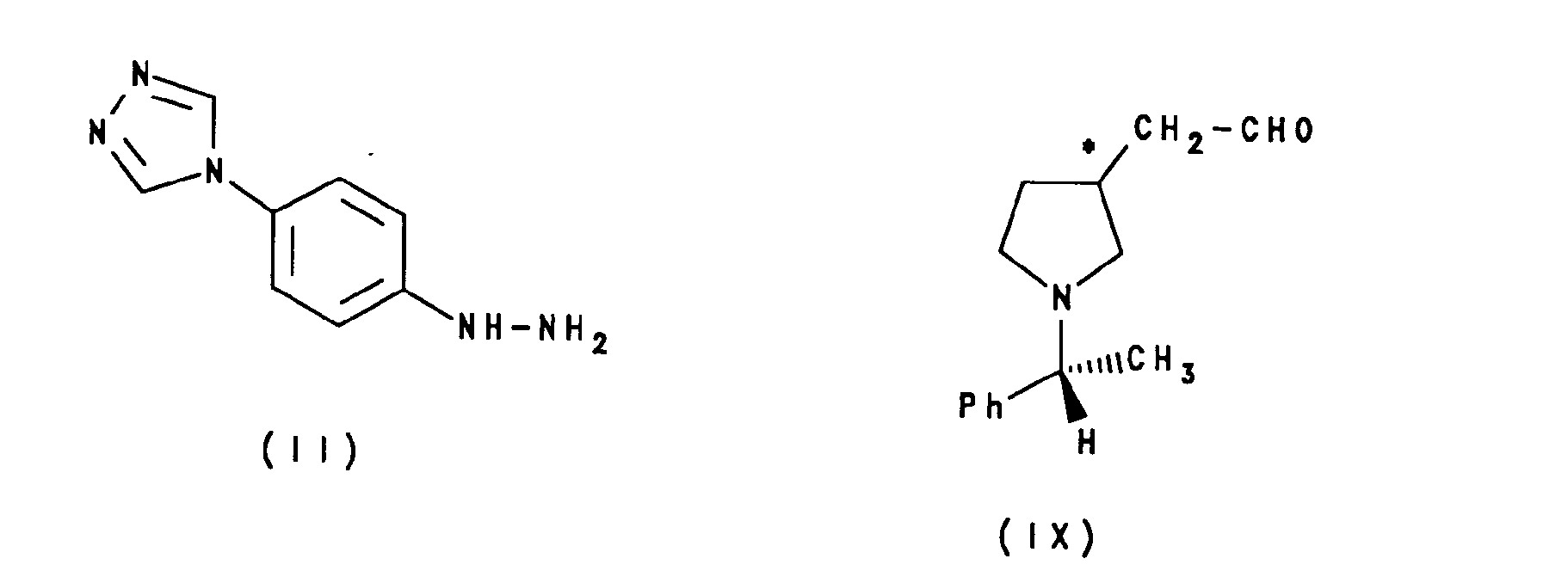
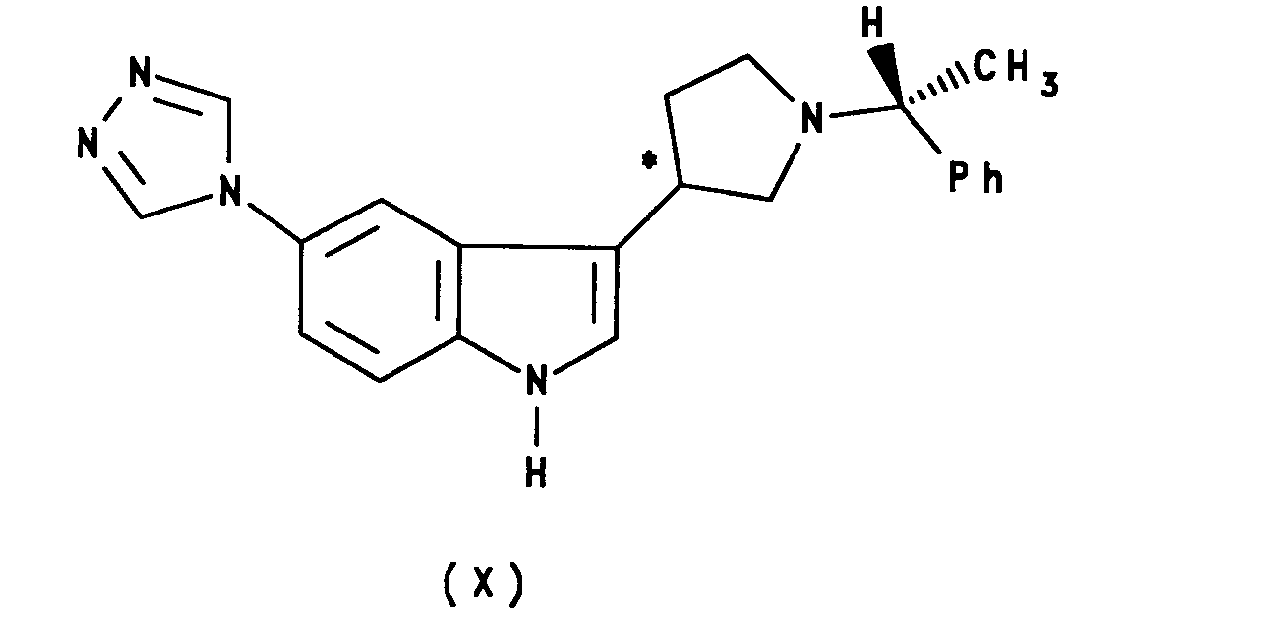
- reaction between compounds II and IX may be carried out in a single step (Fischer indole synthesis) or by an initial non-cyclising step at a lower temperature to give a compound of formula XII: wherein the carbon atom designated * is in the (R) or (S) configuration; followed by cyclisation using a suitable reagent, such as a polyphosphate ester, to give a compound of formula X.
- a suitable reagent such as a polyphosphate ester
- the hydrazine derivative offormula may be prepared from the corresponding aniline derivative of formula XIII: by diazotisation followed by reduction. Diazotisation is typically carried out using sodium nitrite/conc. HCI and the resulting diazo product reduced in situ using,for example, tin(ll) chloride/conc. HCI, sodium sulphite/conc. HCI or sodium sulphite/conc. H 2 SO 4 .
- the aniline derivative of formula XIII may suitably be prepared by reacting the hydrazine derivative of formula XIV with the acetanilide of formula XV: followed by removal of the N-acetyl protecting group.
- reaction between compounds XIV and XV is conveniently effected in refluxing toluene, advantageously in the presence of a catalytic quantity of p-toluenesulphonic acid. Subsequent removal of the N-acetyl protecting group is typically effected in hot aqueous hydrochloric acid.
- the hydrazine derivative of formula XIV can be prepared from N,N'-diformylhydrazine by reaction with thionyl chloride/N,N-dimethylformamide, as reported in J. Chem. Soc. (C), 1967,1664, and subsequent treatment with sodium methoxide in methanol.
- the acetanilide of formula XV may be prepared by reduction of the corresponding nitro compound of formula XVI: typically by transfer hydrogenation using a hydrogenation catalyst in the presence of a hydrogen donor such as ammonium formate, or alternatively by conventional catalytic hydrogenation or using tin(II) chloride.
- nitro compound of formula XVI is commercially available from Aldrich Chemical Company Ltd., Gillingham, United Kingdom.
- the starting compound XVII (1-methyl-4- piperidone) is commercially available from Aldrich Chemical Company Ltd., Gillingham, U.K.
- Step 1 of the reaction scheme involves reacting this compound with the Horn- er-Emmons reagent MeO 2 C.CH 2 .PO(OEt) 2 in the presence of sodium hydride, using THF as the solvent.
- Step 2 the double bond of the resulting piperidine olefin ester is hydrogenated over palladium-charcoal in ethanolic HCI.
- Step 3 by reduction of the side-chain methyl ester group using diisobutylaluminium hydride (DIBAL-H) in THF, with subsequent Swern oxidation of the resulting terminal hydroxymethyl group to the aldehyde moiety present in the target intermediate of formula III.
- DIBAL-H diisobutylaluminium hydride
- Step 1 of the reaction scheme involves reacting this compound with the Horn- er-Emmons reagent MeO 2 C.CH 2 .PO(OEt) 2 in the presence of sodium hydride, using THF as the solvent.
- Step 2 the double bond of the resulting pyrrolidine olefin ester is hydrogenated over palladium-charcoal in ethanolic HCI.
- Step 3 by reduction of the side-chain methyl ester group using diisobutylaluminium hydride (DIBAL-H) in THF, with subsequent Swern oxidation of the resulting terminal hydroxymethyl group to the aldehyde moiety present in the target intermediate of formula V.
- DIBAL-H diisobutylaluminium hydride
- the aldehyde derivatives of formula IX above may be prepared by reduction of the corresponding cyano compound of formula XIX: wherein the carbon atom designated * is in the (R) or (S) configuration.
- a suitable reducing agent for effecting this transformation is diisobutylaluminium hydride (DIBAL-H), and the reaction is conveniently carried out in tetrahydrofuran as solvent.
- Step (ii) of the above-described chiral process comprises the deprotection of the compound of formula X. Removal of the amino-protecting group is suitably effected by hydrogenation. This may be conventional catalytic hydrogenation or, more particularly, the technique known as transfer hydrogenation as described above.
- Step (C) and step (iii) of the above-described processes comprise the methylation of the compounds of formulae VII and XI respectively.
- This is suitably effected by conventional N-methylation techniques, such as by treatment of compound VII or compound XI with formaldehyde in the presence of a reducing agent such as sodium cyanoborohydride.
- test compounds to bind to 5-HT 1 -like receptors was measured in membranes prepared from pig caudate using the procedure described in J. Neurosci., 1987, 7, 894. Binding was determined using 2 nM 5-hydroxytryptamine creatinine sulphate, 5-[1,2- 3 H(N)] as a radioligand. Cyanopindolol (100 nM) and mesu- lergine (100 nM) were included in the assay to block out 5-HT 1A and 5-HT ic binding sites respectively. The concentration of the compounds of the accompanying Examples required to displace 50% of the specific binding (IC 50 ) is below 1 ⁇ M in each case.
- test compounds as agonists of the 5-HT 1 -like receptor was measured in terms of theirability to mediate contraction of the saphenous vein of New Zealand White rabbits, using the procedure described in Arch. Pharm.,1990, 342, 111.
- Agonist potencies were calculated as -log 10 EC 50 (pEC 50 ) values, from plots of percentage 5-HT (1 ⁇ ]M) response against the concentration of the agonist.
- the compounds of the accompanying Examples were found to possess pEC 50 values in this assay of not less than 5.0 in each case.
- Methyl diethylphosphonoacetate (26.9g, 0.128mol) in THF (50ml) was added dropwise to a stirred suspension of NaH (5.12g, 60% dispersion in oil, 0.128mol) in THF (125mi), at 10°C.
- the mixture was stirred for 0.6h and a solution of N-benzyl pyrrolidin-3-one (20.4g, 0.117mol) in THF (50ml) added dropwise.
- the mixture was heated at 50°C for 3h before removing the solvent under vacuum and redissolving the residue in CH 2 Cl 2 (300ml) and H 2 O(100ml).
- Diisobutylaluminium hydride (105ml of a 1 M solution in toluene, 0.105mol) was added dropwise to a stirred solution of the preceding ester (7.0g, 30.0mmol) in toluene (400ml) at -35°C, over a 0.5h period.
- the solution was allowed to warm to room temperature, and stirred for 2h, before quenching by addition of Methanol (1 Oml), 2NNaOH (5ml) and H 2 0 (5ml), sequentially.
- the mixture was stirred for 1 h and the resulting precipitate removed by filtration through celite.
- the solvent was removed under vacuum to give the desired ethyl alcohol (5.65g, 92%).
- Diisobutylalumimum hydride (37.4ml of a 1M solution in toluene, 37.4mmol) was added to a solution of the preceding nitrile (4.0g, 18.7mmol), in THF (100ml), and the mixture stirred at room temperature for 3h.
- the mixture was basified with K 2 CO 3 solution and extracted with EtOAc (3x).
- Methyl diethylphosphonoacetate (88.69g, 0.422mol) was added dropwise to a stirred suspension of sodium hydride (18.56g, 60% dispersion in oil, 0.464mol) in THF (300ml) under nitrogen, at such a rate as to maintain the temperature below 30°C.
- the mixture was stirred for 1 h and a solution of N-methyl-4-piperidinone (47.71g, 0.422mol) in THF (150ml) was added dropwise.
- the mixture was heated at 60°C for 4.5h before removing the solvent under vacuum and redissolving the residue in dichloromethane (300ml) and water (200ml).
- Diisobutylaluminium hydride 120ml of a 1 M solution in toluene, 0.120mol was added dropwise to a stirred solution of the preceding ester (8.19g, 0.047mol) in toluene (350ml) at -35°C under nitrogen.
- the solution was allowed to warm to room temperature over 1 h, before recooling to -30°C and quenching by addition of methanol (5ml), water (5ml) and 2N NaOH (5ml), sequentially.
- the mixture was allowed to warm to room temperature and the resulting precipitate removed by filtration through celite.
- Dimethylsulphoxide (6.56ml, 92.4mmol) was added dropwise to a stirred solution of oxalyl chloride (4.03ml, 46.2mmol) in dichloromethane (300ml) at -70°C under nitrogen. The mixture was stirred for 0.2h before adding a solution of the preceding alcohol (5.51g, 38.5mmol) in dichloromethane (80ml) and stirring for 1 at -70°C. Triethylamine (26.8ml, 192mmol) was added and the reaction mixture warmed to room temperature. Water and dichloromethane were added and the mixture basified with saturated K 2 CO 3 solution.
- the combined organics were dried (MgS0 4 ), evaporated and the residue chromatographed on silica gel, eluting with CH 2 Cl 2 /MeOH/NH 3 (60:8:1), to give the title-triazole (0.70g, 45%).
- the benzoate salt was prepared by addition of a solution of benzoic acid in diethyl ether to a solution of the triazole in methanol-diethyl ether. The solvent was removed under vacuum and the resultant product triturated with diethyl ether; mp 172-174°C. Found: C, 66.59; H, 6.28; N, 18.42. C 21 H 23 N 5 O 2 requires C, 66.83; H, 6.14; N, 18.55%).
- Tablets containing 1.0, 2.0, 25.0, 26.0, 50.0 and 100mg, respectively, of the following compounds are prepared as illustrated below:
- All of the active compound, cellulose, and a portion of the corn starch are mixed and granulated to 10% corn starch paste.
- the resulting granulation is sieved, dried and blended with the remainder of the corn starch and magnesium stearate.
- the resulting granulation is then compressed into tablets containing 1.0 mg, 2.0 mg, 25.0 mg, 26.0 mg, 50.0 mg and 100 mg of the active ingredient per tablet.
Landscapes
- Organic Chemistry (AREA)
- Chemical & Material Sciences (AREA)
- Health & Medical Sciences (AREA)
- Nuclear Medicine, Radiotherapy & Molecular Imaging (AREA)
- Life Sciences & Earth Sciences (AREA)
- Chemical Kinetics & Catalysis (AREA)
- General Chemical & Material Sciences (AREA)
- Medicinal Chemistry (AREA)
- Engineering & Computer Science (AREA)
- Pharmacology & Pharmacy (AREA)
- Bioinformatics & Cheminformatics (AREA)
- Animal Behavior & Ethology (AREA)
- General Health & Medical Sciences (AREA)
- Public Health (AREA)
- Veterinary Medicine (AREA)
- Pharmaceuticals Containing Other Organic And Inorganic Compounds (AREA)
- Plural Heterocyclic Compounds (AREA)
- Agricultural Chemicals And Associated Chemicals (AREA)
Abstract
Description
- The present invention relates to a discrete class of 4-substituted 1,2,4-triazole derivatives which act on 5-hydroxytryptamine (5-HT) receptors, being Selective agonists of so-called "5-HT1-like" receptors. They are therefore useful in the treatment of clinical conditions for which a selective agonist of these receptors is indicated.
- 5-HT1-like receptor agonists which exhibit selective vasoconstrictor activity have recently been described as being of use in the treatment of migraine (see, for example, A. Doenicke et al., The Lancet, 1988, Vol. 1, 1309-11). The compounds of the present invention, being selective 5-HT1-like receptor agonists, are accordingly of particular use in the treatment of migraine and associated conditions, e.g. cluster headache, chronic paroxysmal hemicrania, headache associated with vascular disorders, tension headache and paediatric migraine.
- EP-A-0313397 and WO-A-91/18897 describe separate classes of tryptamine derivatives substituted by various five-membered heteroaliphatic rings, which are stated to be specific to a particular type of "5-HT1-like" receptor and thus to be effective therapeutic agents for the treatment of clinical conditions, particularly migraine, requiring this activity. However, neither EP-A-0313397 nor WO-A-91/18897 discloses or suggests the particular 4-substituted 1,2,4-triazole derivatives provided by the present invention.
- EP-A-0497512, published on 5th August 1992, describes a class of substituted imidazole, triazole and tet- razole derivatives which are stated to be selective agonists of 5-HT1-like receptors and hence to be of particular use in the treatment of migraine and associated conditions.
- The present invention provides a compound of formula I:


- The compounds of formula I above have interesting biological activity, being potent and highly selective agonists of 5-HT1-like receptors with good bioavailability. These compounds, and salts and prodrugs thereof, are generically encompassed within the scope of EP-A-0497512. However, EP-A-0497512 nowhere specifically discloses a 1,2,4-triazol-4-yl derivative, or a salt or prodrug thereof.
- The compound of formula I above wherein R represents the group of formula (i) contains an asymmetric carbon atom at the 3-position of the pyrrolidine ring and is therefore optically active; for ease of reference, the relevant carbon atom has been designated by a "3" symbol in formula (i) above. As a consequence of possessing an asymmetric carbon atom within the molecule, this compound can exist as (R) and (S) enantiomers. The present invention accordingly includes within its scope the individual enantiomers of this compound, as well as mixtures thereof. One such mixture, the so-called racemic mixture or racemate, contains equal proportions of the individual (R) and (S) enantiomers. In addition, mixtures of this compound containing at least 75% of the enantiomer wherein the carbon atom in the 3-position of the pyrrolidine ring is in either the (R) or the (S) configuration and 25% or less of the opposite enantiomer are provided by the present invention, as also are mixtures containing at least 85% of one enantiomer and 15% or less of the opposite enantiomer. Desirably, the mixture is enriched to the extent that it contains at least 95%, preferably at least 99%, of one enantiomer and no more than 5%, preferably no more than 1%, of the opposite enantiomer.
- For use in medicine, the salts of the compounds of formula I will be pharmaceutically acceptable salts. Other salts may, however, be useful in the preparation of the compounds according to the invention or of their pharmaceutically acceptable salts. Suitable pharmaceutically acceptable salts of the compounds of this invention include acid addition salts which may, for example, be formed by mixing a solution of the compound according to the invention with a solution of a pharmaceutically acceptable acid such as hydrochloric acid, sulphuric acid, fumaric acid, maleic acid, succinic acid, acetic acid, benzoic acid, oxalic acid, citric acid, tartaric acid, carbonic acid or phosphoric acid.
- The present invention includes within its scope prodrugs of the compounds of formula I above. In general, such prodrugs will be functional derivatives of the compounds of formula I which are readily convertible in vivo into the required compound of formula I. Conventional procedures for the selection and preparation of suitable prodrug derivatives are described, for example, in "Design of Prodrugs", ed. H. Bundgaard, Elsevier, 1985.
- Specific compounds within the scope of the present invention include: (±)-N-methyl-3-[5-(1,2,4-triazol-4-yl)-1 H-indol-3-yl]pyrrolidine; 3(R)-N-methyl-3-[5-(1,2,4-triazol-4-yl)-1H-indol-3-yl]pyrrolidine of formula IA:



- The invention also provides pharmaceutical compositions comprising one or more compounds of formula I above or a pharmaceutically acceptable salt thereof or a prodrug thereof in association with a pharmaceutically acceptable carrier. Preferably these compositions are in unit dosage forms such as tablets, pills, capsules, powders, granules, sterile parenteral solutions or suspensions, metered aerosol or liquid sprays, drops, ampoules, auto-injector devices or suppositories; for oral, parenteral, intranasal, sublingual or rectal administration, or for administration by inhalation or insufflation. For preparing solid compositions such as tablets, the principal active ingredient is mixed with a pharmaceutical carrier, e.g. conventional tableting ingredients such as corn starch, lactose, sucrose, sorbitol, talc, stearic acid, magnesium stearate, dicalcium phosphate or gums, and other pharmaceutical diluents, e.g. water, to form a solid preformulation composition containing a homogeneous mixture of a compound of the present invention, or a pharmaceutically acceptable salt thereof. When referring to these preformulation compositions as homogeneous, it is meant that the active ingredient is dispersed evenly throughout the composition so that the composition may be readily subdivided into equally effective unit dosage forms such as tablets, pills and capsules. This solid preformulation composition is then subdivided into unit dosage forms of the type described above containing from 0.1 to about 500 mg of the active ingredient of the present invention. The tablets or pills of the novel composition can be coated or otherwise compounded to provide a dosage form affording the advantage of prolonged action. For example, the tablet or pill can comprise an inner dosage and an outer dosage component, the latter being in the form of an envelope over the former. The two components can be separated by an enteric layer which serves to resist disintegration in the stomach and permits the inner component to pass intact into the duodenum or to be delayed in release. A variety of materials can be used for such enteric layers or coatings, such materials including a number of polymeric acids and mixtures of polymeric acids with such materials as shellac, cetyl alcohol and cellulose acetate.
- The liquid forms in which the novel compositions of the present invention may be incorporated for administration orally or by injection include aqueous solutions, suitably flavoured syrups, aqueous or oil suspensions, and flavoured emulsions with edible oils such as cottonseed oil, sesame oil, coconut oil or peanut oil, as well as elixirs and similar pharmaceutical vehicles. Suitable dispersing or suspending agents for aqueous suspensions include synthetic and natural gums such as tragacanth, acacia, alginate, dextran, sodium carboxymethylcellulose, methylcellulose, polyvinylpyrrolidone or gelatin.
- In the treatment of migraine, a suitable dosage level is about 0.01 to 250 mg/kg per day, preferably about 0.05 to 100 mg/kg per day, and especially about 0.05 to 5 mg/kg per day. The compounds may be administered on a regimen of 1 to 4 times per day.
- The compounds of formula I above may be prepared by a process which comprises reacting the compound of formula II:


- The reaction of compounds II and III may be carried out in a single step (Fischer indole synthesis) or by an initial non-cyclising step at a lower temperature to give a compound of formula IV:

- The compound of formula I above wherein R represents the group of formula (i) may alternatively be prepared in racemic form by a process which comprises the following steps:
- (A) reaction of the compound of formula II with a compound of formula V, or a carbonyl-protected form thereof:

- (B) deprotection of the compound of formula VI thereby obtained, to afford a compound of formula VII:

- (C) methylation of the compound of formula VII thereby obtained.
- As with that between compounds II and III, the reaction between compounds II and V may be carried out in a single step (Fischer indole synthesis) or by an initial non-cyclising step at a lower temperature to give a compound of formula VIII:

- Suitable examples of amino-protecting groups for the substituent RP include carboxylic acid groups such as chloroacetyl, trifluoroacetyl, formyl, benzoyl, phthaloyl, phenylacetyl or pyridinecarbonyl; acid groups derived from carbonic acid such as ethoxycarbonyl, benzyloxycarbonyl, t-butoxycarbonyl, biphenylisopropoxy- carbonyl, p-methylbenzyloxycarbonyl, p-nitrobenzyloxycarbonyl, p-bromobenzyloxycarbonyl, p-phenylazobenzyloxycarbonyl, p-(p'-methoxyphenylazo)benzyloxycarbonyl or t-amyloxycarbonyl; acid groups derived from sulphonic acid, e.g. p-toluenesulphonic acid; and other groups such as benzyl, p-methoxybenzyl, trityl, o-nitrophenylsulphenyl or benzylidene.
- The removal of the protecting group present in the resultant compound may be effected by an appropriate procedure depending upon the nature of the protecting group. Typical procedures include hydrogenation in the presence of a palladium catalyst (e.g. palladium carbon or palladium black) for benzyloxycarbonyl, p-nitrobenzyloxycarbonyl, p-bromobenzyloxycarbonyl, p-phenylazobenzyloxycarbonyl, p-(p'-methoxyphenylazo)benzyloxycarbonyl and trityl groups; treatment with hydrogen bromide in glacial acetic acid or trifluoroacetic acid for benzyloxycarbonyl, p-bromobenzyloxycarbonyl, p-phenylazobenzyloxycarbonyl and t-butoxycarbonyl groups; treatment with acetic acid and/or a mineral acid such as hydrochloric acid or sulphuric acid for trityl, t-butoxycarbonyl, formyl and benzylidene groups; and treatment with 2,3-dichloro-5,6-dicyano-1,4-benzoquinone for p-methoxybenzyl groups.
- A particular amino-protecting group RP is benzyl. Where benzyl is employed as the amino-protecting group RP, a favoured method for its removal is hydrogenation. This may be conventional catalytic hydrogenation or, more particularly, the technique known as transfer hydrogenation. The latter procedure employs a hydrogenation catalyst such as palladium on carbon, ideally 10% palladium on carbon, in the presence of a hydrogen donor such as ammonium formate, sodium hypophosphite, triethylammonium formate or potassium formate, preferably ammonium formate. Where ammonium formate is employed as the hydrogen donor, the reaction is conveniently carried out in a solvent such as methanol or aqueous methanol, advantageously at a temperature in the region of 35-45°C.
- The individual enantiomers of the compound of formula I above wherein R represents the group of formula (i) may be prepared by resolution of racemic N-methyl-3-[5-(1,2,4-triazol-4-yl)-1H-indol-3-yl]pyrrolidine, prepared as described above, or a protected derivative thereof which may subsequently be deprotected by methods known per se at an appropriate subsequent stage. Known methods of resolution may suitably be employed, for example comprising the formation and separation of diastereoisomers. Suitable resolving agents include chiral acids which form acid addition salts with amino groups within the molecule. Suitable resolving acids are camphor derivatives, such as camphor-10-suiphonic acid, α-brom0-camph0-7r-sulphonic acid, hydroxymethylene camphor and camphoric acid; menthol derivatives such as menthoxyacetic acid; naturally occurring optically active forms of tartaric acid and malic acid; and diacetyltartaric acid.
- Alternatively, a chiral amino acid derivative may be employed in the resolution process, to form an amide bond, for example with the nitrogen atom at the 1-position of the indole nucleus, which subsequently may be cleaved under mild conditions. A suitable amino acid which may be employed is L-phenylalanine, optionally having its amino group protected.
- The diastereoisomers are separated by conventional methods, such as chromatography or crystallisation. Suitable solvents for chromatography include ethyl acetate and petroleum ethers. Suitable solvents for crystallisation include non-polar solvents such as ether, methylene dichloride, petroleum ethers and methanol.
- After separation, the appropriate diastereoisomer is converted to the enantiomer wherein the carbon atom at the 3-position of the pyrrolidine ring is in the requisite configuration, either (R) or (S) as required. If necessary, the diastereoisomer obtained wherein the carbon atom at the 3-position of the pyrrolidine ring is in the opposite configuration may be re-racemised for further resolution.
- The individual enantiomers of the compound of formula I above wherein R represents the group of formula (i) may also be prepared by a chiral process which comprises the following steps:
- (i) reaction of the compound of formula II with a compound of formula IX, or a carbonyl-protected form thereof:
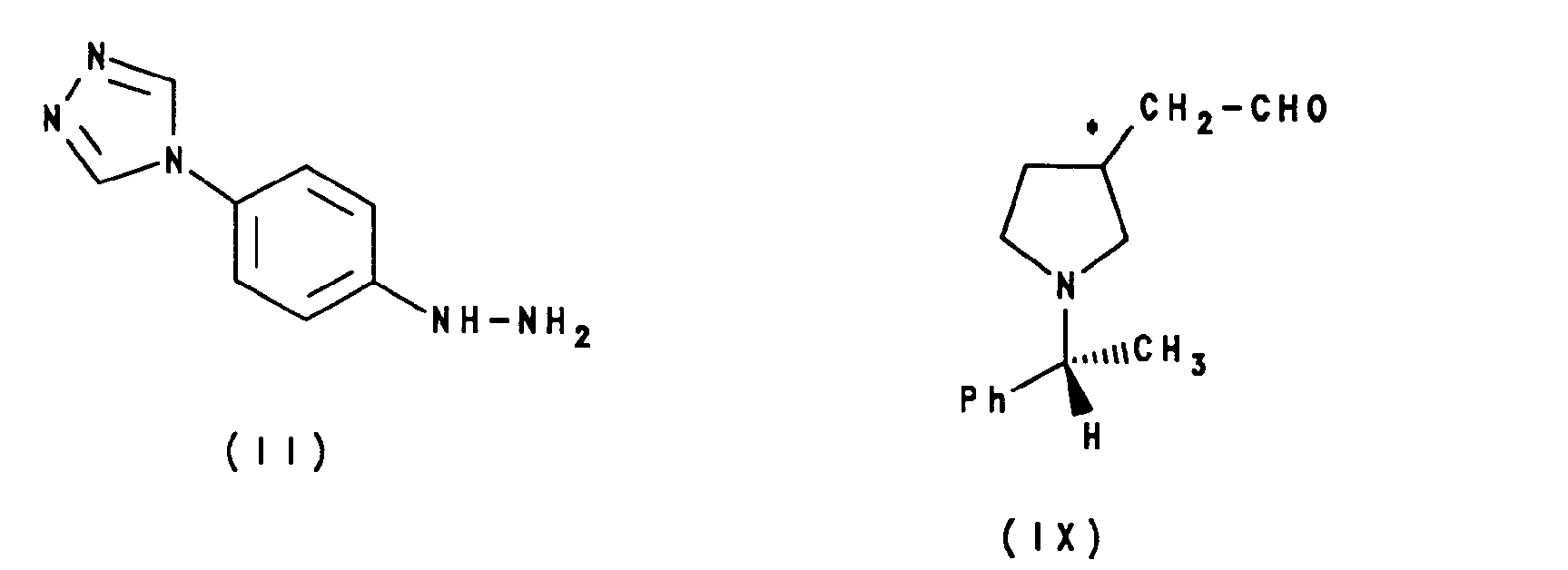

- (ii) deprotection of the compound of formula X thereby obtained, to a afford a compound of formula XI:

- (iii) methylation of the compound of formula XI thereby obtained. Suitable carbonyl-protected forms of the compounds of formulae III, V and IX above include the dimethyl acetal derivatives.
- As with that between compounds II and III, and between compounds II and V, the reaction between compounds II and IX may be carried out in a single step (Fischer indole synthesis) or by an initial non-cyclising step at a lower temperature to give a compound of formula XII:

- The hydrazine derivative offormula may be prepared from the corresponding aniline derivative of formula XIII:

- The aniline derivative of formula XIII may suitably be prepared by reacting the hydrazine derivative of formula XIV with the acetanilide of formula XV:

- The reaction between compounds XIV and XV is conveniently effected in refluxing toluene, advantageously in the presence of a catalytic quantity of p-toluenesulphonic acid. Subsequent removal of the N-acetyl protecting group is typically effected in hot aqueous hydrochloric acid.
- The hydrazine derivative of formula XIV can be prepared from N,N'-diformylhydrazine by reaction with thionyl chloride/N,N-dimethylformamide, as reported in J. Chem. Soc. (C), 1967,1664, and subsequent treatment with sodium methoxide in methanol.
- The acetanilide of formula XV may be prepared by reduction of the corresponding nitro compound of formula XVI:
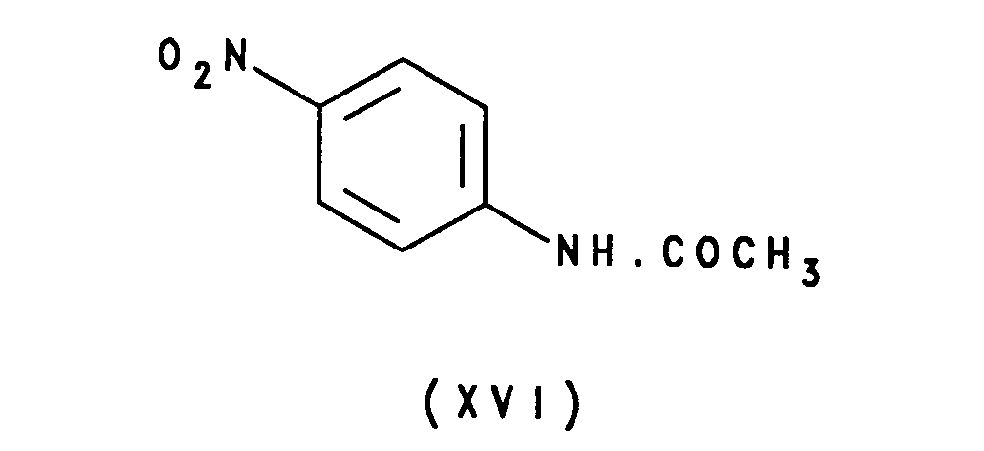
- The nitro compound of formula XVI is commercially available from Aldrich Chemical Company Ltd., Gillingham, United Kingdom.
- The preparation of the aldehyde of formula III above wherein R represents the group of formula (ii) is illustrated by the following reaction scheme:

- The starting compound XVII (1-methyl-4- piperidone) is commercially available from Aldrich Chemical Company Ltd., Gillingham, U.K. Step 1 of the reaction scheme involves reacting this compound with the Horn- er-Emmons reagent MeO2C.CH2.PO(OEt)2 in the presence of sodium hydride, using THF as the solvent. In Step 2, the double bond of the resulting piperidine olefin ester is hydrogenated over palladium-charcoal in ethanolic HCI. This is followed in Step 3 by reduction of the side-chain methyl ester group using diisobutylaluminium hydride (DIBAL-H) in THF, with subsequent Swern oxidation of the resulting terminal hydroxymethyl group to the aldehyde moiety present in the target intermediate of formula III.
- The preparation of a typical intermediate of formula V above, wherein the amino-protecting group RP is benzyl, is illustrated by the following reaction scheme:

- The starting compound XVIII (1-benzyl-3-pyrrolidinone) is commercially available from Aldrich Chemical Company Ltd., Gillingham, U.K. Step 1 of the reaction scheme involves reacting this compound with the Horn- er-Emmons reagent MeO2C.CH2.PO(OEt)2 in the presence of sodium hydride, using THF as the solvent. In Step 2, the double bond of the resulting pyrrolidine olefin ester is hydrogenated over palladium-charcoal in ethanolic HCI. This is followed in Step 3 by reduction of the side-chain methyl ester group using diisobutylaluminium hydride (DIBAL-H) in THF, with subsequent Swern oxidation of the resulting terminal hydroxymethyl group to the aldehyde moiety present in the target intermediate of formula V.
- The aldehyde derivatives of formula IX above may be prepared by reduction of the corresponding cyano compound of formula XIX:

- The preparation of both enantiomers of the cyano compound of formula XIX above is described in J. Med. Chem.,1990, 33, 71.
- Step (ii) of the above-described chiral process comprises the deprotection of the compound of formula X. Removal of the amino-protecting group is suitably effected by hydrogenation. This may be conventional catalytic hydrogenation or, more particularly, the technique known as transfer hydrogenation as described above.
- Step (C) and step (iii) of the above-described processes comprise the methylation of the compounds of formulae VII and XI respectively. This is suitably effected by conventional N-methylation techniques, such as by treatment of compound VII or compound XI with formaldehyde in the presence of a reducing agent such as sodium cyanoborohydride.
- The following Examples illustrate the preparation of compounds according to the invention.
- The ability of test compounds to bind to 5-HT1-like receptors was measured in membranes prepared from pig caudate using the procedure described in J. Neurosci., 1987, 7, 894. Binding was determined using 2 nM 5-hydroxytryptamine creatinine sulphate, 5-[1,2-3H(N)] as a radioligand. Cyanopindolol (100 nM) and mesu- lergine (100 nM) were included in the assay to block out 5-HT1A and 5-HTic binding sites respectively. The concentration of the compounds of the accompanying Examples required to displace 50% of the specific binding (IC50) is below 1 µM in each case.
- The activity of test compounds as agonists of the 5-HT1-like receptor was measured in terms of theirability to mediate contraction of the saphenous vein of New Zealand White rabbits, using the procedure described in Arch. Pharm.,1990, 342, 111. Agonist potencies were calculated as -log10EC50 (pEC50) values, from plots of percentage 5-HT (1 µ]M) response against the concentration of the agonist. The compounds of the accompanying Examples were found to possess pEC50 values in this assay of not less than 5.0 in each case.
- Methyl diethylphosphonoacetate (26.9g, 0.128mol) in THF (50ml) was added dropwise to a stirred suspension of NaH (5.12g, 60% dispersion in oil, 0.128mol) in THF (125mi), at 10°C. The mixture was stirred for 0.6h and a solution of N-benzyl pyrrolidin-3-one (20.4g, 0.117mol) in THF (50ml) added dropwise. The mixture was heated at 50°C for 3h before removing the solvent under vacuum and redissolving the residue in CH2Cl2 (300ml) and H2O(100ml). The CH2Cl2 phase was separated and washed with H20 (50ml) and sodium bisulphite solution (2 x 50ml) and dried (Na2SO4). The crude product was chromatographed on silica gel eluting with petroleum ether/ ethyl acetate (60:40) to give a mixture of the unsaturated esters (24.7g, 92%).
- A solution of the preceding unsaturated ester (18.8g, 81.4mmol) in MeOH (95ml) and 2NHCI (40ml) was hydrogenated at 50 psi, over Pd-C (1.9g), for 0.25h. The catalyst was removed by filtration through celite and the solvents removed under vacuum. The residue was basified with saturated K2CO3 solution (100ml) and extracted with EtOAc (2x). The combined extracts were dried (MgS04) and evaporated and the residue chromatographed on silica gel, eluting with CH2Cl2/MeOH (96:4) to give the title-carbomethoxy ester (15.4g, 81%); δ (360MHz, CDCl3) 1.40-1.49 (1 H, m, CH of CH2): 2.03-2.12 (1 H, m, CH of CH2), 2.18 (1 H, dd, J=6.4 and 9.2Hz, CH ofCH2),2.40 (2H, d, J=7.5Hz, CH2CO2CH3), 2.49-2.63 (3H, m, CH and CH2),2.80 (1 H, dd, J=7.6 and 9.2Hz, CH of CH2), 3.59 (2H, ABq, J=13Hz CH2Ph), 3.65 (3H, s, CH3), 7.21-7.31 (5H, m, Ar-H).
- Diisobutylaluminium hydride (105ml of a 1 M solution in toluene, 0.105mol) was added dropwise to a stirred solution of the preceding ester (7.0g, 30.0mmol) in toluene (400ml) at -35°C, over a 0.5h period. The solution was allowed to warm to room temperature, and stirred for 2h, before quenching by addition of Methanol (1 Oml), 2NNaOH (5ml) and H20 (5ml), sequentially. The mixture was stirred for 1 h and the resulting precipitate removed by filtration through celite. The solvent was removed under vacuum to give the desired ethyl alcohol (5.65g, 92%).
- Dimethylsulphoxide (1.66ml, 23.4mmol) was added dropwise to a solution of oxalyl chloride (1.49g, 11.7mmol) in CH2Cl2 (130ml) at 75°C. The mixture was stirred for 0.25h before adding a solution of the preceding alcohol (2.0g, 9.76mmol) in CH2Cl2 (30ml) and stirring for 1 h, at 75°C. Triethylamine (4.94g, 48.8mmol) was added and the reaction mixture warmed to 25°C and stirred for 1 h. Water (100ml) and CH2Cl2(400ml) were added and the mixture basified with saturated K2CO3 solution. The aqueous phase was separated and extracted with CH2Cl2 (2x). The combined extracts were dried (MgS04) and evaporated and the residue chromatographed on silica gel eluting with CH2Cl2/EtOH (9:1) to give the desired aldehyde (1.63g, 82%); (360MHz, CDCl3) 1.41-1.50 and 2.07-2.17 (2H, m, CH2),2.20 (1 H, dd, J=5.9 and 9.1Hz, CH of CH2), 2.54-2.67 (5H, m, CH and 2 of CH2), 2.80 (1 H, dd, J=7.3 and 9.1 Hz, CH of CH2), 3.60 (2H, ABq, J=13.0Hz, CH2), 7.22-7.31 (5H, m, Ar-H), 9.74 (1 H, t, J=1.6Hz, HCO).
- A solution of 4'-nitroacetanilide (5.0g, 27.8mmol) in EtOH/EtOAc (160ml, 1:1), H20 (15ml) and 5N HCI (5.6ml, 28.0mmol) was hydrogenated over 10% Pd-C (0.50g) at 50 psi for 0.25h. The catalyst was removed by filtration through celite and the solvents removed under vacuum. The free base was generated by dissolving the product in H20, basifying with 2N NaOH and extracting into EtOAc. The combined extracts were dried (MgS04) and evaporated to give the title-aniline (3.75g, 90%); δ (250MHz, CDCl3/D4-MeOH) 2.10 (3H, s, CH3), 6.68 (2H, d, J = 8.8Hz, Ar-H), 7.27 (2H, d, J = 8.8Hz, Ar-H).
- A mixture of the preceding aniline (3.52g, 23.4mmol), N,N-dimethylformamide azine (3.33g, 23.4mmol; J. Chem. Soc. C. 1967, 1664) and p-toluenesulphonic acid monohydrate (0.223g, 1.17mmol), in anhydrous toluene (100mi), was heated at reflux for 17h. The beige coloured precipitate was filtered off and washed with toluene and CH2Cl2 and dried under vacuum to give the desired triazole (4.29g, 91%); δ (250MHz,D4-MeOH, ds-DMSO) 2.14 (3H, s, CH3), 7.60 (2H, d, J = 8.8Hz, Ar-H), 7.78 (2H, d, J = 8.8Hz, Ar-H), 8.96 (2H, s, Ar-H).
- A solution of the preceding acetanilide (4.91g, 24.3mmol) in 5N HCI (100ml) was heated at 125°C for 1.5h. The mixture was cooled to 0°C, basified with conc. aqueous NaOH solution and extracted with CH2Cl2 (x 5). The combined extracts were dried (MgS04) and evaporated and the residue chromatographed on silica-gel eluting with CH2Cl2/MeOH/NH3 (80:8:1) to give the title-aniline (2.94g, 76%); δ (250MHz, CDCl3) 3.80 (2H, s, NH2), 6.71 (2H, d, J = 8.8Hz, Ar-H), 7.08 (2H, d, J = 8.8Hz, Ar-H), 8.36 (2H, s, Ar-H).
- To a solution of the preceding aniline (1.60g, 9.99mmol) in conc. HCI/H20 (23ml and 3ml respectively) was added at -21°C, a solution of NaN02 (0.69g, 9.99mmol) in H20 (8ml), at such a rate as to maintain the temperature below -10°C. The mixture was stirred for 0.3h and then filtered rapidly through a sinter, under vacuum. The filtrate was added to a cooled (-20°C) solution of SnC12.2H20 (9.02g, 40.0mmol) in conc. HCI (17ml). The mixture was stirred at -20°C for 0.25h and then at room temperature for 1.25h. The resulting solid was filtered off and washed with Et20 and dried under vacuum. The crude product was dissolved in H20, basified with conc aq. NaOH and extracted with EtOAc (x5). The combined extracts were dried (MgS04) and evaporated to afford the title-product (0.95g, 54%); δ (ODCl3/D4-MeOH) 3.98 (3H, br s, NH and NH2), 6.97 (2H, d, J=12.0Hz, Ar-H), 7.25 (2H, d, J=12.0Hz, Ar-H), 8.48 (2H, s, Ar-H).
- A solution of Intermediat 2 (0.416g, 2.37mmol) and Intermediate 1 (0.4g, 1.96mmol), in 4% H2S04 (45ml), was heated at reflux for 40h. The mixture was cooled to room temperature and CH2Cl2(100ml) added and the aqueous basified (pH 12/13) with saturated K2CO3 solution. The aqueous layer was separated and extracted further with CH2Cl2 (x5). The combined extracts were dried (MgS04) and evaporated and the residue chromatographed on silica gel, eluting with CH2Cl2/MeOH 9:1), to give the title-benzylpyrrolidine (0.183g, 22.5%); δ (250MHz,CDCl3) 1.87-2.06 (1 H, m, CH of CH2), 2.30-2.43 (1 H, m, CH of CH2), 2.69-3.02 (4H, m, 2 of CH2), 3.57-3.68 (1 H, m, CH), 3.71 (2H, ABq, J=13Hz, CH2Ph), 7.05-7.36 (7H, m, Ar-H), 7.46 (1 H, d, J=8.5Hz, Ar-H), 7.78 (1 H, d, J=2.0Hz, Ar-H), 8.46 (2H, s, Ar-H), 8.71 (1 H, br s, NH).
- A mixture of the preceding benzylpyrrolidine (0.183g, 0.53mmol), ammonium formate (0.176g, 2.79mmol) and 10%Pd-C (0.183g), in MeOH (17ml), was stirred at room temperature for 0.25h and then at 70°C for 0.9h. The catalyst was removed by filtration through celite and the solvent removed under vacuum. The crude product was chromatographed on silica gel eluting with CH2Cl2/MeOH/NH3 (20:8:1) to give the desired NH-pyrrolidine (99mg, 73%); δ (360MHz, D4-MeOH) 1.82-1.95 and 2.16-2.30 (each 1 H, each m, CH2), 2.76-3.10 (3H, m, CH of CH2 and CH2), 3.24-3.50 (2H, m, CH of CH2 and CH), 7.16 (1 H, s, Ar-H), 7.17 (1 H, dd, J=1.5 and 8.4Hz, Ar-H), 7.42 (1 H, d, J=8.4Hz, Ar-H), 7.69 (1 H, d, J=1.5Hz, Ar-H), 8.80 (2H, s, Ar-H).
- A solution of HCHO (35mg of a 38% w/v solution; 0.44mmol) in MeOH (8ml) was added to a stirred solution of the preceding amine (90mg, 0.36mmol), NaCNBH3 (28mg, 0.45mmol) and glacial acetic acid (0.05ml, 0.89mmol), in MeOH (8ml), at 0°C. The mixture was stirred at 0°C for 2h and then at room temperature for 0.7h. Saturated K2CO3 solution (6ml) was added and the solvent removed under vacuum. The resulting residue was taken up into EtOAc (125ml) and washed with brine (x2). The combined aqueous was re-extracted with EtOAc (x2) and the combined extracts dried (MgS04) and evaporated. Flash chromatography of the residue, eluting with CH2CI2/MeOH/NH3 (40:8:1), afforded the desired product (78mg, 82%) and the 2.55 oxalate salt prepared; mp 40°C (hygroscopic). Found: C, 48.84; H, 5.02; N, 13.60. C15H17N5.2.5 (C2H204). 0.2H20. 0.03 (EtOH). 0.03 (Et20) requires C, 48.51; H, 4.62; N, 14.02%. δ (360MHz, D20) 2.26-2.44 and 2.58-2.76 (each 1 H, each m, CH2), 3.01 and 3.02 (total 3H, each s, CH3), 3.22-4.16 (total 5H, 2 of CH2 and CH), 7.39 (1 H, dd, J=1.5 and 8.6Hz, Ar-H), 7.46 and 7.49 (total 1 H, each s, Ar-H), 7.67 (1 H, d, J=8.6Hz, Ar-H), 7.84 (1 H, d, J=1.5Hz, Ar-H), 9.28 (2H, s, Ar-H).
- Prepared from 3(R)-N-[(R)-1-phenylethyl]-3-(hydroxymethyl) pyrrolidine by literature procedures (J. Med. Chem. 1990,33(1), 71).
- Diisobutylalumimum hydride (37.4ml of a 1M solution in toluene, 37.4mmol) was added to a solution of the preceding nitrile (4.0g, 18.7mmol), in THF (100ml), and the mixture stirred at room temperature for 3h. Ethyl acetate (40ml) and saturated NH4CI solution (30ml) were added and the mixture stirred for 0.25h before adding 4% H2SO4 (10ml) and allowing to stir for 0.5h. The mixture was basified with K2CO3 solution and extracted with EtOAc (3x). The combined extracts were dried (Na2SO4) and evaporated and the crude product chromatographed on silica gel eluting with CH2Cl2/MeOH (9:1) to give the title aldehyde (2.3g, 57%); δ (360MHz, CDCl3) 1.37 (3H, d, J = 6.6Hz, CH3CH), 1.37-1.48 (1H, m, CH of CH2), 2.02-2.12 (2H, m, CH and CH of CH2),2.39-2.46, 2.51-2.65 and 2.81-2.85 (1 H, 4H and 1 H respectively, each m, 3 of CH2) 3.21 (1 H, q, J = 6.6Hz, CHCH3), 7.20-7.32 (5H, m, Ar-H).
- The title compound was prepared from the hydrazine, Intermediate 2, and the aldehyde, Intermediate 3, using the procedures described for Example 1. The benzoate salt was prepared; mp 187-190°C. Found: C, 68.11; H, 6.13; N, 18.11. C15H17N5.C7H6O2 requires C, 67.85; H, 5.95; N, 17.98%. δ (360MHz, D20) 2.26-2.44 and 2.58-2.76 (each 1 H, each m, CH2), 3.03 (3H, s, CH3), 3.22-4.16 (total 5H, 2 of CH2 and CH), 7.34 (1 H, dd, J = 1.5 and 8.6Hz, Ar-H), 7.46-7.57 (total 4H, m, Ar-H), 7.65 (1 H, d, J = 8.6Hz, Ar-H), 7.76 (1 H, d, J = 1.5Hz, Ar-H), 7.86-7.88 (2H, m, Ar-H), 8.82 (2H, s, Ar-H).
- The title compound was prepared from 3(R)-N-[(R)-1-phenylethyl]-3(cyanomethyl)pyrrolidine and Intermediate 2 using the procedures described for Example 1. The benzoate salt was prepared; mp 188-189°C. Found: C, 68.12; H, 6.06; N, 18.10. C15H17N5.C7H6O2 requires C, 67.85; H, 5.95; N, 17.98%. 8 (360MHz, ds-DMSO) 1.91-2.00 and 2.29-2.42 (each 1 H, each m, CH2), 2.42 (3H, s, CH3), 2.60-2.88 (total 3H, m, CH2 and CH of CH2), 3.14-3.17 and 3.58-3.68 (each 1 H, each m, CH of CH2 and CH), 7.31 (1 H, dd, J = 1.5 and 8.6Hz, Ar-H), 7.34 (1 H, d, J = 1.5Hz, Ar-H), 7.44-7.50 and 7.54-7.59 (total 4H, each m, Ar-H), 7.85 (1 H, d, J = 1.5Hz, Ar-H), 7.93-7.95 (2H, m, Ar-H), 9.02 (2H, s, Ar-H).
- Methyl diethylphosphonoacetate (88.69g, 0.422mol) was added dropwise to a stirred suspension of sodium hydride (18.56g, 60% dispersion in oil, 0.464mol) in THF (300ml) under nitrogen, at such a rate as to maintain the temperature below 30°C. The mixture was stirred for 1 h and a solution of N-methyl-4-piperidinone (47.71g, 0.422mol) in THF (150ml) was added dropwise. The mixture was heated at 60°C for 4.5h before removing the solvent under vacuum and redissolving the residue in dichloromethane (300ml) and water (200ml). The dichloromethane phase was separated, washed successively with water (200ml) and saturated sodium bisulphite solution (2x70ml)and dried (MgS04). The crude product was chromatographed on silica gel, eluting with methanol/ether (5:95) to give the title-product (19.75g, 28%). 1H NMR (250MHz, CDCl3) δ 2.30 (3H, s, N-CH3), 2.35 (2H, t, J=6Hz, CH2), 2.40-2.50 (4H, m, 2 of CH2), 3.00 (2H, t, J=6Hz, CH2), 3.70 (3H, s, C02CH3), 5.65 (1 H, s, vinyl CH).
- Asolution of the preceding unsaturated ester (19.5g, 0.115mol) in MeOH (140ml), H20 (28ml) and 5N HCI (23.1ml, 0.115mol) was hydrogenated over 10% Pd-C (1.95g) at 40 psi for 0.5h. The catalyst was removed by filtration through celite and the solvents removed under vacuum. The free base was generated by dissolving the residue in H20 (70ml), basifying with saturated K2CO3 solution and extracting into EtOAc. The combined extracts were dried (MgS04) and evaporated to give the title-ester (8.41g; 43%). 1H NMR (250MHz, CDCl3) δ 1.24-1.37 (2H, m, CH2), 1.69-1.81 (3H, m, CH2 and CH), 1.94 (2H, td, J=11.9 and 2.2Hz, CH2), 2.23-2.26 (5H, m including s at 8 2.26, NCH3 and CH2), 2.82(2H, br d, J=11.6Hz, CH2), 3.67 (3H, s, CO2Me).
- Diisobutylaluminium hydride (120ml of a 1 M solution in toluene, 0.120mol) was added dropwise to a stirred solution of the preceding ester (8.19g, 0.047mol) in toluene (350ml) at -35°C under nitrogen. The solution was allowed to warm to room temperature over 1 h, before recooling to -30°C and quenching by addition of methanol (5ml), water (5ml) and 2N NaOH (5ml), sequentially. The mixture was allowed to warm to room temperature and the resulting precipitate removed by filtration through celite. The solvent was removed under vacuum and the residue passed through a pad of alumina, eluting with methanol/dichloromethane (4:96) to give the title-product (5.51g, 82%). 1H NMR (360MHz, CDCl3) 8 1.23-1.47 (3H, m, CH2 and CH), 1.52 (2H, q, J=6.6Hz, CH2), 1.69 (2H,brd,J=13.0Hz,CH2),1.91 (2H, td, J=11.5and2.1Hz, CH2),2.18 (3H, s, CH3), 2.83 (2H, brd, J=11.8Hz, CH2), 3.69 (2H, t, J=6.6Hz, CH2).
- Dimethylsulphoxide (6.56ml, 92.4mmol) was added dropwise to a stirred solution of oxalyl chloride (4.03ml, 46.2mmol) in dichloromethane (300ml) at -70°C under nitrogen. The mixture was stirred for 0.2h before adding a solution of the preceding alcohol (5.51g, 38.5mmol) in dichloromethane (80ml) and stirring for 1 at -70°C. Triethylamine (26.8ml, 192mmol) was added and the reaction mixture warmed to room temperature. Water and dichloromethane were added and the mixture basified with saturated K2CO3 solution. The aqueous phase was separated and extracted with dichloromethane (x 4) and the combined extracts dried (MgS04) and evaporated. The crude product was chromatographed on alumina, eluting with methanol/ dichloromethane (1:99) to afford the title-aldehyde (3.68g, 69%); 1H NMR (360MHz, CDCl3) δ 1.35(2H, qd, J=11.9 and 3.8Hz, CH2), 1.69-1.73 (2H, m, CH2), 1.81-2.00 (3H, m, CH2 and CH), 2.23 (3H, s, CH3), 2.35-2.38 (2H, m, CH2),2.83 (2H, br d, J=11.9Hz, CH2), 9.78 (1 H, t, J=2.0Hz, CHO).
- A solution of the dihydrochloride salt of Intermediate 2 (2.11g, 8.51mmol) and Intermediate 4 (1.0g, 7.09mmol) in 4% H2S04 (100ml) was heated at reflux for 22h. The mixture was cooled to 0°C, basified with saturated K2CO3 solution and extracted into EtOAc (5 x 200ml). The combined extracts were dried (Na2SO4), evaporated and the residue chromatographed on silica gel, eluting with CH2Cl2MeOH/NH3(60:8:1), to give the title-triazole (1.08g, 54%). The monobenzoate salt was prepared; m.p. 218-220°C. Found: C, 68.54; H, 6.12; N, 17.32. C23H25N502 requires C, 68.47; H, 6.25; N, 17.36%. 1H NMR (360MHz, D20) δ 1.90-2.05 (2H, m, CH2), 2.20-2.38(2H, m, CH2),2.95(3H, s, CH3), 3.07-3.30 (3H, m, CH and CH2), 3.58-3.72(2H, m, CH2), 7.26 (1 H, dd, J=1.8 and 8.6Hz, Ar-H), 7.35 (1 H, s, Ar-H), 7.44-7.61 (4H, m, Ar-H), 7.71 (1 H, d, J=1.8Hz, Ar-H), 7.86-7.89 (2H, m, Ar-H), 8.94 (2H, s, Ar-H).
- A solution of the dihydrochloride salt of Intermediate 2 (1.50g, 6.04mmol) and 4-N,N-dimethylaminobutanal dimethylacetal (0.976g, 6.05mmol) in 4% aqueous sulphuric acid (120ml) was stirred at room temperature for 2h and then heated at reflux for 40h. After cooling to room temperature, dichloromethane was added and the aqueous basified with saturated aqueous potassium carbonate solution. The aqueous was separated and extracted further with dichloromethane (x 3). The combined organics were dried (MgS04), evaporated and the residue chromatographed on silica gel, eluting with CH2Cl2/MeOH/NH3 (60:8:1), to give the title-triazole (0.70g, 45%). The benzoate salt was prepared by addition of a solution of benzoic acid in diethyl ether to a solution of the triazole in methanol-diethyl ether. The solvent was removed under vacuum and the resultant product triturated with diethyl ether; mp 172-174°C. Found: C, 66.59; H, 6.28; N, 18.42. C21H23N5O2 requires C, 66.83; H, 6.14; N, 18.55%). 1H NMR (360MHz, D20) δ 2.95 (6H, s, NMe2), 3.26 (2H, t, J = 7.4Hz, CH2),3.50(2H, t, J = 7.4Hz, CH2), 7.32 (1 H, d, J = 6.8Hz, Ar-H), 7.46-7.55 (4H, m, Ar-H), 7.63 (1 H, d, J = 8.6Hz, Ar-H), 7.73 (1 H, s, Ar-H), 7.88 (2H, d, J = 6.8Hz, Ar-H), 8.81 (2H, s, Ar-H).
- Tablets containing 1.0, 2.0, 25.0, 26.0, 50.0 and 100mg, respectively, of the following compounds are prepared as illustrated below:
- (±)-N-Methyl-3-[5-(1,2,4-triazol-4-yl)-1 H-indol-3-yl]pyrrolidine. 2.55 Oxalate
- 3(S)-N-Methyl-3-[5-(1,2,4-triazol-4-yl)-1H-indol-3-yl]pyrrolidine. Benzoate
- 3(R)-N-Methyl-3-[5-(1,2,4-triazol-4-yl)-1H-indol-3-yl]pyrrolidine. Benzoate
- N-Methyl-4-[5-(1,2,4-triazol-4-yl)-1H-indol-3-yl]piperidine. Benzoate
- N,N-Dimethyl-2-[5-(1,2,4-triazol-4-yl)-1H-indol-3-yl]ethylamine. Benzoate.


- All of the active compound, cellulose, and a portion of the corn starch are mixed and granulated to 10% corn starch paste. The resulting granulation is sieved, dried and blended with the remainder of the corn starch and magnesium stearate. The resulting granulation is then compressed into tablets containing 1.0 mg, 2.0 mg, 25.0 mg, 26.0 mg, 50.0 mg and 100 mg of the active ingredient per tablet.
Claims (9)



Applications Claiming Priority (6)
| Application Number | Priority Date | Filing Date | Title |
|---|---|---|---|
| GB9216264 | 1992-07-30 | ||
| GB929216192A GB9216192D0 (en) | 1992-07-30 | 1992-07-30 | Therapeutic agents |
| GB929216264A GB9216264D0 (en) | 1992-07-30 | 1992-07-30 | Therapeutic agents |
| GB9216192 | 1992-07-30 | ||
| GB9222261 | 1992-10-23 | ||
| GB929222261A GB9222261D0 (en) | 1992-10-23 | 1992-10-23 | Therapeutic agents |
Publications (2)
| Publication Number | Publication Date |
|---|---|
| EP0581538A1 true EP0581538A1 (en) | 1994-02-02 |
| EP0581538B1 EP0581538B1 (en) | 1999-03-03 |
Family
ID=27266308
Family Applications (1)
| Application Number | Title | Priority Date | Filing Date |
|---|---|---|---|
| EP93305829A Expired - Lifetime EP0581538B1 (en) | 1992-07-30 | 1993-07-23 | 4-Substituted 1,2,4-triazole derivatives |
Country Status (12)
| Country | Link |
|---|---|
| US (1) | US5554629A (en) |
| EP (1) | EP0581538B1 (en) |
| JP (1) | JP2599557B2 (en) |
| CN (1) | CN1037101C (en) |
| AT (1) | ATE177096T1 (en) |
| AU (1) | AU664102B2 (en) |
| CA (1) | CA2101219A1 (en) |
| DE (1) | DE69323667T2 (en) |
| ES (1) | ES2127789T3 (en) |
| IL (1) | IL106445A (en) |
| MX (1) | MX9304595A (en) |
| WO (1) | WO1994003446A1 (en) |
Cited By (6)
| Publication number | Priority date | Publication date | Assignee | Title |
|---|---|---|---|---|
| WO1995021167A1 (en) * | 1994-02-02 | 1995-08-10 | Merck Sharp & Dohme Limited | Triazole derivatives |
| WO1995021166A1 (en) * | 1994-02-02 | 1995-08-10 | Merck Sharp & Dohme Limited | Triazole derivatives |
| WO1996004274A1 (en) * | 1994-08-02 | 1996-02-15 | Merck Sharp & Dohme Limited | Azetidine, pyrrolidine and piperidine derivatives |
| WO1999007700A1 (en) * | 1997-08-09 | 1999-02-18 | Smithkline Beecham Plc | Bicyclic compounds as ligands for 5-ht1 receptors |
| US5998438A (en) * | 1996-11-26 | 1999-12-07 | Allelix Biopharmaceuticals, Inc. | 5-cyclo indole compounds |
| US7189753B1 (en) | 1997-11-06 | 2007-03-13 | Cady Roger K | Preemptive prophylaxis of migraine |
Families Citing this family (13)
| Publication number | Priority date | Publication date | Assignee | Title |
|---|---|---|---|---|
| GB9410031D0 (en) * | 1994-05-19 | 1994-07-06 | Merck Sharp & Dohme | Therapeutic agents |
| US5552402A (en) * | 1994-05-19 | 1996-09-03 | Merck, Sharp & Dohme Ltd. | Five-membered heteroaromatic compounds as 5-HT receptor agonists |
| US5521196A (en) * | 1994-10-05 | 1996-05-28 | Eli Lilly And Company | 5-HT1F agonists for the treatment of migraine |
| GB9423460D0 (en) * | 1994-11-21 | 1995-01-11 | Merck Sharp & Dohme | Therapeutic agents |
| US5521197A (en) * | 1994-12-01 | 1996-05-28 | Eli Lilly And Company | 3-<1-alkylenearyl>-4-<1,2,3,6-tetrahydropyridinyl>-and 3-<1-alkylenearyl>-4-piperidinyl-1h-indoles: new 5-HT1F agonists |
| NZ305166A (en) * | 1995-03-20 | 1998-12-23 | Lilly Co Eli | 5-substituted-3-(1,2,3,6-tetrahydropyridin-4-yl)- and 3-(piperidin-4-yl)-1h-indoles; preparation and medicaments |
| US5942536A (en) * | 1995-10-10 | 1999-08-24 | Eli Lilly And Company | N- 2-substituted-3-(2-aminoethyl)-1H-indol-5-YL!-Amides: new 5-HT1F agonists |
| FR2767827A1 (en) * | 1997-09-03 | 1999-02-26 | Adir | NOVEL INDOLE AND INDAZOLE DERIVATIVES, PROCESS FOR PREPARING THEM AND PHARMACEUTICAL COMPOSITIONS CONTAINING THE SAME |
| ES2199553T3 (en) * | 1998-03-09 | 2004-02-16 | H.Lundbeck A/S | INDOLES REPLACED WITH 5-HETEROARILO. |
| ES2357129T3 (en) | 2005-04-13 | 2011-04-19 | Neuraxon Inc. | INDODIC SUBSTITUTED COMPOUNDS THAT HAVE INHIBITING ACTIVITY OF US. |
| US7989447B2 (en) | 2006-04-13 | 2011-08-02 | Neuraxon, Inc. | 1,5 and 3,6-substituted indole compounds having NOS inhibitory activity |
| KR20100103799A (en) | 2007-11-16 | 2010-09-28 | 네우렉슨 인코포레이티드 | Indole compounds and methods for treating visceral pain |
| WO2010084507A2 (en) * | 2008-07-15 | 2010-07-29 | Sun Pharmaceutical Industries Ltd. | Process for the preparation of n-methyl-2-[3-(1-methyl-4-piperidyl)-1h-indol-5-yl]-ethanesulfonamide and its acid addition salts |
Citations (3)
| Publication number | Priority date | Publication date | Assignee | Title |
|---|---|---|---|---|
| EP0313397A1 (en) * | 1987-10-23 | 1989-04-26 | The Wellcome Foundation Limited | Therapeutic heterocyclic compounds |
| WO1991018897A1 (en) * | 1990-06-07 | 1991-12-12 | The Wellcome Foundation Limited | Therapeutic heterocyclic compounds |
| EP0497512A2 (en) * | 1991-02-01 | 1992-08-05 | Merck Sharp & Dohme Ltd. | Imidazole, triazole and tetrazole derivatives |
Family Cites Families (16)
| Publication number | Priority date | Publication date | Assignee | Title |
|---|---|---|---|---|
| US3475437A (en) * | 1964-06-05 | 1969-10-28 | Boehringer Sohn Ingelheim | 3-tertiary amino lower alkylpseudoindoles |
| GB1237008A (en) * | 1968-12-18 | 1971-06-30 | Pfizer Ltd | Novel indoline derivatives |
| US3686213A (en) * | 1970-08-28 | 1972-08-22 | American Cyanamid Co | Substituted aminoethyl indoles |
| DE2520816C3 (en) * | 1975-05-09 | 1979-02-15 | Bayer Ag, 5090 Leverkusen | Methine dyes |
| ZA815541B (en) * | 1980-08-12 | 1983-03-30 | Glaxo Group Ltd | Heterocyclic compounds |
| NL8103764A (en) * | 1980-08-12 | 1982-03-01 | Glaxo Group Ltd | HETEROCYCLIC COMPOUNDS, METHOD FOR PREPARING THE SAME, AND PHARMACEUTICAL PREPARATIONS CONTAINING THESE COMPOUNDS AS AN ACTIVE COMPONENT. |
| ZW19381A1 (en) * | 1980-08-12 | 1983-03-09 | Glaxo Group Ltd | Heterocyclic compounds |
| US4453001A (en) * | 1982-02-22 | 1984-06-05 | Sandoz, Inc. | Isoxazolyl indolamines as intermediates |
| JPS58150576A (en) * | 1982-03-03 | 1983-09-07 | Sumitomo Chem Co Ltd | Novel 1,2,4-oxadiazole derivative |
| US4692531A (en) * | 1984-06-22 | 1987-09-08 | Bristol-Myers Company | Substituted 3,4-diamino-1,2,5-thiadiazoles having histamine H2 -receptor antagonist activity |
| GB8419575D0 (en) * | 1984-08-01 | 1984-09-05 | Glaxo Group Ltd | Chemical compounds |
| DE3430284A1 (en) * | 1984-08-17 | 1986-02-27 | Troponwerke GmbH & Co KG, 5000 Köln | NEW TRYPTAMINE DERIVATIVES, A METHOD FOR THEIR PRODUCTION AND THEIR USE |
| IE58370B1 (en) * | 1985-04-10 | 1993-09-08 | Lundbeck & Co As H | Indole derivatives |
| DE3531658A1 (en) * | 1985-09-05 | 1987-03-12 | Boehringer Mannheim Gmbh | HETEROCYCLICALLY SUBSTITUTED INDOLE, INTERMEDIATE PRODUCTS, METHOD FOR THEIR PRODUCTION AND MEDICINAL PRODUCTS |
| US5225431A (en) * | 1987-10-23 | 1993-07-06 | Burroughs Wellcome Co. | Therapeutic substituted indole compounds and compositions thereof |
| NZ227841A (en) * | 1988-02-12 | 1991-08-27 | Merck Sharp & Dohme | Heterocyclic compounds with at least two non-condensed five membered rings and pharmaceutical compositions |
-
1993
- 1993-07-22 IL IL106445A patent/IL106445A/en not_active IP Right Cessation
- 1993-07-23 AU AU42155/93A patent/AU664102B2/en not_active Ceased
- 1993-07-23 DE DE69323667T patent/DE69323667T2/en not_active Expired - Fee Related
- 1993-07-23 EP EP93305829A patent/EP0581538B1/en not_active Expired - Lifetime
- 1993-07-23 ES ES93305829T patent/ES2127789T3/en not_active Expired - Lifetime
- 1993-07-23 CA CA002101219A patent/CA2101219A1/en not_active Abandoned
- 1993-07-23 WO PCT/GB1993/001570 patent/WO1994003446A1/en not_active Ceased
- 1993-07-23 AT AT93305829T patent/ATE177096T1/en not_active IP Right Cessation
- 1993-07-23 JP JP5202571A patent/JP2599557B2/en not_active Expired - Lifetime
- 1993-07-29 MX MX9304595A patent/MX9304595A/en not_active IP Right Cessation
- 1993-07-30 CN CN93109405A patent/CN1037101C/en not_active Expired - Fee Related
-
1995
- 1995-06-29 US US08/496,839 patent/US5554629A/en not_active Expired - Fee Related
Patent Citations (3)
| Publication number | Priority date | Publication date | Assignee | Title |
|---|---|---|---|---|
| EP0313397A1 (en) * | 1987-10-23 | 1989-04-26 | The Wellcome Foundation Limited | Therapeutic heterocyclic compounds |
| WO1991018897A1 (en) * | 1990-06-07 | 1991-12-12 | The Wellcome Foundation Limited | Therapeutic heterocyclic compounds |
| EP0497512A2 (en) * | 1991-02-01 | 1992-08-05 | Merck Sharp & Dohme Ltd. | Imidazole, triazole and tetrazole derivatives |
Cited By (9)
| Publication number | Priority date | Publication date | Assignee | Title |
|---|---|---|---|---|
| WO1995021167A1 (en) * | 1994-02-02 | 1995-08-10 | Merck Sharp & Dohme Limited | Triazole derivatives |
| WO1995021166A1 (en) * | 1994-02-02 | 1995-08-10 | Merck Sharp & Dohme Limited | Triazole derivatives |
| US5902819A (en) * | 1994-02-02 | 1999-05-11 | Merck Sharp & Dohme Ltd. | Triazole derivatives |
| WO1996004274A1 (en) * | 1994-08-02 | 1996-02-15 | Merck Sharp & Dohme Limited | Azetidine, pyrrolidine and piperidine derivatives |
| US5854268A (en) * | 1994-08-02 | 1998-12-29 | Merck Sharp & Dohme, Ltd. | Azetidine, pyrrolidine and piperidine derivatives |
| US5998438A (en) * | 1996-11-26 | 1999-12-07 | Allelix Biopharmaceuticals, Inc. | 5-cyclo indole compounds |
| WO1999007700A1 (en) * | 1997-08-09 | 1999-02-18 | Smithkline Beecham Plc | Bicyclic compounds as ligands for 5-ht1 receptors |
| US6391891B1 (en) | 1997-08-09 | 2002-05-21 | Smithkline Beecham Plc | Bicyclic compounds as ligands for 5-HT1 receptors |
| US7189753B1 (en) | 1997-11-06 | 2007-03-13 | Cady Roger K | Preemptive prophylaxis of migraine |
Also Published As
| Publication number | Publication date |
|---|---|
| JP2599557B2 (en) | 1997-04-09 |
| CA2101219A1 (en) | 1994-01-31 |
| AU664102B2 (en) | 1995-11-02 |
| WO1994003446A1 (en) | 1994-02-17 |
| US5554629A (en) | 1996-09-10 |
| CN1037101C (en) | 1998-01-21 |
| DE69323667D1 (en) | 1999-04-08 |
| ES2127789T3 (en) | 1999-05-01 |
| CN1089262A (en) | 1994-07-13 |
| EP0581538B1 (en) | 1999-03-03 |
| IL106445A (en) | 1998-01-04 |
| ATE177096T1 (en) | 1999-03-15 |
| AU4215593A (en) | 1994-02-03 |
| MX9304595A (en) | 1994-02-28 |
| JPH06184139A (en) | 1994-07-05 |
| DE69323667T2 (en) | 1999-09-30 |
| IL106445A0 (en) | 1993-11-15 |
Similar Documents
| Publication | Publication Date | Title |
|---|---|---|
| EP0581538B1 (en) | 4-Substituted 1,2,4-triazole derivatives | |
| US5567726A (en) | Imidazole, Triazole and tetrazole derivatives | |
| EP0630374B1 (en) | Imidazole, triazole and tetrazole derivatives | |
| US5514682A (en) | Fused imidazole and triazole derivatives as 5-HT1 receptor agonists | |
| US5602162A (en) | Imidazole, triazole and tetrazole derivatives | |
| AU740064B2 (en) | Heterocyclic substituted piperidines and uses thereof | |
| US5256664A (en) | Antidepressant 3-halophenylpiperazinylpropyl derivatives of substituted triazolones and triazoldiones | |
| US5607957A (en) | Imidazole, triazole and tetrazole derivatives | |
| EP0741722B1 (en) | Triazole derivatives | |
| US5770611A (en) | Indole derivatives as 5HT1 -like agonists | |
| WO2005040130A1 (en) | 1h-imidazole derivatives as cannabinoid receptor modulators | |
| WO1995021167A1 (en) | Triazole derivatives | |
| WO1997006159A1 (en) | Substituted 1-indolylpropyl-4-phenethylpiperazine derivatives | |
| GB2286185A (en) | Triazole derivatives |
Legal Events
| Date | Code | Title | Description |
|---|---|---|---|
| PUAI | Public reference made under article 153(3) epc to a published international application that has entered the european phase |
Free format text: ORIGINAL CODE: 0009012 |
|
| AK | Designated contracting states |
Kind code of ref document: A1 Designated state(s): AT BE CH DE DK ES FR GB GR IE IT LI LU NL PT SE |
|
| 17P | Request for examination filed |
Effective date: 19940802 |
|
| 17Q | First examination report despatched |
Effective date: 19970512 |
|
| GRAG | Despatch of communication of intention to grant |
Free format text: ORIGINAL CODE: EPIDOS AGRA |
|
| GRAG | Despatch of communication of intention to grant |
Free format text: ORIGINAL CODE: EPIDOS AGRA |
|
| GRAH | Despatch of communication of intention to grant a patent |
Free format text: ORIGINAL CODE: EPIDOS IGRA |
|
| GRAH | Despatch of communication of intention to grant a patent |
Free format text: ORIGINAL CODE: EPIDOS IGRA |
|
| GRAA | (expected) grant |
Free format text: ORIGINAL CODE: 0009210 |
|
| AK | Designated contracting states |
Kind code of ref document: B1 Designated state(s): AT BE CH DE DK ES FR GB GR IE IT LI LU NL PT SE |
|
| PG25 | Lapsed in a contracting state [announced via postgrant information from national office to epo] |
Ref country code: SE Free format text: THE PATENT HAS BEEN ANNULLED BY A DECISION OF A NATIONAL AUTHORITY Effective date: 19990303 Ref country code: NL Free format text: LAPSE BECAUSE OF FAILURE TO SUBMIT A TRANSLATION OF THE DESCRIPTION OR TO PAY THE FEE WITHIN THE PRESCRIBED TIME-LIMIT Effective date: 19990303 Ref country code: LI Free format text: LAPSE BECAUSE OF FAILURE TO SUBMIT A TRANSLATION OF THE DESCRIPTION OR TO PAY THE FEE WITHIN THE PRESCRIBED TIME-LIMIT Effective date: 19990303 Ref country code: GR Free format text: LAPSE BECAUSE OF NON-PAYMENT OF DUE FEES Effective date: 19990303 Ref country code: CH Free format text: LAPSE BECAUSE OF FAILURE TO SUBMIT A TRANSLATION OF THE DESCRIPTION OR TO PAY THE FEE WITHIN THE PRESCRIBED TIME-LIMIT Effective date: 19990303 Ref country code: BE Free format text: LAPSE BECAUSE OF FAILURE TO SUBMIT A TRANSLATION OF THE DESCRIPTION OR TO PAY THE FEE WITHIN THE PRESCRIBED TIME-LIMIT Effective date: 19990303 Ref country code: AT Free format text: LAPSE BECAUSE OF FAILURE TO SUBMIT A TRANSLATION OF THE DESCRIPTION OR TO PAY THE FEE WITHIN THE PRESCRIBED TIME-LIMIT Effective date: 19990303 |
|
| REF | Corresponds to: |
Ref document number: 177096 Country of ref document: AT Date of ref document: 19990315 Kind code of ref document: T |
|
| REG | Reference to a national code |
Ref country code: CH Ref legal event code: EP |
|
| REG | Reference to a national code |
Ref country code: IE Ref legal event code: FG4D |
|
| REF | Corresponds to: |
Ref document number: 69323667 Country of ref document: DE Date of ref document: 19990408 |
|
| ET | Fr: translation filed | ||
| REG | Reference to a national code |
Ref country code: ES Ref legal event code: FG2A Ref document number: 2127789 Country of ref document: ES Kind code of ref document: T3 |
|
| ITF | It: translation for a ep patent filed | ||
| PG25 | Lapsed in a contracting state [announced via postgrant information from national office to epo] |
Ref country code: DK Free format text: LAPSE BECAUSE OF FAILURE TO SUBMIT A TRANSLATION OF THE DESCRIPTION OR TO PAY THE FEE WITHIN THE PRESCRIBED TIME-LIMIT Effective date: 19990603 |
|
| PG25 | Lapsed in a contracting state [announced via postgrant information from national office to epo] |
Ref country code: PT Free format text: LAPSE BECAUSE OF FAILURE TO SUBMIT A TRANSLATION OF THE DESCRIPTION OR TO PAY THE FEE WITHIN THE PRESCRIBED TIME-LIMIT Effective date: 19990604 |
|
| PG25 | Lapsed in a contracting state [announced via postgrant information from national office to epo] |
Ref country code: LU Free format text: LAPSE BECAUSE OF NON-PAYMENT OF DUE FEES Effective date: 19990723 Ref country code: IE Free format text: LAPSE BECAUSE OF NON-PAYMENT OF DUE FEES Effective date: 19990723 |
|
| NLV1 | Nl: lapsed or annulled due to failure to fulfill the requirements of art. 29p and 29m of the patents act | ||
| REG | Reference to a national code |
Ref country code: CH Ref legal event code: PL |
|
| PLBE | No opposition filed within time limit |
Free format text: ORIGINAL CODE: 0009261 |
|
| STAA | Information on the status of an ep patent application or granted ep patent |
Free format text: STATUS: NO OPPOSITION FILED WITHIN TIME LIMIT |
|
| 26N | No opposition filed | ||
| REG | Reference to a national code |
Ref country code: IE Ref legal event code: MM4A |
|
| PGFP | Annual fee paid to national office [announced via postgrant information from national office to epo] |
Ref country code: GB Payment date: 20000609 Year of fee payment: 8 |
|
| PGFP | Annual fee paid to national office [announced via postgrant information from national office to epo] |
Ref country code: FR Payment date: 20000629 Year of fee payment: 8 |
|
| PGFP | Annual fee paid to national office [announced via postgrant information from national office to epo] |
Ref country code: DE Payment date: 20000703 Year of fee payment: 8 |
|
| PGFP | Annual fee paid to national office [announced via postgrant information from national office to epo] |
Ref country code: ES Payment date: 20000808 Year of fee payment: 8 |
|
| PG25 | Lapsed in a contracting state [announced via postgrant information from national office to epo] |
Ref country code: GB Free format text: LAPSE BECAUSE OF NON-PAYMENT OF DUE FEES Effective date: 20010723 |
|
| PG25 | Lapsed in a contracting state [announced via postgrant information from national office to epo] |
Ref country code: ES Free format text: LAPSE BECAUSE OF NON-PAYMENT OF DUE FEES Effective date: 20010724 |
|
| GBPC | Gb: european patent ceased through non-payment of renewal fee |
Effective date: 20010723 |
|
| PG25 | Lapsed in a contracting state [announced via postgrant information from national office to epo] |
Ref country code: FR Free format text: LAPSE BECAUSE OF NON-PAYMENT OF DUE FEES Effective date: 20020329 |
|
| PG25 | Lapsed in a contracting state [announced via postgrant information from national office to epo] |
Ref country code: DE Free format text: LAPSE BECAUSE OF NON-PAYMENT OF DUE FEES Effective date: 20020501 |
|
| REG | Reference to a national code |
Ref country code: FR Ref legal event code: ST |
|
| REG | Reference to a national code |
Ref country code: ES Ref legal event code: FD2A Effective date: 20020810 |
|
| PG25 | Lapsed in a contracting state [announced via postgrant information from national office to epo] |
Ref country code: IT Free format text: LAPSE BECAUSE OF NON-PAYMENT OF DUE FEES;WARNING: LAPSES OF ITALIAN PATENTS WITH EFFECTIVE DATE BEFORE 2007 MAY HAVE OCCURRED AT ANY TIME BEFORE 2007. THE CORRECT EFFECTIVE DATE MAY BE DIFFERENT FROM THE ONE RECORDED. Effective date: 20050723 |