EP0580378B1 - Substituted benzoate derivatives - Google Patents
Substituted benzoate derivatives Download PDFInfo
- Publication number
- EP0580378B1 EP0580378B1 EP93305630A EP93305630A EP0580378B1 EP 0580378 B1 EP0580378 B1 EP 0580378B1 EP 93305630 A EP93305630 A EP 93305630A EP 93305630 A EP93305630 A EP 93305630A EP 0580378 B1 EP0580378 B1 EP 0580378B1
- Authority
- EP
- European Patent Office
- Prior art keywords
- optionally substituted
- compound
- group
- hydroxy
- aryl
- Prior art date
- Legal status (The legal status is an assumption and is not a legal conclusion. Google has not performed a legal analysis and makes no representation as to the accuracy of the status listed.)
- Expired - Lifetime
Links
- 150000001558 benzoic acid derivatives Chemical class 0.000 title description 2
- 150000001875 compounds Chemical class 0.000 claims abstract description 32
- 102100037611 Lysophospholipase Human genes 0.000 claims abstract description 14
- 108010058864 Phospholipases A2 Proteins 0.000 claims abstract description 14
- 125000000217 alkyl group Chemical group 0.000 claims abstract description 10
- 229910052736 halogen Inorganic materials 0.000 claims abstract description 10
- 150000002367 halogens Chemical class 0.000 claims abstract description 10
- 229910052739 hydrogen Inorganic materials 0.000 claims abstract description 9
- 239000001257 hydrogen Substances 0.000 claims abstract description 9
- 150000003839 salts Chemical class 0.000 claims abstract description 9
- 230000002401 inhibitory effect Effects 0.000 claims abstract description 6
- -1 hydroxy, amino Chemical group 0.000 claims description 49
- 125000003118 aryl group Chemical group 0.000 claims description 12
- 238000002360 preparation method Methods 0.000 claims description 11
- 125000001424 substituent group Chemical group 0.000 claims description 11
- 125000001997 phenyl group Chemical group [H]C1=C([H])C([H])=C(*)C([H])=C1[H] 0.000 claims description 9
- 125000004191 (C1-C6) alkoxy group Chemical group 0.000 claims description 6
- 150000002148 esters Chemical class 0.000 claims description 6
- 239000003358 phospholipase A2 inhibitor Substances 0.000 claims description 6
- 125000004169 (C1-C6) alkyl group Chemical group 0.000 claims description 5
- 125000003178 carboxy group Chemical group [H]OC(*)=O 0.000 claims description 4
- 125000003342 alkenyl group Chemical group 0.000 claims description 3
- 125000003710 aryl alkyl group Chemical group 0.000 claims description 3
- 125000003638 stannyl group Chemical group [H][Sn]([H])([H])* 0.000 claims description 3
- 125000004890 (C1-C6) alkylamino group Chemical group 0.000 claims description 2
- 125000003277 amino group Chemical group 0.000 claims description 2
- 201000010099 disease Diseases 0.000 claims description 2
- 208000037265 diseases, disorders, signs and symptoms Diseases 0.000 claims description 2
- 125000001181 organosilyl group Chemical group [SiH3]* 0.000 claims description 2
- 150000003673 urethanes Chemical class 0.000 claims description 2
- 125000004435 hydrogen atom Chemical class [H]* 0.000 claims 2
- 239000008194 pharmaceutical composition Substances 0.000 claims 2
- 125000004209 (C1-C8) alkyl group Chemical group 0.000 claims 1
- 125000006710 (C2-C12) alkenyl group Chemical group 0.000 claims 1
- 108010014865 PLIalpha Proteins 0.000 claims 1
- 229940123898 Phospholipase A2 inhibitor Drugs 0.000 claims 1
- 239000003085 diluting agent Substances 0.000 claims 1
- 239000003937 drug carrier Substances 0.000 claims 1
- 239000000825 pharmaceutical preparation Substances 0.000 claims 1
- 229940127557 pharmaceutical product Drugs 0.000 claims 1
- 125000003545 alkoxy group Chemical group 0.000 abstract description 8
- 150000002431 hydrogen Chemical class 0.000 abstract description 6
- 125000004423 acyloxy group Chemical group 0.000 abstract description 4
- 125000003282 alkyl amino group Chemical group 0.000 abstract description 3
- 125000004356 hydroxy functional group Chemical group O* 0.000 abstract 2
- 125000004185 ester group Chemical group 0.000 abstract 1
- 230000004968 inflammatory condition Effects 0.000 abstract 1
- OKKJLVBELUTLKV-UHFFFAOYSA-N Methanol Chemical compound OC OKKJLVBELUTLKV-UHFFFAOYSA-N 0.000 description 42
- 239000000203 mixture Substances 0.000 description 33
- XEKOWRVHYACXOJ-UHFFFAOYSA-N Ethyl acetate Chemical compound CCOC(C)=O XEKOWRVHYACXOJ-UHFFFAOYSA-N 0.000 description 30
- 239000000243 solution Substances 0.000 description 21
- LFQSCWFLJHTTHZ-UHFFFAOYSA-N Ethanol Chemical compound CCO LFQSCWFLJHTTHZ-UHFFFAOYSA-N 0.000 description 20
- YMWUJEATGCHHMB-UHFFFAOYSA-N Dichloromethane Chemical compound ClCCl YMWUJEATGCHHMB-UHFFFAOYSA-N 0.000 description 18
- 239000002904 solvent Substances 0.000 description 18
- 125000002496 methyl group Chemical group [H]C([H])([H])* 0.000 description 16
- XLYOFNOQVPJJNP-UHFFFAOYSA-N water Substances O XLYOFNOQVPJJNP-UHFFFAOYSA-N 0.000 description 16
- 125000004432 carbon atom Chemical group C* 0.000 description 15
- ZMXDDKWLCZADIW-UHFFFAOYSA-N N,N-Dimethylformamide Chemical compound CN(C)C=O ZMXDDKWLCZADIW-UHFFFAOYSA-N 0.000 description 14
- DTQVDTLACAAQTR-UHFFFAOYSA-N Trifluoroacetic acid Chemical compound OC(=O)C(F)(F)F DTQVDTLACAAQTR-UHFFFAOYSA-N 0.000 description 14
- 239000013078 crystal Substances 0.000 description 13
- VEXZGXHMUGYJMC-UHFFFAOYSA-N Hydrochloric acid Chemical compound Cl VEXZGXHMUGYJMC-UHFFFAOYSA-N 0.000 description 11
- VYPSYNLAJGMNEJ-UHFFFAOYSA-N Silicium dioxide Chemical compound O=[Si]=O VYPSYNLAJGMNEJ-UHFFFAOYSA-N 0.000 description 10
- HEDRZPFGACZZDS-MICDWDOJSA-N Trichloro(2H)methane Chemical compound [2H]C(Cl)(Cl)Cl HEDRZPFGACZZDS-MICDWDOJSA-N 0.000 description 10
- PMZURENOXWZQFD-UHFFFAOYSA-L Sodium Sulfate Chemical compound [Na+].[Na+].[O-]S([O-])(=O)=O PMZURENOXWZQFD-UHFFFAOYSA-L 0.000 description 9
- 238000000034 method Methods 0.000 description 9
- RDOXTESZEPMUJZ-UHFFFAOYSA-N anisole Chemical compound COC1=CC=CC=C1 RDOXTESZEPMUJZ-UHFFFAOYSA-N 0.000 description 8
- 238000006243 chemical reaction Methods 0.000 description 8
- ZZVUWRFHKOJYTH-UHFFFAOYSA-N diphenhydramine Chemical group C=1C=CC=CC=1C(OCCN(C)C)C1=CC=CC=C1 ZZVUWRFHKOJYTH-UHFFFAOYSA-N 0.000 description 8
- 238000001914 filtration Methods 0.000 description 8
- 239000000463 material Substances 0.000 description 8
- 125000000956 methoxy group Chemical group [H]C([H])([H])O* 0.000 description 8
- 238000005160 1H NMR spectroscopy Methods 0.000 description 6
- QTBSBXVTEAMEQO-UHFFFAOYSA-N Acetic acid Chemical compound CC(O)=O QTBSBXVTEAMEQO-UHFFFAOYSA-N 0.000 description 6
- IJGRMHOSHXDMSA-UHFFFAOYSA-N Atomic nitrogen Chemical compound N#N IJGRMHOSHXDMSA-UHFFFAOYSA-N 0.000 description 6
- IMNFDUFMRHMDMM-UHFFFAOYSA-N N-Heptane Chemical compound CCCCCCC IMNFDUFMRHMDMM-UHFFFAOYSA-N 0.000 description 6
- HEMHJVSKTPXQMS-UHFFFAOYSA-M Sodium hydroxide Chemical compound [OH-].[Na+] HEMHJVSKTPXQMS-UHFFFAOYSA-M 0.000 description 6
- YXFVVABEGXRONW-UHFFFAOYSA-N Toluene Chemical compound CC1=CC=CC=C1 YXFVVABEGXRONW-UHFFFAOYSA-N 0.000 description 6
- ZMANZCXQSJIPKH-UHFFFAOYSA-N Triethylamine Chemical compound CCN(CC)CC ZMANZCXQSJIPKH-UHFFFAOYSA-N 0.000 description 6
- WPYMKLBDIGXBTP-UHFFFAOYSA-N benzoic acid Chemical compound OC(=O)C1=CC=CC=C1 WPYMKLBDIGXBTP-UHFFFAOYSA-N 0.000 description 6
- QFLWZFQWSBQYPS-AWRAUJHKSA-N (3S)-3-[[(2S)-2-[[(2S)-2-[5-[(3aS,6aR)-2-oxo-1,3,3a,4,6,6a-hexahydrothieno[3,4-d]imidazol-4-yl]pentanoylamino]-3-methylbutanoyl]amino]-3-(4-hydroxyphenyl)propanoyl]amino]-4-[1-bis(4-chlorophenoxy)phosphorylbutylamino]-4-oxobutanoic acid Chemical compound CCCC(NC(=O)[C@H](CC(O)=O)NC(=O)[C@H](Cc1ccc(O)cc1)NC(=O)[C@@H](NC(=O)CCCCC1SC[C@@H]2NC(=O)N[C@H]12)C(C)C)P(=O)(Oc1ccc(Cl)cc1)Oc1ccc(Cl)cc1 QFLWZFQWSBQYPS-AWRAUJHKSA-N 0.000 description 5
- 102000004190 Enzymes Human genes 0.000 description 5
- 108090000790 Enzymes Proteins 0.000 description 5
- 239000012267 brine Substances 0.000 description 5
- OAYLNYINCPYISS-UHFFFAOYSA-N ethyl acetate;hexane Chemical compound CCCCCC.CCOC(C)=O OAYLNYINCPYISS-UHFFFAOYSA-N 0.000 description 5
- 125000002887 hydroxy group Chemical group [H]O* 0.000 description 5
- HPALAKNZSZLMCH-UHFFFAOYSA-M sodium;chloride;hydrate Chemical compound O.[Na+].[Cl-] HPALAKNZSZLMCH-UHFFFAOYSA-M 0.000 description 5
- HEDRZPFGACZZDS-UHFFFAOYSA-N Chloroform Chemical compound ClC(Cl)Cl HEDRZPFGACZZDS-UHFFFAOYSA-N 0.000 description 4
- RTZKZFJDLAIYFH-UHFFFAOYSA-N Diethyl ether Chemical compound CCOCC RTZKZFJDLAIYFH-UHFFFAOYSA-N 0.000 description 4
- JUJWROOIHBZHMG-UHFFFAOYSA-N Pyridine Chemical compound C1=CC=NC=C1 JUJWROOIHBZHMG-UHFFFAOYSA-N 0.000 description 4
- WYURNTSHIVDZCO-UHFFFAOYSA-N Tetrahydrofuran Chemical compound C1CCOC1 WYURNTSHIVDZCO-UHFFFAOYSA-N 0.000 description 4
- 238000001816 cooling Methods 0.000 description 4
- 125000001495 ethyl group Chemical group [H]C([H])([H])C([H])([H])* 0.000 description 4
- UZKWTJUDCOPSNM-UHFFFAOYSA-N methoxybenzene Substances CCCCOC=C UZKWTJUDCOPSNM-UHFFFAOYSA-N 0.000 description 4
- 239000000741 silica gel Substances 0.000 description 4
- 229910002027 silica gel Inorganic materials 0.000 description 4
- 239000012279 sodium borohydride Substances 0.000 description 4
- 229910000033 sodium borohydride Inorganic materials 0.000 description 4
- 229910052938 sodium sulfate Inorganic materials 0.000 description 4
- 235000011152 sodium sulphate Nutrition 0.000 description 4
- 238000003756 stirring Methods 0.000 description 4
- 239000000126 substance Substances 0.000 description 4
- OVDGUTHABMXVMI-UHFFFAOYSA-N 3-nitro-4-(propylamino)benzoic acid Chemical compound CCCNC1=CC=C(C(O)=O)C=C1[N+]([O-])=O OVDGUTHABMXVMI-UHFFFAOYSA-N 0.000 description 3
- WEVYAHXRMPXWCK-UHFFFAOYSA-N Acetonitrile Chemical compound CC#N WEVYAHXRMPXWCK-UHFFFAOYSA-N 0.000 description 3
- UHOVQNZJYSORNB-UHFFFAOYSA-N Benzene Chemical compound C1=CC=CC=C1 UHOVQNZJYSORNB-UHFFFAOYSA-N 0.000 description 3
- IAZDPXIOMUYVGZ-UHFFFAOYSA-N Dimethylsulphoxide Chemical compound CS(C)=O IAZDPXIOMUYVGZ-UHFFFAOYSA-N 0.000 description 3
- DHMQDGOQFOQNFH-UHFFFAOYSA-N Glycine Chemical compound NCC(O)=O DHMQDGOQFOQNFH-UHFFFAOYSA-N 0.000 description 3
- 239000007832 Na2SO4 Substances 0.000 description 3
- KWYUFKZDYYNOTN-UHFFFAOYSA-M Potassium hydroxide Chemical compound [OH-].[K+] KWYUFKZDYYNOTN-UHFFFAOYSA-M 0.000 description 3
- 238000004458 analytical method Methods 0.000 description 3
- 210000001772 blood platelet Anatomy 0.000 description 3
- 229910052681 coesite Inorganic materials 0.000 description 3
- 229910052906 cristobalite Inorganic materials 0.000 description 3
- 230000000694 effects Effects 0.000 description 3
- 230000002255 enzymatic effect Effects 0.000 description 3
- 229910052757 nitrogen Inorganic materials 0.000 description 3
- 239000011541 reaction mixture Substances 0.000 description 3
- 238000010898 silica gel chromatography Methods 0.000 description 3
- 239000000377 silicon dioxide Substances 0.000 description 3
- 235000012239 silicon dioxide Nutrition 0.000 description 3
- 239000007787 solid Substances 0.000 description 3
- 229910052682 stishovite Inorganic materials 0.000 description 3
- 239000006228 supernatant Substances 0.000 description 3
- 229910052905 tridymite Inorganic materials 0.000 description 3
- KAFZOLYKKCWUBI-HPMAGDRPSA-N (2s)-2-[[(2s)-2-[[(2s)-1-[(2s)-3-amino-2-[[(2s)-2-[[(2s)-2-(3-cyclohexylpropanoylamino)-4-methylpentanoyl]amino]-5-methylhexanoyl]amino]propanoyl]pyrrolidine-2-carbonyl]amino]-5-(diaminomethylideneamino)pentanoyl]amino]butanediamide Chemical compound N([C@@H](CC(C)C)C(=O)N[C@@H](CCC(C)C)C(=O)N[C@@H](CN)C(=O)N1[C@@H](CCC1)C(=O)N[C@@H](CCCN=C(N)N)C(=O)N[C@@H](CC(N)=O)C(N)=O)C(=O)CCC1CCCCC1 KAFZOLYKKCWUBI-HPMAGDRPSA-N 0.000 description 2
- VGNCBRNRHXEODV-XXVHXNRLSA-N (6r,7r)-1-[(4s,5r)-4-acetyloxy-5-methyl-3-methylidene-6-phenylhexyl]-6-dodecoxy-4,7-dihydroxy-2,8-dioxabicyclo[3.2.1]octane-3,4,5-tricarboxylic acid Chemical compound C([C@@H](C)[C@H](OC(C)=O)C(=C)CCC12[C@H](O)[C@H](C(O2)(C(O)=O)C(O)(C(O1)C(O)=O)C(O)=O)OCCCCCCCCCCCC)C1=CC=CC=C1 VGNCBRNRHXEODV-XXVHXNRLSA-N 0.000 description 2
- RYHBNJHYFVUHQT-UHFFFAOYSA-N 1,4-Dioxane Chemical compound C1COCCO1 RYHBNJHYFVUHQT-UHFFFAOYSA-N 0.000 description 2
- 125000003903 2-propenyl group Chemical group [H]C([*])([H])C([H])=C([H])[H] 0.000 description 2
- UULGWGARYDGVBM-UHFFFAOYSA-N 4-[4-(2,4-dihydroxy-3,6-dimethylbenzoyl)oxy-2-methoxy-3,5,6-trimethylbenzoyl]oxy-2-methoxy-3,5,6-trimethylbenzoic acid Chemical compound CC1=C(C(O)=O)C(OC)=C(C)C(OC(=O)C=2C(=C(C)C(OC(=O)C=3C(=C(C)C(O)=CC=3C)O)=C(C)C=2C)OC)=C1C UULGWGARYDGVBM-UHFFFAOYSA-N 0.000 description 2
- PAYRUJLWNCNPSJ-UHFFFAOYSA-N Aniline Chemical compound NC1=CC=CC=C1 PAYRUJLWNCNPSJ-UHFFFAOYSA-N 0.000 description 2
- ROSDSFDQCJNGOL-UHFFFAOYSA-N Dimethylamine Chemical compound CNC ROSDSFDQCJNGOL-UHFFFAOYSA-N 0.000 description 2
- JOYRKODLDBILNP-UHFFFAOYSA-N Ethyl urethane Chemical class CCOC(N)=O JOYRKODLDBILNP-UHFFFAOYSA-N 0.000 description 2
- QUSNBJAOOMFDIB-UHFFFAOYSA-N Ethylamine Chemical compound CCN QUSNBJAOOMFDIB-UHFFFAOYSA-N 0.000 description 2
- XEEYBQQBJWHFJM-UHFFFAOYSA-N Iron Chemical compound [Fe] XEEYBQQBJWHFJM-UHFFFAOYSA-N 0.000 description 2
- 241001465754 Metazoa Species 0.000 description 2
- BAVYZALUXZFZLV-UHFFFAOYSA-N Methylamine Chemical compound NC BAVYZALUXZFZLV-UHFFFAOYSA-N 0.000 description 2
- TZCCKCLHNUSAMQ-DUGSHLAESA-N NC(=O)C[C@H](NC(=O)[C@H](CCCNC(=N)N)NC(=O)[C@@H]1CCCN1C(=O)[C@H](CCCNC(=N)N)NC(=O)[C@H](Cc2ccc(F)cc2)NC(=O)[C@H](Cc3c[nH]c4ccccc34)NC(=O)Cc5cccs5)C(=O)N Chemical compound NC(=O)C[C@H](NC(=O)[C@H](CCCNC(=N)N)NC(=O)[C@@H]1CCCN1C(=O)[C@H](CCCNC(=N)N)NC(=O)[C@H](Cc2ccc(F)cc2)NC(=O)[C@H](Cc3c[nH]c4ccccc34)NC(=O)Cc5cccs5)C(=O)N TZCCKCLHNUSAMQ-DUGSHLAESA-N 0.000 description 2
- PXHVJJICTQNCMI-UHFFFAOYSA-N Nickel Chemical compound [Ni] PXHVJJICTQNCMI-UHFFFAOYSA-N 0.000 description 2
- KDLHZDBZIXYQEI-UHFFFAOYSA-N Palladium Chemical compound [Pd] KDLHZDBZIXYQEI-UHFFFAOYSA-N 0.000 description 2
- VMHLLURERBWHNL-UHFFFAOYSA-M Sodium acetate Chemical compound [Na+].CC([O-])=O VMHLLURERBWHNL-UHFFFAOYSA-M 0.000 description 2
- UIIMBOGNXHQVGW-UHFFFAOYSA-M Sodium bicarbonate Chemical class [Na+].OC([O-])=O UIIMBOGNXHQVGW-UHFFFAOYSA-M 0.000 description 2
- WQDUMFSSJAZKTM-UHFFFAOYSA-N Sodium methoxide Chemical compound [Na+].[O-]C WQDUMFSSJAZKTM-UHFFFAOYSA-N 0.000 description 2
- XAKBSHICSHRJCL-UHFFFAOYSA-N [CH2]C(=O)C1=CC=CC=C1 Chemical group [CH2]C(=O)C1=CC=CC=C1 XAKBSHICSHRJCL-UHFFFAOYSA-N 0.000 description 2
- 150000001298 alcohols Chemical class 0.000 description 2
- 150000001412 amines Chemical class 0.000 description 2
- 239000002585 base Substances 0.000 description 2
- PUJDIJCNWFYVJX-UHFFFAOYSA-N benzyl carbamate Chemical compound NC(=O)OCC1=CC=CC=C1 PUJDIJCNWFYVJX-UHFFFAOYSA-N 0.000 description 2
- WJKJXKRHMUXQSL-UHFFFAOYSA-N benzyl glycinate 4-methylbenzenesulfonate salt Chemical compound CC1=CC=C(S(O)(=O)=O)C=C1.NCC(=O)OCC1=CC=CC=C1 WJKJXKRHMUXQSL-UHFFFAOYSA-N 0.000 description 2
- 125000001584 benzyloxycarbonyl group Chemical group C(=O)(OCC1=CC=CC=C1)* 0.000 description 2
- 125000000484 butyl group Chemical group [H]C([*])([H])C([H])([H])C([H])([H])C([H])([H])[H] 0.000 description 2
- 238000010531 catalytic reduction reaction Methods 0.000 description 2
- 239000003638 chemical reducing agent Substances 0.000 description 2
- WORJEOGGNQDSOE-UHFFFAOYSA-N chloroform;methanol Chemical compound OC.ClC(Cl)Cl WORJEOGGNQDSOE-UHFFFAOYSA-N 0.000 description 2
- 235000014113 dietary fatty acids Nutrition 0.000 description 2
- 238000010790 dilution Methods 0.000 description 2
- 239000012895 dilution Substances 0.000 description 2
- 125000003754 ethoxycarbonyl group Chemical group C(=O)(OCC)* 0.000 description 2
- 239000000194 fatty acid Substances 0.000 description 2
- 229930195729 fatty acid Natural products 0.000 description 2
- VKYKSIONXSXAKP-UHFFFAOYSA-N hexamethylenetetramine Chemical compound C1N(C2)CN3CN1CN2C3 VKYKSIONXSXAKP-UHFFFAOYSA-N 0.000 description 2
- 125000003392 indanyl group Chemical group C1(CCC2=CC=CC=C12)* 0.000 description 2
- 125000000959 isobutyl group Chemical group [H]C([H])([H])C([H])(C([H])([H])[H])C([H])([H])* 0.000 description 2
- 125000001449 isopropyl group Chemical group [H]C([H])([H])C([H])(*)C([H])([H])[H] 0.000 description 2
- 239000007788 liquid Substances 0.000 description 2
- 125000004184 methoxymethyl group Chemical group [H]C([H])([H])OC([H])([H])* 0.000 description 2
- GTCAXTIRRLKXRU-UHFFFAOYSA-N methyl carbamate Chemical compound COC(N)=O GTCAXTIRRLKXRU-UHFFFAOYSA-N 0.000 description 2
- 230000000793 phophlogistic effect Effects 0.000 description 2
- 150000003904 phospholipids Chemical class 0.000 description 2
- 125000005633 phthalidyl group Chemical group 0.000 description 2
- BASFCYQUMIYNBI-UHFFFAOYSA-N platinum Chemical compound [Pt] BASFCYQUMIYNBI-UHFFFAOYSA-N 0.000 description 2
- BWHMMNNQKKPAPP-UHFFFAOYSA-L potassium carbonate Chemical compound [K+].[K+].[O-]C([O-])=O BWHMMNNQKKPAPP-UHFFFAOYSA-L 0.000 description 2
- 239000000047 product Substances 0.000 description 2
- 125000001436 propyl group Chemical group [H]C([*])([H])C([H])([H])C([H])([H])[H] 0.000 description 2
- WGYKZJWCGVVSQN-UHFFFAOYSA-N propylamine Chemical compound CCCN WGYKZJWCGVVSQN-UHFFFAOYSA-N 0.000 description 2
- UMJSCPRVCHMLSP-UHFFFAOYSA-N pyridine Natural products COC1=CC=CN=C1 UMJSCPRVCHMLSP-UHFFFAOYSA-N 0.000 description 2
- 238000006722 reduction reaction Methods 0.000 description 2
- 239000001632 sodium acetate Substances 0.000 description 2
- 235000017281 sodium acetate Nutrition 0.000 description 2
- 239000000758 substrate Substances 0.000 description 2
- 125000000999 tert-butyl group Chemical group [H]C([H])([H])C(*)(C([H])([H])[H])C([H])([H])[H] 0.000 description 2
- YLQBMQCUIZJEEH-UHFFFAOYSA-N tetrahydrofuran Natural products C=1C=COC=1 YLQBMQCUIZJEEH-UHFFFAOYSA-N 0.000 description 2
- 125000005023 xylyl group Chemical group 0.000 description 2
- HGPYGSKIUPWIKI-UHFFFAOYSA-N (2-diazo-1-phenylethyl)benzene Chemical compound C=1C=CC=CC=1C(C=[N+]=[N-])C1=CC=CC=C1 HGPYGSKIUPWIKI-UHFFFAOYSA-N 0.000 description 1
- FZENGILVLUJGJX-NSCUHMNNSA-N (E)-acetaldehyde oxime Chemical compound C\C=N\O FZENGILVLUJGJX-NSCUHMNNSA-N 0.000 description 1
- IGVKWAAPMVVTFX-BUHFOSPRSA-N (e)-octadec-5-en-7,9-diynoic acid Chemical compound CCCCCCCCC#CC#C\C=C\CCCC(O)=O IGVKWAAPMVVTFX-BUHFOSPRSA-N 0.000 description 1
- JHNRZXQVBKRYKN-VQHVLOKHSA-N (ne)-n-(1-phenylethylidene)hydroxylamine Chemical compound O\N=C(/C)C1=CC=CC=C1 JHNRZXQVBKRYKN-VQHVLOKHSA-N 0.000 description 1
- AUWDOZOUJWEPBA-UHFFFAOYSA-N 2-(4-methoxyphenyl)ethanol Chemical compound COC1=CC=C(CCO)C=C1 AUWDOZOUJWEPBA-UHFFFAOYSA-N 0.000 description 1
- FKJSFKCZZIXQIP-UHFFFAOYSA-N 2-bromo-1-(4-bromophenyl)ethanone Chemical compound BrCC(=O)C1=CC=C(Br)C=C1 FKJSFKCZZIXQIP-UHFFFAOYSA-N 0.000 description 1
- CFMZSMGAMPBRBE-UHFFFAOYSA-N 2-hydroxyisoindole-1,3-dione Chemical compound C1=CC=C2C(=O)N(O)C(=O)C2=C1 CFMZSMGAMPBRBE-UHFFFAOYSA-N 0.000 description 1
- VSWICNJIUPRZIK-UHFFFAOYSA-N 2-piperideine Chemical compound C1CNC=CC1 VSWICNJIUPRZIK-UHFFFAOYSA-N 0.000 description 1
- WKBOTKDWSSQWDR-UHFFFAOYSA-N Bromine atom Chemical compound [Br] WKBOTKDWSSQWDR-UHFFFAOYSA-N 0.000 description 1
- 0 C*c(c(Oc(c(O)c1*)c(*)c(*)c1Oc1c(*)c(*)c(*)c(*)c1*)c1*)c(*)c(O)c1O Chemical compound C*c(c(Oc(c(O)c1*)c(*)c(*)c1Oc1c(*)c(*)c(*)c(*)c1*)c1*)c(*)c(O)c1O 0.000 description 1
- 101100037762 Caenorhabditis elegans rnh-2 gene Proteins 0.000 description 1
- OYPRJOBELJOOCE-UHFFFAOYSA-N Calcium Chemical compound [Ca] OYPRJOBELJOOCE-UHFFFAOYSA-N 0.000 description 1
- UXVMQQNJUSDDNG-UHFFFAOYSA-L Calcium chloride Chemical compound [Cl-].[Cl-].[Ca+2] UXVMQQNJUSDDNG-UHFFFAOYSA-L 0.000 description 1
- ZAMOUSCENKQFHK-UHFFFAOYSA-N Chlorine atom Chemical compound [Cl] ZAMOUSCENKQFHK-UHFFFAOYSA-N 0.000 description 1
- RYGMFSIKBFXOCR-UHFFFAOYSA-N Copper Chemical compound [Cu] RYGMFSIKBFXOCR-UHFFFAOYSA-N 0.000 description 1
- GSNUFIFRDBKVIE-UHFFFAOYSA-N DMF Natural products CC1=CC=C(C)O1 GSNUFIFRDBKVIE-UHFFFAOYSA-N 0.000 description 1
- PXGOKWXKJXAPGV-UHFFFAOYSA-N Fluorine Chemical compound FF PXGOKWXKJXAPGV-UHFFFAOYSA-N 0.000 description 1
- 239000004471 Glycine Substances 0.000 description 1
- 206010018910 Haemolysis Diseases 0.000 description 1
- 208000032843 Hemorrhage Diseases 0.000 description 1
- UFHFLCQGNIYNRP-UHFFFAOYSA-N Hydrogen Chemical compound [H][H] UFHFLCQGNIYNRP-UHFFFAOYSA-N 0.000 description 1
- 206010021118 Hypotonia Diseases 0.000 description 1
- DGAQECJNVWCQMB-PUAWFVPOSA-M Ilexoside XXIX Chemical compound C[C@@H]1CC[C@@]2(CC[C@@]3(C(=CC[C@H]4[C@]3(CC[C@@H]5[C@@]4(CC[C@@H](C5(C)C)OS(=O)(=O)[O-])C)C)[C@@H]2[C@]1(C)O)C)C(=O)O[C@H]6[C@@H]([C@H]([C@@H]([C@H](O6)CO)O)O)O.[Na+] DGAQECJNVWCQMB-PUAWFVPOSA-M 0.000 description 1
- 206010061218 Inflammation Diseases 0.000 description 1
- 239000004472 Lysine Substances 0.000 description 1
- KDXKERNSBIXSRK-UHFFFAOYSA-N Lysine Natural products NCCCCC(N)C(O)=O KDXKERNSBIXSRK-UHFFFAOYSA-N 0.000 description 1
- 208000007379 Muscle Hypotonia Diseases 0.000 description 1
- JLTDJTHDQAWBAV-UHFFFAOYSA-N N,N-dimethylaniline Chemical compound CN(C)C1=CC=CC=C1 JLTDJTHDQAWBAV-UHFFFAOYSA-N 0.000 description 1
- NQTADLQHYWFPDB-UHFFFAOYSA-N N-Hydroxysuccinimide Chemical compound ON1C(=O)CCC1=O NQTADLQHYWFPDB-UHFFFAOYSA-N 0.000 description 1
- TZYWCYJVHRLUCT-VABKMULXSA-N N-benzyloxycarbonyl-L-leucyl-L-leucyl-L-leucinal Chemical compound CC(C)C[C@@H](C=O)NC(=O)[C@H](CC(C)C)NC(=O)[C@H](CC(C)C)NC(=O)OCC1=CC=CC=C1 TZYWCYJVHRLUCT-VABKMULXSA-N 0.000 description 1
- AFBPFSWMIHJQDM-UHFFFAOYSA-N N-methylaniline Chemical compound CNC1=CC=CC=C1 AFBPFSWMIHJQDM-UHFFFAOYSA-N 0.000 description 1
- 238000005481 NMR spectroscopy Methods 0.000 description 1
- 206010030113 Oedema Diseases 0.000 description 1
- 108010058846 Ovalbumin Proteins 0.000 description 1
- 229910019142 PO4 Inorganic materials 0.000 description 1
- NBIIXXVUZAFLBC-UHFFFAOYSA-N Phosphoric acid Chemical compound OP(O)(O)=O NBIIXXVUZAFLBC-UHFFFAOYSA-N 0.000 description 1
- ZLMJMSJWJFRBEC-UHFFFAOYSA-N Potassium Chemical compound [K] ZLMJMSJWJFRBEC-UHFFFAOYSA-N 0.000 description 1
- 241000270295 Serpentes Species 0.000 description 1
- 241001494489 Thielavia Species 0.000 description 1
- 241000183072 Thielavia terricola Species 0.000 description 1
- 239000007983 Tris buffer Substances 0.000 description 1
- YLEIFZAVNWDOBM-ZTNXSLBXSA-N ac1l9hc7 Chemical compound C([C@H]12)C[C@@H](C([C@@H](O)CC3)(C)C)[C@@]43C[C@@]14CC[C@@]1(C)[C@@]2(C)C[C@@H]2O[C@]3(O)[C@H](O)C(C)(C)O[C@@H]3[C@@H](C)[C@H]12 YLEIFZAVNWDOBM-ZTNXSLBXSA-N 0.000 description 1
- PXAJQJMDEXJWFB-UHFFFAOYSA-N acetone oxime Chemical compound CC(C)=NO PXAJQJMDEXJWFB-UHFFFAOYSA-N 0.000 description 1
- 239000013543 active substance Substances 0.000 description 1
- 229910052783 alkali metal Inorganic materials 0.000 description 1
- 150000001340 alkali metals Chemical class 0.000 description 1
- 229910052784 alkaline earth metal Inorganic materials 0.000 description 1
- 150000001342 alkaline earth metals Chemical class 0.000 description 1
- 125000004183 alkoxy alkyl group Chemical group 0.000 description 1
- 125000005205 alkoxycarbonyloxyalkyl group Chemical group 0.000 description 1
- 150000001413 amino acids Chemical class 0.000 description 1
- BVCZEBOGSOYJJT-UHFFFAOYSA-N ammonium carbamate Chemical compound [NH4+].NC([O-])=O BVCZEBOGSOYJJT-UHFFFAOYSA-N 0.000 description 1
- 125000005428 anthryl group Chemical group [H]C1=C([H])C([H])=C2C([H])=C3C(*)=C([H])C([H])=C([H])C3=C([H])C2=C1[H] 0.000 description 1
- 230000002429 anti-coagulating effect Effects 0.000 description 1
- 150000004982 aromatic amines Chemical class 0.000 description 1
- 206010003246 arthritis Diseases 0.000 description 1
- YUZPANIPHWRSHH-UHFFFAOYSA-N benzyl 2-aminoethaneperoxoate Chemical compound NCC(=O)OOCC1=CC=CC=C1 YUZPANIPHWRSHH-UHFFFAOYSA-N 0.000 description 1
- 125000001797 benzyl group Chemical group [H]C1=C([H])C([H])=C(C([H])=C1[H])C([H])([H])* 0.000 description 1
- 208000034158 bleeding Diseases 0.000 description 1
- 230000000740 bleeding effect Effects 0.000 description 1
- 230000037396 body weight Effects 0.000 description 1
- GDTBXPJZTBHREO-UHFFFAOYSA-N bromine Substances BrBr GDTBXPJZTBHREO-UHFFFAOYSA-N 0.000 description 1
- 229910052794 bromium Inorganic materials 0.000 description 1
- 125000004369 butenyl group Chemical group C(=CCC)* 0.000 description 1
- 229910052791 calcium Inorganic materials 0.000 description 1
- 239000011575 calcium Substances 0.000 description 1
- 239000001110 calcium chloride Substances 0.000 description 1
- 235000011148 calcium chloride Nutrition 0.000 description 1
- 229910001628 calcium chloride Inorganic materials 0.000 description 1
- AXCZMVOFGPJBDE-UHFFFAOYSA-L calcium dihydroxide Chemical compound [OH-].[OH-].[Ca+2] AXCZMVOFGPJBDE-UHFFFAOYSA-L 0.000 description 1
- 239000000920 calcium hydroxide Substances 0.000 description 1
- 229910001861 calcium hydroxide Inorganic materials 0.000 description 1
- KXDHJXZQYSOELW-UHFFFAOYSA-N carbonic acid monoamide Natural products NC(O)=O KXDHJXZQYSOELW-UHFFFAOYSA-N 0.000 description 1
- 150000001732 carboxylic acid derivatives Chemical class 0.000 description 1
- 239000000969 carrier Substances 0.000 description 1
- 210000004027 cell Anatomy 0.000 description 1
- 239000003153 chemical reaction reagent Substances 0.000 description 1
- 229910052801 chlorine Inorganic materials 0.000 description 1
- 239000000460 chlorine Substances 0.000 description 1
- 238000004587 chromatography analysis Methods 0.000 description 1
- 229910017052 cobalt Inorganic materials 0.000 description 1
- 239000010941 cobalt Substances 0.000 description 1
- GUTLYIVDDKVIGB-UHFFFAOYSA-N cobalt atom Chemical compound [Co] GUTLYIVDDKVIGB-UHFFFAOYSA-N 0.000 description 1
- 238000004440 column chromatography Methods 0.000 description 1
- 229940125773 compound 10 Drugs 0.000 description 1
- 239000003179 convulsant agent Substances 0.000 description 1
- 229910052802 copper Inorganic materials 0.000 description 1
- 239000010949 copper Substances 0.000 description 1
- 125000004122 cyclic group Chemical group 0.000 description 1
- 238000010511 deprotection reaction Methods 0.000 description 1
- HPNMFZURTQLUMO-UHFFFAOYSA-N diethylamine Chemical compound CCNCC HPNMFZURTQLUMO-UHFFFAOYSA-N 0.000 description 1
- 125000006182 dimethyl benzyl group Chemical group 0.000 description 1
- XHFGWHUWQXTGAT-UHFFFAOYSA-N dimethylamine hydrochloride Natural products CNC(C)C XHFGWHUWQXTGAT-UHFFFAOYSA-N 0.000 description 1
- 125000002147 dimethylamino group Chemical group [H]C([H])([H])N(*)C([H])([H])[H] 0.000 description 1
- IQDGSYLLQPDQDV-UHFFFAOYSA-N dimethylazanium;chloride Chemical compound Cl.CNC IQDGSYLLQPDQDV-UHFFFAOYSA-N 0.000 description 1
- 125000005982 diphenylmethyl group Chemical group [H]C1=C([H])C([H])=C(C([H])=C1[H])C([H])(*)C1=C([H])C([H])=C([H])C([H])=C1[H] 0.000 description 1
- 239000012153 distilled water Substances 0.000 description 1
- IDGUHHHQCWSQLU-UHFFFAOYSA-N ethanol;hydrate Chemical compound O.CCO IDGUHHHQCWSQLU-UHFFFAOYSA-N 0.000 description 1
- 125000001301 ethoxy group Chemical group [H]C([H])([H])C([H])([H])O* 0.000 description 1
- 125000005448 ethoxyethyl group Chemical group [H]C([H])([H])C([H])([H])OC([H])([H])C([H])([H])* 0.000 description 1
- 125000005745 ethoxymethyl group Chemical group [H]C([H])([H])C([H])([H])OC([H])([H])* 0.000 description 1
- 230000001747 exhibiting effect Effects 0.000 description 1
- 210000000416 exudates and transudate Anatomy 0.000 description 1
- 150000004665 fatty acids Chemical class 0.000 description 1
- 229910052731 fluorine Inorganic materials 0.000 description 1
- 239000011737 fluorine Substances 0.000 description 1
- ULITUPMHIDVLLV-UHFFFAOYSA-N formonitrile;sodium Chemical compound [Na].N#C ULITUPMHIDVLLV-UHFFFAOYSA-N 0.000 description 1
- 235000021588 free fatty acids Nutrition 0.000 description 1
- 210000002216 heart Anatomy 0.000 description 1
- 230000008588 hemolysis Effects 0.000 description 1
- 125000006038 hexenyl group Chemical group 0.000 description 1
- 125000004051 hexyl group Chemical group [H]C([H])([H])C([H])([H])C([H])([H])C([H])([H])C([H])([H])C([H])([H])* 0.000 description 1
- 238000004128 high performance liquid chromatography Methods 0.000 description 1
- 239000005457 ice water Substances 0.000 description 1
- 230000004054 inflammatory process Effects 0.000 description 1
- 239000003112 inhibitor Substances 0.000 description 1
- PNDPGZBMCMUPRI-UHFFFAOYSA-N iodine Chemical compound II PNDPGZBMCMUPRI-UHFFFAOYSA-N 0.000 description 1
- 229910052742 iron Inorganic materials 0.000 description 1
- ZLVXBBHTMQJRSX-VMGNSXQWSA-N jdtic Chemical compound C1([C@]2(C)CCN(C[C@@H]2C)C[C@H](C(C)C)NC(=O)[C@@H]2NCC3=CC(O)=CC=C3C2)=CC=CC(O)=C1 ZLVXBBHTMQJRSX-VMGNSXQWSA-N 0.000 description 1
- 150000002611 lead compounds Chemical class 0.000 description 1
- 238000004519 manufacturing process Methods 0.000 description 1
- 229960000901 mepacrine Drugs 0.000 description 1
- 229910052751 metal Inorganic materials 0.000 description 1
- 239000002184 metal Substances 0.000 description 1
- 125000001160 methoxycarbonyl group Chemical group [H]C([H])([H])OC(*)=O 0.000 description 1
- 125000006178 methyl benzyl group Chemical group 0.000 description 1
- 125000004372 methylthioethyl group Chemical group [H]C([H])([H])SC([H])([H])C([H])([H])* 0.000 description 1
- 244000005700 microbiome Species 0.000 description 1
- 210000003205 muscle Anatomy 0.000 description 1
- YNTOKMNHRPSGFU-UHFFFAOYSA-N n-Propyl carbamate Chemical compound CCCOC(N)=O YNTOKMNHRPSGFU-UHFFFAOYSA-N 0.000 description 1
- 125000001624 naphthyl group Chemical group 0.000 description 1
- 210000005036 nerve Anatomy 0.000 description 1
- 229910052759 nickel Inorganic materials 0.000 description 1
- 125000006502 nitrobenzyl group Chemical group 0.000 description 1
- 229910052763 palladium Inorganic materials 0.000 description 1
- 210000000496 pancreas Anatomy 0.000 description 1
- 125000001147 pentyl group Chemical group C(CCCC)* 0.000 description 1
- 229940117803 phenethylamine Drugs 0.000 description 1
- BSCCSDNZEIHXOK-UHFFFAOYSA-N phenyl carbamate Chemical compound NC(=O)OC1=CC=CC=C1 BSCCSDNZEIHXOK-UHFFFAOYSA-N 0.000 description 1
- 125000000286 phenylethyl group Chemical group [H]C1=C([H])C([H])=C(C([H])=C1[H])C([H])([H])C([H])([H])* 0.000 description 1
- NBIIXXVUZAFLBC-UHFFFAOYSA-K phosphate Chemical compound [O-]P([O-])([O-])=O NBIIXXVUZAFLBC-UHFFFAOYSA-K 0.000 description 1
- 239000010452 phosphate Substances 0.000 description 1
- 235000011007 phosphoric acid Nutrition 0.000 description 1
- 230000000704 physical effect Effects 0.000 description 1
- 229910052697 platinum Inorganic materials 0.000 description 1
- 229910052700 potassium Inorganic materials 0.000 description 1
- 239000011591 potassium Substances 0.000 description 1
- 229910000027 potassium carbonate Inorganic materials 0.000 description 1
- 239000000843 powder Substances 0.000 description 1
- 125000004368 propenyl group Chemical group C(=CC)* 0.000 description 1
- GPKJTRJOBQGKQK-UHFFFAOYSA-N quinacrine Chemical compound C1=C(OC)C=C2C(NC(C)CCCN(CC)CC)=C(C=CC(Cl)=C3)C3=NC2=C1 GPKJTRJOBQGKQK-UHFFFAOYSA-N 0.000 description 1
- RWWYLEGWBNMMLJ-YSOARWBDSA-N remdesivir Chemical compound NC1=NC=NN2C1=CC=C2[C@]1([C@@H]([C@@H]([C@H](O1)CO[P@](=O)(OC1=CC=CC=C1)N[C@H](C(=O)OCC(CC)CC)C)O)O)C#N RWWYLEGWBNMMLJ-YSOARWBDSA-N 0.000 description 1
- 239000011369 resultant mixture Substances 0.000 description 1
- 230000003248 secreting effect Effects 0.000 description 1
- 229910052708 sodium Inorganic materials 0.000 description 1
- 239000011734 sodium Substances 0.000 description 1
- BEOOHQFXGBMRKU-UHFFFAOYSA-N sodium cyanoborohydride Chemical compound [Na+].[B-]C#N BEOOHQFXGBMRKU-UHFFFAOYSA-N 0.000 description 1
- 238000001228 spectrum Methods 0.000 description 1
- 208000024891 symptom Diseases 0.000 description 1
- ILMRJRBKQSSXGY-UHFFFAOYSA-N tert-butyl(dimethyl)silicon Chemical group C[Si](C)C(C)(C)C ILMRJRBKQSSXGY-UHFFFAOYSA-N 0.000 description 1
- 125000001412 tetrahydropyranyl group Chemical group 0.000 description 1
- 238000004809 thin layer chromatography Methods 0.000 description 1
- 125000003944 tolyl group Chemical group 0.000 description 1
- 230000001988 toxicity Effects 0.000 description 1
- 231100000419 toxicity Toxicity 0.000 description 1
- 125000006000 trichloroethyl group Chemical group 0.000 description 1
- 125000000026 trimethylsilyl group Chemical group [H]C([H])([H])[Si]([*])(C([H])([H])[H])C([H])([H])[H] 0.000 description 1
- LENZDBCJOHFCAS-UHFFFAOYSA-N tris Chemical compound OCC(N)(CO)CO LENZDBCJOHFCAS-UHFFFAOYSA-N 0.000 description 1
- 125000002221 trityl group Chemical group [H]C1=C([H])C([H])=C([H])C([H])=C1C([*])(C1=C(C(=C(C(=C1[H])[H])[H])[H])[H])C1=C([H])C([H])=C([H])C([H])=C1[H] 0.000 description 1
- 239000002435 venom Substances 0.000 description 1
- 210000001048 venom Anatomy 0.000 description 1
- 231100000611 venom Toxicity 0.000 description 1
- 238000005406 washing Methods 0.000 description 1
Classifications
-
- C—CHEMISTRY; METALLURGY
- C07—ORGANIC CHEMISTRY
- C07C—ACYCLIC OR CARBOCYCLIC COMPOUNDS
- C07C63/00—Compounds having carboxyl groups bound to a carbon atoms of six-membered aromatic rings
- C07C63/04—Monocyclic monocarboxylic acids
- C07C63/06—Benzoic acid
- C07C63/08—Salts thereof
-
- C—CHEMISTRY; METALLURGY
- C07—ORGANIC CHEMISTRY
- C07C—ACYCLIC OR CARBOCYCLIC COMPOUNDS
- C07C271/00—Derivatives of carbamic acids, i.e. compounds containing any of the groups, the nitrogen atom not being part of nitro or nitroso groups
- C07C271/06—Esters of carbamic acids
- C07C271/08—Esters of carbamic acids having oxygen atoms of carbamate groups bound to acyclic carbon atoms
- C07C271/10—Esters of carbamic acids having oxygen atoms of carbamate groups bound to acyclic carbon atoms with the nitrogen atoms of the carbamate groups bound to hydrogen atoms or to acyclic carbon atoms
- C07C271/22—Esters of carbamic acids having oxygen atoms of carbamate groups bound to acyclic carbon atoms with the nitrogen atoms of the carbamate groups bound to hydrogen atoms or to acyclic carbon atoms to carbon atoms of hydrocarbon radicals substituted by carboxyl groups
-
- A—HUMAN NECESSITIES
- A61—MEDICAL OR VETERINARY SCIENCE; HYGIENE
- A61P—SPECIFIC THERAPEUTIC ACTIVITY OF CHEMICAL COMPOUNDS OR MEDICINAL PREPARATIONS
- A61P25/00—Drugs for disorders of the nervous system
-
- A—HUMAN NECESSITIES
- A61—MEDICAL OR VETERINARY SCIENCE; HYGIENE
- A61P—SPECIFIC THERAPEUTIC ACTIVITY OF CHEMICAL COMPOUNDS OR MEDICINAL PREPARATIONS
- A61P29/00—Non-central analgesic, antipyretic or antiinflammatory agents, e.g. antirheumatic agents; Non-steroidal antiinflammatory drugs [NSAID]
-
- A—HUMAN NECESSITIES
- A61—MEDICAL OR VETERINARY SCIENCE; HYGIENE
- A61P—SPECIFIC THERAPEUTIC ACTIVITY OF CHEMICAL COMPOUNDS OR MEDICINAL PREPARATIONS
- A61P43/00—Drugs for specific purposes, not provided for in groups A61P1/00-A61P41/00
-
- A—HUMAN NECESSITIES
- A61—MEDICAL OR VETERINARY SCIENCE; HYGIENE
- A61P—SPECIFIC THERAPEUTIC ACTIVITY OF CHEMICAL COMPOUNDS OR MEDICINAL PREPARATIONS
- A61P7/00—Drugs for disorders of the blood or the extracellular fluid
-
- C—CHEMISTRY; METALLURGY
- C07—ORGANIC CHEMISTRY
- C07C—ACYCLIC OR CARBOCYCLIC COMPOUNDS
- C07C229/00—Compounds containing amino and carboxyl groups bound to the same carbon skeleton
- C07C229/38—Compounds containing amino and carboxyl groups bound to the same carbon skeleton having amino groups bound to acyclic carbon atoms and carboxyl groups bound to carbon atoms of six-membered aromatic rings of the same carbon skeleton
-
- C—CHEMISTRY; METALLURGY
- C07—ORGANIC CHEMISTRY
- C07C—ACYCLIC OR CARBOCYCLIC COMPOUNDS
- C07C69/00—Esters of carboxylic acids; Esters of carbonic or haloformic acids
- C07C69/76—Esters of carboxylic acids having a carboxyl group bound to a carbon atom of a six-membered aromatic ring
- C07C69/84—Esters of carboxylic acids having a carboxyl group bound to a carbon atom of a six-membered aromatic ring of monocyclic hydroxy carboxylic acids, the hydroxy groups and the carboxyl groups of which are bound to carbon atoms of a six-membered aromatic ring
- C07C69/92—Esters of carboxylic acids having a carboxyl group bound to a carbon atom of a six-membered aromatic ring of monocyclic hydroxy carboxylic acids, the hydroxy groups and the carboxyl groups of which are bound to carbon atoms of a six-membered aromatic ring with etherified hydroxyl groups
Definitions
- the present invention relates to novel phospholipase A2 inhibitors.
- the present invention relates to novel compounds exhibiting an inhibiting effect on phospholipase A2, which compounds are analogs of biologically active substances, thielocins which are produced by microorganisms such as Thielavia terricola RF-143 belonging to Thielavia genus.
- Phospholipase A2 is an enzyme which exists in a cell and secretory liquid, in particular, a venom of snakes, pancreas of a mammalian, blood platelets of various animals, arthritis exudate of higher animals, and so on.
- the enzyme specifically hydrolyses phospholipids.
- the enzyme specifically hydrolyses C-2 fatty acid esters of 1,2-diacylglycerol phospholipids to form lysoglycerophospholipids and fatty acids.
- Phospholipid A2 exhibits toxicity on nerve, muscle and heart, and anticoagulant actions in association with the above enzymatic action, and it is generally said that the enzyme may induce convulsant, hypotonia, haemolysis, bleeding, edema, and so on. Further, the enzyme can also be directly or indirectly responsible for other clinical symptoms including inflammation. It should be noted that phospholipase A2 is recognized to be one of the phlogogenic substances in humans.
- JP-A-4159252 discloses as phospholipase A2 inhibitors compounds of formula I: where one of R1 and R2 is H and the other is CH3, or its salt.
- JP-A-4159251 discloses also as phospholipase A2 inhibitors compounds of the formula including salts thereof.
- the present invention relates to substituted benzoates derivatives of the formula: in which R1, R2, R3, R4, R5, R6, R7, and R8 are independently hydrogen, C1-C6 alkyl which is optionally substituted, C1-C6 alkoxy which is optionally substituted, hydroxy, acyloxy, or halogen; R9 is C1-C6 alkoxy which is optionally substituted, or C1-C6 alkylamino which is optionally substituted, preferably R9 is a group which is selected from the group consisting of: -NHCH2COOCH2Ph, -NHCH2COOEt, -OCH2CH2CH2CH3, wherein Ph is an optionally substituted phenyl group, and E1 is hydrogen, or an ester residue; m is an integer of from 1 to 4; or pharmaceutically acceptable salts thereof.
- lower alkyl refers to C1-C6 alkyl such as methyl, ethyl, propyl, isopropyl, butyl, isobutyl, tert-butyl, pentyl, hexyl.
- lower alkoxy refers to C1-C6 alkoxy such as methoxy, ethoxy, propoxy, isopropoxy, butoxy, isobutoxy, tert-butoxy, pentoxy, hexyloxy.
- acyloxy refers to acetyloxy, propionyloxy, butyryloxy, including groups having up to 6 carbon atoms.
- halogen refers to chlorine, bromine, iodine, or fluorine.
- ester residue refers to an alkyl having 1 to 8 carbon atoms (methyl, methoxymethyl, ethyl, ethoxymethyl, iodoethyl, propyl, isopropyl, butyl, isobutyl, ethoxyethyl, methylthioethyl, methanesulfonylethyl, trichloroethyl, t-butyl, and so on), an alkenyl having 3 to 8 carbon atoms (propenyl, allyl, butenyl, hexenyl, phenylpropenyl, dimethylhexenyl, and so on), an aralkyl having 7 to 19 carbon atoms (benzyl, methylbenzyl, dimethylbenzyl, methoxybenzyl, ethoxybenzyl, nitrobenzyl, aminobenzyl, diphenylmethyl, phenylethyl, trity
- a lower alkylamino which is optionally substituted refers to an alkylamino which may have one or more substituent(s) which are identical or different and selected from an aryl group, an amino group of an urethane derivative, and a carboxyl group which may be esterified or amidated.
- an urethane derivative described above includes ethyl carbamate, methyl carbamate, propyl carbamate, ammonium carbamate, phenyl carbamate, and benzyl carbamate, and, in the present invention, benzyl carbamate which is optionally substituted is most preferred.
- a carboxyl group which may be esterified includes carboxyl group, methoxycarbonyl group, ethoxycarbonyl group, tert-butoxycarbony group, benzyloxycarbonyl group, and so on and, in the present invention, ethoxycarbonyl group and benzyloxycarbonyl group are most preferred.
- a lower alkyl which is optionally substituted refers to an alkyl optionally substituted by one or more substituent(s) which are the same or different and which are selected from lower alkoxy, halogen, hydroxy, amino, and aryl which is optionally substituted, and preferred substituents include methoxy, ethoxy, hydroxy.
- An aryl includes phenyl, naphthyl, anthryl and so on.
- a lower alkoxy which is optionally substituted refers to an alkoxy optionally substituted by one or more substituent(s) which are the same or different and which are selected from lower alkyl, halogen, hydroxy, amino, and aryl which is optionally substituted, and a preferred substituent includes aryl which is optionally substituted.
- the most preferred substituent is a phenyl which is substituted by a lower alkoxy such as methoxy, and ethoxy.
- an optionally substituted phenyl group refers to a phenyl group which may have one or more substituents which are identically or differently selected from the group of halogen, lower alkoxy, hydroxy, amino and aryl which is optionally substituted.
- the compounds of the present invention can form salts with a metal such as an alkali metal (sodium, potassium, etc.), or an alkaline earth metal (calcium, etc.) capable of forming a salt with a carboxylic acid.
- a metal such as an alkali metal (sodium, potassium, etc.), or an alkaline earth metal (calcium, etc.) capable of forming a salt with a carboxylic acid.
- the compounds of the present invention can be prepared in accordance with preparations A, and B of the following scheme: wherein X is a group of the formula: R1, R2, R3, R4, R5, R6, R7, R8, R9, m, and E1 are as defined above, R10, R11, R12, R13, and R14 are independently hydrogen, lower alkyl, and hydroxy group.
- Compound 7 is reacted with a suitable amine or alcohol in a suitable solvent at -50°C to 100°C, preferably at 0°C to about room temperature, and preferably in the presence of a base to yield compounds 8 and 9.
- aliphatic amines such as methylamine, ethylamine, propylamine, dimethylamine, diethylamine, and so on
- aromatic amines such as aniline, methylaniline, dimethylaniline, and so on
- amino acids such as glycine or ester thereof, lysine or ester thereof, and so on are used.
- methanol ethanol, glycinebenzyloxytosyl alcohol, or p -methoxy-2-phenyl ethanol, and so on are used.
- potassium hydroxide sodium hydroxide, calcium hydroxide, potassium carbonate, triethylamine, pyridine, and so on are used.
- alcohols such as methanol, ethanol, and so on, dioxane, tetrahydrofuran, DMF, DMSO, or an aqueous mixture therewith may be used.
- R5, R6, R7, R8, X, and E1 are as defined above.
- Compound 10 is reacted with R9H in the presence of a reducing agent such as a borohydride, for example, sodium borohydride to yield compound 11, and if necessary, the latter is subjected to deprotection.
- a reducing agent such as a borohydride, for example, sodium borohydride
- the reaction is conducted in a suitable solvent at -50°C to 50°C, preferably at -20°C to about room temperature, preferably in a stream of nitrogen.
- Alcohols such as methanol, ethanol, and so on, acetic acid, trifluoroacetic acid, benzene, toluene, ether, tetrahydrofuran, tetrahydropyridine, and pyridine, and so on are used as a suitable solvent.
- compound 11' When, in this process, compound 11' may be formed before compound 11 is prepared, then compound 11' is reduced to yield compound 11.
- the reduction is conducted using the reducing agent previously described herein.
- the reduction can be also conducted using sodium cyanohydride, etc., or by catalytic reduction. This catalytic reduction is conducted in accordance with the conventional procedure using platinum, palladium, nickel, cobalt, iron, copper, etc., .
- the compounds of the present invention can be formulated into oral or external preparations in association with various carriers. Dose of the compounds will differ depending on the intended treatment effect, the administration route, and age and body weight of particular patients, and therefore, the dose cannot be defined in general. Usually, daily dose may be about 0.1 mg to about 500 mg, preferably about 0.5 mg to about 100 mg in the case of oral administration. On the administration, the above dose may be divided into one to five portions.
- Bh means benzhydryl
- the precipitated crystals was collected by filtration, dissolved in 200 ml of ethyl acetate, and the solution was washed with 100 ml of brine, and dried over anhydrous sodium sulfate. The solvent was evaporated to yield 2.33 g of the yellow oil.
- the oil was subjected to silica gel chromatography (SiO2; 120 g), eluting with ethyl acetate - n-hexane (1:2) to yield 1.07 g of 5d (the benzhydryl ester of the desired compound 6c) as a pale yellow oil (49.7%).
- Thielavin B Japanese Patent Application No. 162847/1991 (4a') (30 g, 53 mmol) was dissolved in 300 ml of trifluoroacetic acid, and 8.9 g (63 mmol) of hexamethylenetetraamine was added thereto in an ice-cooling bath, and the mixture was stirred for two hours. The mixture was warmed to room temperature, and was stirred for additional two hours, warmed at 50°C for 4.5 hours, and then allowed to stand overnight at room temperature. The solvent, trifluoroacetic acid, was evaporated, and 400 ml of water was added thereto, and the mixture was heated at 60°C for seven hours.
- the precipitated solid was collected by filtration, washed with water, dissolved in 300 ml of ethyl acetate, and washed with 1N hydrochloric acid, water and brine, and then dried over anhydrous sodium sulfate.
- the solvent was evaporated to yield 41.7 g of an orange foamy material, which material was dissolved in 200 ml of chloroform.
- To the solution was added 18 g (93 mmol) of benzhydryldiazomethane in an ice-cooling bath, and the mixture was stirred for 3.5 hours. The solvent was evaporated, and the residue was dissolved in 100 ml of ethyl acetate.
- the solution was washed with 1N hydrochloric acid, an aqueous saturated sodium bicarbonate solution, water, and brine, and then dried over anhydrous sodium sulfate.
- the solvent was evaporated to yield 46 g of an orange foamy material.
- the compounds of the present invention were tested for their Phospholipase A2 inhibitory activity by the following procedure.
- 1-Palmitoyl-2-[1-14C]-linoleoyl L-3-Phosphatidylethanolamine (Amersham, Inc., 59 mCi/mmol) were diluted with L- ⁇ -phosphatidylethanolamine (Sigma, Co., from egg albumin) [2,000 dpm/nmol], and the dilution was sonicated. The resultant dilution was used as a substrate.
- the PLA2 phospholipase A2 which was used in the test was from rat platelets.
- the PLA2 and the substrate preparation were added to a solution of CaCl2 (3 mM) in Tris-buffer (0.1 M, pH 7.4), and the mixture was allowed to react at 37°C for 20 minutes.
- the reaction was terminated by adding 1.25 ml of Dole's reagent to the reaction mixture and stirring immediately the resultant mixture.
- To the mixture was added 0.5 ml of distilled water and 0.8 ml of n-heptane, and the mixture was stirred, centrifuged, and the resulting supernatant was taken into another tube.
- To this supernatant were added additional 0.8 ml of n-heptane and silica gel, and the mixture was stirred, centrifuged, and then the supernatant was taken into vials.
- Toluene cocktails were added to the vials.
- the amount of free fatty acid released from PLA2 was determined using liquid scintillation counter.
- Inhibitory activity was estimated by the formula: [(DPM value at the addition of the inhibitor - DPM value without PLA 2 ) / (DPM value with only PLA 2 - DPM value without PLA 2 )] ⁇ 100 .
Landscapes
- Chemical & Material Sciences (AREA)
- Organic Chemistry (AREA)
- Health & Medical Sciences (AREA)
- Life Sciences & Earth Sciences (AREA)
- General Health & Medical Sciences (AREA)
- Veterinary Medicine (AREA)
- Chemical Kinetics & Catalysis (AREA)
- General Chemical & Material Sciences (AREA)
- Medicinal Chemistry (AREA)
- Nuclear Medicine, Radiotherapy & Molecular Imaging (AREA)
- Public Health (AREA)
- Pharmacology & Pharmacy (AREA)
- Animal Behavior & Ethology (AREA)
- Engineering & Computer Science (AREA)
- Bioinformatics & Cheminformatics (AREA)
- Hematology (AREA)
- Diabetes (AREA)
- Biomedical Technology (AREA)
- Neurology (AREA)
- Neurosurgery (AREA)
- Pain & Pain Management (AREA)
- Rheumatology (AREA)
- Organic Low-Molecular-Weight Compounds And Preparation Thereof (AREA)
- Acyclic And Carbocyclic Compounds In Medicinal Compositions (AREA)
- Pharmaceuticals Containing Other Organic And Inorganic Compounds (AREA)
Abstract
Description
- The present invention relates to novel phospholipase A₂ inhibitors. In more particular, the present invention relates to novel compounds exhibiting an inhibiting effect on phospholipase A₂, which compounds are analogs of biologically active substances, thielocins which are produced by microorganisms such as Thielavia terricola RF-143 belonging to Thielavia genus.
- Phospholipase A₂ is an enzyme which exists in a cell and secretory liquid, in particular, a venom of snakes, pancreas of a mammalian, blood platelets of various animals, arthritis exudate of higher animals, and so on. The enzyme specifically hydrolyses phospholipids. For example, the enzyme specifically hydrolyses C-2 fatty acid esters of 1,2-diacylglycerol phospholipids to form lysoglycerophospholipids and fatty acids. Phospholipid A₂ exhibits toxicity on nerve, muscle and heart, and anticoagulant actions in association with the above enzymatic action, and it is generally said that the enzyme may induce convulsant, hypotonia, haemolysis, bleeding, edema, and so on. Further, the enzyme can also be directly or indirectly responsible for other clinical symptoms including inflammation. It should be noted that phospholipase A₂ is recognized to be one of the phlogogenic substances in humans.
- If the enzymatic activity of phospholipase A₂ which is the phlogogenic substance can be inhibited, various diseases caused by or associated with the enzymatic activity can probably be treated. Based on such assumption, substances such as mepacrine and p-bromophenacyl bromide have already been developed, and the applicants have also claimed and disclosed novel phospholipase A₂ inhibitors in EP-A-395418, EP-A-547231, JP-A-4117346. However, it is desirable to develop additional phospholipase A₂ inhibitors, because types of the phospholipase A₂ molecules are varied and the activity of one of the molecules is not the same as the other due to the difference of the structure of the molecules.
- Our JP-A-4159252 discloses as phospholipase A₂ inhibitors compounds of formula I:

where one of R¹ and R² is H and the other is CH₃, or its salt. - Further, our JP-A-4159251 discloses also as phospholipase A₂ inhibitors compounds of the formula

including salts thereof. - Now the applicants have chemically synthesized new thielocin derivatives having the lower molecular weight, using thielocin B groups among the various thielocin derivatives as lead compounds, and established the present invention.
- Specifically, the present invention relates to substituted benzoates derivatives of the formula:

in which R¹, R², R³, R⁴, R⁵, R⁶, R⁷, and R⁸ are independently hydrogen, C₁-C₆ alkyl which is optionally substituted, C₁-C₆ alkoxy which is optionally substituted, hydroxy, acyloxy, or halogen;
R⁹ is C₁-C₆ alkoxy which is optionally substituted, or C₁-C₆ alkylamino which is optionally substituted, preferably R⁹ is a group which is selected from the group consisting of:
-NHCH₂COOCH₂Ph,
-NHCH₂COOEt, -OCH₂CH₂CH₂CH₃,
wherein Ph is an optionally substituted phenyl group, and E¹ is hydrogen, or an ester residue;
m is an integer of from 1 to 4;
or pharmaceutically acceptable salts thereof. - Several terms used in the present specification are defined below:
- The term "lower alkyl" refers to C₁-C₆ alkyl such as methyl, ethyl, propyl, isopropyl, butyl, isobutyl, tert-butyl, pentyl, hexyl.
- The term "lower alkoxy" refers to C₁-C₆ alkoxy such as methoxy, ethoxy, propoxy, isopropoxy, butoxy, isobutoxy, tert-butoxy, pentoxy, hexyloxy.
- The term "acyloxy" refers to acetyloxy, propionyloxy, butyryloxy, including groups having up to 6 carbon atoms.
- The term "halogen" refers to chlorine, bromine, iodine, or fluorine.
- The term "ester residue" refers to an alkyl having 1 to 8 carbon atoms (methyl, methoxymethyl, ethyl, ethoxymethyl, iodoethyl, propyl, isopropyl, butyl, isobutyl, ethoxyethyl, methylthioethyl, methanesulfonylethyl, trichloroethyl, t-butyl, and so on), an alkenyl having 3 to 8 carbon atoms (propenyl, allyl, butenyl, hexenyl, phenylpropenyl, dimethylhexenyl, and so on), an aralkyl having 7 to 19 carbon atoms (benzyl, methylbenzyl, dimethylbenzyl, methoxybenzyl, ethoxybenzyl, nitrobenzyl, aminobenzyl, diphenylmethyl, phenylethyl, trityl, di-t-butylhydroxybenzyl, phthalidyl, phenacyl, and so on), an aryl having 6 to 12 carbon atoms (phenyl, tolyl, methoxyphenyl, diisopropylphenyl, xylyl, trichlorophenyl, pentachlorophenyl, indanyl, and so on), an N-hydroxyamino compound having 1 to 12 carbon atoms (acetone oxime, acetophenone oxime, acetaldoxime, N-hydroxy succinimide, N-hydroxy phthalimide, and so on), a hydrocarbonated silyl having 3 to 12 carbon atoms (trimethylsilyl, dimethylmethoxysilyl, t-butyldimethylsilyl, and so on), a hydrocarbonated stannyl having 3 to 12 carbon atoms (trimethyl stannyl, and so on), mono-oxygenated alkyl having 2 to 15 carbon atoms [a straight, branched, cyclic or partially cyclic alkanoyloxyalkyl (acetoxymethyl, acetoxyethyl, propionyloxymethyl, pivaloyloxymethyl, pivaloyloxyethyl, cyclohexanacetoxyethyl, cyclohexanecarbonyloxycyclohexylmethy, and so on), an alkoxycarbonyloxyalkyl having 3 to 15 carbon atoms (ethoxycarbonyloxyethyl, isopropoxycarbonyloxyethyl, isopropoxycarbonyloxypropyl, t-butoxycarbonyloxyethyl, isopentyloxycarbonyloxypropyl, cyclohexyloxycarbonyloxyethyl, cyclohexylmethoxycarbonyloxyethyl, bornyloxycarbonyloxyisopropyl, and so on), an alkoxyalkyl having 2 to 8 carbon atoms (methoxymethyl, methoxyethyl, and so on), 2-oxacycloalkyl having 4 to 8 carbon atoms (tetrahydropyranyl, tetrahydrofurany ester, and so on), and so on], a substituted aralkyl having 8 to 12 carbon atoms (phenacyl, phthalidyl, and so on), an aryl having 6 to 12 carbon atoms (phenyl, xylyl, indanyl, and so on), an alkenyl having 2 to 12 carbon atoms (allyl, (2-oxo-1,3-dioxolyl) methyl, and so on), and so on.
- The term "a lower alkylamino which is optionally substituted" refers to an alkylamino which may have one or more substituent(s) which are identical or different and selected from an aryl group, an amino group of an urethane derivative, and a carboxyl group which may be esterified or amidated.
- The term "an urethane derivative" described above includes ethyl carbamate, methyl carbamate, propyl carbamate, ammonium carbamate, phenyl carbamate, and benzyl carbamate, and, in the present invention, benzyl carbamate which is optionally substituted is most preferred.
- Further, "a carboxyl group which may be esterified" includes carboxyl group, methoxycarbonyl group, ethoxycarbonyl group, tert-butoxycarbony group, benzyloxycarbonyl group, and so on and, in the present invention, ethoxycarbonyl group and benzyloxycarbonyl group are most preferred.
- The term "a lower alkyl which is optionally substituted" refers to an alkyl optionally substituted by one or more substituent(s) which are the same or different and which are selected from lower alkoxy, halogen, hydroxy, amino, and aryl which is optionally substituted, and preferred substituents include methoxy, ethoxy, hydroxy. An aryl includes phenyl, naphthyl, anthryl and so on.
- The term "a lower alkoxy which is optionally substituted" refers to an alkoxy optionally substituted by one or more substituent(s) which are the same or different and which are selected from lower alkyl, halogen, hydroxy, amino, and aryl which is optionally substituted, and a preferred substituent includes aryl which is optionally substituted. The most preferred substituent is a phenyl which is substituted by a lower alkoxy such as methoxy, and ethoxy.
- The term "an optionally substituted phenyl group" refers to a phenyl group which may have one or more substituents which are identically or differently selected from the group of halogen, lower alkoxy, hydroxy, amino and aryl which is optionally substituted.
- The compounds of the present invention can form salts with a metal such as an alkali metal (sodium, potassium, etc.), or an alkaline earth metal (calcium, etc.) capable of forming a salt with a carboxylic acid.
- The compounds of the present invention can be prepared in accordance with preparations A, and B of the following scheme:

wherein X is a group of the formula:
R¹, R², R³, R⁴, R⁵, R⁶, R⁷, R⁸, R⁹, m, and E¹ are as defined above,
R¹⁰, R¹¹, R¹², R¹³, and R¹⁴ are independently hydrogen, lower alkyl, and hydroxy group. - Compound 7 is reacted with a suitable amine or alcohol in a suitable solvent at -50°C to 100°C, preferably at 0°C to about room temperature, and preferably in the presence of a base to yield compounds 8 and 9.
- As an amine, aliphatic amines such as methylamine, ethylamine, propylamine, dimethylamine, diethylamine, and so on, aromatic amines such as aniline, methylaniline, dimethylaniline, and so on, and amino acids such as glycine or ester thereof, lysine or ester thereof, and so on are used.
- As an alcohol, methanol, ethanol, glycinebenzyloxytosyl alcohol, or p-methoxy-2-phenyl ethanol, and so on are used.
- As a base, potassium hydroxide, sodium hydroxide, calcium hydroxide, potassium carbonate, triethylamine, pyridine, and so on are used.
- As a solvent, alcohols such as methanol, ethanol, and so on, dioxane, tetrahydrofuran, DMF, DMSO, or an aqueous mixture therewith may be used.

wherein R⁵, R⁶, R⁷, R⁸, X, and E¹ are as defined above. Compound 10 is reacted with R⁹H in the presence of a reducing agent such as a borohydride, for example, sodium borohydride to yield compound 11, and if necessary, the latter is subjected to deprotection. - The reaction is conducted in a suitable solvent at -50°C to 50°C, preferably at -20°C to about room temperature, preferably in a stream of nitrogen.
- Alcohols such as methanol, ethanol, and so on, acetic acid, trifluoroacetic acid, benzene, toluene, ether, tetrahydrofuran, tetrahydropyridine, and pyridine, and so on are used as a suitable solvent.
- When, in this process, compound 11' may be formed before compound 11 is prepared, then compound 11' is reduced to yield compound 11. The reduction is conducted using the reducing agent previously described herein. Alternatively, the reduction can be also conducted using sodium cyanohydride, etc., or by catalytic reduction. This catalytic reduction is conducted in accordance with the conventional procedure using platinum, palladium, nickel, cobalt, iron, copper, etc., .
- The compounds of the present invention can be formulated into oral or external preparations in association with various carriers. Dose of the compounds will differ depending on the intended treatment effect, the administration route, and age and body weight of particular patients, and therefore, the dose cannot be defined in general. Usually, daily dose may be about 0.1 mg to about 500 mg, preferably about 0.5 mg to about 100 mg in the case of oral administration. On the administration, the above dose may be divided into one to five portions.
- Typical examples of the compounds of the present invention, which are shown in the above formula are illustrated below:


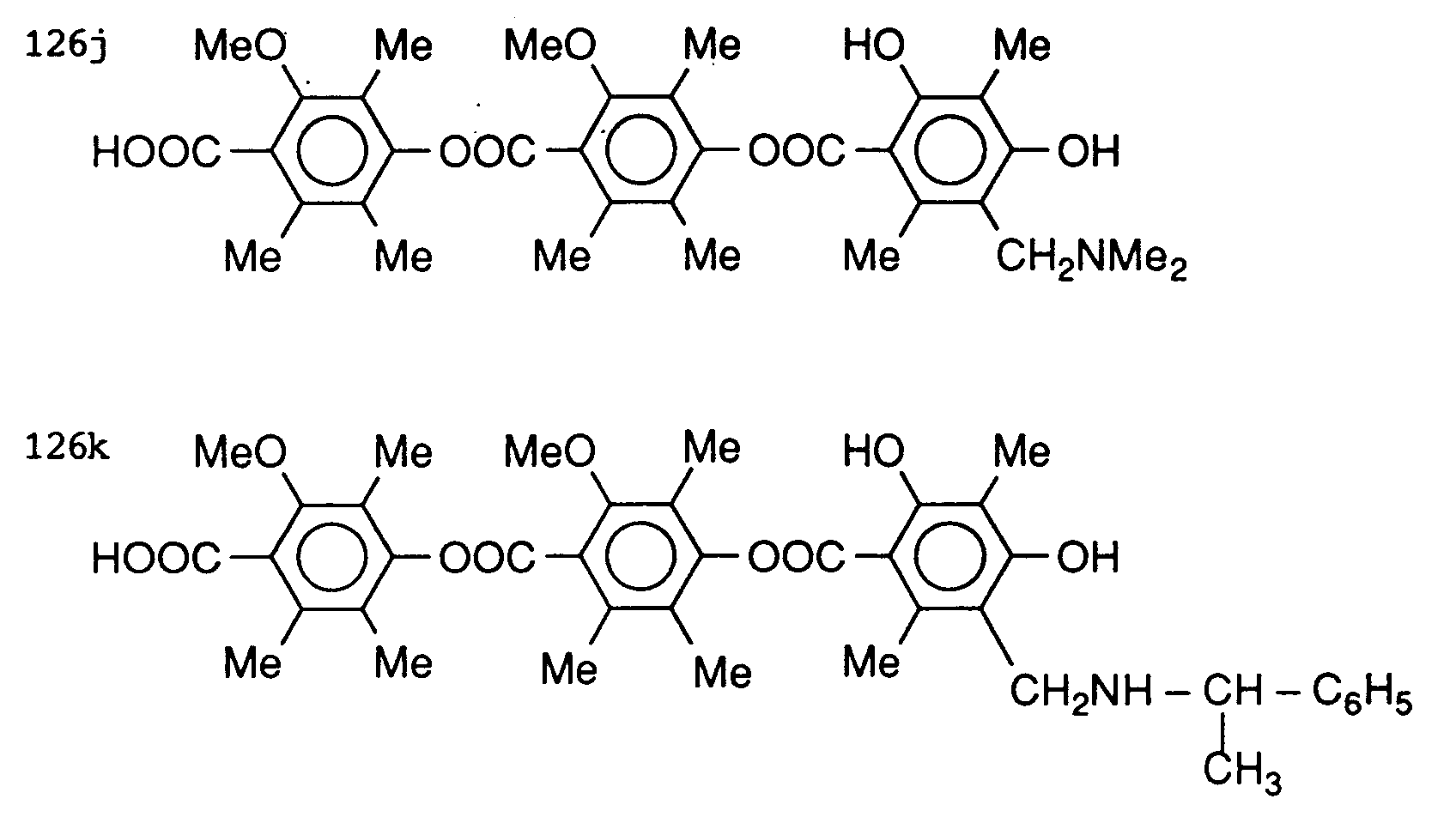
All of the compounds of the present invention can be prepared by methods which are known in the art. - The following examples and preparations are provided to further illustrate the process for preparing the compounds of the invention. The examples and preparations are representative only, and should not be construed as limiting the invention in any respect.
- Thielocin A2α (2a) [This compound was prepared in accordance with the procedure of JP-A-4158790] (12 mg) was dissolved in 1 ml of dioxane, and to the solution were added subsequently glycine benzyl ester p-toluenesulfonate (10 mg), two drops of triethylamine, and 0.2N NaOH (2 ml) with stirring, and then the mixture was stirred at room temperature for one hour. The reaction mixture was diluted with water, acidified to pH 3.0 with dilute hydrochloric acid, and the mixture was extracted with ethyl acetate. The extract was dried over Na₂SO₄, and the solvent was evaporated in vacuo to yield a residue. The residue was subjected to thin layer chromatography on silica gel developing with CHCl₃ : methanol : water = 62:25:2, to isolate a desired material (Rf: 0.6). Then, the material was purified by high performance liquid chromatography (Nucleosil 5C₁₈, 80% acetonitrile - 0.1% H₃PO₄) to yield 1.5 mg of the title compound (tR(min.) 8.0).
¹H-NMR: described hereinafter
MS spectrum: MH⁺m/z Found: 744 (Theory: 744 for C₄₁H₄₅NO₁₂). - The above reaction is described as shown in the following scheme:

wherein X is a group of the formula:
R¹, R² and R⁴ are methyl, R³ is methoxy, R⁵ and R⁷ are methyl, R⁶ is hydroxy, R⁸ is hydroxy, R⁹ is -NHCH₂CO₂CH₂C₆H₅, R¹⁰ and R¹¹ are hydroxy, and R¹², R¹³ and R¹⁴ are methyl, and E¹ is hydrogen. - Thielocin A2α (2a) or A1α [2b, which is described in the specification of the European Patent Application No. 90304552-4] was reacted with various compounds of RNH₂ or ROH instead of glycine benzyloxy ester, and treated in a similar procedure to that of Example 1, to yield compounds 1b through 1i. Such reactions are shown in the following scheme.

wherein X¹ is a group of the formula:
X² is a group of the formula:
- R¹, R², R³, R⁴, R⁵, R⁶, R⁷, R⁸, R⁹, R¹⁰, R¹¹, R¹², R¹³, R¹⁴, and E¹ are as defined above;
provided that
- Conditions of such reaction, and chemical formula of the compounds are shown in Tables 1 and 2, respectively. Also, physical properties of compounds 1a to 1i are shown in Table 3.


Table 3 Compound No. Molecular Formula SIMS MH m/z ¹H-NMR(CDCl₃) 1a C₄₁H₄₅NO₁₂ 744 δ 2.12, 2.14, 2.15, 2.17, 2.26, 2.29, 2.36, 2.41, 2.59(3Hs each, CH₃), δ 3.60(2Hs, COCH₂NH), 4.17(2Hs, ArCH₂NH), 5.23(2Hs, O-CN₂ph), δ 7.37(5Hs, ph) 1b C₃₆H₄₃NO₁₂ 682 δ 1.32(3Ht, J=7.0Hz, CH₂CH₃), δ 2.31, 2.51, 2.18, 2.26, 2.26, 2.29, 2.36, 2.41, 2.62(3Hs each, CH₃), 3.50(2Hs, COCH₂NH), δ 3.85, 3.86(3Hs each, OCH₃), δ 4.13(2Hs, ArCH₂NH), δ 4.27(2Hz, J=7.0Hz, CH₂CH₃). 1c C₄₁H₄₆O₁₂ 731 753(MNa⁺) δ 2.12, 2.13, 2.18, 2.26, 2.29, 2.36, 2.42, 2.61(3Hs each, CH₃). δ 2.93, 3.80(2Ht, J=7.0Hz, CH₂), δ 3.81, 3.85, 3.86(3Hs each, OCH₃), δ 4.83(2Hs, ArCH₂O), δ 6.87, 7.16(2Hd each, J=8.8Hz, =<H). 1d C₃₆H₄₄O₁₁ 675(MNa⁺) δ 0.96(3Ht, J=7.1Hz, (CH₂)₃CH₃), δ 2.13, 2.16, 2.18, 2.26, 2.29, 2.36, 2.41, 2.62(3Hs each, CH₃), 1.45, 1.66(2Hm each, CH₂), 3.63(2Ht, J=7.6Hz OCH₂(CH₂)-), δ 3.85, 3.86(3Hs each, OCH₃), 4.84(2Hs, ArCH₂O). 1e C₄₆H₅₅N₃O₁₃ 858 δ 2.12, 2.15, 2.16, 2.22, 2.25, 2.28, 2.39, 2.65(3Hs each, CH₃), δ 3.83(6Hs, OCH₃), δ 4.15(2Hs, NHCH₂Ar), δ 5.11(2Hs, CO₂CH₂ph), δ 7.34(5Hz, ph) 1g C₃₃H₃₈O₁₁ 611 δ 2.13, 2.16, 2.18, 2.26, 2.29, 2.36, 2.42, 2.64(3Hs each, CH₃), δ 3.52(3Hs, CH₂OCH₃), δ 3.85, 3.86(3Hs each, OCH₃), δ 4.81(2Hs, CH₂OCH₃) -

In the reaction scheme above, Bh means benzhydryl. - To a solution of 10.7 g (130 mmol) of dimethylamine hydrochloride in 200 ml of methanol is added 20.3 g (105 mmol) of NaOMe (in methanol, 28%) at -10°C to -15°C over about five minutes in a stream of nitrogen. After the mixture was stirred for 40 minutes, 4a (1 g, 1.3 mmol), which had been synthesized in Preparation 1 hereinafter was added thereto, and the resulting mixture was allowed to warm to 0°C, and stirred for 2.5 hours. To the mixture was added a portion of 60 mg (1.6 mmol) of 500 mg (13 mmol) of NaBH₄ over 10 minutes, and then the remainder of NaBH₄ was added thereto together. After stirring for 40 minutes, the mixture was allowed to stand overnight at room temperature. The solvent, methanol, was evaporated, and the residue was distributed between ethyl acetate and water. The ethyl acetate layer was washed with water and brine, and then dried over Na₂SO₄. The solvent was evaporated to yield 1.31 g of a residue. The residue was subjected to column chromatography (SiO; 100 g), washing with ethyl acetate - hexane (1:1), and then eluting with CHCl₃ - methanol (20:1), to yield 1 g of the product as a pale brown oil. The oil was crystallized from methanol to yield 844 mg of 5a (the benzhydryl ester of 6a) as a white powder (81.3%).
- Then, 120 mg (1.11 mmol) of anisole was added to a solution of 5a (200 mg, 0.26 mmol) in 5 ml of dichloromethane, and the mixture was cooled to 0°C. To the mixture was added 1 ml of a solution of 300 mg of trifluoroacetic acid in dichloromethane, and the resulting mixture was stirred at 0°C for one hour. After stirring, the mixture was allowed to stand overnight in the refrigerator at 4°C, and the solvent was evaporated to yield 0.46 g of a residue as a pale yellow oil. The residue was crystallized from ether, and the crystals were collected by filtration, and recrystallized from ethanol - water to yield 63 mg of the desired compound 6a (39.9%).
Mp: 218-220°C (dec.)
6a
Molecular formula: C₃₄H₄₁NO₁₀
SIMS: MH⁺ m/z 624
¹H-NMR (CDCl₃) δ 2.14, 2.16, 2.19, 2.24, 2.27, 2.29, 2.42, 2.67 (3Hs each, CH₃), δ 2.57 (6Hs, NMe₂), δ 3.99 (2Hs, ArCH₂N) -

Three hundred mg of 4a (Preparation 1) was reacted in a similar procedure to that of Example 10 except that 658 mg of a compound of C₆H₅CH(CH₃)NH₂ (sec-phenethylamine) was used instead of Me₂HN, and that 80 mg of NaBH₄ was reacted in 2.5 ml of DMF and 12 ml of methanol, to yield 314 mg of 5b (the benzhydryl ester of the desired compound 6b). - Then, to a solution of the resulting compound 5b in dichloromethane (10 ml) were added 180 mg of anisole and 420 mg of trifluoroacetic acid, and the mixture was reacted in a similar procedure to that of Example 10, to yield 136 mg of the title compound 6b.
6b
Molecular formula: C₄₀H₄₅NO₁₀
SIMS: MH⁺m/z 700
¹HNMR (CDCl₃) [δ 1.57 (3Hd, J=6.8Hz), δ 2.13 (3Hs, CH₃), δ 2.15 (6Hs, CH₃), δ 2.23, 2.26, 2.29, 2.40, 2.42 (3Hs, each CH₃), δ 3.83, 3.84 (3Hs each, OCH₃), 3.94 (2Hm, ArCH₂NH), 7.37 (5Hm, C₆H₅)] -

Two g (2.6 mmol) of 4a (Preparation 1) and 8.9 g (26 mmol) of glycine benzyl ester p-toluenesulfonate were dissolved in 30 ml of a dried dimethylformamide, and then to the solution was add 4.3 g (52 mmol) of sodium acetate, and the mixture was stirred for 3.5 hours. The reaction mixture was poured into 300 ml of cooled water to precipitate crystals, which were collected by filtration. The crystals were dissolved in 100 ml of ethyl acetate, and the solution was washed with 100 ml of water and 100 ml of brine, then dried over anhydrous sodium sulfate. The solvent was evaporated to yield 2.58 g of the title compound 5c as an yellow foamy material. The material was recrystallized from ethyl acetate - n-hexane (1:2) to yield 2.2 g of the desired compound (92.2%) as yellow pillar crystals.
Mp: 153-5°CElementary Analysis (for C₅₄H₅₃NO₁₂ (MW 907.972)) Theory C;71.43, H;5.88, N;1.54 Found C;71.69, H;5.88, N;1.62 -

(2) Compound 5d obtained above (1g, 1.1mmol) was dissolved in 40 ml of dichloromethane, and then 0.6 ml (5.5 mmol) of anisole was added thereto. To the mixture was slowly added a solution of 0.85 ml (11 mmol) of trifluoroacetic acid in 4 ml of dichloromethane dropwise in an ice-cooling bath. The mixture was directly stirred for four hours, concentrated in vacuo, and 1 N hydrochloric acid was added to the residue, and the precipitated solid was collected by filtration. The solid was washed with water repeatedly, dissolved in 50 ml of ethyl acetate, washed with 0.1% aqueous phosphate solution and with water, and then dried over anhydrous sodium sulfate. The solvent was evaporated to yield 865 mg of an yellow oil. The oil was subjected to silica gel chromatography (SiO₂; 50 g), eluting with chloroform - methanol (10 : 1), to yield 720 mg of 6c as an yellow oil (88.1%). This oil was recrystallized from 95% ethanol to yield 266 mg of the title compound 6c as pale yellow grained crystals.
Mp: 134-6°C (dec.)Elementary Analysis (for C₄₁H₄₅NO₁₂·EtOH·H₂O) Theory C;63.93, H;6.61, N;1.73 Found C;63.90, H;6.58, N;1.81 -

- Compound 4b (Preparation 1) (2.02g, 3.5 mmol) was dissolved in 30 ml of DMF, and 5.98 g (17.7mmol) of Gly·OBn·Tos and 3.04 g (37 mmol) of sodium acetate were added thereto, and the mixture was stirred at room temperature. After completion of the reaction, 300 ml of water was added to the mixture, and the precipitated crystals was collected by filtration. The filtered cake was dissolved in ethyl acetate, and the solution was dried over Na₂SO₄, and the solvent was evaporated in vacuo to yield 2.33 g of benzhydryl 4-[5'-(benzyloxycarbonylmethyliminomethyl)-2',4'-dihydroxy-3',6'-dimethyl]phenylcarboxy-2-methoxy-3,5,6-trimethyl benzoate (5c').
5c'
¹H-NMR (δ,CDCl₃) 2.04 (3H, S), 2.08 (3H, S), 2.10 (3H, S), 2.15 (3H, S), 2.83 (3H, S), 3.55 (3H, S), 4.46 (2H, S), 5.24 (2H, S), 7.20 (1H, S), 7.23-7.50 (15H, m), 8.86 (1H, S), 11.95 (1H, S) - Compound 5c obtained above (2.33 g, 3.25 mmol) was dissolved in 200 ml of a mixture of methanol and DMF (1:1). The mixture was cooled to 0°C, and a solution of 510 mg (8.1 mmol) of NaBH₃CN in 10 ml of methanol was added thereto dropwise, and then the mixture was stirred at 0°C for 40 hours. To the mixture was added about 800 ml of ice water, and the precipitated yellow crystals was collected by filtration, which crystals were purified using 200 g of silica gel to yield 120 mg of benzhydryl 4-[5'-(benzyloxycarbonylmethylaminomethyl)-2',4'-dihydroxy-3',6'-dimethyl]phenylcarboxy-2-methoxy-3,5,6-trimethyl benzoate (5d').
5'
¹H-NMR (δ, CDCl₃) 2.03 (3H, S), 2.03 (3H, S), 2.08 (3H, S), 2.12 (3H, S), 2.54 (3H, S), 3.55 (3H, S), 4.11 (2H, S), 5.22 (2H, S), 7.20 (1H, S), 7.23-7.50 (15H, m), 11.60 (1H,S) - Compound 5d' obtained above (120 mg, 0.167 mmol), and 97 mg (0.85 mmol) of anisole were dissolved in 6 ml of dichloromethane, and the solution was cooled to 0°C, and then, to the solution was slowly added 0.12 ml (1.64 mmol) of trifluoroacetic acid, and the mixture was stirred directly. After completing the reaction, the solvent was evaporated in vacuo, and 3 ml of 1N hydrochloric acid was added thereto, and the precipitated crystals was collected by filtration. The crystals was dissolved in ethyl acetate, and the solution was dried over sodium sulfate, and then the solvent was evaporated to yield the residue, which residue was purified using 75 g of silica gel. The resulting product (40 mg) was recrystallized from ethanol to yield 8.5 mg of the title compound 6C' as white crystals.
6c'
Mp: 164°C
IR (cm⁻¹, nujol): 3400-2300, 760, 1650, 1620.
NMR (δ, CDCl₃-CD₃OD5%): 2.05 (3H, S), 2.09 (3H, S), 2.15 (3H, S), 2.29 (3H, S), 2.59 (3H, S), 3.69 (2H, S), 3.82 (3H, S), 4.23 (2H, S), 5.24 (2H, S), 7.36 (5H, S) -

Thielavin B (Japanese Patent Application No. 162847/1991) (4a') (30 g, 53 mmol) was dissolved in 300 ml of trifluoroacetic acid, and 8.9 g (63 mmol) of hexamethylenetetraamine was added thereto in an ice-cooling bath, and the mixture was stirred for two hours. The mixture was warmed to room temperature, and was stirred for additional two hours, warmed at 50°C for 4.5 hours, and then allowed to stand overnight at room temperature. The solvent, trifluoroacetic acid, was evaporated, and 400 ml of water was added thereto, and the mixture was heated at 60°C for seven hours. The precipitated solid was collected by filtration, washed with water, dissolved in 300 ml of ethyl acetate, and washed with 1N hydrochloric acid, water and brine, and then dried over anhydrous sodium sulfate. The solvent was evaporated to yield 41.7 g of an orange foamy material, which material was dissolved in 200 ml of chloroform. To the solution was added 18 g (93 mmol) of benzhydryldiazomethane in an ice-cooling bath, and the mixture was stirred for 3.5 hours. The solvent was evaporated, and the residue was dissolved in 100 ml of ethyl acetate. The solution was washed with 1N hydrochloric acid, an aqueous saturated sodium bicarbonate solution, water, and brine, and then dried over anhydrous sodium sulfate. The solvent was evaporated to yield 46 g of an orange foamy material. The material was subjected to silica gel chromatographies (500 g and 400 g of SiO₂), eluting with ethyl acetate - n-hexane (1:4), and the same chromatography was repeated once more, to yield 9.95 g (24.7%) of Benzhydryl 4-[4'-(2'',4''-dihydroxy-5''-formyl-3'',6''-dimethylphenylcarboxy)-2'-methoxy-3',5',6'-trimethyl]phenylcarboxy-2-methoxy-3,5,6-trimethyl benzoate (4a), and 3.77 g (12.5%) of benzhydryl 4-(5'-formyl-2',4'-dihydroxy-3',6'-dimethyl)phenylcarboxy-2-methoxy-3,5,6-trimethylbenzoate (4b).
4b; white pillar crystals (ethyl acetate - n-hexane)
Mp; 182-4°CElementary Analysis (for C₃₄H₃₃O₈ (MW: 569.604)) Theory C;71.69, H;5.84 Found C;71.61, H;5.77 - The compounds of the present invention were tested for their Phospholipase A₂ inhibitory activity by the following procedure.
- 1-Palmitoyl-2-[1-¹⁴C]-linoleoyl L-3-Phosphatidylethanolamine (Amersham, Inc., 59 mCi/mmol) were diluted with L-α-phosphatidylethanolamine (Sigma, Co., from egg albumin) [2,000 dpm/nmol], and the dilution was sonicated. The resultant dilution was used as a substrate. The PLA₂ (phospholipase A₂) which was used in the test was from rat platelets. The PLA₂ and the substrate preparation were added to a solution of CaCl₂ (3 mM) in Tris-buffer (0.1 M, pH 7.4), and the mixture was allowed to react at 37°C for 20 minutes. Then, the reaction was terminated by adding 1.25 ml of Dole's reagent to the reaction mixture and stirring immediately the resultant mixture. To the mixture was added 0.5 ml of distilled water and 0.8 ml of n-heptane, and the mixture was stirred, centrifuged, and the resulting supernatant was taken into another tube. To this supernatant were added additional 0.8 ml of n-heptane and silica gel, and the mixture was stirred, centrifuged, and then the supernatant was taken into vials. Toluene cocktails were added to the vials. The amount of free fatty acid released from PLA₂ (DPM value) was determined using liquid scintillation counter.
- Inhibitory activity (%) was estimated by the formula:

- The results are shown in the following Table 4.
Table 4 PLA₂ inhibitory activity [IC₅₀(µM)] Compound No. Rat platelets 1a 0.026 1b 0.17 1c 0.16 1d 0.12 1e 1.10 1g 0.34 6b 0.30
Claims (6)
- A compound of the formula:

R⁹ is C₁-C₆ alkylamino which may have one or more substituents which are identically or differently selected from an aryl group, an amino group of a urethane derivative, and a carboxyl group which may be esterified or amidated, or a C₁-C₆ alkoxy which is optionally substituted by one or more substituents which are the same or different and which are selected from C₁-C₆ alkyl, halogen, hydroxy, amino and aryl which is optionally substituted;
E¹ is hydrogen, C₁-C₈ alkyl, C₃-C₈ alkenyl, C₇-C₁₉ aralkyl, C₆-C₁₂ aryl, C₁-C₁₂ N-hydroxyamino compound C₃-C₁₂ hydrocarbonated silyl, C₃-C₁₂ hydrocarbonated stannyl, C₂-C₁₅ mono-oxygenated alkyl,substituted C₈-C₁₂ aralkyl, or C₂-C₁₂ alkenyl;
m is an integer of from 1 to 4; or a pharmaceutically acceptable salt thereof. - The compound of Claim 1 in which R⁹ is a group which is selected from the group consisting of:
-NHCH₂COOCH₂Ph,

- A phospholipase A₂ inhibitor in accordance with the formula of claim 1, which is
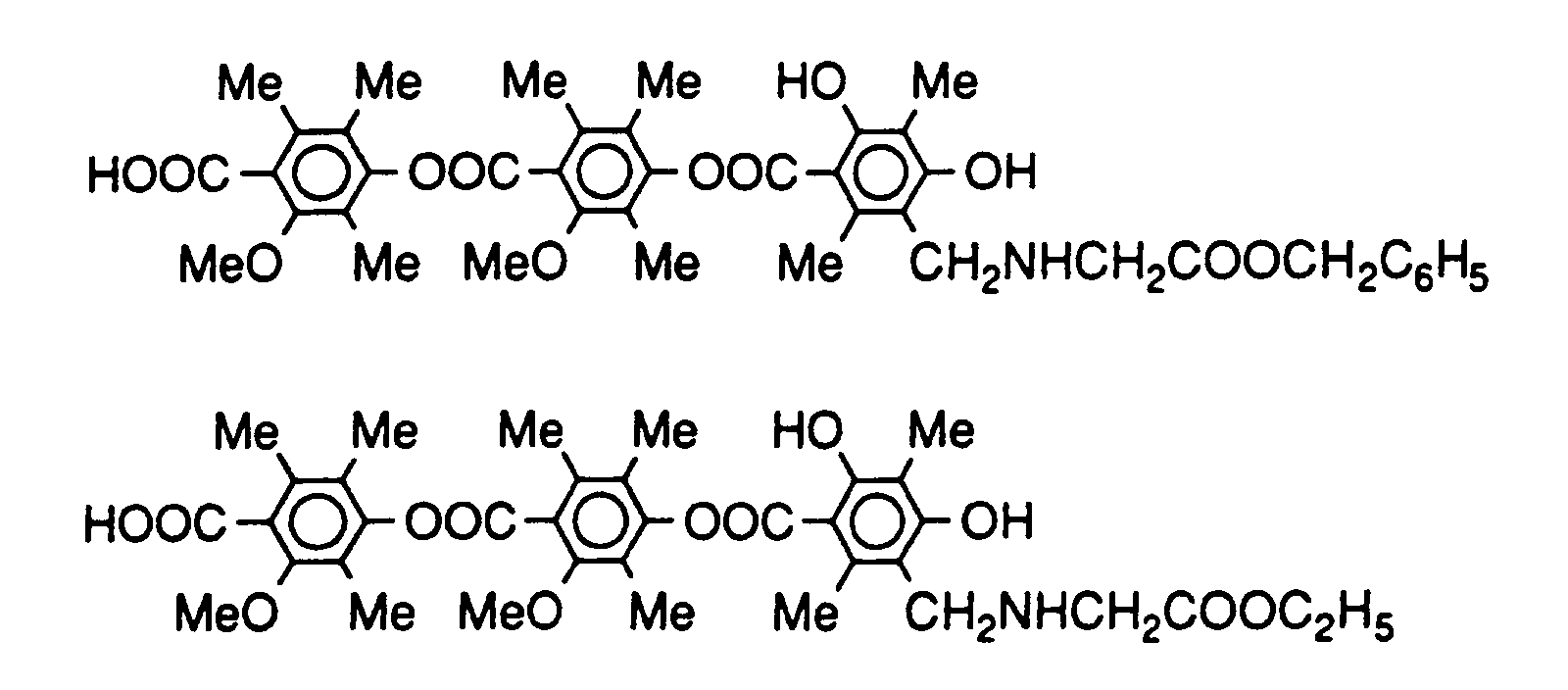
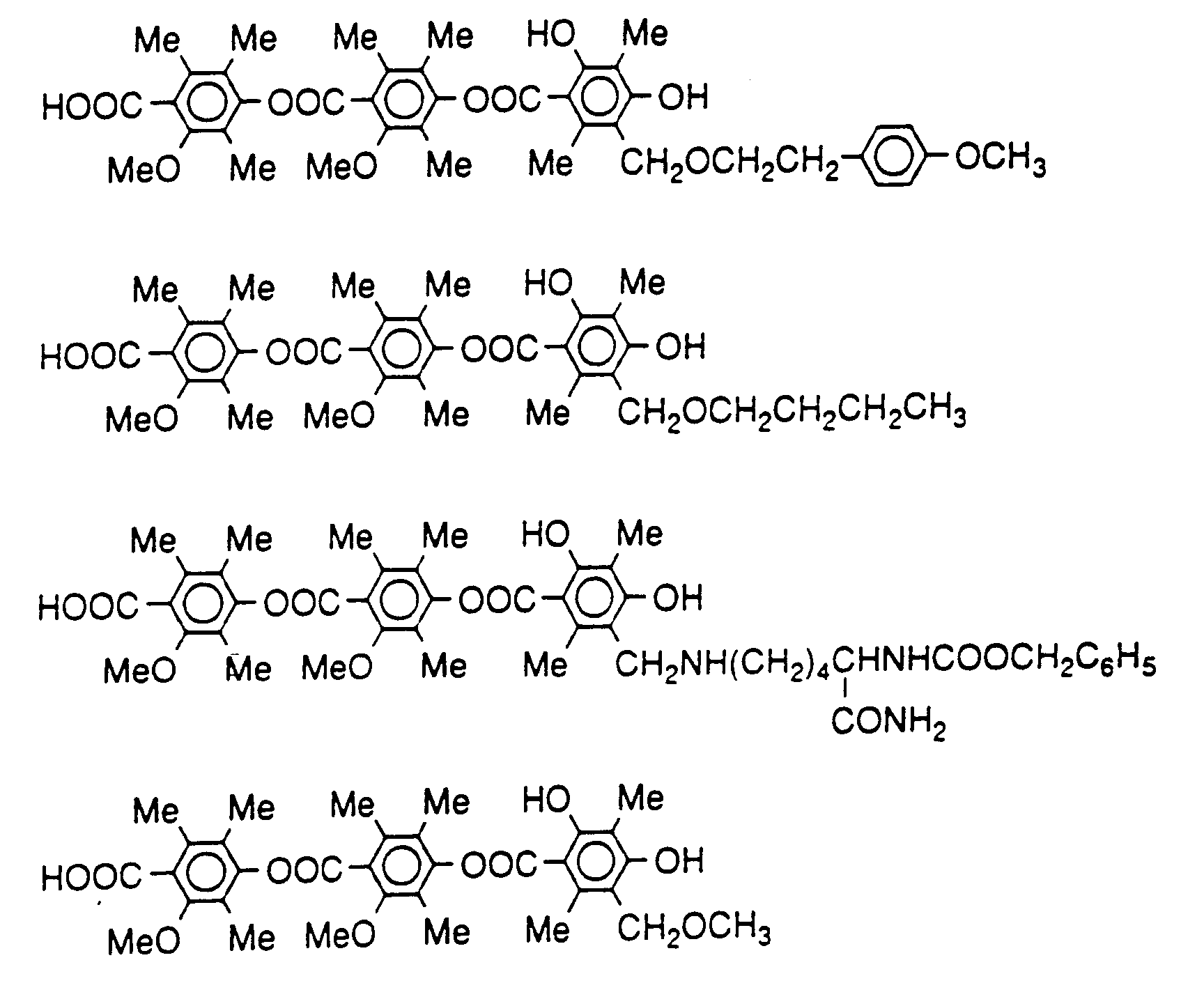

- A pharmaceutical composition comprising a compound or a pharmaceutically acceptable salt thereof as claimed in Claim 1, Claim 2 or Claim 3 in association with one or more pharmaceutically acceptable carriers or diluents therefor.
- The pharmaceutical composition of Claim 3, for use in inhibiting phospholipase A₂.
- The use of a compound claimed in anyone of claims 1 to 3 in the preparation of a pharmaceutical product for the treatment of any disease caused by phospholipase A₂.
Applications Claiming Priority (2)
| Application Number | Priority Date | Filing Date | Title |
|---|---|---|---|
| JP196789/92 | 1992-07-23 | ||
| JP19678992 | 1992-07-23 |
Publications (2)
| Publication Number | Publication Date |
|---|---|
| EP0580378A1 EP0580378A1 (en) | 1994-01-26 |
| EP0580378B1 true EP0580378B1 (en) | 1996-06-26 |
Family
ID=16363676
Family Applications (1)
| Application Number | Title | Priority Date | Filing Date |
|---|---|---|---|
| EP93305630A Expired - Lifetime EP0580378B1 (en) | 1992-07-23 | 1993-07-19 | Substituted benzoate derivatives |
Country Status (13)
| Country | Link |
|---|---|
| US (1) | US5473096A (en) |
| EP (1) | EP0580378B1 (en) |
| JP (1) | JP3526889B2 (en) |
| KR (1) | KR100273603B1 (en) |
| CN (1) | CN1039317C (en) |
| AT (1) | ATE139764T1 (en) |
| CA (1) | CA2100640A1 (en) |
| DE (1) | DE69303333T2 (en) |
| DK (1) | DK0580378T3 (en) |
| ES (1) | ES2091558T3 (en) |
| GR (1) | GR3020336T3 (en) |
| HU (1) | HU218926B (en) |
| TW (1) | TW262462B (en) |
Families Citing this family (3)
| Publication number | Priority date | Publication date | Assignee | Title |
|---|---|---|---|---|
| EP0763016B1 (en) * | 1994-06-01 | 2000-01-26 | Axys Pharmaceuticals, Inc. | Compositions and methods for treating mast-cell mediated conditions |
| US5888721A (en) * | 1996-07-03 | 1999-03-30 | Millennium Pharmaceuticals, Inc. | Antibacterial compounds |
| TW544310B (en) * | 1998-04-02 | 2003-08-01 | Ajinomoto Kk | Amino acid derivatives and anti-inflammatory agents |
Family Cites Families (6)
| Publication number | Priority date | Publication date | Assignee | Title |
|---|---|---|---|---|
| US3884960A (en) * | 1972-12-26 | 1975-05-20 | Ciba Geigy Corp | Polyol esters of alkyl substituted hydroxy-benzoyloxybenzoic acids |
| US3943102A (en) * | 1972-12-26 | 1976-03-09 | Ciba-Geigy Corporation | Compositions stabilized with polyol esters of benzoyloxybenzoic acids |
| JPS6459252A (en) * | 1987-08-31 | 1989-03-06 | Toshiba Corp | Cooling device for electronic office equipment |
| JP2842613B2 (en) * | 1989-04-28 | 1999-01-06 | 塩野義製薬株式会社 | Phospholipase A (bottom 2) inhibitor |
| JPH04159252A (en) * | 1990-10-22 | 1992-06-02 | Shionogi & Co Ltd | Phospholipase a2 inhibiting substance |
| DK0547231T3 (en) * | 1991-07-03 | 1996-09-16 | Shionogi & Co | Phospholipase A 2 inhibitor |
-
1993
- 1993-07-15 CA CA002100640A patent/CA2100640A1/en not_active Abandoned
- 1993-07-19 DK DK93305630.1T patent/DK0580378T3/en active
- 1993-07-19 DE DE69303333T patent/DE69303333T2/en not_active Expired - Fee Related
- 1993-07-19 EP EP93305630A patent/EP0580378B1/en not_active Expired - Lifetime
- 1993-07-19 AT AT93305630T patent/ATE139764T1/en not_active IP Right Cessation
- 1993-07-19 ES ES93305630T patent/ES2091558T3/en not_active Expired - Lifetime
- 1993-07-20 TW TW082105772A patent/TW262462B/zh active
- 1993-07-21 US US08/093,953 patent/US5473096A/en not_active Expired - Lifetime
- 1993-07-22 KR KR1019930013903A patent/KR100273603B1/en not_active Expired - Fee Related
- 1993-07-22 JP JP18131793A patent/JP3526889B2/en not_active Expired - Fee Related
- 1993-07-23 HU HU9302141A patent/HU218926B/en not_active IP Right Cessation
- 1993-07-23 CN CN93116880A patent/CN1039317C/en not_active Expired - Fee Related
-
1996
- 1996-06-27 GR GR960401548T patent/GR3020336T3/en unknown
Also Published As
| Publication number | Publication date |
|---|---|
| HUT64938A (en) | 1994-03-28 |
| JP3526889B2 (en) | 2004-05-17 |
| ES2091558T3 (en) | 1996-11-01 |
| US5473096A (en) | 1995-12-05 |
| CN1039317C (en) | 1998-07-29 |
| CA2100640A1 (en) | 1994-01-24 |
| ATE139764T1 (en) | 1996-07-15 |
| TW262462B (en) | 1995-11-11 |
| JPH0687790A (en) | 1994-03-29 |
| GR3020336T3 (en) | 1996-09-30 |
| HU218926B (en) | 2000-12-28 |
| CN1088197A (en) | 1994-06-22 |
| KR940005541A (en) | 1994-03-21 |
| DE69303333T2 (en) | 1996-11-21 |
| EP0580378A1 (en) | 1994-01-26 |
| DE69303333D1 (en) | 1996-08-01 |
| HU9302141D0 (en) | 1993-10-28 |
| DK0580378T3 (en) | 1996-07-29 |
| KR100273603B1 (en) | 2000-12-15 |
Similar Documents
| Publication | Publication Date | Title |
|---|---|---|
| SU1333234A3 (en) | Method of producing the derivatives of n-phenylbenzamide or salts thereof | |
| EP0330065A1 (en) | Sulfonamide compounds | |
| EP0061206B1 (en) | 6-aminopenicillanic acid esters and their use for producing new ampicillin esters | |
| US5362750A (en) | 4,5-dihydroxy- and 4,5,8-trihydroxy- 9,10-dihydro-9,10-dioxo-2-anthracenecarboxylic acid dicarbonates and urethans having therapeutical activities | |
| US4782088A (en) | Nitro aliphatic compounds and use thereof | |
| FI76069B (en) | FOERFARANDE FOER FRAMSTAELLNING AV NYA TERAPEUTISKT ANVAENDBARA Z-2-ACYLAMINO-3-MONOSUBSTITUERADE PROPENOATER. | |
| US2417326A (en) | Imidazol thiophan derivatives and process for the manufacture of same | |
| AU602813B2 (en) | Enantiomeric glutaramide diuretic agents | |
| US5473096A (en) | Substituted benzoate derivatives | |
| EP0547231B1 (en) | Phospholipase a2 inhibitor | |
| WO2005084658A1 (en) | Derivatives of actarit and their therapeutic use | |
| US5597943A (en) | Phospholipase A2 inhibitor | |
| US5387707A (en) | Route of synthesis for tertiary alkyl esters | |
| US4243665A (en) | 2-Heterocyclylalkyl-6-methoxy-naphthalenes | |
| US4332959A (en) | Process for manufacturing phenoxylactic acids, their derivatives and products obtained thereby | |
| SU803859A3 (en) | Method of preparing omega-thiopropionamides or their acid-additive salts | |
| US5401769A (en) | Dibenzofuranyl N-alkyl carbamates | |
| US5373009A (en) | Dibenzofuranyl esters of N-heterocyclic carboxylic acids | |
| US4927970A (en) | Substituted 3-cyclobutene-1,2-dione intermediates | |
| KR850000049B1 (en) | Process for preparing alpha-substituted ureido benzyl penicillin derivatives | |
| US4835180A (en) | N-(ω-cyanoalkyl)aminophenols and use as inhibitors of lipoxygenase activity | |
| US5003090A (en) | Process for the preparation of benzopyrans | |
| SU1486057A3 (en) | Method of producing c4-alkyl esters of 4-alkoxy-3-pyrroline-2-on-1-yl acetic acid | |
| US4579970A (en) | 1-(4'-alkylamido)-2'{1[n-(alkyl)imino]-ethyl}-phenoxy-3-alkylamino-2-propanols and use thereof | |
| US4900841A (en) | 1-[4-[(methyl-sulfonyl)amino]benzoyl]aziridine |
Legal Events
| Date | Code | Title | Description |
|---|---|---|---|
| PUAI | Public reference made under article 153(3) epc to a published international application that has entered the european phase |
Free format text: ORIGINAL CODE: 0009012 |
|
| AK | Designated contracting states |
Kind code of ref document: A1 Designated state(s): AT BE CH DE DK ES FR GB GR IE IT LI LU MC NL PT SE |
|
| 17P | Request for examination filed |
Effective date: 19940113 |
|
| 17Q | First examination report despatched |
Effective date: 19940705 |
|
| GRAH | Despatch of communication of intention to grant a patent |
Free format text: ORIGINAL CODE: EPIDOS IGRA |
|
| GRAH | Despatch of communication of intention to grant a patent |
Free format text: ORIGINAL CODE: EPIDOS IGRA |
|
| GRAA | (expected) grant |
Free format text: ORIGINAL CODE: 0009210 |
|
| AK | Designated contracting states |
Kind code of ref document: B1 Designated state(s): AT BE CH DE DK ES FR GB GR IE IT LI LU MC NL PT SE |
|
| REF | Corresponds to: |
Ref document number: 139764 Country of ref document: AT Date of ref document: 19960715 Kind code of ref document: T |
|
| REG | Reference to a national code |
Ref country code: DK Ref legal event code: T3 |
|
| REF | Corresponds to: |
Ref document number: 69303333 Country of ref document: DE Date of ref document: 19960801 |
|
| REG | Reference to a national code |
Ref country code: IE Ref legal event code: FG4D Free format text: 68905 |
|
| REG | Reference to a national code |
Ref country code: CH Ref legal event code: NV Representative=s name: A. BRAUN, BRAUN, HERITIER, ESCHMANN AG PATENTANWAE |
|
| REG | Reference to a national code |
Ref country code: GR Ref legal event code: FG4A Free format text: 3020336 |
|
| ET | Fr: translation filed | ||
| ITF | It: translation for a ep patent filed | ||
| REG | Reference to a national code |
Ref country code: ES Ref legal event code: FG2A Ref document number: 2091558 Country of ref document: ES Kind code of ref document: T3 |
|
| SC4A | Pt: translation is available |
Free format text: 960814 AVAILABILITY OF NATIONAL TRANSLATION |
|
| PLBE | No opposition filed within time limit |
Free format text: ORIGINAL CODE: 0009261 |
|
| STAA | Information on the status of an ep patent application or granted ep patent |
Free format text: STATUS: NO OPPOSITION FILED WITHIN TIME LIMIT |
|
| 26N | No opposition filed | ||
| PGFP | Annual fee paid to national office [announced via postgrant information from national office to epo] |
Ref country code: SE Payment date: 20010529 Year of fee payment: 9 |
|
| PGFP | Annual fee paid to national office [announced via postgrant information from national office to epo] |
Ref country code: GR Payment date: 20010530 Year of fee payment: 9 |
|
| PGFP | Annual fee paid to national office [announced via postgrant information from national office to epo] |
Ref country code: PT Payment date: 20010531 Year of fee payment: 9 |
|
| PGFP | Annual fee paid to national office [announced via postgrant information from national office to epo] |
Ref country code: IE Payment date: 20010615 Year of fee payment: 9 |
|
| PGFP | Annual fee paid to national office [announced via postgrant information from national office to epo] |
Ref country code: BE Payment date: 20010619 Year of fee payment: 9 |
|
| PGFP | Annual fee paid to national office [announced via postgrant information from national office to epo] |
Ref country code: MC Payment date: 20010620 Year of fee payment: 9 |
|
| PGFP | Annual fee paid to national office [announced via postgrant information from national office to epo] |
Ref country code: LU Payment date: 20010703 Year of fee payment: 9 |
|
| PGFP | Annual fee paid to national office [announced via postgrant information from national office to epo] |
Ref country code: GB Payment date: 20010713 Year of fee payment: 9 Ref country code: DK Payment date: 20010713 Year of fee payment: 9 |
|
| PGFP | Annual fee paid to national office [announced via postgrant information from national office to epo] |
Ref country code: CH Payment date: 20010718 Year of fee payment: 9 |
|
| PGFP | Annual fee paid to national office [announced via postgrant information from national office to epo] |
Ref country code: AT Payment date: 20010725 Year of fee payment: 9 |
|
| PGFP | Annual fee paid to national office [announced via postgrant information from national office to epo] |
Ref country code: FR Payment date: 20010730 Year of fee payment: 9 |
|
| PGFP | Annual fee paid to national office [announced via postgrant information from national office to epo] |
Ref country code: NL Payment date: 20010731 Year of fee payment: 9 Ref country code: ES Payment date: 20010731 Year of fee payment: 9 |
|
| PGFP | Annual fee paid to national office [announced via postgrant information from national office to epo] |
Ref country code: DE Payment date: 20011001 Year of fee payment: 9 |
|
| REG | Reference to a national code |
Ref country code: GB Ref legal event code: IF02 |
|
| PG25 | Lapsed in a contracting state [announced via postgrant information from national office to epo] |
Ref country code: LU Free format text: LAPSE BECAUSE OF NON-PAYMENT OF DUE FEES Effective date: 20020719 Ref country code: IE Free format text: LAPSE BECAUSE OF NON-PAYMENT OF DUE FEES Effective date: 20020719 Ref country code: GB Free format text: LAPSE BECAUSE OF NON-PAYMENT OF DUE FEES Effective date: 20020719 Ref country code: AT Free format text: LAPSE BECAUSE OF NON-PAYMENT OF DUE FEES Effective date: 20020719 |
|
| PG25 | Lapsed in a contracting state [announced via postgrant information from national office to epo] |
Ref country code: SE Free format text: LAPSE BECAUSE OF NON-PAYMENT OF DUE FEES Effective date: 20020720 Ref country code: ES Free format text: LAPSE BECAUSE OF NON-PAYMENT OF DUE FEES Effective date: 20020720 |
|
| PG25 | Lapsed in a contracting state [announced via postgrant information from national office to epo] |
Ref country code: LI Free format text: LAPSE BECAUSE OF NON-PAYMENT OF DUE FEES Effective date: 20020731 Ref country code: DK Free format text: LAPSE BECAUSE OF NON-PAYMENT OF DUE FEES Effective date: 20020731 Ref country code: CH Free format text: LAPSE BECAUSE OF NON-PAYMENT OF DUE FEES Effective date: 20020731 Ref country code: BE Free format text: LAPSE BECAUSE OF NON-PAYMENT OF DUE FEES Effective date: 20020731 |
|
| BERE | Be: lapsed |
Owner name: *SHIONOGI & CO. LTD Effective date: 20020731 |
|
| PG25 | Lapsed in a contracting state [announced via postgrant information from national office to epo] |
Ref country code: PT Free format text: LAPSE BECAUSE OF NON-PAYMENT OF DUE FEES Effective date: 20030131 |
|
| PG25 | Lapsed in a contracting state [announced via postgrant information from national office to epo] |
Ref country code: NL Free format text: LAPSE BECAUSE OF NON-PAYMENT OF DUE FEES Effective date: 20030201 Ref country code: MC Free format text: LAPSE BECAUSE OF NON-PAYMENT OF DUE FEES Effective date: 20030201 Ref country code: DE Free format text: LAPSE BECAUSE OF NON-PAYMENT OF DUE FEES Effective date: 20030201 |
|
| PG25 | Lapsed in a contracting state [announced via postgrant information from national office to epo] |
Ref country code: GR Free format text: LAPSE BECAUSE OF NON-PAYMENT OF DUE FEES Effective date: 20030206 |
|
| EUG | Se: european patent has lapsed | ||
| REG | Reference to a national code |
Ref country code: DK Ref legal event code: EBP |
|
| GBPC | Gb: european patent ceased through non-payment of renewal fee |
Effective date: 20020719 |
|
| REG | Reference to a national code |
Ref country code: CH Ref legal event code: PL |
|
| PG25 | Lapsed in a contracting state [announced via postgrant information from national office to epo] |
Ref country code: FR Free format text: LAPSE BECAUSE OF NON-PAYMENT OF DUE FEES Effective date: 20030331 |
|
| NLV4 | Nl: lapsed or anulled due to non-payment of the annual fee |
Effective date: 20030201 |
|
| REG | Reference to a national code |
Ref country code: PT Ref legal event code: MM4A Free format text: LAPSE DUE TO NON-PAYMENT OF FEES Effective date: 20030131 |
|
| REG | Reference to a national code |
Ref country code: FR Ref legal event code: ST |
|
| REG | Reference to a national code |
Ref country code: IE Ref legal event code: MM4A |
|
| REG | Reference to a national code |
Ref country code: ES Ref legal event code: FD2A Effective date: 20030811 |
|
| PG25 | Lapsed in a contracting state [announced via postgrant information from national office to epo] |
Ref country code: IT Free format text: LAPSE BECAUSE OF NON-PAYMENT OF DUE FEES;WARNING: LAPSES OF ITALIAN PATENTS WITH EFFECTIVE DATE BEFORE 2007 MAY HAVE OCCURRED AT ANY TIME BEFORE 2007. THE CORRECT EFFECTIVE DATE MAY BE DIFFERENT FROM THE ONE RECORDED. Effective date: 20050719 |