EP0580373B1 - Hydrocarbon conversion catalyst comprising noble metal on a rare earth and group IVB oxides modified silica-alumina support - Google Patents
Hydrocarbon conversion catalyst comprising noble metal on a rare earth and group IVB oxides modified silica-alumina support Download PDFInfo
- Publication number
- EP0580373B1 EP0580373B1 EP93305620A EP93305620A EP0580373B1 EP 0580373 B1 EP0580373 B1 EP 0580373B1 EP 93305620 A EP93305620 A EP 93305620A EP 93305620 A EP93305620 A EP 93305620A EP 0580373 B1 EP0580373 B1 EP 0580373B1
- Authority
- EP
- European Patent Office
- Prior art keywords
- catalyst
- silica
- oxide
- alumina
- rare earth
- Prior art date
- Legal status (The legal status is an assumption and is not a legal conclusion. Google has not performed a legal analysis and makes no representation as to the accuracy of the status listed.)
- Expired - Lifetime
Links
Images


Classifications
-
- B—PERFORMING OPERATIONS; TRANSPORTING
- B01—PHYSICAL OR CHEMICAL PROCESSES OR APPARATUS IN GENERAL
- B01J—CHEMICAL OR PHYSICAL PROCESSES, e.g. CATALYSIS OR COLLOID CHEMISTRY; THEIR RELEVANT APPARATUS
- B01J23/00—Catalysts comprising metals or metal oxides or hydroxides, not provided for in group B01J21/00
- B01J23/10—Catalysts comprising metals or metal oxides or hydroxides, not provided for in group B01J21/00 of rare earths
-
- B—PERFORMING OPERATIONS; TRANSPORTING
- B01—PHYSICAL OR CHEMICAL PROCESSES OR APPARATUS IN GENERAL
- B01J—CHEMICAL OR PHYSICAL PROCESSES, e.g. CATALYSIS OR COLLOID CHEMISTRY; THEIR RELEVANT APPARATUS
- B01J23/00—Catalysts comprising metals or metal oxides or hydroxides, not provided for in group B01J21/00
- B01J23/38—Catalysts comprising metals or metal oxides or hydroxides, not provided for in group B01J21/00 of noble metals
- B01J23/54—Catalysts comprising metals or metal oxides or hydroxides, not provided for in group B01J21/00 of noble metals combined with metals, oxides or hydroxides provided for in groups B01J23/02 - B01J23/36
- B01J23/56—Platinum group metals
- B01J23/62—Platinum group metals with gallium, indium, thallium, germanium, tin or lead
- B01J23/622—Platinum group metals with gallium, indium, thallium, germanium, tin or lead with germanium, tin or lead
- B01J23/626—Platinum group metals with gallium, indium, thallium, germanium, tin or lead with germanium, tin or lead with tin
-
- B—PERFORMING OPERATIONS; TRANSPORTING
- B01—PHYSICAL OR CHEMICAL PROCESSES OR APPARATUS IN GENERAL
- B01J—CHEMICAL OR PHYSICAL PROCESSES, e.g. CATALYSIS OR COLLOID CHEMISTRY; THEIR RELEVANT APPARATUS
- B01J23/00—Catalysts comprising metals or metal oxides or hydroxides, not provided for in group B01J21/00
- B01J23/38—Catalysts comprising metals or metal oxides or hydroxides, not provided for in group B01J21/00 of noble metals
- B01J23/54—Catalysts comprising metals or metal oxides or hydroxides, not provided for in group B01J21/00 of noble metals combined with metals, oxides or hydroxides provided for in groups B01J23/02 - B01J23/36
- B01J23/56—Platinum group metals
- B01J23/63—Platinum group metals with rare earths or actinides
-
- B—PERFORMING OPERATIONS; TRANSPORTING
- B01—PHYSICAL OR CHEMICAL PROCESSES OR APPARATUS IN GENERAL
- B01J—CHEMICAL OR PHYSICAL PROCESSES, e.g. CATALYSIS OR COLLOID CHEMISTRY; THEIR RELEVANT APPARATUS
- B01J23/00—Catalysts comprising metals or metal oxides or hydroxides, not provided for in group B01J21/00
- B01J23/38—Catalysts comprising metals or metal oxides or hydroxides, not provided for in group B01J21/00 of noble metals
- B01J23/54—Catalysts comprising metals or metal oxides or hydroxides, not provided for in group B01J21/00 of noble metals combined with metals, oxides or hydroxides provided for in groups B01J23/02 - B01J23/36
- B01J23/56—Platinum group metals
- B01J23/64—Platinum group metals with arsenic, antimony, bismuth, vanadium, niobium, tantalum, polonium, chromium, molybdenum, tungsten, manganese, technetium or rhenium
- B01J23/656—Manganese, technetium or rhenium
- B01J23/6567—Rhenium
-
- C—CHEMISTRY; METALLURGY
- C10—PETROLEUM, GAS OR COKE INDUSTRIES; TECHNICAL GASES CONTAINING CARBON MONOXIDE; FUELS; LUBRICANTS; PEAT
- C10G—CRACKING HYDROCARBON OILS; PRODUCTION OF LIQUID HYDROCARBON MIXTURES, e.g. BY DESTRUCTIVE HYDROGENATION, OLIGOMERISATION, POLYMERISATION; RECOVERY OF HYDROCARBON OILS FROM OIL-SHALE, OIL-SAND, OR GASES; REFINING MIXTURES MAINLY CONSISTING OF HYDROCARBONS; REFORMING OF NAPHTHA; MINERAL WAXES
- C10G35/00—Reforming naphtha
- C10G35/04—Catalytic reforming
- C10G35/06—Catalytic reforming characterised by the catalyst used
- C10G35/085—Catalytic reforming characterised by the catalyst used containing platinum group metals or compounds thereof
- C10G35/09—Bimetallic catalysts in which at least one of the metals is a platinum group metal
Definitions
- the present invention relates to a hydrocarbon conversion catalyst comprising noble metal on a rare earth and Group IVB oxides-modified silica-alumina support.
- EP-A-0 558 343 describes and claims a catalyst composition
- a catalyst composition comprising an amorphous silica-alumina support having at least 50 wt.% silica, a rare earth oxide, and metal(s) selected from the group consisting of Group VIII noble metal(s), mixtures of Group VIII noble metal(s) and rhenium, and mixtures of Group VIII noble metal(s) and tin.
- the catalyst composition is used for catalytic hydroconversion, including hydroisomerization, of a C 5 + feedstream.
- the applicants have discovered that the addition of Group IVB oxides to a catalyst comprising a rare earth oxide-modified amorphous silica-alumina support and a metal(s) functionality affords a catalyst having enhanced metal(s) dispersion and activity which can function as a hydrocarbon conversion catalyst in reactions such as reforming and isomerization, especially wax isomerization.
- the novel catalyst can be utilized as a hydrocarbon conversion catalyst in reforming reactions typically employing platinum on chlorided-alumina catalysts, thereby, removing the necessity of inconvenient, environmentally detrimental chlorine addition required during reforming over chlorided-alumina catalysts.
- the catalyst provides permanent acidity, unlike chlorided-alumina catalysts whose acidity decreases as chlorine is depleted during use of the catalyst, thereby lowering activity and requiring continuous chlorine addition to maintain acidity and catalyst performance.
- novel catalysts exhibit enhanced cyclohexene hydrogenation, and enhanced activity and aromatic selectivity during C 7 reforming, when compared to catalysts without the addition of Group IVB oxides.
- novel catalyst's C 7 isomerization selectivity is reduced and C 5 - selectivity is only slightly increased.
- the present invention provides a catalyst composition
- a catalyst composition comprising a support having dispersed thereon at least one Group VIII noble metal component and optionally a tin component and/or a rhenium component, wherein the support comprises amorphous silica-alumina, of which at least 50 wt% is silica, having dispersed thereon a Group IVB oxide and one or more rare earth metal oxides and/or yttrium oxide.
- amorphous means non-crystalline as indicated by the absence of sharp X-ray diffraction lines.
- “Rare earth metal” includes the rare earth metals and yttrium.
- the Group IVB oxide may be present in an amount of in the range of from 0.1 to 15 weight percent, and is selected from the group consisting of silica, germania, tin oxide and mixtures thereof, with the proviso that if there is only one group IVB oxide, this is not tin oxide.
- the Group VIII noble metal may be present in an amount in the range of from 0.01 to 10 weight percent.
- the said silica-alumina support may have a ratio of silica:alumina in the range of from 50:50 to 95:5.
- the said rare earth oxide and/or yttrium oxide may be present in an amount between 1 wt% and 90 wt%, and may be selected from the group consisting of oxides of the elements of the periodic table having atomic numbers of from 57 to 71 and 39.
- the present invention also provides a catalytic hydroconversion process comprising contacting a hydrocarbon feedstream with a catalyst composition as described under hydroconversion conditions.
- the feedstream may be a reforming feedstream which is contacted with the catalyst under reforming conditions.
- the feedstream may be an isomerization feedstream which is contacted with the catalyst under isomerization conditions.
- the isomerization feedstream may be a natural wax or a synthetic wax.
- Figure 1 compares the acidities of rare earth modified amorphous silica-alumina, Group IVB oxide additions to rare earth modified silica-alumina, silica-alumina, and chlorided-alumina catalysts. Catalyst comparison is accomplished by using the 2-methylpent-2-ene acidity probe test by measuring the ratio of 3-methylpent-2-ene to 4-methylpent-2-ene isomers.
- Figure 2 depicts the enhancement of platinum dispersion afforded by Group IVB oxide containing rare earth modified amorphous silica-alumina by measuring the number of H atoms chemisorbed per Pt metal atom (H/M) using H 2 chemisorption techniques.
- Figure 3 shows % conversion of cyclohexene hydrogenated to cyclohexane of catalysts containing 0.3 wt% platinum and 0.9% Cl, a Pt silica-alumina catalyst containing 0.6 wt% platinum, a present invention catalyst having 0.3% Pt, 25% neodymium oxide, and 5% silica added, a rare earth modified Pt silica-alumina catalyst having 25 wt% neodymium oxide and 0.3 wt% platinum, and a rare earth modified Pt silica-alumina catalyst having 17% neodymium oxide and 0.3% platinum.
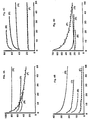
- Figure 4A, B, C, and D compare a platinum chlorided-alumina catalyst containing 0.3 wt% platinum and 0.9% Cl, a Pt silica-alumina catalyst containing 0.6 wt% platinum, a present invention catalyst having 0.3% Pt, 25% neodymium oxide, and 5% silica added, and a rare earth modified Pt silica-alumina catalyst having 25 wt% neodymium oxide and 0.3 wt% platinum.
- the catalysts are compared for n-C 7 conversion, aromatics selectivity, C 7 isomer selectivity, and C 5 -selectivity respectively, in a nC 7 reforming process.
- the present invention utilizes a weakly basic rare earth oxide to systematically decrease the acidity of an amorphous silica-alumina support, hereinafter referred to as a singly modified support, to levels near those exhibited by halided-alumina catalysts.
- a Group IVB oxide is then added to the support, hereinafter referred to as a doubly modified support, to increase the dispersion of a metal, e.g. platinum, which is incorporated later.
- the doubly modified support having platinum dispersed thereon, can function as a hydrocarbon conversion catalyst in reactions where platinum supported on halided-Al 2 O 3 is used, for example, in reforming.
- Systematically as used herein means that the catalyst's acidity decreases proportionally to the amount of rare earth oxide added to the amorphous silica-alumina support.
- the amorphous silica-alumina support of the present catalyst may be prepared by any of a number of conventional methods known to those skilled in the art. Alternatively, the amorphous silica-alumina support may be purchased from commercial sources.
- the support of the instant catalyst has a silica to alumina ratio of between about 95:5 & 50:50, preferably 75:25 SiO 2 :Al 2 O 3 .
- the amorphous silica-alumina support Prior to modification by addition of a rare earth oxide, the amorphous silica-alumina support is calcined in air at a temperature ranging from about 200 to about 600°C. The support is then impregnated with an aqueous solution of a rare earth salt which upon subsequent calcination is converted to a rare earth oxide.
- the rare earths are those elements of the periodic table having atomic numbers 57 to 71. Also included is yttrium, having an atomic number of 39, which behaves similar to rare earths in many applications. Suitable rare earths include, for example, neodymium, gadolinium and samarium with neodymium and yttrium being preferred. Mixtures of rare earth oxides may also be used.
- the amount of rare earth oxide impregnated onto the silica-alumina support ranges from about 1 wt% to about 90 wt%, preferably 10 wt% to about 25 wt%.
- the rare earth oxide is added to the support in the form of a hydrated salt, e.g. Nd(NO 3 ) 3 ⁇ 6H 2 O.
- the impregnation is accomplished via the incipient wetness technique, however, other techniques, such as ion exchange, chemical vapor deposition, or decomposition of organometallic compounds or other rare earth oxide precursors, known to those skilled in the art are also suitable.
- the impregnated support is then dried at about 100 to about 150°C and calcined between about 300 and about 900°C, preferably about 400 to about 600°C for about 1 to about 24 hours, preferably about 4 hours. Calcination converts the hydrated salt to the rare earth oxide.
- a Group IVB oxide is added to the support in amounts ranging from 0.1 to 15 wt%, preferably 1 to 10 wt%.
- the Group IVB oxide is selected from silica, germania, tin oxide and mixtures thereof.
- silica is used as the Group IVB oxide.
- the Group IVB oxide is typically incorporated into the singly modified amorphous silica-alumina support in the form of a water soluble salt or a Group IVB organic compound. For example, an ethanolic solution of tetraethoxysilane may be used.
- the support is then calcined to convert the Group IVB hydroxide compound, for example Si(OH) 4 , to the oxide.
- the SiO 2 -Al 2 O 3 support modified by both rare earth and Group IVB oxides, is referred to as doubly modified.
- Metal(s) selected from the group consisting of Group VIII noble metal(s), mixtures of Group VIII noble metal(s) and rhenium, mixtures of Group VIII noble metal(s) and tin, and mixtures of Group VIII noble metal(s), tin, and rhenium, are then impregnated onto the doubly modified amorphous silica-alumina support to provide a hydrogenation-dehydrogenation function.
- Group VIII noble metal(s) most preferably platinum will be employed.
- the Group VIII noble metal(s) will be present on the catalyst in an amount from about 0.01 to about 10 wt%, calculated on an elemental basis, of the final catalyst composition.
- the catalyst will contain from about 0.01 to about 2.0 wt%, most preferably about 0.3 to 0.6 wt% Group VIII noble metal(s).
- the catalyst of the present invention may also contain promoters or other metals that may be used in conjunction with, e.g. platinum, in reforming or isomerization, especially wax isomerization, such as iridium, rhenium, palladium, ruthenium, rhodium and mixtures thereof in concentrations ranging from about 0.01 to 10 wt%, preferably from about 0.01 to 2.0 wt%, more preferably from about 0.3 to 0.6 wt%.
- tin may also be present, alone or in conjunction with rhenium, in concentrations ranging from about 0.01 to 10 wt%, preferably from about 0.01 to 2.0 wt%, more preferably from about 0.3 to 0.6 wt%. Preferably tin will be present with platinum.
- the metals can be incorporated onto the doubly modified support via the incipient wetness technique, or other suitable technique known to those skilled in the art.
- An absorption technique from a dilute or concentrated solution or evaporation may also be used.
- the solution used in impregnating the catalyst e.g. can be a neutral salt or acid solution having the respective Group VIII noble metal(s), and mixtures of Group VIII noble metal(s) and rhenium and/or tin dissolved therein.
- the impregnation can be carried out under a variety of conditions known to those skilled in the art including ambient and elevated temperatures, and atmospheric and superatmospheric conditions.
- the catalyst after impregnation of the Group VIII noble metal or mixtures of Group VIII noble metal(s) and tin and/or rhenium, is dried by heating at a temperature above about 27°C, preferably between about 65°C and 150°C, in the presence of nitrogen, oxygen, or both, in an air stream or under vacuum. It is then calcined at a temperature from about 300°C to 650°C, preferably 400°C to 560°C, in the presence of nitrogen or oxygen in an air stream, or in the presence of an inert gas or a mixture of oxygen and an inert gas. This calcination, or activation, is conducted for periods ranging from about 1 to about 24 hours in either flowing or static gases.
- the catalyst of the present invention can be contacted with a feedstream comprising C 5 +.
- the feedstream will preferably by C 5 to C 232°C hydrocarbons, in an isomerization reaction using a liquid feedstream, the feedstream will preferably be normal C 5 to C 9 paraffins.
- the feed will preferably be C 12 + hydrocarbons.
- a hydrotreated (low wt % sulfur) naphtha stream comprising C 5 +, preferably C 5 to C 232°C hydrocarbons, that typically contains about 20-80 volume % paraffins, 20-80 volume % naphthenes, and about 5-20 volume % aromatics, and boiling at atmospheric pressure between about 27° and 232°C, preferably between about 66° and 191°C, is brought into contact with the catalyst system of the present invention in the presence of hydrogen.
- the reaction typically takes place in the vapor phase at a temperature ranging from about 350 to 550°C, preferably about 400° to 530°C.
- Reaction zone pressures may range from about 1 to 50 atmospheres (1.01 to 50.69 bar), preferably from about 3 to 25 atmospheres (3.04 to 25.34 bar).
- the naphtha feedstream is generally passed over the catalyst at space velocities ranging from about 0.5 to 20 parts by weight of naphtha per hour per part by weight of catalyst (w/w/hr), preferably from about 1 to 10 w/w/hr.
- the hydrogen to hydrocarbon mole ratio within the reaction zone is maintained between about 0.5 and 20, preferably between 1 and 10.
- the hydrogen employed can be in admixture with light paraffinic gaseous hydrocarbons. Since the hydroforming process produces large quantities of hydrogen, a recycle stream is employed for admission of hydrogen with the feed.
- the wax which may be isomerized using the catalyst of the present invention is any readily available natural or synthetic wax.
- Natural waxes include those waxes obtained by dewaxing natural hydrocarbons, commonly called slack waxes. Slack waxes may contain up to 40% of a liquid hydrocarbon phase admixed with the wax.
- Slack waxes coming from natural petroleum sources, contain numerous molecular species such as heteroatom compounds and polynuclear aromatic materials which are detrimental to the life and activity of isomerization catalysts.
- the heteroatoms should be removed prior to isomerization using a hydrotreating catalyst under mild hydrotreating conditions.
- Exemplary of hydrotreating catalysts are Ni/Mo on alumina and Co/Mo on alumina.
- Hydrotreating conditions are 250°C-400°C; 0.1-10 LHSV; 500 to 3000 psi (34.48 to 206.89 bar) H 2 ; 500-2000 SCF H 2 /bbl (88.95 - 355.79 m 3 H 2 /m 3 ).
- acceptable levels will be a nitrogen content of about 1-5 ppm, preferably 2 ppm and less and a sulfur content of about 1-20 ppm, preferably 5 ppm and less.
- Fischer-Tropsch Wax may be made from natural gas. Under known conditions, natural gas is converted to synthesis gas (CO + H 2 ) which may then be converted by the Fischer-Tropsch process to gaseous and liquid hydrocarbons and a normally solid paraffin wax, known as Fischer-Tropsch Wax.
- This wax does not contain the sulfur, nitrogen, or metal impurities normally found in naturally occurring oil, but it is known to contain water and a number of oxygenate compounds such as alcohols, ketones, aldehydes, etc. Hydrotreating to remove oxygenates and reduce olefin concentration may be desirable.
- Isomerization, especially wax isomerization, over the catalyst of the present invention can be conducted at a temperature of 250 to 400°C, 100 to 3000 psi (6.89 to 206.89 bar) H 2 ; 500 to 10000 SCF/bbl (88.95 to 1778.93 m 3 H 2 /m 3 ), H 2 , and 0.1 to 10.0 LHSV, preferably 300 to 400°C, 1000 to 1500 psi (68.96 to 103.45 bar) H 2 , and 1 to 2 V/V/hr.
- the catalysts of the instant invention were prepared by first calcining an amorphous silica-alumina support containing 75% silica and 25% alumina at 600°C overnight. Various amounts of Nd(NO 3 ) 3 ⁇ 6H 2 O or Y(NO 3 ) 3 ⁇ 6H 2 O, as indicated in Table 1, were added to 9 cc of water and impregnated onto 14 grams of the calcined amorphous silica-alumina support via the incipient wetness technique to obtain the compositions shown in Table 1.
- Each of the above singly modified supports was then impregnated with silica in the following manner.
- the weight of tetraethoxysilane indicated in Table 2, to prepare different weight loadings of silica was diluted to a total volume of 5 cc with ethanol and impregnated via the incipient wetness technique onto 9.5 grams of the above singly modified amorphous silica-alumina supports.
- the supports were then placed along with a vessel of water into a sealed container for 48 hours, to create a high relative humidity to hydrolyze the tetraethoxysilane to Si(OH) 4 .
- the supports were then calcined at 500°C for 3 hours.
- Table 2 Grams Tetraethoxysilane % Silica Impregnated 0.32 1 0.84 2.5 1.73 5
- Table 3 shows the % of the rare earth oxide, as well as the % silica contained in the doubly modified amorphous silica-alumina supports.
- Table 3 Wt% Nd 2 O 3 Wt% Y 2 O 3 Wt% SiO 2 17 -- 2.5 25 -- 1 25 -- 2.5 25 -- 5 30 -- 5 18 1 18 5
- Each catalyst support impregnated with platinum contained 0.3 wt% platinum. Additionally, a portion of calcined amorphous silica-alumina was impregnated with 0.6% platinum via the above technique. Chlorided alumina supports having 0.6%, 0.9%, 1.2%, and 1.5% chloride were prepared and used for comparison. The chlorided-alumina sample containing 0.9% chloride was also impregnated with 0.3% platinum and used for comparison in reforming reactions.
- the formation rates and rate ratios of various hexene products can be used to estimate both acid site concentrations and acid site strengths.
- the product hexene isomers formed include 4-methylpent-2-ene (4MP2), t-3-methylpent-2-ene (t-3MP2), and 2,3 dimethylbute-2-ene (2,3 DMB2).
- 4MP2 requires only a double bond shift, a reaction occurring on weak acid sites.
- 3MP2 involving a methyl group shift required stronger acidity than the double bond shift, and 2,3 DMB2 requires even stronger acidity to create a second methyl branch.
- the % conversion of 2-methylpent-2ene as well as the ratios of t-3MP2/4MP2, 2,3 DMB2/4MP2, and % C 5 - selectivity were determined.
- the catalysts were reduced for 1 hour at 500°C prior to the run.
- the runs were conducted at 2.5 w/w/hr and 15 psia.
- the following data, in Table 4, was obtained after 1 hour on feed.
- the numbers appearing before the Nd, Y or Si indicate the wt% of that oxide present.
- the metal symbol was used as a shorthand, however, it is understood that it is the oxide that is present.
- the silica-alumina support was also designated in this fashion as Si-Al.
- 25Nd/1Si/Si-Al represents an amorphous silica-alumina (Si-Al) support having 25 wt% neodymium oxide (25Nd) dispersed thereon, and additionally having 1 wt% silica (1Si) added.
- Figure 1 graphically depicts the results obtained from the catalyst supports of Example 1 prior to platinum incorporation when employed in the 2MP2 acidity probe test.
- the ratio of t-3MP2/4MP2 is shown.
- the results show that rare earth addition to amorphous silica-alumina systematically lowers acidity, further addition of Group IVB oxide, e.g. silica, increases the acidity.
- Group IVB oxide e.g. silica
- the addition of silica to the rare earth oxide modified support suprisingly behaves different than addition of silica to an unmodified silica-alumina support.
- the catalysts were calcined at 500°C prior to platinum impregnation and then impregnated with 0.3 wt% platinum by chloroplatinic acid, calcined at 450°C, and then reduced at 450°C.
- the platinum dispersion was measured by H 2 chemisorption and the weak adsorption as determined from the backsorption was subtracted from the total adsorption to give values indicative of only the strongly chemisorbed sites.
- the results are shown in Figure 2.
- the Y axis shows the H/M chemisorption after 450°C calcination and reduction.
- the X axis shows the % neodymium oxide incorporated into the amorphous silica-alumina.
- the catalysts prepared in accordance with Example 1 were tested for conversion of cyclohexene to cyclohexane. This test was performed to monitor the dispersion of the platinum in a hydrogenation reaction which primarily depends on the metal activity or dispersion.
- the following catalysts were employed: 0.3 wt% Pt on 17 wt% Nd 2 O 3 modified SiO 2 -Al 2 O 3 hereinafter referred to as catalyst (A), 0.3 wt% Pt on 25 wt% Nd 2 O 3 modified SiO 2 -Al 2 O 3 hereinafter referred to as catalyst (B), 0.3 wt% Pt on 25 wt% Nd 2 O 3 modified SiO 2 -Al 2 O 3 having 5 wt% silica added hereinafter referred to as catalyst (D), 0.6 wt% Pt on SiO 2 -Al 2 O 3 hereinafter referred to as catalyst (F), and 0.3 wt% Pt on 0.9 wt% chlorided
- Catalysts (D) and (G) were more active at a given temperature than catalysts (A), (B) and (F) indicating that the catalysts having added Group IVB oxide, which showed higher platinum dispersion in Example 2, also exhibit increased reactivity for cyclohexene hydrogenation compared with rare-earth modified catalysts without added silica. Furthermore, catalyst (D)'s activity was very close to that of catalyst (G), the platinum chlorided alumina catalyst, confirming the dispersion measurements.
- the n-C 7 activity of the catalysts was compared.
- the platinum on chlorided alumina (G) showed about 80% conversion over a period of 50 hours.
- the Pt on Si-Al catalyst (F) exhibited about an 85% conversion initially, but dropped off after about 8 hours stabilizing around 30 to 40% after about 20 hours and continuing for the entirety of the run.
- the present invention catalyst having 5 wt% silica added (D) showed about 65% conversion initially and dropped off, stabilizing at about 55% for the entirety of the run.
- the 25 wt% neodymium oxide-modified catalyst having 0.3 wt% platinum (B) was only run for 20 hours and showed about 42-50% conversion for that time.
- Figure 4A shows these results. Each curve is designated by the letter of the catalyst it represents.
- the present invention catalyst shows higher stability than the platinum silica-alumina catalyst (F).
- the present invention catalyst performance is closer to that of the platinum chlorided-alumina catalyst (G) than the same catalyst without Group IVB oxide addition (B).
- the Y axis in the figure is nC 7 conversion, the X axis time in hours.
- Example 4 The catalysts of Example 4 were compared for aromatics (benzene and toluene) wt% selectivity over a 50 hour period with the following results:
- the platinum on chlorided alumina catalyst (G) showed a % selectivity of about 38% initially and dropped off at about 3 hours stabilizing at about 25%-20% over the remainder of 50 hour run.
- the present invention catalyst having 5 wt% silica added, catalyst (D), began at about 24% selectivity at about 3 hours, and stabilized at about 18% for the remainder of the run.
- the 25 wt% neodymium oxide modified silica-alumina catalyst (B) began at about 18% stabilizing at about 9 to 10% selectivity up to about 20 hours when the run was terminated.
- the platinum on silica-alumina catalyst (F) began at about 8%, stabilizing at about 4% for the remainder of the run.
- the results are graphically depicted in Figure 4 View B. The letters designated indicate which particular catalyst the line represents. The results indicate that catalyst (D) is improved over catalyst (B) as a result of silica addition.
- the catalyst of the present invention (D) began at about 43% and rose to about 63%, remaining there for the entire run.
- the rare-earth oxide modified catalyst (B) began at about 60% rising to about 70% for its entire run of 20 hours.
- the platinum on chlorided catalyst (G) showed a steady C 7 isomer selectivity of about 43%.
- the Pt/Si-Al catalyst (F) showed about 18% selectivity.
- the results are graphically depicted in Figure 4C. The lines represent the catalysts as noted by the letters designated.
- the catalysts were also compared for C 5 - selectivity.
- the present invention catalyst (D) showed about 30% selectivity initially, stabilizing at about 20%.
- Catalyst (G), Pt on chlorided alumina, began at about 20% and rose to about 25%.
- the Pt on silica alumina catalyst (F) began at about 68% and dropped to between 25-30% for the remainder of the run at about 20 hours.
- the rare earth oxide modified catalyst (B) began at about 22% and thereafter remained at about 18% for the remainder of its 20 hour run.
- the results are graphically depicted in Figure 4D.
- the Y axis shows C 5 - selectivity and the X axis time in hours.
Landscapes
- Chemical & Material Sciences (AREA)
- Engineering & Computer Science (AREA)
- Organic Chemistry (AREA)
- Chemical Kinetics & Catalysis (AREA)
- Materials Engineering (AREA)
- Oil, Petroleum & Natural Gas (AREA)
- General Chemical & Material Sciences (AREA)
- Catalysts (AREA)
- Production Of Liquid Hydrocarbon Mixture For Refining Petroleum (AREA)
- Organic Low-Molecular-Weight Compounds And Preparation Thereof (AREA)
Description
- The present invention relates to a hydrocarbon conversion catalyst comprising noble metal on a rare earth and Group IVB oxides-modified silica-alumina support.
- US-A-3927131 describes and claims a method for thermally dehydrochlorinating a C2-12 chlorinated hydrocarbon which involves vapor-phase contacting with a catalyst consisting essentially of a rare earth oxide in combination with a platinum group metal on a support.
- EP-A-0 558 343 describes and claims a catalyst composition comprising an amorphous silica-alumina support having at least 50 wt.% silica, a rare earth oxide, and metal(s) selected from the group consisting of Group VIII noble metal(s), mixtures of Group VIII noble metal(s) and rhenium, and mixtures of Group VIII noble metal(s) and tin. The catalyst composition is used for catalytic hydroconversion, including hydroisomerization, of a C5+ feedstream.
- The applicants have discovered that the addition of Group IVB oxides to a catalyst comprising a rare earth oxide-modified amorphous silica-alumina support and a metal(s) functionality affords a catalyst having enhanced metal(s) dispersion and activity which can function as a hydrocarbon conversion catalyst in reactions such as reforming and isomerization, especially wax isomerization. The novel catalyst can be utilized as a hydrocarbon conversion catalyst in reforming reactions typically employing platinum on chlorided-alumina catalysts, thereby, removing the necessity of inconvenient, environmentally detrimental chlorine addition required during reforming over chlorided-alumina catalysts. Additionally, the catalyst provides permanent acidity, unlike chlorided-alumina catalysts whose acidity decreases as chlorine is depleted during use of the catalyst, thereby lowering activity and requiring continuous chlorine addition to maintain acidity and catalyst performance.
- The novel catalysts exhibit enhanced cyclohexene hydrogenation, and enhanced activity and aromatic selectivity during C7 reforming, when compared to catalysts without the addition of Group IVB oxides. The novel catalyst's C7 isomerization selectivity is reduced and C5- selectivity is only slightly increased.
- The present invention provides a catalyst composition comprising a support having dispersed thereon at least one Group VIII noble metal component and optionally a tin component and/or a rhenium component, wherein the support comprises amorphous silica-alumina, of which at least 50 wt% is silica, having dispersed thereon a Group IVB oxide and one or more rare earth metal oxides and/or yttrium oxide.
- In this patent specification, the term "amorphous" means non-crystalline as indicated by the absence of sharp X-ray diffraction lines. "Rare earth metal" includes the rare earth metals and yttrium.
- The Group IVB oxide may be present in an amount of in the range of from 0.1 to 15 weight percent, and is selected from the group consisting of silica, germania, tin oxide and mixtures thereof, with the proviso that if there is only one group IVB oxide, this is not tin oxide.
- The Group VIII noble metal may be present in an amount in the range of from 0.01 to 10 weight percent.
- The said silica-alumina support may have a ratio of silica:alumina in the range of from 50:50 to 95:5.
- The said rare earth oxide and/or yttrium oxide may be present in an amount between 1 wt% and 90 wt%, and may be selected from the group consisting of oxides of the elements of the periodic table having atomic numbers of from 57 to 71 and 39.
- The present invention also provides a catalytic hydroconversion process comprising contacting a hydrocarbon feedstream with a catalyst composition as described under hydroconversion conditions. The feedstream may be a reforming feedstream which is contacted with the catalyst under reforming conditions. The feedstream may be an isomerization feedstream which is contacted with the catalyst under isomerization conditions. The isomerization feedstream may be a natural wax or a synthetic wax.
- Figure 1 compares the acidities of rare earth modified amorphous silica-alumina, Group IVB oxide additions to rare earth modified silica-alumina, silica-alumina, and chlorided-alumina catalysts. Catalyst comparison is accomplished by using the 2-methylpent-2-ene acidity probe test by measuring the ratio of 3-methylpent-2-ene to 4-methylpent-2-ene isomers.
- Figure 2 depicts the enhancement of platinum dispersion afforded by Group IVB oxide containing rare earth modified amorphous silica-alumina by measuring the number of H atoms chemisorbed per Pt metal atom (H/M) using H2 chemisorption techniques.
- Figure 3 shows % conversion of cyclohexene hydrogenated to cyclohexane of catalysts containing 0.3 wt% platinum and 0.9% Cl, a Pt silica-alumina catalyst containing 0.6 wt% platinum, a present invention catalyst having 0.3% Pt, 25% neodymium oxide, and 5% silica added, a rare earth modified Pt silica-alumina catalyst having 25 wt% neodymium oxide and 0.3 wt% platinum, and a rare earth modified Pt silica-alumina catalyst having 17% neodymium oxide and 0.3% platinum.
- Figure 4A, B, C, and D compare a platinum chlorided-alumina catalyst containing 0.3 wt% platinum and 0.9% Cl, a Pt silica-alumina catalyst containing 0.6 wt% platinum, a present invention catalyst having 0.3% Pt, 25% neodymium oxide, and 5% silica added, and a rare earth modified Pt silica-alumina catalyst having 25 wt% neodymium oxide and 0.3 wt% platinum. The catalysts are compared for n-C7 conversion, aromatics selectivity, C7 isomer selectivity, and C5-selectivity respectively, in a nC7 reforming process.
- The present invention utilizes a weakly basic rare earth oxide to systematically decrease the acidity of an amorphous silica-alumina support, hereinafter referred to as a singly modified support, to levels near those exhibited by halided-alumina catalysts. A Group IVB oxide is then added to the support, hereinafter referred to as a doubly modified support, to increase the dispersion of a metal, e.g. platinum, which is incorporated later. Thus, the doubly modified support, having platinum dispersed thereon, can function as a hydrocarbon conversion catalyst in reactions where platinum supported on halided-Al2O3 is used, for example, in reforming. Systematically as used herein means that the catalyst's acidity decreases proportionally to the amount of rare earth oxide added to the amorphous silica-alumina support.
- The amorphous silica-alumina support of the present catalyst may be prepared by any of a number of conventional methods known to those skilled in the art. Alternatively, the amorphous silica-alumina support may be purchased from commercial sources. The support of the instant catalyst has a silica to alumina ratio of between about 95:5 & 50:50, preferably 75:25 SiO2:Al2O3.
- Prior to modification by addition of a rare earth oxide, the amorphous silica-alumina support is calcined in air at a temperature ranging from about 200 to about 600°C. The support is then impregnated with an aqueous solution of a rare earth salt which upon subsequent calcination is converted to a rare earth oxide. The rare earths are those elements of the periodic table having atomic numbers 57 to 71. Also included is yttrium, having an atomic number of 39, which behaves similar to rare earths in many applications. Suitable rare earths include, for example, neodymium, gadolinium and samarium with neodymium and yttrium being preferred. Mixtures of rare earth oxides may also be used. The amount of rare earth oxide impregnated onto the silica-alumina support ranges from about 1 wt% to about 90 wt%, preferably 10 wt% to about 25 wt%. Typically, the rare earth oxide is added to the support in the form of a hydrated salt, e.g. Nd(NO3)3·6H2O. The impregnation is accomplished via the incipient wetness technique, however, other techniques, such as ion exchange, chemical vapor deposition, or decomposition of organometallic compounds or other rare earth oxide precursors, known to those skilled in the art are also suitable. The impregnated support is then dried at about 100 to about 150°C and calcined between about 300 and about 900°C, preferably about 400 to about 600°C for about 1 to about 24 hours, preferably about 4 hours. Calcination converts the hydrated salt to the rare earth oxide.
- Following the rare earth oxide modification, a Group IVB oxide is added to the support in amounts ranging from 0.1 to 15 wt%, preferably 1 to 10 wt%. The Group IVB oxide is selected from silica, germania, tin oxide and mixtures thereof. Preferably silica is used as the Group IVB oxide. The Group IVB oxide is typically incorporated into the singly modified amorphous silica-alumina support in the form of a water soluble salt or a Group IVB organic compound. For example, an ethanolic solution of tetraethoxysilane may be used. Following exposure to a wet atmosphere to hydrolyze the Group IVB compound, the support is then calcined to convert the Group IVB hydroxide compound, for example Si(OH)4, to the oxide. At this point, the SiO2-Al2O3 support, modified by both rare earth and Group IVB oxides, is referred to as doubly modified.
- Metal(s) selected from the group consisting of Group VIII noble metal(s), mixtures of Group VIII noble metal(s) and rhenium, mixtures of Group VIII noble metal(s) and tin, and mixtures of Group VIII noble metal(s), tin, and rhenium, are then impregnated onto the doubly modified amorphous silica-alumina support to provide a hydrogenation-dehydrogenation function. Preferably Group VIII noble metal(s), most preferably platinum will be employed. The Group VIII noble metal(s) will be present on the catalyst in an amount from about 0.01 to about 10 wt%, calculated on an elemental basis, of the final catalyst composition. More preferably, the catalyst will contain from about 0.01 to about 2.0 wt%, most preferably about 0.3 to 0.6 wt% Group VIII noble metal(s). The catalyst of the present invention may also contain promoters or other metals that may be used in conjunction with, e.g. platinum, in reforming or isomerization, especially wax isomerization, such as iridium, rhenium, palladium, ruthenium, rhodium and mixtures thereof in concentrations ranging from about 0.01 to 10 wt%, preferably from about 0.01 to 2.0 wt%, more preferably from about 0.3 to 0.6 wt%. When Group VIII noble metal(s) are employed, tin may also be present, alone or in conjunction with rhenium, in concentrations ranging from about 0.01 to 10 wt%, preferably from about 0.01 to 2.0 wt%, more preferably from about 0.3 to 0.6 wt%. Preferably tin will be present with platinum.
- The metals can be incorporated onto the doubly modified support via the incipient wetness technique, or other suitable technique known to those skilled in the art. An absorption technique from a dilute or concentrated solution or evaporation may also be used. The solution used in impregnating the catalyst e.g. can be a neutral salt or acid solution having the respective Group VIII noble metal(s), and mixtures of Group VIII noble metal(s) and rhenium and/or tin dissolved therein. The impregnation can be carried out under a variety of conditions known to those skilled in the art including ambient and elevated temperatures, and atmospheric and superatmospheric conditions.
- The catalyst after impregnation of the Group VIII noble metal or mixtures of Group VIII noble metal(s) and tin and/or rhenium, is dried by heating at a temperature above about 27°C, preferably between about 65°C and 150°C, in the presence of nitrogen, oxygen, or both, in an air stream or under vacuum. It is then calcined at a temperature from about 300°C to 650°C, preferably 400°C to 560°C, in the presence of nitrogen or oxygen in an air stream, or in the presence of an inert gas or a mixture of oxygen and an inert gas. This calcination, or activation, is conducted for periods ranging from about 1 to about 24 hours in either flowing or static gases.
- The catalyst of the present invention can be contacted with a feedstream comprising C5+. When utilized in a reforming process the feedstream will preferably by C5 to C 232°C hydrocarbons, in an isomerization reaction using a liquid feedstream, the feedstream will preferably be normal C5 to C9 paraffins. When a wax isomerization reaction is performed, the feed will preferably be C12+ hydrocarbons.
- In a catalytic reforming process, a hydrotreated (low wt % sulfur) naphtha stream comprising C5+, preferably C5 to C 232°C hydrocarbons, that typically contains about 20-80 volume % paraffins, 20-80 volume % naphthenes, and about 5-20 volume % aromatics, and boiling at atmospheric pressure between about 27° and 232°C, preferably between about 66° and 191°C, is brought into contact with the catalyst system of the present invention in the presence of hydrogen. The reaction typically takes place in the vapor phase at a temperature ranging from about 350 to 550°C, preferably about 400° to 530°C. Reaction zone pressures may range from about 1 to 50 atmospheres (1.01 to 50.69 bar), preferably from about 3 to 25 atmospheres (3.04 to 25.34 bar).
- The naphtha feedstream is generally passed over the catalyst at space velocities ranging from about 0.5 to 20 parts by weight of naphtha per hour per part by weight of catalyst (w/w/hr), preferably from about 1 to 10 w/w/hr. The hydrogen to hydrocarbon mole ratio within the reaction zone is maintained between about 0.5 and 20, preferably between 1 and 10. During the reforming process, the hydrogen employed can be in admixture with light paraffinic gaseous hydrocarbons. Since the hydroforming process produces large quantities of hydrogen, a recycle stream is employed for admission of hydrogen with the feed.
- The wax which may be isomerized using the catalyst of the present invention is any readily available natural or synthetic wax. Natural waxes include those waxes obtained by dewaxing natural hydrocarbons, commonly called slack waxes. Slack waxes may contain up to 40% of a liquid hydrocarbon phase admixed with the wax.
- Slack waxes, coming from natural petroleum sources, contain numerous molecular species such as heteroatom compounds and polynuclear aromatic materials which are detrimental to the life and activity of isomerization catalysts. Thus, the heteroatoms should be removed prior to isomerization using a hydrotreating catalyst under mild hydrotreating conditions. Exemplary of hydrotreating catalysts are Ni/Mo on alumina and Co/Mo on alumina. Hydrotreating conditions are 250°C-400°C; 0.1-10 LHSV; 500 to 3000 psi (34.48 to 206.89 bar) H2; 500-2000 SCF H2/bbl (88.95 - 355.79 m3 H2/m3). Following hydrotreating, acceptable levels will be a nitrogen content of about 1-5 ppm, preferably 2 ppm and less and a sulfur content of about 1-20 ppm, preferably 5 ppm and less.
- Waxes which may be isomerized using the catalyst of the present invention also include Fischer-Tropsch Wax. Fischer-Tropsch Wax may be made from natural gas. Under known conditions, natural gas is converted to synthesis gas (CO + H2) which may then be converted by the Fischer-Tropsch process to gaseous and liquid hydrocarbons and a normally solid paraffin wax, known as Fischer-Tropsch Wax. This wax does not contain the sulfur, nitrogen, or metal impurities normally found in naturally occurring oil, but it is known to contain water and a number of oxygenate compounds such as alcohols, ketones, aldehydes, etc. Hydrotreating to remove oxygenates and reduce olefin concentration may be desirable.
- Isomerization, especially wax isomerization, over the catalyst of the present invention can be conducted at a temperature of 250 to 400°C, 100 to 3000 psi (6.89 to 206.89 bar) H2; 500 to 10000 SCF/bbl (88.95 to 1778.93 m3 H2/m3), H2, and 0.1 to 10.0 LHSV, preferably 300 to 400°C, 1000 to 1500 psi (68.96 to 103.45 bar) H2, and 1 to 2 V/V/hr.
- The following examples are illustrative of the invention though not limiting.
- The catalysts of the instant invention were prepared by first calcining an amorphous silica-alumina support containing 75% silica and 25% alumina at 600°C overnight. Various amounts of Nd(NO3)3·6H2O or Y(NO3)3·6H2O, as indicated in Table 1, were added to 9 cc of water and impregnated onto 14 grams of the calcined amorphous silica-alumina support via the incipient wetness technique to obtain the compositions shown in Table 1.
Table 1 Grams % Rare Earth Oxide On Amorphous Silica-Alumina Nd(NO3)3·6H2O Y(NO3)3·6H2O 7.5 -- 17% Nd2O3 12.2 -- 25% Nd2O3 15.6 -- 30% Nd2O3 -- 10.6 18% Y2O3 - Each of the above singly modified supports was then impregnated with silica in the following manner. The weight of tetraethoxysilane indicated in Table 2, to prepare different weight loadings of silica, was diluted to a total volume of 5 cc with ethanol and impregnated via the incipient wetness technique onto 9.5 grams of the above singly modified amorphous silica-alumina supports. The supports were then placed along with a vessel of water into a sealed container for 48 hours, to create a high relative humidity to hydrolyze the tetraethoxysilane to Si(OH)4. The supports were then calcined at 500°C for 3 hours.
Table 2 Grams Tetraethoxysilane % Silica Impregnated 0.32 1 0.84 2.5 1.73 5 Table 3 Wt% Nd2O3 Wt% Y2O3 Wt% SiO2 17 -- 2.5 25 -- 1 25 -- 2.5 25 -- 5 30 -- 5 18 1 18 5 - Platinum was then impregnated onto selected doubly modified supports. 4.985 grams of each support selected was impregnated via the incipient wetness technique with 2.5 cc of an aqueous chloroplatinic acid solution containing 0.015 g of platinum followed by drying at 110°C overnight and air calcination at 450°C for three hours.
- Each catalyst support impregnated with platinum contained 0.3 wt% platinum. Additionally, a portion of calcined amorphous silica-alumina was impregnated with 0.6% platinum via the above technique. Chlorided alumina supports having 0.6%, 0.9%, 1.2%, and 1.5% chloride were prepared and used for comparison. The chlorided-alumina sample containing 0.9% chloride was also impregnated with 0.3% platinum and used for comparison in reforming reactions.
- Prior to incorporating platinum, several supports prepared in accordance with the above methods were compared for acidity using the 2-methylpent-2-ene (2MP2) acidity probe test. Additionally, one support containing only 5% added silica (no rare earth oxide added) was prepared by omitting the rare earth oxide addition step. Also compared were the chlorided-alumina samples.
- The formation rates and rate ratios of various hexene products can be used to estimate both acid site concentrations and acid site strengths. The product hexene isomers formed include 4-methylpent-2-ene (4MP2), t-3-methylpent-2-ene (t-3MP2), and 2,3 dimethylbute-2-ene (2,3 DMB2). 4MP2 requires only a double bond shift, a reaction occurring on weak acid sites. 3MP2 involving a methyl group shift required stronger acidity than the double bond shift, and 2,3 DMB2 requires even stronger acidity to create a second methyl branch. For a homologous series of solid acids, differences in t-3MP2 rates normalized with respect to surface area reflect the density of acid sites possessing strengths sufficient to catalyze the skeletal isomerization. Since skeletal isomerization rates generally increase with increasing acid strength, the ratio of methyl group migration rate to double bond shift rate should increase with increasing acid strength. The use of rate ratios, in lieu of individual conversion rates is preferable since differences in acid site populations are normalized.
- The % conversion of 2-methylpent-2ene as well as the ratios of t-3MP2/4MP2, 2,3 DMB2/4MP2, and % C5- selectivity were determined. The catalysts were reduced for 1 hour at 500°C prior to the run. The runs were conducted at 2.5 w/w/hr and 15 psia. The following data, in Table 4, was obtained after 1 hour on feed. The numbers appearing before the Nd, Y or Si indicate the wt% of that oxide present. The metal symbol was used as a shorthand, however, it is understood that it is the oxide that is present. The silica-alumina support was also designated in this fashion as Si-Al. For example, 25Nd/1Si/Si-Al represents an amorphous silica-alumina (Si-Al) support having 25 wt% neodymium oxide (25Nd) dispersed thereon, and additionally having 1 wt% silica (1Si) added.
Table 4 Catalyst % Conversion t- 3MP2/4MP2 2,3DMB2/4MP2 % C5- Si-Al 75 2.87 0.69 1.73 25Nd/Si-Al 47 0.47 0.055 0.17 25Nd/1Si/Si-Al 53 0.87 0.094 0.40 25Nd/2.5Si/Si-Al 55 0.97 0.11 0.51 25Nd/5Si/Si-Al 67 1.79 0.21 1.07 17Nd/2.5Si/Si-Al 67 1.97 0.26 1.17 30Nd/5Si/Si- Al 50 0.70 0.70 0.40 18Y/Si-Al 43 0.36 0.048 0.102 18Y/5Si/Si-Al 69 1.18 0.14 1.17 5Si/Si-Al 64 1.64 0.20 1.15 0.6Cl/Al 29 0.2 0.084 0.026 0.9Cl/ Al 30 0.22 0.078 0.020 1.2Cl/Al 32 0.29 0.10 0.027 1.5Cl/Al 36 0.44 0.15 0.045 - Figure 1 graphically depicts the results obtained from the catalyst supports of Example 1 prior to platinum incorporation when employed in the 2MP2 acidity probe test. The ratio of t-3MP2/4MP2 is shown. The results show that rare earth addition to amorphous silica-alumina systematically lowers acidity, further addition of Group IVB oxide, e.g. silica, increases the acidity. However, the addition of silica to the rare earth oxide modified support suprisingly behaves different than addition of silica to an unmodified silica-alumina support.
- Catalysts prepared in the manner described in Example 1 containing 0.3 wt% platinum and having 0, 10, 17, 20 and 25 wt% neodymium oxide, prepared by using 0, 4.1, 7.5, 9.1, and 12.2 g of Nd(NO3)3·6H2O per 9 cc of water respectively impregnated on 14 gm of SiO2-Al2O3, were compared to the catalyst of Example 1 having 0.3 wt% platinum, 25 wt% neodymium oxide and 5 wt% silica added hereinafter designated (D) in Figure 2. The catalysts were calcined at 500°C prior to platinum impregnation and then impregnated with 0.3 wt% platinum by chloroplatinic acid, calcined at 450°C, and then reduced at 450°C. The platinum dispersion was measured by H2 chemisorption and the weak adsorption as determined from the backsorption was subtracted from the total adsorption to give values indicative of only the strongly chemisorbed sites. The results are shown in Figure 2. The Y axis shows the H/M chemisorption after 450°C calcination and reduction. The X axis shows the % neodymium oxide incorporated into the amorphous silica-alumina.
- The results demonstrate that addition of 5 wt% silica dramatically enhances platinum dispersion on a rare earth oxide modified amorphous silica-alumina catalyst.
- The catalysts prepared in accordance with Example 1 were tested for conversion of cyclohexene to cyclohexane. This test was performed to monitor the dispersion of the platinum in a hydrogenation reaction which primarily depends on the metal activity or dispersion. The following catalysts were employed: 0.3 wt% Pt on 17 wt% Nd2O3 modified SiO2-Al2O3 hereinafter referred to as catalyst (A), 0.3 wt% Pt on 25 wt% Nd2O3 modified SiO2-Al2O3 hereinafter referred to as catalyst (B), 0.3 wt% Pt on 25 wt% Nd2O3 modified SiO2-Al2O3 having 5 wt% silica added hereinafter referred to as catalyst (D), 0.6 wt% Pt on SiO2-Al2O3 hereinafter referred to as catalyst (F), and 0.3 wt% Pt on 0.9 wt% chlorided Al2O3 hereinafter referred to as catalyst (G).
- Catalysts (D) and (G) were more active at a given temperature than catalysts (A), (B) and (F) indicating that the catalysts having added Group IVB oxide, which showed higher platinum dispersion in Example 2, also exhibit increased reactivity for cyclohexene hydrogenation compared with rare-earth modified catalysts without added silica. Furthermore, catalyst (D)'s activity was very close to that of catalyst (G), the platinum chlorided alumina catalyst, confirming the dispersion measurements.
- The above results are more easily analyzed by reference to Figure 3 which shows the % conversion to cyclohexane at different temperatures. The curves designate the catalyst as indicated by the letters. The Y axis represents % conversion to cyclohexane and the X axis temperature in degrees C.
- The catalysts of Example 1 were compared in a reforming process at 160 psi, WHSV=12, and H2/nC7=6: present invention catalyst having 5 wt% silica added (D), the chlorided alumina catalyst having 0.3 wt% platinum and 0.9 wt% Cl. (G), the platinum silica-alumina catalyst having 0.6% platinum (F), the 25 wt% neodymium oxide modified silica-alumina containing 0.3 wt% platinum (B), and the 17 wt% neodymium oxide modified silica alumina containing 0.3 wt% platinum (A) were compared. The reaction was conducted, over a 50 hour period, in a fixed bed reactor equipped with a gas chromatograph.
- The n-C7 activity of the catalysts was compared. The platinum on chlorided alumina (G) showed about 80% conversion over a period of 50 hours. The Pt on Si-Al catalyst (F) exhibited about an 85% conversion initially, but dropped off after about 8 hours stabilizing around 30 to 40% after about 20 hours and continuing for the entirety of the run. The present invention catalyst having 5 wt% silica added (D) showed about 65% conversion initially and dropped off, stabilizing at about 55% for the entirety of the run. The 25 wt% neodymium oxide-modified catalyst having 0.3 wt% platinum (B) was only run for 20 hours and showed about 42-50% conversion for that time. Figure 4A shows these results. Each curve is designated by the letter of the catalyst it represents. From the figure it is evident that the present invention catalyst shows higher stability than the platinum silica-alumina catalyst (F). The present invention catalyst performance is closer to that of the platinum chlorided-alumina catalyst (G) than the same catalyst without Group IVB oxide addition (B). The Y axis in the figure is nC7 conversion, the X axis time in hours.
- The catalysts of Example 4 were compared for aromatics (benzene and toluene) wt% selectivity over a 50 hour period with the following results:
- The platinum on chlorided alumina catalyst (G) showed a % selectivity of about 38% initially and dropped off at about 3 hours stabilizing at about 25%-20% over the remainder of 50 hour run. The present invention catalyst having 5 wt% silica added, catalyst (D), began at about 24% selectivity at about 3 hours, and stabilized at about 18% for the remainder of the run. The 25 wt% neodymium oxide modified silica-alumina catalyst (B) began at about 18% stabilizing at about 9 to 10% selectivity up to about 20 hours when the run was terminated. The platinum on silica-alumina catalyst (F) began at about 8%, stabilizing at about 4% for the remainder of the run. The results are graphically depicted in Figure 4 View B. The letters designated indicate which particular catalyst the line represents. The results indicate that catalyst (D) is improved over catalyst (B) as a result of silica addition.
- The results shown in Figure 4B indicate that catalyst (D) is improved over catalyst (B) as a result of silica addition. The Y axis is aromatization selectivity and the X axis time in hours.
- The catalysts were also compared over the 50 hour period for C7 isomerization selectivity with the following results:
- The catalyst of the present invention (D) began at about 43% and rose to about 63%, remaining there for the entire run. The rare-earth oxide modified catalyst (B) began at about 60% rising to about 70% for its entire run of 20 hours. The platinum on chlorided catalyst (G) showed a steady C7 isomer selectivity of about 43%. The Pt/Si-Al catalyst (F) showed about 18% selectivity. The results are graphically depicted in Figure 4C. The lines represent the catalysts as noted by the letters designated.
- The figures Y axis shows C7 isomerization selectivity and the X axis is time in hours. Comparison of Views B and C of Figure 4 show that the decreased isomerization selectivity of catalyst (D) has resulted in increased aromatics.
- The catalysts were also compared for C5- selectivity. The present invention catalyst (D) showed about 30% selectivity initially, stabilizing at about 20%. Catalyst (G), Pt on chlorided alumina, began at about 20% and rose to about 25%. The Pt on silica alumina catalyst (F) began at about 68% and dropped to between 25-30% for the remainder of the run at about 20 hours. The rare earth oxide modified catalyst (B) began at about 22% and thereafter remained at about 18% for the remainder of its 20 hour run.
- The results demonstrate that the catalysts of the present invention are stable, affording better aromatic selectivity and lower cracking than Pt on Si-Al catalysts (F), but have a somewhat lower activity than chlorided catalysts (G). However, the activity is increased over that of the same catalyst without the oxide addition (B) and the aromatics selectivity increases substantially. The present invention catalyst (D) reduced cracking relative to Pt on Si-Al (F). The results are graphically depicted in Figure 4D. The lines represent the catalysts as noted by the letters. The Y axis shows C5- selectivity and the X axis time in hours.
Claims (9)
- A catalyst composition comprising at least one Group VIII noble metal component and optionally a tin component and/or a rhenium component dispersed on an amorphous silica-alumina support containing at least 50 wt.% silica, the support being modified by dispersing thereon one or more rare earth metal oxides and/or yttrium oxide, and a Group IVB oxide selected from the group consisting of silica, germania, tin oxide and mixtures therof, with the proviso that if there is only one Group IVB oxide, this is not tin oxide.
- A catalyst composition according to claim 1 wherein said Group IVB oxide is present in an amount in the range of from 0.1 to 15 weight percent.
- A catalyst composition according to any one of claims 1 to 2 wherein said Group VIII noble metal is present in an amount in the range of from 0.01 to 10 weight percent.
- A catalyst composition according to any one of claims 1 to 3 wherein said silica-alumina support has a ratio of silica:alumina in the range of from 50:50 to 95:5.
- A catalyst composition according to any one of claims 1 to 4 wherein said rare earth metal oxide and/or yttrium oxide is present in an amount between 1 wt% and 90 wt%.
- A catalyst composition according to any one of claims 1 to 5 wherein said rare earth metal oxide(s) is/are selected from the oxides of the elements of the periodic table having atomic numbers of from 57 to 71 and 39.
- A catalytic hydroconversion process comprising contacting a hydrocarbon feedstream with a catalyst composition according to any one of claims 1 to 6 under hydroconversion conditions.
- A process according to claim 7 wherein said feedstream is either: (a) a reforming feedstream which is contacted with the catalyst under reforming conditions, or: (b) an isomerization feedstream which is contacted with the catalyst under isomerization conditions.
- A process according to claim 7 or claim 8 wherein said feedstream is a synthetic wax or a natural wax.
Applications Claiming Priority (2)
| Application Number | Priority Date | Filing Date | Title |
|---|---|---|---|
| US07/916,759 US5254518A (en) | 1992-07-22 | 1992-07-22 | Group IVB oxide addition to noble metal on rare earth modified silica alumina as hydrocarbon conversion catalyst |
| US916759 | 1992-07-22 |
Publications (2)
| Publication Number | Publication Date |
|---|---|
| EP0580373A1 EP0580373A1 (en) | 1994-01-26 |
| EP0580373B1 true EP0580373B1 (en) | 1997-09-17 |
Family
ID=25437789
Family Applications (1)
| Application Number | Title | Priority Date | Filing Date |
|---|---|---|---|
| EP93305620A Expired - Lifetime EP0580373B1 (en) | 1992-07-22 | 1993-07-16 | Hydrocarbon conversion catalyst comprising noble metal on a rare earth and group IVB oxides modified silica-alumina support |
Country Status (5)
| Country | Link |
|---|---|
| US (2) | US5254518A (en) |
| EP (1) | EP0580373B1 (en) |
| JP (1) | JPH06170227A (en) |
| CA (1) | CA2099405A1 (en) |
| DE (1) | DE69313953T2 (en) |
Families Citing this family (27)
| Publication number | Priority date | Publication date | Assignee | Title |
|---|---|---|---|---|
| US5648577A (en) * | 1994-07-12 | 1997-07-15 | Exxon Research And Engineering Company | Dispersed metal sulfide catalysts for hydroprocessing (LAW105) |
| US5565086A (en) * | 1994-11-01 | 1996-10-15 | Exxon Research And Engineering Company | Catalyst combination for improved wax isomerization |
| WO1996016142A1 (en) * | 1994-11-22 | 1996-05-30 | Exxon Research & Engineering Company | A method for upgrading waxy feeds using a catalyst comprising mixed powdered dewaxing catalyst and powdered isomerization catalyst formed into a discrete particle |
| US5665223A (en) * | 1995-06-05 | 1997-09-09 | Uop | Selective bifunctional multimetallic reforming catalyst |
| US6059960A (en) * | 1995-06-05 | 2000-05-09 | Uop Llc | Catalytic reforming utilizing a selective bifunctional multimetallic reforming catalyst |
| US5965475A (en) * | 1997-05-02 | 1999-10-12 | Exxon Research And Engineering Co. | Processes an catalyst for upgrading waxy, paraffinic feeds |
| DE19720657A1 (en) * | 1997-05-16 | 1998-11-19 | Basf Ag | Process for the preparation of aliphatic alcohols |
| US6059955A (en) | 1998-02-13 | 2000-05-09 | Exxon Research And Engineering Co. | Low viscosity lube basestock |
| US20040112792A1 (en) * | 1998-02-13 | 2004-06-17 | Murphy William J. | Method for making lube basestocks |
| EP1062306B1 (en) | 1998-02-13 | 2017-08-09 | ExxonMobil Research and Engineering Company | A lube basestock with excellent low temperature properties and a method for making |
| US6043288A (en) | 1998-02-13 | 2000-03-28 | Exxon Research And Engineering Co. | Gas conversion using synthesis gas produced hydrogen for catalyst rejuvenation and hydrocarbon conversion |
| US8455389B2 (en) * | 2000-05-25 | 2013-06-04 | Sasol Technology (Pty) Ltd. | Hydrocracking catalyst and a diesel production process |
| JP4523714B2 (en) * | 2000-11-21 | 2010-08-11 | 独立行政法人産業技術総合研究所 | Hydrocarbon hydrogenation catalyst composition and hydrocarbon hydrogenation method using the catalyst composition |
| CN1384175A (en) * | 2001-04-28 | 2002-12-11 | 中国石油化工股份有限公司 | Multiple-metal reforming catalyst containing Pt and Sn and its prepn and application |
| US7056856B2 (en) * | 2002-09-09 | 2006-06-06 | Airflow Catalyst Systems, Inc. | Tin oxide exhaust catalyst supports and catalysts stable at high temperatures |
| US7655595B2 (en) * | 2006-06-02 | 2010-02-02 | United States Of America As Represented By The Administrator Of The National Aeronautics And Space Administration | Sol-gel based oxidation catalyst and coating system using same |
| CN101284232B (en) * | 2007-04-13 | 2013-01-16 | 微宏动力系统(湖州)有限公司 | Bromomethane prepared by bromine oxidation of methane and catalyst for conversing the bromomethane into hydrocarbon |
| CN101293208B (en) * | 2007-04-28 | 2010-10-20 | 中国石油化工股份有限公司 | A kind of reforming catalyst and preparation method thereof |
| KR20110030472A (en) * | 2008-05-22 | 2011-03-23 | 다우 글로벌 테크놀로지스 엘엘씨 | Metal platinum catalyst on silica support and its manufacturing method |
| GB0817109D0 (en) * | 2008-09-18 | 2008-10-29 | Johnson Matthey Plc | Catalyst and process |
| US20120028794A1 (en) * | 2008-12-23 | 2012-02-02 | Khiet Thanh Lam | Catalysts for the production of hydrogen |
| KR101180949B1 (en) * | 2010-07-09 | 2012-09-07 | 기아자동차주식회사 | Catalyst for diesel particulate filter, preparation method of the same, and smoke reduction device of diesel engine |
| CN101935474B (en) * | 2010-09-10 | 2012-09-05 | 哈尔滨工业大学 | Method for modifying nano silicon dioxide for ink sucking coating |
| CN102895995B (en) * | 2011-07-28 | 2015-07-01 | 中国石油化工股份有限公司 | Naphtha reforming catalyst and preparation method thereof |
| US8937203B2 (en) * | 2012-01-06 | 2015-01-20 | Celanese International Corporation | Multifunctional hydrogenation catalysts |
| CA3044394A1 (en) | 2016-12-14 | 2018-06-21 | Exxonmobil Research And Engineering Company | Production of iso-octene from tertiary alcohols |
| FR3074062B1 (en) * | 2017-11-30 | 2020-06-26 | IFP Energies Nouvelles | MULTI-METAL CATALYST DOPED BY PHOSPHORUS AND YTTRIUM |
Citations (1)
| Publication number | Priority date | Publication date | Assignee | Title |
|---|---|---|---|---|
| EP0558343A1 (en) * | 1992-02-27 | 1993-09-01 | Exxon Research And Engineering Company | Catalyst composition with modified silica-alumina support |
Family Cites Families (16)
| Publication number | Priority date | Publication date | Assignee | Title |
|---|---|---|---|---|
| GB766027A (en) * | 1954-03-29 | 1957-01-16 | Bataafsche Petroleum | Processes for the isomerisation of waxy hydrocarbons |
| US2968632A (en) * | 1958-07-14 | 1961-01-17 | Pure Oil Co | Isomerization catalyst |
| US3002921A (en) * | 1958-12-10 | 1961-10-03 | Exxon Research Engineering Co | Hydroforming catalyst and process |
| US2976232A (en) * | 1959-01-19 | 1961-03-21 | Exxon Research Engineering Co | Platinum-alumina-ceria hydroforming catalyst and process |
| US3223617A (en) * | 1962-01-30 | 1965-12-14 | Socony Mobil Oil Co Inc | Catalytic hydrocarbon conversion |
| US3247099A (en) * | 1962-04-05 | 1966-04-19 | Socony Mobil Oil Co Inc | Catalytic reforming |
| DE1802383A1 (en) * | 1968-02-23 | 1969-10-16 | Mobil Oil Corp | Impregnated catalyst and process for its manufacture |
| US3649524A (en) * | 1969-09-30 | 1972-03-14 | Mobil Oil Corp | Method for reforming paraffinic and naphthenic rich hydrocarbon feed streams |
| US3684742A (en) * | 1969-12-17 | 1972-08-15 | Universal Oil Prod Co | Process for preparing a silica-alumina supported platinum group metal hydrocracking catalyst |
| US3776860A (en) * | 1971-07-30 | 1973-12-04 | Cities Service Oil Co | Reforming catalyst |
| BE790861A (en) * | 1971-11-19 | 1973-04-30 | Catalyse Soc Prod Francais | NEW HYDROCARBON CONVERSION CATALYST |
| US3915845A (en) * | 1973-12-06 | 1975-10-28 | Universal Oil Prod Co | Hydrocarbon conversion with a multimetallic catalytic composite |
| US3927131A (en) * | 1974-06-10 | 1975-12-16 | Dow Chemical Co | Dehydrohalogenation of halogenated hydrocarbons |
| FR2280426A1 (en) * | 1974-07-30 | 1976-02-27 | Raffinage Cie Francaise | HYDROCARBON HYDROTREATMENT CATALYSTS AND APPLICATION OF SUCH CATALYSTS |
| FR2281342A1 (en) * | 1974-08-07 | 1976-03-05 | Raffinage Cie Francaise | HYDROCARBON ISOMERIZATION CATALYZERS, PROCESS FOR THE PREPARATION OF SUCH CATALYSTS AND APPLICATIONS THEREOF |
| US4624940A (en) * | 1985-04-12 | 1986-11-25 | Engelhard Corporation | High temperature catalyst compositions for internal combustion engine |
-
1992
- 1992-07-22 US US07/916,759 patent/US5254518A/en not_active Expired - Fee Related
-
1993
- 1993-06-30 CA CA002099405A patent/CA2099405A1/en not_active Abandoned
- 1993-07-16 DE DE69313953T patent/DE69313953T2/en not_active Expired - Fee Related
- 1993-07-16 EP EP93305620A patent/EP0580373B1/en not_active Expired - Lifetime
- 1993-07-21 JP JP5180231A patent/JPH06170227A/en active Pending
-
1994
- 1994-12-20 US US08/359,764 patent/US5457253A/en not_active Expired - Fee Related
Patent Citations (1)
| Publication number | Priority date | Publication date | Assignee | Title |
|---|---|---|---|---|
| EP0558343A1 (en) * | 1992-02-27 | 1993-09-01 | Exxon Research And Engineering Company | Catalyst composition with modified silica-alumina support |
Also Published As
| Publication number | Publication date |
|---|---|
| JPH06170227A (en) | 1994-06-21 |
| DE69313953T2 (en) | 1998-04-09 |
| DE69313953D1 (en) | 1997-10-23 |
| US5457253A (en) | 1995-10-10 |
| CA2099405A1 (en) | 1994-01-23 |
| US5254518A (en) | 1993-10-19 |
| EP0580373A1 (en) | 1994-01-26 |
Similar Documents
| Publication | Publication Date | Title |
|---|---|---|
| US5457253A (en) | Oxide addition to noble metal on rare earth modified silica alumina as hydrocarbon conversion catalyst | |
| US5208200A (en) | Noble metal on rare earth modified silica alumina as hydrocarbon conversion catalyst | |
| US4605680A (en) | Conversion of synthesis gas to diesel fuel and gasoline | |
| Shum et al. | The effects of rhenium and sulfur on the maintenance of activity and selectivity of platinum/alumina hydrocarbon conversion catalysts: II. Experiments at elevated pressure | |
| Ali et al. | Dehydrogenation of cyclohexane on catalysts containing noble metals and their combinations with platinum on alumina support | |
| EP0174836B1 (en) | Solid strong acid catalyst | |
| JPH055878B2 (en) | ||
| EP0558343B1 (en) | Catalyst composition with modified silica-alumina support | |
| US4224192A (en) | Method for preparing a modified alumina catalyst support and a composition comprising said support and a catalyst | |
| GB1393715A (en) | Method of manufacturing a reforming catalyst | |
| RU2024297C1 (en) | Catalyst for conversion of gas into hydrocarbons by fischertropsch synthesis | |
| US3567625A (en) | Hydroforming with promoted iridium catalyst | |
| US4305810A (en) | Stabilized reforming catalyst | |
| EP0018808B1 (en) | Pd/pt catalyst composition for hydrocarbon reforming and reforming process using same | |
| US3883419A (en) | Process for preparing platinum-tin reforming catalysts and use thereof | |
| US4370224A (en) | Reforming with multimetallic catalysts | |
| US5494571A (en) | Naphtha upgrading using solid superacid catalysts comprising platinum metal | |
| US4306963A (en) | Stabilized reforming catalyst | |
| US4049578A (en) | Hydrocarbon conversion catalyst | |
| US4265786A (en) | Reforming with multimetallic catalysts | |
| US5482615A (en) | Noble metal/ZN-A1203 reforming catalysts with enhanced reforming performance (C-2714) | |
| US3182097A (en) | Hydrocarbon conversion process | |
| EP0690119A1 (en) | Reforming catalysts containing noble metal and zinc and reforming process | |
| EP0231401B1 (en) | Ruthenium-rhenium-titania catalysts, and use thereof for fischer-tropsch synthesis | |
| US3844938A (en) | Reforming of hydrocarbon feed stocks with a catalyst comprising platinum and tin |
Legal Events
| Date | Code | Title | Description |
|---|---|---|---|
| PUAI | Public reference made under article 153(3) epc to a published international application that has entered the european phase |
Free format text: ORIGINAL CODE: 0009012 |
|
| AK | Designated contracting states |
Kind code of ref document: A1 Designated state(s): DE GB NL |
|
| 17P | Request for examination filed |
Effective date: 19940718 |
|
| 17Q | First examination report despatched |
Effective date: 19950517 |
|
| GRAG | Despatch of communication of intention to grant |
Free format text: ORIGINAL CODE: EPIDOS AGRA |
|
| GRAH | Despatch of communication of intention to grant a patent |
Free format text: ORIGINAL CODE: EPIDOS IGRA |
|
| GRAH | Despatch of communication of intention to grant a patent |
Free format text: ORIGINAL CODE: EPIDOS IGRA |
|
| GRAA | (expected) grant |
Free format text: ORIGINAL CODE: 0009210 |
|
| AK | Designated contracting states |
Kind code of ref document: B1 Designated state(s): DE GB NL |
|
| REF | Corresponds to: |
Ref document number: 69313953 Country of ref document: DE Date of ref document: 19971023 |
|
| PLBE | No opposition filed within time limit |
Free format text: ORIGINAL CODE: 0009261 |
|
| STAA | Information on the status of an ep patent application or granted ep patent |
Free format text: STATUS: NO OPPOSITION FILED WITHIN TIME LIMIT |
|
| 26N | No opposition filed | ||
| REG | Reference to a national code |
Ref country code: GB Ref legal event code: IF02 |
|
| PGFP | Annual fee paid to national office [announced via postgrant information from national office to epo] |
Ref country code: GB Payment date: 20020613 Year of fee payment: 10 |
|
| PGFP | Annual fee paid to national office [announced via postgrant information from national office to epo] |
Ref country code: NL Payment date: 20020618 Year of fee payment: 10 |
|
| PGFP | Annual fee paid to national office [announced via postgrant information from national office to epo] |
Ref country code: DE Payment date: 20020731 Year of fee payment: 10 |
|
| PG25 | Lapsed in a contracting state [announced via postgrant information from national office to epo] |
Ref country code: GB Free format text: LAPSE BECAUSE OF NON-PAYMENT OF DUE FEES Effective date: 20030716 |
|
| PG25 | Lapsed in a contracting state [announced via postgrant information from national office to epo] |
Ref country code: NL Free format text: LAPSE BECAUSE OF NON-PAYMENT OF DUE FEES Effective date: 20040201 |
|
| PG25 | Lapsed in a contracting state [announced via postgrant information from national office to epo] |
Ref country code: DE Free format text: LAPSE BECAUSE OF NON-PAYMENT OF DUE FEES Effective date: 20040203 |
|
| GBPC | Gb: european patent ceased through non-payment of renewal fee |
Effective date: 20030716 |
|
| NLV4 | Nl: lapsed or anulled due to non-payment of the annual fee |
Effective date: 20040201 |