EP0579989B1 - Polyurethaneurea elastomer - Google Patents
Polyurethaneurea elastomer Download PDFInfo
- Publication number
- EP0579989B1 EP0579989B1 EP93110448A EP93110448A EP0579989B1 EP 0579989 B1 EP0579989 B1 EP 0579989B1 EP 93110448 A EP93110448 A EP 93110448A EP 93110448 A EP93110448 A EP 93110448A EP 0579989 B1 EP0579989 B1 EP 0579989B1
- Authority
- EP
- European Patent Office
- Prior art keywords
- methylenebis
- polyalkylene
- formula
- polyol
- aminobenzoate
- Prior art date
- Legal status (The legal status is an assumption and is not a legal conclusion. Google has not performed a legal analysis and makes no representation as to the accuracy of the status listed.)
- Expired - Lifetime
Links
- 0 *C(*)(*)OC(c(cc1)ccc1N)=O Chemical compound *C(*)(*)OC(c(cc1)ccc1N)=O 0.000 description 5
Classifications
-
- C—CHEMISTRY; METALLURGY
- C08—ORGANIC MACROMOLECULAR COMPOUNDS; THEIR PREPARATION OR CHEMICAL WORKING-UP; COMPOSITIONS BASED THEREON
- C08G—MACROMOLECULAR COMPOUNDS OBTAINED OTHERWISE THAN BY REACTIONS ONLY INVOLVING UNSATURATED CARBON-TO-CARBON BONDS
- C08G18/00—Polymeric products of isocyanates or isothiocyanates
- C08G18/06—Polymeric products of isocyanates or isothiocyanates with compounds having active hydrogen
- C08G18/70—Polymeric products of isocyanates or isothiocyanates with compounds having active hydrogen characterised by the isocyanates or isothiocyanates used
- C08G18/72—Polyisocyanates or polyisothiocyanates
- C08G18/74—Polyisocyanates or polyisothiocyanates cyclic
- C08G18/76—Polyisocyanates or polyisothiocyanates cyclic aromatic
- C08G18/7657—Polyisocyanates or polyisothiocyanates cyclic aromatic containing two or more aromatic rings
- C08G18/7678—Polyisocyanates or polyisothiocyanates cyclic aromatic containing two or more aromatic rings containing condensed aromatic rings
-
- C—CHEMISTRY; METALLURGY
- C08—ORGANIC MACROMOLECULAR COMPOUNDS; THEIR PREPARATION OR CHEMICAL WORKING-UP; COMPOSITIONS BASED THEREON
- C08G—MACROMOLECULAR COMPOUNDS OBTAINED OTHERWISE THAN BY REACTIONS ONLY INVOLVING UNSATURATED CARBON-TO-CARBON BONDS
- C08G18/00—Polymeric products of isocyanates or isothiocyanates
- C08G18/06—Polymeric products of isocyanates or isothiocyanates with compounds having active hydrogen
- C08G18/08—Processes
- C08G18/10—Prepolymer processes involving reaction of isocyanates or isothiocyanates with compounds having active hydrogen in a first reaction step
-
- C—CHEMISTRY; METALLURGY
- C08—ORGANIC MACROMOLECULAR COMPOUNDS; THEIR PREPARATION OR CHEMICAL WORKING-UP; COMPOSITIONS BASED THEREON
- C08G—MACROMOLECULAR COMPOUNDS OBTAINED OTHERWISE THAN BY REACTIONS ONLY INVOLVING UNSATURATED CARBON-TO-CARBON BONDS
- C08G18/00—Polymeric products of isocyanates or isothiocyanates
- C08G18/06—Polymeric products of isocyanates or isothiocyanates with compounds having active hydrogen
- C08G18/28—Polymeric products of isocyanates or isothiocyanates with compounds having active hydrogen characterised by the compounds used containing active hydrogen
- C08G18/40—High-molecular-weight compounds
- C08G18/42—Polycondensates having carboxylic or carbonic ester groups in the main chain
- C08G18/46—Polycondensates having carboxylic or carbonic ester groups in the main chain having heteroatoms other than oxygen
- C08G18/4615—Polycondensates having carboxylic or carbonic ester groups in the main chain having heteroatoms other than oxygen containing nitrogen
- C08G18/4623—Polycondensates having carboxylic or carbonic ester groups in the main chain having heteroatoms other than oxygen containing nitrogen containing primary or secondary terminal aminogroups
-
- C—CHEMISTRY; METALLURGY
- C08—ORGANIC MACROMOLECULAR COMPOUNDS; THEIR PREPARATION OR CHEMICAL WORKING-UP; COMPOSITIONS BASED THEREON
- C08G—MACROMOLECULAR COMPOUNDS OBTAINED OTHERWISE THAN BY REACTIONS ONLY INVOLVING UNSATURATED CARBON-TO-CARBON BONDS
- C08G18/00—Polymeric products of isocyanates or isothiocyanates
- C08G18/06—Polymeric products of isocyanates or isothiocyanates with compounds having active hydrogen
- C08G18/28—Polymeric products of isocyanates or isothiocyanates with compounds having active hydrogen characterised by the compounds used containing active hydrogen
- C08G18/40—High-molecular-weight compounds
- C08G18/48—Polyethers
- C08G18/50—Polyethers having heteroatoms other than oxygen
- C08G18/5021—Polyethers having heteroatoms other than oxygen having nitrogen
- C08G18/5024—Polyethers having heteroatoms other than oxygen having nitrogen containing primary and/or secondary amino groups
- C08G18/5027—Polyethers having heteroatoms other than oxygen having nitrogen containing primary and/or secondary amino groups directly linked to carbocyclic groups
-
- Y—GENERAL TAGGING OF NEW TECHNOLOGICAL DEVELOPMENTS; GENERAL TAGGING OF CROSS-SECTIONAL TECHNOLOGIES SPANNING OVER SEVERAL SECTIONS OF THE IPC; TECHNICAL SUBJECTS COVERED BY FORMER USPC CROSS-REFERENCE ART COLLECTIONS [XRACs] AND DIGESTS
- Y10—TECHNICAL SUBJECTS COVERED BY FORMER USPC
- Y10S—TECHNICAL SUBJECTS COVERED BY FORMER USPC CROSS-REFERENCE ART COLLECTIONS [XRACs] AND DIGESTS
- Y10S528/00—Synthetic resins or natural rubbers -- part of the class 520 series
- Y10S528/906—Fiber or elastomer prepared from an isocyanate reactant
Definitions
- the present invention relates to a polyurethaneurea elastomer excellent in impact resilience and flexural properties, which is useful for industrial rolls, belts, blankets or industrial parts.
- the polyurethaneurea elastomer obtained by this method was poor in the impact resilience and flexural properties although it had good static properties, and it was not fully satisfactory for the intended use for industrial rolls, belts, blankets or industrial parts.
- a polyurethaneurea elastomer having excellent dynamic properties such as impact resilience and flexural properties while maintaining good static properties As a result, it has been unexpectedly found that a polyurethaneurea elastomer obtained by reacting a polyisocyanate component obtained by reacting 1,5-naphthalene diisocyanate (hereinafter sometimes referred to as NDI) with a polyol, with an amine component consisting essentially of an amine compound of the following formula (1), has good static properties and yet has excellent impact resilience and flexural properties.
- NDI 1,5-naphthalene diisocyanate
- a polyurethaneurea elastomer obtained by using in the above reaction an amine component having an aromatic diamine mixed to the amine compound of the formula (1) has excellent properties with the hardness and tensile strength further improved.
- the present invention provides a polyurethaneurea elastomer obtained by reacting a polyisocyanate component obtained by reacting 1,5-naphthalene diisocyanate with a polyol, with an amine component consisting essentially of an amine compound of the formula (1): wherein R is a bivalent polyalkylene polyether or polyalkylene polyester having an average molecular weight of at least 200, which may contain unsaturated bonds in the polyalkylene.
- the present invention also provides a polyurethaneurea elastomer obtained by reacting a polyisocyanate component obtained by reacting 1,5-naphthalene diisocyanate with a polyol, with an amine component consisting essentially of the amine compound of the formula (1) and an aromatic diamine mixed to the amine compound, whereby the proportion of the aromatic diamine mixed is at most 100% by weight, based on the amine compound of the formula (1).
- the polyurethaneurea elastomer of the present invention has excellent dynamic properties such as impact resilience and flexural properties while maintaining good static properties. By virtue of such excellent properties, it is most suitable for use as industrial rolls, belts, blankets or industrial parts which are required to have high levels of dynamic properties such as impact resilience and flexural properties, and it is capable of solving the problems inherent to the conventional polyurethaneurea elastomer used for such purposes.
- the polyurethaneurea elastomer of the present invention can be produced by the following method. Namely, an amine component consisting essentially of an amine compound of the formula (1) alone, or such an amine compound and a predetermined amount of an aromatic diamine mixed thereto, is heated and completely dissolved. Then, this amine component is thoroughly defoamed under a reduced pressure of from 10 to 20 mmHg and cooled to room temperature. Then, it is added to a predetermined polyisocyanate component maintained at a temperature of from 70 to 120°C, preferably from 80 to 90°C, and the mixture is thoroughly mixed and defoamed.
- the mixture is injected into a mold preheated to a temperature of from 80 to 120°C and cured at that temperature for a few tens minutes. Then, the molded product is taken out from the mold and subjected to post curing in an oven set at a temperature of from 100 to 150°C. It is further aged at room temperature for about one week to obtain the desired polyurethaneurea elastomer.
- the amine compound of the formula (1) to be used as the amine component in the production of a polyurethaneurea elastomer of the present invention may, for example, be polyethylene ether glycol bis(4-aminobenzoate), polytetramethylene ether glycol bis(4-aminobenzoate), bis(4-aminobenzoate), polypropylene ether glycol poly(oxyethylene-propylene ether)glycol bis(4-aminobenzoate), polybutylene ether glycol bis(4-aminobenzoate), bis(4-aminobenzoate), polyethylene adipate polybutylene adipate bis(4-aminobenzoate) or polypropylene adipate bis(4-aminobenzoate).
- the average molecular weight of the polyalkylene polyether moiety or polyalkylene polyester moiety at the central portion of such a compound is always within a range of at least 200.
- a starting material having an aromatic diamine mixed to the amine compound of the formula (1) can be used as the amine component.
- the aromatic diamine to be mixed may have an optional substituent such as a halogen atom, an alkyl group, a trifluoromethyl group or an alkoxycarbonyl group introduced into its aromatic ring.
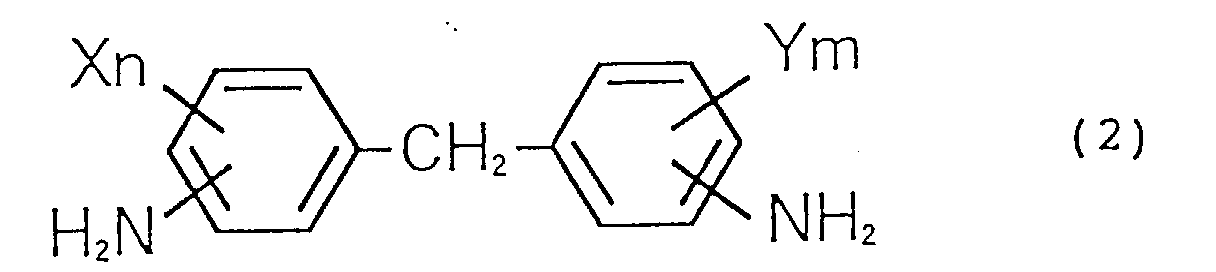
- aromatic diamines examples include diaminodiphenylmethane type aromatic diamines of the formula (2): wherein each of X and Y which are independent of each other, is a halogen atom, an alkyl group which may be branched, a trifluoromethyl group, an alkoxycarbonyl group or a hydrogen atom, and each of n and m which are independent of each other, is an integer of from 1 to 4, provided that when n and/or m is at least 2, a plurality of X and/or Y which are independent of one another, may be the same or different, such as 4,4'-methylenebisaniline, 4,4'-methylenebis(2-chloroaniline), 4,4'-methylenebis(2,3-dichloroaniline) (TCDAM), 4,4'-methylenebis(2,5-dichloroaniline),4,4'-methylenebis(2-methylaniline), 4,4'-methylenebis(2-ethylaniline), 4,4'-m
- aromatic diamines may be used alone or in combination as a mixture of two or more of them.
- the mixing ratio of the aromatic diamine varies depending upon the desired physical properties and operation efficiency. However, it is at most 50% by weight in the amine component (a mixture of the amine compound of the formula (1) and the aromatic diamine), i.e. the aromatic diamine being at most 100% by weight relative to the amine compound of the formula (1), preferably at most 30% by weight in the amine component, i.e. the aromatic diamine being at most 42.9% by weight relative to the amine compound of the formula (1).
- the mixed solution of the amine compound of the formula (1) and the aromatic diamine tends to be hardly maintained in a liquid state, or even if it can be maintained in a liquid state, the solution tends to be highly viscous, whereby handling and molding operation tend to be difficult, and the pot life during the molding tends to be short and it tends to be difficult to obtain a molded product.
- the polyisocyanate component to be used for the production of a polyurethaneurea elastomer of the present invention may, for example, be a reaction product having isocyanate groups at both terminals and having the chain extended by urethane bonds, which is obtained by reacting 1,5-naphthalene diisocyanate (NDI) with a predetermined amount of a polyol of the formula (5): wherein R is as defined above.
- NDI 1,5-naphthalene diisocyanate
- polyol compound of the formula (5) examples include aliphatic polyester glycols obtained by condensing an aliphatic glycol with a dicarboxylic acid for chain extension, such as polyethylene adipate, polybutylene adipate and polypropylene adipate, polyalkylene ether glycols obtained by ring-opening polymerization of ethylene oxide, propylene oxide, tetrahydrofuran, etc., such as polyethylene ether glycol, polypropylene ether glycol and polytetramethylene ether glycol, polyester glycols obtained by ring-opening polymerization of ⁇ -caprolactone, polyol compounds obtained by hydroxylating the terminal groups of polybutadiene, polyol compounds obtained by copolymerizing a copolymer of at least two alkylene oxides with at least two glycols and dicarboxylic acids, and long chain diols such as a mixture of aromatic glycols.
- the proportions of the 1,5-naphthalene diisocyanate and the polyol of the formula (5) in the polyisocyanate component used for the production of a polyurethaneurea elastomer of the present invention are usually such that the molar ratio of isocyanate groups (-NCO) to hydroxyl groups (-OH) i.e. -NCO/-OH is from 1.1 to 5.0, preferably from 2.8 to 4.3.
- the mixing ratio of the amine component to the isocyanate component for the production of a polyurethaneurea elastomer of the present invention is usually such that the molar ratio of isocyanate groups (-NCO) to amino groups (-NH 2 ) i.e. -NCO/-NH 2 (NCO index) is from 0.9 to 1.5, preferably from 1.0 to 1.3.
- additives commonly used for a polyurethane elastomer such as an antioxidant, an ultraviolet absorber, a coloring-preventive agent, a hydrolysis-preventing agent, antifungul agent, a flame retardant, a colorant and a bulking agent, may be incorporated as the case requires.
- the amine compound of the formula (1) to be used for the production of a polyurethaneurea elastomer of the present invention can be prepared, for example, by the methods disclosed in Japanese Examined Patent Publication No. 32641/1985 and Japanese Unexamined Patent Publication No. 135514/1981.
- the amine compound of the formula (1) can be prepared by reacting a polyol compound of the formula (5) with two equivalent of p-nitrobenzoyl chloride in the presence of a hydrochloric acid-removing agent, and the obtained nitro compound is reduced by a usual method.
- the amine compound of the formula (1) can be prepared by an ester exchange reaction of two equivalents of an alkyl p-aminobenzoate with a polyol compound of the formula (5).
- an amino benzoic acid and an aliphatic polyol compound can be used instead of the alkyl aminobenzoate.
- hydroxyl groups may sometimes partially remain at the terminals depending upon the reaction conditions or a change in the molar ratio of the starting materials, but such a product may be used as it is, without creating any particular problem.
- the polyurethaneurea elastomer of the present invention has excellent dynamic properties such as impact resilience and flexural properties while maintaining good static properties and can be readily produced by reacting a polyisocyanate component obtained by reacting 1,5-naphthalene diisocyanate with the polyol, with an amine component consisting essentially of an amine compound of the formula (1) alone, or such an amine compound and an aromatic diamine mixed thereto.
- the polyurethaneurea elastomer of the present invention is most suitable for e.g. industrial rolls, belts, blankets or industrial parts which are required to have high levels of the dynamic properties such as impact resilience and flexural properties, and it solves the problems inherent to the conventional polyurethaneurea elastomer used for such purposes.
- the above reaction solution was heated to a temperature of from 40 to 50°C under stirring, and the dropping solution prepared as described above, was dropwise added thereto over a period of one hour. After completion of the dropwise addition, the reaction solution was heated, and an aging reaction was conducted under reflux for 1.5 hours. The reaction solution was left to cool and then filtered to remove precipitated triethylamine hydrochloride. The filtrate was washed with a 5% potassium carbonate aqueous solution and water and then concentrated under reduced pressure to obtain a dinitro intermediate as a yellow transparent viscous liquid. The amount was 1217.5 g, and the yield was 96.0%.
- the desired product was a pale yellowish brown transparent viscous liquid, and the amount was 1078.7 g and the yield was 93.0%. Further, the amine value was 89.0 KOHmg/g, and the OH value was 2.3 KOHmg/g.
- the desired product was a brown viscous liquid, and the amount was 224.7 g and the yield was 93.0%. Further, the amine value was 81.4 KOHmg/g, and the OH value was 14.5 KOHmg/g.
- De Mattia flex property was measured by bending a notched specimen and represented by the number of bending cycles when cracking reached 100%.
- a polyurethaneurea elastomer was prepared in the same manner as in Example 1.
- an amine component obtained by mixing 23.7 parts of 4,4'-methylenebis(2-chloroaniline) to 157.9 parts by weight of the polytetramethylene ether glycol bis(4-aminobenzoate) obtained in Preparation Example 1 at room temperature, was mixed, followed by defoaming. Then, the mixture was injected into a casting mold preliminarily heated to 100°C and cured for 15 minutes. The molded product was removed from the mold and then subjected to post curing for 4 hours in a forcibly air-circulating oven set at 150°C and then aged at room temperature for one week to obtain a polyurethaneurea elastomer.
Landscapes
- Chemical & Material Sciences (AREA)
- Health & Medical Sciences (AREA)
- Chemical Kinetics & Catalysis (AREA)
- Medicinal Chemistry (AREA)
- Polymers & Plastics (AREA)
- Organic Chemistry (AREA)
- Polyurethanes Or Polyureas (AREA)
Description
- The present invention relates to a polyurethaneurea elastomer excellent in impact resilience and flexural properties, which is useful for industrial rolls, belts, blankets or industrial parts.
- Heretofore, it is known to obtain a polyurethaneurea elastomer by using the same amine compound of the formula (1) as used in the present invention and a polyisocyanate (EP-A-279 376) or a prepolymer and 4,4'-diphenylmethane diisocyanate (Japanese Unexamined Patent Publication No. 292317/1990).
- However, the polyurethaneurea elastomer obtained by this method was poor in the impact resilience and flexural properties although it had good static properties, and it was not fully satisfactory for the intended use for industrial rolls, belts, blankets or industrial parts.
- It is an object of the present invention to provide a polyurethaneurea elastomer having excellent dynamic properties such as impact resilience and flexural properties while maintaining good static properties.
- The present inventors have conducted extensive researches to obtain a polyurethaneurea elastomer having excellent dynamic properties such as impact resilience and flexural properties while maintaining good static properties. As a result, it has been unexpectedly found that a polyurethaneurea elastomer obtained by reacting a polyisocyanate component obtained by reacting 1,5-naphthalene diisocyanate (hereinafter sometimes referred to as NDI) with a polyol, with an amine component consisting essentially of an amine compound of the following formula (1), has good static properties and yet has excellent impact resilience and flexural properties.
- Further, a polyurethaneurea elastomer obtained by using in the above reaction an amine component having an aromatic diamine mixed to the amine compound of the formula (1), has excellent properties with the hardness and tensile strength further improved.
- The present invention has been accomplished on the basis of these discoveries.
- Thus, the present invention provides a polyurethaneurea elastomer obtained by reacting a polyisocyanate component obtained by reacting 1,5-naphthalene diisocyanate with a polyol, with an amine component consisting essentially of an amine compound of the formula (1):

- The present invention also provides a polyurethaneurea elastomer obtained by reacting a polyisocyanate component obtained by reacting 1,5-naphthalene diisocyanate with a polyol, with an amine component consisting essentially of the amine compound of the formula (1) and an aromatic diamine mixed to the amine compound, whereby the proportion of the aromatic diamine mixed is at most 100% by weight, based on the amine compound of the formula (1).
- The polyurethaneurea elastomer of the present invention has excellent dynamic properties such as impact resilience and flexural properties while maintaining good static properties. By virtue of such excellent properties, it is most suitable for use as industrial rolls, belts, blankets or industrial parts which are required to have high levels of dynamic properties such as impact resilience and flexural properties, and it is capable of solving the problems inherent to the conventional polyurethaneurea elastomer used for such purposes.
- Now, the present invention will be described in further detail with reference to the preferred embodiments.
- The polyurethaneurea elastomer of the present invention can be produced by the following method. Namely, an amine component consisting essentially of an amine compound of the formula (1) alone, or such an amine compound and a predetermined amount of an aromatic diamine mixed thereto, is heated and completely dissolved. Then, this amine component is thoroughly defoamed under a reduced pressure of from 10 to 20 mmHg and cooled to room temperature. Then, it is added to a predetermined polyisocyanate component maintained at a temperature of from 70 to 120°C, preferably from 80 to 90°C, and the mixture is thoroughly mixed and defoamed. Then, the mixture is injected into a mold preheated to a temperature of from 80 to 120°C and cured at that temperature for a few tens minutes. Then, the molded product is taken out from the mold and subjected to post curing in an oven set at a temperature of from 100 to 150°C. It is further aged at room temperature for about one week to obtain the desired polyurethaneurea elastomer.
- The amine compound of the formula (1) to be used as the amine component in the production of a polyurethaneurea elastomer of the present invention may, for example, be polyethylene ether glycol bis(4-aminobenzoate), polytetramethylene ether glycol bis(4-aminobenzoate), bis(4-aminobenzoate), polypropylene ether glycol poly(oxyethylene-propylene ether)glycol bis(4-aminobenzoate), polybutylene ether glycol bis(4-aminobenzoate), bis(4-aminobenzoate), polyethylene adipate polybutylene adipate bis(4-aminobenzoate) or polypropylene adipate bis(4-aminobenzoate).
- The average molecular weight of the polyalkylene polyether moiety or polyalkylene polyester moiety at the central portion of such a compound (the structure of the moiety represented by R in the formula (1)) is always within a range of at least 200.
- In the production of a polyurethaneurea elastomer of the present invention, a starting material having an aromatic diamine mixed to the amine compound of the formula (1) can be used as the amine component. The aromatic diamine to be mixed may have an optional substituent such as a halogen atom, an alkyl group, a trifluoromethyl group or an alkoxycarbonyl group introduced into its aromatic ring.
- Examples of such an aromatic diamine include diaminodiphenylmethane type aromatic diamines of the formula (2):


- These aromatic diamines may be used alone or in combination as a mixture of two or more of them.
- In a case where the aromatic diamine is used in combination with the amine compound of the formula (1) as the amine component in the production of a polyurethaneurea elastomer of the present invention, the mixing ratio of the aromatic diamine varies depending upon the desired physical properties and operation efficiency. However, it is at most 50% by weight in the amine component (a mixture of the amine compound of the formula (1) and the aromatic diamine), i.e. the aromatic diamine being at most 100% by weight relative to the amine compound of the formula (1), preferably at most 30% by weight in the amine component, i.e. the aromatic diamine being at most 42.9% by weight relative to the amine compound of the formula (1).
- If the aromatic diamine exceeds 50% by weight in the amine component, the mixed solution of the amine compound of the formula (1) and the aromatic diamine tends to be hardly maintained in a liquid state, or even if it can be maintained in a liquid state, the solution tends to be highly viscous, whereby handling and molding operation tend to be difficult, and the pot life during the molding tends to be short and it tends to be difficult to obtain a molded product.
- The polyisocyanate component to be used for the production of a polyurethaneurea elastomer of the present invention may, for example, be a reaction product having isocyanate groups at both terminals and having the chain extended by urethane bonds, which is obtained by reacting 1,5-naphthalene diisocyanate (NDI) with a predetermined amount of a polyol of the formula (5):

- Here, specific examples of the polyol compound of the formula (5) include aliphatic polyester glycols obtained by condensing an aliphatic glycol with a dicarboxylic acid for chain extension, such as polyethylene adipate, polybutylene adipate and polypropylene adipate, polyalkylene ether glycols obtained by ring-opening polymerization of ethylene oxide, propylene oxide, tetrahydrofuran, etc., such as polyethylene ether glycol, polypropylene ether glycol and polytetramethylene ether glycol, polyester glycols obtained by ring-opening polymerization of ε-caprolactone, polyol compounds obtained by hydroxylating the terminal groups of polybutadiene, polyol compounds obtained by copolymerizing a copolymer of at least two alkylene oxides with at least two glycols and dicarboxylic acids, and long chain diols such as a mixture of aromatic glycols.
- The proportions of the 1,5-naphthalene diisocyanate and the polyol of the formula (5) in the polyisocyanate component used for the production of a polyurethaneurea elastomer of the present invention are usually such that the molar ratio of isocyanate groups (-NCO) to hydroxyl groups (-OH) i.e. -NCO/-OH is from 1.1 to 5.0, preferably from 2.8 to 4.3.
- Further, the mixing ratio of the amine component to the isocyanate component for the production of a polyurethaneurea elastomer of the present invention is usually such that the molar ratio of isocyanate groups (-NCO) to amino groups (-NH2) i.e. -NCO/-NH2 (NCO index) is from 0.9 to 1.5, preferably from 1.0 to 1.3.
- To the polyurethaneurea elastomer of the present invention, additives commonly used for a polyurethane elastomer, such as an antioxidant, an ultraviolet absorber, a coloring-preventive agent, a hydrolysis-preventing agent, antifungul agent, a flame retardant, a colorant and a bulking agent, may be incorporated as the case requires.
- The amine compound of the formula (1) to be used for the production of a polyurethaneurea elastomer of the present invention can be prepared, for example, by the methods disclosed in Japanese Examined Patent Publication No. 32641/1985 and Japanese Unexamined Patent Publication No. 135514/1981.
- Namely, the amine compound of the formula (1) can be prepared by reacting a polyol compound of the formula (5) with two equivalent of p-nitrobenzoyl chloride in the presence of a hydrochloric acid-removing agent, and the obtained nitro compound is reduced by a usual method.
- Otherwise, the amine compound of the formula (1) can be prepared by an ester exchange reaction of two equivalents of an alkyl p-aminobenzoate with a polyol compound of the formula (5). In this reaction, an amino benzoic acid and an aliphatic polyol compound can be used instead of the alkyl aminobenzoate.
- In such a reaction to obtain the amine compound of the formula (1), hydroxyl groups may sometimes partially remain at the terminals depending upon the reaction conditions or a change in the molar ratio of the starting materials, but such a product may be used as it is, without creating any particular problem.
- The polyurethaneurea elastomer of the present invention has excellent dynamic properties such as impact resilience and flexural properties while maintaining good static properties and can be readily produced by reacting a polyisocyanate component obtained by reacting 1,5-naphthalene diisocyanate with the polyol, with an amine component consisting essentially of an amine compound of the formula (1) alone, or such an amine compound and an aromatic diamine mixed thereto.
- By virtue of the excellent properties, the polyurethaneurea elastomer of the present invention is most suitable for e.g. industrial rolls, belts, blankets or industrial parts which are required to have high levels of the dynamic properties such as impact resilience and flexural properties, and it solves the problems inherent to the conventional polyurethaneurea elastomer used for such purposes.
- Now, the present invention will be described in further detail with reference to Examples. However, it should be understood that the present invention is by no means restricted by such specific Examples.
- Firstly, preparation of the amine compound of the formula (1) will be described.
- Into a 5 ℓ four-necked flask equipped with a thermometer, a condenser, a dropping funnel and a stirrer, 970 g (1.0 mol) of a polytetramethylene ether glycol having an average molecular weight of 970, 242.5 g (2.4 mol) of triethylamine and 1 ℓ of toluene were charged to obtain a reaction solution. On the other hand, 390 g (2.1 mol) of p-nitrobenzoyl chloride was dissolved in 1 ℓ of toluene to obtain a dropping solution. The above reaction solution was heated to a temperature of from 40 to 50°C under stirring, and the dropping solution prepared as described above, was dropwise added thereto over a period of one hour. After completion of the dropwise addition, the reaction solution was heated, and an aging reaction was conducted under reflux for 1.5 hours. The reaction solution was left to cool and then filtered to remove precipitated triethylamine hydrochloride. The filtrate was washed with a 5% potassium carbonate aqueous solution and water and then concentrated under reduced pressure to obtain a dinitro intermediate as a yellow transparent viscous liquid. The amount was 1217.5 g, and the yield was 96.0%.
- Then, into a 10ℓ four-necked flask equipped with a thermometer, a condenser, a dropping funnel and a stirrer, 614 g (11.0 mol) of iron powder, 30 g of acetic acid, 2.5 ℓ of toluene and 1 ℓ of water were charged. On the other hand, the dinitro intermediate obtained by the above reaction was dissolved in 1 ℓ of toluene to obtain a dropping solution. This dropping solution was dropwise added over a period of 1.5 hours while the reaction solution was heated by an oil bath and refluxed under stirring. After completion of the dropwise addition, the mixture was aged at the same temperature for 5 hours to complete the reaction. To the reaction mixture thus obtained, sodium hydrogencarbonate was added to neutralize acetic acid, and the mixture was filtered while it was still hot, to remove the iron sludge. Further, water was separated by liquid separation. The obtained organic layer was washed with water and then concentrated under reduced pressure to obtain the desired polytetramethylene ether glycol bis(4-aminobenzoate).
- The desired product was a pale yellowish brown transparent viscous liquid, and the amount was 1078.7 g and the yield was 93.0%. Further, the amine value was 89.0 KOHmg/g, and the OH value was 2.3 KOHmg/g.
- Into a 1 ℓ four-necked flask equipped with a thermometer, a water separator having a condenser and a stirrer, 194 g (0.2 mol) of a polytetramethylene ether glycol having an average molecular weight of 970, 65.9 g (0.4 mol) of ethyl p-aminobenzoate and 0.018 g of tetrabutyl titanate were charged to obtain a reaction solution. The reaction solution was heated to 200°C under stirring in a nitrogen stream to distill off ethyl alcohol. The distilled ethyl alcohol was 82% of the theoretical amount. Further, the temperature was raised to 215°C, and aging was conducted for 2 hours. Then, non-reacted ethyl p-aminobenzoate was distilled off under reduced pressure to obtain the desired polytetramethylene ether glycol bis(4-aminobenzoate).
- The desired product was a brown viscous liquid, and the amount was 224.7 g and the yield was 93.0%. Further, the amine value was 81.4 KOHmg/g, and the OH value was 14.5 KOHmg/g.
- Now, the present invention will be described in further detail with reference to Examples and Comparative Examples.
- Into a 500 mℓ separable flask equipped with a thermometer and a stirrer, 100 parts by weight of a polytetramethylene ether glycol having an average molecular weight of 1942 was charged and heated to 120°C under stirring, and water was removed under reduced pressure of 5 mmHg for one hour. Then, it was cooled to 100°C. While blowing nitrogen into it, 30 parts by weight of 1,5-naphthalene diisocyanate was charged, and the mixture was reacted at 125°C for about 20 minutes. Then, the mixture was cooled to 90°C and defoamed. The NCO content of the obtained polyisocyanate component was 5.9% by weight.
- To the polyisocyanate component cooled to 90°C, 109.6 parts by weight of the polytetramethylene ether glycol bis(4-aminobenzoate) at room temperature obtained in Preparation Example 1 was added, followed by defoaming. This mixture was injected into a casting mold preliminarily heated to a temperature of 100°C and cured for 15 minutes. Then, the molded product was taken out from the mold and subjected to post curing for 8 hours in a forcibly air-circulating oven set at a temperature of 120°C and then aged at room temperature for one week to obtain a polyurethaneurea elastomer. The production conditions of the polyurethaneurea elastomer thus obtained and the physical properties of the obtained polyurethaneurea elastomer are shown in Table 1.
- The physical properties were measured in accordance with JIS K6301.
- Further, the De Mattia flex property was measured by bending a notched specimen and represented by the number of bending cycles when cracking reached 100%.
- Using the polytetramethylene ether glycol bis(4-aminobenzoate) obtained in Preparation Example 2, a polyurethaneurea elastomer was prepared in the same manner as in Example 1.
- The production conditions of the polyurethaneurea elastomer thus obtained and the physical properties of the obtained polyurethaneurea elastomer are shown in Table 1.
- Using an amine component obtained by mixing 8.0 parts by weight of 4,4'-methylenebis(2-chloroaniline) to 71.9 parts by weight of the polytetramethylene ether glycol bis(4-aminobenzoate) obtained in Preparation Example 1, a polyurethaneurea elastomer was prepared in the same manner as in Example 1.
- The production conditions of the polyurethaneurea elastomer thus obtained and the physical properties of the obtained polyurethaneurea elastomer are shown in Table 1.
- Using a poly(3-methylpentamethylene)glycol adipate having an average molecular weight of 1941, a polyurethaneurea elastomer was prepared in the same manner as in Example 1.
- The production conditions of the polyurethaneurea elastomer thus obtained and the physical properties of the obtained polyurethaneurea elastomer are shown in Table 1.
- Into a 500 mℓ separable flask equipped with a thermometer and a stirrer, 100 parts by weight of a polytetramethylene ether glycol having an average molecular weight of 970 was charged and heated to 70°C under stirring while blowing nitrogen thereinto. Then, 51.6 parts by weight of 4,4'-diphenylmethane diisocyanate (MDI) was charged, and the mixture was reacted for 2 hours and defoamed. The NCO content in the polyisocyanate component thus obtained was 5.3% by weight. Then, 37.9 parts by weight of liquid MDI (MDI was liquefied by partially carbodiimide-modifiying MDI) was mixed thereto at room temperature to obtain a polyisocyanate component.
- To this polyisocyanate component, an amine component obtained by mixing 23.7 parts of 4,4'-methylenebis(2-chloroaniline) to 157.9 parts by weight of the polytetramethylene ether glycol bis(4-aminobenzoate) obtained in Preparation Example 1 at room temperature, was mixed, followed by defoaming. Then, the mixture was injected into a casting mold preliminarily heated to 100°C and cured for 15 minutes. The molded product was removed from the mold and then subjected to post curing for 4 hours in a forcibly air-circulating oven set at 150°C and then aged at room temperature for one week to obtain a polyurethaneurea elastomer.
- The production conditions of the polyurethaneurea elastomer thus obtained and the physical properties of the obtained polyurethaneurea elastomer are shown in Table 1.

Claims (6)
- A polyurethaneurea elastomer obtained by reacting a polyisocyanate component obtained by reacting 1,5-naphthalene diisocyanate with a polyol, with an amine component consisting essentially of an amine compound of the formula (1):

- A polyurethaneurea elastomer obtained by reacting a polyisocyanate component obtained by reacting 1,5-naphthalene diisocyanate with a polyol, with an amine component consisting essentially of an amine compound of the formula (1):

- The polyurethaneurea elastomer according to Claim 2 or 3, wherein the aromatic diamine is at least one aromatic diamine selected from the group consisting of diaminodiphenylmethane-type aromatic diamines of the formula (2):


- The polyurethaneurea elastomer according to Claim 2 , wherein the aromatic diamine is at least one aromatic diamine selected from the group consisting of 4,4'-methylenebisaniline, 4,4'-methylenebis(2-chloroaniline), 4,4'-methylenebis(2,3-dichloroaniline), 4,4'-methylenebis(2,5-dichloroaniline), 4,4'-methylenebis(2-methylaniline), 4,4'-methylenebis(2-ethylaniline), 4,4'-methylenebis(2-isopropylaniline), 4,4'-methylenebis(2,6-dimethylaniline), 4,4'-methylenebis(2,6-diethylaniline), 4,4'-methylenebis(2-ethyl-6-methylaniline), 4,4'-methylenebis(2-chloro-6-methylaniline), 4,4'-methylenebis(2-chloro-6-ethylaniline), 4,4'-methylenebis(3-chloro-2,6-diethylaniline), 4,4'-methylenebis(2-trifluoromethylaniline), 4,4'-methylenebis(2-methoxycarbonylaniline), 1,3-propanediolbis(4-aminobenzoate), 1,4-butanediolbis(4-aminobenzoate), diethylene glycol bis(4-aminobenzoate), triethylene glycol bis(4-aminobenzoate), isopropyl 4-chloro-3,5-diaminobenzoate and isobutyl 4-chloro-3,5-diaminobenzoate.
- The polyurethaneurea elastomer according to Claim 1, 2, 3 or 4, wherein the polyol is a polyol compound of the formula (5):

- The polyurethaneurea elastomer according to Claim 1, 2, 3 or 4, wherein the polyol is at least one polyol compound selected from the group consisting of aliphatic polyester glycols obtained by condensing an aliphatic glycol with a dicarboxylic acid for chain extension, polyalkylene ether glycols obtained by ring-opening polymerization of a polyalkylene oxide or polyalkylene intramolecular ether, polyester glycols obtained by ring-opening polymerization of ε-caprolactone, polyol compounds obtained by hydroxylating the terminal groups of a polybutadiene, polyol compounds obtained by copolymerizing a copolymer of at least two alkylene oxides with at least two glycols and dicarboxylic acids, and mixtures of aromatic glycols.
Applications Claiming Priority (2)
| Application Number | Priority Date | Filing Date | Title |
|---|---|---|---|
| JP19750192A JP3220873B2 (en) | 1992-07-02 | 1992-07-02 | Polyurethane urea elastomer |
| JP197501/92 | 1992-07-02 |
Publications (2)
| Publication Number | Publication Date |
|---|---|
| EP0579989A1 EP0579989A1 (en) | 1994-01-26 |
| EP0579989B1 true EP0579989B1 (en) | 1997-09-03 |
Family
ID=16375526
Family Applications (1)
| Application Number | Title | Priority Date | Filing Date |
|---|---|---|---|
| EP93110448A Expired - Lifetime EP0579989B1 (en) | 1992-07-02 | 1993-06-30 | Polyurethaneurea elastomer |
Country Status (7)
| Country | Link |
|---|---|
| US (1) | US5410009A (en) |
| EP (1) | EP0579989B1 (en) |
| JP (1) | JP3220873B2 (en) |
| KR (1) | KR970007321B1 (en) |
| CA (1) | CA2099197C (en) |
| DE (1) | DE69313550T2 (en) |
| TW (1) | TW252123B (en) |
Families Citing this family (16)
| Publication number | Priority date | Publication date | Assignee | Title |
|---|---|---|---|---|
| PT770102E (en) * | 1994-07-14 | 2002-03-28 | Gates Corp | HIGH TEMPERATURE RESISTANT POLYURETHANE / UREA ELASTOMERS |
| US6127505A (en) * | 1995-02-02 | 2000-10-03 | Simula Inc. | Impact resistant polyurethane and method of manufacture thereof |
| US6258917B1 (en) * | 1996-05-21 | 2001-07-10 | Simula, Inc. | Extrudable thermoplastic elastomeric urea-extended polyurethane |
| US5811506A (en) * | 1997-02-03 | 1998-09-22 | Simula Inc. | Extrudable thermoplastic elastomeric urea-extended polyurethane |
| EP0900245B1 (en) * | 1996-05-21 | 2005-04-20 | Simula, Inc. | Extrudable thermoplastic elastomeric urea-extended polyurethane |
| US6114488A (en) * | 1999-03-02 | 2000-09-05 | Air Products And Chemicals, Inc. | Polyurethaneurea elastomers for dynamic applications |
| DE60017236T2 (en) | 1999-07-02 | 2005-12-08 | Kolon Industries, Inc., Kwachon | ELASTIC POLYURETHANE FIBER AND METHOD FOR THE PRODUCTION THEREOF |
| US20060276613A1 (en) * | 2005-05-12 | 2006-12-07 | Iskender Yilgor | Polyurethaneurea segmented copolymers |
| DE102006030391A1 (en) * | 2006-07-01 | 2008-01-10 | Bayer Materialscience Ag | Foamed and massive polyurethane elastomers based on 1,5-naphthalene diisocyanate, process for their preparation and their use |
| WO2009103301A2 (en) * | 2006-12-18 | 2009-08-27 | Voith Patent Gmbh | Roller cover and method for the production thereof |
| US20080199706A1 (en) * | 2007-02-21 | 2008-08-21 | Kristy Bacher | Polyurethane elastomeric adhesive composition and composite article formed therefrom |
| JP5710856B2 (en) * | 2008-03-27 | 2015-04-30 | アイカ工業株式会社 | Urea urethane resin composition |
| KR200484635Y1 (en) * | 2016-10-14 | 2017-10-10 | 한울계기공업 주식회사 | A anti-vibration tempepature gauge using bimetal method |
| KR102659375B1 (en) | 2017-06-15 | 2024-04-24 | 디디피 스페셜티 일렉트로닉 머티리얼즈 유에스, 엘엘씨 | Composition containing adhesive containing hydrophobic modified isocyanate functional prepolymer |
| EP3906270B1 (en) * | 2019-01-04 | 2025-03-19 | Basf Se | Solid phase-modified thermoplastic polyurethane |
| CN114736366B (en) * | 2022-04-12 | 2024-02-20 | 山西省建筑科学研究院集团有限公司 | Hindered amine-terminated polyether, preparation method of hindered amine-terminated polyether and preparation method of slow-reaction polyurea |
Family Cites Families (20)
| Publication number | Priority date | Publication date | Assignee | Title |
|---|---|---|---|---|
| DE2003706C3 (en) * | 1970-01-28 | 1980-06-12 | Bayer Ag, 5090 Leverkusen | Process for the production of polyurethane-urea elastomers |
| DE2019432C3 (en) * | 1970-04-22 | 1982-05-06 | Bayer Ag, 5090 Leverkusen | Process for the production of terminal amino groups containing organic compounds and their use for the production of plastics |
| DE2040644C3 (en) * | 1970-08-17 | 1978-11-02 | Bayer Ag, 5090 Leverkusen | METHOD FOR MANUFACTURING POLYURETHANE PLASTICS |
| US3817940A (en) * | 1970-08-17 | 1974-06-18 | Bayer Ag | Aromatic diamines |
| US4039514A (en) * | 1972-09-15 | 1977-08-02 | E. I. Du Pont De Nemours And Company | Polyurethanes cured with derivatives of 2,4-diamino-benzamide |
| US4054556A (en) * | 1972-09-15 | 1977-10-18 | E. I. Du Pont De Nemours And Company | Polyurethanes cured with derivatives of 2,4-diamino-benzoic acid |
| US3932360A (en) * | 1974-03-14 | 1976-01-13 | Polaroid Corporation | Polyurethane elastomers prepared from diamine curing agents |
| US3929729A (en) * | 1974-11-21 | 1975-12-30 | Goodyear Tire & Rubber | Polyureaurethane shock absorbing unit |
| JPS5480397A (en) * | 1977-12-09 | 1979-06-27 | Ihara Chem Ind Co Ltd | Production of polyurethane elastomer |
| DE2843739C3 (en) * | 1978-10-06 | 1982-04-22 | Bayer Ag, 5090 Leverkusen | Process for the production of substantially homogeneous polyurethane elastomers |
| US4328322A (en) * | 1979-12-03 | 1982-05-04 | Polaroid Corporation | Synthetic polymers by polyisocyanate polyaddition process |
| JPS5989322A (en) * | 1982-11-13 | 1984-05-23 | Toyo Tire & Rubber Co Ltd | Polyurethane urea polymer and its production |
| DE3329775A1 (en) * | 1983-08-18 | 1985-02-28 | Bayer Ag, 5090 Leverkusen | THERMOPLASTIC POLYURETHANES OF HIGH HEAT RESISTANCE BASED ON NAPHTHYLENE DIISOCYANATE, METHOD FOR THEIR PRODUCTION AND THEIR USE |
| US5011903A (en) * | 1985-10-29 | 1991-04-30 | Peterson Elastomers, Inc. | Encapsulating and patching elastomer for concrete repairs and method of making the same |
| JP2577900B2 (en) * | 1987-02-18 | 1997-02-05 | イハラケミカル工業 株式会社 | Method for producing polyurea resin |
| JPS63243122A (en) * | 1987-03-31 | 1988-10-11 | Hodogaya Chem Co Ltd | Production of polyurea resin |
| US4810769A (en) * | 1987-06-05 | 1989-03-07 | Air Products And Chemicals, Inc. | Process of preparing polyurethanes cured with 2,6-idaminobenzoic acid derivatives and blends of the 2, 4 and 2,6 isomers |
| US4868231A (en) * | 1988-05-27 | 1989-09-19 | Gencorp Inc. | Thickened molding resin compositions and cured molded compounds |
| US5162481A (en) * | 1990-03-30 | 1992-11-10 | Minnesota Mining And Manufacturing Company | Polyurethaneurea composition |
| US5183877A (en) * | 1991-10-25 | 1993-02-02 | H. B. Fuller Company | Polyurea or polyurea-urethane adhesive for bonding elastomers |
-
1992
- 1992-07-02 JP JP19750192A patent/JP3220873B2/en not_active Expired - Lifetime
-
1993
- 1993-06-21 TW TW082104881A patent/TW252123B/zh not_active IP Right Cessation
- 1993-06-25 CA CA002099197A patent/CA2099197C/en not_active Expired - Lifetime
- 1993-06-28 US US08/082,368 patent/US5410009A/en not_active Expired - Lifetime
- 1993-06-30 EP EP93110448A patent/EP0579989B1/en not_active Expired - Lifetime
- 1993-06-30 DE DE69313550T patent/DE69313550T2/en not_active Expired - Lifetime
- 1993-07-01 KR KR1019930012274A patent/KR970007321B1/en not_active Expired - Lifetime
Also Published As
| Publication number | Publication date |
|---|---|
| KR970007321B1 (en) | 1997-05-07 |
| JP3220873B2 (en) | 2001-10-22 |
| DE69313550T2 (en) | 1998-01-15 |
| EP0579989A1 (en) | 1994-01-26 |
| CA2099197A1 (en) | 1994-01-03 |
| KR940005701A (en) | 1994-03-22 |
| JPH0616765A (en) | 1994-01-25 |
| TW252123B (en) | 1995-07-21 |
| DE69313550D1 (en) | 1997-10-09 |
| CA2099197C (en) | 2003-08-19 |
| US5410009A (en) | 1995-04-25 |
Similar Documents
| Publication | Publication Date | Title |
|---|---|---|
| KR930004365B1 (en) | Process for producing polyurea resin | |
| US5410009A (en) | Polyurethaneurea elastomer | |
| AU659224B2 (en) | Method for the preparation of a polyurea resin | |
| US4448905A (en) | Alcohol substituted amides as chain extenders for polyurethanes | |
| RU2059607C1 (en) | Substituted n,n′-methylene-bis-anilines as chain lengthener or polyurethane cross-linking agent | |
| US4482690A (en) | Process for the production of polyurethane urea elastomers | |
| US20050020767A1 (en) | High performance aqueous polyurethanes dispersion and methods of fabricating the same | |
| EP1756185B1 (en) | High performance paraphenylene diisocyanate based polyurethanes cured with alkylated 4,4´-methylenedianiline | |
| US20030027923A1 (en) | High performance aqueous polyurethanes and methods of fabricating the same | |
| US4463155A (en) | Polyether polyurethane elastomers | |
| KR100415729B1 (en) | Method for preparing thermoplastic polyurethane elastomer | |
| US4537945A (en) | Polyether derivative and a poly(urethane)ureamide obtained therefrom | |
| EP0439264A2 (en) | Reaction injection moulded polyurea elastomers | |
| JP3220880B2 (en) | Polyurethane urea elastomer | |
| JP3060108B2 (en) | Manufacturing method of polyurethane urea elastomer | |
| JP3278757B2 (en) | Method for producing polyurea resin | |
| JPS6032641B2 (en) | Method for manufacturing polyurea elastomer | |
| JP3291593B2 (en) | Conductive polyurea elastomer | |
| JP3291594B2 (en) | Composite polyurea elastomer | |
| JP3160680B2 (en) | Composite polyurea elastomer composition | |
| US6303732B1 (en) | Diol blends and methods for making and using the same | |
| KR790001437B1 (en) | Curing agent composition for polyurethane | |
| EP0370286B1 (en) | Liquid isocyanate prepolymers | |
| JPH03128932A (en) | Production of polyoxyalkylene polyamine | |
| JPH01279920A (en) | Preparation of reaction injection molding elastomer |
Legal Events
| Date | Code | Title | Description |
|---|---|---|---|
| PUAI | Public reference made under article 153(3) epc to a published international application that has entered the european phase |
Free format text: ORIGINAL CODE: 0009012 |
|
| AK | Designated contracting states |
Kind code of ref document: A1 Designated state(s): DE FR GB |
|
| 17P | Request for examination filed |
Effective date: 19940525 |
|
| 17Q | First examination report despatched |
Effective date: 19951215 |
|
| GRAG | Despatch of communication of intention to grant |
Free format text: ORIGINAL CODE: EPIDOS AGRA |
|
| GRAH | Despatch of communication of intention to grant a patent |
Free format text: ORIGINAL CODE: EPIDOS IGRA |
|
| GRAH | Despatch of communication of intention to grant a patent |
Free format text: ORIGINAL CODE: EPIDOS IGRA |
|
| GRAA | (expected) grant |
Free format text: ORIGINAL CODE: 0009210 |
|
| AK | Designated contracting states |
Kind code of ref document: B1 Designated state(s): DE FR GB |
|
| REF | Corresponds to: |
Ref document number: 69313550 Country of ref document: DE Date of ref document: 19971009 |
|
| ET | Fr: translation filed | ||
| PLBE | No opposition filed within time limit |
Free format text: ORIGINAL CODE: 0009261 |
|
| STAA | Information on the status of an ep patent application or granted ep patent |
Free format text: STATUS: NO OPPOSITION FILED WITHIN TIME LIMIT |
|
| 26N | No opposition filed | ||
| REG | Reference to a national code |
Ref country code: GB Ref legal event code: IF02 |
|
| PGFP | Annual fee paid to national office [announced via postgrant information from national office to epo] |
Ref country code: DE Payment date: 20120627 Year of fee payment: 20 |
|
| PGFP | Annual fee paid to national office [announced via postgrant information from national office to epo] |
Ref country code: FR Payment date: 20120619 Year of fee payment: 20 Ref country code: GB Payment date: 20120627 Year of fee payment: 20 |
|
| REG | Reference to a national code |
Ref country code: DE Ref legal event code: R071 Ref document number: 69313550 Country of ref document: DE |
|
| REG | Reference to a national code |
Ref country code: GB Ref legal event code: PE20 Expiry date: 20130629 |
|
| PG25 | Lapsed in a contracting state [announced via postgrant information from national office to epo] |
Ref country code: GB Free format text: LAPSE BECAUSE OF EXPIRATION OF PROTECTION Effective date: 20130629 |
|
| PG25 | Lapsed in a contracting state [announced via postgrant information from national office to epo] |
Ref country code: DE Free format text: LAPSE BECAUSE OF EXPIRATION OF PROTECTION Effective date: 20130702 |