EP0579342B1 - Process for producing cycloolefin random copolymers - Google Patents
Process for producing cycloolefin random copolymers Download PDFInfo
- Publication number
- EP0579342B1 EP0579342B1 EP93202806A EP93202806A EP0579342B1 EP 0579342 B1 EP0579342 B1 EP 0579342B1 EP 93202806 A EP93202806 A EP 93202806A EP 93202806 A EP93202806 A EP 93202806A EP 0579342 B1 EP0579342 B1 EP 0579342B1
- Authority
- EP
- European Patent Office
- Prior art keywords
- cycloolefin
- random copolymer
- ethylene
- solution
- hydrocarbon
- Prior art date
- Legal status (The legal status is an assumption and is not a legal conclusion. Google has not performed a legal analysis and makes no representation as to the accuracy of the status listed.)
- Expired - Lifetime
Links
Classifications
-
- C—CHEMISTRY; METALLURGY
- C08—ORGANIC MACROMOLECULAR COMPOUNDS; THEIR PREPARATION OR CHEMICAL WORKING-UP; COMPOSITIONS BASED THEREON
- C08F—MACROMOLECULAR COMPOUNDS OBTAINED BY REACTIONS ONLY INVOLVING CARBON-TO-CARBON UNSATURATED BONDS
- C08F212/00—Copolymers of compounds having one or more unsaturated aliphatic radicals, each having only one carbon-to-carbon double bond, and at least one being terminated by an aromatic carbocyclic ring
-
- C—CHEMISTRY; METALLURGY
- C08—ORGANIC MACROMOLECULAR COMPOUNDS; THEIR PREPARATION OR CHEMICAL WORKING-UP; COMPOSITIONS BASED THEREON
- C08F—MACROMOLECULAR COMPOUNDS OBTAINED BY REACTIONS ONLY INVOLVING CARBON-TO-CARBON UNSATURATED BONDS
- C08F6/00—Post-polymerisation treatments
- C08F6/06—Treatment of polymer solutions
- C08F6/10—Removal of volatile materials, e.g. solvents
-
- C—CHEMISTRY; METALLURGY
- C08—ORGANIC MACROMOLECULAR COMPOUNDS; THEIR PREPARATION OR CHEMICAL WORKING-UP; COMPOSITIONS BASED THEREON
- C08F—MACROMOLECULAR COMPOUNDS OBTAINED BY REACTIONS ONLY INVOLVING CARBON-TO-CARBON UNSATURATED BONDS
- C08F210/00—Copolymers of unsaturated aliphatic hydrocarbons having only one carbon-to-carbon double bond
- C08F210/02—Ethene
-
- C—CHEMISTRY; METALLURGY
- C08—ORGANIC MACROMOLECULAR COMPOUNDS; THEIR PREPARATION OR CHEMICAL WORKING-UP; COMPOSITIONS BASED THEREON
- C08F—MACROMOLECULAR COMPOUNDS OBTAINED BY REACTIONS ONLY INVOLVING CARBON-TO-CARBON UNSATURATED BONDS
- C08F232/00—Copolymers of cyclic compounds containing no unsaturated aliphatic radicals in a side chain, and having one or more carbon-to-carbon double bonds in a carbocyclic ring system
- C08F232/08—Copolymers of cyclic compounds containing no unsaturated aliphatic radicals in a side chain, and having one or more carbon-to-carbon double bonds in a carbocyclic ring system having condensed rings
Definitions
- the invention relates to a process for the production of cycloolefin random copolymers.
- This application is a divisional application of application no. 89309103.3 which describes and claims a process for the production of a cycloolefin copolymer which comprises copolymerizing ethylene with a cycloolefin of formula [I] as hereinafter defined in the presence of a catalyst in a polymerization reactor in the substantial absence of a gas phase.
- This process provides cycloolefin random copolymers of high quality which are suitable for use in optical materials, in particular optical memory discs.
- This process is, however, complicated, and is hardly productive of a purified product of a uniform quality unless the starting copolymer has a molecular weight within a certain limited range.
- ethylene-cycloolefin random copolymers find their application in various other fields, and thus, desired in the art is a process for removing unreacted cycloolefin monomer from ethylene-cycloolefin random copolymers having a molecular weight within a wide range.
- solvent-insoluble copolymers undesirable copolymers which have an unduly high content of ethylene and which are insoluble in a hydrocarbon solvent used in the polymerization reaction (referred to hereinafter as solvent-insoluble copolymers) are liable to form on the wall of the polymerization vessel in the vicinity of the gas-liquid interface in the vessel, that these solvent-insoluble copolymers cause changes in the conditions at the gas-liquid interface over time and, when formed in large amounts, decrease the effective area of the gas-liquid interface, so that the copolymerization does not proceed sufficiently, and that the solvent-insoluble copolymers formed on the wall of the vessel fall off into the liquid phase in the vessel, are withdrawn through a pick up line together with the desired copolymer produced, and are trapped by a filtering device installed in the pick up line to clog the filtering device and occasionally the pick up
- the present invention seeks to solve these problems and to provide a simple process for the production of cycloolefin random copolymers, which is capable of economically producing cycloolefin random copolymers of high quality with any unreacted cycloolefin monomer substantially removed and having excellent heat resistance, heat aging property, chemical resistance, solvent resistance, dielectric property, rigidity as well as impact property.
- EP-A-235,421 discloses a method for the separation of a polymer from a hydrocarbon solvent by flash drying above 130°C under reduced pressure.
- the present invention provides a process for the production of a random copolymer which comprises flash drying a mixture comprising 100 parts by weight of a first random copolymer [B] as a solution in a first hydrocarbon and 5 to 100 parts by weight of a second random copolymer [C] as a solution in a second hydrocarbon, said first random copolymer [B] deriving from copolymerization, in said first hydrocarbon in the presence of a catalyst, of ethylene and a cycloolefin of formula [I] and having an intrinsic viscosity [ ⁇ ] of from 0.05 to 10 dl/g measured in decalin at 135°C and a softening point (TMA) of at least 70°C, said second random copolymer [C] deriving from copolymerization, in said second hydrocarbon in the presence of a catalyst, of ethylene, at least one ⁇ -olefin other than ethylene and said cycloolefin [I] and having an intrinsic viscos
- the first solution of the first cycloolefin random copolymer [B] in the first hydrocarbon and the second solution of the second random copolymer [C] in the second hydrocarbon are admixed to provide the mixed solution.
- the second random copolymer [C] may, for example, derive from ethylene, at least one of propylene and butene and said cycloolefin [I].
- the or each copolymerization may be carried out in a polymerization reactor in the substantial absence of a gas phase.
- the cycloolefins represented by general formula [I] can easily be prepared by the Diels-Alder condensation of cyclopentadienes with appropriate olefins.
- Examples of the cycloolefins represented by general formula [I] include the compounds exemplified in Table 1, and 1,4,5,8-dimethano-1,2,3,4,4a,5,8,8a-octahydronaphthalene, such octahydronaphthalenes as 2-methyl-1,4,5,8-dimethano-1,2,3,4,4a,5,8,8a-octahydronaphthalene, 2-ethyl-1,4,5,8-dimethano-1,2,3,4,4a,5,8,8a-octahydronaphthalene, 2-propyl-1,4,5,8-dimethano-1,2,3,4,4a,5,8,8a-octahydronaphthalene, 2-hexyl-1,4,5,8-dimethano-1,2,3,4,4a,5,8,8a-octahydronaphthalene, 2-stearyl-1,4,5,8-dimethano-1,2,3,4,4a,5,8,8
- Ethylene is copolymerized with at least one cycloolefin of general formula [I].
- cycloolefin of general formula [I] there may be optionally copolymerized other copolymerizable unsaturated monomers in such a range that they do not mar the object of the invention.
- Examples of the unsaturated monomers which may optionally be copolymerized with ethylene and at least one cycloolefin of general formula [I] include ⁇ -olefins having from 3 to 20 carbon atoms, such as propylene, 1-butene, 4-methyl-1-pentene, 1-hexene, 1-octene, 1-decene, 1-dodecene, 1-tetradecene, 1-hexadecene, 1-octadecene and 1-icosene, in such a proportion that the resulting cycloolefin random copolymer may contain units derived therefrom in an amount of less than an equimolar amount of units derived from ethylene; cycloolefins, such as cyclopentene, cyclohexene, 3-methylcyclohexene, cyclooctene and 3a, 5, 6, 7a-tetrahydro-4, 7-methano-1H-indene of formula
- 1,7-octadiene, dicyclopentadiene, 5-ethylydene-2-norbornene and 5-vinyl-2-norbornene in such a proportion that the resulting cycloolefin random copolymer may contain units derived therefrom in an amount of less than an equimolar amount of units derived from the cycloolefin of general formula [I]; and norbornene compounds, such as norbornene-2, 5-methylnorbornene-2, 5-ethylnorbornene-2, 5-isopropylnorbornene-2, 5-n-butylnorbornene-2, 5-i-butylnorbornene-2, 5,6-dimethylnorbornene-2, 5-chloronorbornene-2, 2-fluoronorbornene-2 and 5,6-dichloronorbornene-2, in such a proportion that the resulting cycloolefin random copolymer may contain units derived therefrom
- Ethylene is copolymerized with at least one cycloolefin of general formula [I] in a hydrocarbon solvent.
- the hydrocarbon solvents herein include aliphatic hydrocarbons such as hexane, heptane, octane, and kerosene; alicyclic hydrocarbons such as cyclohexane and methylcyclohexane; aromatic hydrocarbons such as benzene, toluene and xylene; and the above-illustrated cycloolefins of general formula [I], alone or in combination.
- Ethylene is copolymerized with at least one cycloolefin of general formula [I] in the presence of a catalyst.
- Suitable catalysts which can be used herein comprise a vanadium compound which is soluble in the particular hydrocarbon solvent used and an organoaluminium compound.
- the vanadium compounds as one component of the catalyst include compounds of general formula VO(OR) a X b or V(OR) c X d wherein R is a hydrocarbon group, and a, b, c and d are numbers such that 0 ⁇ a ⁇ 3, 0 ⁇ b ⁇ 3, 2 ⁇ a + b ⁇ 3, 0 ⁇ c ⁇ 4, 0 ⁇ d ⁇ 4, and 3 ⁇ c + d ⁇ 4; and their adducts with an electron donor.
- vanadium compound examples include, for example, VO(Cl 3 ), VO(OC 2 H 5 )Cl 2 , VO(OC 2 H 5 ) 2 Cl, VO(O-iso-C 3 H 7 )Cl 2 , VO(O-n-C 4 H 9 )Cl 2 , VO(OC 2 H 5 ) 3 , VCl 4 , VOCl 2 , VOBr 2 , VO(O-n-C 4 H 9 ) 3 and VCl 3 -20C 8 H 17 OH.
- Electron donors which can be used for the preparation of the vanadium component of the catalyst may be oxygen-containing electron donors such as alcohols, phenols, ketones, aldehydes, carboxylic acids, esters of organic and inorganic acids, ethers, acid amides, acid anhydrides and alkoxysilanes; or nitrogen-containing electron donors such as ammonia, amines, nitriles and isocyanates.
- oxygen-containing electron donors such as alcohols, phenols, ketones, aldehydes, carboxylic acids, esters of organic and inorganic acids, ethers, acid amides, acid anhydrides and alkoxysilanes
- nitrogen-containing electron donors such as ammonia, amines, nitriles and isocyanates.
- Suitable electron donors include, for example, alcohols having from 1 to 18 carbon atoms, such as methanol, ethanol, propanol, isopropanol, pentanol, hexanol, octanol, dodecanol,octadecyl alcohol, oleyl alcohol, benzyl alcohol, phenylethyl alcohol, isopropylbenzyl alcohol and cumyl alcohol; phenols having from 6 to 20 carbon atoms which may include a lower alkyl group or groups attached to the aromatic ring, such as phenol, cresols, xylenols, ethylphenols, propylphenols, nonylphenols, cumylphenols and naphthols; ketones having from 3 to 15 carbon atoms, such as acetone, methyl ethyl ketone, methyl isobutyl ketone, acetophenone, benzophenone and benzoquinone; al
- organoaluminium compound of the other component of the catalyst compounds having at least one Al-C bond in the molecule can be used.
- Another group of such compounds are complex compounds of aluminium and a metal of Group I represented by general formula (ii) M 1 AlR 1 4 (ii) wherein M 1 is Li, Na or K, and R 1 is as defined above.
- organoaluminium compound of general formula (i) examples include trialkylaluminiums such as triethylaluminium, triisopropylaluminium and tributylaluminium; partly alkoxylated alkylaluminiums including, in addition to dialkylaluminium alkoxides such as diethylaluminium ethoxide and dibutylaluminium butoxide, alkylaluminium sesquialkoxides such as ethylaluminium sesquiethoxide and butylaluminium sesquibutoxide, and those having such an average composition as, for example, R 1 2.5 Al(OR 2 ) 0.5 ; partly halogenated alkylaluminium halides including dialkylaluminium halides such as diethylaluminium chloride, dibutylaluminium chloride and diethylaluminium bromide, alkylaluminium sesquihalides such as ethylaluminium sesquihal
- organoaluminium compounds in which two aluminium atoms are attached to one and the same oxygen or nitrogen atom such as (C 2 H 5 ) 2 AlOAl(C 2 H 5 ) 2 , (C 4 H 9 ) 2 AlOAl(C 4 H 9 ) 2 and may also be used as the organoaluminium component of the catalyst.
- organoaluminium compound of general formula (ii) examples include LiAl(C 2 H 5 ) 4 and LiAl(C 7 H 15 ) 4 .
- organoaluminium compounds which can be used herein as the organoaluminium component of the catalyst, are dialkylaluminium halides and alkylaluminium dihalides and mixtures thereof.
- the copolymerization is normally carried out continuously as hereinafter described in detail. Both the catalyst components are normally respectively diluted with the hydrocarbon solvent described above and fed to the polymerization vessel.
- the concentration of the vanadium compound fed to the reaction system is normally not higher than 10 times, preferably from 1 to 7 times, more preferably from 1 to 5 times, the concentration of the vanadium compound present in the reaction system.
- the concentration of the organoaluminium compound fed to the reaction system may be not higher than 50 times the concentration of the vanadium compound present in the reaction system.
- the concentration of the vanadium compound present in the reaction system is normally from 0.01 to 5 gram atom of V/liter, preferably from 0.05 to 3 gram atom of V/liter, and the atomic ratio of the aluminium atom to the vanadium atom (Al:V) in the reaction system is normally at least 2:1, preferably from 2:1 to 50:1, in particular from 3:1 to 20:1.
- the polymerization may be carried out using a polymerization reactor such as a loop-shaped reactor having a function to perform forced circulation of a reaction liquid by means of a pump or a polymerization vessel equipped with a stiffer.
- a polymerization reactor such as a loop-shaped reactor having a function to perform forced circulation of a reaction liquid by means of a pump or a polymerization vessel equipped with a stiffer.
- cycloofefin random copolymers are prepared by copolymerization of ethylene and the above-mentioned cycloolefins under such conditions that substantially no gas phase portion is present in the polymerization reactor even when either of the abovementioned reactors is used.
- the cycloolefin random copolymers are prepared using the polymerization vessel equipped with a stiffer, various measures may be adopted in order that substantially no gas phase portion is present in said polymerization vessel.
- the amount of the resulting cycloolefin random copolymer to be picked up is preferably controlled automatically by means of a pressure control valve and not by means of a liquid surface control valve as used hitherto.
- a state wherein substantially no gas phase portion is present can also be set by selection of the polymerization temperature and pressure such that the product of the amount of hydrocarbon solvent fed per unit of time to the reactor and the solubility in said hydrocarbon solvent of ethylene becomes larger than the amount of unreacted ethylene per unit time.
- the copolymerization of ethylene and the cycloolefin in the reactor where substantially no gas phase is present is normally carried out at a temperature of from - 50 ° to 100 °C, preferably from -30 ° to 80 °C, more preferably from - 20 ° to 60 °C.
- the copolymerization of ethylene and the cycloolefin is normally carried out continuously.
- the monomers including ethylene, the cycloolefin of general formula [I] and optionally one or more other copolymerizable monomers; the catalyst components, that is, the soluble vanadium compound and the organoaluminium compound, and the hydrocarbon solvent, are continuously fed to the polymerization system, while the polymerization reaction mixture is continuously drawn out from the polymerization system.
- the average residence time of the polymerization mixture in the polymerization system is normally from 5 minutes to 5 hours, preferably from 10 minutes to 3 hours, depending upon the monomers, the concentration of the catalyst and the polymerization temperature.
- the pressure of the polymerization system is positive and is normally up to 50 kg/cm 2 , preferably up to 20 kg/cm 2 .
- the molar ratio of ethylene to the cycloolefin used in the copolymerization may be from 99:1 to 1:99, preferably from 98:2 to 2:98, more preferably from 90:10 to 10:90.
- the cycloolefin random copolymer obtained by copolymerization of ethylene and cycloolefin has the structure represented by general formula [II]: wherein n and R 1 to R 12 are as defined above.
- the cycloolefin random copolymer thus obtained normally comprises from 1 to 99 mol %, preferably from 40 to 85 mol % and more preferably from 50 to 75 mol % of recurring units (a) derived from ethylene and normally from 1 to 99 mol %, preferably from 15 to 60 mol % and more preferably from 25 to 50 mol % of recurring units (b) derived from the cycloolefin.
- the recurring units (a) derived from ethylene and the recurring units (b) derived from the cycloolefin are arranged substantially at random.
- This cycloolefin copolymer is substantially linear and has no gel-forming crosslinked structure, as confirmed by the fact that the copolymer completely dissolves in decalin at 135 °C.
- Such cycloolefin random copolymers as mentioned above usually have an intrinsic viscosity [ ⁇ ] of from 0.05 to 10 dl/g as measured at 135 °C in decalin, a softening point (TMA) of from 70 to 250 °C as measured by a thermal mechanical analyzer, a glass transition temperature (Tg) of from 50 to 230 °C and a crystallinity index of from 0 to 10 % as measured by X-ray diffractometry.
- TMA softening point
- Tg glass transition temperature
- the cycloolefin random copolymer solution is subjected, if desired, to an ash removal step.
- an alkali solution for example an aqueous sodium hydroxide solution having a concentration of from 10 to 50 % by weight, is added to the cycloolefin random copolymer solution to stop the polymerization reaction, and the catalyst residue which remains in this polymer solution is removed (deashed) therefrom.
- the thus deashed polymer solution is transferred, in actual practice, once to a container equipped with a stirrer and stirred for a certain period of time, though said polymer solution may be subjected, immediately after the deashing step, to the flash drying step.
- the cycloolefin random copolymer solution subjected to a deashing step in the manner mentioned above is then heated, usually by using a heater, for example, a double-pipe heater or plate-type heat exchanger.
- a heater for example, a double-pipe heater or plate-type heat exchanger.
- the concentration of the copolymer in said solution is preferably adjusted to from 1 to 70 % by weight.
- the heating temperature employed should be sufficient to thoroughly volatilize the solvent in the copolymer solution in the subsequent flash drying step, and is usually from 150 to 280°C, preferably from 180 to 250°C.
- the first solution of a first cycloolefin random copolymer [B] in a first hydrocarbon is obtained by copolymerization of ethylene and a cycloolefin of general formula [I] in a hydrocarbon as described hereinabove, in the presence of a catalyst as described hereinabove, normally at a temperature of from -50° to 100°C under a pressure of above 0 and not higher than 50kg/cm 2 G.
- a minor amount of an ⁇ -olefin having from 3 to 20 carbon atoms may be copolymerized with the ethylene and cycloolefin provided that the resulting copolymer [B] has the properties prescribed herein.
- the copolymerization may be carried out using either a loop-shaped reactor or a polymerization vessel equipped with a stiffer.
- the cycloolefin random copolymer [B] thus obtained normally comprises from 40 to 85 mol % and preferably from 50 to 75 mol % of recurring units (a) derived from ethylene and from 15 to 60 mol % and preferably from 25 to 50 mol % of recurring units (b) derived from the cycloolefin.
- the recurring units (a) derived from ethylene and the recurring units (b) derived from the cycloolefin are arranged substantially linearly and at random.
- This cycloolefin copolymer [B] is substantially linear and has no gel-forming crosslinked structure, as confirmed by the fact that the copolymer completely dissolves in decalin at 135°C.
- the cycloolefin random copolymer [B] has an intrinsic viscosity [ ⁇ ] of from 0.05 to 10 dl/g, preferably from 0.08 to 5 dl/g as measured at 135 °C in decalin, a softening point (TMA) of at least 70°C, preferably from 90° to 250°C, and more preferably from 100° to 200°C, as measured by a thermal mechanical analyzer, a glass transition temperature (Tg) of usually from 50 to 230°C, preferably from 70 to 210°C and a crystallinity index normally of from 0 to 10%, preferably from 0 to 7%, and more preferably from 0 to 5%, as measured by X-ray diffractometry.
- TMA softening point
- Tg glass transition temperature
- Tg glass transition temperature
- crystallinity index normally of from 0 to 10%, preferably from 0 to 7%, and more preferably from 0 to 5%, as measured by X-ray diffrac
- the second solution of a second cycloolefin random copolymer [C] in a second hydrocarbon can be obtained by the same process as described hereinabove with respect to the production of the first solution of the first cycloolefin random copolymer [B] in the first hydrocarbon except that at least one ⁇ -olefin other than ethylene is necessarily copolymerized with ethylene and the cycloolefin of general formula [I] and that conditions are suitably selected so that the resulting second cycloolefin random copolymer has the properties prescribed herein.
- the catalyst, hydrocarbon solvent and apparatus used in the preparation of the second solution can be the same as those used in the preparation of the first solution.
- the cycloolefin random copolymer [C] thus obtained normally comprises from 40 to 98 mol %, preferably from 75 to 98 mol % of recurring units (a) derived from ethylene, from 1 to 40 mol %, preferably from 1 to 15 mol % of recurring units (b) derived from the cycloolefin and from 1 to 45 mol %, preferably from 1 to 35 mol % of recurring units (c) derived from at least one ⁇ -olefin other than ethylene .
- the recurring units (a) derived from ethylene, the recurring units (b) derived from the cycloolefin and the recurring units derived from at least one ⁇ -olefin other than ethylene are arranged substantially linearly and at random.
- This cycloolefin copolymer [C] is substantially linear and has no gel-forming crosslinked structure, as confirmed by the fact that the copolymer completely dissolves in decalin at 135°C.
- the cycloolefin random copolymer [C] has an intrinsic viscosity [ ⁇ ] of from 0.01 to 10 dl/g, preferably from 0.08 to 5 dl/g as measured at 135 °C in decalin, a softening point (TMA) of less than 70°C, preferably from -40 to 60°C, and more preferably from -30° to 30°C, as measured by a thermal mechanical analyzer which is desirably lower than the softening point of the copolymer [B] by from 30 to 250°C, preferably by from 50° to 250°C, and more preferably by from 200° to 240°C, a glass transition temperature (Tg) of usually from -60° to 40°C, preferably from -50° to 10°C, which is desirably lower than that of the copolymer [B] by from 30 to 250°C, preferably by from 100° to 240°C, and a crystallinity index normally of from 0 to 10%, preferably
- the first solution and the second solution are admixed together in such proportions that the resulting mixed solution contains from 5 to 100 parts, preferably from 7 to 80 parts, and more preferably from 10 to 70 parts by weight of the second cycloolefin random copolymer [C] based on 100 parts by weight of the first cycloolefin random copolymer [B].
- the resulting mixed solution contains from 5 to 100 parts, preferably from 7 to 80 parts, and more preferably from 10 to 70 parts by weight of the second cycloolefin random copolymer [C] based on 100 parts by weight of the first cycloolefin random copolymer [B].
- the copolymer [C] in excess of 100 parts by weight based on 100 parts by weight of the copolymer [B]
- the final product tends to have unsatisfactory rigidity, although the impact property is excellent.
- the mixed solution of the first cycloolefin random copolymer [B] and the second cycloolefin random copolymer [C] is then optionally subjected to ash removal and heating steps and thereafter flash dried in the manner as described hereinabove.
- the cycloolefin random copolymer solution is flash dried, whereby unreacted cycloolefin monomer is removed therefrom.
- This flash drying step may be carried out, for example, by using a double-pipe flash drier.
- the cycloolefin random copolymer solution In flash drying the cycloolefin random copolymer solution using the double-pipe flash drier, it is preferable to give said solution such a pressure distribution and quantity of heat that the temperature as preset in the drier becomes a temperature at which no solidification of the copolymer in the cycloolefin random copolymer solution will take place. In that case, it is preferable to feed the cycloolefin random copolymer solution to the drier at a rate of at least 0.3 m/s or thereabouts in order to inhibit staining of a heat transfer surface of the drier.
- cycloolefin random copolymers By carrying out the flash drying of the cycloolefin random copolymer solution under the above-mentioned conditions, there are obtained cycloolefin random copolymers from which unreacted cycloolefin monomer and the solvent remaining have been substantially removed.
- the cycloolefin random copolymers thus obtained have excellent properties such as heat resistance, heat aging property, chemical resistance, solvent resistance, dielectric properties, rigidity and impact property.
- the cycloolefin random copolymers subjected to the flash drying step contain practically no unreacted cycloolefin monomer.
- these copolymers which contain, if any, small amounts of unreacted cycloolefin monomer may also be treated with the following extruder to remove the unreacted monomer therefrom.
- the atmospheric vent is necessary for preventing the cycloolefin random copolymer from foaming in the vacuum vent.
- the temperature of the extruder should be higher than the boiling point of the unreacted cycloolefin monomer in the atmosphere, and is usually from 210 to 280°C, preferably from 230 to 260°C.
- the second random copolymer [C] may be a random copolymer [D] obtained by copolymerization of ethylene, at least one of propylene and butene, and the cycloolefin of general formula [I].
- the cycloolefin random copolymer [D] can be obtained by the same process as described hereinabove for the cycloolefin random copolymer [C] except that at least one specific ⁇ -olefin, that is propylene and/or butene, is copolymerized with the ethylene and cycloolefin.
- the hydrocarbon solvent used may be the same as the second and first hydrocarbon solvents.
- the or each copolymerization of ethylene with a cycloolefin of general formula [I] may be carried out in a polymerization reactor in the substantial absence of a gas phase. This ensures a smooth copolymerization of ethylene and the cycloolefin and a continuous and stable running of the apparatus for the production of the ethylene-cycloolefin random copolymers, and is productive of ethylene-cycloolefin random copolymers which have a uniform quality and excellent heat resistance, heat aging property and various mechanical properties.
- the cycloolefin random copolymers produced by the process according to the invention are relatively inexpensive, and therefore they find application in wide industrial fields, including as engineering plastics.
- VO(OC 2 H 5 )Cl was diluted with cyclohexane to prepare a vanadium catalyst in which the vanadium concentration was 6.7 mmol/l-cyclohexane.
- ethyl aluminium sesquichloride Al(C 2 H 5 ) 1.5 Cl 1.5
- an organic aluminium catalyst in which the aluminium concentration was 107 mmol/l-cyclohexane.
- Cycloolefin random copolymer [B] was continuously prepared by carrying out a copolymerization reaction between ethylene and tetracyclo[4,4,0,1 2.5 ,1 7.10 ]-3-dodecene] (sometimes merely called tetracyclododecene hereinafter) as cycloolefin, using a polymerization reactor equipped with a stirrer (500 mm inner diameter, 100 liter reaction capacity).
- the vanadium catalyst prepared as stated above was fed into the reactor at such a rate that the concentration of vanadium in cyclohexane, which was the polymerization solvent used, was maintained at 0.6 mmol/l in the reactor.
- the vanadium catalyst was further diluted with cyclohexane to a V concentration of two times that in the polymerization reactor.
- the organoaluminium catalyst prepared as above was supplied to the reactor at a rate so that a Al:V ratio of 8.0: was maintained in the reactor.
- the aforementioned copolymerization reaction was carried out continuously at a temperature of 11 °C and under a pressure of 1.8 kg/cm 2 G.
- Cycloolefin copolymer [C] was produced by executing the copolymerization reaction using a loop-shaped reactor (internal tube diameter:4B, external tube diameter 6B, length: 32 m, vertical type), under a pressure of 4 kg/ cm 2 G, with ethylene, tetracyclododecene as cycloolefin, and propylene as ⁇ -olefin.
- the mixed solution from the heating step was flash dried to remove most of the unreacted tetracyclododecene, which was removed together with the polymerization solvent. Steam at 25 kg/cm 2 G was used as a heating source for the double-tube flash drier.
- the copolymer from the above flash drying step was next kneaded in a vented extruder.
- Example 1 was repeated except that methyltetracyclo[4,4,0,1 2.5 ,1 7.10 ]-3-dodecene] (sometimes merely called methyltetracyclododecene hereinafter) was used as the cycloolefin monomer.
- Example 2 Polymer solution Polymer B Ethylene content (mol %) 51 62 Polymer concentration (wt. %) 5 5 Polymer [ ⁇ ] (d/g) 0.94 0.48 Polymer TMA (°C.) 170 154 Unreacted cycloolefin rate (kg/h) 1 1.2 Feed rate (kg/h) 105 120 Polymer C Ethylene content (mol %) 76 69 Propylene content (mol %)) 16 21 Polymer concentration (wt.
Landscapes
- Chemical & Material Sciences (AREA)
- Health & Medical Sciences (AREA)
- Chemical Kinetics & Catalysis (AREA)
- Medicinal Chemistry (AREA)
- Polymers & Plastics (AREA)
- Organic Chemistry (AREA)
- Addition Polymer Or Copolymer, Post-Treatments, Or Chemical Modifications (AREA)
- Transition And Organic Metals Composition Catalysts For Addition Polymerization (AREA)
Abstract
Description
- The invention relates to a process for the production of cycloolefin random copolymers. This application is a divisional application of application no. 89309103.3 which describes and claims a process for the production of a cycloolefin copolymer which comprises copolymerizing ethylene with a cycloolefin of formula [I] as hereinafter defined in the presence of a catalyst in a polymerization reactor in the substantial absence of a gas phase.
- It has been recently found that random copolymers of ethylene and specific bulky cycloolefins have excellent transparency and have balanced heat resistance, heat aging property, chemical resistance, solvent resistance, dielectric characteristics and mechanical properties (see US-A-4,614,778 and JP-A-61,98,780 (1984)). Although the random copolymers have excellent properties they are likely to contain an amount of unreacted cycloolefin monomer and this impairs their quality. JP-A-62-215,611 discloses a process for removing unreacted cycloolefin monomer from the ethylene-cycloolefin random copolymers. This process provides cycloolefin random copolymers of high quality which are suitable for use in optical materials, in particular optical memory discs. This process is, however, complicated, and is hardly productive of a purified product of a uniform quality unless the starting copolymer has a molecular weight within a certain limited range.
- Because of their excellent properties ethylene-cycloolefin random copolymers find their application in various other fields, and thus, desired in the art is a process for removing unreacted cycloolefin monomer from ethylene-cycloolefin random copolymers having a molecular weight within a wide range.
- We have found that upon continuous copolymerization of ethylene with a bulky cycloolefin in a polymerization vessel equipped with a stirrer, although depending upon the reaction conditions, undesirable copolymers which have an unduly high content of ethylene and which are insoluble in a hydrocarbon solvent used in the polymerization reaction (referred to hereinafter as solvent-insoluble copolymers) are liable to form on the wall of the polymerization vessel in the vicinity of the gas-liquid interface in the vessel, that these solvent-insoluble copolymers cause changes in the conditions at the gas-liquid interface over time and, when formed in large amounts, decrease the effective area of the gas-liquid interface, so that the copolymerization does not proceed sufficiently, and that the solvent-insoluble copolymers formed on the wall of the vessel fall off into the liquid phase in the vessel, are withdrawn through a pick up line together with the desired copolymer produced, and are trapped by a filtering device installed in the pick up line to clog the filtering device and occasionally the pick up line itself, thereby hindering a continuous and stable running of apparatus for the production of the ethylene-cycloolefin random copolymers including the filtering device.
- The present invention seeks to solve these problems and to provide a simple process for the production of cycloolefin random copolymers, which is capable of economically producing cycloolefin random copolymers of high quality with any unreacted cycloolefin monomer substantially removed and having excellent heat resistance, heat aging property, chemical resistance, solvent resistance, dielectric property, rigidity as well as impact property.
- EP-A-235,421 discloses a method for the separation of a polymer from a hydrocarbon solvent by flash drying above 130°C under reduced pressure.
- The present invention provides a process for the production of a random copolymer which comprises flash drying a mixture comprising 100 parts by weight of a first random copolymer [B] as a solution in a first hydrocarbon and 5 to 100 parts by weight of a second random copolymer [C] as a solution in a second hydrocarbon, said first random copolymer [B] deriving from copolymerization, in said first hydrocarbon in the presence of a catalyst, of ethylene and a cycloolefin of formula [I] and having an intrinsic viscosity [η] of from 0.05 to 10 dl/g measured in decalin at 135°C and a softening point (TMA) of at least 70°C, said second random copolymer [C] deriving from copolymerization, in said second hydrocarbon in the presence of a catalyst, of ethylene, at least one α-olefin other than ethylene and said cycloolefin [I] and having an intrinsic viscosity [η] of from 0.01 to 10 dl/g measured in decalin at 135°C and a softening point (TMA) of less than 70°C:

- The first solution of the first cycloolefin random copolymer [B] in the first hydrocarbon and the second solution of the second random copolymer [C] in the second hydrocarbon are admixed to provide the mixed solution.
- The second random copolymer [C] may, for example, derive from ethylene, at least one of propylene and butene and said cycloolefin [I].
- By the process according to the invention in which a solution of cylcoolefin random copolymers in a hydrocarbon is flash dried, there can be economically and effectively produced cycloolefin random copolymers of high quality having any unreacted cycloolefin monomer substantially removed with no need of any complicated process steps. .
- The or each copolymerization may be carried out in a polymerization reactor in the substantial absence of a gas phase.
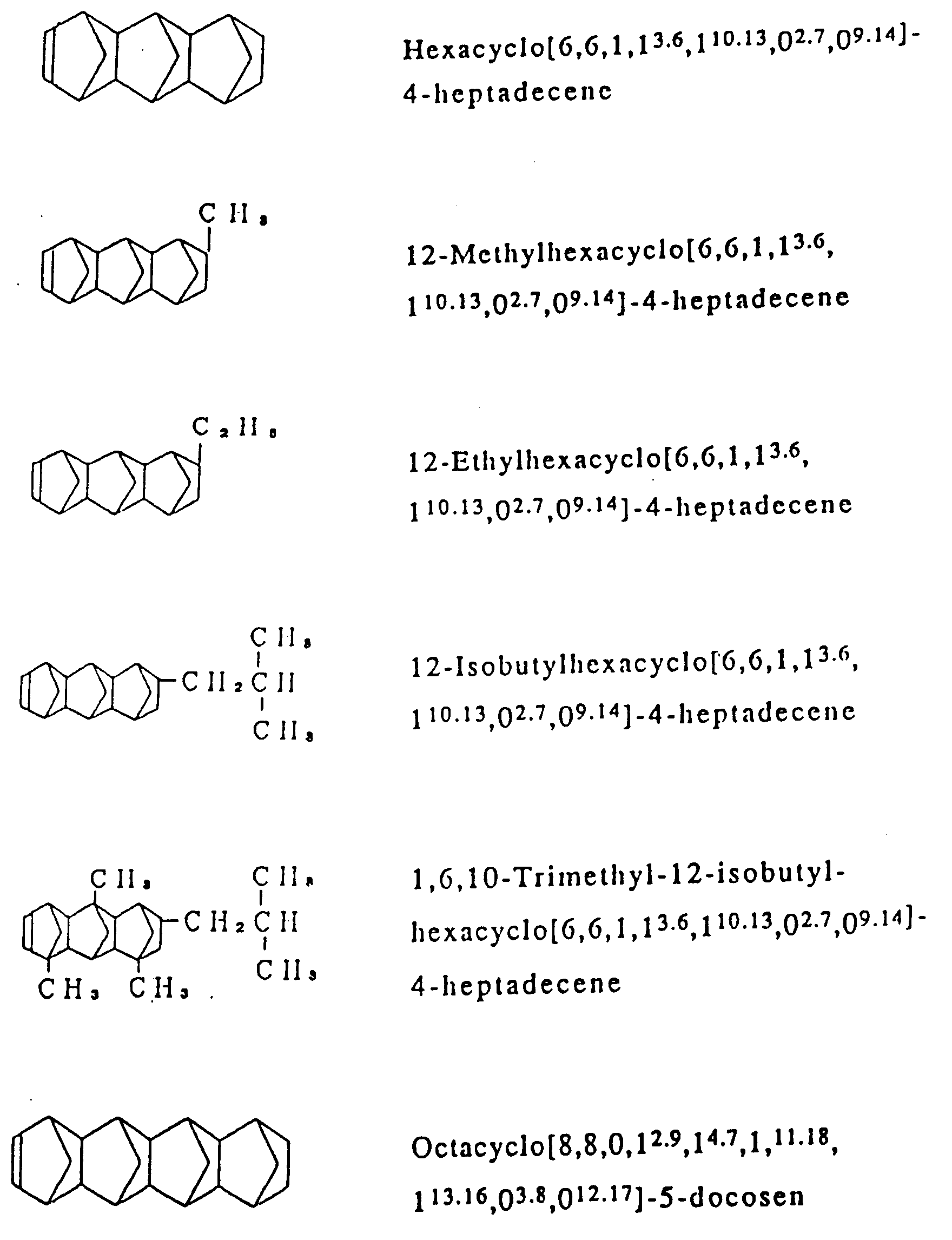
- The cycloolefins represented by general formula [I] can easily be prepared by the Diels-Alder condensation of cyclopentadienes with appropriate olefins.
- Examples of the cycloolefins represented by general formula [I] include the compounds exemplified in Table 1, and 1,4,5,8-dimethano-1,2,3,4,4a,5,8,8a-octahydronaphthalene, such octahydronaphthalenes as 2-methyl-1,4,5,8-dimethano-1,2,3,4,4a,5,8,8a-octahydronaphthalene, 2-ethyl-1,4,5,8-dimethano-1,2,3,4,4a,5,8,8a-octahydronaphthalene, 2-propyl-1,4,5,8-dimethano-1,2,3,4,4a,5,8,8a-octahydronaphthalene, 2-hexyl-1,4,5,8-dimethano-1,2,3,4,4a,5,8,8a-octahydronaphthalene, 2-stearyl-1,4,5,8-dimethano-1,2,3,4,4a,5,8,8a-octahydronaphthalene, 2,3-dimethyl-1,4,5,8-dimethano-1,2,3,4,4a,5,8,8a-octahydronaphthalene, 2-methyl-3-ethyl-1,4,5,8-dimethano-1,2,3,4,4a,5,8,8a-octahydronaphthalene, 2-chloro-1,4,5,8-dimethano-1,2,3,4,4a,5,8,8a-octahydronaphthalene, 2-bromo-1,4,5,8-dimethano-1,2,3,4,4a,5,8,8a-octahydronaphthalene, 2-fluoro-1,4,5,8-dimethano-1,2,3,4,4a,5,8,8a-octahydronaphthalene, 2,3-dichloro-1,4,5,8-dimethano-1,2,3,4,4a,5,8,8a-octahydronaphthalene, 2-cyclohexyl-1,4,5,8-dimethano-1,2,3,4,4a,5,8,8a-octahydronaphthalene, 2-n-butyl-1,4,5,8-dimethano-1,2,3,4,4a,5,8,8a-octahydronaphthalene and 2-isobutyl-1,4,5,8-dimethano-1,2,3,4,4a,5,8,8a-octahydronaphthalene.




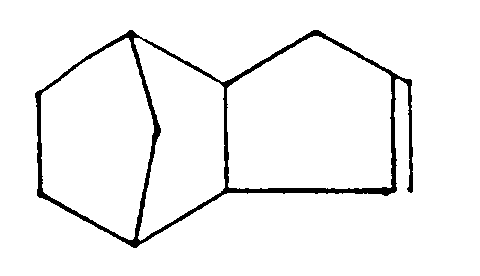
- Ethylene is copolymerized with at least one cycloolefin of general formula [I]. In addition to said two essential components, however, there may be optionally copolymerized other copolymerizable unsaturated monomers in such a range that they do not mar the object of the invention. Examples of the unsaturated monomers which may optionally be copolymerized with ethylene and at least one cycloolefin of general formula [I] include α-olefins having from 3 to 20 carbon atoms, such as propylene, 1-butene, 4-methyl-1-pentene, 1-hexene, 1-octene, 1-decene, 1-dodecene, 1-tetradecene, 1-hexadecene, 1-octadecene and 1-icosene, in such a proportion that the resulting cycloolefin random copolymer may contain units derived therefrom in an amount of less than an equimolar amount of units derived from ethylene; cycloolefins, such as cyclopentene, cyclohexene, 3-methylcyclohexene, cyclooctene and 3a, 5, 6, 7a-tetrahydro-4, 7-methano-1H-indene of formula :
- Ethylene is copolymerized with at least one cycloolefin of general formula [I] in a hydrocarbon solvent. The hydrocarbon solvents herein include aliphatic hydrocarbons such as hexane, heptane, octane, and kerosene; alicyclic hydrocarbons such as cyclohexane and methylcyclohexane; aromatic hydrocarbons such as benzene, toluene and xylene; and the above-illustrated cycloolefins of general formula [I], alone or in combination.
- Ethylene is copolymerized with at least one cycloolefin of general formula [I] in the presence of a catalyst. Suitable catalysts which can be used herein comprise a vanadium compound which is soluble in the particular hydrocarbon solvent used and an organoaluminium compound.
- The vanadium compounds as one component of the catalyst, include compounds of general formula VO(OR)aXb or V(OR)cXd wherein R is a hydrocarbon group, and a, b, c and d are numbers such that 0 ≤ a ≤ 3, 0 ≤ b ≤ 3, 2 ≤ a + b ≤ 3, 0 ≤ c ≤ 4, 0 ≤ d ≤ 4, and 3 ≤ c + d ≤ 4; and their adducts with an electron donor. Examples of the vanadium compound include, for example, VO(Cl3), VO(OC2H5)Cl2, VO(OC2H5)2Cl, VO(O-iso-C3H7)Cl2, VO(O-n-C4H9)Cl2, VO(OC2H5)3, VCl4, VOCl2, VOBr2, VO(O-n-C4H9)3 and VCl3-20C8H17OH.
- Electron donors which can be used for the preparation of the vanadium component of the catalyst may be oxygen-containing electron donors such as alcohols, phenols, ketones, aldehydes, carboxylic acids, esters of organic and inorganic acids, ethers, acid amides, acid anhydrides and alkoxysilanes; or nitrogen-containing electron donors such as ammonia, amines, nitriles and isocyanates. Examples of suitable electron donors include, for example, alcohols having from 1 to 18 carbon atoms, such as methanol, ethanol, propanol, isopropanol, pentanol, hexanol, octanol, dodecanol,octadecyl alcohol, oleyl alcohol, benzyl alcohol, phenylethyl alcohol, isopropylbenzyl alcohol and cumyl alcohol; phenols having from 6 to 20 carbon atoms which may include a lower alkyl group or groups attached to the aromatic ring, such as phenol, cresols, xylenols, ethylphenols, propylphenols, nonylphenols, cumylphenols and naphthols; ketones having from 3 to 15 carbon atoms, such as acetone, methyl ethyl ketone, methyl isobutyl ketone, acetophenone, benzophenone and benzoquinone; aldehydes having from 2 to 15 carbon atoms, such as acetaldehyde, propionaldehyde, octylaldehyde, benzaldehyde, tolualdehydes and naphthoaldehydes; organic acid esters having from 2 to 30 carbon atoms, such as methyl formate, methyl acetate, ethyl acetate, vinyl acetate, propyl acetate, octyl acetate, cyclohexyl acetate, ethyl propionate, methyl butyrate, ethyl valerate, methyl chloroacetate, ethyl dichloroacetate, methyl methacrylate, ethyl crotonate, ethyl cyclohexanecarboxylate, methyl benzoate, ethyl benzoate, propyl benzoate, butyl benzoate, octyl benzoate, cyclohexyl benzoate, phenyl benzoate, benzyl benzoate, methyl toluylates, ethyl toluylates, amyl toluylates, ethyl ethylbenzoates, methyl anisates, n-butyl maleate, diisobutyl methyl malonate, di-n-hexyl cyclohexenecarboxylate, diethyl nadate, diisopropyl tetrahydrophthalate, diethyl phthalate, diisobutyl phthalate, di-n-butyl phthalate, di-2-ethylhexyl phthalate, γ-butyrolactone, δ-valerolactone, coumarin, phthalide and ethylene carbonate; acid halides having from 2 to 15 carbon atoms, such as acetyl chloride, benzoyl chloride, toluyl chloride and anisic acid chloride; ethers having from 2 to 20 carbon atoms, such as methyl ether, ethyl ether, isopropyl ether, butyl ether, amyl ether, tetrahydrofuran ,anisole and diphenyl ether; acid amides such as acetamide, benzamide and toluamides; amines such as methyl amine, ethyl amine, diethyl amine, tributyl amine, piperidine, tribenzyl amine, aniline, pyridine, picolines and tetramethylenediamine; nitriles such as acetonitrile, benzonitrile and tolunitriles; and alkoxysilanes such as ethyl silicate and diphenylmethoxysilane. The illustrated electron donors may be used alone or in combination.
- As the organoaluminium compound of the other component of the catalyst, compounds having at least one Al-C bond in the molecule can be used. One group of such organoaluminium compounds may be represented by general formula (i)
R1 mAl(OR2)nHpXq (i)
wherein R1 and R2 are the same or different, and each represents a hydrocarbon group normally having from 1 to 15, preferably from 1 to 4 carbon atoms, X is halogen and m, n, p and q are numbers such that 0 ≤ m ≤ 3; 0 ≤ n < 3; 0 ≤ p < 3; 0 ≤ q < 3; and
M1AlR1 4 (ii)
wherein M1 is Li, Na or K, and R1 is as defined above. - The organoaluminium compounds of general formula (i) include those of general formula
R1 mAl(OR2)3-m
wherein R1 and R2 are as defined above, and m is a number which is preferably such that 1.5 ≤ m < 3; those of general formula
R1 mAlX3-m
wherein R1 and X are as defined above, and m is a number which is preferably such that 0 < m < 3; those of general formula
R1 mAlH3-m
wherein R1 is as defined above, and m is a number which is preferably such that 2 ≤ m < 3; and those of general formula
R1 mAl(OR2)nXq
wherein R1, R2 and X are as defined above, and m, n and q are numbers such that 0 < m ≤ 3, 0 ≤ n < 3, 0 ≤ q < 3 and
- Examples of the organoaluminium compound of general formula (i) include trialkylaluminiums such as triethylaluminium, triisopropylaluminium and tributylaluminium; partly alkoxylated alkylaluminiums including, in addition to dialkylaluminium alkoxides such as diethylaluminium ethoxide and dibutylaluminium butoxide, alkylaluminium sesquialkoxides such as ethylaluminium sesquiethoxide and butylaluminium sesquibutoxide, and those having such an average composition as, for example, R1 2.5Al(OR2)0.5 ; partly halogenated alkylaluminium halides including dialkylaluminium halides such as diethylaluminium chloride, dibutylaluminium chloride and diethylaluminium bromide, alkylaluminium sesquihalides such as ethylaluminium sesquichloride, butylaluminium sesquichloride and ethylaluminium sesquibromide, and alkylaluminium dihalides such as ethylaluminium dichloride, propylaluminium dichloride and butylaluminium dibromide; partly hydrogenated alkylaluminiums including dialkylaluminium hydrides such as diethylaluminium hydride and dibutylaluminium hydride and alkylaluminium dihydrides such as ethylaluminium dihydride and propylaluminium dihydride; and partly alkoxylated and halogenated alkylaluminiums such as ethylaluminium ethoxychloride, butylaluminium butoxychloride and ethylaluminium ethoxybromide. Furthermore, organoaluminium compounds in which two aluminium atoms are attached to one and the same oxygen or nitrogen atom, such as
(C2H5)2AlOAl(C2H5)2,
(C4H9)2AlOAl(C4H9)2
and
- Examples of the organoaluminium compound of general formula (ii) include LiAl(C2H5)4 and LiAl(C7H15)4.
- Particularly preferred organoaluminium compounds which can be used herein as the organoaluminium component of the catalyst, are dialkylaluminium halides and alkylaluminium dihalides and mixtures thereof.
- The copolymerization is normally carried out continuously as hereinafter described in detail. Both the catalyst components are normally respectively diluted with the hydrocarbon solvent described above and fed to the polymerization vessel. The concentration of the vanadium compound fed to the reaction system is normally not higher than 10 times, preferably from 1 to 7 times, more preferably from 1 to 5 times, the concentration of the vanadium compound present in the reaction system. The concentration of the organoaluminium compound fed to the reaction system may be not higher than 50 times the concentration of the vanadium compound present in the reaction system.
- The concentration of the vanadium compound present in the reaction system is normally from 0.01 to 5 gram atom of V/liter, preferably from 0.05 to 3 gram atom of V/liter, and the atomic ratio of the aluminium atom to the vanadium atom (Al:V) in the reaction system is normally at least 2:1, preferably from 2:1 to 50:1, in particular from 3:1 to 20:1.
- The cycloolefin random copolymer is prepared by copolymerization of ethylene with a cycloolefin represented by general formula [I] in the above-mentioned hydrocarbon solvent in the presence of the catalyst as aforesaid at a temperature of usually from -50 to 100 °C and a pressure of from 0 to 50 kg/cm2 G (1 kg/cm2 G = 0.981 bar G).
- The polymerization may be carried out using a polymerization reactor such as a loop-shaped reactor having a function to perform forced circulation of a reaction liquid by means of a pump or a polymerization vessel equipped with a stiffer.
- The optimum conditions under which the polymerization is carried out are illustrated below in detail.
- It is desirable that the cycloofefin random copolymers are prepared by copolymerization of ethylene and the above-mentioned cycloolefins under such conditions that substantially no gas phase portion is present in the polymerization reactor even when either of the abovementioned reactors is used.
- By carrying out the above-mentioned polymerization reaction using a reactor in which substantially no vapor phase portion is present, solvent-insoluble copolymers which have a high ethylene content and which are insoluble in the hydrocarbon solvent used in carrying out the polymerization reaction form in the reactor only with difficulty.
- When the cycloolefin random copolymers are prepared using the polymerization vessel equipped with a stiffer, various measures may be adopted in order that substantially no gas phase portion is present in said polymerization vessel. For example, it is desirable to have a nozzle to pick up the copolymer solution from the polymerization vessel fitted to the uppermost portion of said polymerization vessel; the gas portion formed, if any, can be discharged promptly from the polymerization vessel. The amount of the resulting cycloolefin random copolymer to be picked up is preferably controlled automatically by means of a pressure control valve and not by means of a liquid surface control valve as used hitherto.
- In order to prevent leakage of the cycloolefin random copolymer from a shaft sealing portion of the stirrer caused by permeation of said copolymer into the shaft sealing portion, for example a sealing surface of, a mechanical seal, it is preferred to take an appropriate measure, for example, by flowing a flashing liquid over said shaft sealing portion.
- When the cycloolefin random copolymers are prepared using the loop-shaped reactor, a so-called cavitation takes place if a gas phase portion in excess of a certain degree is present around a pump for forced circulation of said copolymer solution. Consequently the forced circulation of said copolymer solution becomes difficult. Hence, it is possible to confirm whether or not the interior of said reactor is substantially filled with said copolymer solution by observing the flow rate of said copolymer solution within the reactor. The resulting cycloolefin random copolymers are preferably picked up from the reactor, while automatically controlling the pressure inside the reactor by a pressure control valve.
- Even in the case where either the above-mentioned polymerization vessel equipped with a stirrer or a loop-shaped reactor is used, variations of the pressure in said polymerization reactor, which is automatically controlled by the pressure control valve, become large as the amount of the gas phase portion in the reactor decreases. It is readily confirmed that substantially no gas phase portion is present in the reactor when a large variation in pressure as aforesaid is recorded in a pressure record provided in said reactor.
- From the standpoint of material balance, moreover, a state wherein substantially no gas phase portion is present can also be set by selection of the polymerization temperature and pressure such that the product of the amount of hydrocarbon solvent fed per unit of time to the reactor and the solubility in said hydrocarbon solvent of ethylene becomes larger than the amount of unreacted ethylene per unit time. In actual practice, however, it is preferable to carry out the polymerization reaction while confirming that substantially no gas phase portion is present in the reactor by checking the variation width of pressure in the reactor or the electric current consumption of the pump in the loop-shaped reactor.
- The copolymerization of ethylene and the cycloolefin in the reactor where substantially no gas phase is present is normally carried out at a temperature of from - 50 ° to 100 °C, preferably from -30 ° to 80 °C, more preferably from - 20 ° to 60 °C.
- The copolymerization of ethylene and the cycloolefin is normally carried out continuously. In this case, the monomers including ethylene, the cycloolefin of general formula [I] and optionally one or more other copolymerizable monomers; the catalyst components, that is, the soluble vanadium compound and the organoaluminium compound, and the hydrocarbon solvent, are continuously fed to the polymerization system, while the polymerization reaction mixture is continuously drawn out from the polymerization system.
- The average residence time of the polymerization mixture in the polymerization system is normally from 5 minutes to 5 hours, preferably from 10 minutes to 3 hours, depending upon the monomers, the concentration of the catalyst and the polymerization temperature. The pressure of the polymerization system is positive and is normally up to 50 kg/cm2, preferably up to 20 kg/cm2.
- The molar ratio of ethylene to the cycloolefin used in the copolymerization may be from 99:1 to 1:99, preferably from 98:2 to 2:98, more preferably from 90:10 to 10:90.
- By the copolymerization described above, there is obtained a solution of the cycloolefin random copolymer in the hydrocarbon solvent.
- The cycloolefin random copolymer obtained by copolymerization of ethylene and cycloolefin has the structure represented by general formula [II]:

- The cycloolefin random copolymer thus obtained normally comprises from 1 to 99 mol %, preferably from 40 to 85 mol % and more preferably from 50 to 75 mol % of recurring units (a) derived from ethylene and normally from 1 to 99 mol %, preferably from 15 to 60 mol % and more preferably from 25 to 50 mol % of recurring units (b) derived from the cycloolefin. In the cycloolefin random copolymer, the recurring units (a) derived from ethylene and the recurring units (b) derived from the cycloolefin are arranged substantially at random. This cycloolefin copolymer is substantially linear and has no gel-forming crosslinked structure, as confirmed by the fact that the copolymer completely dissolves in decalin at 135 °C.
- Such cycloolefin random copolymers as mentioned above usually have an intrinsic viscosity [η] of from 0.05 to 10 dl/g as measured at 135 °C in decalin, a softening point (TMA) of from 70 to 250 °C as measured by a thermal mechanical analyzer, a glass transition temperature (Tg) of from 50 to 230 °C and a crystallinity index of from 0 to 10 % as measured by X-ray diffractometry.
- The cycloolefin random copolymer solution is subjected, if desired, to an ash removal step. In this ash removal step, an alkali solution, for example an aqueous sodium hydroxide solution having a concentration of from 10 to 50 % by weight, is added to the cycloolefin random copolymer solution to stop the polymerization reaction, and the catalyst residue which remains in this polymer solution is removed (deashed) therefrom.
- Subsequently, the thus deashed polymer solution is transferred, in actual practice, once to a container equipped with a stirrer and stirred for a certain period of time, though said polymer solution may be subjected, immediately after the deashing step, to the flash drying step.
- The cycloolefin random copolymer solution subjected to a deashing step in the manner mentioned above is then heated, usually by using a heater, for example, a double-pipe heater or plate-type heat exchanger.
- In heating the cycloolefin random copolymer solution the concentration of the copolymer in said solution is preferably adjusted to from 1 to 70 % by weight. The heating temperature employed should be sufficient to thoroughly volatilize the solvent in the copolymer solution in the subsequent flash drying step, and is usually from 150 to 280°C, preferably from 180 to 250°C.
- In the process for the production of cycloolefin random copolymers according to the invention,
- a first solution of a first cycloolefin random copolymer [B] in a first hydrocarbon obtained by copolymerization of ethylene and a cycloolefin of general formula [I] in said first hydrocarbon in the presence of a catalyst, said first cycloolefin random copolymer [B] having an intrinsic viscosity [η] of from 0.05 to 10 dl/g measured in decalin at 135°C and a softening point (TMA) of at least 70°C,
- and a second solution of a second random copolymer [C] in a second hydrocarbon obtained by copolymerization of ethylene, at least one α-olefin other than ethylene and a cycloolefin of general formula [I] in said second hydocarbon in the presence of a catalyst, said second cycloolefin random copolymer [C] having an intrinsic viscosity [η] of from 0.01 to 10 dl/g measured in decalin at 135°C and a softening point (TMA) of less than 70°C,
- are mixed to provide a mixed solution in which from 5 to 100 parts by weight of said second cycloolefin random copolymer [C] is present based on 100 parts by weight of said first cycloolefin random copolymer [B] present therein;
- and the mixed solution is flash dried.
- The first solution of a first cycloolefin random copolymer [B] in a first hydrocarbon is obtained by copolymerization of ethylene and a cycloolefin of general formula [I] in a hydrocarbon as described hereinabove, in the presence of a catalyst as described hereinabove, normally at a temperature of from -50° to 100°C under a pressure of above 0 and not higher than 50kg/cm2 G. In the production of the first cycloolefin random copolymer [B], a minor amount of an α-olefin having from 3 to 20 carbon atoms may be copolymerized with the ethylene and cycloolefin provided that the resulting copolymer [B] has the properties prescribed herein.
- The copolymerization may be carried out using either a loop-shaped reactor or a polymerization vessel equipped with a stiffer.
- The cycloolefin random copolymer [B] thus obtained normally comprises from 40 to 85 mol % and preferably from 50 to 75 mol % of recurring units (a) derived from ethylene and from 15 to 60 mol % and preferably from 25 to 50 mol % of recurring units (b) derived from the cycloolefin. In the cycloolefin random copolymer [B], the recurring units (a) derived from ethylene and the recurring units (b) derived from the cycloolefin are arranged substantially linearly and at random. This cycloolefin copolymer [B] is substantially linear and has no gel-forming crosslinked structure, as confirmed by the fact that the copolymer completely dissolves in decalin at 135°C.
- The cycloolefin random copolymer [B] has an intrinsic viscosity [η] of from 0.05 to 10 dl/g, preferably from 0.08 to 5 dl/g as measured at 135 °C in decalin, a softening point (TMA) of at least 70°C, preferably from 90° to 250°C, and more preferably from 100° to 200°C, as measured by a thermal mechanical analyzer, a glass transition temperature (Tg) of usually from 50 to 230°C, preferably from 70 to 210°C and a crystallinity index normally of from 0 to 10%, preferably from 0 to 7%, and more preferably from 0 to 5%, as measured by X-ray diffractometry.
- The second solution of a second cycloolefin random copolymer [C] in a second hydrocarbon can be obtained by the same process as described hereinabove with respect to the production of the first solution of the first cycloolefin random copolymer [B] in the first hydrocarbon except that at least one α-olefin other than ethylene is necessarily copolymerized with ethylene and the cycloolefin of general formula [I] and that conditions are suitably selected so that the resulting second cycloolefin random copolymer has the properties prescribed herein. Thus, the catalyst, hydrocarbon solvent and apparatus used in the preparation of the second solution can be the same as those used in the preparation of the first solution.
- The cycloolefin random copolymer [C] thus obtained normally comprises from 40 to 98 mol %, preferably from 75 to 98 mol % of recurring units (a) derived from ethylene, from 1 to 40 mol %, preferably from 1 to 15 mol % of recurring units (b) derived from the cycloolefin and from 1 to 45 mol %, preferably from 1 to 35 mol % of recurring units (c) derived from at least one α-olefin other than ethylene . In the cycloolefin random copolymer [C], the recurring units (a) derived from ethylene, the recurring units (b) derived from the cycloolefin and the recurring units derived from at least one α-olefin other than ethylene are arranged substantially linearly and at random. This cycloolefin copolymer [C] is substantially linear and has no gel-forming crosslinked structure, as confirmed by the fact that the copolymer completely dissolves in decalin at 135°C.
- The cycloolefin random copolymer [C] has an intrinsic viscosity [η] of from 0.01 to 10 dl/g, preferably from 0.08 to 5 dl/g as measured at 135 °C in decalin, a softening point (TMA) of less than 70°C, preferably from -40 to 60°C, and more preferably from -30° to 30°C, as measured by a thermal mechanical analyzer which is desirably lower than the softening point of the copolymer [B] by from 30 to 250°C, preferably by from 50° to 250°C, and more preferably by from 200° to 240°C, a glass transition temperature (Tg) of usually from -60° to 40°C, preferably from -50° to 10°C, which is desirably lower than that of the copolymer [B] by from 30 to 250°C, preferably by from 100° to 240°C, and a crystallinity index normally of from 0 to 10%, preferably from 0 to 7%, and more preferably from 0 to 5%, as measured by X-ray diffractometry.
- In the process according to the invention, the first solution and the second solution are admixed together in such proportions that the resulting mixed solution contains from 5 to 100 parts, preferably from 7 to 80 parts, and more preferably from 10 to 70 parts by weight of the second cycloolefin random copolymer [C] based on 100 parts by weight of the first cycloolefin random copolymer [B]. With less than 5 parts by weight, based on 100 parts by weight of the copolymer [B], of the copolymer [C], the final product tends not to have a satisfactory impact property, although it has excellent rigidity. Whereas with the copolymer [C] in excess of 100 parts by weight based on 100 parts by weight of the copolymer [B], the final product tends to have unsatisfactory rigidity, although the impact property is excellent.
- The mixed solution of the first cycloolefin random copolymer [B] and the second cycloolefin random copolymer [C] is then optionally subjected to ash removal and heating steps and thereafter flash dried in the manner as described hereinabove.
- After completion of the above-mentioned heating step, the cycloolefin random copolymer solution is flash dried, whereby unreacted cycloolefin monomer is removed therefrom. This flash drying step may be carried out, for example, by using a double-pipe flash drier.
- In flash drying the cycloolefin random copolymer solution using the double-pipe flash drier, it is preferable to give said solution such a pressure distribution and quantity of heat that the temperature as preset in the drier becomes a temperature at which no solidification of the copolymer in the cycloolefin random copolymer solution will take place. In that case, it is preferable to feed the cycloolefin random copolymer solution to the drier at a rate of at least 0.3 m/s or thereabouts in order to inhibit staining of a heat transfer surface of the drier.
- By carrying out the flash drying of the cycloolefin random copolymer solution under the above-mentioned conditions, there are obtained cycloolefin random copolymers from which unreacted cycloolefin monomer and the solvent remaining have been substantially removed. The cycloolefin random copolymers thus obtained have excellent properties such as heat resistance, heat aging property, chemical resistance, solvent resistance, dielectric properties, rigidity and impact property.
- As mentioned above, the cycloolefin random copolymers subjected to the flash drying step contain practically no unreacted cycloolefin monomer. However, these copolymers which contain, if any, small amounts of unreacted cycloolefin monomer may also be treated with the following extruder to remove the unreacted monomer therefrom.
- By passing the above-mentioned flash dried cycloolefin random copolymer through a twin-screw extruder equipped with atmospheric and vacuum vents, the unreacted cycloolefin monomer present in such small amounts in said copolymer can be removed.
- The atmospheric vent is necessary for preventing the cycloolefin random copolymer from foaming in the vacuum vent. The temperature of the extruder should be higher than the boiling point of the unreacted cycloolefin monomer in the atmosphere, and is usually from 210 to 280°C, preferably from 230 to 260°C.
- The second random copolymer [C] may be a random copolymer [D] obtained by copolymerization of ethylene, at least one of propylene and butene, and the cycloolefin of general formula [I].
- The cycloolefin random copolymer [D] can be obtained by the same process as described hereinabove for the cycloolefin random copolymer [C] except that at least one specific α-olefin, that is propylene and/or butene, is copolymerized with the ethylene and cycloolefin. The hydrocarbon solvent used may be the same as the second and first hydrocarbon solvents.
- By the process according to the invention in which a solution of cylcoolefin random copolymers in a hydrocarbon is flash dried, there can be economically and effectively produced cycloolefin random copolymers of high quality having any unreacted cycloolefin monomer substantially removed with no need of any complicated process steps.
- The or each copolymerization of ethylene with a cycloolefin of general formula [I] may be carried out in a polymerization reactor in the substantial absence of a gas phase. This ensures a smooth copolymerization of ethylene and the cycloolefin and a continuous and stable running of the apparatus for the production of the ethylene-cycloolefin random copolymers, and is productive of ethylene-cycloolefin random copolymers which have a uniform quality and excellent heat resistance, heat aging property and various mechanical properties.
- The cycloolefin random copolymers produced by the process according to the invention are relatively inexpensive, and therefore they find application in wide industrial fields, including as engineering plastics.
- The present invention will now be further described in the following Examples.
- The properties of cycloolefin random copolymers were determined as follows:
- MFR was measured at 260 °C under a load of 2160 g.
- Intrinsic viscosity [η] was measured in decalin at 135 °C. using an Atlantic viscometer.
- Copolymer composition [mol %] was determined by infrared spectroscopy. From the height of the peak of the absorption band (1026 cm-1) based on the cycloolefin component, the content of cycloolefin was determined. The remainder was regarded as the content of ethylene.
- Various ash contents [V, Al and Cl] were determined by X-ray diffractometry.
- Volatile materials [VM] was determined from the weight change measured at 300 °C, 1 Torr, for 1 hour, and expressed in wt.%.
- Unreacted cycloolefin content was determined by gas chromatography on a solution of the cycloolefin random copolymer in cyclohexane.
- Softening point [TMA] was determined by a Penetration test using a thermomechanical analyzer supplied by Du pont with a rate of temperature rise of 5 °C/minute.
- Molecular-weight distribution [Mw/Mn] was determined by GPC.
- VO(OC2H5)Cl was diluted with cyclohexane to prepare a vanadium catalyst in which the vanadium concentration was 6.7 mmol/l-cyclohexane. On the other hand, ethyl aluminium sesquichloride (Al(C2H5)1.5Cl1.5) was diluted with cyclohexane to prepare an organic aluminium catalyst in which the aluminium concentration was 107 mmol/l-cyclohexane.
- Cycloolefin random copolymer [B] was continuously prepared by carrying out a copolymerization reaction between ethylene and tetracyclo[4,4,0,12.5,17.10]-3-dodecene] (sometimes merely called tetracyclododecene hereinafter) as cycloolefin, using a polymerization reactor equipped with a stirrer (500 mm inner diameter, 100 liter reaction capacity). To perform the copolymerization reaction, the vanadium catalyst prepared as stated above was fed into the reactor at such a rate that the concentration of vanadium in cyclohexane, which was the polymerization solvent used, was maintained at 0.6 mmol/l in the reactor. Just before the feeding of the vanadium catalyst to the reactor, the vanadium catalyst was further diluted with cyclohexane to a V concentration of two times that in the polymerization reactor.
- The organoaluminium catalyst prepared as above was supplied to the reactor at a rate so that a Al:V ratio of 8.0: was maintained in the reactor. The aforementioned copolymerization reaction was carried out continuously at a temperature of 11 °C and under a pressure of 1.8 kg/cm2 G.
- Cycloolefin copolymer [C] was produced by executing the copolymerization reaction using a loop-shaped reactor (internal tube diameter:4B, external tube diameter 6B, length: 32 m, vertical type), under a pressure of 4 kg/ cm2 G, with ethylene, tetracyclododecene as cycloolefin, and propylene as α-olefin.
- The solutions of cycloolefin random copolymer [B] and cycloolefin type random copolymer [C] drawn from the respective reactors were sent into a pipe where they were premixed, and boiler water and a 25 wt.% NaOH aqueous solution as a pH modifier were added to the mixed solution, thereby stopping the polymerization reaction. The thus formed catalyst residue was then removed (deashed) from the mixed solution. The deashed mixed solution was once mixed for an hour in a stirring bath having an effective capacity of 1.0 m3 before being sent to the subsequent step.
- To a double-tube heater (external tube diameter: 2B, internal tube diameter: 3/4 B, length: 21 m) heated with steam of 20 kg/cm2G as a heating source, the mixed solution of which the copolymer concentration was set to 5 wt.% was fed at a rate of 150 kg/h, and the mixture was heated to 180 °C.
- By using a double-tube flash drier (external tube diameter: 2B, internal tube diameter: 3/4 B, length: 27 m) and a flash hopper (capacity: 200 liter), the mixed solution from the heating step was flash dried to remove most of the unreacted tetracyclododecene, which was removed together with the polymerization solvent. Steam at 25 kg/cm2G was used as a heating source for the double-tube flash drier.
- The copolymer from the above flash drying step was next kneaded in a vented extruder. The kneading was executed using a vented extruder (screw diameter 30 ⌀ mm, twin-screw rotating in the same direction, L/D=42, air vent: 1, vacuum vent: 2), at a barrel temperature of 250 °C and a vacuum degree of vent of 5 Torr. Unreacted tetracyclododecene was again removed from the copolymer.
- Typical physical properties of the resulting copolymer are shown in Table 2.
- Example 1 was repeated except that methyltetracyclo[4,4,0,12.5,17.10]-3-dodecene] (sometimes merely called methyltetracyclododecene hereinafter) was used as the cycloolefin monomer.
- Typical physical properties of the resulting copolymer are shown in Table 2.
Table 2 Example 1 Example 2 Polymer solution Polymer B Ethylene content (mol %) 51 62 Polymer concentration (wt. %) 5 5 Polymer [η] (d/g) 0.94 0.48 Polymer TMA (°C.) 170 154 Unreacted cycloolefin rate (kg/h) 1 1.2 Feed rate (kg/h) 105 120 Polymer C Ethylene content (mol %) 76 69 Propylene content (mol %)) 16 21 Polymer concentration (wt. %) 5 5 Polymer [η] (d/g) 0.98 1.44 Polymer TMA (°C.) -8 -4 Unreacted cycloolefin rate (kg/h) 0.05 0.3 Feed rate (kg/h) 45 30 Heater outlet temperature (°C) 181 180 Flash tube outlet temperature (°C) 200 200 Properties of the product Unreacted cycloolefin content at flash tube outlet (wt.%) 0.7 0.77 VM at flash tube outlet (wt.%) 3.79 3.81 Unreacted cycloolefin content at extruder outlet (wt.%) 0.04 0.04 VM at extruder outlet (wt.%) 0.76 0.77
Claims (3)
- A process for the production of a random copolymer which comprises flash drying a mixture comprising 100 parts by weight of a first random copolymer [B] as a solution in a first hydrocarbon and 5 to 100 parts by weight of a second random copolymer [C] as a solution in a second hydrocarbon, said first random copolymer [B] deriving from copolymerization, in said first hydrocarbon in the presence of a catalyst, of ethylene and a cycloolefin of formula [I] and having an intrinsic viscosity [η] of from 0.05 to 10 dl/g measured in decalin at 135°C and a softening point (TMA) of at least 70°C, said second random copolymer [C] deriving from copolymerization, in said second hydrocarbon in the presence of a catalyst, of ethylene, at least one α-olefin other than ethylene and said cycloolefin [I] and having an intrinsic viscosity [η] of from 0.01 to 10 dl/g measured in decalin at 135°C and a softening point (TMA) of less than 70°C:

- A process according to claim 1 wherein said second random copolymer [C] derives from ethylene, at least one of propylene and butene and said cycloolefin [I].
- A process according to claim 1 or 2 wherein the said or each copolymerization has been carried out in a polymerization reactor in the substantial absence of a gas phase.
Priority Applications (1)
| Application Number | Priority Date | Filing Date | Title |
|---|---|---|---|
| EP96109118A EP0737697B1 (en) | 1988-09-07 | 1989-09-07 | Process for producing cycloolefin random copolymers |
Applications Claiming Priority (5)
| Application Number | Priority Date | Filing Date | Title |
|---|---|---|---|
| JP22377688 | 1988-09-07 | ||
| JP22377588 | 1988-09-07 | ||
| JP223775/88 | 1988-09-07 | ||
| JP223776/88 | 1988-09-07 | ||
| EP89309103A EP0358516B1 (en) | 1988-09-07 | 1989-09-07 | Process for producing cycloolefin random copolymers |
Related Parent Applications (2)
| Application Number | Title | Priority Date | Filing Date |
|---|---|---|---|
| EP89309103A Division EP0358516B1 (en) | 1988-09-07 | 1989-09-07 | Process for producing cycloolefin random copolymers |
| EP89309103.3 Division | 1989-09-07 |
Related Child Applications (2)
| Application Number | Title | Priority Date | Filing Date |
|---|---|---|---|
| EP96109118.8 Division-Into | 1989-09-07 | ||
| EP96109118A Division EP0737697B1 (en) | 1988-09-07 | 1989-09-07 | Process for producing cycloolefin random copolymers |
Publications (3)
| Publication Number | Publication Date |
|---|---|
| EP0579342A2 EP0579342A2 (en) | 1994-01-19 |
| EP0579342A3 EP0579342A3 (en) | 1994-11-17 |
| EP0579342B1 true EP0579342B1 (en) | 1997-02-12 |
Family
ID=26525678
Family Applications (3)
| Application Number | Title | Priority Date | Filing Date |
|---|---|---|---|
| EP96109118A Expired - Lifetime EP0737697B1 (en) | 1988-09-07 | 1989-09-07 | Process for producing cycloolefin random copolymers |
| EP93202806A Expired - Lifetime EP0579342B1 (en) | 1988-09-07 | 1989-09-07 | Process for producing cycloolefin random copolymers |
| EP89309103A Expired - Lifetime EP0358516B1 (en) | 1988-09-07 | 1989-09-07 | Process for producing cycloolefin random copolymers |
Family Applications Before (1)
| Application Number | Title | Priority Date | Filing Date |
|---|---|---|---|
| EP96109118A Expired - Lifetime EP0737697B1 (en) | 1988-09-07 | 1989-09-07 | Process for producing cycloolefin random copolymers |
Family Applications After (1)
| Application Number | Title | Priority Date | Filing Date |
|---|---|---|---|
| EP89309103A Expired - Lifetime EP0358516B1 (en) | 1988-09-07 | 1989-09-07 | Process for producing cycloolefin random copolymers |
Country Status (6)
| Country | Link |
|---|---|
| US (2) | US5128446A (en) |
| EP (3) | EP0737697B1 (en) |
| KR (1) | KR930000650B1 (en) |
| AT (1) | ATE115154T1 (en) |
| CA (1) | CA1339182C (en) |
| DE (3) | DE68919776T2 (en) |
Families Citing this family (13)
| Publication number | Priority date | Publication date | Assignee | Title |
|---|---|---|---|---|
| EP0542488B1 (en) * | 1991-11-11 | 1994-07-06 | Mitsui Petrochemical Industries, Ltd. | Process for preparing cycloolefin random copolymer |
| US5567776A (en) * | 1992-05-26 | 1996-10-22 | Mitsui Petrochemical Industries, Ltd. | Cycloolefin copolymer composition and method for the preperation thereof |
| US5494969A (en) * | 1993-01-29 | 1996-02-27 | Mitsui Petrochemical Industries, Ltd. | Cycloolefin polymer composition |
| JPH06228323A (en) * | 1993-01-29 | 1994-08-16 | Mitsui Petrochem Ind Ltd | Production of pellet of cycloolefin random copolymer |
| TW312696B (en) * | 1994-04-22 | 1997-08-11 | Mitsui Petroleum Chemicals Ind | |
| US5753755A (en) * | 1995-08-28 | 1998-05-19 | Kuraray Co., Ltd. | Resin composition and molded article of the same |
| DE19746688A1 (en) * | 1997-10-22 | 1999-04-29 | Basf Ag | Method for cleaning parts of plant used for producing and processing (meth)acrylic esters |
| KR100483803B1 (en) * | 2002-10-17 | 2005-04-20 | (주)넥센나노텍 | Preparation method for fibrous nano-carbon |
| KR100483802B1 (en) * | 2002-10-17 | 2005-04-20 | (주)넥센나노텍 | Dual-carbon nanofiber with two nanofibers |
| KR100542095B1 (en) * | 2002-10-17 | 2006-01-10 | (주)넥센나노텍 | Microfiber nanocarbon manufacturing method |
| KR100694084B1 (en) * | 2005-01-21 | 2007-03-12 | 삼성전자주식회사 | Printing method, printing control method, printing device and multimedia providing device |
| JP5103177B2 (en) * | 2005-06-30 | 2012-12-19 | 三井化学株式会社 | Method for producing cyclic olefin resin composition and cyclic olefin resin composition |
| JP6167601B2 (en) * | 2013-03-27 | 2017-07-26 | セイコーエプソン株式会社 | How to clean the head |
Family Cites Families (15)
| Publication number | Priority date | Publication date | Assignee | Title |
|---|---|---|---|---|
| US3280091A (en) * | 1963-02-06 | 1966-10-18 | Dow Chemical Co | Monomer recovery process |
| US3494897A (en) * | 1963-12-05 | 1970-02-10 | Union Carbide Corp | Ethylene/bicyclo(2.2.1)hept-2-ene copolymers |
| US3523929A (en) * | 1964-07-17 | 1970-08-11 | Uniroyal Inc | Olefin polymerization process |
| US3450183A (en) * | 1964-10-02 | 1969-06-17 | Phillips Petroleum Co | Polymer recovery apparatus |
| US3586089A (en) * | 1967-05-02 | 1971-06-22 | Mitsui Petrochemical Ind | Method and apparatus for separating and drying organic high molecular weight substances |
| NL6912273A (en) * | 1969-08-12 | 1971-02-16 | ||
| US4439601A (en) * | 1979-03-30 | 1984-03-27 | Cosden Technology, Inc. | Multiple stage devolatilization process for mass processable polymers |
| IT1121993B (en) * | 1979-07-02 | 1986-04-23 | Montedison Spa | IMPROVED PROCEDURE FOR DRYING INCONERENT MATERIALS |
| US4424341A (en) * | 1981-09-21 | 1984-01-03 | Phillips Petroleum Company | Separation of solid polymers and liquid diluent |
| NL8203281A (en) * | 1982-08-21 | 1984-03-16 | Stamicarbon | DEVICE AND METHOD FOR WINNING POLYMER FROM A SOLUTION. |
| EP0235421A1 (en) * | 1986-03-05 | 1987-09-09 | Du Pont Canada Inc. | Separation of polymer from hydrocarbon solvent in a process for the manufacture of polymers of ethylene |
| US4614778A (en) * | 1984-02-03 | 1986-09-30 | Hirokazu Kajiura | Random copolymer |
| CA1278899C (en) * | 1985-05-24 | 1991-01-08 | Mitsui Chemicals, Inc. | Random copolymer, and process for production thereof |
| DE3628994A1 (en) * | 1986-08-26 | 1988-03-03 | Basf Ag | CONTINUOUS METHOD FOR REMOVING SOLVED MATERIALS FROM POLYMER SOLUTIONS |
| SG64882A1 (en) * | 1987-05-01 | 2001-06-19 | Mitsui Chemicals Inc | Cycloolefin type random copolymer compositions and uses thereof |
-
1989
- 1989-09-06 US US07/403,459 patent/US5128446A/en not_active Expired - Lifetime
- 1989-09-06 CA CA000610411A patent/CA1339182C/en not_active Expired - Fee Related
- 1989-09-07 EP EP96109118A patent/EP0737697B1/en not_active Expired - Lifetime
- 1989-09-07 KR KR1019890012952A patent/KR930000650B1/en not_active Expired - Lifetime
- 1989-09-07 DE DE68919776T patent/DE68919776T2/en not_active Expired - Lifetime
- 1989-09-07 DE DE68929138T patent/DE68929138T2/en not_active Expired - Lifetime
- 1989-09-07 AT AT89309103T patent/ATE115154T1/en not_active IP Right Cessation
- 1989-09-07 EP EP93202806A patent/EP0579342B1/en not_active Expired - Lifetime
- 1989-09-07 DE DE68927776T patent/DE68927776T2/en not_active Expired - Lifetime
- 1989-09-07 EP EP89309103A patent/EP0358516B1/en not_active Expired - Lifetime
-
1993
- 1993-04-27 US US08/052,606 patent/US5310801A/en not_active Expired - Lifetime
Also Published As
| Publication number | Publication date |
|---|---|
| ATE115154T1 (en) | 1994-12-15 |
| DE68919776D1 (en) | 1995-01-19 |
| DE68927776T2 (en) | 1997-06-12 |
| EP0358516A2 (en) | 1990-03-14 |
| EP0358516A3 (en) | 1991-01-23 |
| KR930000650B1 (en) | 1993-01-29 |
| EP0579342A3 (en) | 1994-11-17 |
| US5128446A (en) | 1992-07-07 |
| US5310801A (en) | 1994-05-10 |
| DE68927776D1 (en) | 1997-03-27 |
| CA1339182C (en) | 1997-07-29 |
| DE68919776T2 (en) | 1995-04-13 |
| EP0358516B1 (en) | 1994-12-07 |
| DE68929138T2 (en) | 2000-09-21 |
| EP0737697A2 (en) | 1996-10-16 |
| EP0579342A2 (en) | 1994-01-19 |
| EP0737697A3 (en) | 1997-11-12 |
| KR900004784A (en) | 1990-04-13 |
| EP0737697B1 (en) | 2000-01-12 |
| DE68929138D1 (en) | 2000-02-17 |
Similar Documents
| Publication | Publication Date | Title |
|---|---|---|
| EP0737697B1 (en) | Process for producing cycloolefin random copolymers | |
| US5837787A (en) | Process for producing elastic thermoplastic α-olefin/cyclic olefin copolymers | |
| JP2834141B2 (en) | Homogeneous addition copolymers of ethylene and cycloolefin monomers | |
| EP0310394B1 (en) | Process for producing cycloolefin random copolymer | |
| JPS61272216A (en) | Production of cyclic olefin random copolymer | |
| EP0361714B1 (en) | Process for producing cycloolefin random copolymers | |
| JP3061896B2 (en) | Polymerizable antioxidant, polyolefin and polymerization method for producing the polyolefin | |
| US3535269A (en) | Catalyst compositions for polymerizing ethylene | |
| US5106927A (en) | Process for producing ethylene/propylene/ethylidene norbornene rubbers | |
| CA2037774C (en) | Process for the production of cycloolefin-based random copolymer | |
| US5243005A (en) | Process for producing cycloolefin random copolymers | |
| JPS62215611A (en) | Production of cyclic olefinic random copolymer | |
| US3338986A (en) | Continuous block copolymerization process | |
| CA2082532A1 (en) | Process for preparing cycloolefin random copolymer | |
| CA1340147C (en) | Process for producing cycloolefin random copolymers | |
| JP2693596B2 (en) | Method for producing cyclic olefin random copolymer | |
| JP2928283B2 (en) | Method for producing cyclic olefin random copolymer | |
| KR970009228B1 (en) | Reduction of agglomeration | |
| EP0527144B1 (en) | Solution process for the preparation of polymers of alpha-olefins | |
| JP3260847B2 (en) | Cyclic olefin copolymer and method for producing the same | |
| EP0527475A1 (en) | Process for the copolymerization of 4-methyl-1-pentene | |
| JP2693597B2 (en) | Method for producing cyclic olefin random copolymer | |
| JPWO2007034828A1 (en) | Method for producing cyclic olefin-based random copolymer | |
| CA2328828A1 (en) | Cycloolefin polymer composition | |
| JPS62241912A (en) | Production of cyclic olefin random copolymer |
Legal Events
| Date | Code | Title | Description |
|---|---|---|---|
| PUAI | Public reference made under article 153(3) epc to a published international application that has entered the european phase |
Free format text: ORIGINAL CODE: 0009012 |
|
| AC | Divisional application: reference to earlier application |
Ref document number: 358516 Country of ref document: EP |
|
| AK | Designated contracting states |
Kind code of ref document: A2 Designated state(s): DE FR GB IT NL |
|
| PUAL | Search report despatched |
Free format text: ORIGINAL CODE: 0009013 |
|
| AK | Designated contracting states |
Kind code of ref document: A3 Designated state(s): DE FR GB IT NL |
|
| 17P | Request for examination filed |
Effective date: 19941031 |
|
| 17Q | First examination report despatched |
Effective date: 19960109 |
|
| GRAG | Despatch of communication of intention to grant |
Free format text: ORIGINAL CODE: EPIDOS AGRA |
|
| GRAH | Despatch of communication of intention to grant a patent |
Free format text: ORIGINAL CODE: EPIDOS IGRA |
|
| GRAH | Despatch of communication of intention to grant a patent |
Free format text: ORIGINAL CODE: EPIDOS IGRA |
|
| GRAA | (expected) grant |
Free format text: ORIGINAL CODE: 0009210 |
|
| AC | Divisional application: reference to earlier application |
Ref document number: 358516 Country of ref document: EP |
|
| AK | Designated contracting states |
Kind code of ref document: B1 Designated state(s): DE FR GB IT NL |
|
| DX | Miscellaneous (deleted) | ||
| ET | Fr: translation filed | ||
| ITF | It: translation for a ep patent filed | ||
| REF | Corresponds to: |
Ref document number: 68927776 Country of ref document: DE Date of ref document: 19970327 |
|
| PLBE | No opposition filed within time limit |
Free format text: ORIGINAL CODE: 0009261 |
|
| 26N | No opposition filed | ||
| REG | Reference to a national code |
Ref country code: FR Ref legal event code: CD |
|
| NLT1 | Nl: modifications of names registered in virtue of documents presented to the patent office pursuant to art. 16 a, paragraph 1 |
Owner name: MITSUI CHEMICALS, INC. |
|
| REG | Reference to a national code |
Ref country code: GB Ref legal event code: IF02 |
|
| PGFP | Annual fee paid to national office [announced via postgrant information from national office to epo] |
Ref country code: NL Payment date: 20080915 Year of fee payment: 20 Ref country code: IT Payment date: 20080926 Year of fee payment: 20 Ref country code: FR Payment date: 20080915 Year of fee payment: 20 |
|
| PGFP | Annual fee paid to national office [announced via postgrant information from national office to epo] |
Ref country code: GB Payment date: 20080910 Year of fee payment: 20 |
|
| PGFP | Annual fee paid to national office [announced via postgrant information from national office to epo] |
Ref country code: DE Payment date: 20080919 Year of fee payment: 20 |
|
| REG | Reference to a national code |
Ref country code: GB Ref legal event code: PE20 Expiry date: 20090906 |
|
| NLV7 | Nl: ceased due to reaching the maximum lifetime of a patent |
Effective date: 20090907 |
|
| PG25 | Lapsed in a contracting state [announced via postgrant information from national office to epo] |
Ref country code: NL Free format text: LAPSE BECAUSE OF EXPIRATION OF PROTECTION Effective date: 20090907 Ref country code: GB Free format text: LAPSE BECAUSE OF EXPIRATION OF PROTECTION Effective date: 20090906 |