EP0579129B1 - Thiadiazole derivatives for the treatment of depressive states - Google Patents
Thiadiazole derivatives for the treatment of depressive states Download PDFInfo
- Publication number
- EP0579129B1 EP0579129B1 EP93111008A EP93111008A EP0579129B1 EP 0579129 B1 EP0579129 B1 EP 0579129B1 EP 93111008 A EP93111008 A EP 93111008A EP 93111008 A EP93111008 A EP 93111008A EP 0579129 B1 EP0579129 B1 EP 0579129B1
- Authority
- EP
- European Patent Office
- Prior art keywords
- thiadiazole
- mercapto
- benzyl
- amino
- acetylamino
- Prior art date
- Legal status (The legal status is an assumption and is not a legal conclusion. Google has not performed a legal analysis and makes no representation as to the accuracy of the status listed.)
- Expired - Lifetime
Links
- 150000004867 thiadiazoles Chemical class 0.000 title claims abstract description 12
- 238000011282 treatment Methods 0.000 title claims abstract description 12
- 208000020401 Depressive disease Diseases 0.000 title claims abstract description 10
- 125000001797 benzyl group Chemical group [H]C1=C([H])C([H])=C(C([H])=C1[H])C([H])([H])* 0.000 claims abstract description 11
- 125000000217 alkyl group Chemical group 0.000 claims abstract description 9
- 239000004480 active ingredient Substances 0.000 claims abstract description 7
- 238000002360 preparation method Methods 0.000 claims abstract description 7
- 125000000008 (C1-C10) alkyl group Chemical group 0.000 claims abstract description 6
- 208000019901 Anxiety disease Diseases 0.000 claims abstract description 6
- 230000036506 anxiety Effects 0.000 claims abstract description 6
- 125000003435 aroyl group Chemical group 0.000 claims abstract description 5
- 125000001589 carboacyl group Chemical group 0.000 claims abstract description 5
- 125000005843 halogen group Chemical group 0.000 claims abstract description 5
- 125000004423 acyloxy group Chemical group 0.000 claims abstract description 4
- 125000003545 alkoxy group Chemical group 0.000 claims abstract description 4
- 125000003118 aryl group Chemical group 0.000 claims abstract description 4
- 125000004432 carbon atom Chemical group C* 0.000 claims abstract description 4
- 125000002887 hydroxy group Chemical group [H]O* 0.000 claims abstract description 4
- 125000000449 nitro group Chemical group [O-][N+](*)=O 0.000 claims abstract description 4
- 239000000203 mixture Substances 0.000 claims description 29
- 230000001225 therapeutic effect Effects 0.000 claims description 9
- 239000003085 diluting agent Substances 0.000 claims description 2
- 239000000546 pharmaceutical excipient Substances 0.000 claims description 2
- 238000000034 method Methods 0.000 abstract description 9
- 230000008569 process Effects 0.000 abstract description 6
- 239000008194 pharmaceutical composition Substances 0.000 abstract 1
- LFQSCWFLJHTTHZ-UHFFFAOYSA-N Ethanol Chemical compound CCO LFQSCWFLJHTTHZ-UHFFFAOYSA-N 0.000 description 38
- XEKOWRVHYACXOJ-UHFFFAOYSA-N Ethyl acetate Chemical compound CCOC(C)=O XEKOWRVHYACXOJ-UHFFFAOYSA-N 0.000 description 36
- XLYOFNOQVPJJNP-UHFFFAOYSA-N water Substances O XLYOFNOQVPJJNP-UHFFFAOYSA-N 0.000 description 28
- UHOVQNZJYSORNB-UHFFFAOYSA-N Benzene Chemical compound C1=CC=CC=C1 UHOVQNZJYSORNB-UHFFFAOYSA-N 0.000 description 24
- RTZKZFJDLAIYFH-UHFFFAOYSA-N Diethyl ether Chemical compound CCOCC RTZKZFJDLAIYFH-UHFFFAOYSA-N 0.000 description 24
- 239000000047 product Substances 0.000 description 18
- 230000015572 biosynthetic process Effects 0.000 description 16
- 238000003786 synthesis reaction Methods 0.000 description 16
- -1 alpha-naphthyl group Chemical group 0.000 description 15
- HEDRZPFGACZZDS-UHFFFAOYSA-N Chloroform Chemical compound ClC(Cl)Cl HEDRZPFGACZZDS-UHFFFAOYSA-N 0.000 description 14
- WFDIJRYMOXRFFG-UHFFFAOYSA-N Acetic anhydride Chemical compound CC(=O)OC(C)=O WFDIJRYMOXRFFG-UHFFFAOYSA-N 0.000 description 12
- 241001465754 Metazoa Species 0.000 description 11
- 238000002844 melting Methods 0.000 description 11
- 230000008018 melting Effects 0.000 description 11
- 239000000243 solution Substances 0.000 description 9
- HEDRZPFGACZZDS-MICDWDOJSA-N Trichloro(2H)methane Chemical compound [2H]C(Cl)(Cl)Cl HEDRZPFGACZZDS-MICDWDOJSA-N 0.000 description 8
- 238000006243 chemical reaction Methods 0.000 description 8
- 150000001875 compounds Chemical class 0.000 description 8
- 239000011541 reaction mixture Substances 0.000 description 8
- 230000003997 social interaction Effects 0.000 description 8
- PMZURENOXWZQFD-UHFFFAOYSA-L Sodium Sulfate Chemical compound [Na+].[Na+].[O-]S([O-])(=O)=O PMZURENOXWZQFD-UHFFFAOYSA-L 0.000 description 7
- GDGIVSREGUOIJZ-UHFFFAOYSA-N 5-amino-3h-1,3,4-thiadiazole-2-thione Chemical compound NC1=NN=C(S)S1 GDGIVSREGUOIJZ-UHFFFAOYSA-N 0.000 description 6
- OKKJLVBELUTLKV-UHFFFAOYSA-N Methanol Chemical compound OC OKKJLVBELUTLKV-UHFFFAOYSA-N 0.000 description 6
- ZMXDDKWLCZADIW-UHFFFAOYSA-N N,N-Dimethylformamide Chemical compound CN(C)C=O ZMXDDKWLCZADIW-UHFFFAOYSA-N 0.000 description 6
- JUJWROOIHBZHMG-UHFFFAOYSA-N Pyridine Chemical compound C1=CC=NC=C1 JUJWROOIHBZHMG-UHFFFAOYSA-N 0.000 description 6
- 239000000935 antidepressant agent Substances 0.000 description 6
- 229940005513 antidepressants Drugs 0.000 description 6
- 125000002496 methyl group Chemical group [H]C([H])([H])* 0.000 description 6
- 239000012074 organic phase Substances 0.000 description 6
- 239000002244 precipitate Substances 0.000 description 6
- 239000002904 solvent Substances 0.000 description 6
- 238000003756 stirring Methods 0.000 description 6
- FYSNRJHAOHDILO-UHFFFAOYSA-N thionyl chloride Chemical compound ClS(Cl)=O FYSNRJHAOHDILO-UHFFFAOYSA-N 0.000 description 6
- 150000004869 1,3,4-thiadiazoles Chemical class 0.000 description 5
- XDTMQSROBMDMFD-UHFFFAOYSA-N Cyclohexane Chemical compound C1CCCCC1 XDTMQSROBMDMFD-UHFFFAOYSA-N 0.000 description 5
- 241000700159 Rattus Species 0.000 description 5
- 238000001914 filtration Methods 0.000 description 5
- 238000007912 intraperitoneal administration Methods 0.000 description 5
- 238000005160 1H NMR spectroscopy Methods 0.000 description 4
- YDBBZKLJWCUPKG-UHFFFAOYSA-N 2-benzylsulfanyl-1,3,4-thiadiazole Chemical compound C=1C=CC=CC=1CSC1=NN=CS1 YDBBZKLJWCUPKG-UHFFFAOYSA-N 0.000 description 4
- BHIGBGKIAJJBGD-UHFFFAOYSA-N 5-benzylsulfanyl-1,3,4-thiadiazol-2-amine Chemical compound S1C(N)=NN=C1SCC1=CC=CC=C1 BHIGBGKIAJJBGD-UHFFFAOYSA-N 0.000 description 4
- CSCPPACGZOOCGX-UHFFFAOYSA-N Acetone Chemical compound CC(C)=O CSCPPACGZOOCGX-UHFFFAOYSA-N 0.000 description 4
- 229940123445 Tricyclic antidepressant Drugs 0.000 description 4
- 238000002425 crystallisation Methods 0.000 description 4
- 230000008025 crystallization Effects 0.000 description 4
- 229940079593 drug Drugs 0.000 description 4
- 239000003814 drug Substances 0.000 description 4
- 230000000694 effects Effects 0.000 description 4
- BCGWQEUPMDMJNV-UHFFFAOYSA-N imipramine Chemical compound C1CC2=CC=CC=C2N(CCCN(C)C)C2=CC=CC=C21 BCGWQEUPMDMJNV-UHFFFAOYSA-N 0.000 description 4
- 229960004801 imipramine Drugs 0.000 description 4
- 238000002560 therapeutic procedure Methods 0.000 description 4
- 239000003029 tricyclic antidepressant agent Substances 0.000 description 4
- YMWUJEATGCHHMB-UHFFFAOYSA-N Dichloromethane Chemical compound ClCCl YMWUJEATGCHHMB-UHFFFAOYSA-N 0.000 description 3
- IAZDPXIOMUYVGZ-UHFFFAOYSA-N Dimethylsulphoxide Chemical compound CS(C)=O IAZDPXIOMUYVGZ-UHFFFAOYSA-N 0.000 description 3
- VYPSYNLAJGMNEJ-UHFFFAOYSA-N Silicium dioxide Chemical compound O=[Si]=O VYPSYNLAJGMNEJ-UHFFFAOYSA-N 0.000 description 3
- HREPEKPEKJXBGT-UHFFFAOYSA-N [3-(chloromethyl)phenyl] acetate Chemical compound CC(=O)OC1=CC=CC(CCl)=C1 HREPEKPEKJXBGT-UHFFFAOYSA-N 0.000 description 3
- OKRCXSCDWKJWSW-UHFFFAOYSA-N [4-(chloromethyl)phenyl] acetate Chemical compound CC(=O)OC1=CC=C(CCl)C=C1 OKRCXSCDWKJWSW-UHFFFAOYSA-N 0.000 description 3
- 230000001430 anti-depressive effect Effects 0.000 description 3
- 230000000949 anxiolytic effect Effects 0.000 description 3
- 238000001816 cooling Methods 0.000 description 3
- IIEWJVIFRVWJOD-UHFFFAOYSA-N ethyl cyclohexane Natural products CCC1CCCCC1 IIEWJVIFRVWJOD-UHFFFAOYSA-N 0.000 description 3
- 125000001495 ethyl group Chemical group [H]C([H])([H])C([H])([H])* 0.000 description 3
- 125000001449 isopropyl group Chemical group [H]C([H])([H])C([H])(*)C([H])([H])[H] 0.000 description 3
- 125000000956 methoxy group Chemical group [H]C([H])([H])O* 0.000 description 3
- 125000004123 n-propyl group Chemical group [H]C([H])([H])C([H])([H])C([H])([H])* 0.000 description 3
- 125000006503 p-nitrobenzyl group Chemical group [H]C1=C([H])C(=C([H])C([H])=C1[N+]([O-])=O)C([H])([H])* 0.000 description 3
- UMJSCPRVCHMLSP-UHFFFAOYSA-N pyridine Natural products COC1=CC=CN=C1 UMJSCPRVCHMLSP-UHFFFAOYSA-N 0.000 description 3
- 239000000741 silica gel Substances 0.000 description 3
- 229910002027 silica gel Inorganic materials 0.000 description 3
- 125000005806 3,4,5-trimethoxybenzyl group Chemical group [H]C1=C(OC([H])([H])[H])C(OC([H])([H])[H])=C(OC([H])([H])[H])C([H])=C1C([H])([H])* 0.000 description 2
- OKVJCVWFVRATSG-UHFFFAOYSA-N 3-hydroxybenzyl alcohol Chemical compound OCC1=CC=CC(O)=C1 OKVJCVWFVRATSG-UHFFFAOYSA-N 0.000 description 2
- FKMVNGWJGSSDCF-UHFFFAOYSA-N 4-acetoxybenzyl alcohol Chemical compound CC(=O)OC1=CC=C(CO)C=C1 FKMVNGWJGSSDCF-UHFFFAOYSA-N 0.000 description 2
- QTBSBXVTEAMEQO-UHFFFAOYSA-N Acetic acid Chemical compound CC(O)=O QTBSBXVTEAMEQO-UHFFFAOYSA-N 0.000 description 2
- 0 CN(*)c1ccc(S*)[s]1 Chemical compound CN(*)c1ccc(S*)[s]1 0.000 description 2
- UEQUQVLFIPOEMF-UHFFFAOYSA-N Mianserin Chemical compound C1C2=CC=CC=C2N2CCN(C)CC2C2=CC=CC=C21 UEQUQVLFIPOEMF-UHFFFAOYSA-N 0.000 description 2
- 241000699666 Mus <mouse, genus> Species 0.000 description 2
- 241000699670 Mus sp. Species 0.000 description 2
- UIIMBOGNXHQVGW-UHFFFAOYSA-M Sodium bicarbonate Chemical compound [Na+].OC([O-])=O UIIMBOGNXHQVGW-UHFFFAOYSA-M 0.000 description 2
- PZAMFCCILFWVGS-UHFFFAOYSA-N [3-(hydroxymethyl)phenyl] acetate Chemical compound CC(=O)OC1=CC=CC(CO)=C1 PZAMFCCILFWVGS-UHFFFAOYSA-N 0.000 description 2
- BRIMLUZGZWFOST-UHFFFAOYSA-N [4-(chloromethyl)-2-methoxyphenyl] acetate Chemical compound COC1=CC(CCl)=CC=C1OC(C)=O BRIMLUZGZWFOST-UHFFFAOYSA-N 0.000 description 2
- 239000002253 acid Substances 0.000 description 2
- 238000004458 analytical method Methods 0.000 description 2
- 230000006399 behavior Effects 0.000 description 2
- 238000009835 boiling Methods 0.000 description 2
- 229960003529 diazepam Drugs 0.000 description 2
- AAOVKJBEBIDNHE-UHFFFAOYSA-N diazepam Chemical compound N=1CC(=O)N(C)C2=CC=C(Cl)C=C2C=1C1=CC=CC=C1 AAOVKJBEBIDNHE-UHFFFAOYSA-N 0.000 description 2
- 201000010099 disease Diseases 0.000 description 2
- 208000037265 diseases, disorders, signs and symptoms Diseases 0.000 description 2
- 201000003104 endogenous depression Diseases 0.000 description 2
- 238000011156 evaluation Methods 0.000 description 2
- 208000024714 major depressive disease Diseases 0.000 description 2
- 229960003955 mianserin Drugs 0.000 description 2
- CXGNGMANBKYIEF-UHFFFAOYSA-N n-(5-benzylsulfanyl-1,3,4-thiadiazol-2-yl)acetamide Chemical compound S1C(NC(=O)C)=NN=C1SCC1=CC=CC=C1 CXGNGMANBKYIEF-UHFFFAOYSA-N 0.000 description 2
- WIVYSHHKZZGGHZ-UHFFFAOYSA-N n-(5-benzylsulfanyl-1,3,4-thiadiazol-2-yl)cyclopropanecarboxamide Chemical compound C1CC1C(=O)NC(S1)=NN=C1SCC1=CC=CC=C1 WIVYSHHKZZGGHZ-UHFFFAOYSA-N 0.000 description 2
- BVJSUAQZOZWCKN-UHFFFAOYSA-N p-hydroxybenzyl alcohol Chemical compound OCC1=CC=C(O)C=C1 BVJSUAQZOZWCKN-UHFFFAOYSA-N 0.000 description 2
- 230000000144 pharmacologic effect Effects 0.000 description 2
- BWHMMNNQKKPAPP-UHFFFAOYSA-L potassium carbonate Chemical compound [K+].[K+].[O-]C([O-])=O BWHMMNNQKKPAPP-UHFFFAOYSA-L 0.000 description 2
- 239000000376 reactant Substances 0.000 description 2
- 230000009467 reduction Effects 0.000 description 2
- 239000007787 solid Substances 0.000 description 2
- 231100000419 toxicity Toxicity 0.000 description 2
- 230000001988 toxicity Effects 0.000 description 2
- 125000004169 (C1-C6) alkyl group Chemical group 0.000 description 1
- OHVLMTFVQDZYHP-UHFFFAOYSA-N 1-(2,4,6,7-tetrahydrotriazolo[4,5-c]pyridin-5-yl)-2-[4-[2-[[3-(trifluoromethoxy)phenyl]methylamino]pyrimidin-5-yl]piperazin-1-yl]ethanone Chemical compound N1N=NC=2CN(CCC=21)C(CN1CCN(CC1)C=1C=NC(=NC=1)NCC1=CC(=CC=C1)OC(F)(F)F)=O OHVLMTFVQDZYHP-UHFFFAOYSA-N 0.000 description 1
- SVUOLADPCWQTTE-UHFFFAOYSA-N 1h-1,2-benzodiazepine Chemical compound N1N=CC=CC2=CC=CC=C12 SVUOLADPCWQTTE-UHFFFAOYSA-N 0.000 description 1
- SCPICDMJOJOHCX-UHFFFAOYSA-N 2-(1,3,4-thiadiazol-2-ylsulfanylmethyl)aniline Chemical compound NC1=CC=CC=C1CSC1=NN=CS1 SCPICDMJOJOHCX-UHFFFAOYSA-N 0.000 description 1
- GOJUJUVQIVIZAV-UHFFFAOYSA-N 2-amino-4,6-dichloropyrimidine-5-carbaldehyde Chemical group NC1=NC(Cl)=C(C=O)C(Cl)=N1 GOJUJUVQIVIZAV-UHFFFAOYSA-N 0.000 description 1
- 125000006497 3-methoxybenzyl group Chemical group [H]C1=C([H])C(=C([H])C(OC([H])([H])[H])=C1[H])C([H])([H])* 0.000 description 1
- 125000003143 4-hydroxybenzyl group Chemical group [H]C([*])([H])C1=C([H])C([H])=C(O[H])C([H])=C1[H] 0.000 description 1
- LJSMGWBQOFWAPJ-UHFFFAOYSA-N 4-methoxy-3-(naphthalen-1-ylmethyl)-4-oxobutanoic acid Chemical compound C1=CC=C2C(CC(CC(O)=O)C(=O)OC)=CC=CC2=C1 LJSMGWBQOFWAPJ-UHFFFAOYSA-N 0.000 description 1
- 102100022738 5-hydroxytryptamine receptor 1A Human genes 0.000 description 1
- 101710138638 5-hydroxytryptamine receptor 1A Proteins 0.000 description 1
- 208000017194 Affective disease Diseases 0.000 description 1
- NOTFZGFABLVTIG-UHFFFAOYSA-N Cyclohexylethyl acetate Chemical compound CC(=O)OCCC1CCCCC1 NOTFZGFABLVTIG-UHFFFAOYSA-N 0.000 description 1
- 206010011953 Decreased activity Diseases 0.000 description 1
- 102000004190 Enzymes Human genes 0.000 description 1
- 108090000790 Enzymes Proteins 0.000 description 1
- 208000026139 Memory disease Diseases 0.000 description 1
- 229940123685 Monoamine oxidase inhibitor Drugs 0.000 description 1
- 208000019022 Mood disease Diseases 0.000 description 1
- 238000005481 NMR spectroscopy Methods 0.000 description 1
- 208000018737 Parkinson disease Diseases 0.000 description 1
- 229920005372 Plexiglas® Polymers 0.000 description 1
- 208000013738 Sleep Initiation and Maintenance disease Diseases 0.000 description 1
- XSLCJVWNAYMBLQ-UHFFFAOYSA-N [4-(hydroxymethyl)-2-methoxyphenyl] acetate Chemical compound COC1=CC(CO)=CC=C1OC(C)=O XSLCJVWNAYMBLQ-UHFFFAOYSA-N 0.000 description 1
- 229960000583 acetic acid Drugs 0.000 description 1
- 230000007059 acute toxicity Effects 0.000 description 1
- 231100000403 acute toxicity Toxicity 0.000 description 1
- 125000002252 acyl group Chemical group 0.000 description 1
- 239000000556 agonist Substances 0.000 description 1
- 150000001298 alcohols Chemical class 0.000 description 1
- 150000008064 anhydrides Chemical class 0.000 description 1
- 238000010171 animal model Methods 0.000 description 1
- 208000022531 anorexia Diseases 0.000 description 1
- 230000001022 anti-muscarinic effect Effects 0.000 description 1
- 229940124538 antidiuretic agent Drugs 0.000 description 1
- 239000003160 antidiuretic agent Substances 0.000 description 1
- 239000000164 antipsychotic agent Substances 0.000 description 1
- 239000002249 anxiolytic agent Substances 0.000 description 1
- 239000000010 aprotic solvent Substances 0.000 description 1
- 239000007864 aqueous solution Substances 0.000 description 1
- 229940049706 benzodiazepine Drugs 0.000 description 1
- PASDCCFISLVPSO-UHFFFAOYSA-N benzoyl chloride Chemical compound ClC(=O)C1=CC=CC=C1 PASDCCFISLVPSO-UHFFFAOYSA-N 0.000 description 1
- 125000003236 benzoyl group Chemical group [H]C1=C([H])C([H])=C(C([H])=C1[H])C(*)=O 0.000 description 1
- KCXMKQUNVWSEMD-UHFFFAOYSA-N benzyl chloride Chemical compound ClCC1=CC=CC=C1 KCXMKQUNVWSEMD-UHFFFAOYSA-N 0.000 description 1
- 229940073608 benzyl chloride Drugs 0.000 description 1
- 244000309464 bull Species 0.000 description 1
- 229910052799 carbon Inorganic materials 0.000 description 1
- 230000000747 cardiac effect Effects 0.000 description 1
- 208000015114 central nervous system disease Diseases 0.000 description 1
- 230000002490 cerebral effect Effects 0.000 description 1
- 239000003795 chemical substances by application Substances 0.000 description 1
- 238000004587 chromatography analysis Methods 0.000 description 1
- 239000006071 cream Substances 0.000 description 1
- 239000013078 crystal Substances 0.000 description 1
- 125000000753 cycloalkyl group Chemical group 0.000 description 1
- ZOOSILUVXHVRJE-UHFFFAOYSA-N cyclopropanecarbonyl chloride Chemical compound ClC(=O)C1CC1 ZOOSILUVXHVRJE-UHFFFAOYSA-N 0.000 description 1
- 125000006255 cyclopropyl carbonyl group Chemical group [H]C1([H])C([H])([H])C1([H])C(*)=O 0.000 description 1
- 206010061428 decreased appetite Diseases 0.000 description 1
- 230000003001 depressive effect Effects 0.000 description 1
- 230000000994 depressogenic effect Effects 0.000 description 1
- 238000004090 dissolution Methods 0.000 description 1
- 239000012153 distilled water Substances 0.000 description 1
- 231100000673 dose–response relationship Toxicity 0.000 description 1
- 238000001035 drying Methods 0.000 description 1
- 238000002474 experimental method Methods 0.000 description 1
- 239000012530 fluid Substances 0.000 description 1
- 230000006870 function Effects 0.000 description 1
- 239000000417 fungicide Substances 0.000 description 1
- 239000012362 glacial acetic acid Substances 0.000 description 1
- 230000003370 grooming effect Effects 0.000 description 1
- 150000004820 halides Chemical class 0.000 description 1
- 229910052736 halogen Inorganic materials 0.000 description 1
- 238000010438 heat treatment Methods 0.000 description 1
- 239000004009 herbicide Substances 0.000 description 1
- 125000000623 heterocyclic group Chemical group 0.000 description 1
- 230000005764 inhibitory process Effects 0.000 description 1
- 238000002347 injection Methods 0.000 description 1
- 239000007924 injection Substances 0.000 description 1
- 206010022437 insomnia Diseases 0.000 description 1
- 239000000543 intermediate Substances 0.000 description 1
- INQOMBQAUSQDDS-UHFFFAOYSA-N iodomethane Chemical compound IC INQOMBQAUSQDDS-UHFFFAOYSA-N 0.000 description 1
- 239000007788 liquid Substances 0.000 description 1
- XGZVUEUWXADBQD-UHFFFAOYSA-L lithium carbonate Chemical compound [Li+].[Li+].[O-]C([O-])=O XGZVUEUWXADBQD-UHFFFAOYSA-L 0.000 description 1
- 229910052808 lithium carbonate Inorganic materials 0.000 description 1
- 238000001819 mass spectrum Methods 0.000 description 1
- 239000002899 monoamine oxidase inhibitor Substances 0.000 description 1
- 230000036651 mood Effects 0.000 description 1
- PLASWWTUVLHDCF-UHFFFAOYSA-N n-(5-benzylsulfanyl-1,3,4-thiadiazol-2-yl)propanamide Chemical compound S1C(NC(=O)CC)=NN=C1SCC1=CC=CC=C1 PLASWWTUVLHDCF-UHFFFAOYSA-N 0.000 description 1
- 239000011049 pearl Substances 0.000 description 1
- 239000000575 pesticide Substances 0.000 description 1
- 238000011458 pharmacological treatment Methods 0.000 description 1
- 125000001997 phenyl group Chemical group [H]C1=C([H])C([H])=C(*)C([H])=C1[H] 0.000 description 1
- 239000004926 polymethyl methacrylate Substances 0.000 description 1
- 239000013641 positive control Substances 0.000 description 1
- 229910000027 potassium carbonate Inorganic materials 0.000 description 1
- 239000000843 powder Substances 0.000 description 1
- 238000001556 precipitation Methods 0.000 description 1
- WYVAMUWZEOHJOQ-UHFFFAOYSA-N propionic anhydride Chemical compound CCC(=O)OC(=O)CC WYVAMUWZEOHJOQ-UHFFFAOYSA-N 0.000 description 1
- 208000020016 psychiatric disease Diseases 0.000 description 1
- 102000005962 receptors Human genes 0.000 description 1
- 108020003175 receptors Proteins 0.000 description 1
- 238000010992 reflux Methods 0.000 description 1
- 239000003215 serotonin 5-HT2 receptor antagonist Substances 0.000 description 1
- 239000003369 serotonin 5-HT3 receptor antagonist Substances 0.000 description 1
- 229910000030 sodium bicarbonate Inorganic materials 0.000 description 1
- 229910052938 sodium sulfate Inorganic materials 0.000 description 1
- 235000011152 sodium sulphate Nutrition 0.000 description 1
- 230000009154 spontaneous behavior Effects 0.000 description 1
- 238000013222 sprague-dawley male rat Methods 0.000 description 1
- 238000007619 statistical method Methods 0.000 description 1
- 239000000126 substance Substances 0.000 description 1
- 125000001424 substituent group Chemical group 0.000 description 1
- 230000002459 sustained effect Effects 0.000 description 1
- 208000024891 symptom Diseases 0.000 description 1
- LBLZPOGZQOBQKC-UHFFFAOYSA-N thiadiazole-4-sulfonamide Chemical class NS(=O)(=O)C1=CSN=N1 LBLZPOGZQOBQKC-UHFFFAOYSA-N 0.000 description 1
- 231100000331 toxic Toxicity 0.000 description 1
- 230000002588 toxic effect Effects 0.000 description 1
- ZENOXNGFMSCLLL-UHFFFAOYSA-N vanillyl alcohol Chemical compound COC1=CC(CO)=CC=C1O ZENOXNGFMSCLLL-UHFFFAOYSA-N 0.000 description 1
- 231100000925 very toxic Toxicity 0.000 description 1
- 238000005406 washing Methods 0.000 description 1
- 238000005303 weighing Methods 0.000 description 1
Images


Classifications
-
- C—CHEMISTRY; METALLURGY
- C07—ORGANIC CHEMISTRY
- C07D—HETEROCYCLIC COMPOUNDS
- C07D285/00—Heterocyclic compounds containing rings having nitrogen and sulfur atoms as the only ring hetero atoms, not provided for by groups C07D275/00 - C07D283/00
- C07D285/01—Five-membered rings
- C07D285/02—Thiadiazoles; Hydrogenated thiadiazoles
- C07D285/04—Thiadiazoles; Hydrogenated thiadiazoles not condensed with other rings
- C07D285/12—1,3,4-Thiadiazoles; Hydrogenated 1,3,4-thiadiazoles
- C07D285/125—1,3,4-Thiadiazoles; Hydrogenated 1,3,4-thiadiazoles with oxygen, sulfur or nitrogen atoms, directly attached to ring carbon atoms, the nitrogen atoms not forming part of a nitro radical
- C07D285/135—Nitrogen atoms
-
- A—HUMAN NECESSITIES
- A61—MEDICAL OR VETERINARY SCIENCE; HYGIENE
- A61K—PREPARATIONS FOR MEDICAL, DENTAL OR TOILETRY PURPOSES
- A61K31/00—Medicinal preparations containing organic active ingredients
- A61K31/33—Heterocyclic compounds
- A61K31/395—Heterocyclic compounds having nitrogen as a ring hetero atom, e.g. guanethidine or rifamycins
- A61K31/41—Heterocyclic compounds having nitrogen as a ring hetero atom, e.g. guanethidine or rifamycins having five-membered rings with two or more ring hetero atoms, at least one of which being nitrogen, e.g. tetrazole
Definitions
- the present invention relates to thiadiazole derivatives, a process for their preparation and therapeutical compositions for the treatment of depressive states and anxiety containing them as the active ingredients.
- depression is an affective disorder consisting of a mood descent, characterised by feeling of deep melancholy, pessimism, anxiety, self-pity, lack of ideas, organic symptoms (insomnia, anorexia, loss of enthusiasm and libido).
- This drug like the other ones belonging to the class of tricyclic antidepressants, is very toxic (imipramine rat LD50: 90-110 mg/kg i.p.,400-490 mg/kg per os.)
- An other tricyclic antidepressant drug mianserine present a mouse LD50 : 365-390 mg/kg per os, 31-32,5 mg/kg i.v..
- 1,3,4-thiadiazole derivatives is particularly described for agricultural purposes and in particular as herbicides, fungicides and pesticides as, for example, in J. Heterocyclic Chem., 22 (1985), 915-20; LU-A-79 015; US-A-3 629 429; US-A-4 056 382; FR-A-2 356 645; FR-A-2 240 922; FR-A-2 107 222; EP-A-0 238 059.
- EP-A-0 183 577 refers to particular 1,3,4-thiadiazole derivatives suitable for treating central nervous system diseases such as humour and behaviour diseases, neurogenous and endogenous depression, memory disorders and Parkinson's disease.
- the 1,3,4-thiadiazole derivatives of this patent have in position 5 a substituent selected from an alkyl group, a cycloalkyl group, a phenyl group, a diphenylyl group and an alpha-naphthyl group.
- R 1 is selected from the class consisting of: C 1 -C 10 linear or branched alkyl, benzyl, optionally substituted at the aromatic ring with one or more groups selected on their turn from the class consisting of : C 1 -C 20 linear or branched alkyl residues , nitro groups, halogen atoms, C 1 -C 20 linear or branched alkoxy, hydroxy and C 2 -C 20 linear or branched acyloxy groups, R 2 is selected from H, C 2 -C 10 alkanoyl, cycloalkanoyl wherein this ring has from 3 to 10 carbon atoms, aroyl, and R 3 is selected from H and C 1 -C 10 alkyl, exhibit antidepressant activity, which is analogous or in some cases much higher than those respectively of imipramine and mianserine and contemporaneously they present a much lower toxicity (m
- thiadiazole derivatives wherein R 1 is benzyl, R 2 is C 2 -C 7 acyl and R 3 is C 1 -C 6 alkyl are described in GB 844,946, according to which they are used as intermediates for the preparation of thiadiazol-sulphonamides which are on their turn utilized as antidiuretic agents, because of their ability to inhibit anhydrase enzyme.
- the thiadiazole derivatives of formula (I) which resulted particularly useful as antidepressants according to the present invention are those belonging to one of the following classes:
- compositions of the present invention are suitable for the treatment of depressive states.
- the thiadiazole derivatives of general formula (I) are prepared by a process comprising one or more of the following steps:
- the formed precipitate is washed with water and ether, and crystallized from methanol.
- a white-cream powder is obtained, having a melting point: 158-160 °C; the substance is soluble in alcohols, chloroform, ethyl acetate, acetone; insoluble in ether and water.
- the yield is about 50%.
- the product coming from the preceding step is dissolved in benzene and a drop of pyridine is added. 2.45 ml thionyl chloride previously dissolved in benzene are then added to the obtained solution.
- 3-acetoxybenzylchloride (2.5 g) is then dissolved in the reaction environment and the obtained mixture is maintained under strirring at 0°C for 30 min., and at room temperature for about 5 hours.
- a raw product is obtained which is filtered under vacuum and washed with water.
- the filtered product is dried on air and crystallized by using ethyl acetate, thereby obtaining 2-amino-5-(-3-acetoxy)-benzylmercapto-1,3,4-thiadiazole, characterized by having a melting point of 147-148°C (yield 47%).
- the formed precipitate is then recovered from mother liquors by filtration under vacuum, washing with water and drying on air.
- the obtained product is then purified by treating it with chloroform at room temperature and filtering it under vacuum and by repeating the above operating conditions several times.
- the recovered product is treated with chloroform at the boiling temperature and filtered under vacuum, it is finally dried, thereby recovering the corresponding 3-hydroxy derivative, showing a melting point 176-178°C (yield 39%).
- the product (3g) coming from the preceding step is dissolved in 7.5 ml benzene and a drop of pyridine is added. 2.17 ml thionyl chloride dissolved in benzene are then added to the obtained solution.
- 4-acetoxybenzylchloride (2.78 g) is then dissolved in the reaction environment and the obtained mixture is maintained under stirring at 0°C for 30 min., and at room temperature for about 5 hours. The reaction mixture is then concentrated under vacuum and maintained for 1 night at 0°C.
- a raw product is obtained which is filtered under vacuum and washed with water.
- 4-acetoxy-derivative is obtained by treating the obtained precipitate with chloroform and successively filtering it under vacuum. The process is repeated several times and at the end the chloroform is evaporated, thereby recovering a raw product, which is then purified by chromatography on silica gel column , eluting the column with a mixture cyclohexane-ethyl acetate 3:7 (yield 40%).
- the corresponding 4-hydroxy derivative is obtained from the residue of the preceding treatment with chloroform.
- the product is obtained by heating the same solvent to the boiling point and filtering under vacuum at the same temperature (28%).
- the product (1.5 g) coming from the preceding step is dissolved in 4 ml benzene and a drop of pyridine is added. 1.5 ml thionyl chloride previously dissolved in 4 ml benzene are then added drop by drop to the obtained solution.
- 2-propionylamino-5-benzylmercapto-1, 3, 4-thiadiazole ( B54 ), melting point (162-163°C) is prepared analogously to what previously described in example 2 starting from B16, propionic anhydride and also 2-hepthanoylamino-5-benzylmercapto-1,3,4-thiadiazole (melting point 123-124 °C) is obtained , starting from B16 and heptanoic anhydride.
- 2-cyclopropylcarbonylamino-5-benzylmercapto-1,3,4 thiadiazole (B56) is prepared in an analogous way starting from the product B16 and cyclopropylcarbonyl chloride. Melting point 182-184 °C.
- Example 4 2 -(N-methyl-N-acetyl)-amino-5-isopropylmercapto - 1, 3, 4-thiadiazole (B39) synthesis (step c).
- Another positive factor comes from the phenomenological analogy between the immobility shown by the animal, that is judged as a measure of its depressive state and what happens in a large number of depressive form in man, particularly in the mono and bipolar endogenous depression.
- the method consists in placing the animal in a plexiglas cylinder 25 cm high and with a diameter of 9 cm filled with water at 24 °C up to a level of 6 cm.
- the test lasts 6 minutes and the time in which the animal lets itself float without reacting is measured starting from the 2 nd minute (immobility duration).
- the animals are treated by intraperitoneal route (injection volume 10 ml/kg) 1 hour before the test.
- these compounds are active at low dosage (10 mg/kg for B35, 5-10 mg/kg for B16, 1 mg/kg for B36, about 0.50 mg/kg for B51 and B17).
- Imipramine is active at dosage of 20 mg/kg in the same tests; therefore the compounds according to the present invention are generally more effective than said known comparison antidepressant.
- LD50 evaluated on mice of some compounds of the present invention is reported hereinbelow : Compound DL50 B17 >1g/kg both per os and i.p. B21 >1g/kg i.p. B16 >600 mg/kg both i.p. and per os.
- the animal After a normal stabling period (2 weeks), the animal are isolated in smaller cages (267 x 207 x 140mm surface 410 cm 2 ) for a period of about 5 days.
- the couple thus gathered are assigned to the respective treatment group.
- Diazepam was utilized as the positive control drug : 1,25 mg/kg are intraperitoneally administered 30 min before carrying out the test.
- the compounds to be tested are administered 1 hour before carrying out the test.
- Diazepam increases Social Interaction if compared to the controls of an amount comprised between about 70 and 100%
- the box utilized [55 x 55 x 30 cm (height)] for the animal observation is white, completely washable and provided with a floor split up into 25 squares.
- a 100 Watt lamp is placed upon the box at 50 cm from the floor.
- the test is realized in a remote room whose only light source is represented by the lamp lighting the box.
- the evaluation is carried out in blind.
- the animals are observed indirectly, by means of a mirror suitably placed.
- the box is systematically cleaned up after every test.
- results are expressed as a function of a percentage increase of Social Interaction of the treated animals in comparison with the controls.
- the dose-response curve has a Gaussian shape.
Landscapes
- Chemical & Material Sciences (AREA)
- Organic Chemistry (AREA)
- Health & Medical Sciences (AREA)
- Medicinal Chemistry (AREA)
- Pharmacology & Pharmacy (AREA)
- Epidemiology (AREA)
- Life Sciences & Earth Sciences (AREA)
- Animal Behavior & Ethology (AREA)
- General Health & Medical Sciences (AREA)
- Public Health (AREA)
- Veterinary Medicine (AREA)
- Nitrogen- Or Sulfur-Containing Heterocyclic Ring Compounds With Rings Of Six Or More Members (AREA)
- Pharmaceuticals Containing Other Organic And Inorganic Compounds (AREA)
- Lubricants (AREA)
Abstract
Description
- The present invention relates to thiadiazole derivatives, a process for their preparation and therapeutical compositions for the treatment of depressive states and anxiety containing them as the active ingredients.
- As is well known depression is an affective disorder consisting of a mood descent, characterised by feeling of deep melancholy, pessimism, anxiety, self-pity, lack of ideas, organic symptoms (insomnia, anorexia, loss of enthusiasm and libido).
- It can be treated for example with tricyclic antidepressants, with monoaminooxidase inhibition, with some antipsychotic drugs, with lithium carbonate and with the electroconvulsivant therapy (ECT or electroshock) (Goodman & Gilman" Pharmacological bases of the therapy" Italian edition to the sixth American Edition pp 440-456)
The treatment which in any case resulted the most effective is that encompassing the administration of tricyclic antidepressants, and particularly of imipramine. - This drug, like the other ones belonging to the class of tricyclic antidepressants, is very toxic (imipramine rat LD50: 90-110 mg/kg i.p.,400-490 mg/kg per os.)
- The majority of their toxic reactions involve their antimuscarinic effect and their toxicity at the cerebral level, but also the cardiac effects represent a serious problem, (Goodman & Gilman" Pharmacological bases of the therapy" Italian edition to the sixth American Edition pp 439-456).
- An other tricyclic antidepressant drug: mianserine present a mouse LD50 : 365-390 mg/kg per os, 31-32,5 mg/kg i.v..
- On the other hand several articles and patents on 1,3,4-thiadiazole derivatives have been published, regarding both processes of preparation and use of the same.
- Processes for the preparation of 1,3,4-thiadiazole derivatives are described, for example, in Chem. Abs., 57 (1962), 16600b; Chem. Abs., 53 (1959), 18947b; Chem. Abs., 78 (1973), 111217f; DE-B-1 108 228; CH-A-422 792; DE-A-1 817 949; FR-A-1 598 961.
- The use of 1,3,4-thiadiazole derivatives is particularly described for agricultural purposes and in particular as herbicides, fungicides and pesticides as, for example, in J. Heterocyclic Chem., 22 (1985), 915-20; LU-A-79 015; US-A-3 629 429; US-A-4 056 382; FR-A-2 356 645; FR-A-2 240 922; FR-A-2 107 222; EP-A-0 238 059.
- EP-A-0 183 577 refers to particular 1,3,4-thiadiazole derivatives suitable for treating central nervous system diseases such as humour and behaviour diseases, neurogenous and endogenous depression, memory disorders and Parkinson's disease. The 1,3,4-thiadiazole derivatives of this patent have in position 5 a substituent selected from an alkyl group, a cycloalkyl group, a phenyl group, a diphenylyl group and an alpha-naphthyl group.
- Mass spectra of a number of homologous 5-alkylthio-1,3,4-thiadiazolyl-2-amines are reported by Chem. Abs., 75 (1971), 34718d.
- The Applicant has now unexpectedly found that thiadiazole derivatives of general formula (I)

- In addition the Applicant has also unexpectedly found that the derivatives of formula (I) are characterized by having anxiolytic activity.
- Some of the derivatives comprised in general formula (I) are already known.
- In particular the thiadiazole derivatives wherein R1 is benzyl, R2 is C2-C7 acyl and R3 is C1-C6 alkyl are described in GB 844,946, according to which they are used as intermediates for the preparation of thiadiazol-sulphonamides which are on their turn utilized as antidiuretic agents, because of their ability to inhibit anhydrase enzyme.
- The compounds of formula (I) wherein R2=R3=H and R1= benzyl, ethyl, methyl are already described in Beilstein 27,2, 783-785.
- The compounds of formula (I) wherein R2 = R3 =H and R1 is selected from :
R1 =
- A) derivatives of formula (I) wherein R2 = R3=H and R1 is methyl (B21), ethyl (B34), n-propyl (B32), isopropyl (B35), benzyl (B16), p-nitro-benzyl (B43), p-methoxy-benzyl (B51), p-Cl-benzyl (B57), p-methyl-benzyl (B58), 3,4,5-trimethoxy-benzyl (B59), 3-methoxybenzyl (B63) p-hydroxy-benzyl (B92/2), m-mydroxy-benzyl (B90/2), p-acetoxy-benzyl (B92/1) m-acetoxy-benzyl (B90/1), 3-methoxy-4-acetoxy-benzyl (B93), 3,4,5-trihydroxy-benzyl, 3,4,5- triacetoxy-benzyl;
- B) derivatives of formula (I) wherein R2 = -COCH3, R3 = H, R1 is selected from methyl (B37), n-propyl (B55), i-propyl (B36), benzyl (B17), p-nitro-benzyl (B45), p-methoxy-benzyl (B53), p-Cl-benzyl (B60), p-methyl-benzyl (B61), 3,4,5 -trimethoxy-benzyl (B62);
- C) derivatives of formula (I) having R3 = H, R1 is benzyl, R2 = CH3CH2-CO- (B54), or CH3(CH2)5-CO- (B46);
- D) derivative of formula (I) in which R2 = -COCH3; R3= R1= methyl (B42);
- E) derivative of formula (I) having R2 = -COCH3, R3 = methyl, R1 = isopropyl (B39),
- F) derivative of formula (I) in which R2 = benzoyl, R1 =benzyl, R3 = H (B49),
- G) derivative of formula (I) wherein R2 = cyclopropylcarbonyl, R3 = H, and R1 = benzyl (B56).
- The present invention further relates to therapeutical compositions, containing as the active ingredient one or more thiadiazole derivatives of general formula (I) wherein R1 is selected from the class consisting of: C1-C10 linear or branched alkyl, benzyl, optionally substituted at the aromatic ring with one or more groups selected on their turn from the class consisting of : C1-C20 linear or branched alkyl residues , nitro groups, halogen atoms, C1-C20 linear or branched alkoxy, hydroxy and C2-C20 linear or branched acyloxy groups, R2 is selected from H, C2-C10 alkanoyl , cycloalkanoyl wherein this ring has from 3 to 10 carbon atoms, aroyl, and R3 is selected from H and C1-C10 alkyl,
provided that when R1 =
- In particular the therapeutical compositions of the present invention are suitable for the treatment of depressive states.
- The present invention further consists in the use of the thiadiazole derivatives of formula (I), wherein R1 =

as the active ingredient for the preparation of therapeutical compositions to be used in human therapy for the treatment of depressive states and anxiety. - The thiadiazole derivatives of general formula (I) are prepared by a process comprising one or more of the following steps:
- a) reacting 5-mercapto-2-amino-1,3,4-thiadiazole of formula (II)

- b) reacting the derivative obtained in step (a) with equimolar amounts of the compounds R2Cl, wherein R2 is selected from aroyl and cycloalkanoyl;
or - b') reacting the derivative of formula (I) coming from step (a) with equimolar amounts of the anhydride having formula R(CO)2O, wherein R is a C1-C9 alkyl, in the solution of the corresponding acid RCOOH, thereby obtaining the derivative of formula (I) wherein R1 has the above mentioned meanings and R2 is a C2-C10 alkanoyl, R3 = H;
- c) reacting the derivative of formula (I) coming from step (b) or (b') in a dipolar aprotic solvent, preferably dimethyl formamide in the presence of a halide acid acceptor with R3X, wherein R3 = C1-C10 alkyl and X = halogen, thereby obtaining the derivative of formula (I) wherein R1 and R2 have the above mentioned meanings and R3 is a C1-C10 alkyl.
- The following examples are reported for illustrative but not limitative purposes.
- 13.31 g (0.1 mol.) 2-amino-5-mercaptothiadiazole (AMTD) are suspended in an amount of 0.5 moles water (about 9 ml), then 85% KOH is added in a sufficient amount to have an equimolar ratio KOH-AMTD (about 6.6 g). When the solution becomes fluid 12.66 g (0.1 moles) benzyl chloride are added and the mixture is stirred at 0 °C for 30 min. The reaction progress is followed by TLC, by using as the eluant ether or a mixture of benzene and ethanol in a volumetric ratio 9 : 1. Afterwards an amount of water 5 times higher then that initially used (about 30 ml) is added and the mixture is left under rest for several hours. The formed precipitate is washed with water and ether, and crystallized from methanol. A white-cream powder is obtained, having a melting point: 158-160 °C; the substance is soluble in alcohols, chloroform, ethyl acetate, acetone; insoluble in ether and water. The yield is about 50%.
- The following derivatives of formula (I) are prepared analogously with similar yields, hereinbelow reported are also the corresponding melting points and the corresponding crystallization solvents :
A) R2=R3=H R1 Initials m.p. (°C) crystallization solvent Methyl B21 180 ethyl acetate ethyl B34 137-138 methanol n-propyl B32 117-119 ethyl acetate i-propyl B35 150-151 methylene chloride p-nitrobenzyl B43 171-172 ethanol p-methoxybenzyl B51 151-153 ethyl acetate p-Cl-benzyl B57 168-169 ethyl acetate p-methyl benzyl B58 181-182 ethanol 3,4,5-trimethoxybenzyl B59 180-181 ethanol 3-methoxybenzyl B63 148-149 ethyl acetate - 8.5 g 3-hydroxybenzyl-alcohol, are dissolved in 11 ml 5.45 M KOH, while cooling the reaction mixture with ice. 6.5 ml acetic anhydride are then added in 15 minutes to the solution thus obtained.
- An equal volume ethyl ether is added, and the organic phase is separated, washed with water, dried on anhydrous sodium sulfate and finally evaporated. The obtained product is then distilled (b.p. 120-130 °C), then purified by silica gel chromatographic column (eluant cyclohexane/ethyl acetate 5.5: 4.5). A substantially pure product is obtained to be used for the successive reaction (yield 60%)
- The product coming from the preceding step is dissolved in benzene and a drop of pyridine is added. 2.45 ml thionyl chloride previously dissolved in benzene are then added to the obtained solution.
- The mixture is left under strirring at room temperature for 4 hours, then concentrated under vacuum. The mixture is then dissolved in ethyl ether, the organic phase is then separated and washed with water, dried on anhydrous sodium sulfate , filtered and evaporated . The obtained product is then distilled (90-95°C/0.666 mbar (0.5 mm Hg)), thereby obtaining a liquid which is then subjected to IR and NMR analyses (yield 65%).
- 1.79 g 2-amino-5-mercapto-1,3,4-thiadiazole are suspended in 18 ml water. The mixture is cooled with ice, then 0.9 g 85% KOH are added and diluted with 35 ml ethanol.
- 3-acetoxybenzylchloride (2.5 g) is then dissolved in the reaction environment and the obtained mixture is maintained under strirring at 0°C for 30 min., and at room temperature for about 5 hours.
- A raw product is obtained which is filtered under vacuum and washed with water.
- The filtered product is dried on air and crystallized by using ethyl acetate, thereby obtaining 2-amino-5-(-3-acetoxy)-benzylmercapto-1,3,4-thiadiazole, characterized by having a melting point of 147-148°C (yield 47%).
- The formed precipitate is then recovered from mother liquors by filtration under vacuum, washing with water and drying on air. The obtained product is then purified by treating it with chloroform at room temperature and filtering it under vacuum and by repeating the above operating conditions several times. The recovered product is treated with chloroform at the boiling temperature and filtered under vacuum, it is finally dried, thereby recovering the corresponding 3-hydroxy derivative, showing a melting point 176-178°C (yield 39%).
- 8.4 g 4-hydroxybenzyl-alcohol, are dissolved in 11 ml 5.45 M KOH, while cooling the reaction mixture with ice. 6.48 ml acetic anhydride are then added in 15 minutes to the solution obtained. An equal volume of ethyl ether is added, and once the organic phase is separated, it is washed with a NaHCO3 oversaturated solution and dried on anhydrous sodium sulphate and finally evaporated. The obtained product is then distilled (b.p. 140-150°C) under vacuum (3.999 mbar) (3mm Hg), then purified by silica gel chromatographic column (eluant cyclohexane/ethyl acetate 8: 2). A substantially pure product is obtained to be used for the successive reaction (yield 45%)
- The product (3g) coming from the preceding step is dissolved in 7.5 ml benzene and a drop of pyridine is added. 2.17 ml thionyl chloride dissolved in benzene are then added to the obtained solution.
- The mixture is left to stir under reflux for 1 hour, then it is concentrated under vacuum, dissolved in ethyl ether, the organic phase is separated and washed with water, dried on anhydrous sodium sulfate , filtered and evaporated (yield 50%).
- 2 g 2-amino-5-mercapto-1,3,4-thiadiazole are suspended in 15 ml water. The mixture is cooled with ice, then 1 g 85% KOH are added and diluted with 40 ml ethanol.
- 4-acetoxybenzylchloride (2.78 g) is then dissolved in the reaction environment and the obtained mixture is maintained under stirring at 0°C for 30 min., and at room temperature for about 5 hours. The reaction mixture is then concentrated under vacuum and maintained for 1 night at 0°C.
- A raw product is obtained which is filtered under vacuum and washed with water.
- 4-acetoxy-derivative is obtained by treating the obtained precipitate with chloroform and successively filtering it under vacuum. The process is repeated several times and at the end the chloroform is evaporated, thereby recovering a raw product, which is then purified by chromatography on silica gel column , eluting the column with a mixture cyclohexane-ethyl acetate 3:7 (yield 40%).
- The corresponding 4-hydroxy derivative is obtained from the residue of the preceding treatment with chloroform. The product is obtained by heating the same solvent to the boiling point and filtering under vacuum at the same temperature (28%).
- 2 g (3-methoxy-4-hydroxy) benzyl-alcohol (MW 154.17, 0.013 mol), are dissolved in 4 ml of 5.45 M KOH aqueous solution , while cooling the reaction mixture with ice. As soon as this reactant results completely dissolved 1,3 g acetic anhydride (0.013 mol) are then added dropwise. The reaction is left under stirring for about three hours until completion (TLC eluant: ethyl acetate/ cyclohexane 6:4).
- The reaction mixture is extracted with diethyl ether and the organic phase is washed carefully with water. The organic phase is then dried on anhydrous sodium sulfate, filtered and evaporated to dryness. The oily raw product thus obtained results to be sufficiently pure from 1H-NMR analysis and it can be therefore used for the successive reaction (yield 78%).
1H-NMR (CDCl3) (CDCl3) δ : 2.3 (s,3H, OCOCH3); 3.8 (s, 3H, OCH3); 4.6 (d, J =4.3 Hz, 2H, CH2); 4.8 (broad. s, exchanges with D2O, 1H, OH); 6.9 (dd) Jortho =8 Hz, Jmeta =1 Hz, 1H, H6); 7.0-7.1 (m, 2H arom, H2 + H5.) - The product (1.5 g) coming from the preceding step is dissolved in 4 ml benzene and a drop of pyridine is added. 1.5 ml thionyl chloride previously dissolved in 4 ml benzene are then added drop by drop to the obtained solution.
- The mixture is left under stirring at room temperature for about three hours until the reactant disappears (TLC eluant : ethyl acetate/ cyclohexane 6:4). The solvent is evaporated under reduced pressure and the residue is diluted with diethyl ether .
- The ethereal solution is repeatedly washed with water and dried on anhydrous sodium sulfate, filtered and evaporated under reduced pressure . The raw product thus obtained is distilled at 200 °C, P = 2.666 mbar (2mm Hg), thereby recovering an uncoloured oil which slowly solidifies (yield 50%). 1H-NMR (CDCl3) (CDCl3) δ : 2.3 (s,3H, OCOCH3); 3.8 (s, 3H, OCH3); 4.6 (s, 2H, CH2); 6.95 (dd, Jortho = 8.2 Hz, Jmeta =1.6 Hz, 1H, H6); 7.0-7.1 (m, 2H arom, H2 + H5.)
- 0.4 g 2-amino-5-mercapto-1,3,4-thiadiazole (MW 133, 0.003 mol) are suspended in 2 ml water. The mixture is cooled with ice, then 0.168 g KOH (pearls), and after some minutes a complete dissolution is observed. 4.5 ml ethanol are then added to the reaction mixture together with 0.53 g of 4-acetoxy-3-methoxybenzylchloride. After about 1 hour the precipitation of a white fine solid is observed. The reaction mixture is maintained under stirring for about 4 hours until its completion (TLC eluant: ethyl acetate /cyclohexane 6:4), then it is maintained at 0° C for 12 hours. The formed solid is thus filtered and washed with ethanol, it is further crystallized from ethanol (yield 75%).
m.p. 139-140°C.
1H-NMR (DMSO) δ : 2.3 (s,3H, OCOCH3); 3.7 (s, 3H, OCH3); 4.3 (s, 2H, CH2); 6.93 (dd, Jortho = 8.1 Hz, Jmeta =1.9 Hz, 1H, H2); 7.3 (broad s, exchanges with D2O, 2H, NH2). - 5 g (0.022 mol) B16 are suspended in 2.28 ml (0.024 mol) acetic anhydride then 9 ml glacial acetic acid are added.
- The mixture is heated to 35-40 °C until it becomes clear, (the reaction progress is followed by TLC by using as the eluant benzene:ethanol = 9:1) afterwards the mixture is left to cool as long as the first crystal appears. 11 ml water are added: a white precipitate forms which is removed by filtration. M.P. = 170 °C.
- The following derivatives of formula (I) are prepared analogously; hereinbelow reported are the corresponding melting points and the corresponding crystallization solvents :
A) R3 = H R2 = -COCH3 R1 Initials m.p. (°C) crystallization solvent Methyl B37 215-216 ethanol n-propyl B55 135-136 chloroform i-propyl B36 187-189 acetone + ethanol p-nitrobenzyl B45 263-265 ethanol p-methoxybenzyl B53 177-179 ethanol p-Cl-benzyl B60 213-215 ethanol p-methyl benzyl B61 212-213 ethanol 3,4,5-trimethoxybenzyl B62 200-201 ethanol - 2-propionylamino-5-benzylmercapto-1, 3, 4-thiadiazole ( B54 ), melting point (162-163°C) is prepared analogously to what previously described in example 2 starting from B16, propionic anhydride and also 2-hepthanoylamino-5-benzylmercapto-1,3,4-thiadiazole (melting point 123-124 °C) is obtained , starting from B16 and heptanoic anhydride.
- 26.62 g (0.2 mol) 2-amino - benzylmercapto -1,3,4-thiadiazole (B16) prepared as in example 1 (step a), are dissolved in about 25 ml distilled water. When the mixture is clear, 25.32 g (0.2 moles) benzoyl chloride are added and the mixture is stirred at 0 °C for 30 minutes. Afterwards 125 ml water are added and the mixture is left under rest for several hours. A white precipitate forms, which is filtered washed with water and ether and crystallized from ethanol. Melting point: 193-194°C.
- 2-cyclopropylcarbonylamino-5-benzylmercapto-1,3,4 thiadiazole (B56) is prepared in an analogous way starting from the product B16 and cyclopropylcarbonyl chloride. Melting point 182-184 °C.
- 43.4 g (0.2) moles 2-N-acethyl-5-isopropylmercapto-1,3,4-thiadiazole (B36) are dissolved in 50 ml dimethylformamide. Then 1 g potassium carbonate and 28.4 g (0.2 moles) of methyl iodide are slowly added to the reaction mixture maintained under stirring . The same mixture mixture is then left to react at low temperature (0°C) for 30 minutes and 150 ml water are added; the mixture is left under rest for some hours. A white precipitate forms that is filtered, washed with water and ether and crystallized from ethanol, (melting point 44-45 °C).
- 2-N-methyl-N-acetyl-5-methylmercapto-1, 3, 4-thiadiazole (B42) (melting point 72-74 °C) is obtained in an analogous way starting from 2-N-acethyl-5-methylmercapto-1, 3, 4-thiadiazole (B37).
- This behaviouristic test conceived by Porsolt (1977 -Nature, 266 730 - 732 is generally utilized to evaluate the antidepressant activity.
- It is a very simple test to carry out , requiring a minimum equipping and having excellent predictive characteristics : as a matter of fact antidepressants of the three main classes: tricyclic, monoamine oxidase inhibitor and atypical antidepressants resulted positive to DISPAIR TEST.
- Moreover a significant correlation between the clinical activity and the activity in the behaviouristic test was demonstrated (Porsolt 1977).
- Another positive factor comes from the phenomenological analogy between the immobility shown by the animal, that is judged as a measure of its depressive state and what happens in a large number of depressive form in man, particularly in the mono and bipolar endogenous depression.
- The animal behaviour does not represent a generalized hypoactivity but rather an incapacity to maintain the effort to try to escape. In agreement with this behaviouristic aspect the depressed subjects demonstrated pronounced psychomotor difficulties in those tests requiring a sustained effort. (Weingartner and Silberman 1982 Psychoph. Bull. 18: 27-42).
- Swiss strain male mice of average weight of 30 g (CD -1 Charles River) casually assigned to the different treatment groups are used.
- The method consists in placing the animal in a plexiglas cylinder 25 cm high and with a diameter of 9 cm filled with water at 24 °C up to a level of 6 cm.
- The test lasts 6 minutes and the time in which the animal lets itself float without reacting is measured starting from the 2nd minute (immobility duration).
- The animals are treated by intraperitoneal route (
injection volume 10 ml/kg) 1 hour before the test. - The evaluation is carried out in blind. The statistical analysis of the results is carried out where it is possible by means of the T-Student test, otherwise the non parametric test of Mann Whitney is used.
- The results of the Dispair Test are reported in the following table :


- As it can be deduced from the above reported data, these compounds are active at low dosage (10 mg/kg for B35, 5-10 mg/kg for B16, 1 mg/kg for B36, about 0.50 mg/kg for B51 and B17).
- Imipramine is active at dosage of 20 mg/kg in the same tests; therefore the compounds according to the present invention are generally more effective than said known comparison antidepressant.
- The LD50, evaluated on mice of some compounds of the present invention is reported hereinbelow :
Compound DL50 B17 >1g/kg both per os and i.p. B21 >1g/kg i.p. B16 >600 mg/kg both i.p. and per os. - The behaviouristic Social Interaction test found by FILE was used. (Animal models of psychiatric disorders, vol. 1 Karger, Basel, pp 151-166).
- It consists in an experimental procedure permitting to evaluate the influence of the pharmacological treatment on the spontaneous behaviour of the rat, by means of the social component which in this animal is particularly accentuated.
- In fact it has been demonstrated that rats exposed to anxiogen conditions such as unfamiliar environment and considerable lighting, exhibit a social interaction reduction and this reduction is countered by conventional benzodiazepine type and new generation anxiolytic drugs, acting on various serotonine receptors types (5-HT1A agonists; 5-HT2 and 5-HT3 antagonists)
- Sprague- Dawley male rats weighing about 250 g are used.
- After a normal stabling period (2 weeks), the animal are isolated in smaller cages (267 x 207 x 140mm surface 410 cm 2) for a period of about 5 days.
- Then the rats are gathered into couples, avoiding that weight difference between the two animals overcomes 10 g and that the couple components had not previously stabled together.
- The couple thus gathered are assigned to the respective treatment group.
- Diazepam was utilized as the positive control drug : 1,25 mg/kg are intraperitoneally administered 30 min before carrying out the test.
- The compounds to be tested are administered 1 hour before carrying out the test.
- Diazepam increases Social Interaction if compared to the controls of an amount comprised between about 70 and 100%
- The box utilized [55 x 55 x 30 cm (height)] for the animal observation is white, completely washable and provided with a floor split up into 25 squares.
- A 100 Watt lamp is placed upon the box at 50 cm from the floor.
- The test is realized in a remote room whose only light source is represented by the lamp lighting the box.
- The evaluation is carried out in blind.
- The animals are observed indirectly, by means of a mirror suitably placed.
- The box is systematically cleaned up after every test.
- The results are expressed as a function of a percentage increase of Social Interaction of the treated animals in comparison with the controls.
- The data relative to B16 are reported in figure 1 and in Table 2
- The dose-response curve has a Gaussian shape.
- The data relative to B63 are reported in figure 2 and in Table 3.
TABLE 2 (B16) GROUP administered dose (mg/kg) Social Interaction increase (%) p 1) (n=6) 0.5 40 0.2 N.S. 2) (n=4) 1 67 3 X 10-23) (n=5) 2.5 94 2 X 10-24) (n=6) 5 51 0.1 N.S. TABLE 3 (B63) GROUP administered dose (mg/kg) Social Interaction increase (%) p 1) 0.25 14 N.S. 2) 0.5 40 0.02 3) 1 70 0.01 4) 2.5 73 0.06 N.S.
Claims (4)
- A therapeutical composition containing as the active ingredient one or more thiadiazole derivatives of general formula (I)
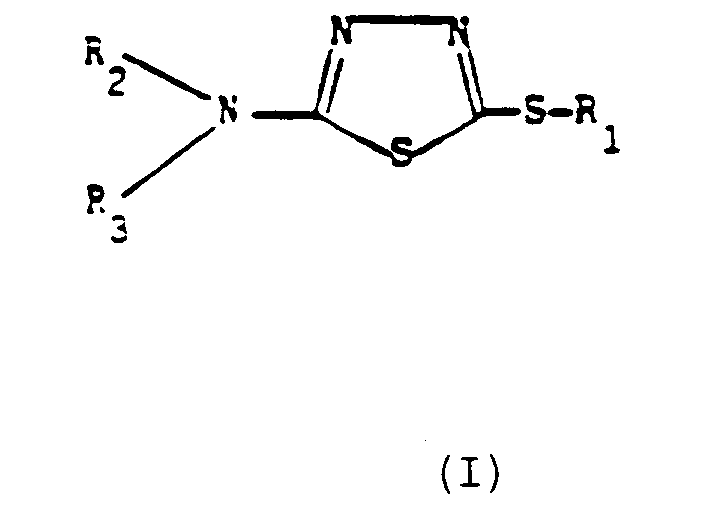
provided that when R1 =
- The therapeutic composition according to claim 1 for the treatment of depressive states and anxiety.
- The therapeutic composition according to claim 1 wherein the active ingredient is selected among one or more of the following group:- 2-amino-5-benzyl-mercapto-1,3,4-thiadiazole;- 2-amino-5-methyl-mercapto-1,3,4-thiadiazole;- 2-amino-5-ethyl-mercapto-1,3,4-thiadiazole;- 2-amino-5-n-propyl-mercapto-1,3,4-thiadiazole;- 2-amino-5-iso-propyl-mercapto-1,3,4-thiadiazole;- 2-amino-5-(p-methyl)-benzylmercapto-1,3,4-thiadiazole;- 2-amino-5-(p-nitro)-benzyl-mercapto-1,3,4-thiadiazole;- 2-amino-5-(p-chloro)-benzyl-mercapto-1,3,4-thiadiazole;- 2-amino-5-(p-hydroxy)-benzyl-mercapto-1,3,4-thiadiazole;- 2-amino-5-(m-hydroxy)-benzyl-mercapto-1,3,4-thiadiazole;- 2-amino-5-(p-acetoxy)-benzyl-mercapto-1,3,4-thiadiazole;- 2-amino-5-(m-acetoxy)-benzyl-mercapto-1,3,4-thiadiazole;- 2-amino-5-(3,4-di-hydroxy)-benzyl-mercapto-1,3,4-thiadiazole;- 2-amino-5-(3,4-di-acetoxy)-benzyl-mercapto-1,3,4-thiadiazole;- 2-amino-5-(3-methoxy-4-acetoxy)-benzyl-mercapto-1,3,4-thiadiazole;- 2-amino-5-(3,4,5-tri-hydroxy)-benzyl-mercapto-1,3,4-thiadiazole;- 2-amino-5-(3,4,5-tri-acetoxy)-benzyl-mercapto-1,3,4-thiadiazole;- 2-acetylamino-5-methyl-mercapto-1,3,4-thiadiazole;- 2-acetylamino-5-n-propyl-mercapto-1,3,4-thiadiazole;- 2-acetylamino-5-iso-propyl-mercapto-1,3,4-thiadiazole;- 2-acetylamino-5-benzyl-mercapto-1,3,4-thiadiazole;- 2-acetylamino-5-(p-nitro)-benzyl-mercapto-1,3,4-thiadiazole;- 2-acetylamino-5-(p-methyl)-benzyl-mercapto-1,3,4-thiadiazole;- 2-acetylamino-5-(p-methoxy)-benzyl-mercapto-1,3,4-thiadiazole;- 2-acetylamino-5-(p-chloro)-benzyl-mercapto-1,3,4-thiadiazole;- 2-acetylamino-5-(3,4,5-tri-methoxy)-benzyl-mercapto-1,3,4-thiadiazole;- 2-propanoylamino-5-benzyl-mercapto-1,3,4-thiadiazole;- 2-heptanoylamino-5-benzyl-mercapto-1,3,4-thiadiazole;- 2-(N-methyl)-acetylamino-5-methyl-mercapto-1,3,4-thiadiazole;- 2-(N-methyl)-acetylamino-5-iso-propyl-mercapto-1,3,4-thiadiazole;- 2-benzoylamino-5-benzyl-mercapto-1,3,4-thiadiazole;- 2-cyclopropylcarbonylamino-5-benzyl-mercapto-1,3,4-thiadiazole.
- The use of thiadiazole derivatives of general formula (I)

R1 =
as the active principle for the preparation of therapeutical compositions for the treatment of depressive states and anxiety.
Applications Claiming Priority (2)
| Application Number | Priority Date | Filing Date | Title |
|---|---|---|---|
| ITMI921705A IT1255219B (en) | 1992-07-14 | 1992-07-14 | THIADIAZOLE DERIVATIVES FOR THE TREATMENT OF DEPRESSIVE STATES |
| ITMI921705 | 1992-07-14 |
Publications (3)
| Publication Number | Publication Date |
|---|---|
| EP0579129A2 EP0579129A2 (en) | 1994-01-19 |
| EP0579129A3 EP0579129A3 (en) | 1994-04-20 |
| EP0579129B1 true EP0579129B1 (en) | 1997-03-05 |
Family
ID=11363665
Family Applications (1)
| Application Number | Title | Priority Date | Filing Date |
|---|---|---|---|
| EP93111008A Expired - Lifetime EP0579129B1 (en) | 1992-07-14 | 1993-07-09 | Thiadiazole derivatives for the treatment of depressive states |
Country Status (6)
| Country | Link |
|---|---|
| US (1) | US5401853A (en) |
| EP (1) | EP0579129B1 (en) |
| AT (1) | ATE149352T1 (en) |
| DE (1) | DE69308406T2 (en) |
| ES (1) | ES2101171T3 (en) |
| IT (1) | IT1255219B (en) |
Families Citing this family (2)
| Publication number | Priority date | Publication date | Assignee | Title |
|---|---|---|---|---|
| JP2001278873A (en) * | 2000-03-27 | 2001-10-10 | Shiseido Co Ltd | Hair tonic |
| CN105837529A (en) * | 2016-04-07 | 2016-08-10 | 大连理工大学 | 1,3,4-thiadiazole derivatives, preparing method thereof and applications of the derivatives |
Family Cites Families (15)
| Publication number | Priority date | Publication date | Assignee | Title |
|---|---|---|---|---|
| CH422792A (en) * | 1957-05-29 | 1966-10-31 | Sandoz Ag | Process for the preparation of primary amines of the heterocyclic series |
| DE1108228B (en) * | 1958-07-04 | 1961-06-08 | Omikron Gagliardi Societa Di F | Process for the preparation of 4-alkyl-5-acylimino -? - 1,3,4-thiadiazoline-2-sulfochlorides |
| DE1670925B2 (en) * | 1967-09-19 | 1977-03-10 | Bayer Ag, 5090 Leverkusen | 1,3,4-THIADIAZOLYL URENE |
| US4639526A (en) * | 1967-09-19 | 1987-01-27 | Bayer Aktiengesellschaft | N-substituted 5-amino-1,3,4-thiadiazoles |
| DE1817949A1 (en) * | 1968-12-23 | 1974-11-07 | Bayer Ag | 1,3,4-Thiadiazol-5-yl ureas - herbicides |
| US3629429A (en) * | 1969-08-01 | 1971-12-21 | Mobil Oil Corp | Thiadiazolyl ureas as systemic fungicides |
| US3903099A (en) * | 1970-09-04 | 1975-09-02 | Ciba Geigy Corp | Certain 2-halo-5-thio-1,3,4-thiadiazoles |
| AT311118B (en) * | 1970-09-04 | 1973-10-25 | Agripat Sa | Means for combating pests occurring in the soil |
| DE2341816A1 (en) * | 1973-08-16 | 1975-02-27 | Schering Ag | HERBICIDES 1,3,4-THIADIAZOL-2-YL URBAN MATERIAL |
| US4056382A (en) * | 1974-12-11 | 1977-11-01 | Eli Lilly And Company | Method of controlling aquatic weeds |
| US4066436A (en) * | 1976-06-30 | 1978-01-03 | Gulf Oil Corporation | Method of controlling sicklepod in soybeans |
| NL7713621A (en) * | 1977-08-25 | 1979-02-27 | Gulf Oil Corp | PROCEDURE FOR SELECTIVE CONTROL OF WEEDS IN SOYBEAN CULTURES. |
| FR2572074B1 (en) * | 1984-10-18 | 1987-07-17 | Sanofi Sa | THIADIAZOLE DERIVATIVES ACTIVE IN THE CENTRAL NERVOUS SYSTEM, PROCESS FOR OBTAINING SAME AND PHARMACEUTICAL COMPOSITIONS CONTAINING THEM |
| JPS6293284A (en) * | 1985-10-19 | 1987-04-28 | Yamanouchi Pharmaceut Co Ltd | Methoxyphenylalkylthiazole compound |
| ES2058068T3 (en) * | 1986-03-19 | 1994-11-01 | Kumiai Chemical Industry Co | DERIVATIVES OF 5H-1,3,4-TIADIAZOL- (3,2-A) -PIRIMIDIN-5-ONA AND FUNGICIDE COMPOUNDS CONTAINED IN SUCH DERIVATIVES. |
-
1992
- 1992-07-14 IT ITMI921705A patent/IT1255219B/en active IP Right Grant
-
1993
- 1993-07-09 ES ES93111008T patent/ES2101171T3/en not_active Expired - Lifetime
- 1993-07-09 US US08/089,747 patent/US5401853A/en not_active Expired - Lifetime
- 1993-07-09 EP EP93111008A patent/EP0579129B1/en not_active Expired - Lifetime
- 1993-07-09 DE DE69308406T patent/DE69308406T2/en not_active Expired - Fee Related
- 1993-07-09 AT AT93111008T patent/ATE149352T1/en not_active IP Right Cessation
Also Published As
| Publication number | Publication date |
|---|---|
| ITMI921705A1 (en) | 1994-01-14 |
| IT1255219B (en) | 1995-10-20 |
| ITMI921705A0 (en) | 1992-07-14 |
| EP0579129A2 (en) | 1994-01-19 |
| DE69308406D1 (en) | 1997-04-10 |
| EP0579129A3 (en) | 1994-04-20 |
| ATE149352T1 (en) | 1997-03-15 |
| DE69308406T2 (en) | 1997-06-19 |
| US5401853A (en) | 1995-03-28 |
| ES2101171T3 (en) | 1997-07-01 |
Similar Documents
| Publication | Publication Date | Title |
|---|---|---|
| DE60225316T2 (en) | CYANO ALKYLAMINO DERIVATIVES AS PROTEASE INHIBITORS | |
| DE69418243T2 (en) | N-heteroaryl-N'-phenylurea derivatives, their preparation and use | |
| US20020188009A1 (en) | Bisarylimidazolyl fatty acid amide hydrolase inhibitors | |
| US3165520A (en) | Certificate of correction | |
| DE69107959T2 (en) | 3-Cycloalkylpropanoic acid amides, their tautomers and salts, processes for their preparation, their use as medicaments and compositions containing them. | |
| WO1996034856A1 (en) | 2-ureido-benzamide derivatives | |
| SK56390A3 (en) | Ether 1-benzyl-3-hydroxymethylindazole with aliphatic 2-hydroxyacids, preparation method of it, intermediate product of this method, pharmaceutical composition containing said ether and use | |
| US3532685A (en) | N,n' - alkylene-n,n'-bis((alkoxy benzoyloxy)alkyl)alkylene diimines | |
| SK7696A3 (en) | 9-substituted 2-(2-n-alkoxyphenyl)-purin-6-ones, manufacturing process thereof, pharmaceutical agent containing these subtances and their use | |
| DE68912843T2 (en) | Parabanic acid derivatives and pharmaceutical compositions with it. | |
| JPS62108814A (en) | Lipid peroxide production inhibitor | |
| US4649198A (en) | Imidazo(1,5-a)pyrimidine derivatives and their use as antimycotic agents | |
| FR2593818A1 (en) | ACYLAMINOMETHYL-3 IMIDAZO (1,2-A) PYRIDINE DERIVATIVES, THEIR PREPARATION AND THEIR THERAPEUTIC USE | |
| US5401853A (en) | Thiadiazole derivatives for the treatment of depressive states | |
| RU2279433C2 (en) | New compound for impotence treatment | |
| JPS60158190A (en) | Hydantoin derivative, its preparation, and drug containing it | |
| EP0670837A1 (en) | METHOD OF PREPARING -g(b)-CARBOLINES. | |
| CS199744B2 (en) | Process for preparing derivatives of 2-hydrazonpropionic acid | |
| DE2838377A1 (en) | NEW 4-HYDROXY-2H SQUARE CLAMP ON 1 SQUARE CLAMP ON BENZOTHIENO SQUARE CLAMP ON 2.3-S SQUARE CLAMP ON -1,2- THIAZINE-3-CARBOXAMIDE-1,1-DIOXIDE AND THEIR SALES, THEIR USE AND METHOD FOR THEM YOUR PRODUCTION | |
| US5041440A (en) | Dithiolane derivatives | |
| DE69509510T2 (en) | 2- (AMINOALKOXY) PHENYLALKYLAMINE WITH INFLAMMATORY PROPERTIES | |
| US6004954A (en) | Condensed thiazine derivatives, their production and use thereof | |
| JPS5846088A (en) | Imidazoquinazolines | |
| JPS6258349B2 (en) | ||
| JPS6039273B2 (en) | Naphthalene derivatives and their manufacturing method |
Legal Events
| Date | Code | Title | Description |
|---|---|---|---|
| PUAI | Public reference made under article 153(3) epc to a published international application that has entered the european phase |
Free format text: ORIGINAL CODE: 0009012 |
|
| AK | Designated contracting states |
Kind code of ref document: A2 Designated state(s): AT BE CH DE DK ES FR GB GR IE IT LI LU MC NL PT SE |
|
| PUAL | Search report despatched |
Free format text: ORIGINAL CODE: 0009013 |
|
| AK | Designated contracting states |
Kind code of ref document: A3 Designated state(s): AT BE CH DE DK ES FR GB GR IE IT LI LU MC NL PT SE |
|
| 17P | Request for examination filed |
Effective date: 19941011 |
|
| 17Q | First examination report despatched |
Effective date: 19951019 |
|
| GRAG | Despatch of communication of intention to grant |
Free format text: ORIGINAL CODE: EPIDOS AGRA |
|
| GRAH | Despatch of communication of intention to grant a patent |
Free format text: ORIGINAL CODE: EPIDOS IGRA |
|
| GRAH | Despatch of communication of intention to grant a patent |
Free format text: ORIGINAL CODE: EPIDOS IGRA |
|
| GRAA | (expected) grant |
Free format text: ORIGINAL CODE: 0009210 |
|
| AK | Designated contracting states |
Kind code of ref document: B1 Designated state(s): AT BE CH DE DK ES FR GB GR IE IT LI LU MC NL PT SE |
|
| PG25 | Lapsed in a contracting state [announced via postgrant information from national office to epo] |
Ref country code: GR Free format text: LAPSE BECAUSE OF FAILURE TO SUBMIT A TRANSLATION OF THE DESCRIPTION OR TO PAY THE FEE WITHIN THE PRESCRIBED TIME-LIMIT Effective date: 19970305 Ref country code: DK Effective date: 19970305 |
|
| REF | Corresponds to: |
Ref document number: 149352 Country of ref document: AT Date of ref document: 19970315 Kind code of ref document: T |
|
| REG | Reference to a national code |
Ref country code: CH Ref legal event code: NV Representative=s name: SCHMAUDER & WANN PATENTANWALTSBUERO, INHABER KLAUS Ref country code: CH Ref legal event code: EP |
|
| REF | Corresponds to: |
Ref document number: 69308406 Country of ref document: DE Date of ref document: 19970410 |
|
| ET | Fr: translation filed | ||
| REG | Reference to a national code |
Ref country code: IE Ref legal event code: FG4D Free format text: 72323 |
|
| ITF | It: translation for a ep patent filed | ||
| PG25 | Lapsed in a contracting state [announced via postgrant information from national office to epo] |
Ref country code: SE Effective date: 19970605 Ref country code: PT Effective date: 19970605 |
|
| REG | Reference to a national code |
Ref country code: ES Ref legal event code: FG2A Ref document number: 2101171 Country of ref document: ES Kind code of ref document: T3 |
|
| PG25 | Lapsed in a contracting state [announced via postgrant information from national office to epo] |
Ref country code: LU Free format text: LAPSE BECAUSE OF NON-PAYMENT OF DUE FEES Effective date: 19970709 |
|
| PLBE | No opposition filed within time limit |
Free format text: ORIGINAL CODE: 0009261 |
|
| STAA | Information on the status of an ep patent application or granted ep patent |
Free format text: STATUS: NO OPPOSITION FILED WITHIN TIME LIMIT |
|
| 26N | No opposition filed | ||
| PGFP | Annual fee paid to national office [announced via postgrant information from national office to epo] |
Ref country code: FR Payment date: 19980605 Year of fee payment: 6 |
|
| PGFP | Annual fee paid to national office [announced via postgrant information from national office to epo] |
Ref country code: IE Payment date: 19980615 Year of fee payment: 6 Ref country code: CH Payment date: 19980615 Year of fee payment: 6 |
|
| PGFP | Annual fee paid to national office [announced via postgrant information from national office to epo] |
Ref country code: GB Payment date: 19980616 Year of fee payment: 6 |
|
| PGFP | Annual fee paid to national office [announced via postgrant information from national office to epo] |
Ref country code: AT Payment date: 19980618 Year of fee payment: 6 Ref country code: NL Payment date: 19980618 Year of fee payment: 6 |
|
| PGFP | Annual fee paid to national office [announced via postgrant information from national office to epo] |
Ref country code: BE Payment date: 19980619 Year of fee payment: 6 |
|
| PGFP | Annual fee paid to national office [announced via postgrant information from national office to epo] |
Ref country code: DE Payment date: 19980626 Year of fee payment: 6 |
|
| PGFP | Annual fee paid to national office [announced via postgrant information from national office to epo] |
Ref country code: ES Payment date: 19980709 Year of fee payment: 6 |
|
| PGFP | Annual fee paid to national office [announced via postgrant information from national office to epo] |
Ref country code: MC Payment date: 19980731 Year of fee payment: 6 |
|
| PG25 | Lapsed in a contracting state [announced via postgrant information from national office to epo] |
Ref country code: IE Free format text: LAPSE BECAUSE OF NON-PAYMENT OF DUE FEES Effective date: 19990709 Ref country code: GB Free format text: LAPSE BECAUSE OF NON-PAYMENT OF DUE FEES Effective date: 19990709 Ref country code: AT Free format text: LAPSE BECAUSE OF NON-PAYMENT OF DUE FEES Effective date: 19990709 |
|
| PG25 | Lapsed in a contracting state [announced via postgrant information from national office to epo] |
Ref country code: ES Free format text: LAPSE BECAUSE OF NON-PAYMENT OF DUE FEES Effective date: 19990710 |
|
| PG25 | Lapsed in a contracting state [announced via postgrant information from national office to epo] |
Ref country code: LI Free format text: LAPSE BECAUSE OF NON-PAYMENT OF DUE FEES Effective date: 19990731 Ref country code: FR Free format text: THE PATENT HAS BEEN ANNULLED BY A DECISION OF A NATIONAL AUTHORITY Effective date: 19990731 Ref country code: CH Free format text: LAPSE BECAUSE OF NON-PAYMENT OF DUE FEES Effective date: 19990731 Ref country code: BE Free format text: LAPSE BECAUSE OF NON-PAYMENT OF DUE FEES Effective date: 19990731 |
|
| BERE | Be: lapsed |
Owner name: LABORATORIO FARMACEUTICO C.T. S.R.L. Effective date: 19990731 |
|
| PG25 | Lapsed in a contracting state [announced via postgrant information from national office to epo] |
Ref country code: MC Free format text: LAPSE BECAUSE OF NON-PAYMENT OF DUE FEES Effective date: 20000131 |
|
| PG25 | Lapsed in a contracting state [announced via postgrant information from national office to epo] |
Ref country code: NL Free format text: LAPSE BECAUSE OF NON-PAYMENT OF DUE FEES Effective date: 20000201 |
|
| GBPC | Gb: european patent ceased through non-payment of renewal fee |
Effective date: 19990709 |
|
| REG | Reference to a national code |
Ref country code: CH Ref legal event code: PL |
|
| NLV4 | Nl: lapsed or anulled due to non-payment of the annual fee |
Effective date: 20000201 |
|
| PG25 | Lapsed in a contracting state [announced via postgrant information from national office to epo] |
Ref country code: DE Free format text: LAPSE BECAUSE OF NON-PAYMENT OF DUE FEES Effective date: 20000503 |
|
| REG | Reference to a national code |
Ref country code: IE Ref legal event code: MM4A |
|
| REG | Reference to a national code |
Ref country code: FR Ref legal event code: ST |
|
| REG | Reference to a national code |
Ref country code: ES Ref legal event code: FD2A Effective date: 20020603 |
|
| PG25 | Lapsed in a contracting state [announced via postgrant information from national office to epo] |
Ref country code: IT Free format text: LAPSE BECAUSE OF NON-PAYMENT OF DUE FEES;WARNING: LAPSES OF ITALIAN PATENTS WITH EFFECTIVE DATE BEFORE 2007 MAY HAVE OCCURRED AT ANY TIME BEFORE 2007. THE CORRECT EFFECTIVE DATE MAY BE DIFFERENT FROM THE ONE RECORDED. Effective date: 20050709 |