EP0576475B1 - Isoindoles having cardiovascular activity - Google Patents
Isoindoles having cardiovascular activity Download PDFInfo
- Publication number
- EP0576475B1 EP0576475B1 EP92906404A EP92906404A EP0576475B1 EP 0576475 B1 EP0576475 B1 EP 0576475B1 EP 92906404 A EP92906404 A EP 92906404A EP 92906404 A EP92906404 A EP 92906404A EP 0576475 B1 EP0576475 B1 EP 0576475B1
- Authority
- EP
- European Patent Office
- Prior art keywords
- hydroxy
- mole
- halogen
- alkyl
- alkoxy
- Prior art date
- Legal status (The legal status is an assumption and is not a legal conclusion. Google has not performed a legal analysis and makes no representation as to the accuracy of the status listed.)
- Expired - Lifetime
Links
- 0 CC[U]C(C)=CC(C(*)I1C)=C(C=C)C1=O Chemical compound CC[U]C(C)=CC(C(*)I1C)=C(C=C)C1=O 0.000 description 2
Classifications
-
- C—CHEMISTRY; METALLURGY
- C07—ORGANIC CHEMISTRY
- C07D—HETEROCYCLIC COMPOUNDS
- C07D209/00—Heterocyclic compounds containing five-membered rings, condensed with other rings, with one nitrogen atom as the only ring hetero atom
- C07D209/02—Heterocyclic compounds containing five-membered rings, condensed with other rings, with one nitrogen atom as the only ring hetero atom condensed with one carbocyclic ring
- C07D209/44—Iso-indoles; Hydrogenated iso-indoles
- C07D209/48—Iso-indoles; Hydrogenated iso-indoles with oxygen atoms in positions 1 and 3, e.g. phthalimide
-
- A—HUMAN NECESSITIES
- A61—MEDICAL OR VETERINARY SCIENCE; HYGIENE
- A61P—SPECIFIC THERAPEUTIC ACTIVITY OF CHEMICAL COMPOUNDS OR MEDICINAL PREPARATIONS
- A61P9/00—Drugs for disorders of the cardiovascular system
- A61P9/08—Vasodilators for multiple indications
-
- A—HUMAN NECESSITIES
- A61—MEDICAL OR VETERINARY SCIENCE; HYGIENE
- A61P—SPECIFIC THERAPEUTIC ACTIVITY OF CHEMICAL COMPOUNDS OR MEDICINAL PREPARATIONS
- A61P9/00—Drugs for disorders of the cardiovascular system
- A61P9/10—Drugs for disorders of the cardiovascular system for treating ischaemic or atherosclerotic diseases, e.g. antianginal drugs, coronary vasodilators, drugs for myocardial infarction, retinopathy, cerebrovascula insufficiency, renal arteriosclerosis
Definitions
- the present invention relates to isoindoles having cardiovascular activity, a process for the preparation thereof and pharmaceutical compositions containing them.
- R1 is selected from hydrogen; C1-C6 alkyl; benzyl optionally substituted with halogen, hydroxy, C1-C6 alkoxy, methylenedioxy; C2-C8 aliphatic acyl; benzoyl optionally substituted with halogen, hydroxy, C1-C6 alkoxy, C2-C6 alkanoyl, C2-C6 alkanoyloxy, C1-C4 alkyl, trifluoromethyl, methylenedioxy; R2 and R3 are selected independently from hydrogen; halogen; C1-C4 alkyl; trifluoromethyl; hydroxy; nitro; amino; mono or di C1-C4 alkylamino; cyano; C1-C6 alkoxy; C2-C6 alkoxycarbonyl; Y is ethylene, or a straight or branched alkylene chain containing from 3 to 6 carbon atoms.
- a further object of the invention is provided by the salts of compounds of formula (I) with pharmaceutically acceptable acids.
- 3-Substituted 1-oxo-isoindoles bearing a nitrooxyalkylene chain as the substituent, whether the chain is linked to the nitrogen atom or not, are not known from literature, including the patent one.
- phthalimido derivatives having coronary dilating activity in which derivatives the nitrogen atom is substituted by a nitrooxyalkylene group, are known from EP-A-171.977.
- phthalimidines substituted at the nitrogen atom by a nitrooxyalkylene chain having antianginal activity are known from C.A. 108 , 186566t, page 688.
- the compounds of the invention have cardiovascular activity. Particularly, they were found to have high in vitro vasorelaxing activities and a marked antianginal activity in the laboratory animal. Besides having such favourable biological activities, said compounds have a negligible hypotensive effect, which is known to be an undesired side-effect of the up-to-now known and used nitro-derivatives.
- the compounds of the invention could be used as antianginal agents.
- the compounds of the invention can be prepared according to the following scheme 1: wherein X is halogen, whereas Y, R2 and R3 are as defined above, and R1 has the meanings defined for scheme 1.
- step iii) Acylation of (Ia), according to step iii), can be carried out with acyl chlorides in the presence of a catalyst, such as dimethylaminopyridine, and a proton-binding agent, such as triethylamine;
- the reaction solvent is generally a poorly polar solvent, for example an open- or closed-chain ether, such as tetrahydrofuran.
- Alkylation or benzylation of (Ia) according to step iii), on the contrary, can be carried out with suitable alkyl or benzyl halides in the presence of a strong base, for example sodium hydride or an alkali metal alkoxide, or by reacting the compound (Ia) with the selected alkanol or benzyl alcohol in the presence of strong acids.
- a strong base for example sodium hydride or an alkali metal alkoxide
- Phthalic anhydride of formula (V) is transformed into the corresponding phthalimide of formula (VI) by reaction with a ⁇ -haloalkylamine of formula (III).
- a suitable reducing agent for example sodium bis-(2-methoxyethoxy)aluminium hydride (Red-Al®)
- Red-Al® sodium bis-(2-methoxyethoxy)aluminium hydride
- a suitable organic solvent such as toluene
- Carboxyaldehydes of formula (II), ⁇ -haloalkylamines of formula (III) and phthalic anhydrides of formula (V) are commercially available products or they are prepared according to known methods. Some phthalimides of formula (VI) are also commercial products and therefore they are used as such for the reduction of the above carbonyls.
- the compound was prepared as described in example 2, starting from 3.4 g (0.014 mole) of the compound prepared in 1B, 170 mg (0.0014 mole) of dimethylaminopyridine, 1.48 ml (0.014 mole) of n-butanoyl chloride and 1.95 ml (0.014 mole) of triethylamine. 2.27 g of the title product were obtained as an oil having the following characteristics: Elementary analysis: % C % H % N calculated 54.54 5.23 9.09 found 54.11 5.25 9.00
- vasorelaxing activity of the compounds of the invention was determined on rabbit aorta which had been contracted with noradrenaline, according to the method described in Eur. J. Pharmacol, 141 , 195 (1987). The values are reported in the following table 1.
- the in vivo antianginal activity was evidenced on Sprague Dawley anaesthetized rats, weighing 350-400 g, operating according to the procedure of M. Leitold et al., Arzneim. Forsch. 36 , 1454, 1986.
- the test was carried out administering the animal intravenously with 1 I.U./kg, equivalent to 3 mg/kg of Arg-vasopressin, which induces a coronary spasm which can be reproduced and evidenced electrocardiographycally with an increase in the amplitude of the T wave.
- the compounds of the invention were administered by gastric gavage at a dose of 3 mg/kg, 1 hour before administration of Argvasopressin.
- the antianginal effect was expressed as percent inhibition of the T wave increase versus controls.
- the compounds of the invention besides having the above reported favourable properties, also show a low toxicity: the LD50 values, determined according to the method of Lichtfield and Wilcoxon, J. Pharm. Expt. Ther. 96 , 99, 1949, are in fact higher than 500 mg/kg i.p. in the mouse and 800 mg/kg per os in the rat. Therefore, the present invention also relates to the use of the compounds of the invention as antianginal agents in the preparation of a medicament for antianginal therapy, as well as to all the industrial aspects connected to said use, including the pharmaceutical compositions containing the compounds of the invention.
- compositions are tablets, dragees, syrups and vials, the latter being suitable for both the oral and the intramuscular or intravenous administrations.
- Said compositions will contain the active ingredient alone or in admixture with conventional carriers and excipients.
- the dosages of the active ingredient can vary within a wide range, depending on the used compounds as well as the severity of the condition to be treated and the age and weight of the patient, as to obtain the best effect during 24 hours.
Landscapes
- Chemical & Material Sciences (AREA)
- Organic Chemistry (AREA)
- Health & Medical Sciences (AREA)
- Engineering & Computer Science (AREA)
- Bioinformatics & Cheminformatics (AREA)
- Cardiology (AREA)
- Heart & Thoracic Surgery (AREA)
- Chemical Kinetics & Catalysis (AREA)
- General Chemical & Material Sciences (AREA)
- Medicinal Chemistry (AREA)
- Nuclear Medicine, Radiotherapy & Molecular Imaging (AREA)
- Pharmacology & Pharmacy (AREA)
- Life Sciences & Earth Sciences (AREA)
- Animal Behavior & Ethology (AREA)
- General Health & Medical Sciences (AREA)
- Public Health (AREA)
- Veterinary Medicine (AREA)
- Urology & Nephrology (AREA)
- Vascular Medicine (AREA)
- Indole Compounds (AREA)
- Pharmaceuticals Containing Other Organic And Inorganic Compounds (AREA)
Abstract
Description
- The present invention relates to isoindoles having cardiovascular activity, a process for the preparation thereof and pharmaceutical compositions containing them.
- The compounds of the invention have the following general formula:

wherein:
R₁ is selected from hydrogen; C₁-C₆ alkyl; benzyl optionally substituted with halogen, hydroxy, C₁-C₆ alkoxy, methylenedioxy; C₂-C₈ aliphatic acyl; benzoyl optionally substituted with halogen, hydroxy, C₁-C₆ alkoxy, C₂-C₆ alkanoyl, C₂-C₆ alkanoyloxy, C₁-C₄ alkyl, trifluoromethyl, methylenedioxy;
R₂ and R₃ are selected independently from hydrogen; halogen; C₁-C₄ alkyl; trifluoromethyl; hydroxy; nitro; amino; mono or di C₁-C₄ alkylamino; cyano; C₁-C₆ alkoxy; C₂-C₆ alkoxycarbonyl;
Y is ethylene, or a straight or branched alkylene chain containing from 3 to 6 carbon atoms. - A further object of the invention is provided by the salts of compounds of formula (I) with pharmaceutically acceptable acids.
- 3-Substituted 1-oxo-isoindoles bearing a nitrooxyalkylene chain as the substituent, whether the chain is linked to the nitrogen atom or not, are not known from literature, including the patent one. On the contrary, phthalimido derivatives having coronary dilating activity, in which derivatives the nitrogen atom is substituted by a nitrooxyalkylene group, are known from EP-A-171.977. Moreover, phthalimidines substituted at the nitrogen atom by a nitrooxyalkylene chain having antianginal activity, are known from C.A. 108, 186566t, page 688.
- As stated above, the compounds of the invention have cardiovascular activity. Particularly, they were found to have high in vitro vasorelaxing activities and a marked antianginal activity in the laboratory animal. Besides having such favourable biological activities, said compounds have a negligible hypotensive effect, which is known to be an undesired side-effect of the up-to-now known and used nitro-derivatives.
- Therefore, the compounds of the invention could be used as antianginal agents.
- They also proved to have antiarrhytmic activity, which is another favourable feature since angina attacks are often accompanied by more or less marked arrhytmias.
- The compounds of the invention can be prepared according to the following scheme 1:

wherein X is halogen, whereas Y, R₂ and R₃ are as defined above, and R₁ has the meanings defined for scheme 1. - The starting compound, 2-carboxybenzaldehyde of formula II in which the carboxy group has previously been activated, is reacted with a haloalkylamine (III) to give the product (IV); substitution of halogen X with a nitrooxy group by reaction with AgNO₃ yields to compounds (Ia). Compounds (I) in which R₁ is different from H, can be obtained by acylation or alkylation or benzylation of compounds (Ia) according to conventional methods.
- Step i) is carried out preferably in an inert solvent, such as, for example, an halogenated solvent, in the presence of an acid-binding agent, for example a suitable organic base. The reaction temperature is comprised between -10°C and 10°C, preferably between 0°C and 5°C.
- Step ii) is carried out in a polar organic solvent, such as acetonitrile, at the reflux temperature of the solvent.
- Acylation of (Ia), according to step iii), can be carried out with acyl chlorides in the presence of a catalyst, such as dimethylaminopyridine, and a proton-binding agent, such as triethylamine; the reaction solvent is generally a poorly polar solvent, for example an open- or closed-chain ether, such as tetrahydrofuran.
- Alkylation or benzylation of (Ia) according to step iii), on the contrary, can be carried out with suitable alkyl or benzyl halides in the presence of a strong base, for example sodium hydride or an alkali metal alkoxide, or by reacting the compound (Ia) with the selected alkanol or benzyl alcohol in the presence of strong acids.
- When compounds of formula (I) are desired in which R₂ and R₃ are at the 5- and 6- positions and they are the same, an alternative preparation can be carried out according to the following scheme 2:

wherein X, Y, R₂ and R₃ are as defined above. - Phthalic anhydride of formula (V) is transformed into the corresponding phthalimide of formula (VI) by reaction with a ω-haloalkylamine of formula (III). Subsequently one of the phthalimide carbonyl groups is reduced to hydroxy by means of a suitable reducing agent, for example sodium bis-(2-methoxyethoxy)aluminium hydride (Red-Al®), in a suitable organic solvent, such as toluene, to obtain the compound of formula (VII). The latter is then converted into the desired final products of formula (I) as described above. The reactive groups present in the aromatic ring can previously be protected according to conventional methods, with suitable substituents which can easily be removed to obtain the final products. Carboxyaldehydes of formula (II), ω-haloalkylamines of formula (III) and phthalic anhydrides of formula (V) are commercially available products or they are prepared according to known methods. Some phthalimides of formula (VI) are also commercial products and therefore they are used as such for the reduction of the above carbonyls.
- ¹H-NMR Spectra were recorded in dimethylsulfoxide (DMSO-d6) with a VARIAN GEMINI 200 spectrometer. ¹³C-NMR Spectra were recorded using a VARIAN GEMINI 200 spectrometer, taking the 39.5 p.p.m. peak of dimethylsulfoxide (DMSO-d6) as the reference peak.
- The following examples further illustrate the invention.
- 9.7 ml (0.101 mole) of ethyl chlorocarbonate were dropwise added to a solution of 15.2 g (0.101 mole) of 2-carboxybenzaldehyde in 500 ml of chloroform and 14.1 ml (0.101 mole) of triethylamine, cooled to 0°C. After 45 minutes, a solution of 11.7 g (0.101 mole) of 2-chloroethylamine hydrochloride in 200 ml of chloroform and 14.1 ml (0.101 mole) of triethylamine was dropwise added thereto. The obtained solution was kept at 0-5°C for 5 hours. After warming to room temperature, the mixture was washed with water, 5% sodium bicarbonate, again with water and finally dried over sodium sulfate. 19 g of a crude product were obtained, which was purified on silica gel column eluting with methylene chloride-acetone 10/1 (v/v). 7 g of the title product were obtained; mp = 133-134°C (methylene chloride).
- To a solution of 5 g (0.023 mole) of the product prepared in 1A in 150 ml of acetonitrile, 7.8 g (0.046 mole) of silver nitrate were added. The mixture was refluxed for 3 hours, shielded from light, then it was warmed to room temperature, the salts were filtered off and the solvent was evaporated off. The resulting crude product was taken up into methylene chloride, washed with water and dried over sodium sulfate. 6 g of the title product were obtained; mp=143-145°C (acetonitrile).
- A solution of 17 g (0.070 mole) of the compound prepared in 1B and 440 mg (0.004 mole) of 4-dimethylaminopyridine in 6.7 ml (0.071 mole) of acetic anhydride and 9.9 ml (0.071 mole) of triethylamine was kept for 2 hours at room temperature under stirring. The mixture was taken up into methylene chloride, washed with 5% hydrochloric acid, water and finally dried over sodium sulfate. 23 g of crude product were obtained, which was purified on silica gel column eluting with methylene chloride-acetone 97/3 (v/v). 18 g of the title product were obtained; mp = 74-75°C (hexane).
- The compound was prepared as described in example 2, starting from 3.4 g (0.014 mole) of the compound prepared in 1B, 170 mg (0.0014 mole) of dimethylaminopyridine, 1.48 ml (0.014 mole) of n-butanoyl chloride and 1.95 ml (0.014 mole) of triethylamine. 2.27 g of the title product were obtained as an oil having the following characteristics:
Elementary analysis: % C % H % N calculated 54.54 5.23 9.09 found 54.11 5.25 9.00 - ¹HNMR (δppm, DMSO-d6) 7.80÷7.60 (m, 4H); 7.16 (s, 1H); 4.88÷4.64 (m, 2H); 4.07÷3.94 (m, 1H); 3.75÷3.63 (m, 1H); 2.78 (t, 2H) 1.61 (m, 1H) 0.92 (t, 3H). ¹³CNMR 173.51; 167.60; 141.69; 133.26; 131.10; 130.69; 124.47; 123.30; 81.41; 71.44; 38.01; 35.56; 18.00; 13.61.
- The compound was prepared as described in example 2, starting from 2 g (0.008 mole) of the compound prepared in 1B, 51 mg (0.0004 mole) of dimethylaminopyridine, 1.14 ml (0.008 mole) of triethylamine and 0.95 ml (0.008 mole) of benzoyl chloride. 2.4 g of the title product were obtained; mp = 65-67°C (hexane).
- A solution of 20.6 g (0.139 mole) of phthalic anhydride, 20 g (0.126 mole) of 5-chloropentylamine hydrochloride and 17.6 ml (0.126 mole) of triethylamine in 250 ml of toluene was heated to 130°C for 4 hours. The obtained mixture was evaporated to dryness. The residue was taken up into 200 ml of water and extracted with ethyl acetate. The phases were separated and the organic phase was dried over sodium sulfate and evaporated to dryness. From the crude product, 23 g of the title product were obtained as an oil having the following characteristics:
Elementary analysis: % C % H % N % Cl calculate 62.03 5.61 5.56 14.08 found 61.98 5.45 5.31 14.00 - ¹HNMR ( ppm, DMSO-d6) 7.70÷7.61 (m, 4H); 3.80÷3.40 (m, 4H); 2.00÷11 (m, 6H)
¹³CNMR (ppm) 162.9; 149.9; 132.2; 129.9; 45.0; 44.9; 32.8; 28.4; 24.5. - 22 g (0.087 mole) of the product prepared in 5A were dissolved in 200 ml of toluene and cooled to -20°C. 21.3 g (0.073 mole) of a 70% Red-Al® solution in toluene diluted in 100 ml of toluene were dropwise added thereto. The obtained solution was kept at -20°C for 2 hours. The solution was warmed to room temperature, then 300 ml of water were added thereto. The formed salts were filtered off and the phases were separated. The organic phase was dried over sodium sulfate and evaporated to give 13 g of the title product; mp = 77-79°C (n-hexane).
- The product was prepared as described in 1B, starting from 10 g (0.039 mole) of the compound prepared in 5B. 5.8 g of the title product were obtained; mp = 70-72°C (ethyl ether).
- The compound was prepared as described in 2, starting from 8 g of the product prepared in 5C. 3 g of the title product were obtained as an oil having the following characteristics:
Elementary analysis: % C % H % N calculated 54.19 5.85 9.03 found 54.03 5.64 8.98 - ¹HNMR (δppm, DMSO-d6) 7.76÷7.58 (m, 4H); 7.07 (s, 1H); 4.52 (t, 2H); 3.69÷3.55 (m, 1H); 3.35÷3.21 (m, 1H) 2.16 (s, 3H); 1.78÷1.27 (m, 6H)
¹³CNMR 171.05; 167.23; 141.46; 132.87; 131.64; 130.60; 124.41; 123.08; 81.01; 73.97; 39.83; 27.51; 25.95; 22.74; 21.11. - The compound was prepared as described in 5B, starting from 250 g (0.098 mole) of N-(2-bromoethyl)-phthalimide (commercial product). 8 g of the title product were obtained; mp = 123-124°C (methylene chloride).
- The compound was prepared as described in 1B, starting from 7 g (0.027 mole) of the compound prepared in 7A. 5.3 g of the title product were obtained; mp = 143-145°C (acetonitrile).
- A solution of 6.98 ml (0.050 mole) of triethylamine in 300 ml of acetonitrile was added with 5 g (0.025 mole) of acetylsalicylic acid chloride dissolved in 30 ml of acetonitrile and 5 g (0.021 mole) of the product prepared in 1B dissolved in 240 ml of acetonitrile-tetrahydrofuran 1/1 (v/v). The solution was left at room temperature for 24 hours. The formed salts were removed and the solvent was evaporated under vacuum. The resulting crude product was purified over silica gel, eluting with ethyl acetate-hexane 7-3 (v/v). 4.8 g of the title product were obtained; mp = 81-83°C (ethyl ether).
- The compound was prepared as described in example 1A, starting from 2.5 g (0.013 mole) of 4-chloro-2-carboxybenzaldehyde (Il farmaco, Ed. Sci 31, 691, 1976) and 2.76 g (0.013 mole) of 2-bromoethylamine hydrobromide. 1.05 g of the title product were obtained; mp = 164-168°C (n-hexane).
- The product was prepared as described in example 1B, starting from 1 g (0.003 mole) of the product prepared in 9A and 1.19 g (0.007 mole) of silver nitrate. 0.86 g of the title product were obtained; mp = 116-118°C (toluene).
- The compound was prepared as described in example 5A, starting from 14 g (0.065 mole) of 4,5-dichlorophthalic anhydride (Beilstein 4th Ed. vol. 17 System No 6143) and 7.51 g (0.065 mole) of 2-chloroethylamine monohydrochloride. 10.5 g of the title product were obtained; mp = 144-145°C (ethyl acetate)
- The compound was prepared as described in example 5B, starting from 9 g (0.032 mole) of the product prepared in 10A. 6.2 g of the title product were obtained; mp = 147-149°C (hexane).
- The compound was prepared as described in example 5C, starting from 58 g (0.021 mole) of the product prepared in 10B. 2.2 g of the title product were obtained; mp = 145-147°C (acetonitrile).
- The compound was prepared as described in 5B, starting from 25 g (0.093 mole) of N-(3-bromopropyl)-phthalimide (commercial product). 24.3 g of the title product were obtained; mp = 79°C (methylene chloride).
- The compound was prepared as described in 1B, starting from 10 g (0.037 mole) of the product prepared in 11A. 3 g of the title product were obtained; mp = 72-74°C (hexane/ether 8/2).
- The following products were prepared according to the procedures described in the above Examples.
-Y-ONO₂ R₁ R₂ R₃ 2-nitrooxyethyl hydrogen 7-trifluoro methyl hydrogen " acetyl 5-fluoro 7-fluoro " " 5-chloro 4-methyl " " 5-methoxy 6-methoxy " hydrogen 5-nitro hydrogen " hexanoyl 7-chloro 5-nitro 3-nitrooxypropyl hydrogen 5-cyano hydrogen " " 5-chloro 7-chloro 4-nitrooxybutyl acetyl 6-methyl 4-fluoro " hydrogen 5-nitro hydrogen " benzoyl 5-ethyl " - The activity of the compounds of the invention on the cardiocirculatory system was evidenced in the following tests.
- The vasorelaxing activity of the compounds of the invention was determined on rabbit aorta which had been contracted with noradrenaline, according to the method described in Eur. J. Pharmacol, 141, 195 (1987). The values are reported in the following table 1.
TABLE 1 In vitro vasorelaxing activity Compound of Ex. N. IC₅₀ (mole/l) 1 1.3 10⁻⁶ 2 1.2 10⁻⁶ 3 2.4 10⁻⁶ 4 3.2 10⁻⁶ 5 1.3 10⁻⁵
IC₅₀ = concentration of active substance, expressed in mole/litre, able to inhibit by 50% the contraction of the aorta "strip" induced by noradrenaline. - The in vivo antianginal activity was evidenced on Sprague Dawley anaesthetized rats, weighing 350-400 g, operating according to the procedure of M. Leitold et al., Arzneim. Forsch. 36, 1454, 1986. The test was carried out administering the animal intravenously with 1 I.U./kg, equivalent to 3 mg/kg of Arg-vasopressin, which induces a coronary spasm which can be reproduced and evidenced electrocardiographycally with an increase in the amplitude of the T wave. The compounds of the invention were administered by gastric gavage at a dose of 3 mg/kg, 1 hour before administration of Argvasopressin. The antianginal effect was expressed as percent inhibition of the T wave increase versus controls.
- The obtained results for some representative compounds of the invention are reported in Table 2.
TABLE 2 Vasopressine angina in the anaesthetized rat Product mg/kg Effect (%) Ex. n. 1 3 -56.1 Ex. n. 3 3 -55.2 Ex. n. 4 3 -34.5 - The compounds of the invention, besides having the above reported favourable properties, also show a low toxicity: the LD₅₀ values, determined according to the method of Lichtfield and Wilcoxon, J. Pharm. Expt. Ther. 96, 99, 1949, are in fact higher than 500 mg/kg i.p. in the mouse and 800 mg/kg per os in the rat. Therefore, the present invention also relates to the use of the compounds of the invention as antianginal agents in the preparation of a medicament for antianginal therapy, as well as to all the industrial aspects connected to said use, including the pharmaceutical compositions containing the compounds of the invention. Examples of said compositions are tablets, dragees, syrups and vials, the latter being suitable for both the oral and the intramuscular or intravenous administrations. Said compositions will contain the active ingredient alone or in admixture with conventional carriers and excipients.
- The dosages of the active ingredient can vary within a wide range, depending on the used compounds as well as the severity of the condition to be treated and the age and weight of the patient, as to obtain the best effect during 24 hours.
Claims (3)
- Compounds of general formula:
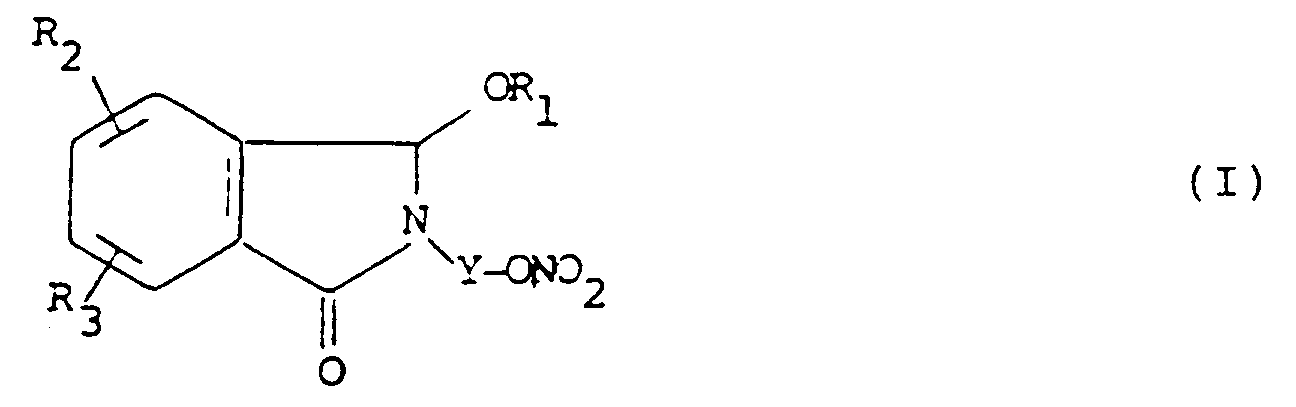
R₁ is selected from hydrogen; C₁-C₆ alkyl; benzyl optionally substituted with halogen, hydroxy, C₁-C₆ alkoxy, methylenedioxy; C₂-C₈ aliphatic acyl; benzoyl optionally substituted with halogen, hydroxy, C₁-C₆ alkoxy, C₂-C₆ alkanoyl, C₂-C₆ alkanoyloxy, C₁-C₄ alkyl, trifluoromethyl, methylenedioxy;
R₂ and R₃ are selected independently from hydrogen; halogen; C₁-C₄ alkyl; trifluoromethyl; hydroxy; nitro; amino; mono or di C₁-C₄ alkylamino; cyano; C₁-C₆ alkoxy; C₂-C₆ alkoxycarbonyl;
Y is ethylene, or a straight or branched alkylene chain containing from 3 to 6 carbon atoms, and the salts thereof with pharmaceutically acceptable acids. - Pharmaceutical compositions containing a therapeutically effective amount of a compound as defined in claim 1, in admixture with a pharmaceutically acceptable carrier.
- The use of the compounds according to claim 1 in the preparation of a medicament for the antianginal therapy.
Applications Claiming Priority (3)
| Application Number | Priority Date | Filing Date | Title |
|---|---|---|---|
| ITMI910732A IT1245351B (en) | 1991-03-19 | 1991-03-19 | CARDIOVASCULAR ACTIVITY ISOINDLES |
| ITMI910732 | 1991-03-19 | ||
| PCT/EP1992/000531 WO1992016506A1 (en) | 1991-03-19 | 1992-03-11 | Isoindoles having cardiovascular activity |
Publications (2)
| Publication Number | Publication Date |
|---|---|
| EP0576475A1 EP0576475A1 (en) | 1994-01-05 |
| EP0576475B1 true EP0576475B1 (en) | 1995-09-20 |
Family
ID=11359118
Family Applications (1)
| Application Number | Title | Priority Date | Filing Date |
|---|---|---|---|
| EP92906404A Expired - Lifetime EP0576475B1 (en) | 1991-03-19 | 1992-03-11 | Isoindoles having cardiovascular activity |
Country Status (13)
| Country | Link |
|---|---|
| US (1) | US5376673A (en) |
| EP (1) | EP0576475B1 (en) |
| JP (1) | JPH06505722A (en) |
| AT (1) | ATE128123T1 (en) |
| AU (1) | AU659442B2 (en) |
| CA (1) | CA2105684A1 (en) |
| DE (1) | DE69204995T2 (en) |
| DK (1) | DK0576475T3 (en) |
| ES (1) | ES2079185T3 (en) |
| GR (1) | GR3017990T3 (en) |
| HU (1) | HUT67668A (en) |
| IT (1) | IT1245351B (en) |
| WO (1) | WO1992016506A1 (en) |
Families Citing this family (1)
| Publication number | Priority date | Publication date | Assignee | Title |
|---|---|---|---|---|
| ATE172183T1 (en) * | 1992-07-30 | 1998-10-15 | Cal Int Ltd | ESTERS AND COMBINATIONS OF AN ORGANIC NITRATE AND A SALICYCLATE |
Family Cites Families (3)
| Publication number | Priority date | Publication date | Assignee | Title |
|---|---|---|---|---|
| JPS6137766A (en) * | 1984-07-31 | 1986-02-22 | Sankyo Co Ltd | Phthalimide derivative and preparation thereof |
| DE3533442A1 (en) * | 1985-09-19 | 1987-03-26 | Hoechst Ag | NEW 2-ARYL-4,5,6,7-TETRAHYDROISOINDOLINONE, METHOD FOR THE PRODUCTION THEREOF AND THEIR USE IN PLANT PROTECTION |
| IT1244472B (en) * | 1990-12-14 | 1994-07-15 | Italfarmaco Spa | BENZOSSAZINONI AND BENZOTIAZINONI WITH CARDIOVASCULAR ACTIVITY |
-
1991
- 1991-03-19 IT ITMI910732A patent/IT1245351B/en active IP Right Grant
-
1992
- 1992-03-11 ES ES92906404T patent/ES2079185T3/en not_active Expired - Lifetime
- 1992-03-11 HU HU9302507A patent/HUT67668A/en unknown
- 1992-03-11 JP JP4505510A patent/JPH06505722A/en active Pending
- 1992-03-11 AT AT92906404T patent/ATE128123T1/en not_active IP Right Cessation
- 1992-03-11 DK DK92906404.6T patent/DK0576475T3/en active
- 1992-03-11 CA CA002105684A patent/CA2105684A1/en not_active Abandoned
- 1992-03-11 WO PCT/EP1992/000531 patent/WO1992016506A1/en not_active Ceased
- 1992-03-11 EP EP92906404A patent/EP0576475B1/en not_active Expired - Lifetime
- 1992-03-11 DE DE69204995T patent/DE69204995T2/en not_active Expired - Fee Related
- 1992-03-11 AU AU13479/92A patent/AU659442B2/en not_active Ceased
-
1993
- 1993-09-17 US US08/117,162 patent/US5376673A/en not_active Expired - Fee Related
-
1995
- 1995-11-08 GR GR950403099T patent/GR3017990T3/en unknown
Also Published As
| Publication number | Publication date |
|---|---|
| HU9302507D0 (en) | 1993-12-28 |
| DK0576475T3 (en) | 1996-01-15 |
| IT1245351B (en) | 1994-09-20 |
| AU1347992A (en) | 1992-10-21 |
| ITMI910732A0 (en) | 1991-03-19 |
| GR3017990T3 (en) | 1996-02-29 |
| WO1992016506A1 (en) | 1992-10-01 |
| ATE128123T1 (en) | 1995-10-15 |
| AU659442B2 (en) | 1995-05-18 |
| CA2105684A1 (en) | 1992-09-20 |
| EP0576475A1 (en) | 1994-01-05 |
| DE69204995T2 (en) | 1996-02-08 |
| HUT67668A (en) | 1995-04-28 |
| ITMI910732A1 (en) | 1992-09-19 |
| JPH06505722A (en) | 1994-06-30 |
| DE69204995D1 (en) | 1995-10-26 |
| US5376673A (en) | 1994-12-27 |
| ES2079185T3 (en) | 1996-01-01 |
Similar Documents
| Publication | Publication Date | Title |
|---|---|---|
| US5366992A (en) | Benzoic acid substituted derivatives having cardiovascular activity | |
| US20020161025A1 (en) | N-substituted indole-3glyoxylamides having anti-asthmatic, antiallergic and immunosuppressant/immuno-modulating action | |
| US5977130A (en) | Intimal hypertrophy inhibitors | |
| CN85105301A (en) | (S)-preparation method of alpha-ethyl-2-oxo-1-pyrrolidine acetamide | |
| CZ20014496A3 (en) | Indole derivatives and their use for treating osteoporosis | |
| FR2846657A1 (en) | New pyridopyrimidone derivatives are kinase inhibitors and activators, useful in the treatment of cancers, hyperglycemia, dyslipidemias, diabetes and its complications, obesity, arthritis, and arterial hypertension | |
| US4460607A (en) | Lipid absorption-inhibiting agents and their use | |
| HK1054038B (en) | Substituted n-benzyl-indol-3-yl glyoxylic acid derivatives having an anti-tumoral effect | |
| FR2510115A1 (en) | ERGOLINE DERIVATIVES, PROCESS FOR PREPARING THEM AND THEIR USE AS A MEDICINAL PRODUCT | |
| US5387588A (en) | Pyridopyrimidine derivatives, pharmaceutical compositions containing them and process for preparing same | |
| US4814345A (en) | 1-phenyl-2-aminocarbonylindole compounds, preparation thereof and pharmaceutical compositions containing them | |
| EP0350251B1 (en) | N-Substituted amide derivatives | |
| JPH06211788A (en) | Indole-7-carboxamide derivative | |
| EP0273401B1 (en) | Isoindolin-1-one derivative and antiarrhythmic agent | |
| US4801590A (en) | Pyrido(1,8)naphthyridinones, and their use as pharmaceuticals | |
| US5376673A (en) | Isoindoles having cardiovascular activity | |
| EP0349902A2 (en) | Processes for the preparation of morniflumate and analogous compounds | |
| US4530843A (en) | Isoindole amidoxime derivatives | |
| US4507308A (en) | Analgesically or anti-inflammatory effective 4-quinolyl anthranilic acid derivatives | |
| EP0397210A1 (en) | Indole derivative and method of production thereof | |
| US4452982A (en) | Process for the preparation of nitrogen-bridgehead condensed pyrimidine compounds, and pharmaceutical compositions containing them | |
| HU192728B (en) | Process for producing 4-oxo-pyrido/2,3-d/pyrimidine derivatives and pharmaceutical compositions containing them | |
| US4588812A (en) | Substituted 2,3-dihydro-5H-thiazolo[2,3,-b]quinazoline derivatives | |
| FI71554C (en) | Process for the preparation of therapeutically useful 5-R, S-trans-amino-3,4,5,6-tetrahydro-1H-cyclohept / c, d / indole-6-parent derivatives and of their acid addition salts. | |
| US4568688A (en) | Antihypotensive tetrahydro-1H-pyrazolo[5,1-a]isoindoles |
Legal Events
| Date | Code | Title | Description |
|---|---|---|---|
| PUAI | Public reference made under article 153(3) epc to a published international application that has entered the european phase |
Free format text: ORIGINAL CODE: 0009012 |
|
| 17P | Request for examination filed |
Effective date: 19930810 |
|
| AK | Designated contracting states |
Kind code of ref document: A1 Designated state(s): AT BE CH DE DK ES FR GB GR IT LI LU MC NL SE |
|
| 17Q | First examination report despatched |
Effective date: 19940204 |
|
| GRAA | (expected) grant |
Free format text: ORIGINAL CODE: 0009210 |
|
| AK | Designated contracting states |
Kind code of ref document: B1 Designated state(s): AT BE CH DE DK ES FR GB GR IT LI LU MC NL SE |
|
| REF | Corresponds to: |
Ref document number: 128123 Country of ref document: AT Date of ref document: 19951015 Kind code of ref document: T |
|
| REF | Corresponds to: |
Ref document number: 69204995 Country of ref document: DE Date of ref document: 19951026 |
|
| ET | Fr: translation filed | ||
| ITF | It: translation for a ep patent filed | ||
| REG | Reference to a national code |
Ref country code: ES Ref legal event code: FG2A Ref document number: 2079185 Country of ref document: ES Kind code of ref document: T3 |
|
| REG | Reference to a national code |
Ref country code: DK Ref legal event code: T3 |
|
| REG | Reference to a national code |
Ref country code: GR Ref legal event code: FG4A Free format text: 3017990 |
|
| PGFP | Annual fee paid to national office [announced via postgrant information from national office to epo] |
Ref country code: MC Payment date: 19960222 Year of fee payment: 5 Ref country code: FR Payment date: 19960222 Year of fee payment: 5 |
|
| PGFP | Annual fee paid to national office [announced via postgrant information from national office to epo] |
Ref country code: GR Payment date: 19960223 Year of fee payment: 5 |
|
| PGFP | Annual fee paid to national office [announced via postgrant information from national office to epo] |
Ref country code: SE Payment date: 19960226 Year of fee payment: 5 |
|
| PGFP | Annual fee paid to national office [announced via postgrant information from national office to epo] |
Ref country code: LU Payment date: 19960301 Year of fee payment: 5 |
|
| PGFP | Annual fee paid to national office [announced via postgrant information from national office to epo] |
Ref country code: GB Payment date: 19960304 Year of fee payment: 5 |
|
| PGFP | Annual fee paid to national office [announced via postgrant information from national office to epo] |
Ref country code: ES Payment date: 19960312 Year of fee payment: 5 Ref country code: BE Payment date: 19960312 Year of fee payment: 5 |
|
| PGFP | Annual fee paid to national office [announced via postgrant information from national office to epo] |
Ref country code: DK Payment date: 19960328 Year of fee payment: 5 Ref country code: DE Payment date: 19960328 Year of fee payment: 5 |
|
| PGFP | Annual fee paid to national office [announced via postgrant information from national office to epo] |
Ref country code: AT Payment date: 19960329 Year of fee payment: 5 |
|
| PGFP | Annual fee paid to national office [announced via postgrant information from national office to epo] |
Ref country code: NL Payment date: 19960331 Year of fee payment: 5 |
|
| PGFP | Annual fee paid to national office [announced via postgrant information from national office to epo] |
Ref country code: CH Payment date: 19960401 Year of fee payment: 5 |
|
| PLBE | No opposition filed within time limit |
Free format text: ORIGINAL CODE: 0009261 |
|
| STAA | Information on the status of an ep patent application or granted ep patent |
Free format text: STATUS: NO OPPOSITION FILED WITHIN TIME LIMIT |
|
| 26N | No opposition filed | ||
| PG25 | Lapsed in a contracting state [announced via postgrant information from national office to epo] |
Ref country code: LU Free format text: LAPSE BECAUSE OF NON-PAYMENT OF DUE FEES Effective date: 19970311 Ref country code: GB Effective date: 19970311 Ref country code: DK Effective date: 19970311 Ref country code: AT Effective date: 19970311 |
|
| REG | Reference to a national code |
Ref country code: DK Ref legal event code: EBP |
|
| PG25 | Lapsed in a contracting state [announced via postgrant information from national office to epo] |
Ref country code: SE Effective date: 19970312 Ref country code: ES Free format text: LAPSE BECAUSE OF NON-PAYMENT OF DUE FEES Effective date: 19970312 |
|
| PG25 | Lapsed in a contracting state [announced via postgrant information from national office to epo] |
Ref country code: LI Effective date: 19970331 Ref country code: CH Effective date: 19970331 Ref country code: BE Effective date: 19970331 |
|
| BERE | Be: lapsed |
Owner name: ITALFARMACO S.P.A. Effective date: 19970331 |
|
| PG25 | Lapsed in a contracting state [announced via postgrant information from national office to epo] |
Ref country code: MC Effective date: 19970930 Ref country code: GR Free format text: THE PATENT HAS BEEN ANNULLED BY A DECISION OF A NATIONAL AUTHORITY Effective date: 19970930 |
|
| PG25 | Lapsed in a contracting state [announced via postgrant information from national office to epo] |
Ref country code: NL Effective date: 19971001 |
|
| GBPC | Gb: european patent ceased through non-payment of renewal fee |
Effective date: 19970311 |
|
| REG | Reference to a national code |
Ref country code: GR Ref legal event code: MM2A Free format text: 3017990 |
|
| REG | Reference to a national code |
Ref country code: CH Ref legal event code: PL |
|
| PG25 | Lapsed in a contracting state [announced via postgrant information from national office to epo] |
Ref country code: FR Free format text: LAPSE BECAUSE OF NON-PAYMENT OF DUE FEES Effective date: 19971128 |
|
| NLV4 | Nl: lapsed or anulled due to non-payment of the annual fee |
Effective date: 19971001 |
|
| PG25 | Lapsed in a contracting state [announced via postgrant information from national office to epo] |
Ref country code: DE Effective date: 19971202 |
|
| EUG | Se: european patent has lapsed |
Ref document number: 92906404.6 |
|
| REG | Reference to a national code |
Ref country code: FR Ref legal event code: ST |
|
| REG | Reference to a national code |
Ref country code: ES Ref legal event code: FD2A Effective date: 19990503 |
|
| PG25 | Lapsed in a contracting state [announced via postgrant information from national office to epo] |
Ref country code: IT Free format text: LAPSE BECAUSE OF NON-PAYMENT OF DUE FEES;WARNING: LAPSES OF ITALIAN PATENTS WITH EFFECTIVE DATE BEFORE 2007 MAY HAVE OCCURRED AT ANY TIME BEFORE 2007. THE CORRECT EFFECTIVE DATE MAY BE DIFFERENT FROM THE ONE RECORDED. Effective date: 20050311 |