EP0575387B1 - Extraction system - Google Patents
Extraction system Download PDFInfo
- Publication number
- EP0575387B1 EP0575387B1 EP92905907A EP92905907A EP0575387B1 EP 0575387 B1 EP0575387 B1 EP 0575387B1 EP 92905907 A EP92905907 A EP 92905907A EP 92905907 A EP92905907 A EP 92905907A EP 0575387 B1 EP0575387 B1 EP 0575387B1
- Authority
- EP
- European Patent Office
- Prior art keywords
- reaction vessel
- nucleic acid
- capillary
- closed
- reaction
- Prior art date
- Legal status (The legal status is an assumption and is not a legal conclusion. Google has not performed a legal analysis and makes no representation as to the accuracy of the status listed.)
- Expired - Lifetime
Links
- 238000000605 extraction Methods 0.000 title claims abstract description 27
- 238000006243 chemical reaction Methods 0.000 claims abstract description 93
- 102000039446 nucleic acids Human genes 0.000 claims abstract description 38
- 108020004707 nucleic acids Proteins 0.000 claims abstract description 38
- 150000007523 nucleic acids Chemical class 0.000 claims abstract description 38
- 238000000034 method Methods 0.000 claims abstract description 15
- 239000011534 wash buffer Substances 0.000 claims abstract description 8
- 239000000243 solution Substances 0.000 claims abstract description 5
- 239000011230 binding agent Substances 0.000 claims description 15
- 238000005119 centrifugation Methods 0.000 claims description 11
- 239000012528 membrane Substances 0.000 claims description 8
- XLYOFNOQVPJJNP-UHFFFAOYSA-N water Substances O XLYOFNOQVPJJNP-UHFFFAOYSA-N 0.000 claims description 7
- 101710163270 Nuclease Proteins 0.000 claims description 3
- 230000003297 denaturating effect Effects 0.000 claims description 3
- 239000013049 sediment Substances 0.000 claims description 3
- GNFTZDOKVXKIBK-UHFFFAOYSA-N 3-(2-methoxyethoxy)benzohydrazide Chemical compound COCCOC1=CC=CC(C(=O)NN)=C1 GNFTZDOKVXKIBK-UHFFFAOYSA-N 0.000 claims 2
- 238000009835 boiling Methods 0.000 claims 1
- 238000005406 washing Methods 0.000 claims 1
- 238000010494 dissociation reaction Methods 0.000 abstract 1
- 230000005593 dissociations Effects 0.000 abstract 1
- 238000011109 contamination Methods 0.000 description 4
- 239000000126 substance Substances 0.000 description 3
- FAPWRFPIFSIZLT-UHFFFAOYSA-M Sodium chloride Chemical compound [Na+].[Cl-] FAPWRFPIFSIZLT-UHFFFAOYSA-M 0.000 description 2
- 238000004140 cleaning Methods 0.000 description 2
- 150000001875 compounds Chemical class 0.000 description 2
- 239000012530 fluid Substances 0.000 description 2
- 239000012634 fragment Substances 0.000 description 2
- 239000007792 gaseous phase Substances 0.000 description 2
- 239000002245 particle Substances 0.000 description 2
- 238000004062 sedimentation Methods 0.000 description 2
- 238000003260 vortexing Methods 0.000 description 2
- 102000016943 Muramidase Human genes 0.000 description 1
- 108010014251 Muramidase Proteins 0.000 description 1
- 108010062010 N-Acetylmuramoyl-L-alanine Amidase Proteins 0.000 description 1
- 239000003513 alkali Substances 0.000 description 1
- 239000008280 blood Substances 0.000 description 1
- 210000004369 blood Anatomy 0.000 description 1
- 239000012295 chemical reaction liquid Substances 0.000 description 1
- 238000004925 denaturation Methods 0.000 description 1
- 230000036425 denaturation Effects 0.000 description 1
- 239000012535 impurity Substances 0.000 description 1
- 208000015181 infectious disease Diseases 0.000 description 1
- 239000004325 lysozyme Substances 0.000 description 1
- 229960000274 lysozyme Drugs 0.000 description 1
- 235000010335 lysozyme Nutrition 0.000 description 1
- 244000005700 microbiome Species 0.000 description 1
- 238000001556 precipitation Methods 0.000 description 1
- 108090000623 proteins and genes Proteins 0.000 description 1
- 102000004169 proteins and genes Human genes 0.000 description 1
- 239000000725 suspension Substances 0.000 description 1
Images
Classifications
-
- B—PERFORMING OPERATIONS; TRANSPORTING
- B01—PHYSICAL OR CHEMICAL PROCESSES OR APPARATUS IN GENERAL
- B01L—CHEMICAL OR PHYSICAL LABORATORY APPARATUS FOR GENERAL USE
- B01L3/00—Containers or dishes for laboratory use, e.g. laboratory glassware; Droppers
- B01L3/50—Containers for the purpose of retaining a material to be analysed, e.g. test tubes
- B01L3/502—Containers for the purpose of retaining a material to be analysed, e.g. test tubes with fluid transport, e.g. in multi-compartment structures
-
- B—PERFORMING OPERATIONS; TRANSPORTING
- B01—PHYSICAL OR CHEMICAL PROCESSES OR APPARATUS IN GENERAL
- B01D—SEPARATION
- B01D11/00—Solvent extraction
- B01D11/04—Solvent extraction of solutions which are liquid
- B01D11/0415—Solvent extraction of solutions which are liquid in combination with membranes
-
- B—PERFORMING OPERATIONS; TRANSPORTING
- B01—PHYSICAL OR CHEMICAL PROCESSES OR APPARATUS IN GENERAL
- B01D—SEPARATION
- B01D11/00—Solvent extraction
- B01D11/04—Solvent extraction of solutions which are liquid
- B01D11/0476—Moving receptacles, e.g. rotating receptacles
- B01D11/048—Mixing by counter-current streams provoked by centrifugal force, in rotating coils or in other rotating spaces
-
- B—PERFORMING OPERATIONS; TRANSPORTING
- B01—PHYSICAL OR CHEMICAL PROCESSES OR APPARATUS IN GENERAL
- B01D—SEPARATION
- B01D11/00—Solvent extraction
- B01D11/04—Solvent extraction of solutions which are liquid
- B01D11/0492—Applications, solvents used
-
- Y—GENERAL TAGGING OF NEW TECHNOLOGICAL DEVELOPMENTS; GENERAL TAGGING OF CROSS-SECTIONAL TECHNOLOGIES SPANNING OVER SEVERAL SECTIONS OF THE IPC; TECHNICAL SUBJECTS COVERED BY FORMER USPC CROSS-REFERENCE ART COLLECTIONS [XRACs] AND DIGESTS
- Y10—TECHNICAL SUBJECTS COVERED BY FORMER USPC
- Y10S—TECHNICAL SUBJECTS COVERED BY FORMER USPC CROSS-REFERENCE ART COLLECTIONS [XRACs] AND DIGESTS
- Y10S435/00—Chemistry: molecular biology and microbiology
- Y10S435/81—Packaged device or kit
Definitions
- the present invention concerns an extraction system, in particular the present invention concerns a method to perform extraction of nucleic acids in a closed system and an extraction system to pursue the method.
- Extractions of nucleic acids from cells are important procedures in biochemical work. Such extractions are normally accomplished by chemical or physical denaturation of membranes, followed either by precipitation of the nucleic acid, or by permitting it to bind to a medium with affinity to nucleic acids. Subsequently the nucleic acid is washed or else cleaned.
- Such contamination consists predominantly of air-borne particles carrying microorganisms, fragments of nucleic acids and nucleases.
- the present invention aims to minimize the risk for this type of contamination during extraction of nucleic acids by handling the components of the process (cells, chemicals and binding medium for nucleic acids) in a closed handling chain.
- the principle for the present invention is to utilize a medium (a chemical compound or a suspension of particles) being denser than water and having affinity to specific molecules, e.g. nucleic acids, which is serving as a shuttle, that, using centrifugation or sedimentation, alternately is transferred to desired fluid matter (e.g. washing buffer) , alternately is temporarily stored in a capillary tube, at time for exchange of the desired fluid matter.
- a medium a chemical compound or a suspension of particles
- desired fluid matter e.g. washing buffer
- the extraction system according to the present invention is generally designated by reference number 1 in the figures.
- the extraction system consists of a reaction vessel 2 according to Fig. 1 and a reaction vessel 3 according to Fig. 2, both having configurations permitting them to be fitted together with the bottom ends directed upwards and downwards respectively as illustrated in Fig. 3.
- This fit is generated by means of the reaction vessel 2 is provided with an upper, convergent section or lid 4 and the reaction vessel 3 is provided with an upper divergent or collared section 8.
- the angles of the convergent and divergent parties respectively, are the same, leading to a tight fit and, consequently, a closed system when the two reaction vessels 2, 3 are mounted together as shown in Fig. 3.
- the outer diameter of the reaction vessel 2 corresponds to the inner diameter of the collared section 8 of the reaction vial 3.
- the lid 4 of the reaction vessel 2 is situated one or more (the number corresponds to the number of capillaries 12 below) tube shaped orifices 5 which optionally can be covered by a permeable membrane 6.
- the reaction vessel 3 is provided with a considerably wider orifice 9 compared with the orifices 5, which orifice 9 has the function to come into the upper section 4 of the reaction vessel 2 as is explained above, c.f. Fig. 3.
- one or more capillaries 12 are longitudinally arranged.
- This capillaries 12 are fixed, preferrably in the center of the reaction vessel 3, as a consequence of its top end being inserted into a bore 11 in a disc, which is situated in the upper section of the reaction vessel 3 precisely beneath the collared section 8, and its lower end being firmly attatched to the bottom of the reaction vessel 3.
- the tube shaped orifices 5 is dimensioned precisely to fit over the upper section of the capillaries 12 and to establish contact with the disc 10.
- the capillaries 12 are provided with a medium with affinity to nucleic acids 13 (below termed DNA-binder), which is denser than water.
- the reaction vessel 3, enclosing the capillaries 12, has the shape of a microcentrifuge tube, and has three functions. One is the function to isolate its content from the environment, which reduces the contamination risk as well as the infection risk in case of extraction of contagious matter, another function is to stabilize the capillary during centrifugation, and a third is to function as a stop collar during centrifugation. Stability is achieved due to the bore 11 in the horizontal disc 10 as described above. The function as a stop collar is achieved due to the upper collared section 8 of the reaction vessel 3, leading to an upside down reaction vessel 2 will be brought to contact with the diverging walls of the collar, according to the description above.
- reaction vessel 2A To a reaction vessel 2, here being denoted reaction vessel 2A, a membrane denaturating medium 7 (e.g. concentrated saline solution, lysozyme and/or alkali), followed by the bore 5 in the lid 4 is sealed by a thin membrane 6.
- a membrane denaturating medium 7 e.g. concentrated saline solution, lysozyme and/or alkali
- reaction vessel 2B To another, not shown, reaction vessel 2B is inserted a washing buffer (a saline solution aimed to rinse the DNA-binder, cleaning it from coagulated proteins, cell-fragments and other impurities, without eluating the DNA from the DNA-binder), and to yet another, not shown, reaction vessel 2, here being denoted reaction vessel 2C, is inserted distillated water, whereafter also the reaction vessels 2B and 2C are sealed with thin membranes.
- the operations described hithereto may be carried out industrially in advance.
- the manual handling starts by the sample, e.g. blood, using a syringe, pipet or a measuring capillary is inserted to reaction vessel 2A. This is incubated and the content may be boiled up in order to denaturate nucleases, followed by the capillaries 12 are coupled to the reaction vessel 2 by bringing the tube shaped orifices 5 over the capillaries 12 until their verges are brought into contact with the disc 10.
- the reaction vessel 2A and the reaction vessel 3 then comprises a closed unit (c.f Fig. 3), which is placed with the bottom of the reaction vessel 2A directed downwards/outwards in a microcentrifuge, followed by a short centrifugation, which transfer the content of each capillary (i.e. DNA-binder) to reaction vessel 2A. After powerful mixing, e.g by vortexing, of the content of the reaction vessel 2A, the DNA will bind to the DNA-binder.
- a closed unit c.f Fig. 3
- the closed extraction system 1 is turned and placed with the bottom of the reaction vessel 3 downwards, either in a stand for tubes, allowing the DNA-binder 13 with bound DNA to sediment back into the capillaries 12, or in a microcentrifuge with the bottom of the reaction vessel 3 directed downwards/outwards, followed by a short centrifugation in which the DNA-binder 13 with bound DNA is returned to the capillaries 12.
- reaction vessel 2A with its content is disposed, and the reaction vessel 2B containing washing buffer is arranged on the capillaries 12 as described above.
- the DNA-binder with bound DNA is rinsed by transferring it into reaction vessel 2B containing washing buffer, using centrifugation.
- the content of the reaction vessel 2B is mixed, e.g. by vortexing, to achieve effective cleaning of bound DNA.
- the DNA-binder with bound DNA is tranferred back to the capillaries 12 by sedimentation or centrifugation according to the same procedure as described above concerning reaction vessel 2A. Thereafter also reaction vessel 2B with its content is disposed.
- reaction vessel 2A If further rinsing is desired, the procedure is repeated one or several times from the point of replacement of reaction vessel 2A to the disposing of reaction vessel 2B.
- reaction vessel 2B is replaced with reaction vessel 2C containing water or other medium bringing DNA into solution.
- the DNA-binder with bound DNA is centrifuged down into the reaction vessel 2C, which is shaken, in which the DNA will dissociate from the DNA-binder and be brought in solution in the water.
- the DNA-binder without DNA may, if so is preferred, sediment or be pelleted by centrifugation, optionally to the bottom of reaction vessel 2C or back into the capillaries 12, which thereafter are disposed together with the connected reaction vessel 3.
- the DNA in reaction vessel 2C is dispensed using a dispenser according to applicant's copending application, SE9100726.
Landscapes
- Chemical & Material Sciences (AREA)
- Chemical Kinetics & Catalysis (AREA)
- Health & Medical Sciences (AREA)
- Clinical Laboratory Science (AREA)
- General Health & Medical Sciences (AREA)
- Hematology (AREA)
- Analytical Chemistry (AREA)
- Apparatus Associated With Microorganisms And Enzymes (AREA)
- Measuring Or Testing Involving Enzymes Or Micro-Organisms (AREA)
- Sampling And Sample Adjustment (AREA)
- Liquid Crystal Substances (AREA)
- Control And Other Processes For Unpacking Of Materials (AREA)
- Preparation Of Compounds By Using Micro-Organisms (AREA)
- Saccharide Compounds (AREA)
Abstract
Description
- The present invention concerns an extraction system, in particular the present invention concerns a method to perform extraction of nucleic acids in a closed system and an extraction system to pursue the method.
- Extractions of nucleic acids from cells are important procedures in biochemical work. Such extractions are normally accomplished by chemical or physical denaturation of membranes, followed either by precipitation of the nucleic acid, or by permitting it to bind to a medium with affinity to nucleic acids. Subsequently the nucleic acid is washed or else cleaned.
- These operations are normally carried out using conventional procedures in an open handling chain, typically using piston pipets and microcentrifuge tubes. A disadvantage with this open handling is that the reaction liquid is repeatedly exposed, giving rise to contamination risks.
- Such contamination consists predominantly of air-borne particles carrying microorganisms, fragments of nucleic acids and nucleases. The present invention aims to minimize the risk for this type of contamination during extraction of nucleic acids by handling the components of the process (cells, chemicals and binding medium for nucleic acids) in a closed handling chain.
- From DE-A-36 16 309 a method is known for extraction of volatile compounds from gaseous phases. In a closed system, the volatile substances are transferred from the gaseous phase containing vessel by at least one capillary to a second vessel.
- In brief, the principle for the present invention is to utilize a medium (a chemical compound or a suspension of particles) being denser than water and having affinity to specific molecules, e.g. nucleic acids, which is serving as a shuttle, that, using centrifugation or sedimentation, alternately is transferred to desired fluid matter (e.g. washing buffer) , alternately is temporarily stored in a capillary tube, at time for exchange of the desired fluid matter.
- The invention will now be more precisly described in relation to the enclosed figures, in which
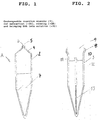
- Fig. 1 is a section view of a reaction vessel constituting one of the two parts of an extraction system according to the present invention;
- Fig. 2 is a section view of an into the former reaction vessel fitting, second reaction vessel, constituting the second part of the extraction system according to the present invention; and
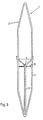
- Fig. 3. is a diagrammatic view of the extraction system mounted together.
- The extraction system according to the present invention is generally designated by
reference number 1 in the figures. The extraction system consists of areaction vessel 2 according to Fig. 1 and areaction vessel 3 according to Fig. 2, both having configurations permitting them to be fitted together with the bottom ends directed upwards and downwards respectively as illustrated in Fig. 3. This fit is generated by means of thereaction vessel 2 is provided with an upper, convergent section orlid 4 and thereaction vessel 3 is provided with an upper divergent or collaredsection 8. The angles of the convergent and divergent parties respectively, are the same, leading to a tight fit and, consequently, a closed system when the tworeaction vessels reaction vessel 2 corresponds to the inner diameter of the collaredsection 8 of thereaction vial 3. - In the
lid 4 of thereaction vessel 2 is situated one or more (the number corresponds to the number ofcapillaries 12 below) tube shapedorifices 5 which optionally can be covered by a permeable membrane 6. Thereaction vessel 3 is provided with a considerablywider orifice 9 compared with theorifices 5, whichorifice 9 has the function to come into theupper section 4 of thereaction vessel 2 as is explained above, c.f. Fig. 3. - Within the
reaction vessel 3, one ormore capillaries 12 are longitudinally arranged. Thiscapillaries 12 are fixed, preferrably in the center of thereaction vessel 3, as a consequence of its top end being inserted into abore 11 in a disc, which is situated in the upper section of thereaction vessel 3 precisely beneath thecollared section 8, and its lower end being firmly attatched to the bottom of thereaction vessel 3. - As shown in Fig. 3, the tube
shaped orifices 5 is dimensioned precisely to fit over the upper section of thecapillaries 12 and to establish contact with thedisc 10. - Below is described a preferred way to use the extraction system according to the invention, for extraction of nucleic acids.
- The
capillaries 12 are provided with a medium with affinity to nucleic acids 13 (below termed DNA-binder), which is denser than water. Thereaction vessel 3, enclosing thecapillaries 12, has the shape of a microcentrifuge tube, and has three functions. One is the function to isolate its content from the environment, which reduces the contamination risk as well as the infection risk in case of extraction of contagious matter, another function is to stabilize the capillary during centrifugation, and a third is to function as a stop collar during centrifugation. Stability is achieved due to thebore 11 in thehorizontal disc 10 as described above. The function as a stop collar is achieved due to the upper collaredsection 8 of thereaction vessel 3, leading to an upside downreaction vessel 2 will be brought to contact with the diverging walls of the collar, according to the description above. - To a
reaction vessel 2, here being denotedreaction vessel 2A, is provided a membrane denaturating medium 7 (e.g. concentrated saline solution, lysozyme and/or alkali), followed by thebore 5 in thelid 4 is sealed by a thin membrane 6. To another, not shown,reaction vessel 2, here being denotedreaction vessel 2B is inserted a washing buffer (a saline solution aimed to rinse the DNA-binder, cleaning it from coagulated proteins, cell-fragments and other impurities, without eluating the DNA from the DNA-binder), and to yet another, not shown,reaction vessel 2, here being denotedreaction vessel 2C, is inserted distillated water, whereafter also thereaction vessels - The manual handling starts by the sample, e.g. blood, using a syringe, pipet or a measuring capillary is inserted to
reaction vessel 2A. This is incubated and the content may be boiled up in order to denaturate nucleases, followed by thecapillaries 12 are coupled to thereaction vessel 2 by bringing the tube shapedorifices 5 over thecapillaries 12 until their verges are brought into contact with thedisc 10. Thereaction vessel 2A and thereaction vessel 3 then comprises a closed unit (c.f Fig. 3), which is placed with the bottom of thereaction vessel 2A directed downwards/outwards in a microcentrifuge, followed by a short centrifugation, which transfer the content of each capillary (i.e. DNA-binder) toreaction vessel 2A. After powerful mixing, e.g by vortexing, of the content of thereaction vessel 2A, the DNA will bind to the DNA-binder. - Subsequently, the closed
extraction system 1 is turned and placed with the bottom of thereaction vessel 3 downwards, either in a stand for tubes, allowing the DNA-binder 13 with bound DNA to sediment back into thecapillaries 12, or in a microcentrifuge with the bottom of thereaction vessel 3 directed downwards/outwards, followed by a short centrifugation in which the DNA-binder 13 with bound DNA is returned to thecapillaries 12. - The
reaction vessel 2A with its content is disposed, and thereaction vessel 2B containing washing buffer is arranged on thecapillaries 12 as described above. After this, the DNA-binder with bound DNA is rinsed by transferring it intoreaction vessel 2B containing washing buffer, using centrifugation. The content of thereaction vessel 2B is mixed, e.g. by vortexing, to achieve effective cleaning of bound DNA. Subsequently the DNA-binder with bound DNA is tranferred back to thecapillaries 12 by sedimentation or centrifugation according to the same procedure as described above concerningreaction vessel 2A. Thereafter alsoreaction vessel 2B with its content is disposed. - If further rinsing is desired, the procedure is repeated one or several times from the point of replacement of
reaction vessel 2A to the disposing ofreaction vessel 2B. - If no further rinsing is desired the
reaction vessel 2B is replaced withreaction vessel 2C containing water or other medium bringing DNA into solution. The DNA-binder with bound DNA is centrifuged down into thereaction vessel 2C, which is shaken, in which the DNA will dissociate from the DNA-binder and be brought in solution in the water. The DNA-binder without DNA may, if so is preferred, sediment or be pelleted by centrifugation, optionally to the bottom ofreaction vessel 2C or back into thecapillaries 12, which thereafter are disposed together with the connectedreaction vessel 3. - The DNA now being in solution in the
reaction vessel 2C, would, due to the closed handling described above, ensure very reliable results in e.g. PCR. - Preferrably, the DNA in
reaction vessel 2C is dispensed using a dispenser according to applicant's copending application, SE9100726.
Claims (10)
- A method to perform nucleic acid extraction in a closed system, whereina) a nucleic acid containing sample is added to a reaction vessel (2A) containing a membrane denaturating medium (7), and these are allowed to incubate;b) an orifice (5) being situated in the lid (4) of said reaction vessel (2A) is arranged over the upper portion of a capillary (12), containing nucleic acid binding medium (13) (denser than water) and being tightly secured against the bottom of a second reaction vessel (3), said reaction vessels (2A) and (3), respectively, forming a closed unit comprising an open passage from said capillary (12) to the bottom of said reaction vessel (2A);c) said closed unit is centrifugated with the bottom of said reaction vessel (2A) directed downwards, whereby said nucleic acid binding medium is brought into said reaction vessel (2A);d) the contents in said reaction vessel (2A) is mixed, whereby nucleic acid in said sample binds to said nucleic acid binder (13);e) said closed unit is centrifugated with the bottom of said reaction vessel (3) directed downwards, whereby said nucleic acid binding medium with bound nucleic acid is brought into said capillary (12);f) said reaction vessel (2A) is discarded and replaced with a new reaction vessel (2B) comprising washing buffer and said centrifugations according to c) and e) are repeated with mixing therebetween;g) said reaction vessel (2B) is discarded and replaced with a new reaction vessel (2C) comprising medium causing the nucleic acid to dissociate from said nucleic acid binding medium (13) and said centrifugation according to c) is repeated, whereby the nucleic acid dissociates from said nucleic acid binder and is brought in solution, and said nucleic acid binder sediments to the bottom of reaction vessel (2C); andh) said reaction vessels (3) and (2C) are disconnected and said nucleic acid in said reaction vessel (2C) is subjected to further analysis.
- A method according to claim 1, wherein boiling is performed before step b) to denaturate nucleases, if present.
- A method according to claims 1 or 2, wherein washing of bound nucleic acid is repeated with one or more reaction vessels (2B) comprising washing buffer before the final centrifugation of said closed unit comprising said reaction vessel (2C) and said reaction vessel (3).
- A method according to claims 1, 2 or 3, wherein said nucleic acid binding medium in step g) is centrifugated down into said reaction vessel (2C).
- A method according to claims 1, 2 or 3, wherein said nucleic acid binding medium in step g) is centrifugated down into said capillary (12).
- A closed extraction system, wherein it comprises exchangeable reaction vessels (2A, 2B, 2C) and a reaction vessel (3) comprising a centred capillary (12) therein, the reaction vessels (2A, 2B, 2C) and (3), respectively, being constructed to engage with each other to form a closed system comprising an open passage from said capillary (12) to the bottom of said reaction vessel (2A, 2B, 2C).
- A closed extraction system according to claim 6, wherein the engagement between said reaction vessel (2A, 2B, 2C) and said reaction vessel (3) is accomplished in that said reaction vessel (2A, 2B, 2C) is provided with an upper converging portion or lid (4), the inclination of which is adapted to an upper diverging or collared portion (8) on said reaction vessel (3), and wherein said lid (4) is provided a tubular orifice (5) the inner diameter of which is adapted to the outer diameter of said capillary (12).
- A closed extraction system according to claim 7, wherein said orifice (5) of said reaction vessel (2A, 2B, 2C) is covered by a permeable membrane (6).
- A closed extraction system according to claims 6, 7 or 8, wherein said capillary (12) is centred in said reaction vessel (3) by arranging said capillary (12) in a bore (11) of a disc (10) being arranged in the upper portion of said reaction vessel (3) just beneath said collared portion (8), and wherein its lower end is fixedly arranged in the bottom of said reaction vessel (3).
- A closed extraction system according to one or more of the claims 6-9, wherein said capillary (12) comprises nucleic acid binding medium (13), being denser than water, wherein said reaction vessel (2A) comprises membrane denaturating medium, wherein said reaction vessel (2B) comprises washing buffer, and wherein said reaction vessel (2C) comprises medium causing said bound nucleic acid to dissociate from said nucleic acid binding medium.
Applications Claiming Priority (3)
| Application Number | Priority Date | Filing Date | Title |
|---|---|---|---|
| SE9100725 | 1991-03-11 | ||
| SE9100725A SE503729C2 (en) | 1991-03-11 | 1991-03-11 | extraction |
| PCT/SE1992/000151 WO1992015597A1 (en) | 1991-03-11 | 1992-03-11 | Extraction system |
Publications (2)
| Publication Number | Publication Date |
|---|---|
| EP0575387A1 EP0575387A1 (en) | 1993-12-29 |
| EP0575387B1 true EP0575387B1 (en) | 1997-06-04 |
Family
ID=20382126
Family Applications (1)
| Application Number | Title | Priority Date | Filing Date |
|---|---|---|---|
| EP92905907A Expired - Lifetime EP0575387B1 (en) | 1991-03-11 | 1992-03-11 | Extraction system |
Country Status (9)
| Country | Link |
|---|---|
| US (1) | US5436328A (en) |
| EP (1) | EP0575387B1 (en) |
| JP (1) | JPH06510421A (en) |
| AT (1) | ATE154026T1 (en) |
| AU (1) | AU665750B2 (en) |
| CA (1) | CA2105986A1 (en) |
| DE (1) | DE69220213T2 (en) |
| SE (1) | SE503729C2 (en) |
| WO (1) | WO1992015597A1 (en) |
Families Citing this family (7)
| Publication number | Priority date | Publication date | Assignee | Title |
|---|---|---|---|---|
| US5364591A (en) * | 1992-06-01 | 1994-11-15 | Eastman Kodak Company | Device for moving a target-bearing solid through a liquid for detection while being contained |
| US5639428A (en) * | 1994-07-19 | 1997-06-17 | Becton Dickinson And Company | Method and apparatus for fully automated nucleic acid amplification, nucleic acid assay and immunoassay |
| US5863801A (en) * | 1996-06-14 | 1999-01-26 | Sarnoff Corporation | Automated nucleic acid isolation |
| SE9702005D0 (en) | 1997-05-28 | 1997-05-28 | Alphahelix Ab | New reaction vessel and method for its use |
| ATE306324T1 (en) * | 1997-06-09 | 2005-10-15 | Hoffmann La Roche | DISPOSABLE ANALYZER |
| JP4431508B2 (en) * | 2005-02-21 | 2010-03-17 | 富士フイルム株式会社 | Cartridge holding mechanism for nucleic acid extraction apparatus |
| ITMI20062272A1 (en) * | 2006-11-27 | 2008-05-28 | Genedia S R L | REACTOR FOR BIOCHEMICAL PROCESSES PARTICULARLY EXTRACTION PURIFICATION ENRICHMENT SEDIMENTATION |
Family Cites Families (7)
| Publication number | Priority date | Publication date | Assignee | Title |
|---|---|---|---|---|
| US3432487A (en) * | 1966-05-16 | 1969-03-11 | Du Pont | Process for extraction and concentration of hydrophilic substances |
| US3983037A (en) * | 1973-11-05 | 1976-09-28 | Jae Yoon Lee | Apparatus for transfer, storage, and distribution of liquid |
| US4786471A (en) * | 1983-10-21 | 1988-11-22 | Baxter Travenol Laboratories, Inc. | Heterogeneous immunoassay method and assembly |
| IL74967A (en) * | 1985-04-18 | 1988-10-31 | Assaf Pharmaceutical Ind | Separation of materials from a liquid dispersion by sedimentation |
| DE3843610A1 (en) * | 1988-01-13 | 1989-07-27 | Stephan Dr Diekmann | DISCONNECTING OR REACTION PILLAR UNIT |
| EP0338591A3 (en) * | 1988-04-21 | 1991-09-04 | Microprobe Corporation | Nucleic acid extraction method |
| US4997932A (en) * | 1989-11-13 | 1991-03-05 | Boehringer Mannheim Corporation | Method and kit for purifying nucleic acids |
-
1991
- 1991-03-11 SE SE9100725A patent/SE503729C2/en not_active IP Right Cessation
-
1992
- 1992-03-11 JP JP4505643A patent/JPH06510421A/en active Pending
- 1992-03-11 WO PCT/SE1992/000151 patent/WO1992015597A1/en not_active Ceased
- 1992-03-11 AT AT92905907T patent/ATE154026T1/en not_active IP Right Cessation
- 1992-03-11 DE DE69220213T patent/DE69220213T2/en not_active Expired - Fee Related
- 1992-03-11 CA CA002105986A patent/CA2105986A1/en not_active Abandoned
- 1992-03-11 US US08/117,051 patent/US5436328A/en not_active Expired - Fee Related
- 1992-03-11 EP EP92905907A patent/EP0575387B1/en not_active Expired - Lifetime
- 1992-03-11 AU AU13443/92A patent/AU665750B2/en not_active Ceased
Also Published As
| Publication number | Publication date |
|---|---|
| WO1992015597A1 (en) | 1992-09-17 |
| CA2105986A1 (en) | 1992-09-12 |
| SE9100725D0 (en) | 1991-03-11 |
| US5436328A (en) | 1995-07-25 |
| DE69220213T2 (en) | 1998-01-15 |
| DE69220213D1 (en) | 1997-07-10 |
| ATE154026T1 (en) | 1997-06-15 |
| SE503729C2 (en) | 1996-08-12 |
| JPH06510421A (en) | 1994-11-24 |
| AU1344392A (en) | 1992-10-06 |
| AU665750B2 (en) | 1996-01-18 |
| EP0575387A1 (en) | 1993-12-29 |
| SE9100725L (en) | 1992-09-12 |
Similar Documents
| Publication | Publication Date | Title |
|---|---|---|
| US7776616B2 (en) | Apparatuses and methods for isolating nucleic acid | |
| RU2244559C2 (en) | Device and method for extracting nucleic acids | |
| US5935858A (en) | Device for isolating a component of a physiological sample | |
| DE19610354C1 (en) | Device, method and device for isolating nucleic acids | |
| US5346999A (en) | Method of nucleic acid extraction | |
| US9506847B2 (en) | Method and system for selective isolation of target biological molecules in a general purpose system | |
| CN101010592A (en) | Device and method for separating, mixing and concentrating magnetic particles with a fluid and use thereof in purification methods | |
| US20030013205A1 (en) | Separating device | |
| CN108076644A (en) | Apparatus and method for automatic nucleic acid extraction | |
| WO2005003346A1 (en) | Purification device for ribonucleic acid in large volumes, and method | |
| RU110746U1 (en) | DEVICE FOR SIMULTANEOUS AUTOMATED ISOLATION AND PURIFICATION OF NUCLEIC ACIDS FROM SEVERAL BIOLOGICAL SAMPLES | |
| EP0245945A2 (en) | Automated nucleic acid extractor | |
| AU665750B2 (en) | Extraction system utilizing centrifugation | |
| US6177009B1 (en) | Apparatus for treating biomolecules | |
| EP0972080B1 (en) | Biomolecular processor | |
| EP0530283B1 (en) | Method and means to perform biochemical reactions | |
| JPH04232868A (en) | Liquid treating apparatus | |
| EP0215533A2 (en) | A method of extracting nucleic acids from cells | |
| JP2003527953A (en) | Method and apparatus for treating substances in a single container | |
| WO1995027546A1 (en) | Method and apparatus for isolation and purification of biologically active complexes | |
| EP1177043A2 (en) | Device for rapid dna sample processing with integrated liquid handling, thermocycling, and purification | |
| JP2002345465A (en) | Unit for purifying nucleic acid and method for purifying the nucleic acid | |
| JP2000342982A (en) | Fractional refiner for repeating type dispenser | |
| AU2003200640B2 (en) | Apparatuses and methods for isolating nucleic acid | |
| CN221254569U (en) | Nucleic acid extraction amplification detection device using magnetic beads as carriers of objects to be detected |
Legal Events
| Date | Code | Title | Description |
|---|---|---|---|
| PUAI | Public reference made under article 153(3) epc to a published international application that has entered the european phase |
Free format text: ORIGINAL CODE: 0009012 |
|
| 17P | Request for examination filed |
Effective date: 19930915 |
|
| AK | Designated contracting states |
Kind code of ref document: A1 Designated state(s): AT BE CH DE DK ES FR GB GR IT LI LU NL |
|
| 17Q | First examination report despatched |
Effective date: 19950927 |
|
| GRAG | Despatch of communication of intention to grant |
Free format text: ORIGINAL CODE: EPIDOS AGRA |
|
| GRAH | Despatch of communication of intention to grant a patent |
Free format text: ORIGINAL CODE: EPIDOS IGRA |
|
| GRAH | Despatch of communication of intention to grant a patent |
Free format text: ORIGINAL CODE: EPIDOS IGRA |
|
| GRAA | (expected) grant |
Free format text: ORIGINAL CODE: 0009210 |
|
| AK | Designated contracting states |
Kind code of ref document: B1 Designated state(s): AT BE CH DE DK ES FR GB GR IT LI LU NL |
|
| PG25 | Lapsed in a contracting state [announced via postgrant information from national office to epo] |
Ref country code: LI Effective date: 19970604 Ref country code: IT Free format text: LAPSE BECAUSE OF FAILURE TO SUBMIT A TRANSLATION OF THE DESCRIPTION OR TO PAY THE FEE WITHIN THE PRE;WARNING: LAPSES OF ITALIAN PATENTS WITH EFFECTIVE DATE BEFORE 2007 MAY HAVE OCCURRED AT ANY TIME BEFORE 2007. THE CORRECT EFFECTIVE DATE MAY BE DIFFERENT FROM THE ONE RECORDED.SCRIBED TIME-LIMIT Effective date: 19970604 Ref country code: GR Free format text: LAPSE BECAUSE OF FAILURE TO SUBMIT A TRANSLATION OF THE DESCRIPTION OR TO PAY THE FEE WITHIN THE PRESCRIBED TIME-LIMIT Effective date: 19970604 Ref country code: ES Free format text: THE PATENT HAS BEEN ANNULLED BY A DECISION OF A NATIONAL AUTHORITY Effective date: 19970604 Ref country code: DK Effective date: 19970604 Ref country code: CH Effective date: 19970604 Ref country code: AT Effective date: 19970604 |
|
| REF | Corresponds to: |
Ref document number: 154026 Country of ref document: AT Date of ref document: 19970615 Kind code of ref document: T |
|
| REG | Reference to a national code |
Ref country code: CH Ref legal event code: EP |
|
| REF | Corresponds to: |
Ref document number: 69220213 Country of ref document: DE Date of ref document: 19970710 |
|
| ET | Fr: translation filed | ||
| REG | Reference to a national code |
Ref country code: CH Ref legal event code: PL |
|
| PG25 | Lapsed in a contracting state [announced via postgrant information from national office to epo] |
Ref country code: LU Free format text: LAPSE BECAUSE OF NON-PAYMENT OF DUE FEES Effective date: 19980311 |
|
| PLBE | No opposition filed within time limit |
Free format text: ORIGINAL CODE: 0009261 |
|
| STAA | Information on the status of an ep patent application or granted ep patent |
Free format text: STATUS: NO OPPOSITION FILED WITHIN TIME LIMIT |
|
| 26N | No opposition filed | ||
| PGFP | Annual fee paid to national office [announced via postgrant information from national office to epo] |
Ref country code: GB Payment date: 19990304 Year of fee payment: 8 |
|
| PGFP | Annual fee paid to national office [announced via postgrant information from national office to epo] |
Ref country code: FR Payment date: 19990318 Year of fee payment: 8 |
|
| PGFP | Annual fee paid to national office [announced via postgrant information from national office to epo] |
Ref country code: NL Payment date: 19990331 Year of fee payment: 8 Ref country code: BE Payment date: 19990331 Year of fee payment: 8 |
|
| PGFP | Annual fee paid to national office [announced via postgrant information from national office to epo] |
Ref country code: DE Payment date: 19990528 Year of fee payment: 8 |
|
| PG25 | Lapsed in a contracting state [announced via postgrant information from national office to epo] |
Ref country code: GB Free format text: LAPSE BECAUSE OF NON-PAYMENT OF DUE FEES Effective date: 20000311 |
|
| PG25 | Lapsed in a contracting state [announced via postgrant information from national office to epo] |
Ref country code: BE Free format text: LAPSE BECAUSE OF NON-PAYMENT OF DUE FEES Effective date: 20000331 |
|
| BERE | Be: lapsed |
Owner name: ALPHAHELIX DIAGNOSTICS A.B. Effective date: 20000331 |
|
| PG25 | Lapsed in a contracting state [announced via postgrant information from national office to epo] |
Ref country code: NL Free format text: LAPSE BECAUSE OF NON-PAYMENT OF DUE FEES Effective date: 20001001 |
|
| GBPC | Gb: european patent ceased through non-payment of renewal fee |
Effective date: 20000311 |
|
| PG25 | Lapsed in a contracting state [announced via postgrant information from national office to epo] |
Ref country code: FR Free format text: LAPSE BECAUSE OF NON-PAYMENT OF DUE FEES Effective date: 20001130 |
|
| NLV4 | Nl: lapsed or anulled due to non-payment of the annual fee |
Effective date: 20001001 |
|
| REG | Reference to a national code |
Ref country code: FR Ref legal event code: ST |
|
| PG25 | Lapsed in a contracting state [announced via postgrant information from national office to epo] |
Ref country code: DE Free format text: LAPSE BECAUSE OF NON-PAYMENT OF DUE FEES Effective date: 20010103 |