EP0574681A1 - Yogurt product containing bacteriocin from pediococcus adilactici - Google Patents
Yogurt product containing bacteriocin from pediococcus adilactici Download PDFInfo
- Publication number
- EP0574681A1 EP0574681A1 EP93106910A EP93106910A EP0574681A1 EP 0574681 A1 EP0574681 A1 EP 0574681A1 EP 93106910 A EP93106910 A EP 93106910A EP 93106910 A EP93106910 A EP 93106910A EP 0574681 A1 EP0574681 A1 EP 0574681A1
- Authority
- EP
- European Patent Office
- Prior art keywords
- yogurt
- bacteriocin
- product
- milk
- pediococcus acidilactici
- Prior art date
- Legal status (The legal status is an assumption and is not a legal conclusion. Google has not performed a legal analysis and makes no representation as to the accuracy of the status listed.)
- Ceased
Links
Classifications
-
- A—HUMAN NECESSITIES
- A23—FOODS OR FOODSTUFFS; TREATMENT THEREOF, NOT COVERED BY OTHER CLASSES
- A23C—DAIRY PRODUCTS, e.g. MILK, BUTTER OR CHEESE; MILK OR CHEESE SUBSTITUTES; PREPARATION THEREOF
- A23C9/00—Milk preparations; Milk powder or milk powder preparations
- A23C9/12—Fermented milk preparations; Treatment using microorganisms or enzymes
- A23C9/123—Fermented milk preparations; Treatment using microorganisms or enzymes using only microorganisms of the genus lactobacteriaceae; Yoghurt
- A23C9/1236—Fermented milk preparations; Treatment using microorganisms or enzymes using only microorganisms of the genus lactobacteriaceae; Yoghurt using Leuconostoc, Pediococcus or Streptococcus sp. other than Streptococcus Thermophilus; Artificial sour buttermilk in general
-
- A—HUMAN NECESSITIES
- A23—FOODS OR FOODSTUFFS; TREATMENT THEREOF, NOT COVERED BY OTHER CLASSES
- A23C—DAIRY PRODUCTS, e.g. MILK, BUTTER OR CHEESE; MILK OR CHEESE SUBSTITUTES; PREPARATION THEREOF
- A23C9/00—Milk preparations; Milk powder or milk powder preparations
- A23C9/152—Milk preparations; Milk powder or milk powder preparations containing additives
- A23C9/158—Milk preparations; Milk powder or milk powder preparations containing additives containing vitamins or antibiotics
- A23C9/1585—Antibiotics; Bacteriocins; Fungicides from microorganisms
Definitions
- the present invention relates to a yogurt product with increased shelf life containing a bacteriocin derived from a Pediococcus acidilactici .
- a preferred method for producing the yogurt product is by fermenting a milk based medium with Pediococcus acidilactici (PA), heating the medium to terminate growth of the Pediococcus acidilactici and fermenting the first fermentate after the heating with a yogurt culture to produce the yogurt product which contains bacteriocin active against undesirable flora.
- PA Pediococcus acidilactici
- Yogurt products are well known and are produced by equal parts by cell count of Lactobacillus bulgaricus and Streptococcus thermophilus and are described, for instance, in U.S. Patent Nos. 3,420,742 to Farr and 4,339,464 to Vedamuthu .
- yogurt there are numerous foods which use yogurt as an ingredient in fluid or dried form. Some examples are salad dressings, sauces, baking mixtures, and other food systems requiring a tart, clean, lactic acid flavoring. There are a few dried yogurt powders available in the marketplace.
- dairy bases which have either been acidified by direct addition of edible acids (primarily lactic acid and ⁇ -gluconolactone for coagulation and acidity) or fermented using a yogurt starter bacteria.
- the fermented products in addition to dairy ingredients contain dead, injured and live cells of yogurt bacteria and their metabolic by-products.
- Those products made by direct acidification will contain the acid(s) used for acidification.
- Dried yogurt powders can contain any neutralizing agent used to adjust the pH to the desirable range for good or acceptable dehydration of the product.
- Pediococcus acidilactici is known to produce a bacteriocin which has a broad spectrum against spoilage bacteria.
- Such bacteriocins are described in U.S. Patent No. 4,929,445 to Vandenbergh et al; U.S. application Serial No. 07/375,344; and U.S. Patent No. 4,883,673 to Gonzalez et al.
- bacteriocins tend to retard the growth of yogurt cultures. This is true of nisin. Thus nisin has to be blended into the final product, thereby producing a significant risk of contamination of the final product.
- the bacteriocin could be introduced into the milk based medium used to produce the yogurt product. In this manner, the bacteriocin could protect the product as it was produced.
- the problem is that any acids or the like in excess generated by the bacteriocin producing cultures can inhibit the yogurt cultures.
- Pediococcus acidilactici is used in meat fermentations. Generally it is not used commercially for milk fermentations because it grows poorly on milk based media. A Pediococcus which grows well in a milk based medium is needed.
- the present invention relates to a method for producing a yogurt product which comprises: providing a bacteriocin in a milk based medium by fermenting the medium; and providing yogurt flavors in the fermented medium.
- the present invention further relates to a method for producing a yogurt product which comprises: providing a bacteriocin from Pediococcus acidilactici in a milk based medium; and fermenting the milk based medium containing the bacteriocin with a yogurt culture to produce the yogurt product containing the bacteriocin, which provides inhibition of undesirable bacterial growth in the yogurt product.
- the present invention relates to a method for producing a yogurt product which comprises: fermenting a milk based medium with a bacteriocin producing Pediococcus acidilactici to produce a first fermentate containing the bacteriocin; heating the medium to terminate the growth of the Pediococcus acidilactici ; and fermenting the first fermentate after the heating with a yogurt culture to produce the yogurt product containing the bacteriocin in an amount which provides inhibition of undesirable bacterial growth in the yogurt product.
- the present invention relates to a yogurt product which comprises: a milk based medium containing yogurt flavors; and a bacteriocin produced by a Pediococcus acidilactici in the medium in an amount which promotes inhibition of undesirable bacterial growth.
- the present invention relates to a yogurt product which comprises: a milk based medium containing fermentates from fermentation by a yogurt culture; and a bacteriocin produced by a Pediococcus acidilactici in an amount which provides inhibition of undesirable bacterial growth.
- the product can contain live yogurt cultures.
- This invention relates to a method which provides fluid or dried yogurt products containing bacteriocins from Pediococcus acidilactici as barriers to spoilage and/or pathogenic flora, which are gram-positive.
- yogurt listeria and other low temperature lactobacilli are especially important undesirable bacteria.
- a fluid or dried yogurt product is provided containing a biologically derived Pediococcus acidilactici bacteriocin active against spoilage and/or pathogenic flora, preferably developed in situ in a milk based medium by using a single-stage or two-stage fermentation.
- the microorganisms used in developing the yogurt product are cultures traditionally used in such fermentations.
- the preferred strain is Pediococcus acidilactici NRRL-B-18925. This strain has been deposited under the Budapest Treaty with the Northern Regional Research Laboratory (NRRL) in Peoria, Illinois. This strain is particularly effective in producing the bacteriocin in a milk based medium. There are numerous other Pediococcus acidilactici strains which are available from the American Type Culture Collection or the NRRL which can be grown in milk to produce strains which effectively grow in milk based media.
- the milk based medium is fermented between 25° and 45°C to produce the bacteriocin.
- the medium includes non-fat milk solids, a carbohydrate source and milk hydrolyzates which provide proteins and amino acids for growth of the Pediococcus acidilactici (PA).
- the milk solids are not actively metabolized by the Pediococcus acidilactici (PA) and are impregnated with the bacteriocin.
- the milk solids are preferably present in an amount between 0.1 and no more than 5.0 % by weight in the milk based medium to avoid precipitation on further processing.
- the fermented medium after production of the bacteriocin is neutralized to a pH between about 5.2 and 6.3 to provide a suitable medium for the yogurt culture.
- the medium is heated to about 65 to 80°C to terminate growth of the Pediococcus acidilactici .
- the heat treated Pediococcus acidilactici fermented medium is fortified with nonfat milk solids in an amount between about 5 and 15 percent depending upon the amount in the milk based medium used for the Pediococcus acidilactici fermentation.
- the fortified medium is then fermented with the yogurt culture to produce the yogurt product.
- this second stage fermentation is at about 35° to 43°C.
- the yogurt product can also be produced by direct acidulation. This method is not preferred.
- the yogurt product is preferably dried to a powder to make it easier to ship for use as an additive to salad dressings and the like. Preferably spray drying at about 87° to 102°C is used since a powder is produced directly.
- the product may also be lyophilized.
- the product contains 100 to 10,000 AU per gram of the bacteriocin.
- the unit "AU” is defined as 5 microliters of the highest dilution of the yogurt product yielding a zone of growth inhibition with a lawn of a gram positive bacteria ( Pediococcus pentosaceus FBB-63) on an agar plate.
- This example describes a two-stage fermentation using a bacteriocin producing strain and a yogurt culture.
- the first-stage fermentation involved the use of a strain of Pediococcus acidilactici which produced the bacteriocin PA-1 in situ in a milk based medium.
- a second-stage fermentation using a yogurt starter culture was performed to obtain yogurt containing the bacteriocin.
- the yogurt was lyophilized as such, or after pH was adjusted to 5.5.
- the yogurt product had the typical tartness and "green" flavor associated with yogurt along with live yogurt bacteria and the bacteriocin Most importantly and unexpectedly, the liquid and the dried yogurt products had an equivalent or only slightly lower titer of the bacteriocin PA-1 found immediately after the initial fermentation by the Pediococcus acidilactici .
- one of the technological problems that had to be overcome related to the prevention of extreme precipitation and wheying off experienced when the original milk medium was heat-treated to destroy the pediococci such that the second fermentation could proceed unhindered.
- the first step was to obtain a strain of Pediococcus acidilactici that would produce bacteriocin PA-1 in milk.
- Strain PAC 10.0 Pediococcus acidilactici NRRL-B-18925
- yeast extract does not qualify as a milk derived ingredient
- milk fortified with various milk-derived hydrolysates was used.
- EDAMIN K at 1.0% by volume level gave the maximum titer of bacteriocin when PAC 10.0 was used.
- EDAMIN K is a hydrolysate of whey proteins made by Sheffield Products, Norwich, NY. Strain PAC 10.0 produced between 800 and 1600 AU/ml of bacteriocin when cultured in reconstituted 11% nonfat milk solids fortified with 1.0% glucose and 1.0% EDAMIN K, all reconstituted weight per volume. Lower levels of the whey protein derivative did not give equivalent titer of bacteriocin. Higher levels failed to boost the bacteriocin titer. Milk fortified at 1.0% by weight per volume each of glucose and EDAMIN K was selected for use.
- strain PAC 10.0 When strain PAC 10.0 was initially cultured in a menstruum made up of a mix containing 1.0% each of nonfat milk solids, glucose and EDAMIN K, and subsequently adjusted to pH 6.3 followed by fortification with 11 to 12% nonfat milk solids (weight per volume) and was heat-treated at 65°-80°C for 60 minutes with either intermittent or constant agitation, there was very little or no precipitation and the bacteriocin remained active.
- the resulting mix was suitable for yogurt fermentation.
- Table 1 shows the bacteriocin level at various stages of the fermentation.
- the yogurt product had an acceptable level of bacteriocin for inhibiting undesirable bacteria.
- Example 2 the bacteriocin as a purified chemical was added to the milk based medium prior to adding the yogurt culture.
- the bacteriocin was added to a level of 800 AU/ml.
- the second stage fermentation was then performed as in Example 1.
- the resultant fermentate retained the original titer.
- bacteriocin-containing yogurt powder was tested in a frozen yogurt system.
- a total volume of 300 ml mix for frozen yogurt was made.
- An unfermented base mix was made separately and combined with sufficient amount of fully fermented yogurt mix such that the final acidity of the combined mix was 0.3% as lactic acid.
- Composition of the base mix 40% Cream 25 parts Whole Milk 201 parts Non-fat dry Milk 12 parts Sugar 45 parts 80% Corn Sweetener 24 parts Stabilizer-Emulsifier 2 parts
- Composition of yogurt mix Skim milk 0.2% milk fat 97 parts Non-fat dry milk 3 parts
- the two mixes were separately heat treated at 100°C for 5 minutes.
- the yogurt mix was cultured with a yogurt starter at 35°C overnight.
- the base mix was stored at 5°C.
- the final mix was made by combining the required proportions of the base mix (255 parts) and the yogurt (45 parts).
- the mix was divided into 100 ml portions into 3 separate sterile screw-cap Erlenmeyer flasks. They were labeled 1, 2 and 3.
- To flask 1 two grams of non-fat milk powder was added and mixed in.
- To flask 2 two grams of previously made bacteriocin-containing yogurt powder of Example 1 was added and mixed in.
- the yogurt powder contained 4000 AU/gm. Hence, the contents of flask 2, had an equivalent of 80 AU/ml of the bacteriocin.
- each container was removed and a sufficient portion of the frozen material chipped out into three separate sterile snap-cap plastic tubes.
- the containers were returned to the freezer after sampling.
- the samples were thawed in a 37°C water-bath and immediately after thawing were plated on "OXOID" Listeria Selective Agar (Unipath Ltd., Basingstoke, Hampshire, England). On this agar, Listeria form dark grey or black colonies with dark grey or black zones. Other flora are inhibited on this medium. Suitable sample portions or dilutions were spread-plated to get accurate counts.
- Addition of yogurt powder containing the bacteriocin so as to give 80 AU/ml of the frozen yogurt mix reduced the population of added listeria from 1.2 x 10⁴/ml to 1.0/ml within 4 days of freezing. After 15 days, none could be found in the mix containing the yogurt powder.
- the inoculated control maintained the numbers of added listeria throughout the storage.
Landscapes
- Life Sciences & Earth Sciences (AREA)
- Microbiology (AREA)
- Chemical & Material Sciences (AREA)
- Engineering & Computer Science (AREA)
- Food Science & Technology (AREA)
- Polymers & Plastics (AREA)
- Plant Pathology (AREA)
- Health & Medical Sciences (AREA)
- Nutrition Science (AREA)
- Dairy Products (AREA)
Abstract
A method for producing a yogurt product containing a bacteriocin is described. In the preferred method, a milk based medium is cultured with Pediococcus acidilactici to produce the bacteriocin, the Pediococcus acidilactici is then heat inactivated and finally a yogurt culture is added to the medium with the bacteriocin and cultured to produce the yogurt product. The yogurt product can be dried, either by lyophilization or spray-drying or other means, preferably to a powder, for use in various foods.
Description
- The present invention relates to a yogurt product with increased shelf life containing a bacteriocin derived from a Pediococcus acidilactici. A preferred method for producing the yogurt product is by fermenting a milk based medium with Pediococcus acidilactici (PA), heating the medium to terminate growth of the Pediococcus acidilactici and fermenting the first fermentate after the heating with a yogurt culture to produce the yogurt product which contains bacteriocin active against undesirable flora.
- Yogurt products are well known and are produced by equal parts by cell count of Lactobacillus bulgaricus and Streptococcus thermophilus and are described, for instance, in U.S. Patent Nos. 3,420,742 to Farr and 4,339,464 to Vedamuthu.
- There are numerous foods which use yogurt as an ingredient in fluid or dried form. Some examples are salad dressings, sauces, baking mixtures, and other food systems requiring a tart, clean, lactic acid flavoring. There are a few dried yogurt powders available in the marketplace.
- All the fluid and dried yogurt products currently available are made out of dairy bases which have either been acidified by direct addition of edible acids (primarily lactic acid and δ-gluconolactone for coagulation and acidity) or fermented using a yogurt starter bacteria. The fermented products in addition to dairy ingredients, contain dead, injured and live cells of yogurt bacteria and their metabolic by-products. Those products made by direct acidification will contain the acid(s) used for acidification. Dried yogurt powders can contain any neutralizing agent used to adjust the pH to the desirable range for good or acceptable dehydration of the product.
- The usefulness of fluid and rehydrated yogurt products is in providing the specific textural and flavor attributes desired in the food system. Their addition to food systems is not intended to provide a barrier against spoilage or pathogenic bacteria which may gain entry into the food system. Acidity, if present, can provide very limited bacterial inhibition; however, neutralization limits this inhibition. It would be highly desirable to provide bacterial inhibition in the yogurt product.
- Pediococcus acidilactici is known to produce a bacteriocin which has a broad spectrum against spoilage bacteria. Such bacteriocins are described in U.S. Patent No. 4,929,445 to Vandenbergh et al; U.S. application Serial No. 07/375,344; and U.S. Patent No. 4,883,673 to Gonzalez et al.
- Broad spectrum bacteriocins tend to retard the growth of yogurt cultures. This is true of nisin. Thus nisin has to be blended into the final product, thereby producing a significant risk of contamination of the final product.
- It would be desirable if the bacteriocin could be introduced into the milk based medium used to produce the yogurt product. In this manner, the bacteriocin could protect the product as it was produced. The problem is that any acids or the like in excess generated by the bacteriocin producing cultures can inhibit the yogurt cultures.
- Pediococcus acidilactici is used in meat fermentations. Generally it is not used commercially for milk fermentations because it grows poorly on milk based media. A Pediococcus which grows well in a milk based medium is needed.
- It is therefore an object of the present invention to provide a method whereby the bacteriocin is introduced into the milk based media prior to introducing the yogurt culture. Further, it is an object of the present invention to provide a fermentation step for providing the bacteriocin in the yogurt product. Further still, it is an object of the present invention to provide a Pediococcus acidilactici culture which grows well in a milk based medium. Further still, it is an object of the present invention to provide a method for producing a yogurt product which is simple and economical. These and other objects will become increasingly apparent by reference to the following description.
- The present invention relates to a method for producing a yogurt product which comprises: providing a bacteriocin in a milk based medium by fermenting the medium; and providing yogurt flavors in the fermented medium.
- The present invention further relates to a method for producing a yogurt product which comprises: providing a bacteriocin from Pediococcus acidilactici in a milk based medium; and fermenting the milk based medium containing the bacteriocin with a yogurt culture to produce the yogurt product containing the bacteriocin, which provides inhibition of undesirable bacterial growth in the yogurt product.
- In particular, the present invention relates to a method for producing a yogurt product which comprises: fermenting a milk based medium with a bacteriocin producing Pediococcus acidilactici to produce a first fermentate containing the bacteriocin; heating the medium to terminate the growth of the Pediococcus acidilactici; and fermenting the first fermentate after the heating with a yogurt culture to produce the yogurt product containing the bacteriocin in an amount which provides inhibition of undesirable bacterial growth in the yogurt product.
- Further, the present invention relates to a yogurt product which comprises: a milk based medium containing yogurt flavors; and a bacteriocin produced by a Pediococcus acidilactici in the medium in an amount which promotes inhibition of undesirable bacterial growth.
- Finally, the present invention relates to a yogurt product which comprises: a milk based medium containing fermentates from fermentation by a yogurt culture; and a bacteriocin produced by a Pediococcus acidilactici in an amount which provides inhibition of undesirable bacterial growth. The product can contain live yogurt cultures.
- This invention relates to a method which provides fluid or dried yogurt products containing bacteriocins from Pediococcus acidilactici as barriers to spoilage and/or pathogenic flora, which are gram-positive. In yogurt, listeria and other low temperature lactobacilli are especially important undesirable bacteria.
- A fluid or dried yogurt product is provided containing a biologically derived Pediococcus acidilactici bacteriocin active against spoilage and/or pathogenic flora, preferably developed in situ in a milk based medium by using a single-stage or two-stage fermentation. The microorganisms used in developing the yogurt product are cultures traditionally used in such fermentations.
- The preferred strain is Pediococcus acidilactici NRRL-B-18925. This strain has been deposited under the Budapest Treaty with the Northern Regional Research Laboratory (NRRL) in Peoria, Illinois. This strain is particularly effective in producing the bacteriocin in a milk based medium. There are numerous other Pediococcus acidilactici strains which are available from the American Type Culture Collection or the NRRL which can be grown in milk to produce strains which effectively grow in milk based media.
- Preferably the milk based medium is fermented between 25° and 45°C to produce the bacteriocin. The medium includes non-fat milk solids, a carbohydrate source and milk hydrolyzates which provide proteins and amino acids for growth of the Pediococcus acidilactici (PA). The milk solids are not actively metabolized by the Pediococcus acidilactici (PA) and are impregnated with the bacteriocin. The milk solids are preferably present in an amount between 0.1 and no more than 5.0 % by weight in the milk based medium to avoid precipitation on further processing. The fermented medium after production of the bacteriocin is neutralized to a pH between about 5.2 and 6.3 to provide a suitable medium for the yogurt culture. The medium is heated to about 65 to 80°C to terminate growth of the Pediococcus acidilactici.
- Generally the heat treated Pediococcus acidilactici fermented medium is fortified with nonfat milk solids in an amount between about 5 and 15 percent depending upon the amount in the milk based medium used for the Pediococcus acidilactici fermentation. The fortified medium is then fermented with the yogurt culture to produce the yogurt product. Preferably, this second stage fermentation is at about 35° to 43°C.
- The yogurt product can also be produced by direct acidulation. This method is not preferred.
- The yogurt product is preferably dried to a powder to make it easier to ship for use as an additive to salad dressings and the like. Preferably spray drying at about 87° to 102°C is used since a powder is produced directly. The product may also be lyophilized.
- The product contains 100 to 10,000 AU per gram of the bacteriocin. The unit "AU" is defined as 5 microliters of the highest dilution of the yogurt product yielding a zone of growth inhibition with a lawn of a gram positive bacteria (Pediococcus pentosaceus FBB-63) on an agar plate.
- This example describes a two-stage fermentation using a bacteriocin producing strain and a yogurt culture. The first-stage fermentation involved the use of a strain of Pediococcus acidilactici which produced the bacteriocin PA-1 in situ in a milk based medium. Using the same medium, a second-stage fermentation using a yogurt starter culture was performed to obtain yogurt containing the bacteriocin. The yogurt was lyophilized as such, or after pH was adjusted to 5.5. The yogurt product had the typical tartness and "green" flavor associated with yogurt along with live yogurt bacteria and the bacteriocin Most importantly and unexpectedly, the liquid and the dried yogurt products had an equivalent or only slightly lower titer of the bacteriocin PA-1 found immediately after the initial fermentation by the Pediococcus acidilactici. Thus, one of the technological problems that had to be overcome related to the prevention of extreme precipitation and wheying off experienced when the original milk medium was heat-treated to destroy the pediococci such that the second fermentation could proceed unhindered.
- The first step was to obtain a strain of Pediococcus acidilactici that would produce bacteriocin PA-1 in milk. Strain PAC 10.0 (Pediococcus acidilactici NRRL-B-18925) produced the maximum titer of bacteriocin (pediocin) in milk fortified with 0.5% yeast extract and 1.0% glucose by volume. Because yeast extract does not qualify as a milk derived ingredient, milk fortified with various milk-derived hydrolysates was used. Of the various milk protein hydrolysates tested, EDAMIN K at 1.0% by volume level gave the maximum titer of bacteriocin when PAC 10.0 was used. EDAMIN K is a hydrolysate of whey proteins made by Sheffield Products, Norwich, NY. Strain PAC 10.0 produced between 800 and 1600 AU/ml of bacteriocin when cultured in reconstituted 11% nonfat milk solids fortified with 1.0% glucose and 1.0% EDAMIN K, all reconstituted weight per volume. Lower levels of the whey protein derivative did not give equivalent titer of bacteriocin. Higher levels failed to boost the bacteriocin titer. Milk fortified at 1.0% by weight per volume each of glucose and EDAMIN K was selected for use.
- When the milk system cultured for pediocin production was heat-treated for the second-stage yogurt fermentation, excessive precipitation of the acid-denatured milk protein occurred. The system was thus unsuitable for yogurt fermentation. Adjustment of the pH of the cultured bacteriocin-containing mix before heat-treatment also failed to alleviate the precipitation problem. It was found that the bacteriocin titer remained unchanged even when the nonfat solids level in the mix was dropped to 1.0% from 11% (weight per volume) which was unexpected. When strain PAC 10.0 was initially cultured in a menstruum made up of a mix containing 1.0% each of nonfat milk solids, glucose and EDAMIN K, and subsequently adjusted to pH 6.3 followed by fortification with 11 to 12% nonfat milk solids (weight per volume) and was heat-treated at 65°-80°C for 60 minutes with either intermittent or constant agitation, there was very little or no precipitation and the bacteriocin remained active. The resulting mix was suitable for yogurt fermentation. The mix, after reducing the temperature, was inoculated with 1.0% by volume yogurt starter (FARGO® 404 available from Quest International, Inc., 1833 57th Street, P. O. Box 3917, Sarasota, Florida 34230) and incubated at 35°C for 16 to 18 hours. At the end of incubation, the yogurt product was cooled, and analyzed for pH, bacteriocin titer, and organoleptic quality. The major advantage achieved in performing a two-stage fermentation in the same menstruum was that no dilution of bacteriocin titer occurred. If the two fermentations were to be separately done and then mixed together to obtain yogurt containing pediocin, there would be a dilution of bacteriocin titer. Also, the two-stage method allowed the development of a unique procedure for application in milk fermentations to produce a yogurt product.
- Table 1 shows the bacteriocin level at various stages of the fermentation. The yogurt product had an acceptable level of bacteriocin for inhibiting undesirable bacteria.


- In this Example, the bacteriocin as a purified chemical was added to the milk based medium prior to adding the yogurt culture. The bacteriocin was added to a level of 800 AU/ml. The second stage fermentation was then performed as in Example 1. The resultant fermentate retained the original titer.
- The application of bacteriocin-containing yogurt powder was tested in a frozen yogurt system. A total volume of 300 ml mix for frozen yogurt was made. An unfermented base mix was made separately and combined with sufficient amount of fully fermented yogurt mix such that the final acidity of the combined mix was 0.3% as lactic acid. The proportions worked out to be a mixture of 255 parts of the base mix and 45 parts of fully fermented yogurt.
Composition of the base mix: 40% Cream 25 parts Whole Milk 201 parts Non-fat dry Milk 12 parts Sugar 45 parts 80% Corn Sweetener 24 parts Stabilizer-Emulsifier 2 parts Composition of yogurt mix: Skim milk 0.2% milk fat 97 parts Non-fat dry milk 3 parts
The two mixes were separately heat treated at 100°C for 5 minutes. The yogurt mix was cultured with a yogurt starter at 35°C overnight. The base mix was stored at 5°C. The following morning, the final mix was made by combining the required proportions of the base mix (255 parts) and the yogurt (45 parts). After uniform mixing of the two components, the mix was divided into 100 ml portions into 3 separate sterile screw-cap Erlenmeyer flasks. They were labeled 1, 2 and 3. To flask 1, two grams of non-fat milk powder was added and mixed in. To flask 2, two grams of previously made bacteriocin-containing yogurt powder of Example 1 was added and mixed in. The yogurt powder contained 4000 AU/gm. Hence, the contents of flask 2, had an equivalent of 80 AU/ml of the bacteriocin. To flask 3, two grams of non-fat milk powder was added. The three flasks were placed in a boiling water-bath for 10 minutes, and cooled in a bath of tap water. When the flasks cooled down to room temperature, flask 3 was isolated from the other two. To flasks 1 and 2, a suitable dilution (1 x 10⁻³) of an overnight culture of Listeria monocytogenes LM04 was added to provide approximately 1 x 10⁴ cells of the pathogen per ml of the mix. The three flasks were emptied into three separate previously labeled wide-mouth plastic containers. The containers were closed with suitable lids and placed in a -20°C freezer. - After 4 days and 15 days, each container was removed and a sufficient portion of the frozen material chipped out into three separate sterile snap-cap plastic tubes. The containers were returned to the freezer after sampling. The samples were thawed in a 37°C water-bath and immediately after thawing were plated on "OXOID" Listeria Selective Agar (Unipath Ltd., Basingstoke, Hampshire, England). On this agar, Listeria form dark grey or black colonies with dark grey or black zones. Other flora are inhibited on this medium. Suitable sample portions or dilutions were spread-plated to get accurate counts.

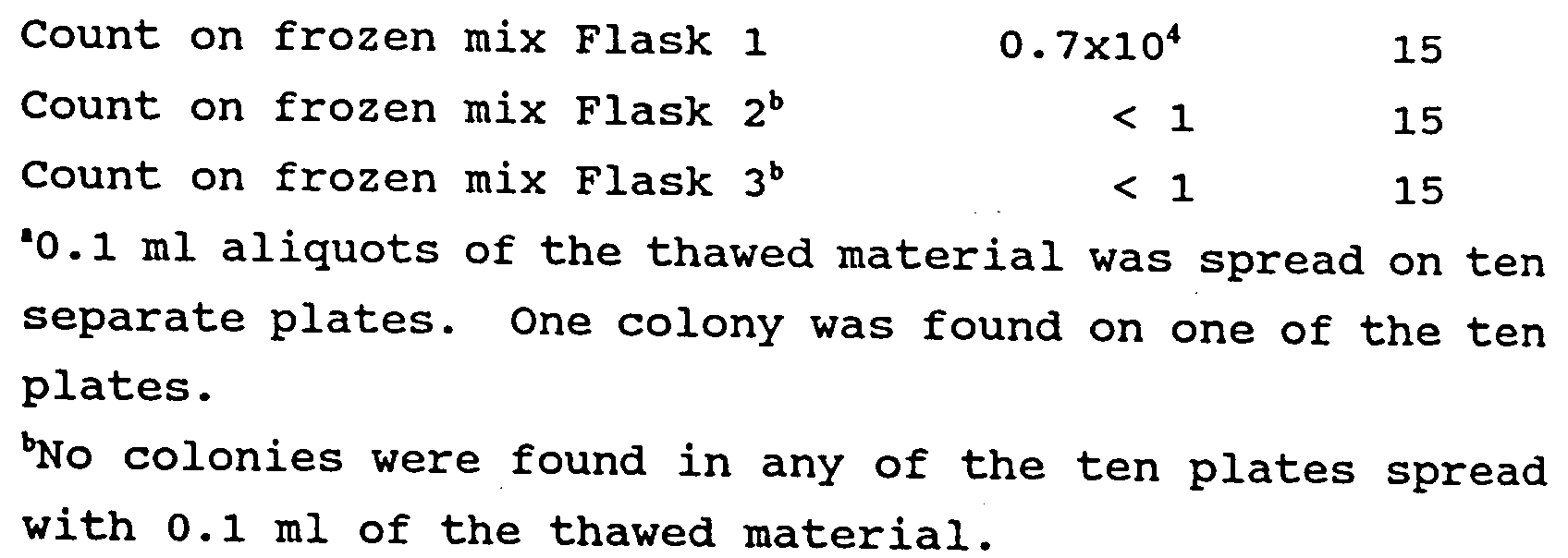
- Addition of yogurt powder containing the bacteriocin so as to give 80 AU/ml of the frozen yogurt mix reduced the population of added listeria from 1.2 x 10⁴/ml to 1.0/ml within 4 days of freezing. After 15 days, none could be found in the mix containing the yogurt powder. The inoculated control maintained the numbers of added listeria throughout the storage.
- It is intended that the foregoing specification be only illustrative of the present invention and that the present invention be limited to the hereinafter appended claims.
Claims (24)
- A method for producing a yogurt product which comprises:(a) providing a bacteriocin from Pediococcus acidilactici in a milk based medium; and(b) fermenting the milk based medium containing the bacteriocin with a yogurt culture to produce the yogurt product containing the bacteriocin which provides inhibition of undesirable bacterial growth in the yogurt product.
- A method for producing a yogurt product which comprises:(a) fermenting a milk based medium with a bacteriocin producing Pediococcus acidilactici to produce a first fermentate containing the bacteriocin;(b) heating the medium to terminate the growth of the Pediococcus acidilactici; and(c) fermenting the first fermentate after the heating with a yogurt culture to produce the yogurt product containing the bacteriocin in an amount which provides inhibition of undesirable bacterial growth in the yogurt product.
- The method of Claim 2 wherein the bacterium is Pediococcus acidilactici.
- The method of Claim 2 wherein the bacterium is Pediococcus acidilactici deposited as NRRL-B-18925.
- The method of Claim 2 wherein the product is dried to a powder.
- The method of Claim 2 wherein the fermentation in step (a) is at a temperature between about 25° and 45°C.
- The method of Claim 2 wherein the fermentation in step (b) is at a temperature between about 35° and 43°C.
- The method of Claim 2 wherein the bacterium is Pediococcus acidilactici, wherein the fermentation in step (a) is at a temperature of 25° to 45°C and in step (b) at 35° to 43°C.
- The method of Claim 8 wherein the Pediococcus acidilactici is deposited as NRRL-B-18925.
- The method of Claim 9 wherein the drying is at a temperature of up to about 87° to 102°C.
- The method of Claim 10 wherein the drying is by spray drying.
- The method of Claim 10 wherein the drying is by lyophilizing.
- The method of Claim 2 wherein the milk based medium contains between about 0.1 to 5 percent milk in step (a) and then is fortified with milk powder after step (b) in order to provide enough milk solids for producing the yogurt culture.
- The method of Claim 13 wherein the milk is a non-fat dry milk powder.
- A yogurt product which comprises:(a) a milk based medium containing yogurt flavors; and(b) a bacteriocin produced by a Pediococcus acidilactici in the medium in an amount which promotes inhibition of undesirable bacterial growth.
- A yogurt product which comprises:(a) a milk based medium containing fermentates from fermentation by a yogurt culture; and(b) a bacteriocin produced by a Pediococcus acidilactici in an amount which provides inhibition of undesirable bacterial growth.
- The product of Claim 16 wherein the bacteriocin is produced by fermenting the milk based medium with the Pediococcus acidilactici.
- The product of Claim 16 wherein the Pediococcus acidilactici is deposited as NRRL-B-18925.
- The product of Claim 16 in dry form.
- The product of Claim 19 in powdered form.
- The product of Claim 17 wherein the bacteriocin is present in an amount between about 100 and 10,000 AU per gram of the yogurt product.
- The product of Claim 13 wherein the yogurt acidity is imparted by lactic acid and delta-gluconolactone.
- A method for producing a yogurt product which comprises:(a) providing a bacteriocin in a milk based medium by fermenting the medium; and(b) providing yogurt flavors in the fermented medium.
- The method of Claim 23 wherein the yogurt acidity is imparted by lactic acid and delta-gluconolactone.
Applications Claiming Priority (2)
| Application Number | Priority Date | Filing Date | Title |
|---|---|---|---|
| US89854392A | 1992-06-15 | 1992-06-15 | |
| US898543 | 1992-06-15 |
Publications (1)
| Publication Number | Publication Date |
|---|---|
| EP0574681A1 true EP0574681A1 (en) | 1993-12-22 |
Family
ID=25409600
Family Applications (1)
| Application Number | Title | Priority Date | Filing Date |
|---|---|---|---|
| EP93106910A Ceased EP0574681A1 (en) | 1992-06-15 | 1993-04-28 | Yogurt product containing bacteriocin from pediococcus adilactici |
Country Status (4)
| Country | Link |
|---|---|
| US (1) | US5445835A (en) |
| EP (1) | EP0574681A1 (en) |
| AU (1) | AU648463B2 (en) |
| CA (1) | CA2098079A1 (en) |
Cited By (3)
| Publication number | Priority date | Publication date | Assignee | Title |
|---|---|---|---|---|
| FR2861549A1 (en) * | 2003-10-31 | 2005-05-06 | Rhodia Chimie Sa | AROMATING A DAIRY PRODUCT FROM AT LEAST ONE BACTERIUM PRODUCING A BACTERIOCIN AND BELONGING TO THE GENUS PEDIOCOCCUS |
| EP2415858A4 (en) * | 2009-03-30 | 2012-08-22 | Meiji Co Ltd | METHOD FOR CULTURING MILKY ACID BACTERIA AND METHOD FOR PRODUCING FERMENTED MILK |
| CN106754296A (en) * | 2016-12-09 | 2017-05-31 | 昆山博青生物科技有限公司 | The installation for fermenting and method of high-efficiency fermenting production bacteriocin |
Families Citing this family (11)
| Publication number | Priority date | Publication date | Assignee | Title |
|---|---|---|---|---|
| US6613364B2 (en) | 1999-08-31 | 2003-09-02 | Kraft Foods Holdings, Inc. | Stabilization of cooked meat and meat-vegetable compositions using whey from nisin-producing cultures and product thereof |
| US6797308B2 (en) | 2001-02-08 | 2004-09-28 | Kraft Foods Holdings, Inc. | Stabilization of cooked pasta compositions using whey from nisin-producing cultures |
| US7186426B2 (en) | 2001-02-23 | 2007-03-06 | Kraft Foods Holdings, Inc. | Prevention of lactic acid bacteria spoilage of beer through use of bacteriocin-containing fermented wort |
| EP1448594B1 (en) * | 2001-11-29 | 2010-07-07 | Vrije Universiteit Brussel | A food grade lantibiotic from streptococcus macedonicus and uses thereof |
| EP2294926B1 (en) * | 2008-06-30 | 2014-11-19 | Meiji Co., Ltd. | Process for producing fermented milk |
| FR2940748B1 (en) * | 2009-01-07 | 2012-11-16 | Danisco | PROCESS FOR PRODUCING MATURE MILK FOR FEEDING ANIMALS NOURISHED WITH MILK |
| CN102369274B (en) * | 2009-03-30 | 2014-08-27 | 株式会社明治 | Method for culturing lactic acid bacterium and method for producing fermented milk |
| JP2013507394A (en) | 2009-10-09 | 2013-03-04 | プロセラ インコーポレイテッド | Compositions and methods comprising Pediococcus for reducing at least one symptom associated with an autism spectrum disorder in a human diagnosed with an autism spectrum disorder |
| RU2010138189A (en) * | 2010-09-16 | 2012-03-27 | Дзе Юнайтед Стэйтс Оф Америка, Эз Репрезентид Бай Дзе Секретари Оф Агрикалча (Us) | NEW LACTOBACILLUS SALIVARIUS STRAIN AND NEW BACTERIOCIN |
| WO2017095968A1 (en) * | 2015-11-30 | 2017-06-08 | Imagilin Technology Llc | Compositions comprising probiotics and methods of use thereof |
| KR101754040B1 (en) * | 2016-09-30 | 2017-07-05 | 강한은 | Pharmaceutical composition for preventing or treating liver diorders |
Citations (3)
| Publication number | Priority date | Publication date | Assignee | Title |
|---|---|---|---|---|
| EP0293547A2 (en) * | 1987-02-09 | 1988-12-07 | Microlife Technics, Inc. | Method for inhibiting bacterial spoilage and composition for this purpose |
| EP0360290A2 (en) * | 1988-09-23 | 1990-03-28 | Microlife Technics, Inc. | Process for producing a novel antifungal product |
| US5096718A (en) * | 1982-09-17 | 1992-03-17 | The State Of Oregon Acting By And Through The Oregon State Board Of Higher Education On Behalf Of Oregon State University | Preserving foods using metabolites of propionibacteria other than propionic acid |
Family Cites Families (8)
| Publication number | Priority date | Publication date | Assignee | Title |
|---|---|---|---|---|
| US3420742A (en) * | 1964-10-16 | 1969-01-07 | Dairy Technics Inc | Milk fermenting product and method of making same |
| US4339464A (en) * | 1978-02-24 | 1982-07-13 | Microlife Technics, Inc. | Stabilizer producing Streptococcus thermophilus |
| US4790994A (en) * | 1987-10-02 | 1988-12-13 | Microlife Technics, Inc. | Method for inhibiting psychrotrophic bacteria in cream or milk based products using a pediococcus |
| US4929445A (en) * | 1988-01-25 | 1990-05-29 | Microlife Technics, Inc. | Method for inhibiting Listeria monocytogenes using a bacteriocin |
| US4906611A (en) * | 1988-09-23 | 1990-03-06 | Microlife Technics, Inc. | Process for using a novel antifungal product |
| US4942032A (en) * | 1988-09-23 | 1990-07-17 | Microlife Technics, Inc. | Process for producing a novel antifungal product |
| US4968512A (en) * | 1989-12-20 | 1990-11-06 | Kharrazi N Michael | Method of making a yogurt spread |
| US5173297A (en) * | 1991-07-01 | 1992-12-22 | Quest International Flavors & Food Ingredients Company Division Of Indopco, Inc. | Bacteriocin from lactococcus lactis subspecies lactis |
-
1993
- 1993-04-28 EP EP93106910A patent/EP0574681A1/en not_active Ceased
- 1993-04-29 AU AU38302/93A patent/AU648463B2/en not_active Ceased
- 1993-06-09 CA CA002098079A patent/CA2098079A1/en not_active Abandoned
-
1994
- 1994-02-07 US US08/192,960 patent/US5445835A/en not_active Expired - Fee Related
Patent Citations (3)
| Publication number | Priority date | Publication date | Assignee | Title |
|---|---|---|---|---|
| US5096718A (en) * | 1982-09-17 | 1992-03-17 | The State Of Oregon Acting By And Through The Oregon State Board Of Higher Education On Behalf Of Oregon State University | Preserving foods using metabolites of propionibacteria other than propionic acid |
| EP0293547A2 (en) * | 1987-02-09 | 1988-12-07 | Microlife Technics, Inc. | Method for inhibiting bacterial spoilage and composition for this purpose |
| EP0360290A2 (en) * | 1988-09-23 | 1990-03-28 | Microlife Technics, Inc. | Process for producing a novel antifungal product |
Cited By (6)
| Publication number | Priority date | Publication date | Assignee | Title |
|---|---|---|---|---|
| FR2861549A1 (en) * | 2003-10-31 | 2005-05-06 | Rhodia Chimie Sa | AROMATING A DAIRY PRODUCT FROM AT LEAST ONE BACTERIUM PRODUCING A BACTERIOCIN AND BELONGING TO THE GENUS PEDIOCOCCUS |
| WO2005041675A1 (en) * | 2003-10-31 | 2005-05-12 | Danisco A/S | Aromatization of a milk product using at least one bacteria producing a bacteriocin and belonging to the pediococcus genus |
| EP2415858A4 (en) * | 2009-03-30 | 2012-08-22 | Meiji Co Ltd | METHOD FOR CULTURING MILKY ACID BACTERIA AND METHOD FOR PRODUCING FERMENTED MILK |
| US8709516B2 (en) | 2009-03-30 | 2014-04-29 | Meiji Co., Ltd. | Method for culturing lactic acid bacterium and method for producing fermented milk |
| CN106754296A (en) * | 2016-12-09 | 2017-05-31 | 昆山博青生物科技有限公司 | The installation for fermenting and method of high-efficiency fermenting production bacteriocin |
| CN106754296B (en) * | 2016-12-09 | 2019-06-21 | 昆山博青生物科技有限公司 | The installation for fermenting and method of high-efficiency fermenting production bacteriocin |
Also Published As
| Publication number | Publication date |
|---|---|
| AU3830293A (en) | 1993-12-16 |
| AU648463B2 (en) | 1994-04-21 |
| US5445835A (en) | 1995-08-29 |
| CA2098079A1 (en) | 1993-12-16 |
Similar Documents
| Publication | Publication Date | Title |
|---|---|---|
| US6136351A (en) | Stabilization of fermented dairy compositions using whey from nisin-producing cultures | |
| US5527505A (en) | Process for the manufacture of fermented milk | |
| EP0576780B1 (en) | A novel microorganism strain, bacterial preparations comprising said strain, and use of said strain and preparations for the controlling of yeasts and moulds | |
| US5096718A (en) | Preserving foods using metabolites of propionibacteria other than propionic acid | |
| US6110509A (en) | Stabilization of cream cheese compositions using nisin-producing cultures | |
| US5445835A (en) | Method of producing a yogurt product containing bacteriocin PA-1 | |
| EP0443543A2 (en) | Novel lactic acid bacteria, antibacterial substance produced by the bacteria, fermented milk starter containing the bacteria, and process for producing fermented milk by using the starter | |
| Benkerroum et al. | Development and use of a selective medium for isolation of Leuconostoc spp. from vegetables and dairy products | |
| US6056979A (en) | Streptococcus Thermophilus strain, fermentation process using such strain and product obtained | |
| US6242017B1 (en) | Stabilization of cooked meat compositions stabilized by nisin-containing whey and method of making | |
| EP0333056A2 (en) | Method for inhibiting food-borne human pathogens and preventing microbial spoilage in refrigerated food using a lactobacillus | |
| EP0281467B1 (en) | Method of preparation of bifidobacteria-containing fermented milk | |
| AU766707B2 (en) | Stabilization of mayonnaise spreads using whey from nisin-producing cultures | |
| EP0443653B1 (en) | Method for the preparation of a fermented milk product | |
| JPH10229819A (en) | Bifidobacterium fermented milk and method for producing the same | |
| NZ500569A (en) | A method and culture of Bacillus subtilis (NRRL-B-21974) for inhibiting undesired microorganisms | |
| EP0698348B1 (en) | Inhibition of clostridia with lactic acid bacteria | |
| NL8202045A (en) | PROCESS FOR PREPARING STITCH-PROOF ACID MILK PRODUCTS. | |
| US6210719B1 (en) | Yogurt flavor composition | |
| EP0521166A1 (en) | Lactic acid bacterium starter, containing peroxidase, fermented milk product, and production thereof | |
| Olasupo et al. | Evaluation of Nisin for the preservation of Nono‐A Nigerian Fermented Milk Product | |
| EP1690456A1 (en) | Stabilised dairy base material for use as heavy cream replacement | |
| JP2634818B2 (en) | Lactic acid bacteria fermentation preparation for food preservation | |
| US4880743A (en) | Bacterial composition for inhibiting psychrotrophic bacteria in cream or milk based products | |
| EP0766926A1 (en) | Yogurt flavour compostion |
Legal Events
| Date | Code | Title | Description |
|---|---|---|---|
| PUAI | Public reference made under article 153(3) epc to a published international application that has entered the european phase |
Free format text: ORIGINAL CODE: 0009012 |
|
| 17P | Request for examination filed |
Effective date: 19930428 |
|
| AK | Designated contracting states |
Kind code of ref document: A1 Designated state(s): AT BE CH DE DK ES FR GB IE IT LI NL SE |
|
| 17Q | First examination report despatched |
Effective date: 19940223 |
|
| GRAG | Despatch of communication of intention to grant |
Free format text: ORIGINAL CODE: EPIDOS AGRA |
|
| 18R | Application refused |
Effective date: 19960701 |