EP0571745B1 - Cellular mobile radio system with multiplicity of CDMA carriers for ISDN applications - Google Patents
Cellular mobile radio system with multiplicity of CDMA carriers for ISDN applications Download PDFInfo
- Publication number
- EP0571745B1 EP0571745B1 EP93105568A EP93105568A EP0571745B1 EP 0571745 B1 EP0571745 B1 EP 0571745B1 EP 93105568 A EP93105568 A EP 93105568A EP 93105568 A EP93105568 A EP 93105568A EP 0571745 B1 EP0571745 B1 EP 0571745B1
- Authority
- EP
- European Patent Office
- Prior art keywords
- channels
- group
- bandwidth
- cdma
- groups
- Prior art date
- Legal status (The legal status is an assumption and is not a legal conclusion. Google has not performed a legal analysis and makes no representation as to the accuracy of the status listed.)
- Expired - Lifetime
Links
Images


Classifications
-
- H—ELECTRICITY
- H04—ELECTRIC COMMUNICATION TECHNIQUE
- H04J—MULTIPLEX COMMUNICATION
- H04J13/00—Code division multiplex systems
-
- H—ELECTRICITY
- H04—ELECTRIC COMMUNICATION TECHNIQUE
- H04B—TRANSMISSION
- H04B7/00—Radio transmission systems, i.e. using radiation field
- H04B7/24—Radio transmission systems, i.e. using radiation field for communication between two or more posts
- H04B7/26—Radio transmission systems, i.e. using radiation field for communication between two or more posts at least one of which is mobile
- H04B7/2628—Radio transmission systems, i.e. using radiation field for communication between two or more posts at least one of which is mobile using code-division multiple access [CDMA] or spread spectrum multiple access [SSMA]
-
- H—ELECTRICITY
- H04—ELECTRIC COMMUNICATION TECHNIQUE
- H04B—TRANSMISSION
- H04B7/00—Radio transmission systems, i.e. using radiation field
- H04B7/24—Radio transmission systems, i.e. using radiation field for communication between two or more posts
- H04B7/26—Radio transmission systems, i.e. using radiation field for communication between two or more posts at least one of which is mobile
- H04B7/2628—Radio transmission systems, i.e. using radiation field for communication between two or more posts at least one of which is mobile using code-division multiple access [CDMA] or spread spectrum multiple access [SSMA]
- H04B7/2631—Radio transmission systems, i.e. using radiation field for communication between two or more posts at least one of which is mobile using code-division multiple access [CDMA] or spread spectrum multiple access [SSMA] for broadband transmission
Definitions
- This invention relates to radio communication systems and more especially it relates to cellular mobile radio communication systems.
- 'mobile' when used herein includes vehicular mobility and/or pedestrian mobility, i.e. mobile units may be mounted in vehicles and/or and held.
- Cellular mobile radio systems may use various multiple access schemes to connect the mobile user to the base station hub.
- a CDMA (Code Division Multiple Access) scheme based on DSSS (Direct Sequence Spread Spectrum) has been proposed under a US Interim Standard TIA/EIA/IS-95-A.
- TIA/EIA/IS-95-A Direct Sequence Spread Spectrum
- This is claimed to provide improvements in system capacity for a given density of cellular base stations and for a given allocation of spectrum as compared to other, more conventional, systems.
- These benefits accrue largely from the averaging of interference which arises through servicing a relatively large number of users in one cell or one cell sector.
- the system self interference level is reduced by only transmitting as required according to the voice activity of the individual users.
- the level of interference received at the base station from users in other sectors is reduced by the average (rather than the worst case, i.e. minimum) attenuation of the antenna outside its main beam.
- a radio communication system comprises a base station which is arranged in communication with a plurality of mobile stations for the transmission of speech using a first set of channels and for the transmission of data using a second set of channels, the channels of the said first set each having substantially the same bandwidth and comprising a plurality of groups of channels wherein each group of channels is arranged to operate using a different frequency, i.e.
- FDMA Frequency Division Multiple Access
- CDMA Code Division Multiple Access
- the frequency bandwidth occupied by the channels of the second set may conveniently be the same as the frequency bandwidth occupied by all of the groups of the first set in combination.
- a plurality of second sets of channels may be provided, each arranged to occupy a different frequency band so that in combination they occupy a bandwidth which corresponds to the bandwidth occupied by a third set of channels which use CDMA for mutual discrimination.
- a base station for use in a system according to the present invention using for transmission purposes a plurality of groups of channels and having for each of said groups a plurality of CDMA modulators, one modulator per channel in each group of channels, operating for each channel of a group on the same carrier frequency, the modulators being fed from a multiplexer under control of a switching centre and being arranged to feed a plurality of frequency 'up-converters' one for each modulator which are coupled to a transmission signal combiner which in turn is arranged to feed a transmit antenna, and in said apparatus the CDMA spreading bandwidth of one of the modulator groups used for one group of channels designed for carrying data corresponds to the bandwidth occupied by all of the other modulator groups of channels in combination, the base station having for reception purposes a complementary receiver arrangement.
- a hybrid FDMA narrowband CDMA system comprises a plurality of groups of channels wherein each group is transmitted at a different frequency F1 to F10 as shown in Figure 1.
- Each group comprises eight channels which are mutually distinguished by CDMA and accordingly each channel is transmitted using a different CDMA code.
- eight channels referenced C1 to C8 are shown for the group which operates at the frequency F1.
- each spreading code might spread to a bandwidth of 1 MHz whereby a total bandwidth of 10 MHz is used for all of the groups F1 to F10.
- each channel “stack” represents a different carrier frequency whilst each pattern in the "stack” represents a different code used on that carrier frequency.
- a wideband CDMA system comprising eight channels C9 to C16 is illustrated which spreads over the entire 10 MHz bandwidth occupied by the frequencies F1 to F10 of the group shown in Figure 1.
- this would normally be considered as the only approach to achieve spectrally efficient provision of wideband data services but if the entire spectrum were converted in this manner then the power/speech/complexity/cost of the mobile units would need to increase.
- a change to this approach for all channels to facilitate the transmission of data would require the replacement of all existing mobiles.
- channels of a system according to the present invention are shown, wherein channel C17 to C20 which occupy the entire 10 MHz bandwidth are used for the transmission of data whereas 10 groups of channels wherein each group comprises 4 channels thereby to provide a total of 40 channels are used for speech but each speech channel has only 1 MHz bandwidth.
- channels C21 to C24 are transmitted at the frequency F1 and are mutually distinguished by means of CDMA using a unique code for each channel. This is in effect an overlay approach wherein voice users remain on a narrowband CDMA carrier whilst a wideband data service is used which employs full band spreading. Thus, the voice users can continue uneffected by the wideband users except to the extent that the voice and data systems share the available bandwidth capacity. It will be appreciated that the system as a whole retains the high spectral efficiency inherent in a CDMA approach without paying a penalty of inflexibility imposed by the other data system usage.
- a system according to the invention is particularly attractive in that it provides an evolutionary path for systems as;
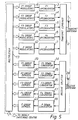
- a base station comprises for a cellular mobile radio system a transmit antenna 1 which is fed from a signal combiner 2.
- the signal combiner 2 is fed from a plurality of up converters 3, 4, 5, 6 and 7 which in turn are fed from modulator groups 8, 9, 10, 11 and 12.
- the modulators are controlled by a multiplexer 13 from a switching centre not shown.
- Each group of modulators 8, 9 10, 11 and 12 is arranged to operate at a different frequency, different channels within a group being distinguished by CDMA utilising a unique code for each channel.
- groups 8, 9 10, and 11 are used for the transmission of speech and therefore assigned a small spreading bandwidth of say 1 MHz whereas the group 12 is used for data and accordingly assigned a much greater spreading bandwidth of say 10 MHz.
- a complementary receiver system comprising a receiver antenna 13, and down converters 14, 15, 16, 17 and 18 which are arranged to feed de-modulators 19, 20, 21, 22 and 23. It will be appreciated that the de-modulators are arranged in groups 19, 20, 21, 22 and 23 and that each group works at a different frequency, the groups 19 to 22 being used for voice or speech and the group 23 being used for data.
- An overlayed system as just before described utilising wideband CDMA/hybrid FDMA narrowband CDMA provides for flexible evolution of mobile communication systems to support new, widerband services using the same spectral allocation as existing voice services without disruption of those services.
Landscapes
- Engineering & Computer Science (AREA)
- Computer Networks & Wireless Communication (AREA)
- Signal Processing (AREA)
- Mobile Radio Communication Systems (AREA)
Description
Claims (4)
- A radio communication system comprising a base station which is arranged in communication with a plurality of mobile stations for the transmission of speech using a first set of channels (C21-C24) and for the transmission of data using a second set of channels (C17-C20), the channels of the said first set each having substantially the same bandwidth and comprising a plurality of groups of channels, wherein each group of channels is arranged to operate using a different frequency (F1 to F10), i.e. in an FDMA (Frequency Division Multiple Access) mode, and wherein all channels within a group are arranged to operate on the same nominal carrier frequency, and wherein the channels of each group are transmitted using CDMA (Code Division Multiple Access) whereby each channel of a group (C21-C24) is distinguished from every other channel of that group by a unique CDMA code, the channels of the second set (C17-C20) being transmitted each on the same nominal carrier frequency using CDMA for mutual discrimination, the frequency bandwidth used for the channels of the said second set being arranged to correspond with the bandwidth occupied by at least some of the groups of the first set in combination.
- A system as claimed in Claim 1, wherein the frequency bandwidth occupied by the channels of the second set is the same as the frequency bandwidth (F1 to F10) occupied by all of the groups of the first set in combination.
- A system as claimed in Claim 1, wherein a plurality of second sets of channels is provided, each arranged to occupy a different frequency band so that in combination they occupy a bandwidth which corresponds to the bandwidth occupied by a third set of channels which use CDMA for mutual discrimination.
- A base station for use in a system according to Claim 1, using for transmission purposes a plurality of groups of channels and having for each of said groups a plurality of CDMA modulators (8-12), one modulator per channel in each group of channels, operating for each channel of a group on the same carrier frequency, the modulators (8-12) being fed from a multiplexer (13) under control of a switching centre and being arranged to feed a plurality of frequency 'up-converters' (3-7) one for each modulator which are coupled to a transmission signal combiner (2) which in turn is arranged to feed a transmit antenna (1), and in said apparatus the CDMA spreading bandwidth of one of the modulator groups (12) used for one group of channels designed for carrying data corresponds to the bandwidth occupied by all of the other modulator groups (8-11) of channels in combination, the base station having for reception purposes a complementary receiver arrangement (13-23).
Applications Claiming Priority (2)
| Application Number | Priority Date | Filing Date | Title |
|---|---|---|---|
| GB9211178A GB2267627B (en) | 1992-05-27 | 1992-05-27 | Improvements in or relating to radio communication systems |
| GB9211178 | 1992-05-27 |
Publications (2)
| Publication Number | Publication Date |
|---|---|
| EP0571745A1 EP0571745A1 (en) | 1993-12-01 |
| EP0571745B1 true EP0571745B1 (en) | 1998-11-18 |
Family
ID=10716064
Family Applications (1)
| Application Number | Title | Priority Date | Filing Date |
|---|---|---|---|
| EP93105568A Expired - Lifetime EP0571745B1 (en) | 1992-05-27 | 1993-04-03 | Cellular mobile radio system with multiplicity of CDMA carriers for ISDN applications |
Country Status (8)
| Country | Link |
|---|---|
| US (1) | US5471463A (en) |
| EP (1) | EP0571745B1 (en) |
| JP (1) | JPH06120879A (en) |
| CA (1) | CA2094535C (en) |
| DE (1) | DE69322123T2 (en) |
| FI (1) | FI932403L (en) |
| GB (1) | GB2267627B (en) |
| RU (1) | RU2110892C1 (en) |
Families Citing this family (43)
| Publication number | Priority date | Publication date | Assignee | Title |
|---|---|---|---|---|
| US5796772A (en) | 1991-05-13 | 1998-08-18 | Omnipoint Corporation | Multi-band, multi-mode spread-spectrum communication system |
| US5790587A (en) | 1991-05-13 | 1998-08-04 | Omnipoint Corporation | Multi-band, multi-mode spread-spectrum communication system |
| US5887020A (en) | 1991-05-13 | 1999-03-23 | Omnipoint Corporation | Multi-band, multi-mode spread-spectrum communication system |
| US5815525A (en) | 1991-05-13 | 1998-09-29 | Omnipoint Corporation | Multi-band, multi-mode spread-spectrum communication system |
| FI94819C (en) * | 1993-06-10 | 1995-10-25 | Nokia Telecommunications Oy | Data transmission method and CDMA / FDMA radio system |
| US6018528A (en) * | 1994-04-28 | 2000-01-25 | At&T Corp | System and method for optimizing spectral efficiency using time-frequency-code slicing |
| US5592470A (en) * | 1994-12-21 | 1997-01-07 | At&T | Broadband wireless system and network architecture providing broadband/narrowband service with optimal static and dynamic bandwidth/channel allocation |
| DE19645433C2 (en) * | 1996-11-04 | 2002-10-10 | Ericsson Telefon Ab L M | Communication system, mobile switching center and method for establishing multi-dialog communication between subscriber stations |
| GB2320661B (en) | 1996-12-20 | 2001-10-03 | Dsc Telecom Lp | Processing data transmitted and received over a wireless link connecting a central terminal and a subscriber terminal of a wireless telecommunications system |
| GB2320660A (en) | 1996-12-20 | 1998-06-24 | Dsc Telecom Lp | Processing data transmitted and received over a wireless link connecting a central terminal and a subscriber terminal of a wireless telecommunication system |
| ATE304755T1 (en) * | 1997-05-02 | 2005-09-15 | Siemens Ag | TDMA/CDMA MESSAGE TRANSMISSION SYSTEM WITH ADJUSTABLE DATA RATE |
| GB2325816B (en) * | 1997-05-30 | 1999-06-23 | Lucent Technologies Inc | Packet data option for circuit switched wireless DS-CDMA systems |
| US6081536A (en) | 1997-06-20 | 2000-06-27 | Tantivy Communications, Inc. | Dynamic bandwidth allocation to transmit a wireless protocol across a code division multiple access (CDMA) radio link |
| US6151332A (en) | 1997-06-20 | 2000-11-21 | Tantivy Communications, Inc. | Protocol conversion and bandwidth reduction technique providing multiple nB+D ISDN basic rate interface links over a wireless code division multiple access communication system |
| US6542481B2 (en) | 1998-06-01 | 2003-04-01 | Tantivy Communications, Inc. | Dynamic bandwidth allocation for multiple access communication using session queues |
| US6510147B1 (en) * | 1997-07-15 | 2003-01-21 | Hughes Electronics Corporation | Method and apparatus for orthogonally overlaying variable chip rate spread spectrum signals |
| US6285669B1 (en) * | 1997-07-17 | 2001-09-04 | Nortel Networks Limited | CDMA direct spread overlay system and method of operation |
| US6377809B1 (en) * | 1997-09-16 | 2002-04-23 | Qualcomm Incorporated | Channel structure for communication systems |
| US7496072B2 (en) | 1997-12-17 | 2009-02-24 | Interdigital Technology Corporation | System and method for controlling signal strength over a reverse link of a CDMA wireless communication system |
| US9525923B2 (en) | 1997-12-17 | 2016-12-20 | Intel Corporation | Multi-detection of heartbeat to reduce error probability |
| US7936728B2 (en) | 1997-12-17 | 2011-05-03 | Tantivy Communications, Inc. | System and method for maintaining timing of synchronization messages over a reverse link of a CDMA wireless communication system |
| US8175120B2 (en) | 2000-02-07 | 2012-05-08 | Ipr Licensing, Inc. | Minimal maintenance link to support synchronization |
| US6222832B1 (en) | 1998-06-01 | 2001-04-24 | Tantivy Communications, Inc. | Fast Acquisition of traffic channels for a highly variable data rate reverse link of a CDMA wireless communication system |
| US7394791B2 (en) | 1997-12-17 | 2008-07-01 | Interdigital Technology Corporation | Multi-detection of heartbeat to reduce error probability |
| US8134980B2 (en) | 1998-06-01 | 2012-03-13 | Ipr Licensing, Inc. | Transmittal of heartbeat signal at a lower level than heartbeat request |
| US7221664B2 (en) | 1998-06-01 | 2007-05-22 | Interdigital Technology Corporation | Transmittal of heartbeat signal at a lower level than heartbeat request |
| US7773566B2 (en) | 1998-06-01 | 2010-08-10 | Tantivy Communications, Inc. | System and method for maintaining timing of synchronization messages over a reverse link of a CDMA wireless communication system |
| RU2172564C2 (en) * | 1998-06-04 | 2001-08-20 | Самсунг Электроникс Ко., Лтд. | Device and method render additional services in communication system ( versions ) |
| FR2779605B1 (en) * | 1998-06-04 | 2000-07-13 | Alsthom Cge Alcatel | RADIO RESOURCE ALLOCATION SYSTEM IN A CELLULAR MULTI-SERVICE RADIOCOMMUNICATION SYSTEM |
| US6925067B2 (en) * | 1999-04-23 | 2005-08-02 | Qualcomm, Incorporated | Configuration of overhead channels in a mixed bandwidth system |
| US6377556B1 (en) * | 1999-07-14 | 2002-04-23 | Qualcomm Incorporated | Method and apparatus to resynchronize ppp on um interface without affecting ppp on a rm interface and to resynchronize ppp on a rm interface without affecting ppp on a um interface |
| US6882631B1 (en) * | 1999-09-13 | 2005-04-19 | Qualcomm Incorporated | Method and apparatus for overlaying two CDMA systems on the same frequency bandwidth |
| US6526034B1 (en) | 1999-09-21 | 2003-02-25 | Tantivy Communications, Inc. | Dual mode subscriber unit for short range, high rate and long range, lower rate data communications |
| EP1093243A1 (en) * | 1999-10-11 | 2001-04-18 | Alcatel | Allocation of resources in a CDMA cell |
| CN1147177C (en) * | 2000-09-26 | 2004-04-21 | 华为技术有限公司 | A method and device for increasing carrier output power of a broadband multi-carrier base station |
| US8155096B1 (en) | 2000-12-01 | 2012-04-10 | Ipr Licensing Inc. | Antenna control system and method |
| US20020077152A1 (en) * | 2000-12-15 | 2002-06-20 | Johnson Thomas J. | Wireless communication methods and systems using multiple overlapping sectored cells |
| US6954448B2 (en) | 2001-02-01 | 2005-10-11 | Ipr Licensing, Inc. | Alternate channel for carrying selected message types |
| US7551663B1 (en) | 2001-02-01 | 2009-06-23 | Ipr Licensing, Inc. | Use of correlation combination to achieve channel detection |
| CA2867406C (en) | 2001-06-13 | 2016-08-02 | Apple Inc. | Transmittal of heartbeat signal at a lower level than heartbeat request |
| US7353004B2 (en) * | 2001-11-01 | 2008-04-01 | Broadlogic Network Technologies, Inc. | Multi-channel broadband content distribution system |
| WO2003063416A1 (en) * | 2002-01-23 | 2003-07-31 | Huawei Technologies Co., Ltd. | A method for providing real-time broadcast service in the mobile communication network |
| KR100830163B1 (en) * | 2005-04-20 | 2008-05-20 | 삼성전자주식회사 | Signal Transceiver and Method in Frequency Overlay Communication System |
Family Cites Families (8)
| Publication number | Priority date | Publication date | Assignee | Title |
|---|---|---|---|---|
| DE3447107A1 (en) * | 1984-12-22 | 1986-06-26 | Philips Patentverwaltung Gmbh, 2000 Hamburg | PROCESS FOR TRANSMITTING MESSAGES IN A DIGITAL RADIO TRANSMISSION SYSTEM |
| WO1991003892A1 (en) * | 1987-01-27 | 1991-03-21 | Advanced Systems Research Pty Limited | Improvements in a spread-spectrum multiplexed transmission system |
| US5117501A (en) * | 1988-08-08 | 1992-05-26 | General Electric Company | Dynamic regrouping in a trunked radio communications system |
| US5109390A (en) * | 1989-11-07 | 1992-04-28 | Qualcomm Incorporated | Diversity receiver in a cdma cellular telephone system |
| US5025452A (en) * | 1990-03-20 | 1991-06-18 | Andrew Corporation | Full-duplex, sub-band spread spectrum communications system |
| US5150377A (en) * | 1990-11-02 | 1992-09-22 | At&T Bell Laboratories | Direct sequence spread spectrum (dsss) communications system with frequency modulation utilized to achieve spectral spreading |
| US5218618A (en) * | 1990-11-07 | 1993-06-08 | Hughes Aircraft Company | Cellular telephone service using spread spectrum transmission |
| US5161168A (en) * | 1991-05-15 | 1992-11-03 | Scs Mobilecom, Inc. | Spread spectrum CDMA communications system microwave overlay |
-
1992
- 1992-05-27 GB GB9211178A patent/GB2267627B/en not_active Expired - Fee Related
-
1993
- 1993-04-03 EP EP93105568A patent/EP0571745B1/en not_active Expired - Lifetime
- 1993-04-03 DE DE69322123T patent/DE69322123T2/en not_active Expired - Fee Related
- 1993-04-21 CA CA002094535A patent/CA2094535C/en not_active Expired - Fee Related
- 1993-04-27 US US08/052,968 patent/US5471463A/en not_active Expired - Lifetime
- 1993-05-15 RU RU93029621/09A patent/RU2110892C1/en not_active IP Right Cessation
- 1993-05-24 JP JP5121565A patent/JPH06120879A/en active Pending
- 1993-05-26 FI FI932403A patent/FI932403L/en unknown
Also Published As
| Publication number | Publication date |
|---|---|
| FI932403A7 (en) | 1993-11-28 |
| CA2094535A1 (en) | 1993-11-28 |
| DE69322123T2 (en) | 1999-04-15 |
| JPH06120879A (en) | 1994-04-28 |
| US5471463A (en) | 1995-11-28 |
| GB2267627A (en) | 1993-12-08 |
| DE69322123D1 (en) | 1998-12-24 |
| CA2094535C (en) | 2001-02-13 |
| GB2267627B (en) | 1996-01-03 |
| FI932403A0 (en) | 1993-05-26 |
| GB9211178D0 (en) | 1992-07-08 |
| FI932403L (en) | 1993-11-28 |
| EP0571745A1 (en) | 1993-12-01 |
| RU2110892C1 (en) | 1998-05-10 |
Similar Documents
| Publication | Publication Date | Title |
|---|---|---|
| US5471463A (en) | Radio communication systems | |
| KR960012086B1 (en) | Method and apparatus for reducing interference in a wireless communication link of a cellular communication system | |
| EP0614598B1 (en) | Rearranging channels | |
| US6804214B1 (en) | System and method for implementing multiple carriers in cellular networks | |
| US6229796B1 (en) | Code-reuse partitioning systems and methods for cellular radiotelephone systems | |
| CA2266939C (en) | Cellular system and frequency carrier allocation method thereof | |
| EP0827654A4 (en) | MULTI-LAYERED DEVICE FOR DISTRIBUTING LOADS IN TELECOMMUNICATIONS SYSTEMS | |
| HK91791A (en) | Method and control device for the distribution of the volume of traffic among different control channels of a radio network | |
| US20070142057A1 (en) | Dynamic cell reconfiguring method and cellular network system to which the method is applied | |
| CA2133294A1 (en) | Fixed cellular communications system | |
| JP2001500687A (en) | Frequency planning to accommodate growing demand. | |
| Lee | New cellular schemes for spectral efficiency | |
| AU7538794A (en) | Method for adjusting transmission power in a radio system, and an exchange | |
| FI88991B (en) | ALLOKERINGSFOERFARANDE FOER RADIOKANALER | |
| US5825763A (en) | Mobile communication apparatus | |
| US6385188B1 (en) | Method for sharing channels between base station sectors and frequency assignments in code division multiple access system | |
| EP0717577B1 (en) | Cellular communications network with directional antennae | |
| EP1204284B1 (en) | Cellular system and communication method according to multi-code cdma | |
| JPH1023497A (en) | A cellular radio telephone system using a centralized base station. | |
| WO1998018278A1 (en) | Dynamic control of cellular radio communication system resources | |
| US5722077A (en) | Mobile communication system capable of effectively using a radio communication channel | |
| JP2596184B2 (en) | Wireless channel assignment method | |
| RU2131642C1 (en) | Base station system for digital cellular mobile radio network | |
| KR100259860B1 (en) | Grouping and Ungrouping Using Power Control in Microcell Environments | |
| WO2000054527A1 (en) | Mobile communications network |
Legal Events
| Date | Code | Title | Description |
|---|---|---|---|
| PUAI | Public reference made under article 153(3) epc to a published international application that has entered the european phase |
Free format text: ORIGINAL CODE: 0009012 |
|
| AK | Designated contracting states |
Kind code of ref document: A1 Designated state(s): DE FR GB IT SE |
|
| 17P | Request for examination filed |
Effective date: 19940514 |
|
| 17Q | First examination report despatched |
Effective date: 19970224 |
|
| GRAG | Despatch of communication of intention to grant |
Free format text: ORIGINAL CODE: EPIDOS AGRA |
|
| GRAG | Despatch of communication of intention to grant |
Free format text: ORIGINAL CODE: EPIDOS AGRA |
|
| GRAH | Despatch of communication of intention to grant a patent |
Free format text: ORIGINAL CODE: EPIDOS IGRA |
|
| GRAH | Despatch of communication of intention to grant a patent |
Free format text: ORIGINAL CODE: EPIDOS IGRA |
|
| GRAA | (expected) grant |
Free format text: ORIGINAL CODE: 0009210 |
|
| AK | Designated contracting states |
Kind code of ref document: B1 Designated state(s): DE FR GB IT SE |
|
| ET | Fr: translation filed | ||
| REF | Corresponds to: |
Ref document number: 69322123 Country of ref document: DE Date of ref document: 19981224 |
|
| ITF | It: translation for a ep patent filed | ||
| PLBE | No opposition filed within time limit |
Free format text: ORIGINAL CODE: 0009261 |
|
| 26N | No opposition filed | ||
| REG | Reference to a national code |
Ref country code: GB Ref legal event code: IF02 |
|
| PGFP | Annual fee paid to national office [announced via postgrant information from national office to epo] |
Ref country code: SE Payment date: 20030404 Year of fee payment: 11 |
|
| PG25 | Lapsed in a contracting state [announced via postgrant information from national office to epo] |
Ref country code: SE Free format text: LAPSE BECAUSE OF NON-PAYMENT OF DUE FEES Effective date: 20040404 |
|
| REG | Reference to a national code |
Ref country code: GB Ref legal event code: 732E |
|
| EUG | Se: european patent has lapsed | ||
| PGFP | Annual fee paid to national office [announced via postgrant information from national office to epo] |
Ref country code: DE Payment date: 20070430 Year of fee payment: 15 |
|
| PGFP | Annual fee paid to national office [announced via postgrant information from national office to epo] |
Ref country code: GB Payment date: 20070426 Year of fee payment: 15 |
|
| PGFP | Annual fee paid to national office [announced via postgrant information from national office to epo] |
Ref country code: IT Payment date: 20070626 Year of fee payment: 15 |
|
| PGFP | Annual fee paid to national office [announced via postgrant information from national office to epo] |
Ref country code: FR Payment date: 20070416 Year of fee payment: 15 |
|
| GBPC | Gb: european patent ceased through non-payment of renewal fee |
Effective date: 20080403 |
|
| PG25 | Lapsed in a contracting state [announced via postgrant information from national office to epo] |
Ref country code: DE Free format text: LAPSE BECAUSE OF NON-PAYMENT OF DUE FEES Effective date: 20081101 |
|
| REG | Reference to a national code |
Ref country code: FR Ref legal event code: ST Effective date: 20081231 |
|
| PG25 | Lapsed in a contracting state [announced via postgrant information from national office to epo] |
Ref country code: FR Free format text: LAPSE BECAUSE OF NON-PAYMENT OF DUE FEES Effective date: 20080430 |
|
| PG25 | Lapsed in a contracting state [announced via postgrant information from national office to epo] |
Ref country code: GB Free format text: LAPSE BECAUSE OF NON-PAYMENT OF DUE FEES Effective date: 20080403 |
|
| PG25 | Lapsed in a contracting state [announced via postgrant information from national office to epo] |
Ref country code: IT Free format text: LAPSE BECAUSE OF NON-PAYMENT OF DUE FEES Effective date: 20080403 |