EP0570812B1 - Process for the preparation of cross-linked olefin polymers - Google Patents
Process for the preparation of cross-linked olefin polymers Download PDFInfo
- Publication number
- EP0570812B1 EP0570812B1 EP93107616A EP93107616A EP0570812B1 EP 0570812 B1 EP0570812 B1 EP 0570812B1 EP 93107616 A EP93107616 A EP 93107616A EP 93107616 A EP93107616 A EP 93107616A EP 0570812 B1 EP0570812 B1 EP 0570812B1
- Authority
- EP
- European Patent Office
- Prior art keywords
- meta
- para
- seconds
- cross
- peroximon
- Prior art date
- Legal status (The legal status is an assumption and is not a legal conclusion. Google has not performed a legal analysis and makes no representation as to the accuracy of the status listed.)
- Expired - Lifetime
Links
Classifications
-
- C—CHEMISTRY; METALLURGY
- C08—ORGANIC MACROMOLECULAR COMPOUNDS; THEIR PREPARATION OR CHEMICAL WORKING-UP; COMPOSITIONS BASED THEREON
- C08K—Use of inorganic or non-macromolecular organic substances as compounding ingredients
- C08K5/00—Use of organic ingredients
- C08K5/04—Oxygen-containing compounds
- C08K5/14—Peroxides
Definitions
- the present invention refers to a process for the preparation of crosslinked olefin polymers wherein liquid peroxidic compositions are used which do not show blooming in the compounds of different olefinic polymers.
- the present invention refers to peroxides showing, besides the absence of blooming, an optimal combination of properties as indicated below.
- peroxides in the cross-linking of polymers, such as f.e. polyethylene, elastomers, as ethylene-propylene (EP) or containing also units deriving from a dienic monomer (EPDM), etc.
- Peroxides solid at room temperature as PEROXIMON F are known from USP 3.764.628 and Italian Patent No. 651.288.
- its use in the vulcanization of polymers is limited in that it is a compound solid at room temperature.
- PEROXIMON F In order to obtain a homogenous vulcanized blend it is therefore necessary to maintain PEROXIMON F in the molten state to have a uniform dosage. This operation has the disadvantage in particular due to losses in peroxidic content and to the introduction of impurities.
- composition is liquid at the room temperature of 23°C. This is a drawback since it is desirable to have compositions liquid at a room temperature also of 15°C so permitting a higher use range.
- liquid peroxidic compositions are known, obtained from PEROXIMON F and DCP (dicumylperoxide) and t.butyl-cumyl-peroxide (PEROXIMON 166) which are liquid at very low temperatures, also lower than 5°C.
- the invention relates to a process as defined in Claim 1.
- the substituting groups in (I) are in meta and/or para position with respect to the benzenic ring, preferably the meta/para ratio ranges between 1 and 2.0.
- a preferred process consists in the alkylation of benzene with an excess of propylene, the preferred ratio being 1:1.5 molar, in the presence of AlCl 3 according to Friedel-Kraft reaction; if desired the mixture containing diisopropylbenzene, prevailingly meta and para, can be rectified to obtain the two isomers separated.
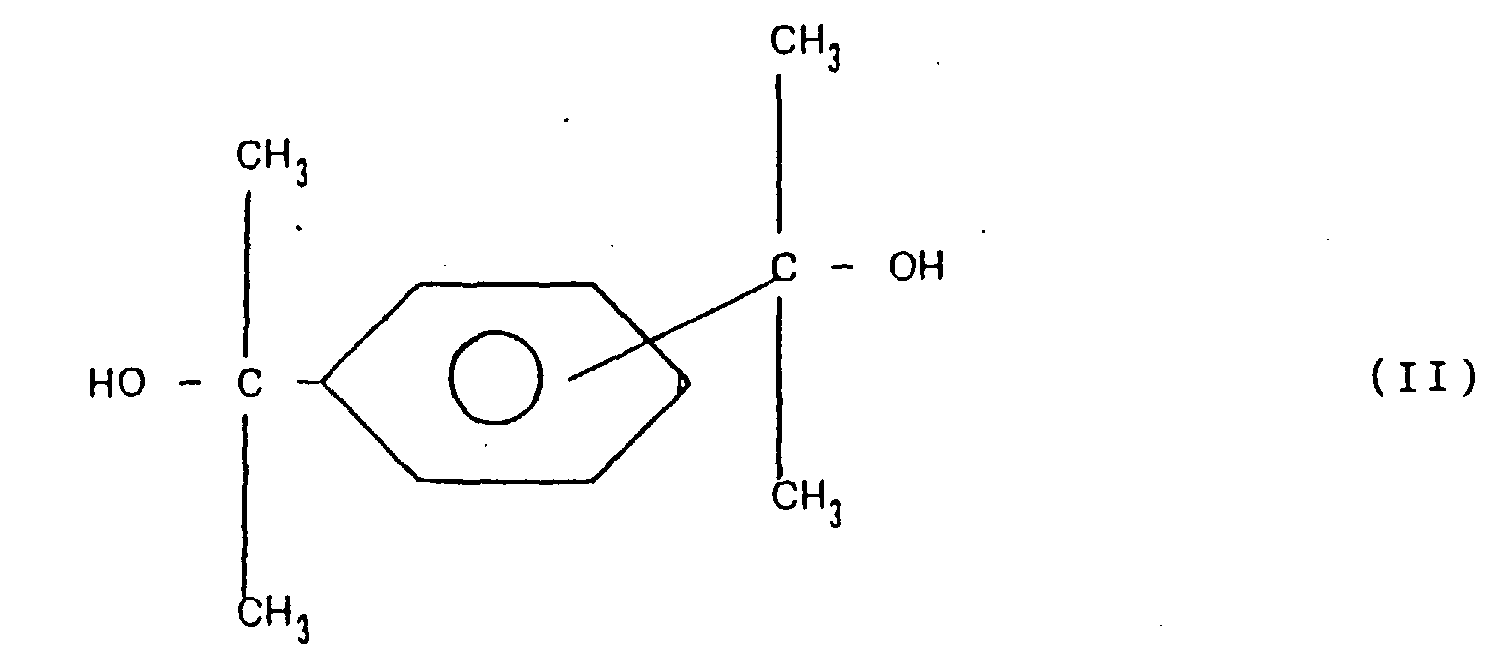
- the so prepared dihydroperoxide is extracted by adding an aqueous solution of caustic soda and a subsequent reduction according to known techniques, for instance by sulphides, sulfites, sulphydrates to obtain the dialcohol of formula: the two substituting groups of the benzenic ring being in meta and/or para position.
- the alcohol is separated by centrifugation or filtration of the aqueous phase.
- PEROXIMON 180 is then obtained by reaction of the dialcohols (II) with teramylhydroperoxide, in solution of hydrocarbons and/or diteramylperoxide or in aqueous solution, in the presence of one of the known acid catalysts, among them e.g. the sulphuric, the metansulphonic, the paratoluensulphonic so obtaining the known PEROXIMON 180 in meta and/or para form depending on the synthetizing alcohols.
- the known acid catalysts among them e.g. the sulphuric, the metansulphonic, the paratoluensulphonic
- the resulting peroxidic mixture is washed, for instance by an alcaline solution; then it is concentrated by removing the low-boiling compounds, essentially hydrocarburic solvents and peroxidic by-products such as diterbutylperoxide, preferably by distillation under vapour stream or by evaporation of the solvent.
- olefinic polymers can be cross-linked by the peroxide of the present invention.
- middle-, low-, high-density polyethylene ethylene/vinylacetate copolymers, ethylene/butene-1 copolymers, ethylene/4-methyl-pentene-1 copolymers and propylene/butene-1 copolymers; moreover ethylene/propylene elastomeric polymers or copolymers of EP or EPDM type, the butylic rubber, chlorinated polyethylene and the propylene/butene-1 copolymer.
- thermoplastic polymers can be successfully cross-linked.
- the peroxidic compositions can be used not only in the vulcanization of compact articles obtained by extrusion, but also for the manufacture of expanded articles (cross-linked) derived from the same materials, in particular from polystyrene containing self-extinguishing agents (flame-extinguishing agents), furthermore the same compositions can be used as coadjuvants in the degradation by beta-scission of polymers degradable by peroxides, for instance polypropylene or poly-4-methyl-pentene-1, and as radicalic polymerization initiators.
- the bisperoxide obtained by said processes can be purified from monoperoxides present as by-products according to the process of USP 3.584.059 which is entirely incorporated by reference in the present description.
- the bisperoxide to be used in the process of the present invention has the characteristic to be liquid also at very low temperatures, even at -10°C.
- the compounds are obtained by mixing the polymer in granules, chosen among those indicated above, the peroxides, the antioxidants and, if desired, cross-linking co-agents with inert fillers.
- antioxidants we can cite, for instance: 2.2.4-trimethyl-1.2-dihydroquinoline polymer, 2-mercaptobenzoimidazol, para-benzoquinon-diossine, 4.4-tio-bis-(6-t-butyl-m-cresol), N,N'-m-phenylen-dimaleimide; as cross-linking co-agents: triallylcyanurate, triallylisocyanurate, ethylenglycoldimethacrylate, trimetylolpropane trimetacrylate, 1,2-cis-polybutadiene; as inert charges: carbon black, calcium carbonate, kaolin.
- RIBLENE CF 2203® means a low-density polyethylene
- ANOX HB® means 2.2.4-trimethyl-1.2-dihydroquinoline polymer.
- the gaschromatographic analysis indicates the percentages by weight.
- the meta and paradihydroperoxide were extracted from said oxidized mixture by an aqueous solution of soda.
- the extract was reduced with sodic sulphydrate, according to usual techniques, by this way all hydroperoxidic groups (-O-O-H) were transformed into alcoholic groups, so obtaining an aqueous suspension of the dialcohol (II), constituted by 35% of the para isomer and by 65% of the meta isomer.
- aqueous phase was separated in a separatory funnel and two washings were effected with 500 cm 3 each time (at 60°C) of aqueous solution of soda at 10% by weight, then other two washings followed with 200 cm 3 each time of deionized water.
- 193 g of a peroxidic mixture were obtained having an active oxygen content equal to 6.97% by weight, a purity degree of 81% by weight (as total peroxidic content), a density of 0.933 g/cm 3 and a viscosity (at 25°C) of 97 mPa.s.
- the halving-points of the mixture were 107°C (at 10 hours) and 178°C (at 1 minute), the gaschromatographic analysis showed the following composition:
- the aqueous phase was separated in a separating funnel and two washings were effected, with 500 cm 3 each time (at 60°C) of an aqueous solution of soda at 10% by weight, followed by other two washings with 200 cm 3 each time of deionized water.
- 178 g of peroxidic mixture were obtained having an active oxygen content of 7.01% by weight, a purity degree of 81% by weight (as total peroxidic content), a density of 0.931 g/cm 3 and a viscosity (at 25°C) of 74.47 mPa.s.
- the rest were by-products.
- the product was liquid at -10°C.
- the aqueous phase was separated in a separating funnel and two washings were effected, with 500 cm 3 each time (at 60°C) of an aqueous solution of soda at 10% by weight, followed by other two washings with 200 cm 3 each time of deionized water.
- 202 g of a peroxidic mixture were obtained having an active oxygen content equal to 7.02% by weight, a purity degree of 81% by weight (as total peroxidic content), a density of 0.935 g/cm 3 and a viscosity (at 25°C) of 109.1 mPa.s.
- the rest were by-products.
- the product was liquid at -10°C.
- Example 1/e/A, B, and C was repeated with the difference that bis(alpha-t-butylperoxyisopropylbenzene) (PEROXIMON F) in an amount of 4.4 g formulated at 40% by weight with 60 parts of calcium carbonate, was used as peroxide.
- PEROXIMON F was a meta/para isomeric mixture in a ratio of 1.6. The results were as follows:
- Example 1/f was repeated with the difference that PEROXIMON F was used in the meta form in an amount of 4.4 g.
- the results were as follows:
Landscapes
- Chemical & Material Sciences (AREA)
- Health & Medical Sciences (AREA)
- Chemical Kinetics & Catalysis (AREA)
- Medicinal Chemistry (AREA)
- Polymers & Plastics (AREA)
- Organic Chemistry (AREA)
- Addition Polymer Or Copolymer, Post-Treatments, Or Chemical Modifications (AREA)
- Processes Of Treating Macromolecular Substances (AREA)
- Compositions Of Macromolecular Compounds (AREA)
- Organic Low-Molecular-Weight Compounds And Preparation Thereof (AREA)
Abstract
Description
- The present invention refers to a process for the preparation of crosslinked olefin polymers wherein liquid peroxidic compositions are used which do not show blooming in the compounds of different olefinic polymers.
- More particularly the present invention refers to peroxides showing, besides the absence of blooming, an optimal combination of properties as indicated below.
- As blooming it is generally intended the migration towards the surface of materials incompatible with the polymer.
- In the compound where said phenomenon takes place, it occurs the separation of the peroxide from the granule with consequent dishomogeneity of the same.
- From an industrial point of view this must be avoided since in the successive vulcanization not uniform degrees of cross-linking are obtained. For instance in the electric cables this causes a decrease of electrical and mechanical characteristics.
- Therefore the blooming causes problems when the product is stocked also for very long periods, also for tens of days only.
- It is well known to use peroxides in the cross-linking of polymers, such as f.e. polyethylene, elastomers, as ethylene-propylene (EP) or containing also units deriving from a dienic monomer (EPDM), etc. Peroxides solid at room temperature as PEROXIMON F are known from USP 3.764.628 and Italian Patent No. 651.288. However its use in the vulcanization of polymers is limited in that it is a compound solid at room temperature. In order to obtain a homogenous vulcanized blend it is therefore necessary to maintain PEROXIMON F in the molten state to have a uniform dosage. This operation has the disadvantage in particular due to losses in peroxidic content and to the introduction of impurities.
- It is known in the art to overcome these drawbacks by introducing additives having the function to lower the melting point under room temperature.
- However, this solution presents the drawback to reduce the efficiency of the cross-linking since the cited additives are inactive substances.
- It is known from Italian Patent No. 1.209.130 to prepare liquid compositions of PEROXIMON F by solubilizing the bisperoxide with isopropylcumyl-t-butyl-peroxide.
- The composition is liquid at the room temperature of 23°C. This is a drawback since it is desirable to have compositions liquid at a room temperature also of 15°C so permitting a higher use range.
- In this way it is avoided the melt the mixture when the temperature is lower than the cited value since this gives rise to the above-mentioned drawbacks as for instance the introduction of impurities in the system which leads to a poor vulcanization in the finished article.
- Other liquid peroxidic compositions are known from USP 4.202.790 and No. 4.239.644 where PEROXIMON F is substituted with DCP and is solubilized with cumylisopropyl-cumylperoxide or peroxides of similar general formula. But also these peroxidic compositions present the drawback to be liquid only above 23°C, and so giving the same disadvantages said above.
- From USP 4.450.302 liquid peroxidic compositions are known, obtained from PEROXIMON F and DCP (dicumylperoxide) and t.butyl-cumyl-peroxide (PEROXIMON 166) which are liquid at very low temperatures, also lower than 5°C.
- Nevertheless they present the drawback to be too volatile at a temperature of 15°C, due to the use of PEROXIMON 166.
- The invention relates to a process as defined in Claim 1.
- It was desirable to have available liquid peroxides having the optimal balance of the following properties:
- to be liquid at room temperature, also at 15°C;
- to be of low volatility, so to permit that the formulates with inert materials, such as kaolin, calcium carbonate, the elastomeric compounds or polymers in general as polyethylene, can be stocked for long periods without losses in peroxidic content;
- to be compounds where the peroxidic distribution is uniform also after stockage;
- to show absence of blooming.
- It has surprisingly been found that by using the peroxide PEROXIMON 180, bis(alpha-t-amyl-peroxy-isopropyl)-benzene of formula:

- The substituting groups in (I) are in meta and/or para position with respect to the benzenic ring, preferably the meta/para ratio ranges between 1 and 2.0.
- The preparation processes of (I) are well known in the art, for example from USP 3.658.914 and Italian Patents Nos. 707.597, 651.288 and 805.543 in addition to the ones indicated above.
- A preferred process consists in the alkylation of benzene with an excess of propylene, the preferred ratio being 1:1.5 molar, in the presence of AlCl3 according to Friedel-Kraft reaction; if desired the mixture containing diisopropylbenzene, prevailingly meta and para, can be rectified to obtain the two isomers separated.
- Then an oxidation is carried out by known methods, for example with air, oxygen etc, to obtain the dihydroperoxide of the diisopropylbenzene.
- The so prepared dihydroperoxide is extracted by adding an aqueous solution of caustic soda and a subsequent reduction according to known techniques, for instance by sulphides, sulfites, sulphydrates to obtain the dialcohol of formula:
- The alcohol is separated by centrifugation or filtration of the aqueous phase.
- PEROXIMON 180 is then obtained by reaction of the dialcohols (II) with teramylhydroperoxide, in solution of hydrocarbons and/or diteramylperoxide or in aqueous solution, in the presence of one of the known acid catalysts, among them e.g. the sulphuric, the metansulphonic, the paratoluensulphonic so obtaining the known PEROXIMON 180 in meta and/or para form depending on the synthetizing alcohols.
- The resulting peroxidic mixture is washed, for instance by an alcaline solution; then it is concentrated by removing the low-boiling compounds, essentially hydrocarburic solvents and peroxidic by-products such as diterbutylperoxide, preferably by distillation under vapour stream or by evaporation of the solvent.
- Generally olefinic polymers can be cross-linked by the peroxide of the present invention.
- More particularly we can cite middle-, low-, high-density polyethylene, ethylene/vinylacetate copolymers, ethylene/butene-1 copolymers, ethylene/4-methyl-pentene-1 copolymers and propylene/butene-1 copolymers; moreover ethylene/propylene elastomeric polymers or copolymers of EP or EPDM type, the butylic rubber, chlorinated polyethylene and the propylene/butene-1 copolymer.
- Also the mixture of two or more olefinic thermoplastic polymers, or two polymers of elastomeric type, or mixtures of at least an elastomeric with a thermoplastic polymer can be successfully cross-linked. The peroxidic compositions can be used not only in the vulcanization of compact articles obtained by extrusion, but also for the manufacture of expanded articles (cross-linked) derived from the same materials, in particular from polystyrene containing self-extinguishing agents (flame-extinguishing agents), furthermore the same compositions can be used as coadjuvants in the degradation by beta-scission of polymers degradable by peroxides, for instance polypropylene or poly-4-methyl-pentene-1, and as radicalic polymerization initiators.
- The bisperoxide obtained by said processes can be purified from monoperoxides present as by-products according to the process of USP 3.584.059 which is entirely incorporated by reference in the present description.
- The bisperoxide to be used in the process of the present invention has the characteristic to be liquid also at very low temperatures, even at -10°C.
- This characteristic associated to the absence of blooming and to the optimal combination of the cited properties makes the peroxides to be used in the process of the present invention particularly useful and flexible for the most various industrial applications.
- The compounds are obtained by mixing the polymer in granules, chosen among those indicated above, the peroxides, the antioxidants and, if desired, cross-linking co-agents with inert fillers.
- As antioxidants we can cite, for instance: 2.2.4-trimethyl-1.2-dihydroquinoline polymer, 2-mercaptobenzoimidazol, para-benzoquinon-diossine, 4.4-tio-bis-(6-t-butyl-m-cresol), N,N'-m-phenylen-dimaleimide; as cross-linking co-agents: triallylcyanurate, triallylisocyanurate, ethylenglycoldimethacrylate, trimetylolpropane trimetacrylate, 1,2-cis-polybutadiene; as inert charges: carbon black, calcium carbonate, kaolin.
- In the examples: RIBLENE CF 2203® means a low-density polyethylene; ANOX HB® means 2.2.4-trimethyl-1.2-dihydroquinoline polymer.
- The gaschromatographic analysis indicates the percentages by weight.
- The following examples are given only with an illustrative but not limitative purpose of the present invention.
- 1 mole of benzol was alkylated with 1.5 moles of propylene, in the presence of AlCl3 and according to Friedel-Kraft usual techniques, so obtaining a mixture of benzene, cumene, diisopropylbenzenes, tri-isopropylbenzene.
The mixture was rectified to separate the meta-, para-diisopropylbenzene. This mixture was then oxidized by usual techniques with air so obtaining an oxidized mixture containing meta and para diisopropylbenzene, meta and para monohydroperoxide of the diisopropylbenzene, meta and para dihydroperoxide of the diisopropylbenzene. The meta and paradihydroperoxide were extracted from said oxidized mixture by an aqueous solution of soda.
The extract was reduced with sodic sulphydrate, according to usual techniques, by this way all hydroperoxidic groups (-O-O-H) were transformed into alcoholic groups, so obtaining an aqueous suspension of the dialcohol (II), constituted by 35% of the para isomer and by 65% of the meta isomer.
647 g of an eptanic solution containing 1.84 moles of teramylhydroperoxide were introduced in a glass-flask, equipped with stirrer and thermometer, then 174 g of the dialcohol (II) containing 0.53 moles of the meta isomer, 0.28 moles of the para isomer and 0.97 moles of water were added.
Afterwards 331 g of an aqueous solution containing 70% of sulphuric acid were gradually added during 60 minutes, at 5-8°C under nitrogen stream and the solution was kept at 5-8°C for two hours under stirring.
At the end of the reaction the aqueous phase was separated in a separatory funnel and two washings were effected with 500 cm3 each time (at 60°C) of aqueous solution of soda at 10% by weight, then other two washings followed with 200 cm3 each time of deionized water.
After elimination of the heptane under vapour stream and after anhydrification under vacuum at 65°C, 193 g of a peroxidic mixture were obtained having an active oxygen content equal to 6.97% by weight, a purity degree of 81% by weight (as total peroxidic content), a density of 0.933 g/cm3 and a viscosity (at 25°C) of 97 mPa.s.
The halving-points of the mixture (by thermic decomposition) were 107°C (at 10 hours) and 178°C (at 1 minute), the gaschromatographic analysis showed the following composition: - meta PEROXIMON 180 45% by weight
- para PEROXIMON 180 36% by weight
- 644 g of an heptanic solution containing 1.84 moles of teramylhydroperoxide were introduced in a glass-flask, equipped with stirrer and thermometer, then 174 g of the dialcohol (II) were added, containing 0.807 moles of the pure meta isomer and 0.98 moles of water.
Then 331 g of an aqueous solution containing 70% by weight of sulphuric acid were gradually added during 60 minutes, at 5-8°C and under nitrogen stream and the solution was kept at 5-8°C for two hours under stirring.
At the end of the reaction the aqueous phase was separated in a separating funnel and two washings were effected, with 500 cm3 each time (at 60°C) of an aqueous solution of soda at 10% by weight, followed by other two washings with 200 cm3 each time of deionized water.
After elimination of the heptane under vapor stream, and after anhydrification under vacuum at 65°C, 178 g of peroxidic mixture were obtained having an active oxygen content of 7.01% by weight, a purity degree of 81% by weight (as total peroxidic content), a density of 0.931 g/cm3 and a viscosity (at 25°C) of 74.47 mPa.s.
The rest were by-products.
The product was liquid at -10°C. - 644 g of an heptanic solution containing 1.84 moles of teramylhydroperoxide were introduced in a glass-flask equipped with stirrer and thermometer, then 174 g of the dialcohol (II) were added, containing 0.807 moles of pure para isomer and 0.98 moles of water.
Then 331 g of an aqueous solution containing 70% by weight of sulphuric acid were gradually added, during 60 minutes, at 5-8°C under nitrogen stream and the solution was kept at 5-8°C for two hours under stirring.
At the end of the reaction the aqueous phase was separated in a separating funnel and two washings were effected, with 500 cm3 each time (at 60°C) of an aqueous solution of soda at 10% by weight, followed by other two washings with 200 cm3 each time of deionized water.
After elimination of the heptane under vapor stream and after anhydrification under vacuum at 65°C, 202 g of a peroxidic mixture were obtained having an active oxygen content equal to 7.02% by weight, a purity degree of 81% by weight (as total peroxidic content), a density of 0.935 g/cm3 and a viscosity (at 25°C) of 109.1 mPa.s.
The rest were by-products.
The product was liquid at -10°C. - 100 parts by weight of polyethylene, commercially known as RIBLENE CF 2203® were mixed with 0.5 parts by weight of ANOX HB®.
2.19 parts by weight of the peroxidic mixture of example 1/a were added and the resulting blend was homogenized in a calender.
The product coming from the calender showed the following properties: - a) ODR curve data at 170°C (oscillation arc = 1°)
- MH = 16.93 pounds x inches
- ts10 = 135 seconds
- t90 = 950 seconds
- b) "scorching" times at Mooney viscosimeter (135°C):
- t5 = 1034 seconds
- t10 = 1236 seconds
-
- A)
5.34 parts of the peroxidic mixture of example 1/a formulated at 40% by weight with 60 parts of calcium carbonate and 0.5 parts by weight of ANOX HB® were mixed with 100 parts by weight of polyethylene used in example 1/d.
It was calendered as in example 1.
The product coming from the calender showed the following properties:- MH = 16.79 pounds x inches
- ts10 = 139 seconds
- t90 = 865 seconds
- B)
A preformed sheet (not cross-linked) of 20 mm x 100 mm having a thickness of 2 mm, obtained from the product after calendering, was stocked at 25°C for 360 hours. Then the sheet was washed by immersion with hexane for 2 minutes to eliminate the possible peroxide bloomed on the surface.
The sample was then submitted to a cross-linking test under the conditions cited in A).- MH = 16.33 pounds x inches
- ts10 = 146 seconds
- t90 = 849 seconds
- C)
Example 1/e/B was repeated with the difference that the stockage was continued till 900 hours.- MH = 16.56 pounds x inches
- ts10 = 147 seconds
- t90 = 860 seconds
- Example 1/e/A, B, and C was repeated with the difference that bis(alpha-t-butylperoxyisopropylbenzene) (PEROXIMON F) in an amount of 4.4 g formulated at 40% by weight with 60 parts of calcium carbonate, was used as peroxide.
PEROXIMON F was a meta/para isomeric mixture in a ratio of 1.6.
The results were as follows: - A)
- MH = 16.47 pounds x inches
- ts10 = 193 seconds
- t90 = 1314 seconds
- B)
- MH = 14.35 pounds x inches
- ts10 = 181 seconds
- t90 = 1251 seconds
- C)
- MH = 14.27 pounds x inches
- ts10 = 185 seconds
- t90 = 1291 seconds
- Example 1/f was repeated with the difference that PEROXIMON F was used in the meta form in an amount of 4.4 g. The results were as follows:
- A)
- MH = 16.01 pounds x inches
- ts10 = 176 seconds
- t90 = 1385 seconds
- B)
- MH = 14.64 pounds x inches
- ts10 = 180 seconds
- t90 = 1419 seconds
- C)
- MH = 14.39 pounds x inches
- ts10 = 186 seconds
- t90 = 1427 seconds
The product was liquid at -10°C.
In example 1/f the blooming was evident with the naked eye: peroxide crystals were evident on the surface of the sample. In example 1/g the blooming showed as a waxy continuous superficial layer.
Claims (3)
- Process for the preparation of crosslinked olefin(co)polymers comprising the following consecutive steps:a) preparing a compound based on olefin polymer and meta and/or para bis-(alpha-t-amylperoxoisopropyl)-benzene as the sole peroxide,b) storage of the compound for at least 360 hours,c) cross-linking of the compound.
- Process according to claim 1, in which the bis-(alpha-t-amyl-peroxyisopropyl)-benzene is in the form of meta/para isomeric mixtures having a meta/para ratio by weight ranging between 1 and 2.0.
- Process according to claims 1 or 2 in which the olefin polymer is polyethylene.
Applications Claiming Priority (2)
| Application Number | Priority Date | Filing Date | Title |
|---|---|---|---|
| ITMI921204 | 1992-05-19 | ||
| ITMI921204A IT1264528B (en) | 1992-05-19 | 1992-05-19 | LIQUID PEROXIDE COMPOSITIONS FOR POLYMERS CROSS-LINKING |
Publications (2)
| Publication Number | Publication Date |
|---|---|
| EP0570812A1 EP0570812A1 (en) | 1993-11-24 |
| EP0570812B1 true EP0570812B1 (en) | 1997-01-22 |
Family
ID=11363325
Family Applications (1)
| Application Number | Title | Priority Date | Filing Date |
|---|---|---|---|
| EP93107616A Expired - Lifetime EP0570812B1 (en) | 1992-05-19 | 1993-05-11 | Process for the preparation of cross-linked olefin polymers |
Country Status (5)
| Country | Link |
|---|---|
| EP (1) | EP0570812B1 (en) |
| AT (1) | ATE148142T1 (en) |
| DE (1) | DE69307591T2 (en) |
| ES (1) | ES2099311T3 (en) |
| IT (1) | IT1264528B (en) |
Families Citing this family (1)
| Publication number | Priority date | Publication date | Assignee | Title |
|---|---|---|---|---|
| DE19601498C2 (en) * | 1996-01-17 | 2002-01-24 | Buna Sow Leuna Olefinverb Gmbh | Process for the uniform and permanent distribution of peroxides in polyethylene |
Citations (2)
| Publication number | Priority date | Publication date | Assignee | Title |
|---|---|---|---|---|
| US3584059A (en) * | 1968-12-19 | 1971-06-08 | Hercules Inc | Purifying organic peroxides |
| EP0533090A1 (en) * | 1991-09-19 | 1993-03-24 | ELF ATOCHEM ITALIA S.r.l. | Liquid peroxidic compositions |
Family Cites Families (2)
| Publication number | Priority date | Publication date | Assignee | Title |
|---|---|---|---|---|
| US3764628A (en) * | 1960-01-07 | 1973-10-09 | Grace W R & Co | Tertiary-tertiary bisperoxides |
| US3658914A (en) * | 1968-06-11 | 1972-04-25 | Hercules Inc | Polyperoxides |
-
1992
- 1992-05-19 IT ITMI921204A patent/IT1264528B/en active IP Right Grant
-
1993
- 1993-05-11 ES ES93107616T patent/ES2099311T3/en not_active Expired - Lifetime
- 1993-05-11 DE DE69307591T patent/DE69307591T2/en not_active Expired - Lifetime
- 1993-05-11 AT AT93107616T patent/ATE148142T1/en not_active IP Right Cessation
- 1993-05-11 EP EP93107616A patent/EP0570812B1/en not_active Expired - Lifetime
Patent Citations (2)
| Publication number | Priority date | Publication date | Assignee | Title |
|---|---|---|---|---|
| US3584059A (en) * | 1968-12-19 | 1971-06-08 | Hercules Inc | Purifying organic peroxides |
| EP0533090A1 (en) * | 1991-09-19 | 1993-03-24 | ELF ATOCHEM ITALIA S.r.l. | Liquid peroxidic compositions |
Also Published As
| Publication number | Publication date |
|---|---|
| ITMI921204A1 (en) | 1993-11-19 |
| ES2099311T3 (en) | 1997-05-16 |
| ATE148142T1 (en) | 1997-02-15 |
| IT1264528B (en) | 1996-10-02 |
| DE69307591D1 (en) | 1997-03-06 |
| EP0570812A1 (en) | 1993-11-24 |
| ITMI921204A0 (en) | 1992-05-19 |
| DE69307591T2 (en) | 1997-07-10 |
Similar Documents
| Publication | Publication Date | Title |
|---|---|---|
| EP0208353B1 (en) | Process for cross-linking or degrading polymers and shaped articles obtained by this process | |
| US6277925B1 (en) | Allyl compounds, compositions containing allyl compounds and processes for forming and curing polymer compositions | |
| HU213909B (en) | Polypropilenes made by new chemical degradation and process for producing them | |
| US4288575A (en) | Conjugated diene butyl elastomer copolymer | |
| US5994473A (en) | Scorch resistant peroxidic compositions | |
| EP0453204B1 (en) | Composition for cross-linking of ethylene-polymer, method for cross-linking ethylene-polymer, and cross-linkable composition | |
| JPS6019745B2 (en) | Peroxide composition, its production method, its use | |
| EP0533089B1 (en) | Liquid peroxidic compositions | |
| EP0374999B1 (en) | Use of oligomers of alkenyl groups-substituted aromatics as co-agents | |
| EP0570812A1 (en) | Process for the preparation of cross-linked olefin polymers | |
| EP0063855B1 (en) | Flame retardant polymer compositions | |
| US3980629A (en) | Organic peroxides derived from unsaturated compounds | |
| EP0266161B1 (en) | Liquid organic peroxide compositions | |
| EP0533090B1 (en) | Liquid peroxidic compositions | |
| US3730929A (en) | Bloom inhibited flame retardant compositions | |
| US5096947A (en) | Organic peroxide and organic sulfide antioxidant composition | |
| US4145492A (en) | Catalytic dehydrohalogenation process for allylically halogenated unsaturated hydrocarbon polymers | |
| CA1314344C (en) | Modification of crystalline propylene polymers | |
| US5719096A (en) | Liquid peroxide compositions | |
| US3652495A (en) | Stabilization of relatively saturated polymers with phenolic stabilizers and sulfur-containing compounds | |
| US3342872A (en) | 2, 2-bis-(4, 4-ditertiary-butyl-peroxycyclohexyl)-propane | |
| US5539061A (en) | Liquid peroxide compositions | |
| US3928466A (en) | Organic peroxides derived from unsaturated compounds | |
| US3755464A (en) | Tertiary alkyl halocumyl peroxides | |
| US3122519A (en) | Propylene resin stabilized with a mixture of a para-tertiaryalkylphenol-formaldehyderesin and a mercapto compound |
Legal Events
| Date | Code | Title | Description |
|---|---|---|---|
| PUAI | Public reference made under article 153(3) epc to a published international application that has entered the european phase |
Free format text: ORIGINAL CODE: 0009012 |
|
| AK | Designated contracting states |
Kind code of ref document: A1 Designated state(s): AT BE CH DE DK ES FR GB GR IT LI LU MC NL PT SE |
|
| 17P | Request for examination filed |
Effective date: 19940505 |
|
| 17Q | First examination report despatched |
Effective date: 19940729 |
|
| GRAG | Despatch of communication of intention to grant |
Free format text: ORIGINAL CODE: EPIDOS AGRA |
|
| GRAH | Despatch of communication of intention to grant a patent |
Free format text: ORIGINAL CODE: EPIDOS IGRA |
|
| GRAH | Despatch of communication of intention to grant a patent |
Free format text: ORIGINAL CODE: EPIDOS IGRA |
|
| ITF | It: translation for a ep patent filed | ||
| GRAH | Despatch of communication of intention to grant a patent |
Free format text: ORIGINAL CODE: EPIDOS IGRA |
|
| GRAA | (expected) grant |
Free format text: ORIGINAL CODE: 0009210 |
|
| AK | Designated contracting states |
Kind code of ref document: B1 Designated state(s): AT BE CH DE DK ES FR GB GR IT LI LU MC NL PT SE |
|
| PG25 | Lapsed in a contracting state [announced via postgrant information from national office to epo] |
Ref country code: GR Free format text: LAPSE BECAUSE OF FAILURE TO SUBMIT A TRANSLATION OF THE DESCRIPTION OR TO PAY THE FEE WITHIN THE PRESCRIBED TIME-LIMIT Effective date: 19970122 Ref country code: DK Effective date: 19970122 Ref country code: BE Effective date: 19970122 Ref country code: AT Effective date: 19970122 |
|
| REF | Corresponds to: |
Ref document number: 148142 Country of ref document: AT Date of ref document: 19970215 Kind code of ref document: T |
|
| REG | Reference to a national code |
Ref country code: CH Ref legal event code: NV Representative=s name: KEMIA S.A. Ref country code: CH Ref legal event code: EP |
|
| ET | Fr: translation filed | ||
| REF | Corresponds to: |
Ref document number: 69307591 Country of ref document: DE Date of ref document: 19970306 |
|
| REG | Reference to a national code |
Ref country code: ES Ref legal event code: FG2A Ref document number: 2099311 Country of ref document: ES Kind code of ref document: T3 |
|
| REG | Reference to a national code |
Ref country code: PT Ref legal event code: SC4A Free format text: AVAILABILITY OF NATIONAL TRANSLATION Effective date: 19970203 |
|
| PG25 | Lapsed in a contracting state [announced via postgrant information from national office to epo] |
Ref country code: LU Free format text: LAPSE BECAUSE OF NON-PAYMENT OF DUE FEES Effective date: 19970531 |
|
| PLBE | No opposition filed within time limit |
Free format text: ORIGINAL CODE: 0009261 |
|
| PG25 | Lapsed in a contracting state [announced via postgrant information from national office to epo] |
Ref country code: MC Effective date: 19971130 |
|
| 26N | No opposition filed | ||
| REG | Reference to a national code |
Ref country code: GB Ref legal event code: IF02 |
|
| REG | Reference to a national code |
Ref country code: CH Ref legal event code: PFA Owner name: ELF ATOCHEM ITALIA S.R.L. Free format text: ELF ATOCHEM ITALIA S.R.L.#VIA GIOACCHINO MURAT 17#20159 MILANO (IT) -TRANSFER TO- ELF ATOCHEM ITALIA S.R.L.#VIA GIOACCHINO MURAT 17#20159 MILANO (IT) |
|
| PGFP | Annual fee paid to national office [announced via postgrant information from national office to epo] |
Ref country code: CH Payment date: 20110512 Year of fee payment: 19 Ref country code: SE Payment date: 20110512 Year of fee payment: 19 Ref country code: PT Payment date: 20110509 Year of fee payment: 19 Ref country code: FR Payment date: 20110523 Year of fee payment: 19 Ref country code: ES Payment date: 20110617 Year of fee payment: 19 |
|
| PGFP | Annual fee paid to national office [announced via postgrant information from national office to epo] |
Ref country code: NL Payment date: 20110526 Year of fee payment: 19 Ref country code: GB Payment date: 20110511 Year of fee payment: 19 |
|
| PGFP | Annual fee paid to national office [announced via postgrant information from national office to epo] |
Ref country code: DE Payment date: 20110505 Year of fee payment: 19 Ref country code: IT Payment date: 20110518 Year of fee payment: 19 |
|
| REG | Reference to a national code |
Ref country code: PT Ref legal event code: MM4A Free format text: LAPSE DUE TO NON-PAYMENT OF FEES Effective date: 20121112 |
|
| REG | Reference to a national code |
Ref country code: NL Ref legal event code: V1 Effective date: 20121201 |
|
| REG | Reference to a national code |
Ref country code: CH Ref legal event code: PL |
|
| REG | Reference to a national code |
Ref country code: SE Ref legal event code: EUG |
|
| GBPC | Gb: european patent ceased through non-payment of renewal fee |
Effective date: 20120511 |
|
| PG25 | Lapsed in a contracting state [announced via postgrant information from national office to epo] |
Ref country code: LI Free format text: LAPSE BECAUSE OF NON-PAYMENT OF DUE FEES Effective date: 20120531 Ref country code: CH Free format text: LAPSE BECAUSE OF NON-PAYMENT OF DUE FEES Effective date: 20120531 |
|
| PG25 | Lapsed in a contracting state [announced via postgrant information from national office to epo] |
Ref country code: IT Free format text: LAPSE BECAUSE OF NON-PAYMENT OF DUE FEES Effective date: 20120511 Ref country code: SE Free format text: LAPSE BECAUSE OF NON-PAYMENT OF DUE FEES Effective date: 20120512 Ref country code: PT Free format text: LAPSE BECAUSE OF NON-PAYMENT OF DUE FEES Effective date: 20121112 |
|
| REG | Reference to a national code |
Ref country code: FR Ref legal event code: ST Effective date: 20130131 |
|
| REG | Reference to a national code |
Ref country code: DE Ref legal event code: R119 Ref document number: 69307591 Country of ref document: DE Effective date: 20121201 |
|
| PG25 | Lapsed in a contracting state [announced via postgrant information from national office to epo] |
Ref country code: NL Free format text: LAPSE BECAUSE OF NON-PAYMENT OF DUE FEES Effective date: 20121201 |
|
| PG25 | Lapsed in a contracting state [announced via postgrant information from national office to epo] |
Ref country code: GB Free format text: LAPSE BECAUSE OF NON-PAYMENT OF DUE FEES Effective date: 20120511 Ref country code: FR Free format text: LAPSE BECAUSE OF NON-PAYMENT OF DUE FEES Effective date: 20120531 |
|
| REG | Reference to a national code |
Ref country code: PT Ref legal event code: MM4A Free format text: MAXIMUM VALIDITY LIMIT REACHED Effective date: 20130511 |
|
| PG25 | Lapsed in a contracting state [announced via postgrant information from national office to epo] |
Ref country code: DE Free format text: LAPSE BECAUSE OF NON-PAYMENT OF DUE FEES Effective date: 20121201 |
|
| REG | Reference to a national code |
Ref country code: ES Ref legal event code: FD2A Effective date: 20130821 |
|
| PG25 | Lapsed in a contracting state [announced via postgrant information from national office to epo] |
Ref country code: PT Free format text: LAPSE BECAUSE OF EXPIRATION OF PROTECTION Effective date: 20130521 |
|
| PG25 | Lapsed in a contracting state [announced via postgrant information from national office to epo] |
Ref country code: ES Free format text: LAPSE BECAUSE OF NON-PAYMENT OF DUE FEES Effective date: 20120512 |
|
| PG25 | Lapsed in a contracting state [announced via postgrant information from national office to epo] |
Ref country code: PT Free format text: LAPSE BECAUSE OF EXPIRATION OF PROTECTION Effective date: 20120511 |