EP0569995B1 - Scorch retardant compositions for peroxide curable elastomers - Google Patents
Scorch retardant compositions for peroxide curable elastomers Download PDFInfo
- Publication number
- EP0569995B1 EP0569995B1 EP93107840A EP93107840A EP0569995B1 EP 0569995 B1 EP0569995 B1 EP 0569995B1 EP 93107840 A EP93107840 A EP 93107840A EP 93107840 A EP93107840 A EP 93107840A EP 0569995 B1 EP0569995 B1 EP 0569995B1
- Authority
- EP
- European Patent Office
- Prior art keywords
- scorch
- sulfenamide
- polyfunctional
- meth
- acrylate
- Prior art date
- Legal status (The legal status is an assumption and is not a legal conclusion. Google has not performed a legal analysis and makes no representation as to the accuracy of the status listed.)
- Expired - Lifetime
Links
- 0 CNC(C=C*(*)CC1)=S1SC Chemical compound CNC(C=C*(*)CC1)=S1SC 0.000 description 1
Classifications
-
- C—CHEMISTRY; METALLURGY
- C08—ORGANIC MACROMOLECULAR COMPOUNDS; THEIR PREPARATION OR CHEMICAL WORKING-UP; COMPOSITIONS BASED THEREON
- C08K—Use of inorganic or non-macromolecular organic substances as compounding ingredients
- C08K5/00—Use of organic ingredients
- C08K5/0008—Organic ingredients according to more than one of the "one dot" groups of C08K5/01 - C08K5/59
- C08K5/0025—Crosslinking or vulcanising agents; including accelerators
-
- C—CHEMISTRY; METALLURGY
- C08—ORGANIC MACROMOLECULAR COMPOUNDS; THEIR PREPARATION OR CHEMICAL WORKING-UP; COMPOSITIONS BASED THEREON
- C08K—Use of inorganic or non-macromolecular organic substances as compounding ingredients
- C08K5/00—Use of organic ingredients
- C08K5/04—Oxygen-containing compounds
- C08K5/07—Aldehydes; Ketones
- C08K5/08—Quinones
-
- C—CHEMISTRY; METALLURGY
- C08—ORGANIC MACROMOLECULAR COMPOUNDS; THEIR PREPARATION OR CHEMICAL WORKING-UP; COMPOSITIONS BASED THEREON
- C08K—Use of inorganic or non-macromolecular organic substances as compounding ingredients
- C08K5/00—Use of organic ingredients
- C08K5/36—Sulfur-, selenium-, or tellurium-containing compounds
- C08K5/43—Compounds containing sulfur bound to nitrogen
- C08K5/44—Sulfenamides
Definitions
- This invention is directed to scorch retardant compositions suited for the vulcanization of elastomers.
- polyunsaturated monomers and particularly polyfunctional (meth)acrylate monomer systems, for the curing and vulcanization of peroxide-curable elastomers to enhance physical properties of the resulting elastomers is known.
- property enhancements include high hardness, resistance to attack by sunlight, hydrocarbon solvents as well as water, physical strength and aging.
- Free-radical reaction of the polyunsaturated monomers with the elastomeric compositions is conducted at elevated temperatures wherein the polyunsaturated compositions crosslink through an abstractable hydrogen atom on the elastomer.
- Scorching is a problem associated with the curing of the elastomers in the presence of peroxide and scorching, in effect, is the result of prevulcanization of the elastomer.
- prevulcanization the monomer crosslinks with the elastomer at low temperature resulting in products which have a rough texture, a shriveled appearance and its surface appearance is lumpy. Thus, they are unacceptable.
- scorch retardants to the polyunsaturated monomer which in turn retard the rate of crosslinking between the elastomer and polyunsaturated monomer at low temperature.
- scorch retardants Although many types of scorch retardants have been incorporated into the polyunsaturated monomers for subsequent peroxide curing of elastomers, there have been problems. In terms of elastomer properties, the addition of the scorch retardants have been relatively ineffective during high temperature vulcanization or too effective in that they have retarded vulcanization to the extent that the resulting elastomers do not have the required physical properties. For example many have reduced elastic modulus and increased elongation. In terms of processing the elastomers, the scorch retardants often have extended the cure times to such an extent that costs become prohibitive or, because of their volatility, present environmental problems in the workplace due to odor and toxicity.
- U.S. 3,751,378 discloses a mechanism for inhibiting prevulcanization of rubber crosslinked with a polyfunctional methacrylate in the presence of peroxide.
- a scorch retardant of N-nitrosodiarylamine or N,N'-dinitrosodiphenyl- p -phenylenediamine is shown.
- U.S. 4,857,571 discloses a method for the inhibiting the prevulcanization during free-radical curing of rubbers.
- the prior art section of the patent discloses that it was known to use acidic materials such as phthalic anhydride, salicylic acid and sodium acetate which act as retarders in sulfur vulcanization systems.
- Other known retarders include nitroso and nitroaromatic amines as well as various quinones e.g. p-benzoquinone and naphthoquinone.
- Retarders used by the patentees include modified alkyl-substituted aminoalkylphenols, an example of which is 2,6-di- t -butyl-4-[methyl(phenyl)amino]-n-propylphenol.
- U.S. 954,907 discloses a method for avoiding scorching of ethylene polymer based compositions vulcanized in the presence of organic peroxide.
- the patentees disclose the use of monofunctional vinyl compositions as a scorch retarding agent.
- Antioxidants such as sterically hindered phenols are also suggested as an adjuvant.
- U.S. 3,578,647 discloses a scorch prevention process for producing ethylene-containing polymers crosslinked by free radical generating crosslinking agents.
- the patentees employ the use of a chain transfer agent e.g., mercaptans and aldehydes as a scorch retarding or scorch preventing adjuvant.
- U.S. 3,335,124 discloses method for controlling the rate of vulcanization of polyethylene through the use of a crosslinking regulator which heretofore were utilized or antioxidants.
- Various compositions having antioxidant activity and suited as a crosslinking regulator include aromatic amines, phenolic compounds and ketone-aldehyde condensation products.
- U.S. 3,202,648 discloses the addition of scorch inhibiting components during the free radical peroxide crosslinking of polyethylene.
- Alkyl, cycloalkyl and arylalkyl nitrites having from 5 to 18 carbon atoms are used as the scorch preventing additive.
- EP-A-0 346 863 relates to a mixture containing at least one organic peroxide suitable for the crosslinking of polymers ; at least one hydroquinone derivative ; and at least one crosslinking reinforcing agent, said mixture permitting the crosslinking of polymers while extending the scorch time.
- US-A-3 993 633 describes a class of 2-(1(2H)-phthalazinone) sulfenamides useful as inhibitors of premature vulcanization of rubber.
- This invention relates to a polyfunctional (meth)acrylate based scorch retardant formulation for use as a crosslinker system for the peroxide curing of elastomer compositions vulcanizable in the presence of the peroxide catalyst and to the curable elastomer system itself.
- the improved scorch retarding polyfunctional (meth)acrylate system comprises: a polyfunctional (meth)acrylate and an effective amount of a scorch retardant mixture comprising hydroquinone and a sulfenamide.
- Scorch retarding curable elastomers are formed by incorporating the polyfunctional (meth)acrylate based scorch retardant formulations into a peroxide-curable elastomer system.
- a first subject-matter of the present invention is a scorch retarding polyunsaturated monomer containing system suited for curing peroxide curable elastomers and polyethylene, polypropylene, copolymers containing ethylene units and copolymers containing propylene units, which comprises polyunsaturated monomer, 0.2 to 6 weight percent hydroquinone based upon said polyunsaturated monomer and 1 to 50 weight percent sulfenamide based upon said polyunsaturated monomer.
- a second subject matter of the present invention is a curable composition
- a curable composition comprising an elastomer or polyethylene or polypropylene or a copolymer containing ethylene units or a copolymer containing propylene units having an abstractable hydrogen atom crosslinkable with a polyfunctional (meth)acrylate, polyfunctional (meth)acrylate, organic peroxide, and a scorch retarding additive which comprises from 0.2 to 6% by weight of hydroquinone based upon said polyfunctional (meth)acrylate and from 1 to 50% by weight of a sulfenamide based upon said polyfunctional (meth)acrylate.
- This invention pertains to compositions suited for inhibiting or retarding the prevulcanization or scorching of peroxide-curable elastomers during cure with polyinsaturated monomers.
- the curable elastomers which are crosslinked with the polyunsaturated monomers are elastomeric organic high polymers, e.g., rubbers which are curable via free-radical crosslinking with polymerizable vinyl unsaturated monomers.
- the free-radical curable elastomers are polymers having extractable hydrogen atoms which on reaction with the polymerizable monomers crosslink through carbon-carbon bonds.
- Representative examples of synthetic rubbery polymers formed via the polymerization of conjugated dienes include polyisoprene, styrene-butadiene rubbers, polybutadiene rubbers, neoprene, and substituted butyl rubbers, chlorinated polyethylene rubber.
- Other elastomers are based upon vinyl polymerization and include polymers such as ethylene-propylene rubbers, butadiene-acrylonitrile elastomers, and silicone elastomers.
- This invention pertains also to compositions mited for inhibiting or retarding the prevulcanization or scarching of peroxide-curable polyethylene, polypropylene and copolymers containing ethylene and propylene units e.g. ethylene-vinyl acetate copolymers.
- the patents described in the prior art section herein suggest many representative elastomer systems.
- the scorch retarding curatives for peroxide curable elastomers comprise a polyfunctional unsaturated monomer, typically a polyfunctional (meth)acrylate monomer, and an effective amount of a scorch retardant inhibitor and vulcanizate accelerator, the scorch retarder being hydroquinone and the vulcanizate accelerator being a sulfenamide.
- the polyfunctional unsaturated monomer generally is admixed with the scorch retardant additives and generally it is a component of the scorch retarding curative; it is polyfunctional in that it has a plurality of unsaturation units for crosslinking with the elastomers. Preferably it is a liquid at temperatures below about 50°C.
- polyacrylates in the vulcanization of peroxide curable elastomers is conventional.
- polyfunctional acrylates include those acrylic and methacrylic acid esters of C 2-12 polyols and alkoxylated derivatives containing from 2-6 alkyleneoxide units.
- the polyols Preferably have from 2-8 carbon atoms and preferably they are diols and triols.
- Specific polyfunctional (meth)acrylates are : trimethylolethane triacrylate, trimethylolpropane trimethacrylate, pentaerythritol tetramethylacrylate, glycerol trimethyacrylate, glycerol triacrylate, 1,3-butylene glycol dimethylacrylate, ethylene glycol dimethacrylate, 1,4-butylene glycol dimethacrylate, polyethylene glycol dimethacrylate.
- polyunsaturated monomers which may be used by themselves or in combination with the polyfunctional(meth)acrylates include the polyallyl derivatives of polyols, such as, the allylic ethers of trimethylolpropane, pentaerythritol, ethylene glycol, glycerol, polyethylene glycol and polypropylene glycol ; triallylmellitate, diallylphthalate, diallylchlorendate, triallylcyanurate, and triallylisocyanurate,
- polyallyl derivatives of polyols such as, the allylic ethers of trimethylolpropane, pentaerythritol, ethylene glycol, glycerol, polyethylene glycol and polypropylene glycol ; triallylmellitate, diallylphthalate, diallylchlorendate, triallylcyanurate, and triallylisocyanurate,
- One component of the scorch retardant system is an organosulfenamide. These compounds have been used in rubber formulations as delayed action accelators.
- the sulfenamides are represented by the formulas: and wherein
- quinones have been used as shortstop agents in polymerization processes, e.g. in the polymerization of olefins such as butadiene and styrene.
- Other quinones or polymerization inhibitor even though they act to retard the rate of vulcanization, do not give the desired result when combined with the sulfenamide during the peroxide curing of elastomer with polyacrylates.
- One highly acceptable method for incorporating the scorch retardant additive for curing of the elastomer involves mixing the hydroquinone and sulfenamide with the polyacrylate and then coating the resulting liquid mixture onto an inert solid phase substrate. The material then can be packaged and stored for extended periods of time at ambient temperatures.
- substrates suited for coating the mixture of polyacrylates monomers and scorch retardants include powdered silica, diatomaceous earth and clays.
- the scorch retardant system of hydroquinone and sulfenamide also can be added separately or jointly to the elastomer during milling with the polyunsaturated monomer. However, it is preferred that the scorch retardant additives be mixed with the polyunsaturated monomer and the resultant mixture added to the elastomer.
- the scorch resistant polyunsaturated monomer or polyfunctional(meth)acrylate systems for effecting vulcanization of curable elastomeric organic high polymers typically are formulated on the basis of one hundred weight parts monomer, e.g., polyfunctional(meth)acrylate.
- the scorch retardant system then is incorporated into the curable elastomer in conventional amounts from about 0.5 to 50 weight parts polyunsaturated monomer per one hundred weight parts elastomer. (These values may be expressed as weight percent.)
- polyallylic functional monomers higher levels may be used than when using polyacrylates.
- the level of polyfunctional(meth)acrylate vis-a-vis the curable elastomer generally is from 1 to 50 parts per 100 parts elastomer. Higher levels may be used but seldom are for reasons of cost; the addition level is primarily at the discretion of the formulator and thus depends on the nature of the elastomer to be produced.
- the range of hydroquinone based upon polyfunctional(meth)acrylate is from 0.2 to 6 parts by weight per one hundred parts by weight polyfunctional(meth)acrylate.
- the sulfenamide also present in a proportion of from about 1 to 30 typically 2 to 20 weight parts per 100 weight parts of polyfunctional(meth)acrylate.
- hydroquinone When less than about 0.2 parts hydroquinone are used in the scorch retardant polyfunctional(meth)acrylate system, there may be insufficient inhibitor to prevent even modest levels of scorching during cure. Higher levels may be required depending upon vulcanization temperatures and vulcanization times as well as the elastomeric organic high polymers and polyunsatured momomers themselves. Too much hydroquinone may overly extend cure cycles and result in insufficiently cured elastomers.
- the vulcanization or crosslinking of the curable elastomers is effected through free radical initiation by the addition of a free-radical generating compound or via a radiation source, e.g., a high energy electron source.
- a radiation source e.g., a high energy electron source.
- polymerization is effected by initiating reaction through the addition of a free radical generating compound which is usually an organic peroxide.
- Organic peroxides suited for abstracting hydrogen from the elastomer are known and those conventionally used can be used in the practice of this invention for vulcanizing elastomers.
- Organic peroxides which can be used include ditertiary peroxides and these include benzoyl peroxide, 1,3-bis- t -butylperoxyisopropylbenzene; 1,1-bis( t -butylperoxy)3,3,5-trimethylcyclohexane; 2,5-dimethyl-2,5-bis( t -butylperoxy)hexane; di- ⁇ -cumyl peroxide; and ditertiary peroxides such as di( tert -peroxy)butane; tert -butyl-methylcyclohexyl peroxide and dibenzoyl peroxide.
- Other peroxides include tert -butyl perbenzoate and tert -butyl perphthalate.
- Radiation of the polymers would be an acceptable method depending on use and cost over chemical free radical initatiors. However, any conventional process may be used.
- the elastomeric compositions can be processed in conventional manner typically involving the milling of a masterbatch formulations in roll mills and then curing the milled masterbatch in molds or presses.
- Various additives can be added to the elastomer for imparting desirable properties thereto and examples of additives include carbon black, antioxidants, wetting agents and reinforcing pigments and fillers.
- reinforcement and fillers include fine particles, zinc oxide, calcium carbonate, calcium silicate, amorphous hydrated silica, fine clays, magnesium carbonate and carbon black.
- the addition of various additives to achieve desired properties is at the discretion of the processor.
- Vulcanization of butadiene-acrylonitrile rubbers was carried out in conventional manner in a roll mill and then placing the milled system into a mold. Varying levels of scorch retarding additives of hydroquinone and sulfenamide were compared.
- the scorch retardant systems were formulated by mixing the hydroquinone and sulfenamide with the trimethylolpropane triacrylate and coating the resulting mixture onto powdered silica. Scorch time to determine cure characteristics was evaluated on the basis of Mooney scorch time according to ASTM 1646-80. The formulations were cured at 160°C and physical properties i.e. hardness measured. The conditions and results are set forth in Table 1.
- the masterbatch formulation is as follows: Parts (by wt) NBR N367C70 Nitrile Rubber 100 FEF Carbon Black N550 40 Zinc Oxide 5 Stearic Acid 1 Trimethylolpropane Trimethacrylate 15 Vulcup 40KE (peroxide) 5 N- t -butylbenzothiazolesulfenamide TABLE 1 Hydroquinone TABLE 1 Nitrile Rubber is a butadiene-acrylonitrile rubber Vulcup 40KE is 1,3-bis- t -butylperoxyisopropylbenzene at 40% activity SULFENAMIDE * HYOROQUINONE * SCORCH TIME AT 121°C (min) IRHD HARDNESS 1 1 48 76.5 0.5 1 54 74.5 1 0.5 48 79 0.5 0.5 47 78.5 1 0.25 49.5 84 0.5 0.25 43.5 85
- TABLE 1 shows a combination of both additives yields desirable products.
- a level of hydroquinone or less than 0.5% by weight of the trimethylolpropane trimethacrylate provided higher hardness levels in the cured elastomer, although all levels are acceptable.
- Example 1 The procedure of Example 1 was repeated using the following masterbatch formulation. No sulfenamide was used in the cure and delayed action was sought to be achieved through addition of hydroquinone to the methacrylate monomer. The scorch retarding monomer, TAC, was also tested for comparison.
- Vistalon 7500 EPDM is an ethylene/propylene rubber which is commercially available.
- TMQ antioxidant is polymerized trimethyldihydroquinone.
- Example 2 The procedure of Example 2 was repeated except sulfenamide was added along with polyacrylate and hydroquinone in forming the co-agent formulation.
- Table 3 provides data at 5 parts and 3 parts trimethylolpropane trimethacrylate as follows.
- the masterbatch formulation was comprised: Parts (by wt) Keltan 4802 EPDM 100 FEF Black 85 Sunpar 2280 Process Oil 30 Antioxidant TMQ 1 N- t -butylbenzothiazole sulfenamide Table 3 Vulcup 40KE 9 Hydroquinone 1.7 Kelton 4802 is an ethylene/propylene rubber which is commercially available.
- Example 1 The procedure of Example 1 was repeated but using a different masterbatch formulation as follows: Nitrile Rubber BR 1042 100 pts. Zinc Oxide 5 pts. Stearic Acid 1 pt. FEF Carbon Black 40 pts. Dicumyl peroxide 4 pts. Trimethylolpropane trimethacrylate 15 pts. Various potential scorch additives were added at a level of 5% W/W relative to the acrylate monomer. Table 4 sets forth the test results: Scorch Retardant Additive Mooney Scorch at 121°C Mins.
- Example 1 The procedure of Example 1 was repeated except for the use of a different masterbatch formulation.
- One co-agent composition was prepared consisting of diethylene glycol dimethacrylate (83.3%), hydroquinone (1.7%) and N- t -butylbenzthiazylsulfenamide (15%). That formulation was compared with an identical masterbatch formulation in which TAC was substituted for the diethylene glycol dimethylacrylate and without the addition of scorch additives. Table 5 sets forth the test results.
- Example 5 The procedure of Example 5 was repeated except only 30 pts of paraffinic oil, and a coagent consisting of trimethylolpropane trimethacrylate (83.55), N- t -butylbenzothiazolesulfenamide (15) and hydroquinone (1.45), parts were used. Table 6 sets forth the test results. Coagent 2 Parts METHACRYLATE TAC Scorch Time at 121°C 24.5 22.5 Hardness 70 67 Compression Set % (22 hrs at 160°C) 21.9 16.2 Elongation at break % 255 235 Tensile Strength (MN.m -2 ) 17.6 17.9
- Example 6 trimethylolpropane trimethacrylate co-agent composition in a rubber compound as above containing 65 parts of paraffinic process oil, data are as follows in Table 7. Coagent 2 parts METHACRYLATE TAC Scorch Time 77 >120 Hardness 49 44 Compression Set % (22 hrs at 160°C) 27.0 65.1 Elongation at break % 480 515 Tensile Strength (MN.m -2 ) 12.0 6.9
- Example 2 The procedure of Example 1 was repeated except hydroquinone was omitted from the scorch retarding polyacrylate system.
- the sulfenamide derivative failed to give adequate scorch protection.
- the formulation consisted of: Parts (by wt) Breon N3670 Nitrile Rubber 100 FEF Carbon Black 40 Zinc Oxide 5 Stearic Acid 1 DiCup 40C (peroxide) 5 Trimethylolpropane trimethacrylate 15 N- t -butylbenzothiazolesulfenamide 2
- Example 1 The procedure of Example 1 was repeated except that the following masterbatch was used. No special addition of scorch-retardant agent(s) was made. The results are in Table 8. NBR B36C70 Nitrile Rubber 100 FEF Black 40 Zinc Oxide 5 Stearic Acid 1 Antioxidant TMQ 0.5 DiCup 40C (peroxide) 7 Polyacrylate Monomer (See Table 8 ) 15 MONOMER FUNCTIONALITY SCORCH TIME AT 121°C (min) IRHD HARDNESS TETRAHYDROFURFURYL METHACRYLATE 1 24 63 1,3-BUTANEDIOL DIMETHACRYLATE 2 9 81 TRIMETHYLOLPROPANE TRIMETHACRYLATE 3 7 84 These results show that polyunsaturated monomers without a scorch retarding agent scorch times were low.
- the monounsaturated monomer had better scorch time but at the expense of hardness.
- the appearance of the products showed severe scorching. Scorching became more severe, as expected, with increasing functionality of the polyacrylate and such scorch times were significantly lower for the higher functional polyfunctional(meth)acrylates.
- the polyunsaturated monomers cured elastomers had better and excellent hardness.
- Example 1 The procedure of Example 1 was repeated except that the percentage of hydroquinone was varied based on the trimethylolpropane methylacrylate. No sulfenamide was used. The results are set forth in Table 9. % ADDITION OF HYDROQUINONE ON MONOMER SCORCH TIME AT 121°C (min) IRHD HARDNESS 0 7.5 84 0.5 16 82 1.0 25 76 3.0 58 60 5.0 >60 50
- Example 2 The procedure of Example 1 was repeated, but using tetramethyl thiuram monosulfide in place of the sulfenamide. The results obtained are set forth in Table 10. Monosulfide Hydroquinone Scorch Time 121°C Hardness 1 1 27.4 73 0.5 1 30.1 73.5 1 0.5 21.5 77 0.5 0.5 21.2 78
- Example 2 Two commercial scorch retardant systems were compared to the formulation of Example 1 in order to provide comparative performance requirements.
- the formulation was as follows: NBR N36C70 Nitrile Rubber 100 FEF Black N550 40 Zinc Oxide 5 Stearic Acid 1 Monomer 15 Vulcup 40KE peroxide 4 MONOMER SCORCH TIME AT 121°C (min) IRHD HARDNESS EXAMPLE 1 43.5 85 TRIMETHYLOLPROPANE TRIMETHACRYLATE 6 1/2 84 COMMERCIAL PRODUCT 1 47.5 83 COMMERCIAL PRODUCT 2 40.5 83
- Example 4 The procedure of Example 4 was repeated using the same masterbatch, but using N-cyclohexyl benzothiazolesulfenamide at a level of 5% relative to the methacrylate monomer. This formulation gave a scorch-time of 9.5 minutes at 121°C and a vulcanisate hardness of 83 after cure for 60 mins at 160°C. This further demonstrates that sulfenamide by itself will not render the scorch properties adequate.
- Example 1 The procedure of Example 1 was repeated except that the t -butyl-sulfenamide was replaced by N-cyclohexylbenzothiazolesulfenamide at a level of 3% relative to the methacrylate monomer. However, the combination was only slightly inferior to the commercial products of Example 11.
Landscapes
- Chemical & Material Sciences (AREA)
- Health & Medical Sciences (AREA)
- Chemical Kinetics & Catalysis (AREA)
- Medicinal Chemistry (AREA)
- Polymers & Plastics (AREA)
- Organic Chemistry (AREA)
- Compositions Of Macromolecular Compounds (AREA)
- Addition Polymer Or Copolymer, Post-Treatments, Or Chemical Modifications (AREA)
Description


- N,N-dicyclohexylbenzothiazolesulfenamide;
- N,N-diisopropyl-2-benzothiazolesulfenamide;
- 2-(4-morpholino)thiobenzothiazole (MTB);
- N-t-butyl-2-benzothiazolesulfenamide; and
- N-cyclohexyl-2-benzothiazolesulfenamide.
| Parts (by wt) | |
| NBR N367C70 Nitrile Rubber | 100 |
| FEF Carbon Black N550 | 40 |
| Zinc Oxide | 5 |
| Stearic Acid | 1 |
| Trimethylolpropane Trimethacrylate | 15 |
| Vulcup 40KE (peroxide) | 5 |
| N-t-butylbenzothiazolesulfenamide | TABLE 1 |
| Hydroquinone | TABLE 1 |
| Nitrile Rubber is a butadiene-acrylonitrile rubber | |
| Vulcup 40KE is 1,3-bis-t-butylperoxyisopropylbenzene at 40% activity |
| SULFENAMIDE* | HYOROQUINONE* | SCORCH TIME AT 121°C (min) | IRHD HARDNESS |
| 1 | 1 | 48 | 76.5 |
| 0.5 | 1 | 54 | 74.5 |
| 1 | 0.5 | 48 | 79 |
| 0.5 | 0.5 | 47 | 78.5 |
| 1 | 0.25 | 49.5 | 84 |
| 0.5 | 0.25 | 43.5 | 85 |
| Vistalon 7500 EPDM | 100 PTS |
| FEF Carbon Black N550 | 100 |
| Struckpar 2280 Process Oil | 45 |
| Antioxidant TMQ | 1 |
| Trimethylolpropane trimethacrylate | 2 |
| Vulcup 40KE (peroxide) | 5 |
| Vistalon 7500 EPDM is an ethylene/propylene rubber which is commercially available. | |
| TMQ antioxidant is polymerized trimethyldihydroquinone. |
| HQ LEVEL | TAC | SCORCH TIME AT 131°C (min) | HARDNESS |
| 1.07% | - | 11 | 56 |
| 12.5% | - | 12.5 | 56 |
| ____ | 2 | 27 | 55 |
| Parts (by wt) | |
| Keltan 4802 EPDM | 100 |
| FEF Black | 85 |
| Sunpar 2280 Process Oil | 30 |
| Antioxidant TMQ | 1 |
| N-t-butylbenzothiazole sulfenamide | Table 3 |
| Vulcup 40KE | 9 |
| Hydroquinone | 1.7 |
| Kelton 4802 is an ethylene/propylene rubber which is commercially available. |
| TRIMETHYLOLPROPANE TRIMETHACRYLATE | ||
| CO-AGENT 5 PTS | ||
| SULFENAMIDE LEVEL | SCORCH TIME AT 121°C (min) | HARDNESS |
| 0.25 | 19.5 | 71 |
| 0.5 | 24.5 | 71 |
| CO-AGENT 3 PTS | ||
| SULFENAMIDE LEVEL | SCORCH TIME AT 121°C (min) | HARDNESS |
| 0 | 14 | 73 |
| 0.25 | 19 | 70 |
| 0.5 | 19 | 72 |
| Nitrile Rubber BR 1042 | 100 pts. |
| Zinc Oxide | 5 pts. |
| Stearic Acid | 1 pt. |
| FEF Carbon Black | 40 pts. |
| Dicumyl peroxide | 4 pts. |
| Trimethylolpropane trimethacrylate | 15 pts. |
| Scorch Retardant Additive | Mooney Scorch at 121°C Mins. | Hardness IRHD |
| None | 8.33 | 84 |
| Hydroquinone | 60 | 46 |
| Antioxidant 2246 | 10.06 | 79 |
| Phenyl B-naphthylamine | 8.48 | 83 |
| Santowhite Crystals | 11.14 | 84 |
| This demonstrates that hydroquinone is unique in its ability to extend scorch time, but that it does so at a very unacceptable reduction of hardness when used alone at higher levels. |
| Ingredients | Parts (by wt) |
| Vistalon 7500 EPDM | 100 |
| N550 Black | 100 |
| Paraffinic Oil | 45 |
| Antioxidant TMQ | 1 |
| Coagent Monomer | 2 |
| Vulcup 40KE peroxide | 5 |
| Coagent Monomer 2 Parts | ||
| DIMETHACRYLATE | TAC | |
| Scorch Time at 121°C (min) | 53 | 45 |
| Hardness | 57 | 60 |
| Compression Set % (22 hr at 160°C) | 23.6 | 34.2 |
| Elongation at break % | 360 | 315 |
| Tensile Strength (MN.m-2) | 14.5 | 15.7 |
| Coagent 2 Parts | ||
| METHACRYLATE | TAC | |
| Scorch Time at 121°C | 24.5 | 22.5 |
| Hardness | 70 | 67 |
| Compression Set % (22 hrs at 160°C) | 21.9 | 16.2 |
| Elongation at break % | 255 | 235 |
| Tensile Strength (MN.m-2) | 17.6 | 17.9 |
| Coagent 2 parts | ||
| METHACRYLATE | TAC | |
| Scorch Time | 77 | >120 |
| Hardness | 49 | 44 |
| Compression Set % (22 hrs at 160°C) | 27.0 | 65.1 |
| Elongation at break % | 480 | 515 |
| Tensile Strength (MN.m-2) | 12.0 | 6.9 |
| Parts (by wt) | |
| Breon N3670 Nitrile Rubber | 100 |
| FEF Carbon Black | 40 |
| Zinc Oxide | 5 |
| Stearic Acid | 1 |
| DiCup 40C (peroxide) | 5 |
| Trimethylolpropane trimethacrylate | 15 |
| N-t-butylbenzothiazolesulfenamide | 2 |
| NBR B36C70 Nitrile Rubber | 100 |
| FEF Black | 40 |
| Zinc Oxide | 5 |
| Stearic Acid | 1 |
| Antioxidant TMQ | 0.5 |
| DiCup 40C (peroxide) | 7 |
| Polyacrylate Monomer (See Table 8 ) | 15 |
| MONOMER | FUNCTIONALITY | SCORCH TIME AT 121°C (min) | IRHD HARDNESS |
| TETRAHYDROFURFURYL METHACRYLATE | 1 | 24 | 63 |
| 1,3-BUTANEDIOL DIMETHACRYLATE | 2 | 9 | 81 |
| TRIMETHYLOLPROPANE TRIMETHACRYLATE | 3 | 7 | 84 |
| % ADDITION OF HYDROQUINONE ON MONOMER | SCORCH TIME AT 121°C (min) | IRHD HARDNESS |
| 0 | 7.5 | 84 |
| 0.5 | 16 | 82 |
| 1.0 | 25 | 76 |
| 3.0 | 58 | 60 |
| 5.0 | >60 | 50 |
| Monosulfide | Hydroquinone | Scorch Time 121°C | Hardness |
| 1 | 1 | 27.4 | 73 |
| 0.5 | 1 | 30.1 | 73.5 |
| 1 | 0.5 | 21.5 | 77 |
| 0.5 | 0.5 | 21.2 | 78 |
| NBR N36C70 Nitrile Rubber | 100 |
| FEF Black N550 | 40 |
| Zinc Oxide | 5 |
| Stearic Acid | 1 |
| Monomer | 15 |
| Vulcup 40KE peroxide | 4 |
| MONOMER | SCORCH TIME AT 121°C (min) | IRHD HARDNESS |
| EXAMPLE 1 | 43.5 | 85 |
| TRIMETHYLOLPROPANE TRIMETHACRYLATE | 6 1/2 | 84 |
| COMMERCIAL PRODUCT 1 | 47.5 | 83 |
| COMMERCIAL PRODUCT 2 | 40.5 | 83 |
Claims (20)
- Scorch retarding polyunsaturated monomer containing system suited for curing peroxide curable elastomers and polyethylene, polypropylene, copolymers containing ethylene units and copolymers containing propylene units, which comprises polyunsaturated monomer, 0.2 to 6 weight percent hydroquinone based upon said polyunsaturated monomer and 1 to 50 weight percent sulfenamide based upon said polyunsaturated monomer.
- The scorch retardant system of Claim 1 wherein the sulfenamide is represented by the formulas :and
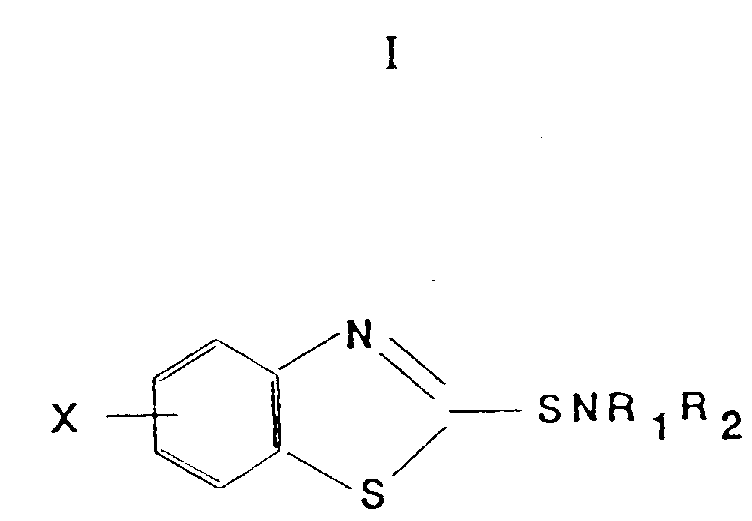 wherein :
 R is up to C10;R1 is H, C1-10 aliphatic, aryl, cycloalkyl or aralkyl ;R2 is C1-10 aliphatic, aryl, cycloalkyl or aralkyl, or combined with R1 forming a heterocyclic group ; andX is hydrogen, halogen, hydroxy, C1-6 alkyl, C1-6 alkoxy.
 - The scorch retardant system of Claim 2 wherein the polyunsaturated monomer is selected from the group of polyfunctional (meth)acrylates and polyallylic monomers.
- The scorch retardant system of Claim 3 wherein the polyunsaturated monomer is a polyacrylic or methacrylic ester of a C2-12 polyol.
- The scorch retardant system of Claim 4 wherein the polyol is C2-8 diol or triol.
- The scorch retardant system of Claim 5 wherein said sulfenamide is selected from the group consisting of N,N-dicyclohexylbenzothiazolesulfenamide ; N,N-diisopropyl-2-benzothiazolesulfenamide ; 2-(4-morpholino)thiobenzo-thiazole (MTB) ; N-t-butyl-2-benzothiazolesulfenamide ; and N-cyclohexyl-2-benzothiazolesulfenamide.
- The scorch retardant system of Claim 1 intended to be used in a peroxide curable elastomer selected from the group consisting of polyisoprene, styrene-butadiene rubbers, polybutadiene, neoprene, butyl, chlorinated polyethylene, ethylene-propylene, and butadiene-acrylonitrile rubbers, and silicone elastomers, or in a peroxide curable ethylene - vinylacetate copolymer.
- The scorch retardant system of Claim 7 wherein the weight parts hydroquinone per 100 weight parts polyfunctional (meth)acrylate are from 0.5 to 5.
- The scorch retardant system of Claim 8 wherein the sulfenamide is present in an amount from 2 to 20 parts per 100 parts by weight polyfunctional (meth)acrylate.
- The scorch retardant system of Claim 9 wherein the sulfenamide is N-t-butylbenzothiazolesulfenamide.
- A curable composition comprising an elastomer or polyethylene or polypropylene or a copolymer containing ethylene units or a copolymer containing propylene units having an abstractable hydrogen atom crosslinkable with a polyfunctional (meth) acrylate, polyfunctional (meth) acrylate, organic peroxide, and a scorch retarding additive which comprises from 0.2 to 6% by weight of hydroquinone based upon said polyfunctional (meth)acrylate and from 1 to 50% by weight of a sulfenamide based upon said polyfunctional (meth)acrylate.
- The curable composition of Claim 11 wherein the sulfenamide is represented by the formulas :and
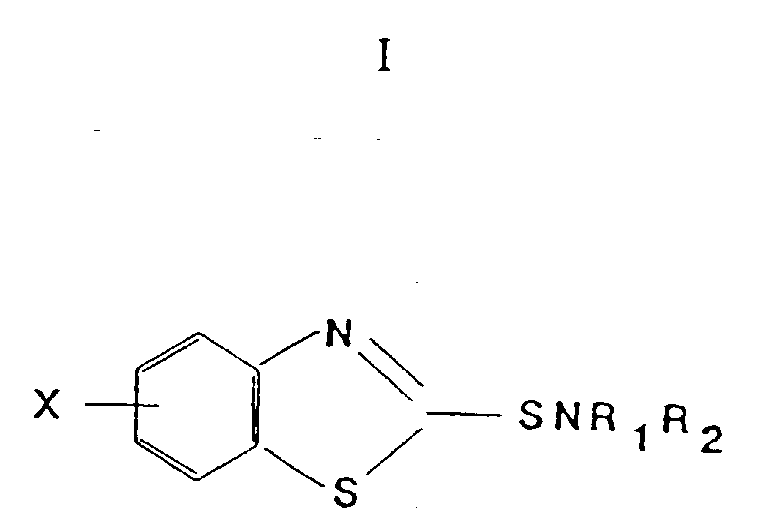 wherein :
 R is up to C10;R1 is H, C1-10 aliphatic, aryl, cycloalkyl or aralkyl ;R2 is C1-10 aliphatic, aryl, cycloalkyl or aralkyl, or combined with R1 forming a heterocyclic group ; and,X is hydrogen, halogen, hydroxy, C1-6 alkyl, C1-6 alkoxy.
 - The composition of Claim 12 wherein the sulfenamide is represented by formula 1 and R1 is hydrogen and R2 is aliphatic.
- The curable composition of Claim 13 wherein the polyfunctional (meth)acrylate is a polyacrylic or methacrylic ester of a C2-12 polyol.
- The curable composition of Claim 14 wherein the polyol is C2-8 diol or triol.
- The curable composition of Claim 15 wherein said sulfenamide is selected from the group consisting of N,N-dicyclohexylbenzothiazolesulfenamide ; N,N-diisopropyl-2-benzothiazolesulfenamide ; 2-(4-morpholino)thiobenzo-thiazole (MTB) ; N-t-butyl-2-benzothiazolesulfenamide; and N-cyclohexyl-2-benzothiazole-sulfenamide.
- The curable composition of Claim 16 wherein the elastomer is selected from the group consisting of polyisoprene, styrene-butadiene rubbers, polybutadiene, neoprene, butyl, chlorinated polyethylene ethylenepropylene, and butadiene-acrylonitrile rubbers, and silicone elastomers, or wherein the copolymer containing ethylene units is ethylene - vinyl acetate copolymer.
- The curable composition of Claim 17 wherein the weight parts hydroquinone per 100 parts polyfunctional (meth)acrylate are from 0.5 to 5.
- The curable composition of Claim 18 wherein the sulfenamide is present in an amount from 2 to 20 parts per 100 weight parts polyfunctional (meth)acrylate.
- The curable composition of Claim 19 wherein the sulfenamide is N-t-butylbenzothiazolesulfenamide.
Applications Claiming Priority (2)
| Application Number | Priority Date | Filing Date | Title |
|---|---|---|---|
| US883333 | 1992-05-14 | ||
| US07/883,333 US5272213A (en) | 1992-05-14 | 1992-05-14 | Scorch retardant polyacrylate elastomers |
Publications (2)
| Publication Number | Publication Date |
|---|---|
| EP0569995A1 EP0569995A1 (en) | 1993-11-18 |
| EP0569995B1 true EP0569995B1 (en) | 1998-12-16 |
Family
ID=25382409
Family Applications (1)
| Application Number | Title | Priority Date | Filing Date |
|---|---|---|---|
| EP93107840A Expired - Lifetime EP0569995B1 (en) | 1992-05-14 | 1993-05-13 | Scorch retardant compositions for peroxide curable elastomers |
Country Status (5)
| Country | Link |
|---|---|
| US (1) | US5272213A (en) |
| EP (1) | EP0569995B1 (en) |
| JP (1) | JP2595442B2 (en) |
| DE (1) | DE69322543T2 (en) |
| ES (1) | ES2076131T3 (en) |
Families Citing this family (16)
| Publication number | Priority date | Publication date | Assignee | Title |
|---|---|---|---|---|
| ITMI960029U1 (en) * | 1996-01-18 | 1997-07-18 | Atochem Elf Italia | PEROXIDE COMPOSITIONS WITH SCORCH RESISTANCE |
| US6277925B1 (en) | 1999-03-18 | 2001-08-21 | Hercules Incorporated | Allyl compounds, compositions containing allyl compounds and processes for forming and curing polymer compositions |
| US6143822A (en) * | 1999-03-18 | 2000-11-07 | Union Carbide Chemicals & Plastics Technology Corporation | Polyethylene crosslinkable composition |
| US6191230B1 (en) * | 1999-07-22 | 2001-02-20 | Union Carbide Chemicals & Plastics Technology Corporation | Polyethylene crosslinkable composition |
| EP1188788A1 (en) * | 2000-09-08 | 2002-03-20 | Borealis Technology Oy | Extrusion of polyolefins |
| US6555019B2 (en) * | 2001-03-22 | 2003-04-29 | Atofina Chemicals, Inc. | Sulfur free, low color generating scorch time extending compositions for use in compounding and cure of free radical initiator curable polymers |
| JP2006219505A (en) * | 2005-01-13 | 2006-08-24 | Daiso Co Ltd | Composition for vulcanizing chlorinated polyethylene |
| ES2311181T3 (en) | 2005-02-28 | 2009-02-01 | Borealis Technology Oy | COMPOSITION POLYMERICA RETARDANTE OF THE COMBUSTION. |
| JP4978919B2 (en) * | 2005-08-30 | 2012-07-18 | 川口化学工業株式会社 | New sulfenamide compounds |
| EP2771397A4 (en) | 2011-10-24 | 2015-06-10 | Bridgestone Americas Tire | Silica-filled rubber composition and method for making the same |
| US10612492B2 (en) | 2017-03-16 | 2020-04-07 | Northrop Grumman Innovation Systems, Inc. | Precursor compositions for an insulation, insulated rocket motors, and related methods |
| US20190120174A1 (en) | 2017-10-25 | 2019-04-25 | Northrop Grumman Innovation Systems, Inc. | Precursor compositions for an insulation, insulated rocket motors, and related methods |
| JP7342481B2 (en) * | 2018-10-09 | 2023-09-12 | 住友ゴム工業株式会社 | adhesive for tennis balls |
| US20220056222A1 (en) * | 2018-12-17 | 2022-02-24 | Arkema France | Multi(meth)acrylate-functionalized resins as co-agents for crosslinking of thermoplastic polymers |
| JP2023521747A (en) * | 2020-04-09 | 2023-05-25 | アーケマ・インコーポレイテッド | Anti-scorch organic peroxide formulation |
| CN114426611B (en) * | 2020-10-29 | 2024-05-24 | 中国石油化工股份有限公司 | Process for adjusting vulcanization performance of butadiene rubber |
Family Cites Families (14)
| Publication number | Priority date | Publication date | Assignee | Title |
|---|---|---|---|---|
| NL274460A (en) * | 1961-02-09 | |||
| NL124035C (en) * | 1961-11-08 | |||
| DE1302645B (en) * | 1963-11-15 | 1900-01-01 | ||
| US3578647A (en) * | 1968-05-06 | 1971-05-11 | Grace W R & Co | Chemical crosslinking scorch preventing additives and process therefor |
| US3751378A (en) * | 1971-03-31 | 1973-08-07 | Sartomer Ind Inc | Inhibiting prevulcanization of rubber with polyfunctional methacrylate monomers as cross-linking coagents with peroxides |
| US3954907A (en) * | 1974-11-27 | 1976-05-04 | Union Carbide Corporation | Composition with selected vinyl compounds and process for avoiding scorching of ethylene polymer composition |
| US3993633A (en) * | 1975-09-11 | 1976-11-23 | Monsanto Company | 2(1(2H)-phthalazinone)sulfenamides vulcanization inhibitors |
| JPS5929921B2 (en) * | 1975-12-12 | 1984-07-24 | ニツポンユニカ− カブシキガイシヤ | Hands-on-the-scenes construction |
| JPS5278254A (en) * | 1975-12-25 | 1977-07-01 | Bridgestone Corp | Vulcanizable rubber composition |
| US4983685A (en) * | 1986-06-10 | 1991-01-08 | Sumitomo Chemical Company, Limited | Methods for production of crosslinked rubber products |
| US4857571A (en) * | 1988-03-03 | 1989-08-15 | Sartomer Company, Inc. | Prevulcanization retardation of free-radical cured rubber |
| US4931508A (en) * | 1988-05-13 | 1990-06-05 | Servus Rubber Company, Inc. | Co-curing of NR/EPDM rubber blends |
| DE3820252A1 (en) * | 1988-06-14 | 1989-12-21 | Luperox Gmbh | COMPOUND COMPOUND MIXTURE AND METHOD OF NETWORKING POLYMERS THROUGH EXTENDING THE SCORING TIME |
| CA2063478A1 (en) * | 1991-03-22 | 1992-09-23 | Michael F. Novits | Scorch extending curing/crosslinking compositions |
-
1992
- 1992-05-14 US US07/883,333 patent/US5272213A/en not_active Expired - Lifetime
-
1993
- 1993-05-13 DE DE69322543T patent/DE69322543T2/en not_active Expired - Fee Related
- 1993-05-13 EP EP93107840A patent/EP0569995B1/en not_active Expired - Lifetime
- 1993-05-13 ES ES93107840T patent/ES2076131T3/en not_active Expired - Lifetime
- 1993-05-13 JP JP5111540A patent/JP2595442B2/en not_active Expired - Fee Related
Also Published As
| Publication number | Publication date |
|---|---|
| JP2595442B2 (en) | 1997-04-02 |
| ES2076131T1 (en) | 1995-11-01 |
| US5272213A (en) | 1993-12-21 |
| EP0569995A1 (en) | 1993-11-18 |
| DE69322543T2 (en) | 1999-07-15 |
| DE69322543D1 (en) | 1999-01-28 |
| JPH06157824A (en) | 1994-06-07 |
| ES2076131T3 (en) | 1999-05-01 |
Similar Documents
| Publication | Publication Date | Title |
|---|---|---|
| US5272213A (en) | Scorch retardant polyacrylate elastomers | |
| US4857571A (en) | Prevulcanization retardation of free-radical cured rubber | |
| Dluzneski | Peroxide vulcanization of elastomers | |
| US4720526A (en) | Cured rubber compositions of high modulus | |
| CA2068924C (en) | Hydrogenated nitrile vulcanizates | |
| US2989504A (en) | Vulcanization of polymer with nu, nu'-bismaleimides and compositions thereof | |
| US5245084A (en) | Mixture suited for crosslinking polymers and process for crosslinking polymers with extension of scorch time | |
| JP3182199B2 (en) | Scorch delayed cure / crosslinker composition | |
| US4990570A (en) | Curable rubber composition | |
| CA2081707A1 (en) | Triazine reinforcement and curing of hydrogenated acrylonitrile butadiene rubber | |
| US5310811A (en) | Free radical cured rubber employing acrylate or methacrylate esters of hydroxybenzene and hydroxynaphthalene compounds as co-curing agents | |
| EP1981916B1 (en) | Polybutadiene compositions, methods and articles | |
| JPH09504323A (en) | Vulcanizable elastomer compound | |
| JP2855875B2 (en) | Crosslinkable composition of ethylene polymer and crosslinking method | |
| US5554699A (en) | Method of curing rubbers without forming nitrosamines | |
| US4412043A (en) | Vulcanizable ethylene copolymers | |
| JPH0412739B2 (en) | ||
| JPS63278948A (en) | Rubber composition modified with benzimidazolinone | |
| EP1081188B1 (en) | Improved polymer composition and process for production vulcanizates thereof | |
| US2822353A (en) | Vulcanizable rubber composition and process | |
| US3301826A (en) | Vulcanizate of sulfur vulcanizable rubber with nu-maleimide derivatives | |
| JPH03285928A (en) | Rubber composition | |
| US4104329A (en) | Acrylate-modified ethylene-vinyl acetate polymer | |
| WO1997001597A1 (en) | Improved phenolic scorch retarders | |
| EP0630937A1 (en) | Curing system for polyacrylate rubbers |
Legal Events
| Date | Code | Title | Description |
|---|---|---|---|
| PUAI | Public reference made under article 153(3) epc to a published international application that has entered the european phase |
Free format text: ORIGINAL CODE: 0009012 |
|
| AK | Designated contracting states |
Kind code of ref document: A1 Designated state(s): BE DE ES FR GB IT NL SE |
|
| 17P | Request for examination filed |
Effective date: 19940513 |
|
| RAP1 | Party data changed (applicant data changed or rights of an application transferred) |
Owner name: CRAY VALLEY SA |
|
| REG | Reference to a national code |
Ref country code: ES Ref legal event code: BA2A Ref document number: 2076131 Country of ref document: ES Kind code of ref document: T1 |
|
| 17Q | First examination report despatched |
Effective date: 19960311 |
|
| GRAG | Despatch of communication of intention to grant |
Free format text: ORIGINAL CODE: EPIDOS AGRA |
|
| GRAG | Despatch of communication of intention to grant |
Free format text: ORIGINAL CODE: EPIDOS AGRA |
|
| GRAG | Despatch of communication of intention to grant |
Free format text: ORIGINAL CODE: EPIDOS AGRA |
|
| GRAH | Despatch of communication of intention to grant a patent |
Free format text: ORIGINAL CODE: EPIDOS IGRA |
|
| GRAH | Despatch of communication of intention to grant a patent |
Free format text: ORIGINAL CODE: EPIDOS IGRA |
|
| GRAA | (expected) grant |
Free format text: ORIGINAL CODE: 0009210 |
|
| AK | Designated contracting states |
Kind code of ref document: B1 Designated state(s): BE DE ES FR GB IT NL SE |
|
| REF | Corresponds to: |
Ref document number: 69322543 Country of ref document: DE Date of ref document: 19990128 |
|
| ITF | It: translation for a ep patent filed | ||
| ET | Fr: translation filed | ||
| REG | Reference to a national code |
Ref country code: ES Ref legal event code: FG2A Ref document number: 2076131 Country of ref document: ES Kind code of ref document: T3 |
|
| PLBE | No opposition filed within time limit |
Free format text: ORIGINAL CODE: 0009261 |
|
| 26N | No opposition filed | ||
| REG | Reference to a national code |
Ref country code: GB Ref legal event code: IF02 |
|
| PGFP | Annual fee paid to national office [announced via postgrant information from national office to epo] |
Ref country code: DE Payment date: 20020522 Year of fee payment: 10 |
|
| PGFP | Annual fee paid to national office [announced via postgrant information from national office to epo] |
Ref country code: FR Payment date: 20020530 Year of fee payment: 10 |
|
| PGFP | Annual fee paid to national office [announced via postgrant information from national office to epo] |
Ref country code: SE Payment date: 20030507 Year of fee payment: 11 Ref country code: GB Payment date: 20030507 Year of fee payment: 11 |
|
| PGFP | Annual fee paid to national office [announced via postgrant information from national office to epo] |
Ref country code: ES Payment date: 20030529 Year of fee payment: 11 |
|
| PGFP | Annual fee paid to national office [announced via postgrant information from national office to epo] |
Ref country code: NL Payment date: 20030530 Year of fee payment: 11 |
|
| PGFP | Annual fee paid to national office [announced via postgrant information from national office to epo] |
Ref country code: BE Payment date: 20030725 Year of fee payment: 11 |
|
| PG25 | Lapsed in a contracting state [announced via postgrant information from national office to epo] |
Ref country code: DE Free format text: LAPSE BECAUSE OF NON-PAYMENT OF DUE FEES Effective date: 20031202 |
|
| PG25 | Lapsed in a contracting state [announced via postgrant information from national office to epo] |
Ref country code: FR Free format text: LAPSE BECAUSE OF NON-PAYMENT OF DUE FEES Effective date: 20040130 |
|
| REG | Reference to a national code |
Ref country code: FR Ref legal event code: ST |
|
| PG25 | Lapsed in a contracting state [announced via postgrant information from national office to epo] |
Ref country code: GB Free format text: LAPSE BECAUSE OF NON-PAYMENT OF DUE FEES Effective date: 20040513 |
|
| PG25 | Lapsed in a contracting state [announced via postgrant information from national office to epo] |
Ref country code: SE Free format text: LAPSE BECAUSE OF NON-PAYMENT OF DUE FEES Effective date: 20040514 Ref country code: ES Free format text: LAPSE BECAUSE OF NON-PAYMENT OF DUE FEES Effective date: 20040514 |
|
| PG25 | Lapsed in a contracting state [announced via postgrant information from national office to epo] |
Ref country code: BE Free format text: LAPSE BECAUSE OF NON-PAYMENT OF DUE FEES Effective date: 20040531 |
|
| BERE | Be: lapsed |
Owner name: S.A. *CRAY VALLEY Effective date: 20040531 |
|
| PG25 | Lapsed in a contracting state [announced via postgrant information from national office to epo] |
Ref country code: NL Free format text: LAPSE BECAUSE OF NON-PAYMENT OF DUE FEES Effective date: 20041201 |
|
| EUG | Se: european patent has lapsed | ||
| GBPC | Gb: european patent ceased through non-payment of renewal fee |
Effective date: 20040513 |
|
| NLV4 | Nl: lapsed or anulled due to non-payment of the annual fee |
Effective date: 20041201 |
|
| PG25 | Lapsed in a contracting state [announced via postgrant information from national office to epo] |
Ref country code: IT Free format text: LAPSE BECAUSE OF NON-PAYMENT OF DUE FEES Effective date: 20050513 |
|
| REG | Reference to a national code |
Ref country code: ES Ref legal event code: FD2A Effective date: 20040514 |